
Breed profile
Central Asian Shepherd Dog (Alabai): The Complete India Guide
A 50 kg minimum livestock guardian whose FCI standard sets no upper weight at all, whose ears are cropped in almost every photograph you will be shown, and which Indian law forbids you to crop.
Quick answer
The Central Asian Shepherd Dog, or Alabai, is a Central Asian livestock guardian recognised as FCI standard 335, with males standing at least 70 cm and weighing at least 50 kg. Its standard sets no maximum weight at all. Indian sellers price it from Rs 30,000 to Rs 6,00,000, a twentyfold spread. Almost every photograph shows cropped ears, which Second Schedule Part II paragraph 6(8) of India's 2017 breeding rules strictly forbids.
This page summarises published veterinary research and registry data for general information. It is not a diagnosis and it is not treatment advice. Consult a registered veterinarian about your own dog before acting on anything here, and treat a rectal temperature at or above 41.0 degrees Celsius, a distended painful abdomen with unproductive retching, or sudden collapse in a large dog as an emergency.
Central Asian Shepherd Dog at a glance
What the Central Asian Shepherd Dog is, and what FCI-335 actually says
The Central Asian Shepherd Dog is a very large livestock guardian from the belt of country running from the Caspian Sea to China, recognised by the Federation Cynologique Internationale as standard number 335 under the Russian name Sredneaziatskaya Ovtcharka, in Group 2, Section 2.2 Molossoid Breeds Mountain type, without working trial.
Read the register entry rather than the marketing. FCI-335 was accepted on a definitive basis on 25 January 1989, which makes it a fully recognised breed rather than a provisional one, and the nomenclature record names the country of origin as the Russian Federation while the standard document itself says ORIGIN: USSR (Regions of Central Asia) with PATRONAGE: Russia Federation Cynologique Internationale. Those two lines are not the same claim, and the gap between them is the whole political story of this breed compressed into a form field. The dog is Central Asian. The paperwork is Russian.
The standard's own history section says the breed formed by natural selection over more than four thousand years across territory that "spreads nowadays from the Caspian Sea to China and from Southern Ural to Afghanistan", was used to protect cattle, caravans and the owner's dwellings, and that work with the breed started in the USSR in the 1930s. So the animal is ancient and the breed, as a registered thing with a studbook, is about ninety years old.
The register also records what the breed is for. FCI-335's UTILIZATION line reads simply "Guard and watch dog";, and the AKC files it under the Working Group designation. A guard dog is what both registries think they are describing, and a guard dog is what an Indian buyer is being sold.
The measurements, exactly as printed
FCI-335 gives minimum figures and no maximum figures. Males are minimum 70 cm at the withers and females minimum 65 cm. Weight is males minimum 50 kg, females minimum 40 kg, followed by the line "Large size desirable, but proportional constitution must remain". There is no upper limit anywhere in the document, which is unusual and which matters enormously once you start reading Indian sale listings.
Say that precisely, because it is the fact this page returns to most often: the standard states a body weight floor and no body weight ceiling at all.
| Measure | FCI-335 (13.10.2010) | UKC (revised 2 January 2023) |
|---|---|---|
| Male height | Minimum 70 cm | 27.5 inches or over (69.9 cm) |
| Female height | Minimum 65 cm | 25.5 inches or over (64.8 cm) |
| Male weight | Minimum 50 kg | No figure. 'Weight should be in proportion to the height' |
| Female weight | Minimum 40 kg | No figure |
| Maximum of any kind | None given | None given |
| Group | Group 2, Molossoid, Mountain type | Guardian Dog Group |
Two registries, two documents, and between them exactly two weight numbers, both of them floors. Anyone quoting you a tidy adult weight range for this breed is quoting something other than a breed standard.
Appearance in the standard's own words
The body is "moderately long (neither long nor short in body)", robust and muscular, "voluminous, but not with visible muscles", and the length of body only slightly exceeds the height at the withers. Sexual dimorphism is clearly defined, with males more massive and more courageous than females, larger in head and more pronounced in withers. The standard then adds the single most important sentence for anyone buying a puppy: full maturity is reached by the age of 3 years.
The head is massive and close to rectangular seen from above and from the side, with a flat forehead, a moderately defined stop and a blunt muzzle of moderate length whose length is less than half and more than a third of the length of the head. That proportion is why the breed is classified mesocephalic rather than brachycephalic, a classification confirmed independently in the supplementary data of a 584,734-dog UK longevity study. It is the single most favourable thing about this dog in an Indian climate, and we return to it in the [heat section](#heat-band).
Coat is abundant, straight and coarse over a well developed undercoat, in two lengths: 3 to 5 cm covering the whole body, or 7 to 10 cm forming a mane on the neck, feathers behind the ears and on the back of the limbs and tail. Colour is "Any, except genetic blue and genetic brown in any combination and black mantel on tan";. There is no fashionable colour in this breed because the standard permits nearly all of them.
The permitted coat colours are therefore almost the whole range, and the two exclusions are genetic rather than aesthetic.
The standard says the skin is "Thick, sufficiently elastic loose lying to prevent injuries if in combat with predators". A breed standard that specifies skin thickness by reference to fighting wolves is telling you plainly what the animal is for. It is not a large family pet with a guarding hobby.
Recognition status: four registries, four different answers
The Central Asian Shepherd Dog is fully recognised by the FCI, fully recognised by the UKC, and not fully recognised by the American Kennel Club, which has recorded it in the Foundation Stock Service since 1996 and no further United Kennel Club American Kennel Club.
Every one of those statements was checked against the register itself rather than inferred, because recognition claims are the single most repeated error in breed writing and a seller's "internationally recognised" tells you nothing about which body recognises what.
| Registry | Status | Since | Group / classification |
|---|---|---|---|
| FCI | Recognized on a definitive basis | 25 January 1989 | Group 2, Section 2.2 Molossoid, Mountain type, without working trial |
| United Kennel Club | Fully recognised, own standard | Standard copyright 2001, revised 2 January 2023 | Guardian Dog Group |
| American Kennel Club | Foundation Stock Service only, not fully recognised | Recorded in FSS since 1996 | Assigned Working Group designation |
| AKC events | Eligible for Companion Events | 1 January 2010 | Not eligible for AKC conformation championships |
| Kennel Club of India | Could not be verified, see below | n/a | n/a |
The AKC line deserves emphasis because Indian sellers routinely borrow AKC branding. The AKC's own breed page carries the banner "Foundation Stock Service" and its Did You Know panel states that the breed "has been recorded in the Foundation Stock Service since 1996" and "has been approved to compete in AKC Companion Events since January 1, 2010";. Thirty years in the waiting room is not recognition. It is the AKC's holding register for breeds with too small a population to sustain a national breed club and a closed studbook.
The Kennel Club of India question, and why we cannot answer it
We could not verify whether the Kennel Club of India registers this breed, and we are saying so rather than guessing. The KCI is an FCI member in good standing: the FCI publishes its annual returns, which show 32,219 puppies registered with the studbook and the appendix in 2025, 7,412 litters, 126 CAC all-breed shows, and a cumulative 1,425,001 pure-bred dogs registered with the studbook since its creation. That is a real, working registry.
What we could not do is read its breed list. The domain kciindia.org did not resolve to any address on 25 August 2026, and the Internet Archive holds no snapshot of it at all, while fci.be, awbi.gov.in, apnews.com and dgft.gov.in all resolved and returned documents in the same session. So this is a genuine dead end rather than a broken network, and it has a direct consequence for buyers, covered in the [price section](#price): an Indian seller charging a Rs 1,00,000 premium for a "KCI Registered" Alabai is charging for a document the buyer cannot independently look up either.
What 'without working trial' means here
The FCI files this breed without working trial, which is the register's formal way of saying no working qualification is required before a dog may be awarded a conformation title. That is worth knowing because the breed's reputation rests entirely on working ability. Wikipedia's article asserts that "Central Asians from pure show lines are very rare, because most registries require working tests prior to breeding";. The FCI, the largest registry involved, requires no such thing. Treat any claim that a pedigree guarantees working temperament as unsupported.
These are two different FCI breeds from two different regions, and the confusion is actively dangerous because the Caucasian Shepherd Dog carries the shortest median lifespan in a 155-breed UK study, at 5.4 years with a hazard ratio of 2.44. That figure belongs to the other dog. The Central Asian Shepherd Dog was excluded from that study's survival analysis entirely, and we set out exactly what its supplementary tables say in the [lifespan section](#lifespan).
Alabai, Ovtcharka, Tobet: are the Turkmen and FCI dogs the same animal?
The Turkmen Alabai and the FCI's Sredneaziatskaya Ovtcharka are the same breed population under two names and two registers, and the FCI recognises only one of them, with Russia as the stated country of origin rather than Turkmenistan.
The naming is genuinely confusing, and sellers exploit the confusion in both directions: a Turkmen name to imply an exotic import, or a Russian name to imply an FCI pedigree. Here is what each name is.
| Name | Language or register | What it denotes |
|---|---|---|
| Sredneaziatskaya Ovtcharka | Russian, and the FCI's official breed name | FCI standard 335, the only internationally registered form |
| Central Asia Shepherd Dog | The FCI's English rendering, published 9 February 2011 | The same breed, same standard, same number |
| Central Asian Shepherd Dog | AKC and UKC usage | The same breed, in the AKC's Foundation Stock Service and the UKC's Guardian Dog Group |
| Alabai, Alabay | Turkmen, and general Central Asian usage | The same dog. Defined in Turkmen statute as created by Turkmen folk selection |
| Turkmen Alabai | Turkmen national designation | A state-registered national population with no separate FCI standing |
| Tobet | Kazakh | The Kazakh regional name for the aboriginal type |
| Volkodav | Russian, literally wolf-crusher | A working nickname, not a register term |
Wikipedia lists the alternative names as Alabai, Boribasar, Tobet, Chuponi, Central Asian Ovcharka and Volkodav, which is a reasonable summary of the regional usage and is not a registry claim. Reuters glosses the working nickname directly: the breed "is known as 'wolf crusher' for its prowess in guarding sheep and goats";.
One breed, or one name over many populations?
The standard itself concedes that the registered breed is a formalisation of something broader. FCI-335 says the dogs "were formed as a breed from natural selection during more than four thousand years" across territory from the Caspian to China, and that "The work with the breed started in the USSR in the 1930s";. Everything before the 1930s is a landrace; everything after is a studbook.
Genetics supports that reading. A 2024 whole-genome and microsatellite study of the Kazakh Tobet, covering 97 dogs from three Kazakhstan regions plus 10 from Bayan-Ulgii in Mongolia and whole genomes from 45 dogs, states that "the Central Asian Shepherd Dog is an established breed that originated from several indigenous populations in Central Asia in the 20th century", and suggests "the Kazakh Tobet may have been one of these ancestral forms, as well as the Akbash".
The same study found that its own Tobet samples clustered with the Central Asian Shepherd Dogs and the Akbash, and reported plainly that "the Kazakh Tobet dogs were not grouped as a separate breed";. It also notes the "extremely low genetic differentiation in the Asian LGDs" previously demonstrated across the Caucasian Shepherd, the Central Asian Shepherd and the Turkish Akbash and Kangal. Read that as a warning about regional names generally: the dogs across this belt are closely related, and a national label is not a genetic boundary.
Wikipedia's own article makes the same point less formally, saying the breed "comprises numerous breed types" that "differ in size, color, head types, and hair types", and that these features "give grounds for complications with breed standard";. It also states that "purebred dogs only remained with herders, breed enthusiasts and farms, with a surfeit of crosses elsewhere";. Treat that as the encyclopedia's own summary rather than as a study, because it cites none.
Modern Molosser describes the breed as "a molossoid breed that was developed on a vast Asian territory, including Turkmenistan, Tajikistan, Kazakhstan" and neighbouring countries, which is consistent with a landrace spread across borders rather than a national breed. The UKC standard's history section names the countries where working dogs are still found today as Afghanistan, Iran, Kazakhstan, Kirgyzstan, Tadjikistan, Turkmenistan, and Uzbekistan.
Why the origin field says Russia
The FCI's country-of-origin field for standard 335 reads RUSSIAN FEDERATION, and the standard document itself reads ORIGIN: USSR (Regions of Central Asia) with PATRONAGE: Russia Federation Cynologique Internationale. That is a statement about who did the studbook work in the 1930s and who holds the standard now, not about where the dog is from. All five Central Asian republics named in the UKC's history were Soviet republics in the 1930s, so the FCI field records the state that existed when the register opened.
Turkmenistan's answer to this has been to build a parallel national register rather than to seek FCI recognition of a separate Turkmen breed, and its own law frames the Association's role as glorifying and protecting an existing national gene pool rather than as creating a new breed.
Alabai and Central Asian Shepherd Dog name the same dog, and an Indian seller using both names in one listing is not being inconsistent. What matters is whose paperwork sits behind the animal: an FCI-lineage pedigree, a Turkmen state pedigree, a claimed Kennel Club of India registration, or nothing at all. Those are four different things, they carry four different levels of verifiability, and the [price section](#price) shows one Indian seller charging Rs 1,00,000 to move between two of them.
Turkmenistan, the Alabai and the state: what it amounts to in registry terms
Turkmenistan treats the Alabai as a national symbol backed by real statute, a state pedigree book, a national holiday and a presidentially-headed association, and none of that gives it any standing in international registry terms, because Turkmenistan is not an FCI full member, associate member or contract partner Federation Cynologique Internationale.
That two-part answer is the honest one, and both parts matter. The Turkmen apparatus around this dog is not decorative. It is also not connected to the register that decides what a pedigree is worth outside the country.
What the Turkmen state has actually done, with dates
| Date | Action | Source read |
|---|---|---|
| 11 October 2017 | President Berdymukhamedov presents Vladimir Putin with an Alabai puppy at Sochi, named Verny | Voice of America |
| 1 May 2020 | Turkmen alabay itleri Association established | Government of Turkmenistan portal |
| 31 August 2020 | Constituent international online meeting, about 200 delegates, 25 representatives admitted from ten countries | Embassy of Turkmenistan, Ankara |
| 13 November 2020 | A 15-metre gilded Alabai statue unveiled on an Ashgabat roundabout | Reuters, and AFP for the height |
| 26 February 2021 | Decree in the Neutral Turkmenistan newspaper creating a state holiday for the breed | Agence France-Presse |
| 13 March 2021 | Law No. 333-VI establishing the honorary title Turkmenistanyn at gazanan itsynasy for dog breeders | Mejlis of Turkmenistan |
| 24 July 2022 | Law On dog breeding and cynological activity | Mejlis of Turkmenistan |
| 26 July 2022 | That law takes effect: pedigree-book marking, dog passports, special government export permission | Associated Press |
| From 2022 | The national Alabai holiday is observed on the last Sunday of October | Government of Turkmenistan portal |
Two corrections belong on the record here, because both errors circulate widely. First, there is no Turkmen law called "On the Turkmen Alabai dog". The two real instruments are the March 2021 honorary-title law and the July 2022 breeding law Mejlis of Turkmenistan. Second, the statue was unveiled in November 2020, not 2021; the AP report saying "last year" was filed in 2022 and is wrong on that point, while Reuters dated the unveiling to 13 November 2020 Associated Press.
The Association's own founding record is worth reading before you treat it as an international body. Turkmen state media reports that the "Turkmen alabay itleri Association has been established in May 2020", and the Embassy of Turkmenistan in Ankara records that its constituent online meeting on 31 August 2020 was attended by about 200 delegates, at which "the Charter of the organization was adopted and 25 representatives were accepted into the membership of the Association" from Armenia, Belarus, Georgia, Iran, China, Russia, Turkey, France, Uzbekistan and Ukraine Embassy of Turkmenistan in Ankara. Twenty-five individual members from ten countries is a genuine international association of enthusiasts. It is not a kennel-club federation, and it does not issue pedigrees any FCI member must honour.
The holiday moved too. AFP reported in February 2021 that the dog would "share a holiday on the last Sunday of April with the Akhal-Teke horse";. By October 2022 Turkmen state media was announcing that "On the last Sunday of October, our country will celebrate one of the holidays in the national calendar, the Day of the Turkmen Alabai";. We could not find the instrument that moved it, and we are not going to invent one.
The law defines the breed, and the definition is national rather than international
Article 1(5) of the 2022 law defines its subject in the original Russian as "туркменские собаки алабаи, породистые собаки, созданные на протяжении многих веков туркменской народной селекцией";, that is, pedigree dogs created over many centuries by Turkmen folk selection. Article 13 permits selection and breeding work to be carried out by the International Association, and Article 16(1) makes the Association's principal aim "the glorification in the world of Turkmen alabai dogs, the protection of the gene pool and the increase of their numbers";.
Then comes the sentence that settles the registry question. Article 16(3) says the Association may be a member of an international organisation in the field of dog breeding. Permission, not fact. A statute does not grant itself the power to join a body it has already joined.
Turkmenistan and the FCI: not a member, not an associate, not a contract partner
Turkmenistan holds no FCI affiliation of any kind, so a Turkmen state pedigree connects to no international studbook, while neighbouring Kazakhstan got the Kazakh Tazy onto the FCI provisional register on 3 September 2024 Federation Cynologique Internationale.
The FCI side, checked directly
Turkmenistan appears on no FCI membership list, and we checked all three lists ourselves rather than taking it on trust. The FCI publishes 79 full members, 10 associate members and 12 contract partners, and Turkmenistan appears in none of the three. The twelve contract partners are Albania, Bulgaria, Ghana, Iran, Jordan, Kuwait, Lebanon, Madagascar, Myanmar, Nigeria, Tunisia and the United Arab Emirates.
The neighbours are the point. Kazakhstan and the Russian Federation are full members, and Uzbekistan and Kirghizistan are associate members, so every surrounding country with an Alabai population is inside the federation and Turkmenistan is not. That absence is a choice rather than an accident of geography, and the neighbouring case proves it. The FCI's provisional register carries KAZAKH TAZY (372), accepted 3 September 2024, so a Central Asian state can and did get a native breed recognised on its own account. Turkmenistan has not.
A Turkmen state pedigree is a real document issued by a real register that no FCI member, including the Kennel Club of India, is obliged to recognise, because Turkmenistan has no FCI affiliation through which the two studbooks connect Mejlis of Turkmenistan. Add the export side: since 26 July 2022 an Alabai leaving Turkmenistan needs a government passport and special government export permission. A dog offered in India as Turkmen-bred should come with both, and the seller should be able to show you the export permission, not just the pedigree.
Ear cropping and tail docking: what FCI-335 actually says, word for word
FCI-335 describes the natural ear and the natural tail first, then adds that the traditional cropping and docking "is still practiced in country of origin and in countries where it is not prohibited by law", and it grants equal value to a natural tail while saying nothing equivalent about a natural ear.
That asymmetry is the finding, and it is invisible unless you read the two paragraphs side by side. Here they are, transcribed from our own extraction of the standard PDF rather than from any summary.
| Clause | Verbatim text |
|---|---|
| EARS | "Medium sized, triangular shape, thick, low set and hanging. Lower part of ear base is level with, or slightly below the eyes. Traditional ear-cropping, in the fashion illustrated on the cover, is still practiced in country of origin and in countries where it is not prohibited by law." |
| TAIL | "Thick at the base and set fairly high. The natural tail is carried in a sickle curve or curled in a loose ring that begins at the last third of the tail. When alert the tail rises to the line of back or slightly above. Hanging at rest. Traditional tail docking, in the fashion illustrated on the cover, is still practiced in country of origin and in countries where it is not prohibited by law. Natural tail is of equal value to a docked tail." |
Count the sentences. The tail clause gets one extra: "Natural tail is of equal value to a docked tail." The ear clause has no counterpart. A judge reading FCI-335 literally has been told, in writing, that an undocked tail must not be penalised, and has been told nothing at all about whether an uncropped ear must not be penalised.
Two things follow, and both matter to an Indian buyer. First, the FCI standard is not neutral marketing copy: it is the reason the illustration on the cover of the standard shows a cropped dog, and the reason the phrase "in the fashion illustrated on the cover" appears twice. Second, the drafting means this breed is one of the minority whose FCI standard still makes explicit reference to cropped ears and a docked tail, which turns out to decide whether such a dog may be exhibited at all. That is the subject of the [next section](#fci-show-rule).
The UKC drafted the same two clauses differently
The United Kennel Club's standard, revised 2 January 2023, is worth reading beside the FCI text because it makes the neutral choice explicitly in both places. Its ear clause reads "Ears may be cropped or uncropped. Uncropped, the ears are small, pendent, triangular, and set at or below eye level", and its tail clause reads "The tail is set on high and may be docked close to the body or natural";. No "traditional", no cover illustration, no asymmetry between the two.
The UKC also gives the best available description of what an undocked tail should look like on this breed, which the FCI covers more briefly: "An undocked tail is thick at the base, and tapering to the tip. When the dog is in repose, the tail just reaches to the hock, with the bottom third of the tail forming a hook. When the dog is in action or excited, the tail is carried as a sickle-shaped hook or ring above the level of the back";. Its General Appearance paragraph likewise says the ears "are normally cropped close to the head but are naturally small, drop, and set low on the head".
So on the two documents that actually define this breed, the natural ear is small, triangular, thin-set, dropped and carried at or below eye level, and the natural tail is thick-based, reaches the hock at rest and hooks or rings above the back when the dog is roused. Those are the shapes you are looking for, and the [uncropped appearance section](#uncropped-appearance) turns them into something you can check on a doorstep.
Wikipedia's own general-appearance paragraph states that the ears "are, in practice, cropped very short, and the tail is docked moderately long (except for dogs from countries where cosmetic surgeries for dogs are illegal)";. One of the two Indian pages ranking for this breed illustrates it with images whose own alt text reads "with cropped ears", twice. You are not imagining the pattern. The photographic record of this breed is a record of a surgical convention, not of the animal's anatomy.
Can a cropped Alabai be shown? The rule changed on 1 January 2025, and this breed sits on the safe side of it
A cropped or docked Central Asian Shepherd Dog may still be shown at FCI conformation events in countries where cropping and docking are not banned, because the 1 January 2025 prohibition applies only to breeds whose FCI standards make no reference to cropped ears or a docked tail, and FCI-335 makes that reference twice Federation Cynologique Internationale.
This is the question the brief needed settling, and it took two FCI communications rather than one, published five years apart.
The 2016 decision: laws of the country are the highest authority
On 7 March 2016 the FCI General Committee published a two-limb decision after several countries of origin amended their own standards. Limb one: in countries where a ban on showing cropped or docked dogs exists, "the laws of the country being the highest authority, there is no possibility to show, at FCI sanctioned events, cropped/docked dogs of breeds customarily cropped/docked". Limb two: in countries where no ban exists, such dogs "can be shown without any restriction, whether cropped/docked or not", and "there cannot be any discrimination, from the judges, between cropped and non-cropped dogs and between docked and non-docked dogs".
The document closes with a hard expiry: "This measure applies from the date of its publication until December 31st, 2024";. It was a nine-year transitional reprieve, dated on its face.
The 2021 reminder: what actually expired
On 22 December 2021, further to its online meeting of 24 November 2021, the FCI General Committee gave notice that effective from 1 January 2025, dogs with cropped ears or a docked tail "belonging to breeds for which no reference is made to the cropped ears/docked tail in the FCI breed standards, will not be allowed anymore to be shown in any conformation event where the FCI breed standards are used". It also told organisers to find a way of learning the anatomy of entered dogs in advance, "for example via the entry form".
The notice then lists the breeds concerned. There are eleven, and every one of them is a German or Italian breed whose national standard had been rewritten to delete the cropping and docking language.
| FCI number | Breed |
|---|---|
| 143 | Dobermann |
| 144 | Deutscher Boxer |
| 147 | Rottweiler |
| 181 | Riesenschnauzer |
| 182 | Schnauzer |
| 183 | Zwergschnauzer |
| 184 | Deutscher Pinscher |
| 185 | Zwergpinscher |
| 197 | Mastino Napoletano |
| 235 | Deutsche Dogge |
| 343 | Cane Corso Italiano |
335 is not on that list. It is not on it because the Central Asian Shepherd Dog's standard was never rewritten: the text still valid today, published 13 October 2010, still says traditional ear-cropping and traditional tail docking are "still practiced in country of origin and in countries where it is not prohibited by law". The eleven breeds lost the exemption because their own countries of origin took the sentence out. This breed kept it because Russia did not.
What that means in practice, in three lines
- In a country that bans the procedures, a cropped or docked Alabai cannot be shown at an FCI event, because national law overrides the standard.
- In a country that does not ban them, a cropped or docked Alabai can be shown, and a judge may not discriminate between it and a natural dog in either direction.
- The 1 January 2025 change did not touch this breed, because it bites only where the standard is silent, and FCI-335 is not silent Federation Cynologique Internationale.
The FCI rule turns on whether the show's country bans the procedure. India does prohibit ear cropping and tail docking, in terms set out in the [next section](#indian-law-cropping). So a cropped dog is a dog whose appearance was created by an act Indian law forbids, sold into a country whose own rules forbid it, carrying a standard from a body that permits it elsewhere. That is not a technicality. It is the reason a seller can show you a cropped dog and a certificate in the same hand and neither of them is lying.
Indian law on cropped ears: Second Schedule Part II paragraph 6(8), quoted in full
Indian law strictly forbids ear cropping and tail docking on a pup, in Second Schedule Part II paragraph 6(8) of the Prevention of Cruelty to Animals (Dog Breeding and Marketing) Rules, 2017, notified as G.S.R. 496(E) on 23 May 2017.
We extracted the gazette ourselves rather than trusting any summary, because this document has repeatedly been paraphrased into rule numbers that do not exist. The file is fourteen pages with a working text layer of 51,940 extractable characters. Here is the provision as printed.
"There shall be no tail docking, ear cropping de-barking, de-clawing, branding, dyeing, injecting substances to enhance visual appeal, performing a surgery or procedure to camouflage or hide any defect or infirmity or any other kind of mutilation of any body part of the pup and any change of appearance by artificial means is strictly forbidden.";
Three details in that sentence carry weight and are usually lost in paraphrase. It names ear cropping and tail docking first and by name, so there is no argument about whether a general cruelty provision reaches them. It closes with the sweeping words "any change of appearance by artificial means", which catches procedures nobody thought to name. And it is drafted as an absolute, "strictly forbidden", with no exception for breed standards, tradition, working use or the country of origin.
Where the paragraph sits, and why the number confuses people
The numbering is genuinely awkward and worth stating precisely so a reader can look it up. The Second Schedule carries the header "[See rules 5(2) and 6]", which is why some writers report the clause as 5(8). It is not. Within the Second Schedule, Part II is headed "GENERAL REQUIREMENTS TO BE ADHERED TO BY BREEDERS", and it contains paragraph 5 ("Breeding requirements") and paragraph 6 ("Common breeding techniques"). The cropping prohibition is sub-paragraph (8) of paragraph 6.
It is also worth knowing that paragraph 6 is an odd home for it. Sub-paragraphs 6(1) to 6(3) are about out breeding, line breeding, in breeding and incest breeding; 6(4) to 6(7) are about the age and record-keeping of breeding females; then 6(8) prohibits mutilation and 6(9) prohibits "Breeding to create new breeds of dogs or unusual looks". The drafter appears to have treated cosmetic surgery as a breeding-practice question rather than a veterinary one.
| Provision | Where it lives | What it says |
|---|---|---|
| Ear cropping and tail docking forbidden | Second Schedule, Part II, para 6(8) | "strictly forbidden", along with de-barking, de-clawing, branding, dyeing and any change of appearance by artificial means |
| Father-to-daughter and sibling matings forbidden | Second Schedule, Part II, para 6(3) | In breeding within the first four generations and incest breeding are "not permitted and are prohibited" |
| Breeding for unusual looks forbidden | Second Schedule, Part II, para 6(9) | "Breeding to create new breeds of dogs or unusual looks shall be strictly prohibited" |
| Genetic-defect testing mandatory | Second Schedule, Part III, para 8(10) | Names hip dysplasia, progressive retinal atrophy, night blindness, hypothyroidism, entropion, ectropion and cryptorchidism |
| No sale under eight weeks | Rule 8(1)(a), a Rule not a Schedule paragraph | "pups less than eight weeks in age are not sold" |
| Sterilisation over six months | Rule 8(1)(b) | Dogs over six months are not sold without first being sterilised, unless sold to another licensed breeder |
Note the distinction in that table between a Rule and a Second Schedule paragraph, because it is the commonest citation error on this subject. Rule 8 is "Conditions for sale". Second Schedule Part III paragraph 8 is "Veterinary care". They are two different things numbered the same, and quoting one while meaning the other sends any reader who checks to the wrong page.
Rule 6 of the Rules proper is what gives the Second Schedule its force: "Requirements to be met by breeders and establishments used for breeding or housing dogs for breeding.- Every breeder shall comply with the standards and requirements set out in the Second Schedule";. So paragraph 6(8) binds because Rule 6 says it does, which is exactly why it should be cited as a Schedule paragraph and not as a Rule.
A cropped puppy in India is evidence that someone in the chain did something the 2017 Rules strictly forbid. It is not evidence that you did, and buying the dog does not undo the surgery. What it does do is pay for it. The practical response is in the [common mistakes section](#common-mistakes), and it is not complicated: ask to see the litter, and walk away from any litter presented with cropped ears.
What an uncropped Alabai should look like, so you can recognise one
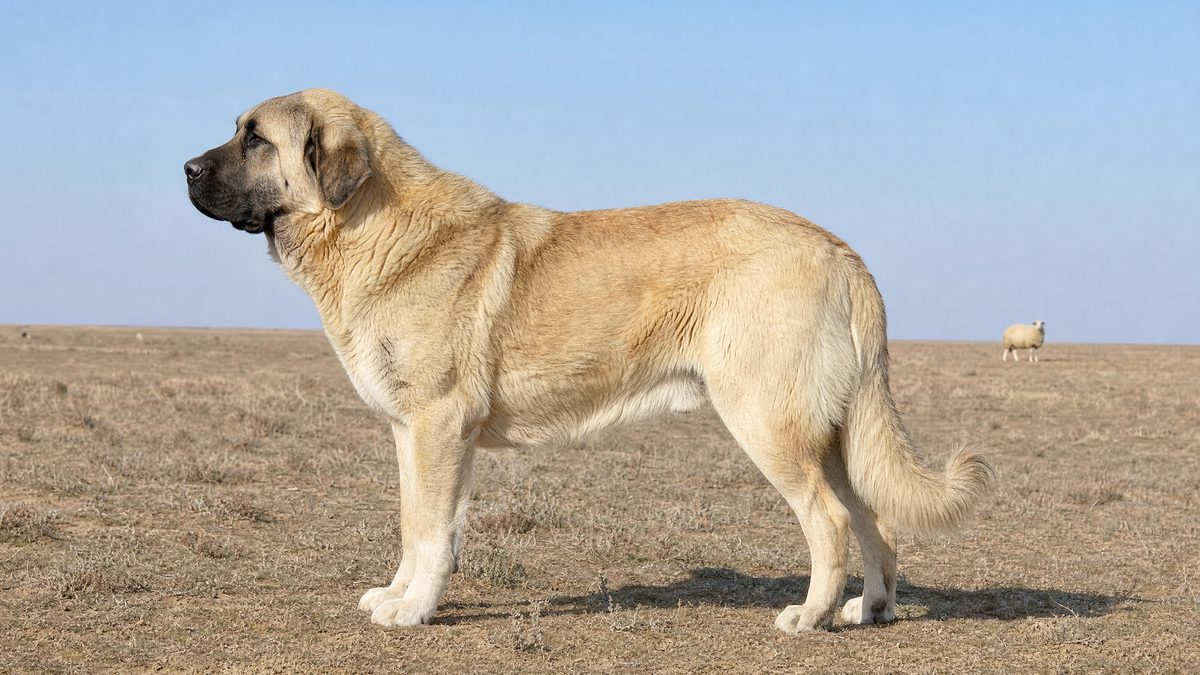
An uncropped Central Asian Shepherd Dog carries medium-sized, thick, triangular ears, set low, hanging against the cheek, with the lower part of the ear base level with or slightly below the eyes, and an undocked tail that reaches the hock at rest with the bottom third forming a hook.
Almost nobody publishes this description, because almost nobody photographs the dog this way. Both standards do describe it, in scattered clauses, and putting them in one place is the most directly useful thing this page can give an Indian buyer standing in front of a litter.
The natural ear, in five checks
- Size: medium, and the UKC calls it "small". Not large and not upright.
- Shape: triangular, with the point downward and the leather thick to the touch.
- Set: low. FCI-335 makes "Ears high set" an explicit fault in its faults list, which is a useful reminder that a natural ear on this breed should sit noticeably below the top of the skull.
- Carriage: hanging, dropped against the cheek, not folded forward like a hound's and not rose-shaped.
- Landmark: the lower part of the ear base sits level with, or slightly below, the eyes. The UKC gives the same landmark as "set at or below eye level";. Two independent standards agreeing on one anatomical line is the strongest check available.
That last one is the check to actually use, because it needs no experience. Look at the puppy's eye, then look at where the ear meets the skull. If the ear base is above the eye line, the dog is atypical whatever else is true of it. If the ear is a short triangle standing upright with a visible scar edge, it is cropped.
The natural tail, in four checks
- Base: thick, set fairly high, tapering to the tip.
- Length at rest: "just reaches to the hock", with the bottom third of the tail forming a hook.
- Shape when carried: a sickle curve, or curled in a loose ring beginning at the last third of the tail.
- When alert: rising to the line of the back or slightly above, and hanging at rest.
One important negative: FCI-335 lists "Natural stubbed tail, kinked tail"; among its severe faults. So a naturally short or kinked tail is not the breed's own variant, it is a serious fault, and a seller explaining a short tail as "natural bobtail in this line" is describing a severe fault rather than a feature.
| Feature | As almost always photographed | As the standard describes it naturally |
|---|---|---|
| Ear outline | Short upright triangle, cut edge often visible | Medium triangle hanging flat to the cheek |
| Ear base landmark | Raised above the eye line by the cut | Level with or slightly below the eye |
| Ear leather | Thin remnant, held erect | Thick, heavy, dropped |
| Tail at rest | Short stub, sometimes a hand's width | Reaches the hock, bottom third hooked |
| Tail when roused | No visible carriage | Sickle or loose ring above the back line |
| Legality of creating it in India | Strictly forbidden, Second Schedule Part II para 6(8) | Lawful, because nothing was done |
There is a second reason to insist on the natural ear that has nothing to do with law. The FCI standard describes a dog whose skin is deliberately thick and loose "to prevent injuries if in combat with predators", and whose ears are thick and low set. The dropped ear is protective structure, and the argument that cropping protects a working dog from ear injury runs directly against the standard's own account of why the ear is built the way it is.
Ask to see the dam and the sire, and ask whether either has natural ears. A breeder producing uncropped litters can answer that in a second and will usually be pleased you asked. A breeder who crops will change the subject to bloodlines. This costs nothing, needs no expertise, and it is the single most informative question available to an Indian buyer of this breed.
Central Asian Shepherd Dog price in India: a real market, and a twentyfold disagreement
Published Central Asian Shepherd Dog prices in India run from Rs 30,000 to Rs 6,00,000, a spread of twenty times between the two ends, and the two sources that produce it do not overlap by a single rupee.
This breed is genuinely present in the Indian market, which makes it unusual among the large foreign guardians this encyclopedia covers. There are dedicated Indian sale pages, city-level pages for Hyderabad, Bangalore, Delhi, Chennai, Pune and Kolkata, and named sellers with phone numbers. So the question here is not whether there is a price. It is which of the published prices describes the same animal.
| Source | Price band quoted | What the band is said to cover |
|---|---|---|
| mrnmrspet.com, headline | Rs 2,00,000 to Rs 6,00,000+ | "The average price of a Alabai puppy in India" |
| mrnmrspet.com, Basic Quality tier | Rs 2,00,000 to Rs 3,00,000 | Height 25-32 in, weight 40-79 kg, "property guarding and family protection" |
| mrnmrspet.com, KCI Registered tier | Rs 3,00,000 to Rs 4,00,000 | "Certifying the dog's purebred status and official lineage" |
| mrnmrspet.com, Champion Bloodline tier | Rs 4,00,000 to Rs 6,00,000 | "from imported or award-winning parents" |
| happypet.care | Rs 30,000 to Rs 1,00,000 | "Cost of buying", with lineage and breeder reputation named as the drivers |
Read the two rows at the extremes together. happypet.care's top price, Rs 1,00,000, is half of mrnmrspet's bottom price. There is no overlap at all. Either one source is describing a different animal from the other, or one of them is wrong by a factor of several. We do not average them, and neither should you.
What the tier pricing is actually charging for
The single most expensive line item on the Indian market for this breed is a piece of paper. Moving from the Basic Quality tier to the KCI Registered tier costs Rs 1,00,000, and the stated benefit is "documented lineage and verified health records" and "Certifying the dog's purebred status and official lineage". That is a lakh of rupees for registration paperwork on a dog whose Indian registry status we could not verify from any published breed list, for the reasons set out in the [recognition section](#recognition).
Moving again to Champion Bloodline costs another Rs 1,00,000 to Rs 2,00,000, for "imported or award-winning parents". Hold that word imported against the [import law section](#import-law), because DGFT Trade Notice 22/2022-23 states that applications to import dogs "for trading/breeding purposes" "shall be duly rejected";.
The cheap end is the one to be suspicious of, not the expensive end
Rs 30,000 is roughly the Indian price of a pet-quality Labrador or a Rottweiler, and it is a long way below what a 50 kg imported guardian would cost anyone to raise to eight weeks. For scale, one Indian round-up of the five most expensive breeds in the country puts the Tibetan Mastiff at Rs 2 lakh to Rs 5 lakh and does not list the Alabai at all. A dog of comparable size and rarity selling for Rs 30,000 is either not that dog or not that breeding.
There is no single Alabai puppy price in India, and any page giving you one number has picked a band and dropped the other.
The most likely reading, and we state it as a reading rather than a finding, is that the two bands describe two different products sharing one name: a small specialist import-descended population at two to six lakh, and a much larger informal supply of large mastiff-type guardians sold under the name at 30,000 to a lakh. The evidence for that reading is set out in the [market reality section](#market-reality).
If you are quoted Rs 98,999 for this or any breed, it is not this breed's price. That exact figure is a rupee-native charm price that recurs across one Indian listing site attached to whichever puppy happens to be in stock, including for breeds the site does not stock at all. It sits just under the top of the happypet.care band, so it will look plausible here. It is not a breed price, it is a price point.
We ran the currency-conversion tests on every Indian price, and they came back clean
Every published Indian rupee price for this breed fails division by 84.38 and by 74, the two exchange rates that expose a converted American price list, so these are rupee-native asking prices rather than a foreign list run through a calculator.
This site tests every Indian price it publishes, because Indian pages routinely republish a US dollar figure through a single exchange rate and present it as a local price. The test has caught converted lists on this encyclopedia repeatedly. On this breed it does not fire, and reporting a negative result is as much a finding as reporting a positive one.
| Rupee figure | At 84.38 | At 74 | At 80 | Verdict |
|---|---|---|---|---|
| Rs 30,000 | 355.53 | 405.41 | 375 | No clean conversion |
| Rs 1,00,000 | 1,185.11 | 1,351.35 | 1,250 | No clean conversion |
| Rs 2,00,000 | 2,370.23 | 2,702.70 | 2,500 | No clean conversion |
| Rs 3,00,000 | 3,555.35 | 4,054.05 | 3,750 | No clean conversion |
| Rs 4,00,000 | 4,740.46 | 5,405.41 | 5,000 | No clean conversion |
| Rs 6,00,000 | 7,110.69 | 8,108.11 | 7,500 | No clean conversion |
Not one figure divides to a round dollar amount at 84.38, which is the strong test, and not one divides cleanly at 74 either. Both columns are full of long decimals. That is what a genuinely Indian price looks like.
Why the 80 column proves nothing, and why we printed it anyway
The flat-80 column looks like a perfect match, and it is worthless. Every figure in the table ends in at least four zeros, and 10,000 divided by 80 is 125, so any rupee figure of that shape divides cleanly at 80 by construction. The test is structurally rigged in favour of a false positive, and the quotients confirm it: USD 3,750 and USD 7,500 are not prices any breeder prints, and USD 1,250 and USD 2,500 are simply what round lakh figures become.
The rule we apply, and that you can apply, is that a match at 80 counts as evidence only when the quotient is also a number a human would quote, and even then only alongside a match at another rate. Here it is neither. So the conclusion is that the Indian Alabai market prices in lakhs because Indian sellers set those prices, not because someone converted an American list.
The specifications on the same pages, however, ARE converted
This is where the interesting part is. The prices are Indian. The breed data printed beside them is not. mrnmrspet's specification table gives adult weight as Male: 50 - 79 kg; Female: 40 - 65 kg. Run those through pounds.
| Seller's figure | In pounds | Where that pound figure comes from |
|---|---|---|
| 50 kg male minimum | 110.2 lb | FCI-335's 50 kg minimum, and the round 110 lb repeated by English-language sources |
| 79 kg male maximum | 174.2 lb | Associated Press: Alabay "weighing as much as 80 kilograms (175 pounds)" |
| 40 kg female minimum | 88.2 lb | FCI-335's 40 kg minimum, printed by the AKC as "Minimum: 88-110 pounds" |
| 65 kg female maximum | 143.3 lb | No standard source located |
The seller's 79 kg is 175 pounds converted back to kilograms and rounded down, and 175 pounds is the Associated Press's figure for the heaviest Alabay, not a breed standard's. Neither FCI-335 nor the UKC standard contains any maximum weight at all United Kennel Club. The AKC's own vital statistics box confirms the direction of travel by printing "Weight: Minimum: 88-110 pounds", which is FCI's 40 and 50 kg minima converted, and "Height: Minimum: 25.5-27.5 inches", which is FCI's 65 and 70 cm minima converted Federation Cynologique Internationale.
The press disagrees with itself here too, and we are not going to resolve it. The Associated Press writes that Alabay "are among the world's largest dogs, weighing as much as 80 kilograms (175 pounds)";. Agence France-Presse, reporting the 2023 Turkmen competition, writes of "The breed, which can weigh up to 120 kilogrammes";. Those two claims are 40 kg apart, neither cites a measurement, and no breed standard supports either as a ceiling. Attribute them, do not average them.
Honestly: a number no standard will give you. FCI-335 sets floors of 50 kg and 40 kg with no ceiling and the note "Large size desirable, but proportional constitution must remain". Working adults are commonly reported around 50 to 70 kg and press reports cite individuals to 80 kg. Plan your household, your car, your vet's table and your monthly food budget around at least 50 kg for a male and treat anything above that as likely rather than exceptional.
What the Indian market is actually selling under this name
The Indian Alabai market is a small, specialist, seller-led trade that sits entirely outside the mainstream Indian breed press, and we established that by searching five populated Indian breed and price pages for six spellings of the breed and finding zero mentions on every one.
The test was built so it could fail. We downloaded five Indian pages that publish breed round-ups or price bands, searched each for alabai, alabay, central asian, ovcharka, ovtcharka and sredne, and then searched the same pages for five control breeds to prove the documents had actually loaded.
| Indian page | Mentions of this breed, six spellings | Control breeds found |
|---|---|---|
| supertails.com, 30 Types of Dog Breeds in India | 0 | Labrador 10, German Shepherd 8, Golden Retriever 7, Rottweiler 6, Great Dane 2, Tibetan Mastiff 3 |
| headsupfortails.com, 50 breeds for Indian homes | 0 | Labrador 11, German Shepherd 7, Golden Retriever 9, Rottweiler 6, Great Dane 4, Tibetan Mastiff 3 |
| carrymypet.com, 25 most popular breeds in India | 0 | Labrador 7, German Shepherd 4, Golden Retriever 6, Rottweiler 5, Great Dane 3, Tibetan Mastiff 2 |
| basilpetcare.com, 5 most expensive breeds in India | 0 | Rottweiler 7, Tibetan Mastiff 6 |
| dogfarm.in, seller catalogue | 0 | Labrador 5, German Shepherd 5, Golden Retriever 5, Rottweiler 5, Great Dane 4, Tibetan Mastiff 4 |
Every control fired on every page, so the documents loaded and the search worked. The breed is absent from all five Heads Up For Tails CarryMyPet, The 25 Most Popular Dog Breeds… The Basil Pet Care The Dog Farm, Buy Certified Dogs…. The basilpetcare result is the sharpest one: a page titled the five most expensive dog breeds in India, which prices the Tibetan Mastiff at Rs 2 lakh to Rs 5 lakh, does not list a breed that dedicated Indian sellers advertise at Rs 2 lakh to Rs 6 lakh Mr n Mrs Pet, Alabai Puppies For Sale….
So what is being sold, and to whom
Putting the evidence together, the Indian market for this breed has three visible layers and they should not be confused with one another.
- A specialist import-descended layer at Rs 2,00,000 to Rs 6,00,000. Sold by dedicated sellers with city pages for Hyderabad, Bangalore, Delhi, Chennai, Pune and Kolkata, tiered as Basic Quality, KCI Registered and Champion Bloodline, with the top tier described as coming "from imported or award-winning parents".
- A general-guardian layer at Rs 30,000 to Rs 1,00,000. Published as the breed's Indian cost of buying by a mainstream Indian pet-care site, with lineage and breeder reputation named as the drivers. This band does not overlap the first one at any point.
- No mainstream layer at all. Absent from every general Indian breed round-up and price list we tested, including one specifically about expensive breeds.
We cannot verify from published sources what animal sits behind the Rs 30,000 figure, and we will not assert that it is a crossbreed. What we can do is set out what a buyer is able to check, and the honest answer is: less than you would want. The tier that costs Rs 1,00,000 more is the one labelled KCI Registered, and the Kennel Club of India's breed list was not reachable at any address that resolved.
The two claims that should trigger questions
First, "imported". DGFT Trade Notice 22/2022-23 states that any applications to import dogs "for trading/breeding purposes, or applications made on behalf of some another person/entity shall be duly rejected";. A commercially imported breeding Alabai is not something the import regime permits, so ask which of the three lawful routes the parent dog came in under, and see the [import law section](#import-law).
Second, "Turkmen" or "Turkmenistan bloodline". Since 26 July 2022, exporting an Alabai from Turkmenistan requires the dog to be marked in the government pedigree book, to hold a government-issued passport carrying its sex, date of birth, colour and owner details, and to have special government export permission. Those documents exist and can be asked for.
The price spread here is not the usual Indian pattern of one converted American list. We tested every published rupee figure against the three exchange rates that expose that pattern and none of them converted, as the [price tests section](#price-tests) shows. These are real Indian asking prices set by real Indian sellers. The disagreement between Rs 30,000 and Rs 6,00,000 is therefore a disagreement about what is in the box, not an arithmetic artefact, and that is a more serious problem for a buyer, not a smaller one.
Import law: the three lawful routes, and the one that is expressly refused
India classes live dogs as a Restricted import under ITC(HS) 01061900 and permits entry for only three purposes, none of which is commercial breeding, and DGFT states that applications "for trading/breeding purposes" "shall be duly rejected";.
We read Trade Notice No. 22/2022-23, dated 19 December 2022, from our own extraction of the DGFT PDF, five pages with a working text layer of 6,635 characters. Here is what it permits.
| Provision | What it says |
|---|---|
| ITC(HS) 01061900, Mammals: Other | Import Policy: Restricted, subject to Policy Condition 6 of the chapter |
| Policy Condition (7)(i) | "Pet dog with valid pet book and relevant records/documents in the name of importer" |
| Policy Condition (7)(ii) | "Dogs imported by the R&D Organisations for conducting research with the recommendation of CPCSEA" |
| Policy Condition (7)(iii) | "For the internal security by the Defence and Police Force" |
| Policy Condition (8) | "Import of commercial dogs for breeding or any other commercial activities other than the purposes mentioned above is not permitted" |
| Paragraph 6 | "any applications for trading/breeding purposes, or applications made on behalf of some another person/entity shall be duly rejected" |
| Paragraph 7 | Import allowed only through the airports and seaports of Delhi, Mumbai, Chennai, Hyderabad, Bangalore and Kolkata, with quarantine where required; DAHD added Kochi for pets arriving under the baggage rules in October 2024 |
The passenger-baggage route is narrower than most people expect. Import without DGFT authorisation is allowed "only to persons transferring their residence to India after two years of continuous stay abroad", only for cats and dogs, and only up to two animals. Fewer than two years abroad, more than two animals, or an animal not travelling as passenger baggage, and a DGFT authorisation is required, with the application examined by the Department of Animal Husbandry and Dairying.
What this means for a Rs 6,00,000 'Champion Bloodline, imported parents' puppy
It does not mean the puppy is unlawful. It means the parent cannot lawfully have been imported as breeding stock. There are only three ways an Alabai can lawfully be standing in India today: it came in as a returning resident's own pet under a pet book in that person's name, it came in to a research organisation with CPCSEA recommendation, or it came in to the Defence or Police forces. A dog that arrived under the first route and was later bred from is a different situation from a dog imported in order to breed from it, and only the second is what the Trade Notice refuses.
So the reasonable question to a seller advertising imported parents is not accusatory and not hard to answer: which route, whose name is on the pet book, and through which of the seven permitted ports. A breeder with a genuine import history can answer that. It is the same class of question as asking about the ears, and it costs nothing. The full route is set out in how to import a dog to India.
The Turkmen export side, which is the harder half
Any dog coming out of Turkmenistan faces a second gate that has existed since 26 July 2022. All puppies of the breed must be "marked in the government's pedigree book and register of pedigreed dogs", passports are issued carrying the dog's sex, date of birth, colour and owner details, and "Special government export permission will be required";. Turkmenistan's own 2022 law frames the Association's purpose as protecting the gene pool and increasing numbers, which is not the language of a state keen to see the population leave.
Practically, that means most Alabai lineage reaching India will have travelled through Russia or another FCI country rather than direct from Turkmenistan, which is consistent with Indian listings advertising Russian imports and with the FCI holding the standard under Russian patronage.
A restricted import regime that refuses breeding applications caps the size of India's founder population, and a small founder population is exactly the condition in which Second Schedule Part II paragraph 6(3) becomes hard to comply with. That paragraph prohibits in breeding within the first four generations, naming uncle to niece, nephew to aunt, cousin to cousin and grandparent to grandchild, and prohibits incest breeding outright. Ask any Indian breeder of this breed for a four-generation pedigree, and read it for repeated names.
Cost of ownership: the published Indian figure is Rs 4,900 a month, and it is not enough
The only published Indian running cost for this breed is Rs 4,900 to Rs 7,650 a month, and it omits every large-dog cost that actually bites: boarding, transport, fencing, insurance and orthopaedic care on a breed with 24.7 percent hip dysplasia on OFA's register.
We are not going to invent a replacement number. What we can do is name what the published figure covers, name what it does not, and show why the omissions are larger than the total.
What the published figure includes
happypet.care breaks its monthly range into food at Rs 3,000 to Rs 4,500, veterinary at Rs 1,200 to Rs 1,950 and grooming at Rs 700 to Rs 1,200, totalling Rs 4,900 basic and Rs 7,650 premium. Both totals add up correctly. It is a coherent estimate of three line items.
What it leaves out, and why each one is worse for this breed
| Omitted cost | Why it is larger for this breed than for a Labrador |
|---|---|
| Secure boundary | A territorial guardian that decides for itself needs real fencing, not a gate latch. This is a one-off capital cost most Indian buyers meet after the first incident, not before |
| Boarding and travel | Boarding kennels charge by size, several refuse guardian breeds outright, and cabin travel is impossible above 8 kg on Indian carriers |
| Transport | A 50 kg dog does not fit a hatchback with a crate. Vehicle choice becomes a dog cost |
| Orthopaedic care | 24.7 percent dysplastic hips and 21.1 percent abnormal elbows on OFA's register, on a breed whose weight floor is 50 kg |
| Anaesthesia and surgery | Drug volumes, monitoring time and theatre handling all scale with mass. A gastric torsion surgery on a 55 kg dog is not the same invoice as on a 25 kg dog |
| Genetic testing | COL7A1 testing of breeding stock, plus the hip dysplasia and other tests Second Schedule Part III para 8(10) requires Ministry of Environment |
| Third-party liability | A guardian breed whose own standard normalises mild dog aggression is an insurance question, not a hypothetical |
The purchase price, in perspective
The acquisition cost dwarfs the first year of running costs, whichever Indian source you believe. At the low band of Rs 30,000, twelve months of the published basic running cost is Rs 58,800, so the dog costs less than its first year of upkeep. At the high band of Rs 6,00,000, the purchase price is more than ten years of the published basic cost.
That gap is the clearest signal that the two Indian price bands are not describing the same transaction, and the [market reality section](#market-reality) sets out what we could and could not establish about it.
The costs that arrive once and hurt
- Fencing and a gate a 50 kg dog cannot open or clear. Budget this before the puppy, not after the first escape.
- A crate and a vehicle that takes it. Sized for an adult, because you will not buy two.
- Neutering or spaying a giant breed, which is a larger procedure with a longer recovery than most Indian owners are quoted for.
- The three-year training horizon. Professional help with a guardian breed is not a puppy-class fee, and FCI-335 says maturity takes three years.
- End of life. A 50 kg dog's final year, with mobility support and possible euthanasia and cremation costs, is the line nobody budgets and everybody meets.
Treat Rs 4,900 to Rs 7,650 as the food, routine vet and grooming line, because that is what its source actually measures. Then ask yourself whether you can absorb an unplanned five-figure orthopaedic or emergency-surgery bill on a dog in the heaviest weight band, in a country where fewer than one household in a hundred carries pet insurance. If the answer is no, the breed is out of reach at any purchase price, and the [adoption section](#adoption) has better uses for the money.
Climate: this breed's homeland is hotter than Chennai, and that is not the good news it sounds like
The Karakum grid cell this breed comes from averages 32.31 degrees Celsius in July, which is hotter than the hottest month of Chennai, Mumbai, Kolkata, Bengaluru or Pune, and its July relative humidity is 19 percent against Chennai's 67.
Most breed pages rate a Central Asian guardian as heat-intolerant by reflex, because it is large and double-coated. The numbers do not support that reflex, and we are going to let them say what they say. We queried NASA POWER by explicit latitude and longitude and checked the coordinates it echoed back against the coordinates we asked for, on every point below, because a climate page that silently serves another city would discredit the most original argument on this page.
| Place | Lat, lon requested and returned | Annual mean C | Hottest month C | Coldest month C | Annual mean RH % |
|---|---|---|---|---|---|
| Karakum, Turkmenistan | 39.50, 60.00, elev 138.37 m | 16.07 | 32.31 (Jul) | 0.31 (Jan) | 41.14 |
| Ashgabat, Turkmenistan | 37.95, 58.38, elev 769.34 m | 15.37 | 28.58 (Jul) | 2.83 (Jan) | 42.93 |
| Tashkent, Uzbekistan | 41.30, 69.24, elev 668.72 m | 14.38 | 28.97 (Jul) | 0.43 (Jan) | 48.80 |
| Chennai | 13.08, 80.27, elev 48.95 m | 27.95 | 31.51 (May) | 24.09 (Jan) | 72.39 |
| Mumbai | 19.08, 72.88, elev 97.15 m | 26.77 | 31.19 (May) | 23.19 (Jan) | 67.39 |
| Delhi | 28.61, 77.21, elev 206.37 m | 25.60 | 35.88 (Jun) | 13.61 (Jan) | 45.56 |
| Jaipur | 26.91, 75.79, elev 405.74 m | 25.58 | 34.57 (Jun) | 14.51 (Jan) | 40.94 |
| Bengaluru | 12.97, 77.59, elev 841.72 m | 23.74 | 28.37 (Apr) | 20.22 (Dec) | 67.94 |
| Kolkata | 22.57, 88.36, elev 7.35 m | 25.81 | 31.53 (May) | 17.31 (Jan) | 73.93 |
| Pune | 18.52, 73.86, elev 635.99 m | 23.86 | 28.93 (Apr) | 19.62 (Dec) | 66.80 |
| Hyderabad | 17.38, 78.49, elev 494.59 m | 26.10 | 33.30 (May) | 20.76 (Dec) | 60.30 |
Read the first row against the Chennai row. The Karakum in July is nearly a full degree hotter than Chennai in May, and its peak recorded T2M_MAX is 46.66 degrees against Chennai's 42.70. The UKC standard says the same thing in words: the climate where this breed developed "ranges from hot and dry, to bitterly cold and windy", and "only the hardiest of pups survived";.
So this is not a mountain dog transplanted into the tropics. It is a desert dog, and it has four thousand years of selection for surviving heat that most of India never reaches.
That makes it genuinely more heat-tolerant than any northern European guardian this encyclopedia covers, and it is worth saying so plainly before the rest of this section explains why heat-tolerant is not the same as India-tolerant.
Then read the other two columns, which is where India wins and loses
The Karakum's annual mean is 16.07 degrees and its January mean is 0.31. Chennai's coldest month is 24.09 and its annual mean is 27.95. The breed's homeland spends half the year giving the dog a genuine recovery season. Coastal India never does. A dog that survives a Karakum July does it knowing January is coming.
And the humidity gap is enormous. Karakum July relative humidity is 19 percent, and it stays at 19 through August. The Indian comparison numbers for the same months are Pune at 91 percent in August, Mumbai at 90 in July, Kolkata at 89, Bengaluru at 79 and Chennai at 72. That is a gap of up to 72 percentage points, and it is the whole story, because evaporative cooling from panting is what a dog has instead of sweating, and its efficiency collapses as the air saturates.
| Place | August mean temp C | August relative humidity % | Gap from Karakum August RH |
|---|---|---|---|
| Karakum, Turkmenistan | 29.9 | 19 | baseline |
| Ashgabat, Turkmenistan | 26.8 | 21 | +2 |
| Jaipur | 28.8 | 73 | +54 |
| Delhi | 29.8 | 75 | +56 |
| Bengaluru | 23.3 | 79 | +60 |
| Hyderabad | 25.5 | 80 | +61 |
| Kolkata | 28.2 | 89 | +70 |
| Mumbai | 26.1 | 90 | +71 |
| Pune | 23.3 | 91 | +72 |
We rate this breed 3 out of 5 for heat tolerance, higher than any northern European guardian on this site and lower than any Indian breed. It earns the 3 on three grounds: a desert origin genuinely hotter than most of India, a mesocephalic skull confirmed in the supplementary data of a 584,734-dog study rather than the brachycephalic one that multiplies risk, and a coat that can be as short as 3 cm McMillan KM, Bielby J, Williams CL Federation Cynologique Internationale. It loses the other two on mass and on water vapour, and those are covered in the [next section](#heat-band).
The weight band that decides the risk: 3.42 times the odds, and a female who sits just below it
A male Central Asian Shepherd Dog at the FCI minimum of 50 kg sits in the heaviest band of the largest study of canine heat-related illness ever run, where dogs over 50 kg had 3.42 times the odds (95% CI 1.54 to 7.57) of heat-related illness compared with dogs under 10 kg Federation Cynologique Internationale.
This is the single most decision-relevant number on the page, and the breed sits on the wrong side of it by construction rather than by chance. FCI-335 sets a male floor of 50 kg. The study's top band starts at 50 kg. A breed-standard male is not near the top band, he is in it.
The study is Hall, Carter and O'Neill 2020 in Scientific Reports, covering 905,543 dogs under veterinary care at 886 UK VetCompass clinics during 2016. Here is the full bodyweight result, with the reference band and the confidence intervals, because a bare odds ratio is not usable.
| Bodyweight band | Odds ratio | 95% confidence interval | P value |
|---|---|---|---|
| Under 10 kg | baseline | reference | reference |
| 10 to under 20 kg | 1.82 | 1.31 to 2.53 | under 0.001 |
| 20 to under 30 kg | 2.13 | 1.51 to 3.02 | under 0.001 |
| 30 to under 40 kg | 1.74 | 1.14 to 2.65 | 0.010 |
| 40 to under 50 kg | 1.76 | 0.91 to 3.40 | 0.093 |
| 50 kg and over | 3.42 | 1.54 to 7.57 | 0.002 |
Two things in that table are worth more than the headline. First, the risk is not linear: it dips between 20 and 50 kg and then jumps at 50. Second, the 40 to under 50 kg band is the one row whose confidence interval crosses 1 and whose P value is 0.093, meaning the study could not distinguish it from chance.
Now put the breed's own floors against those rows. A standard male at 50 kg minimum is in the 3.42 band. A standard female at 40 kg minimum sits in the 40 to under 50 kg band, the single row the study could not call. That is a genuinely useful distinction for an Indian household weighing sexes, and no other page on this breed makes it.
The skull, which is the breed's one real advantage
The same paper found brachycephalic dogs had 2.10 times the odds (95% CI 1.68 to 2.64) of heat-related illness compared with mesocephalic dogs. This breed is mesocephalic, and that is not our assessment: it is the cephalic-index classification recorded for the Central Asian Shepherd Dog in the supplementary data of McMillan et al. 2024. It is also what FCI-335 implies by requiring a muzzle whose length is less than half and more than a third of the head.
We are not going to rank 3.42 against 2.10, because the paper does not, and the two figures come from different models with different reference categories and overlapping intervals. What can be said plainly is that this breed carries the mass risk factor and does not carry the skull risk factor, which is why it rates 3 out of 5 on heat rather than the 1 or 2 that a brachycephalic giant would earn.
The finding that changes what you do on a Tuesday evening
The companion paper, Hall et al. 2020 in Animals, classified 879 heat-related illness events by trigger. Exertional heat-related illness accounted for 652 of them, 74.2 percent, against environmental at 113 (12.9 percent) and vehicular confinement at only 46 (5.2 percent). Of the 551 exertional events where the exercise type was recorded, 372, or 67.5 percent, occurred after walking.
Read that twice. Two thirds of exercise-triggered canine heatstroke followed a walk, not running, not cycling, not competition. The dog left in a car is the story everyone knows and the smallest category in the data. The dog taken for its normal evening walk is the largest.
The event fatality rate for heat-related illness in the 2016 incident cohort was 14.18 percent (95% CI 11.08 to 17.96), from 56 deaths in 395 events. Check that arithmetic yourself: 56 divided by 395 is 14.18 percent, and it holds.
Neither Hall paper contains this breed. A full-text search of both, covering 67,161 and 81,560 characters, returned zero matches for central asian, ovcharka, alabai, alabay or sredneaziat. And both are UK studies, so the absolute rates are UK rates in a UK climate. What transfers is the shape of the risk, the weight bands and the trigger split, not the incidence. We apply the bands to this breed on the basis of its own standard's weight floors, and we say so rather than implying the study measured Alabai.
Where in India this breed makes most sense, city by city
Dry-heat inland India suits this breed best, and Jaipur is the closest Indian climate match at 40.94 percent annual relative humidity against the Karakum's 41.14, while coastal Mumbai, Chennai, Kolkata and monsoon Pune are the worst fits despite being cooler.
This is the reverse of the usual advice, and the numbers are why. For a desert breed, the enemy is water vapour rather than the thermometer. Rank the cities on humidity and the ranking inverts.
| City | Annual RH % | Peak monthly RH % | Hottest month C | Verdict |
|---|---|---|---|---|
| Jaipur | 40.94 | 73 (Aug) | 34.57 (Jun) | Best fit. Annual humidity within 0.2 points of the Karakum |
| Delhi | 45.56 | 75 (Aug) | 35.88 (Jun) | Good fit nine months, hard in July and August |
| Hyderabad | 60.30 | 83 (Sep) | 33.30 (May) | Workable with a hard monsoon protocol |
| Pune | 66.80 | 91 (Aug) | 28.93 (Apr) | Cool but the wettest air of any city here |
| Mumbai | 67.39 | 90 (Jul) | 31.19 (May) | Poor. Three straight months at or near 90 percent |
| Bengaluru | 67.94 | 81 (Oct) | 28.37 (Apr) | Mild temperatures, persistently damp air, no dry season |
| Chennai | 72.39 | 82 (Nov) | 31.51 (May) | Poor. No month below 64 percent and no cool season |
| Kolkata | 73.93 | 89 (Aug) | 31.53 (May) | Worst of the eight on annual humidity |
Two readings follow from that table that Indian breed pages get backwards.
Reading one: Bengaluru is not the safe answer here
Bengaluru is the default recommendation for every large imported breed in India, because its hottest month averages a mild 28.37 degrees and it sits at 841 metres. For this breed the case is weaker than it looks. Bengaluru's driest month is March at 44 percent, and from May through December it never drops below 64, peaking at 81 percent in October. The Karakum spends June to September between 19 and 22. A desert dog in Bengaluru is comfortable on temperature and permanently damp.
That matters most for the coat and the skin rather than for heatstroke, and it is why the [grooming section](#grooming) treats the undercoat rake as a year-round weekly job in India rather than a seasonal one.
Reading two: Jaipur and Delhi are hotter and better
Delhi's June mean of 35.88 degrees is the highest of any city in this table, and its April and May humidity of 24 and 23 percent is the driest air in India outside the desert itself. That is close to Karakum conditions. Then the monsoon arrives and Delhi goes to 75 percent in August while staying at 29.8 degrees, which is the genuinely dangerous combination.
So a north Indian owner gets nine good months and two bad ones, and can plan around them. A Mumbai or Chennai owner gets no dry season at all. Planning around two identifiable months is a manageable problem. Planning around a permanent condition is not.
The hill option, and its limit
Leh is the only Indian point we tested that is genuinely colder than the breed's homeland: at 34.16 N, 77.58 E, returned elevation 4,532.61 metres, the annual mean is minus 2.75 degrees with a July mean of 10.18. A double-coated 50 kg guardian would thrive there and would be doing recognisable work. That is a real answer for a Ladakh or high Himachal household and an irrelevant one for everybody else, and we would rather say so than pretend a hill station solves a coastal problem.
One caution on hill-station figures generally. NASA POWER returns a grid cell, not a street address, so a request for Shimla returned an elevation of 897.65 metres against the town's actual 2,200, and the temperatures come back warmer than the town experiences. We checked the returned elevation on every point and we are not publishing the Shimla row for that reason.
If your city has a month above 85 percent relative humidity, you are keeping a desert dog in a place its ancestors never experienced, and the [heat management protocol](#heat-management) is not optional. That covers Pune at 91, Mumbai at 90, Kolkata at 89 and Chennai in its wettest stretch. Even happypet.care's own Indian breed page gives the ideal weather range as minus 10 to 30 degrees Celsius, which quietly concedes that most of urban India sits at or above the top of it for months at a time.
The heat protocol for a 50 kg guardian in an Indian summer
Move the walk out of the heat rather than shortening it, because 67.5 percent of exercise-triggered canine heatstroke events followed a walk rather than any strenuous activity, and a 50 kg dog carries 3.42 times the odds of heat-related illness.
Everything below follows from two facts already established: the largest trigger category is ordinary walking, and this breed's own standard puts a male in the heaviest risk band by definition Federation Cynologique Internationale.
The daily protocol
- Walk before 6.30 am and after 8.30 pm from March to October in any plains city. Ground temperature, not air temperature, is what a dog's feet and belly meet, and tarmac holds heat for hours after sunset.
- Test the surface with the back of your hand for five seconds before you step off. If you cannot hold it, the dog cannot walk on it.
- Carry water on every outing above 30 degrees, not just long ones. The largest trigger category was a walk, and walks are where owners assume water is unnecessary.
- Give shade plus airflow, not shade alone. In 85 to 91 percent humidity, still shaded air does very little, because evaporative cooling from panting is what a dog uses instead of sweating.
- Provide a shallow water surface the dog can stand in. Wetting the ventral surface and paws works; wetting the topcoat of a double-coated dog mostly traps water in the undercoat.
- Never shave the coat. It is a double coat with a dense undercoat that insulates in both directions, and the standard makes "Very short coat" a fault and "Very short coat without undercoat" a serious fault in the UKC text.
The emergency threshold, and what to do in the first ten minutes
Treat a rectal temperature at or above 41.0 degrees Celsius as an emergency and get to a veterinarian, cooling the dog on the way rather than instead of going. The event fatality rate in the UK 2016 incident cohort was 14.18 percent, 56 deaths from 395 events, so roughly one in seven heat-related illness events killed the dog.
- Move the dog into shade and moving air immediately, ideally in front of a fan.
- Pour cool, not iced, water over the neck, chest, belly and paws. Ice-cold water on a large dog can cause peripheral vasoconstriction and slow heat loss.
- Offer water to drink but never force it, and never pour water into the mouth of a collapsed dog.
- Go to the vet even if the dog seems to recover. Heat-related illness has delayed consequences including clotting disorders and acute kidney injury.
- Tell the vet the dog is over 50 kg. Drug dosing and cooling targets scale with mass, and this is the band that carried the highest odds in the study.
The monsoon half of the problem, which nobody plans for
Indian owners plan for May and get caught in August. Pune reaches 91 percent relative humidity in August, Mumbai and Kolkata sit at 90 and 89 in July and August, and Delhi combines 75 percent humidity with a 29.8 degree monthly mean. The temperature has fallen and the risk has risen, because a panting dog in saturated air is moving very little heat.
The practical version is that the walking window does not widen when the rain starts. Keep the early-morning and late-evening schedule through the monsoon, and treat a warm still day after rain as more dangerous than a hot dry one in May.
Housing, and one Indian legal point
This dog cannot live on a balcony or a terrace in an Indian city. It needs shaded ground, moving air and, for its own reasons rather than the heat's, a secure boundary. The Supreme Court in Nagaraja read the five internationally recognised animal freedoms into sections 3 and 11 of the Prevention of Cruelty to Animals Act, and one of them is expressly "freedom from physical and thermal discomfort";.
That is not an abstract point for the owner of a 50 kg desert guardian in Chennai. It is a standard an Indian court has already said the Act contains, and tethering a heavy double-coated dog on an unshaded roof through an Indian May is exactly the conduct it describes.
Unlike the flat-faced giants, this dog can actually pant efficiently. Brachycephalic dogs carried 2.10 times the odds of heat-related illness against mesocephalic dogs, and this breed is classified mesocephalic in the supplementary data of a 584,734-dog longevity study McMillan KM, Bielby J, Williams CL. Its airway is not the problem. Its mass and India's water vapour are.
Temperament: a dog that makes its own decisions, and who should not buy one
FCI-335 describes the temperament in seven words, "Self assured, balanced quiet, proud and independent";, and adds that "fearlessness towards large predators is a characteristic feature", which is an accurate and slightly alarming summary of what you are taking on.
Read the two standards together and a consistent animal appears: calm, unhurried, unimpressed by strangers, and entirely willing to act without instruction. That last trait is the one Indian buyers underestimate.
What the standards say, and what they mean at home
The UKC standard is the more useful of the two on behaviour: "For centuries, the Central Asian Shepherd Dog worked alone or together with several other dogs, without much intervention from the herdsmen, relying on its own intelligence and instincts to do its job. While these dogs are very devoted to their family members, they expect to be treated with respect". It adds that they are "inclined to be suspicious of strange people or dogs", are "steady, even-tempered", and that "when threatened, they react quickly and with complete seriousness";.
"Complete seriousness" is doing a lot of work in that sentence. This is not a dog that gives a warning bark and then defers to you. FCI-335 says the dogs "have high working capacity, endurance and a natural instinct of territory", which in an Indian context means a dog that will form its own view about the delivery rider, the electrician and the neighbour's child at the gate.
The FCI puts the same trait more bluntly: the dogs are "very courageous" and fearless towards large predators, and it lists fearlessness as a characteristic feature rather than as an individual quirk. A long-standing guardian-breed profile describes the Central Asian Shepherd as one of the oldest primitive dog breeds and separates its herding role from its guardian role, which is the right distinction: this dog does not move stock, it stands between stock and whatever is coming.
The dog-aggression clause nobody quotes
The UKC standard closes with an instruction to judges that a buyer should read as a disclosure: "Central Asian Shepherd Dogs are not to be penalized for mild dog aggression, as it is a normal characteristic of this breed";. A registry has written into its own standard that mild dog aggression is normal and must not be marked down.
In a country where free-roaming community dogs are on most residential lanes, that is a daily management problem rather than an occasional one. It is not a training failure to be fixed; it is a characteristic the standard names.
The counterweight, and it is real, is that the aggression is discriminating rather than general. Wikipedia's article states that "promiscuity in aggression toward strangers and friends is highly atypical for the breed", and both standards make "Aggressive or overly shy dogs" a disqualifying fault, with FCI-335 adding "Timid, overexcited" and the UKC adding "Viciousness or extreme shyness"; Federation Cynologique Internationale United Kennel Club. A dog that is indiscriminately aggressive is a bad specimen, not a typical one.
Who should not buy this breed
- Anyone in a flat. A territorial guardian in a shared corridor has no defensible territory and every trigger. happypet.care's own Indian page says apartment living "is not ideal" and that they need "ample space".
- First-time dog owners. The same Indian page answers "Are Central Asian Shepherd Dogs good for first-time owners?" with a flat "No";.
- Households with heavy, unpredictable footfall. Domestic staff, tuition students, extended family arriving unannounced, and a dog with a natural instinct of territory are a poor combination.
- Anyone who wants obedience. The FCI files this breed without working trial, which is the register declining to test it on formal obedience at all.
- Anyone buying for status. A Rs 6,00,000 price tag attracts buyers who want the price, not the dog, and this is the least forgiving breed on this site for that mistake.
Who it can genuinely suit
A farm, a plot, a factory compound or a large walled house in dry inland India, with one primary handler who is present daily, a secure boundary, and no expectation that the dog will be sociable with strangers. In that setting it is doing the job it was selected for over four thousand years, and the UKC's line that these dogs "adjust well to change in their environment" becomes an asset rather than a claim Federation Cynologique Internationale.
Both standards describe a dog bred to decide, alone, at night, whether something crossing the boundary is a threat, and to act on that decision without asking Federation Cynologique Internationale. Every good thing about this breed and every hard thing about it come from that same sentence. If you want a dog that checks with you first, this is the wrong breed, and no amount of training will change what it was selected for.
Dog fighting and this breed: what is documented, and what it does to the population
Organised fighting is a documented use of this breed in Turkmenistan, reported by Reuters as "a popular entertainment", and Turkmen law does not prohibit it outright: it bans mismatched fights while creating a lawful category of regulated test bouts that assess a dog's gripping ability.
We report this because it shapes both the population you are buying from and the way the breed is marketed, and because a page that leaves it out is not being kind, it is being incomplete. We report it without embellishment and without pictures.
What the wire services say
Reuters, reporting the Ashgabat statue unveiling in November 2020, describes the breed as "known as 'wolf crusher' for its prowess in guarding sheep and goats"; and states it "is also used to guard homes and for dog fights, a popular entertainment in Turkmenistan". Voice of America lists the breed's uses as "livestock protection, dog fighting, personal and property protection, companionship and military work";.
AFP, reporting the state holiday decree in February 2021, is the source that connects the fighting to the surgery: "The alabai is trained to fight from a young age and breeders clip the dogs' ears and cut their tails down to stumps in preparation for battle";. That sentence explains the photographic record discussed in the [ears and tail section](#ears-tail-standard) better than any cosmetic argument does. The cropping convention this breed carries is, on AFP's account, a fighting convention.
The Turkmen legal position, read in the original
The 2022 Law On dog breeding and cynological activity does three relevant things, and it is worth being precise because "dog fighting is banned in Turkmenistan" is both what you would assume and not what the statute says.
- Article 24(6) lists among acts recognised as cruel treatment "проведение собачьих боёв между отдельными породами собак и с разной психикой", the holding of dog fights between different breeds and dogs of differing temperament. It is a ban on mismatching, not a ban on fighting.
- Article 25(3) lists among acts not recognised as cruel treatment accidental injury to a dog during training, sporting competitions, contests and tests.
- Article 1(17) defines "испытательные состязания собак" as "испытательные схватки собак", test bouts, conducted under rules approved by the authorised body, for breeding selection work and to identify skill, bravery, endurance, staying power and хваткости, gripping ability. Article 16(6)(2) makes organising them a task of the state Association.
Read together, a like-for-like bout between two Alabai, staged under approved rules by the presidentially-headed Association, sits inside the law rather than outside it, and an injury sustained in one is expressly excluded from the cruelty definition.
The region beyond Turkmenistan, and the limits of what we found
In Afghanistan, dogfighting is a long-documented tradition. RFE/RL reported in 2012 that contests were "just one of hundreds of clashes played out every week in informal tournaments around the country", that "technically, these brutal contests are illegal" but authorities "have done little to enforce any sort of ban", and quoted a trainer saying he had seen people betting 1 million afghanis, about 21,000 US dollars. It also records bomb attacks on fight crowds, including a February 2008 Kandahar suicide bombing that left at least 80 men dead. That reporting describes mastiff-type fighting dogs and does not name this breed, so we do not claim the Afghan fights are Alabai fights.
In Tajikistan, The Times of Central Asia reported in March 2026 that "although dog fighting is officially prohibited, activists say such events continue to take place", in a country that "has not adopted a specific law on animal protection";. For Uzbekistan, Kyrgyzstan and Kazakhstan we could not establish the statutory position or find dated reporting from a wire service or established outlet, so we state nothing about them. An absence we could not test is not a finding.
The welfare evidence, and one myth it kills
A 2022 review in Animals sets out what fighting does to a dog, and it is worth quoting because it dismantles the commonest defence of the practice. The authors write that the injuries cause "not only acute or chronic pain but can also trigger a greater sensitivity to other harmful (hyperalgesia) or even innocuous stimuli (allodynia)", and that "these neurobiological aspects are often ignored and the erroneous assumption made that the breeds engaged in organized fighting have a high pain threshold". Their conclusion is that the damage "is not only physical but psychological, emotional, and sensory";.
Wikipedia states that "the majority of breeders are aware of their dogs' backgrounds, and will tell whether the dog comes from lines used for fighting", and that "Central Asian Shepherd dogs can come from working lines, fighting lines, and livestock guardian lines, and behave accordingly, regardless of the country they come from";. That is an unsourced claim on a wiki, but it points at a real question you can ask. Ask what the line was bred for. A seller who cannot answer, or who answers with "champion bloodline" and a price, has told you something.
Animal fighting is a criminal offence in India, and the fine is Rs 50
Indian law makes it an offence to incite any animal to fight, under section 11(1)(m)(ii) of the Prevention of Cruelty to Animals Act, 1960, and a separate offence to organise or keep any place for animal fighting, under section 11(1)(n), with a maximum first-offence fine of fifty rupees.
Both halves of that sentence matter. The prohibition is real, it is old, and the Supreme Court has enforced it. The penalty attached to it has not been revised since 1982 and is now, in practical terms, nothing.
The two clauses, verbatim
| Clause | Verbatim text |
|---|---|
| 11(1)(m) | "solely with a view to providing entertainment, (i) confines or causes to be confined any animal (including tying of an animal as a bait in a tiger or other sanctuary) so as to make it an object of prey for any other animal; or (ii) incites any animal to fight or bait any other animal" |
| 11(1)(n) | "organises, keeps, uses or acts in the management of, any place for animal fighting or for the purpose of baiting any animal or permits or offers any place to be so used or receives money for the admission of any other person to any place kept or used for any such purposes" |
Clause (m) was substituted in its entirety by Act 26 of 1982 with effect from 30 July 1982, and clause (n) had the words "for the purposes of his business" deleted by the same amendment. That deletion is the important one: before 1982 you had to be running a business to commit the offence under (n). Since 1982 you do not.
The penalty, and why it is the weak point
The concluding words of section 11(1) provide that an offender "shall be punishable, in the case of a first offence, with fine which shall not be less than ten rupees but which may extend to fifty rupees and in the case of a second or subsequent offence committed within three years of the previous offence, with fine which shall not be less than twenty-five rupees but which may extend to one hundred rupees or with imprisonment for a term which may extend to three months, or with both".
- First offence: fine only, between Rs 10 and Rs 50. No imprisonment is available at all.
- Second or subsequent offence within three years: fine between Rs 25 and Rs 100, or up to three months imprisonment, or both.
- No exemption applies. Section 11(3) exempts dehorning, castration, branding, nose-roping, the destruction of stray dogs in lethal chambers, destruction under other law, matters in Chapter IV and slaughter for food. None of those reaches animal fighting.
Set that beside the money involved in this breed. A single Champion Bloodline Alabai is advertised in India at up to Rs 6,00,000. The maximum first-offence fine for inciting an animal to fight is Rs 50. The deterrent is the prosecution and the seizure, never the fine.
What the Supreme Court held
In Animal Welfare Board of India v. A. Nagaraja, decided 7 May 2014, the Supreme Court read section 11(1)(m)(ii) broadly. At paragraph 75 the Court held that "if any person solely with a view to provide entertainment, incites any animal to fight" an offence is made out, and that "Fight can be with an animal or a human being";. Direction 5 of the judgment ordered the Animal Welfare Board of India to ensure that section 11(1)(m)(ii) is "scrupulously followed, meaning thereby, that the person-in-charge or care of the animal shall not incite any animal to fight against a human being or another animal";.
The Court also read the five internationally recognised animal freedoms into sections 3 and 11 of the Act, including "freedom from physical and thermal discomfort" and "freedom to express normal patterns of behaviour", and held that Articles 51A(g) and (h) of the Constitution "have to be read into the PCA Act";. Freedom from thermal discomfort is not a throwaway line for a 50 kg double-coated guardian in an Indian summer, and we return to it in the [heat management section](#heat-management).
One scoping note so nobody is misled. A five-judge Constitution Bench on 18 May 2023 upheld state amendments permitting Jallikattu and similar bovine sports, and departed from Nagaraja on whether Jallikattu is part of Tamil cultural heritage. It did not amend or strike down central section 11(1)(m) or 11(1)(n), so the prohibition on inciting animals to fight and on keeping a place for animal fighting stands exactly as quoted above.
Whatever is lawful in the country of origin, staging or attending a dog fight in India is a criminal offence under two separate clauses of a 1960 central Act that the Supreme Court has directly enforced Supreme Court of India. If a seller markets this breed to you on its fighting record, that is a reason to leave, not a selling point. The dog you would be buying was selected on the trait the law is aimed at.
Training: negotiate with a decision-maker, and expect it to take three years
To train a Central Asian Shepherd Dog, work with its judgement rather than against it, and plan for a three-year timeline, because FCI-335 states that full maturity is reached by the age of three.
That single line reframes everything. A Labrador is functionally adult at eighteen months. This dog is not, and every Indian owner who concludes at eighteen months that the training has failed is measuring against the wrong clock.
What the standards tell you about method
The UKC standard is explicit: "Central Asians are slow to mature and require extensive socialization and patient training techniques". It also records that the breed worked "without much intervention from the herdsmen, relying on its own intelligence and instincts", and that the dogs "expect to be treated with respect";.
Set that against what the FCI does not do. The breed is filed without working trial, so no obedience or protection qualification is required before a conformation title. Nobody is testing this dog on recall, and no pedigree implies it has one.
The five things worth training, in priority order
- Threshold control. Teach the dog to wait at every gate and door until released. On a territorial guardian this is the single highest-value behaviour, because the gate is where every incident starts.
- Cooperative handling. Teach the dog to accept a muzzle, a collar hold, paw handling and being lifted onto a table before you need any of it. A 50 kg dog that refuses a vet examination cannot be persuaded, and the FCI weight floor is 50 kg for males.
- Recall, trained for years and never fully trusted. Build it, reward it richly, and still walk a guardian on a lead in an Indian city.
- Settle on a mat, in the presence of visitors. You are teaching an alternative to deciding, not suppressing the instinct to decide.
- Loose-lead walking, early and while the dog is light. A 20 kg six-month-old that pulls becomes a 55 kg adult that pulls, and by then the lesson is a physics problem.
What does not work, and why
Correction-based handling is the commonest failure with this breed in India, and it fails for a structural reason rather than an ethical one. The dog was selected for four thousand years to make independent decisions under threat, and a handler who escalates is giving it a threat to decide about. Both standards disqualify "Aggressive or overly shy dogs", and heavy correction reliably produces one or the other United Kennel Club.
Repetition drills fail for a different reason. This is not a breed that finds compliance intrinsically rewarding, and asking for a twentieth sit teaches it that you are not worth attending to. Ask once, pay well, stop early.
The socialisation window, and the Indian version of it
Extensive socialisation is what the UKC standard asks for, and in India it has a specific shape. The dog must learn that autorickshaws, hawkers, cattle, temple crowds, firecrackers and free-roaming community dogs are ordinary, and it must learn this before it is heavy enough to act on an opinion.
Socialise the puppy deliberately rather than passively. Take it out to meet the ordinary chaos of an Indian street on a schedule you write down, because a guardian that has not learned to socialise with strangers by the time it is heavy will make its own judgement about every one of them.
The legal frame helps here too. Rule 8(1)(a) of the 2017 Rules prohibits selling pups under eight weeks, which exists precisely to protect the window in which a puppy learns from its dam and littermates. A seller offering a six-week-old Alabai is breaking the law and handing you a dog with a socialisation deficit you will spend three years repairing.
Months 2 to 4: threshold control, handling, and as much calm exposure as your city allows. Months 4 to 12: loose-lead walking while the dog is still liftable, plus settle-with-visitors. Year 2: the dog starts testing the boundaries it accepted as a puppy; hold the same rules without escalating. Year 3: FCI-335's stated point of full maturity, and the point at which you find out what you actually built. Anyone promising a finished guardian at twelve months is selling you a puppy.
Exercise: 60 to 90 minutes on paper, and territory in practice
The only published Indian figure for this breed's exercise requirement is 60 to 90 minutes a day, and it understates the problem, because what this dog needs is a territory to patrol rather than a scheduled walk.
happypet.care's Indian breed page gives an exercise routine of 60 to 90 minutes and an energy level of High. Take that as a floor for a dog kept in a house, and understand what it is a substitute for.
What the breed was actually doing
FCI-335 describes a dog with "high working capacity, endurance and a natural instinct of territory", used "to protect cattle, caravans and the owner's dwellings" across territory from the Caspian to China. Its gait clause asks for a trot with "free reach in the forequarters and with powerful drive from the hindquarters" and a steady topline while moving. The UKC adds that at increasing speed "the dog breaks into a heavy, lumbering gallop";.
That is an animal built for covering ground slowly and indefinitely, not for sprinting. A flock guardian's working day is many hours of low-intensity movement punctuated by rare, brief, decisive action. Nothing in an Indian apartment routine resembles it.
The Indian scheduling problem, which is harder than the amount
Sixty to ninety minutes is not a large requirement in itself. The difficulty is when. In any Indian plains city between March and October, the walkable window is before roughly 6.30 am and after 8.30 pm, and both ends of that window are also when free-roaming community dogs are most active, which is the worst pairing for a breed whose own standard normalises mild dog aggression.
The heat data makes this concrete. Delhi's June mean is 35.88 degrees, Jaipur's is 34.57, Hyderabad peaks at 33.30 in May and Chennai at 31.51. A 50 kg dog in the heaviest heat-risk band should not be doing its ninety minutes in any of those conditions, and 67.5 percent of exercise-triggered heat-related illness followed a walk rather than anything strenuous.
| Element | Amount | Why |
|---|---|---|
| Morning patrol walk | 35-45 min before 6.30 am | The cooler half of the daily requirement |
| Evening walk | 25-45 min after 8.30 pm | Completes the 60-90 minute published requirement |
| Boundary patrol at home | Unmeasured, throughout the day | The behaviour the breed actually wants, and the reason a compound beats a park |
| Scent and problem work | 10-15 min, twice daily | Replaces the decision-making a working guardian gets for free |
| Forced running or cycling | None | Wrong gait for the breed and the highest-risk activity for a 50 kg dog in heat |
| Stair and jump work under 18 months | None | Joint protection on a breed with 24.7 percent hip dysplasia on OFA's register |
What happens without it
A guardian breed with no territory and no job does not become calm, it becomes reactive. The commonest Indian outcome is a dog that patrols the only boundary it has, which is the front door or the balcony grille, and escalates at every person who passes it. happypet.care's own answer to whether they suit apartments is that "apartment living is not ideal because they thrive in environments with ample space", which is the polite version.
The second commonest outcome is joint damage from the wrong exercise rather than too little. Under eighteen months, this is a heavy, fast-growing, slow-maturing dog that does not reach full maturity until three years. Free movement on soft ground builds it. Repetitive road work, stairs and jumping do not.
We rate exercise need 3 out of 5, which is lower than most owners expect and lower than the breed's size suggests. This is not a high-energy dog; it is a high-territory dog. If you have a compound it can patrol, ninety minutes of walking is genuinely enough. If you do not, no amount of walking substitutes, and the [temperament section](#temperament) explains why.
Grooming a desert double coat in Indian humidity
Rake the undercoat weekly all year in India rather than seasonally, and never clip or shave the coat, because FCI-335 requires an abundant straight coarse coat over a well developed undercoat and the UKC makes a coat without undercoat a serious fault United Kennel Club.
The grooming advice written for this breed abroad assumes a climate with a real winter and dry summers. India has neither, and one instruction in particular does not transfer.
What the coat actually is
FCI-335 describes hair that is "Abundant, straight coarse and with well developed undercoat", short and dense on the head and the front of the limbs, often longer on the withers, in two lengths: a shorter coat of 3 to 5 cm covering the whole body, or a longer coat of 7 to 10 cm forming a mane on the neck, feathers behind the ears and on the back of the limbs and the tail.
The UKC gives the same two coats in inches, a long coat of 2 to 3 inches with furnishings and a short coat of 1 to 2 inches with none, and adds a serious fault for a "Very short coat without undercoat" and a disqualification for a "Soft, curly or wavy coat". FCI-335 lists "Very short coat" among its faults.
So the coat is structural, and the standards defend it in both directions. It is also, unlike most double coats on this site, a desert double coat: it evolved at 19 percent relative humidity, not 80.
The routine, adjusted for India
| Task | Dry months | Monsoon and coastal humidity | Why it changes |
|---|---|---|---|
| Undercoat rake | Weekly | Twice weekly | Trapped dead undercoat plus 85 to 91 percent humidity is where hot spots begin |
| Full brush-through | Weekly | Weekly | Distributes oil and finds what the rake missed |
| Skin check, groin, armpits, tail base | Weekly | Every 2-3 days | Folds stay damp longest and the standard describes thick loose skin |
| Ear check and dry | Weekly | After every wetting | Drop ears over a damp ear canal, in monsoon air |
| Bath | Every 6-8 weeks | Only when genuinely dirty | Over-bathing strips a coat that is already struggling to dry |
| Clipping or shaving | Never | Never | Removes insulation in both directions and the standards fault a coat without undercoat |
| Nail trim | Every 3-4 weeks | Every 3-4 weeks | A 50 kg dog on long nails loads the toes wrongly |
The instruction that does not transfer
Overseas guardian-breed guidance routinely says to towel a dog and let the coat air dry. In Ashgabat in July, at 23 percent relative humidity, that works and takes minutes. In Pune in August at 91 percent, in Mumbai at 90 or Kolkata at 89, a 7 to 10 cm double coat over a dense undercoat does not air dry at all; it stays damp against the skin for hours Federation Cynologique Internationale.
So in Indian monsoon conditions, dry the dog actively. Towel to the skin rather than the topcoat, use a stand fan or a blaster on cool, and pay particular attention to the ear bases, the armpits, the groin and the tail root. happypet.care's Indian page rates the breed High Shedding and lists ear infections among the common health issues it names, which is consistent.
Two coat facts a seller may get wrong
First, there is no hypoallergenic version of this breed, and neither standard says anything about reduced shedding. The evidence on hypoallergenic breeds generally is settled and negative, and an Indian page selling this dog rates its shedding as High on its own spec card.
Second, colour is not a premium. FCI-335 permits "Any, except genetic blue and genetic brown in any combination and black mantel on tan";, and disqualifies coats of any combination of genetic brown or genetic blue and "Colour that is tan with distinctive black mantle". An Indian seller listing White, Fawn, Bicolour, Black and Brown as varieties is describing normal breed colour, not rarity.
Do not shave this dog to cool it down. The undercoat insulates against heat gain as well as heat loss, shaving removes the barrier between Indian sun and thin skin, and the coat frequently grows back with altered texture. The [heat management protocol](#heat-management) has things that actually work: shade with airflow, wetting the belly and paws rather than the topcoat, and moving the walk out of the heat.
Health: real OFA numbers, one breed-specific genetic disease, and a literature of ten papers
The Central Asian Shepherd Dog has 243 hip evaluations on file with the Orthopedic Foundation for Animals, of which 24.7 percent were dysplastic, and one confirmed breed-specific inherited disease with a DNA test, recessive dystrophic epidermolysis bullosa.
That is more real data than most rare guardians have, and far less than a buyer would want. We set out what exists, and we say plainly where nothing does.
Hips and elbows, from OFA's own tables
We pulled OFA's full disease-statistics dump, confirmed the printed breed label reads CENTRAL ASIAN SHEPHERD, and matched each figure to its own column header rather than to its position, because the hip and elbow tables share a near-identical layout.
| Breed | Rank | Evaluations | Normal % | Dysplastic % | Mild / Moderate / Severe % |
|---|---|---|---|---|---|
| Caucasian Shepherd | 10 | 118 | 46.6 | 49.2 | 23.7 / 20.3 / 5.1 |
| Armenian Gampr | 27 | 121 | 66.9 | 29.8 | 20.7 / 7.4 / 1.7 |
| Central Asian Shepherd | 36 | 243 | 72.8 | 24.7 | 16.5 / 7.8 / 0.4 |
| Kangal Dog | 40 | 146 | 76.7 | 23.3 | 10.3 / 11.0 / 2.1 |
| Tibetan Mastiff | 71 | 1,403 | 82.1 | 16.7 | 9.6 / 6.1 / 1.1 |
| Anatolian Shepherd | 134 | 3,075 | 89.3 | 9.8 | 5.9 / 3.2 / 0.7 |
Check the arithmetic yourself: 16.5 plus 7.8 plus 0.4 is 24.7, so the severity columns sum to the dysplastic total exactly. Note also how favourably the severity split reads. Only 0.4 percent of evaluated dogs were graded severe, against 5.1 percent in the Caucasian Shepherd and 2.1 percent in the Kangal. The breed has more dysplasia than an Anatolian and much less severe dysplasia than its nearest neighbours.
On elbows, the OFA ELBOW table gives the breed rank 20 with 185 evaluations, 78.9 percent normal and 21.1 percent abnormal, split Grade 1 14.6 percent, Grade 2 5.4 percent and Grade 3 1.1 percent, which again sums to 21.1. For scale, the Cane Corso sits at the same 21.1 percent abnormal on 3,100 evaluations.
Elbow dysplasia is graded differently from hip dysplasia, on a I to III abnormality scale rather than by dysplastic severity, so the two tables are not directly comparable and should not be averaged into one orthopaedic figure.
Two limits on those numbers. They are volunteer-submitted, so owners of visibly unsound dogs submit less often and the true population rate is likely worse. And OFA counts move: publish the sample size beside every percentage, as we have, so a later reader can tell whether the figure has drifted.
The one disease that is genuinely this breed's own
Recessive dystrophic epidermolysis bullosa is caused in this breed by a nonsense variant in COL7A1, c.4579C>T, p.R1527*, at chr20:40,532,043, producing a premature stop codon in exon 45. It is autosomal recessive: the two affected puppies were born to healthy carrier parents, and both parents and the unaffected littermates were carriers, showing complete segregation.
The clinical picture is severe and it appears immediately. Both puppies were presented "soon after birth due to severe skin lesions, blisters and ulcers on feet, ears, muzzle and oral mucosa", with "multiple vesicles, bullae and ulcers in the oral and oropharyngeal mucosa, inner pinnae, dorsal plane of the nose, ventral abdomen, external genitalia, metacarpal and metatarsal skin and footpads";. Both were euthanised on a poor prognosis, and the paper states flatly that "No cure for EB exists";.
The variant was found in 13 of a 47-dog Central Asian Shepherd screening cohort, 27.7 percent, and in zero of 143 dogs from five related breeds, comprising 39 Caucasian Shepherd, 3 South Russian Ovcharka, 6 Kuvasz, 19 Slovakian Chuvach and 76 Tibetan Mastiff. Both sums check out: 13 divided by 47 is 27.66 percent, and the five related-breed counts total exactly 143. But that 47-dog cohort deliberately included the affected litter and its two obligate-carrier parents, so it is not a random sample of the breed and the true population carrier rate is very likely lower. Read it as "27.7 percent of a 47-dog cohort that included the affected family", never as "28 percent of the breed".
A DNA test exists, which is the actionable part. The authors state that the discovery "provides a genetic test for the eradication of the disease from the breed" and enables identification of carriers. In fairness to the reader, the paper's own competing-interests statement discloses that the test "is available from Genoscoper Ltd, which is partly owned by HL", the senior author. The finding stands; the commercial tie should be visible.
Ask any breeder of this breed for the COL7A1 status of both parents. Two carriers bred together give a one-in-four risk of a puppy that dies of an incurable blistering skin disease, and the test that prevents it has existed since 2017.
The evidence base: ten papers in the whole of PubMed, and what is missing from them
The entire peer-reviewed literature naming this breed is ten PubMed records, and not one of them studies hip dysplasia prevalence, heat tolerance or lifespan, so every such figure you will see on a breed-profile page is unsourced.
We are stating that as a finding rather than a shrug, and we earned it with controls. The phrase-quoted query "Central Asian Shepherd" returns 10 records with no query rewrite, while control queries run in the same session returned 1,811 records for Labrador Retriever and 80 for livestock guardian dog, proving the search worked.
Three query traps we hit, and you would too
- Unquoted "Central Asian Shepherd" returns 23 records and most are junk. PubMed silently maps "Central Asian" onto the human-ethnicity MeSH heading "central asian people", surfacing Parkinson's genetics and prostate-cancer guidelines.
- "Central Asian Ovcharka" returns 21,484 records and every one is spurious. PubMed reports `PhraseNotFound: Ovcharka`, deletes the word entirely, and returns everything matching "central asian".
- "Alabai" returns zero and "Alabay" returns 35 false positives. The 35 are all papers by human authors surnamed Alabay, in ophthalmology, tuberculous meningitis and microrobotics. The breed is indexed only under Central Asian Shepherd.
A count is not coverage. Anyone reporting that this breed has thousands of papers has read a result number rather than a record.
What the ten records actually contain
| Study | What it establishes | What it cannot support |
|---|---|---|
| Niskanen 2017, PLoS One | A nonsense COL7A1 variant causing recessive dystrophic epidermolysis bullosa, with a DNA test | A population carrier rate, because the cohort included the affected family |
| Mierzejewska 2014, Ann Agric Environ Med | First evidence of vertical transmission of Babesia canis, 3 of 10 pups in one Polish litter | Any prevalence figure. One litter |
| Azargoun 2025, Vet Med Sci | First report of complex microphthalmia in the breed, three 2-month-old females in Iran | Any prevalence figure. Three dogs |
| Bigi 2018, Animal | Population genetics of 24 ENCI-registered dogs against five other guardian breeds | Anything about aboriginal Central Asian stock |
| Perfilyeva 2024, Sci Rep | The breed's relationship to the Kazakh Tobet and Akbash | A separate Turkmen or Kazakh breed identity |
| Shariflou 2011, Vet J | An Australian registry of 120 dogs with a mean inbreeding coefficient of 0 percent | A real absence of relatedness, given shallow pedigree depth |
| Slesarenko 2015, Morfologiia | Knee parapatellar cartilage histology in 14 dogs of this breed | Any disease prevalence |
| Three further case reports and surveys | Single-animal findings and breed-list entries | Anything at breed level |
Population genetics: the most diverse guardian breed in the only study that measured it
Of six livestock guardian breeds genotyped together, the Central Asian Shepherd Dog came out highest on every diversity measure, with allelic richness of 6.85, observed heterozygosity of 0.74 and 16 of the study's 38 private alleles.
The population genetics, which is genuinely reassuring
Bigi et al. 2018 genotyped 24 Central Asian Shepherd Dogs registered with the Italian Kennel Club, against a reference population of 7,890 ENCI studbook entries from 2007 to 2016, alongside five other guardian breeds. The breed came out best on every diversity measure in the study.
- Highest allelic richness of six breeds, 6.85, against 5.11 for the lowest.
- Highest observed and expected heterozygosity, 0.74 and 0.76, against a six-breed average of 0.72.
- Highest number of private alleles, 16 of the 38 recorded across all six breeds.
- Inbreeding coefficient of 0.04, and not statistically significant. Only the Maremma's FIS of 0.10 was significant after Bonferroni correction.
The authors attribute this to the breed's history: "The CAD breed shows the highest number of private alleles and AR... This reflects its ancient origin close to one of the main domestication hubs";. Their overall verdict is that none of the six breeds "seems to be victim of phenotypic selection leading to genetic drift, loss of alleles or high inbreeding values";.
The only Russian-language indexed record naming the breed is a 2015 anatomy paper in Morfologiia on parapatellar cartilage structure in canids, which included 14 Central Asian shepherd dogs alongside 15 Caucasian shepherd dogs, poodles, terriers and foxes, and concluded that the parapatellar cartilages "can act as compensatory devices, leveling functional overload of the quadriceps femoris";. It is descriptive histology and reports no disease prevalence, and we searched Russian-language sources for any Russian Kynological Federation dysplasia dataset for this breed and found none published in any form we could reach.
An Australian genealogical survey adds a second data point and a caution with it: across 32 registered breeds, mean inbreeding coefficients ranged "from 0% (Central Asian shepherd dog) to 10.1% (Bichon Frise)", on an Australian registry of just 120 dogs. A pedigree-based zero in a registry that small reflects shallow pedigree depth rather than genuine unrelatedness, and should be read that way.
There is no published radiographic hip-dysplasia prevalence study for this breed, anywhere in PubMed, and none of the ten records addresses it. The OFA figures in the [health section](#health) come from a voluntary screening register, not from a study, and that distinction matters. There is also no study of heat tolerance or thermoregulation in this breed, so the widely repeated claim that it is heat-adapted rests on origin geography and its own standard, not on measurement. We say so in the [climate section](#climate) rather than dressing geography up as physiology.
The Indian health risks, and one paper that should change how you plan a litter here
Tick-borne babesiosis is the Indian risk this breed has its own paper about, because the only published *Babesia canis* vertical-transmission case in any breed was a litter of ten Central Asian Shepherd puppies kept strictly indoors, three of whom fell ill anyway.
Most breed pages hand an Indian reader a list of conditions copied from an American profile. This one has something specific, and it lands directly on a decision Indian owners make: whether keeping a litter indoors is enough.
The Polish litter, in detail
The study concerned "the litter of ten 6-week-old puppies, pure breed Central Asian Shepherd dogs, kept strictly indoors", in a kennel near Warsaw, in a region endemic for canine babesiosis. Three of the ten had confirmed *Babesia canis* infection by amplification of 18S rDNA, a prevalence of 30 percent, and 3 divided by 10 is exactly that.
The three cases appeared on days 43, 45 and 46 of life, a four-day window in the seventh week, and all isolates from the pups and the dam "were identical and showed 100% homology with *B. canis* group B";. The dam was asymptomatic throughout but showed splenomegaly on ultrasound at day 70.
The authors conclude that this is "the first evidence for the vertical transmission of *B. canis* in dogs", resting on the shared timing, the identical sequences and the dam's splenomegaly. They are honest about the limit, and so are we: they state it "cannot be excluded that the transmission of the parasite via milk" occurred, since the bitch used the garden during lactation and was found carrying a *Dermacentor reticulatus* tick just before the pups fell ill.
Indoor housing of a litter is not by itself a tick-borne-disease control if the dam goes outside. Whether the route was transplacental or through milk, the pups never left the building and a third of them became infected. In an Indian monsoon, with year-round tick pressure and a dam who must be walked, the practical response is to control ticks on the dam before mating and throughout lactation, and to treat any pup that is weak, febrile or pale in the sixth to eighth week as a babesiosis suspect rather than as a fading puppy.
Treatment in the reported cases was imidocarb at 5 mg/kg subcutaneously, with amoxicillin-clavulanate, dexamethasone, fluid therapy and blood transfusion, and no pup death is reported. That is a serious protocol for a six-week-old animal, and it is the argument for prevention rather than for confidence in rescue.
The eye finding, and the inbreeding warning attached to it
A 2025 case report describes complex microphthalmia in three 2-month-old female puppies of this breed at Urmia University Veterinary Teaching Hospital, two from one litter and one from different parents. All three had congenital ectopia lentis, with the lens displaced into the vitreous chamber and rotated about 90 degrees, and the mean globe axial length was 11.21 plus or minus 1.55 mm against 15.22 in a healthy same-age control.
It is three dogs, it is the first report of its kind in the breed, and it supports no prevalence claim at all. What it does support is a warning the authors make themselves: the lesions "can be related to a high grade of inbreeding in kennels, so breeding efforts should be aimed to confine such anomalies", and "the small size of the population and the limited gene pool can contribute to the increased prevalence of a disease in a breed";.
That is precisely India's situation. A restricted import regime that refuses breeding applications produces a small founder population, and the 2017 Rules already prohibit in breeding within four generations under Second Schedule Part II paragraph 6(3) Ministry of Environment.
The same paper records a gap worth knowing about before you go looking for screening: "The Central Asian Shepherd dog is one of the few dog breeds that do not have enough eye screening examination statistics. Therefore, the Genetics Committee of the American College of Veterinary Ophthalmologists has not been able to provide a detailed description of the hereditary eye diseases of this breed";.
The Indian screening that law already requires
Second Schedule Part III paragraph 8(10) of the 2017 Rules requires that dogs "shall have been tested for genetic defects, including hip dysplasia, progressive retinal atrophy, night blindness, hypothyroidism, entropion, ectropion, overshot, undershot jaw, wry mouth, two or more missing teeth, unilateral cryptorchid or full cryptorchid males". Hip dysplasia is on that list, and OFA's register shows the breed at 24.7 percent dysplastic on 243 evaluations, so this is not a formality.
Ask for hip and elbow scores on both parents, ask for the COL7A1 result, and ask whether either parent has been eye-examined. The first two are checkable against real registers. The third, on this breed, currently is not.
Life expectancy: three published figures, no study behind any of them
No measured life expectancy exists for the Central Asian Shepherd Dog, because the breed was explicitly excluded from the survival analysis of the largest UK longevity study, and the three figures in circulation, 12 to 15 years, and 17 years, come from commercial pages and a registry factoid Happy Pet Care, Central Asian Shepherd Dog….
This is the section most likely to be got wrong, and it is got wrong in a specific way that we can head off.
The exclusion, quoted from the study's own supplementary table
McMillan et al. 2024 analysed 584,734 unique UK dogs including 284,734 deceased, and published a per-breed table stating whether each breed was included in the survival analysis. The Central Asian Shepherd Dog's row reads: Included in Survival Analysis: N, with the phylogeny abbreviation CASD, Kennel Club group NA, FCI group "Pinscher and Schnauzer, Molossoid and Swiss Mountain and Cattledogs", body size Large, cephalic index Mesocephalic.
That table carries 155 breeds marked Y and 189 marked N, and this breed is one of the 189. So the study did consider it, could not analyse it for want of data, and said so. That is a cleaner absence than most, because it comes with a reason printed beside it.
The same study's headline shortest-lived breed is the Caucasian Shepherd Dog, at a median of 5.4 years with a hazard ratio of 2.44 (95% CI 1.61 to 3.71). That is a different FCI breed from a different region. Anyone telling you a Central Asian Shepherd lives 5.4 years has read the wrong row. The two breeds also sit far apart in OFA's hip table, at 24.7 percent dysplastic on 243 evaluations against 49.2 percent on 118.
The three figures in circulation, and what each one is
| Figure | Source | What it rests on |
|---|---|---|
| "can live upwards of 17 years" | American Kennel Club, Did You Know panel | An unsourced registry factoid. The AKC's own Life Expectancy field on the same page prints no number at all |
| 12 to 15 years | happypet.care, Indian breed guide | An Indian commercial breed page. No study cited |
| 12 to 15 years | mrnmrspet.com, Indian sale page specification table | An Indian seller's specification table. No study cited |
| No figure | McMillan et al. 2024, 584,734 UK dogs | The only study that could have measured it, and it excluded the breed |
The AKC line is worth reading carefully. Its Did You Know panel says the breed "can live upwards of 17 years", while the vital-statistics block on the same page has a Life Expectancy heading with the word "years" and no number in front of it. The registry is simultaneously making a claim and declining to fill in the field.
The two Indian figures agree with each other at 12 to 15 years, which looks like corroboration and is not: neither cites anything, and Indian commercial pages routinely copy one another Mr n Mrs Pet, Alabai Puppies For Sale…. Two sources repeating a number is one source with a mirror.
What can honestly be said
Reason from the breed's own attributes rather than from a borrowed number. It is a Large dog in the study's own classification, and large dogs die younger than small ones; that direction is not controversial. It is also mesocephalic, which puts it outside the flat-faced group that suffers the worst breed-specific mortality. Its FCI standard says full maturity is not reached until three years of age, which is late even for a giant breed and implies a long developmental period.
Beyond that we are not going to invent a range. A buyer planning a fifteen-year commitment on the strength of an Indian sale page's specification table is planning on nothing.
For household planning, treat this as a giant working breed that matures at three and is elderly well before a Labrador would be. Budget for orthopaedic problems from middle age given 24.7 percent hip dysplasia and 21.1 percent abnormal elbows on OFA's register, and budget for the fact that a 50 kg dog costs more to anaesthetise, medicate and, eventually, to nurse than any figure in the [cost of ownership section](#cost-of-ownership) covers comfortably.
Feeding a 50 kg guardian in India, and the growth trap that comes with three-year maturity
Feed a Central Asian Shepherd Dog puppy to grow slowly, because FCI-335 states full maturity is not reached until three years of age and the breed carries 24.7 percent hip dysplasia on OFA's register, so fast growth on a heavy frame is the single most avoidable orthopaedic risk.
The only published Indian calorie figures for this breed give 2,000 kcal a day for puppies and 3,000 kcal for adults, with a food budget of Rs 3,000 to Rs 4,500 a month. Treat those as a starting point and adjust to body condition rather than to the bowl.
The growth trap, stated plainly
Giant-breed puppies fed to their appetite grow faster than their joints can consolidate. This breed makes the problem worse in two ways: the FCI sets a male weight floor of 50 kg with no ceiling, so there is no target weight to aim at, and it says maturity takes three years, so the growth phase is longer than any owner expects.
The consequence shows up in the register. OFA has 243 hip evaluations for the breed with 24.7 percent dysplastic and 185 elbow evaluations with 21.1 percent abnormal. Genetics sets the ceiling on those numbers and feeding decides where within it a given dog lands. Second Schedule Part III paragraph 8(10) of the 2017 Rules already requires hip dysplasia testing, which tells you how seriously Indian law takes it.
- Feed a large or giant breed puppy formulation, not adult food and not a small-breed puppy food, through to at least 18 months.
- Keep the puppy lean enough that you can feel ribs under light pressure and see a waist from above. A visibly chunky guardian puppy is not thriving, it is loading its joints.
- Do not supplement calcium. A balanced large-breed puppy diet already controls the calcium to phosphorus ratio, and added calcium is a documented risk to skeletal development.
- Split the daily ration across three meals to twelve months, then two. Never one, on a deep-chested breed.
- Weigh monthly and plot it. Without a target adult weight in the standard, the trend line is the only signal you have.
Bloat, and why one meal a day is not an option
FCI-335 describes a chest that is "Deep, long, broad, distinctly developed" with the lower part level with the elbow or slightly below, and long false ribs. That is the deep-chested conformation associated with gastric dilatation and volvulus, and happypet.care's Indian page lists Bloat first among the breed's common health issues.
The practical rules are unglamorous and they matter. Feed two or three smaller meals rather than one large one. Do not exercise hard for an hour on either side of a meal. Learn the signs: a distended painful abdomen, unproductive retching, restlessness and drooling, in a large dog, is a surgical emergency and not something to watch overnight.
The Indian availability question
A 50 kg dog eating toward 3,000 kcal a day is a real logistics problem in India, not just a cost one. Large-breed formulations in 15 kg bags are stocked in metros and thin out fast in smaller cities, so plan a supply line before the puppy arrives rather than after.
Indian home diets built on rice and buffalo meat can work for this breed, and they fail in a predictable way: they under-supply calcium and over-supply energy, which is the exact combination a growing giant should avoid. If you feed home food, get the ration balanced by a veterinarian rather than by a kennel's recipe, and hold that line through the whole three-year growth period.
| Item | Basic lifestyle | Premium lifestyle |
|---|---|---|
| Food | Rs 3,000 | Rs 4,500 |
| Veterinary | Rs 1,200 | Rs 1,950 |
| Grooming | Rs 700 | Rs 1,200 |
| Stated total | Rs 4,900 | Rs 7,650 |
Those totals check out, 3,000 plus 1,200 plus 700 is 4,900 and 4,500 plus 1,950 plus 1,200 is 7,650, so the source is at least internally consistent. Whether it is realistic for a 50 kg dog is a different question, and the [cost of ownership section](#cost-of-ownership) takes it apart.
Month by month through the first year in India
Plan the first year around three fixed points: no sale before eight weeks under Rule 8(1)(a), a *Babesia* risk window in weeks six to eight, and a growth phase that runs to three years rather than one Mierzejewska EJ, Welc-Faleciak R Federation Cynologique Internationale.
The timeline below is built from the legal minimum ages, the published vaccination schedule for India, the one study of infectious disease in this breed's puppies, and the standard's own maturity statement. It assumes an Indian household in a plains city.
| Age | What is happening | What you do |
|---|---|---|
| 6-8 weeks | Core vaccinations begin, and this is the window in which the only documented Babesia canis vertical-transmission cases appeared, on days 43, 45 and 46 | The pup is still legally unsaleable. Distemper, parvovirus, hepatitis and parainfluenza start at 6-8 weeks |
| 8 weeks | The earliest lawful sale date | Rule 8(1)(a): pups under eight weeks are not sold. Walk away from any earlier offer |
| 8-10 weeks | Home, and the socialisation window is open | Check the ears are natural. Start threshold control at every door. Tick control on the dam and the pup |
| 10-12 weeks | Booster vaccination | Boosters for distemper, parvovirus, hepatitis and parainfluenza |
| 14-16 weeks | Rabies vaccination | Rabies. Also the last easy month for lifting the dog onto a table |
| 4-6 months | Rapid growth, and the pup passes 20 kg | Loose-lead walking now, while it is still physically possible. No stairs, no jumping, no forced running |
| 6 months | The sterilisation threshold in law | Rule 8(1)(b): dogs over six months are not sold without first being sterilised, unless sold to another licensed breeder |
| 6-12 months | Adolescence, and the guarding instinct switches on | Hold your rules without escalating. The dog is testing boundaries, not failing training |
| 12 months | Vaccination boosters annually from here | First hip and elbow screening conversation with your vet. OFA-style scoring is done later, but the plan starts now |
| 12-18 months | Still growing. Large-breed puppy food continues | Weigh monthly. The standard gives no target adult weight, so the trend is your only signal |
| 18 months to 3 years | Slow consolidation to full maturity | FCI-335: full maturity is reached by the age of 3 years |
The three dates that are not negotiable
Eight weeks. Rule 8(1)(a) of the 2017 Rules provides that "pups less than eight weeks in age are not sold". This is a Rule, not a Second Schedule paragraph, and it is the one most often breached in India because early puppies sell faster.
Six months. Rule 8(1)(b) provides that "dogs over six months in age are not sold without first being sterilised, unless they are being sold to another licensed breeder";. If you are offered an eight-month-old entire Alabai by a non-breeder, that sale does not comply.
Microchipping. Rule 8(1)(e) requires that each pup sold is micro-chipped. On a 50 kg guardian that may one day be reported straying, this is worth more than the certificate.
The weeks six to eight watch, which is specific to this breed
The only published *Babesia canis* vertical-transmission cases in any breed were in a litter of ten Central Asian Shepherd puppies, kept strictly indoors, in which three fell ill on days 43, 45 and 46 of life, a four-day window in the seventh week. That is exactly the age at which a new Indian owner is collecting a puppy.
So in the sixth to eighth week, treat lethargy, pallor, fever or a reluctance to nurse as a babesiosis suspect and ask for a blood smear and PCR, rather than assuming a fading puppy. The mother in that case was asymptomatic throughout and still showed splenomegaly at day 70, so a healthy-looking dam is not reassurance.
Ear cropping is typically done on very young puppies, so by the time you collect at eight weeks the decision has already been made by someone else. Second Schedule Part II paragraph 6(8) strictly forbids it, and the [uncropped appearance section](#uncropped-appearance) gives you the five checks. Look at the litter, not just your puppy. A single natural-eared pup in a cropped litter tells you as much as the reverse.
Against the breeds Indian buyers actually cross-shop
Against the Caucasian Shepherd, Tibetan Mastiff, Kangal and Anatolian, the Central Asian Shepherd Dog has the third-worst hips of the six breeds compared here and the least severe dysplasia of any of them, at 24.7 percent dysplastic with only 0.4 percent graded severe.
Anyone shopping this breed in India is also being shown the other giant guardians, usually by the same seller. Here is how they separate on data rather than on adjectives.
| Breed | OFA hips: evaluations, dysplastic %, severe % | Standard's size floor | UK longevity study | Indian availability |
|---|---|---|---|---|
| Central Asian Shepherd Dog | 243, 24.7%, 0.4% severe | FCI: 70 cm and 50 kg minimum, males, no maximum | Excluded from survival analysis | Sold at Rs 30,000 to Rs 6,00,000, absent from all mainstream Indian lists |
| Caucasian Shepherd Dog | 118, 49.2%, 5.1% severe | Comparable giant guardian | Median 5.4 years, hazard ratio 2.44, the study's shortest-lived breed | Widely offered in India |
| Tibetan Mastiff | 1,403, 16.7%, 1.1% severe | Comparable giant guardian | Not reported here | Rs 2 lakh to Rs 5 lakh on Indian expensive-breed lists |
| Kangal Dog | 146, 23.3%, 2.1% severe | Comparable giant guardian | Not reported here | Occasionally offered |
| Anatolian Shepherd | 3,075, 9.8%, 0.7% severe | Comparable large guardian | Not reported here | Rare in India |
| Armenian Gampr | 121, 29.8%, 1.7% severe | Comparable guardian | Not reported here | Not found in Indian listings |
Three readings from that table matter to a buying decision.
One: against the Caucasian Shepherd, this breed wins clearly
The Caucasian Shepherd Dog carries 49.2 percent dysplastic hips on 118 evaluations, with 5.1 percent graded severe, and it is the shortest-lived breed in a 155-breed UK study at a median of 5.4 years with a hazard ratio of 2.44 McMillan KM, Bielby J, Williams CL. The Central Asian Shepherd Dog has half the dysplasia rate and less than a tenth of the severe grade, on twice the sample.
That is the single most useful comparison on this page, because the two breeds are constantly confused, offered interchangeably and sometimes crossed. They are not equivalent animals on the only orthopaedic data that exists for either.
Two: against the Anatolian and the Tibetan Mastiff, this breed loses on hips
The Anatolian Shepherd sits at 9.8 percent dysplastic on 3,075 evaluations and the Tibetan Mastiff at 16.7 percent on 1,403, both on far larger samples than this breed's 243. If hips are your deciding factor and you want a guardian, the Anatolian is the better-evidenced choice by a wide margin.
Sample size matters here in a way that cuts against this breed. OFA data is volunteer-submitted, and a breed with 243 evaluations is being assessed on a smaller and more self-selected group than one with 3,075.
Three: the genetic diversity comparison runs the other way
On population genetics, this breed came out best of six guardian breeds studied together. Bigi et al. measured the highest allelic richness at 6.85, the highest heterozygosity at 0.74 observed and 0.76 expected, and the highest number of private alleles at 16 of 38, with a non-significant inbreeding coefficient of 0.04. Its pairwise genetic distance from the Caucasian Shepherd was 0.063 and from the Cane Corso 0.109.
So the breed that loses on hips against the Anatolian wins on diversity against every guardian in that study, which the authors attribute to "its ancient origin close to one of the main domestication hubs";.
If you want a giant guardian in India and you are choosing on evidence, the Anatolian Shepherd has the best hip data by a distance, the Tibetan Mastiff has the most Indian market history, and the Caucasian Shepherd should be approached with the 49.2 percent hip figure and the 5.4-year median in front of you. The Central Asian Shepherd Dog's case is a genuinely hot-climate origin, real genetic diversity and a low severe-dysplasia rate, set against a small Indian population, an unverifiable registry position and a cropping convention you will have to refuse Ministry of Environment.
Ten mistakes Indian buyers make with this breed, and how to catch each one
The commonest mistake is accepting a cropped puppy as normal, because almost every photograph of this breed shows one and Second Schedule Part II paragraph 6(8) strictly forbids the procedure in India Wikipedia, Central Asian Shepherd Dog.
Each item below has a check you can run before money moves, and each check costs nothing.
| The mistake | The check |
|---|---|
| Accepting cropped ears because every photo shows them | Look at the ear base against the eye line. Both standards put it level with or below the eye. Refuse a cropped litter |
| Paying a Rs 1,00,000 premium for 'KCI Registered' | Ask for the registration number and the breed's entry on the register before paying the premium, not after |
| Believing 'imported parents' without asking how | DGFT permits import only as a personal pet with a pet book in the importer's name, for CPCSEA-recommended research, or for Defence and Police. Ask which |
| Taking a puppy before eight weeks | Rule 8(1)(a) prohibits it. An earlier collection date is not a favour |
| Assuming a heat-adapted origin means heat-safe in India | The Karakum runs 19 percent humidity in August. Pune runs 91. The origin is dry heat, India is wet heat |
| Shaving the coat in May | The undercoat insulates in both directions, and both standards fault a coat without undercoat |
| Confusing this breed with the Caucasian Shepherd | Different FCI breeds. The 5.4-year median lifespan and 49.2 percent hip dysplasia belong to the other one |
| Skipping the COL7A1 test on breeding stock | Two carriers give a one-in-four chance of a puppy with an incurable blistering skin disease. A DNA test has existed since 2017 |
| Keeping a territorial guardian in a flat | The only Indian page that answers directly says apartment living is not ideal and that first-time owners should not buy this breed |
| Expecting a finished dog at one year | FCI-335 says full maturity is reached by the age of three years |
The three that cost the most money
The registration premium. Moving from Basic Quality to KCI Registered costs Rs 1,00,000 on the one Indian seller publishing a tiered price list, and the stated benefit is documentation. We could not reach the Kennel Club of India's breed list at any address that resolved, while every other registry and government site we tested returned documents in the same session. Ask for the number and verify it before you pay for it.
The champion-bloodline premium. Another Rs 1,00,000 to Rs 2,00,000 for "imported or award-winning parents". Awards from where? Turkmenistan's association runs an annual competition whose 2024 winner took a Toyota Camry from the President, and Turkmenistan has no FCI affiliation at all, so a Turkmen title is real but not internationally transferable Federation Cynologique Internationale.
The vet bill you did not model. A breed with 24.7 percent hip dysplasia and 21.1 percent abnormal elbows on OFA's register, at a 50 kg minimum, is an orthopaedic risk you should price in from the start rather than meet at year five.
The mistake that is not about money
Buying this breed for its reputation. It is marketed on being a wolf-crusher, on fighting lineage and on size, and the reputation is not fabricated: Reuters records the fighting use, AFP records that dogs are trained to fight from a young age, and the standard itself specifies skin thick enough to survive combat with predators Agence France-Presse, via Bangkok Post Federation Cynologique Internationale.
None of that is a household selling point in Bengaluru or Ludhiana. In India, staging or attending a dog fight is a criminal offence under two separate clauses of the Prevention of Cruelty to Animals Act 1960, and the Supreme Court has directly ordered the provision be scrupulously followed Supreme Court of India. A dog selected on that trait, kept in a city, with no territory and no job, is the specific animal that ends up rehomed or destroyed.
Ask these in order, and stop at the first one that gets a vague answer. One: do the dam and sire have natural ears? Two: what are the hip and elbow scores on both parents, and from which scheme? Three: what is the COL7A1 status of both parents? Four: may I see a four-generation pedigree, so I can check it against the in-breeding prohibition in Second Schedule Part II paragraph 6(3)? Five: what was this line bred for, guarding, working stock, or fighting? Wikipedia, Central Asian Shepherd Dog
Adoption and responsible sourcing: the realistic Indian route
Adopt a large Indian guardian rather than importing a desert breed if what you want is a dog that guards a compound in India, because the job is the same, the climate fit is better, and the supply is lawful and local.
This is not a disclaimer paragraph. For most Indian households asking about this breed, adoption is the better answer on the evidence this page has already set out, and it is worth saying why before saying how.
The case for adoption, made from this page's own findings
- The registry position is unverifiable. We could not reach any Kennel Club of India breed list, so a buyer cannot check the document they are being charged Rs 1,00,000 for Federation Cynologique Internationale.
- The lawful supply chain is narrow. DGFT permits import only for a personal pet with a pet book in the importer's name, CPCSEA-recommended research, or Defence and Police use, and refuses trading and breeding applications outright.
- The founder population is small, and a 2025 case report on this breed warns that "the small size of the population and the limited gene pool can contribute to the increased prevalence of a disease in a breed";.
- The cropping convention is near-universal and unlawful here. Second Schedule Part II paragraph 6(8) strictly forbids ear cropping and tail docking.
- The climate fit is partial. The origin is genuinely hot, and it is dry, and India's humidity is the part the breed never met.
What to do if you still want this breed
Two routes are defensible. Breed rescue is the first: guardian breeds are surrendered in India for exactly the reasons this page describes, an adolescent that started guarding, an apartment that could not hold it, an owner who bought on price. A two-year-old surrendered Alabai is past the growth phase, past the socialisation window and honest about who it is.
A verified breeder is the second, and the five questions in the [common mistakes section](#common-mistakes) are the whole test. Natural ears on the parents, hip and elbow scores from a named scheme, COL7A1 status, a four-generation pedigree you can read against the in-breeding prohibition in Second Schedule Part II paragraph 6(3), and a straight answer about what the line was bred for Niskanen J, Dillard K, Arumilli M.
Add three legal checks that any lawful Indian sale must pass anyway: the pup is at least eight weeks old under Rule 8(1)(a), it is micro-chipped under Rule 8(1)(e), and if it is over six months it has been sterilised unless you are a licensed breeder, under Rule 8(1)(b).
The Indian alternatives that do the same job
| Option | Why it fits better here |
|---|---|
| Indian pariah dog | Free to adopt, native heat and humidity tolerance, alert and territorial without guardian-breed mass, and available in every Indian city |
| Himalayan Sheepdog | An Indian mountain guardian doing the same work in a climate it evolved in, and lawfully available |
| Bakharwal or Gaddi type | Native large guardians from the Indian Himalaya, suited to the north, with no import question at all |
| Anatolian Shepherd | If it must be a foreign guardian: 9.8 percent hip dysplasia on 3,075 OFA evaluations against this breed's 24.7 percent on 243 |
| A rescued large crossbreed | Most guardian work is done by presence and bark rather than by pedigree, and a 30 kg dog does it as well as a 55 kg one |
Bonbeno does not broker sales, recommend breeders or link puppy listings, and nothing on this page is an offer. We report published prices as editorial content and we are consistently unenthusiastic about paying six figures for a dog whose paperwork the buyer cannot verify.
Ask yourself what the dog is for. If the answer is "a guardian for a compound in India", an adopted Indian dog does that job in a climate it was built for, at no purchase cost, with no import question, no cropping convention and no registry you cannot check. If the answer is "this specific breed, because I have read the standard and I want the animal it describes", then buy it properly: natural ears, tested parents, a readable pedigree, and eyes open about a 50 kg dog in the heaviest heat-risk band Ministry of Environment.
Central Asian Shepherd Dog questions Indian buyers actually ask
What is the average price of a Alabai in India?
Published Indian prices disagree by twenty times. One dedicated seller gives Rs 2,00,000 to Rs 6,00,000 across three tiers, Basic Quality, KCI Registered and Champion Bloodline. An Indian pet-care site gives Rs 30,000 to Rs 1,00,000 as the cost of buying. The two bands do not overlap at any point, so they are almost certainly describing different animals rather than a price range.
What should I check before buying a Alabai puppy in India?
Check five things before money moves. Whether the dam and sire have natural uncropped ears, because ear cropping is strictly forbidden in India under Second Schedule Part II paragraph 6(8). The hip and elbow scores of both parents. The COL7A1 test result of both parents. A four-generation pedigree you can read against the in-breeding prohibition. And the puppy's age, since Rule 8(1)(a) prohibits selling pups under eight weeks.
Should I buy or adopt a Alabai?
For most Indian households, adopt a large Indian guardian instead. The registry position of this breed in India could not be verified from any reachable Kennel Club of India breed list, the lawful import routes exclude commercial breeding, and an adopted Indian dog does the same guarding job in a climate it evolved in. If you specifically want this breed, breed rescue and a fully tested breeder are the two defensible routes.
How much does it cost to maintain a Alabai in India monthly?
The only published Indian figure is Rs 4,900 to Rs 7,650 a month, made up of food at Rs 3,000 to Rs 4,500, veterinary at Rs 1,200 to Rs 1,950 and grooming at Rs 700 to Rs 1,200. Both totals add up correctly. They exclude boarding, transport, secure fencing, insurance and orthopaedic care, which on a 50 kg breed with 24.7 percent hip dysplasia are the costs that actually bite.
Do Alabai require professional grooming?
No, but they need consistent home grooming. Rake the undercoat weekly through the dry season and twice weekly in monsoon humidity, brush through weekly, and check skin folds every two to three days when humidity is above 85 percent. Never clip or shave the coat: the FCI standard faults a very short coat and the UKC makes a coat without undercoat a serious fault.
Are Central Asian Shepherd Dogs good for first-time owners?
No. This is a livestock guardian selected for four thousand years to make independent decisions without instruction, whose own UKC standard says mild dog aggression is a normal characteristic and must not be penalised. It does not reach full maturity until three years of age, and the FCI files it without working trial, so no pedigree implies any tested obedience.
How much space do they need?
They need a securable territory rather than a floor area, which is why apartment living fails for this breed regardless of flat size. A guardian with no boundary to patrol will patrol the front door and escalate at everyone who passes it. A walled compound, a plot or a farm suits the breed, and 60 to 90 minutes of daily walking is a supplement to that rather than a substitute for it.
Do they get along with other pets?
Raised with stock they guard it, which is the entire purpose of the breed. With unfamiliar dogs the picture is different: the UKC standard instructs judges that Central Asian Shepherd Dogs are not to be penalised for mild dog aggression because it is a normal characteristic of the breed. In Indian cities with free-roaming community dogs on most lanes, that becomes a daily management task.
Are they suitable as family dogs?
They are devoted to their own family and suspicious of everyone else. Both standards disqualify aggressive or overly shy dogs, so indiscriminate aggression is a fault rather than the type. The practical limits are mass and territory: a 50 kg minimum dog with a natural instinct of territory needs supervision around small children and around the constant unannounced footfall of an Indian household.
Where can I buy a Alabai puppy from?
Bonbeno does not recommend breeders, broker sales or link puppy listings. What we can tell you is what a lawful Indian sale looks like: a pup of at least eight weeks under Rule 8(1)(a), micro-chipped under Rule 8(1)(e), with natural uncropped ears, parents screened for hips and elbows, and a COL7A1 result. Any seller who cannot produce those has told you something useful.
Is the Central Asian Shepherd Dog recognised by the AKC?
No, not fully. The AKC has recorded the breed in its Foundation Stock Service since 1996 and approved it for AKC Companion Events from 1 January 2010, with a Working Group designation, but it is not a fully recognised AKC breed. The FCI recognises it definitively as standard 335, accepted 25 January 1989, and the United Kennel Club recognises it in its Guardian Dog Group.
How much does a Central Asian Shepherd Dog weigh?
The FCI standard gives only minimums and no maximum: males minimum 50 kg, females minimum 40 kg. The UKC standard gives no weight figure at all, saying only that weight should be in proportion to height. The 50 to 79 kg range printed by an Indian seller is 110 to 175 pounds converted, and 175 pounds is a news-agency figure for the heaviest individuals rather than any breed standard.
Can a Central Asian Shepherd Dog handle Indian heat?
Better than most large guardians and worse than any Indian breed. Its homeland is genuinely hotter than Chennai, with the Karakum averaging 32.31 degrees in July, but at 19 percent humidity against India's 72 to 91 percent. It is also mesocephalic rather than flat-faced, which helps, but at 50 kg minimum a male sits in the weight band carrying 3.42 times the odds of heat-related illness.
Why do all the photos show cropped ears, and is that legal in India?
Cropping is near-universal in the working population, and AFP reports that breeders clip the ears and cut the tails to stumps in preparation for fighting. It is not legal in India. Second Schedule Part II paragraph 6(8) of the 2017 Rules strictly forbids tail docking, ear cropping and any change of appearance by artificial means. A natural ear on this breed is a medium thick triangle hanging against the cheek, with its base level with or below the eye.
How long do Central Asian Shepherd Dogs live?
No measured figure exists. The largest UK longevity study, covering 584,734 dogs, explicitly excluded this breed from its survival analysis. The figures in circulation are 12 to 15 years from two Indian commercial pages that cite nothing, and an AKC claim of upwards of 17 years on a page whose own Life Expectancy field prints no number. The 5.4-year median often attached to this breed belongs to the Caucasian Shepherd Dog.
Is the Turkmen Alabai a different breed from the Central Asian Shepherd Dog?
No. They are the same breed population under two names and two registers. The FCI recognises one breed, standard 335, with Russia as the stated country of origin. Turkmenistan defines the Turkmen Alabai in its own 2022 law and maintains a state pedigree book, but it is not an FCI full member, associate member or contract partner, so its pedigrees have no international standing.
Compare with similar breeds
Central Asian Shepherd Dog sits in 2 Bonbeno groups. Each one compares it directly against the breeds it is genuinely an alternative to, on the same figures.