
Breed profile
Sarabi Dog: Price in India, Real Size and Registry Status
An Iranian livestock guardian whose most-repeated measurement, 80 to 100 cm at the withers, is attributed on Wikipedia to a microsatellite genetics paper that contains the word height zero times.
Quick answer
The Sarabi has no verified breed standard anywhere and no verified price in India, and its famous height of 80 to 100 cm is attributed on Wikipedia to a genetics paper that contains no height measurement at all. Iran's FCI contract partner registers Sarabi dogs in its own studbook, which makes this a register without a standard rather than a recognised breed.
This page reports published veterinary and genetics literature, registry records, climate data and Indian law. It is not a diagnosis and it is not a treatment plan. Consult your nearby vet, a registered veterinary practitioner, before acting on anything here, and particularly before making decisions about heat management, feeding a large breed puppy or anaesthesia.
Sarabi at a glance
What the Sarabi is, and why nobody can tell you how big it gets
The Sarabi is a large livestock guardian population from Sarab County in East Azerbaijan province, north-western Iran, and it has no published breed standard, which means every height and weight you will read for it rests on nothing you can check.
Start with what is genuinely established. Iranian peer-reviewed animal science describes the Sarabi as an ecotype, one of five named Iranian dog ecotypes sampled in a 2016 microsatellite study alongside the Kurdish, Bakhtiari, Tazi (Saluki) and Sangsari, and it says the Sarabi is considered one of the oldest and most powerful indigenous dogs in Iran, used for guarding and fighting, native to East Azerbaijan province. A second Iranian study, surveying 305 native dogs, likewise treats the Sarabi as one of seven named native populations rather than as a registered breed. That is the whole scientific description of this animal, and it contains no measurement.
The 80 to 100 cm claim, traced to its source
English Wikipedia's infobox gives males 80 to 100 cm and 65 to 100 kg, females 70 to 85 cm and 60 to 80 kg, a short coat with undercoat, and colours fawn, sable and black. The article carries exactly two references. One is a personal website. The other is Montazery, Masoudi and Vaez Torshizi 2016, and the article's descriptive sentences are footnoted to it.
So we downloaded that paper and extracted it ourselves with pypdf rather than trusting a summary of it. Ten pages, 37,767 characters, a real text layer throughout. Then we counted.
| Term | Occurrences in the full text |
|---|---|
| height | 0 |
| withers | 0 |
| weight | 0 |
| cm | 0 |
| kg | 0 |
| Sarabi | 22 |
| microsatellite | 39 |
| haplotype | 28 |
The paper cited for this breed's height contains no height. It contains no weight, no centimetre and no kilogram either. It is a study of seventeen autosomal and Y-chromosome microsatellite markers in 97 blood samples, and it measured no dog's body. Every figure in the Sarabi infobox is therefore unsourced, and the ranges that circulate elsewhere disagree with it and with each other. Treat all of them as unverified.
How far apart the published figures are
| Source | Male height | Male weight | Document behind it |
|---|---|---|---|
| Wikipedia infobox | 80 to 100 cm | 65 to 100 kg | A genetics paper with no measurements |
| rocadog | 70 to 95 cm | 60 to 90 kg | None named |
| Google AI Mode, informational query | Up to 95 cm | 55 to 90 kg | Two Facebook posts |
| A widely shared social post | 80 to 95 cm | 65 to 90 kg | None named |
| Any registry standard | Not stated | Not stated | No standard exists |
The spread on male height across those rows is 25 cm, which is the difference between a large dog and the tallest breed in the world. For scale, the tallest recognised breeds have male minimums around 79 to 80 cm, so a Sarabi routinely reaching 100 cm would be extraordinary and would have been measured by somebody. Nobody has. We therefore publish no height and no body weight for this breed, and the practical consequence for an owner is direct: you must measure and weigh the individual animal, because there is no breed average worth planning against.
What the dog looks like, stated as description rather than as standard
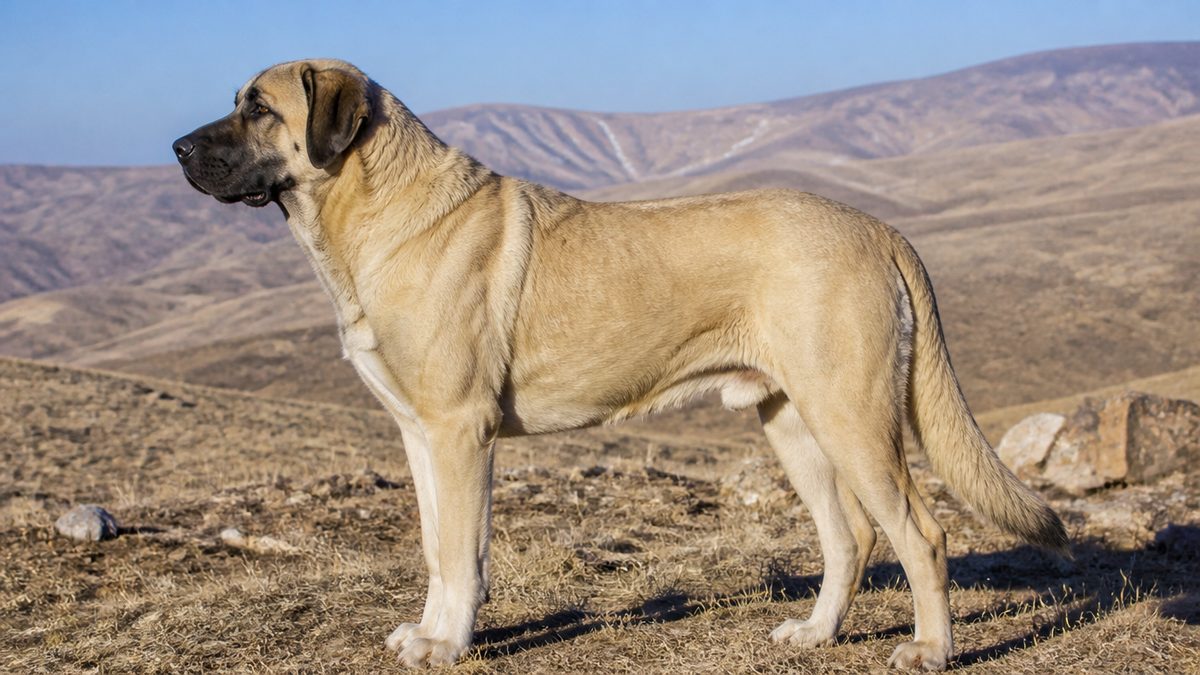
Sources agree, without a document to agree from, that this is a heavy short-coated dog of molosser type with a broad head, a deep chest and heavy bone, in fawn, sable or black, with a short coat over an undercoat. Ears are frequently shown cropped in working photographs from Iran, which is a husbandry practice rather than a breed feature and one that Indian law prohibits outright. This page describes natural ears throughout and its illustration shows them, for that reason.
The name is worth pinning down too. In English the animal is marketed as the Iranian Mastiff and the Persian Mastiff, and both names matter later on this page because of what India's 2024 customs circular says. In Iranian scientific writing it is simply the Sarabi ecotype.
What Iranian genetics actually found, which is more interesting than the missing measurements
Two Iranian studies have genotyped Sarabi dogs, and both report the same thing: the Sarabi is not genetically separated from its neighbouring Iranian populations, and individual variation swamps population identity.
The Montazery study is the closest thing this breed has to a foundational document, and it is worth reading properly rather than mining for a number it does not contain.
| Population | n | Mean alleles | Expected heterozygosity |
|---|---|---|---|
| Sarabi | 20 | 4.5 | 0.68 |
| Bakhtiari | 15 | 4.5 | 0.66 |
| Alborz samples | 15 | 4.0 | 0.59 |
| Kurdish | 12 | 5.1 | 0.72 |
| Western part samples | 11 | 3.4 | 0.61 |
| Khorasan samples | 10 | 3.5 | 0.56 |
| Tazi (Saluki) | 8 | 3.8 | 0.64 |
| Sangsari | 6 | 3.0 | 0.53 |
| Total | 97 | 3.9 average | 0.62 average |
Three findings in that paper bear directly on whether the Sarabi is a breed.
- Approximately 15 percent of the total genetic variation was explained by breed differences, with the remaining 85 percent corresponding to differences among individuals. Individual variation dominates by more than five to one.
- The smallest genetic distance in the whole study is between the Sarabi and the Bakhtiari, at a mean FST of 0.04 and a Nei's distance of 0.31, with 5.17 migrants per generation, which the authors describe as high gene flow between the two.
- The Sarabi carried the highest Y-chromosome haplotype diversity of any population, five of the eight haplotypes found, and the authors say the reason is unknown but suggest the Sarabi's habitat is adjacent to that of foreign dogs such as Ghafghazi dogs, which might have introduced new paternal lineages.
Read those together and the picture is coherent. A population with the highest paternal diversity in the study, sitting at the lowest genetic distance from its neighbour, in a country where 85 percent of variation is individual rather than between groups, is a regional working type with open gene flow. That is not a criticism of the dogs. It is an accurate description of what a landrace guardian is, and it is the opposite of a closed studbook.
The larger study says the same thing
The mitochondrial DNA survey of 305 Iranian native dogs assigns the Sarabi and the Saluki to haplogroups A, B, C and D, the Qahderijani and Kurdi to A, B and C, the Torkaman to A, B and D, and the Sangsari and Fendo to A and B. Its verdict on structure is explicit: evaluation of population differentiation using pairwise FST generally revealed no clear population structure in most Iranian dog populations. The paper also reports the highest number of d2 haplotypes in Iranian dogs compared with other areas of the Mediterranean basin, and suggests Iran as the probable centre of origin for that lineage, which is a genuinely notable finding about Iranian dogs generally rather than about the Sarabi specifically.
Asadi Fozi M is an author on both the Iranian native dogs mitochondrial study and on the whole-genome study of Sarabi CATTLE Moradian H, Esmailizadeh Koshkoiyeh. That is not a defect, it is the same Iranian animal-science community working across species from the same region, and it explains why a literature search on this breed's name returns more cattle than dogs. It is also a reminder to read the species in a citation before using it.
Older regional work exists but does not reach this population directly: a 2006 Genetika study of mitochondrial DNA variation in Asian guardian dogs covers the wider guardian group without naming this breed in its title. What neither Iranian study does is measure a dog, screen for disease or establish a lifespan, and no third study exists to do it. The genetic diversity work is the entire scientific corpus on this animal.
Registry status, tested honestly, and the verdict the documents support
The Sarabi satisfies one of the two conditions this site uses to call something a breed: a studbook registers it, and no written standard for it could be found anywhere, which makes the correct verdict a register without a standard.
This site applies a two-condition test. A breed needs a written standard somewhere, and a studbook somewhere. The two conditions can be met by different bodies on different continents, so each is checked separately.
Condition one, a written standard: not found
- FCI: absent from the register of breeds recognised on a provisional basis, which we read in full at twenty entries on 9 September 2026, with the Romanian Raven Shepherd Dog 373 present as an in-document control.
- FCI, definitive: the Group 1 nomenclature index lists eighteen countries of origin in Section 1 and four in Section 2, and Iran is not among them.
- Iran Kennel Club: its stated mission includes identifying purebred Iranian dogs and standard-writing, listed as an activity rather than as a completed set of documents, and no Sarabi standard is published on its site.
- Anywhere else: no standard was located under Sarabi, Iranian Mastiff or Persian Mastiff. We record that as not found rather than as non-existent, because a Persian-language document we could not reach would not show up in that search.
Condition two, a studbook: satisfied
This is the half the English-language pages have entirely missed. Iran has an FCI contract partner with a real studbook. The FCI's own members register lists Iran (Islamic Republic of) with the Iran Kennel Club (IKC) of Qazvin City as a contract partner, which is the third of the FCI's three membership tiers. The club states it obtained exclusive FCI representation for Iran in 1394, which is 2015 or 2016, and it operates a public pedigree service.
| Year | Puppies registered | Pure-bred dogs in the studbook | Cumulative total since creation |
|---|---|---|---|
| 2016 | 172 | 56 | 121 |
| 2017 | 310 | 50 | 12,000 |
| 2018 | 537 | 657 | 3,770 |
| 2019 | 554 | 644 | 4,414 |
| 2020 | 964 | 1,013 | 5,427 |
| 2021 | 1,284 | 1,395 | 6,999 |
| 2022 | 372 | 232 | 7,236 |
| 2023 | 74 | 249 | 7,485 |
| 2024 | 47 | 226 | 7,711 |
A cumulative total cannot fall. This one goes 121, then 12,000, then 3,770. From 2018 onward it behaves properly and its year-on-year differences mostly reproduce the annual registration row, at 644, 1,013, 1,572, 237, 249 and 226 against annual figures of 644, 1,013, 1,395, 232, 249 and 226. So the series is usable from 2018 and the 2016 and 2017 columns are not. Also worth noting: CAC shows, CACIB shows and FCI judges all read zero in every reported year. The IKC keeps a studbook and runs no FCI conformation events, which is exactly what a contract partner looks like.
Does that studbook actually register the Sarabi?
Yes, by name, and the club says so itself. The IKC has publicly offered free registration for Iranian native-breed dogs naming the Sarabi, Pazhdari and Qahderijani, and in a news item dated 1403/11/25, which is February 2025, it announced that it intends to submit a file to the FCI for the international registration of Iranian native breeds, naming the Sarabi, Pazhdari, Qahderijani and Khorasani dogs.
That announcement is the single most useful document about this breed's status, and it cuts both ways. It confirms that Iran's national body treats the Sarabi as a registrable native breed. It also confirms, in the club's own words, that the FCI file has not yet been submitted, which settles the recognition question without any inference on our part.
Register without standard. A studbook kept by the FCI's own contract partner in Iran registers Sarabi dogs; no written breed standard for the Sarabi could be located anywhere; and the FCI holds the breed neither definitively nor provisionally. This is not the same as a type, because a real national register does hold the dogs. It is not a breed in formation either, because that verdict requires a standard document to exist alongside the register. And it is certainly not recognition. The nearest parallel on this site is a breed the United Kennel Club will register while stating in writing that no breed standard exists for it.
One more thing the IKC announcement contains, because it explains the urgency behind the file. The club's stated motivation is that this national genetic asset should not pass out of Iranian hands, and it names a precedent: that the Iranian Tazi, the Saluki, was registered by England and the intellectual ownership of that genetic treasure was lost. Whatever one makes of the history, it tells you why an Iranian register exists and why a standard is being written now rather than eighty years ago.
History, and how much of it is actually documented
The Sarabi's documented history is short, because the earliest verifiable record of it as a named population is a 2016 genetics paper, and everything older is assertion.
The claim you will meet everywhere is that the Sarabi is an ancient breed, sometimes tied to Alexander's campaigns or to Assyrian reliefs. Wikipedia calls it one of the oldest indigenous dog breeds in Iran and cites a personal website for the age claim. The Iranian scientific literature makes a narrower statement and it is the one worth quoting: the Sarabi ecotype is considered one of the oldest and most powerful indigenous dogs in Iran. That is a report of what is believed, framed as such, and it is as far as any document we could reach will take you.
What can be dated
| Date | Event | Document |
|---|---|---|
| 1394 (2015/16) | Iran Kennel Club obtains exclusive FCI representation for Iran | The club's own site |
| 2016 | First peer-reviewed genotyping of a named Sarabi sample, n equals 20 | Montazery et al., Journal of Livestock Science and Technologies |
| 2016 | FCI begins publishing IKC studbook statistics | FCI statistics by national canine organisation |
| 2018 | Mitochondrial DNA survey of 305 Iranian native dogs including the Sarabi | Amiri Ghanatsaman et al., Mitochondrial DNA Part A |
| 1397 (2018/19) | Registration and identification of Sarabi and Qahderijani dogs announced | Iran Kennel Club social communications |
| February 2025 | IKC states it intends to submit an FCI file for the Sarabi | IKC news item, 1403/11/25 |
| 2025 | First and only clinical paper on Sarabi dogs published | Khatami et al., BMC Veterinary Research |
Read that table and the shape of the record is obvious: the documented history of this breed is about ten years old, and it is an institutional history rather than a canine one. That does not mean the dogs are ten years old. Livestock guardians have worked the Iranian uplands for a very long time and nobody disputes it. It means that the thing being registered, described and photographed as the Sarabi has been treated as a named unit in documents only recently, which is why its measurements were never taken.
It is repeated because it is attractive and because the two sources at the bottom of the chain are a personal blog and a single hedged sentence in a genetics paper Montazery M, Masoudi AA. When a rare breed's whole English-language presence rests on one or two references, whatever those references say hardens into fact through repetition. Follow the citation back and see what is actually at the end of it. On this breed the end of the chain arrives quickly.
A related and better-evidenced piece of regional history comes from the Y-chromosome work. The Sarabi's paternal lineages are the most diverse of any Iranian population sampled, and the authors' own suggestion is contact with neighbouring Ghafghazi, that is Caucasian, dogs. A guardian population on a border, absorbing males from across it, is a far more plausible and better-documented history than any account involving Alexander.
Sarabi dog price in india, and the Rs 100 listing that shows what the market is
No verified Sarabi price in india exists, the widely quoted Rs 40,000 to Rs 70,000 band comes from one retailer's blog with no source, and the only Indian listing offering a live animal prints Rs 100.
The commercial query for this breed returns a result set that answers the price question by its composition rather than by any number in it.
| Result | What it offers | Figure attached |
|---|---|---|
| AsiaPets | Buy Sarabi Mastiff puppy for sale in India, health-checked, verified seller | Rs 100 |
| Pawgy Pets blog, 31 March 2025 | An editorial price estimate, no source given | Rs 40,000 to Rs 70,000 |
| Supertails | A Tibetan Mastiff price page, not a Sarabi page | From Rs 25,000 |
| Mr n Mrs Pet | A Tibetan Mastiff page | INR 1,00,000 to 8,00,000 |
| petsworld.in | A Tibetan Mastiff sales page | INR 60,000 to several lakhs |
| TradeIndia | A German Shepherd price list | Rs 14,000 to 35,000 |
| Google AI Mode | Repeats the Pawgy Pets band and cites a Tibetan Mastiff page for space requirements | Rs 40,000 to Rs 70,000 |
The Rs 100 listing
A giant livestock guardian is not for sale in India at Rs 100. The AsiaPets result presents itself as a live listing with a health-checked animal and a verified seller, and prints that figure. It is a placeholder, a lead-capture device or a defaulted database field, and the useful thing about it is that it is the only Indian result that even claims to offer the animal. A search that surfaces one live listing, priced at a hundred rupees, is a search that has found no market.
Testing the Rs 40,000 to Rs 70,000 band
One Indian retailer's blog post of 31 March 2025 is the origin of the only substantive rupee band in circulation, and Google's AI Mode repeats it as the average price. We ran the standard division tests on it.
| Rate | Rs 40,000 becomes | Rs 70,000 becomes | Verdict |
|---|---|---|---|
| 84.38 | 474.0 | 829.6 | No, neither is a round figure |
| 80.00 | 500.0 | 875.0 | Weak. 500 is a price a seller would print; 875 is not |
| 74.00 | 540.5 | 945.9 | No |
| 83.33 | 480.0 | 840.0 | No |
So this band is not a converted foreign price. It divides cleanly at nothing except 80, and the 80 test is weak by construction because any rupee figure ending in three zeros divides evenly by it, and here only one of the two quotients is a number a seller would actually print. The honest conclusion is that Rs 40,000 to Rs 70,000 is rupee-native and arbitrary: somebody chose a plausible-looking band for an article, and an answer engine has since promoted it to the average price of the breed in India.
The AI Mode answer for sarabi dog price in india footnotes its space-requirements claim to petsworld.in, and the petsworld.in page ranking on that query is a Tibetan Mastiff sales page. The citation is real, the link works, and the page is about another animal. This is the failure mode where working footnotes give a fabricated answer the appearance of scholarship, and it is why opening the cited page is not optional.
What an Indian buyer is actually being offered
A Tibetan Mastiff, mostly. Three of the commercial results on this query are Tibetan Mastiff sales pages, and Indian sellers substitute the nearest available giant guardian when the requested one does not exist here. That is worth knowing before you speak to anybody, because the substitution happens in conversation too. If you want the Tibetan Mastiff, read that page and buy it knowingly. Do not let it arrive under another name.
The printed result count is worth one sentence, as a caution rather than a finding. This query printed About 19,900 results, the informational form printed About 101, and the Labrador Retriever control, the thickest commercial dog query in India, printed About 184 on the same instrument in the same session In-session control query labrador retriever…. A count that puts an unavailable Iranian guardian a hundred times above the Labrador is measuring nothing about demand or supply. Judge a market by what the results contain.
Cost of ownership for a very large dog in India, bounded honestly
Running costs for a dog of this size in India are dominated by food and parasite control, and the honest complication for this breed is that nobody can tell you what an adult weighs, so no feeding budget can be built from the breed name.
Every figure below is a real Indian price for a large dog, sourced and dated. None of it is specific to this breed, because no Indian population of this breed exists to survey, and we keep that distinction visible rather than dressing an estimate up as breed data.
| Item | Price | Source and scope |
|---|---|---|
| Puppy vaccination course | From Rs 6,499 | Vetic, seven visits from day 30, list price Rs 8,111 |
| Annual booster course | From Rs 3,199 | Vetic, list price Rs 3,806 |
| Anti-rabies, single dose | Rs 699 | Vetic clinic price |
| 9-in-1 DHPPiL, single dose | Rs 899 | Vetic clinic price |
| Canine corona | Rs 899 | Vetic clinic price |
| Kennel cough | Rs 1,349 | Vetic clinic price |
| Pet dog registration, Delhi | Rs 500 | MCD, new and renewal, Rs 100 per month late fee |
| Pet licence, Chennai | Rs 50 | Greater Chennai Corporation |
The feeding budget you cannot build
This is where the missing standard stops being an academic problem. A large-breed feeding chart is keyed to adult body weight, and the published adult weights for this breed run from 55 kg to 100 kg across sources that name no document. At Indian large-breed kibble prices of roughly Rs 600 to 650 per kilogram, that range is the difference between about Rs 7,200 and about Rs 13,000 a month for food alone. You cannot budget across a spread that wide, which means you have to weigh the animal monthly and let the trend tell you, rather than reading a number off a page.
The same 9-in-1 vaccine is Rs 899 at a Vetic clinic, and Greater Chennai Corporation's six municipal pet clinics provide treatment and anti-rabies vaccination free of cost Greater Chennai Corporation. The price of veterinary care in India is a function of the delivery model far more than of the drug, and knowing that is worth more to an owner than any single rate card. Register the dog while you are there: Delhi charges Rs 500 and Chennai Rs 50.
Parasite control, which scales with weight and with coat
Indian clinic-based series report heavy tick-borne disease burdens. A West Bengal study of 584 dogs screened found Babesia gibsoni in 76.54 percent and Anaplasma in 55.75 percent, with 72.9 percent of the 584 dogs screened carrying two or more pathogens. A southern Indian series of 120 found Babesia in 66.7 percent. An eastern Indian series of 178 found Ehrlichia canis in 31.46 percent, and 75 percent of the infected dogs weighed over 20 kg. Those denominators are clinic caseloads rather than random populations, so read them as among dogs tested at veterinary clinics.
The short coat is the one genuine cost advantage this breed has over a long-coated guardian: you can see a tick on it, and you can groom it in ten minutes rather than an hour. Budget for monthly ectoparasite cover regardless, at a four-figure rupee sum for a dog above 30 kg.
- Budget for cooling through March to June, which for a very large dog in an Indian plains city is an electricity cost rather than a pet cost.
- Budget for a large-dog boarding rate, which is at the top of the Indian market and often refused outright for guardian breeds.
- Budget for an experienced trainer from week eight, because the socialisation window is short and unrecoverable.
- Budget for a weighing scale, which sounds trivial and is the only way to feed this dog correctly given that no breed weight exists.
Indian climate suitability, and an honest homeland figure with its error stated
The Sarabi comes from uplands near 1,650 m whose corrected annual mean is about 10.8 C, so no Indian plains city is close, and the short coat improves the picture without changing the conclusion.
The method has to come before the number here, because the model fails on exactly this terrain. NASA POWER returns a grid cell rather than a point, and across the Iranian plateau every cell we queried sits far above the town beneath it.
| Point | Cell elevation | Real elevation | Error | Usable at face value |
|---|---|---|---|---|
| Sarab, East Azerbaijan | 2,035.02 m | about 1,650 m | +385.02 m | No |
| Tabriz | 1,883.65 m | about 1,350 m | +533.65 m | No |
| Ardabil | 1,712.05 m | about 1,350 m | +362.05 m | No |
| Chennai | 48.95 m | about 6 m | +42.95 m | Yes |
| Delhi | 206.37 m | about 216 m | -9.63 m | Yes |
| Bengaluru | 841.72 m | about 920 m | -78.28 m | Yes |
| Kolkata | 7.35 m | about 9 m | -1.65 m | Yes |
The model puts every north-western Iranian point 360 to 534 metres too high, so it reports the homeland as colder than it is NASA POWER climatology 2001-2020. Two things follow. The raw figures cannot be published as the homeland climate. And because the error runs one way and its size is known, a lapse-rate correction at about 6.5 C per 1,000 m gives a defensible estimate. We publish that estimate and label it an estimate. Note also that Sarab and Tabriz returned genuinely different cells, at 2,035.02 m and 1,883.65 m, so this is not one cell being queried three times.
| Place | Annual mean as returned | Corrected estimate | Hottest month as returned | Annual RH | Peak wet bulb |
|---|---|---|---|---|---|
| Sarab, corrected | 8.28 C | about 10.8 C | 20.66 C (Jul) | 60.17 % | 13.68 C (Jul) |
| Tabriz, corrected | 9.54 C | about 13.0 C | 22.97 C (Jul) | 57.83 % | 14.59 C (Jul) |
| Ardabil, corrected | 9.57 C | about 11.9 C | 20.75 C (Jul) | 62.65 % | 14.59 C (Jul) |
| Chennai | 27.95 C | as returned | 31.51 C (May) | 72.39 % | 26.11 C (May) |
| Delhi | 25.60 C | as returned | 35.88 C (Jun) | 45.56 % | 26.50 C (Jul) |
| Bengaluru | 23.74 C | as returned | 28.37 C (Apr) | 67.94 % | 21.86 C (May) |
| Kolkata | 25.81 C | as returned | 31.53 C (May) | 73.93 % | 27.09 C (Jun) |
| Ahmedabad | 27.57 C | as returned | 35.06 C (May) | 48.32 % | 26.11 C (Jun) |
The gap is the finding. Sarab's corrected annual mean of about 10.8 C sits 17.15 C below Chennai's 27.95 C, and the homeland's hottest month as the model returns it, July at 20.66 C, is cooler than Bengaluru's coolest month, December at 20.22 C only just NASA POWER climatology 2001-2020…. Correcting the homeland upward makes the gap smaller and does not close it.
The short coat changes one thing and not the important one
This is where the Sarabi differs genuinely from a long-coated guardian, and it deserves a straight answer rather than a reflex. A short coat over an undercoat is still a double coat, but it carries far less solar-absorbing bulk and it dries. So a Sarabi in India is better off than a Tatra Shepherd Dog or a South Russian Ovcharka in the same yard, and it is still a very large animal from a cold upland.
Frame the risk as wet-bulb load, the measure that combines heat and moisture and determines whether a panting dog can shed heat at all. The Sarab cell peaks at 13.68 C wet bulb in July. Kolkata peaks at 27.09 C in June, Delhi at 26.50 C in July, Chennai and Ahmedabad at 26.11 C in May and June respectively. That is a gap of more than 13 degrees on the variable that matters most, and no coat length closes it. The homeland is also drier, at 60.17 percent annual relative humidity against Kolkata's 73.93, so unlike some northern breeds this one really has not met Indian humidity either.
The largest study of canine heat-related illness examined 905,543 UK dogs under primary veterinary care in 2016, found 395 confirmed events, and reported significantly raised odds for dogs at or above their breed and sex mean bodyweight at 1.42 (1.12 to 1.80), and for dogs over 50 kg at 3.42 (1.54 to 7.57). A companion paper from the same cohort found that of 879 events with a recorded trigger, 652, or 74.2 percent, were exertional. This breed was in neither study and has no odds ratio of its own, so only the transferable factors are quoted. On published figures a Sarabi is comfortably over 50 kg, and the risk arrives on an ordinary evening walk rather than in a parked car. Indian law reaches the same ground from a different direction: Second Schedule Part IV paragraph 21(1) bars outdoor housing, without written veterinary approval, for breeds that cannot tolerate local temperatures.
Temperament, including the part the marketing pages leave out
The Sarabi is described consistently as calm, independent, powerful and protective, and the Iranian scientific literature adds that the ecotype is used for guarding and fighting, which is the part English-language pages omit.
The temperament description that circulates in English is stable across sources: calm, controlled, independent, powerful and protective, deeply bonded to its own household and highly suspicious of unfamiliar people Google India SERP. It is consistent, it is plausible for a landrace guardian, and it comes from no systematic behavioural study, because none exists.
The sentence that is usually cut
Montazery and colleagues write that the Sarabi ecotype is considered one of the oldest and powerful indigenous dogs in Iran which is used for guarding and fighting. Wikipedia carries it forward, saying the breed is also used to compete in staged dog fights. That is not a slur invented by outsiders; it is what the peer-reviewed Iranian description of the population says about its use. A page that describes this animal only as a calm family guardian has removed the sentence that most changes what a buyer is taking on.
Two things follow, and both matter more in India than they would elsewhere. First, a population in which some animals have been selected for fighting performance is a population whose temperament varies far more than a standardised breed's would, and there is no standard and no register-linked temperament testing to narrow it. Second, organised animal fighting is an offence in India: inciting an animal to fight sits at section 11(1)(m)(ii) of the Prevention of Cruelty to Animals Act 1960, and keeping or managing a place for animal fighting sits at section 11(1)(n), which is the cognizable one of the pair. Anyone importing that use into India is importing a criminal offence with it.
Who should not consider this dog
- Anyone in an Indian apartment or a shared building. A large aloof guardian and a daily stream of unfamiliar visitors is the worst possible combination.
- Anyone buying a first large dog. This animal makes its own decisions, which is the trait it was kept for.
- Anyone who needs to know what they are buying. With no standard and no verified size, you cannot know what the puppy will become.
- Anyone relying on the temperament descriptions online, which are consistent, repeated and evidenced by nothing.
- Anyone who cannot commit to intensive socialisation from week eight, because a guardian that has not met the world will decide what the world is on its own.
If the appeal is a large, calm, short-coated guardian that you can actually verify, the Kangal Shepherd Dog has a published standard and an FCI number, and this site's page on it says what that standard contains. That is a real difference and it is the one worth acting on.
Training an independent guardian, with no breed knowledge to draw on
To train a Sarabi you build cooperation rather than compliance, and you do it without the breed-specific guidance that exists for every recognised guardian, because none has been written.
The training problem is the guardian problem plus an information problem. Guardian breeds work alone and decide alone, and the Iranian description of this population is exactly that. What is missing here that is present for the Kangal or the Maremmano is a body of breed-specific handling advice written by people who have worked with hundreds of the dogs under a common standard. There is no such body for the Sarabi.
The order the work has to happen in
- Socialise from week eight through week sixteen, daily and deliberately, to people, vehicles, surfaces, sounds and situations. The socialisation window is the only part of this list that closes.
- Train in short sessions built on what the dog already wants. A guardian will outlast you in a contest of wills and will learn only that you are unpleasant.
- Establish a reliable recall and a settle before the guarding behaviour appears, which in a slow-maturing large dog is usually after twelve months.
- Manage the environment rather than relying on obedience at the gate. Physical separation does more than any command when a stranger arrives.
- Verify any trainer's real experience with livestock guardian breeds rather than with sport or gundog work, because the methods differ and the wrong method produces a defensive dog.
What this dog will refuse
It will refuse repetition without purpose and it will refuse to be physically compelled. It will not stop assessing strangers, because that assessment is the guardian instinct the population was kept for and it is not trainable away. A realistic goal is a dog that defers the decision to you rather than one that stops making a decision.
The 2017 Rules provide, at Second Schedule Part IV paragraph 23(5) under the heading Compatibility, that dogs with a vicious or aggressive disposition shall be housed separately from other dogs and that sedation shall not be used to control behavior of such dogs. Sedating a large guardian to get it through a visit is precisely what that clause forecloses. If behaviour cannot be managed without chemistry, the answer is a behaviourist and a management plan, and your nearby vet is the right first call.
One further point specific to this breed. Because the population includes animals selected for fighting, and because there is no register-linked temperament assessment, the individual dog in front of you is the only evidence you have. Meet the parents if you possibly can, watch them with a stranger, and treat any claim about typical breed temperament as unverified.
Daily exercise, and what the Indian calendar does to it
A Sarabi needs long, steady, low-intensity work rather than hard exercise, and in India the binding constraint is the number of hours in the day when a very large dog can safely move at all.
Living conditions decide this section more than the dog does. A massive guardian in an Indian city has a daily window measured in hours, and the conditions it is living in set that window rather than its appetite for work. Livestock guardians are not endurance athletes in the way a working gundog is. They patrol, they watch, they cover ground at a slow pace for long periods, and they conserve energy between events. What that means practically is that the exercise requirement is measured in hours of low-intensity activity rather than in kilometres of hard work.
- Walk before sunrise and after dark, and write off the middle of the day from March to June in every Indian plains city.
- Watch the wet bulb rather than the air temperature, because a 26 C wet bulb in Chennai in May is harder on a large dog than a dry 35 C afternoon.
- Split the requirement across two or three shorter outings so the dog is never far from shade and water.
- Avoid hard running entirely in heat, because exertional heat illness is the dominant mechanism at 652 of 879 events with a recorded trigger in the largest study available.
- Give the dog territory to patrol rather than a sport to perform, because that is the activity this kind of animal was actually built around.
Deny a guardian that and it does not become destructively hyperactive in the way an under-exercised retriever does. It becomes reactive: it patrols a boundary it cannot leave, escalates at whatever crosses it, and turns a gate into a trigger. In an Indian residential street, with foot traffic and delivery riders all day, that failure mode arrives quickly and is hard to reverse.
In most Indian cities, for most of the year, you cannot give a dog this size the exercise it needs at the hours a working household is free to give it. That is a reason the breed does not belong here rather than a scheduling problem to be solved with willpower. Indian law reaches the same conclusion from the housing side, barring outdoor housing without written veterinary approval for dogs not accustomed to local temperatures.
Grooming a short coat in Indian humidity
To groom a Sarabi you brush weekly through the undercoat rather than over it, check the skin folds and the ears, and never shave the dog, because a short coat over an undercoat is still a double coat.
The grooming load is the one genuinely easy thing about this animal. Sources agree the coat is short and dense with an undercoat. That means a weekly brushing, a heavier shed twice a year, and a job measured in minutes rather than hours. Compared with a long-coated flock guardian this is a different order of work entirely.
The routine
- Brush weekly with a rubber curry and an undercoat rake, working through to the skin rather than skimming the surface, and daily during a shed.
- Check the ears every week. On a dog often kept with cropped ears in its homeland, an Indian dog with natural ears has a warm humid canal and needs looking at.
- Dry the dog properly after any bath rather than letting it air dry, because Indian monsoon conditions plus a dense undercoat produce hot spots.
- Inspect the skin at every brushing, especially around the neck and elbows, because a heavy dog develops pressure calluses on hard Indian flooring.
- Refuse to shave the dog. The undercoat is insulation in both directions, and removing it exposes skin to solar load without improving heat loss.
Most working photographs of Sarabi dogs from Iran show short cropped ears, which is why so many English-language pages describe the breed as having small ears. It is a cut, not a trait. In India, Second Schedule Part II paragraph 6(8) of the 2017 Rules forbids tail docking, ear cropping, de-barking, de-clawing, branding, dyeing, injecting substances to enhance visual appeal, any other kind of mutilation, and any change of appearance by artificial means, in those words. If anybody offers you a cropped dog in India, that is a legal problem before it is an aesthetic one.
The short coat has one real advantage in India that is worth stating positively: you can see a tick on this dog. Given Indian clinic series reporting Babesia gibsoni in 76.54 percent of 584 dogs screened in West Bengal, that is not a small thing. Part the coat over the neck, ears, elbows and groin weekly anyway, but on this breed the inspection is quick and it works.
Health, and the two papers that exist
Exactly two peer-reviewed papers concern the Sarabi dog, only one of them is clinical, and there is no screening data, no lifespan figure and no disease prevalence for this breed anywhere.
The health problems attributed to this breed on ranking pages are the generic large-breed list, applied by analogy. That is worth stating before anything else, because the alternative on a page like this is to repeat the list and let it look like breed knowledge. The screening registries are empty too, and we checked rather than assumed: the Orthopedic Foundation for Animals holds no Sarabi entry at all in its Browse By Breed list, confirmed on two separate retrievals with Labrador Retriever, Bulldog and Beagle present as in-document controls, while Kangal Dog, Akbash Dog, Anatolian Shepherd, Caucasian Shepherd and Central Asian Shepherd are all present and this breed is not.
The literature search, in full
| Query | Records | What they actually are |
|---|---|---|
| "Sarabi"[tiab] | 21 | 2 on the dog, 5 on Sarabi CATTLE, the rest an author surname |
| Sarabi dog | 2 | Both genuinely on the breed |
| "Iranian mastiff"[tiab] | 0 | Exact phrase not in the index |
| "Persian mastiff"[tiab] | 0 | Exact phrase not in the index |
| Iran AND dog AND breed AND genetic diversity | 1 | The mitochondrial DNA survey |
| Labrador retriever hip dysplasia | 126 | Control, passed |
| "Kuvasz"[tiab] | 3 | Control on a rare guardian, passed |
| "Akbash"[tiab] | 4 | Control on a neighbouring guardian, passed |
Sarabi is also the name of an Iranian taurine cattle breed from the same district, and the veterinary literature holds more of the cattle than the dog. One of those papers is a whole-genome study of recent selection signatures in Sarabi cattle, describing it as a unique Iranian taurine breed. So a naive count of 21 records overstates the dog literature by a factor of ten, and anyone reporting a Sarabi literature has to open the records and read the species. Iran has sequenced the cattle genome and has published two papers on the dog.
The only clinical paper, read properly
Khatami, Pourjafar and Gharamaleki 2025, in BMC Veterinary Research, is the entire clinical literature on this breed. It studied the effect of a synbiotic feed containing Lactobacillus acidophilus La5 and 5 percent inulin on thyroid and sex hormones in male Sarabi dogs over 24 days, under ethics approval IR.IAU.TABRIZ.REC.1401.156 at the Faculty of Veterinary Medicine, Tabriz.
| Measure | Start | End | p value |
|---|---|---|---|
| T3 (ng/ml) | 1.09 +/- 0.51 | 0.95 +/- 0.40 | > 0.05 |
| T4 (ug/dl) | 6.60 +/- 4.33 | 4.70 +/- 4.29 | > 0.05 |
| TSH (mIU/L) | 0.07 +/- 0.09 | 0.03 +/- 0.00 | > 0.05 |
| Testosterone (ng/ml) | 1.56 +/- 0.66 | 1.26 +/- 0.93 | > 0.05 |
| FSH (mIU/ml) | 4.72 +/- 1.12 | 11.55 +/- 3.42 | 0.008 |
| LH (mIU/ml) | 0.56 +/- 0.48 | 0.31 +/- 0.15 | > 0.05 |
The abstract does not state how many dogs were studied. It says male dogs and gives no n, which for the only clinical study of a breed is a real limitation on what can be drawn from it. And FSH more than doubled at p equals 0.008, a statistically significant change, in a paper that concludes no significant adverse effects were observed. Both statements can be defended, because a rise in FSH within a normal range need not be adverse, but a reader quoting the conclusion without the table would miss the one significant result in it. Recompute and re-read before you cite; do not take the conclusion alone.
Lifespan, and why we publish none
Four figures circulate: 10 to 12 years, 12 to 15 years, 10 to 15 years, and up to 17 years, and none names a study. We checked the table that adjudicates inclusion in the largest UK longevity study, parsing 3,339 cells of its supplementary material, and Sarabi appears zero times. That is a different finding from an explicit exclusion: the breed was never considered, which is what you would expect for a population with no UK presence. There is therefore no median survival figure for this breed and no basis for constructing one.
What does transfer, and what does not
The heat evidence transfers, because it is keyed to bodyweight rather than to breed: 1.42 times the odds at or above breed and sex mean bodyweight, and 3.42 times over 50 kg. The Indian tick-borne disease evidence transfers, because it is about where the dog lives Venugopal V, Deepa PM, Muhasin Asaf VN.
The anaesthetic evidence does not transfer and it is worth saying why. The largest breed-specific anaesthetic mortality study, covering 54,542 anaesthetics after exclusions, reported overall mortality of 0.69 percent and found that after adjusting for ASA physical status only two breeds retained excess risk, the Chihuahua and the Spanish Water Dog, with the authors concluding that between-breed differences largely reflected case severity. This breed was not in that study. Importing an odds ratio onto a population the authors never examined would be fabrication wearing a citation.
Tell them the dog is a large Iranian livestock guardian population with no published health data, no breed standard and no known adult weight range, and give them the animal's actual current weight. Ask them to screen and dose as a large-breed dog of that measured weight rather than of any breed average. Consult your nearby vet before any anaesthetic procedure and ask specifically about recovery-phase heat management. Where there is no literature, your vet's judgement is the evidence base, and a page pretending otherwise would be doing you harm.
Feeding a very large dog whose adult weight nobody has published
To feed a Sarabi you weigh the dog and feed to the measured weight, because the published adult weights for this breed span 55 to 100 kg and none of them comes from a document.
Everything in this section follows from one fact established earlier: there is no breed standard, so there is no authoritative adult weight, so no feeding chart can be filled in from the breed name Sarabi dog, English Wikipedia. That is unusual, and it changes the practical advice rather than merely qualifying it.
The approach, in order
- Feed a large-breed puppy food with controlled calcium through growth rather than an all-life-stages food, because rapid growth on unbalanced minerals is the established orthopaedic risk in large breeds.
- Measure the dog's weight monthly through the first two years and feed to the trend, not to a bag chart keyed to an adult weight you do not know.
- Split the daily ration into three meals until six months and two thereafter, and never feed immediately before or after exercise.
- Score body condition by hand every fortnight, ribs and waist, because a heavy short-coated dog can carry several kilograms invisibly.
- Delay the switch to adult food until the weight trend genuinely flattens, which in a slow-maturing giant is later than a calendar date suggests.
Indian availability and cost
Large-breed dry foods are widely stocked in Indian metros. At roughly Rs 600 to 650 per kilogram, a dog in the 50 to 70 kg band eating 500 to 700 g a day costs about Rs 9,000 to Rs 13,600 a month for food alone, and one 15 kg bag lasts 21 to 30 days. Re-price before you budget; Indian retail food prices have moved within days on this site's own checks.
Deep-chested large breeds carry a raised risk of gastric dilatation and volvulus, and every description of this dog gives it a deep chest. There is no breed-specific incidence figure, because there is no breed-specific clinical literature beyond a single 24-day hormone study. So the advice is the general large-breed advice, split meals and no exercise around feeding, and the honest framing is that nobody has measured it in this population. Discuss prophylactic gastropexy with your nearby vet if the dog is going under anaesthesia for another reason.
One India-specific point. Water intake rises steeply with heat load in a large dog, and a Sarabi drinking less than usual in an Indian April is a dog to take seriously the same day. Provide fresh water in more than one place, changed rather than topped up.
Month by month through the first year
The first year of a guardian puppy is front-loaded, because the socialisation window closes at about sixteen weeks while the guarding behaviour it has to shape does not appear until well after twelve months.
Weeks 8 to 16, the window that does not reopen
Indian law sets the earliest point: Rule 8(1)(a) of the 2017 Rules requires that pups less than eight weeks in age are not sold. From arrival, socialisation is the whole job, and on a breed with no temperament data it is the only lever you control. Meet people of many ages and appearances, in many settings, every day. Introduce vehicles, lifts, tiled floors, stairs, doorbells and delivery riders deliberately, pairing each with something good.
Vaccination runs alongside. An Indian clinic course currently starts at Rs 6,499 across a seven-visit schedule from day 30, with anti-rabies at Rs 699 and the 9-in-1 at Rs 899 individually. Do not postpone socialisation until the course finishes; manage the risk by choosing clean environments instead.
Months 4 to 8, growth against the Indian calendar
A puppy born in November reaches four months in March, and March to June is precisely when Indian plains cities are unusable in the middle of the day. Growth does not pause for that. Find the exercise in the hours before sunrise and after dark, keep sessions short and on soft ground, and weigh monthly. Resist letting a growing giant-breed puppy run hard on hot surfaces.
Months 8 to 14, size and the first guarding
This breed puts on a great deal of frame in this window, and the first guarding behaviour usually appears within it as barking at boundaries and at approaching strangers. How the first instances are handled sets the pattern for years. Interrupt and redirect rather than punish, and never let the dog rehearse an escalation at a gate. Keep weighing, because the feeding plan depends entirely on the measured trend.
Months 14 to 24, maturity
Large guardians mature slowly and this one has no published maturity age, because it has no published anything. Keep feeding a growth-appropriate diet until the weight trend flattens rather than switching on a date, keep the socialisation going rather than treating it as complete, and expect the dog's judgement about strangers to harden into its adult form in this period.
Register the dog. Delhi charges Rs 500 for a new pet dog registration and the same for renewal, with a Rs 100 per month late fee. Greater Chennai Corporation charges Rs 50 for a pet licence and runs six clinics giving treatment and anti-rabies vaccination free of cost. On a breed that an undefined category word in a live customs instruction plainly reaches, a licensed, registered, vaccinated dog with documentation is a very different proposition in any enforcement conversation.
Indian legal status, and the one word in the circular that reaches this breed
The Sarabi is not named in India's March 2024 customs circular, but the circular carries the bare undefined word Mastiffs (boerbulls) at entry 15, and this breed's ordinary English names are Iranian Mastiff and Persian Mastiff.
CBIC Instruction No. 05/2024-Customs of 14 March 2024 reproduces a Department of Animal Husbandry and Dairying letter identifying 24 comma-separated entries as breeds that are ferocious and dangerous for human life and that shall be prohibited for import, breeding, selling as pet dogs and other purposes. We read it from two independent reproductions carrying identical transcription defects, which is the strongest available evidence that both transcribe the same document.
Checking the four undefined category words, not just the proper names
Four of the 24 entries are bare words the instrument never defines: Mastiffs (boerbulls) at 15, Terriers at 17, Wolf dogs at 19 and Canario at 20. Because they are undefined, they reach breeds by description rather than by name, and clearing a breed by checking proper names alone is exactly how this gets done wrongly.
| Category word | Reaches this breed? | Reasoning |
|---|---|---|
| Mastiffs (boerbulls), entry 15 | Yes, on its face | The breed's two standard English names are Iranian Mastiff and Persian Mastiff, and every English description files it as a molosser. The word reaches it directly |
| Terriers, entry 17 | No | Nothing in any description relates this population to a terrier |
| Wolf dogs, entry 19 | No | No source, Iranian or English, claims wolf content in this population. The mitochondrial work assigns it to ordinary domestic dog haplogroups A, B, C and D |
| Canario, entry 20 | No | A Canary Islands reference with no relationship to an Iranian breed |
Mastiffs (boerbulls) reaches the Sarabi on the face of the instrument, because Iranian Mastiff and Persian Mastiff are the names the breed is sold and described under in English. A page that says the Sarabi appears nowhere in the reported lists is checking proper names and missing the category word, and that is a documented error class on breed pages generally. We flag it rather than clear it.
What the instrument is, and where the litigation left it
The document is weaker than the word ban implies. It is a D.O. letter from a Joint Secretary, reproduced inside a customs instruction asking Principal Chief Commissioners to sensitise officers under their jurisdiction, and it is not an Act, a rule or a notification. The Karnataka High Court quashed the underlying circular in April 2024, finding that no stakeholder had been heard, that the committee's composition was not in consonance with the Rules, and that the circular travelled beyond what is found in the Rules. The Union has since told a High Court that the quashed circular has lost its effect entirely.
No Indian law in force today bans owning, breeding or selling this dog. The Karnataka court expressly left open a Rules amendment after due process, so neither banned nor settled all-clear is right. Separately, commercial import of dogs into India is restricted under the import policy regardless of breed, and that import restriction is what actually determines whether a Sarabi can lawfully reach an Indian buyer. It cannot, and it could not before March 2024 either.
The 2017 Rules, which are in force and unaffected
- Second Schedule Part II paragraph 6(8) forbids ear cropping, tail docking, de-barking, de-clawing and any change of appearance by artificial means, which reaches the cropping shown in most photographs of this breed.
- Second Schedule Part IV paragraph 23(5) requires separate housing for a dog with a vicious or aggressive disposition and forbids using sedation to control its behaviour.
- Second Schedule Part IV paragraph 21(1) bars outdoor housing without written veterinary approval for dogs not accustomed to local temperatures and for breeds that cannot tolerate them.
- Second Schedule Part III paragraph 8(10) requires breeding dogs to have been tested for genetic defects including hip dysplasia, progressive retinal atrophy, entropion and cryptorchidism, with the word including making the list illustrative rather than closed.
Head to head against the guardians an Indian buyer cross-shops
An Indian buyer looking at a Sarabi is really choosing between four large guardians, and the decisive column is not temperament but whether anybody has written the breed down.
| Breed | Published standard | Studbook | Named on India's 2024 circular | Peer-reviewed papers on the breed |
|---|---|---|---|---|
| Sarabi | None found | Iran Kennel Club, FCI contract partner | Not by name; Mastiffs reaches it | 2 |
| Kangal Shepherd Dog | FCI standard | FCI, via Turkey | Yes, entry 8 | Multiple |
| Central Asian Shepherd Dog | FCI standard | FCI | Yes, entry 9 | Multiple |
| Caucasian Shepherd Dog | FCI standard | FCI | Yes, entry 10 | Multiple |
| South Russian Ovcharka | FCI standard 326 | FCI | Yes, entry 11 | Zero |
| Tibetan Mastiff | FCI standard | FCI | Not named | Multiple |
| Bakharwal dog | None | None | Not named | Few |
Read the first two columns together and the Sarabi's position is unique among these dogs. It has a register and no standard, where the four FCI breeds have both and the Bakharwal has neither. That combination is exactly why so much nonsense is published about its size: a register creates dogs to photograph and sell, while the absence of a standard means nobody has ever had to agree what one looks like.
If you want a large short-coated guardian and you want to know what you are buying, the Kangal Shepherd Dog has a published standard, an FCI number, a genuine literature and a Turkish national register behind it. It is also entry 8 on India's 2024 circular, so the Indian legal position is worse rather than better. If the priority is a dog that is actually here, an Indian livestock guardian such as the Bakharwal dog has no standard either, and it has the enormous advantage of being adapted to Indian conditions and available from Indian sources.
Two things this table deliberately does not compare. It does not compare lifespans, because only some of these breeds have one published and the Sarabi has none. And it does not compare temperament ratings, because for the Sarabi that would mean scoring marketing copy against registry text, which is not a comparison.
Mistakes Indian buyers make with this breed
The five mistakes below are specific to a breed with a register and no standard, which is a combination that produces confident wrong information rather than obvious gaps.
Believing the height
The 80 to 100 cm figure is the single most repeated claim about this dog and its cited source contains the word height zero times. Buyers pay premiums for size in this population, and the Iranian literature says so explicitly: the larger and heavier an individual dog is, the greater its value. A published height that nobody measured, in a market that prices on size, is a commercial incentive rather than a fact.
Treating an ecotype as a standardised breed
Iranian genetics calls this an ecotype, finds 85 percent of variation to be between individuals rather than between populations, and reports the smallest genetic distance in the study between the Sarabi and its Bakhtiari neighbour. A second study finds no clear population structure across most Iranian dog populations. Buying an ecotype puppy and expecting standardised adult traits is buying a lottery ticket described as a specification.
Clearing the breed against the wrong document
Several judicial reproductions of the 2024 circular are abridged and drop entries including the undefined category words, so a buyer checking the list from a court's recital would clear this breed when Mastiffs (boerbulls) reaches it. Read the list from the customs instruction itself, count the entries, and check the category words as well as the proper names.
Accepting a cropped dog
Cropped ears are normal in working photographs from Iran and illegal in India. Second Schedule Part II paragraph 6(8) forbids ear cropping and any change of appearance by artificial means in terms. A cropped dog offered in India raises a question about how it got here and who cut it, and neither answer is good.
Taking a rupee band from an answer engine
Google's AI Mode gives Rs 40,000 to Rs 70,000 as the average price and footnotes it partly to a Tibetan Mastiff sales page. The band itself traces to one retailer's blog and divides cleanly at no plausible exchange rate, so it is not even a conversion; it is a number somebody chose. Open the cited page before believing any figure attributed to it.
Pursuing this breed in India at all. There is no lawful commercial import route, no Indian population, no published standard to identify a dog against, and an undefined category word in a live customs instruction that reaches it. If a seller offers you one, the question is not the price. It is which document says this dog is a Sarabi, and on current evidence no such document can exist in India.
Adoption, and the honest route for someone who wants this kind of dog
Adopting a Sarabi in India is not possible, because no Indian population exists to surrender from, and the responsible route is to adopt the large guardian-type dog that is already in front of you in an Indian shelter.
This section is usually a formality on a rare-breed page. Here the answer genuinely changes what a reader should do next.
Why there is nothing to adopt
- No Indian breeding population exists, so Indian shelters receive no surrenders of this breed. Rescue intake mirrors ownership.
- No lawful commercial import route exists, so a population cannot form. Dogs enter India as accompanied pets, not for trading or breeding.
- No standard exists to identify a dog against, so even a well-meaning shelter could not confirm that a large short-coated guardian is a Sarabi.
- The single Indian listing claiming to offer one prints Rs 100, which tells you what that listing is.
What to do instead
Indian shelters carry large guardian-type dogs continuously, most of them mixed, many with genuine protective behaviour and all of them already adapted to Indian heat. A shelter dog offers the one thing no imported puppy can: an observed adult temperament. On a population where the scientific description includes use for fighting and where no register-linked temperament assessment exists, that is not a small advantage, it is the whole ballgame.
- Verify the shelter's assessment process and meet the dog more than once, at different times of day.
- Ask specifically how the dog behaves when a stranger arrives at a doorway, which is the scenario every guardian fails first.
- Screen for tick-borne disease at intake rather than waiting for clinical signs, given the Indian clinic series.
- Confirm vaccination and sterilisation in writing, then register the dog with your municipality.
- Adopt only if the household genuinely suits a protective dog, because returning one is worse for the animal than never taking it.
We report published price ranges as editorial content and we do not recommend breeders, link puppy listings or quote a live price as an offer. On this breed there is nothing to link even if we did. If you want a large protective dog in India, start at a shelter, and consult your nearby vet about what a very large dog will need through the hot months before you commit.
One closing point, and it is a positive one. The Sarabi's status is likely to change, and this page will need rewriting when it does. Iran's FCI contract partner has said it intends to submit a file for the Sarabi, Pazhdari, Qahderijani and Khorasani dogs. If that file is accepted, a written standard will follow, and for the first time there will be a document that says how tall this dog is. Until then, every measurement you read for it is somebody's guess, and the most useful thing an encyclopedia can do is say so.
Questions people actually ask, answered as they were asked
What kind of dog is Sarabi?
The Sarabi is a large livestock guardian from Sarab County in East Azerbaijan province, north-western Iran, and the most accurate word for it is the one Iranian animal science uses: an ecotype. English-language sources market it as the Iranian Mastiff or Persian Mastiff. Iran's own kennel club registers Sarabi dogs in its studbook, but no written breed standard for it has been published anywhere that we could find, which places it in the category of a register without a standard rather than a recognised breed.
How much does a Sarabi dog cost in India?
No verified Sarabi price in india exists, and the figure you will be shown, Rs 40,000 to Rs 70,000, traces to a single Indian retailer's blog post of 31 March 2025 that cites nothing. The only Indian listing that appears to offer a live animal prints a price of Rs 100 for a Sarabi Mastiff puppy, which is a placeholder rather than a price. Meanwhile the organic results on that query are dominated by Tibetan Mastiff sales pages, which tells you what an Indian buyer is actually being offered instead.
What is the average lifespan of a Sarabi dog?
Nobody has measured it. The figures in circulation are 10 to 12 years, 12 to 15 years and, in Google's own answer, 10 to 15 years with some sources reporting up to 17, and none of them names a study. The breed appears zero times across the 3,339 cells of the supplementary table that adjudicates inclusion in the largest UK longevity study, so it was never considered there. We publish no lifespan for this breed rather than choose between four unsourced numbers.
What is the #1 best family dog?
Google asks this on a Sarabi query, and the honest answer is that the question has no single answer and this breed is not a candidate for it. A large territorial guardian with no published standard, no health data, no verified adult size and no lawful Indian supply route is not a family dog in any Indian household. If you want a family dog in India, the shortlist starts with well-socialised Indian shelter dogs and with breeds a local vet has actually treated before.
How tall is a Sarabi dog really?
Nobody knows, and the famous number is unsupported. Wikipedia gives males 80 to 100 cm and cites Montazery, Masoudi and Vaez Torshizi 2016. We downloaded that paper and extracted it: ten pages, 37,767 characters, and the words height, withers, weight, cm and kg occur zero times in it. A routine 100 cm at the withers would make this the tallest dog breed on earth by a clear margin. Treat every published Sarabi measurement as unverified until somebody publishes a document behind it.
Is the Sarabi banned in India?
The Sarabi is not named in India's March 2024 customs circular, but the circular carries the bare undefined word Mastiffs (boerbulls) at entry 15, and this breed's ordinary English names are Iranian Mastiff and Persian Mastiff. A page that cleared the breed by checking proper names alone would be wrong. That said, the Karnataka High Court quashed the underlying circular in April 2024 and the Centre has told courts it is not acting on it, so no Indian law in force today bans owning this dog. Commercial import of dogs is restricted regardless of breed.
Is the Sarabi a recognised breed?
No. The Sarabi is absent from the FCI's provisional register, which we read in full at twenty entries with a working in-document control, and no Iranian breed appears anywhere in the FCI Group 1 country list Federation Cynologique Internationale. Iran's own FCI contract partner, the Iran Kennel Club, announced in February 2025 that it intends to submit a file to the FCI for the Sarabi and three other native breeds, which is the club's own statement that recognition has not happened.
Is there a Sarabi breed standard?
We could not find one, and we looked in the places a standard would be. There is no FCI standard, no UKC entry, and the Iran Kennel Club lists standard-writing among its stated future missions rather than publishing a completed document. So the honest statement is that no written standard for this breed could be located, not that none exists. Without a standard there is no authority for any height, weight, colour or fault list you will read anywhere.
Why do searches for the Sarabi return cattle papers?
Because Sarabi is also a cattle breed from the same district, and the veterinary literature holds more of the cattle than the dog. A PubMed search for "Sarabi"[tiab] returns 21 records, of which two concern the dog and five concern Sarabi cattle, with the rest carrying Sarabi as an author surname. One of those cattle papers is a whole-genome selection-signature study calling Sarabi cattle a unique Iranian taurine breed. Iran's animal-science establishment has sequenced the cattle and barely studied the dog.
Can a Sarabi handle the Indian climate?
A Sarabi handles Indian heat better than a long-coated guardian and still badly. Its homeland at Sarab sits near 1,650 m in north-western Iran, and after correcting the NASA POWER cell for a 385 m elevation error the annual mean comes out around 10.8 C as an estimate. Chennai averages 27.95 C and peaks at 31.51 C in May. The short coat removes one problem and leaves the two that matter, which are a very large body and no evolutionary experience of wet-bulb loads near 26 C.
Are Sarabi dogs used for fighting?
The Iranian scientific literature says so plainly, and it is the least comfortable fact on this page. Montazery and colleagues describe the Sarabi ecotype as one of the oldest and most powerful indigenous dogs in Iran, used for guarding and fighting. Wikipedia repeats it. Under Indian law, organised animal fighting engages sections 11(1)(m)(ii) and 11(1)(n) of the Prevention of Cruelty to Animals Act 1960, and a page describing this breed without saying what the literature says about its use would be hiding the thing a buyer most needs to weigh.
What should I ask a seller offering a Sarabi in India?
Ask which document says the dog is a Sarabi, and expect no good answer. With no published standard, no Indian population and no Indian pedigree register for the breed, there is nothing an Indian seller can produce that identifies the animal. Then ask how the dog entered India, because commercial import of dogs is restricted and dogs enter only as accompanied pets. Consult your nearby vet before taking on any large guardian, and be aware that a wrongly identified giant puppy is a fifteen-year commitment made on a guess.
Compare with similar breeds
Sarabi sits in 1 Bonbeno group. Each one compares it directly against the breeds it is genuinely an alternative to, on the same figures.