
Breed profile
South Russian Ovcharka: Price in India, Size and the Import Ban
A 66 cm white steppe flock guardian that India's 2024 customs circular calls ferocious, on a list whose first thirteen entries are Denmark's banned-breed list copied in order, and which Russia's own dangerous-dogs decree does not contain.
Quick answer
The South Russian Ovcharka has no price in India, no Indian breeder and no lawful commercial import route, and it is named in India's March 2024 customs circular as entry 11 of 24. It stands not less than 66 cm in males and 62 cm in females under FCI standard 326, and weighs not less than 35 kg and 30 kg respectively.
This page reports published registry standards, government instruments, climate data and Indian veterinary literature. It is not a diagnosis and it is not a treatment plan. Consult your nearby vet, a registered veterinary practitioner, before acting on anything here, and especially before making decisions about heat management, anaesthesia or feeding a large breed puppy.
South Russian Ovcharka at a glance
What the South Russian Ovcharka is, measured from the registry rather than the blogs
The South Russian Ovcharka is a large white long-coated flock guardian from the steppes of southern Russia and Ukraine, standing not less than 66 cm at the withers in males and not less than 62 cm in females under FCI standard 326, with a weight floor of 35 kg and 30 kg and no stated maximum for either.
Start with the names, because seven of them are in circulation and they decide what you can find out about this dog. The Federation Cynologique Internationale registers it as Yuzhnorusskaya Ovcharka and gives its English name as South Russian Shepherd Dog. The United Kennel Club files it as the South Russian Shepherd Dog in its Herding Dog Group. Wikipedia titles it South Russian Ovcharka and lists Youjnorousskaia Ovtcharka, South Russian Sheepdog, Ukrainian Ovcharka, Yuzhak, South Ukrainian Ovcharka and South Russian Shepherd Dog as other names. India's 2024 customs circular calls it South Russian Shepherd Dog (ovcharka). Denmark's statute calls it Sydrussisk ovtcharka. An Indian buyer searching one of those forms will not meet the document written under another, and that is the practical reason this page exists.
The measurements, and the 2.5 cm the two registries disagree about
| Source | Males | Females | Weight given |
|---|---|---|---|
| FCI standard 326, English text 12.12.2017 | Not less than 66 cm | Not less than 62 cm | 35 kg / 30 kg minimum |
| FCI standard 326, French authentic text 18.02.2022 | Pas moins de 66 cm | Pas moins de 62 cm | 35 kg / 30 kg minimum |
| UKC standard, revised 1 March 2009 | Minimum 25 in (63.5 cm) | Minimum 24 in (61 cm) | None stated |
| Wikipedia infobox | Minimum 66 cm | Minimum 62 cm | 35 kg / 30 kg, plus up to 75 kg in text |
| Wag! | Minimum two feet (61 cm) | Minimum two feet (61 cm) | Upwards of 100 lb |
| dogbreedinfo | 25 in (65 cm) minimum | Not separately stated | None stated |
| EuroPuppy | Not stated as a range | Not stated as a range | None stated |
Three things fall out of reading that table downward. The two registries genuinely disagree, and not by a rounding error: the UKC's male minimum of 25 inches is 63.5 cm against the FCI's 66 cm, a gap of 2.5 cm at the one place in the standard where the number does real work, because both documents make undersize a fault. The UKC states no weight at all, so any weight you read that cites the UKC is somebody's estimate. And Wag!'s minimum of two feet is 61 cm, which sits below both registry floors and would be a severe fault under the FCI text and an undersize serious fault under the UKC's.
Most breed standards give a range. FCI 326 gives a minimum and then says explicitly that a larger size is preferable, provided the general conformation stays well proportioned. So a 78 cm male is not oversized under this standard; he is preferred. When you are estimating food quantity, crate size or a drug dose for a breed like this, the standard will not give you an upper bound and you have to weigh the animal.
What the dog is built like
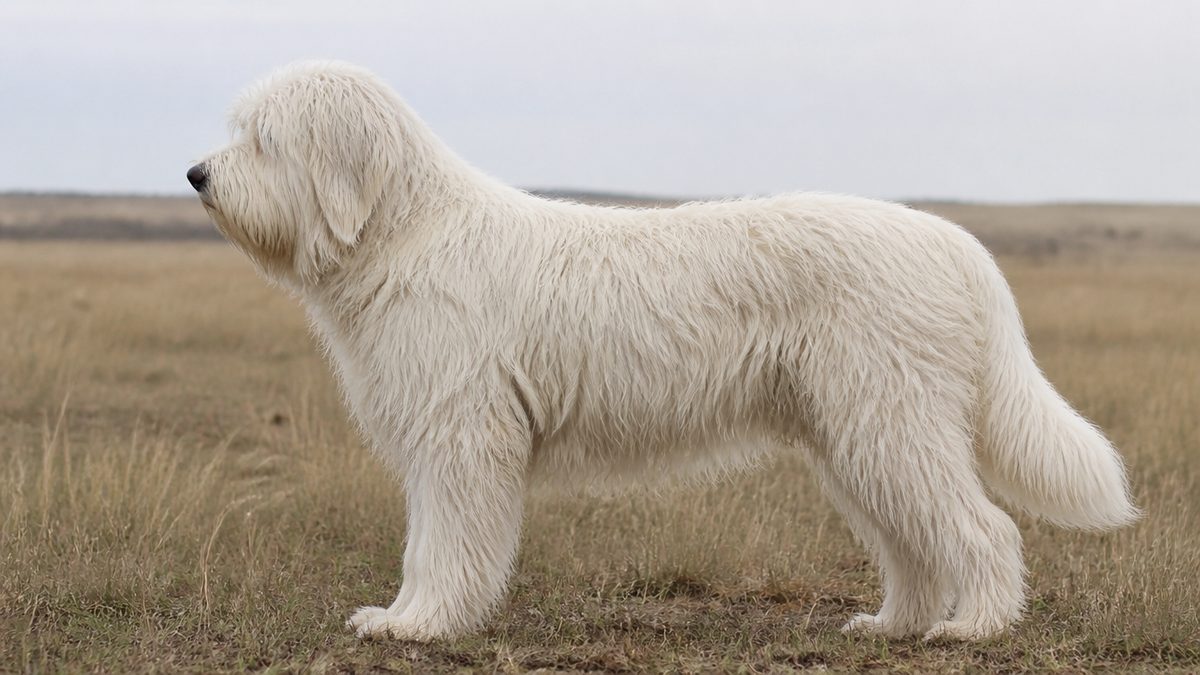
The FCI describes a dog of above-medium to large size, moderately long in body, not stocky, with strong bones and dry powerful muscles, and marked sexual dimorphism in which males are more massive and carry larger heads. The signature is the topline, which the standard calls a characteristic feature of the breed: it forms a slight curve over the loin, and the height at the rump is the same as or 1 to 2 cm more than the height at the withers. Excessive or insufficient curve of that topline is a listed fault, and a roach back is a severe one.
The head is elongated and wedge-shaped, narrowing towards the nose, with a moderately broad flat forehead, a barely defined stop and well-developed occiput and cheek bones. The nose is black and large, though the standard permits a seasonal lightening of nose pigment in wheaten and pale ivory dogs provided the rim stays black. The eyes are almond-shaped, not large, set wide apart and looking forward, ranging from dark to light brown with darker preferred. The ears are low set, medium-sized, triangular and hanging close to the cheeks. The tail reaches at least the hock, is carried down at rest and, when the dog is alert and in movement, is carried not higher than the topline and slightly curved upwards but never curled over the back. It may end in a hook or a semicircle, with the last two or three vertebrae often fused into a joint bone.
The coat is the part that decides everything for an Indian reader. It is abundant, and of almost the same length on head, body, limbs and tail, which is the detail that separates this breed from every other white flock guardian. Long thick hair on the head forms eyebrows, a moustache and a beard, and even the nasal bridge is meant to be well covered with hair. The quality is specified: long, not less than 10 cm, harsh, thick, coarse and shaggy, slightly wavy or broken, over a soft, long, thick, lighter-coloured undercoat. Males desirably carry a mane. A coat with the undercoat completely combed out is explicitly undesirable, and so is a matted or elf-locked one, which means the standard is asking for a maintained coat rather than a stripped or a neglected one.
Colour is white, white with yellowish shading, or white with grey, wheaten or pale ivory patches, and grey or pale ivory dogs may carry a white blaze and white neck markings. Patches must be light-shaded and must not have distinct borders. The final colour appears only at 18 to 24 months, so puppies and young dogs look more intensely coloured than they will end up. Black, red, greyish brown, blue, brown and tricolour are disqualifying faults, as are an intensely represented mask or saddle. The UKC treats the same colours as serious faults rather than disqualifications, which is a real difference in severity between two documents describing one dog.
History, and the place the FCI's own standard puts in the wrong country
The South Russian Ovcharka was developed on one estate, at Askania-Nova, from local steppe dogs crossed with long-haired shepherd dogs brought from Spain alongside fine-wool sheep, and the FCI's own standard places that estate in Crimea when it is in Kherson Oblast.
The FCI standard tells the story in unusual detail for a breed document. Bearded coarse-haired dogs arrived in the southern steppes from Spain together with fine-wool sheep, a movement the standard says is recorded in the twenty-sixth volume of the Complete Collection of the Laws of the Russian Empire, published at St Petersburg around 1830. Those dogs were agile and of medium size, resembling the modern Gos d'Atura Catala, and they interbred with local shepherd and sighthound-type dogs already working the flocks. The crossbred descendants spread through southern Russia and became known abroad simply as the Russian shepherd. In 1867 one of them won a gold medal for beauty at the Exposition Universelle in Paris.
Real selection began in 1898 on the estate of Friedrich von Falz-Fein, a Russian baron of German origin, who gave the breed its modern type and its name. Numerous crosses with local sighthounds raised the height, fixed the dominance of the white coat, and added a lighter build, a somewhat flattened chest, a tucked-up belly and more pronounced hindquarter angulation. The type and the name were finally settled in the USSR period in the early 1930s, when the first official standard was approved.
Where Askania-Nova actually is
| Document | Says the breed comes from | Comment |
|---|---|---|
| FCI breed record 326 | RUSSIAN FEDERATION | The register's country-of-origin field, unchanged since definitive acceptance |
| FCI standard 326, English | ORIGIN: Russia. Selection began in 1898 in the Crimea, in Askania-Nova | Askania-Nova is not in Crimea |
| FCI standard 326, French authentic text | en Crimee, a Ascania-Nova | The same error in the authentic language, so it is not a translation slip |
| Wikipedia | Russian Empire, Soviet Union, Ukraine, Russia; estate at Askania-Nova, now in Kherson Oblast, Ukraine | Four origin entries for one breed |
| Coordinates used for this page's climate data | 46.4494 N, 33.8828 E | About 165 km north of Simferopol and north of the Perekop isthmus, so outside Crimea |
That is not a pedantic point and it is worth stating plainly. Both the English translation and the French authentic text of FCI 326 place the breed's foundation estate in Crimea, and Askania-Nova sits in Kherson Oblast, on the mainland, well north of the isthmus. Because the error is in the authentic language too, it is the standard's own error rather than a translator's. The register meanwhile files the country of origin as the Russian Federation, a state that did not exist under that name when the breed was accepted in 1983 and which does not contain the estate the standard names South Russian Ovcharka, English Wikipedia. We publish the disagreement rather than choosing one version, because every account is drawn from a different document and each is accurate about what its own document says.
The UKC's history section says this is a native Russian breed directly descended from the wolf, with additions of local shepherd dogs and sighthounds. The FCI standard describes a Spanish import crossed with local shepherd and sighthound-type dogs and never mentions a wolf at all. Two registries, two incompatible founding accounts, both current. The wolf sentence is also biologically empty, since every domestic dog descends from the wolf, but it has a consequence in India that nobody has noticed and that we come back to in the legal section: the 2024 circular carries the undefined category word Wolf dogs.
The trail of documents also explains why the breed's population is thin. It was developed on a single estate by a single patron, standardised in the 1930s, and then went through two wars fought across exactly the territory it came from. The FCI accepted it definitively on 30 September 1983, more than fifty years after the first standard, and the breed has never spread far beyond the region that made it.
Which registries hold this breed, and what the FCI record actually says
Four bodies hold the South Russian Ovcharka in some form, and the FCI's record is the one that matters for India, because the Kennel Club of India issues pedigrees against FCI nomenclature.
The FCI record for breed 326 is short and every line of it is load-bearing. Breed status: recognised on a definitive basis. Group 1, Sheepdogs and Cattledogs except Swiss Cattledogs, Section 1 Sheepdogs. Country of origin: Russian Federation. Date of acceptance on a definitive basis: 30 September 1983. Not subject to a working trial. And, crucially for anyone reading a figure off a standard, the official authentic language is French.
The English standard is a translation, and it is five years older than the authentic one
The FCI record lists a publication date per language, and they are not the same. The English text is dated 12 December 2017. The French, German and Spanish texts are all dated 18 February 2022. All four carry the same date of publication of the official valid standard, 22 August 2017, so the 2022 date is a re-issue of the file rather than a new standard. Anyone reading the English PDF is therefore reading a 2017 rendering of a document whose authentic version was reset in 2022. We extracted both PDFs with pypdf and compared every numeric token in them, and they agree: 66, 62, 35, 30, 10 cm, 64, 59, 100 degrees, 42 teeth, 18 to 24 months, 10 to 12 percent, 40 percent FCI-Standard N 326. So on this breed the translation drift that bites elsewhere on this site has not happened, and that negative result is worth recording.
The English PDF carries a line most readers skip: TRANSLATION: Dmitry Mamontov and Anna Samsonova, edited by Dr. Eugene Yerusalimsky, official language (FR). So the English text of a French-authentic standard for a Russian breed was produced by Russian cynologists. That is not a criticism, and the numbers check out, but it tells you the chain a figure travelled before it reached an English-language breed page.
The UKC moved this dog out of the guardian group in 2009
The United Kennel Club recognised the breed on 1 January 1996 as the South Russian Ovcharka, in the Guardian Dog Group. Effective 1 January 2009 it changed the name to South Russian Shepherd Dog and moved the breed from the Guardian Dog Group to the Herding Dog Group. The current standard is marked Official UKC Breed Standard, revised 1 January 2009.
That reclassification is worth holding on to, because fifteen years later an Indian instrument put the same dog on a list of breeds identified as ferocious. Two registries independently file it among sheepdogs. The FCI has never filed it anywhere else, and the UKC actively moved it there.
- FCI: recognised definitively, 30 September 1983, Group 1 Section 1 Sheepdogs, standard 326, no working trial.
- UKC: recognised 1 January 1996, currently in the Herding Dog Group, standard revised 1 January 2009.
- Continental Kennel Club: carries a breed page filing it among pastoral and stock dog breeds.
- Kennel Club of India: India is a full FCI member represented by the KCI, so FCI nomenclature governs Indian pedigrees. The KCI publishes no breed list of its own, which means an absence there is an instrument limit rather than a finding about the breed.
So the recognition answer is unambiguous and it needs no hedging: this is a fully recognised breed with a published standard and an international studbook route. Both conditions of the two-condition test are satisfied by one organisation. The interesting question about this animal is not whether it is a breed. It is why a fully recognised Group 1 sheepdog is named in an Indian customs instruction, and that has an answer.
India's 2024 circular names this breed, and the list it came from is Danish
India's March 2024 customs circular names the South Russian Shepherd Dog (ovcharka) as entry 11 of 24, and the circular's first thirteen entries are the thirteen breeds prohibited by Denmark's Hundeloven section 1 a, in the same order, with this breed at position 11 in both documents.
This is the section every other page about this breed is missing, so the evidence is laid out in full and you can check every step of it. English Wikipedia is the only ranking page that reaches the question at all, and its entire Legislation section is a single sentence saying the dog is banned in Denmark, sourced to a 2013 archived capture. That sentence is correct. What it leaves out is that the same Danish list is why this is a banned breed in an Indian document too.
CBIC Instruction No. 05/2024-Customs, F.No.401/32/2024-Cus.III, dated 14 March 2024, reproduces an office memorandum from the Department of Animal Husbandry and Dairying enclosing D.O. letter No. D.O. V-11/1/2024-Anlm-Dadf of 12 March 2024, signed by a Joint Secretary. Paragraph 2 says the following breeds of dogs have been identified as ferocious which are dangerous for human life and shall be prohibited for import, breeding, selling as pet dogs and other purposes. The quoted list runs to 24 comma-separated entries. We read it from two independent reproductions, and both carry the identical transcription defects, a doubled comma after Tosa Inu and a full stop instead of a comma after Fila Brasileiro Second independent reproduction of CBIC…. Matching defects are the strongest available evidence that two mirrors are transcribing the same document rather than copying a summary of it, because a paraphrase would have quietly fixed them.
The two lists, side by side
| No. | India, CBIC Instruction 05/2024-Customs | Denmark, Hundeloven section 1 a |
|---|---|---|
| 1 | Pitbull Terrier | Pitbull terrier |
| 2 | Tosa Inu | Tosa inu |
| 3 | American Staffordshire Terrier | Amerikansk staffordshire terrier |
| 4 | Fila Brasileiro | Fila brasileiro |
| 5 | Dogo Argentino | Dogo argentino |
| 6 | American Bulldog | Amerikansk bulldog |
| 7 | Boerboel | Boerboel |
| 8 | Kangal | Kangal |
| 9 | Central Asian Shepherd Dog (ovcharka) | Centralasiatisk ovtcharka |
| 10 | Caucasian Shepherd Dog (ovcharka) | Kaukasisk ovtcharka |
| 11 | South Russian Shepherd Dog (ovcharka) | Sydrussisk ovtcharka |
| 12 | Tornjak | Tornjak |
| 13 | Sarplaninac | Sarplaninac |
Thirteen entries, same breeds, same sequence, same positions. The South Russian sits at number 11 in both documents. Denmark's list is not new: it was inserted into the Hundeloven as section 1 a and came into force on 1 July 2010, and the Danish Ministry of Justice published a guidance note setting it out in exactly this numbered order. Denmark's provision prohibits possession and breeding, extends to crosses under subsection 2, and prohibits commercial import under subsection 3. India's text uses the same construction, opening with breeds (including mixed and cross breeds) and covering import, breeding and sale.
India's circular writes three breeds with a parenthetical, as Central Asian Shepherd Dog (ovcharka), Caucasian Shepherd Dog (ovcharka) and South Russian Shepherd Dog (ovcharka). Denmark's statute writes them as Centralasiatisk ovtcharka, Kaukasisk ovtcharka and Sydrussisk ovtcharka. Somebody translated the Danish breed names into English and kept the Danish word in brackets. That is why the parenthesis is there, and it is present on exactly the three entries where the Danish name is built on that word.
The remaining eleven entries look different in kind, and reading them as a block makes the point: Japanese Tosa and Akita, Mastiffs (boerbulls), Rottweiler, Terriers, Rhodesian Ridgeback, Wolf dogs, Canario, Akbash dog, Moscow Guard dog, Cane corso, and every dog of the type commonly known as a Ban Dog. Several of them duplicate the copied block: the Tosa is already entry 2 and reappears at entry 14, and the Boerboel is already entry 7 and reappears inside entry 15 as Mastiffs (boerbulls). A list drafted from scratch against a register does not name the same breed twice. A collation of other jurisdictions' lists does.
The four undefined category words, and whether any of them reaches this breed
Four of the 24 entries are bare category words the instrument never defines: Mastiffs (boerbulls) at 15, Terriers at 17, Wolf dogs at 19 and Canario at 20. Because they are undefined, they reach breeds by description rather than by name, and a page that clears a breed by checking only the proper names gets this wrong. So we check all four explicitly.
| Category word | Reaches this breed? | Reasoning |
|---|---|---|
| Mastiffs (boerbulls), entry 15 | No | The FCI files this breed in Group 1 Section 1 Sheepdogs, not in Group 2 among molossers, and the standard describes a lean dog with dry muscles and a wedge-shaped head |
| Terriers, entry 17 | No | Nothing in either registry standard relates this breed to any terrier |
| Wolf dogs, entry 19 | Arguably yes, on the UKC's own words | The UKC standard's history says the breed is directly descended from the wolf. The claim is biologically empty because every dog is, and the FCI standard never mentions a wolf, but an official registry text says it in writing |
| Canario, entry 20 | No | A Canary Islands reference with no relationship to a Ukrainian and southern Russian steppe breed |
So the answer is that this breed is reached by name at entry 11 and does not need a category word at all, and that one category word arguably reaches it a second time because a registry standard says the dog descends directly from the wolf. We flag it rather than clear it, because clearing a breed against undefined words is exactly the error that has had to be corrected on this site before.
What the instrument actually is, and what the courts did to it
The document is weaker than the word ban implies and a reader deserves the precise version. It is a D.O. letter from a Joint Secretary, reproduced inside a customs instruction that asks Principal Chief Commissioners to sensitise officers under their jurisdiction. It is not an Act, a rule or a notification. The Karnataka High Court quashed the underlying circular in April 2024, finding that no stakeholder had been heard, that the committee's composition was not in consonance with the Rules, and that the circular travelled beyond what is found in the Rules. The Union subsequently told a High Court that the quashed circular has lost its effect entirely.
No Indian law in force today bans owning, breeding or selling this breed. But the Karnataka court expressly left the door open to a Rules amendment after due process, so neither banned nor settled all-clear is the right description. Separately, commercial import of dogs into India is restricted under the import policy regardless of breed, so the import restriction that actually bites here is not breed-specific at all, and the practical position for a would-be Indian buyer is unchanged: there is no lawful commercial route to acquire one, and there was not before March 2024 either.
Russia does not list this breed, and its criteria are published
The country the FCI names as this breed's country of origin published its own list of potentially dangerous dogs five years before India's circular, and the South Russian Ovcharka is not on it.
| No. | Entry | Also on India's 2024 list? |
|---|---|---|
| 1 | Akbash | Yes, entry 21 |
| 2 | American Bandog | Yes, within entry 24 |
| 3 | Ambuldog | No |
| 4 | Brazilian Bulldog | No |
| 5 | Bully Kutta | No |
| 6 | Alapaha Blue Blood Bulldog (Otto) | No |
| 7 | Bandog | Yes, entry 24 |
| 8 | Wolf-dog hybrids | Yes, entry 19 |
| 9 | Volkosob, a wolf hybrid | No |
| 10 | Gull Dong | No |
| 11 | Pitbull mastiff | No |
| 12 | North Caucasian dog | No |
| 13 | Crosses of entries 1 to 12 | Comparable to India's mixed and cross breeds wording |
Four things follow from that table and each is checkable. The overlap between the two lists is three entries out of thirteen: the Akbash, the bandog and wolf-dog hybrids. None of the three ovcharkas India names appears on Russia's list, and note that Russia's entry 12 is the North Caucasian dog, which is not the Caucasian Shepherd Dog. Russia stated its criteria, which India's instrument does not: dogs with genetically determined qualities of aggression and strength, dogs used for baiting, and aboriginal breeds in which no selection for loyalty to humans was carried out and whose behaviour is not fully studied. And Russia consulted, taking proposals from the Russian Kynological Federation and the Union of Cynological Organisations of Russia, running the draft through public consultation, and taking account of other countries' experience. The Karnataka High Court's complaint about India's circular was precisely that nobody had been heard.
One more detail worth knowing, because it mirrors the counting argument about India's list. The decree carries 13 numbered entries and the Russian government's own announcement says 12 breeds, because entry 13 is the crosses clause rather than a breed Government of the Russian Federation. India's list is counted at 23, 24 or 25 depending on whether you split Japanese Tosa and Akita and whether you fold the bandog clause in. In both countries the count is a punctuation question rather than a substantive one, and arguing about the number distracts from what the entries say.
The Indian breeding rules that do apply, whatever happens to the circular
The Prevention of Cruelty to Animals (Dog Breeding and Marketing) Rules, 2017 are in force and unaffected by the circular litigation, and three of their clauses land directly on a guardian breed. We extracted the gazette ourselves, 14 pages and 51,953 characters with a real text layer, and quote only what we read.
- Second Schedule Part IV paragraph 23(5), under the heading Compatibility, reads that dogs with a vicious or aggressive disposition shall be housed separately from other dogs and sedation shall not be used to control behavior of such dogs. That is the clause that matters most for a guardian breed, and it forecloses the shortcut some Indian owners of large protective dogs reach for.
- Second Schedule Part IV paragraph 21(1) bars keeping in outdoor facilities, without the attending veterinary practitioner's written approval, dogs not accustomed to local temperatures, dog breeds that cannot tolerate the temperatures prevalent in the area or region in question, such as long-haired breeds in high temperature locations, and sick, infirm, aged or young animals. A 10 cm coat in Chennai is the textbook case.
- Second Schedule Part II paragraph 6(8) forbids tail docking, ear cropping, de-barking, de-clawing, branding, dyeing, injecting substances to enhance visual appeal, surgery to camouflage a defect, any other kind of mutilation, and any change of appearance by artificial means. FCI 326 already makes any surgical or cosmetic change a disqualifying fault, so the standard and the Rules agree here.
- Second Schedule Part II paragraph 6(9) reads in full that breeding to create new breeds of dogs or unusual looks shall be strictly prohibited. That does not reach an established 1930s breed, but it does reach anyone proposing to cross one into something new.
FCI 326 specifies that the metatarsus is set slightly under the body, without dewclaws unless their removal is prohibited in specific countries. The 2017 Rules never use the word dewclaw at all, which we confirmed by searching the extracted gazette with a pattern tolerant of the split-word artefacts that extraction produces: zero occurrences. So the collision has to be argued through 6(8), which forbids de-clawing and any other kind of mutilation of any body part of the pup, rather than through a dewclaw clause that does not exist. The standard itself anticipates the problem with its own escape hatch, which is unusually careful drafting for a breed document.
South Russian Ovcharka price in india, and the arithmetic behind the number you will be quoted
There is no South Russian Ovcharka price in india, because no Indian seller offers a live animal, and the rupee band Google's own AI answer prints for the breed is a United States dollar figure divided at exactly 83.33 at both ends.
Say it first because it is the answer: the honest Indian price for this breed is that there is not one. An exact-phrase commercial search on Google India returned no listing for a live animal, no Indian classifieds page, no breeder and no marketplace. The control passed in the same session, so the emptiness is about the breed rather than about the instrument.
| Result | What it is selling | Rupee or dollar figure attached |
|---|---|---|
| Etsy | A Funny South Russian Ovcharka Print Definition wall art poster | Priced in rupees on the Indian storefront |
| Adobe Stock | Royalty-free stock photographs and video of the breed | Licence fees, not animals |
| eBay | A postcard of the breed | USD 5.99 |
| A breed description that quotes Pakistani prices of Rs 4,500 to Rs 18,000 | Rs, but Pakistani rupees | |
| GoofyTails, k9sphere | Indian content pages. Neither sells dogs | None |
| dogbreedslist, EuroPuppy, The Spruce Pets, Wisdom Panel | Foreign content and marketplace pages | None for India |
Two of those rows are traps this site has documented before and both are live on this query. The merchandise trap: the only Indian-storefront rupee figure attached to the breed is for a downloadable poster, and a scraper cannot tell a poster from a puppy. The Rs collision: an Instagram result surfacing on an India-geo query quotes Rs 4,500 to Rs 18,000, and those are Pakistani rupees. Pakistan and India both abbreviate their currency as Rs, the two are not close in value, and nothing in the string warns you. We publish no conversion, because we could not establish a live rate we would stand behind.
Google's own answer converts a dollar price and tells you it is not converting
The AI answer on that same result page is worth quoting because it performs the trap in two consecutive sentences. It opens by saying a South Russian Ovcharka is extremely rare in India and there is no standard market price available for puppies. It then prints, under the heading Estimated Import Costs: base puppy cost USD 1,500 to 3,000, approximately Rs 1,25,000 to Rs 2,50,000.
| End of band | Rupees | Dollars | Implied rate |
|---|---|---|---|
| Lower | Rs 1,25,000 | USD 1,500 | 83.33 |
| Upper | Rs 2,50,000 | USD 3,000 | 83.33 |
One rate, to two decimal places, at both ends. That is not an observation of an Indian market; it is a division. The sequence is the tell rather than the divisor: an engine states that no Indian price exists, then prints a confident rupee band, then offers an unsourced shipping-and-documentation multiplier on top. Run the same test on any rupee figure you are given for a breed with no Indian supply, at 83.33, 84.38, 80 and 74, and look at whether the quotient is a number a seller would actually print.
The exact-phrase commercial query for this breed printed About 2,350 results. The Labrador Retriever control, the thickest commercial dog query in India, printed About 184 results on the same instrument in the same session. The obscure breed printed twelve times the count of the head term. A printed result count is not a measure of demand, of supply or of anything else, and no page should reason from one. What evidences a thin market is composition: zero listings for a live animal against a passing control, converted foreign figures, and merchandise standing in for stock.
What an Indian buyer is actually being offered instead
Nothing, is the short version, and that is unusually clean. On many rare breeds the Indian listing pages exist but sell a different dog. Here there are no Indian listing pages at all for a live animal. The two Indian-facing domains that rank, GoofyTails and k9sphere, are content pages rather than sellers. If somebody offers you a South Russian Ovcharka puppy in India, the first question is which document says the dog is one, because there is no established Indian population for a pedigree to sit in, and the second is how it entered the country.
The breeds an Indian buyer will be steered towards instead are the Caucasian Shepherd Dog and the Central Asian Shepherd Dog, which are also named on the 2024 circular, at entries 10 and 9. If the white coat is the appeal, the honest alternatives to look at are the Tatra Shepherd Dog and the Komondor, neither of which appears on any Indian or Danish list.
Cost of ownership for a 35 kg-plus guardian in India, bounded honestly
Running costs for a dog of this size in India are dominated by food and parasite control rather than by anything breed-specific, and the single most useful number is not a price at all but the 3.3x spread between delivery models for one identical vaccine.
No Indian owner of this breed exists to survey, so every figure below is a real Indian price for a dog of comparable size, sourced and dated, rather than an estimate for this breed specifically. That distinction matters and we keep it visible.
| Item | Price | Source and scope |
|---|---|---|
| Puppy vaccination course | From Rs 6,499 | Vetic, seven visits from day 30, struck-through list price Rs 8,111 |
| Annual booster course | From Rs 3,199 | Vetic, struck-through list price Rs 3,806 |
| Anti-rabies, single dose | Rs 699 | Vetic clinic price |
| 9-in-1 DHPPiL, single dose | Rs 899 | Vetic clinic price |
| Kennel cough | Rs 1,349 | Vetic clinic price |
| Pet dog registration, Delhi | Rs 500 | MCD, new registration and renewal, Rs 100 per month late fee |
| Pet licence, Chennai | Rs 50 | Greater Chennai Corporation, covers pet animals generally |
The number that is actually actionable
The same 9-in-1 vaccine costs Rs 899 at a Vetic clinic and Rs 100 for anti-rabies at a Goa government veterinary hospital, and a vet-at-home service charges multiples of the clinic price plus a visit fee. The useful fact for an Indian owner is not any single price but that the spread is a function of the delivery model rather than of the drug. Greater Chennai Corporation goes further: its six municipal pet clinics provide treatment and anti-rabies vaccination free of cost, which is a better fact for a Chennai reader than any private rate card.
Food, which is where the money goes on a dog this size
A monthly kibble figure is arithmetic rather than a quoted price, and we show the arithmetic instead of a headline number. A large-breed adult food sold in India at roughly Rs 600 to 650 per kilogram, fed at 400 to 550 g a day to a 45 to 60 kg dog, works out at Rs 7,200 to Rs 10,700 a month for food alone. Verify grams per day against the pack you actually buy, because the feeding chart is keyed to bodyweight and this breed has no upper bound in its standard. Retail food prices in India move within weeks, so treat any figure on any page, including this one, as perishable and re-price before you budget.
Indian clinic-based studies find high burdens of tick-borne disease. A West Bengal series of 584 dogs screened reported Babesia gibsoni in 76.54 percent and Anaplasma in 55.75 percent, with 72.9 percent of the 584 dogs screened carrying two or more pathogens. A southern Indian series of 120 dogs found Babesia in 66.7 percent, and an eastern Indian series of 178 found Ehrlichia canis in 31.46 percent, with 75 percent of infected dogs weighing over 20 kg and 79 percent having a tick history. Read all of those as among dogs tested at veterinary clinics, not as population prevalence, because that is what the studies sampled. Monthly ectoparasite cover for a dog above 30 kg runs to a four-figure rupee sum, and on a heavily coated dog you will not see the ticks.
- Budget for grooming as a recurring professional cost rather than a home job, because a 10 cm double coat is not a comb-and-go proposition in Indian humidity.
- Budget for air conditioning or reliable cooling through March to June, which is an electricity cost rather than a pet cost and is the one most Indian owners of heavy-coated dogs underestimate.
- Budget for a large-dog boarding rate, which in Indian metros runs to the upper end of the market because few facilities take guardian breeds at all.
- Budget for an experienced trainer from week nine, not from month nine, because the socialisation window closes long before a guardian breed's guarding behaviour appears.
Indian climate suitability, and the homeland number that settles it
The South Russian Ovcharka is unsuited to every Indian plains city, because its homeland steppe averages 11.76 C across the year against Chennai's 27.95 C, and its hottest month at 25.47 C is barely warmer than Bengaluru's coolest.
Climate is the one section on a breed page where the analysis can be genuinely ours rather than borrowed, so the method comes before the numbers. NASA POWER returns a grid cell rather than a point, and where terrain varies the cell's mean elevation can miss the town beneath it badly, which produces a figure that is right for the cell and wrong for the place. Every point below therefore carries the elevation the model returned beside the real elevation of the place, and the two are compared rather than assumed to agree.
| Point | Cell elevation | Real elevation | Error | Usable |
|---|---|---|---|---|
| Askania-Nova, Kherson steppe | 28.84 m | about 30 m | -1.16 m | Yes |
| Rostov-on-Don | 54.99 m | about 65 m | -10.01 m | Yes |
| Simferopol, Crimea | 320.92 m | about 300 m | +20.92 m | Yes |
| Chennai | 48.95 m | about 6 m | +42.95 m | Yes |
| Delhi | 206.37 m | about 216 m | -9.63 m | Yes |
| Bengaluru | 841.72 m | about 920 m | -78.28 m | Yes |
| Kolkata | 7.35 m | about 9 m | -1.65 m | Yes |
| Mumbai | 97.15 m | about 14 m | +83.15 m | Yes, with the error noted |
The steppe is flat, and the model handles flat ground well. Askania-Nova came back 1.16 m from its real elevation, which is the most accurate homeland cell this site has recorded for any European breed. Rostov-on-Don and Simferopol are different cells returning genuinely different series, 10.89 C and 11.03 C annual mean against Askania-Nova's 11.76 C, so three independent points agree on the climate without collapsing into one cell. On a mountain breed we would be publishing a caveat instead of a number.
The comparison that decides the question
| Place | Annual mean | Hottest month | Coolest month | Annual RH | Peak wet bulb |
|---|---|---|---|---|---|
| Askania-Nova steppe | 11.76 C | 25.47 C (Jul) | -1.60 C (Jan) | 69.29 % | 18.66 C (Jul) |
| Rostov-on-Don | 10.89 C | 25.50 C (Jul) | -3.26 C (Jan) | 70.61 % | 18.64 C (Jul) |
| Chennai | 27.95 C | 31.51 C (May) | 24.09 C (Jan) | 72.39 % | 26.11 C (May) |
| Delhi | 25.60 C | 35.88 C (Jun) | 13.61 C (Jan) | 45.56 % | 26.50 C (Jul) |
| Bengaluru | 23.74 C | 28.37 C (Apr) | 20.22 C (Dec) | 67.94 % | 21.86 C (May) |
| Kolkata | 25.81 C | 31.53 C (May) | 17.31 C (Jan) | 73.93 % | 27.09 C (Jun) |
| Mumbai | 26.77 C | 31.19 C (May) | 23.19 C (Jan) | 67.39 % | 25.77 C (Jun) |
| Ahmedabad | 27.57 C | 35.06 C (May) | 19.93 C (Jan) | 48.32 % | 26.11 C (Jun) |
Two comparisons in that table do all the work. The steppe's hottest month, July at 25.47 C, is 5.27 C warmer than Bengaluru's coolest month, December at 20.22 C, and 1.38 C cooler than Chennai's coolest month, January at 24.09 C NASA POWER climatology 2001-2020…. Put plainly, the peak of this dog's summer is cooler than the mildest month Chennai ever has. And the annual gap to Chennai is 16.19 C, which is not an acclimatisation problem to be managed, it is a different thermal environment altogether.
The humidity argument is the wrong argument here
The reflex with a northern breed is to say Indian humidity will finish it. On this breed that is roughly half wrong, and the homeland data says so. The steppe runs 69.29 percent annual relative humidity, which is higher than Delhi at 45.56 and Ahmedabad at 48.32, close to Bengaluru at 67.94 and Mumbai at 67.39, and only a few points below Chennai at 72.39 and Kolkata at 73.93 NASA POWER climatology 2001-2020…. This is not a dry-climate dog meeting damp air for the first time. What it has never met is heat, or heat and moisture together. So describe it accurately: this is a heat-sensitive breed rather than a humidity-sensitive one, and the two need different management.
So frame the risk as wet-bulb load, the measure that combines the two, because that is what determines whether a panting animal can shed heat at all. The steppe peaks at 18.66 C wet bulb in July. Kolkata peaks at 27.09 C in June, Delhi at 26.50 C in July, Chennai at 26.11 C in May and Ahmedabad at 26.11 C in June. That is a gap of 8.43 degrees between the steppe's worst month and Kolkata's, on the one variable that governs evaporative cooling. Chennai and Ahmedabad genuinely share a 26.11 C Stull peak in different months, which is a coincidence rather than a copied figure, and both were recomputed here rather than carried across.
The largest study of canine heat-related illness examined 905,543 UK dogs under primary veterinary care in 2016 and identified 395 confirmed events, an incidence of 0.04 percent with an event fatality rate of 14.18 percent. It found significantly raised odds for dogs at or above their breed and sex mean bodyweight, at 1.42 (1.12 to 1.80), and for dogs over 50 kg, at 3.42 (1.54 to 7.57). A companion paper from the same 905,543-dog cohort reports 1,259 events from 1,222 dogs, of which 879 had a recorded trigger, and 652 of those 879, or 74.2 percent, were exertional. This breed was not modelled in either paper and has no odds ratio of its own, so we quote only the transferable factors. An adult male of this breed at the standard's floor is 35 kg, and individuals to 75 kg are recorded. Exertion, not a parked car, is the main mechanism, which means the risk arrives on an ordinary evening walk.
The practical Indian conclusion is short. No plains city works. Bengaluru and Pune are the least bad on paper and are still permanently warmer than the breed's summer. Hill stations are the only Indian analogue worth discussing, and this site does not publish POWER figures for Indian hill stations because the model's cells for them are wrong by 700 to 1,900 metres, so we make no claim about Manali, Shimla or Darjeeling here rather than publishing a number we cannot stand behind.
Temperament, and the household this breed is genuinely wrong for
The South Russian Ovcharka is a well-balanced, self-confident and independent flock guardian that is devoted to its owner and mistrustful and aloof towards strangers, and both registries that hold it say a version of that in their own words.
The FCI's behaviour section is four sentences and it is worth having verbatim in your head: well-balanced, self-confident and independent; devoted to its owner but mistrustful and aloof towards strangers; a perfect guard dog both when watching cattle and when protecting the owner and his property. The history section adds that these dogs are exceptionally loyal and dedicated to their owners, but that one should not expect the South Russian Shepherd Dog will be friendly with the strangers.
The word the UKC uses, and why we are printing it
The United Kennel Club opens its Characteristics section with a single sentence: fierce, distrustful of strangers, and dominant in character, and capable of adjusting to a wide variety of climatic conditions and temperatures. Its only listed serious faults in that section are uncontrolled excitability or cowardice.
This page spends a long section showing that India's circular reached this breed by copying a Danish list rather than by assessing the dog. That argument does not require the dog to be gentle, and it would be dishonest to hide a registry's own word to protect it. The UKC standard says fierce. What the argument does require is that the reason for the Indian listing be stated accurately, and the reason is a document lineage, not a finding about behaviour in India. Both things are true at once and a reader deserves both.
Who should not consider this dog, in order of how badly it goes
- Anyone in an Indian apartment. A dog bred to patrol open steppe, kept in a flat, in a city whose peak wet bulb reaches 26 C, is a welfare problem before it is a training problem.
- Anyone buying a first large dog. Independent decision-making is the trait this breed was selected for, and it does not respond to the handling that works on a Labrador.
- Anyone with regular visitors, delivery traffic or shared stairwells. A guardian that is aloof by standard, in a building where strangers arrive daily, is a bite incident waiting for a date.
- Anyone expecting the coat to be manageable. The standard asks for a maintained 10 cm coat over a thick undercoat, and specifies that combing the undercoat out entirely is undesirable.
- Anyone hoping the 2024 circular will simply go away. It was quashed, but the court left the door open to a Rules amendment after due process, and a household should not be built on a pending legal question.
If you recognise yourself in more than one of those, the honest advice is to stop here and read the Tatra Shepherd Dog page instead, which covers a white European flock guardian with the same broad temperament and none of the legal complication.
There is one temperament claim we will not make, and it is worth saying which. Nobody has measured this breed's behaviour in India, or anywhere else in a published study. PubMed returns zero papers across eight name forms with in-session controls returning 126, 3 and 4. Everything above is registry description, which is a statement of what the standard asks breeders to select for, and that is a different thing from an observed behavioural profile.
Training a flock guardian, and what this breed will simply refuse
To train a South Russian Ovcharka you build a relationship it chooses to cooperate within, because the breed standard describes an independent dog selected to make its own decisions about threats without a handler present.
The training problem is stated in the standard rather than in any training manual. A dog described as self-confident and independent, whose job is to watch cattle and property, was selected across generations to act without instruction. The UKC adds dominant in character. Neither is a description of a dog that will work for the pleasure of being told what to do.
What works, in the order it has to happen
- Socialise from week eight to week sixteen, deliberately and daily, to as many people, surfaces, vehicles and sounds as you can safely reach. The socialisation window is the only part of this timetable that cannot be recovered later.
- Train short sessions built on things the dog already wants, rather than long sessions built on compliance. A guardian breed will outlast you in a battle of wills and learn only that you are unpleasant.
- Establish a recall and a settle before the guarding behaviour appears, which is typically between twelve and twenty-four months rather than in puppyhood.
- Manage the environment rather than relying on obedience at the door. Gates, airlocks and a place to send the dog do more than any command when a stranger arrives.
- Verify every trainer's actual experience with guardian breeds rather than with sport or gundog work, because the methods that produce a fast Malinois produce a defensive guardian.
What this breed will refuse
It will refuse repetition without purpose, and it will refuse being physically compelled, and a heavy-handed correction on a dominant guardian buys you a defensive dog rather than a compliant one. It will also refuse to stop assessing strangers, because that assessment is the trait the standard selects for and it is not trainable away. The realistic goal is a dog that defers the decision to you, not a dog that stops making one.
The 2017 Rules require that dogs with a vicious or aggressive disposition be housed separately, and state that sedation shall not be used to control behavior of such dogs, at Second Schedule Part IV paragraph 23(5). Sedating a guardian breed to manage its behaviour around visitors is exactly the shortcut that clause forecloses. If a dog's behaviour cannot be managed without chemistry, the answer is a behaviourist and a management plan, and your nearby vet is the right first call.
Daily exercise, and what happens to a guardian without it
A South Russian Ovcharka needs long, low-intensity, temperature-controlled exercise rather than hard work, and in India the binding constraint is not the dog's stamina but the hours of the day when it can safely move at all.
The FCI describes a free, balanced gait with good reach and good drive, and calls the breed quick and agile despite the deceptive impression of clumsiness the coat creates. Its natural gaits under the UKC standard are the heavy trot and the gallop. This is a dog built to cover ground at a working pace all day, not to sprint.
What the daily requirement looks like in an Indian city
- Walk before sunrise and after dark, and treat the middle of the day as unavailable from March to June in every plains city.
- Watch the wet bulb rather than the air temperature, because a 26 C wet bulb in Chennai in May is a harder problem for a coated dog than a 35 C dry afternoon in Delhi in April.
- Split the requirement into two or three shorter outings rather than one long one, so the dog is never far from shade and water.
- Avoid hard running on hot surfaces entirely. Exertional heat illness is the dominant mechanism in the largest study available, at 652 of 879 events with a recorded trigger.
- Give the dog a job in the garden or the yard rather than a sport, because a guardian that is patrolling is exercising in the way it was built to.
Without that, a guardian breed does not become hyperactive in the way a working gundog does. It becomes reactive: it patrols a boundary it cannot leave, escalates its response to whatever crosses it, and turns a fence line into a trigger. That failure mode is quieter than a bored retriever destroying a sofa, and it is considerably harder to reverse.
For most of the year in most Indian cities, you cannot give this breed the exercise it needs at the times a working household is free to give it. That is not a scheduling problem to be solved with discipline, it is a reason the breed does not belong here. The 2017 Rules already say as much in a different register, barring outdoor housing without written veterinary approval for breeds that cannot tolerate local temperatures, naming long-haired breeds in high temperature locations as the example.
Grooming a 10 cm double coat in Indian humidity
To groom a South Russian Ovcharka you brush the whole coat to the skin several times a week and never shave it, because the standard specifies a coat not less than 10 cm long over a profuse undercoat and treats a fully combed-out undercoat as undesirable.
The coat specification is unusually precise and it dictates the whole regime. Long, not less than 10 cm, harsh, thick, coarse and shaggy, slightly wavy or broken, over a soft, long, thick, lighter-coloured undercoat, and of almost the same length on head, body, limbs and tail. Long hair on the head forms eyebrows, a moustache and a beard, and the nasal bridge itself is meant to be well covered. A coat with the undercoat completely combed out is undesirable; so is a matted or elf-locked coat. Absence of the undercoat is a severe fault, and short hair, tight curls or cords anywhere on the body are disqualifying faults.
The regime, and why the face is the hard part
- Brush to the skin, in sections, three or four times a week minimum, using a slicker and then a long-toothed comb to confirm you have reached the undercoat rather than skimming the top.
- Check the beard, moustache and the hair over the nasal bridge daily, because that is where food, water and Indian dust collect, and because a coat that covers the eyes hides the early signs of an eye problem.
- Dry the dog completely after every bath, actively rather than by air drying. Indian monsoon skin disease starts here: a thick undercoat plus residual moisture is the recipe for hot spots and ear infection, and it is the commonest coated-dog complaint Indian clinics see in July and August.
- Part the coat weekly along the spine, behind the elbows and between the hind legs to look for ticks, because on this coat you will not see one by looking at the dog.
- Refuse to shave the dog. The undercoat is insulation in both directions and shaving a double-coated breed in a hot climate removes protection from solar load without improving heat loss.
Care guidance written for a temperate climate routinely says to towel a heavy-coated dog and let it air dry. That is fine in a Ukrainian autumn and wrong in an Indian monsoon. Ask what climate any grooming instruction assumes before you follow it, and where it does not transfer, say so. Nobody has published Indian-specific grooming research for this breed, so what we can offer here is the physical reasoning plus the tick evidence, which is real: clinic-based Indian series report very high haemoparasite burdens, and a 10 cm coat is the single best hiding place a tick can find.
One more thing the standard tells you that a grooming guide will not. The final coat colour appears only at 18 to 24 months, so a puppy that looks distinctly grey or wheaten may finish white or near-white, and a buyer judging colour at eight weeks is judging something that has not happened yet.
Health, and the honest answer that no data exists
There is no published health data for the South Russian Ovcharka at all, and the correct response is to say so three times rather than borrow one figure from a related breed.
This is a short section by design, and its shortness is the finding. We could not locate a single peer-reviewed paper about this breed, and we tested that properly rather than accepting a first zero. Every page that lists this breed's health problems is listing generic large-breed health problems with this breed's name attached, because there is nothing else to list. The nearest published work touching this kind of dog at all is a 2006 Genetika survey of mitochondrial DNA variation in Asian guardian dogs, which is about population history rather than disease and does not name this breed in its title.
The literature search, in full, so you can check it
| Query | Records | Note |
|---|---|---|
| "South Russian Ovcharka"[tiab] | 0 | Exact phrase not found in the index |
| "South Russian Shepherd"[tiab] | 0 | The FCI's own English name |
| Yuzhnorusskaya[tiab] | 0 | Transliterated native name, no phrase warning |
| "Ovcharka", quoted | 0 | Genus term for all three ovcharka breeds |
| Ovcharka, unquoted retry | 0 | Run because an exact-phrase zero is never reported alone |
| Ovtcharka | 0 | The Danish and older English spelling |
| "Russian Sheepdog"[tiab] | 0 | The name used in nineteenth-century sources |
| Ioujnorousskaia | 0 | French transliteration |
| Labrador retriever hip dysplasia | 126 | Control, passed |
| "Kuvasz"[tiab] | 3 | Control on a comparably rare flock guardian, passed |
| "Akbash"[tiab] | 4 | Control on a breed named on the same Indian circular, passed |
Three controls returned sane, on-topic results in the same session, so the instrument was working and the zeros are about the literature rather than about the query. The screening registries were checked too. The Orthopedic Foundation for Animals does hold a breed entry for this dog, filed as SOUTH RUSSIAN SHEPHERD, which we confirmed on two separate retrievals of its Browse By Breed list with Labrador Retriever, Bulldog and Beagle present as in-document controls. We could not obtain a breed code from OFA's own markup, because that list renders client-side and the API endpoint serves the same shell, so we publish no OFA figure rather than guessing a code. Note in any case that holding an OFA breed entry is not the same as appearing in OFA's published statistics, which require 100 hip evaluations, or 50 for its other databases, before a breed is listed at all. Note also what the audit found on the field itself: the exact phrase "livestock guardian dog"[tiab] returns zero in PubMed, which is a phrase-indexing artefact rather than an absence, and a useful warning against building any conclusion on a single quoted phrase.
The longevity question, answered from the table that adjudicates it
Every ranking page gives this breed a lifespan. The Continental Kennel Club says 10 to 13 years, dogbreedslist and EuroPuppy say 9 to 11, and none of them cites anything. We went to the only document that can settle whether a breed is in the largest UK longevity study, which is its Supplementary Table S5 rather than the headline table, because a missing row in the headline table has three different causes and only S5 tells them apart.
Table S5 carries a row reading South Russian Shepherd Dog with an inclusion flag of N and a reclassification of NA. That is the decisive answer: the breed was considered by name and excluded, rather than merged into another breed's row or filed under a different name. So there is no median survival figure for this breed in the study, and there is also no basis for saying it was overlooked. For comparison, the same table includes the Caucasian Shepherd Dog with a flag of Y, and excludes the Central Asian Shepherd Dog, the Tatra Shepherd Dog, the Kuvasz, the Komondor and the Maremma Shepherd with N.
No study, no registry figure, no breed-club survey. A number invented to fill a field is worse than an empty field, because a reader plans around it. If you meet a lifespan for this breed anywhere, ask what document it came from, and expect the answer to be another website.
What the standards themselves flag, which is the only breed-specific health signal available
A breed standard is not health data, but its disqualifying faults tell you what the people who watch this breed most closely have decided to breed away from, and that is worth reading.
| Finding | FCI standard 326 | UKC standard |
|---|---|---|
| Entropion | Disqualifying fault | Not mentioned |
| Deviation from a scissor bite | Disqualifying fault | Serious fault |
| Absence of any tooth except PM1 and M3 | Disqualifying fault | Faults: small teeth, lack of premolars |
| Cryptorchidism | Both testicles must be normal and descended | Unilateral or bilateral cryptorchid is a disqualification |
| Aggressive or overly shy dogs | Disqualifying fault | Viciousness or extreme shyness is a disqualification |
| Albinism | Not listed separately | Disqualification |
| Any surgical or cosmetic change | Disqualifying fault | Not mentioned |
| Absence of undercoat | Severe fault | Serious fault: short coat, soft texture |
Entropion is the one to notice. The FCI makes it a disqualifying fault outright, which is a strong position for a breed standard to take and implies the fault has been seen often enough to matter. It also connects to Indian law: entropion is one of the conditions named in Second Schedule Part III paragraph 8(10) of the 2017 Rules, which requires that breeding dogs shall have been tested for genetic defects including hip dysplasia, progressive retinal atrophy, night blindness, hypothyroidism, entropion, ectropion, overshot and undershot jaw, wry mouth, two or more missing teeth and cryptorchidism. The word in that clause is including, so the list is illustrative rather than closed.
Two general findings that do apply, and one that does not
The heat evidence transfers because it is keyed to bodyweight rather than to breed, and we quote only the transferable factors: 1.42 times the odds at or above breed and sex mean bodyweight, and 3.42 times over 50 kg. The Indian tick-borne disease evidence transfers because it is about where the dog lives rather than what it is Venugopal V, Deepa PM, Muhasin Asaf VN.
The anaesthetic evidence is the one that does not transfer, and it is worth saying why rather than quietly omitting it. The largest breed-specific anaesthetic mortality study, covering 54,542 anaesthetics after exclusions, found overall mortality of 0.69 percent and reported that after adjusting for ASA physical status only two breeds retained excess risk, the Chihuahua and the Spanish Water Dog. Crude rates were higher for the German Shepherd Dog, the Chihuahua and the Bulldog, but the authors conclude that between-breed differences largely reflected case severity rather than breed. This breed was not in the study, and importing an odds ratio onto a breed the authors never examined is fabrication wearing a citation.
Tell them the dog is a large flock guardian breed with no published health data, give them an accurate current weight rather than a breed-average one, and ask them to treat it as a large-breed dog of that weight. Consult your nearby vet before any anaesthetic procedure, and ask specifically about heat management during recovery in a coated dog. On a breed with no literature, the vet's judgement is the evidence base, and a page that pretended otherwise would be doing the reader harm.
Feeding a slow-maturing large breed in India
To feed a South Russian Ovcharka you use a large-breed growth food through a long puppyhood, weigh the dog rather than trusting a breed average, and accept that the standard gives you no upper bound to plan against.
Start with the problem the standard creates. FCI 326 sets a weight floor of 35 kg for males and 30 kg for females and states no maximum, while saying larger is preferable. A secondary reference records individuals to 75 kg. So a feeding chart keyed to an adult weight cannot be filled in from the breed name, and you have to weigh the animal. The coat makes visual body condition scoring unreliable too, which means hands on ribs rather than eyes on outline.
Life stage, in the order it matters
- Feed a large-breed puppy food with controlled calcium through growth, not an all-life-stages food, because rapid growth on unbalanced minerals is the well-established orthopaedic risk in large breeds.
- Split the daily ration into three meals until six months and two thereafter, and never feed immediately before or after hard exercise.
- Weigh the dog monthly through the first two years and adjust from the trend rather than from the bag's chart, because the chart assumes an adult weight you do not know.
- Score body condition by feel every fortnight, ribs and waist, because a 10 cm coat will hide two kilograms in either direction.
- Delay any switch to adult food until growth has genuinely finished, which in a breed whose coat colour is still changing at 18 to 24 months is later than most owners assume.
Indian availability, and what it costs
Large-breed dry foods are widely available in Indian metros and the maths is simple enough to do yourself. At roughly Rs 600 to 650 per kilogram and 400 to 550 g a day for a dog in the 45 to 60 kg band, food alone runs Rs 7,200 to Rs 10,700 a month, and one 15 kg bag lasts 27 to 37 days. Re-price before you budget, because Indian retail food prices have moved within days on this site's own checks.
Deep-chested large breeds carry a raised risk of gastric dilatation and volvulus, and this breed's standard describes a deep chest. There is no breed-specific incidence figure for this dog, because there is no breed-specific literature at all. So the practical advice is the general large-breed advice, split meals and avoid exercise around feeding, and the honest framing is that nobody has measured it in this breed. Discuss prophylactic gastropexy with your nearby vet if the dog is going under anaesthesia for another reason.
One India-specific point that applies to every heavily coated dog. Water intake rises sharply with heat load, and a dog that is drinking less than usual in April in a plains city is a dog to take seriously rather than to encourage. Fresh water in more than one place, changed rather than topped up, is not a luxury in Indian conditions.
Month by month through the first year
The first year of a flock guardian is front-loaded, because the socialisation window closes at about sixteen weeks while the guarding behaviour it has to shape does not appear until well after twelve months.
Weeks 8 to 16, the only window you cannot get back
Indian law sets the floor on when this period can start: Rule 8(1)(a) of the 2017 Rules requires that pups less than eight weeks in age are not sold. From the day the puppy arrives, socialisation is the entire job. Meet people of different ages and appearances, in different settings, daily. Introduce vehicles, lifts, tiled floors, stairs, doorbells and delivery riders deliberately, and pair every one with something good. A guardian breed that has not met the world by sixteen weeks will decide for itself what the world is, and it will decide badly.
Vaccination runs alongside. An Indian clinic course currently starts at Rs 6,499 across a seven-visit schedule from day 30, with anti-rabies at Rs 699 and the 9-in-1 at Rs 899 individually. Do not delay socialisation until the course finishes, because the window closes first; manage the risk by choosing clean environments and carrying the puppy where the ground is doubtful.
Months 4 to 8, growth and the first heat season
This is where an Indian owner meets the real problem. A puppy born in November hits four months in March, and March to June is when the plains cities are unusable in the middle of the day. Growth continues regardless, and the exercise the puppy needs has to be found in the hours before sunrise and after dark. Keep the sessions short and on soft ground, weigh monthly, and resist the temptation to let a growing large-breed puppy run hard on hot surfaces.
Months 8 to 14, the coat and the first guarding
The adult coat comes in through this period and the grooming workload roughly doubles. Establish the brushing routine before it does, so a 40 kg adolescent is not learning to tolerate a slicker brush for the first time. Guarding behaviour typically starts to appear here as barking at boundaries and at approaching strangers, and how you respond to the first instances sets the pattern for years. Interrupt and redirect rather than punish, and never let the dog rehearse a fence-line escalation.
Months 14 to 24, maturity and the final colour
The breed matures slowly and the standard gives you a marker: final coat colour appears only at 18 to 24 months. Physical maturity trails behind it. Keep feeding a growth-appropriate diet until the weight trend flattens rather than switching on a calendar date, keep the socialisation going rather than treating it as finished, and expect the dog's judgement about strangers to harden into its adult form in this period.
Register the dog. Delhi charges Rs 500 for a new pet dog registration and the same for renewal, with a Rs 100 per month late fee. Greater Chennai Corporation charges Rs 50 for a pet licence and runs six clinics giving treatment and anti-rabies vaccination free of cost. Registration matters more than usual for a breed named on a customs instruction, because a licensed, registered, vaccinated dog with documentation is a very different proposition in an enforcement conversation than an undocumented one.
Head to head against the guardians an Indian buyer cross-shops
An Indian buyer looking at this breed is usually choosing between four large guardians, and three of the four are named on the same 2024 circular, which makes the comparison a legal question before it is a temperament one.
Set the legal status beside the registry facts, because for an Indian reader those two columns decide the choice.
| Breed | FCI status | On India's 2024 circular | On Denmark's list | On Russia's 2019 decree | Male height floor |
|---|---|---|---|---|---|
| South Russian Ovcharka | 326, Group 1 Section 1, definitive 1983 | Entry 11 | Entry 11 | Not listed | 66 cm |
| Caucasian Shepherd Dog | Group 2, recognised | Entry 10 | Entry 10 | Not listed | Taller floor, molosser type |
| Central Asian Shepherd Dog | Group 2, recognised | Entry 9 | Entry 9 | Not listed | Molosser type |
| Kangal Shepherd Dog | Group 2, recognised | Entry 8 | Entry 8 | Not listed | Molosser type |
| Akbash | Not FCI recognised | Entry 21 | Not listed | Entry 1 | Not set by an FCI standard |
| Tatra Shepherd Dog | 252, Group 1 Section 1, recognised | Not named | Not listed | Not listed | 65 to 70 cm |
| Komondor | 53, Group 1 Section 1, recognised | Not named | Not listed | Not listed | Corded coat, Hungarian |
Read that table across and the pattern is unmistakable. The four breeds an Indian buyer would naturally compare, at entries 8 to 11, are consecutive entries on the same list, and they are consecutive on the Danish statute too. The Akbash is the interesting exception: it is the only breed that appears on both India's circular and Russia's decree, and it is not on Denmark's list at all, which is consistent with it having been appended to India's list from a different source than the first thirteen.
If the appeal is a large white flock guardian, the Tatra Shepherd Dog is the same silhouette, the same FCI group and section, a similar height at 65 to 70 cm for males, and it appears on none of the three instruments this page has examined. It is not easy to obtain in India either, and it has its own heat problem, but it does not carry a named entry on a live customs instruction. That is a real difference and it is the only one that changes what a buyer can lawfully do.
Two things this table deliberately does not compare. It does not compare lifespans, because this breed has none published and neither do most of the others. And it does not compare temperament ratings, because those would be registry description on one side and marketing copy on the other, which is not a comparison at all.
Mistakes Indian buyers make with heavily coated guardian breeds
The five mistakes below are the ones that recur across every heavy-coated guardian breed page on this site, and each has a specific Indian consequence rather than a general one.
Reading a lifespan off a page that invented it
Four ranking pages give this breed a life expectancy and not one of them cites a source. The figures disagree, at 9 to 11 and 10 to 13 years, which on its own tells you they are estimates. The breed is flagged N in the table that adjudicates inclusion in the largest UK longevity study, so no median exists to quote. Planning a fifteen-year commitment around an invented number is a bad way to start.
Shaving the dog in April
This is the single most common Indian error with double-coated breeds and it is counterproductive. The undercoat insulates in both directions and shaving removes protection from solar load without improving evaporative heat loss, while a shaved double coat frequently grows back with a changed texture. The FCI standard makes short hair a disqualifying fault and absence of the undercoat a severe fault, which tells you what the people who know the coat best think of removing it. Brush more instead, and change the hours you walk.
Clearing the breed against the wrong document
This one is specific to 2024 onwards and it is easy to get wrong. Several judicial reproductions of the circular are abridged, dropping entries including the undefined category words, so a page or a buyer checking the list from a court's recital can clear a breed the instrument actually reached. Read the list from CBIC Instruction 05/2024-Customs itself, count the entries, and check the category words as well as the proper names Second independent reproduction of CBIC….
Treating a rupee figure from an AI answer as a price
The answer engine on this exact query says no standard market price is available and then prints Rs 1,25,000 to Rs 2,50,000, a dollar band divided at 83.33 at both ends. It is not a price, it is arithmetic performed on a foreign asking price, and it will be repeated back to you by the next tool you ask. Divide any rupee band you are given by the plausible rate for the currency of whatever was cited, and see whether the quotient is a number a seller would print.
Missing ticks under the coat
On a coat of not less than 10 cm you will not see a tick by looking at the dog, and Indian clinic-based series report very high haemoparasite burdens: 76.54 percent Babesia gibsoni among 584 dogs screened in West Bengal, 66.7 percent Babesia among 120 in southern India, and Ehrlichia canis in 31.46 percent of 178 in eastern India with 75 percent of infected dogs over 20 kg Venugopal V, Deepa PM, Muhasin Asaf VN Chakraborty A, Rath PK, Panda SK. Those denominators are clinic caseloads rather than random populations, so read them as among dogs tested at veterinary clinics. The practical point stands either way: part the coat weekly and check by hand.
Buying this breed in India at all. There is no lawful commercial import route, no Indian breeder, no Indian population, and a named entry on a customs instruction that a High Court quashed but expressly left open to replacement after due process. Everything else on this page is downstream of that. If a seller offers you one, the question is not the price, it is which document says this dog is that breed and how it came to be here.
Adoption, and the only responsible route near this breed
Adopting a South Russian Ovcharka in India is not a realistic proposition, because no Indian population exists to surrender from, and the responsible route is to adopt the large guardian-type dog that is actually in front of you.
Adoption sections on rare-breed pages are usually a formality. This one is not, because the honest answer changes what a reader should do next.
Why there is nothing to adopt
- No Indian breeding population exists, so there is no supply for shelters to receive surrenders from. Indian rescue intake mirrors Indian ownership, and this breed is not owned here.
- No lawful commercial import route exists, so a population cannot form. Dogs enter India as accompanied pets under the personal import route, never for trading or breeding.
- The commercial SERP contains no listing for a live animal, against a control that passed in the same session.
- Any dog offered as this breed in India therefore needs documentation, and in the absence of an Indian pedigree population there is very little a document could be checked against.
What to do instead, if the guardian temperament is what you want
Indian shelters carry large guardian-type dogs continuously, most of them mixed and many of them with real protective behaviour. A shelter dog comes with something no imported puppy has: an observed adult temperament. You can meet the dog, watch it with strangers, and know what you are taking on, rather than betting on what a puppy will become. For a heavily coated dog in India that matters even more, because you can also see how the individual animal handles heat rather than assuming from the breed.
- Verify the shelter's own assessment process and ask to meet the dog more than once, at different times of day.
- Ask specifically how the dog behaves when a stranger arrives at a doorway, which is the exact scenario a guardian breed fails.
- Confirm vaccination and sterilisation status in writing, and register the dog with your municipality afterwards.
- Screen for tick-borne disease at intake rather than waiting for signs, given what the Indian clinic series report.
- Adopt only if your household genuinely suits a protective dog, because returning one is worse for the animal than never taking it.
We report published price ranges as editorial content and we do not recommend breeders, link puppy listings or quote a live price as an offer. On this breed there is nothing to link even if we did. If you want a large protective dog in India, start at a shelter, and consult your nearby vet about what a heavily coated dog will need through the hot months before you commit to one.
The wider point is worth stating once, plainly. A breed with no Indian population, no Indian literature, no lawful import route and a named entry on a customs instrument is not a breed an Indian household can responsibly pursue. That is not a judgement about the dog, which is a fully recognised Group 1 sheepdog with a published standard and a documented history going back to an estate in Kherson Oblast in 1898. It is a judgement about the distance between that dog and an Indian city, and the distance is not closeable by wanting it enough.
Questions people actually ask, answered as they were asked
How big do South Russian Ovcharkas get?
South Russian Ovcharkas get to not less than 66 cm at the withers in males and not less than 62 cm in females, with a weight floor of 35 kg and 30 kg, and the FCI standard says outright that a larger size is preferable if the dog stays well proportioned. There is no ceiling in the standard at all, which is unusual. The United Kennel Club sets its floors lower, at 25 inches for males and 24 inches for females, which works out to 63.5 cm and 61 cm, so the two registries disagree by about 2.5 cm on males. A secondary reference work records individuals up to 75 kg.
Are Caucasian Ovcharka good family dogs?
Google asks this on a page about a different breed, which is itself the answer to a question nobody asked: the Caucasian Ovcharka and the South Russian Ovcharka are separate breeds that share one Russian word. Ovcharka simply means sheepdog. The FCI files the Caucasian Shepherd Dog in Group 2 among molossers and the South Russian in Group 1 among sheepdogs. Both are named on India's 2024 customs circular, at entries 10 and 11. Neither is a family dog in the sense most Indian buyers mean, and neither can lawfully be imported for sale or breeding.
What is Russia's biggest dog?
Russia's biggest recognised breed by the FCI's own floor is not this one. The South Russian Ovcharka's minimum is 66 cm for males with no stated maximum, while the Caucasian Shepherd Dog and the Central Asian Shepherd Dog are both heavier animals of molosser type. What makes the South Russian look enormous is the coat rather than the dog: the standard describes coarse, long, thick, shaggy hair that creates a deceptive impression of clumsiness and heaviness, while the dog underneath is quick and agile.
How much does a Russian bear dog cost?
Russian bear dog is a marketing name for the Caucasian Shepherd Dog rather than for this breed, and no honest rupee figure exists for either as an Indian purchase. Both are named on the March 2024 customs circular, at entries 10 and 11 of 24, which addresses import, breeding and sale as pet dogs. Any Indian page quoting a price for either is quoting either a converted foreign figure or a number with no document behind it, and we show the arithmetic for one such conversion in the price section below.
Which dog is 20 crore price in India?
The Rs 20 crore dog in Indian coverage is Cadabom Hayder, a Caucasian Shepherd in Bengaluru whose owner declined an offer at that figure, and he is not a South Russian Ovcharka. The question appears in Google's People also ask box on searches for this breed, which is worth knowing because it shows what the query is being confused with. An unaccepted offer for one named animal is not a market price for any breed, and it should never be read as one.
Is the South Russian Ovcharka banned in India?
The South Russian Shepherd Dog (ovcharka) is named as entry 11 of 24 in CBIC Instruction No. 05/2024-Customs of 14 March 2024, which reproduces a Department of Animal Husbandry and Dairying letter saying those breeds shall be prohibited for import, breeding, selling as pet dogs and other purposes. That instruction is not an Act, a rule or a notification; it is a customs instruction reproducing a Joint Secretary's D.O. letter. The Karnataka High Court quashed the underlying circular in April 2024 and the Centre has told courts it is not acting on it, so no Indian law in force today bans owning this breed. Commercial import remains barred by the separate import policy in any case.
Why is a sheepdog on a list of ferocious breeds?
A sheepdog is on that list because the list was not drafted against this dog. India's first thirteen entries are the thirteen breeds prohibited by Denmark's Hundeloven section 1 a, in the same order, with the South Russian at position 11 in both documents Justitsministeriet. India's text even carries the Danish spelling across, writing (ovcharka) after three breed names where the Danish statute writes ovtcharka. So the reason a Group 1 herding sheepdog appears beside fighting breeds is that a Danish list from 2010 was adopted wholesale, not that anyone measured this breed's behaviour in India.
Does Russia consider the South Russian Ovcharka dangerous?
Russia does not. Russian Government Decree No. 974 of 29 July 2019 approves the list of potentially dangerous dogs, and its thirteen numbered entries are the Akbash, American Bandog, Ambuldog, Brazilian Bulldog, Bully Kutta, Alapaha Blue Blood Bulldog, Bandog, wolf-dog hybrids, the Volkosob, the Gull Dong, the Pitbull mastiff, the North Caucasian dog, and crosses of those twelve. The South Russian Ovcharka is absent. The government's own announcement records that the list was built with proposals from the Russian Kynological Federation and with regard to other countries' experience, against three stated criteria.
Can a South Russian Ovcharka survive the Indian climate?
A South Russian Ovcharka cannot be kept comfortably anywhere on the Indian plains, and the homeland numbers say why. The steppe around Askania-Nova averages 11.76 C across the year with a July peak of 25.47 C, while Chennai averages 27.95 C and peaks at 31.51 C in May. The gap in annual mean is 16.19 C. Put a 10 cm double coat and a 35 kg minimum bodyweight on top of that and you have an animal carrying two of the risk factors the largest study of canine heat-related illness identifies.
What is the South Russian Ovcharka price in india?
There is no South Russian Ovcharka price in india, because there is no Indian supply. An exact-phrase commercial search returns zero listings for a live animal against a control that passed in the same session, and the only rupee-denominated items attached to the breed are an Etsy wall-art poster, Adobe Stock photographs and a five-dollar eBay postcard In-session control query labrador retriever…. Google's own AI answer says no standard market price is available and then prints a rupee band anyway, which we take apart with arithmetic in the price section.
How long does a South Russian Ovcharka live?
Nobody knows, and every page that gives you a lifespan for this breed is guessing. The breed appears in McMillan's Table S5 with an inclusion flag of N, meaning it was considered and excluded from the largest UK longevity study rather than merely overlooked. PubMed returns zero papers across eight name forms with working in-session controls. The 9 to 11 and 10 to 13 year figures circulating on ranking pages carry no source. We publish no lifespan rather than repeat one.
Is the South Russian Ovcharka a good guard dog for an Indian house?
No, and the honest reasons are legal, thermal and practical rather than a matter of the dog's ability to guard. The breed cannot be lawfully imported for sale or breeding, it carries a named entry on a live customs instruction, its coat is wrong for every Indian plains city, and the 2017 Rules require a dog with a vicious or aggressive disposition to be housed separately and forbid using sedation to control its behaviour. If you want a large protective dog in India, start from the breeds that are actually here and that a local vet has seen before.
Compare with similar breeds
South Russian Ovcharka sits in 1 Bonbeno group. Each one compares it directly against the breeds it is genuinely an alternative to, on the same figures.