
Indian breed profile
Bakharwal Dog: Price, Heat Tolerance and Care in India
Kashmir's livestock guardian, kept by Gujjar and Bakarwal herders on the Pir Panjal. Widely called endangered, rarely actually counted, and one of the worst climate matches a plains buyer can make.
Quick answer
The Bakharwal Dog is a Himalayan livestock guardian from Jammu and Kashmir, kept by Gujjar and Bakarwal herders across the Pir Panjal Range. Published Indian prices for a bakharwal dog run from Rs 2,000 to over Rs 1,50,000, and no source cites data. It carries a heavy double coat and rates 1 out of 5 for heat tolerance. It is not registered by ICAR-NBAGR, the Kennel Club of India or the FCI.
This guide is general information for Indian pet owners and is not a diagnosis. Consult your nearby vet, a registered veterinarian, before acting on anything you read here, and treat any sudden change in your dog's condition as urgent.
Bakharwal Dog at a glance
What the Bakharwal Dog is
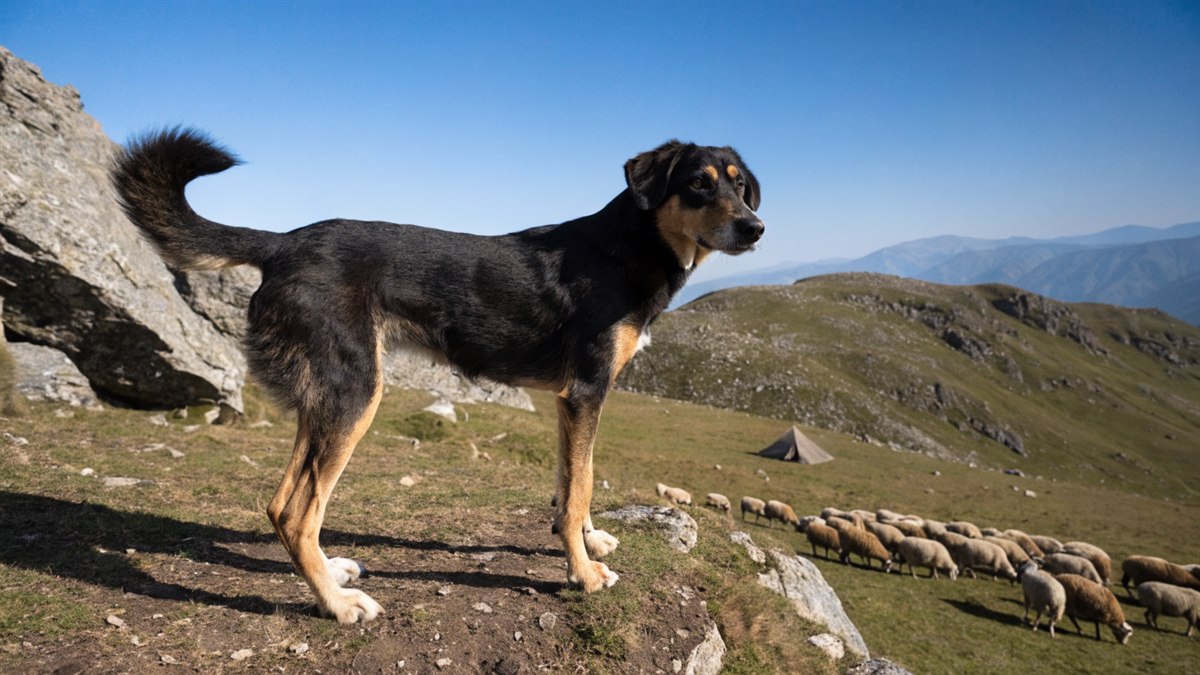
The Bakharwal Dog is a livestock guardian dog of northern India, an ancient working breed found in Ladakh and across the Pir Panjal Range of Jammu and Kashmir. It has been bred by the Gaddis, Jats, Gujjar and Bakerwal communities of Jammu and Kashmir and Himachal Pradesh to guard flocks of goats, sheep and cattle, and to guard their houses.
Read that job description carefully, because everything else on this page follows from it. This is a dog bred to live outdoors at altitude, walk with a migrating flock, and make its own decisions about threats with no handler nearby. It was never bred to be a companion animal in a warm city, and the gap between those two lives is the single biggest thing an Indian buyer needs to understand.
The names, including the ones only Indian sources carry
The breed answers to at least a dozen names, and knowing them matters because sellers switch between them. Wikipedia records Bakherwal, Bakhrawal Mastiff, Kashmiri Sheepdog, Kashmiri Bakerwal Dog and Kashmiri Mastiff. A 2025 Indian review in Bhartiya Krishi Anusandhan Patrika adds the local Kashmiri forms that no English breed page carries, listing Kashmir Sheepdog (Pahil Hoon), Bakarwal Mastiff, Kashmiri Bakharwal Dog (Bakarwal Hoon), Gujjar Watchdog, Gujjar Dog (Gujjir Hoon) and Kashmiri Mastiff as synonyms. Note the recurring element, hoon, which corresponds to the ordinary Kashmiri word for dog recorded in Kashmiri glossaries as hun. Read that way, three of the breed's names are not breed titles at all. They are simply the Gujjar's dog and the Bakarwal's dog, which is a fair description of how the community itself regards the animal.
| Attribute | Detail | Source |
|---|---|---|
| Type | Livestock guardian and settlement protector | Wikipedia, SKUAST-Kashmir Hamadani A., Ganai N. A., Rather M. A. |
| Home range | Pir Panjal Range and Ladakh, Jammu and Kashmir | Wikipedia, BKAP 2025 Sarma O., Rather M. A. |
| Kept by | Gujjar and Bakarwal nomadic pastoralists, also Gaddis and Jats | Wikipedia |
| Also called | Kashmiri Sheepdog, Bakarwal Mastiff, Gujjar Watchdog, Bakarwal Hoon, Gujjir Hoon, Pahil Hoon | BKAP 2025 |
| Coat | Double coat, furry, with a plumed tail | Wikipedia, BKAP 2025 Sarma O., Rather M. A. |
| Colour | Mostly black with white on toes and chest; also black and tan, red, fawn, pied, sable, white, brindle | Wikipedia |
| Height | 61 to 76 cm (24 to 30 in), both sexes | Wikipedia, BKAP 2025 Sarma O., Rather M. A. |
| Weight | Disputed. Published claims run 27 kg to 90 kg | See the size table below |
| Litter size | Disputed. Published claims run 1 to 6, once a year | See the litter table below |
| Registered by ICAR-NBAGR | No | NBAGR Newsletter Jan to Jun 2025 |
| Recognised by the FCI | No, neither definitively nor provisionally | FCI nomenclature Federation Cynologique Internationale |
| Recognised by a major kennel club | No | Wikipedia List of dog breeds from India, Wikipedia |
Two types, and a resemblance that causes trouble
The breed splits into two recorded categories, general Bakarwal and Ladakhi Bakarwal. It is described as a powerful, heavy-boned, medium to large dog, agile and sturdy, a typical mountain dog with a furry coat and plumy tail, and specifically as looking like a medium version of the Tibetan Mastiff. The 2025 Indian review repeats that the breed shares phenotypic traits with the Tibetan Mastiff.
That resemblance is the commercial problem. A Tibetan Mastiff is an FCI-recognised breed with an international market and a price history to match, and a rare, unregistered, unstandardised Kashmiri dog that looks like a smaller one is easy to sell as something it is not. The comparison section below sets out the differences that actually hold.
The size disagreement no ranking page prints
Published weights for this breed disagree by a factor of more than three, which is unusual even for an unregistered landrace. Height is the one measurement sources broadly agree on.
| Source | Height | Weight |
|---|---|---|
| Wikipedia | 61 to 76 cm (24 to 30 in) | 70 to 90 kg (150 to 200 lb) |
| BKAP 2025, Indian review | 24 to 30 in | Not stated |
| 101DogBreeds | 24 to 30 in, both sexes | 60 to 79 lb (27 to 36 kg) |
| The Smart Canine | 24 to 30 in | 60 to 85 lb (27 to 39 kg) |
| GoofyTails | Male 70 to 80 cm, female 65 to 75 cm | Male 50 to 70 kg, female 45 to 60 kg |
| NativeBreed | Male 25 to 30 in, female 23 to 28 in | 70 to 90 kg (150 to 200 lb) |
A 27 kg dog and a 90 kg dog are not the same animal. Two things are probably happening at once. There is no breed standard and no measured survey, so every figure is an estimate copied from another estimate, and the heavier numbers track the pages that lean hardest on the Tibetan Mastiff comparison. Bonbeno's position is that a working hill guardian at 61 to 76 cm at the shoulder is far more likely to sit in the 35 to 60 kg band than at 90 kg, but we will not publish a number nobody measured. Read the spread, and treat any page that gives you one confident weight as a page that did not check.
Litter size, and why it matters more here than usual
Published litter figures disagree too, and for a breed whose central story is scarcity, the litter number is load-bearing.
| Source | Claim |
|---|---|
| Wikipedia | 1 to 3 |
| Wikipedia, appearance section | One litter a year, average three to four puppies |
| Daily Excelsior, Javaid Rahi | "It gives one to four pups as compared to other breeds which gives birth to as many as twelve pups simultaneously in a year" |
| BKAP 2025 | Average 3 to 4 pups, once yearly |
| 101DogBreeds | Gives both "1 to 3 puppies per year" and "3 to 6" on the same page |
The consistent claim across Indian sources is a single small annual litter, which is normal for a primitive landrace living outdoors rather than a defect. For comparison, ICAR-NBAGR records the litter size of the registered Gaddi dog of Himachal Pradesh as varying from 4 to 8. A breed producing three or four puppies once a year recovers from a population shock slowly, and that arithmetic is the strongest argument in the conservation case.
The one thing an Indian university has published about this dog
Sher-e-Kashmir University of Agricultural Sciences and Technology of Kashmir published a peer-reviewed review of the livestock and poultry breeds of Jammu and Kashmir and Ladakh in the Indian Journal of Animal Sciences in 2022. It is the closest thing to an authoritative institutional statement on this dog that exists, and its entire treatment of the breed is one paragraph, reproduced here in full because its brevity is the finding.
"The Bakharwal dog is one of the most fascinating dog breeds originating in Jammu and Kashmir. This breed of dog is rare and unusual as it acts as a livestock guardian. It originated with nomadic tribes in the Himalayas hundreds of years ago. While this breed is very friendly with most humans, it is not so with other dogs and can get aggressive. Unlike most dogs, Bakharwal do not eat meat. They only eat bread, milk, and dairy products. This dog breed is exceedingly rare and difficult to breed.";
Three things in that paragraph are worth holding on to. The breed's own regional university calls it very friendly with most humans and reserves the aggression note for other dogs, which is close to the opposite of the fierce-guardian framing on most English pages. It states the vegetarian diet as fact, which the feeding section takes apart. And it says the breed is exceedingly rare and difficult to breed without giving a number, because the paper has no number to give.
That absence is the point. In the same paper, every sheep and goat breed of Jammu and Kashmir gets a table row with a breeding tract, a total population, a female population and a formal status. Bakerwal sheep are recorded at 24,575 head with 17,890 females, and four sheep populations, Ghidord Phamphri, Punchi Bakerwali, Bani and Karnahi, are listed at zero and marked extinct. The dog gets a paragraph and no row.
History, and the part that is genuinely unresolved
The origin of the breed lies in Ladakh, and it is found in Jammu and Kashmir and Himachal Pradesh. Beyond that, the ancestry is contested and no genetic study has settled it. One account has the breed descending from crossbreeding the Tibetan Mastiff with the Indian pariah dog; other scholars describe it instead as "the oldest Indian Dog which since centuries has been surviving with the Kashmiri nomads";. Scientists have suggested these may be among the oldest herding dogs, with origins in Central Asia. A tribal researcher writing in Daily Excelsior notes that scientists debate a Central Asian, Tibetan or Indian origin, with some tracing the ancestry back 3,000 years.
Bonbeno's view is that none of these is established, and that anyone presenting one of them as settled fact is overreaching. The tool that could settle it now exists, which the conservation section covers.
The conflict years
The breed's recent history is not a normal breed history. Wikipedia records that the dogs have been targeted by separatist militants in the erstwhile Indian state of Jammu and Kashmir, who shot them to stop them alerting people to an intrusion, and that militants prevented herdsmen from going to the higher reaches, which caused many Bakharwal Dogs to catch disease and die. The Daily Excelsior column puts the same period plainly: "After 1990 a steep decline in population of Bakerwal Dog was observed as a number of dogs were killed during insurgency/conflict in the State in higher reaches of the State";.
It is also used by the Indian police to capture militants, and Himalayan breeds including the Bakharwal, Gaddi and Bhutia are being evaluated for high-altitude deployment because of their natural adaptation to cold climates. Note what that second sentence quietly concedes. The reason the armed forces are interested is cold adaptation, which is the same reason the breed is a poor match for most of India.
Bakharwal Dog price in India
Published figures for the bakharwal dog price in india run from Rs 2,000 to over Rs 1,50,000, a spread of more than seventy-five times, and not one of the sources publishing those numbers cites data for them. There is no organised commercial market for this breed, so there is no market rate to report. What follows is every published claim Bonbeno could open, with the quality of each stated plainly.
Start with the most important sentence on this page. The real Bakharwal Dogs are working animals living with Gujjar and Bakarwal herding families on the Pir Panjal, and those families are not in the business of selling puppies to plains cities. Anything advertised to you in Delhi, Mumbai or Kolkata has either come out of that system by an unclear route, or it is not a Bakharwal.
| Source | Stated price | Sourcing quality |
|---|---|---|
| Daily Excelsior, Dr Javaid Rahi | Rs 75,000 to Rs 1,50,000 "or above keeping in view the appearance of the dog" | A named tribal researcher writing about illegal sale out of the community. No survey, no sample. |
| Premium Pet House | Rs 50,000 to Rs 70,000 average, city table from Rs 50,000 to Rs 75,000 | A seller quoting its own asking prices. No external source cited. |
| NativeBreed | Rs 2,000 to Rs 6,000 | No citation. Same page cites "multiple studies" for its conservation claim without naming one. |
| Bark Junction | No purchase price given at all | Page titled "Bakharwal price in India [All Major Cities]" and carries no city prices and no purchase figure. |
Why the spread is this wide
Four things drive it, and only one of them is about the dog.
- Supply is genuinely tiny and mostly not for sale. The one Indian academic statement on the breed calls it "exceedingly rare and difficult to breed", and a single annual litter of three or four puppies does not produce a supply chain.
- The name is unpoliced. No kennel club recognises the breed, so nothing stops a seller calling any large black double-coated dog a Bakharwal. Without a registry there is no pedigree to check and no accession number to quote.
- The Tibetan Mastiff halo raises the ask. The breed is described as looking like a medium version of the Tibetan Mastiff, and a Tibetan Mastiff is an internationally recognised breed with a price story attached. Part of every high figure is that borrowed story.
- The pages quoting prices did not check. One publishes a maintenance figure as "80,00-240,00" annually, which is not a readable number in rupees or in any other currency, on a page whose title promises city-wise pricing it never gives. That is the standard of evidence behind the numbers Indian buyers are currently reading.
The city price table, and what it accidentally reveals
One seller publishes a city-by-city table. Read it for geography rather than for price.
| City | Stated price | Approximate May-June daytime high |
|---|---|---|
| Mumbai | Rs 50,000 to Rs 70,000 | Hot and humid |
| Delhi | Rs 55,000 to Rs 75,000 | Extreme dry heat |
| Chennai | Rs 55,000 to Rs 75,000 | Hot and humid |
| Kolkata | Rs 55,000 to Rs 75,000 | Hot and humid |
| Hyderabad | Rs 55,000 to Rs 75,000 | Hot |
| Bengaluru | Rs 55,000 to Rs 75,000 | Mild by Indian standards |
| Pune | Rs 50,000 to Rs 70,000 | Hot |
| Srinagar, Anantnag, Poonch, Rajouri | Not listed | The breed's actual home range |
Every city on that list is on the plains or the Deccan. Not one is in Jammu and Kashmir, Himachal Pradesh or Ladakh. Google's own India autocomplete tells the same story, offering "bakharwal dog price in punjab" and "bakharwal dog price in kolkata" alongside "bakharwal dog price jammu". The commercial demand for a Himalayan livestock guardian in India is concentrated almost entirely in the places where it cannot thermoregulate, which the climate section explains in detail.
What a low price actually signals
A Rs 2,000 to Rs 6,000 puppy advertised as a Bakharwal is the clearest warning in the whole price range. At that figure you are almost certainly being offered a local free-ranging dog, an Indian pariah dog cross, or an unrelated large mixed-breed puppy with a saleable name attached. That is not a bargain, and buying it funds the exact naming confusion that makes the real breed harder to protect.
The high end carries a different problem. The only source describing a Rs 75,000 to Rs 1,50,000 trade is describing it as illegal poaching and sale out of the herding communities, alongside the observation that popular males get sold to city dwellers and are then lost to the breeding population. Paying the top of the published range does not get you a verified pedigree. It removes a breeding male from a population that is already reproducing at three or four puppies a year.
Every figure above is reported as published editorial content, not as an offer. Bonbeno does not link puppy listings, does not recommend breeders and does not sell animals. If you want an Indian guardian breed and you live in the plains, read the comparison and adoption sections before you look at a single advertisement.
Monthly cost of owning a Bakharwal Dog in India
No breed-specific cost study exists for the Bakharwal Dog in India, so this section reports the two published estimates Bonbeno could open, names their weaknesses, and then sets out the cost lines a plains household will actually carry that neither estimate prices. Treat the numbers below as claims, not as a budget.
| Line item | Premium Pet House | Bark Junction |
|---|---|---|
| Feeding | Rs 2,000 to Rs 4,000 a month | Not separately stated |
| Grooming | Rs 1,500 to Rs 5,000 | Not stated |
| Professional training | Rs 5,000 to Rs 10,000 | Rs 2,000 to Rs 6,000 |
| Veterinary care | Rs 10,000 a year | Not separately stated |
| Total maintenance | Not totalled | Printed as "80,00-240,00" annually, which is not a readable figure |
The second column is a seller quoting its own prices, which is a legitimate data point about what is being asked and a poor one about what a dog costs to keep. The third column is a page that could not proof-read its own only number. Between them, that is the entire published Indian cost evidence for this breed.
The five cost lines no published page prices
A heavy double-coated mountain guardian kept anywhere south of the hill states carries expenses that a generic monthly cost table does not contain. Each of these is a real, recurring, sometimes very large line.
- Cooling that runs for five months. Air conditioning is not an accessory for a dog whose insulation was built for a Pir Panjal winter. In Delhi, Jaipur, Ludhiana or Nagpur it is an electricity bill that begins in March and ends in October, and it is the largest hidden cost of owning this breed outside the hills.
- Coat work through the moult. A dense double coat that blows out needs daily brushing for weeks and the right tools to reach the undercoat. Budget for a rake and an undercoat comb, or for a groomer who will not reach for a clipper.
- Emergency capacity for heat. Heat-related illness in dogs carried an event fatality rate of 14.18 percent, 95 percent CI 11.08 to 17.96, across a UK primary-care dataset of 905,543 dogs. Money set aside for an unplanned emergency visit is a genuine cost of keeping this dog in a hot country, not a contingency.
- Year-round rabies and parasite cover. Jammu and Kashmir recorded 57,057 dog bite cases in 2025, and rabies deaths went from none in 2022 to four in 2023 and five in 2024. A large outdoor guardian meeting free-ranging dogs needs its rabies schedule and its tick and flea control kept current without exception.
- Secure containment. A territorial livestock guardian needs a physical boundary, not a latch. That is a one-time construction cost most first-time owners discover in month three.
What Bonbeno will and will not publish
Bonbeno does not publish a monthly cost figure for this breed, because we have not collected one and no credible source has. When we do publish our own cost data we state the sample size, the cities covered and the collection date. Reprinting a single seller's asking prices as a Bonbeno budget would launder a sales figure into a reference figure, and that is exactly the failure this page exists to correct.
What we will say is directional and defensible. This is a large, high-maintenance, climate-mismatched dog with no health registry behind it. In every category that matters, food volume, coat care, cooling and veterinary risk, it sits at the expensive end, and the further south you live the wider that gap becomes.
If cost is a real constraint for you, the Indian Pariah Dog is the direct answer. It is adapted to Indian heat, needs no cooling budget, has a short coat that needs no professional grooming, and is free to adopt. Almost every rupee in the list above is a rupee you are spending to keep a Himalayan animal comfortable somewhere it was never built for.
Heat tolerance in Indian conditions, rated 1 out of 5
Rate the Bakharwal Dog's heat tolerance at 1 out of 5, the bottom of the Bonbeno scale. It is a double-coated livestock guardian developed at high altitude in Jammu and Kashmir Hamadani A., Ganai N. A., Rather M. A., and the same three features that make it survive a Pir Panjal winter, dense insulation, large body mass and an outdoor working life, each independently worsen its position in Indian heat.
The mechanical reasoning behind the 1
A dog has one significant route for dumping heat, evaporation from the respiratory tract through panting. It has almost no functional sweating. Three things stack against this breed on that single route.
- The undercoat is a still-air trap that works in both directions. Insulation does not know which way heat is travelling. A dense undercoat slows the loss of the dog's own metabolic heat exactly as effectively as it slows the gain of cold, and the dog is producing that heat continuously whether the air outside is minus 5 degrees or plus 42.
- Body mass works against a big dog. Heat production rises with body mass, while the skin and airway surface available to shed it does not rise as fast. That is the physiological reason large dogs run into trouble sooner, and it shows up directly in the data: dogs weighing over 50 kg had 3.42 times the odds of heat-related illness compared with lighter dogs.
- Humidity switches the panting route off. Evaporative cooling depends on the moisture gradient between the airway and the air. In Mumbai, Chennai, Kolkata or coastal Kerala in June, that gradient collapses, and a dog panting hard in humid air is doing the work without getting the cooling. Delhi presents the opposite problem, a gradient that still works but an ambient temperature so high that the dog is gaining heat faster than it can shed it.
Cold tolerance, by the same reasoning, is where the breed is superb. These dogs live in the open with a flock at altitude, and there is no Indian climate cold enough to trouble them.
What the veterinary evidence actually shows
No study has measured heat-related illness in this breed, and no study of Indian dogs of this size exists that Bonbeno could open. The best available evidence comes from UK primary-care records, and it is still worth reading before buying a mountain dog for a hot country. Across 905,543 dogs under veterinary care in 2016, researchers identified 395 confirmed heat-related illness events. Incidence was 0.04 percent, 95 percent CI 0.04 to 0.05, and the event fatality rate was 14.18 percent, 95 percent CI 11.08 to 17.96.
The risk factors are what matter here. Alongside the over-50 kg finding, dogs whose bodyweight equalled or exceeded the mean for their breed and sex had 1.42 times the odds, dogs aged 12 years or more had 1.75 times the odds against dogs under two, and brachycephalic dogs had 2.10 times the odds of mesocephalic dogs. The Bakharwal is not brachycephalic, which is its one structural advantage, and it lands on the wrong side of the weight factor under every published weight estimate above 50 kg GoofyTails, Bakharwal Mastiff NativeBreed.org, Bakharwal Dog Complete….
Purina India's own guidance on heat stroke names two higher-risk groups, short-faced breeds and dogs with heavy coats, listing Huskies and Newfoundlands in the second group. A Bakharwal belongs squarely in that second group. The published warning signs of heat stroke are severe panting, difficulty breathing, severe salivating, vomiting, diarrhoea, a raised temperature of 40.5 degrees Celsius or above, blood in the urine, nose bleeds and ultimately collapse and coma, and a dog showing any of them needs veterinary attention immediately.
What happens when a Bakharwal is taken to a plains city
This is the question the whole page turns on, because Google's India autocomplete shows people searching "bakharwal dog price in kolkata" and "bakharwal dog price in punjab", and the one published city price table lists Mumbai, Delhi, Chennai, Kolkata, Hyderabad, Bengaluru and Pune. The honest answer is a sequence, not a single event.
| Stage | What the owner sees | What is actually happening |
|---|---|---|
| First winter, November to February | The dog looks magnificent and settles well | Delhi or Punjab winter is within the range the coat handles. Nothing is wrong yet, and this is when owners conclude the climate objection was overblown. |
| First spring, March to April | Heavy shedding, restlessness, seeking cold floors | The moult is triggered but the cue is wrong. A coat cycle keyed to a mountain photoperiod and temperature curve does not clear in time for a plains April. |
| First summer, May to June | Panting at rest, refusing walks, appetite drop, lethargy | The dog is running a continuous thermal deficit. This is the stage at which many owners reach for a clipper, which makes the problem worse. |
| Monsoon, July to September | Skin problems, hot spots, ear trouble, smell | Humidity has both cut the panting route and made the undercoat a permanently damp layer against skin. Coat disease in India is a humidity problem before it is a genetics problem. |
| Any single hot exertion | Collapse | Heat-related illness is an emergency with a recorded event fatality rate of 14.18 percent. A guardian breed in drive does not self-regulate, so the handler has to. |
Note what is not in that table: a dramatic first-day failure. The plains do not kill this dog quickly, which is precisely why the mistake keeps getting made. They wear it down across a decade, and the owner attributes each stage to something else.
Even Srinagar is getting warmer
The climate objection is not only about Chennai. On 5 July 2025 Srinagar recorded 37.4 degrees Celsius, its third-highest maximum ever, against a previous 37.7 degrees on 5 July 1953 and an all-time high of 38.3 degrees on 10 July 1946. In the same spell Pahalgam recorded 31.6 degrees, the highest ever measured at that station. A breed whose entire adaptation is to cold is being squeezed in its own home range, and that is a conservation fact as much as a care fact.
| Location type | Verdict |
|---|---|
| High pasture, Pir Panjal, Ladakh, Gurez, Kishtwar | The breed's native environment. No objection at all. |
| Hill towns: Srinagar, Gulmarg, Pahalgam, Manali, Shimla, Leh, Gangtok | Workable with shade and water, and getting slightly harder each decade. |
| Jammu, Chandigarh, Dehradun, Kathmandu-altitude valleys | Difficult. Summer is a managed problem for four to five months. |
| Delhi, Punjab, Rajasthan, Uttar Pradesh plains | Livable only inside an air-conditioned home with a disciplined summer routine, and most households will not sustain that for ten years. |
| Mumbai, Chennai, Kolkata, Hyderabad, Bengaluru, coastal India | Bonbeno does not recommend this breed here under any care regime. |
If you already own one below the hills
- Move both walks into the cool hours, before 7 AM and after 8 PM, and test the road surface with the back of your hand before you step out.
- Never shave the double coat. The undercoat is what slows radiant heat gain and protects the skin from direct sun. Clipping it removes that protection and does not make the dog cooler.
- Keep the dog lean. Bodyweight at or above the breed and sex mean was an identified risk factor for heat-related illness, so body condition is a heat-safety control here, not a cosmetic one.
- Give it a cool hard surface and moving air. A stone or tile floor with a fan over it does more for a double-coated dog than a bed.
- Learn the signs and act on the first one. Move the dog to shade or air conditioning, spray or sponge with cool but not cold water, use a fan, stop cooling at 39.4 degrees Celsius, and get veterinary attention.
Everything above applies below the hill line. In Srinagar, Anantnag, Poonch, Rajouri, Leh, Manali or Dharamshala this is a superbly matched dog and the climate objection largely disappears. A buyer in Ludhiana and a buyer in Gulmarg are not making the same decision, and no page that gives one answer for all of India is being useful to either.
Temperament and household fit
The Bakharwal Dog is a territorial livestock guardian for experienced handlers with land, and the published sources disagree sharply about how it behaves around people. The disagreement is the most useful thing on this subject, so this section prints it rather than picking a side.
The disagreement, laid out
Indian institutional writing and Western breed pages describe two different dogs. Both are probably describing something real, and the gap between them tells you what actually drives the behaviour.
| Source | Stated temperament |
|---|---|
| SKUAST-Kashmir, Indian Journal of Animal Sciences | "While this breed is very friendly with most humans, it is not so with other dogs and can get aggressive" |
| BKAP 2025, Indian review | "Loyal, brave, protective livestock guardian and settlement protector dog", noted for determination and courage |
| 101DogBreeds | "Loyal, social, energetic, alert, brave, independent, responsive, polite" |
| GoofyTails | "Loyal, Courageous, Protective, Intelligent, Calm, Independent" |
| The Smart Canine | "Their temperament can be very fierce; they are guard dogs after all. However, they can be very friendly with people they know" |
| Dog with Blog | Frames the breed as an honest livestock guardian rather than a pet, generally robust and free of many inherited diseases |
Read the Indian academic line again, because it is the one that gets left out everywhere else. The breed's own regional agricultural university records it as very friendly with most humans and puts the aggression firmly on dog-to-dog interaction. That is entirely consistent with the working reality. A dog that migrates with a Gujjar or Bakarwal family through inhabited valleys twice a year, meeting other families, cannot be indiscriminately hostile to people and remain useful. What it must be hostile to is a strange dog approaching a flock, because that is what a predator or a rival looks like.
What this means for an Indian household
The practical translation is uncomfortable for urban buyers. A dog selected for tolerance of familiar humans and low tolerance of unfamiliar dogs is close to the worst possible profile for an Indian apartment complex or gated colony, where the daily reality is a stairwell of strangers and a compound full of free-ranging dogs. India has an estimated street dog population in the millions, and Jammu and Kashmir alone recorded 57,057 dog bite cases in 2025. A territorial guardian that meets other dogs on every walk is a management problem for its whole life.
- Good fit. Hill properties with land, working farms and orchards, households that already keep livestock, owners with previous livestock guardian experience, and a secure physical boundary.
- Poor fit. First-time dog owners, apartments, shared compounds, plains cities, homes with frequent visitors, and anyone who wants a dog that greets other dogs at a park.
- Non-negotiable. Structured socialisation from the day the puppy arrives, because a guardian breed's discrimination between familiar and unfamiliar is built in the first months and cannot be retrofitted at two years old.
Is the Bakharwal Dog dangerous
No measured behavioural or bite-incident data exists for this breed anywhere Bonbeno could find, so nobody can answer that question with evidence. What can be said is structural. This is a large, powerful, independent dog bred to make its own decisions about threats without instruction, and it is unrecognised by any kennel club, which means there is no breed standard, no temperament test and no organised breeder network selecting for stable temperament List of dog breeds from India, Wikipedia. In a breed with a written standard and a registry, a buyer has at least some structural protection. Here there is none.
The related search Indians run most is bite force, and the honest answer is that no bite force figure for the Bakharwal Dog has ever been measured. Every number circulating online for this breed is invented or copied from a mastiff estimate, and a page giving you a specific PSI for a dog with no breed standard and no research base is telling you something about the page, not the dog.
With children, other pets and other dogs
The consistent picture is affection and tolerance toward its own family, including children it has grown up with, and wariness of the unfamiliar The Smart Canine, Bakharwal Dog: Stubborn. Dog-to-dog is the flagged risk, stated by the Indian source and echoed by the Western ones The Smart Canine, Bakharwal Dog: Stubborn. With livestock, the breed is doing its actual job and is generally excellent, which is the whole reason it exists.
Two practical warnings. Guardian behaviour arrives late. A ten-week-old Bakharwal puppy is usually sociable, and the territorial adult emerges months after the early socialisation window has closed, so owners who judge the breed by the puppy and ease off on exposure get a reactive two-year-old with very little room to correct it. And the breed's noise level is not trivial. A guardian bred to warn a shepherd about a bear at night will bark at a shared stairwell at 2 AM, and that becomes a neighbour problem long before it becomes a training problem.
If what you want is a native Indian dog for a normal home in a warm city, the Indian Pariah Dog fits the climate, fits the household, and is free to adopt. If you want a serious Indian guardian and you live somewhere warm, the Kombai and the Rajapalayam were built for South Indian heat rather than Himalayan snow. Choosing the Bakharwal because it is rare and impressive is the single most common reason these dogs end up in the wrong home.
Training a Bakharwal Dog, and what it resists
Train this breed through relationship, structure and early exposure rather than through repetition drills, because a livestock guardian was selected for centuries to override instruction when its own judgement disagreed. That independence is a working feature, not a training failure, and no amount of obedience work removes it.
The proof that the breed is trainable is not in doubt. The Indian police have used Bakharwals to track militants, and Himalayan breeds including the Bakharwal are being evaluated for high-altitude deployment on the strength of their cold adaptation. What professional handlers get from this dog is not a biddable follower. It is a working partner that will do a job it understands with someone it respects.
Socialisation is the safety decision, not the manners decision
Socialise this dog deliberately and continuously from the week it arrives, because socialisation is what decides whether the adult can tell a guest from a threat. In a breed with no kennel club, no breed standard and no temperament testing behind it List of dog breeds from India, Wikipedia, the owner's early work is the only quality control in the system.
The specific priority here differs from most breeds. Because the documented flashpoint is dog-to-dog rather than dog-to-human, the socialisation programme has to be weighted toward calm, controlled, distance-managed exposure to other dogs, in a country where free-ranging dogs are on almost every street. That is harder work than taking a puppy to meet people, and it is the part most owners skip.
What works with this breed
- Structure every arrival. Teach a place command and use it for every single visitor from month two. A guardian with no instruction defaults to its own judgement, and its judgement is a guardian's.
- Pay for the relationship, not the compliance. Force-based correction with a large, confident, independent dog buys you an adversarial relationship with an animal that can physically win the argument. It is a bad trade at any age.
- Keep sessions short and give the dog a real job. Patrolling a fixed boundary, carrying a pack on a walk, or working around livestock satisfies this breed far more than twenty minutes of heel work.
- Walk on lead, always, in unfenced country. A guardian that ranges will treat a neighbour's goat or dog as its business, and in India that becomes a village dispute quickly.
- Protect the growing skeleton. Do not force distance work, stairs or jumping on a large-breed puppy while the growth plates are open.
- Hire experience early. If you have not raised a livestock guardian before, book a trainer who has, in month one rather than month ten. Retrofitting is far more expensive than building.
Realistic timelines
The table below is Bonbeno's working guidance for large guardian breeds, offered as a planning tool rather than as breed-specific research, because no training study exists for this dog. Note what sits in the last two rows.
| Skill | Start | Reasonably reliable by |
|---|---|---|
| Name response | Week 1 at home | 3 to 5 weeks |
| Sit, down, place | Week 1 at home | 6 to 10 weeks |
| Handling and grooming tolerance | Week 1 at home | 8 to 12 weeks |
| Crate or settle in a fixed spot | Week 1 at home | 4 to 8 weeks |
| Loose-lead walking | Month 2 | 8 to 14 months |
| Recall with no distraction | Month 2 | 6 to 12 months |
| Recall with a strange dog present | Month 3 | Treat as management, not as a trained skill |
| Controlled greeting of visitors | Month 2 | Ongoing management for life |
The last two rows are the honest part. With a livestock guardian you are not training the instinct out, you are building enough structure around it that the instinct rarely gets a vote. Owners who plan for lifelong management succeed with these dogs. Owners who expect the dog to eventually become reliable off-lead around strange dogs do not.
What this breed genuinely resists
- Repetition for its own sake. A dog bred to solve problems alone gets bored and disengages, and owners read that as stubbornness.
- Being corrected by a stranger. Handler transfer is slow with guardian breeds. A trainer who cannot build the relationship first will not get the behaviour.
- Ignoring a boundary. You cannot train a guardian to be indifferent to something crossing its perimeter. You can only train what it does next.
- Being crated all day in a warm flat. Frustration in a large working dog comes out as barking, digging and destruction, and in Indian heat it comes out faster.
The territorial adult appears between roughly nine and twenty-four months, long after the friendly puppy has convinced its owner that the breed's reputation was exaggerated. Keep socialising through the whole of the first two years, especially the months when it feels unnecessary. That is exactly when it is doing the most work.
Daily exercise, living conditions and space
Give an adult Bakharwal Dog at least two long walks a day plus a territory to patrol, and understand that neither of those replaces the job it was actually built for. The clearest measure of that job is the migration itself. Gujjar and Bakarwal families make a roughly 600 kilometre vertical journey taking 30 to 45 days, and nearly 500,000 of Jammu and Kashmir's transhumant pastoralists undertake that trek twice every year.
The dog walks all of it. Then, at the summer pasture, it works a static job on a scale most owners never picture. A tribal researcher writing on the breed records that "One Dog can guard nearly 300 to 500 sheep/ goats/horses";. That is not an animal that gets tired out by a park loop.
What that translates to in a normal home
| Stage | Guidance |
|---|---|
| Puppy to 6 months | Short frequent sessions on soft ground. No forced distance, no stairs work, no jumping. |
| 6 to 18 months | Build distance gradually. Free play and exploration beat structured road walking while the skeleton finishes. |
| Adult | Two long walks daily, minimum 45 minutes each, plus patrol or work time on its own ground. |
| Senior | Shorter and gentler, still twice daily. Watch the joints and keep the dog lean. |
| Any Indian summer, anywhere below the hills | Both sessions before 7 AM and after 8 PM. On a genuinely hot day, skip the walk and do scent work indoors instead. |
That last row is the constraint that makes this breed so difficult in India, and it deserves stating plainly. In Delhi or Nagpur between April and June, the hours in which it is safe to exercise a heavily coated 50 kg dog are roughly the hours in which most owners are asleep or at work. The exercise requirement and the heat window are in direct conflict for nearly half the year, and the dog loses that conflict.
Living conditions
The living conditions this breed needs are a house with secure land, ideally at altitude, ideally with livestock. GoofyTails' own listing records the breed as hardy and well adapted to cold climates, which is the same sentence read from the other end. Almost every source describing the breed places it outdoors with a flock rather than indoors with a family Hamadani A., Ganai N. A., Rather M. A. Sarma O., Rather M. A..
- A physical boundary, not a latch. A wall or a substantial fence the dog cannot go over, under or through. Guardian breeds test perimeters.
- Shade and cool ground, permanently available. Stone, tile or dug earth in the shade, not a raised bed in a sunny yard.
- Water in more than one place, including next to where the dog sleeps.
- A job. Patrolling a fixed perimeter satisfies this breed more than a longer aimless walk does. If you cannot give it territory to be responsible for, it will invent responsibilities you did not want.
- Company. This is a dog that has lived alongside a family and a flock continuously for centuries. Long isolation in a yard produces barking and destruction.
The apartment question
Do not keep this breed in an apartment. Three separate problems arrive before the exercise problem does. The heat problem arrives first, because a flat in a plains city is warm even before summer. The noise problem arrives second, because a guardian barking in a shared building at night is a neighbour dispute. The dog-to-dog problem arrives third and is the most serious, because a documented dog-aggressive guardian on a lift, a stairwell and a compound full of free-ranging dogs has no safe route from the flat to the street.
A yard is not an alternative to a walk, either. Space alone is not exercise for a dog bred to move with people and animals across a landscape, and a large dog left alone in a garden will spend its day lying in the shade, not exercising.
A guardian breed in drive does not self-regulate. It will keep working, keep patrolling and keep chasing past the point at which it should stop, which is exactly why exertional heat illness is a risk in dogs that are otherwise fit and healthy. In Indian summer the handler has to be the one who calls it off.
Grooming a double coat in Indian humidity
Brush this coat to the skin two to five times a week all year, brush it daily through the moult, and never clip it. The breed carries a double coat with a plumed tail Sarma O., Rather M. A., and published guidance runs from brushing two to three times per week with daily brushing during seasonal shedding to brushing through the coat three to five times a week.
Why Indian conditions change the job
A double coat is two layers doing two jobs. The outer guard hairs shed water and block sun. The dense undercoat traps still air, which is what insulates. In a dry Himalayan environment that undercoat dries fast and stays open. In an Indian monsoon it does neither, and everything that goes wrong with this coat in India follows from that one fact.
A damp undercoat held against warm skin for weeks is an incubator. It produces the familiar Indian cluster of hot spots, bacterial and fungal skin infection, ear trouble and smell, and none of it is a genetic weakness in the breed. It is a housing problem. The dog is fine in Gulmarg and in trouble in Kolkata.
The routine that actually works
- Brush to the skin, not across the surface. Use an undercoat rake or a slicker and work in sections, lifting the coat as you go. A surface brush leaves a felted undercoat that traps both heat and moisture, and the dog looks groomed while the problem builds underneath.
- Move to daily through the moult. A dense double coat blows out in a concentrated period, and a week of skipped brushing during that window produces mats that then have to be cut out.
- Check for ticks at every single session. Run your fingers around the ears, under the jaw, down the neck, in the groin, in the armpits and between every toe. Tick and flea control is a year-round job across most of India, not a monsoon one, and a thick black coat hides an engorged tick completely.
- Dry the dog completely after any bath, any rain and any river crossing. Towel first, then a fan or a low-heat blaster to the skin. Air drying is standard advice in cool dry climates and is bad advice in an Indian monsoon.
- Bathe rarely. A working double coat has natural oils that keep water out. Wash it every few months with a dog shampoo, not more, unless the dog is genuinely dirty.
- Keep nails, ears and teeth on the same routine, so the whole check happens together and nothing gets forgotten for six months.
The clipper is the most expensive mistake in Indian grooming
Every Indian summer, well-meaning owners shave double-coated dogs to help them cope with heat, and every one of them makes the dog worse off. Removing the undercoat removes the layer that slows radiant heat gain and shields the skin from direct sun, and a shaved double coat frequently grows back patchy and coarser. If a groomer offers to clip a Bakharwal down for summer, that is the signal to find a different groomer.
The exception nobody argues about is a sanitary trim and light tidying of the feet and rear, which some sources note as occasional trimming. That is not the same thing as taking the coat off.
| Season | Brushing | Watch for |
|---|---|---|
| Winter, Nov to Feb | 2 to 3 times a week | Coat at its heaviest. Easiest season anywhere in India. |
| Pre-summer moult, Mar to Apr | Daily | Mats forming at the ruff, behind the ears and on the rear trousers. |
| Summer, May to Jun | 3 to 5 times a week | Hot spots, sun exposure on any thin patch, and the urge to shave. |
| Monsoon, Jul to Sep | 3 to 5 times a week plus drying after every soaking | Damp undercoat, ear infection, fungal patches, ticks. |
| Post-monsoon, Oct | 2 to 3 times a week | Second, lighter moult in some dogs. Full skin inspection. |
A neglected double coat in Indian humidity becomes a veterinary problem, not a cosmetic one. Owners who cannot realistically brush a large uncooperative dog several times a week, for ten years, in a hot country, should choose a short-coated breed. Consult your nearby vet at the first sign of a hot spot, a smell from an ear, or a bald patch that is spreading.
Health risks, screening and lifespan
No breed-level health study exists for the Bakharwal Dog. There is no prevalence survey, no screening scheme, no health registry and no breed club collecting data, so every percentage you will see online for this dog is extrapolated from other breeds rather than measured in this one. That absence is the first and most important health fact on this page.
Say it a second time, because it changes how you should read everything below. A hip or elbow screening scheme needs a registry and a breed club to run it, and this breed has neither: it is not recognised by any major kennel club, it is listed with a recognition status of none in the standard reference table of Indian breeds, and the Kennel Club of India's own website publishes registration and show forms with no public list of recognised breeds or breed standards at all. Nobody is collecting this dog's hip scores anywhere in the world.
What sources actually report
Two positions exist, and they are not as contradictory as they look.
| Condition or claim | Reported by |
|---|---|
| Generally robust, free of many inherited diseases that trouble designer breeds | Dog with Blog |
| Bloating (gastric torsion) | 101DogBreeds |
| Canine hip dysplasia | 101DogBreeds |
| Patellar luxation | 101DogBreeds |
| Cryptorchidism | 101DogBreeds |
| Obesity | 101DogBreeds |
| Rabies, contracted in the field | Wikipedia |
| Disease and death after herders were kept from the higher reaches | Wikipedia |
| "Exceedingly rare and difficult to breed" | SKUAST-Kashmir |
A functional landrace selected for survival at altitude, with no show ring pushing exaggerated conformation, genuinely does tend to be structurally sounder than a heavily bred pedigree breed, and the robustness claim is plausible on those grounds. What it does not mean is that the breed has been checked and cleared. It means nobody has looked.
The three risks that will actually matter to an Indian owner
Forget the copied orthopaedic list for a moment. For a Bakharwal Dog living in India today, three things are more likely to harm it than anything on a standard breed health page.
- Rabies and dog-to-dog contact. Wikipedia records that many of these dogs contracted rabies in the field, and the surrounding picture in the breed's home territory is stark. Jammu and Kashmir recorded 34,664 dog bite cases in 2023, 51,027 in 2024 and 57,057 in 2025, with rabies deaths going from none in 2022 to four in 2023, five in 2024 and at least three within the first six months of 2025. A large territorial dog that engages other dogs, in a region with that exposure profile, must have its rabies vaccination current without exception.
- Heat-related illness. No breed health list includes it for this dog because nobody has studied it, and it is nonetheless the most likely thing to harm a Bakharwal kept below the hill line. The recorded event fatality rate across heat-related illness events in a large primary-care dataset was 14.18 percent, and dogs over 50 kg carried 3.42 times the odds.
- Nutritional disease from the traditional diet. The vegetarian feeding pattern reported for this breed by its own regional university is a genuine risk when it is transplanted into a household setting, and the feeding section below sets out exactly why.
Bloat, and why it deserves special attention here
Gastric dilatation-volvulus, commonly called bloat, is the fast stomach emergency that large deep-chested dogs are prone to, and it is on the reported list for this breed. Learn the signs before you need them: a distended, hard abdomen, unproductive retching, restlessness and pacing, drooling, and rapid collapse. It kills within hours. Know which veterinary hospital near you can perform emergency abdominal surgery at 2 AM, and know it before you own the dog rather than during the emergency.
Cryptorchidism in a very small population
Cryptorchidism, where one or both testicles fail to descend, is reported for the breed and is worth flagging for a specific reason that applies here more than elsewhere. It is a heritable trait whose frequency rises as a population's effective breeding size falls. With a breed that is described as exceedingly rare and difficult to breed, that produces perhaps three or four puppies a year, and whose most desirable males are reported to be sold away to city buyers and lost to the breeding pool, the conditions for rising inbreeding are exactly the conditions present.
Lifespan, and how much the published figures vary
Published lifespans run from 8 to 13 years and no source names a dataset.
| Source | Claimed lifespan |
|---|---|
| The Smart Canine | 8 to 11 years |
| 101DogBreeds | 8 to 12 years, and around 10 to 12 in its own FAQ |
| NativeBreed | 10 to 12 years |
| BKAP 2025, Indian review | 10 to 12 years |
| GoofyTails | 10 to 13 years |
Read the range, not the midpoint. The only figure here with an Indian academic source behind it is 10 to 12 years, and even that is a review statement rather than a survival study. A large dog living outdoors at altitude and a large dog living in an air-conditioned flat in Gurugram are not going to produce the same number, and nobody has measured either.
What to actually do
- Keep rabies vaccination and the full core schedule current, and never let it lapse in a dog that meets other dogs.
- Run year-round tick and flea control, and check the coat at every grooming session rather than relying on a monthly product alone.
- Keep the dog lean. Body condition is a direct heat-safety lever in this breed, because bodyweight at or above the breed and sex mean raised the odds of heat-related illness, and obesity is already on the reported list.
- Monitor the joints from puppyhood. Avoid forced distance work and stairs while the growth plates are open, and get any persistent limp looked at rather than waiting.
- See both parents where you can. With no registry, no breed standard and no screening scheme, watching the sire and dam move is close to the only health information available to a buyer.
- Build the veterinary relationship before you need it. Find a vet near you who is comfortable with large working breeds, and identify your nearest 24-hour surgical facility on day one.
Any page giving you a precise disease prevalence figure for the Bakharwal Dog is extrapolating, because no study has produced one. Bonbeno will publish real figures for this breed the moment they exist. Until then, this section reports what sources claim and marks it as claim. Consult your nearby vet, a registered veterinarian, for advice on your individual dog, and treat any sudden change in its condition as urgent rather than something to research online.
Feeding, and the vegetarian diet claim examined
Feed a Bakharwal Dog as a large, active working breed on a complete and balanced diet, and do not reproduce the traditional herding diet at home. The vegetarian claim attached to this breed is real, well documented and widely repeated by serious sources, and it is also the single most dangerous piece of care advice an Indian owner could copy without understanding it.
What the sources actually say
The claim is not internet folklore. It appears in a peer-reviewed Indian review and in the general reference literature alike, and "is bakharwal dog vegetarian" is one of the questions Google's India autocomplete returns for the breed.
| Source | Statement |
|---|---|
| SKUAST-Kashmir, Indian Journal of Animal Sciences | "Unlike most dogs, Bakharwal do not eat meat. They only eat bread, milk, and dairy products" |
| Wikipedia | "The dog has a vegetarian appetite that mainly includes bread made of rice chaff, maize and milk" |
| 101DogBreeds | The dogs "are vegetarian, and avoid eating flesh", with a "favorite dish" of milk and bread made from maize |
| The Smart Canine | "they are vegetarian. They will not even eat fish" |
| Dog with Blog | "Traditionally the herders raise these dogs on a simple, largely milk-and-maize diet" |
Why the herding diet looks the way it does
The observation makes complete sense in context, and understanding the context is what stops you copying it. A Gujjar or Bakarwal family on a 600 kilometre migration is carrying maize flour and is surrounded by milk. What it is not doing is feeding meat to a dog, because the sheep and goats are the family's capital, not the dog's dinner. The diet is a function of what a migrating pastoral household has spare, and the dogs adapted to it over generations of selection.
It is also worth noting how deeply milk-feeding runs through South Asian dog keeping generally. A survey of dog owners at a veterinary practice in Colombo found that 42 percent of dogs were fed only home-cooked food and 49 percent were given milk as a separate meal in addition to their normal diet. The Bakharwal's traditional diet is an extreme version of a regional pattern, not an exotic outlier.
Why you must not reproduce it at home
The gap between "these dogs survive on it in the mountains" and "this is an adequate diet" is where owners get into trouble. Nobody has ever assessed the nutritional adequacy of the maize-bread-and-milk diet, and the general evidence on unformulated home diets is poor. A study assessing 1,726 homemade dog diets found that only 6 percent had the potential to be nutritionally complete.
The specific nutrient that matters here is taurine. Taurine deficiency causes dilated cardiomyopathy, a heart muscle disease, and the link with low-quality plant-heavy diets is documented. In a study of golden retrievers, 23 of 24 dogs diagnosed with taurine deficiency and dilated cardiomyopathy had been fed diets that were grain-free, legume-rich or both, and none of those diets had been feeding-trial tested using AAFCO procedures. The encouraging part of the same study is that 23 of the 24 dogs improved significantly on echocardiography and normalised their taurine levels after a diet change and taurine supplementation.
That is the shape of the risk. A grain-and-milk diet is low in the animal protein that supplies taurine and the sulphur amino acids a dog builds it from, and the resulting heart disease develops silently over months. It is also, importantly, reversible if caught. A mountain dog eating this diet while working sixteen hours a day at altitude and a house dog eating it while lying on a Bengaluru floor are not running the same experiment.
A vegetarian diet for a dog is not automatically wrong, and a properly formulated one with supplemented taurine and adequate protein can work. An unformulated one built from maize bread and milk because a breed page said the breed is vegetarian is a different thing entirely. If you want to feed your dog a vegetarian diet for religious or ethical reasons, consult your nearby vet and get the diet formulated with supplementation rather than assembling it yourself.
What to feed instead
| Stage | Approach | Watch |
|---|---|---|
| 8 weeks to 4 months | Large-breed puppy food, three to four meals a day | Do not over-supplement calcium. Rapid growth damages large-breed joints. |
| 4 to 12 months | Large-breed puppy food, two to three meals a day | Keep the puppy lean. A fat large-breed puppy is a joint problem later. |
| 12 to 24 months | Transition to a large-breed adult food, two meals a day | Adjust to actual workload rather than to a chart. |
| Adult | Two meals a day, never one large meal | Deep-chested breeds and bloat. Rest for an hour either side of a meal. |
| Senior | Two smaller meals, joint support if your vet advises it | Muscle loss, weight creep and reduced appetite in heat. |
- Judge by body condition, not by the bag. You should feel the ribs easily under a light cover and see a waist from above. In this breed, body condition is a heat-safety measure as well as a joint one, because higher relative bodyweight raised the odds of heat-related illness.
- Feed to the season. Appetite genuinely drops in Indian summer. Move the larger meal to the evening rather than forcing food at midday.
- Never feed one large meal a day to a large deep-chested dog, given bloat is on this breed's reported condition list.
- Fresh water in several places, changed at least twice daily in summer.
- Availability is not the problem. Large-breed complete foods are widely available across Indian cities and online. The constraint on this breed is climate and space, not nutrition supply.
Conservation status: what the evidence actually shows
The Bakharwal Dog is very widely described as endangered or on the verge of extinction, and that description rests on far less evidence than its confidence implies. Bonbeno's finding, after tracing every figure in circulation back to its source, is that the breed is almost certainly declining, that nobody has ever counted it with a published method, and that the two numbers everyone repeats come from a 2009 community survey and a 2017 newspaper column whose own author called his figure "a raw idea".
Where the numbers come from
| Claim | Origin | What it actually is |
|---|---|---|
| Fewer than 1,000 pure dogs remain, against 10,000 in the 1990s | Dr Javaid Rahi, tribal researcher, Daily Excelsior, 2017 | The author's own words are "According to a raw idea around less than a 1000 pure Bakerwali dogs are still surviving in upper reaches as against 10,000 population in 90s." No method, no sample, no survey named. |
| Only a few hundred remained | A 2009 survey by the Tribal Research and Cultural Foundation, reported second-hand | A community organisation's survey, seventeen years old, whose methodology and full results Bonbeno could not locate. |
| "A recent study says that this breed is on the verge of extinction" | Wikipedia | The study is not named, cited or linked anywhere in the article. |
| "Critically endangered, with by some estimates only a few hundred purebred dogs left" | Dog with Blog | Attributed to unnamed estimates. |
| "Near threatened, population declining" | NativeBreed | Borrows the wording of a formal IUCN Red List category. The same page says "An exact population count does not exist, but multiple studies indicate the pure Bakharwal population is critically small and declining" and names none of those studies. |
| "Exceedingly rare and difficult to breed" | SKUAST-Kashmir, Indian Journal of Animal Sciences, 2022 | The most authoritative statement available. It gives no number, because the paper has none to give. |
Two corrections follow from that table. First, no source Bonbeno could open produces a population figure with a stated method, a sample and a date, which means nobody currently knows how many Bakharwal Dogs exist. Second, the Near Threatened language is a category error. Near Threatened is a formal conservation category applied to wild species assessments, and Bonbeno found no assessment of this or any domestic dog breed under it. A breed page that reaches for that vocabulary is signalling seriousness it has not earned.
None of that makes the decline untrue. The direction of travel is supported by everything around the dog, which is the part worth reading carefully.
The absence that is most telling
The most revealing document on this breed's status is the SKUAST-Kashmir review of the animal genetic resources of Jammu and Kashmir and Ladakh. In that paper, every sheep and goat breed of the region gets a table row carrying a breeding tract, a total population, a female population and a formal status. Bakerwal sheep are recorded at 24,575 head. Four sheep populations, Ghidord Phamphri, Punchi Bakerwali, Bani and Karnahi, are entered at zero and marked extinct, on Puri's 2007 assessment. Three goat breeds reared by Bakerwals, Kaghani, Lubdi and Kilan, are marked as being on the verge of extinction, and four more, Gurziya, Belori, Lamdi and Goodri, are marked extinct.
The dog gets one paragraph and no row at all. The region's own agricultural university has population data for the animals the Bakharwal guards, and none for the Bakharwal.
The comparison that answers the question
There is a formal route to official recognition for an Indian dog breed, it works, and it was used twice in a single meeting. At the 12th meeting of the Breed Registration Committee on 6 January 2025 in New Delhi, ICAR-NBAGR registered ten new indigenous breeds, including the Gaddi dog of Himachal Pradesh and the Changkhi dog of Ladakh, with gazette notification following on 15 April 2025. India now has 229 registered indigenous breeds in total, of which five are dogs.
| Breed | Home tract | ICAR-NBAGR accession number |
|---|---|---|
| Gaddi dog | Chamba, Kangra, Kullu, Mandi, Lahaul Spiti and Kinnaur, Himachal Pradesh | INDIA_DOG_0600_GADDI_19004 |
| Changkhi dog | Ladakh, kept by Changpa nomads | INDIA_DOG_3800_CHANGKHI_19005 |
| Bakharwal Dog | Pir Panjal Range and Ladakh, Jammu and Kashmir | None. Not registered. |
Read the Changkhi entry carefully, because it is the closest thing to a controlled comparison available. NBAGR's own description is that the Changkhi is native to Ladakh and is "used as watch dog to guard their livestock including sheep and goat from snow leopard, wild animals and other predators";. That is the Bakharwal's job description almost word for word, in the same union territory region, for a different nomadic community. One of those two dogs now has a gazette-notified accession number and the protection of formal recognition, and the other does not.
The difference is not merit. It is that somebody did the characterization work for the Changkhi and nobody has done it for the Bakharwal. Registration requires a documented population with measured phenotypic and morphometric data, which is exactly the paper that does not exist for this breed.
The tool now exists
This is the genuinely hopeful part, and no page currently ranking for this breed mentions it. ICAR-NBAGR has designed and validated a high-density SNP genotyping array for Indian dogs, named Axiom_Shwaan. Whole-genome resequencing was performed on 48 dogs from four genetically diverse populations at an average coverage of 10X, more than 23 million raw SNPs were detected, and 629,597 high-quality SNPs were selected for the array at an average inter-marker spacing of 3.8 kb. It was validated by genotyping 186 dogs from 11 breeds or populations with a 99 percent average call rate, and principal component analysis and phylogenetic reconstruction separated the native breeds into distinct clusters.
The instrument that could settle the Bakharwal's ancestry, verify whether an individual dog is genetically what a seller claims, and support a registration application now exists inside an Indian government institute. Whether it has been turned on this breed is something Bonbeno could not establish, and we will not claim either way.
Why the decline is happening
The dog's fate is not really a dog story. It is a pastoralism story, and the pressures are on the human system that created the breed.
- Conflict. "After 1990 a steep decline in population of Bakerwal Dog was observed as a number of dogs were killed during insurgency/conflict in the State in higher reaches of the State";. Wikipedia records dogs shot by militants specifically to stop them raising an alarm, and herders being prevented from reaching the high pastures, after which many dogs caught disease and died.
- Sedentarisation. The Bakarwal are a Scheduled Tribe of Jammu and Kashmir numbering 113,198 at the 2011 census, and roughly 500,000 of the region's 600,000 transhumant pastoralists still make the biannual 600 kilometre trek. Where a family stops migrating, the job the dog was bred for stops existing.
- Extraction of breeding males. The best males get sold to city buyers and are lost to the breeding population, at prices reported between Rs 75,000 and Rs 1,50,000 or above National Purebred Dog Day.
- Slow reproduction. A single annual litter of three or four puppies against 4 to 8 for the registered Gaddi dog means the population recovers from any shock very slowly.
- No formal status. With no registry, no breed standard and no conservation programme, there is no institution whose job it is to notice if the breed disappears.
The job has not gone away
One argument for the breed's continued relevance is that the work it does is still needed, and here the published Kashmir research is unusually clear. A 2025 study of three protected areas in southern Kashmir found livestock predation by the Asiatic black bear and the leopard, with sheep the primary prey, most predation occurring in summer, during the day and within forest areas, and leopards also attacking livestock penned in corrals. A 2024 study around Kazinag National Park documented 72 livestock kills across 2021 and 2022, with an estimated economic loss above 15,000 US dollars, and identified poorly constructed corrals as a primary risk factor.
Note the correction hiding in those two papers. Almost every breed page claims the Bakharwal fights snow leopards and Himalayan wolves. The published depredation research in the breed's actual working range names the Asiatic black bear and the common leopard as the carnivores taking livestock Uzma Dawood and Bilal A. Bhat. The snow leopard story is not wrong for Ladakh, where it is the predator NBAGR names for the Changkhi's range, but it is the wrong animal for most of the Pir Panjal.
The Bakharwal Dog is very likely declining and is not formally assessed by anyone. Repeating "fewer than 1,000 left" as a fact is not supportable, because its author published it as a rough impression rather than a count. What is supportable, and more useful, is this: the breed has no ICAR-NBAGR registration while two comparable Himalayan guardian breeds got one in January 2025, no characterization study, no kennel club recognition, and no organisation counting it. Those are verifiable facts about the breed's institutional position, and they are the ones that would need to change first.
Bakharwal puppy: month by month through the first year
Plan a Bakharwal puppy's first year around three things that are specific to this breed, a socialisation programme weighted toward other dogs rather than people, a growth period that must not be rushed physically, and an Indian summer that will arrive before the puppy is mature enough to handle it. The month-by-month plan below assumes the puppy comes home at eight weeks.
Never take a puppy home before eight weeks. That is the point at which a puppy has finished learning bite inhibition and dog-to-dog manners from its mother and littermates, and in a breed whose documented behavioural risk is aggression toward other dogs, those weeks are not optional social nicety. They are the foundation of the one thing you most need this dog to get right.
| Age | Priority | What to avoid |
|---|---|---|
| 8 to 10 weeks | Settle in, name response, crate or fixed sleeping spot, gentle handling of feet, ears and mouth every day. Start the vaccination schedule with your vet. | Long car journeys, isolation, forcing the puppy onto stairs. |
| 10 to 14 weeks | The critical socialisation window. Controlled, calm exposure to people, surfaces, sounds, vehicles and, above all, to other dogs at a distance the puppy is comfortable with. | Free-for-all dog parks, uncontrolled meetings with free-ranging dogs, anything frightening. |
| 3 to 4 months | Introduce the place command and use it for every visitor. Begin lead work. Begin grooming as a daily two-minute ritual so the coat is never a fight later. | Skipping grooming practice because the puppy coat is easy. It will not stay easy. |
| 4 to 6 months | Keep socialising, especially around other dogs. Teething. Complete the core vaccination course and start year-round tick and flea control. | Forced distance walking, jumping, stairs, and any high-impact work on a growing skeleton. |
| 6 to 9 months | Build walk duration slowly. Introduce the boundary the dog will be responsible for. Continue structured visitor management. | Assuming the friendly puppy is the finished temperament. The guardian has not arrived yet. |
| 9 to 12 months | Guarding behaviour typically begins to emerge. Tighten structure rather than loosening it. Keep exposure going even though it now feels harder. | Backing off socialisation because the adolescent has become reactive. That is precisely when it is needed. |
| 12 to 18 months | Transition to adult food. Increase exercise toward the adult requirement as growth finishes. | Neutering decisions made without discussing large-breed growth timing with your vet. |
Time the arrival to the Indian calendar
Bring a Bakharwal puppy home between October and December if you possibly can, anywhere in India. That gives you the entire cool season for the critical socialisation window, which means you can be outside in the mornings and evenings without heat limiting the work. A puppy that arrives in April spends its socialisation window indoors in air conditioning, and the deficit shows up as a reactive eighteen-month-old.
The first summer is a serious event for a coated puppy below the hill line. Young dogs have less thermal reserve than adults, and a puppy cannot tell you it is in trouble until it is already in trouble. Plan the first May and June deliberately, with walks moved to the coolest hours, cool hard flooring available all day, and indoor enrichment substituting for outdoor exercise on the worst days.
What to check before you commit
- See the mother, and ideally the father, with the litter. With no registry, no breed standard and no health screening scheme behind this breed, watching the parents move and interact is close to the only information available to you.
- Ask where the dogs work. A genuine Bakharwal comes from a working context in Jammu and Kashmir or Himachal Pradesh. A seller who cannot describe that context is selling you something else.
- Be suspicious of a confident pedigree claim. No kennel club registers this breed and ICAR-NBAGR has not registered it, so there is no accession number and no papers to produce. Anyone offering registration documents for a Bakharwal is offering you something that does not exist.
- Verify the price against the published spread. Figures in circulation run from Rs 2,000 to over Rs 1,50,000 Javaid Rahi, Bakerwali Dog, Daily Excelsior, which tells you the price carries no information about the dog.
- Ask yourself the climate question honestly. If you live below the hill line, read the climate section again before you go any further.
A Bakharwal puppy is a sociable, appealing, manageable animal. The dog it becomes is a large territorial guardian bred to make its own decisions, with a documented flashpoint around other dogs. Almost every failed placement of a guardian breed traces back to an owner who made the decision while looking at the puppy.
Bakharwal vs Gaddi Kutta, Tibetan Mastiff and the other Himalayan guardians
Indians cross-shopping this breed search almost exclusively against three dogs, and Google's India autocomplete returns "bakharwal dog vs gaddi kutta", "bakharwal dog vs tibetan mastiff" and "bakharwal dog vs bhotia dog" among its top suggestions. The honest headline is that these breeds are constantly conflated in both Indian and Western writing, that their published measurements overlap heavily, and that the most reliable way to tell them apart is not what the dog looks like but where it comes from and which community keeps it.
| Breed | Home tract and community | Official status | Litter size |
|---|---|---|---|
| Bakharwal Dog | Pir Panjal Range and Ladakh, Jammu and Kashmir. Gujjar and Bakarwal nomads Sarma O., Rather M. A. | None. No ICAR-NBAGR registration, no kennel club recognition, not on the FCI definitive or provisional lists Federation Cynologique Internationale Federation Cynologique Internationale | 1 to 4, one litter a year Sarma O., Rather M. A. |
| Gaddi dog, also called Gaddi Kutta or Himalayan Sheepdog | Chamba, Kangra, Kullu, Mandi, Lahaul Spiti and Kinnaur, Himachal Pradesh. Gaddi tribe | Registered by ICAR-NBAGR, accession number INDIA_DOG_0600_GADDI_19004. Still no kennel club recognition | 4 to 8 |
| Changkhi dog | Ladakh. Changpa nomads, guarding sheep and goats from snow leopard and other predators | Registered by ICAR-NBAGR, accession number INDIA_DOG_3800_CHANGKHI_19005 | Not stated in the NBAGR summary |
| Tibetan Mastiff | Tibetan plateau, an international show and pet breed | Recognised by the Federation Cynologique Internationale | Not compared here |
Bakharwal vs Tibetan Mastiff
The Bakharwal is repeatedly described as looking like a medium version of the Tibetan Mastiff, and as sharing phenotypic traits with it Sarma O., Rather M. A.. The size figures make the point. A Tibetan Mastiff male stands about 66 cm and a female about 61 cm, with males weighing 40 to 70 kg and females 30 to 55 kg. Published Bakharwal heights run 61 to 76 cm, which overlaps and in places exceeds the Tibetan Mastiff, while published Bakharwal weights are so disputed, from 27 kg to 90 kg, that no comparison on weight is possible.
What separates them in practice is not measurement. The Tibetan Mastiff is a heavier, more coated, more massively headed dog that has been shaped by decades of show breeding and, in its Chinese market phase, by a status-symbol economy that eventually collapsed: by 2015, after excessive breeding and the breed's unsuitability as an urban pet became obvious, prices in China for the best dogs had fallen to about 2,000 US dollars. The Bakharwal has never been through that. It is a working landrace, leaner, longer-legged and more agile, described in Indian sources as an agile and sturdy mountain dog rather than a heavyweight.
That collapse is worth holding on to as a warning. A rare, impressive, coated Himalayan guardian sold into hot cities as a status animal is a story India has watched play out once already with the Tibetan Mastiff.
Bakharwal vs Gaddi Kutta
This is the comparison most searched and the one most often got wrong. The two breeds share a range, a job and a general appearance, and Wikipedia records that the Bakharwal has been bred by the Gaddis as well as by the Gujjar and Bakerwal communities, which is exactly the kind of overlap that makes clean separation difficult. The reliable differences are institutional rather than physical.
- Official status differs completely. The Gaddi dog was registered by ICAR-NBAGR in January 2025 with a published accession number. The Bakharwal was not.
- Reproduction differs sharply. NBAGR records the Gaddi's litter size at 4 to 8. Indian sources put the Bakharwal at one to four pups once a year Sarma O., Rather M. A.. That is a large difference for two breeds so often described as the same dog.
- Geography and community differ. The Gaddi is a Himachal Pradesh dog of the Gaddi tribe. The Bakharwal is a Jammu and Kashmir dog of the Gujjar and Bakarwal communities Sarma O., Rather M. A..
- Role emphasis differs. The Gaddi is documented as a herding and hunting dog as well as a guardian, while the Bakharwal is consistently described purely as a livestock guardian and settlement protector.
For the full treatment of the Gaddi and Bhotia naming muddle, see the Himalayan Sheepdog page, which covers the same family from the Himachal and Uttarakhand end. The Vikhan, a lighter-framed livestock guardian reported from the Chitral region of Khyber Pakhtunkhwa and from Himachal Pradesh, documented by two books and registered by nobody, belongs to the same muddle.
Bakharwal vs German Shepherd or Rottweiler, the real Indian cross-shop
Google's India autocomplete puts "bakharwal dog vs german shepherd", "bakharwal dog vs rottweiler" and "bakharwal dog vs kangal" among the top comparisons, which tells you what buyers are really deciding between: an unregistered rare Indian guardian, or an established guard breed with papers.
| Factor | Bakharwal Dog | German Shepherd or Rottweiler in India |
|---|---|---|
| Breed standard | None exists | Published and enforced by kennel clubs |
| Health screening data | None exists | Hip and elbow schemes with published statistics |
| Availability of a verified puppy | Effectively zero outside the herding communities | Widely available, with real risk of poor breeding |
| Heat tolerance in India | 1 out of 5 | Also limited, but better than a Himalayan double coat |
| Trainability for a first-time owner | Low. Bred for independent judgement | Considerably higher, particularly the German Shepherd |
| Veterinary familiarity in Indian cities | Almost none. Most vets will never have seen one | High |
The German Shepherd and the Rottweiler both bring problems of their own in Indian heat, and Bonbeno's pages on them do not soften those. What they do bring is a standard, a health-screening infrastructure and a veterinary community that recognises them. For a first-time guard-dog owner in an Indian city, that difference matters more than rarity does.
Buyers drawn to the Bakharwal usually want a genuinely Indian working dog. If you live anywhere warm, the Kombai and the Rajapalayam were shaped by South Indian heat rather than Himalayan snow, and the Indian Pariah Dog is the most heat-adapted dog on the subcontinent and free to adopt. Choosing the Indian breed that fits your climate is a better instinct than choosing the rarest one.
Mistakes Indian owners actually make with this breed
Nine mistakes account for most of what goes wrong with a Bakharwal Dog in India, and eight of them are made before the dog arrives. They are listed here in the order in which they cause damage, and each names what to do instead.
1. Buying a Himalayan guardian for a plains city
This is the mistake that produces every other problem. The published city price table for this breed lists Mumbai, Delhi, Chennai, Kolkata, Hyderabad, Bengaluru and Pune, and lists no city in Jammu and Kashmir, Himachal Pradesh or Ladakh. The commercial demand is entirely in the places the dog is worst suited to. Rate the heat tolerance at 1 out of 5 and make the decision on that, not on how the dog looks.
2. Copying the traditional vegetarian diet
Reading that the breed eats only bread, milk and dairy and reproducing it at home is a nutritional experiment on your own dog. A study of 1,726 homemade diets found only 6 percent had the potential to be nutritionally complete, and taurine deficiency from poor-quality plant-heavy diets is a documented cause of dilated cardiomyopathy. Feed a complete and balanced large-breed food, and if you want a vegetarian diet, have it formulated by a vet.
3. Shaving the double coat for summer
Every Indian summer, owners of double-coated dogs clip them down in good faith and make the animal hotter and more sun-exposed. The undercoat is what slows radiant heat gain and shields the skin. Brush it out, never cut it off.
4. Judging the breed by the puppy
Guardian behaviour emerges months after the socialisation window closes, usually between nine and twenty-four months. Owners who conclude from a friendly four-month-old that the reputation was exaggerated ease off on exposure, and get a reactive adolescent with very little room to correct it.
5. Socialising toward people and forgetting other dogs
The documented flashpoint in this breed is not humans. Its own regional university records it as very friendly with most humans and aggressive with other dogs. A socialisation programme built around meeting visitors, in a country where every walk includes free-ranging dogs, is aimed at the wrong risk.
6. Believing a pedigree claim
No kennel club recognises the Bakharwal Dog, the Kennel Club of India's own website carries no public list of recognised breeds or standards, ICAR-NBAGR has not registered it, and it appears on neither the FCI's definitive nomenclature nor its provisional list Federation Cynologique Internationale. There is no accession number, no pedigree and no papers. Anyone producing registration documents for a Bakharwal is producing something that does not exist.
7. Buying one to save the breed
This one is well-intentioned and does real harm. The mechanism of decline that sources actually describe includes desirable males being sold away to city buyers and lost to the breeding population Javaid Rahi, Bakerwali Dog, Daily Excelsior. In a breed producing three or four puppies a year, buying a good male out of the mountains and neutering it in Gurugram is a subtraction from the very population you meant to help.
8. Letting the rabies schedule slide
A large territorial dog that engages other dogs needs its rabies vaccination absolutely current. Jammu and Kashmir recorded 57,057 dog bite cases in 2025, with rabies deaths rising from none in 2022 to five in 2024, and the breed itself has a documented history of contracting rabies in the field.
9. Feeding one large meal a day
Bloat is on this breed's reported condition list and it kills large deep-chested dogs within hours. Split the daily ration into two meals, keep the dog quiet for an hour either side, and know where your nearest emergency surgical facility is before you need it.
Almost every failure with this breed begins with treating rarity as a reason to buy. A dog with no breed standard, no health data, no registry and no veterinary familiarity in Indian cities is not a prestige purchase, it is a research project you are conducting on a living animal. If you want this breed because it is rare, that is the strongest argument available for choosing a different one.
Adoption, responsible sourcing and what to do instead
You cannot realistically adopt a Bakharwal Dog from an Indian shelter, and for most readers of this page the responsible answer is to adopt a different dog. For the small number of readers who genuinely live and work where this breed belongs, this section sets out what responsible sourcing looks like and what to verify before money changes hands.
Why the adoption route barely exists
Shelter and rescue populations in Indian cities are overwhelmingly free-ranging Indian dogs and abandoned popular pedigree breeds. A breed described by its own regional university as exceedingly rare, living in working herding households across the Pir Panjal Sarma O., Rather M. A., does not enter that system in any number. If a shelter or a rehoming page in Delhi or Bengaluru offers you a Bakharwal, the far likelier explanation is a large black double-coated mixed-breed dog that somebody named optimistically.
That is not a reason to be cynical about the shelter. It is a reason to be honest about the label. Meet the dog, judge the dog, and adopt it for what it is rather than for what it was called.
If you live in the hills and genuinely need a working guardian
This is the one context in which acquiring a Bakharwal is straightforwardly defensible. If you keep livestock in Jammu and Kashmir, Himachal Pradesh or Ladakh, and you need a dog that will guard a flock against the carnivores the research actually documents in that landscape, the Asiatic black bear and the leopard Uzma Dawood and Bilal A. Bhat, then this breed is doing the job it was made for and you should get it from the community that made it.
- Go to the working population, not to a listings site. Source within Gujjar and Bakarwal herding networks in the region, where the parents are visibly doing the work.
- See both parents working. With no breed standard and no health screening scheme available, watching the sire and dam guard livestock is the only meaningful assessment there is.
- Take a female, or an unremarkable male. The documented harm pattern is the best males being extracted from the breeding population. Do not be that buyer.
- Keep the dog entire unless your vet advises otherwise, and be willing to let it breed within the working population rather than removing it from the gene pool.
- Wait until eight weeks minimum. In a breed whose behavioural risk is dog-directed, the weeks spent with the litter are the foundation you cannot buy back later.
The verification checklist, for any claimed Bakharwal
| Ask | A good answer | A warning |
|---|---|---|
| Where do the parents live and what do they do? | A named working context in Jammu and Kashmir, Himachal Pradesh or Ladakh | "Imported bloodline" or a vague "from the mountains" |
| Can I see the mother with the litter? | Yes, in person or on a live video call | Photographs only, or a story about why not |
| Is the dog registered? | "No, this breed has no registry" | Any offer of pedigree papers, a KCI certificate or an accession number Kennel Club of India, official website |
| What are the parents fed? | An honest description of the working diet, and a plan to transition the puppy to complete food | A claim that the dog must stay vegetarian |
| What is the price, and why? | A reasoned answer that matches the working context | Anything anchored to a Tibetan Mastiff price, or the Rs 2,000 to Rs 6,000 band that signals a different dog entirely |
| What happens if I cannot keep the dog? | A clear commitment to take it back | No answer |
What to adopt instead, for almost everyone reading this
If you live below the hill line and you wanted this breed because it is Indian, loyal and impressive, three better options exist and all of them are easier to get.
- The Indian Pariah Dog. The most heat-adapted dog on the subcontinent, short-coated, robust, alert, genuinely protective of its family, and available free from every shelter and street in India. For the overwhelming majority of Indian households this is the right dog.
- The Kombai or the Rajapalayam. Serious Indian guarding breeds shaped by South Indian heat rather than Himalayan snow, and both are far more available than a Bakharwal.
- The Himalayan Sheepdog or Tibetan Mastiff, only if you live in the hills. These carry the same climate objection as the Bakharwal, and the Tibetan Mastiff at least has a breed standard behind it.
How to actually help this breed without buying one
The Bakharwal's problem is not a shortage of buyers. It is a shortage of documentation, and that is a solvable problem that does not require anyone to own a dog. The route to formal recognition exists and works: ICAR-NBAGR registered the Gaddi dog and the Changkhi dog on 6 January 2025 and gazette-notified them on 15 April 2025. What those breeds had, and this one does not, is a characterization study. India also now has a validated high-density SNP array for Indian dogs, Axiom_Shwaan, built from whole-genome resequencing of 48 dogs and validated across 186 dogs from 11 breeds or populations.
Supporting the pastoral system helps more directly than anything else. Roughly 500,000 of Jammu and Kashmir's 600,000 transhumant pastoralists still make the biannual 600 kilometre trek, and Oxford research values their ecosystem services at nearly Rs 6,000 crore a year in the union territory. The dog exists because that system exists. It will disappear when the system does, and no amount of urban demand for puppies changes that arithmetic.
Bonbeno does not sell animals, does not broker puppy sales, does not link listings and does not recommend breeders. Every price and figure on this page is reported from a published source and marked with what it is worth. If a page tells you where to buy a rare Indian breed and does not tell you what you are taking out of its home population, ask who it is written for.
Bakharwal Dog questions Indians actually search
What is the bakharwal dog price in india?
Published figures run from Rs 2,000 to Rs 6,000 at the low end to Rs 75,000 to Rs 1,50,000 or above at the high end, and no source cites data for any of them. There is no organised commercial market for this breed, so there is no reliable market price to quote.
Is bakharwal dog vegetarian?
Traditionally yes. Sher-e-Kashmir University of Agricultural Sciences and Technology of Kashmir records that unlike most dogs, Bakharwal do not eat meat and only eat bread, milk and dairy products. Do not copy that diet at home without veterinary formulation, because unbalanced plant-heavy diets are linked to taurine deficiency and heart disease.
Is bakharwal dog dangerous?
No behavioural or bite-incident data exists for this breed, so nobody can answer that with evidence. Its own regional university describes it as very friendly with most humans but aggressive toward other dogs. It is a large independent guardian with no breed standard and no temperament testing behind it.
What is the Bakharwal dog bite force?
No bite force has ever been measured for this breed. Every PSI figure circulating online for the Bakharwal is invented or borrowed from a mastiff estimate. A breed with no standard, no registry and no research base has no measured bite force to publish.
Bakharwal dog vs gaddi kutta which is better?
Neither is better, and they are different dogs from different states and communities. The Gaddi is a Himachal Pradesh dog of the Gaddi tribe, registered by ICAR-NBAGR in January 2025 with litter sizes of four to eight. The Bakharwal is a Jammu and Kashmir dog of the Gujjar and Bakarwal communities, unregistered, with one to four pups a year.
What is the difference between a Bakharwal dog and a Tibetan Mastiff?
The Bakharwal is described as looking like a medium version of the Tibetan Mastiff, and is a leaner, longer-legged working landrace. The Tibetan Mastiff is a heavier, more coated FCI-recognised show and pet breed whose Chinese market prices collapsed to around 2,000 US dollars by 2015 after excessive breeding.
Is the Bakharwal dog recognised by the Kennel Club of India?
No. The breed is not recognised by any major kennel club, it is listed with a recognition status of none in the standard reference table of Indian breeds, and the Kennel Club of India's own website carries no public list of recognised breeds or breed standards at all.
Is the Bakharwal dog registered by ICAR-NBAGR?
No. ICAR-NBAGR registered the Gaddi dog of Himachal Pradesh and the Changkhi dog of Ladakh on 6 January 2025, gazette-notified on 15 April 2025, bringing India to five registered indigenous dog breeds. The Bakharwal is not among them and has no accession number.
Is the Bakharwal dog endangered?
No formal assessment exists. The widely quoted figure of fewer than 1,000 dogs comes from a 2017 newspaper column whose author wrote it as "a raw idea" rather than a count, and a 2009 community survey reporting a few hundred. The breed is very likely declining, but nobody has counted it with a published method.
How long do Bakharwal dogs live?
Published lifespan claims run from 8 to 13 years and none names a dataset. The only figure with an Indian academic source behind it is 10 to 12 years. Read the range rather than the midpoint, because no survival study has ever been done on this breed.
Can a Bakharwal dog live in Delhi or Mumbai?
Bonbeno rates its heat tolerance 1 out of 5 and does not recommend the breed in coastal or plains cities. It is livable in Delhi only inside an air-conditioned home with a disciplined summer routine, and most households will not sustain that for a decade.
How big does a Bakharwal dog get?
Height is fairly consistent across sources at 61 to 76 cm, or 24 to 30 inches. Weight is not: published claims run from 27 kg to 90 kg, a 3.3-fold disagreement, because no breed standard and no measured survey exists. Treat any single confident weight figure with suspicion.
Is the Bakharwal the same as the Kashmiri Sheepdog?
Yes. Kashmiri Sheepdog is one of this breed's many names, alongside Bakarwal Mastiff, Kashmiri Mastiff and Gujjar Watchdog. Indian academic writing also records the local Kashmiri forms Bakarwal Hoon, Gujjir Hoon and Pahil Hoon, where hoon simply means dog.
Where can I buy a Bakharwal puppy in India?
Bonbeno does not link listings or recommend breeders. The breed is described by SKUAST-Kashmir as exceedingly rare and difficult to breed, and real dogs live with working Gujjar and Bakarwal herding families. Most puppies advertised in plains cities are a different breed with a saleable name attached.
How intelligent are bakharwal dogs?
No intelligence study or trainability ranking exists for this breed, so no score can be quoted. What is documented is that the Indian police have used Bakharwals to track militants, and published breed profiles describe the dog as intelligent, independent and courageous. It was selected for centuries to make its own decisions about threats without instruction, so it is capable rather than biddable: it does a job it understands with a handler it respects, and trainability for a first-time owner is low.
What is a Bakharwal puppy?
A Bakharwal puppy is the young of the Bakharwal Dog, the Himalayan livestock guardian of Jammu and Kashmir, and at eight to ten weeks it is a sociable, appealing and manageable animal. The territorial guardian it grows into emerges between roughly nine and twenty-four months, after the socialisation window has closed. Never take one home before eight weeks, because in a breed whose documented flashpoint is aggression toward other dogs, the weeks with the litter build bite inhibition and dog manners. Most puppies advertised in plains cities are a different dog with a saleable name attached.
What are bakharwal dogs known for?
Bakharwal dogs are known as the livestock guardian of the Gujjar and Bakarwal herding communities of Jammu and Kashmir, bred to guard flocks of goats, sheep and cattle and to guard houses across the Pir Panjal Range and Ladakh. They are also known for a heavy double coat built for Himalayan winters, for a traditional diet of bread, milk and dairy recorded by SKUAST-Kashmir, for use by the Indian police to track militants, and for being unrecognised by ICAR-NBAGR, the Kennel Club of India and the FCI.
Compare with similar breeds
Bakharwal Dog sits in 3 Bonbeno groups. Each one compares it directly against the breeds it is genuinely an alternative to, on the same figures.