
Indian breed profile
Vikhan Dog: What Is Actually Known, and What Is Not
A lighter, faster livestock guardian of the Chitral valleys and, by report, Himachal Pradesh. Documented by two books, registered by nobody, and measured by no one.
Quick answer
The Vikhan dog is a livestock guardian sheepdog reported from the Chitral region of Khyber Pakhtunkhwa in Pakistan and from Himachal Pradesh in India. Its entire documented record is two books, Soman's The Indian Dog of 1962 and Morris's Dogs of 2001. No registry recognises it, no study measures it, and there is no Indian price data. Heat tolerance rates 2 out of 5.
This guide is general information for Indian pet owners and is not a diagnosis. Consult your nearby vet, a registered veterinarian, before acting on anything you read here, and treat any sudden change in your dog's condition as urgent.
Vikhan dog at a glance
What the Vikhan dog is
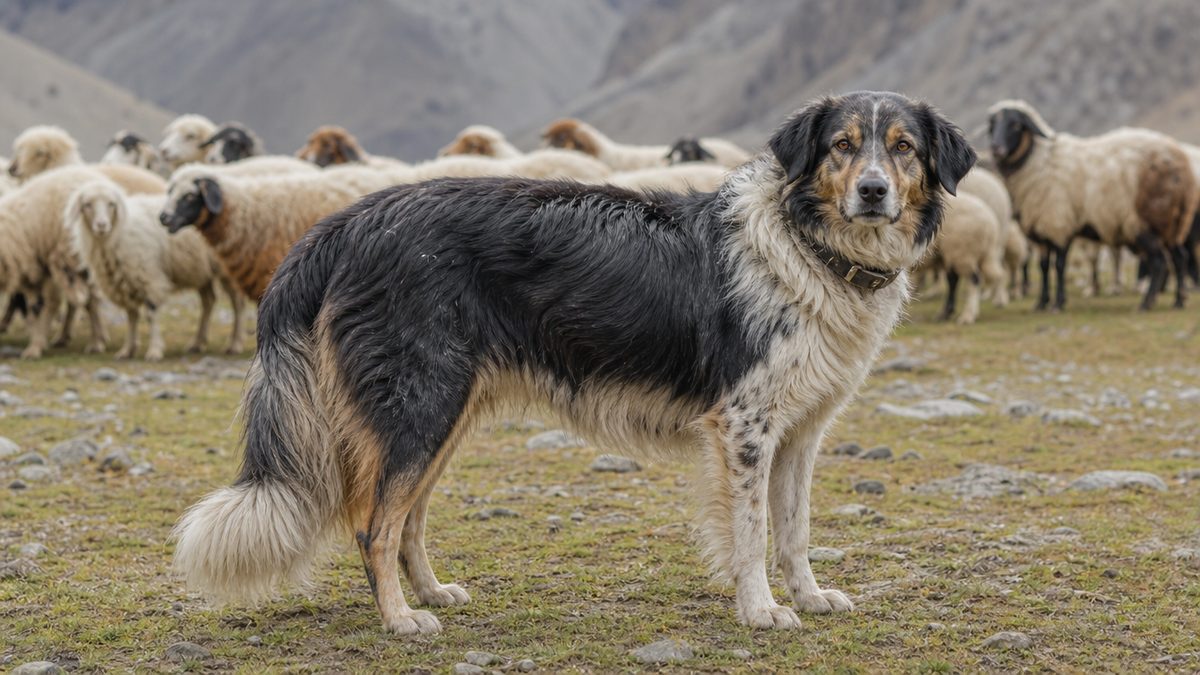
The Vikhan is a livestock guardian dog reported from two countries, found in the Chitral region of the Khyber Pakhtunkhwa Province in Pakistan and in Himachal Pradesh in India. In its home range it guards flocks of sheep from predators including the leopard, and to protect its neck from a leopard's teeth it is frequently fitted with a thick iron collar.
Hold on to that iron collar, because it settles the breed's job description in one image. This is not a dog that hunts a leopard. It is a dog that stands between a leopard and a flock and gets bitten on the throat for it, and somebody thought hard enough about that to put metal around its neck. Everything else on this page, the long coat, the lean frame, the temperament, the reason it will struggle in Chennai, follows from that one working relationship.
The second thing to hold on to is harder to say and more useful. Almost nothing about this breed has been measured. There is no breed standard, no registry entry, no population count, no lifespan study and no published weight. What exists is two books and a body of internet writing that did not read them. This page sets out what those two books support, then shows exactly where the numbers on every other page came from, because that trail turns out to be the most useful thing an Indian reader can be handed.
The names, and the one Wikipedia deliberately dropped
The breed answers to at least five names. When the Wikipedia article was created on 20 December 2007 it was titled Vikhan Sheepdog and listed Chitral Watchdog, Pakistani Vikhan Dog and Vikhan Shepherd as alternates. On 21 September 2020 an editor moved the page to the bare Vikhan with the edit summary "Name used in both sources cited". That is a small act of housekeeping with a large implication. The longer names are not what the books call the animal. They are what a forum called it, and the forum is where they came from.
| Attribute | Detail | Source |
|---|---|---|
| Type | Livestock guardian dog | Wikipedia, from Morris 2001 and Soman 1962 |
| Home range | Chitral, Khyber Pakhtunkhwa, Pakistan, and Himachal Pradesh, India | Wikipedia |
| Job | Guarding sheep flocks from predators including the leopard | Wikipedia |
| Equipment | A thick iron collar, to protect the neck from a leopard's teeth | Wikipedia |
| Build | Lighter framed than other livestock guardians, built more for speed than strength, resembling a large Scotch Collie | Wikipedia |
| Coat | Long coat, often shorn and the hair used to make a dark wool | Wikipedia |
| Colour | Black, reddish or mottled | Wikipedia |
| Ears and tail | Drooped ears, bushy tail | Wikipedia |
| Height | Not recorded | Infobox field empty |
| Weight | Not recorded | Infobox field empty |
| Litter size | Not recorded | Infobox field empty |
| Lifespan | Not recorded | Infobox field empty |
| Registered by ICAR-NBAGR | No. India's register holds five dog breeds and this is not one | NBAGR registered breeds |
| Recognised by the FCI | No, neither definitively nor provisionally | FCI nomenclature Federation Cynologique Internationale |
| Recognised by any kennel club | No. Wikipedia's infobox sets its not-recognised flag to yes | Wikipedia |
Four rows of that table read "not recorded", and they are the four rows a buyer most wants. That is not an editorial failure on Wikipedia's part. It is an accurate report of what two books contain.
Breed recognition, checked at every registry that could hold it
Breed recognition for the Vikhan is absent everywhere Bonbeno could check, and the checks are worth listing individually, because an absence only counts as evidence when you say where you looked.
- ICAR-NBAGR. India's register of indigenous dog breeds carries five entries, the Rajapalayam and Chippiparai of Tamil Nadu, the Mudhol Hound of Karnataka, the Gaddi of Himachal Pradesh and the Changkhi of Ladakh, each with an accession number. The Vikhan is not among them.
- Federation Cynologique Internationale. The nomenclature page for breeds beginning with V lists three, Vastgotaspets, Volpino Italiano and Vostotchno-Sibirskaia Laika. The provisional list carries twenty breeds and not one is Pakistani or Indian.
- Kennel Club of India. Read on 20 August 2026, the KCI site was serving a page headed "Temporary Arrangement as the new website is being deployed", carrying downloadable registration, litter, show and judge forms and nothing else. It contains no list of recognised breeds, no breed standard and no occurrence of the word Vikhan. There is nothing there for a breed to be absent from.
- Pakistan Kennel Club. The PKC describes itself as a non-profit organisation affiliated with the International Kennel Union, and its mission statement speaks of preserving breed standards and safeguarding all recognised breeds. It publishes neither list, and the word Vikhan does not appear on the site at all.
- Wikipedia's own infobox sets the breed's not-recognised flag to yes.
One nuance is worth carrying out of that list. The Himalayan Sheepdog is reported as recognised by the International Kennel Club under the name bhote kukur, and the Pakistan Kennel Club is affiliated to the International Kennel Union. Those bodies sit outside the FCI system and neither publishes anything about the Vikhan, but their existence is why the honest phrasing is unrecognised by every body we could check, rather than unrecognised full stop.
Appearance, and the one word that does real work
Compared to other livestock guardian breeds the Vikhan is lighter framed, built more for speed than strength, resembling a large Scotch Collie. Read that against the region's other guardians and it is a genuine distinction rather than a filler sentence. The Himalayan Sheepdog, known locally as the Gaddi Kutta, Bhote Kukur, Bhotia or Bangara, is described as closely related to the slightly larger Tibetan Mastiff, and it carries a published height of 51 to 75 cm and a weight of 23 to 41 kg. The Vikhan is the lean, fast one in that family, and "lighter" is the only measurement-adjacent claim the documented record actually makes.
The long coat is the other distinctive detail, and it is distinctive because of what is done with it. The coat is often shorn and the hair used to make a dark wool. A coat you can shear and spin has real staple length and real density, which matters enormously once this dog is imagined anywhere warm. Note also the drooped ears, a comfort feature in cold wind and a liability in Indian humidity, for reasons the grooming section sets out.
The name, and how much weight the Sanskrit claim can carry
The breed's name is said to derive from the Sanskrit word "vikh", meaning broken, noseless or hermit, with two suggested explanations, the broken and uneven land where the dog is found, or the breed living in solitude from other parts of the Indian subcontinent. Both explanations are hedged in the source itself with the words "It is possible", and no linguistic reference is given for the derivation. It comes from a general-interest dog dictionary and a 1962 breed survey, not from a philologist.
Bonbeno's position is that the etymology is repeatable but not established. Two proposed meanings for one syllable, offered tentatively, in a book about dogs, is a hypothesis. Treat any page that states it flatly as a page that copied a sentence and dropped its qualifier. The AI-generated Grokipedia article expands the same claim into a paragraph about the name evolving through local dialects among Pashtun, Kalash and Pahari communities to highlight the dog's hermit-like independence. Nothing in the record this page could reach supports that expansion.
History, in the only two documents that exist
The breed's entire documented history is two books. W. V. Soman's The Indian Dog, published in Mumbai by Popular Prakashan in 1962, covers it on pages 66 to 67. Desmond Morris's Dogs: the ultimate dictionary of over 1,000 dog breeds, published in 2001, covers it on pages 402 to 403. Wikipedia attaches one of those two references to every substantive sentence it carries.
A third reference sits on the article's opening sentence, an Indian veterinary teaching text, and it deserves a pause because it is the only Indian institutional source anywhere in the chain. The Handbook on Care and Management of Laboratory and Pet Animals, by Y. B. Rajeshwari, K. Satyanarayan and S. B. Prasanna of the Veterinary College, KVAFSU, Bengaluru, comes from New India Publishing Agency. Wikipedia's citation gives the page as 13 while the Google Books link it supplies points to page 93. The publisher's own table of contents settles which is plausible. Chapter 13, "History, Management, Breeds and Utilities of Dogs", runs from page 81 to page 94, and page 13 falls inside the opening chapters on laboratory animal science. The link is right and the printed page number is wrong, which is exactly the error that survives when nobody checks a citation.
There is a neat confirmation one article away. Wikipedia's Himalayan Sheepdog article cites the same handbook twice, once with the same malformed page=13 and once correctly as pages 93, both pointing at the same Google Books link. The correct reading and the broken one sit in the same reference list, and the Vikhan article inherited the broken one.
We could not obtain Soman 1962 or the relevant pages of Morris 2001, and we could not read page 93 of the Rajeshwari handbook. All three are real, catalogued books, and none is available in full text through any route we could open. Everything attributed to them here is attributed as Wikipedia reports it, and is labelled that way rather than presented as a direct reading. When another page claims to quote those books, ask how it got them.
Where every Vikhan measurement on the internet actually came from
Every height, weight and lifespan published for this breed traces back to a single unsigned paragraph on a Molosser enthusiast forum, archived in November 2006, dead since 2011, and removed from Wikipedia in 2020 Vikhan, Wikipedia. The two books the current Wikipedia article cites contain no measurements at all, which is why its height, weight, litter size and lifespan fields are empty.
This section exists because the trail is short enough to follow end to end, and following it changes what a reader should believe. Bonbeno has run this check on several breeds. This is the cleanest closed loop we have found.
The root document, in full
The Internet Archive captured the MolosserDogs.com encyclopedia entry for the Vikhan on 15 November 2006, thirteen months before the Wikipedia article existed. The entry carried no author, no bibliography and no date, and it sat under a hit counter reading 1,115 reads. Here it is in full, because its brevity and its origin are the finding.
"The ancient Vikhan Dog comes from the Chitral region of North-Western Pakistan, where it is still employed as a sheep herder and protector, as well as an excellent leopard hunting dog, due to its immense speed and fierce personality. It also makes a formidable property watchdog. Related to other Molossers of the region, the Vikhan is often described as a 'giant Collie', due to its profuse coat, which is used as a wool substitute in Pakistan. This large, muscular and lean working breed posseses a fearless temperament and great intelligence. It is, however, very territorial and aggressive, needing careful socialization from an early age. The rich coat comes in solid shades of black, brown, red and fawn, but multicoloured dogs are quite common. Average height is around 26 inches."
That is 129 words, and if you have read anything about this breed online you have already read most of it. The misspelling of "possesses" is in the original. Note two internal problems. The entry files the breed under Molossers, the heavy mastiff group, while simultaneously calling it a giant Collie, which is the opposite body type. And it calls the dog a leopard hunting dog, when the book-sourced description has the dog wearing an iron collar because the leopard is biting it.
The timeline, from the edit history
| Date | What happened |
|---|---|
| 15 Nov 2006 | Internet Archive captures the MolosserDogs entry, the only source that will exist for fourteen years |
| 20 Dec 2007 | Wikipedia article created as "Vikhan Sheepdog", 1,938 bytes, one reference, MolosserDogs |
| 23 Jul 2011 | The MolosserDogs URL returns HTTP 404. The citation is now dead and stays cited for nine more years |
| 21 Jul 2016 | InternetArchiveBot rescues the dead link rather than the article questioning it |
| 19 Feb 2020 | An editor tags the article for notability |
| 21 Sep 2020, 02:06 UTC | Editor Cavalryman removes the MolosserDogs reference, summary "Removed molasserdogs" |
| 21 Sep 2020, 02:46 UTC | "Complete rewrite", forty minutes later. Article drops from 2,705 to 2,463 bytes |
| 21 Sep 2020, 02:48 UTC | Page moved from "Vikhan Sheepdog" to "Vikhan", summary "Name used in both sources cited" |
| 18 Nov 2025 | Latest revision. 2,921 bytes, three references, no measurements |
Forty-eight minutes on one night in September 2020 replaced the entire public description of this breed. Everything published before that date, and every page that copied from a pre-2020 mirror after it, still carries the forum paragraph.
What the ranking pages publish today, and what it rests on
Three pages currently ranking for this breed in India print confident numbers. Not one of them has a source that contains those numbers.
| Page | What it publishes | What it cites | Does the cited source contain it |
|---|---|---|---|
| Wikipedia, current | No height, no weight, no litter size, no lifespan | Morris 2001, Soman 1962, Rajeshwari handbook | Consistent. It publishes nothing it cannot source |
| Animalia.Pets | Withers height 65-66 cm, 25.6-26 inches | One reference, the Wikipedia Vikhan article | No. That article's height field is empty |
| Grokipedia | Males 65-70 cm and 40-50 kg, females 62-67 cm and 35-45 kg, lifespan 10 to 14 years | 22 numbered reference markers | Not established. No figure of this kind exists in the breed's two documented books |
| My Lil Paw | 24 to 30 inches, 61 to 76 cm, lifespan 10-12 years | Nothing. The page carries no references at all | No. That is the published height range of the Bakharwal Dog |
Read the Animalia row carefully, because it is the whole problem in one line. The page names exactly one reference, the Wikipedia article, and then prints a withers height that the Wikipedia article does not contain. The number it prints, 65 to 66 cm, is 25.6 to 26 inches. The 2007 forum-sourced Wikipedia article said "Average height is around 26 inches". A single hedged sentence from a dead forum has been converted into metric, given a one-centimetre band, and published as a specification.
The Animalia page also reproduces the 2007 wording almost verbatim, calling the Vikhan "a large and muscular breed" with "a fearless temperament" that is "very territorial and aggressive". The current Wikipedia article, sourced to the books, says the opposite where the two overlap: lighter framed, built more for speed than strength. A page citing Wikipedia as its only source is contradicting Wikipedia on the one physical claim both address.
The tell that costs nothing to check
Animalia's own "related breeds" block lists the Kishu of Japan, the Tweed Water Spaniel, the Irish Red and White Setter, the Laizhou Hong of China, the Braque Francais, the Podenco Andaluz, the Tang Dog, the Aksaray Malaklisi, the Havanese and the Drentse Patrijshond. Ten breeds, and not one Himalayan or Karakoram livestock guardian among them. No editor who had read about this dog would place it next to a Havanese. That block is machine-generated, and once you see it you know what the rest of the page is.
The independent check anybody can run
Search PubMed for Vikhan across all fields and it returns zero results. That is not a broken search. Run on the same day, the same instrument returned 145 results for Chitral, 80 for livestock guardian dog and 12 for Gaddi dog. The Vikhan is absent from the indexed veterinary and biological literature, not hidden in it.
Three checks catch almost every invented breed statistic. Open the source a page names and search it for the number, because roughly half the time the number is not in there. Divide any stated conversion out, since a metric band that resolves to a round imperial figure was converted, not measured. And look at the page's related-breeds list, because an auto-generated one gives the whole page away.
Vikhan dog price in india
There is no reliable vikhan dog price in india, because there is no Indian market for this breed and no lawful route by which one could form. Bonbeno found exactly one published Indian rupee figure for the Vikhan, Rs 10,000 to Rs 15,000, on a page that cites no source for it or for anything else. That single uncited band is the entire published Indian price evidence.
Start with the geography, because it decides everything. The breed's documented population lives in Chitral, in the Khyber Pakhtunkhwa province of Pakistan. Its claimed Indian presence is a single unelaborated line, "in India, it is found in Himachal Pradesh", carried by two books and repeated by everyone since. No Indian breeder, no Indian kennel, no Indian registry entry and no Indian survey attaches to it.
The one published figure, and the check it passes
Bonbeno divides any suspicious Indian rupee figure by 84.38, because Indian breed pages routinely publish a United States dollar price run through one exchange rate and presented as a local market rate. We have caught that three times on this site. Run it here and it does not fire. Rs 10,000 comes to about 118.5 dollars and Rs 15,000 to about 177.8 dollars, and neither is a round dollar figure. So the number is probably not a laundered dollar price. It is simply a number with nothing behind it, offered with the qualifier that it depends on "the breeder's reputation, pedigree, location, age" and availability, for a breed that has no breeders, no pedigrees and no registry to hold either.
For scale, contrast that with the neighbouring breeds this site has already documented. Published claims for the Bakharwal Dog run from Rs 2,000 to over Rs 1,50,000, and for the Himalayan Sheepdog from roughly Rs 5,000 to Rs 80,000. Those are wide, badly sourced ranges, but they are ranges, produced by multiple sellers competing for the same buyer. The Vikhan has one number from one page. That is what genuinely absent demand looks like.
The import policy, read from the trade notice itself
A reader who accepts that the breed is not for sale in India will next ask whether it can be brought in from Chitral. It cannot, and the answer is written down in two documents Bonbeno opened and read rather than summarised.
DGFT Trade Notice 22/2022-23 of 19 December 2022 sets the import policy for pet animals. Under ITC (HS) 01061900, "Mammals: Other", the import policy is Restricted. Policy Condition 7 permits import of dogs only for three purposes, a pet dog with a valid pet book and relevant records in the name of the importer, dogs imported by research and development organisations with the recommendation of CPCSEA, and dogs for internal security by the Defence and Police Force. Policy Condition 8 states that import of commercial dogs for breeding or any other commercial activity outside those purposes is not permitted, and paragraph 6 states that any applications for trading or breeding purposes shall be duly rejected.
- Only seven entry points. Import of pet animals is allowed only through the airports and seaports of Delhi, Mumbai, Chennai, Hyderabad, Bengaluru and Kolkata and, since October 2024, Kochi airport Department of Animal Husbandry…. The full route is set out in how to import a dog to India.
- Only a genuine relocation qualifies as baggage. Up to two pets may enter as passenger baggage without DGFT authorisation, and only for a person transferring residence to India after two years of continuous stay abroad.
- More than two pets always needs authorisation. Applications go to the Department of Animal Husbandry and Dairying for examination before DGFT grants anything.
- Start two months early. Pet owners are advised to begin the import authorisation process at least two months before travel.
- Quarantine and an advance NOC apply. An Advance No Objection Certificate must be obtained from the Quarantine Officer of the entry port, normally seven days before travel.
The second door, which is bolted
Even a person who satisfied all of that could not lawfully bring a dog from the country where this breed lives. On 2 May 2025 the Directorate General of Foreign Trade issued Notification 06/2025-26, "Prohibition on Import or transit of all goods originating in or exported from Pakistan, Insertion of Para 2.20A of Foreign Trade Policy (FTP) 2023". Bonbeno read DGFT's own published notification list on 20 August 2026. It carries 232 notifications spanning 28 August 2023 to that day, and exactly one of them mentions Pakistan. Nothing since has reversed it.
The PDF of Notification 06/2025-26 hosted on DGFT's own content server is a single-page image scan. Our own extraction returned zero characters and the page carries no font resources at all, so nobody has quoted verbatim text from that file. The notification's number, date and full official title above were read from DGFT's machine-readable notification listing, which is what we cite. We do not quote the operative wording, because we could not read it.
Put the two together. Dogs are a Restricted import, trading and breeding applications are rejected outright, and separately every good originating in Pakistan is prohibited. There is no lawful commercial supply chain into India for a Chitral breed, and there is no registry route either, because neither ICAR-NBAGR nor the FCI nor any kennel club recognises the animal Federation Cynologique Internationale.
What an Indian search actually returns
Search the breed's price from India and the results are worth reading as evidence in themselves. Alongside the encyclopedia pages, the set includes Justdial category pages titled "Top Pet Shops For Vikhan Sheepdog" for Delhi and for Dehradun. Both carry the identical category identifier in the URL path, nct-13812354. A shop-finder that assigns one category number to two cities is generating a page per city per breed from a template, not listing anyone who has the dog. Bonbeno did not read those pages, because Justdial returned HTTP 403 to every request, and we take no view on their contents beyond the URL structure that is visible without opening them.
The set also contains print-on-demand training titles for the breed on Amazon.in and Flipkart. A breed with no standard, no registry, no club and no published training literature nonetheless has training guides for sale in India. We could not open those listings and make no claim about what is inside them. Their existence is the point.
Every figure above is reported as published editorial content, not as an offer. Bonbeno does not link puppy listings, does not recommend breeders and does not sell animals. If a seller in an Indian city offers you a Vikhan puppy, the single most useful question is what documentation exists, and the honest answer is that none can exist, because there is no registry anywhere in the world that issues papers for this breed.
Monthly cost of owning a Vikhan dog in India
No cost estimate exists for this breed in India, not even a bad one. The single Indian page that publishes a price for the Vikhan gives no feeding, grooming, training or veterinary figure at all, and no other Indian page publishes one. This section therefore names the cost lines a long-coated mountain guardian genuinely carries here, anchors each to real data, and publishes no monthly total.
That absence is itself worth noticing, because it separates this breed from its neighbours. The Bakharwal Dog has two published Indian cost estimates, both weak. The Vikhan has none. Where a breed has enough Indian demand to be sold, somebody eventually writes a maintenance-cost page for it. Nobody has written one here.
The six cost lines that are real, whatever the total
Each of the following is a recurring expense that follows from the documented description of the animal, not from a guess about its price. Read them as a shape rather than a budget.
- Cooling, for five to seven months a year. A coat dense enough to be shorn and spun into wool is insulation that does not switch off in April. Across most of India this is an electricity bill, not an accessory, and it is the single largest hidden cost of keeping this dog outside the hill states.
- Coat work through every moult. A long coat on a working dog needs a rake, an undercoat comb and time. Budget for tools and for a groomer who understands that you brush this coat out rather than clip it off.
- Emergency capacity for heat. Across a UK primary-care population of 905,543 dogs, confirmed heat-related illness carried an event fatality rate of 14.18 percent, 95 percent confidence interval 11.08 to 17.96. Money held back for one unplanned emergency visit is a genuine cost of keeping a cold-climate dog in a hot country.
- Year-round tick and flea control. In the breed's own province, 300 dogs examined in central Khyber Pakhtunkhwa yielded 1,150 hard ticks and a total tick infestation prevalence of 61 percent. In India, a multiplex PCR survey of 719 dogs in Punjab found Babesia gibsoni in 8.9 percent, Hepatozoon canis in 5.1 percent, Ehrlichia canis in 2.6 percent and Babesia vogeli in 1.1 percent. An outdoor guardian meets ticks constantly, and this is a monthly line, not a seasonal one.
- Rabies and vaccination discipline. India recorded an estimated 9.1 million animal bites in a nationwide community survey covering 60 districts across 15 states, with an annual dog-bite incidence of 5.6 per 1,000 population and an estimated 5,726 human rabies deaths a year. A large dog kept outdoors, meeting free-ranging dogs, needs its rabies schedule kept current without exception.
- Secure containment. A territorial guardian bred to patrol a grazing boundary needs a physical wall or fence, not a gate latch. That is a one-time construction cost most first-time owners discover in month three.
What Bonbeno will not publish, and why
Bonbeno publishes no monthly rupee figure for this breed. We have not collected one, and no credible source has. Borrowing the Bakharwal's or the Gaddi's numbers would be worse than useless here, because the one physical claim the record makes about the Vikhan is that it is a lighter dog than those breeds, which would change the food line in a direction nobody has quantified. Reprinting a neighbouring breed's budget under this breed's name would launder a guess into a reference figure.
What we will say is directional. Every cost driver above scales with coat length, body size, outdoor exposure and ambient heat. On coat and outdoor exposure this breed sits at the expensive end. On body size it may sit slightly below its Himalayan relatives, and on ambient heat it sits wherever you live, which is the variable you control.
If cost is a real constraint, the Indian Pariah Dog answers it directly. It is adapted to Indian heat, carries a short coat that needs no professional grooming, needs no cooling budget, and is free to adopt. Almost every rupee in the list above is a rupee spent keeping a high altitude animal comfortable somewhere it was never built for.
Heat tolerance in Indian conditions, rated 2 out of 5
Rate the Vikhan dog's heat tolerance at 2 out of 5. It is a high altitude livestock guardian carrying a coat long enough to be shorn and spun into wool, which is close to the worst insulation profile a dog can bring to an Indian summer. The one point that lifts it above the bottom of the scale is a single documented feature, the lighter frame, and the reasoning below sets out exactly how much that is worth.
The mechanism, in three steps
A dog sheds heat almost entirely by evaporation from the respiratory tract, through panting. It has no functional whole-body sweating. Everything that follows is about how much that single route has to carry.
- Insulation does not know which direction heat is travelling. A coat dense enough to harvest as textile fibre traps still air against the skin in August exactly as effectively as it does in January. The dog's own metabolic heat has to cross that layer to leave, and it is produced continuously whether the air outside is minus five degrees or plus forty two.
- Body mass sets the baseline risk, and the step is at 50 kg. In a UK primary-care cohort of 905,543 dogs, the odds of heat-related illness rose with bodyweight, but not smoothly. Against dogs under 10 kg, the 40 to under 50 kg band showed an odds ratio of 1.76 with a 95 percent confidence interval of 0.91 to 3.40, which crosses one and is not statistically significant, while dogs at 50 kg and above jumped to 3.42 times the odds, 95 percent CI 1.54 to 7.57. The cliff is at 50 kg.
- Humidity switches the panting route off. Evaporative cooling depends on the moisture gradient between the airway and the surrounding air. In Mumbai, Chennai, Kolkata or coastal Kerala in June that gradient collapses, and a dog panting hard in saturated air does the muscular work without getting the cooling. Delhi presents the opposite problem, a gradient that still works against an ambient temperature so high that the dog gains heat faster than it can shed it.
Why 2 and not 1
The Vikhan is the only Himalayan guardian on this site whose documented description contains a thermoregulatory advantage. It is lighter framed, built more for speed than strength compared to other livestock guardian breeds. If that is accurate, the dog sits somewhere below the mass band where the UK data found a significant jump in heat-related illness risk, rather than in it. That is a real, mechanically meaningful difference from a Tibetan Mastiff-type guardian, and it is why Bonbeno does not rate this breed 1 the way we rate the Bakharwal Dog and the Himalayan Sheepdog.
Now the caveat, stated as plainly as the credit. Nobody has ever weighed a Vikhan and published the result. The extra point rests entirely on one comparative adjective appearing in two books, carried into an encyclopedia entry with no number attached Morris D., Dogs: the ultimate dictionary… Soman W. V., The Indian Dog. The moment anyone publishes a measured bodyweight for this breed, this rating moves, and if the figure lands at or above 50 kg it moves to 1.
Why not 3
Four things hold the rating down, and none of them is speculative.
- The coat is the heaviest documented feature of the animal. Long, and specifically long enough to shear for wool. That is not a light summer jacket.
- There is no heat-adapted ancestry anywhere in the record. Every documented population is at altitude in the Hindu Kush or the western Himalaya.
- The working life is outdoors, all day, in the open. A guardian walks with a flock. It does not lie under a fan.
- The drooped ears are a monsoon liability. They are protective in cold wind and they trap moisture in Indian humidity, which the grooming section covers.
Cold tolerance, by the same reasoning, is where the breed is excellent. No Indian climate is cool enough to trouble a dog bred to sleep out on a Chitral pasture.
Himachal Pradesh is not one climate, and that matters here
The breed's claimed Indian range is Himachal Pradesh, and Indian readers routinely treat that as shorthand for cool. It is not. On 10 June 2025, Una in Himachal Pradesh recorded 44.2 degrees Celsius, 5.8 degrees above normal, with Neri in Hamirpur district at 43.3, Bilaspur at 40.8, and Kangra and Mandi both at 40, while Keylong recorded the state's lowest minimum at 8.0 degrees on the same day.
Read Kangra and Mandi twice. Both are among the six districts ICAR-NBAGR names as the native tract of the registered Gaddi dog, alongside Chamba, Kullu, Lahaul Spiti and Kinnaur. So the state that supposedly holds this breed contains, in one June day, a 44 degree valley and an 8 degree minimum in the high country, and even the recognised guardian's home districts touch 40. A Himalayan guardian is a high-country animal within Himachal, not a Himachal animal in general.
| Where you live | The specific problem | Bonbeno's view |
|---|---|---|
| Lahaul-Spiti, Kinnaur, upper Kullu, Keylong | None. This is the climate the breed was built for | Suitable |
| Shimla, Manali, upper Chamba | Warm afternoons in May and June, cool nights | Workable with shade and water discipline |
| Kangra, Mandi, Dharamshala | 40 degrees in a June heatwave | Marginal. Summer routine has to change completely |
| Una, Bilaspur, Hamirpur, Punjab, Haryana, Delhi | 44.2 degrees recorded in Himachal's own lowlands | Not recommended |
| Mumbai, Chennai, Kolkata, coastal Kerala, Goa | Humidity collapses the evaporative gradient the dog depends on | Not recommended |
| Bengaluru, Pune | Mild by Indian standards, still well above a Chitral pasture | Possible indoors, still a poor climate match |
A double-length working coat protects against solar radiation as well as cold, and clipping it destroys the airflow layer next to the skin while exposing pigment-free areas to the sun. Shearing in the breed's home range is a fibre harvest done on a working animal in a cold climate, on a schedule set by the season. It is not a heat-management technique for a dog in Ludhiana. Brush the coat out instead, keep the dog indoors between 10 am and 5 pm from March to October, walk before sunrise and after sunset, and consult your nearby vet the moment you see heavy unrelenting panting, brick-red gums, staggering or vomiting.
Vikhan temperament, and who has actually observed it
Nobody has published an observation of Vikhan temperament that Bonbeno could verify. Every confident personality claim online, that the breed is fearless, highly intelligent, very territorial and aggressive, and needs careful socialisation from an early age, is a direct copy of one unsigned forum paragraph archived in 2006. Wikipedia's current book-sourced article says nothing whatsoever about temperament.
That is a stronger statement than it looks, so read it slowly. The two books that document this breed are, as reported by the encyclopedia that cites them, silent on how the dog behaves. The entire temperament literature for the Vikhan is two sentences, 28 words, written by an anonymous forum contributor before 2006, on a page that went dead in 2011.
Animalia.Pets today prints "The Vikhan has a fearless temperament and high intelligence. It is a very territorial and aggressive breed and requires socialization from a very early age", and names the Wikipedia article as its only reference. That sentence is a light paraphrase of the 2006 forum text and it is not in the Wikipedia article it cites. Grokipedia goes further, describing an aloof demeanour bordering on suspicion, a loyal and gentle side with familiar humans, and aggression reserved primarily for genuine threats. None of that is observation. It is the standard livestock guardian description, applied to a breed nobody has studied.
What can honestly be inferred from the job
Function constrains behaviour, and the Vikhan's function is documented even where its personality is not. It guards sheep flocks against predators including the leopard, in country rough enough that a thick iron collar is standard equipment. Three things follow, and Bonbeno labels them as inference rather than evidence.
- Independent decision-making is the core trait. A dog that stands with a flock decides alone whether an approaching animal is a threat. It is not waiting for a command, and it was never selected to.
- Willingness to escalate is the point of the dog. A guardian that backs down is not doing the job. Expect a low threshold for confrontation with an unfamiliar animal, because that is what the iron collar implies about the work.
- Bonding is to the flock and the household, not to strangers. Livestock guardians across the world are shaped this way. A protective dog is not the same as a friendly dog, and the two are frequently confused in Indian buying decisions.
What cannot be inferred is how any of that expresses itself in a flat in Gurugram, because no Vikhan has been documented living in one.
Who should not consider this breed
Bonbeno takes an unusually firm line here, because the evidence base gives a buyer nothing to plan around. A first dog, a household with small children, an apartment, a home with regular visitors and delivery workers, a hot city, or any household without a secure physical boundary are all wrong for a large unregistered guardian with no temperament record at all. With a Labrador or a German Shepherd you can at least read a large body of behavioural work and adjust. Here there is nothing to read.
There is also no bite-incident data, no temperament testing programme and no breed club collecting owner reports. Where the Bakharwal Dog at least has its own regional university describing it in print, the Vikhan has no institutional description of behaviour anywhere.
Socialisation, if you keep one anyway
If you already live with a dog of this type, weight the socialisation programme toward calm, repeated, low-intensity exposure rather than toward volume. Guardian breeds do not become sociable through more introductions; they become manageable through predictable ones. Start in the first sixteen weeks, keep every session short and successful, and pay particular attention to other dogs, because free-ranging dogs are a daily reality in almost every Indian neighbourhood.
The 2006 forum entry that seeded the entire internet on this breed calls it a leopard hunting dog with immense speed and a fierce personality. The book-sourced description says the dog wears an iron collar because a leopard bites its neck. Those are two different animals doing two different jobs, and everything written about Vikhan temperament sits on the first one.
Training a Vikhan, and what the breed will resist
To train a livestock guardian of this type you build structure around an instinct you cannot remove, because the dog was selected for generations to decide alone whether an approaching animal is a threat. Obedience is achievable. Compliance under drive is not, and any trainer who promises it has not worked a guardian breed.
Begin with the honest disclaimer. There is no published training literature for this breed. No club has written a guide, no handler has published a method, and the print-on-demand titles sold under the breed's name in India are not evidence of any. What follows is general livestock guardian practice applied to a dog whose documented job is guarding sheep from leopards, stated as such.
The five things worth training, in priority order
- A boundary routine, before anything else. Walk the perimeter of your property with the dog on lead, daily, from the first week. A guardian that has been shown its boundary by a person is far easier to live with than one that decides where the boundary is.
- A settle on a mat. Not a sit, a settle. The single most useful behaviour in a guardian is the ability to switch off in a specific place when told, and it is the behaviour that makes visitors survivable.
- Gate and door manners. Train the dog to move away from the gate before it opens, every time, with no exceptions. This is the behaviour that prevents almost every serious incident in Indian homes with a guard dog.
- Lead skills that hold under distraction. You are not going to walk this dog past a group of free-ranging dogs on charm. Teach a turn-and-go cue and practise it a hundred times where nothing is happening.
- A reliable check-in. Reward the dog for looking back at you, so that you have a way to interrupt attention before it becomes commitment. Interruption is realistic; recall out of a full chase is not.
Timelines that are honest rather than encouraging
| Age | What is realistic | What is not |
|---|---|---|
| 8 to 16 weeks | Name, settle, lead introduction, calm exposure to household routine | Any reliability outdoors |
| 4 to 8 months | Boundary routine established, gate manners, basic lead skills | Recall around other dogs |
| 8 to 18 months | Guarding behaviour appears and intensifies. Structure, not correction | Expecting the dog to greet strangers warmly |
| 18 months to 3 years | Adult judgement settles. The dog becomes predictable to people it knows | Off-lead freedom in a public Indian space |
Barking, and the illegal shortcut
A livestock guardian barks. That is the first line of the job, and in an Indian apartment block or a dense colony it is the complaint that arrives fastest. Some owners are then offered a surgical fix, and it is worth knowing where Indian law stands before that conversation happens.
The Prevention of Cruelty to Animals (Dog Breeding and Marketing) Rules 2017, notified as G.S.R. 496(E) on 23 May 2017, state at Second Schedule Part II paragraph 6(8) that "There shall be no tail docking, ear cropping de-barking, de-clawing, branding, dyeing, injecting substances to enhance visual appeal, performing a surgery or procedure to camouflage or hide any defect or infirmity or any other kind of mutilation of any body part of the pup and any change of appearance by artificial means is strictly forbidden". De-barking is named in that list. So is ear cropping, so is tail docking, and both matter for a breed whose documented appearance includes drooped ears and a bushy tail.
The lawful answers are the slow ones. Give the dog a job and a boundary so it barks at events rather than at boredom, bring it indoors at night, and manage the triggers instead of the throat.
Anyone imagining a small Indian breeding project for this breed runs straight into the same Rules. Paragraph 6(3) prohibits in breeding, defined as mating between relatives of the second to fourth grade within the first four generations, giving uncle to niece, nephew to aunt, cousin to cousin and grandparents to grandchildren as examples, and separately prohibits incest breeding between parents and children or brother and sister. Paragraph 6(9) states that breeding to create new breeds of dogs or unusual looks shall be strictly prohibited. A population founded on a handful of imported animals cannot be bred forward inside those limits, which is a legal fact, not an opinion.
Daily exercise a Vikhan actually needs
Give a dog of this type two long walks a day plus a space it can patrol, and treat that as the floor rather than the target. The working day this breed was built for is walking with a flock across rough country and standing over it, so the requirement is distance and duration on foot, not intensity.
No exercise study exists for this breed, and Bonbeno will not invent a number. The only published figure we could find is Grokipedia's recommendation of a minimum of two hours of daily vigorous exercise, which carries reference markers but no evidence that anyone has observed a Vikhan. Two hours is directionally plausible for a large working guardian. Treat it as a reasonable guess by an AI, which is what it is.
Speed is not the same as stamina, and the distinction matters
The breed is described as built more for speed than strength, and Indian buyers routinely read that as a dog that wants to run alongside a bicycle. That is a misreading of what a guardian's speed is for. A livestock guardian's burst of speed is a short, explosive interception of an approaching predator, followed by hours of standing still. The daily rhythm is long slow movement punctuated by sudden effort, not sustained aerobic work. Build the routine around walking, not running.
The Indian version of that routine
- October to February. Two walks of 45 to 60 minutes, morning and evening, plus free movement in a secure yard. This is the easy half of the Indian year.
- March to June. Move both walks outside daylight entirely. Before sunrise and after 8 pm, on grass or earth rather than tar, and shorten them on any day above 35 degrees.
- July to September. The monsoon removes the heat problem and creates a skin and ear problem instead. Keep walking, and dry the coat and ears properly afterwards every time.
- Every month. Give the dog a boundary to patrol. A guardian with a perimeter to check is a calmer animal than one confined to a balcony, and no amount of walking substitutes for that.
- Every walk in summer. Carry water, check tar temperature with the back of your hand, and turn back early rather than pushing through.
What under-exercising this breed looks like
Under-exercised guardians do not usually become destructive in the Labrador sense. They become vigilant in the wrong direction. Barking at every sound in the stairwell, patrolling the flat, escalating at the door, redirecting on the other household dog. If any of that appears, the first thing to audit is not obedience but movement and boundary, in that order.
The trap in India is that the season most likely to produce under-exercise, April through June, is also the season the dog is least able to tolerate. That is not a scheduling inconvenience. It is a structural reason this breed does not belong in a hot Indian city, and it is why the climate rating sits where it does.
Watch the dog for the twenty minutes after a walk. A dog that settles on its own, without being told, has had enough. A dog that paces, stares out of the window or re-starts at the first sound has not. Run that test for a week and you will have a better exercise prescription for your specific dog than any published figure for this breed can give you.
Grooming a long coat in Indian humidity
Brush this coat right down to the skin two to three times a week, daily through a moult, and dry the drooped ears after every wash and every wet walk. The Vikhan carries a long coat that is often shorn and the hair used to make a dark wool, which tells you it is thick enough to mat and long enough to hold water against the skin for hours.
The undercoat question, which nobody has settled
Wikipedia's book-sourced description says only that the coat is long. Grokipedia states that the Vikhan possesses a long, thick double coat with a dense undercoat and longer guard hairs, often wiry in texture with slight feathering on the legs and tail. Bonbeno could not trace that to any source, and it is the level of anatomical detail that a breed with no standard cannot support.
Groom as though the undercoat is there. The cost of over-grooming a single coat is twenty wasted minutes a week. The cost of under-grooming a double coat in an Indian monsoon is a matted, damp, hot layer against the skin, and that is how a manageable coat becomes a veterinary problem. Buy an undercoat rake and a slicker, and use the rake first.
Should you shear it, since they shear it there
No. Shearing in the home range is a fibre harvest, done on a working animal in a cold climate on a schedule set by the wool cycle, not a way of cooling a dog down. Clipping a working coat in India removes the still-air layer that buffers the skin against solar radiation and leaves thin, pigment-poor skin exposed at the exact hours the dog is most at risk. If you want the dog cooler, change the hours it goes outside, not the coat it was born with.
| Season | Coat | Ears and skin |
|---|---|---|
| October to February | Rake and brush two to three times a week, to the skin | Weekly ear check. Low risk period |
| March to June | Daily brushing through the moult. Never clip | Watch for hot spots under the ruff and behind the elbows |
| July to September | Brush after every wet walk, before the coat dries in place | Dry the ear canal opening after every wash and every soaking. Highest risk period |
| All year | Check for ticks at every grooming session | Tick and flea control is a year-round job in India, not a seasonal one |
Drooped ears plus Indian humidity
The drooped ear is a cold-country feature that costs the dog in a wet one. A hanging ear leaf holds the canal closed, and a closed canal in a humid climate stays warm and damp for hours after a bath or a monsoon walk. Bonbeno searched PubMed for an Indian seasonal otitis series during this build and did not find one indexed, so we publish no prevalence figure. What we will say is procedural. Lift the leaf, dry the opening with cotton wool, never push anything into the canal, and treat a head shake, an odour or repeated scratching as a reason to consult your nearby vet rather than something to watch for a week.
Two skin risks specific to a dog that lives with livestock
A guardian sleeps with the flock, and that changes the skin picture in ways a companion-dog grooming guide never covers.
- Ringworm from the animals it guards. A survey in Chitral district screened 5,873 animals, 1,087 cows, 2,033 goats and 2,753 sheep, and confirmed Trichophyton verrucosum by microscopy and real-time PCR in 18 cows (1.6 percent), 3 sheep (0.1 percent) and 4 goats (0.2 percent), with infection more common in cattle and in winter. T. verrucosum transmits to dogs and to people. A dog in daily contact with cattle is in that transmission chain, and any circular, crusting, hair-loss lesion needs a vet rather than a home remedy.
- A heavy tick burden that concentrates where you cannot see. In central Khyber Pakhtunkhwa, 300 dogs yielded 1,150 hard ticks and a 61 percent overall infestation prevalence, dominated by Rhipicephalus sanguineus at 41.3 percent and Rhipicephalus turanicus at 28.7 percent. Ticks favour the ear margins, the neck under a collar and between the toes. On a long coat you find them by hand, not by eye.
If a dog of this type wears a heavy protective collar, the skin under it needs checking every single week. A rigid collar over a long coat creates constant friction and traps moisture, and it is the one place on the body where a matted, damp patch can sit unnoticed for a month. Take the collar off, part the coat, look at the skin, and put it back on.
Vikhan health, lifespan and what nobody has screened
No inherited-disease study, no health survey, no screening scheme and no lifespan study exists for the Vikhan. Every list of "common Vikhan health problems" you will find online is a generic large-dog list applied to a breed nobody has examined, and Bonbeno publishes no breed-specific prevalence figure because none has been produced. Consult your nearby vet, a registered veterinarian, for anything concerning your own dog.
The lifespan claims, and what sits behind each
Wikipedia's life span field is empty, because the two books it cites do not supply one. Two other pages fill the gap anyway.
| Source | Claim | What it rests on |
|---|---|---|
| Wikipedia | No figure published | Two books that contain none. The honest position |
| My Lil Paw | 10 to 12 years | No references anywhere on the page |
| Grokipedia | 10 to 14 years | An AI-generated article marked fact-checked by Grok |
| Benchmark, not a breed figure | Large purebreds, median survival 11.9 years, 95 percent CI 11.9 to 11.9 | 584,734 UK dogs, 284,734 deceased, 123,072 large purebreds with 61,976 death events |
That last row is worth understanding properly rather than borrowing. McMillan and colleagues report median survival of 12.7 years for small purebreds, 12.5 for medium and 11.9 for large, across a UK companion-dog population. It is a benchmark for what large purebred dogs live to in a country with routine veterinary care, and it is not a prediction for a working Himalayan guardian in the Hindu Kush, which faces predators, terrain, parasite load and limited veterinary access that a UK dataset does not represent. Bonbeno publishes no lifespan for this breed. If you need a planning number, use the general large-dog figure and know exactly what it is.
What size alone predicts, since size is nearly all we have
The Dog Aging Project analysed owner-reported disease history against bodyweight across the canine age spectrum and found significant positive associations between dog size and the lifetime prevalence of skin, bone and orthopaedic, gastrointestinal, ear nose and throat, cancer and tumour, brain and neurologic, endocrine and infectious disease categories. It found the opposite direction for ocular, cardiac, liver and pancreas, and respiratory disease, and no variation by size for kidney and urinary disease.
Read the first list against this breed's documented profile and two entries stand out. Ear, nose and throat disease rises with size, and this dog has drooped ears in a monsoon country. Skin disease rises with size, and this dog has a long coat that holds water. That is as far as evidence takes us, and it is further than any competing page goes.
What Indian law says a breeder must screen for
India has a published screening list, and it applies whatever a breed's own club does or does not recommend. The Prevention of Cruelty to Animals (Dog Breeding and Marketing) Rules 2017, Third Part of the Second Schedule, paragraph 8(10), requires that dogs "shall have been tested for genetic defects, including hip dysplasia, progressive retinal atrophy, night blindness, hypothyroidism, entropion, ectropion, overshot, undershot jaw (when incisors do not touch or mesh), wry mouth, two or more missing teeth, unilateral cryptorchid or full cryptorchid males".
That list is the closest thing to a screening protocol this breed will ever have in India, and it is worth knowing that it exists, because there is no orthopaedic or ophthalmic registry anywhere in the world that holds Vikhan records. Screening registries publish breed statistics only for breeds that submit enough evaluations to produce them, and a breed with no kennel club, no FCI number and no ICAR-NBAGR accession number submits nothing Federation Cynologique Internationale Vikhan, Wikipedia. So hip dysplasia is a plausible concern for any large dog and an unmeasured one for this dog, and anyone who tells you a percentage has invented it.
The health risks that are actually evidenced, all environmental
The honest inversion here is that everything documented about this breed's health risk comes from its environment rather than its genes. Four Indian and Pakistani datasets bear directly on a dog living this life.
- Ticks, at a load most Indian owners underestimate. In central Khyber Pakhtunkhwa, 300 dogs carried 1,150 ixodid ticks with a 61 percent overall infestation prevalence, dominated by Rhipicephalus sanguineus at 41.3 percent and Rhipicephalus turanicus at 28.7 percent, with district prevalence running from Mardan at 14.7 percent down to Malakand at 10.3 percent.
- Tick-borne blood parasites, measured in India. A multiplex PCR survey of 719 dogs in Punjab found Babesia gibsoni in 8.9 percent, Hepatozoon canis in 5.1 percent, Ehrlichia canis in 2.6 percent and Babesia vogeli in 1.1 percent, with microscopy alone detecting far less, 5.0 percent for B. gibsoni against 8.9 percent by PCR. If your vet suspects a tick-borne infection, ask what test is being run.
- Heat-related illness. In a UK primary-care population of 905,543 dogs, 395 confirmed heat-related illness events carried an event fatality rate of 14.18 percent, 95 percent CI 11.08 to 17.96, and 56 of those 395 events ended in the dog's death. That fatality rate is the reason the climate section is written the way it is.
- Rabies exposure. A nationwide Indian community survey across 60 districts in 15 states estimated 9.1 million animal bites a year, an annual dog-bite incidence of 5.6 per 1,000 population, and 5,726 human rabies deaths annually, with 20.5 percent of people bitten by a dog receiving no anti-rabies vaccination at all. Vaccinate on schedule and keep the record.
Nothing on this page is a diagnosis. A breed with no health data is a breed where your own veterinarian's examination carries more weight than usual, not less. Take any collapse, heavy unrelenting panting, brick-red or pale gums, blood in urine, sudden lethargy, a distended abdomen with unproductive retching, or a persistent head shake to a registered veterinarian the same day.
Conservation status, since several pages assert one
Several pages describe the Vikhan as endangered or on the verge of extinction. No formal assessment exists. The IUCN Red List does not assess domestic dog breeds, ICAR-NBAGR has not registered the breed and therefore assigns it no status, and Bonbeno could not find a population count from any government or academic body in either country. The breed may well be declining, and saying so honestly is different from publishing a conservation status that no institution has issued.
Feeding a Vikhan in India
Feed to body condition rather than to a chart, because no feeding data, no published bodyweight and no energy requirement exists for this breed. You cannot portion a dog whose adult weight nobody has recorded, so the ribs and the waistline are the instrument, and they are a better instrument than a printed figure would be anyway.
The one diet instruction currently published for the Vikhan illustrates the problem. Animalia.Pets states that Vikhan dogs require a diet high in animal protein supplemented with meat, bones and offal, and names the Wikipedia article as its only reference. The Wikipedia article contains no diet information of any kind. That is boilerplate written for a category, not guidance derived from a breed.
The traditional diet question, and why we will not answer it here
Himalayan herding communities feed their guardian dogs on what the household has, and for at least one neighbouring breed that has been recorded in print. Bonbeno's Bakharwal Dog page carries a published Indian academic statement that Bakharwals do not eat meat and live on bread, milk and dairy products. Nothing equivalent exists for the Vikhan. We are not going to transfer the Bakharwal's diet onto a different breed in a different valley on the strength of both being mountain guardians, because that is precisely how invented breed facts get made.
What can be said is a caution that applies either way. A roti-and-milk diet is the default in many Indian hill households, it is cheap, and it is nutritionally incomplete unless formulated. Chemical analysis of 75 homemade dog diets prepared from published website recipes found that non-supplemented canine diets had calcium and a calcium to phosphorus ratio below recommendations, that zinc was below recommendation in both animal-product and vegetarian groups, and that neither the number of ingredients nor the presence of a supplement guaranteed nutritional adequacy. If you feed home food, have it formulated by a veterinary nutritionist rather than assembled from a recipe.
A life-stage plan that does not need a weight figure
| Stage | How to feed | The specific risk |
|---|---|---|
| 8 weeks to 6 months | Large-breed puppy formulation, three to four meals a day | Over-feeding a large-breed puppy accelerates growth and loads developing joints |
| 6 to 18 months | Two meals, gradual transition to adult food, weigh monthly | Calcium supplementation on top of a complete food, which is a common and avoidable mistake |
| 18 months to 7 years | Two meals, portion set by body condition, adjusted seasonally | Summer weight gain, because the dog is walking far less from March to June |
| 7 years and older | Two meals, joint and weight monitoring, vet review twice yearly | Large dogs age earlier. The general large-purebred median survival is 11.9 years |
Body condition, in thirty seconds
Run both hands flat along the ribcage. You should feel each rib easily with light pressure, the way you feel the knuckles on the back of your own hand, with a thin covering over them. Look down from above and you should see a waist behind the ribs. Look from the side and the belly should tuck up rather than run straight. If you have to press to find ribs, cut the portion by ten percent and reassess in three weeks. Do that four times a year and you will never need a feeding chart.
Three Indian-specific feeding rules
- Feed at cool hours. Digestion generates heat. From March to June, move both meals to early morning and after dark, and never feed a large meal immediately before or after exercise.
- Water is a feeding decision. A panting dog loses water fast, and a long-coated dog in Indian heat pants for months. Multiple bowls, refilled, in shade, all day.
- Watch for bloat in any deep-chested large dog. Gastric dilatation-volvulus is a general large-breed emergency rather than a documented Vikhan finding, and Grokipedia's assertion that the breed is prone to it carries no evidence we could trace. Treat a distended abdomen with unproductive retching and restlessness as an emergency regardless of breed, and consult your nearby vet immediately.
A proper feeding section names an adult weight band, a daily energy requirement, and a gram figure per meal. We cannot write one for this breed and will not fabricate one. If a published, measured bodyweight for the Vikhan appears from any veterinary or agricultural institution, this section gets rewritten the same week.
The first year, month by month
No Vikhan puppy timeline exists, because no litter has been documented and no litter size has been recorded anywhere. Wikipedia's litter size field is empty, like its height, weight and life span fields. What follows is a first-year plan for a large guardian-type puppy in Indian conditions, and it is labelled as generic because that is what it is.
For contrast, ICAR-NBAGR records a litter size of 4 to 8 for the registered Gaddi dog of Himachal Pradesh. That is what a documented breed looks like: a state, six named districts, a use, a litter range and an accession number. The Vikhan has none of those, which is precisely why this section can offer a schedule and not a breed-specific expectation.
The legal floor, before anything else
Two provisions of the Prevention of Cruelty to Animals (Dog Breeding and Marketing) Rules 2017 set the earliest legitimate start of any Indian puppy's timeline, and both are worth quoting because they are routinely ignored.
- Rule 8, Conditions for sale, sub-rule (1)(a) requires every breeder to ensure that "pups less than eight weeks in age are not sold". A seven-week puppy offered to you is an illegal sale, whatever the seller says about the mother.
- Second Schedule Part III, paragraph 8(9) states that "All pups shall be vaccinated which can start at the age of seven-eight weeks, and are usually completed at the age of eighteen weeks". That is the schedule Indian law assumes, and it is the one to hold your vet's plan against.
| Age | What matters most | What to avoid |
|---|---|---|
| 8 to 10 weeks | Settle into one quiet room. Start the vaccination course. Handle paws, ears and mouth daily | Taking the puppy out into public spaces before the vet clears it |
| 10 to 14 weeks | Peak socialisation window. Short, calm, positive exposures to surfaces, sounds, vehicles and people | Overwhelming exposure. Ten calm minutes beats an hour at a market |
| 14 to 18 weeks | Complete the vaccination course. Begin lead work in the compound. Introduce the boundary walk | Skipping the final vaccination because the puppy seems healthy |
| 4 to 6 months | Teething. Structured chewing. First real training routine, five minutes at a time | Long forced walks or stair work while growth plates are open |
| 6 to 9 months | Adolescence starts. Guarding behaviour appears. Consistency matters more than correction | Assuming a friendly puppy stays a friendly adolescent. It usually does not in a guardian breed |
| 9 to 12 months | Gate manners, settle on a mat, calm handling of visitors. Discuss neutering timing with your vet | Off-lead freedom outside a secure boundary |
| 12 to 18 months | Adult routine, adult food, adult expectations. Behaviour consolidates now | Waiting for the dog to grow out of a habit. It will grow into it instead |
The Indian overlay nobody prints
A large long-coated puppy's first year in India is shaped by which month it was born in, and this matters more for a cold-climate breed than for any other kind.
- Born October to December. The best case. The socialisation window falls in cool weather, so you can actually take the puppy outside for it, and the dog is eight or nine months old and physically robust by its first summer.
- Born January to February. Workable. The window closes just as the heat arrives, so front-load outdoor socialisation into February and March.
- Born March to May. The worst case. The 10 to 14 week socialisation window lands in peak heat, when a long-coated puppy should not be outside during daylight at all. You will be socialising at 6 am and after 9 pm, and you must plan for it rather than discover it.
- Born June to August. The monsoon window. Heat is lower and skin and ear risk is highest. Dry the puppy properly every single time and keep working on outdoor exposure between showers.
Socialisation priorities for this specific type of dog
Socialise a guardian puppy for calmness, not for friendliness. The goal is a dog that notices a stranger, registers it, and does nothing, rather than a dog that greets everyone. Weight the programme toward other dogs, because free-ranging dogs are unavoidable in Indian neighbourhoods and same-species conflict is the risk most likely to end badly for a large dog. Keep every session short enough that the puppy is still relaxed when it ends.
Ask to see the mother, on the premises, with the litter. Ask what registry the litter is recorded with, and understand that the honest answer is none, because no registry in the world recognises this breed Federation Cynologique Internationale Vikhan, Wikipedia. Ask for the breeder's registration certificate under the 2017 Rules. If a seller produces a pedigree certificate for a Vikhan, that document was issued by somebody with no authority to issue it.
Vikhan versus the region's other guardians
Bonbeno cannot determine whether the Vikhan is a distinct breed or a local name for a population already documented under another name, and neither can anybody else with the evidence that currently exists. This section sets out what separates it on paper, what does not, and precisely what work would settle the question, because an honest "we do not know" is worth more here than a confident comparison built on nothing.
| Breed | Home range | Registry status | Published height | Published weight |
|---|---|---|---|---|
| Vikhan | Chitral, Khyber Pakhtunkhwa; Himachal Pradesh | None anywhere Federation Cynologique Internationale | Not recorded | Not recorded |
| Himalayan Sheepdog (Gaddi Kutta, Bhote Kukur, Bhotia, Bangara) | Himalayan foothills, eastern Nepal to Kashmir | Recognised by the International Kennel Club as bhote kukur | 51 to 75 cm | 23 to 41 kg |
| Gaddi (as registered) | Chamba, Kangra, Kullu, Mandi, Lahaul Spiti, Kinnaur, Himachal Pradesh | ICAR-NBAGR accession number INDIA_DOG_0600_GADDI_19004 | Not published in the register entry | Not published in the register entry |
| Bakharwal Dog | Pir Panjal Range and Ladakh, Jammu and Kashmir | None | 61 to 76 cm | 70 to 90 kg |
| Changkhi | Ladakh | ICAR-NBAGR accession number INDIA_DOG_3800_CHANGKHI_19005 | Not published in the register entry | Not published in the register entry |
Two things jump out of that table. The Vikhan is the only row with nothing in either measurement column. And the two rows with accession numbers are the two the Indian state has actually documented, which is a different kind of authority from an encyclopedia entry.
The one real distinction, and how thin it is
There is exactly one substantive contrast in the documented record. The Vikhan is described as lighter framed, built more for speed than strength, resembling a large Scotch Collie, while the Himalayan Sheepdog is described as closely related to the slightly larger Tibetan Mastiff. A light, fast, collie-like guardian and a heavy, mastiff-adjacent guardian are genuinely different animals, and if that description is accurate it is a real breed distinction.
The problem is that both descriptions come from the same two books, Morris 2001 and Soman 1962, cited on both Wikipedia articles. One author's comparative impression of two populations is a starting hypothesis, not a finding. And the Himalayan Sheepdog got a height and a weight out of those books while the Vikhan got neither, which suggests the underlying material on the Vikhan is thinner still.
The page numbers are the strongest argument for distinctness
There is one piece of evidence for the two being separate breeds that nobody seems to have noticed, and it is sitting in the citations. Morris covers the Vikhan at pages 402 to 403 and the Himalayan Sheepdog at pages 404 to 405 Himalayan Sheepdog, Wikipedia. Soman covers the Vikhan at pages 66 to 67 and the Himalayan Sheepdog at page 73 Himalayan Sheepdog, Wikipedia.
Both authors, four decades apart, wrote them up as separate entries in the same book. Morris put them on facing spreads, which means he was looking at both while describing each, and still described one as lighter framed and built for speed and the other as closely related to the slightly larger Tibetan Mastiff. That is not proof of a genetic distinction, and a dictionary compiler can inherit a distinction from an earlier source without testing it. It is, however, considerably better evidence than anything else on offer, and it is why Bonbeno reports the question as open rather than treating the Vikhan as a synonym.
The Himachal Pradesh tangle
The breed's claimed Indian presence is one clause, "in India, it is found in Himachal Pradesh". No district, no community, no local name, no informant, no date. Set that beside what the same state contains and the difficulty is obvious.
- Wikipedia treats Gaddi Kutta as an alternative name for the Himalayan Sheepdog, a population spanning eastern Nepal to Kashmir, also called Bhote Kukur, Bhotia and Bangara.
- ICAR-NBAGR registered a distinct Gaddi dog for six named Himachal districts in January 2025, with a litter size of 4 to 8, described as reared mainly as a guarding dog and named after the Gaddi tribe associated with migratory farming.
- The Vikhan is claimed for the same state with no district and no distinguishing datum.
Bonbeno's position, stated plainly: on the current record we cannot say whether an Indian Vikhan population exists separately from the Gaddi, whether it is a Chitral population whose presence in Himachal was reported once and repeated ever since, or whether it is a distinct breed that nobody has surveyed. Asserting any of the three would be inventing a finding. What we can say is that the Indian claim rests on a single unelaborated clause in two books and has never been checked by anyone.
The work that would settle this exists, and it is already running in India
This is not an unanswerable question. It is an unasked one. In 2026 an Indian group genotyped 46 dogs by double-digest restriction site-associated DNA sequencing, identified 75,811 high-quality SNPs, and reported 2,033 tag-SNPs across six breeds, with a maximum of 242 on chromosome 5. The two indigenous breeds in that study were the Gaddi and the Mudhol Hound. Separately, an Indian team has run full mRNA and miRNA sequencing on Gaddi dogs against Labradors and found no shared genes responding to the same immune stimulation, concluding that indigenous Gaddi genetic diversity is worth preserving.
So the instrument exists, the laboratory capability exists in Punjab and it has already been pointed at the Gaddi. Twenty or thirty samples from Chitral and from the upper Himachal valleys would answer in a single study whether the Vikhan is a population, a synonym, or a name.
The Gaddi transcriptomics paper, published in 2025, states that the Gaddi dog "remains unrecognized by the National Bureau of Animal Genetic Resources (NBAGR)". That was true when the work was done and is no longer true. NBAGR's Breed Registration Committee registered the Gaddi on 6 January 2025 with accession number INDIA_DOG_0600_GADDI_19004, gazette notified on 15 April 2025 ICAR-National Bureau of Animal Genetic…. Bonbeno prints both rather than quietly picking one, because the gap between them is exactly six months and it tells you how recent India's indigenous-dog record actually is.
What an Indian buyer should take from all of this
If you want a Himalayan livestock guardian in India and you want one whose identity you can verify, the registered breeds are the answer, because an accession number is a checkable fact. If you want a heat-tolerant Indian guardian, the Indian Pariah Dog, the Kombai and the Rajapalayam are built for this climate and this one is not. And if a seller offers you a Vikhan specifically, the comparison that matters is not between breeds. It is between a documented animal and an undocumented name.
Nine mistakes Indian buyers make with this breed
The commonest mistake is believing that a specification exists. Every other error on this list follows from it, because once a reader accepts a height, a weight and a lifespan as facts, everything built on top of them looks reasonable. Verify the source of any number before you plan around it.
- Treating the published measurements as measurements. A withers height of 65 to 66 cm looks like data. It is a 2006 forum sentence reading "Average height is around 26 inches", converted to metric and given a one-centimetre band. Twenty-six inches is 66.04 cm, which is where the top of that band comes from.
- Buying on the rare indigenous breed story. "Rare" is doing a lot of work in Indian puppy advertising, and for an unrecognised breed it is unfalsifiable. There is no registry to be rare within. A genuinely rare and genuinely indigenous animal, like the registered Gaddi or the Changkhi, comes with an accession number you can look up in ten seconds.
- Assuming Himachal Pradesh means cool. Una in Himachal Pradesh recorded 44.2 degrees Celsius on 10 June 2025, with Kangra and Mandi both at 40. A hill-state address does not give a long-coated dog a hill-state climate.
- Clipping the coat to cool the dog down. Shearing in the home range is a wool harvest on a working animal in a cold climate. Clipping in an Indian summer removes the layer that buffers the skin against solar load. Change the hours, not the coat.
- Socialising a guardian for friendliness. The goal with this type of dog is a calm dog that notices a stranger and does nothing, not a dog that greets everyone. Volume of exposure is not the variable. Predictability is.
- Treating drooped ears as low maintenance. A hanging ear leaf in an Indian monsoon holds a warm, damp canal closed for hours after every wash and every wet walk. Lift, dry, check weekly, and see a vet at the first head shake or odour.
- Reading a low price as a bargain. The only published Indian figure for this breed is Rs 10,000 to Rs 15,000 on a page with no references at all. At that price in an Indian city you are almost certainly being sold a local free-ranging dog, a crossbreed, or another Himalayan guardian under a saleable name.
- Assuming the dog can simply be imported. Dogs are a Restricted import under ITC (HS) 01061900, applications for trading or breeding purposes shall be duly rejected, and entry is limited to seven ports Department of Animal Husbandry…. Separately, DGFT Notification 06/2025-26 of 2 May 2025 prohibits import or transit of all goods originating in or exported from Pakistan, which is where the documented population lives.
- Accepting a pedigree certificate. No registry in the world issues papers for this breed. Not ICAR-NBAGR, whose register holds five dog breeds, not the FCI, whose V nomenclature runs Vastgotaspets, Volpino Italiano and Vostotchno-Sibirskaia Laika, and not any kennel club. A certificate you are shown was issued by somebody with no authority to issue it.
The mistake that is becoming the most common
Using AI-generated encyclopedia content as a care source is now the fastest-growing error on rare-breed pages, and this breed is a clean example of it. Grokipedia's Vikhan article is longer, more confident and more specific than the entire documented record: separate male and female height and weight ranges, a lifespan of 10 to 14 years, a double coat with a dense undercoat and longer guard hairs, a bushy tail typically carried low, deep-set alert eyes, a two-hour daily exercise minimum, a named health-risk list, and maintenance instructions for the iron collar including periodic application of a rust-inhibiting oil.
None of that can be traced to Morris 2001 or Soman 1962, the only two documents anyone has ever cited for this animal. The article carries a fact-checked label. The label is about the process, not about whether a source containing those numbers exists.
When a breed page gives you a number, open the source it names and search that source for the number. On this breed the check takes ninety seconds and it fails almost every time, because the encyclopedia that everyone cites publishes no height, no weight, no litter size and no lifespan at all. That habit is worth more than any single fact on this page.
Adoption and responsible sourcing
You cannot adopt a Vikhan in India, because no Indian shelter, rescue or breed-specific network holds one and no Indian population has ever been documented beyond a single clause in two books. What you can do is decide honestly what you actually want from this dog, and then adopt the animal that delivers it, which in almost every Indian household is a different animal entirely.
Separate the three things people mean by wanting a Vikhan
- You want a serious guard dog. Then what you want is a large, confident, territorially settled adult with a known history. Indian shelters have those, and an adult's temperament is visible before you commit, which is worth more than any breed label. Rescues in every metro rehome large dogs and will tell you honestly which ones guard.
- You want an indigenous subcontinental breed. Then choose one that is documented. The Indian Pariah Dog is heat-adapted, short-coated and free to adopt. The Rajapalayam, Chippiparai and Mudhol Hound hold ICAR-NBAGR accession numbers, as do the Gaddi and the Changkhi.
- You want to help a rare breed survive. Then buying one does not do it, and the next paragraphs explain why.
Why buying does not conserve this breed
A breed is conserved by being counted, characterised and kept working in its home range. It is not conserved by moving individuals into cities in another country, and for the Vikhan there is nothing to move them out of, because no one has established what the population is. There is no census, no herd book, no accession number, no breed society and no survey Vikhan, Wikipedia.
It is also worth reading what the scientific literature about dogs in Chitral actually says, because it is the opposite of what a rare-breed narrative implies. Searching PubMed for Chitral and dogs returns one paper. Over a fifteen-year period from 2006 to 2020, feral dogs killed hundreds of threatened markhor in Chitral Gol National Park, the authors note that the population of feral dogs appears to have increased alongside community dumping sites, and they call for controlling the feral dog population and eradicating it from the park's core zone, coupled with castration and sterilisation.
Those are feral dogs, not the guardian breed, and Bonbeno is not conflating them. The point is what the record contains. In the Vikhan's own home valley the only indexed scientific attention paid to dogs is a conservation problem caused by too many free-ranging ones. A romantic account of a vanishing noble guardian has to sit alongside that, honestly, rather than instead of it.
The structural comparison that says it best
In 2017 a research team screened 5,873 animals in Chitral district for ringworm, 1,087 cows, 2,033 goats and 2,753 sheep, across two seasonal surveys, and published species-level prevalence with molecular confirmation. Not one dog was sampled. The livestock the Vikhan guards has been counted, swabbed and PCR-tested. The dog guarding it has never been counted at all.
That asymmetry is the single most useful fact on this page. It is not that researchers reached a negative conclusion about this breed. It is that no researcher has ever gone looking.
If you are offered a dog described as a Vikhan
- Ask what registry the litter is recorded with, and understand in advance that no truthful answer exists, because no registry recognises the breed.
- Ask to see the mother with the litter, on the premises. No mother, no deal, for any breed and any price.
- Ask for the breeder's registration certificate under the Prevention of Cruelty to Animals (Dog Breeding and Marketing) Rules 2017.
- Confirm the puppy's age. Rule 8(1)(a) requires that pups less than eight weeks in age are not sold.
- Ask what happens if you cannot keep the dog. A seller with no answer is a seller with no stake in the animal.
- Walk away from any import offer. Trading and breeding import applications shall be duly rejected, and goods originating in Pakistan are prohibited outright. Anyone promising a Chitral-bred puppy is describing something unlawful.
What would actually help
Three things would move this breed from folklore into the record, and none of them involves a purchase. A field survey in Chitral and upper Himachal Pradesh that counts animals and records local names. A set of samples run through the SNP genotyping pipeline Indian groups already operate, which produced 75,811 high-quality SNPs across 46 dogs in a 2026 study. And an ICAR-NBAGR characterisation application, the same route that gave the Gaddi and the Changkhi accession numbers in January 2025. Until at least the first of those happens, everyone writing about this breed, including us, is working from two books and a dead forum post.
For almost every Indian household, adopt an Indian dog. The heat suits it, the coat suits the climate, the cost is a fraction, and you can meet the actual adult animal before you commit. If you specifically need a livestock guardian for a working flock in the high Himalaya, the registered Gaddi and Changkhi are documented, local and supported by a government breed-development route. The Vikhan is a name we would like to see turned into a breed record. Until somebody does that work, it is not a purchase decision.
Vikhan dog questions people actually search
What is the vikhan dog price in india?
There is no reliable price, because there is no Indian market. Bonbeno found exactly one published Indian figure, Rs 10,000 to Rs 15,000, on a page that cites no source for it or for anything else on the page. Treat it as a number with nothing behind it.
Is the vikhan dog breed recognised by any kennel club?
No. Wikipedia's infobox marks the breed as not recognised, the FCI nomenclature for V lists only Vastgotaspets, Volpino Italiano and Vostotchno-Sibirskaia Laika, the FCI provisional list does not carry it, and ICAR-NBAGR's register holds five Indian dog breeds of which this is not one.
How big does a Vikhan dog get?
Nobody has published a measured height or weight. Wikipedia's height and weight fields are both empty, because the two books it cites contain no figures. Every number you see elsewhere, from 65 to 66 cm to 40 to 50 kg, traces back to one 2006 forum sentence saying the average height is around 26 inches.
How long do Vikhan dogs live?
No lifespan study exists and Wikipedia publishes no figure. Two pages claim 10 to 12 and 10 to 14 years without a dataset behind either. For a general benchmark, median survival for large purebred dogs in a UK study of 584,734 animals was 11.9 years, which is not a Vikhan figure.
What is the Vikhan dog bite force?
No bite force has ever been measured for this breed, and no PSI figure circulating online for it has any measurement behind it. A breed with no standard, no registry and no research base has no measured bite force to publish, and the same is true of the Bakharwal.
Is the Vikhan dog found in India?
The claim rests on one clause, that in India it is found in Himachal Pradesh, carried by two books and repeated ever since. No district, community, local name, survey or count supports it. ICAR-NBAGR registered a Himachal Pradesh guarding dog in January 2025 and it was the Gaddi, not the Vikhan.
Can a Vikhan dog live in Delhi or Mumbai?
Bonbeno rates its heat tolerance 2 out of 5 and does not recommend the breed in plains or coastal cities. A long coat dense enough to shear for wool is the wrong insulation for Indian summer, and humidity in Mumbai or Chennai collapses the evaporative gradient that panting depends on.
Is the Vikhan the same as the Gaddi Kutta or the Bakharwal dog?
Nobody can say with the evidence that exists. The only documented distinction is that the Vikhan is described as lighter framed and built for speed, while the Himalayan Sheepdog, also called Gaddi Kutta, is described as closely related to the slightly larger Tibetan Mastiff. Both descriptions come from the same two books.
Is the Vikhan sheepdog endangered?
No formal assessment exists. The IUCN Red List does not assess domestic dog breeds, ICAR-NBAGR has not registered the breed and so assigns it no conservation status, and Bonbeno found no population count from any government or academic body in either India or Pakistan.
Can I import a Vikhan dog from Pakistan to India?
No. Dogs are a Restricted import under ITC (HS) 01061900, applications for trading or breeding purposes shall be duly rejected, and entry is limited to seven ports. Separately, DGFT Notification 06/2025-26 of 2 May 2025 prohibits import or transit of all goods originating in or exported from Pakistan.
Why does the Vikhan wear an iron collar?
To protect its neck from a leopard's teeth. The breed guards sheep flocks from predators including the leopard, and a thick iron collar is frequently fitted for that reason. Note that this contradicts the older description of the Vikhan as a leopard hunting dog, which came from an unsourced forum entry.
Is the Vikhan dog aggressive?
Nobody knows, because no behavioural observation of this breed has been published. The claim that it is very territorial and aggressive comes from two sentences written by an anonymous contributor to a Molosser forum before 2006, and every page repeating it is quoting that dead page.
Where can I buy a Vikhan puppy in India?
Bonbeno does not link listings or recommend breeders. No Indian breeder, registry or documented population exists, so a puppy advertised under this name in an Indian city is almost certainly a local dog, a crossbreed or another Himalayan guardian sold under a saleable label.
Compare with similar breeds
Vikhan sits in 3 Bonbeno groups. Each one compares it directly against the breeds it is genuinely an alternative to, on the same figures.