
Breed profile
Karakachan Dog: The India Guide
Bulgaria's mountain flock guardian, its two competing national standards, and what an Indian buyer is actually being offered.
Quick answer
No Karakachan dog price in India exists. Google's own AI answer says the breed is not commercially available here and then quotes a rupee band it produced by converting an American price. The Karakachan is a 40 to 55 kg Bulgarian mountain flock guardian, registered by Bulgaria as a native breed in 2005 and recognised by no international federation, with about 100 breeding females left. Bonbeno rates its heat tolerance 1 of 5.
This page reports published registry documents and peer-reviewed research for general information. It is not a diagnosis and it is not a treatment plan. The Karakachan has almost no published veterinary literature of its own, so nothing here substitutes for an examination. Consult a registered veterinary practitioner before acting on anything on this page, and treat collapse, laboured panting or sudden lameness in a large guardian breed as an emergency.
Karakachan at a glance, rated for India
What the Karakachan actually is
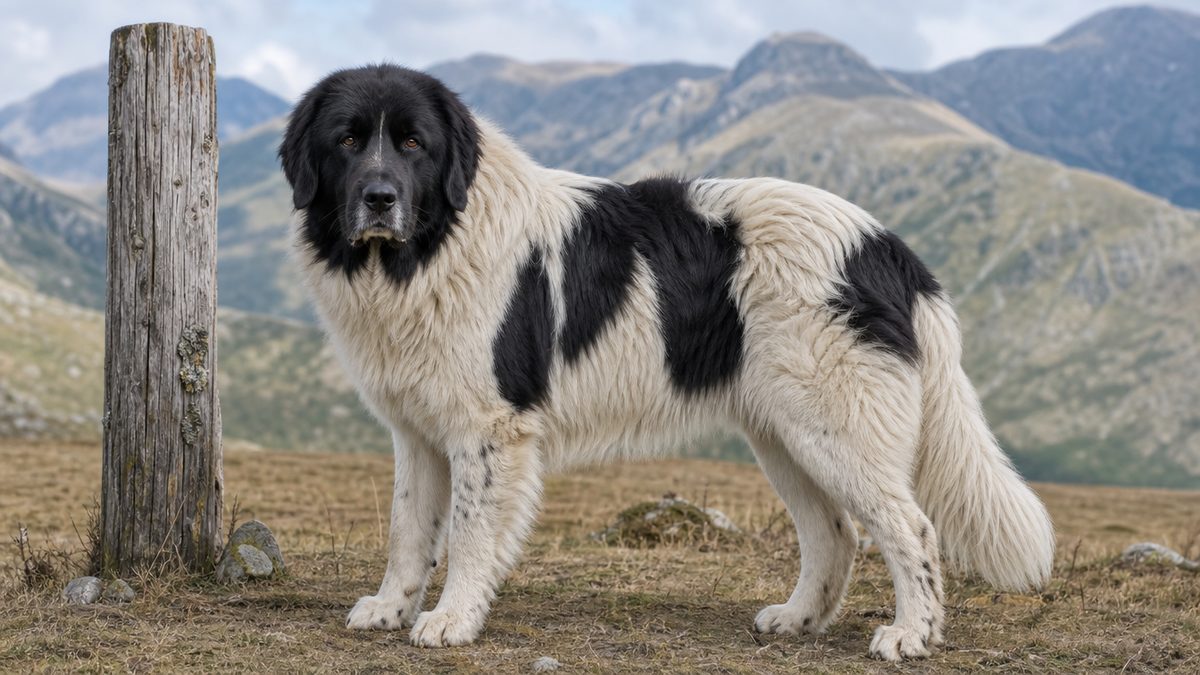
The Karakachan is a Bulgarian livestock guardian dog of 40 to 55 kg in males and 30 to 45 kg in females, with a long rough coat over a heavy undercoat and a two- or tricolour patched pattern that a single solid colour disqualifies. Bulgaria registered it as a native breed in 2005; no international federation recognises it at all.
Three facts do most of the work on this page. The breed is patched, not solid. It is small in number, with 100 breeding females recorded in Bulgaria and a conservation status of Endangered. And it is unrecognised outside Bulgaria, which is why the paperwork question later on this page matters more here than for almost any other breed Bonbeno covers.
The dog takes its name from the Karakachans, also called Sarakatsani, a population of ethnically Greek nomadic shepherds who moved across the Balkan peninsula. Their conservative stock-breeding traditions preserved three of the oldest domestic breeds in Europe together: the Karakachan sheep, the Karakachan horse and the Karakachan dog. That shared name is the first thing to get straight, because a search for this breed returns all three animals.
What the two Bulgarian standards agree on
Bulgaria has two published Karakachan standards, and the next section sets out where they differ. On the essentials they agree, and those are the points that identify the dog.
| Point | What both documents say |
|---|---|
| Weight | Males 40 to 55 kg, females 30 to 45 kg Bulgarian National Federation of Cynology |
| Colour | Two or tricolour with patches; a one-colour coat is an eliminating or disqualifying fault Bulgarian National Federation of Cynology |
| Coat | A long, hard, straight topcoat over a heavy undercoat, longest at the neck, croup, backs of legs and tail Bulgarian National Federation of Cynology |
| Ears | Rather small, V-shaped, pendant, lying close to the head Bulgarian National Federation of Cynology |
| Teeth | A full dentition of 42 teeth, scissor or pincer bite Bulgarian National Federation of Cynology |
| Rear dewclaws | Single or double extra toes are a common and accepted breed feature Bulgarian National Federation of Cynology |
| Tail | Reaches the hock, carried low at rest and curled over the back when alert, and dogs are born with naturally short tails |
The dentition line is worth a moment because it is the kind of claim that is easy to check and rarely checked. The IKDA standard specifies 42 teeth, 20 in the upper jaw and 22 in the lower. That is exactly the normal adult dog formula, so the standard is right and the number can be trusted.
The natural short tail, which matters more in India than in Bulgaria
The federation standard records a genuine breed peculiarity: it is characteristic of the Karakachan that dogs are born with a congenitally short or shortened tail. The IKDA standard puts the same point differently, saying the tail reaches the hock joints but can also be short by birth.
In Bulgaria that is a curiosity. In India it is a legal question. Tail docking is strictly forbidden under Second Schedule Part II paragraph 6(8) of the Prevention of Cruelty to Animals (Dog Breeding and Marketing) Rules 2017, so a short-tailed dog invites the assumption that it was docked. For this breed, a short tail can be natural, and an owner should be able to say which it is. That is one of the few places where knowing an obscure breed standard has a practical Indian consequence.
A working history, and one honest gap in it
The federation's own history is unusually frank about the breed's near-loss. After the closing of the borders between the Balkan states and the collectivisation of agriculture in socialist Bulgaria, the need for these dogs fell and their numbers reached a critical minimum. The breed was saved from complete disappearance by shepherds keeping small flocks in remote high-mountain regions, and active work to find and preserve it began at the end of the 1980s.
One date in that history is contested and Bonbeno prints both versions. The federation says the first breed standard was written by Todor Gaytandzhiev in the 1940s. Wikipedia and the IKDA standard both say Gaytandzhiev proposed the standardisation of the breed in the 1970s International Karakachan Dog Association. Those are not the same claim, they are thirty years apart, and no source Bonbeno opened reconciles them.
Searching for this breed will return the Karakachan sheep and the Karakachan horse alongside the dog, and the confusion reaches into the scientific literature. Of the four PubMed records returned by the bare term Karakachan, one is a 2025 genetic conservation study of the Bardoka and Karakachan SHEEP breeds of Serbia, one is a study of scrapie susceptibility in Bulgarian sheep breeds, one is about vulture prey remains, and one is a 1988 paper on Goodpasture's syndrome. Not one is about a dog.
Bulgaria has two Karakachan standards and they disagree
Two Bulgarian bodies publish a Karakachan breed standard, and they do not give the same dog. The International Karakachan Dog Association puts males at 63 to 75 cm; the Bulgarian National Federation of Cynology puts them at 63 to 71 cm Bulgarian National Federation of Cynology. For females the gap is wider still, 60 to 69 cm against 56 to 65 cm. No page anywhere sets the two documents side by side.
This matters to a buyer for one reason. A female at 58 cm is a correct Karakachan under the federation standard and two centimetres under the minimum of the association standard. Ask which document a seller is measuring against and you will learn more than any pedigree tells you.
| Point | IKDA standard | BNFC standard |
|---|---|---|
| Height, males | 63 to 75 cm | 63 to 71 cm |
| Height, females | 60 to 69 cm | 56 to 65 cm |
| Weight | Males 40 to 55 kg, females 30 to 45 kg | Identical |
| Coat length | Two types: longhaired over 12 cm, shorthaired up to 12 cm | A single range, 6 to 7 cm up to over 20 to 25 cm |
| Coat too short | Not specified as a fault by length | Under 6 cm, or no undercoat, disqualifies |
| Muzzle as share of head | 43 to 45 percent | 36 to 45 percent |
| Body longer than tall by | Males 4 to 10 percent, females 6 to 15 percent | Males 2 to 12 percent, females 5 to 16 percent |
| Ear set | Low set | At eye level or slightly above |
| Shoulder angle | About 105 degrees | 110 to 125 degrees |
| Hock angle | About 140 degrees | 140 to 150 degrees |
| Black mask | Listed as a fault | Not listed as a fault |
| Entropion or ectropion | Not listed | Disqualifying |
| Blue or odd-coloured eyes | Not listed | Disqualifying |
| Resemblance to Caucasian Shepherd, Central Asian Shepherd, Sarplaninac or Landseer | Eliminating fault | Not listed |
The colour clause is actively diverging
The sharpest difference is not in the table above, because it is a change over time. In 2017 the IKDA revised its standard so that brindle colouring of the pigmented part of the coat is no longer treated as a disadvantage, and removed it from the Faults list. Bonbeno verified that by reading both versions posted side by side: the earlier text lists brindle coloration among its faults and the revised text does not, with every other fault unchanged.
The federation standard moved the other way. It disqualifies a coat with a grey-yellow base and clearly defined dark bands or stripes along the back and chest. Those two documents are describing much the same pattern and reaching opposite conclusions about it. A brindle-marked Karakachan is now acceptable to one Bulgarian body and disqualified by the other.
The IKDA document prints Classification FCI: Group 2 Pinscher and Schnauzer, Molossoid breeds, Swiss Mountain and Cattle Dogs, Section 2.2 Molossoid breeds, Mountain type, Without working trial. The federation document prints the same classification in Bulgarian. The FCI recognises no such breed. Its nomenclature letter K runs Kai to Kuvasz, letter B runs Barbet to Bullmastiff, and the provisional register runs from 378 down to 351 with no Bulgarian breed on it Federation Cynologique Internationale. Both standards are formatted as FCI standards for a breed the FCI has never listed.
What each document is actually good for
Neither standard is fake and neither is authoritative in the way an FCI standard is. The IKDA text carries the Bulgarian state registration: the breed and the standard were registered in 2005 under Bulgarian law by the Ministry of Agriculture and Foods with a State Commission resolution of 10 August 2005, and by the Bulgarian Patent Office under Certificate for recognition of native breed BG 10675 P2. Its authors are named as V. Dintchev, S. Sedefchev and A. Sedefchev, dated 14 January 2000 with amendments, and it traces back to a first published standard of 26 June 1991 at Thracian University, Stara Zagora.
The federation text is the standard of the body the FCI actually deals with, since Bulgaria sits in the FCI as a contract partner represented by the Bulgarian National Federation of Cynology of Asenovgrad. So one document has the state paperwork and the other has the international relationship, and they disagree about how tall the dog is.
For an Indian reader the practical rule is short. Ask which of the two standards a dog was judged or registered against, and read the height and colour clauses of that document rather than a summary. A page that gives you one Karakachan height range without saying which body published it has flattened a real disagreement into a false fact.
Registry recognition: a native breed nobody international lists
The Karakachan holds Bulgarian state recognition and no international recognition whatsoever. Bulgaria registered it as a native breed in 2005 under certificate BG 10675 P2. The FCI lists it nowhere, and Bonbeno confirmed that against three separate registers rather than assuming it Federation Cynologique Internationale Federation Cynologique Internationale.
An absence is a strong claim, so here is exactly how it was tested. Letter K of the FCI nomenclature runs Kai, Kangal Coban Kopegi, Karjalankarhukoira, Kavkazskaia Ovtcharka, Kazakh Tazy, Kerry Blue Terrier, King Charles Spaniel, Kishu, Kleiner Munsterlander, Komondor, Korea Jindo Dog, Kraski Ovcar, Kromfohrlander and Kuvasz. There is no Karakachan. That list is a working instrument, not a broken one: it correctly returns the Kangal at 331, the Caucasian Shepherd at 328 and the Karst Shepherd at 278.
Letter B runs from Barbet to Bullmastiff with no Bulgarian Shepherd Dog and no Balgarsko Ovcharsko Kuche, so the breed is not hiding under its other name either. And the provisional register, the one that catches breeds on their way in, runs from the Macedonian Shepherd Dog Karaman at 378 down to the Australian Stumpy Tail Cattle Dog at 351 with no Bulgarian entry at all.
| Body | Position | Source read |
|---|---|---|
| Republic of Bulgaria | Registered native breed. State Commission for animal breeds resolution of 10 August 2005; Bulgarian Patent Office certificate BG 10675 P2 | IKDA standard's own registration block |
| Bulgarian National Federation of Cynology | Publishes a full Karakachan standard in Bulgarian, and lists the breed in its Bulgarian navigation alongside three others | BNFC breed page |
| International Karakachan Dog Association | Publishes the state-registered standard in English translation, revised 2017 | IKDA standard |
| Federation Cynologique Internationale | Not listed. Absent from letter K, from letter B and from the provisional register | All three FCI registers Federation Cynologique Internationale Federation Cynologique Internationale |
| Bulgaria's standing at the FCI | Contract partner, not a full member, represented by the BNFC of Asenovgrad | FCI member record for Bulgaria |
The federation's English page and its Bulgarian pages do not match
This is the finding that no other page carries, and it is checkable in two clicks. The federation's English page, headed Bulgarian Dog Breeds, opens: as a result of our work we have created three Bulgarian breeds, two hunting, Bulgarian Hound and Bulgarian Scenthound, and Bulgarian Shepherd Dog. It then says the federation seeks and works for the recognition of the three Bulgarian breeds. The Karakachan is not among them.
The federation's Bulgarian navigation lists four breeds, and the fourth is Karakachansko Kuche with a complete standard behind it. So the same organisation counts three breeds in English and carries four in Bulgarian.
There is a further detail that makes the omission legible rather than accidental. On the English page, the three photographs illustrating the Bulgarian Shepherd Dog section are served from files named brfk-karakachan-1, brfk-karakachan-2 and brfk-karakachanka. The federation is illustrating its created show breed with pictures filed under the landrace's name.
The 2018 mitochondrial study of Bulgarian native dogs is unambiguous, and it is worth quoting closely. It describes the Karakachan Shepherd as a traditional mountain livestock guard dog breed, and then states that a newly created dog breed based on the Karakachan Dog is the Bulgarian Shepherd Dog, that the Central Asian Shepherd Dog, the Caucasian Shepherd dog, the St Bernhardshund and the Newfoundland also took part in its development, and that the Bulgarian Shepherd Dog was created mainly as a very large companion dog suitable for the urban environment and the exhibition ring, with no evidence that it was used as a traditional shepherd dog. Bonbeno's Caucasian Shepherd Dog and Central Asian Shepherd Dog guides cover two of the contributing breeds.
Wikipedia states the same relationship more briefly and gets it right: the Karakachan was officially recognised as a Bulgarian native breed in 2005, and the breed is part of the origin of the Bulgarian Shepherd but should not be confused as the same breed. It also records that some Bulgarian enthusiasts are creating new large show breeds by crossing Karakachans with the Caucasian Ovcharka, Central Asian Ovcharka, Moscow Watchdog, Saint Bernard, Landseer and Newfoundland, aiming at giant heavy dogs coloured like the native Karakachan, and bred mostly as pets.
That is the sentence an Indian buyer should carry into any conversation about this breed. A dog coloured like a Karakachan, built much heavier than one, and sold as a Karakachan, is a described phenomenon in its own country of origin. The size clauses in both Bulgarian standards, which top out at 55 kg for a male, are the check against it Bulgarian National Federation of Cynology.
Karakachan dog price in India: there isn't one, and here is the proof
No Karakachan dog price in india exists, and the strongest witness for that is Google itself. Its AI answer for this exact query opens by saying the Karakachan is not a standard commercial breed available in India, meaning there is no fixed domestic market price. It then supplies a rupee band anyway, by converting an American one.
Start with what the Indian first page actually contains, because it is the shortest route to the truth here. Searching the target term with the location set to India returns a United States breeder marketplace, two Facebook group posts, a Pinterest board, an aggregator profile, a puppy-listing directory, an Etsy T-shirt, a Dutch image-similarity page and a Bulgarian-breed encyclopedia entry.
Of every result on the Indian first page for karakachan dog price in india, exactly one carried a rupee figure, and it was an Etsy listing for a Karakachan Dog T-Shirt reading I Love My Dog, at an original price of Rs 2,761. Bonbeno reports that as what the Indian result page displayed. There was no Indian dog on the page at any price.
Google's own answer converts a dollar price and calls it Indian
The AI Mode reply is worth reading closely, because it is where an Indian buyer's number will come from. Having said there is no domestic market price, it continues that anyone wanting a purebred Karakachan puppy in India would typically need to import one, raising the total estimated acquisition cost to anywhere between Rs 1,50,000 and Rs 35,00,000 or more once international breeding costs, shipping and customs are factored in.
Then it shows its working. Base puppy price, international: 800 to 1,500 US dollars, approximately Rs 67,000 to Rs 1,25,000, attributed to a United States breeder network. Divide those rupee figures by those dollar figures and the rate falls out: 67,000 divided by 800 is 83.75, and 1,25,000 divided by 1,500 is 83.33.
| Figure Google prints | What it actually is | Test |
|---|---|---|
| 800 to 1,500 US dollars | A United States breeder-marketplace range | Cited to a US network, not to any Indian seller |
| Rs 67,000 to Rs 1,25,000 | The same dollar range at an exchange rate | 67,000/800 = 83.75; 1,25,000/1,500 = 83.33 |
| Rs 1,50,000 to Rs 35,00,000 or more | An estimate of import costs on top | No source is given for either end of it |
| Rs 10,000 to Rs 18,000 monthly upkeep | An Indian general large-dog figure | Cited to an Indian price list that does not cover this breed |
This is currency conversion presented as a market. Bonbeno has documented converted rupee price tables on content farms before, at rates of 84.38, 80, 74 and 66.67. What is different here is where the conversion happened: not on a blog, but inside the answer engine, in response to an Indian query, complete with a citation to the American source it converted. The arithmetic is visible on the page and anyone can check it.
Where the climate advice in that answer came from
One more line in the same answer deserves attention, because it is right and its sourcing is strange. Google's reply tells the Indian reader that because Karakachans have dense thick coats designed for European winters, you will need to spend heavily on 24/7 air conditioning during Indian summers to avoid heatstroke.
That advice is sound, and the climate section below supports it with measured data. Its attribution is to a United States miniature-livestock farm's sales page plus two other sources. So the most useful sentence written about this breed in India is correct by accident, sourced from an American farm, and produced by a system that also invented the price above it.
What a buyer should conclude
- No verified Indian transaction price for a Karakachan exists. Bonbeno publishes none rather than converting a foreign one.
- Any Indian seller quoting a figure for this breed is quoting either an exchange-rate calculation or nothing at all, and can be asked which.
- The searches Google suggests alongside this one are for White, Black and Red Karakachans. A solid one-colour coat is a disqualifying fault in the federation standard, so two of those three searches are for a dog that cannot be a Karakachan.
- The costs that are real and Indian are the running costs, not the purchase price, and the next section builds those from published Indian figures.
One comparison makes the point sharply. Bonbeno's Kangal Shepherd Dog guide found two Indian blogs publishing a price band, traced them to one copied table, and showed where a zero had been dropped. For the Karakachan there is not even a table to check. The Kangal at least has a contaminated Indian price. This breed has an American price wearing a rupee sign.
Monthly cost of ownership, built from Indian figures rather than converted ones
Budget Rs 9,000 to Rs 19,000 a month to keep a Karakachan properly in an Indian metro. There is no purchase price to report, but the cost of ownership is entirely real and entirely Indian, because it is driven by body mass, coat and climate rather than by what anyone paid for the dog.
The anchor figure comes from VOSD, which runs an 1,800-dog sanctuary in India and writes from its own operating experience. It puts the total monthly cost of owning a dog in India at Rs 3,000 to Rs 10,000 and beyond, annual spending at Rs 25,000 to Rs 80,000, and lifetime cost at roughly Rs 3 lakh to Rs 10 lakh, adding that large breed dogs, especially working breeds, can push the food line to Rs 5,000 or more a month.
| Line item | Monthly range | Basis |
|---|---|---|
| Food | Rs 5,000 to Rs 10,000 | VOSD's large working-breed figure of Rs 5,000 or more, scaled to 40 to 55 kg International Karakachan Dog Association |
| Preventive veterinary care | Rs 400 to Rs 700 | VOSD gives Rs 5,000 to Rs 8,000 a year for vaccines, deworming, tick control and a blood profile |
| Tick and flea control | Rs 600 to Rs 1,200 | Top weight band of every product, and a heavy undercoat that hides ticks |
| Coat management | Rs 1,000 to Rs 2,500 | The heaviest line on this page relative to other breeds, because the coat runs to over 20 to 25 cm with a dense undercoat |
| Training, first year | Rs 1,500 to Rs 3,000 | VOSD gives Rs 5,000 to Rs 15,000 for a basic course, spread across a year |
| Cooling | Rs 1,500 to Rs 3,000 in summer | Not optional for this coat in the plains; see the climate section |
| Emergency reserve | Rs 1,500 to Rs 2,500 | Set aside against VOSD's Rs 30,000 to Rs 80,000 orthopaedic range |
| Realistic monthly total | Rs 11,500 to Rs 22,900 | Sum of the rows above |
Google's own Indian answer for this breed gives monthly upkeep of Rs 10,000 to Rs 18,000, attributed to an Indian dog price list. That band sits inside the range above and Bonbeno has no quarrel with it. The difference is that the figure above is built line by line from published Indian costs, so a reader can argue with any single row, while the AI's is a general large-dog number attached to a breed the source it cites does not cover.
Three costs specific to this breed rather than to large dogs generally
Coat management is the first, and it is genuinely higher than for the Kangal. The federation standard describes a coat varying from 6 to 7 cm to over 20 to 25 cm, with a mane at the neck, feathering, and a heavy undercoat, and it disqualifies a coat under 6 cm or one lacking undercoat. That is not a coat you can pay a groomer to remove without producing a dog that fails its own standard, so the cost is tools, time and repeated de-shedding rather than a clip.
Cooling is the second and it is not discretionary. The next section sets out why: the breed's homeland grid cell averages 10.5 C across the year against Chennai's 28.0 C NASA POWER Climatology API. Air conditioning for the hours the dog is indoors between March and June is a line item, and it should be budgeted before the dog arrives.
Veterinary uncertainty is the third, and it is a cost even though it has no invoice. This breed has no OFA row, no screening scheme and one paper in the searchable literature. An Indian vet meeting a Karakachan has no breed-specific reference values of any kind to work from, which in practice means more diagnostics rather than fewer, and a larger reserve rather than a smaller one.
VOSD puts good boarding at Rs 500 to Rs 2,000 a day, so a ten-day trip is Rs 5,000 to Rs 20,000. For this breed the binding constraint is not the rate but acceptance. A territorial flock guardian that both Bulgarian standards describe as distrustful of strangers, with what the IKDA calls a typical deep solid bark, is refused by many Indian facilities. Establish who will take the dog before you need them, not during a family emergency.
One structural point closes this section. For most breeds Bonbeno covers, purchase price is the number buyers fixate on and running cost is the number that decides whether the dog is well kept. For the Karakachan in India the purchase price does not exist, which strips the question down to what it always should have been: can this household spend around Rs 15,000 a month, for ten to twelve years, on a dog bred for a Bulgarian mountain?
Heat tolerance: the worst climate mismatch on this site, and the model understates it
The Karakachan's heat tolerance is the lowest Bonbeno rates, 1 of 5, and two numbers carry the argument. The Rhodope homeland cell averages 10.5 C across the year with a hottest month of 21.6 C, which is below Chennai's coolest month of 24.1 C NASA POWER Climatology API. And the real summer pasture sits hundreds of metres above that cell, so it is colder than the model says.
Bonbeno queried NASA POWER by explicit latitude and longitude rather than by place name, and then checked the elevation the model returned, because in mountains a grid cell can describe a very different altitude from the town underneath it.
Smolyan and a point in the high Rhodope near Pamporovo, about nine kilometres apart, returned the same values in every month and the same grid-cell elevation of 804.38 m NASA POWER Climatology API. They are not identically warm; they fall inside a single model cell. Bonbeno therefore treats them as one measurement and draws no conclusion from their agreement. The cell sits roughly 200 m below Smolyan and roughly 850 m below the high pasture near Pamporovo, so the model is describing a place lower and warmer than the ground this breed actually works. Applying the standard lapse rate of about 6.5 C per 1,000 m, the true high summer pasture is roughly 5.5 C cooler than the figures below. Bonbeno publishes that as a labelled estimate, not as a measurement.
| Place | Coldest month | Hottest month | Annual mean | Annual mean humidity |
|---|---|---|---|---|
| Rhodope cell, 804 m | January, -0.5 C | July and August, 21.6 C | 10.5 C | 73.4 percent |
| Same cell, corrected to ~1,650 m pasture | about -6.0 C, estimated | about 16.1 C, estimated | about 5.0 C, estimated | not estimated |
| Sofia cell, 835 m | January, -2.3 C | August, 21.2 C | 9.7 C | 74.2 percent |
| Chennai | January, 24.1 C | May, 31.5 C | 28.0 C | 72.4 percent |
| Mumbai | January, 23.2 C | May, 31.2 C | 26.8 C | 67.4 percent |
| Delhi | January, 13.6 C | June, 35.9 C | 25.6 C | 45.6 percent |
| Bengaluru | December, 20.2 C | April, 28.4 C | 23.7 C | 67.9 percent |
Three readings fall out of that table. Chennai's coolest month is 2.5 C warmer than the Karakachan homeland's hottest, and about 8 C warmer than the corrected high-pasture estimate. Chennai's annual mean is 17.5 C above the homeland cell's. And Bengaluru's coolest month, at 20.2 C, is within 1.4 C of the homeland cell's hottest month, so India's mildest large city is roughly a permanent Rhodope August.
Why this breed is a point worse than the Kangal
Bonbeno rates the Kangal Shepherd Dog at 2 of 5 for heat and this breed at 1 of 5, and the difference is the coat, not the temperature. The Kangal's FCI standard specifies a guard coat of 3 to 7 cm and the breed sheds most of its undercoat entering summer.
The Karakachan's federation standard describes a coat running from 6 to 7 cm up to over 20 to 25 cm with a well-developed dense undercoat, a pronounced mane at the neck and feathering on the thighs and the underside of the tail. A coat under 6 cm, or one lacking undercoat, is a disqualifying fault. So the Karakachan's shortest permissible coat is roughly the Kangal's longest, and the breed cannot lawfully be shown, or honestly be called a Karakachan, in a lighter jacket.
Humidity compounds it. The Rhodope cell runs 73.4 percent mean humidity across the year but only 54 percent in August, its hottest month. Chennai runs 72 percent in August and reaches 80 to 82 percent in October and November; Mumbai reaches 90 percent in July and August. Panting is evaporative cooling and it fails in saturated air, so a dog built to shed heat into a dry 21 C is being asked to shed it into a wet 26 C, through 20 cm of hair.
The heat-illness evidence, applied honestly
The largest study of canine heat-related illness followed 905,543 UK dogs and found 395 confirmed events with a case fatality rate of 14.18 percent. Its transferable finding is bodyweight: dogs at or above their breed and sex mean had 1.42 times the odds, and dogs over 50 kg had 3.42 times the odds, confidence interval 1.54 to 7.57.
Apply that carefully to this breed, because most Karakachans do not reach the 50 kg band. Both Bulgarian standards cap males at 55 kg and females at 45 kg Bulgarian National Federation of Cynology, so only a male in the top fifth of the range qualifies, and no female does. The transferable factor for almost every Karakachan is the 1.42 bodyweight odds ratio, not the 3.42. The Karakachan was not modelled in that paper and no odds ratio here is breed-specific.
The companion paper on the same cohort found 652 of the 879 events with a recorded trigger, or 74.2 percent, were exertional. For a flock guardian in India that is the operative risk, and it points at the working dog rather than the resting one. India's own heat-wave threshold is a maximum of at least 40 C in the plains, with May the peak month, and the Rhodope cell's annual maximum is 40.2 C reached once a year.
One phrase should be retired from Indian writing about this breed. Several aggregator pages describe the Karakachan as hardy and by implication heat-tolerant, on the strength of its own standard calling it extremely undemanding and easy to keep. A dog whose minimum lawful coat is 6 cm over a dense undercoat, from a homeland averaging 10.5 C, is not heat-tolerant in any sense an Indian reader means by the word. It is cold-hardy, which is the opposite quality wearing a similar adjective.
The legal status in India, and the one list this breed is not on
The legal status in India of the Karakachan is straightforward, and better than for most of its relatives. It was not named in the Union circular of 12 March 2024, unlike the Kangal, the Tornjak, the Sarplaninac, the Akbash, the Caucasian Shepherd Dog and the Central Asian Shepherd Dog. Owning one is lawful. Importing one commercially is not.
The circular asked states to stop issuing licences for the sale, breeding and keeping of breeds described as dangerous for human life. The Hindu printed the list in full, and reading it entry by entry is the point: Pitbull Terrier, Tosa Inu, American Staffordshire Terrier, Fila Brasileiro, Dogo Argentino, American Bulldog, Boerboel, Kangal, Central Asian Shepherd Dog, Caucasian Shepherd Dog, South Russian Shepherd Dog, Tornjak, Sarplaninac, Japanese Tosa and Akita, Mastiffs, Rottweiler, Terriers, Rhodesian Ridgeback, Wolf Dogs, Canario, Akbash, Moscow Guard, Cane Corso, and every dog of the type commonly known as Ban Dog.
Six Balkan and Anatolian flock guardians are on that list and the Karakachan is not. Bonbeno does not read that as a judgement about the breed's temperament. It reads it as a consequence of obscurity: a breed with no Indian presence and no international registry listing is a breed a committee is unlikely to have heard of.
The circular's fate is the same either way. The Karnataka High Court quashed it on 10 April 2024, holding that the Centre could not impose a blanket ban by circular absent any such power under the Prevention of Cruelty to Animals Act 1960 or the Animal Birth Control Rules, and recording that no stakeholders had been heard. The Delhi High Court set it aside on 16 April 2024. Karnataka expressly preserved the government's liberty to re-impose a ban after amending the rules and hearing stakeholders.
Bonbeno has not seen the circular itself and treats no count as settled. The Hindu's headline says 23; The Indian Express describes the same circular as covering 24 The Indian Express. Counting the comma-separated entries The Hindu prints gives 24 items, one of which is Japanese Tosa and Akita, naming two breeds in a single entry, which is the likeliest source of the 23, 24 and 25 counts in circulation. It makes no difference to this breed, which is absent under every count.
Importing one: the door is shut at the commercial end
DGFT Trade Notice 22/2022-23 of 19 December 2022 makes live dogs a Restricted import under ITC(HS) 01061900. Entry is permitted only for a pet accompanying an importer holding a valid pet book in the importer's own name, for research with a CPCSEA recommendation, or for Defence and Police use, and only through a named set of ports. On applications made for trading or breeding, the notice says plainly that they shall be duly rejected.
Set that beside the population figure and the conclusion is unavoidable. There are about 100 breeding females of this breed in Bulgaria, and its conservation status is Endangered. A breed that small has no export surplus, and India's own policy forecloses the only route by which a breeding population could be founded here. No lawful Indian Karakachan supply chain can form, and that is a stable fact rather than a temporary shortage.
Google's own answer reaches the same place by a different road, telling Indian readers that anyone wanting a purebred Karakachan would typically need to import one. It does not mention that the commercial version of that route is closed.
The Indian rules that would apply to a Karakachan kept here
- Ear cropping, tail docking, de-clawing and de-barking are strictly forbidden under Second Schedule Part II paragraph 6(8). Note the citation form: this is a Second Schedule paragraph, not a Rule, because the Rules themselves stop at Rule 13.
- A congenitally short tail is not docking, and this breed genuinely produces them, which the federation standard records as characteristic. Be able to evidence it.
- Second Schedule Part IV paragraph 21(1) bars keeping in outdoor facilities, without the attending veterinary practitioner's written approval, dogs not accustomed to local temperatures and breeds that cannot tolerate them, such as long-haired breeds in high temperature locations. This breed meets both limbs, which is unusual: its coat runs to over 20 cm and its homeland averages 10.5 C NASA POWER Climatology API.
- Rule 8(1)(a) prohibits selling pups under eight weeks, Rule 8(1)(b) prohibits selling dogs over six months without prior sterilisation except to another licensed breeder, and Rule 8(1)(e) requires every pup sold to be micro-chipped.
- Second Schedule Part III paragraph 8(10) requires breeding dogs to have been tested for genetic defects including hip dysplasia, progressive retinal atrophy, night blindness, hypothyroidism, entropion and ectropion. Entropion and ectropion are disqualifying faults in the federation's own Karakachan standard, so Indian law and the breed standard point the same way here.
That last alignment is worth naming, because on most breeds Bonbeno covers the standard and Indian law collide. Here they agree. The Bulgarian standard disqualifies entropion and ectropion; Indian law lists both among the defects a breeding dog must have been tested for. An Indian breeder following the Bulgarian standard would already be doing what paragraph 8(10) requires on that point.
Temperament and household fit: a working guardian with a carrying voice
Do not buy a Karakachan for an Indian flat, and do not buy one as a first dog. The federation standard calls it self-confident, brave and intelligent with a balanced character, strongly attached to its owner and family and distrustful of strangers. The association standard is blunter: proud, domineering, wary of strangers, brave and intelligent, of a tough, steady and independent character, with a typical deep solid bark.
Read those clauses as a job description. This dog was selected to hold a flock on open mountain ground against wolves and bears, deciding alone what was a threat, and Wikipedia records its working nickname in Bulgaria as the wolf killer. Both Bulgarian bodies write guard work into the breed's stated purpose: a dog for guarding flocks of farm animals and property, and a companion. Sellers reach for loyal to describe the result, and loyal is accurate as far as it goes, but the standards are describing loyalty pointed at one household and suspicion pointed at everyone else.
The bark is written into the standard, and it decides Indian housing
One clause on this page rules out more Indian homes than any other. The IKDA standard lists a typical deep solid bark among the breed's temperament characteristics. That is a selected working trait: a voice that carries across a valley and tells a shepherd two ridges away that something is wrong.
In an Indian housing society that trait is a nuisance complaint. It is not a training failure to be corrected, and a trainer who promises to remove it is promising to undo the breed. De-barking, which is what some owners of vocal guardians eventually reach for, is strictly forbidden in India under Second Schedule Part II paragraph 6(8) alongside docking and cropping. So the noise is a permanent condition of ownership and has to be designed around at the property level.
What territorial means for this breed specifically
The Karakachan is strictly territorial and it accepts the flock as its territory wherever the flock happens to be, becoming visibly aggressive if the flock is threatened and seriously so if a stranger tries to remove an animal from it. The same account notes something Indian readers should weigh carefully in both directions: when a flock passes through a village the dogs walk calmly without paying attention to people, and in Bulgaria conflicts are rare partly because everyone knows to leave flocks alone.
That second half does not transfer. The absence of accidents in Bulgaria rests on a shared social convention about not approaching working flocks. India has no such convention regarding a large dog in a residential compound, and a delivery rider walking through a gate is not a villager giving a flock a wide berth.
Who this breed suits in India
- A hill farm or orchard in the Himalayan belt with livestock to guard, a walled boundary and genuine winters.
- A household with prior experience of a large guardian breed, so that neither the size nor the independence is a surprise.
- An owner who can accept a protective dog that will never be sociable with visitors, because both standards describe designed distrust rather than a training gap.
- A property where visitors are handled at a gate rather than at a door, and where a deep carrying bark will not generate complaints.
- A budget carrying Rs 11,500 to Rs 22,900 a month plus a reserve.
Who should not buy one
- Anyone in an apartment. The bark alone settles it, before the coat and the exercise requirement are considered.
- Anyone in the coastal or plains heat, on the climate evidence above, because this coat cannot be reduced.
- Anyone buying a first dog, since the IKDA standard makes both a phlegmatic temperament and a timid temperament eliminating faults, which describes a narrow and demanding behavioural target.
- Anyone who wants a dog that meets guests. Distrust of strangers is the specification.
- Anyone attracted by the wolf-killer reputation, which is the motivation behind the show crosses Wikipedia describes.
Both standards work against aggression as a selected trait rather than encouraging it. The IKDA standard lists unreasonable aggressiveness as an eliminating fault, alongside timidity and phlegmatic temperament, and the federation standard disqualifies an aggressive or excessively timid dog outright. Wikipedia adds that the trend in breeding these dogs is to produce offspring less aggressive towards people. This is a suspicious breed by design and a hostile one by fault, and the two Bulgarian bodies agree on that even where they agree on little else.
One last note for Indian households with children. Nothing in either standard addresses children at all, and Bonbeno will not fill that gap with reassurance it cannot source. What the documents do establish is a 40 to 55 kg dog with a strong attachment to its own family and active distrust of everyone else. Supervision is not a precaution with a dog that size, it is a condition of keeping one.
Training and socialisation, with no breed-specific research to lean on
To train a Karakachan, work with a dog that was bred to decide alone and accept that you are negotiating rather than commanding. The IKDA standard describes a tough, steady and independent character. Unlike most breeds Bonbeno covers, there is no behavioural research on this dog at all, so everything below is derived from the standards and from what the breed was selected to do.
Say the evidence limit out loud first, because other pages will not. Sixteen PubMed queries across every published name of this breed returned exactly one paper that reaches it, and that paper is about mitochondrial DNA Marinov M, Teofanova D, Gadjev D. There is no training study, no temperament survey, no bite-risk analysis and no working-trial data. A page that gives you confident Karakachan training statistics has invented them.
| Period | Priority | What failure looks like later |
|---|---|---|
| 8 to 16 weeks | Neutral exposure to gates, deliveries, house staff, vehicles and calm adult dogs, in short sessions at the cool ends of the day | A dog that treats every gate arrival as an intrusion, at 35 kg and with a bark that carries |
| 4 to 8 months | Lead manners and recall while the dog can still be physically held | An adolescent that walks you, which at 45 kg is not recoverable by technique alone |
| 8 to 18 months | Managed stranger introductions on your terms, and impulse work around gates and food | Guarding behaviour generalising from the property to the car, the pavement and the vet's table |
| 18 months onward | Maintenance, and re-testing every boundary as guarding confidence matures | An owner who assumes the training took, and finds at two years that the dog has re-evaluated |
Socialisation is the whole game, and the Indian list is specific
You cannot socialise the guarding instinct out of a flock guardian, and anyone offering to is selling something. What socialisation buys is a larger library of experiences that register as normal, so fewer things register as threats. For an Indian household the useful list is concrete rather than general.
- Gate traffic on a schedule: couriers, gas cylinders, house help, security guards, the same faces at the same hours, paired with food and calm.
- Free-ranging dogs observed at distance and never permitted to become an encounter, because this is a breed that treats its territory as absolute.
- Two-wheelers, horns and close-passing traffic, none of which a Rhodope pasture prepares a dog for.
- Handling of feet, ears, mouth and the deep coat from eight weeks, because a 50 kg dog that objects to a vet's hands gets sedated for routine work.
- Muzzle conditioning as a neutral positive routine long before it is ever needed.
What this breed resists
Repetition without purpose. A dog selected to make independent judgements gets nothing from the twentieth repetition of a sit, and owners arriving from a Labrador or German Shepherd background routinely misread that as stupidity or stubbornness. Short sessions with a real outcome work; drilling does not.
Pressure from an unfamiliar handler. Both standards describe a dog distrustful of strangers. An Indian board-and-train facility, where an unknown handler applies correction to a 50 kg guardian, is the worst available option for this breed and is widely sold. If you use a professional, use one who trains you and the dog together, on your own ground.
A well-raised Karakachan in India will reliably tolerate the people it knows, accept managed introductions to new ones, and walk past a stranger without incident. It will not become friendly with visitors, it will not stop announcing arrivals, and it will not stop assessing your gate. Those are the traits both Bulgarian standards were written to preserve. Training changes the dog's manners, not its job description, and an owner who needs the job description changed has chosen the wrong breed.
One structural point closes this section, and it applies to every guardian Bonbeno covers. Most behaviour problems that reach an Indian trainer with these breeds are housing problems and boredom problems wearing a training costume. The fix is usually the compound and the routine rather than the curriculum, and for this breed it is also the thermometer, because a dog that cannot be exercised properly for four months of the year will find its own work to do.
Exercise: 90 to 120 minutes, and the Indian clock matters more than the distance
Plan on 90 to 120 minutes of walking a day for an adult Karakachan, split across the two coolest ends of the day. Neither Bulgarian standard prints an exercise figure, so Bonbeno derives it from what the breed does: the federation describes powerful movement with a wide stride, and the association describes long-reaching movement with a springy trot as the preferred gait International Karakachan Dog Association.
That is a patrolling gait, not a sprinting one. The exercise this breed actually wants is long, slow ground coverage with something to look at, which is fortunate in India because it is also the safest kind. The alternative, short bursts of hard work, is precisely what the heat-illness evidence warns against.
| Season | Morning | Evening | What governs it |
|---|---|---|---|
| November to February | 50 to 60 minutes from about 6 a.m. | 50 to 60 minutes after 5 p.m. | The only window in which most of India is workable for this coat |
| March to June, plains | 45 to 60 minutes finishing before 6:45 a.m. | 30 to 45 minutes after 7:30 p.m., on ground tested with a hand | May is India's peak heat-wave month; nothing outdoors between 9 a.m. and 6:30 p.m. |
| Monsoon | 40 to 55 minutes when it is not raining hard | 40 to 55 minutes, plus a full dry-out of a 20 cm coat | Humidity, not temperature: Mumbai runs 90 percent in July and August |
| September to October | 50 to 60 minutes early | 50 to 60 minutes late | Chennai humidity peaks at 80 to 82 percent in October and November |
Why the timing rule is stricter for this breed than for the Kangal
The trigger evidence is the same for both breeds: of 1,259 heat-related illness events recorded in 1,222 UK dogs, 380 had no trigger recorded, leaving 879 with a recorded trigger, of which 652 were exertional, 113 environmental and 46 vehicular confinement, giving 74.2 percent, 12.9 percent and 5.2 percent on that denominator.
What differs is the insulation. A Kangal Shepherd Dog carries a 3 to 7 cm coat and sheds most of its undercoat for summer. A Karakachan carries 6 to 7 cm at minimum and up to 20 to 25 cm, with a dense undercoat that the standard requires. The same walk in the same Chennai May is a materially hotter walk for this dog, and the safe window is correspondingly narrower.
End the walk and cool the dog if panting becomes loud and open-mouthed with the tongue widened and spatulate, if the dog slows or stops on its own and will not restart, or if it seeks tile or concrete and lies flat rather than curling. Wet the neck, chest, groin and paws with tap-temperature water, move air across the dog, and offer water without forcing it. The UK study recorded a case fatality rate of 14.18 percent across 395 confirmed heat-related illness events, so this is not a wait-and-see situation. Ring your veterinarian on the way, not afterwards. On a heavily coated dog, wet the skin rather than the coat surface, because water sitting on top of 20 cm of hair cools nothing.
What under-exercising a flock guardian produces
The failure mode is specific to guardians and Indian owners routinely misread it as aggression. A Karakachan short of work does not become bouncy the way a retriever does. It becomes more watchful, and the watching has a voice attached to it.
- Fence-line patrolling that wears a visible track and continues into the midday sun, which is exactly the exertional pattern the evidence flags.
- Escalating gate reactivity, self-reinforced every time a courier leaves, and audible at a distance because the deep carrying bark is a selected trait.
- Chewing at boundaries such as gates, grilles and doors rather than at toys, which is containment behaviour and not boredom.
- Night vocalisation, since this is a breed built to work at night with nobody telling it to stop.
The practical Indian answer is to trade intensity for duration and to move the whole schedule to the margins of the day. Two long, slow walks on varied ground beat one hard session, and they keep the dog out of the hours in which the damage happens. A weighted vest, midday fetch on a terrace, or a hot beach are all wrong for this breed in this country.
For four months of the year in the plains, that is still not enough, and the honest answer is indoor work rather than more walking. Scent games in a cooled room, chew work, and slow feeding all burn attention without burning the dog. They are a substitute for exercise only in the sense that a fan is a substitute for winter, which is the recurring argument of this whole page.
Grooming a 20 cm mountain coat in Indian humidity
To groom a Karakachan in India, rake the double coat out hard and often, dry it completely every time it gets wet, and never clip it down for summer. The federation standard specifies a long hard topcoat over a well-developed dense undercoat, varying from 6 to 7 cm to over 20 to 25 cm, and it disqualifies any coat under 6 cm or lacking undercoat.
That disqualification clause is the single most important sentence for an Indian owner, and it is why this breed rates 1 of 5 on Bonbeno's grooming scale where the Kangal rates 3. You cannot make this dog's coat shorter and still have the breed. The IKDA standard divides the breed into two coat types, longhaired at over 12 cm on the body and shorthaired at up to 12 cm, so even the short variety carries roughly twice the Kangal's 3 to 7 cm.
The coat is longest exactly where air needs to move: over the neck, withers and croup, at the backs of the legs and on the underside of the tail, forming a mane that is especially heavy in males, plus feathering. The topcoat is straight and stiff and the hair is short only on the muzzle and the fronts of the legs.
| Task | Cool season | March to June | Monsoon |
|---|---|---|---|
| Brushing and raking | Twice a week, undercoat rake plus slicker | Four to five times a week through the heavy blow | Three times a week, plus after every wet walk |
| Bathing | Every 8 to 10 weeks | Every 6 to 8 weeks | Only when genuinely dirty, and always fully dried to the skin |
| Drying after wet | Towel and air | Towel and air | Towel, then forced air to the skin. A 20 cm coat air-dries too slowly in 90 percent humidity |
| Mane and feathering check | Weekly | Weekly | Twice weekly for matting and hot spots under the mane and behind the elbows |
| Ear check | Weekly | Weekly | Twice weekly, because the ears are small, pendant and lie close to the head |
| Tick search by hand | Weekly | After every grass walk | After every grass walk |
Never clip this coat, and the reason is not cosmetic
Clipping a double-coated mountain breed for an Indian summer is the most common well-intentioned mistake made about these dogs. The guard coat reflects solar radiation and holds a boundary layer of still air off the skin. Remove it and you expose skin that has never seen direct sun to a Delhi May whose climatological maximum is 48.1 C.
The undercoat is what traps heat, and the answer is to remove the undercoat, not the guard coat. A rake and a de-shedding tool, used often through March and April, take out the blown underlayer and let air reach the skin. That is real work on a dog this size and it is the reason the coat-management line in the cost table runs to Rs 2,500 a month.
Ears and skin, where overseas advice stops transferring
The ears are described identically by both Bulgarian bodies: rather small, V-shaped, pendant, lying close to the head International Karakachan Dog Association. A pendant ear held flat against the skull over a humid canal is a known setup for otitis externa, and this is exactly where care guidance written for a Rhodope August at 54 percent humidity stops applying to a Mumbai July at 90 percent NASA POWER Climatology API.
- Check both ears twice weekly through the monsoon for redness, a yeasty smell or head shaking.
- Dry the ear opening after every bath and soaking rather than letting the dog air dry, which is the standard overseas instruction and the wrong one for an Indian July.
- Do not flush the canal with water or push cotton buds into it; use a cleaner your vet has approved for this dog.
- Treat a sudden head tilt, a foul smell or persistent pawing at one ear as a same-week veterinary visit.
There is nothing to trim, strip or scissor on this breed, and no clipping pattern to pay a salon to maintain. The whole job is a rake, a slicker, a dryer and time. That makes it cheap in money and expensive in hours, which is the opposite of most coated breeds and worth knowing before you commit. An owner who will not spend three hours a week on a coat in April should not take this dog to a city in the Indian plains.
One point about the mane specifically. In males the neck coat forms a pronounced mane, and it is the first place to mat and the last place to dry. In Indian monsoon conditions it is also where hot spots start. Lift it and check the skin underneath weekly, because a dog can carry an infected patch under that much hair for days before anything is visible from the outside.
Health: the least-documented breed on this site, stated honestly
The health issues of this breed are undocumented, and pretending otherwise would be the most damaging thing this page could do. The Karakachan has no row in OFA's published statistics for hips or for any other database, against 109 rows for Labrador in the same retrieval. It has no published screening scheme, no lifespan study, and one paper in the searchable veterinary literature.
Bonbeno tested that absence rather than assuming it, because an absence is a strong claim. The full OFA statistics dump, 2,208,315 characters covering every breed and every database, was retrieved and searched case-insensitively. Karakachan returns zero. Sarplaninac returns zero. Labrador returns 109 in the same file. The instrument works; the breed is genuinely not in it.
The literature was tested the same way. Sixteen PubMed queries were run in one session across every published name and synonym, with two control searches returning sane counts in the same session: Labrador plus hip dysplasia gave 124 records and Bergamasco plus dog gave 13.
| Query | Count | What the records actually are |
|---|---|---|
| "Karakachan" | 4 | None about dogs. Karakachan SHEEP of Serbia, scrapie in Bulgarian sheep, vulture prey remains, and a 1988 paper on Goodpasture's syndrome |
| "Karakachan dog" | 0 | The phrase was not found and the broadened AND-ed query also returned nothing |
| "Karakachan dogs" | 0 | Same, on the plural |
| "Karakachan Shepherd" | 0 | Same |
| "Karakachansko kuche" | 112 | Manufactured. PubMed collapsed it to the surname kuche |
| "Ovcharsko kuche" | 112 | The identical 112, which is the tell that both were the same rewritten query |
| "Thracian Mollos" | 203 | Manufactured. Collapsed to thracian OR thracians, which is archaeology |
| "Karakatschan" | 0 | German spelling, nothing found |
| "Sarakatsani" | 0 | The shepherd people the breed is named for |
| "Bulgarian Shepherd Dog" | 1 | The 2018 mitochondrial study, which is the one real record |
The honest total is one paper, and it reaches the breed under the name Bulgarian Shepherd Dog rather than its own. Two of the counts above look like literature and are not: a query returning 112 and a different query returning exactly 112 is the same rewritten search twice over, and 203 records for Thracian Mollos are about Thracians.
What the one real paper actually gives you
The 2018 study sequenced mitochondrial DNA from Bulgaria's native dogs and it is a population-genetics paper, not a health paper. It gives the numbers that matter most for a buyer thinking about inherited risk.
| Population | Samples | Function | Breeding females | Status | Haplotype diversity |
|---|---|---|---|---|---|
| Karakachan | 37 | Livestock herding | 100 | Endangered | 0.812 plus or minus 0.0016 |
| Bulgarian Shepherd Dog (BOK) | 14 | Guarding | 1,300 | Not at risk | 0.934 plus or minus 0.0037 |
| Bulgarian Hound (Barak) | 34 | Hunting | 120 | Endangered | 0.916 plus or minus 0.0006 |
| Bulgarian Scenthound (Gonche) | 45 | Hunting | 150 | Endangered | 0.821 plus or minus 0.044 |
One hundred breeding females is the number to carry away. The Karakachan produced 10 haplotypes with 5 unique, on a nucleotide diversity of 0.0087 and mean pairwise differences of 6.366 across 26 polymorphic sites. Its haplotype diversity of 0.812 is the lowest of the four populations, below the show-bred Bulgarian Shepherd Dog at 0.934 and below both hounds.
Bonbeno checked that table's internal arithmetic, because a diversity figure should reconcile against the alignment length. The paper's sequences cover 732 base pairs, and dividing mean pairwise differences by nucleotide diversity should return that. The Karakachan row gives 6.366 divided by 0.0087, or 732, which reconciles exactly. The Bulgarian Hound row gives 732 and the Bulgarian Shepherd Dog row gives 728, both fine. Only the Bulgarian Scenthound row fails, at 316, which Bonbeno's Bulgarian Scenthound guide reports independently. The Karakachan's figures are sound.
Screen the parents anyway, and screen them for what large mountain guardians get rather than for what this breed is known to get, because nothing is known. That means hip radiographs, an eye examination and a thyroid panel. Two of those are pointed at by documents you can cite to a breeder: the federation standard disqualifies entropion and ectropion, and Second Schedule Part III paragraph 8(10) of India's 2017 Rules requires breeding dogs to have been tested for genetic defects including hip dysplasia, entropion, ectropion and hypothyroidism. A breeder who says the breed has no health problems is telling you that nobody has looked.
Lifespan, and what the Karakachan's relatives can and cannot tell you
No study gives a lifespan for the Karakachan, and Bonbeno publishes none rather than borrowing a relative's. The largest longevity study covered 155 recognised purebreds from 584,734 UK dogs including 284,734 deceased, and its full text names no Bulgarian breed. Neither Bulgarian standard prints a lifespan figure either International Karakachan Dog Association.
That is an unsatisfying answer and it is the correct one. The temptation on a rare breed is to reach for the nearest relative's median, and doing so would be fabrication with a citation attached. What Bonbeno can offer instead is the neighbourhood: in that study crossbreds sat at 12.0 years, large breeds at 12.5 years, and the Caucasian Shepherd Dog, one of the breeds crossed into Bulgaria's show-ring guardian, at 5.4 years with a hazard ratio of 2.4.
Do not read that 5.4 as the Karakachan's number. It belongs to the Caucasian Shepherd Dog and to no other breed, and Bonbeno's Caucasian Shepherd Dog guide is where it belongs. A Karakachan buyer should plan on a large-guardian lifespan somewhere around a decade and should treat any page quoting a precise Karakachan median as having invented it.
The relatives, and one thing they do establish
The 2018 Bulgarian study names the Karakachan's nearest relatives as the Tornjak of Bosnia and Herzegovina and Croatia, the Sarplaninac of North Macedonia, and the Akbash of Turkey. Those three have been studied where this breed has not, and one of their findings transfers directly to the argument of this page.
A 2014 study genotyped 493 dogs of five breeds using 18 microsatellite markers and sequenced mitochondrial DNA from 94 of them, covering the Karst Shepherd, the Sarplaninac and the Tornjak. The Karakachan was not included, which is itself a finding: the leading genetic survey of Western Balkan livestock guardians does not contain this breed.
| Finding | Detail |
|---|---|
| Allelic richness | Sarplaninac highest at 5.94, Tornjak 5.72, Karst Shepherd lowest at 3.33 |
| Karst Shepherd population | Realised effective population size of fewer than 20 animals, and only one mtDNA haplotype found |
| Sarplaninac and Caucasian Shepherd | Could not be separated by neighbour-joining, STRUCTURE or DAPC, and sat close together in the NeighborNet tree |
| Karst Shepherd and Sarplaninac | Common ancestry could not be reconstructed from microsatellites despite pedigree and mtDNA evidence of historical admixture |
| The authors' conclusion | The official separation of these breeds strongly affected the resolution of genetic differentiation, so relationships are determined not only by breed relatedness but, in small populations, even more by stochastic effects |
That last line is the most useful sentence written about any of these breeds. Official breed boundaries in this group are doing work that the genetics does not always support, and in small populations chance does as much as ancestry. It is the scholarly version of the argument this page and its Kangal Shepherd Dog companion both make: the registries disagree because the dogs themselves do not divide as cleanly as a studbook needs them to.
One comparison that shows the evidence gap plainly
The Sarplaninac, which the Karakachan's own IKDA standard names as a breed it must not resemble, has had a hip dysplasia paper in the veterinary literature since 1972. It also appears in the 2014 genetics study and in a 2023 imaging case report.
The Karakachan, over the same fifty-four years, has one mitochondrial paper reaching it under a different breed's name. A prospective owner should read that as the risk it is: not that the breed is unhealthy, but that nobody would know if it were, and that no Indian veterinarian will have breed-specific reference values of any kind.
Screen a Karakachan the way you would screen any large mountain guardian, because absence of data is not evidence of health. Hips and elbows by radiograph, an eye examination for entropion and ectropion, and a thyroid panel. Two of those are anchored in documents: the federation standard disqualifies entropion and ectropion outright, and Indian law names hip dysplasia, entropion, ectropion and hypothyroidism among the defects a breeding dog must have been tested for. Add a bloat plan, because both standards describe a deep broad chest reaching to or below the elbows International Karakachan Dog Association and deep-chested giants are the classic gastric dilatation-volvulus population.
Finally, one point about population size that a buyer outside Bulgaria should sit with. A breed with 100 breeding females has no depth in its gene pool to absorb a bad decision. Exporting animals from a population that small, to a country where they cannot lawfully be bred commercially and cannot comfortably live for four months of the year, is a poor outcome for the breed as well as for the dog.
Feeding a Bulgarian mountain guardian in India
To feed a Karakachan in India, grow the puppy slowly and keep the adult lean, because the joints of a 40 to 55 kg dog are the thing you are protecting and this breed has no screening data to warn you when something is going wrong Orthopedic Foundation for Animals. Budget Rs 5,000 to Rs 10,000 a month for food alone.
Two facts frame every decision. The breed reaches 40 to 55 kg in males and 30 to 45 kg in females, and there is no hip screening data for it anywhere. Growth rate and body condition are the two levers an owner controls that bear on developmental joint disease, and on a breed with no published risk figures those levers matter more, not less.
| Stage | What to feed | What to watch |
|---|---|---|
| 8 weeks to 6 months | A large-breed puppy formulation with controlled calcium and energy density, three meals a day | Ribs easily felt under a thin fat cover at all times; a visible waist from above by four months |
| 6 to 14 months | The same large-breed puppy food, two meals, portion reduced rather than raised as growth slows | Any limp, bunny-hopping gait or reluctance on stairs is a same-week veterinary visit, not a growing pain |
| 14 months to 3 years | Transition to an adult large-breed diet, two meals, adjusted by season | Coat quality is a feeding readout on this breed; a dull, sparse or soft coat is worth investigating |
| 3 to 7 years | Adult maintenance, two meals, portions cut in the hot months when exercise drops | Weigh monthly on the same scale, because 5 kg hides easily under 20 cm of coat |
| 7 years onward | Senior formulation, joint support if your vet advises it, two smaller meals | Senior bloodwork is worth the money on a breed with no published baseline of its own |
Two meals a day, never one, and never around exercise
Split the ration into at least two meals and leave an hour either side of any walk. Both Bulgarian standards describe a deep, broad chest reaching to or below the point of the elbows International Karakachan Dog Association, which is the classic gastric dilatation-volvulus conformation. Nothing about bloat is worth risking to save a feeding slot.
There is a second Indian reason. The heat evidence puts 652 of 879 triggered heat-illness events in the exertional category, and a full stomach plus a patrol in a Chennai May is worse than either alone. Feed after the evening walk has finished and the dog has cooled, never before it starts.
Weighing a dog you cannot see the shape of
This is a practical problem specific to heavily coated breeds and it catches owners out. You cannot body-condition-score a Karakachan by eye through a 20 cm coat. The federation standard allows coat over 20 to 25 cm with a heavy undercoat and a pronounced mane, and a dog can gain several kilos under that without anything looking different.
- Score by hand, not by sight: ribs should be easily felt under a thin covering, with a waist palpable behind the last rib.
- Weigh monthly on the same scale and write the number down, because a remembered impression drifts and a number does not.
- Do the hand check at the same point in the grooming cycle, since a freshly raked dog feels different from one carrying a blown undercoat.
- Treat the post-monsoon months as the highest-risk period for quiet weight gain, because activity has been curtailed for weeks.
Sourcing and home feeding in India
Large-breed puppy food is the category that is genuinely hard to source outside Indian metros, and the formulations that matter here are those with controlled calcium and moderate energy density. If you cannot get one locally, that is a reason to talk to your vet about portioning, not a reason to feed an adult food to a four-month-old giant.
Home-cooked feeding is common in India and is not disqualifying for this breed, but at this size it needs a veterinary nutritionist rather than a recipe from a forum. An unbalanced calcium-to-phosphorus ratio in a growing 40 kg dog is the specific way home feeding goes wrong in giant breeds, and it goes wrong permanently.
Supplementing calcium into a large-breed puppy's diet is common Indian breeder advice and it is the opposite of what large-breed puppy formulations are engineered to do. If a seller hands you a calcium supplement with the puppy, treat that as information about the seller. On a breed with no published orthopaedic data at all, the margin for this kind of error is smaller than usual, not larger.
One last point on water. A dog whose homeland cell averages 10.5 C across the year has a water requirement in an Indian summer that bears no relation to its requirement at home. Provide more than one station, refresh them through the day rather than topping up, and put one where the dog rests rather than only where it eats, because a heat-stressed dog will not walk far for water.
The puppy timeline, month by month through an Indian first year
Build the puppy timeline around three constraints. The pup cannot lawfully be sold under eight weeks in India, under Rule 8(1)(a). Its socialisation window closes at roughly sixteen weeks. And for four months of the year the outdoor part of that window is closed by heat, because this coat cannot be reduced.
| Age | What matters most | The India-specific job |
|---|---|---|
| 8 to 10 weeks | Arrival, vaccination schedule started, three meals a day, sleep | Check the microchip number against the paperwork, since Rule 8(1)(e) requires every pup sold to be micro-chipped |
| 10 to 16 weeks | The socialisation window: gate traffic, house staff, vehicles, calm adult dogs | Run it at 7 a.m. and 7:30 p.m. in the hot months, never midday, and never on hot ground |
| 4 to 6 months | Lead manners while the dog is still under 25 kg and physically manageable | First full hot season for most litters; establish the indoors-by-day habit now, before it is a fight |
| 6 to 8 months | Recall, gate impulse control, cooperative handling of feet, ears, mouth and coat | Start the twice-weekly monsoon ear check, and start teaching the dog to tolerate a dryer |
| 8 to 12 months | Managed stranger introductions on your terms; growth slows and portions come down | Watch for any lameness. There is no breed screening data to reassure you, so behave as if the risk is real |
| 12 to 18 months | Adolescent re-testing of every boundary; the adult coat comes in properly | The first full adult coat plus the first adult summer is the hardest combination this dog will meet |
Before the puppy arrives
- Fix the compound. A territorial guardian needs a boundary it can learn, and a gate it cannot see through beats one it can.
- Find a veterinary clinic willing to handle a dog that will weigh 50 kg, and take the puppy there twice before anything needs doing.
- Find out now whether any boarding facility within reach accepts guardian breeds, because you will need the answer during an emergency rather than before a holiday.
- Buy the coat tools before the dog: an undercoat rake, a slicker and a forced-air dryer. In monsoon India the dryer is not a luxury on a 20 cm coat.
- Ask the seller for the parents' hip radiographs and eye examination in writing. If none exist, that is your health answer.
- Confirm the pup is at least eight weeks old on collection day, in writing.
The two windows that do not reopen
The socialisation window closes and does not come back. Between roughly eight and sixteen weeks a puppy files experiences as normal rather than as threats, and for a breed whose standards record distrust of strangers as the specification, those eight weeks decide how much of that distrust the dog spends on couriers and neighbours for the next decade.
Growth-rate control is the second, and it is equally one-way. You cannot un-grow a joint. A puppy carried heavy through months four to twelve is loading hips that nobody has ever screened at breed level. Ribs easily felt under a thin cover, checked by hand every week, is a simpler rule than any chart and it works through a coat.
A puppy arriving in February in Delhi hits the peak heat-wave month of May at about four months old, exactly when it should be meeting the world. The answer is not to skip socialisation, it is to move it indoors and to the edges of the day: visitors coming in, recorded sounds at low volume, controlled meetings on a cooled terrace at 7:30 p.m. A Karakachan that spends its socialisation window shut in a room because it was too hot outside will meet its first real stranger at eight months and 35 kg, and that is the version of this dog that ends up in rescue.
Parasite control, which cannot lapse on this coat
Follow your veterinarian's vaccination protocol rather than any schedule printed on a website, including this one. What is worth saying about India specifically is that tick control cannot be allowed to lapse for a dog with this much hair. A dense undercoat over a large body surface makes ticks genuinely hard to find, and Indian tick pressure is year-round across most of the country.
Budget for the top weight band of every product from about eight months, and pair chemical control with a weekly hand search of the places a brush does not reach: inside the pendant ear flap, under the mane, in the groin, and between the toes, where both standards note the breed carries good feathering Bulgarian National Federation of Cynology.
Karakachan against the guardians it is confused with
Compare the Karakachan against the Kangal and the Sarplaninac and one physical test separates it from both. The Karakachan must be two- or tricolour with patches, and a solid one-colour coat disqualifies it. The Kangal must be one whole colour with a mandatory black mask, and no mask is a disqualifying fault. The two breeds are, on colour, exact opposites.
| Point | Karakachan | Kangal Shepherd Dog |
|---|---|---|
| Colour required | Two or tricolour with patches; a one-colour coat disqualifies | One whole colour, fawn to wolf sable |
| Black mask | Listed as a fault in the IKDA standard | Mandatory. No mask is a disqualifying fault |
| Coat length | 6 to 7 cm up to over 20 to 25 cm; under 6 cm disqualifies | 3 to 7 cm |
| Height, males | 63 to 71 cm (BNFC) or 63 to 75 cm (IKDA) | 72 to 78 cm with 2 cm tolerance |
| Weight, males | 40 to 55 kg | 48 to 60 kg |
| FCI recognition | None, in any register | Standard 331, definitive since 1989 |
| Named in India's 2024 circular | No The Hindu, Karnataka High Court quashes… | Yes |
| OFA statistics rows | None | 146 hip evaluations, 23.3 percent dysplastic |
| Bonbeno heat rating | 1 of 5 | 2 of 5 |
The mask row is the field test. A large Balkan or Anatolian guardian with a black mask on a solid fawn body is a Kangal type, and Bonbeno's Kangal Shepherd Dog guide covers it. The same dog patched black on white, with no mask, is a Karakachan type. Anyone selling you one as the other is either confused or counting on you being so.
The Sarplaninac, which this breed's own standard tells you to distinguish
The IKDA standard contains an unusual clause. Among its eliminating faults it lists resemblance to other breeds, naming the Caucasian Shepherd Dog, the Central Asian Shepherd Dog, the Sharplaninets and the Landseer. That is a breed standard formally disqualifying a dog for looking like its neighbours, which tells you how live the confusion is in Bulgaria itself.
The 2018 Bulgarian genetics paper names the Karakachan's nearest relatives as the Tornjak, the Sarplaninac and the Akbash, and Bonbeno's Akbash guide covers the third. The evidence position on those relatives is far better than on this breed: the Sarplaninac appears in a 2014 microsatellite study of Western Balkan guardians and in a hip dysplasia paper from 1972, while the Karakachan appears in neither Petrovic B, Draganovic B, Tadic M.
The comparison that actually matters, which is not with another guardian
For an Indian household the useful comparison is not Karakachan against Sarplaninac. It is Karakachan against a dog that can be found, kept and screened in this country. On every axis an Indian buyer can act on, this breed loses.
| Can you... | Karakachan | Kangal | Indian Pariah Dog |
|---|---|---|---|
| Find one in India? | No. No Indian breeder, listing or transaction found | Barely. One directory listing and two copied price blogs | Yes, in every city, free to adopt |
| Get a verified price? | No. The only Indian figure is an AI's currency conversion | No. One copied table with a dropped zero | Adoption, effectively free |
| Screen the parents against breed data? | No. No OFA row of any kind | Partly. 146 OFA hip evaluations exist | No breed data, but no import or climate problem either |
| Keep it comfortably in the plains? | No. A 6 to 25 cm coat against a 28.0 C annual mean NASA POWER Climatology API | Only with cooling | Yes. Evolved here |
| Import one lawfully to breed? | No Directorate General of Foreign Trade | No Directorate General of Foreign Trade | Not applicable |
None of this makes it a poor dog. It is a genuine working landrace that Bulgarian shepherds kept alive through collectivisation in remote mountains, that still guards flocks against wolves and bears, and that its own country registered and protected in 2005 International Karakachan Dog Association. With 100 breeding females and Endangered status, it deserves careful breeding in the country that saved it. The argument of this page is not that the breed is bad. It is that India is the wrong country for it, and that nobody writing about it in India says so.
If what draws you is a large, hardy, self-reliant flock guardian, the honest Indian answers are the Bakharwal Dog and the Himalayan Sheepdog, which do this work in Indian mountains without an import permit, and the Indian Pariah Dog, which Bonbeno rates 5 of 5 for the climate you actually live in.
Seven mistakes Indian buyers make about this breed
Every mistake below is checkable against a document earlier on this page. The first and largest is treating any Indian rupee figure for this breed as a market price, when the only one in existence is an answer engine's own conversion of an American number.
1. Taking the AI's rupee band as an Indian price
Google's answer says in its first sentence that the Karakachan is not a standard commercial breed available in India and that there is no fixed domestic market price, then prints Rs 67,000 to Rs 1,25,000 from a United States range of 800 to 1,500 dollars. Divide and the rate appears: 83.75 and 83.33. That is arithmetic, not a market. Its upper figure of about Rs 35 lakh carries no source at all.
2. Confusing the dog with the sheep or the horse
The Karakachan sheep, the Karakachan horse and the Karakachan dog were all preserved by the same nomadic shepherds and all carry the same name. The confusion is not hypothetical: of the four PubMed records under the bare term Karakachan, two are about sheep and none about dogs. Read any source carefully enough to be sure which animal it is describing.
3. Believing a Karakachan and a Bulgarian Shepherd Dog are the same breed
The 2018 mitochondrial study states plainly that the Bulgarian Shepherd Dog is a newly created breed based on the Karakachan, with Central Asian Shepherd, Caucasian Shepherd, St Bernard and Newfoundland input, created mainly as a very large companion dog for the urban environment and the exhibition ring, and that there is no evidence it was used as a traditional shepherd dog. The two populations carry different diversity and different conservation status: 100 breeding females and Endangered against 1,300 and Not at risk.
4. Accepting a solid white, black or red dog as a rare colour
Google suggests White, Black and Red karakachan dog price in india alongside the main query, which means Indian buyers are asking for them. A one-colour coat is a disqualifying fault in the federation standard and an eliminating fault in the IKDA standard International Karakachan Dog Association. Red is a recognised pigment, and the federation standard describes red dogs as having a brown nose leather and amber eyes, but the dog still has to be patched. A solid animal of any colour is not this breed.
5. Reading a black mask as breed type
The black mask belongs to the Kangal, whose FCI standard makes it mandatory and disqualifies a dog without one. The IKDA Karakachan standard lists a black mask among its faults. A masked, solid-coloured dog sold in India as a Karakachan is being sold under the wrong name, and this is the single easiest check a buyer can perform from a photograph.
6. Assuming a short tail means the dog was docked
This one runs the other way from the usual warning, and it is worth getting right. The federation standard records that it is characteristic of the Karakachan that dogs are born with a congenitally short or shortened tail, and the IKDA standard says the tail can also be short by birth. Docking is strictly forbidden in India under Second Schedule Part II paragraph 6(8), so a short tail invites suspicion, and on this breed alone that suspicion can be misplaced. Ask, and expect the breeder to know.
7. Clipping the coat for the Indian summer
The guard coat reflects sun and holds still air off the skin, and the federation standard disqualifies a coat under 6 cm or lacking undercoat. Clipping it down for a Delhi May, whose climatological maximum is 48.1 C, exposes skin that has never seen the sun. Rake the blown undercoat out instead. That is the layer trapping heat and it is the layer the dog is already trying to shed.
Bonbeno has not listed failing to import one as a mistake, because for an Indian buyer there is no lawful commercial route to fail at. DGFT Trade Notice 22/2022-23 states that import applications for trading or breeding purposes shall be duly rejected, and the source population is 100 breeding females with Endangered status. An Indian advertisement offering Karakachan puppies is therefore a claim that needs explaining before it needs pricing. Ask which of the three permitted DGFT grounds the founding animals entered on, and treat an inability to answer as the answer.
One closing correction, because it is the claim this page most often had to argue against. Multiple aggregator pages describe the Karakachan as a hardy, undemanding, easy-to-keep dog, and the IKDA standard itself says extremely undemanding and easy to keep. That sentence is true on a Bulgarian mountain where the annual mean is around 10.5 C. Undemanding is a claim about a climate, not about a dog, and it does not survive the journey to Chennai.
Adoption, and how to verify anyone selling a Karakachan in India
Adopt a large guardian rather than pursuing this one, because the Indian supply side for the Karakachan does not exist to inspect. Bonbeno found no Indian breeder, no Indian listing and no Indian transaction, and the only rupee price on the first page of Indian results belongs to a T-shirt. Google's own answer agrees that the breed is not commercially available here.
State the position plainly, because it is the most useful thing this page can offer. There is no verified Indian source for this breed, no Indian health-screening scheme covering it, and no Indian price that can be traced to a document rather than to a currency calculation. That is why the availability trait rating is 1 of 5, and it is not a gap in the research.
The adoption route, which is real
Large guardian-type dogs and their crosses do reach Indian rescue, usually surrendered between eighteen months and three years, when the size, the voice and the independence arrive together and a household discovers what it bought. Those dogs are past the growth-plate risk, past destructive adolescence, and old enough that temperament is legible rather than promised.
- Ask city rescues and breed-agnostic shelters to flag large guardian-type surrenders rather than searching for this breed's name, which will return nothing.
- Meet the dog three times in three settings, including one with strangers passing, before deciding.
- Ask directly about resource guarding, gate reactivity and behaviour with other dogs, and take a hesitant answer seriously.
- Budget the same Rs 11,500 to Rs 22,900 a month as for a purchased dog, because running cost follows body mass and coat, not acquisition price.
- Consider the Indian Pariah Dog honestly. Free to adopt, rated 5 of 5 for the Indian climate, and the right answer for more households than will admit it.
If someone offers you one: ten questions
| Ask | A good answer | What a bad answer tells you |
|---|---|---|
| Which standard was this dog bred and assessed against? | Named: either the IKDA state-registered standard or the BNFC standard Bulgarian National Federation of Cynology | The two disagree on height by up to 5 cm, so a seller who cannot name one has not read either |
| Is the coat patched? | Two or tricolour, with defined patches | A one-colour dog is disqualified by both Bulgarian standards |
| Does it have a black mask? | No | A black mask is a fault in the IKDA standard and mandatory in the Kangal's Federation Cynologique Internationale. You may be looking at the wrong breed |
| How long is the coat? | At least 6 cm, with a dense undercoat | Under 6 cm, or no undercoat, disqualifies under the federation standard |
| What does it weigh? | Within 40 to 55 kg for an adult male | A much heavier dog may be one of the Karakachan-crossed show types Wikipedia describes |
| Is the short tail natural? | Yes, congenitally, which this breed genuinely produces | Docking is strictly forbidden in India under Second Schedule Part II paragraph 6(8) |
| Hip radiographs and an eye examination on both parents? | Films and a report | There is no breed screening data at all, so parent screening is the only evidence available |
| How old is the pup on collection day? | Eight weeks or more, in writing | Selling under eight weeks breaches Rule 8(1)(a) and costs the pup its socialisation window |
| Is it micro-chipped? | Yes, number matching the paperwork, as Rule 8(1)(e) requires | No chip means no traceable identity for a dog that will weigh 50 kg |
| Where did the founding animals come from, and on what permission? | A documented DGFT entry ground | Trading and breeding import applications shall be duly rejected, and the source population is 100 breeding females |
Bonbeno does not sell dogs, does not broker puppy sales and does not recommend or link breeders. This page publishes no Indian purchase price for this breed, because none exists that can be verified, and converting a foreign one would be inventing the very number the rest of this page is written to warn against. Where the evidence runs out, as it does on lifespan, on hips and on temperament research, this page says so rather than filling the gap.
One last thought for the reader who has read this far and still wants the dog. The Karakachan is a genuine working landrace, kept alive through collectivisation by shepherds with small flocks in remote Bulgarian mountains, registered and protected by its own state in 2005, and still doing the job it was made for International Karakachan Dog Association. It is also Endangered, with about a hundred breeding females in the world.
A breed that small does not have animals to spare for a country where it cannot lawfully be bred, cannot be screened, and cannot be comfortable for a third of the year. That is the argument of this page, and it is made on the breed's behalf as much as on the buyer's. If the Karakachan interests you, the useful thing an Indian reader can do is read its standards properly, understand why its own country counts it as endangered, and then go and meet a dog that is already here.
Karakachan questions Indian buyers actually ask
Which dog is 20 crore price in India?
No dog has a verified 20 crore price in India. The figure comes from press coverage of a Bengaluru-owned Caucasian Shepherd for which a Hyderabad businessman is reported to have offered Rs 20 crore, an offer the owner declined. That is a refused offer, not a transaction, and it has nothing to do with the Karakachan, which has no Indian market at all.
Are Karakachan dogs good family pets?
Not for most Indian households. Both Bulgarian standards describe a dog that is strongly attached to its own family and distrustful of strangers, proud and domineering, with a deep carrying bark. It is a working flock guardian rated 1 of 5 by Bonbeno for apartment suitability, for friendliness with strangers and for tolerance of other dogs.
What is the average weight of a Karakachan dog?
Both Bulgarian standards agree on weight even though they disagree on height: males 40 to 55 kg and females 30 to 45 kg. Height is where they part company, with the IKDA giving males 63 to 75 cm and the federation giving 63 to 71 cm, and females 60 to 69 cm against 56 to 65 cm.
What is the no. 1 costly dog?
No reliable ranking exists, because the headline figures are press claims rather than receipts. For the Karakachan specifically there is no Indian price at all. The only rupee band published for the breed in India is Google's own AI conversion of an American breeder-marketplace figure, and its upper number of about Rs 35 lakh carries no source.
What is the Karakachan dog price in India?
There is none. Google's own AI answer states that the Karakachan is not a standard commercial breed available in India and that there is no fixed domestic market price, then supplies a range anyway by converting a United States price of 800 to 1,500 dollars into roughly Rs 67,000 to Rs 1,25,000. That is an exchange-rate calculation, not an Indian price.
Is the Karakachan the same as the Bulgarian Shepherd Dog?
No, and the peer-reviewed answer is blunt about it. The 2018 mitochondrial study of Bulgarian native dogs states that the Bulgarian Shepherd Dog is a newly created breed based on the Karakachan, with Central Asian Shepherd, Caucasian Shepherd, St Bernard and Newfoundland also taking part, created mainly as a very large companion dog for the urban environment and the exhibition ring, with no evidence that it was used as a traditional shepherd dog.
Is the Karakachan recognised by the FCI?
No. The FCI nomenclature's letter K runs from Kai to Kuvasz with no Karakachan, letter B runs from Barbet to Bullmastiff with no Bulgarian Shepherd Dog, and the provisional register from 378 down to 351 contains no Bulgarian breed. Bulgaria itself is an FCI contract partner rather than a full member. Both Bulgarian standards nonetheless print an FCI classification of Group 2, Section 2.2.
Is a Karakachan legal in India?
Yes. Unlike the Kangal, the Tornjak, the Sarplaninac and the Akbash, the Karakachan was not named in the Union circular of 12 March 2024, and that circular was in any case quashed by the Karnataka High Court on 10 April 2024 and set aside by the Delhi High Court on 16 April 2024. Importing one commercially is a separate problem, because trading and breeding import applications are to be duly rejected.
Can a Karakachan survive the Indian climate?
Poorly, and worse than the Kangal. Its Rhodope homeland grid cell averages 10.5 C across the year with a hottest month of 21.6 C, below Chennai's coolest month of 24.1 C, and the real high summer pasture is several degrees colder still. The standard requires a heavy undercoat and disqualifies a coat under 6 cm, so the dog cannot be lightened without ceasing to be the breed.
Is a white Karakachan a real Karakachan?
No. White karakachan dog price in india is one of the searches Google suggests for this breed, and a solid one-colour coat is a disqualifying fault in the federation standard and an eliminating fault in the IKDA standard. The breed is defined by two- or tricolour patching. The same answer applies to the black and red single-colour searches Google also suggests.
How is a Karakachan different from a Kangal?
The mask and the coat settle it. A Kangal must have a black mask and one whole colour from fawn to wolf sable, with no mask being a disqualifying fault. The Karakachan must be two- or tricolour with patches, a one-colour coat disqualifies it, and the IKDA standard lists a black mask among its faults. So the marking that a Kangal cannot be shown without is the marking a Karakachan is penalised for having.
Do Karakachans get hip dysplasia?
Nobody knows, and that is the honest answer. The breed has no row in OFA's published statistics for hips or for any other database, against 109 Labrador rows in the same retrieval, and no published screening scheme covers it. Its close relative the Sarplaninac has had a hip dysplasia paper in the literature since 1972. Assume the risk that applies to any large mountain guardian and screen the parents.
Compare with similar breeds
Karakachan sits in 1 Bonbeno group. Each one compares it directly against the breeds it is genuinely an alternative to, on the same figures.