
Breed profile
Bulgarian Hound: The Complete India Guide
A 53 to 58 cm shaggy Bulgarian scenthound with roughly 120 breeding females left, no FCI standard, no Indian price, and an origin climate 15 degrees cooler than Chennai.
Quick answer
The Bulgarian Hound, or Balgarski Barak, is a 53 to 58 cm shaggy Bulgarian scenthound with a hard 6 to 10 cm coat, and it is a different breed from the Bulgarian Scenthound. It is not FCI recognised, roughly 120 breeding females remain, and no Indian price exists. Heat tolerance rates 1 out of 5, because Chennai's coldest month is warmer than Sofia's hottest.
This page summarises published veterinary research, registry data and breed-standard text for general information. It is not a diagnosis and it is not treatment advice. Consult a registered veterinarian about your own dog before acting on anything here, and treat a rectal temperature at or above 41.0 degrees Celsius in a dog as an emergency.
Bulgarian Hound at a glance
What the Bulgarian Hound is, and what its national standard actually says
The Bulgarian Hound is a 53 to 58 cm, 23 to 27 kg wire-haired scenthound from Bulgaria, called Balgarski Barak at home, and its only breed standard is published by the Bulgarian National Federation of Cynology, which titles it *Bulgarski barak, a hard-coated hunting dog*.
The standard opens its general appearance clause with one sentence: the Bulgarian Barak is a hound of medium height with a harmoniously developed body and an elongated format. Everything below fills that out. Start with the figures the standard prints, because no English page prints them. The Bulgarian text gives a height at withers of 53 to 58 cm for males and 48 to 53 cm for females, and a weight of 23 to 27 kg for males and 19 to 22 kg for females. It then does something most standards do not: it fixes the body proportion numerically, as a format index of 106 to 113 in males and 108 to 115 in bitches, where the index is body length as a percentage of height at the withers. The muzzle must be 40 to 45 percent of head length, and the head about 45 percent of the height at the withers.
The coat is the breed, and the standard measures it
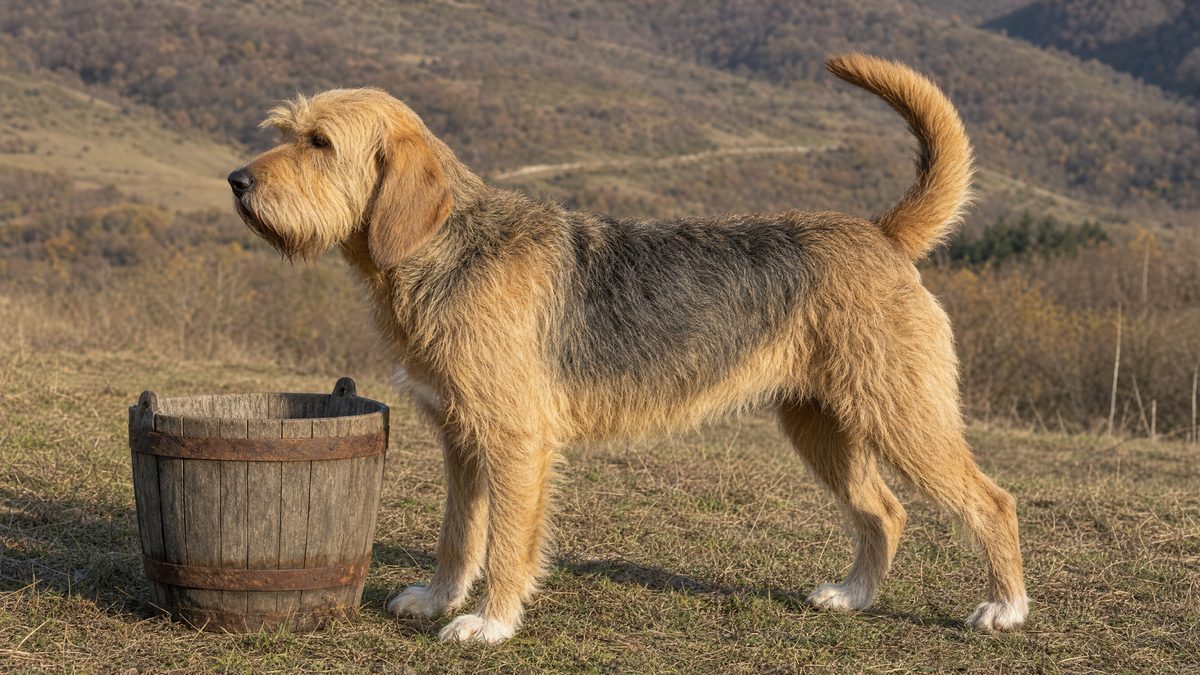
The coat definition is where this dog stops being a generic hound. Guard hairs are hard, 6 to 10 cm long, slightly wavy but not curly, forming small tufts over the whole body except the nasal bridge, ears, forehead and crown, where they are softer and shorter. The stop carries long hair forming a forelock, the skin of both jaws is well haired into a characteristic moustache and beard, the hair above the eyes forms eyebrows, and the undercoat is dense. Hair shorter than 6 cm or longer than 10 cm is a fault; hair over 12 cm, or soft hair, is disqualifying. A ranking page describes that same coat as roughly 6 to 7 cm long, which sits at the bottom of the permitted band rather than across it.
Colour, and why almost every English colour list is wrong
Colour is the single most misreported thing about this breed. The standard requires a base colour of yellow-rufous in shades from straw yellow to dark rufous, either as full coverage or combined with a grey or black-grey saddle, and it insists the head must be in the base colour. White is permitted only in six named places: a small chest patch, white paws, a stripe on the nasal bridge and forehead, limited patches on one or both sides of the muzzle, a white tail tip, and a neck patch or collar that does not join the forehead white, does not run onto the forelegs and does not reach back to the withers. White anywhere else is disqualifying. So a listing that offers this breed in black, white, brown, grey, red and rust is describing a range the national standard would reject outright.
| Item | What the BNFC standard specifies |
|---|---|
| Breed name | Bulgarski barak, described as a hard-coated hunting dog |
| Claimed classification | FCI Group VI, Section 1.2 (a claim by the federation, not an FCI act) |
| Height at withers | Males 53 to 58 cm, females 48 to 53 cm |
| Weight | Males 23 to 27 kg, females 19 to 22 kg |
| Format index | Males 106 to 113, females 108 to 115 |
| Coat | Hard guard hairs 6 to 10 cm, slightly wavy, dense undercoat, moustache, beard and eyebrows |
| Colour | Yellow-rufous from straw to dark rufous, optional grey or black-grey saddle, head in base colour |
| Ears | Medium long, wide, hanging, set low, rounded tips, thin cartilage, lying flat |
| Tail | Set low, reaching the hock at rest, carried sabre-fashion above the topline when hunting |
| Voice | Bass and clear, audible from a distance |
| Disqualifying | Soft hair, hair over 12 cm, depigmented nose, level bite, cryptorchidism, fear or aggression |
The utilisation clause is the sentence an Indian buyer should read twice. The standard defines the breed as a hound working on a fresh trail, used for small and large furred game, with a powerful nose, great endurance and a sense of orientation that holds up regardless of climatic conditions and the relief of the terrain. That last phrase is a hunter's boast about Balkan weather, not a claim about the tropics, and this page spends several sections showing why. A single Bulgarian Hound is expected to bring down wild boar on its own, and the breed's working habit is to run far ahead of the gun and then bark to report.
A 25 kg wire-haired hound carrying 6 to 10 cm of hard hair over a dense undercoat, bred to run all day in a country whose capital averages 9.73 degrees Celsius across the year. Everything difficult about keeping this breed in India follows from that.
Bulgarian Hound or Bulgarian Scenthound: settled from the registry's own two documents
The Bulgarian Hound and the Bulgarian Scenthound are two different breeds, and the proof is that the same federation publishes a separate standard for each, on the same website, under separate names: Balgarski Barak and Balgarsko Gonche.
This matters more than any other fact on the page, because the two names are used interchangeably across the internet and the sources contradict each other about which is which. So take it from the body that writes both standards. The Bulgarian National Federation of Cynology states on its own English page that it has created three Bulgarian breeds, two hunting and one shepherd, and lists them as *Bulgarian Hound* with the parenthetical *Balgarski Barak*, and *Bulgarian Scenthound* with the parenthetical *Balgarsko Gonche*. Those are distinct entries with distinct standard documents and distinct designations of use.
The two standards are written to exclude each other
Now read the two documents against each other, which nobody appears to have done in English. The Barak standard requires hard guard hairs 6 to 10 cm long and treats soft hair or hair over 12 cm as disqualifying. The Gonche standard requires a coat that is short, about 3 cm, hard, glossy and close-lying, and lists among its disqualifying faults ears covered with long wavy hair and coarse and long hair. Those are the Barak's defining features, named as disqualifications in the other breed's standard.
Colour runs the same way, in mirror image. The Barak must be yellow-rufous with the head in the base colour, and white outside six named places is disqualifying. The Gonche must be anthracite black with brown markings, carrying two hazelnut-sized brown spots above the inner corner of each eye, and its faults list includes the absence of a white chest patch, while white patches on the head, neck, limbs or tail tip are disqualifying. One breed is required to be yellow with permitted white; the other is required to be black and tan with a white chest patch it must not lose.
| Point | Bulgarian Hound (Balgarski Barak) | Bulgarian Scenthound (Balgarsko Gonche) |
|---|---|---|
| Coat | Hard, 6 to 10 cm, slightly wavy, dense undercoat | Short, about 3 cm, hard, glossy, close-lying |
| Colour | Yellow-rufous, straw to dark rufous, optional grey saddle | Anthracite black with brown markings |
| Face | Moustache, beard and bushy eyebrows required | Protruding eyebrows are a disqualifying fault |
| Height, males | 53 to 58 cm | 54 to 58 cm |
| Height, females | 48 to 53 cm | 50 to 54 cm |
| Weight, males | 23 to 27 kg | 23 to 25 kg |
| Format index, females | 108 to 115 | 112 to 115 |
| Muzzle | 40 to 45 percent of head length | 50 percent of head length |
| Stop | Pronounced | Weakly expressed; a clearly outlined stop disqualifies |
| Ear set | Set low, hanging, wide | Set on the line of the eyes, hanging to the cheeks |
| Stated use | Fresh-trail hound for small and large furred game | Specialised on wild boar |
| First shown internationally | No date given in the standard | World Hunting Exhibition, Plovdiv, June 1981 |
Peer-reviewed genetics treats them as two populations too, and that is the strongest independent check available. A 2018 mitochondrial study sampled 34 Bulgarian Hound (Barak) dogs and 45 Bulgarian Scenthound (Gonche) dogs as separate breeds from separate regions, north-western Bulgaria for the Barak and north-eastern for the Gonche, and reported separate haplotype counts, separate diversity statistics and separate clade C frequencies of about 24 percent and 38 percent. A 2026 Bulgarian hospital series does the same thing clinically, listing *Bulgarian Hound dog* and *Bicolor hound*, which is the Gonche's other name, as two separate breeds in the same table.
Look at the coat and the colour. Shaggy, bearded and yellow-to-rust is the Bulgarian Hound. Sleek, short-coated and black with tan points is the Bulgarian Scenthound. If a photograph shows a smooth black-and-tan dog under the name Bulgarian Hound, the caption is wrong, not the dog.
Why the published literature calls both breeds Bulgarian Hound, and how to tell which one a source means
The phrase *Bulgarian Hound* is used in print for both Bulgarian hound breeds by different bodies, which is why the two look like one breed under two names, and the only reliable way to tell them apart in a source is the coat description rather than the name.
Here is the collision, laid out from the documents. The Bulgarian federation's English page uses *Bulgarian Hound* for the Barak. The Serbian zootechnical literature that produced the only measurements of the Barak uses *Bulgarian barak* for the Barak and Bulgarian hound for the Gonche, the exact reverse: its own reference list resolves the phrase *Bulgarian hound* to a 2014 paper titled *Basic Exterior Characteristics of Bulgarian Scent Hound*. Wikipedia then splits the difference, using *Bulgarian Hound* for the Barak and *Bulgarian Scenthound* for the Gonche Wikipedia, Bulgarian Scenthound.
The confusion has left fingerprints in file names. The zootechnic study of the Scenthound that Wikipedia links from its Bulgarian Scenthound article is hosted under the filename `Pages-from-Bulgarian_hound_final_eng.pdf`. Stock libraries do the same thing from the other direction: a Shutterstock search for *bulgarian hound* returns images captioned Bulgarian Scenthound (Deliormansko Gonche), which is the other breed under a third regional name.
A rule that works on any source
Ignore the breed name and read four things instead. Coat length and texture settles it in one line, because 6 to 10 cm of hard wavy hair cannot be confused with 3 cm of glossy close-lying hair. Colour settles it in another, because yellow-rufous and anthracite black with tan are not adjacent. Region settles a third, because the Barak's population sits in north-western and central Bulgaria and the Gonche's in the Ludogorie of the north-east. And a beard settles the fourth, because the Barak's standard requires one and the Gonche's disqualifies protruding eyebrows.
- Read the coat length first. Six to ten centimetres of hard hair means Bulgarian Hound; about three centimetres means Bulgarian Scenthound.
- Read the colour second. Yellow to rust means Bulgarian Hound; black with tan points means Bulgarian Scenthound.
- Read the region third. North-western and central Bulgaria means Bulgarian Hound; the Ludogorie in the north-east means Bulgarian Scenthound.
- Read the face fourth. A beard, moustache and bushy eyebrows mean Bulgarian Hound.
- Read the alternative names last. Barak means Bulgarian Hound; Gonche, Bicolor hound, Ludogorsko gonche and Deliormansko gonche all mean Bulgarian Scenthound.
One more source problem is worth naming, because it affects what an answer engine reports. The number two ranking page for this term carries Open Graph metadata for a completely different breed: the page body is headed *Bulgarian Hound* and the article is unambiguously about the Barak, but its `og:title` and `og:url` tags name the Norwegian Elkhound. Any machine reading that page's social metadata rather than its body will file this breed under the wrong name entirely.
Barak is a Turkish loanword meaning shaggy or hairy, and the Bulgarian standard says so in its own history paragraph. The same word names an unrelated Bosnian breed, the Bosnian Broken-haired Hound called Barak, which is a third dog again. Three breeds, one adjective, and a great deal of mislabelled photography.
Three breeds are called Barak, and only one of them is FCI recognised
The word barak names three different dogs in the cynological literature, and the one with an FCI standard is not this breed: it is the Bosnian Broken-haired Hound called Barak, FCI-155, recognised on 15 January 1973.
Set the two Baraks against each other from their own standards and the differences are not subtle. FCI-155 gives a height of 46 to 56 cm with an ideal of 52 and a weight of 16 to 24 kg with an ideal of 20. The Bulgarian standard gives males 53 to 58 cm and 23 to 27 kg. The Bulgarian Barak's floor for a male, 53 cm, is above the Bosnian Barak's ideal height, and its floor weight of 23 kg is 3 kg above the Bosnian ideal. The Bulgarian dog is simply a bigger animal.
Two heads built in opposite directions
The heads are the giveaway once you know what to look at. FCI-155 says the muzzle is a little longer than the skull, and sets the shoulder-blade to upper-arm angle at 90 degrees. The Bulgarian standard says the muzzle is 40 to 45 percent of head length, which makes it shorter than the skull, and sets the same shoulder angle at 105 degrees. Ear set runs the same way: FCI-155 wants leathers moderately high set, while the Bulgarian standard wants them set low Bulgarian National Federation of Cynology.
| Point | Bosnian Barak, FCI-155 | Bulgarian Hound, BNFC standard |
|---|---|---|
| Recognition | FCI Group 6, Section 1.2, with working trial | None; the FCI classification line is a proposal |
| Standard dated | 15 January 1973, printed on the document | Field printed and left blank |
| Height | 46 to 56 cm, ideal 52; females a little smaller | Males 53 to 58 cm, females 48 to 53 cm |
| Weight | 16 to 24 kg, ideal 20 kg | Males 23 to 27 kg, females 19 to 22 kg |
| Proportion | Body length exceeds height by 10 percent | Format index 106 to 113 in males, 108 to 115 in females |
| Muzzle | A little longer than the skull | 40 to 45 percent of head length, so shorter than the skull |
| Shoulder angle | 90 degrees | 105 degrees |
| Ear set | Moderately high set | Set low |
| Dewlap | A dewlap only slightly pronounced is an important fault | Not mentioned |
| Ground colour | Wheaten yellow, reddish yellow, earthy grey or blackish | Yellow-rufous only, straw to dark rufous, head in base colour |
| White | Often on head, throat, neck, chest, lower legs, tail tip | Six named places only; elsewhere disqualifying |
| Coat faults | Hair too long, woolly, wavy or curly eliminates | Hair over 12 cm or soft hair disqualifies |
One detail from the Bosnian document is worth flagging because it shows that even a recognised standard can contradict itself. FCI-155 permits a blackish ground colour in its coat clause and then lists black among its eliminating faults. The Bulgarian standard has no such tension, because it permits only the yellow-rufous range with an optional grey or black-grey saddle and insists the head carries the base colour.
The third Barak, and why the word travels
The third use of the word is generic rather than a breed. Barak is a Turkish loanword meaning shaggy or hairy, which the Bulgarian standard states in its own history paragraph and which a breed-history source repeats for the Bulgarian dog. Any shaggy Balkan or Anatolian hound can attract the word, which is why photo libraries file all of them together. A Shutterstock search for *bulgarian hound* returns, among its first results, a captioned Bosnian Coarse-haired Hound and a second image whose caption reads *Bosnian Coarse-haired Hound. Bulgarian, Barak dog*, naming two countries in one line.
Look at the ears and the muzzle. The Bosnian Barak carries moderately high-set ears and a muzzle longer than its skull, and often shows a dewlap under the throat. The Bulgarian Hound carries low-set ears lying flat and a muzzle shorter than its skull. If the dog is blackish overall, it is not the Bulgarian breed, whose head must be yellow-rufous.
The standard and the only measurements of this breed do not agree
The only published morphometric study of the Bulgarian Hound measured 64 dogs and found a mean body format index of 115.20 in males and 123.00 in bitches, both above the 106 to 113 and 108 to 115 ranges the national standard permits.
That is not a rounding problem. It is the standard describing a dog that the measured population is not. The study, run by the Center for Preservation of Indigenous Breeds in Belgrade with a veterinarian from the Club of Bulgarian Barak in Sofia and one from the Bulgarian kennel club as co-authors, measured twelve exterior parameters on 36 males and 28 bitches aged one to eight years, all carrying pedigrees issued by the Kennel Club of Bulgaria, in the areas of Sofia, Zheleznitsa, Haskovo, Pazardzhik and Kardzhali. That paper is printed under the English title *Basic Exterior Characteristics of Bulgarian Scent Hound*, which names the other breed, and the mismatch is in the title rather than in the dogs. The project document behind it is headed *EXTERIOR OF THE BULGARIAN HOUND*, its project sheet describes it as the creation of an exterior-zootechnical study for the Bulgarian hound ordered by the Kennel Club of Bulgaria, and the five measuring localities are this breed's, not the Scenthound's. The Bulgarian Scenthound was measured by a separate project with a different sample of 21 males and 15 bitches, so the two datasets do not overlap.
The paper does not hide the gap. It writes plainly that bitches have a longer body than males, 23 percent longer than their height at the withers, and that such proportions in hounds are not to be regarded as desirable, then recommends that future breeding and selection pay close attention to body format, particularly in bitches. It also records the highest massiveness index in bitches, 125.00 against 119.66 in males, and calls that undesirable too.
| Measure | BNFC standard | Measured mean | Measured range |
|---|---|---|---|
| Height at withers, males | 53 to 58 cm | 55.33 cm, SD 2.89 | 50.00 to 61.00 cm |
| Height at withers, females | 48 to 53 cm | 51.28 cm, SD 3.09 | 47.00 to 57.00 cm |
| Format index, males | 106 to 113 | 115.20 | not reported |
| Format index, females | 108 to 115 | 123.00 | not reported |
| Body length, males | not specified | 63.74 cm, SD 4.00 | 56.00 to 71.00 cm |
| Head length, males | about 45 percent of height | 24.55 cm, SD 1.58 | 22.00 to 27.00 cm |
| Head length, females | about 45 percent of height | 22.75 cm, SD 1.83 | 19.00 to 25.00 cm |
| Chest circumference, males | not specified | 66.21 cm, SD 4.49 | 60.00 to 79.00 cm |
| Skull length, males | not specified | 14.61 cm, SD 1.16 | 13.00 to 16.00 cm |
| Muzzle length, males | 40 to 45 percent of head | 9.72 cm, SD 1.06 | 8.00 to 11.00 cm |
Three of those rows deserve a second look. Male height at withers reaches 61 cm in the sample against a standard ceiling of 58, and female height reaches 57 cm against a ceiling of 53, so the tallest measured bitch would be four centimetres over the limit for her sex Bulgarian National Federation of Cynology. Muzzle length as a share of head length comes out at 40.50 percent in males and 40.00 in bitches, which sits at the very bottom of the standard's 40 to 45 percent window rather than in the middle of it. And the skull width index of 60.30 in males places the breed among mesaticephalic dogs, with skull width greater than skull length.
There is a second, independent check that points the same way. A 2017 clinical study weighed 26 healthy working Bulgarian hounds and reported a median of 25.75 kg with a range of 16.6 to 40.0 kg. The upper end of that range is 13 kg above the standard's ceiling for a male and the lower end is 2.4 kg below its floor for a female. Two studies, thirteen years apart, both find live dogs outside the paper dog.
Do not use the standard as a checklist for identifying a genuine one. The published evidence says a real, pedigreed, working population of this breed routinely falls outside its own standard on height, body proportion and weight. Judge it on coat, colour, beard and origin, and treat any seller who quotes exact standard figures at you as reciting a document rather than describing a dog.
FCI recognition: why no international standard for this breed can exist yet
The Bulgarian Hound is not recognised by the Federation Cynologique Internationale, and the structural reason is that Bulgaria's national canine body is listed by the FCI as a Contract partner rather than a full member.
Work through the FCI's own description of how a breed becomes international. The FCI recognises 364 breeds, and each one is the property of a specific country whose national organisation writes the standard in co-operation with the FCI's Standards and Scientific Commissions, after which the FCI translates, updates and publishes it. There are 101 members and contract partners, one per country, and the FCI arranges them in three sections. Contract partner is the entry tier of that ladder, and the FCI's Europe listing for Bulgaria prints the status in plain text beside the country name.
So the sequence a Bulgarian breed has to complete is long, and Bulgaria has not completed it. The federation says so itself, in one sentence on its English page: BNFC seek and work for the recognition of the three Bulgarian breeds. That is a statement of intent, published beside three standards that have not yet been adopted by anybody outside Bulgaria.
The Group VI line on the standard is a proposal, not a fact
This is where careful reading pays. Both Bulgarian standards print a line reading Classification by FCI: Group VI, Section 1.2 Bulgarian National Federation of Cynology. Read quickly, that looks like an FCI act. It is not. It is the Bulgarian federation stating where it believes the breed belongs in the FCI's scheme, in a document the FCI has never adopted. Wikipedia gets this right and says so plainly: the standard places the dog in group 6, section 1.2, and the breed is not recognized by FCI. A widely-shared Bulgarian expat article gets it wrong in the other direction, describing the federation as a member of the Federation Cynologique Internationale, which the FCI's own record contradicts.
The absence, checked on the FCI's own Group 6 list
The absence is checkable in one place, and this page checked it on the correct document rather than on a search result. The FCI's Group 6 nomenclature page lists every recognised scenthound by country across Sections 1, 2 and 3, and Bulgaria appears nowhere in it. Section 1.2 Medium-sized Hounds, which is the exact section the Bulgarian standard claims, contains 17 countries, from Austria to Switzerland, and already holds a Barak: BOSANSKI OSTRODLAKI GONIC-BARAK (155), the Bosnian Broken-haired Hound called Barak, recognised on 15 January 1973. That is a different breed from a different country, and it is one more reason photographs of the two get mixed up.
| Question | Answer for the Bulgarian Hound |
|---|---|
| Is there an FCI standard? | No. The only standard is the Bulgarian national one |
| Can it be entered at an FCI show in India? | No. The Kennel Club of India runs FCI shows and there is no FCI breed number |
| Can it earn an FCI International Champion title? | No, for the same reason |
| Can the Kennel Club of India register one? | Not against any FCI standard. Ask KCI directly before assuming a route exists |
| Is Bulgaria inside the FCI at all? | Yes, as a Contract partner, the entry tier |
| Is India inside the FCI? | Yes, through the Kennel Club of India |
India sits higher on that ladder than Bulgaria does, which sharpens the point considerably. The FCI's member record for INDIA lists the Kennel Club of India, Chennai, as a Full member, while its record for BULGARIA lists the Bulgarian National Federation of Cynology as a Contract partner Federation Cynologique Internationale. An Indian owner therefore has access to the entire FCI system, and this breed is one of the things that system does not contain. Nobody is keeping the Bulgarian Hound out of India. There is simply nothing to register.
The practical consequence for an Indian buyer is short and worth stating without hedging. There is no FCI breed number, no FCI standard document, no FCI show class and no route to an FCI International Champion title for this dog anywhere in the world, India included Federation Cynologique Internationale.
There is no international paperwork for this dog. Any document offered as an international pedigree for a Bulgarian Hound is either a Bulgarian national document or is not what it claims to be. Verify it with the issuing federation directly rather than judging it by how official it looks.
The registry renamed itself, and the standard is undated
Bulgaria's canine federation has changed its name from BRFK to BNFC, and its Bulgarian Hound standard carries a publication-date field that is printed and left blank, so two of the things a reader would normally use to date a source do not work here.
Take the rename first, because it makes older sources look wrong when they are only out of date. Wikipedia's infobox for this breed names the recognising club as BRFK, the Bulgarian Republican Federation of Cynology, and links the standard at `brfk.bg`. That domain now redirects to `bnfc.bg`, and the FCI's member record for Bulgaria names the Bulgarian National Federation of Cynology at Oborishte 40, Asenovgrad. The 2018 genetic study also describes its sampling kennels as being under the control of the Bulgarian Republican Federation of Cynology, which is correct for its own date.
The organisation is now mid-transition in public. Its Bulgarian-language pages carry the new name, Balgarska natsionalna federatsiya po kinologiya, while its English-language pages still carry the old Republican one, and the image files on both are still named `brfk-...` from 2019 Bulgarian National Federation of Cynology. So a source calling it BRFK is not necessarily unreliable, and a source calling it BNFC is not necessarily newer. Check the FCI record, which is the one place a single current name is published.
The standard has no date, and the field is right there
The Bulgarian Hound standard prints a heading reading Date of publication of the valid original standard and then leaves it empty. The Bulgarian Scenthound standard on the same site does not carry that field at all. Neither document is dated anywhere in its text. That is unusual: every FCI standard prints the date of its last revision on its face, which is what allows a reader to tell one version from another and a researcher to prove when a figure changed.
The practical consequences are worth stating rather than shrugging at. Nobody reading the Bulgarian Hound standard can tell which revision they are holding. Nobody can tell whether the height range or the format index has ever been altered. And nobody, including this page, can date the standard against the 2014 morphometric study, which described the breed at the time as unstandardized and internationally unrecognized and said efforts were then under way to standardise it. That sentence implies the current standard postdates 2014, but the document itself will not confirm it.
| If a source says | Check | Because |
|---|---|---|
| BRFK recognises the breed | The FCI member record for Bulgaria | The body is now named BNFC; BRFK is the former name |
| The standard was revised in year X | Nothing on the document supports it | The publication-date field is printed blank |
| The breed is unstandardised | Whether the source predates the current standard | That was true in the 2014 literature and is not true now |
| The breed is FCI Group VI Section 1.2 | The FCI Group 6 nomenclature | The line is the federation's proposal; Bulgaria is absent from the list |
| The standard permits black | The colour clause and the disqualifying faults | Base colour is yellow-rufous and the head must carry it |
A rare breed's whole English internet usually rests on two or three documents, so knowing exactly how old each one is decides how much weight it can carry. For this breed, one of those documents refuses to say. Bonbeno prints that fact rather than quietly assigning the standard a date it does not have.
History and origins, and which parts of it are evidence
The Bulgarian Hound's history divides into one documented strand and three traditional ones, and the documented strand is the 1905 Balkan hound survey in which the breed's coat type was first classified.
Take the evidence first. The Austrian researcher who published *Das Weidwerk in Bosnien und der Hercegovina* in Klagenfurt in 1905 conducted the first zootechnical study of Balkan scent hounds, covering 1,036 hounds, and divided them by hair type into short-haired, long-haired and wire-haired groups. The Bulgarian Hound is the only long-haired scent hound breed known on the Balkans, which is what makes the coat clause of its standard a classification statement rather than a cosmetic one. Note that even the primary literature cannot spell the man's name consistently: the same 2014 paper calls him Franz B. Laszka in its abstract and Laska, R. in its reference list.
What the Bulgarian standard's own history paragraph says
The national standard tells a two-migration story. It records that the Barak is an ancient hunting breed raised on Bulgarian lands, formed over centuries from local strains, and that historical data indicate the proto-Bulgarians brought shaggy dogs resembling today's Barak when they arrived on the Balkan peninsula, with Turkish hunting dogs contributing later. It then supplies the etymology directly: the name comes from Turkish and means shaggy or hairy.
The Osman Pasha story, and how far it can be pushed
The breed's most repeated anecdote comes from the Siege of Plevna during the Russo-Turkish War of 1877 to 1878. The Ottoman field marshal Osman Pasha held the city for five months against superior Russo-Romanian forces and was captured; his first concern on being presented to the Russian officers was reportedly to ask that his Bulgarian Hounds be well fed and looked after. It is a good story and it appears in two independent English sources, but neither cites a contemporary document, so treat it as tradition rather than as record.
Two further traditional claims deserve the same caution. The first is that returning French knights carried Balkan hounds home after the Fourth Crusade, founding the Griffon line, which is repeated verbatim by two of the ranking pages and sourced by neither. The second is a very precise-sounding claim that Barak dogs descend from Asian dogs that arrived 1,340 years ago, which the same expat article prints without a source; counted back from its 2021 publication that is 681, the traditional founding year of the First Bulgarian Empire, so the figure is a national date wearing the clothes of a measurement.
| Claim | Status | Source |
|---|---|---|
| Long-haired Balkan hounds classified in a 1,036-dog survey, 1905 | Documented in the zootechnical literature | Urosevic 2014, citing Laska 1905 |
| The only long-haired scent hound breed on the Balkans | Stated in peer-adjacent literature and repeated by Wikipedia | Urosevic 2014 |
| Proto-Bulgarians brought shaggy dogs to the Balkans | Asserted by the national standard, no source given | BNFC standard |
| Turkish hunting dogs contributed to the breed | Asserted by the national standard, no source given | BNFC standard |
| Barak is a Turkish word meaning shaggy | Stated by the standard and by two English sources | BNFC standard, NPDD |
| Osman Pasha asked after his hounds in 1877 to 1878 | Tradition, no contemporary document cited | NPDD |
| Fourth Crusade knights founded the Griffon line | Tradition, no source in any page that repeats it | NPDD |
| Descended from Asian dogs 1,340 years ago | Unsourced, and resolves to a national date rather than a measurement | expat article |
Ancient DNA now touches this breed directly, which no traditional story can. A Bronze Age dog excavated at Via Ordiere in Solarolo, northern Italy, carries the same mitochondrial haplotype as a modern Bulgarian Hound in the 2018 Bulgarian dataset. The genetics section sets out exactly what that does and does not prove.
The two studies that actually contain Bulgarian Hound data, and what they found
Two peer-reviewed papers contain real Bulgarian Hound data, a 2018 mitochondrial survey of 34 Barak dogs and a 2020 ancient-DNA study that matched a Bronze Age Italian dog to a modern Bulgarian Hound, and no breed page in English cites either Koupadi K, Fontani F, Ciucani MM, Maini E.
The 2018 study is the foundation. Bulgarian researchers sampled hair from 130 dogs across four Bulgarian populations and sequenced about 630 base pairs of the mitochondrial control region, working under permission 627/30.03.2015 from the Bulgarian Ministry of Environment and Waters, with sequences deposited in GenBank as MG920357 to MG920486. The Bulgarian Hound contribution was 34 dogs drawn from two kennels, and the resulting sequences are the only published genetic description of the breed.
The Bulgarian Hound is the most genetically varied of the four
The results place this breed at the top of the diversity table among Bulgaria's native dogs. It produced 15 haplotypes, the highest count of any breed in the study, and 7 unique haplotypes, again the highest, against 3 unique haplotypes in the Bulgarian Scenthound. Haplotype diversity came out at 0.916 with a standard deviation of 0.0006, second only to the newly created Bulgarian Shepherd Dog at 0.934, and above the Karakachan at 0.812 and the Scenthound at 0.821.
| Population | Samples | Haplotypes | Unique | Haplotype diversity | Polymorphic sites |
|---|---|---|---|---|---|
| Bulgarian Hound (Barak) | 34 | 15 | 7 | 0.916 plus or minus 0.0006 | 43 |
| Bulgarian Scenthound (Gonche) | 45 | 10 | 3 | 0.821 plus or minus 0.044 | 15 |
| Karakachan Shepherd | 37 | 10 | 5 | 0.812 plus or minus 0.0016 | 26 |
| Bulgarian Shepherd Dog (BOK) | 14 | 11 | 4 | 0.934 plus or minus 0.0037 | 55 |
The headline finding of the paper concerns clade C, an old European maternal lineage. Both Bulgarian hunting breeds carry it at unusual frequency, about 24 percent in the Barak and about 38 percent in the Gonche, against roughly 10 percent in modern European dogs generally, and its most common subhaplogroup C1b3 appears in below 5 percent of modern European breeds. The shepherd breeds carry no clade C at all and instead carry the Mediterranean D2 lineage, which is why the authors conclude the hunting and shepherd dogs of Bulgaria have a dual independent phylogenetic origin without hybridisation events between them.
The Bronze Age Italian dog that matches a modern Bulgarian Hound
The 2020 ancient-DNA paper is where this gets genuinely striking, and it needs stating precisely because the detail is easy to garble. Researchers sampled 27 canid remains from northern Italy and successfully amplified 11 of them. One Bronze Age dog, sample ORD7 from Via Ordiere in Solarolo, dated by relative chronology to 3,600 to 3,120 years before present, was assigned to haplogroup C and matched only modern dog samples, and in particular matched a modern Bulgarian Hound taken from the 2018 Bulgarian dataset Marinov M, Teofanova D, Gadjev D.
Two cautions belong with that. First, a shared 57 base-pair mitochondrial haplotype means a shared maternal lineage, not descent, and the paper is careful to place ORD7 one mutational step from two other Italian samples rather than claiming an Italian-Bulgarian pedigree. Second, Wikipedia reports the dating as 3,600 to 3,280 years ago, which is the range Table 1 of that paper gives for ORD1, ORD2, ORD3 and several others; ORD7's own row reads 3,600 to 3,120 Wikipedia, Bulgarian Hound. It is a small error, but it is the kind that propagates, and this page prints the row rather than the summary.
Wikipedia, Animalia and several derivative pages state that the Bulgarian Hound's closest relative is the Slovak Rough-haired Pointer Animalia, All about Bulgarian Hound breed. That sentence comes from the introduction of the 2018 paper, where it is an unreferenced background assertion, not from its results. The study never tested the Slovak Rough-haired Pointer and holds no data on it. Treat the claim as a repeated aside, not as a finding.
How many Bulgarian Hounds exist, counted rather than guessed
The Bulgarian Hound's published breeding population is 120 females, and its published conservation status is Endangered, both taken from the demographic table of a 2018 peer-reviewed paper on Bulgarian native dogs.
That single row is the most decision-relevant number on this page and it appears on no breed site anywhere. The table records, for each Bulgarian population, its locality, its function, its current female population size and its current conservation status, with the note that demographic data were available only for the Bulgarian breeds. Three of the four are listed as Endangered, and the only one that is not is the modern show-bred Bulgarian Shepherd Dog with 1,300 females.
| Population | Locality | Function | Breeding females | Status |
|---|---|---|---|---|
| Bulgarian Hound (Barak) | North-Western Bulgaria | Hunting | 120 | Endangered |
| Bulgarian Scenthound (Gonche) | North-Eastern Bulgaria | Hunting | 150 | Endangered |
| Karakachan Shepherd | The Rhodope mountain and other mountainous parts | Livestock herding | 100 | Endangered |
| Bulgarian Shepherd Dog (BOK) | All country | Guarding | 1,300 | Not at risk |
Put 120 breeding females beside the numbers an Indian reader has intuitions about. India's most common pedigree dog, the Labrador Retriever, carries 9,653 hip evaluations in a single overseas health register, which is roughly eighty times the entire female breeding stock of this breed. A breed at that scale has no depth in its gene pool to absorb a bad decision, which is why the morphometric study's recommendation to select against body format and massiveness is easier to write than to carry out.
Where the dogs actually are, and a discrepancy worth flagging
The sources disagree slightly about geography, and the disagreement is informative rather than fatal. The 2018 genetic study places the Barak population in North-Western Bulgaria and describes both hunting breeds as reared on the flat Danubian Plain in the north. Wikipedia says the breed is prevalent in the north, north-western and central regions. The 2014 morphometric study, however, measured its 64 dogs in Sofia, Zheleznitsa, Haskovo, Pazardzhik and Kardzhali, which are western and southern, not northern. So the breed is not confined to one corner, and a sample drawn in the south may not represent dogs in the north.
Two named kennels supplied the genetic samples, and one of them connects the two papers. The 2018 study drew its Barak material from Kan el Kot, run by Hristo Kanev, and Vom Pirin Hunt, run by Asen Belezhkov. Hristo Kanev, described as a veterinarian of the Club of Bulgarian Barak in Sofia, is also a co-author of the 2014 morphometric paper. The entire published evidence base for this breed runs through a very small number of people, which is normal for a breed this rare and worth knowing before you treat any one figure as independent confirmation of another.
The 120 figure is from a paper published in 2018 and is not maintained as a live register. It could be higher or lower now. Bonbeno publishes it with its source and its date rather than rounding it into a vague claim that the breed is rare, and any later editor should check whether a newer count has been published before repeating it.
Bulgarian Hound price in India: there is no Indian price, and here is the proof
There is no Bulgarian Hound price in India, because no Indian seller stocks the breed, no Indian marketplace lists it, and no Indian price guide names it, and the evidence for that absence is set out below rather than asserted.
Start with what a puppy price claim would have to survive. India's most comprehensive published breed price table for 2026 covers more than 40 breeds, compiled from breeder networks, Kennel Club of India registration data and first-quarter marketplace surveys, and the Bulgarian Hound does not appear in it in any spelling. That table includes breeds far rarer in India than the Labrador, such as the Alaskan Malamute at Rs 60,000 to Rs 2,00,000 and the Dogo Argentino at Rs 80,000 to Rs 3,00,000, so its coverage is not confined to the obvious.
The searches that came back empty, and the controls that prove they worked
An absence is only evidence if the search that produced it works. A site-restricted search of the four marketplaces where Indian dogs are actually advertised, IndiaMART, Justdial, OLX and Quikr, for the Bulgarian Hound returned zero results. The identical query shape run for the Labrador Retriever in the same session returned a full page, including Justdial's *Pet Shops For Labrador Retriever Dog* category pages for Anand and Jabalpur. The tool works; the breed is not there.
A second, unrestricted search for the breed name combined with price, cost and rupees returned ten results, and not one of them was about this breed. They were generic Indian dog price lists, a Quora thread, a Pug supplier page and an international puppy-selling site. The pattern matters, because it is what a genuine absence looks like: the search engine finds the words *price* and *India* and *dog* and returns the nearest commercially motivated page rather than admitting it has nothing.
| Dog | Published Indian band | Why it is the honest substitute |
|---|---|---|
| Bulgarian Hound | No published Indian price exists | Not stocked, not listed, not in any Indian price table |
| Beagle | Rs 15,000 to Rs 60,000 | The medium scenthound India actually sells, with a comparable nose and voice |
| Dachshund | Rs 15,000 to Rs 50,000 | A scent-driven hunting breed at a size that suits Indian flats |
| Mudhol Hound | Rs 3,000 to Rs 15,000, registered up to Rs 1,00,000 | An Indian working hound already adapted to the heat |
| Indie, adopted | Rs 0 to Rs 3,000 including vaccination and microchipping | Genetically diverse, climate-adapted, and available today |
If someone quotes you a figure anyway
Treat any rupee number attached to this breed as unverified until you can trace it, and run two cheap arithmetic checks first. Divide the figure by 84.38 and by 74, the two exchange rates Indian listing sites have been caught converting American price lists at. A rupee price that resolves to a round dollar figure, such as 800, 1,500 or 2,500 dollars, is an imported number wearing a rupee sign rather than a quote from anybody who has ever had this dog. And treat Rs 98,999 as a specific red flag: it is a recurring house charm price on one Indian listing site, attached to whichever puppy is in stock, and it is not any breed's price.
Ask for the sire and dam's registration papers, the issuing body, and the import authorisation number under which the parents entered India. There are 120 breeding females of this breed in the world and no lawful breeding-import route into India, so a seller who can produce all three has done something genuinely remarkable and a seller who cannot is selling you a different dog.
The only lawful way a Bulgarian Hound reaches India, read from the trade notice itself
A Bulgarian Hound can enter India lawfully only as your own pet, under DGFT Trade Notice 22/2022-23, which makes dogs a Restricted import and states that applications made for trading or breeding purposes shall be duly rejected.
The trade notice, dated 19 December 2022, sets the policy out in four clauses that between them close every commercial route. Dogs fall under ITC (HS) 01061900, mammals other, with an import policy of Restricted. Policy Condition 7 permits import for exactly three purposes: a pet dog with a valid pet book and relevant records in the name of the importer, dogs imported by research organisations with a CPCSEA recommendation, and dogs for internal security by the Defence and Police Force. Policy Condition 8 then adds that import of commercial dogs for breeding or any other commercial activities other than the purposes mentioned above is not permitted.
- Confirm the route. Only a pet in your own name, research with CPCSEA recommendation, or Defence and Police use qualifies.
- Check the residence rule. Import as passenger baggage without a DGFT authorisation is open only to a person transferring residence to India after two years of continuous stay abroad, for up to two pets.
- Apply for authorisation where the rule requires it, using ANF-2M, against your own Importer Exporter Code or the permanent IEC IIHIE0153E for personal, non-trade imports.
- Start at least two months before travel, which is the notice's own advice to pet owners.
- Obtain an Advance No Objection Certificate from the Regional or Quarantine Officer seven days before travel, relaxable to three days.
- Enter through one of seven ports only: Delhi, Mumbai, Chennai, Hyderabad, Bengaluru, Kolkata or, since October 2024, Kochi, with quarantine at the port where required. The full route is set out in how to import a dog to India.
Read those together with the recognition position and the practical answer becomes short. There is no FCI standard for this breed, so no international pedigree exists for it; Bulgaria's federation is an FCI Contract partner still seeking recognition Bulgarian National Federation of Cynology. India permits no breeding or trading imports of dogs at all. Between those two facts, no lawful supply chain for this breed can form in India, now or in the foreseeable future. That is not a shortage that better demand would fix. It is a closed door.
| Import type | Documents the notice lists |
|---|---|
| Permanent import | Vaccination book, pet passport or pet book; certificate for emotional support; passport of the pet |
| Temporary import | The three above, plus a copy of the return ticket or expected date of return |
| Temporary import, additional | An undertaking from the local host or relative accepting liability under the Foreign Trade (Development and Regulation) Act 1992 if the pet is not taken back |
| Before travel | Advance NOC from the AQCS Regional or Quarantine Officer, with the DGFT licence copy and an exporting-country veterinary health certificate |
| Testing | Disease testing as prescribed in the health certificate, conducted in the exporting country, with reports accompanying the animal |
You cannot lawfully import a Bulgarian Hound to breed from, to sell, or on behalf of anybody else, and the notice says such applications shall be duly rejected. If you are moving to India from Bulgaria and the dog is already yours, the route exists and is well documented. If you are in India and want to start a line, it does not.
What a Bulgarian Hound costs to keep in India each month
Budget Rs 6,500 to Rs 12,500 a month for a 25 kg Bulgarian Hound in an Indian metro, built up from the published medium-breed cost structure and adjusted upward for a coated working dog in a hot climate.
The base numbers are published and worth quoting exactly rather than paraphrasing. For a medium breed in India in 2026, dry and wet food runs Rs 2,500 to Rs 4,000 a month, routine vet visits Rs 800 to Rs 1,500, annual vaccination Rs 1,500 and grooming Rs 800 to Rs 1,500. Urban Indian households now spend Rs 5,000 or more per month per dog, and total monthly upkeep across breed sizes runs Rs 3,000 to Rs 18,000. First-year spending, including purchase, vaccinations, food, training and supplies, is put at Rs 80,000 to Rs 2,00,000.
Three of those lines move upward for this breed specifically, and one moves down. Food moves up because a 23 to 27 kg dog with a working metabolism sits at the top of the medium band and often into the large one. Parasite control moves up sharply, because a hound that works or walks in grass in India meets a tick burden that is not theoretical: a survey of 525 dogs across four Indian cities found potential tick vectors on 53 percent of dogs examined. Ear care moves up because of the drop ears the standard requires. Professional grooming moves down, because a coarse coat that must never be clipped needs a rake and a comb rather than a salon.
| Line | Monthly range | Note |
|---|---|---|
| Food | Rs 3,000 to Rs 4,500 | Top of the medium band for a working-built 25 kg dog |
| Routine veterinary | Rs 800 to Rs 1,500 | Published medium-breed figure |
| Vaccination, amortised | Rs 125 | Rs 1,500 a year for a medium breed |
| Tick and flea control | Rs 600 to Rs 1,200 | Raised deliberately: ticks were on 53 percent of dogs in an Indian survey |
| Deworming | Rs 150 to Rs 300 | Quarterly, amortised |
| Grooming supplies | Rs 300 to Rs 600 | Undercoat rake, slicker, comb, ear cleaner; no clipping |
| Ear care | Rs 200 to Rs 400 | Drop ears plus Indian humidity; a monsoon line, not a luxury |
| Toys, chews, enrichment | Rs 500 to Rs 1,200 | Scent work replaces the hunting job this dog no longer has |
| Boarding or day care sinking fund | Rs 800 to Rs 2,500 | Higher than average, because few Indian boarders know this breed |
| Total | Rs 6,475 to Rs 12,325 | Before any illness, and before the cost of a cooled room in summer |
Two costs sit outside that table and both are real. The first is electricity, because a double-coated hound in Chennai or Kolkata needs a fan or an air conditioner running for more hours of the year than a short-coated Indian dog does, and that is a genuine monthly line rather than an occasional one. The second is the one-off cost of a home you can actually keep the dog in, which for a hound with a bass voice audible from a distance means a ground-floor house with a fenced run rather than an apartment.
An independent Indian source puts the same problem differently and is worth reading beside the price tables. The Voice of Stray Dogs cost guide argues that the purchase price is the smallest part of dog ownership and that the recurring commitment is what people underestimate. For a breed with no Indian veterinary familiarity, no local breed rescue and no boarding kennel that has seen one before, that gap is wider than usual.
Adopting an Indian dog costs Rs 0 to Rs 3,000 including vaccination, deworming and microchipping, and the resulting dog is already adapted to the climate and the food. Every rupee in the table above applies to that dog too, minus the cooling, minus the coat work and minus the import. Compare the whole cost of ownership, not the purchase line.
Heat tolerance: Chennai's coldest month is warmer than Sofia's hottest
The Bulgarian Hound rates 1 out of 5 for heat tolerance on this site, because Sofia averages 9.73 degrees Celsius across the year while Chennai averages 27.95, and Chennai's coldest month at 24.09 degrees is warmer than Sofia's hottest month at 21.20 NASA POWER Climatology API.
Those figures come from NASA POWER twenty-year monthly climatologies for January 2001 to December 2020, queried by explicit latitude and longitude so that no place-name lookup could quietly serve a different city. The Sofia query returned coordinates 23.322, 42.698 at 834.82 metres, and the Chennai query returned 80.271, 13.083 at 48.95 metres NASA POWER Climatology API.
Sofia is the federation's own city, but the breed's population sits north, on the Danubian Plain, so the fair comparison uses a lowland northern point too. Pleven, at 24.607, 43.417 and 145.14 metres, averages 12.93 degrees Celsius annually, with a coldest month of minus 0.33 and a hottest month of 25.35. Even that warmer, lower, northern figure is 15.02 degrees below Chennai's annual mean.
| Place | Annual mean C | Coldest month C | Hottest month C | Peak wet-bulb C |
|---|---|---|---|---|
| Sofia, Bulgaria, 835 m | 9.73 | -2.27 | 21.20 | 16.34 |
| Vratsa, north-west Bulgaria, 630 m | 10.39 | -1.85 | 21.90 | 16.97 |
| Pleven, Danubian Plain, 145 m | 12.93 | -0.33 | 25.35 | 19.59 |
| Bengaluru | 23.74 | 20.22 | 28.37 | 22.66 |
| Pune | 23.86 | 19.62 | 28.93 | 23.56 |
| Delhi | 25.60 | 13.61 | 35.88 | 27.74 |
| Kolkata | 25.81 | 17.31 | 31.53 | 27.86 |
| Chennai | 27.95 | 24.09 | 31.51 | 27.36 |
Wet-bulb temperature is the number that decides this
Air temperature alone understates the problem, because a dog sheds heat mainly by evaporating water from its airways. Wet-bulb temperature measures how much evaporative cooling the air will accept, and this is where the gap becomes unbridgeable. Pleven's peak monthly wet-bulb is 19.59 degrees; Kolkata's is 27.86 degrees, and Delhi's is 27.74 NASA POWER Climatology API. A dog that evolved to dump heat into 19-degree air is being asked to dump it into 28-degree air, through 6 to 10 centimetres of hard hair over a dense undercoat.
Bengaluru and Pune are the two Indian cities where this breed is least impossible, and both should be described honestly rather than sold. Bengaluru's annual mean of 23.74 degrees is still 10.81 degrees above Pleven's, and its coldest month, 20.22, is warmer than Sofia's hottest. What Bengaluru and Pune do offer is the lowest peak wet-bulb of the five, 22.66 and 23.56 degrees, roughly four to five degrees below Kolkata, which is the difference between a hard summer and a dangerous one.
The Bulgarian standard says this hound works well regardless of climatic conditions and the relief of the terrain. That sentence was written about Balkan weather by people who hunt in it, and it is true there. Read in Chennai it is simply false, and it is the single most misleading line an Indian buyer will be shown about this breed.
The summer routine that keeps a coated hound alive in an Indian city
To keep a Bulgarian Hound safe through an Indian summer, move all exercise outside the 09:00 to 18:00 window, because the largest study of canine heat illness found that 67.5 percent of exercise-triggered cases followed an ordinary walk, not athletic activity.
That study is the reason this section exists and is not generic advice. Researchers reviewed the electronic records of 905,543 dogs under primary veterinary care and identified 1,259 heat-related illness events in 1,222 dogs. Of the events with a recorded trigger, exertional heat illness accounted for 652 of 879, or 74.2 percent, against 12.9 percent environmental and 5.2 percent from being shut in a vehicle. In the authors' own words, exertional heat-related illness in the UK affects more dogs, and kills more dogs, than confinement in a hot vehicle.
Then read the breakdown inside that 74.2 percent, because it is counterintuitive and it is the practical point. Of the 551 exertional events where the type of exercise was recorded, 372, or 67.5 percent, occurred after walking, 97 after high-intensity activity such as running or cycling, and 76 after play. The dog that collapses is usually the one that went for a normal walk at the wrong hour, not the one that ran a marathon. Those figures come from Britain, where the annual mean is far below any Indian city, so treat them as a floor rather than a ceiling here.
- Walk before 06:30 and after 19:30 from March to October, and check the pavement with the back of your hand before you start.
- Cut duration, not intensity, on the worst days. A short scent game in shade beats a long slow walk in sun.
- Carry water on every outing over fifteen minutes, and offer it before the dog looks like it wants it.
- Cool the dog with tepid water over the neck, groin and paws rather than ice, and move air across the wet coat with a fan.
- Watch for the early signs: heavy noisy panting that does not settle, brick-red gums, a wobbling hind end, vomiting or diarrhoea.
- Treat a rectal temperature at or above 41.0 degrees Celsius as an emergency and drive to a veterinarian while cooling.
Never shave the coat, and here is what to do instead
A coarse double coat insulates against heat as well as cold, and shaving it removes that buffer while exposing skin that has never seen Indian sun. It also damages the coat permanently: veterinary guidance on coarse-coated breeds is to avoid clipping the coat as the regrowth is often of inferior quality, and to hand-strip instead where a tidier outline is wanted. The Bulgarian standard reinforces this from the other end, making soft hair a disqualifying fault, and soft hair is precisely what a clipped hard coat grows back as.
What actually works is removing the dead undercoat, not the guard coat. Rake the undercoat two or three times a week through the hot months, which thins the insulating layer without touching the hard outer hair that reflects sun. Combine that with a wet towel under the dog rather than over it, a floor fan at dog height, and a tiled or stone floor with shade on it. None of that makes a heat-tolerant dog out of a heat-sensitive one, and it should not be sold as though it does.
Do not use this breed as a running or cycling companion in India, however hardy its home reputation. A dog bred to work all day at 12 degrees Celsius will keep going past the point where it can cool itself, because the drive that makes it a good hunter is exactly what removes its brake. The published data say that ordinary exercise, not extreme exercise, is what kills.
Temperament and household fit, including who should not get one
The Bulgarian Hound is a lively, owner-attached hunting dog that is distrustful of strangers and carries a bass voice audible from a distance, which is exactly the profile that fails in an Indian apartment.
The national standard describes temperament in four clauses and every one of them has a household consequence. The breed has a balanced type of nervous system, a lively temperament and a strongly developed hunting passion, is attached to its owner and distrustful of unfamiliar people, and its voice is bass and clear, audible from afar. It then makes an unbalanced nervous system, fear and aggression disqualifying faults, which tells you the breed's own custodians regard nervousness as a defect rather than a variation.
The working habit that explains the pet
Understand the job and the dog stops being confusing. This hound was bred to work a fresh trail ahead of the gun, often alone rather than in a pack, to run far in front of its handler and then bark to report that it is onto something. Every difficult trait follows from that specification. The dog goes away from you because it was selected to. It ignores you at range because it was selected to. It announces itself loudly because that announcement was the whole point. A veterinarian-reviewed breed entry puts the pet consequence bluntly: this makes the dog immensely independent and freethinking, and a frustratingly disobedient pet.
| Situation | Verdict | Why |
|---|---|---|
| Apartment living in a metro | No | A bass voice audible from afar, in a building with shared walls |
| Independent house with a fenced run | Workable outside summer | The only Indian housing that suits the noise and the range |
| First-time dog owner | No | Stated as unsuitable for a first dog by a veterinarian-reviewed source |
| Home with cats, rabbits or poultry | No | A hunting breed worked on furred game; this is a constraint, not a training project |
| Home with young children | Case by case | Good-natured with its people, but a 25 kg dog with momentum and a low frustration threshold |
| Family away ten hours a day | No | Under-stimulated hounds bark, dig, chew and try to escape |
| Experienced handler who does scent work | Yes, in a cool-season city | The one profile where the breed's drives become an asset |
Prey drive is the constraint most Indian buyers underestimate
The prey drive here is not a quirk to be managed down. This is a breed capable of holding wild boar single-handed, and its hunting instinct is written into the standard as a defining quality rather than a side effect. A veterinarian-reviewed source states the household consequence directly: the dog cannot tell a wild rabbit from a pet one, so cohabitation with small animals is a scenario best avoided. In an Indian context add free-roaming community dogs, cats and poultry to that list, all of which a loose Bulgarian Hound will treat as work.
Apartment living deserves one more sentence because it is where most Indian enquiries about this breed come from. The problem is not floor area. It is that the breed's selected voice carries by design, that Indian housing societies enforce noise complaints quickly, and that the dog's response to under-exercise is more noise rather than less. No amount of daily walking fixes a dog that was bred to be heard across a valley.
An experienced handler in Bengaluru, Pune or a hill station, living in a house with a securely fenced garden, who wants a scent-working partner rather than an obedient companion, who is prepared to keep the dog on a long line for life, and who has no small pets. That is a real person, and there are not many of them.
Training a hound that was bred to work away from you
Train a Bulgarian Hound by paying it for attention rather than demanding obedience, because this is a trainable but stubborn dog that was selected to make decisions at a distance from its handler.
The starting position is realistic rather than gloomy. A veterinarian-reviewed entry describes the breed as intelligent but hard to focus on instruction, readily distracted by its nose and inclined to use its own initiative, and adds that with an experienced handler it can achieve wonderful things, especially using reward-based training methods. The Bulgarian standard's temperament clause supports that: a balanced nervous system and attachment to the owner are exactly the raw material reward-based work needs.
What works, in order
- Pay attention itself. Mark and feed every voluntary check-in for the first six months, so looking at you becomes a behaviour with a history.
- Move the training outdoors. Reward-based sessions that involve movement, fetching and following a scent trail beat sitting still in a room.
- Keep sessions to five or seven minutes and finish while the dog still wants more.
- Use food, not correction. Compulsion on an independent hound produces avoidance, and avoidance in this breed means leaving.
- Give the nose a job. A daily scent trail across a garden costs ten minutes and does more than an hour of walking.
- Socialise deliberately from eight weeks, because the standard's distrust of strangers is a trait to shape, not a flaw to cure.
Recall deserves its own paragraph, because it is where Indian owners of scenthounds get hurt. This breed was bred to leave, to track independently, and to report by voice from wherever it has got to. Free off-lead recall in an unfenced Indian park is not a realistic training goal for this dog and should not be sold as one. Plan for a long line for life, a securely fenced garden, and recall practised as a paid game inside those boundaries rather than as an emergency brake.
Two Indian-specific adjustments
First, timing. The best training window in most Indian cities is the same window that is safe for exercise, before 06:30 and after 19:30 from March to October, so plan sessions inside it rather than treating training and heat management as separate problems. Second, noise. Bulgarian Hound barking is a selected working behaviour, not a symptom, so the realistic goal is teaching an off-switch on cue and building enough scent work that the dog has nothing to complain about, rather than expecting a quiet dog.
Give this dog a nose job every single day. A five-minute scent trail, a snuffle mat, or three hidden portions of dinner is the difference between a settled hound and a hound that barks, digs and tests the fence. This is the cheapest intervention on the page and the one most Indian owners skip.
Daily exercise requirement, and what happens without it
A Bulgarian Hound needs 90 to 120 minutes of exercise a day across two sessions, plus daily scent work, and an under-exercised one barks, digs, chews and tries to escape.
The requirement is not a preference. The standard defines the breed by great endurance on a fresh trail across varied terrain, and a veterinarian-reviewed entry says the high energy levels of the Bulgarian Hound mean it needs plenty of exercise each and every day, warning that an owner who fails to meet that need ends up with a bored dog that makes its own entertainment through barking, chewing, digging or destructive behaviour.
In Bulgaria that requirement is met by hunting. In an Indian city it has to be manufactured, and the honest arithmetic is uncomfortable. Two sessions of 45 to 60 minutes each, both outside the 09:00 to 18:00 window, means walking at 06:00 and at 20:00, every day, in every season, for ten to fourteen years. That is the actual commitment, and it is the single reason most Indian households should not take this breed.
| Season | Morning | Evening | Extra |
|---|---|---|---|
| Cool months, Nov to Feb | 50 to 60 min walk plus sniffing | 45 to 60 min walk | One longer weekend outing on soft ground |
| Pre-monsoon heat, Mar to Jun | 40 min before 06:30 | 40 min after 20:00 | Two indoor scent games, water available throughout |
| Monsoon, Jul to Sep | 35 to 45 min, dry the dog afterwards | 35 to 45 min | Ears dried after every soaking, without exception |
| Post-monsoon, Oct | 45 to 55 min | 45 min | Return to normal volume as wet-bulb falls |
| Any heatwave day | 20 to 25 min at first light | 25 min late | Replace the shortfall with indoor nose work, not with a midday walk |
Notice what is not on that list. Running and cycling alongside the dog are popular suggestions for this breed in cooler countries, and one ranking page recommends exactly that, proposing it as a jogging companion for someone training for a marathon. In India that advice inverts. The largest study of canine heat illness found high-intensity activity such as running or cycling behind 97 of 551 exertional cases, and ordinary walking behind 372 of them, so the sport is not the safe part of the day and adding intensity to Indian heat compounds a risk that is already the leading trigger.
The muscular hindquarters the standard describes, with a femur-to-tibia angle around 130 degrees and a hock around 140, are built for sustained ground-covering trot and gallop. Concrete does not suit that build. Where you have a choice, walk this dog on soil, grass or packed earth rather than city pavement, which is also cooler underfoot in the hours you will be using.
Thirty minutes of scent work tires this breed more thoroughly than sixty minutes of pavement walking, and it can be done indoors at any hour. On a 38-degree Indian afternoon that is not a compromise, it is the better training session.
Grooming a 6 to 10 cm hard coat in Indian humidity
Groom a Bulgarian Hound by raking the undercoat two or three times a week, combing the beard daily and drying the ears after every soaking, and never clip the coat, because clipped regrowth on a coarse-coated breed comes back soft and the standard treats soft hair as disqualifying.
Know what you are working with first. The standard specifies hard guard hairs 6 to 10 cm long, slightly wavy but not curly, forming tufts across the body, with shorter softer hair on the nasal bridge, ears, forehead and crown, a long-haired forelock at the stop, a moustache and beard on the jaws, eyebrows above the eyes, and a dense undercoat. Coat on the tail, the forelimbs to the elbow and the hindlimbs to mid-tibia is hard but shorter. That is four different textures on one dog, and each needs a different tool.
| Area | Tool | Frequency | Why here specifically |
|---|---|---|---|
| Body coat and undercoat | Undercoat rake, then slicker | 2 to 3 times a week, more in shed | Removing dead undercoat lowers heat load without touching the guard coat |
| Beard and moustache | Fine comb, wiped dry | Daily | Food and water sit in a wet beard and go sour fast in Indian humidity |
| Ears, inside and fold | Vet-approved cleaner, dry cotton | Check daily, clean weekly | Low-set drop ears plus monsoon humidity is the classic otitis externa setup |
| Between the toes | Comb and blunt scissors on hair only | Weekly | Grass seeds, mud and monsoon damp collect here |
| Whole coat after rain | Towel, then airflow | Every soaking | Never let this coat air dry against the skin in a humid month |
| Nails | Clippers or grinder | Every 3 to 4 weeks | Pavement wear is uneven when walks are short in summer |
| Whole dog, ticks | Hands and a fine comb | After every outing | Ticks were found on 53 percent of dogs in an Indian four-city survey |
Where overseas grooming advice stops working in India
This is the seam worth reading twice. A veterinarian-reviewed source says the coarse coat has evolved to protect the dog from the elements and thorns and so needs very little by way of maintenance, and that the dog needs only the occasional bath because over-cleansing strips the protective oils. Both halves of that are correct in Britain. The bathing half transfers to India unchanged and is genuinely useful, because Indian owners over-bathe coated dogs in summer. The low-maintenance half does not transfer, because Britain does not have a monsoon and does not have a season in which a dense undercoat traps moisture against skin for weeks.
Monsoon humidity is the specific mechanism. A dense undercoat under 6 to 10 cm of hard hair holds water; skin that stays damp macerates; and the drop ears the standard requires sit flat against the head over a warm, unventilated canal. So the Indian version of this breed's grooming routine is not more brushing for looks, it is drying, deliberately and every time. Towel first, then move air across the coat with a fan or a cool blow-dryer, and finish with the ear folds.
One claim you can ignore entirely. This breed sheds and carries a dense undercoat, so nobody should be selling it as hypoallergenic, and the aggregator pages that tag it explicitly mark it non-hypoallergenic. If a seller tells you otherwise, that is a reason to stop the conversation rather than to negotiate.
Most Indian grooming salons will offer to shave a shaggy dog down for summer, in good faith, because it works on many coats. On this one it destroys the guard hair permanently and removes the layer that reflects sun. Say no, ask for an undercoat rake-out and a bath-and-dry instead, and put it in writing on the intake form.
Health: the one real finding is an eye finding, and it has never been published on a breed page
The strongest health signal for the Bulgarian Hound is primary glaucoma, which accounted for 7.69 percent of 208 cases in a thirteen-year Bulgarian hospital series, making it the fourth most represented breed and the only Bulgarian native breed high on that list.
The study is worth setting out in full, because the numbers are checkable and the framing matters. Researchers at the University Veterinary Hospital of Trakia University in Stara Zagora reviewed the clinical database from January 2012 to December 2024 and identified 208 dogs with primary glaucoma out of 62,792 treated, a hospital rate of 0.33 percent. The illness was recorded in 22 breeds. Mixed-breed dogs led at 15.38 percent, followed by the Miniature Pinscher at 13.46 percent and the Siberian Husky and Chihuahua at 9.61 percent each, and the paper identified four newly affected breeds, one of which was the Bulgarian Hound dog at 7.69 percent.
Do the arithmetic yourself, as this site does with every percentage it is handed. Seven point six nine percent of 208 is exactly 16 dogs; 1.92 percent is exactly 4; 15.38 percent is 32; 13.46 percent is 28; and 9.61 percent is 20. The laterality figures also sum correctly: 38 right eyes plus 46 left plus 124 bilateral equals 208. Every number in the abstract is internally consistent, which is the first thing a reader should check and the thing that fails most often.
| Breed | Share of 208 cases | Implied dogs |
|---|---|---|
| Mixed breed | 15.38 percent | 32 |
| Miniature Pinscher | 13.46 percent | 28 |
| Siberian Husky | 9.61 percent | 20 |
| Chihuahua | 9.61 percent | 20 |
| Bulgarian Hound dog | 7.69 percent | 16 |
| Pitbull | 1.92 percent | 4 |
| Laika | 1.92 percent | 4 |
| Bicolor hound (Bulgarian Scenthound) | 1.92 percent | 4 |
What that percentage does not mean
This is a hospital case series, so it measures the composition of glaucoma cases, not the risk to an individual dog. Seven point six nine percent of glaucoma cases being Bulgarian Hounds does not mean 7.69 percent of Bulgarian Hounds get glaucoma; it depends entirely on how many of the breed attend that hospital, and Stara Zagora sits in a country where this is a native hunting breed. What the figure does establish, and what no other source establishes at all, is that glaucoma in this breed is common enough for clinicians to notice, and the paper's own recommendation is careful observation of the affected breeds after the seventh year of life, consistent with a mean age of onset of 7.58 plus or minus 2.25 years across all 208 dogs. The breed's own 16 cases came later, at 10.08 plus or minus 1.00 years.
This breed has published normal eye reference values, which almost none do
Alongside that sits an unusual asset. A 2017 study at the same faculty established normal electroretinography reference intervals for the Bulgarian hound, using 26 healthy hunting dogs and 52 eye recordings under general anaesthesia, following the European College of Veterinary Ophthalmology protocol. Electroretinography is the test used to detect progressive retinal atrophy before it is visible, and having breed-specific normals is the difference between a usable result and a guess.
| Test | Wave | Median amplitude, microvolts | Median implicit time, ms |
|---|---|---|---|
| Standard rod and cone | a-wave | 63.8 (3.6 to 125.4) | 14.5 (12.0 to 17.0) |
| Standard rod and cone | b-wave | 116.0 (12.2 to 237.6) | 34.0 (24.5 to 52.0) |
| High intensity rod and cone | a-wave | 85.4 (6.8 to 252.2) | 14.0 (11.0 to 17.5) |
| High intensity rod and cone | b-wave | 127.5 (29.6 to 276.8) | 33.0 (22.5 to 48.0) |
| Single cone | b-wave | 27.8 (2.2 to 86.4) | 30.5 (24.0 to 34.5) |
| Cone flicker, 30 Hz | b-wave | 25.7 (9.0 to 59.7) | 12.0 (5.0 to 18.5) |
The 2017 electroretinography paper does not say which of Bulgaria's two hound breeds it studied, and its background line calling the Bulgarian hound the oldest and most popular national hunting breed echoes the Bulgarian Scenthound standard's own claim Bulgarian National Federation of Cynology. The 2026 glaucoma paper from the same department does disambiguate, listing Bulgarian Hound dog and Bicolor hound separately. Bonbeno reports the ERG values as belonging to a Bulgarian hound breed and names the ambiguity rather than resolving it by assumption.
The evidence audit: what we searched, what came back, and every control
There is no published lifespan figure for the Bulgarian Hound, no orthopaedic screening data, and no breed health survey, and this section names every database searched and the control query that proves each search worked.
An absence is a claim, so it has to be earned. The three claims below are each paired with a control run in the same tool in the same session, because a search that returns nothing because it was never really run is evidence of nothing at all.
Orthopedic Foundation for Animals: zero rows, with two passing controls
The full OFA disease-statistics dump was retrieved and searched as raw text, 2,225,910 characters covering every breed and every database. A case-insensitive search for bulgar, barak, gonche and bosnian returned zero hits each. The same file returned 109 hits for LABRADOR and 61 for BEAGLE, including the Labrador Retriever hip row of 9,653 evaluations, so the tables were present and the search worked. The correct reading is that this breed has never reached OFA's threshold for appearing at all, which is 100 hip evaluations, or 50 for other databases.
PubMed: zero exact-phrase records, with two passing controls and one trap avoided
PubMed exact-phrase searches were run for "Bulgarian Barak", "Bulgarian Hound", "Balgarski barak", "balgarsko gonche" and "Bulgarian Scenthound". Every one returned zero, and every one printed a query translation identical to the query, meaning PubMed did not silently rewrite the search. Two controls run in the same session passed: "Bosnian broken-haired hound" returned 1 record and "hip dysplasia" AND "dog" returned 520.
The reverse trap was checked too, and it is worth reporting because it would have produced the opposite conclusion. A loose search for *Bulgarian Barak OR Bulgarian Hound* returned 3,610 records, which looks like a substantial literature. The printed query translation showed why: PubMed had collapsed the phrase to `"barak"[All Fields]`, so the count is dominated by an unrelated surname. A large hit count on a rare breed is not coverage, and this one is worth nothing.
Note the limitation honestly: the two peer-reviewed papers that do contain Bulgarian Hound data are both indexed in PubMed, and a control search for *Bulgarian native dogs OR Karakachan* returned 5 records including the 2018 mitochondrial study. So the accurate statement is not that PubMed holds nothing about this breed. It is that no PubMed record is retrievable by the breed's own name, and that the total literature naming it amounts to a handful of papers, none of them about lifespan or inherited disease.
| Question | Search | Result | Control run in the same session |
|---|---|---|---|
| Hip, elbow, eye screening data | OFA full statistics dump, case-insensitive | 0 for bulgar, barak, gonche, bosnian | LABRADOR 109 hits, BEAGLE 61 hits |
| Peer-reviewed literature by name | PubMed exact phrase, five breed names | 0 records, no query rewriting | Bosnian broken-haired hound 1, hip dysplasia AND dog 520 |
| Whether a large count means coverage | PubMed loose phrase | 3,610, translated to barak alone | Query translation printed and read |
| Indian marketplace listings | Site-restricted, four Indian marketplaces | 0 results | Labrador Retriever, same query shape, full page |
| Indian published price | Indian price tables covering 40-plus breeds | Breed absent in every spelling | Table includes Alaskan Malamute and Dogo Argentino |
This page prints no life expectancy figure for the Bulgarian Hound, because no study, registry or breed survey has ever measured one, and the ranges that circulate on aggregator sites trace back to nothing. It prints no hip or elbow dysplasia percentage, no cancer rate and no inherited-disease prevalence, for the same reason. Where a competitor page gives you those numbers, ask it which document they came from.
The Indian health pressures this breed's anatomy walks straight into
Three Indian conditions matter more for a Bulgarian Hound than any inherited disease: ear infection under low-set drop ears, tick-borne disease from working in grass, and exertional heat illness, and all three are measurable in published Indian data Hall EJ, Carter AJ.
Ears first, because the standard builds the risk in
The standard requires ears that are medium long, wide, hanging, set low, with rounded tips, soft, thin-cartilaged and lying well against the head. That is a description of a closed, warm, unventilated ear canal, and Indian data say what happens next. In a Jammu series of 273 dogs presented between August and December 2011, otitis externa accounted for 21.97 percent of all canine skin cases, 60 of 273, with the highest monthly share in August at 28.33 percent, followed by October at 26.66 and the lowest in December at 10.00. The same paper names pendulous ears and relative humidity among the factors favouring the organisms responsible.
A later Indian series, quoted in the same record, screened 167 dogs and found ear infection in 13.77 percent, with the affected group skewed towards dogs with pendulous ears at 56.52 percent and towards the monsoon season at 65.21 percent against 34.78 percent post-monsoon, isolating Malassezia species, Pseudomonas aeruginosa, Klebsiella aerogenes and others. Two Indian series, two designs, and the same anatomical finding.
The Jammu paper also supplies the single most useful sentence on this page for a Bulgarian Hound owner, and it is a criticism of owner practice rather than of dogs: interviews revealed that regular cleaning practices after the bath were not followed in most cases, so water accumulated in the ear canal and raised the moisture that drove the infection. Overseas grooming guidance for coarse-coated breeds tells you to bathe rarely and let the coat look after itself, which is fine advice about coat and silent about ears. In India, dry the ears after every bath, every swim and every soaking, without exception.
Ticks, because this is a dog that goes into grass
A survey of 525 dogs across four Indian cities, using PCR alongside blood smears, found that 261 of 525 dogs, 49.7 percent, carried one or more tick-borne pathogen, and that potential tick vectors of the genera Rhipicephalus and Haemaphysalis were present on 278 dogs, 53 percent. Hepatozoon canis led at 30 percent, followed by Ehrlichia canis at 20.6 percent, Mycoplasma haemocanis at 12.2, Anaplasma platys at 6.5, Babesia vogeli at 5.5 and Babesia gibsoni at 0.2. Concurrent infection with more than one pathogen occurred in 39 percent of cases.
Microscopy alone found Hepatozoon gamonts in only 12 of 525 smears, 2.3 percent, against 30 percent by PCR, which is the practical warning. A negative blood smear does not clear a hound that lives in grass. Ask for PCR where the clinical picture warrants it, and treat tick prevention as a year-round line in the budget rather than a monsoon habit. A shaggy 6 to 10 cm coat also hides attached ticks, so the after-walk check has to be done with fingers on skin, not eyes on coat.
Heat, because the drive outlasts the cooling
The heat-management section sets out the mechanism. The figure to carry into a veterinary conversation is that exertional heat illness was 74.2 percent of triggered cases in a 905,543-dog study, and that 67.5 percent of those followed an ordinary walk. For a heat-sensitive coated hound in India, that is not background information, it is the most likely serious emergency the dog will ever have.
Given the glaucoma finding, ask your veterinarian to measure intraocular pressure at the annual check from year five onward, and every six months from year seven, which is where the Bulgarian series put the mean age of onset across all breeds, 7.58 years; the 16 Bulgarian Hound cases averaged 10.08 years. Tonometry takes a minute and costs little. Sudden eye pain, a cloudy or reddened eye, or a dilated unresponsive pupil in this breed is an emergency, not a wait-and-see.
What Indian law requires of anyone breeding or selling this dog
Anyone breeding or selling a Bulgarian Hound in India is bound by the Prevention of Cruelty to Animals (Dog Breeding and Marketing) Rules 2017, which prohibit sale under eight weeks, prohibit close-relative matings, prohibit cosmetic surgery, and require testing for named genetic defects.
These provisions are quoted here from the gazette text, G.S.R. 496(E), extracted directly rather than summarised from a secondary source, because this document has repeatedly been misquoted. Note also that it numbers clauses twice, so each one below says whether it is a Rule or a Second Schedule paragraph.
| Provision | Where it lives | What it says |
|---|---|---|
| Minimum sale age | Rule 8(1)(a) | Pups less than eight weeks in age are not sold |
| Sterilisation before sale | Rule 8(1)(b) | Dogs over six months are not sold without first being sterilised, unless sold to another licensed breeder |
| Minimum breeding age | Second Schedule Part II para 5(2) and 5(7) | Only healthy mature dogs that have reached their eighteenth month, certified healthy at least ten days before mating |
| Litter frequency | Second Schedule Part II para 5(4) and 5(5) | No litter before twelve months have passed since the last, and only one litter in a year |
| Lifetime litters | Second Schedule Part II para 5(6) | No female dog shall give birth to more than five litters in her lifetime |
| Close-relative matings | Second Schedule Part II para 6(3) | In-breeding and incest breeding are prohibited; in-breeding is defined as relatives of the 2nd to 4th grade within the first four generations |
| Cosmetic surgery | Second Schedule Part II para 6(8) | Tail docking, ear cropping, de-barking, de-clawing, branding, dyeing and any other mutilation are strictly forbidden |
| Creating new looks | Second Schedule Part II para 6(9) | Breeding to create new breeds of dogs or unusual looks is strictly prohibited |
| Genetic testing | Second Schedule Part III para 8(10) | Dogs shall have been tested for genetic defects including hip dysplasia, progressive retinal atrophy, night blindness, hypothyroidism, entropion, ectropion, jaw defects, missing teeth and cryptorchidism |
Two of those clauses land unusually hard on this breed
The first is paragraph 6(3), which prohibits in-breeding and incest breeding and permits only out breeding and line breeding. Read that against 120 breeding females worldwide. A population that small cannot be expanded in India without close matings that Indian law forbids, which is another reason no Indian breeding programme for this breed can lawfully form. Combined with the import rule that rejects breeding applications outright, the two texts close the same door from opposite sides.
The second is paragraph 8(10), the genetic-defect testing clause, and here the breed is unusually well served. It names progressive retinal atrophy and night blindness among the required tests, and progressive retinal atrophy is detected by electroretinography, the exact test for which this breed has published normal reference intervals in 26 dogs Nedev V, Simeonova G. The normal…. It also names cryptorchidism, which the Bulgarian standard independently lists as a disqualifying fault, so the law and the standard happen to agree.
One provision has no application here and it is worth saying so, because it applies to many breeds on this site. Nothing in the Bulgarian standard calls for a docked tail or cropped ears: the tail is required to be natural and to reach the hock at rest, and the ears are required to hang. So the docking and cropping prohibition of paragraph 6(8) creates no conflict between the standard and Indian law for this breed, which is a cleaner position than the Dobermann or the Boxer enjoys.
The 2017 Rules bind breeders and sellers, not pet owners. What they give you is a checklist to hold a seller to. Ask for the pup's date of birth, the microchip numbers of sire and dam, the health certificate issued within ten days of mating, and the genetic-defect test results named in paragraph 8(10). A seller who has none of those is outside the Rules, whatever the dog is.
Feeding a 25 kg working hound in India, and what Bulgarian hunters actually feed
Feed an adult Bulgarian Hound 500 to 700 grams of a mid-protein dry food a day split across two meals, adjusted to body condition rather than to the bag, and know that in Bulgaria the breed is kept on poultry offal, bread and commercial dry food.
That last detail is the only published description of this breed's real diet and it comes from an unexpected place. A 2017 clinical study recorded the husbandry of its 26 working dogs: they were used for hunting, they lived separately from one another, and most often they were fed chicken or duck offal, bread and commercial dry food. The paper's English renders the offal term oddly, which is a translation artefact rather than a dietary mystery, but the shape of the diet is clear and it is worth knowing before anybody tells an Indian owner that this breed needs an exotic feeding regime. It does not. It is a working hound kept on cheap animal protein, a carbohydrate staple and kibble.
What that means in an Indian kitchen
It means an Indian owner's instinct is closer to correct than the internet suggests. Chicken, chicken liver and gizzard, egg, curd, rice or roti as the carbohydrate, and a quality commercial dry food as the base is structurally the same diet the breed eats at home. Two Indian adjustments follow. Keep total fat moderate in hot months, because digestion generates heat a heat-sensitive dog does not need. And do not feed a large single meal before or after exercise in summer, which is standard practice for any deep-chested breed and is more important here because the exercise window is compressed into the two coolest hours of the day.
| Stage | Meals a day | Guide quantity | Watch for |
|---|---|---|---|
| 8 to 12 weeks | 4 | Per bag, split evenly, weighed not scooped | Loose stool from over-feeding; keep the pup lean |
| 3 to 6 months | 3 | Rising with weight, reassess fortnightly | Fast growth on a large-framed pup stresses joints |
| 6 to 12 months | 2 to 3 | Approaching adult ration by 10 months | Do not free-feed; hounds eat opportunistically |
| Adult, 1 to 7 years | 2 | 500 to 700 g dry food or equivalent, by condition | Ribs easily felt, waist visible from above |
| Working or high-activity weeks | 2 plus a small third | Add 10 to 20 percent, not more | Summer heat, which suppresses appetite legitimately |
| Senior, 8 years and older | 2 | Reduce 10 to 15 percent if activity drops | Weight gain loading arthritic joints; eye checks alongside |
Body condition beats any chart
Weigh the dog monthly and score its condition with your hands, because the published weight ranges for this breed disagree with each other. The standard says 23 to 27 kg for a male and 19 to 22 for a female. The 26 live working dogs measured in 2017 had a median of 25.75 kg and a range of 16.6 to 40.0 kg. So the correct target weight for your dog is the one at which you can feel its ribs under a thin fat cover and see a waist from above, not a number copied from a document that its own population does not match.
Two Indian practicalities close this out. Kibble stored in Indian humidity spoils faster than the bag suggests, so buy smaller packs and keep them sealed with the original bag inside an airtight container. And water is a feeding item for this breed, not a separate one: a coated dog in a hot climate that drinks less eats less, so put out more bowls than you think you need and change the water rather than topping it up.
Feed at least one meal a day out of a snuffle mat, a scatter across a lawn, or three hidden portions. It costs nothing, it uses the nose this breed was built around, and on a 40-degree afternoon it replaces a walk you should not be taking anyway.
Month by month through a Bulgarian Hound puppy's first year in India
Plan a Bulgarian Hound puppy's first year around three fixed points: socialisation before sixteen weeks, a heat-safe exercise habit from day one, and an ear-drying routine established before the first monsoon.
Indian law sets the start. A pup less than eight weeks in age may not be sold, so eight weeks is the earliest lawful arrival and any seller offering a six-week pup is breaking Rule 8(1)(a). Vaccination under the same Rules can begin at seven to eight weeks and is usually completed by eighteen weeks, which is the schedule to agree with your veterinarian rather than one copied from an overseas breed club.
| Age | Priority | Exercise | Indian specifics |
|---|---|---|---|
| 8 to 10 weeks | Settle, house-train, start ear handling | Garden only, five minutes at a time | Fix the arrival for a cool month if you have the choice |
| 10 to 12 weeks | Socialise to people, surfaces, traffic noise, other dogs | Two 10-minute outings, before 07:00 and after 20:00 | Carry the pup where vaccination is incomplete |
| 12 to 16 weeks | Close the socialisation window; teach a hand-touch and a name | Two 15-minute walks | Start the after-bath ear-dry habit now, not in July |
| 4 months | Begin long-line work; introduce scent games | Two 20-minute walks plus nose work | Tick check by hand after every outing |
| 5 months | Teach an off-switch on cue; crate or settle mat | Two 25-minute walks | First full Indian summer; shorten walks, extend indoor games |
| 6 months | Adolescent recall regression begins; keep paying for check-ins | Two 30-minute walks | Discuss neutering timing with your veterinarian, not a forum |
| 7 to 8 months | Coat changes; introduce the undercoat rake properly | Two 35-minute walks | Monsoon: dry ears and coat after every soaking |
| 9 to 10 months | Adult barking pattern emerges; build the quiet cue | Two 40-minute walks | Housing society conversations happen now, so get ahead of them |
| 11 to 12 months | Move to the adult routine | Two 45-minute sessions plus daily scent work | Book the first adult health check including an eye exam |
Three things to get right that are specific to this breed
First, handle the ears daily from week eight. A dog that accepts having low-set drop ears lifted, wiped and dried is a dog whose first Indian monsoon is a chore rather than a crisis, and Indian data put pendulous ears among the leading risk factors for ear infection. Second, build the long line into normal life immediately, because the recall problem in a scenthound is not a training failure at eight months, it is a design feature that arrives on schedule. Third, do not run or cycle with a growing dog of this build at all, and do not start once it is grown either, for the heat reasons already set out.
One more piece of paperwork belongs in the first month. If the pup entered India as an imported pet, keep the DGFT authorisation, the Advance NOC and the exporting-country veterinary health certificate together, because they are the only proof of lawful entry and there is no international registry that can reissue them.
Autorickshaws, temple bells, pressure cookers, doorbells, delivery riders, cows, free-roaming community dogs, monsoon thunder, lift doors and the building watchman. A breed selected to be distrustful of strangers needs those experiences banked before sixteen weeks, paired with food, and repeated afterwards.
Bulgarian Hound against the dogs an Indian buyer can actually get
Compare the Bulgarian Hound with the Beagle, the Mudhol Hound and the Indian Pariah Dog, because those three are available in India and this breed is not, and on every practical measure at least one of them is a better answer.
The comparison below is not a scoring exercise designed to reach a predetermined answer. It is the four rows that decide whether a household succeeds with a dog in India: can you get it, can it survive the summer, can you keep it where you live, and what does it cost.
| Measure | Bulgarian Hound | Beagle | Mudhol Hound | Indian Pariah Dog |
|---|---|---|---|---|
| Available in India | No. Zero listings, zero price entries | Yes, widely | Yes, from Karnataka | Yes, adoption today |
| Published Indian price | None exists | Rs 15,000 to Rs 60,000 | Rs 3,000 to Rs 15,000, registered to Rs 1,00,000 | Rs 0 to Rs 3,000 |
| Heat tolerance, out of 5 | 1 | 3 | 5 | 5 |
| Coat work in Indian humidity | High: rake, comb, dry, never clip | Low: short coat, weekly brush | Very low | Very low |
| Apartment workable | No, on voice alone | Marginal, also vocal | Needs running space, quieter | Usually yes |
| Exercise, minutes a day | 90 to 120 plus scent work | 60 to 90 | 60 to 90 with a run | 45 to 60 |
| Prey drive | Very high, worked on wild boar | High, worked on hare | Very high, a sighthound | Moderate |
| Vet familiarity in India | None. No Indian vet has seen one | High | Good in Karnataka | Highest of any dog |
| Breed-specific health data | One eye study, one ERG study, no lifespan data | Extensive | Limited | Limited |
| Lawful route to ownership | Import your own pet only | Ordinary purchase or adoption | Ordinary purchase or adoption | Adoption |
If it is the coat and the look you want
Then the honest answer is that no Indian-available breed reproduces a 6 to 10 cm hard shaggy coat with a beard, and the ones that come closest carry the same heat problem for the same reason. Look instead at what the coat is for. It is weatherproofing for a Balkan winter, and in India it is a liability you manage rather than an asset you enjoy. A buyer attracted to the shaggy bearded look who lives in Chennai is choosing the one feature that will define the dog's summers.
If it is the nose and the working drive you want
Then the Beagle is the closest realistic match and the comparison genuinely favours it. It is a Group 6 scenthound with a comparable nose, a comparable voice problem, an established Indian population, familiar veterinary support and a published price band of Rs 15,000 to Rs 60,000. It is also smaller, shorter-coated and better documented, and a scent-work hobby runs identically on either dog. For an Indian household that wants a hound to track and to think for itself, the Beagle delivers the same experience with a supply chain behind it.
If what you want is a hound that can actually work in Indian heat, the Mudhol Hound is the answer and the price band makes the point sharply: Rs 3,000 to Rs 15,000 for a standard pup, rising to Rs 1,00,000 for a registered one. It is a sighthound rather than a scenthound, so the working style differs, but it is climate-adapted in a way no Balkan breed can be.
An adopted Indian dog costs Rs 0 to Rs 3,000 including vaccination, deworming and microchipping, scores highest on this site for heat tolerance, needs almost no coat work, and is the animal every Indian veterinarian has treated thousands of. Put it in the same table as any imported breed and it wins four of the ten rows outright.
Ten mistakes Indian buyers make with this breed
The most expensive Bulgarian Hound mistake in India is buying the wrong dog under the right name, because the breed is not sold here and every other error follows from that first one.
- Confusing the two Bulgarian hounds. The Bulgarian Hound is shaggy and yellow-rufous; the Bulgarian Scenthound is short-coated and black with tan. Sources use both names for both dogs, so read the coat description, never the label.
- Accepting a rupee price without tracing it. No Indian source publishes a price for this breed, so any figure is unverified. Divide it by 84.38 and by 74 before you believe it, and treat Rs 98,999 as a house charm price rather than a breed price.
- Assuming FCI paperwork exists. Bulgaria is an FCI Contract partner still seeking recognition, so there is no FCI standard and no international pedigree for this dog.
- Reading the standard's climate line literally. It says the breed works regardless of climatic conditions, which is true in Bulgaria and false in an Indian summer.
- Shaving the coat for summer. Clipped regrowth on a coarse coat comes back soft, the standard makes soft hair disqualifying, and the shorn dog loses the layer that reflects sun.
- Letting the coat and ears air dry. Overseas guidance says a weatherproof coat needs little care, and Indian ear-infection data say monsoon moisture in a pendulous ear is the commonest setup there is.
- Walking at the wrong hour. Ordinary walking triggered 67.5 percent of exertional heat-illness cases in the largest study of the subject, so the hour matters more than the distance.
- Trying free off-lead recall. This hound was selected to run ahead and report by voice; plan for a long line and a fenced garden instead of a recall breakthrough.
- Putting one in an apartment. The standard describes a bass voice audible from afar, which is a working feature, not a training problem.
- Believing a lifespan figure. No study has ever measured life expectancy in this breed, so any number you are shown was invented somewhere upstream.
Two of those deserve expansion, because they are where money and welfare actually go. The first is the identification problem. With no Indian population, an Indian buyer who is offered a Bulgarian Hound is being offered something else: a coarse-coated crossbreed, a Bosnian Barak photograph attached to a different dog, or a listing generated automatically for a breed the seller does not stock. Stock photography makes this worse in a way worth seeing for yourself. A Shutterstock search for *bulgarian hound* claims 117,061 images and returns, on its first page, a Bosnian Coarse-haired Hound, a 1970 Bulgarian postage stamp of the Bulgarian Scenthound, a stamp of a rabbit, a Bulgarian street protest, and a mixed-breed dog.
The header image on the most widely shared English article about this breed is Shutterstock asset 737477830. Its own title on Shutterstock is Shaggy dog, with no breed named at all. The breed identification was added by whoever placed the picture, not by the photographer. That is the evidentiary standard of the visual record for this dog, and it is why this page describes the breed from its standard rather than from photographs.
The second is the veterinary one. No Indian veterinarian has treated this breed, so an owner arrives with a dog nobody has a reference for. That is manageable, and this page gives you the two documents to hand over: the Bulgarian standard for conformation, and the published normal electroretinography intervals if an eye problem is ever suspected Nedev V, Simeonova G. The normal…. Print them. A veterinarian with breed-specific normals in hand is in a completely different position from one working blind.
Adoption and responsible sourcing when the breed does not exist here
You cannot adopt a Bulgarian Hound in India, because there is no Indian population and therefore no Indian breed rescue, so the responsible route is either an honest import of your own pet or a different dog entirely.
Say the awkward part first. Every other breed page can send a reader to a breed-specific rescue. This one cannot, and pretending otherwise would be the kind of soft dishonesty this site exists to avoid. With 120 breeding females worldwide and no lawful breeding-import route into India, there is no surrendered-dog pipeline to draw from and there will not be one.
What responsible sourcing looks like if you are genuinely committed
- Confirm the breed from the coat and colour before anything else, because two Bulgarian hounds share one English name.
- Contact the Bulgarian National Federation of Cynology directly, since it publishes the only standard and registers the only pedigrees.
- Verify that the route applies to you. DGFT permits import as your own pet, and rejects applications made for breeding or trading.
- Register the intent early. The trade notice advises starting the authorisation process at least two months before travel.
- Screen the parents for the defects Indian law names, including progressive retinal atrophy, night blindness and hypothyroidism.
- Ask for intraocular pressure readings on both parents, given the glaucoma finding in the Bulgarian hospital series.
- Plan the arrival for a cool month and a cool city, and have the summer routine in place before the first hot season.
- Accept that no Indian veterinarian, boarder or trainer has handled this breed, and build those relationships before you need them.
The adoption argument, made properly rather than as a footnote
For almost every reader of this page, the right dog is one that is already in India and already needs a home. An adopted Indian dog costs Rs 0 to Rs 3,000 including vaccination, deworming and microchipping, is genetically diverse rather than drawn from 120 females, is already adapted to the climate and the food, and is available through organisations operating in every Indian city. If what attracted you to this breed was the independence, the nose and the working brain, those are not scarce qualities in Indian dogs.
If you want the scenthound experience specifically, the Beagle is available across India with a published price band and a large body of breed health data behind it, and Indian shelters regularly hold surrendered Beagles for the same reason people surrender them everywhere: they are loud and they follow their nose. If you want a working hound suited to Indian heat, the Mudhol Hound is an Indian breed with an Indian population and an Indian price.
| Ask for | What a real answer looks like | What to do if it is missing |
|---|---|---|
| The DGFT import authorisation for the parents | An authorisation number, or an explicit pet-import route in a named person | Walk away; no lawful breeding import exists |
| The issuing registry of the pedigree | The Bulgarian National Federation of Cynology, verifiable with the federation | Treat the document as unverified |
| An FCI number for the breed | There is none, and an honest seller will say so | A seller who produces one is producing a fiction |
| Date of birth and microchip numbers of sire and dam | Records the 2017 Rules already require breeders to hold | Report the seller and buy nothing |
| Genetic-defect test results | PRA, night blindness, hypothyroidism, hips, at minimum | Assume untested |
| Photographs of both parents in natural light | Shaggy 6 to 10 cm coat, beard, yellow-rufous, head in base colour | If they are smooth or black and tan, it is a different breed |
Unless you are moving to India from Bulgaria with a dog that is already yours, do not pursue this breed. Adopt an Indian dog, or buy a Beagle from a breeder who can show you the mother. That is not a consolation prize. On heat tolerance, veterinary support, cost, legality and welfare it is the better outcome for the animal, and the Bulgarian Hound's 120 remaining breeding females are better served staying in the Balkans.
Bulgarian Hound questions Indian buyers actually ask
Is the Bulgarian Hound the same as the Bulgarian Scenthound?
No. They are two separate breeds and the Bulgarian National Federation of Cynology publishes a separate standard for each. The Bulgarian Hound, or Balgarski Barak, is shaggy with a 6 to 10 cm hard coat in yellow-rufous. The Bulgarian Scenthound, or Balgarsko Gonche, is short-coated at about 3 cm and anthracite black with brown markings.
What is the Bulgarian Hound price in India?
There is no Bulgarian Hound price in India. No Indian marketplace lists the breed, no Indian price guide covering more than forty breeds names it, and site-restricted searches of IndiaMART, Justdial, OLX and Quikr returned zero results while the same query for a Labrador returned a full page.
Can I import a Bulgarian Hound to India?
You can import one lawfully only as your own pet, with a valid pet book and records in your name, under DGFT Trade Notice 22/2022-23. Applications made for trading or breeding purposes shall be duly rejected, and entry is limited to Delhi, Mumbai, Chennai, Hyderabad, Bengaluru, Kolkata and, since October 2024, Kochi.
Is the Bulgarian Hound recognised by the FCI?
No. Bulgaria's national canine body is listed by the FCI as a Contract partner rather than a full member, and it states on its own site that it is still seeking recognition for its three Bulgarian breeds. The Group VI line printed on the standard is the federation's proposal, not an FCI act.
How long do Bulgarian Hounds live?
No study, registry or breed health survey has ever measured life expectancy in this breed, so Bonbeno publishes no figure. PubMed exact-phrase searches under five breed names returned zero records with two controls passing in the same session, and the breed appears nowhere in the OFA statistics.
Can a Bulgarian Hound live in Indian heat?
Poorly. Sofia averages 9.73 degrees Celsius across the year against 27.95 in Chennai, and Chennai's coldest month at 24.09 degrees is warmer than Sofia's hottest at 21.20. Peak wet-bulb temperature runs 19.59 degrees on the Danubian Plain against 27.86 in Kolkata, so evaporative cooling barely works for this coated hound here.
What health problems does the Bulgarian Hound have?
The one documented signal is primary glaucoma. A Bulgarian hospital series covering January 2012 to December 2024 found the Bulgarian Hound dog was 7.69 percent of 208 primary glaucoma cases, the fourth largest share of any breed. The breed's 16 cases had a mean age of onset of 10.08 years, against 7.58 years across all 208 dogs.
How big is a Bulgarian Hound?
The national standard gives males 53 to 58 cm and 23 to 27 kg, and females 48 to 53 cm and 19 to 22 kg. The only published measurements, taken on 64 dogs, found means of 55.33 cm in males and 51.28 cm in females, with individuals up to 61 cm.
How rare is the Bulgarian Hound?
Very rare. A peer-reviewed 2018 paper on Bulgarian native dogs records a current female population size of 120 for this breed and a conservation status of Endangered, alongside 150 females for the Bulgarian Scenthound and 100 for the Karakachan.
Is the Bulgarian Hound good for apartment living?
No. The breed standard describes a bass, clear voice audible from a distance, which is a selected working trait rather than a training fault, and the breed needs 90 to 120 minutes of exercise a day. Both make an Indian flat unworkable regardless of floor area.
Can you shave a Bulgarian Hound in summer?
No. Veterinary guidance on coarse-coated breeds is to avoid clipping because regrowth is often of inferior quality, and the Bulgarian standard makes soft hair a disqualifying fault. Rake out the dead undercoat instead, which lowers heat load without damaging the guard coat that reflects sun.
What does a Bulgarian Hound eat?
In Bulgaria, working dogs of this breed are most often fed poultry offal, bread and commercial dry food, according to the husbandry description in a 2017 clinical study of 26 hunting dogs. In India, budget Rs 3,000 to Rs 4,500 a month for a 25 kg adult and feed by body condition.
Does the Bulgarian Hound get on with cats and small pets?
Rarely. This is a hunting breed capable of holding wild boar alone, and a veterinarian-reviewed source states that it cannot distinguish a wild rabbit from a pet one, so households with cats, rabbits or poultry should treat cohabitation as a hard constraint rather than a training project.
What does the name Barak mean?
Barak is a Turkish loanword meaning shaggy or hairy, and the Bulgarian standard gives that etymology in its own history paragraph. The same word names an unrelated Bosnian breed, the Bosnian Broken-haired Hound called Barak, which is a third and different dog.
Is the Bulgarian Hound hypoallergenic?
No. It carries a dense undercoat under a 6 to 10 cm hard outer coat and sheds accordingly, and the aggregator listings that tag the breed mark it explicitly as non-hypoallergenic. Any seller claiming otherwise is describing a dog that does not match the national standard.
Is there a Bulgarian dog breed?
Yes, four. A peer-reviewed 2018 study of Bulgaria's native dogs lists the Bulgarian Hound (Barak) with a current female population of 120 in north-western Bulgaria, the Bulgarian Scenthound (Gonche) with 150 in the north-east, the Karakachan Shepherd with 100 in the Rhodope and other mountains, and the Bulgarian Shepherd Dog with 1,300 across the country. The first three are classed as endangered, and the Bulgarian Hound is not recognised by the FCI, which lists Bulgaria's national canine body as a contract partner rather than a full member.
Is a hound dog a good pet?
This one, rarely, and only for one kind of owner. The Bulgarian Hound is good-natured with its people, but its standard describes a bass voice audible from a distance, it is a hunting breed worked on furred game that cannot live with cats, rabbits or poultry, and a veterinarian-reviewed source states it is unsuitable for a first dog. The owner it suits is an experienced handler in a cool-season city with a securely fenced house who wants a scent-working partner and keeps the dog on a long line for life.
Compare with similar breeds
Bulgarian Hound sits in 1 Bonbeno group. Each one compares it directly against the breeds it is genuinely an alternative to, on the same figures.