
Breed profile
Bavarian Mountain Hound in India: Price, Law and Reality
FCI Standard 217 read from the FCI's own PDF, the German parent club's hunters-only supply rule quoted from the VDH register, a Finnish Kennel Club breeding programme counted rather than described, and every rupee figure on the ranking pages traced back to a US dollar.
Quick answer
No verified bavarian mountain hound price in india exists, because no Indian market for the breed exists. The German parent club releases puppies only to licensed hunters, DGFT Trade Notice 22/2022-23 rejects any dog import for trading or breeding, and India's largest 40-breed price list does not mention the breed at all. Every dollar figure circulating as an Indian price is an unconverted US number.
This guide is general information for Indian pet owners and is not a diagnosis. Consult a registered veterinarian near you before acting on anything you read here, and treat sudden collapse, heavy open-mouth panting, staggering or refusal to move in the heat as an emergency rather than as something to watch overnight.
Bavarian Mountain Hound at a glance
What a Bavarian Mountain Hound actually is
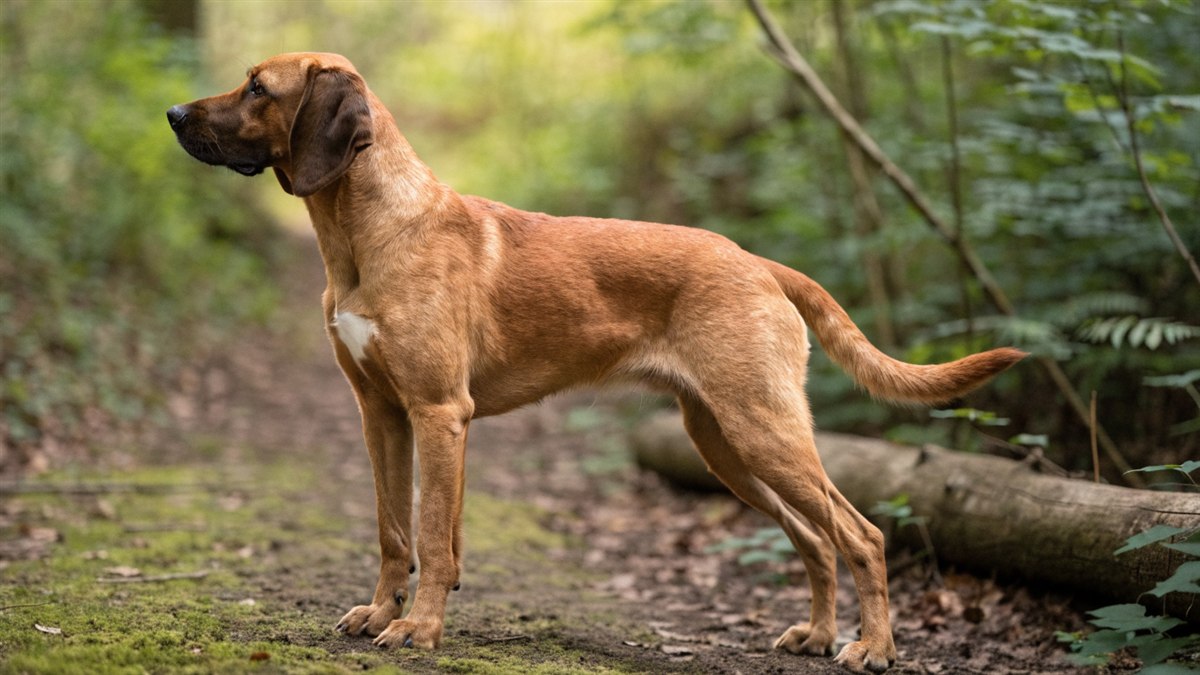
A Bavarian Mountain Hound is a medium-sized German leash hound bred to follow the blood trail of a wounded deer hours after the shot, registered as FCI-Standard No. 217 in Group 6, Section 2, Leash (scent) Hounds, and accepted by the FCI on a definitive basis on 14 November 1959.
The standard opens by calling the dog altogether balanced, somewhat light, very mobile and muscular, of medium size, which is a working description rather than a show one. The rest of it is short, specific and worth reading before any Indian buyer goes further. It fixes height at withers at 47 to 52 cm for males and 44 to 48 cm for females, and adds a sentence most breed pages drop: no departure from those figures is permitted in either sex. Ideal weight is 20 to 30 kg for males and 17 to 25 kg for females. The body is only slightly longer than high, the ratio of height to length of back running from 1:1.15 to 1:1.25, and the dog stands slightly higher at the rear on legs the standard calls not too long.
The German name says what the dog does. Bayerischer Gebirgsschweisshund breaks into Bavarian, mountain and Schweisshund, and Schweiss is the hunter's word for the blood of wounded game rather than sweat. The FCI's own utilization clause reads that the dog is a specialist for the search of hoofed game and that its usefulness must be confirmed by the relevant working trials. The nomenclature entry carries the same condition as a status line, marking the breed subject to a working trial. Very few breeds carry that requirement, and it is the single most important fact on the page.
The coat is harsh and dull, not glossy
The standard describes hair that is dense, close fitting and moderately harsh with little gloss, finer on the head and ear leathers and harsher and longer on the belly, legs and tail. Colour runs deep red, deer red, reddish brown, tan, clear fawn to biscuit, or reddish grey like a deer's winter coat, and may be brindled or shot through with black hairs. The muzzle and ear leathers are dark, and a small light chest patch called the Bracken Star is allowed. Black colour with red markings is a serious fault, so a black-and-tan dog sold as this breed is not this breed.
English Wikipedia describes the same coat as short, thick and glossy, which is the opposite of what the standard says, and it is the description most Indian pages have copied. The other recurring error is size. One India-hosted page lists the weight as 18 to 25 kg and the coat as "Short, Medium, carly"; a widely-cited breed database lists 44 to 55 pounds, or 20 to 25 kg, which quietly deletes the top 5 kg of a standard-sized male. Animal Jankari, 'Bavarian Mountain Hound… Dog Breeds List, 'Bavarian Mountain Hound -…
Where it came from, and why it is lighter than its parent breed
The breed was made after 1870 by Baron Karg-Bebenburg of Reichenhall, who crossed Hanoverian Scenthounds with red Mountain Scenthounds because the Hanoverian proved too heavy for steep ground. The standard's own history section explains the timing. After the revolution of 1848 the large hunting estates broke up, driven hunts gave way to stalking with better firearms, and the dog was needed after the shot rather than during the chase. The Klub fuer Bayerische Gebirgsschweisshunde was founded in Munich in 1912 and the standard names it the only recognised club for the breed in Germany. Verband fuer das Deutsche Hundewesen (VDH)
The size difference from the parent breed is still measurable in the two standards. FCI-Standard No. 213 puts the Hanoverian Scent Hound at 50 to 55 cm and 30 to 40 kg for males, against 47 to 52 cm and 20 to 30 kg here, and gives it a body length to height ratio of 1.4 to 1 against a maximum of 1.25 to 1 for the Bavarian. The Bavarian is the lighter, shorter-coupled mountain version of the same job. Federation Cynologique Internationale
| Clause | What the standard says |
|---|---|
| Standard number | No. 217, Group 6 Scenthounds and related breeds, Section 2 Leash (scent) hounds |
| Utilization | Specialist for the search of hoofed game, usefulness confirmed by working trials |
| Height at withers | Males 47-52 cm, females 44-48 cm, no departure permitted |
| Weight | Males ideally 20-30 kg, females ideally 17-25 kg |
| Coat | Dense, close fitting, moderately harsh, with little gloss |
| Ears | Heavy, set on high and broad, rounded at tips, hanging close to the head |
| Temperament | Calm and balanced, devoted to owner, reserved with strangers, biddable |
| Tail | Medium length, at most to the hocks, carried horizontal or slightly down |
Two clauses in the standard matter for anyone reading an Indian sales listing. The tail is natural and medium length, so a docked dog is not standard, and there is no cropping clause at all because the ears hang. Both procedures are separately prohibited in India, which the Dobermann guide covers in detail. Prevention of Cruelty to Animals
Why this is a tracking specialist and not a pack hound
A Bavarian Mountain Hound works alone, on a long leash, on a cold blood trail that a wounded animal left hours earlier, which is a different job from what a pack scenthound does and produces a different dog.
The distinction is written into the FCI's own classification. Group 6 splits into Section 1 for scent hounds, the pack breeds that run a live line in cry, and Section 2 for leash hounds, of which there are only three. This breed sits in Section 2 with the Hanoverian Scent Hound and the Alpine Dachsbracke. A Beagle or a Basset Hound is a Section 1 pack animal; this dog is not.
The standard's history clause explains the split in the dogs' own terms. All leash hounds descend from the Bracken, and from those pack hounds the calmest and most biddable were selected to work on the leash and find the lost trail of hunted game. From that group came the Leithunde, which work only natural cold scent, and the Schweisshunde, the dogs that work the trail of wounded game. Selection ran toward calm, persistence and biddability rather than pack drive and voice.
What the working trial actually tests
Slovakia's club publishes the clearest description of the standard, because it lists what a dog must pass before it may breed. A Bavarian Mountain Hound there needs a pass at first or second prize in the PF, the preliminary blood tracking test, and a pass at first or second prize in the IHF, the individual main test worked on a real wounded animal, and it must demonstrate loud driving and the holding of wounded game at that test. A club officer or supervisory board member attends the IHF as a witness.
That is not a temperament rosette. It is a working examination on a live case, and it is why the FCI marks the breed subject to a working trial while most show breeds carry no such condition. Klub chovatelov farbiarov (Slovakia)
The trail is old, cold and long
Finland's Kennel Club-approved breeding programme spells out how the breed-specific test differs from an ordinary tracking test. Across central Europe the dedicated Bavarian trial uses a longer and older track than a general tracking test, with more and harder events along it, and foreign versions often add an obedience element. In Sweden and Norway the breed has its own Elitspar test on top of the all-breed Viltspar. Finland's own MEJA test has two classes, and the VAHI test additionally assesses handler and dog together, with the handler formally consenting to be called out by the authorities to track wounded deer.
The same document says that experienced handlers advise against putting this breed on roe deer, because roe are common and their scent is strong, which would coarsen a dog selected for discrimination on a faint line. That is the kind of detail that only exists in a working culture.
A dog selected for four generations to follow a faint blood trail for kilometres, alone, and then to hold a wounded animal at bay does not become a low-drive flat dog because it lives in a flat. The Finnish breeding programme states it plainly: as a companion and pet only, the Bavarian is not the best choice.
The scale of real working use is also documented rather than assumed. Germany keeps the breed almost entirely in its original job with professional hunters and gamekeepers, and the rising hoofed-game population there is the stated reason more Schweisshunde are needed. In Finland, where the breed is far more often a pet, only 34.3 percent of the tracking-active owners reported doing large-game official assistance work and 28.6 percent had actually tracked a wounded deer. Suomen Bassetkerho ry
Who is allowed to buy one, and who imposes that rule
The German parent club releases Bavarian Mountain Hounds only to hunters, and it says so in one sentence on the German Kennel Club's own register, which is the single most decision-relevant fact for an Indian reader and appears on no page currently ranking for this breed.
The Verband fuer das Deutsche Hundewesen publishes the club profile of the Klub fuer Bayerische Gebirgsschweisshunde 1912 e.V. on its official puppy portal. Two lines in it settle the question. "Die Mitgliedschaft ist Voraussetzung fuer den Erwerb eines Hundes", membership is a precondition for acquiring a dog. And "Bayerische Gebirgsschweisshunde werden ausschliesslich nur an Jaegerinnen und Jaeger mit ausreichenden Einsatzmoeglichkeiten abgegeben";, Bavarian Mountain Scent Hounds are given exclusively only to huntresses and hunters with sufficient opportunities to deploy them.
The club is not a hobby society issuing a preference. The same profile states it is the only recognised and studbook-keeping club for the breed in Germany, has over 900 members and is organised into eight regional groups specifically so that animal-welfare-compliant Nachsuche can be guaranteed across the country. It belongs to the JGHV hunting-dog federation, the ISHV, the VDH and the FCI, and it founded the ISHV in Leipzig on 19 July 1930 together with the Verein Hirschmann and the Austrian and Hungarian clubs.
The rule is not only German
Slovakia goes further and ties breeding rights to ongoing work. Clause VI of the Klub chovatelov farbiarov breeding conditions lets the breeding adviser suspend or permanently exclude dogs whose owners do not report their searches, and states that a dog with no recorded wounded-game searches in the last two calendar years will not be issued a mating recommendation, for dogs and bitches alike. Poland's club sits inside the Polish Hunting Association and describes itself as an association of owners of working Hanoverian and Bavarian scenthounds.
Finland's breeding programme records what happens where the rule is loosest. In countries outside the ISHV the breed is increasingly a companion or show dog, and Poland is named as the exception inside the system, with roughly 100 club members and many breeders working outside the club entirely. The same document lists finding suitable homes as one of the breed's stated challenges, because a home has to let the dog behave like the breed.
| Body | Condition on getting or breeding a dog |
|---|---|
| KBGS, Germany | Club membership required to acquire a dog; puppies released only to hunters with sufficient deployment |
| KCHF, Slovakia | PF and IHF working passes, hips A or B, DNA profile, and documented searches within two years |
| Klub Posokowcow, Poland | Club of owners of working scenthounds, inside the Polish Hunting Association |
| ISHV | Fourteen national clubs plus Norway provisional and Romania as guest, all European |
| India | No club, no ISHV member, and no lawful hunting use for the dog to be deployed on |
The practical consequence for India is not a shortage. It is a closed door. A buyer in Pune cannot satisfy a condition that requires a German hunting licence and a hunting ground, so the lawful supply of registered puppies from the breed's own registry is not restricted to Indian buyers, it is unavailable to them. Any Indian listing offering the breed is therefore, by definition, outside that system. Internationaler Schweisshundeverband
The job this dog does is unlawful in India
India prohibits the activity the Bavarian Mountain Hound exists to perform, so the breed arrives here with no legal function, and that is a stronger constraint than climate, price or availability.
Section 9 of the Wildlife (Protection) Act, 1972 reads "No person shall hunt any wild animal specified in Schedule, I, II, III and IV except as provided under section 11 and section 12." Section 2(16) defines hunting broadly enough to cover exactly what a tracking hound does. It includes capturing, killing, poisoning, snaring and trapping any wild animal and every attempt to do so, and separately includes driving any wild animal, and injuring or destroying or taking any part of the body of such an animal.
Put those two clauses next to the FCI utilization clause and the conflict is direct. The standard defines the dog as a specialist for the search of hoofed game whose usefulness must be confirmed by working trials, and the Slovak breeding conditions require it to demonstrate loud driving and the holding of wounded game. Driving a wild animal is named in the Indian definition of hunting. India's deer, antelope and wild pig are scheduled species, so there is no ordinary route by which a private owner may lawfully put this dog on a wild ungulate. Klub chovatelov farbiarov (Slovakia) The Wildlife (Protection) Act
Section 9 carves out only what sections 11 and 12 permit, which are narrow official permissions rather than a sporting licence. Nothing in this guide should be read as advice that any private hunting use is available in India. If a state forest department engages tracking dogs, that is a departmental matter, not a route to owning one.
The 2017 Rules also bite on how the breed is maintained
The Prevention of Cruelty to Animals (Dog Breeding and Marketing) Rules, 2017 were read here from the machine-readable gazette text of G.S.R. 496(E) rather than from a summary. Second Schedule Part II paragraph 6(3) prohibits in breeding and incest breeding outright, defining in breeding as mating between relatives of the second to fourth grade in straight or side line within the first four generations, and naming uncle to niece, nephew to aunt and cousin to cousin. Only out breeding and line breeding are permitted.
That clause matters for this breed specifically. Finland's breeding programme records litters born between 2010 and 2024 with inbreeding coefficients ranging from 0.00 to 17.60 percent, a fifteen-year mean of 6.10 percent, and litters in the breed's history reaching 25 percent. A coefficient of 6.25 percent is a cousin mating, and 25 percent is a father-to-daughter equivalent. Breeding practice that is normal management in a tiny European population would be unlawful if reproduced in India. Prevention of Cruelty to Animals
Three further provisions apply to anyone who did somehow acquire the breed here. Rule 8(1)(a) prohibits selling pups less than eight weeks old, and rule 8(1)(b) prohibits selling a dog over six months old without first sterilising it unless the buyer is another licensed breeder. Second Schedule Part II paragraph 6(8) forbids tail docking, ear cropping, de-barking, de-clawing and any other mutilation or change of appearance by artificial means, and paragraph 6(9) prohibits breeding to create new breeds or unusual looks.
Part III paragraph 8(10) requires breeding dogs to have been tested for genetic defects including hip dysplasia, progressive retinal atrophy, night blindness, hypothyroidism, entropion, ectropion, overshot and undershot jaw, wry mouth, two or more missing teeth, and unilateral or full cryptorchidism. That list maps almost item for item onto this breed's own disqualifying faults and known problems, since FCI-217 disqualifies ectropion, entropion, incorrect bites and missing teeth, and the Finnish club reports that cryptorchidism occurs regularly in the breed. Federation Cynologique Internationale Suomen Bassetkerho ry
Bavarian Mountain Hound price in India, and why no rupee figure exists
No verified Bavarian Mountain Hound price in India exists, because there is no Indian market for the breed to have a price in. Every number circulating as an Indian price is a US dollar figure that was never converted, and the arithmetic proves it.
Start with the only India-hosted page that ranks for this query. It answers the question "What is the price of a Bavarian mountain hound?" with the sentence that one "may be purchased from a breeder for roughly $800". That is a dollar figure, on a page whose own keyword footer targets "Bavarian Mountain Hound price in india" and "Bavarian Mountain Hound Dog Lowest Price In India". The page never converts it, never mentions a rupee, and never names an Indian seller.
Do the conversion the page did not do. At 84.38 rupees to the dollar, the arithmetic runs the other way too, which is how you catch a converted figure masquerading as market data.
| Published figure | Source | Rupees at 84.38 | What that tells you |
|---|---|---|---|
| $800 | India-hosted breed page | Rs 67,504 | A round dollar number, not an Indian quote |
| $1,000 | Breed database low end | Rs 84,380 | A round dollar number |
| $1,500 | Breed database high end | Rs 1,26,570 | A round dollar number |
| Rs 15,000-60,000 | Indian Beagle price band | n/a | What a real Indian scenthound band looks like |
| No figure | Supertails 40+ breed India price list | n/a | The breed is absent from the list entirely |
The reverse test is the useful one. If an Indian page ever quotes you Rs 67,504, Rs 84,380 or Rs 1,26,570 for this breed, divide by 84.38 and watch a round dollar amount fall out. A genuine Indian price never does that, because Indian sellers quote in round rupees, which is why the real Beagle band on the same market runs Rs 15,000 to Rs 60,000 rather than Rs 84,380. Supertails, 'Dog Price List in India
The largest Indian price list does not contain the breed
Supertails publishes what it calls the most comprehensive breed price table available in India for 2026, covering more than forty breeds and compiled from breeder networks, KCI registration data and online marketplace surveys conducted in the first quarter of 2026. It prices the Weimaraner at Rs 50,000 to Rs 1,50,000 and the Siberian Husky at Rs 40,000 to Rs 1,50,000. The word "Bavarian" does not appear anywhere on that page. When the country's largest commercial price list omits a breed, that is not an oversight, it is the market telling you the breed is not traded here.
The price you would actually pay is an import bill, not a puppy price
There is no lawful commercial import route. DGFT Trade Notice 22/2022-23 places ITC (HS) 01061900 under Restricted, and Policy Condition 7 allows dog imports only for a pet dog with a valid pet book in the importer's own name, for R&D organisations with a CPCSEA recommendation, or for Defence and Police internal security. Policy Condition 8 states that import of commercial dogs for breeding or any other commercial activity is not permitted, and paragraph 6 states that any applications for trading or breeding purposes, or made on behalf of another person, shall be duly rejected.
So the only door is the personal pet route, and it is narrow. Import as passenger baggage without DGFT authorisation is available only to a person transferring residence to India after two continuous years abroad, for up to two pets. Anything else needs an import authorisation applied for through the DGFT portal, entry is limited to the six ports the DGFT notice names, Delhi, Mumbai, Chennai, Hyderabad, Bangalore and Kolkata, and an advance No Objection Certificate must be obtained from the AQCS quarantine officer seven days before travel. Applicants are advised to start two months ahead.
So there is no affordable route and no expensive one either, because there is no route. The question an Indian buyer should ask is not what the breed costs but whether the dog in front of them is the breed at all.
Bonbeno found no Indian breeder, no Indian rescue and no Indian rupee price for this breed. The single India-facing page ranking on the query is titled "Bavarian Mountain Hound Dog Rescue Groups In India" and names no Indian rescue group at all. Treat any Indian listing using this name as unverified until the seller shows an FCI export pedigree, a DGFT import authorisation and an AQCS clearance in the dog's own paperwork.
Monthly cost of ownership in India, honestly bounded
Budget the monthly cost of a 20 to 30 kg working hound rather than a breed-specific figure, because no Indian cost data exists for this breed and inventing one would be worse than saying so.
Two things are known and one is not. The known part is the size class. FCI-Standard No. 217 puts an adult male at 20 to 30 kg and a female at 17 to 25 kg, which places the breed in the same feeding bracket as a large Beagle or a small Labrador Retriever. The other known part is the Indian market rate for keeping a dog of that size. What is not known is any breed-specific Indian figure, and no page should pretend otherwise.
Supertails, drawing on Indian breeder networks and marketplace surveys in the first quarter of 2026, puts monthly upkeep for a dog in India between Rs 3,000 and Rs 18,000 depending on size and grooming needs, and a realistic first-year total between Rs 80,000 and Rs 2,00,000 including vaccinations, food, training and supplies. A short-coated 25 kg hound sits in the middle of that range on food and near the bottom on grooming.
| Line item | Monthly range | Note |
|---|---|---|
| Food | Rs 3,000-7,000 | Scales with the 20-30 kg adult weight in the standard |
| Tick and flea control | Rs 400-1,200 | Non-optional given documented Indian tick-borne disease pressure |
| Ear care | Rs 200-600 | Heavy pendulous ears in a monsoon climate |
| Routine vet and deworming | Rs 500-1,500 | Excludes any illness |
| Grooming | Rs 0-800 | Coat is short and close; the Royal Kennel Club rates it once a week |
| Exercise-related costs | Rs 500-2,000 | Long-line, harness, travel to space to work the dog |
| Total, routine month | Rs 4,600-13,100 | Before any imported medication or specialist care |
Two Indian line items are genuinely higher for this breed than for an average pet. The first is parasite control. A 2024 multiplex PCR survey of 719 canine blood samples in Punjab found Babesia gibsoni in 8.9 percent, Hepatozoon canis in 5.1 percent, Ehrlichia canis in 2.6 percent and Babesia vogeli in 1.1 percent, and a dog worked through undergrowth meets more ticks than a dog walked on pavement.
The second is ear care. The Finnish breeding programme names the breed's large, heavy, pendulous ear leathers as an anatomical trait that predisposes to ear disease, because air cannot circulate and the surface becomes a growth medium for bacteria and yeast. In Jabalpur, a screen of 651 dogs with skin signs found 92 cases of otitis externa, an occurrence of 14.13 percent, with the highest number of cases recorded during the monsoon months of July and August. Budget for ear cleaner as a standing item, not an occasional one. Singh S, Tiwari A, Das G, Gupta DK
The costs nobody prints
A one-off import bill dwarfs the monthly figures and is not a puppy price. It combines a DGFT import authorisation application, an AQCS advance No Objection Certificate obtained seven days before travel, possible quarantine at one of the seven permitted ports, an export health certificate with all disease testing done in the exporting country, and air transport for a 25 kg dog in a crate. None of those has a published flat rate, so this guide gives no total rather than a plausible one.
For the money and effort this breed would cost to bring into India lawfully, an Indian buyer can keep an adopted Indian Pariah Dog or a Mudhol Hound for years, in a coat and body built for this climate, with a vet in every city who has seen the breed before.
Suitability for the Indian climate
Rate the Bavarian Mountain Hound's heat tolerance at 2 out of 5 for India, because the standard selects for a protective weatherproof coat and for sustained endurance work, and only the head structure keeps the rating off the floor.
Two clauses in the standard do the work. The coat clause specifies hair that is dense, close fitting and moderately harsh, and the serious-faults list makes a too fine or too thin coat a serious fault. The Finnish breeding programme states the reason plainly: the coat has to be protective and weather-resistant, so a coat of too fine a quality is penalised. This is a dog whose registry actively breeds against a thin coat, in a country whose Alpine working season runs from autumn into snow.
The size clause adds the second half. A 20 to 30 kg body has a low surface-area-to-mass ratio, and mass is a documented risk factor. The VetCompass study of 905,543 UK dogs found that higher bodyweight relative to the breed and sex mean, and being over two years of age, were both significant risk factors for heat-related illness, alongside brachycephalic skull shape and a weight above 50 kg. Federation Cynologique Internationale
The head is the one thing in the dog's favour
The standard gives a muzzle of equal length or slightly shorter than the skull, sufficiently broad and never pointed, with a nose of good size and well-opened nostrils. That is a mesocephalic head, and it means a full-length nasal turbinate surface for evaporative cooling. This breed is not brachycephalic, so it does not carry the specific airway penalty that put the Chow Chow, Bulldog and French Bulldog at the top of the UK risk list. That is why the rating here is 2 and not 1. Hall EJ, Carter AJ
The number that should worry an Indian buyer
The 2022 VetCompass follow-up found that the median ambient temperature on days when UK dogs suffered heat-related illness was 16.9 degrees Celsius, and that the majority of events overall were triggered by exertion rather than by being shut in a vehicle. Dogs were collapsing at temperatures an Indian city would call a pleasant winter morning, while doing what they were bred to do.
Set that against the India Meteorological Department's own thresholds. A heat wave is not even considered on the plains until a station's maximum reaches 40 degrees, it is declared at a departure from normal of 4.5 to 6.4 degrees or an actual maximum of 45 degrees, and severe heat wave begins at 47 degrees. Coastal stations get a heat wave description at 37 degrees with a 4.5 degree departure. Delhi, Nagpur, Ahmedabad and Hyderabad cross those numbers every year.
| Place | Verdict | Why |
|---|---|---|
| Ooty, Gangtok, Shimla, Munnar | Workable | Hill-station maxima sit below the IMD's 30 degree hilly-region heat-wave floor for most of the year |
| Pune, Bengaluru | Manageable with discipline | Dawn and post-dusk work only, no midday exertion, from March onward |
| Mumbai, Chennai, Kochi | Unfair to the dog | Coastal humidity blocks evaporative cooling at the IMD's 37 degree coastal threshold |
| Delhi, Nagpur, Ahmedabad, Jaipur | Unfair to the dog | Routine 45 degree plains maxima against a coat bred against thinness |
A short, close, moderately harsh coat is a heat shield as well as a cold one, and clipping it exposes dark, thinly-haired skin to direct Indian sun. The dog stays heat-sensitive either way. Manage heat by moving the work to dawn, shortening it, and giving shade and water, not by removing coat.
The practical rule for an Indian owner is simple. Do the day's exercise before sunrise, treat any panting that does not settle within a few minutes of stopping as an emergency, and accept that between March and October in most of the country this dog cannot be worked the way it was designed to be worked at all. India Meteorological Department
The monsoon and the heavy hanging ear
Check this breed's ears twice a week from June to September, because the standard requires exactly the ear shape that Indian monsoon conditions punish, and the breed's own registry names it as a disease-predisposing trait.
The standard is unambiguous about the ear. It is somewhat over medium length but at most reaching the nose, heavy, set on high and broad, rounded at the tips, hanging close to the head without any twist. Finland's breeding programme adds what breeders do with that clause in practice, noting that the longest and thickest ear leathers are favoured, and states directly that this anatomical trait increases ear disease because the ear cannot ventilate, leaving a surface where bacteria and yeast overgrow. Repeated outer-ear infection then thickens the canal walls, which narrows the canal further.
Now put that ear in an Indian July. The Jabalpur epidemiological study screened 651 dogs showing dermatological signs and found 92 positive for otitis externa, an occurrence of 14.13 percent, with the highest number of cases recorded during the monsoon season of July and August. Highest occurrence fell in dogs of three to six years, and the most affected breed was the Labrador Retriever, another drop-eared dog.
The same paper reports bilateral otitis at 61.04 percent and unilateral at 38.06 percent, which sum to 99.1 rather than 100. Bonbeno reports the monsoon peak and the 92 of 651 occurrence, which divides out exactly to 14.13 percent, and flags the bilateral pair as not fully reconciling rather than quoting it as settled.
What the breed's own numbers say
Ear infection is documented in the breed at low but persistent rates in three countries. Finland's 2024 owner survey of 62 dogs found repeated or chronic outer-ear infections in 3 dogs, 4.8 percent. Sweden's 2022 survey of 110 owners reported ear infection in 6 dogs, 5 percent, and Britain's 2024 survey of 72 owners reported it in 1 dog, 1 percent. Those are northern European climates. None of them tests the ear against 90 percent relative humidity for three months.
The Finnish document also warns that repeated ear infections can signal allergy or atopy, and instructs that such a dog must not be bred from. For an Indian owner the practical read is different: recurrent otitis here is far more likely to be humidity and water than atopy, so the first response is drying and ventilation rather than an allergy work-up.
- Check both ears every third day through the monsoon, and weekly the rest of the year.
- Dry the ear canal opening after any swim, bath or heavy rain, before the dog shakes and drives water inward.
- Clean only with a veterinary ear solution, never with a cotton bud, which pushes debris deeper into the L-shaped canal.
- Treat head shaking, malodour, head tilt or scratching at one ear as a vet visit, not a wait-and-see.
- Lift and air the leathers for a few minutes daily in humid weather, which costs nothing and does more than any product.
One overseas instruction does not transfer. Northern European grooming advice routinely says to towel a working dog and let it air dry after water work. In a Bavarian autumn that is fine. In an Indian monsoon, where a published Indian series puts the otitis peak squarely in July and August, air drying a heavy hanging ear leather is how the infection starts. Dry the ear deliberately, every time. Suomen Bassetkerho ry
Temperament, and the household this breed actually suits
The Bavarian Mountain Hound is calm and balanced at home, deeply attached to one person and reserved with strangers, and the surveyed problem in the breed is not aggression but separation anxiety, which is precisely the wrong trait for Indian apartment living where the dog is alone all day.
The standard sets the target. Calm and balanced, devoted to his owner, reserved with strangers, and required to be sound, self-assured, unafraid and biddable, neither shy nor aggressive. Aggressive or overly shy dogs are a disqualifying fault, as is any dog clearly showing behavioural abnormalities. That is a narrow, demanding specification for a hunting dog.
Owner data broadly matches it. In Finland's 2024 survey of 62 dogs, 71 percent of respondents, 44 dogs, reported no behaviour problems of any kind, and anger toward people was reported in zero dogs. Sweden's 2022 survey of 110 owners found 53.6 percent of dogs open and friendly toward strangers and 65.5 percent open and friendly toward children, with aggression toward strangers at 1.8 percent and toward children at 0.0 percent.
| Trait reported | Dogs | Percent |
|---|---|---|
| No behaviour problems at all | 44 | 71.0 |
| Shyness or fear | 6 | 9.7 |
| Separation anxiety | 6 | 9.7 |
| Anger toward other dogs | 4 | 6.5 |
| Fear of loud noises, fireworks, thunder | 3 | 4.8 |
| Unpredictability | 3 | 4.8 |
| House-soiling | 1 | 1.6 |
| Anger toward people | 0 | 0.0 |
The separation anxiety figure is the one that matters in India
Nine point seven percent of the Finnish dogs showed some degree of separation anxiety when left alone, and the club records that every affected dog was a bitch and that two thirds of them lived in a household with two or three dogs, so company alone did not fix it. Breeders questioned in the same exercise singled out sensitivity and attachment to people as stronger in this breed than in other, more independent working breeds, and the club instructs breeders to specifically coach new puppy buyers on teaching the dog to be alone.
Apply that to the standard Indian professional household. The dog is alone from nine to seven in a flat with neighbours on three sides, and the reported signs are howling, frustration and destruction of furniture. This is a hound that gives tongue on a trail for a living. A dog that vocalises for eight hours in a Mumbai housing society is not a training problem you solve later, it is a housing decision you make first.
Skip it if you live in a flat with no access to daily off-lead scenting ground, if the dog will be alone all day, if you want a first dog, if you want a dog that greets your visitors warmly, or if you are anywhere in the plains where March to October rules out real exercise. The breed's own Kennel Club-approved breeding programme states that as only a companion and pet, the Bavarian is not the best choice.
Who it does suit is narrower than any English breed page admits. A hill-station household with land, someone at home most of the day, an owner who will do a scent sport several times a week, and a tolerance for a dog that decides slowly about strangers. Finnish breeders describe exactly that pattern, saying the dog rarely accepts anyone immediately and needs its own space, but that once an individual is accepted the decision is usually permanent.
Training, and the two things this breed resists
Train a Bavarian Mountain Hound through its nose rather than against it, because the standard calls it biddable but the breed was selected to work independently and decisively in the forest, and it resists recall off a live scent and repetitive obedience drilling.
Start from what the registry says the dog is. The Finnish breeding programme, quoting the standard and the breed description together, calls the breed especially keen and very sure on the trail, working independently and purposefully in the forest, and describes the dogs as intelligent, inventive, persistent and hardy, and as independent yet still obedient. Those two words sit in tension, and every training decision lives in that tension. The breed is trainable, but only on its own terms.
Resistance one, recall on a live line
A dog bred to hold a trail for kilometres does not abandon it because a human calls. This is not defiance, it is the selected behaviour, and Slovakia's breeding conditions reward it by requiring a first or second prize on a real wounded-animal search before a dog may breed at all. Plan for a long line rather than for perfect off-lead recall in scent-rich ground, and do off-lead work in enclosed space.
Resistance two, drilled obedience for its own sake
Finland's data shows what this breed will and will not do. Across 2015 to 2024 only two bitches took the formal Finnish temperament test, scoring 95 and 80 points, and only one dog has ever completed an MH description. That is 2.2 percent of the population, and the club states outright that no conclusions about the breed's character can be drawn from so few tests. Meanwhile the same owners entered blood-tracking trials 180 times in that decade. Owners take this breed to the thing it was built for.
The club's own assessment is blunter still. It records that for goal-directed competition and chasing results in sports other than the breed-specific ones, the Bavarian may be challenging, because of its independent character and its hunting tendencies. Outside the hunting season it motivates best in activities that use its nose.
| Measure | Figure |
|---|---|
| Total trial starts across the decade | 180 |
| Approved results | 139 |
| Zero results or retirements | 41 |
| First prizes, VOI (higher) class | 50 |
| First prizes, AVO (open) class | 37 |
| Busiest year, 2023 | 11 dogs, 44 starts |
| Maximum share of the population entering per year | About 9 percent in VOI, 8 percent in AVO |
Two readings follow. The pass rate is high, 139 approved from 180 starts, so dogs that are entered generally do the job. But under a tenth of the population competes in any given year, so the trial numbers describe committed handlers rather than the breed at large. Do not read a 77 percent approval rate as a claim about the average pet.
What actually works
- Socialise hard and early, because shyness and fear were reported in 9.7 percent of Finnish dogs and the standard disqualifies an overly shy dog.
- Teach settled alone-time from week nine, since the club instructs breeders to coach buyers on exactly this.
- Build every obedience behaviour as an interruption of a scent task rather than as a separate discipline.
- Keep sessions short and end them on a find, because a found article is the reinforcer this breed was bred for.
- Accept a long line for life in open ground, and stop treating that as a training failure.
In India the substitute for real work is scent work. Track-and-search games, mantrailing on a laid human track, and article searches in the garden at dawn all use the same machinery lawfully. Finnish owners already do this: 62.9 percent of them do some form of tracking, and 5.7 percent have trailed people rather than deer.
Daily exercise requirement, and what happens without it
Give a Bavarian Mountain Hound more than two hours of exercise a day, which is the Royal Kennel Club's own rating for the breed, and understand that the hours have to include scent work rather than pavement walking.
The Royal Kennel Club's breed characteristics table is unusually direct for this breed. Exercise is rated more than 2 hours per day, the town or country field reads Country, and the size of garden field reads Large garden. A national kennel club does not print "Country" for a dog that does well in a city. It also rates size of home as small house, which tells you the dog is compact indoors and demanding outdoors, a combination Indian buyers consistently misread.
The standard explains why the requirement is so high. The gait clause calls for ground-covering movement with good reach in front and strong drive from the rear, and names the preferred movement in action as walk and gallop, with nothing in between. This is an animal built for a slow working pace over long distance punctuated by bursts, in mountain terrain, and the specialisation clause requires it to be useful on the more difficult searches.
Two hours of walking is not two hours of exercise
Scent work fatigues a tracking hound faster and more completely than distance does, and this breed's registry treats the nose as the primary engine. Finland's owners bear that out. Of the 62 households surveyed, 62.9 percent do tracking of some kind, 44.3 percent do shows, 21.3 percent do rally or obedience, 18 percent hunt, 14.8 percent do nosework, and only 1.6 percent of dogs, a single dog, had no activity at all. Of the tracking-active owners, 94.3 percent work blood tracks specifically.
| Session | When | What |
|---|---|---|
| Morning, 45-60 min | Before sunrise | Long-line walk on varied ground, plus one laid track |
| Midday | None | Rest indoors on a cool floor, no exertion at all from March to October |
| Evening, 45-60 min | After dusk, once surfaces are cool | Second walk, article searches, scatter feeding |
| Twice a week | Dawn | Longer aged track of 400-800 m, laid the night before |
| Weekly | Dawn, out of the city | Off-lead work in enclosed or remote ground |
That schedule exists because of the exertion finding, not because of fussiness. The VetCompass work reports that the majority of heat-related illness events in UK dogs were triggered by exertion, at a median ambient temperature of 16.9 degrees Celsius. An Indian owner who takes a working hound out at 8 am in April is exercising it above every temperature in that dataset. India Meteorological Department
What under-exercise looks like in this breed
It does not look like hyperactivity. It looks like the specific list Finnish owners reported: howling, frustration, destruction of furniture and objects when left alone, which the club notes became more prominent after the pandemic when dogs were left alone again. Separation problems affected 9.7 percent of the dogs surveyed. An under-worked hound of this type converts unused drive into vocalising and chewing, which in an Indian housing society becomes a neighbour problem within a month.
Ask yourself whether you can deliver two hours daily, split across dawn and after dark, every day of the year, including monsoon weeks when the ground is flooded. If the answer is no, the Royal Kennel Club's own rating has already answered the question for you.
Grooming and coat care in Indian humidity
Groom this breed once a week, which is the Royal Kennel Club's own rating, and spend the saved time on ears, feet and skin instead, because the short coat is the easiest thing about the dog and the humid skin underneath it is not.
The coat is genuinely low-maintenance. FCI-Standard No. 217 describes hair that is dense, close fitting and moderately harsh with little gloss, finer on the head and ear leathers and harsher and longer on the belly, legs and tail. The Royal Kennel Club rates grooming at once a week and coat length as short, and confirms the breed sheds. A rubber curry mitt and five minutes is the whole weekly job in a dry month. The Royal Kennel Club (United Kingdom)
The standard makes a too fine or too thin coat a serious fault, and the Finnish breeding programme explains why: the coat has to be protective and weather-resistant. Clipping a coat that has been bred for density removes a sun barrier over dark skin. Nothing about Indian heat is improved by shaving this dog.
Skin, not coat, is the Indian problem
The breed's largest published owner survey puts skin above coat in every count. In Finland's 2024 survey, skin problems or diseases including ears and paws were found in 8 dogs of 62, 12.9 percent, the single most common complaint recorded. Recurrent itching of paws or skin affected 6.5 percent of respondents, and repeated or chronic outer-ear infection 4.8 percent. Half the affected dogs first showed skin signs before one year of age.
Seasonality is the part that transfers to India directly. Four of the eight affected Finnish dogs, 50 percent, had symptoms that were stronger or more frequent in a particular season, and treatment ran to special diets in 71 percent of cases and allergy or atopy medication in 57 percent. Sweden's 2022 survey put skin disease at 2 percent of 110 dogs and Britain's 2024 survey at 7 percent of 72. Indian humidity, tick pressure and year-round warmth push in one direction from those baselines, not the other.
| Task | Frequency | Why |
|---|---|---|
| Curry mitt over the whole coat | Weekly | Short close coat, Royal Kennel Club rates grooming once a week |
| Ear check and dry | Every third day, June-September | Heavy pendulous ears; Indian otitis peaks in July and August |
| Between-toe check | Twice weekly | Paw and nail problems reported in 7 of 110 Swedish dogs, 6 percent |
| Tick sweep by hand | Daily after any grass or scrub | Documented Indian Babesia, Ehrlichia and Hepatozoon prevalence |
| Bath | Only when actually dirty | Frequent bathing strips a coat bred for weather resistance |
| Nail trim | Every 3-4 weeks | Standard calls for tight, well-arched toes; overgrown nails flatten them |
One overseas grooming instruction is wrong here and should be named. Northern European advice for short-coated working dogs commonly says to towel off and let the dog air dry after water work or a bath. Combine that with a heavy hanging ear leather and an Indian monsoon and you have manufactured the exact conditions the Finnish club describes, where air cannot circulate and yeast and bacteria overgrow. Dry the ear opening actively with cotton wool every time, and dry the armpits, groin and between the toes as well. Singh S, Tiwari A, Das G, Gupta DK
Tick and flea control is a grooming task in India rather than a veterinary afterthought. A dog worked through undergrowth in a country where a 719-sample Punjab survey found Babesia gibsoni in 8.9 percent and Hepatozoon canis in 5.1 percent of dogs needs a year-round product and a hand check after every session in cover.
Health risks, screening and the back problem nobody mentions
The Bavarian Mountain Hound's most common documented health issues are skeletal, and the reason is written into the standard, because a body 15 to 25 percent longer than it is tall places the breed among the mildly chondrodystrophic types with the disc degeneration that carries.
Finland's Kennel Club-approved breeding programme states the link directly. A dog whose body length exceeds height at withers by 15 to 25 percent belongs to the chondrodystrophic breeds, and the cause is the FGF4 retrogene on chromosome 12 that shortens the humerus, radius and ulna and bends the latter two. The standard asks for straight forelegs, but the club notes that mild bowing or twisting can appear because of the breed's history and this gene, and that twisted or bowed forelegs load the joints and can cause osteoarthritis. Federation Cynologique Internationale
The retrogene's effect on the spine is the serious part. The 2017 study that identified it reported an odds ratio of 51.23, with a 95 percent confidence interval of 46.69 to 56.20, for intervertebral disc disease in carriers across breeds. The Finnish club states the risk in a different form, that the CDDY mutation raises the risk of disc bulge, herniation and consequent surgery by five to ten times compared with dogs without the fault, and that disc degeneration begins as early as ten weeks of age. Those are two different comparisons, not two versions of one number.
The Finnish document reports that among gene-tested representatives of the breed so far, the CDDY frequency has been 100 percent and the dogs were homozygous, and it attributes that to Wisdom Panel. No sample size is given for that statement anywhere in the document. Bonbeno reports it because the club published it, and flags it as a claim without a denominator rather than as a breed prevalence.
What Finnish owners actually reported
| Finding | Dogs | Percent |
|---|---|---|
| Any musculoskeletal disease | 7 | 11.3 |
| Lameness or difficulty moving | 5 | 8.1 |
| Spinal disc herniation | 2 | 3.2 |
| Other symptomatic musculoskeletal disease | 2 | 3.2 |
| Symptomatic spondylosis | 1 | 1.6 |
| Hip dysplasia | 1 | 1.6 |
| Osteochondrosis, symptomatic | 1 | 1.6 |
| Osteoarthritis | 1 | 1.6 |
Read those as owner-reported counts in a small, young population, not as prevalence. Sixty-two percent of the surveyed dogs were under four years old, and the club warns that the young age profile may suppress the apparent frequency of some diseases. The club's own summary names the mildly chondrodystrophic structure and the spinal degeneration it brings as the breed's most common current problem, and recommends that breeding dogs be radiographed for skeletal status.
Hip screening, and what a real requirement looks like
Slovakia sets the strictest published bar. A Bavarian Mountain Hound there cannot enter breeding without a negative hip dysplasia radiograph, where negative means grade A or B only, taken at a minimum age of 12 months, with the owner paying for the examination. Finland runs no such rule: the breed is not in the Finnish Kennel Club's PEVISA screening programme at all, so no compulsory hip, elbow or eye screening applies there. Two ISHV-linked countries, two entirely different evidence bases. Suomen Bassetkerho ry
The Orthopedic Foundation for Animals disease-statistics page was retrieved on 20 August 2026 and returned only the placeholder line "Searching Database, Please wait." Its tables load from wp.ofa.org, which timed out on two separate connection attempts. No breed code could be read from OFA's own markup, so no OFA hip, elbow or eye percentage appears on this page. Guessing a code is how other pages end up publishing a different breed's numbers.
One rare finding is on the record and belongs here because it is properly published. A 2018 case series reported five new cases of canine hypospadias, one of them a Bavarian Mountain Hound with the perineal type. The same paper searched 19,950 male dog records from one Polish clinic between 2006 and 2017 and found 10 penile hypospadias cases, 0.05 percent, so this is a single case report rather than a breed risk.
Epilepsy, eyes and the diseases the registries are acting on
Epilepsy is the Bavarian Mountain Hound's most serious health problem worldwide, according to the breed's own Kennel Club-approved breeding programme, and three national clubs have written formal breeding measures against it.
The Finnish document is explicit. Its summary of the breed's key health problems states that the breed's most serious health problem worldwide is epilepsy, while adding that reported occurrence in Finland itself is low. That sentence is the single most important health statement published about this breed anywhere, and no English-language breed page carries it.
| Survey | Respondent dogs | Epilepsy cases | Percent |
|---|---|---|---|
| Britain 2024 | 72 | 11 | 15 |
| Sweden 2022 | 110 | 1 | 1 |
| Finland 2024 | 62 | 1 | 1.6 |
| Slovakia 2023, club report | not stated | 1 confirmed | not calculable |
The British figure is the outlier and it divides out exactly: 11 of 72 is 15.3 percent. Treat it with care rather than as a prevalence. These are voluntary owner surveys, an owner whose dog has a seizure disorder has more reason to respond than one whose dog is well, and the same British survey found that only 6 of the 72 dogs, 8 percent, had never been ill at all. What the three surveys agree on is that epilepsy is present in the breed across countries, not that 15 percent of the breed is affected.
Finland's own detail is more granular. Three dogs of 62, 4.8 percent, had a neurological disease of some kind; epilepsy was diagnosed in 1 dog, 1.6 percent, aged five to six at onset, and epilepsy-like convulsions, absence episodes or tremor episodes in 2 more, 3.1 percent, aged one to two at onset.
What the clubs have actually done about it
Slovakia's measures are the most detailed and are dated. Following the club conference of 26 March 2022, a commission that included a Diplomate ECVN veterinary neurologist set rules in force from 1 November 2022. Affected individuals are recorded and may not be used for breeding, parents whose puppies developed epilepsy have their breeding rights suspended, and full siblings of an affected dog may breed only after reaching five years with no epileptic signs. Breeding age for both sexes was raised to three years. On 21 August 2022 the club suspended the breeding rights of every descendant of one named stud dog, after epileptiform signs appeared in his dam and granddam.
Germany went at it with population genetics instead. The Finnish document records that in 2006 a genotype-probability calculation was performed for the breed in Germany as part of the breeding-value estimation programme, and that since then only matings with a risk factor below 2.5 percent have been made. Slovakia additionally caps lifetime offspring at 27 puppies per bitch and 50 per stud, rising to 36 and 70 for dogs with a higher working qualification.
Eyes, and a denominator worth seeing
Finland's official eye-examination record for this breed since the year 2000 is two dogs, one in 2012 and one in 2024, with no hereditary eye disease found in either. That is the entire official dataset, and it is why the club describes the breed as relatively healthy for eyes while conceding it cannot say much. Owner-reported eye problems ran to 5 percent of respondents.
Switzerland took a different view. At the 2023 meeting of ISHV breeding directors, the head of the Swiss breeding committee reported a case of primary closed-angle glaucoma in which the dog lost its sight, and as a precaution the Swiss club now requires compulsory eye examinations of breeding dogs. Polish owners have separately reported glaucoma cases in which one or both eyes had to be removed.
The Finnish document links cherry eye in this breed to a retrogene fault "in the same gene as chondrodystrophy", citing Freyer et al. 2024. That paper locates the cherry-eye signal on canine chromosome 18, at the FGF4L1 insertion, while the same document places this breed's chondrodystrophy at the FGF4 retrogene on chromosome 12. Those are two different insertions, so the inference does not automatically transfer to this breed. Bonbeno reports the cherry-eye observations as observations, not as a genetic finding about the Bavarian Mountain Hound.
Life expectancy, audited figure by figure
Published life expectancy for the Bavarian Mountain Hound ranges from 9 to 15 years across sources, the widest spread on any figure about this breed, and the highest numbers are the ones with no data behind them.
Begin with what the breed standard says, because three separate pages attribute a lifespan to it. FCI-Standard No. 217 was read here in full, all eight pages of it, and it contains no life expectancy at all. There is no lifespan clause, no age figure and no reference to longevity anywhere in the document. Any page citing the standard for a lifespan is citing something that is not there.
| Figure | Source | Evidence behind it |
|---|---|---|
| 12-15 years | American Kennel Club breed page | No dataset cited; the breed is in Foundation Stock Service, not a full AKC group |
| 12-14 years | Quoted in the Finnish programme as the standard's figure | Not in FCI-Standard No. 217, which gives no lifespan |
| Over 10 years | Royal Kennel Club breed characteristics | A band, not a mean |
| 10-12 years | Breed database page | One reference, a YouTube video |
| 10-11 years | Finnish Kennel Club breeding database | 37 dogs recorded dead, about 13 percent of all that have died |
| 9 years | Finnish owner health survey 2024 | 13 responses reporting a dead dog |
| None at all | English Wikipedia infobox | The life_span field is empty |
The two Finnish figures are the only ones attached to a countable denominator, and they are the two lowest. The breeding database gives an average of 10 to 11 years, but the club states plainly that only 37 dogs have ever been reported dead in it, roughly 13 percent of all the breed's dogs that have died, so no generalisation about the breed can be drawn from it. The 2024 owner survey produced a mean of 9 years from 13 responses about a dead dog. Both denominators are small and the club says so.
Within those 13 responses the distribution matters more than the mean. Nine dogs, 69 percent, lived past 10 years. Three dogs, 23 percent, died between 4 and 7 years. One dog, 8 percent, died under a year old. A single early death drags a mean of 13 down hard, which is why the 9-year figure and the 10 to 11 year figure are not really in conflict.
What they die of
The Finnish database records old age as the commonest cause at 12 dogs, followed by tumours at 9 and euthanasia for spinal, skeletal and joint disease at 6. The owner survey ordered them differently, putting spinal, skeletal and joint disease first at 4 of 13 responses, 30 percent, then old age, cancer and endocrine disease at 2 each, 15 percent apiece and 45 percent together. Both orderings put the back at or near the top, which is consistent with the chondrodystrophy discussion above. Dogs dying of tumours were around 12 years old.
The 12 to 15 year band comes from a registry page that carries no mortality dataset for a Foundation Stock Service breed, and the 12 to 14 band is attributed to a standard that contains no lifespan. Bonbeno publishes 10 to 11 years from the Finnish register and 9 years from the Finnish owner survey, names both denominators, and states that neither is a population lifespan for the breed.
The English-language pages that rank for this breed do not resolve any of this. Wikipedia's entire Health section is one sentence about a 2009 inbreeding coefficient, its infobox lifespan field is empty, and PubMed holds two records mentioning the breed in total. There is no longevity study of the Bavarian Mountain Hound to appeal to, and saying so is more useful than picking the friendliest number. PubMed, National Library of Medicine.… American Kennel Club
Feeding and nutrition in India
Feed a Bavarian Mountain Hound to the weight range in its own standard, 20 to 30 kg for a male and 17 to 25 kg for a female, and treat body condition as a spinal health measure rather than a cosmetic one.
The weight target is not a guideline here, it is a load calculation. A breed with a body 15 to 25 percent longer than it is tall and a documented chondrodystrophic mutation carries every extra kilo across an unsupported span. Where the standard sets a 20 to 30 kg male, feeding to 33 kg is not a plump dog, it is added leverage on discs that the Finnish club says begin degenerating at ten weeks of age.
There is a second, independent reason to hold the weight down in India. The VetCompass analysis of 905,543 UK dogs found that higher bodyweight relative to the breed and sex mean was a significant risk factor for heat-related illness, alongside brachycephalic skull shape and age over two years. A dog kept at the top of its range in a Chennai August is carrying two risks at once.
A practical Indian feeding plan
- Weigh the dog monthly on the same scale, and record it, because a working hound hides condition change under a close coat.
- Feel for ribs under light pressure and look for a waist from above; a visible tuck-up is normal in this breed, since the standard calls for a belly slightly tucked up.
- Split the daily ration into two meals, morning and evening, and never feed immediately before or after hard exertion.
- Feed the evening meal after the dog has fully cooled from the dusk session, not while it is still panting.
- Adjust the ration seasonally downward from March, because Indian summer forces exercise volume down whether you plan for it or not.
Digestive upset is the second most common complaint in the breed's own survey data, so start conservative. Five of the 62 Finnish dogs, 8.1 percent, had gastrointestinal problems, presenting as a sensitive stomach, vomiting, diarrhoea or reflux, and in every case the signs appeared before the dog was two years old. Sweden's and Britain's surveys put gastrointestinal signs at 4 to 8 percent of dogs. A young dog of this breed with loose stools is a common pattern, not an unusual one.
| Stage | Meals per day | Focus |
|---|---|---|
| 8-16 weeks | 4 | Steady growth, no supplementation for size, calcium only if a vet directs it |
| 4-9 months | 3 | Lean growth; a heavy-bodied adolescent loads growing joints |
| 9-18 months | 2 | Transition to adult food; growth plates are still closing |
| Adult, 18 months on | 2 | Hold the standard's weight band; recheck monthly |
| Working or trial weeks | 2 | Add calories on work days only, remove them on rest days |
| Senior, 8 years on | 2 | Watch for spinal pain masquerading as reluctance to eat or move |
Give free access to cool water at all times and take water on every dawn session. Do not use ice water to cool a dog that is already overheating; move it to shade, wet the paws, groin and armpits with tap-temperature water, and get to a vet.
Indian availability is not a constraint for this size class. Adult and large-breed diets from the brands stocked in Indian metros cover a 25 kg dog comfortably, and nothing in the breed requires an imported diet. What does require thought is a dog with recurrent skin signs, since 71 percent of the Finnish dogs with skin problems were managed with a special diet, which in India means talking to a vet before switching food rather than cycling brands on your own. Supertails, 'Dog Price List in India
Month by month through the first year
Plan the first year around three things this breed specifically needs, alone-time training from week nine, heavy socialisation before week sixteen, and a spine that is not asked to jump before eighteen months.
One legal point comes first. In India a pup may not be sold below eight weeks of age under rule 8(1)(a) of the Dog Breeding and Marketing Rules 2017, and a dog over six months may not be sold without first being sterilised unless the buyer is another licensed breeder, under rule 8(1)(b). Any Indian seller offering a six-week puppy of any breed is already outside the law, whatever the breed name on the listing.
| Age | Priority | Why this breed specifically |
|---|---|---|
| 8-10 weeks | Alone-time from day one, in minutes | The club instructs breeders to coach buyers on this because separation anxiety runs at 9.7 percent |
| 8-12 weeks | Vaccination course begins | The 2017 Rules note vaccination starting at seven to eight weeks and usually completing by eighteen weeks |
| 10-16 weeks | Socialise to people, traffic, surfaces, other dogs | Shyness or fear was reported in 9.7 percent of dogs, and the standard disqualifies an overly shy dog |
| 12-16 weeks | First laid scent games, a few metres long | The nose is the engine; start it before the drive outruns your handling |
| 4-6 months | Long-line habit established | Recall on a live line is the breed's documented resistance |
| 6-9 months | No stairs repetition, no jumping, no forced running | Disc degeneration in chondrodystrophic dogs begins as early as ten weeks |
| 9-12 months | Lengthen tracks, not speed | Trial work rewards an old, cold, long track rather than a fast one |
| 12 months | Hip radiograph possible | Slovakia's club sets 12 months as the minimum age for the hip examination |
| 12-18 months | Hold weight lean through adolescence | Standard weight band is 20-30 kg males, 17-25 kg females |
The Indian summer changes the schedule
A puppy born in December meets its first Indian summer at five to six months, exactly when it needs the most socialisation walking. Move that walking to before sunrise and after dusk, and use indoor and car-based socialisation during the day rather than skipping it. Losing the socialisation window costs more than losing exercise volume, because the standard treats shyness as a disqualifying fault while nothing in it mentions fitness. India Meteorological Department
Ask your vet to confirm both testicles are descended in a male by six months, since the Finnish club reports that cryptorchidism occurs regularly in the breed and two males in its own survey had an undescended testicle at that age. Ask them to check for an umbilical hernia as well, which five dogs in the same survey had. Both are cheap to find early.
What good breeding looks like on paper
Whatever the country of origin, the paperwork test is the same. A Slovak-bred puppy of this breed should come from parents that each hold a hip grade of A or B, a DNA profile, a bonitation pass from 18 months and working passes in both the PF and IHF, with the dam aged between three and eight and the sire between three and nine. That is a high bar, and it is a useful yardstick for judging any pedigree you are shown.
Litter size gives another reality check. Across 2015 to 2024 Finland registered 13 litters and 84 puppies, an average of 6.5 per litter and 8.4 registered puppies per year for the whole country. A seller claiming ready availability of this breed in India is describing a supply that does not exist in countries where the breed is established.
Head to head against the breeds Indian buyers cross-shop
Indian buyers who reach this breed page arrive from three different searches, one for a scenthound, one for a rare imported hound, and one for a low-shedding medium dog, and the Bavarian Mountain Hound loses all three comparisons in India for different reasons.
| Breed | Size | Available in India | Heat tolerance | Verdict for an Indian buyer |
|---|---|---|---|---|
| Bavarian Mountain Hound | 47-52 cm, 20-30 kg males | No verified market | 2 of 5 | No lawful working role, no supply, hunters-only at source |
| Hanoverian Scent Hound | 50-55 cm, 30-40 kg males | No verified market | 2 of 5 | Heavier version of the same job, same closed registry |
| Beagle | 33-40 cm | Rs 15,000-60,000 | 3 of 5 | The pack scenthound India actually has, in a body that copes better |
| Dachshund | Small | Rs 15,000-50,000 | 3 of 5 | Shares the FGF4 disc risk in a far more extreme form, and is widely available |
| Indian Pariah Dog | Medium | Adoption, free | 5 of 5 | Built for this climate, and a genuine scenting dog when trained |
| Mudhol Hound | Tall, lean | Indian breeders | 4 of 5 | An Indian working hound with a lawful role and local vets who know it |
Against the Hanoverian Scent Hound, its own parent breed
The two standards separate them cleanly. FCI-213 gives the Hanoverian males 50 to 55 cm and 30 to 40 kg with a body length to height ratio of 1.4 to 1, against 47 to 52 cm, 20 to 30 kg and a maximum of 1.25 to 1 here. The FCI-217 history clause states the reason the Bavarian exists: the Hanoverian proved too heavy in mountain country. Neither is obtainable in India, and both are held inside the same ISHV club system. Federation Cynologique Internationale Internationaler Schweisshundeverband
Genetics separates them further, and this is the one place the Bavarian comes out ahead. The 2009 European pedigree study analysed 3,231 Bavarian Mountain Hounds, 1,371 Hanoverian Hounds and 1,167 Tyrolean Hounds registered between 1992 and 2004. Average inbreeding coefficients were 4.5 percent for the Bavarian, 6.8 percent for the Hanoverian and 9.5 percent for the Tyrolean. Effective population size was 72.7 effective breeding animals for the Bavarian against 50.9 and 26.5, and the ten most important ancestors contributed 54.4 percent of the Bavarian gene pool against 65.2 and 77.9 percent.
That study is also the reason to be careful with the word "healthy". Its authors concluded that all three breeds need careful breed management to maintain genetic diversity and that European stud books should be established to avoid inbreeding through missing pedigree records. A 4.5 percent coefficient is the best of a narrow field, not a wide gene pool. The Finnish club adds that a genetic profile study found the whole breed was founded on 17 bitches and that all dogs alive today are related to one another in some way. Suomen Bassetkerho ry
Against the Dachshund, on the same gene
Anyone drawn to this breed for its build should know it shares a mechanism with a breed India already has in quantity. Both carry an FGF4 retrogene, and the 2017 study that identified the CFA12 copy reported an odds ratio of 51.23 for intervertebral disc disease in carriers. The Dachshund expresses it far more extremely, but the Finnish club classifies the Bavarian as mildly chondrodystrophic on exactly the same basis and names spinal degeneration as the breed's most common current problem. Suomen Bassetkerho ry
If the appeal is a calm, one-person, scent-driven medium dog that works with you outdoors, an adopted Indian Pariah Dog delivers the temperament, the nose and a coat and body evolved for this climate, at no purchase cost and with no import authorisation. That is not a consolation recommendation. It is the better dog for the conditions.
Mistakes Indian buyers actually make with this breed
The commonest mistake with this breed in India is not a care error, it is believing the dog on offer is the breed at all, and the second is reading a rare hound's calm home manner as low exercise need.
1. Trusting an Indian page that has never seen the breed
The single India-hosted page ranking for this query is titled "Bavarian Mountain Hound Dog Rescue Groups In India" and names no Indian rescue group anywhere in it. Its FAQ asks "How To Test For PDE In Bavarian Mountain Hound?";, and PDE is Pug Dog Encephalitis, a disease of Pugs. Its keyword footer sells "Bavarian Mountain Hound Dog All Jewelry Lists And Price". These are the fingerprints of a template applied to hundreds of breeds, not a page written about this dog.
2. Taking a price that was never in rupees
The same page answers the price question with "roughly $800" and never converts it. Divide by 84.38 and you get Rs 67,504, which no Indian seller would ever quote as a price. The habit worth building is mechanical: divide any suspicious rupee figure by 84.38 and see whether a round dollar amount falls out. If it does, you are reading a foreign price wearing a rupee sign. Dog Breeds List, 'Bavarian Mountain Hound -…
3. Reading "calm indoors" as "low exercise"
The standard's first temperament word is calm, and every breed page repeats it. The Royal Kennel Club, in the same table, rates exercise at more than two hours a day and lists town or country as Country. A dog can be still on a floor at 9 pm and still need two hours before dawn. Under-exercised, this breed does not bounce off walls, it howls and chews, which is exactly what 9.7 percent of Finnish owners reported when their dogs were left alone. The Royal Kennel Club (United Kingdom) Suomen Bassetkerho ry
4. Buying it as a guard dog
Reserved with strangers is not protective. Finland's 2024 survey recorded anger toward people in zero dogs of 62, and Sweden's 2022 survey put aggression toward strangers at 1.8 percent and toward children at 0.0 percent. The standard disqualifies an aggressive dog outright. Anyone sold this breed as a guard dog has been sold a story. Federation Cynologique Internationale
5. Shaving the coat for the Indian summer
The standard makes a too fine or too thin coat a serious fault because the coat has to be protective and weather-resistant. Clipping it exposes darkly pigmented skin to direct sun and does nothing for a dog that cools by panting. Manage heat by moving work to dawn and dusk instead. Suomen Bassetkerho ry
6. Letting the ears air dry
Overseas grooming habits assume a European climate. In a country where a Jabalpur series found the otitis externa peak in July and August, and where the breed's own registry names its heavy hanging ears as a disease-predisposing trait, drying the ear after every bath and swim is not fussiness. Suomen Bassetkerho ry
7. Line breeding on the European model
A buyer who imports one dog and then plans a litter runs into Indian law. Finland's litters between 2010 and 2024 averaged a 6.10 percent inbreeding coefficient, which is cousin-level, and the breed's history includes litters at 25 percent. Second Schedule Part II paragraph 6(3) of the 2017 Rules prohibits in breeding and incest breeding in India, naming cousin to cousin explicitly. What is routine population management in Europe is prohibited here. Prevention of Cruelty to Animals
There is no verified Bavarian Mountain Hound population in India and no Kennel Club of India route for one to be registered against FCI-Standard No. 217 without an import trail. If someone shows you a red hound with dark ears and calls it this breed, ask for the FCI export pedigree, the DGFT import authorisation and the AQCS clearance. Without all three, you are being sold something else.
Adoption and responsible sourcing
There is no Bavarian Mountain Hound rescue in India to adopt from, so the responsible route for an Indian reader is either to adopt a dog that genuinely exists here or to verify an import trail document by document before any money moves.
Start with the claim that ranks. The page titled "Bavarian Mountain Hound Dog Rescue Groups In India" carries no Indian rescue group, no Indian shelter, no city and no phone number, and instead repeats the American line about looking for breed rescues in your area. Bonbeno found no Indian rescue, no Indian breed club and no Indian listing for this breed that could be verified. That absence is the finding, and it is more useful than a fabricated contact.
Why no supply chain can form here
Three separate closures stack on top of each other. The German parent club releases puppies only to hunters with sufficient deployment opportunities and requires club membership first. The ISHV, which governs the breed internationally, has fourteen national member clubs plus Norway and Romania, all European, and none in Asia. And DGFT Trade Notice 22/2022-23 states that any application to import dogs for trading or breeding purposes shall be duly rejected. No commercial route exists to be regulated. Internationaler Schweisshundeverband Directorate General of Foreign Trade
A fourth closure is domestic. India is an FCI member country through the Kennel Club of India, so FCI-Standard No. 217 formally applies to any Indian registration, but a registration needs a registered parent, and no verified Indian breeding population exists to supply one. Note also that the Kennel Club of India's own website could not be reached from this environment on 20 August 2026, with DNS resolution failing on two attempts, so nothing here is claimed about KCI's current breed schedule.
If someone offers you one anyway
- Ask for the FCI export pedigree with the issuing national club named on it, and check the breed name printed inside the document rather than on the covering email.
- Ask for the DGFT import authorisation, issued against ITC (HS) 01061900, in the current owner's name.
- Ask for the AQCS advance No Objection Certificate and the exporting country's veterinary health certificate with test reports attached.
- Ask which of the seven permitted ports the dog entered through, since only Delhi, Mumbai, Chennai, Hyderabad, Bengaluru, Kolkata and, from October 2024, Kochi are lawful entry points. The full route is set out in how to import a dog to India.
- Ask for both parents' hip grades, and expect A or B if the dog came from Slovakia, where nothing lower may be bred.
- Walk away if the seller offers a pup under eight weeks old, which rule 8(1)(a) prohibits outright.
Adopt. An Indian Pariah Dog gives you the calm, one-person, nose-led temperament this breed is admired for, in a coat and body that evolved in this climate, from a shelter in your own city, with no import authorisation, no quarantine and no closed foreign registry standing between you and the dog. Every major Indian city has more of them waiting than it has homes.
If the pull is specifically the working hound, look at what India already has. The Mudhol Hound and the Rampur Greyhound are Indian working breeds with living populations, local breeders and vets who recognise them on sight, and neither requires you to satisfy a German hunting-licence condition to buy one.
One last point on independence. Bonbeno does not sell dogs, does not link puppy listings and takes no breeder commission. This page names no seller because no verifiable Indian seller of this breed was found, and it would rather publish that gap than fill it. Even the German parent club's own website served only a JavaScript shell when it was retrieved for this guide, which is why every club rule quoted here comes from the VDH's published register instead. Verband fuer das Deutsche Hundewesen (VDH)
Bavarian Mountain Hound questions Indian buyers actually ask
What is the price of a Bavarian mountain hound?
No verified Indian price exists. The one India-hosted page ranking on this query answers with roughly $800, an unconverted US dollar figure that works out to Rs 67,504 at 84.38, and India's largest 40-breed price list does not mention the breed at all.
What are the functions of Bavarian Mountain Hounds?
The breed has one function. FCI-Standard No. 217 defines it as a specialist for the search of hoofed game, meaning it follows the blood trail of a wounded deer on a long leash hours after the shot, and its usefulness must be confirmed by working trials.
Is it simple to train Bavarian Mountain Hounds?
It is simple to train through the nose and difficult to train against it. The standard calls the breed biddable, but the Finnish breeding programme describes it working independently and purposefully, and says it may be challenging in sports other than tracking.
What's The Average Life Of A Bavarian Mountain Hound?
Published figures run from 9 to 15 years. The only ones with a denominator are Finnish: 10 to 11 years in the Kennel Club breeding database from 37 recorded deaths, and 9 years in a 2024 owner survey from 13 responses. FCI-Standard No. 217 gives no lifespan at all.
How Do I Know If My Bavarian Mountain Hound Is In Pain?
Watch the back first. This breed is mildly chondrodystrophic, spinal disc herniation was reported in 2 of 62 Finnish dogs, and euthanasia for spinal, skeletal and joint disease was the leading cause of death in a 2024 owner survey. Reluctance to jump, a roached back or yelping on lifting warrants a vet visit.
How To Test For PDE In Bavarian Mountain Hound?
You do not. PDE means Pug Dog Encephalitis, a disease of Pugs, and it appears on this breed's Indian page only because that page is generated from a template. The neurological condition that actually concerns this breed is epilepsy, which its Finnish breeding programme calls the breed's most serious health problem worldwide.
Can I buy a Bavarian Mountain Hound in India?
Not through any verified route. The German parent club releases puppies exclusively to hunters with sufficient deployment opportunities and requires club membership first, and DGFT Trade Notice 22/2022-23 states that any import application for trading or breeding purposes shall be duly rejected.
Is a Bavarian Mountain Hound good for an Indian apartment?
No. The Royal Kennel Club rates the breed's exercise need at more than two hours per day and lists town or country as Country with a large garden required, and separation anxiety was reported in 9.7 percent of surveyed Finnish dogs, which becomes a housing-society problem in a flat.
Can a Bavarian Mountain Hound handle Indian heat?
Poorly. The standard makes a too fine or too thin coat a serious fault, so the breed is bred for a weatherproof coat, and UK dogs suffered heat-related illness at a median ambient temperature of 16.9 degrees Celsius, mostly triggered by exertion. Only the long muzzle keeps its heat tolerance rating at 2 rather than 1.
Is hunting with a Bavarian Mountain Hound legal in India?
No. Section 9 of the Wildlife (Protection) Act, 1972 prohibits hunting any wild animal in Schedules I to IV, and section 2(16) defines hunting to include driving any wild animal and every attempt to capture one, which covers what a blood-tracking hound does.
How big does a Bavarian Mountain Hound get?
Males stand 47 to 52 cm at the withers and females 44 to 48 cm, with an ideal weight of 20 to 30 kg for males and 17 to 25 kg for females. The standard states that no departure from those heights is permitted in either sex.
Does the Bavarian Mountain Hound have health problems?
Three are documented. Epilepsy, which the Finnish breeding programme calls the breed's most serious problem worldwide; spinal disease from a mildly chondrodystrophic build carrying an FGF4 retrogene; and skin problems, found in 8 of 62 Finnish dogs, or 12.9 percent.
Is the Bavarian Mountain Hound recognised by the Kennel Club of India?
India is an FCI member country, so FCI-Standard No. 217 formally applies to any Indian registration. Bonbeno could not reach the Kennel Club of India website on 20 August 2026, with DNS resolution failing twice, so no claim is made here about its current breed schedule.
How rare is the Bavarian Mountain Hound?
Rare everywhere and absent in India. Finland registered 122 dogs across the 15 years from 2010 to 2024, an average of 8.1 per year, and the entire European reference population for the 2009 pedigree study was 3,231 dogs registered over 13 years.
Compare with similar breeds
Bavarian Mountain Hound sits in 1 Bonbeno group. Each one compares it directly against the breeds it is genuinely an alternative to, on the same figures.