
Breed profile
Hanover Hound Price in India, and the Job That Defines the Breed
There is no Hanover Hound price in India and no Indian page about the breed. What there is instead is a German working registry that decides who may own one, a job that is unlawful here, and a pile of popular sources that get the basic facts wrong.
Quick answer
No Hanover Hound price in India exists, because no Indian page even covers the breed and no Indian seller was found. The German parent club, Verein Hirschmann, breeds only to order, produces as few as 35 puppies in a year and releases them only to handlers who will actually work them. The FCI registers the breed as standard 213 under its German name, Hannoverscher Schweisshund, and marks it subject to a working trial. Bonbeno rates it 2 of 5 for heat tolerance.
This guide is general information for Indian pet owners and is not a diagnosis. Always consult a registered veterinarian near you before acting on anything you read here, and treat heatstroke, sudden collapse or a swollen abdomen as an emergency that needs a clinic the same hour.
Hanover Hound traits, rated for Indian conditions
What a Hanover Hound is, and why the job is the breed
A Hanover Hound is a German leash hound bred to follow the blood trail of wounded game hours after the shot, registered by the FCI as standard 213 under its German name Hannoverscher Schweisshund, accepted on a definitive basis on 6 October 1959 and marked subject to a working trial.
The FCI does not describe this dog by what it looks like. It describes it by what it does. The standard's utilization clause reads "Tracking hound for wounded game, Scenthound";, and adds that as a highly specialised hunting dog for the tracking of wounded game the breed has to display all the hunting abilities, endurance and working-trial potential its recognised breed club requires.
The name says the same thing once you translate it properly. Schweiss is the German hunter's word for the blood of wounded game rather than for perspiration, so Schweisshund means blood-tracking hound, and the FCI files the breed in Group 6, Section 2, Leash Hounds, a section containing only three breeds rather than the pack hounds of Section 1.
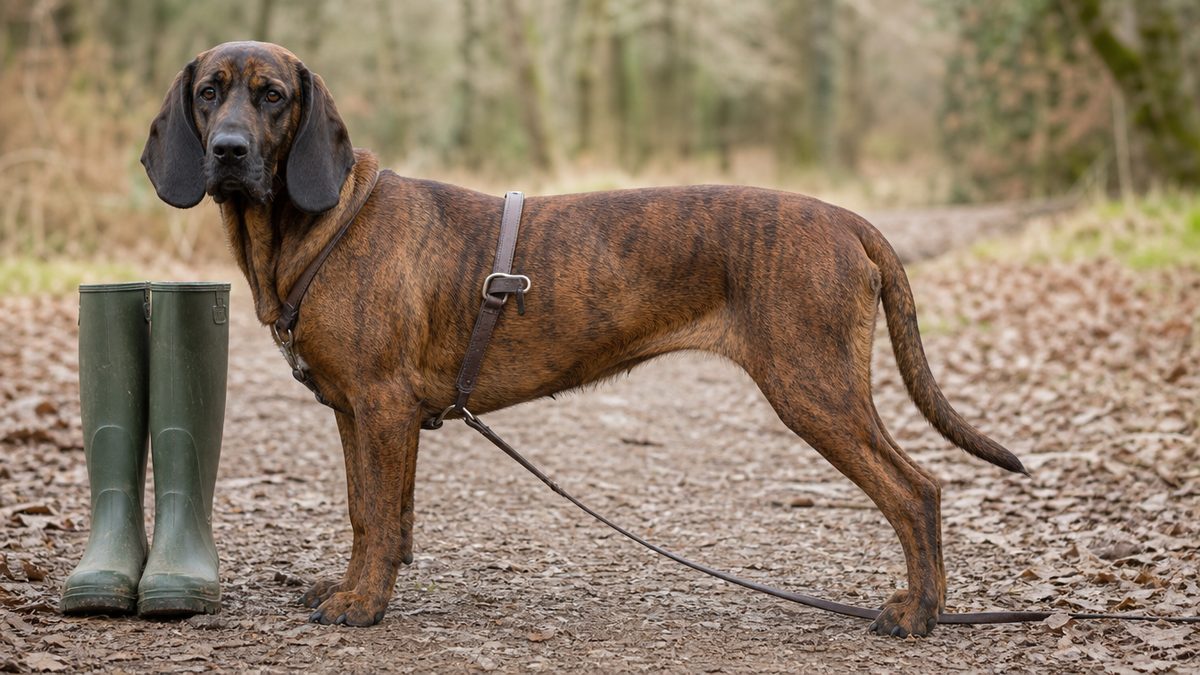
Physically it is a medium-sized, short-coated, powerful dog. The breed standard's general appearance clause calls it "of medium size, well proportioned and powerful";, with well set strongly muscled limbs that qualify it for tireless work, and warns that too-long legs or an overbuilt forequarter affect work with the nose to the ground and are foreign to its type. The broad, deep chest is there to provide lung room for long strenuous chases.
The measurements, from the standard's own text
Bonbeno downloaded FCI-Standard 213 and extracted it with pypdf rather than reading a scraper's rendering of the PDF, because scraper renderings of FCI standards have been caught inserting breed names that do not appear in the file.
| Clause | What the standard says |
|---|---|
| Standard and section | No. 213, Group 6 Scenthounds and related breeds, Section 2 Scenthounds/Leash Hounds, with working trial |
| Origin and language | Germany, official authentic language German |
| Height at withers | Males 50 to 55 cm, females 48 to 53 cm |
| Weight | Males 30 to 40 kg, females 25 to 35 kg |
| Body length to height | 1.4 to 1, so clearly longer than tall |
| Depth of chest to height | 0.5 to 1 |
| Coat | Short, thick, coarse to harsh, longer and coarser only on the rear thighs and underside of tail |
| Colour | Light to dark deer-red, more or less intensely brindled, with or without mask; small white patches on forechest tolerated |
| Skin | Thick, rather loose, mostly wrinkled on the head and occasionally at the throat |
| Temperament | Calm and assured, sensitive with the handler, choosy and discerning with strangers |
Two of those rows are the ones popular pages get wrong. The weight band is 30 to 40 kg for males and 25 to 35 kg for females, and the UKC standard repeats it exactly in pounds at 66 to 88 and 55 to 77. United Kennel Club The American Kennel Club's own breed page instead prints 79 to 99 pounds, and Dimensions.com prints 80 to 100 pounds. Dimensions.com, 'Hanoverian Scenthound… Both American figures begin above the German standard's ceiling for a female and end roughly five kilograms above its ceiling for a male.
History, from the German federation rather than from an English summary
The ISHV traces the line to the Celtic Segusier hound from about 500 BC, then to the medieval Leithund or leash hound, whose handlers were among the most important hunters at court and whose training took three years. When firearms changed how big game was shot, a dog was needed after the shot, and the Leithund became the Schweisshund.
The Hanoverian Jaegerhof developed the breed through the 18th and 19th centuries and created the handling method still called the Jaegerhofmethode. Hanover fell to Prussia in 1866 and the Jaegerhof was dissolved, with the Prussian forest administration continuing the work. In 1885 the hound from Hanover was formally given the name Hannoverscher Schweisshund, also Deutscher Schweisshund, and on 17 June 1894 the founding meeting of Verein Hirschmann took place at Silbers Hotel in Erfurt.
English Wikipedia says the FCI recognised this breed in 1964 and cites the FCI's own page as its source. The FCI's register gives 6 October 1959. Bonbeno read the register entry directly, having found the number on the FCI's own letter-H index rather than guessing it. Federation Cynologique Internationale
Keeping it apart from the Bavarian Mountain Hound, which nobody manages
The Hanover Hound is the parent breed and the Bavarian Mountain Hound is the descendant, created after 1870 because the Hanoverian was too heavy for mountain ground. Three widely read sources reverse or garble that, and the FCI's own standard settles it.
FCI-Standard 217, the Bavarian's own document, contains the sentence that ends the argument. Describing how hunting changed after the Revolution of 1848, it says that in mountain regions "the Hanovarian Scenthound proved too heavy", and that to get the required performance in difficult mountain terrain "Baron Karg-Bebenburg, Reichenhall, bred the racy and ennobled lighter Mountain Scenthound after 1870, by crossing Hanovarian Scenthounds and red Mountain Scenthounds";.
So the parentage runs one way, the date is after 1870, and the other parent is a red mountain bracke rather than any breed called Bavarian.
| Source | What it says | Verdict |
|---|---|---|
| FCI-Standard 217, history clause | Baron Karg-Bebenburg crossed Hanoverian Scenthounds with red Mountain Scenthounds after 1870 | Primary. The breed's own standard |
| English Wikipedia | The Hanover Hound 'was crossbred with the Bavarian Hound, which gave rise to the Bavarian Mountain Hound', and 'in 1912, the Hanoverian scent hound was crossed with the Bavarian mountain scent hound' | Circular, and 1912 is when the Bavarian club was founded, not when a cross happened |
| zooplus | 'The Bavarian Mountain Hound originated from crossing Hanover Hounds and German Hounds' | Names a different second parent |
| ISHV | Wildbodenhunde and mountain bracken were mated with the Hanoverian Scenthound | Consistent with the FCI standard |
Wikipedia's article also carries a maintenance banner asking for more citations, dated April 2016, and its first reference, attached to a sentence about the Hanover Hound, is the FCI page for the Bavarian Mountain Scent Hound. The two breeds are conflated inside the citation apparatus itself.
How to tell them apart on paper
| Hanover Hound, FCI 213 | Bavarian Mountain Hound, FCI 217 | |
|---|---|---|
| Height, males | 50 to 55 cm | 47 to 52 cm, no departure permitted |
| Height, females | 48 to 53 cm | 44 to 48 cm, no departure permitted |
| Weight, males | 30 to 40 kg | Ideally 20 to 30 kg |
| Weight, females | 25 to 35 kg | Ideally 17 to 25 kg |
| Body length to height | 1.4 to 1 | 1:1.15 to 1:1.25 maximum |
| FCI acceptance | 6 October 1959 | 14 November 1959 |
| Parent club | Verein Hirschmann, founded 1894 | Klub fuer Bayerische Gebirgsschweisshunde, founded 1912 |
The build ratio is the cleanest test. A Hanover Hound is 1.4 times as long as it is tall; a Bavarian is capped at 1.25. Stand the two side by side and the Hanoverian reads as the longer, heavier, more deliberate dog, which is exactly why it lost the mountains. Federation Cynologique Internationale
One oddity is worth recording rather than smoothing over. The FCI accepted the descendant breed on 14 November 1959, five weeks after it accepted the parent on 6 October 1959. Both dates come from the FCI's own nomenclature entries, read with each breed's name printed on the returned document, and the near-simultaneity has nothing to do with which dog came first.
The job, and why it does not exist in India
A Hanover Hound works one cold blood trail at a time, on a long leash, hours or a day after a shot, and it is bred and licensed for that single task. India has no lawful version of that job, which is the fact that governs everything else on this page.
The German picture is precise. A Schweisshund is called out after a shot has wounded an animal that then ran, and the dog's job is to hold the specific trail of that specific animal across hours, distance, other deer, other tracks and rain, so the handler can reach it and end its suffering. The FCI standard requires the breed to show all the hunting abilities, endurance and working-trial potential the recognised club demands, and marks the whole breed as subject to a working trial.
The parent club's own account is blunter still. Verein Hirschmann's treasurer describes a handler as effectively on call around the clock all year, with call-outs coming on weekday mornings and late evenings rather than at convenient times, and describes the required quality as an ability to sink completely into one trail and block out everything else. He also says plainly that a drone cannot replace the dog, because a drone has to be steered and cannot answer the question of left, right or straight on after fifty metres.
None of that is available in India
Section 9 of the Wild Life (Protection) Act, 1972 provides that "No person shall hunt any wild animal specified in [Schedules I and II] except as provided under section 11 and section 12."; There is no Indian equivalent of a Nachsuche network, no state licensing of blood-tracking teams, and no lawful supply of wounded big game for a specialist to be called out to.
That matters more here than on most breed pages, because the club that controls the breed will not sell you a dog without the job. Puppies are released only into handler hands where the dog will actually be used, and the club breeds only when a handler needs one. An Indian buyer with no working role is not a buyer the registry recognises.
What the dog does when the job is missing
zooplus states the consequence for a pet home directly: this breed will not be happy in a city apartment, needs an environment close to woods and nature where it can do what it was bred for, and suits experienced families of hunters, police officers or members of a rescue-dog association. Its exercise requirement is listed as high while its training and care requirements are listed as low, which is an unusual combination and an accurate one.
The nearest lawful substitute an Indian owner could build is tracking sport. Laying a cold artificial trail with a tracking shoe and working it on a long leash is the recognised training method in Germany itself, where the club increasingly uses artificial trails while still valuing work on a genuine cold, observed, healthy trail. That is a real outlet, and it is a demanding hobby rather than a walk.
An Indian household can give this dog scent work, a long line and a settled home. It cannot give it the job. That is not a fatal objection on its own, but anyone telling you the breed adapts easily to a flat has not read what its own registry says about who gets a puppy.
Hanover Hound price in India, and why the question has no answer
There is no Hanover Hound price in India, because there is no Indian market, no Indian page about the breed and no lawful route to a commercial import. The only published figure anywhere is a UK estimate of several thousand pounds, possibly above 5,000.
Bonbeno ran two India-located organic searches for the target term on 31 August 2026. Neither returned a single Indian page about this breed. The India-hosted results were a Mudhol Hound price article, Supertails' generic 40-breed list, an Amazon.in listing for a book about the breed, an Afghan Hound puppy sales page, a Bloodhound care article, a Basset Hound sales page and an Etsy India listing for a graphics bundle.
The absence is testable rather than assumed. Bonbeno retrieved Supertails' 2026 India price list in full, 125,428 characters, and searched it: Hanover appears zero times, Bavarian zero and Foxhound zero, while Beagle appears twelve times at Rs 15,000 to Rs 60,000. The same India-located search instrument returned a genuine on-topic Indian result set for a different breed in the same session, so the emptiness is about the breed rather than about the tool.
The one real price, and what it is attached to
zooplus, writing for a UK audience, gives the price as "from several thousand pounds upwards, possibly exceeding 5000 pounds";, and notes that UK dogs are traditionally obtained through the Hanoverian Hound Society. Bonbeno does not convert that into rupees. Converting a foreign price and printing it as an Indian one is the single commonest fabrication on Indian breed pages, and it would be fabrication here too.
Supply, which is the real constraint
Even with money and a licence, the dogs barely exist. Verein Hirschmann's treasurer states that the club never breeds for stock, only when a handler needs a dog, that in some years as few as 35 puppies are born, and that they go only into hands where the dog will be worked. The club has about 1,050 members and takes on 30 to 40 new ones a year, so a year's puppies roughly match a year's new members. There is no surplus for an export market, let alone a pet market.
The club is also the only gate. It is the only club in Germany recognised by the JGHV, the VDH and the FCI to issue pedigrees for this breed, and it holds the standard at the FCI. A dog without its Ahnentafel is not a registered Hanover Hound in any sense a kennel club would accept.
The legal route, in full
The lawful path into India is a personal pet import. DGFT Trade Notice 22/2022-23 of 19 December 2022 places dogs under ITC(HS) 01061900 as Restricted, permits import only as a pet dog with a valid pet book in the importer's name, for CPCSEA-recommended research, or for Defence and Police internal security, and bars commercial import for breeding. Paragraph 6 states that applications for trading or breeding purposes shall be duly rejected, and paragraph 7 limits entry to the airports and seaports of Delhi, Mumbai, Chennai, Hyderabad, Bangalore and Kolkata. DAHD added a seventh port, Cochin International Airport at Kochi, for pets arriving under the baggage rules in October 2024.
Two or fewer pets can enter as passenger baggage without an import authorisation only if you are transferring residence to India after two years of continuous stay abroad. Everything else needs a DGFT import authorisation, applied for at least two months before travel. To then register the dog with the Kennel Club of India you must produce the original export pedigree, the airway bill, the air ticket, the boarding pass, the DGFT licence, customs and quarantine clearances, a pet passport and a notarised affidavit. India is a full FCI member, so the pedigree would be read against FCI-Standard 213.
Ask for the Verein Hirschmann Ahnentafel by number, then ask which working trial the parents passed. A seller who cannot produce both is not selling you this breed. Given that no Indian page even describes the dog, the realistic animals behind such an offer are a red-brindled crossbreed or an unrelated hound.
Monthly expenses for a 30 to 40 kg hound in India
Running a 30 to 40 kg working hound in an Indian metro costs roughly Rs 6,000 to Rs 15,000 a month on published Indian figures, with a first year between Rs 1,00,000 and Rs 2,50,000 before the dog itself. Those are real Indian numbers for a large scent hound, and they hold whatever the pedigree says.
No Harrier-style Indian cost line exists for this breed, because no Indian page covers it. This section therefore uses published Indian running costs for a scent hound and adjusts upward for size, which is honest and more useful than a manufactured breed figure.
| Item | Published Indian range | Note for a 30 to 40 kg dog |
|---|---|---|
| Food | Rs 3,000 to Rs 7,000 | Budget the top of the range or above, this dog is roughly twice a Beagle |
| Grooming | Rs 1,000 to Rs 3,000 per session | Largely optional on a short, coarse coat |
| Vet and preventive care | Rs 500 to Rs 2,000 | Add for a large-dog dose weight on every parasiticide |
| Tick and flea prevention | Rs 500 to Rs 1,500 | Non-negotiable in India, and dosed by weight |
| Treats, toys and enrichment | Rs 1,000 to Rs 3,500 | Higher here, because scent work is the substitute for the job |
| Training | Rs 8,000 to Rs 30,000 per programme | Find a tracking-capable trainer, not a general obedience class |
| Monthly total | Rs 6,000 to Rs 15,000 and above | Treat the upper figure as the realistic one |
The published Indian first-year breakdown puts vaccinations at Rs 3,000 to Rs 8,000, deworming and vet visits at Rs 2,000 to Rs 6,000, a year of food at Rs 36,000 to Rs 84,000, grooming at Rs 12,000 to Rs 30,000, training at Rs 8,000 to Rs 30,000, bed, bowl, leash and collar at Rs 3,000 to Rs 10,000, toys and chews at Rs 5,000 to Rs 15,000 and tick and flea prevention at Rs 6,000 to Rs 15,000, for Rs 1,00,000 to Rs 2,50,000 and above in year one.
Costs this breed adds that a Beagle does not
- Import, which is the largest single line and is unpublishable. Air cargo, a DGFT import authorisation, quarantine clearance and KCI registration are separate charges, and Bonbeno does not quote a figure it cannot source.
- Weight-based dosing on everything. A 35 kg dog costs roughly twice a 15 kg dog on every parasiticide, every anaesthetic and most medications, which is where the real gap between hound sizes shows up.
- Long-line and tracking equipment. A tracking harness and a ten-metre leash are cheap, but they are the only equipment that makes the dog manageable and they wear out.
- A trainer who understands scent work. General Indian obedience classes will not help a dog that cannot be drilled, and the club's own position is that this breed must work independently.
- Cooling infrastructure. Fans, shade and, in most of India, air conditioning during the hot months, for a dog whose homeland averages 9.48 C.
One cost that does not apply here is the one Indian buyers usually fear. The grooming bill is close to zero. The coat is short, thick and coarse to harsh with little gloss, and it needs a brush rather than a salon.
Heat tolerance in India, measured against Hannover
Bonbeno rates the Hanover Hound 2 of 5 for heat tolerance, which is a way of saying it is not heat-tolerant. Hannover's annual mean 2-metre temperature is 9.48 degrees Celsius and its January mean is 0.38, while Chennai's coolest month averages 24.09, so India's mildest month is 5.4 degrees hotter than the homeland's hottest.
The homeland baseline was measured rather than assumed. Bonbeno queried NASA POWER's 2001-2020 climatology by explicit latitude and longitude for Hannover and echoed back the grid-cell elevation: 79.35 m against a city near 55 m, a 24 m difference, which is within tolerance for a lowland point. The Indian cells checked the same way came back accurate too, at Delhi 206.37 m against about 216 m and Chennai 48.95 m against about 6 m.
| Place | Cell elevation | Coldest month | Hottest month | Annual mean |
|---|---|---|---|---|
| Hannover, Lower Saxony | 79.35 m | 0.38 (Jan) | 18.71 (Jul) | 9.48 |
| Bengaluru | 841.72 m | 20.22 (Dec) | 28.37 (Apr) | 23.74 |
| Chennai | 48.95 m | 24.09 (Jan) | 31.51 (May) | 27.95 |
| Mumbai | 97.15 m | 23.19 (Jan) | 31.19 (May) | 26.77 |
| Delhi | 206.37 m | 13.61 (Jan) | 35.88 (Jun) | 25.60 |
Compare the Hannover row against the Chennai row and the case is closed. Chennai's coldest month is 5.4 degrees warmer than Hannover's warmest, and Delhi's June is 17.2 degrees above it. The dog's own registry is aware of the problem, and Verein Hirschmann carries a news item on its site headed for heat deaths during tracking work, which is a German club warning about German summers. NASA POWER climatology API
Why exertion is the specific risk here
This is a dog whose job is sustained work rather than a walk, and that is exactly where the evidence points. In the largest study of canine heat-related illness, on 905,543 UK dogs under primary veterinary care in 2016, there were 1,259 events from 1,222 dogs, of which 380 had no trigger recorded. Of the 879 events with a recorded trigger, 652 were exertional, 113 environmental and 46 vehicular confinement, which is 74.2 percent exertional.
The companion paper on the same cohort recorded 395 confirmed events with a case fatality of 14.18 percent, and found an odds ratio of 1.42, confidence interval 1.12 to 1.80, for dogs at or above their breed and sex mean bodyweight. The Hanover Hound is not among the breeds those papers modelled, so no breed-specific odds ratio exists for it and Bonbeno does not borrow one. What transfers is the bodyweight finding, which applies to any dog above its own breed mean, and a 40 kg male sits close to the top of the standard already.
Indian thresholds and the legal line
The India Meteorological Department declares a heat wave when a plains station reaches at least 40 degrees Celsius, or 30 degrees in hilly regions, with a departure from normal of 4.5 to 6.4 degrees, and a severe heat wave above 6.4 degrees. Delhi's monthly mean exceeds 30 degrees from April through July on POWER's climatology, so an Indian summer is a season of exposure rather than an event.
Indian law addresses this directly for any dog kept outdoors. Second Schedule Part IV paragraph 21(1) of the Prevention of Cruelty to Animals (Dog Breeding and Marketing) Rules, 2017 bars keeping in outdoor facilities, without the attending veterinary practitioner's written approval, dogs "that are not accustomed to the temperatures prevalent in the area or region in question" and breeds "that cannot tolerate the temperatures prevalent in the area or region in question". Paragraph 21(2) requires separate outside areas of shade large enough to hold all the animals at once and to protect them from the direct rays of the sun.
The string "Rule 21" appears zero times in the gazette. This is Second Schedule Part IV paragraph 21, and the Rules themselves stop at Rule 13. Bonbeno extracted the 14-page AWBI gazette with pypdf and checked the string count directly.
The practical rule for an Indian owner is narrow and firm. Work the dog before sunrise and after dark, treat every month whose mean exceeds 28 degrees as a restricted month, keep water available at all times, and never start a tracking session in the afternoon, because a hound committed to a trail will not stop itself when it overheats.
Temperament, from the people who actually keep them
A Hanover Hound is calm, assured, deeply attached to one handler and reserved with strangers, with an unusually high threshold and a very self-willed core. Two credible sources call it suitable as a family dog, and both attach the same condition about work.
The FCI standard's behaviour clause is short: "Calm and assured temperament, at the same time sensitive with his handler, choosy and discerning with strangers. High capabilities of concentration in any tracking work with strong loyalty to the hunter in charge."; The UKC repeats it almost word for word as "Calm and assured, with a high capability to concentrate on any track.";
The club's own description adds the parts a standard cannot carry. Verein Hirschmann's treasurer describes a friendly, self-contained dog that is very good-natured and firm in character, with an extraordinarily high threshold for reaction, not prone to uncontrolled snapping, and therefore also suitable as a family dog, while being very self-willed.
The AKC's page adds two observations worth knowing before you commit. The breed tends to gravitate towards one person in the family, and it matures slowly, remaining very puppy-like for several years. Both are consistent with a specialist that bonds to a handler rather than a household.
The condition attached to every positive review
zooplus makes the family-dog verdict conditional in the same sentence that grants it: the breed makes an excellent new family member only if you are prepared to meet its special needs, will not be happy in a city apartment, and suits experienced families of hunters, police officers or rescue-dog association members.
| Situation | Verdict |
|---|---|
| A 2BHK flat in Mumbai or Bengaluru | No. The breed's own sources say a city apartment will not work, and a 35 kg hound with no job is a problem you cannot train away |
| A rural house with land and a tracking hobby | The only Indian setting that makes sense, and even then the heat schedule governs everything |
| A family with children and other dogs | Workable. The high threshold and the absence of snapping are real, and the dog will pick one adult as its person |
| A household with cats, poultry or small pets | Poor. This is a dog selected to pursue and hold wounded game, and Wildschaerfe is a breeding criterion rather than a fault |
| A first-time dog owner | No. The club states these dogs cannot be drilled like other breeds and must work independently |
| Anyone wanting a guard dog | No. Reserved with strangers is not the same as protective, and the breed is bred against reactivity |
One line from the club deserves quoting because it explains the failure mode better than any temperament chart. "Man kann sie nicht so dressieren wie andere Rassen. Sie muessen komplett selbststaendig arbeiten."; You cannot drill them like other breeds; they have to work completely independently. And if one is handled unfairly or broken by too-hard training, it eventually stops working altogether.
Training, and the one method that works
To train a Hanover Hound, build the trail habit and protect it, because the breed cannot be drilled and its whole value is a willingness to commit to one line. The German method is to work the dog on a cold, observed, healthy trail rather than on obedience.
Start with the club's method rather than a generic obedience plan, because the two are different activities. Verein Hirschmann works its dogs on the cold Gesundfaehrte, the trail of a healthy animal, increasingly supplemented by artificial trails laid with a tracking shoe, but still valuing the real thing. The reasoning is precise: a dog that can hold one specific starting trail to the end, even when the animal was in a herd or when other trails cross it, will have no trouble with a wounded animal's trail.
That method inverts the usual advice. The instruction is not to make the dog more obedient; it is to never break the Faehrtenwille, the will to hold the trail. The treasurer's warning is that a dog handled unfairly or trained too hard will one day simply decline to go out with you.
What to do, in order, in an Indian home
- Socialise before sixteen weeks. Lifts, watchmen, traffic, household staff, other dogs. A reserved breed that has not met India will be a reserved breed that finds India alarming.
- Track from the first month. Lay short food trails indoors and on a terrace, then lengthen them. This is the behaviour the dog exists for and it is available even in a heat season.
- Long line always, outdoors. A ten-metre biothane line on a harness, never a collar. Off-lead in unfenced Indian space is not a training goal for this breed.
- Reward, never correct. The club's method rests on willingness, and pressure destroys the one trait you are buying.
- Train a settle with duration. The realistic indoor behaviour is lying quietly for hours, and that is taught on a mat rather than through obedience commands.
- Screen the handler as well as the dog. Anyone in the household who will hold the leash needs the same rules, because inconsistency is what teaches a self-willed hound to ignore people.
Realistic timelines
| Age | What is realistic |
|---|---|
| 8 to 16 weeks | House training, name, crate and mat settle, indoor socialisation, first food trails. Outdoor exposure only in cool hours |
| 4 to 8 months | Long-line manners, longer cold trails, first exposure to distraction. Growth is fast and forced exercise stays off the list |
| 8 to 18 months | Adolescence. Independence sharpens and recall degrades. The AKC notes the breed matures slowly and stays puppy-like for several years |
| 18 months to 3 years | A dependable settle, a workable long-line partnership and trails of real length and age |
| 3 years and beyond | The dog most people describe. Calm indoors, single-minded outdoors, bonded hard to one person |
Published Indian training programmes run Rs 8,000 to Rs 30,000 and above, and an eight to twelve session plan suits a scent hound better than a short obedience course. Ask any trainer whether they have run a tracking dog before you book, because a class built on drilling is the wrong room for this breed.
Exercise needs, and the Indian window
The Hanover Hound needs high daily exercise plus mental work on a trail, and in India that has to happen before sunrise and after dark for most of the year. Distance alone will not settle this dog, because the job it was bred for is a nose job.
zooplus lists the breed's exercise requirements as high while listing training and care requirements as low, which is an unusual and accurate combination. The same page says the breed needs to be regularly challenged and that dogs and owners alike need a high level of fitness for the kind of missions the breed exists for, suggesting man-trailing as the sport substitute.
The German picture behind that is a dog whose call-outs come at any hour, year round, and whose working sessions are long. Translated into a pet schedule, that means an hour and a half to two hours of physical work plus a genuine scent session, most days.
The schedule the climate allows
| Season | Morning | Evening | Scent work |
|---|---|---|---|
| Nov to Feb, plains | 60 to 75 min from first light | 45 to 60 min after dusk | 20 min trail, outdoors |
| Mar and Oct | 45 to 60 min, finish before 7 am | 45 min, start after 7 pm | 20 min trail, shaded |
| Apr to Jun | 30 to 40 min, pre-dawn only | 30 min, well after dark | 30 to 45 min indoors, split into blocks |
| Jul to Sep, monsoon | 40 min between showers | 40 min | Trails work well in damp cool air. Dry the ears afterwards, every time |
| Coastal cities year round | Treat every month as a hot month | Same | Scent work carries most of the load |
Scent work is not a consolation prize for this breed, it is the main event. A dog that has held a twenty-minute trail is more settled afterwards than a dog that has walked for an hour, and in April in Delhi it is the only version available. Lay a trail with a piece of meat or a scented article, age it by thirty minutes, and let the dog work it on the long line.
The rule that is not negotiable
Never let this dog run loose in unfenced Indian space. A leash hound committed to a line does not check for traffic, does not hear a recall and does not stop at a boundary. The breed's entire selection history is against the behaviour you would be relying on. Helena von Hardenberg
A dog at or above its breed and sex mean bodyweight carried an odds ratio of 1.42 for heat-related illness in a cohort of 905,543 dogs. For a breed whose standard already tops out at 40 kg for males, keeping the dog lean is a heat measure, not a cosmetic one.
Grooming a coarse short coat in Indian humidity
Grooming a Hanover Hound takes about ten minutes a week, because the standard describes a short, thick, coarse to harsh coat. The two things that need real attention are the high-set hanging ears and the loose, thick, wrinkled skin, and both matter more in an Indian monsoon than the coat does.
The FCI standard's coat clause is specific: hair short, thick, coarse to harsh, somewhat longer and coarser only on the rear edges of the upper thighs, with the tail coat dense and coarse and a little longer on the underside. The UKC repeats it. zooplus lists care requirements as low and says occasional brushing is enough.
So the routine is a rubber curry once a week against the lie of the coat, a damp cloth, nails every three to four weeks and a bath only when the dog is genuinely dirty. Do not clip a coarse working coat.
The ears, which are the whole job
The standard gives ears of medium length, set on high and broad, smooth, hanging close to the head without twist, bluntly rounded at the tips. A close-hanging ear seals the canal, and in an Indian monsoon that is an otitis externa risk on any pendant-eared hound.
- Check both ears every evening in July, August and September, and twice a week the rest of the year.
- Dry the canal after every bath, wet walk, swim and monsoon soaking, and never leave a wet ear folded shut.
- Plug the ears before a bath rather than letting water run in.
- Escalate on head-shaking, an ear carried low, odour or brown discharge, rather than reaching for a pet-shop bottle.
Overseas breed advice written for a German climate often says to towel a working dog and let it dry naturally. That is correct in Lower Saxony, where the annual mean is 9.48 degrees, and wrong in an Indian monsoon. Dry the ear canal properly every time.
Skin, dewlap and the folds nobody mentions
The standard describes skin that is thick, rather loose, mostly wrinkled on the head, and occasionally at the throat too, with a slight dewlap permissible and the throat skin full and loose. Loose skin plus Indian humidity plus a dog that pushes its head through undergrowth is a recipe for intertrigo in the throat folds and around the eyes.
The routine is the same discipline as the ears. Part the folds, look at the skin underneath, wipe and dry rather than powdering, and treat a persistent damp red line in a fold as a reason for a vet visit rather than a home remedy.
Published Indian grooming runs Rs 1,000 to Rs 3,000 a session. On this coat almost none of that is needed. Spend it on a good tick and flea programme dosed for a 35 kg dog and on ear-drying supplies instead.
Health, and a screening regime stricter than most breeds get
No breed-specific disease has been published for the Hanover Hound, so any list of its health issues you find online is a generic hound template rather than breed data. What does exist is a screening regime stricter than most kennel clubs require, with every breeding dog radiographed for hip dysplasia, elbow dysplasia and lumbosacral transitional vertebra.
Verein Hirschmann's breeding order rests on three pillars, and health is the first. Breeding is permitted only with healthy dogs, which are X-rayed for HD (hip dysplasia), ED (elbow dysplasia) and LUEW (lumbosacral transitional vertebra), and all breeding dogs must be free of recognisable hereditary diseases. The lumbosacral screen in particular is unusual and makes sense for a dog that works long hours with its spine loaded.
That screen sits on top of a performance gate. Every dog is presented at a Schweisshundpruefung or Vorpruefung, potential breeding dogs must reach minimum grades across several subjects, and annual performance certificates, the Hetz- und Stellnachweis and preferably a passed Hauptpruefung are preconditions for breeding. Conformation is third, with a minimum grade of "gut" and no faults that would impair the dog at work.
What is genuinely not known
zooplus states there are no known frequently occurring hereditary diseases affecting the breed. Bonbeno treats that as an absence of published evidence rather than proof of health, and here is the reason: the Orthopedic Foundation for Animals holds no statistics row for this breed at all.
That absence was tested rather than assumed. Bonbeno retrieved OFA's disease-statistics page in full on 31 August 2026, saved the 2,226,110-character dump and searched it case-insensitively, because OFA prints breed names in capitals and a case-sensitive search manufactures false absences. The fragment HANOV returns zero and SCHWEISS returns zero, while the controls run in the same session return LABRADOR 109, BEAGLE 61, HARRIER 14 and OTTERHOUND 3, and BAVARIAN returns 5 rows for the descendant breed. OFA requires 100 hip evaluations, or 50 for its other databases, before publishing a breed, so this is "no row in OFA's published statistics tables" rather than "absent from the OFA database".
Britain gives the same answer from a different direction. The Royal Kennel Club's ten-yearly Hound group table, extracted with pypdf and re-summed against its own printed column totals, which reconcile exactly in all ten columns, contains no Hanoverian or Hanover row of any kind, while listing the Bavarian Mountain Hound every year for a decade total of 682.
The literature is two papers, both from one institute
A PubMed search returns exactly two records genuinely about this breed, both from the Institute for Animal Breeding and Genetics at the University of Veterinary Medicine in Hannover, and the Labrador plus hip dysplasia control returned 126 records in the same session.
| Year | Paper | Key numbers |
|---|---|---|
| 2005 | Luepke and Distl, J Anim Breed Genet 122(2):131-9 | 16 microsatellites on 92 dogs, representative of a total population of 334 with inbreeding coefficient 9.2 percent and relationship coefficient 11.2 percent. Genetic variability unexpectedly higher than published for breeds of similar size |
| 2009 | Voges and Distl, J Anim Breed Genet 126(5):357-65 | 1,371 Hanoverian Hounds registered 1992-2004. Average inbreeding 6.8 percent, effective founder genomes 5.6, effective population size 50.9, top ten ancestors contributing 65.2 percent |
The two inbreeding figures differ and neither is a correction of the other. The 2005 paper gives 9.2 percent for a total current population of 334 dogs, and the 2009 paper gives 6.8 percent for the 1,371 dogs registered between 1992 and 2004. Different populations, different windows, same senior author. Voges S, Distl O. 'Inbreeding trends… Bonbeno prints both rather than averaging them.
One near miss is worth naming so nobody repeats it. A breed search surfaces a 2018 paper reporting that hypospadias is not rare in dogs, with three perineal cases in a Bavarian Mountain Hound, a French Bulldog and an American Staffordshire Terrier. That is the descendant breed, not this one, and Bonbeno read the abstract before deciding.
Searching the German name "Hannoverscher Schweisshund" returns one record, and it is about osseous fragments in the joints of Hanoverian Warmblood horses. PubMed dropped the word Schweisshund as an unindexed phrase and searched "Hannoverscher" alone. Read the query translation line, not just the count.
The genetics of a 35-puppy breed, and why it is healthier than it should be
A breed producing as few as 35 puppies a year should be in genetic trouble, and this one measurably is not as badly off as its numbers predict. The two published studies agree that variability is higher than the population size would suggest, and both still say the population needs careful management.
The 2009 pedigree study is the most useful comparison Bonbeno has for this breed, because it measures the Hanoverian against its own descendant and against a third scent hound in one analysis. Pedigree data reached back to 1894 for the Hanoverian and 1912 for the Bavarian, which matches the two clubs' founding dates exactly.
| Measure | Bavarian Mountain Hound | Hanoverian Hound | Tyrolean Hound |
|---|---|---|---|
| Dogs in reference population | 3,231 | 1,371 | 1,167 |
| Average generation interval | 5.3 years | 5.0 years | 5.0 years |
| Average inbreeding coefficient | 4.5 percent | 6.8 percent | 9.5 percent |
| Effective number of founder genomes | 10.9 | 5.6 | 4.3 |
| Effective population size | 72.7 | 50.9 | 26.5 |
| Genetic contribution of top ten ancestors | 54.4 percent | 65.2 percent | 77.9 percent |
Read the middle column against the outer two. The Hanoverian sits between its lighter descendant and the Tyrolean on every measure, with an effective population size of 50.9 breeding animals and two thirds of the gene pool traceable to ten ancestors. The authors' own conclusion is that all three breeds need careful management to maintain diversity, and that European stud books should be established to avoid inbreeding caused by missing pedigree records.
The surprise in the marker study
The earlier microsatellite study is the more interesting one, because it contradicts what the pedigree numbers imply. Across 16 microsatellites on 92 dogs representative of a total population of 334, the observed heterozygosity was slightly higher than expected and the genetic variability was "unexpectedly higher than that previously published for dog breeds of similar population size", with the authors adding that even breeds of larger population size seldom showed higher heterozygosity. That held despite genetic bottlenecks in the 1920s and the 1950s and despite high inbreeding and relationship coefficients sustained for more than fifty years.
The club's explanation is consistent and comes from a different source entirely. Its treasurer attributes a comparatively low inbreeding coefficient to decades of forward-looking breeding policy, and says the club's coefficient is better than that of many fashionable breeds despite a narrow base. The club also runs a project drawing blood samples to build genetic markers for the future. And the ISHV exists in part to circulate puppies and stud dogs between national clubs, which broadens the pool across borders.
What Indian law would require of anyone breeding here
The question is hypothetical, because no lawful Indian breeding population can form, but the clauses are worth knowing. Second Schedule Part II paragraph 6(3) of the 2017 Rules prohibits in-breeding and incest breeding, defining in-breeding as mating between relatives of the second to fourth grade in straight or side line within the first four generations, naming uncle to niece, nephew to aunt, cousin to cousin and grandparent to grandchild, and defining incest breeding as mating between parents and children or between brother and sister.
Second Schedule Part III paragraph 8(10) requires that breeding dogs have been tested for genetic defects "including hip dysplasia, progressive retinal atrophy, night blindness, hypothyroidism, entropion, ectropion, overshot, undershot jaw (when incisors do not touch or mesh), wry mouth, two or more missing teeth, unilateral cryptorchid or full cryptorchid males". Three of those items are already faults in the FCI standard for this breed: under- or overshot bite, ectropion and entropion, and lack of the first premolar or of other teeth. The UKC standard faults the same three. For once, German breed practice and Indian law point the same way.
Feeding a 30 to 40 kg working hound in India
Feed a Hanover Hound a complete, balanced diet matched to its life stage and its actual workload, and keep it lean, because bodyweight at or above the breed mean is the one heat risk factor the evidence supports for any dog. Portion by body condition, not by the bag.
This is a large dog with a small published evidence base, so the feeding advice here rests on the size, the coat, the climate and the one heat finding that genuinely transfers rather than on breed-specific nutrition research, which does not exist.
| Stage | Approach | Indian monthly food cost |
|---|---|---|
| 8 weeks to 4 months | Complete large-breed puppy food, four meals a day, weighed rather than scooped | Rs 3,000 to Rs 5,000 |
| 4 to 12 months | Three meals, then two from around six months. Slow steady growth matters on a breed screened for hip and elbow dysplasia | Rs 4,000 to Rs 7,000 |
| 1 to 7 years | Two meals, adult maintenance, portion set by body condition score | Rs 4,000 to Rs 8,000 |
| 7 years and older | Two meals, lower calorie density, joint support discussed with your vet | Rs 4,000 to Rs 8,000 |
Published Indian food costs for a scent hound run Rs 3,000 to Rs 7,000 a month, and a 35 kg dog belongs at the top of that band or above it.
Body condition is a heat measure here
In a cohort of 905,543 UK dogs, being at or above the breed and sex mean bodyweight carried an odds ratio of 1.42, confidence interval 1.12 to 1.80, for heat-related illness, and dogs over 50 kg carried 3.42 (1.54-7.57). A male Hanover Hound at the top of its standard is already 40 kg, so the margin before the heavy band is thin.
Run your hands over the ribs weekly. You should feel them under a thin cover without pressing, see a waist from above and see an abdominal tuck from the side. Do that instead of trusting a feeding chart, because Indian kibble bags are calibrated for a sedentary dog and this is not one.
Two rules that matter more in India than in Germany
- Split the ration around work, never before it. Feed after the morning session and after the evening session, not immediately before a long trail, and leave at least an hour either side of hard exercise.
- Do not build the diet on raw abattoir offal. It is cheap and widely recommended in India for large dogs, and the pack-feeding literature on related hounds records both a fatal viral outbreak and a spinal disease traced to exactly that practice. A complete commercial diet removes the whole category of risk.
Water is the other half. A dog working a trail in Indian humidity loses more than an owner expects, and the animal will not stop for a drink while it is committed to a line. Carry water and offer it on a schedule rather than on demand.
Second Schedule Part III paragraph 8(9) of the 2017 Rules states that all pups shall be vaccinated, which can start at seven to eight weeks and is usually completed at eighteen weeks. Published Indian first-year vaccination costs run Rs 3,000 to Rs 8,000.
The first year, month by month
Plan a Hanover Hound puppy's first year around four fixed points: Indian law bars sale under eight weeks, the socialisation window closes near sixteen weeks, growth plates close between roughly ten and fourteen months, and the Indian heat season closes the outdoors from April to June.
| Age | Development | What you do |
|---|---|---|
| Under 8 weeks | Still with the litter. Rule 8(1)(a) of the 2017 Rules provides that pups less than eight weeks in age are not sold | Refuse any seller offering a younger puppy, and say why |
| 8 to 10 weeks | Home, crate, name, first vaccines, which paragraph 8(9) says can start at seven to eight weeks | Four meals, no forced exercise, indoor socialisation, first food trails on a mat |
| 10 to 16 weeks | Socialisation window. Vaccination usually completed by eighteen weeks | Lifts, watchmen, traffic noise, other dogs, household staff. Short pre-dawn outings in hot months |
| 4 to 6 months | Rapid growth, teething, first real responses to scent and to street animals | Long line becomes permanent. Three meals. Lengthen the trails, keep them successful |
| 6 to 8 months | Adult teeth in. Rule 8(1)(b) requires sterilisation before sale above six months unless the buyer is another licensed breeder | Two meals. Build the settle with duration. No sustained distance work yet |
| 8 to 12 months | Adolescence and rising independence. The AKC notes the breed matures slowly and stays puppy-like for years | Manage rather than correct. Protect the trail habit above everything |
| 10 to 14 months | Growth plates closing, adult height reached in the 50 to 55 cm band for males | Introduce sustained trotting distance only after this point |
| 12 months | Adult food, adult workload, full heat protocol | Book an adult health check and discuss hip and elbow radiography with your vet |
Those three legal rows are worth reading twice, because they are the only points on this page an Indian buyer can enforce. Rule 8(1)(a) bars the sale of pups under eight weeks, Rule 8(1)(b) bars selling a dog over six months without prior sterilisation unless the buyer is another licensed breeder, and paragraph 8(9) sets the vaccination window.
The Indian calendar overlay
Time the arrival if you can. A puppy landing in November in the plains gets roughly four months of usable outdoor time before April shuts the window, which covers the whole socialisation period. A puppy landing in March gets the worst combination available, a socialisation window inside a heat season and an owner who cannot take it out. India Meteorological Department
Verein Hirschmann grades every dog for conformation twice, once young and once mature, with a minimum of "gut" for breeding approval, and radiographs hips, elbows and the lumbosacral junction. Even outside that system, those are the three films worth taking on any dog of this build.
Hanover Hound against the hounds an Indian buyer can actually get
Against the Bavarian Mountain Hound the Hanover Hound is 3 cm taller and 10 kg heavier with the same closed registry. Against the Beagle it is 15 cm taller, unavailable and unpriceable. Here are the four side by side, from their own documents.
| Hanover Hound | Bavarian Mountain Hound | Beagle | Harrier | |
|---|---|---|---|---|
| FCI standard | 213 | 217 | 161 | 295 |
| Height at withers | 50 to 55 cm males | 47 to 52 cm males | 33 to 40 cm | 48 to 55 cm |
| Weight in the standard | 30 to 40 kg males | 20 to 30 kg males | Not stated | Not stated |
| FCI section | 2, Leash hounds | 2, Leash hounds | 1.3, Small-sized | 1.2, Medium-sized |
| Subject to a working trial | Yes | Yes | No | Yes |
| Verified India price | None | None | Rs 15,000 to Rs 90,000 plus | None |
| On Supertails' 40-breed India list | No | No | Yes | No |
| OFA statistics rows | Zero | 5, all eye tables | Published, large dataset | 14, including 416 hip evaluations |
| UK registrations, decade to 2025 | No row at all | 682 | 18,374 | 67, from 2020 only |
| Heat tolerance, Bonbeno rating | 2 of 5 | 2 of 5 | 3 of 5 | 2 of 5 |
Read the last three rows together. This breed has no OFA row, no Royal Kennel Club row and no line on India's most-cited price list, while its own descendant has two of the three. That is not a health verdict; it is a measure of how few dogs exist outside one German registry. Supertails, 'Dog Price List in India 2026
Against the Bavarian Mountain Hound, which is the real comparison
The two are the same job in two body types. The Bavarian was created after 1870 precisely because the Hanoverian was too heavy for steep ground, and the difference survives in both standards: 1.4 to 1 body length here against a maximum of 1.25 to 1 there, 30 to 40 kg against 20 to 30. Federation Cynologique Internationale Genetically the Bavarian is in better shape, with an effective population size of 72.7 against 50.9 and an average inbreeding coefficient of 4.5 percent against 6.8.
Neither is obtainable in India, both sit inside the same ISHV club system, and both are released only to working handlers. The choice between them is not a choice an Indian buyer gets to make.
Against the Beagle, which is the decision people actually face
Almost everyone who reaches a page like this in India ends up with a Beagle, and on practical grounds that is usually correct. A Beagle is 33 to 40 cm against 50 to 55, is on every Indian price list, has vets who recognise it, and does not need a job to be content. What you give up is the thing that makes this breed remarkable, which is a nose selected for one cold trail rather than for a pack chase.
Against the Bloodhound, which English writers keep invoking
zooplus repeatedly calls the Hanover Hound a bloodhound, and Wikipedia says it is "descended from bloodhounds of medieval times";. Wikipedia, 'Hanover Hound' That is a translation artefact rather than a pedigree claim: Schweisshund means blood-tracking hound, and the Bloodhound is a different breed with a different history. The ISHV traces this line to the Celtic Segusier hound and the medieval Leithund, and notes the famous black leash hounds of the Abbey of St Hubert in the Ardennes as a parallel tradition rather than as this breed's ancestor.
For an Indian household the Indian Pariah Dog is heat-adapted, free to adopt and available everywhere, and it will take to scent games as happily as any hound. If what you want is the tracking work rather than the badge, that dog will give it to you and this one will not be sold to you.
Mistakes made about this breed, mostly by people writing about it
The commonest mistake with the Hanover Hound is not an ownership error, because almost nobody in India owns one. It is a reporting error, and the pages that rank for the breed in India carry several that are checkable against documents they cite themselves.
1. Getting the FCI recognition year wrong
English Wikipedia states that the breed was officially recognised by the FCI in 1964, and cites the FCI's own nomenclature page as its source. The FCI's register gives the date of acceptance on a definitive basis as 6 October 1959. Federation Cynologique Internationale Five years, and the correction is one click from the article's own footnote.
2. Reversing or garbling the descent
Wikipedia says the Hanover Hound "was crossbred with the Bavarian Hound, which gave rise to the Bavarian Mountain Hound", and separately that "in 1912, the Hanoverian scent hound was crossed with the Bavarian mountain scent hound". zooplus says the Bavarian came from crossing Hanover Hounds with German Hounds. FCI-Standard 217 says Baron Karg-Bebenburg crossed Hanoverian Scenthounds with red Mountain Scenthounds after 1870, and 1912 is the year the Bavarian club was founded. zooplus Magazine (United Kingdom) Federation Cynologique Internationale
3. Publishing an American weight for a German breed
The AKC's page gives 79 to 99 pounds and Dimensions.com gives 80 to 100. The FCI standard gives 30 to 40 kg for males and 25 to 35 for females, and the UKC standard converts that exactly to 66 to 88 and 55 to 77 pounds. Dimensions.com, 'Hanoverian Scenthound… Federation Cynologique Internationale United Kennel Club The American figures are roughly ten kilograms heavy, and a buyer using them would reject a correctly built dog as too light.
One complication is worth publishing rather than hiding. The German club's own treasurer keeps a dog printed at 43 kg and 56 cm, which is over the FCI ceiling on both counts and is described as the heavy type. So real working dogs do exceed the standard. That still does not make the AKC's band the standard.
4. Trusting a page titled for prices and breeders that has neither
Creatures.com ranks tenth in India for this breed with a page headed "Hanover Hound Dog: Breed Facts, Prices & Breeders". It contains no price and no breeder. Its marketplace listings, herdbook records, community profiles and breeder counters all read zero, it offers a Dog Gestation Calculator preset for the breed, and the featured listings beside it are a bull in Iowa and a blue pullet in Texas.
Its colour list is the clincher. The page assigns the breed 58 colours including albino, blue merle, harlequin, leucistic, piebald, tuxedo and white, where the FCI standard permits light to dark deer-red with brindling, with or without a mask, and tolerates only small white patches on the forechest. That is a site-wide dropdown pasted onto a breed page, and it is the reason to cite this source only as evidence of fabrication.
5. Assuming money buys a puppy
It does not. The German club breeds only to order, sometimes produces as few as 35 puppies in a year, and gives them only to handlers who will work them. An Indian buyer with a budget and no Nachsuche is not a buyer the registry recognises, and DGFT Trade Notice 22/2022-23 forecloses the commercial route regardless.
6. Searching the German name and believing the result
A PubMed query for "Hannoverscher Schweisshund" returns one record about Hanoverian Warmblood horses, because the database dropped the unindexed word and searched "Hannoverscher" alone. A count is not a finding. Read the query translation line.
Treating this as a low-maintenance dog because its coat and training requirements are listed as low. The coat genuinely is easy. The dog is not. Exercise requirements are listed as high, the club says it cannot be drilled, and without trail work you have a 35 kg self-willed hound with nothing to do in an Indian summer. Helena von Hardenberg
Adoption, and the honest answer for an Indian reader
You cannot adopt a Hanover Hound in India, because there is no Indian population to adopt from. Adopt the hound-type dog in front of you instead, which will be heat-adapted, locally understood and free, and give it the scent work this breed would have wanted.
The absence here is unusually complete and Bonbeno tested it rather than assuming it. Two India-located searches returned no Indian page about the breed at all, Supertails' 40-breed 2026 India price list does not mention it, OFA holds no row, and the Royal Kennel Club's Hound group table has no line for it in ten years. Orthopedic Foundation for Animals The Royal Kennel Club
There is also no rescue pipeline, and the reason is structural rather than accidental. The German club releases puppies only into handler hands where the dog will be used, breeds only when a handler needs one, and requires two sponsors before a person can even join. A registry that controls placement that tightly does not generate a surplus of unwanted dogs.
What to do instead, in order
- Adopt a hound-type Indian dog and judge it on the animal rather than on a label. A red or brindled indie with hanging ears is not a Hanover Hound and does not need to be one.
- Test the nose at the first meeting. Drop a treat in grass and watch. A dog that puts its head down and works is telling you what will settle it for the next decade.
- Check the ears before you commit, because pendant-eared Indian shelter dogs frequently arrive with untreated otitis externa.
- Ask for the intake record, the vaccination card and the sterilisation certificate, and be suspicious of any shelter that assigns a rare European breed name without documentation.
- Budget the same Rs 6,000 to Rs 15,000 a month you would for any large dog, because adoption changes the purchase price and nothing else.
- Train scent work deliberately, because it is the single cheapest way to give a hound-type dog in an Indian city something real to do.
If you are determined to import one
The route exists and it is narrow. You need a dog with a Verein Hirschmann pedigree, a valid pet book in your own name, and a DGFT import authorisation unless you are transferring residence to India after two years abroad with no more than two animals. Entry is limited to the airports and seaports of Delhi, Mumbai, Chennai, Hyderabad, Bengaluru and Kolkata and, since October 2024, Kochi airport, an Advance No Objection Certificate is needed from the quarantine officer at that port, and any application made for trading or breeding purposes shall be duly rejected. Directorate General of Foreign Trade Registration with the Kennel Club of India then requires the original export pedigree, the airway bill, the air ticket, the boarding pass, the DGFT licence, customs and quarantine clearances, a pet passport and a notarised affidavit. India is a full FCI member, so the pedigree is read against FCI-Standard 213.
The harder question is not legal. It is whether the dog gets a life worth having. Section 9 of the Wild Life (Protection) Act, 1972 prohibits hunting any wild animal specified in the Schedules, so the job this breed was made for over a thousand years does not exist here in any form. A Hanover Hound in Gurugram is a specialist with no speciality, in a climate 18 degrees warmer than the one it was built for.
We do not broker puppy sales and we do not recommend breeders. This page exists because the English-language pages that rank for this breed in India get its recognition date, its parentage and its weight wrong, and because a reader deserves to know that the answer to the price question is not a number but a closed registry. If you want a tracking dog in India, adopt one and teach it to track.
Hanover Hound questions, answered from the documents
What is the hanover hound price in india?
No Hanover Hound price in India exists. An India-located search returns no Indian page about the breed at all, Supertails' 40-breed 2026 India price list does not mention it once, and the only published figure anywhere is a UK estimate of several thousand pounds and possibly more than 5,000. Any rupee figure you are quoted is invented.
Is the Hanover Hound the same as the Bavarian Mountain Hound?
No, and the direction of descent matters. FCI-Standard 217's own history clause says that after 1870 Baron Karg-Bebenburg of Reichenhall created the Bavarian Mountain Scent Hound by crossing Hanoverian Scenthounds with red Mountain Scenthounds, because in mountain country the Hanoverian proved too heavy. The Hanover Hound is the parent breed, and it is 3 cm taller and 10 kg heavier.
When did the FCI recognise the Hanover Hound?
The FCI's own nomenclature entry gives the date of acceptance on a definitive basis as 6 October 1959. English Wikipedia says 1964 and cites the FCI page itself as its source, so the error is checkable against the document the article links. Bonbeno read the FCI entry directly and reports the register's date.
How much does a Hanover Hound weigh?
The FCI standard gives males 30 to 40 kg and females 25 to 35 kg, and the UKC standard gives exactly the same in pounds, 66 to 88 and 55 to 77. The AKC's breed page instead prints 79 to 99 pounds and Dimensions.com prints 80 to 100, so both American figures start above the German standard's female ceiling.
Can I buy a Hanover Hound puppy?
Only if you will work the dog on wounded game, and probably not in India. The German parent club's treasurer states that the club never breeds for stock but only when a handler needs a dog, that as few as 35 puppies may be born in a year, and that they are released only into hands where the dog will actually be used.
Can I import a Hanover Hound into India?
Only as your own pet, and never to breed or sell. DGFT Trade Notice 22/2022-23 makes dogs a Restricted import under ITC(HS) 01061900, permits entry only for a pet dog with a valid pet book in the importer's name, for CPCSEA-recommended research or for Defence and Police use, and states that applications for trading or breeding purposes shall be duly rejected. Entry is limited to seven named ports. The full route is set out in how to import a dog to India.
Are Hanover hounds good family dogs?
Two credible sources say yes with the same condition attached. The club treasurer describes a friendly, self-contained dog with an unusually high threshold that does not snap and suits family life, while adding that it is very firm in character and very self-willed. zooplus says the breed makes an excellent family member only if you can meet its working needs, and that it will not be happy in a city apartment.
What health problems does the Hanover Hound have?
No breed-specific disease has been published, and the screening is unusually strict. Verein Hirschmann radiographs every breeding dog for hip dysplasia, elbow dysplasia and lumbosacral transitional vertebra, and admits only dogs free of recognisable hereditary disease. The Orthopedic Foundation for Animals holds no statistics row for the breed at all, which reflects its size rather than its health.
How long do Hanover Hounds live?
Published life expectancy is 10 to 14 years on both the AKC's page and zooplus, with zooplus adding that most dogs reach about 12. Neither cites a study, and Bonbeno found no life-table figure for this breed in the peer-reviewed literature, so those bands are estimates rather than measurements.
Does the Hanover Hound do well in Indian heat?
No. Bonbeno rates the breed 2 of 5 for heat tolerance. NASA POWER's 2001-2020 climatology puts Hannover at an annual mean of 9.48 degrees Celsius with a January mean of 0.38, while Chennai's coolest month averages 24.09 and Delhi's hottest averages 35.88. Chennai's coldest month is 5.4 degrees hotter than Hannover's hottest.
Why is the breed called a Schweisshund if it is not a sweat hound?
Schweiss is the German hunter's word for the blood of wounded game rather than perspiration, so Schweisshund means blood-tracking hound. The FCI gives the breed's utilization as 'Tracking hound for wounded game, Scenthound' and classes it in Section 2, Leash Hounds, alongside only two other breeds.
Where can I adopt a Hanover Hound in India?
Nowhere, and a dog offered to you under that name in India is not one. The breed has no Indian population, no Indian page and no Indian seller, and its own registry releases puppies only to working handlers in Europe. Adopt the hound-type dog in front of you on its own merits instead, which is a better outcome in an Indian climate anyway.
Are Hanover hounds rare?
Yes, by design. The German parent club, Verein Hirschmann, founded in 1894, never breeds for stock but only when a handler needs a dog, so in some years as few as 35 puppies are born, and they go only into hands where the dog will be worked; the club has about 1,050 members and takes on 30 to 40 new ones a year, so a year's puppies roughly match a year's new members. The genetics reflect it: the reference population registered between 1992 and 2004 was 1,371 Hanoverian Hounds against 3,231 Bavarian Mountain Hounds, and a microsatellite study sampled 92 dogs from a total current population of 334. In India there is no population at all.
Is a hound dog a good family dog?
For this hound, only with the work attached. The FCI standard's behaviour clause reads calm and assured temperament, at the same time sensitive with his handler, choosy and discerning with strangers, with high capabilities of concentration in any tracking work and strong loyalty to the hunter in charge. The AKC adds that it gravitates towards one person in the family and matures slowly, remaining puppy-like for several years. zooplus states the consequence for a pet home directly: the breed will not be happy in a city apartment and needs an environment close to woods where it can do what it was bred for.
Compare with similar breeds
Hanover Hound sits in 1 Bonbeno group. Each one compares it directly against the breeds it is genuinely an alternative to, on the same figures.