
Dog breed profile
German Hound (Deutsche Bracke) in India: Price, Registries and Reality
There is no German Hound market in India, and this page proves it with a working control. It also reads FCI-Standard 299 in both its languages, where the German original and the English translation disagree about the standard's own date.
Quick answer
No verified German Hound price in India exists, because there is no Indian market to price. An India-region search returns Wikipedia, three American breed pages and an Etsy tote bag at Rs 1,870, while the same tool returns real Indian puppy listings for a Labrador. The breed is FCI-Standard N° 299, Group 6, Section 1.3 Small-sized Hounds, 40 to 53 cm. Bonbeno rates the German Hound 2 of 5 for heat tolerance in India.
This guide is general information for Indian pet owners and is not a diagnosis. Consult your nearby vet, a registered veterinarian, before acting on anything you read here, and treat any sudden change in your dog's condition as urgent.
German Hound traits, rated for Indian conditions
What a German Hound actually is
The German Hound is a light, high-stationed German scent hound standing 40 to 53 cm at the withers, recognised by the FCI as standard number 299 in Group 6, Section 1.3 Small-sized Hounds, with working trial, and known in its own country as the Deutsche Bracke.
Start with the document, because almost nothing else about this breed online starts there. FCI-Standard N° 299 runs to four pages of text and it is short by the standards of Group 6. It gives the breed's origin as Germany, its utilization as Hound, and its classification as Group 6 Scenthounds and related breeds, Section 1.3 Small sized hounds, with working trial. The FCI's own nomenclature record adds the dates: accepted on a definitive basis on 28 January 1964, official authentic language German, breed status Recognized on a definitive basis, country of origin Germany.
The standard's general appearance clause is one sentence and it is worth having in full, because three ranking pages paraphrase it wrongly. The dog is "That of a light, high stationed, elegant, yet strongly made hunting dog with a noble, comparatively fine head, good leathers and a well carried but in respect of the noble general appearance, remarkably thick tail. Slightly tucked up abdomen";. High-stationed means long in the leg for its depth of body, which is exactly what a hound needs to work broken ground at a trot for hours.
The measurements the standard gives, and the one it does not
The standard measures three things and refuses a fourth. Height at the withers is 40 to 53 cm, with the note that moderate departure from these measurements is permitted. Length of head in dogs of medium size is approximately 21 cm, and from the muzzle to between the eyes about 9 cm. The leathers, meaning the ear flaps, are long at about 14 cm and broad at about 9 cm, close fitting and rounded at the ends.
There is no weight anywhere in the document, in either language. The United Kennel Club standard, the only other registry standard for this breed, gives no weight either. So every weight figure in circulation for the German Hound is unsourced by construction, including the 10 to 18 kg published by the page that ranks seventh for its Indian price query. Bonbeno publishes no weight for this breed because no registry has ever published one.
| Feature | What the standard says |
|---|---|
| Height at the withers | 40 to 53 cm, moderate departure permitted |
| Weight | Not given, in either language |
| Length of head, medium-sized dog | About 21 cm |
| Muzzle to between the eyes | About 9 cm |
| Ear leather | Long, about 14 cm, and broad, about 9 cm |
| Coat | Long for a short haired dog, very dense, hard, almost bristly |
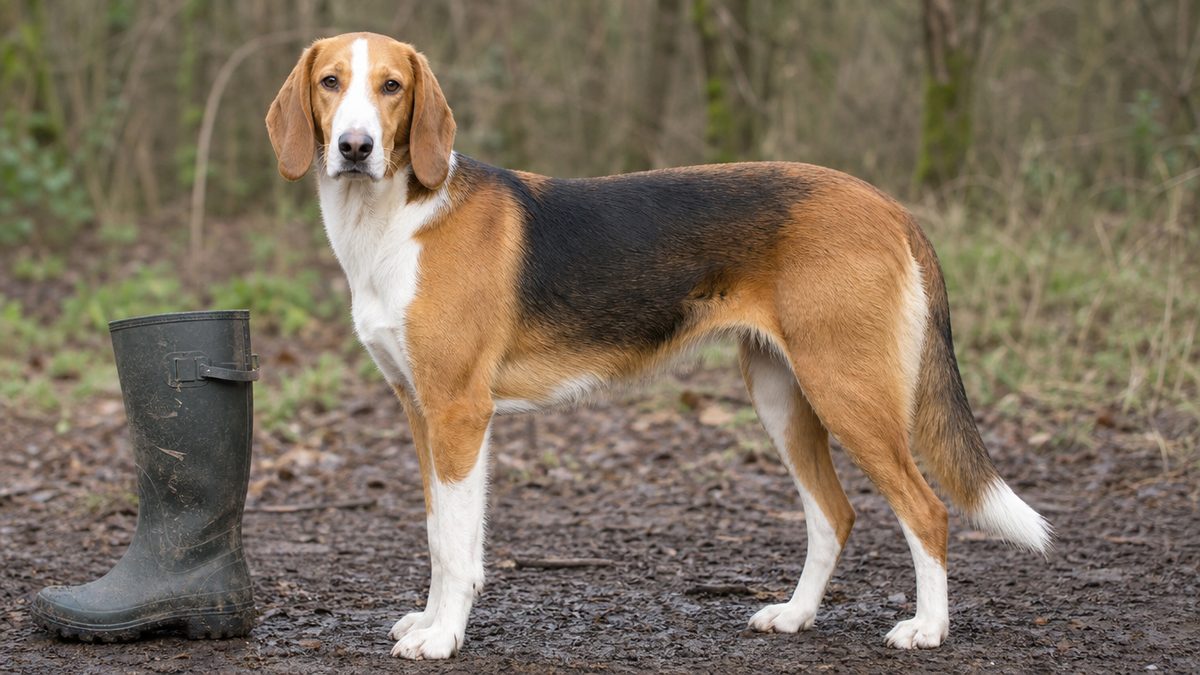
| Colour | Red to yellow, black saddle or blanket, white Bracken markings |
| Behaviour and temperament clause | There is none |
A dense coat described as short, which is the whole Indian argument
The coat clause is the single most consequential sentence on this page for an Indian reader. The standard reads "Hair: Long for a short haired dog. Very dense, hard, almost bristly. Well coated and dense on belly. Generally, a little longer on underside of tail forming a moderate brush. Buttocks (thighs) well breeched";. The German is identical in force: "Für einen kurzhaarigen Hund lang, sehr dicht, hart, fast stockig und auch der Bauch dicht und gut behaart";.
So this is a short-coated dog only in the loosest sense. The standard goes out of its way to say the hair is long *for* a short-haired dog, that it is very dense, that even the belly is well coated, and that the thighs are breeched. That is a coat built to keep an animal warm and dry on wet ground at single-digit temperatures, and it is not the same thing as a Doberman's or a Rajapalayam's jacket. A ranking American breed guide describes the same coat as "short, coarse, and lies close to the body", which drops every word the standard used to make its point.
Colour, and what the Bracken markings actually are
The German Hound is a tricolour hound with a specific and named white pattern. The standard gives "Red to yellow with black saddle or blanket and the white 'Bracken' markings: blaze running through, white muzzle with neck ring (closed neck ring should be aimed for), white chest, legs and tip of tail". The German adds the same aspiration in the same words, that a closed neck ring is to be aimed for.
Chocolate brown is a fault and so are piebald dogs on the body. A German Hound offered to you in solid black, solid liver, merle, or any colour without a blaze and a white tail tip is not a German Hound as either registry defines one.
Look at the tail first. The standard calls for a remarkably thick, bushy-haired tail that tapers to a point, described as protection against knocking on tree trunks and branches. Then look at the leg length against the body depth, because high stationed is a stated requirement and a long-cast, low body shape is a listed fault. Then look for the white neck ring and the blaze running through. A short-legged tricolour Bracke with the same colours is a Westphalian Dachsbracke, which is a different FCI number.
The German Hound is not the Westphalian Dachsbracke, and neither is the Alpine one
Three Bracken are routinely written about as one dog, and the FCI register separates them by number, by country, by section and by height, with the Deutsche Bracke at 299, the Westfälische Dachsbracke at 100 and the Alpenländische Dachsbracke at 254.
This confusion is not a reader's fault. It is baked into the FCI's own documents. Standard 100 opens its general appearance clause by stating that "The Westphalian Dachsbracke is the short-legged variety of the German Hound (Bracke). It corresponds in essential points with the longlegged variety, but gives a compacter, more powerful impression than the former";. So the FCI's own text calls the Westphalian a variety of this breed, while the FCI's own register lists it as a separate breed with its own number, its own standard and its own validity date.
Both statements are official and they cannot both be operative. Bonbeno reports the disagreement rather than resolving it, because the practical answer for a buyer is unambiguous either way: the two dogs carry different numbers, so a pedigree names one or the other and never both.
| Feature | Deutsche Bracke (299) | Westfälische Dachsbracke (100) | Alpenländische Dachsbracke (254) |
|---|---|---|---|
| Country of origin | Germany | Germany | Austria |
| FCI section | 1.3 Small-sized Hounds | 1.3 Small-sized Hounds | 2 Leash (scent) hounds |
| Height at the withers | 40 to 53 cm | 30 to 38 cm | 34 to 42 cm |
| Height as a disqualification | No, moderate departure permitted | Not stated as a fault | Yes, under 34 or over 42 cm |
| Standard in force published | 24.06.1997 in English, 24.06.1987 in German | 24.06.1987 | 10.10.1995 |
| Coat | Long for a short haired dog, very dense | Very dense and coarse over the whole body | Double coat, thick top coat plus dense undercoat |
| Colour | Red to yellow, black saddle, white Bracken marks | Red to yellow, black saddle, white Bracken marks | Dark deer red, or black with red-brown Vieräugl marks |
| Behaviour and temperament clause | None | None | Yes, intelligent and friendly, fearless |
| Breed-specific paper in PubMed | None | None | Yes, an SCN8A ataxia variant |
The height ranges overlap, so height alone will not identify the dog
Read the table's height row carefully. The Westphalian tops out at 38 cm and the Alpine at 42 cm, while the German Hound starts at 40 cm. A 40 to 42 cm tricolour Bracke is inside the German Hound's range and inside the Alpine Dachsbracke's range at the same time. What separates them at that size is leg length, coat structure and country, not the tape measure.
The Alpine is the easiest of the three to rule out, and the coat is the tell. Standard 254 specifies "a very thick top coat and a dense undercoat";. Standard 299 describes no undercoat at all. An Austrian mountain dog carrying a full undercoat and a German Westphalian hound carrying none are different propositions in a Chennai August, and anyone selling you either as the other is telling you something material and wrong.
The Dachshund head is a named fault, which is the point of the distinction
FCI-Standard 299 lists "Teckel-like (Dachshund type) head" among its faults, and the German prints it as one word, TeckelkopfFédération Cynologique Internationale. The UKC standard carries the same fault in the same place. So the German Hound's own standard is actively defending the breed against drifting towards its short-legged relative, and "long cast, low body shape" sits immediately above it on the same fault list.
English Wikipedia adds the mechanism, sourced to the breed club's own archived history page, that the Westphalian Dachsbracke is possibly a cross of a Bracke with the Dachshund. Whether or not that is settled, the standard's fault list makes the breeding intention plain.
One club runs both German breeds, which is why the names blur
The Deutscher Bracken Club e.V., founded in 1896 and seated at 57462 Olpe, is the parent breed club for both the Deutsche Bracke and the Westfälische Dachsbracke. Its own homepage discusses them in a single sentence. That is entirely reasonable inside Germany, where nobody confuses them, and it is a large part of why English-language pages published far from Westphalia treat the pair as one animal with two leg lengths.
Verified from the FCI's own documents on 31 August 2026: the Deutsche Bracke is number 299, Germany, Section 1.3, 40 to 53 cm; the Westfälische Dachsbracke is number 100, Germany, Section 1.3, 30 to 38 cm; the Alpenländische Dachsbracke is number 254, Austria, Section 2, 34 to 42 cm. Not settled: whether the Westphalian is a breed or a variety, because FCI-Standard 100 and the FCI's Group 6 register say different things and neither document acknowledges the other.
Registry recognition, and the date the FCI prints two different ways
Two registries recognise the German Hound, the FCI as number 299 and the United Kennel Club in its Scenthound Group since 1 January 1996, and reading both standards side by side turns up a height disagreement, a duplicated fault and a publication date that changes depending on which language you open.
Registry recognition is the question an Indian buyer should ask first, because the Kennel Club of India is a full FCI member and issues pedigrees against FCI nomenclature. India registered 33,880 pure-bred dogs with the KCI studbook in 2025, against 38,592 in 2024 and 89,571 in 2021. So an FCI-recognised breed has a theoretical Indian paper route. The German Hound is FCI-recognised on a definitive basis, which means the route exists on paper and is worth nothing without a dog to register.
The German original and the English translation disagree about the standard's own date
German is the official authentic language of FCI-Standard 299, a fact printed on the face of the English translation itself. So the German PDF is the operative text and the English is a rendering of it. The two documents do not agree on when the standard was published.
The English text prints "DATE OF PUBLICATION OF THE OFFICIAL VALID STANDARD: 24.06.1997", and the FCI's own nomenclature record and the VDH breed page both print 24 June 1997Fédération Cynologique InternationaleVerband für das Deutsche Hundewesen. The German text prints "DATUM DER PUBLIKATION DES GÜLTIGEN OFFIZIELLEN STANDARDS: 24. 06. 1987".
A ten-year gap in a single field is not a rounding matter, and there is a clue to what happened. 24.06.1987 is the Westphalian Dachsbracke's publication date, printed on standard 100 and carried in the Group 6 registerFédération Cynologique Internationale. The two German Bracke standards were evidently prepared as a pair, and one date appears to have followed the other into the wrong file. Bonbeno records what the documents say and does not adjudicate which is correct, because three FCI-controlled sources say 1997 and one says 1987, and all four are official.
| Document | Date of publication of the official valid standard |
|---|---|
| FCI-Standard 299, English text 15.09.1997 | 24.06.1997 |
| FCI-Standard 299, German authentic text 15.09.1997 | 24.06.1987 |
| FCI nomenclature record for breed 299 | 24 June 1997 |
| VDH Rasselexikon entry for the Deutsche Bracke | Gives the standard number and height, not the date |
| FCI-Standard 100, Westphalian Dachsbracke | 24.06.1987 |
The English translation also carries a fault the German does not
The English fault list ends with two bullets reading "Chocolate colour, particolour" and then, immediately below it, "Particolour";. The German fault list ends with "Schokoladenbraune Farbe" and "Scheckige Hunde am Körper", two distinct faults stated once each. So the translation has merged two faults into one bullet and then repeated half of it, producing a list with a duplicate that does not exist in the authentic text. It changes nothing about how a dog is judged and it tells you how carefully the English document has been maintained.
The two registries disagree on the height floor by three centimetres
The FCI gives height at the withers of 40 to 53 cm with moderate departure permitted. The UKC gives "Height at the withers for males and females is 17 inches to 21 inches";. Seventeen inches is 43.2 cm and twenty-one inches is 53.3 cm.
So a 41 cm German Hound is comfortably inside the FCI standard and three centimetres below the UKC's floor. Neither registry mentions the other's figure. Neither publishes a weight. And neither has a working trial requirement in common either: the FCI marks breed 299 as subject to a working trial according to the FCI Breeds Nomenclature, while the UKC standard is a conformation document with no working component at allUnited Kennel Club.
- FCI, definitive since 28 January 1964. Group 6, Section 1.3 Small-sized Hounds, with working trial. The route the Kennel Club of India would use.
- VDH, the German national kennel club. Publishes the breed's standard page and its puppy registrations, and delegates the studbook to the Deutscher Bracken Club.
- UKC, since 1 January 1996. Scenthound Group. The only English-speaking major registry that recognises the breed.
- AKC. No recognition. The breed appears in neither the AKC's recognised roster nor its Foundation Stock Service, which is what the second-ranking page means when it says the breed lacks AKC recognition.
The FCI files the German Hound under Section 1.3 Small-sized Hounds, alongside the Beagle at 33 to 40 cm and the Basset Hound. One subsection up, in 1.2 Medium-sized Hounds, sit the Ariegeois at 52 to 58 cm and the Chien d'Artois. So a 53 cm German Hound is officially a small hound and a 52 cm Ariegeois is officially a medium one. The classification tracks the breed's traditional job and its country's own filing, not the tape. Any page that translates Section 1.3 into a promise about how much dog you are getting has misread the register.
German Hound price in India: there is none
No verified German Hound price in India exists, because there is no Indian market for the breed to price, and the only rupee figure an India-region search produces for the name is Rs 1,870 for a tote bag.
Put the answer first, because every ranking page buries it. Bonbeno could not find a single Indian seller, breeder, rescue or listing offering a German Hound, and the search that failed to find one was proved to work in the same session on a breed India actually keeps.
What an India-region search for the price actually returns
A Firecrawl web search with location set to India for "German Hound Deutsche Bracke price in India", run on 31 August 2026, returned ten results in this order: the English Wikipedia article, an American puppy marketplace's breed guide, WagWalking pricing the dog in US dollars, DogsGlobal quoting the FCI coat clause, an Etsy listing for a Deutsche Bracke tote bag at Rs 1,870, a PetSupplies page, DogBreedsList twice, and a Pinterest ideas board for "german dog price in india" twice.
Not one result offers a dog. The only India-domain result on the entire page is the tote bag, and its Rs 1,870 is the only rupee figure the query produces. That is the honest state of the price in india question for this breed: the dog is unavailable here, so the price does not exist.
The control that makes the absence evidence rather than a failed search
An absence proves nothing unless the instrument is working, so the same tool ran "labrador retriever price in india" in the same session. It returned Supertails' Indian breed guide, Mr n Mrs Pet with a city-by-city price table covering Hyderabad, Bangalore, Delhi, Chennai, Lucknow, Mumbai, Jaipur and Pune, a YouTube price video, a Quora thread and PetsWorld, every one of them a genuine Indian puppy listingMr n Mrs Pet, Labrador Retriever Puppies…. The instrument works. It finds Indian dog prices when Indian dog prices exist.
A second engine was tried and is reported here only so nobody repeats the attempt. The DuckDuckGo HTML endpoint with the India region flag returned HTTP 202 and an anti-bot challenge reading "Select all squares containing a duck", so it served no results at all. Bonbeno draws no conclusion from it in either direction, because a search that was never run is not evidence of anything.
India's benchmark price list does not contain this breed
Supertails' "Dog Price List in India: Top 40 Breeds" is the most-cited Indian dog price page there is. Searched in full, its 120,485 characters contain zero occurrences of Bracke, German Hound or Deutsche, against fourteen occurrences of Beagle, eleven of Labrador and four of Dachshund in the same document. The controls sit inside the source itself, which is the cleanest form this test takes.
| Source | Figure published | What it is |
|---|---|---|
| DogBreedsList | $800 to $1,200 | A US dollar puppy estimate with no breeder named |
| WagWalking | $600 to $1,500 a year | US pet insurance, not a purchase price |
| Etsy, via the India result page | Rs 1,870 | A tote bag |
| Supertails Dog Price List in India | No entry | The breed is absent from India's benchmark list |
| Mr n Mrs Pet | No entry | The marketplace lists Labradors city by city and not this breed |
| Any Indian breeder or rescue | No entry | None found |
There is nothing here to divide by an exchange rate, and that is unusual
Bonbeno routinely finds Indian pages publishing a rupee band that turns out to be a dollar figure run through one exchange rate, and the test is to divide the rupee figures by 84.38, by 80, by 74 and by 66.67 and see which lands on a number a seller would print. This breed has no Indian rupee band to test at all. There is no Indian page publishing a price for it, so there is nothing to convert and nothing to catch. The absence of even a fabricated price is itself a measure of how far outside the Indian market this dog sits.
Ask for the pedigree number and the registry that issued it, and check the dog against three things at once. Height at the withers between 40 and 53 cm, a coat the standard calls long for a short-haired dog and very dense rather than sleek, and the white Bracken markings with a blaze running through and a white tail tip. A short-legged tricolour Bracke is a Westphalian Dachsbracke. A tricolour hound at 30 to 45 cm with a thick undercoat is likelier to be an Alpine Dachsbracke, which is Austrian. And a mid-sized Indian tricolour hound with drop ears is very commonly a Beagle cross, which is a fine dog and not this one.
How many German Hounds exist, from the German kennel club's own table
The VDH registered 100 Deutsche Bracke puppies in Germany in 2025 and 1,380 across the fifteen years from 2011 to 2025, an average of 92 a year, which is the only hard population figure published for this breed anywhere.
Almost no English page about this dog cites a number, and the number is public, official and fifteen years deep. The Verband für das Deutsche Hundewesen publishes a nationwide puppy registrations table by breed, and the Deutsche Bracke has a row in it every year.
| Breed | 2025 | 2024 | 2023 | 2022 | 2021 | 2020 | 2019 |
|---|---|---|---|---|---|---|---|
| Deutsche Bracke | 100 | 80 | 53 | 142 | 120 | 108 | 89 |
| Westfälische Dachsbracke | 30 | 40 | 25 | 56 | 91 | 28 | 44 |
| Alpenländische Dachsbracke | 77 | 87 | 75 | 113 | 101 | 112 | 113 |
| Beagle | 312 | 327 | 411 | 445 | 610 | 602 | 433 |
| Teckel (Dachshund) | 4,508 | 4,788 | 5,475 | 6,296 | 7,205 | 6,660 | 5,921 |
| All breeds, VDH total | 55,053 | 56,851 | 60,306 | 69,381 | 85,595 | 77,461 | 72,377 |
The breed is going up while German pedigree registration goes down
Read the 2023 column and then the 2025 column. The Deutsche Bracke went from 53 puppies in 2023 to 100 in 2025, a rise of 89 percent in two years. Over the same two years the VDH's all-breeds total fell from 60,306 to 55,053, a drop of 8.7 percent. So this breed nearly doubled while German pedigree dog registration as a whole shrank by almost a tenth.
That is worth stating carefully, because a 53 is a small number and small numbers swing. The fifteen-year series runs 92, 51, 79, 76, 81, 100, 90, 119, 89, 108, 120, 142, 53, 80, 100 from 2011 to 2025. The 2023 figure of 53 is the second lowest in the whole series and the 2012 figure of 51 is the lowest, so 2023 looks like a trough rather than a collapse, and 2025 looks like a return to the series average of 92 rather than a boom. Either way the breed is stable, small and not disappearing.
Put 100 puppies in proportion
One hundred puppies is 0.18 percent of the 55,053 puppies the VDH registered across all breeds in 2025. The Beagle, the scent hound India actually keeps, produced 312 in Germany the same year, a little over three times as many. The Teckel produced 4,508, about 45 times as many. Germany's own most popular breed, the Deutscher Schäferhund, produced 6,374.
So the German Hound is rare even at home, in the one country where it is a working dog with a parent club, a studbook and a national following. It is not rare in the sense of endangered. It is rare in the sense that roughly one hundred puppies a year is the entire annual global supply of registered animals, and essentially all of them go to German hunters.
The German kennel club's own breed page had no litters on it
The VDH's Rasselexikon page for the Deutsche Bracke carries an "Aktuelle Würfe" panel, which the page states shows litters of the current breed as well as of the associated FCI group. When Bonbeno checked it on 31 August 2026 the panel listed one Basset Hound litter and three Dalmatian litters, and no Deutsche Bracke litter at all.
That is a snapshot rather than a trend, and it is the right kind of snapshot to publish, because it shows what a prospective owner in Germany sees on the official page on an ordinary day. The parent club is explicit about why there is no central list to consult: responsibility for placing puppies rests with the breeders themselves, and the club runs no central puppy placement, though it will help through a Welpenberater on request.
Verified: the VDH registered 100 Deutsche Bracke puppies in 2025, 1,380 over fifteen years, against 549 Westfälische Dachsbracken and 1,814 Alpenländische Dachsbracken over the same period, and the VDH all-breeds total fell from 60,306 in 2023 to 55,053 in 2025. Not verified: how many living German Hounds there are in total, because neither the VDH nor the Deutscher Bracken Club publishes a population census, only births. And not applicable: any figure for India, because there is no Indian registration of this breed to count.
Indian import rules, and why no supply chain can form
Indian law makes a dog a Restricted import and states that applications for trading or breeding purposes shall be duly rejected, so the only lawful way a German Hound reaches India is in the baggage of an owner who already had it abroad.
The instrument is DGFT Trade Notice No. 22/2022-23 of 19 December 2022, Guidelines for import of Pet Animals. It records ITC (HS) 01061900 Mammals Other as Restricted subject to Policy Condition 6, and its Policy Condition 7 limits dog imports to three categories: a pet dog with a valid pet book in the importer's own name, R&D organisations holding a CPCSEA recommendation, and the Defence and Police Force.
Policy Condition 8 bars the import of commercial dogs for breeding or any other commercial activities, and paragraph 6 of the notice states plainly that any applications for trading or breeding purposes shall be duly rejected. Paragraph 7 permits entry only through the airports and seaports of Delhi, Mumbai, Chennai, Hyderabad, Bangalore and Kolkata.
Read the two facts together and the market question closes
Take the import policy and the German registration table together and the conclusion follows without any guesswork. Roughly one hundred puppies a year exist, essentially all of them in German hunting hands, and Indian law will reject an application to bring one in for breeding or sale. Two closed doors, and neither depends on the other.
So no Indian breeder can lawfully establish a founding pair, no Indian pet shop can lawfully stock one, and no Indian buyer can lawfully purchase a German Hound imported for that purpose. The one lawful route is a person who owned the dog abroad, holds its pet book in their own name, and brings the animal with them when they move. That route produces individual dogs, never a market.
Do not conflate the two import routes
Commercial and restricted import runs on the DGFT trade notice above. Personal pet import under the baggage rules is a different instrument, resting on the Livestock Importation Act, 1898, and S.O. 4396(E) of 10 October 2024 permits pet dogs and cats through Cochin International Airport, Kochi, under the jurisdiction of the Animal Quarantine and Certification Station, Chennai. That order adds a port to the pet route. The DGFT notice still names six ports for its own licence route, so the DGFT figure is reported as the DGFT prints it, and a pet arriving under the baggage rules can land at seven ports today. Both lists are right for their own route, as how to import a dog to India sets out.
If the dog does arrive, Indian breeding law still applies
Anyone who imports a German Hound lawfully and then contemplates breeding from it runs into the Prevention of Cruelty to Animals (Dog Breeding and Marketing) Rules, 2017. Three provisions bite on any hound.
- Rule 8(1)(a) requires that pups less than eight weeks in age are not sold. That is a Rule in the main body of the instrument, not a Schedule paragraph.
- Second Schedule Part II paragraph 6(8) forbids tail docking, ear cropping, de-barking, de-clawing, branding, dyeing and any change of appearance by artificial means. De-barking matters for a hound, because a hound's voice is the trait it was selected for, and removing it is prohibited.
- Second Schedule Part III paragraph 8(10) requires that breeding dogs have been tested for genetic defects, including hip dysplasia, progressive retinal atrophy, night blindness, hypothyroidism, entropion, ectropion, overshot and undershot jaw, wry mouth, two or more missing teeth and cryptorchidism.
Paragraph 8(10) has a specific edge on this breed. Its list includes cryptorchidism, and the UKC makes unilateral or bilateral cryptorchid a disqualifying fault while the FCI puts two normally descended testicles in its N.B. rather than its disqualificationsFédération Cynologique Internationale. So Indian law, the American registry and the international registry all treat the same finding with three different degrees of force, and the Indian rule is the one that binds a breeder here.
Note also what paragraph 8(10) does not contain. Across all fourteen pages of the Rules the words BAER and deaf appear zero times, and so do patella and luxation. There is no Indian hearing test requirement and no Indian patella grading requirement for any breed, and anyone who tells you otherwise is inventing a rule.
Any Indian listing offering a German Hound puppy is making one of three claims, and all three deserve documents. Either the dog was imported under a route that Indian policy says shall be duly rejected, or it descends from an animal imported as somebody's personal pet, in which case ask to see that pet book and the pedigree, or it is not a German Hound. The third is by far the most likely, because roughly one hundred registered puppies exist worldwide each year and the German parent club places them through individual breeders it knows.
Monthly cost of keeping one in India, if one is here
Budget Rs 6,000 to Rs 13,000 a month for a 40 to 53 cm working hound in an Indian city, built from India's published cost benchmarks rather than from any figure attached to this breed, because no such figure exists.
Every number in this section is an Indian benchmark for a dog of this size, not a monthly cost anybody has published for a German Hound. Say that plainly, because the alternative is to convert an American figure and present it as Indian, which is exactly what the ranking pages do. WagWalking prices this breed's insurance at $600 to $1,500 a year and offers no Indian equivalent at all.
Supertails' Indian price list gives the frame. Monthly upkeep across breeds runs Rs 3,000 to Rs 18,000 depending on breed size and grooming needs, average monthly maintenance runs Rs 3,000 to Rs 11,000, urban Indian households now spend Rs 5,000 or more every month, and a first year costs Rs 80,000 to Rs 2,00,000 including purchase, vaccinations, food, training and supplies. City prices vary 15 to 30 percent, with Mumbai and Delhi the most expensive.
| Line | Monthly, Rs | What drives it |
|---|---|---|
| Food | 3,000 to 6,000 | A 15 to 22 kg working-built hound on a quality kibble or a cooked diet |
| Routine veterinary and preventives | 800 to 1,500 | Tick and flea control every month, not seasonally, plus deworming |
| Ear care consumables | 300 to 700 | Vet-supplied ear cleaner, drying agent and cotton, weekly at minimum |
| Grooming | 0 to 800 | A dense short coat needs a brush, not a salon. Budget only if you outsource baths |
| Exercise and enrichment | 500 to 1,500 | Long lines, scent-work kit, replacement toys a hound destroys |
| Boarding and daycare sinking fund | 800 to 2,000 | A vocal hound is refused by some Indian boarding facilities |
| Insurance or a self-insurance fund | 600 to 1,200 | Indian pet insurance is thin, so most owners self-fund |
| Total | 6,000 to 13,700 | Toward the upper half of the Indian range, driven by ear care and exercise, not grooming |
Two lines are higher for this breed than for a comparable Indian dog
The ear line is the first. Pendulous-eared breeds carry 1.76 times the odds of otitis externa compared with erect-eared breeds, with a 95 percent confidence interval of 1.48 to 2.10, and V-shaped drop ears carry 1.84 times the odds, 1.53 to 2.21. A 14 cm by 9 cm close-fitting leather is squarely in that group. In an Indian climate that is a recurring consumable cost and, in a bad year, a recurring consultation cost.
The tick line is the second. A survey of 525 dogs across four Indian cities found 261 of them, 49.7 percent, infected with at least one canine tick-borne pathogen by PCR, with Hepatozoon canis at 30 percent and Ehrlichia canis at 20.6 percent, and ticks present on 278 of the dogs examined. A dog whose job description is putting its nose in undergrowth meets more ticks than a dog that walks on pavement. Monthly year-round preventive is not optional here, and it is the single cheapest line on the table relative to what it prevents.
What the first year costs, and what it does not include
Take the Indian benchmark of Rs 80,000 to Rs 2,00,000 for a first year including purchase. For this breed the purchase component is undefined, because there is nothing to buy in India and nothing lawful to import for sale. So the honest first-year figure for a German Hound that is already in India, brought by an owner relocating, is the Indian benchmark minus the purchase price: roughly Rs 75,000 to Rs 1,40,000 across food, vaccination, neutering, ear care, equipment and the first year's preventives.
One line most Indian budgets miss for a hound is fencing. A scent hound that picks up a line will follow it, and Indian residential compounds are rarely built to hold one. Physical containment is a capital cost, not a monthly one, and it is the difference between a dog that lives to twelve and a dog that meets traffic.
The Indian ranges here are published Indian benchmarks for dogs of comparable size, drawn from India's most-cited price list, plus two lines lifted by Indian veterinary evidence specific to this dog's ears and this country's ticks. They are not a German Hound cost survey, because none exists in any country. Treat them as a planning envelope, not a quotation, and get a written estimate from your own vet before you commit.
Heat tolerance in India: Bonbeno rates this breed 2 of 5
Bonbeno rates the German Hound 2 out of 5 for heat tolerance in India, because a dense-coated working hound bred at an annual mean of 8.3 C meets an annual mean wet-bulb temperature in Chennai that is higher than the air temperature of its home region in its hottest month.
Most breed pages guess at heat tolerance. This one measures it, using NASA POWER climatology queried by explicit latitude and longitude so that no place name can be served in error, and comparing wet-bulb rather than air temperature because wet-bulb is what limits a panting animal.
The origin climate, by coordinates
The breed's home is Westphalia and the Sauerland, and the Deutscher Bracken Club sits at Olpe in North Rhine-WestphaliaFédération Cynologique Internationale. Queried at 51.0286 N, 7.8511 E, Olpe returns an annual mean air temperature of 8.3 C, an annual mean relative humidity of 84.66 percent and an annual mean wet-bulb temperature of 6.88 C. Its hottest month, July, averages 17.6 C with a 14.84 C wet bulb, and January averages -0.6 C at 95.24 percent humidity.
Notice the humidity figure before going further. Olpe is humid, more humid on an annual average than any Indian city in the table below. Humidity by itself is therefore not what makes India hard for this dog. Humidity at 28 C is.
| Place | Annual mean air, C | Annual mean humidity, % | Annual mean wet bulb, C | Wet bulb above Olpe, C |
|---|---|---|---|---|
| Olpe, Sauerland (origin) | 8.3 | 84.66 | 6.88 | - |
| Chennai | 27.95 | 72.39 | 24.94 | +18.06 |
| Kolkata | 25.81 | 73.93 | 22.85 | +15.97 |
| Mumbai | 26.77 | 67.39 | 22.73 | +15.85 |
| Bengaluru | 23.74 | 67.94 | 19.80 | +12.92 |
| Pune | 23.86 | 66.80 | 19.66 | +12.78 |
| Delhi | 25.60 | 45.56 | 18.03 | +11.15 |
The one comparison that settles the question
Chennai's annual mean wet-bulb temperature is 24.94 C. Olpe's air temperature in July, its hottest month, averages 17.6 CNASA Langley Research Center. So the wet bulb that Chennai holds as an ordinary year-round condition sits 7.3 C above the dry-bulb temperature of the breed's homeland at the peak of a German summer. There is no month of the year in which a German Hound in Chennai experiences anything its coat was selected for.
Delhi looks milder on the annual wet-bulb column at 18.03 C, and that is the column lying to you. Delhi's July wet bulb is 27.74 C, the highest single monthly figure in the whole table, against Olpe's July wet bulb of 14.84 CNASA Langley Research Center. Delhi's annual average is dragged down by a dry, cool winter. Its monsoon is the hardest month in this set for a working dog, and Kolkata's May wet bulb of 27.61 C is barely behind it.
Why the exercise, not the weather, is what kills these dogs
The largest primary-care study of heat-related illness in dogs found that of 879 events with a recorded trigger, 652, or 74.2 percent, were exertional, against 113 environmental and 46 from vehicular confinement. Of the 551 exertional events whose exercise type was specified, 372, or 67.5 percent, followed walking rather than any high-intensity activity.
Read that carefully, because it inverts the usual advice. Two thirds of the exertional cases came from a walk. The German Hound was not among the breeds the study modelled, so no odds ratio from it can be applied to this dog, and Bonbeno applies none. What transfers is the mechanism: a dog that will work a line for hours, in a coat the standard calls very dense, in a country whose IMD declares a heat wave at 40 C in the plains with a peak in May, does not stop itself.
- Walk before 06:00 and after 20:00, eight months of the year, in every city in the table above.
- Watch the wet bulb, not the thermometer. Delhi in July and Chennai in May are the two conditions in this set where a dog cannot cool itself efficiently by panting.
- Carry water on every outing, and end the outing when the dog stops responding to a recall rather than when your route ends.
- Never leave the dog in an outdoor run in daytime. Second Schedule Part IV paragraph 21 of the 2017 Rules bars keeping dogs that cannot tolerate prevailing local temperatures in outdoor facilities without a vet's written approval.
The German Hound gets a 2 rather than a 1 because it is a normal-muzzled dog with no brachycephalic penalty and small-sized rather than a heavy giant. It does not get a 3 because the standard specifies a very dense coat with a well-coated belly and breeched thighs, and because the entire purpose of the animal is sustained work that the largest study on the subject identifies as the dominant trigger of heat illness. Bonbeno's Alpine Dachsbracke page reaches the same 2 of 5 by a different route, weighing a true double coat with a dense undercoat against a short-legged frame that sits closer to hot ground. Two different builds, two different arguments, one rating, and the two pages agree.
Temperament, and the clause the standard never wrote
Neither registry standard for the German Hound contains a behaviour or temperament clause, so every temperament claim published about this breed comes from the parent club or from nowhere, and the difference between those two origins is the most useful thing this section can tell you.
Open FCI-Standard 299 and look for the heading. Group 6 standards normally carry a BEHAVIOUR / TEMPERAMENT clause, and the Alpine Dachsbracke's standard has one reading "Expression intelligent and friendly. Fearless personality";. Standard 299 has no such heading at all, in English or in GermanFédération Cynologique Internationale. The only temperament content in the whole document is the eye clause, "Dark, clear with friendly expression", and the disqualifying fault of aggressive or overly shy dogs.
The UKC standard is the same. It runs from History through Disqualifications without a temperament section, and its disqualifications are viciousness or extreme shyness, albinism and cryptorchidism. So two registries, and not one sentence about what this dog is like to live with.
What the parent club says, which is the only sourced description there is
The Deutscher Bracken Club fills the gap in one sentence on its own homepage, and it is worth taking seriously because the club has run the studbook since 1896. It states that the Deutsche Bracke and the Westfälische Dachsbracke are, by virtue of their size, very pleasant hunting companions in the shoot, which because of their calm and balanced nature are also unproblematic to keep at home, provided they are given a firm place in the family.
The conditional at the end is the whole sentence. The club is not saying the dog is easy. It is saying the dog is easy when it lives with people rather than in a kennel run, which is a claim about housing rather than about temperament. English Wikipedia reports the same position from the club's archived pages, that although it is a hunting dog it is affectionate and benefits from living with the family rather than in a kennel, and that it is a very persistent tracking dog with a good sense of direction.
What the ranking pages say, and why to discount it
The second-ranking page describes the breed as warm and friendly, outgoing, quick to pick up commands, deeply devoted with protective instincts especially around children, an escape artist, and unsuited to being left alone. Some of that is plausible for any pack-bred scent hound. None of it is sourced, and the same page states that the breed's ancestry likely includes Greyhounds and Bloodhounds, which appears nowhere in the standard's historical clause, and hyperlinks the words Deutsche Bracke in its own opening sentence to a German Pinscher sales pageFédération Cynologique Internationale.
The seventh-ranking page is more instructive still. Its Temperament field reads "A light / High stationed / Elegant", which is the FCI standard's general appearance sentence chopped into three fragments and filed under the wrong heading, and all fifteen of its behavioural star ratings read 0 stars. That is not a description of a dog. It is a template with a gap in it.
What can honestly be said about living with one
Three things are supportable, and each rests on something documented rather than on adjectives.
- Voice is the working trait, not a behaviour problem. Brackade hunting works because the pack hound gives tongue while it runs, telling the hunter where the dog is and what it is following. A dog selected for a hundred and twenty-five years to bay across broken country will bay in a stairwell.
- Independence is the working trait too. A hound that hunts ahead of the gun and holds a line on its own is deciding for itself, all day. The club calls it persistent with a good sense of direction, and that is the same quality read from the owner's side.
- Company is a requirement rather than a preference. Both the club and its archived pages put the same condition on the same claim, that the dog does well at home when it has a real place in the family.
Who should not want one in India
Anyone in a flat. The dog is vocal by design and India's Noise Pollution (Regulation and Control) Rules, 2000 set a residential limit of 55 dB(A) by day and 45 dB(A) at night, with night defined as 10 p.m. to 6 a.m., and allow a complaint where ambient standards are exceeded by 10 dB(A) or more. Apartment living with a working Bracke is a dispute waiting to be filed, and it is not a training failure when it happens.
Anyone who wants a first dog, because an independent hound teaches bad habits faster than a beginner corrects them. Anyone without secure fencing. And anyone who wants a guard dog, because nothing in either standard or in the club's description suggests this animal guards anything.
This is a friendly, persistent, noisy, independent working hound that wants to live indoors with its people and work outdoors for hours. The friendliness is well attested by the club that breeds them. The noise and the independence are not flaws to be trained out, because they are the two traits the breed exists for.
Training a hound that was bred to decide for itself
Train the German Hound with short, frequent, food-paid sessions and treat recall as a lifelong management problem rather than a skill you finish, because the breed's working job is to follow a scent line away from you and keep going.
Nothing in either registry standard tells you how this dog learns, so this section reasons from the job the standard does describe and from what is documented about hounds generally. That is a weaker footing than a page on a Labrador stands on, and saying so is more useful than filling the gap with confidence.
The job is Brackade. The dog runs the line, gives tongue continuously so the hunter can place it by ear, and drives game towards a waiting gun, sometimes over very large ground and often out of sight for long stretches. Every hour of that work rewards the dog for continuing without instruction. You cannot train that out, and you should not want to, because it is the animal.
Recall is the exception, and it is the only one that matters
Everything else this breed learns readily. Recall in the presence of a live scent is the exception, and it is the one failure that kills dogs in Indian cities. The mechanism is simple: a scent line is a self-reinforcing activity, so every second the dog spends following it pays better than anything you are holding.
The practical position for an Indian owner is therefore management first and training second.
- Fence the property physically, to a height and a depth the dog cannot pass. A hound follows a line under a gate as readily as over a wall.
- Use a long line of 10 to 15 metres for every open-ground outing, for life, in every Indian city. This is not an admission of failure, it is the standard equipment for the breed.
- Pay recall with food every single time, at a value that beats a scent, and never call the dog to end something it enjoys.
- Practise recall on scent, not on grass. A recall that only works in a bare park has not been tested against the thing it is for.
- Fit a collar tag and microchip before the first outing, because the first escape is the one you did not plan for.
Session shape, and why short beats long here
Keep formal sessions to five or eight minutes and run three or four of them a day. A hound's attention is long in the field and short in the yard, and a twenty-minute obedience block in Indian heat produces a bored dog and an irritated handler. Use scent games as the reward for obedience rather than as a separate activity, because that pairs the thing you want with the thing the dog already wants.
Socialisation, on an Indian timetable
Socialise the puppy deliberately and early, and understand that the Indian version of this task is different from the German one. An Indian puppy needs calibrated exposure to free-roaming dogs, to two-wheeler traffic at close range, to crowded market noise, to cattle, to festival firecrackers and to household staff coming and going. A German puppy needs none of those in that combination.
Do it in the cool hours, keep every session short and pleasant, and stop before the puppy is tired rather than after. Indian law sets one hard date here that owners should know: Rule 8(1)(a) of the 2017 Rules requires that pups less than eight weeks in age are not sold, so a breeder offering a six-week puppy is breaking the law and telling you something about the rest of their practice.
What not to do
Do not use an aversive collar to fix recall. A hound running a line is not being defiant, it is doing its job, and punishing it teaches the dog that returning to you predicts something unpleasant, which is the opposite of what you need. Do not attempt to train the voice away either, and note that de-barking is expressly forbidden in India under Second Schedule Part II paragraph 6(8) of the 2017 Rules, alongside docking, cropping and de-clawing.
No published training study exists for the German Hound, and none is likely to, because a breed producing about a hundred registered puppies a year worldwide does not generate research. What is written above is reasoned from the working role that FCI-Standard 299 and the breed club describe, and from the general behaviour of pack scent hounds. Where a claim rests on inference rather than evidence, this page says so rather than dressing it up.
The daily exercise requirement, and the number the breed club actually gives
Plan on 90 to 120 minutes a day split across two cool-hour sessions with at least a third of it nose work, because the German breed club describes the ground a working pack needs as a minimum of 1,000 hectares and no Indian city walk approximates that.
Most breed pages guess at exercise requirements. For this breed there is one published anchor and it is startling. English Wikipedia, citing the breed club's own archived pages, records that the space needed to hunt a pack of these hounds is described by the club as a minimum area of 1,000 hectares, which is 2,471 acres or ten square kilometres.
That figure describes a hunting ground rather than a daily requirement, and it should not be converted into one. What it tells you is the scale the breed's own club thinks in. This is not a dog whose working day is measured in kilometres. It is measured in square kilometres.
The other anchor is the working trial
The FCI marks breed 299 as subject to a working trial according to the FCI Breeds Nomenclature. That is a formal status, not a description: it means a dog of this breed must pass a working test to gain certain titles. The Deutscher Bracken Club runs Fährtenschuhprüfungen through the season and an annual Brackenwochenende, and its calendar for September 2026 alone lists four separate trials, two of them already fully booked.
So the breed is still tested on work, in numbers, every year. That is the population you are buying into if one of these dogs reaches you.
What that translates to in an Indian city
Ninety minutes is a floor rather than a target, and how you split it matters more than the total.
| Session | When | Duration | Content |
|---|---|---|---|
| Pre-dawn | 05:15 to 06:15 | 45 to 60 min | Long line, varied route, at least 20 minutes of free sniffing on a slack lead |
| Midday | Indoors | 10 to 15 min | Scatter feed, snuffle mat, find-it games. No outdoor exposure |
| Post-sunset | 20:30 to 21:30 | 40 to 60 min | Long line again, plus one laid scent trail two or three times a week |
| Weekly | Cool hours | 2 to 3 hours | Peri-urban ground with real cover, on a long line, off pavement |
The midday indoor block is not padding. Nose work exhausts a scent hound far faster than walking does, and it is the only form of exercise that is fully available in an Indian afternoon. A dog worked hard on scent in a cool room at noon is a calmer dog at 4 p.m. than one that was walked in the sun.
The advice from the ranking pages that you should not follow here
The second-ranking page recommends at least two hours of vigorous daily exercise "incorporating ample off-leash time in secure spaces", on the same page where it calls the breed a notorious escape artist. Both halves cannot be safely acted on in an Indian city, where genuinely secure off-lead space is rare and traffic is not.
The heat half of that advice is worse. Of 879 heat-illness events with a recorded trigger in the largest primary-care study of the subject, 652, or 74.2 percent, were exertional, and of the 551 exertional events with a specified exercise type, 372, or 67.5 percent, followed a walk. Two hours of vigorous exercise in a Chennai afternoon, at an annual mean wet bulb of 24.94 C, is the exact protocol that study describes as the dominant cause.
- Move the volume, not reduce it. The dog still needs 90 to 120 minutes. It needs them before 06:00 and after 20:00.
- Substitute nose for distance whenever the wet bulb is high. Scent work delivers the tiring without the thermal load.
- Swim where clean water is genuinely available, and dry the ears afterwards, which the grooming section explains.
- Never jog with the dog in the heat. A hound will keep pace past the point where it should stop.
Verified: the FCI lists breed 299 as subject to a working trial, the breed club runs multiple trials a year, Wikipedia records the club describing a 1,000 hectare minimum hunting area, and 652 of 879 recorded-trigger heat events in the Hall study were exertional with 372 of 551 specified exertional events following a walk. Not verified: any published daily exercise figure in minutes for this breed, because no registry or club publishes one. The 90 to 120 minute range here is Bonbeno's own reading of a working hound's needs, not a quoted figure.
Grooming a dense-coated hound in Indian humidity
Brush the German Hound twice a week and treat the ears as the actual grooming job, because a 14 cm close-fitting leather over a warm humid canal is the single highest-frequency health cost this breed carries in India.
The coat is easy and the ears are not, and every ranking page has that ratio backwards. Start with what the standard says the coat is. "Long for a short haired dog. Very dense, hard, almost bristly. Well coated and dense on belly. Generally, a little longer on underside of tail forming a moderate brush. Buttocks (thighs) well breeched";.
So this is a dense double-length-for-a-shorthair jacket with no described undercoat, over the whole animal including the belly. You groom it with a rubber curry or a firm bristle brush twice a week, more in a coat change, and you never take it to a salon. There is no stripping, no clipping and no scissoring in this breed, and anyone proposing to shave it for the Indian summer should be refused: the coat is the dog's insulation in both directions, and removing it exposes skin that has never been exposed.
Bathing, and the drying rule that overseas advice keeps getting wrong
Bathe every four to six weeks in an Indian city and after any swim or muddy work. The instruction that matters is what happens next. Overseas breed-care advice routinely says to towel a hound off and let it air dry, which is sound in Westphalia at 8.3 C and actively wrong in an Indian monsoon.
Dry the dog properly, and dry the ear canal specifically, using a vet-supplied drying agent rather than cotton buds pushed into the canal. Plug the ears before you bathe. That single habit is worth more than every other grooming step on this page combined.
Why the ears carry the risk, with the numbers
The standard specifies leathers that are long, about 14 cm, and broad, about 9 cm, close fitting and rounded at the ends. Close fitting is the operative phrase: the flap lies against the head and seals the canal, which is exactly the geometry that traps warm moist air.
The largest UK primary-care study of canine otitis externa, drawing a random sample of 22,333 dogs from a population of 905,554 under veterinary care, reports a one-year period prevalence of 7.30 percent, 95 percent CI 6.97 to 7.65. Compared with breeds carrying erect ears, breeds with pendulous ear carriage had 1.76 times the odds, 95 percent CI 1.48 to 2.10, and breeds with V-shaped drop ears had 1.84 times the odds, 1.53 to 2.21. The same study puts the Basset Hound highest of all named breeds at 5.87 and the Beagle at 2.54.
An older North American study of 8,975 dogs across fifteen university teaching hospitals found the same ear effect and added the piece that makes it an Indian problem. Dogs with pendulous ears and heavy ear canal hair had significantly more otitis externa than other ear types at P less than 0.01, and monthly variations in ambient temperature, rainfall and relative humidity explained to a large extent the monthly variation in prevalence. Ear disease is a weather-driven condition, and India supplies the weather.
Which Indian season is worst is genuinely disputed, and this page publishes the dispute
Bonbeno's gundog pages report an Indian otitis series peaking in the monsoon. An Indian series from Durg in Chhattisgarh disagrees. It examined 281 dogs, found 51 positive for otitis externa, a prevalence of 18.14 percent, and recorded seasonal prevalence highest in summer, defined as March to June, at 21 of 51 cases or 41.18 percent, against 17 of 51 or 33.33 percent in the rainy season of July to October.
Both cannot be the general Indian pattern, and neither should be presented as settled. What is not disputed is that Indian ear disease is seasonal in both directions and that the seasons in question cover roughly eight months of the year. Ear cleaning for this breed is therefore a year-round weekly routine, not a monsoon precaution.
- Lift and look, weekly. A healthy canal is pale, dry and odourless. Yeast smells sweet and sour at once.
- Clean only when there is something to clean, with a vet-supplied cleaner, and never with a cotton bud inside the canal.
- Dry after every bath and every swim, ears first.
- Escalate a head shake that lasts two days. Early otitis is a consultation. Late otitis is a chronic canal.
- Keep the monthly tick preventive running, because 261 of 525 Indian dogs surveyed carried a tick-borne pathogen and ears are where you first notice ticks.
Two brushings a week for the coat, a bath every four to six weeks with the ears plugged and dried afterwards, a weekly ear inspection, and a monthly tick preventive that never lapses. There is no salon appointment in this breed's life and there should never be a clipper.
Health problems and lifespan: an honest blank, four times over
No peer-reviewed paper names the German Hound, no OFA statistics table carries a row for it, no breed club publishes a screening scheme for it, and the largest UK longevity study does not include it, so nobody can tell you this breed's real rate of anything.
This is the section where most breed pages invent, so this one shows its working. Four separate registers and literatures were searched, each with a control run in the same session, and all four came back empty for this breed while returning results for controls.
One, the peer-reviewed literature returns nothing
PubMed was queried for "Deutsche Bracke" and returned 3 records, and the count is the trap. PubMed reported the warning quotedphrasesnotfound and translated the query to ("deutsche" OR "deutsches") AND "bracke", so it never searched the phrase. The three records are a perihilar cholangiocarcinoma study in BJS Open, a PRMT7 and COPD paper in Nature Communications and an ATP6AP2 hippocampus paper in Brain Structure and Function. Bracke is a Belgian and Dutch surname, and those three papers have authors with it.
"German Hound" returned 35 records with the same warning, translated to a German-people term ANDed with hound. Its hits include a canine 3D printing review, a Croatian canine lymphoma study, and a psycholinguistics paper titled "Wolf-hound vs. sled-dog: neurolinguistic evidence for semantic decomposition in the recognition of German noun-noun compounds";. Zero of the 38 records across both queries are about this breed.
Controls run in the same session returned 126 records for Labrador Retriever hip dysplasia, 42 for Dachshund intervertebral disc disease and 11 for Beagle otitis externa. So PubMed was working. The honest answer for the German Hound is zero papers, and zero is publishable.
Two, the same search finds the Alpine Dachsbracke, which makes the zero stronger
The best control here is a relative. "Alpine Dachsbracke" was matched by PubMed as an exact phrase, with no not-found warning, and returned 4 genuine records. One of them is a breed-specific genetic disease paper, "A Missense Variant in SCN8A in Alpine Dachsbracke Dogs Affected by Spinocerebellar Ataxia", published in Genes in May 2019.
So a sibling Bracke breed of similar rarity has a named mutation, a named disease and a paper in the literature, retrieved by the same tool in the same minute. The German Hound has none. That is a much better-evidenced absence than a bare zero, and it is a direct reason not to import the Alpine Dachsbracke's ataxia onto this breed's page, which no responsible source should do.
Three, the OFA has no statistics row
The Orthopedic Foundation for Animals' full disease statistics tables were retrieved as a 2,226,110 character document and searched case-insensitively. The document returns zero occurrences of BRACKE, DACHSBRACKE, GERMAN HOUND, DEUTSCHE, WESTPHALIAN or ALPINE, against 109 occurrences of LABRADOR, 80 of DACHSHUND, 61 of BEAGLE and 46 of BASSET HOUND in the same file.
The right way to state that is precise. There is no row in OFA's published statistics tables for this breed, which is not the same as absence from the OFA database. The OFA's own FAQ explains the threshold: a breed is not included in the statistics until at least 100 evaluations for hips or 50 for all other databases have been performed. A breed producing about a hundred puppies a year, almost all in Germany, will never cross an American registry's hundred-evaluation floor.
Four, there is no published lifespan
The ranking pages call the breed generally hardy and give 10 to 12 years, and none of them cites anything for either claim. The largest UK companion-dog longevity study, covering 584,734 unique dogs including 284,734 deceased, partitions its estimates across 155 breeds, and the German Hound is not among them. That is expected, because the 155 breeds analysed are the breeds the United Kingdom keeps as companions and this one is not kept as a companion anywhere.
So Bonbeno publishes no lifespan figure for the German Hound. The 10 to 12 years in circulation may well be right, and it is a guess repeated until it looked like a fact. English Wikipedia is unusually candid on the point and states directly that no specific diseases or claims of extraordinary health have been documented for this breed.
| Register | German Hound | Control run in the same session |
|---|---|---|
| PubMed, exact phrase | 0 genuine records | Labrador and hip dysplasia, 126 records |
| PubMed, sibling breed | Not matched as a phrase | Alpine Dachsbracke matched, 4 records, one an SCN8A paper |
| OFA published statistics | No row | Labrador 109, Dachshund 80, Beagle 61 mentions |
| McMillan 2024 longevity, 155 breeds | Not included | The study's 155 breeds are UK companion breeds |
| Breed club screening scheme | None published | The club publishes trials, not health schemes |
What the ranking pages fill this blank with
The second-ranking page lists gastric dilatation volvulus, hip dysplasia, ocular conditions, cryptorchidism and increased sensitivity to anaesthesia as this breed's notable health issues, introducing them as risks "familiar to large hunting dogs";. Three problems with that. The breed is not large, it sits in the FCI's Small-sized Hounds subsection at 40 to 53 cm. No source is given for any of the five. And anaesthesia sensitivity is a well-documented sighthound trait with a known mechanism, imported here onto a scent hound with no evidence at all.
Two of the five are worth watching anyway, for reasons that come from the documents rather than from that page. Cryptorchidism is a UKC disqualifying fault and is named in Indian law's genetic-defect testing clause. And any deep-chested dog carries some bloat risk, which the standard describes as a chest "deep, reaching to below elbows, flatly rounded with long ribcage";. Those are structural observations, not prevalence figures, and this page offers no percentage for either.
Because no breed screening scheme exists, ask the breeder what they personally test and see the certificates. Hips and elbows scored by any recognised scheme, eyes examined, and both testicles descended in a male, cover the ground Indian law's Second Schedule Part III paragraph 8(10) asks about. A breeder who says the breed has no health problems is describing an absence of data, not an absence of disease, and you should say so back to them.
Feeding, and the body shape the standard tells you to aim for
Feed the German Hound to a visible waist and a slightly tucked-up abdomen, because the standard names that outline twice and because bodyweight at or above the breed mean is one of the few heat-illness risk factors an owner can actually change.
The standard gives you the target without a single gram. It describes a "light, high stationed, elegant, yet strongly made hunting dog" with a "slightly tucked up abdomen", and a chest that is deep and flatly rounded with a long ribcage. The German is the same, "leicht aufgezogener Leib";. Light, high-stationed, tucked up. That is the shape you feed to, and it is easier to hold than a number you do not have.
You do not have a number because no registry publishes a weight for this breed, in any languageUnited Kennel Club. The 10 to 18 kg in circulation comes from a page whose fifteen behavioural ratings all read zero and whose only reference is labelled YouTube. Do not feed to it.
Why body condition is a heat argument, not a cosmetic one
In the VetCompass heat-illness work, exertional heat-related illness was the dominant recorded trigger, accounting for 652 of the 879 events with a recorded trigger, or 74.2 percent. Bodyweight relative to the breed mean is one of the risk factors that literature has examined, and it is the one an owner controls entirely.
The German Hound is absent from the breed model in that study, so no odds ratio from it is applied to this breed here. The transferable point is simpler and needs no statistic: a heavier dog carries more heat, sheds it more slowly and works just as hard, in a country where Chennai's annual mean wet bulb is 24.94 C.
Life-stage feeding, on an Indian schedule
| Stage | Meals a day | What to watch |
|---|---|---|
| 8 to 16 weeks | 4 | Steady growth, not fast growth. Avoid over-supplementing calcium |
| 4 to 8 months | 3 | Ribs easily felt under a thin fat cover at all times |
| 8 to 14 months | 2 | Growth plates still closing. No forced distance running |
| Adult | 2 | A visible waist from above and a tuck from the side, all year |
| Over 8 years | 2 | Reduce calories before the dog gains, not after |
Two Indian-specific practices matter more than the brand. Feed the larger meal after the evening outing rather than before it, because a deep-chested dog exercised on a full stomach is the classic bloat presentation. And never feed immediately after a hot walk. Let the dog cool, offer water first, and feed twenty to thirty minutes later.
Availability in India, and what to actually buy
There is no breed-specific food for the German Hound and there does not need to be. Any complete adult food formulated for a medium-active dog of 15 to 25 kg is appropriate, and India stocks plenty. The decisions worth making are about fat content and feeding time rather than about breed labelling.
In an Indian summer many working-built dogs eat less voluntarily, and that is normal. Do not chase intake with toppers. Weigh the dog monthly on the same scale, record it, and act on a trend rather than on a week. Indian households now spend Rs 5,000 or more a month on a pet on average, and food is the largest single component of that.
Ribs easily felt under a thin fat cover, a waist visible from above, and a tuck visible from the side, in August as well as in January. If you can only see the tuck by shaving the coat, the dog is too heavy, because this coat is dense enough to hide a fat cover that a shorter-coated breed would reveal.
Month by month through the first year
Plan the German Hound's first year around three fixed points, the eight-week floor Indian law sets on sale, the socialisation window that closes early, and the growth-plate window that rules out distance running until at least twelve months.
This timeline assumes a puppy already in India, because there is no lawful route to import one for sale. It is built from Indian legal dates and general canine developmental biology rather than from any breed-specific study, because none exists for this dog.
| Age | What is happening | What you do |
|---|---|---|
| 0 to 8 weeks | With the dam. Indian law bars sale below eight weeks under Rule 8(1)(a) | Refuse any puppy offered earlier, and note what that offer tells you |
| 8 to 10 weeks | Home. Fear responses forming fast | Short pleasant outings in cool hours. Handle the ears daily from day one |
| 10 to 16 weeks | Socialisation window closing | Free-roaming dogs, two-wheelers, market noise, cattle, staff. Calibrated, brief, positive |
| 4 to 6 months | Teething. Recall still reliable | Bank recall now, on scent, before adolescence removes it |
| 6 to 9 months | Adolescence. Recall degrades sharply | Long line goes on and stays on. Do not treat the regression as disobedience |
| 9 to 12 months | Growth plates closing | No jogging, no cycling alongside, no repetitive jumping |
| 12 to 18 months | Physical maturity | Distance work can begin, in cool hours only |
| Any age | Indian ear season is roughly eight months long | Weekly ear check, monthly tick preventive, never lapsing |
Handle the ears from week eight, before there is a problem
This is the single highest-value habit in the whole timeline. A dog that has had its 14 cm leathers lifted, looked into and wiped every week since it was eight weeks old is a dog you can treat at home when otitis starts. A dog that first meets an ear cleaner at fourteen months, in pain, learns to fight the procedure, and that fight lasts the rest of its lifeDan G. O'Neill, Andrea V. Volk.
The adolescent recall collapse is normal and it is not a training failure
Between roughly six and nine months a scent hound's recall gets markedly worse, and the reason is developmental rather than moral. The dog's nose and its independence are both maturing, and the reward available on a scent line is rising faster than anything in your pocket. Owners who respond by punishing get a dog that avoids returning. Owners who respond by managing get their recall back at fifteen months.
Manage it with equipment and geography rather than with confrontation. Long line on, high-value food, short sessions, and no open ground without a barrier for six months. That is the whole intervention.
Growth plates, and the Indian temptation to over-exercise
A young working hound looks tireless at eight months and is not structurally finished until twelve to eighteen. Repetitive high-impact loading on open plates is how a sound dog acquires a joint problem, and it is more tempting here than in Germany because Indian owners are often compressing all the day's exercise into two cool windows.
Resist that. Add nose work, not distance. Scatter feeds, laid trails and find-it games load the brain without loading the joints, and they tire this breed faster than walking does at any age.
Rule 8(1)(a) of the Prevention of Cruelty to Animals (Dog Breeding and Marketing) Rules, 2017 requires that pups less than eight weeks in age are not sold. Note the form of that citation. It is a Rule in the main body of the instrument, not a Second Schedule paragraph, and this site cites the two differently because the document numbers its clauses twice and the confusion has caused real errors elsewhere.
The German Hound against the breeds an Indian buyer actually cross-shops
An Indian buyer drawn to the German Hound is usually choosing between a tricolour drop-eared scent hound they cannot get and four they can, so the honest comparison is against the Beagle, the Dachshund, the Basset Hound and the Indian Pariah Dog.
Nobody in India is choosing between a German Hound and a Westphalian Dachsbracke, because neither is available. The real choice is between the idea of this dog and what an Indian household can actually acquire, so this table compares on the axes that decide the outcome rather than on breed romance.
| Breed | Height | FCI section | Bonbeno heat rating | Available in India |
|---|---|---|---|---|
| German Hound (299) | 40 to 53 cm | 1.3 Small-sized Hounds | 2 of 5 | No. None found, with a working control |
| Beagle (161) | 33 to 40 cm desirable | 1.3 Small-sized Hounds | See the Beagle page | Yes, widely, and priced city by city |
| Basset Hound (163) | Short-legged | 1.3 Small-sized Hounds | See the Basset page | Yes, and it carries the highest measured otitis odds at 5.87 |
| Dachshund | Short-legged | Group 4, not a scent hound section | See the Dachshund page | Yes. India's Teckel equivalent is everywhere |
| Indian Pariah Dog | Varies | Not FCI recognised | The heat-adapted native benchmark | Yes, free, in every Indian shelter |
The Beagle is the substitution most Indian buyers actually make
The Beagle sits in the same FCI subsection, 1.3 Small-sized Hounds, is the same kind of vocal, nose-driven, pack-bred animal, and is genuinely available in India at published pricesShama Hiregange, Dog Price List in India. Germany registered 312 Beagle puppies in 2025 against 100 Deutsche Bracke.
It is also better documented in every direction that matters. The Beagle has an OFA statistics presence, 11 PubMed records on otitis externa alone, and a measured otitis odds ratio of 2.54 against the general dog populationUnited States National Library of MedicineDan G. O'Neill, Andrea V. Volk. If you want to know what you are buying, you can. With a German Hound you cannot, because none of those datasets contain it.
The honest trade is that the Beagle is smaller, at a desirable 33 to 40 cm against 40 to 53 cm, and every bit as loud. Anyone rejecting the German Hound for noise should reject the Beagle for the same reason.
The Basset Hound is the ear warning
If you are considering a drop-eared hound in India, look at the number the Basset Hound generates. It carries the highest odds of otitis externa of any breed in the largest UK primary-care study, at 5.87, well above the pendulous-ear-carriage effect of 1.76 that applies to drop-eared breeds as a class.
That is not an argument against Bassets. It is an argument for understanding that ear geometry is a real, measured, breed-level risk, and that it is the axis on which Indian humidity punishes hound owners. The German Hound sits in the 1.76 group rather than the 5.87 one, which is better and is not zero.
The Indian Pariah Dog is the comparison this site keeps making, for a reason
A free, heat-adapted, locally evolved dog with a functioning immune history in exactly the climate you live in is a serious proposition, not a consolation prize. Set it against a German hound bred at an annual mean of 8.3 C, imported illegally or not at all, with no lifespan data, no OFA row and no published health schemeOrthopedic Foundation for Animals.
The one thing the Pariah does not give you is the specific working nose and voice of a Bracke. If that is genuinely what you want, the Beagle is the available answer and adopting an Indian dog alongside it is the better one.
Read the availability column first, not the heat column. Four of these five dogs can be acquired in India today and one cannot, and no comparison of temperament or coat changes that. If the German Hound is the only one you want, what you actually want is a working scent hound, and that want is better served by a Beagle from a breeder who health-tests than by waiting for a dog Indian import policy will not admit.
Mistakes Indian buyers actually make with this breed
Six mistakes account for almost everything that goes wrong around the German Hound in India, and the first one is believing that a dog offered to you under this name is this breed.
None of these is hypothetical. Each maps onto something published on a page currently ranking for this breed's Indian price query, or onto something the documents themselves make likely.
One, accepting the name without the pedigree
About one hundred registered German Hound puppies exist worldwide each year, almost all placed by German breeders the parent club knows personally, and Indian import policy states that applications for trading or breeding purposes shall be duly rejectedDirectorate General of Foreign Trade. A German Hound offered casually in India is overwhelmingly likely to be something else with drop ears and a tricolour coat.
Ask for the pedigree number and the issuing registry, and check the dog against the standard's own markers: 40 to 53 cm at the withers, high stationed rather than long and low, a coat the standard calls long for a short-haired dog and very dense, a blaze running through, a white neck ring and a white tail tip.
Two, believing a published weight
Neither the FCI nor the UKC has ever published a weight for this breedUnited Kennel Club. Any seller quoting a weight range is quoting a website, and the website most likely to be the source publishes 10 to 18 kg alongside fifteen behavioural ratings that all read zero. Feed to body condition instead, which the standard describes and a scale does not.
Three, treating it as a short-coated dog and shaving it
The standard calls the hair "Long for a short haired dog. Very dense, hard, almost bristly" with the belly well coated and the thighs breeched. A ranking American page reduces that to "short, coarse, and lies close to the body";. Owners who believe the second version conclude that the dog is heat-suited and that shaving would help.
Both conclusions are wrong. The coat is insulation in both directions and shaving exposes skin that has never seen Indian sun. Brush it twice a week and manage the heat by moving the exercise, not by removing the coat.
Four, letting it off the lead because it seems obedient
This breed learns readily and returns reliably right up to the moment it meets a scent line, at which point four generations of selection outrank six months of training. Indian traffic does not offer a second chance. A 10 to 15 metre long line is standard equipment for the life of the dog, and using one is not an admission that your training failed.
Five, keeping it in an outdoor run through an Indian summer
Second Schedule Part IV paragraph 21 of the 2017 Rules provides that dogs not accustomed to the temperatures prevalent in the area, and breeds that cannot tolerate them, shall not be kept in outdoor facilities unless the practice is specifically approved in writing by the attending veterinary practitioner, and requires outdoor shelters with a roof, four sides, a floor and separate shaded areas large enough for all the animals at once.
For a dense-coated hound from a region whose annual mean is 8.3 C, in a city whose annual mean wet bulb is 24.94 C, that rule is not paperwork. It is the correct answer written into law.
Six, buying it for a flat and then trying to fix the voice
The hound's voice is the trait Brackade hunting selects for, because the hunter locates the dog by ear. India's residential noise limits are 55 dB(A) by day and 45 dB(A) at night, with a complaint available at 10 dB(A) over. And de-barking is expressly forbidden under Second Schedule Part II paragraph 6(8) of the 2017 Rules, alongside docking, cropping and de-clawing.
So there is no lawful surgical fix and no realistic training fix for a trait the breed exists to express. The decision is made before the dog arrives, not afterwards.
Every one of these starts with reading a page written for an American or German reader and applying it unchanged in Chennai or Delhi. Overseas care advice assumes overseas weather, overseas law and overseas availability. Check each instruction against the climate you actually live in and the rules that actually bind you here, and where an overseas source and Indian evidence disagree, the Indian evidence wins.
Adoption and responsible sourcing
Adopt an Indian dog rather than wait for a German Hound, because no German Hound rescue exists in India, no Indian shelter has one, and the nose-driven, vocal, people-loving animal you are picturing is already sitting in an Indian shelter without a pedigree.
Start with the honest position. Bonbeno found no German Hound available in India through any channel, verified with a control query that returned real Indian listings for a breed India actually keepsMr n Mrs Pet, Labrador Retriever Puppies…. There is no German Hound rescue network in India because there is no German Hound population in India to rescue from.
What to do instead, in order
- Adopt an Indian dog from a shelter in your city. Free, heat-adapted, and available today in every metro. Ask the shelter specifically for a nose-driven dog if that is what you want, because shelter staff know their animals.
- Adopt a Beagle or Beagle cross through breed rescue. Indian Beagle rescues exist and are regularly full, largely because people buy a scent hound for a flat and then surrender it. That surrender pattern is the same mistake this page warns about, arriving from the other side.
- If you must buy, buy a breed that is genuinely bred in India, from a breeder who shows you hip, elbow and eye certificates and lets you meet the dam. Second Schedule Part III paragraph 8(10) of the 2017 Rules names the defects a breeding dog should have been tested for, and it is a reasonable checklist to hold a breeder to.
- Do not attempt to import. DGFT policy states that applications for trading or breeding purposes shall be duly rejected, and a dog acquired around that rule has no lawful paperwork behind it.
How to verify a breeder, whatever the breed
The same four checks work everywhere and they take one visit. See the dam with the litter, in the place the puppies were raised. Ask for written health certificates and photograph them. Confirm the puppy is at least eight weeks old, which Rule 8(1)(a) requires. And ask what the breeder does if you cannot keep the dog in three years, because a breeder who takes their dogs back is a breeder who is still there in three years.
Add one check for any hound. Ask to hear the parents. A breeder who cannot let you hear an adult of the breed give voice, in a country where residential noise is capped at 45 dB(A) at night, is not preparing you for the animal.
If a German Hound genuinely does reach you
A small number will, in the baggage of people relocating to India with a dog they already owned, which is the one lawful route. If you are that owner, three things change your dog's odds materially and none of them is expensive.
- Shift the whole exercise routine before you arrive, not after. Pre-dawn and post-sunset, eight months a year, from day one.
- Start the weekly ear routine immediately, because a dog moving from a 6.88 C wet bulb to a 24.94 C one is meeting new ear conditions on arrival.
- Put a monthly tick preventive in place before the first walk, given that 261 of 525 Indian dogs surveyed carried a tick-borne pathogen.
The independence claim, stated plainly
Bonbeno does not sell dogs, does not broker puppy sales and takes no payment from any breeder, marketplace or rescue named or unnamed on this page. The reason this page contains no Indian price for the German Hound is that no verified Indian price exists, and the reason it contains no lifespan figure is that no study has produced one. Where a number would be convenient and is not real, this site leaves the space empty and says why.
There is no German Hound to adopt in India and no lawful way to buy one. The dog people picture when they read about this breed, a friendly, persistent, loud, nose-led animal that wants to live with its family, is genuinely available in Indian shelters right now without a pedigree and without a price. Start there.
German Hound in India: questions people actually search
How much does a German Hound cost?
No verified German Hound price exists in India, because no Indian seller, breeder or rescue offers one. The only published figures are American: DogBreedsList quotes $800 to $1,200 for a puppy and WagWalking quotes $600 to $1,500 a year for insurance. The only rupee figure an India-region search produces for the name is Rs 1,870, and it is for a tote bag.
How to Find a German Hound Puppy in the U.S.?
That question is the second-ranking page's own heading, and the honest Indian answer is different from the American one. In India there is no route at all, because DGFT Trade Notice 22/2022-23 states that import applications for trading or breeding purposes shall be duly rejected, and roughly one hundred registered puppies exist worldwide each year, placed by German breeders the parent club knows.
What is the average lifespan of a Deutsche Bracke?
Nobody knows, and Bonbeno publishes no figure. The 10 to 12 years in circulation is uncited on every page that prints it, and the largest UK longevity study, covering 584,734 dogs across 155 breeds, does not include this one. English Wikipedia states directly that no specific diseases or claims of extraordinary health have been documented for the breed.
Is the German Hound recognised by the AKC?
No. The American Kennel Club recognises neither the German Hound nor the Westphalian Dachsbracke, in its main roster or its Foundation Stock Service. Two registries do recognise the breed: the FCI as standard number 299 on a definitive basis since 28 January 1964, and the United Kennel Club in its Scenthound Group since 1 January 1996.
How much exercise does a German Hound need?
No registry or breed club publishes a figure in minutes, so treat any page that gives one as guessing. What is published is that the FCI makes breed 299 subject to a working trial and that the breed club describes a working pack as needing a minimum area of 1,000 hectares. Bonbeno's own floor for an Indian city is 90 to 120 minutes a day, split across pre-dawn and post-sunset sessions.
Is the Deutsche Bracke the same as the Westphalian Dachsbracke?
The FCI's own documents disagree. Its register lists them as separate breeds, number 299 at 40 to 53 cm and number 100 at 30 to 38 cm, while FCI-Standard 100 opens by calling the Westphalian Dachsbracke the short-legged variety of the German Hound. Both are German, both sit in Section 1.3, and one club has run both since 1896, which is why the names blur.
What is the difference between a Deutsche Bracke and an Alpine Dachsbracke?
Country, section and coat. The Deutsche Bracke is German, FCI 299, Section 1.3 Small-sized Hounds, 40 to 53 cm, with no described undercoat. The Alpine Dachsbracke is Austrian, FCI 254, Section 2 Leash hounds, 34 to 42 cm, short-legged, with a true double coat of thick top coat over dense undercoat, and it is the only one of the two with a temperament clause in its standard.
Does the German Hound shed?
Yes, and the coat is denser than the phrase short-coated suggests. FCI-Standard 299 describes the hair as long for a short haired dog, very dense, hard, almost bristly, with the belly well coated, a moderate brush under the tail and the thighs well breeched. Brush it twice a week and never shave it, because the coat insulates in both directions.
Are German Hounds good family dogs?
Probably yes, on thinner evidence than a mainstream breed offers. Neither the FCI nor the UKC standard contains a temperament clause at all, so the only sourced description comes from the parent club, which calls both German Bracke breeds calm and balanced and unproblematic at home when given a firm place in the family. Aggression is a disqualifying fault in both standards.
How big does a German Hound get?
Forty to 53 cm at the withers for both sexes under FCI-Standard 299, with moderate departure permitted, and 17 to 21 inches under the UKC standard, which is 43.2 to 53.3 cm. Neither registry publishes a weight in any language, so every weight figure in circulation, including the 10 to 18 kg on the seventh-ranking page, has no registry behind it.
Can I import a German Hound to India?
Only as your own pet, and never for sale or breeding. DGFT Trade Notice 22/2022-23 records dogs as a Restricted import, limits entry to a pet dog with a valid pet book in the importer's own name, R&D bodies with a CPCSEA recommendation and the Defence and Police Force, and states that applications for trading or breeding purposes shall be duly rejected.
Is the German Hound a good apartment dog in India?
No, and the reason is legal as well as practical. The breed's voice is the trait it was selected for, because Brackade hunting depends on the hunter locating the dog by ear. India's Noise Pollution Rules 2000 set a residential limit of 45 dB(A) at night, and Second Schedule Part II paragraph 6(8) of the 2017 Rules forbids de-barking, so there is no lawful fix.
Does the German Hound have known genetic health problems?
None are documented, which is not the same as none existing. PubMed returns zero genuine records for the breed against working controls of 126, 42 and 11 in the same session, OFA's published statistics tables carry no row for it against 109 Labrador mentions in the same file, and no breed club screening scheme is published. The Alpine Dachsbracke, by contrast, has a named SCN8A ataxia variant in the literature.
What is the temperament of a German Hound?
Neither registry standard says, which is unusual for Group 6. FCI-Standard 299 has no behaviour or temperament heading at all, in English or German, and its only temperament content is an eye clause asking for a friendly expression plus the disqualifying fault of aggressive or overly shy dogs; the UKC standard likewise runs from History to Disqualifications without a temperament section. The only sourced description comes from the Deutscher Bracken Club, which has run the studbook since 1896 and calls the breed calm and balanced and unproblematic to keep at home, provided it is given a firm place in the family, and describes it as a very persistent tracking dog with a good sense of direction.
What is a German Hound?
A light, high-stationed German scent hound standing 40 to 53 cm at the withers, known in its own country as the Deutsche Bracke and recognised by the FCI as standard number 299 in Group 6, Section 1.3 Small-sized Hounds, with working trial. The FCI accepted it on a definitive basis on 28 January 1964. Its general appearance clause asks for a light, high-stationed, elegant yet strongly made hunting dog with a noble, comparatively fine head, good leathers and a remarkably thick tail; high-stationed means long in the leg for its depth of body, which is what a hound needs to work broken ground at a trot for hours.
Is a hound a good family dog?
For this hound, yes at home and no in an Indian flat. The parent club, the only sourced description there is, calls the German Hound calm and balanced and unproblematic to keep at home provided it lives with the family rather than in a kennel run, and both registries make aggression a disqualifying fault. The constraint is the voice, the trait the breed was selected for because Brackade hunting depends on the hunter locating the dog by ear: India's Noise Pollution Rules 2000 set a residential limit of 45 dB(A) at night, and the 2017 Rules forbid de-barking, so there is no lawful fix for a dog that is bred to give tongue.
Compare with similar breeds
German Hound sits in 1 Bonbeno group. Each one compares it directly against the breeds it is genuinely an alternative to, on the same figures.