
Breed profile
Westphalian Dachsbracke: The India Guide
The German short-legged hound that its own breed standard calls a variety of another breed, measured against Indian heat, Indian law and a German register that counts it separately.
Quick answer
The Westphalian Dachsbracke is a separate FCI breed, number 100, and its own standard opens by calling it the short-legged variety of the German Hound. The FCI recognised it on 29 November 1954 and the German Hound on 28 January 1964, so the variety was recognised nine years before the breed. Germany registered 549 of them across the fifteen years to 2025, against 1,380 German Hounds.
This guide summarises breed-standard documents, kennel-club registration data, peer-reviewed veterinary research, Indian breeding and import law and satellite climate data as general information for Indian pet owners. It is not a diagnosis and it is not treatment advice. Consult your nearby vet, a registered veterinarian you can reach the same day, before acting on anything you read here, and treat sudden hind-limb weakness or reluctance to move in a short-legged dog, or collapse after exercise in heat, as an emergency.
Westphalian Dachsbracke at a glance
What the Westphalian Dachsbracke actually is
The Westphalian Dachsbracke is a separate FCI breed at number 100, and its own breed standard opens by calling it the short-legged variety of a different FCI breed.
It sits in Group 6, Scent hounds and related breeds, one of the 70 breeds the FCI files in that group, in Section 1.3, Small-sized Hounds, with a working trial. The FCI accepted it definitively on 29 November 1954, the country of origin is Germany, and the authentic language is German.
Then the standard's first substantive sentence says something a breed record does not usually say about itself. Under GENERAL APPEARANCE it reads: The Westphalian Dachsbracke is the short-legged variety of the German Hound (Bracke). It corresponds in essential points with the longlegged variety, but gives a compacter, more powerful impression than the former. The authentic German text says the same thing in German terms, calling the breed die Niederlaufform der Deutschen Bracke and the other die hochlaeufige Form.
The breed standard, in numbers
The standard describes a moderately long, sturdily built hunting dog standing 30 to 38 cm high, with a noble head of medium size and a well set-on tail carried sabre-shaped upward or pendant with a slight curve at the tip in quiet movement, and a facial expression that is faithful, friendly, serious and alert. That height at withers is stated inside General Appearance, because this standard has no size section at all, and it gives no weight anywhere.
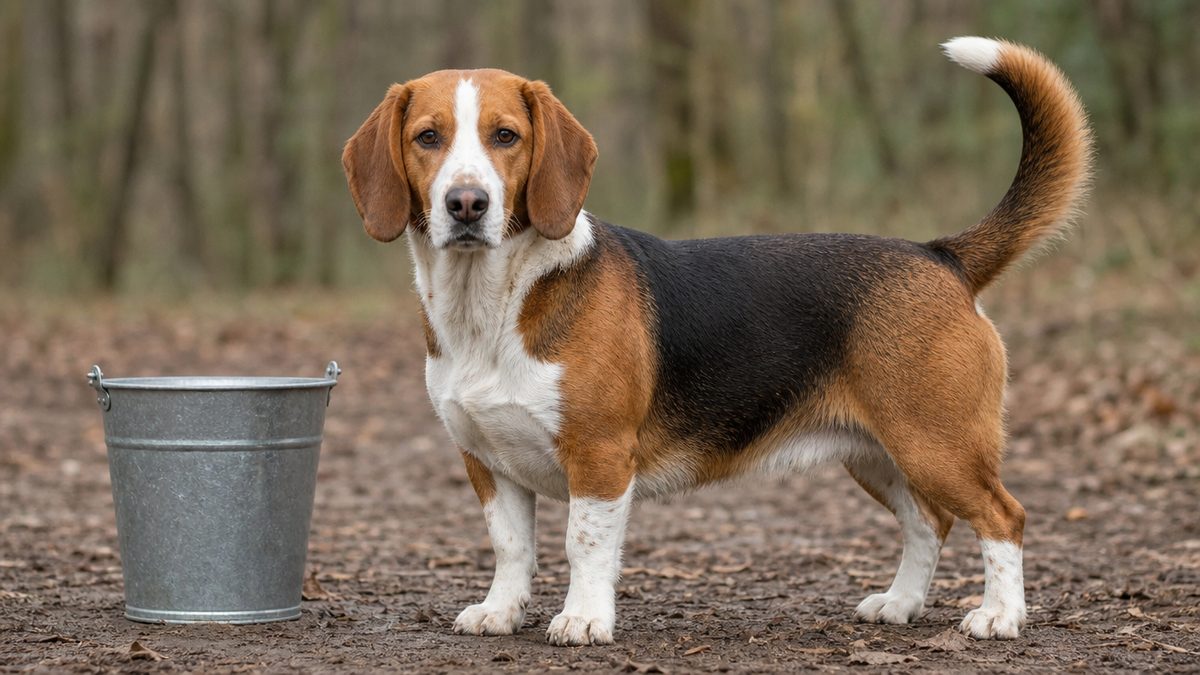
Colour is red to yellow with a black saddle or mantle and the white Bracken markings: a blaze or snip, white muzzle, white collar, white chest, white legs and a white tip to the tail. Bicoloured dogs and dogs with black markings on the head are undesirable, and chocolate brown is a fault. The nose clause is distinctive and worth knowing: the leather carries a light, almost flesh-coloured strip over its centre while the nose wings have more or less dark pigment.
What this standard does not contain
The document in force was published on 24 June 1987, which makes it the oldest standard among the six breeds in this cluster by a decade, and it reads like it.
| Section | Present in FCI 100? |
|---|---|
| Brief historical summary | No |
| Important proportions | No |
| Behaviour and temperament | No |
| Gait and movement | No |
| Size, as its own heading | No; the height sits inside General Appearance |
| Weight | No, and no figure appears anywhere |
| Coat and colour | Yes |
| Faults | Yes |
| Disqualifying faults | Yes, but only two |
The two disqualifying faults are aggressive or overly shy dogs, and any dog clearly showing physical or behavioural abnormalities. There is no disqualification for size, none for bite, none for eyelid faults. That is a very short list by modern FCI standards, and it is a consequence of the document's age rather than a statement about the breed.
The title page of the English version prints WESTPHAELISCHE DACHSBRACKE, hybridising the English Westphalian, with its PH, and the German umlaut form. The FCI's own nomenclature and the authentic German standard both spell it WESTFAELISCHE, with an F. The consequence is practical: an exact search for the correct German name inside the FCI's own English standard for this breed returns nothing at all. Search both spellings, or you will manufacture an absence.
Variety or breed, and why this is the sharpest case of the question
The Westphalian Dachsbracke is registered as a breed and described as a variety, the two FCI standards involved point the descent in opposite directions, and the variety was recognised nine years before the breed.
Take the three documents in turn, because each of them says something the others do not.
One, what FCI 100 says about itself
The Westphalian Dachsbracke's own standard opens by calling the breed the short-legged variety of the German Hound, and adds that it corresponds in essential points with the long-legged variety. Read plainly, a breed standard is describing its subject as a form of something else.
Two, what FCI 299 says about the same relationship
The German Hound's standard has a brief historical summary, and it points the other way. It states that from the formerly numerically strong varieties of the Bracken, the only one surviving in Germany is the Westphalian Bracke; that its most significant local variety was the tricolour Sauerlaender Holzbracke; and that through melting this type with local Steinbracken a certain type evolved which since 1900 has been designated as the Deutsche Bracke.
So FCI 100 says the Westphalian is a variety of the German Hound, and FCI 299 says the German Hound descends from the Westphalian. Two current FCI standards describe the same relationship in opposite directions. Neither is obviously wrong: a regional population can both give rise to a national breed and later be filed as its short-legged form. But a reader told only one of the two gets a very different picture.
Three, the dates, which are the decisive part
| Field | Westphalian Dachsbracke, FCI 100 | German Hound, FCI 299 |
|---|---|---|
| Definitive FCI acceptance | 29 November 1954 | 28 January 1964 |
| Standard in force | 24 June 1987 | 24 June 1997 |
| English version published | 6 May 1997 | 15 September 1997 |
| Section | 1.3 Small-sized Hounds | 1.3 Small-sized Hounds |
| Height | 30 to 38 cm | 40 to 53 cm, moderate departure permitted |
| Translator named | C.Seilder | C. Seidler, revised by Dr. Paschoud |
| Historical summary | None | Yes, and it traces descent to the Westphalian |
| In the FCI varieties and CACIB table | No | No |
The FCI recognised the variety on 29 November 1954 and the breed it is a variety of on 28 January 1964, nine years and two months later. A short-legged form cannot be a variety of a breed the same registry had not yet recognised, so at the very least the standard's opening sentence is describing a relationship that post-dates the recognition it appears in.
Two further details in that table are worth reading. The standards were published on 24 June in 1987 and 24 June in 1997, the same day and month ten years apart. And the translator's surname is printed C.Seilder on one and C. Seidler on the other, which is the same person's name spelled two ways in two FCI documents.
The textual evidence that they share an ancestor document
Put the two nose clauses side by side. FCI 100: the leather has a light, almost flesh coloured strip over the center, while the nose wings have more or less dark pigment. FCI 299: the nose has a light, almost flesh coloured strip in its middle, while the wings of the nose have more or less dark pigment. That is the same sentence with two words moved.
The bite clauses match too, both permitting either a level bite or the inside of the upper incisors touching the outside of the lower, and both noting that the canines are particularly strongly developed. Two standards this close in wording are two edits of one document, which is exactly what you would expect if one breed really is the other's short-legged form.
And what the FCI does not do
Neither breed appears in the FCI's varieties and CACIB table, the document that lists every definitively recognised breed holding varieties of size, coat or colour. Nor does the pair appear in the FCI's crossing register, whose BREEDS list of five entries includes the two Bull Terriers and the two Swiss hounds but not these two.
That absence is informative. The FCI has a mechanism for saying two names are one breed with two varieties, and it has not applied it here. For the Swiss hounds it did apply it, listing four varieties under each of numbers 59 and 60 and awarding the CACIB per variety on one and per breed on the other. For the Westphalian and the German Hound it simply keeps two numbers and lets one standard call the other's dog a variety.
The Westphalian Dachsbracke is a breed for every purpose the FCI acts on: it has its own number, its own standard, its own acceptance date, its own show classification and its own line in the German register. It is a variety only in the descriptive sentence its own standard opens with, and in the shared drafting that sentence reflects. A page that calls it merely a variety of the German Hound is repeating one sentence and ignoring five registry facts. A page that never mentions the sentence is hiding the most interesting thing about it.
Westphalian Dachsbracke price in India
There is no Westphalian Dachsbracke price in India, because there is no Westphalian Dachsbracke in India, and Germany itself produces about thirty-seven a year.
The German register settles the supply question. The VDH recorded 549 puppies of this breed across the fifteen years from 2011 to 2025, with 30 in 2025, 40 in 2024 and a low of 16 in 2013. That is the output of the breed's own home country.
Indian law then closes the commercial route independently. Dogs enter the Indian tariff at ITC (HS) 01061900, Mammals: Other, with an import policy of Restricted. Import is permitted only for a pet dog with a valid pet book and records in the importer's name, for research organisations with a CPCSEA recommendation, and for internal security by the Defence and Police Force. Policy Condition 8 states that import of commercial dogs for breeding or any other commercial activity is not permitted, and the notice adds that applications for trading or breeding purposes, or made on behalf of another person or entity, shall be duly rejected. Indian import law, not price, is the binding constraint.
The only lawful private route
Import as passenger baggage without a DGFT authorisation is available only to a person transferring residence to India after two years of continuous stay abroad, for cats and dogs only, up to two animals, through the airports and seaports of Delhi, Mumbai, Chennai, Hyderabad, Bengaluru and Kolkata and, since October 2024, Kochi airport, with the process advised to start at least two months before travel Department of Animal Husbandry…. For context on the receiving register, the Kennel Club of India recorded 33,880 pure-bred dogs across 80 member clubs in 2025. The American Kennel Club's Foundation Stock Service index returns nothing for Dachsbracke either, with Bracco Italiano and Lancashire Heeler passing as in-document controls. The full route is set out in how to import a dog to India.
How to test any Indian price you are shown
- Divide the rupee figure by 84.38, then by 80, then by 74, and see whether a round foreign asking price falls out, because a converted overseas figure is not an Indian observation.
- Check the photograph for a black saddle over red to yellow with white Bracken markings, since a plain tricolour hound picture is more likely to be some other Bracke.
- Ask whether the dog is a Westphalian Dachsbracke or a German Hound, since the two are constantly confused and differ by 10 cm of leg.
- Ask which register the litter is recorded in, since the Kennel Club of India issues pedigrees against FCI nomenclature and this breed exists there at 100.
- Walk away if the seller cannot answer all four, whatever the price.
An answer engine asked for an Indian price for a breed with no Indian market will often say no local price exists and then print a rupee band anyway, produced by dividing a European asking price by an exchange rate. The tell is the sequence rather than the divisor. If a page tells you there is no Indian price and then supplies one, the number was never an Indian observation.
Monthly cost of ownership for a dog this size in India
Budget roughly Rs 4,500 to Rs 9,000 a month for a short-legged hound of this size in an Indian metro, and note that the breed standard gives no weight to anchor the estimate to.
The FCI standard for this breed publishes a height of 30 to 38 cm and no mass at all, so a feeding chart or a parasite dose band has nothing to key off except the dog in front of you. Weigh it and score it rather than assuming.
| Item | Indian price | Frequency | Source |
|---|---|---|---|
| Anti-rabies vaccine | Rs 699 | Annual | Vetic clinic price list |
| Nine-in-one DHPPiL | Rs 899 | Annual booster | Vetic clinic price list |
| Kennel cough | Rs 1,349 | Annual, optional | Vetic clinic price list |
| Adult annual booster course | From Rs 3,199 | Annual | Vetic clinic price list |
| NexGard Spectra 15 to 30 kg | Rs 3,308 for 3 tablets | Monthly, and the wrong band for most of this breed | Supertails listing |
| Bath, and bath with styling | From Rs 934, and from Rs 1,869 | Every 6 to 10 weeks | Vetic Delhi grooming |
| Delhi MCD pet dog registration | Rs 500 new and Rs 500 renewal, Rs 100 a month late fee | Annual | MCD Delhi |
| Chennai GCC pet licence | Rs 50 | Annual | Greater Chennai Corporation |
Read the parasite row with the same caution as for any small breed. The 15 to 30 kg NexGard Spectra pack at Rs 3,308 for three tablets is the standard Indian reference size, and a 30 to 38 cm hound will usually sit below its lower bound, so a smaller and cheaper pack applies. Quoting the 15 to 30 kg figure here would overstate the cost.
Two Indian facts are worth more than the arithmetic. Greater Chennai Corporation's six municipal veterinary clinics provide treatment and anti-rabies vaccination free of cost, and issued 9,115 pet licences in 2024 at Rs 50 each. Delhi charges Rs 500 to register a pet dog and Rs 500 to renew, with a Rs 100 per month late fee.
Indian kibble prices move fast enough that a monthly figure quoted today misleads within weeks, and this breed has no published weight to convert a feeding chart into a monthly cost. Weigh your dog, price your bag, and do the arithmetic yourself. Any page that prints a confident monthly food cost for a breed with no Indian population and no standard weight is printing a template row.
Suitability for the Indian climate
The Westphalian Dachsbracke is the worst Indian-climate fit in this cluster on the numbers, with a homeland peak wet-bulb load 12.10 degrees below Kolkata's.
This breed's homeland can be measured properly, which is not true of every breed in this group. Arnsberg in the Sauerland, the region the German Hound's standard names as home to the tricolour Sauerlaender Holzbracke, returns an annual mean of 9.17 degrees at 83.08 percent relative humidity, a hottest month of July at 18.48 degrees and a coolest of January at 0.39 degrees, from a cell sitting at 236.39 metres against a real town elevation near 226 metres, an error of just 10.39 metres. Muenster in the Westphalian lowland returns 9.92 degrees from a cell at 66.33 metres against a real 60.
Those errors are small enough that the figures describe the places. That is worth saying because in the same session every Swiss point tested sat 150 to 720 metres above its town, so a German homeland baseline is available where a Swiss one is not.
Homeland against seven Indian cities
| Place | Annual mean C | Relative humidity % | Hottest month | Peak wet-bulb C | Cell elevation m |
|---|---|---|---|---|---|
| Arnsberg, Sauerland | 9.17 | 83.08 | July, 18.48 | 14.99 | 236.39 |
| Muenster, Westphalia | 9.92 | 82.35 | July, 18.78 | 15.50 | 66.33 |
| Chennai | 27.95 | 72.39 | May, 31.51 | 26.11 | 48.95 |
| Mumbai | 26.77 | 67.39 | May, 31.19 | 25.77 | 97.15 |
| Kolkata | 25.81 | 73.93 | May, 31.53 | 27.09 | 7.35 |
| Delhi | 25.60 | 45.56 | June, 35.88 | 26.50 | 206.37 |
| Pune | 23.86 | 66.80 | April, 28.93 | 22.97 | 635.99 |
| Bengaluru | 23.74 | 67.94 | April, 28.37 | 21.86 | 841.72 |
The humidity argument is wrong and the heat argument is right
It would be easy to write that Indian humidity will finish a German forest hound. The Sauerland is more humid than every Indian city in that table, at 83.08 percent against Kolkata's 73.93 and Delhi's 45.56. Damp is this breed's native condition.
The problem is heat carried in damp air, and wet-bulb temperature measures it directly. The Sauerland peaks at 14.99 degrees in July. Kolkata peaks at 27.09 in June, Delhi at 26.50 in July, Chennai at 26.11 in May and Mumbai at 25.77 in June. A gap of 12.10 degrees to Kolkata is the widest in this cluster of six breeds, and it makes this a heat-sensitive breed in India rather than a merely inconvenienced one. Bengaluru at 21.86 and Pune at 22.97 are the least bad options and are still seven degrees above the homeland peak.
Note also that Delhi peaks in June rather than May, and that Bengaluru and Pune peak in April and are coolest in December, so a page writing May beside every Indian city has measured nothing.
Two things about this breed's build that make it worse
First the coat. The standard asks for a very dense and coarse coat over the whole body including the underside, which is insulation designed for a wet German winter and works against a dog in a Chennai May.
Second the height. A dog standing 30 to 38 cm carries its chest and its densely coated underside close to the ground, and in India the ground is often the hottest surface available: asphalt, concrete and stone re-radiate heat for hours after sunset. A short-legged dog walks inside that layer. The practical test is the back of a hand held on the surface for five seconds before any walk.
What the heat literature supports
Hall 2020 in Scientific Reports modelled heat-related illness across 905,543 UK dogs under primary veterinary care and found 395 confirmed events, with dogs at or above their breed and sex mean bodyweight at 1.42 times the odds. The companion paper in Animals recorded 1,259 events from 1,222 dogs, of which 879 had a recorded trigger, and 652 of those 879, that is 74.2 percent, were exertional. This breed was not separately modelled, so no breed-specific odds ratio exists and none should be invented. The mechanism transfers: the dominant trigger is exercise, and a tracking hound does not stop for heat.
Second Schedule Part IV paragraph 21(1) of the Prevention of Cruelty to Animals (Dog Breeding and Marketing) Rules 2017 bars keeping in outdoor facilities, without the attending veterinary practitioner's written approval, dogs not accustomed to the temperatures prevalent in the area, breeds that cannot tolerate them, and sick, infirm, aged or young animals. A dense-coated hound from a region whose hottest month averages 18.48 degrees is inside the first category, and working hounds are among the breeds most often kennelled outdoors.
Temperament and household fit
The Westphalian Dachsbracke's standard gives one line about character, describing a facial expression that is faithful, friendly, serious and alert, and nothing else at all.
That is not an oversight to work around; it is a fact about the document. FCI Standard 100 has no behaviour or temperament section, because it was written in 1987 before the FCI's current template required one. Every confident description of this breed's personality you will read online is therefore an inference from type rather than a quotation from the standard, and honest writing says so.
What can be said from the register is that the breed is a working Bracke: filed with a working trial, in the small hounds section, alongside the German Hound whose standard describes a persistent tracking type. The only two disqualifying faults in FCI 100 are aggressive or overly shy dogs and any dog clearly showing physical or behavioural abnormalities, so soundness of temperament is required even where character is not described.
- Households with a fenced garden and rural or semi-rural surroundings suit any working Bracke, and this one is no exception.
- Households with children are likely to do well, on the standard's faithful and friendly line and on the type's general reputation.
- Households with close neighbours should assume a hound's voice until they have met the individual dog.
- Households with small pets should assume a scent hound's drive, since this is a hunting breed rather than a companion one.
- Households wanting a documented temperament profile should note that this breed's own standard does not provide one.
Owners describe a versatile little tracking dog that is affectionate at home, trainable in the ordinary sense and energetic outdoors, and that description is consistent with the type and with the standard's single character line, but it is testimony rather than a registry statement and this page marks it as such. The one thing not to do is to import a character description from the Alpine Dachsbracke, which is a different breed from a different country with its own standard and its own genetics. The shared word Dachsbracke means short-legged hound, not shared ancestry.
Training approach and what this breed resists
To train a Westphalian Dachsbracke, treat it as a working scent hound rather than as a small dog, because the FCI files it with a working trial and gives its utilization simply as Hound.
The breed's own standard offers no training guidance at all, having no temperament or gait section, so the sensible approach is the one that works for every Bracke: build a recall before the dog has ever had a successful independent chase, and accept that a nose will beat a voice at range.
A realistic Indian training sequence
- Weeks 8 to 16, socialise daily in the cool hours to traffic, autorickshaws, cattle, community dogs and building-site noise.
- Weeks 10 to 20, build a recall on a long line, in a fenced space, before the first self-rewarding chase can happen.
- Months 4 to 8, train an emergency stop, which is more achievable in a hound than a recall and buys the same safety.
- Months 6 to 12, give the nose sanctioned work, since a tracking breed with no legal scent work invents its own.
- Lifelong, avoid stairs, repeated jumping and rough landings, because a short-legged sturdily built dog loads its back in ways a taller one does not.
That last line is a precaution rather than a documented breed risk, and the distinction matters. No FGF4 retrogene study has tested this breed. The 2022 paper that separated the effects of the two retrogenes used the Alpine Dachsbracke and the Schweizer Niederlaufhund, and named neither this breed nor the German Hound. So the general chondrodystrophic caution applies on the basis of build, and no genotype claim can be made here.
German training material for Bracken assumes cool weather, forest access and lawful hunting. Take the structure, which is early recall and early nose work, and rebuild the timetable around dawn and dusk. Do not copy the assumption that a densely coated short-legged dog can track through an Indian afternoon.
Daily exercise requirement, and what happens without it
Plan on 60 to 90 minutes of real exercise a day in the cool hours, with a substantial part of it nose work, because short legs cap this breed's speed and not its stamina.
The FCI attaches a working trial to breed 100 and gives its utilization simply as Hound. That is a working requirement rather than a pet one, and it is why a 30 to 38 cm dog sits at four on a five-point exercise scale.
The Indian constraint is timing and surface together. Delhi's hottest month averages 35.88 degrees with a peak wet-bulb load of 26.50, and exertional illness accounts for 652 of the 879 heat events with a recorded trigger in the largest study of the problem. A densely coated short-legged hound tracking across hot ground in an Indian May meets the exertional risk and the radiant one at once.
- March to October, exercise before sunrise and after dark, and test the ground with the back of your hand before every walk.
- November to February in the north, most of the day is usable and this is when to build condition.
- Year-round on the Deccan plateau, Bengaluru and Pune buy four to five degrees of wet-bulb relief against Kolkata, which widens the window without removing the limit.
- Replace distance with tracking games on unsafe days, since a scent hound's brain tires before its legs do.
- Keep the dog lean, because in a short-legged sturdily built breed a spare kilogram is a spinal cost as well as a heat one.
Without enough, the failure modes are the ordinary hound ones: escaping, roaming, digging and vocalising. In an Indian residential setting the last is usually what ends the arrangement.
Grooming and coat care in Indian humidity
Brush this breed weekly and check the belly and the ears twice weekly through the monsoon, because a very dense coarse coat carried close to wet ground is the specific Indian problem.
The standard asks for a very dense and coarse coat over the whole body, including the underside, short on head, ear leathers and lower legs, and longer over back, neck and underside of tail. There is no undercoat specification and no furnishing to mat, so the coat itself is easy. What is not easy is where a 30 to 38 cm dog carries it.
The underside is the part people forget
A dog this low drags its chest and belly through wet grass, puddles and monsoon mud on every walk, and the standard specifically requires the underside to be densely coated. That combination holds water against skin for hours, and warm damp against skin is how hot spots and secondary bacterial infection begin in an Indian June. Part the belly coat and check the skin weekly, and dry the underside after every wet walk.
Ears
The ear leathers are of medium length, broad, close fitting and bluntly rounded at the tips, which is the drop-ear design that holds warm damp air against the canal. An Indian series from the Palam Valley in Himachal Pradesh found otitis externa concentrated in dogs with pendulous ear carriage, and its ear-carriage table carries an internal arithmetic error worth naming if you quote it: it prints 53 pendulous cases at 69.13 percent of 81, but 53 of 81 is 65.43 percent, and 69.13 percent of 81 is 56, which is the figure that balances against its 25 erect-ear cases. Quote it with the discrepancy stated or not at all.
- Brush weekly with a firm bristle brush, which is enough for a dense coarse coat with no furnishing.
- Check and dry the belly and chest after every wet walk from June to September, since a low dog's underside stays wet longest.
- Check and dry both ears weekly year-round and after every wetting in the monsoon.
- Bathe only when genuinely dirty, because a dense coarse coat dries slowly once it is soaked through.
- Check between the toes weekly for grass seed and the early softness of interdigital infection.
German guidance for Bracken treats the coat as self-cleaning and advises little more than a weekly brush, which is correct where the hottest month averages 18.48 degrees. In an Indian monsoon at a wet-bulb load approaching 27 degrees, self-cleaning takes hours the dog's skin does not have. Dry actively, and check the underside as well as the ears.
Health risks and lifespan, and what belongs to other breeds
Nothing is published about this breed's health specifically, and the most useful thing this page can do is name the findings that belong to its neighbours rather than to it.
The health issues of this breed are undocumented in the peer-reviewed literature, and so is its genetic diversity. The literature search returns a clean and slightly awkward result. PubMed returns zero records for Westphalian Dachsbracke, with both words indexed separately so the zero is a genuine absence of co-occurrence rather than an unindexed phrase. The control, Labrador retriever hip dysplasia, returned 126 in the same session.
The five Dachsbracke papers, and who they belong to
Searching Dachsbracke alone returns five records, and it is worth setting out exactly what each is, because the shared word is the trap.
| Record | Breed it concerns | Applies to this breed? |
|---|---|---|
| A Missense Variant in SCN8A in Alpine Dachsbracke Dogs Affected by Spinocerebellar Ataxia, Genes 2019 | Alpine Dachsbracke | No |
| Neuronal ceroid lipofuscinosis caused by the entire deletion of CLN8 in the Alpenlaendische Dachsbracke, Mol Genet Metab 2017 | Alpine Dachsbracke | No |
| The Effects of FGF4 Retrogenes on Canine Morphology, Genes 2022 | Alpine Dachsbracke and Schweizer Niederlaufhund | No |
| Hunt Trials as a Measure to Assess Level of Training in Boarhounds, Animals 2021 | Multiple hunting breeds | Not breed-specific |
| Far lateral lumbar disc extrusion, Vet Comp Orthop Traumatol 2013 | Case series | Not breed-specific |
Not one of those five is about the Westphalian Dachsbracke. The two genetic findings, an SCN8A missense variant causing spinocerebellar ataxia and a complete CLN8 deletion causing neuronal ceroid lipofuscinosis, both belong to the Alpine Dachsbracke, an Austrian breed at FCI 254. The FGF4 retrogene study, which is the most useful published work on any short-legged hound, used the Alpine Dachsbracke and the Schweizer Niederlaufhund precisely because both retrogenes segregate in those two, and it names neither this breed nor the German Hound.
Repeating those findings on this page as though they were this breed's would be a citation attached to the wrong dog, which is a common and undetectable error. So they are named here and disowned.
What can be said about the build
The breed is short-legged and sturdily built, and its own standard says the chest is narrower than with the Dachshund and that the hindquarters are straighter than with most other breeds, with hind legs far more strongly developed relative to the forelegs than in the Dachshund. Those are statements about conformation rather than about disease, and a reader should take the spinal caution from the build rather than from any test result, because no test result exists for this breed.
The standard's disqualifying faults are only two: aggressive or overly shy dogs, and any dog clearly showing physical or behavioural abnormalities. There is no eyelid disqualification, no bite disqualification and no size disqualification, which is a much shorter list than any other standard in this cluster carries and is a consequence of the document's 1987 vintage.
Indian law is more prescriptive than this standard. Second Schedule Part III paragraph 8(10) of the Dog Breeding and Marketing Rules 2017 requires breeding dogs to have been tested for genetic defects including hip dysplasia, progressive retinal atrophy, night blindness, hypothyroidism, entropion, ectropion, overshot and undershot jaw, wry mouth, two or more missing teeth and cryptorchidism. The word in the clause is including, so the list is illustrative rather than closed. An Indian breeder would be screening for more than this breed's own standard asks about.
Lifespan
No study figure exists. McMillan 2024 lists the Westphalian Dachsbracke in Supplementary Table S5 with inclusion flag N, phylogeny reclassification NA, Kennel Club group NA, FCI group Scent hounds and related breeds, body size Small and cephalic index Mesocephalic. Flag N with reclassification NA means the breed was considered and excluded rather than merged into another row, so there is no row in Table S3, where the crossbred comparator is 111,053 dogs at a median of 12.0 years and the Basset Hound sits at 12.5 years on 883 deaths. The study covers 155 purebred breeds in total.
No OFA figure appears on this page. api.ofa.org and wp.ofa.org both refused connections from this environment, and ofa.org's statistics page returned a 49 KB JavaScript shell with zero table rows and zero breed names. That is an instrument failure rather than a finding, and OFA's own publication threshold of 100 hip evaluations, or 50 for its other databases, means a breed producing about 37 puppies a year in Germany would very likely not appear even when the site is reachable.
Feeding a short-legged German hound in India
Feed to a nine-point body condition score rather than to a chart, because the FCI standard for this breed publishes no weight at all and no kennel club supplies one.
That gap is real. A kibble feeding guide is indexed to bodyweight, and this breed's governing document sets a height of 30 to 38 cm without ever stating mass. Unlike the medium Swiss hound, where the national kennel club fills the gap, there is no published weight for this breed anywhere.
The nine-point body condition score removes the problem. Ribs easily felt under a light covering, waist visible from above, abdominal tuck visible from the side, which is 4 or 5 of 9 on the WSAVA scale. Score every fortnight and adjust the quantity.
Keeping this breed lean matters twice over. Hall 2020 found dogs at or above their breed and sex mean bodyweight at 1.42 times the odds of heat-related illness, and a short-legged sturdily built dog carrying extra weight loads a back that its build already stresses.
- Weeks 8 to 16, four meals a day of a complete puppy food, never left down in Indian heat where a bowl attracts ants within the hour.
- Months 4 to 8, three meals a day, and resist pushing growth in a short-legged breed whose joints and back are the vulnerable parts.
- Months 8 to 12, two meals a day and a move to an adult formulation towards the end of that window.
- Adult, two meals a day with the larger one after evening exercise rather than before it.
- Lifelong, keep the dog visibly lean, because in a low sturdy hound a spare kilogram is a structural cost and not a cosmetic one.
Month by month through the first year
A Westphalian Dachsbracke puppy timeline in India runs on the developmental clock, the Indian legal clock and a seasonal clock, and the third decides when the first two can happen outdoors.
| Age | Developmental job | Indian constraint |
|---|---|---|
| Under 8 weeks | Stays with the litter | Rule 8(1)(a) forbids sale of pups less than eight weeks old |
| 7 to 18 weeks | Core vaccination course | The Rules say vaccination can start at seven to eight weeks and usually completes at eighteen |
| 8 to 16 weeks | Socialisation window | All of it in the cool hours from March to October |
| 3 months | Microchipping | Second Schedule paragraph 30(b) requires a vet to micro-chip pups over three months |
| 4 to 6 months | Long-line recall and emergency stop | Build both before the first successful chase; no stairs, no jumping |
| 6 to 9 months | Growth plates still open | No forced road work; start the weekly belly and ear checks now |
| 9 to 12 months | Adult coat and adult stamina arrive | Condition through the cool season, not through summer |
| Over 6 months | Sale rules change | Rule 8(1)(b) bars sale over six months unless sterilised, except between licensed breeders |
Three of those rows are Indian law rather than advice. Rule 8(1)(a) requires that pups less than eight weeks in age are not sold. Rule 8(1)(b) requires that dogs over six months are not sold without first being sterilised, unless sold to another licensed breeder. Second Schedule Part IV paragraph 30 requires every dog to be identified by an official tag on its collar and requires a veterinary practitioner to micro-chip all breeding stock and pups over three months. The gazette hyphenates micro-chipping, so search both spellings if you go looking.
The seasonal clock
A puppy arriving in November in Delhi gets a full cool season for socialisation and early conditioning, and meets its first real heat at about eight months with adult judgement. A puppy arriving in April gets the reverse, with its socialisation window falling entirely inside the months when a densely coated short-legged dog cannot safely be outside in daylight. The second puppy is not doomed, but the socialisation has to move indoors and be constructed deliberately.
Greater Chennai Corporation's six veterinary clinics provide treatment and anti-rabies vaccination free of cost. For a first-year puppy that is the largest avoidable cost in the whole schedule, and most Chennai owners do not know the service exists.
Head to head against the breeds an Indian buyer would actually get
An Indian buyer cannot get a Westphalian Dachsbracke, so the useful comparison is against the breed its own standard calls it a variety of, the Austrian breed beating it at home, and the short-legged hound that is available here.
| Breed | FCI number | Height | German puppies 2011 to 2025 | McMillan 2024 median |
|---|---|---|---|---|
| Westphalian Dachsbracke | 100 | 30 to 38 cm | 549 | None; flag N in Table S5 |
| German Hound | 299 | 40 to 53 cm | 1,380 | None; flag N in Table S5 |
| Alpine Dachsbracke | 254 | 34 to 42 cm | 1,814 | None; flag N in Table S5 |
| Schweizerischer Niederlaufhund | 60 | 35 to 43 cm | 194 | Absent from Table S5 entirely |
| Basset Hound | 163 | 33 to 38 cm | Not compared here | 12.5 years on 883 deaths |
Read the German column and the finding is uncomfortable for the home breed. An Austrian short-legged hound, the Alpine Dachsbracke, is registered in Germany at 3.3 times the rate of this German one, 1,814 puppies against 549 over the same fifteen years. The long-legged German Hound outnumbers it 2.5 to one. The Westphalian Dachsbracke is losing at home to both a domestic and a foreign competitor of almost identical size and job.
Against the German Hound, the breed it is called a variety of
| Field | Westphalian, FCI 100 | German Hound, FCI 299 |
|---|---|---|
| Definitive acceptance | 29 November 1954 | 28 January 1964 |
| Standard in force | 24 June 1987 | 24 June 1997 |
| Height | 30 to 38 cm | 40 to 53 cm, moderate departure permitted |
| Historical summary | None at all | Yes, tracing descent to the Westphalian Bracke |
| Behaviour section | None | None either |
| Nose clause | Light flesh-coloured strip over the centre | Light flesh-coloured strip in its middle |
| How it describes the other | Calls itself the short-legged variety of it | Traces its own descent from it |
| Faults naming the other's shape | Not applicable | Long cast low body shape, and Dachshund-type head |
The last row is the sharpest. The German Hound's standard lists a long cast low body shape and a Dachshund-type head among its faults, which is a description of the very dog its own relative's standard calls its short-legged variety. Two FCI documents, one calling the shape a variety and the other calling it a fault.
If what appeals is a short-legged scent hound, the Basset Hound is genuinely obtainable in India, has a lifespan measured on 883 deaths, and carries a large published literature on its own back and ear problems. It is heavier and slower, which in an Indian climate is a feature rather than a compromise.
Common mistakes buyers and writers make with this breed
The commonest mistake with the Westphalian Dachsbracke is borrowing the Alpine Dachsbracke's genetics, and the second is searching only one spelling of its name.
- Attributing the SCN8A ataxia variant or the CLN8 deletion to this breed, when both belong to the Alpine Dachsbracke, a different breed from a different country at FCI 254.
- Attributing the FGF4 retrogene findings to this breed, when that study used the Alpine Dachsbracke and the Schweizer Niederlaufhund and named neither this breed nor the German Hound.
- Searching only Westfaelische or only Westphaelische, when the FCI's German standard uses the first and its own English standard's title page uses the second.
- Repeating the standard's opening sentence as settled taxonomy, without noticing that the FCI recognised this breed nine years before the one it calls itself a variety of.
- Quoting a temperament description as though it came from the standard, when FCI 100 has no behaviour section at all.
- Confusing this breed with the German Hound in a photograph, when the two differ by roughly 10 cm of leg and by almost nothing else on paper.
- Planning to import one to breed from, which Policy Condition 8 of the Indian import policy does not permit.
The mistake that reaches furthest
The broadest error on this breed is a citation attached to the wrong dog. Four breeds in this cluster carry the word Dachsbracke or Laufhund in their names, three of them have published genetics and one of them does not, and the one that does not is this one. A finding is only this breed's if this breed is named in it, and on the five PubMed records that mention Dachsbracke, it never is.
The same discipline applies to the Indian side. Divide any rupee figure by 84.38, then 80, then 74; check whether a listing sells a live animal; and check the photograph against a red to yellow dog with a black saddle and white Bracken markings, because most Indian listings for rare hounds are illustrated with whichever tricolour hound the seller could find.
Adoption and responsible sourcing
Adopting a Westphalian Dachsbracke in India is not a realistic route, and with about thirty-seven puppies a year in Germany it is a slow route anywhere.
No Indian rescue listing, breed-rescue network or shelter placement for this breed was found, which is what a breed with no domestic population looks like. There is nothing to rescue because nothing was bred or imported in numbers.
The three routes that exist, ranked
- Adopt an Indian dog of similar build and temperament from a shelter, which is available immediately and has no import problem.
- Choose a short-legged scent hound genuinely present in India, such as the Basset Hound, and get published health data and a supply chain you can inspect.
- Import a pet under the baggage route only if you are personally transferring residence to India after two years of continuous stay abroad, which is the single lawful private path.
How to verify a seller anywhere in the world
- Ask whether the litter is a Westphalian Dachsbracke or a German Hound, and check the parents' heights against 30 to 38 cm and 40 to 53 cm.
- Ask what the breeder screens for, and expect an answer that does not simply repeat the Alpine Dachsbracke's DNA tests.
- Ask whether the parents passed the working trial the FCI attaches to this breed.
- Ask which studbook the litter is entered in and check the number against FCI nomenclature, where this breed is 100.
- Ask the age of the pups, because Indian law forbids sale below eight weeks and most national rules say the same.
One caution particular to this breed is worth stating. Because its standard is nearly forty years old and carries no health-related disqualifications, the standard is not a screening document for this breed in the way that a modern FCI standard is. A responsible breeder here is going beyond the standard rather than following it, and a buyer should ask what beyond means in practice.
If you read this far because you liked a short-legged tricolour hound with a black saddle, the realistic Indian version is a shelter dog of similar build, or a Basset Hound from a breeder you can visit. Neither needs an import authorisation, and both are dogs you can meet before you commit.
What the pages ranking for this breed actually tell you
Every page ranking for this breed either repeats the standard's variety sentence as taxonomy or ignores it entirely, and none of them checks the two dates that make it interesting.
The harvest has to be reported honestly because it partly failed. Google, queried with an Indian geo and language, returned a 92 KB page whose visible body said there was trouble accessing Google Search, with zero organic results on a Labrador Retriever control. Bing India returned HTTP 200 with the correct title and Indian language chips, then ten organic results about an Indonesian internet-banking service, on the same control. DuckDuckGo served a CAPTCHA. Brave Search, whose control passed earlier in the session, returned HTTP 429 on this breed's queries even after a six-minute cooldown.
So no People-also-ask box was captured for this breed, and that is a statement about the instrument rather than about the breed. The ranking set below came from a working index and every page was then fetched directly and read.
What ranks, and what it omits
The set is led by the English Wikipedia article, the FCI's own breed record, the VDH, DogZone, Wamiz, PetGuide, DogBreedInfo, Animalia and two aggregators. Wikipedia's article carries four content headings: Appearance, History, Health and See also. The aggregator pages carry the usual template sections and no sourcing.
None of them notes that the FCI recognised this breed on 29 November 1954 and the German Hound on 28 January 1964, none quotes the German Hound's own historical summary tracing its descent to the Westphalian Bracke, and none mentions that the English standard misspells the breed's name on its own title page. Several describe the breed's temperament in detail, which is difficult to source given that FCI 100 has no temperament section at all.
The gap this page fills
None of the ranking set tells a reader that the variety was recognised nine years before the breed it is called a variety of, that the two FCI standards point the descent in opposite directions, that the German Hound's standard lists this breed's own body shape among its faults, that the German register shows an Austrian competitor outregistering this German breed 3.3 to one, that every published Dachsbracke genetic finding belongs to the Alpine breed and not to this one, or anything at all about Indian heat, Indian cost or Indian import law. That set of absences is why this page exists.
Westphalian Dachsbracke questions buyers actually ask
Is the Westphalian Dachsbracke a breed or a variety?
Both answers are in FCI documents, which is the honest reply. The FCI holds it as a separate breed at number 100, with its own standard, its own number and its own definitive acceptance date of 29 November 1954. That same standard's first sentence says the Westphalian Dachsbracke is the short-legged variety of the German Hound. The German Hound is a different FCI breed at number 299, recognised on 28 January 1964, nine years later. So the FCI registers it as a breed and describes it as a variety, in the same document set.
What is the Westphalian Dachsbracke price in India?
No verifiable Indian price exists, because no Indian breeder, club or listing for the breed was found. Germany registered 549 puppies of it across the fifteen years to 2025, an average of about 37 a year, so there is very little surplus anywhere. Indian import policy classifies dogs as a Restricted item and states that applications for trading or breeding purposes shall be duly rejected, so no lawful commercial supply chain can form here.
How big is a Westphalian Dachsbracke?
The standard says 30 to 38 cm high, and it says it inside the General Appearance paragraph rather than in a size section, because this 1987 document has no size heading at all. It gives no weight anywhere. For comparison, the German Hound that the same standard calls this breed a variety of stands 40 to 53 cm with moderate departure from those measurements permitted, so the two do not overlap at any point.
What health problems does the Westphalian Dachsbracke have?
Nothing is published about this breed specifically, and the honest answer is to say so rather than to borrow. PubMed returns zero records for Westphalian Dachsbracke. The five records for Dachsbracke alone are all about the Alpine Dachsbracke, including a 2019 SCN8A spinocerebellar ataxia paper and a 2017 CLN8 neuronal ceroid lipofuscinosis paper, and a 2022 FGF4 retrogene study that names the Alpine Dachsbracke and the Schweizer Niederlaufhund and not this breed. None of those findings transfers here.
How long does a Westphalian Dachsbracke live?
No study figure exists. McMillan 2024, the largest UK longevity study, lists the Westphalian Dachsbracke in its Supplementary Table S5 with the inclusion flag N, no phylogeny reclassification, a Kennel Club group of NA and a body size of Small, so the breed was considered and excluded rather than merged or overlooked, and it has no median. For scale, the crossbred comparator in that study is 111,053 dogs at a median of 12.0 years and the Basset Hound sits at 12.5 years on 883 deaths.
Can a Westphalian Dachsbracke handle Indian heat?
No, and this breed has the widest homeland gap of any in this cluster. Arnsberg in the Sauerland averages 9.17 degrees a year, its hottest month is July at 18.48 degrees, and its peak wet-bulb load is 14.99 degrees, against 27.09 degrees in Kolkata. That is a gap of 12.10 degrees in the measure that governs whether a dog can shed heat by evaporation. The very dense coarse coat over the whole body, including the underside, makes it worse, and short legs put the dog in the layer of re-radiated heat above an Indian road.
What is the difference between a Westphalian Dachsbracke and a German Hound?
Leg length and size, and almost nothing else on paper. The Westphalian stands 30 to 38 cm and the German Hound 40 to 53 cm. Their nose clauses are nearly word for word identical, both describing a light almost flesh-coloured strip over the centre of the nose leather with darker pigment on the wings, and both were translated into English by the same person. The German Hound's standard then lists a long cast low body shape and a Dachshund-type head as faults, which are the shape of its own alleged variety.
Is the Westphalian Dachsbracke recognised by the Kennel Club or the AKC?
By neither. The Royal Kennel Club's Breeds A to Z carries 227 breeds and returns zero occurrences of Dachsbracke, with Labrador at seven and Munsterlander at eight as in-document controls. The American Kennel Club's Foundation Stock Service index likewise returns zero for Dachsbracke, with Bracco Italiano and Lancashire Heeler present as controls. Its recognition is FCI and German, which for an Indian reader is the register that counts since India is a full FCI member.
How rare is the Westphalian Dachsbracke?
Rare even in Germany, and losing to an Austrian competitor at home. The VDH registered 549 of them across the fifteen years from 2011 to 2025, with 30 in 2025 and a peak of 91 in the 2021 pandemic year. Over the same period it registered 1,380 German Hounds and 1,814 Alpine Dachsbracken, so an Austrian short-legged hound is registered in Germany at 3.3 times the rate of this German one. The low year was 16 puppies in 2013.
Why does the FCI standard spell the breed's name differently in English and German?
Because the English translation misspells it. The FCI's German standard and its nomenclature both spell the breed WESTFAELISCHE Dachsbracke with an F. The English translation's own title page prints WESTPHAELISCHE, hybridising the English Westphalian with the German umlaut form, which is a spelling that exists in neither language. The practical consequence is that an exact search for the correct German name inside the FCI's own English standard for this breed returns nothing.
What does a dog this size cost per month in India?
Budget roughly Rs 4,500 to Rs 9,000 a month for a short-legged hound of this size in an Indian metro, built entirely from Indian care costs because no breed-specific Indian cost row exists. This breed sits below the 15 kg lower bound of the common Indian parasite pack size, so the NexGard Spectra figure of Rs 3,308 for three tablets in the 15 to 30 kg band overstates it and a smaller pack applies. An adult annual booster starts at Rs 3,199 and a single anti-rabies dose is Rs 699.
Does the Westphalian Dachsbracke have a temperament section in its standard?
No, and that is worth knowing before you read any confident description of its character. The FCI standard of 24 June 1987 has no behaviour or temperament section, no brief historical summary, no important proportions, no gait section and no size heading. The only character statement in the whole document is one line inside General Appearance saying the facial expression is faithful, friendly, serious and alert. Any page describing this breed's personality in detail is describing the type rather than quoting the standard.
Was kostet eine westfälische Dachsbracke?
The question arrives in German because that is where this breed's information lives, and there is no Indian price to give: no Indian breeder, club or listing was found, and Indian import policy states that applications to import dogs for trading or breeding shall be duly rejected. Germany's VDH registered 549 puppies across the fifteen years to 2025, about 37 a year with a low of 16 in 2013, so there is very little surplus anywhere, and the only figure this page can offer in India is upkeep of roughly Rs 4,500 to Rs 9,000 a month.
Wie ist der Charakter der Westfälischen Dachsbracke?
The standard barely says. FCI Standard 100, written in 1987, has no behaviour or temperament section at all, and its only character statement is one line inside General Appearance describing a facial expression that is faithful, friendly, serious and alert. Its two disqualifying faults are aggressive or overly shy dogs and any dog clearly showing physical or behavioural abnormalities, so soundness is required even where character is not described; owners describe an affectionate, trainable, energetic little tracking dog, which is testimony rather than a registry statement.
Ist eine Bracke ein Anfängerhund?
Not an easy one. A Bracke is a working scent hound, and this breed is filed by the FCI with a working trial in the small hounds section alongside the German Hound, whose standard describes a persistent tracking type. It suits a household with a fenced garden and rural or semi-rural surroundings; households with close neighbours should assume a hound's voice and households with small pets a scent hound's drive. A first owner also gets no documented temperament profile to prepare from, because the breed's own standard does not provide one.
Compare with similar breeds
Westphalian Dachsbracke sits in 1 Bonbeno group. Each one compares it directly against the breeds it is genuinely an alternative to, on the same figures.