
Breed profile
Schweizerischer Niederlaufhund: The India Guide
The short-legged Swiss hound whose four colour varieties were four separate breeds until 2015, measured against Indian heat, Indian law and its own genetics.
Quick answer
The Schweizerischer Niederlaufhund is one FCI breed, number 60, holding four colour varieties. Those four were four separate FCI breeds from 1954 until the revised standard of 13 October 2015 merged them, after which all colours may be bred together. It stands 35 to 43 cm against its medium relative's 49 to 59 cm, and Germany registered 194 puppies of it across the fifteen years to 2025.
This guide summarises breed-standard documents, a national kennel club's own publications, peer-reviewed veterinary research, Indian breeding and import law and satellite climate data as general information for Indian pet owners. It is not a diagnosis and it is not treatment advice. Consult your nearby vet, a registered veterinarian you can reach the same day, before acting on anything you read here, and treat a young dog that becomes unsteady or starts losing its sight, or any dog that collapses after exercise in heat, as reasons to see a veterinarian immediately.
Schweizerischer Niederlaufhund at a glance
What the Schweizerischer Niederlaufhund actually is
The Schweizerischer Niederlaufhund is one breed today, registered by the Federation Cynologique Internationale at number 60, and its four colour varieties were four separate FCI breeds until 2015.
It sits in Group 6, Scent hounds and related breeds, one of the 70 breeds the FCI files in that group, in Section 1.3, Small-sized Hounds, with a working trial. The FCI accepted it definitively on 27 August 1954, two days after the medium Schweizer Laufhund. The country of origin is Switzerland and the standard in force is dated 13 October 2015.
The standard opens its General Appearance section by defining the breed against its larger relative: Swiss Hound type, smaller in proportion than the Schweizer Laufhund. Rectangular in shape, moderately long, well built. The Swiss Kennel Club puts the same thing more bluntly, calling the Niederlaufhund the scaled-down edition of the Schweizer Laufhund.
The breed standard, in numbers
Males stand 35 to 43 cm at the withers and females 33 to 40 cm, with a tolerance of two centimetres either way. The disqualifying limits are males under 33 cm or over 45 cm and females under 31 cm or over 42 cm, which reconcile exactly with the ranges plus the tolerance, and that internal consistency is worth noting because it is not always present in breed standards. The standard gives no weight anywhere.
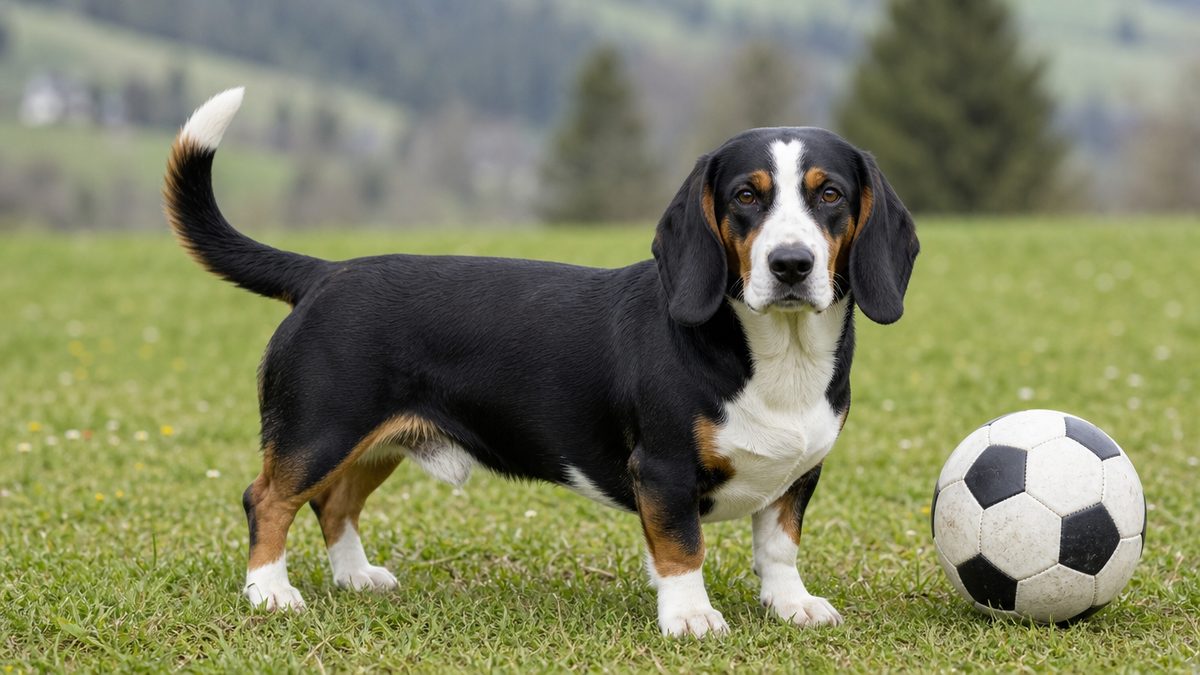
Colour is where the breed's history shows. The standard allows all types of colours as follows: white and black with tan markings (Small Bernese Hound), black with tan markings (Small Jura Hound), blue speckled with black mantle (Small Lucerne Hound) and white with orange-red mantle (Small Schwyz Hound) as well as all mixed colours of those. That final clause, permitting mixed colours, is the merger of 2015 written into the colour section.
The coat clause is the other surprise. The standard describes three coat types: a smooth coat that is short, close fitting and finer on head and ears; a rough coat that is harsh, elastic and close fitting with barely any undercoat and a slight beard; and a double coat with a very dense straight top coat and a dense undercoat. The three coat types are not tied to the four colour names, so the breed carries variation on two independent axes and the FCI names varieties on only one of them.
History, and the hunting-law change that created the breed
The standard's history is unusually causal. At the turn of the century the system of shoots, that is enclosed hunting grounds, was introduced into several Swiss cantons. Because the generally popular medium-sized Schweizer Laufhunde were considered too fast for enclosed shoots, it was decided to replace them with smaller short-legged scenthounds. The new smaller breed, bred through planned selection of stock and suitable crossing, was called the Niederlaufhund, and it was distinguished by a relatively low height at the withers, coat colours similar to the medium hounds, a melodious cry, and very passionate determination to find game and do track work.
The Swiss Kennel Club adds the administrative detail: in some cantons of the Swiss Mittelland the canton-wide licence hunt was converted into the shooting-ground system, which is the change the standard refers to. The Schweizerischer Niederlaufhund-Club was founded on 1 June 1905, first under the name Schweizerischer Dachsbracken Club, and it was later renamed the Schweizer Niederlaufhund- und Dachsbracken-Club when the Dachsbracken were taken in.
Most breed histories describe selection for a task. This one describes selection for a legal regime. The dogs did not become slower because the game changed; they became slower because the hunting grounds got smaller when cantonal licence hunting became enclosed shooting. That is an unusually clean example of legislation producing a breed, and it is in the FCI's own document rather than in folklore.
Four breeds until 2015, one breed since, and the documents that show it
The Schweizerischer Niederlaufhund's four colour varieties were four separate FCI breeds from 1954 until the standard revision of 13 October 2015 merged them into one, and the Swiss Kennel Club says so in as many words.
This is the single most important fact about the breed and no English-language page carries it. The Swiss Kennel Club's own portrait states that the Niederlaufhund was recognised in 1954 by the FCI as four colour-specific breeds, and that in 2015, with the merger into one breed, a new version of the FCI standard followed. It repeats the point later: the revised 2015 standard dispenses with the four different colour-dependent breeds, merges all colours into one breed, and as a consequence all colour types may in principle now be bred together.
Read the standard with that in mind and it stops looking like an ordinary document. The colour clause runs the four names together in a single sentence and ends as well as all mixed colours of those. A standard that had always described one breed with four varieties would have no reason to spell that out. A standard written to merge four breeds does.
The CACIB table, and the inversion between the two Swiss hounds
The FCI publishes a table titled FCI BREEDS WITH VARIETIES AND CACIB AWARD, listing every definitively recognised breed holding varieties of size, coat or colour, with columns for validity date, CACIB and working trial. The two Swiss rows in it are the clearest evidence available.
| Row | Validity date | CACIB |
|---|---|---|
| SCHWEIZER NIEDERLAUFHUND (60) | 13 October 2015 | yes, to the breed |
| a) Small Jura Hound | none | |
| b) Small Schwyz Hound | none | |
| c) Small bernese Hound | none | |
| d) Small Lucerne Hound | none | |
| SCHWEIZER LAUFHUND - CHIEN COURANT SUISSE (59) | 28 November 2001 | none to the breed |
| a) Bernese Hound | yes | |
| b) Jura Hound | yes | |
| c) Lucerne Hound | yes | |
| d) Schwyz Hound | yes |
This breed takes one CACIB and its four varieties take none. Its medium relative takes none and each of its four varieties takes one. Two Swiss scent-hound breeds, recognised two days apart in 1954, with four identically named varieties each, and exactly opposite show regimes. Note also the validity dates in that table: 2015 for this breed and 2001 for the other, which are the dates of the two standards and which line up precisely with the merger.
At a show that means a Small Bernese Hound and a Small Lucerne Hound compete against each other for one international beauty title, while a Bernese Hound and a Lucerne Hound of the medium breed compete for two separate ones.
The German register followed, with a lag
The VDH's own puppy statistics show a national registry working through the same change. Its table carries a Schweizer Niederlaufhund breed row alongside Berner Niederlaufhund, Jura Niederlaufhund and Schwyzer Niederlaufhund variety rows, and the arithmetic is exact.
| Year | Breed row | Berner | Jura | Schwyzer | Varieties sum |
|---|---|---|---|---|---|
| 2011 | 10 | 10 | 0 | 0 | 10 |
| 2012 | 27 | 27 | 0 | 0 | 27 |
| 2013 | 17 | 17 | 0 | 0 | 17 |
| 2014 | 12 | 12 | 0 | 0 | 12 |
| 2015 | 11 | 4 | 0 | 7 | 11 |
| 2016 | 24 | 0 | 24 | 0 | 24 |
| 2017 | 15 | 0 | 15 | 0 | 15 |
| 2018 | 2 | 0 | 2 | 0 | 2 |
| 2019 | 13 | 0 | 13 | 0 | 13 |
| 2020 | 0 | 0 | 0 | 0 | 0 |
| 2021 | 13 | 0 | 13 | 0 | 13 |
| 2022 | 9 | 0 | 0 | 0 | 0 |
| 2023 | 26 | 0 | 0 | 0 | 0 |
| 2024 | 11 | 0 | 0 | 0 | 0 |
| 2025 | 4 | 0 | 0 | 0 | 0 |
For eleven consecutive years, 2011 to 2021, the variety rows sum exactly to the breed row. From 2022 the variety rows go blank while the breed row keeps reporting. The German register broke out the varieties, then stopped, roughly seven years after the FCI merged them. The 2015 row is the most informative single line: 4 Berner plus 7 Schwyzer equals 11, the only year in the series with two varieties at once.
The same table treats the medium Swiss hound the opposite way round. It carries no Schweizer Laufhund breed row at all, only Jura Laufhund and Luzerner Laufhund variety rows, and it has never recorded a Berner Laufhund or a Schwyzer Laufhund in fifteen years. So the German register's row structure mirrors the FCI's CACIB structure: a breed row for the merged breed, variety rows for the unmerged one.
The crossing register
The FCI's crossing document, BREEDS AND VARIETIES: CROSSES, last updated 21 September 2023, has a BREEDS section with only five entries, and one of them is SCHWEIZER LAUFHUND (59) & SCHWEIZERISCHER NIEDERLAUFHUND (60), Schwyzer type: Only breed white/red to white/red. Note the name it uses for this breed: SCHWEIZERISCHER Niederlaufhund, the longer form, where the FCI's nomenclature and standard both say SCHWEIZER Niederlaufhund. Both forms are FCI-published, in different FCI documents.
The FCI's breed record for number 60 gives the official authentic language as English. The FCI's own standard for number 60 prints, at the top of its second page, TRANSLATION: Christina Bailey. Official language (DE). Two current FCI documents about the same breed disagree about which language governs it. This page follows the standard, because that is the document a judge reads, but the disagreement is real and is recorded rather than resolved.
Schweizerischer Niederlaufhund price in India
There is no Schweizerischer Niederlaufhund price in India, because there is no Schweizerischer Niederlaufhund in India, and Germany registered an average of thirteen a year over the last fifteen years.
Supply settles it before Indian law does. The VDH registered 194 puppies of this breed across the fifteen years from 2011 to 2025, with four in 2025, eleven in 2024 and a peak of 27 in 2012. That is the German output of a breed whose home country is next door, which makes this a genuinely rare breed rather than merely an unfamiliar one. It is rare in the registers too: the American Kennel Club's complete 297-entry breed directory, Foundation Stock Service included, returns nothing for Swiss Hound, Laufhund or Dachsbracke, with the Bavarian Mountain Scent Hound and the Labrador Retriever passing as in-document controls. The FCI publishes the standard in German as well as English, and both carry the same 13 October 2015 date.
Indian law then closes the commercial route independently. Dogs enter the Indian tariff at ITC (HS) 01061900, Mammals: Other, with an import policy of Restricted. Import is permitted only for a pet dog with a valid pet book and records in the importer's name, for research organisations with a CPCSEA recommendation, and for internal security by the Defence and Police Force. Policy Condition 8 states that import of commercial dogs for breeding or any other commercial activity is not permitted, and the notice adds that applications for trading or breeding purposes, or made on behalf of another person or entity, shall be duly rejected.
The only lawful private route
Import as passenger baggage without a DGFT authorisation is available only to a person transferring residence to India after two years of continuous stay abroad, for cats and dogs only, up to two animals, through the airports and seaports of Delhi, Mumbai, Chennai, Hyderabad, Bengaluru and Kolkata and, since October 2024, Kochi airport, with the process advised to start at least two months before travel Department of Animal Husbandry…. Indian import law, not price, is the binding constraint. For context on the receiving register, the Kennel Club of India recorded 33,880 pure-bred dogs across 80 member clubs in 2025. The full route is set out in how to import a dog to India.
How to test any Indian price you are shown
- Divide the rupee figure by 84.38, then by 80, then by 74, and see whether a round foreign asking price falls out, because a converted overseas figure is not an Indian observation.
- Ask which colour variety and which of the three coat types is being offered, since a seller who cannot answer is not describing a real dog.
- Check the photograph for leg length, because the commonest error with this breed is a picture of the medium Schweizer Laufhund at 49 to 59 cm.
- Ask which register the litter is recorded in, since the Kennel Club of India issues pedigrees against FCI nomenclature and this breed exists there at 60.
- Ask whether both parents have been DNA tested for the MFSD8 duplication, because a test has existed since 2024.
An answer engine asked for an Indian price for a breed with no Indian market will often say no local price exists and then print a rupee band anyway, produced by dividing a European asking price by an exchange rate. The tell is the sequence rather than the divisor. If a page tells you there is no Indian price and then supplies one, the number was never an Indian observation.
Monthly cost of ownership for a dog this size in India
Budget roughly Rs 4,500 to Rs 9,000 a month for a short-legged hound of this size in an Indian metro, and note that the breed standard publishes no weight at all, so the only weight figure, up to about 15 kg for a bitch and up to about 20 kg for a dog, comes from the Swiss Kennel Club.
The FCI standard for this breed gives height without giving mass, The Swiss Kennel Club's portrait fills the gap with a ceiling rather than a range, bitches up to about 15 kg and dogs up to about 20 kg. That matters for two practical things, feeding quantity and parasite dose banding, and it puts a bitch and a dog of this breed in different pack sizes. Score the dog rather than guessing at it.
| Item | Indian price | Frequency | Source |
|---|---|---|---|
| Anti-rabies vaccine | Rs 699 | Annual | Vetic clinic price list |
| Nine-in-one DHPPiL | Rs 899 | Annual booster | Vetic clinic price list |
| Kennel cough | Rs 1,349 | Annual, optional | Vetic clinic price list |
| Adult annual booster course | From Rs 3,199 | Annual | Vetic clinic price list |
| NexGard Spectra 15 to 30 kg | Rs 3,308 for 3 tablets | Monthly; the right band for a dog above 15 kg, the wrong one for a bitch | Supertails listing |
| Bath, and bath with styling | From Rs 934, and from Rs 1,869 | Every 6 to 10 weeks | Vetic Delhi grooming |
| Delhi MCD pet dog registration | Rs 500 new and Rs 500 renewal, Rs 100 a month late fee | Annual | MCD Delhi |
| Chennai GCC pet licence | Rs 50 | Annual | Greater Chennai Corporation |
Read the parasite row carefully. The 15 to 30 kg NexGard Spectra pack at Rs 3,308 for three tablets is the standard Indian reference size, and the Swiss Kennel Club's weights put a bitch, at up to about 15 kg, at or below its lower bound and only a dog, at up to about 20 kg, inside it. For a bitch a smaller and cheaper pack applies, so quoting the 15 to 30 kg figure for every animal of this breed would overstate the cost, which is the opposite of the usual error and worth flagging.
Two Indian facts matter more than the arithmetic. Greater Chennai Corporation's six municipal veterinary clinics provide treatment and anti-rabies vaccination free of cost, and issued 9,115 pet licences in 2024 at Rs 50 each. Delhi charges Rs 500 to register a pet dog and Rs 500 to renew, with a Rs 100 per month late fee.
A DNA test. Since 2024 there has been a genetic test for the MFSD8 duplication that causes neuronal ceroid lipofuscinosis in this breed, and any responsible breeding pair should carry results. That is a one-off cost per breeding animal rather than a monthly one, and a breeder who has not heard of it has not read the literature about their own breed.
Suitability for the Indian climate
The Schweizerischer Niederlaufhund is a poor fit for Indian heat, and this page publishes the Indian half of the comparison and refuses to publish the Swiss half, because Swiss climate cannot be measured at satellite grid resolution.
Eight Swiss points were queried by explicit latitude and longitude, and every one returned a grid cell well above the town beneath it. At the standard lapse rate of about 6.5 degrees per thousand metres, an error of that size makes the temperature wrong for the place by degrees rather than fractions.
| Place | Real elevation m | Cell elevation m | Error m | Shares its cell with |
|---|---|---|---|---|
| Bern | 540 | 752.22 | plus 212 | Langenthal and Solothurn |
| Langenthal | 471 | 752.22 | plus 281 | Bern and Solothurn |
| Solothurn | 432 | 752.22 | plus 320 | Bern and Langenthal |
| Lucerne | 435 | 938.00 | plus 503 | Sursee |
| Sursee | 504 | 938.00 | plus 434 | Lucerne |
| Schwyz | 517 | 1237.47 | plus 720 | Einsiedeln |
| Einsiedeln | 882 | 1237.47 | plus 355 | Schwyz |
| Delemont, Jura | 413 | 562.99 | plus 150 | Basel, 30 km away and 153 m lower |
Nine Swiss towns resolve into four grid cells. One cell is describing Schwyz at 517 metres and Einsiedeln at 882 metres with a single number; another is describing Delemont in the Jura and Basel on the Rhine at once; a third covers Bern, Langenthal and Solothurn; a fourth covers Lucerne and Sursee. Reporting the region as unmeasurable is more useful than publishing a cell that is wrong by up to 720 metres, particularly for a breed whose four varieties are named after four of those very regions.
The Indian side, which is measurable
| City | Annual mean C | Relative humidity % | Hottest month | Peak wet-bulb C | Cell elevation m |
|---|---|---|---|---|---|
| Chennai | 27.95 | 72.39 | May, 31.51 | 26.11 | 48.95 |
| Mumbai | 26.77 | 67.39 | May, 31.19 | 25.77 | 97.15 |
| Kolkata | 25.81 | 73.93 | May, 31.53 | 27.09 | 7.35 |
| Delhi | 25.60 | 45.56 | June, 35.88 | 26.50 | 206.37 |
| Pune | 23.86 | 66.80 | April, 28.93 | 22.97 | 635.99 |
| Bengaluru | 23.74 | 67.94 | April, 28.37 | 21.86 | 841.72 |
Those cells are trustworthy where the Swiss ones are not, because these are plains and plateau cities and the elevation errors run from minus 78 to plus 84 metres. Note that Delhi peaks in June rather than May, and that Bengaluru and Pune peak in April and are coolest in December. Kolkata's peak wet-bulb load is 27.09 and Mumbai's 25.77.
The disadvantage short legs add
There is a heat problem specific to this breed that a taller hound does not have. A dog standing 35 to 43 cm carries its chest and abdomen close to the ground, and in India the ground is often the hottest surface available: an asphalt road, a concrete terrace or a stone courtyard re-radiates heat upward for hours after sunset. A short-legged dog walks in that layer. The practical consequence is that surface temperature matters as much as air temperature for this breed, and the back of a hand held on the ground for five seconds is a better test than a thermometer. That combination of a hot surface and humid air is what makes this a heat-sensitive breed in India rather than a merely inconvenienced one. For scale on the population being discussed, the medium Swiss relative's parent club recorded 85 puppies in the whole of Switzerland in 2024.
What the heat literature supports
Hall 2020 in Scientific Reports modelled heat-related illness across 905,543 UK dogs under primary veterinary care and found 395 confirmed events, with dogs at or above their breed and sex mean bodyweight at 1.42 times the odds. The companion paper in Animals recorded 1,259 events from 1,222 dogs, of which 879 had a recorded trigger, and 652 of those 879, that is 74.2 percent, were exertional. This breed was not separately modelled, so no breed-specific odds ratio exists and none should be invented. The mechanism transfers: the dominant trigger is exercise, and this is a hound that will not stop for heat once it has a scent.
Second Schedule Part IV paragraph 21(1) of the Prevention of Cruelty to Animals (Dog Breeding and Marketing) Rules 2017 bars keeping in outdoor facilities, without the attending veterinary practitioner's written approval, dogs not accustomed to the temperatures prevalent in the area, breeds that cannot tolerate them, and sick, infirm, aged or young animals. A hound from the Swiss Mittelland is inside the first category, and hounds are among the breeds most often kennelled outdoors.
Temperament and household fit
The Schweizerischer Niederlaufhund has a friendly character, is not nervous and never aggressive, and its temperament runs from calm to lively, which is the FCI standard's own wording.
The full behaviour clause reads: a passionate small scenthound with an excellent nose, deft, untiring and keen, steady on the trail and hunting with a melodious cry, which reliably searches and drives the game with great determination even on difficult terrain and which also excels in tracking wounded game; friendly character, not nervous and never aggressive; temperament calm to lively.
The Swiss Kennel Club goes further and is unusually direct about family life. It describes the breed as highly intelligent, with a marked bond to its handler, excellent at blood tracking thanks to a calm nature and a fine nose, and then says plainly that in character they are fearless but never aggressive, and are therefore outstandingly good family dogs which get on excellently with children.
The same club supplies the counterweight in the same paragraph: their high passion for independently searching, flushing and hunting game marks them out as working hunting dogs, they detach from the handler quickly, they hunt eagerly and over wide ground, and they do it with a powerful voice audible far off.
- Households with a securely fenced garden suit this breed, and unfenced ground does not.
- Households with children generally do very well, on the national kennel club's own assessment.
- Households with close neighbours should think hard, because the voice is the breed's working tool rather than a habit.
- Households with small pets should expect a hound that flushes and drives game to treat them as game.
- Households wanting a small dog because it is small should note that this is a working hound at 35 to 43 cm, not a companion breed.
The standard's disqualifying faults confirm what the breed is not: aggressive or overly shy dogs are disqualified, as is any dog clearly showing physical or behavioural abnormalities, and even an uncertain or slightly sharp temperament is listed as an ordinary fault. Taken together the two accounts describe a versatile little working hound that is affectionate indoors and energetic outdoors, which is a combination that suits a rural household and defeats an urban one.
Training approach and what this breed resists
To train a Schweizerischer Niederlaufhund, build management around the nose rather than expecting recall to override it, because the breed's own national club says the dogs detach from the handler quickly.
That phrase is the training brief in five words. The Swiss Kennel Club describes a dog with a marked bond to its handler that nonetheless leaves quickly, searches eagerly and widely, and ideally finishes the hunt on its own. Both halves are true, and the second one is what determines what is safe.
A realistic Indian training sequence
- Weeks 8 to 16, socialise daily in the cool hours to traffic, autorickshaws, cattle, community dogs and building-site noise, and to being handled by strangers.
- Weeks 10 to 20, build a recall on a long line before the dog has had one successful self-rewarding chase.
- Months 4 to 8, train an emergency stop, which is more achievable in a hound than a recall and buys the same safety.
- Months 6 to 12, give the nose sanctioned work, since the standard says the breed excels at tracking wounded game and a hound with no legal scent work will find its own.
- Months 9 to 18, accept that off-lead freedom in unfenced Indian ground may never be safe, and build a routine that does not depend on it.
This breed is genuinely trainable in the house. The standard asks for a friendly, calm to lively character and the club calls it highly intelligent, so obedience, tricks and household manners come easily. The limit is not the dog's willingness but its nose, and the honest answer is that a scent hound's recall is a management problem rather than a training problem.
The voice. The standard requires the breed to hunt giving tongue with a melodious cry, and the Swiss Kennel Club describes it as powerful and far-carrying. If the barking is unacceptable in your setting, the honest conclusion is that this is the wrong breed for that setting rather than that the dog needs correcting.
Daily exercise requirement, and what happens without it
Plan on 60 to 90 minutes of real exercise a day in the cool hours, with a substantial part of it nose work, because short legs reduce this breed's speed and not its stamina.
The FCI attaches a working trial to breed 60 and describes a scenthound that hunts on its own, holds a trail steadily, and drives game with great determination even on difficult terrain. That is a working requirement, not a pet one, and it is the reason a 35 to 43 cm dog belongs at four on a five-point exercise scale.
The Indian constraint is timing, and for this breed also surface. Delhi's hottest month averages 35.88 degrees with a peak wet-bulb load of 26.50, and exertional illness accounts for 652 of the 879 heat events with a recorded trigger in the largest study of the problem. A short-legged hound running a scent across hot ground in an Indian May faces both the exertional risk and the radiant one.
- March to October, exercise before sunrise and after dark, and test the ground with the back of your hand before every walk.
- November to February in the north, most of the day is usable and this is when to build condition.
- Year-round on the Deccan plateau, Bengaluru and Pune buy four to five degrees of wet-bulb relief against Kolkata, which widens the window without removing the limit.
- Replace distance with tracking games on unsafe days, because a scent hound's brain tires before its legs do.
- Avoid stairs and repeated jumping in a chondrodystrophic breed, since the FGF4L2 retrogene it may carry raises intervertebral disc herniation risk.
Without enough, the failure modes are the ordinary hound ones: escaping, roaming, digging and long stretches of vocalising. In an Indian residential setting the last is usually what ends the arrangement, and it starts earlier in an under-exercised dog.
Grooming and coat care in Indian humidity
Grooming this breed depends on which of its three coat types a dog has, and in all three cases the ears are the real job.
The standard describes three coats and treats them as equally correct. Smooth: short, smooth, close fitting, finer on head and ears. Rough: harsh, elastic, close fitting, barely any undercoat, with a slight beard. Double: a very dense, straight, close-fitting top coat, short on feet and toes, over a dense undercoat.
For India those three are not equivalent. A smooth coat is the easiest thing to keep in a monsoon. A rough coat with a slight beard traps food and moisture around the muzzle and needs the beard dried and checked. A double coat with a dense undercoat is the hardest of the three here, because a dense undercoat is an insulation layer designed to keep an Alpine hound warm, and it holds damp against skin. Ask which coat a dog has before you plan for it.
The ears are the constant across all three
The ear clause applies whatever the coat: leathers set on low, not above eye level, narrow, in length reaching at least to the tip of the nose, nicely folded, pendulous and close to the cheeks, supple, with fine hair. Set low, long, narrow, folded and held against the cheek is the design that keeps warm damp air against the ear canal.
An Indian series from the Palam Valley in Himachal Pradesh found otitis externa concentrated in dogs with pendulous ear carriage. Its ear-carriage table carries an internal arithmetic error worth naming if you quote it: it prints 53 pendulous cases at 69.13 percent of 81, but 53 of 81 is 65.43 percent, and 69.13 percent of 81 is 56, which is the figure that balances against its 25 erect-ear cases. Quote it with the discrepancy stated or not at all. The direction is not in doubt.
- Check and dry both ears weekly year-round, and after every wetting from June to September.
- Lift and air the leathers for a minute daily in the monsoon, since a folded ear held against the cheek does not ventilate itself.
- Brush a double coat twice weekly through the monsoon, and a smooth coat weekly with a rubber mitt.
- Dry and check a rough coat's beard after every meal and every drink, because it stays wet longer than the rest of the dog.
- Check the belly and chest weekly, since a short-legged dog drags them through wet grass and wet ground.
The Swiss Kennel Club itself calls the long leathers a breeding-related weak point that covers the ear canal and can raise the risk of ear canal inflammation, and asks for particular attention to ear care; it writes that for a Swiss summer. In an Indian monsoon at a wet-bulb load approaching 27 degrees, an ear built to this standard needs checking weekly and drying after every wetting. That is the single change an Indian owner must make to overseas advice.
Health risks and lifespan
The Schweizerischer Niederlaufhund has better published genetics than almost any breed of its size, because two recent University of Bern papers used it directly, and both findings are actionable.
That is unusual for a breed registering thirteen puppies a year in Germany, and it happened for a specific reason: the breed's genetics turned out to be scientifically interesting. The health issues that are documented are therefore documented very precisely, and both of them bear directly on genetic diversity in a small closed population. A PubMed search on the breed name returns two records and a search on Small Swiss Hound returns two, against a control of 126 for Labrador retriever hip dysplasia in the same session.
Neuronal ceroid lipofuscinosis, and a DNA test that now exists
Rietmann and colleagues at the Institute of Genetics, Vetsuisse Faculty, University of Bern, investigated two Small Swiss Hound littermates that showed progressive ataxia and loss of cognitive function and vision starting around the age of 12 months. Both had to be euthanised a few months after onset because of the severity of their signs. Post-mortem examination of one showed cerebral and cerebellar atrophy with cytoplasmic accumulation of autofluorescent material in degenerating neurons, which with the clinical picture gave a tentative diagnosis of neuronal ceroid lipofuscinosis.
Sequencing the genome of one affected dog revealed a duplication of 18,819 base pairs within the MFSD8 gene, with breakpoints in intron 3 and exon 12, predicted to disrupt the reading frame. Both affected dogs carried it homozygously, and there was perfect cosegregation of the genotypes with the phenotype in a large pedigree, consistent with autosomal recessive inheritance. MFSD8 loss-of-function variants are a known cause of NCL7 in humans and other species.
The practical consequence is the sentence that matters for a buyer. The authors state that the results allow the diagnosis to be refined to NCL7 and enable genetic testing in the breed to avoid further unintentional carrier by carrier matings. Since 2024 there has been a test. A breeder of this breed who cannot discuss it has not read the literature about their own dogs.
The FGF4 retrogenes, and why this breed was chosen
Two FGF4 retrogenes cause short legs in dogs: FGF4L1 on chromosome 18 and FGF4L2 on chromosome 12. Most breeds carry only one, or are nearly homozygous for both like the Dachshund, which makes it hard to separate their individual effects. Bannasch and colleagues identified two breeds selected for hunting ability, the Alpine Dachsbracke and the Schweizer Niederlaufhund, that segregate both. That is why this breed appears in a paper about canine morphology at all.
| Effect | FGF4L1, chromosome 18 | FGF4L2, chromosome 12 |
|---|---|---|
| Height at the shoulders | Reduces it, with much the greater effect | Reduces it, with the smaller effect |
| Antebrachial length | Reduces it, with much the greater effect | Reduces it, with the smaller effect |
| Carpal valgus | Influences the degree of it, alone | No effect |
| Head width | No effect | Increases it, alone |
| Thorax width or depth | No effect | No effect |
| Intervertebral disc herniation risk | Not the retrogene carrying it | The retrogene carrying it |
The authors' own conclusion is a breeding instruction: selectively breeding dogs with FGF4L1 and without FGF4L2 would likely lead to a reduction in the FGF4L2-related risk of intervertebral disc herniation while maintaining the reduction in leg length resulting from FGF4L1. For a short-legged breed that is about as actionable as genetics gets, and it is publicly available.
Lens luxation, named by variety
A retrospective study at the University of Zurich Veterinary Teaching Hospital reviewed 134 dogs with lens luxation between 2000 and 2011, representing 0.41 percent of the 32,523 dogs presented and 3.02 percent of ophthalmology cases. Of the 134, 86 were primary and 48 secondary, with glaucoma, cataract and trauma the commonest causes of the secondary form. Terriers, Chinese Crested dogs, Pinschers and Spitz were predisposed to the primary form.
The Luzerner Niederlaufhund is named among the breeds that suffered significantly more often from secondary lens luxation, alongside the Siberian Husky, Basset Hound, Bearded Collie and others. Note the precision of that: a Swiss university's case records name a colour variety rather than the breed, which is itself evidence about how the Swiss veterinary world treats these four names.
What the standard screens for, and what Indian law asks
Breed 60's disqualifying faults include a completely flesh-coloured nose, an undershot or overshot mouth, a wry mouth, absence of incisors or canines, faulty canine position, absence of more than three premolars or molars other than PM1 and M3, entropion and ectropion, a short sternum, a rolled or kinked tail, and heights outside the disqualifying limits.
Indian law reaches the same eyelid faults from the other direction. Second Schedule Part III paragraph 8(10) of the Dog Breeding and Marketing Rules 2017 requires breeding dogs to have been tested for genetic defects including hip dysplasia, progressive retinal atrophy, night blindness, hypothyroidism, entropion, ectropion, overshot and undershot jaw, wry mouth, two or more missing teeth and cryptorchidism. The word in the clause is including, so the list is illustrative rather than closed, and the FCI standard and the Indian statute happen to ask for the same eye and jaw screening.
Lifespan
The Swiss Kennel Club publishes 14 to 16 years with correct keeping and feeding, and adds that the club places great value on healthy, robust and long-lived dogs in its breeding. That is a long figure, it is the only one published for the breed, and it is a kennel club statement rather than a study result.
McMillan 2024 does not help. The breed is absent from Supplementary Table S5 entirely, under Small Swiss, Niederlauf, Short-Legged, Short Legged and Swiss Short, while a Swiss Hound row for the medium breed is present with flag N. So one of the two Swiss hounds was considered and excluded and the other was never enumerated. There is therefore no row in Table S3, where the crossbred comparator is 111,053 dogs at a median of 12.0 years, and the study covers 155 purebred breeds.
No OFA figure appears on this page. api.ofa.org and wp.ofa.org both refused connections from this environment, and ofa.org's statistics page returned a 49 KB JavaScript shell with zero table rows and zero breed names. That is an instrument failure rather than a finding, and OFA's own publication threshold of 100 hip evaluations, or 50 for its other databases, means a breed of this size would very likely not appear even when the site is reachable.
Feeding a short-legged Swiss hound in India
Feed to a nine-point body condition score rather than to a chart, because the FCI standard for this breed publishes no weight at all and the Swiss Kennel Club supplies only a ceiling, about 15 kg for a bitch and 20 kg for a dog.
That gap is wider here than for the medium Swiss hound, where the Swiss Kennel Club publishes a range of 18 to 23 kg. For this breed the same club gives only an upper limit, bitches up to about 15 kg and dogs up to about 20 kg, so a kibble feeding chart indexed to bodyweight has a ceiling to work from and nothing more.
The nine-point body condition score solves it. Ribs easily felt under a light covering, waist visible from above, abdominal tuck visible from the side, which is 4 or 5 of 9 on the WSAVA scale. Score every fortnight and adjust the quantity.
Condition matters more in this breed than in most, for a spinal reason as well as a heat one. A chondrodystrophic dog carrying extra weight loads a back that already has a raised intervertebral disc risk if it carries the FGF4L2 retrogene. And Hall 2020 found dogs at or above their breed and sex mean bodyweight at 1.42 times the odds of heat-related illness.
- Weeks 8 to 16, four meals a day of a complete puppy food, never left down in Indian heat where a bowl attracts ants within the hour.
- Months 4 to 8, three meals a day, and resist pushing growth in a short-legged breed whose joints and spine are the vulnerable parts.
- Months 8 to 12, two meals a day and a move to an adult formulation towards the end of that window.
- Adult, two meals a day with the larger one after evening exercise rather than before it.
- Lifelong, keep the dog visibly lean, because in a chondrodystrophic hound a spare kilogram is a spinal cost and not a cosmetic one.
Month by month through the first year
A Schweizerischer Niederlaufhund puppy timeline in India has one window that no other breed in this cluster shares, because neuronal ceroid lipofuscinosis in this breed begins at around twelve months.
| Age | Developmental job | Constraint or risk |
|---|---|---|
| Under 8 weeks | Stays with the litter | Rule 8(1)(a) forbids sale of pups less than eight weeks old |
| 7 to 18 weeks | Core vaccination course | The Rules say vaccination can start at seven to eight weeks and usually completes at eighteen |
| 8 to 16 weeks | Socialisation window | All of it in the cool hours from March to October |
| 3 months | Microchipping | Second Schedule paragraph 30(b) requires a vet to micro-chip pups over three months |
| 4 to 6 months | Long-line recall and emergency stop | Build both before the first successful chase; avoid stairs and jumping |
| 6 to 9 months | Growth plates still open, ears at full length | Start the weekly ear routine now; no forced road work |
| Around 12 months | Adult stamina arrives | The reported age of onset for MFSD8 neuronal ceroid lipofuscinosis |
| Over 6 months | Sale rules change | Rule 8(1)(b) bars sale over six months unless sterilised, except between licensed breeders |
Three of those rows are Indian law. Rule 8(1)(a) requires that pups less than eight weeks in age are not sold. Rule 8(1)(b) requires that dogs over six months are not sold without first being sterilised, unless sold to another licensed breeder. Second Schedule Part IV paragraph 30 requires every dog to be identified by an official tag on its collar and requires a veterinary practitioner to micro-chip all breeding stock and pups over three months. The gazette hyphenates micro-chipping, so search both spellings.
The row that is specific to this breed
The twelve-month row is not a milestone; it is a watch point. The two affected dogs in the 2024 study showed progressive ataxia and loss of cognitive function and vision starting around the age of 12 months, and both were euthanised a few months later. A young dog of this breed that becomes unsteady, bumps into things or loses learned behaviours around its first birthday is not going through an adolescent phase.
The prevention is upstream and it exists. Ask, before you take a puppy, whether both parents have been DNA tested for the MFSD8 duplication, because the test was made possible by that paper and the condition is autosomal recessive, so two tested-clear parents cannot produce an affected puppy.
Greater Chennai Corporation's six veterinary clinics provide treatment and anti-rabies vaccination free of cost. For a first-year puppy that is the largest avoidable cost in the whole schedule, and most Chennai owners do not know the service exists.
Head to head against the breeds an Indian buyer would actually get
An Indian buyer cannot get a Schweizerischer Niederlaufhund, so the useful comparison is against its own medium relative, the two other continental short-legged hounds, and the short-legged scent hound that is available here.
| Breed | FCI number | Height | Varieties | McMillan 2024 median |
|---|---|---|---|---|
| Schweizerischer Niederlaufhund | 60 | 35 to 43 cm males | Four colour types, merged in 2015 | Absent from Table S5 entirely |
| Schweizer Laufhund | 59 | 49 to 59 cm males | Four varieties, unmerged, separate CACIBs | Present, flag N, no median |
| Alpine Dachsbracke | 254 | 34 to 42 cm | None | Present, flag N, no median |
| Westphalian Dachsbracke | 100 | 30 to 38 cm | None, but called a variety of FCI 299 | Present, flag N, no median |
| Basset Hound | 163 | 33 to 38 cm | None | 12.5 years on 883 deaths |
The Alpine Dachsbracke row is the most interesting comparison because it is not just similar, it is the breed this one was studied alongside: the 2022 FGF4 paper used the two of them together as the only breeds in which both retrogenes segregate. They are the same experiment.
Against its own medium relative
| Field | Niederlaufhund, FCI 60 | Laufhund, FCI 59 |
|---|---|---|
| Definitive acceptance | 27 August 1954 | 25 August 1954 |
| Standard in force | 13 October 2015 | 28 November 2001 |
| Section | 1.3 Small-sized Hounds | 1.2 Medium-sized Hounds |
| Height, males | 35 to 43 cm | 49 to 59 cm |
| Size tolerance | Plus or minus 2 cm | None whatsoever |
| Status of the four before 2015 | Four separate colour-specific breeds | Four varieties since 1933 |
| Mixed colours | Explicitly permitted | Not provided for; colour faults are per variety |
| CACIB | One to the breed, none to any variety | One to each variety, none to the breed |
| Coat types | Three: smooth, rough and double | One, short and smooth |
| Weight published anywhere | Up to about 15 kg for bitches and 20 kg for dogs, from the Swiss Kennel Club | 18 to 23 kg, from the Swiss Kennel Club |
That table is the variety question in one place. The two breeds are not two sizes of one thing; they are two breeds at different stages of the same classification process, and every row in which they differ is a consequence of the 2015 merger applying to one of them and not the other.
If what appeals is a short-legged scent hound, the Basset Hound is genuinely obtainable in India, has a lifespan measured on 883 deaths, and carries a large published literature on its own back and ear problems. It is a heavier and slower dog, which in an Indian climate is a feature.
Common mistakes buyers and writers make with this breed
The commonest mistake is describing the four colour varieties as four breeds without saying that they were, until 2015, exactly that.
- Calling the four colour types four breeds with no date attached, when they were four FCI breeds until the 2015 standard revision merged them and are one breed now.
- Assuming the same answer covers the medium Schweizer Laufhund, whose four varieties were never merged and still carry separate CACIBs.
- Reading a picture of the medium breed as this one, when the difference is 49 to 59 cm against 35 to 43 cm.
- Ignoring the three coat types, when a double-coated dog and a smooth-coated dog are materially different propositions in an Indian monsoon.
- Buying without asking about the MFSD8 DNA test, which has existed since 2024 for an autosomal recessive disease that kills young adults.
- Treating a Swiss satellite climate figure as a homeland baseline, when every Swiss point tested sits 150 to 720 metres above its town.
- Planning to import one to breed from, which Policy Condition 8 of the Indian import policy does not permit.
The mistake that reaches furthest
The broadest error is settling the variety question from a summary instead of from the register. A standard tells you what the FCI says; the CACIB table, the crossing register and a national kennel club's own portrait tell you what happened and when. On this breed those three documents give a dated, specific answer that no amount of prose about four regional colours can substitute for.
The same discipline applies to the Indian side. Divide any rupee figure by 84.38, then 80, then 74; check whether a listing sells a live animal; and ask which colour type and which coat type is on offer, because a seller who cannot answer is not describing a dog that exists.
Adoption and responsible sourcing
Adopting a Schweizerischer Niederlaufhund in India is not a realistic route, and the useful advice is about what to ask a breeder anywhere in the world.
No Indian rescue listing, breed-rescue network or shelter placement for this breed was found, which is what a breed with no domestic population looks like. Germany, the largest market outside Switzerland, registered 194 puppies of it over fifteen years.
The three routes that exist, ranked
- Adopt an Indian dog of similar temperament from a shelter, which is available immediately and has no import problem.
- Choose a short-legged scent hound genuinely present in India, such as the Basset Hound, and get published health data and a supply chain you can inspect.
- Import a pet under the baggage route only if you are personally transferring residence to India after two years of continuous stay abroad, which is the single lawful private path.
How to verify a seller anywhere in the world
- Ask for both parents' MFSD8 DNA test results, because the test has existed since 2024 and the disease is autosomal recessive.
- Ask whether the parents have been tested for FGF4 retrogene copy number, since the published breeding advice is to keep FGF4L1 and avoid FGF4L2.
- Ask which colour type and which of the three coat types the litter carries, and expect a clear answer.
- Ask which studbook the litter is entered in and check the number against FCI nomenclature, where the breed is 60.
- Ask the age of the pups, because Indian law forbids sale below eight weeks and most national rules say the same.
One thing counts strongly in this breed's favour. Very few breeds of this size have a published, peer-reviewed genetic test for a fatal recessive disease and a published breeding recommendation for their own chondrodystrophy, and this one has both, from the same university institute, within two years of each other Bannasch D, Batcher K, Leuthard F. A breed whose problems have been sequenced is easier to breed away from than one whose problems are only anecdotes.
If you read this far because you liked a small tricolour hound with short legs, the realistic Indian version is a shelter dog of similar build, or a Basset Hound from a breeder you can visit. Neither needs an import authorisation, and both are dogs you can meet before you commit.
What the pages ranking for this breed actually tell you
Every page ranking for this breed lists its four colour varieties and none of them reports that those four were separate breeds until 2015.
The harvest has to be reported honestly because it partly failed. Google, queried with an Indian geo and language, returned a 92 KB page whose visible body said there was trouble accessing Google Search, with zero organic results on a Labrador Retriever control. Bing India returned HTTP 200 with the correct title and Indian language chips, then ten organic results about an Indonesian internet-banking service, on the same control. DuckDuckGo served a CAPTCHA. Brave Search, whose control passed earlier in the session, returned HTTP 429 on this breed's queries even after a six-minute cooldown.
So no People-also-ask box was captured, and that is a statement about the instrument rather than about the breed. The ranking set below came from a working index and every page was then fetched directly and read.
What ranks, and what it omits
The set is led by the English Wikipedia article, the Swiss Kennel Club's own portrait, the VDH's puppy site, DogZone, Wamiz, a German hunting magazine and two German breeder sites. The Swiss Kennel Club page is the one carrying the decisive fact, and it is in German, which is very likely why no English-language page has picked it up.
The English pages generally present four varieties as a timeless feature of the breed, list the colours, and move on. None of them dates the merger, none cites the CACIB table, and none mentions the 2024 MFSD8 finding or the 2022 FGF4 study, both of which are open-access and both of which name this breed in their abstracts.
The gap this page fills
None of the ranking set tells a reader that the FCI recognised four colour-specific breeds in 1954 and merged them in 2015, that the CACIB now goes to the breed and not the varieties while the medium Swiss hound is the exact inverse, that the German register's variety rows summed exactly to its breed row for eleven years and then went blank, that an 18,819 base-pair MFSD8 duplication causes a fatal recessive disease with an onset around twelve months and that a DNA test exists, that this is one of only two breeds in which both FGF4 retrogenes segregate, or anything at all about Indian heat, Indian cost or Indian import law. That set of absences is why this page exists.
Schweizerischer Niederlaufhund questions buyers actually ask
Is the Schweizerischer Niederlaufhund one breed or four?
One breed today and four until 2015. The Swiss Kennel Club states it directly: the FCI recognised the Niederlaufhund in 1954 as four colour-specific breeds, and the revised FCI standard of 2015 dispenses with those four and merges all colours into one breed. The standard now in force, published 13 October 2015, lists the four colour names in a single colour paragraph and then permits all mixed colours of those, which is the merger written into the document.
What is the difference between the Small Bernese, Jura, Lucerne and Schwyz Hounds?
Colour alone, and since 2015 they may be crossed with each other. The standard allows white and black with tan markings, which is the Small Bernese; black with tan markings, the Small Jura; blue speckled with a black mantle, the Small Lucerne; and white with an orange-red mantle, the Small Schwyz, as well as all mixed colours of those. Everything else in the standard, including a height of 35 to 43 cm and three permitted coat types, applies to all four equally.
What is the Schweizerischer Niederlaufhund price in India?
No verifiable Indian price exists, because no Indian breeder, club or listing for the breed was found. Germany, the largest market outside Switzerland, registered 194 puppies of the breed across the fifteen years to 2025, an average of about thirteen a year, with four in 2025. Indian import policy classifies dogs as a Restricted item and states that applications for trading or breeding purposes shall be duly rejected, so no lawful commercial supply chain can form here.
How big is a Schweizerischer Niederlaufhund?
Males stand 35 to 43 cm at the withers and females 33 to 40 cm, with a tolerance of two centimetres either way, and the standard disqualifies males under 33 or over 45 cm and females under 31 or over 42 cm. Those disqualifying limits reconcile exactly with the ranges plus the tolerance, which is a sign of a carefully drafted document. The standard gives no weight anywhere. For comparison, the medium Schweizer Laufhund stands 49 to 59 cm with no tolerance at all.
What health problems does the Schweizerischer Niederlaufhund have?
Two are documented in recent peer-reviewed work and both are specific. A 2024 study identified an 18,819 base-pair duplication within MFSD8 causing neuronal ceroid lipofuscinosis in the breed, autosomal recessive, with onset of ataxia and loss of vision and cognition around twelve months, and it enables a DNA test to avoid carrier by carrier matings. A 2022 study showed the breed segregates both FGF4 retrogenes, of which FGF4L2 carries the intervertebral disc herniation risk. A Swiss lens luxation study separately names the Luzerner variety.
How long does a Schweizerischer Niederlaufhund live?
The Swiss Kennel Club publishes 14 to 16 years with correct keeping and feeding, which is a long life expectancy for any dog and is the only published figure for this breed. It is a national kennel club's statement rather than a study result, and it should be read that way. McMillan 2024, the largest UK longevity study, does not list the breed at all: no row appears under Small Swiss Hound, Niederlaufhund, Short-Legged or Swiss Short, while a Swiss Hound row for the medium breed is present and flagged as excluded.
Can a Schweizerischer Niederlaufhund handle Indian heat?
No, and there is an extra disadvantage that taller breeds do not have. Kolkata's peak wet-bulb load is 27.09 degrees and Chennai's is 26.11, and a short-legged dog carries its chest and abdomen much closer to hot ground, so radiant heat from an Indian road or terrace reaches it more directly. The homeland comparison that would normally sit beside those numbers cannot be made, because every Swiss point tested returns a satellite grid cell 150 to 720 metres above its town.
Why are the two Swiss hounds classified differently?
Because one was merged and the other was not. The short-legged breed's four colour varieties were four separate FCI breeds until the 2015 standard revision merged them into one breed, after which all colours may be interbred. The medium breed's four have been varieties under one standard since 22 January 1933 and their colours are still kept apart, with variety-specific colour faults. The FCI's varieties table then follows: this breed takes one CACIB and its varieties none, while the medium breed takes none and each of its varieties takes one.
Can the Small Swiss Hound be crossed with the Swiss Hound?
Yes, under one narrow rule. The FCI's official crossing register lists SCHWEIZER LAUFHUND (59) and SCHWEIZERISCHER NIEDERLAUFHUND (60) together in a BREEDS list of only five entries, qualified as Schwyzer type: Only breed white/red to white/red. So the two may be crossed, but only within the Schwyz colour type and only white and red to white and red. The other four entries are the two Bull Terriers, the two Pyrenean Sheepdogs, the three Belgian griffons, and the Greenland Dog with the Canadian Eskimo Dog.
Is the Schweizerischer Niederlaufhund recognised by the Kennel Club or the AKC?
By neither. The Royal Kennel Club's Breeds A to Z carries 227 breeds and returns zero occurrences of Laufhund or Swiss Hound, with Labrador at seven and Munsterlander at eight as in-document controls. The American Kennel Club's complete breed directory of 297 entries, which spans all seven groups, the Miscellaneous Class and the Foundation Stock Service, likewise returns zero for Swiss Hound, Laufhund and Dachsbracke, with the Bavarian Mountain Scent Hound and the Labrador Retriever present as controls. The breed's recognition is FCI, Swiss and German, which for an Indian reader is the register that matters anyway since India is a full FCI member.
What does a dog this size cost per month in India?
Budget roughly Rs 4,500 to Rs 9,000 a month for a short-legged hound of this size in an Indian metro, built entirely from Indian care costs because no breed-specific Indian cost row exists. The Swiss Kennel Club puts a bitch at up to about 15 kg and a dog at up to about 20 kg, so the NexGard Spectra figure of Rs 3,308 for three tablets in the 15 to 30 kg band fits a larger male and over-estimates the cost for a bitch, for whom a smaller pack applies. An adult annual booster starts at Rs 3,199 and a single anti-rabies dose is Rs 699.
What is the FGF4 retrogene finding and why does it matter?
Two FGF4 retrogenes, FGF4L1 on chromosome 18 and FGF4L2 on chromosome 12, cause short legs across many dog breeds, and most breeds carry only one of them. A 2022 study identified this breed and the Alpine Dachsbracke as the only two that segregate both, which made them the ideal population for separating the two effects. FGF4L1 turned out to have much the larger effect on height and forearm length and to influence carpal valgus, while FGF4L2 alone increased head width and is the one carrying intervertebral disc herniation risk.
Wie alt wird ein Schweizer Niederlaufhund?
This question reaches Google in German and asks how old a Schweizer Niederlaufhund gets. The only published figure is the Swiss Kennel Club's 14 to 16 years with correct keeping and feeding, alongside its statement that the club places great value on healthy, robust and long-lived dogs in its breeding. Read it as a kennel club statement rather than a study result: McMillan 2024, the largest UK longevity study, carries no row for the breed under any of its name forms, so no measured median exists.
Was ist der Schweizer Laufhund?
Asked in German, this means what is the Schweizer Laufhund. It is the medium-sized Swiss hound from which this breed was scaled down, FCI breed 59, standing 49 to 59 cm with no tolerance against 35 to 43 cm for the Niederlaufhund. The standard for breed 60 defines this breed against it in its opening words, Swiss Hound type, smaller in proportion than the Schweizer Laufhund, and records why the smaller breed was made: around the turn of the century the medium hounds were considered too fast for the enclosed shoots then being introduced in several Swiss cantons, so short-legged scenthounds were bred to replace them.
Wo kann ich einen Schweizer Laufhund kaufen?
This German question asks where a Schweizer Laufhund can be bought, and for an Indian reader the answer for either Swiss hound is not in India. No Indian breeder, club or listing was found, and Indian import policy files dogs as Restricted, with Policy Condition 8 stating that import for breeding or any other commercial activity is not permitted and that applications for trading or breeding purposes shall be duly rejected. The single lawful private route is the passenger baggage route, open only to a person transferring residence to India after two years of continuous stay abroad, for up to two animals, through the airports and seaports of Delhi, Mumbai, Chennai, Hyderabad, Bengaluru and Kolkata and, since October 2024, Kochi airport.
Compare with similar breeds
Schweizerischer Niederlaufhund sits in 1 Bonbeno group. Each one compares it directly against the breeds it is genuinely an alternative to, on the same figures.