
Breed profile
Schweizer Laufhund: The India Guide
One Swiss breed with four named varieties, measured against Indian heat, Indian law, and a homeland whose climate satellites cannot actually measure.
Quick answer
The Schweizer Laufhund is one FCI breed, number 59, holding four named varieties: the Bernese, Jura, Lucerne and Schwyz Hounds. One standard governs all four and separates them only by skin and coat colour. The FCI awards a separate CACIB to each variety and none to the breed. Switzerland registered 85 puppies across all four in 2024, down from 359 in 1981, a fall of 76.3 percent.
This guide summarises breed-standard documents, a national kennel club's and a parent club's own publications, peer-reviewed veterinary research, Indian breeding and import law and satellite climate data as general information for Indian pet owners. It is not a diagnosis and it is not treatment advice. Consult your nearby vet, a registered veterinarian you can reach the same day, before acting on anything you read here, and treat a dog that collapses after exercise in heat, or one that is losing its sight, as reasons to see a veterinarian immediately.
Schweizer Laufhund at a glance
What the Schweizer Laufhund actually is
The Schweizer Laufhund is one breed, registered by the Federation Cynologique Internationale at number 59, holding four named varieties that a single standard separates by colour alone.
It sits in Group 6, Scent hounds and related breeds, one of the 70 breeds the FCI files in that group, in Section 1.2, Medium-sized Hounds, with a working trial. The FCI accepted it definitively on 25 August 1954, the country of origin is Switzerland, and the authentic language of the standard is German. Its English name in FCI nomenclature is the Swiss Hound.
The standard states the position in its own General Appearance section: There are 4 varieties of the Swiss Hound: Bernese Hound, Jura Hound, Lucerne Hound, Schwyz Hound. Everything else in that document is shared. Head, ears, neck, body, tail, limbs, gait, size, faults and disqualifications are written once and apply to all four.
What the standard actually separates
Exactly two clauses differ between the varieties, and both are about colour. The SKIN section gives each variety a different skin colour: black under black coat and slightly white and black marbled under white coat for the Bernese; black under black but lighter under tan for the Jura; black under black and lighter under blue speckling for the Lucerne; dark grey under orange and white and black marbled under white for the Schwyz. The COAT section then gives each a different coat colour.
| Variety | Coat colour in the standard | Variety-specific colour fault |
|---|---|---|
| Bernese Hound | White with black patches or black saddle, with light to dark tan markings over the eyes, on the cheeks, inside the ear leathers and around the vent | Too many black ticks in the white; tan or white on the outer ear lobe |
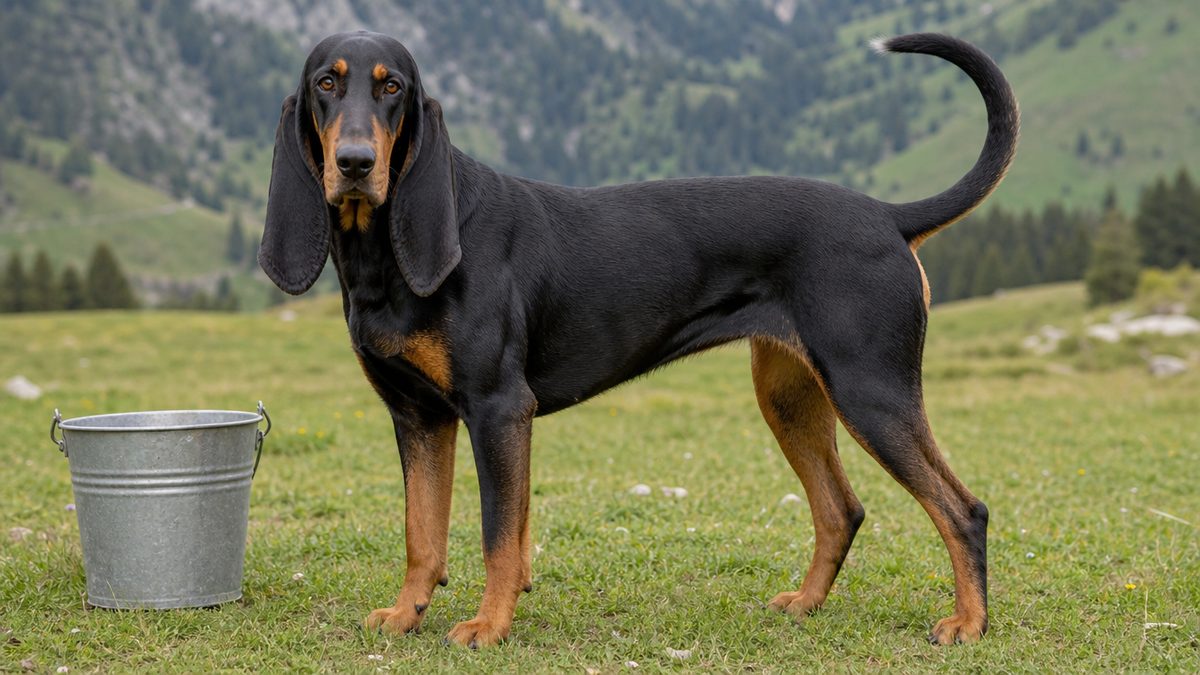
| Jura Hound | Tan with black blanket, sometimes with black overlay, or black with tan markings over the eyes, cheeks, vent and legs | Self coloured coat; an important or strongly speckled white patch on the chest |
| Lucerne Hound | Blue from a combination of black and white hairs, very heavily speckled, with black patches or saddle and light to dark tan markings | Absence of blue speckle; tan on the outer face of the ear lobe |
| Schwyz Hound | White with orange patches or orange saddle, sometimes with very slight orange ticking | Too many orange flecks in the white; self coloured coat; white on the outer ear lobe |
That table is the whole of the difference. A Bernese Hound and a Schwyz Hound are the same dog in different colours, and the standard's faults section is where that becomes concrete: it lists colour faults per variety, and nothing else per variety at all. Each colour variety is therefore a colour and not a type, and the authentic German text of the standard carries the same structure as the English. The FCI's own record for the short-legged breed lists its four under the same Varieties and CACIB heading.
History, and the fifth variety nobody mentions
The standard's own history is more precise than the pages that summarise it. It says the Swiss Hound's presence in Roman Helvetia is attested by a mosaic discovered at Avenches showing packhounds corresponding to the varieties of Swiss hound; that in the fifteenth century Italian dog lovers sought the breed and in the eighteenth the French did, for its aptitude for hunting hare; and that native lines were certainly influenced by French scenthounds brought back by mercenaries.
Then it gives three dates that matter. In 1882 a standard was established for each of the five varieties of the Swiss Hound. In 1909 those standards were revised and the total disappearance of the hound of Thurgovie was noted. On 22 January 1933, one single standard was established for the 4 varieties. The standard adds that the ancient variety, the hound of the Jura type St. Hubert, has in the meantime disappeared.
So the honest count is not four or five but both, at different dates: five varieties in 1882, four from 1933, and within the Jura a second St. Hubert type that has since gone. The pages ranking for this breed generally give 1889 rather than 1882 for the first standards, and they compress 1909 and 1933 into a single event.
The Swiss Kennel Club's own portrait says the same thing in German: the coat is short, smooth and dense, and depending on which colours predominate, four varieties are distinguished. It also traces the earliest written record to Albrecht von Bonstetten, Dean of the monastery of Einsiedeln, in whose correspondence of 1475 to 1480 dukes and ecclesiastical dignitaries of Milan asked him for Laufhunde from the monastery's breeding.
Variety or breed, and how the FCI answers it differently for the two Swiss hounds
The FCI holds the four Swiss hounds as varieties of one breed, and the decisive evidence is not the standard's wording but the two registers that act on it: the CACIB table and the crossing register.
The question keeps recurring because both answers look defensible from a distance. Four names, four colours, four regions, and each with its own following. The way to settle it is to ask what the registry actually does rather than what a summary says.
The CACIB table, and the inversion inside it
The FCI publishes a table titled FCI BREEDS WITH VARIETIES AND CACIB AWARD, listing every definitively recognised breed that holds varieties of size, coat or colour, with three columns: validity date, CACIB and working trial. Read the two Swiss rows side by side and the picture is unambiguous, and unambiguous in opposite directions.
| Row | Validity date | CACIB |
|---|---|---|
| SCHWEIZER LAUFHUND - CHIEN COURANT SUISSE (59) | 28 November 2001 | none to the breed |
| a) Bernese Hound | yes | |
| b) Jura Hound | yes | |
| c) Lucerne Hound | yes | |
| d) Schwyz Hound | yes | |
| SCHWEIZER NIEDERLAUFHUND (60) | 13 October 2015 | yes, to the breed |
| a) Small Jura Hound | none | |
| b) Small Schwyz Hound | none | |
| c) Small bernese Hound | none | |
| d) Small Lucerne Hound | none |
Breed 59 awards a separate CACIB to each of its four varieties and none to the breed. Breed 60 awards one CACIB to the breed and none to any of its four varieties. Two Swiss scent-hound breeds, recognised two days apart in August 1954, with four identically named varieties each, and exactly opposite regimes. The St Bernard sits immediately below with the same shape as 59: nothing on the breed row and a star on each of its short-haired and long-haired varieties.
What that means at a show is concrete. A Bernese Hound competes for its own international beauty title and there is no title for the Swiss Hound as such. A Small Bernese Hound competes against a Small Lucerne Hound for one title.
Why the two differ, with a date
The Swiss Kennel Club supplies the answer and it is a specific event rather than an accident of drafting. Its portrait of the short-legged breed states that the Niederlaufhund was recognised by the FCI in 1954 as four colour-specific breeds, and that in 2015 a new version of the FCI standard followed on their merger into one breed. It adds that the revised 2015 standard dispenses with the four separate colour-dependent breeds and merges all colours into one breed, with the consequence that all colour types may in principle now be bred together.
That is why standard 60, published 13 October 2015, sets out its four colour names in a single Colour paragraph and then permits all mixed colours of those, while standard 59, published 28 November 2001, keeps four separate colour specifications and faults a Jura for a self-coloured coat and a Lucerne for the absence of blue speckle.
So the two Swiss hounds are at different points of the same process. The short-legged breed's four varieties were breeds until 2015 and are now colour types of one breed. The medium breed's four have been varieties since 1933 and still carry separate CACIBs.
The crossing register, which settles the breed question
The FCI publishes a second document, BREEDS AND VARIETIES: CROSSES, last updated 21 September 2023, setting out general and breed-specific guidelines for crossing breeds and breed varieties. It has a section headed BREEDS with only five entries, and one of them reads as follows.
SCHWEIZER LAUFHUND (59) & SCHWEIZERISCHER NIEDERLAUFHUND (60), Schwyzer type: Only breed white/red to white/red.
Three things follow. First, the FCI treats 59 and 60 as two breeds, because they appear in the BREEDS list rather than among the per-breed variety rules. Second, it permits crossing them, which is a real and unusual permission: the only company that entry keeps is the Bull Terrier with the Miniature Bull Terrier, the two Pyrenean Sheepdogs, the three Belgian griffons, and the Greenland Dog with the Canadian Eskimo Dog. Third, the permission is doubly restricted, to the Schwyzer type and to white and red only.
The same document says the FCI encourages crosses between breed varieties when necessary to increase the gene pool for health, that the recommendation supersedes circular 36/1973 and the 1984 General Assembly decisions in Acapulco, and that it does not affect in any way the existing CACIB distribution. That last clause is worth noting: the FCI has explicitly decoupled its breeding policy from its show classification, so the CACIB regime is not evidence about what may be bred, only about what may be shown.
The FCI's breed record for number 60 gives the official authentic language as English. The FCI's own standard for number 60 prints, at the top of its second page, TRANSLATION: Christina Bailey. Official language (DE). Two current FCI documents about the same breed disagree about which language governs it. This page follows the standard, because that is the document a judge reads, but the disagreement is real and is recorded here rather than resolved.
Schweizer Laufhund price in India
There is no Schweizer Laufhund price in India, because there is no Schweizer Laufhund in India, and Switzerland produced only 85 puppies across all four varieties in 2024.
Start with supply, because it settles the question before Indian law does. The Schweizerischer Laufhundeclub's 2024 statistics record 85 puppies entered in the Swiss studbook from 14 litters, split Lucerne 31, Jura 27, Schwyz 15 and Bernese 12. That is the whole Swiss annual output of the breed. In Germany the VDH registered 70 puppies of this breed across the fifteen years from 2011 to 2025.
Indian law then closes the commercial route independently. Dogs enter the Indian tariff at ITC (HS) 01061900, Mammals: Other, with an import policy of Restricted. Import is permitted only for a pet dog with a valid pet book and records in the importer's name, for research organisations with a CPCSEA recommendation, and for internal security by the Defence and Police Force. Policy Condition 8 states that import of commercial dogs for breeding or any other commercial activity is not permitted, and the notice adds that applications for trading or breeding purposes, or made on behalf of another person, shall be duly rejected.
The only lawful private route
Import as passenger baggage without a DGFT authorisation is available only to a person transferring residence to India after two years of continuous stay abroad, for cats and dogs only, up to two animals, through the airports and seaports of Delhi, Mumbai, Chennai, Hyderabad, Bengaluru and Kolkata and, since October 2024, Kochi airport, with the process advised to start at least two months before travel Department of Animal Husbandry…. Indian import law is therefore the binding constraint rather than price. For context on the register that would receive such a dog, the Kennel Club of India recorded 33,880 pure-bred dogs across 80 member clubs in 2025, and the American Kennel Club's complete 297-entry breed directory, Foundation Stock Service included, returns nothing for Swiss Hound, Laufhund or Dachsbracke with the Bavarian Mountain Scent Hound and the Labrador Retriever passing as controls. The full route is set out in how to import a dog to India.
How to test any Indian price you are shown
- Divide the rupee figure by 84.38, then by 80, then by 74, and see whether a round foreign asking price falls out, because a converted overseas figure is not an Indian observation.
- Ask which of the four varieties is being offered, since a seller who cannot name one is not describing a real dog.
- Check the photograph against the standard's colour clause for that variety, since the four colours are the only thing that distinguishes them.
- Ask which register the litter is recorded in, since the Kennel Club of India issues pedigrees against FCI nomenclature and this breed exists there at 59.
- Walk away if the seller cannot answer all four, whatever the price.
An answer engine asked for an Indian price for a breed with no Indian market will often say no local price exists and then print a rupee band anyway, produced by dividing a European asking price by an exchange rate. The tell is the sequence rather than the divisor. If a page tells you there is no Indian price and then supplies one, the number was never an Indian observation.
Monthly cost of ownership for a dog this size in India
Budget roughly Rs 6,000 to Rs 12,000 a month for an 18 to 23 kg dog in an Indian metro, and note that the weight itself comes from the Swiss Kennel Club rather than from the breed standard.
The FCI standard for this breed publishes no weight at all. The Swiss Kennel Club's own portrait supplies 18 to 23 kg alongside a height of 47 to 59 cm, and that is the figure used here, with its source named because the distinction matters when a feeding chart or a drug dose depends on it.
| Item | Indian price | Frequency | Source |
|---|---|---|---|
| Anti-rabies vaccine | Rs 699 | Annual | Vetic clinic price list |
| Nine-in-one DHPPiL | Rs 899 | Annual booster | Vetic clinic price list |
| Kennel cough | Rs 1,349 | Annual, optional | Vetic clinic price list |
| Adult annual booster course | From Rs 3,199 | Annual | Vetic clinic price list |
| NexGard Spectra 15 to 30 kg | Rs 3,308 for 3 tablets, about Rs 1,103 a month | Monthly | Supertails listing |
| Bath, and bath with styling | From Rs 934, and from Rs 1,869 | Every 6 to 10 weeks | Vetic Delhi grooming |
| Delhi MCD pet dog registration | Rs 500 new and Rs 500 renewal, Rs 100 a month late fee | Annual | MCD Delhi |
| Chennai GCC pet licence | Rs 50 | Annual | Greater Chennai Corporation |
A short-coated hound is the cheapest coat type to keep in India, so grooming sits at the low end of that table and bathing is needed less often than for any other breed in this cluster. Parasite cover is the largest recurring line at about Rs 1,103 a month using NexGard Spectra for the 15 to 30 kg band, and for a hound that works vegetation it is not a line to trim.
Two Indian facts matter more than the arithmetic. Greater Chennai Corporation's six municipal veterinary clinics provide treatment and anti-rabies vaccination free of cost, and issued 9,115 pet licences in 2024 at Rs 50 each. Delhi charges Rs 500 to register a pet dog and Rs 500 to renew, with a Rs 100 per month late fee.
Noise. This is a hound selected to hunt giving tongue, and its voice carries. In an Indian residential setting that is not a grooming or veterinary cost but it is a real one, and it is the single most common reason hounds are rehomed. Budget for a garden and for neighbours, not for a clipper.
Suitability for the Indian climate
The Schweizer Laufhund is a poor fit for Indian heat, and this page publishes the Indian half of that comparison and refuses to publish the Swiss half, because Swiss climate cannot be measured at this satellite resolution.
That refusal is the finding rather than a gap. Eight Swiss points were queried by explicit latitude and longitude, and every one returned a grid cell sitting well above the town beneath it, which makes the temperature it reports wrong for the place by roughly 6.5 degrees per thousand metres.
| Place | Real elevation m | Cell elevation m | Error m | Shares its cell with |
|---|---|---|---|---|
| Bern | 540 | 752.22 | plus 212 | Langenthal and Solothurn |
| Langenthal | 471 | 752.22 | plus 281 | Bern and Solothurn |
| Solothurn | 432 | 752.22 | plus 320 | Bern and Langenthal |
| Lucerne | 435 | 938.00 | plus 503 | Sursee |
| Sursee | 504 | 938.00 | plus 434 | Lucerne |
| Schwyz | 517 | 1237.47 | plus 720 | Einsiedeln |
| Einsiedeln | 882 | 1237.47 | plus 355 | Schwyz |
| Delemont, Jura | 413 | 562.99 | plus 150 | Basel, 30 km away and 153 m lower |
Read the last column. Nine Swiss towns resolve into four grid cells, and one of those cells is simultaneously describing Delemont in the Jura and Basel on the Rhine, thirty kilometres apart and a hundred and fifty-three metres apart vertically. Another is describing Schwyz at 517 metres and Einsiedeln at 882 metres with one number. The best Swiss point available is Delemont at plus 150 metres, and even that cell is not Delemont's. The Bern cell and the Lucerne cell are worse, at plus 212 and plus 503 metres respectively. What can be said without a Swiss figure is that this is a heat-sensitive breed in India: an Alpine scent hound has no evolutionary experience of a humid Indian May, whatever the exact Swiss baseline turns out to be.
So no Swiss annual mean, no Swiss hottest month and no Swiss wet-bulb figure appears on this page. Reporting the region as unmeasurable is more useful than publishing a cell that is wrong by up to 720 metres, and it is the honest answer for a breed whose four varieties are named after four Alpine and pre-Alpine regions.
The Indian side, which is measurable
| City | Annual mean C | Relative humidity % | Hottest month | Peak wet-bulb C | Cell elevation m |
|---|---|---|---|---|---|
| Chennai | 27.95 | 72.39 | May, 31.51 | 26.11 | 48.95 |
| Mumbai | 26.77 | 67.39 | May, 31.19 | 25.77 | 97.15 |
| Kolkata | 25.81 | 73.93 | May, 31.53 | 27.09 | 7.35 |
| Delhi | 25.60 | 45.56 | June, 35.88 | 26.50 | 206.37 |
| Pune | 23.86 | 66.80 | April, 28.93 | 22.97 | 635.99 |
| Bengaluru | 23.74 | 67.94 | April, 28.37 | 21.86 | 841.72 |
The Indian cells are trustworthy in a way the Swiss ones are not, because these are plains and plateau cities and the errors run from minus 78 to plus 84 metres. Note that Delhi peaks in June rather than May, and that Bengaluru and Pune peak in April and are coolest in December. Mumbai's peak wet-bulb load is 25.77 in June and Kolkata's is 27.09.
What the heat literature supports
Hall 2020 in Scientific Reports modelled heat-related illness across 905,543 UK dogs under primary veterinary care and found 395 confirmed events, with dogs at or above their breed and sex mean bodyweight at 1.42 times the odds. The companion paper in Animals recorded 1,259 events from 1,222 dogs, of which 879 had a recorded trigger, and 652 of those 879, that is 74.2 percent, were exertional. This breed was not separately modelled, so no breed-specific odds ratio exists and none should be invented.
The mechanism transfers exactly, though. The dominant trigger is exercise rather than confinement, and this is a breed whose standard requires it to search and hunt with great determination even on difficult terrain. A Laufhund following a scent will not stop because it is hot.
Second Schedule Part IV paragraph 21(1) of the Prevention of Cruelty to Animals (Dog Breeding and Marketing) Rules 2017 bars keeping in outdoor facilities, without the attending veterinary practitioner's written approval, dogs not accustomed to the temperatures prevalent in the area, breeds that cannot tolerate them, and sick, infirm, aged or young animals. A hound from the Swiss pre-Alps is squarely inside the first category, and hounds are exactly the breeds most likely to be kennelled outdoors.
Temperament and household fit
The Schweizer Laufhund is lively, passionately keen on hunting, sensitive, docile and very attached to its master, and every one of those five words is the FCI standard's own.
The standard's behaviour clause is a single sentence and it is unusually warm for a working hound: lively and passionately keen on hunting, sensitive, docile and very attached to his master. The utilization clause beside it is the counterweight: a hunting dog used for hare, roe deer, fox and sometimes boar, which hunts in an independent manner giving tongue and which searches and hunts with great determination even on difficult terrain.
The Swiss Kennel Club adds a caution that is worth quoting because it anticipates exactly how the standard gets misread. Commenting on the FCI's word for easy to lead, it warns that easy to lead must not be confused with blind obedience. A dog can be genuinely docile at home and completely unavailable once it has a scent.
- Households with a securely fenced garden and rural or semi-rural surroundings suit this breed and very little else does.
- Households with children generally do well, since sensitive and docile is what the standard asks for and aggression is a disqualifying fault.
- Households with close neighbours should think hard, because giving tongue is the breed's job rather than a habit.
- Households with cats, poultry or rabbits are taking on a management project, since the standard's quarry list is hare, roe deer, fox and boar.
- Households wanting a reliable off-lead recall in an unfenced Indian park should choose a different group of dog entirely.
The disqualifying faults tell you what the breed is not: aggressive or overly shy dogs, and any dog clearly showing physical or behavioural abnormalities, are disqualified, and even slightly apprehensive or slightly sharp behaviour is listed as an ordinary fault. This is a sociable hound, not a guard. It is also a versatile one within its own trade, since the standard's quarry list runs from hare to boar, and an energetic dog rather than a placid one. It is trainable in the house and unavailable on a scent, and both halves are true at once.
Training approach and what this breed resists
To train a Schweizer Laufhund, build management around the nose rather than trying to train the nose out, because a hound that hunts independently and gives tongue was selected to work away from you.
The standard is explicit that the dog hunts in an independent manner, and the Swiss Kennel Club warns in its own words that easy to lead is not blind obedience. Between them those two lines describe the whole training problem: a sensitive, biddable, affectionate dog at home, and a dog that leaves at speed and does not hear you once it is on a line.
A realistic Indian training sequence
- Weeks 8 to 16, socialise daily in the cool hours to traffic, autorickshaws, cattle, community dogs and building-site noise, and to being handled by strangers.
- Weeks 10 to 20, build a recall on a long line before the dog has ever had one successful self-rewarding chase.
- Months 4 to 8, train an emergency stop, which is more achievable than a recall in a hound and buys you the same safety.
- Months 6 to 12, give the nose legal work such as tracking games, because a scent hound with no scent work will find its own.
- Months 9 to 18, accept that off-lead freedom in unfenced ground may never be safe, and build a life that does not require it.
What this breed resists is being asked to ignore a scent. That is not disobedience; it is the trait every breeder for four hundred years selected for. The productive approach is a long line, a fenced space, and enough sanctioned nose work that the dog is not desperate.
The voice is the breed. The Swiss Kennel Club attributes the breed's decline directly to increasing resistance to hunting with voice, which means a silent Laufhund is a Laufhund that has lost its function. If the barking is the problem, the honest conclusion is that this is the wrong breed for the setting rather than that the dog needs correcting.
Daily exercise requirement, and what happens without it
Plan on 90 minutes or more of real exercise a day in the cool hours, with a substantial part of it nose work, because this breed carries a working trial and was bred to hunt for hours over difficult ground.
The FCI files breed 59 with a working trial and describes a dog that searches and hunts with great determination even on difficult terrain. That is the standard against which any exercise plan has to be judged, and it puts this breed at the top of the scale in this cluster.
The Indian constraint is timing rather than distance. Delhi's hottest month averages 35.88 degrees with a peak wet-bulb load of 26.50, and exertional illness accounts for 652 of the 879 heat events with a recorded trigger in the largest study of the problem. A hound running a scent in an Indian May is the exact case that literature describes, with the additional problem that a hound on a line will not self-regulate.
- March to October, exercise before sunrise and after dark, and treat the middle of the day as indoor time.
- November to February in the north, most of the day is usable and this is when to build condition.
- Year-round on the Deccan plateau, Bengaluru and Pune buy four to five degrees of wet-bulb relief against Kolkata, which widens the window without removing the limit.
- Replace distance with scent work on unsafe days, because tracking tires a hound faster than walking does.
- Never let a hound off-lead in unfenced Indian ground on the assumption that heat will bring it back.
Without enough, the failure modes are the ones every hound owner reports: escaping, roaming, and vocalising for long stretches. In an Indian residential setting the third is usually what ends the arrangement.
Grooming and coat care in Indian humidity
The coat is the easiest thing about keeping this breed in India, and the ears are the hardest, because the standard asks for leathers long enough to reach the tip of the nose.
The standard describes a coat that is short, smooth and dense, and very fine on the head and the ear leathers. There is no feathering anywhere, no undercoat specification and no furnishing to mat. A weekly rub over with a rubber mitt and a bath every couple of months is genuinely the whole coat routine, which makes this the lowest-maintenance coat in this group of breeds.
The ears are the actual job
Now read the ear clause. The leathers are set on below the eye level and towards the back of the skull, never attached in their greatest width, in length reaching at least the tip of the nose, narrow, drooping, folded and twisted, rounded at their tips, supple and covered with fine hair. Every element of that description is a reason warm damp air stays in the ear canal: set low, long, narrow, folded and twisted.
An Indian series from the Palam Valley in Himachal Pradesh found otitis externa concentrated in dogs with pendulous ear carriage. Its ear-carriage table carries an internal arithmetic error worth naming if you quote it: it prints 53 pendulous cases at 69.13 percent of 81, but 53 of 81 is 65.43 percent, and 69.13 percent of 81 is 56, which is the figure that balances against its 25 erect-ear cases. Quote it with the discrepancy stated or not at all. The direction of the finding is not in doubt.
- Check and dry both ears weekly year-round, and after every wetting from June to September.
- Lift and air the leathers for a minute daily in the monsoon, since a folded twisted ear does not ventilate itself.
- Brush the coat weekly with a rubber mitt, which is enough for a short dense coat and removes dead hair.
- Bathe rarely, because there is no coat problem for a bath to solve in this breed.
- Check the pads and between the toes weekly, since the standard asks for rough hard pads and an Indian road surface tests them.
The Swiss Kennel Club's own portrait says ear problems are rather the exception in this breed, because the inside of the ear is only sparsely haired and the dogs are not used for water work, which is true of a Swiss summer. In an Indian monsoon at a wet-bulb load approaching 27 degrees, an ear built to this standard needs checking weekly and drying after every wetting. That is the single change an Indian owner has to make to overseas guidance for this breed.
Health risks and lifespan, and how little is published
Almost nothing is published about this breed's health, and the honest section is a map of instruments and what each of them returned.
Four sources were run, three of them returned nothing for this breed while passing their own controls, and the fourth could not be reached at all.
| Instrument | Result for this breed | Control in the same session |
|---|---|---|
| PubMed, Swiss Hound in title or abstract | 4 records, of which 1 is genuinely about this breed | Labrador retriever hip dysplasia returned 126 |
| PubMed, Laufhund | 0, with the phrase reported as not found | Same session, same control |
| McMillan 2024 Table S5 | Swiss Hound present, flag N, Kennel Club group NA | Labrador flag Y, Great Pyrenees flag Y |
| McMillan 2024 Table S3 | No row, so no median and no hazard ratio | 155 purebred rows plus a Crossbreed row present |
| OFA published statistics | Not retrievable at all this session | Both statistics hosts refused connections |
The one paper that is genuinely about this breed
PubMed's four hits for Swiss Hound in title or abstract include a Balzac neurology essay and a Hanoverian scenthound population study, both irrelevant, and the 2024 MFSD8 paper about the short-legged relative. The one that is on-breed is Retinal atrophy in a Swiss hound, American Journal of Veterinary Research, October 1981. That is a single case report, more than four decades old, and it is the breed's entire published clinical literature.
It is worth saying what that does and does not mean. It does not mean the breed is unusually healthy, and it does not mean it is unusually sick. It means the health issues of this breed have not been studied, which is what happens to a breed producing 85 puppies a year in one country. Genetic diversity in such a population is the underlying worry, and the contrast with the short-legged Swiss breed is instructive: that breed has two recent papers of its own, a 2024 study identifying an 18,819 base-pair duplication in MFSD8 causing neuronal ceroid lipofuscinosis and a 2022 study of FGF4 retrogenes that used it as one of only two breeds in which both retrogenes segregate. Neither finding transfers to this breed and neither should be quoted for it.
What the standard itself screens for
In the absence of data the standard is the next best guide, and its disqualifying faults are informative. Breed 59 disqualifies a nose entirely depigmented, an overshot or undershot mouth, a wry mouth, ectropion and entropion even if operated, a rolled, ring, hook, malformed, knotted or fused tail, and size either over or under that fixed by the standard. Dewclaws on the hindlegs are a fault unless their removal is prohibited by law.
Two of those line up with Indian law. Second Schedule Part III paragraph 8(10) of the Dog Breeding and Marketing Rules 2017 requires breeding dogs to have been tested for genetic defects including hip dysplasia, progressive retinal atrophy, night blindness, hypothyroidism, entropion, ectropion, overshot, undershot jaw and wry mouth. The word in the clause is including, so the list is illustrative rather than closed. A breeder following the FCI standard and a breeder following the Indian Rules would be screening for the same eyelid and jaw faults.
One further note on the standard's own dewclaw wording. It says hind dewclaws should be absent except in countries where their removal is prohibited by law, and India is such a country: Second Schedule Part II paragraph 6(8) forbids de-clawing along with tail docking, ear cropping and de-barking. So an Indian-bred dog of this breed would lawfully carry hind dewclaws that the standard would otherwise have removed, and the standard anticipates exactly that.
Lifespan
No study figure exists. McMillan 2024 lists Swiss Hound in Supplementary Table S5 with inclusion flag N, phylogeny reclassification NA, Kennel Club group NA, FCI group Scent hounds and related breeds, body size Medium and cephalic index Dolichocephalic. Flag N with reclassification NA means the breed was considered and excluded, not merged into another breed's row. It therefore has no row in Table S3, where the crossbred comparator is 111,053 dogs at a median of 12.0 years, and the study covers 155 purebred breeds in total.
Beware of borrowing. The Swiss Kennel Club publishes a life expectancy of 14 to 16 years, but it publishes it for the short-legged Niederlaufhund, not for this breed. Two Swiss hounds, two portraits, and the lifespan belongs to the other one.
No OFA figure appears on this page. api.ofa.org and wp.ofa.org both refused connections from this environment, and ofa.org's statistics page returned a 49 KB JavaScript shell with zero table rows and zero breed names. That is an instrument failure rather than a finding, and OFA's own publication threshold of 100 hip evaluations, or 50 for its other databases, means a breed producing 85 puppies a year would very likely not appear even when the site is reachable.
Feeding a Swiss scent hound in India
Feed to a nine-point body condition score rather than to a chart, because the FCI standard for this breed publishes no weight at all and the only figure available, 18 to 23 kg, comes from the national kennel club.
That gap is real and it matters practically. Kibble feeding guides are indexed to bodyweight, and the breed's own governing document sets height without ever stating mass. The Swiss Kennel Club fills it with 18 to 23 kg, which is a usable range, and the honest thing is to say where it came from.
The nine-point body condition score removes the problem. Ribs easily felt under a light covering, waist visible from above, abdominal tuck visible from the side, which is 4 or 5 of 9 on the WSAVA scale. Score every fortnight and adjust the quantity, and the missing standard weight stops mattering.
- Weeks 8 to 16, four meals a day of a complete puppy food, never left down in Indian heat where a bowl attracts ants within the hour.
- Months 4 to 8, three meals a day, and resist pushing growth in a breed whose adult work is endurance rather than mass.
- Months 8 to 12, two meals a day and a move to an adult formulation towards the end of that window.
- Adult, two meals a day with the larger one after evening exercise rather than before it.
- Through summer, feed the main meal after dark, because a dog that has just eaten sheds heat less efficiently.
Body condition matters more here for a heat reason than a joint one. Hall 2020 found dogs at or above their breed and sex mean bodyweight at 1.42 times the odds of heat-related illness, and a hound is a breed people over-feed precisely because it looks lean when it is correct.
Month by month through the first year
A Schweizer Laufhund puppy timeline in India runs on the developmental clock, the Indian legal clock and a seasonal clock, and the third one decides when the first two can happen outdoors.
| Age | Developmental job | Indian constraint |
|---|---|---|
| Under 8 weeks | Stays with the litter | Rule 8(1)(a) forbids sale of pups less than eight weeks old |
| 7 to 18 weeks | Core vaccination course | The Rules say vaccination can start at seven to eight weeks and usually completes at eighteen |
| 8 to 16 weeks | Socialisation window | All of it in the cool hours from March to October |
| 3 months | Microchipping | Second Schedule paragraph 30(b) requires a vet to micro-chip pups over three months |
| 4 to 6 months | Long-line recall and emergency stop | Build both before the first successful chase happens |
| 6 to 9 months | Growth plates still open, ears at full length | No forced road work; start the weekly ear routine now |
| 9 to 12 months | Adult stamina and adult voice arrive | Condition through the cool season, and settle the noise question with neighbours |
| Over 6 months | Sale rules change | Rule 8(1)(b) bars sale over six months unless sterilised, except between licensed breeders |
Three of those rows are law rather than advice. Rule 8(1)(a) requires that pups less than eight weeks in age are not sold. Rule 8(1)(b) requires that dogs over six months are not sold without first being sterilised, unless sold to another licensed breeder. Second Schedule Part IV paragraph 30 requires every dog to be identified by an official tag on its collar and requires a veterinary practitioner to micro-chip all breeding stock and pups over three months. The gazette hyphenates micro-chipping, so search both spellings.
The seasonal clock
A puppy arriving in November in Delhi gets a full cool season for socialisation and early conditioning and meets its first real heat at about eight months with adult judgement. A puppy arriving in April gets the reverse, with its socialisation window falling entirely inside the months when it cannot safely be outside in daylight. The second puppy is not doomed, but the work has to move indoors and be constructed deliberately.
Greater Chennai Corporation's six veterinary clinics provide treatment and anti-rabies vaccination free of cost. For a first-year puppy that is the largest avoidable cost in the whole schedule, and most Chennai owners do not know the service exists.
Head to head against the breeds an Indian buyer would actually get
An Indian buyer cannot get a Schweizer Laufhund, so the useful comparison is against its own short-legged relative, the neighbouring hounds that raise the same variety question, and the scent hound that is genuinely available here.
| Breed | FCI number | Height | Varieties held | McMillan 2024 median |
|---|---|---|---|---|
| Schweizer Laufhund | 59 | 49 to 59 cm males, no tolerance | Four, each with its own CACIB | None; flag N in Table S5 |
| Schweizerischer Niederlaufhund | 60 | 35 to 43 cm males, plus or minus 2 cm | Four, none with a CACIB | Absent from Table S5 entirely |
| German Hound | 299 | 40 to 53 cm | None | None; flag N in Table S5 |
| Westphalian Dachsbracke | 100 | 30 to 38 cm | None, but called a variety of 299 by its own standard | None; flag N in Table S5 |
| Basset Hound | 163 | 33 to 38 cm | None | 12.5 years on 883 deaths |
The Basset Hound row is there for scale rather than similarity: it is the only scent hound in that table with a measured lifespan, and 12.5 years on 883 deaths is the kind of number none of the other four can offer.
Against its own short-legged relative
The two Swiss hounds are the clearest comparison available and the most instructive. They were recognised two days apart in August 1954, they carry four identically named varieties each, and they diverge on almost every rule that follows.
| Field | Laufhund, FCI 59 | Niederlaufhund, FCI 60 |
|---|---|---|
| Definitive acceptance | 25 August 1954 | 27 August 1954 |
| Standard in force | 28 November 2001 | 13 October 2015 |
| Section | 1.2 Medium-sized Hounds | 1.3 Small-sized Hounds |
| Height, males | 49 to 59 cm | 35 to 43 cm |
| Size tolerance | None whatsoever | Plus or minus 2 cm |
| Varieties before 2015 | Four varieties since 1933 | Four separate colour-specific breeds |
| Varieties now | Four varieties, colours kept separate | Four colour types, and all mixed colours permitted |
| CACIB | One to each variety, none to the breed | One to the breed, none to any variety |
| Coat types in the standard | One, short and smooth | Three: smooth, rough and double |
That table is the answer to the variety question in one place, and the last row is the detail most sources miss entirely: the short-legged breed carries three coat types as well as four colour names, and the coat types are not tied to the colours. The medium breed has one coat.
If what appeals here is a scent hound, the Basset Hound is genuinely obtainable in India, has a lifespan measured on 883 deaths, and comes with a large published literature on its own problems. It is also a much slower dog, which in an Indian climate is a feature rather than a compromise.
Common mistakes buyers and writers make with this breed
The commonest mistake with the Schweizer Laufhund is calling its four varieties four breeds, and the second is quoting the short-legged relative's lifespan for it.
- Calling the Bernese, Jura, Lucerne and Schwyz Hounds four breeds, when the FCI holds them as four varieties of breed 59 under one standard since 1933.
- Assuming the same answer applies to the short-legged Swiss hound, when those four were four separate breeds until the FCI merged them in 2015.
- Borrowing the Swiss Kennel Club's 14 to 16 year lifespan, which it publishes for the Niederlaufhund and not for this breed.
- Dating the first variety standards to 1889, when the FCI standard itself says 1882 and separately dates the Thurgovie hound's disappearance to a 1909 revision.
- Quoting a weight from the standard, which contains none; the 18 to 23 kg figure comes from the Swiss Kennel Club.
- Treating a Swiss satellite climate figure as the homeland baseline, when every Swiss point tested sits 150 to 720 metres above its town.
- Planning to import one to breed from, which Policy Condition 8 of the Indian import policy does not permit.
The mistake that reaches furthest
The broadest error is deciding the variety-versus-breed question from a summary rather than from the register. A breed's standard tells you what the FCI says; the CACIB table and the crossing register tell you what the FCI does, and on this pair of breeds those two documents give a sharper and more surprising answer than any amount of prose.
The same discipline applies to the Indian side. Divide any rupee figure by 84.38, then 80, then 74, and see what falls out; check whether a listing sells a live animal; and ask which of the four varieties is being offered, because a seller who cannot name one is not describing a dog that exists.
Adoption and responsible sourcing
Adopting a Schweizer Laufhund in India is not a realistic route, and with 85 puppies a year in its home country it is barely a realistic route anywhere.
No Indian rescue listing, breed-rescue network or shelter placement for this breed was found, which is what a breed with no domestic population looks like. There is nothing to rescue because nothing was bred or imported in numbers.
The three routes that exist, ranked
- Adopt an Indian dog of similar temperament from a shelter, which is available immediately and has no import problem.
- Choose a scent hound genuinely present in India, such as the Basset Hound, and get published health data and a supply chain you can inspect.
- Import a pet under the baggage route only if you are personally transferring residence to India after two years of continuous stay abroad, which is the single lawful private path.
How to verify a seller anywhere in the world
- Ask which of the four varieties the litter is, and check the puppies against that variety's colour clause rather than against a general description.
- Ask whether the parents passed the working trial the FCI attaches to this breed, since that is what the register expects.
- Ask which studbook the litter is entered in, because the Swiss club publishes its registrations by variety every year and a Swiss-bred litter should be traceable.
- Ask the age of the pups, because Indian law forbids sale below eight weeks and most national rules say the same.
- Walk away from any seller who offers a mixed-colour dog as a variety, because this standard, unlike the short-legged one, does not permit mixing the four.
One thing counts in the breed's favour and is worth stating. The Swiss parent club publishes its full registration series back to 1981, its breeding admissions back to 1982, its litters by canton and variety, and its unsuccessful matings, every year, in three languages. A breed whose decline is documented year by year is easier to assess honestly than one whose numbers are not published at all, and very few rare breeds offer that.
If you read this far because you liked a classic tricolour hound, the realistic Indian version is a shelter dog with a hound's temperament, or a Basset Hound from a breeder you can visit. Neither needs an import authorisation, and both are dogs you can meet before you commit.
What the pages ranking for this breed actually tell you
Every page ranking for this breed picks a side on the variety question and none of them shows the reader the two FCI documents that settle it.
The harvest has to be reported honestly because it partly failed. Google, queried with an Indian geo and language, returned a 92 KB page whose entire visible body said there was trouble accessing Google Search, with zero organic results on a Labrador Retriever control. Bing India returned HTTP 200 with the correct title and Indian language chips, then ten organic results about an Indonesian internet-banking service, on the same control. DuckDuckGo served a CAPTCHA. Brave Search, whose control passed earlier in the same session, returned HTTP 429 on this breed's queries.
So no People-also-ask box was captured for this breed, and that is a statement about the instrument rather than about the breed. The ranking set below came from a working index and every page was then fetched directly and read.
What ranks, and what it gets wrong
The set is led by the English Wikipedia article, animalia.bio, PetGuide, DogZone, DogBreedInfo, the Swiss Kennel Club, the parent club and the FCI itself. The consensus among the aggregators is that a standard was established for five varieties in 1889, where the FCI standard says 1882, and that the Thurgovie hound had disappeared by 1933, where the standard dates the noting of its total disappearance to the 1909 revision.
More importantly, the ranking pages split on the central question without acknowledging that it is a question. Some describe four breeds, some four varieties, and none of them cites the CACIB table or the crossing register. PetGuide even runs a separate breed page for the Schwyz Hound alongside its Schweizer Laufhund page, which is the variety-as-breed treatment in its purest form.
The gap this page fills
None of the ranking set tells a reader that the FCI awards a CACIB to each of breed 59's varieties and none to the breed while doing exactly the opposite for breed 60, that the FCI's crossing register names 59 and 60 together in a five-entry BREEDS list with a restriction to the Schwyzer type and to white and red, that the short-legged breed's four varieties were four separate breeds until 2015, that the Swiss studbook has fallen 76.3 percent since 1981, that Germany has never registered a Bernese or Schwyz Hound, or that Swiss homeland climate cannot be measured at satellite grid resolution. That set of absences is why this page exists.
Schweizer Laufhund questions Indian buyers actually ask
Is the Schweizer Laufhund one breed or four?
One breed with four varieties, and the FCI says so in the standard's own words. Breed 59's General Appearance section states there are 4 varieties of the Swiss Hound, and names the Bernese, Jura, Lucerne and Schwyz Hounds. A single standard governs the head, body, size, gait, faults and disqualifications for all four, and the only clauses that differ between them are skin colour and coat colour. What complicates the picture is that the FCI then awards a separate CACIB to each variety and none to the breed, which is why the varieties look like breeds at a dog show.
What is the difference between the Bernese, Jura, Lucerne and Schwyz Hounds?
Colour, and nothing else in the standard. The Bernese is white with black patches or a black saddle plus tan markings. The Jura is tan with a black blanket, or black with tan markings over the eyes, on the cheeks, around the vent and on the legs. The Lucerne is blue, made from mixed black and white hairs and very heavily speckled, with black patches or a saddle. The Schwyz is white with orange patches or an orange saddle. The standard even gives each variety a different skin colour under the coat, and lists variety-specific colour faults.
What is the Schweizer Laufhund price in India?
No verifiable Indian price exists, because no Indian breeder, club or listing for the breed was found. Switzerland itself registered only 85 puppies across all four varieties in 2024, so there is no surplus anywhere to export. Indian import policy classifies dogs as a Restricted item and states that applications for trading or breeding purposes shall be duly rejected, so no lawful commercial supply chain can form here. Treat any Indian page quoting a price for this breed as unsourced.
How rare is the Schweizer Laufhund?
Rare and getting rarer, on the parent club's own numbers. The Swiss studbook recorded 359 puppies in 1981 and 85 in 2024, a fall of 76.3 percent, with a low of 73 in 2019. Breeding admissions fell from 175 in 1982 to 39 in 2024, with a low of 21 in 2022. In Germany the VDH registered 70 puppies of this breed across the fifteen years from 2011 to 2025, every one of them a Jura or a Lucerne, and not a single Bernese or Schwyz.
How big is a Schweizer Laufhund?
Males stand 49 to 59 cm at the withers and females 47 to 57 cm, and the standard allows no tolerance of undersize or oversize at all, listing size outside those limits as a disqualifying fault. The standard gives no weight anywhere. The Swiss Kennel Club supplies 18 to 23 kg in its own breed portrait, which is the figure to use, while being clear that it comes from the national kennel club rather than from the standard.
Can a Schweizer Laufhund handle Indian heat?
No, and the honest answer includes an admission about the evidence. This is a medium Alpine scent hound bred to run for hours in a temperate mountain country, and Kolkata's peak wet-bulb load is 27.09 degrees while Chennai's is 26.11. The homeland comparison that would normally sit beside those figures cannot be made reliably, because every Swiss point tested returns a satellite grid cell 150 to 720 metres above the town beneath it. Reporting that limitation is more useful than publishing a wrong Swiss number.
What health problems does the Schweizer Laufhund have?
Very little is published, and saying so is the honest answer. PubMed returns exactly one record genuinely about this breed, a 1981 retinal atrophy case report in the American Journal of Veterinary Research, against a control of 126 for Labrador retriever hip dysplasia in the same session. No OFA figure could be retrieved because both of that organisation's statistics hosts refused connections. The standard's own disqualifying faults include ectropion and entropion, and Indian law requires breeding dogs to be tested for both.
How long does a Schweizer Laufhund live?
No study figure exists for this breed. McMillan 2024, the largest UK longevity study, lists Swiss Hound in its Supplementary Table S5 with the inclusion flag N, no phylogeny reclassification and a Kennel Club group of NA, so it was considered and excluded rather than merged into another row, and it has no median. For scale, the crossbred comparator in that study is 111,053 dogs at a median of 12.0 years. The Swiss Kennel Club publishes 14 to 16 years for the short-legged relative, and that figure belongs to the other breed.
Can the Swiss Hound be crossed with the Small Swiss Hound?
Yes, under one narrow FCI rule. The FCI's official crossing register lists SCHWEIZER LAUFHUND (59) and SCHWEIZERISCHER NIEDERLAUFHUND (60) together in a BREEDS list of only five entries, with the qualification Schwyzer type: Only breed white/red to white/red. So the two breeds may be crossed, but only within the Schwyz colour type, and only white and red to white and red. The other four entries in that list are the two Bull Terriers, the two Pyrenean Sheepdogs, the three Belgian griffons, and the Greenland Dog with the Canadian Eskimo Dog.
Is the Schweizer Laufhund recognised by the Kennel Club or the AKC?
By neither. The Royal Kennel Club's Breeds A to Z carries 227 breeds and returns zero occurrences of Swiss Hound or Laufhund, with Labrador at seven and Munsterlander at eight as in-document controls. The American Kennel Club's complete breed directory of 297 entries, which spans all seven groups, the Miscellaneous Class and the Foundation Stock Service, likewise returns zero for Swiss Hound, Laufhund and Dachsbracke, with the Bavarian Mountain Scent Hound and the Labrador Retriever present as controls. The breed's recognition is FCI and Swiss, which for an Indian reader is the register that counts anyway.
What does a dog this size cost per month in India?
Budget roughly Rs 6,000 to Rs 12,000 a month for an 18 to 23 kg dog in an Indian metro, built entirely from Indian care costs because no breed-specific Indian cost row exists. Parasite cover runs about Rs 1,103 a month using NexGard Spectra for the 15 to 30 kg band at Rs 3,308 for three tablets. An adult annual booster starts at Rs 3,199 and a single anti-rabies dose is Rs 699. Delhi charges Rs 500 to register a pet dog while Chennai charges Rs 50 for a pet licence.
Why is the Schweizer Laufhund disappearing?
The Swiss Kennel Club gives a specific reason rather than a general one. Its own breed portrait says the breed has been bred for centuries for the loud hunt, hunting with voice, and that this is probably one of the main reasons the population of this unique native hunting breed is falling, because resistance to hunting with voice is increasing and in many places it can now only be practised in a very restricted way. A breed whose single defining function is becoming socially and legally unavailable loses its purpose before it loses its numbers.
What is the Lucernese hound?
The Lucernese hound, or Lucerne Hound, is one of the four varieties of the Schweizer Laufhund, FCI breed 59, alongside the Bernese, Jura and Schwyz Hounds. The standard separates it from the others by colour alone: its coat is blue, made from mixed black and white hairs and very heavily speckled, with black patches or a saddle, and its skin is black under the black coat and lighter under the blue speckling. The standard faults a Lucerne for the absence of blue speckle. It is currently the most numerous variety in Switzerland, with 31 of the 85 puppies entered in the Swiss studbook in 2024, and in Germany every VDH-registered puppy of the breed from 2011 to 2025 was a Jura or a Lucerne.
Compare with similar breeds
Schweizer Laufhund sits in 1 Bonbeno group. Each one compares it directly against the breeds it is genuinely an alternative to, on the same figures.