
Breed profile
Finnish Hound (Suomenajokoira): The India Guide
Finland's own hare hound, measured against Indian heat with the Finnish Kennel Club's own screening, mortality and gene-pool numbers.
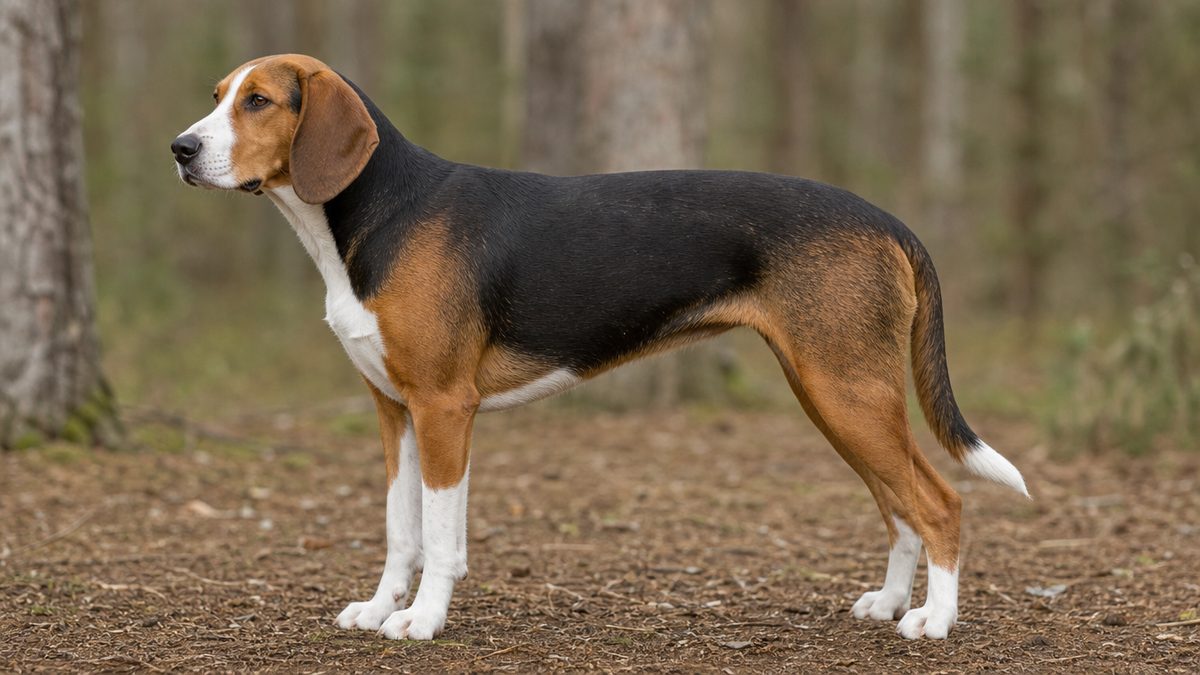
Quick answer
The finnish hound is a tricolour Finnish scent hound, FCI standard 51, bred to chase hare and fox for two hours while barking. No Finnish Hound is sold in India at any price, and none should be: the warmest month in Finland has a lower wet-bulb temperature than the coolest month in Bengaluru. Finland's own register holds 90,003 dogs, 8,003 graded hips and 12,258 recorded deaths.
This page summarises published breed-standard text, open kennel-club registry statistics, government notifications and peer-reviewed veterinary research for general information. It is not a diagnosis and it is not treatment advice. Consult a registered veterinarian near you about your own dog before acting on anything here. Three things in this breed are worth acting on the same day rather than watching. A puppy that trembles, staggers or loses limb coordination between 4 and 12 weeks needs a neurological assessment immediately, because Finnish Hound cerebellar ataxia progresses rapidly. An adult that tires abruptly during exercise in cool weather, or coughs at night, needs a cardiac work-up rather than rest, because the breed carries a heart condition whose first sign is exactly that. And a dog that pants heavily, staggers, vomits or collapses after activity in Indian heat is a heat-illness emergency: begin cooling with cool water at once and go to a veterinarian, because the event fatality rate for heat-related illness in the largest published study was 14.18 percent.
Finnish Hound at a glance
What the Finnish Hound is, and what the breed standard actually says
The Finnish Hound is a tricolour, medium-sized scent hound built in Finland to track and chase hare and fox while giving tongue, and the FCI recognises it as standard 51 under its Finnish name, Suomenajokoira.
The FCI entry places the breed in Group 6, Scent hounds and related breeds, Section 1.2, Medium-sized hounds, with a working trial. It was accepted on a definitive basis on 8 August 1954, its country of origin is Finland, and its official authentic language is English. That last detail matters more than it looks: the English text is the master version, so the wording below is the standard itself rather than a translation of it.
One check is worth making before anything else, because a sibling Finnish breed on this site fails it. FCI 189 is published in English as the Finnish Lapponian Dog, not the Finnish Lapphund, so the common name and the register name diverge. For FCI 51 they do not. The nomenclature page prints SUOMENAJOKOIRA at the top and gives FINNISH HOUND as the English name on the same row, so Finnish Hound is the correct registry name and not a nickname. The Finnish Kennel Club's own breed-code list assigns the same number, 51, to suomenajokoira.
| Point | The standard's own wording |
|---|---|
| Height at the withers | Males 55 cm to 61 cm, ideal 57-59. Bitches 52 cm to 58 cm, ideal 54-56 |
| Weight | Not specified anywhere in the document |
| Body proportion | Body length to height at the withers is 1.1 to 1 |
| Chest | Depth is half the height at the withers, reaching to the elbows |
| Coat | Undercoat short, dense and soft. Outer coat medium in length, close-lying, straight, dense and rather harsh |
| Colour | Tricoloured. Black mantle, rich tan on head, lower body, shoulders and thighs, white usually on head, neck, forechest, lower legs and tail tip |
| Temperament | Calm, energetic and friendly, never aggressive |
| Eliminating faults | Aggression or shyness, undershot or clearly overshot bite, kinky tail, total lack of nose pigment, height more than 1 cm outside the range |
The standard sets no weight at all. Every ranking page states one anyway. Wikipedia, the top result for the breed name from India, gives 20-25 kg. That figure may well describe real dogs, but it is not the breed standard, and a buyer told a breed weighs 20-25 kg is being handed a number the recognising body never published. The standard controls height and treats a deviation of more than 1 cm as an eliminating fault, which is a tighter rule than most breeds carry.
The job description is in the document
The standard's utilization line reads: a hound for hunting hare and fox by following the scent, eager to hunt also in difficult circumstances, who works independently, is a versatile tracker, and pursues the quarry with resonant barking. Four things in that one sentence decide whether this dog fits an Indian home. It works independently, it hunts by scent, it is meant to work in hard conditions, and it is meant to bark loudly while it does. None of those is a fault to be trained out. They are the specification.
When the standard was written, and why two dates circulate
The FCI standard says the first standard was written in 1932. The Finnish Kennel Club's own breed page says something different and more detailed: hunting enthusiasts founded the Finnish Kennel Club in 1889 and set the creation of a Finnish hound breed as one of its first goals, three dogs were selected at the club's first show in 1891 and eight the following year, and the first breed marks were drawn up in 1893 with the colour fixed as red-brown. Because the colour would not stabilise and the black mantle kept pushing through, breeders had to return to a tricolour dog in the early 1900s, and the current standard mostly dates from 1932.
Both accounts are right about different things, and we print both rather than picking one. 1893 is when a written description of the breed first existed; 1932 is when the document recognisable as today's standard was written. Anyone who tells you the breed "dates from 1932" has read the FCI page and not the Finnish one.
The United Kennel Club in the United States publishes its own Finnish Hound standard, so the breed has an English-language registry route outside the FCI as well. Its description opens with the same three words the FCI uses, calm, energetic and friendly. Royal Canin's breed page, which also ranks in India for the breed name, opens the same way and describes the breed as an enthusiastic hare and fox tracker that works independently and chases while barking resonantly.
Finland's numbers: a breed that was number one and is now ninth
The Finnish Hound was the most registered dog of any breed in Finland through the 1990s and into the 2000s, and by 2025 it had fallen to ninth, behind the Finnish Lapponian Dog. Both halves of that sentence matter, and no page in English carries either.
We went to the Finnish Kennel Club's own registration ranking and pulled four separate five-year windows rather than one. The breed's position moves a long way across them.
| Window | Rank among all breeds | Registrations, first year to last year of the window |
|---|---|---|
| 1990-1994 | 1st | 4,106 / 4,355 / 4,621 / 4,200 / 4,216 |
| 2000-2004 | 1st | 3,065 / 2,734 / 2,360 / 2,290 / 2,394 |
| 2010-2014 | 4th | 1,784 / 1,577 / 1,475 / 1,664 / 1,409 |
| 2021-2025 | 9th | 1,230 / 932 / 943 / 796 / 631 |
So the common claim that this is Finland's most registered native breed is out of date. In the 2021-2025 window the Finnish Lapponian Dog sits fifth with 874 registrations in 2025 against the Finnish Hound's 631, and the Finnish Spitz is twelfth with 609. The accurate statement is that the Finnish Hound was Finland's most registered dog of any breed for at least fifteen years and is now the country's second most registered native breed. It still has by far the largest historical dataset of any Finnish breed, which is why the health figures further down this page are worth reading.
The scale of the fall is the story. The peak registration year was 1992 at 4,621 dogs. The 2025 figure of 631 is 86 percent lower. The Finnish Kennel Club's own breed page, written when the breed still ranked eighth in 2023 with 943 puppies, credits its continuing popularity to Finland's long hare and fox hunting seasons.
Ninety thousand dogs, and why that matters to a reader in India
Counted by birth year, KoiraNet holds 90,003 Finnish Hounds born between 1988 and 2026. That is an unusually deep register for one breed in one country, and it is the reason this page can quote screening rates, grade distributions and causes of death instead of adjectives. Most breed pages on the internet cannot, because most breeds have no equivalent.
The breed club is blunt about the trend. Its 2025-2029 breeding strategy opens by saying the Finnish Hound has traditionally been a numerous breed but that registrations fell sharply through the 2010s, and that its distribution is comparatively narrow, covering Finland plus Sweden and Norway. Small numbers of dogs have been exported to several European countries, but there is no established population outside the Nordic region, and none in India.
KoiraNet's registration table counts by registration year and its health tables count by birth year, so 1992 shows 4,621 in one and 4,584 in the other. Neither is wrong. Check which basis a Finnish figure uses before comparing it with another.
The hunting job, scored out of 100, and what it tells a pet buyer
Finland scores this breed's hunting work on a published 100-point scale in which chase time alone is worth 70 points, so the trait an Indian household would find hardest to live with is the trait the breed is selected for.
Finland runs two hunting trial forms for this breed, the hare trial and the fox trial, and the FCI entry records the breed as subject to a working trial. In a hare trial the dog gets four hours of search time, used in more than one stint, and two chase periods of 120 minutes each. After a 120-minute chase the dog is leashed and taken to a new place to find a second hare, and the judging group has to make sure the same hare is not chased twice. Judges score search, bark and chase skill at up to 10 points each, a maximum of 30, and the chase time itself is worth up to 70 points, for a total of 100. A dog can also lose 0 to 10 points for search looseness and 0 to 10 for chase looseness.
Fox trials became an official Finnish trial form in 1979 and work differently. The dog needs one chase, has 120 minutes of chase time, and search is the most heavily weighted element at up to 40 points, because a fox hound has to unpick very long night trails. Only a few percent of Finnish Hounds ever enter a fox trial.
| Element | Weight in the combined use index |
|---|---|
| Chase skill (ajotaito) | 40 percent |
| Bark (haukku) | 25 percent |
| Search (haku) | 17.5 percent |
| Hunting drive (metsästysinto) | 17.5 percent |
Read that table as a household forecast. A quarter of the breed's official working score is the barking. The FCI standard asks for resonant barking in the field, and the Finnish Kennel Club notes that at home the breed barks and guards little or not at all, which is a genuine and useful distinction. Suomen Kennelliitto, Suomenajokoira The dog is not a nuisance barker in a living room. It is a dog that has been selected for two centuries to bark continuously for two hours while running.
The Kilpa and the Ajokuningas
Finland crowns a Chase King every year. The Kilpa championship was first held in 1937 and has run every year since apart from the war years. Three dogs from each kennel district championship reach one of four regional selection trials, the best three from each region reach the Kilpa, and the previous year's Ajokuningas qualifies automatically. The winner is crowned Ajokuningas.
Since 1996 the Finnish Kennel Club has also computed BLUP breeding indices for hunting qualities from hare trial results, with the breed mean set at 100, correcting for factors such as trial conditions and the dog's age. The breed club reports that chase ability has improved strongly over the last thirty years on this system, while search looseness has moved back and forth with only a slight downward trend. Very few breeds anywhere have thirty years of quantitative genetic progress on a working trait.
The number a pet buyer should not skip
The Finnish Kennel Club's death register records 143 Finnish Hounds euthanised because a working dog was not suited to its purpose, 1.3 percent of all reported deaths, at a mean age of 4 years 10 months. A further 206 dogs, 1.9 percent, were euthanised for behaviour problems at a mean age of 4 years 1 month. Those are dogs that failed to become hunting dogs in the country that invented the breed, with hunting land and hunting culture on the doorstep. An Indian buyer starts from a worse position than every one of them.
The Finnish Kennel Club's own breed page says the Finnish Hound, being extremely high in hunting drive, is better suited as a hunting dog than as a companion dog. That is the national registry describing its own native breed, and it is the most important line published about it anywhere.
Indian heat: the wet-bulb comparison, city by city
The warmest month in the warmest part of Finland is cooler in wet-bulb terms than the coolest month in Bengaluru, so an Indian city never gives this breed a season that resembles a Finnish summer. Every figure below comes from NASA POWER queried by explicit latitude and longitude.
We use wet-bulb temperature rather than air temperature because a dog sheds heat by panting, which is evaporative, and evaporation stops working as humidity rises. Two places at 30 C are not the same place for a dog if one is at 30 percent humidity and the other at 85 percent. We compute wet-bulb from NASA POWER's 2001-2020 monthly means for air temperature and relative humidity using the Stull 2011 empirical formula. Stull R. Wet-Bulb Temperature from Relative…
Querying by coordinates matters. Slug-based climate sites have served this project six wrong cities at HTTP 200, including a request for Chennai that returned Porirua in New Zealand. A latitude and longitude cannot hand you a different city by accident, and we checked the coordinates echoed back by the API against the ones we sent for every row below.
| Place | Coordinates queried | Warmest month, mean air | Highest monthly wet-bulb | Lowest monthly wet-bulb |
|---|---|---|---|---|
| Helsinki, Finland | 60.17 N, 24.94 E | 17.55 C (July) | 15.29 C (July) | -4.56 C (February) |
| Joensuu, Finland | 62.60 N, 29.76 E | 17.60 C (July) | 15.25 C (July) | -12.17 C (January) |
| Bengaluru | 12.97 N, 77.59 E | 28.37 C (April) | 21.86 C (May) | 16.41 C (January) |
| Pune | 18.52 N, 73.86 E | 28.93 C (April) | 22.97 C (June) | 14.06 C (January) |
| Mumbai | 19.08 N, 72.88 E | 31.19 C (May) | 25.77 C (June) | 16.62 C (January) |
| Chennai | 13.08 N, 80.27 E | 31.51 C (May) | 26.11 C (May) | 21.00 C (January) |
| Delhi | 28.61 N, 77.21 E | 35.88 C (June) | 26.50 C (July) | 7.58 C (January) |
| Shillong | 25.58 N, 91.89 E | 22.38 C (August) | 21.33 C (July) | 8.07 C (January) |
Three readings come straight off that table. Bengaluru in January, India's mildest large-city month, sits at 21.86 C peak and 16.41 C at its coolest, which is above Helsinki's July peak of 15.29 C. Chennai's coolest month, January, is 21.00 C wet-bulb, which is 5.71 C above the hottest month Finland offers. And Delhi's July, at 26.50 C, is 11.21 C above it. There is no Indian metro where this dog gets a Finnish summer, let alone a Finnish autumn hunting season.
Delhi is the interesting case for the wrong reason. Its January wet-bulb of 7.58 C looks workable, and for eight to ten weeks it genuinely is. Then the same city reaches 35.88 C mean air temperature in June. A dog that is comfortable in a Delhi January is in a different climate by May, and the transition is fast enough that owners routinely misjudge it.
The one Indian place that comes close, and why it still is not Finland
Shillong is the closest India gets. Its January wet-bulb of 8.07 C is genuinely colder than anything Helsinki sees between May and September, and its warmest month averages only 22.38 C air temperature. For a Finnish Hound, a Shillong winter is a real hunting climate. Its July wet-bulb of 21.33 C is still 6 C above Helsinki's July, so the monsoon months remain hard, and hill stations at this altitude have neither an FCI-linked breeder network nor the specialist veterinary cover a working hound generates demand for. If you live at that altitude and want a scent hound, this is the honest place to start the conversation, and it is still not a recommendation.
A trait score of 1 for heat tolerance does not mean the dog will die in Chennai. It means the climate it was built for does not exist here, so every hour of exercise has to be moved, shortened or replaced, permanently and not seasonally.
Heat illness: what the evidence actually supports for this breed
Exertional heat illness, not a hot car, is the dominant trigger in the largest study of the subject, and a scent hound that works for two hours at a stretch is exactly the profile that study describes.
Two papers by the same authors in the same year are constantly conflated, so we name both. Hall, Carter and O'Neill 2020 in Animals reviewed 905,543 UK dogs under primary veterinary care in 2016 and identified 1,259 heat-related illness events from 1,222 dogs. Of the 879 events where a trigger was recorded, 652 were exertional, which is the 74.2 percent the paper prints, against 12.9 percent environmental and 5.2 percent vehicular confinement. The 74.2 percent is computed on 879, not on 1,259, and pages that attach it to the larger number are quoting an impossible figure.
Hall, Carter and O'Neill 2020 in Scientific Reports uses the same 905,543-dog cohort with a stricter case definition and finds 395 confirmed events, an incidence of 0.04 percent and an event fatality rate of 14.18 percent (95% CI 11.08 to 17.96). Its multivariable model flags breed, bodyweight above the breed and sex mean, age over two years, a brachycephalic skull and a bodyweight over 50 kg.
Now apply that honestly. The Finnish Hound is mesocephalic, with a muzzle the standard requires to equal the skull in length, so the brachycephalic risk does not apply. At the 20-25 kg commonly reported it is nowhere near the over-50 kg band. The factor that does transfer is bodyweight above the breed and sex mean, which is squarely within an owner's control, and the exertional trigger, which is not a breed factor at all but an activity factor.
Why exertional is the relevant category here
A dog that overheats in a car is a passive victim. A dog that overheats on a chase is doing the thing it was bred to do, and it will keep doing it past the point where it should stop, because stopping is the trait Finnish judges deduct points for. The breed's own trial rules give a dog up to four hours of searching and two hours of chasing in a single day. Reproduce a tenth of that in a Chennai May, where the monthly mean wet-bulb is 26.11 C, and you have constructed the exact exposure the Animals paper found to be the commonest trigger. Hall EJ, Carter AJ
- Walk before sunrise and after dark, not at 8 am, because ground temperature lags air temperature by hours.
- Cool with room-temperature or cool water over the whole body, and go to a veterinarian, rather than watching and waiting.
- Keep the dog at or below its breed and sex mean bodyweight, which is the one modelled risk factor you control.
- Treat heavy panting with staggering, vomiting or collapse after activity as an emergency and not as tiredness.
- Drop the chase games in summer entirely, because scent work in heat produces the exertional pattern the evidence describes.
One caution about borrowing odds ratios. The Finnish Hound is not a UK-registered breed in any number, so it is not named in either model, and no page should quote a breed-specific odds ratio for it. What transfers is the bodyweight factor and the exertional mechanism. What does not transfer is any figure computed for another breed.
Hips and elbows: 8,003 and 2,528 graded dogs, with every grade counted
Finland has graded 8,003 Finnish Hound hips and 2,528 elbows, and the grade counts sum exactly to those totals, which is why this is one of the few breeds where a screening claim can be checked rather than believed.
Both tables below come from the Finnish Kennel Club's KoiraNet breeding database, filtered by breed code 51 and birth years 1988 to 2026, pulled on 27 August 2026. The denominator in both is 90,003 dogs born. We add the grade columns and print the sum so you can see it balances.
| Grade | Dogs | Share of graded dogs |
|---|---|---|
| A, no signs of hip dysplasia | 2,972 | 37 percent |
| B, near normal | 2,604 | 33 percent |
| C, mild hip dysplasia | 1,699 | 21 percent |
| D, moderate | 623 | 8 percent |
| E, severe | 105 | 1 percent |
| Total graded | 8,003 | 8.9 percent of 90,003 born |
2,972 plus 2,604 plus 1,699 plus 623 plus 105 is 8,003 exactly. Grouping C, D and E as dysplastic gives 2,427 of 8,003, or 30.3 percent. That is a real hip dysplasia burden, and it sits alongside a screening rate of well under one dog in ten.
| Grade | Dogs | Share of graded dogs |
|---|---|---|
| 0, no elbow dysplasia | 2,070 | 82 percent |
| 1, mild arthrosis | 306 | 12 percent |
| 2, moderate | 102 | 4 percent |
| 3, severe | 50 | 2 percent |
| Total graded | 2,528 | 2.8 percent of 90,003 born |
2,070 plus 306 plus 102 plus 50 is 2,528 exactly. Any elbow dysplasia is 458 of 2,528, or 18.1 percent. The breed club's own strategy document prints the same four percentages, 82, 12, 4 and 2, which is a useful independent confirmation that we read the table the same way its authors did.
The trend nobody publishes: more screening, worse results
Restrict the same hip table to dogs born 2015-2026 and the picture changes. In that window 12,965 dogs were born, 2,142 were graded, and the split is A 618, B 755, C 594, D 131, E 44, which again sums exactly to 2,142. The screening rate roughly doubles, from 9 percent to 17 percent, and the A rate falls from 37 to 29 percent while the dysplastic share rises from 30.3 to 35.9 percent. The most likely explanation is that a low screening rate is self-selecting, because owners who suspect a problem are not the ones who volunteer a radiograph. It is also possible hips are genuinely deteriorating. We cannot separate the two from the register, and we say so rather than picking the flattering reading.
The breed club states that only 12 percent of Finnish Hounds born in the 2000s have been screened for hip dysplasia and that 69 percent of those screened were graded A or B, concluding that hip dysplasia is not currently a breeding problem while adding that the proportion examined is very low. Elsewhere in the same document it gives the 2000s screening rate as 10 percent. Two numbers, one document. We print both.
Patellar luxation has barely been looked for: 227 Finnish Hounds of 90,003 have a patella result, 223 of them grade 0. Spondylosis has 104 results, 82 of them grade 0. Both denominators are too small to support any prevalence claim, and we make none.
The eye examination almost nobody has done
Finland has recorded exactly 115 eye examinations across 90,003 Finnish Hounds born since 1988, which is 0.13 percent of the breed, and that near-total absence of data is itself the finding.
We pulled the KoiraNet eye examination table for breed code 51 across every birth year in the register and summed it. Of 90,003 dogs born, 115 have an eye examination result and 106 of those were recorded as free, which is 92.2 percent of those examined. The busiest single birth year is 2010 with nine dogs examined. Eleven birth years have one or zero.
| Diagnosis as printed in the register | Occurrences |
|---|---|
| No hereditary eye diseases found | 105 |
| Posterior polar cataract, confirmed | 3 |
| Distichiasis, confirmed | 3 |
| Severity of eye changes, mild | 2 |
| CEA, not found | 1 |
| Ectopic cilia, confirmed | 1 |
| Keratitis, confirmed | 1 |
| Plasmoma, confirmed | 1 |
| Cataract extent, moderate | 1 |
| Macroblepharon or eyelid ectropion, confirmed | 1 |
| Cataract extent, extensive | 1 |
| Nuclear cataract, confirmed | 1 |
| Cataract of unspecified location, suspicious | 1 |
| Cortical cataract, suspicious | 1 |
Note the small internal inconsistency and do not paper over it: the register counts 106 dogs as free while the diagnosis rows carry 105 entries of no hereditary eye disease found. The likely reason is that a dog can be recorded free of hereditary disease while carrying a non-hereditary finding such as keratitis or plasmoma, so the two counts measure slightly different things. We print both figures rather than quoting one as the rate.
What 115 examinations can and cannot support
A 92.2 percent clear rate on 115 dogs is not a statement about the breed's eyes. It is a statement about 115 volunteers over 38 birth years, and a screening programme this thin cannot detect a late-onset or low-frequency condition at all. The correct reading is that hereditary eye disease in the Finnish Hound is unstudied, not absent. That distinction is the whole point, and no ranking page makes it because no ranking page has the data.
It also puts the breed in a very different position from the two Finnish spitz breeds. Those carry meaningful eye datasets. This one does not, and an Indian buyer told the breed has "no eye problems" is being told something the evidence cannot support. The three confirmed posterior polar cataracts and three confirmed distichiasis findings are real, and they are all anyone can honestly say.
If a breeder anywhere offers a Finnish Hound with an eye certificate, ask for the KoiraNet record number. Fewer than 120 such records exist in the world, so a genuine one is checkable in seconds.
Cerebellar ataxia: a lethal disease this breed engineered out of itself
Finnish Hound cerebellar ataxia is caused by a single recessive SEL1L mutation carried by about 10 percent of the breed when it was found in 2012, and the breed club reports the disease has since effectively disappeared thanks to the DNA test.
Kyöstilä and colleagues published the mutation in PLoS Genetics in 2012, working from Professor Hannes Lohi's group at the University of Helsinki at the breed club's own initiative. Ten affected Finnish Hound puppies from six litters were examined clinically. Clinical signs were first noticed at a mean age of 9 weeks, ranging from 4 to 12 weeks, and all ten were euthanised because of rapid progression and a poor prognosis.
The cause is a homozygous missense mutation in SEL1L, c.1972T>C, p.Ser658Pro, on canine chromosome 8, inherited as a simple autosomal recessive. Genotyping showed complete segregation: all 13 affected puppies homozygous, all 13 parents heterozygous, and 20 littermates either heterozygous (12) or wild-type (8).
| Group tested | Result |
|---|---|
| Randomly selected unaffected Finnish Hounds | 24 carriers of 241, a 10 percent carrier frequency |
| Homozygous affected among those 241 | None |
| Dogs from 51 other breeds tested | 349, with the C allele completely absent |
| Association between the C allele and disease | p = 1.8 x 10 to the minus 42 |
24 divided by 241 is 9.96 percent, which is where the widely repeated "10 percent of Finnish Hounds" comes from. It is one of the few round numbers on the dog internet that is actually the arithmetic and not a guess.
What happened next is the part worth copying
The breed club's 2025-2029 strategy states that a genetic test exists, that roughly 10 percent of dogs carried the faulty gene, and that ataxia in practice no longer occurs in the breed, precisely because of the genetic test. An independent peer-reviewed source says the same thing: Donner and colleagues, screening nearly 7,000 dogs of around 230 breeds for 93 disease variants, write that since the c.1972T>C SEL1L mutation was discovered, breeders have successfully used genetic screening to eradicate the lethal disorder from the breed and affected dogs are no longer encountered in practice. The Finnish Kennel Club describes the mechanism plainly: affected puppies are prevented by not combining two carriers, and a carrier may be bred to a dog with a normal ataxia genotype. Carriers were not culled, so the gene pool did not narrow.
The same study found the variant was not as breed-specific as everyone assumed. Thirteen carriers turned up in another Nordic breed, the Norrbottenspitz, whose Finnish breed club describes its population as fairly heterogeneous with open stud books, and all thirteen shared ancestry with the same dogs registered into that breed in the 1990s. A further 41 unrelated Norrbottenspitzes were then screened separately. Kyöstilä's 2012 screen had found the C allele completely absent from 349 dogs of 51 other breeds, so this is a real extension of the picture rather than a contradiction of it. That is a rare and genuinely admirable outcome. A recessive disease that killed puppies at three months was reduced to a management problem in roughly a decade without discarding 10 percent of a breed's breeding stock. The club now lists knowing the ataxia status of breeding dogs as a target it has met.
For a reader in India the practical consequence is narrow but sharp. The ataxia risk is not a reason to avoid the breed. It is a reason to insist on documentation, because a puppy exported outside the Finnish system carries none of that infrastructure with it, and outside Finland nobody is checking. The scientific paper was published expressly to enable carrier screening for breeding purposes, and screening only works where somebody performs it.
The 2012 paper describes this as the first early-onset neurodegenerative ataxia mutation identified in dogs, and proposes SEL1L as a candidate gene for human childhood ataxias. A Finnish hunting hound is a model organism for a human disease.
Heart, skin, lymphoma and one disease the panels list that Finland does not
Beyond the joints and the ataxia the breed club names four conditions it treats as hereditary in practice, and there is one condition on the commercial DNA panels that Finland's own 62-page breeding strategy never mentions.
The club's list, from experience rather than from a published prevalence study, is progressive myocardial degeneration or dilated cardiomyopathy, lymphoma, black hair follicular dysplasia and atopic dermatitis. It also names bite faults, cryptorchidism, tail vertebral defects, eyelid faults, umbilical hernia and cleft palate and lip as hereditary defects seen in the breed.
The heart disease that arrives at working age
The club describes a heart defect that almost without exception ends in the dog being euthanised, with a course closely resembling dilated cardiomyopathy, and notes that the affected dog is often at its best working age. The first sign is sudden tiring during a hunt, followed as the disease progresses by laboured breathing, night-time coughing and other signs of respiratory distress. A veterinarian can find a clear heart murmur and an enlarged heart on radiography, confirmed by echocardiography.
That first sign matters in India for a reason the Finnish text does not anticipate. Sudden tiring during exercise is also the first sign of heat stress, and in an Indian summer an owner will reasonably attribute it to the weather. The Finnish register records 405 deaths from heart disease at a mean age of 8 years 3 months. If an adult Finnish Hound tires abruptly in cool weather, or tires and then coughs at night, that is a cardiology question and not a heat question.
Skin, and why the Indian version is different
The Finnish Kennel Club's 2015 health survey found that about 9 percent of Finnish Hounds suffer from significant or recurrent skin problems, atopy included. Atopic dermatitis is a lifelong condition that is controllable but not curable, typically starting between 6 months and 3 years of age, and the club's position is that an atopic or allergic dog must not be bred from.
Black hair follicular dysplasia is the other skin condition named, and it is specific to the breed's colour pattern: hair loss confined to the black-pigmented areas, which on a tricolour dog means the mantle. In a tropical climate a dog losing coat over its entire back has lost its sun barrier, and that is a sunburn and solar dermatitis problem that Finland never has to write about.
Factor VII deficiency: on the panels, absent from the Finnish document
Commercial genetic panels list Factor VII deficiency for this breed. Wisdom Panel's Finnish Hound page names it alongside the cerebellar ataxia as the breed's two genetic health conditions. The Online Mendelian Inheritance in Animals catalogue confirms the underlying record: OMIA:000361-9615, Factor VII deficiency, autosomal recessive, caused by the F7 missense variant c.407G>A, p.(G136E) on chromosome 22, first described in Beagles in 2006 and since documented in a list of breeds that includes the Finnish Hound.
Now the divergence. Searching the breed club's own 62-page breeding strategy for Factor VII, for the Finnish word for clotting factor and for coagulation returns zero occurrences. Finland, which holds the deepest data on this breed anywhere and lists ten hereditary conditions by name, does not treat Factor VII deficiency as a breed issue.
One published measurement settles the middle ground, and it is worth quoting because it cuts both ways. Donner and colleagues recruited one Finnish Hound homozygous for the F7 mutation. Its clinical history was unremarkable, and its prothrombin time was nonetheless prolonged at 72 seconds against a laboratory reference of 10 to 20 seconds, indicating genuine factor VII deficiency. So the variant is functional in this breed, and a dog carrying two copies of it can look completely healthy while its blood takes three to seven times as long to clot. Both things can therefore be true. A variant can be real and functional yet sit at a frequency low enough that a national breeding programme never encounters it, and OMIA itself warns that inclusion of a variant in its table does not automatically mean it should be used for DNA testing. What is not acceptable is a page telling an owner their Finnish Hound is at risk of a bleeding disorder on the strength of a panel listing, without saying that the breed's own custodians do not mention it. We say it.
Lifespan: 12,258 recorded deaths against a 10-12 year internet number
The Finnish Kennel Club's register holds 12,258 Finnish Hound deaths at a mean age of 8 years 6 months, and the 10-12 year lifespan every ranking page prints is not drawn from it.
This is the largest single-breed mortality dataset this site has worked with. We pulled the KoiraNet cause-of-death table for breed code 51 across the whole register on 27 August 2026 and it returned 12,258 dogs with a recorded death, at an overall mean age of 8 years 6 months. The 24 cause rows sum exactly to 12,258.
| Cause as recorded | Dogs | Mean age at death |
|---|---|---|
| Old age, natural or euthanasia | 2,730 | 11 years 6 months |
| Cause of death not reported | 2,481 | 9 years 2 months |
| Accident or traffic collision | 1,530 | 5 years 3 months |
| Euthanasia without a diagnosed disease | 1,277 | 8 years 4 months |
| Tumours and cancer | 977 | 8 years 4 months |
| Died without a diagnosed disease | 639 | 8 years 10 months |
| Other disease not on the list | 516 | 7 years 0 months |
| Heart disease | 405 | 8 years 3 months |
| Euthanasia for behaviour problems | 237 | 4 years 2 months |
| Skeletal and joint disease | 241 | 7 years 0 months |
| Skin and ear disease | 168 | 6 years 2 months |
| Working dog unsuited to its purpose | 161 | 4 years 10 months |
| Urinary and reproductive disease | 159 | 8 years 1 month |
| Liver or gastrointestinal disease | 134 | 7 years 0 months |
| Lost or missing | 112 | 6 years 1 month |
| Neurological disease | 81 | 4 years 10 months |
| Predator kill | 74 | 6 years 1 month |
| Spinal disease | 72 | 8 years 8 months |
| Six smaller causes combined: endocrine 61, whelping difficulty 61, immunological 46, respiratory 39, eye disease 36, congenital puppy defect 21 | 264 | varies |
| All causes | 12,258 | 8 years 6 months |
The single largest disease category is cancer at 977 deaths. The breed club computes its share on the 9,232 dogs whose death was attributed to disease rather than to accidents and traffic, which gives 8.5 percent. Computed on all reported deaths it is 7.4 percent instead. Both are defensible and they answer different questions, so name the denominator whenever you quote either.
The second largest single category, ahead of every disease, is accident and traffic collision: 1,530 dogs at a mean age of 5 years 3 months. That is a free-running scent hound following a trail across a road, and it is the clearest signal on this page of what the breed does when it picks up a line. Add 112 dogs recorded simply as lost and 74 killed by predators, and 1,716 deaths trace to a dog that was out of its owner's control.
So where does 10-12 years come from
Basepaws gives 10-12 years, and versions of that range appear across the ranking set. The Finnish register gives a mean age at death of 8 years 6 months across 12,258 dogs, and a mean of 11 years 6 months among the 2,730 that died of old age. Those are compatible if you read them correctly. A Finnish Hound that avoids the road and reaches old age lives about 11 and a half years. The breed average is dragged down by 1,530 road deaths at five, and by euthanasia of young dogs that would not work or would not behave.
For an Indian household that is unexpectedly good news, because the largest killer in the Finnish dataset is a working-dog hazard rather than a disease of the breed. An Indian pet Finnish Hound that is never let off-lead near traffic removes the biggest single line in that table. Everything else on this page still argues against the breed here, but the lifespan does not.
Two pulls forty minutes apart returned 12,257 and 12,258 deaths, the extra record landing in the died-without-a-diagnosis row, so quote this figure with its date. The breed club also lists the oldest records in the register as 17 years 4 months, 20 years and 40 years 11 months. The last of those is a data-entry error, and it is a reminder that a national register is a human artefact. Suomen Kennelliitto
A closed population with a surprisingly healthy gene pool
The Finnish Hound is a closed population whose inbreeding coefficient has fallen to 2.41 percent and whose effective population size per generation is 419, which is four to eight times the level at which conservation genetics starts to worry.
The breed club states plainly that the Finnish Hound population is closed, meaning no new genetic material enters from outside, and that the standing risk in a closed population is inbreeding rising too far and too fast. With registrations down 86 percent from their peak, you would expect the gene pool to be in trouble. It is not, and that is worth saying precisely.
| Measure | 2016 | 2020 | 2023 | 2025 |
|---|---|---|---|---|
| Registrations altogether | 1,584 | 1,096 | 943 | 644 |
| Litters | 240 | 170 | 145 | 97 |
| Mean litter size | 6.6 | 6.4 | 6.4 | 6.6 |
| Different sires used | 136 | 108 | 94 | 69 |
| Different dams used | 239 | 169 | 145 | 97 |
| Mean inbreeding coefficient | 3.45 percent | 2.60 percent | 2.45 percent | 2.41 percent |
| Effective population, per year | 254 | 190 | 164 | 114 |
| Effective population, per four-year generation | 819 | 637 | 538 | 419 |
The inbreeding coefficient has fallen every period, from 3.45 percent in 2016 to 2.41 percent in 2025, while the population shrank by 59 percent. Breeders are spreading matings wider as the breed contracts, which is the correct response and is not the usual one.
The breed club sets out the threshold: below an effective size of 50 to 100, a breed's internal relatedness grows too fast and genetic variation is lost faster than nature can rebalance it. At 419 per generation, the Finnish Hound sits four to eight times above that line. For comparison, most rare breeds this site covers have effective sizes in the low double digits or no computable figure at all.
Where the pressure genuinely is
Two numbers qualify the good news. First, the club puts internal relatedness at about 12 percent, meaning today's Finnish Hounds are on average cousins of one another. Second, the sire-to-dam ratio has sat near 0.53 per generation for a decade, so roughly half as many males as females are used, and popular sires do disproportionate work.
The club is specific about that. Its PEVISA programme caps a dog at 120 registered puppies, and its own recommendation for males is 75. In the 2000s, 25 sires used for breeding exceeded 150 offspring, and each of the 15 most-used males had at least 180. Some of those most-used males are close relatives of each other, which compounds the effect. The club also notes that the healthiest period for diversity was 1992-1996, when the ten most-used sires produced only 11 percent of all registrations.
Molecular work supports the register. Finnish Hound mean MHC heterozygosity was measured at 63.5 percent and microsatellite heterozygosity at 66.4 percent, with the inbreeding statistic FIS positive at every gene but not statistically significant, which the club summarises as an indicatively better-than-average situation.
Gene-pool depth is what makes the health figures above trustworthy rather than the artefact of a tiny founder base. A breed with 419 effective animals and 30 percent hip dysplasia has a real hip problem. A breed with 20 effective animals and the same figure might just have unlucky ancestors.
Temperament: two dogs in one animal, and only one of them fits a flat
The Finnish Hound is calm and friendly indoors and an obsessive independent hunter outdoors, and the Finnish breed club describes exactly that split rather than pretending it away.
The standard asks for calm, energetic and friendly, never aggressive, and treats slight timidity and excessive roughness towards other dogs as faults, with shyness or aggression as eliminating faults. The breed club's phrasing is warmer and more useful: the Finnish Hound has clearly two sides, a lovable and friendly family dog and a passionate hunting dog.
At home the Finnish Kennel Club describes a dog that barks and guards little or not at all. The club adds that indoors it is calm and friendly and gives voice mainly when it sees something interesting or worth reporting, and that continuous watchdog barking is not characteristic. If you are picturing a hound that howls at the flat door all day, that is not this breed.
Who this dog suits
- Households with a genuine outlet for two hours of daily scent-led movement, all year.
- Owners who accept a recall that will fail on a fresh trail, and who manage that with fences rather than obedience.
- Families with children, since the standard and the club both describe a friendly, non-aggressive dog.
- Homes in cool hill climates where the dog can work in daylight for more than three months of the year.
- Owners who want a hardy, low-maintenance coat and no grooming bills.
Who it does not suit
- Apartment owners in Chennai, Mumbai or Delhi who plan on two lead walks a day.
- First-time owners who expect a scent hound to be as trainable as a retriever.
- Anyone who wants a guard dog, because the club states this dog barely watches the house.
- Households with free-roaming cats, poultry or small pets, given a breed selected for prey pursuit.
- Owners who cannot secure a garden, because 1,530 recorded deaths in Finland are road accidents.
The Finnish register's behaviour numbers deserve one more look here. 237 dogs were euthanised for behaviour or temperament problems at a mean age of 4 years 1 month. That is 1.9 percent of all reported deaths and it is not a small figure for a breed the standard describes as never aggressive. The likeliest reading, given the mean age, is dogs that became unmanageable adolescents in homes that could not give them work. That is a failure mode an Indian city home is more exposed to, not less.
One structural point in the breed's favour. The Finnish Hound has not split into show and working lines. The club says it remains principally a hunting dog and has not divided into separate lines, so there is no calmer show-bred variety to look for. Every Finnish Hound is bred from working stock, and you should assume any individual carries the full drive.
Training: what works, and the recall problem you cannot fix
Train a Finnish Hound for management rather than for obedience, because the breed standard specifies a dog that works independently and Finland scores it on how long it will ignore you to keep a line.
Start from the standard's own wording. It calls for a dog that works independently and is a versatile tracker. Independence in a scent hound is not stubbornness, and it is not a training failure. It is the trait that lets a dog hold a line for two hours out of sight and earshot. You cannot select for that and then be surprised by a soft recall.
The five things that actually work
- Socialise early and widely, in the 8-to-16-week window, since a friendly standard is a starting point and not a guarantee.
- Train on a long line, 10 to 15 metres, so a failed recall costs you nothing and never gets rehearsed off-lead.
- Pay for scent work instead of fighting it, using tracking games and scatter feeding, because a nose-tired hound settles and a leg-tired one does not.
- Build a whistle recall away from scent first, in a bare room and then a bare yard, and never test it on a fresh trail.
- Keep sessions short and food-led, three to five minutes, since a hound that is bored will simply leave.
Do not attempt an off-lead recall in an unfenced Indian park. The Finnish register records 1,530 road and accident deaths at a mean age of 5 years 3 months, plus 112 dogs recorded simply as lost. Those dogs belonged to Finnish hunters with tracking collars, in a country with a hunting culture and far fewer vehicles per kilometre than an Indian city. If the breed's own experts lose dogs to roads at that rate, an urban Indian owner should treat off-lead freedom as something that happens only inside a fence.
The heat constraint on training
Training a scent hound means working its nose, and working a nose means moving. In Chennai, where the coolest month has a mean wet-bulb of 21.00 C, the usable window for anything sustained is roughly 4.30 am to 7 am and after 8 pm. Plan the whole training programme inside those hours rather than trying to shorten sessions in the middle of the day. Indoor scent games on a cool floor are the workaround, and they are a real one.
One thing to skip. Do not try to train the bark out of a working session. Finland weights bark at 25 percent of the breed's overall working index, so it is one of the most heavily selected traits the dog has. You can and should teach a quiet cue for the home, where the club says the dog is naturally quiet anyway. You will not teach a Finnish Hound to chase silently.
De-barking is illegal in India. Second Schedule Part II paragraph 6(8) of the Prevention of Cruelty to Animals (Dog Breeding and Marketing) Rules 2017 states that there shall be no tail docking, ear cropping, de-barking, de-clawing, branding, dyeing, injecting substances to enhance visual appeal, performing a surgery or procedure to camouflage or hide any defect or infirmity or any other kind of mutilation of any body part of the pup, and that any change of appearance by artificial means is strictly forbidden.
Exercise: what the breed is built for, and what an Indian city can supply
A Finnish Hound is built for four hours of searching and two hours of chasing in a single working day, and no Indian city routine comes within a fraction of that for most of the year.
The Finnish hare trial gives a dog four hours of search time and two chase periods of 120 minutes, and dogs that complete that are the ones scoring well. That is the design specification, not an extreme. A Finnish hunting season runs from late summer through winter, so a working hound gets months of it.
| Setting | Usable outdoor hours per day in the hot season | Realistic daily work |
|---|---|---|
| Finnish hunting season | All daylight hours, wet-bulb below 15.3 C even in July | 4 hours search plus 2 hours chase |
| Shillong, winter | Most daylight hours, January wet-bulb 8.07 C | 2 to 3 hours of varied scent work |
| Bengaluru or Pune | Roughly 5 am to 7.30 am and after 8 pm | 60 to 90 minutes split across two sessions |
| Chennai or Mumbai | Roughly 4.30 am to 6.30 am and after 9 pm | 45 to 75 minutes, most of it low-intensity |
| Delhi, May to September | Before sunrise only, July wet-bulb 26.50 C | 30 to 60 minutes, walking rather than running |
The honest arithmetic is that an Indian city can supply between a tenth and a quarter of what this breed was designed to do, and only outside the middle of the day. That gap does not close with a bigger flat or a treadmill. It is a climate constraint, not an effort constraint.
What to substitute
- Scatter-feed the whole daily ration across a room or terrace so the dog hunts for every meal.
- Run tracking lines indoors on a cool floor, laying a trail with a treat every metre and lengthening it weekly.
- Use snuffle mats and cardboard puzzles during the hottest hours, since nose work is the only exercise that is safe at 26 C wet-bulb.
- Swim where clean water exists, which cools and works the whole body at once.
- Split walks into three short outings rather than one long one, because heat load accumulates within a session.
Under-exercised is the wrong word for what goes wrong here. A Finnish Hound denied scent work does not get fat and sleepy, it gets vocal, destructive and escape-prone, and an escape-prone scent hound in Indian traffic is the failure mode the Finnish death register documents 1,530 times.
The breed club describes rintapahka, a sternal callus: in deep, keel-chested dogs chasing through snow, the skin over the breastbone breaks and a hairless pouch forms, which is very painful, needs medication when infected and often recurs even after skin-graft surgery. India has no snow, so the injury does not transfer. The deep keel chest that causes it is still being selected for.
Grooming: the easiest coat on this site, and the ears that are not
The Finnish Hound's coat needs a weekly brush and nothing else, and the real grooming work in India is the ears, because a hanging ear in a humid climate is the breed's most likely recurring problem.
The standard describes a short, dense, soft undercoat under a medium-length, close-lying, straight, dense and rather harsh outer coat, and the Finnish Kennel Club calls the coat double, tricolour and fairly smooth. Suomen Kennelliitto, Suomenajokoira There is no furnishing, no feathering and nothing to strip or clip. A rubber curry brush once or twice a week lifts the dead undercoat, and that is the whole routine.
The colour is fixed and worth knowing for identification: a black mantle with rich tan on the head, lower body, shoulders, thighs and legs, and white usually on head, neck, forechest, lower legs and the tail tip. A mottled colour, clearly broken mantle colours or a lot of grey or wolf hair are faults. If a seller shows you a solid, bicolour or heavily flecked dog and calls it a Finnish Hound, the coat and colour alone tell you it is not one.
The ears are the real job
The standard specifies ears that hang with the front edge close to the head, flat, reaching over half the muzzle when drawn forward. That is a classic pendulous hound ear, and the largest study available puts a number on what it costs. In a random sample of 22,333 dogs from 905,554 under UK primary veterinary care, the one-year prevalence of otitis externa was 7.30 percent, and breeds with pendulous ear carriage had 1.76 times the odds of otitis externa (95% CI 1.48 to 2.10) compared with erect-eared breeds, while V-shaped drop ears carried 1.84 times the odds.
India adds humidity to that anatomy. A Himachal Pradesh hospital series screened 2,476 dogs presented at Palampur between June 2022 and July 2023 and diagnosed 81 with otitis externa, a hospital prevalence of 3.27 percent, with the incidence peaking in the rainy season at 59.25 percent of cases. The same series found Labrador Retrievers most affected at 23.45 percent of cases, followed by German Shepherds at 14.81 percent and Pomeranians at 12.43 percent, and dogs aged 1 to 5 years worst hit at 41.97 percent.
- Dry the ear canal after every swim and every bath, rather than letting the dog air dry, which is standard advice in Finland and wrong in an Indian monsoon.
- Check both ears weekly for smell, redness and head shaking, and daily in July and August.
- Clean only when a veterinarian says to, because over-cleaning damages the canal and the UK study's authors warn against overzealous ear-cleaning.
- Treat head shaking, ear pain, swelling or purulent discharge as a clinic visit, since those are the presenting signs the Palampur series lists.
- Never shave the coat to cool the dog, because the double coat is also its sun barrier.
Coat care in Indian humidity is otherwise unremarkable. The breed has no folds, no wrinkles and a skin the standard describes as thick, close-lying and free of wrinkles, which removes the intertrigo problems that dominate grooming advice for many imported breeds. The exception is black hair follicular dysplasia, which causes hair loss confined to the black mantle, and a dog losing its mantle in India has lost the coat over the part of it the sun hits hardest.
Finnish Hound price in India: there is no Indian price, and here is the proof
No Finnish Hound is offered for sale in India at any price, and we prove that with a working control rather than with an empty search result.
There is no Finnish Hound price in India because there is no Indian supply. We searched the India-located result set for the breed name plus price on 27 August 2026 and not one result was about this breed. Position 1 was a Finnish Lapphund page, position 2 a general Indian breed cost list, position 3 an Amazon India listing for a Finnish Lapphund book, and position 5 the Finnish Lapphund Wikipedia article. The search engine substituted a different Finnish breed rather than return nothing.
The control, run in the same session
An empty search result proves nothing on its own, because a blocked or throttled query returns zero exactly like a genuine absence. So we ran a control in the same tool, in the same session, from the same India location. Searching for Labrador Retriever price in India returned rich, breed-specific Indian commerce immediately, including a page quoting INR 30,000 to INR 1,20,000 broken into basic, KCI-registered and champion-bloodline tiers with per-city tables for Hyderabad, Bangalore, Delhi, Chennai, Lucknow, Mumbai, Jaipur and Pune. The instrument works. The absence is real.
| Query | Result |
|---|---|
| finnish hound price in india | Zero pages about the Finnish Hound. Three of the top five concerned the Finnish Lapphund |
| labrador retriever price in india (control) | Multiple Indian sellers with rupee price bands, quality tiers and city tables |
| "Finnish Hound" puppies for sale India price | Zero Indian listings. Top result was a European sales site whose breed selector lists Finnish Hound (051) |
Because there is no Indian price, we publish none. This site has documented Indian breed price tables that are American dollar lists divided by 74 or by 84.38, tables where 453 of 463 rupee values resolve to round dollar amounts, pages where the dollar sign was simply deleted and the digits reprinted as rupees, and a marketplace carousel that prints Rs 98,999 against whichever puppy is in stock, including breeds the seller does not stock. Manufacturing a Finnish Hound price would put this page in that company. There is no figure to divide, because nobody has published one.
What a price would look like if one existed
The nearest honest reference point is Finland itself, and even there the breed is not a commodity. Around 97 litters were registered in 2025 from 92 breeders, an average of 6.6 puppies per litter, in a country where most Finnish Hounds live outside kennel-club activity and are used purely for hunting. Those puppies go to hunters, mostly within Finland, Sweden and Norway. A pet buyer in India is not in that market and cannot enter it, for reasons the import section below sets out.
Ask three questions. Which kennel, in which country, registered where. Then check the number against KoiraNet's public register, which lists every Finnish Hound litter in Finland. A dog that cannot be found there is not a Finnish Hound with Finnish papers, whatever the invoice says.
What Indian searches return instead, and how to recognise it
Indian and international pages carrying the Finnish Hound name fall into four recognisable types, and none of them is a dog you can buy in India.
We read every result on the India-located pages for the breed name and for the breed name plus for sale. Four patterns account for all of them.
| Type | Example | What it really is |
|---|---|---|
| A different Finnish breed | Finnish Lapphund pages at positions 1, 3 and 5 of the price query | Name-similarity substitution by the search engine |
| A breed name in a drop-down menu | An Indian rehoming service whose breed selector carries Finnish Hound and French Spaniel | A menu option with no dogs behind it |
| An international breed-list page | A European puppy sales site listing Finnish Hound (051) in its selector | A complete FCI breed list, not stock |
| Merchandise and stamps | Etsy cufflinks and a Grenada postage stamp booklet on eBay | Objects, not animals |
The international sales sites work the same way. Dogva.com came back as the top result for a Finnish Hound for-sale query from India, and what it actually carries is a breed selector listing Finnish Hound (051) beside every other FCI breed, which is a nomenclature list rather than stock. The Indian drop-down case is the most instructive. ThePetNest, an Indian pet rehoming service, carries Finnish Hound in its breed selector, immediately followed by Finnish Lapphund, Finnish Spitz, Fox Terrier (Smooth), French Bulldog and French Spaniel. That list is an FCI nomenclature dump pasted into a form. It tells you the site can accept a Finnish Hound listing, not that one exists. An Indian buyer who finds the breed name on an Indian domain and concludes the breed is available here has misread a form field as an inventory.
Quality problems in the pages that do rank
The pages that rank for the breed name are mostly fine, and two are not. Basepaws files this FCI Group 6 scent hound under a heading reading Pointer-Spaniel Lineage. The FCI classifies the breed as a scent hound in Group 6, section 1.2, medium-sized hounds, which is a different functional group from pointers and spaniels entirely. The same page gives a life expectancy of 10-12 years, which is the number the whole ranking set repeats and which nobody sources.
Wikipedia, the top result, gives a weight of 20-25 kg. The FCI standard specifies no weight. That is not a lie, and the figure may well be accurate for real dogs, but it is presented as a breed specification and it is not one.
None of the ten ranking pages carries a Finnish figure. Not the 90,003 registrations, not the 8,003 hip gradings, not the 12,258 recorded deaths, not the fall from first to ninth in Finland's own rankings, and not the fact that the breed's lethal ataxia has been engineered out. All of it is public, in Finnish, on the Finnish Kennel Club's own systems. Suomen Kennelliitto
Importing one, and what Indian law says before you try
India permits a pet dog to be imported only in a personal capacity with a valid pet book in the importer's name, and any application made for trading or breeding purposes is rejected outright.
The controlling instrument is DGFT Trade Notice No. 22/2022-23 of 19 December 2022. Dogs sit under ITC(HS) 01061900, Restricted. Policy Condition (7) allows import of dogs only for three purposes: a pet dog with a valid pet book and relevant records in the name of the importer, dogs imported by R&D organisations with a CPCSEA recommendation, and dogs for internal security by the Defence and Police Forces. Policy Condition (8) states that import of commercial dogs for breeding or any other commercial activity is not permitted.
Two operative sentences are worth quoting because people paraphrase them wrongly. Paragraph 6 reads that any applications for trading or breeding purposes, or applications made on behalf of some another person or entity, shall be duly rejected. Paragraph 7 reads that import of pet animals is allowed only through airports and seaports of Delhi, Mumbai, Chennai, Hyderabad, Bangalore and Kolkata, with quarantine at the government station of those ports where required. DAHD added a seventh port, Cochin International Airport at Kochi, for pets arriving under the baggage rules in October 2024.
| Route | Allowed? | Conditions |
|---|---|---|
| Bringing your own dog when you relocate | Yes | Up to two pets as passenger baggage without DGFT authorisation, on transfer of residence after two years of continuous stay abroad |
| Importing a puppy to keep as a pet | Authorisation required | Application to DGFT with a pet book, applied for at least two months before travel |
| Importing to breed or resell | No | Applications for trading or breeding purposes shall be duly rejected |
| Having a third party import for you | No | Applications made on behalf of another person or entity shall be duly rejected |
So the only lawful way a Finnish Hound reaches India is in the arms of a resident who already owned it abroad, or under an individual DGFT authorisation. No commercial pipeline can lawfully form, which is the structural reason the price section above has nothing to report.
The 2017 Rules a breeder here would have to satisfy
If anyone ever did breed this dog in India, the Prevention of Cruelty to Animals (Dog Breeding and Marketing) Rules 2017 apply. We read the machine-readable gazette copy rather than a summary, because summaries of this document have repeatedly been fabricated.
- Rule 8, Conditions for sale, sub-clause 8(1)(a): every breeder shall ensure that pups less than eight weeks in age are not sold.
- Second Schedule Part II paragraph 6(3): in breeding, defined as breeding between relatives of the 2nd to 4th grade in straight or side line within the first four generations, and incest breeding, defined as mating between parents and children or brother and sister, are both prohibited.
- Second Schedule Part II paragraph 6(8): no tail docking, ear cropping, de-barking, de-clawing, branding, dyeing or any other mutilation, and any change of appearance by artificial means is strictly forbidden.
- Second Schedule Part II paragraph 6(9): breeding to create new breeds of dogs or unusual looks shall be strictly prohibited.
- Second Schedule Part III paragraph 8(10): the dogs shall have been tested for genetic defects, including hip dysplasia, progressive retinal atrophy, night blindness, hypothyroidism, entropion, ectropion, overshot, undershot jaw, wry mouth, two or more missing teeth, and unilateral or full cryptorchid males.
Note what 8(10) does to this breed specifically. Hip dysplasia is the first named defect, and 30.3 percent of the 8,003 Finnish Hounds ever graded in Finland are C, D or E. Prevention of Cruelty to Animals The clause says including, so its list is illustrative rather than closed, and an unlisted defect is not thereby outside it. The word cryptorchid also matters here, because the breed club names cryptorchidism among the hereditary faults seen in the breed.
We searched the whole gazette. BAER appears zero times, deaf appears zero times, patella and luxation appear zero times and dental appears zero times. So there is no Indian patella-testing or hearing-testing requirement, and nobody should tell you otherwise.
Monthly cost of ownership, bounded honestly
We publish no rupee figure for buying a Finnish Hound because none exists, and the running costs below are the costs of keeping any 20-25 kg short-coated dog in an Indian city, which is what the arithmetic can honestly support.
Two things are separable here and are usually conflated. The purchase price of a Finnish Hound in India is unknowable, because no Indian market exists and every published figure this site has tested for absent breeds turned out to be a converted or invented number. The running cost of a medium-sized short-coated dog in India is knowable in structure, though not in a single national figure, because it varies with city, brand choice and how much veterinary care you use.
| Line item | What drives it for this breed specifically |
|---|---|
| Food | Bodyweight and activity. A working-bred hound denied work still needs a maintenance ration, not a working one, or it gains weight |
| Grooming | Near zero. No clipping, no stripping, no professional appointment. A brush and a bottle of ear cleaner |
| Routine veterinary care | Vaccination, deworming, parasite prevention. No breed-specific screening is available in India |
| Ear care | The one recurring breed-specific line, given pendulous ears and a monsoon |
| Containment | A secured garden or a long line. This is the line most owners underbudget and the one the Finnish death register argues for hardest |
| Emergency reserve | Heat illness, road trauma and, in later life, cardiac work-up |
We will not print a monthly rupee total, and that is deliberate. The site's rule is that every figure traces to a source, and there is no published Indian cost dataset for this breed because there are no Indian Finnish Hounds. What we can say is which lines are unusually low and which are unusually high, and that is genuinely decision-relevant.
The two lines that differ from an average dog
Grooming is unusually cheap, and it is the one genuinely affordable line on the list. The standard describes a short, dense, soft undercoat under a medium, close-lying, rather harsh outer coat with no furnishings. Compared with a Cocker Spaniel or a Golden Retriever, a Finnish Hound owner in India saves the entire professional grooming line, which for a long-coated dog in a humid city is a monthly appointment.
Containment is unusually expensive. The Finnish register records 1,530 accident and traffic deaths and 112 dogs simply lost, at mean ages of 5 years 3 months and 6 years 1 month. Budget for a genuinely secure boundary before the dog arrives, not after the first escape. In practical terms that is fencing, or a lifetime commitment to a long line, and it is the single most cost-effective thing an owner of this breed can buy.
Ear care sits in between. The UK primary-care study gives a 7.30 percent one-year prevalence of otitis externa across all dogs and 1.76 times the odds for pendulous-eared breeds, and the Palampur series puts 59.25 percent of Indian cases in the rainy season. Assume at least one veterinary ear consultation in a typical monsoon and budget for it rather than being surprised.
Nothing in the Indian pet insurance market is priced for a breed with no Indian population. Expect to be quoted on a generic medium-breed band, and expect any hereditary-condition exclusion to be untestable, since no Indian laboratory offers the SEL1L ataxia test as routine.
Feeding: body condition matters more here than in Finland
Feed a Finnish Hound in India to hold it at or below its breed and sex mean bodyweight, because that is the one heat-illness risk factor in the published model that an owner directly controls.
The link between feeding and heat is not a general wellness point on this page. The Scientific Reports analysis of 905,543 UK dogs found that higher bodyweight relative to the breed and sex mean was a significant risk factor for heat-related illness, alongside brachycephaly, age over two years and a bodyweight over 50 kg. The Finnish Hound is neither brachycephalic nor over 50 kg, so the bodyweight-versus-mean factor is the transferable one, and it is a feeding decision.
| Stage | What changes |
|---|---|
| 8 weeks to 4 months | Four meals a day of a large-breed puppy diet. Do not free-feed a scent hound, because food-motivation is your main training currency |
| 4 to 9 months | Three meals. Growth is fastest here and joint loading matters, given 30.3 percent hip dysplasia among graded Finnish dogs |
| 9 to 14 months | Two meals. Switch to adult food at the lower end of the range, since an Indian dog is doing a fraction of the Finnish workload |
| Adult, 1 to 7 years | Two meals, ration set on body condition and not on a bag chart written for a working dog |
| Senior, 7 years and over | Two meals, reduced ration, and a cardiac check-up, because Finnish heart deaths cluster at a mean of 8 years 3 months |
The bag chart is the trap. Feeding guides for a medium hound assume a dog that works. A Finnish Hound in Bengaluru getting 75 minutes of split walking is doing perhaps a fifth of what the chart assumes, and the gap shows up as weight within three months. Set the ration from ribs you can feel without pressing and a visible waist from above, then adjust monthly.
Indian availability is not a constraint. Every major brand sold in India makes a medium-breed adult formulation, and there is nothing in this breed's requirements that a standard complete diet fails to meet. There is no breed-specific dietary condition in the club's list of hereditary problems.
Two Indian adjustments
- Move the main meal to the coolest part of the day, because digestion generates heat and a full stomach before a hot afternoon is a poor combination.
- Use the daily ration as scatter-feeding and tracking rewards rather than serving it in a bowl, which converts a feeding problem into an exercise solution.
- Watch water intake through summer, since a panting dog loses water fast and dehydration compounds heat risk.
- Do not add supplements for the joints on spec, because no Indian screening exists to tell you whether this individual has a hip problem in the first place.
One thing not to do: do not restrict feeding to keep a growing puppy thin in the hope of protecting its hips. Hip dysplasia in this breed is real at 30.3 percent among graded dogs, but the intervention that works is controlled steady growth on a complete diet, not underfeeding.
The first year, month by month
Plan a Finnish Hound puppy's first year around three fixed points: the socialisation window that closes at 16 weeks, the ataxia signs that appear between 4 and 12 weeks, and the first Indian summer.
| Age | What to do | What to watch |
|---|---|---|
| 0 to 8 weeks | With the breeder. Indian law prohibits sale below eight weeks under Rule 8(1)(a) of the 2017 Rules | Ataxia signs first appear at a mean of 9 weeks, range 4 to 12 weeks, so a wobbly littermate is a red flag |
| 8 to 12 weeks | Home, vaccinations, four meals a day, crate and toilet routine | Any tremor, staggering or fore and hind limb incoordination needs a neurological opinion the same week |
| 12 to 16 weeks | Socialisation sprint. Traffic, lifts, tiled floors, other dogs, monsoon rain, cattle, autorickshaws | The window closes here. What is missed now is far harder later |
| 4 to 6 months | Long-line recall work begins. Three meals. First scent games | Teething. Do not start distance running on a growing skeleton |
| 6 to 9 months | Adolescence and the first serious recall failures. Never off-lead outside a fence | Hip and elbow loading. Avoid repetitive stair and jump work |
| 9 to 12 months | Two meals, adult food. Structured tracking replaces random walking | The first hot season. Move all activity before sunrise and after dark |
| 12 months | Hip and elbow radiographs are possible from 12 months, though the Finnish recommendation is from 24 months | Weight creep as growth stops but the bag chart does not |
The ataxia line is the one to read twice. Kyöstilä and colleagues report clinical signs first noticed at a mean age of 9 weeks with a range of 4 to 12 weeks, in ten affected puppies from six litters, all of which were euthanised because of rapid progression. In Finland this is now effectively prevented by the DNA test. Outside the Finnish system nobody is testing, so an importing owner should treat any early wobble as urgent rather than as clumsiness.
Radiograph timing
The Finnish Kennel Club allows an official hip radiograph from 12 months and recommends from 24 months, and the breed club has long advised screening every dog used for breeding. For an Indian pet owner the practical value of an early radiograph is different: it is not for breeding, it is to know whether the dog in front of you has a joint that will limit its exercise for fifteen years. Given 30.3 percent dysplastic among graded Finnish dogs, that is worth knowing.
One socialisation note specific to India. A Finnish puppy is socialised to forest, snow and quiet. An Indian puppy has to be socialised to horns, crowds, street dogs, cattle, festival firecrackers and monsoon flooding, all before 16 weeks. That is a heavier programme than the breed's home country requires, and skipping it produces exactly the adolescent the Finnish register euthanises at four years old for behaviour problems.
Head to head: Finnish Hound against the breeds an Indian buyer can actually get
Compare the Finnish Hound against the scent hounds that are genuinely available in India, and the comparison settles the question quickly, because on every practical axis a Beagle or an Indian pariah dog wins in an Indian city.
| Finnish Hound | Beagle | Indian Pariah Dog | Dachshund | |
|---|---|---|---|---|
| Available in India | No, none offered for sale | Yes, widely | Yes, free from any shelter | Yes, widely |
| Origin climate | Finland, July wet-bulb 15.3 C | England | The Indian subcontinent | Germany |
| Height | 55-61 cm males, 52-58 cm bitches | 33-40 cm | Roughly 51-64 cm | Under 27 cm |
| Scent drive | Extreme, the breed's whole purpose | Extreme | High but variable | High |
| Barking on a trail | Selected for, 25 percent of the working index | Selected for | Not selected for | Selected for |
| Heat tolerance | Very low | Low to moderate | High, adapted here | Moderate |
| Grooming load | Very low | Very low | Very low | Low |
| Known screening data | 8,003 hips, 2,528 elbows, 115 eyes in Finland | Extensive, worldwide | None, and none needed | Extensive |
| Cost to acquire in India | No market | Established market | Free | Established market |
The Beagle is the honest substitute and it is not a close call. It gives you the same nose, the same voice on a trail, the same low grooming load and the same friendly household temperament, in a smaller body, from an established Indian market with veterinary familiarity behind it. What it does not give you is the Finnish Hound's stamina, which in an Indian climate is a feature you cannot use anyway.
The Indian pariah dog is the better answer for most readers and almost nobody says so. It is a medium-sized, short-coated, scent-driven, hardy dog evolved in this exact climate, available free from any shelter in any Indian city, with no hereditary screening burden because it has no closed gene pool. If what attracts you to the Finnish Hound is a lean tricolour hunting dog that lives outdoors and covers ground, you are describing an animal that already exists here.
Against its Finnish siblings
Within Finland's five native breeds the Finnish Hound is the specialist. The Finnish Lapponian Dog now out-registers it, 874 to 631 in 2025, and is a herding spitz with a thick double coat and a very different temperament. The Finnish Spitz is a bark-pointer, smaller, and even more vocal. The Karelian Bear Dog is a big-game breed at 425 registrations and is not a pet anywhere. None of the five is a sensible Indian city dog, and the Finnish Hound is the one with the largest health dataset behind it.
One axis where the Finnish Hound genuinely wins: coat maintenance. Against the Finnish Lapponian Dog's dense herding coat, this breed's close-lying jacket is a fraction of the work in Indian humidity, and it never needs a professional groomer. That advantage is real, and it is not enough.
Mistakes Indian owners make with hounds like this one
Six mistakes account for most of what goes wrong with a high-drive scent hound in an Indian home, and five of them are decisions made before the dog arrives.
1. Buying the calm-at-home description and missing the sentence after it
The Finnish Kennel Club says the breed barks and guards little at home and, in the same paragraph, that being extremely high in hunting drive it suits a hunting home better than a companion home. Buyers quote the first half. The second half is the operative one.
2. Trusting a recall that Finland's own hunters cannot rely on
1,530 recorded deaths from accidents and traffic, at a mean age of 5 years 3 months, in a country with tracking collars, hunting land and low traffic density. An Indian arterial road is a worse environment than any of those. Fence, or use a long line, permanently.
3. Exercising in the morning instead of before dawn
An 8 am walk in Chennai in May is not an early walk. The monthly mean wet-bulb there is 26.11 C and road surfaces hold heat long after air temperature falls. Exertional heat illness was the commonest trigger in the largest study of the subject.
4. Letting the ears air dry
Advice written for a Nordic climate says towel the dog and let it dry. In an Indian monsoon, with a pendulous-eared breed carrying 1.76 times the odds of otitis externa and an Indian series putting 59.25 percent of cases in the rainy season, that advice is wrong here. Dry the canal deliberately.
5. Assuming a health certificate from anywhere means what a Finnish one means
Finland grades hips A to E, elbows 0 to 3, and publishes every result in a public register. Suomen Kennelliitto A certificate from a system with no public register and no breed-club oversight is a piece of paper. Ask for the KoiraNet record and check it yourself, because it is free and it takes a minute.
6. Treating sudden tiring as heat when it may be the heart
The breed club describes a cardiac condition resembling dilated cardiomyopathy whose first sign is sudden tiring during a hunt, in a dog often at its best working age, progressing to night-time coughing and breathlessness. The Finnish register holds 405 heart deaths at a mean of 8 years 3 months. In an Indian summer every owner will blame the weather. If an adult tires abruptly in cool weather, or coughs at night, ask for a cardiac work-up.
If anyone offers you a Finnish Hound in India, the burden of proof is entirely on them. There is no Indian population, no Indian breeder network and no lawful commercial import route. The most likely explanations, in order, are a different breed, a crossbreed, or a listing generated from an FCI breed list.
Adoption: the realistic route, and the better question
You will not adopt a Finnish Hound in India, and the useful version of that answer is what to do instead if the breed's qualities are what attracted you.
No Finnish Hound rescue exists in India, and no Indian shelter has a realistic prospect of holding one. The breed's whole world population sits in Finland, Sweden and Norway, with small exported groups elsewhere in Europe. An Indian rehoming service carrying the breed name in its drop-down menu is carrying an FCI breed list, not a dog.
If the working hound is what you want
- Adopt an Indian pariah dog, which is the same size, the same coat length and far better adapted, from any municipal shelter.
- Adopt an ex-street Beagle or Beagle cross, of which Indian rescues hold many, since Beagles are commonly bought and surrendered here.
- Look at Indian sighthound rescues if what you want is a hunting dog, since Rajapalayam, Mudhol and Caravan Hound crosses reach shelters regularly.
- Take a working-line dog only if you have work, because the failure mode in Finland is euthanasia at four years old, not rehoming.
If you are moving to India with one
This is the one realistic Finnish Hound in India scenario, and the law accommodates it. A resident transferring residence after two years of continuous stay abroad may bring up to two pets as passenger baggage without DGFT authorisation, through Delhi, Mumbai, Chennai, Hyderabad, Bengaluru, Kolkata or, since October 2024, Kochi, with quarantine at the government station where required. Directorate General of Foreign Trade Start the paperwork at least two months before you travel, obtain the advance no-objection certificate from the quarantine officer seven days before travel, and plan the arrival for the cool season. The full route is set out in how to import a dog to India.
Then plan the dog's Indian life around one number. The warmest month in Helsinki has a mean wet-bulb of 15.29 C, and the coolest month in Bengaluru is 16.41 C. Your dog has never experienced an Indian winter, let alone an Indian summer, and its first year here is the dangerous one. Move all exercise before sunrise, keep it lean, dry its ears after every bath, and treat any collapse after activity as an emergency.
Responsible sourcing if you must import
There is one honest checklist. Confirm the litter exists in KoiraNet, which publishes every Finnish litter. Ask for the sire's and dam's hip and elbow grades, which are public in the same system, and for both parents' SEL1L ataxia status, because the DNA test is what removed the disease from the breed. Ask what the dogs do, because a Finnish Hound from non-working stock does not exist. And then ask yourself honestly whether the climate section above changes your answer.
Bonbeno does not sell dogs, broker puppy sales or take payment from breeders. We have no commercial reason to talk you into this breed and no commercial reason to talk you out of it. We are simply reporting what Finland's own register says.
Finnish Hound questions Indian readers actually ask
What is the Finnish Hound price in India?
There is no Finnish Hound price in India, because no Finnish Hound is offered for sale here. An India-located search for the breed name plus price returned no page about this breed at all, while a control search for Labrador Retriever price in India returned multiple Indian sellers with rupee bands and city tables in the same session. The absence is real rather than a broken search.
Can a Finnish Hound survive in India?
A Finnish Hound can survive in India with careful management, and it will not be comfortable. Helsinki in July has a monthly mean wet-bulb temperature of 15.29 C, while Bengaluru's coolest month reaches 16.41 C and Chennai's coolest is 21.00 C. India offers no season resembling the climate the breed was built to work in, so exercise moves permanently to before sunrise and after dark.
How long do Finnish Hounds live?
The Finnish Kennel Club's register holds 12,258 recorded Finnish Hound deaths at a mean age of 8 years 6 months, and a mean of 11 years 6 months among the 2,730 dogs that died of old age. The 10 to 12 year figure repeated across breed sites is not drawn from that dataset. The breed average is pulled down by 1,530 road deaths at a mean of 5 years 3 months.
Is the Finnish Hound a good family dog?
The Finnish Kennel Club says the breed suits a hunting home better than a companion home, being extremely high in hunting drive, and that is the national registry describing its own native breed. Indoors it is genuinely calm and friendly and barks or guards little. The problem is not temperament, it is that the exercise requirement cannot be met in an Indian city.
Do Finnish Hounds have hip dysplasia?
Yes, at a meaningful rate. Of 8,003 Finnish Hounds ever graded in Finland, 1,699 were C, 623 were D and 105 were E, which is 2,427 dysplastic dogs or 30.3 percent. Only 8.9 percent of the 90,003 dogs born since 1988 have been graded at all, so the true rate could sit either side of that figure.
What is Finnish Hound ataxia and is it still a risk?
Finnish Hound cerebellar ataxia is a lethal recessive disease caused by a SEL1L mutation, with signs appearing at a mean of 9 weeks and a range of 4 to 12 weeks, and affected puppies are euthanised. About 10 percent of dogs carried the mutation when it was identified in 2012. The breed club now reports that the disease in practice no longer occurs, because of the DNA test.
How much exercise does a Finnish Hound need?
The breed is built for four hours of searching and two chase periods of 120 minutes in a single working day, which is what Finnish hare trials measure. An Indian city can realistically supply 45 to 90 minutes split across two sessions outside daylight hours. Substitute scent work, scatter feeding and indoor tracking for the distance you cannot give.
Is the Finnish Hound Finland's most popular breed?
It was, and it is not now. The breed ranked first among all breeds in Finland across 1990 to 1994 and again across 2000 to 2004, fell to fourth by 2010 to 2014, and sits ninth for 2021 to 2025 with 631 registrations in 2025. The Finnish Lapponian Dog is now the country's most registered native breed at 874.
Can I import a Finnish Hound to India?
Only as your own pet. DGFT Trade Notice 22/2022-23 classifies dogs as Restricted and permits import only for a pet dog with a valid pet book in the importer's name, for R&D with a CPCSEA recommendation, or for Defence and Police use. Applications for trading or breeding purposes, or made on behalf of another person, shall be duly rejected.
Do Finnish Hounds bark a lot?
On a trail, constantly and by design, because Finland weights bark at 25 percent of the breed's official working index and the standard asks for resonant barking while pursuing quarry. At home the Finnish Kennel Club says the breed barks and guards little or not at all. You can teach a quiet cue for the house and you cannot remove the behaviour in the field.
How big does a Finnish Hound get?
The FCI standard sets height at the withers at 55 to 61 cm for males with an ideal of 57 to 59, and 52 to 58 cm for bitches with an ideal of 54 to 56. A deviation of more than 1 cm is an eliminating fault. The standard specifies no weight at all, though secondary sources commonly report 20 to 25 kg.
What health tests should a Finnish Hound have?
Ask for four things: an FCI hip grade from A to E, an elbow grade from 0 to 3, the SEL1L ataxia genotype, and the KoiraNet record number so you can verify all three in Finland's public register yourself. Eye examinations are rare in this breed, with only 115 recorded across 90,003 dogs, so treat a certificate as unusual rather than expected.
Is the Finnish Hound the same as the Finnish Lapphund?
No, and Indian search results confuse them constantly. The Finnish Hound is FCI 51, a tricolour scent hound in Group 6 bred to chase hare and fox. The Finnish Lapphund is FCI 189, published in English as the Finnish Lapponian Dog, a thick-coated herding spitz in Group 5. Three of the top five results for the Finnish Hound price query in India were about the Lapphund.
Does the Finnish Hound get ear infections?
Its ear shape raises the risk. UK primary-care data on a random sample of 22,333 dogs put the one-year prevalence of otitis externa at 7.30 percent overall, with pendulous-eared breeds carrying 1.76 times the odds of erect-eared breeds. An Indian hospital series in Himachal Pradesh found 59.25 percent of otitis cases occurring in the rainy season, so dry the ear canal after every bath and swim.
Which breed should I get in India instead?
Adopt an Indian pariah dog if what appeals is a lean, short-coated, scent-driven medium dog that covers ground, because that animal is already adapted to this climate and is free from any shelter. Choose a Beagle if you specifically want a trailing hound with a voice, since it has an established Indian market and familiar veterinary support.
What are the main differences between a Finnish Hound and a Beagle?
Size, availability in India and heat tolerance separate them; nose and voice do not. The Finnish Hound stands 55 to 61 cm for males and 52 to 58 cm for bitches against the Beagle's 33 to 40 cm. No Finnish Hound is offered for sale in India, while the Beagle has an established Indian market with veterinary familiarity behind it. Both have extreme scent drive, are selected to bark on a trail and carry a very low grooming load, but the Finnish Hound comes from a Finland where the July wet-bulb mean is 15.3 C and its heat tolerance is very low, against the Beagle's low to moderate.
Is the Finnish Lapphund a dog breed?
Yes, and it is not this breed. The Finnish Lapphund is FCI 189, published in English by the FCI as the Finnish Lapponian Dog, a thick-coated herding spitz in Group 5. The Finnish Hound is FCI 51, a tricolour scent hound in Group 6 bred to chase hare and fox. Indian search results confuse the two constantly; three of the top five results for the Finnish Hound price query in India were about the Lapphund.
Are there any Finnish dog breeds?
Yes, Finland has five native breeds, and the Finnish Hound is the specialist scent hound among them. The Finnish Lapponian Dog, sold abroad as the Finnish Lapphund, is a herding spitz that now out-registers the Finnish Hound at 874 to 631 in 2025. The Finnish Spitz is a smaller, more vocal bark-pointer at 609 registrations, and the Karelian Bear Dog is a big-game breed at 425 registrations that is not a pet anywhere. None of the five is a sensible Indian city dog.
Compare with similar breeds
Finnish Hound sits in 1 Bonbeno group. Each one compares it directly against the breeds it is genuinely an alternative to, on the same figures.