
Breed profile
Norrbottenspets: Declared Extinct in 1948, and What India Is Actually Offered
A small Swedish hunting spitz that the Swedish Kennel Club declared extinct in 1948 and re-registered in 1967, now more numerous in Finland than in Sweden, and unavailable in India at any price.
Quick answer
No Norrbottenspets price in India exists, because the breed is not bred, sold or registered here and India's largest puppy network has no category for it. The Norrbottenspets is FCI breed 276 from northern Sweden, the Swedish Kennel Club declared it extinct in 1948 and re-introduced it to the registry in 1967, and Finland now registers roughly two and a half times as many of them as Sweden does.
This page reports published registry data and peer-reviewed veterinary research for general information. It is not a diagnosis and it is not a treatment plan. Epilepsy, patellar luxation and inherited eye disease all occur in this breed at rates its own kennel clubs monitor, and heat-related collapse in a double-coated northern dog moves fast in Indian conditions, so consult a registered veterinarian about your own dog before acting on anything here.
Norrbottenspets at a glance
What a Norrbottenspets actually is
A Norrbottenspets is a small Swedish hunting spitz that works forest game birds by finding them, treeing them and barking to tell the hunter where they are. It is FCI breed 276, in Group 5 Section 2 Nordic Hunting Dogs, accepted definitively on 20 September 1968, with Sweden as the country of origin, English as the official authentic language, and it is subject to a working trial under FCI nomenclature.
Start with the job, because everything else follows from it. The FCI standard states that although the breed is mainly used for hunting large forest grouse, the capercaillie and the black grouse, it is still capable of hunting fur game as well as baying elk. The Swedish Kennel Club adds that it is primarily a tree-barking hunting dog and that it still stands elk, and that it is one of Sweden's national breeds.
The standard's actual figures, and the ones people print instead
Read the height clause carefully, because almost everything downstream of it is wrong. FCI 276 gives an ideal size for males of 45 cm and for females of 42 cm, with a tolerance of plus or minus 2 cm, and it gives no weight at all. Not a range, not a guide, nothing. A breed standard that declines to state a weight is making a point about type over mass, and every secondary source that supplies one is supplying it from somewhere else.
Wikipedia states that the breed standard says dogs should stand between 43 and 47 centimetres and bitches between 40 and 44, and that they typically weigh between 11 and 15 kilograms, citing the FCI standard among its sources. The two height ranges are the standard's 45 and 42 with its ±2 cm tolerance silently folded in, which produces numbers that appear nowhere in the document. The weight appears nowhere in it either, because FCI 276 states none. Separately, the American Kennel Club prints 16.5 to 18 inches, which is 41.9 to 45.7 cm, and 20 to 30 pounds. Three sources, three size pictures, one standard that gives a different answer from all of them.
Colour is the identifying feature and the standard is strict about it
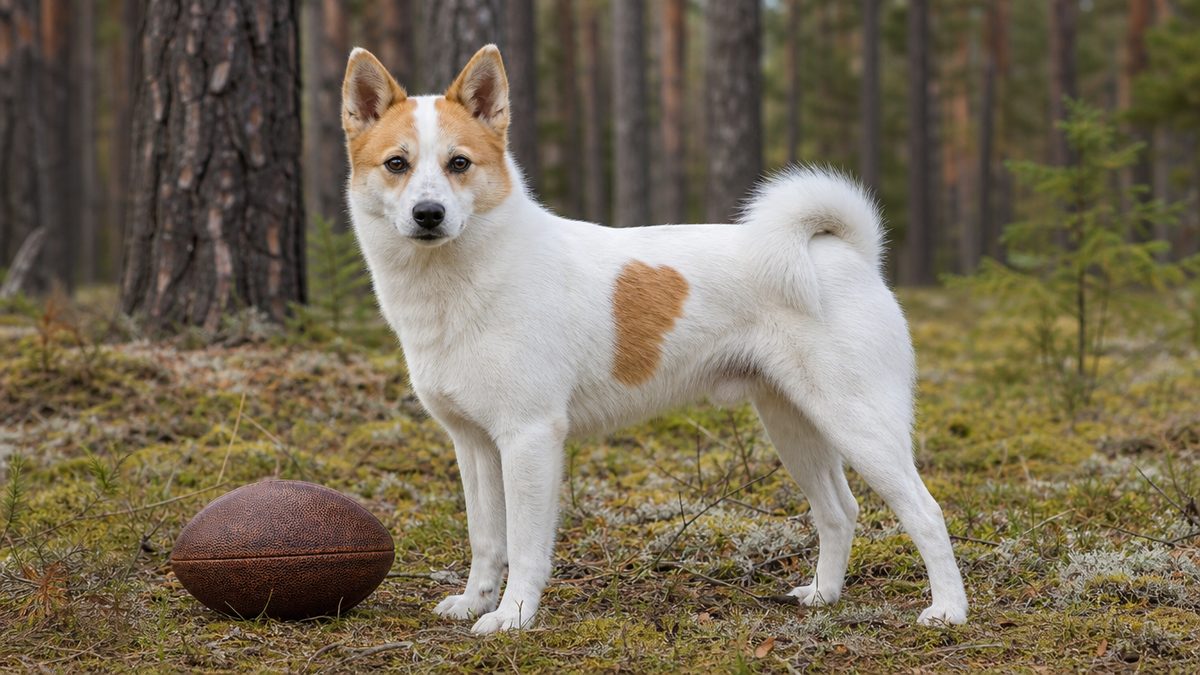
Learn the colour rule and you will never confuse this breed again. The standard requires pure white as the ground, always with well defined and well distributed patches, ideally in all nuances of red and yellow, with the patches on the body fairly big and the colour covering the sides of the head and the ears. Patches in black, any nuance of fawn or agouti are tolerated but the ideal colours are always to be preferred.
The severe faults tell you what the breeders are guarding against. FCI 276 lists a flesh-coloured or liver-brown nose, missing teeth other than P1, tan markings, and roaning or ticking as severe faults, and it disqualifies an aggressive or overly shy dog, a dog clearly showing physical or behavioural abnormalities, and a stumpy tail. Tan markings and ticking are both faults of colour distribution, which is a registry saying in the technical language that the white must stay white.
The rest of the dog, in the standard's own terms
The general appearance clause is unusually vivid for an FCI document: a small, slightly rectangular spitz dog, well poised, with sinewy and well developed muscles, alert with head carried high, a fearless attitude and extremely agile, with sexual dimorphism clearly visible. The ears are high set, erect, slightly over medium size, with hard leather and tips slightly rounded, which is one of the quieter ways to separate this breed from a Finnish Spitz. The tail is rather high set and carried in a high curve but loosely curled, with the tip touching the side of the upper thigh.
The coat is a genuine double coat and the standard specifies both layers: a fine, dense undercoat under a hard, short, straight guard hair, with the topcoat lying rather close and running to different lengths, shortest on the nose bridge, the top of the skull, the ears and the fronts of the legs, and longest on the neck, the backs of the thighs and the underside of the tail.
One name, three spellings, and the FCI uses two of them on one page
The naming is genuinely inconsistent at the source. The FCI's own letter-N index lists the breed as NORRBOTTENSPETS, and the link under that entry points at a page whose address reads NORRBOTTENSPITZ-276. Open that page and the heading reads NORRBOTTENSPETS while the English row of the standards table reads NORRBOTTENSPITZ. The standard PDF splits the difference and prints NORRBOTTENSPETS with (Norrbottenspitz) underneath. The Swedish Kennel Club's own English page lists three alternatives, Norrbottenspitz, Spitz de Norrbotten and Pohjanpystykorva. Search all of them, because they return different results.
Declared extinct in 1948, back on the register in 1967
The Swedish Kennel Club proclaimed the Norrbottenspets extinct in 1948, and re-introduced it to the registry with a new standard in 1967. Between those two dates the breed was never actually gone; it had stopped being registered, which is a different thing, and the distinction is the whole history of this dog.
Get the mechanism right first, because it is not a conservation story. The FCI standard explains it in one sentence: precious furs like sable, marten-skin and ermine were the only valid currency for centuries, and when fur prices dropped drastically after the Second World War, so did the interest for the Norrbottenspitz. A dog kept for its economic output stopped being kept when the output stopped paying. Registrations ceased, and after enough silent years the registry drew the obvious conclusion.
FCI 276 says the breed vanished and had no registrations for many years, hence the Swedish Kennel Club declared it extinct, and that only a decade later news came that some true to type specimens had been found living as pets and watch dogs on small homesteads in the inland North Bothnia. It gives no year for the declaration. The Swedish Kennel Club's own English page supplies it: 1948. Note that the standard's only a decade later and the club's 1948 to 1967 interval of nineteen years are not the same span, so the decade refers to when the dogs were found rather than when the register reopened.
The 1967 appeal, which is the part nobody publishes
One document tells the story properly and it is in Swedish. The Swedish breed club's own breeding strategy records that a bird-dog section was formed within the Norrbotten elkhound club in 1963, that the Norrbottenspets came to that section for consultation in 1964 to poor interest, and that only in 1966 could enough people be persuaded that the breed should be taken up, against opposition arguing that it looked like the Finnish Spitz and that squirrel hunting was a vanished era.
Then in 1967 Rune Samuelsson was asked to build the case for an inventory and wrote a public appeal, sent to newspapers, hunting organisations, forestry people and anyone who might know where such dogs were. The result exceeded expectations: over 100 dogs were examined, of which about half made the grade, and 36 of those came to the first show at Öjebyn in 1967. They were, understandably, of varying quality, size, type and colour.
For the Swedish Kennel Club to approve the dog as a breed, a specialist club had to exist to take care of it. So the enthusiasts applied to form Specialklubben för skällande fågelhundar, the specialist club for barking bird dogs, and it was granted in 1967. As the club's own document puts it, that year did not only revive a breed; it also created a new specialist club within the SKK. That club still administers the breed today.
The register and the standard, in the right order
Two dates get conflated and they are one year apart. The Swedish Kennel Club re-introduced the breed to the registry and adopted a new standard in 1967, and the FCI accepted the breed on a definitive basis on 20 September 1968. The Swedish page in Swedish words it slightly differently again, saying that in 1967 the breed was recognised by the Swedish Kennel Club and a new breed standard was drawn up. Recognised, re-introduced and re-registered are three ways of saying the same administrative act, and the sequence is Swedish register 1967, FCI 1968.
What the Indian result set does with all this
One Indian-hosted page carries this history and stops in the wrong place. Royal Canin India's Norrbottenspitz page reproduces the FCI standard's paragraph verbatim, through the collapse in fur prices, the disappearance of registrations, the Swedish Kennel Club's declaration of extinction, the news a decade later of true-to-type specimens on small homesteads, and the dedicated work of a few men that saved the breed. It then stops. The next sentence in the FCI standard, In 1967 the Norrbottenspitz was re-introduced to the Registry and a new standard was drawn up, does not appear.
An Indian reader arriving at the only India-hosted breed page therefore learns that the breed died out and does not learn that it came back. That is not fabrication and it is not malice; it is a paragraph break in the wrong place. It is also exactly the kind of error that becomes permanent once an answer engine summarises the page, and it is why this section exists.
Three Nordic spitzes, one dog, and where the borders went
The Norrbottenspets, the Finnish Spitz and the Karelo-Finnish Laika are the same small northern bird dog divided by national registries rather than by biology, and the Swedish breed club says so in its own words: the two Swedish and Finnish breeds almost certainly share a common origin within a relatively recent horizon.
Follow the colour and the history explains itself. When Finnish breeders began consolidating the Finnish Spitz in the later 1800s the dogs came in all colours, with a great deal of white, grey and black in the mix, and the Finnish aim was to fix the more solidly coloured dog by eliminating the others. The variously coloured dogs did not disappear; they carried on living in northern Finland and across much of northern Sweden, and those dogs are probably the foundation of what is called the Norrbottenspets today.
The Swedish breed club records that every spitz breed registered with the Swedish Kennel Club before 1906 went under the single name Nordiska spetsar, Nordic spitzes. The Swedes then set out to refine Norrbotten's bird dog, which at the time was called Norrbottens fågelhund. So the boundary between the Finnish Spitz and the Norrbottenspets is a decision taken in registry offices around the turn of the twentieth century, not a division that existed in the forest.
Wikipedia puts the same point in one sentence, describing the Norrbottenspets as the Swedish equivalent of the closely related Finnish Spitz and the Russian Karelo-Finnish Laika, with the various breeds only becoming distinct once separate kennel clubs recognised dogs found across various national borders. That is a fair summary and it is the reason the three breeds' names, not their bodies, are what you are being asked to buy.
How to tell them apart in a photograph
| Feature | Norrbottenspets | Finnish Spitz | Karelo-Finnish Laika |
|---|---|---|---|
| Ground colour | Pure white with red or yellow patches | Solid red or fox-red, deliberately consolidated | Red, with the same landrace origin as the Finnish Spitz |
| Tan markings | A severe fault | Not applicable | Not established on this page |
| Roaning or ticking | A severe fault | Not applicable | Not established on this page |
| Ideal height, males | 45 cm ± 2 cm | Not established on this page | Not established on this page |
| Weight in the FCI standard | None given at all | Not established on this page | Not established on this page |
| Ear tips | Slightly rounded | Not established on this page | Not established on this page |
| FCI section | Group 5 Section 2, Nordic Hunting Dogs | Same section | Not established on this page |
| Country of origin | Sweden | Finland | Russia |
Two cells settle almost every real-world case. The Norrbottenspets is white with patches and the Finnish Spitz is a solid red dog, so a solid fox-red spitz offered as a Norrbottenspets is not one. And the ear tip is slightly rounded rather than sharply pointed, which is the detail that survives in a photograph taken at the wrong angle when the colour does not.
The Lapponian breeds are a different animal entirely
Do not lump the Lapland breeds in with these three, because they were bred for a different job. The Finnish Lapphund and the Lapponian Herder are reindeer-herding dogs from Finnish Lapland, filed by the FCI among watchdogs and herders rather than among Nordic hunting dogs, and they work stock rather than barking game up a tree. The confusion arises only because all five breeds are northern, spitz-shaped and Finnish or Swedish, which is not a taxonomy.
Where the Norrbottenspets turns up in the scientific literature
This breed's entire presence in PubMed is as somebody else's outcross partner, which is itself the most interesting thing about it. Searching Norrbottenspets returns exactly two records, and both are Norwegian Lundehund papers in which the Norrbottenspets is one of three candidate breeds for genetic rescue Stronen AV, Salmela E, Baldursdóttir BK Melis C, Billing AM, Wold PA. Searching the alternative spelling Norrbottenspitz returns a different single record, a canine genetic-panel study, and the Finnish name pohjanpystykorva returns zero. A control query returned 126 records in the same session, so the instrument was working.
Of the three breeds selected to outcross into the Lundehund, the Norrbottenspets returned the lowest pairwise FST against it, meaning it is the closest of the three. Yet it has contributed the fewest puppies to the project: one F0 mating, four F1 puppies and eight F2 puppies, against 84 from the Norwegian Buhund line. Being the best genetic match and the least used donor at the same time is a real and checkable fact about this breed's place in Nordic dog conservation, and no page currently ranking for it mentions the project at all.
How many there are, and why Finland has most of them
About 4,000 Norrbottenspets exist, split roughly 1,500 in Sweden, 2,400 in Finland and 100 in Norway. Finland registers about two and a half times as many as Sweden does, which makes the breed's own country of origin a minority holder of it.
The Swedish breed club publishes eleven years of registration data for both countries side by side, which almost no breed club does, and the numbers are worth reading rather than summarising.
| Year | Sweden (imports) | Finland (imports) |
|---|---|---|
| 2009 | 152 (2) | 215 (1) |
| 2010 | 138 (2) | 248 (0) |
| 2011 | 127 (6) | 214 (1) |
| 2012 | 157 (11) | 357 (3) |
| 2013 | 112 (10) | 345 (2) |
| 2014 | 142 (8) | 389 (3) |
| 2015 | 160 (6) | 370 (5) |
| 2016 | 108 (11) | 382 (6) |
| 2017 | 152 (19) | 404 (2) |
| 2018 | 141 (12) | 320 (4) |
| 2019 | 185 (21) | 410 (1) |
The Swedish breed club states that the mean number of registrations was 149 a year over 2015 to 2019. Adding the five Swedish figures gives 160 + 108 + 152 + 141 + 185 = 746, and 746 divided by 5 is 149.2. The arithmetic closes. That matters because this site routinely finds registry summaries that do not reconcile with their own tables, and when a document's stated average reproduces from its own rows the rest of its figures are more trustworthy for it. The Finnish column over the same five years sums to 1,886, a mean of 377.
Two populations, barely mixing
The import columns are the interesting part. Swedish imports run at a few percent of total registrations over 2015 to 2019 and Finnish imports run lower still, which the breed club reads as evidence that the two populations are relatively isolated from each other. It offers three reasons: geographical distance, language, and the fact that the stud-dog lists used in breeding advice have been purely national. Norway is the exception, where advisory cooperation with the Swedish breeding councils does happen, but the Norwegian population is very small.
One regulatory change shows up directly in the numbers. Rules introduced in December 2014 to prevent the spread of rabies mean a puppy younger than 15 weeks can no longer be imported from Finland, which the Swedish club says probably reduces the appetite for importing. No such restriction applies to puppies from Norway. That is a clean example of an animal-health rule reshaping a breed's gene flow, and it is the sort of thing an Indian reader weighing this country's own import rules should notice.
Litters, breeding animals and the gap between the sexes
The club also publishes how many individual dogs actually breed, which is a better measure of a small population than a registration count. In 2019 there were 34 litters from 34 bitches and 31 stud dogs, a gap of three; in 2009 there were 40 litters from 39 bitches and only 26 males, a gap of 13. Narrowing that gap over a decade means a broader breeding base is actually being used, and the club notes that reuse of males has stayed under 20 percent.
On inbreeding the club is precise and reassuring. The average increase in inbreeding across the breed, calculated over five generations, sits just under 1 percent and has done for a long period, and the club's stated target is a maximum of 2 percent for any individual mating and preferably under 1 percent. It sets a general goal for effective population size of at least 100, noting that below 50 a breed's vitality is seriously threatened by too-rapid loss of genes.
Where the breed exists outside Scandinavia
The club is blunt about the rest of the world. Norrbottenspets exist in Denmark and North America as well as Sweden, Finland and Norway, but those populations consist of dogs that are only sparingly used for hunting, and because this is a hunting breed whose breeding aims at improving hunting ability, the club regards them as of little interest for breeding exchange. That is a national breed club saying, in writing, that the overseas pet population is not part of its plans.
For an Indian reader that sentence is the whole availability question in one line. A breed whose own custodians treat non-hunting overseas dogs as outside the breeding programme is not a breed with an export pipeline, and the American Kennel Club's own status confirms it: the Norrbottenspets is recorded in the Foundation Stock Service, one of 88 breeds in that programme as at 1 September 2026, rather than fully recognised.
Norrbottenspets price in India
No Norrbottenspets price in India exists, and the three foreign figures that rank for the Indian query disagree with each other by a factor of four. Dog Breeds List gives USD 2,000 to 3,000, Good Dog gives USD 1,650 to 2,250, and Petlur gives USD 600 to 800, all three in the same ten results for the same breed Petlur, Norrbottenspets breed page.
Start with what India actually stocks. The country's largest puppy listing network carries roughly three hundred breed categories including Chippiparai, Mudhol hound, Rajapalayam, Rampur Hound, Indian Spitz, Japanese Spitz, German Spitz, Keeshond, Norwegian Buhund and Norwegian Elkhound, and its selector runs Norfolk Terrier, Norwegian Buhund, Norwegian Elkhound, Norwich Terrier with no Norrbottenspets between them and no Finnish Spitz anywhere. There is no category, so there is no price.
Why the three foreign figures cannot be averaged
Do not split the difference between numbers that describe different things. Petlur's USD 600 to 800 is roughly a quarter of Dog Breeds List's USD 2,000 to 3,000 for the same breed on the same day, and Good Dog's USD 1,650 to 2,250 is described on its own page as a national range, meaning the United States. None of the three names a breeder, a country, a currency date or a year. Averaging them would produce a fourth number that describes nothing, and converting that fourth number into rupees would produce a fifth.
This site has repeatedly caught Indian pages publishing an American price list divided by one exchange rate and presented as a local market, at 84.38, at 74, at 80 and at 66.67. The discipline that catches it is refusing the conversion in the first place. What can be priced honestly for an Indian reader is the cost of keeping a small dog in India, and that is the next section, sourced to Indian price lists rather than to arithmetic.
Why no Indian supply chain can form
Three facts close the question between them. First, the breed's own national club states that overseas populations outside Scandinavia consist of dogs only sparingly used for hunting and are of little interest for breeding exchange, so the export pipeline the breed does have is aimed at Finland and Norway rather than outward. Second, Indian import policy places dogs under ITC(HS) 01061900 as Restricted, permits import only for a pet dog with a valid pet book in the importer's own name, for research with a CPCSEA recommendation, or for Defence and Police internal security, and states that any application for trading or breeding purposes shall be duly rejected. Third, the whole world population is around 4,000 dogs, of which Sweden produces about 149 registrations a year.
A breed producing a few hundred puppies a year across three countries, whose own club regards non-hunting foreign dogs as outside the plan, and which cannot lawfully be imported into India for sale or breeding, will not develop an Indian market price. Any page that gives you one has produced it rather than found it.
What the working-trial requirement does to availability
One line in the FCI register is doing quiet work here. The Norrbottenspets is subject to a working trial under FCI nomenclature, where the Norwegian Lundehund is not Fédération Cynologique Internationale. In Sweden the only hunting form in which the breed can earn a working merit is barking bird, and the club's recommendation is that breeding should focus on dogs with at least a second prize at hunting trial. A breed whose registry expects proven hunting work from its breeding stock is a breed whose good dogs stay in the forests they can be tested in.
That has a measurable consequence the club itself worries about. Across 2014 to 2019 only about 22 percent of the bitches used in breeding had at least a second prize at hunting trial, and across 2015 to 2019 about 36 percent of the males did. The club calls the bitch figure low and warns that the alternative reading is that the breed is largely being bred from dogs that do not meet a sufficient hunting standard, which could seriously damage its usefulness in the long term. That is a national breed club publishing an unflattering number about itself, which is a good reason to trust its other ones.
What an Indian search for this breed actually returns
The Indian result set for this breed's price query contains a tractor comparison, a diesel price tracker, two coffee mugs and a crashed WordPress site, and the engine itself flags three of the ten results as not containing the word India. The instrument was working; there is simply nothing to return.
This result set is different from the sibling Lundehund query and the difference matters. That one was substituted outright and returned ten Telegram pages, so nothing could be concluded from it. This one was honoured: the results genuinely relate to the string that was typed. They just relate to different halves of it.
| Position | Domain | What it is | Engine's own flag |
|---|---|---|---|
| 1 | pawcosts.com | A generated cost-of-ownership page for the breed in India | None |
| 2 | flipkart.com | A ceramic coffee mug | Missing: india |
| 3 | etsy.com | Papa Norrbottenspets merchandise | None |
| 4 | tractorjunction.com | Top 10 Most Powerful Tractors in India | None |
| 5 | mypetrolprice.com | Diesel Price in India | None |
| 6 | royalcanin.com | The Indian-hosted breed page | Missing: india |
| 7 | flipkart.com | A second ceramic coffee mug | None |
| 8 | pawtrition.in | An Indian breed guide dated 1 January 2026 | None |
| 9 | wrapinfur.com | Dog Price List in India 2026, 50+ breeds | None |
| 10 | getapet.com | A foreign for-sale aggregator | Missing: india |
Two of the ten answered price in india and ignored the breed entirely. Two more are coffee mugs. One is merchandise. Three are flagged by the engine as not containing the country word at all. That composition, rather than any absolute result count, is what a genuinely empty market looks like, and it is checkable by anyone in thirty seconds.
The number one result quotes rupee figures its own page does not contain
The first result deserves its own paragraph, because it is the clearest live example of a snippet trap this site has recorded. The search description for the PawCosts page states that owning a Norrbottenspets in India costs roughly ₹750,700 over its lifetime and about ₹43,500 a year, including about ₹17,200 food. Fetched directly on 2 September 2026, that URL redirects to a healthspan profile which carries a noindex directive, contains no rupee figure anywhere, states that the cohort is not matched to this breed, and says explicitly that country defaults remain unavailable until a dated local source supports them.
The page has been rewritten and is now scrupulous. Its methods note says source data were mapped by exact normalised breed name or a recorded human-approved alias, that unsupported fuzzy matches fail closed, and that medical review is not claimed because no reviewer sign-off is recorded. That is better practice than most breed sites manage. But the older version's rupee figures are still what the search engine shows an Indian searcher, and they are still what an answer engine would summarise. A publisher can fix its page and not fix the index, which is the strongest argument on this site for opening every page you intend to quote.
The control that proves the page is a template
Test it rather than assuming it. The same site's Finnish Spitz page was fetched in the same session and is structurally identical to the Norrbottenspets page, sentence for sentence, with four things changed: the breed name, the group label, the legacy standard figures and the photograph. The Norrbottenspets page reads Miscellaneous Class, Medium, legacy standard 14 to 17 years and 20 to 30 lb; the Finnish Spitz page reads Non-Sporting, Medium, 13 to 15 years and 20 to 33 lb. Everything else, including the sentence declining to supply a country default, is word for word the same.
One of those swapped labels is wrong. The page calls the Norrbottenspets a Miscellaneous Class breed, while the American Kennel Club's own current list places it in the Foundation Stock Service programme, assigned to the Hound Group, revised 1 September 2026. Those are different AKC statuses, and the error is exactly the kind that a template makes and a human does not.
The Indian page in the set does not load
The one result promising an Indian guide is broken. Pawtrition's Norrbottenspets Dog Breed India, a Rare Swedish Spitz Guide, dated 1 January 2026 and ranking eighth, returned HTTP 500 and a WordPress critical-error page when fetched on 2 September 2026. An Indian searcher clicking the only Indian-authored breed guide in the result set gets a stack trace. That is worth stating plainly rather than quietly excluding, because the ranking position is real and the page behind it is not.
What is actually purchasable in India under this breed's name
Count it. Two ceramic coffee mugs on Flipkart, an Etsy India merchandise market page titled Buy Norrbottenspets Online In India, and an Amazon India tricks-and-agility workbook Bing India result set for norrbottenspets…. Bonbeno did not open the merchandise listings and quotes no figure from any of them. An Indian reader searching for this breed's price is not looking at a thin market for a dog; they are looking at a merchandise market with no animal behind it, exactly as on the sibling Lundehund page.
What a Norrbottenspets-sized dog costs to keep in India
Budget for a small dog under 20 kilograms rather than for a breed, because no recurring cost of ownership in India depends on which northern spitz you have. Indian vaccination and boarding prices are published, real and directly applicable to a dog of roughly 45 centimetres and 11 to 15 kilograms Dog House, Chennai.
Vaccination is the easiest line to pin down and the one most often understated. A published Indian per-dose table gives DHPP at 800 INR, rabies at 350 INR, leptospirosis at 150 INR, Bordetella for kennel cough at 200 INR, canine influenza at 800 INR and Lyme disease at 700 INR. Those are vaccine prices before any consultation or injection charge, so the vaccination cost of a full puppy course runs well above the sum of the doses.
The same article's body text gives kennel cough at 600 INR per dose and canine influenza at 220 INR per dose, while its own summary table gives Bordetella at 200 and canine influenza at 800. Two of six lines disagree with themselves, and they disagree in opposite directions, so this is not a stale table beside updated prose. Bonbeno uses the summary-table figures because those are the ones presented as the price list, and records the discrepancy so a reader quoted 600 rupees for a kennel cough shot knows where that number probably came from.
| Item | Published Indian figure | Source type |
|---|---|---|
| DHPP vaccine, per dose | ₹800 | Indian retailer price table |
| Rabies vaccine, per dose | ₹350 | Indian retailer price table |
| Leptospirosis vaccine, per dose | ₹150 | Indian retailer price table |
| Bordetella, kennel cough, per dose | ₹200 in the table, ₹600 in the same article's text | Indian retailer price table |
| Boarding, up to 20 kg, air-conditioned | ₹850 per day | Chennai kennel tariff, 2026 |
| Boarding, up to 20 kg, non air-conditioned | ₹750 per day | Chennai kennel tariff, 2026 |
| Boarding, puppies under six months, air-conditioned | ₹850 per day | Chennai kennel tariff, 2026 |
| Boarding, 21 to 40 kg, air-conditioned | ₹950 per day | Chennai kennel tariff, 2026 |
A Norrbottenspets at 11 to 15 kilograms sits comfortably inside the small band, so the published Chennai rate is ₹850 a day with air conditioning and ₹750 without. On a double-coated dog from the Arctic Circle that ₹100 difference is not a preference, and over a fortnight away it is ₹1,400 that buys the dog a survivable two weeks.
Building the monthly cost from parts you can check
Assemble the monthly cost from sourced components rather than quoting one number nobody can verify. For a dog of this size the food line is genuinely modest, which is the only financial advantage the breed has in India. What it does not have is a cheap exercise line, because a working forest-bird dog in an Indian city needs either a large secure space or a great deal of an owner's time in the two safe hours of the day.
- Food for an 11 to 15 kg adult, bought in small bags through the monsoon so it does not spoil in humidity.
- Vaccination annually for the core boosters, at the per-dose figures above plus a consultation each visit.
- Ectoparasite control year-round rather than seasonally, because Indian tick pressure does not pause.
- Coat maintenance, which costs a brush and time rather than money, and costs both twice a year in earnest.
- Boarding at ₹850 a day in the air-conditioned small band, which is ₹5,950 for a week away.
- An eye examination if you ever intend to breed, since the breed's own health programme requires one no older than a year at mating.
The Swedish club's requirements for a dog on the stud list are a knee-joint examination without remark by an approved veterinarian, an approved dental status certificate, a testicle certificate if the male is not show-merited, and an eye examination no older than one year at the time of mating. Three of those four are ordinary Indian veterinary procedures. The fourth, a formal eye examination by an approved ophthalmologist against a national health programme, is not a service that exists in most Indian cities in the form the Swedish scheme means. That is worth knowing before promising a foreign breeder you can maintain their screening.
No lifetime total is published here. There is no Indian population of this breed, no Indian veterinary series and no Indian cost dataset, and the one page in the Indian result set that did publish a lifetime rupee figure no longer contains it. Manufacturing a replacement out of those absences is exactly the practice this site spends its time detecting.
Heat tolerance: a homeland that averages 2.2 degrees against a country that averages 27.9
The Norrbottenspets has the lowest heat tolerance this site rates, because Öjebyn near Piteå in Norrbotten averages 2.2 degrees Celsius across the year with a January mean of minus 9.8, while Chennai averages 27.9 with a coolest month of 24.1. The coolest month Chennai has to offer is eight degrees warmer than the warmest month in the breed's homeland.
Every figure below was queried from NASA POWER by explicit latitude and longitude rather than by place name, because place-name climate pages have served this project six wrong cities at HTTP 200. A coordinate cannot hand you another town by accident. It can hand you a grid cell rather than a point, so every cell elevation is echoed in the table and checked against the terrain. One column also needs a label rather than an assumption. The record-high column is NASA POWER's T2M_MAX, the hottest reading the climatology holds for that month across the whole period. It is an extreme, not an average afternoon, so compare it with other record highs and never with a monthly mean.
| Place | Cell elevation | Annual mean | Warmest month mean | Highest reading on record | Coolest month mean | Annual mean humidity |
|---|---|---|---|---|---|---|
| Öjebyn, Piteå, Norrbotten | 114.62 m | 2.2 °C | 16.0 °C (Jul) | 32.2 °C (Jul) | -9.8 °C (Jan) | 89.8% |
| Överkalix, inland Norrbotten | 144.68 m | 0.7 °C | 15.5 °C (Jul) | 31.4 °C (Jun) | -12.7 °C (Jan) | 92.1% |
| Luleå, Norrbotten coast | 45.43 m | 2.8 °C | 16.3 °C (Jul) | 30.8 °C (Jul) | -9.1 °C (Feb) | 89.0% |
| Chennai | 48.95 m | 27.9 °C | 31.5 °C (May) | 42.7 °C (May) | 24.1 °C (Jan) | 72.4% |
| Mumbai | 97.15 m | 26.8 °C | 31.2 °C (May) | 44.9 °C (Apr) | 23.2 °C (Jan) | 67.4% |
| Delhi | 206.37 m | 25.6 °C | 35.9 °C (Jun) | 48.8 °C (Jun) | 13.6 °C (Jan) | 45.6% |
| Pune | 635.99 m | 23.9 °C | 28.9 °C (Apr) | 43.2 °C (Apr) | 19.6 °C (Dec) | 66.8% |
| Bengaluru | 841.72 m | 23.7 °C | 28.4 °C (Apr) | 40.4 °C (Apr) | 20.2 °C (Dec) | 67.9% |
The three Swedish cells sit between 45 and 145 metres, which is what a low coastal and river-valley region should return, and the three towns returned three different results rather than one repeated cell. Both of those are the checks that fail elsewhere. This site has recorded NASA POWER returning a single byte-identical cell for three points on one Norwegian island, and cell elevations more than a kilometre out in the Himalaya. Neither failure mode appears here, so these figures are the region rather than an artefact.
The single number that decides this
Compare the extremes rather than the averages. Öjebyn's warmest month averages 16.0 degrees and Överkalix's 15.5. Chennai's coolest month averages 24.1, Mumbai's 23.2 and Bengaluru's 20.2. Every month of the year in every one of those cities is warmer than the warmest month this breed's homeland has ever offered it. Only Delhi in January, at 13.6 degrees, is genuinely cooler than a Norrbotten July, and Delhi in June averages 35.9 degrees with 48.8 as the hottest June reading on the record.
There is one honest qualification and it cuts slightly the other way. Norrbotten does get warm in short bursts: the hottest July reading in the Öjebyn cell's twenty-year record is 32.2 degrees and the hottest June reading at Överkalix is 31.4, against warmest-month means of 16.0 and 15.5. So this is not a dog whose homeland has never seen 30 degrees, and the word to hold on to is bursts, because 30 degrees there is the top of the record rather than an ordinary afternoon. What it has never met is 30 degrees in month eight of twelve, at 72 percent humidity, with no cool night to recover in.
Anyone arguing that an Indian hill station could suit this breed should check the elevation first. For Shimla, NASA POWER reports a cell elevation of 897.65 metres against a town near 2,200, so the cell stands roughly 1,300 metres too low and its 21.2 degree annual mean reads about eight degrees too warm. For Gangtok the error runs the other way: a cell at 3,239.61 metres against a town near 1,650, so its 7.5 degree annual mean reads roughly ten degrees too cold and looks deceptively like a Scandinavian analogue. Neither raw figure can be used as printed, and this page will not build an Indian recommendation on either.
Humidity, which decides whether panting works
Panting is this dog's only cooling system and humidity is what limits it. Chennai runs an annual mean relative humidity of 72.4 percent, Mumbai 67.4 and Bengaluru 67.9, while Delhi is much drier at 45.6 percent. Norrbotten is more humid than any of them, at 89.8 to 92.1 percent, and at 2 degrees Celsius that humidity costs the dog nothing at all. Humidity only becomes a problem once the air is warm enough that evaporation is doing the work, which is precisely the combination an Indian coastal city supplies for eight months a year.
What the heat research transfers, and what it does not
Take the mechanism and leave the odds ratios where they belong. The largest study of heat-related illness in UK dogs found exertion behind most cases: of the 879 events with a recorded trigger, 652 were exertional, which is 74.2 percent, against 113 environmental and 46 from vehicular confinement. Its companion paper, from the same 905,543-dog cohort, reports that dogs at or above the mean bodyweight for their own breed and sex carried an odds ratio of 1.42, with a 95 percent confidence interval of 1.12 to 1.80.
Be precise about the limit. The Norrbottenspets is not a UK breed at any meaningful frequency and was not modelled in either paper, so no breed-specific odds ratio exists for it and none is invented here. What transfers is that exertion, not confinement, is the dominant trigger, which for a loose-hunting bird dog is the whole warning, and that a dog heavy for its own breed carries more risk. Indian law makes the same point from another direction: Second Schedule Part IV paragraph 21(1) of the 2017 Rules bars keeping in outdoor facilities, without the attending veterinary practitioner's written approval, dogs not accustomed to the temperatures prevalent in the area and breeds that cannot tolerate them.
Temperament: alert, friendly and not a companion dog
The Swedish Kennel Club describes the Norrbottenspets as attentive, friendly and self-assured, wanting a great deal of attention and enjoying its family's company, and states in the same breath that it is a pronounced hunting dog which does not thrive purely as a companion dog. Both halves are true, and the second one is the sentence an Indian buyer is least likely to have read.
Take the FCI standard's wording seriously, because it is unusually behavioural for a conformation document. In its capacity as a hunting dog the breed should be attentive and bold, and it is described as a keen, lively, self-confident dog with a kind disposition. The general appearance clause adds alert with head carried high, a fearless attitude and extremely agile. Nothing there is decoration; each of those words describes a dog that has to work alone at a distance and hold its nerve under a tree with a capercaillie in it.
The voice is the job, and India should hear that clearly
This is a barking bird dog and the barking is the function rather than a fault. The dog's task is to find forest game birds, tree them, and stand under the tree barking until the hunter walks in, which can take a long time. The Swedish Kennel Club calls the breed alert and known for its rapid response to stimuli, often by barking. A breed selected for four centuries to bark for as long as it takes is not a breed that stops barking because a neighbour complained. Expect a vocal dog, expect the voice to carry, and treat both as design rather than defect.
In Indian housing, buildings sit close together, sound carries across courtyards, and a dog that alerts at every passer-by is a dog that generates complaints. This is the single most predictable failure mode for this breed in an Indian city, and it is entirely foreseeable from the breed standard. Teach a quiet cue in the first year rather than correcting a habit in the third, and be honest with yourself about whether your building can absorb a working bird dog's voice.
The rest of the personality
The Swedish Kennel Club's own summary is worth reading in full because it is balanced. The breed is energetic, active and spirited; it is primarily a tree-barking hunting dog but is used in other hunting areas too; it is attentive, friendly and self-confident; it must not be nervous, shy or aggressive; and it wants a lot of attention and enjoys being close to its family. Wikipedia's book sources add that the breed is generally even-tempered but is said to have a low tolerance for children bothering it, which is worth weighing in an Indian household where children and visiting relatives are a constant.
Who this breed suits in India
- A cool-season region, realistically the north Indian plain in winter, and nowhere on the coast at any time of year.
- A property with real fencing and a tolerant neighbourhood, because the voice and the prey drive both need containing.
- An owner who will work the dog, through tracking, scent games or canine sport, because the hunting drive does not switch off in a country with no capercaillie.
- A household that can absorb an alert dog, since reactivity to stimuli is a described breed characteristic rather than a training failure.
Who it does not suit
- A flat, which the exercise requirement and the barking rule out together.
- Anyone in Chennai, Mumbai, Bengaluru, Hyderabad or Kolkata, where every month is warmer than the breed's hottest.
- A household with poultry or small pets, given a breed selected to find, chase and hold game.
- A buyer who wants a quiet companion, because the breed's own kennel club says it does not thrive as one.
Training a dog bred to make its own decisions at 200 metres
Train recall, a settle and a quiet cue, in that order, and accept that recall will fail on live game. A dog whose job is to leave the handler, search independently across forest, find a bird and hold it by barking until a human arrives has been selected for four centuries to act without instruction, and the FCI standard's keen, lively, self-confident is a polite way of saying so.
Start from what the breeding programme selects for, because the selection is explicit and recent. The Swedish club's recommendation is that breeding should be directed at individuals with at least a second prize at hunting trial, and the trials it means are barking-bird trials in which the dog is judged on its search, on the character of its barking and on other traits the club calls probably strongly heritable. The search itself is described as a central and probably strongly inherited quality. Every generation is therefore filtered for the willingness to go away from you and work.
The training order that works
- Socialise early and deliberately. Use the window before sixteen weeks on Indian city reality: traffic, two-wheelers, free-roaming dogs, cattle, lifts, and festival noise. A friendly, alert breed still needs the exposure.
- Teach a quiet cue in the first year. This is the single highest-value behaviour for this breed in India, and it is far easier to install than to retrofit.
- Build a settle before obedience. A working spitz that cannot switch off indoors will not survive Indian apartment life, and the settle buys back the hot hours of the day.
- Keep the dog on a long line for the first year and in unfenced spaces thereafter. Treat the line as permanent equipment rather than a phase.
- Give the hunting drive a legal target. Tracking, scatter feeding, hidden-article searches and formal scent sport use the same circuitry that otherwise takes the dog after a crow.
- Reward engagement rather than compliance. Pay the dog for checking in with you while something interesting is available, because that is the behaviour you actually need.
What this breed resists
It resists repetition, and it resists working at the wrong hour. The second is the practical constraint in India. In most of the country the hours when a scenting, searching dog works best, before sunrise and after dark when the ground is cool and holding scent, are the only hours in which it is safe to work this breed hard at all. That coincidence is the one piece of luck in this breed's Indian situation, and a sensible routine is built entirely around it.
The Swedish club notes that the proportion of breeding animals with hunting and show merits is unfortunately trending downwards, and that this is difficult to explain, since the number of individual dogs starting at trials and shows has been drifting slightly upwards. Its own suggested explanation is that the breed has become more popular for hunting elk and wild boar, particularly in southern Sweden, and those dogs are unlikely to appear at barking-bird trials because that is the only form the Swedish trials cover. A club willing to publish a falling number about its own breed is a club whose other numbers are worth trusting.
One last note on method. Nothing in this breed's history rewards force. It was bred to work out of sight and to keep working while a human walked a kilometre through forest to reach it, which is a job you can only do with a dog that wants to. Use food, use games, use a long line, and keep sessions short enough that a keen dog stays keen.
Exercise needs, and the two windows an Indian day allows
A Norrbottenspets has high activity needs and the Swedish Kennel Club rates its activity level at the top of its own scale. The English page puts it plainly: the breed has strong hunting instincts, requires an environment where its natural instincts can be fulfilled, and is best suited to active owners who can provide the necessary stimulation and training.
Understand the working benchmark before deciding what a domestic version looks like. This is a loose-hunting forest dog that ranges out of sight, searches large ground, and then holds position under a tree barking for as long as it takes. The Swedish club describes the search as a central and probably strongly heritable quality. A dog bred to that specification is not satisfied by a lead walk around a colony park.
What the safe window looks like in practice
Read both numbers, and know which is which. Chennai's warmest month averages 31.5 degrees Celsius against a record high of 42.7, Mumbai averages 31.2 against a record 44.9 in April, Delhi averages 35.9 against a record 48.8 in June and Bengaluru averages 28.4 against a record 40.4 in April. The means are what the dog lives through and the record highs are what it might one day meet, and neither of them offers a usable midday for an athletic double-coated dog. What they offer is a pre-dawn window and a post-sunset window, and in Delhi a genuinely usable full day through January.
- Split the daily requirement, roughly 45 to 60 minutes before sunrise and 30 to 45 after dark, rather than attempting one session.
- Test the ground with the back of your hand. Tarmac and concrete hold heat long after the air cools, and paw burns are a common Indian city injury.
- Carry water on every outing, including short ones, and offer it before the dog looks like it needs it.
- Swap distance for nose work when the window closes. Twenty minutes of searching tires a hunting spitz more than an hour of lead walking.
- Watch for the early signs rather than the late ones. Bright red gums, thick saliva, an unwillingness to continue and any unsteadiness are the point to stop, cool the dog and call a veterinarian.
What under-exercise produces in this breed
An under-worked bird dog does not become calm, it becomes loud. The barking that is an asset in a Norrbotten forest is the first thing to expand into an empty day, and it expands in the direction of whatever is passing the gate. Wikipedia's sources put it directly, describing a curious breed that requires considerable exercise and becomes destructive without it. In an Indian apartment those two failure modes, noise and destruction, arrive together.
If this dog overheats, wet it thoroughly with cool, not ice-cold, water, concentrating on the belly, groin, armpits and paws where the coat is thinnest, and move air over it. Do not soak the outer coat and walk away, because a dense undercoat holds warm water against the skin and can make things worse. Then go to a veterinarian, because collapse from heat is an emergency whatever the dog looks like ten minutes later. On a 12 kilogram body both the deterioration and the recovery happen faster than they would on a large dog, which cuts both ways.
One structural point worth stating. The exertional finding from the largest UK heat-illness study, that 652 of the 879 triggered events were exertional, is why this section is about timing rather than duration. It is not the length of the outing that hurts a northern dog in India. It is the hour you choose for it.
Grooming and coat care in Indian humidity
Brush a Norrbottenspets weekly, brush it daily through the moult, and leave the coat otherwise alone. The Swedish Kennel Club says the coat consists of two layers, a fine dense undercoat and a hard, short, straight topcoat, that it is easy to care for, and that the dog is bathed only when needed. It rates the grooming load at the low end of its own scale.
This is a genuine double coat and the standard is specific about both layers. FCI 276 requires a fine and dense undercoat under hard, short and straight guard hair, with the topcoat lying rather close and varying in length: shortest on the nose bridge, the top of the skull, the ears and the fronts of the legs, and longest on the neck, the backs of the thighs and the underside of the tail. The American Kennel Club adds that the breed is clean with no offensive smell and needs little beyond regular weekly grooming and the occasional bath.
The moult is the whole job
A dense northern undercoat sheds in bulk twice a year, and in India the pattern often becomes less predictable because the light and temperature cues the coat responds to are different from the ones it evolved with near the Arctic Circle. Plan for continuous moderate shedding punctuated by heavy periods rather than for two tidy seasonal blowouts.
- Brush weekly as a baseline and daily through a moult, using an undercoat rake rather than a bristle brush, which only moves the guard hair.
- Work outdoors and accept that a small dog produces a startling volume of undercoat in an Indian summer.
- Do not shave. Removing the coat exposes skin that has never been sun-adapted and takes away the layer that holds air off it. On a breed whose ground colour is pure white, the sunburn risk on exposed skin is not theoretical.
- Bathe only when needed, which is the Swedish Kennel Club's own instruction, and dry the dog down to the skin afterwards rather than leaving a coat damp in a humid month.
- Fold a tick check into the brush. A dog worked or walked in vegetation carries its head and shoulders through exactly the height ticks wait at, and a year-round preventive beats finding one.
Nordic and British breed guides routinely say to towel a double-coated dog and let it air dry. That is sound advice in a dry temperate climate and poor advice in an Indian monsoon, where an undercoat left damp under the longer coat of the neck stays wet for hours and becomes a warm, moist layer against the skin. Dry the dog down to the skin over the neck, shoulders and behind the ears, and if you cannot, do not bathe it that day. This is the same climate mismatch this site has documented on other imported northern breeds, and it is the most transferable grooming correction on the page.
The erect ear is a real advantage, and worth saying
So much of this page is about disadvantages that the one clear structural advantage deserves a sentence. A high-set, erect, open ear ventilates in a way a drop ear does not, so this breed carries markedly lower risk of the monsoon ear disease that troubles the drop-eared hounds elsewhere on this site. That does not mean ignoring the ear. It means checking and drying it after any bath or swim rather than treating infection as inevitable.
The white coat and Indian sun
One consequence of the colour is worth flagging because no overseas guide mentions it. The standard requires pure white as the ground colour with the patches concentrated on the head, ears and body, which leaves genuinely white skin under genuinely white hair on parts of a dog that will be walking under Indian sun. Keep the coat on, keep the walks early and late, and if a veterinarian recommends a sunscreen for the nose or ear margins, that advice is more relevant on this breed than on most.
Health issues, and the three the breed's own club actually manages
The Norrbottenspets is a healthy breed with small disease problems, and its own club says so in a document that then spends three sections explaining which problems it does have. The three it manages are eye disease, epilepsy and patellar luxation, and the honest position is that all three occur at low rates that are being watched rather than fought.
Read the club's own framing first, because it is unusually measured. The Swedish breed club states that the picture of a healthy breed is confirmed by the insurance companies' statistics on disease and death, that the disease cases which do occur should be seen in that light and given reasonable weight in breeding work, and that the task is largely one of monitoring the disease situation rather than running far-reaching intervention programmes. That is a club declining to inflate its own problem, which is rarer than it should be.
Eyes, and a health programme that worked
The eye story is the best evidence this breed has that screening changes outcomes. In the 1980s it was noticed that an estimated 25 percent of Norrbottenspets suffered from cataract in the upper polar form, and a health programme was started that is still in force, requiring an eye examination of every dog used in breeding. Because the upper polar cataract the breed carried is dominantly inherited, it has largely disappeared. Isolated cataract cases still occur but do not show the same heritability.
Progressive retinal atrophy is the one that will not go away as easily, and the club explains why. Isolated PRA cases have been recorded during the years the programme has run, and because PRA is recessively inherited the number of carriers is considerably larger than the number of affected dogs, so further cases can be expected in future. The rule attached is simple and checkable: dogs must have an eye examination before mating, the certificate must be no more than a year old, and it applies to bitch and stud dog alike.
The Swedish club notes that Finland also requires eye examination, and that in recent years the Finns have noticed eye diseases other than cataract and PRA. That prediction can be checked against the Finnish register, and it holds: of the four eye findings recorded in Finland in the three months to 31 August 2026, three were distichiasis or ectopic cilia and only one was a cataract. A Swedish strategy document's claim about Finnish practice, confirmed from the Finnish database itself.
Epilepsy, counted rather than estimated
The epilepsy figure on this breed is unusually well earned. Cases became known in the second half of the 2000s, and rather than leaving it there the club ran an extensive mapping exercise, actively searching for cases far back in time, writing in the club magazine and on the website and contacting a large number of breeders and owners directly. The number of known cases rose from a handful to about 50. Of the dogs registered between 2000 and 2005, 2 percent have epilepsy, which the club calls not an alarmingly high figure.
The pedigree analysis is the useful part for a buyer. It shows the disease occurring with wide spread across the breed rather than concentrated in a few lines: most cases lack close relatives with the disease, though there are also examples of familial clustering where a hereditary pattern is more likely. Because of that, the club builds a calculated epilepsy figure for the bitch into the choice of stud dog, which is a quantitative breeding tool most breed clubs do not have.
Patellar luxation, where the club admits it does not know enough
Here the club is candid about its own data. Only a small number of patellar luxation cases are known in the breed, but dogs have not been examined over a long period, only in recent years, so the club wants to increase the proportion examined in order to get a better picture, and it notes explicitly that reporting of examination results to the Swedish Kennel Club is not complete. Its stated approach is to recommend a patella examination at the same visit as the eye examination, to breed only from healthy individuals, and to be cautious with dogs having close relatives affected.
Teeth, and a fault the standard names outright
Missing teeth occur, usually premolars, and the breed's own documents treat it as something to record rather than ignore. FCI 276 lists missing teeth other than P1 as a severe fault, and the Swedish club's strategy says tooth status is to be assessed at shows, any loss noted and taken into account in prize-giving, with breeding on individuals with missing teeth only exceptionally. The Swedish Kennel Club's public breed page lists absence of teeth among the conditions that occur on a very small scale.
Second Schedule Part III paragraph 8(10) of the Prevention of Cruelty to Animals (Dog Breeding and Marketing) Rules 2017 requires that dogs shall have been tested for genetic defects, including hip dysplasia, progressive retinal atrophy, night blindness, hypothyroidism, entropion, ectropion, overshot, undershot jaw when incisors do not touch or mesh, wry mouth, two or more missing teeth, unilateral cryptorchid or full cryptorchid males. Two of that list, progressive retinal atrophy and two or more missing teeth, are precisely the conditions this breed's Swedish club monitors, so an Indian breeder of this breed would be required to test for exactly what Sweden already screens. The clause requires testing rather than exclusion. Note also what the gazette does not contain: it names no patella requirement anywhere, so Indian law would not require the knee examination the Swedish stud list does.
Life expectancy, and why this page publishes none
No cohort study measures the life expectancy of this breed and Bonbeno publishes no figure. The American Kennel Club prints 14 to 17 years and Royal Canin India prints 12 to 16, and the two do not agree at either end. Neither carries a sample size, a confidence interval or a dataset. A 14 to 17 year range would make this one of the longest-lived breeds in the world, which is a large claim to publish without a denominator.
The insurance claim that cannot be verified from its own abstract
One health claim circulates widely and needs handling carefully. Wikipedia states that a Swedish study reviewing over 200,000 dogs insured in 1995 and 1996 found that the Norrbottenspets had the lowest morbidity of all dogs, purebred and mixed, citing Egenvall and colleagues in the Veterinary Record. That paper is real: it is a retrospective cross-sectional study of more than 200,000 insured dogs reporting that 13 percent experienced at least one veterinary care event each year and that the mortality risk was 3.0 per cent. Its abstract states that morbidity and mortality data have been stratified by breed, but it carries no breed ranking, so the specific claim sits in the paper's tables rather than anywhere Bonbeno could read. This page reports the claim as attributed and unverified rather than repeating it as fact.
One further absence is worth recording plainly. A full retrieval of OFA's disease-statistics tables on 2 September 2026, 2,231,869 characters covering every published breed, returned zero case-insensitive matches for NORRBOTTEN, in a retrieval where LABRADOR matched 109 times and FINNISH SPITZ 15. Write that as no row in OFA's published statistics tables rather than as absent from the OFA database, because OFA requires 100 hip evaluations, or 50 for its other databases, before a breed appears at all.
What Finland's public register shows, counted this week
The Finnish Kennel Club publishes every screening result for this breed as it comes in, and in the three months from 3 June to 31 August 2026 it recorded 106 health results. No page currently ranking for this breed cites a single one of them, and they are the most current health data the breed has anywhere.
Read this as a snapshot rather than a prevalence. These are the dogs whose owners chose to have them examined in one summer, which is a self-selected group of mostly breeding-age animals, so the percentages below describe what Finnish breeders are finding rather than what the breed as a whole carries. That caveat is the reason to publish the counts and the denominators together rather than a bare rate.
| Examination | Records in the window | Clear | With a finding |
|---|---|---|---|
| Eye examination | 46 | 42 with no evidence of inherited eye disease | 4 |
| Patellar luxation | 40 | 37 graded 0/0 | 3 |
| Hip joint | 2 | A/A and B/A | 0 dysplastic |
| Elbow joint | 2 | both 0/0 | 0 |
| Total health results in the window | 106 |
42 clear eye examinations plus 4 with a finding is 46, and 37 patellae graded 0/0 plus 3 with a grade above zero is 40. This site has repeatedly found registry summaries that do not reconcile with their own rows, including an OFA eye table whose detail rows reported a part exceeding its whole and a Swedish breed table whose printed percentages disagreed with their own counts. These reconcile. Bonbeno counted the aggregates itself from the rendered table and reproduces no individual dog record, because the Finnish Kennel Club owns that database and says so.
What the four eye findings actually were
The composition is more interesting than the count. Of the four eye findings, one was a posterior polar cataract and three were distichiasis or ectopic cilia. Note the position of the cataract: the form the Swedish health programme was built against in the 1980s was the upper polar cataract, dominantly inherited, which the club says has largely disappeared. Posterior polar is a different location, and the Swedish document's own note is that the isolated cataract cases still appearing do not show the same heritability. So this single Finnish record is consistent with the Swedish account rather than contradicting it.
The three distichiasis and ectopic cilia records are the more telling half, because they are exactly what the Swedish club said Finland had begun noticing beyond cataract and PRA. Those are eyelash-position disorders that irritate the cornea, and they are the kind of finding a health programme only sees once it starts examining large numbers of dogs for something else.
Forty patella examinations in three months, in a breed Sweden says is under-examined
Set the two countries side by side and a real difference in practice appears. The Swedish club writes that dogs have only been examined for patellar luxation in recent years, that it wants to raise the proportion examined to get a better overall picture, and that reporting of results to the Swedish Kennel Club is incomplete. Finland recorded 40 patella examinations for the same breed in a single summer quarter. Whatever the Swedish position, the Finnish population is being screened for knees at scale.
Three of those 40 carried a grade above zero on at least one side, recorded as 0 and medial grade 2, medial grade 1 and medial grade 2, and 0 and medial grade 1. Medial luxation is the ordinary direction in small and medium breeds. Three of forty is 7.5 percent of examined dogs in one quarter, which is a number to hold loosely for the reasons in the first paragraph, and which is still the only recent patella figure published for this breed anywhere.
The genetic finding no Swedish or English page carries
One peer-reviewed study puts a named mutation into this breed and neither its own kennel clubs' public pages nor any ranking page mention it. Donner and colleagues screened nearly 7,000 dogs of around 230 breeds against 93 disease-associated variants and reported a plausible molecular explanation for cerebellar ataxia in the Norrbottenspitz. The variant is SEL1L c.1972T>C, p.Ser658Pro, previously considered specific to the Finnish Hound, in which it causes a rapidly progressing severe generalised cerebellar ataxia with tremors and failure to thrive in puppies.
The panel found 13 carriers among 103 Norrbottenspitzes, which is 12.6 percent. The authors then traced all thirteen through the Finnish Kennel Club registry and found they shared ancestry with the same dogs registered into the breed in the 1990s, and screened a further separate 41 Norrbottenspitzes, all from different unrelated litters, in which they observed no further carriers. So the honest statement is that the variant exists in this breed, that it clusters in one identified family line rather than being spread through the population, and that a second unrelated sample of 41 dogs carried none of it. Quoting the 12.6 percent without the 0 of 41 would badly overstate the risk, and quoting the 0 of 41 alone would hide a real finding.
One detail in that paper deserves an Indian reader's attention for a different reason. The authors note that the Finnish breed club describes the Norrbottenspitz population as fairly heterogeneous with open stud books. An open stud book is how a small northern breed keeps genetic variation, and this site has documented the same arrangement on the Hällefors Elkhound. It also means the ancestry of a given dog can include recently inspected-in animals, which is a question worth asking a breeder rather than assuming.
Feeding a Norrbottenspets in India
Feed this breed by body condition rather than by a breed weight figure, because the FCI standard states no weight at all. The only published weights come from secondary sources that do not agree: Wikipedia gives 11 to 15 kilograms and the American Kennel Club gives 20 to 30 pounds, which is 9.1 to 13.6 American Kennel Club.
Use your hands rather than the scales on a coated dog. Ribs should be easy to feel under light pressure, there should be a visible waist from above and a clear tuck from the side, and on a dog with a dense undercoat you cannot assess any of that by eye. Weigh the food rather than scooping it, because a 50 gram error is a rounding difference on a Labrador and a meaningful fraction of the daily ration on a 12 kilogram dog.
Life-stage feeding
- Eight to sixteen weeks. Four meals a day, on whatever food the breeder or exporter used, changed over a week if at all.
- Four to six months. Three meals. Keep a growing dog lean, because extra weight on developing joints is the one dietary choice with a documented downside in any breed.
- Six to twelve months. Two meals. Introduce nothing new in the weeks around travel or a house move.
- Adult. Two meals, weighed rather than scooped, adjusted seasonally because an Indian summer suppresses appetite and an Indian winter does not.
- Senior. Two meals, smaller portions, and a monthly hands-on body-condition check rather than a weight check.
Keep this dog lean and treat that as heat management rather than aesthetics. The largest UK study of heat-related illness found that dogs at or above the mean bodyweight for their own breed and sex carried an odds ratio of 1.42, with a confidence interval of 1.12 to 1.80. On a double-coated northern dog living in India, body condition is one of the very few risk factors an owner fully controls, and it is free.
Availability in India, and one storage problem
Feeding this breed in India is straightforward on the supply side. Small and medium adult ranges from the international brands are sold nationally, Indian brands cover the same segment, and nothing about a 12 kilogram dog requires a specialist product unless a veterinarian prescribes one. No veterinary record for this breed indicates a prescription diet, and the club's own health documents name no dietary condition.
The Indian consideration is humidity rather than availability. A 12 kilogram dog eats a large bag slowly, and dry food left open in a coastal city goes stale and can grow mould long before the bag is finished. Buy the smallest pack the brand sells, decant into a sealed container, and do not bulk-buy through the monsoon.
Bonbeno publishes no grams-per-day table on this page. The Indian small-breed feeding chart that would have supplied one could not be reached at a URL that resolved, and this site's rule is that a guessed product URL is how a wrong figure gets published. Ask your own veterinarian for the ration, and weigh it.
The first year, month by month, in Indian conditions
Plan the first year around the month the puppy lands and around the point at which an alert bird dog's voice becomes a neighbour's problem. Everything else follows the ordinary developmental clock, with two breed-specific additions: a quiet cue installed early, and an eye examination booked before it is needed.
- Weeks 8 to 10. Indian law requires that pups less than eight weeks in age are not sold, under Rule 8(1)(a) of the 2017 Rules, and an imported puppy will be older because flight and quarantine add weeks. Keep it indoors, on its existing food, and let it sleep.
- Weeks 10 to 12. Start the vaccination course with your own veterinarian. Indian published per-dose prices put DHPP at 800 INR and rabies at 350 INR, plus a consultation charge each visit. The gazette notes that vaccination can start at seven to eight weeks and is usually completed at eighteen weeks.
- Weeks 12 to 16. The socialisation window closes around sixteen weeks and does not reopen. Use it on Indian city reality rather than on a quiet park, and start the quiet cue in the same weeks.
- Months 4 to 5. Long-line recall starts now, before the hunting drive matures. Three meals a day. Keep the puppy lean.
- Months 5 to 7. Adolescence, and the first genuine recall failures on live animals. This is development, not disobedience.
- Months 7 to 9. Build duration rather than intensity, on soft ground, in the cool hours only.
- Months 9 to 12. Two meals a day. Introduce structured scent work, which is the outlet that will carry this dog through the next decade in a country with no capercaillie in it.
- Months 12 to 24. If you might ever breed the dog, this is the window for a first eye examination and a patella check. The breed's own health programme requires an eye certificate no older than a year at the time of mating, for bitch and stud dog alike.
The landing month decides the first six months
A puppy arriving in Delhi in October gets a real cool season, roughly October to February, in which to do its socialisation walks and build early fitness. A puppy arriving in April gets none, and its owner will be trying to complete a sixteen-week socialisation window in months whose monthly mean climbs to 35.9 degrees Celsius, in a city that has recorded 48.8. If the import timing is within your control, land the dog in the cool half of the year. That single decision shapes the dog for life more than any training choice above it.
A dense northern undercoat moulting for the first time in an Indian climate produces a volume of hair that first-time owners find genuinely shocking, and it often arrives off-schedule because the light and temperature cues differ from the ones the coat evolved with near the Arctic Circle. It is normal. Brush it out with an undercoat rake, do not reach for clippers, and if the skin underneath looks red or the loss is patchy rather than general, that is a veterinary question rather than a grooming one.
Norrbottenspets against the breeds it is confused with and crossed into
Separate the Norrbottenspets from the Finnish Spitz before anything else, because that is the substitution an Indian buyer will actually meet: there are Finnish Spitz listings in Indian cities and there are no Norrbottenspets listings anywhere in the country. The right comparison set is the three Nordic breeds it shares an origin or a programme with.
The table below is built only from documents read directly for this page, so every cell can be checked. Where a figure was not established here, the cell says so rather than guessing.
| Point of comparison | Norrbottenspets | Norwegian Lundehund | Hällefors Elkhound |
|---|---|---|---|
| FCI status | Recognised, breed 276 | Recognised, breed 265 | Not recognised, Nordic Kennel Union only |
| FCI definitive acceptance | 20 September 1968 | 6 October 1965 | None |
| Subject to a working trial | Yes | No | Not applicable |
| Country of origin | Sweden | Norway | Sweden |
| Weight in the FCI standard | None given | About 7 kg males, about 6 kg females | None, no FCI standard |
| Estimated world population | About 4,000 | About 1,500 | About 400 of breeding age |
| PubMed records under its own name | 2, both Lundehund papers | 17 | 0 |
| OFA published statistics row | None | None | None |
| AKC status | Foundation Stock Service, Hound Group | Fully recognised, Non-Sporting Group | Not recorded |
| Listed on India's largest puppy network | No | No | No |
Two rows do most of the work. The working-trial row explains why this breed's good dogs stay in Scandinavia: the FCI expects proven work from its breeding stock and Sweden's only qualifying trial is on forest bird Specialklubben för Skällande Fågelhundar. And the PubMed row explains its scientific profile: the Norrbottenspets appears in the literature only as a candidate donor for somebody else's rescue programme, which makes it the healthy breed in a comparison where the other two are the problem cases.
Telling it from a Finnish Spitz by eye
Colour settles it in one glance. The Norrbottenspets is pure white with well defined red or yellow patches, and tan markings, roaning and ticking are all severe faults. The Finnish Spitz is the solidly coloured dog that Finnish breeders deliberately consolidated out of the same mixed landrace in the later 1800s. A solid fox-red spitz offered to you as a Norrbottenspets is a Finnish Spitz, and there are Finnish Spitz sellers advertising in Indian cities where there are none for this breed.
Against an Indian pariah dog, which is the honest recommendation
An Indian pariah dog is heat-adapted, locally available, hardy, free of import paperwork and entirely capable of the alertness, independence and voice a buyer usually wants from a small hunting spitz. What it will not give you is a documented barking-bird technique, and there is no capercaillie in India to use it on. For a household in Chennai, Mumbai or Bengaluru the recommendation is the local dog, and this page would rather say so than help move a working Arctic bird dog into a climate whose coolest month is warmer than its homeland's hottest.
Mistakes Indian buyers make with a Norrbottenspets
The first mistake is believing you have found one. There is no Indian breeder, no Indian registration and no category for the breed on India's largest puppy network, whose selector runs Norfolk Terrier, Norwegian Buhund, Norwegian Elkhound, Norwich Terrier with nothing between them.
- Taking the widely printed size figures as the standard's. FCI 276 gives ideal heights of 45 and 42 centimetres with a ±2 cm tolerance and states no weight at all; the 43 to 47, 40 to 44 and 11 to 15 kg figures in circulation are the tolerance folded in plus a weight from somewhere else.
- Believing the breed died out. It was declared extinct in 1948 because registrations stopped, not because the dogs did, and it was back on the Swedish register in 1967.
- Reading the one Indian-hosted breed page as the whole history. Royal Canin India reproduces the FCI extinction paragraph and stops one sentence before the revival.
- Averaging the three foreign prices. USD 2,000 to 3,000, USD 1,650 to 2,250 and USD 600 to 800 in one result set for one breed is not a market, and an average of them describes nothing Petlur, Norrbottenspets breed page.
- Treating a Finnish Spitz as the same dog. They share an origin and they are separate breeds with separate standards, and the colour rule tells them apart in a photograph.
- Assuming a thick coat means only cold-hardy. The standard requires a fine, dense undercoat under a hard topcoat, and a dog carrying that in Chennai is carrying insulation it cannot remove.
- Shaving that coat in an Indian summer. Brush the undercoat out through the moult instead, and remember the ground colour under it is white skin.
- Exercising in the afternoon. The largest UK study of heat-related illness found exertion behind 652 of the 879 events that had a trigger recorded, which is 74.2 percent.
- Expecting a quiet companion. The Swedish Kennel Club states outright that this is a pronounced hunting dog which does not thrive purely as a companion dog, and the barking is its working function.
Second Schedule Part IV paragraph 21(1) of the Prevention of Cruelty to Animals (Dog Breeding and Marketing) Rules 2017 bars keeping in outdoor facilities, without the attending veterinary practitioner's written approval, dogs that are not accustomed to the temperatures prevalent in the area or region in question, dog breeds that cannot tolerate those temperatures such as long-haired breeds in high temperature locations, and sick, infirm, aged or young animals. A double-coated dog from a region whose January mean is minus 12.7 degrees Celsius, landing in an Indian summer, meets the first two limbs. Cite it as a Second Schedule paragraph and never as Rule 21, because the Rules stop at Rule 13 and the string Rule 21 appears nowhere in the gazette.
The mistake that produces a wrong number
Several readers will arrive with a rupee figure attached to this breed. Divide any such figure by 84.38, by 80 and by 74, and then ask whether the quotient is a price a seller would actually print. On this breed there is a sharper test available, because the one rupee figure circulating in the Indian result set can be checked directly: the search snippet quotes a lifetime cost of ₹750,700 and about ₹43,500 a year, and the live page contains no rupee figure at all and states that country defaults remain unavailable until a dated local source supports them. Open the page the number came from. On this breed, the page disowns it.
The classification mistake two large registries make between them
One last confusion is worth naming because it is not anybody's error so much as a disagreement. The FCI classifies the Norrbottenspets in Group 5, Spitz and primitive types, Section 2 Nordic Hunting Dogs. The American Kennel Club records it in the Foundation Stock Service and assigns it to the Hound Group. Both are internally coherent, because the FCI files on type and the AKC files on function, and a bird dog that hunts by barking is a hound in one system and a spitz in the other. A reader who sees the breed called a hound on one page and a spitz on another has not found a mistake; they have found two registries.
Adoption, import and how to verify a Norrbottenspets
Adopt an Indian dog if what you want is a companion, because no Norrbottenspets rescue exists outside Scandinavia and the breed's own national club regards overseas non-hunting populations as of little interest for its breeding work. Import only if you intend to keep a working bird dog and can meet the paperwork below.
The only lawful route into India
Import the dog as your own pet or not at all. DGFT Trade Notice 22/2022-23 of 19 December 2022 places mammals under ITC(HS) 01061900 as Restricted and permits import of dogs only for a pet dog with a valid pet book and relevant records in the name of the importer, for research organisations with a CPCSEA recommendation, and for internal security by the Defence and Police Force. Policy Condition 8 states that import of commercial dogs for breeding or any other commercial activity other than those purposes is not permitted.
- Begin the import authorisation at least two months before travel, which is the notice's own advice.
- Use one of the seven permitted entry points. The notice allows pet animals in only through the airports and seaports of Delhi, Mumbai, Chennai, Hyderabad, Bangalore and Kolkata, with quarantine at the government station of that port where required. DAHD added a seventh port, Cochin International Airport at Kochi, for pets arriving under the baggage rules in October 2024. The full route is set out in how to import a dog to India.
- Obtain the Advance No Objection Certificate from the Regional or Quarantine Officer of that port, seven days before travel and relaxable to three, after submitting the DGFT licence copy and the exporting country's veterinary health certificate.
- Know which route you are on. Import as passenger baggage without a DGFT authorisation applies only to a person transferring residence to India after two years of continuous stay abroad, for up to two pets; anything else needs an authorisation.
- Register the imported dog with the Kennel Club of India. Its checklist asks for the export pedigree in original, the airway bill, the air ticket, the boarding pass, the DGFT licence, the customs clearance document, the quarantine clearance document, the pet passport and a notarised affidavit.
- Plan the landing month. Land the dog between October and February if you can, because a northern bird dog arriving into an Indian April begins its Indian life in the worst conditions it will ever meet.
Paragraph 6 of the trade notice states that any applications for trading or breeding purposes, or applications made on behalf of some another person or entity, shall be duly rejected. That is not discretionary language. Anyone offering to import this breed for you, or to bring in a pair so that Indian puppies can follow, is describing an application the rule says will be refused.
Verifying a dog somebody offers you
Verify the health paperwork rather than the photograph, because this breed's clubs screen for specific things and the certificates are therefore checkable.
- Ask for the dated eye examination certificate. The Swedish health programme requires one no more than a year old at the time of mating, for the bitch and the stud dog alike. An older certificate does not satisfy the breed's own rule.
- Ask for the patella result in writing. Finland records these at scale and grades them per side, so a Finnish-bred dog should have a number rather than an assurance.
- Ask for the dental status certificate. The Swedish stud-dog list requires an approved one, and missing teeth other than P1 are a severe fault in the standard.
- Ask about the SEL1L cerebellar ataxia variant if the dog traces to Finnish lines registered in the 1990s, since that is where the thirteen identified carriers clustered.
- Check the age. Rule 8(1)(a) of the 2017 Rules requires that pups less than eight weeks in age are not sold.
- Check the ears and tail are natural. Second Schedule Part II paragraph 6(8) forbids tail docking, ear cropping, de-barking and de-clawing outright and prohibits any change of appearance by artificial means. Note that de-barking is on that list, and that a breed whose function is barking is exactly the breed somebody would be tempted to silence.
If the appeal is a small, alert, white-and-red, independent dog with a loud voice and a working nose, an Indian shelter can offer you a heat-adapted dog with most of those qualities today, at no purchase price and with no import file. That is not a lesser option. For a household anywhere south of the Gangetic plain it is plainly the better one, and it also leaves the roughly 4,000 Norrbottenspets that exist where their own breed clubs want them, in the forests they can still be tested in.
One closing note on where this breed sits. It is not endangered and it is not in trouble; its inbreeding increase runs under 1 percent over five generations, its clubs publish their data, and Finland registers over 400 a year. What it is, is national. A working breed with a working-trial requirement, a specialist club formed to save it, and a stated policy that pet populations abroad are outside the breeding plan, is a dog that belongs where it is. India can read about it. India cannot, at present, buy one.
Norrbottenspets questions Indian buyers actually ask
How much do Norrbottenspets dogs cost?
No Norrbottenspets price in India exists. The breed is not bred, sold or registered here, India's largest puppy network has no category for it, and the three foreign prices in the Indian result set are USD 2,000 to 3,000, USD 1,650 to 2,250 and USD 600 to 800, which do not agree with one another.
Was the Norrbottenspets really extinct?
It was declared extinct, which is not the same thing. The Swedish Kennel Club proclaimed the breed extinct in 1948 after fur prices collapsed and registrations stopped, but true-to-type dogs had survived as watchdogs and companions on small homesteads in inland North Bothnia and were found again in the 1960s.
When was the Norrbottenspets recognised again?
In 1967 the breed was re-introduced to the Swedish registry and a new standard was drawn up. Over 100 dogs were examined that year following a public appeal, about half made the grade, and 36 of them appeared at the first show at Öjebyn. The FCI accepted the breed definitively on 20 September 1968.
How big is a Norrbottenspets?
The FCI standard gives an ideal height of 45 centimetres for males and 42 for females with a tolerance of plus or minus 2 centimetres, and it states no weight at all. Wikipedia's 43 to 47 and 40 to 44 centimetre ranges are those ideals with the tolerance folded in, and its 11 to 15 kilogram weight appears in no registry document.
What is the difference between a Norrbottenspets and a Finnish Spitz?
Colour separates them fastest. The Norrbottenspets is pure white with well defined red or yellow patches, while the Finnish Spitz was deliberately bred toward a single solid colour. The Swedish breed club states that the two almost certainly share a common origin within a relatively recent horizon and that the white-marked dogs of northern Sweden and Finland became the Norrbottenspets.
Is the Norrbottenspets a healthy breed?
Its own kennel club calls it a healthy breed with small disease problems, confirmed by insurance statistics, and says the work is more about watching the situation than running far-reaching programmes. The three conditions it does manage are eye disease, epilepsy and patellar luxation.
Does the Norrbottenspets get epilepsy?
Yes, at a low rate that has been actively counted. Cases became known in the second half of the 2000s, a deliberate search raised the number of known cases from a handful to about 50, and 2 percent of dogs registered between 2000 and 2005 have epilepsy. Pedigree analysis shows the disease spread widely across the breed rather than concentrated in families.
How long do Norrbottenspets live?
No cohort study measures it and this page publishes no figure. The American Kennel Club prints 14 to 17 years and Royal Canin India prints 12 to 16, neither with a sample size or a dataset, and the two do not agree at either end. Treat both as breed-club convention rather than measurement.
Can a Norrbottenspets handle Indian heat?
Poorly. Öjebyn in Norrbotten averages 2.2 degrees Celsius across the year with a January mean of minus 9.8, while Chennai averages 27.9 with a coolest month of 24.1. Every month in Chennai is warmer than the warmest month in the breed's homeland, and the standard requires a double coat with a fine dense undercoat.
Is the Norrbottenspets recognised by the AKC?
Not fully. It is recorded in the AKC Foundation Stock Service, one of 88 breeds in that programme as at 1 September 2026, and the AKC assigns it to the Hound Group. The FCI classifies the same breed in Group 5, Spitz and primitive types, so the two registries file it differently.
How many Norrbottenspets are there?
The Swedish breed club estimates about 1,500 in Sweden, about 2,400 in Finland and about 100 in Norway, roughly 4,000 in total. Swedish registrations averaged 149 a year across 2015 to 2019 while Finnish registrations averaged 377 across the same period, so Finland registers about two and a half times as many.
Does the Norrbottenspets have missing teeth?
It occurs, usually premolars, and the breed's own documents treat it as a fault to be recorded. The FCI standard lists missing teeth other than P1 as a severe fault, and the Swedish club's strategy says tooth status is to be assessed at shows and considered in prize-giving, with breeding on affected dogs only exceptionally.
What is the Norrbottenspets used for?
It is a barking bird dog. The FCI standard says it is used mainly for hunting large forest grouse, capercaillie and black grouse, and remains capable of hunting fur game and baying elk. In Sweden it can only earn a working merit on forest bird, and it is subject to a working trial under FCI nomenclature.
Can I import a Norrbottenspets into India?
Only as your own pet. Trade Notice 22/2022-23 places dogs under a Restricted line and permits import for a pet dog with a valid pet book in the importer's own name, for CPCSEA-recommended research, or for Defence and Police use, through six named ports. DAHD added a seventh port, Cochin International Airport at Kochi, for pets arriving under the baggage rules in October 2024. Applications for trading or breeding shall be duly rejected.
What is the temperament of a Norrbottenspets?
Attentive, friendly and self-assured, in the Swedish Kennel Club's words, wanting a great deal of attention and enjoying its family's company, and in the same breath a pronounced hunting dog which does not thrive purely as a companion dog. The FCI standard calls it keen, lively and self-confident with a kind disposition, alert with head carried high, fearless and extremely agile, and says it must not be nervous, shy or aggressive. It barks by design: its job is to tree a forest bird and bark until the hunter walks in.
Are Norrbottenspets good family dogs?
Affectionate, yes; a companion-only dog, no. The Swedish Kennel Club says it wants a lot of attention and enjoys being close to its family, and also states outright that it is a pronounced hunting dog which does not thrive purely as a companion dog. Wikipedia's book sources add a low tolerance for children bothering it, which matters in an Indian household full of children and visiting relatives. The exercise need and the barking rule out a flat together, and an under-worked one becomes loud and destructive.
Compare with similar breeds
Norrbottenspets sits in 2 Bonbeno groups. Each one compares it directly against the breeds it is genuinely an alternative to, on the same figures.