
Breed profile
Norwegian Lundehund: Six Toes, Five Founder Counts and No Indian Price
A Norwegian puffin-hunting spitz with at least six toes on every foot, an inbreeding coefficient its own kennel club puts at 95 percent, and a cross-breeding programme that opened the stud book in 2023.
Quick answer
No Norwegian Lundehund price in India exists, because the breed is not bred, sold or registered here and fewer than about 1,500 exist worldwide. The Lundehund is FCI breed 265 from Værøy in Norway, carries at least six toes on every foot, and descends from a bottleneck so severe that the Norwegian Kennel Club puts the breed's inbreeding coefficient at 95 percent.
This page reports published registry data and peer-reviewed veterinary research for general information. It is not a diagnosis and it is not a treatment plan. Lundehund syndrome is a protein-losing enteropathy that can kill, and heat-related collapse in a double-coated northern breed moves fast in Indian conditions, so consult a registered veterinarian about your own dog before acting on anything here.
Norwegian Lundehund at a glance
What a Norwegian Lundehund actually is
A Norwegian Lundehund is a small Norwegian spitz built to climb into puffin burrows, and it is the only dog breed whose breed standard requires at least six toes on every foot. It is FCI breed 265, in Group 5 Section 2 Nordic Hunting Dogs, accepted on a definitive basis on 6 October 1965, with Norway as the country of origin and English as the official authentic language.
Start with the name, because it explains the dog. Lunde is the Norwegian for puffin, Fratercula arctica, and hund is dog. Puffins nest in burrows one to two metres deep, dug into scree and cliff crevices along the Norwegian coast, and the Lundehund was bred to go in after them and bring the birds out alive. Every anatomical oddity on this dog is a tool for that job.
The four features the standard actually requires
Read the standard rather than the folklore, because the folklore rounds the numbers. FCI 265 specifies oval forefeet turning slightly outwards, with at least six toes of which five must rest on the ground, and eight pads on each foot; the two inner toes are formed by three and two phalanges respectively and carry their own ligaments and muscles. The hind feet also carry at least six toes, four of which must rest on the ground, and seven pads, the middle one being the largest.
The Norwegian Kennel Club prints the count more precisely than the FCI does: five three-jointed toes and one two-jointed toe on each forefoot, and four three-jointed and two two-jointed toes behind. The other three features are the ear, the neck and the shoulder. The cartilage of the ear lobe retracts so the ear folds forwards or upwards at a right angle and closes the auditory passage against dirt. The neck bends back far enough for the head to touch the spine. The shoulder allows the forelegs to be carried straight out to the side, which produces the external rotary action the standard names as characteristic of the breed.
FCI 265 gives males 35 to 38 cm and about 7 kg, and females 32 to 35 cm and about 6 kg. The Norwegian Kennel Club collapses that into a single 32 to 38 cm range for both sexes at 6 to 7 kg. The American Kennel Club prints 13 to 15 inches for males, which is 33 to 38 cm, and 15 to 18 pounds, which is 6.8 to 8.2 kg. Wikipedia prints 30 to 40 cm and 5 to 8 kg, a range wider at both ends than any registry document. Use the FCI figures, because they are the standard's own and every other version is a rounding of them.
The bite clause nobody quotes
One line in the standard matters more in India than anywhere else, and it is easy to miss. Under Jaws and Teeth, FCI 265 states that a scissor bite is preferred but a pincer bite or a moderate prognathism of the lower jaw is permitted, and that the absence of premolars on both sides, in each jaw, is accepted. That is a registry expressly writing missing teeth and an undershot jaw into an acceptable dog, because a population this small cannot afford to discard for either. Hold on to it; the legal section returns to it.
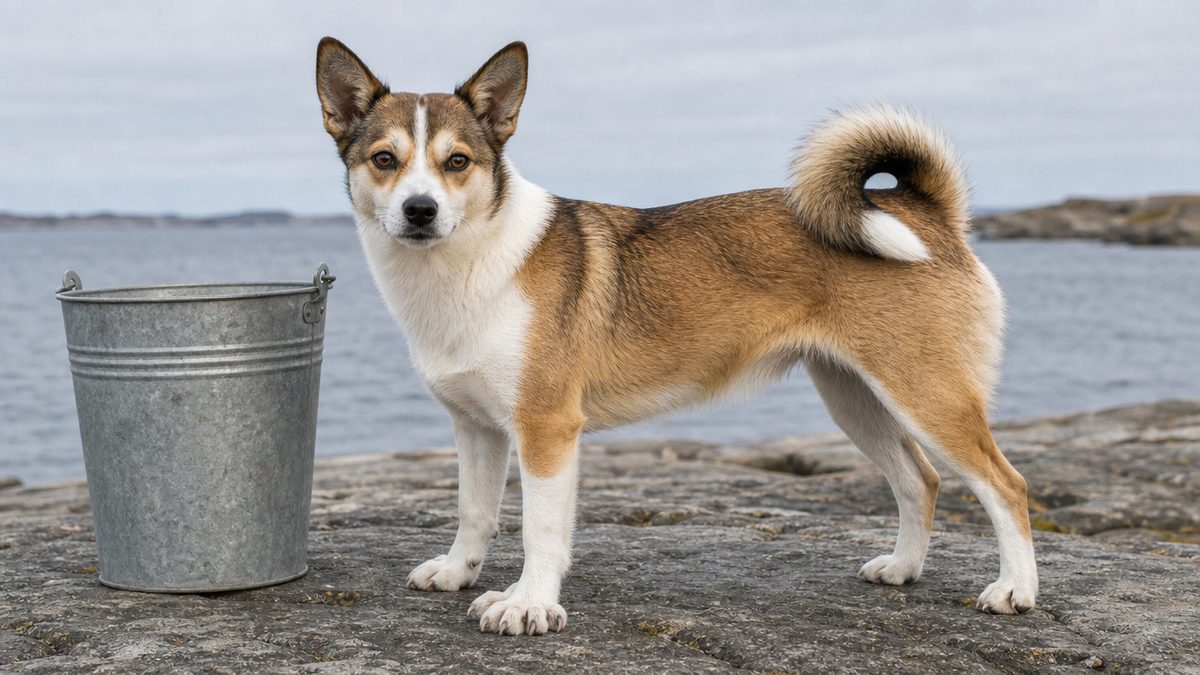
The coat is a double coat, described as dense and rough over a soft undercoat, short on the head and the fronts of the legs and more abundant on the neck, the backs of the thighs and the tail, which is well covered but carries no flag. Colour is always combined with white, running from red to fawn with more or less black-tipped hairs, or white with dark patches, and adults usually show more marked black tips than youngsters.
How old the breed is, and why three sources give three answers
The written record is older than the breed, and the dates do not line up. The FCI standard says there are descriptions of dogs used for hunting puffins which are more than 400 years old. Wikipedia gives a specific first record, a bailiff writing of his visit to Værøy in 1591 that one cannot easily retrieve the birds from the depth without a small dog accustomed to crawling into the hole. The American Kennel Club says written records date back to the early 1400s. Bonbeno reports all three and follows the 1591 record, because it is the only one attached to a named place and a quotable sentence.
What all three agree on is the ending. Nets replaced dogs from the 1850s, a dog tax made keeping them expensive, and by about 1900 the breed survived in one village, Måstad on the island of Værøy in Lofoten, where the connection to the outside world was poor enough that the old way of hunting continued. Puffin hunting is now outlawed in Norway, so no living Lundehund has ever done the job it was made for.
How many dogs does the Lundehund descend from? Five sources, five answers
Every living Norwegian Lundehund descends from somewhere between two and six dogs, and no two authorities give the same number. That is not a gap in this page's research. It is the finding, and the size of the population bottleneck is the single most important thing an Indian buyer will not learn from any page currently ranking for this breed.
Set the five figures side by side and the disagreement stops looking like carelessness. Three of the five come from bodies that work directly on the breed, and two of those three are the same organisation.
| Founders | Source | Date | What it actually says |
|---|---|---|---|
| Two | Stronen and eleven co-authors, PLoS ONE | 1 June 2017 | The approximately 1500 dogs remaining world-wide today appear to descend from only two individuals |
| Three | Norsk Kennel Klub press release | 6 January 2023 | All of today's Lundehunds descend from three individuals, giving an inbreeding coefficient of 95 percent |
| Four | American Kennel Club breed history | modified 16 March 2022 | By the 1960s only six purebred Lundehunds remained, and every Lundehund today descends from four of these dogs, all related |
| Five | Indrebø and Lingaas, Norsk veterinærtidsskrift | 2022, issue 4 | Two littermates plus two half-brothers sent from Måstad and one unrelated male in Mid-Norway. These five dogs are the basis of today's Lundehunds |
| Six | Norsk Kennel Klub breed page | retrieved 2 September 2026 | Eleanor Christie had five dogs sent from Måstad which together with a sixth dog formed the basis of the breeding work |
The Norwegian Kennel Club is the breed's home registry and the FCI member for Norway, and it publishes both three and six. Its January 2023 press release says all of today's Lundehunds descend from three individuals; its own breed page says five dogs came from Måstad and a sixth joined them. This page does not resolve that. It reports it, because a reader who takes any single number away from any single page has taken away a figure the publisher's own colleagues contradict.
The two epidemics, which everyone does agree on
The mechanism is settled even where the arithmetic is not. Canine distemper hit twice. Around 1930 an English Setter breeder, Eleanor Christie, read about the breed in a magazine article, obtained stock from Måstad and built a kennel that at its peak held more than 60 Lundehunds; the Norwegian Kennel Club puts the same pack at 60 to 70 dogs. In 1943 distemper killed almost every remaining dog in Lofoten, and it is stated that only three survived there. Christie sent dogs back north to rebuild the island population. Then distemper reached eastern Norway and levelled her kennel, and Værøy sent stock back the other way.
The second collapse is dated differently by different sources, which is part of why the counts differ. Wikipedia dates it to 1963. The Norwegian veterinary journal dates the depopulation of Måstad to 1960-64. The Norwegian Kennel Club's breed page says only that towards the end of the 1950s the stock was again very small. A page that prints one of those dates without the other two is not more accurate; it is just less complete.
The FCI standard calls them Mr. & Mrs Christie. The Norwegian Kennel Club's press release calls her Ellinor Christie. The Norwegian veterinary journal calls her Eleanor Christensen. The American Kennel Club calls her Eleanor Christie and names her kennel Luxor. Bonbeno uses Eleanor Christie because two independent sources give it, and records the other two forms so a reader searching the Norwegian literature knows what else to look for.
Why the number matters, and why it is not just trivia
A founder count is the denominator under every health figure on this page. If the breed came through on two dogs rather than six, the expected homozygosity is higher, the pool of variants available to any breeding programme is smaller, and the case for outcrossing is stronger. The published genetics gives the answer the pedigrees cannot: whatever the exact count, the outcome is a population as inbred as any recognised dog breed anywhere, and the next section puts numbers on it.
Note also what nobody claims. No source suggests the surviving dogs were unrelated. The American Kennel Club states plainly that the four founders it names were all related to each other, and the Norwegian veterinary account has two of its five as littermates and two more as half-brothers. So the effective founder number is smaller than any of the five headline figures, which is exactly what the genome scans go on to show.
The inbreeding numbers, measured four different ways
The Norwegian Lundehund is the most inbred recognised dog breed for which published genome-wide data exists, and four independent teams have measured it. The Norwegian Kennel Club states the breed's inbreeding coefficient as 95 percent, and the peer-reviewed figures behind that headline are set out below.
Understand what each measure is before comparing them, because they are not interchangeable. Heterozygosity asks how often a dog carries two different versions of a gene. Runs of homozygosity ask how much of the genome sits in long identical stretches inherited from a common ancestor. Effective population size asks how fast the population is losing variation. A pedigree inbreeding coefficient asks only what the recorded family tree implies, and on this breed it is the weakest of the four.
| Measure | Value | Dogs | Method and source |
|---|---|---|---|
| Alleles per locus | 1.73 | 125 | 26 microsatellites, Melis 2013 |
| Observed and expected heterozygosity | 0.07 and 0.07 | 125 | 26 microsatellites, Melis 2013 |
| Expected heterozygosity | 0.035 | 12 of 48 | 165K SNPs, Stronen 2017 |
| Runs of homozygosity, FROH | 0.80 to 0.81 | 28 | Illumina high density, Pfahler and Distl 2015 |
| Effective population size | 10 to 13 | 28 | Linkage disequilibrium over 200 generations, Pfahler and Distl 2015 |
| Effective population size | 13 to 82 | pedigree | Depending on method, Kettunen 2017 |
| Effective population size | 13 | 75 | Quoted in Melis 2023 |
| Genetic diversity lost from base population | 38.8 percent | pedigree | Kettunen 2017 |
| Pedigree inbreeding coefficient, last 11 generations | 0.10 | 28 | Pfahler and Distl 2015, described by the authors as strongly biased downwards |
Pfahler and Distl report a pedigree inbreeding coefficient of 0.10 over the last 11 generations and say in the same paper that it is strongly biased downwards, because the coancestry of the founders in that pedigree is unknown. In other words the family tree starts at a point where every dog was already related and the arithmetic cannot see it. Their genomic estimate of the same population, 0.80 to 0.81, is eight times higher. When a page quotes a Lundehund inbreeding figure, ask which of those two it is.
The two heterozygosity figures are not a contradiction
Read the marker type before treating 0.07 and 0.035 as a conflict. Melis and colleagues genotyped 125 Lundehunds and 27 Nova Scotia Duck Tolling Retrievers on 26 microsatellite markers and found an average of 1.73 alleles per locus, with observed and expected heterozygosity both 0.07, against much higher values in the Toller. Stronen and colleagues genotyped 48 dogs across four breeds on 165,000 single nucleotide polymorphisms and reported expected heterozygosity of 0.035 for the Lundehund against 0.209 to 0.284 for the Norwegian Buhund, Icelandic Sheepdog and Norrbottenspets. Microsatellites and SNPs are different instruments with different scales, so the two numbers measure the same collapse and are not rival estimates of one quantity.
The finding that says it best without any statistics
One paper makes the point in a way no coefficient can. Kropatsch and colleagues genotyped 17 Lundehunds on a genome-wide array of 170,000 SNPs and found that the standard method of assigning sex, which relies on expected homozygosity of X-chromosomal loci, failed to assign these dogs to the correct sex. Physical examination and a Y-chromosomal marker gave the right answer; the SNP assay did not. The breed is homozygous enough that a routine genetic test which works on every other dog stops working.
The same body of work has identified what selection acted on. Pfahler and Distl's long-range haplotype test flagged regions containing genes involved in immunity, olfaction, wound healing and neuronal development, and named QSOX2, BMPR1B, PRRX2 and MYOM1 as candidates for small body size, the increased number of digits per paw, and the extraordinary mobility. So polydactyly, the feature the breed is famous for, has a named candidate gene, and it sits in a genome with almost no variation left around it.
What inbreeding depression looks like in this breed
The consequences are the ordinary ones and they are documented. Kettunen and colleagues describe low fertility and a high-frequency predisposition to intestinal disorder as implying inbreeding depression, and conclude that optimal contribution selection alone can achieve nothing here because the relatedness of the whole population is extremely high. Wikipedia's summary of the same literature adds reduced litter size, inbreeding-avoidance behaviour and low sperm quality. The Norwegian veterinary journal reports an average litter size of just under three puppies, against six and a half to eight for the Norwegian hare-hound breeds discussed in the same article.
That litter figure is the one to carry into any Indian decision. A breed averaging under three puppies a litter, registering around 115 dogs a year in its own home country, cannot supply a foreign market at any price, and the price section returns to why.
The cross-breeding programme, counted from the club's own register
The Norwegian Lundehund Club runs a sanctioned cross-breeding programme with three other Nordic spitz breeds, and it publishes every mating. Counted from that register on 2 September 2026, the project has produced 31 litters and 113 puppies, of which 84 carry Norwegian Buhund ancestry, 17 Icelandic Sheepdog and only 12 Norrbottenspets.
Get the authorisation right first, because it is what separates this from a backyard cross. The project is approved by and run with the Norwegian Kennel Club, NMBU, the Norwegian genetic resource centre at NIBIO, NordGen, the breed clubs for all three donor breeds, and named veterinarians and researchers. Under the rules a crossing project needs approval from whichever country the FCI recognises as the breed's homeland, and Norway is the homeland for seven breeds and runs crossing projects in four of them.
The dates, in order
Three dates matter and they are often collapsed into one. The Norwegian Lundehund Club decided to start the project in 2013 and the project began in 2014 in cooperation with NKK and the veterinary faculty at NMBU. In autumn 2022 the club voted, with NKK approval, to open the stud book to project dogs from 1 January 2023, and the first dogs were assessed for entry on 4 February 2023. Then on 29 April 2025 the annual meeting voted by a 94 percent majority to open the stud book to selected second-generation crosses meeting the health requirements and reaching a show or mustering grade of Good, and NKK approved that on 20 June 2025.
What the register actually contains
Count the litters rather than accepting a summary, because the club publishes enough to do it. Every project puppy is registered outside the breed in an X-register at NKK and managed as a separate side population, with a name suffix showing the donor breed and the generation: Alvar B2 is a second-generation cross with a Buhund behind it.
| Donor breed | F0 matings | F1 puppies | F2 puppies | F3 puppies | Total puppies |
|---|---|---|---|---|---|
| Norwegian Buhund | 3 | 12 | 42 | 30 | 84 |
| Icelandic Sheepdog | 2 | 4 | 8 | 5 | 17 |
| Norrbottenspets | 1 | 4 | 8 | none yet | 12 |
| All three | 6 | 20 | 58 | 35 | 113 |
In 2022 the Norwegian veterinary journal reported the project as two Buhunds crossed in with 8 puppies in F1, 38 in F2 and 7 in F3; two Icelandic Sheepdogs with 4, 4 and 3; and so far only one Norrbottenspets with 4 in F1. Take the club's current register and remove every litter born after that article, and the Buhund line gives exactly 8, 38 and 7, the Icelandic line exactly 4, 4 and 3, and the Norrbottenspets line exactly 4. Two documents, four years apart, reconciling to the puppy. That is the strongest corroboration available for any number on this page.
One detail in the club's own prose does not match its own tables. The page says crossings have so far been made with two Buhunds, two Icelandic Sheepdogs and one Norrbottenspets, while the tables below it list three separate Buhund dams, in 2014, 2016 and 2022. The tables are dated and itemised and the sentence is not, so this page counts three, and says so rather than quietly picking one.
Which breeds, and why those three
The three donors were chosen on phenotype first and genetics second, which the researchers say deliberately. Stronen and colleagues explain that the candidate breeds were selected on appearance and then subjected to genetic investigation, because phenotype is what breed owners care about and involving them from the start is what makes a rescue programme survive. Their pairwise FST values put the Icelandic Sheepdog furthest from the Lundehund, then the Buhund, then the Norrbottenspets, so the Swedish breed is the genetically closest of the three and has contributed the fewest puppies.
Because Lundehund fertility is poor and all three donor breeds are larger, the club decided to use bitches from the other breeds mated to Lundehund males, then breed the offspring back to Lundehunds in later generations. Every combination must be approved by the club and NKK's veterinarians in cooperation with NMBU before mating.
The health bar, which is higher for the outsiders than for the Lundehunds
Read the two lists of requirements against each other, because the asymmetry is revealing. A dog of another breed, or a project puppy, needs hip grade A or B, patella grade 0, an eye examination clear of hereditary conditions, a veterinary health certificate and a good temperament. A Lundehund used in the project needs patella grade 0 or 1, must not have had intestinal lymphangiectasia, needs general good health confirmed by certificate, and a good temperament. There is no hip requirement on the Lundehund side at all, and the patella bar is one grade lower.
Does it work? The published evidence says yes, with a caveat. Melis and colleagues genotyped 12 Lundehunds, 12 Buhunds, 7 F1 crosses and 12 first-generation backcrosses on more than 170,000 SNPs and found heterozygosity in the backcrosses above the Lundehund and below the F1 as predicted, and runs of homozygosity reduced in the backcrosses compared with purebred Lundehunds. Their caveat is that some of the acquired diversity is lost as soon as you backcross, so breeding F2 crosses to each other deserves consideration. Kettunen's pedigree modelling reached the same place from another direction: adding ten foreign breeding candidates to thirty Lundehund breeders cut the parental additive genetic relationship by 40 to 42 percent, and replacing rather than adding cut it by 48 to 53 percent.
Norwegian Lundehund price in India
No Norwegian Lundehund price in India exists, and the reason is structural rather than a gap in the listings. India's largest puppy-listing network has no category for the breed at all, its breed selector running Norfolk Terrier, Norwegian Buhund, Norwegian Elkhound, Norwich Terrier with no Lundehund between them, and Indian import policy permits a dog into the country only as the importer's own pet.
Look at what the India-localised result set actually offers, recorded in full in this page's competitor list. Two entries are foreign breed directories quoting US dollars and one quotes pounds sterling Weenect, Everything about the Norwegian… Wamiz, Norwegian Lundehund. Four are retail: a jigsaw puzzle, a book, a t-shirt and a directory page for pet shops in a Kerala town. Three are foreign reference pages. The single Indian commercial page in the set is selling a different breed, and the next section takes it apart. Bonbeno opened the seller page and the three price sources, and did not open the merchandise listings, so no figure is quoted from them.
The three foreign prices, which are three currencies and no agreement
Report the foreign figures for what they are, and convert none of them. Dog Breeds List gives an average of USD 2,000 to 3,000. Weenect gives USD 1,080 to 2,200 for a puppy plus annual care costs from USD 1,550. Wamiz gives GBP 1,600 to 1,800. Those three bands do not overlap cleanly even after allowing for the currency, and none of them names a breeder, a country or a year.
This site has repeatedly caught Indian pages publishing an American price list divided by a single exchange rate and presented as a local market. The discipline that catches it is refusing the conversion in the first place. Multiplying a US directory's guess by today's rate would produce a rupee number that looks authoritative, describes nothing, and would be quoted back at us within a month. What can be priced honestly for an Indian reader is the cost of keeping a small dog here, and that is the next section, sourced to Indian price lists.
The one genuine published price, and where it comes from
There is exactly one real, current, publisher-stated price for a dog of this breed, and it is Norwegian. The Norwegian Lundehund Club states that cross-breeding project puppies cost kr 21,000, the same as Lundehund puppies, and that buying one requires signing two separate agreements, one with the club and one with the breeder. It is reported here as a Norwegian kroner figure set by a breed club, not as a market price and not as anything an Indian buyer can act on.
The conditions attached matter more than the number. The club says it must retain full control of the crossbreed dogs, that puppies go to families willing to take part in the future work on the breed, and that owners of Lundehund bitches can offer their dog for breeding within the project. This is a conservation programme selling participation, not a shop selling puppies.
Why no Indian supply chain can form
Three facts close the question between them. First, the breed produces very little: an average of 115 registrations a year in Norway over the five years to 2022, at an average litter size just under three puppies, against a Norwegian population the Norwegian Kennel Club puts at about 650 dogs and says should increase. Second, Indian policy places dogs under ITC(HS) 01061900 as Restricted, permits import only for a pet dog with a valid pet book in the importer's own name, for research with a CPCSEA recommendation, or for Defence and Police internal security, and states that any application for trading or breeding purposes shall be duly rejected. Third, the club places every puppy under contract and screens the home.
A breed that produces roughly a hundred puppies a year worldwide, places each one under a signed agreement, and cannot lawfully be imported into India for sale or breeding will never develop an Indian market price. Any page that gives you one has made it up.
What a rupee figure attached to this breed would have to be
Test any Indian number you are shown before believing it. Divide it by 84.38, by 80 and by 74, and then ask whether the quotient is a price a seller would actually print. This site has documented Indian tables that divide cleanly to whole dollars at 74, a national finance site whose figure was a US insurer's dollar number at exactly 80, and a listing network whose Rs 98,999 recurs unchanged across breeds it does not stock. For a breed with no Indian listings at all, the additional test is simpler still: ask who the seller is, and whether they can name a registry, a pedigree number and an import authorisation. On this breed, nobody in India can.
What an Indian search for this breed actually returns
The number one Indian commercial result for a Norwegian Lundehund price query is a Norwegian Buhund page, and its available stock is an Australian Shepherd in Jaipur, a French Bulldog in Patna and an Australian Shepherd in Chennai. Not one Buhund, and certainly not one Lundehund.
This matters more than any missing price, because it is what a real Indian buyer will meet. The page ranks for a Lundehund query, sells a different Norwegian spitz, prints the headline Norwegian buhund Puppies For Sale, reports 3 Result Found, and then fills the space with three dogs of two entirely unrelated breeds under the heading Similar breeds at other locations. Prices sit behind a View Price link that requires a sign-up, so the page quotes no figure at all while ranking first for a price query.
| Listing name | Breed listed | City | Quality label | Price shown |
|---|---|---|---|---|
| BUZZY | Australian Shepherd | Jaipur | KCI Registered | Hidden behind sign-up |
| sisy | French Bulldog | Patna | Pet Quality | Hidden behind sign-up |
| Charlotte | Australian Shepherd | Chennai | KCI Registered | Hidden behind sign-up |
The breed selector is the checkable part
Anyone can verify the central claim in ten seconds. That site's own breed dropdown lists roughly three hundred breeds including Chippiparai, Mudhol hound, Rajapalayam, Rampur Hound, Pashmi Hound, Kombai, Indian Spitz, Japanese Spitz, German Spitz, Keeshond, Norwegian Buhund and Norwegian Elkhound. It does not list the Norwegian Lundehund, and it does not list the Norrbottenspets. India's largest listing network has no category for either breed, which is a far harder fact than any absence of search results.
The search engine substituted the query, and the control proves it
One retrieval on this breed produced the cleanest instrument failure this site has recorded. Queried on 2 September 2026 with the country set to India, norwegian lundehund price in india returned HTTP 200, the correct page title, About 118,000 results, and ten organic results that were all Telegram Messenger pages: the Telegram home page, Telegram Desktop, two telegram.me channels, Telegram Web twice, the Wikipedia article on Telegram the software, Telegram on Google Play, and a GitHub-hosted Telegram web client.
In the same session, on the same endpoint, with the same country setting, labrador retriever price in india returned About 29,300 results, ten genuine Indian Labrador price pages and a live People also ask box with four questions. The control passed and the breed query did not, which means the instrument was working and the query alone was substituted. No absence claimed anywhere on this page rests on that result set. Note also the arithmetic: the obscure Norwegian breed reported four times the result count of the single thickest commercial dog query in India. A count that large for a breed with no Indian market is proof the results describe something else.
A second form of the query, norwegian lundehund dog breed with the same country setting, was not substituted. It returned the genuine English-language breed set, led by Wikipedia, the American Kennel Club, Dogster and The Spruce Pets, and it carried six People also search for chips: Norwegian Lundehund puppies for sale, norwegian lunde puppies for sale, Norwegian Lundehund cost, Norwegian Lundehund price, Norwegian Lundehund breeders near me, and Norwegian Lundehund for sale. Four of those six are commercial. So Indian searchers are asking to buy a dog that no Indian seller has.
The merchandise problem, which is the honest description of this market
Count what is genuinely purchasable in India under this breed's name. A jigsaw puzzle on Flipkart, an owner's-guide book on Amazon India, and a printed t-shirt on IndiaMART. Those three are the only Indian-domiciled products in the whole result set, and Bonbeno did not open any of them, so this page quotes no figure from them and states only what their own result titles say. An Indian reader searching for this breed's price is not looking at a thin market for a dog. They are looking at a merchandise market with no animal behind it.
The JustDial result deserves its own sentence
One listing shows how these pages are generated. JustDial ranks a page titled Pet Shops For Norwegian Lundehund Dog in Palakkad, and the business its own result title then names sits in Anand Vihar, Delhi, roughly 2,500 kilometres from Palakkad. A directory that crosses every breed name with every Indian city produces a page for every combination whether or not a matching business exists, and fills the empty ones with whatever is nearest in its index. Reading that page as evidence that Palakkad has Lundehund suppliers would be reading a template as a market, which is a mistake this site has documented on trade-data aggregators as well.
What a Lundehund-sized dog costs to keep in India
Budget for a small dog under 20 kilograms rather than for a breed, because no recurring cost of ownership in India depends on which northern spitz you have. Indian vaccination and boarding prices are published, real, and directly applicable to a 6 to 7 kilogram dog Dog House, Chennai.
Vaccination is the easiest line to pin down and the one most often understated. A published Indian per-dose table gives DHPP at 800 INR, rabies at 350 INR, leptospirosis at 150 INR, Bordetella for kennel cough at 200 INR, canine influenza at 800 INR and Lyme disease at 700 INR. Those are vaccine prices before any consultation or injection charge, so the vaccination cost of a full puppy course is higher than the sum of the doses.
The same article's body text gives kennel cough at 600 INR per dose and canine influenza at 220 INR per dose, while its own summary table gives Bordetella at 200 and canine influenza at 800. Two of six lines disagree with themselves, and they disagree in opposite directions, so this is not a stale table beside updated prose. Bonbeno uses the summary-table figures because they are the ones presented as the price list, and records the discrepancy so a reader who is quoted 600 rupees for a kennel cough shot knows where that number probably came from.
| Item | Published Indian figure | Source type |
|---|---|---|
| DHPP vaccine, per dose | ₹800 | Indian retailer price table |
| Rabies vaccine, per dose | ₹350 | Indian retailer price table |
| Leptospirosis vaccine, per dose | ₹150 | Indian retailer price table |
| Bordetella, kennel cough, per dose | ₹200 in the table, ₹600 in the same article's text | Indian retailer price table |
| Boarding, up to 20 kg, air-conditioned | ₹850 per day | Chennai kennel tariff, 2026 |
| Boarding, up to 20 kg, non air-conditioned | ₹750 per day | Chennai kennel tariff, 2026 |
| Boarding, puppies under six months, air-conditioned | ₹850 per day | Chennai kennel tariff, 2026 |
| Boarding, 21 to 40 kg, air-conditioned | ₹950 per day | Chennai kennel tariff, 2026 |
A Lundehund at 6 to 7 kilograms sits at the bottom of the small band, so the published Chennai rate is ₹850 a day with air conditioning and ₹750 without. On a double-coated northern dog that ₹100 difference is not a preference. Over a fortnight away it is ₹1,400, and it buys the dog a survivable two weeks.
Building the monthly cost from parts you can check
Assemble the monthly cost from sourced components rather than quoting one number nobody can verify. For a 6 to 7 kilogram dog the food line is genuinely small, which is the one financial advantage this breed has in India. Bonbeno publishes no gram-per-day figure here, because the small-breed feeding table it would have cited could not be retrieved at a URL that resolves, and a guessed product URL is exactly how a wrong figure enters a page.
- Food for a 6 to 7 kg adult, bought in small bags through the monsoon so it does not spoil in humidity.
- Vaccination annually for the core boosters, at the per-dose figures above plus a consultation each visit.
- Ectoparasite control year-round rather than seasonally, because Indian tick pressure does not pause.
- Coat maintenance, which costs a brush and time rather than money, and costs both twice a year in earnest.
- Boarding at ₹850 a day in the air-conditioned small band, which is ₹5,950 for a week away.
- A gastrointestinal contingency, which on this breed is not optional and has no Indian price.
Every other cost on this page applies to any small dog. The one that does not is chronic gastrointestinal disease. A Swedish study of 814 dogs with chronic enteropathy at two animal hospitals found the Norwegian Lundehund among the breeds at highest relative risk, and among the dogs whose treatment outcome could be classified, 55.2 percent were immunosuppressant-responsive, 11.4 percent food-responsive, 5.2 percent non-responsive and 1.1 percent antibiotic-responsive. Immunosuppressant-responsive means lifelong medication and monitoring. Nobody has priced that in India for this breed, and this page will not estimate it.
No lifetime total is published here. There is no Indian population of this breed, no Indian veterinary series and no Indian cost dataset, and manufacturing a single figure out of those three absences is exactly the practice this site spends its time detecting on other pages.
Heat tolerance: a 12.7 degree island against a 27.9 degree country
The Norwegian Lundehund has the lowest heat tolerance this site rates, because Måstad on Værøy averages 6.9 degrees Celsius across the year with a warmest month of 12.7, while Chennai averages 27.9 with a coolest month of 24.1. The coolest month an Indian coastal city offers is 11.4 degrees warmer than the hottest month this breed was built for.
Every figure below was queried from NASA POWER by explicit latitude and longitude rather than by place name, because place-name climate pages have served this project six wrong cities at HTTP 200. A coordinate cannot hand you another town by accident. What it can do is hand you a grid cell instead of a point, and on this breed's homeland it does exactly that. One column also needs a label rather than an assumption. The record-high column is NASA POWER's T2M_MAX, the hottest reading the climatology holds for that month across the whole period. It is an extreme, not an average afternoon, so compare it with other record highs and never with a monthly mean.
One grid cell for a whole island, and it is a sea-level cell
Three separate points on Værøy were queried and all three returned byte-identical results at a cell elevation of 0.33 metres: Måstad on the south-east shore where the breed survived, the main village to the north, and a point on the island's high ground. Same annual mean of 6.90 degrees, same August peak of 12.67, same February minimum of 2.49, same annual relative humidity of 80.55 percent. The model cannot tell the three places apart because they sit inside one cell, and that cell is standing at the waterline.
The FCI standard describes a dog predestined to hunt puffins on the steep rocks around the fjords, climbing near-vertical screes to reach nesting cavities. Those cliffs are by definition far above 0.33 metres, so the cell describes the shore and nothing above it. For the purpose this page needs it, that is the right half: Måstad itself is a shoreline settlement, and the sea-level cell is a fair description of where the dogs lived. It is not a description of where they worked, and this page does not present it as one. Anyone using POWER on a hill station in India should run the same check, because there the error runs to more than a kilometre in both directions.
One independent check supports the coastal figures. The American Kennel Club describes the Lofoten archipelago as a place north of the Arctic Circle whose average temperatures remain above freezing year-round because of the Gulf Stream. POWER's coldest month for the cell is February at 2.49 degrees, above freezing, from a completely different source. The two agree.
| Place | Cell elevation | Annual mean | Warmest month mean | Highest reading on record | Coolest month mean | Annual mean humidity |
|---|---|---|---|---|---|---|
| Måstad, Værøy | 0.33 m | 6.9 °C | 12.7 °C (Aug) | 20.6 °C (Jul) | 2.5 °C (Feb) | 80.6% |
| Værøy village | 0.33 m, same cell | 6.9 °C | 12.7 °C (Aug) | 20.6 °C (Jul) | 2.5 °C (Feb) | 80.6% |
| Bodø, mainland Nordland | 75.12 m | 5.4 °C | 13.2 °C (Jul) | 25.5 °C (Jul) | -0.8 °C (Feb) | 81.9% |
| Chennai | 48.95 m | 27.9 °C | 31.5 °C (May) | 42.7 °C (May) | 24.1 °C (Jan) | 72.4% |
| Mumbai | 97.15 m | 26.8 °C | 31.2 °C (May) | 44.9 °C (Apr) | 23.2 °C (Jan) | 67.4% |
| Delhi | 206.37 m | 25.6 °C | 35.9 °C (Jun) | 48.8 °C (Jun) | 13.6 °C (Jan) | 45.6% |
| Pune | 635.99 m | 23.9 °C | 28.9 °C (Apr) | 43.2 °C (Apr) | 19.6 °C (Dec) | 66.8% |
| Bengaluru | 841.72 m | 23.7 °C | 28.4 °C (Apr) | 40.4 °C (Apr) | 20.2 °C (Dec) | 67.9% |
The single number that decides this
Compare the two extremes rather than the averages. Værøy's hottest month averages 12.7 degrees. Chennai's coolest month averages 24.1, Mumbai's 23.2 and Bengaluru's 20.2. Every month of the year in every one of those cities is warmer than the warmest month this breed's homeland has ever offered it. Only Delhi in January, at 13.6 degrees, comes within a degree of Værøy's August, and Delhi in June averages 35.9 degrees with 48.8 as the hottest June reading on the record.
Anyone arguing that an Indian hill station could suit this breed should check the cell first. For Shimla, NASA POWER reports a cell elevation of 897.65 metres against a town near 2,200, so the cell stands roughly 1,300 metres too low and its 21.15 degree annual mean reads about eight degrees too warm. For Gangtok the error runs the other way: a cell at 3,239.61 metres against a town near 1,650, so its 7.45 degree annual mean reads roughly ten degrees too cold and looks deceptively like a Norwegian analogue. Neither raw figure can be used as printed, and this page will not build an Indian recommendation on either.
Humidity, which decides whether panting works
Panting is this dog's only cooling system and humidity is what limits it. Chennai runs an annual mean relative humidity of 72.4 percent, Mumbai 67.4 and Bengaluru 67.9, while Delhi is much drier at 45.6 percent. Værøy is humid too, at 80.6 percent, higher than any Indian city on this table, and at 12.7 degrees that humidity costs the dog nothing at all. Humidity only becomes a problem once the air is warm enough that evaporation is doing the work.
What the heat research transfers, and what it does not
Take the mechanism and leave the odds ratios where they belong. The largest study of heat-related illness in UK dogs found exertion behind most cases: of the 879 events with a recorded trigger, 652 were exertional, which is 74.2 percent, against 113 environmental and 46 from vehicular confinement. Its companion paper, from the same 905,543-dog cohort, reports that dogs at or above the mean bodyweight for their own breed and sex carried an odds ratio of 1.42, with a 95 percent confidence interval of 1.12 to 1.80.
Be precise about the limit. The Norwegian Lundehund is not a UK breed at any meaningful frequency and was not modelled in either paper, so no breed-specific odds ratio exists for it and none is invented here. What transfers is that exertion, not confinement, is the dominant trigger, and that a dog heavy for its own breed carries more risk. On a 6 to 7 kilogram dog in India, keeping it lean is one of the very few heat protections entirely within an owner's control.
Temperament: a friendly dog with a burglar's skill set
A Norwegian Lundehund is friendly, curious and alert, and its own kennel club warns in the same breath that it can be a little self-willed. The FCI standard sums the temperament up in three words, alert, energetic and lively, and every one of those words is a description of a small dog that was selected to work out of sight inside a cliff.
Take the Norwegian Kennel Club's own phrasing seriously, because it is unusually candid. It calls the Lundehund a big personality in a small dog, an excellent family dog and walking companion, quite willing to learn, and somewhat headstrong. That is a fair description of most working spitzes. What separates this one is the anatomy, and the anatomy has behavioural consequences that no temperament rating captures.
The three physical traits that shape daily life with one
- It climbs. A dog bred for puffin hunting on near-vertical scree, with shoulders that let the forelegs go straight out to the side, treats furniture, walls and gates as terrain. Fencing that contains an ordinary small dog will not contain this one.
- It is flexible past the point of usefulness. The neck bends back until the head touches the spine and the ears fold shut on command of the cartilage. It can extract itself from spaces you assumed were secure.
- It digs. The extra toes and pads exist to grip rock and open nest burrows. In an Indian garden that instinct finds soil.
Norwegian Kennel Club reporting on the crossbreeding project states that the crosses have proved fertile and vital, have very little gastrointestinal trouble, and have inherited the Lundehund's markedly friendly disposition. That is worth stating because it is the rare case where a temperament claim has been tested rather than asserted: three generations of dogs, deliberately produced, assessed for temperament by a club and a national registry, and reported publicly.
Who this breed suits in India
- A cool-season region, realistically the north Indian plain in winter, and nowhere on the coast at any time of year.
- A genuinely secure boundary, because a climbing, digging, flexible small dog defeats ordinary fencing.
- An owner who wants a project, since the interesting parts of this breed are its history and its genetics rather than its usefulness.
- Someone with a veterinary relationship already established, because the gastrointestinal risk is the whole story and it arrives without warning.
Who it does not suit
- Anyone in Chennai, Mumbai, Bengaluru, Hyderabad or Kolkata, where every month is warmer than the breed's hottest.
- A buyer who wants a rare dog as a status object, because this breed's rarity is a medical problem rather than an ornament.
- A household unwilling to budget for chronic illness, given the enteropathy risk.
- Anyone who cannot lawfully import one, which in India is anyone not moving their own pet in under the baggage or authorisation route.
On noise, be realistic. This is a small alert spitz and it is vocal, in the ordinary spitz way rather than the elkhound way, and Indian housing sits close together. Train a quiet cue in the first year rather than correcting a habit in the third.
Training a dog bred to work where you cannot see it
Train recall, a settle and a containment routine, in that order, and accept that a dog selected to enter a burrow alone will always prefer its own judgement. The Norwegian Kennel Club describes the breed as quite willing to learn and somewhat headstrong in the same sentence, and both halves are true at once.
Start from what the breed was selected for, because the selection explains the resistance. A dog sent into a one to two metre burrow to take a live bird and bring it out undamaged cannot be handled while it works. It has to decide alone, in the dark, in a space too tight to turn around in, and then reverse out. Four centuries of that produces a dog that treats a handler's instruction as one input among several.
The training order that works
- Socialise early and widely. Use the window before sixteen weeks on Indian city reality: traffic, two-wheelers, free-roaming dogs, cattle, lifts, and festival noise. A friendly breed still needs the exposure.
- Build a settle before obedience. A dog that cannot switch off indoors will not survive Indian apartment life, and the settle is what buys back the hot hours of the day.
- Treat containment as a training subject, not a hardware problem. Teach a boundary, then assume the boundary will be tested by a dog with six toes and rotating shoulders.
- Give the digging and climbing drive a legal target. A sandpit, a scent game, a rummage box and formal nose work all use the circuitry that otherwise takes the dog over a compound wall.
- Reward engagement rather than compliance. Pay the dog for checking in with you while something interesting is available, because that is the behaviour you actually need on a long line.
- Teach a quiet cue in the first year, before the barking becomes a habit and a neighbour becomes a problem.
What this breed resists
It resists repetition, and it resists being made to work at the wrong hour. The second is the practical constraint in India rather than the temperamental one. In most of the country the hours when a scenting dog works best, before sunrise and after dark when the ground is cool and holding scent, are the only hours in which it is safe to work this dog at all. That coincidence is the single piece of luck in this breed's Indian situation, and a sensible routine is built entirely around it.
Overseas breed-club and hobbyist material consistently reports that Lundehunds are slow to house-train, and Bonbeno reports that as widely-held owner experience rather than as a measured finding, because no study has quantified it. What is measured, and what may be relevant, is that this is a breed with a high frequency of protein-losing enteropathy. Before treating a house-training failure as a training problem in an adult dog of this breed, have a veterinarian rule out the gut. That is a clinical instruction rather than a behavioural one, and it is the right order to do them in.
One more note on method. Nothing in this breed's history rewards force, and everything in its anatomy makes physical management a bad idea: a dog whose neck bends to its own spine and whose shoulders rotate sideways is not a dog to restrain by the collar. Use food, use games, use a long line, and keep sessions short enough that a curious dog stays curious.
Exercise needs, and the two windows an Indian day allows
A Norwegian Lundehund needs moderate daily exercise and considerably more mental work than its size suggests, and the Norwegian Kennel Club describes it as an easy-care dog requiring moderate amounts of exercise. In India the requirement does not shrink, but the hours in which it can safely be met collapse to two windows a day for eight months of the year.
Understand the working benchmark before deciding what a domestic version looks like. This is not a distance dog. It is a small, athletic climber that covered short, technical, vertical ground and then stopped, and the FCI standard describes its gait as light and elastic with a characteristic external rotary action of the forelegs. A dog built that way is satisfied by problem-solving and terrain, not by kilometres.
What the safe window looks like in practice
Read both numbers, and know which is which. Chennai's warmest month averages 31.5 degrees Celsius against a record high of 42.7, Mumbai averages 31.2 against a record 44.9 in April, Delhi averages 35.9 against a record 48.8 in June and Bengaluru averages 28.4 against a record 40.4 in April. The means are what the dog lives through and the record highs are what it might one day meet, and neither of them offers a usable midday for a double-coated dog of any size. What they offer is a pre-dawn window and a post-sunset window, and in Delhi a genuinely usable full day through January.
- Split the daily requirement, roughly 30 to 45 minutes before sunrise and 20 to 30 after dark, rather than attempting one session.
- Test the ground with the back of your hand. Tarmac and concrete hold heat long after the air cools, and a 6 kg dog's feet are close to that surface.
- Carry water on every outing, including short ones, and offer it before the dog looks like it needs it.
- Swap distance for problem-solving when the window closes. Twenty minutes of scent work or a climbing puzzle tires this breed more than an hour of lead walking.
- Watch for the early signs rather than the late ones. Bright red gums, thick saliva, an unwillingness to continue and any unsteadiness are the point to stop, cool the dog and call a veterinarian.
What under-exercise produces in this breed
An under-stimulated Lundehund does not become calm; it becomes an escape artist. Every physical trait that made it valuable on a cliff, the rotating shoulder, the flexible neck, the gripping foot, becomes a way out of a garden. Owners overseas report the same pattern consistently enough that it is the practical case for indoor enrichment rather than a longer walk.
If this dog overheats, wet it thoroughly with cool, not ice-cold, water, concentrating on the belly, groin, armpits and paws where the coat is thinnest, and move air over it. Do not soak the outer coat and walk away, because an undercoat holds warm water against the skin and can make things worse. A 6 to 7 kilogram body also loses and gains heat faster than a large one, so both the deterioration and the response happen quickly. Then go to a veterinarian, because collapse from heat is an emergency whatever the dog looks like ten minutes later.
One structural point worth stating. The exertional finding from the largest UK heat-illness study, that 652 of 879 triggered events were exertional, is the reason this section is about timing rather than duration. It is not the length of the walk that hurts a northern dog in India. It is the hour you choose for it.
Grooming and coat care in Indian humidity
Brush a Norwegian Lundehund weekly, brush it daily through the moult, and leave the coat otherwise alone. The FCI standard requires hair that is dense and rough over a soft undercoat, short on the head and the fronts of the legs and more abundant at the neck, the backs of the thighs and the tail, and the American Kennel Club rates the grooming frequency as low with weekly brushing plus an occasional bath.
This is a genuine double coat and there is no ambiguity about it. Both the FCI standard and the AKC describe two layers explicitly, and the standard specifies that the tail is well covered with hair but carries no flag, which is one of the quickest ways to tell a Lundehund from a Buhund at a glance American Kennel Club. Coat care on this breed is therefore cheap, unskilled and non-negotiable rather than optional.
The moult is the whole job
A dense northern undercoat sheds in bulk twice a year, and in India the pattern often becomes less predictable, because the light and temperature cues the coat responds to are different from the ones it evolved with on an Arctic-Circle island. Plan for continuous moderate shedding punctuated by heavy periods rather than for two tidy seasonal blowouts.
- Brush weekly as a baseline and daily through a moult, using an undercoat rake rather than a bristle brush, which only moves the guard hair.
- Work outdoors and accept that a small dog produces a startling volume of undercoat in an Indian summer.
- Do not shave. Removing the coat exposes skin that has never been sun-adapted and takes away the layer that holds air off it.
- Bathe only when needed, and dry the dog down to the skin afterwards rather than leaving a thick coat damp in a humid month.
- Check the feet every time you groom. Six toes and eight pads per front foot is more surface, more crevices and more places for grit, ticks and interdigital damage than any four-toed dog has.
Northern and British breed guides routinely say to towel a double-coated dog and let it air dry. That is sound in a dry temperate climate and poor advice in an Indian monsoon, where an undercoat left damp under a ruff stays wet for hours and becomes a warm, moist layer against the skin. Dry the dog down to the skin over the neck, shoulders and behind the ears, and if you cannot, do not bathe it that day. This is the same climate mismatch this site has documented on other imported breeds, and it is the single most transferable grooming correction on the page.
The ear, which is an advantage and a trap at once
The folding ear cuts both ways. A cartilage that closes the auditory passage against dirt is genuinely protective in scree and equally protective in Indian dust. It also means the ear can be closed while wet, so after any bath or swim, open it, dry inside it, and look. Do not put anything down the canal; dry what you can see and let a veterinarian handle the rest.
The skin condition that is this breed's own
One dermatological problem is specific enough to name. Bergvall and Shokrai described a non-infectious, spontaneous, multifocal alopecia in Norwegian puffin dogs in Sweden, biopsying 14 dogs which represented 11.7 percent of the Swedish breed population, with questionnaire information on 72 dogs or 60 percent of it. Median age of onset was 1.5 years, with a range from 8 months to 7 years, and the picture was multifocal or serpiginous hair loss with follicular plugging, dry skin, slight scaling and itch, confined to haired skin.
Two findings from that paper change what an owner should do. Spontaneous remission was rare, and oestrus was associated with worsening or relapse, so an entire bitch's season is a dermatological event in this breed as well as a reproductive one. Oral prednisolone reduced the itch but did not resolve the lesions, while every dog treated with ciclosporin went into remission. That is a specific, citable, treatable answer, and it is worth having in hand before an Indian veterinarian meets a hair-loss pattern they have never seen.
Lundehund syndrome, with the denominators attached
The Norwegian Lundehund's defining health issues are gastrointestinal, and the collective name for them is Lundehund syndrome, which is intestinal lymphangiectasia, a protein-losing enteropathy of the small intestine. The Norwegian Kennel Club states plainly that all Lundehunds are predisposed to gut problems, which is a registry saying the disease is a property of the breed rather than a risk within it.
Insist on denominators, because this is a breed where the vivid descriptions circulate and the counts do not. Four numbers carry the weight of everything else on this page, and all four are from primary sources.
| Finding | Count | Denominator | Source |
|---|---|---|---|
| Intestinal lymphangiectasia at autopsy | 12 | 14 Lundehunds autopsied over 13 years | Kolbjørnsen 1994, APMIS |
| Chronic gastritis on histology | all | the same Lundehund series | Kolbjørnsen 1994, APMIS |
| Primary gastric carcinoma | 4 | the same Lundehund series | Kolbjørnsen 1994, APMIS |
| Gastric neoplasia with concurrent chronic atrophic gastritis | 7 | 8 Lundehunds with gastric neoplasia | Qvigstad 2008, J Comp Pathol |
| Neuroendocrine (ECL cell) differentiation among those tumours | 4 | 8 tumours | Qvigstad 2008, J Comp Pathol |
| Deaths before 11 years caused by Lundehund syndrome | 30 percent | the breed club's own mortality analysis | Norwegian Lundehund Club RAS 2014, as reported by Wikipedia |
What the disease actually does
Understand the mechanism, because it explains why an owner can do everything right and still lose the dog. Intestinal lymphangiectasia dilates and leaks the lymph vessels of the intestinal wall, so protein is lost into the gut faster than it can be absorbed. The clinical picture is intermittent diarrhoea, vomiting, weight loss and ascites, and in extreme cases a dog can starve while eating. It was first described in the veterinary literature in 1977 by Flesjå and Yri, under the title Protein-losing enteropathy in the Lundehund, and characterised at the level of the mucosa by Landsverk and Gamlem in 1984 using scanning electron microscopy.
The stomach is part of the same disease rather than a separate one. Kolbjørnsen and colleagues found chronic gastritis restricted to the fundic and body regions in every Lundehund examined, prominent atrophy of the mucosal fundic glands, mucous metaplasia, and a significant decrease in the height of the gastric mucosa, and concluded that the high incidence of gastric carcinoma alongside the consistent gastritis in dogs with intestinal lymphangiectasia represents features of a single pathogenetic process. Qvigstad and colleagues later suggested that hypergastrinaemia secondary to fundic atrophy may drive the carcinogenesis, and proposed the breed as an animal model for the role of gastrin in gastric cancer.
A breed proposed in the literature as a model organism for gastric cancer is a breed whose vomiting is not a minor complaint. In India, where the differential for a vomiting dog is long and heavily weighted towards infectious and dietary causes, an owner needs to be able to hand a veterinarian the breed's own literature. Take the Kolbjørnsen and Qvigstad citations to the first appointment, not the tenth Qvigstad G, Kolbjørnsen Ø, Skancke E.
The genetics, which are not settled
The inheritance pattern is not established, and honest sources say so. Metzger and colleagues sequenced affected and control dogs, found a genome-wide association signal on canine chromosome 34 and breed-specific runs of homozygosity in that region, and identified a missense mutation in LEPREL1 about 1.2 megabases from the association peak, in which affected Lundehunds carried the mutant genotype while controls of other breeds carried the wild type. They present it as a potential causative mutation and a possible precursor of the inflammatory process, not as a settled answer. Wikipedia's summary that the pattern may be partly polygenic with a very high frequency, or fixation, of the responsible gene is a fair reading of the same literature.
A newer line of work points at the gut flora. Melis and colleagues sampled the faecal microbiomes of 75 dogs across the parental Lundehund generation, F1 Lundehund by Buhund crosses and F2 backcrosses, and found significant variation between the purebred Lundehunds and the outcross progeny, with the purebred dogs showing dysbiosis: a highly variable microbiome, an elevated Firmicutes to Bacteroidetes ratio and an increased prevalence of the Streptococcus bovis and Streptococcus equinus complex, a known pathobiont. Diet, the presence of a cat in the household, living on a farm and probiotic use were all tracked and none explained the difference.
Life expectancy, and why this page publishes no figure
No cohort study measures the life expectancy of this breed and Bonbeno publishes none. The American Kennel Club prints 12 to 15 years, which is a breed-club convention rather than a measured median, and it appears alongside no sample size, no confidence interval and no dataset. What is measured, and what an Indian buyer should weigh instead, is the breed club's own mortality analysis reported by Wikipedia: 30 percent of deaths before 11 years of age were a consequence of Lundehund syndrome, and another 10 percent of other gastrointestinal disease. Forty percent of early deaths from the gut is a more useful number than any headline range.
What the American screening registry holds
Nothing. A full retrieval of OFA's disease-statistics tables on 2 September 2026, 2,231,869 characters covering every published breed and every disease, returned zero case-insensitive matches for LUNDEHUND, in a retrieval where LABRADOR matched 109 times. That absence has a defensible reading rather than a sinister one: OFA requires 100 hip evaluations, or 50 for its other databases, before a breed appears at all, and a breed registering around 115 dogs a year in its home country will not reach that threshold in the United States. Write it as no row in OFA's published statistics tables, not as absent from the OFA database.
Two of the three outcross partners do appear in that same retrieval, which sharpens the contrast. The Norwegian Buhund carries 416 hip evaluations at 91.8 percent normal and 7.5 percent dysplastic, and 716 eye evaluations at 89.1 percent normal. The Icelandic Sheepdog carries 1,302 hip evaluations at 80.0 percent normal and 18.5 percent dysplastic. So the breeds being crossed into the Lundehund have published orthopaedic data and the Lundehund does not.
Seventeen papers, and what the epidemiology says
The Norwegian Lundehund has 17 records in PubMed under its own name, which is an unusually large literature for a breed of roughly 1,500 dogs, and the reason is that it has been studied as a natural experiment in inbreeding rather than as a pet. That literature was enumerated for this page across six name forms, against a same-session control returning 126 records.
Searching one name is not searching a breed, so all six were run. Lundehund returned 17 records; the exact phrase Norwegian Lundehund returned 8; the plural Norwegian Lundehunds returned 2, both of which are absent from the singular phrase search; puffin dog returned 2; and Norsk lundehund returned 1. The plural and the English nickname each surfaced papers the singular phrase missed, including the 1984 scanning electron microscopy study and a 2007 clinical review Berghoff N, Ruaux CG, Steiner JM. A control query for labrador retriever and hip dysplasia returned 126 records in the same session, so the instrument was working.
The epidemiological finding, which is the one Indian buyers should read
One study puts this breed in a population rather than a case series. Holmberg and colleagues reviewed chronic enteropathy in dogs presenting at two Swedish animal hospitals between 2013 and 2018, identified 814 dogs meeting the inclusion criteria, and calculated a period prevalence of 1.1 percent of all dogs seen. The breeds with the highest relative risk were the Norwegian Lundehund, the West Highland White Terrier and the Miniature Poodle, with the Lundehund named first.
Their treatment-response figures are the practical part. Among the dogs whose outcome could be classified, which was 72.9 percent of the study population, 55.2 percent were immunosuppressant-responsive, 11.4 percent food-responsive, 5.2 percent non-responsive and 1.1 percent antibiotic-responsive, and the non-responsive dogs were more likely to present with anaemia, low protein or albumin, raised C-reactive protein and ascites. In a subset, hypoalbuminaemia was found in 116 of 662 dogs at 17.5 percent and hypocobalaminaemia in 98 of 647 at 15.1 percent.
The single most useful thing an owner can carry into an Indian consulting room is that a Lundehund with chronic diarrhoea is statistically far more likely to need immunosuppression and B12 supplementation than antibiotics. Antibiotic-responsive enteropathy accounted for 1.1 percent of classified cases in that Swedish series. Reaching for antibiotics first is the default in many Indian practices for good local reasons, and on this breed it is the least likely answer.
The diet question, which is widely repeated and thinly evidenced
Separate what is measured from what is reported. There are indications that a low-fat, higher-protein diet has positive effects on digestive problems in this breed, and Wikipedia reports it in exactly those hedged terms. Bonbeno reports it the same way, as clinical practice rather than as a trial result, because no controlled study of diet in this breed appears in the 17 records enumerated above. Low-fat diets are the mainstream veterinary approach to intestinal lymphangiectasia generally, and the specific application to Lundehunds is reviewed in the 2007 clinical article on gastroenteropathy in Norwegian Lundehunds.
What no study has screened for
Note the absences honestly. No published prevalence exists for hip dysplasia in this breed, no published patella survey exists despite the cross-breeding project screening patellae as a condition of entry, and no eye-disease prevalence is published Orthopedic Foundation for Animals. The club screens for those things and does not publish the aggregate, so this page cannot report them. That is a different statement from saying the breed is clear of them, and the two must not be confused.
The other thing not to do is import a related breed's numbers. The Norwegian Buhund and Icelandic Sheepdog figures quoted earlier are theirs, not the Lundehund's, and they appear on this page only to show that the comparison exists. A hip percentage borrowed from an outcross partner and attached to a Lundehund would be fabrication wearing a citation.
Feeding a Norwegian Lundehund in India
Feed this breed as a small adult by body condition rather than by a breed weight figure, and treat every change of food as a clinical decision rather than a preference. The FCI standard gives about 7 kilograms for males and about 6 for females, and on a breed with a high frequency of protein-losing enteropathy the composition of the bowl matters more than the quantity in it.
Use your hands rather than the scales on a coated dog. Ribs should be easy to feel under light pressure, there should be a visible waist from above and a clear tuck from the side, and on a dog with a dense coat you cannot assess any of that by eye. Weigh the food rather than scooping it, because a 50 gram error is a rounding difference on a Labrador and a tenth of the daily ration on a 6 kilogram dog.
Life-stage feeding
- Eight to sixteen weeks. Four meals a day, on whatever food the breeder or exporter used, changed over a week if at all.
- Four to six months. Three meals. Keep a growing dog lean, because extra weight is the one dietary choice with a documented downside in any breed.
- Six to twelve months. Two meals. Introduce nothing new in the weeks around travel or a house move.
- Adult. Two meals, weighed rather than scooped, adjusted seasonally because an Indian summer suppresses appetite and an Indian winter does not.
- Senior. Two meals, smaller portions, and a monthly hands-on body-condition check rather than a weight check.
On this breed, a change of diet is a medical event. Clinical practice favours a low-fat, higher-protein diet for dogs with intestinal lymphangiectasia, and this is the approach reported for Lundehunds specifically Berghoff N, Ruaux CG, Steiner JM. Do not start one on your own reading. Get a baseline albumin and cobalamin before you change anything, because 17.5 percent of the dogs in a Swedish chronic-enteropathy series were hypoalbuminaemic and 15.1 percent hypocobalaminaemic, and a diet trial run without those numbers cannot be interpreted afterwards.
The one heat-related feeding rule
Keep this dog lean, and treat that as a heat measure rather than a cosmetic one. The largest UK study of heat-related illness found that dogs at or above the mean bodyweight for their own breed and sex carried an odds ratio of 1.42 with a confidence interval of 1.12 to 1.80. On a small double-coated northern dog living in India, body condition is one of the very few risk factors an owner fully controls.
Availability in India, and one storage problem
Feeding this breed in India is straightforward on the supply side and awkward on the storage side. Small and mini adult ranges from the international brands are sold nationally, Indian brands cover the same segment, and nothing about a 6 kilogram dog requires a specialist product unless a veterinarian prescribes one. The Indian consideration is humidity: a small dog eats a bag slowly, and a large bag of dry food left open in a coastal city goes stale and can grow mould long before a 6 kilogram dog finishes it. Buy the smallest pack size the brand sells, decant into a sealed container, and do not bulk-buy through the monsoon.
Bonbeno publishes no grams-per-day table on this page. The Indian small-breed feeding chart that would have supplied one could not be reached at a URL that resolved, and this site's rule is that a guessed product URL is how a wrong figure gets published. Ask your own veterinarian for the ration, and weigh it.
The first year, month by month, in Indian conditions
Plan the first year around the month the puppy lands and the point at which a northern coat meets an Indian summer. Everything else follows the ordinary developmental clock, with two breed-specific additions: a gastrointestinal baseline taken early, and a containment plan built before the dog is old enough to need one.
- Weeks 8 to 10. Indian law requires that pups less than eight weeks in age are not sold, under Rule 8(1)(a) of the 2017 Rules, and an imported puppy will be older because flight and quarantine add weeks. Keep it indoors, on its existing food, and let it sleep.
- Weeks 10 to 12. Start the vaccination course with your own veterinarian. Indian published per-dose prices put DHPP at 800 INR and rabies at 350 INR, plus a consultation charge each visit. The gazette itself notes that vaccination can start at seven to eight weeks and is usually completed at eighteen weeks.
- Weeks 12 to 16. The socialisation window closes around sixteen weeks and does not reopen. Use it on Indian city reality rather than on a quiet park.
- Months 3 to 4. Take a baseline. Ask for serum albumin and cobalamin while the puppy is well, so that a future episode of diarrhoea has something to be compared against.
- Months 4 to 5. Long-line recall starts now. Walk the boundary of wherever the dog will live and assume a climbing dog will find the weak point.
- Months 5 to 7. Adolescence, and the first genuine recall failures. This is development, not disobedience.
- Months 7 to 9. Build duration rather than intensity, on soft ground, in the cool hours only.
- Months 9 to 12. Two meals a day. Introduce structured scent work, which is the outlet that will carry this dog through the next decade in a country with nothing for it to hunt.
- Months 12 to 24. Watch the coat. Median age of onset for the breed's own alopecia is 1.5 years, with cases from 8 months, so a patchy or serpiginous hair loss in a young adult is a veterinary question rather than a grooming one.
The landing month decides the first six months
A puppy arriving in Delhi in October gets a real cool season, roughly October to February, in which to do its socialisation walks and build early fitness. A puppy arriving in April gets none, and its owner will be trying to complete a sixteen-week socialisation window in months whose monthly mean climbs to 35.9 degrees Celsius, in a city that has recorded 48.8. If the import timing is within your control, land the dog in the cool half of the year. That single decision shapes the dog for life more than any training choice above it.
A dense northern undercoat moulting for the first time in an Indian climate produces a volume of hair that first-time owners find genuinely shocking on a dog this size, and it often arrives off-schedule because the light and temperature cues differ from the ones the coat evolved with north of the Arctic Circle. It is normal. Brush it out with an undercoat rake, do not reach for clippers, and if the skin underneath looks red or the loss is patchy rather than general, that is the alopecia question above rather than a moult.
Norwegian Lundehund against the breeds it is crossed with and confused with
Separate the Norwegian Lundehund from the Norwegian Buhund before anything else, because that is the substitution an Indian buyer will actually be offered: the top Indian result for a Lundehund price query is a Buhund page. The three breeds in the cross-breeding programme are the right comparison set, because they are the only breeds a registry has formally judged close enough to this one to breed to it.
The table below is built only from documents read directly for this page, so every cell can be checked. Where a figure was not established here, the cell says so rather than guessing.
| Point of comparison | Norwegian Lundehund | Norwegian Buhund | Icelandic Sheepdog | Norrbottenspets |
|---|---|---|---|---|
| FCI number | 265 | 237 | Filed under its Icelandic name, not checked here | 276 |
| Expected heterozygosity, 165K SNPs | 0.035 | within 0.209 to 0.284 | within 0.209 to 0.284 | within 0.209 to 0.284 |
| Genetic distance from the Lundehund | n/a | middle of the three | furthest of the three | closest of the three |
| Project puppies contributed by 2 Sep 2026 | n/a | 84 | 17 | 12 |
| OFA hip evaluations published | None | 416, 7.5% dysplastic | 1,302, 18.5% dysplastic | None |
| OFA eye evaluations published | None | 716, 89.1% normal | Present in the tables | None |
| Listed on India's largest puppy network | No | Yes, with no stock | Not checked | No |
| PubMed records under its own name | 17 | Not established here | Not established here | 2, both Lundehund papers |
Two rows do most of the work. The heterozygosity row is the reason the programme exists: the Lundehund's 0.035 against 0.209 to 0.284 in the other three is roughly a sixfold gap on the same 165,000 markers in the same study. And the OFA row shows the practical asymmetry: the two donor breeds with American populations have published orthopaedic screening data, and the Lundehund and the Norrbottenspets have none. The Norrbottenspets is FCI 276, from Sweden, accepted definitively on 20 September 1968 and subject to a working trial where the Lundehund is not.
Telling a Lundehund from a Buhund by eye
Three features settle it and two of them are on the foot. Count the toes: at least six on every foot with eight pads in front is a Lundehund and nothing else. Look at the tail: the Lundehund's is well covered but carries no flag and may hang or ring, where the Buhund's is tightly curled. And look at the colour: the Lundehund is always combined with white, red to fawn with black-tipped hairs or white with dark patches, while the Buhund is typically a solid wheaten. If a seller in India cannot or will not photograph the feet, the conversation is over.
Against a Norwegian Elkhound, which is the other confusion
The two Norwegian Elkhounds are different dogs in the same FCI section, and the difference is not subtle. Norsk Elghund Grå is FCI 242 and Norsk Elghund Sort is 268, both under Norway in Group 5 Section 2. Both are grey or black respectively, both are substantially larger, and neither is polydactyl. A grey or black spitz offered to you as a Lundehund is not one.
Against an Indian pariah dog, which is the honest recommendation
An Indian pariah dog is heat-adapted, locally available, hardy, free of import paperwork and entirely capable of the alertness and curiosity a buyer usually wants from a small spitz. What it will not give you is six toes, a neck that folds to the spine, or a place in one of the most closely studied conservation-breeding programmes in the dog world. For a household in Chennai, Mumbai or Bengaluru the recommendation is the local dog, and this page would rather say so than help move a rare Arctic-Circle breed with a documented enteropathy into a climate its own kennel club never contemplated.
Mistakes Indian buyers make with a Norwegian Lundehund
The first mistake is believing you have found one. There is no Indian breeder, no Indian registration and no category for the breed on India's largest puppy network, and the one Indian commercial page that surfaces for the search is selling Norwegian Buhunds and stocking Australian Shepherds.
- Taking any single founder count as settled. Five sources give two, three, four, five and six, and the Norwegian Kennel Club publishes two of those numbers itself.
- Quoting a pedigree inbreeding coefficient as the breed's inbreeding. The published pedigree figure of 0.10 is described by its own authors as strongly biased downwards; the genomic estimate for the same dogs is 0.80 to 0.81.
- Reading rarity as desirability. The American Kennel Club ranks this breed 197 of 197, and the reason is a genetic emergency rather than exclusivity.
- Treating chronic diarrhoea as an infection first. In a Swedish series of 814 chronic-enteropathy dogs, antibiotic-responsive cases were 1.1 percent of those classified and immunosuppressant-responsive cases were 55.2 percent.
- Assuming a thick coat means only cold-hardy. The standard requires a dense outer coat over a soft undercoat, and a dog carrying that in Chennai is carrying insulation it cannot remove.
- Shaving that coat in an Indian summer. Brush the undercoat out through the moult instead, and dry the dog to the skin after any bath in a humid month.
- Exercising in the afternoon. The largest UK study of heat-related illness found exertion behind 652 of the 879 events that had a trigger recorded, which is 74.2 percent.
- Buying a small wheaten spitz sight unseen. Count the toes. At least six per foot with eight pads in front is the only thing that identifies this breed with certainty.
FCI 265 expressly accepts the absence of premolars on both sides, in each jaw, and permits a moderate prognathism of the lower jaw. The Prevention of Cruelty to Animals (Dog Breeding and Marketing) Rules 2017, Second Schedule Part III paragraph 8(10), requires that dogs shall have been tested for genetic defects, including hip dysplasia, progressive retinal atrophy, night blindness, hypothyroidism, entropion, ectropion, overshot, undershot jaw when incisors do not touch or mesh, wry mouth, two or more missing teeth, unilateral cryptorchid or full cryptorchid males. So Indian law names as a genetic defect two features this breed's own standard writes in as acceptable. The clause requires testing rather than exclusion, so it does not make the dog unlawful; it does mean any Indian breeding of this breed would have to be documented against a standard that disagrees with the gazette.
The mistake that would be unlawful, not merely unwise
Anyone imagining they could establish this breed in India should read one more clause. Second Schedule Part II paragraph 6(3) of the same Rules prohibits two mating techniques outright: in breeding, defined as breeding between relatives of the 2nd to 4th grade in straight or side line within the first four generations, with uncle to niece, nephew to aunt, cousin to cousin and grandparent to grandchild given as examples; and incest breeding, defined as mating between parents and children or between brother and sister. In a population where the Norwegian Kennel Club puts the inbreeding coefficient at 95 percent, essentially every available mating is between relatives. A Lundehund breeding programme of the kind Norway runs could not lawfully be replicated in India, and that is worth knowing before, not after, a dog arrives.
The mistake that produces a wrong number
Several readers will arrive with a rupee figure attached to this breed. Divide any such figure by 84.38, by 80 and by 74, and then ask whether the quotient is a price a seller would actually print. This site has documented Indian tables that resolved to whole dollar amounts at 74, a national finance site's figure that was a US insurer's number at exactly 80, and a listing network's Rs 98,999 recurring unchanged across breeds it does not stock. For this breed the test is even simpler, because the three foreign figures in the Indian result set are quoted in two currencies and do not agree with each other: USD 2,000 to 3,000, USD 1,080 to 2,200, and GBP 1,600 to 1,800 Weenect, Everything about the Norwegian… Wamiz, Norwegian Lundehund. A rupee number derived from any one of them would be a guess about a guess.
Adoption, import and how to verify a Norwegian Lundehund
Adopt an Indian dog if what you want is a companion, because no Norwegian Lundehund rescue exists outside the Nordic countries and every puppy the breed produces is placed under a signed agreement with its own club. Import only if you intend to take on a documented conservation animal and can meet the paperwork below.
The only lawful route into India
Import the dog as your own pet or not at all. DGFT Trade Notice 22/2022-23 of 19 December 2022 places mammals under ITC(HS) 01061900 as Restricted and permits import of dogs only for a pet dog with a valid pet book and relevant records in the name of the importer, for research organisations with a CPCSEA recommendation, and for internal security by the Defence and Police Force. Policy Condition 8 states that import of commercial dogs for breeding or any other commercial activity other than those purposes is not permitted.
- Begin the import authorisation at least two months before travel, which is the notice's own advice.
- Use one of the seven permitted entry points. The notice allows pet animals in only through the airports and seaports of Delhi, Mumbai, Chennai, Hyderabad, Bangalore and Kolkata, with quarantine at the government station of that port where required. DAHD added a seventh port, Cochin International Airport at Kochi, for pets arriving under the baggage rules in October 2024. The full route is set out in how to import a dog to India.
- Obtain the Advance No Objection Certificate from the Regional or Quarantine Officer of that port, seven days before travel and relaxable to three, after submitting the DGFT licence copy and the exporting country's veterinary health certificate.
- Know which route you are on. Import as passenger baggage without a DGFT authorisation applies only to a person transferring residence to India after two years of continuous stay abroad, for up to two pets; anything else needs an authorisation.
- Register the imported dog with the Kennel Club of India. Its checklist asks for the export pedigree in original, the airway bill, the air ticket, the boarding pass, the DGFT licence, the customs clearance document, the quarantine clearance document, the pet passport and a notarised affidavit.
- Plan the landing month. Land the dog between October and February if you can, because an Arctic-Circle breed arriving into an Indian April begins its Indian life in the worst conditions it will ever meet.
Paragraph 6 of the trade notice states that any applications for trading or breeding purposes, or applications made on behalf of some another person or entity, shall be duly rejected. That is not discretionary language. Anyone offering to import this breed for you, or to import a pair for breeding, is describing an application that the rule says will be refused.
Verifying a dog somebody offers you
Verify the paperwork and the feet, in that order. Because the breed is FCI-recognised, its pedigrees carry an FCI-member registry's authority and India is an FCI member represented by the Kennel Club of India, so an imported Lundehund arrives with a document the Indian registry can read.
- Ask which register the dog is in. Project crosses are registered outside the breed in NKK's X-register and carry a name suffix showing the donor breed and generation, such as B2 or N1. That is a feature of a well-run programme, not a defect, but you should know which document you are being given.
- Ask for photographs of all four feet. At least six toes per foot, with five bearing weight in front and four behind, is the identifying feature. Nothing else in the dog world looks like it.
- Ask whether either parent has had intestinal lymphangiectasia. The breed club excludes affected Lundehunds from its own project on exactly that ground.
- Ask for the patella status. The project requires grade 0 or 1 on the Lundehund side and grade 0 from outside dogs, which tells you what the club itself screens for.
- Check the age. Rule 8(1)(a) of the 2017 Rules requires that pups less than eight weeks in age are not sold.
- Check the ears and tail are natural. Second Schedule Part II paragraph 6(8) forbids tail docking, ear cropping, de-barking and de-clawing outright and prohibits any change of appearance by artificial means.
If the appeal is a small, curious, friendly, alert dog with a big personality and a strong nose, an Indian shelter can offer you a heat-adapted dog with all of those qualities today, at no purchase price, with no import file and no inherited enteropathy. That is not a lesser option. For a household anywhere south of the Gangetic plain it is plainly the better one, and choosing it also leaves one more of roughly 1,500 Lundehunds in the country that is trying to save them.
One last point about the direction of travel. This breed is not short of demand; it is short of dogs. The Norwegian Kennel Club says the population should increase to secure a safe and viable future, the club runs a waiting relationship with its buyers rather than a shop, and the whole cross-breeding programme exists to produce more Lundehunds rather than to distribute the ones that exist. An Indian buyer who wants to help this breed helps it most by not being one more claim on a hundred puppies a year.
Norwegian Lundehund questions Indian buyers actually ask
How much does a Norwegian Lundehund cost?
No Norwegian Lundehund price in India exists. The breed is not bred, sold or registered here, India's largest listing network has no category for it, and Indian import policy permits a dog in only as the importer's own pet. The only rupee figure in the Indian result set is Rs 499 for a t-shirt.
How many dogs does the Norwegian Lundehund descend from?
Nobody agrees, and that is the honest answer. Five sources give two, three, four, five and six founders. The Norwegian Kennel Club itself says three in a 2023 press release and six on its own breed page, so the disagreement is not between rival camps but inside one registry.
Do Norwegian Lundehunds have six toes on each foot?
Polydactyly on all four feet is written into the breed standard, which requires at least six toes on each foot, eight pads on each forefoot and seven behind. A genome scan of 28 Lundehunds named BMPR1B as a candidate gene under selection for the increased number of digits per paw.
What is Lundehund syndrome?
Lundehund syndrome is intestinal lymphangiectasia, a protein-losing enteropathy that stops the gut absorbing nutrients. It was first described in the veterinary literature in 1977, and a 1994 Norwegian autopsy series found it in 12 of 14 Lundehunds examined over 13 years, with primary gastric carcinoma in four of them.
Is the Norwegian Lundehund a healthy breed?
No, and its own registry says so. The Norwegian Kennel Club puts the breed's inbreeding coefficient at 95 percent and states that all Lundehunds are predisposed to gastrointestinal problems. A Swedish hospital study of 814 chronic-enteropathy dogs placed the Norwegian Lundehund at the head of the breeds with highest relative risk.
What is the Lundehund cross-breeding programme?
It is a controlled outcross to three other Nordic spitz breeds, the Norwegian Buhund, the Icelandic Sheepdog and the Norrbottenspets, run by the Norwegian Lundehund Club with the Norwegian Kennel Club, NMBU and the Norwegian genetic resource centre. The stud book opened to project dogs on 1 January 2023.
How long do Norwegian Lundehunds live?
No cohort study measures it and this page publishes no figure of its own. The American Kennel Club states 12 to 15 years, which rests on no published dataset, while a Norwegian breed-club analysis quoted by Wikipedia reports that 30 percent of deaths before 11 years were caused by Lundehund syndrome.
Can a Norwegian Lundehund handle Indian heat?
Poorly. Værøy's warmest month averages 12.7 degrees Celsius while Chennai's coolest month averages 24.1, so the coolest month an Indian coastal city offers is 11.4 degrees warmer than the hottest month the breed was built for. The standard also requires a dense outer coat over a soft undercoat.
How big is a Norwegian Lundehund?
The FCI standard gives males 35 to 38 centimetres and females 32 to 35, with weights of about 7 and about 6 kilograms. The Norwegian Kennel Club prints a single 32 to 38 centimetre range for both sexes, and Wikipedia prints 30 to 40 centimetres, which appears in no registry document.
Is the Norwegian Lundehund in the OFA database?
No. A full retrieval of OFA's disease-statistics tables, 2,231,869 characters covering every published breed, contains zero matches for LUNDEHUND, in a retrieval where LABRADOR matched 109 times. Two of the breed's three outcross partners, the Norwegian Buhund and the Icelandic Sheepdog, do appear.
Can I import a Norwegian Lundehund into India?
Only as your own pet. Trade Notice 22/2022-23 places dogs under a Restricted line and allows import for a pet dog with a valid pet book in the importer's own name, for CPCSEA-recommended research, or for Defence and Police use, through six named ports. DAHD added a seventh port, Cochin International Airport at Kochi, for pets arriving under the baggage rules in October 2024. Applications for trading or breeding shall be duly rejected.
Is the Norwegian Lundehund recognised by the FCI?
Yes, on a definitive basis. It is FCI breed 265, in Group 5 Section 2 Nordic Hunting Dogs, accepted definitively on 6 October 1965, with Norway as the country of origin, English as the official authentic language and no working trial requirement.
Why is the Norwegian Lundehund called the rarest dog breed?
The American Kennel Club ranked it 197 of 197 breeds on 2021 registration statistics, making it the least registered breed on that list. Wikipedia puts the world population at roughly 1,500 dogs in 2022, with about 900 in Norway, against about 650 in Norway on the Norwegian Kennel Club's own page.
Does the Norwegian Lundehund have missing teeth?
Often, and the breed standard accepts it. FCI 265 states that the absence of premolars on both sides, in each jaw, is accepted, and that a pincer bite or a moderate prognathism of the lower jaw is permitted. Indian law lists two or more missing teeth and an undershot jaw as genetic defects a breeding dog must have been tested for.
Are Norwegian Lundehund good pets?
Friendly ones, with a burglar's skill set. The Norwegian Kennel Club calls the Lundehund a big personality in a small dog, an excellent family dog and walking companion, quite willing to learn and somewhat headstrong, and the FCI standard sums it up as alert, energetic and lively. It climbs, because its shoulders let the forelegs go straight out to the side, and it digs, because the extra toes exist to open puffin burrows. Its rarity is a medical problem rather than an ornament, so it is no status object.
Why is the Norwegian Lundehund so rare?
Because canine distemper hit twice. Nets replaced puffin dogs from the 1850s and by about 1900 the breed survived only in Måstad on Værøy. Around 1930 Eleanor Christie built a kennel of 60 to 70 dogs from that stock; in 1943 distemper killed almost every remaining dog in Lofoten, leaving three, and then levelled her kennel too. A second collapse around 1960 to 1964 left somewhere between two and six founders, all related, from which every living Lundehund descends, and the world population is roughly 1,500.
Compare with similar breeds
Norwegian Lundehund sits in 1 Bonbeno group. Each one compares it directly against the breeds it is genuinely an alternative to, on the same figures.