
Breed profile
Black Norwegian Elkhound: Breed Guide for India
A separate FCI breed, not a colour of the Grey. Roughly 282 puppies a year, two peer-reviewed papers, zero OFA records, and a black woolly undercoat built for an annual mean of 2.7 degrees.
Quick answer
The Black Norwegian Elkhound is a separate FCI breed, number 268, not a colour variety of the Grey Norwegian Elkhound, which is FCI 242. Norsk Kennel Klub registered 282 of them in 2024 against 631 Greys. It is a dense double-coated Arctic spitz with a black woolly undercoat, and it is a poor choice for almost every Indian city.
This page reports published veterinary and registry data for information only. It is not veterinary advice and it cannot substitute for examination of your own dog. Consult a qualified veterinarian before acting on anything here, particularly on screening, feeding, coat care in heat and any suspected inherited disease.
Black Norwegian Elkhound at a glance
What the Black Norwegian Elkhound is
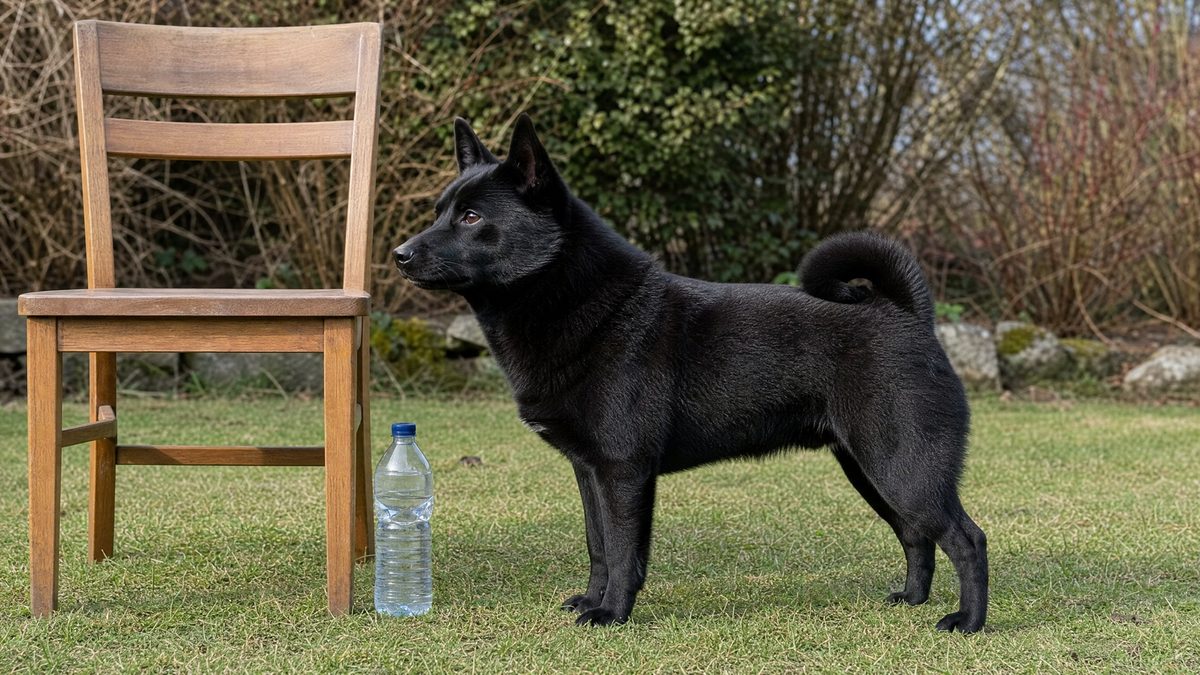
The Black Norwegian Elkhound is a small Norwegian spitz, FCI breed number 268, bred to track elk and moose silently on a leash. Males stand 46 to 49 cm at the withers with an ideal of 47 cm, females 43 to 46 cm with an ideal of 44 cm, and the coat is shining black over a soft, woolly, black undercoat.
Norway calls it Norsk Elghund Sort, the black elk dog, and the Norwegian breed federation calls it the smallest of the nine elkhound breeds. The FCI standard describes a typical spitz, squarely built, with black hair lying rather close to the body, erect pointed ears, a tail tightly curled over the back, a proud rise of neck, muscular and athletic. Height at the withers equals length of body, and length of muzzle equals length of skull.
The breed's job explains almost everything about it. A bandhund is a leashed tracking dog: the handler holds the line, the dog works the air scent, and the pair closes on a standing moose without a sound. Norsk Kennel Klub puts it plainly, that the dog should stay calm and silent in contact with game so the handler can approach undetected. The Norwegian federation says the breed has become a specialist at this through systematic breeding, and that there are no known loose-hound lines within the breed at all.
The size and weight numbers do not agree
Three sources give three different weights, and the breed standard gives none. FCI-268 prints heights and no weight whatsoever. The Norwegian federation says bitches weigh around 13 kg and males around 15 kg. Wikipedia prints 16 to 20 kg. An Indian retail page prints 18 to 27 kg for males and 16 to 25 kg for females. A 27 kg dog standing 47 cm at the shoulder would not be the athletic animal the standard describes.
A peer-reviewed clinical study offers an independent check. Berg and colleagues examined 32 dogs across black Norwegian elkhounds and Brittanys and reported a median weight of 14.50 kg among the affected group. That sits almost exactly on the Norwegian federation's 13 to 15 kg and nowhere near the Indian retailer's range.
| Source | Male | Female | What it is |
|---|---|---|---|
| FCI-Standard N° 268 | not stated | not stated | The breed standard. Gives height only |
| Norske Elghundklubbers Forbund | around 15 kg | around 13 kg | The Norwegian breed federation that runs the studbook work |
| Wikipedia | 16 to 20 kg | 16 to 20 kg | Single range, no sex split, cites the FCI standard which prints no weight |
| GoofyTails (India) | 18 to 27 kg | 16 to 25 kg | Indian retailer, no source given |
| Berg et al. 2025 | median 14.50 kg (mixed sample) | median 14.50 kg (mixed sample) | Clinical study, 32 dogs of two breeds |
Where a figure is load-bearing, take the Norwegian federation's 13 to 15 kg. It is the body that keeps the register, and it is corroborated by the only clinical study that weighed these dogs. Anything above 20 kg has no source behind it.
A history of nearly disappearing twice
The breed has existed as its own line since the middle of the 1800s, when it was called the Dyrehund. The first standard for the Sort Dyrehund was written in 1895, the name Norsk Dyrehund first appears in the studbook's breed list in 1903, and the breed type has been more or less unchanged since the standard was approved in 1905. Black dogs were first shown in 1877, when every spitz was judged together in a single class called elk and bear dogs.
Then it lost. In the first half of the twentieth century Scandinavian elkhound breeding concentrated almost entirely on the Grey, and the black dog fell into the background. By the mid 1950s the population was very small and close to dying out, and a handful of enthusiasts rebuilt it from the best of the few dogs that remained. The rebuilding involved extensive inbreeding, including father to daughter, brother to sister and mother to son matings. Every dog alive today descends from that bottleneck, which is why the modern breeding rules are as strict as they are.
Separate breed or colour variety? Reading FCI-268 against FCI-242
Under the FCI the Black Norwegian Elkhound is a separate breed, not a colour of the Grey. FCI-268 (Norsk Elghund Sort) and FCI-242 (Norsk Elghund Grå) are two numbered standards, published on the same day, both translated by Norsk Kennel Klub, and they differ in far more than colour.
Both documents print their own breed name inside the file, which is the check that matters. The header of the first reads FCI-Standard N° 268, (NORSK ELGHUND SORT), (Norwegian Elkhound Black). The header of the second reads FCI-Standard N° 242, NORSK ELGHUND GRÅ, (Norwegian Elkhound Grey). Both are dated 09.08.1999, both sit in Group 5 Section 2 Nordic Hunting Dogs, and both carry a working trial requirement in Norway, Sweden and Finland only. The FCI recognised 268 on a definitive basis on 7 October 1965.
Set the two side by side clause by clause and the differences are structural.
| Clause | Black, FCI-268 | Grey, FCI-242 |
|---|---|---|
| Utilization | Hound for elk-hunting | Dog for elk-hunting |
| Ideal height, males | 47 cm (range 46 to 49) | 52 cm |
| Ideal height, females | 44 cm (range 43 to 46) | 49 cm |
| Skull | Nearly flat | Slightly arched |
| Head | Clean and rather light | Lean |
| Chest | Relatively deep, good spring of ribs | Broad and deep, good spring of ribs |
| Underline and belly | Slightly tucked up | Almost straight |
| Coat | Dense and rough, lying close to the body | Medium length, thick, coarse, abundant outer coat |
| Undercoat | Soft, woolly and black | Soft, light grey |
| Colour | Shining black, a little white on chest and feet tolerated | Grey of various shades, with a harness marking |
| Naturally short tail | Serious fault | Disqualifying fault |
| Hind dewclaws | Not desired | Disqualifying fault |
| Colour other than the standard | Not listed as disqualifying | Any variety in colour other than grey disqualifies |
| Separate skin clause | None | Firm, without wrinkles on the head |
The five centimetre gap at ideal height is the clearest single fact. A 47 cm male against a 52 cm male is not a shade difference, and the Grey is heavier with it: the UK standard gives the Grey approximately 23 kg for dogs and 20 kg for bitches, against the Norwegian federation's 15 kg and 13 kg for the Black. Divide 23 by 15 and the Grey male is roughly 1.5 times the Black male by weight.
They also do different jobs
The two standards describe two hunting methods. The AKC standard for the Grey says the dog holds moose at bay by barking and dodging attack. Norsk Kennel Klub says the Black should stay calm and silent in contact with game. One breed announces the moose, the other conceals the hunter. Selection has run in opposite directions on the single most audible trait a hunting dog has.
One studbook or two
The two populations are managed as separate closed studbooks. The Norwegian breed federation's breeding strategy treats the Black as a small and closed population, calculates its effective population size on its own pedigrees, and states that there is little opportunity to bring in breeding material from other countries because there are no sustainable populations of the breed anywhere else. A breed that could legally take a Grey mate would not describe itself as short of breeding animals. Norsk Kennel Klub registers the two separately in its own statistics, as norsk elghund grå and norsk elghund sort, on separate rows with separate ranks.
Neither FCI standard says in so many words that crossing the two is forbidden, and no document reviewed here prints an explicit interbreeding rule. What the documents do show is two numbered standards, two studbook rows, two sets of breeding criteria and an explicit statement that no foreign breeding stock is available. That is a separate breed in practice. A reader who wants the formal registry rule should ask Norsk Kennel Klub directly rather than take it from any page, including this one.
What each kennel club actually says about a black elkhound
Registries split into two camps. The FCI, Norsk Kennel Klub and the American Continental Kennel Club treat the Black as its own breed, while the AKC, the UKC and the UK Royal Kennel Club recognise only the Grey and explicitly rule solid black out of the ring.
This is the fact that most confuses buyers, because a search for the breed returns AKC and UKC pages that are about a completely different dog.
| Registry | Position | The wording |
|---|---|---|
| FCI | Separate breed, number 268 | Recognised on a definitive basis 7 October 1965, Group 5 Section 2 |
| Norsk Kennel Klub | Separate breed | Own breed page and own row in the registration statistics |
| Norske Elghundklubbers Forbund | Separate breed | Own breeding committee (AU NES) and own breeding strategy document |
| Continental Kennel Club (USA) | Separate breed | Listed in Breed Group 2, Spitz and Nordic Breeds |
| American Kennel Club | Not recognised | Disqualifications: An overall color other than gray |
| United Kennel Club | Not recognised | Any overall color other than gray, as described; such as red, brown, solid black, white or other solid color |
| The Royal Kennel Club (UK) | Not recognised | Any other colour or combination of colours unacceptable |
| Kennel Club of India | No listing found | No KCI breed entry for either elkhound was located |
The AKC standard was approved on 13 December 1988 and took effect on 1 February 1989. Its colour clause reads that any overall color other than gray as described above, such as red, brown, solid black, white or other solid color, disqualifies, and the disqualifications line repeats it. The UKC standard, revised 1 July 2008, uses almost identical wording and names solid black in the list. The Royal Kennel Club, last updated 1 April 2025, prints the sentence in bold: any other colour or combination of colours unacceptable.
So a Black Norwegian Elkhound entered in an AKC or UKC conformation class as a Norwegian Elkhound would be disqualified on sight. That is not a judgement about the dog. It is a statement that those registries hold one breed where the FCI holds two.
The colour codes give the game away
The AKC's own registration colour list for the Norwegian Elkhound contains seven entries and every one of them is a grey combination: Gray Black and Silver (106), Silver Gray and Black (190), Gray and Black (101), Silver and Black (177), Black White and Silver (033), Black and Gray (012), and Black and Silver (016). Those codes describe a banded grey coat where the guard hairs carry black tips. There is no code for a solid black dog, because under that standard no such dog exists.
The naming muddle reaches the laboratories too
Commercial genetic testing has inherited the confusion. Genomia lists three disease tests for the breed it calls Norwegian Elkhound Black (Norsk Elghund Sort), and two of them are named for the Grey's name: Ataxia in Norwegian Elkhound and POAG in Norwegian Elkhounds, sold together with PRA-prcd as a combination. A buyer reading a test certificate has to know which dog the test was validated in before the result means anything.
No Indian registry paperwork can make a Black Norwegian Elkhound a recognised breed here, because no Indian registry entry for it was found. A seller offering KCI papers for one is offering paperwork for a breed the club does not appear to list. Ask which registry, which breed name, and which number, then check the number against the FCI nomenclature yourself.
How rare it is, in registration numbers
Norsk Kennel Klub registered 282 Black Norwegian Elkhounds in 2024 against 631 Greys, which makes the Black the 21st most registered breed in Norway and the Grey the 9th. Those are the real registration numbers, taken from NKK's own published statistics spreadsheet covering 292 breeds.
Rarity is the word every ranking page uses and none of them quantifies. Here is the actual series. NKK publishes a spreadsheet of the most registered breeds with columns for 2010, 2015 and then every year from 2018 to 2024.
| Year | Black (Norsk elghund sort) | Grey (Norsk elghund grå) | Grey per Black |
|---|---|---|---|
| 2010 | 184 | 958 | 5.2 |
| 2015 | 207 | 870 | 4.2 |
| 2018 | 228 | 767 | 3.4 |
| 2019 | 257 | 743 | 2.9 |
| 2020 | 230 | 811 | 3.5 |
| 2021 | 362 | 968 | 2.7 |
| 2022 | 371 | 863 | 2.3 |
| 2023 | 271 | 706 | 2.6 |
| 2024 | 282 | 631 | 2.2 |
| Total of the nine years | 2,392 | 7,317 | 3.1 |
Both columns sum exactly to their printed totals, which is the first thing to check on any table like this. The nine Black figures add to 2,392 and the nine Grey figures add to 7,317, both matching the spreadsheet's own Totalsum column.
Read the last column and the interesting story is not that the Black is rare. It is that the gap is closing, and closing because the Grey is falling rather than because the Black is rising fast. Between 2010 and 2024 Grey registrations fell from 958 to 631, a drop of 327 dogs or 34 percent. Black registrations rose from 184 to 282, a gain of 98 dogs or 53 percent. The ratio went from 5.2 Greys per Black to 2.2.
Put against everything else Norway registers
NKK registered 24,915 puppies of all breeds in 2024. The Black's 282 is 1.13 percent of that; the Grey's 631 is 2.53 percent. For scale, the Jämthund, the Swedish elkhound, took 346 registrations in Norway the same year, more than the Black, and the Swedish White Elkhound took 13. So within Norway this is a genuinely small breed but not a vanishing one, and it is not the smallest of the elkhounds.
The published annual figures disagree with each other
Three Norwegian sources give three different pictures of the same years, and a reader should see all three. Norsk Kennel Klub's own breed page still says the annual registration figure now lies between 180 and 220 puppies, which was true around 2010 to 2018 and has not been true since. The breed federation's information page says around 250 puppies are born a year with an average litter of 5. The federation's breeding strategy document says 2,554 individuals were registered from 2010 to 2020, an average of 255 a year, and that in 2021 and 2022 respectively 371 and 369 puppies were registered.
That last pair does not match the registry. NKK's spreadsheet gives 362 for 2021 and 371 for 2022. The federation's 371 appears to be the 2022 figure carried back a year, and its 369 for 2022 matches nothing. The difference is small, but it matters because the breeding strategy uses those numbers to argue the population is stable.
Use 282 for 2024 and cite the NKK spreadsheet. It is the registry's own file, it carries a nine-year series, and both breed columns sum exactly to their printed totals. Treat the breed club's round '250 a year' as a description rather than a count, and treat NKK's own breed-page text of 180 to 220 as out of date.
Effective population size is the number that should worry a breeder
Counting puppies overstates how much genetic variation the breed holds. The population report prepared by Aninova in 2023 calculated the founder effective population size for the most recent generation, dogs born 2017 to 2021, at 33. The same report puts the current Ne at 53, based on inbreeding among dogs born in the last two generations, against a target of 50 considered necessary for long-term conservation. Founder Ne has climbed steadily across the generations, from 17 for dogs born 1972 to 1976, through 24 for 1992 to 1996, to 33 for 2017 to 2021.
So roughly 280 puppies a year rest on the genetic equivalent of a few dozen founders. The report describes the rise in inbreeding as high but not critical, on the grounds that most of the inbreeding is old, and it notes that average litter size has held at around 5 puppies for the last ten years with no sign of inbreeding depression.
Price in India: there is no price, and here is the proof
No Indian seller publishes a Black Norwegian Elkhound puppy price, because no Indian seller has the dog. Searching for one in India returns merchandise, breed-dropdown menus and empty product grids, and the two Indian sites that appear to offer the breed offer something else when you open them.
Start with the control, because an absence you cannot test is not evidence. Searching labrador retriever price in india on the same tool in the same session returned a full set of real Indian price pages carrying concrete rupee figures, including an ordinary marketplace band of INR 30,000 to 60,000 for pet quality, 60,000 to 90,000 for KCI registered and 90,000 to 1,20,000 for champion bloodline. The search works, the India localisation works, and Indian puppy prices are published in quantity.
Searching black norwegian elkhound price in india on the same tool returned no Indian price page at all. What it returned instead: an Etsy market page for black elkhound beanies and gifts, a US breeder directory, a UK litter-registration dropdown, a Google Open Images class-descriptions CSV, and Indian listing pages for entirely different breeds where the words appear only inside a site-wide navigation menu.
What India's biggest puppy marketplace actually serves
Mr n Mrs Pet publishes a page headed Norwegian elkhound Puppies For Sale, which claims to provide healthy, purebred KCI-certified Norwegian Elkhound puppies in India and reports 3 Result Found. Open it and the three results, grouped under a heading reading Similar breeds at other locations, are a French Bulldog in Moga, a Border Collie in Jaipur and a Newfoundland in Bangalore. Not one is an elkhound of either colour, and every price is hidden behind a View Price link that routes to a sign-up form.
The same page proves the site does hold real inventory for breeds it actually stocks. Its own most-popular list gives Shih Tzu 650 listings, Siberian Husky 549, Golden Retriever 487, Labrador Retriever 454 and German Shepherd 412. So the emptiness is specific to the elkhound, not a broken site. The breed dropdown lists Norwegian Elkhound and Norwegian Buhund, and does not list the Black at all.
The Indian retailer that ranks sixth for the query, GoofyTails, publishes a breed page with no price on it whatsoever. Its product grid returns We're sorry. There are no results for '' and, above that, the line Showing -1 Results. A negative result count is a template that was never populated. The page is a shell that exists for every breed the retailer writes about, not evidence of a market.
The currency tests, and why nothing here needs them
Indian breed pages routinely print a dollar figure run through one exchange rate and call it a rupee price, so every suspicious figure gets divided by 84.38 and by 74. On this breed there is nothing to divide, because no page produced a rupee figure attached to the dog. That is itself the finding.
For contrast, run the tests on the genuine Indian prices the control turned up. INR 30,000 divided by 84.38 is 355.5 dollars and divided by 74 is 405.4; INR 90,000 gives 1,066.6 and 1,216.2. None of them lands on a round dollar amount, because 30,000, 60,000, 90,000 and 1,20,000 are round rupee numbers written by a person in India. That is what a real Indian price band looks like. A band that resolves to 600, 800 or 1,500 dollars on division has been converted from an American list.
If you meet the figure INR 98,999 attached to this breed anywhere, ignore it. It is a recurring house price point on one Indian listing site, attached to whichever puppy is in stock, and it has been caught on eleven separate pages including breeds that site does not stock. It divides to 1,173.25 dollars at 84.38 and 1,337.8 at 74, so it is not even a currency conversion. It is a rupee-native charm price. It did not appear on any page opened for this breed, and it should never be reported as one.
One search that failed, reported as failed
PetzLover, an Indian listing site whose breed navigation includes the Black Norwegian Elkhound, could not be read. The breed URL returned HTTP 403 behind a page headed PetzLover, Verify You Are Human with a CAPTCHA image, on both a normal and a stealth-proxy fetch. No conclusion is drawn from that page in either direction. A blocked request is not a zero.
Importing one is not a route either, and the trade notice says why
Indian law permits a dog to enter the country only as a returning owner's own pet, as research stock with CPCSEA backing, or for Defence and Police use. Buying a Black Norwegian Elkhound puppy abroad and importing it to sell, breed from, or bring in on someone else's behalf is expressly refused.
DGFT Trade Notice No. 22/2022-23, dated 19 December 2022 and signed by the Deputy Director General of Foreign Trade, sets out the position. Under ITC (HS) 01061900, mammals other than those separately listed, the import policy is Restricted, subject to Policy Condition 6.
Policy Condition (7) allows import of dogs only for three purposes, quoted from the notice itself: a pet dog with valid pet book and relevant records or documents in the name of importer; dogs imported by R&D Organisations for conducting research with the recommendation of CPCSEA; and for the internal security by the Defence and Police Force. Policy Condition (8) adds that import of commercial dogs for breeding or any other commercial activities other than the purposes mentioned above is not permitted.
Paragraph 6 is blunter still. It states that any applications for trading or breeding purposes, or applications made on behalf of some another person or entity, shall be duly rejected.
- Personal baggage route. Up to two pets may enter as passenger baggage without DGFT authorisation, and only for a person transferring residence to India after two years of continuous stay abroad. Only cats and dogs may come in under baggage rules.
- Authorisation route. DGFT authorisation is required if the stay abroad was under two years, if the pet is not travelling as passenger baggage, or if more than two pets are involved. Applications for more than two go to DAH&D with justifications.
- Documents. Vaccination book, pet passport or pet book, a certificate for emotional support, and the pet's passport. Temporary imports add a return ticket and a local host's undertaking.
- Ports. Entry is allowed only through the airports and seaports of Delhi, Mumbai, Chennai, Hyderabad, Bengaluru and Kolkata and, since October 2024, Kochi airport, seven in total, with quarantine at the government station where required. The full route is set out in how to import a dog to India.
- Timing. Owners are advised to begin the authorisation application at least two months before travel, and an advance No Objection Certificate from the AQCS Regional or Quarantine Officer must be obtained seven days before travel, relaxable to three days.
Put that alongside the supply side and no lawful chain can form. The Norwegian breed federation states that there is little chance of obtaining breeding material from other countries, because the Black is a Norwegian breed and there are no sustainable populations of it elsewhere. Norsk Kennel Klub says the breed is little spread in the rest of the world, with a small stock in Sweden and individual specimens in Germany, Estonia and the USA. There is no exportable surplus to import from, and Indian law would refuse the application if there were.
The Norwegian breeding rules would stop it anyway
Even a Norwegian buyer cannot simply buy a puppy and breed it. Since 1 June 2024, NKK will not register puppies unless at least one parent is stambokført genetically free of glaucoma, and separately unless at least one parent is genetically free of ataxia. The breed committee's own criteria for an approved mating add that both parents must have a hunting-trial award, both must have achieved at least Very Good at a show, the combined hip index must be 203 or higher with neither dog carrying D or E hips, and the combined inbreeding coefficient must be under 4 over five generations.
Those conditions describe a working-dog breeding regime built around Norwegian moose hunting. No Indian breeder can satisfy them, because the hunting trial does not exist here and neither does the studbook that records it.
There is no puppy price for this breed in India because there is no supply, no registry route and no lawful import pathway for a commercial one. Anyone quoting you a figure is either selling a different dog or has not got one. That is a more useful answer than a made-up range, and it is the answer this page will keep giving until a verifiable Indian litter exists.
What it costs, and why the biggest cost has no rupee figure
No honest monthly running cost can be quoted for this breed in India, because there is no Indian owner base to draw one from. What can be priced is the health testing regime the breed carries, and the structural costs a dense black double coat adds in a hot country.
Most breed pages open the cost section with a confident monthly number. This one cannot, and saying so is more useful than inventing one. There is no Indian purchase market, no Indian breeder, no puppy price and therefore no cohort of Indian owners whose food, vet and grooming bills could be averaged. Any monthly figure you read for this breed on an Indian page has been copied from a generic medium-dog template.
What can be priced: the genetic test panel
The health testing this breed requires is real, quotable and unavoidable if you ever import one or verify a pedigree. Genomia, the laboratory that lists the breed by name, publishes these prices.
| Test | Price (USD) |
|---|---|
| POAG in Norwegian Elkhounds (primary open-angle glaucoma) | 56.00 |
| Ataxia in Norwegian Elkhound | 56.00 |
| PRA-prcd (progressive rod-cone degeneration) | 56.00 |
| Combination of all three | 128.00 |
| Premium SNP DNA profile, ISAG 2020 | 64.00 |
| Screening panel, 340 markers | 189.00 |
Buying the three separately costs 168 dollars against 128 for the combination, a saving of 40 dollars or 23.8 percent. The rupee equivalent depends on the exchange rate on the day plus international sample shipping, so no rupee figure is quoted here. What matters is that these are not optional extras. Since 1 June 2024 a Norwegian litter cannot be registered unless at least one parent is recorded free of each of the first two.
The cost structure that is specific to this dog in India
- Cooling, not food, is the recurring cost. A 15 kg dog eats like a 15 kg dog. A 15 kg dog with a black woolly undercoat in Chennai needs a cooled room for eight months, and that is an electricity bill rather than a pet bill.
- Professional drying after every bath. Blow-drying a double coat to the skin is a longer grooming appointment than a short-coated dog of the same size, and in monsoon cities it is not optional.
- Hip radiography. With heritability estimated as high as 0.48 in this breed, screening is worth the money, and the Norwegian scheme grades A to E rather than the OFA scale.
- Annual eye examination. Glaucoma in this breed typically ends in euthanasia at 5 to 7 years, so intraocular pressure checks earn their place even in a gene-tested dog.
- Tick prevention, year round. A dense black undercoat conceals ticks that a short pale coat would show, and Indian tick pressure runs all year rather than one season.
Even in Norway this is not an expensive dog to feed or groom. In India the cost that actually bites is the one nobody budgets: a dog that cannot be exercised outdoors for most of the day for most of the year needs indoor enrichment, cooling, and an owner's time, every day, for twelve to fifteen years. If that budget is not there, the money question is already answered.
Heat tolerance: why this breed is close to the worst possible match for India
The Black Norwegian Elkhound has poor heat tolerance, and the reason is mechanical rather than a matter of opinion. It carries a dense double coat with a woolly undercoat, that undercoat is black rather than pale, and it was selected in a place whose annual mean temperature is 2.7 degrees Celsius.
Take the coat from the standard first, because that is the part that is not arguable. FCI-268 describes hair that is dense and rough but lying close to the body, made up of a longish and coarse topcoat over a soft, woolly and black undercoat, and gives the colour as shining black with at most a little white on chest and feet. Lacking undercoat is listed as a fault, so a thin-coated individual is a breeding fault rather than a hot-climate advantage.
Compare the Grey's clause. FCI-242 gives the Grey a light grey undercoat, and grey outer hair whose colour comes only from black tips, with lighter, untipped hair on chest, belly, legs and the harness marking. So the Black is not simply a darker version of the same coat. Its insulating layer is dark all the way to the skin, where the Grey's is pale.
How a dog actually sheds heat, and what the coat does to each route
Dogs have four ways to lose heat and a double coat interferes with three of them.
- Panting does most of the work. Evaporation from the tongue and airway is the dog's main cooling route, and it is the one route a coat does not block. It is also the one route that humidity destroys, because evaporation slows as the air approaches saturation.
- Vasodilation brings hot blood close to the skin, especially at the ears and face. A dense coat over the trunk means most of that surface cannot radiate freely.
- Sweating is negligible. Merocrine sweat glands sit only in the paw pads.
- Radiation and convection from the body surface are what the undercoat is built to prevent. That is the point of insulation, and insulation works in both directions.
The American Kennel Club's Chief Veterinary Officer states the trade-off directly: a dog's coat acts as an insulator, and the trapped air between the two layers lets the dog regulate its temperature. In a Norwegian autumn that trapped air is the difference between a working dog and a cold one. Under Indian sun it is a layer that slows heat leaving the body while a black surface takes solar radiation on.
The origin climate, measured
The breed developed in the border country between Norway and Sweden, and the earliest records place the black dogs from Nordland down to Halden and west to Telemark, with the strongest early populations in Hedmark and Østerdalen. Taking Elverum in Østerdalen as the reference point and querying NASA POWER by explicit coordinates, 60.8819 north and 11.5623 east, gives a twenty-year monthly climatology for 2001 to 2020. One label needs care throughout this page. NASA POWER's T2M_MAX is the highest temperature the climatology records for that month across the whole twenty years, not an average daily high, so every record-high figure below describes the hottest day on file rather than a routine afternoon.
| Measure | Value |
|---|---|
| Annual mean temperature | 2.7 C |
| Warmest month mean (July) | 15.1 C |
| Coldest month mean (January) | -8.3 C |
| Months with a mean at or below 0 C | 5 (November to March) |
| July record high | 30.6 C |
| Relative humidity, January | 98 percent |
| Relative humidity, July | 81 percent |
Fifteen degrees is the warmest average month this breed's home range has. Five months of the year the mean sits at or below freezing. The dog was selected to work all day in an autumn that arrives cold and wet, which is exactly why NKK describes the coat as one that keeps out the heavy Scandinavian autumn rain and endures the cold.
Every temperature and humidity figure on this page comes from NASA POWER, queried point by point with latitude and longitude, so a request for one place cannot silently return another. The returned coordinates were checked against the requested ones for all eight locations. Named-city climate pages have served the wrong document repeatedly on this site, so none was used.
City by city: what an Indian year does to an Arctic coat
Chennai's coldest month averages 9.0 degrees warmer than the warmest month in this breed's Norwegian home range. That single comparison settles the question for coastal and southern India, and only Ladakh and the high Himalaya reverse it.
All figures below come from the same NASA POWER climatology, 2001 to 2020, each queried by coordinates. Elverum's warmest month mean of 15.1 C is the benchmark column, because a month above it is a month hotter than anything the breed's origin ever averages.
| Place | Annual mean C | Coldest month mean C | Warmest month mean C | Hottest month record high C | Months above 15.1 C |
|---|---|---|---|---|---|
| Elverum, Norway (breed home range) | 2.7 | -8.3 (Jan) | 15.1 (Jul) | 30.6 (Jul) | 0 |
| Oslo, Norway | 4.6 | -5.9 (Jan) | 16.1 (Jul) | 31.2 (Jul) | 2 |
| Leh, Ladakh | -2.8 | -16.0 (Jan) | 10.2 (Jul) | 24.7 (Jul) | 0 |
| Shimla, Himachal Pradesh | 21.1 | 10.8 (Jan) | 30.2 (Jun) | 43.9 (Jun) | 9 |
| Bengaluru, Karnataka | 23.7 | 20.2 (Dec) | 28.4 (Apr) | 40.4 (Apr) | 12 |
| Delhi | 25.6 | 13.6 (Jan) | 35.9 (Jun) | 48.8 (Jun) | 11 |
| Mumbai, Maharashtra | 26.8 | 23.2 (Jan) | 31.2 (May) | 44.9 (Apr and May) | 12 |
| Chennai, Tamil Nadu | 27.9 | 24.1 (Jan) | 31.5 (May) | 42.7 (May) | 12 |
Delhi's annual mean of 25.6 C is 22.9 C above Elverum's 2.7 C. In Mumbai, Chennai and Bengaluru there is no month at all cooler than a Norwegian July. Delhi manages exactly one, January at 13.6 C, which is 1.5 C below Elverum's July.
Dry heat and wet heat fail the dog in different ways
Delhi and Chennai are both bad and they are bad by different mechanisms. Delhi's June averages 35.9 C at 36 percent relative humidity, and the highest June temperature on the twenty-year record for that cell is 48.8 C, which is a radiant and convective load a black coat absorbs directly. Chennai never gets that hot, averaging 31.5 C in its worst month against a recorded May high of 42.7 C, but its humidity sits between 64 and 82 percent every month of the year. Since panting is evaporative, humid heat attacks the only cooling route the coat does not already obstruct.
Mumbai is the worst combination on the table. Its June to September relative humidity runs 80, 90, 90 and 89 percent while mean temperatures hold between 26.1 and 28.7 C. That is four consecutive months in which a dense double coat cannot radiate and panting barely evaporates.
Where it is less bad, and the caveats on those rows
Two Indian places genuinely suit this breed, and both come with a measurement caveat.
- Leh and high Ladakh. The grid cell returns an annual mean of -2.8 C and a July mean of 10.2 C, colder than Elverum on both counts. Zero months exceed the Norwegian summer. The caveat is that the NASA POWER cell for these coordinates averages to 4,533 m elevation, well above Leh town at roughly 3,500 m, so the real town is warmer than the row. Even allowing for that, Ladakh is the one part of India where the coat is an asset rather than a liability.
- Shimla and the high Himalaya. Nine of twelve months exceed the Norwegian benchmark on this row, which looks poor. The caveat runs the other way: the grid cell averages to 898 m, far below Shimla town at roughly 2,200 m, so the true town is materially cooler than the figures shown. Treat the Shimla row as an upper bound on the heat, not a measurement of the town.
- Nowhere else. Bengaluru is often sold as India's temperate city and its April still averages 28.4 C at 49 percent humidity, 13.3 C above Elverum's warmest month, with a recorded April high of 40.4 C. Being the coolest big city in a hot country is not the same as being cool.
This breed rates 1 out of 5 for heat tolerance, the lowest rating this site gives. A dense double coat with a black woolly undercoat, on a dog selected where the annual mean is 2.7 C, is a poor choice almost everywhere in India. It is less bad above roughly 2,500 m in Ladakh, Lahaul and Spiti, and the high reaches of Himachal, Uttarakhand and Sikkim, where a real winter exists. In Delhi, Mumbai, Chennai, Kolkata, Hyderabad, Ahmedabad, Pune and Bengaluru it is the wrong dog, and no amount of air conditioning changes what happens on the walk.
None of that is a claim that the dog would die on contact with Indian air. It is a claim about the daily quality of its life. A dog that cannot be walked between about 08:00 and 18:00 for eight months of the year, from a breed whose own registry says it is a distinct hunting dog not suited as a purely companion dog, will be a frustrated animal. The heat rating and the exercise requirement collide, and the collision is the real argument against the breed here.
Temperament: calm at home, silent at game, and noisier at the door than you were told
The Black Norwegian Elkhound is a calm, affectionate, family-bonded dog with an unusually clean temperament record, and it is also an independent hunting dog with a strong prey drive that barks at the doorbell. The largest owner survey of the breed puts poor temperament at 0.1 percent and doorbell barking at around 32 percent.
The 2021 Norwegian health and behaviour survey collected 763 responses, and its behaviour section is the best evidence anyone has on this breed's character. Read the good numbers first, because they are genuinely good.
| Question | Result |
|---|---|
| Satisfied or very satisfied with general behaviour | 96.7 percent |
| Rated behaviour as poor | 0.1 percent |
| Perceived as happy (right or very right) | 98 percent |
| Perceived as secure and confident | 90 percent |
| Perceived as tough | 65 percent |
| Anxious in some situations | about 22 percent |
| Growls at adult strangers | about 1 percent |
| Shows aggression if a stranger tries to pet the dog | 0.5 percent |
| Owner thinks the dog barks too much | 17 percent |
| Tends to bark at the doorbell | about 32 percent |
| Strong or very strong urge to chase game | 57 percent |
| Would readily chase cats | 53 percent |
| Aggressive signals to same-sex dogs on leash, often or very often | 11.5 percent |
| Fights often when off leash | 3.1 percent |
| Strong or very strong fear of fireworks | about 15 percent |
| Strong or very strong separation anxiety | 4.2 percent |
Correcting the 'rarely barks' claim
Several pages say this breed rarely barks, and the claim needs splitting in two. It is true at work. The whole point of a bandhund is that it stays calm and silent in contact with game so the handler can approach undetected, and that silence is what the breed was systematically selected for. It is not true at home. Seventeen percent of Norwegian owners think their dog barks too much, about a third report barking at the doorbell, and roughly 8 percent report frequent barking when someone passes the house or garden. In a Norwegian farmhouse that is background noise. In a Mumbai flat with a shared lift lobby it is a neighbour complaint.
Prey drive is the trait that decides Indian suitability
Fifty-seven percent with a strong or very strong urge to chase game, and 53 percent that would chase cats, is a working hunting dog's profile. India's streets carry free-roaming dogs, cats, cattle, monkeys and poultry within a hundred metres of most homes. A dog bred to lock onto large game and pull toward it on a line is not a dog you drop the leash on at a Bengaluru park, and secure fencing matters more here than in the country the breed came from.
Diwali, and the one number Indian owners should read twice
About 15 percent of these dogs have strong or very strong fear of fireworks, and 4.2 percent have strong fear of loud bangs and gunshots. That figure comes from Norway, where fireworks are concentrated into New Year's Eve. An Indian dog meets a fortnight of Diwali, plus weddings, plus festival processions. Plan the desensitisation work from puppyhood rather than the week before.
Who should not buy one
- First-time owners. Norsk Kennel Klub states outright that this is a distinct hunting dog which is not suited as a purely companion dog.
- Households in hot coastal cities. The heat rating is 1 out of 5, and the exercise requirement does not shrink to match.
- Homes with a resident cat. Fifty-three percent would chase one.
- Anyone wanting an off-leash park dog. The recall fight is against 100 years of selection for pulling toward game.
- Anyone wanting a quiet apartment dog. The doorbell figure settles it.
Who should? Someone in a genuinely cold part of India, with a fenced space, an active outdoor routine, previous experience of an independent northern breed, and the patience to socialise a puppy properly before it is five months old.
Training an independent tracker whose hunting drive is only 12 percent heritable
Train this breed with short, cooperative, reward-based sessions and accept that recall against live game will never be perfect. The most useful training fact about the breed comes from its own research programme: hunting desire is roughly 12 percent heritable, which means about 88 percent of what the dog becomes is training, environment and experience.
That figure comes from the FoU Elghundprosjektet of 2016, led by Marthe Wetten, which estimated the heritability of jaktlyst, the hunting drive and search, at around 12 percent. The breed federation's own conclusion is that the other components develop largely through environmental influence, meaning training and experience. Read that as an owner rather than a breeder and it says the dog you get is mostly the dog you make.
Norsk Kennel Klub rates the breed's cooperation as high and its activity level as medium, and says the ability to cooperate with the handler is a highly valued trait in the breed. That is unusual for a northern spitz and it is the breed's single biggest training advantage. The Norwegian federation adds that these dogs form strong bonds with their owners and need a fair and secure leader.
What works
- Reward what you want, early. An Indian retail source that otherwise gets a lot wrong is right on this: repetitive or harsh training methods are often ineffective with an independent-minded breed.
- Work with the nose, not against it. This is an air-scenting dog. Scent games, find-the-food and tracking exercises engage the thing it was built for, and they can be run indoors during the hot months.
- Keep sessions short. Five to ten minutes, several times a day, beats a half-hour drill.
- Train the leash first. A bandhund is meant to work at the end of a line. Loose-leash walking and a reliable stop are more valuable than off-leash recall you will never fully trust.
- Socialise before five months. Eighty-six percent of Norwegian owners took the puppy at 8 to 10 weeks or later, 80 percent of dogs grew up in families with children, and 46 percent grew up with other dogs. That density of early exposure is part of why the temperament record is as clean as it is.
What this breed resists
Perfect recall around game is the honest limit. Fifty-seven percent of surveyed dogs show a strong or very strong urge to chase game and 53 percent would chase cats. Around 11.5 percent show aggressive signals toward same-sex dogs on leash often or very often, so same-sex dog-to-dog work needs a plan rather than optimism.
The breed is trainable in the sense that matters, meaning it wants to work with you, and it is not biddable in the way a Labrador is. Those are different things and buyers confuse them.
Realistic timelines
| Goal | Realistic window | Note |
|---|---|---|
| House training | 10 to 16 weeks | Straightforward. A clean, den-oriented breed |
| Name, sit, recall in the house | 8 to 14 weeks | Fast. Cooperation is rated high |
| Loose-leash walking | 4 to 8 months | The core skill for a leash-hunting breed |
| Reliable stop or wait outdoors | 6 to 12 months | Worth more than recall in Indian traffic |
| Settling at the doorbell | 6 to 18 months, ongoing | About 32 percent of the breed barks at the door |
| Recall past a running cat | Never assume it | 53 percent would give chase |
One practical Indian constraint shapes the whole plan. Training happens outdoors and outdoors is closed for most of the day for most of the year, so the schedule collapses into a short window before 07:30 and another after 19:00. Build the indoor scent-work habit in the first month, because it is the only thing that will carry the dog through April to June.
Daily exercise, and the Indian walking window that will not fit it
Give this breed 60 to 90 minutes of real outdoor work a day, split across two sessions, from puppyhood onward. Norsk Kennel Klub rates its activity level as medium and says regular walks in forest and field from the puppy stage lay the foundation for a good hiking and hunting companion.
The registry's own description is the right starting point. It says the black elkhound is fond of exercise and easy to keep in shape, and that regular trips in forest and countryside right from the puppy stage build the future companion. Activity level is rated middels, medium, which is worth stressing because buyers assume every Nordic spitz is a Siberian Husky. It is not. This is a medium-energy dog with a high mental workload, not an endurance sled dog.
What it was built for still sets the bar. The breed federation writes that a dog without the right proportions and spring cannot hunt effectively in all kinds of terrain for days on end. Days on end, in cool weather, on soft ground.
The Indian arithmetic
Now put that against the walking window. Delhi's June monthly mean is 35.9 C, day and night together, and the highest June temperature the climatology records for that cell is 48.8 C. The mean alone is 20.8 C above the hottest month Elverum ever averages. In Mumbai the problem is different but no smaller: four consecutive months at 80 to 90 percent relative humidity, which shuts down the panting that a dense black coat leaves as the dog's only cooling route.
| City | Hardest months | Workable window | What it means |
|---|---|---|---|
| Delhi | April to June | Before 06:30 and after 20:30 | Roughly 3 months of near-total restriction, radiant heat is the problem |
| Mumbai | June to September | Before 07:00 and after 20:00 | Humidity of 80 to 90 percent, not temperature, is the limit |
| Chennai | March to September | Before 06:30 and after 20:00 | Humid all year, so there is no easy season |
| Bengaluru | March to May | Before 07:30 and after 19:30 | The most workable big city, still a 28.4 C April mean |
| Shimla and higher | May and June only | Most of the day | The Himalayan foothills are the realistic mainland option |
| Leh and high Ladakh | None | All day | The one Indian climate that suits the coat |
What happens without the exercise
An under-exercised dog of this breed becomes a vocal one. The barking figures already run at 17 percent of owners thinking the dog barks too much and about 32 percent barking at the doorbell in a country where the dog gets a daily forest walk. Remove the walk and add an apartment and those numbers move the wrong way. The Indian retailer's own page lists mental stimulation as necessary to prevent boredom and excessive barking, and names obesity if under-exercised among the breed's health concerns.
Puppy exercise, and one rule with real evidence behind it
Keep a puppy under three months off stairs. A Norwegian prospective cohort of 501 client-owned dogs from 103 litters found that puppies walking on stairs from birth to 3 months of age had an increased risk of developing hip dysplasia, while off-leash exercise from birth to 3 months, birth during spring and summer, and birth on a farm were each associated with decreased risk. The authors' recommendation is that puppies under three months should not have access to stairs but should get outdoor exercise on soft ground in moderately rough terrain.
Krontveit's cohort was 125 Newfoundlands, 133 Labrador Retrievers, 180 Leonbergers and 63 Irish Wolfhounds, which sum exactly to 501. No elkhound of either colour was in it. Applying it to a 15 kg spitz is a transfer, and a cautious one, since three of the four breeds are giants where growth-related joint risk is highest. The Norwegian elkhound federation cites the same study in its own hip report and describes the summer and farm effect as a halved risk, a magnitude the published abstract does not print. Take the direction, treat the size of the effect as unquantified, and note that an Indian flat with a stairwell is exactly the housing the study warns about.
Grooming a double coat that blows twice a year, in Indian humidity
Brush this coat two to three times a week year round and daily through each moult, and never let it stay damp. The Norwegian registry rates grooming as light work, which is true in Norway and only half true here, because Indian conditions change both how often the dog sheds and what happens to skin under a wet undercoat.
The coat itself is simpler than it looks. FCI-268 describes hair that is dense and rough but lying close to the body, short and smooth on the head and the front of the legs, longer on chest and neck, the back of the legs and the underside of the tail, formed of a longish coarse topcoat over a soft woolly black undercoat. There is no furnishing to trim, no feathering to mat and no skirt to clip. Norsk Kennel Klub rates coat care as litt, meaning little, and says the coat requires little maintenance. Wikipedia's care note recommends brushing two or three times a week.
The moult is the whole job
Twice a year the undercoat lets go in sheets. The AKC calls the elkhound coat two-ply and warns buyers that during shedding season they will find tumbleweeds of undercoat rolling around the house. On the Black that undercoat is black rather than silver, so the drifts show on light floors and light upholstery instead of dark ones.
In India the twice-a-year pattern often stops being twice a year. An Indian veterinary chain notes that in the country's warmer climate some indoor dogs shed all year because artificial lighting, indoor cooling and inconsistent seasonal temperature exposure disrupt the photoperiod cue that drives the moult. An owner in Chennai or Mumbai should plan for continuous moderate shedding rather than two intense weeks, which changes the tool and the schedule.
- Undercoat rake, twice weekly, all year. An undercoat rake or slicker reaches the woolly layer. A bristle brush only tidies the guard hair and leaves the dead undercoat sitting against the skin.
- Daily through a moult. Ten minutes a day beats an hour on Sunday, and it keeps the shed hair out of the house.
- Brush in the cool hours. Brushing at 15:00 in May in Delhi is unpleasant for both of you and the dog will not stand for it.
- Dry to the skin after every bath and every soaking. This is the Indian rule that Norwegian guidance never has to state.
- Check for ticks every time you brush. A dense black undercoat hides an engorged tick far better than a short pale coat does.
Air drying is Norwegian advice, and it does not transfer
Overseas care guidance for thick-coated breeds routinely says to towel the dog and let the coat dry naturally. That is sound in an Elverum autumn where the air is cold. It is poor advice in a Mumbai monsoon, where June to September relative humidity runs 80 to 90 percent. A woolly undercoat under a monsoon does not dry, and the layer against the skin stays warm and wet for hours. Blow the coat dry, working the dryer down to the skin, and pay attention to the ruff, the chest, the trousers and the underside of the tail, which is where the standard says the hair is longest. An Indian veterinary source makes the same point from the other direction, noting that professional blow-drying after bathing helps separate dense undercoat layers properly.
The Norwegian skin baseline, so you know what abnormal looks like
The 2021 Norwegian health and behaviour survey of the breed collected 763 owner responses, about 38 percent of the 1,986 dogs registered with NKK over 2010 to 2019. On skin, coat and ears, 120 of 707 owners who answered reported any problem, which is 17.0 percent.
| Finding | Dogs | Percent of 707 |
|---|---|---|
| Any skin, coat or ear problem | 120 | 17.0 |
| Itching or skin irritation | 47 | 6.6 |
| Hairless patches | 18 | 2.5 |
| Anal gland problems | 15 | 2.1 |
| Has had ear inflammation, but rarely | 14 | 2.0 |
| Wet eczema (hot spots) | 8 | 1.1 |
| Excessive shedding or hair loss | 9 | 1.3 |
| Frequent or chronic ear inflammation | 1 | 0.1 |
| Demodex mange | 0 | 0.0 |
One dog in 707 with chronic ear inflammation is the number to hold on to. That is the Norwegian baseline for a breed with erect, well-ventilated, high-set ears, in a cool dry-aired country. An Indian owner whose dog is scratching its ears every monsoon is not seeing a breed trait, and should not be told it is one.
Do not shave it, and it is not hypoallergenic
Never shave a Black Norwegian Elkhound to cool it down. Shaving a double coat removes the insulating layer that also slows heat coming in, raises heat-stroke risk, exposes black skin to sun, and can permanently change how the coat regrows. It does not reduce shedding either.
This is the single most common thing owners of double-coated dogs do wrong in hot countries, so it deserves a source rather than an assertion.
The American Kennel Club's Chief Veterinary Officer, Dr Jerry Klein, puts it as follows: a dog's coat acts as an insulator, and shaving that coat to reduce shedding or supposedly to keep the dog cool also eliminates that insulating layer of fur, makes the dog susceptible to heat stroke, and can result in improper hair growth and the possibility of follicle damage. He adds that the coat protects against sunburn and decreases the risk of skin cancer. The same source explains the regrowth problem: when a double coat is shaved to the skin, the undercoat hair grows back faster and sometimes crowds out the slower-growing guard hairs, changing the texture and colour of the coat.
An Indian veterinary chain reaches the same conclusion for Indian conditions, and names the specific outcome. It reports that vets and certified groomers do not recommend clipping healthy double-coated dogs in summer, lists sunburn, skin irritation, uneven regrowth, permanent coat-texture change and increased heat exposure among the risks, and names post-clipping alopecia, where the coat regrows very slowly or unevenly after shaving. It also disposes of the shedding argument: double-coated dogs keep shedding because the hair growth cycles remain active, so shaving only makes the shed hairs shorter and less visible.
When clipping is actually indicated
Clipping a double coat has real medical indications and an Indian owner will occasionally meet one. The Indian veterinary source lists severe matting, skin infections, surgical procedures, tick infestation management, wound treatment and severe hygiene problems, and notes that in a heavily matted coat clipping may be the safest option because tight mats trap moisture, bacteria and heat against the skin. Those are veterinary decisions taken for a reason. None of them is heat.
Both the AKC and the UKC standards for the Norwegian Elkhound state that the coat is not to be altered by trimming, clipping or artificial treatment, and require natural, unaltered presentation. Those clauses govern the Grey, since neither registry recognises the Black, and FCI-268 carries no equivalent sentence. The point is not the show rule. It is that the people who know this coat best wrote it down as something you do not cut.
The hypoallergenic claim is unsupported, and Wikipedia repeats it
Wikipedia's care section states that the Black Elkhound's fur is considered to be hypoallergenic and works well for many people who are allergic to dogs, hedged with a line that no dog is 100 percent allergy-friendly. The claim is sourced to a Norwegian consumer pet site, not to any allergy research, and it should not be repeated.
The evidence is settled and it points the other way. Vredegoor and colleagues measured Can f 1, the major dog allergen, in hair and coat samples from 196 dogs of so-called hypoallergenic breeds against 160 dogs of non-hypoallergenic and control breeds. The hypoallergenic group came back higher, not lower: geometric mean 2.26 micrograms per gram in hair against 0.77, and 27.04 against 12.98 in coat samples. There was no difference in airborne allergen levels between groups. The authors conclude that there is no evidence for the classification of certain dog breeds as being hypoallergenic.
Divide those out and the hypoallergenic group carried 2.9 times the hair allergen and 2.1 times the coat allergen of the controls. Note also that the Black Norwegian Elkhound was not one of the breeds tested, so the honest statement is not that this breed is worse. It is that breed labels do not predict allergen load at all, and a heavy seasonal shedder is a strange candidate for the claim in any case. Even the Indian retailer selling the breed lists heavy seasonal shedding among its disadvantages.
Spend time with adult dogs of the breed before committing, and treat any breed-level allergy claim as marketing. Individual variation within a breed was larger than the difference between breeds in the Vredegoor data, so the only test that means anything is the one you run on your own household.
Health and hip dysplasia, with the denominators printed
Roughly 83 percent of radiographed Black Norwegian Elkhounds are free of hip dysplasia, on 1,050 hips screened over 2013 to 2022, and 45 dead dogs reported to the 2021 Norwegian survey reached a mean age of 10.3 years. Those are real breed-specific figures with real denominators, and they are unusually good for a breed this small.
Two Norwegian datasets carry almost everything known about this breed's health, and both print their sample sizes, which is more than most breeds get.
Hip dysplasia, from the NKK studbook
The breed federation's breeding strategy publishes hip figures pulled from NKK's Dogweb register across two overlapping windows. Norwegian grading runs A to E, where A and B together count as free, C is mild, D is moderate and E is severe.
| Grade | 2010-2020 dogs | 2010-2020 percent | 2013-2022 dogs | 2013-2022 percent |
|---|---|---|---|---|
| Offspring in the period | 2,032 | 2,406 | ||
| Radiographed | 947 | 46.6 of all offspring | 1,050 | 43.64 of all offspring |
| Free (A or B) | 792 | 83.60 | 874 | 83.24 |
| Mild (C) | 104 | 11.00 | 120 | 11.43 |
| Moderate (D) | 41 | 4.30 | 31 | 2.95 |
| Severe (E) | 10 | 1.10 | 12 | 1.14 |
Check the arithmetic before trusting a table. The 2010 to 2020 grades sum to exactly 947, matching the printed total. The 2013 to 2022 grades sum to 1,037 against a printed total of 1,050, leaving 13 radiographs, or 1.24 percent, unaccounted for. The percentages are calculated on 1,050 and themselves sum to 98.76 percent, which is consistent with the same 13 missing dogs. It is a small gap and it does not change the conclusion, but a reader is entitled to see it rather than be handed a clean 83.24 percent.
Read the trend rather than the headline. Between the two windows moderate hips fell from 4.30 to 2.95 percent while the free rate barely moved, which is what index-based selection is supposed to do. Index breeding was introduced for both Norwegian elkhound breeds in 2016.
A second hip estimate that disagrees, and why
The 2021 owner survey found 60.8 percent of its dogs had been hip radiographed, of which 86.1 percent were free (A or B), 8.4 percent C and 4.4 percent D or E. That is a better result than the register's 83.24 percent free, and the reason is selection: owners who answer a health survey and who bother to screen are not a random sample. Prefer the Dogweb figure, and treat the survey figure as the ceiling.
What a bad hip actually costs the dog
The breed federation ran a follow-up survey specifically of owners of dogs graded D or E, and its numbers are the most useful thing on this subject. Only 50 questionnaires went out to Black Norwegian Elkhound owners, which tells you how few severely affected dogs the whole Norwegian register holds, and 52 percent answered.
- Hind-limb lameness: 18 percent of D and E dogs, against 3.4 percent of Black Norwegian Elkhounds in the general survey and 2.8 percent of Greys.
- Hind-limb stiffness: 26 percent of D and E dogs, against roughly 3 percent of the breed generally.
- Daily impact: 20 percent of owners said the dog was a little or much bothered by its hips day to day, and 20 percent reported pain and stiffness after a day's hunting.
- Euthanasia: hip dysplasia was given as the reason for putting down 2 dogs in that survey.
- Temperament held up: 91 percent of D and E owners still rated temperament very good, against 96.7 percent in the control group.
Heritability matters for an Indian buyer because it says how much of this is inherited and how much is management. NKK's general figure is 0.3, meaning roughly 30 percent genes and 70 percent environment, but its own final report gives the Black Norwegian Elkhound a heritability as high as 0.48. That is a strongly heritable version of the trait, which is an argument for buying only from screened parents and against assuming you can manage the risk away.
Lifespan, honestly bounded
The 2021 survey collected causes of death for dead dogs and reported a mean lifespan of 10.3 years across 45 dogs. Treat that as an indication and not a life table. Forty-five dogs is a small sample, Norway keeps no official register of canine death dates, and the survey itself is internally inconsistent on the count, saying 45 dogs in its general summary and 52 in its health summary. Eye disease and simply growing old and sick were among the commonest causes recorded. Mean age of the 661 living dogs with an age given was 4.9 years.
Two inherited diseases that now gate registration
Two recessive diseases define this breed's health work: primary open-angle glaucoma, which blinds and is usually fatal by 5 to 7 years, and juvenile ataxia, which kills puppies before six months. Since 1 June 2024 NKK will not register a litter unless at least one parent is recorded genetically free of each.
Both diseases are recessive, so a puppy is only affected when both parents carry the variant. Carrier frequencies in the breed are high, which is what makes the registration rule necessary.
Primary open-angle glaucoma
Affected dogs lose their sight, suffer significant pain, and are usually euthanised around 5 to 7 years of age. A gene test was verified in 2016. On the tests carried out by 2022 the breed federation estimates around 30 percent of dogs carry the variant.
The 2021 survey gives a sharper picture with its denominators shown. Of 248 dogs that had been gene tested, 153 were homozygous free (61.7 percent), 83 were carriers (33.5 percent) and 7 were affected homozygotes (2.8 percent), with 5 unknown (2.0 percent). Those four counts sum to exactly 248. Separately, 15 of 707 owners answering (2.1 percent) reported their dog had actually had glaucoma, and 4 dogs in the survey were blind.
The underlying mutation was characterised in the Norwegian Elkhound, which in that study means the Grey. Ahonen and colleagues ran a genome-wide association study on 9 cases and 8 controls drawn from Finland, the US and the UK, mapped the locus to a 750 kb region on canine chromosome 20, and found a fully segregating missense mutation p.A387T in exon 9 of ADAMTS10, present in 14 cases against 572 unaffected dogs, with a carrier frequency of 25.3 percent.
The commercial laboratory Genomia sells the same test, listed as POAG in Norwegian Elkhounds, for the breed it names Norwegian Elkhound Black. Carrier frequencies are strikingly close: 25.3 percent in Ahonen's mostly Grey sample, around 30 percent in the Black per the breed federation, and 33.5 percent among 248 gene-tested Black dogs in the survey. That is consistent with a single ancestral allele shared by both breeds, which would be the strongest evidence yet that the two split from one population. No document read for this page states it outright, so it is offered as a question rather than a finding.
Juvenile ataxia, a disease of the Black specifically
Symptoms appear from 3 to 4 weeks of age as uncoordinated, ataxic movement. Affected puppies cannot have a normal life and are usually put down before six months. A gene test was verified in 2022, and around 25 percent of the breed carries the variant on tests completed by 2022.
This one belongs to the Black alone. Bellamy and colleagues examined affected puppies from three litters, noted that cases had been known anecdotally in the Norwegian elkhound black for the last 40 years, and found vestibulocerebellar signs with degenerative changes in cerebellum and brain stem. Whole-genome sequencing of three affected dogs, one from each litter, together with both parents and one healthy littermate from each, identified a 1 bp deletion in HACE1 on chromosome 12, producing a frameshift at codon 333 and a premature stop codon at codon 366. The first author is affiliated with the Norwegian Kennel Club and the senior author is the same Frode Lingaas who wrote the 2021 health survey.
Both tests are sold commercially, together with a progressive rod-cone degeneration test, as a three-test combination for the breed. For an Indian buyer the practical point is simple: a certificate for one parent on each of the two diseases is the minimum a Norwegian litter must legally hold, so a breeder who cannot produce both is either outside the studbook or not telling you the truth.
The spine finding owners cannot feel, and the rest of the list
A transitional vertebra at the lumbosacral junction occurs in about 25 percent of hip-radiographed dogs of this breed, and the published study found clinical lower back pain in most affected dogs whose owners believed they were pain-free. That gap between examination and owner perception is the most useful health finding on this page.
The breed federation reports lumbosacral transitional vertebrae, abbreviated LTV, in roughly a quarter of dogs radiographed for hips, in varying degrees. Preliminary results from a 2022 to 2025 study suggested bitches with the most severe grades may carry a somewhat raised risk of whelping difficulty and a somewhat higher risk of hip dysplasia. No breeding restriction has been introduced for it yet, and the federation says the question should be revisited when the research is complete.
What the published study found
Berg and colleagues followed 32 dogs across black Norwegian elkhounds and Brittanys, comparing owner assessment against clinical evaluation and advanced imaging. Mild lower back pain was present in 57.0 percent of dogs with LTV type 2 and 70.0 percent of those with type 3, significantly more often than in types 0 and 1 (P = 0.012), and CT or MRI found a plausible cause. Affected dogs were lighter (median 14.50 kg) and younger (median 4.10 years) than the breeds usually reported with degenerative lumbosacral stenosis.
The abstract records that, based on the owners' assessment of their dogs, they considered them pain-free. A clinical examination found back pain in the majority of affected dogs while the people who lived with them saw nothing wrong. Every owner-reported health survey on this page, including the excellent Norwegian one, inherits that blind spot. Treat owner-reported comfort as a weak signal and a hands-on veterinary examination as the real one.
Note the sample honestly. Thirty-two dogs split across two breeds and four LTV grades means the subgroup denominators behind 57.0 and 70.0 percent are small, and the abstract does not print them. A figure of 57.0 percent is consistent with 4 dogs out of 7. Take the direction as solid and the percentages as indicative rather than as prevalence.
The rest of the conditions on record
- Epilepsy. Occurs sporadically. Diagnosed dogs are removed from breeding, combinations that produced it are not repeated, and littermates are used with caution. The 2021 survey recorded epilepsy-like cases or epilepsy in 14 dogs.
- Radial head dislocation. Two cases in two years, previously unknown in the breed. It is usually noticed during rapid growth at 2 to 5 months as marked foreleg lameness, it cannot be treated, and euthanasia of the puppy is the only outcome.
- Hearing. Twenty-nine dogs in the survey were reported deaf or with reduced hearing.
- Eyes beyond glaucoma. Eye findings were reported in 94 of 710 owners answering (13.2 percent), most commonly running eyes at 9.4 percent and conjunctivitis at 5.3 percent. Ten dogs had cataract and 3 had progressive retinal atrophy. Ninety-three percent of owners judged their dog's sight normal.
- Joints. Joint, muscle or skeletal problems in 5.9 percent, patellar luxation in 1.1 percent and arthrosis in 1.5 percent. Only 7.5 percent of dogs had been elbow radiographed at all, of which 92.5 percent were free of elbow dysplasia.
- Reproduction. No documented reports of reproductive problems for the breed, though caesarean section does occur. Complications were reported in 12 percent of whelpings, and 10 bitches had pyometra.
Read as a whole, this is a healthy small breed with two serious recessive diseases under active genetic control and one skeletal finding that owners systematically under-report. That is a better health picture than most rare breeds can show, and it exists only because a small Norwegian federation has done twenty years of unglamorous registry work.
OFA holds nothing for this breed, and the control proves it
OFA has no Black Norwegian Elkhound entry at all, so every OFA figure on this page is borrowed from the Grey and labelled as such. The absence is a property of OFA rather than of the search, and a control run on the same file proves it.
The check was run properly rather than assumed. OFA's full disease-statistics page was pulled in one request, giving 2.21 million characters covering every breed and every database. Searching it case-insensitively returns exactly one distinct label containing the word elkhound: NORWEGIAN ELKHOUND, appearing 47 times across the various tables. There is no BLACK NORWEGIAN ELKHOUND row, no ELKHOUND, BLACK row and no NORSK ELGHUND row anywhere in the file.
A zero is worthless without proof the search worked. In the same dump, LABRADOR returned 109 matches, GOLDEN RETRIEVER 101, and BERGAMASCO, a genuinely rare breed, returned 1. So the file loaded, the search reaches common and rare breeds alike, and the Black's absence is a property of OFA rather than of the query. OFA's own thresholds are 100 hip evaluations, or 50 for its other databases, before a breed appears at all. This breed does not fail the threshold. It has no label.
That absence is expected. OFA's databases are built around AKC-recognised breeds, and the AKC recognises only the Grey while disqualifying solid black. There is no American population of Black Norwegian Elkhounds submitting radiographs, because Norsk Kennel Klub reports only individual specimens of the breed in Germany, Estonia and the USA.
The Grey's OFA figures, clearly labelled as the Grey's
| OFA database | Evaluations | Result |
|---|---|---|
| Hips | 4,545 | 78.3 percent normal (8.4 excellent, 52.1 good, 17.8 fair); 19.8 percent dysplastic (11.8 mild, 7.1 moderate, 0.9 severe) |
| Elbows | 350 | 99.7 percent normal, 0.3 percent abnormal (all Grade 1) |
| Eyes | 590 | 94.6 percent normal, 5.4 percent abnormal |
| Patella | 229 | 99.1 percent normal, 0.9 percent Grade 1 |
| Thyroid | 135 | 94.1 percent normal, 0.7 percent compensative autoimmune thyroiditis, 5.2 percent equivocal |
| Congenital cardiac | 58 | 100.0 percent normal |
| Kidney | 94 | 100.0 percent normal |
| Progressive retinal atrophy | 53 | 100.0 percent normal, 0 carriers |
The hip row's own sub-figures add up exactly: 8.4 plus 52.1 plus 17.8 equals 78.3, and 11.8 plus 7.1 plus 0.9 equals 19.8. Every database above clears OFA's threshold, hips comfortably at 4,545 and the smallest, progressive retinal atrophy at 53, just over the 50 needed. Each table was matched to its own printed header rather than to column position, because OFA's hip, elbow and patella layouts are near-identical and a row read off the wrong header produces a plausible wrong number.
Is it fair to borrow the Grey's health data? Partly, in one direction only
The Grey's figures are not valid prevalence estimates for the Black, because the two run separate closed studbooks under different selection pressure and different grading schemes. They are a fair watch list, and there is molecular evidence of at least one shared disease allele.
Split the question in two, because the answer differs depending on what you want the number for.
As prevalence numbers, no
The two breeds run separate closed studbooks with separate breeding committees, separate registration rows and separate breeding criteria. The Black's rules exclude D and E hips from breeding altogether and require a combined hip index of 203 or higher. Different selection pressure over decades produces different prevalence.
The measurement systems are not comparable either. OFA grades Excellent, Good, Fair, Mild, Moderate and Severe on voluntary American submissions from owners who chose to submit. The Norwegian figures use the FCI A to E scheme on a register where known hip status has been a condition of breeding, for the Grey since 1 July 1988. Setting OFA's 19.8 percent dysplastic against the Black's 15.52 percent would compare two different measurements of two different populations under two different incentives.
As a watch list, yes
Both breeds descend from the same Scandinavian spitz stock and there is direct molecular evidence of shared disease genetics. The ADAMTS10 glaucoma variant was characterised in the Grey and the same POAG test is marketed for the Black, with carrier frequencies of 25.3 and roughly 30 percent respectively. So the conditions documented in the Grey are worth knowing about, even where the rates are not transferable.
What the Grey's literature adds is a list of things to ask a breeder about. PubMed's 26 records for the Norwegian Elkhound are dominated by familial renal disease, with Finco and colleagues detecting renal disease in 21 of 56 progeny from one inbred line, which divides out to 37.5 percent, plus chondrodysplasia and rod dysplasia leading to progressive retinal atrophy. None of those three is documented in the Black, and OFA's kidney database records 94 evaluations of the Grey at 100 percent normal, so the historic renal problem does not appear to be a current population-wide one even in the Grey.
What the breed's own literature amounts to
Searching PubMed for the phrase returns 2 records, and both are genuinely about this dog. The database printed a warning that neither quoted phrase exists in its index, so the hits came from a term-level rewrite rather than a phrase match, and the rewrite expanded black into a set of terms including a MeSH heading about people. That is exactly the kind of rewrite that can return plenty of the wrong thing, so both records were opened and checked. Both name the Black in the title: the HACE1 ataxia paper and the transitional-vertebra paper.
The control search on the Grey's name returned 26 records with the processed query left untouched as a straight phrase search, so the tool works and PubMed's index simply does not carry this breed's name.
Two peer-reviewed papers, both from the same Norwegian veterinary faculty, both published since 2022, constitute the entire published literature on the Black Norwegian Elkhound. Everything else known about the breed's health comes from one national kennel club's register, one breed federation's breeding strategy and one owner survey of 763 responses. That is a narrow evidence base, it is honestly reported by the Norwegians who built it, and it is far more than most breeds of 282 puppies a year can show.
Feeding a 15 kilogram dog that most sources describe as a 20 kilogram dog
Feed this breed as a small-to-medium dog of 13 to 15 kilograms, not as the 20 to 27 kilogram animal several published sources describe. Getting the target weight wrong is the commonest feeding error with this breed and it is caused by the sources, not the owner.
Start from the right target. The Norwegian breed federation puts bitches around 13 kg and males around 15 kg, and the only clinical study that weighed these dogs reported a median of 14.50 kg. An Indian retail page saying 18 to 27 kg for males would have an owner feeding for a body the dog is not supposed to have.
Feed to body condition rather than to a chart. On a correctly conditioned dog of this breed you should feel the ribs easily under a thin fat cover, see a waist from above, and see an abdominal tuck from the side. The standard describes the underline as slightly tucked up, so a straight underline on an adult is a weight problem rather than a build variation.
Life stages
| Stage | Age | Approach |
|---|---|---|
| Puppy, early | 8 weeks to 4 months | Four meals a day, a medium-breed puppy formula, no supplementation of calcium |
| Puppy, growth | 4 to 8 months | Three meals, keep the puppy lean, rapid growth raises joint risk |
| Adolescent | 8 to 14 months | Two meals, transition to adult food around 12 months |
| Adult | 14 months to 8 years | Two meals, adjust seasonally because activity collapses in the hot months |
| Senior | 8 years and over | Two meals, watch for the weight gain that follows reduced walking |
Keep the puppy lean, and the reason is joints
Growth rate is one of the few hip-dysplasia risk factors an owner controls. The Norwegian hip report notes that for breeds with high birth weight and rapid growth the risk of developing hip dysplasia increases, and that the most effective preventive measures target the puppy's first three months. With heritability in this breed estimated as high as 0.48, environment carries the remaining share, and feeding is the largest lever in it.
Digestive findings from the breed's own survey
The 2021 Norwegian survey gives a useful baseline for what is normal in this breed. Persistent or serious digestive problems were reported in 5.1 percent of dogs, 10.4 percent had experienced bloody diarrhoea at some point, and 26 dogs were reported with hernias, of which 23 were umbilical and 3 inguinal, with only 4 operated. Congenital missing teeth, retained milk teeth and tartar were the most frequently recorded dental findings.
Indian availability and the seasonal adjustment
Nothing about this breed requires a specialist diet. Any complete medium-breed food sold in India will do the job, and the practical questions are Indian rather than Norwegian.
- Cut portions in the hot months. A dog that walks 20 minutes a day in May does not need the ration it ate in January. Norwegian owners adjust feeding around the hunting season; Indian owners should adjust around the heat.
- Water in more than one place. A panting dog drinks far more than a resting one, and a black-coated dog in India pants most of the year.
- Feed in the cool hours. Many dogs will not eat a full meal in the afternoon heat, and an owner who tops up later ends up overfeeding.
- Do not free-feed. Obesity is listed among the breed's own health concerns when it is under-exercised, and under-exercised is the default Indian state.
- Watch the weight through the moult. A shedding coat makes a fat dog look normal for about six weeks.
The first year, month by month
Plan the first year around three fixed points: the puppy goes home at 8 to 10 weeks, stairs are off limits until 3 months, and the socialisation work has to be finished before 5 months. Everything else on this timeline bends around the Indian heat calendar.
Litters average about 5 puppies and that has held steady for twenty years. Eighty-six percent of Norwegian owners collected their puppy at 8 to 10 weeks or later.
| Age | What is happening | What you do |
|---|---|---|
| 3 to 4 weeks | Juvenile ataxia, if present, becomes visible as uncoordinated movement. Affected puppies never reach a buyer | Nothing. This happens at the breeder. Ask to see both parents' ataxia gene results |
| 8 to 10 weeks | Puppy goes home. Weight around 3 to 4 kg | Vaccination course, deworming, no stairs, soft flooring, meet people daily |
| 2 to 3 months | The hip-risk window that the research actually identifies | No stairs at all. Carry the puppy up and down. Free play on soft, uneven ground in the cool hours |
| 3 to 4 months | Fast growth. Radial head dislocation, though rare, is detected in this window as marked foreleg lameness | Four meals a day. Any persistent front-leg limp goes to a vet immediately, not next week |
| 4 to 5 months | The socialisation window closes | Traffic, lifts, doorbells, children, other dogs, festival noise. Get this done before the hot season if you can |
| 5 to 6 months | Adult teeth in. Puppy coat starts giving way | Three meals. Start the brushing habit now, while the coat is still easy |
| 6 to 8 months | Prey drive switches on properly. Recall gets worse, not better | Long-line work outdoors. Stop expecting off-leash reliability |
| 8 to 12 months | First real moult. Adolescent testing of boundaries | Undercoat rake daily through the blow. Two meals from around 12 months |
| 12 months | Skeleton close to mature at 46 to 49 cm for a male | Hip radiography and eye examination. This is when screening becomes meaningful |
| 12 to 15 months | Adult weight of 13 to 15 kg reached | Adult food, settled two-meal routine, condition-scored monthly |
The stairs rule deserves its own paragraph
A Norwegian prospective cohort of 501 dogs found that puppies walking on stairs from birth to 3 months had an increased risk of developing hip dysplasia, and that off-leash exercise on soft ground in that same window reduced it. Applied to an Indian flat, that means carrying a puppy in and out of the building for six weeks. It is inconvenient and it is the highest-value thing an owner does in the first year. Remember the transfer caveat: the study's four breeds were Newfoundlands, Labradors, Leonbergers and Irish Wolfhounds, and no elkhound was in it.
Timing the litter against the Indian calendar
If a puppy is ever legitimately available to an Indian home, take one that arrives between October and January. That puts the critical 8-week to 5-month socialisation window in the cool season, when outdoor exposure is actually possible. A puppy arriving in March spends its entire socialisation window indoors in Delhi or Chennai, and you cannot get that window back.
The Norwegian breed committee allows a bitch a maximum of 5 litters, recommends she should not have a first litter after turning 6, and encourages a first litter before age 4. A male is capped at 40 registered offspring, dropping to 30 each if two full brothers are used and 20 each if three or more are, with a combined ceiling of 60 offspring from full brothers. Those rules exist because the effective population size is 33 for the most recent generation, and any breeder who cannot explain them is not following them.
Head to head against the breeds Indian buyers actually cross-shop
Against the northern breeds Indian buyers consider, the Black Norwegian Elkhound loses on the measure that decides a purchase: evidence. It has no OFA record of its own, two peer-reviewed papers and no Indian supply, while the Siberian Husky that India does stock carries 22,665 hip evaluations.
Buyers reach this breed from three directions: from the Grey Norwegian Elkhound, from the northern spitz group generally, and from a search for a rare black dog. All three comparisons go the same way.
The table below carries only figures taken from a single source, OFA's disease-statistics page, so the breeds are compared like for like. Every row clears OFA's 100-hip threshold, and in each case the printed sub-percentages sum to the totals shown.
| Breed | Hip evaluations | Percent normal | Percent dysplastic |
|---|---|---|---|
| Black Norwegian Elkhound | no OFA entry exists | no figure | no figure |
| Siberian Husky | 22,665 | 97.3 | 2.3 |
| Samoyed | 20,357 | 87.8 | 11.1 |
| Akita | 18,630 | 85.0 | 13.3 |
| Alaskan Malamute | 16,162 | 87.2 | 11.7 |
| Chow Chow | 6,463 | 75.9 | 21.6 |
| Norwegian Elkhound, Grey | 4,545 | 78.3 | 19.8 |
| Norwegian Buhund | 415 | 91.8 | 7.5 |
The Siberian Husky's 2.3 percent dysplastic on 22,665 hips is the standout and it makes a useful point: a coat unsuited to India and a joint problem are separate questions, and a breed can be badly matched to the climate while being structurally sound. The Black Norwegian Elkhound's own hip record, 83.24 percent free of 1,050 radiographs, comes from the Norwegian A to E scheme rather than OFA and is not directly comparable with any row above.
Against the Grey specifically
If you want an elkhound and either colour will do, the Grey is the better documented animal by a wide margin. It has an OFA record across eight databases, 26 PubMed entries against the Black's 2, three national kennel clubs that recognise it, and roughly 2.2 times the Norwegian registrations. The Grey is also the larger dog: FCI-242 gives an ideal 52 cm for males against FCI-268's 47 cm Fédération Cynologique Internationale, and the Royal Kennel Club puts the Grey at approximately 23 kg for dogs and 20 kg for bitches against the Norwegian federation's 15 kg and 13 kg for the Black.
What the Grey does not have is a better climate case. Both are dense double-coated Arctic spitz breeds selected in the same country, and the Grey's coat is if anything more abundant, described by FCI-242 as thick, coarse and abundant against the Black's dense coat lying close to the body. Choosing the Grey solves the documentation problem and none of the India problem. Neither is available here in any case.
Life expectancy across the group
Comparable life expectancy figures do not exist for most of this table, and the honest answer is to print what does. The Black Norwegian Elkhound's only figure is a mean age at death of 10.3 years across 45 dogs reported to one owner survey, which is an indication rather than a life table. An Indian retailer prints 12 to 15 years for the breed with no source attached. Where a page gives you a tidy lifespan range for a breed with 282 registrations a year, ask where the cohort came from.
The registry axis, which no other page compares
There is a second comparison worth making, and it is about paperwork rather than the dog. The Black is recognised as its own breed by the FCI, Norsk Kennel Klub and the Continental Kennel Club in the United States, which lists it in Breed Group 2, Spitz and Nordic Breeds, under the aliases Norwegian Elkhound Black and Norsk Elghund Sort. It is recognised by nobody else. Every other breed in the table above is recognised by the AKC, the UKC and the Royal Kennel Club, which means an owner can find a parent club, a health scheme and a rescue network in English. For this breed all three of those live in Norwegian.
The comparison that actually answers the question
For an Indian household that wants an alert, hardy, medium-sized, family-bonded dog with a watchdog instinct, the honest recommendation is not on this table at all. The Indian Pariah Dog has the same size range, the same alertness and the same devotion, a short coat that works in this climate, and it is available in every Indian city for free. The Indian Spitz gives you the spitz outline, the curled tail and the pricked ears in a body that has been kept in Indian homes for generations. If the appeal is specifically the northern working dog, the Siberian Husky at least exists here in numbers, with 549 listings on one Indian marketplace alone, and comes with real health data. Its heat tolerance is no better, so read the climate sections before that choice too.
What Indian owners and Indian pages get wrong about this breed
The commonest mistake is treating the Black Norwegian Elkhound as a colour variant of a breed you can buy in India, and the second commonest is shaving it in April. Most of the rest come from Indian pages repeating figures that no source supports.
Mistakes the pages make
- Printing a weight range with no source. An Indian retailer gives 18 to 27 kg for males where the breed federation gives around 15 kg and the FCI standard gives no weight at all. Nine kilograms of difference on a 47 cm dog is not a rounding error.
- Repeating 'hypoallergenic';. Wikipedia states the coat is considered hypoallergenic. The controlled measurement of Can f 1 across 196 supposedly hypoallergenic dogs and 160 controls found the hypoallergenic group carried more allergen in hair and coat, and the authors concluded there is no evidence for the classification at all.
- Repeating 'rarely barks'. True at game, false at the door. Seventeen percent of Norwegian owners think their dog barks too much and about 32 percent report barking at the doorbell.
- Quoting 'hip dysplasia type F'. Wikipedia's health section reports that 83.2 percent of the breed is free from hip dysplasia 'type F'. There is no type F. Norwegian grading runs A to E, and fri is simply the Norwegian word for free. Follow the citation back and it points to a breed-club page that no longer carries any statistics at all; the real figure, 83.24 percent free of 1,050 radiographs over 2013 to 2022, lives in the breeding strategy document.
- Selling AKC or KCI paperwork. The AKC disqualifies an overall colour other than gray and no KCI entry for the breed was found. Papers claiming otherwise describe a dog the registry does not recognise.
- Listing a breed the site does not have. India's largest puppy marketplace serves a Norwegian Elkhound page reporting three results, which are a French Bulldog, a Border Collie and a Newfoundland.
Mistakes owners make
- Shaving the coat in summer. It removes the insulating layer, raises heat-stroke risk, can damage follicles and permanently change regrowth, and does not reduce shedding.
- Letting a puppy use stairs before three months. The one hip-dysplasia risk factor an Indian flat-dweller controls, and the one most likely to be ignored.
- Air-drying after a monsoon bath. Sound advice in Norway. In Mumbai's 80 to 90 percent June to September humidity a woolly undercoat does not dry.
- Feeding to a 25 kilogram target. The published clinical median is 14.50 kg.
- Assuming OFA data covers this dog. It does not. There is no Black Norwegian Elkhound row anywhere in OFA's statistics.
- Trusting an owner's judgement of back pain. The transitional-vertebra study found clinical lower back pain in the majority of affected dogs while their owners considered them pain-free.
- Buying in the hot season. A puppy that lands in March spends its whole socialisation window indoors.
Buying the dog at all in a hot Indian city. Every health issue on this page is manageable and every training problem is solvable. What is not solvable is a heat-sensitive Arctic coat in a place where eleven months of the year run hotter than a Norwegian July. The registry that keeps this breed says plainly that it is a distinct hunting dog not suited as a purely companion dog. A companion dog in a Chennai flat is exactly what an Indian buyer is proposing to make of it.
What the ranking pages leave out entirely
No page ranking in India for this breed prints a single registration number, names either of the two gene tests that became NKK registration requirements on 1 June 2024, mentions that the effective population size is 33, or states that the breed's entire published literature runs to two papers. Those are the facts that decide whether the dog is a sensible purchase, and none of them appear in a coat type table or a breed ratings widget.
Adoption and responsible sourcing
You will not adopt a Black Norwegian Elkhound in India, because there are none here to surrender. What you can do is adopt the dog that actually fits this climate, and if you are determined on the breed, verify a foreign litter against the Norwegian criteria before any money moves.
The adoption section on most breed pages is a formality. On this one it is the whole answer, because the alternative to adopting is a supply chain that does not exist.
There is no Indian rescue population
A breed reaches Indian shelters when Indian people buy it in numbers and then give it up. Norsk Kennel Klub reports the breed as little spread outside Norway, with a small stock in Sweden and individual specimens in Germany, Estonia and the USA, and Indian marketplaces carry none. No Indian rescue listing for the breed was found, and given the supply position that absence is what you would expect rather than a gap in the search.
Adopt this instead
- Indian Pariah Dog. Alert, devoted, medium-sized, watchful, and selected by this climate rather than against it. Available free in every Indian city, today.
- Indian Spitz. The spitz outline, pricked ears and curled tail in a dog Indian households have kept for decades. Regularly in shelters.
- Siberian Husky. If the northern working dog is the whole appeal, this is the one India already has, including a growing rescue population from owners who did not think the coat through. Heat tolerance is no better, so read that section first.
- Japanese Spitz or Chow Chow. Both turn up in Indian rescue and both carry the same double coat warning.
If you are set on the breed, here is the verification list
Anyone offering you this dog inside India is offering something else, so the only honest route runs through Norway or Sweden and through the DGFT rules already set out. Before any money moves, get answers to all of these in writing.
- Which registry, which breed name, which number. The answer should be Norsk Kennel Klub, Norsk Elghund Sort, FCI 268. Check the number on the FCI nomenclature page yourself.
- Both parents' glaucoma gene status. Since 1 June 2024 NKK will not register a litter unless at least one parent is recorded genetically free. Ask for the certificate, not the claim.
- Both parents' ataxia gene status. Same rule, same date, same document.
- Both parents' hip grades and the combined index. The breed committee requires A, B or C only, with a combined index of 203 or higher and no D or E hips.
- Both parents' hunting-trial award and show grade. An approved mating requires both parents premiated at a hunting trial and graded at least Very Good at a show. A breeder who has neither is breeding outside the committee's criteria.
- The combined inbreeding coefficient. Under 4 on five generations. With an effective population size of 33 this is not a formality.
- Whether the mating is on the AU NES approved list. The committee publishes approved matings, and over 95 percent of matings in the population follow its criteria.
- Your import authorisation route. Read DGFT Trade Notice 22/2022-23 before you commit. Applications for trading or breeding purposes, or made on behalf of another person, are duly rejected, and entry is limited to seven ports Department of Animal Husbandry….
Ask the seller which of the two 2024 NKK registration requirements applies to their litter and what the parents' results were. A genuine Norwegian breeder answers in one sentence. Anybody else cannot, because the requirement only exists inside a studbook they are not part of.
One closing point about the breed's own conservation. The Norwegian breeding strategy states that its main goal is a genetically sustainable population with good health, good temperament, good hunting ability and a breed-typical appearance, and that it needs more dogs in breeding rather than fewer. Every well-bred puppy that leaves Norway for a climate it cannot work in is a dog subtracted from a population of 33 effective founders. That is a real argument against the export, and it is worth weighing alongside the argument about the dog's own comfort.
Black Norwegian Elkhound, questions Indian buyers actually ask
Is the Black Norwegian Elkhound a separate breed or just a black Norwegian Elkhound?
It is a separate breed under the FCI, which numbers the Black 268 and the Grey 242 with two distinct published standards. The Black is 5 cm shorter at ideal height, roughly two thirds the weight, hunts silently on a leash rather than baying, and is managed in its own closed studbook. The AKC, UKC and Royal Kennel Club take the opposite view and recognise only the Grey.
Can I register a Black Norwegian Elkhound with the AKC?
No. The AKC official standard for the Norwegian Elkhound lists as a disqualification an overall color other than gray, and names solid black explicitly in its colour clause. The UKC standard uses almost identical wording and the Royal Kennel Club states that any other colour or combination of colours is unacceptable. Only the FCI, Norsk Kennel Klub and the American Continental Kennel Club treat the Black as its own breed.
Black Norwegian Elkhound price in India?
There is no published Indian price, because no Indian seller has the breed. A control search for Labrador Retriever prices in the same session returned dozens of real Indian price pages, so the search works and the absence is real. India's largest puppy marketplace serves a Norwegian Elkhound page whose three listings turn out to be a French Bulldog, a Border Collie and a Newfoundland.
Are black Norwegian elkhounds rare?
Norsk Kennel Klub registered 282 in 2024, making it the 21st most registered breed in Norway out of 292 listed. Over 2010 to 2024 the breed took 2,392 registrations against the Grey's 7,317. Effective population size for dogs born 2017 to 2021 was calculated at 33, against the 50 considered necessary for long-term conservation.
Can a Black Norwegian Elkhound survive in India?
It can survive and it will not be comfortable. Its Norwegian home range averages 2.7 degrees Celsius across the year and 15.1 degrees in its warmest month, while Chennai's coldest month averages 24.1 degrees. Mumbai, Chennai and Bengaluru have no month at all cooler than a Norwegian July. Only Ladakh and the high Himalaya reverse the comparison.
Are Black Norwegian Elkhounds hypoallergenic?
No, and the claim has been tested. Vredegoor and colleagues measured the major dog allergen Can f 1 across 196 dogs of so-called hypoallergenic breeds and 160 controls, and the hypoallergenic group carried 2.9 times the allergen in hair and 2.1 times in coat samples, with no difference in airborne levels. Their conclusion was that there is no evidence for the classification at all.
Should I shave my Black Norwegian Elkhound in summer?
Never for heat. The AKC's Chief Veterinary Officer states that shaving a double coat eliminates the insulating layer, makes the dog susceptible to heat stroke, and can cause improper hair growth and follicle damage. An Indian veterinary chain adds post-clipping alopecia to that list and confirms shaving does not reduce shedding, since the hair growth cycles keep running.
Do Black Norwegian Elkhounds bark a lot?
They are silent at game and noisier at home than most pages admit. The breed was selected to stay quiet in contact with a moose so the hunter can approach undetected. In the 2021 Norwegian owner survey, however, 17 percent of owners thought their dog barked too much and about 32 percent reported barking at the doorbell.
What health problems does the Black Norwegian Elkhound have?
Two recessive diseases dominate. Primary open-angle glaucoma blinds and usually ends in euthanasia at 5 to 7 years, with about 30 percent of dogs carrying the variant. Juvenile ataxia kills puppies before six months, with about 25 percent carriers. Since 1 June 2024 NKK will not register a litter unless one parent is recorded genetically free of each. Hip dysplasia affects roughly 16 percent of radiographed dogs.
What is the life expectancy of a Black Norwegian Elkhound?
The only real figure is a mean age at death of 10.3 years across 45 dogs reported to the 2021 Norwegian owner survey, and that is an indication rather than a life table. Norway keeps no official register of canine death dates. Pages quoting a tidy 12 to 15 year range for this breed do not say where the cohort came from.
Does OFA have hip data for the Black Norwegian Elkhound?
No. OFA's full statistics page contains exactly one label containing the word elkhound, and it is the Grey. Controls run on the same file returned 109 matches for Labrador, 101 for Golden Retriever and 1 for the rare Bergamasco, so the search works. The Grey's 4,545 hip evaluations and 19.8 percent dysplastic rate are borrowed figures and should not be quoted for the Black.
Can I import a Black Norwegian Elkhound to India?
Only as your own returning pet. DGFT Trade Notice 22/2022-23 classifies dogs as a Restricted import and permits entry only for a pet dog with a valid pet book in the importer's name, research organisations with CPCSEA backing, or Defence and Police use. Applications for trading or breeding purposes, or made on behalf of another person, shall be duly rejected. Entry is limited to seven ports.
How much does a Black Norwegian Elkhound weigh?
Around 15 kg for males and 13 kg for females according to the Norwegian breed federation, and the FCI standard gives no weight at all. Wikipedia prints 16 to 20 kg and an Indian retailer prints 18 to 27 kg with no source. The only clinical study to weigh these dogs reported a median of 14.50 kg, which supports the lower figures.
Is the Black Norwegian Elkhound good with children?
The Norwegian evidence is genuinely positive. About 80 percent of surveyed dogs grew up in families with children, 96.7 percent of owners rated general behaviour good or very good, and only 0.1 percent rated temperament poor. Growling at adult strangers ran at about 1 percent. The caveats are prey drive at 57 percent and same-sex dog reactivity at 11.5 percent.
Is a Norwegian Elkhound a good pet?
For an experienced owner in a cold part of India, yes; the 2021 Norwegian survey of 763 owners found 96.7 percent satisfied with the breed's behaviour, 0.1 percent rating it poor, and only 0.5 percent reporting aggression when a stranger pets the dog. Against that, 57 percent have a strong urge to chase game, 53 percent would chase cats, about 32 percent bark at the doorbell, and Norsk Kennel Klub states outright that this is a hunting dog not suited as a purely companion dog.
Is a Norwegian Elkhound a husky?
No. The Black Norwegian Elkhound is a small Norwegian spitz, FCI breed number 268, bred as a bandhund that tracks moose silently on a leash, standing 46 to 49 cm and weighing around 13 to 15 kg according to the Norwegian breed federation. Norsk Kennel Klub rates its activity level medium, which is worth stressing because buyers assume every Nordic spitz is a Siberian Husky; this is a medium-energy dog with a high mental workload, not an endurance sled dog.
Compare with similar breeds
Black Norwegian Elkhound sits in 1 Bonbeno group. Each one compares it directly against the breeds it is genuinely an alternative to, on the same figures.