
Breed profile
Norwegian Elkhound in India: What Norway's Own Data Says
Norway's own kennel club says the ancient-Viking story is a myth and that this is a modern breed between 100 and 200 years old. Its registrations at home have halved since 2005.
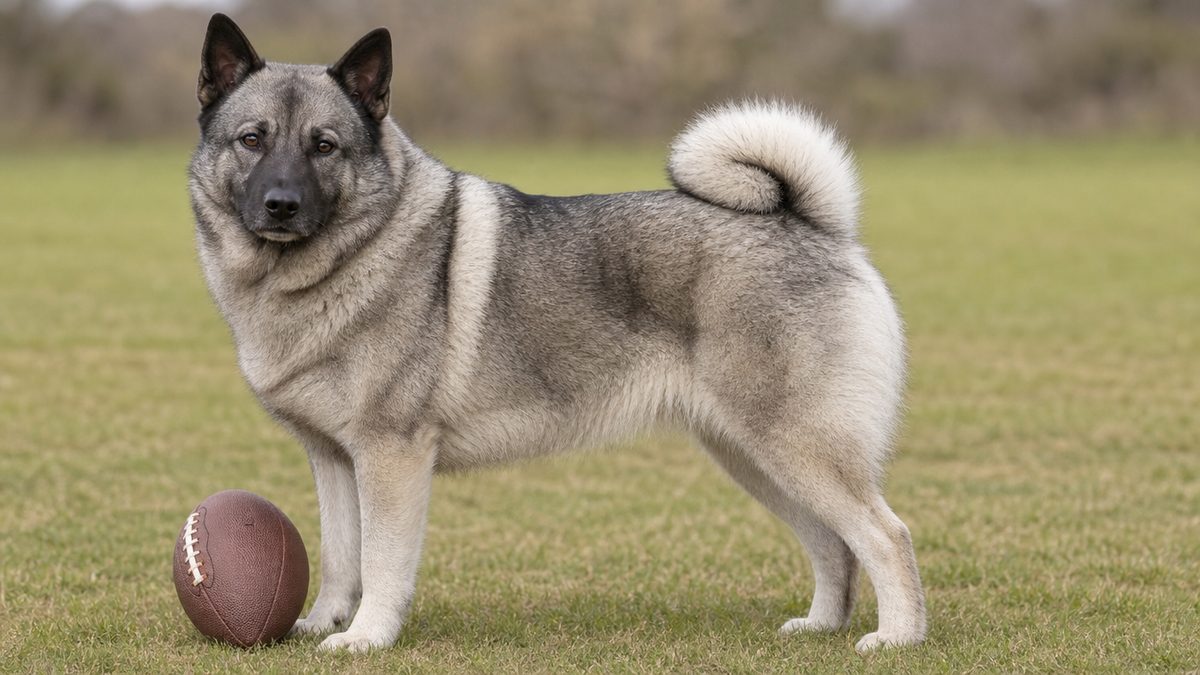
Quick answer
The Norwegian Elkhound is a grey Nordic hunting spitz, FCI standard 242, with an ideal height of 52 cm for males and 49 cm for females and no weight given in its standard at all. Norway registered 563 puppies in 2025, its lowest figure since at least 2005. It is a poor fit for lowland India: its homeland's hottest month is cooler on wet-bulb than Chennai's coldest, and Indian sellers listing it show no such dog.
This page is a research summary and is not veterinary advice. Screening percentages describe populations and not your dog. A dog that rubs or squints at one eye, a puppy whose legs look short or bowed, an adult that drinks and urinates more than it used to, and any dog that pants without settling in Indian heat all need a registered veterinarian in person rather than a web page. Glaucoma is an emergency: a painful, cloudy or reddened eye needs intraocular pressure measured the same day, not next week.
Norwegian Elkhound at a glance
What the Norwegian Elkhound actually is
The Norwegian Elkhound is a grey Nordic hunting spitz built to find moose and hold them by barking until a hunter walks in, recognised by the FCI as standard 242 in Group 5, Section 2, Nordic Hunting Dogs.
Take the breed standard first, because almost every other claim on the internet drifts from it. FCI Standard 242 describes a typical spitz with a compact and short body, squarely built, with a good rise of neck, erect ears, a coat that is thick and abundant but not bristling or long, and a tail tightly curled over the back. Its stated utilisation is one line: dog for elk hunting. That is the whole design brief, and everything a buyer in Pune or Kochi finds difficult about the breed follows from it.
The proportions carry a detail nobody quotes. The standard requires that the length of skull and the length of muzzle be identical. That single sentence is the fastest way to reject a photograph of the wrong dog, because most northern spitz breeds are drawn with a muzzle noticeably shorter than the skull.
The size figure, and the one that does not exist
The standard's size section reads in full: ideal height at the withers 52 cm for males and 49 cm for females. There is no range. Instead the tolerance sits in the disqualifying faults, as height at the withers under 3 cm or over 4 cm from the ideal, which works out at 49 to 56 cm for a male and 46 to 53 cm for a female. Note that the tolerance is deliberately asymmetric, three centimetres down against four centimetres up, and the French text carries the same asymmetry.
The heading of that section is SIZE AND WEIGHT. No weight is given. Not a range, not an ideal, not a guideline. Every weight you will read for this breed comes from somewhere other than its standard, including the 23 to 27 kg for males printed by the aggregator holding position two on the Indian search for the breed's price, a page whose only two references are a YouTube video and FCI Standard 242 itself FCI-Standard N 242.
| Attribute | What the standard says |
|---|---|
| Height, males | Ideal 52 cm. Disqualifying below 49 cm or above 56 cm |
| Height, females | Ideal 49 cm. Disqualifying below 46 cm or above 53 cm |
| Weight | Not stated anywhere in the document |
| Life expectancy | Not stated anywhere in the document |
| Colour | Grey of various shades only. Any other colour is disqualifying |
| Eye colour | Dark brown. Yellow or blue eyes are disqualifying |
| Hind dewclaws | Disqualifying fault |
A typographical error in the authentic text
One line in the English standard does not parse. Under the head it reads "Stop: Marked, but too pronounced";. The French version of the same standard reads "Stop: Marque, mais pas abrupte", marked but not abrupt. The French document also prints the line "Langue faisant foi: (EN)", so English is the authentic language and the French is the translation.
That matters because this site has recorded the opposite failure before, where an error in an authentic English text propagated outward into every translation. Here the translation is the one that reads correctly and the authentic text has evidently lost a word. Read the sentence as "not too pronounced", which is what a spitz head requires, and know that the authoritative document says something else.
This breed's own standard gives no weight. If a page prints one, ask where it came from, because it did not come from the FCI.
Telling it apart from the three dogs it is confused with
Four grey or dark Nordic spitz breeds are routinely sold and photographed as each other, and height plus colour separates all four cleanly using nothing but the breed standards.
Start with the one that trips up most Indian listings. The grey Norwegian Elkhound and the Black Norwegian Elkhound are two separate FCI breeds with two separate standards and two separate numbers, not two colours of one dog. Standard 242 makes any variety in colour other than grey a disqualifying fault, and Standard 268 requires shining black with only a little white on chest and feet tolerated FCI-Standard N 268.
They are also different sizes. The black is 46 to 49 cm for males with an ideal of 47 cm and 43 to 46 cm for females with an ideal of 44 cm, so it sits a full five centimetres below the grey at the ideal. Read the two Black Norwegian Elkhound figures alongside the grey's 52 and 49 and the two dogs stop being interchangeable.
| Breed | FCI number | Section | Ideal height, males | Colour required |
|---|---|---|---|---|
| Norwegian Elkhound Grey | 242 | 5.2 Nordic Hunting Dogs | 52 cm | Grey only |
| Norwegian Elkhound Black | 268 | 5.2 Nordic Hunting Dogs | 47 cm | Shining black |
| Jamthund | 42 | 5.2 Nordic Hunting Dogs | 61 cm | Lighter and darker grey |
| Norwegian Buhund | 237 | 5.3 Nordic Watchdogs and Herders | 43 to 47 cm range | Wheaten or black |
The nine-centimetre test against the Jamthund
The Jamthund is the Swedish moose dog, FCI 42, and it is the breed a grey elkhound is most often confused with because both are grey, both are spitz, and both are used on elk. The separation is size and it is not subtle: the Jamthund is 57 to 65 cm for males with an ideal of 61 cm against the elkhound's 52 cm. Nine centimetres at the ideal is a different dog across a room. The Jamthund's standard also describes a body slightly longer than the height at the withers, where 242 demands a square outline FCI-Standard N 242.
The Hallefors Elkhound is a third Swedish entry in the same working group and is worth a glance for anyone trying to compare the Nordic moose dogs properly rather than by photograph.
The section test against the Buhund
The Norwegian Buhund is the cleanest separation of the four, because the FCI files it in a different section entirely. The elkhound sits in Group 5 Section 2, Nordic Hunting Dogs, and is subject to a working trial in the Nordic countries. The Buhund sits in Group 5 Section 3, Nordic Watchdogs and Herders, without working trial. Colour finishes the job: a wheaten dog cannot be a grey elkhound, and a grey dog cannot be a Buhund, whose standard permits only wheaten and black.
- Check the colour first. Grey with black-tipped guard hairs and a pale harness marking behind the shoulder means 242.
- Measure the height. Around 52 cm is the grey elkhound; around 61 cm is a Jamthund; under 47 cm is the black elkhound or a Buhund.
- Look at the mask. Standard 242 requires dark ears and a dark front to the muzzle, delimited by a dark line running from the eye to the set-on of the ear.
- Find the harness marking, an approximately five-centimetre stripe from withers to elbow where the outer coat lacks its black tips. No other breed in this group is described this way.
That harness marking is the single most useful field mark on the breed and almost no Indian listing photograph shows it, which is usually because the photograph is not of this breed.
History: the Viking claim, and what Norway says about it
The Norwegian Kennel Club's own breed page says the ancient-origin story is a myth and dates the breed to the 1800s, which puts it in direct conflict with the American Kennel Club's page for the same dog.
Here is the claim as the English-speaking internet carries it. The American Kennel Club's breed page opens: shipmate of the Vikings, guardian of remote farms, herder of flocks and defender from wolves and bear, the Norwegian Elkhound has survived more than six thousand years. Almost every aggregator, seller page and answer engine repeats some version of it.
Here is what the breed's home registry says, in Norwegian, on its own consumer breed page. Many have believed this dog must be a direct descendant of the peat-bog dog that existed in the Nordic region more than 5,000 years ago, but that is probably not the case. Others have claimed the roots stretch back long before the Viking Age of 800 to 1050 AD, which is also a myth.
And then the positive claim, which is the important half. The grey Norwegian Elkhound is a modern dog breed created through selective breeding in the 1800s. In type it does resemble the ancient Nordic spitz breeds, but genetically it belongs among the modern European breeds, and its kinship to those ancient dogs is as distant as any other modern European breed's. A series of new DNA studies show this. It is therefore clear that the breed is a new dog, between 100 and 200 years old.
The AKC says more than six thousand years. Norsk Kennel Klub says 100 to 200 years and calls the older claim a myth. No English-language page reports the disagreement.
The genomic study that settles which one to believe
A 2024 paper in Molecular Biology and Evolution analysed eight dog fur samples, themselves 100 to 200 years old, taken from traditional North Swedish clothing. Population genomic analysis confirmed that the Lapphund and Elkhound breeds originate from the local dog population and showed a distinct decrease in genetic diversity consistent with intense breeding. The authors identified eleven genes under positive selection during breed development, including MSRB3, associated with breed-related ear morphology and selected in all the Lapphund and Elkhound breeds.
That is a peer-reviewed reconstruction of a breed being *made*, from a founder population, within the window Norsk Kennel Klub describes. It does not support a six-thousand-year lineage and it was published on the AKC's own side of the argument's timeline, two years before that page was last updated.
The documented history, which is more interesting than the myth
Norway's account is specific and datable. The breed was first shown at an exhibition in Kristiania, now Oslo, in 1877, where an elkhound called Grant won. The best known dog of the breed is Bamse, called Gamle Bamse Gram, owned by consul Jens Gram at the Ask estate in Ringerike. Bamse is regarded as the breed's progenitor and is the oldest grey elkhound known in the breed's pedigree; he was born in 1865 and was present at the 1877 show but did not compete, because Jens Gram was judging it.
Norway had a written standard for the breed from 1905. The first dogs were exported to the United States in 1913, the same year the American Kennel Club recognised the breed. Norway's genetic resource centre adds the population arc: from about 30 puppies born a year in the 1920s, to a couple of hundred in the 1930s, to over 700 by the 1950s.
A breed with a named founder, a dated first show, a judge who owned the progenitor and a written standard from 1905 does not need a Viking origin story. It has a better one, and it is checkable.
Registration numbers: the one Norwegian breed that is not threatened, and is still falling
Norway's genetic resource centre names the grey Norwegian Elkhound as the single exception among the seven Norwegian breeds that are counted as threatened, and NKK's own spreadsheet shows its registrations halving between 2005 and 2025.
Norway treats its dogs as livestock genetic resources. The genetic resource centre at NIBIO counts seven national breeds, four spitz types and three hare hounds, and states that all the Norwegian dog breeds except the grey Norwegian Elkhound are so few in number that they count as threatened. On its own breed page the centre puts it directly: the grey Norwegian Elkhound is today a large and viable population and is not a threatened breed in the way the other Norwegian breeds are.
That assessment was published on 10 August 2017. Here is what has happened to the registration numbers since, taken from Norsk Kennel Klub's own spreadsheets rather than from any summary of them.
| Breed | 2010 | 2015 | 2018 | 2020 | 2022 | 2024 | 2025 |
|---|---|---|---|---|---|---|---|
| Norsk elghund gra (grey) | 958 | 870 | 767 | 811 | 863 | 631 | 563 |
| Norsk elghund sort (black) | 184 | 207 | 228 | 230 | 371 | 282 | 262 |
| Norsk buhund | 80 | 109 | 134 | 162 | 217 | 158 | 139 |
| Norsk lundehund | 45 | 89 | 103 | 132 | 116 | 119 | 74 |
| Dunker | 124 | 174 | 152 | 112 | 141 | 87 | 67 |
| Hygenhund | 37 | 23 | 32 | 42 | 29 | 16 | 14 |
| Haldenstover | 20 | 14 | 4 | 38 | 28 | 7 | 14 |
Three things fall out of that table and none of them appears on any ranking page.
- The grey elkhound's 2025 figure of 563 is its lowest in the series, and the fall from 1,135 in 2005 is a drop of 50.4 percent in twenty years Norsk Kennel Klub.
- The two elkhounds are moving in opposite directions. The grey is down 41 percent since 2010 while the black is up 42 percent over the same period, from 184 to 262.
- Not threatened does not mean stable. NIBIO's 2017 assessment is accurate about what a large population is, and NKK's own data since then shows a breed that has lost 224 registrations a year against its 2017 level of 787.
The British picture is smaller and falling faster
The Royal Kennel Club registered 30 Norwegian Elkhounds in 2025, its lowest figure in the ten-year table, against a ten-year mean of 44 and a 2021 peak of 73. That figure is self-corroborating: the quarterly table gives 7, 7, 6 and 10 for the four quarters of 2025, which sums to exactly 30.
That check matters because this site has recorded the Kennel Club's web tables and its own PDFs disagreeing in the Terrier and Toy groups. The Hound group is one of the groups previously found clean, and it held here: the quarterly table's four 2025 columns sum to 20,841 against a printed group total of 20,841, and the ten-yearly table prints the same 20,841 for 2025 Royal Kennel Club. Agreement is worth reporting as plainly as disagreement.
Recognition, and what it means for an Indian buyer
The FCI's own Group 5 index lists NORSK ELGHUND GRA (242) under Norway in Section 2, with a validity date of 9 August 1999 and a working trial required only for the Nordic countries of Sweden, Norway and Finland. India is a full FCI member represented by the Kennel Club of India in Chennai, so a KCI pedigree would be issued against FCI nomenclature and this breed's number is the one it would carry. That is the honest way to state the Indian recognition position, because the KCI publishes no breed list of its own for any breed.
Both spreadsheets quoted above are published from Norsk Kennel Klub's own Statistikk page, which also carries the club's notes on what the figures count, and both were parsed directly with openpyxl rather than read from any summary of them.
Price in India: what the listings actually contain
No verifiable Norwegian Elkhound price in India exists, and this page publishes none, because both Indian seller pages that rank for the breed's name showed no dog of this breed when they were read on 2 September 2026.
The question people search is the price in india, so start with the answer. There is no Indian price for this breed that survives being checked, and the reason is not that the number is hidden. It is that the pages carrying the number are not selling this dog.
What the number-one and number-three results contain
Puppiezo's Norwegian Elkhound page returned HTTP 200 with a correct title and a correct breed photograph, and its available-pets carousel holds eight animals: two Maltipoos named Fizey and Samy at 98,999 rupees each, two Poodles named Kuzo and Dugu at 92,599, a Cane Corso named Kazuka at 94,999, a Goldendoodle named Doir at 120,000, a Rottweiler named Tugi at 76,499 and a Doxiepoo named Yoki at 98,999. Zero of the eight are Norwegian Elkhounds.
Every one of those animals and every one of those prices also appears, byte for byte, on the same site's Norwegian Buhund page. The carousel is a site-wide fixture, not an inventory of the breed whose name is on the page, and the 98,999 rupee figure is a house price point this site has now tracked across a dozen unrelated breeds. It is not any breed's price.
Mr n Mrs Pet's Norwegian Elkhound listing page prints "3 Result Found" and then "Page 1 of 1", and the three animal cards rendered on it sit under the heading "Similar breeds at other locations": a French Bulldog in Secunderabad and two Border Collies in Hyderabad and Ahmedabad. No Norwegian Elkhound card appears on the page at all.
| Source | Claim | What it actually contains |
|---|---|---|
| Puppiezo, position 3 | Norwegian Elkhound price in India, KCI registered | Eight animals, none of them the breed, at a recurring house price |
| Mr n Mrs Pet, position 1 | 3 Result Found, verified breeders | Three cards, all under Similar breeds, none of them the breed |
| Dogbreedslist, position 2 | Puppy price for the breed | A US dollar band of 700 to 1,500, not a rupee figure |
| Amazon.in, position 5 | Ranks for the query | A paperback book about the breed |
The dollar band, and why it is not a rupee price
The page holding position two states its band openly in dollars: average 700 to 1,500 US dollars, with the cost depending on the dog's age, sex, quality, breeder, heritage and geographical location. That is honest labelling and it is not a conversion trap. It is simply an American figure ranking against an Indian query, and it tells an Indian buyer nothing about what anyone in India would charge.
This page ran the division tests on every rupee figure it found and none of them belongs to this breed in the first place, so there is nothing to convert. Where a number cannot be attached to the animal it claims to price, the correct output is no price, not a hedged one.
The one real price on record is Norwegian
Norsk Kennel Klub's own litter listings do carry prices, and one grey Norwegian Elkhound litter registered in 2026 was advertised at 20,000 Norwegian kroner. That is a genuine, published, breed-specific figure from the breed's home registry. It is quoted here as the Norwegian number it is, and this page publishes no rupee conversion of it, because converting a foreign price into rupees is exactly how the fabricated Indian bands documented above get made.
If an Indian seller quotes you a Norwegian Elkhound price, ask to see the dog, its KCI papers and its parents' hip grades before you discuss money. On current evidence the dog is the part that will not turn up.
Cost of ownership in India, bounded honestly
A 52 cm working spitz in an Indian city costs roughly 4,000 to 9,000 rupees a month in food, parasite control and routine veterinary care, and this page builds that from published Indian retail prices rather than from a breed cost table.
There is no Indian purchase price for this breed, but the running cost of ownership is real and sourceable, because it depends on the dog's size and the country's prices rather than on its breed. A male at the standard's ideal 52 cm is a 20 to 25 kg working dog, so price it as one.
Food, and the pack-size trap
Supertails lists Pedigree Chicken and Vegetables adult dry food at 3,300 rupees for 20 kg, 2,584 for 15 kg, 1,960 for 10 kg, 1,251 for 5.5 kg, 603 for 2.8 kg, 229 for 1 kg and 100 for 370 g. Divide those out and the per-kilogram cost runs from 165 rupees at 20 kg to 270 rupees at 370 g. Buying the 20 kg bag costs 39 percent less per kilogram than the 1 kg bag, which is the single largest lever an Indian owner has on this line.
A 22 kg active dog on a mainstream Indian dry food eats roughly 350 to 450 g a day, so about 10.5 to 13.5 kg a month. At the 20 kg bag rate that is roughly 1,730 to 2,230 rupees a month; on 1 kg packs the same food costs 2,400 to 3,090.
| Line | Low | High | Basis |
|---|---|---|---|
| Dry food, mainstream brand | Rs 1,730 | Rs 2,230 | 10.5 to 13.5 kg at the 20 kg bag rate |
| Dry food, if bought in 1 kg packs | Rs 2,400 | Rs 3,090 | Same food, worst pack size |
| Tick and flea control | Rs 350 | Rs 600 | One systemic dose per 12 weeks, amortised |
| Deworming | Rs 60 | Rs 120 | One tablet per 10 kg per quarter, amortised |
| Vaccination, amortised | Rs 85 | Rs 250 | Annual booster of Rs 1,000 to 3,000 spread monthly |
| Routine vet consultation | Rs 100 | Rs 270 | Rs 300 to 800 per visit, roughly four visits a year |
| Grooming tools and shampoo | Rs 150 | Rs 400 | Undercoat rake, slicker, coat-safe shampoo |
| Monthly total, excluding boarding | Rs 2,475 | Rs 3,870 | Food at the best pack size |
Where the published Indian figures disagree, and why that matters
Two Indian sources give vaccine costs and they do not agree. One gives DHPPi at 500 to 1,200 rupees a dose, anti-rabies at 300 to 600, a full puppy course at 3,000 to 6,000 and an annual booster at roughly 1,000 to 2,000, with a consultation or injection charge of about 300 to 800 on top. The other gives DHPPi at 500 to 1,500, anti-rabies at 300 to 800, a full puppy series at 2,500 to 6,000 and an annual booster at 1,000 to 3,000.
The bands overlap but the ceilings differ by 50 percent on the booster. Both are published Indian estimates rather than surveys, so this page prints the range across both rather than averaging them into a false precision. The second source adds a genuinely useful line: government veterinary hospitals often provide rabies vaccines free or at minimal cost.
The two costs specific to this breed
Two lines above are larger for a Norwegian Elkhound than for a short-coated Indian dog of the same weight, and one is larger still.
- Cooling. A dog with a dense undercoat in Chennai or Kolkata needs air conditioning or at minimum a fan and a cooled room through the hot months. Nine hours of a 1.5 tonne split unit a day is a real household expense and it is not optional for this coat.
- Grooming. Twice-yearly coat blows on a spitz undercoat mean either an undercoat rake and an hour a week at home, or a professional de-shed at Indian metro salon rates, which is a recurring line rather than a one-off.
- Eye screening. Norway now requires a DNA test for the ADAMTS10 glaucoma mutation in breeding stock, and an owner who wants the same certainty is buying a laboratory test, not a clinic visit.
None of that is a reason to avoid the breed. It is a reason to budget honestly before buying one, and to treat any Indian page that prints a tidy monthly figure for this specific breed with suspicion, because the running-cost tables on Indian breed sites are known to be shared constants copied across unrelated breeds.
Climate: the homeland numbers against India's, with the grid-cell caveat stated
The grey Norwegian Elkhound was formed where the hottest month averages 13.66 degrees C on wet-bulb, and Chennai's coolest month averages 21.77 degrees C on the same measure, so India's mildest month is 8.1 degrees hotter than the hottest month the coat was built for.
Heat tolerance on this page is worked from NASA POWER's twenty-year climatology, queried by explicit latitude and longitude so that no place name can be silently substituted, and the returned grid-cell elevation is echoed against each town's real one. Wet-bulb temperature is used rather than dry-bulb because a double coat fails on humidity, not on heat alone: a heat-sensitive dog in Kochi at 30 degrees and 85 percent humidity is in more trouble than the same dog in Jaisalmer at 40 degrees and 20 percent.
The homeland cells, and how wrong they are
Ringerike, where Jens Gram's Ask estate stood and where the breed's progenitor was bred, sits at about 96 m. NASA POWER's cell for that point reports 362.1 m, which is 266 m too high and therefore roughly 1.7 degrees C too cold at the standard lapse rate. Oslo's cell reports 258.74 m against a city near 23 m, Trondheim's 263.43 m against about 56 m, and the point for Rogaland reports 101.41 m against about 10 m.
So every Norwegian figure below is a little colder than the real town, and the direction of the error is consistent across four separate points. That works against the argument this section makes, which is the right way for an error to run: correcting it makes Norway warmer and the Indian gap smaller, and the gap is still enormous.
| Place | Cell elevation | Annual mean T2M | Annual mean wet-bulb | Hottest-month wet-bulb |
|---|---|---|---|---|
| Honefoss, Ringerike | 362.1 m | 3.95 C | 2.89 C | 13.66 C in July |
| Oslo | 258.7 m | 4.62 C | 3.59 C | 14.31 C in July |
| Bengaluru | 841.7 m | 23.74 C | 19.80 C | 22.66 C in May |
| Pune | 636.0 m | 23.86 C | 19.66 C | 23.56 C in June |
| Hyderabad | 494.6 m | 26.10 C | 20.96 C | 24.44 C in June |
| Delhi | 206.4 m | 25.60 C | 18.03 C | 27.74 C in July |
| Mumbai | 97.2 m | 26.77 C | 22.73 C | 26.55 C in June |
| Chennai | 49.0 m | 27.95 C | 24.94 C | 27.36 C in May |
| Kolkata | 7.4 m | 25.81 C | 22.85 C | 27.86 C in June |
The sentence that decides it
Chennai's coolest month, January, averages 21.77 degrees C on wet-bulb. Honefoss's hottest month, July, averages 13.66 degrees C on wet-bulb. The mildest month this dog would meet in Chennai is 8.11 degrees hotter, on the measure that matters for a coated animal, than the hottest month its coat was selected against. There is no season in coastal India that resembles a Norwegian summer.
Bengaluru and Pune are the least bad lowland options at 19.80 and 19.66 degrees C annual mean wet-bulb, and both are still about 17 degrees above Honefoss. Delhi's dry annual mean of 18.03 looks deceptively kind until you read its July peak of 27.74, the highest of any city in this table apart from Kolkata's 27.86. The Indian monsoon is the dangerous season for this coat, not the pre-monsoon dry heat, because a wet-coated dense undercoat cannot shed heat by evaporation.
Every Norwegian cell here reads too high and therefore too cold, by 91 to 266 metres across four points. Correcting for it narrows the India gap by well under two degrees and changes nothing about the conclusion.
One framing to carry away. This is a heat-sensitive breed in the strict sense, meaning its problem is not that Indian summers are unpleasant for it but that its cooling mechanism was never selected to work at the wet-bulb temperatures India delivers for eight months of the year.
Heat risk: which parts of the published evidence actually apply
The largest study of canine heat-related illness did not model this breed, so this page borrows only the transferable risk factors from it and says plainly which ones do not apply.
The reference work is Hall, Carter and O'Neill's cohort of 905,543 UK dogs under primary veterinary care in 2016. The *Scientific Reports* paper found 395 confirmed heat-related illness events, an incidence of 0.04 percent and a case fatality of 14.18 percent, and reported that a bodyweight at or above the breed and sex mean carried an odds ratio of 1.42 with a confidence interval of 1.12 to 1.80, while dogs over 50 kg carried an odds ratio of 3.42.
The companion paper in *Animals*, on the same cohort, recorded 1,259 events from 1,222 dogs. Of these, 380 had no trigger recorded, leaving 879 with one, of which 652 were exertional, 74.2 percent of the events with a recorded trigger, against 113 environmental and 46 from vehicular confinement.
A 20 to 25 kg elkhound is nowhere near the over-50 kg band, so the 3.42 odds ratio does not apply to it. The transferable factor is bodyweight at or above the breed mean, at 1.42.
The exertional figure is the one that matters here
Three quarters of recorded heat events in that cohort came from the dog moving, not from a hot car and not from being left outdoors. For a breed whose entire selection history is about covering ground in forest, that is the finding to act on. An elkhound will keep working past the point where it should stop, because that is what it was bred to do, and Indian owners tend to read a willing dog as a comfortable one.
- Exercise before sunrise and after full dark, and treat 10 am to 5 pm as unavailable from March to October across most of India.
- Check the ground with the back of your hand for five seconds before a walk. Tarmac that is uncomfortable to your hand is unusable for a dog that has no way to tell you.
- Watch for the dog that pants and does not settle, seeks tiles or a wet floor, or slows without being asked. Those are the early signs, not collapse.
- Never shave the undercoat to cool the dog. A spitz coat insulates in both directions and shaving it removes the dog's own shade.
The Indian legal clause that bites on this breed
The Prevention of Cruelty to Animals (Dog Breeding and Marketing) Rules, 2017 contain a provision written for exactly this animal. Second Schedule Part IV paragraph 21(1), Outdoor housing facilities, bars keeping in outdoor facilities, without the written approval of the attending veterinary practitioner, dogs not accustomed to local temperatures, breeds that cannot tolerate them such as long-haired breeds in high temperature locations, and sick, infirm, aged or young animals.
Note the citation form carefully. The Rules themselves stop at Rule 13, so anything numbered above that is a Second Schedule paragraph and not a Rule, and "Rule 21" appears nowhere in the gazette. A dense double-coated Nordic breed kept in an outdoor kennel in Nagpur or Vijayawada is the clause's textbook case, and the approval it requires is a veterinarian's in writing.
This is also the clause that makes a registered breeder's paperwork worth asking for. A breeding establishment operating under these Rules is subject to it; a backyard seller is not, which is a reason to verify who you are dealing with rather than a reason to relax.
Temperament: what its own registry says, and one measured behaviour finding
Norsk Kennel Klub describes a robust, brave and energetic dog devoted to its owner, rates its willingness to cooperate as Low, and states plainly that the breed is not suited as a companion dog alone.
The home registry's own summary is unusually candid, and it is worth reading before any seller's copy. NKK's breed page rates the grey Norwegian Elkhound High on activity level, Medium on size, Low on cooperation and Little on coat care, and its bullet list includes the flat statement that the breed is not suited as a companion dog only.
The positive half is equally direct: the elkhound is a robust, brave and energetic breed, devoted to its owner and a very pleasant family dog, with a strong hunting instinct and a need for a great deal of exercise. NIBIO adds that the breed has become one that easily becomes a natural part of the family, is sociable and loyal, and that the old myth that a good hunting dog must be sharp with people is thankfully gone.
Owner-reported data supports the sociable reading. In a 2021 health and behaviour survey run by Professor Frode Lingaas at the Norwegian University of Life Sciences, with about 1,200 responses, 96 percent of owners were well or very well satisfied with their dog's general behaviour, 4 percent moderately satisfied and 1 percent rated it poor.
The prey drive, measured rather than asserted
Almost every breed page says this dog has a high prey drive. One Norwegian study actually measured it, and its numbers are the most useful behavioural data available on the breed for an Indian owner.
Christiansen, Bakken and Braastad tested 20 grey Norwegian Elkhounds towards sheep in a fenced enclosure in five-minute trials, with physical contact prevented, first alongside a non-chasing companion dog and two to three days later alongside a chasing one. During the full test, 60 percent of the dogs attacked sheep when accompanied by the non-chaser. All 20 attacked when the chasing companion was present. Attack latency was shorter with a chasing companion, and attack severity was higher when a dog attacked alone. No sex differences were observed.
India is full of loose community dogs, goats, cattle and poultry. A study showing that a single chasing companion takes this breed from 60 percent to 100 percent participation describes an ordinary Indian street, not a Norwegian research pen.
Who this breed suits
- Suits a household with a securely fenced ground-floor space, cool months to work in, and an owner who wants a companion on long early-morning walks.
- Suits an owner who reads an independent dog as interesting rather than disobedient, and who will socialise the puppy hard through its first six months.
- Does not suit a high-rise flat with shared corridors, because this is a vocal breed whose working method is sustained barking.
- Does not suit a home with rabbits, cats acquired later, or free-ranging poultry, on the evidence above.
- Does not suit a first dog for an owner who has never trained a hunting breed, given NKK's own Low cooperation rating.
An athletic, hardy, sociable dog that will not reliably come back to you off lead is a very good dog and a demanding one. Both halves of that sentence are in its home registry's own description.
Training: what Norway gates breeding on, and what that tells you
Norway requires a hunting-trial result rather than an obedience result before a grey Norwegian Elkhound can be bred from, which tells you exactly which kind of biddability the breed was selected for and which kind it was not.
To train this breed effectively, start from what it was selected to do without you. Its working method is to range out, find moose, and then bark continuously at the held animal until the hunter walks in, which can be a long way and a long time from the handler. Norway uses the breed both as a bandhund on a long lead and as a lohund working loose.
The selection pressure is explicit and it is not obedience. NIBIO records that the requirement for a breeding dog in Norway is a first prize at a hunting trial for males and a hunting prize for females. A century of choosing breeding stock on independent field performance produces a dog that solves problems on its own, which is precisely what NKK means when it rates the breed Low on cooperation.
What works
- Pay for the behaviour you want with food or a real reward, every time, for the first year. This breed does not work for approval alone.
- Keep sessions to five or ten minutes and end while the dog is still interested. A trainable spitz is one that has not yet been bored.
- Build the recall on a long line for months before you ever test it off one, and never test it near livestock.
- Socialise deliberately with people, traffic, lifts and other dogs between eight and sixteen weeks, because a confident adult is made in that window.
- Manage the barking rather than punishing it. Give the dog something to do at the times it would otherwise sound off, and never reward the noise with attention.
What this breed resists, and the realistic timeline
Three things take much longer than a retriever owner expects. Off-lead recall past a scent is the hardest, and for many individuals it never becomes fully reliable in an open Indian park. Quiet on command is second, because barking is the trait the breed was built on rather than a fault to be extinguished. Loose-lead walking is third, since a dog bred to move ahead and hold a line does not naturally sit at your knee.
| Age | What is achievable | What is not yet |
|---|---|---|
| 8 to 16 weeks | Name response, crate, toilet routine, broad socialisation | Any reliability outdoors |
| 4 to 6 months | Sit, down, hand target, long-line recall in a quiet space | Recall near other dogs or animals |
| 6 to 9 months | Loose lead in low distraction, settle on a mat, car travel | Off-lead freedom anywhere unfenced |
| 9 to 12 months | Recall on a long line with mild distraction, an interrupt cue for barking | Silence on cue, off-lead near livestock |
| 12 to 24 months | Consolidation, and honest assessment of off-lead viability | A guarantee of it |
The Indian variable nobody plans for
In most of India you can only work this dog properly for about two hours out of twenty-four, split before sunrise and after dark. That compresses every training plan above. A puppy that would get four short outdoor sessions a day in Trondheim gets two in Hyderabad, and the deficit shows up as a dog that is undertrained rather than untrainable.
Norway is also, quietly, trying to measure temperament more systematically. Its elkhound federation is exploring general behaviour testing through the Norwegian hunters' and anglers' association, on anecdotal Finnish evidence that dogs scoring well on general behaviour tests also work well on the hunt. There is no equivalent instrument in India, so an Indian buyer has no behavioural paperwork to ask for and should ask to meet both parents instead.
Exercise: what you are replacing, and what happens if you do not
A working moose hunt is several hours of independent ranging over rough ground in cold air, and an Indian city gives this breed about two usable hours a day in which to replace it.
Understand the size of the substitution first. NKK states that the grey Norwegian Elkhound has a strong hunting instinct and requires a great deal of exercise, and rates its activity level High. Norway works it both loose and on a long lead, and its own trials are hunting trials over terrain. A twenty-minute lead walk on a Bengaluru pavement replaces none of that.
The honest daily requirement
Ninety minutes to two hours a day for an adult, split into at least two sessions, with a meaningful part of it off-lead in a securely fenced space or on a long line. That is a demanding number for an Indian household even before the climate is applied, and the climate is what makes it hard rather than the number itself.
| Slot | What it does | Notes |
|---|---|---|
| 05:30 to 06:30, daily | Main aerobic session | The only reliably cool hour in most of India from March to October |
| 20:30 to 21:15, daily | Second walk plus sniffing | Check ground temperature with the back of a hand first |
| Two evenings a week | Long line work in a fenced ground | Recall, retrieve, tracking games |
| Daily, indoors | Scent games and puzzle feeders | Twenty minutes of nose work tires this breed properly |
| Monsoon weeks | Indoor substitution | Do not let a soaked double coat sit wet in a humid flat |
What under-exercise looks like in this breed
It does not usually present as restlessness. It presents as noise, and in an Indian apartment that is the problem that ends the placement. A dog bred to bark at held game for as long as it takes will bark at the lift, the corridor, the neighbour's door and the delivery rider, and it will do it with stamina. Destruction and escape attempts follow.
- Build distance gradually from about nine months, on soft ground, before sunrise.
- Avoid repetitive jumping and hard turns on tile or marble until growth plates close, generally around twelve to eighteen months in a medium working breed.
- Swap duration for difficulty in the hot months. Scent work in an air-conditioned room is real work and costs the dog nothing in heat load.
- Stop on the dog's behaviour rather than on the clock. This breed will not tell you it has had enough.
The joint case for restraint is concrete rather than general. With close to one dog in five graded dysplastic on hip dysplasia in both the Norwegian and American registries, slow loading through the first year is cheap insurance rather than over-caution.
Grooming: a coat built for snow, kept in a monsoon
The grey Norwegian Elkhound carries a thick, coarse outer coat over a soft undercoat, sheds it out once or twice a year, and must never be shaved to make Indian heat easier.
Take the coat description from the standard. The hair is of medium length, with a thick, coarse, abundant outer coat without curls, short and smooth on the head and the front of the legs and longest on neck, thigh, back of legs and tail, over a soft undercoat. Faults include a coat that is too long or too short in the undercoat, so thinning it is not something the standard tolerates either.
NKK's own summary is the reassuring one: a very easy coat, bathed only when needed, that sheds regularly about one to two times a year. That is care advice written for Norway. In an Indian climate the seasonal shedding stops being seasonal and becomes a long, low-grade, near-continuous shed, because the coat is responding to daylight and temperature cues that never deliver a real winter.
The routine that actually works in India
- Brush twice a week outside the shed, and daily through it, with an undercoat rake rather than a slicker alone. The rake reaches the dead undercoat; a slicker mostly moves the guard hair.
- Groom dry rather than wet. Raking a damp double coat mats it, and a matted undercoat in Indian humidity is the start of a hot spot.
- Bathe rarely, and only when the coat is genuinely dirty. Then dry to the skin with a stand dryer or a high-velocity blaster, not by air drying.
- Dry the ears every time the dog gets wet, and check them weekly through the monsoon.
A spitz coat insulates in both directions and shades the skin. Shaving it removes the dog's own protection, exposes skin that has never seen Indian sun, and frequently grows back patchy. Rake it out instead.
The air-drying instruction, and why it does not travel
This site has repeatedly found overseas breed-club grooming advice that is correct at home and wrong here, most clearly an American parent club telling owners to towel the dog and let it air dry. That instruction assumes a dry temperate climate. In an Indian monsoon a thick undercoat left to air dry stays damp against the skin for hours, and that is exactly the condition that produces moist dermatitis and ear disease.
Nothing in FCI 242 or NKK's page addresses drying at all, so this is a gap in the published guidance rather than a contradiction of it Norsk Kennel Klub. Fill it deliberately: dry this coat to the skin, every time, and treat a wet dense undercoat as a problem to fix rather than a temporary state.
The allergy claim
This breed is sometimes offered as low-allergy on the strength of its coat type, and the claim is unsupported. FCI 242 says nothing about shedding load or allergen, and the seller page ranking third for the breed's name prints "Shedding: Yes" on its own spec card Puppiezo, Norwegian Elkhound Puppies…. There is no such thing as a non-allergenic dog, and a heavy-shedding Arctic-type double coat is close to the opposite of one.
Health issues: three genetic conditions with published carrier frequencies
The grey Norwegian Elkhound carries three well-characterised inherited problems, primary glaucoma, chondrodysplastic dwarfism and familial renal disease, and the first two now have DNA tests that Norway makes compulsory for breeding stock.
This is a breed with an unusually well-documented health record, because Norway has been studying it for fifty years and because two of its problems yielded to gene mapping. Start with the eye, which is the one that can blind a dog quickly.
Primary glaucoma, and a 25.3 percent carrier frequency
Primary glaucoma in this breed has a named mutation. Ahonen and colleagues mapped it to a 750 kb region on canine chromosome 20 through a genome-wide association study of 9 cases and 8 controls, and found a fully segregating missense mutation, p.A387T in exon 9 of ADAMTS10, in 14 cases and 572 unaffected Norwegian Elkhounds. The carrier frequency was 25.3 percent, which is one dog in four in the tested population.
That paper carries a formal Correction published in the same journal three months later, which almost nothing citing the original mentions. If you are checking a laboratory's test description against the literature, check both records.
For scale on how common the disease is clinically, Gelatt and MacKay's retrospective across North American veterinary teaching hospitals found a Norwegian Elkhound glaucoma prevalence of 1.98 percent in 1994 to 2002, the seventh highest of any breed, behind the American Cocker Spaniel at 5.52 and the Basset Hound at 5.44. In most breeds glaucoma presented first between four and ten years of age.
Chondrodysplasia, and a 24 percent carrier frequency
The second is a dwarfism. Kyostila, Lappalainen and Lohi mapped an autosomal recessive chondrodysplasia affecting the Norwegian Elkhound and the Karelian Bear Dog to a 2 Mb region on canine chromosome 17 in nine affected and nine healthy Elkhounds, and identified a nonsense mutation in exon 16 of ITGA10, c.2083C>T, p.Arg695*, segregating fully with disease in both breeds. The carrier frequency was 24 percent in Norwegian Elkhounds and 8 percent in Karelian Bear Dogs.
Affected dogs have disproportionate short-stature dwarfism of varying severity, and the alpha10 protein could not be detected in affected cartilage. An earlier description of the same phenotype in the breed was published in the American Journal of Pathology in 1982, so this is a problem the breed has carried for at least four decades and only recently been able to test for.
ADAMTS10 at 25.3 percent and ITGA10 at 24 percent are carrier frequencies, not disease rates. But two independent recessive defects each carried by a quarter of the population is why Norway made both tests compulsory rather than advisory.
Familial renal disease, unsolved since 1970
The kidney problem is the oldest and the least resolved. Finco and colleagues described familial renal disease in Norwegian Elkhound dogs in JAVMA in 1970, and followed it with physiologic, biochemical and morphologic examinations through the 1970s. On the histopathological resemblance to human Alport syndrome, Wiersma and colleagues tested canine COL4A3 and COL4A4 as candidate genes in an affected pedigree and found a recombinant, concluding that these genes are not likely candidates.
Fifty-five years after the first description there is still no DNA test. NKK reports a research project with the NMBU Veterinary Faculty collecting blood, urine and tissue from affected and healthy dogs to identify the variants and build one. Until it exists, the breeding rule is a pedigree rule: dogs with hereditary kidney disease are not bred, and combinations that have produced affected offspring are not repeated.
Two further findings belong on the record without being overstated. Norwegian work on transitional lumbosacral vertebrae, published in 2025, studied the black Norwegian elkhound and the Brittany rather than the grey, so it is a sibling-breed finding and this page does not transfer its numbers across. And a survey of serum immunoglobulin A across breeds identified several with low concentrations, which is worth knowing as background on Nordic breeds generally rather than as a diagnosis for any individual dog.
Screening: what Norway now requires, and what the two registries measure
Since 1 April 2026 a grey Norwegian Elkhound can only be bred in Norway with a known hip grade of A, B or C plus DNA tests for two named mutations, and the Norwegian and American hip figures agree to within 1.3 percentage points.
Norsk Kennel Klub's approved breeding programme for the breed sets four mandatory requirements, effective from 1 April 2026.
- Hips. All breeding animals must have a known HD status, and only dogs graded A, B or C may be bred from.
- Glaucoma. All breeding animals must be DNA-tested for ADAMTS10 hereditary glaucoma, and at least one parent must be entirely free of the disease allele.
- Dwarfism. All breeding animals must be DNA-tested for ITGA10 dwarfism, and at least one parent must be entirely free of the disease allele.
- Numbers. A maximum of 60 offspring may be registered by any one dog, after which further puppies carry a breeding bar, and a male should not exceed half that before the age of five.
The recommendations alongside are just as informative. A combination's joint HD index should exceed 200, and the increase in inbreeding in a single litter, calculated over a five-generation pedigree, should not exceed 3.125 percent. NKK estimates the breed's effective population size at about 120 individuals and notes that the 60-offspring cap corresponds to just under 2 percent of all dogs registered in the breed between 2019 and 2023.
The hip figures, from two registries that do not talk to each other
Norway's own per-birth-year sheet records, across the 2002 to 2023 birth cohorts, 20,506 registered dogs of which 6,078 were hip-radiographed, 29.6 percent of the total. Of those, 4,956 were graded free and 1,122 dysplastic, split 844 mild, 246 moderate and 32 severe, giving 18.46 percent dysplastic.
The Orthopedic Foundation for Animals, working from a different population under a different grading scheme, publishes 4,545 hip evaluations for the Norwegian Elkhound with 78.3 percent normal and 19.8 percent dysplastic, split 11.8 mild, 7.1 moderate and 0.9 severe. The components add up correctly in both directions: 8.4 excellent plus 52.1 good plus 17.8 fair is 78.3, and 11.8 plus 7.1 plus 0.9 is 19.8.
| Registry | Evaluations | Dysplastic | Moderate or severe |
|---|---|---|---|
| Norsk Kennel Klub, 2002 to 2023 birth cohorts | 6,078 | 18.46 percent | 278 dogs, 4.6 percent |
| Orthopedic Foundation for Animals | 4,545 | 19.8 percent | 8.0 percent |
Two national registries, two countries, two grading schemes and 1.3 percentage points apart is about as much agreement as veterinary screening data ever produces, and it is worth more than either figure alone. The elbow picture is genuinely good: Norway recorded 249 elbow radiographs with 2 abnormal, 0.8 percent, and OFA reports 350 evaluations at 99.7 percent normal Orthopedic Foundation for Animals.
The eye tables contradict themselves, as they usually do
OFA's eye summary line reports 590 evaluations at 94.6 percent normal and 5.4 percent abnormal. Its own per-diagnosis detail rows, on the same denominator of 590, record 433 normal, which is 73.4 percent. That is a gap of 21.2 points between a source's summary and its own detail.
The arithmetic gets worse. The single largest detail row is cataract of unknown significance at 49 of 590, which is 8.3 percent on its own, and that already exceeds the summary's total abnormal rate of 5.4 percent. A part cannot exceed its whole, so the two figures are not measuring the same thing and neither should be quoted as the breed's eye rate. Both are printed here with the arithmetic shown.
Ask a breeder for the hip grade, both DNA test certificates and a current eye examination, and verify the certificates rather than the seller's summary of them.
What the literature contains, and how the search was checked
Twenty-six PubMed records name the Norwegian Elkhound in title or abstract, and the union across three name forms is larger than any single query returns, which is why this page ran all of them.
PubMed searches were run on 2 September 2026 with controls in the same session. The control queries returned 47 records for labrador retriever plus hip dysplasia and 1 for bergamasco plus dog, both plausible and both on topic, so the instrument was working.
| Query | Records | Note |
|---|---|---|
| "Norwegian Elkhound"[tiab] | 26 | The obvious query |
| "Norwegian Elkhounds"[tiab] | 9 | Plural. Surfaces behaviour and diabetes papers the singular misses |
| "Elkhound"[tiab] | 33 | Widest. Adds the 2024 genomic origin study |
| "Norsk Elghund"[tiab] | 0 | Native name, with quotedphrasesnotfound |
| "Grey Norwegian Elkhound"[tiab] | 0 | The FCI's English name returns nothing |
Two of those rows are the point. The native Norwegian name and the FCI's own English name both return zero, so a searcher using either would report a breed with no literature. The plural form returns records the singular does not, including Christiansen's sheep-chasing study and Fall's diabetes cohort. A zero on one name is a zero on one name.
Three findings worth knowing that no breed page carries
Gastric carcinoma. Seim-Wikse and colleagues studied 19,715 histologically verified tumours in the Norwegian Canine Cancer Register for 1998 to 2009 and identified 31 gastric carcinomas, 0.16 percent, at a median age of 10 years. The Norwegian elkhound showed a significantly increased proportional morbidity ratio of 6.1, alongside the Tervuren at 56.1, Bouvier des Flandres at 36.5, Groenendael at 34.5, Collie at 26.1 and Standard Poodle at 7.6. Vomiting, anorexia and weight loss were the commonest signs.
Glucosuria at shows. Heiene, Bjorndal and Indrebo dipstick-tested clinically healthy dogs at 15 Norwegian dog shows. Fifty-two of 187 Norwegian elkhounds tested glucosuric against 15 of 202 dogs of other breeds, a statistically significant difference; two of the glucosuric elkhounds and one non-glucosuric elkhound developed signs of kidney disease during the study year. Note one arithmetic wrinkle: 52 of 187 is 27.8 percent, while the abstract prints 27.3 percent, and the two do not reconcile. The counts are quoted here rather than the percentage.
Diabetes, and its sex skew. Fall and colleagues followed 182,087 insured dogs over 652,898 dog-years and recorded 860 diabetes cases, 72 percent of them female, at a mean age of 8.6 years and an overall incidence of 13 cases per 10,000 dog-years. Norwegian Elkhounds that developed diabetes were almost exclusively female, alongside Swedish Elkhounds, Beagles and Border Collies.
What is absent, and stays absent
There is no breed-specific lifespan study for the grey Norwegian Elkhound. The UK life-table work by Teng and colleagues models companion dogs at population level rather than giving this breed its own row usable here, and no Norwegian source publishes a life expectancy at all. NKK's breed page gives none, NIBIO's gives none, and FCI 242 gives none Norsk genressurssenter at NIBIO FCI-Standard N 242.
So the life expectancy figure of 10 to 12 years that the aggregators print is not traceable to any of the three official documents about this breed. This page publishes no lifespan rather than repeating theirs.
The same discipline was applied to the search-engine work behind this page. Three India-region queries about this breed and its sibling came back substituted, while the control query for a common breed returned a correct Indian result set and a live People Also Ask module in the same session, which is how the substitution was identified as an instrument fault rather than an absence of demand.
Feeding: a medium working spitz with a known appetite problem
Feed a grey Norwegian Elkhound as a 20 to 25 kg medium working breed on a medium-breed growth formula, and weigh the food, because this is a breed with a documented tendency to carry weight it should not.
There is no weight in the breed standard, so body condition rather than a target number is the tool. Feed to a body condition score of 4 or 5 out of 9: ribs easily felt under a thin fat cover, a visible waist from above, and an abdominal tuck from the side. On this breed's coat you will have to use your hands, because the coat hides the outline completely.
Why weight matters more here than in most breeds
Two separate published findings converge on it. First, heat: in the UK cohort of 905,543 dogs, a bodyweight at or above the breed and sex mean carried an odds ratio of 1.42 for heat-related illness, with a confidence interval of 1.12 to 1.80. In an Indian climate that is the single modifiable risk factor an owner controls completely.
Second, joints: with 18.5 percent of 6,078 Norwegian radiographs and 19.8 percent of 4,545 American evaluations graded dysplastic, a heavy growing puppy is loading hips that are already a population-level problem.
Life-stage schedule
| Stage | Meals per day | Food type | Watch for |
|---|---|---|---|
| 8 to 16 weeks | 4 | Medium-breed puppy growth formula | Loose stool on a food change; transition over a week |
| 4 to 6 months | 3 | Same growth formula | A puppy carrying visible fat; slow the ration, not the growth |
| 6 to 12 months | 2 | Growth formula to about 12 months | Rapid weight gain around the growth spurt |
| 1 to 7 years | 2 | Adult medium-breed maintenance | Winter appetite that does not drop in an Indian winter |
| 7 years and over | 2 | Senior or lower-calorie adult | Increased drinking and urination, which is a vet visit |
Use a medium-breed formula rather than a large-breed or a small-breed one. A 22 kg squarely built spitz does not need giant-breed calcium control and does not thrive on a toy formulation.
The Indian availability picture
Mainstream Indian retail carries what this dog needs. Supertails lists Pedigree Chicken and Vegetables adult dry food from 100 rupees for 370 g up to 3,300 rupees for 20 kg, so the food is available at every budget point. Premium and imported ranges exist alongside it at two to four times the per-kilogram cost.
Free-feeding a bowl left down all day defeats every weight-control point above in a humid climate that also spoils the food. And a working spitz fed roti and household leftovers gets a diet whose calcium and phosphorus ratios nobody has measured, at exactly the age when its hips are forming.
One last note on the drinking bowl. Given a fifty-five-year-old record of familial renal disease in this breed and a Norwegian show survey finding 52 of 187 apparently healthy elkhounds glucosuric, a dog that starts drinking noticeably more is a clinical event and not a hot-weather quirk Heiene R, Bjorndal H, Indrebo.
The first year, month by month, in an Indian household
A grey Norwegian Elkhound puppy's first year in India is governed by three clocks at once: the socialisation window, the growth plates, and the calendar month you brought it home in.
Indian law sets the floor on the first of those. Rule 8(1)(a) of the Prevention of Cruelty to Animals (Dog Breeding and Marketing) Rules, 2017 provides that pups less than eight weeks in age are not sold. A seller offering a six-week-old puppy is breaking that rule, and it is the cheapest single test of whether you are dealing with a legitimate breeder.
| Age | Priority | Indian-specific note |
|---|---|---|
| 8 to 10 weeks | Settling, crate, toilet routine, first vet check | Do not walk on hot ground. Carry the puppy outdoors for exposure |
| 10 to 16 weeks | The socialisation window. People, surfaces, lifts, traffic, vet visits | Complete the vaccine course; a full puppy series costs Rs 2,500 to 6,000 |
| 4 to 5 months | Long-line recall, handling for grooming, mouth and paw tolerance | First coat change begins. Start the undercoat rake habit now |
| 5 to 7 months | Loose-lead work, settle on a mat, alone-time training | Barking starts to sound adult. Manage it before it becomes a habit |
| 7 to 9 months | Steady distance building on soft ground, before sunrise | Avoid tile and marble turns. Growth plates are still open |
| 9 to 12 months | Consolidation, second coat blow, adult food transition at about 12 months | Monsoon ear checks weekly. Dry the coat to the skin every time |
| 12 to 18 months | Honest assessment of off-lead viability, joint-safe activity | Hip radiography is usually read from 12 months onward |
What to ask the breeder before the puppy is eight weeks old
- Ask for both parents' hip grades and the reading scheme used, not a verbal assurance that the hips are fine.
- Ask for both parents' ADAMTS10 glaucoma DNA results, which Norway has required for breeding since 1 April 2026.
- Ask for both parents' ITGA10 dwarfism DNA results, required on the same date.
- Ask to see the dam with the litter, and to meet the sire or see his paperwork.
- Ask what the puppy has been exposed to. A litter raised in a shed has missed weeks you cannot get back.
Those first three questions are not a wish list. They are the exact tests the breed's home registry now makes compulsory, and they exist because the published carrier frequencies for the two mutations are 25.3 and 24 percent Ahonen SJ, Kaukonen M, Nussdorfer FD Kyostila K, Lappalainen AK, Lohi H.
The month you bring it home matters
A puppy that arrives in November has four cool months to be socialised in before its first Indian summer. One that arrives in April spends its entire socialisation window unable to go outside between 9 am and 6 pm, and arrives at six months under-exposed. If you have any choice in the timing, take the cool-season litter.
Head to head against what Indian buyers actually cross-shop
An Indian buyer looking at a Norwegian Elkhound is usually choosing between it, a Siberian Husky, a Samoyed and an Indian Pariah Dog, and the honest comparison is not close in this climate.
Nobody in India is choosing between a grey Norwegian Elkhound and a Jamthund. They are choosing between a northern double-coated spitz look and something more sensible, so compare it against the dogs that are actually on the shortlist.
| Norwegian Elkhound | Siberian Husky | Samoyed | Indian Pariah Dog | |
|---|---|---|---|---|
| Coat | Dense double, grey with dark mask | Dense double | Dense double, white | Short single |
| Homeland summer wet-bulb | 13.7 C | Sub-Arctic | Sub-Arctic | The Indian plains |
| Actually available in India | No verified listing found | Widely | Widely | Everywhere, free |
| Documented hip rate | 18.5 pct NKK, 19.8 pct OFA | Published separately | Published separately | No registry data |
| Compulsory DNA tests at home | Two, since April 2026 | None equivalent | None equivalent | None |
| Noise | High. Barking is the working method | High, vocal | Moderate to high | Variable |
| Suits an Indian flat | No | No | No | Often yes |
Against the Siberian Husky
The Siberian Husky is the northern breed Indians actually buy, and it is the fairest warning available. Both dogs carry a dense double coat built for a climate India does not have. The differences that matter are that the husky is genuinely obtainable here, has a large Indian population whose problems are visible, and is not gated behind two compulsory DNA tests that no Indian laboratory routinely runs.
If the appeal is the northern look, the husky gets you the same thermal problem with a supply chain. That is not a recommendation. It is a statement that the elkhound offers no advantage on the climate question and a considerable disadvantage on availability.
Against the Samoyed
The Samoyed is the same argument in white. It is a heavier coat and a warmer dog, and it is widely sold in India. The elkhound is more athletic and far more independent, which is a harder combination in a flat, not an easier one.
Against the Indian Pariah Dog
The honest recommendation is the uncomfortable one. The Indian Pariah Dog has a short single coat evolved for this exact climate, costs nothing to adopt, is available in every Indian city, and asks for a fraction of the cooling and grooming budget. If what attracts you to the elkhound is a compact, alert, hardy, independent dog with erect ears and a curled tail, the pariah gives you most of that description in a body that can survive May in Nagpur.
Against its own siblings, if the Norwegian connection is the draw
If it is specifically Norway you want, the picture is worth seeing whole. The Black Norwegian Elkhound is a smaller, rarer dog on the threatened list at 262 Norwegian registrations in 2025. The Dunker carries a far worse hip record, 29.7 percent dysplastic across 784 radiographs. The Halden Hound and Hygen Hound registered 14 each in Norway in 2025 and are effectively unobtainable. The grey elkhound is the one Norwegian breed with a real population, real screening data and a real breeding programme behind it, which is a genuine argument in its favour on every axis except the one India cares about most.
What Indian owners actually get wrong with this breed
The five recurring mistakes are shaving the coat, reading the Viking story as a care instruction, trusting a listing that shows no dog, treating a bark as a training failure, and buying without the two DNA certificates Norway now requires.
1. Shaving the undercoat to help with the heat
This is the commonest and the most damaging. A spitz double coat insulates in both directions and shades skin that has never been exposed. Shaving it removes the dog's own protection, can leave the coat growing back patchy, and does not lower the dog's core temperature. FCI 242 lists an undercoat that is too short as a fault in its own right. Rake the dead undercoat out instead, and brush it through the shed rather than cutting it off.
2. Taking the ancient-Viking framing as a hardiness claim
The story that this is a 6,000-year-old dog that sailed with Vikings is used, implicitly, to sell it as an indestructible primitive breed. Its home registry says the story is a myth and that this is a modern breed created by selective breeding in the 1800s. A modern breed with two recessive mutations at roughly 25 percent carrier frequency each is not a hardy landrace, and the difference is not academic when you are deciding what to screen for.
3. Paying against a listing that contains no dog of the breed
Both Indian pages ranking for this breed's name showed no Norwegian Elkhound when read on 2 September 2026. One displayed eight animals of six other breeds at a recurring house price; the other rendered a French Bulldog and two Border Collies under a heading reading Similar breeds at other locations Mr n Mrs Pet, Norwegian elkhound Puppies…. Ask to see the specific dog and its parents before any deposit changes hands.
4. Treating the barking as disobedience
This breed's entire function is to find game and bark at it continuously until a person arrives. NKK rates the breed High on activity and Low on cooperation and says outright that it is not suited as a companion dog alone. Punishing the bark treats the breed's defining trait as a fault. Manage it with exercise, an interrupt cue and something to do at the trigger times, and be realistic about whether a shared-wall apartment can absorb it at all.
5. Buying without the two certificates
Norway has required, since 1 April 2026, that both parents be DNA-tested for the ADAMTS10 glaucoma mutation and the ITGA10 dwarfism mutation, with at least one parent free of the disease allele in each case, and that hips be graded A, B or C. An Indian buyer who does not ask for those three documents is accepting a dog from a population in which one in four carries each mutation Kyostila K, Lappalainen AK, Lohi H.
Two smaller ones worth naming
- Off-lead near livestock or community dogs. In a Norwegian trial all 20 tested elkhounds attacked sheep when a chasing companion was present. An Indian street supplies the chasing companion for free.
- Removing a hind dewclaw to make the dog showable. Hind dewclaws are a disqualifying fault in FCI 242, but Second Schedule Part II paragraph 6(8) of the 2017 Rules forbids de-clawing and any change of appearance by artificial means outright. The show fault cannot lawfully be fixed in India, and a breeder who offers to fix it is telling you something.
Adoption and responsible sourcing
There is no lawful commercial route to import this breed into India and no verified Indian litter, so the realistic options are adoption of a similar dog already here or a long, checked wait for a genuine local breeding.
Start with the law, because it closes the obvious route. DGFT Trade Notice 22/2022-23 places live dogs under ITC(HS) 01061900 as Restricted, permits entry only for a pet dog accompanied by a valid pet book in the importer's name, for research with a CPCSEA recommendation, or for Defence and internal security purposes, and states that applications for trading or breeding purposes shall be duly rejected. You cannot lawfully import this breed into India to sell or breed from.
And there is very little to import even if you could. Norway registered 563 grey Norwegian Elkhound puppies in the whole of 2025, its lowest figure in twenty years, and the Royal Kennel Club registered 30 in Britain in the same year Royal Kennel Club. Norway also caps any one dog at 60 registered offspring for life. That is not a population with an export surplus.
The adoption route, which is the real one
Indian shelters do not hold Norwegian Elkhounds, and pretending otherwise would be dishonest. What they hold in large numbers are dogs that answer the same want: compact, alert, prick-eared, curl-tailed, independent, and already adapted to the climate.
- Adopt an Indian Pariah Dog from any municipal shelter or rescue network. Short single coat, evolved for this climate, and free.
- Look at the Indian Spitz if the spitz outline is specifically what appeals. It is a small breed that has lived in Indian homes for generations.
- Consider a surrendered adult northern-breed dog. Indian rescues regularly take in Siberian Huskies and Samoyeds given up for exactly the heat and noise reasons this page describes, and an adult with a known temperament is an easier proposition than a puppy.
If you are set on the breed
Then treat it as a multi-year project rather than a purchase, and apply the checks below in order.
- Verify the dog exists before discussing money. A photograph on a listing page is not a dog, and both Indian pages ranking for this breed showed none.
- Register the pedigree properly. India is a full FCI member represented by the Kennel Club of India, so a genuine pedigree is issued against FCI nomenclature under number 242 Federation Cynologique Internationale.
- Screen the parents. Hip grade A, B or C, ADAMTS10 glaucoma clear or carrier-to-clear, ITGA10 dwarfism the same.
- Check the age. Rule 8(1)(a) of the 2017 Rules bars the sale of pups under eight weeks.
- Ask what the breeder does about heat, and listen carefully to the answer. Anyone breeding this coat in India without a considered reply has not thought about it.
The grey Norwegian Elkhound is a genuinely good dog with an unusually honest home registry, a real breeding programme and thirty years of published health data. Almost none of that helps a dog living through a Chennai May. Buy it for the right reasons or adopt something built for the country you live in.
One closing note on how to read anything else you find about this breed. Its own national registry publicly contradicts the origin story every English-language page repeats, and a 2024 genomic study of century-old dog furs sides with the registry Wang SZ, Yan Y, Widlund M and colleagues. If the most repeated fact about a breed does not survive contact with its home kennel club, treat the rest of that page's claims with the same suspicion.
Norwegian Elkhound questions Indian buyers actually ask
Is the Norwegian Elkhound really an ancient Viking dog?
No, on its home registry's own account. Norsk Kennel Klub's breed page calls the peat-bog-dog descent untrue and the pre-Viking roots a myth, and says the breed is a modern one created by selective breeding in the 1800s and is between 100 and 200 years old. The American Kennel Club's page still calls it a shipmate of the Vikings surviving more than six thousand years.
How much does a Norwegian Elkhound puppy cost?
No verifiable Indian price exists, and this page publishes none. The two Indian seller pages ranking for the breed name showed no Norwegian Elkhound at all when read on 2 September 2026: one displayed a carousel of two Maltipoos, two Poodles, a Cane Corso, a Goldendoodle, a Rottweiler and a Doxiepoo at prices from 76,499 to 120,000 rupees, none of them this breed.
Can a Norwegian Elkhound survive in Indian heat?
Not comfortably anywhere in lowland India. The breed was formed where the hottest month averages 13.66 degrees C on wet-bulb. Chennai's coolest month averages 21.77 degrees C on wet-bulb, which is 8.1 degrees hotter than the warmest month the coat was selected for, and Delhi peaks at 27.74 degrees C in July.
What is the difference between the grey and black Norwegian Elkhound?
They are two separate FCI breeds with separate standards, not two colours of one breed. The grey is standard 242 with an ideal height of 52 cm for males; the black is standard 268 at 46 to 49 cm with an ideal of 47 cm. Colour other than grey is a disqualifying fault in 242, and 268 requires shining black.
How long do Norwegian Elkhounds live?
No breed-specific lifespan study exists for this breed, so this page publishes no figure. The 10 to 12 years that the ranking aggregator prints is unsourced: that page lists only two references, a YouTube video and FCI Standard 242, and the standard contains no life expectancy anywhere in its text.
Do Norwegian Elkhounds shed a lot?
Yes, heavily and seasonally. Norsk Kennel Klub describes a very easy coat that is bathed only when needed and sheds regularly about one to two times a year. In Indian heat that seasonal shed becomes a longer, messier and more continuous one, and the undercoat must never be shaved to manage it.
Are Norwegian Elkhounds good with children?
Norwegian sources describe a robust, brave and energetic breed that is devoted to its owner and a very pleasant family dog, and a 2021 owner survey of about 1,200 responses found 96 percent well or very well satisfied with general behaviour. That is a sociability finding about family life, not a supervision licence around toddlers.
Do Norwegian Elkhounds get hip dysplasia?
Yes, at close to one dog in five. Norway's own registry records 1,122 of 6,078 radiographed dogs graded dysplastic across the 2002 to 2023 birth cohorts, which is 18.5 percent, and the American registry independently reports 19.8 percent dysplastic across 4,545 evaluations. Two registries, two countries, two grading schemes, 1.3 points apart.
Is the Norwegian Elkhound hypoallergenic?
No. No dog breed is, and this one sheds a heavy double coat twice a year. FCI Standard 242 says nothing at all about allergy or shedding load, and any Indian seller offering the breed as allergy-safe is making a claim its own breed standard does not support.
How much does a Norwegian Elkhound weigh?
Its breed standard does not say. FCI Standard 242 gives an ideal height of 52 cm for males and 49 cm for females under the heading SIZE AND WEIGHT, then prints no weight figure at all. Every weight range you will read online, including the 23 to 27 kg on the page ranking second, comes from somewhere other than the standard.
Can you keep a Norwegian Elkhound in a flat?
Norsk Kennel Klub's own breed page says the breed is not suited as a companion dog only, rates its activity level High and its willingness to cooperate Low. A dog whose working method is to bark continuously at held game until a hunter arrives is a difficult neighbour in an Indian apartment block.
Are Norwegian Elkhounds legal in India?
Yes. No Indian law in force today bans owning, breeding or selling this breed. What is barred is commercial import: DGFT Trade Notice 22/2022-23 places live dogs under ITC(HS) 01061900 as Restricted and states that applications for trading or breeding purposes shall be duly rejected.
Is the Norwegian Elkhound the same as a Jamthund?
No, and height separates them cleanly. The Jamthund is FCI 42 at 57 to 65 cm for males with an ideal of 61 cm, while the grey Norwegian Elkhound is FCI 242 with an ideal of 52 cm. A nine-centimetre gap at the ideal is visible across a room once you know to look for it.
What health tests should a Norwegian Elkhound breeder have done?
Three, and Norway has required all three since 1 April 2026. Hips must be graded and only A, B or C dogs bred from; both parents must be DNA-tested for the ADAMTS10 glaucoma mutation; and both must be DNA-tested for the ITGA10 dwarfism mutation, with at least one parent free of the disease allele in each case.
Are Norwegian Elkhounds a good family dog?
A pleasant one for the right house, and a poor one for a flat, on its home registry's own words. Norsk Kennel Klub calls the grey Norwegian Elkhound robust, brave and energetic, devoted to its owner and a very pleasant family dog, and in the same breath rates its activity High, its willingness to cooperate Low, and states that it is not suited as a companion dog only. It suits a household with a securely fenced ground-floor space, cool months to work in, and an owner who wants a companion on long early-morning walks.
Is a Norwegian Elkhound a husky?
No. The Norwegian Elkhound is a grey Nordic hunting spitz, FCI standard 242 in Group 5, Section 2, Nordic Hunting Dogs, built to find moose and hold them by barking until a hunter walks in, with an ideal height of 52 cm for males. What it shares with the Siberian Husky is a dense double coat built for a climate India does not have. The husky is the northern breed Indians actually buy, with a supply chain and a visible Indian population; the elkhound offers the same thermal problem with neither.
Is a Norwegian Elkhound a wolf?
No, and it is not an ancient wolf-adjacent dog either. Norsk Kennel Klub's own breed page calls descent from the 5,000-year-old peat-bog dog untrue and the pre-Viking roots a myth, and states that the grey Norwegian Elkhound is a modern breed created through selective breeding in the 1800s, between 100 and 200 years old, that genetically belongs among the modern European breeds with kinship to ancient Nordic dogs as distant as any other. A series of new DNA studies show this, and a 2024 genomic study of century-old furs sides with the registry.
Compare with similar breeds
Norwegian Elkhound sits in 1 Bonbeno group. Each one compares it directly against the breeds it is genuinely an alternative to, on the same figures.