
Breed profile
Karelian Bear Dog: Price in India, Heat Limits and the Laika It Is Confused With
A Finnish big-game barker built in 1936 to hold a bear at bay, recognised as FCI standard 48, with three inherited diseases mapped to named genes and no sourced price anywhere in India.
Quick answer
No sourced Karelian Bear Dog price in India exists. Two Indian pages quote ₹30,000 to ₹80,000 and neither names a source, while the only organisation publishing a working price charges USD 5,000. The breed is FCI standard 48, a Finnish big-game barker averaging 425 registrations a year in Finland and effectively absent from India. Its homeland averages 1.5 °C; Chennai's coolest month is 24.1 °C, so this heat-sensitive double coat has no comfortable Indian home outside a Ladakh winter.
This page reports published registry data, breed-club documents and peer-reviewed veterinary research for general information. It is not a diagnosis, a treatment plan or a substitute for veterinary advice. Heat-related illness in a double-coated northern dog is a medical emergency: if your dog is panting uncontrollably, staggering, vomiting or collapsing in Indian heat, cool it with room-temperature water and contact a registered veterinary practitioner immediately. Any decision about screening, breeding, vaccination or diet for an individual dog must be made with a veterinarian who has examined that dog.
Karelian Bear Dog at a glance
What a Karelian Bear Dog actually is
The Karelian Bear Dog is a medium-sized Finnish hunting spitz, recognised as FCI standard number 48, bred since 1936 to find large game and hold it at bay by barking. In Finnish it is the Karjalankarhukoira.
The register settles the basics. The Fédération Cynologique Internationale lists the breed in Group 5, Spitz and primitive types, Section 2, Nordic Hunting Dogs, under Finland, as KARJALANKARHUKOIRA (48). That number matters more than the name, because on the FCI's site the trailing number decides which document you are served and the words before it are ignored. The standard itself is dated 3 November 2014 and was published on 27 May 2015.
The breed is young and its origin is documented rather than legendary. The standard's own historical summary says the Komi dog, also called the dog of the Zyrians, is considered the origin of the breed, while the basic stock came from Ladoga Karelia, Olonets and Russian Karelia, where the dogs were used for all kinds of game. Breeding started in 1936 with the goal of creating a sturdy dog which barks at big game, the name Karelian Bear Dog was agreed at that point, the first standard was established in 1945, and the first dogs were registered in 1946.
That timeline is worth holding on to, because the Indian pages ranking for this breed get it wrong. One states the breed's roots can be traced back several centuries and calls it one of the oldest breeds in Finland. The standard says breeding began in 1936, which makes the breed about ninety years old. The same page says the Finnish Kennel Club recognised the breed in 1946; the standard dates the first standard to 1945 and the first registrations to 1946, which is not the same claim.
What the standard requires
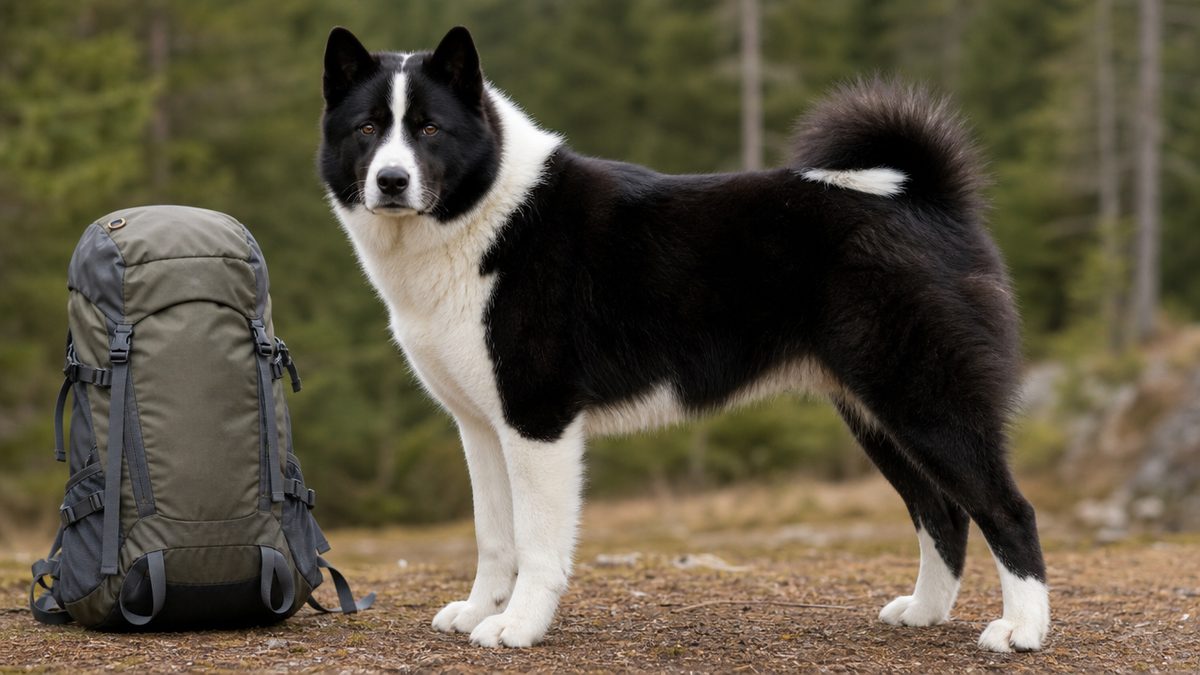
A Karelian Bear Dog is built for endurance rather than speed. The standard calls for a medium sized spitz with a dense coat, robust conformation and strong build, with the body only slightly longer than the height at the withers and the depth of the body about half that height. The build is muscular throughout: the standard specifies a muscular neck of medium length, a back that is level and muscular, a short muscular loin, and thighs that are broad and long with strong muscles.
| Point | Requirement |
|---|---|
| Height, males | 54-60 cm, ideal 57 cm |
| Height, females | 49-55 cm, ideal 52 cm |
| Weight, males | Ideal 25-28 kg |
| Weight, females | Ideal 17-20 kg |
| Colour | Black, may be dull or with nuances of brown; most individuals have clearly defined white markings on head, neck, chest, belly and legs |
| Coat | Outer coat harsh and straight, longer on neck, back and backside of the upper thighs; undercoat soft and dense |
| Ears | Erect, set rather high, medium sized, slightly rounded tips |
| Tail | High set, medium length, curved over the back; a natural bobtail is permitted and of equal value to a natural long tail |
| Teeth | 42 teeth per the dentition formula, close fitting scissors bite |
| Temperament | Eager hunter, very independent, balanced, courageous, persistent, very self-confident, slightly reserved |
Two entries in that table do real work later on this page. The double coat, a harsh outer layer over a soft dense undercoat, is what makes the breed heat-sensitive in India. And the bobtail clause is the single cleanest way to tell this breed from the Russo-European Laika, which disqualifies exactly what this standard permits.
A working breed, not a companion breed
The FCI defines the breed's job in one line: a hunting spitz, a dog mainly for elk and bear hunting, that holds the game at bay. It does not hold game by fighting it. It finds large game, then barks, and keeps barking, until the hunter arrives. Everything else about the dog follows from that, including the volume, the independence and the range.
The Wind River Bear Institute in the United States, which has bred, tested and placed working Karelian Bear Dogs for human-wildlife conflict work since 1996, is the plainest source on what this means for an owner. Its own guidance opens: "Karelian Bear Dogs do not make great pets. They are high-energy working dogs that are bred to go out and hunt. They are generally considered to be difficult dogs to train and they do not do well in urban settings";. It also reports that only about 20 percent of a litter from a lineage of grizzly bear hunting lines will have the ability to safely and effectively work bear, which is why it tests every litter it produces.
So the breed that is famous for baying bears mostly cannot bay bears. It is a hardy, fearless, intelligent and highly independent forest working dog whose usual quarry is small game and moose, with a minority of specialist lines able to work bear. An Indian buyer told they are getting a bear hunter is being sold a story about one dog in five from a narrow set of bloodlines that are not exported casually.
Three different English names appear in the literature for this one dog: Karelian Bear Dog, Carelian Bear Dog spelled with a C, which the AKC notes is the Finnish country-of-origin spelling, and Karelian Bear Hound, which is how a 2007 veterinary surgery case report described a 3-year-old, 20 kg patient Liska WD, Marcellin-Little DJ. If you search only one of them you will miss part of what has been published.
The Karelian Bear Dog and the Russo-European Laika are two breeds, and the confusion is real
The Karelian Bear Dog is FCI breed 48 and the Russo-European Laika is FCI breed 304. They are separate breeds with separate standards, and the cleanest way to tell them apart is the tail.
Read the register's own list and both numbers sit in the same section, three entries apart. Under Finland: KARJALANKARHUKOIRA (48). Under Russian Federation: RUSSKO-EVROPEÏSKAÏA LAÏKA (304), which the FCI renders in English as Russian-European Laika rather than Russo-European Laika. Anyone assembling an FCI URL from a breed name and a guessed number will be served whichever breed that number belongs to, with a complete and plausible page, so the numbers are the thing to hold on to.
The two dogs genuinely resemble each other, and the standards say why. FCI 304's historical summary records that in 1947 the offspring of Arkhangelsk, Komi, Karelia, Votiatsk and other Laikas were united into one breed under the modern name Russian-European Laika, and that the breed standard was approved in 1952. Karelia is in that founding list. FCI 48 says the Karelian Bear Dog's basic stock came from Ladoga Karelia, Olonets and Russian Karelia, and that the Komi dog is considered the origin of the breed. Two breeds, two registries, overlapping founding populations, drawn from the same forests within eleven years of each other.
The colour completes the confusion. FCI 304 says the most typical colours are black with white or white with black, and that solid black and solid white also occur. FCI 48 says black, which may be dull or with nuances of brown, and that most individuals have clearly defined white markings. A black-and-white Nordic spitz with erect ears and a curled tail describes both.
The tail is the test
One difference is decisive and visible from across a field. FCI 48 states that a natural bobtail is permitted and is of equal value to a natural long tail. FCI 304 lists natural stumpy tail among its disqualifying faults. The same feature is expressly allowed in one breed and disqualifying in the other. Nothing on the Indian first page of results for this breed mentions it.
| Point | Karelian Bear Dog, FCI 48 | Russo-European Laika, FCI 304 |
|---|---|---|
| Country | Finland | Russia |
| Standard date | 3 November 2014 | 13 October 2010 |
| Height, males | 54-60 cm | 52-58 cm |
| Height, females | 49-55 cm | 48-54 cm |
| Natural bobtail | Permitted, equal to a long tail | Disqualifying fault |
| Ear tips | Slightly rounded | V-shaped, pointed |
| Weight in standard | Ideal 25-28 kg males, 17-20 kg females | No weight given |
| Dewclaws | Not mentioned | Preferably absent on forefeet, not desirable on hind |
The dewclaw line is worth a note for an Indian reader. FCI 304 prefers a dog with no first digits on the forefeet, while the Prevention of Cruelty to Animals (Dog Breeding and Marketing) Rules 2017 forbid de-clawing outright at Second Schedule Part II paragraph 6(8), alongside tail docking, ear cropping and any change of appearance by artificial means. A preference in a standard is not permission to create it surgically, and in India creating it is prohibited.
The confusion may be a fact about the dogs, not only about the names
This is the part no ranking page carries, and it comes from the breed's own Finnish breeding programme. Discussing populations outside Finland, the 2026-2030 programme states that almost no information is available about Karelian Bear Dogs in Russia because of deficient contacts, and then goes further: it says it is also possible that no purebred Karelian Bear Dogs have survived in Russia, and that their dogs resembling the Karelian Bear Dog are Russo-European Laikas.
A second passage in the same document says the breed is in hunting use in Russia and other Eastern European countries, but partly mixed with the Russo-European Laika, as also on the American side. So the breed's own custodians treat the overlap as a live population question rather than a naming muddle, and they treat it as unresolved. Bonbeno reports it the same way: the two are separate breeds on the register, the standards separate them cleanly on the tail, and what is actually walking around in Russia under the Karelian name is not established.
The genetics point the same direction without settling it either. A 2018 study of Finnish hunting spitzes using commercial SNP panels found that the Finnish Spitz, the Nordic Spitz and the Karelian Bear Dog, together with the Lapphund and the Lapponian Herder, are all closely related and have common origins with the northeastern Eurasian Laika breeds, rather than with other Scandinavian spitz breeds such as the Elkhounds and the Swedish Vallhund. The paper explicitly says it provides new insight into the history of the Swedish Elkhound and the Russian-European Laika. The Finnish hunting spitzes are Laikas by descent. That is why they look like Laikas.
Two separate FCI breeds with two separate numbers, 48 and 304, distinguishable on the tail clause and on ear-tip shape. Beyond that, the Finnish breeding programme itself raises the possibility that the Russian population of Karelian Bear Dogs no longer exists as a pure breed. Bonbeno does not resolve that, because the document that raises it does not resolve it either.
Recognition: what the registers say, and what that means in India
The Karelian Bear Dog is fully recognised by the FCI as standard 48, is a native breed of the Finnish Kennel Club, and sits in the American Kennel Club's Foundation Stock Service rather than among its fully recognised breeds.
Start with the FCI, because for India it is the operative answer. The breed appears on the definitive nomenclature under Finland with CACIB status and a working trial qualification restricted to the Nordic countries, meaning Finland, Sweden and Norway FCI-Standard N° 48. That last detail is a small but real limitation: the working title this breed exists to earn can only be earned in three countries.
The Kennel Club of India question, answered honestly
The Kennel Club of India publishes no breed list for any breed, so querying its site for the Karelian Bear Dog returns nothing, and returns nothing for a common breed too. That is a broken instrument, not a finding, and Bonbeno will not report it as the breed being unrecognised in India. The route that does work is the FCI members register, which lists India as a full member represented by the Kennel Club of India in Chennai. The KCI therefore issues pedigrees against FCI nomenclature, which means FCI recognition effectively answers the India recognition question, and this breed is FCI standard 48.
In practice that is a paper answer. A pedigree route existing is not the same as dogs existing, and Bonbeno found no verifiable Karelian Bear Dog litter, breeder or registration anywhere in India.
Finland: a common working breed, and the numbers are falling
In its own country this is not a rare dog. The Finnish Kennel Club's breeding database records 37,498 Karelian Bear Dogs registered in total, with the most recent litter dated 8 July 2026 and the most recent show entry 30 August 2026. In 2024 it was the 31st most popular breed of the 317 breeds and varieties registered in Finland, ahead of the Lapponian Herder and behind the Finnish Spitz at 13th.
Two Finnish Kennel Club sources disagree about the current rate, and the disagreement is worth showing rather than averaging. The breed's 2026-2030 breeding programme, approved in early 2025, says the population has settled at about 5,000 individuals and about 800 annual registrations, and its own ten-year table gives a mean of 697 a year across 2013-2022, ranging from 528 to 895. The live database, however, records only 425 registrations in 2025.
| Year | Registrations |
|---|---|
| 2018 | 900 |
| 2019 | 758 |
| 2020 | 701 |
| 2021 | 789 |
| 2022 | 529 |
| 2023 | 626 |
| 2025 (live database) | 425 |
That is a fall of more than half from the 2018 peak. Some of it is national: Finnish registrations across all breeds dropped 7.9 percent in 2024, to 40,364 dogs from 43,813 in 2023, and the Kennel Club's own director says the figures have fallen back to turn-of-the-millennium levels. But a drop from 900 to 425 is far steeper than 7.9 percent a year, and the breeding programme's "about 800" was written before the most recent figures existed. Anyone quoting 800 registrations a year for this breed today is quoting a number the live register no longer supports.
The United States: Foundation Stock Service, not full recognition
The American Kennel Club records the Karelian Bear Dog in its Foundation Stock Service, the programme for rare breeds being recorded rather than fully registered. The first petition to add the breed was made in May 2005 and was approved on 9 June 2005, the breed has been assigned the Working Group designation, and it was approved to compete in AKC Companion Events with effect from 1 July 2008.
The AKC also publishes size figures, and they do not agree with the FCI standard. The AKC gives a weight of 44-49 pounds, which is 20 to 22 kg. The FCI standard gives an ideal weight of 25-28 kg for males and 17-20 kg for females. The AKC band sits entirely below the FCI male ideal and overlaps only the female range. Bonbeno publishes both rather than picking one: a buyer told to expect a 20 kg dog and handed a 27 kg one has been misled by a kennel club, not by a breeder.
The two also differ on lifespan, which the health section returns to. The AKC prints 11 to 13 years; an Indian ranking page prints 10 to 12; the breed's own Finnish breeding programme prints no breed-wide figure at all Happy Pet, "Karelian Bear Dog Breed Guide" Suomen Pystykorvajärjestö and Suomen….
FCI standard 48, definitive, since a standard first established in 1945. Native breed of the Finnish Kennel Club with a five-year breeding programme running to 2030. AKC Foundation Stock Service since 2005, not fully recognised. Registrable in India in principle through the KCI against FCI nomenclature, and absent from India in practice.
Karelian Bear Dog price in India
No sourced Karelian Bear Dog price in India exists. Two Indian pages quote a band, ₹30,000 to ₹80,000 on one and Rs 30,000 to Rs 60,000 on the other, and neither names a breeder, a litter, a date or any other source.
Say the important part first, because the ranking pages bury it. Bonbeno could not verify a single Karelian Bear Dog for sale in India, a single Indian litter, or a single Indian registration. What exists is two Indian breed guides that print a rupee band with no provenance, and a first page of search results that is half merchandise.
| Source | Figure quoted | Provenance given |
|---|---|---|
| Happy Pet, updated 22 July 2025 | ₹30,000 to ₹80,000 to buy | None |
| Best For Pets, published 2023, page dated November 2024 | Rs 30,000 to Rs 60,000 to buy | None |
| Happy Pet, monthly costs | ₹3,550 basic, ₹5,400 premium | None |
| Wind River Bear Institute, United States | USD 5,000 for the pup plus three days of owner transfer training, and a recommended USD 500 puppy kit | Named programme, published terms |
The two Indian bands share a floor of ₹30,000 and disagree at the ceiling by ₹20,000, which is a 33 percent spread on the same breed in the same country in the same year. Neither page explains the difference, because neither page has anything to explain it with.
What the second page actually is
The Best For Pets page is worth describing rather than just citing. Its first heading is "Karelian Bear Dog Puppies For Sale In India"; and it carries a click-to-call phone number, so it presents itself as a route to buying one. Its price section then says the figure "depends on many factors" and lists seven of them, breeder reputation, lineage, health clearances, age and training, demand and availability, show or working potential, and geographic location, without attaching a number to any of them.
The same page also contains checkable errors against the primary document. It says the breed's roots trace back several centuries and calls it one of the oldest breeds in Finland; FCI standard 48 says breeding started in 1936. It says the Finnish Kennel Club recognised the breed in 1946; the standard says the first standard was established in 1945 and the first dogs were registered in 1946. It describes the outer coat as short; the standard requires it harsh and straight and longer on the neck, back and backside of the upper thighs. A page that misreports the coat of the dog it is offering to sell you is not a price source.
The only published working price
One organisation publishes a real, current, sourced figure for a Karelian Bear Dog, and it is not in India. The Wind River Bear Institute, which has bred and placed working Karelian Bear Dogs since 1996 and supplies wildlife agencies in the United States, Canada and Japan, charges USD 5,000 for the puppy and three days of owner transfer training, and recommends a further USD 500 for a puppy kit of crate, tie-outs and bowls.
Put the two side by side at the rate this site uses for conversion checks, 84.38 rupees to the dollar. The Indian floor of ₹30,000 is about USD 356, roughly one fourteenth of the Wind River price. The Indian ceiling of ₹80,000 is about USD 948, roughly one fifth of it. The gap is not a bargain. It is the distance between a documented working programme with published health testing and a rupee figure typed onto a page.
A price needs a supply chain. Indian law blocks the commercial one: under DGFT Trade Notice 22/2022-23, dogs sit at ITC(HS) 01061900 as Restricted, Policy Condition 7 permits import only for a pet dog with a valid pet book in the importer's name, for research organisations with CPCSEA recommendation, or for Defence and Police internal security, and Policy Condition 8 states that import of commercial dogs for breeding or any other commercial activity is not permitted. The notice adds that applications for trading or breeding purposes shall be duly rejected. Until a lawfully imported pet dog is bred here under KCI pedigree, there is no Indian market for anyone to price.
Testing the Indian figures: are they converted dollars or invented rupees?
The Indian figures for this breed are rupee-native and unsourced rather than converted from dollars. They fail the strong conversion tests, and the one rate they appear to pass, a flat 80, passes by arithmetic accident.
Indian breed pages routinely publish a "price" that is a US dollar figure run through a single exchange rate, and this site has caught it repeatedly at 84.38, at 74, at a flat 80 and at 66.67. So every rupee figure gets divided before it gets quoted. Here is the whole test, shown so a reader can repeat it in a calculator.
| Rupee figure | ÷ 84.38 | ÷ 74 | ÷ 80 | Verdict |
|---|---|---|---|---|
| ₹30,000 | 355.53 | 405.41 | 375.00 | Only 80 divides cleanly |
| ₹60,000 | 711.07 | 810.81 | 750.00 | Only 80 divides cleanly |
| ₹80,000 | 948.09 | 1,081.08 | 1,000.00 | Only 80 divides cleanly |
At first glance a flat 80 looks like the answer, and the quotients 750 and 1,000 are prices a seller might print. But the 80 test is structurally weak and must never be run alone, because 1,000 divided by 80 is 12.5, so any rupee figure ending in three zeros divides cleanly at 80 by construction. All three of these figures end in three zeros. The test tells you nothing about them.
The way to break the tie is to run the same rate across the page's other numbers, the ones a converter would also have converted. Happy Pet publishes monthly costs alongside the purchase band, and those do not end in three zeros.
| Rupee figure | ÷ 80 | Is that a price anyone prints? |
|---|---|---|
| ₹2,250 monthly food | 28.13 | No |
| ₹3,000 monthly food, premium | 37.50 | No |
| ₹600 monthly veterinary | 7.50 | No |
| ₹700 monthly grooming | 8.75 | No |
| ₹3,550 monthly total, basic | 44.38 | No |
| ₹5,400 monthly total, premium | 67.50 | No |
Six of six fail. A page converted wholesale from a dollar list would yield plausible dollar amounts across all its rows, not only on the three that end in zeros. So the conclusion is that these are rupee-native figures, typed directly in rupees, not converted from anything. That is a different contamination from a converted list and it needs saying differently: nobody did arithmetic here, and nobody cited anything either.
One thing the Indian page gets right
Credit where it is due, because it is rare on these pages. Happy Pet's monthly totals reconcile against their own components exactly. Basic: ₹2,250 food plus ₹600 veterinary plus ₹700 grooming is ₹3,550, which is what it prints. Premium: ₹3,000 plus ₹1,200 plus ₹1,200 is ₹5,400, which is what it prints. The internal arithmetic is sound. The figures are simply unsourced, which is a different fault and a smaller one.
What the search results are actually selling
The most useful thing Bonbeno can tell an Indian reader about this term is what the first page of results contains. Of the ten organic results captured on 31 August 2026, four are not about the breed at all: an Etsy art print at position 4 and again at 9, an Amazon paperback owner's manual at 5, and a Flipkart blank notebook titled *The Karelian Bear Dog Journal* at 7. Position 8 is an auto-generated answers page. Only positions 1, 2, 3 and 6 are breed information, and position 6 is the American working programme.
That distribution is itself the finding. A search engine returns merchandise when almost nobody in the country has written about the animal, and almost nobody has written about the animal because almost nobody in the country has one.
Bonbeno publishes no Karelian Bear Dog price for India. The two rupee bands in circulation are unsourced and rupee-native, they disagree with each other by ₹20,000 at the top, and the only sourced price for this breed anywhere is USD 5,000 from a United States working programme that does not sell into India. Reporting a number here would mean inventing one.
What a Karelian Bear Dog costs to keep in India
Budget for a 25 to 28 kg working dog, not for a medium pet. There is no Indian purchase price to quote, but Indian vaccination, consultation and feeding costs are real published figures and they apply to any dog of this size living here.
Separate the two questions, because the ranking pages merge them. The price in india of the animal is unknowable and Bonbeno refuses to invent one. The cost of ownership is a different matter: an Indian owner pays Indian prices for Indian veterinary care and Indian food regardless of where the dog came from, and those figures are published and checkable.
Size sets the budget. FCI standard 48 gives an ideal weight of 25 to 28 kg for males and 17 to 20 kg for females. Feed, parasite prevention and most drug doses scale with body weight, so cost a male at the top of that range and you will not be surprised.
First-year veterinary costs, from published Indian figures
| Item | Published Indian range |
|---|---|
| Full puppy vaccination course, across all visits | ₹3,000 to ₹6,000 |
| DHPPi or 7-in-1, per dose | ₹500 to ₹1,200 |
| Anti-rabies, per dose | ₹300 to ₹600 |
| Consultation or injection charge, per visit | ₹300 to ₹800 |
| Annual booster afterwards, one DHPPi plus one rabies | ₹1,000 to ₹2,000 |
Those are general Indian dog figures rather than breed-specific ones, and Bonbeno labels them that way because no Indian population of this breed exists to price separately. They are published Indian ranges from an Indian source, and they are the honest floor for a first year.
Recurring monthly costs
The only Indian page publishing monthly costs for this breed specifically gives ₹3,550 a month on a basic standard and ₹5,400 on a premium one, broken down as ₹2,250 to ₹3,000 for food, ₹600 to ₹1,200 for veterinary care and ₹700 to ₹1,200 for grooming. Those totals reconcile against their own components exactly, which is more than most such pages manage, but the figures carry no source and should be read as one page's estimate rather than as market data.
Bonbeno would add three lines that page omits, all of which bite harder for this breed than for a Labrador.
- Tick and flea prevention, year round rather than seasonal. A West Bengal series of 584 client-owned dogs found 76.5 percent positive for *Babesia gibsoni* and 72.9 percent carrying two or more pathogens at once, so prevention in India is not optional.
- Cooling. A dog with the dense undercoat this standard requires needs shade, airflow and often air conditioning through an Indian summer, and that is an electricity bill, not a pet-shop purchase.
- Containment. The breed's working programme says Karelian Bear Dogs are notorious in some areas for running away and harassing wildlife and livestock, and need lots of fenced area to patrol. Fencing a plot is a capital cost most Indian buyers do not budget.
The costs nobody advertises
Three genetic tests exist for this breed and a responsible buyer would want all three results before purchase, which is a cost borne by the breeder and passed on. Finnish researchers have mapped ALPL hypophosphatasia, ITGA10 chondrodysplasia and POU1F1 pituitary dwarfism to specific variants in Karelian Bear Dogs, and a genetic test was explicitly offered as an outcome of the first of those studies Kyöstilä K, Niskanen JE, Arumilli M.
Finnish breeding rules also require hip radiographs and an eye examination on both parents before a litter can be registered, under the PEVISA programme in force from 1 January 2026. A puppy produced without those is cheaper for a reason.
Every rupee figure on this page is a published Indian figure with its source named, and none of them is a Karelian Bear Dog purchase price, because no verifiable one exists. If a seller quotes you a price for this breed in India, the useful question is not whether it is high or low. It is which lawful import route under DGFT Trade Notice 22/2022-23 produced the parent dogs, and what the pedigree number is.
Heat tolerance: a 1.5 °C homeland in a 27.9 °C country
The Karelian Bear Dog has the lowest heat tolerance rating this site gives. Its Finnish heartland averages 1.5 °C across the year and 16.4 °C in July, while Chennai averages 27.9 °C and its coolest month is warmer than a Karelian summer.
This is the section that matters most for an Indian reader, and it is the one no ranking page attempts with data. Bonbeno queried NASA's POWER climatology by explicit latitude and longitude for the places FCI standard 48 actually names as the breed's origin, and for the Indian cities a buyer would keep one in, echoing back the elevation the model reports so the figures can be checked.
| Place | Annual mean °C | Warmest month, mean °C | Coolest month, mean °C |
|---|---|---|---|
| Kuhmo, Kainuu, Finland | 1.5 | 16.4 (July) | −12.4 (January) |
| Joensuu, North Karelia, Finland | 2.7 | 17.6 (July) | −11.9 (January) |
| Petrozavodsk, Olonets Karelia, Russia | 2.7 | 18.0 (July) | −12.5 (January) |
| Sortavala, Ladoga Karelia, Russia | 3.8 | 19.0 (July) | −11.4 (January) |
| Delhi | 25.6 | 35.9 (June) | 13.6 (January) |
| Mumbai | 26.8 | 31.2 (May) | 23.2 (January) |
| Chennai | 27.9 | 31.5 (May) | 24.1 (January) |
| Bengaluru | 23.7 | 28.4 (April) | 20.2 (December) |
| Pune | 23.9 | 28.9 (April) | 19.6 (December) |
Ladoga Karelia and Olonets are not decorative choices. FCI standard 48 names them as the source of the breed's basic stock, and Kuhmo in Kainuu is in the Finnish forest belt where the breed still works. All four northern sites cluster between 1.5 °C and 3.8 °C annually, and none exceeds 19.0 °C in its warmest month.
Now the comparison that settles it. Chennai's coolest month averages 24.1 °C. The warmest month in Ladoga Karelia averages 19.0 °C. India's hottest large city is more than five degrees warmer in January than the breed's homeland is at midsummer. Bengaluru, the most temperate large Indian city on this table, averages 20.2 °C in its coolest month, which is still warmer than a Karelian July.
Why the coat makes it worse
The standard requires an outer coat that is harsh and straight, longer on the neck, back and backside of the upper thighs, over an undercoat that is soft and dense. That is an insulating system built to hold body heat against a −12 °C January. It does not switch off in May in Nagpur.
The breed's own Finnish breeding programme says almost nothing about heat, which is itself informative. Across the whole 2026-2030 document the only coat-and-environment statements are that breeding recommendations should favour a weather-resistant coat and that coat quality must be breed-typical so the dog suits its purpose. There is no guidance at all on keeping this breed in a hot climate, because the people who wrote it have never needed any. An Indian owner is therefore operating without the breed's own advice.
What the heat-illness research does and does not say about this breed
The largest study of heat-related illness in dogs analysed 905,543 UK dogs under primary veterinary care in 2016 and found 395 confirmed events, with a case fatality of 14.18 percent. A companion paper from the same team and the same cohort recorded 1,259 events from 1,222 dogs, of which 879 had a recorded trigger, and 652 of those 879, or 74.2 percent, were exertional rather than caused by a hot car or hot weather alone.
The Karelian Bear Dog is not in either model. It is far too rare in the United Kingdom to have met the papers' inclusion thresholds, so no breed-specific odds ratio exists for it and Bonbeno will not borrow one. What does transfer is a risk factor the papers measured across all breeds: dogs at or above their breed and sex mean bodyweight carried an odds ratio of 1.42, with a confidence interval of 1.12 to 1.80, for heat-related illness. A heavy male Karelian Bear Dog at the top of the 25 to 28 kg range is in that category.
The exertional finding is the one that should change behaviour. Most heat-related illness in that cohort happened because a dog was exercising, not because it was shut in a car. This breed's exercise requirement is high and its owners are the sort who take dogs out. In India that combination is the whole risk.
The Prevention of Cruelty to Animals (Dog Breeding and Marketing) Rules 2017, at Second Schedule Part IV paragraph 21(1), Outdoor housing facilities, states that dogs shall not be kept in outdoor facilities without the attending veterinary practitioner's written approval where they are (i) dogs not accustomed to the temperatures prevalent in the area, (ii) breeds that cannot tolerate the temperatures prevalent in the area, such as long-haired breeds in high temperature locations, and (iii) sick, infirm, aged or young animals. A dense-undercoated Nordic breed in an Indian summer is the case that clause describes. Note the citation: this is a Second Schedule paragraph, not a Rule. The Rules themselves stop at Rule 13, and the string "Rule 21" appears zero times in the gazette.
The Indian hill stations, and why the raw satellite numbers mislead
Ladakh is the only place in India whose corrected climate approaches Karelia. Every other Indian hill station sits 12 to 14 °C annually, which is cooler than the plains and still far warmer than the breed's homeland.
Hill stations are where these pages usually end up, and where they usually go wrong. NASA POWER returns a grid cell, not a point, and in mountains the cell's mean elevation can miss the town beneath it by more than a kilometre. Temperature falls with height at roughly 6.5 °C per 1,000 m, so an unchecked cell can make a hill town look habitable for a Nordic breed when it is not, or unlivable when it is.
Bonbeno checked. The plains are fine and the mountains are not, in both directions.
| Place | Cell elevation, m | Real elevation, m | Error, m |
|---|---|---|---|
| Delhi | 206.4 | 216 | −9.6 |
| Pune | 636.0 | 560 | +76.0 |
| Bengaluru | 841.7 | 920 | −78.3 |
| Mumbai | 97.2 | 14 | +83.2 |
| Chennai | 49.0 | 6 | +43.0 |
| Darjeeling | 1,313.5 | 2,045 | −731.5 |
| Leh | 4,532.6 | 3,500 | +1,032.6 |
| Shimla | 897.7 | 2,200 | −1,302.4 |
| Ooty | 784.6 | 2,240 | −1,455.4 |
| Gangtok | 3,239.6 | 1,650 | +1,589.6 |
| Manali | 3,984.7 | 2,050 | +1,934.7 |
Five plains cities land within 84 m of the real town, so for Delhi, Mumbai, Chennai, Bengaluru and Pune the cell is the town and the figures in the previous section stand as read. Six hill stations are wrong by between 731 m and 1,935 m, and the error runs both ways, so no rule of thumb can correct it. Manali's cell sits nearly two kilometres above Manali and therefore reports a town that does not exist.
Corrected hill-station figures, labelled as estimates
Applying a standard lapse rate of 6.5 °C per 1,000 m to the elevation error gives an estimate for each town. These are estimates, not measurements, and Bonbeno labels them so.
| Place | Raw cell annual °C | Correction °C | Corrected annual °C, estimate | Corrected warmest month °C, estimate |
|---|---|---|---|---|
| Leh | −2.8 | +6.7 | 4.0 | 16.9 (July) |
| Manali | −0.6 | +12.6 | 12.0 | 21.3 (July) |
| Shimla | 21.2 | −8.5 | 12.7 | 21.8 (June) |
| Darjeeling | 18.4 | −4.8 | 13.7 | 18.3 (June) |
| Ooty | 23.5 | −9.5 | 14.0 | 18.0 (April) |
| Gangtok | 7.5 | +10.3 | 17.8 | 23.9 (July) |
Read the raw column and you would conclude that Manali at −0.6 °C and Gangtok at 7.5 °C are the coldest places in India and ideal for this breed. Both are artefacts. Manali's cell is 1,935 m too high and Gangtok's is 1,590 m too high, and once corrected Gangtok becomes one of the warmest places on the table at an estimated 17.8 °C, with a July close to 24 °C. An unchecked figure would have sent a Nordic dog to precisely the wrong hill station.
Ladakh is the answer, and only Ladakh
Corrected, Leh estimates to 4.0 °C annually with a July around 16.9 °C. Set that beside Sortavala in Ladoga Karelia at 3.8 °C annually and 19.0 °C in July, and the match is close enough to be real. Leh is genuinely a Karelian climate, and it is the only place in India on this table that is.
The remaining hill stations cluster between 12.0 and 14.0 °C annually with warmest months of 18 to 22 °C. That is a pleasant temperate climate and it is not Karelia: their summer months sit at or above a Karelian July, so the hottest part of a Shimla or Manali year already exceeds the hottest part of the breed's homeland year.
First, the elevation echo above, because a coordinate echo alone proves you asked about the right latitude, not that the model is standing at the right altitude. Second, a duplicate-cell check: two towns falling inside one grid cell return byte-identical series and cannot be used to distinguish anything. All fifteen places queried returned distinct monthly series, so none of these comparisons rests on the same cell queried twice.
One practical consequence for anyone reading this from Ladakh rather than about it. A climate that suits the coat does not by itself make the breed suitable, because the exercise requirement, the voice and the prey drive travel with the dog. And the lawful supply problem is unchanged: Leh is not one of the seven ports through which pet animals may enter India, which are Delhi, Mumbai, Chennai, Hyderabad, Bengaluru, Kolkata and, since October 2024, Kochi Department of Animal Husbandry…. The full route is set out in how to import a dog to India.
Indian law and the Karelian Bear Dog: import and outdoor housing
Indian law permits importing a Karelian Bear Dog as a personal pet and prohibits importing one to breed or sell. It also restricts keeping a breed that cannot tolerate local temperatures in outdoor housing without written veterinary approval.
Two instruments govern getting one here and keeping one here, and both are commonly cited wrongly. Bonbeno read each and quotes the clause it actually saw.
Import: one route open, one closed
Dogs sit in the Indian import schedule at ITC(HS) 01061900, Mammals: Other, Restricted. Under DGFT Trade Notice No. 22/2022-23 of 19 December 2022, Policy Condition 7 allows the import of dogs only for three purposes: a pet dog with a valid pet book and relevant records in the name of the importer; dogs imported by research and development organisations with the recommendation of the CPCSEA; and dogs for internal security by the Defence and Police forces. Policy Condition 8 states that import of commercial dogs for breeding or any other commercial activity other than those purposes is not permitted.
The notice reinforces it at paragraph 6: applications for trading or breeding purposes, or made on behalf of another person or entity, shall be duly rejected. Paragraph 7 limits entry to the airports and seaports of Delhi, Mumbai, Chennai, Hyderabad, Bangalore and Kolkata. DAHD added a seventh port, Cochin International Airport at Kochi, for pets arriving under the baggage rules in October 2024.
- You may import one, as your own pet, with a pet book in your name, if you are transferring residence to India after two years of continuous stay abroad, up to two animals, as passenger baggage without a DGFT authorisation.
- You need a DGFT authorisation if your stay abroad was under two years, if the pet is not travelling as passenger baggage, or if the pet cannot come under the baggage rules.
- You may not import one to breed from, to sell, or on someone else's behalf.
- Start early. The notice advises beginning the authorisation process at least two months before travel, and an advance No Objection Certificate from the AQCS quarantine officer is needed seven days before the date of travel, relaxable to three.
So a lawful Karelian Bear Dog can reach India, singly, with a returning resident. A lawful Indian breeding population cannot form through the commercial route, which is why the price section finds no market to price.
Housing: the heat clause, cited correctly
The clause that matters most for this breed is Second Schedule Part IV paragraph 21(1) of the Prevention of Cruelty to Animals (Dog Breeding and Marketing) Rules 2017, headed *Outdoor housing facilities*. It bars keeping in outdoor facilities, without the attending veterinary practitioner's written approval, dogs not accustomed to local temperatures, breeds that cannot tolerate the temperatures prevalent in the area or region in question, such as long-haired breeds in high temperature locations, and sick, infirm, aged or young animals.
Paragraph 21(2) adds that outdoor facilities must include roofed shelters accessible to each animal, large enough to sit, stand, lie down and turn about freely, plus one or more separate outside areas of shade big enough to contain all the animals at once and protect them from direct sun.
A dense-undercoated Nordic breed in an Indian summer is the case paragraph 21(1)(ii) describes. In practice that means an Indian owner keeping this breed in an outdoor kennel needs their veterinarian's written approval on file, and most would not give it.
This provision is frequently cited on the internet as "Rule 21". It is not a Rule. The Rules run from 1 to 13, ending at Rule 13, No licence without registration, and everything numbered above 13 is a Second Schedule paragraph. Bonbeno extracted the gazette and counted: the string "Rule 21" appears zero times in it, and the highest numbered Rule actually cross-referenced anywhere in the text is Rule 11. Cite it as Second Schedule Part IV paragraph 21(1).
What Indian breeding law requires for this breed, and where it misses
Indian law mandates genetic testing that covers two of the Karelian Bear Dog's screened conditions, hip dysplasia and progressive retinal atrophy, and does not name the cataract its own breed club calls the most significant eye disease.
Second Schedule Part III paragraph 8(10) of the Prevention of Cruelty to Animals (Dog Breeding and Marketing) Rules 2017 requires that dogs used for breeding "shall have been tested for genetic defects, including hip dysplasia, progressive retinal atrophy, night blindness, hypothyroidism, entropion, ectropion, overshot, undershot jaw (when incisors do not touch or mesh), wry mouth, two or more missing teeth, unilateral cryptorchid or full cryptorchid males".
Three items on that list land on this breed.
| Defect named in Indian law | In the Finnish PEVISA programme? | Note |
|---|---|---|
| Hip dysplasia | Yes | Both parents need an official hip radiograph statement at mating; a D-hipped dog may only be mated to an A |
| Progressive retinal atrophy | Yes | Offspring of an affected dog are not registered; PRA ran at 1.6 percent of dogs examined born 2013-2022 |
| Two or more missing teeth | Indirectly | The standard requires 42 teeth and faults missing teeth other than PM1 and M3 |
| Hereditary cataract | Yes, but not named in Indian law | The Finnish programme calls cataract the breed's most significant eye disease, steady at about 5 percent of dogs examined annually |
So on hips and PRA, Indian law and the Finnish breed rules agree, which is the useful case: a breeder complying with either is complying with both Suomen Pystykorvajärjestö and Suomen…. On cataract they diverge. Paragraph 8(10) does not mention it, although its operative word is "including", so the list is illustrative rather than closed and a defect is not outside the clause merely because it is unlisted.
Two absences in the Rules are worth stating plainly because owners assume otherwise. Across the whole gazette the words "patella" and "luxation" appear zero times, and "BAER" and "deaf" appear zero times. There is no Indian patella-testing requirement and no Indian hearing-test requirement for any breed, so a seller citing one is inventing it.
Docking, cropping and the bobtail
Second Schedule Part II paragraph 6(8) states that there shall be no tail docking, ear cropping, de-barking, de-clawing, branding, dyeing, injecting substances to enhance visual appeal, surgery to camouflage a defect, or any other mutilation, and that any change of appearance by artificial means is strictly forbidden.
This breed raises the point in an unusual way. FCI standard 48 permits a natural bobtail and rates it of equal value to a natural long tail. A natural bobtail is a genetic trait, not a procedure, and is entirely lawful. A *docked* tail on a Karelian Bear Dog in India is not, and the two are distinguishable by a veterinarian. Any Indian seller offering a short-tailed puppy should be asked which of the two it is, and the answer should be on the pedigree.
One place Finland is stricter than India
Indian law prohibits in-breeding and incest breeding at Second Schedule Part II paragraph 6(3), defining in-breeding as mating between relatives of the second to fourth grade in straight or side line within the first four generations, giving uncle to niece, nephew to aunt, cousin to cousin and grandparent to grandchild as examples, and incest breeding as mating between parents and children or brother and sister.
The Finnish breed club goes further. Its programme treats it as self-evident that offspring of sibling, father-to-daughter and mother-to-son matings are not registered, and it manages combinations so the inbreeding coefficient does not exceed 5.0 percent over eight generations, with an ancestor-loss coefficient of at least 0.50 and the most influential single dog contributing at most 0.85 percent. It also caps a single dog at 60 registered offspring, of which at most 25 may come from matings before the dog is five years old.
Indian law looks back four generations and sets no numeric ceiling. The Finnish club looks back eight, puts a number on the result, and limits popular-sire use. Where a breed's home-country rules exceed the local legal floor, the home-country rules are the better standard to buy against.
Ask for the parents' official hip statement and eye examination certificate, dated within 36 months for a dog under six years old, and the three genetic test results for ALPL, ITGA10 and POU1F1. Those are the documents a Finnish litter must have to be registered at all under the PEVISA programme in force from 1 January 2026. A seller who cannot produce them is not selling you a health-screened dog, whatever the price.
Temperament: what the Finnish behaviour records actually show
The Karelian Bear Dog is a one-person, self-confident, slightly reserved forest hunter that is never aggressive towards people and may be territorial towards other males. Finnish character tests find 91 percent good-natured and open with people, and the breed club's stated worry is softness, not aggression.
FCI standard 48 describes the temperament in a single dense paragraph: eager hunter, very independent, yet works co-operatively to game, marking game by barking; senses especially of smell are sharp; very good sense of direction; balanced, courageous and persistent; highly developed spirit for game; very self-confident, may be territorial towards other males, never aggressive towards people; slightly reserved. Aggressive or overly shy dogs are a disqualifying fault.
The character test numbers
Finland runs a formal character test, the luonnetesti, and the breed's 2026-2030 programme reports results for 103 Karelian Bear Dogs tested between 2006 and 2024. These are the numbers the Indian pages have no equivalent of.
| Measure | Distribution |
|---|---|
| Accessibility to people | 91 percent good-natured, accessible and open; 9 percent slightly reserved |
| Sharpness | 71 percent showed no sharpness at all; 20 percent slight, without remaining desire to attack; 9 percent moderate, without remaining desire to attack |
| Nerves | 26 percent balanced; 56 percent slightly restless; 16 percent tending to nervousness; 2 percent slightly nervous |
| Hardness | 60 percent slightly soft; 39 percent moderately hard; one dog rated soft |
| Gunfire steadiness | 60 percent steady; 24 percent inexperienced; 11 percent prone; 3 percent noise-irritable; 2 percent gun-shy |
The sharpness row is the one to notice. Seventy-one percent of tested Karelian Bear Dogs showed no sharpness at all, and not one of the graded categories involved a remaining desire to attack. A breed with a reputation for facing bears tests as overwhelmingly soft towards people.
The breed club says so itself, and puts it the other way round from what a buyer expects. Its summary chapter states that as regards temperament "the problem is not so much aggression but rather, especially in bitches, even excessive softness of character, which readily affects the dog's working qualities in big game hunting that demands independent work". The Finnish worry is that the dog is not bold enough for its job, not that it is dangerous.
What the death records say about behaviour
Finnish owners report causes of death into the national database, and the breeding programme analyses them. Across the 2000 to 2023 birth cohorts, 4.1 percent of Karelian Bear Dogs were recorded as euthanised because of behaviour or behavioural disorders, and aggression was named as the reason in 35 dogs, which is 26.3 percent of those euthanised for behaviour and about 1 percent of all dogs in the period. The average age at euthanasia for behaviour was 4 years and 10 months.
Read that carefully. One percent of dogs euthanised for aggression is neither reassuring nor alarming in itself. What it tells an Indian reader is that the failure mode is real, that it appears in early adulthood rather than puppyhood, and that a breed club with no obligation to publish it did so anyway.
Household fit
The programme describes how these dogs actually live. Most are kept in the countryside or on detached-house plots in kennel conditions, but remarkably often as a family dog and family member. It attaches to its owners and is very often a so-called one-man dog, especially when treated fairly. The breed is capable of and willing to learn and cooperate, and has a need to please its handler.
On other dogs it is honest about the spread: "aggression towards dogs of the same sex can occur in the Karelian Bear Dog, but entirely opposite examples are also found", and it notes that hunters' attitudes have changed from a time when an aggressive dog was considered a good working dog.
And one line deserves quoting whole, because it answers the most common Indian keeping arrangement for a large working breed: "The breed is still not suited to being a chained dog at the far end of the yard";, the programme says, "as no other dog is either".
Who should not get one
- Anyone in an apartment. The working programme states the breed does not do well in urban settings and needs lots of fenced area to patrol.
- Anyone with a resident dog of the same sex. Same-sex aggression is documented by the breed's own club.
- Anyone with free-roaming cats, poultry or livestock nearby. The breed is notorious in some areas for running away and harassing wildlife and livestock.
- Any first-time owner. The organisation that has bred working Karelian Bear Dogs since 1996 says they do not make great pets and are generally considered difficult dogs to train.
- Anyone who wants a quiet dog. Barking is the breed's working function, not a fault to be corrected.
A loyal, fearless, intelligent, one-person forest dog that is safe with people, unreliable with same-sex dogs and small animals, extremely vocal by design, and happiest with a job. It is not a guard dog, not an apartment dog, and not a beginner's dog. Read the Finnish Spitz if you want the same temperament in a smaller, lighter-coated package.
Training a dog bred to work a kilometre away from you
Train a Karelian Bear Dog for recall and impulse control first, and accept that off-lead reliability around game may never arrive. The breed is selected to search independently away from the handler, which is the opposite of biddability.
Start from what the breed was built to do, because that is what you are training against. A Karelian Bear Dog finds large game on its own initiative, often out of sight and earshot, then holds it and barks until a hunter walks in. The Finnish breeding programme's stated population goals include strengthening exactly that: rapid reaction, fighting spirit, and the breed's "unique sense of direction and contact keeping";. A dog selected for nine decades to make its own decisions at distance is not going to be a heeling dog.
The organisation that trains them professionally is blunt: Karelian Bear Dogs "are generally considered to be difficult dogs to train" and need owners "willing to spend an above-average amount of time training and socializing their dog";. That is the working baseline, from people who succeed at it.
What works
- Socialise early and very widely. The professional programme begins socialising puppies with all types of people at three weeks, and tests each puppy between 8 and 10 weeks for working aptitude and personality. Three weeks is before most Indian buyers have even chosen a puppy, which is an argument for buying from someone who has already done it.
- Train for recall before anything else, and pay for it. A dog whose job is to leave you and stay gone needs recall built as a deeply rewarded habit, not as a command.
- Use positive reinforcement and fair, consistent handling. The Finnish programme repeatedly links behaviour problems to "unskilled rearing or deficient socialisation" rather than to the breed, and notes that good, skilled and fair treatment plus early socialisation and obedience training prevent problems.
- Give the brain a job. The working programme pairs exercise with mental stimulation as a single requirement, not two.
- Manage rather than correct the barking. Barking is the breed's function. You can teach a quiet cue and reduce triggers; you cannot train it out of a dog whose standard defines it as marking game by barking.
What this breed resists
Three things, reliably.
- Off-lead reliability around prey. Every generation is selected for independent searching. In India, where free-roaming cats, poultry and community dogs are everywhere, this is the risk that ends badly.
- Repetitive obedience drilling. The breed is described as capable and willing to learn and needing to please its own person, which is a different motivation from tolerating repetition.
- Being handled by strangers as a routine. The standard calls the breed slightly reserved, and Finnish character tests find 9 percent slightly reserved with people even among tested dogs Suomen Pystykorvajärjestö and Suomen….
Realistic timelines in an Indian household
| Goal | Realistic window | Note |
|---|---|---|
| Name response and basic handling | 8 to 14 weeks | Overlaps the vaccination course, so do it indoors and in the garden |
| Reliable house training | 3 to 5 months | Slower in monsoon months when the dog will not go out willingly |
| Recall in a fenced area, no distractions | 4 to 8 months | Achievable and worth heavy investment |
| Recall with a cat, squirrel or bird in view | Often never | Manage with a long line and fencing instead |
| Settling calmly indoors for hours | 12 to 24 months | Only if the exercise requirement is genuinely being met |
| Reliability with a same-sex adult dog | Often never | The breed club records same-sex aggression as a real occurrence |
The row that Indian buyers most need is the fourth one. A prey drive built to pin a moose does not switch off for a neighbour's chicken, and no amount of training makes a promise you can rely on. Fencing and a long line are not training failures; they are the standard tools for this kind of dog.
Finnish records show 4.1 percent of dogs from the 2000 to 2023 cohorts euthanised for behaviour or behavioural disorders, at an average age of 4 years and 10 months, and a further group euthanised as "working dog unsuited to its purpose" at an average of 4 years and 9 months. Both clusters land in early adulthood, which is when an under-exercised, under-trained working dog in a city becomes unmanageable. The training you do in the first year is what decides that.
Exercise needs, and the two narrow windows an Indian day allows
A Karelian Bear Dog needs two hours or more of real work a day, and in most of India that has to fit into the hour after dawn and the hour after dusk. An under-exercised one becomes the dog the Finnish records show being euthanised at four.
The requirement is not a number anyone has measured in a trial, so Bonbeno will not invent one. What exists is the description from the people who work these dogs: they "need a lot of exercise and mental stimulation", they "do not do well in urban settings", and they need "a loving home with lots of fenced in area to patrol in order to prevent them from becoming a nuisance to neighbors, both human and animal";.
Set that against a working day in Finland. A hunting Karelian Bear Dog may range for hours across forest, out of contact, following its own nose, and the Finnish breeding programme selects for the breadth of that search. Nothing an Indian city offers replaces it.
Why the Indian day is the constraint, not the dog
The problem is thermal, not motivational. Delhi averages 35.9 °C in June and Chennai 31.5 °C in May, and midday surface temperatures on tarmac run far above air temperature. A double-coated 27 kg dog exercised in that is the exact scenario the heat-illness research identifies as the main risk: in a UK cohort of 905,543 dogs, 652 of the 879 heat-related illness events with a recorded trigger, 74.2 percent, were exertional rather than caused by hot cars or ambient heat alone.
That figure is the reason this section exists. Most heat-related illness happens because someone took a dog out, and this is a breed whose owners take dogs out.
| Season | Morning window | Evening window | Midday |
|---|---|---|---|
| Winter, north India | 6:30 to 9:00 am | 5:00 to 7:30 pm | Short walk acceptable |
| Summer, plains | 5:00 to 6:30 am | After 8:00 pm | Indoors only, no exceptions |
| Monsoon | Whenever it is dry | Whenever it is dry | Indoor enrichment, dry the coat after every outing |
| Hill stations, corrected 12-14 °C annually | Most of the morning | Most of the evening | Usually fine |
What to do inside those windows
- Scent work. The standard singles out the sense of smell as especially sharp. Hiding food and letting the dog hunt for it indoors uses the faculty the breed was selected for and costs nothing.
- Long-line tracking. A 10 to 15 m line in a park at dawn gives search behaviour a safe outlet without risking a chase.
- Structured problem solving. Puzzle feeders and shaped tasks tire a working spitz faster than distance walking does.
- Fenced free running, if you have it. This is the single most valuable thing an Indian owner of this breed can provide, and it is a construction cost rather than a training one.
What happens without it
The Finnish death records answer this without editorialising. Among causes of death recorded across 4,067 dogs from 1988 to 2023, 123 dogs were euthanised as a "working dog not suited to its purpose" and 164 for behavioural disorders, and the programme notes those two categories are the commonest reasons young dogs are put down, usually under five years old.
An Indian household will not be euthanising a dog for failing at elk hunting. But the underlying mechanism, a high-drive working animal with nothing to do becoming unmanageable in early adulthood, transfers exactly. It arrives as destruction, escaping, barking that the neighbours complain about, and eventually rehoming.
The working programme says Karelian Bear Dogs "are notorious in some areas for running away and harassing wildlife and livestock";. In Finland that means a deer. In India it means a neighbour's goats, a community dog, or a road. Fence first, then buy the dog.
Grooming and coat care in Indian humidity
Brush a Karelian Bear Dog's double coat out thoroughly through every moult and dry it completely after any bath. Never shave it, and never let it air dry in a humid Indian month, which is where the overseas advice stops transferring.
The coat is simple to maintain and hard to live with. FCI standard 48 requires an outer coat that is harsh and straight, longer on the neck, back and backside of the upper thighs, over an undercoat that is soft and dense. There is no trimming, no stripping, no professional clip and no grooming-salon dependency. What there is, is a large volume of shed undercoat twice a year and a coat that holds water.
The one published Indian estimate puts grooming at ₹700 to ₹1,200 a month, which for a breed needing no professional trimming is really a bathing-and-brushing service charge rather than a necessity. An owner with a slicker brush, an undercoat rake and twenty minutes several times a week does not need it.
Where the overseas advice fails in India
Northern breed guidance is written for northern air. Towel a thick-coated dog and let it air dry in Finland, where the July mean is 16.4 °C, and it dries. Do the same in Mumbai in July and the undercoat stays damp for hours against warm skin.
Three consequences follow, and they are the reason this section is not a copy of a Finnish grooming guide.
- Dry the dog actively, to the skin. Use a high-velocity dryer or a long towel-and-fan routine, and check the undercoat at the neck ruff, the trousers and behind the elbows, where it is thickest.
- Plug and dry the ears. The breed has erect ears, which ventilate far better than a drop-eared gundog's, so it starts with an advantage. Do not squander it by letting bathwater sit in the canal.
- Bath less often than you think. Frequent bathing in humidity strips coat oils and prolongs drying time. Brushing removes more dirt from a harsh outer coat than shampoo does.
Never shave a double coat
Indian summers tempt owners to clip northern breeds down, and it is the wrong move. The double coat insulates in both directions and shades the skin; removing it exposes skin that has never been exposed, and the undercoat regrows faster than the guard hair so the coat that returns is worse at its job. The Finnish programme's breeding recommendations specifically value a weather-resistant coat and require coat quality to be breed-typical. Shaving is not a heat-management strategy; shade, airflow, water and timing are.
Ticks are the real Indian coat problem
A dense undercoat is excellent tick habitat, and Indian tick pressure is not comparable to Finland's. A West Bengal series of 584 client-owned dogs tested by real-time PCR found **76.5 percent positive for *Babesia gibsoni*** (447 of 584), 55.8 percent for *Anaplasma* species, 28.9 percent for *Hepatozoon*, 27.1 percent for *Babesia canis* and 16.6 percent for *Ehrlichia canis*, with 72.9 percent of dogs carrying two or more pathogens at once and 34.9 percent carrying three or more.
A southern Indian series of 120 clinically affected dogs found a different picture, and Bonbeno publishes the disagreement rather than averaging it: *Babesia* species in 66.7 percent, but *Ehrlichia canis* in only 5.0 percent and *Hepatozoon canis* in 1.7 percent, with cases peaking in the pre-monsoon season, March to May.
| Pathogen | West Bengal, 584 dogs | Southern India, 120 dogs |
|---|---|---|
| Babesia gibsoni | 76.5% | Included in 66.7% Babesia spp. |
| Anaplasma spp. | 55.8% | A. platys 1.7% |
| Hepatozoon spp. | 28.9% | 1.7% |
| Ehrlichia canis | 16.6% | 5.0% |
| Two or more pathogens | 72.9% | Not reported in these terms |
The two studies sampled differently, one taking client-owned dogs presenting at a state animal health centre and the other taking dogs already showing fever and thrombocytopenia, so they are not measuring the same population. That is exactly why they should not be averaged into a single national figure. What both establish is that tick-borne infection in Indian dogs is common enough that year-round prevention is the baseline, not a seasonal extra.
One practical detail from the West Bengal work: **microscopy missed 130 of 158 *Babesia canis* positives and 146 of 169 *Hepatozoon* positives** that PCR found. A clear blood smear is not a clear dog. If your vet suspects tick-borne disease in a heavily coated breed, ask what test was used.
Run your hands through the coat to the skin once a week, along the neck ruff, behind the ears, in the armpits, between the toes and around the tail base. You are checking for ticks and for damp, matted undercoat, and both are found by touch rather than by looking. That five-minute habit does more for this breed in India than any grooming package.
Health: three inherited diseases mapped to named genes
Three inherited diseases have been traced to specific gene variants in the Karelian Bear Dog by researchers at the University of Helsinki, with published carrier frequencies of 17 percent, 8 percent and 8 percent. Genetic tests exist for all three, which makes them avoidable rather than merely known.
This is where a small Finnish breed turns out to be better documented than most popular ones. One research group has published three separate gene discoveries in Karelian Bear Dogs, each with a named variant and a measured carrier frequency in a real cohort. Nothing on the Indian first page of results mentions any of them.
| Condition | Gene and variant | Carrier frequency | Cohort screened |
|---|---|---|---|
| Hypophosphatasia | ALPL, c.1301T>G, p.V434G, homozygous missense | 0.17 | 509 Karelian Bear Dogs; absent from 303 control-breed dogs |
| Chondrodysplasia | ITGA10, c.2083C>T, p.Arg695*, nonsense | 8 percent | Full segregation in Karelian Bear Dogs and Norwegian Elkhounds |
| Pituitary dwarfism | POU1F1, c.605-3C>A, intronic splice region | 8 percent | About 8,000 dogs across 207 breeds |
Hypophosphatasia, and why it is the serious one
The 2019 study characterised a previously unreported skeletal disease in the breed. Seven Karelian Bear Dog puppies presented with a variable picture of skeletal hypomineralisation, growth retardation, seizures and movement difficulties. Exome sequencing found a homozygous missense variant in the tissue non-specific alkaline phosphatase gene, ALPL, which showed full segregation with the disease in a cohort of 509 Karelian Bear Dogs at a carrier frequency of 0.17, and was absent from 303 dogs of control breeds.
In humans, ALPL mutations cause hypophosphatasia, a metabolic bone disease. The authors report this as the first naturally occurring hypophosphatasia in animals, resembling the human infantile form, and note that a genetic test will assist breeding programmes.
A carrier frequency of 0.17 is high. Bonbeno's own arithmetic, and this is calculated rather than quoted: if 17 percent of dogs carry one copy, the variant's frequency in the population is about 0.085, so under random mating roughly 0.7 percent of puppies, about one in 140, would be affected. Real breeding is not random and a test now exists, so the true rate should be far lower. The figure is offered to show why the test matters, not as a prediction.
Chondrodysplasia, shared with the Norwegian Elkhound
The 2013 study mapped an autosomal recessive chondrodysplasia affecting both the Norwegian Elkhound and the Karelian Bear Dog, causing disproportionate short-stature dwarfism of varying severity. A nonsense mutation in exon 16 of ITGA10 segregated fully with the disease in both breeds. Carrier frequency was 24 percent in Norwegian Elkhounds and 8 percent in Karelian Bear Dogs.
That shared mutation is a genetic fingerprint of relatedness worth noticing beside the Black Norwegian Elkhound page, even though the 2018 phylogeny places the Finnish hunting spitzes closer to the Laikas than to the Elkhounds.
Pituitary dwarfism, and the paper the singular search misses
The 2021 study obtained samples from five Karelian Bear Dogs presenting dwarfism and abnormal coats, mapped the disease to chromosome 31 and identified a homozygous intronic variant in POU1F1 predicted to affect splicing. Screening across about 8,000 dogs from 207 breeds showed complete segregation in Karelian Bear Dogs with a carrier frequency of 8 percent, and high breed specificity: carriers were found at low frequency only in Lapponian Herders, a related breed.
Before this, only German Shepherds with an LHX3 splice defect had a known genetic cause for combined pituitary hormone deficiency among dogs; the Karelian Bear Dog form had been recognised but unexplained.
This paper is invisible to the obvious search. A phrase search for "Karelian Bear Dog" in PubMed returns three records; the plural "Karelian Bear Dogs", which the abstract actually uses, surfaces this dwarfism paper and a 2007 surgical case report that neither singular search finds. That case report calls the patient a Karelian Bear Hound, a third name again. The breed has five genuine papers, not three, and finding all five requires searching every name the dog has.
What is not established
Bonbeno found no published breed-specific figure for hip dysplasia prevalence, no elbow data of any kind, and no breed-wide lifespan, and says so rather than borrowing a neighbour's numbers. The Finnish breeding programme contains no elbow screening requirement and no elbow results at all, and its hip charts did not survive extraction in a usable form. The next section sets out exactly what could and could not be read.
Screening: the Finnish programme, and a contradiction inside OFA's own tables
Finland requires a hip radiograph and an eye examination on both parents before a Karelian Bear Dog litter can be registered. OFA holds data on the breed but its two tables disagree with each other, so Bonbeno quotes neither as the rate.
The Finnish programme is the one that binds. Under PEVISA, the Finnish Kennel Club's programme for combating hereditary defects and diseases, the parents of a litter must both hold an official hip radiograph statement and an official eye examination statement at the time of mating. The version approved by the breeding science committee on 17 September 2025 runs from 1 January 2026 to 31 December 2028.
- Hips. Both parents radiographed. A dog graded D may only be mated to a dog graded A. Since 2013 the breed has used a calculated hip index, with the parents' mean index required to be at least 95 at mating, and breeding recommendations ask for a combined index of at least 200.
- Eyes. Minimum examination age 12 months. A statement given to a dog under six years old is valid for 36 months; after six it is valid indefinitely. Offspring of a dog with hereditary cataract, PRA, or PHTVL/PHPV grades 2 to 6 are not registered.
- Popular sires. A dog is capped at 60 registered offspring, of which at most 25 may come from matings before it is five years old.
Eye disease: the numbers, and one that does not divide
The programme publishes eye results for two ten-year birth cohorts, and they show a real improvement.
| Finding | Born 2013-2022, n=1,662 | Born 2003-2012, n=2,192 |
|---|---|---|
| No hereditary eye disease found | 91.5% (1,521) | 87.2% (1,911) |
| Cortical cataract | 2.3% (38) | 3.8% (83) |
| Posterior polar cataract | 1.4% (23) | 4.0% (88) |
| Progressive retinal atrophy | 1.6% (26) | 28 dogs, see note |
| Multifocal retinal dysplasia | 1.7% (29) | 2.5% (55) |
Cataract has fallen and PRA has risen slightly, which the programme states plainly: PRA prevalence went from 1.3 percent to 1.6 percent, an increase of 0.3 points, while the eye examination requirement reduced the hereditary cataracts.
The programme's own table prints the 2003-2012 PRA rate as 1.0 percent. It does not divide: 28 of 2,192 is 1.28 percent. The document's own prose two paragraphs earlier gives 1.3 percent, which does reconcile. So the table cell is wrong and the prose is right. Bonbeno uses 1.3 percent and flags the discrepancy rather than repeating either silently. Every other percentage in that table divides correctly, which is what makes the odd one out visible.
Cataract remains the breed's headline eye problem. The programme calls it "the Karelian Bear Dog's most significant and most common eye disease" and says the number of affected dogs has stayed firmly at about 5 percent of dogs examined annually.
OFA: present in the data, and internally inconsistent
The Orthopedic Foundation for Animals does hold Karelian Bear Dog records. Bonbeno read the breed's registry code from OFA's own markup rather than guessing it, where the attribute pairs `value="KB"` with `data-name="KARELIAN BEAR DOG"`. Guessed OFA codes return another breed's statistics with no error, so this step is not optional.
Retrieving OFA's full disease-statistics dump and searching it case-insensitively, with Labrador at 109 rows and Norwegian Elkhound at 47 as working controls, returns 16 rows for the Karelian Bear Dog. Two of them cannot both be right.
| Table shape | Row as printed | Arithmetic |
|---|---|---|
| Rank, evaluations, Normal %, Breeder Option %, Abnormal % | 18 | 55 | 89.1 | .0 | 10.9 | 89.1 + 0.0 + 10.9 = 100.0, internally consistent |
| Breed, Tested, Affected, % | 54 | 40 | 74.1 | 40 of 54 = 74.07 percent, internally consistent |
Each row adds up on its own. Together they cannot describe the same thing: 10.9 percent abnormal on 55 evaluations against 74.1 percent affected on 54. A part cannot exceed its whole, and the denominators are one dog apart. This is the same pattern this site has recorded on at least six other breeds, where an OFA summary line reports a high normal percentage while detail rows on near-identical denominators report a much lower one.
Bonbeno therefore quotes neither as "the" rate, and publishes both with the arithmetic so a reader can see the problem. One further limitation, stated because it is the honest thing to do: OFA's dump carries no table captions at all, only print and download icons between tables, so Bonbeno could not confirm which disease registry either row belongs to and will not guess. The column shape of the first row, Normal, Breeder Option and Abnormal, is the shape OFA uses for eye results, but a shape is not a caption.
One absence is clean and citable. The Karelian Bear Dog has no row in OFA's published hip statistics in the distinctive ten-column hip format that the Finnish Spitz, with 361 evaluations, and the Norwegian Elkhound, with 4,545, both carry. That is consistent with OFA's stated threshold of 100 hip evaluations before a breed is published. Write it as no row in the published hip tables, not as absent from OFA.
Life expectancy: nobody publishes a reliable figure, and here is what is actually recorded
No sourced breed-wide life expectancy exists for the Karelian Bear Dog. The breed's own Finnish breeding programme contains none, the AKC prints 11 to 13 years without a source, and the only real Finnish figure is a cause-specific one: 9 years and 11 months at death from cancer.
Three numbers circulate and none of them is evidence. The AKC gives a life expectancy of 11 to 13 years with no source named. An Indian ranking page gives 10 to 12 years, also unsourced. The breed's own 2026-2030 Finnish breeding programme, a 122,000-character document that analyses this breed's population in detail, contains no breed-wide life expectancy or average age at death at all.
That absence is the finding. When a breed club that publishes inbreeding coefficients to two decimal places and eye results by diagnosis does not publish a lifespan, it is because it does not have one, not because it forgot.
What Finland does record: 4,067 deaths
The programme's cause-of-death statistics cover 4,067 Finnish Karelian Bear Dogs from 1988 to 2023. The twenty-four line items sum to exactly 4,067, which is the first thing Bonbeno checked.
| Cause | Dogs | Share |
|---|---|---|
| Old age, natural or euthanasia | 963 | 23.7% |
| Cause of death not reported | 872 | 21.4% |
| Accident or traffic injury | 500 | 12.3% |
| Euthanised without a diagnosis | 470 | 11.6% |
| Tumours and cancer | 230 | 5.7% |
| Euthanised for behavioural disorders | 164 | 4.0% |
| Died without a diagnosis | 156 | 3.8% |
| Other disease not on the list | 149 | 3.7% |
| Working dog unsuited to its purpose | 123 | 3.0% |
| Skeletal and joint disease | 83 | 2.0% |
| Heart disease | 49 | 1.2% |
| Skin and ear disease | 48 | 1.2% |
| Went missing | 42 | 1.0% |
| Eye disease | 39 | 1.0% |
| Predator attack | 19 | 0.5% |
The programme's own commentary reconciles: it says accidents and traffic injuries still take 12 percent of bear dogs, which matches 500 of 4,067, and that tumours and cancer account for about 5.6 percent, which matches 230 of 4,067. Both check out.
The one age figure, and what it does not mean
The single age-at-death figure in the document is cause-specific: dogs dying of tumours and cancer were on average 9 years and 11 months old. That is not a breed lifespan. It is the mean age of the 5.7 percent of dogs that died of one particular cause, and cancer is a disease of older dogs, so it is biased upwards relative to the breed as a whole.
The other ages recorded are all for early euthanasia and they cluster tightly: 4 years 10 months for dogs euthanised for behaviour or behavioural disorders, 4 years 9 months for those euthanised as a working dog unsuited to its purpose, and about 5 years where aggression was the stated reason.
Two things the table tells an Indian reader
First, 21.4 percent of deaths have no cause recorded at all, and a further 11.6 percent are euthanasia without a diagnosis and 3.8 percent death without one. Together that is over a third of the dataset with no medical information. Any lifespan derived from these records would inherit that gap, which is very likely why the breed club derives none.
Second, the largest identifiable killer after old age is accident and traffic injury at 12.3 percent, ahead of every disease including cancer. For a breed the working programme describes as notorious in some areas for running away, in a country with Indian traffic, that is the number to act on. Fencing and recall are the health interventions with the best evidence behind them for this breed.
This site normally reaches for two large UK datasets for breed lifespans, the VetCompass life tables and the Dogs Trust longevity study McMillan KM, Bielby J, Williams CL. Neither is quoted for this breed, because Bonbeno could not establish that the Karelian Bear Dog appears in either, and a median borrowed from a study that did not include the breed is fabrication with a citation attached. The Dogs Trust study also merges some closely related breeds into a single row, which would matter a great deal for a breed sitting this close to the Finnish Spitz and the Laikas.
Feeding a Karelian Bear Dog in India
Feed to a body condition score rather than to a chart, because a working dog in India will burn far less than the same dog in a Finnish forest. Target the FCI ideal of 25 to 28 kg for a male and 17 to 20 kg for a female, and adjust down when the dog cannot exercise.
Start with the target weight, because everything else is derived from it. FCI standard 48 gives an ideal weight of 25 to 28 kg for males and 17 to 20 kg for females. Note the AKC's published range of 44 to 49 pounds, which is 20 to 22 kg, sits below the FCI male ideal entirely. If you feed an Indian-kept male to the AKC figure you will have a thin dog by the standard he is judged against; if you feed to the FCI figure while he is exercising for forty minutes a day in Chennai, you will have a fat one. Neither chart substitutes for looking at the dog.
Why body condition matters more than a chart here
This is a working breed being kept, in India, without work. The energy gap between a Finnish hunting season and an Indian apartment is enormous, and it is the single commonest cause of an overweight northern dog in this country.
Weight is not only a cosmetic problem for this breed. In the UK heat-illness cohort of 905,543 dogs, being at or above the breed and sex mean bodyweight carried an odds ratio of 1.42, confidence interval 1.12 to 1.80, for heat-related illness. In a country where the coat is already the problem, letting the dog run heavy adds a measurable, quantified risk on top.
- Ribs should be easy to feel under a thin fat layer, not visible at rest and not buried.
- Waist should be visible from above, behind the ribcage.
- Abdominal tuck should be visible from the side. The standard describes the underline as slightly tucked up, so this is breed-typical rather than thin.
- Weigh monthly and write it down. A 2 kg drift on a 26 kg dog is 8 percent and is invisible day to day.
Life-stage feeding
| Stage | Meals per day | Focus |
|---|---|---|
| 8 weeks to 4 months | 4, then 3 | Steady growth, not fast growth. Controlled calcium and appropriate large-breed puppy food |
| 4 to 12 months | 3, then 2 | Watch the growth curve through the skeletal growth period, given the breed's documented skeletal variants |
| 1 to 7 years | 2 | Adjust to actual exercise, which in India is seasonal |
| 7 years and over | 2 | Reduce calories, maintain protein, watch for the joint and skeletal disease that accounts for 2.0 percent of recorded deaths |
Puppy growth deserves particular care in this breed and the reason is specific rather than general. Two of the three documented inherited diseases, ITGA10 chondrodysplasia and ALPL hypophosphatasia, are skeletal, and hypophosphatasia presents with skeletal hypomineralisation and growth retardation in puppies. A puppy of this breed growing abnormally is a puppy that needs a veterinary opinion and possibly a genetic test, not a change of food.
Practical Indian points
- Water, constantly and everywhere. A double-coated dog in Indian heat dehydrates faster than its owner expects.
- Feed at the cool ends of the day, aligned to the exercise windows, and leave a gap around exertion.
- Do not free-feed in humidity. Kibble left out in a Mumbai monsoon goes off, and a working spitz will eat it anyway.
- Budget realistically. The one published Indian estimate for this breed puts food at ₹2,250 to ₹3,000 a month, which is plausible for a 25 kg dog on mid-range kibble, though like every figure on that page it carries no source.
Keep the dog at the lean end of its standard weight. It reduces the load on hips that Finland screens for, it reduces a quantified heat-illness risk factor, and it is the only one of this breed's health levers that an Indian owner controls completely.
The first year, month by month, in Indian conditions
Socialise hard in months two and three, get the vaccination course finished before the monsoon if you can, and treat the summer of the first year as a training problem rather than an exercise one.
The professional programme that raises working Karelian Bear Dogs begins socialising puppies with all types of people at three weeks and tests each puppy for aptitude and personality between 8 and 10 weeks. An Indian buyer receives the puppy at eight weeks at the earliest, because Rule 8(1)(a) of the Prevention of Cruelty to Animals (Dog Breeding and Marketing) Rules 2017 requires that pups less than eight weeks in age are not sold. So the most valuable socialisation window has already been used, well or badly, before you meet the dog.
| Age | Priority | Indian specifics |
|---|---|---|
| 8-10 weeks | Arrival, settling, first vaccinations | Lawful minimum age for sale is eight weeks. Start the vaccination course; budget ₹3,000 to ₹6,000 across all visits |
| 10-14 weeks | Socialisation, carefully | The critical window is closing while the course is still running. Use carried outings, your own terrace and controlled visitors rather than waiting |
| 3-4 months | House training, name, handling | Slower in monsoon months, when the puppy will not willingly go out. Dry the coat every time it does |
| 4-6 months | Recall as the main project | Build it in a fenced area before prey drive matures. This is the highest-value month of the year |
| 6-9 months | Impulse control, growth watch | Watch the growth curve. Abnormal growth in this breed warrants a vet and possibly a genetic test, not a food change |
| 9-12 months | Adolescence, boundary testing | Same-sex reactivity may first appear. Do not escalate; manage distance |
| 12 months | First annual booster | One DHPPi plus one rabies, roughly ₹1,000 to ₹2,000 |
Heat: the first summer is the dangerous one
A puppy has less thermal reserve than an adult and no judgement about stopping. Indian law recognises the category directly: Second Schedule Part IV paragraph 21(1)(iii) bars keeping young animals in outdoor facilities without written veterinary approval, alongside dogs of breeds that cannot tolerate local temperatures. A Karelian Bear Dog puppy in an Indian summer meets two of the three limbs of that clause at once.
Practically: no midday outings at all between March and June in the plains, water constantly available, and the exercise windows from the exercise section applied from day one rather than introduced later.
Growth and the skeletal question
Two of this breed's three documented inherited diseases are skeletal, and both present in puppyhood. ITGA10 chondrodysplasia causes disproportionate short-stature dwarfism of varying severity. ALPL hypophosphatasia presented in seven affected puppies as skeletal hypomineralisation, growth retardation, seizures and movement difficulties. POU1F1 pituitary dwarfism presented as dwarfism with abnormal coats in five dogs.
So a Karelian Bear Dog puppy that is not growing normally, or is growing disproportionately, or has an odd coat, is a puppy with three specific, testable differentials. That is unusually actionable, and it is only actionable if you know the tests exist.
What to do in month one
- Get the parents' paperwork, if you did not before purchase: hip statements, eye certificates, and the ALPL, ITGA10 and POU1F1 results.
- Register with a vet who will weigh the puppy monthly and write it down.
- Start tick prevention immediately and keep it year round, given Indian prevalence.
- Fence the space before the puppy is fast enough to test it.
- Book the vaccination course and plan the socialisation you will do around it rather than after it.
Bonbeno has written this timeline from the breed standard, the Finnish breeding programme, the working programme's published protocol and Indian law and cost data. It is not written from Indian experience of raising this breed, because Bonbeno could not find a verifiable Indian litter to draw on. Where this page is extrapolating from a well-documented breed into a country that has almost none of them, it says so.
Karelian Bear Dog against the breeds it is confused with
The Karelian Bear Dog is confused with three breeds for three different reasons: the Russo-European Laika on looks, the Finnish Spitz on nationality, and the Norwegian Elkhound on job. The standards separate all three cleanly.
Every one of these comparisons is drawn from the breeds' own FCI standards rather than from breed-guide prose, so a reader can check each row against a primary document.
| Karelian Bear Dog (48) | Russo-European Laika (304) | Finnish Spitz (49) | Norwegian Elkhound Black (268) | |
|---|---|---|---|---|
| Country | Finland | Russia | Finland | Norway |
| Colour | Black with white markings | Black with white or white with black; solid black or white also occur | Bright red or golden red | Black |
| Height, males | 54-60 cm | 52-58 cm | 44-50 cm | Standard not read for this page |
| Weight in standard | Ideal 25-28 kg | Not stated | Not stated | Standard not read for this page |
| Ear tips | Slightly rounded | V-shaped, pointed | Pointed | Standard not read for this page |
| Natural bobtail | Permitted, equal value | Disqualifying fault | Kinked tail disqualifying | Standard not read for this page |
| Quarry | Mainly elk and bear | All-round hunting dog | Mainly forest game birds | Elk |
Against the Russo-European Laika: use the tail
These two are the genuine look-alikes, both black and white Nordic spitzes with erect ears and a curled tail, and the confusion has a documented basis. FCI 304 records that the Russo-European Laika was formed in 1947 by uniting the offspring of Arkhangelsk, Komi, Karelia, Votiatsk and other Laikas into one breed, with the standard approved in 1952. The Karelian Bear Dog's own stock came from Ladoga Karelia, Olonets and Russian Karelia, with the Komi dog considered its origin. They were drawn from overlapping populations eleven years apart.
The decisive test is the tail clause. FCI 48 permits a natural bobtail and rates it equal to a natural long tail; FCI 304 lists a natural stumpy tail among its disqualifying faults. A bobtailed dog of this type is a Karelian Bear Dog or it is not a show-eligible Russo-European Laika. Ear tips are the second test: slightly rounded on the Karelian, V-shaped and pointed on the Laika.
And the harder point, which no ranking page carries: the Karelian Bear Dog's own Finnish breeding programme says it is possible that no purebred Karelian Bear Dogs have survived in Russia, and that the Russian dogs resembling them are Russo-European Laikas, adding that in Russia and eastern Europe the breed is in hunting use "partly mixed with the Russo-European Laika, as also on the American side". So in some populations the confusion may not be an error at all.
Against the Finnish Spitz: same country, different dog
Colour settles this one instantly. The Finnish Spitz is bright red or golden red; the Karelian Bear Dog is black with white markings FCI-Standard N° 48. The Finnish Spitz is also markedly smaller, at 44 to 50 cm for males against 54 to 60 cm, and hunts forest game birds rather than big game.
They are nonetheless close relatives. The 2018 phylogeny of Finnish hunting spitzes found the Finnish Spitz, the Nordic Spitz and the Karelian Bear Dog, together with the Lapphund and the Lapponian Herder, all closely related and sharing common origins with the northeastern Eurasian Laika breeds rather than with the Scandinavian elkhounds. Both are also managed by the same breed club, Suomen Pystykorvajärjestö.
The health literature differs sharply, which matters for a buyer. The Finnish Spitz has a substantial published epilepsy literature, including a study of idiopathic epilepsy that estimated heritability at 0.22 and found 85 percent of seizures had a focal onset. The Karelian Bear Dog's literature is three genetic diseases instead. Same country, same club, different problems.
Against the Norwegian Elkhound: shared mutation, different lineage
The Black Norwegian Elkhound does the same job on the same animal and looks broadly similar at a distance. The genuine link is medical rather than visual: the ITGA10 chondrodysplasia mutation segregates fully in both the Norwegian Elkhound and the Karelian Bear Dog, at a carrier frequency of 24 percent in the former and 8 percent in the latter.
The lineage, though, points away. The 2018 SNP work places the Finnish hunting spitzes with the Laikas and not with the Elkhounds and the Swedish Vallhund. A shared recessive can outlive a shared ancestry by a long way.
Red dog, pointed ears, small: Finnish Spitz. Black-and-white dog, rounded ear tips, bobtail acceptable: Karelian Bear Dog. Black-and-white dog, V-shaped pointed ears, bobtail disqualifying: Russo-European Laika. All three from the standards, none from a breed guide.
Mistakes Indian buyers make with this breed
The commonest mistake is believing a Karelian Bear Dog is available in India at all. The next is shaving the coat, and the third is trusting a rupee price that no source stands behind.
1. Believing there is an Indian market
Two Indian pages print a price band and one is headed "Karelian Bear Dog Puppies For Sale In India" with a phone number, which reads as availability. Bonbeno found no verifiable Indian litter, breeder or registration. The commercial import route that would create one is closed: Policy Condition 8 of DGFT Trade Notice 22/2022-23 does not permit importing dogs for breeding or any other commercial activity, and applications for trading or breeding purposes shall be duly rejected. Ask any seller which lawful route produced the parents.
2. Buying the wrong black-and-white spitz
Because the Russo-European Laika looks so similar and both were drawn from Karelian stock, a black-and-white Nordic-type dog offered as a Karelian Bear Dog may be something else entirely, or a cross. Check the ear tips, slightly rounded rather than V-shaped and pointed, and remember that a natural bobtail is permitted in this breed and disqualifying in the Laika FCI-Standard N° 304. Then check the pedigree number.
3. Shaving the coat in summer
The double coat insulates in both directions and shades skin that has never been exposed. Shaving it does not cool the dog and produces a worse coat when it regrows, because the undercoat returns faster than the guard hair. The Finnish programme's breeding recommendations explicitly value a weather-resistant, breed-typical coat. Manage heat with shade, airflow, water and timing instead.
4. Letting the coat air dry
Overseas guidance for northern breeds assumes northern air. In a Finnish July averaging 16.4 °C a towelled dog dries; in an Indian monsoon the undercoat stays damp against warm skin for hours. Dry actively, to the skin, at the neck ruff, the trousers and behind the elbows.
5. Treating tick prevention as seasonal
A West Bengal series of 584 dogs found 72.9 percent carrying two or more tick-borne pathogens simultaneously, and a southern Indian series found cases peaking in the pre-monsoon months of March to May. The two series disagree substantially on which pathogens dominate, which is itself a reason to prevent year round rather than to plan around one season.
6. Exercising in the middle of the day
In a cohort of 905,543 UK dogs, 652 of the 879 heat-related illness events with a recorded trigger, 74.2 percent, were exertional rather than caused by hot cars or ambient heat alone. The risk with this breed in India is not a parked car. It is a well-meaning owner taking a working dog out at eleven in the morning.
7. Assuming it will guard the house
It will bark, loudly and often, and it will not guard. FCI standard 48 makes aggression towards people a disqualifying fault and describes the breed as never aggressive towards people, and Finnish character tests found 91 percent good-natured, accessible and open with people, with 71 percent showing no sharpness at all Suomen Pystykorvajärjestö and Suomen…. Buying this breed as a guard dog produces a noisy, friendly disappointment.
8. Keeping one with another dog of the same sex
The standard says the breed may be territorial towards other males and the Finnish programme records that same-sex aggression can occur, while noting opposite examples exist too. In a country where community dogs are everywhere, this is a daily management problem rather than an occasional one.
9. Under-fencing
The working programme says Karelian Bear Dogs are notorious in some areas for running away and harassing wildlife and livestock, and need lots of fenced area to patrol. The Finnish death records make the consequence concrete: accident and traffic injury is the largest identifiable cause of death after old age, at 500 of 4,067 dogs, or 12.3 percent.
10. Expecting a bear hunter
Approximately 20 percent of a litter from a lineage of grizzly bear hunting lines has the ability to safely and effectively work bear, which is why the leading working programme tests every litter it produces. The breed is primarily used on small game and moose. A puppy sold to an Indian buyer as a bear dog is being sold a story about one dog in five from bloodlines that do not leave working programmes casually.
If you are shown a black-and-white spitz puppy in India and told it is a Karelian Bear Dog, no article can verify it for you. Only a pedigree traceable to an FCI-member registry can, and for this breed in this country that pedigree will be unusual enough that producing it should be easy for an honest seller and impossible for anyone else.
Adoption, import and how to verify a Karelian Bear Dog
Adopt a dog that suits an Indian climate rather than importing one that does not. If you are set on this breed, the only lawful route into India is as your own pet under the DGFT rules, and verification rests entirely on the pedigree.
Bonbeno's first recommendation for this breed in India is not to acquire one. That is not a moral position, it is a climate and welfare one: the coat, the exercise requirement and the prey drive all point away from Indian city life, and the breed's own working programme opens its guidance by saying these dogs do not make great pets.
The adoption route, which is the realistic one
There is no rescue population of Karelian Bear Dogs in India, because there is no population. What there is, in every Indian city, is a large number of dogs needing homes, including northern-type and spitz-type crosses that are already acclimatised to the country they live in.
- Indian community dogs are heat-adapted by descent, which is the single largest welfare advantage available to an Indian owner and one no imported northern breed can match.
- Spitz-type crosses appear regularly in Indian shelters and carry the erect ears and curled tail people find appealing, without the dense Nordic undercoat.
- Breed-specific rescue does not exist for this breed in India, and any organisation claiming to run one should be asked how many dogs it has placed and where they came from.
- Ask a shelter about heat behaviour before adopting any thick-coated dog: how it copes in May, whether it seeks shade, whether it has had skin or ear problems.
If you are importing your own dog
This is the one lawful path. Under DGFT Trade Notice 22/2022-23, a pet dog may be imported with a valid pet book and relevant records in the name of the importer. Import as passenger baggage without a DGFT authorisation is allowed only to persons transferring residence to India after two years of continuous stay abroad, for up to two animals. Anything else needs a DGFT authorisation, and entry is limited to the airports and seaports of Delhi, Mumbai, Chennai, Hyderabad, Bengaluru and Kolkata and, since October 2024, Kochi airport.
| Step | Requirement | Timing |
|---|---|---|
| Import authorisation | Apply via ANF-2M against your IEC, or the permanent IEC for personal-use imports | Begin at least two months before travel |
| Documents | Vaccination book, pet passport or pet book; certificate for emotional support; passport of the pet | With the application |
| Advance NOC | From the Regional or Quarantine Officer (AQCS) at the port of entry, with the DGFT licence and the exporting country's veterinary health certificate | Seven days before travel, relaxable to three |
| Testing | Disease testing as prescribed in the health certificate, done in the exporting country, reports travelling with the animal | Before departure |
| Quarantine | Where required, at the government quarantine station of the port | On arrival |
Note what this route cannot do. It brings one dog, yours, as a pet. It does not create a breeding population, and paragraph 6 of the notice states that applications for trading or breeding purposes shall be duly rejected.
How to verify a dog someone offers you in India
Verification for this breed is documentary, because the visual check is unreliable against the Russo-European Laika and against crosses.
- Ask for the pedigree and the registry. India is a full FCI member represented by the Kennel Club of India, Chennai, so a legitimate dog traces to FCI nomenclature and breed number 48.
- Ask for the parents' hip statements and eye certificates. A Finnish litter cannot be registered without both, and the eye certificate must be dated within 36 months for a dog under six.
- Ask for the three genetic test results, ALPL, ITGA10 and POU1F1. All three variants are published with named mutations and commercial tests exist Kyöstilä K, Niskanen JE, Arumilli M.
- Ask which of the seven ports the parent dog entered through, and when. A seller who cannot answer has not imported anything lawfully.
- Check the tail honestly. A short tail may be a permitted natural bobtail or an illegal dock; docking is prohibited in India under Second Schedule Part II paragraph 6(8), and a veterinarian can tell them apart FCI-Standard N° 48.
What Bonbeno will not do
This page names no breeder, links no listing and quotes no price as an offer. Bonbeno does not broker puppy sales. The two Indian price bands reported here are published editorial figures shown so a reader can see that they are unsourced and that they disagree with each other, not so a reader can budget against them Best For Pets, "Karelian Bear Dog Breed….
Corrected for grid-cell elevation error, Leh is the only place in India whose climate approaches the breed's homeland, at an estimated 4.0 °C annual mean against 3.8 °C for Ladoga Karelia. Everywhere else in the country, including every hill station on this page, is warmer than Karelia in its warmest month. If you live in Ladakh, this is a conversation worth having with a vet. If you live in Chennai, where the coolest month is 24.1 °C, it is not.
A name collision an English reader will walk straight into
Russia registers a breed called the Karelian Laika, and it is not the Karelian Bear Dog. It is the small red dog the FCI calls the Finnish Spitz, renamed, and the two are separated by colour, size and quarry.
This trap is easy to fall into and hard to notice, because both names begin with Karelian and both dogs are northern hunting spitzes. Anyone researching this breed in Russian sources, or reading a translated page, needs to know which dog is being discussed.
| Name | Russian | What it actually is |
|---|---|---|
| Karelian Bear Dog | карельская медвежья собака | FCI 48, Finland. Black with white markings, males 54-60 cm, hunts elk and bear |
| Karelian Laika | карельская лайка | The Russian national breed group formerly called the Karelo-Finnish Laika. Red, small, hunts game birds and small game |
The Russian hunters' association, Росохотрыболовсоюз, lists Карельская лайка as entry 3.3 in its register of hunting dog breeds, with the breed code лк, alongside the Russo-European Laika at 3.2 and the West and East Siberian Laikas. A footnote on that entry records that the breed's name was changed by Central Board resolution No. 106 of 23 September 2020, which is when Карело-финская лайка became Карельская лайка.
The same organisation records that on 9 September 2022 the Russian state commission for testing and protection of selection achievements registered patent No. 13047 on the selection achievement, the breed "Карельская лайка".
The Russian Cynological Federation handles it as a breed group rather than a breed. Its registration order, approved by RKF Presidium decision of 20 July 2022, opens by stating that the Karelian Laika as a breed is in the stage of breed formation and is classified as a breed group, that it was recognised in the RKF system by decision of 11 December 2019, and that it is not recognised by the FCI, so it is registered in the RKF stud book's register for unrecognised breeds.
Crucially for anyone comparing dogs: that order requires the Karelian Laika and the Finnish Spitz to be registered separately, and states that matings between the two breeds are not permitted.
A Russian pedigree reading карельская лайка is not a Karelian Bear Dog. It is a small red spitz that the FCI regards as a Finnish Spitz and that Russia maintains as a separate national breed group. If someone offers you a "Karelian Laika" in India and shows you a black-and-white dog, the paperwork and the animal do not match. Bonbeno covers that dispute in full on the Karelo-Finnish Laika page.
There is a genuine genetic reason these Finnish and Russian northern spitzes keep getting entangled, and it is not carelessness. The 2018 phylogeny found the Finnish Spitz, the Nordic Spitz and the Karelian Bear Dog all closely related and sharing common origins with the northeastern Eurasian Laika breeds rather than with the Scandinavian elkhounds. They are all Laikas by descent, which is why the naming keeps blurring across the border.
The population consequences of that shared, narrow ancestry are measurable. A study using pedigree data from 28,119 Finnish Spitzes plus genome-wide SNP data from 135 of them found the breed had undergone repeated male bottlenecks with a dramatic loss of genetic diversity, leaving 20 effective founders and a genetic effective population size, computed from linkage disequilibrium decay, of only 57 individuals. The Karelian Bear Dog's own effective population, calculated by its breeding programme on Finnish registrations, sits at 376 for 2022.
Those two numbers are not measured the same way and should not be read as a league table. What they show is that these small northern breeds all sit close to the edge, and that the registries' decisions about who counts as which breed have real genetic consequences for both populations.
Karelian Bear Dog questions Indian buyers actually ask
What is the Karelian Bear Dog price in India?
No sourced Karelian Bear Dog price in India exists. Two Indian pages quote bands, ₹30,000 to ₹80,000 on one and Rs 30,000 to Rs 60,000 on the other, and neither names a breeder, a litter, a date or any other source for the figure. Treat both as unsourced.
Are Karelian Bear Dogs available in India?
Bonbeno found no verifiable Indian litter, breeder or registration for this breed. Indian law also blocks the ordinary route to creating one, because the import of dogs for breeding or any other commercial activity is not permitted and such applications are to be duly rejected.
Can a Karelian Bear Dog survive in Indian heat?
Not comfortably anywhere most Indians live. The breed's Finnish heartland averages 1.5 °C across the year and 16.4 °C in July, while Chennai's coolest month averages 24.1 °C. Indian law also restricts keeping a breed that cannot tolerate local temperatures in outdoor housing without written veterinary approval.
Are Karelian Bear Dogs good with children?
The FCI standard says the breed is never aggressive towards people but may be territorial towards other males, and is slightly reserved. The organisation that breeds working Karelian Bear Dogs says more directly that they do not make great pets and need experienced, rural homes.
Are Karelian Bear Dogs aggressive?
Towards people, no. The FCI standard makes aggression towards people a disqualifying fault. Finnish records show 4.1 percent of dogs from the 2000 to 2023 birth cohorts were euthanised for behaviour, with aggression named in 35 dogs, which is 26.3 percent of those and about 1 percent of all dogs.
What is the difference between a Karelian Bear Dog and a Russo-European Laika?
They are separate FCI breeds, numbers 48 and 304, and both are black and white. The cleanest visible test is the tail: a natural bobtail is expressly permitted in the Karelian Bear Dog and rated equal to a long tail, while in the Russo-European Laika a natural stumpy tail is a disqualifying fault.
What health problems do Karelian Bear Dogs have?
Three inherited diseases have been mapped to named genes in this breed by Finnish researchers, with published carrier frequencies: ALPL hypophosphatasia at 0.17 in 509 dogs, ITGA10 chondrodysplasia at 8 percent, and POU1F1 pituitary dwarfism at 8 percent. Genetic tests exist for all three.
How long do Karelian Bear Dogs live?
Nobody publishes a reliable figure. The breed's own Finnish breeding programme contains no breed-wide life expectancy at all, and the only stated mean age is 9 years and 11 months for dogs that died of cancer specifically. The AKC prints 11 to 13 years without naming a source.
Is the Karelian Bear Dog recognised by the Kennel Club of India?
The KCI publishes no breed list for any breed, so that question cannot be answered from its site. India is a full FCI member represented by the Kennel Club of India, Chennai, so FCI recognition effectively answers it, and this breed is FCI standard 48.
How much exercise does a Karelian Bear Dog need?
More than an Indian city day allows. It is a big game hunting spitz bred to range independently for hours, and its working programme says it needs a lot of exercise and mental stimulation and lots of fenced area to patrol, or it becomes a nuisance to neighbours.
Can all Karelian Bear Dogs hunt bear?
No, and the figure is specific. The Wind River Bear Institute reports that approximately 20 percent of a litter produced from a lineage of grizzly bear hunting lines will have the ability to safely and effectively work bear, which is why it tests every litter it breeds.
Do Karelian Bear Dogs shed a lot?
Yes. The FCI standard requires a harsh straight outer coat over a soft dense undercoat, longer on the neck, back and backside of the thighs. That undercoat is shed in bulk, and in Indian humidity it must be brushed out and dried properly rather than left to air dry.
How rare are Karelian Bear Dogs?
Not rare in Finland and effectively absent from India. The Finnish Kennel Club's breeding database records 37,498 Karelian Bear Dogs registered in total, with the most recent litter dated 8 July 2026, and in 2024 it was the 31st most popular of the 317 breeds and varieties registered in Finland. The current rate is disputed inside the same club: the 2026-2030 breeding programme says about 5,000 individuals and about 800 annual registrations, while the live database records only 425 registrations in 2025, a fall of more than half from the 2018 peak. The AKC has held the breed in its Foundation Stock Service since 2005, and Bonbeno found no verifiable litter, breeder or registration anywhere in India.
Compare with similar breeds
Karelian Bear Dog sits in 1 Bonbeno group. Each one compares it directly against the breeds it is genuinely an alternative to, on the same figures.