
Breed profile
Hällefors Elkhound: Recognition, Heat and What India Is Actually Offered
A Swedish elk-hunting spitz created in the late 1930s from a Siberian import and a local elkhound, recognised across the Nordic countries but not by the FCI, with an open stud book and no English breed standard.
Quick answer
No Hallefors Elkhound price in India exists, because the breed is not sold, bred or registered here and it is not recognised by the FCI at all. Sweden registered roughly 288 in five years and the whole world population runs to about 400 dogs of breeding age. An India-localised search returns one seller page, and its actual stock is Poodles and Maltipoos.
This page reports published registry data and veterinary research for general information. It is not a diagnosis and it is not a treatment plan. Heat-related illness in a double-coated Nordic breed moves fast in Indian conditions, and diabetes in an entire bitch is an emergency rather than a routine finding, so consult a registered veterinarian about your own dog before acting on anything here.
Hällefors Elkhound at a glance
What a Hällefors Elkhound actually is
A Hällefors Elkhound is a Swedish elk-hunting spitz, in Swedish a hälleforshund, created from a documented late-1930s litter near the Hällefors ironworks and registered by the Swedish Kennel Club only since 2000 Svenska Kennelklubben. It is a yellow-red, rectangular, double-coated working dog of 55 to 63 centimetres in males, and it is one of the youngest recognised breeds in Europe.
The Swedish standard classifies it in Group 5, section 2, with Sweden as the country of origin and its area of use given as jakthund, älghund, a hunting dog for elk. The single most important thing to fix in English is that word. Swedish älg is Alces alces, the moose, called elk in European English. It is not a deer in the ordinary English sense, and the ranking encyclopedia entry that describes this breed as mainly a deer-hunting dog has translated the animal wrongly. The Swedish Kennel Club's own English page says the breed was bred for large game like elk, wild boar and bear, and describes it as courageous and sharp towards bear and lynx.
What the standard actually requires
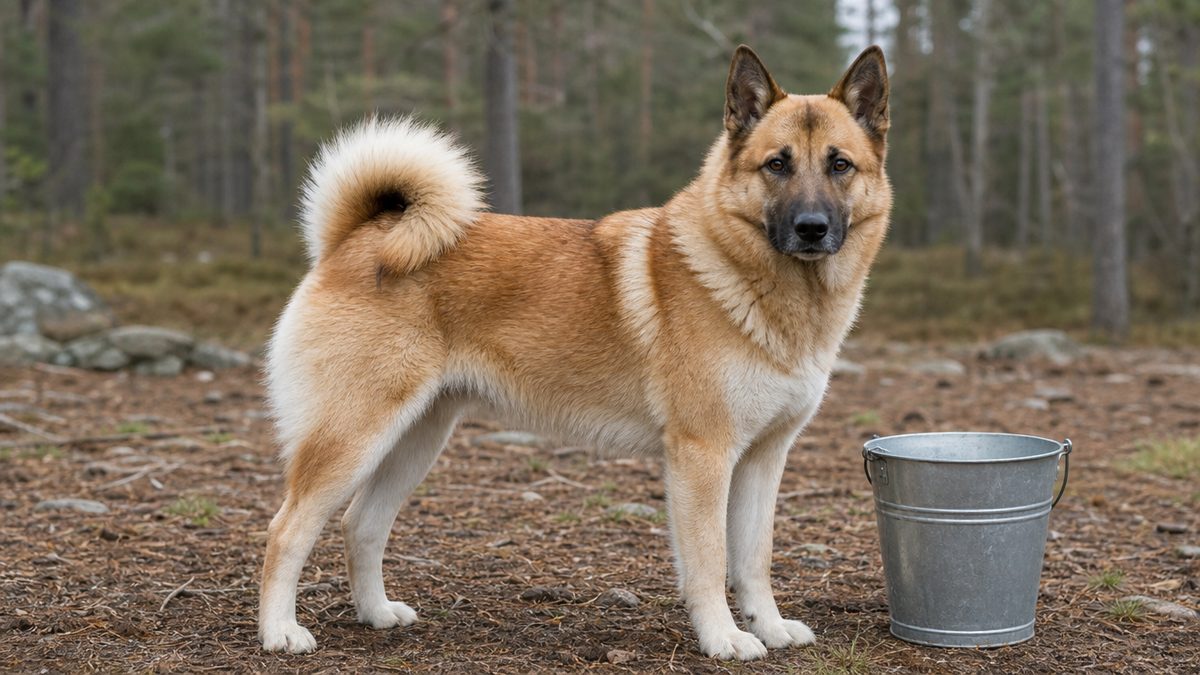
The standard describes a medium to large spitz of pronounced hunting-dog type, rectangular, dry and powerful with good carriage, which must not give a heavy impression, and it states that the body length shall somewhat exceed the height at withers. The head is dry, long and wedge-shaped, the ears high-set, stiffly erect, pointed and mobile, and the tail high-set, medium-long and densely coated without a flag, carried in an arc or curled over the back. Leg length shall be at least half the height at withers.
Colour is where the breed is most recognisable and most often got wrong. The standard requires yellow-red in darker or lighter shades, with a dark muzzle desirable, light muzzle sides and cheeks permitted, lighter colour on chest, belly and legs, in the saddle marking and on the backs of the thighs and the underside of the tail, and a preferably yellow-white undercoat.
Males stand 55 to 63 cm and females 52 to 60 cm. The standard states no weight at all, only height, which is the same situation this site found on the Hamiltonstövare. Any weight figure you see for this breed comes from a secondary site rather than from the standard, so treat it as an estimate. For practical purposes an adult sits in the same range as a large working spitz and will fall inside a 21 to 40 kg boarding band in India.
The two disqualifying faults, and how few they are
The standard lists exactly two disqualifying faults, an aggressive or extremely shy dog, and a dog clearly showing physical or behavioural abnormalities. There is no colour disqualification and no size disqualification, which is unusual and deliberate. The breed club's short-term goal states it plainly, that incorrect colour should be strongly prize-reducing but not disqualifying if the dog is otherwise sound in conformation and temperament. A breed carrying an open stud book cannot afford to throw dogs away over colour.
The rest of the standard's Nota bene is the usual Nordic formula, that only functionally and clinically healthy dogs with breed-typical construction shall be used for breeding, and that males must have both testicles normally descended.
Is the Hällefors Elkhound recognised? The answer has three layers
The Hällefors Elkhound is recognised by the Nordic Kennel Union and is not recognised by the Fédération Cynologique Internationale. Both halves of that sentence are printed on the breed's own standard, which is issued on Nordisk Kennel Union letterhead and carries the line Ej erkänd av FCI, not recognised by the FCI, directly under its group number.
Recognition is not binary, and this breed is the clearest example on this site of the middle layer that most English pages miss. Three distinct statuses apply at once.
- National. The Swedish Kennel Club began registering the breed in 2000, adopted the standard the same year and granted permission for hunting-trial participation. The current standard text was established by SKK's Central Board on 10 August 2017.
- Regional. The standard is issued jointly under the Nordic Kennel Union, whose letterhead on the document lists Dansk Kennel Klub, Hundaræktarfélag Íslands, Norsk Kennel Klub, Svenska Kennelklubben and Suomen Kennelliitto. The Swedish Kennel Club states the position in English without ambiguity: the breed is recognized by the Nordic Kennel Union, NKU, but not by the international kennel organization, FCI.
- International. The FCI does not list it. Three separate FCI documents were checked for this page and none contains it.
How the FCI absence was established
Prove an absence with a register that returns something, not with a search that returns nothing. Each of the three FCI pages below was confirmed to be the list it claimed to be, by finding on it a breed whose number this site had already verified independently.
| FCI document | What it contains | Control found on the same page | Hälleforshund present? |
|---|---|---|---|
| Nomenclature index, letter H | Eleven breeds, HALDENSTØVER to HYGENHUND | HAMILTONSTÖVARE, number 132 | No |
| Group 5, Section 2, Nordic Hunting Dogs | Finland 2, Norway 3, Russia 3, Sweden 2 | JÄMTHUND (42) under Sweden | No |
| Breeds recognised on a provisional basis | Twenty breeds, numbers 351 to 378 | SABUESO FINO COLOMBIANO (376) | No |
The Section 2 list is the decisive one, because that is the shelf this breed would sit on if it were recognised. Under Sweden it carries exactly two entries, JÄMTHUND (42) and NORRBOTTENSPETS (276), and under Norway three, NORSK ELGHUND SORT (268), NORSK ELGHUND GRÅ (242) and NORSK LUNDEHUND (265). There is no third Swedish elk dog.
The other two registers close the remaining routes. The nomenclature index for the letter H runs from HALDENSTØVER to HYGENHUND across eleven breeds and contains no Hälleforshund, and the page proves itself by carrying HAMILTONSTÖVARE at number 132, a figure this site verified separately on the breed's own FCI page. The provisional register holds twenty breeds numbered 351 to 378, the four newest admitted on 11 February 2026, and no Swedish entry among them. A breed can be absent from the definitive register because it is waiting in the provisional one, and this breed is in neither.
Any FCI nomenclature address resolves on its trailing number and discards the breed name in front of it, so an assembled link returns a complete, correct, error-free page for whichever breed owns that number. The provisional register in particular has a live decoy: a plausible-looking provisional-basis URL returns a full English Setter page. The three documents above were reached from the FCI's own index links and each was confirmed by the breeds printed on its face.
What the ranking pages say instead
Wikipedia holds position one for this breed in India and its infobox states, as the breed status, that the dog is not recognized as a breed by any major kennel club. Two rows below, the same infobox's Notes field says the breed is recognized by the Svenska Kennelklubben, the Suomen Kennelliitto and the Norsk Kennel Klub. Those are three national kennel clubs, and the article contradicts itself inside a single box without needing an external source to catch it.
The consequence runs further than one page. The Swedish Kennel Club records that the breed standard has not yet been translated into English, so every English writer has been working from summaries of summaries. That single fact explains the entire English-language result set for this breed, and it is why this page went to the Swedish document.
The next two results show what that produces. One dates the breed's origin to the town of Hällefors in the 19th century, where the Swedish Kennel Club's own standard puts the founding litter in the late 1930s and registration in 2000, an error of roughly a century in the same direction as the errors this site has found on other rare-breed directory pages. The other runs five headings in total, Appearance, Origin, Temperament, Keeping conditions and References, with no price, no climate, no health data and no recognition status at all. Neither page is dishonest. Both are downstream of a standard nobody translated.
The founding dogs, the 156 elk and the wolf claim
The Hällefors Elkhound descends from two named dogs with dates, owners and a Swedish Kennel Club registration number, which is unusually well documented for any breed and settles the wolf question on its own. The founding sire is Pajo, born 1930, and the founding dam is a bitch registered as Vargåsens Izby, born 6 March 1937 and renamed Spanja.
Pajo, and a number that reconciles across two documents
Pajo was a yellow-red male from a 1930 litter in northern Hälsingland, out of a white spitz-type bitch of probably mixed breeding and by a cross between a grey elkhound and a stövare, a scent hound. The litter was intended for hare and fox. Pajo went to the village of Styggberg to a seventeen-year-old owner, Per Ferm, showed no interest in hare or fox and a great appetite for elk, and the first elk was shot over him in October 1931. In autumn 1936 the Hellefors Bruk company bought him, by which point 14 elk had been shot over him, and between 1936 and 1941, handled by the forest officer Edvard Rådberg, a further 142 were.
The breed standard states that it is said 156 elk were shot over the famous yellow dog, and the Swedish Kennel Club's English page repeats 156 Svenska Kennelklubben. The breed club's history decomposes it as 14 before the sale plus 142 afterwards, which sums to exactly 156. Three documents, one number, and the arithmetic reconciles. That is rare enough on a rare breed to be worth stating.
Spanja, and the Siberian half of the breed
The dam line is Siberian, not Scandinavian. Vargåsens Izby was born on 6 March 1937 from a January 1937 mating between Jack av Polarland and Troika av Polarland, both descended from dogs directly imported from Siberia in what was then the Soviet Union, and in the pedigree issued for her every dog carries the breed designation Ostjakhund, with her own registration number recorded as 43406. Her breeder, Åke Aspegren of Stockholm, kept those ostjak dogs mainly as sled dogs and served with them as a volunteer in the Finnish Winter War of 1939 to 1940.
On 26 September 1937 the forest ranger Martin Norman, employed at Hellefors Bruk, bought her at six months old for 50 kronor, a low price set because she was black-grey with white markings while puppies of the wanted yellow-red colour fetched 200 kronor. He renamed her Spanja. Seven elk were shot over her in autumn 1938 and ten in 1939, and she disappeared during a hunt in late autumn 1940, in her owner's view probably kicked to death, the breed club adding that the ostjak dogs used in hunting had a notoriously aggressive hunting style and were therefore often kicked. She had produced two litters, on 21 July 1939 and 12 August 1940, and she is regarded today as the founding dam.
The breed standard describes the founding litter's dam as a grey-beige ostjak bitch from a team of ostjak dogs imported from Siberia in the mid-1930s, while the breed club's own history gives her as Swedish-born in March 1937 to two Swedish-registered parents themselves descended from Siberian imports, and black-grey with white markings rather than grey-beige. Both documents are published by the Swedish Kennel Club. This page reports the divergence rather than choosing, because the club's history carries dates, names and a registration number and the standard carries a one-sentence summary.
The wolf claim, and what the cited paper actually contains
Wikipedia's Lineage section says the breed falls under an mtDNA sub-clade referred to as d1, found only in northern Scandinavia, and then that it is the result of a female wolf and male dog hybridization that occurred post-domestication. Read strictly, the it refers to the sub-clade rather than to the breed. Read the way a search snippet renders it, and the way most readers will take it, it says this dog is part wolf.
The first paper cited for that sentence was retrieved in full and searched. Across 265,070 characters, Pang and colleagues 2009 contains zero occurrences of Hällefors, Hallefors, Elkhound, Jämthund, Lapphund or Sami. What it does say is narrower: outside a defined Asian region there are indications of hybridization between female wolf and male dog in only three cases, two forming clade D, one in Scandinavia and one in south-west Asia, and one in Japan forming clade F, and that such hybridization leading to offspring passed on in the dog population seems rare. Its Scandinavian sample was 58 dogs, with no breed named in the text.
So the citation is real, the paper opens, and it does not contain the claim as applied to this breed. The second source cited alongside it was not retrievable for this page and is not relied on here either way. Against that, a 2024 genomic study of eight 100 to 200 year old dog fur samples from traditional North Swedish clothing concluded that the Nordic Lapphund and Elkhound breeds originate from the local dog population, with a distinct decrease in genetic diversity consistent with intense breeding. That paper is about breeds established long before 1930, so it does not describe the Hälleforshund either, but it points the opposite way to a wolf story.
The plainest evidence is the pedigree. A breed whose founding dam has a registration number, a purchase price and a death date, and whose founding sire has a documented tally of elk, does not need a wolf to explain it.
How rare the Hällefors Elkhound is, and the open stud book that keeps it alive
About 400 Hällefors Elkhounds of breeding age exist, which the breed club describes as far too few to sustain breeding within the breed, and it is why the breed runs an open stud book that the club calls absolutely decisive for its future. Sweden registered 288 over the five years 2018 to 2022, Norway 34 and Finland 14.
An open stud book means a dog of no registered pedigree can be inspected and approved as a hälleforsare if it is typical of the breed, and its offspring then enter the register. Very few recognised breeds anywhere work this way, and the club is explicit about why: the open stud book allows a controlled genetic addition to a narrow base, and it judges the prospect of continued increased genetic variation to be relatively good as a result.
| Year | Bitches | Males | Total | Of which imports |
|---|---|---|---|---|
| 2014 | 45 | 42 | 87 | 2 |
| 2015 | 31 | 22 | 53 | 0 |
| 2016 | 22 | 33 | 55 | 1 recorded in the male row only |
| 2017 | 47 | 27 | 74 | 2 |
| 2018 | 23 | 29 | 52 | 2 |
| 2019 | 27 | 35 | 62 | 3 |
| 2020 | 33 | 29 | 62 | 7 |
| 2021 | 31 | 28 | 59 | 1 recorded in the bitch row only |
| 2022 | 33 | 20 | 53 | 4 |
| 2018 to 2022 | 147 | 141 | 288 | 16 |
Its registration table sums to 288 for 2018 to 2022, and its health section uses 288 explicitly. Its population section's prose says 300, of which 13 were imports, over the last five years. Its next paragraph says 274 puppies were registered in Sweden from 2018 to 2022 across 53 litters, giving 5.2 puppies per litter, which is arithmetically correct on its own figures. None of the three reconciles with the others: 274 plus the table's 16 imports is 290, and 274 plus the prose's 13 is 287. This page uses 288, because that is the figure the document's own table produces and the figure its own health section adopts.
Read the litter count rather than the puppy count to see how small this really is. Fifty-three litters over five years, from 34 bitches and 33 stud dogs, is about eleven litters a year for the entire breed. The weighted mean inbreeding increase for dogs born in that period was 2.3 percent calculated on five generations, against a breeding rule that individual matings should stay under 3 percent.
Who has been inspected into the breed
The club publishes the whole list, which is the kind of transparency almost no breed offers. Ten dogs have been inspected in since the start, from Boy in 2003 to Zorro and Aiko in 2019, producing between one and four litters each and 25 litters between them. Four of the ten have both parents recorded as unknown, which is exactly what an open stud book is for, and two of them trace to a Finnish-registered sire.
The consequence shows up in the show ring rather than in the health data. The club records that prize reductions for incorrect colour have increased somewhat through crossbreeding, and colour is now the commonest cause: of 566 dogs assessed at shows between 2017 and 2022, 32 received prize reductions, of which 19 were for colour. That is the trade the breed has chosen, genetic variation bought at the cost of colour typicality, and the club says so in its own goals.
What none of this means for India
India does not appear in any of these registers, and with about eleven litters a year worldwide it never will through ordinary supply. A Hällefors Elkhound in India would be a single imported dog with a Nordic pedigree, with no second dog in the country and no prospect of one. That is a materially different proposition from importing a rare but internationally traded breed, and it belongs in the decision before the price question does.
Hällefors Elkhound price in India
No Hällefors Elkhound price in India exists, and unlike most rare breeds this one has a structural reason rather than merely an absence of listings. The whole breed produces about eleven litters a year, almost all in Sweden, and Indian import policy forbids importing a dog for breeding or sale Directorate General of Foreign Trade.
The Indian search result set contains exactly one seller page, and it is selling a different breed. An India-localised search for this breed returned Wikipedia, the Swedish Kennel Club twice, two English breed directories, a classifieds site, a YouTube video, a stock-photography library, a Spanish Pinterest pin, and one Indian commercial page advertising Norwegian Elkhound puppies for sale in India. Not one result offers a Hälleforshund at any price.
Bing India returned HTTP 200 and the correct page title for hallefors elkhound price in india and served ten GitHub, Reddit and Zhihu pages about ChatGPT jailbreak prompts, GitHub Desktop and building language models from scratch. In the same session on the same endpoint, a Labrador Retriever price in india control returned ten French-language sports-supplement pages, and a third query returned ten Chinese-language Apple App Store pages. Google India served a Verifying your request interstitial and then failed on every engine for the control. When the control is substituted the same way the query is, the instrument is broken, so nothing on this page rests on those results.
No foreign price is converted here
Bonbeno does not convert a Swedish or Norwegian price into rupees, and no Nordic price for this breed was found to convert. This site has repeatedly documented Indian price tables that turned out to be American price lists divided by a single exchange rate, and the discipline that catches them is to refuse the conversion in the first place. What can be priced honestly for an Indian reader is the cost of keeping a dog of this size here, and that is in the next two sections, sourced to Indian price lists.
Why no Indian supply chain can form for this breed
Two facts close the question between them. Indian import policy places dogs under ITC(HS) 01061900 as Restricted and permits import only for a pet dog with a valid pet book in the importer's own name, for CPCSEA-recommended research, or for Defence and Police use, with Policy Condition 8 barring import of commercial dogs for breeding or any other commercial activity and paragraph 6 requiring that any application for trading or breeding purposes be duly rejected. And the breed's total output is around eleven litters a year against a Swedish waiting demand the club is actively trying to grow.
A breed that cannot be imported commercially and does not produce enough puppies to meet its own domestic demand cannot develop an Indian market price. That is not a gap in this page's research. It is the finding.
What an Indian search for this breed actually offers you
The one Indian commercial page in this breed's search results is a Norwegian Elkhound page whose available stock contains no elkhound at all. Its carousel lists eight animals: two Poodles, two Maltipoos, a Cane Corso, a Goldendoodle, a Rottweiler and a Doxiepoo.
This matters more than any missing price, because it is what a real Indian buyer will actually encounter. The page ranks for an elkhound query, carries elkhound photographs, prints elkhound facts, and then offers whichever puppy is in the building.
| Name | Breed listed | Age | Price |
|---|---|---|---|
| Fizey | Maltipoo | 8 weeks | ₹98,999 |
| Kuzo | Poodle | 8 weeks | ₹92,599 |
| Dugu | Poodle | 8 weeks | ₹92,599 |
| Kazuka | Cane Corso | 8 weeks | ₹94,999 |
| Doir | Goldendoodle | 8 weeks | ₹1,20,000 |
| Samy | Maltipoo | 8 weeks | ₹98,999 |
| Tugi | Rottweiler | 8 weeks | ₹76,499 |
| Yoki | Doxiepoo | 8 weeks | ₹98,999 |
Run the division tests on ₹98,999
Test the recurring figure rather than assuming it. ₹98,999 divided by 84.38 is 1,173.25, by 80 is 1,237.49 and by 74 is 1,337.82. None is a whole number and none is a price a seller anywhere would print, so this is not a converted dollar figure. It is a rupee-native charm price, and the giveaway is that the same number appears three times on one page attached to two Maltipoos and a Doxiepoo, three animals of two unrelated breeds and two different adult sizes.
Bonbeno has recorded ₹98,999 on this Indian listing network before, on pages for breeds the seller does not stock, and this retrieval reproduces it independently along with the neighbouring ₹92,599, ₹94,999, ₹76,499 and ₹1,20,000. Never report it as any breed's price, and be sceptical of any Indian figure that recurs unchanged across unrelated breeds.
The line worth reading twice
The same page publishes a replacement guarantee, which it explains as follows: if your pet perishes because of any health concern covered under its vet-approved conditions within the guarantee period, and a licensed vet confirms it, the seller will happily offer a replacement. Its tier chart sets that period at one week on the middle tier and two weeks on the top tier.
A two-week replacement guarantee on a live animal is a statement about how often eight-week-old puppies from that supply chain die in their first fortnight. It is also, in substance, a returns policy on a sentient animal. An Indian buyer looking at a rare Nordic breed should read that clause before reading any price, because it describes the seller far more accurately than the breed page above it does.
None of this is evidence about the Hällefors Elkhound, and this page does not present it as such. It is evidence about what the Indian market returns when you ask it for one, which is the question a reader actually arrived with.
What a Hällefors Elkhound costs to keep in India
Budget for a large, high-energy, double-coated dog rather than for a breed, because none of the recurring costs of ownership in India depend on which Nordic spitz you have. Indian vaccination, boarding and feeding prices are published, real and directly applicable to a 55 to 63 centimetre working dog.
Vaccination is the easiest line to pin down and the one most often understated. A published Indian per-dose table gives DHPP at 800 INR, rabies at 350 INR, leptospirosis at 150 INR, Bordetella for kennel cough at 200 INR, canine influenza at 800 INR and Lyme disease at 700 INR. Those are vaccine prices before any consultation or injection charge, and published Indian estimates for a full puppy course range from roughly ₹2,500 to ₹8,000 depending on clinic and city, a spread wide enough that any single quoted vaccination cost should be read as one clinic's price.
| Item | Published Indian figure | Source type |
|---|---|---|
| DHPP vaccine, per dose | ₹800 | Indian retailer price table |
| Rabies vaccine, per dose | ₹350 | Indian retailer price table |
| Leptospirosis vaccine, per dose | ₹150 | Indian retailer price table |
| Bordetella, kennel cough, per dose | ₹200 | Indian retailer price table |
| Boarding, 21 to 40 kg, air-conditioned | ₹950 per day | Chennai kennel tariff, 2026 |
| Boarding, 21 to 40 kg, non air-conditioned | ₹850 per day | Chennai kennel tariff, 2026 |
| Boarding, 41 to 50 kg, air-conditioned | ₹1,050 per day | Chennai kennel tariff, 2026 |
| Boarding, over 50 kg, air-conditioned | ₹1,150 per day | Chennai kennel tariff, 2026 |
A Hällefors Elkhound falls in the 21 to 40 kg band, so the published Chennai rate is ₹950 a day with air conditioning and ₹850 without. On a double-coated Nordic breed that ₹100 difference is not a choice, and over a two-week absence it is ₹1,400 that buys the dog a survivable fortnight.
The same published tariff defines its giant band as over 50 kg in the air-conditioned list and over 45 kg in the non air-conditioned list, while its non air-conditioned large band runs 41 to 50 kg, so a 47 kg dog sits inside two bands at once. It does not affect this breed, which is comfortably in the medium band, but it is worth checking the numbers rather than the words when comparing kennels.
The monthly cost, assembled from its parts
Build the monthly cost from sourced components rather than quoting a single number nobody can check. Food is the largest line. Royal Canin India's large-breed adult feeding table runs from 26 kg to 44 kg and gives, at 30 kg, 307 grams a day at low activity, 355 at medium and 404 at high. This is a working spitz whose breed club describes an all-day hunting role, so the high-activity column is the one to budget from, and the gap between low and high at that weight is 97 grams a day, about 32 percent, or roughly 35 kilograms of food across a year.
- Food at the high-activity rate, in smaller bags through the monsoon so it does not spoil.
- Vaccination annually for the core boosters, at the per-dose figures above plus a consultation each visit.
- Ectoparasite control year-round rather than seasonally, because Indian tick pressure does not pause.
- Coat maintenance, which costs a brush and time rather than money, but costs both twice a year in earnest.
- Boarding at ₹950 a day in the air-conditioned medium band, which is ₹6,650 for a week away.
- An eye examination if you ever intend to breed, since the breed council requires one no older than a year at mating.
No lifetime total is published here. This breed has no Indian cost dataset, no Indian population and no Indian veterinary series, and manufacturing a single figure from those absences would be exactly the practice this site spends its time detecting on other pages.
Heat tolerance: a dog from a 4.8 degree homeland in a 27.9 degree country
The Hällefors Elkhound has the lowest heat tolerance this site rates, because its homeland averages 4.8 degrees Celsius across the year and Chennai averages 27.9. Chennai's coolest month, at a mean of 24.1 degrees, runs eight degrees warmer than the warmest month in Hällefors, which averages 16.1.
Every figure below was queried from NASA POWER by explicit latitude and longitude rather than by place name, because place-name climate pages have served this project six wrong cities at HTTP 200. A coordinate cannot hand you another town by accident. One column also needs a label rather than an assumption. The record-high column is NASA POWER's T2M_MAX, the hottest reading the climatology holds for that month across the whole period. It is an extreme, not an average afternoon, so compare it with other record highs and never with a monthly mean.
The grid-cell problem, demonstrated on this breed's own homeland
NASA POWER returns a grid cell, not a point, and this breed gives the cleanest demonstration of that anywhere on this site. Hällefors and Fredriksberg are about 42 kilometres apart, and the two towns are the two candidates for where the breed was actually made. Queried separately by their own coordinates, they return byte-identical results: the same cell elevation of 260 metres, the same annual mean of 4.8 degrees, the same July mean of 16.1 and the same annual relative humidity of 89.8 percent. The model cannot tell them apart, because they sit in one cell.
That is convenient here and dangerous elsewhere. It is convenient because the argument about which town the breed comes from turns out not to matter for climate. It is dangerous because the same behaviour makes a cell in mountainous terrain describe somewhere the town is not.
| Place | Cell elevation | Real town elevation | Annual mean | Warmest month mean | Warmest month record high | Coolest month mean |
|---|---|---|---|---|---|---|
| Hällefors, Sweden | 260 m | ~180 m | 4.8 °C | 16.1 °C (Jul) | 30.3 °C | -5.8 °C (Jan) |
| Fredriksberg, Sweden | 260 m, same cell | ~240 m | 4.8 °C | 16.1 °C (Jul) | 30.3 °C | -5.8 °C (Jan) |
| Chennai | 49 m | ~6 m | 27.9 °C | 31.5 °C (May) | 42.7 °C | 24.1 °C (Jan) |
| Mumbai | 97 m | ~14 m | 26.8 °C | 31.2 °C (May) | 44.9 °C | 23.2 °C (Jan) |
| Delhi | 206 m | ~216 m | 25.6 °C | 35.9 °C (Jun) | 48.8 °C | 13.6 °C (Jan) |
| Pune | 636 m | ~560 m | 23.9 °C | 28.9 °C (Apr) | 43.2 °C | 19.6 °C (Dec) |
| Bengaluru | 842 m | ~920 m | 23.7 °C | 28.4 °C (Apr) | 40.4 °C | 20.2 °C (Dec) |
Those seven cells all sit within about 106 metres of the towns they stand for, which at the standard lapse rate of 6.5 degrees per 1,000 metres is under 0.7 degrees of error, so the figures can be used as printed. The hill stations cannot.
For Gangtok, NASA POWER reports a cell elevation of 3,240 metres against a town at roughly 1,650, so the cell stands about 1,590 metres too high and reads roughly 10 degrees Celsius too cold. Its cell annual mean of 7.5 degrees looks like a near-Swedish analogue and is not one. Shimla's error runs the other way, a cell at 898 metres against a town near 2,200, about 1,302 metres too low, so its cell annual mean of 21.1 degrees reads roughly 8.5 degrees too warm. Leh's cell sits at 4,533 metres against a town near 3,500. This matters because these are precisely the three towns anyone would name when arguing that an Indian hill station could suit a Nordic breed, and the raw cell figures point the wrong way in every one.
Humidity, which decides whether panting works
Panting is this dog's only cooling system and humidity is what limits it. Chennai runs an annual mean relative humidity of 72.4 percent and Mumbai 67.4 percent, while Delhi is much drier at 45.6 percent annually and 36.4 percent in June. Hällefors is humid too, at 89.8 percent annually and 81.8 percent in July, but at 16.1 degrees that humidity costs the dog nothing at all. Humidity only becomes a problem once the air is warm enough that evaporation is doing the work.
The one Indian figure that is genuinely encouraging
Delhi in January averages 13.6 degrees Celsius, which is 2.5 degrees cooler than Hällefors in July. That is the only month in this whole comparison in which an Indian city is genuinely cooler than the breed's homeland at its warmest. A dog living in Delhi therefore gets a real winter and a brutal June, where a dog in Chennai gets neither relief nor variation. If this breed is going to live anywhere in India, the north Indian plain in winter is the part of the year it will actually enjoy.
What the heat research does and does not transfer
The largest study of heat-related illness in UK dogs found exertion, not confinement, behind most cases: of the 879 events that had a trigger recorded, 652 were exertional, which is 74.2 percent, against 113 environmental and 46 from vehicular confinement. Its companion paper from the same 905,543-dog cohort reports that dogs at or above the mean bodyweight for their own breed and sex carried an odds ratio of 1.42, with a 95 percent confidence interval of 1.12 to 1.80.
Be precise about the limits. The Hällefors Elkhound is not a UK breed and was not modelled in either paper, so no breed-specific odds ratio exists for it and none is invented here. What transfers is the mechanism, that exertion is the dominant trigger, and the bodyweight finding, which applies to any dog heavy for its own breed. Keeping this dog lean in India is a heat-safety measure, not a cosmetic one.
Temperament: the one-man dog problem
A Hällefors Elkhound is a one-man dog, and that phrase comes from the breed's own documents rather than from folklore. The standard states that the breed is known for being a so-called enmanshund, and the breed club repeats that many Hälleforshunds display one-man-dog mentality Hälleforshundklubben and Svenska….
Take that literally, because the club spells out what it means in practice. During hunting the dogs often show clear reservation towards other hunters and strangers, which the club says can sometimes be awkward if anyone other than the owner follows the dog during the hunt. That is a description of a dog that bonds hard to one person and works for that person only.
Set against that, the same club describes the breed as quick to learn and a pleasant family dog that very rarely shows dominance aggression within the family, with a strongly developed pack sense and a clear understanding of its place in the order, adding that in some individuals this can make the dog appear soft, noticing and reacting markedly to the leader's wishes. Conformation assessments over the last decade have shown consistently good temperament.
The sentence Indian buyers should read twice
The Swedish Kennel Club states plainly that the Hälleforshund is used as a hunting dog for elk, that it is a pronounced hunting dog and that it is not suitable purely as a companion dog. A national kennel club saying that about one of its own national breeds carries more weight than any temperament star rating on a directory page, and it is the sentence most likely to be missing from whatever page an Indian buyer read first.
Who this breed suits in India
- A single primary handler, since the breed bonds to one person and works for that person. A dog passed between family members will be a frustrated dog.
- A property with real fencing, not a compound wall with a gate onto traffic.
- A cool-season region, realistically the north Indian plain in winter or a genuine hill station whose altitude you have checked rather than taken from a gridded model.
- An owner who will work the dog, through tracking, scent games or canine sport, because the drive does not switch off in a country with no elk.
Who it does not suit
- A flat, which the exercise requirement and the coat rule out together.
- A household with cats, poultry or small pets, given a breed selected for documented game sharpness.
- A family wanting a dog that greets everyone, since reservation towards strangers is a described breed trait rather than a training failure.
- A first-time owner, because a one-man working spitz with a high prey drive is a demanding first dog anywhere and an unfair one in an Indian city.
A Nordic elk dog works by finding and holding game and telling the hunter where it is, which is a job done with the voice. Expect a vocal dog, expect the voice to carry, and expect that to matter in Indian housing where buildings sit close together. That is a bred-in function, not a fault to be corrected out.
Training a one-man elk dog with nothing to hunt
Train recall, a settle and a substitute job, in that order, and accept that recall will fail on live game. The breed club describes the Hälleforshund as quick to learn with a strongly developed pack sense, and the Swedish Kennel Club describes it as needing a great deal of physical and mental stimulation to be well. Both are true at once, and the second is the constraint.
Start from what the breeding programme selects for, because the selection is recent, deliberate and documented. Both of the breed council's mating categories require hunting-trial merit, the Rekommenderad category in both parents and the Anvisad category in at least one. Every generation is therefore filtered for the willingness to leave a handler, find large game alone and hold it. A dog bred to that specification is not going to be a heelwork dog, and treating it as one produces a frustrated dog and a disappointed owner.
The training order that works
- Socialise early and deliberately, and to more than one person. A breed described as a one-man dog with reservation towards strangers needs its social window used, not saved. In Indian cities that means traffic, two-wheelers, free-roaming dogs, cattle, lifts and festival noise, all before sixteen weeks.
- Build a settle before obedience. A working spitz that cannot switch off indoors will not survive Indian apartment life, and the settle is what buys the hot hours back.
- Keep the dog on a long line for the first year and in unfenced spaces thereafter. Treat the line as permanent equipment rather than a phase.
- Give the prey drive a legal target. Tracking, scatter feeding, hidden-article searches and formal scent sport use the same circuitry that otherwise takes the dog over a wall after a cat.
- Reward engagement rather than compliance. Pay the dog for checking in with you while something interesting is available, because that is the behaviour you actually need.
- Teach a quiet cue in the first year. A dog bred to tell a hunter where the game is will be vocal, and a cue trained early is far easier than a habit corrected in year three.
What this breed resists
It resists repetition and it resists working for strangers. A trainer who is not the dog's person will get less out of it than the owner will, which matters in India where group obedience classes are the usual route. If you use a class, handle the dog yourself throughout rather than passing the lead to the instructor.
It also resists heat-hour training, which is a practical rather than a temperamental problem. In most of India the hours when a scenting dog works best, early morning and after dark when the ground is cool and holding scent, are the only hours it is safe to work this breed hard at all. That coincidence is the one piece of luck in this breed's Indian situation and the whole routine should be built around it.
The club records that although hunting ability generally seems good, there are also dogs that are decidedly soft and with weak hunting drive, and that only about 16 percent of each year-cohort born between 2013 and 2019 gained a hunting merit by the age of three, down six percentage points from the previous strategy period. A club willing to publish a falling number about its own breed is a club whose other numbers are worth trusting.
Exercise needs, and the two hours a day India will not give you
A Hällefors Elkhound needs a great deal of physical and mental exercise, which the Swedish Kennel Club states as a requirement rather than a preference. In India that requirement does not shrink, but the hours in which it can be safely met collapse to roughly two windows a day for eight months of the year.
Understand the working benchmark before deciding what a domestic version looks like. This is a loose-running elk dog, worked off-lead across forest to find and hold large game, and the breed council's trial system is built around exactly that, with merit awarded for jaktprov med löshund efter älg, hunting trials with a loose dog after elk. A dog bred for that will not be satisfied by a lead walk around a colony park.
What the safe window looks like in practice
In Chennai the warmest month averages 31.5 degrees Celsius against a record high of 42.7, in Delhi June averages 35.9 against a record 48.8, and in Bengaluru April averages 28.4 against a record 40.4. None of those cities offers a usable midday for an athletic double-coated dog. What they offer is a pre-dawn window and a post-sunset window, and in Delhi a genuinely usable full day through January.
- Split the daily requirement, roughly 60 to 90 minutes before sunrise and 45 to 60 after dark, rather than attempting one session.
- Test the ground with the back of your hand. Tarmac and concrete hold heat long after the air cools, and paw burns are a common Indian city injury.
- Carry water on every outing, including short ones, and offer it before the dog looks like it needs it.
- Swap distance for nose work when the window closes. Twenty minutes of searching tires a scenting spitz more than an hour of lead walking.
- Watch for the early signs rather than the late ones. Bright red gums, thick saliva, an unwillingness to continue and any unsteadiness are the point to stop, cool the dog and call a veterinarian.
What under-exercise produces in this breed
An under-exercised elk dog does not become calm, it becomes destructive, vocal and inclined to leave. The breed's requirement for both physical and mental stimulation is stated by its own kennel club as a condition of the dog being well, and a breed selected across every generation for independent searching will search on its own account if you do not organise it.
If this dog overheats, wet it thoroughly with cool, not ice-cold, water, concentrating on the belly, groin, armpits and paws where the coat is thinnest, and move air over it. Do not soak the outer coat and leave it, because a dense undercoat holds warm water against the skin and can make things worse. Then go to a veterinarian, because collapse from heat is an emergency whatever the dog looks like ten minutes later.
Grooming and coat care in Indian humidity
Brush a Hällefors Elkhound through its moults and leave the coat alone the rest of the year. The standard requires longer coarse guard hair over a short, soft undercoat that must be dense and abundant, with a mane of longer coat framing the head over the neck and shoulders, and the Swedish Kennel Club says the coat needs brushing when shedding, is otherwise easy to care for and should be bathed only when needed.
This is a genuine double coat and there is no ambiguity about it, which is a point of difference from some other Nordic-adjacent breeds where registries disagree. Both the Swedish standard and the Swedish Kennel Club's own summary describe two layers explicitly, and the standard goes further and specifies what the undercoat should look like, preferably yellow-white Svenska Kennelklubben. Coat length is short and smooth on the head and the fronts of the legs, longer on the backs of the forelegs and thighs, and short, dense and soft on the ears.
The moult is the whole job
A dense northern undercoat sheds in bulk twice a year, and in India the pattern often becomes less predictable because the light and temperature cues the coat responds to are different from the ones it evolved with. Plan for continuous moderate shedding punctuated by heavy periods, rather than for two tidy seasonal blowouts.
- Brush weekly as a baseline and daily through a moult, using an undercoat rake rather than a bristle brush, which only moves the guard hair.
- Work outdoors and accept that the volume of hair coming off a Nordic breed in an Indian summer will surprise you.
- Do not shave. Removing the coat exposes skin that has never been sun-adapted and takes away the layer that holds air off it. On this breed the standard's own requirement for a dense, abundant undercoat is a description of what would be removed.
- Bathe only when needed, which is the Swedish Kennel Club's own instruction, and dry the dog properly rather than leaving a thick coat damp in a humid month.
Nordic and British breed guides routinely say to towel a double-coated dog and let it air dry. That is sound advice in a dry temperate climate and poor advice in an Indian monsoon, where a dense undercoat left damp under a mane stays wet for hours and becomes a hot, moist layer against the skin. Dry the dog down to the skin over the neck, shoulders and behind the ears, and if you cannot, do not bathe it that day.
Ticks and skin, which are Indian grooming tasks rather than Swedish ones
Fold a tick check into the brush rather than treating it as a separate seasonal job. A spitz worked or walked in vegetation carries its head and shoulders through exactly the height ticks wait at, and the mane over the neck and shoulders is the hardest part of the dog to see through. Check the ear margins, under the collar, the armpits, the groin and between the toes, and keep an ectoparasite preventive running year-round rather than starting one after you find a tick.
The erect ear is a genuine advantage here and worth saying, because so much of this page is about disadvantages. A high-set, stiffly erect, open ear ventilates in a way a drop ear does not, so this breed is at markedly lower risk of the monsoon ear disease that troubles the hounds elsewhere on this site.
Health issues, hip dysplasia and a screening programme that shames older breeds
The Hällefors Elkhound has no known breed-specific disease and an unusually strict screening programme, and those two facts are connected. The Swedish Kennel Club states there are no known breed-specific health problems and that hip dysplasia occurs, and the breed council requires a hip grade of at least B, clear elbows and a dated eye examination before any recommended mating.
Compare that with what most older breeds ask for and the contrast is stark. This breed screens roughly 40 percent of the population's eyes and around half of its registered dogs' hips, on a base of about 400 breeding-age animals, and its stated short-term goal is to lift health examinations to 60 percent of registered dogs, with the club subsidising 500 kronor towards hip radiography, elbow radiography and an eye examination when done before two years of age.
Hips, and a table that adds up
The hip figures below are computed from the breed club's own table for dogs born 2014 to 2021, and every one of its eight year-columns sums exactly to its own printed total, 171 dogs in all. That is worth stating because this site has published a sibling Swedish breed whose equivalent table fails in four of nine columns.
| Hip grade | Dogs | Share of the 171 screened |
|---|---|---|
| A | 85 | 49.7% |
| B | 57 | 33.3% |
| C | 27 | 15.8% |
| D | 2 | 1.2% |
| E | 0 | 0.0% |
| C or worse | 29 | 17.0% |
The recent trend is worse than that eight-year average and the club says so. Its own summary reports 142 dogs radiographed from 2018 through 2022, of which 20 percent had a C hip or worse and three had a D hip, and states that the share with C or worse has risen by 12 percentage points since the previous strategy, which it calls a significant deterioration. Working from the table's birth-year columns for 2018 to 2021 gives 15 C hips out of 72 dogs, which is 20.8 percent and consistent with that.
First, the 142 figure counts dogs radiographed in the calendar years 2018 to 2022, while the table is arranged by birth year, so the two must not be added together or compared row by row. Second, two of the table's printed percentages do not reconcile with their own columns: the 2014 column's grades sum to 100.4 percent because hip C is printed as 17.7 where 5 of 29 is 17.2, and the 2016 column sums to 101.9 percent because hip A is printed as 51.9 where 14 of 28 is 50.0. Every count in the table is correct and only those two percentages are off, which is why this page computes from the counts.
Elbows, eyes and the rest
- Elbows are clean. Across 145 elbow evaluations from 2014 to 2021, 100 percent were graded without remark in every single year, unchanged from the previous strategy period.
- Hereditary cataract is the screened eye condition. Of 270 eye examinations between 2015 and 2022, about 40 percent of the population, 5.6 percent received a hereditary cataract diagnosis, down from 8.3 percent in the previous period, against a club target of 10 percent or less that has already been met.
- Epilepsy has produced no known cases since the previous strategy period.
- Cryptorchidism produced one known case across 2016 to 2022, against two in the period before.
- Masticatory muscle myositis produced no known cases since 2009. The club records that it was seen in a few cases after the breed was registered in 2000 and has been kept under watch since, and separately that a few isolated autoimmune disease cases were reported in the previous period with genetic significance unknown.
- Teeth show no known missing-tooth cases, with one undershot bite found at a show, and the club notes its own dental reporting may be insufficient.
The eye programme is the part that deserves emphasis for a buyer. An approved eye examination no more than one year old at the time of mating is required for both mating categories, and the club has tightened rather than relaxed it, allowing a milder cataract diagnosis only in a dog over five years old that was previously clear, and never for posterior polar or total cataract.
Life expectancy, and why this page publishes none
No cohort study gives a life expectancy for this breed. It has no row in the published Dogs Trust table of median life expectancy for 155 breeds, in a search where Norwegian Elkhound, Foxhound and Labrador Retriever all returned normally. For scale, the Norwegian Elkhound's median there is 12.9 years with a confidence interval of 12.4 to 14.1, resting on 145 individuals of which 64 had died. Bonbeno publishes no figure for the Hälleforshund, because borrowing a related breed's number is the exact practice this site exists to catch.
What the American screening registry holds
Nothing. A full retrieval of OFA's disease-statistics tables, roughly 2.2 million characters across about 270 printed breed labels, contains no Hälleforshund row, in a retrieval where a Labrador Retriever control matched 109 times. Nor does the breed hold an OFA code: a read of 438 canine entries in the registry's own advanced-search markup runs alphabetically from GREYHOUND to HAMILTONSTOVARE to HANGIN TREE COWDOG to HANOVERIAN HOUND with no Hälleforshund slot at all. The same list does carry SWEDISH ELKHOUND under the code SE, which is the Jämthund and a different breed, so anyone reaching for that code on this breed's behalf would be reading another dog's data.
Zero papers on this breed, and what the neighbouring literature does say
The Hällefors Elkhound has no veterinary literature at all. Three PubMed query forms run on 31 August 2026 returned zero, while same-session controls returned 12 for the Jämthund, 30 for the Norwegian Elkhound and 52 for masticatory muscle myositis in dogs.
That zero is earned rather than assumed, and the way it was earned matters. A search for the token Hallefors alone, without the breed, returns two real records, a Swedish adolescent mental-health study and a paper on common shrews in central Sweden, neither about dogs. So the token exists in the index and retrieves records; the zero for the breed is a real absence rather than a tokenisation artefact.
The absence was then tested against every name the breed has. A dog with a native name and an English name can have its literature split between them, and the Hamiltonstövare page built on this site the same day was corrected for exactly that: its second paper is indexed under Hamilton Hound and is invisible to a search on Hamiltonstovare. So all four of this breed's recorded alternative names were run separately, Hälleforshund, Hälleforsspitz, Hälleforsinkoira and Hälleforsare, alongside Hallefors elkhound and Hallefors spitz. Every one returned zero. Eight query forms, one genuine absence.
The two findings from neighbouring breeds, and why they are not transferred
Two studies in the elkhound literature are worth an Indian owner knowing, and neither is a finding about this breed.
- Diestrus diabetes in Elkhounds. A Swedish study of 63 Elkhounds with diabetes mellitus and 26 healthy controls found that every affected dog was an intact female and 7, which is 11 percent, were pregnant at diagnosis. First clinical signs appeared a median of 30 days after oestrus and diagnosis a median of 46 days after. Forty-six percent of the dogs that underwent ovariohysterectomy recovered from the diabetes, and the authors concluded that immediate surgery improves the prognosis for remission.
- Progressive retinal atrophy in the Jämthund. Nine Jämthunds were reported with retinal degeneration, representing every Jämthund diagnosed with PRA by the Swedish Eye Panel and registered with the Swedish Kennel Club between January 1998 and September 2008. The prcd mutation known from other breeds was excluded as the cause. The paper notes that although it had been known that some adult dogs go blind so they cannot hunt, the Jämthund had historically not been screened for hereditary eye diseases.
The diabetes study says Elkhounds without distinguishing which elkhound breed, and the retinal study is explicitly about Jämthunds. The Hälleforshund is a separate breed with a partly Siberian foundation, it was created in the late 1930s and registered in 2000, and it appears in neither paper. Importing an odds ratio or a prevalence onto a breed the authors never studied is fabrication wearing a citation, and this page will not do it. What is worth carrying across is the mechanism, and the mechanism is worth a conversation with your veterinarian.
The comparison that flatters the newer breed
Notice what those two studies imply together. The Jämthund, Sweden's fourth most common breed with around 1,600 puppies a year at the time of that paper, had historically not been screened for hereditary eye disease. The Hälleforshund, with about 58 puppies a year, requires a dated eye examination before every recommended mating and has screened roughly 40 percent of its population. The smaller, younger, non-FCI breed runs the stricter eye programme, which is the opposite of what an English reader would assume from the recognition status alone.
What the genomic work says about Nordic elkhounds generally
A 2024 study analysed eight 100 to 200 year old dog fur samples taken from traditional North Swedish clothing and concluded that the modern Nordic Lapphund and Elkhound breeds originate from the local dog population, with a distinct decrease in genetic diversity consistent with intense breeding. It identified eleven genes under positive selection during breed development, among them MSRB3, associated with breed-related ear morphology and selected in all the Lapphund and Elkhound breeds studied.
That paper describes breeds established long before the Hälleforshund existed, so it is not evidence about this dog either. It is relevant for one reason: the narrowing of genetic diversity it documents in the older Nordic breeds is precisely the outcome the Hälleforshund's open stud book was designed to avoid, and it is the strongest available argument that the club's unusual approach is the right one.
Feeding a Hällefors Elkhound in India
Feed this breed as a large, high-activity adult and check the bag's stated weight range before buying it. Royal Canin India's large-breed adult feeding table runs from 26 kg to 44 kg, and at 30 kg it gives 307 grams a day at low activity, 355 at medium and 404 at high. A working spitz belongs in the high column.
The standard states no weight for this breed, only heights of 55 to 63 centimetres in males and 52 to 60 in females, so feed by body condition and activity rather than by a breed weight figure that does not exist in any registry document. Ribs should be easy to feel under light pressure, there should be a visible waist from above and a clear tuck from the side, and on a coated breed you have to use your hands rather than your eyes to check any of that.
Life-stage feeding
- Eight to sixteen weeks. Four meals a day, on whatever food the breeder or exporter used, changed over a week if at all.
- Four to six months. Three meals. Keep a growing Nordic spitz lean through its fastest growth, because extra weight on developing hips is the one dietary choice with a documented downside in this breed.
- Six to twelve months. Two meals. Growth continues past the point the dog looks finished.
- Adult. Two meals, weighed rather than scooped, adjusted seasonally because an Indian summer suppresses appetite and an Indian winter does not.
- Senior. Two meals, smaller portions, and a monthly hands-on body-condition check rather than a weight check.
Split the ration into two meals rather than one and leave a gap either side of hard exercise. That is standard advice for any deep-chested dog and it costs nothing to follow.
The largest UK study of heat-related illness found that dogs at or above the mean bodyweight for their own breed and sex carried an odds ratio of 1.42, with a confidence interval of 1.12 to 1.80. On a double-coated Nordic breed living in India, keeping the dog lean is one of the few heat protections entirely within an owner's control. It is worth more than any cooling mat.
Availability in India, and one storage problem
Feeding this breed in India is straightforward, because nothing about it is unusual. Large and medium-breed adult ranges from the international brands are sold nationally, Indian brands cover the same segment, and no veterinary record for the breed indicates a prescription diet. The one genuinely Indian consideration is storage: a 15 kilogram bag of dry food in a humid coastal city goes stale and can grow mould, so buy smaller bags more often through the monsoon and decant into a sealed container rather than keeping the food in its own bag.
The first year, month by month, in Indian conditions
Plan the first year around the month the puppy lands and the point at which its exercise needs outrun the safe hours of an Indian day. Everything else follows the ordinary developmental clock, with one breed-specific addition, which is that a one-man dog needs its socialisation window used on more than one person.
- Weeks 8 to 10. Indian law requires that pups under eight weeks are not sold, under Rule 8(1)(a) of the 2017 Rules, and an imported puppy will be older because flight and quarantine add weeks. Keep it indoors, on its existing food, and let it sleep.
- Weeks 10 to 12. Start the vaccination course with your own veterinarian. Indian published per-dose prices put DHPP at 800 INR and rabies at 350 INR, plus a consultation charge each visit.
- Weeks 12 to 16. The socialisation window closes around sixteen weeks and does not reopen. For this breed specifically, deliberately involve several handlers, not only the primary one, because reservation towards strangers is a described breed trait.
- Months 4 to 5. Long-line recall starts now, before the prey drive matures. Three meals a day. Keep the puppy lean.
- Months 5 to 7. Adolescence, and the first genuine recall failures on live animals. This is development, not disobedience.
- Months 7 to 9. Build duration rather than intensity, on soft ground, and avoid repetitive hard-surface running while the joints finish.
- Months 9 to 12. Two meals a day. Introduce structured scent work, which is the outlet that will carry this dog through the next decade in a country with nothing for it to hunt.
- Months 12 to 24. If you might ever breed the dog, this is the window for hip and elbow radiographs and a first eye examination. The breed club subsidises those in Sweden precisely because it wants them done before two years of age.
The landing month decides the first six months
A puppy arriving in Delhi in October gets a real cool season, roughly October to February, in which to do its socialisation walks and build early fitness. A puppy arriving in April gets none, and its owner will be trying to complete a sixteen-week socialisation window in months whose monthly mean climbs to 35.9 degrees Celsius, in a city that has recorded 48.8. If the import timing is within your control, land the dog in the cool half of the year. That single decision shapes the dog for life more than any training choice above it.
A Nordic double coat moulting for the first time in an Indian climate produces a volume of hair that first-time owners of the breed find genuinely shocking, and it often arrives off-schedule because the light and temperature cues differ from the ones the coat evolved with. It is normal. Brush it out with an undercoat rake, do not reach for clippers, and if the skin underneath looks red or the hair loss is patchy rather than general, that is a veterinary question rather than a grooming one.
Hällefors Elkhound against the elkhounds it gets confused with
Separate the Hällefors Elkhound from the Jämthund and the two Norwegian Elkhounds before anything else, because English-language sources collapse all four and an Indian buyer will be sold one of the others. The FCI settles three of them and is silent on the fourth: its Group 5 Section 2 list of Nordic Hunting Dogs carries JÄMTHUND (42) and NORRBOTTENSPETS (276) under Sweden and NORSK ELGHUND SORT (268) and NORSK ELGHUND GRÅ (242) under Norway, and no Hälleforshund anywhere.
The table below is built only from documents read directly for this page, so every cell can be checked. Where a figure was not established here, the cell says so rather than guessing.
| Point of comparison | Hällefors Elkhound | Jämthund, the Swedish Elkhound | Norwegian Elkhound, grey and black |
|---|---|---|---|
| FCI status | Not recognised, Nordic Kennel Union only | Recognised, breed 42 | Recognised, 242 grey and 268 black |
| In the FCI Nordic Hunting Dogs list | No | Yes, under Sweden | Yes, under Norway |
| PubMed records, 31 August 2026 | 0 | 12 | 30 |
| In the Dogs Trust 155-breed life table | No | No | Yes, one combined row |
| Median life expectancy there | None published | None published | 12.9 years, 12.4 to 14.1 |
| Dogs behind that median | None | None | 145, of which 64 deceased |
| OFA published statistics row | None, and no breed code found | None, code SE held | Yes, under NORWEGIAN ELKHOUND |
| UK Kennel Club hound group, 2016-2025 | Not listed | Not listed | 440 registrations |
| Swedish puppies a year | About 58 | About 1,600, reported 2010 | Not established on this page |
The UK row is worth one sentence of its own. The Kennel Club's ten-year hound-group table for 2016 to 2025 lists the Norwegian Elkhound at 440 registrations across the decade, and carries no Hällefors Elkhound row at all, in a table whose 40 breed rows sum exactly to the printed group total in every one of its ten year columns. Britain, in other words, has a small but continuous population of one of these breeds and none of the other.
Two rows in that table do the most work. The Hällefors Elkhound has zero PubMed records against 12 for the Jämthund and 30 for the Norwegian Elkhounds, in searches whose controls all returned normally in the same session. And the scale gap is roughly 28 to one: the Swedish breed club's own registration table gives 288 Hällefors Elkhounds over five years, about 58 a year, while a 2010 veterinary paper describes the Jämthund as the fourth most common breed in Sweden with approximately 1,600 puppies registered each year Hertil E, Bergström T, Kell U, Karlstam L.
Telling them apart by eye
Colour separates them faster than anything else. The Hällefors Elkhound is yellow-red in darker or lighter shades, with a dark muzzle mask desirable and lighter colour on chest, belly, legs and the underside of the tail. The Norwegian Elkhound Grey is grey and the Black Norwegian Elkhound is black, which the FCI records in their own Norwegian names, Norsk Elghund Grå and Norsk Elghund Sort. A grey or black elk dog offered to you as a Hälleforshund is not one.
Against a Norwegian Elkhound, which is the one an Indian buyer can actually be sold
The Norwegian Elkhound is the practical comparison for India because it is the only one of the four with an Indian sales presence, and that presence is itself the warning. The single Indian seller page in this breed's search results advertises Norwegian Elkhound puppies for sale in India and lists eight available animals underneath, of which two are Poodles, two are Maltipoos, one a Cane Corso, one a Goldendoodle, one a Rottweiler and one a Doxiepoo. There is no elkhound of any kind in the stock list.
Against an Indian pariah dog, which is the honest recommendation
An Indian pariah dog is heat-adapted, locally available, free of import paperwork and entirely capable of the alertness and independence a buyer usually wants from a spitz. What it will not give you is a documented elk-hunting nose, and there is no elk in India to use it on. For a household in Chennai, Mumbai or Bengaluru the recommendation is the local dog, and this page would rather say so than help move a Nordic hunting spitz into a climate its own kennel club never considered.
Mistakes Indian buyers make with a Hällefors Elkhound
The first mistake is believing you have found one. There is no Indian breeder, no Indian registration and no Indian listing for this breed, and the one Indian seller page that surfaces for the search is offering a different breed whose own stock is Poodles.
- Taking Wikipedia's recognition status at face value. Its infobox reads that the breed is not recognised by any major kennel club, and its own Notes field two rows below names three national kennel clubs that recognise it. The correct position is recognition by the Nordic Kennel Union and absence from the FCI.
- Reading the wolf sentence as a description of the breed. Wikipedia's Lineage section says the breed falls under an mtDNA sub-clade and then that it is the result of a female wolf and male dog hybridisation. The paper cited for it never names this breed, and the breed's own documented founders carry Swedish Kennel Club pedigree numbers.
- Buying a grey or black dog under this name. The standard requires yellow-red. Grey and black are the two Norwegian Elkhounds, which are separate FCI breeds.
- Assuming a thick coat means cold-hardy only. The standard requires a dense and abundant undercoat, and a dog carrying that in Chennai is carrying insulation it cannot remove.
- Shaving that coat in an Indian summer. Brush the undercoat out through the moult instead. The Swedish Kennel Club's own care note asks for brushing when the coat is shedding and bathing only when needed.
- Exercising in the afternoon. The largest UK study of heat-related illness in dogs found exertion behind 652 of the 879 events that had a trigger recorded, which is 74.2 percent.
- Ignoring an entire bitch's season. A Swedish study of 63 Elkhounds with diabetes mellitus found every one of them was an intact female, with first signs a median of 30 days after oestrus. Discuss it with your veterinarian before it happens, not after.
- Expecting a family dog. The Swedish Kennel Club states outright that this is a pronounced hunting dog that is not suitable purely as a companion, and both the standard and the breed club describe it as a one-man dog.
Second Schedule Part IV paragraph 21(1) of the Prevention of Cruelty to Animals (Dog Breeding and Marketing) Rules 2017 bars keeping in outdoor facilities, without the attending veterinary practitioner's written approval, dogs not accustomed to the temperatures prevalent in the area, and breeds that cannot tolerate them, naming long-haired breeds in high temperature locations as the example. A Nordic spitz with an abundant undercoat imported into an Indian summer meets that description. Cite it as a Second Schedule paragraph and never as Rule 21, because the Rules stop at Rule 13 and the string Rule 21 appears nowhere in the gazette.
The mistake that produces a wrong number
Several readers will arrive with a rupee figure attached to this breed. Divide any such figure by 84.38, by 80 and by 74 before believing it, and then ask whether the quotient is a price a seller would actually print. The one Indian page in this breed's result set carries ₹98,999 three times over, attached to a Maltipoo, a second Maltipoo and a Doxiepoo, alongside ₹92,599 twice, ₹94,999, ₹76,499 and ₹1,20,000. ₹98,999 divided by 84.38 is 1,173.25, which is not a conversion of anything. It is a house charm price attached to whichever puppy is in stock, and it describes no breed at all.
Adoption, import and how to verify a Hällefors Elkhound
Adopt an Indian dog if what you want is a companion, because no Hällefors Elkhound rescue exists anywhere outside the Nordic countries and the world population of breeding age is around 400 dogs. Import only if you intend to keep a working spitz and can meet the paperwork below.
The pedigree question, which is different for this breed
Understand what pedigree you would be buying. Because the breed is not FCI-recognised, its pedigrees are issued nationally by the Swedish Kennel Club and recognised across the Nordic Kennel Union rather than carrying the FCI logo. India is a full FCI member represented by the Kennel Club of India, so an imported Hälleforshund arrives holding a document that the Indian registry has no FCI nomenclature slot for. That is a real practical consequence of the recognition position, and no ranking page mentions it.
The only lawful route into India
Import the dog as your own pet or not at all. DGFT Trade Notice 22/2022-23 of 19 December 2022 places mammals under ITC(HS) 01061900 as Restricted and permits import of dogs only for a pet dog with a valid pet book and records in the importer's own name, for research organisations with a CPCSEA recommendation, and for Defence and Police internal security. Its Policy Condition 8 bars import of commercial dogs for breeding or any other commercial activity, and paragraph 6 states that any application for trading or breeding purposes, or made on behalf of another person or entity, shall be duly rejected.
- Begin the import authorisation at least two months before travel, which is the notice's own advice.
- Use one of the seven permitted entry points. The notice allows pet animals in only through the airports and seaports of Delhi, Mumbai, Chennai, Hyderabad, Bangalore and Kolkata, with quarantine at the government station of that port where required. DAHD added a seventh port, Cochin International Airport at Kochi, for pets arriving under the baggage rules in October 2024. The full route is set out in how to import a dog to India.
- Obtain the Advance No Objection Certificate from the Regional or Quarantine Officer of that port, after submitting the DGFT licence copy and the health certificate.
- Register the dog with the Kennel Club of India as an import. Its checklist asks for the export pedigree in original, the airway bill, the air ticket, the boarding pass, the DGFT licence, the customs clearance document, the quarantine clearance document, the pet passport and a notarised affidavit.
- Plan the landing month. Land the dog between October and February if you can, because a Nordic spitz arriving into an Indian April begins its Indian life in the worst conditions it will ever meet.
Verifying a dog someone offers you
Verify the health documents rather than the photograph, because this breed's club requires more than most and the paperwork is therefore checkable. Both of the breed council's mating categories, Rekommenderad and Anvisad, require a hip status of at least B, elbows clear, and an approved eye examination no more than one year old at the time of mating, with both parents assessed at shows at minimum Sufficient and the inbreeding increase kept under 3 percent over five generations.
- Ask for both parents' hip grades in writing. Anything worse than B falls outside the club's own rule.
- Ask for the dated eye certificate. An eye examination older than a year does not satisfy the breeding requirement, and hereditary cataract is the condition the club actively screens against.
- Ask whether either parent was registered under the open stud book. Inspected-in dogs are a deliberate and documented part of this breed, not a defect, and the club publishes the names, registration numbers and litter counts of every one.
- Check the age. Rule 8(1)(a) of the 2017 Rules requires that pups less than eight weeks in age are not sold.
- Check the ears and tail are natural. Second Schedule Part II paragraph 6(8) forbids tail docking, ear cropping, de-barking and de-clawing outright, and this breed's standard describes naturally erect ears and a naturally curled tail, so any alteration is a warning about the seller.
If the appeal is a hardy, alert, independent, yellow-red spitz with a loud voice and a working nose, an Indian shelter can offer you a heat-adapted dog with most of those qualities, today, at no purchase price and with no import file. That is not a lesser option. For a household in an Indian city it is the better one.
Hällefors Elkhound questions Indian buyers actually ask
What is the Hallefors Elkhound price in India?
No Hallefors Elkhound price in India exists. The breed is not bred, sold or registered here, its worldwide output is about eleven litters a year, and Indian import policy forbids importing a dog for breeding or sale. The single Indian seller page returned for the search is advertising a different breed, and its actual stock is Poodles and Maltipoos.
Is the Hallefors Elkhound recognised by the FCI?
No. The breed's own standard is issued on Nordic Kennel Union letterhead and prints the line Ej erkand av FCI, not recognised by the FCI, under its group number. It is absent from the FCI's letter H index, from its Group 5 Section 2 list of Nordic hunting dogs, and from its provisional register, all three checked directly.
Which kennel clubs do recognise the Hallefors Elkhound?
The Nordic Kennel Union recognises it, and its standard carries the letterhead of all five Nordic clubs: Dansk Kennel Klub, Hundaraektarfelag Islands, Norsk Kennel Klub, Svenska Kennelklubben and Suomen Kennelliitto. The Swedish Kennel Club began registering the breed in 2000 and adopted the standard the same year.
Is the Hallefors Elkhound part wolf?
No evidence supports that. The encyclopedia sentence readers meet comes from a paper that, retrieved in full and searched across 265,070 characters, contains zero occurrences of this breed's name or of any Nordic elkhound or lapphund breed. The breed's documented founding dam carries a Swedish pedigree, a registration number and a purchase price.
How is the Hallefors Elkhound different from the Jamthund?
They are separate breeds. The Jamthund is FCI breed 42 and was described in 2010 as Sweden's fourth most common breed with about 1,600 puppies a year. The Hallefors Elkhound has no FCI number at all and registers about 58 a year in Sweden, and its dam line traces to a Siberian Ostyak import rather than to Swedish elkhound stock.
What is an open stud book and why does this breed have one?
An open stud book lets a dog of no registered pedigree be inspected and approved as a Halleforshund if it is typical of the breed. The club uses it because roughly 400 dogs of breeding age is far too few to sustain breeding within the breed, and it calls the open stud book absolutely decisive for the breed's future.
How long do Hallefors Elkhounds live?
No cohort study has measured it, and this page publishes no figure. The breed has no row in the Dogs Trust table of median life expectancy for 155 breeds, in a search where Norwegian Elkhound, Foxhound and Labrador Retriever all returned normally. Borrowing a related breed's median would be inventing a number.
Can a Hallefors Elkhound handle Indian heat?
Poorly. Its homeland averages 4.8 degrees Celsius across the year while Chennai averages 27.9, and Chennai's coolest month is eight degrees warmer than the warmest month in Hallefors. The standard also requires a dense, abundant undercoat, which is insulation the dog cannot remove.
What health issues does the Hallefors Elkhound have?
Its kennel club records no known breed-specific health problems and notes that hip dysplasia occurs. Across 171 hip-screened dogs born 2014 to 2021, 17.0 percent graded C or worse, and the club reports that figure rising to 20 percent for dogs radiographed 2018 to 2022, which it calls a significant deterioration.
Does the Hallefors Elkhound need eye testing?
Yes, and its own breed council requires it. Both recommended and directed matings need an approved eye examination no more than one year old at the time of mating. Of 270 examinations between 2015 and 2022, 5.6 percent found hereditary cataract, down from 8.3 percent in the previous strategy period.
Is the Hallefors Elkhound in the OFA database?
No. A full retrieval of OFA's statistics tables, where a Labrador Retriever control matched 109 times, contains no row for the breed, and a read of 438 canine entries in OFA's own advanced-search markup shows no breed code for it either. The SWEDISH ELKHOUND code SE belongs to the Jamthund, a different breed.
Is the Hallefors Elkhound a good family dog?
The Swedish Kennel Club states plainly that it is a pronounced hunting dog that is not suitable purely as a companion dog. Its breed club describes it as a pleasant family dog that very rarely shows dominance aggression, and in the same document as a one-man dog that shows clear reservation towards strangers during hunting.
Can I import a Hallefors Elkhound into India?
Only as your own pet. Trade Notice 22/2022-23 places dogs under a Restricted line and permits import for a pet dog with a valid pet book in the importer's own name, for CPCSEA-recommended research, or for Defence and Police use, through six named ports. DAHD added a seventh port, Cochin International Airport at Kochi, for pets arriving under the baggage rules in October 2024. Applications for trading or breeding purposes shall be duly rejected.
How big is a Hallefors Elkhound?
Males stand 55 to 63 centimetres at the withers and females 52 to 60. The standard gives no weight at all, only height, so any weight figure you see for this breed comes from a secondary source rather than from the registry document and should be treated as an estimate.
How much does a Norwegian Elkhound puppy cost?
In India, the only commercial page in this breed's search results advertises Norwegian Elkhound puppies for sale and has no elkhound in stock at all. Its carousel lists eight animals, two Poodles, two Maltipoos, a Cane Corso, a Goldendoodle, a Rottweiler and a Doxiepoo, at ₹76,499 to ₹1,20,000, with ₹98,999 attached three times to two unrelated breeds. That figure divides into no whole-dollar price at 84.38, 80 or 74 to the dollar, so it is a rupee-native charm price, not a converted one. Never report it as any breed's price, and be sceptical of any Indian figure that recurs unchanged across unrelated breeds.
Kan man ha en jakthund som sällskapshund?
Not this one purely as a companion, and the question arrives in Swedish because that is where the breed's information lives. The Swedish Kennel Club states plainly that the Hälleforshund is a pronounced hunting dog that is not suitable purely as a companion dog. Its breed club describes a pleasant family dog that very rarely shows dominance aggression, quick to learn, with a strongly developed pack sense, and in the same document a one-man dog, an enmanshund, that shows clear reservation towards other hunters and strangers during the hunt. It bonds hard to one person and works for that person only.
Compare with similar breeds
Hällefors Elkhound sits in 1 Bonbeno group. Each one compares it directly against the breeds it is genuinely an alternative to, on the same figures.