
Breed profile
Jämthund: Sweden's National Elk Dog, and What India Is Offered Instead
Sweden's national breed and its largest hunting spitz, recognised separately from the Norwegian Elkhound only in 1946. No Indian price exists, the search for one returns Japanese jigsaw puzzles, and the Indian pages that do rank sell Spitz and Huskies.
Quick answer
No Jamthund price in India exists, because the breed is not bred, sold or registered here and no Indian price-list page mentions any elkhound at all. The Jämthund is FCI standard 42, recognised separately from the Norwegian Elkhound only in 1946, and Sweden's largest native breed. Its homeland in Jämtland averages 2.19 degrees Celsius against Chennai's 27.95, a gap of 25.8 degrees.
This page reports published registry data, breed-club documents and peer-reviewed veterinary research for general information. It is not a diagnosis, a treatment plan or a substitute for examining an actual dog. Progesterone-related diabetes mellitus in this breed can present suddenly after a season, so consult a registered veterinarian about screening, neutering decisions, body condition and any change in thirst or urination rather than acting on anything written here.
Jämthund at a glance
What a Jämthund actually is
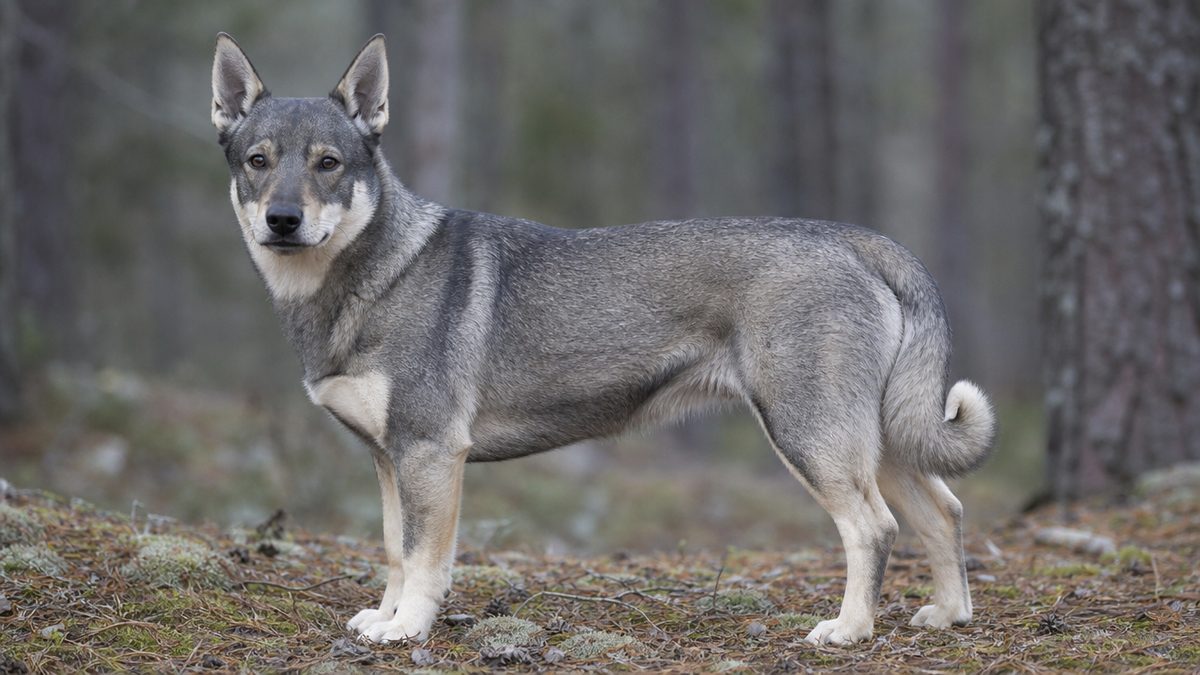
A Jämthund is Sweden's national elk-hunting spitz, FCI standard 42, accepted on a definitive basis on 3 January 1954 and named by the Swedish Kennel Club as one of Sweden's national breeds. It is a large, rectangular, grey double-coated working dog of 57 to 65 centimetres in males, with perfectly erect ears and cream markings on muzzle and cheeks.
The FCI classification places it in Group 5, Spitz and primitive types, Section 2 Nordic Hunting Dogs, with Sweden as the country of origin and English as the official authentic language of the standard. One line in that record is worth reading twice: the breed is subject to a working trial only for the Nordic countries, Finland, Norway and Sweden. Outside Scandinavia the working requirement simply does not apply, which is how a hunting breed starts being sold as a pet.
What the breed standard actually requires
The standard describes a large, rectangular spitz that is clean-cut, strong and substantial but also agile, whose body must not give the impression of being long nor be too heavy. Its stated utilisation is blunt: hunting dog, mainly used for hunting elk, but also used for hunting bear and boar. Temperament is given in six words, courageous and energetic but also stoically calm.
The head is clean-cut and longish, proportionally broad between the ears, with a slightly arched skull and a well defined but not too deep stop. Eyes are slightly oval and brown with a keen but calm expression. The ears are high set, perfectly erect, pointed and sensitive in use, slightly longer than their width at the base, and hanging ears are a disqualifying fault.
The tail is the field mark, not the colour
The single most useful identification detail is the tail. The standard requires it set high, of medium length and of even thickness, carried low in a loose curl, over the thigh, densely coated but without a fringe. That is not the tight curl onto the back that a Norwegian Elkhound carries, and it is the quickest way to tell the two apart in a photograph.
Coat colour is lighter and darker grey, and the characteristic markings are light grey or cream coloured on the sides of the muzzle, cheeks, throat, chest, belly, legs and under the tail. Those markings are not decorative. Lack of the characteristic cream coloured markings on muzzle and cheeks is a disqualifying fault, alongside hanging ears, an over- or undershot bite and any height outside the stated range.
| Measure | FCI standard 42 | Wamiz | Wisdom Panel |
|---|---|---|---|
| Male height | 57 to 65 cm, ideal 61 | 22 to 26 in | 20 to 26 in |
| Female height | 52 to 60 cm, ideal 56 | 20 to 24 in | 20 to 26 in |
| Weight | Not stated at all | 55 to 66 lb, both sexes | 50 to 65 lb |
| Height outside the range | Disqualifying fault | not mentioned | not mentioned |
| Breed group | Group 5, Nordic Hunting Dogs | not stated here | Companion |
FCI standard 42 gives height only. Wamiz publishes 55 to 66 pounds for both sexes and Wisdom Panel publishes 50 to 65 pounds, and the two disagree with each other while neither can be checked against the standard Wisdom Panel, Swedish Elkhound. Where a standard states no weight, treat a published weight as an estimate somebody made, not as a breed fact.
One ranking page files it under the wrong job entirely
Wisdom Panel lists the Swedish Elkhound's breed group as Companion. The Swedish Kennel Club, writing about its own national breed, says the opposite in plain Swedish: the Jämthund is a very popular hunting dog primarily for elk hunters and is not suitable purely as a companion dog. An Indian buyer who wants a family dog and reads the first source has been told the exact reverse of what the country of origin says.
The Swedish Kennel Club goes further in its own advice list. It says the breed is a pronounced hunting dog and does not thrive purely as a companion, that it is stable with great hunting drive and great courage, that it is an active and physically enduring dog requiring an owner who gives it an outlet, and that you should check the parents' health status when buying a puppy. That last instruction is the one this page takes most seriously.
Recognised in 1946, because it had been judged another breed
The Jämthund was recognised as a separate breed only in 1946, and the FCI standard states the reason directly: the smaller Norwegian Elkhound and the Jämthund were judged as the same breed, and this situation eventually turned out to be impossible. The dog is ancient; the paperwork is not.
The Swedish Kennel Club tells the same story from the other side and names the other dog specifically. It says the reason it took so long before the Jämthund got its own breed standard was that the gråhund and the jämthund were long judged as the same breed. Gråhund is the Norwegian Elkhound Grey. So the breed the Jämthund was folded into was not elkhounds in general, it was one specific Norwegian breed.
The FCI standard adds that although recognition was late, the type is very ancient and has been known since the north of Sweden was populated, and the SKK says the breed is considered as old as the hunting peoples' colonisation of Norrland and belongs to the large hunting spitzes of the northern coniferous belt Svenska Kennelklubben. English Wikipedia credits the 1946 recognition to intensive work by Aksel Lindström and others. A third source, Dog Breeds List, tells the same story unprompted, saying the Swedish Elkhound was only recognised as a separate breed in 1946 because it used to be shown together with the smaller Norwegian Elkhound. Three independent accounts agreeing on one date is as solid as breed history gets, and all three name the same cause: a dog built for elk hunting had been judged for decades as a variety of a smaller dog built for the same job.
| Date | Event | Source |
|---|---|---|
| Before 1946 | Judged the same breed as the Norwegian Elkhound Grey | FCI standard 42 and SKK |
| 1946 | Approved in Sweden as an official breed | SKK breed page |
| 3 January 1954 | FCI acceptance on a definitive basis as breed 42 | FCI nomenclature |
| 2014 | Svenska Jämthundklubben adopts a hunting breed standard | RAS 2023-2027 |
| 4 September 2019 | Publication of the current official valid standard | FCI nomenclature |
| 28 October 2019 | English text of the standard published | FCI standard 42 |
| 2023 | Current RAS breeding strategy, running to 2027 | RAS 2023-2027 |
The nomenclature record prints the definitive acceptance as 1/3/1954, which is ambiguous on its face. The same table prints the English standard as 10/28/2019 and the German as 4/15/2020, and neither 28 nor 15 can be a month, so the first field is the month across the table. The date is 3 January 1954. A date column proves its own format if you look down it for a row where one field exceeds twelve.
What the genome says about that history
A 2024 study analysed eight dog fur samples 100 to 200 years old, taken from traditional North Swedish clothing, to look at the founding populations of the Nordic Lapphund and Elkhound breeds. It confirmed that these breeds originate from the local dog population, which supports the SKK's account, and it reported a distinct decrease in genetic diversity in agreement with intense breeding during breed formation.
The study identified eleven genes under positive selection during breed development, and singled out MSRB3, associated with breed-related ear morphology, as selected in all the Lapphund and Elkhound breeds examined. In other words the erect ear that the standard now makes compulsory, and a hanging ear a disqualification, is a trait the breed-building process actively selected for. The abstract does not enumerate which breeds were sampled, so Bonbeno does not claim the Jämthund specifically was among the eight furs.
The breed's own document is blunter about the inbreeding
The Swedish breed clubs' RAS document does not soften this. It presents the pedigree of SJCH Bonso as a study in how hard the Jämthund was inbred in order to make it homogeneous, and gives Bonso's inbreeding coefficient as 20.3 percent, adding that it is probably higher still because data are missing for many dogs in the pedigree. A national kennel club publishing that about its own foundation stock is unusually honest.
The current position is better and the document says why. Genetic variation is described as relatively good, the rise in inbreeding has fallen since 1990, but it still increases by about 0.9 percent every year. The reason is structural rather than accidental: in practice only males that are at least hunting champions and bitches with at least a first prize at a hunting trial are used, which leaves about 70 percent of the breed outside the breeding base altogether.
That is the tension a buyer should understand. The same selection that keeps the breed genuinely functional as an elk dog is what keeps its effective breeding population narrow, and the club is managing it with hard caps rather than hoping. No male may have more than 15 litters counting Norway and Finland, and no more than five before his breeding results are evaluated.
Jamthund price in India
No Jamthund price in India exists, and Bonbeno could find exactly one Indian rupee figure attached to the breed name anywhere: ₹2,277 for a training workbook on Amazon.in, which is a book rather than a dog. The breed is not bred, sold or registered in India, and no lawful route exists to import one for sale.
That is the answer. What follows is the evidence for it, tested rather than asserted, because an absence claimed without proof is just a search that did not run.
Zero elkhounds across six Indian price lists
The Indian pages that rank for dog purchase price queries are large generic price lists, so Bonbeno tested six of them string by string. Across wrapinfur.com, supertails.com, dogbreedo.com, premiumpethouse.com, petbuddy.in and shubhkennel.com, the words Jamthund, Jämthund, Swedish Elkhound, Norwegian Elkhound and Elkhound each return zero, on every page.
The same six pages are not empty. Spitz appears 21 times across them and Husky 27. So the Indian market that answers this query does stock northern double-coated dogs; it simply stocks the two that India has always stocked, and neither is an elkhound.
| Source | Figure published | Currency | Applies to India |
|---|---|---|---|
| Wamiz, purchase price | 1,000 to 1,500 for a puppy | Pounds sterling | No |
| Wamiz, monthly keeping cost | 50 to 100 per month | Pounds sterling | No |
| Royal Canin India | No price published at all | None | Indian page, no price |
| Asia Pets, the Indian listing returned | Heading asks the price, body prints none | None served | Wrong breed anyway |
| Amazon.in | ₹2,277, discounted to ₹2,049.30 | Rupees | It is a training workbook |
| Six Indian dog-price-list pages | Zero mentions of any elkhound | Rupees | Not for this breed |
Wamiz publishes 1,000 to 1,500 pounds for a puppy. Running that through an exchange rate and printing the result as an Indian price would be fabrication, and it is the single commonest way false Indian breed prices enter circulation. A converted figure tells you what a British puppy costs expressed in rupees. It is not a fact about India.
Royal Canin has an Indian page for the breed and no price on it
One genuinely Indian source does exist and it is worth reading carefully. Royal Canin publishes a Jämthund page on its Indian domain, giving country Sweden, size category Large, an average life expectancy of 12 to 13 years, and a character list of lively, alert, friendly, confident, hard-working and obedient. It sources its key facts to the FCI and publishes no price, because it is a food company rather than a seller.
That page is also where the Indian reader meets the breed's contradiction most directly. It calls the dog calm and sociable and an excellent companion for experienced owners, and advises owners to assert themselves as the alpha of the house. The Swedish Kennel Club, writing in Swedish about its own national breed, says it does not thrive purely as a companion dog. Both pages are describing the same animal.
Why a lawful Indian purchase market cannot form
DGFT Trade Notice 22/2022-23 makes live dogs a Restricted import under ITC(HS) 01061900 and states that any applications for trading or breeding purposes, or applications made on behalf of some another person or entity, shall be duly rejected. A dog cannot lawfully enter India in order to be sold, and it cannot enter on somebody else's behalf. The only route is a person relocating with their own pet.
The Kennel Club of India registers pedigrees against FCI nomenclature, since India sits in the FCI members list, so FCI 42 is a registrable breed here in principle Federation Cynologique Internationale. In practice the KCI registered 33,880 pure-bred dogs of all breeds in 2025, down from 89,571 in 2021, and Bonbeno could establish no record of any Jämthund among them.
So the purchase price question has no Indian answer. The question underneath it, what a dog of this size and coat costs to keep in India, does have one, in rupees, and the cost of ownership section gives it.
What an Indian search for this breed actually returns
An Indian search for this breed returns a Norwegian Elkhound, a Japanese jigsaw-puzzle article or a Swedish language course, depending on which engine you ask. None of those is a Jämthund, and the failures are systematic enough to be worth documenting Asia Pets, Norwegian Elkhound Puppies….
The search engine is not reading the query
Bing India returned HTTP 200 for jamthund price in india and served ten Japanese-language pages about the psychology and brain-training effects of jigsaw puzzles, under a reported count of 1,40,000. Nothing errored. The page title was correct and the count looked authoritative.
Searching the breed's English name instead made it worse in an instructive way. swedish elkhound price in india returned ten Swedish-language-learning results, headed by the Wikipedia article on the Swedish language, Omniglot and Google Translate, under a count of 61,700. The word Swedish is doing the damage, the same way Japanese and Italian have done it to other breeds.
A control settles what that means. labrador retriever price in india, run in the same session on the same engine, returned ten genuine Indian price pages under a count of 25,900. So the instrument works and only these queries are being substituted. Dropping the cc=IN country parameter was tried once, as the cheapest possible check, and produced ten Yahoo Japan portal pages instead, which is a fresh substitution rather than a second opinion.
| Query | Reported count | What the ten results actually were |
|---|---|---|
| jamthund price in india, cc=IN | 1,40,000 | Japanese jigsaw-puzzle psychology articles |
| swedish elkhound price in india | 61,700 | Swedish-language courses, Omniglot, Google Translate |
| jamthund dog price in india, no cc | not printed | Yahoo Japan portal pages |
| labrador retriever price in india | 25,900 | Ten genuine Indian Labrador price pages |
A search that was never run is not evidence of anything. Bonbeno claims no absence of Indian Jämthund listings on the strength of these results, and records the substitution instead. The absence claimed on this page rests on six Indian price-list pages that were opened and read, plus the registry checks, not on a search box that answered a different question.
The listing India will actually show you is for a different breed
Search for an elkhound in India through a working engine and the marketplace result you get is Asia Pets' Norwegian Elkhound page. Bonbeno read it. The served page mentions Norwegian Elkhound 23 times and Swedish Elkhound or Jämthund zero times. That is not a bait-and-switch, it is a different breed's listing surfacing for a related query, and a buyer who does not know the two were one breed until 1946 will not notice.
Two details on that page are worth naming. It carries an H3 heading reading How Much Does a Norwegian Elkhound Puppy Cost in India? and the served page prints no price under it. And the adjacent More Pets For You panel, which is what the site actually has in stock, offers a Tiny Chihuahua Puppy in India, a Tiny Yorkshire Terrier Puppy in India and a Tiny Toy Pom Puppy in India.
That pattern is documented elsewhere on this site under other breed names: a page built for one breed, ranking for another, with a carousel containing neither. Saying what the carousel actually holds is more useful to a reader than any price would be, because it tells them what they are really being sold.
One more absence worth recording
DogTime, one of the largest English-language breed libraries, returns HTTP 404 for the Swedish Elkhound. It also returns 404 for the Karst Shepherd, the other breed Bonbeno built the same day. Two of the biggest breed reference sites in English simply do not cover these dogs, which is a large part of why the pages that do rank for them are so weak.
The practical version for a buyer is short. If you are offered a Jämthund in India, you are being offered something else. Ask for the FCI or KCI registration number and the import paperwork before money is discussed, and read the adoption section on this page for what that paperwork has to contain.
What a Jämthund costs to keep in India
The cost of ownership for a large double-coated working dog in India runs Rs 3,000 to Rs 10,000 a month, with food alone passing Rs 5,000 for a large working breed. Those are published Indian figures for a dog of this size, and unlike a purchase price they do not depend on the breed being available here.
This is the half of the cost question that has a real answer, so it is built entirely from Indian sources quoting their own figures.
| Line item | Published Indian figure | Source |
|---|---|---|
| Total monthly cost, all dogs | Rs 3,000 to Rs 10,000 | VOSD |
| Food, medium dog | Rs 1,500 to Rs 4,000 per month | VOSD |
| Food, large working breed | Rs 5,000 or more per month | VOSD |
| Grooming session | Rs 300 to Rs 2,000 | VOSD |
| Vet consultation | Rs 500 to Rs 1,000 | VOSD |
| Annual vaccination | Rs 1,500 to Rs 3,000 | VOSD |
| Preventive care done properly | Rs 5,000 to Rs 8,000 per year | VOSD |
| Professional dog walker | Rs 3,000 to Rs 6,000 per month | VOSD |
| Basic training course | Rs 5,000 to Rs 15,000 | VOSD |
| Typical annual spend | Rs 25,000 to Rs 80,000 or more | VOSD |
| Boarding, 21 to 40 kg, air-conditioned | INR 950 per day | Dog House, Chennai |
| Boarding, 21 to 40 kg, non air-conditioned | INR 850 per day | Dog House, Chennai |
Vaccination cost, cross-checked between two Indian sources
The first-year vaccination cost is the one line where two Indian sources can be checked against each other. A full puppy course runs about Rs 3,000 to Rs 6,000 across all visits, a single anti-rabies shot Rs 300 to Rs 600, and the clinic adds a consultation or injection charge of roughly Rs 300 to Rs 800 on top of the vaccine. A second Indian source gives an average anti-rabies cost of INR 350 per dose, which falls inside that band.
The yearly booster afterwards is one combined vaccine plus one rabies, usually Rs 1,000 to Rs 2,000 all in. Set against a parvovirus hospital stay, which the same source puts at Rs 15,000 to Rs 50,000, the whole first-year vaccination cost is a rounding error. That arithmetic holds for any breed and it is the best-value spend in Indian dog ownership.
The line item this breed adds that others do not
One recurring cost is specific to the Jämthund and it is not grooming. This breed is over-represented for progesterone-related diabetes mellitus, a disease that presents in intact bitches after a season, and treating it costs money indefinitely rather than once Svenska Jämthundklubben and Svenska…. An Indian owner of an intact female should budget for glucose testing and veterinary follow-up as a standing line, not as an emergency.
The health section sets out the evidence. The relevant point here is financial: a disease with a 46 percent remission rate after surgery is a disease where an early, well-timed decision costs far less than a late one. Preventive care at the Indian figure of Rs 5,000 to Rs 8,000 a year buys the monitoring that makes that timing possible.
Before the monthly cost begins, the first month is heavier. A starter kit of bed, bowls, collar, leash and ID tag runs Rs 2,000 to Rs 5,000, and the first vaccinations, deworming and health check add another Rs 2,000 to Rs 5,000. Most Indian owners spend Rs 15,000 to Rs 25,000 in month one before anything goes wrong.
Cooling is a running cost, not a one-off
For a dog from a homeland averaging 2.19 degrees Celsius, the air-conditioned boarding tariff is the honest benchmark rather than the cheap one. Ten days of air-conditioned boarding for a 21 to 40 kg dog in Chennai is INR 9,500 against INR 8,500 without, and the INR 100 a day difference is not where an owner of this breed should economise.
The same logic applies at home. Whatever it costs to keep one room genuinely cool through an Indian summer is part of this breed's cost of ownership, and it is a cost the British monthly figure of 50 to 100 pounds does not contain, because Sweden does not need it.
Heat tolerance: a 2 degree homeland against a 28 degree country
A Jämthund's heat tolerance is the lowest rating this site gives, because its homeland in Jämtland averages 2.19 degrees Celsius a year against 27.95 in Chennai, a gap of 25.8 degrees, and no part of India closes it. Even the coldest Indian hill station, corrected properly, comes out about ten degrees warmer than Östersund.
Every figure below was queried from NASA POWER by explicit latitude and longitude over the 2001 to 2020 climatology, with the grid-cell elevation echoed back so you can see where the model was standing.
| Place | Lat, lon | Cell elevation | Annual mean T2M | Annual max T2M | Relative humidity |
|---|---|---|---|---|---|
| Östersund, Jämtland, Sweden | 63.18, 14.64 | 449.62 m | 2.19 C | 28.55 C | 90.5 % |
| Åre, Jämtland, Sweden | 63.40, 13.08 | 592.51 m | 1.39 C | 28.12 C | 91.8 % |
| Chennai | 13.08, 80.27 | 48.95 m | 27.95 C | 42.70 C | 72.4 % |
| Mumbai | 19.08, 72.88 | 97.15 m | 26.77 C | 44.91 C | 67.4 % |
| Delhi | 28.61, 77.21 | 206.37 m | 25.60 C | 48.79 C | 45.6 % |
| Pune | 18.52, 73.86 | 635.99 m | 23.86 C | 43.20 C | 66.8 % |
| Bengaluru | 12.97, 77.59 | 841.72 m | 23.74 C | 40.38 C | 67.9 % |
The two Jämtland cells are genuinely different from each other, at 449.62 and 592.51 metres, which matters because it means the model is resolving the two towns rather than collapsing them into one cell. Both sit modestly above their towns, Östersund's real elevation being about 320 metres and Åre's about 380, so the figures run slightly cold. The correction is small and does not change the conclusion.
The Indian plains cells are reliable. Delhi's reported elevation is 10 metres below the city's real 216, Chennai's 43 metres above, Mumbai 83 above, Bengaluru 78 below and Pune 76 above. In the plains, the cell is the town.
The hill stations, where the model is wrong by over a kilometre
The obvious question is whether an Indian hill station works for a Nordic breed, and the obvious method gives the wrong answer. NASA POWER returns a grid cell rather than a point, and in mountains the cell's mean elevation can miss the town by well over a kilometre in either direction.
| Hill station | POWER cell elevation | Real town elevation | Error | Cell mean T2M | Lapse-corrected estimate |
|---|---|---|---|---|---|
| Manali | 3,984.73 m | about 2,050 m | 1,935 m too high | -0.56 C | about 12.0 C |
| Leh | 4,532.61 m | about 3,500 m | 1,033 m too high | -2.75 C | about 4.0 C |
| Shimla | 897.65 m | about 2,200 m | 1,302 m too low | 21.15 C | about 12.7 C |
| Ooty | 784.64 m | about 2,240 m | 1,455 m too low | 23.50 C | about 14.0 C |
| Darjeeling | 1,313.52 m | about 2,045 m | 731 m too low | 18.42 C | about 13.7 C |
Taken at face value, NASA POWER says Manali averages minus 0.56 degrees Celsius, which is colder than Östersund and would make it read as an ideal home for this breed. It is not. The cell sits 1,935 metres above the town. Corrected at the standard lapse rate of 6.5 degrees per 1,000 metres, Manali comes out around 12 degrees, and that is an estimate rather than a measurement. An unchecked cell elevation can make a hill station look habitable for a Nordic breed when it is not.
Read across the two tables and the answer is unusually clean. Leh is the only Indian place tested that gets within about two degrees of Jämtland, at a corrected estimate near 4 degrees, and Leh is a high-altitude cold desert at roughly 3,500 metres with its own severe constraints on keeping a large working dog. Every other candidate, Manali, Shimla, Darjeeling and Ooty, lands between about 12 and 14 degrees, which is ten to twelve degrees warmer than the homeland.
That is a harder verdict than the one this site reached for the Karst Shepherd on the same day. A Slovenian mountain guardian from a 13.14 degree plateau has a genuine Indian analogue in Shimla; a Swedish elk dog from a 2.19 degree homeland does not, because India does not contain a 2 degree annual mean outside the high Himalaya.
Humidity runs the other way, and it still does not help
Jämtland is humid, at 90.5 and 91.8 percent relative humidity, which is higher than any Indian city in the table. That sounds like an argument in the breed's favour and it is not, because cold humidity and warm humidity do different things to a double coat. Air at 2 degrees and 90 percent holds almost no water; air at 28 degrees and 72 percent holds a great deal, and it is warm wet air that stops a dense undercoat drying and stops a panting dog shedding heat.
There is also an Indian legal position on this. Second Schedule Part IV paragraph 21(1) of the Prevention of Cruelty to Animals (Dog Breeding and Marketing) Rules 2017 bars keeping dogs not accustomed to local temperatures, and breeds that cannot tolerate them, in outdoor facilities without the attending veterinary practitioner's written approval. A Swedish elk dog in an Indian plains city is squarely inside both categories.
Temperament, and the sentence the Swedish Kennel Club actually writes
The FCI standard gives the Jämthund's temperament in six words, courageous and energetic but also stoically calm, and the Swedish Kennel Club adds the sentence that matters more for an Indian buyer: the breed is a pronounced hunting dog and does not thrive purely as a companion dog Svenska Kennelklubben.
That is the national kennel club of the country that created the breed, writing about its own national breed on its own public breed page. It is a stronger and more specific statement than any English breed-listing site makes, and it is the first thing an Indian reader considering this dog as a pet should weigh.
The SKK's own description fills it out. The Jämthund has a stable temperament with great courage and strong hunting drive. It works very independently, and it marks game by barking. The breed's field of use as a hunting dog makes great demands on strength and endurance.
What independent means here, precisely
Independence in this breed is not a personality quirk, it is a written performance specification. The breed clubs' own hunting standard says the search should be large, about 10 to 25 minutes, mostly at a trot at an excellent tempo of 7 to 12 kilometres an hour, while keeping good contact with the handler, and that dogs which do not keep contact during the search are not breed-typical.
So the dog is bred to leave, work a large area alone at speed, find game, hold it and tell you where it is, and then still be reachable. That combination is what makes it an excellent hunting partner and a difficult off-lead dog anywhere with traffic, livestock or street animals, which is most of India.
The RAS states that the Jämthund is bred primarily to hunt elk but may also be used on wild boar, bear, badger, red deer and lynx, and that a trained, hunt-broken Jämthund over four years old should not hunt game other than those. That is a breed whose prey drive is deliberately shaped rather than general. In India there is nothing on that list, so the drive has no legitimate outlet and will find an illegitimate one.
The bark is the job
This is a ställande älghund, a baying elk dog. Its work is to stop a moose and bark persistently at a standstill until the hunter can approach and shoot. Barking is not a behaviour problem in this breed, it is the trait it was selected for over centuries, and it carries a long way because it was meant to.
In Swedish forest that is an asset. In Indian housing, where flats share walls and landings and where street dogs and traffic supply constant triggers, a dog bred to announce what it has found is a standing conflict with the neighbours. No amount of training removes a selected working trait; it can only be managed.
With people, and with other animals
Royal Canin's Indian page describes the breed as calm and sociable, making excellent companions for experienced owners, and lists the character as lively, alert, friendly, confident, hard-working and obedient. Nothing in the FCI standard contradicts that: the standard's only behavioural disqualification is aggressive or overly shy.
So this is not a sharp or suspicious dog in the way a livestock guardian is, and it is not the reason to say no. The reason to say no in India is the exercise debt, the voice and the coat, in that order. A friendly dog that needs two hours of hard work a day in a country that offers two narrow cool windows is a welfare problem rather than a temperament problem.
Socialise it the way you would any large working breed, early and in volume, and do it in the cool hours because that is when a puppy can safely be out. The socialisation window and the Indian heat window overlap badly, which the puppy timeline section deals with in detail.
Training a dog bred to leave you and come back
To train a Jämthund, build the recall before the prey drive matures and accept that off-lead reliability around live animals will never be complete, because the breed's own hunting standard requires it to work a large area alone for 10 to 25 minutes at a time. It is trainable and quick for its own person; it is not biddable in the retriever sense.
There is no published training study on this breed, so what follows reasons from what the standard and the breed clubs' own documents say, plus the constraints Indian conditions impose. It is presented as reasoning, not as evidence.
What this breed makes easy
The FCI standard describes a courageous and energetic dog that is also stoically calm, and Royal Canin's Indian page lists obedient among its characteristics Royal Canin India, Jämthund breed page. That combination is genuinely workable. Household manners, settle, crate, loose-lead walking and co-operative handling for grooming and veterinary work are all reachable with ordinary consistency.
Handling tolerance deserves early, specific work in this breed for a reason other breeds do not share. An intact female Jämthund needs her season watched, her weight tracked and, if she is over four, her mammary glands examined regularly, because 23 of 84 privately owned bitches in one Swedish study were found to have previously unrecognised mammary masses at a routine examination. A dog that objects to being handled gets less of that.
What this breed will resist
It will resist recall off live game, and that is by design rather than by failure. The hunting standard expects the dog to search independently through wind scent and track scent and to keep barking at a standstill until the handler reaches it. A dog selected for exactly that is not going to abandon a scent because you called.
In India the practical consequence is specific. Street dogs, cattle, monkeys and poultry are all on the route of an ordinary evening walk, and none of them is on the RAS's short list of legitimate quarry. Manage with a long line and a secure area rather than testing whether the recall holds. It will hold until it does not.
- Weeks 8 to 16. Socialisation is the whole curriculum, in the cool hours, with volume and variety rather than distance.
- Months 4 to 8. Recall on a long line, loose-lead walking, crate and settle, and co-operative handling for coat and body checks.
- Months 8 to 14. Adolescence and the arrival of real prey drive. Expect the recall to degrade and manage the environment rather than escalating.
- Months 12 to 24. Hunting instinct consolidates. Give the drive a legal outlet through scentwork, tracking games or mantrailing, since India offers no lawful quarry.
- Throughout. Keep the two daily sessions inside the cool windows, and skip a session rather than moving it into the heat.
The FCI record states that this breed is subject to a working trial only for the Nordic countries, and the RAS requires a breeding male to be hunting-trial qualified on a loose-dog elk trial. Neither requirement can be met in India, because there are no moose. That is not a technicality: it means the entire quality-control mechanism the breed relies on to stay functional is unavailable here, and a dog bred outside it is being selected on looks alone.
Timelines, realistically
Expect household reliability at around twelve months and adult judgement at two to three years, which is the ordinary maturation curve for a large working spitz. The RAS reflects this in its own rules: bitches may not be bred before 18 months, and males not until they show an adult individual's physical maturity and behaviour. A breed club that will not breed a dog before 18 months is telling you when it considers the dog grown up.
Give the drive somewhere to go. A Jämthund in India cannot hunt, so the search behaviour it was bred for has to be redirected into scentwork or tracking, done in the early morning. That is not a substitute for hunting, and this page does not pretend otherwise, but it is the difference between a frustrated dog and a destructive one.
Exercise needs, and the debt India cannot pay
A Jämthund's exercise needs are written down in its breed clubs' own hunting standard, and they are athletic rather than recreational: searches of 10 to 25 minutes, mostly at a trot, at 7 to 12 kilometres an hour, with great endurance expected in areas with no game scent. India offers roughly two cool hours a day to pay that.
That specification is unusual and it is worth taking literally. Most breed pages describe exercise needs in adjectives. This breed's own club describes them in kilometres per hour, and a dog selected against that spec for eighty years does not stop needing it because it moved to Bengaluru.
What the daily requirement actually looks like
Plan two sessions a day totalling at least ninety minutes to two hours of genuine work, not strolling, plus mental work on top. Split them so neither falls in the heat: early morning before the sun is properly up, and evening after the ground has stopped radiating. The Swedish Kennel Club puts it plainly, calling the breed active and physically enduring and saying it requires an owner who gives it an outlet for that.
- Work the nose, not just the legs. A scent-driven searching breed gets more from twenty minutes of tracking than from an hour of pavement.
- Watch the ground, not the air. Tarmac holds yesterday's heat long after an air thermometer reads comfortable.
- Cool the dog before it needs cooling. Shade, airflow and water arranged in advance beat any intervention afterwards.
- Skip a session rather than shifting it later. A missed walk costs less than a heat-stressed one.
- Use a long line in open ground. The recall is not what fails; the prey drive is what wins.
The evidence on exertion and heat
The largest study of heat-related illness in dogs found that exertion, not hot cars, is the dominant trigger. In a cohort of 905,543 UK dogs under primary veterinary care in 2016 there were 1,259 heat-related illness events from 1,222 dogs. Of the 879 events with a recorded trigger, 652, or 74.2 percent, were exertional, against 113 environmental and 46 from confinement in a vehicle.
The companion paper from the same cohort gives the risk factors. Dogs at or above the mean bodyweight for their breed and sex carried an odds ratio of 1.42, with a confidence interval of 1.12 to 1.80, and dogs over 50 kg carried an odds ratio of 3.42, interval 1.54 to 7.57.
The Jämthund was not modelled. It is not a UK-registered breed in the numbers that study required, so it has no breed-level odds ratio there, and it is not in the over-50 kg band either. The transferable finding is the bodyweight one, which is about a dog relative to its own breed mean and applies to any breed. Importing a breed-specific odds ratio onto a breed the authors never studied would be fabrication wearing a citation.
The exertional finding matters here for a behavioural reason rather than a statistical one. A dog bred to search at 7 to 12 kilometres an hour for 25 minutes does not moderate itself when the air is at 35 degrees. It self-limits far later than its owner expects, because self-limiting was selected against. Managing exertion in this breed means managing the opportunity, since the dog will not manage it.
What happens without it
An under-exercised working spitz is not a calm dog with a hobby. It is a vocal, destructive, escape-prone dog, and in this breed the voice is the trait that will end the tenancy first. The SKK's warning that the breed does not thrive purely as a companion is a prediction about exactly this outcome.
There is one more reason to take the exercise seriously that is specific to the Jämthund's disease profile. Being overweight before diagnosis was associated with 2.8 times the odds of progesterone-related diabetes mellitus in elkhounds, with a 95 percent confidence interval of 1.1 to 7.5. In this breed the walk is not only about behaviour; it is one half of the single modifiable risk factor identified for its commonest serious disease.
Grooming: where the Swedish advice stops working in India
To groom a Jämthund in India, brush the double coat out to the skin on a fixed weekly schedule and dry it mechanically after every wetting, because the Swedish Kennel Club's own advice, that the coat is easy to care for, is bathed as needed and is worth brushing through a few times when it moults, was written for a country averaging 2.19 degrees Celsius NASA Prediction Of Worldwide Energy….
The coat itself is straightforward and the standard describes it precisely. The topcoat is rather close lying but not flat; the undercoat is short, soft, light and preferably cream coloured; the coat is smooth on the head and the front of the legs and longer on the neck, chest, tail and the backs of the legs and thighs. The SKK calls the topcoat hardy and the undercoat soft.
This is genuinely a lower-maintenance coat than a long-haired mountain breed's. There is no trimming, no stripping, no professional cut, and the shedding is seasonal rather than constant. In Sweden, brushing through a few times during a moult is adequate advice.
Why that advice does not transfer
Two things change in India. First, the moult stops being seasonal. A dog in a climate with no real winter sheds at a low level for much of the year instead of dropping the undercoat in a defined window, so the brushing that Sweden concentrates into a few weeks has to be spread across twelve months.
Second, and more important, drying stops being automatic. Guidance written for a northern climate assumes a bathed dog dries by standing around. At Chennai's 27.95 degrees and 72.4 percent humidity, a soft undercoat under a close-lying topcoat does not air dry. It stays damp against the skin for hours, and damp skin under a dense coat is where hot spots and skin infection start in Indian dogs.
- Brush the whole dog weekly, lifting the topcoat and working the undercoat out rather than skimming the surface.
- Increase to every day or two through any period of heavy shedding, which in India can arrive twice a year or drift year-round.
- Dry the coat mechanically to the skin after every bath or soaking, on a cool setting, working from the skin outwards.
- Check the skin under the ruff, the armpits and the groin weekly, since those are where moisture sits longest.
- Screen for ticks at the same time, because an Indian outdoor dog meets more of them than a Swedish one.
This is the commonest well-meant mistake made with northern breeds in India and it makes heat management worse. The undercoat insulates in both directions and the topcoat blocks solar radiation. Removing them leaves the dog hotter, sunburnable, and often with a coat that regrows in a different texture. The correct response to heat is more brushing, because a thoroughly brushed-out undercoat lets air move through it while a matted one traps heat.
The one grooming detail the standard cares about
The standard faults a coat that is too short or open as a severe fault, and faults a coat overlaid with black giving a sooty appearance. Neither is a grooming outcome, but the first is worth knowing: this breed is supposed to carry a full close topcoat, and a dog whose coat has been clipped repeatedly may not return to it.
Shedding volume is the practical Indian question and the honest answer is that it is substantial but manageable. This is a two-coat spitz, not a long-coated mountain dog, and the difference in an Indian household is real. Budget for a grooming session at the Indian rate of Rs 300 to Rs 2,000 during heavy moults if you want the deshedding done properly, and treat what you are buying as the dry rather than the cut.
One last transfer failure worth naming. The SKK's phrase is badas vid behov, bathed as needed. In Sweden that means rarely. In an Indian city with dust, humidity and street exposure, as needed means considerably more often, and each of those baths carries the drying obligation above. The instruction is the same; what counts as need is not.
Health issues, hips and the two documents that disagree
The Jämthund's health issues are unusually well documented for a breed India does not stock, and the numbers come from Sweden rather than from OFA. The breed's own breeding strategy reports 2,321 hips scored against 7,739 dogs born in the 2016 to 2020 reference population, of which 93.1 percent graded A or B.
The literature is unusually deep for a breed India does not stock, and it was searched properly rather than assumed. Ten query forms were run against PubMed in one session, covering Jamthund, Jämthund, Jamthunds, Jamthundar, Jemthund, Swedish Elkhound, Swedish Elkhounds, Swedish Moose Dog, Swedish Elk Dog and Swedish elkhound dog, against same-session controls returning 126 and 13, with every returned title read back before it was counted. That read-back matters. The Swedish Moose Dog form returned eight records and not one is about the breed: they are moose ecology, brown bear attacks in Scandinavia, tick-borne pathogens in Ixodes ricinus and a seroprevalence study in Swedish blood donors. PubMed had split the phrase into swedish AND moose AND dog and answered a question nobody asked. Compare that with the American picture. OFA's full statistics tables, retrieved as 2,226,110 characters, contain no SWEDISH ELKHOUND row and no JAMTHUND row, and the only elkhound label present is NORWEGIAN ELKHOUND. Controls in the same retrieval matched LABRADOR 109 times, GOLDEN RETRIEVER 101 and the rare BERGAMASCO once, so the file loaded and the search reaches rare breeds. The breed's hip data simply lives in the Swedish system instead, and there is far more of it than OFA would hold.
| Grade | Dogs examined | Share of examined | Mean HD index |
|---|---|---|---|
| A, normal hips | 1,714 | 73.8 % | 105 |
| B, near normal hips | 448 | 19.3 % | 91 |
| C, mild dysplasia | 132 | 5.7 % | 83 |
| D, moderate dysplasia | 25 | 1.1 % | 76 |
| E, severe dysplasia | 2 | 0.1 % | 64 |
| Total examined | 2,321 | 100 % | - |
| Total born in the cohort | 7,739 | - | - |
That table passes its own arithmetic, which is worth stating because tables on this site often do not. The five grades sum to exactly 2,321, and every printed percentage reproduces from its own count: 1,714 of 2,321 is 73.85 percent, 448 is 19.30, 132 is 5.69, 25 is 1.08 and 2 is 0.09. A and B together are 2,162 dogs, or 93.1 percent, which clears the club's own stated target of at least 90 percent. C, D and E together are 159 dogs, or 6.9 percent.
The same section's prose states that about 40 percent of the registered population is X-rayed for hips and elbows. Its own table gives 2,321 examined against 7,739 born, which is 30.0 percent. Those two figures are in the same section of the same document and they do not reconcile as printed. Bonbeno publishes both rather than picking one. The likely explanation is a different denominator, since the diagram beside the prose shows percentage X-rayed per birth-year cohort while the table covers a five-year reference population, but the document does not say so and the reader is left with two numbers.
What the breed clubs track, and what the public page shows
The Swedish Kennel Club's public breed page names two conditions for the Jämthund, epilepsy and hip dysplasia. The breed clubs' own breeding-strategy document, hosted on the same website, gives dedicated sections to seven and lists nine more at low frequency Svenska Jämthundklubben and Svenska….
There is a second, larger gap worth knowing about before you read any summary of this breed's health. The Swedish Kennel Club's public breed page says the breed is generally considered healthy but that epilepsy and hip dysplasia occur. Two conditions. The breed clubs' own RAS document, hosted on the same site, gives dedicated sections to hip dysplasia, elbow dysplasia, diabetes mellitus, epilepsy, progressive retinal atrophy, gastric torsion and perineal hernia.
The RAS also lists conditions occurring at low frequency: patellar luxation, progressive nephropathy, hypothyroidism, osteochondrosis, glaucoma, cataract, pulmonary oedema, umbilical hernia and cryptorchidism. So the reader who stops at the public summary page gets two conditions out of at least sixteen the breed's own clubs track.
| Condition | What the breed clubs report |
|---|---|
| Hip dysplasia | Generally very good hip status; 93.1 percent of examined dogs grade A or B |
| Idiopathic epilepsy | Over-represented in Agria's life-claim statistics; taken seriously since the early 1990s |
| Diabetes mellitus | Clearly over-represented in Agria's disease statistics; likely hereditary predisposition |
| Gastric torsion | Appears to occur at increasing frequency in the breed, per Agria's statistics |
| Perineal hernia | Clearly over-represented; affects middle-aged and older males |
| Progressive retinal atrophy | Has its own section; breeding dogs must be certified free |
| Low frequency | Patellar luxation, progressive nephropathy, hypothyroidism, osteochondrosis, glaucoma, cataract |
Three of those entries say the same thing, that the breed is over-represented in Swedish insurance statistics. That is a stronger form of evidence than a breed club's impression, because Agria's data are claims against a large insured population rather than a survey of enthusiasts, and it is the reason this page treats diabetes and epilepsy as the breed's real problems rather than hip dysplasia.
For an Indian buyer, the operative instruction is the SKK's own: check the parents' health status when buying a puppy. What that means concretely for this breed is set out in the adoption section, because the Swedish system produces documents an Indian buyer can actually ask to see.
Progesterone-related diabetes: the breed's real disease
The Jämthund's defining health problem is progesterone-related diabetes mellitus in intact females, and it is backed by four peer-reviewed papers from the same Swedish research group rather than by breed-club impression Fall T, Hedhammar A, Wallberg A, et al. Wejdmark AK, Bonnett B, Hedhammar Strage EM, Lewitt MS, Hanson JM, et al.. The disease follows the season, not just age, and that changes what an owner should do.
Start with the scale. A cohort study of 182,087 insured dogs aged 5 to 12, accounting for 652,898 dog-years at risk, found 860 dogs with diabetes mellitus, 72 percent of them female, at a mean age of 8.6 years at first claim and an overall incidence of 13 cases per 10,000 dog-years. Australian Terriers, Samoyeds, Swedish Elkhounds and Swedish Lapphunds had the highest incidence of any breeds studied.
The same paper contains the sex finding that explains the mechanism. Swedish Elkhounds, Beagles, Norwegian Elkhounds and Border Collies that developed diabetes were almost exclusively female. A disease that appears in one sex only is not a general metabolic problem; it is tied to the reproductive cycle.
It matters for this page that Fall and colleagues list Swedish Elkhounds and Norwegian Elkhounds as distinct breeds in the same sentence. The Swedish literature does not conflate them, so where a Swedish paper says Swedish Elkhound it means the Jämthund. Two of the four diabetes papers name the breed that way; the other two say only elkhounds, and Bonbeno reports that distinction rather than assuming.
What the disease actually looks like
A study of 63 elkhounds with diabetes and 26 healthy controls found that all the diabetic dogs were intact females and 7 of them, or 11 percent, were pregnant at diagnosis. First clinical signs appeared a median of 30 days after estrus, with an interquartile range of 3 to 45 days, and diagnosis followed at a median of 46 days, interquartile range 27 to 62. Diabetes was associated with higher growth hormone and lower progesterone than controls matched for time after estrus.
The prognosis finding is the one an owner needs. Forty-six percent of dogs that underwent ovariohysterectomy recovered from the diabetes, with a lower probability of remission in dogs that had higher glucose at diagnosis, odds ratio 1.2, and in dogs where more weeks passed between diagnosis and surgery, odds ratio 1.5. The authors conclude that immediate surgery improves the prognosis for remission.
So this is a diabetes that can be reversed in nearly half of cases, and the two things that reduce the chance are a high glucose at presentation and a delay before surgery. Both are things an Indian owner and their veterinarian control.
The modifiable risk factor, and it is the one you would guess
A case-control study interviewed the owners of 48 diabetic and 58 healthy elkhounds about lifetime diet and exercise. Diabetic dogs had 2.8 times the odds of having been overweight before diagnosis, with a 95 percent confidence interval of 1.1 to 7.5 and a P value of 0.034. Feeding food other than commercial dog food was associated with case status but the effect disappeared once body condition entered the model.
That last clause is worth reading carefully, because it is the opposite of what a marketing page would take from the study. The food type stopped mattering once weight was accounted for. What mattered was the weight.
The mechanism, and a finding nobody expected
A study of 84 privately owned intact female Swedish Elkhounds over four years of age, sampled during the luteal phase, found growth hormone strongly associated with insulin resistance: an increase of 1 nanogram per millilitre of growth hormone was associated with a 12.7 percent increase in HOMA-IR, at P equals 0.009. C-peptide was positively associated with IGF-I. The paper carries an erratum in the same journal later that year.
The incidental finding is the one that should change Indian owners' behaviour. Of those 84 bitches, 23 were found to have previously unrecognised mammary masses, against 61 without, and the affected dogs had significantly higher growth hormone and IGF-I. That is 27.4 percent of an ordinary sample of owned, apparently healthy bitches over four, carrying mammary masses their owners did not know about.
Keep an intact bitch lean, since being overweight carries 2.8 times the odds. Watch the 30 to 60 day window after every season for increased thirst and urination, because that is when the disease presents. Have the mammary chain examined at every visit once she is four, because more than a quarter of a Swedish sample had masses nobody had noticed. And discuss the timing of ovariohysterectomy with your veterinarian before there is an emergency, because delay measurably reduces the chance of remission.
Eyes: nine documented cases, and one claim this page will not make
Progressive retinal atrophy is documented in this breed, and the paper that documents it is precise about how few cases it describes. Nine Swedish Jämthunds with retinal degeneration were reported, and those nine were every Jämthund diagnosed with PRA by the Swedish Eye Panel and registered with the Swedish Kennel Club between January 1998 and September 2008.
That framing is what makes the paper useful. It is not a sample of affected dogs; it is the complete set of diagnoses over a defined ten-and-a-half-year window in one national scheme.
What the paper found, and what it excluded
The nine dogs showed bilateral symmetric generalised retinal degeneration with tapetal hyper-reflectivity, attenuation of blood vessels and pigment clumping in the non-tapetal fundus, and the changes progressed on re-examination in two dogs. Owners reported visual impairment, especially in dim light. Electroretinography in one affected dog showed profoundly reduced rod responses with cone responses better preserved, which is the classic rod-led pattern.
The genetic finding is a negative one and it matters. Re-sequencing of the prcd gene in eight of the nine dogs found that none carried the disease allele associated with prcd-PRA in other breeds. So the commercially available prcd test, which is what a breeder is most likely to have run, does not detect whatever causes this. A clear prcd result in a Jämthund is not a clear PRA result.
The same paper states that although it has been known that some adult dogs go blind so they cannot hunt, the Jämthund has historically not been screened for hereditary eye diseases. In an unscreened breed, the number of diagnoses measures how many dogs were examined at least as much as how many are affected. Against roughly 1,600 registrations a year in that period, nine diagnoses in ten years is an ascertainment-limited count, not a rate, and Bonbeno does not convert it into a percentage.
The claim this page will not make
A second 2010 paper appears in every search for this breed's eye disease, and it is easy to cite wrongly. Zangerl and colleagues examined variations in the canine BEST1 gene and established a third independent canine model for human bestrophinopathies, cmr3. A Jämthund appears in that paper. It would be simple, and wrong, to write that the Jämthund carries a BEST1 retinopathy.
Read the results and the picture reverses. The two linked mutations associated with cmr3 are exclusive to the Lapponian herder, not the Jämthund. What the paper reports for this breed is that two individuals, one Jämthund and one Norfolk terrier, were heterozygous for two conservative changes that were unlikely to have disease-causing potential. That is close to the opposite of a breed disease finding.
Bonbeno is publishing that distinction because it is the kind of error that spreads. A breed with almost no literature attracts citations to papers it merely appears in, and a reader who sees BEST1 and Jämthund in the same abstract will reasonably assume a link that the authors explicitly did not draw.
What the breed club requires, and what Indian law asks for
The Swedish breed clubs do not treat the eye question as settled. Their RAS makes an eye examination compulsory for both parents before mating, requires it to be no more than one year old at the time of mating, and requires the dog to be free from PRA, glaucoma, total cataract, posterior polar cataract and any other change an eye specialist judges serious or hereditary.
That requirement lines up with Indian law more neatly than most breed-standard clauses do. Second Schedule Part III paragraph 8(10) of the Prevention of Cruelty to Animals (Dog Breeding and Marketing) Rules 2017 requires that breeding dogs have been tested for genetic defects including hip dysplasia, progressive retinal atrophy, night blindness, hypothyroidism, entropion, ectropion, overshot and undershot jaw, wry mouth, two or more missing teeth and cryptorchidism.
So on eyes and hips, the Swedish breed club and the Indian gazette are asking for the same tests. That is unusual and it is worth saying plainly, because on this site the more common finding is a collision. One thing the Indian clause does not require, despite the RAS listing it as a low-frequency condition, is a patella grade: the words patella and luxation appear nowhere in the Rules, so no Indian law mandates that test.
Feeding: the one thing that measurably changes this breed's odds
Feeding a Jämthund in India means keeping it lean above everything else, because being overweight before diagnosis carried 2.8 times the odds of progesterone-related diabetes mellitus in this breed's own literature, with a 95 percent confidence interval of 1.1 to 7.5. No other single owner decision on this page has a published effect size attached to it.
That study also found that the type of food, commercial versus other, stopped being significant once body condition entered the model. So this section is about quantity and condition rather than about brands, and the nutrition advice that follows says so.
There is no target weight, and that is a problem worth naming
FCI standard 42 gives height only and states no weight at all. Wamiz publishes 55 to 66 pounds for both sexes, Wisdom Panel publishes 50 to 65 pounds, and the two disagree while neither can be checked against the standard. So an owner cannot look up the correct weight for this breed the way they could for a Karst Shepherd, whose standard prints 30 to 42 kg.
What replaces a target number is body condition scoring by hand, and in a double-coated breed that means hands rather than eyes. Ribs should be easy to feel under a light covering, with a visible waist from above and a tuck-up from the side once you part the coat. Weigh the dog monthly and write the number down, because a close-lying topcoat hides a slow gain completely.
- Feed to the leaner end of whatever the dog settles at, since the published risk runs one way only.
- Weigh monthly and record it, because the coat conceals gradual change.
- Split the daily ration into two meals rather than one, standard practice for any deep-chested breed.
- Avoid hard exercise immediately before or after a meal, which matters more in a breed the RAS flags for gastric torsion.
- Reduce the ration in summer, when a heat-limited dog in India is genuinely doing less work than the same dog in a Swedish autumn.
The RAS gives gastric torsion its own section and states that, according to Agria's disease statistics, it appears to occur at increasing frequency in the Jämthund and may have a hereditary background. That moves the ordinary large-breed advice about meal splitting and exercise timing from generic good practice to breed-specific. Learn what bloat looks like before you need to recognise it.
Life stages
A large working spitz grows for longer than a medium dog, and the breed clubs' own rule reflects it: bitches may not be bred before 18 months, and males not before they show adult physical maturity. Feed a large-breed puppy formulation rather than an adult food, do not free-feed, and do not supplement calcium.
The switch to adult food normally happens between 12 and 18 months for a dog of this size. The more important switch is the one nobody schedules: at around four years an intact bitch enters the age band where the diabetes literature was collected, and that is the point to add an annual glucose check and a mammary examination to her routine.
Availability and cost in India
No manufacturer makes a Jämthund formulation, and none needs to. Royal Canin publishes an Indian breed page for the dog and no breed-specific diet to go with it. Any reputable large-breed food sold in India covers the requirement, and the decision that matters is the quantity.
The Indian cost is published and it is the top of the range for this size of dog. Quality food for a medium dog runs Rs 1,500 to Rs 4,000 a month and a large working breed passes Rs 5,000. Home-prepared feeding shifts that cost into ingredients and time rather than removing it, and for a dog of this size it is a substantial daily quantity of protein however it is bought.
One Indian-specific point on water. A double-coated dog in Indian heat loses water faster than its owner expects and has fewer routes to shed heat than a smooth-coated dog. Multiple water points, refilled and genuinely cool rather than merely present, matter more for this breed than any brand decision, and they matter most in the afternoon when nobody is checking.
The first year, month by month, in Indian conditions
A Jämthund's first year in India is governed by three clocks that conflict: the socialisation window, the vaccination schedule and the heat calendar. Indian law fixes two of them, since pups less than eight weeks in age may not be sold and all pups shall be vaccinated starting at seven to eight weeks and usually completed by eighteen weeks.
The schedule below is built on those two fixed points plus published Indian vaccination costs, so it is specific to India rather than translated from a Swedish breed-club calendar.
| Age | What happens | Indian cost |
|---|---|---|
| Under 8 weeks | The puppy must not be sold. Rule 8(1)(a) of the 2017 Rules is explicit | Not applicable |
| 7 to 8 weeks | First vaccination may start, per Second Schedule para 8(9) | Rs 300 to Rs 800 charge on top of the vaccine |
| 8 to 16 weeks | Socialisation window, in the cool hours only | Part of the Rs 3,000 to Rs 6,000 course |
| 12 weeks | Anti-rabies typically given | Rs 300 to Rs 600 per dose |
| Up to 18 weeks | Puppy course usually completed | Rs 3,000 to Rs 6,000 across all visits |
| 4 to 8 months | Long-line recall, loose-lead work, handling tolerance, coat routine | Basic course Rs 5,000 to Rs 15,000 |
| 6 months | Sale without sterilisation prohibited beyond this age under Rule 8(1)(b) | Not applicable |
| 8 to 14 months | Adolescence and the arrival of real prey drive | Annual booster Rs 1,000 to Rs 2,000 |
| 12 to 18 months | Switch to adult food; first full Indian summer as a near-adult | Food past Rs 5,000 a month |
| 18 months | Earliest age the breed clubs will breed a bitch | Preventive care Rs 5,000 to Rs 8,000 a year |
Where the three clocks collide
The socialisation window and the heat window are the conflict that catches Indian owners of northern breeds. Weeks eight to sixteen are when a working spitz most needs volume and variety of human contact, and in most Indian cities those are also the weeks when a double-coated puppy cannot safely be out between mid-morning and late afternoon. The world available at six in the morning is quieter and less varied than the world the puppy needs to meet.
The workaround is to bring the world to the dog rather than the other way round. Controlled visitor sessions at home in the cool hours, with genuinely different people each time, do more for a working spitz puppy than a longer walk. Count the exposures and vary them, because a dog that met twenty people who all looked and sounded alike has not been socialised.
The Indian rule expects the course to run from seven or eight weeks to about eighteen weeks, which is almost exactly the socialisation window. Waiting for full cover and starting at eighteen weeks means missing it. Discuss controlled, low-risk exposure with your veterinarian rather than choosing between the two, and weigh it against a parvovirus hospital stay that Indian sources put at Rs 15,000 to Rs 50,000.
What to expect physically
The adult coat is not what you buy. A Jämthund puppy carries far less undercoat than the adult will, so a young dog copes with Indian heat noticeably better than the same dog at eighteen months. Plan the summer arrangements and the grooming routine before the coat arrives rather than after, because the dog that managed last April will not manage the next one the same way.
Judge growth against the standard's height range, 57 to 65 centimetres for males and 52 to 60 for females, rather than against any published weight, since the standard gives none. Height outside those ranges is a disqualifying fault in the show ring and, more usefully for an owner, a sign that the dog is not typical of its breed.
One note on timing an arrival
For the small number of people who could lawfully be relocating to India with this breed, the month of arrival matters more than for most dogs. Landing a puppy in April or May puts a Nordic dog into the hardest part of the Indian year at the age when it copes least well. A dog that arrives in October gets a full cool season to acclimatise before it meets an Indian summer.
And one behavioural note for the adolescent months. Prey drive in this breed arrives late and arrives hard, because it was selected to. The recall that held perfectly at seven months will be tested at fourteen by the first street dog, cat or monkey, and the honest plan is a long line and a secure area rather than a bet on the training.
Jämthund against the elkhounds it is confused with
The Jämthund is confused with three other breeds in English sources, and the confusions have different causes. It shared a registration with the Norwegian Elkhound Grey until 1946, it is routinely mixed up with the Black Norwegian Elkhound, and it is a separate breed from the Hällefors Elkhound, which the FCI does not recognise at all Svenska Kennelklubben.
The table below carries only figures Bonbeno retrieved itself in this session, including the FCI numbers, which were read off the Group 5 nomenclature index rather than assembled from breed names. That index lists JAMTHUND (42) and NORRBOTTENSPITZ (276) for Sweden, NORWEGIAN ELKHOUND BLACK (268) and NORWEGIAN ELKHOUND GREY (242) for Norway, and contains no Hällefors Elkhound entry at all.
| Point of comparison | Jämthund | Norwegian Elkhound | Hällefors Elkhound |
|---|---|---|---|
| FCI number | 42 | 242 grey, 268 black | None, not FCI recognised |
| FCI group and section | 5, Nordic Hunting Dogs | 5, Nordic Hunting Dogs | Not applicable |
| Separated from the other in | 1946 | Was the original registration | Registered by SKK from 2000 |
| Row in OFA published statistics | None | Yes, 47 occurrences | None |
| PubMed records under the breed name | 3 under Jamthund, 2 under Swedish Elkhounds | 26 singular, 9 plural | Zero across eight query forms |
| Hip evaluations available | 2,321 in the Swedish scheme | In OFA | Swedish scheme, smaller |
| Tail carriage | Low, loose curl over the thigh | Tightly curled over the back | Arc or curl over the back |
| Available in India | No | Listed, no price served | No |
Telling them apart in a photograph
Use the tail first. FCI standard 42 requires the Jämthund's tail to be set high, of medium length and even thickness, and carried low in a loose curl over the thigh. That is a distinctly different silhouette from the tightly curled tail carried onto the back that the Norwegian Elkhounds show, and it survives in photographs where size does not.
Use the markings second. Light grey or cream on the sides of the muzzle, cheeks, throat, chest, belly, legs and under the tail is not merely typical of the Jämthund; lack of the cream markings on muzzle and cheeks is a disqualifying fault. A grey elk dog with a plain face is not this breed.
Size is the third test and the least reliable in a picture. The Jämthund is the larger dog at 57 to 65 centimetres for males, and it is described in its own standard as a large rectangular spitz whose body must not read as long or heavy.
A sibling page's claim, checked
Bonbeno's Hällefors Elkhound page states that the Jämthund was described in 2010 as Sweden's fourth most common breed with about 1,600 puppies a year, and that the Jämthund holds an OFA breed code but has no statistics row. This page checked both independently and reports the outcome.
The first claim is confirmed at source. The 2010 veterinary ophthalmology paper opens by stating that the Jämthund is the fourth most common breed in Sweden with approximately 1,600 pups registered each year. The second claim's statistics half is confirmed too: a fresh 2,226,110-character retrieval of OFA's tables contains no SWEDISH ELKHOUND or JAMTHUND row against controls that matched 109, 101 and 1.
The sibling page also records that the Jämthund holds OFA breed code SE, read from OFA's advanced-search markup. That list is a different page from the statistics dump, and in this session every route to it, direct fetch and rendered scrape alike, returned an empty shell with the Labrador control at zero. So the code claim is neither confirmed nor contradicted here, and this page publishes no OFA figure for the breed either way. A broken instrument is not evidence.
Against the breed India actually stocks
If the appeal is a grey northern double-coated dog, the honest comparison is not another elkhound. It is the Samoyed and the Siberian Husky, which India genuinely stocks and which appear 21 and 27 times respectively as Spitz and Husky across the six Indian price lists where no elkhound appears at all. Those breeds carry the same coat problem in Indian heat and at least come with a supply chain and a price.
If the appeal is the working hunting spitz specifically, the Karelian Bear Dog works the same quarry by the same baying method and has its own breed-club breeding programme to read. And the Karst Shepherd, built on this site the same day, is the closest structural parallel: another breed that spent decades registered under a neighbour's name before being split out, and another with no Indian market at all.
Mistakes Indian buyers make with this breed
The commonest mistake with the Jämthund in India is buying a Norwegian Elkhound by accident, and the second is treating Sweden's national hunting breed as a companion because an American breed site files it that way Wisdom Panel, Swedish Elkhound. Both start from reading an aggregator instead of the country of origin.
Accepting the elkhound you are actually shown
Search for an elkhound in India and the marketplace result is a Norwegian Elkhound listing that mentions Norwegian Elkhound 23 times and Swedish Elkhound zero times. These are two different FCI breeds, 242 and 42, that were one registration until 1946 FCI-Standard N 42, JÄMTHUND. Ask which breed, then ask for the registration number, and check the tail carriage in any photograph you are sent.
Believing the breed group on a DNA-test site
Wisdom Panel files the Swedish Elkhound's breed group as Companion. The Swedish Kennel Club says the breed is a pronounced hunting dog that does not thrive purely as a companion dog, and the FCI classifies it in Group 5 Section 2 Nordic Hunting Dogs with a working trial required in the Nordic countries. When a country-of-origin registry and an aggregator disagree about what a dog is for, the registry wins.
Quoting a weight the standard does not contain
FCI standard 42 states height only and no weight. Wamiz publishes 55 to 66 pounds and Wisdom Panel 50 to 65 pounds, and they disagree. Neither figure can be checked against the standard, so neither is a breed fact. Judge the dog against its height range and its body condition, which are checkable.
Reading the SKK summary page and stopping there
The Swedish Kennel Club's public breed page names two health conditions, epilepsy and hip dysplasia. The breed clubs' own RAS document, on the same website, gives dedicated sections to seven and lists nine more at low frequency. A buyer who reads the summary and stops has missed the diabetes, which is the condition four peer-reviewed papers are actually about.
The nine documented Jämthunds with progressive retinal atrophy were re-sequenced for the prcd gene, and none carried the prcd disease allele. So the commercial prcd panel, which is the eye test a breeder is most likely to have run, does not detect what causes PRA in this breed. Ask for the eye specialist's certificate, dated within a year of mating as the breed clubs require, rather than a DNA panel result.
Shaving the coat, and four more
Shaving a double coat to help with Indian heat removes the insulation and the sun protection at once and leaves the dog hotter. The correct response is more brushing, because a brushed-out undercoat lets air move through it while a matted one traps heat.
- Trusting the recall around street dogs, cattle or monkeys, in a breed selected to search independently for 25 minutes at a time.
- Letting an intact bitch carry extra weight, when being overweight carried 2.8 times the odds of diabetes in this breed's own case-control study.
- Missing the 30 to 60 day window after a season, which is when the diabetes actually presents.
- Skipping the mammary examination once a bitch is four, when 27.4 percent of a Swedish sample had masses their owners had not noticed.
And one mistake this page nearly made itself
It would be easy to write that the Jämthund carries a BEST1 bestrophinopathy, because a 2010 paper on canine BEST1 mutations names the breed. It does not. The cmr3 mutations in that paper are exclusive to the Lapponian herder, and what it reports for the Jämthund is two conservative changes judged unlikely to have disease-causing potential.
That is the shape of most errors about breeds with thin literature: a paper the breed merely appears in gets cited as a paper about the breed. The defence is to read the results section rather than the abstract's subject list, and it is the same defence that catches a hip figure borrowed from a neighbouring breed.
Adoption, import and how to verify what you are being offered
Nobody in India can sell you a Jämthund lawfully, so the two honest routes are adopting a dog already here or relocating with your own pet. DGFT Trade Notice 22/2022-23 states that applications for trading or breeding purposes shall be duly rejected, which closes the purchase route entirely.
The import rules, as they read
Live dogs sit under ITC(HS) 01061900 as a Restricted import. An import authorisation is applied for through the DGFT website under Services, Import Management System, Import Authorisation of Restricted Items, and pet owners travelling to India are advised to start at least two months before their travel dates. Applications made on behalf of another person or entity are rejected alongside those for trade or breeding.
Entry is permitted only through the airports and seaports of Delhi, Mumbai, Chennai, Hyderabad, Bangalore and Kolkata, with quarantine where required. That is six ports as the notice itself lists them. DAHD added a seventh port, Cochin International Airport at Kochi, for pets arriving under the baggage rules in October 2024. The full route is set out in how to import a dog to India.
What Swedish paperwork you should ask to see
This breed is unusual among the ones Bonbeno covers, because its country of origin generates documents a buyer anywhere can ask for. The breed clubs' RAS sets out what a Swedish breeder must have before mating, and every item on that list is a document.
| Requirement | What the RAS specifies | What to ask the seller for |
|---|---|---|
| Hips | Both parents X-rayed, grade A or B required | The hip certificates, with grades |
| Elbows | Both parents X-rayed, no remark permitted | The elbow certificates |
| HD index | Mean index of the pair must exceed 95 | The two index values and their mean |
| Eyes | Eye examination no older than one year at mating | The dated eye specialist certificate |
| Eye status | Free from PRA, glaucoma, total cataract, posterior polar cataract | The certificate's findings, not a DNA panel |
| Hunting merit | Male qualified on a loose-dog elk trial | The trial result, which cannot be earned in India |
| Bitch age | Not bred before 18 months | Date of birth against date of mating |
| Litter caps | Max 5 litters per bitch, max 15 per male across the Nordics | The parents' litter counts |
That table is the single most useful thing an Indian buyer can take from this page, because it converts a vague instruction, check the parents' health status, into eight specific documents. A seller who can produce none of them is not selling a dog bred to the breed's own standard, whatever the pedigree says.
Registering an imported dog in India
India sits in the FCI members list, represented by the Kennel Club of India, so a KCI pedigree runs against FCI nomenclature and FCI 42 is registrable in principle Federation Cynologique Internationale. The KCI's own form for registering a dog as import status requires the original export pedigree, the original airway bill, the original air ticket, boarding passes with payment, a DGFT licence, customs clearance, quarantine clearance, a pet passport and a notarised affidavit.
Ask a seller to name those nine documents. It is a fast test, because a person who has genuinely imported a dog knows the list and a person who has not cannot improvise it.
A KCI certificate records who a dog's parents were. It is not a health certificate, it does not mean the parents were hip, elbow or eye screened, and Bonbeno could locate no Indian registry publishing breed-level hip or eye statistics for any breed. For this dog the health documents come from Sweden or they do not exist, which is why the table above matters more than the pedigree.
The adoption route, which is the realistic one
If you want a dog of this type in India, you will be adopting a large northern-looking mixed dog rather than a registered Jämthund, and that is a reasonable thing to do. Everything on this page about coat care, heat management, exercise and Indian care costs applies to such a dog, and the Rs 3,000 to Rs 10,000 monthly figure is the same.
What you give up is a pedigree and a documented health history. What you gain is a dog whose temperament and adult size you can assess before committing, in a country where the breed's actual working requirements cannot be met anyway. Bonbeno does not recommend breeders, link puppy listings or quote a live price as an offer, and nothing on this page is a sales channel.
If you are set on the breed itself, deal directly with Svenska Jämthundklubben and the Swedish Kennel Club, verify every document in the table above, and be honest about asking a dog from a 2.19 degree homeland to live at 27.95. That is the whole decision, and no price would have changed it.
Jämthund questions Indian buyers actually ask
What is the Jamthund price in India?
No Jamthund price in India exists. The breed is not bred, sold or registered here, and across six Indian dog-price-list pages the words Jamthund, Swedish Elkhound and Elkhound each appear zero times while Spitz appears 21 times and Husky 27. The only Indian rupee figure attached to the breed name is ₹2,277 for a training workbook on Amazon.in.
Is the Jamthund the same as the Norwegian Elkhound?
No, but they were judged the same breed until 1946. The FCI standard says the late recognition happened because the smaller Norwegian Elkhound and the Jämthund were judged as the same breed and that this situation eventually turned out to be impossible. The Swedish Kennel Club names the other dog specifically as the gråhund, the Norwegian Elkhound Grey.
How big do Jämthund dogs get?
Males stand 57 to 65 cm at the withers with an ideal of 61 cm, and females 52 to 60 cm with an ideal of 56 cm. Height outside those ranges is a disqualifying fault rather than a minor one. FCI standard 42 gives no weight at all, so every weight figure you will read for this breed comes from somewhere other than the standard.
Can a Jamthund live in Indian heat?
No part of India matches its origin climate. Östersund in Jämtland averages 2.19 degrees Celsius a year against 27.95 in Chennai and 25.60 in Delhi, a gap of about 25.8 degrees, and even a lapse-rate corrected Indian hill station comes out around 12 degrees, still roughly ten degrees warmer than the homeland.
What health problems does the Swedish Elkhound have?
Four peer-reviewed papers link the breed to progesterone-related diabetes mellitus, one documents retinal degeneration in nine dogs, and the breed's own Swedish breeding strategy adds idiopathic epilepsy, hip dysplasia, gastric torsion and perineal hernia, naming the breed as clearly over-represented in insurance statistics for three of them.
Why do Jamthund bitches get diabetes?
Because the disease in this breed is driven by the season rather than by age alone. In a study of 63 diabetic elkhounds, all were intact females, 7 were pregnant at diagnosis, and the first clinical signs appeared a median of 30 days after estrus. Forty-six percent of dogs that underwent ovariohysterectomy recovered from the diabetes.
Does neutering prevent diabetes in this breed?
Ovariohysterectomy is treatment with a good remission rate rather than a guarantee. Forty-six percent of elkhounds that had the surgery recovered from diabetes, with a lower chance of remission in dogs with higher glucose at diagnosis and a longer wait between diagnosis and surgery. Discuss timing with your veterinarian rather than treating it as automatic.
How long does a Jamthund live?
Published figures cluster at 12 to 14 years, with Royal Canin's Indian page giving 12 to 13. None of these comes from a life table, so treat them as breed-page estimates rather than measured life expectancy. Bonbeno found no peer-reviewed longevity study covering this breed.
Is the Jamthund in the OFA database?
No. A full retrieval of OFA's statistics tables, where a Labrador control matched 109 times and a rare Bergamasco matched once, contains no SWEDISH ELKHOUND or JAMTHUND row. The only elkhound label present is NORWEGIAN ELKHOUND. The breed's hip data lives in the Swedish system instead, and there is a great deal of it.
How many Jamthunds have their hips X-rayed?
In the reference population born 2016 to 2020, 2,321 dogs were hip scored against 7,739 born, which is 30.0 percent. Of those examined, 1,714 graded A and 448 graded B, so 93.1 percent were A or B, and 159 dogs, or 6.9 percent, graded C, D or E.
Are Jämthund dogs good family pets?
The Swedish Kennel Club says the breed is a pronounced hunting dog and does not thrive purely as a companion dog. That is the national kennel club of the country that created the breed, writing about its own national breed, and it is a stronger statement than any breed-listing site makes.
Can I import a Jamthund into India?
Only as your own pet, and only if you are relocating with it. DGFT Trade Notice 22/2022-23 makes live dogs a Restricted import and states that applications for trading or breeding purposes shall be duly rejected. Entry is permitted through seven ports only: Delhi, Mumbai, Chennai, Hyderabad, Bengaluru, Kolkata and, since October 2024, Kochi.
What does a dog this size cost to keep in India?
Between Rs 3,000 and Rs 10,000 a month for most owners, with food alone passing Rs 5,000 for a large working breed. A first puppy vaccination course runs Rs 3,000 to Rs 6,000 across visits, a consultation is Rs 500 to Rs 1,000, and boarding a 21 to 40 kg dog costs INR 950 a day in an air-conditioned kennel in Chennai.
What will an Indian search for this breed actually offer me?
A Norwegian Elkhound. The Indian marketplace listing returned for elkhound searches mentions Norwegian Elkhound 23 times and Swedish Elkhound zero times, asks in a heading how much a Norwegian Elkhound puppy costs in India without printing a price, and shows a Chihuahua, a Yorkshire Terrier and a Toy Pom in its adjacent panel.
Compare with similar breeds
Jämthund sits in 1 Bonbeno group. Each one compares it directly against the breeds it is genuinely an alternative to, on the same figures.