
Breed profile
Karst Shepherd: the Registry Split, the Heat and What India Is Offered Instead
Slovenia's national livestock guardian, FCI standard 278, separated from the Sarplaninac by name on 16 March 1968 and measurably different in the genome ever since. No Indian price exists, and the search that looks for one is being answered with limestone geology.
Quick answer
No Karst Shepherd price in India exists, because the breed is not bred, sold or registered here and no Indian page ranking for the query even names it. The Karst Shepherd is FCI standard 278, separated from the Sarplaninac by the Central Society of Yugoslavia on 16 March 1968, and its realized effective population size is 19.3 dogs. Its homeland averages 13.1 degrees Celsius against Chennai's 27.9.
This page reports published registry records, veterinary literature and Indian cost data for general information. It is not a diagnosis, a treatment plan or a substitute for examining an actual dog. Heat-related illness in a long-coated guardian breed can kill within hours, so consult a registered veterinarian about vaccination, screening, body condition and any sign of heat stress rather than acting on anything written here.
Karst Shepherd at a glance
What a Karst Shepherd actually is
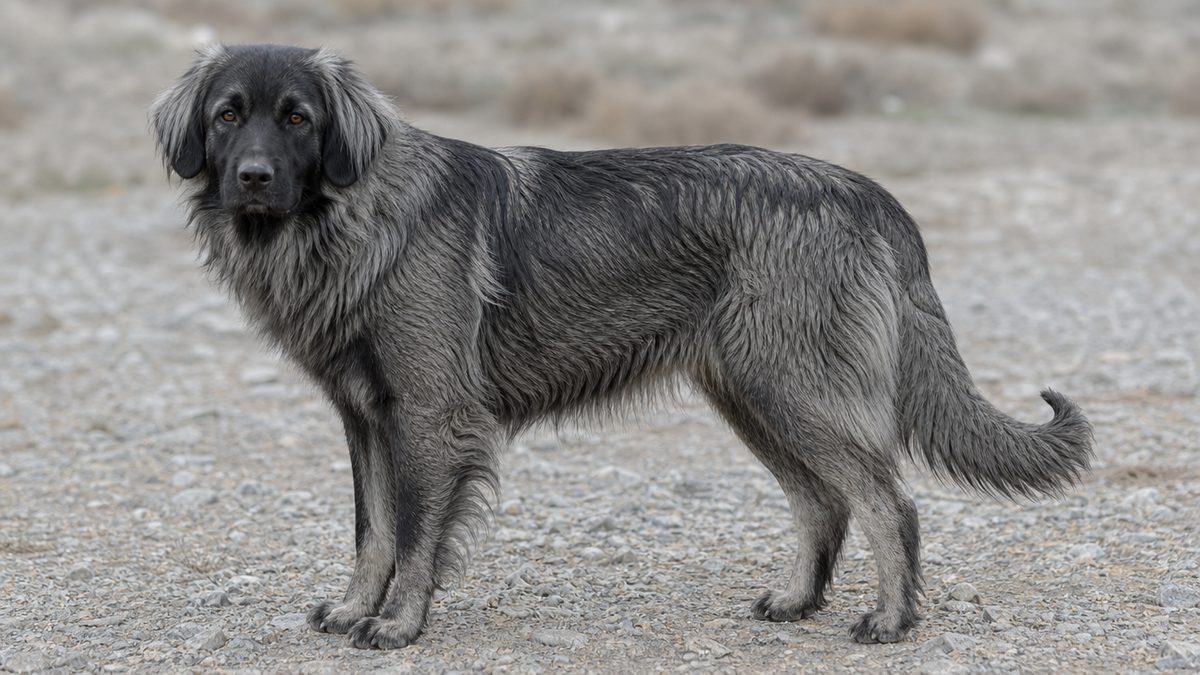
A Karst Shepherd is Slovenia's native livestock guardian, in Slovene a kraski ovcar or krasevec, registered by the Federation Cynologique Internationale as breed 278 and accepted on a definitive basis on 4 February 1969. It is a medium-sized, robust, long-coated dog of iron grey, 57 to 63 centimetres in males, with pendant ears and a long sabre tail.
The FCI classification places it in Group 2, Pinscher and Schnauzer, Molossoid and Swiss Mountain and Cattledogs, Section 2.2 Molossian, Mountain type, without a working trial FCI-Standard N 278. Slovenia is the country of origin and English is the official authentic language of the standard, which matters more than it sounds and is picked up later on this page. The United Kennel Club recognised the breed separately on 1 July 2006 and files it in the Guardian Dog Group.
What the breed standard actually requires
The standard describes a dog of medium size, harmonious, robust, with well developed musculature and a strong constitution, whose tail and ears hang and whose coat is iron grey, long and abundant. Body length to height at withers should be no less than 9:8, so the dog reads slightly longer than tall rather than square. The head is proportionately large without being coarse, 24 to 26 centimetres from occiput to nose tip, and the skull is a little longer than the muzzle at 13 to 14 centimetres against 11 to 12.
Two head details are worth holding on to, because they are what tell this breed apart from the guardians it gets confused with. The ears are moderately high set, of medium length, and fall flat in a V against the cheeks with the inner borders folded outwards. They are never erect. And the eyes are almond shaped, chestnut or dark brown, with an expression the standard itself calls frank, calm and almost melancholic because of the black pigmented eyelids.
Coat colour, and why it is a disqualification rather than a preference
Coat colour is iron grey, darkest on the back, turning without a visible transition towards a light grey or sandy colour on the belly and limbs, with a dark streak down the front of the legs and a dark mask on the muzzle spreading onto the skull. The phrase without visible transition is doing real work. Any other colour than grey, any bicoloured or multi-coloured dog, and any very definite demarcation between the shades of grey is a disqualifying fault, as is a white patch on chest or neck exceeding 2 centimetres in width or 10 centimetres in length.
The coat itself is long and flat with abundant undercoat, so this is a double coat in the working sense. The head, the front edges of the ears and the front of the legs carry short hair; the back edges of the ears carry longer, more supple hair; the upper neck grows a stiff, bushy mane and the lower neck a softer ruff that widens at the base. The backs of the forelegs carry fringes and the hindquarters carry culottes. The standard sets a floor rather than a range: the length of the top coat is at least 10 centimetres. The UKC renders the same requirement as at least four inches, which is 10.16 centimetres, so the two registries agree.
| Measure | FCI standard 278 | UKC standard | Converted |
|---|---|---|---|
| Male height, range | 57 to 63 cm | 22.5 to 25 in | 57.2 to 63.5 cm |
| Male height, ideal | 60 cm | 23.5 in | 59.7 cm |
| Female height, range | 54 to 60 cm | 21.25 to 23.5 in | 54.0 to 59.7 cm |
| Female height, ideal | 57 cm | 22.5 in | 57.2 cm |
| Male weight | 30 to 42 kg | not stated | 66 to 93 lb |
| Female weight | 25 to 37 kg | not stated | 55 to 82 lb |
| Minimum top coat | 10 cm | 4 in | 10.16 cm |
That table is one of the few places on this page where two independent sources can be checked against each other, and they pass. Every UKC figure converts to its FCI counterpart within half a centimetre. Where a breed has almost no literature, an agreement between two registries is worth stating explicitly rather than assuming.
Many FCI standards give height only and leave weight to proportion, which is how aggregator sites end up inventing a weight range. This one prints both: males 30 to 42 kg, females 25 to 37 kg. So a weight figure for this breed is checkable, and a source quoting something outside those bands is quoting itself.
One historical note belongs here rather than in the history section, because it explains the breed's older English names. The dog was first mentioned in writing in 1689, in Baron Janez Vajkart Valvasor's The Glory of the Duchy of Carniola, where the shepherds' dogs of the Pivka area are described as strong and fearless English Wikipedia, Karst Shepherd. You will still see the breed called the Illyrian Sheepdog or the Istrian Sheepdog in older English writing, and both names are the residue of a registry history that took thirty years to settle.
The 1968 split from the Sarplaninac, read off the register
The Karst Shepherd and the Sarplaninac were one registered breed until 16 March 1968, and the FCI standard says so in its own brief historical summary. Before that date both dogs carried the single name Illyrian Shepherd, and the separation was an administrative decision by the Central Society of Yugoslavia rather than a discovery about the dogs.
The sequence, taken from the standard's own text rather than from any secondary account, runs like this. The breed and its standard were officially recognised on 2 June 1939 under the name Illyrian Shepherd, at the FCI general assembly in Stockholm. At the FCI general assembly of 1948 in Bled, Slovenia, the standard was completed and the breed recognised again. Up to 16 March 1968, however, the shepherd of Illyria of the Karst Massif carried the same name as the shepherd from the Sarplanina Massif.
Then the operative sentence. In the presence of two shepherd dogs carrying the same name, the Central Society of Yugoslavia decided to name the one from the Karst region Shepherd from the Karst Massif and the other one Sarplaninac. Since that day, the standard says, those two breeds have been totally independent.
Two registries, told independently, agree
The UKC standard tells the same story without copying the FCI's wording. It says the breed existed for several centuries in the Slovenian region of the Karst Massif, that they were originally named the Illyrian Shepherd and grouped under this name with the Shepherd of the Sarplaninia Massif, and that in 1968 the two breeds were separated by the Central Society of Yugoslavia into the Karst Shepherd Dog and the Sarplaninac. Two registries reporting the same event, one with a day-level date and one without, is as close to corroboration as this breed's history gets.
| Date | Event | Source |
|---|---|---|
| 1689 | First mention in writing, Valvasor's Glory of the Duchy of Carniola | FCI standard 278 |
| 2 June 1939 | Recognised as Illyrian Shepherd, FCI general assembly, Stockholm | FCI standard 278 |
| 1948 | Standard completed and breed recognised again, FCI general assembly, Bled | FCI standard 278 |
| 16 March 1968 | Last day the two dogs shared one name | FCI standard 278 |
| 1968 | Central Society of Yugoslavia separates the two breeds | FCI standard 278 and UKC |
| 4 February 1969 | FCI acceptance on a definitive basis as breed 278 | FCI nomenclature |
| 26 June 2000 | Publication of the official valid standard | FCI nomenclature |
| 22 August 2001 | English text of the standard published | FCI standard 278 |
| 1 July 2006 | UKC recognition, Guardian Dog Group | UKC standard |
The FCI nomenclature page prints the definitive acceptance as 2/4/1969. That is 4 February 1969, not 2 April. The same table prints the English standard as 8/22/2001 and the German as 2/22/2002, and 22 cannot be a month, so the first field is the month across the whole table. A date column proves its own format if you look down it for a row where one field exceeds twelve.
The register contradicts the standard, and the gap is eleven years
Here is the part no ranking page has noticed. The FCI's own nomenclature record for the Sarplaninac, breed 41, gives its date of acceptance on a definitive basis as 24 July 1957. That is eleven years before the 16 March 1968 date that standard 278 gives as the last day the two dogs shared a name. Two FCI documents are saying different things: the register has the Sarplaninac already holding its own definitive registration in 1957, while the Karst Shepherd's own standard says the names did not separate until 1968.
Bonbeno is not able to resolve that from the documents available, and publishes it rather than smoothing it over. What the two records do agree on is the direction of travel: the Sarplaninac kept the low, old number, 41, and the Karst Shepherd was entered as 278, a number from a much later block. A breed that had genuinely been co-equal in the register since 1939 would not be renumbered into the 270s in 1969.
The 1957 date is also, usefully, the explanation for a common error. Several secondary accounts of Balkan guardian breeds date the split itself to 1957. They have taken the Sarplaninac's FCI acceptance date and attached it to the separation event. The separation date the FCI prints in its own standard is 16 March 1968.
| Register field | Karst Shepherd | Sarplaninac |
|---|---|---|
| FCI breed number | 278 | 41 |
| FCI name | KRASKI OVCAR | JUGOSLOVENSKI OVCARSKI PAS-SARPLANINAC |
| Definitive acceptance | 4 February 1969 | 24 July 1957 |
| Country of origin | Slovenia | North Macedonia, Serbia |
| Official authentic language | English | French |
| Valid standard published | 26 June 2000 | 24 November 1970 |
| Group and section | 2, Molossian mountain type | 2, Molossian mountain type |
The practical consequence for a buyer is small but real. Any pedigree, photograph or written reference to an Illyrian Shepherd from before 1968 may describe either dog, and the two are not interchangeable. One is a Slovenian dog of 30 to 42 kg with flat pendant ears; the other is registered to North Macedonia and Serbia. They are being asked to share one name in every pre-1968 source you will find.
What the split cost the breed, measured in its genome
The 1968 separation is not only a naming event, and one paper measured what it did. Ceh and Dovc genotyped 493 dogs of five Western Balkan breeds at 18 microsatellite markers and sequenced mitochondrial DNA from 94 of them, and the Karst Shepherd came out of that analysis as the most genetically depleted breed in the set.
Three numbers carry the finding. The breed's allelic richness is 3.33, against 5.94 in the Sarplaninac and 5.72 in the Tornjak. Its mtDNA haplotype diversity is the lowest of the three, and across the sampled dogs only one haplotype was found at all. And the pedigree data give it a realized effective population size of less than 20 animals, which a later review states precisely as 19.3, against 98.3 for the Tornjak Evaluation of Genetic Diversity in Dog….
Mitochondrial DNA passes down the mother. Finding a single haplotype across the sampled dogs means every one of them traces to a single founding female lineage. That is not a small population, it is a narrow one, and the two problems need different fixes.
The authors could not reconstruct the split from the markers
The most quotable line in the paper is the one that cuts against the tidy story. Using microsatellite data, the authors write, common ancestry between the Karst Shepherd and Sarplaninac could not be reconstructed, despite pedigree and mtDNA evidence of their historical admixture. The two dogs shared a register until 1968 and the pedigrees and the maternal line still record that, but the nuclear markers no longer do.
Their explanation is the interesting part, and it is a warning about reading breed genetics as breed history. The paper concludes that the official separation of these dog breeds strongly affected the resolution of genetic differentiation, and that relationships between breeds are determined not only by relatedness but, in small populations, even more importantly by stochastic effects. In plain terms: when you close a stud book around 19 dogs, drift starts rewriting the genome faster than shared ancestry can be read out of it.
| Breed | Allelic richness | mtDNA haplotype diversity | Effective population size |
|---|---|---|---|
| Karst Shepherd | 3.33, the lowest of the set | Lowest, one haplotype found | 19.3 |
| Sarplaninac | 5.94, the highest of the set | Highest | not stated in the review |
| Tornjak | 5.72 | Intermediate | 98.3, called overestimated |
Note what the review says about that 98.3. The authors of the later paper record that Ceh and Dovc concluded the Tornjak figure was overestimated because of incomplete pedigree information. An effective population size read off a pedigree is only as good as the pedigree, and a shallow one flatters the number. That caveat attaches to the Tornjak, not to the Karst Shepherd, but it is the right way to hold any of these figures.
A second finding that matters for anyone comparing guardians
The same analysis could not separate the Sarplaninac from the Caucasian Shepherd Dog by neighbour-joining, STRUCTURE or DAPC, and the two sat close together in the NeighborNet tree. That is a caution worth carrying into any comparison of Balkan and Caucasian guardians, including the one on Bonbeno's own Caucasian Shepherd Dog page. Breeds that a registry treats as distinct are not always distinguishable by these markers.
For a buyer the practical reading is short. This is a breed whose entire living population sits behind a genetic bottleneck that has been measured and published, so any breeder claim about the depth or diversity of a line should be checkable against a real pedigree rather than asserted. And it is a reason to be sceptical of any dog offered as a Karst Shepherd outside Slovenia and its immediate neighbours, because the pool it could have come from is very small.
Karst Shepherd price in India
No Karst Shepherd price in India exists, and Bonbeno could not source a single rupee figure attached to this breed from any page it opened. The breed is not bred or sold in India, there is no lawful route to import one for sale, and the Indian price-list pages that rank for the query do not mention the breed at all Directorate General of Foreign Trade.
That is the honest answer, and it is more useful than a number would be. What follows is what the sources actually carry, so you can see the shape of the absence rather than being asked to take it on trust.
The only published purchase price is British
The page ranking first for the Indian query is Wamiz, which gives an average purebred puppy price of about 730 pounds and a monthly keeping cost of 80 to 110 pounds. Those are British figures for a British market. Bonbeno does not convert them, because converting a foreign price into rupees and presenting the result as an Indian price is exactly the fabrication mechanism this site documents elsewhere. A converted figure would tell you what a British puppy costs in rupees, which is not a fact about India.
The third-ranking page, Dog Breeds List, is more candid than most. Its puppy price field for this breed reads Average (Unknown). A breed-listing site that publishes a price for hundreds of breeds and declines to publish one here is telling you something real.
Royal Canin publishes a Karst Shepherd page on its Malta site and none on its Indian site. Look4Dog runs a full breed page with a dedicated Breeders section and prints no price at all. EuroBreeder's entire on-page content for the breed is one kennel announcement and the breed name in four languages. Two of the largest English breed libraries, DogTime and PetGuide, return HTTP 404 for the breed and publish no page at all.
| Source | Figure published | Currency | Applies to India |
|---|---|---|---|
| Wamiz, position 1 for the Indian query | About 730 for a purebred puppy | Pounds sterling | No |
| Wamiz, monthly keeping cost | 80 to 110 per month | Pounds sterling | No |
| Dog Breeds List | Average (Unknown) | None given | No |
| Royal Canin | No price published | None | No Indian page exists |
| Look4Dog | No price published | None | No |
| EuroBreeder | No price published | None | No |
| Six Indian dog-price-list pages | 161 distinct rupee figures, none for this breed | Rupees | Not for this breed |
There is no Indian supply. A seller quoting a Karst Shepherd price in India is quoting something else: another breed, a crossbreed, or a number typed into a template. Ask for the FCI or KCI pedigree number and the import paperwork before you discuss money at all, and read the adoption section on this page for what the paperwork has to contain.
Why no lawful Indian purchase market can form
Two independent facts close the loop. First, DGFT Trade Notice 22/2022-23 makes live dogs a Restricted import under ITC(HS) 01061900 and states plainly that any applications for trading or breeding purposes, or applications made on behalf of some another person or entity, shall be duly rejected. So a dog cannot lawfully be imported into India in order to be sold, and it cannot be imported on someone else's behalf either. The only permitted route is a person relocating with their own pet.
Second, the worldwide breeding population is tiny. A realized effective population size of 19.3 dogs is not a pool that can supply an export market, let alone one 4,000 kilometres away. Even in Slovenia this is a breed maintained by a small number of people, and the Kennel Club of India registered 33,880 pure-bred dogs of all breeds in 2025 without, as far as Bonbeno can establish, any of them being this one.
So the purchase price question has no Indian answer, and the useful question underneath it is what a dog of this size and coat costs to keep in India once it is here. That has a real answer, in rupees, and the next section gives it.
What the Indian pages ranking for this query actually contain
The Indian pages that rank for a Karst Shepherd purchase price query are generic dog-price lists, and Bonbeno tested six of them figure by figure. Not one mentions the Karst Shepherd, the Sarplaninac or the Tornjak, and between them they carry 161 distinct rupee values for other breeds.
This is worth doing rather than asserting, because the numbers on those pages are what an answer engine will quote back at you if you ask it what this breed costs in India.
The division tests, run on every figure rather than a sample
Indian breed-price pages are often a foreign price list run through one exchange rate, and the tell is that the rupee figures divide cleanly by a single number. Bonbeno ran every distinct rupee value of 1,000 or more on each page against five rates. The result is unambiguous: zero of 161 figures divide exactly at 84.38, zero at 83.5, and one lone value at 74. These pages are not converted dollar lists.
| Page | Distinct rupee values | Exact at 84.38 | Exact at 74 | Exact at 80 | Mentions this breed |
|---|---|---|---|---|---|
| wrapinfur.com | 35 | 0 | 0 | 15 | No |
| supertails.com | 34 | 0 | 1 | 22 | No |
| dogbreedo.com | 39 | 0 | 0 | 26 | No |
| petbuddy.in | 39 | 0 | 0 | 24 | No |
| shubhkennel.com | 14 | 0 | 0 | 9 | No |
| premiumpethouse.com | 0 detected | n/a | n/a | n/a | No |
| Totals | 161 | 0 | 1 | 96 | None of six |
The 80 column looks alarming and proves nothing
Ninety-six of 161 figures divide exactly at a flat rate of 80, which sounds like a finding until you look at the quotients. A rupee figure ending in three zeros divides cleanly at 80 by construction, because 1,000 divided by 80 is 12.5. The quotients these pages actually produce are 12.5, 15.0, 18.75, 22.5, 31.25, 43.75, 56.25, 87.5, 93.75, 106.25, 181.25, 312.5, 437.5, 687.5, 1,062.5 and 1,187.50.
No seller anywhere prices a puppy at 18.75 dollars, or at 1,187.50 dollars. A genuine converted list yields prices a real shop would print, like 500, 800 or 1,500. Implausible quotients mean these figures are rupee-native and arbitrary rather than converted, which is a different contamination mechanism and needs saying differently. The numbers were typed, not calculated, and they were typed for other breeds.
A match at a flat 80 is weak evidence on its own. Treat it as evidence only when the quotient is also a number a human would quote. Here, 96 rows matched and almost none of the quotients is a price anyone would print, which is how you tell arithmetic noise from a conversion.
The search engine is answering a geology question
There is a second reason no Indian price surfaces, and it is not about the breed at all. Bing India returned HTTP 200 for karst shepherd price in india and served ten results about limestone topography, headed by the Wikipedia article on karst and including a UPSC exam-preparation page on karst landforms. Running a genuinely different question, is karst shepherd legal in india, returned the same ten titles in the same order under the same reported count of 1,31,000.
That identity is the diagnostic. A search engine returning byte-identical results for two different questions is not reading the query. A labrador retriever price in india control run in the same session returned ten genuine Indian price pages under a count of 25,900, so the instrument works and only this query is being substituted. Dropping the country parameter changed nothing at all.
So Bonbeno claims no absence of Indian listings from those zeros, because the search that produced them was never run. What it does claim is narrower and better evidenced: on the six Indian price pages that a working search engine did return, the breed appears zero times, and every figure on them fails the conversion tests. The absence of a price for this breed is established from documents that were actually read, not from a search box that answered a different question.
What a dog this size costs to keep in India
The cost of ownership for a 30 to 42 kg long-coated dog in India runs Rs 3,000 to Rs 10,000 a month for most owners, with food alone passing Rs 5,000 for a large working breed. Those are real published Indian figures for a dog of this size, and unlike a purchase price they do not depend on the breed existing here.
This is the section that actually helps, so it is built entirely from Indian sources with the figures they print rather than from any conversion.
The recurring monthly cost
Food is the largest line and the one most underestimated. Quality dog food for a medium-sized dog costs Rs 1,500 to Rs 4,000 a month, and large breed dogs, especially working breeds, push this past Rs 5,000. A Karst Shepherd sits at the top of that band, because 30 to 42 kg of working guardian is not a medium dog.
Grooming is the second line, and this breed's 10 centimetre top coat puts it at the expensive end. A basic grooming session costs Rs 300 to Rs 2,000 depending on breed and city, with Rs 2,000 being a full session for a large long-haired breed. A long-coated guardian in an Indian summer needs that more often than a smooth-coated dog does.
| Line item | Published Indian figure | Source |
|---|---|---|
| Total monthly cost, all dogs | Rs 3,000 to Rs 10,000 | VOSD |
| Food, medium dog | Rs 1,500 to Rs 4,000 per month | VOSD |
| Food, large working breed | Rs 5,000 or more per month | VOSD |
| Grooming session, large long-haired breed | Rs 300 to Rs 2,000 | VOSD |
| Vet consultation | Rs 500 to Rs 1,000 | VOSD |
| Annual vaccination | Rs 1,500 to Rs 3,000 | VOSD |
| Preventive care, done properly | Rs 5,000 to Rs 8,000 per year | VOSD |
| Professional dog walker | Rs 3,000 to Rs 6,000 per month | VOSD |
| Basic training course | Rs 5,000 to Rs 15,000 | VOSD |
| Typical annual spend | Rs 25,000 to Rs 80,000 or more | VOSD |
Vaccination cost, from two independent Indian sources
The first-year vaccination cost is where two Indian sources can be checked against each other. A full puppy course runs about Rs 3,000 to Rs 6,000 across all visits, a single anti-rabies shot Rs 300 to Rs 600, and the clinic adds a consultation or injection charge of roughly Rs 300 to Rs 800 on top of the vaccine itself. A second Indian source gives an average anti-rabies injection cost of INR 350 per dose, which sits inside the first source's band.
The yearly booster afterwards is one combined vaccine plus one rabies, usually Rs 1,000 to Rs 2,000 all in. Set that beside a parvovirus hospital stay, which the same source puts at Rs 15,000 to Rs 50,000, and the whole first-year vaccine bill is a rounding error. That arithmetic holds for any breed, and it is the single best-value spend in Indian dog ownership.
Boarding, where size is billed directly
Boarding is the clearest example of a cost that scales with this breed's actual weight. A Chennai boarding kennel publishes an air-conditioned tariff of INR 950 a day for a 21 to 40 kg dog and INR 1,050 a day for 41 to 50 kg, with non air-conditioned kennels at INR 850 and INR 950 for the same bands. A male Karst Shepherd at 30 to 42 kg straddles those two bands, so budget the higher one.
Ten days of air-conditioned boarding for a dog at the top of this breed's weight range is INR 10,500. For a double-coated dog from a 13 degree homeland, the air-conditioned option is not a luxury upgrade, which the climate section explains.
Before the monthly cost starts, the first month is heavier. A starter kit of bed, bowls, collar, leash and ID tag runs Rs 2,000 to Rs 5,000, and the first vaccinations, deworming and health check add another Rs 2,000 to Rs 5,000. Most Indian owners spend Rs 15,000 to Rs 25,000 in month one before anything goes wrong.
None of this depends on a purchase price, which is why it is the honest half of the cost question for a breed India does not sell. It is also the half that decides whether the dog is well kept, and a 42 kg guardian fed on a medium-dog budget is a welfare problem regardless of what it cost to acquire.
Heat tolerance: a 13 degree homeland against a 28 degree country
A Karst Shepherd's heat tolerance is the lowest rating Bonbeno gives, because its homeland on the Karst Plateau averages 13.14 degrees Celsius a year against 27.95 in Chennai and 25.60 in Delhi, and the breed standard requires a top coat of at least 10 centimetres over abundant undercoat FCI-Standard N 278. That is a 14.8 degree gap, carried by a dog built for the colder side of it.
Every figure below was queried from NASA POWER by explicit latitude and longitude, over the 2001 to 2020 climatology, with the grid-cell elevation echoed back for each point so you can see where the model actually stood.
| Place | Lat, lon | Cell elevation | Annual mean T2M | Annual max T2M | Relative humidity |
|---|---|---|---|---|---|
| Karst Plateau, Slovenia | 45.71, 13.87 | 256.47 m | 13.14 C | 34.53 C | 75.5 % |
| Ljubljana, Slovenia | 46.06, 14.51 | 597.55 m | 9.37 C | 35.67 C | 81.2 % |
| Chennai | 13.08, 80.27 | 48.95 m | 27.95 C | 42.70 C | 72.4 % |
| Mumbai | 19.08, 72.88 | 97.15 m | 26.77 C | 44.91 C | 67.4 % |
| Delhi | 28.61, 77.21 | 206.37 m | 25.60 C | 48.79 C | 45.6 % |
| Pune | 18.52, 73.86 | 635.99 m | 23.86 C | 43.20 C | 66.8 % |
| Bengaluru | 12.97, 77.59 | 841.72 m | 23.74 C | 40.38 C | 67.9 % |
A hardy mountain breed is still a breed adapted to one range of temperatures rather than to all of them, and hardy is not a synonym for heat-proof. The plains cells are trustworthy. Delhi's reported elevation is 10 metres below the city's real 216, Chennai's is 43 metres above, Mumbai 83 above, Bengaluru 78 below and Pune 76 above. Those are small errors and the cell is effectively the town.
Two towns, one grid cell, and why that is not a finding
The Karst row needs a caveat that is easy to miss. Bonbeno queried two separate Karst towns, Sezana at 45.71, 13.87 and Divaca at 45.68, 13.97, and NASA POWER returned a byte-identical series for both: the same 256.47 metre elevation, the same 13.14 degree mean, the same 34.53 maximum and the same 75.51 percent humidity. Those two places are not identically warm. They fall inside one grid cell, and the cell was queried twice.
So the Karst figure is a plateau-scale average and cannot be used to distinguish one Karst town from another. It is also about 94 to 179 metres below the real elevation of the towns on it, which biases the model slightly warm. Stated honestly, the breed's homeland is a low-mountain plateau averaging somewhere close to 13 degrees, and that is enough for the comparison being made.
The hill stations, where the model is wrong by over a kilometre
The obvious next question is whether an Indian hill station works, and the obvious way to answer it is badly. NASA POWER returns a grid cell rather than a point, and in mountains the cell's mean elevation can miss the town underneath it by well over a kilometre. Bonbeno measured that error rather than assuming it away.
| Hill station | POWER cell elevation | Real town elevation | Error | Cell mean T2M | Lapse-corrected estimate |
|---|---|---|---|---|---|
| Shimla | 897.65 m | about 2,200 m | 1,302 m too low | 21.15 C | about 12.7 C |
| Ooty | 784.64 m | about 2,240 m | 1,455 m too low | 23.50 C | about 14.0 C |
| Darjeeling | 1,313.52 m | about 2,045 m | 731 m too low | 18.42 C | about 13.7 C |
| Manali | 3,984.73 m | about 2,050 m | 1,935 m too high | -0.56 C | about 12.0 C |
| Leh | 4,532.61 m | about 3,500 m | 1,033 m too high | -2.75 C | about 4.0 C |
The corrections use a standard lapse rate of 6.5 degrees per 1,000 metres and are estimates, labelled as estimates. They are not measurements. What makes them worth publishing is that they land close to each hill station's known climate, which is what confirms the diagnosis rather than merely asserting it.
You cannot correct this with a rule of thumb. Shimla, Ooty and Darjeeling come back too warm because the cell sits below the town. Manali and Leh come back far too cold because the cell sits above it. Manali's raw cell reads minus 0.56 degrees, which would make it look like Lapland.
Read across those two tables and the answer is specific. Shimla's lapse-corrected annual mean of roughly 12.7 degrees is within half a degree of the Karst Plateau's 13.14. On annual mean temperature alone, the Himachal hill stations are the only part of India that matches this breed's homeland, and they match it closely. Ooty at roughly 14.0 and Darjeeling at roughly 13.7 are in the same territory.
That is a real finding and it needs one qualification, because annual mean is not the whole climate. The Karst Plateau's relative humidity is 75.5 percent and its recorded maximum is 34.53 degrees. An Indian hill station in the monsoon is wetter for longer, and a dog carrying 10 centimetres of coat plus undercoat through a Himalayan monsoon has a skin and ear problem rather than a heat problem. The plains are simply out: a dog whose ancestors never met 42.70 degrees should not be asked to.
Temperament, and why an Indian flat is the wrong home
The Karst Shepherd's temperament is set out in the breed standard in one sentence, and it is unusually candid: of good, moderately sharp temperament, courageous and valiant but not biting, very devoted to his master, an incorruptibly good guard, distrustful of strangers, a pleasant companion dog and obedient, whilst maintaining a strong individuality. Every clause in that sentence is a household constraint.
The UKC standard says the same thing in its own words, which matters because it was written separately: courageous and valiant, but not apt to bite, very devoted to his master and an extremely good guard dog, a pleasant companion, very obedient, but distrustful of strangers. Two registries independently describing a dog as devoted to one person and distrustful of strangers is a consistent picture, not a marketing line.
Moderately sharp is a technical description, not a warning
In livestock guardian terminology, sharpness is the threshold at which a dog escalates. Moderately sharp with the qualifier not biting describes a dog that challenges, positions itself and makes noise rather than one that closes. That is exactly what you want on open pasture, where the job is to make a predator choose somewhere else. It is a different thing in a stairwell.
The phrase that does the most work is strong individuality. A guardian breed is selected to make its own decisions about threat while the shepherd is asleep or a valley away. That independent judgement is the breed, and it is not something obedience training removes. An owner who wants a dog that defers on every call should not buy a livestock guardian of any kind.
The Indian household problem, stated plainly
A typical Indian home is a high-traffic environment for a territorial dog. Domestic help, cooks, drivers, delivery riders, building staff, the electrician, the plumber, the gas cylinder, relatives arriving unannounced, and in an apartment a shared landing that the dog will treat as its own boundary. A dog whose standard describes it as distrustful of strangers is handed a full-time job by that arrangement, and it will do the job.
This is not a claim that the breed is dangerous. It is a claim about fit. A guard dog that is constantly right, in its own terms, is a dog under constant load, and a dog under constant load in a 30 degree flat with a 10 centimetre coat is a welfare problem before it is a bite risk.
A working property with land, a fixed and small set of humans, real livestock or a real perimeter, and a cool enough location. A farm in Himachal or the Nilgiris with sheep or goats is the honest answer. Everything else is asking a working guardian to be a pet in conditions it was not built for.
Socialisation, and the window that closes
Like all large guardians, this breed has to be socialised early and deliberately, and the target depends on the job. If the dog is to live with people, socialise it with people, in volume, before the guarding threshold sets. If it is to guard livestock, socialise it with the livestock instead. Doing both half-heartedly produces a dog that is confident about neither.
In Indian conditions there is a scheduling conflict worth naming. The socialisation window and the heat window overlap badly. A puppy that most needs to be out meeting the world at eight to sixteen weeks is also a puppy that cannot safely be out in the middle of an Indian day. That pushes socialisation into early mornings and late evenings, which is a smaller and quieter slice of the world than the dog actually needs to meet.
The practical version: plan socialisation as deliberately as you plan vaccination, count the exposures, and use the cool hours. A guardian breed that missed its window does not become friendly later, and this is one of the few things about the dog that is entirely within an owner's control.
Training a guardian that was bred to decide for itself
To train a Karst Shepherd, work with the independence rather than against it, because the breed standard describes a dog that is obedient whilst maintaining a strong individuality and that is an accurate description of what you get. Compliance drills produce a dog that complies when supervised. Relationship and clarity produce a dog that chooses correctly when it is not.
There is no published training study on this breed and Bonbeno will not pretend otherwise. What follows is drawn from what the two standards actually say about temperament, plus the constraints Indian conditions impose, and it is presented as reasoning rather than as evidence.
What this breed makes easy
Both standards call the dog obedient and devoted to its master, so the raw material is good United Kennel Club. A guardian bonded to one person will train readily for that person. Recall, place, settle, walking on a loose lead and accepting handling are all reachable, and the breed is trainable in the ordinary sense of learning quickly what is asked.
Handling tolerance deserves specific work, because this dog will need it. A 42 kg dog that objects to having its ears examined, its coat brushed out or its temperature taken is a dog that gets less veterinary care than it needs. Train co-operative handling early and keep it maintained, and do it before the dog is heavy enough to make it a physical argument.
What this breed will resist
It will resist being asked to stand down from a judgement it has already made. That is the trait the breed exists for. You can build reliable interrupt and recall behaviours, and you should, but a guardian that has decided a stranger at the gate is its business will not simply forget the decision because a cue was given. Manage the environment so the decision does not arise.
It will also resist repetition without purpose. Guardian breeds are not retrievers, and drilling a known behaviour twenty times teaches the dog that the exercise is meaningless. Short sessions, high clarity, and stopping while the dog is still interested is the pattern that works with independent breeds.
- Weeks 8 to 16. Socialisation is the entire curriculum. Volume and variety of people, surfaces, sounds and vehicles, all in the cool hours.
- Months 4 to 8. Loose-lead walking, recall, co-operative handling, crate and settle. Build the habits while the dog is still liftable.
- Months 8 to 14. Adolescent testing arrives. Hold the boundaries you set, expect regression, and do not escalate.
- Months 14 to 24. The guarding threshold sets. Management of gates, doors and visitors becomes more important than any new obedience behaviour.
- Throughout. Maintain handling tolerance every week, because the dog gets 20 kg heavier and the argument gets harder.
The FCI standard lists aggressive or overly shy as a disqualifying fault, and adds that only functionally and clinically healthy dogs with breed typical conformation should be used for breeding. A dog that is genuinely aggressive is outside its own breed standard, not an extreme example of it. Do not accept aggression as breed character, and do not breed from it.
Timelines, realistically
Expect basic household reliability at around twelve months and adult judgement at two to three years, which is the ordinary maturation curve for a large guardian rather than anything specific to this breed. A dog that seems settled at ten months and difficult at fifteen is behaving normally. Anyone selling you a fully finished guardian at six months is selling you something else.
In India there is one extra constraint on the schedule. The training day is the same narrow cool window as the exercise day, so training and exercise compete for the same two hours. That is manageable if you combine them deliberately, walking a training pattern rather than treating the two as separate sessions, and unmanageable if you plan them as if you lived in Slovenia.
Exercise needs, and the two-hour window India gives you
A Karst Shepherd's exercise needs are territorial rather than athletic, and that distinction changes how you meet them in India. This is a patrolling livestock guardian, not a running dog: the standard names the trot as its preferred and most elegant gait and calls the gallop with long strides less elegant. It needs ground and hours, not speed.
That is a genuinely different requirement from the northern hunting spitzes Bonbeno covers elsewhere, and it is good news in India. A dog that needs to cover territory at a trot can do so at first light and after dark. A dog that needs sustained hard running cannot, because the hours when running is safe are the hours when it is dark.
What the daily requirement actually looks like
Plan two sessions a day totalling ninety minutes to two hours of walking on varied ground, plus real space at home. Split them so that neither falls inside the heat of the day: an early-morning session before the sun is up properly, and an evening session after the ground has stopped radiating. In Chennai, where the annual mean is 27.95 degrees and the recorded maximum 42.70, that window is narrow for most of the year.
- Walk on surfaces, not just distance. Grass, earth and stone in one session does more for a guardian than the same time on flat tarmac.
- Watch the ground temperature, not the air. Tarmac that is comfortable to an air thermometer at 6 am can still hold yesterday's heat in the surface.
- Give the dog a boundary to hold. A patrollable perimeter meets a guardian's needs in a way that a treadmill of walks does not.
- Skip the session rather than shift it later. A missed walk costs less than a heat-stressed one.
- Cool the dog before it needs cooling. Shade, water and airflow arranged in advance beat any intervention afterwards.
The evidence on exertion and heat, used carefully
The largest study of heat-related illness in dogs found that exertion, not hot cars, is the dominant trigger. In a cohort of 905,543 UK dogs under primary veterinary care in 2016, there were 1,259 heat-related illness events from 1,222 dogs. Of the 879 events that had a recorded trigger, 652, or 74.2 percent, were exertional, against 113 environmental and 46 from vehicular confinement.
The companion paper from the same cohort reports the risk factors. Dogs at or above the mean bodyweight for their breed and sex carried an odds ratio of 1.42, with a confidence interval of 1.12 to 1.80, and dogs over 50 kg carried an odds ratio of 3.42, interval 1.54 to 7.57.
The Karst Shepherd was not modelled. It is not a UK-registered breed in any number, so it does not appear in that study's breed-level analysis and it does not sit in the over-50 kg band either, since males top out at 42 kg. The transferable finding is the bodyweight one: a dog carrying more than its breed and sex mean is at higher risk, whatever the breed. An odds ratio imported onto a breed the authors never studied would be fabrication wearing a citation.
The reason the exertional finding matters here anyway is behavioural rather than statistical. A guardian breed does not self-limit. A dog that has decided the perimeter needs walking will walk it in 38 degree heat, and a dog that has decided a stranger needs escorting to the gate will do that at a trot at two in the afternoon. Managing exertion in this breed means managing the situations that trigger it, because the dog will not manage them for you.
Indian law puts a floor under the outdoor question
There is also a legal constraint that owners rarely know about. Second Schedule Part IV paragraph 21(1) of the Prevention of Cruelty to Animals (Dog Breeding and Marketing) Rules 2017 bars keeping certain dogs in outdoor facilities without the attending veterinary practitioner's written approval, and the categories it names are dogs not accustomed to the temperatures prevalent in the area, dog breeds that cannot tolerate them such as long-haired breeds in high temperature locations, and sick, infirm, aged or young animals.
A long-coated Slovenian mountain guardian in an Indian plains city falls into the first two categories at once. The clause is written for breeding establishments rather than for private owners, but it is the clearest statement in Indian law of what this dog's exercise and housing arrangements should look like, and it is a reasonable standard for anyone to hold themselves to.
Grooming a 10 centimetre double coat in Indian humidity
To groom a Karst Shepherd in India, brush the whole coat to the skin on a fixed schedule and dry it completely after every wetting, because the standard requires a top coat of at least 10 centimetres over abundant undercoat and that is a lot of material to hold monsoon moisture. There is no clipping, no stripping and no professional cut, so the cost is time rather than money.
The coat is described in unusual detail in the standard, and the detail tells you where the work is. Long, flat hair with abundant undercoat over the trunk and belly; short hair on the head, the front edges of the ears and the front of the legs; longer supple hair on the back edges of the ears; a stiff bushy mane on the upper neck and a softer ruff below it that widens at the base of the neck; fringes behind the forelegs and culottes on the hindquarters; and a bushy tail that does not form a plume.
The four places that mat first
Every one of those long-haired zones is a mat site, and in Indian humidity they behave differently from the way an overseas breed club would describe them. The ruff and mane are the worst, because the neck is where a collar sits and where sweat from a human hand transfers. Behind the ears, where the supple hair meets the short hair, is second. The culottes and the fringes behind the forelegs are third and fourth, because they collect road dust that then holds moisture.
- Brush the mane and ruff twice a week, lifting the top coat and working the undercoat out rather than skimming the surface.
- Check behind both ears every time, because a mat there sits directly over the ear canal.
- Comb the culottes and the leg fringes once a week, and after any walk on dusty ground.
- Line the tail from base to tip monthly, since a bushy tail hides matting well.
- Increase everything to daily during a moult, when the undercoat comes out in bulk.
Where overseas grooming advice does not transfer
Guidance written for a European climate routinely says to towel a long-coated dog and let it air dry. In Slovenia, where the Karst Plateau averages 13.14 degrees, that is fine. In an Indian monsoon it is not, because a 10 centimetre coat over abundant undercoat does not air dry in saturated air. It stays damp against the skin for hours, and damp skin under a dense coat is where hot spots and ear disease start.
The rule for India is different and it is simple: dry the dog to the skin, mechanically, every time it gets wet. Blow the coat out on a cool setting from the skin outwards, pay particular attention to the ruff, the armpits and behind the ears, and do not consider the job finished until you can part the coat anywhere and find dry skin.
This breed's ears fall flat against the cheeks and cover the canal completely. A drop ear over a wet canal in humid weather is the standard setup for otitis externa. Plug the ears before bathing, dry the surrounding coat thoroughly afterwards, and check the canal weekly rather than waiting for a smell or a head shake.
Never shave this coat
Shedding a double-coated dog's coat off is the single most common well-intentioned mistake made with northern and mountain breeds in India, and it makes heat management worse rather than better. The undercoat is the insulating layer and it works in both directions; the top coat is what stops solar radiation reaching the skin. Removing them leaves a dog with less insulation against heat, no sun protection, and a coat that frequently grows back in a different texture.
The right response to shedding is more brushing, not less coat. A dense undercoat that is thoroughly brushed out sheds heat far better than a matted one, because air can move through it. A matted undercoat is the thing that actually traps heat, and it is a grooming failure rather than a property of the breed.
Budget for the professional option even though the breed needs no cut. An Indian grooming session runs Rs 300 for a basic wash to Rs 2,000 for a full session on a large long-haired breed. For this dog you are paying for a thorough deshed and a proper dry rather than for scissors, and in a humid month that is money well spent.
Health issues and life expectancy: what nobody has published
There is no health dataset for the Karst Shepherd, and saying so is more useful than filling the gap with a neighbour's numbers. The breed has no row anywhere in OFA's published statistics, exactly one peer-reviewed paper names it and that paper contains no health data, and the life expectancy figures in circulation come from breed-listing sites rather than from any study Ceh E, Dovc P, Population structure….
Each of those absences was tested rather than assumed, because an untested absence is just a failed search.
OFA holds nothing, and the control proves the search worked
Bonbeno retrieved OFA's full disease-statistics page in one request, giving 2,226,110 characters covering every published breed and every database. Searched case-insensitively, KARST returns zero, KRASKI returns zero, ILLYRIAN returns zero, SARPLAN returns zero and TORNJAK returns zero.
A zero is worthless without proof the search worked, so four controls were run on the same file. LABRADOR matched 109 times, GOLDEN RETRIEVER 101, and BERGAMASCO, a genuinely rare breed, matched once. IRISH RED & WHITE SETTER matched 43 times, which also confirms the ampersand form that OFA uses instead of the spelled-out word. The file loaded, the search reaches common and rare breeds alike, and the absence is a property of OFA rather than of the query.
That absence is expected and it is not a criticism of the breed. OFA requires 100 hip evaluations, or 50 for its other databases, before it publishes a breed at all, and there is no American population of Karst Shepherds submitting radiographs. The correct phrasing is that the breed has no row in OFA's published statistics tables, not that it is absent from the OFA database.
The literature is one paper, tested across eleven name forms
A zero on one name is not a zero, so eleven query forms were run against PubMed in one session: Karst Shepherd, the plural Karst Shepherds, Kraski ovcar, the plural Kraski ovcari, the diacritic form, Krasevec, Illyrian Shepherd, Illyrian Sheepdog, Istrian Shepherd, Istrian Sheepdog and Karst Sheepdog. Controls in the same session returned 126 for a Labrador hip query and 13 for Bergamasco dog, so the instrument was working.
The result is one genuine record, Ceh and Dovc 2014, and it is a population-genetics paper with no health or lifespan content. Two of the searches produced large counts that are pure noise: Kraski ovcari returned 27 records because PubMed collapsed the phrase to kraski alone and surfaced papers on Slovenian dry-cured ham, and Krasevec returned 69 records that are the Slovenian surname Krasevec on papers about historic paper degradation and Egyptian mummies.
Searching the plural Karst Shepherds returned three records against the singular's one, which looks like two extra papers. Opening them shows otherwise: one is a review of metal contamination whose co-author is named Shepherd, and the other is a study of SARS-CoV-2 clades. Reading the titles back is what separates a real extra paper from a coincidence, and here the plural added nothing.
Hip dysplasia: what exists is about the other half of the split
The single hip dysplasia paper touching this breed pair is from 1972 and it is about the Sarplaninac, not the Karst Shepherd. Bonbeno does not borrow it. The third Sarplaninac record is a 2023 case report of Oslerus osleri infection in a 16-month-old Sarplaninac Shepherd cross in Canada, which is a parasitology case rather than a breed finding and is not this breed either. Two breeds that shared a register until 1968 are not interchangeable for a joint-disease figure, and the 2014 genetic work found them clearly differentiated on FST values in any case.
What can be said is structural rather than statistical. Hip dysplasia is common across large mountain and molossoid breeds generally, the closest relative with a published figure is the Caucasian Shepherd Dog at 49.2 percent of hips graded dysplastic on 118 evaluations, and a breed with an effective population size of 19.3 has no capacity to select away from a problem it has not measured Evaluation of Genetic Diversity in Dog….
Life expectancy, and why no figure is given here
The lifespan figure you will find for this breed, 11 to 12 years, comes from Dog Breeds List. That is a breed-listing site, not a study, and it is the same page whose puppy price field for this breed reads Average (Unknown). Bonbeno publishes no life expectancy for the Karst Shepherd, because no life table covers it and a plausible number with no source behind it is worse than an honest gap.
For an owner, the absence of data changes what you do rather than leaving you helpless. Screen the parents' hips and elbows yourself before buying, because nobody has done it at population level. Weigh the dog monthly and keep it at or below its breed and sex mean, since that is the one heat-illness risk factor the literature supports for any breed. And treat the common Indian problems, tick-borne disease, ear disease in a pendant-eared dog and parvovirus in an unvaccinated puppy, as more likely than any exotic inherited condition.
Where this breed standard collides with Indian law
Both standards for this breed instruct that dewclaws be removed, and Indian law names de-clawing among the mutilations that are strictly forbidden. That is a direct collision, and an Indian breeder following the breed standard would be breaking the rule United Kennel Club Ministry of Environment.
The FCI standard's entry for the rear pastern reads: robust, short and straight; dewclaws, if present, must be removed. The French text says d'eventuels ergots doivent etre enleves and the German says etwaige Afterkrallen mussen entfernt sein, so the instruction is identical in all three published languages FCI-Standard Nr. 278, KARST-SCHAFERHUND. The UKC standard, written separately, says simply that dewclaws should be removed.
What the Indian clause actually says, quoted from the gazette
The relevant provision is Second Schedule Part II paragraph 6(8) of the Prevention of Cruelty to Animals (Dog Breeding and Marketing) Rules 2017. Read from the gazette text itself, it reads: there shall be no tail docking, ear cropping, de-barking, de-clawing, branding, dyeing, injecting substances to enhance visual appeal, performing a surgery or procedure to camouflage or hide any defect or infirmity or any other kind of mutilation of any body part of the pup and any change of appearance by artificial means is strictly forbidden.
This is Second Schedule Part II paragraph 6(8), not Rule 6(8). The Rules themselves run only from 1 to 13, ending at Rule 13, No licence without registration. Anything numbered above 13 is a Second Schedule paragraph. In the gazette text Bonbeno extracted, the string Rule 21 appears zero times, which is worth knowing because the outdoor-housing heat clause is widely miscited that way.
The collision is narrow and real. A breeder in India who removed a puppy's dewclaws to meet the breed standard would be performing exactly the procedure paragraph 6(8) names. There is no breed-standard exemption in the clause, and the closing words, any change of appearance by artificial means is strictly forbidden, close the obvious argument that a dewclaw removal is functional rather than cosmetic.
| Procedure | What the breed standard says | What Indian law says |
|---|---|---|
| Dewclaw removal | FCI and UKC both instruct removal | Named in Second Schedule Part II para 6(8) as forbidden |
| Tail docking | UKC disqualifies a docked, bobbed or missing tail | Forbidden by the same paragraph, so the two agree |
| Ear cropping | Neither standard asks for it; ears fall flat naturally | Forbidden by the same paragraph |
| Sale below eight weeks | Not addressed by either standard | Rule 8(1)(a): pups less than eight weeks in age are not sold |
| Outdoor housing of a long-haired breed in heat | Not addressed | Second Schedule Part IV para 21(1) requires written veterinary approval |
One place where standard and law agree, and it matters
The UKC standard disqualifies a docked, bobbed or missing tail outright, and the FCI lists a very short or stump-like tail among its disqualifying faults. Indian law forbids tail docking in the same paragraph 6(8). So on tails, the registries and the law point the same way, and a docked dog offered to you as this breed fails the standard and reflects an illegal procedure at once.
That gives an Indian buyer a usable test. This breed should have a long sabre tail reaching at least the hock, heavily coated without a plume, often with a slight hook at the tip. A short tail is not a variant. It is either the wrong dog or a docked one.
Breeding restrictions worth knowing before anyone offers you a litter
Two further provisions apply to anyone thinking about breeding a rare guardian in India. Second Schedule Part II paragraph 6(3) prohibits two named mating techniques: in breeding, defined as breeding between relatives of the 2nd to 4th grade in straight or side line within the first four generations, giving uncle to niece, nephew to aunt, cousin to cousin and grandparent to grandchild as examples; and incest breeding, defined as mating between parents and children or between brother and sister.
For a breed with a realized effective population size of 19.3 dogs, that is not a technicality. It is a hard constraint on whether a viable Indian population could be established at all, even if the import rules permitted it. And paragraph 8(10) separately requires that breeding dogs have been tested for genetic defects, listing hip dysplasia first among them, which is difficult to satisfy for a breed with no published screening scheme.
Feeding a 30 to 42 kg guardian in India
To feed a Karst Shepherd in India, budget for a large working breed rather than a medium dog and keep the animal at or below its breed and sex mean weight, because that mean is the one bodyweight threshold the heat-illness literature actually supports. Published Indian figures put food for a large working breed past Rs 5,000 a month.
The standard gives the target directly, which is unusual and useful. Males weigh 30 to 42 kg and females 25 to 37 kg. Many FCI standards give height only, which is how aggregator sites end up inventing a weight range for a breed. Here the range is published, so a dog outside it is outside its own standard rather than merely large.
Why body condition is a heat question in this breed
The largest study of canine heat-related illness found that dogs at or above the mean bodyweight for their breed and sex carried an odds ratio of 1.42, with a confidence interval of 1.12 to 1.80. That finding is about bodyweight relative to the breed mean, so it transfers to any breed, including one the study never modelled. It is the most directly actionable thing a Karst Shepherd owner in India can do, and it costs nothing.
The dog you want is at the lower half of its published range with ribs easily felt under the coat, which on a 10 centimetre coat means you have to use your hands rather than your eyes. Body condition scoring by sight is unreliable on any long-coated breed, and it is close to useless on this one.
- Weigh the dog monthly and write the number down, because a long coat hides a slow gain completely.
- Feed to the lower half of the published weight range rather than the middle of it.
- Split the daily ration into two meals for a deep-chested dog rather than feeding one large meal.
- Avoid exercise immediately before or after a meal, which is standard advice for any large deep-chested breed.
- Adjust downward in summer, when a heat-limited dog is genuinely doing less work than the same dog in January.
Life stages, and the growth window that matters
A large-breed puppy grows for longer than a medium one, and over-feeding a growing guardian is a joint problem rather than a weight problem. For a breed with no published hip screening data of its own, and a closest documented relative at 49.2 percent of hips graded dysplastic, controlled growth is the one lever an owner has. Feed a large-breed puppy formulation, do not free-feed, and do not supplement calcium.
The switch from puppy to adult food for a dog of this size normally happens somewhere between 18 and 24 months rather than at twelve. Guardian breeds mature slowly, and the standard's own description of a dog with well developed musculature and a strong constitution is a description of an adult that took time to arrive.
A double-coated dog in Indian heat loses water faster than its owner expects and has fewer ways to shed heat than a smooth-coated dog. Multiple water points, refilled and cool rather than merely present, matter more for this breed than any food brand decision. Check the bowls in the afternoon, not just in the morning.
Availability in India, honestly
There is no breed-specific food for this dog and there does not need to be one. Royal Canin publishes a Karst Shepherd breed page on its Malta site with no Indian equivalent, and no manufacturer makes a Karst Shepherd formulation anywhere. Any reputable large-breed or giant-breed formulation sold in India covers the requirement, and the choice that actually matters is the quantity rather than the label.
Indian owners feeding home-prepared food should note the one thing the published cost figures make clear: home feeding is not free. The Indian source that gives the Rs 1,500 to Rs 4,000 band for a medium dog notes that homemade food shifts the cost into ingredients and time rather than removing it. For a 42 kg guardian, that is a substantial daily quantity of protein however it is bought.
The first year, month by month, in Indian conditions
A Karst Shepherd's first year in India is governed by three clocks that do not line up: the socialisation window, the vaccination schedule and the heat calendar. Indian law fixes two of them. Pups less than eight weeks in age are not sold, and all pups shall be vaccinated starting at seven to eight weeks and usually completed by eighteen weeks.
Everything below is built on those two fixed points plus published Indian vaccination costs, so the schedule is specific to India rather than translated from a European breed club calendar.
| Age | What happens | Indian cost |
|---|---|---|
| Under 8 weeks | The puppy must not be sold. Rule 8(1)(a) of the 2017 Rules is explicit | Not applicable |
| 7 to 8 weeks | First vaccination may start, per Second Schedule para 8(9) | Rs 300 to Rs 800 consultation on top of the vaccine |
| 8 to 12 weeks | Socialisation begins in earnest, in the cool hours only | Part of the Rs 3,000 to Rs 6,000 course |
| 12 weeks | Anti-rabies typically given | Rs 300 to Rs 600 per dose |
| Up to 18 weeks | Puppy course usually completed | Rs 3,000 to Rs 6,000 total across visits |
| 4 to 6 months | Loose-lead work, handling tolerance, crate and settle | Basic course Rs 5,000 to Rs 15,000 |
| 6 months | Sale without sterilisation prohibited beyond this age under Rule 8(1)(b) | Not applicable |
| 8 to 14 months | Adolescence. Expect regression, hold boundaries | Annual booster Rs 1,000 to Rs 2,000 |
| 12 months | First full Indian summer as a near-adult dog | Preventive care Rs 5,000 to Rs 8,000 a year |
| 18 to 24 months | Switch to adult food, guarding threshold sets | Food past Rs 5,000 a month |
The three clocks, and where they conflict
The socialisation window and the heat window are the conflict that catches Indian owners of northern and mountain breeds. Weeks eight to sixteen are when a guardian breed most needs volume and variety of human contact, and in most Indian cities those are also weeks when a long-coated puppy cannot safely be out between about nine in the morning and five in the evening. The world available at 6 am is quieter and less varied than the world the puppy needs to meet.
The workaround is deliberate rather than clever: bring the world to the dog. Controlled visitor sessions at home, in the cool hours, with different people each time, does more for a guardian puppy than a longer walk would. Count the exposures and vary them, because a guardian that met twenty people who all looked and sounded similar has not been socialised.
The Indian rule expects the course to run from seven or eight weeks to about eighteen weeks, which spans almost the entire socialisation window. Waiting for full cover and starting at eighteen weeks means missing it. Discuss controlled, low-risk exposure with your veterinarian rather than choosing between the two, and weigh it against a parvovirus hospital stay that Indian sources put at Rs 15,000 to Rs 50,000.
Coat and growth milestones to expect
The adult coat is not what you buy. A puppy of this breed will not carry the standard's required 10 centimetre top coat with abundant undercoat for many months, so a young dog looks deceptively manageable in the heat and then is not. Plan the grooming routine and the summer arrangements before the coat arrives rather than after.
Growth is slow and long. A large guardian is still filling out at two years, and the standard's requirements for a well developed musculature and a strong constitution describe a finished adult rather than a fifteen-month-old. Judge the dog against its own published weight range, 30 to 42 kg for males and 25 to 37 kg for females, rather than against a growth chart written for another breed.
One practical Indian note on timing a purchase, for the small number of people who could lawfully be importing a pet with them. Arriving with a puppy in April or May puts a young dog into the hardest part of the Indian year at exactly the age when it is least able to cope. A dog that lands in October has a full cool season to acclimatise before it meets an Indian summer.
Karst Shepherd against the guardians India actually stocks
Against the livestock guardian breeds an Indian buyer can genuinely obtain, the Karst Shepherd loses on the measure that should decide a purchase: evidence. It has no OFA row, one peer-reviewed paper, no life table and no Indian supply, while the Caucasian Shepherd Dog that India does stock carries 118 evaluated hips and a published dysplasia rate Ceh E, Dovc P, Population structure….
The table below compares only figures Bonbeno retrieved itself, from the sources named, so the breeds are set against each other like for like rather than through a secondary summary.
| Point of comparison | Karst Shepherd | Sarplaninac | Caucasian Shepherd Dog |
|---|---|---|---|
| FCI number | 278 | 41 | not verified on this page |
| FCI definitive acceptance | 4 February 1969 | 24 July 1957 | not verified on this page |
| Country of origin on the register | Slovenia | North Macedonia, Serbia | not verified on this page |
| Row in OFA published statistics | None | None | Yes, hips |
| OFA hip evaluations | None | None | 118 |
| OFA hips graded dysplastic | No figure exists | No figure exists | 49.2 percent |
| Peer-reviewed papers naming the breed | 1 | 3, one from 1972 | many |
| Allelic richness, Ceh and Dovc | 3.33 | 5.94 | not reported separately |
| Effective population size | 19.3 | not stated in the review | not reported |
| Available in India | No | No | Yes, with a real price band |
The Caucasian Shepherd row, and a small disagreement with our own page
Bonbeno's own Caucasian Shepherd Dog page reports 49.6 percent of hips graded dysplastic on 117 evaluations, ranking the breed ninth worst. Today's retrieval of the same OFA table reads 49.2 percent on 118 evaluations, ranked tenth. Rather than pick one, here is why both are right.
Do the arithmetic. 49.6 percent of 117 is 58.03, so 58 dogs. 58 of 118 is 49.15 percent, which rounds to the 49.2 printed today. The count of dysplastic dogs has not changed at all. One additional dog was evaluated, it graded normal, the percentage fell by four tenths of a point and the breed moved one place down the ranking. That is a live register drifting, not a contradiction between two readings.
A bare decimal from a live register looks fixed and is not. Printing 49.2 percent of 118 lets a reader see what the number rests on and lets a later editor tell whether it has moved. The two Bonbeno readings differ by one dog, and that only became visible because both pages printed the denominator.
Against what an Indian buyer should actually consider
If the appeal is a large, independent guardian for a working Indian property, the honest shortlist does not contain this breed. The Himalayan Sheepdog already lives at the altitudes where a Karst Shepherd's climate requirements could be met, and it is here. The Tibetan Mastiff is the heavy-coated guardian Indian buyers most often cross-shop, with a real market and real problems that are at least documented.
If the appeal is specifically a European mountain guardian, the Estrela Mountain Dog is the useful comparison, because it does hold an OFA breed code. That is precisely what makes the Karst Shepherd's absence measurable rather than merely asserted: a comparable breed of comparable rarity has cleared OFA's publication threshold and this one has not.
And if the appeal is rarity itself, read the genetics section again. A realized effective population size of 19.3 dogs and a single mtDNA haplotype are not a collector's credential Ceh E, Dovc P, Population structure…. They are the reason the breed is fragile, and importing individuals out of that pool to a country where they cannot lawfully be bred removes them from it permanently.
Mistakes Indian buyers make with this breed
The commonest mistake with the Karst Shepherd in India is buying one at all, because there is nothing here to buy, and the second is shaving the coat of the dog you did somehow acquire. Both are avoidable, and both start from the same place: treating an aggregator page as a source.
Accepting a price quote for a breed with no Indian supply
There is no Indian price for this breed, no lawful route to import one for sale, and no mention of it on any of the six Indian dog-price-list pages that rank for the query Bing India, search-results retrieval run 31…. So a rupee figure quoted to you is describing something else. Ask for the FCI or KCI registration number and the import paperwork before any money is discussed, and treat an unwillingness to produce either as the answer.
Shaving the coat to help with the heat
This is the well-intentioned mistake that does real harm. The standard requires a top coat of at least 10 centimetres over abundant undercoat, and those two layers do different jobs. The undercoat insulates in both directions and the top coat blocks solar radiation. Removing them leaves the dog hotter, sunburnable, and frequently with a coat that grows back in a different texture. Brush more; do not clip.
Reading a wrinkle fault as a wrinkled breed
The FCI standard says the skin is thick, compact, elastic, close-fitting and without wrinkles, and then lists among its minor faults both wrinkled skin and absence of wrinkles on forehead. Read in English alone that looks self-contradictory, and a reader could conclude the breed should have loose facial skin.
The other two language versions settle it. The German text gives the fault as Fehlen von Stirnfalte, in the singular, and the French as absence de rides au front FCI-Standard N 278, BERGER DU KARST. The UKC standard, describing the same head, says there is a moderate frontal furrow and a slight stop, and the FCI's own skull section asks for a moderate frontal furrow. So what the fault refers to is the single frontal furrow between the eyes, not loose wrinkled skin. This is a correctly built dog with a furrow and a tight face, and English being the standard's authentic language means the ambiguity propagated rather than being caught in translation.
Assuming the breed standard is a licence to modify the dog
Both standards instruct that dewclaws be removed, and Second Schedule Part II paragraph 6(8) of India's 2017 Rules names de-clawing among the mutilations that are strictly forbidden. A breeder telling you the standard requires it is describing the standard accurately and the Indian legal position not at all.
The FCI standard lists incomplete dentition and undershot or overshot conditions among its disqualifying faults, and Second Schedule Part III paragraph 8(10) requires breeding dogs to have been tested for genetic defects including overshot and undershot jaw when incisors do not touch or mesh, and two or more missing teeth Ministry of Environment. On dentition the registry and the law want the same thing, which is rare enough to be worth noticing.
Four more, briefly
- Skipping ear checks on a pendant-eared dog. The ears fall flat over the canal, and an Indian monsoon is the wrong season to find out you were not looking.
- Delaying socialisation until the vaccination course finishes at eighteen weeks, which spends the entire window waiting.
- Feeding a 42 kg guardian on a medium-dog budget, then reading the resulting weight gain as growth because the coat hides it.
- Borrowing the Sarplaninac's 1972 hip paper or the Caucasian Shepherd's OFA figure and calling it this breed's health data. They shared a register until 1968; they do not share a dataset.
The last one is the mistake this page exists to prevent. When a breed has almost no evidence, the pressure to substitute a neighbour's numbers is strong and the result looks exactly like research. A page that says plainly there is no figure is doing more for a buyer than one that quietly supplies somebody else's.
Adoption, import and how to verify what you are being offered
Nobody in India can sell you a Karst Shepherd lawfully, so the only two honest routes are adopting a dog that is already here or relocating with your own pet, and both come with paperwork you can check. DGFT Trade Notice 22/2022-23 states that applications for trading or breeding purposes shall be duly rejected, which closes the purchase route entirely.
The import rules, as they actually read
Live dogs sit under ITC(HS) 01061900 as a Restricted import. An import authorisation must be applied for through the DGFT website under Services, Import Management System, Import Authorisation of Restricted Items, and pet owners travelling to India are advised to start at least two months before their travel dates. Applications made on behalf of another person or entity are rejected alongside those for trade or breeding.
Entry is permitted only through the airports and seaports of Delhi, Mumbai, Chennai, Hyderabad, Bangalore and Kolkata, and animals are quarantined where required. That is six ports, as the notice itself lists them. DAHD added a seventh port, Cochin International Airport at Kochi, for pets arriving under the baggage rules in October 2024. The full route is set out in how to import a dog to India.
What registration in India would actually require
India is an FCI member represented by the Kennel Club of India, so a KCI pedigree runs against FCI nomenclature and FCI 278 is a recognised breed for that purpose Federation Cynologique Internationale. Registering an imported dog is a real process with a real checklist, and the checklist is public.
The KCI form for registering a dog as import status requires the original export pedigree, the original airway bill from the country of import to the final destination, the original air ticket, boarding passes with payment, a DGFT licence, customs clearance, quarantine clearance, a pet passport and a notarised affidavit. A seller offering a KCI-registerable Karst Shepherd should be able to name every one of those documents. Ask.
| Ask for | What a real answer looks like | What it rules out |
|---|---|---|
| FCI breed number | 278, KRASKI OVCAR | A seller who does not know the breed is registrable |
| Original export pedigree | A named foreign kennel club document | A locally bred dog described as imported |
| DGFT import authorisation | An authorisation number against an IEC | An animal brought in for sale, which is not permitted |
| Airway bill and air ticket | Originals, matching the dog's arrival | A paper trail assembled after the fact |
| Quarantine clearance | An AQCS document naming one of the seven ports | Entry through an unapproved route |
| Parents' hip screening | Radiographic grades from a named scheme | A breeder who has never screened, which is most of them |
| Age at sale | Eight weeks or older, per Rule 8(1)(a) | An underage puppy, which is unlawful to sell |
The adoption route, which is the realistic one
If you want to adopt a dog of this type in India rather than buy one, the honest framing is that you will be adopting a large long-coated guardian-type dog rather than a registered Karst Shepherd. Indian shelters do take in large mixed guardian types, particularly in the hill states, and a dog already in the country carries none of the import problems and none of the genetic-bottleneck concerns.
That is not a consolation prize. Everything this page says about coat care, heat management, socialisation and Indian care costs applies to a large long-coated dog whatever its papers say, and the Rs 3,000 to Rs 10,000 monthly cost is the same. What you give up is a pedigree; what you gain is a dog whose temperament you can actually assess before committing.
A realized effective population size of 19.3 dogs means every individual matters to the gene pool. Moving a dog to a country where it cannot lawfully be bred, and where paragraph 6(3) would in any case restrict the matings available to it, removes that animal from the breeding population permanently. Wanting a rare breed and helping a rare breed point in opposite directions here.
Bonbeno does not recommend breeders, link puppy listings or quote a live price as an offer, and nothing on this page is a sales channel. If you are determined to pursue the breed, deal directly with the Slovenian national club and the registry, verify every document above yourself, and be honest about the climate you are asking the dog to live in.
Karst Shepherd questions Indian buyers actually ask
What is the Karst Shepherd price in India?
No Karst Shepherd price in India exists. The breed is not bred, sold or registered in India, and none of the six Indian dog-price-list pages that rank for the query mentions it at all, although between them they carry 161 distinct rupee figures for other breeds. Any figure you are quoted for this breed in India is unsourced.
Is the Karst Shepherd the same as the Sarplaninac?
No, but they were the same registered breed until 16 March 1968. Both were recognised in 1939 under the single name Illyrian Shepherd, and the Central Society of Yugoslavia then split them into the Karst Shepherd and the Sarplaninac. A 2014 genetic study of 493 dogs found them genetically distinct but could not reconstruct their common ancestry from microsatellite data.
How rare is the Karst Shepherd?
Rare enough to be measured in a genetics paper rather than a registry table. Its realized effective population size is 19.3 dogs, its allelic richness is 3.33 against 5.94 in the Sarplaninac, and only one mtDNA haplotype was found across the sampled dogs. That is a founder bottleneck, not a marketing adjective.
Can a Karst Shepherd live in Indian heat?
Not in the plains. Its homeland on the Karst Plateau averages 13.14 degrees Celsius annually, against 27.95 in Chennai and 25.6 in Delhi, and the breed standard requires a top coat of at least 10 cm with abundant undercoat. Indian law separately restricts keeping long-haired breeds in outdoor facilities in high-temperature locations.
Is the Karst Shepherd recognised in India?
Indirectly. India is an FCI member represented by the Kennel Club of India, so the KCI issues pedigrees against FCI nomenclature, and the Karst Shepherd is FCI 278 on a definitive basis. That makes registration theoretically possible. Bonbeno located no record of any Karst Shepherd actually registered in India.
Can I import a Karst Shepherd into India?
Only as your own pet, and only if you are relocating with it. DGFT Trade Notice 22/2022-23 makes live dogs a Restricted import and states that applications for trading or breeding purposes shall be duly rejected. Entry is permitted through seven ports only: Delhi, Mumbai, Chennai, Hyderabad, Bengaluru, Kolkata and, since October 2024, Kochi.
What health problems does the Karst Shepherd have?
Nobody has published enough to answer that honestly. There is no Karst Shepherd row anywhere in OFA's statistics tables, in a retrieval where the Labrador control matched 109 times, and the single peer-reviewed paper naming the breed is a population-genetics study with no health data. Screen the parents' hips yourself.
How long does a Karst Shepherd live?
No peer-reviewed life table covers this breed. The figure in circulation, 11 to 12 years, comes from a breed-listing site rather than a study, and the same site's puppy-price field for the breed reads Average (Unknown). Treat the lifespan the same way you would treat that price field.
Why does searching for this breed return pages about limestone?
Because the word karst is a geology term and the search engine answers that instead. Bing India returned ten limestone-topography results for karst shepherd price in india, and returned the identical ten for the different question is karst shepherd legal in india, while a Labrador control worked normally in the same session.
Does the breed standard ask for anything Indian law forbids?
Yes. Both the FCI and UKC standards instruct that dewclaws be removed, and paragraph 6(8) of the Second Schedule to India's Dog Breeding and Marketing Rules 2017 names de-clawing among the mutilations that are strictly forbidden. A breeder in India following the standard would be breaking the rule.
What does a dog this size actually cost to keep in India?
Between Rs 3,000 and Rs 10,000 a month for most owners, with food alone passing Rs 5,000 for a large working breed. A first puppy vaccination course runs Rs 3,000 to Rs 6,000 across visits, a consultation is Rs 500 to Rs 1,000, and boarding a 41 to 50 kg dog costs INR 1,050 a day in an air-conditioned kennel in Chennai.
Should I buy a Karst Shepherd in India?
No, because you cannot buy a real one here. There is no Indian supply chain, no lawful import route for a purchased dog, no health data, and a climate that works against a 10 cm coat for most of the year. If you want a livestock guardian in India, look at the breeds that already live at Indian altitudes.
Is the Karst Shepherd a good guard dog for an Indian home?
It is an excellent guard dog and a poor fit for most Indian homes, which is not a contradiction. The standard calls it incorruptibly good as a guard and distrustful of strangers, and an Indian household with daily deliveries, staff and visitors gives that instinct constant work it should not be doing.
How big is a Karst Shepherd dog?
Males stand 57 to 63 cm at the withers with an ideal of 60 cm and weigh 30 to 42 kg, and females stand 54 to 60 cm with an ideal of 57 cm and weigh 25 to 37 kg. The UKC standard gives the same figures in inches and converts consistently, so the two registries agree.
Are karst shepherds good family dogs?
For its own family, yes, and the breed standard says so with unusual candour: of good, moderately sharp temperament, courageous and valiant but not biting, very devoted to his master, an incorruptibly good guard, distrustful of strangers, a pleasant companion dog and obedient, whilst maintaining a strong individuality. Every clause in that sentence is a household constraint. An Indian household with daily deliveries, staff and visitors gives the guarding instinct constant work it should not be doing, and a flat is the wrong home; add a homeland that averages 13.14 degrees Celsius against 27.95 in Chennai, and the honest fit is a fenced house in a cool place with a family that stays put.
Compare with similar breeds
Karst Shepherd sits in 1 Bonbeno group. Each one compares it directly against the breeds it is genuinely an alternative to, on the same figures.