
Breed profile
Maremmano-Abruzzese Sheepdog: Price in India, Heat, Coat and Health
An Italian livestock guardian whose FCI standard was rewritten twice in three years, whose Australian working population turns up in a heat-illness study, and which no Indian breeder lists.
Quick answer
No honest maremma sheepdog price in india can be quoted, because no Maremmano-Abruzzese Sheepdog is verifiably offered for sale here. DogsIndia carries no page for the breed while its Komondor page loads normally, Puppiezo has none, and the top organic result is a Good Dog listing page for Indiana. The ranking band of Rs 50,000 to Rs 1,00,000 carries no source. Bonbeno rates heat tolerance 2 of 5.
This page reports published veterinary research and registry data for general information. It is not a diagnosis and it is not a treatment plan. Heat stress, gastric dilatation, hip and elbow disease, ear infection and deep fungal infection can all become serious quickly in a large long-coated guardian breed, and an Australian study names this breed among those at elevated risk of heat-related illness. Consult a qualified veterinarian in your own city before acting on anything here, and treat any collapsed, bloated, distressed or non-responsive dog as an emergency rather than looking anything up.
Maremmano-Abruzzese Sheepdog at a glance
What the Maremmano-Abruzzese Sheepdog is
The Maremmano-Abruzzese Sheepdog is a large white Italian livestock guardian dog that lives with a flock rather than with a family, and the Federation Cynologique Internationale recognises it as breed standard 201 in Group 1, Section 1 Sheepdogs, without working trial.
Its country of origin is Italy and the FCI accepted it on a definitive basis on 13 March 1956. The breed standard describes the job in one line: a shepherd dog used mainly for the protection of flocks and guarding of properties. That is not a historical note. It is the whole design brief, and every difficulty an Indian owner will have with this dog follows from it.
The FCI changed the breed's name in December 2025
The official name of this breed is now Cane da Pastore Abruzzese Maremmano, with Abruzzese first. The FCI standard dated 16 December 2025, publishing the official valid standard of 3 December 2025, carries that title, and its English rendering is Abruzzes and Maremma shepherd dog. The version immediately before it, dated 18 January 2024, was titled Cane da Pastore Maremmano Abruzzese with the English name Maremma and the Abruzzes Sheepdog.
Bonbeno extracted both PDFs and compared them line by line. Apart from the date lines, the name reversal is the only change the December 2025 revision made. The General Appearance paragraph now opens 'The Abruzzes and Maremma shepherd dog is a big dog' where it previously opened 'The Maremma and Abruzzes shepherd dog'. Nothing else moved.
That matters for a reader searching in India, because every popular English name for this dog is now out of step with its own registry. Bonbeno keeps Maremmano-Abruzzese Sheepdog as the page title because that is what people type, and records the FCI name so anyone checking a pedigree knows what to expect on it.
What it looks like, from the standard rather than from a stock photo
The head is the identifying feature and the standard is unusually vivid about it: large and flat, of conical shape, 'reminiscing of that of a polar bear';. Ears are set very high, small in relation to the dog, triangular in a V, hanging, and their extremities form a narrow point that is never rounded. For a medium size dog their length must not go beyond 12 cm.
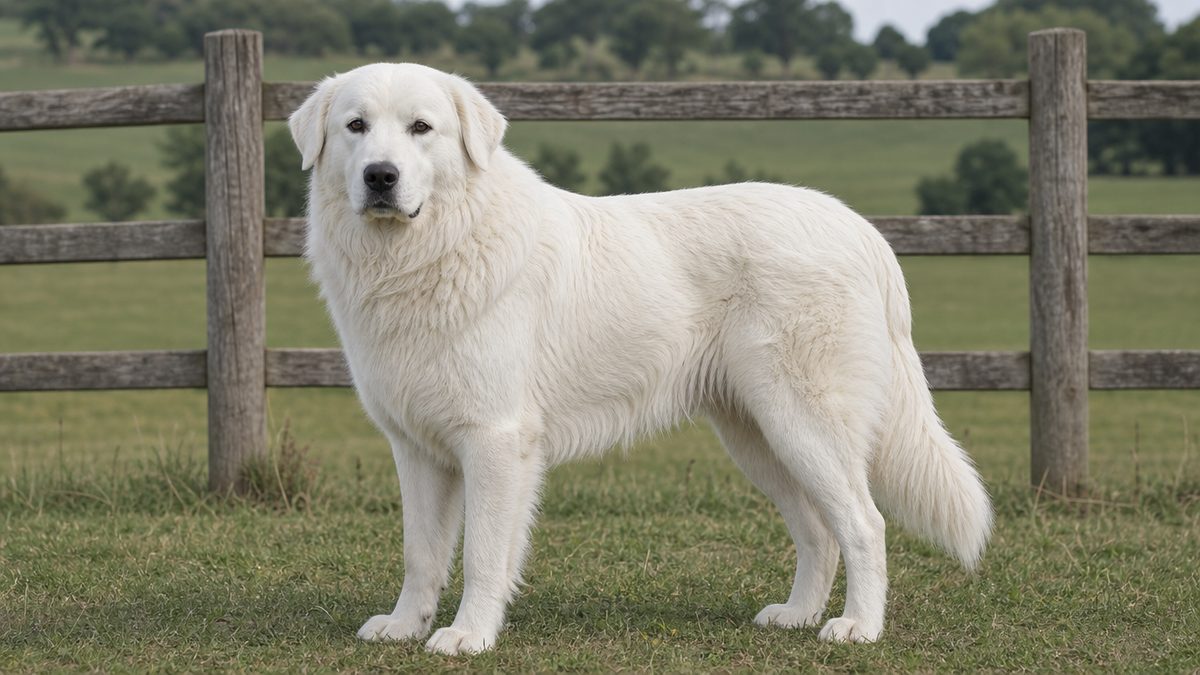
The coat is where buyers go wrong. The standard opens its General Appearance clause by calling this a big dog, strongly built, of a rustic appearance and at the same time majestic. The hair is long, rather harsh to the touch, close to straight horsehair, and it lies flat on the body with only a slight wave tolerated, reaching 8 cm in length, with an undercoat that is abundant only in winter. So this is a double coat that does not cord and does not felt. Colour is solid white, with shades of ivory, pale orange or lemon tolerated only within certain limits.
| Source | Male height | Male weight | Life expectancy |
|---|---|---|---|
| FCI Standard 201, published 03.12.2025 | 67 - 73.5 cm | 40 - 52 kg | not stated |
| FCI Standard 201, published 13.11.2015 (superseded) | 65 - 73 cm | 35 - 45 kg | not stated |
| Animalia, ranking in India | 65 - 73 cm | 35 - 45 kg | 7 - 10 years |
| Dog Breeds List, ranking in India | 60 - 73 cm | 30 - 45 kg | 11 - 13 years |
| Happy Pet, position one in India | not stated | not stated | 10 - 14 years |
| Royal Kennel Club | not stated on the breed page | not stated | over 10 years |
Read that table twice. Animalia is printing the 2015 standard verbatim, ten years out of date FCI-Standard N° 201. Dog Breeds List prints 60 to 73 cm and 30 to 45 kg, which matches neither standard, because it has merged the male and female ranges of the superseded text into one band. And the four pages give four different life expectancies spanning seven years.
Where it actually comes from, and where the Royal Kennel Club puts it
The FCI's own historical summary places the breed in two regions of central Italy: shepherd dogs still used in the Abruzzes, and sheepdogs that existed in the region of the Tuscan Maremma and in Latium, with seasonal transhumance from 1860 onwards favouring a natural crossing of those two primitive breeds.
The Royal Kennel Club's breed page says 'The white sheepdog of Northern Italy were mentioned by the Roman writer Varo in 100BC' and closes with 'The Maremma can still be seen fulfilling its original purpose in Northern Italy'. Abruzzo, the Tuscan Maremma and Latium are all central Italy, several hundred kilometres south of what anyone calls Northern Italy. The FCI standard names all three regions explicitly. Bonbeno follows the standard.
Why does the direction matter? Because the two homelands have very different climates, and the climate section of this page rests on measuring both of them separately. A guardian bred on an Abruzzo mountain pasture and a guardian bred on the coastal Maremma are being asked to tolerate different things, and neither of them is being asked to tolerate Chennai.
The breed standard changed in 2023, and nobody told the buyers
The FCI rewrote this breed's size, weight and dewclaw rules in the standard published on 25 September 2023, and every Indian page still ranking for the breed prints the superseded figures.
Bonbeno downloaded three versions of FCI-Standard 201, extracted each with pypdf, and diffed them: the text dated 17 December 2015, the text dated 18 January 2024, and the live text dated 16 December 2025 FCI-Standard N° 201 FCI-Standard N° 201. Stripping the changed page-footer dates, exactly four substantive things changed between 2015 and 2024, and one between 2024 and 2025.
| Clause | Standard of 13.11.2015 | Standard of 03.12.2025 |
|---|---|---|
| Male height at withers | 65 - 73 cm | 67 - 73.5 cm |
| Female height at withers | 60 - 68 cm | 62 - 70 cm |
| Male weight | 35 - 45 kg | 40 - 52 kg |
| Female weight | 30 - 40 kg | 35 - 45 kg |
| Metatarsus, dewclaws | "No dewclaws." | "The presence of dewclaws is tolerated." |
| Official breed name | Cane da Pastore Maremmano Abruzzese | Cane da Pastore Abruzzese Maremmano |
The weight change crosses a line that matters in India
A male Maremmano's weight ceiling moved from 45 kg to 52 kg, a rise of 7 kg. Under the 2015 text no male of this breed could reach 50 kg and remain within the standard. Under the current text a correct male can weigh 52 kg FCI-Standard N° 201.
That crossing has a direct consequence for heat. Hall 2020, *Scientific Reports*, analysed heat-related illness across 905,543 UK dogs under primary veterinary care in 2016 and reported an odds ratio of 3.42 (1.54 to 7.57) for dogs over 50 kg against dogs under 10 kg. The companion paper in *Animals* gives 2.21 (1.02 to 4.79) for exertional heat illness in the same weight band. Neither paper models the Maremmano itself, and Bonbeno does not pretend otherwise, but bodyweight is a dog-level factor rather than a breed-level one, and the standard has just moved the top of this breed's range into the band that carries the largest published odds ratio.
Weigh the individual animal rather than reading the breed label. A 41 kg female and a 52 kg male are both correct Maremmanos under the current standard, and only one of them is in the over-50 kg band. If you are budgeting food, medication doses or an air-conditioned room, the dog in front of you is the number that counts, not the range on a website.
The dewclaw clause used to collide with Indian law and no longer does
Until 2023 the standard's Metatarsus clause read, in full, 'No dewclaws';. A breeder in India who removed a puppy's rear dewclaws to meet that instruction would have been in direct breach of Second Schedule Part II paragraph 6(8) of the Dog Breeding and Marketing Rules 2017, which forbids 'tail docking, ear cropping de-barking, de-clawing, branding, dyeing, injecting substances to enhance visual appeal' and states that 'any change of appearance by artificial means is strictly forbidden';.
The current text reads 'The presence of dewclaws is tolerated';. The collision is gone, and the FCI removed it rather than an Indian court. Bonbeno flags it anyway, because the older wording is still reproduced on breed pages and in old copies of the standard, and a breeder acting on it today would still be breaking Indian law. The word 'dewclaw' appears zero times in the 51,953-character gazette text, which Bonbeno verified with a whitespace-tolerant search; the prohibition sits under de-clawing and under the general mutilation clause, not under a dewclaw-specific rule.
One clause in the standard agrees with Indian law, which is rare
The standard's disqualifying faults include 'Tailless or short tail, whether congenital or docked';. For once a breed standard and Indian law point the same way: docking is a disqualification under FCI 201 and a prohibited mutilation under the 2017 Rules. On most traditionally docked breeds this page has to report a conflict. Here there is none, and a docked Maremmano is both an illegal dog in India and a disqualified one in the ring.
The standard also disqualifies an undershot mouth, which lines up with Second Schedule Part III paragraph 8(10), where 'undershot jaw (when incisors do not touch or mesh)' is one of the eleven genetic defects a breeding dog must have been tested for. Two documents, written on different continents for different reasons, asking for the same thing.
Which registries actually recognise this breed
The FCI recognises the breed on a definitive basis as standard 201 and has done since 13 March 1956, the Royal Kennel Club lists it in the Pastoral group, and OFA holds it under the code MA.
Recognition is the question an Indian buyer should ask first, because it decides whether a pedigree means anything. The FCI record is unambiguous: breed 201, Group 1 Sheepdogs and Cattledogs, Section 1 Sheepdogs, without working trial, country of origin Italy, recognised on a definitive basis, with the date of acceptance given as 13 March 1956.
The FCI members register lists India as a full member represented by the Kennel Club of India, Chennai, so the KCI issues pedigrees against FCI nomenclature. That means the FCI answer effectively settles the Indian recognition question, and it is checkable, which the KCI’s own site is not: the KCI publishes no breed list for any breed, so a query there returns zero for this breed and zero for every control. That is a broken instrument rather than evidence of non-recognition, and Bonbeno states the limit rather than reporting the zero.
The Royal Kennel Club carries the breed in the Pastoral group with a published breed standard, a Breed Watch Category 2 listing for conformational concerns, and a Colour Watch category of 0, meaning there are no non-breed-standard colour registration options. It records the breed as not a vulnerable native breed, which is correct, since it is Italian rather than British.
One recognition question Bonbeno could not settle, and says so rather than guessing. The American Kennel Club has no breed profile at the URL its own scheme implies, which returns HTTP 404, and its Foundation Stock Service programme page returns HTTP 200 but carries no breed list at all: a control search of that page for the Karelian Bear Dog, the Mudi and the Pumi returns zero for each. That is a broken instrument, not a finding, so Bonbeno makes no claim about this breed’s AKC status. What is certain is that OFA holds it under the code MA and publishes statistics for it, which means American owners submit evaluations under that name.
A 2024 genome-wide study of 304 livestock guarding dogs found extensive gene flow between guarding breeds and free-ranging dogs, and concluded that reproductive isolation is not the core mechanism maintaining these dogs’ specialised skills. So a pedigree tells you what registry a dog is filed under. It does not, on its own, tell you the dog will guard.
Maremma Sheepdog price in India
There is no Maremma Sheepdog price in India, because there is no Maremma Sheepdog for sale in India. Bonbeno could not find a single Indian seller listing the breed, and the one rupee band on page one carries no source.
Start with the figure a buyer will meet first. Happy Pet, the position-one Indian result for this query, prints a cost of buying of Rs 50,000 to Rs 1,00,000 and the sentence 'The cost of a Maremma Sheepdog puppy in India can vary from Rs 50,000 - Rs 1,00,000';. It names no breeder, no city, no transaction and no source. It is a number on a page, not an observation of a market.
What Bonbeno checked, and what a control proves
- DogsIndia has no page for this breed. India's oldest breeder directory serves breed pages at dogsindia.com/<breed>.htm. The Komondor page returns HTTP 200, carries a real breed description and prints 'There are no breeders listed currently under this breed';. The equivalent Maremma URL returns HTTP 404. The pattern works; the breed is simply not on the site.
- Puppiezo has no page either. The Indian listing site that generates a page for almost every breed, including ones it does not stock, returns HTTP 404 with the title 'Page not found - Puppiezo' for this breed. It does carry a Kuvasz page, complete with the Rs 98,999 price point Bonbeno has tracked across a dozen unrelated breeds.
- No Indian seller appeared on page one. The organic results for the target query are Happy Pet, Etsy, Dog Breeds List, Adopt a Pet, the Maremma Sheepdog Club of America, three US breeder farms, Amazon India selling a book, Pets4Homes in the UK and Flipkart selling the same book.
- The control passed in the same session. A query for 'labrador retriever price in india' returned a dense commercial Indian result set including Shubh Kennel, SMC Insurance, Doggywala and Wrapinfur. So the search instrument was working and the absence is about this breed.
The first result on the broader query is Good Dog's listing page at gooddog.com/maremma-sheepdog/in, titled '25 cute Maremma Sheepdog puppies for sale in Indiana'. The two-letter path segment is the US state code for Indiana. An Indian buyer scanning a results page sees a Maremma puppy list with 'in' in the URL and reasonably concludes it is for India. It is not, and neither are the forty-plus puppies on it.
The rupee figure does not survive any conversion test
Bonbeno runs four division tests on any suspicious Indian price, because Indian breed pages routinely publish a US dollar figure run through an exchange rate. Applied to Happy Pet's band:
| Rate | Rs 50,000 becomes | Rs 1,00,000 becomes | Verdict |
|---|---|---|---|
| 84.38 | USD 592.56 | USD 1,185.11 | No clean quotient |
| 80.00 | USD 625 | USD 1,250 | Divides, but any figure ending in three zeros does |
| 74.00 | USD 675.68 | USD 1,351.35 | No clean quotient |
| 66.67 | USD 750 | USD 1,500 | Divides, and 750/1,500 are prices a seller would print |
Two rates produce plausible dollar prices, which is exactly why the division test alone settles nothing. The 80 test is weak by construction: 1,000 divided by 80 is 12.5, so every figure ending in three zeros passes it. The 66.67 result is more interesting, because USD 750 to USD 1,500 is the kind of figure an American breeder would print. Dog Breeds List, ranking third in India, gives 'Average $1500 - $2500 USD' and no rupee figure at all.
Bonbeno's conclusion is deliberately narrow. The band may be a converted American price and it may be a rupee-native invention. What can be stated without hedging is that no Indian transaction has been shown to have happened at it, and that the only price figures on page one with a named currency are in US dollars and British pounds.
So what is a rare, unavailable breed actually worth here?
Nothing, in the only sense that matters: you cannot buy one. There is no lawful route to import one either. DGFT Trade Notice 22/2022-23 places live dogs under ITC(HS) 01061900 in the Restricted category, permits entry only for a pet accompanied by a valid pet book in the importer's name, for research with a CPCSEA recommendation, or for Defence and Police use, and states that applications for trading or breeding purposes shall be duly rejected. Between an empty domestic market and a closed commercial import route, no supply chain for this breed can lawfully form in India.
If someone offers you a Maremmano-Abruzzese Sheepdog puppy in India, the first question is not the price in india. It is what the dog actually is, and the comparison section of this page gives you a coat test you can run in thirty seconds on a photograph.
Cost of ownership in India for a 40 to 52 kg dog
Budget Rs 6,000 to Rs 12,000 a month for a dog this size in an Indian metro, built from published Indian figures rather than from any breed page, because the breed-specific running costs on page one are a shared template.
The purchase price of a dog you cannot buy is not the number that matters. The cost of ownership is, and it is real and sourceable even where the breed is not.
The ranking page's cost table is a template it shares with the Great Dane
Happy Pet prints an average monthly expense of Rs 4,900 to Rs 7,650 for the Maremma Sheepdog, broken into food Rs 3,000 to Rs 4,500, veterinary Rs 1,200 to Rs 1,950, and grooming Rs 700 to Rs 1,200. Bonbeno pulled an unrelated breed from the same site as a control. The Great Dane page prints the identical set, to the rupee, on every line.
| Line | Maremma Sheepdog | Great Dane |
|---|---|---|
| Size label | Large Breed | Giant Breed |
| Avg monthly expenses | Rs 4,900 - Rs 7,650 | Rs 4,900 - Rs 7,650 |
| Monthly food | Rs 3,000 - Rs 4,500 | Rs 3,000 - Rs 4,500 |
| Monthly veterinary | Rs 1,200 - Rs 1,950 | Rs 1,200 - Rs 1,950 |
| Monthly grooming | Rs 700 - Rs 1,200 | Rs 700 - Rs 1,200 |
| Shedding level | High Shedding | Moderate Shedding |
| Coat | long, 8 cm, double coat | short |
| Cost of buying | Rs 50,000 - Rs 1,00,000 | Rs 15,000 - Rs 60,000 |
| Ideal weather | 10 - 25 C | 15 - 24 C |
Look at the grooming line. A long-haired guardian with a dense winter undercoat and a short-coated Great Dane are given the same rupee figure for grooming, and the same site labels one High Shedding and the other Moderate Shedding on the very same page. That single row is what proves the table is a preset rather than an observation. The two lines that do differ, buying price and ideal weather, are the ones the site varies per breed, which is exactly what makes the cost table look breed-specific when it is not.
This site's internal notes recorded the Rs 4,900 to Rs 7,650 set as belonging to the Great Dane alone, unshared. That is now wrong: the Maremma Sheepdog carries it too, and the two breeds sit on opposite sides of the site's own Large / Giant label boundary. Publishing the correction is more useful than quietly updating it.
What it actually costs, from Indian sources that are not breed pages
VOSD, an Indian sanctuary that keeps over 1,800 dogs and publishes its own cost breakdown, gives figures for any dog in India rather than for a breed it has never seen. Those are the numbers to budget from.
| Item | Published Indian range | What it means for a 40 to 52 kg dog |
|---|---|---|
| Quality food, medium dog | Rs 1,500 - Rs 4,000 / month | Use the top of the band or above |
| Quality food, large working breed | Rs 5,000+ / month | This is the realistic line |
| Vet consultation | Rs 500 - Rs 1,000 per visit | Budget four to six routine visits a year |
| Annual vaccinations | Rs 1,500 - Rs 3,000 | Non-negotiable |
| Preventive care, done properly | Rs 5,000 - Rs 8,000 / year | Includes deworming, tick control, annual bloods |
| Grooming, large long-haired breed | up to Rs 2,000 per full session | Monthly in the monsoon, so Rs 12,000 - Rs 24,000 a year |
| Basic training course | Rs 5,000 - Rs 15,000 | Assume you will need it |
| Boarding | Rs 500 - Rs 2,000 per day | A 10-day trip costs more than a month of food |
| Hospitalisation, 1 to 3 days | Rs 8,000 - Rs 30,000 | Heat stroke lands here |
| Orthopaedic intervention | Rs 30,000 - Rs 80,000 | Relevant at 17.9 percent hip dysplasia |
VOSD puts the all-in monthly cost of a dog in India at Rs 3,000 to Rs 10,000 and beyond, the yearly cost at Rs 25,000 to Rs 80,000, and the lifetime cost at Rs 3 lakh to Rs 10 lakh or more. It also notes that a dog costing Rs 4,000 a month in Pune can cost Rs 7,000 a month in South Delhi, and that its own average upkeep runs over Rs 5,000 a month at the scale of 1,800 animals.
Apply that to this breed honestly. A dog at the top of the current weight range eats at the large-working-breed rate, needs a long-haired grooming session rather than a wash, and carries an orthopaedic risk that shows up in OFA's tables. Rs 6,000 to Rs 12,000 a month in a metro is the band Bonbeno would plan against, with a separate reserve for the emergency that VOSD identifies as the leading driver of abandonment in India.
Indian climate suitability, measured against both homelands
This breed comes from two climates, not one, and Bonbeno measured both by explicit latitude and longitude before comparing them with five Indian cities. Chennai's coolest month is warmer than the hottest month in Abruzzo.
The FCI standard names three regions: the Abruzzes, the Tuscan Maremma and Latium. A coastal marshland and a mountain pasture are not the same climate, so Bonbeno queried NASA POWER separately for Grosseto in the Tuscan Maremma, L'Aquila in Abruzzo, a point on the Gran Sasso plateau, and Rome for Latium, then for Chennai, Delhi, Mumbai, Bengaluru and Pune.
| Place | Annual mean T2M | Hottest month mean | Coolest month mean | Annual mean RH |
|---|---|---|---|---|
| Grosseto, Tuscan Maremma | 14.54 C | 24.81 C (Jul) | 5.39 C (Jan) | 74.34% |
| L'Aquila, Abruzzo | 10.77 C | 21.54 C (Jul) | 1.61 C (Jan) | 75.14% |
| Rome, Latium | 15.90 C | 26.15 C (Aug) | 7.01 C (Jan) | 70.39% |
| Chennai | 27.94 C | 31.51 C (May) | 24.09 C (Jan) | 72.39% |
| Mumbai | 26.77 C | 31.19 C (May) | 23.19 C (Jan) | 67.28% |
| Delhi | 25.57 C | 35.88 C (Jun) | 13.61 C (Jan) | 45.51% |
| Bengaluru | 23.74 C | 28.37 C (Apr) | 20.22 C (Dec) | 67.84% |
| Pune | 23.86 C | 28.93 C (Apr) | 19.62 C (Dec) | 66.68% |
The headline comparison is the Abruzzo one. L'Aquila's hottest month averages 21.54 C. Chennai's coolest month averages 24.09 C. A dog bred on the Abruzzo transhumance routes has never, in its ancestral range, experienced a month as warm as the mildest month Chennai offers, and Chennai's warmest month runs ten degrees above that.
The humidity answer is the one that surprises people
Grosseto's annual mean relative humidity is 74.34 percent, which is higher than Chennai's 72.39 percent and far higher than Delhi's 45.51 percent. So the coastal half of this breed's homeland is genuinely humid, and the usual line about a European guardian meeting Indian humidity for the first time does not hold here.
The distribution is what does the damage. In Grosseto the humid months are the cold ones and the hot months are dry: January and December both read 87 percent relative humidity at 5.4 C and 6.5 C, while July and August read 58 and 59 percent at 24.8 C. India inverts that completely. Mumbai in July sits at 26.6 C with 90 percent relative humidity, Pune in August at 23.3 C with 91 percent. The breed's homeland never combines warmth and saturation. Every Indian monsoon city does, for three months a year.
Heat alone is not this dog's worst problem; heat plus humidity is. A dry 30 C afternoon in Delhi in April is survivable with shade and water for a dog that also sees 6 C nights. A 27 C day at 90 percent humidity in Mumbai in July removes evaporative cooling from a dog wearing 8 cm of hair over a winter undercoat, and it removes it for weeks at a stretch. Rate your city on the humid-warm months, not on the peak temperature.
Where NASA POWER got it wrong, stated plainly
NASA POWER returns a grid cell, not a point, and Bonbeno echoes the elevation it reports alongside the coordinates so a reader can see when the cell is not the place. The Indian plains cells were accurate: Delhi came back 10 m below the real city, Chennai 39 m above, Mumbai 83 m above, Bengaluru 58 m below and Pune 76 m above.
| Point queried | Cell elevation | Real elevation | Error |
|---|---|---|---|
| Gran Sasso plateau, Abruzzo | 672.43 m | ~1,800 m | -1,128 m |
| Grosseto, Tuscan Maremma | 260.61 m | ~10 m | +251 m |
| L'Aquila, Abruzzo | 949.86 m | ~714 m | +236 m |
| Rome | 198.41 m | ~21 m | +177 m |
| Chennai | 48.95 m | ~10 m | +39 m |
| Delhi | 206.37 m | ~216 m | -10 m |
| Ooty | 784.64 m | ~2,240 m | -1,455 m |
| Shimla | 897.65 m | ~2,200 m | -1,302 m |
The Gran Sasso failure is the one that matters for this breed, and Bonbeno is publishing it rather than hiding it. A query at 42.4419 N, 13.5606 E, a point on the high Abruzzo pasture where these dogs still work summer flocks, returned a cell sitting 1,128 m below the ground it was supposed to describe. At roughly 6.5 C per 1,000 m, the real high-pasture summer is around 7 C cooler than the 23.17 C the cell reports. Bonbeno therefore uses L'Aquila, whose cell is only 236 m out, as the Abruzzo baseline, and treats the high-pasture figure as unmeasured. The mountain half of this breed's summer is colder than any number on this page.
The two Indian hill stations show the same failure in the other direction, which is why this page does not tell you that Ooty or Shimla is a Maremmano-friendly climate on the strength of a POWER cell. Both cells sit over 1,300 m below the towns and therefore read far too warm.
Heat risk, and the Indian rule that catches this breed exactly
An Australian study names the Maremma Sheepdog by name among breeds at elevated risk of heat-related illness, and Indian law bars keeping a long-haired breed in outdoor housing in a hot location without a vet's written approval.
Most breed pages on this site have to borrow a heat figure from a UK cohort that never modelled the breed. This one does not need to. Tripovich and colleagues examined heat-related illness in dogs in New South Wales, Australia, from 1997 to 2017, identified 119 cases with a 23 percent fatality rate, and listed the breeds at elevated risk against crossbred controls. The Maremma Sheepdog is on that list, alongside the Australian Stumpy Tail Cattle Dog, British Bulldog, French Bulldog, Italian Greyhound, Chow Chow, Airedale Terrier, Pug and Samoyed.
That is a hot-country dataset from a country with a real working Maremma population, and it names the breed. It is stronger evidence for an Indian reader than any odds ratio transferred from a study that excluded the breed.
What Hall 2020 does and does not license you to say
Hall 2020, *Scientific Reports*, covering 905,543 UK dogs under primary veterinary care in 2016, found 395 confirmed heat-related illness events, an incidence of 0.04 percent and a case fatality of 14.18 percent, with dogs over 50 kg carrying an odds ratio of 3.42 (1.54 to 7.57) against dogs under 10 kg, and dogs at or above their breed and sex mean bodyweight carrying 1.42 (1.12 to 1.80). The companion paper in *Animals*, on the same cohort, reports 1,259 events from 1,222 dogs and gives 2.21 (1.02 to 4.79) for the over-50 kg band in exertional illness specifically.
The Maremmano is not among the breeds those papers model, and Bonbeno does not pretend it is. What transfers is the dog-level factor: bodyweight. A male at the top of the current standard weighs 52 kg and sits inside the band carrying the largest published odds ratio; a female at 35 kg does not. Use the weight of your dog, not the name of the breed.
Second Schedule Part IV paragraph 21(1) is about this dog
Bonbeno downloaded the Prevention of Cruelty to Animals (Dog Breeding and Marketing) Rules 2017 gazette, extracted 51,953 characters from its 14 pages with pypdf, and read the clause rather than summarising someone else's summary. Paragraph 21 is headed Outdoor housing facilities and its first sub-clause reads:
"The following categories of dogs shall not be kept in outdoor facilities, unless that practice is specifically approved by the attending veterinary practitioner in writing: (i) dogs that are not accustomed to the temperatures prevalent in the area or region in question; (ii) dog breeds that cannot tolerate the temperatures prevalent in the area or region in question, such as long-haired breeds in high temperature locations; and (iii) sick, infirm, aged or young animals."
Note two things about how that reads for this breed specifically. The FCI standard describes hair 8 cm long on the body, so this is a long-haired breed on any reading. And a livestock guardian is, by definition, a dog kept outdoors with stock. The clause and the breed's entire purpose point in opposite directions, and the resolution is a written approval from the attending veterinary practitioner, which is a document you should ask any Indian breeder or importer to produce.
The clause is a paragraph of the Second Schedule, not a Rule. The Rules themselves run 1 to 13 and stop there; Bonbeno searched the gazette text for the string 'Rule 21' and found it zero times. Cite it as Second Schedule Part IV paragraph 21(1) and a reader can look it up.
Paragraph 21(2) adds the practical requirement, and it is the one an Indian owner should actually build to: outdoor facilities must include one or more shelters accessible to each animal, large enough for the dog to sit, stand, lie down normally and turn about freely, plus one or more separate outside areas of shade, large enough to contain all the animals at once and to protect them from the direct rays of the sun.
A practical heat protocol for this breed in India
- Move exercise to the measured working hours. GPS data on free-ranging Maremmas shows a distinct early-morning and late-afternoon activity peak, which is the schedule the dog would choose anyway.
- Weigh the dog and write the number down. Over 50 kg puts it in the highest published risk band; at or above the breed and sex mean puts it in the next one.
- Treat shade as a structure, not a tree. The Rules require a separate shaded area sized for every dog at once.
- Watch the humid months, not the hot ones. Mumbai in July and Pune in August combine warmth with 90 and 91 percent relative humidity, which is when evaporative cooling fails.
- Know that 23 percent of documented Australian cases died. Heat-related illness in a large dog is an emergency, not a bad afternoon.
Temperament and who should not buy this dog
The Maremmano-Abruzzese Sheepdog is an independent, suspicious, protective guardian that makes its own decisions about strangers, and the honest Indian answer is that almost nobody reading this page should own one.
The FCI standard states the temperament as a job description rather than as a personality: the principal function as a guard and defence dog of flocks and property in general asserts the manner in accomplishing these tasks, with perception and also with devotion to his master and all his entourage. Read 'with perception' carefully. It means the dog assesses the situation itself.
What the dog does when nobody is watching, measured
Two Australian studies fitted GPS collars to free-ranging Maremmas on grazing properties in Victoria and measured the working behaviour instead of describing it van Bommel L, Johnson CN. Livestock….
- 95 percent kernel ranges of 31 to 1,161 hectares, with 50 percent kernel ranges of 4 to 252 hectares.
- 90 percent of time spent in sheep paddocks on average, so the dog stays with its stock without being told to.
- Movements away from stock happened mostly at night, and were high-speed travel on relatively straight paths.
- Ranges were used sequentially, the way the sheep used theirs, with a distinct early-morning and late-afternoon activity peak.
- Four wildlife species avoided the dogs. Swamp wallabies and sambar deer were excluded from areas the dogs occupied, grey kangaroos showed strong spatial and temporal avoidance, and red foxes showed moderately strong avoidance.
The 2016 authors describe the effect as a surrogate top-order predator: in pastoral areas these dogs control the local distribution and behaviour of large herbivores and mesopredators, filling an ecological role lost with the extirpation of native large carnivores. That is what you are bringing into a residential Indian neighbourhood.
The case report nobody selling this breed will mention
An Italian forensic team published a 2024 case in *Cureus* describing the death of a woman attacked by a pack of about twenty Maremma sheepdogs on a property. The victim first interacted with dogs showing non-aggressive attitudes; after an escape attempt she was assaulted and sustained multiple injuries across her body. The investigators concluded that the dogs' state of malnutrition and their sudden aggression revealed profiles of responsibility attributable to the owner, through improper management and training.
This is not a claim that the breed is dangerous. It is one case, and the authors put the fault on management, not on the dogs' breeding. What it does establish is the scale of the failure mode: a guardian breed kept badly, in a pack, on its own territory, produced a fatality that took a multidisciplinary forensic team to reconstruct. Every element of that, except the number of dogs, is reproducible by an under-prepared owner anywhere.
Where Bonbeno disagrees with a page-one result
Animalia tells Indian readers that Maremmano-Abruzzese Sheepdogs 'can tolerate a city apartment, but only if an owner can provide them with enough personal space', and files the breed's activity level as Calm. The Royal Kennel Club files the same breed as country rather than town, requires a large garden, a large house, and more than two hours of exercise per day. The measured working range runs to 1,161 hectares.
Bonbeno follows the Royal Kennel Club and the GPS data. 'Calm' is accurate about a guardian at rest and completely misleading about what it needs to be calm.
Who this breed is genuinely wrong for in India
- Anyone in a flat. A territorial guardian in an Indian apartment block meets a stranger in the corridor every few minutes and will announce each one.
- Anyone who wants an obedient dog. This breed was selected to overrule a human at three in the morning, and it will.
- First-time owners. A 52 kg dog with an independent guarding instinct and a strong stranger response is not a starter dog under any circumstances.
- Anyone in Chennai, Mumbai or coastal Kerala. The homeland's hottest month is cooler than these cities' coolest, and the humid season removes the dog's cooling margin.
- Anyone who cannot socialise a puppy properly with strangers and other animals in the first months. A guardian that never learned the difference between a delivery rider and a wolf is a liability you created.
Who it is right for is a much shorter list: someone with acres, livestock, a genuine predator problem, a cool-season climate, and no expectation of a house dog. That describes a handful of people in India and none of them are shopping on a price page.
Training a dog bred to overrule you
Train this breed for reliability in three situations, recall, stranger management and handling, and accept that competition-style obedience is not what it was selected for.
The training problem with a livestock guardian is not intelligence. It is that independent decision-making is the trait the breed was built on, and the same trait that makes a good guardian makes a poor drill dog. Animalia's own training note asks owners to show perseverance and consistency and to gain authority in the eyes of the dog, which is broadly right and skips the part that matters: what the dog will do when it disagrees.
Three things to train, and one to stop trying
- Recall under distraction, from eight weeks. A guardian that will not come back is a guardian you cannot manage in an Indian street, and the GPS work shows these dogs will travel on straight, fast paths when they decide to leave.
- Stranger management as a taught routine. Not suppression of the guarding instinct, which is neither possible nor desirable, but a reliable place-and-settle so a delivery, a plumber or a child can pass. Socialise widely and early, with as many novel humans as you can arrange.
- Handling tolerance for grooming and veterinary work. A 52 kg dog that will not accept ear cleaning, nail trimming or a rectal temperature reading is a dog whose heat emergency your vet cannot manage safely.
- Stop trying to drill precision obedience. Repetition bores this type of dog, and a guardian complying eight times in ten is normal rather than a training failure.
VOSD puts a basic Indian training course at Rs 5,000 to Rs 15,000, and a behaviourist assessment and programme at Rs 3,000 to Rs 10,000. For a guardian breed in an Indian city that is not an optional upgrade. It is part of the purchase decision.
What Indian breeding law does and does not require of a breeder
If you ever do source a puppy of this breed in India, the Rules give you things to ask for. Rule 8(1)(a) requires that pups less than eight weeks in age are not sold. Second Schedule Part III paragraph 8(10) requires that breeding dogs have been tested for genetic defects, and names them: hip dysplasia, progressive retinal atrophy, night blindness, hypothyroidism, entropion, ectropion, overshot, undershot jaw when incisors do not touch or mesh, wry mouth, two or more missing teeth, and unilateral or full cryptorchid males.
Two of those bite on this breed directly. Hip dysplasia is the first item on the list and this breed runs 17.9 percent dysplastic across 274 OFA evaluations. And the undershot jaw entry lines up with the standard's own disqualifying fault. Ask to see the parents' hip results specifically, and do not accept 'it is a working breed' as a reason not to screen. The Royal Kennel Club lists BVA/KC hip screening as a Best Practice test for exactly this breed.
The word 'including' in paragraph 8(10) means the list is illustrative rather than closed, so a defect being absent from it does not put it outside the clause. And there is no Indian patella-testing requirement and no dental requirement to ask about: the words patella and luxation appear zero times in the gazette, and the only dentition hook is the missing-teeth phrase inside 8(10) itself.
The socialisation window is where an Indian owner wins or loses
A guardian breed's response to strangers is set early and is expensive to fix late. If you take on a puppy, spend the first four months deliberately manufacturing calm encounters with delivery riders, security guards, children, other dogs, traffic noise and the building's staff. The breed's job is to decide what is a threat. Your job is to give it enough data that it decides correctly.
Daily exercise, and why a walk is the wrong unit
Give this breed more than two hours a day, split across dawn and dusk, and understand that it needs territory to patrol rather than distance to cover.
The Royal Kennel Club specifies more than two hours per day for the Maremma Sheepdog, alongside a large house and a large garden, and files the breed as country rather than town. That is the formal answer. The measured answer is more useful and much larger.
Free-ranging Maremmas on Australian grazing properties held 95 percent kernel ranges between 31 and 1,161 hectares, and 50 percent core ranges between 4 and 252 hectares. The authors' own management conclusion is blunt: allowing these dogs to range freely can be a useful decision, but the property has to be large enough to accommodate the areas the dogs actually use.
Patrol is not the same as exercise
The activity profile the collars recorded is a patrol pattern. The dogs used different parts of their range sequentially, the same way the sheep did, with a distinct early-morning and late-afternoon peak and most off-stock movement happening at night. Animalia describes adult Maremmanos as not needing intensive exercise, and in a narrow sense that is right: this is not a Border Collie and it does not want a two-hour run.
What it wants is a perimeter to walk, several times a day, at its own pace, with something to be responsible for. Substituting a lead walk on a Mumbai pavement for that is not a smaller version of the same thing. It is a different activity, and it is the reason under-exercised guardians in cities become barkers and fence-patrollers.
| Measure | Figure | Source |
|---|---|---|
| Royal Kennel Club daily exercise | more than 2 hours | RKC breed page |
| Royal Kennel Club garden requirement | large garden | RKC breed page |
| Royal Kennel Club setting | country, not town | RKC breed page |
| Measured 95% kernel range, min | 31 ha | GPS collars, Victoria |
| Measured 95% kernel range, max | 1,161 ha | GPS collars, Victoria |
| Measured 50% core range | 4 to 252 ha | GPS collars, Victoria |
| Time in sheep paddocks | 90% on average | GPS collars, Victoria |
Two hours of daily exercise for a 40 to 52 kg long-haired dog cannot happen between 10am and 5pm for most of the Indian year. Chennai's hottest month averages 31.51 C with maxima reaching 42.7 C, and Delhi's June maximum reads 48.79 C in the same dataset. The dog's own measured schedule, dawn and dusk, is also the only schedule an Indian climate permits. If your working hours make that impossible, that is a reason not to take on this breed rather than a problem to solve later.
Under-exercised, this breed does not get restless. It gets territorial
A herding breed deprived of work becomes frantic. A guardian breed deprived of territory becomes more insistent about the territory it has, which in an Indian flat means the corridor, the gate and the balcony rail. That is the mechanism behind the complaint an owner will actually make, which is barking, and the fix is not more walking. It is more space, or a different breed.
Grooming a flat 8 cm white coat in Indian humidity
Brush this coat thoroughly at least twice a week and weekly at minimum, dry it completely after every wetting, and check the ears every time, because the coat's own design keeps water against the skin.
Get the coat right first, because three ranking pages describe it loosely and one of them is describing a different breed's problem. The FCI standard says the hair is very well furnished, long, rather harsh to the touch, close to straight horsehair, lying flat on the body with only a slight wave tolerated, reaching 8 cm on the body, forming an important collar around the neck, with fringes of limited length on the edge of the hindquarters, and short hair on the muzzle, skull, ears and the front of the limbs. The undercoat is abundant only in winter.
So this is a flat, harsh, double coat. It does not cord like a Komondor's and it does not felt. The Royal Kennel Club sets grooming at more than once a week and records the breed as shedding, and Happy Pet's Indian page rates it High Shedding.
Where the overseas care advice stops transferring
Animalia tells readers that despite their white coat, Maremmano-Abruzzese Sheepdogs do not require special care, that the coat is protected from dirt by a fatty film, and that the dog should only be bathed when necessary. In a dry Tuscan summer, with a coat that stays dry between rain events, that is reasonable advice. In an Indian monsoon it is incomplete in a way that costs money.
The climate data explains why. Grosseto's humid months are its cold months, with 87 percent relative humidity in January at 5.4 C, while its warm months are dry at 58 to 59 percent. Mumbai in July runs 90 percent relative humidity at 26.6 C, and Pune in August 91 percent at 23.3 C. A coat that dries between showers in Italy does not dry at all for weeks in a Konkan monsoon, and a dense undercoat under a flat outer coat is exactly the structure that holds moisture at skin level.
This site cites published Indian otitis series on other breed pages. For this page Bonbeno could not re-open the Indian otitis papers it wanted, because the journal host returned HTTP 403 to every route tried, so no Indian otitis percentage is published here. What is stated is structural and comes from the standard itself: the ears hang, they are set very high, they are short-coated, and a hanging ear over a wet coat in 90 percent humidity is the classic setting for otitis externa. Check the ears weekly and after every swim or bath, and take a head-shake or an odour to a vet rather than to a search engine.
A practical Indian grooming routine
- Brush twice a week year-round, three times in the monsoon and in the shed. You are lifting the undercoat away from the skin, not smoothing the topcoat.
- Bathe only when needed, then dry to the skin. A high-velocity dryer is the tool; a towel and Indian air are not, in a humid month.
- Dry and check the ears every time the dog gets wet. This is the single highest-value two minutes in the routine.
- Do not clip the coat down for summer. The double coat insulates against heat as well as cold, and shaving a guardian breed removes that and exposes white skin to Indian sun. Manage heat with shade, timing and water instead.
- Trim nails and check feet monthly. The standard describes large, round, well-closed feet with short thick hair between the toes, which traps grit and moisture.
- Budget for it. VOSD puts a full professional session for a large long-haired breed at up to Rs 2,000, so a monsoon-season monthly appointment runs Rs 12,000 to Rs 24,000 a year on top of home brushing.
The white-coat problem nobody prices in
The standard permits solid white only, with shades of ivory, pale orange or lemon tolerated within limits, and disqualifies well-defined patches of isabella or ivory and black shadings. A white coat over pale skin in Indian sun is a sunburn and photodermatitis risk on the nose bridge, ear tips and any thinly covered area, which is a real veterinary cost rather than a cosmetic one. The standard does require black pigment on the nose, lip rims and eyelid rims and black pigmentation of the third eyelids and pads, and a complete non-pigmented nose is a disqualifying fault, so a correctly bred dog at least has pigment where it matters most.
Health risks and life expectancy, with the arithmetic shown
Hip dysplasia is this breed's best-evidenced problem at 17.9 percent of 274 OFA-evaluated dogs, an Italian study of 4,957 dogs places it among the five breeds with the lowest median age at death, and one page ranking in India tells readers the breed has no genetic diseases at all.
Take the contradiction first, because it is the reason this section exists. Animalia's Common Health Issues panel states that Maremmano-Abruzzese Sheepdogs 'have very strong health and have no genetic diseases';. The Royal Kennel Club lists hip testing under the BVA/KC Hip Dysplasia Scheme as a Best Practice test for this breed, on the grounds that such conditions remain significant for it, and files the breed under Breed Watch Category 2 for conformational concerns. Both cannot be right.
What OFA actually publishes, read from the table
Bonbeno retrieved the OFA disease-statistics tables directly, confirmed HTTP 200 and the page title 'Disease Statistics by Breed | OFA', and searched the 1.82-million-character result. OFA files this breed as MAREMMA SHEEPDOG under code MA, and the name appears exactly twice in the whole dump.
| Table | Rank | Evaluations | Normal | Affected | Severity split |
|---|---|---|---|---|---|
| Hips | 66 | 274 | 79.6% | 17.9% dysplastic | 9.9 mild / 7.7 moderate / 0.4 severe |
| Elbows | 69 | 159 | 93.7% | 6.3% dysplastic | 5.0 grade I / 1.3 grade II / 0.0 grade III |
Both rows reconcile, which is the check that catches a bad figure. On hips, 9.9 excellent plus 60.6 good plus 9.1 fair is exactly 79.6 normal, and 9.9 mild plus 7.7 moderate plus 0.4 severe is 18.0 against a printed 17.9, a 0.1 rounding difference worth naming rather than hiding. Normal plus dysplastic comes to 97.5 percent, with the remaining 2.5 percent sitting in OFA's borderline category. On elbows, 5.0 plus 1.3 plus 0.0 is exactly 6.3.
The breed has a row in the hip table and a row in the elbow table and nowhere else. No eye row, no thyroid row, no cardiac row, no patella row. That is not a clean bill of health; it is OFA's publication threshold, which requires 100 hip evaluations or 50 for its other databases before a breed appears at all. Write it as 'no row in OFA's published statistics tables', never as 'absent from the OFA database'.
How those hips compare with the guardians a buyer cross-shops
| Breed | Evaluations | Dysplastic | Normal |
|---|---|---|---|
| Bergamasco | 105 | 24.8% | 75.2% |
| Kangal Dog | 146 | 23.3% | 76.7% |
| Maremma Sheepdog | 274 | 17.9% | 79.6% |
| Kuvasz | 2,127 | 17.6% | 80.5% |
| Tibetan Mastiff | 1,403 | 16.7% | 82.1% |
| Komondor | 1,103 | 13.1% | 85.8% |
| Labrador Retriever | 324,852 | 11.3% | 87.5% |
| Anatolian Shepherd | 3,077 | 9.8% | 89.3% |
| Great Pyrenees | 7,498 | 9.5% | 89.3% |
Two readings follow. The Maremmano is worse than the Great Pyrenees and the Anatolian Shepherd by a factor of roughly 1.9, and it is close to level with the Kuvasz. And its 274 evaluations are a small sample next to the Kuvasz's 2,127 or the Great Pyrenees' 7,498, so the figure will move as more dogs are submitted. Publish the sample size beside the percentage every time, and re-check it rather than quoting a bare decimal from a live register.
Life expectancy: four ranking pages, four different answers, and one real study
The four pages ranking in India for this breed give life expectancies of 7 to 10 years, 10 to 14 years, 11 to 13 years and 'over 10 years'; Happy Pet, Maremma Sheepdog Breed… Dog Breeds List, Maremma Sheepdog page The Royal Kennel Club. A seven-year spread across four pages is not a range; it is four guesses.
The real evidence is Italian and it is uncomfortable. Roccaro and colleagues analysed 4,957 dogs that died between 2004 and 2020 across nine Italian veterinary teaching hospitals and two public health institutions. Overall median longevity was 10.0 years, and median longevity was significantly longer for crossbreds, females, neutered dogs and small-sized breeds. The breeds with the lowest median age at death were the American bulldog, English bulldog, American pit bull terrier, Bernese mountain dog, and the Maremma and the Abruzzes sheepdog.
Bonbeno could not obtain the paper's breed-specific median from the abstract and does not publish one. What can be said, and what no ranking page says, is that in its own country, in a dataset of nearly five thousand dogs, this breed is one of five named as shortest-lived. The most frequent cause of death by pathophysiologic process was neoplasia at 34.0 percent, occurring more frequently in large breeds, and diseases of the renal and urinary system were the most frequent organ-system cause at 15.0 percent.
What the literature actually contains, including a claim that does not transfer
This breed has a real scientific literature, unlike most guardians on this site, and it answers a question Bonbeno's own Karst Shepherd page raised: whether livestock guardian breeds can be told apart genetically at all.
Bonbeno searched PubMed under several names for this breed, because a zero on one name is not a zero. A control query for Labrador Retriever with hip dysplasia returned 47 records in the same session, so the instrument was working.
| Query | Records | What they actually are |
|---|---|---|
| "Maremmano" in title or abstract | 22 | Mostly the Maremmano horse, an unrelated Italian breed |
| "Abruzzese" in title or abstract AND dog | 4 | Two are genuinely this breed |
| "Maremma" all fields | 87 | Mostly the Tuscan region, its wild boar, wolves and olive oil |
| Guardian dog terms | 21 | Includes three papers naming this breed |
'Maremmano' is also the name of an Italian horse breed, and it dominates the veterinary literature under that string: studbook accuracy, morphological breeding values, mitochondrial DNA surveys and stallion semen studies. 'Maremma' on its own is a region of Tuscany. Neither is a broken search or an absence. Add 'dog', 'sheepdog' or 'Abruzzese' and the picture clears.
The disagreement this page was sent to check
Bonbeno's Karst Shepherd page reports that Ceh and Dovc, genotyping 493 dogs of five Western Balkan breeds at 18 microsatellite markers, could not separate the Sarplaninac from the Caucasian Shepherd Dog by neighbour-joining, STRUCTURE or DAPC, and that the two sat close together in the NeighborNet tree. The obvious temptation is to carry that caution across to every livestock guardian and say these breeds are not genetically distinguishable.
That claim does not transfer, and the reason is that the Maremmano was never in that study. Ceh and Dovc examined Western Balkan breeds. The Italian equivalent is Bigi and colleagues, who investigated three Italian livestock guardian breeds, Sila's Dog, the Maremma and Abruzzese Sheepdog and Mannara's Dog, against three functionally and physically similar breeds, the Cane Corso, Central Asian Shepherd Dog and Caucasian Shepherd Dog. They genotyped 179 dogs unrelated at the second generation at 18 autosomal microsatellite markers, the same marker count, and their result was the opposite: 'Our results show clear breed differentiation, whereby all the considered breeds show reasonable genetic variability despite small population sizes'.
So the same method, the same number of markers, and a Caucasian Shepherd Dog in the comparison set both times, produced non-separation in the Balkans and clear separation in Italy. Bonbeno publishes that as a disagreement between two real studies rather than averaging them. Ceh and Dovc's own explanation supports it: they attribute their non-separation to stochastic effects in very small populations and to the way official breed separation shaped the resolution of genetic differentiation. The Italian populations were not that small.
The 2024 genome-wide study, which complicates both
Coutinho-Lima and colleagues generated genome-wide SNP data from 304 livestock guarding dogs and combined it with public genomic data from 2,183 modern and 22 ancient dogs. They found shared ancestry and extensive gene flow among modern livestock guarding dog breeds, identified two lineages, and found multiple ancestries tracing to distinct Eurasian ancient dogs rather than a single ancestor.
The Maremma sheepdog is in that study by name, and it is singled out: 'Breeds of European origin, such as the Maremma sheepdog and the Castro Laboreiro dog, exhibit significant haplotype sharing with all Eurasian free-ranging dog populations';. The authors' broader conclusion is the one a buyer should hear: admixture between guarding dogs and free-ranging dogs argues against reproductive isolation as a core mechanism for maintaining the specialised skills of livestock guarding dogs.
In plain terms, the guarding behaviour is not being preserved by a closed stud book. It is being preserved by how the dogs are raised and worked. That is worth knowing before paying a premium for papers.
The one breed-specific clinical paper
A 2020 case report from the Istituto Zooprofilattico Sperimentale dell'Abruzzo e Molise describes a 10-month-old female Maremmano-Abruzzese sheepdog presented with weakness, lethargy, lateral decubitus, miosis and muscular rigidity, initially suspected as rodenticide poisoning. Postmortem examination found disseminated cream-coloured nodules in the kidneys and mesentery with multiple fungal pyogranulomas, and ITS sequencing matched Scedosporium apiospermum at 100 percent identity.
The transferable part is the authors' conclusion: this fungus may act as a primary pathogen in young and apparently healthy dogs, and its true prevalence is probably underestimated. This is one dog, not a breed risk. For an Indian reader it matters mainly as a reminder that a young guardian collapsing is a diagnostic problem, not a poisoning until proven otherwise.
Feeding a slow-growing 50 kg guardian in India
Feed a large-breed formulation on a controlled growth curve through the first eighteen months, split adult meals into two, and budget the Indian large-working-breed food line rather than the medium-dog one.
The feeding argument for this breed rests on two numbers. A male can now weigh 52 kg under the current standard, up from a 45 kg ceiling before 2023 FCI-Standard N° 201. And 17.9 percent of 274 OFA-evaluated dogs are hip dysplastic. Growth rate and body condition are the two things an owner controls that touch both.
Puppy feeding, and the mistake that costs the hips
Feed a large-breed puppy formulation, not a general puppy food, and not an adult food. The point of a large-breed growth diet is controlled calcium and controlled energy, so the skeleton grows at a rate the joints can keep up with. Overfeeding a giant-breed puppy to make it grow faster is the single most common owner-side contributor to orthopaedic disease, and on a breed already running 17.9 percent dysplastic it is not a risk worth taking.
Keep the puppy lean enough that you can feel the ribs under a light layer without pressing. That is the whole body-condition instruction and it is more reliable than any gram figure, because Indian food brands vary widely in energy density and no chart knows what is in your bowl.
Adult feeding
- Split the daily ration into two meals. A deep-chested dog of this size carries gastric dilatation volvulus risk, and a single large meal followed by exercise is the classic setup.
- Leave an hour either side of exercise. In India that means the food schedule follows the dawn and dusk exercise window, not the other way round.
- Keep water available at all times. Animalia's own care note makes this point for hot seasons and it is right.
- Weigh the dog monthly and write it down. At or above the breed and sex mean bodyweight carries a heat-illness odds ratio of 1.42, and over 50 kg carries 3.42, so weight management is heat management here.
- Do not free-feed a guardian breed. A dog that eats when it likes is a dog whose appetite you cannot read, and appetite loss is often the first sign of trouble.
What it costs in India
VOSD's published Indian figures put quality food for a medium dog at Rs 1,500 to Rs 4,000 a month, and state plainly that large breed dogs, especially working breeds, can push this to Rs 5,000 or more. Use the working-breed line. The Rs 3,000 to Rs 4,500 that the top-ranking Indian page prints for this breed is the same figure it prints for a Great Dane and for every other breed sharing that template, so it is not an estimate of anything specific.
VOSD notes that homemade feeding under veterinary guidance is one of the legitimate ways to reduce cost in India, and that the cost in ingredients and time is still real. For a large-breed puppy specifically, get the calcium-to-phosphorus ratio checked by a vet rather than estimated, because that is exactly the variable a growing giant-breed skeleton is sensitive to.
Animalia's diet note asks for a diet high in animal protein without too many grains, supplemented with meat, bones and offal. The protein point is reasonable; the bones point deserves an Indian caveat, because cooked bones splinter and raw feeding in a hot, humid climate carries a food-safety burden most Indian kitchens are not set up for. If you feed raw, feed it fresh, refrigerate hard, and do not leave a bowl standing in a Chennai afternoon.
The first year, month by month
Plan the first year around three fixed points: the eight-week legal floor for sale, a socialisation window that closes early in a guardian breed, and a growth curve you deliberately keep slow.
Indian law sets the earliest date. Rule 8(1)(a) of the Dog Breeding and Marketing Rules 2017 requires that pups less than eight weeks in age are not sold. That is Rule 8, in the main body of the Rules which run 1 to 13, not a Second Schedule paragraph, and any breeder offering a six-week-old puppy is breaking it.
| Age | What matters most | What to actually do |
|---|---|---|
| 0 - 8 weeks | With the breeder, by law | Ask to see the dam, the litter and the parents' hip results before you commit |
| 8 - 12 weeks | Socialisation window | Manufacture calm meetings with strangers, delivery riders, guards, children, traffic; start vaccinations |
| 3 - 4 months | Recall foundation | Build recall before the guarding instinct sharpens; keep growth lean |
| 4 - 6 months | Handling tolerance | Teach ear cleaning, nail trims, mouth checks and calm restraint while the dog is still liftable |
| 6 - 9 months | Territory awareness begins | Guarding behaviour starts to appear; manage the gate and the door as a trained routine |
| 9 - 12 months | Growth plate protection | No forced running, no stairs drilling, no jumping work; keep the dog lean |
| 12 - 18 months | Slow finish | Stay on large-breed growth food until the vet says otherwise; hip screening becomes possible |
| 18 months+ | Adult | Adult ration split in two, weight logged monthly, heat protocol year-round |
Vaccination, using the schedule an Indian page publishes
Happy Pet's Indian vaccination table for this breed gives distemper and parvovirus at 6 to 8 weeks, DHPP at 10 to 12 weeks, a DHPP booster at 16 to 18 weeks and rabies annually, with its own disclaimer that the list is for reference and a qualified veterinarian should guide the schedule. The gazette's own line is broader and worth knowing: all pups shall be vaccinated, which can start at the age of seven to eight weeks and is usually completed at the age of eighteen weeks.
Follow your own vet. Indian disease pressure varies by city and by season, and rabies, tick-borne disease and parvovirus exposure are not the same in Coimbatore and in Gurugram.
Every other item on this timeline can be caught up. A guardian breed that reached six months without meeting enough strangers calmly will spend its life deciding, on incomplete evidence, which humans are threats. That is how a 50 kg dog becomes a legal problem for its owner. If you cannot commit the first four months, do not take on this breed.
First-year cost, from Indian figures
VOSD puts the Indian starter kit at Rs 2,000 to Rs 5,000, the first round of vaccinations, deworming and an initial health check at another Rs 2,000 to Rs 5,000, and the first month alone at Rs 15,000 to Rs 25,000 or more before anything unexpected happens. Its first-year figure is Rs 30,000 to Rs 80,000 across purchase or adoption, setup, vaccinations, food, grooming, training and routine vet visits. For a dog that will finish at 40 to 52 kg, plan at the top of that band rather than the bottom.
Telling it apart from the four dogs it gets sold as
Use the coat, not the size, because every white livestock guardian overlaps this breed on height and weight and only one of them has a flat harsh coat like straight horsehair.
A photograph of a large white dog on an Indian listing site is not evidence of a breed. Four breeds share the silhouette and the colour, and their standards differ on exactly one thing a buyer can check from a picture.
| Breed | Coat, from its own standard | OFA hips | Evaluations |
|---|---|---|---|
| Maremmano-Abruzzese | Long, harsh, flat, close to straight horsehair, 8 cm | 17.9% | 274 |
| Kuvasz | Wavy, hangs in loose crests and tassels, chest mane on males | 17.6% | 2,127 |
| Komondor | Corded and felted, ropes hanging separately | 13.1% | 1,103 |
| Bergamasco | Flocked, flat wide mats rather than round cords | 24.8% | 105 |
| Great Pyrenees | Long, with badger or tan markings permitted | 9.5% | 7,498 |
| Anatolian Shepherd | Short to medium, dense | 9.8% | 3,077 |
| Kangal Dog | Short, with a black mask | 23.3% | 146 |
A thirty-second test you can run on any listing photograph
- Does the coat hang in separate ropes? That is a Komondor, not this breed.
- Does it hang in wide flat mats or flocks? That is a Bergamasco.
- Does it wave, with a big ruff and mane on the chest? That is a Kuvasz.
- Does it lie flat, look coarse, and follow the body line with only a slight wave? That is the Maremmano-Abruzzese coat the FCI standard describes.
- Are there tan or badger patches anywhere? Not this breed. FCI 201 permits solid white with limited ivory, pale orange or lemon shading, and disqualifies well-defined patches and black shadings.
- Is the tail carried curled over the back? That is a severe fault under FCI 201, whose tail is low set and hangs below the hock at rest.
Which of these you can actually get in India
This is the comparison that decides a purchase. The Maremmano has no Indian supply at all. The Kangal Shepherd Dog and the Caucasian Shepherd Dog have real Indian markets, real Indian prices and, in the Kangal's case, a short coat that handles Indian heat far better than 8 cm of harsh hair over a winter undercoat. The Tibetan Mastiff has genuine Indian supply and 16.7 percent hip dysplasia across 1,403 evaluations. The Himalayan Sheepdog is a livestock guardian that already lives in the country.
Look at the Kangal Shepherd Dog for a short-coated guardian with a real Indian presence, or the Himalayan Sheepdog for one adapted to the subcontinent. If the appeal is specifically the white European flock dog, read the Kuvasz and Komondor pages, which cover the same problem with better-sampled health data. None of these solves the heat problem; they only reduce it.
The sample-size caveat that goes with every row above
OFA rank and percentage move as evaluations accumulate, and three of the rows in that table rest on fewer than 300 dogs. The Bergamasco's 24.8 percent sits on 105 evaluations and the Kangal's 23.3 percent on 146, so both will shift. The Great Pyrenees' 9.5 percent on 7,498 evaluations and the Labrador's 11.3 percent on 324,852 are the stable end of the same table. Read the denominator before you read the percentage, and expect this breed's 274 to grow.
Bonbeno's own Karst Shepherd page makes the opposite point, and the contrast is worth seeing: that breed has no OFA row at all and one peer-reviewed paper. This breed has two OFA rows, three ecology and genetics papers naming it, an Italian mortality study and an Australian heat study. Among rare guardians, the Maremmano is unusually well evidenced. Its problem in India is availability and climate, not ignorance.
What Indian owners and Indian pages get wrong about this breed
Six mistakes recur, and four of them appear on pages currently ranking in India for this query.
1. Believing the breed has no genetic diseases
Animalia states that Maremmano-Abruzzese Sheepdogs 'have very strong health and have no genetic diseases';. OFA publishes 17.9 percent hip dysplasia across 274 evaluations and 6.3 percent elbow dysplasia across 159, and the Royal Kennel Club lists BVA/KC hip screening as a Best Practice test for this breed. Screen the parents. A seller quoting the no-genetic-diseases line is quoting an aggregator, not a registry.
2. Quoting a size from a standard that was replaced in 2023
Animalia prints 65 to 73 cm and 35 to 45 kg for males, which is the FCI text of 13 November 2015 FCI-Standard N° 201. Dog Breeds List prints 60 to 73 cm and 30 to 45 kg, which is the superseded male and female bands merged. The current figures are 67 to 73.5 cm and 40 to 52 kg. If a seller's paperwork describes a dog against the old numbers, the paperwork is old.
3. Treating the running-cost table as breed-specific
The Rs 4,900 to Rs 7,650 monthly figure on the position-one Indian page is the same figure that page prints for the Great Dane, line for line, including an identical grooming cost for a short-coated breed and a long-coated one. Budget from Indian cost data that is not attached to a breed page at all.
4. Assuming the dog can live in a flat because one page says so
Animalia says the breed can tolerate a city apartment. The Royal Kennel Club specifies country rather than town, a large house and a large garden, and GPS collars measured working ranges up to 1,161 hectares. This is the disagreement with the widest practical consequences on the page.
5. Shaving the coat for the Indian summer
A double coat insulates in both directions, and shaving a white guardian removes that insulation and exposes pale skin to Indian sun. The standard describes an outer coat about 8 cm long over an undercoat that is abundant only in winter, so the summer coat is already the thin version. Manage heat by timing, shade and water, which is also what Indian law requires of outdoor housing.
6. Keeping a guardian outdoors in an Indian summer without asking a vet
This is the one with a legal edge. Second Schedule Part IV paragraph 21(1) of the 2017 Rules bars keeping in outdoor facilities, without the attending veterinary practitioner's written approval, dogs not accustomed to local temperatures and dog breeds that cannot tolerate them, 'such as long-haired breeds in high temperature locations'. A long-coated European guardian in an Indian plain is the clause's own example. Get the approval in writing, or keep the dog indoors in the heat.
It would have been easy to carry across the finding from Bonbeno's Karst Shepherd page that livestock guardian breeds cannot be separated genetically, because Ceh and Dovc could not separate the Sarplaninac from the Caucasian Shepherd. That study never examined this breed. The Italian study that did, using the same 18-marker approach, found clear breed differentiation. Bonbeno publishes the disagreement rather than the tidier version.
The mistake that is not a mistake
Owners often say a Maremmano ignores them. It does, and that is the breed working correctly. A dog selected to hold a flock alone overnight, spending 90 percent of its time with stock and travelling at speed when it decides to, is not disobedient when it declines a recall it disagrees with. Train it anyway, but budget your expectations against what the dog was built to do rather than against a retriever.
Adoption, verification and the honest Indian route
You cannot adopt a Maremmano-Abruzzese Sheepdog in India, and the useful version of this section is what to do instead and how to verify any white guardian you are offered.
Adoption normally means a breed rescue or a shelter with the breed on its books. Neither exists here. DogsIndia carries no page for the breed at all, while its Komondor page loads normally and prints its own 'no breeders listed' line. No Indian shelter network Bonbeno searched lists the breed, and no Indian seller appeared on page one against a Labrador control that returned a dense commercial result set.
Overseas, the route is a parent club. The Maremma Sheepdog Club of America maintains a puppies and adults available page, with dogs described as farm raised with goats, poultry and children. That is the correct model for the breed and it is also the reason it does not travel: those dogs are placed to work.
Why importing one is not an option either
DGFT Trade Notice 22/2022-23 places live dogs under ITC(HS) 01061900 in the Restricted category. Import is permitted only for a pet accompanied by a valid pet book in the importer's name, for research with a CPCSEA recommendation, or for Defence and Police use, and the notice states that applications for trading or breeding purposes shall be duly rejected. So a person relocating to India with their own Maremmano can bring the dog. Nobody can import one to sell or to breed, which is why no Indian supply chain for this breed can lawfully form.
How to verify a white guardian somebody offers you
- Run the coat test. Flat and harsh like straight horsehair is this breed. Wavy with a chest mane is a Kuvasz. Corded is a Komondor. Flocked is a Bergamasco FCI-Standard N° 201.
- Ask which registry issued the pedigree, and check the number against the FCI's own record. The breed is FCI 201 and the FCI's page names it in full.
- Ask for the parents' hip results. At 17.9 percent dysplastic across 274 evaluations, this is the screen that matters, and the Royal Kennel Club names it as Best Practice for the breed.
- Check the age against Rule 8(1)(a). Under eight weeks is not a young puppy, it is an illegal sale.
- Look at the tail and ears. A docked tail is a disqualifying fault under FCI 201 and a prohibited mutilation under Second Schedule Part II paragraph 6(8) Prevention of Cruelty to Animals.
- Ask what climate the dog has lived in. A dog imported from a European winter into an Indian plain is exactly the animal paragraph 21(1) has in mind.
If you want a livestock guardian because you have livestock and a predator problem, look at the Himalayan Sheepdog or the Kangal Shepherd Dog, both of which are obtainable here and one of which is Indian. If you want a big white dog, adopt one of the 62 million stray dogs VOSD counts in India, at a fee VOSD puts as low as Rs 500 against Rs 80,000 for a breeder puppy, and spend the difference on the veterinary reserve fund that the same source identifies as the thing most Indian owners lack. If you want this specific breed, you want a dog that is not for sale here and would spend its Indian life indoors in air conditioning doing none of the work it was built for.
What the breed asks of a home, stated once, plainly
Acres rather than a garden. Livestock or at least a genuine perimeter. A cool season long enough to matter. An owner who accepts that the dog will make its own decisions about strangers and who has done the socialisation work to make those decisions safe. And a written veterinary approval if the dog is to live outdoors in an Indian summer. Very few Indian homes clear that list, and the honest answer for almost everyone reading this page is a different breed.
Maremma Sheepdog questions Indian buyers actually ask
What is the Maremma Sheepdog price in India?
No verifiable Maremma Sheepdog price exists in India, because no Indian seller lists the breed. DogsIndia carries no page for it while its Komondor page loads normally at the same URL pattern, and the Rs 50,000 to Rs 1,00,000 band the top-ranking Indian page prints carries no source of any kind.
How much exercise does a Maremma Sheepdog need?
The Royal Kennel Club specifies more than two hours a day, and the working figure is larger still. GPS collars on free-ranging Maremmas in Victoria recorded 95 percent kernel ranges of 31 to 1,161 hectares, with the dogs spending 90 percent of their time in sheep paddocks and moving mostly at dawn and dusk.
How often should I groom my Maremma Sheepdog?
Brush thoroughly at least twice a week, and more in the monsoon. The FCI standard describes hair about 8 cm long that lies flat and is close to straight horsehair, so it does not cord like a Komondor's, but the dense winter undercoat traps moisture and an Indian humid season turns that into skin and ear disease rather than into matting.
What are common health issues in Maremma Sheepdogs?
Hip dysplasia is the best-evidenced one, at 17.9 percent of 274 OFA-evaluated dogs, with elbow dysplasia at 6.3 percent of 159. An Italian study of 4,957 dogs also places the breed among the five with the lowest median age at death, and a 2020 case report documents a fatal disseminated Scedosporium apiospermum infection in a 10-month-old Maremmano-Abruzzese.
How long do Maremma Sheepdogs live?
No breed-specific median has been published that Bonbeno could trace, and the ranking pages disagree with each other by six years. Animalia prints 7 to 10 years, Happy Pet prints 10 to 14, Dog Breeds List prints 11 to 13, and the Royal Kennel Club says only 'over 10 years'. The Italian mortality study places the breed among the five shortest-lived of those it examined without printing its median.
Can a Maremma Sheepdog live in an Indian apartment?
No, and one ranking page says otherwise. Animalia tells readers the breed can tolerate a city apartment; the Royal Kennel Club files it as country rather than town and specifies a large garden, and the measured working range runs to 1,161 hectares. An Indian flat also puts a territorial guardian within barking distance of a stranger every few minutes.
Is the Maremma Sheepdog good in hot weather?
No. An Australian study of 119 heat-related illness cases in New South Wales dogs between 1997 and 2017 names the Maremma Sheepdog among the breeds at elevated risk compared with crossbreds, and reports a 23 percent fatality rate across those cases. That is a hot-country dataset that includes the breed by name, which is stronger evidence than borrowing a UK odds ratio.
Is the Maremma Sheepdog the same as the Abruzzese Mastiff?
It is the same dog under a loose English label, and the FCI has now settled the naming. The official breed name became Cane da Pastore Abruzzese Maremmano on 3 December 2025, reversing the previous Maremmano Abruzzese order, and the English title is Abruzzes and Maremma shepherd dog. It is a sheepdog in FCI Group 1, not a mastiff in Group 2.
Does Indian law let me keep this dog outdoors with livestock?
Only with a vet's written approval, which is the opposite of how the breed is used everywhere else. Second Schedule Part IV paragraph 21(1) of the Dog Breeding and Marketing Rules 2017 bars keeping in outdoor facilities, without the attending veterinary practitioner's written approval, dogs not accustomed to local temperatures and 'dog breeds that cannot tolerate the temperatures prevalent in the area or region in question, such as long-haired breeds in high temperature locations'.
How big does a Maremma Sheepdog get?
A male stands 67 to 73.5 cm at the withers and weighs 40 to 52 kg under the current FCI standard, and a female 62 to 70 cm and 35 to 45 kg. Those male figures were raised in the standard published on 25 September 2023, from 65 to 73 cm and 35 to 45 kg, so every page still printing the older numbers is quoting a superseded document.
Which is bigger, a Maremma Sheepdog or a Kuvasz?
They overlap almost completely and the honest answer is that you cannot tell them apart by size. Both are large white guardians in the 62 to 76 cm range. The coat separates them: the Maremmano's hair lies flat and harsh like straight horsehair, while the Kuvasz's is wavy and hangs in loose crests with a pronounced chest mane on males.
Does the Maremma Sheepdog have no genetic diseases?
No, and that claim appears on a page ranking for this query in India. Animalia states the breed has 'very strong health and no genetic diseases'. OFA publishes 17.9 percent hip dysplasia across 274 evaluations for it, and the Royal Kennel Club lists BVA/KC hip screening as a Best Practice test for the breed precisely because hip disease is a real concern in it.
Can I import a Maremma Sheepdog into India?
Only as your own pet, never to breed or resell. DGFT Trade Notice 22/2022-23 puts live dogs under ITC(HS) 01061900 in the Restricted category and permits entry only for a pet accompanied by a valid pet book in the importer's name, for research with CPCSEA recommendation, or for Defence and Police use, and states that applications for trading or breeding purposes shall be duly rejected.
Are Maremma dogs good pets?
For almost nobody reading an Indian breed page. The FCI standard states the temperament as a job description, a guard and defence dog of flocks and property that accomplishes those tasks with perception, meaning it assesses strangers itself, and the Royal Kennel Club files it as a country dog needing a large garden and more than two hours a day. It is independent, suspicious and protective, and an Australian heat-illness study names the breed among the cases, so the Indian climate works against it too.
Is a Maremma the same as a Great Pyrenees?
No, and the coat is the check. Every white livestock guardian overlaps this breed on height and weight, but the Maremmano's standard calls for a long, harsh, flat coat close to straight horsehair, about 8 cm, while the Great Pyrenees standard permits badger or tan markings. The hip records differ too: 17.9 percent dysplastic across 274 OFA evaluations for the Maremmano against 9.5 percent across 7,498 for the Great Pyrenees, roughly a factor of 1.9 on a far smaller sample.
Can a Maremma be a house dog?
Not comfortably, and one ranking page says otherwise. Animalia tells readers the breed can tolerate a city apartment, while the Royal Kennel Club files it as country rather than town, specifies a large garden and prescribes more than two hours a day, and GPS collars on free-ranging Maremmas measured a working range running to 1,161 hectares. A guardian deprived of territory becomes more insistent about the territory it has, which indoors means the corridor, the gate and the balcony rail.
Do Maremma dogs bark a lot?
An under-exercised one in a city does. What the breed wants is a perimeter to walk several times a day with something to be responsible for, and substituting a lead walk on a Mumbai pavement is a different activity, which is why under-exercised guardians in cities become barkers and fence-patrollers. Barking is the complaint an Indian owner will actually make, and the fix is not more walking but more space, or a different breed.
Compare with similar breeds
Maremmano-Abruzzese Sheepdog sits in 1 Bonbeno group. Each one compares it directly against the breeds it is genuinely an alternative to, on the same figures.