
Breed profile
Kuvasz: price in India, heat limits and coat
A Hungarian white livestock guardian that is constantly confused with the Komondor, and the only Hungarian breed whose three legally mandated Indian screening tests all land on something OFA can measure.
Quick answer
No honest kuvasz price in india can be quoted, because no Kuvasz is verifiably offered for sale here. PetBuy's own Kuvasz page prints 'Showing 0 Results', Puppiezo's price carousel holds eight animals and no Kuvasz, and Dogs India does not carry the breed on its list at all. The ranking band of Rs 4,00,000 to Rs 7,00,000 divides exactly by 80 into 5,000 and 8,750 US dollars. Bonbeno rates heat tolerance 2 of 5.
This page reports published veterinary research and registry data for general information. It is not a diagnosis and it is not a treatment plan. Heat stress, gastric dilatation, ear infection and thyroid disease can all become serious quickly in a large double-coated dog, and a white dog in Indian sun burns. Consult a qualified veterinarian in your own city before acting on anything here, and treat any collapsed, distressed, bloated or non-responsive dog as an emergency rather than looking anything up.
Kuvasz at a glance
What a Kuvasz is, and how to tell one from the dogs it is mistaken for
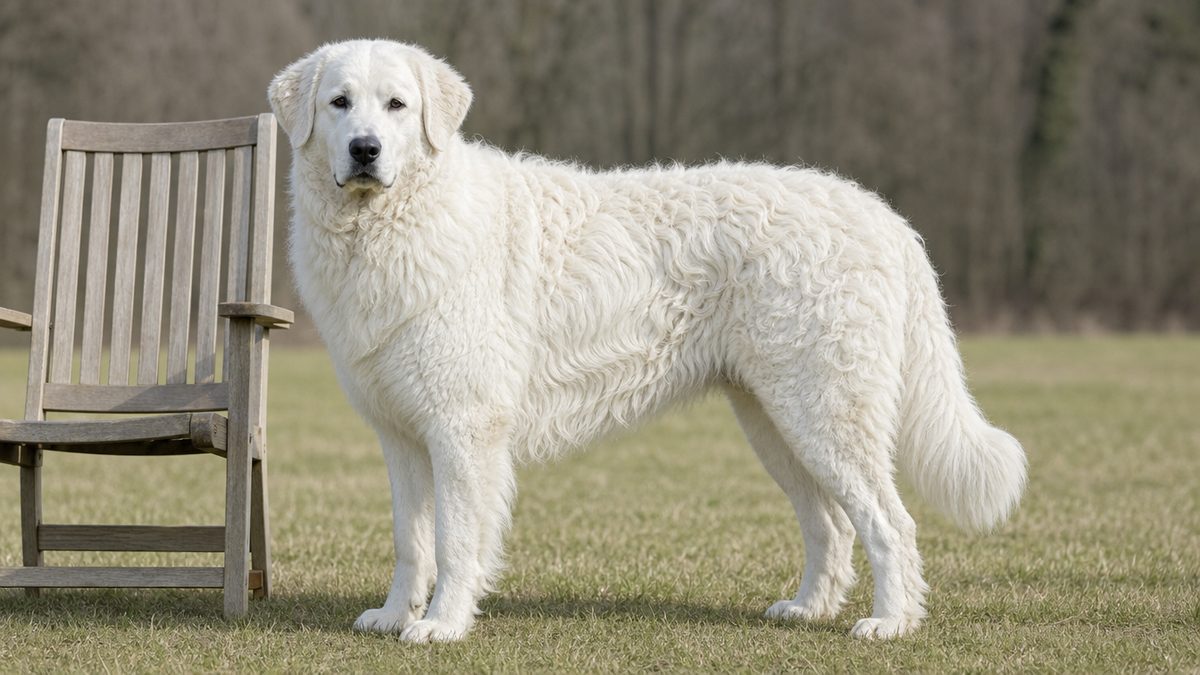
The Kuvasz is a large white Hungarian livestock guardian dog, registered by the Federation Cynologique Internationale as breed standard 54 in Group 1, Section 1 Sheepdogs, accepted on a definitive basis on 10 August 1954 and still governed by a standard published on 6 April 2000. It is not the corded one. That single sentence resolves most of the confusion an Indian buyer meets.
Take the figures from the breed standard first, because every other claim on this page is measured against them. A male Kuvasz stands 71 to 76 cm at the withers and weighs 48 to 62 kg; a female stands 66 to 70 cm and weighs 37 to 50 kg. The colour is white, with ivory permitted, and the nose leather, eyelid rims and lips are black. The eyes are dark brown, almond-shaped and set slightly slanting. The ears sit at medium height and are V-shaped with rounded tips, the top third lifting from the base in a curve before dropping close to the head. Prick ears disqualify, which matters more than it sounds and returns in the health section.
The coat is the identity test. The standard calls the hair moderately harsh, wavy and slightly stiff, and says in as many words that it does not tend to mat, with a finer downy undercoat beneath a coarser topcoat. Length runs 1 to 2 cm on the head, ears and feet, 5 to 8 cm as feathering on the backs of the legs, and 4 to 12 cm on the body, upper thigh and upper arm, where it forms crests, ridges and tassels. The Komondor standard requires the opposite: a shaggy coat that tends towards matting is a basic requirement there, running to at least 20 to 27 cm over the croup. A white Hungarian dog wearing ropes is a Komondor. A white Hungarian dog wearing waves is a Kuvasz.
The English standard is a translation, and one word has drifted
Read the standard in the language that governs it. The document's own front matter names its translators and states "Official language (DE)", so the German text is authentic and the English is a rendering of it. Bonbeno extracted both PDFs and compared them. Every measurement holds: 71-76 cm and 66-70 cm, 48-62 kg and 37-50 kg appear identically in both. That is a negative result worth publishing, because the same comparison has produced real disagreements on other FCI standards.
One word did move. The English says the tail coat "can even reach a length of 10-15 cm at the hip of the tail". The authentic German says it can reach 10 to 15 cm "an der Spitze", which is the tip, not the hip. The German also says the body coat *often* forms crests, ridges and tassels, where the English drops the qualifier. Neither changes which dog you are looking at. Both are worth knowing before you argue with a judge about a tail.
The white guardian breeds English sources run together
Five large white European guardians get written about as though they were one dog, and the FCI publishes numbers that separate them. Measure the animal in front of you against this table before you accept a name for it.
| Breed | FCI | Origin | Male height | Male weight | What the coat does |
|---|---|---|---|---|---|
| Kuvasz | 54 | Hungary | 71-76 cm | 48-62 kg | Wavy, 4-12 cm on the body, must not mat |
| Komondor | 53 | Hungary | Minimum 70 cm | 50-60 kg | Shaggy and matting required, 20-27 cm on the croup |
| Abruzzes and Maremma Sheepdog | 201 | Italy | 67-73.5 cm | 40-52 kg | Long, harsh, close to straight horsehair, flat-lying, to 8 cm |
| Polish Tatra Shepherd | 252 | Poland | 65-70 cm | No weight given at all | Long, thick, straight or slightly wavy, hard |
| Slovakian Chuvach | 142 | Slovakia | 62-70 cm | 36-44 kg | Top coat 5-15 cm, most wavy on the mane |
Two things fall out of that table. The Kuvasz is the tallest of the five and, apart from the Komondor, the heaviest, so a white guardian that looks small for the type probably is not one FCI-Standard N 142. And the Polish Tatra Shepherd's standard gives a height and no weight whatever, so any Tatra weight you read online came from somewhere other than the standard.
Wet the coat. A Komondor's separates into ropes and takes most of a day to dry. A Maremma's lies flat and straight like horsehair. A Kuvasz's springs back into waves and crests. If all you have is a photograph, look at the ears: the Kuvasz carries a V-shaped drop ear with a rounded tip, and an erect ear disqualifies the dog under its own standard.
Recognition, and what it means in India
The Kennel Club of India publishes no usable breed list, so the India question is answered through the FCI instead. India is a full FCI member represented by the Kennel Club of India in Chennai, so the KCI issues pedigrees against FCI nomenclature, and the Kuvasz sits in that nomenclature as standard 54 Federation Cynologique Internationale. A KCI pedigree for a Kuvasz is therefore possible in principle. Whether one has ever been issued is a different question, and the price section is where it gets uncomfortable.
The American Kennel Club recognises the breed in its Working Group, and the Kuvasz Club of America has been its parent club since 1993. That matters here for one reason only. The AKC standard and the FCI standard disagree about how heavy this dog is, and the disagreement decides whether the best-known heat statistic in dog medicine applies to your animal at all.
Hungary's national treasure list, and the bottleneck that shaped this dog's health
Hungary's Parliament declared its protected indigenous and old Hungarian animal breeds a national treasure by Resolution 32/2004 (IV. 19.) OGY, in force from 4 May 2004, and the annex to that resolution names exactly nine dog breeds with the Kuvasz second on the list. Bonbeno read the instrument itself on the Hungarian National Legislation Database rather than repeating the claim.
The annex is organised by species, and the section headed KUTYA, meaning dog, contains nine entries in this order: Komondor, Kuvasz, Mudi, Puli, Pumi, Magyar agar (the Hungarian Greyhound), the short-haired Hungarian Vizsla, the wire-haired Hungarian Vizsla, and Erdelyi kopo (the Transylvanian Hound). So the Kuvasz sits second, immediately after the Komondor. This confirms in full what Bonbeno's Komondor guide established from the same instrument, checked independently here rather than inherited.
The operative clauses are short and they are worth knowing precisely, because they are routinely overstated. Clause 1 declares the protected indigenous and old Hungarian animal breeds a national treasure. Clause 2 commits the state to assist their breeding and the maintenance of their populations. Clause 5 puts the list in the annex and requires the Government to review it at least every five years. Clause 6 says the listed breeds are regarded as Hungarian indigenous animals and are symbols of Hungary in name and in image. Clause 7 brings the resolution into force on the fifteenth day after publication.
The claim that Hungary forbids the export of its national breeds circulates widely on hobby forums and in breed listings. Bonbeno searched the full Hungarian text of Resolution 32/2004 including its annex for the words export, kivitel, kiviteli, tilalom, tilos, engedely, kulfold and korlatoz. Every one of them returns zero occurrences. The resolution confers status and promises support. It says nothing whatever about moving an individual dog across a border, and no Indian buyer should be told that Hungarian law is the reason a Kuvasz is unavailable here.
Fewer than thirty dogs, and why that number still matters
The modern Kuvasz descends from a population that nearly disappeared. The breed's AKC parent club records that the Kuvasz was almost driven to extinction in Hungary during the Second World War, that large white dogs guarding families and farms were a problem to invading forces, and that a search of the country afterwards found fewer than 30 dogs remaining. The breed was rebuilt from those survivors by breeders in Hungary and elsewhere in Europe.
That is not decoration. A population rebuilt from under thirty founders carries whatever those founders carried, at whatever frequency, and it has limited room to breed away from it. The health section reports a 29.0 percent progressive retinal atrophy carrier rate and a third-place rank on the OFA thyroid table. Bonbeno is not asserting that the bottleneck caused those figures, because no study has tested that. It is saying that a reader deciding whether this dog is a sensible import should know the population history and the screening numbers in the same breath, and no ranking page prints either.
The older history, as the club tells it
The rest of the story is the parent club's account and should be read as that rather than as archaeology. The club traces the breed's origins as far back as the steppes of the Ural mountains, records that Magyar tribes brought the dog into the Carpathian Basin when they conquered it in the late ninth century, and says the breed reached its present appearance there. The FCI's own historical summary agrees on the Magyar arrival and adds that the dogs were needed to guard flocks against beasts of prey and thieves.
Both sources name the same king. Under Matthias Corvinus, King of Hungary from 1458 to 1490, the Kuvasz was the preferred hunting dog and was used by the nobility for protection. The club adds that the king ran his own breeding programme, trusted his Kuvaszok over his royal guardsmen, and kept at least two with him at all times, and that a gift of a Kuvasz from the royal kennels was a particular honour. Treat the guardsmen detail as tradition; the utilisation clause in the standard, which still lists hunting and scenting alongside guarding, is the checkable part.
The documented modern record is tighter. Kuvaszok were first shown in 1883, when Count d'Esterhazy displayed two of them in Vienna. The first Hungarian breed standard was written in 1885. The first Kuvasz registered in the United States appears in the stud books of August 1931, and the Kuvasz Club of America was established in 1966 and recognised by the AKC as the parent club in 1993.
One point of vocabulary, because it changes what you find when you search. The plural of Kuvasz in Hungarian is Kuvaszok, and English writing uses both forms. Bonbeno searched PubMed under Kuvasz, Kuvaszok, Hungarian Kuvasz and Kuvasz dog; the plural returned nothing the singular had not, so the literature count in the health section holds across every name the dog has.
Kuvasz price in India: there is no price, because there is no dog
No honest kuvasz price in india can be quoted, because Bonbeno could not find a single Kuvasz verifiably offered for sale anywhere in the country. That is the answer, and it is more useful than any number, because every rupee figure ranking for this query comes from a page that is not selling this breed.
Start with the seller that admits it. PetBuy.in ranks on page one with a page titled "Kuvasz Puppies for Sale in India". Its own listing panel prints "Showing 0 Results", and the heading immediately beneath reads "No Kuvasz Currently Listed";. Directly under that admission, the same page states that "The Kuvasz is one of the most loved companion dogs among Indian families, admired for its temperament, loyalty and adaptability to our climate and homes", and that a well-socialised one "settles in beautifully whether you live in a compact apartment or a house with a yard".
Both things cannot be true. A breed with zero listings on the site claiming to sell it is not one of India's most loved companion dogs. What you are reading is a template with a breed name substituted into it, and the tell is that the listing count is real data while the prose around it is generated. The same page carries an indicative price table for eight popular Indian breeds, from a Labrador at Rs 8,000 to Rs 30,000 up to a Siberian Husky at Rs 30,000 to Rs 90,000, and there is no Kuvasz row in it.
The carousel that sells eight dogs and no Kuvasz
Puppiezo's Kuvasz page ranks in the top ten and carries a price carousel under the heading "Available Kuvasz Puppies For Sale". Bonbeno read every row. The carousel holds eight animals and not one of them is a Kuvasz.
| Name | Breed actually offered | Price shown | Age |
|---|---|---|---|
| Fizey | Maltipoo | Rs 98,999 | 8 weeks |
| Kuzo | Poodle | Rs 92,599 | 8 weeks |
| Dugu | Poodle | Rs 92,599 | 8 weeks |
| Kazuka | Cane Corso | Rs 94,999 | 8 weeks |
| Doir | Goldendoodle | Rs 1,20,000 | 8 weeks |
| Samy | Maltipoo | Rs 98,999 | 8 weeks |
| Tugi | Rottweiler | Rs 76,499 | 8 weeks |
| Yoki | Doxiepoo | Rs 98,999 | 8 weeks |
Two Maltipoos, two Poodles, a Cane Corso, a Goldendoodle, a Rottweiler and a Doxiepoo. Bonbeno's Komondor guide documented this identical carousel, with the same animals at the same prices, sitting under a different breed's name. The same eight dogs are therefore serving as price evidence for at least two breeds the site does not stock, which makes the carousel site furniture rather than a market. Rs 98,999 appears three times on this single page, attached to a Maltipoo, a second Maltipoo and a Doxiepoo. It is a house charm price, not any breed's value, and it is not even a converted dollar figure: 98,999 divided by 84.38 is 1,173.25, which no seller anywhere prints.
What the rest of page one is actually selling
The remaining evidence points the same way. Breed n Breeder's Kuvasz page carries no price whatever, and offers instead a named person who "will connect with you to discuss the Kuvasz puppies price";. That is a lead-capture form, not a listing.
Dogs India, the country's oldest breeder directory, does not carry the Kuvasz on its alphabetical breed list at all. The list runs Komondor, Labrador Retriever, Lakeland Terrier, with nothing between the first two, while the Komondor, the Puli and the Vizsla all appear in the same index. Those three are the control, and they passed on the same document, so the absence is a real absence rather than a failed fetch. Bonbeno's Komondor guide reported that Dogs India lists no *breeder* for that breed; for the Kuvasz the position is a step further back, because the breed is not on the list to have breeders under.
Two of the ten page-one results are not selling dogs at all. Position one is a book about the breed on Amazon India, and position four is a craft marketplace. When a fifth of a commercial query's first page is merchandise, the market is telling you something.
On this query the substitute is not another breed, it is another product. Nobody in the Indian results is passing off a different dog as a Kuvasz. They are selling a book, craft items, a phone call, or eight puppies of other breeds under a Kuvasz headline. If a seller does eventually offer you a Kuvasz, ask for the KCI registration number and the parents' hip, elbow, thyroid and eye results before you discuss money, and read the verification checklist in the adoption section.
Bonbeno could not reach two page-one pages, petsweb.in and mrnmrspet.com, which returned HTTP 403 to every route attempted. Nothing on this page rests on either, and no figure attributed to them is repeated anywhere here.
Test the one Indian price band yourself, in a calculator
The only specific Indian purchase band published for this breed divides exactly into US dollars, which is what a converted price list looks like. Happy Pet, ranking on page one, states a cost of buying of Rs 4,00,000 to Rs 7,00,000. Here is the arithmetic, so you can check it rather than take Bonbeno's word for it.
| Rupee figure | At 84.38 | At 74 | At 80 | What the quotient looks like |
|---|---|---|---|---|
| Rs 4,00,000 | 4,740.46 | 5,405.41 | 5,000.00 | Exact, and 5,000 dollars is a price a seller would print |
| Rs 7,00,000 | 8,295.80 | 9,459.46 | 8,750.00 | Exact, but nobody quotes a puppy at 8,750 dollars |
Both figures resolve to a whole number of US dollars at a flat rate of 80, and neither divides cleanly at 84.38 or at 74. Be careful how much weight a match at 80 carries on its own, because any rupee figure ending in three zeros divides cleanly at that rate by construction: 1,000 divided by 80 is 12.5. The rate only becomes evidence when the quotient is also a number a human would actually quote.
Here one quotient is and one is not. USD 5,000 is a plausible asking price for a rare guardian puppy from a serious breeder. USD 8,750 is not a puppy price at all. Bonbeno has previously traced that exact figure, on a different breed, to a US pet insurer's published lifetime cost estimate rather than to any sale. A band whose floor is a sale price and whose ceiling is an insurance projection was assembled, not observed.
So Bonbeno prints no Indian purchase price for the Kuvasz. Not a range, not an average, not a from-figure. There is no evidence one exists, and the honest page says so rather than converting somebody else's currency to fill the gap.
Asked whether the Kuvasz is legal in India, a search engine's generated summary replied that the breed "is commonly available in India", that puppies are available "from KCI registered breeders", and that average prices run "between Rs 15,000 to Rs 25,000". Every part of that contradicts what the underlying pages actually say: PetBuy shows zero results, Puppiezo shows eight dogs of other breeds, and Dogs India does not carry the breed. Bonbeno could not open either page-one source that band appears to come from, so the band is printed nowhere on this page. A generated answer is not a source for a rupee figure, and a price gains no credibility by being repeated in one.
The cost model on the ranking page is one number times 1.5
One more check is worth running before you trust any Indian cost figure for this breed. Happy Pet gives average monthly expenses of Rs 5,700 for a basic lifestyle and Rs 8,550 for a premium one, and monthly food of Rs 3,000 to Rs 4,500. Multiply the basic figure by 1.5 and you get 8,550 exactly. Multiply the food floor by 1.5 and you get 4,500 exactly.
A cost model where every upper bound is the lower bound times one and a half was generated by a formula, not gathered from Indian owners. The figures are not necessarily wrong, but they carry no observation behind them, and the cost-of-ownership section below builds its numbers from an Indian source that priced each line separately instead.
Cost of ownership in India, priced line by line
Budget Rs 7,000 to Rs 12,000 a month to keep a Kuvasz properly in an Indian metro, and treat the purchase price as the smallest number in the calculation. There is no Indian price for the dog, but the cost of ownership is real, published and sourceable, because every recurring line applies to any 50 kg double-coated dog living in this country.
The Indian baseline comes from VOSD, which prices each line separately rather than deriving one from another. Across all dogs, VOSD puts the total monthly cost of ownership in India at Rs 3,000 to Rs 10,000 and beyond, and the annual cost at Rs 25,000 to Rs 80,000 or more, varying by breed, city and standard of care. A Kuvasz sits at the top of every one of those ranges, and above some of them, for reasons the lines below make concrete.
| Line | Published Indian figure | Where a Kuvasz lands |
|---|---|---|
| Food, per month | Rs 1,500-4,000 for a medium dog; large working breeds push to Rs 5,000 or more | At or above the top. A 48-62 kg working guardian is the case that ceiling describes |
| Vet consultation | Rs 500-1,000 at a good clinic | Same, but expect more visits in the hot months |
| Annual vaccination | Rs 1,500-3,000 | Same |
| Preventive care, per year | Rs 5,000-8,000 done properly | Higher, because a yearly thyroid panel is not optional in this breed |
| Grooming, per session | Rs 300 for a basic wash to Rs 2,000 for a full session on a large long-haired breed | Rs 2,000 end. This is that breed |
| Boarding, per day | Rs 500-2,000 | Top end, and many facilities decline a guardian breed outright |
| Training course | Rs 5,000-15,000 for a basic course | Top end, and a behaviourist at Rs 3,000-10,000 is a realistic second line |
| Professional walker, per month | Rs 3,000-6,000 | Often unavailable. Few walkers will take a 55 kg territorial dog |
Two of those lines deserve attention because they are where an owner of a large guardian gets surprised. Grooming is the obvious one: VOSD's Rs 2,000 ceiling is explicitly for a large long-haired breed, and a Kuvasz in an Indian summer needs a full session more often than a short-coated dog of the same size. Boarding is the quiet one. A guardian bred to expel strangers from a territory is not a straightforward boarding client, and the facilities that will take one charge accordingly.
The first month, and the year that follows
Setup costs land before any of the recurring lines start. VOSD budgets Rs 2,000 to 5,000 for a starter kit of bed, bowls, collar, leash, ID tag and basic grooming supplies, and another Rs 2,000 to 5,000 for the first vaccinations, deworming and health check, putting the first month at Rs 15,000 to 25,000 before anything unexpected happens. For a Kuvasz, scale the equipment: a bed and a crate sized for a 76 cm dog cost more than the same items for a Labrador, and the grooming kit needs a proper undercoat rake rather than a soft brush.
Note one internal inconsistency in that source rather than smoothing it over. Its body text gives an annual figure of Rs 25,000 to Rs 80,000 while its own FAQ gives a first-year figure of Rs 30,000 to Rs 80,000. The gap is small and does not change the planning, but Bonbeno prints both rather than picking the convenient one.
The screening bill nobody budgets for
This breed's screening list is longer and more expensive than the Indian default, and the health section explains why each item is on it. Hip and elbow radiographs require sedation and positioning, an ophthalmologist's examination is available in relatively few Indian cities, and a full thyroid panel is a send-out test at most clinics rather than a bench result. None of these is a routine Indian veterinary product, so budget travel alongside fees, and expect to book rather than walk in.
The emergency lines are where a large dog costs more than a small one, and VOSD prices them plainly: a one to three-day hospitalisation at a good clinic runs Rs 8,000 to Rs 30,000, orthopaedic intervention runs Rs 30,000 to Rs 80,000, and a dental cleaning under anaesthesia runs Rs 3,000 to Rs 8,000. Anaesthetic and drug dosing scale with body weight, so every one of those figures sits at its upper bound for a dog of this size.
VOSD's own comparison is the useful one to plan against: a dog that costs Rs 4,000 a month to maintain in Pune may cost Rs 7,000 a month in South Delhi, with grooming, boarding and training all following the same pattern. For a large long-coated guardian the metro premium bites hardest on grooming and boarding, which are exactly the two lines this breed uses most.
Indian heat and humidity: what the numbers actually say
Chennai spends 0 of its 12 months inside the 10 to 24 C band that the top-ranking Indian page itself names as this breed's ideal weather. That is the shortest honest summary of Kuvasz heat tolerance in India, and it uses the recommending page's own figure rather than Bonbeno's opinion.
Bonbeno queried NASA POWER by explicit latitude and longitude for the Hungarian homeland and for six Indian cities, and echoed back the elevation of every grid cell, because POWER returns a cell rather than a point and in hill country the cell can sit more than a kilometre away from the town underneath it. The Hungarian points came back clean: the Hortobagy cell reports 96.82 m against a real elevation near 90 m, and the Debrecen cell reports 121.33 m against a town at about 121 m. Hungary is lowland, not high country, so the homeland baseline on this page is trustworthy in a way it would not be for a mountain breed.
The Hungarian homeland averages 11.44 C across the year at Hortobagy, with July the warmest month at 23.54 C and January the coldest at -1.67 C. Budapest and Debrecen return 10.80 C and 11.43 C, so the figure is stable across the country rather than an artefact of one cell.
| Place | Cell elevation | Real elevation | Annual mean | Months inside 10-24 C |
|---|---|---|---|---|
| Hortobagy, Hungary | 96.82 m | ~90 m | 11.44 C | 7 of 12 |
| Debrecen, Hungary | 121.33 m | ~121 m | 11.43 C | 7 of 12 |
| Chennai | 48.95 m | ~6 m | 27.95 C | 0 of 12 |
| Mumbai | 97.15 m | ~14 m | 26.77 C | 2 of 12 |
| Delhi | 206.37 m | ~216 m | 25.60 C | 5 of 12 |
| Pune | 635.99 m | ~560 m | 23.86 C | 8 of 12 |
| Bengaluru | 841.72 m | ~920 m | 23.74 C | 8 of 12 |
| Shimla (cell unreliable) | 897.65 m | ~2,200 m | 21.15 C as returned | 7 of 12, but see below |
Chennai runs 16.51 C warmer than the homeland across the year. The comparison that lands harder is monthly: Chennai's coolest month, January, averages 24.09 C, which is 0.55 C warmer than the hottest month Hungary ever has. A dog bred for a place whose summer peak is Chennai's winter floor is not being asked to tolerate a hot season here. It is being asked to live permanently above the top of its own range.
Do not take the Shimla row at face value. NASA POWER puts the Shimla cell at 897.65 m against a town near 2,200 m, an error of 1,302 m that makes the returned figures far too warm. The Manali cell errs the other way, reporting 3,984.73 m against a town near 2,050 m, which makes it far too cold and returns an annual mean of -0.56 C for a place that is nothing like that cold. Correcting both at the standard lapse rate of about 6.5 C per 1,000 m puts each town's real annual mean somewhere near 12 to 13 C, which is genuinely close to Hungary. Treat that as an estimate and label it one, but it is the right order of magnitude and it is why the hill stations are the only honest Indian answer for this breed.
The humidity argument, made properly
"India is humid" is the wrong version of this point, and the annual figures show why. Hortobagy averages 73.3 percent relative humidity across the year and Chennai averages 72.4 percent. On the annual mean, the Hungarian homeland is very slightly the more humid of the two.
What differs is when the humidity arrives. Hungary's relative humidity peaks in December and January at 89.5 and 89.0 percent, when the air is around freezing. Chennai's peaks from October to December at 80.0, 82.3 and 80.4 percent, when the air is 25 to 28 C. A soaked undercoat at 0 C is insulation. A soaked undercoat at 27 C is a sealed layer over the skin that neither dries nor lets heat out, and it is the mechanism behind both the heat risk and the skin problems in the grooming section.
So the honest statement is not that India is more humid than Hungary. It is that India is humid while it is hot, and this dog's coat was designed for the opposite pairing.
Where a Kuvasz can actually live in India
Pune and Bengaluru are the best mainland options and they are not good ones. Both spend 8 of 12 months inside the ideal band, but both peak in April at 28.93 C and 28.37 C respectively, which is five degrees above the ceiling and above anything Hungary produces. Delhi manages 5 months in band and then runs a June mean of 35.88 C with an annual maximum of 48.79 C, which is not survivable outdoors for this coat. Mumbai manages 2. Chennai manages none.
The realistic answer is a hill station with the lapse-rate correction applied, an air-conditioned home anywhere else, and in every case a dog that lives indoors and exercises before sunrise. Anyone planning to keep a Kuvasz as an outdoor guardian on the Indian plains should read the legal position in the next section before going further, because Indian breeding law addresses that specific plan directly.
Heat risk, the over-50 kg question, and what Indian law says about outdoor housing
Whether the best-known heat statistic in dog medicine applies to your Kuvasz depends on which standard the dog was bred to and what it actually weighs, and no other page on this breed asks the question. Weigh the dog before you use the number.
The statistic is Hall 2020, *Scientific Reports* 10:9128, drawn from 905,543 UK dogs under primary veterinary care in 2016, in which 395 confirmed heat-related illness events were identified. The paper reports an incidence of 0.04 percent and an event fatality rate of 14.18 percent, from 56 deaths among the 395 events. Divide it yourself: 56 divided by 395 is 14.18 percent, and it reproduces.
The line everyone quotes is this one, verbatim from the paper: "Dogs over 50 kg in bodyweight had 3.42 times the odds of HRI (95% CI 1.54-7.57) compared to dogs weighing under 10 kg". Note the comparator, because it is routinely dropped. The 3.42 figure is not a large dog against other large dogs. It is a giant dog against a toy.
Two registries, one dog, and a 10 kg disagreement
Here is where the Kuvasz stops behaving like the Komondor. The FCI standard puts a male at 48 to 62 kg. The AKC standard puts a male at approximately 100 to 115 pounds, which converts to 45.4 to 52.2 kg. The two registries agree almost exactly on height, at 71 to 76 cm against 28 to 30 inches, and then disagree by about 10 kg at the top of the male weight range.
| FCI standard 54 | AKC standard | Over 50 kg? | |
|---|---|---|---|
| Male height | 71-76 cm | 28-30 in (71.1-76.2 cm) | Registries agree |
| Male weight | 48-62 kg | 100-115 lb (45.4-52.2 kg) | Most of the FCI range, only the very top of the AKC range |
| Female height | 66-70 cm | 26-28 in (66.0-71.1 cm) | Registries agree |
| Female weight | 37-50 kg | 70-90 lb (31.8-40.8 kg) | Neither range goes above 50 kg |
So the honest handling is this. A male Kuvasz bred to the FCI standard is very likely over 50 kg and the 3.42 odds ratio is relevant to him. A male bred to the AKC standard mostly is not, and a female under either standard is not. Bonbeno does not call the Kuvasz an over-50 kg breed, because the standard that governs it does not say so at the bottom of its own range, and because the two registries that describe it disagree about exactly this. Put the dog on a scale and use the answer.
One risk factor from the same paper transfers regardless of weight class: dogs at or above the mean bodyweight for their own breed and sex carried 1.42 times the odds of heat-related illness (95% CI 1.12-1.80). That is a within-breed comparison, so it applies to a Kuvasz whatever the scale says, and it converts directly into advice. Keeping this dog lean is not cosmetic in India. It is the single heat intervention an owner fully controls.
One limit must be stated plainly. The Kuvasz does not appear anywhere in Hall 2020's modelled breed list; a search of the full paper returns zero mentions, while the Chow Chow and the Labrador, which the paper does model, return eight and twenty-one. The breed was below the study's inclusion threshold. The bodyweight and skull-shape variables quoted above are dog-level factors that replaced the breed variable in the final model, which is why they transfer to an unmodelled dog. A breed-specific odds ratio for the Kuvasz does not exist and is not offered here.
Where the heat actually comes from
The companion paper, Hall 2020 in *Animals*, matters for what an Indian owner should change. Of 1,259 heat-related illness events, 879 had a recorded trigger, and 652 of those 879, or 74.2 percent, were exertional rather than environmental, against 113 environmental and 46 from confinement in a vehicle. Most heat-related illness follows the dog doing something, not the dog sitting somewhere.
That reverses the usual Indian advice. The danger is not principally the parked car or the balcony. It is the 6 pm walk in April because that was when the owner got home. Exercise this breed before sunrise or after full dark, and treat a warm evening as a rest day.
The Indian clause written for this exact dog
Indian breeding law addresses outdoor housing for a coat like this directly. Second Schedule Part IV, paragraph 21(1) of the Prevention of Cruelty to Animals (Dog Breeding and Marketing) Rules 2017 provides that certain categories of dog shall not be kept in outdoor facilities unless the practice is specifically approved by the attending veterinary practitioner in writing. The categories are dogs not accustomed to the temperatures prevalent in the area, dog breeds that cannot tolerate those temperatures, "such as long-haired breeds in high temperature locations", and sick, infirm, aged or young animals.
A Kuvasz carries 4 to 12 cm of wavy topcoat over a profuse undercoat. On the Indian plains it is a long-haired breed in a high temperature location by the clause's own example. Cite it correctly, because most pages do not: this is a Second Schedule paragraph, not a Rule. The Rules themselves stop at Rule 13, and the string "Rule 21" appears zero times in the gazette. Bonbeno extracted the document and checked.
Temperament: who should buy this dog, and who should not
The Kuvasz suits an experienced owner with land, a fence and no expectation of a friendly dog, and it suits almost nobody else. Its own breed standard says the dog defends the people entrusted to his care and their property "even with his life", and warns that he is self-confident and may become aggressive if ill-treated.
Read the standard's temperament clause in full, because it is unusually direct and it is the most reliable character description available for a breed with almost no published behavioural research. The Kuvasz is brave and fearless. He is faithful and dependable and loves his master and his surroundings. He needs plenty of exercise and must be kept busy. He appreciates any love and solicitude given to him. Those are the same sentences that describe a dog who will not tolerate an unannounced visitor, and both halves are true at once.
The same temperament clause says the Kuvasz "is undemanding. His care is easy and he can stand very severe weather conditions";. That is written from Hungary, where severe weather means a January mean of -1.67 C. It does not mean the dog tolerates severe weather in the Indian sense. Read that clause as "withstands hard cold" and nothing else, because taken at face value in Delhi it is the most dangerous sentence on the page. This is a general hazard with imported breed material: care advice is written for the climate the club lives in.
The three questions the ranking page answers, and what it leaves out
The Indian guide ranking on page one answers three temperament questions, and its answers are fair as far as they go. Kuvaszok can be good family dogs with experienced owners who provide proper training and socialisation, but their size and guarding instinct may not suit homes with very young children. They are intelligent with an independent streak that can make them stubborn. And they are not typically good with other dogs, especially same-sex dogs.
What that page leaves out is the mechanism, which is what makes the behaviour predictable rather than random. A livestock guardian was selected to hold a territory alone, decide without a handler, and escalate against anything that entered. None of those traits is switched on by a threat and off by a friendly guest. The dog is not aggressive; it is doing the job it was built for, in a country where the job no longer exists and the territory is a flat in a building with sixty other families.
Who should buy a Kuvasz
- Own a house with a genuinely secure boundary, not a gate a courier opens.
- Have kept a large guardian breed before and know what a territorial display looks like.
- Live somewhere the climate section rates as workable, or run air conditioning year round.
- Accept a dog that greets strangers with suspicion for its whole life, not just as a puppy.
- Budget the screening and grooming lines in the cost section as fixed, not optional.
Who should not
- Live in an apartment, where a corridor supplies a stranger every few minutes.
- Want a dog that is protective of the family and friendly to everyone else, which is not a thing this breed does.
- Have a resident same-sex dog, given the breed's documented tendency to conflict.
- Need a first dog, or a dog for a household with toddlers and frequent visitors.
- Plan to keep the dog outdoors on the Indian plains, which the 2017 Rules address directly.
One honest caveat about all of this. There is no published behavioural study of the Kuvasz, in India or anywhere. What you have read here comes from the breed standard, the parent club and a ranking Indian guide, and it is consistent across all three. Treat it as well-founded description rather than as measured data, which is more than most breed pages will tell you about where their temperament claims came from.
Training a dog bred to ignore you at three in the morning
Train a Kuvasz by giving it reasons rather than repetitions, and expect compliance to be a negotiation rather than a reflex. The breed was selected to make decisions alone in the dark with no handler present, so an instruction it disagrees with gets weighed rather than executed. That is the trait working, not the training failing.
Start with what the standard says, because it sets the ceiling. The Kuvasz is self-confident, needs plenty of exercise and must be kept busy. A bored guardian invents work, and the work it invents is patrolling and barking. The Indian guide ranking for this query puts it the same way from the other side: intelligent, but with an independent streak that makes the dog stubborn, so early socialisation and consistent training are essential.
The FCI temperament clause states that the Kuvasz "may become aggressive if ill-treated";. That is a breed standard telling you that aversive handling on this dog does not produce a compliant animal, it produces a dangerous one. Choke chains, prong collars, alpha rolls and physical corrections are contraindicated here by the breed's own governing document, and any Indian trainer who proposes them for a 55 kg guardian should be replaced rather than argued with.
A realistic timeline
| Age | Priority | What Indian conditions change |
|---|---|---|
| 8-16 weeks | Socialise hard and wide. Every delivery rider, watchman, child, autorickshaw and cow the puppy will meet as an adult | Do it before 6 am. A summer afternoon rules out the outings this window depends on |
| 4-6 months | Name response, recall on a long line, settle on a mat, calm greeting at a gate | Gate work matters more here than anywhere. Indian homes take deliveries at the boundary |
| 6-12 months | Loose-lead walking while the dog still weighs less than you can hold | Non-negotiable. A 55 kg dog that pulls is not walked, it is survived |
| 9-18 months | Guarding behaviour appears and must be shaped, not suppressed | Teach an alternative: bark once, then come to the handler and be paid |
| 18 months onward | Maintenance, and continued introductions to new people | Socialisation is a lifelong programme in this breed, not a puppy course |
Two techniques do most of the work. The first is paying calm rather than correcting noise, because a guardian that is punished for alerting learns to skip the warning and go straight to the response. The second is short sessions: three or four minutes, three or four times a day. The breed's tolerance for drilling is genuinely low, and a session that outlasts the dog's interest teaches it that training is something to endure.
The two Indian failure modes
The first is the gate. Indian homes receive deliveries, staff, gas cylinders and guests at a boundary the dog considers its own, several times a day, from strangers who behave exactly like the intruders the breed was built to repel. A Kuvasz that has not been taught a specific gate routine will invent one, and the one it invents will be bad. Train the routine deliberately: the dog goes to a marked place, stays there while the gate is open, and gets paid every time.
The second is heat sabotaging the socialisation window. The critical period does not pause for April. If the only time it is safe to walk a puppy is before sunrise, then the socialisation programme happens before sunrise, and an owner who cannot commit to that in the first four months should not take this breed in a hot Indian city. There is no way to make up the window later, and a large under-socialised guardian is a permanent management problem rather than a training project.
Set expectations honestly. A well-raised Kuvasz is a dependable dog that watches its boundary, tolerates its household and remains suspicious of everyone else for life. It is not a dog you will train into a friendly one, and no amount of work changes that. What good training buys you is a guardian that is safe to live with, which is the achievable goal and a worthwhile one.
Exercise: about an hour a day, and all of it in the dark
Give a Kuvasz roughly 60 minutes of exercise a day, split across two sessions, and schedule every minute of it outside daylight for eight months of the Indian year. The breed standard says the dog needs plenty of exercise and must be kept busy, and the Indian seller ranking for this query puts the daily requirement at 60 minutes with a medium energy level.
This is a patrolling guardian rather than an endurance athlete, and the standard's gait clause describes exactly that: wide, slow steps at the walk, and a trot that is light-footed, springy, ground-covering and tireless. A Kuvasz wants long, steady, low-intensity movement with a job attached. It does not want a run, and in India it must not have one.
Why the timing matters more than the duration
Most canine heat-related illness follows exertion, not confinement. In the companion Hall 2020 paper, of 1,259 heat-related illness events, 879 had a recorded trigger, and 652 of those 879, being 74.2 percent, were exertional, against 113 environmental and 46 from vehicle confinement. The dog that collapses is usually the dog that was doing something.
So the Indian schedule writes itself. Walk before sunrise and after full dark. Treat any month where the daytime mean exceeds the breed's 24 C ceiling as an early-morning-only month, which in Chennai is all twelve of them and in Pune or Bengaluru is four. On a hot evening, replace the walk with indoor work rather than shortening it.
Press the back of your hand flat on the road surface and hold it for five seconds. If you cannot, the dog cannot walk on it. Tarmac and concrete in an Indian city hold heat for hours after sunset, and a large dog with its chest 35 cm off the ground is walking through a layer of radiated heat that a standing human never feels.
What to do instead of running
- Walk two sessions of 25 to 30 minutes, at the dog's pace, on soft ground where you can find it.
- Work scent games indoors, which the standard's own note that the breed has been used as a hunting and scenting dog makes a natural fit.
- Give the dog a boundary to patrol, which is the exercise this breed actually asks for.
- Train in short sets through the day, because mental work tires a guardian faster than distance.
- Add water only where it is safe and clean, and dry the coat properly afterwards.
The growth rule for a giant puppy
Do not run, jump, cycle beside, or force-march a Kuvasz under about 18 months. A dog that will finish at 48 to 62 kg carries growth plates that close late, and repetitive concussion on hard surfaces during that window is one of the few joint risks an owner directly controls. Free play on grass is fine and stairs in moderation are fine. Structured running is not, and the hip figures in the health section are the reason to take that seriously.
One consequence for apartment dwellers, since the question always comes: an hour of walking does not make an apartment workable for this dog. The problem is not unspent energy, it is a territorial guardian with sixty neighbours, and no amount of exercise resolves it.
Grooming a white double coat in Indian humidity
Brush a Kuvasz thoroughly once a week, daily during the two seasonal coat blows, and dry it completely after every bath. The double coat is genuinely easier than the Komondor's cords, because the standard requires hair that does not tend to mat, but a dense undercoat that stays damp in humid Indian air causes more skin trouble here than matting ever does.
Know what you are grooming. The topcoat is moderately harsh, wavy and slightly stiff, over a finer downy undercoat. It runs 1 to 2 cm on the head, ears and feet, 5 to 8 cm as feathering on the backs of the legs, and 4 to 12 cm across the body, upper thigh and upper arm, forming crests, ridges and tassels. The tail is coated along its whole length and can reach 10 to 15 cm at the tip. Colour is white, with ivory permitted.
The tool that matters is an undercoat rake, not a soft bristle brush. A bristle brush moves the topcoat and leaves the dead undercoat sitting against the skin, which in a humid Indian monsoon is exactly the wrong outcome. Work in sections down to the skin, and pay particular attention to the ruff, the chest mane, the feathering behind the legs and the trousers, which are where a large coated dog holds moisture.
| Task | Frequency | Why it matters here |
|---|---|---|
| Full brush-out to the skin with a rake | Weekly, daily during a coat blow | Removes the damp layer that sits against the skin in humid weather |
| Bath | Every 6-8 weeks, or after the dog gets soaked | Over-bathing strips coat oils and slows drying |
| Force-dry to the skin after every bath | Every time, without exception | A dense undercoat air-drying in monsoon humidity stays wet for hours |
| Ear check and dry | Weekly, and after every bath or swim | V-shaped drop ears plus damp equals otitis externa |
| Nails and pads | Every 3-4 weeks | Hot Indian surfaces damage pads that are already stressed |
| Skin fold and armpit check | Weekly in the monsoon | Hot spots start in the places you cannot see on a white dog |
Clipping a double coat removes the insulating layer that keeps radiant heat off the skin as well as cold out, and the undercoat frequently grows back with a different texture that traps more moisture than before. A shaved white dog also has no protection from Indian sun on skin the standard describes as pigmented but which burns anyway. If the dog is hot, the answer is timing, shade, water and air conditioning, not scissors. The ranking Indian guide links its own article on this question, which tells you how often owners here ask it.
The ears are a measurable risk, not a general worry
The Kuvasz standard specifies ear leathers that are V-shaped with rounded tips, dropping close to the head. That is not a neutral detail. In a UK primary-care study of 22,333 dogs sampled from a population of 905,554, breeds with V-shaped drop ear carriage carried 1.84 times the odds of otitis externa compared with erect-eared breeds, with a 95 percent confidence interval of 1.53 to 2.21, and the one-year period prevalence across all dogs was 7.30 percent. Pendulous ears scored 1.76 by the same model.
That study was done in a temperate climate. In Indian monsoon humidity the same conformation is carrying more moisture for longer, so treat 1.84 as a floor rather than an estimate. The practical rule is to dry the ear canal after every bath and every swim, check weekly, and take a head shake or an odour to a vet rather than to a bottle of ear drops from a pet shop.
One thing Indian law does not force on this breed
A useful negative, and it separates the Kuvasz from its Hungarian cousin. The Komondor standard instructs that dewclaws are to be removed, which collides with Second Schedule Part II paragraph 6(8) of the 2017 Rules, where de-clawing sits on a list of procedures that are strictly forbidden alongside tail docking, ear cropping and any change of appearance by artificial means. The Kuvasz standard contains no dewclaw instruction at all: Bonbeno searched the English and German texts and the words for dewclaw appear zero times in either. So an Indian breeder following FCI 54 faces no conflict with 6(8) on this point, and a Kuvasz shown with its dewclaws intact is correct under its own standard.
Health issues: what to screen for, and why Indian law happens to name most of it
Screen a Kuvasz for hips, elbows, thyroid and eyes, and treat thyroid as the one that matters most, because OFA ranks this breed third of all breeds on its thyroid table. Bonbeno read OFA's published statistics live on 2 September 2026 and cross-checked every row against a 31 August snapshot; they agreed exactly, with a Labrador control returning 109 mentions in both.
| Test | Kuvasz evaluations | Kuvasz result | All breeds | Reading |
|---|---|---|---|---|
| Hips | 2,127 | 17.6% dysplastic, 80.5% normal | 14.2% dysplastic of 1,712,643 | Worse than average |
| Thyroid | 491 | 11.0% compensative autoimmune thyroiditis; rank 3 of all breeds | 4.5% | Roughly 2.4 times the all-breed rate |
| Progressive retinal atrophy | 214 | 29.0% carriers, 0.0% affected | 12.3% carriers | Carrier load well above average |
| Degenerative myelopathy | 131 | 24.4% carriers, 3.8% at risk | 21.3% carriers, 13.2% at risk | Genotype looks better than average |
| Elbows | 711 | 5.5% abnormal | 12.0% abnormal | Better than average |
| Patella | 186 | 0.5% abnormal | 3.5% abnormal | Better than average |
| Congenital cardiac | 79 | 0.0% abnormal, 1.3% equivocal | 0.5% abnormal | Small sample, no signal |
The arithmetic reproduces on every Kuvasz row, which is worth checking before quoting any registry. Hips: 17.1 excellent plus 50.8 good plus 12.6 fair is 80.5 normal, and 9.8 mild plus 6.2 moderate plus 1.6 severe is 17.6 dysplastic. Thyroid: 76.6 plus 1.8 plus 11.0 plus 0.0 plus 10.6 is exactly 100.0.
Use the per-breed rows, not the summary. OFA's ALL BREEDS hip row prints 84.3 percent normal while listing Excellent at 14.6, Good at .0 and Fair at .0, and those three components cannot sum to 84.3. Every individual breed row on the same table sums correctly. So the all-breed figure is usable as a rough benchmark and nothing more, and the 14.2 percent dysplastic baseline quoted above should be read with that caveat attached.
Hip dysplasia is the orthopaedic line that matters, and the elbows are fine
Hip dysplasia in the Kuvasz runs at 17.6 percent of 2,127 evaluations, against an all-breed 14.2 percent. That is meaningfully worse than average without being extreme, and it sits on a large enough sample to trust. The severity split is reassuring, though: 9.8 percent mild, 6.2 moderate and only 1.6 severe, so most affected dogs are at the manageable end.
The contrast with the elbows is the useful part. At 5.5 percent abnormal against an all-breed 12.0 percent, and a patella rate of 0.5 percent against 3.5 percent, this breed is well below average on two of the three joint screens. A buyer told that a Kuvasz is "a giant breed, so expect joint problems" is being given a generalisation the data does not support. Ask for hips specifically.
The collision nobody has written about
Indian breeding law names eleven genetic defects a breeding dog must have been tested for, and this breed happens to line up against nine of them. Second Schedule Part III, paragraph 8(10) of the Dog Breeding and Marketing Rules 2017 reads, verbatim from the gazette: "The dogs shall have been tested for genetic defects, including hip dysplasia, progressive retinal atrophy, night blindness, hypothyroidism, entropion, ectropion, overshot, undershot jaw (when incisors do not touch or mesh), wry mouth, two or more missing teeth, unilateral cryptorchid or full cryptorchid males".
| Defect named in Indian law | What the Kuvasz brings to it |
|---|---|
| Hip dysplasia | 17.6% of 2,127 OFA evaluations, above the all-breed rate |
| Progressive retinal atrophy | 29.0% carriers of 214, against 12.3% across all breeds |
| Night blindness | No breed-specific data. The only one of the eleven with no hook |
| Hypothyroidism | OFA thyroid rank 3, plus a top-ten placing in a 287,948-sample study |
| Entropion | Disqualifying fault in FCI standard 54 |
| Ectropion | Disqualifying fault in FCI standard 54 |
| Overshot | Disqualifying fault in FCI standard 54 |
| Undershot jaw | Disqualifying fault, with a gap over 2 mm named explicitly |
| Wry mouth | Disqualifying fault in FCI standard 54 |
| Two or more missing teeth | The standard is stricter: one or more missing disqualifies |
| Cryptorchidism | Covered by the standard's closing note on descended testicles |
Read that table twice, because it is the argument this page exists to make. A law written for Indian breeding practice in general turns out to name, almost item by item, the specific things a Kuvasz breeder has to check. The dentition clause even runs the other way: FCI 54 disqualifies a dog missing one or more incisors, canines, premolars 2 to 4 or molars 1 to 2, where Indian law only requires testing at two or more missing teeth. On dentition, the breed standard is the stricter document.
Note also what the Rules do not cover. Across the whole gazette the words patella, dental, BAER and deaf appear zero times, so there is no Indian patellar-grading requirement and no hearing-test requirement for any breed. The Kuvasz does not need a BAER test, and any Indian seller citing one as a legal requirement is inventing it.
Life expectancy and the three papers that exist
No reliable Kuvasz life expectancy figure exists, and the honest reason is specific rather than vague: the largest UK longevity study lists the breed by name and excludes it. Bonbeno prints no median lifespan for this dog, because there is nothing measured to print.
McMillan 2024, which produced median survival figures for 155 recognised breeds from a large UK dataset, records the Kuvasz in its supplementary Table S5 with the phylogeny abbreviation KUVA, a Kennel Club group of Pastoral, an FCI group of Sheepdogs and Cattledogs, a body size of Large and a cephalic index of Mesocephalic. Its "Included in Survival Analysis" column reads N, and its "Phylogeny Reclassification" column reads NA McMillan KM and others.
That second column makes the finding clean. The study merges some breeds into others, so an absence can mean "not in the data" or "folded into a relative". For the Kuvasz it is the first: no reclassification, simply too few dogs. Teng 2022, the other major UK life-table study, does not cover the breed either, returning zero mentions against seven for a Labrador control.
| Breed | Deaths | Median survival | 95% CI | Hazard ratio |
|---|---|---|---|---|
| Vizsla | 503 | 13.5 years | 13.2-13.9 | 0.67 (0.61, 0.73) |
| Puli | 39 | 13.3 years | 12.8-14.4 | 0.73 (0.53, 1.00) |
| Great Pyrenees | 128 | 10.9 years | 10.5-11.3 | 1.50 (1.26, 1.79) |
Use that table as context, not as a substitute. The Great Pyrenees is the closest thing the study contains to a Kuvasz, being a large white European livestock guardian of similar build, and it carries a median of 10.9 years with a hazard ratio of 1.50. That is the Great Pyrenees's number and not the Kuvasz's, and anyone who quotes 10.9 years as a Kuvasz lifespan is doing the thing this page refuses to do. Of the nine Hungarian breeds on the national treasure list, only the Puli and the Vizsla have measured UK medians at all.
The two supplementary tables disagree on sample size and agree on deaths, which is a known feature of this paper and worth showing rather than smoothing. For the Puli, Table S3 gives 122 where Table S6 gives 86 alive and 125 total; for the Vizsla, S3 gives 2,965 where S6 gives 2,562 alive and 3,065 total; for the Labrador control, 43,428 against 43,182. The death count is identical in all three pairs. So build any claim on deaths and the median with its confidence interval, which is what the table above does, and do not quote a bare sample size from one table as though the other agreed.
Three papers name this breed, and all three are useful
A PubMed search returns three records for the Kuvasz, against 130 for a Labrador control run in the same session, and the plural Kuvaszok adds nothing. Each abstract was read back, and all three genuinely concern the breed.
The first is the only breed-specific case series. Hazlett and colleagues described a degenerative encephalomyelopathy in seven Kuvasz puppies from two litters of the same parentage, presenting with weakness and ataxia. Six were necropsied and showed lesions in the caudate nucleus, the cerebellar nuclei and folia, and the spinal cord, which the authors attributed either to a familial cause or to an amprolium-induced thiamine deficiency. Two litters is a small foundation, and the authors themselves left the cause open, so treat this as a documented occurrence rather than an established breed disease.
The second corroborates the thyroid signal from a completely independent dataset. Nachreiner and colleagues measured thyroid hormone autoantibodies in 287,948 serum samples from dogs with clinical signs of hypothyroidism, finding them in 18,135 samples, or 6.3 percent. Divide it out and 18,135 over 287,948 is 6.298 percent, so the figure reproduces. The Kuvasz is named among the ten breeds with the highest prevalence, and only breeds with at least 50 samples were analysed. A registry rank of 3 and a top-ten placing in a quarter-million-sample laboratory series are two different instruments pointing the same way.
The third concerns degenerative myelopathy, and it sits in tension with the registry. Kathmann and colleagues studied 50 dogs with degenerative myelopathy and found a significant breed predisposition for the German Shepherd Dog, the Kuvasz, the Hovawart and the Bernese Mountain Dog, with a mean age at diagnosis of 9.1 years. Yet OFA's genotype table puts the Kuvasz at 3.8 percent at risk against an all-breed 13.2 percent, which looks protective.
Both can be true, and the reason matters. The clinical study predates the SOD1 genotype test and diagnosed on presentation, while the OFA table reports a DNA result on 131 dogs, which is a small and self-selected sample. Bonbeno publishes the disagreement rather than picking the flattering number. What follows practically is unchanged: this is a breed where an ataxic older dog deserves a neurological work-up rather than a shrug.
One genuinely encouraging finding from the same paper, since owners ask. Dogs receiving intensive physiotherapy survived a mean of 255 days after diagnosis, against 130 days with moderate physiotherapy and 55 days with none, and they stayed ambulatory longer. Canine physiotherapy is now available in most Indian metros, and on these numbers it is worth finding.
Feeding a 55 kg guardian in India, and the one number that changes the risk
Feed a Kuvasz to a lean body condition and weigh it monthly, because keeping this dog at or below its breed mean weight is the single heat intervention an Indian owner fully controls. Dogs at or above the mean bodyweight for their breed and sex carried 1.42 times the odds of heat-related illness, with a 95 percent confidence interval of 1.12 to 1.80. Feeding is not a cosmetic question here.
Start with the calorie figures the ranking Indian guide publishes, because they are the only breed-specific ones available: roughly 2,500 kcal a day for a puppy and 2,250 kcal for an adult, with monthly food costed at Rs 3,000 to Rs 4,500. Treat those as a starting point rather than a prescription. An entire working male at the top of the FCI range needs more than a spayed inactive female at the bottom, and the range between them is wide: 62 kg against 37 kg.
The Indian cost reality is higher than that page suggests. VOSD prices quality food for a medium dog at Rs 1,500 to Rs 4,000 a month and notes that large breed dogs, especially working ones, can push this to Rs 5,000 or more. A 48 to 62 kg livestock guardian is precisely the animal that sentence describes, so budget the top of the range and treat Rs 3,000 as optimistic.
The large-breed puppy rule that actually matters
- Feed a large-breed or giant-breed puppy formula until 18 months, not an all-life-stages food, because controlled calcium and growth rate is the point of the formulation.
- Split the daily ration across three meals to 6 months, then two meals for life. Never one large meal in a deep-chested dog.
- Keep the puppy lean enough to feel ribs under light pressure. A fat giant-breed puppy is a joint problem being assembled.
- Avoid calcium, phosphorus and vitamin supplements on top of a complete food unless a veterinarian has prescribed them for a diagnosed deficiency.
- Weigh monthly and write it down, because a growth curve tells you something a glance at the dog does not.
Rest the dog for an hour either side of a full meal, and raise nothing. Elevated bowls have been associated with increased gastric dilatation risk in large deep-chested dogs rather than reduced risk, and the FCI standard describes the Kuvasz chest as deep, long and slightly arched. Feed on the floor, feed twice, and keep the dog quiet around meals.
Most breeds that gain weight are being overfed. In a breed that ranks third of all breeds on OFA's thyroid table, with 11.0 percent of 491 dogs showing compensative autoimmune thyroiditis against 4.5 percent across all breeds, weight gain plus coat change plus lethargy is a reason to run a thyroid panel before cutting the ration. Nachreiner's 287,948-sample series found prevalence highest in dogs between two and four years old and higher in females, so a young adult female Kuvasz putting on weight is the exact profile to test rather than to diet.
Indian practicalities
Large-breed formulas are stocked in Indian metros and are patchy elsewhere, so establish supply before the dog arrives rather than after. A 55 kg dog goes through a 15 kg bag in roughly three weeks, which makes delivery reliability a real constraint in a smaller city. If you feed home-cooked food, do it on a formulated plan from a veterinary nutritionist rather than a recipe from a forum, because calcium to phosphorus balance in a growing giant-breed dog is not something to improvise.
Water is the boring answer that matters most. A large double-coated dog in Indian heat drinks heavily, and the practical rule is multiple bowls, refilled and moved into shade, plus a bowl indoors. Free access to cool water is not a nicety in a breed whose homeland summer peak is Chennai's winter floor.
The first year, month by month, on an Indian calendar
Plan the first year around two constraints that do not move: the socialisation window closes at about sixteen weeks, and the guarding instinct switches on between nine and eighteen months. Everything below is arranged so that the work lands before each of those doors shuts.
| Age | What is happening | What you do | The India adjustment |
|---|---|---|---|
| 8-10 weeks | Legal minimum sale age. Rule 8(1)(a) of the 2017 Rules bars selling pups under eight weeks | Vaccination course begins, which the Rules say can start at seven to eight weeks | Refuse any puppy offered younger, and ask when the course started |
| 10-12 weeks | Prime socialisation. Neophobia has not set in | Meet delivery riders, watchmen, children, traffic, cows, other dogs | All of it before 6 am from March onward |
| 12-16 weeks | The window narrows and then closes | Finish the socialisation list. Introduce grooming tools and ear handling | Teach the dog to accept a force dryer now, before the monsoon |
| 4-6 months | Rapid growth, teething, first testing of boundaries | Recall on a long line, settle on a mat, calm gate routine | Walks split into two short cool-hour sessions |
| 6-9 months | Adolescent. Still light enough to physically manage | Loose-lead walking drilled until it is automatic | Hot-surface checks on every walk. Pads burn before you notice |
| 9-12 months | Guarding behaviour appears. Barking at the gate begins | Shape it: one bark, then come to the handler, then payment | Indian gate traffic makes this the single highest-value skill |
| 12-18 months | Growth plates still closing. Adult coat coming in | No running, no jumping, no cycling beside. Free play on grass only | First full coat blow. Daily brushing for two to three weeks |
| 18 months+ | Physically mature. Screening becomes possible | Hips, elbows, thyroid panel, eye examination | Book ahead. None of these is a walk-in test in most Indian cities |
The vaccination and legal checkpoints
Two provisions of the Dog Breeding and Marketing Rules 2017 apply directly to a puppy purchase and are worth quoting rather than paraphrasing. Rule 8(1)(a), under Conditions for Sale, requires every breeder to ensure that "pups less than eight weeks in age are not sold". Second Schedule Part III paragraph 8(9) states that all pups shall be vaccinated, which can start at seven to eight weeks and is usually completed at eighteen weeks. Note the two different numbering systems, because they are routinely confused: the first is a Rule, the second is a Second Schedule paragraph.
OFA hip and elbow evaluations are done from 24 months for a permanent grade, with preliminary evaluations available earlier. A thyroid panel and an eye examination can be done sooner. Plan the money for these in the second year rather than the first, and remember that this breed's screening list is longer than the Indian default: hips and elbows for the joints, a thyroid panel because of the rank-3 finding, and an eye examination because of the 29.0 percent progressive retinal atrophy carrier rate.
The two things that go wrong in an Indian first year
The first is a socialisation programme quietly abandoned to the heat. The window does not extend because April was hot. If a household cannot commit to pre-dawn outings for the whole of a puppy's third and fourth months, the dog will reach adulthood under-socialised, and in a 55 kg guardian that is a permanent management problem rather than a training gap that can be closed later.
The second is letting a big adolescent pull. A nine-month-old Kuvasz already weighs more than many owners can hold, and every walk where it drags you is a repetition teaching it that it can. Loose-lead work belongs in months four to nine while the dog is still light, and it is not optional in a country where the walking surface is shared with traffic, street dogs and pedestrians.
Kuvasz against the guardians Indian buyers actually cross-shop
Buy a Kangal or an Anatolian Shepherd if you want a livestock guardian that can live in India, and buy a Himalayan Sheepdog if you want one that already does. The Kuvasz loses this comparison on every practical axis except one, and the axis it wins on is looks.
The ranking Indian guide names the cross-shopping set itself, offering the Kangal Shepherd Dog, the Caucasian Shepherd Dog, the Komondor and the Dogo Argentino as similar breeds. Bonbeno adds the Great Pyrenees, because it is the white guardian a buyer most often confuses with this one, and the Anatolian Shepherd, because it is the guardian best suited to the Indian climate. All hip figures below were read live from OFA on 2 September 2026.
| Breed | Male size | Coat | Hips dysplastic | Sample | Available in India? |
|---|---|---|---|---|---|
| Kuvasz | 71-76 cm, 48-62 kg | Wavy double coat, 4-12 cm | 17.6% | 2,127 | No verifiable listing found |
| Komondor | Min 70 cm, 50-60 kg | Corded, 20-27 cm | 13.1% | 1,103 | No, and no breeder listed |
| Tibetan Mastiff | Min 66 cm | Heavy double coat | 16.7% | 1,403 | Yes, with a real Indian market |
| Central Asian Shepherd | Large | Short or long variants | 24.7% | 243 | Occasionally |
| Great Pyrenees | Large | Long double coat | 9.5% | 7,498 | Rarely |
| Anatolian Shepherd | Large | Short dense coat | 9.8% | 3,077 | Yes, as Kangal or Anatolian |
| Puli | Medium | Corded | 10.4% | 2,004 | Rarely |
What that table actually says
The Kuvasz has the second-worst hips in this set, beaten only by the Central Asian Shepherd on a sample one ninth the size. It is worse than the Great Pyrenees at 9.5 percent of 7,498, worse than the Anatolian Shepherd at 9.8 percent of 3,077, and worse than its own Hungarian cousin the Komondor at 13.1 percent of 1,103. The comfortable assumption that working guardian breeds have sound hips because they were bred to work does not survive contact with this table.
The coat column decides the climate question on its own. The Anatolian Shepherd carries a short dense coat and comes from a hot dry homeland; the Kuvasz carries 4 to 12 cm of wavy topcoat over a profuse undercoat and comes from a place whose warmest month is cooler than Chennai's coolest NASA POWER climatology resource. Two guardians of similar size, opposite equipment.
The price comparison that finishes the argument
A US breed directory prices Kuvasz puppies at an average of USD 1,500 to 2,500, noting that the typical cost is around 1,500 dollars and that 2,000 or more buys a top bloodline. Set that beside the Indian band of Rs 4,00,000 to Rs 7,00,000, which resolves to USD 5,000 and 8,750 at a flat rate of 80. The Indian figure is between three and three and a half times the actual American market price for the same dog.
So the Indian band is not even a faithful conversion of a real price. It is a converted pair of numbers that were never this breed's price in the first place, and a buyer paying it would be paying a multiple of what the dog costs where it is actually bred.
The same directory records the breed's AKC popularity ranking drifting from 150th in 2015 to 177th in 2022. This is a rare breed in the country that registers most of them, which is context for why no Indian supply chain exists.
The same US directory rates the Kuvasz four stars for child friendliness and calls it "very friendly toward other pets";. The Indian guide ranking for this query says the opposite, that Kuvaszok are not typically good with other dogs and can be aggressive toward same-sex dogs, and the FCI standard describes a dog that defends its charges even with its life. Bonbeno reports the disagreement rather than averaging it, and notes that two of the three sources point the same way and one of those two is the breed's governing document.
Mistakes Indian buyers and writers make with this breed
Seven mistakes recur around the Kuvasz in India, and the first is made by nearly every page that ranks for it: quoting a price for a dog that nobody here is selling.
1. Treating a quoted rupee band as a market price
Rs 4,00,000 to Rs 7,00,000 divides exactly into USD 5,000 and USD 8,750 at a flat rate of 80, and the real American price for the breed is USD 1,500 to 2,500 Dog Breeds List, Kuvasz price. Before you accept any Indian price for any rare breed, divide it by 84.38, by 80 and by 74, and ask whether the quotient is a number a seller would actually print.
2. Confusing the Kuvasz with the Komondor
These are two different breeds with two different FCI standards, 54 and 53, and the difference is visible in one photograph. The Komondor's coat is required to mat and cord; the Kuvasz's is required not to FCI-Standard N 53, Komondor. The mistake matters practically, because the Komondor's grooming load is far heavier and its standard instructs that dewclaws be removed, which Indian law forbids.
3. Believing Hungary bans exporting the breed
It does not. Bonbeno read the full text of Parliamentary Resolution 32/2004 including its annex, and the Hungarian words for export, prohibition, permit and restriction appear zero times. National treasure status confers recognition and a commitment to support breeding. It is not an export control, and it is not the reason no Kuvasz is available in India.
4. Reading the standard's weather clause as an Indian promise
The FCI standard says the Kuvasz "can stand very severe weather conditions";. Written from a country whose January mean is -1.67 C, that sentence means the dog withstands hard cold. Taken at face value in Delhi it is the most dangerous line on any page about this breed, and it is the general hazard with imported breed material: care guidance carries the climate of the club that wrote it.
5. Assuming a working guardian has sound hips
The Kuvasz runs 17.6 percent dysplastic across 2,127 OFA evaluations, worse than the Great Pyrenees, the Anatolian Shepherd, the Puli and the Komondor. Ask for the parents' hip results specifically, and do not accept "it is a working breed" as an answer.
6. Skipping the thyroid panel
This is the most consequential omission on the list, because the evidence is unusually strong and almost nobody acts on it. OFA ranks the Kuvasz third of all breeds on its thyroid table, and an independent series of 287,948 samples places the breed in the top ten for thyroid hormone autoantibody prevalence Nachreiner RF, Refsal KR, Graham PA. Two separate instruments, one a registry and one a laboratory cohort, pointing the same way. Indian law already requires a hypothyroidism test on a breeding dog under Second Schedule Part III paragraph 8(10), so on this breed the legal minimum and the medical priority happen to coincide.
7. Shaving the coat for the heat
Clipping a double coat removes the layer that keeps radiant heat off the skin, and it frequently grows back with a texture that traps more moisture. On a white dog it also exposes skin to Indian sun. The answer to heat is timing, shade, water and air conditioning.
Almost every page about this breed states its lifespan as 10 to 12 years without saying where that came from. The largest UK longevity study lists the Kuvasz by name, marks it as not included in the survival analysis, and records no reclassification into another breed. There is no measured median for this dog. A page that prints one without a source is repeating a number, not reporting one.
Adoption, and how to verify a Kuvasz if somebody does offer you one
Adopt a livestock guardian from an Indian rescue rather than importing one, because no Kuvasz rescue network exists in this country and the dogs that need exactly this home are already here. If you still want the breed, the verification checklist below is the part no ranking page provides.
Set expectations honestly first. A Kuvasz will not appear in an Indian shelter, because there is no Indian Kuvasz population to surrender from. Dogs India does not carry the breed on its list, PetBuy shows zero listings, and the sales carousel that ranks for this query contains eight dogs of other breeds PetBuy.in, Kuvasz Puppies for Sale… Puppiezo, Kuvasz Puppies for Sale in India. A rescue Kuvasz in India would be a remarkable event rather than a route you can plan around.
What Indian rescues do receive is large guardian-type dogs, and the ranking Indian guide names two organisations worth approaching: CUPA in Bengaluru and RESQ in Pune. Add your city's own large-dog rescues to that list. If what draws you to this breed is a big, watchful dog that will guard a property and bond hard to one household, that dog is available in India today, needs a home, and comes without the coat problem.
The Indian alternatives that actually work here
- Himalayan Sheepdog for a genuine Indian livestock guardian already adapted to the country.
- Kangal or Anatolian Shepherd for guardian temperament with a short coat and 9.8 percent hip dysplasia against the Kuvasz's 17.6 percent.
- An Indian pariah or a large rescue mix for the same watchfulness, the best heat tolerance of any option, and a dog that is available now.
- A Tibetan Mastiff only if you have read its own heat figures first, because it shares this breed's coat problem and has a real Indian market to be misled by.
If a seller offers you a Kuvasz, verify these seven things
Given that Bonbeno found no verifiable Kuvasz for sale in India, treat any offer as a claim to be checked rather than an opportunity to move fast. Verify each item below in writing, and walk away from any seller who will not produce them.
| Ask for | What good looks like | What it means if refused |
|---|---|---|
| The KCI registration number of both parents | A number you can check against the registry, not a photograph of a certificate | An unregistered dog of unproven breed, whatever the price |
| Hip and elbow scores for both parents | OFA, FCI or BVA grades with dates and identification | The one screen this breed most needs, skipped |
| A thyroid panel on both parents | A full panel, not a single total T4 | The rank-3 finding ignored |
| An eye examination certificate | Dated within the last 12 months | A 29.0 percent carrier rate unaddressed |
| To see the mother with the litter | In the place the puppies were raised | The commonest sign of a broker rather than a breeder |
| Date of birth and vaccination record | Puppy at least eight weeks old, course started at seven to eight weeks | A sale below eight weeks is prohibited by Rule 8(1)(a) |
| The breeder's registration under the 2017 Rules | A registration number issued by the State Animal Welfare Board | An unregistered breeding establishment |
Two of those items are legal rather than optional. Rule 8(1)(a) of the Dog Breeding and Marketing Rules 2017 requires every breeder to ensure that pups less than eight weeks in age are not sold, and Second Schedule Part III paragraph 8(10) requires that breeding dogs have been tested for genetic defects including hip dysplasia, progressive retinal atrophy and hypothyroidism. On this breed those happen to be the three tests that matter most, which is a coincidence worth using.
You will not be sold a Kuvasz. You will be sold a phone call, a waiting list, a deposit, or a white large-breed puppy of uncertain parentage described as one. Nothing Bonbeno found suggests a Kuvasz supply chain exists here, and a white fluffy puppy at eight weeks is not distinguishable by eye from several other breeds and many crossbreeds. Identity in this breed lives in the paperwork, not in the puppy. Verify the registration before you pay anything, and treat a refusal to produce it as the answer to your question.
The honest recommendation
Bonbeno does not recommend acquiring a Kuvasz in India. The dog is bred to guard flocks in a climate 16.51 C cooler than Chennai, its coat is wrong for the place, its heat ceiling is below the temperature of every month in several major Indian cities, and no verifiable domestic supply exists to buy it from honestly. Those are four separate reasons and any one of them would be enough.
If you are in a hill station with the space, the experience and the budget for the screening this breed needs, and you can source a dog with verifiable parentage and health results, it is a magnificent and dependable animal. That is a narrow set of conditions, and this page exists so an Indian reader can tell whether they are in it rather than finding out afterwards.
Kuvasz questions Indian buyers actually ask
What is the Kuvasz price in India?
No verifiable Kuvasz price in India exists, because no Kuvasz is verifiably for sale here. PetBuy's own Kuvasz page prints 'Showing 0 Results' and 'No Kuvasz Currently Listed', Puppiezo's carousel holds eight animals and no Kuvasz, and Dogs India does not list the breed at all. Treat any quoted figure as a claim to check, not a price.
Why do Indian pages quote Rs 4,00,000 to Rs 7,00,000 for a Kuvasz?
Because those two numbers are almost certainly a converted dollar pair rather than an Indian price. Rs 4,00,000 divided by 80 is exactly 5,000 and Rs 7,00,000 divided by 80 is exactly 8,750. A seller prints 5,000 dollars; nobody prints 8,750 dollars for a puppy, and Bonbeno has traced that figure to a US pet insurer's cost estimate before.
Is Kuvasz a good family dog?
Kuvaszok suit experienced owners with land, and suit almost nobody else. The FCI standard says the breed defends the people in its care and their property even with its life, and warns it may become aggressive if ill-treated. That is a guarding dog's job description, not a family pet's, and the guarding instinct does not switch off for visiting children.
Are Kuvasz easy to train?
No, and the reason is structural rather than a training failure. A livestock guardian was bred to decide alone in the dark without a handler, so it weighs an instruction rather than executing it. The standard calls the breed self-confident and says he must be kept busy. Expect to socialise early, train short, and never drill.
Are Kuvasz good with other dogs?
Often not, particularly with same-sex dogs, which is the answer the page ranking first for this query also gives. A dog bred to expel predators from a territory reads an unfamiliar dog in its space as a job rather than a friend, so introductions on neutral ground and lifelong management are the realistic plan.
What is the difference between a Kuvasz and a Komondor?
The coat settles it in one look. The Komondor standard requires a shaggy coat that tends towards matting, at least 20 to 27 cm long over the croup, while the Kuvasz standard requires a wavy coat 4 to 12 cm on the body that is explicitly 'not tending to mat'. A corded white Hungarian dog is a Komondor. A wavy one is a Kuvasz.
Is the Kuvasz a Hungarian national treasure?
Yes. Hungary's Parliament declared its protected indigenous and old Hungarian animal breeds a national treasure by Resolution 32/2004, in force from 4 May 2004. The annex lists exactly nine dog breeds and the Kuvasz is the second of them, after the Komondor and before the Mudi, Puli and Pumi.
Does Hungary ban the export of the Kuvasz?
No. Bonbeno read the full text of Resolution 32/2004 including its annex, and the Hungarian words for export, prohibition, permit and restriction appear zero times in it. The resolution declares status and commits the state to support breeding. It says nothing at all about moving a dog abroad.
How long do Kuvasz live?
No reliable breed-specific figure exists. McMillan 2024 lists the Kuvasz by name in its supplementary Table S5 and marks it 'N' for inclusion in the survival analysis, with no phylogeny reclassification, so it was excluded outright rather than merged into another breed. Any lifespan range you see for this breed online has nothing measured behind it.
What health tests should a Kuvasz have?
Hips, elbows, thyroid and eyes, and thyroid is the one people skip. In OFA's published statistics the Kuvasz ranks third of all breeds on the thyroid table, with 11.0 percent showing compensative autoimmune thyroiditis against 4.5 percent across all breeds, and 29.0 percent of 214 dogs tested as progressive retinal atrophy carriers.
Can a Kuvasz survive Indian heat?
Only in the hill stations and the cooler months, and never as an outdoor dog on the plains. Chennai's annual mean of 27.95 C runs 16.51 C above the Hungarian homeland, and Chennai spends 0 of its 12 months inside the 10 to 24 C band that the top-ranking Indian page itself names as this breed's ideal weather.
Is it legal to keep a Kuvasz in India?
Yes. No Indian law in force bans owning, breeding or selling this breed. What Indian law does do is regulate breeding: the Dog Breeding and Marketing Rules 2017 bar keeping breeds that cannot tolerate local temperatures in outdoor facilities without a veterinarian's written approval, which is a clause written for exactly this dog.
Is the Kuvasz hypoallergenic?
No, and nothing about a heavy double coat suggests otherwise. The Kuvasz has a coarse topcoat over a downy undercoat that blows seasonally, and the Indian seller ranking for this query prints 'Shedding YES' on its own spec card for the breed. Treat any allergy-safe claim about this dog as marketing.
Do Kuvasz dogs bark a lot?
A bored one does. The FCI standard says the Kuvasz needs plenty of exercise and must be kept busy, and a bored guardian invents work, which is patrolling and barking. Guarding behaviour and barking at the gate appear during the first year, so shape it early: one bark, then come to the handler, then payment. Aversive correction is the wrong tool, because the same standard warns the breed may become aggressive if ill-treated.
Compare with similar breeds
Kuvasz sits in 1 Bonbeno group. Each one compares it directly against the breeds it is genuinely an alternative to, on the same figures.