
Breed profile
Puli Dog Price in India: The Cords, The Heat and The Honest Cost
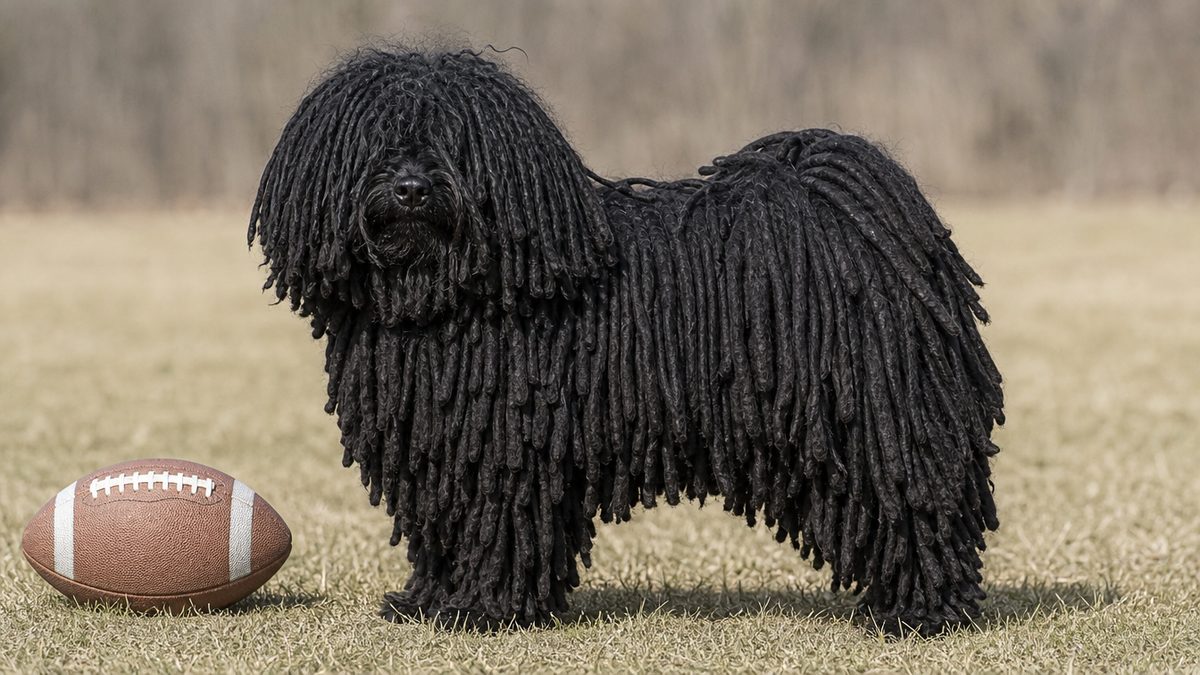
A 13 to 15 kg Hungarian herding dog wearing 20 to 30 cm of felted rope. The coat is the whole decision, and in India it is a welfare decision rather than a grooming preference.
Quick answer
No verified Puli dog price in India exists, because nobody breeds or imports the dog here. The one Indian page ranking for the term prints no rupee figure for a Puli at all, and its puppy carousel holds two Poodles and a Maltipoo. What you can price honestly is the care: a corded coat needs four to six hours of forced drying after every bath, and Indian monsoon air dries it up to four times more slowly than Hungarian summer air does.
This page reports published veterinary literature and registry data. It is not veterinary advice and it cannot diagnose your dog. Coat, skin and ear problems in a corded breed change fast in Indian heat and humidity, so take any smell, scratching, head-shaking or damp patch to a registered veterinarian rather than treating it from a web page. Discuss screening, vaccination and any medication with your own vet before acting on anything written here.
Puli at a glance
What a Puli is, and the two-second test that tells it from a Pumi
The Puli is a medium-sized Hungarian herding dog of 39 to 45 cm, recognised by the Federation Cynologique Internationale as breed standard 55 in Group 1 Section 1 Sheepdogs, with a square build, hanging V-shaped ears and an adult coat that felts into hanging cords 20 to 30 cm long over the loin and croup. Everything difficult about the breed follows from that coat.
Bonbeno took the breed number off the FCI's own Group 1 index rather than assembling a URL, because an fci.be address resolves on its trailing number and a guessed one serves a different breed with no warning. Hungary's block on that index lists Komondor 53, Kuvasz 54, Mudi 238, Puli 55 and Pumi 56, and the Puli row alone carries five colour varieties against the Pumi's four.
The test: look at the ears and the texture
Three Hungarian herding dogs were pulled apart from one another between about 1902 and 1936, and English-language pages have been merging them ever since. Two features separate them from across a room.
| Breed | FCI number | Ears | Coat | Muzzle as share of head |
|---|---|---|---|---|
| Puli | 55 | Hanging, V-shaped, hidden in coat | Corded, 20 to 30 cm on the loin | About one third |
| Pumi | 56 | Upright with the top third folding forward | Curly and off-standing, never corded | 40 to 50 percent |
| Mudi | 238 | Fully erect, reverse V | Wavy, 3 to 7 cm, short on the head | About 45 percent |
So the two-second test is this. If the ears hang and you cannot see them, it is a Puli. If they stand up, it is one of the other two, and the Hungarian Pumi Club of America's own judges' education prints the same three-column comparison for exactly this reason. The AKC's Pumi standard goes further and instructs judges to give additional emphasis to the head, ears, tail and coat, the four characteristics that distinguish the Pumi from the Puli.
What the breed standard actually specifies
The FCI figures are precise, and two of them are the ones Indian listing pages get wrong.
- Height males 39 to 45 cm with an ideal of 41 to 43 cm, females 36 to 42 cm with an ideal of 38 to 40 cm.
- Weight males 13 to 15 kg, females 10 to 13 kg.
- Cords longest on the loin, the croup and the back of the upper thighs at 20 to 30 cm, shortest on the head and limbs at 10 to 12 cm.
- Proportions square, with body length equal to height at the withers, and a muzzle one third of total head length.
- Bite complete scissor bite; an over-shot or under-shot bite is a disqualifying fault.
Two clauses matter for an Indian reader. The coat is a double coat of a coarser top coat over a finer undercoat, and the standard says plainly that the relationship between the two is what determines whether the coat cords cleanly or turns into a matted sheet of too soft a texture that is difficult to groom. And a short or smooth coat is a disqualifying fault, which is the clause a clipped Puli falls foul of.
Where the Indian listing pages diverge from the standard
The page ranking second in India for this query prints a height of 16 to 18 inches and a weight of 11 to 16 kg. Eighteen inches is 45.7 cm, which is above the FCI ceiling for a male, and 16 kg is a kilogram above the standard's maximum. DogsIndia gives 37 to 44 cm and 10 to 15 kg and adds apricot to the colour list, a colour that appears in neither the FCI standard nor the AKC standard. Neither page would let a buyer correctly accept or reject a dog.
The AKC admits only rusty black, black, all shades of gray and white, with a chest spot up to 2 inches. The FCI admits black, black with rusty or grey shadings, fawn with a distinct black mask, grey in any shade and pearl white, with a chest patch up to 3 cm. A fawn Puli is a normal Puli under the FCI and an unregisterable colour under the AKC. India works to FCI nomenclature through the Kennel Club of India's FCI membership, so the FCI list is the one that applies here.
How one Hungarian herding dog became three, and why nobody agrees on the date
The recorded history of the Puli, the Pumi and the Mudi is one loosely-defined population of Hungarian herding dogs that was pulled apart over roughly thirty-four years by a handful of named cynologists rather than by any single instrument. Six sources give six different dates for the split, and the honest answer is to print all of them.
The origins are agreed. The FCI's Puli standard says the breed is of Asiatic origin and that its ancestors most probably came to the Carpathian Basin with the migrating ancient Magyars, and it says nothing at all about the Pumi or the Mudi. The Pumi's standard is the one that carries the descent: the Pumi came into being during the 17th to the 18th century by crossbreeding the primitive Puli with imported German and French dogs of terrier type with prick ears, and it has been recognised as an independent breed at the beginning of the 20th century. So by the FCI's own account the Puli is the parent stock and the other two are derived from it.
Hungarian sources add why the confusion lasted so long. Naming was chaotic, and the words *pumi* and *mudi* simply meant a driving dog, while the first accurate description of a Pumi, in Pethe Ferenc's *Termeszet Historia* of 1815, is printed under the name kuvasz.
The dates, all of them, side by side
Bonbeno went to Hungarian and registry sources rather than repeating a summary. They disagree, and the disagreement is itself the finding.
| Date | What the source says happened | Source |
|---|---|---|
| 1815 | The word Pumi is first mentioned, and used interchangeably with Puli | Hungarian Pumi Club of America |
| 1901 | Hungary's herding dogs reclassified as Canis familiaris domesticus hungaricus | Hungarian Pumi Club of America |
| 1902 | Puli and Pumi first described as separate breeds, and the Mudi identified at the same time | Hungarian Pumi Club of America |
| 1914 | Separation of the Pumi from the Puli begins at the Budapest Zoo under Raitsits | Magyar Mezogazdasag |
| 1920 | Pumik still shown as a regional variety of the Puli at Hungarian shows | Hungarian Pumi Club of America |
| 1921 | First outline of a Pumi standard | Hungarian Pumi Club of America |
| 1923 | Pumi appears as an independent breed at Hungarian shows | Hungarian Pumi Club of America |
| 1924 | Raitsits founds the Studbook of Hungarian Dog Breeds, splitting from MEOE | Hungaria Puli Klub |
| 1935 | Anghy publishes the first scientific description of the Pumi | Magyar Mezogazdasag |
| 1936 | The Mudi is separated out as its own breed | FCI Standard 238 and the Royal Kennel Club |
| 1954 | The FCI accepts the Puli and the Pumi on a definitive basis, on the same day | FCI breed records 55 and 56 |
| 1963 | The FCI accepts the Mudi on a definitive basis | FCI breed record 238 |
The three breeds also came from three different parts of Hungary, which is the simplest explanation for why one population looked like three. Pulik came off the plains, the puszta. Pumik came from Transdanubia, west of the Danube. Mudik came from the southern plains. Bonbeno's own climate work later on this page uses Hortobagy for the Puli and Kaposvar for the Pumi for exactly that reason, rather than treating Hungary as one place.
Treat 1902 as the first description, 1923 and 1924 as the point at which the Pumi acquired independent paperwork in Hungary, 1936 as the Mudi's separation, and 1954 and 1963 as the international ratification. Any page that gives a single date for the separation of these three breeds has picked one link out of a thirty-four year chain and presented it as the whole thing.
There is no separating instrument, and the closest thing to one is a studbook
No gazette, decree or ministerial order separated the Puli from the Pumi and the Mudi. What exists instead is a chain of acts by named people, and the single act that comes closest to an instrument is the founding of a separate Hungarian studbook in 1924.
Dr Emil Raitsits, professor at the Hungarian Royal Veterinary College, is the person every Hungarian source credits. The Hungarian Puli club states it plainly: at the start of the century the names *pumi* and *puli* were frequently mixed and used arbitrarily as labels for small differences of type, and the clear description, separation and improvement of the two breeds is owed to Raitsits's work. The club gives no year for it, which is why the table above has to carry six.
Raitsits worked from live animals rather than paper. With Adolf Lendl, then director of the Budapest Zoo, he collected and displayed the best specimens of the Hungarian breeds, and from 1914 the Pumi, at that point regarded as the Transdanubian variety of the Puli, was separated out there and bred selectively. Then in 1924 he left MEOE and founded the Magyar Kutyafajtak Torzskonyve, the Studbook of Hungarian Dog Breeds, whose seat was at the Veterinary College and whose first president he was. A separate studbook is the nearest thing in the record to a separating instrument, because it is the point at which the three populations acquired separate paperwork instead of separate opinions.
The headcount that shows how far apart they had got
Numbers make the split concrete better than any date does.
| Event | Pulis | Pumis | Source |
|---|---|---|---|
| 1924 shows, total entries | 255 | 130 | Hungarian Pumi Club of America |
| 1927 dog show | 35 | 12 | Hungarian Pumi Club of America |
| March 1932 Hungarian breed competition | 26 | 4 | Hungaria Puli Klub |
| 10 May 1934 international show | 71 | not recorded | Hungaria Puli Klub |
| 31 March 1940, last pre-war show | 47 | not recorded | Hungaria Puli Klub |
By 1932 the ratio was six and a half Pulis to every Pumi, and the Hungarian club's own show record from then on counts Pulis and stops counting Pumis. The American club puts the reason in one sentence: the Puli was adopted by the show enthusiasts and the Pumi and Mudi remained as the shepherds' dogs. That single divergence explains the eighty-year gap between the AKC recognising the Puli in 1936 and the Pumi in 2016.
Raitsits died on 18 March 1934, his death announced from the platform of an agricultural exhibition where he was about to stage a large dog demonstration. The work passed to Lajos Abonyi and Csaba Anghi, and in 1935 Abonyi, Anghi and Ivan Muller compiled the characteristic descriptions of the Hungarian shepherd breeds, sorting the Puli into four size classes: dwarf under 30 cm, small at 30 to 40, medium at 40 to 50, and the large or police Puli above 50 cm. They also fixed the acceptable colours and excluded patched dogs from breeding. The modern FCI standard's single 39 to 45 cm band for males is what survived that four-way split.
One claim in the American record fails against the FCI's own register
The Hungarian Pumi Club of America's judges' education states that Raitsits provided a detailed standard for the Puli, Pumi and Mudi in 1924 which was accepted by FCI. The FCI's own breed records do not support that. The Puli and the Pumi were accepted on a definitive basis on 11 August 1954 and the Mudi on 25 March 1963 Federation Cynologique Internationale breed…. A 1924 Hungarian standard may well have existed and may well have been submitted. FCI acceptance of these three breeds is thirty and thirty-nine years later than that sentence implies, and a judge reading it would date the breeds' international standing to the wrong decade.
The FCI accepted the Puli and the Pumi on the same day, and proving it takes care
The FCI accepted the Puli and the Pumi on a definitive basis on 11 August 1954, the same date on both breed records, and it accepted the Mudi nine years later on 25 March 1963 Federation Cynologique Internationale breed… Federation Cynologique Internationale breed…. Reading those dates correctly needs one deliberate step, because the FCI writes the same date two ways in its own documents.
The trap is simple. FCI web records print dates as month/day/year and FCI standard PDFs print them as day.month.year. A date like 8/11/1954 is 11 August under the first convention and 8 November under the second, and nothing on the page tells you which you are holding. The fix is to prove the format from the document in front of you rather than from the last FCI document you read.
How each format was proved here
| Document | The date in question | Proof inside that same document | Reading |
|---|---|---|---|
| FCI Group 1 index | Puli standard valid 10/29/2013 | Rows read 6/24/1987, 8/18/1965 and 12/21/2019, so 24, 18 and 21 sit in the second field and cannot be months | month/day/year |
| FCI record 55, Puli | Acceptance 8/11/1954 | The same record prints 10/29/2013 for the valid standard, and 29 cannot be a month | 11 August 1954 |
| FCI record 56, Pumi | Acceptance 8/11/1954 | The same record prints 9/13/2000 for three standards and 9/29/2003 for the Spanish, so 13 and 29 sit second | 11 August 1954 |
| FCI record 238, Mudi | Acceptance 3/25/1963 | The same record prints 10/27/2023 and 9/25/2023, so 27 and 25 sit second | 25 March 1963 |
| FCI Standard 55 PDF | Valid standard 29.10.2013 | 29 sits in the FIRST field and cannot be a month, so this document is day.month.year | 29 October 2013 |
| FCI Standard 56 PDF | Header 13.09.2000 | 13 sits first and cannot be a month | 13 September 2000 |
That is the whole method, and it takes about a minute per document. A recognition date in the future is a second free check, because a register records what has already happened.
The register and the standard disagree about the Pumi, by two months
Checking both ends found a real conflict, and it is on the sibling breed rather than this one. The Puli's two documents agree: FCI record 55 gives the valid standard as 10/29/2013 and FCI Standard 55 prints 29.10.2013, which is 29 October 2013 read either way. That agreement is what establishes the convention, because the register renders in month/day exactly what the PDF renders in day.month.
Apply the same convention to the Pumi and the two documents part company. FCI record 56 gives the valid standard as 6/4/2000, which is 4 June 2000. FCI Standard 56 prints 06.04.2000, which is 6 April 2000. Two months apart, both documents current, both official, and no third document to settle it. Bonbeno publishes the conflict rather than picking the convenient one, and notes that this is the only date pair across all six documents read here in which both fields are twelve or under, so it is the only one the proof method cannot resolve.
Three documents, three answers about which language governs
There is a second contradiction inside the same file set, and it matters because the FCI's own rule is that where translations differ, the authentic language wins.
- FCI breed record 55 says the official authentic language is German.
- The English standard prints 'TRANSLATION: Mrs. Chris Seidler and Mrs. Elke Peper. Revised by Mrs. Renee Sporre-Willes. Official language (DE)', agreeing with the register.
- The German standard prints 'UEBERSETZUNG: Peter Weit / Offizielle Originalsprache (EN)', describing itself as a translation from English.
- The French standard prints 'TRADUCTION : Dr.J.-M. Paschoud et Prof. R. Triquet. Langue faisant foi : (EN)', also naming English.
So the German document denies being the authentic text that the register and the English document say it is, and every one of the three language versions calls itself a translation. In practice it does not change a single figure, and Bonbeno checked rather than assuming: the heights, weights, cord lengths of 20 to 30 cm and 10 to 12 cm, and the 3 cm chest patch are identical across the English, German and French texts. That negative result is worth recording, because the same check on two Japanese standards found a tolerance quietly changed from plus 3 cm to plus or minus 3 cm in translation.
The French text of the Pumi standard says the Pumi descends from the primitive Pumi, not the primitive Puli, which is self-referential nonsense and destroys the descent claim the whole document rests on. The English and German texts both say Puli, and the French document itself names English as the authentic language, so the French is the error. It is a one-letter mistake in a primary registry document that nothing downstream has noticed.
Puli dog price in India: there is no Indian price, and here is the proof
No verifiable Puli dog price in India exists, because there is no Indian supply of the breed to price. Bonbeno found zero rupee figures attached to a live Puli anywhere in this research, and the pages that rank for the query in India are either American businesses quoting dollars or Indian pages that quote nothing at all.
Start with what ranks. On an Indian search for this exact term, eight of the ten results are United States businesses or United States content sites, and nine of the ten quote a dollar figure rather than a rupee one. An Indian buyer searching an Indian query is being shown the American market.
| Position | Site | Country | Price quoted |
|---|---|---|---|
| 2 | puppiezo.com | India | No rupee figure anywhere on the page |
| 3 | lancasterpuppies.com | United States | USD 1,000 to 1,900 |
| 4 | adoptapet.com | United States | USD 800 to 1,600 |
| 5 | dogbreedslist.info | United States | USD 1,500 to 2,500 |
| 7 | weenect.com | United States | USD 660 to 1,080 |
| 9 | spotpet.com | United States | USD 1,000 to 2,500 |
Those five American figures do not agree with each other either. The floor runs from 660 to 1,500 dollars and the ceiling from 1,080 to 2,500, so the cheapest published floor and the dearest published ceiling differ by 3.8 times for one breed in one country. Anyone converting one of them into rupees is converting a number that its own neighbours contradict.
The Indian page that ranks second sells no Pulis
Bonbeno read the Puppiezo Puli page as raw markup rather than trusting a summary of it. It returns HTTP 200, runs to 489,682 bytes, is titled 'Buy Puli Puppies for Sale in India at Best Price', and contains not a single rupee figure for a Puli. Its section headed 'Available Puli Puppies For Sale' contains three animals with prices, and none of them is a Puli.
| Name | Breed | Price shown | Image file on the page |
|---|---|---|---|
| Fizey | Maltipoo | Rs 98,999 | Maltipoo-Male-Fizzy |
| Kuzo | Poodle | Rs 92,599 | Poodle-Kuzo-male |
| Dugu | Poodle | Rs 92,599 | Poodle-Dugu |
| Also in the page's images | Rottweiler, Cane Corso, Akita, Goldendoodle | not shown | Rottwieler-tugi, Cane-corse-kazuka, AKITA-2, GD-Dior |
Rs 98,999 is a house price point, not a breed price. Bonbeno has now recorded that exact figure attached to whichever puppy is in stock across many breed pages on this one site, including breeds it does not stock at all, and Fizey the Maltipoo is the animal it is usually attached to. It does not divide cleanly into any plausible dollar rate, so it is not even a converted price. It is a charm price. Never quote it as a Puli's price, and treat an AI answer that does so as repeating this page rather than reporting a market.
The one Indian rupee band that exists, and what it is worth
A second Indian directory does print a Puli buying price of Rs 30,000 to Rs 80,000, alongside a monthly running cost. Bonbeno tested it. Rs 30,000 divides to 355.53 dollars at 84.38, 375.00 at a flat 80, 400.00 at 75 and 405.41 at 74; Rs 80,000 divides to 948.09, 1,000.00, 1,066.67 and 1,081.08. No single rate turns both ends into a price a seller would print, so these are rupee-native round numbers rather than a converted American list. What they are not is an observation of a transaction, because the same site publishes no seller, no listing and no date.
What an Indian buyer is actually being offered
Three checks settle the supply question, all run on 8 September 2026.
- DogsIndia carries a Puli page and prints the line 'There are no breeders listed currently under this breed'. Its Komondor page returns a complete entry on the same path pattern, so the emptiness belongs to the breed and not to the site.
- Royal Canin India publishes a Puli breed page that returns HTTP 200 and contains no price of any kind, so the one large pet-nutrition brand writing about the breed in India prices nothing.
- Import for trading or breeding is not available. DGFT Trade Notice 22/2022-23 makes dogs a Restricted import and states that applications for trading or breeding purposes shall be duly rejected, permitting entry only for a pet accompanied by a valid pet book in the importer's own name, for research with CPCSEA recommendation, or for Defence and Police use.
Between an empty domestic register and a closed commercial import route, no lawful supply chain for a Puli can form in India. That is not a gap in this page. It is the most useful thing the page can tell a buyer, and it is why the cost-of-ownership section below is denominated in care rather than purchase.
Cost of ownership in India, with the one line most pages leave out
Budget a Puli in India as a 13 to 15 kg dog plus a drying problem. The recurring veterinary, food and parasite lines are the same as for any medium dog of that weight, and the line that is specific to this breed is the equipment and the time needed to get a corded coat completely dry after every wash.
Take the ordinary lines first, from Indian sources with their URLs recorded.
| Item | Published Indian figure | Source and caveat |
|---|---|---|
| Anti-rabies, single dose | Rs 699 | Vetic clinic list price |
| 9-in-1 DHPPiL | Rs 899 | Vetic clinic list price |
| Kennel cough | Rs 1,349 | Vetic clinic list price |
| Consultation | Rs 500 to 1,000 | VOSD. Treat as one data point, not two, because an insurer's blog prints the identical range |
| Core vaccination course | Rs 1,500 to 3,000 | VOSD, same single-source caveat |
| Professional bath | from Rs 934 | Vetic, Delhi page, a promotional floor from one chain |
| Complete bath and styling | from Rs 1,869 | Vetic, Delhi page |
| Haircut | from Rs 1,359 | Vetic, Delhi page |
Two warnings about that table. Vetic's figures are starting-at promotional floors from one chain on one city page, and Vetic quotes different course prices on different city pages on the same day, so a Mumbai figure and a Delhi figure are not a price change. And the VOSD consultation and vaccination ranges are printed byte-identically by a general insurer's blog, which means one copied the other; two organisations agreeing to the rupee on two separate quantities is evidence against independence, not for it.
The line that is specific to this breed
A corded Puli cannot be towel-dried and left. The Puli Club of America's own coat care panel puts crate drying at four to six hours with dryers and fans running, with towels replaced at least four times during that period, and states that it is imperative the dog be dried completely because Pulis mildew and smell very offensive otherwise. So the equipment is not optional and the electricity is not trivial.
- A forced-air dog dryer or a drying crate. The club's panellists describe building a drying cage from two stacked wire crates and warn never to leave a cage dryer running for more than two hours at a stretch.
- A stack of absorbent towels, changed at least four times per bath, because the first hour of towel changes is what draws the water out of the cords.
- A dehumidifier, which the same panel recommends where a humid home is not kept dry enough by air conditioning. In an Indian monsoon that moves from a nicety to the thing that makes the schedule work.
- Clippers, if you take the clipped route, which the club's grooming guide explicitly permits and which removes most of this budget.
Bonbeno publishes no rupee figure for that equipment, because retail prices for dryers and dehumidifiers move faster than this page is revised and none was verified with a URL during this research. What is publishable is the shape of the cost: it is capital equipment plus four to six hours of running time per bath, and it recurs for the life of the dog.
The Indian monthly figure you will find, and why it is not about the Puli
One Indian directory prints an average monthly expense of Rs 4,650 basic and Rs 6,600 premium for a Puli, with a food line of Rs 2,250 to 3,000. Bonbeno tested that empirically by pulling seven other breeds from the same site in the same session, which is the only way to tell an observation from a template.
| Breed | Monthly row | Food line | Size label |
|---|---|---|---|
| Puli | Rs 4,650 to 6,600 | Rs 2,250 to 3,000 | Medium |
| Lagotto Romagnolo | Rs 4,650 to 6,600 | Rs 2,250 to 3,000 | Medium |
| Welsh Terrier | Rs 4,650 to 6,600 | Rs 2,250 to 3,000 | Medium |
| Kooikerhondje | Rs 4,650 to 6,600 | Rs 2,250 to 3,000 | Medium |
| Border Collie | Rs 4,650 to 6,600 | Rs 2,250 to 3,000 | Medium |
| Labrador Retriever | Rs 4,900 to 7,650 | Rs 3,000 to 4,500 | Large |
| Komondor | Rs 5,700 to 8,550 | Rs 3,000 to 4,500 | not stated |
| Beagle | Rs 2,200 to 3,750 | Rs 1,200 to 1,800 | Small |
Five unrelated breeds share the Puli's monthly figure to the rupee, including a hand-stripped wire terrier and a Border Collie. That is a preset row assigned from a shared table, not a costing of this breed, and the total is simply the sum of three preset component lines. Quote it as a template constant if you quote it at all. Note also that the same page files the Puli as a Medium Breed in its spec card and as a Small Herding Breed in its own nutrition heading.
If you clip the coat down, the drying equipment, the four to six hour drying window and most of the grooming time disappear, and what remains is an ordinary 13 to 15 kg dog. The Puli Club of America's own guide says the clipped Puli will dry quicker and collect less debris. In India that is the cheaper and the kinder option, and the only thing it costs you is the conformation ring.
Heat tolerance and the Indian climate, measured rather than asserted
The Puli's heat tolerance is low, and the number that settles it is short: Chennai's coolest month is warmer than the hottest month on the Hungarian plain the breed comes from. Every other climate argument on this page follows from that gap.
Bonbeno queried NASA POWER by explicit latitude and longitude and echoed back the grid-cell elevation the model returned for every point, because POWER reports a cell rather than a place and can be more than a kilometre out in hills. Hortobagy, the puszta the Puli worked, came back at 96.82 m against a real 90 m, an error of under seven metres. Chennai returned 48.95 m, Delhi 206.37 m, Kolkata 7.35 m, Pune 635.99 m, Mumbai 97.15 m and Bengaluru 841.72 m, all consistent with the real cities. Budapest was set aside, because its cell reads 178.05 m against a real 102 m, and a 76 m error makes its temperatures slightly too cool for the city.
| Place | Cell elevation | Annual mean | Hottest month | Coolest month | Annual RH |
|---|---|---|---|---|---|
| Hortobagy, Hungary | 96.82 m | 11.44 C | 23.54 C (Jul) | -1.67 C (Jan) | 73.33% |
| Chennai | 48.95 m | 27.95 C | 31.51 C (May) | 24.09 C (Jan) | 72.39% |
| Delhi | 206.37 m | 25.60 C | 35.88 C (Jun) | 13.61 C (Jan) | 45.56% |
| Mumbai | 97.15 m | 26.77 C | 31.19 C (May) | 23.19 C (Jan) | 67.39% |
| Kolkata | 7.35 m | 25.81 C | 31.53 C (May) | 17.31 C (Jan) | 73.93% |
| Bengaluru | 841.72 m | 23.74 C | 28.37 C (Apr) | 20.22 C (Dec) | 67.94% |
| Pune | 635.99 m | 23.86 C | 28.93 C (Apr) | 19.62 C (Dec) | 66.80% |
Read the Chennai row against the Hortobagy row. The Hungarian July averages 23.54 C. Chennai's January, its coolest month of the year, averages 24.09 C. A Puli in Chennai never meets a month as cool as the warmest month its ancestors worked in, and the annual gap is 16.51 C. Bengaluru and Pune are the least hostile Indian options on temperature at 23.74 C and 23.86 C annually, but the following section shows why Pune is the trap.
One correction to a sibling page while Bonbeno was in the same data. Our Komondor page names Delhi's hottest month as May at 35.05 C. May is 35.05 C, and that figure is right, but June is hotter at 35.88 C in the same cell at the same 206.37 m elevation. The figure stands; the month label does not.
What the heat research supports, and what it does not
The largest study of the question analysed 905,543 UK dogs under primary veterinary care in 2016 and found 395 confirmed heat-related illness events, with dogs at or above their breed and sex mean bodyweight carrying 1.42 times the odds, 95 percent confidence interval 1.12 to 1.80. The Puli is far too rare to have been modelled individually, so no Puli-specific odds ratio exists and this page invents none. What transfers is the bodyweight finding, which is a property of size rather than of breed, and it says a Puli held at the top of its 13 to 15 kg band is carrying avoidable risk.
The companion paper from the same team and the same cohort reports 1,259 heat-related illness events from 1,222 dogs, of which 879 had a recorded trigger, and 652 of those 879 were exertional, which is 74.2 percent. Only 46 of the 879 involved a vehicle. For an Indian Puli that means the risk lives in the walk, not in the afternoon, and the fix is the clock rather than the kennel.
Second Schedule Part IV paragraph 21(1) of the Prevention of Cruelty to Animals (Dog Breeding and Marketing) Rules 2017 provides that dogs shall not be kept in outdoor facilities unless specifically approved in writing by the attending veterinary practitioner, where the dogs are not accustomed to the temperatures prevalent in the area, or are of breeds that cannot tolerate them, such as long-haired breeds in high temperature locations, or are sick, infirm, aged or young. Bonbeno extracted the gazette itself, 14 pages and 51,953 characters with a real text layer, and located the clause with a whitespace-tolerant pattern. The phrase 'long-haired breeds in high temperature locations' appears exactly once. The string 'Rule 21' appears zero times in the document, so cite this as Second Schedule Part IV paragraph 21(1) and never as Rule 21.
Paragraph 21 does not stop there. Sub-paragraphs (2) and (3) require outdoor facilities to include roofed shelters large enough for every animal to sit, stand, lie down and turn about freely, plus one or more separate shaded areas big enough to hold all the animals at once and protect them from the direct rays of the sun. Read together, the clause describes the minimum an Indian keeper of a long-coated dog has to provide before the question of written veterinary approval even arises.
Indian humidity will not destroy the coat, and here is what actually will
Indian humidity is not the Puli's problem, because Hungary is more humid than most of India on an annual mean. The problem is a four-month window in which the air over parts of India loses most of its power to pull water out of a wet cord, at a temperature where things grow.
Almost every page written about a corded breed asserts a humidity shock. Bonbeno checked the homeland's own relative humidity before repeating it, and it does not hold. Hortobagy runs at 73.33 percent annual relative humidity. That is above Chennai at 72.39, Bengaluru at 67.94, Mumbai at 67.39, Pune at 66.80, Delhi at 45.56 and Jaipur at 40.94, and level with Kolkata at 73.93. Hungary is a humid place, and the breed evolved in it.
What differs is when the humidity arrives and how warm the air is when it does. Hortobagy peaks at 89.48 percent in December at minus 0.19 C and bottoms at 58.21 percent in August at 23.39 C. Kolkata peaks at 89.34 percent in September at 27.69 C. Nearly identical relative humidity, twenty-eight degrees apart. Relative humidity is therefore the wrong instrument, and the right one is vapour pressure deficit, the gap between the water the air holds and the water it could hold, which is what physically pulls moisture out of a cord.
| Place | Annual mean VPD | Jun to Sep mean VPD | Worst single month | Peak monthly wet bulb |
|---|---|---|---|---|
| Hortobagy, Hungary | 0.500 kPa | 1.000 kPa | 0.060 kPa (Jan) | 18.17 C (Jul) |
| Pune | 1.030 kPa | 0.385 kPa | 0.263 kPa (Aug) | 22.97 C (Jun) |
| Mumbai | 1.172 kPa | 0.471 kPa | 0.325 kPa (Aug) | 25.77 C (Jun) |
| Kolkata | 0.883 kPa | 0.539 kPa | 0.396 kPa (Sep) | 27.09 C (Jun) |
| Bengaluru | 0.990 kPa | 0.654 kPa | 0.519 kPa (Oct) | 21.86 C (May) |
| Chennai | 1.075 kPa | 1.225 kPa | 0.586 kPa (Nov) | 26.11 C (May) |
| Delhi | 1.941 kPa | 1.946 kPa | 0.870 kPa (Jan) | 26.50 C (Jul) |
That table reverses the received wisdom twice. On an annual mean, every Indian city here dries a wet coat faster than Hungary does. In the monsoon window the ranking flips: Pune's June to September air carries 0.385 kPa of drying power against the Hungarian summer's 1.000, which is 2.6 times weaker, and Pune's August alone, at 0.263 kPa against Hortobagy's August at 1.202, is 4.6 times weaker. Mumbai and Kolkata sit in the same band. Chennai and Delhi do not, and dry a coat faster than the homeland even during the monsoon.
The city-by-city answer, which no ranking page gives
- Pune and Mumbai are the hardest places in this sample to keep a corded coat, from June to September. Plan those four months around a dehumidified room, or clip the coat down for the season.
- Kolkata is nearly as difficult and adds the highest wet-bulb load in the sample at 27.09 C, so it is hard on the coat and hard on the dog at the same time.
- Chennai and Delhi are hard on the dog and comparatively easy on the coat, because their air stays thirsty. Chennai's constraint is that its coolest month already exceeds the Hungarian July.
- Bengaluru is the least bad compromise, with the lowest wet bulb in the sample at 21.86 C and a monsoon VPD of 0.654 kPa, still a third weaker than a Hungarian summer.
Why the wet-bulb column is there at all
Wet bulb is the measure of combined heat and humidity a body actually has to shed, and it is the number that separates cities the temperature column makes look alike. Hortobagy's peak monthly wet bulb is 18.17 C; Kolkata's is 27.09 C, which is 8.92 C above the homeland. Every figure in that column was computed from mean air temperature and mean relative humidity and never from a period-extreme maximum, because a wet bulb above about 35 C has never been recorded anywhere on Earth and a figure approaching it is an arithmetic error rather than a finding.
Damp air is not the risk. Warm damp air that will not take up any more water, for four months, on a coat that holds water at the core of every cord, is the risk. That is a wet-bulb and vapour-deficit problem, and it has an address and a season rather than being true of India in general.
Grooming a corded coat, and what a cord actually is
Groom a Puli by separating the felting coat into cords with your fingers, never by brushing it, and by drying it completely every time it gets wet. A cord is not a dreadlock the dog grows. It is a controlled mat, and coat care on this breed is the work of deciding where each mat stops.
The FCI standard explains the mechanism in one paragraph. The coat is a double coat of a coarser top coat over a finer undercoat, and the relationship between the two decides what happens. If the top coat predominates, the coat structure is untypical and sticks out. If the undercoat predominates, the result is a matted coat of too soft a texture that is difficult to groom. The genetically correct proportion produces tassels or cords which are, in the standard's own phrase, easy to groom. So a Puli that cords well is a Puli with the right ratio, and no amount of work fixes the wrong one.
Left entirely alone, the coat does not form neat ropes. It felts into sheets. The job is to interrupt that by pulling the felting mass apart into separate columns and keeping each column separate as new coat grows in at the base. The Puli Club of America's guide says to keep the natural separation of tearing cords at about one inch in diameter at the base, and warns not to separate them too small because thin-based cords become fragile and pull out.
The timeline, so you know what you are signing up for
| Age | What is happening | What you have to do |
|---|---|---|
| Birth to about 6 months | Puppy coat is dense, wavy or curly, and does not cord | Handle the coat daily so the dog accepts being worked on |
| About 6 months | The woolly undercoat first appears | The coat begins to clump; start separating |
| 6 to 8 months | The coat type is now readable | Decide: corded, brushed or clipped. The club says decide by now |
| About 11 months | The 'dreaded giant fuzzball stage' | Several more months of separation work, and the coat looks worst here |
| 3 to 4 years | Development of the corded coat is generally finished | Maintenance only, plus drying after every bath |
Three to four years. That is the club's own figure, from a translated German expert whose comparison is that a Komondor takes four to five. A buyer who wants a corded Puli is committing to roughly the first third of the dog's life spent hand-separating a coat that looks unfinished the whole time, and an eleven-month-old at the fuzzball stage is the point at which most owners give up.
Bathing and drying, which is where India bites
You can bathe a Puli. You cannot leave it to dry. The Puli Club of America's coat care panel gives crate drying with dryers and fans as about four hours for one panellist's fully coated dogs and four to six hours for another, depending on the length and thickness of coat, with white towels replaced at least four times during the drying. The same panel is blunt about the consequence: it is imperative that the dog be dried completely, because Pulis mildew and smell very offensive if all the moisture is not removed from their coats as soon as possible after bathing.
The grooming guide explains why a cord that feels dry can still fail. Cords may seem dry to the touch, but unless the cord is thoroughly dry, dampness at the core of the cord will seep out and can cause a mildew smell. A cord is a column of felt roughly an inch across, so the outside dries first and the core last, and the outside is the only part your hand can check.
The club's own guidance says it was written for a dry climate
This is the seam worth reading carefully. Asked how to stop Pulis smelling of mildew in summer humidity, one panellist answers: living in a climate which is very dry most of the time, I do not have much advice to offer on this question, except to ensure the dog is thoroughly dry after bathing, but I can appreciate that a humid climate will tend to keep the dog slightly damp all the time. That is the parent club stating in writing that its own drying advice assumes a climate India does not have.
Where the panel does address humidity, its answers are equipment answers. Keep the dog on towels with fans blowing from as many angles as possible; use a drying cage; run a dehumidifier in the room the dog spends time in if air conditioning does not keep the home dry enough; and remove an established mildew odour by washing with an antibacterial shampoo such as Nolvasan. Read against Bonbeno's own measurement, that is a workable Indian protocol for eight months of the year and a hard one for four.
The same panel notes that a Puli whose muzzle keeps mildewing needs a different water bowl, one that minimises how much the dog soaks itself while drinking, and warns that the itch from wet skin and coat can start a face-rubbing habit. In an Indian summer a dog drinks far more than it does in Hungary, so the muzzle is the first place to check and a narrow-necked bowl is the whole fix.
What clipping costs, what it forfeits, and why India changes the sum
Clipping a Puli costs you the conformation ring and nothing else, and in India it removes the single largest welfare risk the breed carries. The parent club permits it in writing; the FCI standard is what makes it a show decision.
The Puli Club of America's grooming guide opens by saying the Puli coat can be brushed, corded or clipped, tells owners to make that choice by six to eight months of age, and adds the practical case: if your lifestyle does not allow enough time to take proper care of your Puli's coat, cut it off, and a Puli cut down with a short blade will dry quicker and collect less debris. It also says that if a coat's condition has got too bad, whether brushed or corded, then for the Puli's sake clip it down and start again.
The two registries disagree about what the ring will accept
| Standard | Brushed coat | Clipped or short coat |
|---|---|---|
| AKC, approved 1983 | Explicitly allowed. 'The Puli may be shown either corded or brushed' | Not addressed; the standard sets no coat-length minimum |
| FCI 55, valid from 2013 | 'Both a combed out and a neglected, tousled coat are undesirable', so a fault rather than a bar | 'Short or smooth coat, separately growing hairs' is listed among the disqualifying faults |
That difference matters in India specifically. India is a full FCI member represented by the Kennel Club of India in Chennai, so Indian pedigrees are issued against FCI nomenclature and the FCI standard is the one an Indian show dog is judged under. The registry that governs here is the one that disqualifies the low-maintenance coat, in the country where the low-maintenance coat is the kindest option. An Indian owner who is not showing loses nothing by clipping; an Indian owner who is showing has a genuine conflict to resolve, and should resolve it in the dog's favour during the monsoon.
Why a damp coat is a different problem in India than in Wisconsin
The failure mode the American literature describes is smell. Mildew, a musty odour, a coat that never quite dries. The Indian failure mode is the same moisture meeting a different microbial environment.
- Dermatophytes are present and being sampled. A study at the Indian Veterinary Research Institute screened 442 samples, of which 386 were canine, and recovered ten Trichophyton isolates on micro-morphology. That is a modest recovery rate rather than an epidemic, and it is stated here as what it is.
- The resistant strain came from here. *Trichophyton indotineae* was first identified in India and terbinafine-resistant strains have since spread to Asia, the Middle East, Europe and the United States. Its authors note that its virulence suggests a possible link to zoophilic species, raising the potential for transmission from animals.
- Standard treatment can fail here. A 2026 Indian case report describes an 8-year-old 10 kg Spitz in Jammu with persistent alopecia, scaling, erythema and pruritus that did not respond to itraconazole, 2 percent miconazole shampoo or terbinafine powder, and resolved only after antifungal susceptibility testing directed a switch to posaconazole.
Put those together and the Indian version of 'the coat smells a bit' is a coat that may be incubating an organism against which the first-line drug has documented resistance in this country. That is why Bonbeno rates this as a welfare decision rather than a grooming preference. The corded coat is not harder work in India; it is the same work with a worse consequence for failing it.
None of that means a Puli cannot be kept corded in India. It means the corded route needs a dehumidified drying room, a real dryer, and an owner who will clip the coat off rather than let it stay damp through a Pune August. The clipped route needs none of that.
The 2017 Rules say nothing about clipping a pet dog, and nothing in them prohibits it. What they do prohibit, at Second Schedule Part II paragraph 6(8), is tail docking, ear cropping, de-barking, de-clawing, branding, dyeing, injecting substances to enhance visual appeal, surgery to camouflage a defect, and any change of appearance by artificial means. A haircut is not in that list. Do not let anyone tell you clipping a Puli is unlawful in India; it is not.
Temperament and household fit, and who should not buy one
The Puli is an alert, vocal, home-loving working herder that attaches hard to its own family and announces everything else. Both governing standards say so in almost the same words, and the sentence an Indian buyer should read twice is the one about watchdog behaviour.
The FCI standard describes a dog of lively temperament, extremely able to learn, that loves children and is an excellent watchdog, and notes that its present shape has adapted it to sporting use. The AKC standard says the Puli is by nature an affectionate, intelligent and home-loving companion, sensibly suspicious and therefore an excellent watchdog, and makes extreme timidity or shyness a serious fault. Two registries, two decades apart, agreeing on the same dog.
'Sensibly suspicious' is standard-writing for a dog that barks at what it does not recognise. In a house on a plot that is a feature. In a Bengaluru apartment block where the lift delivers a stranger every few minutes, it is the thing that will get you a complaint, and it is the single most common reason a herding breed is rehomed in an Indian city.
What the breed actually does with its day
This is a dog bred to herd livestock by moving constantly around them, and the FCI standard describes the result in its gait section: movement that is very lively and spirited, with short steps, often typically mincing and jumping, and a tendency to spin round on itself. The AKC calls it acrobatic, light, quick and agile, able to change directions instantly. A Puli with nothing to do will do that in your living room.
| Question | Royal Kennel Club | What it means in an Indian home |
|---|---|---|
| Size of home | Small house | An apartment is workable on space |
| Size of garden | Small or medium garden | A balcony plus daily walks substitutes, barely |
| Town or country | Either | The breed is not a country-only dog |
| Exercise | Up to one hour per day | Achievable before 8 am and after 7 pm |
| Grooming | More than once a week | This is the line that decides the household, not the space |
Who should not buy one
- Anyone buying the look. The cords are three to four years of work before they look like the photograph, and the eleven-month stage looks like a mistake.
- Anyone who cannot control the drying environment for four months of the year in Pune, Mumbai or Kolkata.
- Anyone who needs a quiet dog. Both standards describe a watchdog, and a watchdog that never barks is a fault, not a feature.
- Anyone who wants a dog that ignores strangers. Sensibly suspicious is the standard's own phrase, and socialisation manages it rather than removing it.
- Anyone expecting to find one in India. No breeder is listed on the main Indian directory and no lawful commercial import route exists.
Who it does suit is narrower and real. A household with time, an air-conditioned room, a person who enjoys hand work, and either a plot or a tolerant building. The breed's own standard says it loves children, and the AKC's file says home-loving, so this is a family dog with an expensive coat rather than a difficult dog with a nice one.
Training approach, and the one thing this breed resists
Train a Puli with short, varied, reward-based sessions and give it a job, because the standard's own description of the breed is a dog extremely able to learn that solves problems on its own. What it resists is repetition, and what it needs early is deliberate handling of the coat.
The FCI standard's temperament line, of lively temperament and extremely able to learn, is not marketing; it sits beside a gait description of a dog that spins on itself and changes direction instantly. That combination produces a trainable dog that gets bored faster than it gets tired. Five minutes of new work beats twenty minutes of the same recall.
The training job nobody puts in a training section
On this breed, coat handling is obedience. A Puli that will not stand still on a table for two hours cannot be corded, and a Puli that fights a dryer cannot be dried, which on this page is a health outcome rather than a convenience. So the first training goal is a dog that accepts being handled all over, on a raised surface, with a noisy machine running.
- From eight weeks, handle the whole coat daily for two minutes, including feet, ears and tail, with food. The Puli Club of America's translated German source says to interfere with the coat as soon as the pup is separated from its mother.
- From ten weeks, add a raised surface. Feed on a table so standing still there is the good place to be.
- From twelve weeks, add the dryer, switched on across the room first, then closer, over several weeks. Never start this at the first real bath.
- From four months, add duration. Build to twenty minutes standing calmly, which is what a separation session needs.
- Socialise the doorbell deliberately. Both standards describe a watchdog, so pair arrivals with a reward on a mat rather than trying to suppress the bark.
Realistic timelines
| Goal | Realistic age | Note |
|---|---|---|
| Reliable name response and hand target | 10 to 14 weeks | Easy on this breed |
| Calm on a grooming table for 10 minutes | 4 months | The gateway skill for everything else |
| Accepts a running dryer without restraint | 5 to 6 months | Start before the coat needs it |
| Recall past a distraction | 8 to 12 months | A herding dog with a moving target is a different animal |
| Barking managed rather than eliminated | 12 months onward | Management, not extinction |
What Indian law says about the breeding advice you may be given
One warning that applies to advice from any overseas source about a numerically small breed. Indian law prohibits two named mating techniques outright. Second Schedule Part II paragraph 6(3) of the 2017 Rules prohibits in-breeding, defined as breeding between relatives of the 2nd to 4th grade in straight or side line within the first four generations, giving uncle to niece, nephew to aunt, cousin to cousin and grandparent to grandchild as examples, and incest breeding, defined as mating between parents and children or between brother and sister. A rare breed's overseas guidance sometimes takes a relaxed view of close matings. In India that is not a matter of opinion.
A dog you will need to hold still for hours at a time, for years, cannot be trained into it by compulsion without ruining the very handling you depend on. The grooming schedule is the reason to be careful about method, and it is a better argument than any general one.
Daily exercise needs, and the Indian timetable that makes them safe
A Puli needs up to one hour of exercise a day, which is the Royal Kennel Club's own published figure for the breed, and in India the difficulty is not the hour but which hour. Exertion, not a parked car, is how most dogs overheat.
The Royal Kennel Club files the Hungarian Puli at up to one hour per day, medium size, suitable for a small house with a small or medium garden, town or country either. That is a moderate requirement, and it is the same figure the same registry gives the Hungarian Pumi, which is worth knowing because the Pumi has a louder reputation for drive.
The number that should set your timetable is different. Of the 879 UK heat-related illness events with a recorded trigger in the largest study of the question, 652 were exertional, which is 74.2 percent, against 113 environmental and 46 involving confinement in a vehicle. The dog that overheats in India is usually the dog that was taken out.
A workable Indian week
| Season | Morning | Evening | Coat note |
|---|---|---|---|
| Winter, Dec to Feb | 45 min walk plus training | 20 min | The one season a full corded coat is comfortable |
| Pre-monsoon, Mar to May | Before 7 am, 30 min | After 7.30 pm, 20 min | Peak wet bulb month in Chennai and Bengaluru |
| Monsoon, Jun to Sep | Short, and dry the coat every time | Indoor work if the coat is still damp | The four months the air cannot dry a cord |
| Post-monsoon, Oct to Nov | Back to 45 min | 30 min | Chennai's own worst drying month is November |
Two rules follow from the coat rather than from the dog. A Puli that gets wet on a monsoon walk starts the four to six hour drying clock, so a short walk that ends dry beats a long one that ends soaked. And a dog carrying 20 to 30 cm of felted coat cannot lose heat by convection once the air is warmer than it is, so the coat that insulates against a Hungarian January insulates against a Delhi June in exactly the same way.
What to do instead of a long walk
- Scentwork indoors. Hide food, search on command. It tires a herding brain faster than distance does.
- Short shaping sessions. Five minutes, new behaviour, three times a day.
- Treadmill or corridor recalls in an air-conditioned room during the worst six weeks.
- Herding-style games with a ball on a rope, which give the circling and stopping the breed is built for without the ground temperature.
- Swimming only if you can commit to the drying, because a corded dog leaving a pool is a four to six hour job.
Bonbeno publishes no Indian heat-stroke prevalence figure for dogs, because none is obtainable from the indexed veterinary literature. A PubMed search for canine heat stroke in India returns two records and neither is usable, while the control query in the same session returned 126 on-topic records, so the instrument was working and the gap is real. The statutory hook is the better anchor, and Second Schedule Part IV paragraph 21(1) supplies it by naming long-haired breeds in high temperature locations directly.
Health problems, screening and life expectancy, with the real numbers
Screen a Puli for hips, eyes, patellae and degenerative myelopathy, which are the four tests OFA's CHIC scheme requires for the breed, and ask separately about the BBS4 variant behind blindness in this breed because CHIC does not list it. The published OFA figures are good by pedigree-dog standards and one of them is not.
Bonbeno read the OFA breed code out of OFA's own markup rather than guessing it, because a guessed code returns a complete and plausible table for a different breed. The Puli's code is PU, read verbatim from the attribute value=PU data-name=PULI, and the returned page prints PULI as its own heading.
| Registry | Evaluated | Normal | Abnormal | Detail |
|---|---|---|---|---|
| Hips | 2,004 | 1,784 (89.0%) | 209 (10.4%) | Excellent 357, Good 1,213, Fair 214; mild 120, moderate 65, severe 24 |
| Eyes (ACVO) | 438 | 419 (95.7%) | 19 (4.3%) | Summary line only; the per-diagnosis detail rows were not obtainable |
| Patella | 335 | 323 (96.4%) | 12 (3.6%) | Graded veterinary evaluation |
| Elbow | 301 | 288 (95.7%) | 12 (4.0%) | Grade 1 nine, grade 2 three, grade 3 none |
| Degenerative myelopathy | 263 | 207 clear (78.7%) | 6 at risk (2.3%) | 50 carriers, 19.0 percent |
Those rows close arithmetically, which is worth checking and worth saying. The hip components sum exactly: 357 plus 1,213 plus 214 is 1,784, and 120 plus 65 plus 24 is 209. The degenerative myelopathy row sums to 263 and its percentages to 100.0. A table that adds up is a table you can quote.
Two cautions on the eye row. It is a summary line, and OFA's eye summaries have been found on many breeds to disagree sharply with their own per-diagnosis detail rows, sometimes by more than forty points. Bonbeno could not retrieve the Puli's detail rows in this session, so 95.7 percent normal is the summary figure and not necessarily the rate, and the absence of a visible contradiction is evidence of what could not be reached rather than evidence there is none.
The blindness gene, and the hole in the screening panel
This breed has a named, published, single-gene cause of progressive retinal atrophy, and it is more than an eye disease. A 2017 study genotyped 14 family-based samples and whole-genome sequenced two probands with two parents, and identified a nonsense SNP in exon 2 of BBS4, c.58A>T p.Lys20*, which is highly associated at a chi-squared p of 3.425e-14 across 103 dogs and segregates perfectly with progressive retinal atrophy in the Hungarian Puli. The same team had already published the negative result that the known PRA genes were excluded in this breed.
BBS4 is the gene behind Bardet-Biedl syndrome in humans, and the canine phenotype matches. The authors report affected Hungarian Pulis showing obesity and sperm defects, with flagella present but a large proportion of sperm morphologically abnormal and under 5 percent motile. So in this breed the blindness variant plausibly travels with weight gain and male subfertility, which is not how any ranking page describes it.
OFA's CHIC panel for the Puli does not include a BBS4 test. It requires hips, an ACVO eye examination, patellar luxation and a DNA test for degenerative myelopathy, with deafness, cardiac and elbow optional. An eye examination detects retinal degeneration after it starts; a DNA test would identify carriers before a mating. Ask any breeder directly whether the parents were tested for the BBS4 variant, and treat the honest answer 'no, it is not on the CHIC list' as more informative than a vague yes.
Life expectancy, measured at 13.3 years in Table S3
McMillan 2024 puts the Puli's median survival at 13.3 years, with a 95 percent confidence interval of 12.8 to 14.4 and a hazard ratio of 0.73 (0.53 to 1.00) against the crossbred group, built on 39 recorded Puli deaths. That is a measured figure rather than a band, and it sits above the study's 12.0-year crossbred median. The AKC's 10 to 15 years and the Royal Kennel Club's over ten years are breed-page categories with no cohort behind them. Teng 2022 carries no Puli row at all, so the McMillan figure is the only measured number this breed has.
An earlier version of this page reported that no study supported a Puli lifespan, because Puli, Pumi, Mudi and Komondor each return zero in McMillan 2024's article body. That test is unreliable. Whippet also returns zero in the same body, and the Whippet is in the study. The per-breed rows sit in Supplementary Table S3, which lists 155 purebreds plus the crossbred group, and the Puli is one of them McMillan KM, Bielby J, Williams CL. Quote the death count rather than the sample size, because Tables S3 and S6 disagree on how many Pulik were alive, 122 against 86, while both record 39 deaths.
The literature overall is thin and it is worth saying how thin. A PubMed search for 'Puli dog' returns three records, 'Hungarian Puli'[tiab] returns two, and 'Puli'[tiab] returns 49 of which almost all are a personal surname, including a Hungarian handwriting recognition paper. Controls in the same session returned 126 records for labrador retriever hip dysplasia and 6 for Mudi dog, so the instrument was healthy. Three papers is the whole modern literature on this breed.
Cream and pearl-white colour in dogs requires an e/e genotype at MC1R, and a 2007 study of 27 individuals found that every Akita, Caucasian Mountain Dog, German Shepherd Dog, Miniature Schnauzer and Puli with that genotype was cream, implying those breeds are fixed at a second, then-unidentified locus that dilutes the pigment. In Poodles and Shar-Pei the same genotype does not always give cream. So a pearl-white Puli is white for a breed-specific genetic reason rather than by selection alone.
Feeding and diet, with one breed-specific reason to watch the weight
Feed a Puli to the FCI standard's weight band of 13 to 15 kg for males and 10 to 13 kg for females, and weigh the dog rather than looking at it, because a corded coat hides body condition completely. This breed has two independent reasons to keep the weight honest, and one of them is genetic.
Start with the number the standard sets. Males 13 to 15 kg, females 10 to 13 kg. The AKC's band of 25 to 35 pounds is 11.3 to 15.9 kg across both sexes, which is broadly compatible at the top and looser at the bottom. The Indian listing page ranking second gives 11 to 16 kg, a kilogram above the standard's ceiling.
Why the coat makes this harder than on any short-coated breed
You cannot see a Puli's waist. Under 20 to 30 cm of cord, the tuck-up the standard describes as gradually rising towards the rear is invisible, and the ribs are not palpable through a felted column. So body condition scoring by eye, which is how most owners actually manage weight, does not work on this dog. Use a weighing scale monthly and write the number down.
The genetic reason, which is specific to this breed
The BBS4 nonsense variant that segregates with progressive retinal atrophy in the Hungarian Puli produces a canine phenotype comparable with Bbs4-null mice, and the authors name obesity among the phenotypes they identified. That does not mean every fat Puli is affected or that every affected Puli is fat. It means weight gain in this breed is worth a conversation with a vet rather than a diet alone, particularly if vision is also changing.
The second reason is the one that applies to any dog in India. Dogs at or above their breed and sex mean bodyweight carried 1.42 times the odds of heat-related illness in a study of 905,543 UK dogs, 95 percent confidence interval 1.12 to 1.80. On a coated breed in an Indian summer, a kilogram over is a thermal decision.
| Line | What to do | Indian cost note |
|---|---|---|
| Daily ration | Split into two meals; measure by weight, not by cup | Medium-dog food ranges are published by VOSD; verify against the pack |
| Monthly food | Arithmetic from grams per day, not a quoted price | Bonbeno publishes no monthly kibble figure, because the retail source it had went stale within days |
| Parasite control | Monthly, year round in most of India | A combined tick, flea and worm product covers two lines at once |
| Deworming | As advised by your vet | Dosed by weight, so the monthly scale reading is the input |
| Weight check | Monthly on a scale | Free, and the single most useful thing on this table |
One honest gap. Bonbeno does not publish a rupee-per-month food figure for this breed, because the retail price it verified for a large bag moved within days of being recorded, and a monthly figure is arithmetic over a price rather than a quoted price. Weigh your dog, read the grams per day off your own pack, and multiply. Any page that gives you a single monthly food number for a breed with no Indian population has assembled it rather than observed it, which is exactly what the shared cost table in the previous section turned out to be.
An Indian Puli drinks far more than a Hungarian one, and every drink wets the muzzle coat. The Puli Club of America's panel treats a mildewed muzzle as a water-bowl problem and recommends a bowl that minimises soaking. Feed and water in a way that keeps the face dry, and check the muzzle cords with your fingers weekly.
Month by month through the first year, coat included
A Puli puppy's first year is an ordinary puppy year running alongside a coat that changes under your hands. The two schedules interlock, and the decision that shapes the next decade falls at six to eight months.
| Age | Dog | Coat | Your job |
|---|---|---|---|
| 8 to 12 weeks | Home, vaccination course under way, socialisation window open | Dense, wavy or curly puppy coat; no cords | Two minutes of whole-body handling daily, on the floor |
| 3 to 4 months | Recall and name response land easily | Still puppy coat | Move handling onto a raised surface; introduce a switched-off dryer |
| About 6 months | Adolescence starting | The woolly undercoat appears | The coat starts clumping; begin separating with your fingers |
| 6 to 8 months | Growth slowing | Coat type now readable | Decide: corded, brushed or clipped |
| 9 to 10 months | Adult drive arriving | Clumps consolidating into columns | Weekly separation sessions of 20 to 30 minutes |
| 11 months | Physically mature-looking | The giant fuzzball stage | Keep going; this is where most owners quit |
| 12 months | Adult | Cords beginning to hang | First full bath and a real four to six hour dry |
Two of those rows are the club's own words. The woolly undercoat first appears at approximately six months, and development of the full corded coat is generally finished at three to four years in Pulik. The grooming guide puts the coat decision at six to eight months of age and says plainly that whichever you choose, the dog is still a Puli. The fuzzball description is the 2007 panel's, about an eleven-month-old.
What is legal and what is not, on an Indian puppy
- A puppy sold below eight weeks is unlawful. Rule 8(1)(a) of the 2017 Rules provides that pups less than eight weeks in age are not sold.
- Docking and cropping are forbidden. Second Schedule Part II paragraph 6(8) prohibits tail docking, ear cropping, de-barking, de-clawing, branding, dyeing and any change of appearance by artificial means. The Puli's tail is naturally carried in a flat curl over the croup and its ears naturally hang, so neither procedure has any place here anyway.
- Genetic-defect testing is required of breeding dogs. Second Schedule Part III paragraph 8(10) requires dogs to have been tested for genetic defects including hip dysplasia, progressive retinal atrophy, night blindness, hypothyroidism, entropion, ectropion, overshot and undershot jaw, wry mouth, two or more missing teeth and cryptorchidism. The word is 'including', so the list is illustrative rather than closed.
- A haircut is not a mutilation. Clipping is absent from the 6(8) list, so nothing in Indian law restricts it.
Paragraph 8(10) is worth pausing on for this breed. It names progressive retinal atrophy explicitly, and the Puli has a published single-gene form of it with a known variant. An Indian breeder is therefore under a legal obligation to have tested for a defect for which a breed-specific DNA test exists but is not on the international screening panel. That is a gap a buyer can close simply by asking.
A Puli's ears hang, and they hang from the start. If a seller shows you an eight-week puppy with ears that stand up and tells you they will drop, walk away, because you are being shown a Pumi, a Mudi or a cross. Erect ears are the single feature that separates this breed from its two siblings at any age.
Puli against the breeds an Indian buyer will actually be offered
Cross-shop the Puli against its own two siblings and against the Komondor, because the differences between them decide the workload rather than the look. The single most useful comparison is the drying time, which tracks coat mass rather than cording.
| Puli | Pumi | Mudi | |
|---|---|---|---|
| FCI standard | 55 | 56 | 238 |
| FCI definitive acceptance | 11 Aug 1954 | 11 Aug 1954 | 25 Mar 1963 |
| Height, males | 39 to 45 cm | 41 to 47 cm | 41 to 47 cm |
| Weight, males | 13 to 15 kg | 10 to 15 kg | not stated in the standard |
| Ears | Hanging | Upright, top third folding | Fully erect |
| Coat | Corded, 20 to 30 cm | Curly, 4 to 7 cm, never corded | Wavy, 3 to 7 cm |
| Royal Kennel Club grooming | More than once a week | Once a week | Once a week |
| AKC recognition | 1936 | 2016 | 2022 |
| Bobtail permitted | Not mentioned | No, and docking is not permitted | Yes, a natural stump tail is not a fault |
Two rows in that table are worth reading twice. The Pumi is the taller dog at 41 to 47 cm against the Puli's 39 to 45, in both breeds' own standards, and the AKC agrees by giving the Pumi 16 to 18.5 inches against the Puli's 17 American Kennel Club. Yet the Royal Kennel Club files the Pumi as small and the Puli as medium The Royal Kennel Club, Hungarian Puli. That is not an error so much as a different question: the Pumi's ideal weight of 12 to 13 kg sits below the Puli's 13 to 15, so the taller dog is the lighter one. If you are choosing on the registry's size label alone, you will get the proportions backwards.
Puli against Komondor, which is the comparison that changes the schedule
Both are Hungarian, both cord, and they are not the same commitment. The Puli is 13 to 15 kg; the Komondor is a livestock guardian several times heavier. Published drying figures track that mass: four to six hours for a Puli against twelve to eighteen hours for a Komondor, with the American guidance for the larger breed warning that an air-dried corded coat can stay damp for up to 48 hours. Anyone who has read that a corded coat is unmanageable in India has usually read it about the Komondor. Our Komondor page works that case; this one is a third of the coat mass.
| Choice | Weekly coat work | Drying after a bath | What you give up |
|---|---|---|---|
| Corded Puli | 20 to 30 min separation, rising during years 1 to 4 | 4 to 6 hours forced | Nothing under FCI rules; this is the standard coat |
| Brushed Puli | Bath and blow-dry every two weeks, plus brushing between | About 1 hour of drip then blow-dry | A fault under FCI 55, allowed under the AKC standard |
| Clipped Puli | A slicker brush, minutes | Ordinary towel and air | Disqualified from the FCI ring as a short coat |
| Pumi | Once a week, hand stripping and scissors | Air dry, which the AKC standard requires | Nothing; the coat is designed to dry itself |
| Mudi | Once a week brushing | Ordinary | Nothing |
Read down the last column and the Indian answer becomes obvious. The only thing clipping costs is the conformation ring, and the only registry that penalises it is the one India follows. Everything else on that row is a gain: less drying, less mildew risk, less time, and a dog that can get wet on a monsoon walk without starting a six-hour clock.
If what you actually wanted was a Hungarian herding dog rather than a corded one, the Pumi and the Mudi give you the same working brain in a coat that dries itself, and the Border Collie gives you a real Indian market. If you wanted a low-shedding coat rather than a corded one, note that the Royal Kennel Club records all three Hungarian breeds as non-shedding, so cords buy you nothing there.
What Indian owners and Indian pages get wrong about this breed
Seven mistakes account for almost everything that goes wrong with a Puli in India, and five of them are made before the dog arrives. Each one below is corrected against a document rather than an opinion.
- Brushing the coat out. A brush destroys the structure the standard describes, and the FCI calls a combed-out coat undesirable. The work is finger separation into columns of about an inch at the base, not brushing.
- Bathing and air-drying. A cord dries from the outside in, and a cord that feels dry can still hold water at its core, which then seeps out and produces the mildew smell. Four to six hours of forced drying is the published figure and it is a floor in an Indian monsoon.
- Treating the smell as a bath problem. The panel's own line is that it is not the bath that causes problems, it is the drying. Bathing more often makes it worse, because each bath restarts the clock and dries the skin.
- Believing the coat is hypoallergenic. It is not, and the study that settled the question found more Can f 1 on so-called hypoallergenic breeds, not less. A corded coat holds shed hair rather than dropping it, which helps your floor and not your allergy.
- Refusing to clip on principle. The parent club permits clipping in writing and says a clipped Puli dries quicker and collects less debris. Refusing it in a Pune August is a show decision imposed on a dog that is not being shown.
- Buying on an Indian price page. The page ranking second for this query has no rupee figure for a Puli at all and its puppy carousel holds two Poodles and a Maltipoo.
- Confusing the breed with its siblings. If the ears stand up it is not a Puli. Erect ears are a disqualifying fault in this breed and the defining feature of the other two.
Three mistakes that live on the pages rather than in the homes
These are worth naming because a buyer meets them first.
| Claim, and where | The document | Verdict |
|---|---|---|
| Height 16 to 18 inches (Puppiezo) | FCI 55 gives males 39 to 45 cm, so 45.7 cm is above the ceiling | Overstated at the top |
| Weight 11 to 16 kg (Puppiezo) | FCI 55 gives 13 to 15 kg males, 10 to 13 kg females | A kilogram over the maximum |
| Colours include apricot (DogsIndia) | FCI 55 admits black, black with shadings, fawn with a black mask, grey and pearl white. The AKC admits rusty black, black, grey and white | Not a colour in either standard |
| Monthly cost Rs 4,650 to 6,600 (Happy Pet) | Five unrelated breeds on the same site print the identical row | A template constant, not a costing |
| Rs 98,999 as a price (Puppiezo carousel) | The animal carrying it is a Maltipoo named Fizey | A house price point on a different dog |
The mistake this page might be accused of making
Somebody will read the drying-air section and say Bonbeno is soft on Indian humidity. The measurement is the answer. Hortobagy's annual relative humidity is 73.33 percent, higher than Chennai, Mumbai, Bengaluru, Pune, Delhi and Jaipur. The breed did not evolve in a dry place. What it never met is warm, saturated air for four consecutive months, and that is the thing to plan around. Asserting a general humidity shock would have been easier to write and would have pointed Indian owners at the wrong months and the wrong cities.
Put your hand into three cords, at the loin, behind an elbow and under the tail, once a week. If any of them is cool and damp at the base when the outside feels dry, you have found the problem before it becomes a smell, and before it becomes a skin lesion. It takes fifteen seconds.
Adoption, responsible sourcing and what to do instead
Adopt rather than import, because there is no lawful commercial route to bring a Puli into India and no Indian breeder listed on the country's main breed directory. For almost every Indian household that wants this dog, the honest recommendation is a coat-compatible alternative from a shelter.
Two facts close the sourcing question. DogsIndia lists the Puli and prints 'There are no breeders listed currently under this breed';, while its Komondor page on the same path pattern returns a complete entry, so the emptiness is about the breed rather than the site. And DGFT Trade Notice 22/2022-23 makes dogs a Restricted import, states that applications for trading or breeding purposes shall be duly rejected, and permits entry only for a pet accompanied by a valid pet book in the importer's own name, for research with CPCSEA recommendation, or for Defence and Police use, through six named ports. DAHD added a seventh port, Cochin International Airport at Kochi, for pets arriving under the baggage rules in October 2024. The full route is set out in how to import a dog to India.
Read together those two documents mean a rare breed with no domestic register and no commercial import route cannot form a supply chain in India. The only lawful way a Puli arrives is inside a returning resident's baggage as a family pet, which is a handful of dogs rather than a market.
If somebody offers you a Puli in India, ask these five things
- Show me the ears on the actual dog. Hanging ears, invisible under coat. Erect ears mean a Pumi, a Mudi or a cross, whatever the paperwork says.
- Which import route did this dog come through? A seller who cannot answer, or who says a breeding import, is describing a transaction the DGFT notice says shall be rejected.
- Show me the parents' OFA or equivalent results for hips, eyes, patellae and degenerative myelopathy, and ask separately about the BBS4 variant.
- How old is the puppy? Below eight weeks the sale is unlawful under Rule 8(1)(a) of the 2017 Rules.
- What is the price, in writing, with the dog's own photograph? A carousel price attached to a different animal is not a quote, and Rs 98,999 attached to a Maltipoo is the specific thing to watch for.
Breed rescue exists, and it is outside India
The Puli Club of America maintains grooming and coat-care resources and the breed has an organised parent club, which is where a genuine rehoming enquiry starts. There is no Indian Puli rescue, because there is no Indian Puli population to rescue from. Anyone in India who is set on the breed should expect the wait to be measured in years and to involve an overseas relocation rather than a purchase.
What to adopt instead, on the terms this page has measured
Every argument on this page has been about a coat rather than a temperament, so the substitutes are chosen on coat.
| Instead of | Consider | Why it solves the problem |
|---|---|---|
| The corded coat | Indian pariah dog | A short, solid-coloured coat that dries in minutes and carries no monsoon drying schedule at all |
| The herding brain | Border Collie | A real Indian market, the same working intelligence, and an ordinary double coat |
| The Hungarian herding type | Pumi or Mudi | The same origin, the same brain, a coat the standards expect to dry naturally |
| The watchdog role | Any Indian shelter dog with an alert temperament | Sensibly suspicious is common; a corded coat is not |
Two of those are already on this site. The Indian pariah dog is the honest answer for most Indian households, and the Pumi is the honest answer for anyone who specifically wanted the Hungarian herding type without the drying schedule. Shelters across every Indian metro have dogs that will do the watchdog job the Puli standard describes, in a coat that will never mildew.
Bonbeno does not broker sales, recommend breeders or link puppy listings. This page exists so that an Indian reader who has just typed the breed name into a search box gets the registry documents, the parent club's own coat literature, the measured climate and the law, rather than a converted American price attached to a Poodle.
Puli questions Indian buyers actually ask
Do Puli dogs make good pets?
Yes, for a household that treats the coat as a standing commitment rather than a look. The FCI standard describes a dog of lively temperament, extremely able to learn, that loves children and is an excellent watchdog. The cost is the coat care: three to four years of hand separation while the cords form, and four to six hours of forced drying after every bath.
How much does a Puli dog cost?
In India there is no verifiable answer, because no Indian source quotes a price for a live Puli. The listing page that ranks second on this query contains zero rupee figures for the breed. Abroad, five United States pages ranking on the same Indian query spread from 660 to 2,500 dollars, which is a 3.8 times gap between sources describing one market.
Do Puli dogs naturally have dreadlocks?
Yes and no, and the distinction matters. Puppies are born without cords. The FCI standard says the puppy coat is dense, wavy or curly, and that tufts later develop into tassels and cords when the coarse outer coat traps the softer undercoat. Left alone the coat mats into sheets instead, so a person has to separate it by hand into cords.
Do Puli dogs bark a lot?
Enough to matter in an Indian apartment. The FCI standard calls the Puli an excellent watchdog and the AKC standard calls it sensibly suspicious, which is the standard's way of describing a dog that announces arrivals. The Royal Kennel Club still files the breed as suitable for a small house, so this is a training and management problem rather than a disqualification.
Can a Puli survive Indian summers?
It can live in India with air conditioning and shade, and Indian law says so in writing. Second Schedule Part IV paragraph 21(1) of the 2017 Rules bars keeping in outdoor facilities, without the attending veterinary practitioner's written approval, dog breeds that cannot tolerate local temperatures, such as long-haired breeds in high temperature locations. That clause describes this dog.
Is it cruel to clip a Puli?
No. The Puli Club of America's own grooming guide says the coat can be brushed, corded or clipped, and that a Puli cut down with a short blade will dry quicker and collect less debris. What clipping costs is the show ring, because the FCI standard makes a short or smooth coat a disqualifying fault. In India that is a fair trade.
How long does a Puli take to dry after a bath?
Four to six hours with crate dryers and fans, according to the Puli Club of America's own coat care panel, depending on the length and thickness of coat. That is a figure recorded in a dry American climate. Bonbeno's measurement of Indian monsoon air puts Pune and Mumbai at roughly a third of the Hungarian summer's drying power, so treat four to six hours as a floor.
Is the Puli hypoallergenic?
No breed is, and the Puli was not even in the study that settled it. Vredegoor and colleagues measured Can f 1 across 196 dogs of so-called hypoallergenic breeds against 160 controls and found more allergen in the hypoallergenic group, not less. A corded coat holds shed hair instead of dropping it, which is a housekeeping benefit rather than an allergy one.
What is the difference between a Puli and a Komondor?
Size, mostly, and it changes every practical answer. The FCI gives the Puli 39 to 45 cm and 13 to 15 kg. The Komondor is a livestock guardian several times heavier. Published drying figures follow the mass: 4 to 6 hours for a Puli against 12 to 18 hours for a Komondor, which is why the two need different plans in the same city.
What health tests should a Puli breeder have done?
Four, and OFA's CHIC scheme names them: hips, an ACVO eye examination, patellar luxation and a DNA test for degenerative myelopathy. Ask separately about the BBS4 variant behind progressive retinal atrophy in this breed, because it is not on the CHIC list even though a 2017 study found it segregating perfectly with the disease.
How rare is the Puli in India?
Rare enough that no supply chain exists. DogsIndia lists the breed and prints that no breeders are currently listed under it, while its Komondor page returns a complete entry. Import for trading or breeding is barred outright by DGFT Trade Notice 22/2022-23, so a lawful commercial route into India does not exist either.
When was the Puli separated from the Pumi and the Mudi?
Sources disagree by more than thirty years, and the disagreement is the honest answer. The Hungarian Pumi club's American judges' education dates the first separate description of the Puli and Pumi to 1902, the FCI's Pumi standard says only the beginning of the twentieth century, Hungarian show records put the Pumi's independence at 1923, and the Mudi's own FCI standard says 1936.
Compare with similar breeds
Puli sits in 2 Bonbeno groups. Each one compares it directly against the breeds it is genuinely an alternative to, on the same figures.