
Breed profile
Segugio Maremmano: three Italian animals share this name, and Google returns the wrong two
A 46 to 54 cm rectangular Tuscan boar hound, FCI standard 361, provisionally recognised in 2018, whose two coats live inside one standard and whose name it shares with an Italian horse and a large white sheepdog.
Quick answer
The Segugio Maremmano is a 46 to 54 cm rectangular Tuscan boar hound registered as FCI standard 361 on a provisional basis since 1 March 2018. Unlike the Segugio Italiano, whose two coats are two separate FCI breeds, this breed keeps its short and rough coats inside one standard as varieties. No Indian price for it exists.
This page reports published veterinary literature, registry documents and Indian government instruments. It is not veterinary advice and it cannot diagnose your dog. Almost nothing has been measured in this breed specifically, so the health section is mostly about what is unknown, which makes a real examination more important rather than less. Consult your nearby vet before acting on anything you read, treat collapse or a temperature above 40 C as an emergency, and take weight loss with skin lesions over the muzzle or foot pads to a clinic the same week.
Segugio Maremmano at a glance
What the Segugio Maremmano is, in the words of its own standard
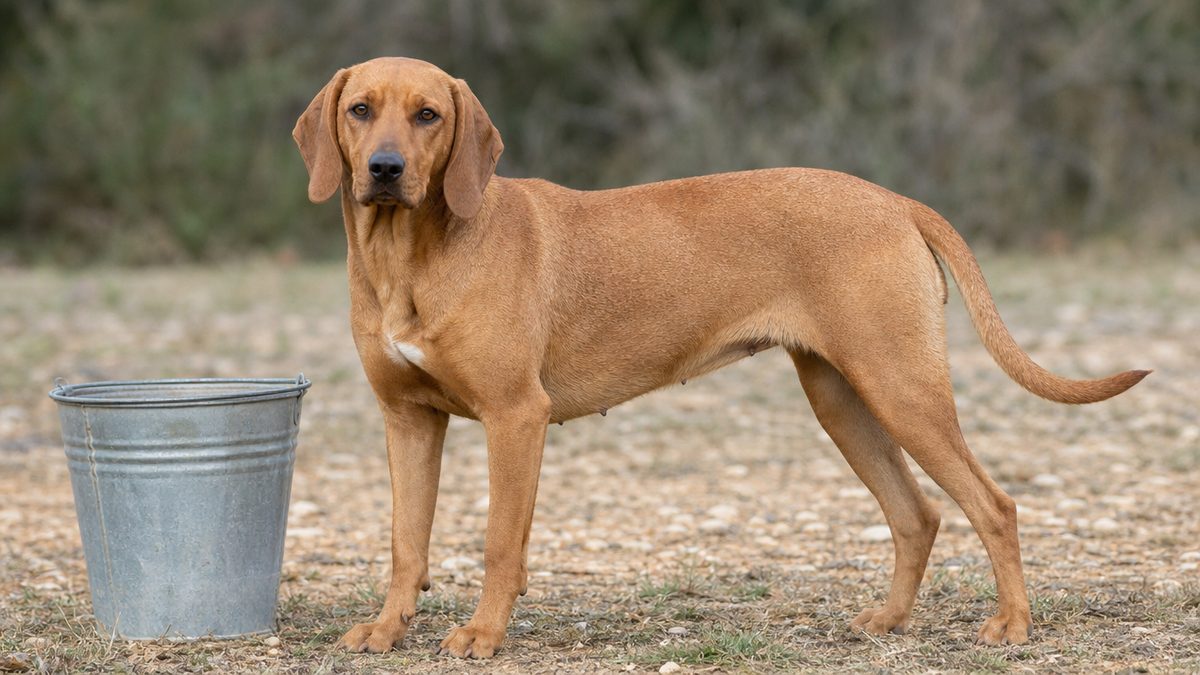
The Segugio Maremmano is a rectangular Italian scent hound of 46 to 54 cm, registered by the Federation Cynologique Internationale as breed standard 361 on a provisional basis since 1 March 2018, and bred by Tuscan hunters principally for wild boar.
Three characteristics identify it and each one separates it from the Segugio Italiano. The body is rectangular rather than square. The ears lie flat against the cheeks rather than hanging forward. And it is meaningfully smaller, at 13 to 23 kg against the Segugio Italiano's 18 to 28.
The standard's own general appearance clause is unusually plain-spoken: a breed without excess, easy, with a natural look, easy mover, rectangular in body, head with quite large skull, skull and foreface upper axes slightly divergent, high set ears, expressive and fierce eye, dark iris and attentive and smart expression. Note the phrase a breed without excess. This is a working dog whose standard explicitly avoids exaggeration, and it says so before it says anything about measurements.
The proportions are given as ratios rather than as descriptions. Muzzle length to skull length is 11 to 12. Body length to height at withers is 11 to 10, so the dog is one tenth longer than it is tall. Height at the elbow is 50 percent of the height at the withers. Total head length is four tenths of the height at the withers. That 11/10 body is the fastest visual check there is: the Segugio Italiano's body length equals its height at the withers, which makes it square.
The numbers the standard gives
| Clause | What the standard says |
|---|---|
| Height at withers, males | 48 to 54 cm |
| Height at withers, females | 46 to 52 cm |
| Height tolerance | 2 cm either way, in excellent specimens |
| Weight, males | 16 to 23 kg |
| Weight, females | 13 to 20 kg |
| Body length to height | 11 to 10, so rectangular |
| Height at elbow | 50 percent of height at withers |
| Head length | Four tenths of the height at withers |
| Muzzle to skull length | 11 to 12, so the muzzle is slightly shorter |
| Scapulo-humerus angle | 105 degrees |
| Short coat | Harsh texture, dense, undercoat often present |
| Rough coat | Rough to the touch, about 3 to 4 cm long |
| Ears | Set over the eye line, flat and well adherent to the cheeks |
Pigment is where this breed departs most sharply from its cousins. The nose is black or liver in colour, and the eyelids are described as well pigmented, brown or liver in colour. Both Segugio Italiano standards require a nose that is always black, and both disqualify total or major depigmentation. A liver-nosed Segugio Maremmano is correct; a liver-nosed Segugio Italiano is not the same breed's dog.
Colour follows the same pattern. Permitted colours are fawn from light to dark rich tan, black and tan, and brindle, with white markings acceptable. Brindle is a disqualifying fault in both Segugio Italiano standards. So a brindle Italian scent hound is either this breed or a dog that cannot be shown as the other one.
The disqualifying faults for 361 are short and worth knowing: aggressive or overly shy dogs, any dog clearly showing physical or behavioural abnormalities, lack of type, over or under standard sizes and weights tolerances, convergent skull and foreface axes, blue eye, overshot and undershot, uprising nose, and all colours not included in the standard description. The inclusion of lack of type as a disqualification, without further definition, is unusual and tells you the breed is still being consolidated.
A rectangular, lean, 13 to 23 kg Tuscan boar hound with flat cheek-hugging ears, a black or liver nose, a fawn, black and tan or brindle coat in either a short or a rough variety, and the loudest and most specialised working voice of the four Italian Segugi.
Two coats, one breed: the FCI solves here the exact problem it splits elsewhere
The Segugio Maremmano keeps its short-haired and rough-haired varieties inside one FCI standard, and ENCI registers them as Varieta A and Varieta B under a single breed record. The Segugio Italiano's two coats are two separate FCI breeds with two numbers. Same federation, same section, opposite answers.
Read standard 361's coat clause and count the breeds it describes. Under the heading COAT it gives Hair: Two coat varieties, then SHORT-HAIRED, of harsh texture, dense, uniformly distributed on body and limbs, undercoat often present, with some rough hair 1.0 to 1.5 cm long possibly present on muzzle and limbs; and ROUGH-HAIRED, rough to the touch, about 3 to 4 cm long, uniformly distributed on body and limbs. One document, one breed number, two coats.
The Italian studbook says the same thing in its own filing language. ENCI's record for the breed prints Codice FCI 361 and a Varieta field reading A, A PELO FORTE and B, A PELO RASO. The two Segugio Italiano records, at 198 and 337, carry no Varieta field at all, because each of them is already a whole breed. ENCI also serves its own Italian text of the standard, translated by Dr Vincenzo Ferrara and published on 12 September 2018, which carries the same two-variety coat clause.
So each coat variety here is exactly that, a coat variety, and not a breed. A short-coated and a rough-coated Segugio Maremmano can be registered, shown and bred under the same number, which is not true of the two hardy Segugio Italiano at 198 and 337. Those two share a section of the FCI's Group 6 index with nothing else Italian in it.
| Breed | FCI number | Coats | How the coats are filed | ENCI Varieta field |
|---|---|---|---|---|
| Segugio Maremmano | 361 | Short and rough | Two varieties in one standard | A pelo forte, B pelo raso |
| Segugio dell'Appennino | 375 | Short and rough | Two varieties in one standard | A pelo forte, B pelo raso |
| Segugio Italiano a Pelo Raso | 337 | Short only | A whole separate breed | None |
| Segugio Italiano a Pelo Forte | 198 | Rough only | A whole separate breed | None |
That table is the single most useful thing on this page for anyone trying to make sense of Italian scent hounds. The two provisionally recognised breeds keep their coats together; the two definitively recognised breeds have them apart. The split is not random: the Segugio Italiano's separation happened in 1993, twenty-five years before either of these two entered the FCI system at all.
Which coat you will actually meet
The short one, overwhelmingly. Of the 5,679 Segugio Maremmano registered in the Italian studbook in 2018, over 90 percent were smooth-haired. So the rough variety is a real minority within a real breed, and any photograph you find is nine times out of ten the short coat. That also means the grooming picture for this breed in India is, in practice, the easy one.
Bonbeno checked whether the FCI's own crossing register resolves the variety question formally, since presence in that document presupposes a single breed. The List of Breed Varieties That Can Be Crossed, issued after the FCI General Committee meeting in Helsinki in February 2019, contains Maremmano zero times and Segugio zero times, against in-document controls of Podengo at 8 hits, Dachshund at 13 and Caniche at 28. That absence proves nothing here, and saying so matters: the register was issued ten months after this breed's provisional recognition and it enumerates definitive breeds. A provisional breed is not expected to be in it.
One more filing oddity, inside ENCI's own site
ENCI contradicts itself about which section this breed belongs to. The breed record prints Sezione 2, Segugi e cani per pista di sangue, the leash and blood-tracking hounds. ENCI's own Group 6 index lists the breed under the heading Cani da Seguita, the running hounds, alongside the two Segugio Italiano and the Appennino, while only the three Dachsbracke and Schweisshund breeds sit under the Segugi e cani per pista di sangue heading. The FCI itself files the breed in Section 1.2, Medium-sized Hounds.
Two of ENCI's own pages disagree, and neither matches the FCI's section. Nothing about a dog changes because of it, but a reader chasing a section number should know that three documents give three answers.
There is no wrong coat. A short-coated and a rough-coated Segugio Maremmano are the same registered breed under one number and can be shown as such, which is not true of the two Segugio Italiano. Ask for the ENCI variety letter, A or B, rather than treating the coat as a breed.
Three Italian animals are called Maremmano, and every search instrument confuses them
The name Maremmano belongs to three different Italian animals: this scent hound, a large white livestock guardian dog, and a horse breed. Google's People also ask panel for this breed returns two questions about the sheepdog, and PubMed returns mostly the horse.
Start with the search engine, because it is the instrument most readers will use. A People also ask panel captured on Google India on 8 September 2026 for the query segugio maremmano dog returned four questions: Are Maremma dogs good pets?, What dog is worth $2 million dollars?, What is the average size of a Segugio Italiano?, and Is the Maremma dog rare?. Three of the four are about other dogs. Google's own AI Overview expanding the first discusses Maremma Sheepdogs as independent livestock guardians that patrol and bark at night, need large fenced areas and are suspicious of guests, which describes a 35 to 45 kg white flock guardian and not a 13 to 23 kg boar hound.
The instrument was healthy when that happened, which is what makes it a finding rather than a failure. A labrador retriever dog control on the same endpoint in the same session returned About 185 results and a normal four-question English panel. So Google was working; the name is ambiguous.
The literature does the same thing, harder
PubMed is worse. Searching Maremmano[tiab] returns 22 records, dominated by the Maremmano horse. Searching Maremmano dog returns 5, of which one is a disseminated Scedosporium apiospermum infection in a Maremmano-Abruzzese sheepdog, one is a proteomic study whose fourth breed is a Maremmano-Abruzzese Sheepdog, and one is a cardiac tumour case in a Maremmano shepherd. The exact phrase 'Segugio Maremmano'[tiab] returns 0 with a quotedphrasesnotfound warning, and the unquoted form, which PubMed rewrites into segugio AND maremmano across all fields, returns exactly one record.
| Query | Instrument | Result | About this breed? |
|---|---|---|---|
| Maremmano[tiab] | PubMed | 22 records | No, mostly the horse |
| Maremmano dog | PubMed | 5 records | No, the sheepdog |
| "Segugio Maremmano"[tiab] | PubMed | 0 records | Phrase not indexed |
| Segugio Maremmano, unquoted | PubMed | 1 record | Yes, the only one |
| segugio maremmano | Google India | About 36,700 results, no PAA panel | Mixed |
| segugio maremmano dog | Google India | About 130 results, 4 PAA questions | One of four |
| labrador retriever dog, control | Google India | About 185 results, 4 PAA questions | Control passed |
Compare the two Google rows. The bare Italian phrase returns About 36,700 results and the same phrase plus the word dog returns About 130. Bonbeno makes no claim from either number on its own, because an absolute result count is not a measure of anything. What is legitimate is the comparison, since both came from the same instrument in the same session: adding one English word removes more than 99 percent of the corpus, and what it removes is the horse and the sheepdog.
Google itself knows, and converts anyway
The most interesting thing about the commercial query is that the engine flags the confusion and then makes a different error. Its AI Mode answer for segugio maremmano price in india carries a warning headed Common Confusion: Maremma Sheepdog vs. Segugio Maremmano, explains that because of the similar names many people mistake this breed for the large white livestock guardian, and gives a separate Maremma Sheepdog price in India of 50,000 to 1,00,000 rupees. Then, in the same answer, it converts a European price into rupees and presents it as an Indian one.
Care advice written for a Maremma Sheepdog applied to a Segugio Maremmano is advice for a dog roughly twice the weight with the opposite job. Guardian breeds are managed by containment and by limiting territory; scent hounds are managed by exercise and by controlling the nose. Check which Maremmano any article you read is describing before you follow it.
The two are both on ENCI's eighteen-breed Razze Italiane list, under the names Segugio Maremmano and Cane da Pastore Abruzzese Maremmano, which is the cleanest way to keep them apart: the sheepdog's Italian name puts Maremmano last and Pastore first.
Recognition: provisional at the FCI since 2018, and the most-registered Italian breed of 2009
The FCI recognises this breed on a provisional basis, accepted 1 March 2018 with its standard published on 12 September 2018. ENCI recognised it nine years earlier, in 2009, when more than 6,600 dogs were registered, the highest number of registrations for any Italian breed that year.
Provisional recognition is a real status with real consequences, and the FCI states them on the register itself. Breeds recognised on a provisional basis are not eligible for the CACIB until they are recognised on a definitive basis, but they are eligible for FCI titles, and the pedigrees issued to their dogs have to carry the FCI logo. So a Segugio Maremmano can be shown and titled internationally but cannot take the international beauty championship certificate.
The register's own row for the breed reads a date of provisional recognition of 3/1/2018 and a validity date of 9/12/2018. The date format is proven on the table's own face, where other rows read 9/17/2024, 6/21/2022, 2/26/2020, 3/30/2022 and 4/29/2019, so the second field is the day and the acceptance date is 1 March 2018. The breed record gives the same acceptance date, names the official authentic language as English, and states that the breed is subject to a working trial.
The breed is absent from the FCI's Group 6 definitive index, which lists only the two Segugio Italiano under Italy. That absence is a consequence of provisional status, not evidence of anything about the dog, and a reader who checks only the definitive index will wrongly conclude the FCI does not hold this breed.
The Italian numbers are the surprising part
Most rare-breed pages describe a dwindling population. This one does not. ENCI recognised the Segugio Maremmano in 2009, and more than 6,600 dogs were registered in that year, the highest number of registrations for any Italian breed. In 2018 there were 5,679 new registrations. For comparison, the short-coated Segugio Italiano registered 3,647 in 2015 and the rough-coated one 1,106.
| Body | Status | Date or figure |
|---|---|---|
| FCI | Recognised on a provisional basis, standard 361 | Accepted 1 March 2018 |
| FCI CACIB eligibility | Not eligible until definitive recognition | Stated on the provisional register |
| ENCI, Italy | Recognised breed, Codice FCI 361, two varieties | Recognised 2009 |
| Italian registrations, first year | Highest of any Italian breed | More than 6,600 in 2009 |
| Italian registrations, 2018 | Still four figures | 5,679, over 90 percent smooth |
| American Kennel Club | No page and no Foundation Stock Service entry | Holds only the Segugio Italiano |
| The Royal Kennel Club | Never held | Its 2020 declassification concerned the Segugio Italiano |
| McMillan 2024 survival analysis | Absent from the supplementary tables entirely | Never considered |
| Kennel Club of India | Publishes no breed list for any breed | Not a finding about this breed |
That last row needs its caveat said out loud rather than implied. The Kennel Club of India publishes no breed list at all, so a query there returns nothing for this breed and nothing for a common control either. That is a limit of the instrument, not evidence about the dog. What does answer the Indian question is the FCI route: India is a full FCI member represented by the Kennel Club of India, so FCI nomenclature is the operative framework, and a provisionally recognised breed carries an FCI-logo pedigree.
Where it came from, according to the standard itself
The history clause in standard 361 is refreshingly recent and specific. The breed originated from an unregistered hunting dog population located in Maremma Toscana, the southern part of the Tuscany region in central Italy. It has been present in its original diffusion area since the 1930s, and the attempt at official recognition by dog lovers and specialised club members traces back to those years. The standard credits Dr Bosio, a veterinary surgeon and president of the specialised club for scenthounds in Italy, and states that Tuscan wild boar hunters created this Italian breed adapted to wild boar hunting and to the biotope of that southern area of Tuscany.
Two things follow. First, this is not an ancient breed and its own standard does not claim to be one, which is a pleasant contrast with the Segugio Italiano's Egyptian and Phoenician origin story. Second, the population it was drawn from was unregistered, which explains both the very large first-year registration figure in 2009 and the presence of lack of type among the disqualifying faults. A breed consolidated out of a landrace within living memory is still deciding what it looks like.
One small note on the document itself, because it matters when a standard is the authority. English is the authentic language of standard 361 per both the register and the standard's own header FCI-Standard N 361, SEGUGIO MAREMMANO, and the French text agrees, reading Langue faisant foi : (EN). The authentic English text is nonetheless visibly unproofed, containing phrases such as Tuscan wild board hunters and Shoulder-blade well layed back. Where an authentic text governs, its typographical state is worth knowing. Bonbeno checked the French figures against the English and found them identical, so no measurement is affected.
Segugio Maremmano price in India: Google says none exists, then prints one
No published Segugio Maremmano price in india exists, and Google India's own answer opens by saying exactly that. It then gives a rupee band, then reveals that band came from a European euro price, at an implied rate of about 92 to 93 rupees to the euro.
Here is the sequence, in the order the answer prints it. The AI Mode reply for segugio maremmano price in india states that the breed has no established market price or active commercial breeding lines in India, as it is an exceptionally rare Italian scent hound. It then says that if you found an importer or specialised breeder, a puppy would likely cost between 1,50,000 and 3,00,000 rupees or more, largely driven by international shipping, quarantine and import documentation. It then adds: to put this into perspective, local puppy prices in Europe range from 1,500 to 2,500 euro, approximately 1,40,000 to 2,30,000 rupees.
Do the division yourself. 1,40,000 divided by 1,500 is 93.33. 2,30,000 divided by 2,500 is 92.00. That is the conversion, and the headline band of 1,50,000 to 3,00,000 is that conversion with an unexplained markup on top. Bonbeno has now watched the same engine do this twice in one session on two different Italian scent hounds, and on the other breed it printed the rate it used, 92.5, as a code block underneath its own answer.
Bonbeno publishes no rupee conversion of a foreign price. Converting is the operation that produces the number at the top of the Indian search results, and reproducing it here would simply add a fourth source to a figure that nobody has ever observed in India.
The rest of that answer is worth reading for what it invents
The same answer offers a cost breakdown for importing, and one line in it is a 19-fold range: international air freight of 80,000 to 1,500,000 rupees, alongside an IATA flight crate and pet passport at 20,000 to 35,000 and Indian customs and quarantine processing at 25,000 to 40,000. None of those carries a source. A range that wide is not an estimate; it is the absence of one.
The answer does get one thing right, and it is worth crediting. It carries its own warning headed Common Confusion: Maremma Sheepdog vs. Segugio Maremmano, and separately gives a Maremma Sheepdog price in India of 50,000 to 1,00,000 rupees, noting the sheepdog is occasionally bred in India for farm guard duties. So the engine is aware that two dogs share the name and still returns two sheepdog questions in the People also ask panel for this hound.
What the honest sources say
The best page on this search results set says the right thing. Creatures.com, under a heading reading Finding a Segugio Maremmano, states plainly that no dependable current price or availability figure was found. Its size figures also match FCI 361 exactly, giving males 48 to 54 cm and 16 to 23 kg and females 46 to 52 cm and 13 to 20 kg, and it describes the short coat as harsh, dense and even with an undercoat often present. Bonbeno records that rather than pretending every ranking page is wrong.
| Figure | Source | What it actually is |
|---|---|---|
| Rs 1,50,000 to Rs 3,00,000 | Google India AI Mode | A euro conversion plus an unexplained markup |
| EUR 1,500 to 2,500 | Google India AI Mode, citing European sources | A European price, left in euros here |
| Rs 1,40,000 to Rs 2,30,000 | Google India AI Mode | The euro band divided at about 92 to 93 |
| Rs 80,000 to Rs 1,500,000 | Google India AI Mode | An unsourced air freight range spanning 19-fold |
| Rs 50,000 to Rs 1,00,000 | Google India AI Mode | The MAREMMA SHEEPDOG's Indian price, a different breed |
| No figure | Creatures.com | States that no dependable price figure was found |
| No figure | Any Indian listing for a live animal of this breed | None exists on the page |
Read the fifth row carefully, because it is the trap an Indian buyer actually falls into. There is an Indian price of 50,000 to 1,00,000 rupees in that answer, and it belongs to a large white livestock guardian, not to this hound. Someone skimming will come away believing a Segugio Maremmano costs about a lakh in India.
Why no Indian supply chain can form
Import of dogs sits at ITC(HS) 01061900, Mammals: Other, marked Restricted. Policy Condition 7 permits import only for a pet dog with a valid pet book in the importer's own name, for research by an R&D organisation with a CPCSEA recommendation, or for internal security by the Defence and Police Force. Policy Condition 8 states that import of commercial dogs for breeding or any other commercial activity outside those purposes is not permitted, and paragraph 6 of the notice states that applications for trading or breeding purposes shall be duly rejected. The DGFT's FAQ closes the last gap: new born puppies of less than 7 months are not to be allowed.
Entry is limited to the airports and seaports of Delhi, Mumbai, Chennai, Hyderabad, Bengaluru and Kolkata and, since October 2024, Kochi airport, with quarantine at the government quarantine station of those ports where required Department of Animal Husbandry…. So an adult pet dog can arrive with its owner. Nothing else can. The full route is set out in how to import a dog to India.
Monthly cost of ownership for a 20 kg hound in India
Budget roughly Rs 3,500 to Rs 6,000 a month for a 20 kg dog before food quality choices, and about Rs 550 a year in municipal fees in Delhi or Rs 50 in Chennai. Every figure below was read live from the seller's or the corporation's own page on 8 September 2026.
This is a dog cost rather than a breed cost, and the distinction is worth stating. There is no Indian purchase price for this breed, so any total that includes one rests on a conversion. What is real and checkable is what a lean 13 to 23 kg dog costs to keep healthy in an Indian city, and this breed is at the light end of the hound range, which helps.
Parasite control, the biggest fixed line
A 20 kg dog sits in the 15 to 30 kg band. NexGard Spectra for that band costs Rs 3,308 for three tablets against an MRP of Rs 3,375, and it is prescription-only. Dosed monthly, that is Rs 1,103 a month, covering the tick and flea role and the roundworm and hookworm role in one product. Drontal Plus costs Rs 813 for a strip of six against an MRP of Rs 838, which is Rs 135.50 a tablet, dosed one per 10 kg, so Rs 271 per deworming for a 20 kg dog.
Both figures were tested for a disguised dollar price. Dividing the NexGard pack by 84.38, 80 and 74 gives 39.20, 41.35 and 44.70, none of which a seller would print, so it is rupee-native. Both also move: an earlier Bonbeno reading of the same Drontal page recorded Rs 754 where it now reads Rs 813. Re-price before you budget.
| Line | Price | Frequency | Monthly equivalent |
|---|---|---|---|
| NexGard Spectra 15-30 kg | Rs 3,308 for 3 | Monthly | Rs 1,103 |
| Drontal Plus deworming | Rs 813 for 6 | Quarterly, 2 tablets | Rs 90 |
| Annual vaccination booster | From Rs 3,199 | Yearly | Rs 267 |
| Anti-rabies alone | Rs 699 | Yearly | Rs 58 |
| Bath and basic grooming | From Rs 934 | Every 6 to 8 weeks | Rs 500 to Rs 670 |
| Delhi pet dog registration | Rs 500 new, Rs 500 renewal | Yearly | Rs 42 |
| Chennai pet licence | Rs 50 | Yearly | Rs 4 |
| Food, mid-range dry | Varies by brand | Monthly | Rs 1,800 to Rs 3,500 |
Vaccination, and the spread that matters more than any single price
At Vetic, a chain with clinics across several metros, the puppy course starts at Rs 6,499 against a struck-through Rs 8,111, the annual booster starts at Rs 3,199 against Rs 3,806, anti-rabies alone is Rs 699, the 9-in-1 DHPPiL is Rs 899 and kennel cough is Rs 1,349. Those are promotional floors from one chain, not a market average, and the same chain quotes different course prices on different city pages on the same day.
The municipal route changes the arithmetic entirely. Greater Chennai Corporation's pet clinics are listed as providing all treatment and anti-rabies vaccination free of cost for pet animals, and the corporation issued 9,115 pet licences during 2024 at Rs 50 each. Delhi charges Rs 500 to register a pet dog and Rs 500 to renew, with a Rs 100 per month late fee and a one-month grace period after the anti-rabies certificate expires, the certificate being valid for a maximum of one year tied to the vaccination date. Municipal fees are the durable numbers here; retail prices are the perishable ones.
The grooming line is small, and for once the breed helps
Vetic's Delhi list gives bathing from Rs 934, a haircut from Rs 1,359 and a complete bath and styling from Rs 1,869. A short-haired Segugio Maremmano needs the first of those and never the others, and over 90 percent of the breed registered in Italy in 2018 was short-haired. Even the rough variety, at 3 to 4 cm, is well short of a coat that needs professional shaping. Budget a bath every six to eight weeks in the wet months and a rubber mitt at home the rest of the time.
Rs 1,103 a month for parasite cover is the single biggest fixed cost of keeping this dog in India and the one owners are most tempted to skip. In a country where tick-borne disease is common in clinic caseloads, it is the last thing to drop from the budget.
Indian climate: the warmest homeland of the four Segugi, and still ten degrees short
This is the most heat-adapted of the four Italian Segugi, because the Maremma is a low coastal plain rather than a mountain range. It is still not an Indian climate: the Maremma's hottest month averages 25.16 C, while Chennai's annual mean is 27.95 C.
Bonbeno queried NASA POWER by explicit latitude and longitude and echoed back the elevation the model reports for every cell, because a grid cell is not a town. Alberese, inside the Parco della Maremma and in the middle of the breed's home range, returns a cell at 90.49 m against a real 20 m, so the cell is standing close to the town. It gives an annual mean of 16.54 C and 74.53 percent relative humidity, a hottest month of August at 25.16 C, a coolest month of January at 9.02 C, and a peak wet bulb of 20.53 C in August.
Orbetello, Alberese and Manciano all return the identical 90.49 m cell, and Manciano's real elevation is 444 m. One grid cell is covering three towns across a 441 m vertical spread, so the inland hill country of the Maremma is warmer in this model than it is on the ground. The figures below describe the coastal plain, which is where the breed's standard says the population sits.
| Place | Annual mean C | Annual RH percent | Hottest month | Peak wet bulb C |
|---|---|---|---|---|
| Alberese, Maremma | 16.54 | 74.53 | August, 25.16 | 20.53 |
| Follonica, Maremma | 16.39 | 74.38 | August, 25.19 | 20.46 |
| Delhi | 25.60 | 45.56 | June, 35.88 | 26.50 |
| Mumbai | 26.77 | 67.39 | May, 31.19 | 25.77 |
| Chennai | 27.95 | 72.39 | May, 31.51 | 26.11 |
| Bengaluru | 23.74 | 67.94 | April, 28.37 | 21.86 |
| Pune | 23.86 | 66.80 | April, 28.93 | 22.97 |
| Kolkata | 25.81 | 73.93 | May, 31.53 | 27.09 |
| Kochi | 27.31 | 78.83 | March, 29.42 | 25.79 |
Read the humidity column first, because the usual assumption about Mediterranean breeds in India is backwards. Alberese runs 74.53 percent annual relative humidity and Follonica 74.38. Mumbai runs 67.39, Bengaluru 67.94, Pune 66.80 and Delhi 45.56. Four of the nine Indian cities in that table are drier than the Maremma, and only Kochi at 78.83 percent is meaningfully damper. A coastal Tuscan hound is not going to be undone by Indian damp; it is a damp-country dog already.
The heat is the whole difference. The Maremma's hottest month averages 25.16 C and Chennai's annual mean is 27.95 C, so a Segugio Maremmano in Chennai lives all year above the temperature its homeland reaches only in August. Delhi peaks in June, not May, at 35.88 C, which is more than ten degrees above anything the Maremma sees. Note also that Bengaluru and Pune peak in April rather than May, which is the detail most Indian breed pages get wrong.
The physiologically meaningful figure is wet bulb, computed with the Stull approximation from mean temperature and mean humidity, because it combines heat and humidity into the number that limits evaporative cooling. Alberese peaks at 20.53 C. Kolkata reaches 27.09, Delhi 26.50 and Chennai 26.11. That is a gap of 5.6 to 6.6 degrees of wet bulb, and it is the honest measure of what an imported dog is being asked to absorb.
Bengaluru's peak wet bulb of 21.86 C sits about 1.3 degrees above the Maremma's 20.53 C, and Pune's 22.97 C about 2.4 degrees above. If this breed has an Indian home it is the Deccan plateau, and specifically Bengaluru, not the coast and not the northern plain.
What this breed has going for it, and what it does not
It is the lightest of the four Segugi at 13 to 23 kg, which matters because bodyweight is the one heat-illness risk factor from the literature that transfers here. Hall 2020's Scientific Reports analysis of 905,543 UK dogs under primary veterinary care found that dogs at or above the mean bodyweight for their breed and sex carried an odds ratio of 1.42, confidence interval 1.12 to 1.80, against an incidence of 0.04 percent and a case fatality of 14.18 percent across 395 events. This breed was not in that study and no breed-specific figure exists for it, so that bodyweight finding is the only transferable one.
What it does not have is any acclimatisation. Indian law addresses exactly that case: Second Schedule Part IV paragraph 21(1) of the 2017 Rules bars keeping in outdoor facilities, without the attending veterinary practitioner's written approval, dogs that are not accustomed to the temperatures prevalent in the area or region in question, breeds that cannot tolerate them such as long-haired breeds in high temperature locations, and sick, infirm, aged or young animals. An imported Segugio Maremmano is the first of those three categories on the day it lands.
Temperament: a boar specialist, and the standard does not pretend otherwise
The ideal owner hunts, or can replicate the work. FCI standard 361 describes a scenthound specialised in wild boar hunting, characterised by high hunting drive and strong temperament, self-confident and easy going near the prey, and an excellent, careful and self-confident barker when the prey is found.
That temperament clause is the least domestic of the four Italian Segugi and it repays reading in full. The standard gives: scenthound specialised in wild boar hunting; characterised by high hunting drive and strong temperament; pleasing voice well differentiated in accordance to hunting phases; self-confident and easy going near the prey; excellent, careful and self-confident barker when the prey is found; strong chaser; an excellent hunter, either alone or as pack member. Every clause describes a job. None describes a companion.
Compare that with what the Segugio Italiano's standard says about itself: a steady temperament but not very outgoing, with a soft expression. The two documents are not describing the same kind of animal, and the difference is not subtle. This is the breed a Tuscan hunter takes to boar; that is the breed a Tuscan hunter takes to hare.
Reading the voice clause literally
The phrase to sit with is a pleasing voice well differentiated in accordance to hunting phases. That is a selection criterion for a dog whose bark tells its handler, from out of sight, whether it is casting, running, closing or holding. Breeding for that produces an animal that is vocal by design, barking a great deal, with variety, and with intent. In an Indian apartment block there is no version of that which is quiet, and no page describing this dog as a quiet or low-maintenance hound has read its standard.
The ideal owner, stated plainly
- Households with a securely fenced space, because a strong chaser on a boar line is not recallable
- Households that can give two hours of walking, running and scent work every day, split around the Indian heat
- Households with neighbours who will accept a working hound voice designed to carry across a valley
- Households already keeping other dogs, since the standard describes a dog that hunts alone or as a pack member
- Households with older children rather than toddlers, because a 20 kg dog running a line does not look where it is going
- Apartments without safe fenced access, where the free-running half of the requirement cannot be met
- Households with cats, rabbits or poultry, given a standard that calls the dog a strong chaser with high hunting drive
- Households wanting an obedient dog, since nothing in the standard mentions biddability at all
- Households wanting a guard dog, because a hound that is self-confident and easy going near the prey is not a suspicious animal
- First-time owners, who will be outmatched by the drive before they are outmatched by the size
One honest caveat about temperament claims for this breed. Almost nothing has been written about it outside its own standard: the entire indexed world veterinary literature naming the Segugio Maremmano is a single 2010 paper about sperm morphometry. So the description above is the standard's, and the standard describes the dog the breed club wants rather than a measured population. Bonbeno reports which it is, and invents nothing to fill the gap.
A cheerful, confident, extremely loud specialist that is easy to live with once it has worked and impossible to live with when it has not. The standard's own words for it are high hunting drive and strong temperament, and both halves of that phrase are the point.
Training a boar specialist that was never selected for obedience
To train this breed, accept from the first week that the recall will not survive a live scent, and build management around that instead of hoping. Nothing in FCI standard 361 mentions trainability, biddability or willingness to please, which is itself the most useful information available.
Read what the standard does say about behaviour, and notice what is missing. High hunting drive. Strong temperament. Self-confident and easy going near the prey. Excellent, careful and self-confident barker. Strong chaser. Excellent hunter alone or in a pack. There is no clause about the handler, no clause about learning, and no clause about willingness. Compare the Segugio Italiano's standards, which at least describe a soft expression and a steady temperament, or the Segugio dell'Appennino's, which states that its obedience is an innate and atavic talent.
That absence is not an accident of drafting. A boar hound works at distance from its handler, often out of sight, making its own decisions about a dangerous animal. Selection has been for a dog that does that well, and the standard's inclusion of lack of type as a disqualifying fault tells you the breed is still being consolidated around the working picture rather than a domestic one.
What actually works, in order
- Weeks 8 to 16: build a recall on a long line in a low-scent space, paying every time and never calling the dog off a line you cannot win
- Weeks 12 to 20: socialise deliberately to Indian urban noise, lifts, autos, delivery riders, doorbells, crowds and other dogs
- Months 4 to 8: teach an emergency stop as a second brake, since a stop occasionally catches a dog that a recall will not
- Months 6 to 12: introduce tracking and scent games as the legitimate outlet, which is the only work this breed finds rewarding
- Month 12 onward: keep a 10 to 15 metre long line permanently for unfenced spaces, and stop calling that a training failure
In India the stakes on that fifth point are higher than in Tuscany. An unfenced maidan, park, beach or colony road ends at traffic, and a strong chaser committed to a line does not check. Buy the long line before the collar.
Barking is a management problem, not a training failure
The standard grades the voice, which means the voice is the product. Training can teach a reliable settle on a mat, desensitise alarm barking at corridor noise, and stop barking earning attention. It cannot make the dog quiet, because a quiet Segugio Maremmano would be a poorly bred one by its own standard. Anyone who cannot accept that should choose a different breed rather than plan to train it out.
Scent work is the single highest-value activity for this dog in India, and the reason is practical rather than philosophical: it can be done indoors on a cool floor at two in the afternoon, when walking is impossible for eight months of the year. Snuffle mats, scattered kibble, find-the-toy games and formal tracking all consume the drive that otherwise goes into the corridor.
One legal note that binds any Indian breeder rather than any owner. The 2017 Rules permit only out breeding and line breeding, and prohibit in breeding, defined as breeding between relatives of the second to fourth grade in straight or side line within the first four generations, and incest breeding, defined as mating between parents and children or between brother and sister. For a breed consolidated recently out of an unregistered landrace, that constraint matters more than usual.
Never call the dog off a live scent you are going to lose. Every failed recall teaches it that your voice is optional information. Collect it on the long line instead, and reserve the recall word for situations you can win.
Exercise: two hours minimum, and the Indian day only has two usable ends
Plan two hours a day of walking, running and scent work, split across dawn and after dark for eight months of the year in most Indian cities. This is a wild boar specialist bred for the biotope of southern Tuscany, and the standard describes a galloper that uses walk and trot when hunting.
The standard's movement clause is short and clear: always sound and easy, lively, a galloper; when hunting he uses walk and trot gaits. Its history clause says the breed was created by Tuscan wild boar hunters and adapted to the biotope of that southern area of Tuscany. A dog selected across a landrace to work Mediterranean scrub all day is not a two-short-walks animal, whatever its 20 kg bodyweight suggests.
The Indian timing problem, in numbers
Chennai's coolest month averages 24.09 C, which is close to the Maremma's summer, and its hottest averages 31.51 C with a peak wet bulb of 26.11 C. Delhi peaks in June at 35.88 C. Those are whole-day means, so afternoons run well above them. The workable schedule in a plains city is a long walk before sunrise, a second after dark, and indoor scent work in the middle.
| City type | Morning | Evening | Midday substitute |
|---|---|---|---|
| Chennai, Mumbai, Kochi, Kolkata | 60 min before sunrise | 60 min after dark | Indoor scent games, 20 to 30 min |
| Delhi, Ahmedabad, Hyderabad | 60 min before sunrise | 60 min well after dark | Indoor work plus a cool floor |
| Bengaluru, Pune | 60 to 75 min, wider window | 60 min | Shaded garden roaming |
| Any city, monsoon weeks | Shortened, dry the ears after | Shortened, dry the ears after | Longer indoor work |
Free running is the hard half to supply. A dog park, a fenced terrace, a society lawn whose gate actually closes, or a rented plot are the realistic options in urban India. A long line on an open maidan is a compromise, and a good one, but it is not the same as letting a hound cast freely.
What under-exercise looks like in this breed specifically
It looks like the standard's own selection criteria turned inward. A dog bred to be an excellent, careful and self-confident barker when the prey is found will bark at the lift, the corridor, the delivery rider and the crow on the balcony. A strong chaser with nothing to chase will chase the cat, the broom and the child on a cycle. These are not behaviour problems; they are the breed doing its job in a place with no job.
On intensity in heat, keep the dog lean. Hall 2020 found that dogs at or above the mean bodyweight for their breed and sex carried an odds ratio of 1.42 for heat-related illness, with a case fatality of 14.18 percent across 395 events in 905,543 dogs under primary veterinary care. The breed was not modelled, so that bodyweight factor is the only transferable finding, and on a dog whose standard tops out at 23 kg for males it is easy to act on.
Frantic panting that does not slow when the dog stops, bright red gums, unsteadiness, vomiting or collapse. Move to shade, wet the coat with cool rather than iced water, and get to a vet. In the largest published study of canine heat-related illness the case fatality was 14.18 percent.
Grooming: the easiest coat of the four Segugi, and ears that finally help
Groom this breed in five minutes a week. Over 90 percent of the Segugio Maremmano registered in Italy carry the short coat, and the standard's ear clause asks for a leather that lies flat against the cheeks rather than hanging forward, which is the friendliest ear geometry in this whole group of breeds.
The coat first. The short variety is harsh in texture, dense, uniformly distributed on body and limbs, with an undercoat often present and some rough hair of 1.0 to 1.5 cm possibly on the muzzle and limbs. The rough variety is rough to the touch, about 3 to 4 cm long, uniformly distributed. Neither requires stripping, shaping or clipping. A rubber curry mitt weekly on the short coat and a firm brush weekly on the rough one is the whole job.
The undercoat clause deserves a note because most secondary descriptions of this breed omit it. A short coat with an undercoat sheds seasonally and sheds more than a single-coated hound does, which matters in an Indian flat. Creatures.com is one of the few pages that gets this right, describing the short coat as harsh, dense and even with an undercoat often present.
Why the ears are less of a problem here
This is the one point where the Segugio Maremmano is meaningfully easier to keep in India than its cousins. Its standard asks for ears set over the eye line, flat and well adherent to the cheeks, long enough to cover the eye when stretched, triangle shaped with slightly rounded tips. The Segugio Italiano's standard, by contrast, requires a leather reaching about 70 percent of the length of the head, very wide, with a torsion drawing the whole thing forward so it cannot fold or lift.
A shorter leather lying against the cheek is still a covered canal, so weekly checks remain non-negotiable in a country where Kochi runs 78.83 percent annual relative humidity, Kolkata 73.93 and Chennai 72.39. But it is a smaller, better-ventilated structure than the one the other Italian hounds carry, and an owner in a monsoon city will notice the difference.
- Brush once a week, with a rubber mitt on the short coat and a firm brush on the rough one
- Lift and check both ears weekly, looking for redness, wax, smell or head shaking
- Dry the ear canals after every bath, swim and wet walk using a vet-approved drying solution, never cotton buds
- Bathe every six to eight weeks in the wet months and less often otherwise, since this coat does not need frequent washing
- Trim nails as needed and brush the teeth, because the 2017 Rules impose no dental requirement and nobody will remind you
On the skin, the standard asks only for good texture, tight in every part of the body, and no wrinkle anywhere on the head. That is a low-maintenance specification, and it is another quiet advantage over breeds with loose facial skin in a humid climate.
The tail clause, and a thing you must not do in India
The standard permits something Indian law does not. Its tail clause reads: an extension of the croup line, slightly tapered, never fringed, sabre shape carriage, anurism tolerated, and then Docked tail: slightly less than half length, in countries where it is not forbidden by the law. India is a country where it is forbidden. Second Schedule Part II paragraph 6(8) of the 2017 Rules states that there shall be no tail docking, ear cropping, de-barking, de-clawing, branding, dyeing, injecting substances to enhance visual appeal, or any other kind of mutilation of any body part of the pup, and that any change of appearance by artificial means is strictly forbidden.
This is the only one of the four Italian Segugi whose standard contemplates docking at all. Both Segugio Italiano standards disqualify a tailless or short tail whether congenital or artificial. Here the standard permits a docked tail where the law allows it, and the Indian law does not allow it. A docked Segugio Maremmano in India was either imported already docked or was produced in breach of the Rules.
The standard also tolerates anurism, meaning a natural bobtail, and tolerates spurs on the front feet and dewclaws on the rear. Both Segugio Italiano standards say plainly: no dewclaws FCI-Standard N 198. None of that changes an owner's routine, but all of it changes what a correct dog looks like, and a buyer comparing photographs across the four breeds should know which features belong to which.
Health: one paper exists in the whole world literature, and it is about sperm
Almost nothing has been measured in this breed. The entire indexed world veterinary literature naming the Segugio Maremmano is a single 2010 paper on spermatozoan morphometry in eleven dogs, and the breed is absent from McMillan 2024's supplementary tables altogether.
Start with the honest position, because it is the most useful thing this section can give you. There is no published life expectancy for this breed and no published lifespan, no hip or elbow screening scheme, no published OFA statistics row, no breed health survey and no disease prevalence figure of any kind. That is an absence of data rather than an absence of disease, and treating the two as the same thing is the commonest error made about newly recognised breeds.
The one paper
In 2010 a preliminary study measured spermatozoan head morphometry and DNA quality, by TUNEL flow cytometry, in semen from 11 dogs of three Italian breeds: the Cirneco dell'Etna, the Piccolo Levriero Italiano and the Segugio Maremmano. It found that Segugio dogs had significantly larger spermatozoa, by 33.67 percent, and separately that in one individual dog a predominance of elliptical spermatozoa, at 23 percent, was significantly related to a 12.6 percent rate of DNA fragmentation, in a dog whose breeding record over the previous twelve months showed poor fertility.
That is the whole of it. Eleven dogs across three breeds, in a paper the authors themselves call preliminary, on a question that matters to breeders rather than to owners. Anyone telling you what this breed dies of is not reading the literature, because there is none to read.
Why the name makes the absence look worse than it is
The searching has to be done carefully, and the reason is the homonym. 'Segugio Maremmano'[tiab] returns 0 records with a quotedphrasesnotfound warning. The unquoted form, which PubMed rewrites into segugio AND maremmano across all fields, returns 1. Maremmano[tiab] returns 22 records dominated by the Maremmano horse, and Maremmano dog returns 5 that are mostly Maremmano-Abruzzese sheepdog papers. Controls in the same session gave Labrador Retriever 1,109 and Bracco Italiano 5, so the instrument was working.
| Question | Instrument checked | Answer |
|---|---|---|
| Median lifespan | McMillan 2024 Tables S3 and S5 | Absent from the tables entirely, never considered |
| Any peer-reviewed paper | PubMed, four name forms with controls | One, on sperm morphometry in 11 dogs |
| Hip or elbow screening scheme | FCI, ENCI | None exists for the breed |
| OFA statistics row | OFA breed list | Could not be read; a Labrador control also returned zero |
| Breed health survey | Breed club and registry publications | None found |
| Inherited disease with a DNA test | Canine Genetics Centre and registry sources | None for this breed; the GAPO work is on the Segugio Italiano |
The last row is the one to be careful about, and it is the reason this page names it. In August 2025 the Canine Genetics Centre at Cambridge identified a novel GAPO-like variant causing glaucoma with short limbs, abnormal dentition and patchy coats, validated it against nearly 2,000 dog genomes, and found it in no other breed than the Segugio Italiano. That finding is about a different breed. Bonbeno does not transfer it here, and any page that does is applying one breed's genetics to another because the names are similar.
The McMillan absence is worth stating precisely too, because the two Italian scent hound situations are not the same. Its supplementary Table S5 lists 345 rows, 155 flagged Y and 189 flagged N. A flexible search for maremm returns exactly one row, Maremma Shepherd, flagged N, filed under sheepdogs and cattledogs, which is the sheepdog. A search for segugio returns one row covering the two Segugio Italiano, flagged N. So the Segugio Italiano was considered and excluded, while the Segugio Maremmano was never listed at all. Absent from the table is a weaker statement than excluded from the analysis, and this page uses the weaker one because that is what the document supports.
What is worth watching anyway, on general grounds
Two things, neither of them breed-specific and both stated as such. The first is canine leishmaniasis, because India has the parasite and the sand fly vectors and because the wider Italian scent hound literature carries it. A 10-year-old Italian Segugio in Romania presented with progressive weight loss and dermal lesions over the muzzle, foot pads and tarsal joints, with a positive ELISA while light microscopy of a lymph node smear found nothing, and needed eight weeks of pentavalent antimonial and eight months of allopurinol. The vector is documented in Italy: a three-year survey in eastern Sicily captured 9,095 sand flies and found Phlebotomus perniciosus at 77.7 percent of the Etna catch.
The second is heat, covered in the climate section above, where the only transferable finding from the literature is Hall 2020's odds ratio of 1.42 for dogs at or above the mean bodyweight for their breed and sex.
Because nothing has been measured in this breed, an actual examination carries more weight here than on any popular breed, not less. If your dog is losing condition, has crusty lesions on the muzzle or foot pads, or shakes its head repeatedly, take it to a registered veterinarian this week rather than looking for a breed-specific answer that does not exist.
Feeding and nutrition: a small hound with a large engine
Feed this breed to hold it lean at 13 to 23 kg, because it is the lightest of the four Italian Segugi and because carrying weight above the breed mean is the only heat-illness risk factor from the literature that transfers to it.
The standard gives no condition clause of its own, unlike the two Segugio Italiano standards which explicitly demand a dog without the least trace of fat. What it does give is a set of proportions that only work on a lean animal: a rectangular body at 11 to 10, height at the elbow exactly 50 percent of the height at the withers, and an underline described as a slightly ascending line from sternum to abdomen which is never tucked up. A dog carrying fat loses that ascending line first, and it is the easiest thing to check by eye.
Why body condition is a heat decision here
Hall 2020's Scientific Reports analysis of 905,543 UK dogs under primary veterinary care found that a bodyweight at or above the mean for the breed and sex carried an odds ratio of 1.42, confidence interval 1.12 to 1.80, for heat-related illness, against an incidence of 0.04 percent and a case fatality of 14.18 percent across 395 events. This breed was not modelled and no breed-specific odds ratio exists for it, so the bodyweight factor is the only transferable finding. On a dog whose standard tops out at 23 kg for males and 20 for females, two extra kilos is a tenth of its bodyweight.
| Stage | Target condition | Meals a day | Priority |
|---|---|---|---|
| 8 to 16 weeks | Growing, ribs easily felt | 4 | Steady growth, never rapid |
| 4 to 8 months | Waist visible from above | 3 | Joint-safe growth rate |
| 8 to 14 months | Approaching 13 to 23 kg by sex | 2 | Muscle without fat cover |
| Adult male, active | 16 to 23 kg per the standard | 2 | The underline must still ascend |
| Adult female, active | 13 to 20 kg per the standard | 2 | The underline must still ascend |
| Adult, Indian summer | Same, fed away from the heat | 2, early and late | Water and timing over quantity |
| Senior, 8 years plus | Slightly lighter | 2 | Protein maintained, calories reduced |
Practical Indian notes
Feed away from the heat of the day. A meal just before or after the coolest walk sits better than an afternoon one, and it keeps the dog from working on a full stomach. Water should be constantly available and refreshed rather than topped up, because a bowl standing in Indian warmth all day is a culture medium.
Do not use food to fix a boredom problem. A hound barking at the corridor because it got forty minutes instead of two hours does not need a bigger dinner. Scatter feeding and snuffle mats convert the same calories into nose work, which is what the breed was selected for, and they can be done indoors when walking is impossible.
One note specific to a smaller hound. Because this breed is 13 to 23 kg rather than 18 to 28, its monthly food line is meaningfully lower than its Segugio Italiano cousins', which is one of the few places where being the smaller breed shows up in a budget rather than only in a standard. Bonbeno publishes no monthly kibble figure, because Indian retail food prices move within weeks and a monthly total is arithmetic from a grams-per-day figure that depends entirely on the food you pick. Price the bag you intend to buy and treat the parasite and vaccination lines in the cost section as the stable part of the budget Vetic Pet Clinic, dog vaccination page.
The first year, month by month, with the Indian dates that bind
Plan the first year around three fixed points: the eight-week floor Indian law sets on any sale, the socialisation window that closes near four months, and the growth period during which a working hound must not be over-exercised on hard ground.
Indian law sets the earliest date. Rule 8(1)(a) of the Prevention of Cruelty to Animals (Dog Breeding and Marketing) Rules, 2017 requires every breeder to ensure that pups less than eight weeks in age are not sold, and Second Schedule Part III paragraph 8(9) states that all pups shall be vaccinated starting at seven to eight weeks and usually completed at eighteen weeks. A six-week-old puppy offered anywhere in India is an offence with a rule number attached.
| Age | What is happening | What you do about it in India |
|---|---|---|
| Under 8 weeks | Legally unsaleable in India | Refuse the puppy and report the breeder |
| 8 to 10 weeks | Home, vaccination course begins | Book the puppy course, budget from Rs 6,499 |
| 10 to 14 weeks | Socialisation window open | Lifts, autos, doorbells, crowds, other dogs, on purpose |
| 14 to 16 weeks | Window closing, course completing | Anti-rabies, then municipal registration |
| 4 to 6 months | Nose and chase drive switch on | Long line becomes permanent outdoors |
| 6 to 9 months | Growth plates still open | No forced running, no stair work, no jumping |
| 9 to 12 months | Adult height nearly reached | Build stamina gradually in cool hours only |
| 12 to 18 months | Filling out to 13 to 23 kg by sex | Hold the underline ascending, ribs easily felt |
Register the dog once the anti-rabies certificate exists, because the registration hangs on it. Delhi charges Rs 500 for a new pet dog registration and Rs 500 to renew, with a Rs 100 per month late fee and a one-month grace period after that certificate expires, and the certificate is valid for a maximum of one year tied to the vaccination date. Chennai charges Rs 50 for a pet licence and issued 9,115 of them in 2024.
The one thing to settle before eight weeks: which variety
This is the breed where the coat question is answered on paper rather than by eye, and it is worth doing early. ENCI registers the two coats as Varieta A, a pelo forte, and Varieta B, a pelo raso, under a single breed record at Codice FCI 361. A puppy's adult coat texture is not obvious at eight weeks, so ask which variety the litter is registered as rather than guessing from a photograph. Over 90 percent of the breed in Italy is variety B, the short coat.
The tail, checked at the first viewing
Check the tail before anything else, because this is the one Italian Segugio whose standard contemplates docking. It permits a docked tail of slightly less than half length in countries where it is not forbidden by the law, and India forbids it under Second Schedule Part II paragraph 6(8), which bars tail docking and any change of appearance by artificial means Prevention of Cruelty to Animals. The standard separately tolerates anurism, a natural bobtail, so a short tail is not automatically evidence of docking. A veterinary examination can tell the difference and a photograph cannot.
Weeks 10 to 14. Everything you expose the puppy to in that window is free and everything you skip costs years. For a breed whose standard calls it a strong chaser with high hunting drive, the exposures that matter most in India are traffic, two-wheelers, cats, cattle and other dogs, in short pleasant doses, before the window closes.
Head to head: against its own family, its namesake, and what India can supply
Against the two Segugio Italiano this is the smaller, rectangular, more specialised dog whose coats stay one breed. Against the Segugio dell'Appennino it is the larger of two genetically indistinguishable hounds. Against the Maremma Sheepdog it shares only a region and an adjective.
| Breed | FCI no. | Status | Males, cm | Weight, kg | Outline | Coats | Brindle |
|---|---|---|---|---|---|---|---|
| Segugio Maremmano | 361 | Provisional 2018 | 48 to 54 | 16 to 23 males | Rectangular 11/10 | Two, one breed | Permitted |
| Segugio dell'Appennino | 375 | Provisional 2026 | 44 to 50 | 10 to 18 | Rectangular 11/10 | Two, one breed | Not listed |
| Segugio Italiano a Pelo Raso | 337 | Definitive 1993 | 52 to 58 | 18 to 28 | Square | One breed each | Disqualifying |
| Segugio Italiano a Pelo Forte | 198 | Definitive 1956 | 52 to 60 | 20 to 28 males | Square | One breed each | Disqualifying |
Read the last two columns together, because they contain the whole taxonomy of this group. The two provisional breeds keep their coats inside one standard and one of them permits brindle; the two definitive breeds each are one coat and both disqualify brindle FCI-Standard N 375 FCI-Standard N 337 FCI-Standard N 198. The FCI is running two different filing philosophies inside one section of one group, and English Wikipedia's disambiguation page for the bare name Segugio Italiano lists all four as separate breeds.
Against the Segugio dell'Appennino, which is the hard comparison
These two are the closest pair in the group and the evidence says so. A 2015 analysis of microsatellite data found no significant genetic distance between the Segugio dell'Appennino and the Segugio Maremmano. They share a rectangular 11/10 outline, both keep two coat varieties inside one standard, and ENCI gives both the same Varieta A and B structure.
What separates them is size and quarry. This breed is the larger, at 48 to 54 cm and 16 to 23 kg for males against the Appennino's 44 to 50 cm and 10 to 18 kg, and its utilisation clause names wild boar first with hare and other mammals second, while the Appennino's names hare first. The Appennino was also recognised provisionally by the FCI eight years later, on 11 February 2026 against this breed's 1 March 2018.
Against the Maremma Sheepdog, which is not a comparison at all
Two of the four questions Google returns for this breed are about the Maremma Sheepdog, so the distinction has to be drawn explicitly. The sheepdog, properly the Cane da Pastore Abruzzese Maremmano, is a large white livestock guardian that works by staying with a flock and deterring predators. This breed is a 13 to 23 kg scent hound that works by leaving its handler, finding a boar and telling him about it. Both are on ENCI's eighteen-breed Razze Italiane list under those two names.
Care advice does not transfer between them in either direction. Guardian breeds are managed by containment and by limiting territory; scent hounds are managed by exercise and by controlling access to scent. Applying one to the other produces a frustrated dog.
Against what India can actually supply
| Dog | Available in India | What it gives you | What you give up |
|---|---|---|---|
| Segugio Maremmano | No, import route only | A light rectangular boar hound with the easiest coat of the four | Availability, any Indian price, any health data at all |
| Beagle | Yes, widely | The same nose-first temperament and a measured median lifespan | Stamina, size, the boar-hound drive |
| Mudhol Hound | Yes, in and around Karnataka | An Indian hunting hound already adapted to the climate | The scent-hound working style; it hunts by sight |
| Indian Pariah Dog | Yes, free from any shelter | Heat adaptation nothing imported can match | The pedigree and the specialised hunting style |
| Maremmano-Abruzzese Sheepdog | Occasionally, for farm work | A guardian, not a hound | Everything this breed is for |
The honest recommendation is the Beagle if you want papers, and an Indie if you want a dog. The Beagle is one of only seven of the 65 scent-hound rows in McMillan 2024's Table S5 carrying a Y flag and a measured median lifespan, and it is buyable in every Indian metro. This breed has no measured lifespan, no health data, no Indian price and no lawful route to a puppy here.
Six mistakes Indian buyers make with the Segugio Maremmano
The commonest mistake is reading advice written for the Maremma Sheepdog. The rest follow from a rupee price that was produced by division and from treating a newly consolidated working breed as though someone had already studied it.
1. Reading the wrong Maremmano
Two of the four questions Google returns for this breed are about the Maremma Sheepdog, and Google's own AI Overview expanding the first discusses livestock guardians that patrol and bark at night and are suspicious of guests. That describes a large white flock guardian, not a 13 to 23 kg boar hound. Check which animal any article is about before following its advice: the sheepdog's Italian name is Cane da Pastore Abruzzese Maremmano and puts Pastore first.
2. Believing the rupee band
Google India's answer states that the breed has no established market price or active commercial breeding lines in India, then gives 1,50,000 to 3,00,000 rupees, then reveals that European puppy prices are 1,500 to 2,500 euro, approximately 1,40,000 to 2,30,000 rupees. Divide 1,40,000 by 1,500 and you get 93.33. It is a conversion. There is also a genuine Indian price in that answer, 50,000 to 1,00,000 rupees, and it belongs to the sheepdog.
3. Assuming the two coats are two breeds
They are not, and this is exactly backwards from the Segugio Italiano. FCI standard 361 describes both a short-haired and a rough-haired variety inside one document under one breed number, and ENCI registers them as Varieta A and Varieta B under one record Ente Nazionale della Cinofilia Italiana. Ask a breeder which variety, not which breed.
4. Rejecting a correct dog on colour
A brindle Segugio Maremmano is correct. Standard 361 permits fawn from light to dark rich tan, black and tan, and brindle, with white markings acceptable, and permits a liver nose. Both Segugio Italiano standards disqualify brindle and require a nose that is always black FCI-Standard N 198. A buyer who learned the colour rules from a Segugio Italiano page will reject a perfectly correct dog of this breed.
5. Assuming Indian humidity is the problem
It is not. Alberese in the Maremma runs 74.53 percent annual relative humidity, against Mumbai 67.39, Bengaluru 67.94, Pune 66.80 and Delhi 45.56. The homeland is more humid than most of urban India. What India adds is heat: the Maremma's hottest month averages 25.16 C while Chennai's annual mean is 27.95 C, and the peak wet bulb gap runs to more than six degrees. Plan for heat, not for damp air.
6. Expecting health information that does not exist
There is no median lifespan, no screening scheme, no health survey and no prevalence figure for this breed. The entire indexed world literature naming it is one 2010 paper on sperm morphometry in eleven dogs, and the breed is absent from McMillan 2024's supplementary tables altogether rather than merely excluded. Anyone quoting you a lifespan for this breed is quoting a guess. That is a reason for more veterinary contact, not less.
Accepting a docked tail because the standard permits one. FCI 361 allows docking only in countries where it is not forbidden by law, and India forbids it under Second Schedule Part II paragraph 6(8) of the 2017 Rules. A natural bobtail, which the standard calls anurism, is a different thing and is tolerated. Only a veterinary examination can tell them apart.
Adoption and responsible sourcing: nothing lawful leads to a puppy here
Adopt rather than import, because there is no lawful route into India for a Segugio Maremmano puppy and no Indian breeder can lawfully produce one. The only lawful arrival is an adult pet dog travelling with its own owner.
The law closes the question. Import of dogs sits at ITC(HS) 01061900, Mammals: Other, marked Restricted. Policy Condition 7 permits import only for a pet dog with a valid pet book and relevant records in the importer's own name, for research by an R&D organisation with a CPCSEA recommendation, and for internal security by the Defence and Police Force. Policy Condition 8 states that import of commercial dogs for breeding or any other commercial activity outside those purposes is not permitted, and paragraph 6 of Trade Notice 22/2022-23 states that applications for trading or breeding purposes shall be duly rejected.
Entry is limited to the airports and seaports of Delhi, Mumbai, Chennai, Hyderabad, Bengaluru and Kolkata and, since October 2024, Kochi airport, with quarantine at the government quarantine station of those ports where required Department of Animal Husbandry…. The DGFT's FAQ closes the last gap: dogs for commercial purposes like breeding are not allowed, and new born puppies of less than 7 months are not to be allowed.
Who could lawfully have one in India
- Someone returning to India after two years or more abroad, bringing their own adult dog as passenger baggage with a pet book in their own name
- Someone holding a DGFT import authorisation obtained on documented justification through the Department of Animal Husbandry and Dairying
- An R&D organisation with a CPCSEA recommendation, which is not a pet-ownership route
- The Defence or Police forces, which is also not a pet-ownership route
Nobody else. And unlike the Segugio Italiano, this breed does not even have a merged Foundation Stock Service entry in the United States to lend it an English-language paper trail: the AKC holds a page for the Segugio Italiano and none for the Segugio Maremmano, and the Royal Kennel Club has never held it The Royal Kennel Club, media centre.
What to check if a dog is genuinely in front of you
- Ask for the ENCI registration and the Varieta letter, A for the rough coat or B for the short, under Codice FCI 361
- Check the outline is rectangular rather than square, since body length to height at withers should be 11 to 10
- Check the ears lie flat and well adherent to the cheeks rather than hanging forward off the head
- Check the height at the elbow is about half the height at the withers, which is written into the standard as a proportion
- Check the tail: full length is correct, a natural bobtail is tolerated, and a docked tail cannot lawfully have been produced in India
- Ask for the anti-rabies certificate before anything else, because the municipal registration hangs on it
- Ask what health testing was done, and expect an honest breeder to tell you that no scheme exists for this breed
On breeding practice, the 2017 Rules bind any Indian breeder and they matter unusually much for a breed consolidated recently out of an unregistered landrace. Only out breeding and line breeding are permitted; in breeding, defined as breeding between relatives of the second to fourth grade in straight or side line within the first four generations, and incest breeding, defined as mating between parents and children or between brother and sister, are both prohibited.
The alternative, said plainly
If what you want is a light, fast, nose-driven hunting dog that can cope with an Indian summer, India has its own and they are available. A Mudhol Hound is a comparable size, already adapted to the climate, and lawful to breed here. An Indian Pariah Dog costs nothing from a shelter and is heat-adapted in a way nothing from coastal Tuscany will ever be. If you want a registered scent hound with a measured lifespan behind it, a Beagle is in every Indian metro.
This page exists to describe a breed accurately, not to help anyone acquire one. There is no lawful route to a Segugio Maremmano puppy in India, no published Indian price, no Indian rescue population, and no published health data of any kind. Adopt an Indie, or choose a breed that is genuinely here.
Segugio Maremmano questions people ask, including the three Google gets wrong
Are Maremma dogs good pets?
Google returns this question first for the Segugio Maremmano and it is about a different breed. The Maremma Sheepdog, properly the Maremmano-Abruzzese, is a large white livestock guardian; the Segugio Maremmano is a 13 to 23 kg scent hound bred to hunt wild boar. Both come from the Maremma and share the adjective. Neither is a straightforward pet, but for opposite reasons: one guards independently, the other hunts obsessively.
Is the Maremma dog rare?
That question is also about the sheepdog rather than this hound, and the honest answer for the hound is the opposite of rare in Italy. More than 6,600 Segugio Maremmano were registered in the year ENCI recognised the breed, 2009, which was the highest number of registrations for any Italian breed that year, and 5,679 were registered in 2018. Outside Italy it is genuinely close to absent.
What is the average size of a Segugio Italiano?
That is a question about a different breed again, and the difference matters here. FCI standard 337 gives the short-coated Segugio Italiano males 52 to 58 cm and females 48 to 56 cm; standard 198 gives the rough-coated one males 52 to 60 cm and females 50 to 58 cm. This breed, FCI 361, is smaller at 48 to 54 cm for males and 46 to 52 cm for females, and rectangular rather than square.
What is the Segugio Maremmano price in India?
No published Indian price exists, and Google India's own answer says so before contradicting itself. It states that the breed has no established market price or active commercial breeding lines in India, then gives a band of 1,50,000 to 3,00,000 rupees, then states that European puppy prices run 1,500 to 2,500 euro, approximately 1,40,000 to 2,30,000 rupees. Divide those out and the implied rate is about 92 to 93 rupees to the euro. It is a conversion, not an observation.
Is the Segugio Maremmano the same breed as the Segugio Italiano?
No. They are three separate FCI registrations: the Segugio Maremmano at 361, provisional since 2018, and the Segugio Italiano at 198 and 337, both definitive. This breed is smaller, rectangular rather than square, permits brindle and a liver nose, tolerates dewclaws, and keeps both its coats inside one standard as varieties. The Segugio Italiano's two coats are two separate breeds.
Does the Segugio Maremmano come in two coats?
Yes, and this is the structural difference that defines the breed against its cousins. FCI standard 361 describes both a short-haired variety of harsh texture with an undercoat often present, and a rough-haired variety of about 3 to 4 cm, inside one document. ENCI registers them as Varieta A a pelo forte and Varieta B a pelo raso under a single breed record. Over 90 percent of the dogs registered in Italy in 2018 were smooth-haired.
Can a Segugio Maremmano be docked in India?
No, and this is the one place where the breed standard and Indian law collide directly. FCI standard 361 permits a docked tail of slightly less than half length, expressly in countries where it is not forbidden by the law. India is a country where it is forbidden: Second Schedule Part II paragraph 6(8) of the 2017 Rules states that there shall be no tail docking, ear cropping, de-barking or de-clawing, and that any change of appearance by artificial means is strictly forbidden.
How long does a Segugio Maremmano live?
Nobody has measured it and Bonbeno publishes no figure. McMillan 2024, the largest UK companion dog longevity study, does not list this breed anywhere in its supplementary tables, so it was never even considered for the survival analysis, unlike the Segugio Italiano which was considered and excluded. The only Maremm row in that table is the Maremma Shepherd, which is the sheepdog.
How much does it cost to keep a 20 kg hound in India each month?
Budget roughly 3,500 to 6,000 rupees a month before food quality choices. Monthly tick, flea and worm cover with NexGard Spectra for a 15 to 30 kg dog costs 1,103 rupees, a deworming with Drontal Plus costs 271 rupees for a 20 kg dog, an annual vaccination booster starts at 3,199, Delhi charges 500 rupees to register a pet dog and Chennai charges 50 for a licence.
Can a Segugio Maremmano handle Indian heat?
Better than the other Italian Segugi and worse than any Indian breed. Its homeland is the lowest and warmest of the group, with Alberese in the Maremma averaging 16.54 C over the year and peaking in August at 25.16 C. Chennai's annual mean is 27.95 C, which is above the Maremma's hottest month, and its peak wet bulb of 26.11 C is 5.6 degrees above the Maremma's 20.53 C.
How many dogs called Maremmano are there?
Three different Italian animals carry the name, which is why searching for this breed is so unreliable. There is the Segugio Maremmano, this scent hound; the Maremmano-Abruzzese Sheepdog, a large white livestock guardian; and the Maremmano, an Italian horse breed that dominates the veterinary literature. A PubMed search for Maremmano in title or abstract returns 22 records, mostly about the horse.
Is the Segugio Maremmano legal to import into India?
An adult pet dog is importable, a puppy is not, and a breeding dog is not. Import falls under ITC(HS) 01061900, Restricted, and Policy Condition 7 permits only a pet dog with a valid pet book in the importer's own name, research imports with a CPCSEA recommendation, and Defence or Police use. Applications for trading or breeding are duly rejected, and puppies under seven months are refused entry.
Compare with similar breeds
Segugio Maremmano sits in 1 Bonbeno group. Each one compares it directly against the breeds it is genuinely an alternative to, on the same figures.