
Breed profile
Serbian Tricolour Hound: India Price, FCI 229, Heat
The Serbian hound that white markings made into a separate breed, read off FCI standard 229 and off the sibling standard it was split from in 1946.
Quick answer
No Serbian Tricolour Hound price in india can be quoted, because no verified Indian listing exists and India's largest published dog price list contains the breed zero times. The breed is FCI standard 229, separated from the Serbian Hound in 1946 and accepted definitively in July 1961, standing 45 to 55 cm at the withers in males with an ideal of 51 cm. Its standard gives no weight.
This page reports published veterinary evidence and is not a diagnosis or a treatment plan. No inherited-disease screening scheme exists for this breed anywhere in the world and no paper in PubMed names it, so nothing here can substitute for examining your own dog. Consult your nearby vet before acting on anything on this page, and especially before starting or changing a medicine, a vaccination schedule or a feeding plan.
Serbian Tricolour Hound at a glance
What the Serbian Tricolour Hound is
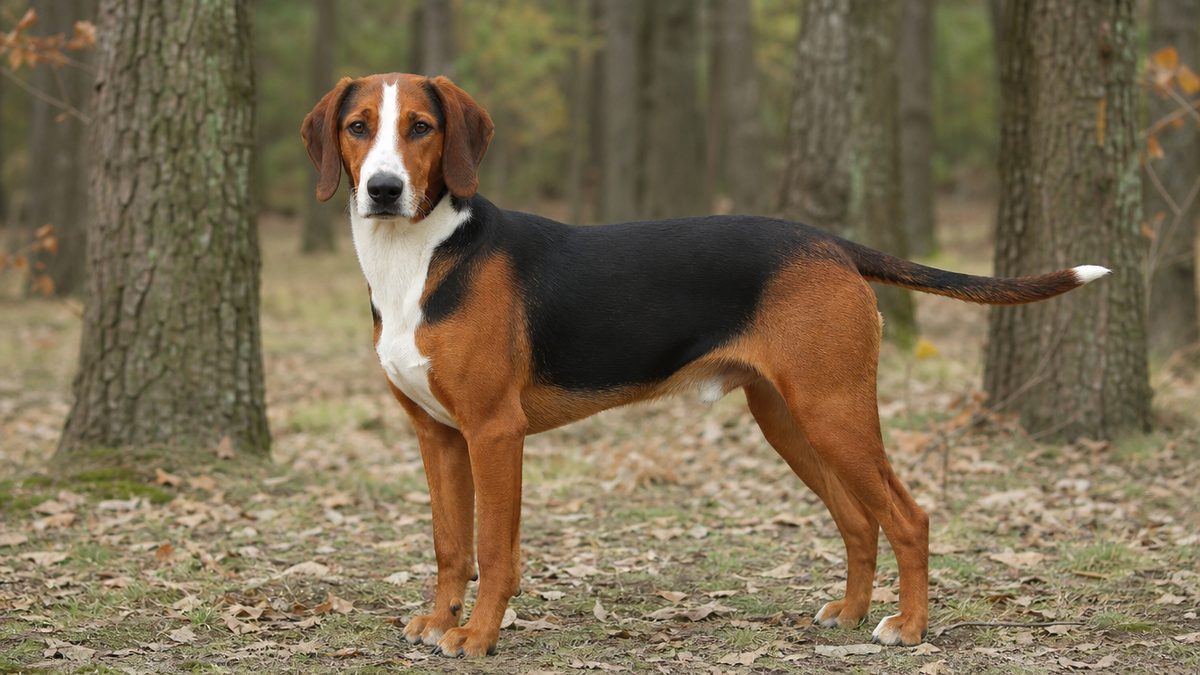
The Serbian Tricolour Hound is a medium-sized Serbian scent hound, deep red with a black mantle and white head, neck and chest markings, recognised by the Federation Cynologique Internationale as standard 229 in Group 6, Section 1.2.
Its Serbian name is Srpski trobojni gonic, which the FCI's authentic French edition renders chien courant tricolore serbe and its German edition Dreifarbiger Serbischer Laufhund FCI-Standard Nr. 229. The FCI files it under S for SRPSKI on its own letter index, so a search under the English name will not find it there.
The standard describes a medium-sized dog of robust constitution, full of character, lively and energetic, whose preferred pace is a free trot that is regular, harmonious and even, with long steps and stretching reach. Two proportions define the outline: the body is 10 percent longer than the height at the withers, and the head is 45 percent of the height at the withers.
The one-line answer for an Indian buyer
You cannot buy one here. India's largest published dog price list covers more than fifty breeds, names the Labrador eleven times and the Beagle nine, and contains the word Serbian zero times. No verified Indian listing for a live dog of this breed was found, and DGFT policy rejects any import application made for breeding or trading purposes.
What makes this breed a breed at all
White markings, and nothing else that a measurement can capture. This dog and the Serbian Hound were argued about in 1946 on precisely the question of whether one was a variety of the other, and the standards they carry eighty years later are almost identical everywhere except colour FCI Standard N 150. That argument, and what the two documents actually say, is the substance of this page.
It also carries the tightest date conflict this site has recorded inside the FCI's own paperwork: four language editions of its standard say 25 July 1961, and the FCI's own register says 23 July 1961.
It will not quote a rupee price, convert a European asking price into rupees, name a breeder, or print a lifespan nobody measured. Where a figure does not exist, this page says so and shows you the document it is missing from.
Breed recognition: FCI 229, and two days the FCI cannot agree on
The FCI's breed record gives the Serbian Tricolour Hound definitive acceptance on 23 July 1961, and all four language editions of the FCI's own standard for the breed say 25 July 1961.
The record is plain enough on its face. Group 6, Section Scent hounds, Subsection Medium-sized Hounds, with working trial. Country of origin Serbia. Breed status recognised on a definitive basis. Official authentic language French. Date of acceptance on a definitive basis 23 July 1961, and date of publication of the official valid standard 26 November 2002.
The standard's own history closes with this sentence: The F.C.I. recognised the breed and published the standard for the tricoloured Yugoslav scent hound on July 25th, 1961. The authentic French says la FCI a reconnu la race et publie le standard du chien courant tricolore yougoslave le 25 juillet 1961. The German says am 25. Juli 1961 and the Spanish says el 25 de julio de 1961 Estandar-FCI N 229.
| Document | Dated | Recognition date it gives |
|---|---|---|
| FCI breed record 229 | live, read 9 September 2026 | 23 July 1961 |
| FCI standard 229, English | 11.12.2002 | 25 July 1961 |
| FCI standard 229, French, the authentic text | 11.12.2002 | 25 July 1961 |
| FCI standard 229, German | 11.12.2002 | 25 July 1961 |
| FCI standard 229, Spanish | 12.01.2005 | 25 July 1961 |
Four editions against the register rules out a translation artefact, which is the usual explanation when one language differs from the others. Here the outlier is the register, and it is the document the FCI serves first to anybody looking the breed up.
How this compares to the rest of the cluster
| Breed | FCI register | The standard's own history | Gap |
|---|---|---|---|
| Karst Shepherd | 24 July 1957 for the Sarplaninac | separation on 16 March 1968 | about eleven years |
| Montenegrin Mountain Hound, FCI 279 | 24 June 1969 | 8 May 1969, at Warsaw | 47 days |
| Serbian Hound, FCI 150 | 30 March 1955 | FCI adopted the standard at Bled on 14 May 1940 | about fifteen years |
| Serbian Tricolour Hound, FCI 229 | 23 July 1961 | 25 July 1961 | two days |
| Posavatz Hound, FCI 154 | 8 April 1955 | the FCI published the first standard on April 8th 1955 | none, they agree |
Four conflicts and one clean agreement across five breeds from one region and one era. That is a property of how these standards were compiled rather than a failure of any single document, and the useful response is to check both ends and publish what you find rather than to pick the convenient date.
The date format proves itself
The FCI prints dates as month, day, year. The same record set carries 8/31/1954, 3/30/1955, 7/23/1961 and 5/29/2015. Thirty-one, thirty, twenty-three and twenty-nine cannot be months, so 7/23/1961 is 23 July.
India is a full FCI member represented by the Kennel Club of India in Chennai, so the KCI issues pedigrees against FCI nomenclature and FCI 229 is a definitively recognised breed here in exactly the sense it is anywhere. That is a fact about paperwork. No Indian breeder, no Indian registration figure and no Indian listing was found.
History and origins: the 1946 argument that created the breed
The breed's history and origins begin with an argument rather than a founder: in 1946 the theory that this dog was merely a variety of the Serbian scent hound was refuted, it was granted breed status, and a first standard was drawn up.
FCI standard 229 states it in one sentence: The tricoloured scent hound has the same origins as the other Balkan scent hounds. In 1946 the theory that this breed was merely a variety of the Serbian scent hound was refuted; it was granted breed status and a first standard was drawn up.
The authentic French uses a softer verb. It says l'hypothese que cette race ne serait qu'une variete du chien courant serbe a ete debattue, that the hypothesis was debated, where the English says refuted. The Spanish follows the French with se discutio la hipotesis. So the authentic text records a debate and the English translation records a verdict, and since French is the authentic language on this standard, debated is the version that governs.
| Date | What the standard says happened |
|---|---|
| 1946 | the variety theory is debated or refuted, breed status is granted, a first standard is drawn up |
| 7 and 8 June 1950 | the breed is shown to cynological circles at the Belgrade International Dog Show |
| 25 July 1961 | the FCI recognises the breed and publishes the standard for the tricoloured Yugoslav scent hound |
| 26 November 2002 | the current valid standard is published |
| 11 December 2002 | the English, French and German editions are dated |
It was recognised as a Yugoslav breed, and nobody dates the rename
All four editions record the FCI recognising the tricoloured Yugoslav scent hound, and the German edition's history still opens by naming Der Dreifarbige Jugoslawische Laufhund even though its title says Dreifarbiger Serbischer Laufhund. Somewhere between 1961 and 2002 the breed became Serbian, and standard 229 does not say when.
Its sibling does. FCI standard 150 records that on 12 November 1996, at its meeting in Copenhagen, the FCI General Committee accepted a motion from the Yugoslav Cynological Association that the name Balkan scent hound be replaced by Serbian hound. Standard 150 was published in 2003 and standard 229 in 2002, so the later document simply had the habit of writing the renaming down and the earlier one did not.
Why 1946 matters more than it looks
A breed created by settling an argument about whether it was a variety is a breed whose identity rests on the argument. Read the two standards side by side today and the case for separation is thinner than the word refuted implies, which is the subject of the next section. That is not a criticism of Serbian cynology. It is what makes this one of the more interesting entries in Group 6, and it is the thing every ranking page leaves out.
Refuted and debated are not the same word, and a reader deciding how settled the 1946 separation is will reach different conclusions from each. The FCI names its authentic language on the face of every standard, and here it is French. When a history clause makes a claim about how firmly something was established, read the authentic text before quoting the translation.
What FCI standard 229 actually says, measurement by measurement
FCI standard 229 gives males 45 to 55 cm at the withers with an ideal of 51 cm and females 44 to 54 cm with an ideal of 49 cm, and gives no weight and no life expectancy in any of its four language editions.
| Item | What the standard says |
|---|---|
| Height at withers, males | 45 to 55 cm, ideal 51 cm |
| Height at withers, females | 44 to 54 cm, ideal 49 cm |
| Weight | not given, in any language edition |
| Life expectancy | not given |
| Body length | 10 percent greater than the height at the withers |
| Chest height | 50 percent of the height at the withers |
| Chest girth | 20 percent greater than the height at the withers |
| Head length | 45 percent of the height at the withers |
| Muzzle to skull ratio | 8.5 to 10 |
| Neck and shoulder angle | 45 to 50 degrees to the horizontal |
| Stifle angle | about 120 degrees; hock 135 to 140 degrees |
| Coat colour | deep red or foxy red with a black mantle or saddle |
| White markings | star on the head, blaze down the muzzle, complete or partial collar, chest, belly and inside of legs, tail tip |
| Maximum white | not more than one third of the total body surface |
| Dentition | complete scissor bite; pincer bite allowed; absence of two PM1 tolerated |
The disqualification list is where the breed is defined
FCI 229 disqualifies aggressive or overly shy dogs, any dog clearly showing physical or behavioural abnormalities, an overshot or undershot mouth, a missing tooth other than the tolerated two PM1, a china eye, a body that is too long, a curled or high-carried or hooked tail, white marks speckled with the base coat colour, white over more than a third of the body surface, the presence of a fourth colour, and size outside the range.
The fourth-colour clause is the one worth noticing. Of the six Group 6 standards in this cluster, this is the only one that disqualifies a dog for having one colour too many, which is exactly what you would expect of a breed whose entire separate identity is its colour scheme.
Three published weights for a standard with none
| Source | Weight claimed | In kilograms | Agrees with the standard |
|---|---|---|---|
| FCI standard 229 | nothing, in four languages | not applicable | this is the document |
| Wikipedia infobox | 20 to 25 kg (44 to 55 lb) | 20 to 25 | no source in the standard |
| PetGuide spec card | 44 to 55 lb | 20.0 to 24.9 | no source in the standard |
| Wikipedia body text | 20 to 25 kilograms, attributed to Serbian Hounds | 20 to 25 | and it names the wrong breed |
Compare that with the sibling. The Serbian Hound is given about 20 kg by Wikipedia and 15 to 23 kg by DogZone, so the two breeds, whose standards contain no weight and whose heights differ by one centimetre, have been assigned different published weights by the same sources. Nobody measured either.
A translation knot in the colour clause
The English colour clause reads: The white star on the head and the blaze which stretches down the muzzle form a complete or partial collar under and around the neck. A star and a blaze cannot form a collar. The authentic French makes the sense clear by listing them, le blanc en pelote sur la tete et en liste qui s'etend sur le museau forme au-dessous et autour du cou un collier complet ou partiel, meaning the white appears as a head patch and a muzzle blaze and also forms a collar. The English reads as one sentence describing one thing when the original describes three.
Crate size, harness fit, boarding tier and, most of all, drug dosing are keyed to weight. A dog dosed off 20 kg when it is 25 kg is under-dosed by a fifth. Weigh your own dog on a vet's scale and use that number, not one from a breed page whose sources disagree with each other and with the sibling breed.
Set against the Serbian Hound, measurement by measurement
Set against the Serbian Hound, the Serbian Tricolour Hound differs by one centimetre at each end of the male height range and by its white markings, and by nothing else the two standards record.
This is the comparison the 1946 argument turned on, and it is the one no ranking page runs. Both standards are on the FCI's own server, both were extracted here with pypdf, and the rows below are read straight off them.
| Clause | Serbian Hound, FCI 150 | Serbian Tricolour Hound, FCI 229 | Same? |
|---|---|---|---|
| Height, males | 46 to 56 cm, ideal 51 to 52 | 45 to 55 cm, ideal 51 | one cm apart |
| Height, females | 44 to 54 cm, ideal 48 to 49 | 44 to 54 cm, ideal 49 | identical range |
| Body length | 10 percent more than height | 10 percent more than height | identical |
| Chest girth | 20 percent more than height | 20 percent more than height | identical |
| Chest height | 50 percent of height at withers | 50 percent of height at withers | identical |
| Head length | 45 percent of height at withers | 45 percent of height at withers | identical |
| Head shape | Dolichocephalic | Dolichocephalic, slim | near identical |
| Stop | almost imperceptible | almost imperceptible | identical |
| Neck angle | 45 to 50 degrees | 45 to 50 degrees | identical |
| Stifle angle | around 120 degrees | about 120 degrees | identical |
| Hock angle | 135 to 140 degrees | 135 to 140 degrees | identical |
| Base colour | fox red, yellowy red to rust | deep red or foxy red | near identical |
| Black | mantle or saddle up to the head, temple marks | mantle or saddle up to the head, temple marks | identical |
| Coat | short, abundant, gleaming, thick, with undercoat | short, abundant, gleaming, slightly thick, undercoat quite well developed | near identical |
| White | a round chest mark up to 2 cm only; more disqualifies | star, blaze, collar, chest, belly, legs, tail tip; up to one third | the whole difference |
| Temperament clause | kind, lively, dependable, remarkable tenacity | devoted, kind, lively, dependable, remarkable tenacity | one word added |
Sixteen clauses, and the two documents diverge on two: white, and a single centimetre of male height Federation Cynologique Internationale. The temperament clauses differ by one word, devoted, which appears in 229 and not in 150 FCI Standard N 229.
What that does and does not prove
It does not prove the 1946 decision was wrong. Two populations can be genuinely separate lines with almost identical conformation standards, especially where the standards were written by the same national body in the same decades and describe the same regional working type. Coat colour is heritable and a colour that breeds true is a real thing to select on.
What it does show is that a buyer cannot tell these two breeds apart by any measurement, and that the FCI's own documents make white the operative test. A red hound with a black saddle and a small chest spot is FCI 150. The same dog with a star, a blaze and a collar is FCI 229. There is no intermediate category, and a Serbian Hound with a blaze is not a poorly marked Serbian Hound but a differently registered dog.
The genetics study covers both, and separates them
Katica 2025 sampled both breeds, eleven Serbian Tricolour Hounds and eight Serbian Hounds, among 85 dogs across eight native Balkan breeds. It found significant interbreed differences in AMY2B copy number and in serum amylase activity, and reported the Serbian Tricolour Hound carrying the highest mean serum glucose of the eight breeds at 3.95 plus or minus 0.50 mmol/L against the Istrian Wire-haired Hound's 3.06 plus or minus 0.57. The glucose difference across breeds was not statistically significant at p equals 0.340, so this is a numerical observation rather than a finding.
Serbian cynology also recognises the Srpski zuti gonic, the Serbian Yellow Hound, which the FCI does not hold. A yellow or fawn hound offered as a Serbian breed has no FCI standard behind it at all, and it is neither of the two breeds on this page.
The head the standard calls dolichocephalic and the study calls mesocephalic
FCI standard 229 opens its head clause with the words Dolichocephalic, slim, and McMillan 2024's Supplementary Table S5 files the Serbian Tricolour Hound as Mesocephalic, which is a flat disagreement between two primary sources about the same dog's skull.
The standard is explicit. HEAD: Dolichocephalic (narrow skull base coupled with great length), slim; top lines of skull and foreface are divergent. It is the first word of the clause, and the sibling standard opens the same way.
McMillan 2024 classified every breed it considered by KC group, FCI group, body size and cephalic index across a 345-row table. The Serbian Tricolour Hound's row reads N for inclusion, NA for KC group, Scent hounds and related breeds for FCI group, Medium for body size, and Mesocephalic for cephalic index.
| Breed | FCI standard's own word | McMillan Table S5 |
|---|---|---|
| Serbian Tricolour Hound, FCI 229 | Dolichocephalic, slim | Mesocephalic |
| Serbian Hound, FCI 150 | Dolichocephalic | Mesocephalic |
| Hungarian Hound, Transylvanian Scent Hound, FCI 241 | the standard does not use the word | Dolichocephalic |
| Posavatz Hound, FCI 154 | the standard does not use the word | Mesocephalic |
| Tyrolean Hound, FCI 68 | the standard does not use the word | Mesocephalic |
| Coarse-haired Styrian Hound, FCI 62 | the standard does not use the word | Mesocephalic |
Only two of the six standards in this cluster use the term, and the study disagrees with both. The one breed the study calls dolichocephalic has a standard that never uses the word. Neither source is being careless: a standard describes a type in words and a study needs one consistent index across 345 rows, and those are different jobs done for different purposes.
Why an Indian reader should care about a skull word
Muzzle length is the dog's radiator. A dog sheds heat by moving air over the moist surfaces of its nose and mouth, so a longer muzzle offers more evaporative surface for the same body mass. That is the mechanism behind the brachycephalic heat literature, and it runs the other way too: a genuinely long-headed hound has more cooling capacity than a mesocephalic dog of the same size.
So the disagreement is not academic here. If the standard is right, this breed has slightly better equipment for Indian heat than its Table S5 row implies. If the study is right, it does not. This page publishes both and follows neither, because neither document reports a measured skull of an actual Serbian Tricolour Hound.
Do not average them and do not pick the convenient one. Name both, say who says what, and let the reader see the question is open. The heat advice on this page rests on wet bulb and on the exertional trigger finding, neither of which depends on which cephalic label turns out to be correct.
Telling it apart from the other Balkan hounds
Six Balkan and Alpine scent hounds entered the FCI register between 1954 and 1963, all in Group 6 Section 1.2, and colour is the only thing that separates several of them in the field.
| FCI number | FCI name | Origin | Definitive acceptance |
|---|---|---|---|
| 62 | Steirische Rauhhaarbracke, Coarse-haired Styrian Hound | Austria | 31 August 1954 |
| 68 | Tiroler Bracke, Tyrolean Hound | Austria | 8 October 1954 |
| 150 | Srpski gonic, Serbian Hound | Serbia | 30 March 1955 |
| 154 | Posavski gonic, Posavatz Hound | Croatia | 8 April 1955 |
| 229 | Srpski trobojni gonic, Serbian Tricolour Hound | Serbia | 23 July 1961 |
| 241 | Erdelyi kopo, Hungarian Hound and Transylvanian Scent Hound | Hungary | 30 March 1963 |
Every one is filed in Group 6, Section 1, Scent hounds, Subsection 1.2, Medium-sized Hounds, and every one is subject to a working trial. That last point is not decoration: a breed subject to a working trial cannot take an FCI international show championship on looks alone, which is why these hounds have stayed functional and why almost none has a pet market anywhere.
The three-second field test
- Deep red with a black saddle plus a white star, blaze and collar: Serbian Tricolour Hound, FCI 229.
- The same red and black with at most a 2 cm white chest spot and no other white: Serbian Hound, FCI 150.
- Reddish wheaten with white on head, neck, chest, belly, feet and tail tip, and no black at all: Posavac Hound, FCI 154.
- Black with tan markings and hazelnut eyebrow spots: Montenegrin Mountain Hound, FCI 279.
- Snow white with orange markings: one of the two Istrian hounds, FCI 151 short-haired or FCI 152 wire-haired.
The Posavac is the one most often confused with this breed from a photograph, because both are red and white. The difference is black: a Posavac Hound carries none, and any grey or black shading on its body is treated as the sign of a third colour and disqualifies it. This breed requires black.
The one genetics study that covers this breed
| Breed | Code | Dogs sampled |
|---|---|---|
| Bosnian Broken-haired Hound, Barak | BAR | 14 |
| Istrian Short-haired Hound | ISTK | 14 |
| Posavatz Hound | POS | 13 |
| Yugoslavian Shepherd Dog, Sharplanina | SAR | 12 |
| Serbian Tricolour Hound | TRO | 11 |
| Serbian Hound | SRP | 8 |
| Istrian Wire-haired Hound | ISTO | 7 |
| Tornjak | TOR | 6 |
Those eight sample sizes sum to 85, which is exactly the total the paper reports, so the transcription closes. Six of the eight are Group 6 medium-sized scent hounds and two, the Sharplanina and the Tornjak, are Group 2 livestock guardians included as a contrast, which the paper says itself.
The paper's abstract names only two of its eight breeds, the two extremes on AMY2B copy number, so a title-and-abstract search for Serbian Tricolour Hound finds nothing while the breed is plainly in the study with eleven dogs and its own reported figure. An absence read off an abstract index is an absence in the index. Search Balkan Hound instead and the paper comes straight back, alongside the Barak genetic diversity study.
Serbian Tricolour Hound price in India
No Serbian Tricolour Hound price in india exists, because no verified Indian listing for a live dog of this breed was found and the breed appears zero times in India's largest published dog price list.
That negative is well evidenced, because there is a good Indian instrument to test it against. Wrapinfur publishes a Dog Price List in India 2026 covering more than fifty breeds. Fetched on 9 September 2026 it ran to 36,126 characters of visible text, in which Labrador appears eleven times and Beagle nine times, and Serbian appears zero times. The controls pass and the absence is real.
What the search actually returned
Bing India printed About 51,000 results for the bare breed name and returned pages about the country: the Wikipedia articles for Serbia and for the Serbian language, and Britannica's entry for Serbia the place. In the same session the labrador retriever price in india control printed About 16,200 results and was headed by fluffyn.co.in, a genuine Indian dog site. The control passed and the breed query was substituted on the token Serbian.
51,000 results looks like evidence of interest and is evidence of nothing at all: those results are about a country of seven million people, not about a dog. This site corrected three published pages that had read a printed count as market size. What evidences a market is composition, meaning a listing, a breeder, a registration figure and a lawful import route. None of the four exists here.
The tests any rupee figure would have to pass
| Test | What it catches | Result here |
|---|---|---|
| Divide by 84.38 | a US dollar price presented as rupees | no rupee figure exists to test |
| Divide by 74 | a wholesale conversion of an older US price list | no rupee figure exists to test |
| Divide by 80 | weak; anything ending in three zeros passes by construction | no rupee figure exists to test |
| Check the host country of any Rs figure | Pakistani rupees printed with the same abbreviation | no South Asian listing found |
| Confirm the listing sells a live animal | posters, mugs and prints presenting as a breed price | no India-facing listing of any kind |
| Check the destination resolves at all | a dead or resold domain still ranking | one top result fails DNS entirely, see below |
One of the top-ranking pages does not exist
earthpedia.earth.com ranks among the top results for this breed and, fetched on 9 September 2026, it failed DNS resolution outright with getaddrinfo failing. The search index still carries it and the destination is gone. That matters because a search summary can quote text from a page that no longer serves it, and a figure attributed to a dead domain cannot be checked by anybody.
What you would actually be offered
If an Indian seller advertises a Serbian Tricolour Hound, assume it is a different dog until proved otherwise. Red-and-black with white markings is one of the commonest colour patterns in Indian free-roaming dogs and in Beagle crosses, so a photograph proves nothing. The verification list is in the adoption section at the end of this page.
What a Serbian Tricolour Hound would cost to keep in India each month
A 20 to 25 kg working scent hound in an Indian metro costs roughly Rs 6,000 to Rs 11,000 a month once food, parasite control, vaccination amortised across the year and occasional grooming are counted, and every figure below was read live rather than carried forward.
The monthly cost of keeping a dog in India is real and sourceable even when the purchase price is not. These are the lines an Indian owner actually meets, re-read on 9 September 2026 rather than copied from an older pull.
| Item | Published price | Source and scope |
|---|---|---|
| Puppy core vaccination course | Starts at Rs 6,499, against a struck-through Rs 8,111 | Vetic national page, a chain's promotional floor |
| Annual booster | Starts at Rs 3,199, against Rs 3,806 | Vetic national page |
| Anti-rabies, single | Rs 699 | Vetic |
| 9-in-1 DHPPiL, single | Rs 899 | Vetic |
| Kennel cough | Rs 1,349 | Vetic |
| Tick, flea and worm control | Rs 3,308 for three months, so Rs 1,103 a month | NexGard Spectra 15-30 kg at Supertails |
| Deworming, six tablets | Rs 813, dosed one per 10 kg | Drontal Plus at Supertails |
| Bathing | From Rs 934 | Vetic, Delhi |
| Nail clipping and ear cleaning add-ons | From Rs 99 | Vetic, Delhi |
| Boarding, 24 hours | Rs 899, with festive rates 25 to 30 percent higher | PawSpace, Bengaluru |
| Municipal registration, Delhi | Rs 500 new and Rs 500 renewal, Rs 100 a month late fee | MCD pet dog portal |
| Municipal licence, Chennai | Rs 50 | Greater Chennai Corporation |
Two caveats belong in the body rather than a footnote. The Vetic figures are Starts at promotional floors from one chain rather than a market average, and the same chain quotes different course prices on different city pages on the same day Vetic, Pet Grooming in Delhi. And the Drontal Plus strip moved within a week, from Rs 754 on 2 September 2026 to Rs 813 on 9 September, against an unchanged MRP of Rs 838. Retail rows are perishable; municipal fees are not.
The dosing problem this breed creates
Look at the parasite line again. NexGard Spectra is banded 15 to 30 kg, and this breed's published weights straddle the middle of that band while its standard gives no weight at all. A dog at the top of the band needs the same tablet as one at the bottom, which is fine, but the moment you move to a product with narrower bands the missing weight becomes a real clinical problem. Weigh the dog.
The Chennai line is the one to act on
Greater Chennai Corporation issues pet animal licences for Rs 50 and provides treatment and anti-rabies vaccination free of cost at its own pet clinics. Against a Rs 699 private anti-rabies shot that is a real saving for any Chennai resident with any dog. Delhi's MCD registers pet dogs only, at Rs 500 new and Rs 500 on renewal, with a Rs 100 per month late fee after a one-month grace period running from the anti-rabies expiry date.
- Grooming is the cheapest line, because a short coat with an undercoat needs a rubber mitt rather than a groomer.
- Ear care is the line that rises, because high-set pendant ears lying close to the cheeks trap moisture in an Indian monsoon.
- Parasite control is the largest recurring line at Rs 1,103 a month and the least skippable.
- Boarding costs more than the dog's size suggests, because a pack hound does badly in a kennel run and needs a home-stay rate.
Several Indian breed sites publish monthly running costs assembled from a small set of preset lines assigned per breed, so unrelated breeds carry byte-identical totals and a Pug and a wire-coated terrier get the same grooming figure. If you meet a monthly cost table for this breed, pull an unrelated breed from the same site and compare the component lines to the rupee before believing either.
Serbian Tricolour Hound heat tolerance in India, tested against Belgrade
Heat tolerance is the weakest thing about this breed in India, and Belgrade is the only point in its homeland NASA POWER can measure accurately, so the comparison below uses Belgrade and says plainly why central Serbia is excluded.
A reanalysis grid returns a cell, not a point, and in hilly country a cell's mean elevation can sit hundreds of metres above the town underneath it. Serbia is exactly that kind of country, so every point below was checked before any figure was taken from it.
| Point | Cell elevation | Real elevation | Cell error | Usable |
|---|---|---|---|---|
| Belgrade | 92.76 m | about 117 m | minus 24 m | yes |
| Uzice, western Serbia | 563.96 m | about 411 m | plus 153 m | marginal, not used |
| Kraljevo, central Serbia | 795.64 m | about 206 m | plus 590 m | no |
| Delhi | 206.37 m | about 216 m | minus 10 m | yes |
| Chennai | 48.95 m | about 6 m | plus 43 m | yes |
| Bengaluru | 841.72 m | about 920 m | minus 78 m | yes |
| Shimla, as a control | 897.65 m | about 2,200 m | minus 1,302 m | no |
The Kraljevo row is the finding. Central Serbia comes back as a place 590 metres higher than it is, and the cell duly returns an annual mean of 9.09 C and an August peak of 20.22 C for a town that is nothing like that cool. Publishing that as the homeland climate would understate the heat these dogs already handle and make the Indian comparison look worse than it is. The Shimla row is there as a control: POWER reports one of India's coldest large towns as an 897 m place with a 21.15 C annual mean.
Belgrade against six Indian cities
| Place | Annual mean | Annual RH | Hottest month mean | Coolest month mean | Peak wet bulb |
|---|---|---|---|---|---|
| Belgrade, Serbia | 12.45 C | 71.5 percent | 24.38 C (Jul) | minus 0.32 C (Jan) | 18.25 C (Jul) |
| Delhi | 25.60 C | 45.6 percent | 35.88 C (Jun) | 13.61 C (Jan) | 26.50 C (Jul) |
| Mumbai | 26.77 C | 67.4 percent | 31.19 C (May) | 23.19 C (Jan) | 25.77 C (Jun) |
| Chennai | 27.95 C | 72.4 percent | 31.51 C (May) | 24.09 C (Jan) | 26.11 C (May) |
| Kolkata | 25.81 C | 73.9 percent | 31.53 C (May) | 17.31 C (Jan) | 27.09 C (Jun) |
| Pune | 23.86 C | 66.8 percent | 28.93 C (Apr) | 19.62 C (Dec) | 22.97 C (Jun) |
| Bengaluru | 23.74 C | 67.9 percent | 28.37 C (Apr) | 20.22 C (Dec) | 21.86 C (May) |
Belgrade is not a dry place. At 71.5 percent annual relative humidity it is more humid than Pune and Bengaluru and a point below Mumbai. So the thing that will hurt this dog in India is not damp air by itself. It is heat, and heat combined with damp air.
Wet bulb is the number that decides
Wet bulb temperature is what a body can reach by evaporating water, and it is the best single measure of how hard cooling will be. Belgrade peaks at 18.25 C in July. Kolkata peaks at 27.09 C in June and Chennai at 26.11 C in May Stull R. Wet-Bulb Temperature from Relative…. That is 8.8 degrees of extra evaporative load in the worst month, on a dog whose homeland tops out at eighteen. Bengaluru at 21.86 C and Pune at 22.97 C are the only large Indian cities where the gap narrows below five degrees.
The standard describes hair that is short, abundant, gleaming and slightly thick, lying well all over the body, with an undercoat that is quite well developed. An undercoat is insulation. A short-coated dog is not automatically heat-tolerant, and a short coat over a developed undercoat is a temperate working jacket rather than anything bred for a Chennai May.
Keeping a Serbian Tricolour Hound safe in Indian heat
To keep a Serbian Tricolour Hound safe in Indian heat, move every session into darkness, keep the dog lean, and treat any collapse in the warm months as heat-related illness until a vet rules it out.
The best evidence on canine heat-related illness comes from a UK cohort of 905,543 dogs under primary veterinary care in 2016, which recorded 1,259 heat-related illness events from 1,222 dogs. Of the 879 events with a recorded trigger, 652 were exertional, which is 74.2 percent; 113 were environmental and 46 were vehicular confinement. Dogs do not mostly overheat in cars. They overheat because somebody exercised them.
That applies with force to a hound the standard credits with remarkable tenacity and long, stretching, energetic steps, because such a dog does not stop when it is too hot. The owner has to make the decision the dog will not make.
The one risk factor that transfers
The companion paper on the same cohort found that a bodyweight at or above the breed and sex mean carried 1.42 times the odds of heat-related illness, and that dogs over 50 kg carried 3.42 times the odds. This breed is nowhere near 50 kg, so the second figure does not apply. The first does, and it is the only modelled risk factor an owner controls directly.
Be careful about what does not transfer. That paper modelled 35 breed categories and this breed is not among them, so it has no breed-specific odds ratio and this page prints none. Its inclusion threshold was five or more heat-related illness cases and, or, 5,000 or more dogs in the study population, which is a disjunction rather than a conjunction. A breed absent from a model is absent, not low risk.
What to actually do, in order
- Walk before sunrise and after full dark from March to October, and treat the middle of the day as unavailable rather than as a judgement call.
- Keep the dog lean, because bodyweight at or above the breed mean is the modelled risk factor at 1.42 times the odds.
- Carry water and offer it before the dog asks, since a scent hound on a trail will not ask.
- Cool a suspected case with tap-temperature water over the whole body and moving air, then get to a vet. Do not use ice.
- Vaccinate and deworm on schedule, because a dog fighting a tick-borne infection has less reserve for a hot afternoon.
- Check the ears after every wet walk, since high-set pendant ears and monsoon humidity are a worse combination than the heat alone.
Where in India this dog could plausibly live
Bengaluru and Pune are the only large Indian cities within reach, at annual means of 23.74 C and 23.86 C and peak wet bulbs under 23 C. Both are still eleven degrees warmer than Belgrade in the annual mean. Chennai, Kolkata, Mumbai and Ahmedabad are not realistic for a dog bred to run all day, and Delhi's June mean of 35.88 C sits 11.5 degrees above Belgrade's hottest month.
The Prevention of Cruelty to Animals (Dog Breeding and Marketing) Rules 2017, Second Schedule Part IV paragraph 21(1), bars keeping in outdoor facilities, without the attending veterinary practitioner's written approval, dogs not accustomed to local temperatures and breeds that cannot tolerate them, giving long-haired breeds in high temperature locations as its own example. A hound from a homeland that freezes in January falls inside the first limb of that clause whatever its coat length.
Temperament, and who should not buy this breed
The Serbian Tricolour Hound's temperament is given in nine words by its own standard, devoted, kind, lively temperament, dependable, showing remarkable tenacity, and that clause is the only published evidence about this breed's character.
FCI 229 says: BEHAVIOUR/TEMPERAMENT: Devoted, kind, lively temperament; dependable, showing remarkable tenacity. The general appearance clause adds full of character, lively and energetic. That is the complete published description of this dog's mind.
It is worth noticing that the sibling standard's clause is the same minus one word. FCI 150 says kind, with lively temperament, dependable, showing remarkable tenacity, and does not say devoted. Whether one added adjective in a 2002 document describes a real behavioural difference between two populations separated in 1946 is not a question any published study can answer, and this page does not pretend otherwise.
No temperament survey, no bite-incidence study and no behavioural questionnaire exists for this breed. A page telling you it is good with cats or wary of strangers is describing hounds in general with a breed name attached.
What the standard implies that the marketing does not
- Remarkable tenacity is the operative phrase. This is a dog bred to hold a line for hours, which is admirable in a Serbian oak wood and exhausting in a flat.
- A pack hound is a vocal hound. Balkan hounds were selected to be heard at distance in cover, and that does not switch off in a housing society.
- Lively and energetic in an FCI standard means a working energy budget, not a brisk twenty-minute walk.
- Devoted, kind and dependable describe handling. They say nothing about recall at 300 metres on a fresh trail, where this breed is an independent worker.
Prey drive, and what it means on an Indian street
The breed is worked to hunt in packs, and the usual quarry across the Balkans for this type is fox and hare, with the more tenacious individuals used to hunt boar and deer. Hunting is what every clause of the standard is written around. That is a wide prey-size range and it implies a serious prey drive around anything smaller than the dog. On an Indian street that means free-roaming dogs, cats, poultry and cattle, all of which a hound may treat as game. Off-lead work is not a realistic goal and a long line is permanent equipment.
Who should not buy one
Anybody in an apartment, on the voice alone. Anybody who wants a dog reliably off-lead in an Indian city. Anybody whose reason for wanting the breed is that it is rare, because the rarity reflects an absent market rather than a special dog. Anybody who cannot commit to two dark hours a day, every day, for twelve years or more.
Who it suits is a household with land outside a metro, someone who genuinely walks a dog before dawn and after dusk, and neighbours far enough away not to mind the noise. That is a small population in India, and saying so is more useful than a paragraph about how affectionate the breed is.
Scent hounds bark at what they notice, which reads as alertness and is not protection. The standard says nothing about guarding, nothing about suspicion of strangers and nothing about territoriality. If you want a dog that deters, this is not the breed, and a hound that barks at everything is worse than useless as a warning.
Training a Serbian Tricolour Hound, and what it will resist
To train a Serbian Tricolour Hound, work with the nose instead of against it: build recall on food and scent games from eight weeks, socialise hard through the first sixteen weeks, and accept that off-lead reliability near livestock is not achievable.
The standard calls the breed dependable and credits it with remarkable tenacity, which describes a dog that finishes a job rather than one that watches its handler. A pack scent hound is trainable to a task and independent at distance, and both are true at once.
The first sixteen weeks decide the next twelve years
- Socialise deliberately to Indian street conditions: horns, firecrackers, construction, temple bells, cattle and free-roaming dogs.
- Pair every new surface, sound and person with food, in sessions of a few minutes rather than a few tens of minutes.
- Build recall as a game with a jackpot, indoors first, long before any competing scent exists.
- Teach a settle on a mat early, because a vocal hound that cannot switch off is the version that gets rehomed.
- Fit a well-adjusted harness from the start, since a 20 kg hound pulling into traffic is a genuine safety problem.
What it will resist, and what works instead
| What it resists | Why | What works instead |
|---|---|---|
| Recall in open ground | bred to work a line independently, often in a pack | long line, tracking games, a fenced area for free running |
| Ignoring livestock and street dogs | quarry range runs from hare to boar | distance management and an emergency stop trained on lead |
| Being quiet on demand | selected to be heard at distance in cover | reduce the trigger and reward an alternative; never punish the bark |
| Nine hours alone in a flat | a pack animal by breeding and by use | a real midday break, indoor scent work, a second person at home |
| Repetitive obedience drilling | an independent worker rather than a biddable one | short sessions ending before disengagement, with a scent reward |
Use the nose, do not fight it
Scatter feeding and indoor scent games are the highest-value thing an owner can do in an Indian flat. Twenty minutes of finding food in a room tires this dog differently from twenty minutes of walking, and through most of the Indian year the indoor option is the only one available for most of the day. It costs nothing and it uses the trait everyone else treats as the problem.
Guidance written for a European hound club is not automatically lawful here. Indian law prohibits two named mating techniques outright: in breeding, defined as breeding between relatives of the second to fourth grade within the first four generations, and incest breeding, defined as mating between parents and children or between brother and sister. That is Second Schedule Part II paragraph 6(3), not Rule 6(3), and the distinction matters to anyone who looks it up.
How much exercise a Serbian Tricolour Hound actually needs
A Serbian Tricolour Hound needs about two hours of real work a day across at least two sessions, and in most of India both sessions have to happen in the dark.
The standard names the gait precisely: long steps, energetic and stretching reach, with a preferred pace of a free trot that is regular, harmonious and even. It describes a body built to cover ground, with chest girth 20 percent greater than height at the withers and a body 10 percent longer than tall. That is an endurance animal, and a twenty-minute walk twice a day is a maintenance dose for a small pet rather than for this.
The Indian daylight problem, in numbers
| City | Hottest month mean | Peak wet bulb | Realistic exercise window |
|---|---|---|---|
| Delhi | 35.88 C (Jun) | 26.50 C (Jul) | before 06:00 and after 21:00, April to October |
| Chennai | 31.51 C (May) | 26.11 C (May) | before 06:00 and after 20:30, most of the year |
| Kolkata | 31.53 C (May) | 27.09 C (Jun) | before 06:00 and after 21:00, March to October |
| Mumbai | 31.19 C (May) | 25.77 C (Jun) | before 06:30 and after 20:30, most of the year |
| Pune | 28.93 C (Apr) | 22.97 C (Jun) | before 07:00 and after 19:30, March to June |
| Bengaluru | 28.37 C (Apr) | 21.86 C (May) | before 07:00 and after 19:30, February to May |
Those windows follow from exertion accounting for 652 of the 879 heat-related illness events with a recorded trigger in the largest study of the subject. A working hound in Indian daylight in May is the precise scenario that produced most of those cases.
What two hours should contain
- Forty-five to sixty minutes of steady trotting on lead, morning and evening, which is the gait the standard names.
- Twenty minutes of scent work several times a week, using a long line and a dragged trail.
- Free running only inside a fence, because a fence is the only place recall can be relied on with this breed.
- A rest day is fine; a rest week is not. An athletic hound that is under-exercised becomes destructive first and vocal second.
One practical Indian detail: a hound working a scent line on a city footpath will pull hard, and a 20 kg dog pulling into traffic is a real risk. Use a well-fitted harness with a front clip and a fixed two-metre lead rather than a retractable one.
People choose a rare hound because it is rare and then discover the exercise requirement is not negotiable. This breed exists because it could run a Serbian hillside all day. Nothing about being uncommon in India makes it need less.
Grooming in Indian humidity: the ears, not the coat
Grooming a Serbian Tricolour Hound in India is almost entirely ear care, because the coat is a short dense jacket a rubber mitt handles twice a week while high-set pendant ears in humid monsoon air are a recurring veterinary problem.
The standard is brief about the coat: short, abundant, gleaming, slightly thick, lying well all over the body, with an undercoat that is quite well developed and hair slightly longer over the back of the thighs and the underside of the tail. That is wash and wear. It needs no clipper, no stripping knife and no groomer on a schedule.
It also means the Vetic Delhi list, at Rs 1,359 for a haircut and Rs 1,869 for a complete bath and hair styling, is mostly irrelevant to this dog. What an owner would actually buy is an occasional bath from Rs 934 and add-on services from Rs 99 covering nail clipping and ear cleaning.
The ear is the whole job
The standard describes ears set high, of medium length and medium size, pendulous, close to the cheeks, thin rather than thick, with a slightly oval tip. A pendant ear lying flat against the cheek is a warm, dark, poorly ventilated space. Add Indian monsoon humidity and a dog that pushes through wet cover, and you have the standing conditions for otitis externa.
| Job | How often | Why this interval |
|---|---|---|
| Rubber mitt over the whole coat | twice a week | removes dead undercoat; the coat needs nothing more |
| Ear check, look and smell | weekly, and after every wet walk | the highest-value habit for a drop-eared hound in India |
| Dry the ears after a bath or a swim | every time | plug or dry rather than letting them air dry |
| Nails | every three to four weeks | a dog that cannot be walked in daylight wears nails down less |
| Bath | every six to eight weeks, or after mud | over-bathing strips a dense coat and irritates skin |
| Tick check by hand | daily in the warm months | faster and cheaper than any product, and it catches what products miss |
One piece of overseas advice that does not transfer
European hound-club guidance routinely says to towel the dog and let it air dry. That is fine in a Serbian autumn. In an Indian monsoon it is how ears go wrong, and one published Indian case series found the great majority of canine otitis cases presenting in July and August. Dry the ear canal opening properly and plug the ears before a bath rather than after.
One more detail specific to this breed. Its white markings sit exactly where a dog gets most sun: the muzzle blaze, the head star and the chest. Unpigmented skin under thin white hair burns, and in Indian sun that is a real risk on a dog whose standard requires those markings. Watch the muzzle blaze in particular.
No clipping, no hand stripping, no de-shedding blade, no conditioner and no groomer on a monthly schedule. If an Indian grooming package quotes a monthly haircut for this breed, it was written for a different dog. The standard's coat clause is two sentences long and it is the whole specification.
Health and life expectancy, and what the literature does not contain
No life expectancy has ever been measured for the Serbian Tricolour Hound, no health screening scheme exists for it in any country, and not one paper in PubMed names the breed.
That is an uncomfortable answer and it is the correct one. Here is exactly what was searched and what came back, so the claim can be checked rather than taken on trust.
| Source | What it holds for this breed | Control that passed in the same session |
|---|---|---|
| FCI standard 229 | no weight, no life expectancy, an eleven-item disqualification list | the standard's other clauses extracted cleanly |
| PubMed, four name forms | 0 records naming the breed | Labrador Retriever[tiab] 1,109; Beagle AND dog 11,014 |
| Katica 2025 full text | 11 dogs sampled, one reported figure | the paper's own arithmetic closes at 85 dogs |
| McMillan 2024 Table S5 | listed and flagged N, considered and excluded | Labrador, Beagle, Whippet and Great Pyrenees all flagged Y |
| McMillan 2024 Table S3 | no row, which is what flag N predicts | Great Pyrenees present at 10.9 years on 128 deaths |
| Teng 2022 UK life tables | no breed-specific row | the study's own breed set is far larger than this |
| OFA statistics | not readable this session | no control passed, so no absence is claimed |
Flag N is not the same as absent
McMillan 2024 studied longevity in 155 recognised purebreds against a crossbred comparator. Its Supplementary Table S5 runs to 345 rows and carries the Serbian Tricolour Hound with the Included in Survival Analysis column reading N, an FCI group of Scent hounds and related breeds, a body size of Medium and a cephalic index of Mesocephalic. The breed was considered by the authors and excluded, which is a different and more informative statement than not appearing at all.
The same table flags every one of this cluster's six breeds N, along with both Istrian hounds and the Montenegrin Mountain Hound. Teng 2022's life tables, built from the same kind of UK primary-care data, carry no row for the breed either.
Two ranking pages, two different single conditions
DogZone names hip dysplasia as this breed's health section, and names ear infections as the Serbian Hound's, on the same site on the same day Serbian Hound Breed Information, DogZone. Neither page gives a prevalence figure or a source. Two breeds separated in 1946, whose standards differ by one centimetre and by white markings, have been assigned different single health problems by one publisher with no data behind either.
To its credit, DogZone says plainly that as a rare breed there is very little information available, which is more honest than most of the ranking set. PetGuide gives a lifespan of 12 to 15 years, an average litter of 3 to 6 puppies and a group of UKC Scenthound, and names no source for any of them.
What the standard does flag
FCI 229's disqualification list is the closest thing to breed health guidance that exists: aggressive or overly shy dogs, any dog clearly showing physical or behavioural abnormalities, an overshot or undershot mouth, a missing tooth beyond the tolerated two PM1, a china eye, a body that is too long, a curled or high-carried or hooked tail, speckled white markings, white over more than a third of the body, a fourth colour, and size outside the range. Several of those overlap with Indian law's own list of genetic defects a breeding dog must have been tested for, including overshot, undershot jaw and two or more missing teeth, under Second Schedule Part III paragraph 8(10).
The OFA statistics tables load client-side. A direct fetch on 9 September 2026 returned a page in which Labrador, Beagle, Bloodhound, Dalmatian and Rhodesian all appeared zero times, so the instrument was broken and nothing can be concluded from it. OFA requires 100 hip evaluations, or 50 for its other databases, before a breed is published at all, so a Serbian working hound with no American population would be unlikely to appear. That is a reason rather than evidence, and this page does not present it as a finding.
The disease pressure this breed would meet in India
Tick-borne disease is the health risk an imported Balkan hound would actually meet in India, and three recent Indian studies put real numbers on it that no breed page for this dog carries.
This breed has no Indian population, so nothing breed-specific exists. What does exist is recent Indian veterinary literature on the pathogens any dog here meets, and a pack hound that spends hours nose-down in vegetation meets them more than most.
| Study | Place | Dogs | Key finding |
|---|---|---|---|
| Shil 2026 | West Bengal | 584 | Babesia gibsoni 447 of 584 (76.54 percent) by qPCR; Anaplasma 325 of 583 (55.75 percent); 72.9 percent of the 584 dogs screened carried two or more pathogens |
| Venugopal 2026 | Kerala and southern India | 120 | Babesia species 80 of 120 (66.7 percent); Ehrlichia canis 6 of 120 (5.0 percent); cases peaked pre-monsoon, March to May |
| Chakraborty 2025 | Odisha | 178 | Ehrlichia canis 56 of 178 (31.46 percent); 75 percent of infected dogs were over 20 kg; 79 percent had a tick history |
Every one of those studies sampled clinically suspected dogs or a clinic caseload, never a random population. Shil 2026 drew its 584 dogs from animals presenting at the State Animal Health Centre in Salt Lake, Kolkata, between July 2024 and December 2025. So 76.54 percent is the prevalence among dogs a vet was already worried about. It is not the chance your dog has babesiosis, and quoted without that caveat the figure is materially misleading.
The Odisha finding applies directly to this dog
Chakraborty 2025 reports that 75 percent of the Ehrlichia canis positive dogs in its Odisha series weighed more than 20 kg and that 79 percent had a history of tick infestation. A male Serbian Tricolour Hound at an ideal 51 cm sits at or just above that 20 kg line by every published estimate, and it is a dog whose job is to push through cover. The same paper found 55 percent of cases in the summer months and identified the vector as Rhipicephalus sanguineus, the brown dog tick.
The Kerala series adds the seasonal detail that matters for budgeting: cases peaked before the monsoon, in March to May, not during it. Parasite control cannot be a monsoon-only expense.
What this means for the Rs 1,103 a month line
Continuous tick and flea control is the largest recurring cost in the ownership table and the least skippable. NexGard Spectra for a 15 to 30 kg dog is a monthly afoxolaner and milbemycin oxime tablet at Rs 3,308 for three, which is Rs 1,103 a month, and it covers the tick and flea role and the roundworm and hookworm role in one product. Drontal Plus at Rs 813 for six tablets, dosed one per 10 kg, covers a periodic broad deworming.
Do the daily hand check anyway. Shil 2026 found microscopy missing 130 of 158 Babesia canis positives and 146 of 169 Hepatozoon positives against qPCR, which is a warning about diagnosis and a good reason not to assume a dog is clear because one blood smear looked clean.
No usable Indian figure exists in the indexed literature for canine heat stroke prevalence or for canine otitis externa seasonality, and much Indian veterinary work appears in journals PubMed does not index. This page leans on the statutory hook for heat rather than reaching for a prevalence number it cannot source, and says so rather than filling the space.
Feeding a Serbian Tricolour Hound in India
Feed a Serbian Tricolour Hound as a working medium hound on a measured, protein-led diet, and note that the only genetics study covering the breed recorded it carrying the highest mean serum glucose of eight Balkan breeds, on a difference that was not statistically significant.
Katica 2025 measured AMY2B gene copy number, serum amylase activity and serum glucose in 85 dogs across eight native Balkan breeds, eleven of them Serbian Tricolour Hounds. AMY2B encodes pancreatic alpha-amylase and its copy number is one of the clearest genetic differences between dogs and wolves.
| Measure | Value | Note |
|---|---|---|
| Serbian Tricolour Hound serum glucose, mean | 3.95 plus or minus 0.50 mmol/L | the highest of the eight breeds |
| Istrian Wire-haired Hound serum glucose | 3.06 plus or minus 0.57 mmol/L | the lowest of the eight |
| All 85 dogs, serum glucose | 3.51 plus or minus 0.77 mmol/L | individual range 1.08 to 5.94 |
| Statistical significance of the breed difference | p equals 0.340 | NOT significant, so this is an observation |
| All 85 dogs, AMY2B copies | 12.4 plus or minus 2.2 | range 7.7 to 18.4 |
| Dogs with more than eight copies | 83 of 85 | no breed in this set is wolf-like |
| Serbian Tricolour Hounds sampled | 11 | of 85 across eight breeds |
Why this is reported carefully
The glucose difference across breeds was not statistically significant, at p equals 0.340, and the paper says so plainly. Eleven dogs is a small sample and serum glucose moves with fasting state, stress and handling. So the correct statement is that this breed had the highest mean glucose in a study that found no significant interbreed difference in glucose, which is a numerical observation and nothing more.
The paper also found no significant correlation between AMY2B copy number and serum amylase activity, and reported an earlier investigation finding no association between copy number and diabetes mellitus susceptibility. That closes off the tempting inference in both directions.
A practical Indian feeding plan
- Measure every meal by weight rather than by scoop, and adjust on body condition rather than on the bag's chart.
- Split the daily ration into two meals and never feed immediately before or after hard exercise.
- Keep the protein source identifiable and the starch load moderate, given that most home-cooked Indian dog food is rice-heavy.
- Weigh the dog monthly, because a bodyweight at or above the breed mean carries 1.42 times the odds of heat-related illness.
- Use part of the daily ration for scent work rather than adding a separate treat budget.
Ribs, not numbers
The standard gives no weight, so there is no target figure to feed toward. Use body condition instead: ribs easily felt under a thin fat cover, a visible waist from above, and an abdominal tuck from the side. The standard's own underline clause, belly has slight tuck up, describes a dog in correct condition.
A monthly kibble figure is arithmetic rather than a quoted price, and it depends on grams per day for a dog whose standard gives no weight. This site's own reference figure for a large-breed 15 kg bag went stale within days of being recorded. Weigh your dog, read the grams per day off the pack you actually buy, and multiply.
The first year with a Serbian Tricolour Hound puppy
A Serbian Tricolour Hound puppy's first year runs on three clocks at once: a socialisation window that shuts near sixteen weeks, a vaccination schedule running to about four months, and growth plates that keep hard exercise off the table until roughly twelve months.
| Age | What matters most | Indian cost line |
|---|---|---|
| Under 8 weeks | Should still be with the litter. Indian law prohibits the sale of pups under eight weeks under Rule 8(1)(a) | nothing lawful to pay |
| 8 to 12 weeks | Socialisation to street noise, surfaces, people and traffic. Core vaccination course begins | puppy course starts at Rs 6,499 |
| 12 to 16 weeks | The window closes. What the puppy has not met by now is harder forever | anti-rabies Rs 699 as scheduled |
| 4 to 6 months | Lead manners, settle on a mat, first scent games. Municipal registration | Rs 500 in Delhi, Rs 50 in Chennai |
| 6 to 9 months | Adolescent recall collapse. The long line becomes permanent equipment | monthly parasite control Rs 1,103 |
| 9 to 12 months | Growth plates closing. Build duration on lead, not impact | annual booster from Rs 3,199 |
| 12 months | Adult load can begin: two hours a day, split, in the dark | boarding if you travel, Rs 899 a night |
Puppy markings change, and this breed is defined by markings
White markings on a young dog are not always the markings it will carry as an adult, and this is the one breed in the cluster where that matters for registration rather than just for looks. FCI 229 disqualifies white over more than a third of the body surface and white marks speckled with the base coat colour, and PetGuide reports an average litter of 3 to 6 puppies, so a litter can easily contain a pup whose markings put it outside the standard. Ask to see both parents and their registrations rather than judging a six-week-old on its blaze.
The eight-week rule is a Rule; most of the rest are Schedule paragraphs
The eight-week minimum is Rule 8(1)(a) of the Prevention of Cruelty to Animals (Dog Breeding and Marketing) Rules 2017 and it is a genuine Rule. The Rules run 1 to 13 and stop there. Anything numbered above 13 is a Second Schedule paragraph, and the docking prohibition, the in-breeding prohibition and the genetic-defect testing clause are all Schedule paragraphs rather than Rules.
Indian heat changes the puppy timeline
A puppy arriving in April in Delhi faces a problem the same puppy arriving in November does not. The socialisation window does not move for the weather, and the hours in which a puppy can safely be outside in a Delhi June, at a 35.88 C monthly mean, are close to none. Plan the arrival for the cool months if you have a choice, and if you do not, move socialisation indoors and into car journeys rather than skipping it.
- Carry the puppy to busy places before it is fully vaccinated, so the window is not spent waiting.
- Handle the ears from week one, because a pendant-eared hound needs weekly ear checks for its whole life.
- Start crate and settle training immediately, since a vocal breed that never learns to switch off is the version that gets rehomed.
- Do not run a puppy for distance on hard surfaces before twelve months, whatever its stamina looks like.
This timeline is written for completeness and for anyone importing their own dog under the personal pet route. No Indian breeder of this breed was identified and the breed does not appear in India's largest published price list. If you are offered a Serbian Tricolour Hound puppy in India, work through the verification list in the adoption section before any money moves.
Compared with the hounds an Indian buyer can actually get
Set against the scent hounds an Indian buyer can actually obtain, the Serbian Tricolour Hound offers nothing a Beagle or an Indian Pariah Dog does not, and costs far more in effort, heat risk and legal friction.
| Breed | Height | Available in India | Screening data exists | Heat suitability |
|---|---|---|---|---|
| Serbian Tricolour Hound | 45-55 cm male, 44-54 cm female | no verified listing, no row in the national price list | none anywhere in the world | poor outside Bengaluru and Pune |
| Serbian Hound | 46-56 cm male, 44-54 cm female | same, and it is the same dog minus the white | none anywhere in the world | the same |
| Beagle | small, per the FCI register | widely, with published Indian prices | yes, substantial | moderate and well documented |
| Indian Pariah Dog | medium, variable | free to adopt everywhere | population data rather than screening | the best of any dog on this list |
| Mudhol Hound | tall sighthound | yes, from Karnataka | limited | good, bred for it |
The comparison is not close and it is not meant to be. A Beagle is a tricoloured scent hound doing the same job in a smaller package with two decades of published health data and a real Indian supply chain. An Indian Pariah Dog is better adapted to every Indian city on this page's climate table, costs nothing, and is subject to no import restriction at all.
Where this breed genuinely differs
- It is a pack hound rather than a solo worker, so it is unusually sociable with other dogs and unusually bad at being alone.
- Its coat is a short dense jacket needing no product, hardy enough to go a season untouched, and easier than a Beagle's shedding.
- Its colour rule is strict enough to be diagnostic, so a correctly marked dog is easy to identify and a wrongly marked one is easy to reject.
- It carries a working-trial requirement on its FCI registration, so the show population has not drifted from the working one.
Where the comparison actually bites
| Question a buyer asks | Serbian Tricolour Hound | Beagle |
|---|---|---|
| What is the median lifespan | unmeasured; flagged N in Table S5 | 12.5 years, 95 percent CI 12.3 to 12.7 |
| On how many deaths | none | 1,552 in Table S3 |
| What should the breeder screen for | no scheme exists in any country | established screening in several countries |
| What will it cost in India | no Indian price exists | published Indian price ranges, verifiable |
| How much does it weigh | the standard gives no weight | published and consistent |
| Which day was it recognised | its own two FCI documents disagree | undisputed |
The Beagle column comes from the same supplementary table that flags this breed N, so both were read from one document in one pass and are directly comparable. That is the honest shape of the choice: one column has numbers in it and the other does not.
A Beagle is a tricoloured scent hound you can buy, health-screen and insure in India today, and it will be easier to keep in an Indian flat than a 51 cm pack hound. If the appeal is specifically a Serbian working hound, the honest route is to go where they are worked, not to import one into a Chennai May.
Common mistakes Indian buyers make with this breed
The common mistakes cluster into six, and five of them begin with believing a number that no primary document contains.
1. Believing a published weight
Two ranking pages give this breed a weight and FCI 229 contains none in any of its four editions. Wikipedia's infobox says 20 to 25 kg and PetGuide's spec card says 44 to 55 lb, which is the same band. Meanwhile the Serbian Hound, a dog one centimetre different in male height, is given about 20 kg by Wikipedia and 15 to 23 kg by DogZone. Nobody measured either breed.
2. Believing a published lifespan
PetGuide says 12 to 15 years and DogZone says 12 to 15 Serbian Tricolour Hound Breed Information. Neither names a source, the standard has no life expectancy, and the largest UK longevity study considered the breed and excluded it.
3. Trusting a top-ranking page to be about the right breed
English Wikipedia's Serbian Tricolour Hound article contains the sentence: Healthy adult Serbian Hounds typically weigh between 20 and 25 kilograms. That names the wrong breed inside the article about this one. The same article attributes the height figures to the Kinoloski savez Srbije breed standard rather than to the FCI, though the figures themselves match FCI 229 exactly.
4. Reading a short coat as heat tolerance
A short coat over a well developed undercoat is not an adaptation to Indian heat, and Belgrade is more humid than Pune while being eleven degrees cooler in the annual mean. The relevant number is peak wet bulb, where the gap to Kolkata runs to 8.8 degrees. This is the mistake that gets dogs hurt rather than merely misdescribed.
5. Trusting any Indian price that appears
There is no Indian market for this breed, so any rupee figure attached to the name arrived by a mechanism rather than an observation: a foreign price divided by an exchange rate, a house price point attached to whatever puppy is in stock, a generated directory page, or merchandise. Run the division tests, check the host country of any Rs figure, and confirm the listing is for a live animal.
6. Confusing it with the Serbian Hound, or with the Posavac
All three are red hounds. The Serbian Hound is the same dog with no white beyond a 2 cm chest spot, and white anywhere else disqualifies it. The Posavac Hound is reddish wheaten with white and carries no black at all, and any grey or black shading on its body disqualifies it as the sign of a third colour. Black present plus generous white means this breed; black present plus almost no white means the Serbian Hound; no black at all means the Posavac.
Reading a printed result count as market size. Bing India returned About 51,000 results for this breed's bare name on 9 September 2026, and the results were about the country of Serbia. A big number attached to a substituted result set is not evidence of demand, and a small number is not evidence of its absence. Composition is the evidence; the count is not.
Adoption, sourcing and what Indian law permits
Adoption is the only sensible route in India, because no Serbian Tricolour Hound is bred here and the import rules bar bringing one in for breeding or sale.
What the import rules actually say
DGFT Trade Notice 22/2022-23 of 19 December 2022 places live dogs under ITC(HS) 01061900 in the Restricted category. It permits import in three situations: a pet accompanying its owner with a valid pet book in the importer's name, research use with a CPCSEA recommendation, and Defence or Police use. It states in terms that applications for trading or breeding purposes shall be duly rejected, and it limits entry to six named ports.
There is a separate personal route. Pet import under baggage rules runs on the Livestock Importation Act, 1898, and S.O. 4396(E) of 10 October 2024 added Cochin International Airport, Kochi, to the airports through which a pet dog or cat may enter, under the jurisdiction of the Animal Quarantine and Certification Station, Chennai. Whether that changes the DGFT notice's own six-port list is a separate question and this page does not merge the two instruments.
Between them those two facts mean one thing for a buyer: you can bring your own dog when you move to India, and no lawful supply chain can form to sell you one here.
Adopt the dog that is actually in front of you
India has a very large population of medium, short-coated red and black dogs with white markings and drop ears in municipal shelters in every city, and many of them are far better built for the climate than any Balkan hound. Greater Chennai Corporation runs pet clinics providing treatment and anti-rabies vaccination free of cost, which lowers the running cost of an adopted dog again. If what appeals is the size, the markings and the nose, that dog exists here and is free.
If somebody offers you one anyway, verify it
- Ask for the FCI or KCI pedigree number and read the breed name printed on the document itself, not the one in the advertisement.
- Check the colour against the standard: a deep red or foxy red base with a black mantle or saddle running to black temple marks, plus a white star, blaze and collar.
- Reject a dog carrying a fourth colour, speckled white markings, or white covering more than a third of its body, all of which disqualify under FCI 229.
- Measure the dog: males 45 to 55 cm and females 44 to 54 cm at the withers, with size outside the range a disqualifying fault.
- Ask which import route the parent stock came in on, and remember that a breeding import is barred outright.
- Walk away if the seller quotes a price band that divides cleanly by 84.38, 80 or 74 into a round foreign figure.
What the law requires of any Indian breeder
The Prevention of Cruelty to Animals (Dog Breeding and Marketing) Rules 2017 prohibit breeding without registration, prohibit the sale of pups under eight weeks under Rule 8(1)(a), prohibit tail docking, ear cropping, de-barking and de-clawing under Second Schedule Part II paragraph 6(8), prohibit breeding to create new breeds or unusual looks under paragraph 6(9), and require testing for genetic defects including hip dysplasia, progressive retinal atrophy, hypothyroidism, entropion, ectropion and jaw faults under Second Schedule Part III paragraph 8(10). A seller who cannot show registration under those Rules is not a lawful breeder, whatever the dog is.
Do not try to acquire this breed in India. Adopt a local dog of similar build, or buy a Beagle from a breeder you can inspect, and read this page as what it is: the document that tells you what FCI 229 actually says in all four of its languages, how little separates it from FCI 150, and which of the FCI's own two dates for its recognition you are being given.
Serbian Tricolour Hound questions India actually asks
What is a Serbian Tricolour Hound?
A Serbian Tricolour Hound is a medium-sized Serbian scent hound, FCI standard 229 in Group 6, Section 1.2, with a working trial. It is deep red or foxy red with a black mantle and white markings, stands 45 to 55 cm at the withers in males, and was recognised by the FCI in 1961 as the tricoloured Yugoslav scent hound.
What is the Serbian Tricolour Hound price in india?
There is no Serbian Tricolour Hound price in india. No verified Indian listing for a live dog of this breed exists, and India's largest published dog price list, which covers more than fifty breeds and names the Labrador eleven times, contains the word Serbian zero times. Importing one for breeding or sale is barred outright.
How is the Serbian Tricolour Hound different from the Serbian Hound?
White. The two standards give identical body proportions, an identical head-to-height ratio and an identical female height range, and differ by one centimetre at each end of the male range. The Serbian Hound may carry only a round chest mark under 2 cm and white anywhere else disqualifies it, while this breed requires a head star, a muzzle blaze and a neck collar.
When was the Serbian Tricolour Hound recognised?
In July 1961, and the FCI's own two documents disagree about which day. All four language editions of standard 229 say the FCI recognised the breed and published the standard on 25 July 1961, while the FCI's breed record gives the date of acceptance on a definitive basis as 23 July 1961. Two days apart, both documents current and official.
How big does a Serbian Tricolour Hound get?
Males stand 45 to 55 cm at the withers with an ideal height of 51 cm, and females 44 to 54 cm with an ideal of 49 cm. Size above or below the standard is a disqualifying fault. The standard gives no weight in any of its four language editions, so every pound or kilogram figure published for this breed came from somewhere else.
How long does a Serbian Tricolour Hound live?
Nobody has measured it. FCI 229 contains no life expectancy, and McMillan 2024 lists the breed in Supplementary Table S5 with the inclusion column reading N, meaning it was considered and excluded from the survival analysis. PetGuide and DogZone both say 12 to 15 years, and neither names a source for the figure.
Can a Serbian Tricolour Hound handle Indian heat?
Not in the plains. Belgrade averages 12.45 C over the year and peaks at a 24.38 C July mean, against Chennai's 27.95 C annual mean. The peak wet bulb gap runs from 18.25 C in Belgrade to 27.09 C in Kolkata, which is 8.8 degrees of extra evaporative load the breed has never encountered.
Is the Serbian Tricolour Hound rare?
Outside Serbia, yes. It has no row in India's largest published dog price list, no verified Indian listing, no entry in the UK primary-care longevity dataset and no paper naming it in PubMed. Even one of the top-ranking pages about it fails DNS resolution entirely, which is its own kind of rarity signal.
What health problems does the Serbian Tricolour Hound have?
No prevalence data exists. A PubMed search across four name forms returns zero records for this breed with three controls passing in the same session, and no screening scheme exists for it in any country. DogZone names hip dysplasia alone, and names ear infections alone for the Serbian Hound, with no figure and no source for either.
Can I import a Serbian Tricolour Hound into India?
Only as your own pet. DGFT Trade Notice 22/2022-23 makes live dogs a Restricted import under ITC(HS) 01061900, permits entry for a pet with a valid pet book in the importer's name, for research with a CPCSEA recommendation, or for Defence and Police use, and states that applications for trading or breeding purposes shall be duly rejected.
Was it called the Yugoslavian Tricolour Hound?
Yes. All four editions of standard 229 record the FCI recognising the tricoloured Yugoslav scent hound in 1961, and the German edition's history still opens by naming Der Dreifarbige Jugoslawische Laufhund. Unlike its sibling, whose standard dates its renaming to 12 November 1996, standard 229 does not record when the name became Serbian.
What does Srpski trobojni gonic mean?
It is Serbian for Serbian three-coloured scent hound, and the FCI's authentic French edition renders it chien courant tricolore serbe. The FCI files the breed under S for SRPSKI on its own letter index rather than under Serbian, so an index search under the English name will not find it.
Are Serbian dogs good family pets?
Nobody has measured it, and the honest answer starts there. FCI standard 229 describes the Serbian Tricolour Hound in nine words, devoted, kind, lively temperament, dependable, showing remarkable tenacity, and the general appearance clause adds full of character, lively and energetic; that is the complete published description of its mind. No temperament survey, bite-incidence study or behavioural questionnaire exists for the breed, so any page calling it good with cats or wary of strangers is describing hounds in general. Devoted, kind and dependable describe handling, and say nothing about recall at 300 metres on a fresh trail, where this breed is an independent worker. For an Indian family, plains heat and the import bar on commercial supply decide the question before temperament does.
What dog breed is from Serbia?
Two Serbian scent hounds hold FCI standards and this page covers both: the Serbian Tricolour Hound, standard 229, deep red with a black mantle and white head, neck and chest markings, and the Serbian Hound, standard 150, the same dog without the white. The two were one breed until 1946, when the theory that the tricolour was merely a variety was refuted and it was granted breed status, and their standards now diverge on white markings and a single centimetre of male height. Serbian cynology also recognises the Srpski zuti gonic, the Serbian Yellow Hound, which the FCI does not hold, so a yellow or fawn hound sold as a Serbian breed has no FCI standard behind it.
Compare with similar breeds
Serbian Tricolour Hound sits in 1 Bonbeno group. Each one compares it directly against the breeds it is genuinely an alternative to, on the same figures.