
Breed profile
Montenegrin Mountain Hound: India Price, Registry, Heat
Montenegro's national scent hound, read off FCI standard 279 and off the superseded 1997 text, rather than off the pages that guess at its old name.
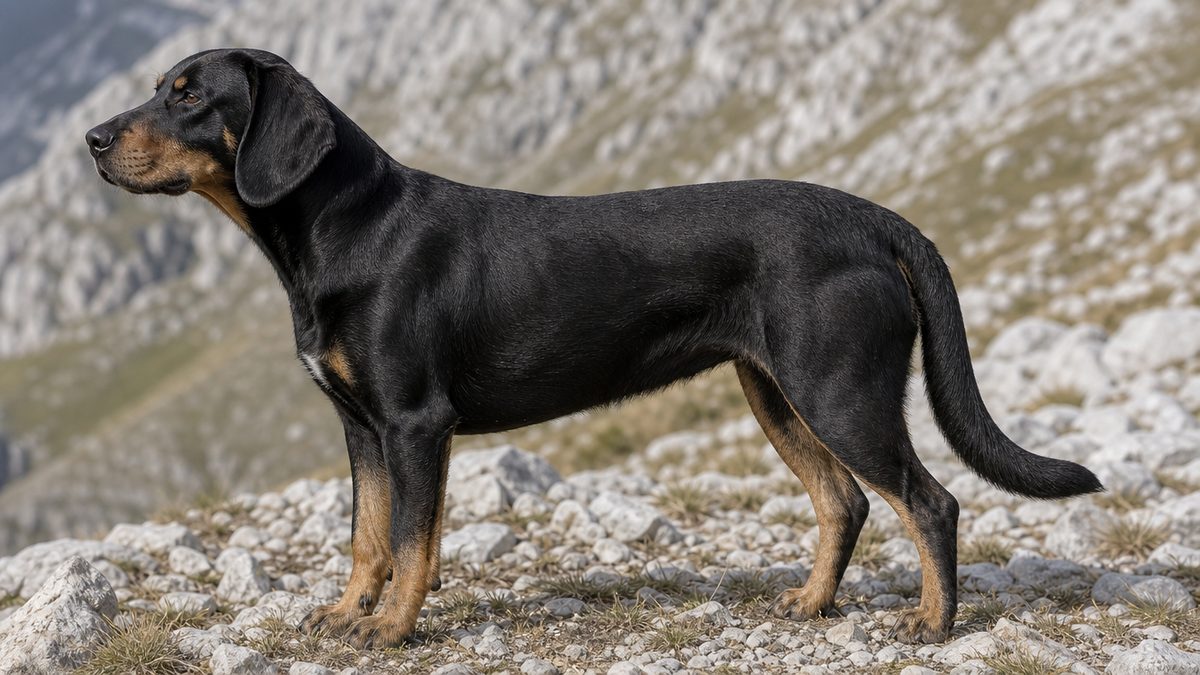
Quick answer
No Montenegrin Mountain Hound price in india can be quoted, because no Indian listing for a live dog exists and no lawful route to import one for breeding does either. The breed is FCI standard 279, accepted on a definitive basis in 1969 and standing 44 to 54 cm at the withers, with an ideal of 49 to 50 cm for males. It is a working scent hound, black with tan markings, and its standard contains no weight figure at all.
This page reports published veterinary evidence and is not a diagnosis. No inherited-disease data exists for this breed, so nothing here can substitute for examining an individual dog. Consult a registered veterinarian before acting on any health, feeding or vaccination decision, and take any dog showing collapse, laboured breathing or a rectal temperature above 40 C to a veterinarian immediately.
Montenegrin Mountain Hound at a glance
What the Montenegrin Mountain Hound is
The Montenegrin Mountain Hound is Montenegro's national scent hound, a medium-sized black-and-tan dog of 44 to 54 cm at the withers, recognised by the Federation Cynologique Internationale as standard 279 in Group 6, Section 1.2, subject to a working trial. It is a hunting dog first and a household dog second, and its own standard says nothing about being anything else.
Bonbeno reached the breed by opening the FCI's nomenclature index for the letter C and following the register's own link, rather than assembling a URL, because on fci.be the trailing number in an address decides which document you get and the breed name in the address is ignored entirely. The index lists CRNOGORSKI PLANINSKI GONIC and links it to breed record 279. That record gives the section as scent hounds, the subsection as medium-sized hounds, the country of origin as Montenegro, the breed status as recognised on a definitive basis, and the official authentic language as French.
The standard's own description is short and physical. General appearance: medium size, solid, agile. Head: dolichocephalic, with the upper lines of the skull and muzzle divergent. Gait: a regular and elastic stride with good thrust from the hindquarters, the preferred gait being a lively and even trot. What it does not say is as informative: there is no utility clause beyond the single word Hound, no exercise guidance, no health screening requirement and no lifespan.
Names, and which one a pedigree will carry
In Montenegrin the breed is the crnogorski planinski gonic, and the FCI registers it under exactly that transliteration with Montenegrin Mountain Hound as the English name, Chien Courant de Montagne du Montenegro in French, Montenegrinischer Gebirgslaufhund in German and Sabueso de Montana del Montenegro in Spanish, all four published on 28 January 2015. The standard also records an older nickname: in the past this dog has sometimes been called the black hound.
English pages add a fifth name, the Yugoslavian Mountain Hound, and the next section shows what can and cannot be established about it. Bing India's own related-search strip on 2 September 2026 offered yugoslavian mountain hound and montenegro mountain hound alongside the breed term, so the old name is still what a good share of searchers type.
How rare is rare
Rare is the word every page uses and none of them quantifies. Bonbeno can put four numbers against it, all of them zero or absent. PubMed returns no genuine record naming the breed under any of its names, against three controls that worked in the same session. The Orthopedic Foundation for Animals carries no breed code for it in the raw markup of its own breed list. A dedicated European pedigree-puppy marketplace returned Sorry, there is no result on its page for the breed. And an India-targeted search returned no listing for a live dog anywhere in the country.
For a breed with a real FCI standard, the register is the only thing a buyer can actually check. There is no health database, no lifespan study, no genetic characterisation and no Indian market. What there is, is a document, a superseded version of that document, a sibling group of six related standards and a second registry that disagrees with the first. Reading those against each other is the useful work, and it happens to expose two conflicts nobody else has published.
Breed recognition: FCI 279, and the date the FCI gives twice
Two registries recognise the Montenegrin Mountain Hound and they disagree about its dentition. The FCI accepted it on a definitive basis in 1969 and the United Kennel Club recognised it in 2008. The FCI itself gives two different 1969 dates, forty-seven days apart, on two documents it serves simultaneously.
The record and the standard do not match
The FCI's breed record for 279 states the date of acceptance on a definitive basis by the FCI as 6/24/1969. The FCI's standard 279, which that record links to, states in its brief historical summary that the F.C.I. officially recognized this breed (standard N° 279) on the 8th May 1969 during its meeting in Warsaw, and the authentic French text says the same, le 8 mai 1969 lors de sa seance a Varsovie FCI-Standard N° 279. Both documents are current and official, and they are 47 days apart.
The date format is not the problem, because that record proves its own format on its own face. It prints 6/24/1969 for acceptance, 12/19/2014 for the valid standard and 1/28/2015 for the English publication, and 24, 19 and 28 cannot be months. So the record reads 24 June 1969 and the standard reads 8 May 1969, and Bonbeno publishes both rather than picking one. This is the same shape of conflict this site records on the Karst Shepherd, where a standard's history and the register's acceptance date cannot both be right.
| Field | What the breed record says | What the standard says |
|---|---|---|
| Recognition date | 6/24/1969, that is 24 June 1969 | The 8th May 1969, at the meeting in Warsaw |
| Group and section | Group 6, scent hounds, medium-sized hounds | Group 6, Section 1.2 Medium-sized Hounds |
| Working trial | Subject to a working trial | With working trial |
| Origin | MONTENEGRO | Republic of Montenegro |
| Authentic language | French | Official language (FR) |
| Valid standard published | 12/19/2014 | 19.12.2014 |
| First standard | Not stated | The first standard dates 1924 |
The United Kennel Club, which cannot decide what to call it
The UKC recognised the breed in 2008 and places it in the Scenthound Group, and no page ranking in India mentions the UKC at all. Its standard is marked Revised July 1, 2009 with a 2008 copyright line. The page also contradicts itself about the breed's name: its heading and its web address read Montenegrin Mountain Dog, while its own prose says the Montenegrin Mountain Hound was recognized by the United Kennel Club in 2008, and its illustration file and downloadable standard are both named montenegrin-mountain-hound.
That matters practically, because a buyer searching a registry for the name printed on a pedigree needs to know the registry files it under a different one. It is the same class of problem this site has recorded elsewhere, where a registry's own URL misspells the breed it serves, and it is why a 404 or a miss on a registry search proves nothing about recognition.
India is a full FCI member represented by the Kennel Club of India, so KCI pedigrees are issued against FCI nomenclature, and a breed the FCI holds on a definitive basis is one the KCI could in principle register. That is a genuine difference from an unrecognised breed. It is also entirely theoretical here, because no Indian breeding stock exists and no lawful route to import any for breeding does either.
History and origins: was it the Yugoslavian Mountain Hound?
Every English page says the breed was formerly the Yugoslavian Mountain Hound and not one of them dates the change. The renaming predates 15 July 1997, which is the date of the oldest FCI standard still reachable, and that document already carries the Montenegrin name with the word Yugoslavian appearing zero times.
Bonbeno tested the claim by pulling the superseded standard out of the Internet Archive rather than by reasoning about it. The archive holds twenty captures of the FCI's English standard file for 279, and the capture of 6 September 2014 predates the current standard of 19 December 2014. Extracted with pypdf, that document is headed 07.08.1998/EN, FCI-Standard N° 279, MONTENEGRIN MOUNTAIN HOUND (Crnogorski Planinski Gonič), and gives its date of publication of the official valid standard as 15.07.1997.
Its origin line reads Republic of Montenegro. Searching the whole extracted text for Yugoslavian, YUGOSLAVIAN, Jugoslovenski and JUGOSLOVENSKI returns zero for each. So the FCI was already publishing this breed under its Montenegrin name in 1997 and 1998, at a time when Montenegro was a constituent republic of the Federal Republic of Yugoslavia and nine years before its independence in 2006.
One ranking page names a year, and it turns out to be right
Royal Canin's Irish breed page states that the first standard was published in 1924 when the breed was still known as the Yugoslavian Mountain Hound, and that in 1997 the FCI recognised the breed's new name after the break-up of the Yugoslav state. The 1997 date matches the standard's own publication date exactly, which is a rare case of a secondary source landing on a checkable year. The causal gloss is looser than the date: Montenegro was still inside a state called Yugoslavia in 1997, so the rename came during the break-up rather than after it.
What Bonbeno cannot establish is what the FCI called the breed before 15 July 1997, because the archive's earliest capture of that file is from 2014 and no pre-1997 FCI document for 279 was reachable. The claim that the old name was Jugoslovenski planinski gonic is repeated by English Wikipedia, in Latin and Cyrillic script, on an article carrying a one-source maintenance tag dated April 2013 whose only link to the FCI standard is a Google cache address for a .doc file that no longer resolves. That is not nothing, but it is not a register either.
The neighbours make the renaming look ordinary
Balkan cynology renamed a great deal after 1991, and the register shows it. The FCI's Serbian Hound at 150 and Serbian Tricolour Hound at 229 both carry Serbia as country of origin and both had their valid standards republished in the early 2000s, 25 March 2003 and 26 November 2002 respectively Federation Cynologique Internationale. So the Montenegrin breed's rename in 1997 ran five to six years ahead of its Serbian siblings, which is the opposite of what you would guess from a country that became independent last.
One more detail suggests the old naming has not fully gone. The 2025 PLoS One study of Balkan breeds, written in Sarajevo, lists among its eight breeds the Yugoslavian Shepherd Dog - Sharplanina. Balkan veterinary authors in 2025 are still using a Yugoslav-era breed name for a neighbouring dog, which is a reminder that these names change on paper long before they change in use.
Very little, and honestly. The whole historical summary is three sentences: that the breed is of the same origin as the other Balkan hounds, that in the past it has sometimes been called the black hound, and that the first standard dates 1924. There is no founder story, no named breeder and no ancient-descent claim. Compared with what circulates about most rare breeds, that restraint is a point in the document's favour.
What FCI standard 279 actually says, measurement by measurement
Read the standard in its authentic language and two things stand out: it is unusually numerical about proportions, and it contains no weight and no life expectancy at all. French governs, so where the English, French, German and Spanish texts disagree, the French text is the one that decides.
| Measurement | Figure in the standard |
|---|---|
| Height at the withers | 44-54 cm |
| Ideal height, males | 49-50 cm |
| Ideal height, females | 48-49 cm |
| Weight | No figure given, in any language |
| Body length against height | About 10 percent longer |
| Chest perimeter against height | About 10 percent greater |
| Head length against height | 45 percent |
| Muzzle to skull ratio | 7.5 to 10 desirable |
| Neck angle to the horizontal | 45 to 50 degrees |
| Shoulder angle to the horizontal | 40 to 45 degrees |
| Croup slope | 20 to 25 degrees |
| Chest depth against height | 45 to 50 percent |
| Elbow height against height at withers | 50 percent |
| Stifle angle | About 120 degrees |
| Hock angulation | About 135 to 140 degrees |
| White chest spot | Admitted, diameter not more than 3 cm |
Notice what is not in that table. There is no weight, no life expectancy, no litter size, no coat-care instruction and no health screening requirement. So every kilogram figure and every lifespan in circulation for this breed was supplied by somebody other than the registry, and the pages that attribute their specifics to the FCI are attributing them to a document that does not contain them.
Coat and colour, which are the fastest identification check
The coat is short, dense, rough, not very thick, glossy, flat and smooth, over an undercoat the standard calls quite well developed, on skin that is elastic and really tight to the body with dark pigmentation. The basic colour is black with tan markings above the eyes, on the muzzle and on the lower parts of the legs. The tan markings above the eyes are the size of a hazelnut, and on the sides of the muzzle they extend at most to the corner of the lips. The tan itself runs from light red through brownish red to bright red.
That is a tight colour rule and it is enforced twice in the disqualification list, once as non authorized colours and once as any other white marking than that which is tolerated. So a Montenegrin Mountain Hound with a white blaze, white feet, a tricolour pattern or a chest patch wider than 3 cm is outside its own standard, which is a check any buyer can make with a ruler.
The disqualifications, which are the practical part
A dog is excluded for aggressive or overly shy behaviour, for any clear physical or behavioural abnormality, for an over- or undershot mouth or a deviated incisor arch, for the absence of one tooth except PM1 and M3, for very light eyes, wall eyes or eyes of different colour, for entropion or ectropion, for a rolled-up tail carried above the back line or deviated laterally, for non authorized colours, for any other white marking than the tolerated one, and for a size above or below the standard.
The authentic French list carries one item the English does not. French disqualifies Chien agressif ou peureux and then, separately, Chien timide; the English collapses both into a single bullet reading aggressive or overly shy dogs FCI-Standard N° 279. Since French is the authentic language, a timid dog is disqualified in its own right under the governing text, and the English reader would not know it.
Entropion and ectropion disqualify under the standard, and Second Schedule Part III paragraph 8(10) of the Prevention of Cruelty to Animals (Dog Breeding and Marketing) Rules, 2017 requires that breeding dogs shall have been tested for genetic defects including entropion and ectropion, along with hip dysplasia, progressive retinal atrophy, night blindness, hypothyroidism, overshot and undershot jaw, wry mouth, two or more missing teeth and cryptorchidism. A breeder screening to this standard is doing part of what the Rules require, which is not true of every breed.
What the 2014 revision actually changed, diffed line by line
The 19 December 2014 revision changed two things of substance and a great deal of punctuation. It moved the original-language name to the front of the title, and it loosened the dentition rule, which now puts FCI 279 in direct conflict with the UKC standard over a dog missing a third molar.
Bonbeno diffed the two English texts rather than describing them. The 1998 publication of the 1997 standard and the 2015 publication of the 2014 standard were both extracted with pypdf, normalised for the running page header and compared sentence by sentence. Both come out at 139 units, and almost every difference is a space before a colon or a word broken across a line by the extractor.
| Point | 07.08.1998 text, standard of 15.07.1997 | 28.01.2015 text, standard of 19.12.2014 |
|---|---|---|
| Title order | MONTENEGRIN MOUNTAIN HOUND (Crnogorski Planinski Gonic) | CRNOGORSKI PLANINSKI GONIC (Montenegrin Mountain Hound) |
| Translation line | TRANSLATION: Mrs. Peggy Davis. | TRANSLATION: Mrs. Peggy Davis. Official language (FR). |
| Missing teeth | Absence of one tooth, the absence of two premolars 1 (PM1) being tolerated | Absence of one tooth (except PM1 and M3) |
| Abnormalities clause | Any dog clearly showing physical or behavioural abnormalities shall be disqualified | Any dog clearly showing physical or behavioural abnormalities |
| Breeding clause in the N.B. | Not present | Only functionally and clinically healthy dogs, with breed typical conformation should be used for breeding |
| Amendment marker | Not present | The latest amendments are in bold characters |
| Height, colour, proportions, temperament | 44-54 cm, ideal 49-50 and 48-49; black and tan; 3 cm white spot | Identical, word for word |
So the widely repeated idea that 2014 is when the breed was renamed is wrong twice over. The name did not change in 2014, it changed at or before 1997; and what 2014 did to the title was reverse the order of two names that were both already there.
The tooth rule, and why it now splits the two registries
Work the dentition change through and it has a real consequence. Under the 1997 rule, absence of one tooth disqualified, with the absence of two first premolars tolerated. Under the 2014 rule, absence of one tooth disqualifies except PM1 and M3, so a missing third molar no longer counts against the dog at all.
The UKC's standard was revised on 1 July 2009, between those two, and it disqualifies missing teeth other than the 1st premolars. That is the pre-2014 FCI rule in shorter words. The upshot is that a Montenegrin Mountain Hound missing an M3 is a perfectly correct dog under the FCI and a disqualified one under the UKC, and neither registry mentions the other. A buyer shown a dentition certificate should therefore ask which standard it was scored against.
Where the UKC and FCI standards otherwise diverge
| Point | FCI standard 279 | UKC standard, revised 2009 |
|---|---|---|
| Height | 44-54 cm, with ideals of 49-50 and 48-49 cm | 17 to 21 inches, that is 43.2-53.3 cm, no ideal, no sex split |
| Size outside the range | A disqualifying fault | An Eliminating Fault, a lesser category |
| Missing teeth | Absence of one tooth except PM1 and M3 | Missing teeth other than the 1st premolars |
| Albinism | Not named | Named as a disqualification in its own right |
| Cryptorchidism | A note that males should have two normal descended testicles | Unilateral or bilateral cryptorchid is a disqualification |
| Hock angulation | About 135 to 140 degrees | About 135 degrees |
| Numeric proportions | Eleven separate ratios and angles | Three retained; the rest dropped |
| Temperament wording | Well balanced, attached to his master, docile, trustworthy | Docile, trustworthy and attached to his master |
The height arithmetic is worth doing because it is where a seller can work. The FCI's floor of 44 cm is 17.32 inches and the UKC prints 17, which is 43.2 cm; the FCI's ceiling of 54 cm is 21.26 inches and the UKC prints 21, which is 53.3 cm. So the UKC range sits about 0.8 cm lower at both ends, and a bitch measuring 43.5 cm is inside the UKC standard and outside the FCI's.
The 2015 text closes with the line The latest amendments are in bold characters, which is the FCI's way of showing what it just changed. Text extraction discards bold, so Bonbeno cannot read that marking and does not claim to. The diff above is derived from comparing the two documents' words, which is a different and slower method, and it is why the finding is stated as what changed rather than as what the FCI flagged.
Telling it apart from the other Balkan hounds
Seven Balkan scent hounds sit in the same FCI group and section, and English sources conflate them constantly. They separate cleanly on four fields the register prints: number, country, date and coat. Bonbeno read all seven records by following the register's own letter indexes.
| FCI | Register name | English name | Definitive acceptance | Origin | Authentic language |
|---|---|---|---|---|---|
| 151 | Istarski kratkodlaki gonic | Istrian Short-haired Hound | 2 April 1955 | Croatia | German |
| 152 | Istarski ostrodlaki gonic | Istrian Wire-haired Hound | 6 April 1955 | Croatia | German |
| 154 | Posavski gonic | Posavatz Hound | 8 April 1955 | Croatia | French |
| 155 | Bosanski ostrodlaki gonic-barak | Bosnian Broken-haired Hound, called Barak | 9 April 1955 | Bosnia and Herzegovina | English |
| 150 | Srpski gonic | Serbian Hound | 30 March 1955 | Serbia | French |
| 229 | Srpski trobojni gonic | Serbian Tricolour Hound | 23 July 1961 | Serbia | French |
| 279 | Crnogorski planinski gonic | Montenegrin Mountain Hound | 24 June 1969 | Montenegro | French |
Three facts fall straight out of that table. The Montenegrin is the last of the seven onto the register, by eight years over the Serbian Tricolour and fourteen over five of the others Federation Cynologique Internationale Federation Cynologique Internationale. It is the only one whose country of origin is Montenegro. And the group runs on three different authentic languages, French for four breeds, German for the two Istrian hounds and English for the Barak, so a reader comparing two standards has to know which language governs each one Federation Cynologique Internationale Federation Cynologique Internationale.
The confusions worth naming
- Wamiz calls this breed previously known as the Yugoslavian Hound, dropping Mountain, which is a different dog's history: the Serbian Hound is the one long called the Balkan Hound
- Bing India's own image strip for this breed mixes in the Bavarian Mountain Hound, the Bulgarian Mountain Hound, the Mountain Cur and a Serbian Mountain Dog, so the engine itself blurs the near names
- Colour separates them fastest: this breed is black with tan markings only, while the Serbian Tricolour Hound carries white as well and the two Istrian hounds are white with orange markings
- Coat separates the Istrians from each other, short on 151 and wire on 152, and the Barak is broken-haired
- Only the Barak's record carries a country of patronage field, which is a further FCI distinction none of the ranking pages mentions
This site's own sibling pages agree, and that is worth stating
Bonbeno's Barak Hound guide records FCI 155 in Group 6 Section 1.2 with a working trial and a standard last revised on 15 January 1973. Its Istrian Shorthaired Hound guide records FCI 151 accepted on 2 April 1955 and its Istrian Coarse Haired Hound guide records FCI 152 accepted on 6 April 1955, four days apart. Every one of those matches what Bonbeno read off the register today Federation Cynologique Internationale Federation Cynologique Internationale. No sibling claim on this site failed against the register, which is the outcome to report when it happens rather than only reporting conflicts.
None of the seven Balkan hounds holds a breed code in the Orthopedic Foundation for Animals' list. Bonbeno read that list from raw markup, 482 data-name attributes, and searched it case-insensitively: MONTENEG, CRNOGOR, GONIC, PLANINSK, POSAV, ISTRIAN, SERBIAN and BOSNIAN all return zero, while Labrador Retriever, Kuvasz, Tornjak and Sarplaninac are present as controls. So the absence is a property of the hound group rather than of this breed.
Montenegrin Mountain Hound price in India
No Montenegrin Mountain Hound price in india exists, because no Indian listing for a live dog exists. The composition of what a search does return is worth more to a buyer than an invented number, and here it is unusually clean: one watercolour print and a European marketplace with nothing in stock.
Two India-targeted searches were run on 2 September 2026, one for the breed term and one for the price query. Neither returned a listing for a live dog anywhere in India. What ranked instead was a Swiss purebred platform, a Croatian-language hunting portal, two Etsy pages, several Facebook posts about Balkan show judges, a Pinterest board, a harness manufacturer's breed dropdown and a set of European breed profiles. To prove the search works, a labrador retriever price in india control was run in the same tool in the same session and returned ten Indian pages carrying real rupee bands, including Supertails at 8,000 to 70,000 rupees and Mr n Mrs Pet's tiered table at 30,000 to 1,20,000 rupees.
The one India-facing rupee figure is a painting
The single Etsy India listing under this breed's name is Montenegrin Mountain Hound in Watercolor 01 Fine Art Print, at 2,140 rupees and upward, local taxes included where applicable. It is a print. A second Etsy page offers a phone case with the breed painted in the manner of Starry Night. Neither describes an animal, and anyone quoting 2,140 rupees as a puppy price has quoted a poster.
| What is being sold | Where | Price shown | Is it a dog |
|---|---|---|---|
| Watercolour fine art print | Etsy India | ₹2,140 and upward | No |
| Phone case with breed artwork | Etsy | Listed, priced outside India | No |
| A live Montenegrin Mountain Hound puppy | Nowhere found in India | No figure exists | Not offered |
The European supply side is thin too, which is the more useful finding
This is not simply a breed that has not reached India. Wuuff, a European marketplace that exists specifically to list pedigree puppies by breed, maintains a Montenegrin Mountain Hound page, and on 2 September 2026 that page returned Sorry, there is no result. A dedicated breed page on a working marketplace, with no litters on it, is a stronger statement about availability than any absence of Indian listings would be, because the marketplace is trying.
So a buyer in India would be sourcing from a European hunting population, through a breed club, in a country where the dog is kept to work rather than to sell. That is a slow, relationship-based route that has nothing to do with a price band, and it is why no currency test is run on this page: there is no candidate price to divide by 84.38, 74.00, 80.00 or 66.67.
Why no Indian price can form
The supply side is closed by law. India's import rules make dogs Restricted under ITC(HS) 01061900, subject to Policy Condition 6, and permit import only for a pet dog with a valid pet book and relevant records in the name of the importer, for research by organisations with the recommendation of CPCSEA, or for internal security by the Defence and Police Force. Policy Condition 8 states that import of commercial dogs for breeding or any other commercial activity is not permitted, and paragraph 6 provides that any applications for trading or breeding purposes shall be duly rejected. No lawful founding stock means no Indian litters, and no Indian litters means no price.
Any black-and-tan medium hound offered here as a Montenegrin Mountain Hound is far more likely to be a Rottweiler cross, a Dobermann cross, a black-and-tan Indian pariah type or a mislabelled Beagle. Those are not lesser dogs and several are better suited to Indian conditions. The point is that you should be able to say which one you are buying, and with no FCI pedigree in the country there is nothing to check a claim against.
What a Montenegrin Mountain Hound would cost to keep in India each month
Budget roughly ₹7,000 to ₹14,000 a month for a hound of this size in an Indian metro, before one-off costs. That is about half what a mountain guardian costs, because a 44 to 54 cm short-coated dog eats less and needs less cooling than a 70 cm double-coated one.
The model below prices a dog at the standard's own height range of 44 to 54 cm, with an ideal of 49 to 50 cm for males. Since the standard gives no weight, the food line is built on the body mass a lean working hound of that frame carries rather than on a quoted kilogram figure. It is a cost model, not a quotation, and no Indian owner of this breed was available to check it against because Bonbeno could not find one.
| Item | Lower | Upper | What drives the spread |
|---|---|---|---|
| Food, quality dry diet | ₹3,000 | ₹5,500 | A lean 20 kg working hound, fed to condition |
| Cooling, electricity share | ₹800 | ₹2,500 | A fan and a cool room rather than a dedicated air-conditioned space |
| Preventive parasite control | ₹700 | ₹1,400 | Medium-dog dosing, year-round in India |
| Routine veterinary care, amortised | ₹900 | ₹1,800 | Vaccination, deworming and a check-up over twelve months |
| Ear care and grooming | ₹300 | ₹900 | Pendant ears in a humid climate, not the coat |
| Joint and skin support | ₹400 | ₹1,000 | Supplements and monsoon skin management |
| Containment and equipment | ₹400 | ₹1,100 | A long line, a secure harness and fence maintenance for a nose-led dog |
| Contingency | ₹500 | ₹1,300 | Tick-borne disease testing is the likeliest unplanned cost |
| Monthly total | ₹7,000 | ₹14,000 |
The ear line is the one Indian owners skip, and for this breed it is the wrong one to skip. The standard describes ears that are high set, moderately long, pendant without folds and close to the head. A pendant ear held against the skull in a humid Indian summer is a warm sealed chamber, which is why the grooming section below treats ears rather than coat as the maintenance item.
One-off costs the table does not carry
- Import authorisation and travel if you are bringing your own dog in, which the trade notice advises beginning at least two months before the travel date
- Quarantine at a government station at one of the permitted ports where required
- Sterilisation, which Rule 8(1)(b) of the 2017 Rules makes a condition of sale for dogs over six months in most circumstances
- Microchipping, which Rule 8(1)(e) requires of every pup sold
- A genuinely secure fence, because a scent hound that picks up a line will follow it
- A long line and a training investment in recall that will still never be reliable off-lead
For scale on the Indian side, a KCI-registered Labrador Retriever puppy is published at ₹60,000 to ₹90,000 and a champion-bloodline one at ₹90,000 to ₹1,20,000, with a basic-quality tier at ₹30,000 to ₹60,000. That is what a real Indian market looks like: tiered, documented and checkable against a registry. All three tiers exist for the Labrador because the Kennel Club of India registers it. None exists here, because nothing is registered.
Preventive parasite control at ₹700 to ₹1,400 a month is the smallest recurring cost on this page and the one with the best evidence behind it. A survey of 525 owned Indian dogs found 49.7 percent carrying at least one tick-borne pathogen by PCR. A month of prevention costs less than a single diagnostic panel, and far less than treating ehrlichiosis in a dog that hunts in vegetation.
Montenegrin Mountain Hound heat tolerance in India, tested against real data
This breed works a cold mountain country, and the gap to India is the largest on any hound page this site has built. The NASA POWER cell over its Durmitor working altitude averages 6.7 C across the year at a wet bulb of 4.9 C, with a January mean of minus 3.6 C. Chennai averages 28.0 C at a wet bulb of 24.0 C.
Every figure here comes from NASA POWER's Source Native Resolution Climatology, queried by explicit latitude and longitude, with the returned coordinates and the grid cell's own elevation checked against the real elevation of each place. Wet-bulb values are computed from the returned air temperature and relative humidity using the Stull approximation published in the Journal of Applied Meteorology and Climatology. The next section explains why not one of the Montenegrin points can be taken at face value, and which one comes closest.
| Place | Cell elevation m | Mean air temp C | Mean RH percent | Annual wet bulb C | Gap vs the Durmitor cell |
|---|---|---|---|---|---|
| Kolasin and Zabljak, one shared cell | 1,300 | 6.7 | 81.6 | 4.9 | - |
| Cetinje, the closest usable point | 517 | 13.5 | 72.9 | 10.5 | +5.6 |
| Bar, Adriatic coast | 209 | 15.8 | 69.2 | 12.3 | +7.4 |
| Pune | 636 | 23.9 | 66.8 | 19.4 | +14.5 |
| Bengaluru | 842 | 23.7 | 67.9 | 19.5 | +14.6 |
| Delhi | 206 | 25.6 | 45.6 | 17.8 | +12.9 |
| Mumbai | 97 | 26.8 | 67.4 | 22.2 | +17.3 |
| Kolkata | 7 | 25.8 | 73.9 | 22.3 | +17.4 |
| Chennai | 49 | 28.0 | 72.4 | 24.0 | +19.1 |
Look at the Montenegrin winter first. The highland cell covering Kolasin and Zabljak averages minus 3.6 C in January and minus 2.6 C in February, at 92.3 and 91.7 percent relative humidity. That is a wet, freezing winter, and the standard's quite well developed undercoat is what it produced. Chennai's coldest month, January, averages 24.1 C. The two climates do not overlap at any point in the year.
The Montenegrin summer is short and dry rather than long and humid, which is the part that matters most. The Durmitor cell's warmest month is August at 17.2 C and 65.9 percent humidity, a wet bulb of 13.2 C. Cetinje in August reaches 24.1 C at 55.7 percent, a wet bulb of 18.0 C. Delhi in July sits at 32.3 C and 62.7 percent, a wet bulb of 26.5 C, and Kolkata in June reaches 27.1 C wet bulb, the highest figure in this table.
| City | Worst month | Mean air temp C | Mean RH percent | Mean wet bulb C |
|---|---|---|---|---|
| Kolasin and Zabljak cell | August | 17.2 | 65.9 | 13.2 |
| Cetinje | August | 24.1 | 55.7 | 18.0 |
| Kolkata | June | 29.9 | 80.4 | 27.1 |
| Delhi | July | 32.3 | 62.7 | 26.5 |
| Chennai | May | 31.5 | 64.5 | 26.1 |
| Mumbai | June | 28.7 | 79.5 | 25.8 |
| Pune | June | 25.6 | 80.3 | 23.0 |
| Bengaluru | May | 27.0 | 63.8 | 21.9 |
Kolkata in June is 13.9 wet-bulb points above the worst month this breed's mountains produce. Bengaluru's May, the mildest Indian worst month here, is still 8.7 points above it. There is no Indian metro where this dog's summer resembles anything in its evolutionary history, and the humid eastern and western coasts are worse than the hot northern plains despite lower air temperatures.
The India Meteorological Department does not classify a day as a heat wave until the maximum reaches at least 40 C in the plains or 30 C in hilly regions, and grades it severe at a departure from normal of 7 C or more. Delhi's mean monthly maximum already reaches 48.8 C in June, which is 15 C above the hottest monthly maximum in the breed's own highlands. A short coat is not the same thing as heat tolerance, and this breed's advantage over a double-coated guardian is real but small next to a gap that size.
A warning about the climate data, which fired badly in Montenegro
NASA POWER returns a grid cell rather than a point, and Montenegro is small, steep and coastal, which is the worst combination for it. Two pairs of places came back byte-identical, and one cell was simultaneously reporting the capital at 44 m and a 2,487 m peak sixty kilometres away.
Bonbeno queried seven points across Montenegro by explicit latitude and longitude and echoed back the elevation the model reported for each. Podgorica and a point on Kucki Kom in the Komovi massif both returned a cell elevation of 932.70 metres and the same annual mean of 9.88 C, the same relative humidity of 76.19 percent and the same January mean of minus 0.59 C, to the decimal. Kolasin and Zabljak both returned 1,299.63 metres and an identical second series.
| Point queried | Cell elevation m | Real elevation m | Error m |
|---|---|---|---|
| Kucki Kom, Komovi massif | 932.70 | 2,487 | -1,554 |
| Podgorica, the capital | 932.70 | 44 | +889 |
| Niksic | 1,162.52 | 647 | +516 |
| Kolasin | 1,299.63 | 954 | +346 |
| Zabljak, Durmitor | 1,299.63 | 1,456 | -156 |
| Cetinje | 516.70 | 671 | -154 |
| Bar, Adriatic coast | 209.39 | 5 | +204 |
| Delhi | 206.37 | 216 | -10 |
| Kolkata | 7.35 | 9 | -2 |
| Chennai | 48.95 | 6 | +43 |
Both tells fired together, which is what makes the diagnosis solid. Two different places returned identical series twice over, and one cell reported a 2,487 metre peak as a 932 metre hill. Temperature falls with altitude at roughly 6.5 C per 1,000 metres, so a cell sitting 1,554 metres below a summit describes that summit as about 10 C too warm, and the same cell placed 889 metres above Podgorica describes the capital as about 6 C too cold. Podgorica's returned January mean of minus 0.59 C is the visible symptom: a Mediterranean-influenced city in the Zeta plain does not average below freezing in January.
Which Montenegrin figure this page therefore uses, and why
The 1,299.63 metre cell is wrong for Kolasin by 346 metres and wrong for Zabljak by 156, and it sits between them. That makes it a poor description of either town and a defensible description of the highland plateau the breed actually hunts, which runs roughly 900 to 1,500 metres across Sinjajevina, Bjelasica and the Durmitor approaches. So this page uses it as the breed's working-altitude baseline and says so, rather than presenting it as any town's climate.
Cetinje, at 154 metres low, is the single most accurate Montenegrin point and is quoted separately for the lowland comparison. Podgorica and the Komovi summit are quoted only in the error table above, never as climate. The Indian side needs no such caution: Delhi is 10 metres low, Kolkata 2 metres low, Chennai 43 metres high, Mumbai 83 high, Bengaluru 78 low and Pune 76 high, which is the same plains accuracy this site has measured before.
It is easy to remember to check an Indian hill station and easy to forget the origin country. A wrong homeland baseline corrupts the comparison exactly as badly. Had this page taken the Podgorica cell as Montenegro's climate, it would have described a 9.9 C country with sub-zero Januaries and drawn a heat conclusion far too severe. Had it taken Cetinje alone, it would have described a 13.5 C country and drawn one too mild. Echo the elevation, and say which point you are using.
Keeping a Montenegrin Mountain Hound safe in Indian heat
Manage the exercise, not the coat, because this breed's heat risk is exertional rather than structural. Of 879 UK heat-illness events with a recorded trigger, 652 were exertional, and of the 551 exercise-triggered events whose type was recorded, 372 followed an ordinary walk rather than a run.
Start with what the evidence is and is not. Hall and colleagues, writing in Scientific Reports, analysed 905,543 UK dogs under primary veterinary care in 2016 and identified 395 confirmed heat-related illness events, giving a 2016 incidence of 0.04 percent and an event fatality rate of 14.18 percent. Dogs at or above their breed and sex mean bodyweight carried an odds ratio of 1.42, purebred dogs 1.86 against crossbreds, and brachycephalic dogs 2.10 against mesocephalic ones.
The over-50 kg band that dominates guardian-breed pages does not apply here. A 44 to 54 cm hound in working condition is nowhere near it, so this page claims no weight-band odds ratio at all. Two factors do transfer: purebred status, and bodyweight at or above the individual's own breed and sex mean, which is the one an owner controls. The skull factor works in the breed's favour, because a dolichocephalic head with divergent skull and muzzle lines is the opposite of brachycephalic.
Why the trigger data matters more for this breed than the coat does
The companion paper in Animals analysed what set off 1,259 heat-related illness events from 1,222 dogs. Of those, 380 had no trigger recorded, leaving 879. Exertional heat illness accounted for 652 of those 879, or 74.2 percent, environmental heat for 113 at 12.9 percent, and confinement in a vehicle for 46 at 5.2 percent. Within the 652 exercise-triggered events the exercise type was recorded for 551, and 372 of those, 67.5 percent, followed an ordinary walk.
That is the profile of a working scent hound almost exactly. This dog will not sit quietly in a hot compound overheating slowly; it will pick up a line and work it at a trot for an hour in 34 C because that is what it is for. The standard's own preferred gait is a lively and even trot, sustained. An owner who lets the dog decide when to stop has handed the decision to the least heat-aware animal in the household.
The management plan
- Walk and work the dog before sunrise and after full dark from March to October in the plains, and treat any morning with a wet bulb above 24 C as an indoor day
- Cap sustained scent work at fifteen minutes in any conditions above a 22 C wet bulb, and stop on the clock rather than on the dog's willingness
- Keep the dog lean, since bodyweight at or above its own breed and sex mean carries an odds ratio of 1.42
- Give a cool indoor space with moving air; a fan and a tiled floor do more for a short-coated hound than an air-conditioned room does for a guardian
- Carry water on every outing and offer it every fifteen minutes, because a hound on a line will not stop to ask
- Cool an overheated dog with room-temperature water over paws, groin and armpits, move it into moving air, and only then travel
- Learn the stop signs: a rectal temperature above 40 C, brick-red or grey gums, staggering, vomiting or collapse
Think in wet bulb rather than in temperature. A 33 C afternoon at 40 percent humidity and a 29 C afternoon at 85 percent feel similar to a person and are completely different to a working dog, because the second offers almost no evaporative headroom. Dew point, which most weather apps show, is a serviceable proxy: above 24 C, a hound of this type should not be doing sustained work at all.
Second Schedule Part IV paragraph 21(1) of the Prevention of Cruelty to Animals (Dog Breeding and Marketing) Rules, 2017, headed Outdoor housing facilities, bars keeping in outdoor facilities, without the attending veterinary practitioner's written approval, dogs not accustomed to the temperatures prevalent in the area, dog breeds that cannot tolerate them such as long-haired breeds in high temperature locations, and sick, infirm, aged or young animals. This breed is short-coated, so the long-haired example does not describe it. The first limb does: a dog imported from a country whose highland cell averages 6.7 C is not accustomed to Indian temperatures.
Temperament, and who should not buy this breed
The standard's temperament clause is one line and every word of it points indoors: well balanced, attached to his master, docile, trustworthy. Everything difficult about this dog is outdoors and downwind, and the standard does not mention that at all.
That single line is the whole of it, in both the English and the authentic French FCI-Standard N° 279. The UKC's version reorders the same four ideas into docile, trustworthy and attached to his master, dropping well balanced. There is no aggression warning, no guarding role and no independence caveat, which is unusual and worth taking at face value: this is not a protection dog and nobody claims it is.
What both standards omit is the nose. A scent hound recognised in Group 6 Section 1.2 and subject to a working trial is a dog whose entire selection history is about following a line away from its handler and telling everyone about it. The prey drive is the management problem, and it is invisible in the breed documents because it is assumed.
Reading that honestly for an Indian household
The good news is real. A docile, master-attached hound of 44 to 54 cm is a manageable size for an Indian flat in a way a mountain guardian is not, it is unlikely to be reactive to visitors, and it needs almost no grooming. The bad news is that it is loud, it is nose-led, it needs two real exercise sessions a day, and in most Indian cities both of those have to happen in the dark.
The vocal question deserves its own line because Indian housing societies decide it. A pack scent hound gives tongue on a line by design; that is how the hunter knows where the dog is. A dog doing that in a stairwell at five in the morning is doing its job. There is no training fix for the instinct, only management of when and where the dog is stimulated.
Who this breed suits
- A household in an Indian hill state that can walk a nose-led dog for two hours a day in cool air
- An owner who wants a calm, undemanding house dog and accepts an athletic, driven outdoor one
- A home with a genuinely secure boundary and no free-roaming small animals
- Someone who will train a long-line routine rather than hoping for off-lead recall
Who must not
- Anyone in a plains metro who cannot exercise a working hound before sunrise, every day, all summer
- A household in a noise-sensitive apartment building
- A home with rabbits, cats or poultry, on prey-drive grounds rather than temperament grounds
- An owner who wants an off-lead companion, which this dog will never reliably be
It is not a guard dog, and Indian buyers drawn to Balkan breeds usually are looking for one. The standard disqualifies aggressive dogs and the authentic French separately disqualifies timid ones, which describes a stable working animal rather than a protective one. If protection is the brief, this is the wrong Balkan dog, and the guardian breeds this site covers are the right place to look.
Training a Montenegrin Mountain Hound, and what it will resist
Train household manners and containment, not off-lead recall. A dog recognised as a scent hound subject to a working trial has been selected for hundreds of years to leave its handler, follow a line and keep going, and no amount of obedience work removes that.
The good news is the temperament clause: well balanced, attached to his master, docile, trustworthy. A dog described that way is easy to live with indoors and genuinely trainable for a routine. The difficulty is entirely about competing motivation outdoors, and it is a design feature rather than a fault in your particular dog.
What works
- Socialise the puppy heavily before sixteen weeks, weighted toward traffic, stairs, lifts and the people it will meet on a daily walk
- Train on a long line from the start and treat it as permanent equipment rather than a training phase
- Use food, and use it generously, because a hound working for its handler is competing with the best smell in the neighbourhood
- Keep sessions very short and finish while the dog is still interested
- Give the nose a legal outlet: scent games, scattered food, a tracking harness and a laid trail in a park
- Build a settle on a mat, which is the single most useful behaviour for a vocal dog in an Indian flat
What it will resist
Recall on a fresh line, which is the one that matters. Quiet, when the dog has found something and its whole purpose is to announce it. Being left alone all day, since the standard's attached to his master is not decorative. And boarding among strange dogs, which for a pack-worked hound is stressful in a specific way. Plan for a sitter the dog knows.
Three Indian legal points that come up in training and buying
De-barking is what an exasperated owner of a vocal hound eventually gets offered, and it is expressly forbidden. Second Schedule Part II paragraph 6(8) of the Prevention of Cruelty to Animals (Dog Breeding and Marketing) Rules, 2017 states that there shall be no tail docking, ear cropping, de-barking, de-clawing, branding, dyeing, injecting substances to enhance visual appeal, performing a surgery or procedure to camouflage or hide any defect or infirmity or any other kind of mutilation of any body part of the pup, and that any change of appearance by artificial means is strictly forbidden.
Tethering has a rule most owners have never read. Second Schedule Part IV paragraph 22 permits dogs to be kept on tethers only in outside housing facilities meeting the Rules, requires the tether to be attached to the front of the shelter structure or a post in front of it, and requires it to be at least three times the length of the dog measured from the tip of the nose to the base of the tail. For a hound of this size that is a long tether, and a short chain in a yard is not a lawful containment plan.
And the eight-week rule applies to every breed. Rule 8(1)(a) provides that pups less than eight weeks in age are not sold, while Second Schedule Part III paragraph 8(9) records that vaccination can start at seven to eight weeks and is usually completed at eighteen weeks. A seller offering a six-week-old hound is breaking a Rule regardless of how rare the breed is.
| Period | Realistic goal | What will not happen |
|---|---|---|
| 8-16 weeks | Sixty novel experiences, daily ear and mouth handling, crate routine | Any recall worth relying on |
| 4-8 months | Loose-lead walking, settle on a mat, long-line habit established | Off-lead freedom in an unfenced space |
| 8-14 months | The nose switches fully on; scent games and tracking channel it | A quiet dog when it finds something interesting |
| 14-24 months | Adult stamina; two real sessions a day become non-negotiable | A dog that will trade a fresh line for a biscuit |
| Throughout | Heat exposure is cumulative and invisible | Safe daytime exercise in the Indian plains from March to October |
Owners of scent hounds spend years chasing an off-lead recall and blaming themselves. A long line, a secure garden and a laid trail give the dog more real freedom than an anxious off-lead walk ever does, and they remove the single situation in which this breed most often disappears. Set the goal you can actually reach.
How much exercise a Montenegrin Mountain Hound actually needs
Two real sessions a day, ninety minutes or more in total, and at least one of them has to engage the nose. This is a working hound whose standard calls for a regular and elastic stride with good thrust from the hindquarters and a lively even trot as its preferred gait.
The build says the same thing as the gait clause. Body about 10 percent longer than the height at the withers, chest depth 45 to 50 percent of that height, elbow at exactly half of it, stifle at about 120 degrees and hock at 135 to 140. Those are the proportions of an athletic animal built to cover broken ground at a sustained trot for hours, not of a dog that is satisfied by a walk round the block.
What a day should contain
- Forty-five to sixty minutes of purposeful walking in the morning, on a long line where possible
- A second session of thirty to forty-five minutes, and in the Indian plains that means after dark
- At least fifteen minutes of deliberate scent work, which tires this breed faster than distance does
- A secure space it can move in freely, since a hound confined to a balcony gets no low-intensity movement at all
- Company, because an under-exercised, under-occupied hound becomes a vocal one
| Season | Morning | Evening | Daytime |
|---|---|---|---|
| November to February | 60 min, any time before 10am | 45 min | Free access to shade and water |
| March to May | 45 min, pre-dawn only | 30-45 min after full dark | Cool room with moving air |
| June to September | 30 min pre-dawn, shorter on humid days | 30 min late, scent work indoors instead | Indoors; wet bulb above 24 C means no work |
| October | 45-60 min early | 45 min | Cool room on humid afternoons |
That table is not comfortable and it should not be. For roughly seven months of the year in the plains, this breed's core activity has to be moved into two narrow windows at the ends of the day, and the summer months compress it further. An owner who cannot commit to a pre-dawn walk every day from March to September should not take this breed into a plains city, and that is a scheduling problem rather than a budget one.
What under-provision looks like
Vocalisation first, and it escalates. Then destructive chewing, then fence-testing and escape attempts, then a dog that pulls hard on every walk because the walk is the only outlet it gets. None of that is a temperament failure in a breed whose standard calls it docile and trustworthy; it is an athletic animal with nothing to do, and it is the commonest reason working hounds end up rehomed.
An Indian hill station or hill-state town, with a household that walks. Shimla, Kalimpong, Kodaikanal, Munnar and the Nilgiri towns give cool morning air for most of the year and terrain the dog is built for. The lowland metros do not, and no amount of enthusiasm compensates for a wet bulb 14 to 19 points above what the breed evolved with.
Grooming in Indian humidity: the ears, not the coat
The coat is the easiest job on this site and the ears are among the hardest. A rubber mitt twice a week handles a short, dense, glossy coat lying flat on tight skin. Pendant ears held close to the head through an Indian monsoon need checking every few days.
The standard describes hair that is short, dense, rough, not very thick, glossy, flat and smooth, with an undercoat that is quite well developed, over skin that is elastic and really tight to the body with dark pigmentation. There is no feathering, no mane, no furnishings and nothing to mat. The ears are the alert-looking part of the dog and they are also the part that needs the work. That is a genuinely low-maintenance coat, which is what the People also ask question about brushing is really getting at.
The undercoat is the part people miss. Quite well developed means the dog does shed seasonally, and in India that shed is untidy because the light and temperature cues that drive a clean spring moult in Montenegro are much weaker here. Expect hair year-round in a plains flat and a heavier drop twice a year rather than once.
The ears are the actual maintenance item
The standard gives ears that are high set, moderately long, thin to medium thick, pendant without folds and close to the head, with a more or less pronounced oval tip. Anatomically that is a warm, poorly ventilated canal, and Indian conditions add heat, humidity and, for a hunting dog, vegetation debris. Otitis externa is the predictable consequence and it is a management problem rather than an inherited one.
Guidance written in Europe routinely says to towel a dog after a bath or a swim and let it air dry. In a climate where outdoor air sits at 86 to 89 percent relative humidity through a Kolkata July, air drying a pendant ear is not drying it. Dry the ear canal deliberately, check it on a schedule rather than when the dog scratches, and take a head shake or an odour to a vet rather than pouring something in.
| Task | Frequency | Why |
|---|---|---|
| Rubber mitt or hound glove | Twice a week | Short flat coat on tight skin; the whole coat job |
| Ear check and dry | Every 2-3 days in monsoon | Pendant ears close to the head in humid heat |
| Tick check | After every outdoor session | Potential tick vectors were found on 53 percent of dogs in an Indian survey |
| Nail trim | Every 3-4 weeks | Cat feet with tight arched toes need short nails to stay that way |
| Skin check | Weekly in monsoon | Tight skin shows hot spots early if you look |
| Bath | When genuinely dirty | A working coat needs its oils; over-bathing strips them |
| Teeth | Several times a week | Both registries disqualify on missing teeth, and Indian law lists two or more as a defect to test for |
One point on the tick line specific to this breed. A short, flat, glossy coat is the best case for finding a tick by hand, far better than the dense mountain coat of a guardian breed, so inspection actually works here. That is a real advantage and it should be used rather than replaced by a preventive alone. Run a hand over the whole dog after every outing, concentrating on the ear margins, between the toes and under the collar.
Black with tan markings only, with the tan above the eyes the size of a hazelnut, on the muzzle as far as the corner of the lips, and on the lower legs. A white chest spot up to 3 cm across is admitted but not sought after. Any other white marking and any other colour are disqualifying faults, so a tricolour, a white-footed or a solid black dog offered under this name does not meet the standard it is being sold against.
Health and life expectancy, and what the literature does not cover
No health data of any kind exists for the Montenegrin Mountain Hound. No paper names it, no registry publishes a screening row for it, and the largest recent study of native Balkan dog breeds covered eight of them and left this one out. The two lifespans in circulation come from breed directories rather than from evidence.
The literature, proved with controls and across every name
Bonbeno searched PubMed through the E-utilities interface, which returns the query translation and any warning list alongside the count. Montenegrin Mountain Hound returned zero. Montenegrin hound returned zero. Crnogorski planinski gonic returned zero. Yugoslavian Mountain Hound returned zero. Jugoslovenski planinski gonic returned zero. Montenegrin combined with dog in title or abstract returned zero.
The homonym is worth naming because it is large. The bare word Montenegrin returns 184 records, because it is a demonym and Montenegro has a working medical research output. Montenegro combined with dog in title or abstract returns 27, and reading their titles shows they are about dogs in Montenegro rather than about this breed: leishmaniasis, rickettsial seroprevalence, parvovirus, rabies antibody testing. The controls run in the same session behaved normally, with Labrador Retriever and hip dysplasia at 54, Bergamasco with dog at 13 and Karst Shepherd or Sarplaninac at 3. The instrument works and the honest answer is zero.
The study that covered its neighbours and skipped it
This is the sharpest version of the finding. A 2025 PLoS One study from the University of Sarajevo's Veterinary Faculty measured AMY2B gene copy number and serum amylase activity in 85 dogs across eight native Balkan breeds. Its methods name every one: Bosnian Broken-Haired Hound Barak at 14 dogs, Posavatz Hound at 13, Istrian Short-Haired Hound at 14, Istrian Wire-Haired Hound at 7, Yugoslavian Shepherd Dog Sharplanina at 12, Serbian Hound at 8, Tornjak at 6 and Serbian Tricolour Hound at 11. Those counts sum to exactly 85, which is the total the paper states.
Five of the seven FCI Balkan scent hounds are in that list. The Montenegrin Mountain Hound is not, and the words Montenegrin, Crnogorski and Montenegro appear zero times in the full text. Two of its neighbours have gone further still: the Barak has a published microsatellite genetic-diversity study of 30 pedigreed dogs and the Istrian Shorthaired Hound has a 220K SNP genomic characterisation. This breed has neither.
Life expectancy: no figure, and two directories disagreeing
| Source | Claim | Evidence behind it |
|---|---|---|
| FCI standard 279 | Nothing. There is no lifespan clause | The document contains no figure in any language |
| Wamiz | 11 to 13 years | Uncited |
| Royal Canin Ireland | 12 to 14 years | Uncited, on a page attributing its specifics to the FCI |
| Any life-expectancy study | No entry for this breed | None exists |
| UK life tables, all companion dogs | 11.23 years at age 0, CI 11.19-11.27 | 30,563 dogs that died 2016-2020 |
Bonbeno publishes no life expectancy for this breed. The UK life-table figure of 11.23 years across all companion dogs, with females at 11.41 and males at 11.07, is the only sound reference point available. Medium breeds generally sit at or slightly above the all-dog average, so an expectation around 11 to 12 years would be reasonable for a lean 20 kg hound. That is reasoning, not measurement, and the two directory figures bracket it without either being evidence Royal Canin Ireland.
More than nothing. Entropion, ectropion, very light eyes, wall eyes, odd eyes, over- and undershot mouths, a deviated incisor arch and missing teeth all disqualify, so a breeder judging to the standard is examining eyes and dentition on every dog. That is not a hip programme and it is not a genetic panel, but it is a documented set of checks, and it overlaps four of the defects Indian law names in Second Schedule Part III paragraph 8(10). Screen the individual animal, and never accept a breed's reputation as a substitute.
The disease pressure this breed would meet, in Montenegro and in India
Tick-borne disease is the measurable risk on both ends, and the comparison is unusually clean: Ehrlichia canis runs at 19.3 percent in Montenegro and 20.6 percent in India, measured by different methods in different decades. A hunting dog working in vegetation is on the wrong side of both figures.
Montenegro has its own canine data, which almost no breed page uses. A seroepidemiological study covered 259 dogs, 155 owned dogs from Podgorica and five coastal municipalities and 104 dogs from a public shelter in Podgorica, and found seroprevalences of 73.36 percent for Rickettsia conorii, 19.3 percent for Ehrlichia canis and 1.16 percent for Coxiella burnetii. Rickettsia conorii was significantly more common in owned dogs at 81.93 percent than in shelter dogs at 60.6 percent, while Ehrlichia canis ran the other way, 29.81 percent in shelter dogs against 12.26 percent in owned ones, and 40 dogs, 15.44 percent, carried two pathogens.
Those figures reconcile against their own denominators, which is worth saying because this site checks. 73.36 percent of 259 is 190 dogs, and 81.93 percent of 155 plus 60.6 percent of 104 is 127 plus 63, which is 190. The Ehrlichia arithmetic closes the same way at 50 dogs. Note that the paper carries an Erratum in Acta Parasitologica 2020;65(1):271, which Bonbeno has flagged but not read, so treat the figures as the published ones subject to that correction.
The Indian side, and the one pathogen both surveys measured
A survey of 525 owned dogs across India found 261, or 49.7 percent with a confidence interval of 45.4 to 54.1, infected with one or more canine tick-borne pathogen by PCR, while microscopy alone found Hepatozoon gamonts in only 12 of the 525 smears, which is 2.3 percent. That gap between 2.3 and 49.7 percent is the paper's central practical point, and it means a negative smear tells an Indian owner very little.
| Pathogen | Prevalence | 95 percent confidence interval |
|---|---|---|
| Hepatozoon canis | 30.0 percent | 26.0 to 34.0 |
| Ehrlichia canis | 20.6 percent | 17.2 to 24.3 |
| Mycoplasma haemocanis | 12.2 percent | 9.5 to 15.3 |
| Anaplasma platys | 6.5 percent | 4.5 to 8.9 |
| Babesia vogeli | 5.5 percent | 3.7 to 7.8 |
| Babesia gibsoni | 0.2 percent | 0.01 to 1.06 |
| Any of the above | 49.7 percent | 45.4 to 54.1 |
Ehrlichia canis is the pathogen both studies measured, and the two figures are close: 19.3 percent of 259 dogs in Montenegro and 20.6 percent of 525 dogs in India Abd Rani PAM, Irwin PJ, Coleman GT. That is a striking result and it needs a caveat stated plainly, because the methods differ. Montenegro's figure is serology, which detects antibodies and therefore past exposure as well as current infection; India's is PCR, which detects the organism itself. The two numbers are not measuring the same thing and should not be treated as a like-for-like comparison, but the practical message is the same in both countries: this is common.
The disease that is emerging in the homeland
A review of canine leishmaniasis across the Balkans describes the region as a blank space on the European map of the disease, with records from the past decade and a half indicating emergence of autochthonous canine leishmaniasis in new settings across the Balkans, a significant increase in infected dogs in previously endemic areas, and a northward spread. That is relevant to an Indian reader in an unexpected way: visceral leishmaniasis is also present in parts of India, so a dog moving between the two regions is moving between two endemic zones rather than out of one.
- Year-round veterinary tick preventive at medium-dog dosing, chosen with your vet rather than a seasonal product
- A PCR-based tick-borne disease panel at least annually, because a smear alone missed most infections in the Indian study
- A hand check over the whole dog after every outing, which a short flat coat makes genuinely effective
- Immediate testing on lethargy, pale gums, nosebleed, shifting lameness or unexplained fever
- Ear checks every two to three days through the monsoon, because pendant ears and humidity are the other predictable problem
- Awareness that a negative smear is not a negative result
Second Schedule Part III paragraph 8(10) requires breeding dogs to have been tested for genetic defects including hip dysplasia, progressive retinal atrophy, night blindness, hypothyroidism, entropion, ectropion, overshot and undershot jaw when incisors do not touch or mesh, wry mouth, two or more missing teeth and unilateral or full cryptorchid males. Four of those overlap this standard's own disqualifications. Note what the gazette does not contain anywhere: patella and luxation appear zero times, and BAER and deaf appear zero times, so there is no Indian patella-grading or hearing-test requirement for any breed.
Feeding a working scent hound in India
Feed to condition and keep the dog lean, because bodyweight at or above the individual's own breed and sex mean carries an odds ratio of 1.42 for heat-related illness and body condition is the one risk factor an owner directly controls. For a hound of this frame that usually means two meals totalling roughly 250 to 400 grams of a good adult dry diet.
The standard gives no weight target at all, in either language, so there is no number to feed toward FCI-Standard N° 279. What it does give is a shape: chest depth at 45 to 50 percent of the height at the withers, a belly only slightly tucked up, and a prominent xiphoid appendix. A dog carrying enough fat to obscure that outline is over-conditioned for the standard as written, whatever a directory's kilogram range says.
Why the condition target is a heat decision
The link is direct. In the UK VetCompass analysis of 905,543 dogs, dogs with bodyweight at or above the relative breed and sex mean had 1.42 times the odds of heat-related illness with a confidence interval of 1.12 to 1.80. In a country where the annual wet bulb runs 14 to 19 points above the breed's own mountains, a few extra kilograms on a working hound is a meaningful risk rather than a cosmetic one.
| Stage | Meals per day | Approximate daily quantity | Watch for |
|---|---|---|---|
| 8-16 weeks | 4 | Medium-breed puppy formula, per chart | Steady growth; do not push it |
| 4-8 months | 3 | Medium-breed puppy formula | Joint strain during fast growth |
| 8-14 months | 2 | Transition to adult around 12 months | Ribs becoming hard to feel |
| 14 months to 7 years | 2 | Roughly 250-400 g dry, by workload and season | Waist visible from above; keep to the lean end |
| 7 years plus | 2 | Reduce 10-15 percent, keep protein up | Muscle loss mistaken for successful dieting |
Practical Indian points
- Split the daily ration into two meals and never one, and do not exercise within an hour either side of a meal
- Feed the larger meal at night in summer, when the dog will actually be active
- Scatter part of the ration rather than bowl-feeding all of it, because a scent hound working for its food is a calmer scent hound
- Water in more than one place, refilled twice daily, and carried on every outing
- Home-cooked Indian diets can work for a medium breed with a veterinary nutritionist balancing calcium and phosphorus during growth
- Weigh monthly on the same scale and write it down, because drift is invisible week to week on a short-coated dog
- Raise the ration in a hill-station winter and cut it in a plains summer, since the same dog's workload changes by season
One caution on packet charts. Indian medium-breed feeding guides are calculated for an average pet dog, and a hound doing ninety minutes of purposeful work in a Himachal winter needs considerably more than the same dog restricted to two short walks through a Chennai May. Let the ribs decide. You should feel them the way you feel your own knuckles through the back of your hand, and you should see a waist from above.
Keeping a hound lean costs nothing, reduces joint loading, reduces heat-illness odds by the 1.42 factor the data actually measures, and is entirely within the owner's control. On a breed with no screening data, no published lifespan, no veterinary literature and no place in the regional genetic studies, body condition is the one lever with evidence behind it. Use it.
The first year with a Montenegrin Mountain Hound puppy
Plan around three things: socialisation before sixteen weeks, a long-line habit established before the nose switches on, and a heat routine built for the Indian plains from the first summer. A medium hound matures faster than a guardian breed, so this is a twelve-month project rather than an eighteen-month one.
| Age | What is happening | What you do |
|---|---|---|
| 8-10 weeks | Legal minimum age for sale in India is eight weeks under Rule 8(1)(a); vaccination usually starts at seven to eight weeks | Daily ear, foot and mouth handling; crate and settle routine |
| 10-16 weeks | The socialisation window is open and closing | Sixty novel experiences, weighted to traffic, stairs, lifts and strangers |
| 4-6 months | Fast growth; joints vulnerable | Short walks, roughly five minutes per month of age twice daily; long line from day one |
| 6-9 months | The nose switches on and recall degrades | Scent games as the reward; stop expecting off-lead compliance |
| 9-14 months | Adult stamina arriving; vocalisation establishes | Two real sessions a day; manage what the dog is allowed to rehearse |
| 14-24 months | Settled adult working routine | Full workload in cool hours; annual tick-borne panel begins |
| Throughout | Heat exposure is cumulative and invisible | Pre-dawn and post-dark exercise from March to October in the plains |
The socialisation window against the vaccination course
The critical window closes around sixteen weeks and the vaccination course, per the 2017 Rules, usually completes around eighteen weeks. Keeping a hound puppy indoors until it is fully covered is the wrong trade in a country where the dog will spend its life meeting people on narrow streets. Carry the puppy, let it watch traffic from a safe distance, invite vaccinated adult dogs to your home, and take veterinary advice on where it may walk.
Weight the socialisation toward the specific things this dog will meet: lift doors, two-wheelers, autorickshaws, cattle, street dogs behind gates and the daily crowd of a residential lane. A hound that finds those unremarkable at four months is a hound you can walk at four in the morning at two years without incident.
Buying, in the order that protects you
- Establish which registry issued the pedigree, and remember the breed is filed as CRNOGORSKI PLANINSKI GONIC by the FCI and as Montenegrin Mountain Dog by the UKC United Kennel Club
- Ask which standard the parents were judged against, because the FCI and UKC disagree about a missing M3
- Ask for import authorisation for the parents, since no lawful commercial breeding route into India exists
- Refuse any puppy under eight weeks, which Rule 8(1)(a) prohibits from being sold
- Measure the parents: 44 to 54 cm at the withers, ideally 49 to 50 for males and 48 to 49 for females
- Check the colour with a ruler: black with tan, and a white chest spot no more than 3 cm across
- Look at the eyes and the bite, since entropion, ectropion, light or odd eyes and an over- or undershot mouth all disqualify
- Ask what the parents were screened for and check it against Second Schedule Part III paragraph 8(10)
For nearly every reader this timeline is hypothetical, because the dog is not obtainable in India. What transfers completely is the scent-hound adolescence, which behaves identically in a Beagle, a Mudhol Hound, a Rampur Greyhound or a nose-led Indian pariah dog from a shelter. If you take one thing from this page into a real Indian household, take the long-line habit and the pre-dawn routine.
Compared with the hounds an Indian buyer can actually get
Set this breed beside the hounds available in India and the difference is not temperament, it is evidence and access. The Beagle has a real Indian market and published screening data. The Mudhol Hound is native, acclimatised and registrable. The Montenegrin Mountain Hound has an FCI number and nothing else a buyer here can use.
| Montenegrin Mountain Hound | Beagle | Mudhol Hound | Rampur Greyhound | |
|---|---|---|---|---|
| FCI status | Definitive, standard 279 | Definitive, standard 161 | Not in the FCI nomenclature | Not in the FCI nomenclature |
| Recognised in India | No KCI stock exists | Yes, widely registered | Yes, and state-supported | Yes |
| Height | 44-54 cm | Two height varieties, both under 15 inches | 24 to 30 inches, per Bonbeno's own guide | 56 to 76 cm, per Bonbeno's own guide |
| Weight in its standard | No figure at all | Given | No formal FCI standard | No formal FCI standard |
| Peer-reviewed literature | Zero records | Extensive | Sparse | Sparse |
| Heat suitability in the plains | Poor; a 14 to 19 point wet-bulb gap | Moderate | Native and adapted | Native and adapted |
| Availability in India | None verified | Everywhere, with real price tiers | Available in Karnataka and beyond | Available in the north |
The Indian breeds' height figures in that table are taken from Bonbeno's own Mudhol Hound and Rampur Greyhound guides rather than from an FCI document, because neither breed is in the FCI nomenclature; the Beagle's FCI number 161 was read off the register's letter-B index today. The row that decides most purchases is the last one. Three of these four are obtainable in India through ordinary channels, two are native to India, and this breed is not obtainable at all. Every other comparison is downstream of that, and a buyer who wants a scent hound with documentation has a better option before this one is even a candidate.
Against its own Balkan siblings, which is the more revealing comparison
Set this breed beside the six other FCI Balkan scent hounds and it comes last on almost every measure a buyer would use. It is the most recently recognised, by eight years. It is the only one of the seven with no peer-reviewed record of any kind. And it is the one the 2025 Balkan AMY2B study left out while including five of its six neighbours.
| Montenegrin Mountain Hound | Bosnian Barak | Istrian Shorthaired Hound | |
|---|---|---|---|
| FCI number | 279 | 155 | 151 |
| Definitive acceptance | 24 June 1969 on the record | 9 April 1955 | 2 April 1955 |
| Genetic study | None | Microsatellite diversity, 30 dogs, 2023 | 220K SNP genomic characterisation, 2020 |
| In the 2025 AMY2B study | No | Yes, 14 dogs | Yes, 14 dogs |
| Authentic standard language | French | English | German |
| Coat | Short, dense, rough, black and tan | Broken-haired | Short, white with orange markings |
Two of those neighbours have real conservation science behind them. The Barak's 2023 study genotyped 30 pedigreed dogs from 17 locations across Bosnia and Herzegovina and reported high genetic variability with a clear differentiation from fifteen other breeds, while calling for a gene bank against declining population trends. The Istrian Shorthaired Hound's 2020 study used a 220K SNP array and found a low genomic inbreeding coefficient and no evidence of bottlenecks. Nobody has done either for the Montenegrin, so nobody knows.
For a scent hound that suits Indian life, the Beagle is the honest answer: available, documented, small enough for a flat and already the subject of a large veterinary literature. For a hunting hound built for Indian heat, the Mudhol Hound and the Rampur Greyhound are native, acclimatised and available. This breed's appeal is that it is rare, and rarity is the one thing that makes a dog harder rather than better to own.
Mistakes Indian buyers make with the Montenegrin Mountain Hound
Almost every mistake on this list comes from repeating a figure nobody has checked against FCI standard 279, or a name nobody has dated. The rest come from underestimating what a working scent hound needs in a country whose wet bulb runs fourteen to nineteen points above its mountains.
1. Quoting a weight the standard does not contain
FCI 279 fixes height at 44 to 54 cm and gives no weight at all, in any of its four published languages. Wamiz prints an adult weight of 44 to 55 lb for both sexes, which is 20.0 to 24.9 kg, and Wikipedia prints the same 44 to 55 lb Wikipedia, Montenegrin Mountain Hound. The figure may well describe real dogs, but it did not come from the registry, and a page that attributes it to the FCI is attributing it to a document that has no weight clause.
2. Believing the 2014 revision renamed the breed
The FCI's English text of 7 August 1998, publishing the standard of 15 July 1997, is already headed MONTENEGRIN MOUNTAIN HOUND (Crnogorski Planinski Gonic), already gives the origin as Republic of Montenegro, and contains the words Yugoslavian and Jugoslovenski exactly zero times. What 2014 did to the title was reverse the order of two names that were both already on it. Royal Canin's 1997 date is the one figure on any ranking page that checks out.
3. Trusting one FCI date because you only opened one FCI document
The breed record gives acceptance on a definitive basis as 6/24/1969 and the standard the same register serves says 8 May 1969 at the Warsaw meeting FCI-Standard N° 279. Whichever you read first will look authoritative. The date format is not the issue, because the record proves its own format by printing 24, 19 and 28 in the day position. Publish both, or say which document you read.
4. Confusing it with the Serbian, Posavac, Bosnian or Istrian hound
All seven sit in FCI Group 6, Section 1.2, all are subject to a working trial, and English pages swap them constantly. Wamiz calls this breed previously known as the Yugoslavian Hound, dropping Mountain, which points at the Serbian Hound's history rather than this one's. Separate them on number, country and colour: 279 from Montenegro, black and tan; 150 and 229 from Serbia; 154 from Croatia; 155 from Bosnia and Herzegovina; 151 and 152 from Croatia and white with orange markings Federation Cynologique Internationale Federation Cynologique Internationale.
5. Confusing it with the Bavarian Mountain Hound
This one is the search engine's fault as much as the buyer's. Bing India's image strip for the breed term mixes in the Bavarian Mountain Hound, the Bulgarian Mountain Hound, the Mountain Cur and a Serbian Mountain Dog, and an India-targeted price search returned two pages about Bavarian Mountain Hound breeders and adoption. Mountain Hound is not a breed family; it is a coincidence of English naming.
6. Treating short-coated as heat-tolerant
A short coat helps and it does not close a gap of this size. A hardy mountain worker is hardy for its own mountain, and hardiness in cold wet country is not hardiness in humid heat. The NASA POWER cell over the breed's highland working country averages 6.7 C annually at a wet bulb of 4.9 C, with January at minus 3.6 C, against Chennai at 28.0 C and a wet bulb of 24.0 C. Add a working brief that involves sustained trotting and the risk is exertional, which is where 74.2 percent of UK heat-illness events with a recorded trigger came from.
7. Believing an off-lead recall is achievable
It is not, and treating it as a training failure wastes years. A scent hound recognised subject to a working trial has been selected to leave the handler and follow a line. Manage it with a long line, a secure boundary and scent games, which is what the training section sets out. The realistic goal is a dog that comes back before it has a line, not one that comes back after.
8. Treating an indexed rupee figure as a price
The only India-facing rupee figure under this breed's name is a watercolour print at ₹2,140 and upward on Etsy India. There is no live-dog listing anywhere in India, and a European marketplace with a dedicated page for the breed returned no result. A price for a breed with no lawful supply chain is not a bargain; it is a different product with the breed's name in the title.
Every error above survives because the sources are a French-authentic PDF, a superseded PDF in an archive, a register in six letter indexes, a second registry that files the breed under a different name, and a Sarajevo genetics paper. The pages ranking in India are not lying on purpose. They are copying each other, and the fix is available to any reader: open the standard, open the register, and read the breed name printed on what comes back.
Adoption, sourcing and what Indian law permits
There is no adoption route to this breed in India and no purchase route either, so the useful content here is the law, the verification checklist and the honest alternative. What follows is what the import instruments actually say and how to check any dog offered under this name.
The Indian import position, in the documents' own words
India's import rules for dogs are set by Directorate General of Foreign Trade Trade Notice No. 22/2022-23 of 19 December 2022. Under ITC(HS) 01061900, mammals other than those separately listed, the import policy is Restricted subject to Policy Condition 6. Policy Condition 7 permits the import of dogs only for three purposes: a pet dog with a valid pet book and relevant records in the name of the importer, dogs imported by research and development organisations with the recommendation of CPCSEA, and dogs for internal security by the Defence and Police Force. Policy Condition 8 states that import of commercial dogs for breeding or any other commercial activity is not permitted.
The operative sentences sit further down the same notice. Paragraph 6 provides that any applications for trading or breeding purposes, or applications made on behalf of some other person or entity, shall be duly rejected. Paragraph 7 restricts entry to the airports and seaports of Delhi, Mumbai, Chennai, Hyderabad, Bangalore and Kolkata, with quarantine at the government station of those ports where required, and the notice advises beginning the process at least two months before the travel date.
A separate instrument covers the personal pet route and should not be conflated with the commercial one. An office memorandum of the Department of Animal Husbandry and Dairying dated 11 October 2024 encloses Notification S.O. 4396(E) of 10 October 2024, issued under the Live-stock Importation Act, 1898, notifying that a pet dog or pet cat as permitted under the applicable baggage rules may be imported through Cochin International Airport, Kochi, under the jurisdiction of the Animal Quarantine and Certification Station in Chennai. Whether that changes the trade notice's own six-port list is a separate question this page does not answer, because the notice text read here has not been amended.
How to verify a dog offered as a Montenegrin Mountain Hound
- Ask which registry issued the pedigree and check the name it is filed under, because the FCI uses Crnogorski planinski gonic and the UKC uses Montenegrin Mountain Dog United Kennel Club
- Measure the height: 44 to 54 cm at the withers, with the ideal at 49 to 50 cm for males and 48 to 49 for females
- Check the colour: black with tan markings above the eyes the size of a hazelnut, on the muzzle to the corner of the lips, and on the lower legs, with no other white than a chest spot up to 3 cm
- Check the ears: high set, pendant without folds, close to the head, oval at the tip
- Check the tail: reaching the hock, carried sabre fashion below the backline, with abundant hair; a curled tail or one carried above the back is a disqualification
- Look at the eyes for entropion and ectropion, both of which disqualify and both of which Indian law names in its testing clause
- Ask for the import authorisation for the parents, since no lawful commercial breeding route into India exists
- Refuse any puppy under eight weeks, which Rule 8(1)(a) of the 2017 Rules prohibits from being sold
Where the breed actually goes to homes
In Montenegro and the wider Balkans, through hunters. The one social-media page Bonbeno found offering puppies advertised them for hunting wild boar with strong bloodlines, and the wider result set was dominated by Balkan show judges and breeders rather than by marketplaces. That is what a working-breed distribution looks like: relationships, hunting clubs and litters placed before they are born. It is also why a European pedigree marketplace has a page for the breed and nothing on it.
The honest recommendation
If you want a scent hound in India, adopt or buy a Beagle, which is available everywhere with real price tiers and a large veterinary literature behind it. If you want a hunting hound suited to Indian heat, the Mudhol Hound and the Rampur Greyhound are native, acclimatised and obtainable. If you want this breed specifically, the realistic path is to hunt in the Montenegrin mountains, and no amount of money shortens it.
Indian shelters are full of medium, short-coated, nose-led dogs that already handle Indian heat, already carry local immunity and already know what a street sounds like. A reader drawn to a lean black-and-tan working hound usually wants an athletic dog with a job and a calm indoor manner. That dog is available for an adoption fee in every Indian metro, and it will do better through a plains summer than any import from a country that averages 6.7 C.
Montenegrin Mountain Hound questions India actually asks
What is a Montenegrin Mountain Hound?
It is Montenegro's national scent hound, FCI standard 279, a medium-sized black-and-tan dog of 44 to 54 cm at the withers bred to hunt hare, fox and small game over mountain terrain. Its standard calls it well balanced, attached to its master, docile and trustworthy.
How big do Montenegrin Mountain Hounds get?
The FCI standard gives a height at the withers of 44 to 54 cm, with an ideal of 49 to 50 cm for males and 48 to 49 cm for females. It gives no weight at all, so the 44 to 55 lb figure circulating on breed directories came from somewhere other than the standard.
Are Montenegrin Mountain Hounds good with kids?
Nobody has measured it, and the only evidence is the standard's own temperament line, which reads well balanced, attached to his master, docile, trustworthy. No behavioural survey covers this breed. Treat the prey drive rather than the temperament as the reason to supervise around small animals.
Do Montenegrin Mountain Hounds need a brush?
Barely. The standard describes a short, dense, rough, glossy coat lying flat and smooth over a well developed undercoat, on skin that is elastic and really tight to the body. A rubber grooming mitt twice a week handles it, rising to more often through a seasonal moult.
What is the Montenegrin Mountain Hound price in india?
There is none that can be quoted honestly. An India-targeted search on 2 September 2026 returned no listing for a live dog anywhere in India, while a labrador retriever price in india control run in the same session returned ten Indian pages with real rupee bands. The only India-facing rupee figure is a watercolour print.
Was the Montenegrin Mountain Hound called the Yugoslavian Mountain Hound?
English sources say so, and none of them dates the change. Bonbeno pulled the superseded FCI standard from the Internet Archive: the English text of 7 August 1998, publishing the standard of 15 July 1997, already carries the Montenegrin name and gives the origin as Republic of Montenegro, with the word Yugoslavian appearing zero times.
When did the FCI recognise the Montenegrin Mountain Hound?
The FCI gives two answers and both are current. Its breed record states acceptance on a definitive basis on 6/24/1969, which is 24 June 1969, while standard 279 itself says the FCI officially recognised the breed on the 8th May 1969 during its meeting in Warsaw. The two are 47 days apart.
How long does a Montenegrin Mountain Hound live?
No study covers the breed and the standard contains no figure. Two ranking pages print different numbers, Wamiz giving 11 to 13 years and Royal Canin 12 to 14, and Royal Canin attributes its breed specifics to the FCI, whose standard has no lifespan clause at all.
Can a Montenegrin Mountain Hound handle Indian heat?
Poorly in the plains and tolerably in the hills. The NASA POWER cell over its highland working country averages 6.7 C across the year at a wet bulb of 4.9 C, against Chennai at 28.0 C and a wet bulb of 24.0 C. The short coat helps, but a 19-point wet-bulb gap does not disappear.
How is it different from the Serbian Hound and the Posavac Hound?
By country, by date and by colour. All three sit in FCI Group 6, Section 1.2, but the Montenegrin is 279 from Montenegro and black with tan markings, the Serbian Hound is 150 from Serbia, and the Posavatz Hound is 154 from Croatia. The Montenegrin was recognised fourteen years after both.
Do the FCI and the UKC agree about this breed?
Not on teeth. FCI 279 disqualifies the absence of one tooth except PM1 and M3, a rule the FCI loosened in its 2014 revision. The UKC's standard, revised in 2009, disqualifies missing teeth other than the 1st premolars, so a dog missing an M3 is acceptable to one registry and disqualified by the other.
Can I import a Montenegrin Mountain Hound into India?
Only as your own pet, never to breed or sell. India's import rules make dogs Restricted under ITC(HS) 01061900 and permit entry only for a pet dog with a valid pet book in the importer's name, for CPCSEA-recommended research, or for Defence and Police use, with trading and breeding applications duly rejected.
Compare with similar breeds
Montenegrin Mountain Hound sits in 1 Bonbeno group. Each one compares it directly against the breeds it is genuinely an alternative to, on the same figures.