
Breed profile
Estrela Mountain Dog: the Indian owner's guide to Portugal's mountain guardian
One Portuguese standard, two coat varieties, a 66 percent hip dysplasia rate at home, and no lawful route into India for a puppy.
Quick answer
The Estrela Mountain Dog is a 45 to 60 kg Portuguese flock guardian recognised by the FCI as standard 173 in two coat varieties, long and short. It suits Indian homes poorly: its homeland averages 12.8 C against Chennai's 27.9 C, Indian law bars importing a dog for sale, and 66 percent of 313 screened Portuguese dogs carried hip dysplasia.
This guide summarises kennel-club breed standards, peer-reviewed veterinary literature, conservation-programme reports, Indian import and breeding law and satellite climate data as general information for Indian pet owners. It is not a diagnosis and it is not treatment advice. Consult a registered veterinarian near you before acting on anything you read here, and treat collapse, laboured panting that will not settle, a distended abdomen with unproductive retching, or a suspected heat stroke as an emergency.
Estrela Mountain Dog traits, rated for India
What the Estrela Mountain Dog is
The Estrela Mountain Dog is a large Portuguese flock guardian from the Serra da Estrela mountains, standing 65 to 73 cm and weighing 45 to 60 kg in males, with a smaller 62 to 69 cm and 35 to 45 kg female. The Federation Cynologique Internationale recognised it on a definitive basis on 23 June 1955 and files it as standard 173 under its Portuguese name, Cao da Serra da Estrela.
Every measurement above comes from FCI-Standard No 173, read from the standard's own PDF after confirming that the document's first page prints CAO DA SERRA DA ESTRELA (Estrela Mountain Dog). The standard adds a tolerance of plus 2 cm at the upper limit, which matters later, because two widely-read pages have quietly folded that tolerance into the height range and published numbers that appear in no document.
The FCI classifies the breed in Group 2, Section 2.2, Molossoid breeds of mountain type, without a working trial. Its listed utilisation is unusually broad for a guardian breed: a livestock guarding dog, watch dog and companion dog, also used for draught work. A dog bred to pull a cart as well as hold a flock is a heavy, deep-chested animal, and that build drives most of what this page has to say about Indian heat and about bloat.
History and origins, as the standard tells them
The standard's own history is short and honest about what it does not know. It says the dog developed and settled in the Estrela Mountains area, its true origin being lost in time, and calls it one of the most ancient breeds in the Iberian Peninsula. The Portuguese kennel club prints the same passage in Portuguese, describing a raca that fixed itself in the region desde epocas remotas. Neither claims a founding date, a founder, or a documented crossing, and neither should be read as though it did.
The one concrete piece of history in the standard is a movement pattern rather than a pedigree. The dog is found from the foot of the mountains to the summit, approximately 2000 m, mainly in the summer, after the snow has melted, because the excessive heat has dried the grass on the lowlands and the herds climb to the high pastures. That single sentence describes transhumance, and it is the most useful line in the document for an Indian reader: this animal's summer is a Portuguese mountain summer at altitude, reached deliberately to escape heat.
The dog the breed standard describes
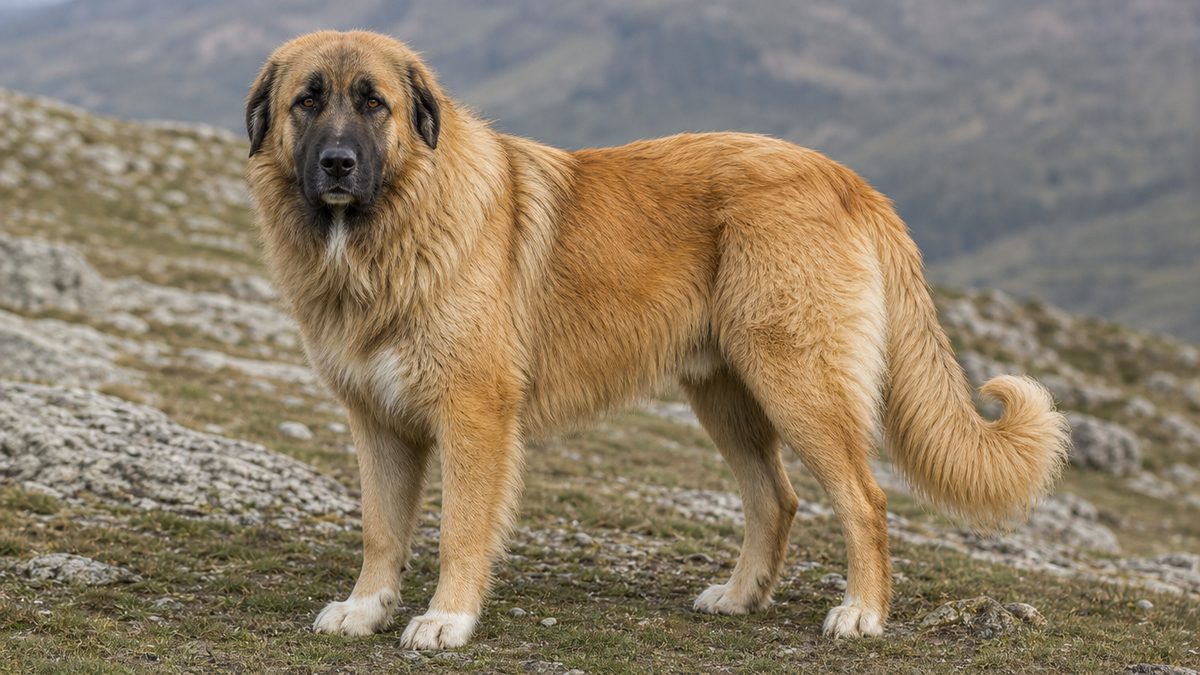
The Estrela is built thick rather than tall. The standard asks for a short, straight and thick neck with a slight dewlap, a broad and deep chest let down to the elbow or slightly below, and a croup equal to or slightly higher than the withers. The head is strong, voluminous and slightly convex in profile, the ears are small, thin, triangular and carried back against the head in what the standard calls a rose ear, and the eyes are preferably dark amber.
The tail is a breed marker and worth knowing before you look at photographs. It is set on at medium height, long, thick, carried below the horizontal, scimitar-shaped, and with a hook at the end; the absence of that hook is listed as a fault. Hind dewclaws are permitted rather than required, single or double, which matters in India because the 2017 breeding Rules forbid de-clawing outright.
| Item | Males | Females |
|---|---|---|
| Height at withers | 65-73 cm | 62-69 cm |
| Height tolerance | plus 2 cm at the upper limit | plus 2 cm at the upper limit |
| Weight | 45-60 kg | 35-45 kg |
| Severe fault on height | under 65 cm or over 75 cm | under 62 cm or over 71 cm |
| Bite | scissors preferred, pincer accepted | scissors preferred, pincer accepted |
| Coat varieties | long-haired or short-haired | long-haired or short-haired |
Two entries in that table deserve emphasis because they are where secondary sources go wrong. The height range and the severe-fault limits are different numbers in the same document, and the Portuguese text separates them just as clearly, listing 65-73 cm under Altura e Peso and 'abaixo de 65 cm ou acima de 75 cm' under Defeitos Graves. Any page printing 65-75 cm as the male height range has merged the two.
The standard accepts solid yellow, fawn and grey in all intensities, wolf grey, and brindle on a fawn, yellow or grey base. A dark mask over the skull and face is typical, and the absence of that mask is listed as a fault. White is admitted only on the feet and on a small area of the lower neck and chest, so a white-chested Estrela with a broad blaze is outside the standard.
Two coat varieties, one breed, two CACIBs
The Estrela Mountain Dog comes in two coat varieties, long-haired and short-haired, under a single FCI standard, and the FCI awards each variety its own CACIB. That is one breed, not two, and not one breed with a cosmetic option, so a page that either blends them or splits them into separate breeds has got the structure wrong.
The FCI nomenclature entry for standard 173 carries a Varieties table with exactly two rows, a) Short-haired and b) Long-haired, each marked with a CACIB asterisk. A CACIB is the certificate that counts toward the international beauty championship, so the two varieties are judged and titled separately while sharing one standard, one breed number and one studbook. In practice a short-coated Estrela does not compete against a long-coated one for the international ticket.
Both varieties are double-coated, and that is the point
Read the standard's Coat section in order and the structure becomes clear. It first describes the hair for the breed as a whole, strong, very abundant, slightly coarse, the texture similar to goat hair, and then says the undercoat is composed of fine hair, short, abundant and entangled, normally lighter in colour than the outer coat. Only after that does it split into the two varieties. The undercoat description therefore governs both.
So the short-haired Estrela is not a short-coated dog in the sense an Indian buyer usually means. It is a double coat with a shorter outer layer. The standard's short-haired paragraph reads simply 'short hair, evenly distributed over the body, slightly shorter on the head and limbs, without feathering', and the Portuguese text is identical in structure, keeping the subpelo description above the variety split. Anyone buying the short variety expecting a smooth-coated dog that will cope with Chennai has misread the document.
The long-haired variety carries a straight or slightly wavy top coat that is longer on the tail, which is bushy and feathered, around the neck and throat, on the buttocks and on the back of the forearms, and shorter and denser on the limbs below elbow and hock and on the head. That is the dog most photographs show, and it is the one Indian search results will put in front of you.
The working population skews short-haired
The variety split is not decorative in Portugal. Grupo Lobo's livestock guardian dog programme, which places pups with shepherds in wolf country, reports that of the more than 690 dogs it has integrated, approximately 340 were Serra da Estrela dogs and those were mostly short-haired. The programme's own published evaluation from 2004 names the Estrela as one of three breeds used and notes in the same sentence that it has both long and short hair varieties.
That gives a genuinely useful signal. When people who need the dog to work through a Portuguese summer at altitude choose a variety, they mostly choose the short one. Nothing about that transfers automatically to an Indian summer, because the comparison is between two double coats rather than between a coat and no coat, but it does tell you which variety the working breeders themselves consider more practical in heat.
Clipping a double-coated dog removes the guard hairs that shade the skin and does not remove the insulating undercoat evenly, so the result is neither variety. If an Indian groomer offers a summer shave for either variety, the honest answer is that no published trial shows it lowers heat risk in a double-coated breed, and the standard treats coat as a breed characteristic rather than a seasonal choice.
One measurement is worth quoting carefully here, because it is the closest thing to evidence anyone has. Kwon and Brundage imaged 50 privately owned dogs with an infrared camera after 15 minutes indoors at 23 plus or minus 2.0 degrees Celsius, and found mean body surface temperature of 31.77 C in short-coated dogs against 28.25 C in double-coated dogs and 28.14 C in long-coated dogs. Surface temperature is not core temperature, and the authors found no significant correlation between surface and rectal temperature (r = -0.24, P = 0.07). Read it as what it is: a thick coat keeps the skin surface cooler because it is holding heat in, measured at 23 C in California, not in a Mumbai May.
Recognition: definitively FCI, and what that means in India
The FCI has recognised the Estrela Mountain Dog on a definitive basis since 23 June 1955, so it is a fully established breed rather than a provisional one, and India's membership of the FCI through the Kennel Club of India is what makes that status matter locally.
The FCI's own nomenclature entry gives the date of acceptance on a definitive basis as 23 June 1955, the breed status as 'Recognized on a definitive basis', the country of origin as Portugal, and the official authentic language as English. The date of publication of the official valid standard is 4 November 2008, which the Portuguese kennel club prints as 04-11-2008 on its own breed page. Those two dates are different things and both are worth knowing: 1955 is when the breed was admitted, 2008 is when the current text of its standard was fixed.
That English is the authentic language is an unusual detail for a Portuguese breed and it has a practical consequence. Where the English and Portuguese texts differ in nuance, the English governs, and the standard credits the translation to the Portuguese Kennel Club, revised by Jennifer Mulholland, Raymond Triquet and Renee Sporre-Willes.
How the FCI status reaches an Indian buyer
India is a full FCI member represented by the Kennel Club of India, so a pedigree issued in India is issued against FCI nomenclature. That is the route by which a breed's FCI number becomes the operative answer to 'is this breed recognised in India'. The KCI publishes no per-breed list, so querying it for the Estrela returns nothing, and it also returns nothing for a control breed, which makes that a broken instrument rather than a finding. State the limit rather than the absence.
What can be checked is scale. The FCI's registration statistics for Portugal report 13,773 puppies and 2,934 litters registered with the Clube Portugues de Canicultura studbook and appendix in 2025, with no breed breakdown published. So even in the breed's home country, the total national puppy registration across every breed is under 14,000 a year, and no public figure isolates the Estrela's share of it.
The other registries, and one that has been misread
The Royal Kennel Club places the breed in the Pastoral group, marks it Breed Watch Category 1 with no points of concern identified for special attention by judges, and answers 'Vulnerable native breed: No', which is correct because it is not a British breed. The RKC recommends hip testing under the BVA/KC Hip Dysplasia Scheme as a minimum before breeding, on the stated ground that the evidence indicates it is a significant concern in the breed.
The American Kennel Club publishes a breed page but no rank. Its popularity line reads 'Ranks of 210' with the rank number left empty, and the group field is blank, which is how the AKC renders a breed outside its ranked roster. Do not read that blank as an absence of records: the Orthopedic Foundation for Animals carries a live breed code for the dog, EMD, filed under a Working key and cross-referenced to the AKC Working Group, the UKC Guardian Dog Group and the Kennel Club Pastoral Group. The breed exists in North American registry systems. It is simply too thin on the ground to be ranked.
The FCI page cited above was reached by requesting a URL ending SERRA-DA-ESTRELA-BERGHUND-173.html, the German name slug. The server returned the correct English-language entry and rewrote the address to ESTRELA-MOUNTAIN-DOG-173.html. On fci.be the trailing number decides the document and the words before it are ignored entirely, which is exactly why an assembled FCI URL can hand you a complete, correct-looking standard for a different breed. Confirm the breed name printed inside the returned document every time.
For the record, the Portuguese standard is also the reference used by the breed's own national association, the Associacao Portuguesa do Cao da Serra da Estrela, alongside the Clube Portugues de Canicultura and the FCI, and English Wikipedia lists all three as the breed's kennel club standards.
How rare the Estrela actually is, in numbers
Fifteen Estrela Mountain Dogs were registered in France in 2025, against 48 the year before, which places the breed among the rarest entries in its entire FCI group. That is the only public year-on-year registration series this page could verify, and it is worth more than any adjective.
The Societe Centrale Canine publishes an annual table of Livre des Origines Francais registrations, breed by breed, and the 2025 edition was downloaded and read directly rather than taken from a summary: 8 pages, 13,578 characters of extractable text. The row for CHIEN DE LA SERRA DA ESTRELA reads 48 registrations in 2024, 15 in 2025, and 9 confirmations in 2025.
Put that beside the group it sits in. Group 2, which covers the pinschers, schnauzers, molossoids and Swiss mountain and cattle dogs, recorded 20,042 registrations in France in 2025, down 3 percent on 20,768 the previous year. Fifteen dogs is 0.07 percent of that. For scale in the other direction, the most-registered breed in France in 2025 was the Golden Retriever at 15,062, which is roughly a thousand times the Estrela's count.
| Breed | 2024 | 2025 | Confirmations 2025 |
|---|---|---|---|
| Chien de la Serra da Estrela (Estrela Mountain Dog) | 48 | 15 | 9 |
| Cao de Gado Transmontano | 58 | 13 | 6 |
| Fila de Saint Miguel | 16 | 22 | 3 |
| Berger du Caucase (Caucasian Shepherd) | 28 | 11 | 6 |
| Cimarron Uruguayen | 9 | 10 | 0 |
| Group 2 total | 20,768 | 20,042 | 3,542 |
One row in that table is worth a sentence on its own. In 2024 the Cao de Gado Transmontano out-registered the Estrela in France, 58 to 48, even though the Transmontano is recognised by the FCI only on a provisional basis while the Estrela has been definitive since 1955. Definitive recognition is a statement about paperwork, not about how many dogs exist. Our Cao de Gado Transmontano guide covers that breed's own position in the same programme.
In Portugal, no breed-level figure is published at all
The FCI's statistics page for the Clube Portugues de Canicultura gives national totals only: 13,773 puppies and 2,934 litters registered with the studbook and appendix in 2025, with 822 individual members and 49 member clubs. There is no breed breakdown, so anyone quoting a Portuguese registration count for the Estrela specifically is quoting something the FCI does not publish.
That absence matters because the Estrela is frequently described in Portuguese media as the most-registered Portuguese breed in its own country. The claim may well be true. It is not verifiable from the registry data that is actually public, so this page does not repeat it as a figure.
Fifteen French registrations in a year tells you three practical things. There is no waiting list you can join casually. Any European litter is planned years out and usually goes to homes the breeder already knows. And a breed this thin on the ground has a small effective population, which is exactly the condition under which inherited disease concentrates. Treat rarity as a health warning, not a status symbol.
The wolf programme: which one, and which dogs
Portugal runs more than one livestock-guardian wolf-coexistence scheme, and English-language pages routinely merge them. Grupo Lobo's Programa Cao de Gado is the one with published numbers, the Estrela is its single largest breed at roughly 340 dogs, and its own two pages give two different totals for the programme's size.
Grupo Lobo's programme page states that the scheme was defined in 1987 and initiated in 1996, and that it 'has already delivered more than 600 dogs';. Its Results page, on the same site, states that the programme has supported more than 380 livestock breeders and integrated more than 690 puppies. Same organisation, same website, two totals. Both figures are printed here rather than averaged, and anyone quoting either should say which page it came from.
There is a second, smaller inconsistency in the start date. The programme's own published evaluation, written by Silvia Ribeiro and Francisco Petrucci-Fonseca for Carnivore Damage Prevention News in July 2004, opens by saying the programme has been ongoing since 1997, against the 1996 the current site gives. One year is not a scandal. It is a reminder that this programme's public record is not internally consistent, which is worth knowing before building an argument on any single number from it.
The Estrela is the programme's largest breed
The Results page gives a partial breed split of the integrated dogs: roughly 55 percent male and 45 percent female, mostly Serra da Estrela dogs, with approximately 340, mostly short-haired, and Castro Laboreiro dogs, with more than 280. Add those and you get about 620 of the more than 690 total, leaving roughly 70 dogs to be divided between the Cao de Gado Transmontano and the Rafeiro do Alentejo across the programme's entire history.
So the Estrela is not a minor participant in Portugal's best-documented wolf-coexistence scheme. It is the single most-used breed in it, by a margin. That is a genuine working credential, and it is the strongest thing anyone can say about this dog's competence at the job it was bred for.
What the programme measured, with denominators
The effectiveness numbers come from two different publications and they are not the same numbers. Ribeiro and Petrucci-Fonseca's 2004 evaluation placed 75 pups, 38 males and 37 females, of three breeds, the Cao de Castro Laboreiro, the Rafeiro do Alentejo and the Cao da Serra da Estrela, into goat and sheep flocks of 50 to 700 animals, and reported a general reduction in damages ranging from 33 percent to 100 percent. The authors themselves cautioned that damage counts varied considerably year to year for reasons unrelated to the dogs, naming predator density, alternative prey and changes in flock management.
Grupo Lobo's current Results page cites a later 2005 paper by the same authors and gives different figures: according to 90 participating livestock farmers, the dogs reduced losses in 74 percent of cases, with the recorded decrease varying between 13 percent and 100 percent. Note the range differs, 13 to 100 rather than 33 to 100, because these are two publications with different samples. Quoting one range under the other's citation is a common error on breed pages and it is worth avoiding.
The mortality figure nobody quotes
The programme is candid about what happens to the dogs, and this is the part of its record that a prospective owner should read. Grupo Lobo reports a mortality rate of over 40 percent in the first two years of life, from being run over, shot, trapped, poisoned or occasionally attacked by wolves, while noting that some dogs have lived beyond 12 years. It sets that against American programmes: Lorenz and colleagues recorded 50 percent mortality in 449 integrated dogs, and Green and colleagues reported 39 percent in the first two years across 100 dogs.
A 40 percent two-year mortality rate describes dogs living unsupervised with flocks in wolf country, killed mostly by roads, guns, traps and poison. It says nothing about the life expectancy of an Estrela in a house. It does say something about the environment the breed's temperament was selected in, which is why this dog patrols, barks at distance and does not recall reliably off a boundary it considers its own.
One more point of hygiene about this programme. Its 2004 paper carries a footnote recording that a fourth guardian breed, the Cao de Gado Transmontano, was at that time only under recognition by the Portuguese Kennel Club and therefore outside the sample. The Estrela was in the sample. That is the reverse of the situation on many sibling pages, and it means the 33 to 100 percent damage-reduction range genuinely does describe dogs of this breed among others.
Price in india: what the one Indian figure is, and what it is worth
No verified Indian seller of the Estrela Mountain Dog was found, and the single India-facing price band on the SERP, Rs 60,000 to Rs 1,00,000, comes from a page that also prints a daily calorie figure roughly 600 kcal below what a dog of this weight needs. Treat it as an unsourced number on a template page, not as a market rate.
The figure comes from HappyPet.care, which ranked second on an India-located search for this breed's price and prints 'Cost of buying Rs 60,000 - Rs 1,00,000' alongside the sentence 'Estrela price in India can be anywhere between Rs. 60,000 to Rs. 1,00,000';. It gives no source, names no seller, and quotes no city.
Running the conversion tests on Rs 60,000 and Rs 1,00,000
Indian breed pages routinely publish a US dollar price list run through one exchange rate, so the first thing to do with any rupee band is divide it. Here is the arithmetic in full, so you can check it in a calculator.
| Rate tested | Rs 60,000 becomes | Rs 1,00,000 becomes | Verdict |
|---|---|---|---|
| 84.38 | USD 711.07 | USD 1,185.11 | Fails. Neither is a price anyone prints |
| 74.00 | USD 810.81 | USD 1,351.35 | Fails. Neither is a price anyone prints |
| 80.00 | USD 750.00 | USD 1,250.00 | Clean, but proves nothing (see below) |
| 66.67 | USD 899.96 | USD 1,499.93 | Close to USD 900 and USD 1,500 |
The 84.38 test, which is the strong one, fails on both figures. The 80.00 test passes, and it is worthless here: 1,000 divided by 80 is 12.5, so any rupee figure ending in three zeros divides cleanly at 80 by construction, and both of these end in four. The 66.67 test lands near two round dollar prices, which is suggestive and nothing more. The honest verdict is that this band cannot be shown to be a converted dollar list and cannot be shown to be a real Indian price either, because nothing underneath it is checkable.
What an Indian search actually offers you instead
Search India for an Estrela puppy and you are shown a different dog. An India-located search for 'Estrela Mountain Dog puppy for sale price India' returned, in its top ten, a Bernese Mountain Dog listing for Mumbai and a Justdial page for pet shops selling Bernese Mountain Dogs in Mumbai Central, plus several generic Indian puppy-seller homepages with no Estrela page on them at all. The words 'Mountain Dog' are doing the matching, not the breed.
The largest Indian dog-price reference on that same result set is Supertails' 'Dog Price List in India: Top 40 Breeds'. It was downloaded and searched: Estrela appears zero times and Serra appears zero times, while Labrador appears ten times. The most-cited Indian price list for dogs does not contain this breed.
The overseas figures, left in their own currency
PetMD answers 'How much does an Estrela Mountain Dog cost?' with 'you can generally expect to pay at least $1,000', and says plainly that the breed is very rare in the United States and more common in Portugal, where it still works. That is a United States figure for a United States buyer. This page does not convert it into rupees, because converting a foreign price and printing it as an Indian one is precisely the fabrication mechanism described above.
DGFT Trade Notice 22/2022-23 classifies dogs under ITC(HS) 01061900 as Restricted and permits import only for a pet dog with a valid pet book in the importer's own name, for R&D with a CPCSEA recommendation, or for Defence and Police use. It states that applications for trading or breeding purposes shall be duly rejected. So even a genuine Portuguese price is not a price you can act on, and the price section of this page is, correctly, mostly about why the question has no Indian answer.
If you want this breed and you are in India, the realistic paths are two. Relocate with a dog you already own, using the personal pet route with a valid pet book, which is a documentation exercise rather than a purchase. Or accept that the breed is not available here and look at the adoption section below, which is where this page thinks an Indian reader's money and effort actually belong.
Monthly expenses: the one Indian estimate, checked line by line
The only published Indian monthly cost estimate for this breed is Rs 5,700 basic and Rs 8,550 premium, and its own food line is roughly 600 kcal a day short of what a 50 kg dog needs. The components add up correctly, so the arithmetic is not sloppy. It is simply not built around a dog of this size.
HappyPet.care breaks its estimate into three lines: food at Rs 3,000 to Rs 4,500, healthcare at Rs 1,500 to Rs 2,250 and grooming at Rs 1,200 to Rs 1,800, with headline monthly expenses of Rs 5,700 and Rs 8,550. Those totals are internally consistent. Rs 3,000 plus Rs 1,500 plus Rs 1,200 is Rs 5,700, and Rs 4,500 plus Rs 2,250 plus Rs 1,800 is Rs 8,550. The components were added, not invented.
The calorie figure does not fit the dog
The same page prints a daily energy figure of 1,500 kcal for an adult. Run the standard veterinary calculation against it. The Merck Veterinary Manual gives resting energy requirement as 70 multiplied by body weight in kilograms to the power 0.75, and maintenance energy requirement as 1.6 times RER for a neutered adult dog or 1.8 times RER for an intact one.
| Body weight | RER (70 x kg^0.75) | Neutered adult MER (1.6 x RER) | Intact adult MER (1.8 x RER) |
|---|---|---|---|
| 35 kg (female, standard minimum) | 1,007 kcal | 1,612 kcal | 1,813 kcal |
| 45 kg (male, standard minimum) | 1,216 kcal | 1,946 kcal | 2,189 kcal |
| 50 kg | 1,316 kcal | 2,106 kcal | 2,369 kcal |
| 60 kg (male, standard maximum) | 1,509 kcal | 2,415 kcal | 2,717 kcal |
So 1,500 kcal a day is below the resting requirement of a 60 kg male before he moves at all, and about 71 percent of the maintenance requirement of a neutered 50 kg dog. Feed an Estrela to that number and you are running a deliberate weight-loss diet on a growing or working animal. The figure looks like it was written for a 25 to 30 kg dog and left on a page about a 45 to 60 kg one.
The food budget follows the same error. Rs 3,000 a month is Rs 100 a day, and Rs 4,500 is Rs 150 a day. Price any large-breed kibble at your own local shop, work out what weight of food those rupees buy, and check it against the 1,946 to 2,415 kcal a real adult of this breed needs. Bonbeno is not quoting an Indian kibble price here because we have not tested one for this page, and quoting an unsourced one would repeat exactly the mistake we are pointing at.
The cost lines nobody budgets, and which matter more
- Hip and elbow radiographs under sedation, twice if you screen at one year and again at two. This is the single most defensible spend on this breed and the one no Indian cost page lists.
- Emergency surgical capacity within a short drive. A deep-chested 50 kg dog with gastric dilatation-volvulus needs a theatre, not an appointment. Budget the retainer of living near one, not the operation.
- Fencing. A guardian breed contains itself only inside a boundary it can see. Fencing a plot is a capital cost that dwarfs a monthly food line.
- Air conditioning through the hot months, running for the dog rather than for you, at a duty cycle you should price before you commit.
- Tick prevention year round, not seasonally, which is the Indian adjustment to every overseas care schedule.
None of those five appear in the Rs 5,700 to Rs 8,550 band, and together they are larger than it. That is the honest shape of what it costs to keep a 45 to 60 kg double-coated mountain guardian in an Indian city, and it is why this page does not publish a tidier number of its own.
A monthly cost estimate is only as good as the number of real households it is drawn from, and there is no verifiable population of Estrela Mountain Dogs in India to draw from. Rather than invent an average, this page shows you the arithmetic you need to build your own from your own city's prices, using the calorie requirement of the actual dog rather than a generic one.
Suitability for the Indian climate, worked from satellite data
The Serra da Estrela averages 12.8 C across the year against Chennai's 27.9 C, a gap of 15.1 C, and in Mumbai, Chennai and Bengaluru there is no month at all whose wet-bulb temperature at the daily maximum falls as low as the breed's homeland reaches at its annual peak. That is the whole climate argument in one sentence.
Every figure below comes from NASA's POWER daily point series for 1991 to 2020, queried by explicit latitude and longitude so that no place-name lookup could return the wrong location. The homeland point is Manteigas in the Serra da Estrela at 40.4022 N, 7.5350 W, and each Indian city was queried at its own coordinates. Each query returned 10,958 daily records with no fill values, and the monthly means below are averaged from those daily records rather than from a pre-computed climatology NASA POWER daily point series, 1991-2020.
Wet-bulb temperature is used rather than air temperature because a dog cools by evaporation, and evaporation is limited by humidity, not by heat alone. The conversion uses Stull's 2011 approximation, validated against the paper's own worked example, where 20.0 C at 50.0 percent relative humidity returns 13.7 C. Our implementation returns 13.7 C for that input, so the arithmetic behind every figure in the table is checkable.
| Location | Annual mean air temp | Annual mean humidity | Hottest month, mean daily max | Highest monthly wet bulb at daily max | Coolest monthly wet bulb at daily max |
|---|---|---|---|---|---|
| Serra da Estrela (Manteigas) | 12.8 C | 72.2 % | 30.4 C (August) | 22.9 C (July) | 8.3 C (January) |
| Delhi | 25.6 C | 44.0 % | 43.0 C (May) | 30.7 C (July) | 15.0 C (January) |
| Mumbai | 26.6 C | 67.2 % | 39.2 C (April) | 31.1 C (May) | 24.3 C (January) |
| Chennai | 27.9 C | 72.2 % | 36.6 C (May) | 30.6 C (April) | 24.7 C (December) |
| Bengaluru | 23.6 C | 68.0 % | 35.8 C (April) | 27.5 C (May) | 23.6 C (December) |
| Pune | 23.7 C | 66.5 % | 38.5 C (April) | 29.7 C (May) | 21.8 C (January) |
Read the last two columns together
The Serra da Estrela's worst month, by wet bulb at the daily maximum, is July at 22.9 C. Now look at the coolest month in each Indian city. Mumbai's January sits at 24.3 C, Chennai's December at 24.7 C and Bengaluru's December at 23.6 C. All three are above the homeland's annual peak. In those cities there is no time of year that is as easy for this dog as a Portuguese mountain July.
Delhi and Pune behave differently and the difference is worth stating rather than smoothing over. Delhi's January wet bulb at the daily maximum is 15.0 C and Pune's is 21.8 C NASA POWER daily point series, 1991-2020, both comfortably below the homeland's 22.9 C. A north or western Indian winter is genuinely within this breed's experience. Delhi's July, at 30.7 C wet bulb, is 7.8 C above anything the Serra da Estrela produces, which is why the same city is both the least bad choice for six months and one of the worst for the other six.
The page selling the dog to India already published the answer
HappyPet.care lists an Ideal Weather band of 10 to 25 degrees Celsius for the Estrela on the same page that quotes its Indian price. Test that band against the satellite record. Mumbai's mean daily maximum never falls below 28.3 C in any month, Chennai's never below 27.5 C, and Bengaluru's never below 26.7 C NASA POWER daily point series, 1991-2020 NASA POWER daily point series, 1991-2020. By its own stated criterion, the breed is outside its ideal weather in those three cities in all twelve months of the year. Only Delhi's January and December, at mean daily maxima of 22.7 C and 24.3 C, fall inside the band.
NASA POWER's underlying reanalysis runs on a coarse grid that smooths mountain terrain toward the surrounding lowlands, so the Manteigas point is warmer than the real high Serra da Estrela, where the standard says the dogs follow the flocks to roughly 2,000 m in summer. Correcting for that would widen the gap between homeland and Indian city, not narrow it. The figures above are therefore the conservative version of the argument.
The practical translation is short. In Bengaluru or Pune, an Estrela can live an ordinary life if you plan the day around dawn and dusk and accept indoor rest through the middle of it. In Chennai or coastal Mumbai, the humid months remove the evaporative headroom this dog depends on, and no amount of grooming changes that. In Delhi you are effectively keeping two different dogs, one from November to February and another from April to September.
Heat tolerance: what the evidence supports and what it does not
Bodyweight is the risk factor the largest heat-illness study actually measured, and dogs of 50 kg or more carried 2.21 times the odds of exertional heat-related illness of a dog under 10 kg. Coat was not a variable in that model at all, so the contribution of this breed's double coat is unquantified rather than proven.
Hall, Carter and O'Neill reviewed the primary-care records of 905,543 UK dogs at 886 VetCompass clinics in 2016 and identified 1,259 heat-related illness events from 1,222 dogs. Of those events, 380 had no trigger recorded. Of the 879 events with a recorded trigger, 652 were exertional, which is 74.2 percent, followed by environmental at 113 events, 12.9 percent, and vehicular confinement at 46 events, 5.2 percent.
The denominator is the point. Exertional heat illness is 74.2 percent of the events where anyone wrote down a cause, not of all 1,259 events. Getting that wrong turns 652 dogs into 934. The paper also records smaller triggers, including 40 events under the care of a veterinary clinic or groomer and 24 from building confinement.
What transfers to this breed, and what does not
The Estrela Mountain Dog is not named anywhere in that paper, so its breed-specific odds ratio does not exist and cannot be borrowed. What can be transferred is the bodyweight finding, because that is a measurement of the dog rather than of the label. In the final model, dogs with an adult bodyweight of 50 kg or more had odds of exertional heat-related illness 2.21 times those of dogs under 10 kg (95 percent CI 1.02 to 4.79, p = 0.046), and the 40 to under 50 kg band carried an odds ratio of 2.15 (1.31 to 3.53).
A male Estrela at the standard's 45 to 60 kg sits across both of those bands. A female at 35 to 45 kg sits in the 30 to 40 and 40 to 50 bands, whose odds ratios were 2.30 and 2.15 respectively. There is no band in that model where a dog of this breed's size is at low risk.
The variables considered in that study were breed type, purebred status, skull shape, adult bodyweight, bodyweight relative to the breed and sex mean, sex and neuter status, and age. Coat is not among them. The paper mentions a thick coat only once, in a rationale sentence explaining why purebred dogs might thermoregulate less well. So the honest statement about an Estrela's double coat is that it is biologically expected to add heat risk and has not been quantified in the largest study available. Anyone printing a coat-specific odds ratio for a heavy-coated breed is printing something no one has measured.
One counter-intuitive finding worth knowing
The same study reports that none of the dogs weighing 50 kg or over were recorded with environmental heat-related illness, and the authors describe the environmental model as the least informative of their three, with the lowest explanatory power. Do not read that as giant breeds being safe in hot rooms. Read it as a UK dataset in which prolonged exposure to extreme ambient heat was rare, which is exactly the condition that does not hold in India, and as a reminder that the transferable signal here is the exertional one.
The practical rules that follow
- Walk before sunrise and after full dark, and treat the wet-bulb figures in the climate table as the constraint rather than the air temperature on your phone.
- Cancel exercise, not shorten it, on any day when the dog is panting before you leave the gate. The 652 exertional events in Hall's data were dogs doing ordinary things on ordinary days.
- Never leave the dog in a vehicle, which accounted for 46 of the 879 triggered events even in a cool country.
- Watch after grooming and boarding, since 40 triggered events occurred under the care of a clinic or groomer.
- Weigh the dog monthly and keep it at the lean end of the standard's range, because bodyweight is the one variable in that model you can move.
A short note on the trait rating on this page. We rate the Estrela's heat tolerance at 1 out of 5 for India, and that rating is a judgement built on three verifiable things: a homeland annual mean of 12.8 C, a standard weight range sitting in the two highest-risk bodyweight bands of the largest heat-illness study available, and a double coat with an undercoat specified for both varieties. It is not a number lifted from another site.
Temperament and household fit
The FCI standard describes the Estrela Mountain Dog as distrustful towards strangers and typically docile to its master, and it treats shyness as a fault serious enough to penalise in the ring. That is a dog selected to make its own decisions about who belongs, which is the single most important thing an Indian apartment buyer needs to understand before anything else on this page.
The standard's behaviour paragraph reads in full: inseparable companion of the shepherd and faithful flock guardian, bravely protecting it against predators and thieves; wonderful farm and house guard, distrustful towards strangers and typically docile to its master. The Portuguese text says the same thing, calling the dog desconfiado perante os estranhos e tipicamente docil com o seu dono.
Two entries in the standard's fault list tell you where the temperament is allowed to sit. Nervous unbalance with signs of shyness is a severe fault, and an aggressive or overly shy dog is a disqualifying fault. So the correct Estrela is neither friendly to everyone nor frightened of anyone. It is confident, aloof and reserved, and a breeder who describes a fearful puppy as merely careful is describing a dog the standard would put out of the ring.
Who this breed genuinely suits in India
- Households with a fenced plot in Bengaluru, Pune, Nashik, Dehradun or the hill districts, where the dog has a visible boundary and the climate is survivable.
- Owners who want a guardian rather than a greeter, and who will not apologise to visitors for a dog that watches rather than wags.
- People home most of the day. Purina rates this breed 3 out of 5 for tolerating being alone, its lowest cluster alongside energy level and grooming needs.
- Families with older children rather than toddlers, because a 50 kg dog moving through a room is a physical hazard before it is a behavioural one.
- Owners prepared to manage a barker. A livestock guardian's job is to announce, and that instinct does not switch off in a housing society.
Who should not buy one
- Anyone in a flat, of any size, in any city. The breed is not destructive indoors but it is a boundary animal without a boundary, and shared corridors and lifts put strangers inside the territory it is guarding.
- First-time dog owners. A protective, independent guardian is the hardest possible first dog, and the mistakes are expensive in a way a first Labrador's are not.
- Anyone who wants an affectionate dog for guests. PetMD's own answer to whether the breed is friendly is that they are loyal and loving toward their families, need time to warm up to strangers, and are not considered outgoing or friendly to everyone.
- Households in Chennai, coastal Mumbai or Kochi, on the climate evidence above rather than on temperament.
Purina's veterinary panel rates the breed 5 out of 5 for family friendliness while giving it 3 out of 5 for liking other pets and 3 out of 5 for energy, and adds that Estrelas are keener to work with their owners than some livestock guardian breeds and will enjoy training and joining family activities if raised appropriately. Read those two ratings together and you get the real picture: warm inside the family, reserved outside it, and not the breed to add to a house that already has an assertive dog.
Grupo Lobo places these dogs unsupervised with flocks in wolf territory, and reports that more than 90 percent of integrated dogs are rated Very Good or Excellent by technicians and owners. A dog that performs that job well is one that stays put, assesses threats without being told, and does not defer. Those are the exact traits that read as stubbornness in a city.
One practical Indian consequence follows from all of it. Society guards, delivery riders, domestic staff and the endless flow of strangers past an Indian gate are not background noise to a guardian breed; they are the job. If you cannot arrange the dog's world so that it is not constantly being asked to make judgements about people, the breed will be miserable and so will you.
Training: what works and what this breed resists
Train an Estrela Mountain Dog by front-loading socialisation before 16 weeks and then training for reliability at distance rather than for obedience, because a guardian breed is selected to act independently of a handler. Purina rates the breed 4 out of 5 for ease of training, which is high for its type and still not the same as biddable.
Start with the socialisation window, which closes far earlier than most Indian owners are told. The practical target is a very large number of calm, neutral, one-off exposures before the puppy is four months old, and the specific Indian exposures that matter are the ones the breed will meet daily: gate visitors, two-wheelers, hawkers, cattle on the road, temple loudspeakers and monsoon thunder. A guardian breed under-socialised in that window does not become shy, which the standard would penalise; it becomes decisive about strangers in a way that is very hard to undo.
Purina's panel puts the breed at 4 out of 5 for ease of training and notes it is keener to work with its owner than some livestock guardian breeds. Treat that as a comparison inside the guardian group rather than against a retriever. Our Golden Retriever guide describes a dog that wants to be told what to do next; this is not that dog.
The three things worth training first
- A settle on a mat, held while a stranger enters and leaves. This is the single highest-value behaviour for a guardian breed in an Indian house, because it replaces the dog's own decision with yours.
- A recall away from a boundary. Guardian breeds recall poorly toward a fence line and well away from open ground; train it where it will fail, not where it will succeed.
- Loose-lead walking finished before 25 kg. A 50 kg dog that pulls is not a training problem, it is a physical one, and the window to fix it closes at roughly six to eight months.
What this breed resists, and why
Repetition without purpose. A dog whose ancestors were rated on whether the flock survived the night does not improve with the twentieth sit. Keep sessions short, change the picture often, and pay for decisions rather than for compliance. Expect a reliable adult somewhere between 18 and 30 months, which is later than most Indian training schedules assume, and expect a genuine adolescent regression somewhere around 10 to 14 months when the guarding instinct switches on properly.
Harsh handling is the specific failure mode to avoid. The standard's severe-fault list names nervous unbalance with signs of shyness, and that is precisely what compulsion produces in a breed selected for independent confidence. A dog that has learned to expect conflict from its handler will not defer to that handler at the gate, which is the moment you actually need it.
Protection or bite work on a livestock guardian breed is unnecessary and counterproductive: the dog already has the behaviour, and what training adds is a trigger you cannot remove. In India there is a second reason. A large guarding dog with a bite history is a legal and social problem for its owner long before it is a training problem, and no Indian city gives you the benefit of the doubt.
One point of honest uncertainty. No published training study exists on this breed. Everything in this section is inference from the standard's own behaviour description, from a kennel-club panel rating and from what the working programme reports about how the dogs are used. Where a page tells you an Estrela learns a specific command in a specific number of repetitions, ask where that number came from.
Exercise needs: the sources disagree, and the range matters
Published exercise needs for the Estrela Mountain Dog range from up to one hour a day to one or two hours a day, and the disagreement is real rather than editorial sloppiness. Plan for 60 to 90 minutes split across the coolest hours, and let the climate table rather than the clock decide.
The Royal Kennel Club's breed characteristics panel gives exercise as up to 1 hour per day, with size of home listed as a large house, size of garden as large, and town or country as country. Purina rates exercise needs at 3 out of 5 and energy level at 3 out of 5. Scrumbles' guide, which is a food brand's content page rather than a registry, gives one to two hours a day plus time to patrol the garden.
The gap is not a contradiction so much as two different questions. A guardian breed's daily energy expenditure is low, because the job is standing watch rather than running; its need for territory and mental occupation is high. That is why the same dog reads as a one-hour breed to a kennel club and a two-hour breed to a lifestyle page. In an Indian city, the binding constraint is neither: it is how many of those minutes fall inside a wet bulb the dog can shed heat into.
A workable Indian schedule
| City | Best window | Realistic daily total, hot season | Realistic daily total, cool season |
|---|---|---|---|
| Delhi | 05:15-06:30 and after 21:00 | 30-40 minutes, split | 75-90 minutes |
| Mumbai | 05:30-06:30 only | 25-35 minutes, split | 45-60 minutes |
| Chennai | 05:00-06:15 only | 20-30 minutes, split | 40-55 minutes |
| Bengaluru | 06:00-07:30 and after 19:30 | 45-60 minutes | 75-90 minutes |
| Pune | 05:45-07:00 and after 20:00 | 40-55 minutes | 75-90 minutes |
Those windows follow directly from the satellite record. Bengaluru's highest monthly wet bulb at the daily maximum is 27.5 C against Mumbai's 31.1 C NASA POWER daily point series, 1991-2020, which is why the same breed gets nearly twice the outdoor time in one city as in the other.
What replaces the missing minutes
- Scatter feeding part of the daily ration across a shaded verandah, which converts food into 20 minutes of low-heat work.
- Boundary patrol on lead at dusk, which uses the instinct rather than fighting it.
- Trained tasks with a job attached, such as carrying, fetching a named object or holding a settle while the gate opens.
- Cool-water paddling where a clean source exists, remembering to dry and check the ears afterwards.
- Nothing on hard sun-heated concrete, at any time of day, for a dog carrying this coat and this weight.
Until roughly 14 to 18 months, forced exercise on hard surfaces, long runs beside a cycle and repeated stair work all load joints that are still closing, in a breed where 66 percent of screened Portuguese dogs carried hip dysplasia. Free movement on grass is the safe default. Distance and duration come after the growth plates, not before.
The one thing not to do is compensate for a hot day by walking further on a cool one. Hall's data are full of ordinary dogs doing ordinary exercise; exertional heat illness accounted for 652 of the 879 heat-related illness events that had a recorded trigger, 74.2 percent. A guardian breed that has missed a walk is restless, not damaged. A guardian breed that has overheated is an emergency.
Grooming a double coat in Indian humidity
Brush an Estrela Mountain Dog thoroughly at least twice a week all year and daily through a coat blow, and never shave either variety. Both the long-haired and the short-haired dog carry the same undercoat, so the grooming job is the same job with a different amount of top coat on it.
The FCI standard describes the hair as strong, very abundant, slightly coarse, without excessive harshness, the texture similar to goat hair, over an undercoat of fine, short, abundant and entangled hair that is normally lighter in colour than the outer coat. That description sits above the split into varieties, so it governs both of them. The word doing the work is entangled: this undercoat mats into itself rather than falling out cleanly, which is why a comb reaching skin matters more than a brush skimming the surface.
The Royal Kennel Club lists grooming as more than once a week, coat length as medium and sheds as yes. Purina's panel rates grooming needs 3 out of 5 and shedding 4 out of 5. Those are two independent sources agreeing that this is a heavy shedder with a moderate grooming workload, which is a fair summary of a working double coat.
One Indian page contradicts itself on shedding
HappyPet.care's Estrela page prints Shedding Level: Moderate Shedding and then lists Low Shedding among the benefits of grooming on the same page. Both cannot be a description of the breed. Against a kennel club's 'sheds: yes'; and a veterinary panel's 4 out of 5, the honest expectation for an Indian household is a heavy seasonal drop plus continuous background shedding, and an air conditioner filter that needs cleaning far more often than the manual says.
A weekly routine that fits Indian conditions
- Line-brush to the skin twice weekly with an undercoat rake plus a long-pin slicker, working in sections, and daily during a coat blow.
- Check behind the ears, the ruff, the britches and the tail feathering every session, because those are the four places a long-haired Estrela mats first and where a short-haired one still holds undercoat.
- Bathe rarely, roughly every eight to twelve weeks or when genuinely dirty, using a shampoo your vet approves rather than a human one.
- Dry to the skin with a forced-air dryer after every bath and every soaking, and never leave a double coat damp under an undercoat in an Indian monsoon.
- Plug the ears before bathing and dry the ear canal afterwards, which is the single most transferable piece of Indian-specific grooming advice on this page.
- Trim nails fortnightly and check the abundant hair between the toes and pads that the standard specifically describes, because grit and moisture collect there.
Guardian-breed care guides written for European or American owners routinely say to towel the dog and let the coat air dry. In an Indian monsoon that leaves a warm, humid undercoat against skin for hours. In one Indian series from Durg, Chhattisgarh, 51 of 281 dogs screened were positive for otitis externa, and of those 51 cases 21, or 41.18 percent, presented in summer, 17 or 33.33 percent in the rainy season and 13 or 25.49 percent in winter. Dry the dog properly and dry the ears specifically.
That Durg series is worth reading carefully rather than quoting loosely. Its own seasonal figures are shares of the 51 cases, not incidence rates within each season, and its three shares sum to exactly 100 percent, which is how you can tell. The useful takeaway for an Estrela owner is simply that ear disease in Indian dogs does not confine itself to the monsoon, and this breed's ears hang flat against the head with only the inner edge visible, which limits airflow into the canal in every season.
Nobody should be selling this dog as hypoallergenic
The FCI standard says nothing about the coat being low-shedding or allergy-friendly, and the evidence on the general claim is settled. Vredegoor and colleagues measured Can f 1 in the hair and coat of 196 dogs of so-called hypoallergenic breeds against a control group and found the hypoallergenic group higher, not lower, at a geometric mean of 2.26 micrograms per gram in hair against the control, and 27.04 micrograms per gram in coat samples, concluding there is no evidence for the classification of certain dog breeds as hypoallergenic. A heavy-shedding double-coated guardian was never a candidate for that claim anyway.
Health issues: hip dysplasia at 66 percent, and a lifespan nobody agrees on
Hip dysplasia was found in 66 percent of 313 Estrela Mountain Dogs screened in Portugal, which is the highest-quality breed-specific health figure that exists for this dog. Elbow dysplasia in the same population ran at 16.5 percent, and published life expectancy ranges from under 10 years to 14 depending on which source you open.
Ginja and colleagues radiographed 313 Estrela Mountain Dogs on the standard ventrodorsal hip-extended view and graded them A to E on the FCI scoring system. Hip dysplasia was found in 66 percent of the dogs. Grades did not differ between males and females (P = 0.14) or between right and left sides (P = 0.51), and the correlation between the Ortolani test and the FCI hip score was only low to moderate (rs = 0.386, P < 0.001).
Read the FCI scale before comparing that number to anything. A companion paper on the same 313-dog database sets out the grades as normal, borderline, slight, moderate and severe. So 66 percent describes dogs at slight or worse, in a voluntarily screened population, on a scale where an OFA 'Fair' hip would sit around the borderline-to-slight boundary. It is not directly comparable with an OFA dysplastic percentage, and the comparison section below shows why that matters.
The authors' own conclusion is the sentence to carry away: the data confirm the high prevalence and severity of HD in predisposed breeds that do not have breeding programmes in place, while showing an initial favourable change in breeding values that they attribute to the voluntary radiographic hip-screening programme. Mean breeding values were flat for dogs born between 1991 and 2003 and improved in 2004 and 2005.
Passive hip laxity, measured by PennHIP
A second Portuguese study examined 215 Estrela Mountain Dogs by the PennHIP method between 2002 and 2006 and reported a distraction index, taken on each dog's worse joint, ranging from 0.15 to 1.12 with a mean of 0.55 plus or minus 0.19. Laxity was higher in females than in males (P < 0.01) and equal on right and left sides. The estimated heritability was 0.83 plus or minus 0.11, and the authors note that the distraction index could be reduced in the breed if passive hip laxity were used as a selection criterion.
That heritability figure is the practical one for a buyer. A trait that heritable responds fast to selection, which means a breeder who screens and selects can move this breed's hips within a few generations, and a breeder who does not will not improve by accident.
Elbow dysplasia, and an arithmetic error in the paper
Alves-Pimenta and colleagues radiographed 351 Estrela Mountain Dogs and scored elbows on the International Elbow Working Group system. The paper reports elbow dysplasia in 16.5 percent (59/351), with males more affected at 27 percent (34/127) than females at 11 percent (24/224), and a very low heritability of 0.065.
Divide the figures out. 59/351 is 16.81 percent, not 16.5. But the paper's own sex rows give 34 affected males plus 24 affected females, which is 58, and 58/351 is 16.52 percent, which rounds to exactly the 16.5 the paper prints. The sex rows also sum correctly on the denominator, 127 plus 224 being 351. So the printed count of 59 is the inconsistent figure and 16.5 percent is the one supported by the rest of the table. We quote the percentage, and we say why.
Take the elbow finding at face value and it changes what you screen for. A heritability of 0.065 means selecting on an individual dog's own elbow score does very little, which is exactly what the authors conclude when they say mass selection using individual phenotypes may not be effective. They add that elbow genetic trends track hip trends closely enough that selection against hip dysplasia should also deliver genetic progress on elbows. Hips are the lever.
Life expectancy: four sources, three different answers
| Source | Life expectancy given | What kind of source it is |
|---|---|---|
| The Royal Kennel Club | Under 10 years | National kennel club breed data |
| American Kennel Club | 10-14 years | National kennel club breed page |
| PetMD | 10-14 years | Veterinary-reviewed consumer site |
| Purina UK | 10-12 years | Pet food brand with a veterinary panel |
| HappyPet.care | 10-14 years | India-facing content page |
The Royal Kennel Club prints Under 10 years while the AKC and PetMD both print 10 to 14 PetMD, 'Estrela Mountain Dog'. Gives a life… and Purina prints 10 to 12. No published longevity study on this breed was found, so none of these figures rests on a mortality dataset that this page could open. The four-year spread between a kennel club and a veterinary consumer site is not a rounding difference, and Bonbeno publishes the disagreement rather than picking the friendlier end of it.
The pattern is worth naming. The AKC's numbers and PetMD's numbers are identical across height, weight and lifespan, at 24.5 to 29 inches, 77 to 132 pounds and 10 to 14 years PetMD, 'Estrela Mountain Dog'. Gives a life…, which is what a shared upstream source looks like. Two sources agreeing is only evidence when they are actually independent.
Screening: what to ask for, and why OFA has nothing on this breed
Ask any Estrela breeder for hip scores on both parents and treat that as non-negotiable, because hip dysplasia at 66 percent with a passive-laxity heritability of 0.83 is a problem selection can actually fix. Do not expect OFA statistics to help you: the breed carries an OFA code but appears nowhere in OFA's published disease tables.
The Orthopedic Foundation for Animals disease-statistics tables were retrieved in full on 27 August 2026 and searched case-insensitively. Estrela returns zero occurrences. Serra returns zero. The search was not broken: in the same retrieval, Labrador returned 109 rows, Samoyed 76, Bernese 73, Keeshond 57, Chow Chow 40 and German Spitz 14. Controls passed, so the absence is real.
Absence from those tables is a threshold effect rather than non-existence. OFA requires roughly 100 hip evaluations, or 50 for its other databases, before a breed appears at all, and this breed has not reached it. That is different from saying OFA has never heard of the dog: OFA's own breed-browse markup carries the code EMD with the label ESTRELA MOUNTAIN DOG, cross-referenced to the AKC Working Group, the UKC Guardian Dog Group and the Kennel Club Pastoral Group. The breed is registrable there. It is simply not numerous enough to generate a statistic.
Our Cao de Gado Transmontano page reported that not one of the four Portuguese livestock guardian breeds appears anywhere in the OFA database. That phrasing was too strong, and this page corrects it. What is verified is that none of them appears in OFA's published disease-statistics tables. The Estrela does hold a live OFA breed code, EMD, in the same registry's breed-browse list. The distinction matters, because one statement means no data exists and the other means no dog has been registered under a name OFA does not recognise.
The screening schemes that do apply
The Royal Kennel Club recommends, as a minimum for this breed, hip testing under the BVA/KC Hip Dysplasia Scheme, on the stated ground that the evidence indicates hip dysplasia is a significant concern in the breed, and it also flags prioritising genetic diversity. It offers no breed-specific DNA testing package, which is consistent with there being no validated single-gene test to offer.
In Portugal, the screening that produced the numbers on this page was voluntary radiographic hip screening, and the improvement in breeding values from 2004 onward is attributed to it. That is the clearest possible demonstration that this breed's hips respond to a screening programme, and the clearest possible argument for insisting on scores before you take a puppy.
The questions to put to a breeder, in order
- What are both parents' hip scores, and under which scheme? FCI A to E, BVA/KC total score and OFA grade are three different scales; ask which one and get the certificate number.
- Has either parent had a PennHIP distraction index measured? In this breed the published mean is 0.55 on the worse joint, so a dog materially above that is worse than a breed already in trouble.
- What are both parents' elbow grades on the IEWG system? Ask even though heritability is low, because the grade still tells you what you are buying.
- How closely related are the parents? In-breeding and incest breeding as defined in Indian law are prohibited here, and in a breed with 15 French registrations a year the pedigree behind a European litter can be tighter than it looks.
- What is the coefficient of inbreeding for this mating? A breeder who cannot answer has not calculated it.
- How many litters has the dam had, and at what age? Indian law caps breeding females at eight years of age, which is a reasonable standard to hold any breeder to.
Two of those questions come straight out of Indian law rather than out of breed practice. The Dog Breeding and Marketing Rules 2017 prohibit in breeding, defined as breeding between relatives of the second to fourth grade in straight or side line within the first four generations, giving uncle to niece, nephew to aunt, cousin to cousin and grandparent to grandchild as examples, and incest breeding, defined as mating between parents and children or between brother and sister. The same paragraph permits only out breeding and line breeding.
Hip dysplasia is heritable, but it is not only heritable. In a controlled trial, 48 Labrador Retrievers were split into two groups and one was fed 25 percent less of the same food until two years old. Using the OFA method at two years, 7 of the 24 limit-fed dogs and 16 of the 24 fed to appetite were diagnosed with hip dysplasia; using the Swedish method the split was 5 of 24 against 18 of 24. Keeping a large-breed puppy lean is the single most effective non-genetic intervention available to you.
The Indian health risks this breed walks into
Three risks matter more in India than in Portugal for a dog of this size and coat: bloat, tick-borne blood parasites, and ear disease under a flat-hanging ear in high humidity. None of them is breed-specific, and all three are size-specific or climate-specific, which is exactly why the overseas breed pages do not cover them.
Gastric dilatation-volvulus, and a conformation detail in this breed's favour
Gastric dilatation-volvulus is the emergency that kills large dogs fastest. In a prospective cohort of 1,914 dogs across 11 large and giant breeds, the incidence was 23 cases per 1,000 dog-years at risk in large breeds and 26 per 1,000 in giant breeds, with a cumulative incidence of 5.7 percent, and of the 105 dogs that developed it 30, or 28.6 percent, died. A UK emergency-practice study of 77,088 dogs found 492 presumptive cases, a prevalence of 0.64 percent, with the highest odds ratios in the Great Dane at 114.3, the Akita at 84.4 and the Dogue de Bordeaux at 82.9.
The Estrela Mountain Dog appears in none of those breed lists, so no breed-specific odds ratio for it exists. What can be transferred is conformation, and here the standard is genuinely informative. Schellenberg and colleagues measured 155 Irish Setters and found that dogs with the deepest thorax relative to width, a ratio of 1.61 to 1.85, carried an odds ratio of 8.45 against the shallowest at 1.20 to 1.50 (95 percent CI 1.44 to 49.57, p = 0.02). Depth relative to width is the axis that matters.
Now read the Estrela's standard on that axis. It asks for a chest that is broad, deep, well sprung without being cylindrical, and well let down to the elbow or slightly below, and its Important Proportions specify that the depth of the chest is less than half the height at withers. That describes a broad, capacious chest with a capped depth, which sits at the safer end of the depth-to-width ratio rather than the dangerous end. It is a real point in this breed's favour and no ranking page makes it.
A prospective cohort of 1,637 large and giant breed dogs found the factors significantly associated with increased gastric dilatation-volvulus risk were increasing age, having a first-degree relative with a history of it, a faster speed of eating, and having a raised feeding bowl. Raised bowls are still sold in India as a large-breed accessory. Feed from the floor, in two or three meals, and slow the dog down with a maze bowl rather than lifting the food.
Tick-borne blood parasites, which are an Indian baseline rather than an event
A 2024 molecular survey of 719 canine blood samples in Punjab found, by multiplex PCR, Babesia gibsoni in 8.9 percent, Hepatozoon canis in 5.1 percent, Ehrlichia canis in 2.6 percent and Babesia vogeli in 1.1 percent, with concurrent infections in a further small share. The clinically important number in that paper is the comparison: by microscopy alone the same samples returned 5.0 percent, 1.0 percent, 1.4 percent and 0.1 percent. Microscopy missed roughly half the Babesia gibsoni and four fifths of the Hepatozoon canis.
For an owner, that translates into two rules. Run tick prevention year round rather than seasonally, because Indian tick pressure does not have a closed season the way a European one does. And if your dog is unwell and a blood smear comes back clean, ask your veterinarian whether PCR is available, because a negative smear is a weaker result than it looks. A thick double coat makes daily tick checks harder, not easier, which is a coat consequence nobody lists under grooming.
Ear disease under a flat ear in a humid climate
The standard describes ears that hang, carried falling backwards and laterally against the side of the head, with only the inner edge visible. That is a canal with limited airflow. In an Indian series from Durg, Chhattisgarh, 51 of 281 dogs screened were positive for otitis externa, a prevalence of 18.14 percent, and of those 51 cases the seasonal split was 21 in summer, 17 in the rainy season and 13 in winter. The paper's authors note that dogs over five years old were the most affected age group.
Check the ears weekly, dry them after every bath and every swim, and treat a head shake, an odour or a dark discharge as a reason to see a veterinarian rather than to buy an ear cleaner. Do not use a cotton bud inside the canal; the same paper names excessive trauma from over-enthusiastic cleaning and from instruments in the canal as a route to bacterial colonisation.
The risk this page will not quantify
Heat stroke is the fourth Indian risk and the one where an honest page has to stop short of a number. The largest available study does not include this breed and does not model coat at all, and no Indian veterinary series on heat-related illness in large double-coated dogs was found. What can be said is what the climate section says: the wet-bulb environment in most Indian cities is outside anything this dog's homeland produces NASA POWER daily point series, 1991-2020. What cannot be said is by how much that raises its risk, and any page giving you that percentage has made it up.
Feeding across the life stages, in rupee reality
Feed an adult Estrela Mountain Dog roughly 1,946 to 2,415 kcal a day depending on weight and neuter status, split into two or three meals from a floor-level bowl. Those numbers come from the standard veterinary formula rather than from a breed page, and they are roughly 30 to 60 percent higher than the one Indian figure published for this breed.
The arithmetic is worth doing once so you can redo it for your own dog. Resting energy requirement is 70 multiplied by body weight in kilograms to the power 0.75; maintenance is 1.6 times that for a neutered adult, 1.8 times for an intact one, 1.4 times for a dog prone to obesity, 3 times for a puppy and 2 times for a puppy over four months old. Run it against your dog's actual weight on the day, not against the breed's average.
| Stage | Typical weight | Multiplier | Daily target |
|---|---|---|---|
| Puppy under 4 months | 12 kg | 3 x RER | 1,354 kcal |
| Puppy over 4 months | 25 kg | 2 x RER | 1,565 kcal |
| Adolescent over 4 months | 40 kg | 2 x RER | 2,227 kcal |
| Adult female, neutered | 40 kg | 1.6 x RER | 1,781 kcal |
| Adult male, neutered | 52 kg | 1.6 x RER | 2,169 kcal |
| Adult male, intact | 52 kg | 1.8 x RER | 2,440 kcal |
| Senior or obesity-prone adult | 52 kg | 1.4 x RER | 1,898 kcal |
Compare the adult rows with the 1,500 kcal a day that the one India-facing page publishes for this breed and the gap is between roughly 280 and 940 kcal, every day. Over a year that is a serious under-feed for a growing or working animal, and it is exactly the kind of error that a page written around a generic large dog produces when it is dropped onto a 45 to 60 kg breed.
How to feed, not just how much
- Split the ration into two or three meals, never one, and never immediately before or after exercise.
- Feed from the floor, because a raised feeding bowl was among the factors significantly associated with increased gastric dilatation-volvulus risk in a 1,637-dog cohort.
- Slow a fast eater with a maze bowl or a snuffle mat, because a faster speed of eating was another of those factors.
- Weigh the food rather than scooping it, since a 10 percent scoop error on a 2,169 kcal ration is a 216 kcal error a day.
- Body-condition score every fortnight, feeling ribs under light pressure with a visible waist from above, and adjust the ration by 10 percent at a time rather than by eye.
Growth feeding is where the money is actually saved
For a large-breed puppy, the ration is a health intervention rather than a budget line. In a controlled trial, 48 Labrador Retrievers were split into two groups and one group was fed 25 percent less of the same food until two years old; at two years, using the OFA method, 7 of 24 limit-fed dogs were diagnosed with hip dysplasia against 16 of 24 fed to appetite, and using the Swedish method 5 of 24 against 18 of 24. In a breed where 66 percent of screened Portuguese dogs already carried hip dysplasia, that is not a marginal effect.
Large-breed puppy and adult diets from the major international brands are widely stocked in Indian metros and available online almost everywhere. What is genuinely harder to source outside the big cities is a consistent supply of one formula, and switching formulas repeatedly is its own gastrointestinal risk in a deep-chested dog. Before you commit to a 50 kg breed, check that the food you intend to use is reliably available where you live, not just available once.
Two things this page will not give you. It will not name a specific Indian brand as best for the breed, because Bonbeno has not tested one for this page. And it will not quote a monthly rupee food cost, because that requires a real price per kilogram in your city multiplied by a ration you can now compute yourself from the table above.
Month by month through the first year
Plan the first year of an Estrela Mountain Dog around three deadlines: socialisation finished by 16 weeks, lead manners finished before 25 kg, and no forced exercise before the growth plates close at roughly 14 to 18 months. Everything else is negotiable.
| Age | Priority | What to avoid |
|---|---|---|
| 0-8 weeks | With the litter. Indian law prohibits the sale of pups under eight weeks, so a breeder offering one earlier is breaking Rule 8(1)(a). | Any collection before eight weeks, whatever the reason given |
| 8-12 weeks | Home, crate and toilet routine. Begin the socialisation programme immediately: gate visitors, vehicles, surfaces, sounds. | Isolation while waiting for vaccinations to finish |
| 12-16 weeks | Finish the socialisation window. Carry the puppy where it cannot walk yet. Introduce grooming as a daily handling ritual before the coat needs it. | Dog parks, and any encounter you cannot control |
| 4-6 months | Loose-lead walking, settle on a mat, recall away from boundaries. Start weighing weekly. | Stairs repeated for exercise, long walks on concrete |
| 6-9 months | Adolescence begins. Hold the training standard rather than raising it. Keep the dog lean. | Free feeding, and any confrontation-based correction |
| 9-14 months | Guarding instinct switches on. Expect regression at the gate and manage it with structure, not force. | Encouraging territorial barking, protection work of any kind |
| 14-18 months | Growth plates close. Preliminary hip and elbow radiographs become worthwhile. Begin building real distance work. | Assuming the dog is mature because it is large |
| 18-24 months | Definitive hip and elbow screening. Reassess ration downward as growth stops. | Continuing puppy-level calories into adulthood |
The eight-week rule is a genuine Indian legal requirement rather than a courtesy. Rule 8(1)(a) of the Dog Breeding and Marketing Rules 2017 provides that every breeder shall ensure that pups less than eight weeks in age are not sold, and the same rule requires that dogs over six months in age are not sold without first being sterilised unless they are going to another licensed breeder.
The two Indian adjustments to a European puppy schedule
First, the vaccination and socialisation clash is worse here. Indian rabies and parvovirus pressure is real, so the temptation is to keep the puppy in until the course finishes, which lands you at 16 weeks with an unsocialised guardian breed. The resolution is controlled exposure rather than isolation: carry the puppy, use clean private spaces, invite known vaccinated dogs to your home. The Rules themselves note that pup vaccination can start at seven to eight weeks and is usually completed at eighteen weeks.
Second, heat management starts in the first week, not in the first summer. A puppy that has learned to sleep through the afternoon indoors and to work at dawn will keep that rhythm as an adult. A puppy that has learned to expect a midday walk will demand one at 50 kg in May.
A weekly weight log is the cheapest diagnostic you will ever run on a large-breed puppy. It catches a growth spurt before you see it, it lets you adjust the ration by 10 percent rather than guessing, and it gives your veterinarian a curve rather than a single point when something looks wrong. In a breed with a 66 percent screened hip dysplasia rate, keeping the puppy lean through growth is the intervention with the best published evidence behind it.
Estrela against the breeds Indian buyers cross-shop
Buyers reach the Estrela Mountain Dog from four directions, usually from the Tibetan Mastiff, the Bernese Mountain Dog, the Caucasian Shepherd or its own Portuguese siblings, and the differences that matter in India are size, coat and screening data rather than temperament. Every figure below was read from the relevant FCI standard after confirming the breed name printed on the document itself.
| Breed and FCI number | Male height | Male weight | Female height | Female weight |
|---|---|---|---|---|
| Estrela Mountain Dog (173) | 65-73 cm | 45-60 kg | 62-69 cm | 35-45 kg |
| Cao de Gado Transmontano (368) | 75-85 cm | 60-75 kg | 68-78 cm | 50-60 kg |
| Cao de Castro Laboreiro (170) | 58-64 cm | 30-40 kg | 55-61 cm | 25-35 kg |
| Caucasian Shepherd Dog (328) | 72-75 cm desirable, 68 cm minimum | 50 kg minimum | 67-70 cm desirable, 64 cm minimum | 45 kg minimum |
| Do-Khyi / Tibetan Mastiff (230) | 66 cm minimum only | none stated | 61 cm minimum only | none stated |
| Bernese Mountain Dog (45) | 64-70 cm, ideal 66-68 | none stated | 58-66 cm, ideal 60-63 | none stated |
Two of those standards give no weight at all. The Tibetan Mastiff's standard states a minimum height and stops, and the Bernese standard gives heights with an ideal range and no weight. Any page quoting a weight range for either as though it came from the standard is quoting something else. The Caucasian Shepherd's standard gives minimum weights only, with larger stature accepted as long as conformation stays harmonic.
Within the Portuguese group the Estrela sits in the middle. It is materially smaller than the Transmontano at 75-85 cm and 60-75 kg and materially larger than the Castro Laboreiro at 58-64 cm and 30-40 kg. The Castro Laboreiro is also the thermal outlier of the group: our Castro Laboreiro Dog guide covers a breed whose standard describes a short coat without undercoat, which is a genuine difference from the Estrela's double coat rather than a marketing one. The Cao de Gado Transmontano guide covers the largest of the four.
Hip data: why the Estrela's 66 percent is not comparable to an OFA figure
Every guardian breed the Estrela is cross-shopped against has an OFA hip table, and the Estrela does not. That makes a direct comparison tempting and wrong, and the reason is worth spelling out, because it is the most common statistical error on breed pages.
| Breed | Evaluations | Normal % | Fair % | Dysplastic % | Fair plus dysplastic |
|---|---|---|---|---|---|
| Great Pyrenees | 7,497 | 89.3 | 12.3 | 9.5 | 21.8 |
| Anatolian Shepherd | 3,076 | 89.3 | 9.9 | 9.8 | 19.7 |
| Komondor | 1,103 | 85.8 | 14.8 | 13.1 | 27.9 |
| Bernese Mountain Dog | 31,550 | 82.1 | 12.4 | 16.3 | 28.7 |
| Tibetan Mastiff | 1,403 | 82.1 | 14.3 | 16.7 | 31.0 |
| Kuvasz | 2,126 | 80.5 | 12.6 | 17.6 | 30.2 |
| Maremma Sheepdog | 273 | 79.5 | 9.2 | 17.9 | 27.1 |
| Labrador Retriever (reference) | 324,743 | 87.5 | 8.6 | 11.3 | 19.9 |
| Estrela Mountain Dog | no OFA table exists | - | - | - | - |
OFA counts Excellent, Good and Fair as Normal, so its Dysplastic column excludes borderline hips. The Portuguese figure counts differently: 66 percent of 313 dogs graded slight or worse on the FCI A to E scale, and FCI slight sits roughly where OFA Fair does. Add OFA's Fair and Dysplastic columns together, as the last column above does, and the worst comparable breed reaches 31.0 percent. The Portuguese Estrela figure is still more than double that.
So the gap is not only a scoring artefact. The other half of the explanation is the population: OFA's tables are voluntary submissions from a screening culture, while Ginja's cohort was drawn from a breed whose own authors describe it as one of the predisposed breeds that do not have breeding programmes in place. Both facts are real, and a buyer should assume the true rate in an unscreened Estrela line is closer to the Portuguese number than to the OFA ones.
Search for this breed from India and the results include Bernese Mountain Dog listings for Mumbai, because the phrase 'Mountain Dog' matches. The two breeds are not close. The Bernese is a tricolour Swiss draught and farm dog whose standard gives no weight and asks for a 2:1 height-to-chest-depth ratio, and it is a substantially shorter-lived breed with a much larger OFA hip dataset. If a seller offers you an Estrela and shows you a black, white and tan dog, you are being shown a Bernese.
Where Indian law meets this breed
Indian breeding law names hip dysplasia by name as a genetic defect a breeding dog must have been tested for, which is a direct hit on the Estrela's single biggest health problem. Import law separately makes buying one into India for sale impossible, and the FCI standard's own severe-fault list happens to agree with Indian law on ears and tails.
The clause that bites hardest: mandatory genetic-defect testing
Second Schedule Part III paragraph 8(10) of the Prevention of Cruelty to Animals (Dog Breeding and Marketing) Rules, 2017 reads, verbatim from the gazette: 'The dogs shall have been tested for genetic defects, including hip dysplasia, progressive retinal atrophy, night blindness, hypothyroidism, entropion, ectropion, overshot, undershot jaw (when incisors do not touch or mesh), wry mouth, two or more missing teeth, unilateral cryptorchid or full cryptorchid males.';
Hip dysplasia is the first item on that list, and it is this breed's defining health problem at 66 percent of 313 screened Portuguese dogs. So an Indian breeder of Estrela Mountain Dogs would be under a positive legal obligation to have tested for exactly the condition the breed's own literature says it has. The word in the clause is including, so the list is illustrative rather than closed, and elbow dysplasia is not named but is plainly within its spirit.
Note what the Rules do not contain, because these absences are citable. Across the whole gazette there is no patella-luxation requirement, no dental requirement beyond the 'two or more missing teeth' inside 8(10), and no mention of BAER testing or deafness at all. Never write that Indian law mandates a patella grade.
Ears, tails and a rare moment of agreement
Second Schedule Part II paragraph 6(8) provides that 'There shall be no tail docking, ear cropping, de-barking, de-clawing, branding, dyeing, injecting substances to enhance visual appeal, performing a surgery or procedure to camouflage or hide any defect or infirmity or any other kind of mutilation of any body part of the pup and any change of appearance by artificial means is strictly forbidden.';
For most guardian breeds this clause collides with the breed standard. Here it does not. FCI-Standard 173 lists cropped ears and a docked or rudimentary tail among its severe faults, and an anurous tail among its disqualifying faults. The standard and Indian law want the same dog. The one point of contact worth watching is de-clawing, which 6(8) prohibits and which the standard makes irrelevant by permitting single or double hind dewclaws rather than requiring their removal.
Breeding technique, and why it matters more in a rare breed
Second Schedule Part II paragraph 6(3) prohibits two named techniques. In breeding is defined as breeding between relatives of the second to fourth grade in straight or side line within the first four generations, with uncle to niece, nephew to aunt, cousin to cousin and grandparent to grandchild given as examples. Incest breeding is defined as mating between parents and children or between brother and sister. Only out breeding and line breeding are permitted.
In a breed registering 15 dogs a year in France, those definitions are not academic. A small population forces close matings, and a European pedigree that looks unrelated on paper can still put the same grandparent on both sides. Ask for the coefficient of inbreeding, and note that the Royal Kennel Club flags prioritising genetic diversity for this breed alongside hip testing.
Sale, minimum age and the import position
Indian law sets an eight-week floor on selling a puppy, bars the sale of an unsterilised dog over six months except to another licensed breeder, and through a separate instrument makes commercial import of a dog impossible. Together those provisions close every route by which an Estrela Mountain Dog could lawfully reach an Indian buyer for money.
- Rule 8(1)(a): every breeder shall ensure that pups less than eight weeks in age are not sold.
- Rule 8(1)(b): dogs over six months in age are not sold without first being sterilised, unless they are being sold to another licensed breeder.
- Second Schedule Part II paragraph 6(4): female dogs shall not be mated after the age of eight years.
- Second Schedule Part II paragraph 5(7): no male dog shall be used for breeding until he has reached his eighteenth month and has been certified healthy by a veterinary practitioner at least ten days before mating. Paragraph 5(2) sets the same eighteen-month floor for females, and 5(6) caps a female at five litters in her lifetime.
- Second Schedule Part III paragraph 8(9): pup vaccination can start at seven to eight weeks and is usually completed at eighteen weeks.
Every one of those is quoted from the gazette text of G.S.R. 496(E) as extracted from the AWBI PDF, 14 pages and 51,953 characters of real text layer. Note the citation form: these are paragraphs of the Second Schedule, not Rules, except 8(1)(a) and 8(1)(b) which genuinely are Rule 8. The document numbers clauses twice and the distinction changes what a reader finds when they look it up.
Import: there is no lawful commercial route
DGFT Trade Notice No. 22/2022-23 of 19 December 2022 classifies dogs under ITC(HS) 01061900 as Restricted. Policy Condition (7) permits import of dogs only for a pet dog with a valid pet book and relevant records in the name of the importer, for R&D organisations with a CPCSEA recommendation, or for internal security by the Defence and Police Force. Policy Condition (8) states that import of commercial dogs for breeding or any other commercial activity other than those purposes is not permitted.
The notice adds that applications for trading or breeding purposes, or made on behalf of another person or entity, shall be duly rejected, and that import of pet animals is allowed only through the airports and seaports of Delhi, Mumbai, Chennai, Hyderabad, Bangalore and Kolkata. DAHD added a seventh port, Cochin International Airport at Kochi, for pets arriving under the baggage rules in October 2024. Read that alongside the fact that no verified Indian breeder of this breed exists, and the conclusion is not a matter of opinion: there is no lawful supply chain for an Estrela Mountain Dog in India, and anyone offering to arrange one is offering to break either the trade notice or the Rules. The full route is set out in how to import a dog to India.
Common mistakes Indian buyers make with this breed
The most expensive mistake is buying the short-haired variety on the belief that it will handle Indian heat, because both varieties carry the same undercoat under a single FCI standard. The rest of the list is the ordinary set of errors that a rare breed with almost no honest Indian coverage produces.
1. Treating the short-haired variety as a heat solution
The standard's undercoat description sits above the split into varieties and therefore governs both of them: fine, short, abundant and entangled, under an outer coat of goat-hair texture. A short-haired Estrela is a double-coated dog with less top coat, not a smooth-coated dog. Buying it as a hot-climate version of the breed is buying a fiction.
2. Shaving the coat in April
No published trial shows that clipping a double-coated dog lowers heat risk, and the largest heat-illness study available does not include coat as a variable at all. What shaving reliably removes is the guard hair that shades skin. If the reasoning for a summer shave is heat, the honest answer is that the evidence does not support it and the coat is not the lever. The lever is the clock and the wet-bulb temperature.
3. Believing the one published Indian price
Rs 60,000 to Rs 1,00,000 appears on a single India-facing page with no source, no seller and no city, and the strong 84.38 conversion test fails on both ends of it. The same page prints a daily adult calorie figure of 1,500 kcal against a real requirement of roughly 1,946 to 2,415 kcal HappyPet.care, 'Estrela Mountain Dog' breed…, which tells you how carefully its other numbers were assembled.
4. Reading OFA's silence as good news
The Estrela has no OFA hip table, and controls run in the same retrieval confirm the search was working. Absence of data is not evidence of health. The data that does exist, from the breed's own country, puts hip dysplasia at 66 percent of 313 screened dogs. Ask for parental hip scores and treat a breeder who says the breed does not need them as disqualified.
5. Buying a Bernese and calling it an Estrela
An India-located search for this breed returns Bernese Mountain Dog listings in Mumbai in its top ten, because the phrase matches. The Bernese standard gives dogs 64-70 cm and no weight, and the dog is tricolour black, white and tan. The Estrela is fawn, yellow, grey, wolf-grey or brindle with a dark mask and only limited white on feet and lower chest. Colour alone separates them at a glance.
6. Using a raised feeding bowl
A raised feeding bowl was among the factors significantly associated with increased gastric dilatation-volvulus risk in a prospective cohort of 1,637 large and giant breed dogs. Indian pet retail still sells raised stands as a large-breed accessory. Feed from the floor and slow a fast eater with a maze bowl instead.
7. Assuming a big dog matures early
Growth plates in a 50 kg breed close at roughly 14 to 18 months, and the guarding instinct arrives around 10 to 14 months. Owners who start distance running or stair work at eight months because the dog already looks adult are loading joints in a breed with a 66 percent screened hip dysplasia rate, and the trial evidence on growth feeding shows how much of that outcome is actually within an owner's control.
8. Keeping a guardian breed in a flat
The FCI standard describes a dog distrustful towards strangers and bred to protect a flock against predators and thieves. A shared lift and a common corridor put strangers inside the territory it is guarding, several times a day, for its whole life. The Royal Kennel Club's own breed panel lists the required size of home as a large house with a large garden and puts the breed in country rather than town.
9. Skipping tick prevention outside the monsoon
A 2024 Punjab survey found Babesia gibsoni in 8.9 percent of 719 dogs by PCR against 5.0 percent by microscopy, and Hepatozoon canis in 5.1 percent against 1.0 percent. Tick prevention in India is a year-round programme, and a thick double coat makes manual tick checks harder rather than easier.
10. Taking one lifespan figure as settled
The Royal Kennel Club prints under 10 years while the AKC and PetMD both print 10 to 14 PetMD, 'Estrela Mountain Dog'. Gives a life…. No longevity study on this breed was found. Plan for the shorter figure and be pleased if you get the longer one, and be suspicious of any Indian page that quotes a single number without saying where it came from.
Deciding against this breed after reading the climate section is the correct outcome for most Indian households, and it is not a failure of nerve. A dog whose homeland averages 12.8 C and whose standard describes it climbing to 2,000 m to escape summer heat is being asked to do something genuinely hard in Chennai. Wanting the dog and not buying it is the responsible version of wanting the dog.
Adoption, sourcing and what to do instead
No Estrela Mountain Dog rescue population exists in India, so adoption of this specific breed is not a realistic Indian route. What is realistic is verifying any dog offered to you as one, adopting an Indian dog that actually needs a home, and understanding that in Portugal the breed's own placement route is a conservation programme rather than a market.
Start with the honest position. India has no breed-specific Estrela rescue, no verified Indian breeder, and no lawful import route for a purchased dog. A search from India for a puppy of this breed returns other breeds and generic seller homepages. So the adoption section of this page cannot point you at an Estrela in a shelter, and pretending otherwise would be the kind of invention this site exists to avoid.
How the breed is actually placed in Portugal
In its homeland the Estrela's working placement route is not a sale. Grupo Lobo's Programa Cao de Gado gives dogs to livestock keepers, monitors their development, evaluates their effectiveness and provides technical and veterinary support, and it has placed more than 690 puppies of the four Portuguese guardian breeds with more than 380 breeders. Roughly 340 of those were Serra da Estrela dogs. Those animals go to flocks, not to households.
That tells an Indian reader something useful about what the breed is for. A dog whose largest organised placement scheme is a wolf-coexistence programme is not a companion breed with a working past; it is a working breed with a companion sideline. The programme's reported mortality of over 40 percent in the first two years of life is a measure of the environment it is selected for.
If someone offers you an Estrela in India, verify it
- Ask for the pedigree and the issuing body. A genuine dog will trace to the Clube Portugues de Canicultura or another FCI member registry, against FCI standard 173.
- Ask which coat variety, and why. A seller who does not know the breed has two varieties with separate CACIBs does not know the breed.
- Check the colour against the standard. Fawn, yellow, grey, wolf-grey or brindle with a dark mask. A tricolour dog is a Bernese. A solid black or a white dog is neither.
- Check the tail for the hook. The standard requires a long scimitar tail with a hook at the end, and lists its absence as a fault.
- Ask for the import paperwork. A dog imported for sale is a dog imported against Policy Condition (8) of the DGFT trade notice, and the paperwork will not exist.
- Ask for both parents' hip scores. If the answer is that the breed does not have hip problems, the conversation is over.
What to adopt instead, if the temperament is what you wanted
If what drew you to the Estrela was a large, calm, territorial dog that guards a property and bonds hard to one household, India already has that animal in large numbers and it is free. The Indian pariah type is heat-adapted by 4,000 years of local selection rather than by a European mountain climate, needs a fraction of the grooming, has no double coat to fail in a Chennai May, and arrives with a substantially smaller inherited-disease burden than a breed with 66 percent screened hip dysplasia.
The practical route is the same everywhere: a registered municipal shelter or an established local rescue, a home visit both ways, a written adoption agreement, and a full veterinary check with a tick-borne disease screen before the dog comes home. That last step is not optional in India, where PCR detects roughly twice the Babesia gibsoni that microscopy does.
We do not recommend breeders, link puppy listings or quote a live price as an offer. Where a breed has no lawful Indian supply chain, the most useful thing an encyclopedia can do is say so clearly, show the law that makes it so, and point at the dog you can actually help. That is not a consolation prize. It is the correct answer to the question you searched.
One closing note on rehoming. If an Estrela Mountain Dog does surface in India, it will almost certainly be an owner-relinquished adult from a diplomatic or expatriate household rather than a shelter dog. Those placements are worth taking seriously, because an adult of this breed with a known history is a far safer proposition than an unverified puppy, and because a guardian breed rehomed at four years old will bond to a new household given structure and time.
Estrela Mountain Dog questions Indian buyers actually ask
How much does an Estrela Mountain Dog cost in India?
No verified Indian seller of the Estrela Mountain Dog exists, and the only India-facing figure, Rs 60,000 to Rs 1,00,000, appears on one page with no source, no seller and no city. The strong 84.38 conversion test fails on both ends of that band, so it cannot be shown to be a converted dollar price either. Indian import law separately makes buying one for sale impossible.
Are Estrela Mountain Dogs rare?
Yes, and the numbers are specific. France registered 15 Estrela Mountain Dogs in 2025, down from 48 in 2024, against a Group 2 total of 20,042 dogs. PetMD describes the breed as very rare in the United States and more common in Portugal, where it still works. No Indian population has been verified at all.
Are Estrela Mountain Dogs friendly?
Estrela Mountain Dogs are affectionate and loyal inside the family and wary outside it. The FCI standard describes the breed as distrustful towards strangers and typically docile to its master, and it treats shyness as a severe fault and aggression as a disqualifying one. Expect a protective dog that watches visitors rather than greets them.
Can an Estrela Mountain Dog survive Indian heat?
Poorly, and the satellite record shows why. Its homeland at Manteigas averages 12.8 C across the year against Chennai's 27.9 C, and in Mumbai, Chennai and Bengaluru no month has a wet-bulb temperature at the daily maximum as low as the Serra da Estrela reaches at its annual peak of 22.9 C. Delhi and Pune winters are within the breed's experience; their summers are not.
What is the difference between the long-haired and short-haired Estrela?
Both varieties sit under one FCI standard, number 173, and each carries its own CACIB, so they are judged separately for the international title while remaining one breed. The undercoat description in the standard governs both, so the short-haired dog is a double-coated dog with less top coat rather than a smooth-coated dog. Portugal's working programme places mostly short-haired Estrelas.
How long do Estrela Mountain Dogs live?
Published life expectancy ranges from under 10 years to 14 years depending on the source, and no longevity study on the breed was found. The Royal Kennel Club gives under 10 years, Purina gives 10 to 12, and the American Kennel Club and PetMD both give 10 to 14 using identical height and weight figures, which suggests a shared upstream source rather than independent agreement.
Do Estrela Mountain Dogs have hip problems?
Yes, severely. Hip dysplasia was found in 66 percent of 313 Estrela Mountain Dogs graded on the FCI A to E scale in Portugal, and a separate PennHIP study of 215 dogs found a mean distraction index of 0.55 on the worse joint with a heritability of 0.83. That heritability is high enough that screening works, which is why parental hip scores are non-negotiable.
How much exercise does an Estrela Mountain Dog need?
Published exercise needs range from up to one hour a day, per the Royal Kennel Club, to one or two hours on lifestyle pages, and Purina rates energy level 3 out of 5. In Indian conditions the binding constraint is the wet bulb rather than the clock, so plan 20 to 40 minutes split across dawn and dusk in the hot season and 45 to 90 minutes in the cool one.
Is the Estrela Mountain Dog good for first-time owners?
No. A large, independent, territorial livestock guardian is the hardest possible first dog, and the standard's own behaviour description makes that plain. Purina rates the breed 4 out of 5 for ease of training, which is high for its type but is a comparison inside the guardian group rather than against a retriever. Socialise the puppy hard before 16 weeks or the guarding instinct arrives without an off switch.
Can I import an Estrela Mountain Dog into India?
Only as your own pet, not as a purchase. DGFT Trade Notice 22/2022-23 classifies dogs as Restricted under ITC(HS) 01061900 and permits import only for a pet dog with a valid pet book in the importer's own name, for R&D with a CPCSEA recommendation, or for Defence and Police use. Applications for trading or breeding purposes shall be duly rejected.
Does the Estrela Mountain Dog shed a lot?
Yes. The Royal Kennel Club lists the breed as shedding and requiring grooming more than once a week, and Purina's panel rates shedding 4 out of 5. One India-facing page contradicts itself, printing moderate shedding and low shedding on the same page. Expect a heavy seasonal drop plus continuous background shedding in an Indian household.
Is the Estrela Mountain Dog hypoallergenic?
No, and no dog breed is. Vredegoor and colleagues measured Can f 1 in 196 dogs of so-called hypoallergenic breeds against controls and found the hypoallergenic group higher, not lower, concluding there is no evidence for the classification of certain dog breeds as hypoallergenic. A heavy-shedding double-coated guardian was never a candidate for the claim.
Why does the Estrela Mountain Dog not appear in OFA statistics?
Because too few dogs have been evaluated. OFA needs roughly 100 hip evaluations, or 50 for its other databases, before a breed gets a table, and the Estrela has not reached that threshold. It does hold a live OFA breed code, EMD, so the breed is registrable there. Controls run in the same retrieval returned 109 rows for Labrador, so the absence is real rather than a failed search.
What is the Estrela Mountain Dog's role in Portugal's wolf programme?
It is the single most-used breed in it. Grupo Lobo's Programa Cao de Gado has integrated more than 690 puppies of four Portuguese guardian breeds with more than 380 livestock breeders, and roughly 340 of those dogs were Serra da Estrela, mostly short-haired. The programme reports mortality of over 40 percent in the first two years of a working dog's life.
Are Estrela Mountain Dogs good family dogs?
Inside the family, yes; it is the outside that needs managing. Purina's veterinary panel rates the breed 5 out of 5 for family friendliness and 3 out of 5 for liking other pets, while the FCI standard describes a dog distrustful towards strangers and docile to its master. It suits families with older children rather than toddlers, because a 50 kg dog moving through a room is a physical hazard before it is a behavioural one, and it is not a first dog.
Do Estrela Mountain dogs bark a lot?
Yes. A livestock guardian's job is to announce, this breed patrols and barks at distance because it was selected in wolf country, and that instinct does not switch off in a housing society. There is no lawful shortcut in India, because Second Schedule Part II paragraph 6(8) of the 2017 Dog Breeding and Marketing Rules prohibits de-barking alongside tail docking and ear cropping, so the only answer is an owner prepared to manage a barker.
Is a Bernese Mountain Dog a good pet?
This page does not assess the Bernese's temperament; it records why the question lands here. An India-located search for the Estrela returns Bernese Mountain Dog listings for Mumbai because the phrase Mountain Dog matches, yet the two breeds are not close: the Bernese is a tricolour Swiss draught and farm dog, 64 to 70 cm with no weight in its standard, substantially shorter-lived and with a much larger OFA hip dataset, while the Estrela is fawn, yellow, grey, wolf-grey or brindle with a dark mask. A tricolour dog offered as an Estrela is a Bernese.
Compare with similar breeds
Estrela Mountain Dog sits in 1 Bonbeno group. Each one compares it directly against the breeds it is genuinely an alternative to, on the same figures.