
Breed profile
Portuguese Sheepdog: India Price, MDR1 Risk and Heat Limits
A 17 to 27 kg Portuguese herding dog with a goat-textured single coat, no undercoat at all, and an MDR1 question that changes how an Indian vet should dose it.
Quick answer
The Portuguese Sheepdog has no price in India, no Indian breeder and no lawful commercial import route, so the only honest Indian figure is a care cost. Two published numbers matter more than any price: a Portuguese national registry gives the breed a life expectancy of 7.93 years, and the only MDR1 study of the breed tested just ten dogs.
This page reports published registry, genomic, pharmacogenetic and veterinary research alongside Indian price and legal material. It is not a diagnosis and it is not a treatment plan. The MDR1 result described here rests on ten dogs and the authors themselves decline to call it an absence, so nothing on this page should be read as clearance to dose any individual animal. Consult your nearby vet, and have a veterinarian assess any individual dog and its medication, before acting on anything here.
Portuguese Sheepdog at a glance
What the Portuguese Sheepdog is
The Portuguese Sheepdog is a medium herding dog of the Alentejo, standing 45 to 55 cm at the withers in males and weighing 17 to 27 kg, recognised by the Federation Cynologique Internationale as standard 93 since 16 November 1954.
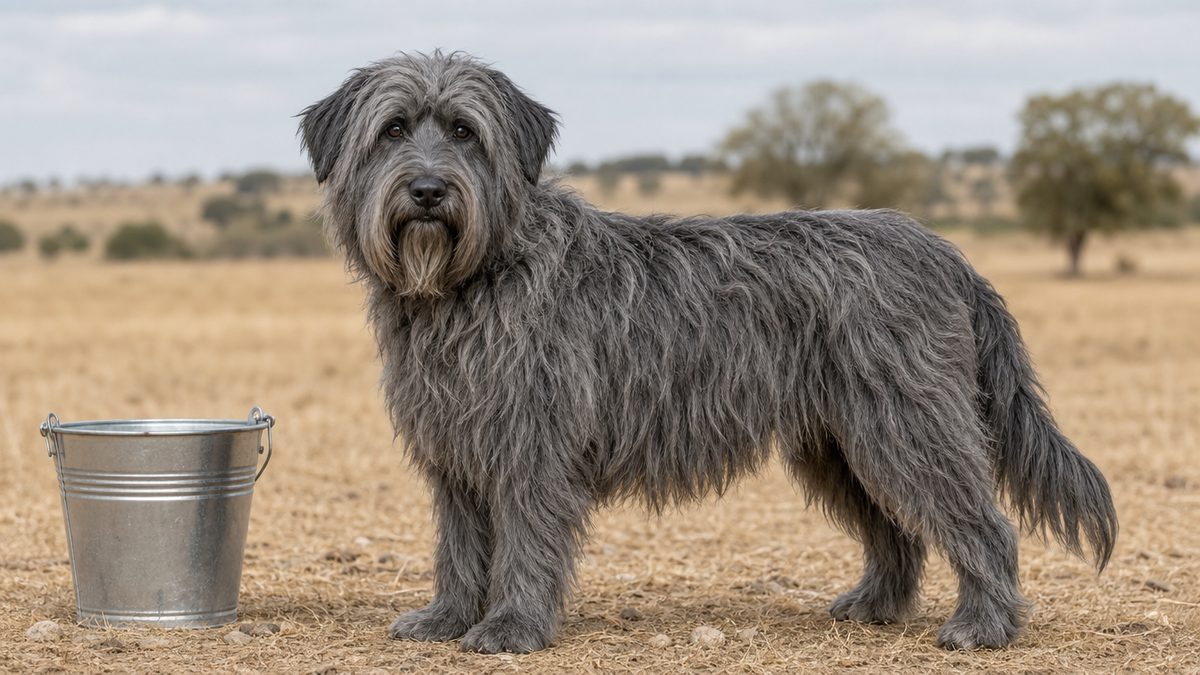
Its own breed standard describes a medium sized, medium long dog with appreciable rusticity and sobriety, extremely agile and swift, with ample and suspended movement, and long hair of goat-like texture without undercoat. Then it adds the sentence that no other FCI standard contains: the breed has simian-like attitudes and appearance, which is why it is known in its native region as the monkey dog.
The utilisation clause is equally direct. This is a sheepdog for herding and watching over livestock, and the history section names sheep, cattle, horses, goats and pigs as the stock it worked, with great endurance for covering long distances across the Alentejo plains. It is a herding breed, not a guardian, and that distinction is the one the ranking pages get wrong most often.
The single coat is the whole breed, and it is unusual
The appearance clause specifies hair that is straight or slightly wavy, long, of slightly harsh preferably goat-like texture, forming long beard, moustache and eyebrows but not covering the eyes, dense and evenly distributed including between the toes, without undercoat or woolliness. The fault list then makes the point non-negotiable: a coat that is short, curly, or with undercoat is a disqualifying fault.
A breed standard that disqualifies an undercoat is rare, and for an Indian reader it is the most useful line in the document. A single coat with no insulating underlayer behaves differently in heat from the double coat almost every shaggy herding breed carries, and it changes both the grooming job and the thermal argument on this page.
| Measure | FCI standard 93 | AKC Foundation Stock Service |
|---|---|---|
| Height, males | 45 to 55 cm | 16.5 to 21.5 in, both sexes |
| Height, females | 42 to 52 cm | 16.5 to 21.5 in, both sexes |
| Weight, both sexes | 17 to 27 kg | 37.5 to 59 lb, both sexes |
| Head type | Mesocephalic, stated in the standard | not stated |
| Coat | Long, goat-like, NO undercoat | not stated |
| Life expectancy | not stated | 12 to 13 years, uncited |
The AKC weight band converts to 17.0 to 26.8 kg, which is the FCI's own 17 to 27 kg rounded. So the two bodies agree on the dog and disagree only on the one number the FCI never publishes and the AKC does not source: the lifespan.
FCI 93's HEAD clause opens 'Medium sized (mesocephalic), strong, broad, neither long nor massive'. Most standards leave cephalic index to be inferred. This one prints it, and the largest UK longevity study independently classifies the breed as mesocephalic in its supplementary data. A normal muzzle matters more in India than almost anywhere, because panting is a dog's only real cooling mechanism.
Appearance, colour and where the breed came from
The Portuguese Sheepdog comes in yellow, brown, grey, fawn, wolf grey and black, in light, medium and dark shades, with tan markings, and it should never be pied except for a very small white spot on the chest.
That colour clause is worth quoting exactly because the page that ranks first on the breed's native name gets it wrong. Petlur's Cao da Serra de Aires page states in its prose that the breed has a long, wavy coat that can be either white or black in color and comes in two colors, white or black, with some dogs having patches of both. Under FCI 93, white on the extremities of the limbs, or a pied coat, is a disqualifying fault. The description on the ranking page is of a dog that could not be shown.
That page contradicts itself four times in one document
This is worth setting out in full, because it is the clearest example on this site of a single page disagreeing with itself while ranking for a breed's Indian price.
| Field | Its spec card says | Its own prose says | FCI standard 93 says |
|---|---|---|---|
| Lifespan | 12 to 14 years | 10 to 12 years | not stated |
| Weight | 26 to 40 lb, 12 to 18 kg | 40 to 50 lb | 17 to 27 kg |
| Height | 16 to 22 in, 41 to 56 cm | 18 to 22 in | 45 to 55 cm males |
| Colour | Black, fawn, grey, wolf grey | White or black, sometimes both | Never pied; white on limbs disqualifies |
| Function | Livestock Guardian Dog | herding breed | Sheepdog for herding and watching |
| Daily food | 2 to 2.5 cups | 1.8 cups per day | not stated |
Six fields, six internal disagreements, on the page that ranks for this breed with the word Price in its title. Its price, incidentally, is USD 800 to 1,000 and its running costs are given in dollars per month, on a page returned to an Indian searcher. None of that is an Indian price.
The history, from the standard and from the genetics
The standard's brief historical summary places the breed squarely in the Alentejo, working sheep, cattle, horses, goats and pigs, and calls it an austere and rustic dog perfectly adapted to the area's temperature changes. The Portuguese Kennel Club published a first standard in 1932, the earliest of the eleven Portuguese native breeds, revised most recently in 2008, and the FCI recognised the breed in 1954.
Two genetic studies fill in what the standard cannot. A 2005 mitochondrial study of four Portuguese autochthonous breeds, sampling 143 dogs in all, found the Portuguese Sheepdog sharing haplotypes with the Serra da Estrela Mountain Dog, which the authors read as gene flow between a central Portuguese breed and a southern one. A 2026 whole-genome study puts the breed in mitochondrial Haplogroup C alongside the Saint Miguel Cattle Dog and the Alentejo Mastiff, breeds of entirely different function, which points to a shared founding population rather than shared work.
The 2026 study's principal component analysis on SNP-array data found the Portuguese Sheepdog separating out early, at only three inferred clusters, alongside the Portuguese Water Dog, and it names both breeds as carrying some of the highest inbreeding and fixation-index values in the set: Portuguese Sheepdog F ROH 0.18, F ST 0.09. An earlier study using different parameters put it higher still at 0.27. An older AFLP study found it one of the two least genetically diverse Portuguese breeds. Isolation in a population of a few hundred dogs is a conservation problem, and a buyer should read it as a reason to ask hard questions about a specific litter rather than as a mark of purity.
Recognition status, checked at the registers
Recognition for the Portuguese Sheepdog is settled: the FCI holds it on a definitive basis as standard 93, in Group 1, Section 1 Sheepdogs, without a working trial, with the country of origin recorded as Portugal and English as the authentic language.
That was read from the FCI's own breed record, whose page prints the breed name CAO DA SERRA DE AIRES on its own face, and cross-checked against the FCI's Group 1 index, which lists 43 breeds and carries the entry CAO DA SERRA DE AIRES (93) (PORTUGUESE SHEEPDOG) alongside in-document controls including SHETLAND SHEEPDOG (88) and POLSKI OWCZAREK NIZINNY (251).
| Body | Status | Evidence read |
|---|---|---|
| FCI | Definitive, standard 93, Group 1 Section 1 | Breed record and Group 1 index, 43 entries |
| Clube Portugues de Canicultura | National standard from 1932, revised 2008 | 2026 genomics paper's Table 1, sourced to CPC |
| American Kennel Club | Foundation Stock Service, not fully recognised | AKC page data, breed group Foundation Stock Service, year_recognized 0, code 864 |
| Kennel Club of India | No breed list published at all | Instrument limit, not a finding about the breed |
| Orthopedic Foundation for Animals | Not established this session | Statistics pages served a JavaScript shell and the API refused connection |
The FCI record prints acceptance as 11/16/1954, which is 16 November 1954 in the American month-first format the register uses. The format is proved from the record's own face, because the same table gives 9/30/2015 for the German edition and 30 cannot be a month. The Rafeiro do Alentejo was accepted eight days later, on 24 November 1954, so Portugal's two Alentejo breeds entered the FCI register in the same fortnight.
No Orthopedic Foundation for Animals figure appears anywhere on this page. OFA's disease-statistics page returned a 49,000-character JavaScript shell carrying the string Searching Database and no breed names at all, and api.ofa.org refused the connection outright. That is an instrument failure in this session and not evidence about the breed. OFA also requires 100 hip evaluations, or 50 for its other databases, before publishing a breed, and a global pedigree population under a thousand makes a published row unlikely either way.
One recognition footnote is worth having, because it separates this breed from its Azorean neighbours. The 2022 MDR1 study notes in its methods that the Barbado da Terceira is not a recognised breed by the FCI and is classified by the Clube Portugues de Canicultura as a Group 1 breed. That is a peer-reviewed confirmation, from a paper that genotyped both breeds side by side, that the two Portuguese Group 1 herding dogs sit on opposite sides of the FCI line.
Portuguese Sheepdog price in India
There is no Portuguese Sheepdog price in India, and the single Indian page that promises one is empty. The URL ranking in Yahoo India under the title Cao da Serra de Aires Dog Lowest Price In India returns 114 bytes whose entire body is a domain-parking redirect.
That is worth setting out precisely, because it is a contamination mechanism this site has not previously documented in this form. The page returns HTTP 200. Its content-length is 114 bytes. Its whole body is a script that redirects the browser to a lander path. It carries no title, no heading, no rupee figure and no dog. The search index still holds the old title, which promises an Indian price, and that title is what an Indian searcher sees.
A dead or parked domain does not fail loudly. It answers, it returns 200, and the search index keeps serving a title it earned years ago. This site has already documented a registry domain that was resold and served a casino page, and a classifieds domain that failed DNS while a search summary still quoted prices from it. This is the third form: alive, indexed, promising an Indian price, and containing 114 bytes of redirect. Fetch the URL before quoting anything attributed to it.
The one page that does print a price prints it in dollars
Petlur's breed page, which ranks first on the native name with Size, Price and Height in its title tag, gives the price as USD 800 to 1,000 and its running costs as a daily 1.20 to 1.40 dollars and a monthly 34 to 45 dollars. Those are foreign figures on a page served into an Indian result set. Converting them into rupees would produce a number that describes an exchange rate, and this page publishes no such conversion.
Run the standard tests on any rupee band you are offered for this breed, because all four failure modes are live here.
- Divide by 84.38, then by 80, then by 74. A clean quotient means a foreign asking price was converted and relabelled.
- Read the quotient for plausibility. A conversion yielding 800 or 1,000 dollars is a converted list; one yielding 6,875 is rupee-native and arbitrary.
- Check the host country of any Rs figure, because Rs is also the Pakistani rupee and R$ is the Brazilian real.
- Fetch the page itself. The single Indian page promising a price for this breed contains 114 bytes.
The import position, read from the instrument
India treats live dogs as a restricted import and the route that exists is a personal pet import for an owner relocating with the animal, not a commercial channel. The Department of Animal Husbandry and Dairying letter of 12 March 2024, reproduced in full in the customs instruction of 14 March 2024, names 24 comma-separated categories of dog to be prohibited for import, breeding and sale. None of them reaches this breed on any reading.
That is worth stating positively rather than by silence, because this site has had to correct pages that cleared a breed the list's undefined category words plainly caught. The undefined words in that list are Mastiffs (boerbulls), Terriers, Wolf dogs and Canario. A 17 to 27 kg herding dog is not reached by any of the four, and it is not reached by any of the twenty named breeds either. The list is in any case quashed and unenforced.
No Indian law in force today bans owning, breeding or selling any dog breed. The Karnataka High Court quashed the March 2024 circular on 10 April 2024 and the Delhi High Court set it aside that month, and the Union has since told the courts that the quashed circular has lost its effect entirely. The instrument was never an Act, a rule or a notification: it was a D.O. letter from a Joint Secretary. The same list is reproduced independently by the Goa Legislative Assembly in an answer of 7 August 2024, which is how its wording can be checked against a second government source. What survives is the possibility of a properly consulted rule change.
Monthly cost of ownership in India
Budget Rs 7,000 to Rs 12,000 a month for a 25 kg dog of this type in an Indian metro before any veterinary event, and expect grooming rather than food to be the line that surprises you, because a long single coat with no undercoat mats and has to be worked on.
Every figure below was read live from the seller's own page on 9 September 2026, and the weight-scaling column matters here because this breed sits neatly inside the 15 to 30 kg band that Indian parasite products are actually priced for. That is a real advantage over the large Portuguese guardians, whose owners buy two units of everything.
| Item | Listed price | Notes for this breed |
|---|---|---|
| Anti-rabies vaccine, clinic chain | From Rs 699 | Dose is not weight-banded |
| 9-in-1 DHPPiL | From Rs 899 | Core, annual booster |
| Kennel cough | From Rs 1,349 | Non-core, risk-dependent |
| Puppy DP, first vaccine | From Rs 849 | First shot of the course |
| Full puppy course, seven visits from day 30 | From Rs 6,499, list Rs 8,111 | One-off, first year |
| Adult annual booster package | From Rs 3,199, list Rs 3,806 | Annual |
| NexGard Spectra, 15 to 30 kg, 3 tablets | Rs 3,308, MRP Rs 3,375 | This breed fits the band exactly. About Rs 1,103 a month |
| Drontal Plus deworming, 6 tablets | Rs 754, MRP Rs 838 | One tablet per 10 kg, so about Rs 314 a round |
| Grooming, bath and styling, Delhi | From Rs 1,869 | The line that actually bites on this coat |
| Overnight boarding to 24 hours, Bengaluru | Rs 899 | Standard medium-dog rate |
| Delhi pet dog registration | Rs 500 a year | Rs 100 per month late fee |
| Chennai pet licence | Rs 50 | 9,115 issued in 2024 |
| Microchipping, one Chennai clinic's own rate | Rs 1,250 | Clinic's own transacted price |
| Consultation | Rs 500 to Rs 1,000 | Commonly quoted Indian range |
The parasite line is genuinely cheaper here than for a large guardian. NexGard Spectra's 15 to 30 kg pack works out at about Rs 1,103 per monthly tablet and this breed sits inside that band at 17 to 27 kg, so there is no doubling. Deworming with Drontal Plus is dosed one tablet per 10 kg at about Rs 125.67 a tablet, so roughly Rs 314 a round.
Grooming is the line to plan for, not food
A long, harsh, single coat with a full beard mats at the armpits, behind the ears, under the beard and in the breeching, and an Indian monsoon accelerates all of it. Professional grooming at a Delhi chain runs from Rs 934 for a bath and from Rs 1,869 for a full bath and styling. If you take that route monthly, grooming alone is roughly Rs 22,000 a year. If you learn to line-brush, it is the cost of a good pin brush and twenty minutes twice a week.
Retail veterinary prices in India are perishable, and this site has watched a food listing change product inside a week. Municipal fees are not. Delhi charges Rs 500 for a pet dog registration, renewable annually with a Rs 100 per month late fee, and has issued 18,958 certificates since 2021. Greater Chennai Corporation charges Rs 50 and issued 9,115 licences in 2024, and its six municipal pet clinics provide treatment and anti-rabies vaccination free of cost. Anchor a budget on those and treat the retail rows as this week's prices.
One warning about Indian per-breed cost tables. Several Indian breed sites publish a monthly total for any breed you name, and those totals are assembled from a small set of preset component lines rather than observed. The mechanism is provable: the total is the sum of three presets, which is why unrelated breeds of completely different sizes share a total to the rupee. If you meet a monthly total for this breed on an Indian site, pull a second unrelated breed from that same site and compare the component lines before believing either.
Consultation is quoted at Rs 500 to Rs 1,000 across the commonly cited Indian sources. Note that the two sources usually given for that range publish it byte-identically along with an identical vaccination range, so this page counts them as one data point rather than as corroboration.
Suitability for the Indian climate
The Portuguese Sheepdog is a marginal fit for cooler Indian cities and a poor one for the coastal plains, and the deciding number is wet-bulb load. Its Alentejo homeland peaks at an August mean of 25.22 C with a peak wet bulb of 18.29 C, against 21.86 C in Bengaluru, 26.11 C in Chennai and 27.09 C in Kolkata.
Those figures come from NASA POWER's 2001 to 2020 climatology, queried by explicit latitude and longitude so no place can be served by accident, with the model's own cell elevation echoed back and checked against each town's real elevation.
The Evora cell returned 173.11 m against a real elevation near 300 m, and the Beja cell returned 154.57 m against about 277 m, errors of about minus 127 m and minus 122 m. At roughly 6.5 C per 1,000 m that makes both Alentejo figures about 0.8 C WARM for the towns themselves, which runs in the direction that makes this page's argument harder rather than easier. The two cells are distinct rather than byte-identical, so they are not one cell queried twice. Every Indian cell used here was within 85 m of its town's real elevation.
| Place | Annual mean C | Annual RH % | Hottest month | Peak wet bulb C |
|---|---|---|---|---|
| Evora, Alentejo | 16.53 | 69.30 | August, 25.22 | 18.29 (August) |
| Beja, Alentejo | 16.88 | 69.16 | August, 25.66 | 18.49 (August) |
| Bengaluru | 23.74 | 67.94 | April, 28.37 | 21.86 (May) |
| Pune | 23.86 | 66.80 | April, 28.93 | 22.97 (June) |
| Mumbai | 26.77 | 67.39 | May, 31.19 | 25.77 (June) |
| Chennai | 27.95 | 72.39 | May, 31.51 | 26.11 (May) |
| Delhi | 25.60 | 45.56 | June, 35.88 | 26.50 (July) |
| Kolkata | 25.81 | 73.93 | May, 31.53 | 27.09 (June) |
The no-undercoat clause changes the argument, and only partly in the breed's favour
Most shaggy herding breeds carry a double coat, and the standard advice for them in a hot country is that the undercoat insulates in both directions and must never be clipped out. This breed has no undercoat at all, and one is a disqualifying fault. The practical consequences run in both directions and both are worth knowing.
- In the breed's favour: a single coat traps less warm air at skin level than a dense double coat, so at a given temperature this dog carries less insulation than a Bearded Collie or an Old English Sheepdog of similar length.
- Against it: a single coat gives less protection from direct sun, so a dog worked in open Indian light burns more easily on thin-haired areas.
- Against it: a long single coat still holds water, so drying time after a monsoon bath is long even without an undercoat.
- Neutral but important: none of this changes the panting ceiling. Coat type affects insulation; wet-bulb load affects whether panting works at all.
Read the wet-bulb column, not the temperature column
Delhi looks like the hardest Indian city on air temperature, peaking at a June mean of 35.88 C, but its annual humidity is 45.56 percent, the lowest of the six, so a panting dog there can still shed heat by evaporation for much of the year. Kolkata combines 31.53 C in May with 73.93 percent annual humidity and the highest peak wet bulb of the six at 27.09 C. That is the number that closes off a dog's only cooling mechanism, and it is roughly nine degrees above anything the Alentejo produces.
Bengaluru at 21.86 C and Pune at 22.97 C are the two genuinely workable Indian cities for this breed, and both are within about four degrees of wet bulb of the homeland's August. Note the months, because they are counter-intuitive and this site has corrected pages that got them wrong: Bengaluru peaks in April and is coolest in December, Pune peaks in April and is coolest in December, and Delhi peaks in June.
The Indian legal clause that catches this breed directly
Second Schedule Part IV paragraph 21(1) of the Prevention of Cruelty to Animals (Dog Breeding and Marketing) Rules 2017 bars keeping certain dogs in outdoor facilities without the attending veterinary practitioner's written approval, and names among them dog breeds that cannot tolerate the temperatures prevalent in the area or region in question, such as long-haired breeds in high temperature locations. That clause was read from the gazette itself.
Unlike the short-coated Portuguese guardians, this breed is caught by the illustration and not merely by the category above it. FCI 93 requires long hair and disqualifies a short coat. A long-haired breed in Chennai is precisely the example the Rules print. An Indian owner keeping one in an outdoor kennel needs that written veterinary approval on file, and enforcement is a separate question from what the text says.
The reflex claim that Indian humidity finishes a European breed is usually wrong, and it is wrong here. The Alentejo runs 69.30 percent annual relative humidity, HIGHER than Mumbai's 67.39, Pune's 66.80 and Bengaluru's 67.94, and far higher than Delhi's 45.56. This dog is not humidity-naive. What it has never met is 31 C combined with 73 percent humidity. Frame the risk as wet-bulb load rather than as damp air.
The measured risk is worth carrying. UK primary-care records for 905,543 dogs identified 395 confirmed heat-related illness events with an event fatality rate of 14.18 percent, 95 percent confidence interval 11.08 to 17.96, and of 879 events with a recorded trigger, 652, or 74.2 percent, were exertional. Roughly one in seven dogs that develops heat illness dies of it, and most of those cases are caused by exercise rather than by hot cars.
Temperament and household fit
The Portuguese Sheepdog is an exceptionally intelligent, very lively working herding dog, extremely devoted to its work and its shepherd, that can be somewhat wary of strangers and is vigilant at night. Every word of that is from the standard, and every word of it is a demand on an owner.
The standard's behaviour clause is unusually warm for an FCI document and it is worth reading in full for what it implies. It records skilful ability to keep livestock in the pastures and to search for stray animals, constant vigilance, successful alerting to the proximity of predators, and that the work is conducted with joy and pleasure. It then adds that nowadays it is also an excellent companion, sporting and guard dog.
Read that as a dog that needs a job and will pick one if you do not supply it. In an Indian household the self-selected jobs are herding children, chasing autorickshaws and barking at the corridor, none of which anyone wants.
Who this breed suits
- Owners in Bengaluru, Pune or a hill station with a garden and daily time.
- Households already doing a dog sport, since this breed's brain needs somewhere to go.
- Handlers who enjoy training rather than tolerating it, because this dog learns faster than most owners teach.
- Families with older children who understand a herding dog's contact style.
- Owners willing to brush a long single coat twice a week for its whole life.
Who should not buy one
- Apartment households without a serious daily exercise plan, whatever the dog's modest size suggests.
- Owners in Chennai, Kolkata or Mumbai planning outdoor housing, for the wet-bulb and legal reasons above.
- First-time owners who want a low-input dog, because this one is high-input by design.
- Anyone who wants a rare breed as an object. Rarity here means no Indian vet has seen one and no Indian rescue can place one.
- Households that will outsource all grooming, unless Rs 20,000 a year of it is genuinely comfortable.
The night-vigilance clause in an Indian street
Vigilant at night is a specification, and in an Indian neighbourhood it converts into barking at movement the dog cannot see. Street dogs, night traffic, delivery riders and watchmen all cross a herding dog's perceived boundary, and a breed selected to alert to the proximity of predators will alert. This is milder than a guardian breed's response but it is not absent, and it is the most predictable complaint about any working breed kept in an Indian city.
The page that ranks first on this breed's native name files it as a Livestock Guardian Dog. Its own FCI standard files it as a Sheepdog for herding and watching over livestock, in Group 1 Section 1 Sheepdogs, and both the 2026 genomics study and the largest UK longevity study's supplementary data classify it as a herding breed. That is not a pedantic distinction. A guardian stays with stock and repels; a herding dog moves stock and works to a handler. The two need different homes, different training and different exercise, and taking guardian advice for a herding breed produces a frustrated dog.
Training a herding brain, and what it resists
Train a Portuguese Sheepdog with short, varied, genuinely difficult sessions, because the standard describes an exceptionally intelligent and very lively dog and the failure mode with this breed is boredom rather than defiance.
The training problem here is the opposite of the one the Portuguese guardian breeds present. A guardian weighs an instruction and decides. This dog takes the instruction, completes it, and then asks what is next. An owner who runs twenty repetitions of a sit has lost the dog by repetition six.
- Keep sessions to five or ten minutes and end while the dog still wants more.
- Change the criterion every few repetitions, because a herding brain rehearses variation rather than volume.
- Give the dog a real job: a fetch-and-place task, a scent search, a tidy-up routine, anything with a beginning and an end.
- Build a solid settle. A dog that cannot switch off in an Indian flat becomes a noise complaint.
- Socialise deliberately through the first six months, including delivery riders, autos, cattle in the road and household staff.
What it resists
This breed resists repetition, resists being left with nothing to do, and resists being handled roughly, which the standard hints at by disqualifying nervous, unbalanced temperament and listing shyness among faults. It does not resist learning, and an owner who complains it is stubborn has almost always made the session boring.
Herding instinct in an Indian street
English Wikipedia's article, which ranks first on the English name, carries Appearance, History, Related Portuguese breeds and Health headings and no lifespan evidence at all, which is why the registry figure on this page sits beside it rather than correcting it.
A herding dog with no stock will herd what moves, and in India what moves is scooters, children and street dogs. That is a real safety issue rather than a charming quirk. Teach an off switch before you need it: a place command, a reliable recall practised at low arousal first, and a habit of asking the dog to disengage rather than waiting for it to.
Clubs for numerically small breeds sometimes recommend close breeding to hold type in a few hundred dogs, and this breed has a few hundred. Second Schedule Part II paragraph 6(3) of the 2017 Rules prohibits in-breeding, defined as breeding between relatives of the second to fourth grade within the first four generations, and incest breeding between parents and children or brother and sister. Only out breeding and line breeding are permitted. An Indian owner following a foreign club's line-breeding guidance would be outside the Rules, and this is a breed whose 2026 SNP-array inbreeding already sits among the highest of the Portuguese natives.
One thing training cannot fix is provenance. Because there is no Indian breeder, an Indian owner of this breed has almost certainly imported an adult or acquired a mislabelled shaggy dog. Verify what you actually have before you plan a programme for a breed the dog may not be, and remember that white on the limbs or a pied coat rules the dog out under FCI 93 whatever the paperwork says.
Daily exercise requirement
Give a Portuguese Sheepdog 60 to 90 minutes of real work a day, split across two sessions at the cool ends of the day, because its standard specifies great endurance for covering long distances and a light suspended trot with great reach.
This is a genuine working dog's exercise budget on a 25 kg frame, and it is the single commonest reason the breed fails in a city. A twenty-minute walk twice a day satisfies a Pug and starves this dog. The standard's gait clause describes a dog that moves predominantly in a light and suspended trot with great reach, and gallops energetically when the work requires it.
The Indian timing rule
Exercise this breed in the two hours after sunrise and the hour before sunset, and treat the middle of the day as unavailable from March to October in every city on this page. That is not a general caution: at Chennai's May peak wet bulb of 26.11 C and Kolkata's June 27.09 C, a dog whose homeland tops out at 18.29 C has no evaporative headroom. Of 879 UK heat-related illness events with a recorded trigger, 652 were exertional, so moving the walk is worth more than shortening it.
- Walk before 7 am and after 6 pm from March to October, and test the ground with the back of your hand first.
- Carry water on every session over 20 minutes, not only on hot days.
- Watch the panting rhythm rather than waiting for collapse, because heat illness is a progression.
- Cool with room-temperature water on belly, groin and paws, move to shade and airflow, and never use ice.
- Stop and consult your nearby vet if the dog is unsteady, vomits, or its gums go brick red or grey.
Mental work is half the budget, not a supplement
Half of this breed's daily requirement is cognitive, and in an Indian summer that half is the only half available for weeks at a time. Scentwork, shaping games, puzzle feeders and a fetch-and-place task all run indoors in air conditioning at 2 pm in May, and a dog that has worked its brain hard will settle even when it has not run. Owners who plan only physical exercise discover in April that they have no plan.
At 17 to 27 kg this breed sheds heat considerably better than the 45 to 60 kg Portuguese guardians, and it sits inside the standard Indian parasite dose band rather than above it. It is the most practically keepable of the three Portuguese breeds in India, which is faint praise but is the honest ranking. The constraint is time and grooming, not mass. Its own standard calls it austere and rustic and perfectly adapted to the Alentejo's temperature changes, which makes it a hardy dog within its own range and says nothing at all about a range nine degrees of wet bulb warmer.
Grooming a single long coat in Indian humidity
Brush a Portuguese Sheepdog thoroughly twice a week to the skin, and never clip it. The coat is long, straight or slightly wavy, of slightly harsh goat-like texture, with no undercoat and no woolliness, and an undercoat is a disqualifying fault.
A single long coat behaves nothing like a double coat, and almost all shaggy-breed grooming advice online is written for double coats. The practical difference is that this coat drops less loose hair and mats far more readily, so the job moves from de-shedding to preventing tangles at the friction points.
Where it mats, in order of trouble
- Under the beard and moustache, which stay wet after every drink and every meal.
- Behind and inside the ears, where the hanging triangular ear rubs constantly.
- The armpits and the groin, which almost no owner brushes.
- The breeching and the tail, which the standard requires to carry long abundant hair.
- Between the toes, which the standard specifically requires to be coated.
Line-brush rather than surface-brush. Part the coat, brush the section from the skin outward, then move the parting a centimetre and repeat. A brush that glides over the top of a coat and meets no resistance is not reaching the mats, and a mat that has been left for a fortnight has to be cut out.
The monsoon rule, and where overseas advice fails here
Do not let this dog air dry after a bath in the monsoon, which is what a great deal of shaggy-breed care advice recommends. Long hair over skin in humid air stays damp for hours, and the beard, the ear rims and the toes are the three places that stay wet longest. Towel to the skin, then use airflow, and dry the beard and ear canals specifically. Mumbai averages 90.36 percent relative humidity in August and Kolkata 73.93 percent across the whole year, so a coat that dries in four hours in Portugal does not dry in four hours here.
Clipping removes the dog's own sun protection while doing nothing for panting, which is the only mechanism that actually cools a dog. On a single-coated breed it also regrows unevenly and can come back softer, which makes matting worse rather than better. The standard already disqualifies a short coat, so a clipped dog is outside the breed description as well as no cooler. Brush it out instead, and if a coat is beyond brushing, take the shave once and then commit to the twice-weekly routine.
Professional grooming at an Indian chain runs from Rs 934 for a bath and from Rs 1,869 for a full bath and styling, with add-ons from Rs 99. A groomer who proposes a summer clip for this breed is offering something the coat does not need. Ask instead for a bath, a thorough dry and a line-brush out, and learn to do the maintenance between visits.
Health problems, MDR1 and life span
The Portuguese Sheepdog has a life span of about 7.93 years on the best available evidence, 95 percent confidence interval 7.35 to 8.51, measured on 435 dogs in Portugal's compulsory national microchip registry. Every page ranking for this breed prints 12 to 13 years instead.
The 12 to 13 years is the American Kennel Club's Foundation Stock Service entry, read from the page's own embedded data, and it carries no source and no sample. The 7.93 years comes from period life tables built at the University of Porto on the Sistema de Informacao de Animais de Companhia, Portugal's compulsory microchip database, covering 278,116 dogs with confirmed deaths.
| Breed | Population in study | Life expectancy at birth, years | 95% CI |
|---|---|---|---|
| Portuguese Water Dog | 384 | 10.85 | 9.80 to 11.89 |
| Portuguese Pointing Dog | 2,560 | 9.23 | 8.84 to 9.61 |
| Terceira Cattle Dog | 104 | 8.62 | 7.78 to 9.46 |
| Castro Laboreiro Dog | 810 | 8.44 | 7.71 to 9.16 |
| Alentejo Mastiff (Rafeiro do Alentejo) | 3,486 | 8.03 | 7.73 to 8.33 |
| Portuguese Sheepdog | 435 | 7.93 | 7.35 to 8.51 |
| Portuguese Podengo | 77,706 | 7.86 | 7.51 to 8.22 |
| Saint Miguel Cattle Dog | 1,553 | 7.81 | 7.10 to 8.51 |
| Estrela Mountain Dog | 3,536 | 7.50 | 6.66 to 8.33 |
| Transmontano Mastiff | 1,009 | 6.73 | 6.35 to 7.11 |
Three things about that table matter. The mean across the ten Portuguese breeds is 8.3 years and the mean for all dogs in the whole study is 8.91, so this breed sits slightly below a Portuguese average that is itself shorter than the figures Anglophone breed pages print. The sexes barely separate: 7.88 years for males and 7.99 for females. And the published table prints the Transmontano Mastiff's upper bound as 711 rather than 7.11, a typographical defect in the source that is corrected above.
This is a life table from a registry, not a cause-of-death study. It measures how long dogs of this breed actually lived in Portugal, which is what a buyer wants to know, but it does not say what they died of and it cannot separate breed biology from how the breed is kept. A working herding dog living on a farm faces risks a pet does not. Quote the number with its interval rather than as a single figure, and note that 435 dogs is a modest sample, which is why the interval runs more than a year wide.
The largest UK study considered this breed and excluded it
McMillan 2024 built medians for 155 purebred groups from UK primary-care data, and it is the study every English-language breed page reaches for. Its Supplementary Table S5 carries a dedicated row reading Portuguese Sheepdog, inclusion flag N, FCI group Sheepdogs and cattledogs, body size Medium, cephalic index Mesocephalic.
That N is decisive rather than ambiguous. A breed missing from the results can be absent for three different reasons, genuinely excluded, merged into another breed's row, or filed under a different name, and only Table S5 separates them. Here it says plainly that the breed was considered and not included, so there is no UK median lifespan for this breed and any page quoting one has borrowed a relative's row.
MDR1: the one pharmacogenetic finding, and why it matters more in India
The MDR1 gene encodes P-glycoprotein, a drug transporter, and a four-base-pair deletion known since 2001 affects herding breeds and causes the condition usually called ivermectin toxicosis, because many veterinary drugs including the macrocyclic lactones are substrates for P-glycoprotein. This is an FCI Group 1 herding breed, which is the group the deletion belongs to.
One study has ever looked. In 2022, researchers at the Faculty of Veterinary Medicine of the University of Lisbon genotyped 105 dogs sampled between May and November 2019, including 10 Cao da Serra de Aires and 23 Barbado da Terceira, alongside 55 dogs of breeds known to carry the mutation and 17 of breeds known not to.
| Breed | Dogs tested | Heterozygous | Homozygous mutant |
|---|---|---|---|
| Cao da Serra de Aires (Portuguese Sheepdog) | 10 | 0 | 0 |
| Barbado da Terceira | 23 | 7 | 0 |
| Australian Shepherd | 32 | 19 | 4 |
| Rough Collie | 4 | 0 | 3 |
| Swiss Shepherd cross Border Collie | 8 | 2 | 0 |
| Border Collie | 7 | 0 | 0 |
| Bearded Collie | 4 | 0 | 0 |
| All 105 dogs | 105 | 28 | 7 |
The result for this breed is a clean ten, and the authors refuse to overclaim it. Their own words are that the mutant allele was not detected in the Cao da Serra de Aires, but we cannot say that the mutation does not exist in this breed population as our sample does not contemplate all the existing animals of this breed in Portugal. They note that the Portuguese Kennel Club's 2017 data records 81 of the breed registered, so ten dogs is 10 of 81.
Ivermectin is used constantly in India, for demodectic and sarcoptic mange, for heartworm prevention and in a great deal of over-the-counter and farm-supply practice, often at doses well above the heartworm-preventive level and often without a prescription. In a country where the drug is that available, a Group 1 herding breed with ten dogs of clearance data is not cleared. Ask for an MDR1 test before any high-dose macrocyclic lactone, tell the vet the dog is an FCI Group 1 herding breed, and consult your nearby vet rather than a farm-supply counter. The test is a cheek swab.
The Indian health problems that will actually reach this dog
The conditions an Indian owner should plan around are the local infectious and heat burden, which people have measured, rather than the breed's inherited risks, which nobody has. Among 584 client-owned dogs tested at the State Animal Health Centre in Salt Lake, Kolkata between July 2024 and December 2025, molecular prevalence was 76.54 percent for Babesia gibsoni, 55.75 percent for Anaplasma species, 28.94 percent for Hepatozoon, 27.10 percent for Babesia canis and 16.61 percent for Ehrlichia canis, and 72.9 percent of the 584 dogs screened carried two or more pathogens.
A southern Indian study of 120 clinically affected dogs in Kerala found Babesia species most prevalent at 66.7 percent, 80 of 120, with Ehrlichia canis at 5.0 percent and Anaplasma platys at 1.7 percent. Both studies sampled clinic caseloads or clinically suspected dogs rather than random populations, so those figures describe dogs presented to a vet rather than dogs in general. That caveat is mandatory.
The practical reading is that year-round tick control is not optional in India, and that a negative blood smear is weak evidence: the West Bengal study found microscopy missed 130 of 158 Babesia canis positives and 146 of 169 Hepatozoon positives. Ask for PCR when the clinical picture fits and the smear is clean. No breed-specific hip dysplasia rate exists for this breed, so screen the individual parents rather than the breed.
Feeding a working herding dog in India
Feed a Portuguese Sheepdog to a body condition score of 4 or 5 out of 9 across two measured meals, and adjust the ration hard between the Indian working season and the hot months, because this breed's real intake varies more across the year than a companion breed's does.
At 17 to 27 kg this is a medium dog with a working metabolism, and the two errors owners make are opposite. In the cool months an active dog burns through its ration and looks lean, so the bowl goes up. In April and May the walk halves and the bowl does not come down, and by July the dog is carrying weight into the worst wet-bulb weeks of the year.
Body condition, not the bowl
Assess body condition weekly with your hands, because a long coat hides both fat and loss completely. You should feel the ribs under light pressure without seeing them, and find a waist from above and a tuck from the side under all that hair. On this breed the visual check is worthless.
- Weigh the dog monthly on the same scale and record it, because the trend beats any single reading.
- Feed two measured meals by weight rather than by volume, since a cup of one kibble is not a cup of another.
- Cut the ration by 10 to 20 percent when the hot season shortens the walks, and restore it when the walks come back.
- Hold a growing puppy visibly lean through the first year, not just the first six months.
- Withhold food and heavy water for an hour either side of exercise.
What Indian food costs, and why this page prints no monthly figure
A monthly kibble number is arithmetic on grams per day rather than a quoted price, and Indian listings for large bags are unstable. The listing this site previously used for a 15 kg large-breed bag now serves a 4 kg dry plus ten wet pouches combination at Rs 4,594 against an MRP of Rs 5,220, which is a different product and cannot be converted into a monthly figure honestly. Read the feeding guide on the bag you buy, weigh a day's ration and multiply.
The stable lines are the ones to budget first. This breed fits the standard Indian 15 to 30 kg parasite band exactly, so combined tick, flea and worm cover through NexGard Spectra is about Rs 1,103 per monthly tablet with no doubling, and deworming with Drontal Plus at one tablet per 10 kg is about Rs 314 a round.
Indian breed sites publish per-breed monthly cost rows assembled from a small set of preset component lines rather than observed for the breed, and the mechanism is provable because the totals are the sum of three presets. That is why unrelated breeds of completely different sizes share a total to the rupee, and why a Pug and a hand-stripped wire terrier get the same grooming line. If you meet a monthly total for this breed, pull a second unrelated breed from the same site and compare the component lines before believing either.
Month by month through the first year
Raise a Portuguese Sheepdog puppy on early broad socialisation, an MDR1 test before any macrocyclic lactone, and a grooming habit started before the adult coat arrives, because all three are far cheaper to do than to fix.
This timeline assumes a lawfully imported puppy or, more realistically for India, an adult of unknown age. Read the later rows too, because in India the adult case is the likely one.
| Age | What is happening | What you do about it in India |
|---|---|---|
| Under 8 weeks | Legally cannot be sold. Rule 8(1)(a) of the 2017 Rules requires that pups less than eight weeks in age are not sold | Walk away from any seller offering one. This is a Rule, not a schedule paragraph |
| 8 to 12 weeks | Core vaccination begins; a clinic chain's course runs seven visits from day 30 | Anti-rabies from Rs 699, 9-in-1 from Rs 899. Book the MDR1 cheek swab now, before any wormer |
| 3 to 4 months | Socialisation window open and closing; puppy coat still short | One new class of person, vehicle or noise a day. Start brushing daily for 60 seconds so the tool is normal |
| 4 to 6 months | Adult coat starts coming through and the first real mats appear | Move to line-brushing twice a week. This is when owners lose the coat and end up clipping |
| 6 to 9 months | Herding instinct emerges; the dog starts chasing what moves | Teach the off switch now: place, disengage, recall at low arousal. Do not wait for the scooter incident |
| 9 to 12 months | First Indian hot season at near-adult mass | Move walks before 7 am and after 6 pm. Shift half the daily budget to indoor scentwork and shaping |
| 12 to 18 months | Physical maturity; working drive fully online | Register the dog: Rs 500 in Delhi, Rs 50 in Chennai. Start a real sport or a real job |
| 18 to 24 months | Settled adult | Screen hips if you intend to breed, and consult your nearby vet first. Re-run the socialisation categories once |
The MDR1 conversation to have at the first appointment
Tell the vet at the first visit that this is an FCI Group 1 herding breed and ask for an MDR1 genotype before any high-dose macrocyclic lactone. The only study of the breed tested ten dogs and found nothing, and its own authors say ten dogs cannot establish absence. A cheek swab once, at the start of the dog's life, removes the question for the next decade in a country where ivermectin is sold across a counter.
Rule 8(1)(a) of the Prevention of Cruelty to Animals (Dog Breeding and Marketing) Rules 2017 provides that pups less than eight weeks in age are not sold. Second Schedule Part II paragraph 6(8) provides that there shall be no tail docking, ear cropping, de-barking, de-clawing, branding, dyeing or injecting substances to enhance visual appeal, and that any change of appearance by artificial means is strictly forbidden. Both were read from the gazette itself. Note the citation forms: 8(1)(a) is a Rule, 6(8) is a Second Schedule paragraph, and the Rules stop at 13. For this breed the docking clause and FCI 93 agree, since a docked or absent tail is a disqualifying fault in the standard.
Head to head against the breeds buyers cross-shop
Compare the Portuguese Sheepdog against the Bearded Collie, the Polish Lowland Sheepdog, the Briard and the Border Collie, because those are the shaggy or working herding breeds an Indian buyer is realistically choosing between, and three of the four are actually obtainable here.
The lifespan column below uses registry life tables and survival studies rather than breed-page claims, which is why the Portuguese figure looks shorter than the ones on competing pages. The Portuguese number comes from a national life table and the UK numbers from a UK survival study, so they are comparable in kind but not in country McMillan KM et al 2024.
| Breed | Coat | Measured life expectancy | Source and sample | Obtainable in India |
|---|---|---|---|---|
| Portuguese Sheepdog | Long, single, no undercoat | 7.93 years, CI 7.35 to 8.51 | Portuguese registry, 435 dogs | No |
| Bearded Collie | Long, double | no Portuguese figure; see the UK study | UK survival study | Rarely |
| Polish Lowland Sheepdog | Long, double | no Portuguese figure; see the UK study | UK survival study | Rarely |
| Border Collie | Medium, double | no Portuguese figure; see the UK study | UK survival study | Yes |
| Himalayan Sheepdog | Long, double | no published life table | none available | Yes |
The comparison that actually decides it in India
Against a Border Collie, the Portuguese Sheepdog loses on every practical axis except novelty and gains on exactly one: the single coat. A Border Collie is available in India, can be seen before purchase, can be treated by a vet who has met the breed, has a rescue safety net, and has a large body of health and behaviour data behind it. The Portuguese dog offers a documented standard, an interesting mitochondrial history and a coat that carries no undercoat.
- Availability: the Border Collie and the Himalayan Sheepdog are obtainable and this breed is not, on a controlled search.
- Coat: the Portuguese Sheepdog wins, marginally. A single coat carries less insulation than a double one at the same length.
- Grooming: the Portuguese Sheepdog loses. A single long coat mats far more than a double coat sheds.
- Drug safety: the Border Collie has a large MDR1 literature; this breed has ten dogs.
- Evidence: the Portuguese breed wins on national registry data and a 2026 whole-genome study, and loses on everything clinical.
There is a reasonable case for this breed on a smallholding near Bengaluru or Pune for an owner who wants a working herding dog, has a lawful pet-relocation route, and will brush a long single coat twice a week for a decade. There is no case for it in a coastal metro flat. Everything else is a preference for a rare name, and this page will not dress that up as a recommendation.
Mistakes Indian owners actually make with this breed
The six errors below recur with long-coated working breeds in India, and each is predictable from documents that already exist. Each is paired with what the evidence actually says.
1. Believing the 12 to 13 year lifespan
That figure is the American Kennel Club's Foundation Stock Service entry and it cites nothing. A Portuguese national registry life table on 435 dogs gives 7.93 years with a confidence interval of 7.35 to 8.51. Four to five years of difference changes insurance decisions, financial planning and the age at which senior care starts.
2. Treating it as a guardian breed
The top-ranking page on the native name files it as a Livestock Guardian Dog. Its own FCI standard files it in Group 1 Section 1 Sheepdogs and describes a sheepdog for herding and watching over livestock. Guardian advice given to a herding breed produces a frustrated, under-worked dog, because the two need different jobs.
3. Giving ivermectin without asking the MDR1 question
Ivermectin is easy to obtain in India and is used at high doses for mange. This is an FCI Group 1 herding breed, and the only study of it tested ten dogs, found nothing, and said explicitly that ten dogs cannot establish absence. A cheek swab settles it once. Do not treat ten dogs as a clearance.
4. Clipping the coat for the Indian summer
A single coat gives the dog its only sun protection and removing it does nothing for panting, which is the only cooling mechanism a dog has. FCI 93 disqualifies a short coat outright. Line-brush instead, and if a coat is genuinely beyond brushing, take the clip once and then commit to the routine.
5. Buying a white and black shaggy dog as this breed
The page that ranks first on the native name describes the breed as white or black with patches of both. FCI 93 makes a pied coat and white on the extremities of the limbs disqualifying faults, and permits nothing more than a very small white spot on the chest. A pied shaggy dog offered as this breed is not this breed.
6. Quoting an Indian price for a breed with no Indian supply
The single Indian page promising a lowest price for this breed returns 114 bytes of domain-parking redirect. The one ranking page that prints a price prints USD 800 to 1,000. There is no Indian figure to quote, and converting a dollar band would publish an exchange rate rather than a price.
Portugal has TWO Group 1 herding breeds and they are not interchangeable. The Cao da Serra de Aires is FCI 93, definitively recognised since 1954, with about 890 pedigree dogs. The Barbado da Terceira is an Azorean herding breed with a Clube Portugues de Canicultura standard from 2004, NOT recognised by the FCI, with about 665 pedigree dogs, and it is the breed in which the MDR1 deletion was found for the first time at seven of twenty-three. Attaching that MDR1 result to this breed would be exactly wrong. Where two breeds share a country, a group and a study, check which row you are reading.
Adoption and responsible sourcing
Adopt rather than import, because there is no lawful commercial route to bring a Portuguese Sheepdog into India for sale, no Indian breeder to buy one from, and a global pedigree population of a few hundred dogs that conservation is not helped by exporting.
India treats live dogs as a restricted import and the channel that exists is a personal pet import for an owner relocating with the animal, not a trade channel. That single fact means any Indian offer of a Portuguese Sheepdog puppy is a mislabelled dog, an illegal import, or a listing for an animal that does not exist. The evidence for the last case is on this page: the URL that ranks in Indian results promising a lowest price for the breed serves 114 bytes of redirect.
What you are actually being offered
Indian listings for an absent breed follow a small number of patterns, and naming them is more useful than any price. The commonest is a different shaggy dog sold under the rare name, and for this breed that is easy to spot, because a pied or white and black coat is a disqualifying fault under FCI 93. The second is an auto-generated shell page that exists identically for every breed on a site's list. The third is a parked domain that the search index still remembers.
- Ask which registry the pedigree sits on, and expect a Livro de Origens Portugues number or nothing.
- Ask to see the parents in the place they live. A seller who cannot produce them does not have them.
- Check the coat against the standard: no pied patching, no white on the limbs, no undercoat, no short or curly hair.
- Ask for the parents' MDR1 genotypes, which is a cheap and specific question this breed's own literature invites.
- Walk away from any pup offered below eight weeks, which Rule 8(1)(a) of the 2017 Rules prohibits outright.
The adoption route that works in India
Adopt a medium shaggy herding-type dog from an Indian rescue instead. Every metro on this page has rescues placing 15 to 30 kg working-type mixes, and those dogs offer the same trainability and energy with a far better climate fit, no import complexity and a fraction of the cost. Greater Chennai Corporation's six municipal pet clinics provide treatment and anti-rabies vaccination free of cost, which makes a rescue dog's first year materially cheaper than an imported dog's.
If the appeal is specifically this breed, support it where it lives. The Clube Portugues de Canicultura keeps the Livro de Origens Portugues and recorded 81 of the breed in 2017 Barroso MC, Grilo A, Aguiar S, and a 2026 genomics survey puts the census at about 890 for 2016 to 2023. A population that small is conserved by Portuguese breeders working with a shallow gene pool, not by exports to a country whose climate is wrong.
This breed's problem is not that too few people abroad own one. The 2026 whole-genome survey puts its SNP-array inbreeding among the highest of the eleven Portuguese native breeds and its principal component analysis separates it out as one of the two most isolated, on a registry population of a few hundred. That is a conservation problem for Portuguese breeders and geneticists, and buying one into Chennai contributes nothing to it. Adopt locally, and if you want to help this breed, help it in the Alentejo.
One closing note on registration, which Indian owners of any dog should not skip. Delhi charges Rs 500 for a pet dog registration, renewable annually with a Rs 100 per month late fee, and has issued 18,958 certificates since 2021. Greater Chennai Corporation charges Rs 50 and issued 9,115 licences in 2024. Microchipping at one Chennai clinic's own transacted rate is Rs 1,250, and a boarding kennel will want proof of both before it takes the dog for a night at Rs 899.
Portuguese Sheepdog questions people actually ask
What breed of dog is a co da Serra de Aires?
The Cao da Serra de Aires is the Portuguese Sheepdog, a medium herding breed of the Alentejo recognised by the FCI as standard 93 since 16 November 1954. The question is reproduced here exactly as the search engine printed it, missing the tilde from Cao, because that mangling is in the engine's own markup rather than in this page's transcription of it.
What does a co da Serra de Aires look like?
A Cao da Serra de Aires is a shaggy medium dog of 45 to 55 cm at the withers in males and 17 to 27 kg, with a long, slightly harsh, goat-textured coat and no undercoat, a full beard, moustache and eyebrows that do not cover the eyes, high-set hanging triangular ears about 10 cm long, and a high-set pointed tail reaching the hocks. Its own standard calls the appearance simian.
What does a Portuguese Sheepdog look like?
A Portuguese Sheepdog looks like a lean, agile, long-coated herding dog in yellow, brown, grey, fawn, wolf grey or black, with tan markings and no pied patching. White anywhere except a very small spot on the chest is a disqualifying fault, so a white and black shaggy dog is not this breed however often the ranking pages describe one.
How long does a Portuguese Sheepdog live?
The best evidence gives 7.93 years, with a 95 percent confidence interval of 7.35 to 8.51, from period life tables built on Portugal's compulsory national microchip registry covering 278,116 dogs with confirmed deaths, of which 435 were this breed. The 12 to 13 years printed by the American Kennel Club's Foundation Stock Service entry carries no source and no sample.
What is the price of a Portuguese Sheepdog in India?
There is no Portuguese Sheepdog price in India. The only Indian page promising one, titled Cao da Serra de Aires Dog Lowest Price In India, returns 114 bytes whose entire body is a domain-parking redirect. The one ranking page that does print a price gives it in US dollars at 800 to 1,000, which is a foreign asking price and not an Indian observation.
Is the Portuguese Sheepdog affected by ivermectin sensitivity?
It is an FCI Group 1 herding breed, which is the group the MDR1 four-base-pair deletion belongs to, and the only study to look genotyped ten of them and did not find the mutant allele. The authors state plainly that ten dogs cannot establish absence in the breed. In India, where ivermectin is used routinely for mange, the safe course is to test the individual dog before a high dose.
Does the Portuguese Sheepdog shed a lot?
It sheds less than most and mats far more. The standard specifies long, straight or slightly wavy hair of slightly harsh goat-like texture with no undercoat and no woolliness, and an undercoat is a disqualifying fault. A coat with no undercoat drops less loose hair, so the grooming work moves from vacuuming the floor to preventing mats at the beard, armpits and behind the ears.
Can a Portuguese Sheepdog handle the Indian climate?
Only in the cooler Indian cities, and only with the walk moved to dawn and dusk. Its Alentejo homeland peaks at an August mean of 25.22 C with a peak wet bulb of 18.29 C, against 26.11 C in Chennai and 27.09 C in Kolkata. Bengaluru at 21.86 C and Pune at 22.97 C are the two workable options, and even there the middle of the day is unavailable from March to October.
How big does a Portuguese Sheepdog get?
Males stand 45 to 55 cm at the withers and females 42 to 52 cm, with both sexes weighing 17 to 27 kg. This is a medium dog of roughly Border Collie mass, not a large one, and the shaggy coat makes it look bigger than it is. The AKC's 37.5 to 59 pounds is the standard's own 17 to 27 kg converted, which is why the two agree so exactly.
Is the Portuguese Sheepdog a good family dog?
It suits an active family with space and time, and it suits nobody else. The standard describes an exceptionally intelligent and very lively dog, extremely devoted to its work and its shepherd, that can be somewhat wary of strangers and vigilant at night. A working herding brain in an Indian flat with two short walks a day produces a destructive, noisy and unhappy dog.
Is the Portuguese Sheepdog banned in India?
No, and it is not reached by the 2024 customs list on any reading. That list named 24 categories including the undefined words Mastiffs, Terriers, Wolf dogs and Canario, none of which touches a medium herding breed. The list was in any case quashed by the Karnataka High Court on 10 April 2024 and set aside by the Delhi High Court that month, so no Indian law in force today bans any breed.
How rare is the Portuguese Sheepdog?
Rare enough that the numbers are countable individually. The Portuguese Kennel Club recorded 81 of them in 2017, a 2026 genomics survey puts the pedigree census at about 890 for the years 2016 to 2023, and the national registry life-table study analysed 435. Those three figures measure three different things, which is why they differ, and all three are small.
Why is the Portuguese Sheepdog called the monkey dog?
Because its own FCI standard says so. The standard records that the breed has simian-like attitudes and appearance, which is why it is known in its native region as the monkey dog. The name refers to the expressive bearded face and the agile, almost climbing movement rather than to anything about its temperament.
Does the Portuguese Sheepdog have hip dysplasia?
No breed-specific hip dysplasia rate has been published for the Portuguese Sheepdog, and with a global pedigree population under a thousand it is unlikely that one will be. Ask a breeder for the individual parents' hip readings and the scheme they were read under. No Orthopedic Foundation for Animals figure appears on this page because OFA could not be reached in this session.
Compare with similar breeds
Portuguese Sheepdog sits in 2 Bonbeno groups. Each one compares it directly against the breeds it is genuinely an alternative to, on the same figures.