
Breed profile
Portuguese Podengo Price in India, Sizes and Heat Guide
One breed in three sizes, or three breeds. The FCI, the Portuguese kennel club and the AKC disagree, and the answer changes what you are buying.
Quick answer
No portuguese podengo price in india exists to quote. Not one rupee figure anywhere in India is attached to a live Podengo; the figures that surface are a pendant, a statue, a mug and a paperback. The breed also comes in three sizes, and whether those are varieties of one breed or three separate breeds depends on which registry you ask. The FCI and the Portuguese kennel club say one breed. The AKC says three.
This page reports published veterinary research, registry statistics and breed standards. It is not a diagnosis and it is not a treatment plan. Screening decisions, vaccination schedules, feeding changes and any suspected illness must go to a registered veterinarian who has examined your dog. Sudden painful cloudiness or redness in one eye needs a veterinarian the same day, because primary lens luxation is a documented risk in this breed and it is a surgical emergency.
Portuguese Podengo at a glance
What the Portuguese Podengo is, and what you are actually buying
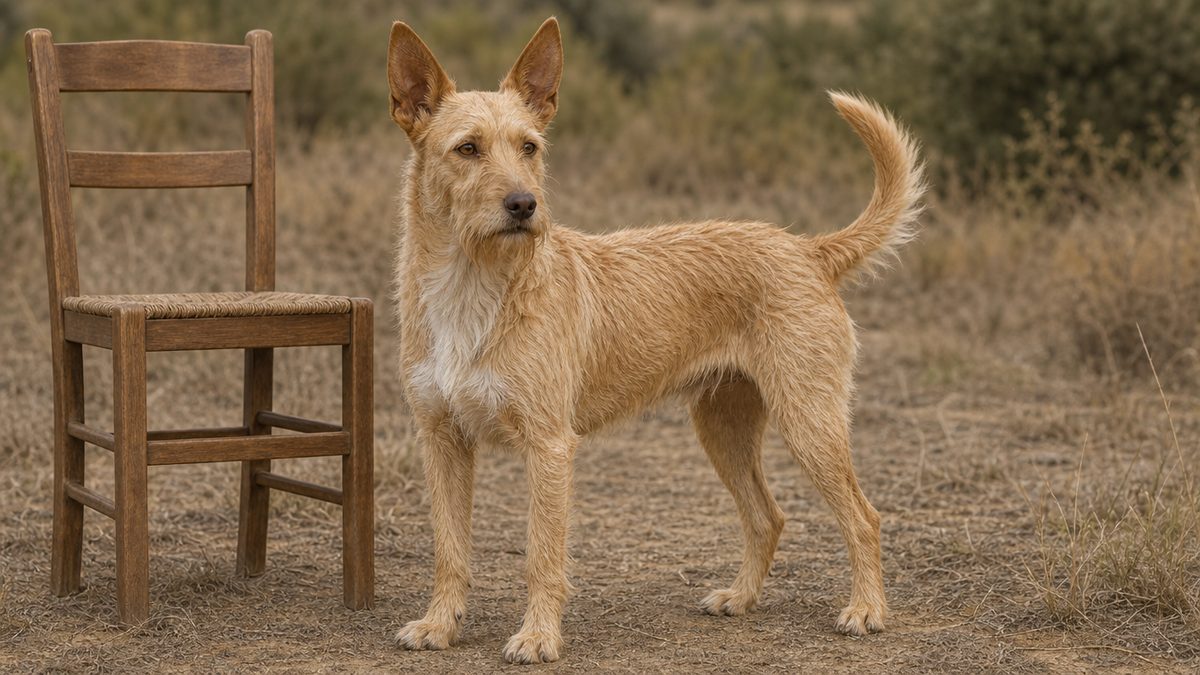
The Portuguese Podengo is a Portuguese primitive breed of hunting hound, FCI number 94, that exists in three sizes and two coat types under a single breed standard, running from 20 cm and 4 kg at the smallest to 70 cm and 30 kg at the largest.
Its official name is Podengo Portugues and the FCI's English name for it is Portuguese Warren Hound. That English name is worth carrying, because it is a search key most buyers never try and because it describes the job: a warren hound is a dog that hunts rabbits out of holes and rocks rather than one that courses them across open ground.
The standard's own general appearance paragraph is the clearest single sentence about this dog anywhere. It describes a quadrangular pyramidal head, erect ears, a sickle-shaped tail, sound construction and good muscle, a very lively and intelligent animal that is sober and rustic, and then states plainly that it exists in three sizes with two varieties of coat, smooth and wire.
| Size | Height at withers | Weight | Traditional job |
|---|---|---|---|
| Pequeno, small | 20 to 30 cm | 4 to 6 kg | Searching rabbits in holes and among rocks |
| Medio, medium | 40 to 54 cm | 16 to 20 kg | Rabbit hunting, in a pack or alone |
| Grande, large | 55 to 70 cm | 20 to 30 kg | Big game |
The Pequeno stops at 30 cm and the Medio starts at 40 cm. A Podengo standing 34 cm fits no variety, and the standard offers no tolerance clause to catch it. That is worth knowing before you buy a Pequeno puppy from a litter whose parents were at the top of their range, because a dog that outgrows the Pequeno ceiling has nowhere to go in the ring.
Coat, colour and the things that disqualify
Both coat varieties are described as of medium thickness and without undercoat, with the short coat denser than the wire one, and the wire variety carrying longer hair on the muzzle, which is the beard. A silky coat, or any undercoat at all, is listed as a fault. That single line is why the grooming load on this breed is the lowest on this site and why its heat profile is as good as it is.
Colour is yellow and fawn in all shades from light to dark, with or without white markings, or white with patches of those colours. Black and brown are additionally accepted in the Small Podengo but are not preferred. Brindle, black and tan, tricolour and wholly white are disqualifying, and so is any sign of crossbreeding to sighthounds or pointing breeds.
One disqualification matters in India for a legal reason as well as a cynological one. The standard says dewclaws are not appreciated and the tail is natural, and Second Schedule Part II paragraph 6(8) of the Dog Breeding and Marketing Rules 2017 forbids tail docking, ear cropping, de-clawing and any change of appearance by artificial means. A cropped or docked Podengo in India is evidence of a prohibited procedure.
The Portuguese kennel club prints the same standard in Portuguese and adds one thing the FCI does not, a separate working standard for the breed published in 2024. A breed with its own working standard alongside its conformation standard is a breed still doing its job, which is not true of most European hounds.
Two figures widely repeated for this breed have no primary source and are printed here as what they are. dogbreedslist gives a litter size of 4 to 6 and a life span of 12 to 14 years, and neither figure appears in the FCI standard, in the Portuguese kennel club's record or in any study. English Wikipedia, which ranks eighth in India for this breed's price query, carries five headings in total and no price, care or health section at all, so it cannot settle a litter size either.
One breed in three sizes, or three breeds? Three registries, three answers
The FCI files one breed with six varieties, the Clube Portugues de Canicultura keeps one breed record for all three sizes, and the American Kennel Club splits them into two registrations and calls them three breeds. All three positions are defensible and this page publishes the disagreement rather than picking one.
The FCI answer, from two of its own documents
The FCI's letter index for P carries exactly one Podengo entry, PODENGO PORTUGUES, resolving to number 94. Its breed record then lists six varieties beneath that single number, a) small, b) medium-sized and c) large, each split into long- and wire-haired and smooth- and short-haired, and every one of the six carries a CACIB asterisk. Six varieties, one breed, six separate certificates at a show.
The decisive document is a different one. The FCI maintains a register titled 'LIST OF BREED VARIETIES THAT CAN BE CROSSED', last updated 21 September 2023, and number 94 appears in it six times, as 1.LARGE wire, 1.LARGE short, 2.MEDIUM wire, 2.MEDIUM short, 3.SMALL wire and 3.SMALL short. A register of varieties that may be crossed is only meaningful if they are varieties of one breed, so the FCI's position is not ambiguous.
That same document carries the rule a Podengo breeder actually has to follow. Under its general principles it states 'SIZE: Only breed to nearest variety in size, or risk of whelping problems';. So the FCI permits a Pequeno to be bred to a Medio and a Medio to a Grande, and warns against Pequeno to Grande. That is a breeding rule that only exists because the sizes are one breed.
| Body | Filing | Evidence read | Sizes covered |
|---|---|---|---|
| FCI | One breed, number 94, six varieties | Breed record plus the crossing register | All three, plus two coats each |
| Clube Portugues de Canicultura | One breed, one record | Its own breed page, in Portuguese | All three on one page |
| AKC, Portuguese Podengo Pequeno | A separate recognised breed | Its own breed page | Small only |
| AKC, Portuguese Podengo | Miscellaneous class since 1 January 2014 | Its own breed page | Medium and large only |
| OFA | Statistics for the Pequeno only | The full statistics dump | Small only, no row for the others |
The Portuguese answer
The breed's country of origin agrees with the FCI, and says so in its own language. The Clube Portugues de Canicultura keeps one record headed Podengo Portugues covering all three sizes, and its general appearance paragraph reads 'Possui tres tamanhos, e duas variedades: pelo liso e cerdoso', which is three sizes and two varieties, smooth and wire. Its index of Portuguese breeds lists eleven native breeds and exactly one Podengo among them.
The American answer, in the AKC's own words
The AKC runs two breed pages. One is headed Portuguese Podengo Pequeno and states that the breed 'was recognized as a breed by the AKC in 2013', giving 8 to 12 inches and 9 to 13 pounds in the Hound group. The other is headed Portuguese Podengo, covers two sizes at 16 to 22 inches and 22 to 28 inches, and states that the breed 'has been approved to compete in the Miscellaneous class since January 1, 2014';.
The AKC then says the quiet part out loud. Its Pequeno page describes that dog as 'the smallest of Portugal's three Podengo breeds';. Three Podengo breeds, in the registry's own sentence, against one breed in the FCI's register and one on the Portuguese kennel club's. This is the same class of disagreement this site has recorded between registries over the Colorpoint Shorthair and the Himalayan, and neither position is wrong.
India is a full FCI member represented by the Kennel Club of India, so a KCI registered pedigree is issued against FCI nomenclature, which means one breed in three sizes. A dog imported with an AKC pedigree as a 'Portuguese Podengo Pequeno' is being registered under a name FCI nomenclature does not use. That is not a problem for a pet, and it is a real one if you ever intend to show or breed.
The Phoenician origin story, tested against a study that sampled this breed
The Portuguese Podengo is not a direct descendant of the dogs of ancient Egypt, and the study that establishes this sampled seventeen Portuguese Podengos rather than reasoning from a relative.
Start with the claim as the sources actually state it. The FCI standard says the breed 'probably originates from the ancient dogs brought by the Phoenicians and Romans to the Iberian Peninsula in the Classic Antiquity', later influenced by dogs arriving with the Moors in the eighth century, and it hedges with the word probably. The Portuguese kennel club prints the same hedge, 'tem a sua origem provavel';.
The AKC drops the hedge and adds a date that does not work. Its history states the probable origin lies with primitive hunting dogs 'obtained, used and distributed by Phoenician traders during the circumnavigation of Africa in 600 BC and reaching Portugal in the 700s BC';. Read those two clauses together and the dogs reach Portugal a century before the voyage that supposedly obtained them. That is the registry's own sentence, and it is internally impossible.
What the genetics actually tested, and on how many dogs
Perini and colleagues published the first comprehensive genomic and mitochondrial survey of hound-like dogs native to the Mediterranean Basin, sampling 272 unrelated dogs across eight populations, and the Portuguese Podengo is one of the eight at N equals 17. The others were the Podenco Valenciano at 61, the Podenco Ibicenco at 38, the Cirneco dell'Etna at 33, the Kelb tal-Fenek at 32, the Podenco Andaluz at 31, the Podenco Canario at 30 and the Egyptian Baladi street dog at 30, with 29 German Shepherds as an outgroup. Those eight sum to exactly 272.
Seventeen is the smallest of the eight samples and that caveat belongs beside every number taken from it. It is still seventeen more Portuguese Podengos than the study everybody else cites for this question, which examined the Pharaoh Hound and the Ibizan Hound and not this breed at all.
| Measure | Portuguese Podengo | Comparison |
|---|---|---|
| Dogs sampled | 17 | smallest of eight populations |
| Mean number of alleles | 5.56 | eight-population mean 6.63 |
| Observed heterozygosity | 0.68 | eight-population mean 0.69 |
| Inbreeding coefficient F-IS | 0.02098 | mean 0.028065; Podenco Canario lowest at minus 0.02957 |
| F-ST from Podenco Andaluz | 0.032 | its closest relative in the study |
| F-ST from Egyptian Baladi | 0.041 | closer than to most podencos |
| F-ST from Kelb tal-Fenek | 0.176 | the largest distance of any pair involving the Kelb |
| F-ST from the German Shepherd outgroup | 0.165 | lower than its distance from the Kelb tal-Fenek |
Read the last two rows together. This breed is genetically further from the Pharaoh Hound, at 0.176, than it is from a German Shepherd, at 0.165. Two dogs that look alike enough to be sold as cousins of the same Egyptian ancestor sit further apart than one of them sits from a modern working shepherd. That is the antiquity claim answered in a single pair of numbers.
Where the ancient lineage actually points
The paper's mitochondrial results point to Europe rather than to Egypt. The Portuguese Podengo is one of four populations carrying haplogroup C, and within that haplogroup the shared clade contains the Egyptian Baladi street dog, the Podenco Valenciano, the Podengo Portugues, the Podenco Andaluz and eleven ancient dog sequences from Italy, Switzerland, France, Germany and Romania. The paper reads that as the conservation of ancient EUROPEAN mitotypes.
The study's own list of highlights closes the question, and it is the sentence no ranking page quotes: 'This study confirms the Mediterranean hound-like dogs origin as a recent event';. Its abstract states that although none of the populations studied appears to be a direct descendant of Egyptian dogs, they retain a close morphological resemblance to the dogs of ancient Egyptian art and share some genetic links with the current Egyptian population.
Sibling pages on this site quote a 2004 Science paper by Parker and colleagues on the Pharaoh Hound and the Ibizan Hound, whose identity was confirmed here through NCBI. No readable full text of that paper could be reached in this session, so nothing on this page rests on its contents and no sentence is quoted from it. The argument above is built on the study that sampled this breed, which is the stronger source in any case.
Two things survive from the origin story once the Egyptian half is removed. The small variety really was selected from the fifteenth century onwards as a ratter aboard the caravels of the Portuguese navigators, which both the FCI and the Portuguese kennel club state Clube Português de Canicultura. And Blaschikoff and colleagues report recent admixture between the Algarve Barrocal Dog and the Portuguese Warren Hound, which is a real and recent piece of this breed's history rather than an ancient one.
The FCI dates, and how the format was proved from each document
The FCI accepted the Portuguese Podengo on a definitive basis on 18 November 1954 and published the official valid standard on 4 November 2008. Both dates needed proving, because the FCI writes the same day two different ways across its own documents.
The breed record prints the acceptance date as 11/18/1954. There is no eighteenth month, so the second field is the day and the record is M/D/YYYY. Two further rows on the same page confirm it independently: the English and Spanish standard dates read 3/30/2009 and the German reads 9/21/2012, and 30 and 21 cannot be months either. Three proofs on one page, which is why the record is the better instrument than any standard PDF.
The standard PDFs prove the opposite convention just as cleanly. The English text's header reads 30.03.2009/EN, first field 30, and the German text's only date is 21.09.2012, first field 21. Both are D.M.YYYY, and both reconcile exactly with the record read as M/D/YYYY.
| Language | Record prints | PDF prints | Both mean | Self-proving? |
|---|---|---|---|---|
| English | 3/30/2009 | 30.03.2009 | 30 March 2009 | yes, in both |
| French | 5/5/2010 | 05.05.2010 | 5 May 2010 | no, in either |
| German | 9/21/2012 | 21.09.2012 | 21 September 2012 | yes, in both |
| Spanish | 3/30/2009 | not fetched | 30 March 2009 | record only |
| Valid standard | 11/4/2008 | 04.11.2008 | 4 November 2008 | record only |
| Acceptance | 11/18/1954 | not stated in any standard | 18 November 1954 | record only |
Two rows in that table cannot prove themselves. Neither field in 04.11.2008 or 05.05.2010 exceeds twelve, so the French PDF and the Portuguese kennel club's page, which prints 04-11-2008 and carries no second date, both have to borrow their format from elsewhere Clube Português de Canicultura. Borrowing the wrong one turns 4 November into 11 April.
Checking both ends, and what was NOT found
Registries can contradict their own standards, and this site has recorded the FCI doing it by forty-seven days on one breed and by four years on another. Breed 94 was checked at both ends and it is clean. The record's acceptance date has no counterpart in any of the three standard PDFs, because none of them states an acceptance date at all, so there is no conflict available to find. The publication dates all reconcile.
One genuine year-level discrepancy did turn up, from a peer-reviewed source rather than from the FCI. Blaschikoff and colleagues tabulate the Portuguese Warren Hound's FCI recognition as 1954 and its official valid standard as 2009, while the FCI record and all three PDFs give the valid standard as 4 November 2008. The 2009 matches the English standard's own publication date, so the two are almost certainly different fields on one record. Both figures are printed here rather than reconciled away.
FCI 94's French PDF prints 'Langue faisant foi : (EN)';, so the authentic text is English and the French is a translation. That line matters because the sibling Portuguese Water Dog standard, FCI 37, translated by the same two people, contains the string 'faisant foi' zero times. Same body, same translators, one document names its authority and the other leaves you to find it on the breed record. Read the line when it is there and go to the record when it is not.
The between-language numeric drift this site has found on other standards does not occur here. The French text gives Petit 20 a 30 cm, Moyen 40 a 54 cm and Grand 55 a 70 cm with weights of 4 a 6, 16 a 20 and 20 a 30 kg, identical to the English. A negative result is worth recording, because it means either language can be quoted for the measurements.
Portuguese Podengo price in India, and why the answer is a mug
No portuguese podengo price in india exists, and the search does not merely come back empty. It comes back full of objects. Every rupee figure attached to the breed name in India belongs to a pendant, a statue, a mug, a pair of socks or a paperback book.
Three of the ten Indian results for this query are merchandise rather than dogs. Amazon India ranks third with a print-on-demand paperback titled 'Portuguese Podengo Pequeno: An Educator's Perspective 2.0' at about Rs 2,315, and Flipkart ranks ninth with the same class of title. Etsy ranks fifth, and its Indian storefront carries a sterling silver pendant and a pin brooch at about Rs 11,502 and Rs 11,524 whose raw markup gives a currency of EUR and an amount of 125.00, plus a 3D-printed statue at about Rs 1,284.
| Figure | What it actually buys | Live animal? |
|---|---|---|
| about Rs 11,502 and Rs 11,524 | Sterling silver pendant and pin brooch, EUR 125.00 in the markup | No |
| about Rs 2,315 | Print-on-demand paperback on Amazon India | No |
| about Rs 1,284 | 3D-printed statue | No |
| Rs 98,999 / 92,599 / 94,999 / 76,499 / 1,20,000 | Puppiezo carousel of Maltipoos, Poodles, a Cane Corso, a Rottweiler, a Goldendoodle and a Doxiepoo | Yes, but not this breed |
| No figure at all | Puppiezo's own Podengo page body | No dog offered |
The Indian page that ranks first is visibly unfinished
Puppiezo holds position one and prints no price for the breed. Its headings give the template away: they read 'Never feed these foods to Portuguese Podengo Pequeno Puppies For Sale' and 'Find Portuguese Podengo Pequeno Puppies For Sale Puppies', where the breed variable has been concatenated with the page title. The same site's Portuguese Water Dog page renders the equivalent heading correctly, so this is a per-page defect rather than a site-wide one.
The prices that page does carry belong to other animals. Its 'Other Available Pets' carousel is byte-identical to the one on its Water Dog page and prints Rs 98,999 three times against two Maltipoos named Samy and Fizey and a Doxiepoo named Yoki, plus Rs 92,599 for two Poodles, Rs 94,999 for a Cane Corso, Rs 76,499 for a Rottweiler and Rs 1,20,000 for a Goldendoodle. That Rs 98,999 is a house price point this site has now tracked across more than ten breed pages, and it is attached to whichever puppy is in stock.
Both Indian breed-guide sites return not-found pages
The two Indian sites that publish price guides for the Portuguese Water Dog have no page for this breed at all. poodles.in returns HTTP 200 for both /dog-breeds/portuguese-podengo and /dog-breeds/portuguese-podengo-pequeno, with the title 'Dog Breed Not Found | Poodles.in';. A status-code check alone would report those pages as existing, which is worth knowing generally. happypet.care returns a hard 404. The Portuguese Podengo is also absent from the breed list of India's largest puppy-listing site entirely.
A search summary asserted a Podengo price of USD 7,275 to 7,575 with an average of 7,425. That figure appears in none of the pages it cited and in none of the pages retrieved for this build; the real published figures are USD 1,000 to 2,500 on American aggregators and GBP 800 to 1,500 on the deepest British guide. A generated answer is never the source of a price, and a price gains no credibility by appearing in one.
The honest overseas anchor, labelled as overseas. dogbreedslist prints 'Average $1000 - $2500 USD' for puppy prices and Pets4Homes prices a UK purchase at GBP 800 to 1,500. Neither is converted into rupees here, because converting a foreign price is precisely how the fabricated Indian prices this site documents were manufactured. AKC Marketplace, for scale, shows three Podengo Pequeno puppies in the entire United States.
Monthly cost of ownership, and why this breed is the cheap one
Budget roughly Rs 4,000 to Rs 7,000 a month for a Medio and Rs 2,500 to Rs 4,000 for a Pequeno in an Indian metro, which makes the Portuguese Podengo one of the cheapest imported breeds to run, because the grooming line that dominates most coated breeds is close to zero here.
That is the practical consequence of a coat with no undercoat that needs no clipping and no stripping dogbreedslist.info entry titled 'Portuguese…. Where a Portuguese Water Dog owner in Delhi pays from Rs 1,359 a haircut every four to six weeks, a Podengo owner pays for a bath when the dog is dirty and nothing else.
| Line | Pequeno, 4 to 6 kg | Medio, 16 to 20 kg | Source |
|---|---|---|---|
| Food | Rs 1,200 to Rs 2,000 | Rs 3,000 to Rs 4,500 | arithmetic, not a quoted price |
| Parasite control | smaller-weight pack | about Rs 1,103 | Supertails, NexGard Spectra 15 to 30 kg |
| Grooming | near zero | near zero | no trimming or stripping needed |
| Vaccination, annualised | about Rs 270 | about Rs 270 | Vetic booster from Rs 3,199 a year |
| Consultation, annualised | Rs 250 to Rs 500 | Rs 250 to Rs 500 | one data point, see note |
| Municipal registration | about Rs 42 | about Rs 42 | MCD Delhi, Rs 500 a year |
| Boarding when you travel | Rs 899 per 24 hours | Rs 899 per 24 hours | PawSpace Bengaluru |
The vaccination line comes from Vetic, a chain of more than fifty clinics across seven Indian metros, which prices anti-rabies at Rs 699, the nine-in-one DHPPiL at Rs 899 and kennel cough at Rs 1,349, with a puppy core course from Rs 6,499 and an annual booster from Rs 3,199. Those course prices differ between the chain's own city pages on the same day, so record the city page rather than treating a difference as a price change.
A dog sanctuary and a general insurer both publish Rs 500 to Rs 1,000 for a consultation and Rs 1,500 to Rs 3,000 for core vaccination, byte-identical on both ranges. Two unrelated organisations agreeing exactly on two separate quantities means one copied the other, so it is counted here as one data point rather than two.
Two municipal facts change the arithmetic more than any breed price would. MCD Delhi charges Rs 500 to register a pet dog and Rs 500 to renew, and has issued 18,958 certificates since 2021. Greater Chennai Corporation charges Rs 50 for a licence, issued 9,115 in 2024, and runs six municipal pet clinics that give treatment and anti-rabies vaccination free of cost. Boarding, when you travel, runs Rs 899 for 24 hours in Bengaluru.
The screening cost is small and one-off. A single ADAMTS17 DNA test for primary lens luxation is the only genetic test this breed genuinely needs, and it belongs in the purchase decision rather than the monthly budget.
Heat tolerance, and the one European breed that arrives suited to India
The Portuguese Podengo has the best heat profile of any European breed on this site, and the reason is measurable rather than rhetorical. Its Alentejo homeland runs an August mean of 25.22 C, which is warmer than Bengaluru's hottest month at 28.37 C is far above its own coolest.
Every figure below came from NASA POWER by explicit latitude and longitude, and every point's returned grid-cell elevation was checked against the real elevation of the place, because that model returns a grid cell rather than a point. Evora came back at 173.11 m against a real 300 m, Braganca at 944.98 m against 690 m, Faro at 54.06 m against 10 m, Delhi at 206.37 m against 216 m, Chennai at 48.95 m against 6 m, Bengaluru at 841.72 m against 920 m and Pune at 635.99 m against 560 m. Braganca is the largest error at plus 255 m, which makes its figures slightly cold, and it is flagged rather than hidden.
| Place | Annual mean | Annual RH2M | Hottest month (mean T2M) | Coolest month (mean T2M) |
|---|---|---|---|---|
| Evora, Alentejo | 16.53 C | 69.30 percent | 25.22 C (August) | 8.83 C (January) |
| Faro, Algarve | 17.89 C | 74.09 percent | 23.75 C (August) | 12.91 C (January) |
| Braganca, north-east Portugal | 10.97 C | 73.35 percent | 20.47 C (July) | 3.23 C (January) |
| Delhi | 25.60 C | 45.56 percent | 35.88 C (June) | 13.61 C (January) |
| Mumbai | 26.77 C | 67.39 percent | 31.19 C (May) | 23.19 C (January) |
| Chennai | 27.95 C | 72.39 percent | 31.51 C (May) | 24.09 C (January) |
| Bengaluru | 23.74 C | 67.94 percent | 28.37 C (April) | 20.22 C (December) |
| Pune | 23.86 C | 66.80 percent | 28.93 C (April) | 19.62 C (December) |
The humidity claim most Indian pages make is wrong here too
Evora runs 69.30 percent annual relative humidity and Faro 74.09. Against that, Pune runs 66.80, Mumbai 67.39, Bengaluru 67.94, Chennai 72.39 and Kolkata 73.93. A Podengo arriving in Bengaluru is meeting AIR THAT IS DRIER than its homeland's, not damper. The load it meets is heat, and the sensible framing is wet bulb rather than damp.
Wet-bulb figures here were computed from mean temperature and mean relative humidity and never from a period maximum. Evora peaks at 18.29 C in August, Faro at 18.96 C. Bengaluru peaks at 21.86 C in May, Pune at 22.97 C in June, Mumbai at 25.77 C in June, Chennai at 26.11 C in May, Delhi at 26.50 C in July and Kolkata at 27.09 C in June. Bengaluru sits 3.57 C above Evora. That is the narrowest gap this site has measured for any European breed.
The standard specifies both coat varieties as medium thickness WITHOUT undercoat, and lists a silky coat or the presence of undercoat as a fault. A single coat over a lean, long-legged, deep-but-narrow-chested frame is close to the ideal shape for shedding heat. dogbreedslist states that the breed is well-suited for hot sunny climates and can live and sleep outdoors so long as it has adequate shelter, which is the only claim in the entire ranking set that this page can confirm from a standard.
| Place | Hottest month by mean daily max | Mean daily max |
|---|---|---|
| Faro, Algarve | August | 28.19 C |
| Bengaluru | April | 35.62 C |
| Chennai | May | 36.46 C |
| Pune | April | 38.61 C |
| Mumbai | April | 39.43 C |
| Delhi | May | 42.73 C |
Suited is not the same as immune, and Indian law draws the same line. Second Schedule Part IV paragraph 21(1) of the Dog Breeding and Marketing Rules 2017 bars outdoor housing, without the attending veterinary practitioner's written approval, for dogs not accustomed to local temperatures and for breeds that cannot tolerate them. An imported Podengo is not accustomed to a Delhi May whatever its coat looks like, and the acclimatisation period is where the risk sits.
The risk is exertional rather than environmental, which matters for a hunting breed with a working drive. Of 879 UK heat-related illness events with a recorded trigger, 652 or 74.2 percent were exertional, 113 environmental and 46 vehicular confinement. A Podengo will run itself into trouble in April in a way that a lazier dog will not, and its heat advantage is a reason to walk early rather than a licence to walk late.
Temperament, prey drive and the household this breed fits
The FCI standard describes a very lively and intelligent dog that is sober and rustic, used for hunting, as a watch dog and as a companion in all three sizes. Read the watchdog ability and the prey drive together and you have the two traits that decide whether this dog works in an Indian home.
Prey drive first, because it is the one people underestimate. A dog bred to find rabbits in holes and among rocks will chase a cat across a lane, a squirrel up a compound wall and a stray across a road. Off-lead freedom in an unfenced Indian street is not an option for this breed, and a securely fenced space is the single biggest predictor of whether the dog is happy.
The AKC's own description is useful because it is unusually frank. It calls the breed lively, agile, playful, alert and highly intelligent but not always easy to train, independent yet loving with the family, and sometimes suspicious of strangers, and adds that Podengos may view smaller animals like dogs and cats as prey. That is an accurate description of an independent primitive hound rather than a friendly family retriever.
The words owners reach for are loyal and playful, and both are fair with a qualification. A Podengo is loyal to its own household and reserved with everyone else, which is the AKC's 'independent yet loving with the family and sometimes suspicious of strangers' put another way. Expect a dog that is devoted at home, friendly on its own terms outside, and genuinely alert about who comes through the door.
Who this breed suits in India
- Households with a securely fenced yard or a genuinely reliable walking routine, because loose in an Indian street this dog hunts.
- Owners who want a hardy, low-maintenance dog and are honest about wanting a vocal one.
- Homes without free-roaming cats, rabbits or small pets, because the standard's own utilisation line is hunting.
- People in Bengaluru, Pune, Hyderabad or the Deccan generally, where the climate is closest to the breed's own.
- Anyone who would rather train an independent mind than manage a heavy coat.
Who should not get one
- Apartment dwellers in a society with a strict noise policy, because barking is a working trait here rather than a training failure.
- Anyone who wants a dog that will come back reliably when it has picked up a scent.
- First-time owners hoping for a biddable dog, because independent is the accurate word and it is in every source.
- Households with cats or rabbits already in residence.
- Anyone who cannot obtain one lawfully, which in India is currently almost everyone.
dogbreedslist scores apartment friendliness five stars while its own body text says the Podengo Portugueso Medio is not recommended for apartment life. Its page is titled Pequeno and parts of its text describe the Medio, so the star rating and the prose are about different dogs. For apartment living in India, the Pequeno at 4 to 6 kg is the size that genuinely works.
The standard rules out the extremes of temperament in both directions. Aggressive or overly shy dogs are disqualified, and a merely suspicious dog is listed among the ordinary faults. A seller describing a fearful or sharp Podengo as typical of a primitive breed is describing a dog that fails its own standard.
Training an independent hunting hound
Train this breed with short, high-value sessions, a long line instead of trust, and a realistic acceptance that recall against a live scent will never be perfect, because independence is in the job description rather than in the dog's attitude to you.
The AKC puts it plainly: Podengos will both surprise and test the unprepared owner, they require firm training or they will find their own adventures, and they are easily motivated by food and fun. Every word of that is training advice. Motivation works; repetition and pressure do not.
A first-year plan for an Indian household
- Weeks 8 to 12: name, crate, handling, and a marker word. Keep sessions to three minutes and stop while the dog still wants more.
- Weeks 12 to 16: socialise deliberately to lifts, autorickshaws, building guards, delivery riders, cattle and other dogs. This window closes and does not reopen.
- Months 4 to 6: long-line work in an open space. Build recall as a paid behaviour, never as an expectation.
- Months 6 to 9: impulse control around movement. Practise a stop cue, because a stop is achievable where a recall against a chase is not.
- Months 9 to 12: scent games and controlled searching, which give a hunting brain its job indoors during the hot months.
The habit to build early is a stop rather than a recall. A dog thirty metres into a chase cannot hear you and will not turn; a dog trained to freeze on a whistle can be reached. That distinction is the difference between a Podengo that lives to twelve and one that meets an Indian road.
Digging deserves its own line because the breed was bred to it. A dog whose ancestors worked rabbits out of rock crevices will excavate a flowerbed with real skill. Give it a permitted place to dig, a sandpit or a corner of the yard, and it will mostly use it. Forbid digging entirely and it will simply dig where you are not looking.
Google's most stable question about this breed across two different query shapes is whether Podengos bark a lot, and the answer is yes by design. A hound that gives tongue on the trail is doing its job; the same dog in a Mumbai flat is doing its job at the lift. Manage it with an alternative behaviour at the door and with exercise, and choose a different breed if a quiet dog is non-negotiable.
One legal note on any breeding advice you may be given for a tiny Indian population. Second Schedule Part II paragraph 6(3) of the Dog Breeding and Marketing Rules 2017 prohibits in-breeding, defined as breeding between relatives of the second to fourth grade within the first four generations, and incest breeding between parents and children or brother and sister. Only out breeding and line breeding are permitted.
Exercise needs by size, and what happens without it
Plan 45 to 60 minutes a day for a Pequeno and 90 minutes for a Medio or Grande, with at least a third of it as scent or search work rather than as walking, because a hunting hound tires through its nose faster than through its legs.
The three sizes were bred for three jobs and their exercise needs follow. The Grande hunted big game, the Medio hunts rabbit in a pack or alone, and the Pequeno searches rabbits in holes and among rocks. A Grande needs distance, a Medio needs distance and problem-solving, and a Pequeno needs intensity in a small space, which is exactly why it is the size that suits an Indian flat.
| Size | Daily total | Split | The part that actually matters |
|---|---|---|---|
| Pequeno | 45 to 60 minutes | two walks | 15 minutes of scent work indoors |
| Medio | 90 minutes | two walks plus free running | 30 minutes of searching or long-line work |
| Grande | 90 to 120 minutes | two walks plus real distance | space to move at speed, which few Indian cities offer |
Timing is the Indian constraint, not volume. From March to June the usable hours in Delhi, Chennai, Mumbai and Pune are before sunrise and after dark, when the mean daily maximum runs from 36.46 C to 42.73 C at the peak. Bengaluru and Pune, where the peak means are 28.37 C and 28.93 C, give you far more of the year at ordinary hours.
What happens without the exercise is specific to this breed rather than generic. An under-exercised Podengo does not mope; it hunts. It patrols the balcony, it barks at movement four floors down, it digs at the door mat, and it takes itself out of an unlatched gate. Every one of those is the dog doing its job in the absence of a real one.
This is an agile breed with a long, light frame and it can clear a fence far higher than its size suggests. Judge a compound wall by whether the dog can get a foothold rather than by its height, and check the gate latch. A Podengo that has jumped once will jump again.
Grooming, and the lowest coat-care bill on this site
Brush a Portuguese Podengo once a week, bathe it when it is dirty, and do nothing else, because the standard specifies both coat varieties as medium thickness without undercoat and no ranking source recommends trimming or stripping dogbreedslist.info entry titled 'Portuguese….
That single sentence is worth more to an Indian owner than any price. A Portuguese Water Dog needs a professional clip every four to six weeks at Rs 1,359 and up per haircut in Delhi. A Portuguese Podengo needs a rubber curry mitt and ten minutes. Over ten years the difference is well over a lakh of rupees, and it is the strongest practical argument for this breed in this country.
Which of the two you get changes almost nothing about the workload. A smooth coat needs a rubber mitt once a week and a wire coat needs a slicker and a comb through the beard, and neither is clipped or stripped. The smooth coat is described in the standard as the denser of the two, which surprises people who assume the wire variety carries more hair.
| Task | Smooth coat | Wire coat |
|---|---|---|
| Brushing | weekly, rubber mitt | weekly, slicker and comb through the beard |
| Bathing | when dirty | when dirty |
| Clipping or stripping | never | never |
| Shedding level | modest, seasonal | modest, sheds in sections |
| Ear check and dry | weekly, and after rain | weekly, and after rain |
| Nail trim | every 3 to 4 weeks | every 3 to 4 weeks |
The erect ears are a genuine advantage in Indian conditions and it is worth saying why. The standard describes them as set on obliquely at eye level, straight, erect, highly mobile, thin and triangular. An upright ear dries by itself, which is the reason this breed does not carry the monsoon otitis risk that drop-eared, dense-coated breeds do in India. It still deserves a weekly look and a dry after rain.
One Indian-specific warning the low grooming load creates
A dog you never brush is a dog you never inspect. Ticks are the Indian risk here rather than mats, and a short-coated dog with almost no grooming routine is one whose owner may go a fortnight without running hands over its skin. Among 584 dogs screened in West Bengal, 76.54 percent carried Babesia gibsoni and 72.9 percent of the 584 screened carried two or more pathogens; among 120 dogs tested in Kerala, Babesia was found in 80, which is 66.7 percent.
Both of those studies sampled clinically suspected dogs presented at veterinary clinics rather than random populations, so they are not population prevalences and should never be quoted as such. They are still the reason a weekly hands-on check and monthly parasite control at about Rs 1,103 belong in the routine of a breed that otherwise needs almost nothing.
Wire-coated terriers are hand-stripped, which is skilled, slow and expensive. The Podengo's wire coat is not, and stripping it is a mistake rather than a service. The AKC's guidance for the breed is explicit that neither coat should be stripped. If an Indian groomer offers to strip your Podengo, decline.
Health issues, screening and the one test that matters
Ask a Portuguese Podengo breeder for one DNA test above all others, the ADAMTS17 primary lens luxation variant, because a UK study of 82 dogs found a mutated allele frequency of 0.09 and the authors called that high.
Tzouganakis and colleagues genotyped two groups of Portuguese Podengos in the United Kingdom for the ADAMTS17 c.1473+1G>A mutation. Of 82 dogs in total, 1 was homozygous for the mutated allele, which is 1.2 percent, 13 were heterozygous carriers at 15.8 percent, and 68 were homozygous wild-type at 83 percent. The counts reconcile exactly, since 1 plus 13 plus 68 is 82, and the allele frequency of 0.09 follows from twice one homozygote plus thirteen carriers over 164 alleles.
The same study tested whether the mutation correlates with short stature, which would have been an important finding for a breed defined by three size varieties, and it found no statistically significant correlation at p equals 0.590. That negative result is worth carrying, because it means the Pequeno's size is not a marker for the mutation and a small dog is not automatically higher risk.
A luxated lens causes sudden pain, redness and a visibly cloudy or displaced lens, and untreated it causes glaucoma and blindness within days. OFA's eye detail rows record lens subluxation or luxation in 3 of 623 Portuguese Podengo Pequenos examined, which is 0.5 percent. If your dog's eye changes overnight, that is a veterinary appointment today, not next week.
What OFA publishes, and for which size
OFA holds statistics for the PORTUGUESE PODENGO PEQUENO only. There is no OFA row for the Medio or the Grande. The correct way to say that is that those two sizes have no row in OFA's published statistics tables, not that they are absent from the database, because OFA requires 100 hip evaluations, or 50 for its other databases, before a breed is published at all.
| OFA table | Evaluations | Normal | Abnormal |
|---|---|---|---|
| Hips | 292 | 98.6 percent | 1.4 percent dysplastic |
| Patella | 301 | 93.0 percent | 7.0 percent abnormal |
| Eyes, summary line | 623 | 95.3 percent | 4.7 percent abnormal |
| Eyes, distichiasis detail row | 623 tested | 46 affected | 7.4 percent |
| Eyes, lens subluxation or luxation | 623 tested | 3 affected | 0.5 percent |
| Eyes, vitreous degeneration syneresis | 623 tested | 14 affected | 2.2 percent |
The hip row is the standout and it reconciles exactly. Excellent 34.6 plus good 60.6 plus fair 3.4 gives the printed 98.6 percent normal, and mild 0.7 plus moderate 0.7 plus severe 0.0 gives the printed 1.4 percent dysplastic. A dysplastic rate of 1.4 percent across 292 evaluations is among the best on the whole OFA hip table, and it is a genuine argument for the breed rather than a marketing line.
Patellas are the orthopaedic weak point instead. OFA ranks the Pequeno nineteenth worst of all breeds on patellar luxation, with 7.0 percent abnormal across 301 evaluations, split 5.0 percent grade one, 1.0 percent grade two and 0.7 percent grade three. That is why the AKC's own health panel for the Pequeno lists a Patella Evaluation first, ahead of hips and an ophthalmologist evaluation.
OFA's eye tables contradict themselves here too
The eye summary reports 95.3 percent normal and 4.7 percent abnormal across 623 evaluations. The detail row labelled NORMAL (OTHER .000) records 471 of 623, which is 75.6 percent, a gap of 19.7 percentage points. Worse, distichiasis alone accounts for 46 of 623, which is 7.4 percent, and a part cannot exceed the 4.7 percent whole. Neither figure should be quoted as the breed's eye rate; both are printed here with the arithmetic.
One coincidence worth naming so nobody reads it as a template. The Portuguese Podengo Pequeno's normal-eye detail row is 471 of 623, which is 75.60 percent, and the Portuguese Water Dog's is 15,448 of 20,432, which is 75.61 percent. Two breeds, two denominators three orders of magnitude apart, one rounded figure. That is arithmetic coincidence rather than a shared preset, and it is exactly the kind of collision that gets mistaken for one.
Beyond that the literature is thin and honestly so. PubMed holds eight records for this breed, of which three are about the breed as a subject and five are case series in which a Podengo happened to be a patient, including a single case report of uterine prolapse with rupture in a Podengo bitch PubMed search audit run 8 September 2026…. No breed health survey exists. dogbreedslist rates health issues one star and calls it a very healthy breed with a low incidence of known inherited defects, and on the OFA hip evidence that is defensible.
No life span figure is published on this page and the reason is worth stating once. Teng and colleagues' UK life tables give an all-dog life expectancy at birth of about eleven and a half years and are a reasonable general anchor, but they are not this breed's number, and McMillan and colleagues' longevity study lists the breed in its Supplementary Table S5 with an inclusion flag of N, meaning it was named in the breed table and never entered the survival analysis. That is a checked exclusion rather than a search that came up empty, which matters because the same paper's article text also returns zero for the Whippet, a breed it certainly analysed. A widely copied 12 to 14 years exists on aggregator pages and nowhere in the literature.
The rarity paradox, and the number no ranking page carries
The Portuguese Podengo is the commonest declared dog breed in its own country and one of the rarest anywhere else, and the two facts come from two different registers counting two different things Blaschikoff L, Serra O, Simões F, Ginja C.
Portugal's national companion-animal registry, SIAC, holds 2,581,870 dogs. Mixed-breed dogs are the largest group at 39.6 percent, and the second largest group is the Portuguese Podengo at 10.9 percent, ahead of the Labrador Retriever at 6.1 percent. Ten point nine percent of 2,581,870 is roughly 281,000 dogs, which makes this the most numerous named breed in the country.
The pedigree register tells a completely different story. Blaschikoff and colleagues give the Portuguese Warren Hound an approximate census of 2,269 in 2025. That is about one registered pedigree dog for every 124 dogs declared as the breed on the national microchip database.
| Register | What it counts | Figure |
|---|---|---|
| SIAC national microchip registry, 2023 | Every registered dog, breed as declared by the owner | 10.9 percent of 2,581,870 |
| Pedigree census, 2025 | Dogs in the studbook | about 2,269 |
| Portuguese Water Dog, same census | Dogs in the studbook | about 2,639 |
| AKC Marketplace, United States | Podengo Pequeno puppies advertised | 3 in the whole country |
| India | Dogs advertised by any seller | none found |
The gap is not a contradiction and it is the most interesting fact about this dog. The Podengo is a working farm and hunting dog across rural Portugal, kept by people who microchip their animals because the law requires it and never register a pedigree because nothing in their lives requires that. The breed is common as a population and rare as a pedigree, which is the definition of a landrace that a kennel club later wrote down.
An Indian buyer cannot access the 281,000. Those dogs are not exported, not registered and not for sale. What is exportable is the roughly 2,269 pedigree animals plus their descendants abroad, and that is the population from which a KCI registered pedigree could ever be issued. Rarity for a buyer is about the pedigree register, not about the dog's abundance in Portugal.
The genetics of a breed split by size
Blaschikoff and colleagues did something no other source does: they split their Portuguese Warren Hound samples into two groups by height at withers, medium/large and small, stating that it has been suggested these two nuclei have different origins and evolutionary histories. That is the variety-versus-breed question asked genetically rather than administratively, and the answer is that the split is real enough to be worth analysing separately.
Their results support it. The Portuguese Warren Hound returned the lowest observed heterozygosity of the ten Portuguese breeds studied, and the paper attributes the deviation in the medium and large dogs to possible sub-structure caused by the presence of two different body size classes, which is the Wahlund effect. It also links the wide variance in the medium and large dogs to a severe population decline between the 1940s and the 1980s as big-game hunting was abandoned.
So the honest summary is that the FCI's single-breed filing and the AKC's three-breed filing are both defending something real. Administratively there is one studbook and one standard. Genetically there are at least two nuclei inside it, and the registry that split them was not being arbitrary.
Feeding a lean hunting hound in India
Feed a Portuguese Podengo to its ribs rather than to a chart, and expect it to look leaner than your neighbours think a healthy dog should, because the standard describes a lean, dry-skinned dog with a slightly tucked-up belly and lean flanks.
That matters more in India than elsewhere, because the local default is to read a visible waist as underfeeding. A Podengo at correct weight has ribs you can feel easily and a waist you can see from above. A Podengo carrying the body condition of a well-fed Labrador is overweight, and overweight is a measurable heat-illness risk factor rather than a cosmetic one.
- Pequeno, 4 to 6 kg: roughly 100 to 150 g a day of a quality dry food, split into two meals.
- Medio, 16 to 20 kg: roughly 250 to 330 g a day, split into two meals.
- Grande, 20 to 30 kg: roughly 330 to 450 g a day, split into two meals.
- Puppies to four months: four meals a day, weighed rather than scooped.
- Hot months: feed the larger meal after the evening walk, once the dog has cooled.
Those are arithmetic from typical energy densities rather than quoted prices, and they should be checked against the pack in front of you. Indian availability is a non-issue for this breed; a mainstream adult formula sold in every metro is entirely adequate and there is no need for an imported or breed-specific food.
A primitive hunting breed with a strong prey drive is more likely than average to guard a high-value resource. Teach a trade from puppyhood, feed in a quiet place, and never take a bowl away to prove a point. This is a management point rather than a nutrition one, and it is the most common Indian complaint about hound breeds generally.
Water is the Indian-specific line. A lean dog with a high surface-to-mass ratio dehydrates faster than a heavy one, and a Podengo walked at dawn in Chennai will drink through the morning. Two bowls in different rooms, refilled twice a day, beats one large bowl filled once.
Month by month through the first year
Build the puppy timeline around three fixed points: the socialisation window that closes near sixteen weeks, the recall and stop training that has to start before the prey drive matures at six to nine months, and the growth period during which you keep jumping down.
| Age | What matters most | Cost or action |
|---|---|---|
| 8 to 10 weeks | Home, crate, name, marker word, handling of feet and ears | Puppy core course from Rs 6,499 at Vetic |
| 10 to 12 weeks | Carried socialisation begins if not yet fully vaccinated | Second and third vaccine visits |
| 12 to 16 weeks | The window that closes. Lifts, autos, guards, riders, cattle, dogs | Anti-rabies, Rs 699 as a single vaccine |
| 4 to 6 months | Long-line recall and a stop cue, before prey drive matures | Municipal registration, Rs 500 in Delhi |
| 6 to 9 months | Impulse control around movement. Expect recall to get worse first | Monthly parasite control, about Rs 1,103 |
| 9 to 12 months | Build to adult exercise volume, add scent work for the hot months | Annual booster from Rs 3,199 |
The Indian complication is that the socialisation window usually falls inside the monsoon or the summer, so plan carried outings rather than cancelled ones. A puppy that first meets the world in October has missed the window regardless of the weather that caused it.
Expect recall to deteriorate between six and nine months and do not treat that as a training failure. A hunting hound's prey drive matures on its own schedule and it overrides a recall that worked perfectly at four months. That is the period during which the long line goes back on, not the period during which you decide the dog is stubborn.
Rule 8(1)(a) of the Prevention of Cruelty to Animals (Dog Breeding and Marketing) Rules 2017 provides that pups less than eight weeks in age are not sold. A seller offering a six-week-old Podengo is breaking that rule, and a seller willing to break it will not have run the one DNA test the breed needs either.
Run through that table at the figures in its right-hand column and the first year comes to roughly Rs 20,000 to Rs 28,000 in vaccination, registration and parasite control before food, with essentially nothing for grooming. That is the cheapest first year of any imported breed on this site, and it is worth stating because most Indian pages leave setup costs out of the purchase decision entirely.
Head to head against the breeds you would actually cross-shop
The Portuguese Podengo competes with two very different sets of dogs: the other Iberian warren hounds if you want this type, and the Indian sighthounds if what you want is a lean, heat-adapted, low-grooming dog you can actually obtain.
| Portuguese Podengo | Ibizan Hound | Podenco Canario | Pharaoh Hound | |
|---|---|---|---|---|
| FCI number | 94 | 89 | 329 | 248 |
| FCI varieties | six, three sizes by two coats | two coat varieties | one | one |
| In the FCI crossing register | yes, all six | yes, both | no | no |
| Size range | 20 to 70 cm | one size | one size | one size |
| Distance from the Pharaoh Hound | F-ST 0.176, the largest of any pair | F-ST 0.169 | F-ST 0.109 | reference |
| Common in its homeland? | yes, 10.9 percent of Portuguese dogs | no | no | no |
| Available in India | no | no | no | no |
The F-ST row is worth reading twice. Perini and colleagues place the Portuguese Podengo further from the Kelb tal-Fenek, the Maltese dog sold in English as the Pharaoh Hound, than any other pair involving that breed, at 0.176. Its closest relative in that study is the Podenco Andaluz at 0.032, and the Egyptian Baladi street dog at 0.041 is closer to it than most of the podencos are.
The comparison an Indian buyer should actually make
| Portuguese Podengo Medio | Rajapalayam | Indian pariah type | |
|---|---|---|---|
| Availability in India | none found | regional, obtainable | everywhere, free |
| Grooming load | near zero | near zero | near zero |
| Heat adaptation | excellent for a European breed | native | native |
| Prey drive | high | very high | variable |
| Verifiable Indian price | none | yes | adoption |
| Veterinary familiarity in India | none | regional | universal |
That second table is the honest recommendation. Almost everything an Indian buyer likes about the Portuguese Podengo, the lean athletic build, the near-zero grooming, the heat tolerance, the alert watchdog ability, is available in a dog that is already here, already adapted and already understood by local veterinarians. The Podengo's genuine advantages over those alternatives are its size range and its documented low hip dysplasia rate.
Same country, entirely different proposition. The Portuguese Water Dog carries a coat that needs a professional clip every four to six weeks at Rs 1,359 and up in Delhi, and OFA records 12.0 percent hip dysplasia across 12,073 evaluations against this breed's 1.4 percent across 292. If grooming budget or heat is your constraint, the Podengo wins on both.
Mistakes Indian owners and Indian websites make with this breed
Five mistakes recur, and three of them are made by websites rather than by owners, because there are so few Portuguese Podengos in India that most of the errors are still theoretical.
- Treating the three sizes as interchangeable. A Grande at 55 to 70 cm and a Pequeno at 20 to 30 cm are not the same dog with different dimensions; they were bred for big game and for rabbits in rock crevices respectively.
- Buying an apartment dog on a star rating. dogbreedslist scores apartment friendliness five stars on a page whose own text says the Medio is not recommended for apartment life.
- Assuming a rare breed is a healthy breed by default. The hips genuinely are excellent at 1.4 percent dysplastic, and the patellas genuinely are not, at 7.0 percent abnormal and nineteenth worst on OFA's whole table.
- Expecting a recall. This is an independent hunting hound and the prey drive matures at six to nine months. Train a stop cue, use a long line, and do not test either against a live scent.
- Repeating the Egyptian origin story. The study that sampled this breed found no population in it descending directly from Egyptian dogs and listed a recent origin among its own highlights.
Three mistakes made by the pages that rank
The first is selling merchandise as a breed page. Three of the ten Indian results for this breed's price query are objects rather than dogs, two of them the same print-on-demand paperback assembled from encyclopaedia text Etsy India marketplace page for 'portuguese…. A buyer clicking the third result for a price gets a book.
The second is publishing a breed page with the variable still in the heading. Puppiezo ranks first with headings reading 'Never feed these foods to Portuguese Podengo Pequeno Puppies For Sale', where the breed name has been concatenated with the page title, while the same site renders the equivalent heading correctly on another breed. That is an unfinished clone holding the top Indian position.
The third is answering a rarity question without a denominator. Google's own box asks how rare a Portuguese Podengo is, twice, in two different query shapes, and no ranking page answers it with a number. The answer needs both figures, 10.9 percent of 2,581,870 registered Portuguese dogs and roughly 2,269 pedigrees, and it is meaningless with only one of them.
The claim attaches to almost any low-shedding breed eventually. Vredegoor and colleagues measured Can f 1 across 196 dogs of so-called hypoallergenic breeds against 160 controls and found the hypoallergenic group HIGHER in hair, at 2.26 against 0.77 micrograms per gram. A modest shedding level is a housekeeping benefit and not an allergy benefit, for this breed or any other.
How a Portuguese Podengo could lawfully reach India
Only a personal pet import is realistic. DGFT Trade Notice 22/2022-23 makes dogs a Restricted import under ITC(HS) 01061900 and states that applications for trading or breeding purposes shall be duly rejected.
The notice permits entry for a pet accompanied by a valid pet book in the importer's name, for research with a CPCSEA recommendation, or for Defence and Police use, and limits entry to six named ports. DAHD added a seventh port, Cochin International Airport at Kochi, for pets arriving under the baggage rules in October 2024. Nothing in that permits a commercial importer to bring in Podengo puppies for sale, which is the structural reason no Indian seller lists the breed. The full route is set out in how to import a dog to India.
A separate route governs personal pet movement under the Livestock Importation Act, 1898, and it moves independently of the DGFT notice. Whether the port list under one instrument matches the other is a separate question this page does not answer, because reading one route into the other is how a wrong sentence spreads across dozens of breed pages.
The paperwork question the three-way filing creates
This is where the one-breed-or-three disagreement stops being academic. India is a full FCI member represented by the Kennel Club of India, so a KCI registered pedigree is issued against FCI nomenclature, under which there is one breed numbered 94 with six varieties. A dog imported on an AKC pedigree as a Portuguese Podengo Pequeno carries a breed name FCI nomenclature does not use, and a dog imported as an AKC Portuguese Podengo comes from a Miscellaneous-class registration rather than a full one American Kennel Club.
- Ask which registry issued the pedigree and under which breed name, before anything else.
- Ask for the ADAMTS17 primary lens luxation certificate by number rather than by assurance.
- Ask for the pet book in the importer's name, because that is the document the DGFT notice actually names.
- Expect to be your veterinarian's first Podengo, and bring the paperwork to the first appointment.
- Treat any Indian seller offering immediate delivery as a reason to walk away rather than good luck.
The KCI publishes no per-breed list, so searching its site returns nothing for this breed and nothing for a control breed either. That is a limit of the instrument rather than a statement about the dog. The route that works is the FCI's own register, which lists India as a full member represented by the KCI in Chennai, so FCI recognition effectively answers the Indian recognition question.
One clause of Indian breeding law lands oddly on this breed and is worth knowing. Second Schedule Part III paragraph 8(10) requires that breeding dogs have been tested for genetic defects including hip dysplasia and progressive retinal atrophy among others, and the word is 'including', so the list is illustrative rather than closed. The one test this breed actually needs, ADAMTS17 for primary lens luxation, is not named in it, and the clause's open wording is what reaches it.
Adoption, sourcing and the honest recommendation
Adopt an Indian dog if what you want is this type, because no Portuguese Podengo is available in India, no Indian rescue for the breed exists, and the traits people want from it are already sitting in Indian shelters.
That is a sourcing conclusion rather than a moral one. Zero Indian listings were found for the breed against a Labrador control that returned dozens of genuine Indian pages in the same session, the breed is absent from the largest Indian listing site's dropdown entirely, and both Indian breed-guide sites return not-found pages. AKC Marketplace, the largest English-language marketplace for the breed, showed three Pequeno puppies in the whole United States.
Three routes that actually work
- Adopt an Indian pariah-type dog. Lean, short-coated, alert, hardy and already adapted, and Greater Chennai Corporation's six municipal clinics vaccinate and treat free of cost.
- Look for a Rajapalayam or a Rajapalayam cross through a regional rescue if you want the sighthound build and the same near-zero grooming.
- If you genuinely need this breed, work through the Portuguese or a European national club, ask for the ADAMTS17 result and a patella evaluation by certificate, and accept an import timeline measured in months.
Verification matters here in a specific way that it does not for commoner breeds. Because the breed is a landrace at home, a great many Portuguese dogs are Podengos without papers, and the gap between a declared Podengo and a registered one is enormous. A pedigree from a recognised studbook is therefore doing real work, and a seller who cannot produce one is not offering you a discount on the same dog.
They will tell you the dog barks, that recall is not reliable against a scent, that the sizes should not be bred across more than one step because the FCI's own crossing register says to breed only to the nearest variety in size, and that the ADAMTS17 test exists. A seller who tells you the breed is quiet, easy to recall and descended from the dogs of the pharaohs is selling you a story.
One closing note on what this page could not establish, because absences deserve stating rather than filling. No Indian veterinary literature on this breed exists, no Indian breed club exists, no Indian rescue exists and no life span study covers it. Each of those was checked rather than assumed, and where a figure could not be sourced this page prints none, which is why it carries no life span, no Indian price and no claimed number of dogs in the country.
Portuguese Podengo questions people actually ask
Do Podengos bark a lot?
Yes, and it is deliberate rather than a fault. The Podengo hunts by voice as well as by nose and sight, so the handler can follow the dog through cover, and a quiet Podengo would have been a useless one. In an Indian apartment that translates into a vocal dog that announces the lift, the delivery rider and the neighbour's door, and it is the single most likely reason a Podengo becomes a complaint to your housing society.
How rare is a Portuguese Podengo?
It depends entirely on where you stand, and the answer is stranger than the question expects. In Portugal it is not rare at all; it is the commonest declared breed in the country at 10.9 percent of 2,581,870 registered dogs. Outside Portugal it is genuinely scarce, with AKC Marketplace showing three puppies in the whole United States and no Indian seller listing the breed at all.
What is the average life expectancy of a Portuguese Podengo?
No study gives one for this breed. The widely repeated 12 to 14 years comes from aggregator pages rather than from research, and McMillan and colleagues' 2024 longevity study does not name the breed anywhere in its main text, against in-document controls that do appear. This page therefore publishes no life span figure rather than repeating a number nobody measured.
Do Podenco dogs make good pets?
Google injects this question into the Podengo box and it is about a different set of dogs, so it is worth separating. Podenco is the Spanish family, which includes the Podenco Ibicenco, the Podenco Canario and the Podenco Andaluz; Podengo is the Portuguese one. They are closely related warren hounds with similar needs, high prey drive, low grooming and a strong hunting instinct, and the same advice applies to both.
Are Portuguese Podengo good dogs?
They are good dogs for the right household and poor ones for the wrong household, and the deciding factor is prey drive rather than temperament. The FCI standard describes a lively, intelligent, sober and rustic dog used for hunting, guarding and companionship. That is an alert, independent hunting hound, not a biddable family retriever, and it will chase what moves.
How much does a Podengo dog cost?
Outside India, published figures run from about USD 1,000 to 2,500 on American aggregator pages and GBP 800 to 1,500 on the deepest British guide. Inside India there is no figure at all, because no Indian seller has one. Every rupee amount that surfaces against the breed name in India belongs to an object, a silver pendant, a 3D-printed statue, a mug or a paperback book.
Is Portuguese Podengo rare?
Rare abroad and common at home, which is why the question keeps getting answered wrongly. Its own pedigree register in Portugal holds roughly 2,269 dogs, yet the national microchip registry records the breed as 10.9 percent of every registered dog in the country. Most Portuguese Podengos are working farm dogs whose owners never registered a pedigree, so the two numbers are measuring different populations rather than contradicting each other.
Is the Portuguese Podengo one breed or three?
It depends which registry you ask, and all three answers are defensible. The FCI files one breed, number 94, with six varieties made of three sizes by two coats, and lists all six in its register of varieties that may be crossed. The Clube Portugues de Canicultura keeps one breed record for all three sizes. The AKC splits them, calling the Pequeno one breed recognised in 2013 and grouping the Medio and Grande as another.
Can a Portuguese Podengo handle Indian heat?
Better than almost any other European breed, and that is a real advantage rather than a marketing line. It carries a short or wire coat with no undercoat, a lean rangy build and a homeland in the Alentejo whose August mean of 25.22 C is warmer than Bengaluru's hottest month. It still needs shade, water and morning walks, because a coat that copes is not the same as a dog that can run at noon.
Which size Portuguese Podengo should I get?
For an Indian flat, the Pequeno at 20 to 30 cm and 4 to 6 kg. For a house with a secured yard and a walker, the Medio at 40 to 54 cm and 16 to 20 kg. The Grande at 55 to 70 cm and 20 to 30 kg was bred for big game and is the hardest to keep well in an Indian city. Note that the standard leaves a ten-centimetre gap between the Pequeno's ceiling and the Medio's floor.
What health tests does a Portuguese Podengo need?
One DNA test genuinely matters and it applies to the Pequeno. Ask for the ADAMTS17 primary lens luxation result, because a UK study of 82 dogs found a mutated allele frequency of 0.09 with one dog homozygous and thirteen carriers. Beyond that, ask for a patella evaluation and an eye examination, which is what the AKC's own health panel for the Pequeno lists alongside hips.
Is the Portuguese Podengo really an ancient Egyptian breed?
No, and the study that tested it sampled this breed directly rather than reasoning from relatives. Perini and colleagues surveyed 272 dogs across eight Mediterranean populations including 17 Portuguese Podengos and concluded that none of the populations studied appears to be a direct descendant of Egyptian dogs, listing among its own highlights that the origin of these hound-like dogs is a recent event.
Do Portuguese Podengos shed?
They shed modestly and need almost no grooming, which is the practical opposite of most imported breeds in India. The FCI standard describes two coat varieties, short and smooth or long and wire, both of medium thickness and both without undercoat, and no clipping or stripping is required. A weekly brush and a bath when the dog is dirty is the whole routine.
Compare with similar breeds
Portuguese Podengo sits in 2 Bonbeno groups. Each one compares it directly against the breeds it is genuinely an alternative to, on the same figures.