
Breed profile
Pharaoh Hound: Price in India, Heat, Health and the Egypt Myth
The registries still say ancient Egypt. The published genetics says Malta, and says it in one sentence you can read for yourself.
Quick answer
No verified pharaoh hound price in india exists, because no Indian breeder, litter or listing for the breed could be found against a control search that worked. The only rupee figure in the Indian result set is an unsourced Rs 1-4 lakh band on a travel listicle. Treat the breed as an import question, not a purchase question, and treat the ancient Egypt story as falsified.
This page reports published veterinary literature and registry data for general information. It is not veterinary advice and it cannot diagnose or treat any animal. Sighthound blood values, skin disease and heat illness all need hands-on assessment, so consult a registered veterinarian in your city before acting on anything here, and treat any collapse, seizure or sudden lethargy in hot weather as an emergency.
Pharaoh Hound at a glance
What the Pharaoh Hound actually is
The Pharaoh Hound is a medium-sized Maltese hunting dog whose FCI country of origin is Malta, whose Maltese name Kelb tal-Fenek means rabbit dog, and whose registered breed standard never once uses the word Egypt.
Start with the document that governs the breed. FCI Standard No. 248, dated 09.08.1999 with English as the authentic language, opens with two lines that settle the question a buyer is usually confused about: ORIGIN: Malta. PATRONAGE: Great Britain. Downloaded and extracted with pypdf, the five-page standard yields 4,647 characters of text, and the string Egypt appears in it zero times. So does the Maltese name Kelb tal-Fenek. The FCI's own register agrees, printing MALTA as the country of origin and Great Britain as the country of patronage, with definitive acceptance dated 8/9/1963 and the official valid standard published 24.06.1987.
The FCI writes dates two ways in its own documents. The register prints 8/9/1999 and 6/24/1987 for this breed, and 24 cannot be a month, so the register is month-first. The standard PDF prints 09.08.1999 and 24.06.1987, which is day-first. Both mean 9 August 1999 and 24 June 1987. Prove the format from the document you are holding, every time.
Size and weight, and why three sources disagree
The breed standard gives heights and no weight at all. Dogs are ideally 56 cm with a range of 22 to 25 inches, which the standard itself converts to 56 to 63.5 cm; bitches are ideally 53 cm with a range of 21 to 24 inches, or 53 to 61 cm. The AKC prints 23 to 25 inches for males and 21 to 24 for females, plus 45 to 55 pounds, roughly 20 to 25 kg, and a life expectancy of 12 to 14 years. Google India's knowledge panel gives males 55 to 63 cm, females 53 to 61 cm, 18 to 27 kg for both sexes, and a life expectancy of 11 to 14 years.
| Source | Male height | Female height | Weight | Life expectancy |
|---|---|---|---|---|
| FCI Standard 248 | 56-63.5 cm, ideally 56 | 53-61 cm, ideally 53 | not stated | not stated |
| American Kennel Club | 58.4-63.5 cm (23-25 in) | 53.3-61 cm (21-24 in) | 20-25 kg (45-55 lb) | 12-14 years |
| Google knowledge panel | 55-63 cm | 53-61 cm | 18-27 kg | 11-14 years |
The male floor is where they part company. The FCI allows a 56 cm dog, the AKC's floor is a full inch taller, and Google's panel drops to 55 cm. A buyer shown a 56 cm male is looking at a dog inside the FCI standard and below the AKC's. Neither is wrong; they are different documents, and the one that matters in India is the FCI's, because the Kennel Club of India is the FCI's full member for India.
The look, in the standard's own words
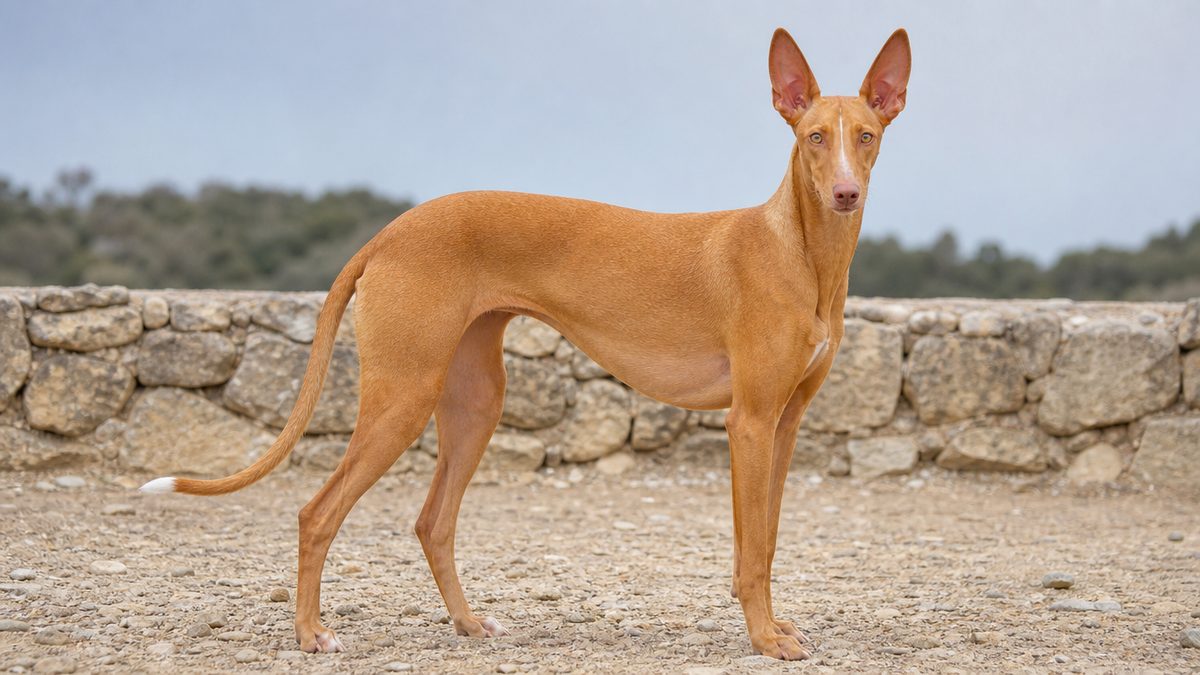
The standard describes a lean, clean-cut dog of noble bearing, graceful yet powerful, very fast, with an alert expression. Three features are diagnostic and worth knowing before you look at a photograph a seller sends you.
- Nose flesh coloured only, blending with the coat. A black nose is not this breed.
- Eyes amber, oval, moderately deep set, blending with the coat. Dark brown eyes are not this breed.
- Ears medium high set, carried erect when alert, broad at base, fine and large, and very mobile.
- Coat short and glossy, tan or rich tan, with a white tip on the tail strongly desired and white on the chest called the star.
- Tail whip-like, reaching just below the point of hock in repose, never tucked between the legs, and a screw tail is undesirable.
That flesh-coloured pigment is also the mechanical explanation for the trick the breed is famous for. Because the nose, ears and eye rims carry no black pigment, blood flow shows through them, and an excited dog appears to be blushing. The AKC leans on it hard, calling the breed the ancient Blushing Dog of Malta. It is a real and charming trait, and it is a pigment fact rather than an emotional one.
One line in the standard that Indian law does not permit
The standard says twice, under forefeet and hind feet, that dewclaws may be removed. In India that permission runs into the Prevention of Cruelty to Animals (Dog Breeding and Marketing) Rules, 2017, whose Second Schedule Part II paragraph 6(8) forbids tail docking, ear cropping, de-barking, de-clawing, branding, dyeing and 'any other kind of mutilation of any body part of the pup', adding that any change of appearance by artificial means is strictly forbidden. A breed standard permitting an elective removal does not create a licence to perform it here. This is the general lesson of every imported standard on this site: read it for the dog, and check the local law before repeating its care and husbandry instructions.
The ancient Egypt story is falsified, and here is the sentence that does it
The claim that the Pharaoh Hound descends directly from the dogs on Egyptian tomb walls was tested with molecular markers in 2004 and failed. The paper says so in one sentence, and every part of that sentence is checkable.
Parker and colleagues genotyped a diverse collection of 85 domestic dog breeds and published the result in Science on 21 May 2004. Their phylogenetic analysis separated a small set of breeds with genuinely ancient Asian and African origins from the rest, which showed modern European origins. The Pharaoh Hound is not in that set. The paper's discussion states it directly:
> "It is notable that several breeds commonly believed to be of ancient origin, such as the Pharaoh Hound and Ibizan Hound, are not included in this group. These are often thought to be the oldest of all dog breeds, descending directly from the ancient Egyptian dogs drawn on tomb walls more than 5000 years ago. Our results indicate, however, that these two breeds have been recreated in more recent times from combinations of other breeds. Thus, although their appearance matches the ancient Egyptian sight hounds, their genomes do not.";
That passage was read from the Science reprint PDF, extracted with pypdf, and confirmed word for word against a second independent copy of the same paper before being quoted here. The paper adds in the same paragraph that the Norwegian Elkhound falls the same way, clustering with modern European breeds despite claims of direct Scandinavian descent over 5,000 years.
What the ancient genetic cluster actually contained
Naming the members matters, because the argument is only as strong as the comparison. The single genetic cluster that split off from the rest held fourteen breeds from Central Africa, the Middle East, Tibet, China, Japan and the Arctic: Basenji, Saluki, Afghan Hound, Tibetan Terrier, Lhasa Apso, Chow Chow, Pekingese, Shar-Pei, Shih Tzu, Akita, Shiba Inu, Alaskan Malamute, Siberian Husky and Samoyed. The deepest split in the tree separated four Asian spitz-type breeds; the second separated the Basenji; the third the Malamute and Husky; the fourth the Afghan and Saluki. No Mediterranean warren hound appears anywhere in that structure.
The follow-up work made the claim weaker still, not stronger
Eight years later a much larger consortium analysed 49,024 autosomal SNPs in 1,375 dogs and contrasted 121 breeds against a worldwide archaeological assessment. Its conclusion undercuts the whole idea of an ancient breed. None of the so-called ancient breeds derives from the regions holding the oldest archaeological dog remains, three of them come from outside the natural range of the grey wolf, and the only thing they share is a lack of recent admixture caused by geographic and cultural isolation. In the authors' words, these breeds 'only appear so because of their relative isolation';. Antiquity of type is not antiquity of breed, and a lean, prick-eared, amber-eyed hunting dog is a shape the Mediterranean has produced repeatedly rather than a pedigree.
A genome-wide SNP and haplotype survey of more than 48,000 markers reached the same general picture from another direction, describing modern breed formation as an iterative process drawing on a limited genetic toolkit. And in 2017 a 161-breed cladistic and haplotype-sharing study proposed a two-step model, ancient separation by function followed by recent selection for physical attributes, which is exactly how a modern breed can be assembled to look like an old one.
The most recent and most careful test, and it is not a flat no
The best study aimed squarely at this question is Perini and colleagues in 2023, the first comprehensive genomic and mitochondrial survey of eight hound-like breeds native to the Mediterranean Basin, done with Maltese co-authors and sampling the Kelb tal-Fenek by name. Two findings sit side by side and both belong on this page. The Kelb tal-Fenek shows high divergence from the current Egyptian street dog population. And the authors write that although none of the breeds studied appears to be a direct descendant of the Egyptian dogs, they still resemble them closely in morphology and share some genetic links with the present Egyptian population, adding that there is not enough evidence in that study to exclude completely the potential of an ancient common relationship.
The honest sentence is not that the Pharaoh Hound has nothing to do with Egypt. It is that no published analysis supports an unbroken 5,000-year Egyptian pedigree, that the strongest statement in the literature says the breed was recreated in modern times from other breeds, and that the most recent Mediterranean-specific study finds the Maltese population diverging from Egyptian dogs while leaving a deep common ancestry unexcluded. Buy the dog for the dog.
What the registries print, and where they contradict themselves
Every major registry recognises the Pharaoh Hound, and the two biggest still print an Egyptian origin that their own governing documents do not support. Recognition is not the problem here. Accuracy is.
The FCI holds the breed definitively as number 248, Group 5 Spitz and primitive types, Section 6 Primitive type, without working trial, with English as the official authentic language. The breed number was read off the FCI's own letter-P index rather than assembled from a guess, because on fci.be the trailing number decides the document and the name slug is ignored. India's route follows from that: the Kennel Club of India is the FCI's full member for India, based in Chennai, so an FCI-recognised breed has a paper path into an Indian studbook and the KCI publishes a checklist for registering a dog on an import pedigree The Kennel Club of India.
The AKC page contradicts itself inside one screen
The American Kennel Club recognised the breed for registration on 1 August 1983 and admitted it to regular classes on 1 January 1984, with the first American litter whelped in 1970. Read the same page top to bottom and it says two incompatible things. Its lead sentence calls the breed the ancient Blushing Dog of Malta. Its Did You Know panel states flatly: 'The Pharaoh Hound originated in ancient Egypt';, adds that the breed 'is one of the oldest domesticated dogs in recorded history', and points to reliefs in the tomb chapels of Mereruka and Senbi.
Chewy, which ranks third for the Indian commercial query, goes further and says the breed has 'remained unchanged since the earliest depiction of Egyptian dogs in ancient tombs';. Wikipedia, which ranks first for the bare term, does not: it opens 'The Pharaoh Hound or Kelb tal-Fenek is a Maltese breed of warren hound';.
| Body | Origin as printed | Antiquity claim | Checked |
|---|---|---|---|
| FCI register and Standard 248 | Malta, patronage Great Britain | none stated, no history section at all | 8 September 2026 |
| American Kennel Club | Malta in the lede, ancient Egypt in the facts panel | 'one of the oldest domesticated dogs in recorded history' | 8 September 2026 |
| Chewy breed guide | Egypt | 'unchanged since the earliest depiction of Egyptian dogs' | 8 September 2026 |
| Wikipedia | Malta | none | 8 September 2026 |
This site usually documents the reverse. Here, Google India's own AI answer for the bare query says: 'Despite their ancient appearance resembling Egyptian art, DNA studies show the breed developed primarily on the island of Malta', while citing the AKC page that says the opposite in its facts panel. Record the direction of travel honestly. On this one claim the generated answer has caught up with the literature and the registry has not.
Why the FCI standard's silence is not evidence
FCI Standard 248 contains no BRIEF HISTORICAL SUMMARY section at all, so its failure to mention Egypt proves nothing on its own. Most FCI standards carry no history section, and reading an absence out of one is a standing error on this site. What the document does carry is a positive statement, ORIGIN: Malta, and that is the citable part. Use the register and the genetics for the antiquity question, and use the standard for the dog.
Pharaoh Hound price in India: there isn't one, and here is the proof
No verified pharaoh hound price in india exists. Nine of the ten pages ranking for that exact query price the dog in dollars or pounds, the tenth prints an unsourced rupee band, and no Indian seller, litter or breeder appears anywhere in the result set.
The India-located search for the commercial term returned ten organic results on 8 September 2026. Their price content, in order, is a US puppy marketplace quoting 3,500 to 14,000 dollars, a US pet insurer quoting 7,500 dollars, a US retailer quoting 1,500 to 2,500 dollars, a US explainer quoting 2,500 to 6,000 dollars, a travel listicle quoting Rs 1-4 lakh, a Hindi-language video, a breed database quoting 1,800 to 2,500 dollars, a UK listicle quoting 5,500 to 5,900 pounds, an animal site quoting 6,000 to 8,000 dollars, and a UK classifieds page Dog Breeds List. Pharaoh Hound: Price.
That is not a thin Indian market. That is no Indian market, dressed as one by a query that contains the words 'in india'.
The control, because an absence has to be earned
A search returning nothing proves nothing unless a search that should return something does. In the same session, on the same instrument, with the same India location, 'labrador retriever price in india' returned ten genuine Indian pages carrying real rupee bands: Supertails at Rs 8,000 to Rs 70,000, Mr n Mrs Pet at Rs 30,000 to Rs 1,20,000 with a city-by-city table for Hyderabad, Bangalore, Delhi, Chennai, Lucknow, Mumbai, Jaipur and Pune, a retailer at Rs 8,000 to Rs 65,000, and another at Rs 15,000 to Rs 50,000 Mr n Mrs Pet, Labrador Retriever puppies…. The instrument reads Indian commercial queries correctly. It simply has nothing Indian to show for this breed. The same control was run again on the bare informational query, where a 'labrador retriever dog' search on Google India returned genuine Labrador results and its own live People-also-ask box in the same session.
The one rupee figure, run through the arithmetic
The single Indian-currency figure anywhere in the set is 'Approx Rs 1-4 lakh per pure bred pup', on a travel site's most-expensive-breeds listicle, attached to no seller, no litter, no city and no date. Indian breed pages routinely publish a US dollar price run through one exchange rate, so the figure was tested against the three divisors this site has caught before.
| Rupee figure | Divided by 84.38 | Divided by 80 | Divided by 74 | Verdict |
|---|---|---|---|---|
| Rs 1,00,000 | 1,185.11 | 1,250.00 | 1,351.35 | only 80 is clean, and 1,250 dollars is a price a seller would print |
| Rs 4,00,000 | 4,740.46 | 5,000.00 | 5,405.41 | only 80 is clean, and 5,000 dollars is a price a seller would print |
The result is genuinely ambiguous and this page says so rather than picking the convenient reading. Both ends divide cleanly only at a flat 80, which is the structurally weak test, and both quotients land on numbers a real breeder would quote and that sit inside the published international bands. So the band is consistent with a converted dollar range and equally consistent with somebody rounding to lakhs. What it is not consistent with is an observation of an Indian transaction, because no Indian transaction for this breed could be found.
Do not budget from it and do not quote it to a seller. If anyone offers you a Pharaoh Hound in India at any price, the first question is not the price. It is which litter, registered where, out of which sire and dam, on whose pedigree. Ask for the KCI or FCI registration number before you discuss money.
What you would actually be buying, and how
The lawful route is import, and only for yourself. DGFT Trade Notice 22/2022-23 places dogs under ITC(HS) 01061900 as Restricted, permits entry for a pet accompanied by a valid pet book in the importer's name, for research with a CPCSEA recommendation, or for Defence and Police use, and states that applications for trading or breeding purposes shall be duly rejected. Those import rules mean a commercial Indian supply chain for this breed cannot lawfully form. A returning resident bringing a personal pet is a different matter and is the only realistic way a Pharaoh Hound reaches India at all.
Budget on that basis. The purchase price abroad is the small half of the number, and the airline crate, the export health certificate, the quarantine station paperwork and the Indian customs clearance are the rest of it. Bonbeno publishes no landed-cost figure here, because every band on offer is a foreign price plus a guess.
Monthly cost of keeping a Pharaoh Hound in India
Budget roughly Rs 6,000 to Rs 11,000 a month for a 22 kg Pharaoh Hound in an Indian metro, before boarding and before the electricity bill for cooling. Every line below comes from a named Indian provider's own published rate, not from a breed site's template.
Indian breed sites publish running costs as shared constants across unrelated breeds, assembled from a small set of preset lines, so a monthly cost lifted from one of them describes a spreadsheet rather than a dog. The figures here are built the other way, from Indian sellers and municipalities that publish their own prices, and the arithmetic is shown so you can redo it with your own city's numbers.
| Line | Basis | Per month |
|---|---|---|
| Food, dry complete diet | roughly 300-390 g a day for a lean 20-25 kg dog | Rs 3,500-6,500 |
| Parasite control, ticks and worms | a monthly combination tablet plus routine deworming | Rs 1,100-1,400 |
| Vaccination, annualised | Vetic annual booster from Rs 3,199, anti-rabies Rs 699 | Rs 320-420 |
| Municipal registration, annualised | Delhi Rs 500 a year, Chennai Rs 50 | Rs 4-42 |
| Grooming | no clipping needed, occasional bath and nails | Rs 0-900 |
| Vet reserve | one consultation a quarter at Rs 500-1,000 | Rs 170-330 |
| Total, ordinary month | Rs 5,100-9,600 |
The vaccination line comes from Vetic, a chain of more than 50 clinics across seven Indian metros, whose published card gives an annual booster starting at Rs 3,199, anti-rabies at Rs 699, a 9-in-1 DHPPiL at Rs 899, canine corona at Rs 899 and kennel cough at Rs 1,349. Read that as one chain's promotional floor rather than a market average, and note that the same chain quotes different course prices on different city pages on the same day while its per-vaccine prices stay identical.
Parasite control is the line that scales with the dog. A monthly combination tablet covering ticks, fleas and intestinal worms runs a little over Rs 1,100 a month in the 15-30 kg band. Drontal Plus is dosed one tablet per 10 kg at about Rs 126 a tablet, so a single deworming of a 22 kg dog costs about Rs 251 to Rs 377.
The two Indian costs nobody puts on a breed page
Municipal registration is cheap and legally real. The Municipal Corporation of Delhi charges Rs 500 for a new pet dog registration and Rs 500 to renew, with a late fee of Rs 100 a month, and it registers dogs only. Greater Chennai Corporation licenses pet animals at Rs 50, issued 9,115 licences in 2024, and runs six pet clinics that give treatment and anti-rabies vaccination free of cost. If you live in Chennai, vaccinate the dog at a corporation clinic first and treat any breed guide's imported vaccination budget as a ceiling rather than a bill.
Boarding is the line that ruins a travel plan. PawSpace in Bengaluru publishes Rs 599 for up to four hours, Rs 799 for daycare to ten hours and Rs 899 for an overnight stay to 24 hours. A two-week trip is therefore about Rs 12,600 on top of the ordinary month, and for a thin-skinned, heat-sensitive sighthound you also need to ask the boarding operator what happens to the air conditioning during a power cut.
A secure enclosed run. The AKC's own exercise guidance for the breed specifies a six-foot fenced area of at least 50 feet by 50 feet for a self-runner. If you do not have that, you are paying in daily lead walks instead, twice a day, every day, for twelve to fourteen years.
Heat tolerance in India, worked from measured climate rather than adjectives
A Pharaoh Hound handles Indian humidity better than most imported breeds and Indian heat worse than most Indian breeds. Malta is more humid than every Indian city measured here and about 8 C cooler, so the gap that matters is temperature, not damp air.
The homeland baseline was pulled from NASA POWER by explicit latitude and longitude, and the cell elevation was echoed on every point, because POWER returns a grid cell rather than a place. The Valletta cell sits at 4.38 m against a real 56 m, an error of about 52 m and negligible. A second Maltese point at Rabat, 10 km away and 185 m up, returned a byte-identical series from the same 4.38 m cell, which means the whole archipelago is smaller than one grid square and Malta gets exactly one climate from this model. Say that on the page rather than presenting the match as a finding.
| Place | Cell elevation | Annual air temp | Annual RH | Annual wet bulb | Peak monthly wet bulb |
|---|---|---|---|---|---|
| Malta (Valletta cell) | 4.38 m | 19.80 C | 77.06 % | 16.97 C | 23.23 C in August |
| Bengaluru | 841.72 m | 23.74 C | 67.94 % | 19.48 C | 21.86 C in May |
| Pune | 635.99 m | 23.86 C | 66.80 % | 19.43 C | 22.97 C in June |
| Jaipur | 405.74 m | 25.58 C | 40.94 % | 17.02 C | 25.33 C in July |
| Delhi | 206.37 m | 25.60 C | 45.56 % | 17.80 C | 26.50 C in July |
| Mumbai | 97.15 m | 26.77 C | 67.39 % | 22.20 C | 25.77 C in June |
| Kolkata | 7.35 m | 25.81 C | 73.93 % | 22.25 C | 27.09 C in June |
| Chennai | 48.95 m | 27.95 C | 72.39 % | 24.04 C | 26.11 C in May |
The humidity claim that every breed page gets backwards
Malta runs 77.06 percent mean annual relative humidity, which is higher than Kolkata at 73.93, Chennai at 72.39, Bengaluru at 67.94, Mumbai at 67.39, Pune at 66.80, Delhi at 45.56 and Jaipur at 40.94. A Mediterranean island breed is not going to be undone by humid air, because its homeland is more humid than the place you are taking it to. Any page telling you that Indian humidity will finish this dog has not looked at Malta's own numbers.
The temperature gap is the real one. Malta's mean annual air temperature of 19.80 C sits 8.15 C below Chennai's 27.95 C, 6.97 C below Mumbai and 3.94 C below Bengaluru. The breed evolved as a working dog in a place where the hottest month averages 26.63 C, which is roughly Chennai's coolest month.
Wet bulb is where the answer gets counter-intuitive
Combining heat and humidity into a wet-bulb temperature reorders the Indian cities in a way that matters for this breed. Bengaluru's peak monthly wet bulb of 21.86 C is below Malta's own peak of 23.23 C. Pune at 22.97 C is also below it. Chennai at 26.11 C, Kolkata at 27.09 C and Delhi at 26.50 C are all well above it. So the Deccan plateau cities are, on this measure, a milder combined heat load than the breed's own homeland in August, while the coastal and northern plains cities are three to four degrees worse.
NASA POWER's T2M_MAX on the climatology endpoint is the highest value recorded in the whole period, not a mean daily maximum. Malta's August figure of 32.16 C and Delhi's May figure of 48.08 C are period extremes. Never feed T2M_MAX into a wet-bulb calculation: any wet bulb above about 35 C is physically impossible and is the signature of exactly that mistake.
What that means for the day, city by city
- Bengaluru and Pune suit the breed best. Walk before 07:00 and after 19:00 from March to June, and the wet-bulb load is no worse than a Maltese August.
- Mumbai and Chennai need indoor cooling through the hot months and hard limits on daytime exercise. Chennai's May wet bulb of 26.11 C is 2.88 C above anything Malta produces.
- Delhi and Jaipur are the dry-heat problem. The air is far drier than Malta's, which helps evaporative cooling, but May and June mean temperatures of 35 C leave no safe daytime window at all.
- Kolkata is the hardest combination on this table, at 27.09 C peak wet bulb, and the monsoon does not relieve it.
- Any city with load shedding needs a plan for the hours the air conditioner is off, not a plan for the hours it is on.
Size is a risk factor in its own right. Hall and colleagues, working from 905,543 UK dogs under primary veterinary care in 2016, found that a bodyweight at or above the breed and sex mean carried an odds ratio of 1.42 for heat-related illness, and dogs over 50 kg an odds ratio of 3.42. A 25 kg Pharaoh Hound is not in that top band, but a Pharaoh Hound carrying extra weight is in the first one. The companion paper, from the same cohort, found that of the 879 heat-illness events with a recorded trigger, 652 were exertional, which is 74.2 percent. Dogs in that dataset were far more often hurt by exercise than by being shut in a car. For a breed whose whole reason to exist is running, that is the sentence to remember.
Temperament and who should not buy one
The Pharaoh Hound is alert, intelligent, friendly, affectionate and playful in its own breed standard, and it is also a hard-wired hunter that will leave you for a moving cat. Both halves are true and the second one decides whether the breed fits an Indian flat.
FCI Standard 248 gives the behaviour clause in five words: alert, intelligent, friendly, affectionate and playful. The AKC adds that these hounds settle down nicely at home and are quiet indoors. Both descriptions are accurate and both understate the working drive, which is the part that costs Indian owners dogs.
The prey drive is the whole temperament question
The standard's utilization clause calls the breed an alert keen hunter that hunts by scent and sight and uses its ears to a marked degree when working close. That is a description of a dog built to detect, pursue and catch small animals in broken ground. In an Indian city the small animals are free-roaming cats, community dogs' puppies, squirrels, monitor lizards and, on a beach, crabs. A high prey drive does not switch off because you live on the fourth floor.
The AKC's own caution is unusually blunt for a registry: no amount of training should be trusted to overcome the breed's hunting instinct, and the dog should never be allowed to exercise off lead in an unenclosed area.
Household fit, honestly
- Good with a calm adult household that wants a clean, quiet, affectionate dog indoors and can commit to two secure outings a day.
- Workable with older children who understand that a sighthound is not a wrestling partner and that grabbing a thin-skinned dog leaves marks.
- Risky with resident cats and small pets unless the dog was raised with them from puppyhood, and even then it needs supervision.
- Wrong for an owner who wants an off-lead park dog, because the recall failure is a breed characteristic rather than a training gap.
- Wrong for a first-time owner in India, where you will also be managing an unfamiliar breed, a nonexistent local support network and laboratory results your vet has no reference range for.
Noise is a middling concern. The breed is alert and will announce a stranger at the door, which is useful in a housing society, but it is not a persistent barker and it does not have a scent hound's voice. Indoors it is a low-maintenance flatmate: short coat, little smell, and a strong preference for the softest surface in the room.
When a Pharaoh Hound is happy or excited its nose, ears and eye rims flush pink. That is worth knowing as a welfare signal rather than a party trick: a dog whose ears are flushed and whose panting has changed on a hot Indian afternoon is telling you about blood flow, and the answer is shade and water, not a photograph.
Training a Pharaoh Hound, and the one thing that will not work
Train everything except recall on the assumption that this is a quick, willing, food-motivated dog, and treat recall training as damage limitation rather than a solvable problem.
The breed is genuinely trainable on structured tasks. It learns fast, it works for food, and it does well in lure coursing, rally and obedience formats where the reinforcement is clear. What it does not do is come back when something moves.
The AKC's training guidance for the breed is worth quoting because it is a registry telling buyers something unhelpful to sales: it has been proven time and again that most Pharaoh Hounds, no matter how obedient or well trained, will not come when called once they find themselves in a free situation, and dogs have been recovered after several days, killed in traffic, or lost for good.
What to do instead of chasing an off-lead recall
- Manage the environment first. A long line of 10 to 15 metres on a harness gives the dog a run without giving it the option to leave.
- Build a station, not a recall. A rock-solid mat or crate settle indoors is more useful than a park recall you cannot trust.
- Train an emergency stop rather than a return. A dog that drops on a whistle at 30 metres is safer than one you are calling back across traffic.
- Book enclosed space. Fenced dog parks and rented private grounds now exist in Bengaluru, Mumbai, Pune and Delhi NCR, and one paid hour a week beats a year of failed park recalls.
- Socialise early and widely to Indian street noise, two-wheelers, cattle, construction and building staff, because a startled sighthound bolts and a bolting sighthound is a traffic casualty.
Puppy socialisation in an Indian building
Socialising this breed in an Indian metro means deliberately manufacturing calm exposures rather than waiting for them. Lift rides with strangers, the sound of the society gate, delivery riders, the watchman's whistle and the neighbour's dog on the landing are all rehearsals. Do them short, do them before the vaccination course finishes by carrying the puppy, and pair each with food.
Do not use a prong collar, a choke chain or an e-collar on a thin-necked sighthound with delicate skin. Beyond the welfare argument, this is a breed you can physically injure with equipment designed for a thick-coated working dog.
If an overseas breeder or club suggests a close mating to fix type in a small population, check it against Indian law before repeating it. The Second Schedule Part II paragraph 6(3) of the Dog Breeding and Marketing Rules, 2017 prohibits in breeding between relatives of the 2nd to 4th grade within the first four generations, naming uncle to niece, nephew to aunt, cousin to cousin and grandparent to grandchild, and separately prohibits incest breeding between parents and children or brother and sister.
The real daily exercise requirement, and what happens without it
Give a Pharaoh Hound two secure outings a day, either 15 to 20 minutes of free running twice or 20 minutes of purposeful walking twice, and expect destructive boredom and weight gain if you do not.
The AKC's parent-club guidance is specific enough to plan around. A self-runner needs 15 to 20 minutes of free running twice a day inside a six-foot fenced area of at least 50 feet by 50 feet. A dog that will not self-exercise needs a walk of at least 20 minutes twice a day. Neither version may happen off lead in an open area.
In Indian conditions that requirement collides with the clock. From March to June in most of the country, the only usable windows are before 07:00 and after 19:00, and in Chennai, Kolkata and Mumbai the evening window stays humid long after the light goes. Plan the day around the wet-bulb table above rather than around your own schedule.
A workable Indian week
| Slot | What it is | Duration |
|---|---|---|
| Early morning, before 07:00 | brisk lead walk with sniffing time, on a harness | 25-30 minutes |
| Mid-morning | indoor scent game or a training session on a mat | 10 minutes |
| Evening, after 19:00 | second lead walk, or long-line running on a school ground | 25-30 minutes |
| Twice a week | enclosed run or a paid fenced field, full-speed running | 20 minutes |
| Once a week | lure coursing or flirt-pole work in a shaded enclosed space | 15 minutes |
That is the maintenance dose, and coursing-style sprint work is the part most owners drop first and miss most. A sighthound that never gets to reach speed does not become calm; it becomes frustrated, and the frustration shows up as counter surfing, door dashing and chewing.
The under-exercised Pharaoh Hound, in order of what breaks
- Weight gain first, which matters more here than in most breeds because bodyweight at or above the breed mean is itself a heat-illness risk factor.
- Door dashing next, which for a dog with no reliable recall is the accident that ends the story.
- Destructive chewing, usually of soft furnishing, because the dog is intelligent and bored rather than badly behaved.
- Reactivity on lead, as thwarted chase drive turns into lunging at cats, cows and two-wheelers.
Exertional heat illness dominated the UK dataset even in a temperate country, at 652 of 879 recorded-trigger events. In an Indian May, a lean fast dog that wants to run is a dog that will run itself into trouble. Stop the session while the dog still looks keen, and carry water on every outing.
Grooming a short-coated sighthound in Indian humidity
The Pharaoh Hound needs the least coat work of almost any breed on this site, and the mistakes Indian owners make with it are all about skin rather than hair.
The standard describes hair that is short and glossy, ranging from fine and close to slightly harsh, with no feathering. There is no undercoat to blow, nothing to strip, nothing to clip and no mats to find. The AKC's guidance is a daily light brushing or a heavier weekly one, with baths as necessary, plus attention to ear cleanliness and nails kept short enough that they do not tap on the floor.
Chewy, ranking third for the Indian commercial term, calls the breed a very low shedder and a dream for people who want to avoid hair on furniture. Low shedding is not the same as hypoallergenic, and that distinction matters commercially in India because the second claim carries a premium.
The hypoallergenic claim, settled
Vredegoor and colleagues measured the major dog allergen Can f 1 in hair and homes across 196 dogs of so-called hypoallergenic breeds against 160 control dogs. The hypoallergenic group came back higher, not lower, on hair and on coat, with no difference in airborne allergen, and the authors concluded that there is no evidence for classifying certain dog breeds as hypoallergenic. Google India's own knowledge panel for this breed marks it Hypoallergenic: No, which is the correct answer. Anyone selling you a low-allergy Pharaoh Hound at a premium is selling a claim the literature does not support.
What actually needs doing in an Indian year
- Weekly, a rubber curry mitt over the whole dog. It takes four minutes and removes more loose hair than a brush.
- Fortnightly, nails. A sighthound's quick grows long if the nails do, and long nails change the foot and the gait.
- Weekly in the monsoon, ears. Large erect ears collect less water than a drop ear but they collect dust, and the humid months are when otitis presents.
- Monthly at most, a bath. Over-bathing thin skin in hard Indian water strips it and provokes the flaky, itchy coat owners then treat as an allergy.
- Daily in tick season, a hands-on tick check of ears, armpits, groin and between the toes.
The overseas grooming instruction that does not transfer
Northern-hemisphere breed guides routinely tell owners to towel a short-coated dog and let it air dry. That is fine in a Maltese autumn and it is questionable in an Indian monsoon, where ambient humidity in Mumbai and Pune runs above 89 percent through July and August and a damp dog simply stays damp. Dry the ears and the skin folds properly, and do not plug a bath into a day when the dog will then sit in still, saturated air.
Tick control is the grooming task with the highest stakes in India, and it belongs in this section rather than only in health. Studies of dogs presented at Indian veterinary clinics report very high tick-borne disease rates: 76.54 percent of 584 dogs positive for Babesia gibsoni in West Bengal with 72.9 percent carrying two or more pathogens, and 66.7 percent of 120 dogs positive for Babesia in Kerala with a pre-monsoon peak. Those figures come from dogs tested at clinics rather than a random population, so they overstate the risk for a healthy pet, but they set the direction: in India, a short coat is a diagnostic advantage and the grooming session is the tick check.
Health, screening and life expectancy
The Pharaoh Hound carries no single catastrophic inherited disease in the published literature, and its real health risks in India are sighthound blood chemistry that Indian labs misread, thin skin, anaesthesia, heat and ticks.
Start with how little literature exists. A quoted phrase search of PubMed for the breed name returns four records in total, against 126 for a Labrador and hip dysplasia control run in the same session. Four papers is not a health profile. It is a reason to be careful about anyone who claims a detailed one.
The screening panel, and what the parent club says about it
The AKC's recommended tests from the national breed club are patella evaluation, hip evaluation, ophthalmologist evaluation and thyroid evaluation, with CHIC certification additionally requiring hip and elbow dysplasia, patella luxation and eye screening. Dr Stephen Sipperly, chair of the Pharaoh Hound Club of America health committee, is quoted on that page saying the majority of results across those screens are normal and that, looking at the results, the breed is not plagued with any significant disorders. The commonest cancers named are hemangiosarcoma, mast cell tumour and mammary cancer, with the caveat on that same page that some are age related and affect all dogs.
Indian law mandates a hypothyroidism test on breeding dogs through Second Schedule Part III paragraph 8(10) of the Dog Breeding and Marketing Rules, 2017, which lists hypothyroidism among the genetic defects a breeding dog must have been tested for. Sighthounds are the one group in which a low thyroid reading is often the normal finding rather than a disease. Get the sample interpreted against sighthound expectations, not against a general canine range.
Sighthound blood values, and the Indian laboratory problem
This is the single most practically useful published finding for the breed. Uhrikova and colleagues sampled 192 individuals across eight sighthound breeds, the Whippet, Greyhound, Italian Greyhound, Sloughi, Saluki, Borzoi, Pharaoh Hound and Azawakh, and found significant differences in haematology and clinical biochemistry between them. Their conclusion is explicit: applying the Greyhound laboratory profile to other sighthounds is not recommended. Italian Greyhounds had significantly higher alanine aminotransferase activity than the other sighthounds, except Pharaoh Hounds, which is the one specific comparison the paper makes about this breed.
The practical consequence in India is that a healthy Pharaoh Hound will produce a report with flagged values, most often a high packed cell volume and haemoglobin against general canine ranges. Take the printed report to a vet who knows sighthounds before agreeing to investigate a disease the dog does not have.
Skin: the one breed-specific case series that exists
Campbell and Crow reported severe zinc responsive dermatosis in a litter of Pharaoh Hound puppies presented at three months old with generalised erythematous crusted papules, itching, exfoliation and erythema of the footpads, poor appetite, lethargy and retarded growth. Three of five puppies were affected, serum zinc was low, and the dogs responded partially to intravenous zinc but not to oral supplementation. Growth stayed stunted, enamel hypoplasia of the permanent dentition developed compared with unaffected littermates, intravenous zinc was needed every three to four weeks to prevent further lesions, and one dog died of renal failure at three years old.
That is one litter, so it is a case report rather than a prevalence figure, and this page will not turn it into one. What it does justify is a specific question to a breeder: has any puppy in this line ever had a crusting skin disease that did not respond to oral zinc.
Orthopaedics, and a genuine India note
Radial carpal bone fractures without violent trauma were reported in 15 dogs across four UK universities between 1977 and 1992. Eleven were Boxers; the other four were a Pharaoh Hound, a Rottweiler, a Springer Spaniel and a Greyhound. One dog of the breed in a 15-dog series over 15 years is a footnote, not a breed predisposition, and it is included here so a reader who finds the paper knows what it does and does not say. Lameness that worsens with exercise and does not resolve deserves radiographs rather than rest.
Life expectancy
The AKC gives 12 to 14 years and Google's knowledge panel gives 11 to 14 Google India, rendered search results page…. No breed-specific life-table study covers the Pharaoh Hound, and this page publishes no median from a paper that did not model it. A twelve to fourteen year life expectancy is a long commitment for an imported dog in a country with no breed rescue network, and that belongs in the buying decision.
A Mediterranean breed meets India's kala-azar programme
The Pharaoh Hound comes from a Leishmania-endemic region and appears to carry an immune profile associated with resistance, and it is being imported into a country that is running a national kala-azar elimination programme in which dogs have just been implicated as reservoirs. That collision is on no other page about this breed.
Martinez-Saez and colleagues compared serum cytokine profiles in 42 clinically healthy, uninfected dogs living in endemic Mediterranean regions, screened by immunofluorescence, ELISA and qPCR to confirm they were free of Leishmania infantum. Three purebred groups were compared against crossbreds: Cirneco dell'Etna, Pharaoh Hound and Boxer.
Their result is specific. Cirneco dell'Etna and Pharaoh Hound showed similar cytokine patterns with lower IL-6 and IL-8 than Boxers and crossbreds; IL-2 was significantly higher in crossbreds; and the authors conclude that these two breeds, closely related genetically to the Leishmania-resistant Ibizan Hound, may possess inherent immunological traits favouring resistance through a controlled Th1 response.
This is 42 healthy dogs and a cytokine panel, not a challenge study and not an outcome study. It is evidence about immune phenotype, not proof that a Pharaoh Hound will not get leishmaniasis. And note the sideways point it makes about origin: the paper groups the Pharaoh Hound genetically with the Cirneco dell'Etna and the Ibizan Hound, the Mediterranean neighbours, rather than with anything Egyptian.
Why an Indian owner should care
India is in the sustained phase of visceral leishmaniasis elimination, and Leishmania donovani has traditionally been treated here as anthroponotic, transmitted person to sandfly to person. A multicentric study across seven districts in endemic Bihar, Jharkhand and West Bengal and in the emerging foci of Kerala and Tamil Nadu screened 782 domestic animals including dogs, goats, cattle and cats. Ninety-eight animals were rK39 seropositive, Leishmania DNA was detected by qPCR in 129, of which 81 were confirmed by ITS1-PCR across dogs, goats, cattle and one cat, and 21 sequenced samples were identified as L. donovani. Amastigotes were microscopically confirmed in canine samples, and natural L. donovani infection was confirmed in Phlebotomus argentipes.
The authors' conclusion is that sustained success of India's kala-azar elimination programme will require integrated surveillance that includes domestic animal reservoirs alongside humans and vectors.
| Measure | Result |
|---|---|
| Animals screened | 782 dogs, goats, cattle and cats |
| rK39 seropositive | 98 |
| Leishmania DNA by qPCR | 129 |
| Confirmed by ITS1-PCR | 81, across dogs, goats, cattle and one cat |
| Sequenced and identified as L. donovani | 21 |
| Amastigotes microscopically confirmed | in canine samples |
Put the two papers together and the practical advice is simple and specific to this breed in this country. A Pharaoh Hound living in Bihar, Jharkhand, West Bengal, Kerala or Tamil Nadu should be on year-round sandfly and tick control, should be checked if it develops weight loss, skin lesions over bony points or unexplained lymph node enlargement, and its owner should mention the breed's Mediterranean origin to the vet, because leishmaniasis is not on most Indian small-animal differential lists. A promising cytokine profile is not a vaccination.
Note what this section does not claim. Nobody has studied Pharaoh Hounds in India, no Indian case of canine leishmaniasis in this breed is on record, and the Spanish and Italian work concerns Leishmania infantum while the Indian work concerns L. donovani. The transferable part is the question, not a number.
Feeding a lean sighthound in India
Feed a Pharaoh Hound to a visible waist and palpable ribs, split into two meals, and resist every Indian instinct to fill out a dog that is supposed to look thin.
The AKC's nutrition guidance is generic and worth repeating only for one line: some dogs of this breed are prone to getting overweight, so watch calorie consumption and weight level, and any diet should suit the dog's life stage. The breed-specific point is that a correct Pharaoh Hound looks underfed to an Indian eye. The standard asks for a lithe body, a deep chest reaching to the point of elbow, well-sprung ribs and a moderate tuck-up. The last two ribs should be visible in good light on a fit adult.
Portions and the arithmetic behind them
A 20 to 25 kg active adult on a good dry complete diet eats roughly 300 to 390 g a day. At Indian retail prices for a mid-to-premium large-breed kibble, that works out at roughly Rs 3,500 to Rs 6,500 a month, and a 15 kg bag lasts about 38 to 50 days. Verify grams per day against the bag you actually buy rather than against a number on a breed page, because feeding guides differ by more than 30 percent between brands at the same bodyweight.
| Stage | Meals a day | Focus |
|---|---|---|
| 8 to 16 weeks | 4 | large-breed puppy food, steady growth, never forced growth |
| 4 to 8 months | 3 | watch the joints during the fastest growth phase |
| 8 to 14 months | 2 | transition to adult food at about 12 months |
| Adult, 14 months to 8 years | 2 | hold a body condition score of 4 to 5 out of 9 |
| Senior, 8 years and over | 2 | reduce calories, keep protein up, monitor kidneys |
Three Indian feeding realities
- Heat suppresses appetite, so a dog that eats poorly in May and well in December is usually normal. Shift the main meal to the coolest part of the day.
- Roti and rice fill a dog without feeding it. A sighthound carrying a rice belly still has no muscle and is now heavier, which is a heat-illness risk factor in its own right.
- Bones and hard chews suit this breed's dentition, and the standard asks for powerful jaws with strong teeth in a scissor bite, but supervise, because a fast, keen dog swallows things whole.
Water matters more than any supplement. Carry it on every outing between March and June, offer it before and after exercise rather than only after, and cool the dog with water on the belly, groin and paws rather than pouring it over the back.
Month by month through the first year in India
Plan the first year around three fixed points: the vaccination course, the socialisation window closing at about 16 weeks, and the first Indian hot season, which will arrive before the dog is grown.
Indian law sets the earliest possible start. Rule 8(1)(a) of the Prevention of Cruelty to Animals (Dog Breeding and Marketing) Rules, 2017 requires that pups less than eight weeks in age are not sold, and that is a Rule rather than a Schedule paragraph. Any seller offering a six-week puppy is telling you something about themselves before you have seen the dog.
| Age | What happens | What it costs or needs |
|---|---|---|
| 8-10 weeks | Home, crate and mat introduction, first vaccinations begin | puppy DP from Rs 849, first vet consult Rs 500-1,000 |
| 10-14 weeks | Core course continues, carried socialisation to lifts, gates, traffic | 9-in-1 DHPPiL from Rs 899 per shot |
| 12-16 weeks | Anti-rabies, first deworming cycle, municipal registration | rabies Rs 699, Delhi registration Rs 500 or Chennai Rs 50 |
| 4-6 months | Long-line work starts, teething, no forced exercise on hard ground | Drontal Plus about Rs 126 a tablet, one per 10 kg |
| 6-8 months | First hot season if born in winter, cut daytime activity hard | monthly tick and worm cover about Rs 1,100 |
| 8-12 months | Adult food transition, sprint work introduced in an enclosed space | enclosed-ground hire, budget one paid session a week |
| 12 months | Annual booster, adult body condition set, screening discussion | booster from Rs 3,199 |
The four things that go wrong in an Indian first year
- Socialisation lost to the vaccination course. Carry the puppy out rather than waiting until 16 weeks, because the window closes whether or not the shots are finished.
- Over-exercise on concrete. A growing sighthound needs distance built slowly and needs surfaces that are not baking pavement.
- A summer birthday. A puppy born in December meets its first Indian May at five months, before it can regulate well. Plan the daily schedule around that, not around convenience.
- Nobody screens the parents. Ask for the sire and dam's hip, patella, eye and thyroid certificates before the litter is born, not after you have paid a deposit.
If the puppy is coming in on an import pedigree, read the Kennel Club of India's own checklist for registering an imported dog before the dog travels, not after it lands. The KCI is the FCI's full member for India, so an FCI export pedigree is the document that makes an Indian registration possible.
Pharaoh Hound against what Indian buyers actually cross-shop
In India the honest comparison is not against other imports. It is against the Mudhol Hound, the Rajapalayam and the Chippiparai, which do the same job, cost a fraction, and were selected in this climate.
A buyer looking at this breed is usually buying a look: tall, lean, fast, prick-eared, exotic. India already produces that dog, several times over, with breeders you can visit and prices you can verify.
| Breed | Verified Indian price | Heat adaptation | Recall | Vet familiarity in India |
|---|---|---|---|---|
| Pharaoh Hound | none found | Maltese baseline, 8 C cooler than Chennai | poor by breed | very low, four papers exist worldwide |
| Ibizan Hound | none found | Balearic baseline, similar problem | poor by breed | very low |
| Mudhol Hound | widely available, verifiable | Deccan-selected | poor by type, but locally understood | high in Karnataka |
| Rajapalayam | widely available, verifiable | Tamil Nadu-selected | poor by type | high in Tamil Nadu |
| Chippiparai | widely available, verifiable | Tamil Nadu-selected | poor by type | high in Tamil Nadu |
| Indian Pariah Dog | adoption, near zero | the benchmark | variable, often good | universal |
Against the Ibizan Hound and the Cirneco dell'Etna
These three are the comparison that the literature actually supports. Parker 2004 names the Pharaoh Hound and the Ibizan Hound in the same sentence as breeds recreated in modern times, and Martinez-Saez 2025 groups the Pharaoh Hound and the Cirneco dell'Etna together on cytokine profile as relatives of the Ibizan Hound. If you want this shape, these are one another's substitutes, and none of them is easier to obtain in India than the others.
The Cirneco is smaller, at roughly 43 to 50 cm, which is a meaningful difference in an Indian flat and in a Chennai May. The Ibizan is larger and comes in smooth and wire coats. On heat, all three carry the same Mediterranean baseline and none of them is a desert dog.
Against a genuinely ancient breed
If antiquity is the appeal, buy a breed that actually holds it. The Basenji, the Saluki and the Afghan Hound are three of the fourteen breeds that did fall into the ancient genetic cluster in Parker 2004, and Larson 2012 explains what that status does and does not mean. The Saluki in particular is a genuinely hot-climate sighthound with a long documented history, and unlike the Pharaoh Hound it is occasionally available in India.
A Mudhol Hound from a Karnataka breeder, or an adopted Indian Pariah Dog, gives you a lean, fast, short-coated, heat-adapted sighthound-shaped dog for a verifiable price, with a vet down the road who has seen a hundred of them. The Pharaoh Hound gives you the same silhouette, an import file, no local price, no local rescue and a blood panel nobody in your city can interpret.
Mistakes Indian owners make with this breed
Six mistakes account for most of the harm done to Pharaoh Hounds in India, and five of them are made before the dog arrives.
1. Buying the Egypt story and paying a premium for it
The antiquity claim is the marketing, and it is unverified at best. Parker 2004 states that the breed was recreated in modern times from combinations of other breeds and that its genome does not match the ancient Egyptian sighthounds. The AKC still prints that the breed originated in ancient Egypt on the same page that calls it the Blushing Dog of Malta. Pay for a good dog from a screened litter, not for a tomb painting.
2. Treating an Rs 1-4 lakh listicle figure as a market price
One travel site carries the only rupee band in the entire Indian result set, with no seller, no city and no source. Both ends of it divide cleanly only at a flat 80, which is the weakest of the three division tests. Do not budget from it, and do not let a seller anchor you to it.
3. Letting the dog off lead 'just this once'
The AKC says most Pharaoh Hounds will not come when called in a free situation no matter how well trained, and that some are recovered days later and others are killed in traffic. In an Indian city that risk is higher, not lower, because the traffic is denser and there is no fenced park to fail safely in.
4. Exercising into the Indian afternoon
Exertional heat illness accounted for 652 of the 879 UK heat-related illness events with a recorded trigger, which is 74.2 percent, in a country far cooler than any Indian metro. Carrying extra weight is itself a risk factor, at an odds ratio of 1.42 for dogs at or above the breed and sex mean. A keen sighthound will run past its own limit, so the human has to stop the session.
5. Investigating a disease the dog does not have
A healthy sighthound produces a blood report that looks abnormal against general canine reference ranges, and Uhrikova and colleagues showed that even the Greyhound profile should not be applied across sighthound breeds. Before agreeing to a workup, ask whether the reference interval used was appropriate for a sighthound.
6. Bathing a thin-skinned dog every week
There is no undercoat to wash and no odour to manage. Over-bathing strips the skin, and the flaky itchy coat that follows gets treated as an allergy. Bath monthly at most, dry the ears properly, and use the grooming session as a tick check instead.
The FCI standard says dewclaws may be removed. Indian law does not permit that. Second Schedule Part II paragraph 6(8) of the Dog Breeding and Marketing Rules, 2017 forbids docking, cropping, de-clawing, branding, dyeing and any other kind of mutilation of any body part of the pup, and says any change of appearance by artificial means is strictly forbidden. If an Indian breeder tells you the standard permits a procedure, ask which document they are reading.
Adoption, and how to verify a seller who claims to have one
Adopt an Indian sighthound rather than importing a Maltese one, and if you still want this breed, verify the dog through the registry paperwork before any money changes hands.
No Pharaoh Hound rescue exists in India, because no Pharaoh Hound population exists in India. What does exist, in every Indian city, is a supply of lean, fast, short-coated, heat-adapted dogs in shelters and on the street, and a network of breed-specific rescues for the Indian sighthounds.
The adoption route that actually matches this search
- Indian Pariah Dog, from any municipal shelter or a city rescue. Short coat, lean build, the best heat adaptation of any dog in this comparison, and the vaccination and sterilisation are usually already done.
- Mudhol Hound, through Karnataka rescues and the state's own breeding centre network, when an owner surrenders a dog that turned out to need more running than a flat allows.
- Rajapalayam and Chippiparai, through Tamil Nadu rescues, where surrendered adults are common because the same mismatch happens locally.
- Retired racing and coursing sighthounds, occasionally available through Indian sighthound owner groups.
- Greater Chennai Corporation's six pet clinics, which give treatment and anti-rabies vaccination free of cost, so the first-year medical cost of an adopted dog in Chennai is close to zero.
If somebody offers you a Pharaoh Hound in India, verify in this order
- Ask for the registration number with the issuing body, and check it against the Kennel Club of India or the foreign kennel club that issued the export pedigree.
- Ask to see the import file. A lawfully imported dog has a pet book in the importer's name, because DGFT Trade Notice 22/2022-23 permits nothing else for a private buyer and says applications for trading or breeding purposes shall be duly rejected.
- Ask for the sire and dam's screening certificates, specifically hip, patella, eye and thyroid, and read the dates on them.
- Look at the nose and the eyes in daylight. Flesh-coloured nose, amber eyes, white tail tip. A black-nosed, brown-eyed tan dog is not this breed, whatever the paperwork says.
- Refuse any dog under eight weeks, which Rule 8(1)(a) prohibits selling outright.
- Walk away from a seller who cannot answer three of these. A breed with no Indian population and a high price is exactly the shape a substituted dog is sold in.
Bonbeno does not recommend breeders, link puppy listings or quote a live price as an offer. Every price on this page is a published figure reported as editorial content, with the source named so you can check it yourself. If a figure here has moved since 8 September 2026, the source is named and dated so you can see that it has.
One last argument for the local dog. A Pharaoh Hound in India is a twelve to fourteen year commitment to a breed with no local rescue, no local breed club, four papers in the entire veterinary literature, a blood chemistry your laboratory will misread, and a heat baseline about eight degrees cooler than Chennai. An Indian sighthound gives you the same silhouette, the same speed and the same affectionate house manners, in a dog that the vet down the road has already seen a hundred times.
Pharaoh Hound questions Indian buyers actually ask
Are Pharaoh Hounds rare?
Yes, and in India they are absent rather than merely rare. Google India shows four results pages for the bare breed term and no Indian seller, litter or breeder appears in any of them, while the same session's Labrador control returned ten genuine Indian price pages. Worldwide the breed is uncommon enough that buyers join waiting lists.
Why are Pharaoh Hounds so expensive?
Scarcity of breeding stock, not antiquity. Published prices range from 1,500 to 14,000 US dollars depending on which page you read, and the premium is paid for a small global population with long waiting lists. Nothing in the price buys a 5,000-year-old pedigree, because the genetics does not support one.
How expensive is a Pharaoh Hound?
In India, unanswerable from any verified source. The published international bands run 1,500 to 2,500 dollars on one retailer page, 1,800 to 2,500 on another, 6,000 to 8,000 on a third and 3,500 to 14,000 on a fourth. The single Indian rupee figure, Rs 1-4 lakh, carries no seller, no litter and no source.
What are Pharaoh Hounds used for?
Rabbit hunting over rock. The FCI standard calls the breed an alert keen hunter that hunts by scent and sight and uses its ears to a marked degree when working close, and the Maltese name Kelb tal-Fenek means rabbit dog. In India the practical use is companionship plus lure coursing, because live coursing has no legal footing here.
Is the Pharaoh Hound really from ancient Egypt?
No. Parker and colleagues wrote in Science in 2004 that the Pharaoh Hound and Ibizan Hound 'have been recreated in more recent times from combinations of other breeds' and that although their appearance matches the ancient Egyptian sight hounds, their genomes do not. The FCI's own record gives the country of origin as Malta.
Why do Pharaoh Hounds blush?
The nose, ears and eye rims flush pink because the pigment is flesh-coloured rather than black, so blood flow shows through when the dog is excited. The FCI standard requires a flesh-coloured nose blending with the coat and amber eyes, which is why the effect is visible in this breed and not in a black-nosed sighthound.
Can a Pharaoh Hound survive Indian summers?
In an air-conditioned home in Bengaluru or Pune, yes, with real care. Measured against NASA POWER climatology, Bengaluru's peak monthly wet bulb of 21.86 C is actually below Malta's 23.23 C, while Chennai's 26.11 C and Kolkata's 27.09 C are well above it. The gap that matters is dry heat, not damp air.
Does a Pharaoh Hound shed, and is it hypoallergenic?
It sheds lightly and it is not hypoallergenic, because no dog is. Vredegoor and colleagues measured Can f 1 across 196 dogs of supposedly hypoallergenic breeds against 160 controls and found the hypoallergenic group higher on hair and coat, concluding there is no evidence for classifying any breed that way. Google's own knowledge panel marks the breed Hypoallergenic: No.
Can I legally import a Pharaoh Hound into India?
Only as your own pet, never to trade or breed. DGFT Trade Notice 22/2022-23 puts dogs under ITC(HS) 01061900 as Restricted and states that applications for trading or breeding purposes shall be duly rejected, allowing entry for a pet with a valid pet book in the importer's name, for research with CPCSEA recommendation, or for Defence and Police use.
What health tests should a Pharaoh Hound breeder show me?
Hip, elbow, patella, eye and thyroid results at minimum. The AKC parent club lists patella evaluation, hip evaluation, ophthalmologist evaluation and thyroid evaluation, and its health committee chair says the majority of results across those screens are normal. Ask for certificates, not verbal assurances.
Why did my vet's blood report flag a healthy Pharaoh Hound as abnormal?
Because most Indian laboratories use general canine reference intervals. Uhrikova and colleagues compared 192 dogs across eight sighthound breeds and concluded that applying the Greyhound laboratory profile to other sighthounds is not recommended, because haematology and biochemistry differ significantly between them. A Pharaoh Hound is neither an average dog nor a Greyhound.
Which dog is under RS 5000?
No purpose-bred imported sighthound is, and any Indian listing that claims otherwise for this breed is selling something else. An adopted Indian Pariah Dog costs nothing beyond vaccination and sterilisation, and Greater Chennai Corporation's six municipal clinics give treatment and anti-rabies vaccination free of cost.
Compare with similar breeds
Pharaoh Hound sits in 2 Bonbeno groups. Each one compares it directly against the breeds it is genuinely an alternative to, on the same figures.