
Breed profile
Tesem: An Egyptian Word for Hunting Dog, Not a Breed
A word, a depiction convention and a criticised 1907 skull study, read against the two-condition test this site applies to every breed.
Quick answer
The Tesem dog is not a breed. Tesem is the ancient Egyptian word for hunting dog, written tzm, and it appears in real inscriptions applied to individual animals. Modern writers use it for the prick-eared, long-legged, curly-tailed dog of early Egyptian art, which stops appearing by the New Kingdom, but Egyptian sources also apply it to a lop-eared Saluki type. One word, two very different dogs, and no standard or studbook at any point.
Nothing on this page is veterinary advice. No Tesem exists to own, so every health figure here describes living breeds an Indian reader can actually acquire, and a figure measured in one population does not transfer cleanly to another animal. For any decision about a real dog in front of you, consult your nearby vet, who can examine the animal and knows local disease pressure.
How the Tesem rates for an Indian household
What a Tesem was, and why calling it a breed is a category error
Tesem is the ancient Egyptian word for a hunting dog, written tzm. It is a common noun describing a job, not a proper name for a bloodline, and it was applied in Egyptian sources to at least two physically different dogs.
Almost every page ranking for this term treats Tesem as a breed name and then supplies breed furniture: an appearance section, a temperament, sometimes a lifespan. One of the ten results on the Indian search page files it as an extinct species of dog breed, which is wrong twice over in five words.
The word's actual behaviour settles the question. In popular usage it denotes the prick-eared, long-legged dog with a tightly curled tail from early Egyptian art. In the sources it is also used with reference to the lop-eared Saluki or Sloughi type. One word covering two clearly different morphologies is a functional label, in the same way that *gundog* or *herder* is a functional label in English.
What the art actually distinguishes
Egyptian tomb art is unusually good evidence because the artists were careful. Three main dog groups appear on Egyptian monuments: a pariah type, a greyhound-like type and a mastiff type, and within the greyhound-like group the two sub-types, the older prick-eared dog and the Saluki or Sloughi form, are clearly distinguished in tomb decorations. The artists saw a difference. The word did not track it.
That is the whole page in one observation. Egyptians drew different dogs and used one word; modern writers took the word and manufactured a breed out of it.
The question box Google India returns for this term makes the same point from the other end. On the bare query shape it contained exactly one question, and that question was about ancient Egyptian sexuality rather than about dogs at all. A re-ask in question form produced four on-topic questions, which are the ones answered in the FAQ below. A name thin enough to drift that far is a name doing very little work as an entity.
The dates that bound the subject
A drawing of a Tesem-type dog appears at Nagada in the Protodynastic Period, dated 3200 to 3000 BC, with upright ears and a tightly curled tail. One of the earliest named examples is the Khufu dog, Akbaru, from the tomb of a pharaoh who reigned between 2609 and 2584 BC, shown wearing a collar. The type continues through the Middle Kingdom, 2055 to 1650 BC, and by the New Kingdom, 1550 to 1069 BC, it has been replaced in the imagery by dogs with hanging ears and straight tails.
Why this page is worth an Indian reader's time
Because the answer at the end of it is a dog they can adopt this week. The prick-eared, long-legged, curl-tailed dog of early Egyptian art is described in the literature as similar to modern pariah dogs, and the pariah morphology is the commonest street dog in India. The closest living approximation to the most-depicted dog of the ancient world is free from a shelter in Chennai, Pune or Delhi, and the Indian Pariah Dog page explains what that actually gets you.
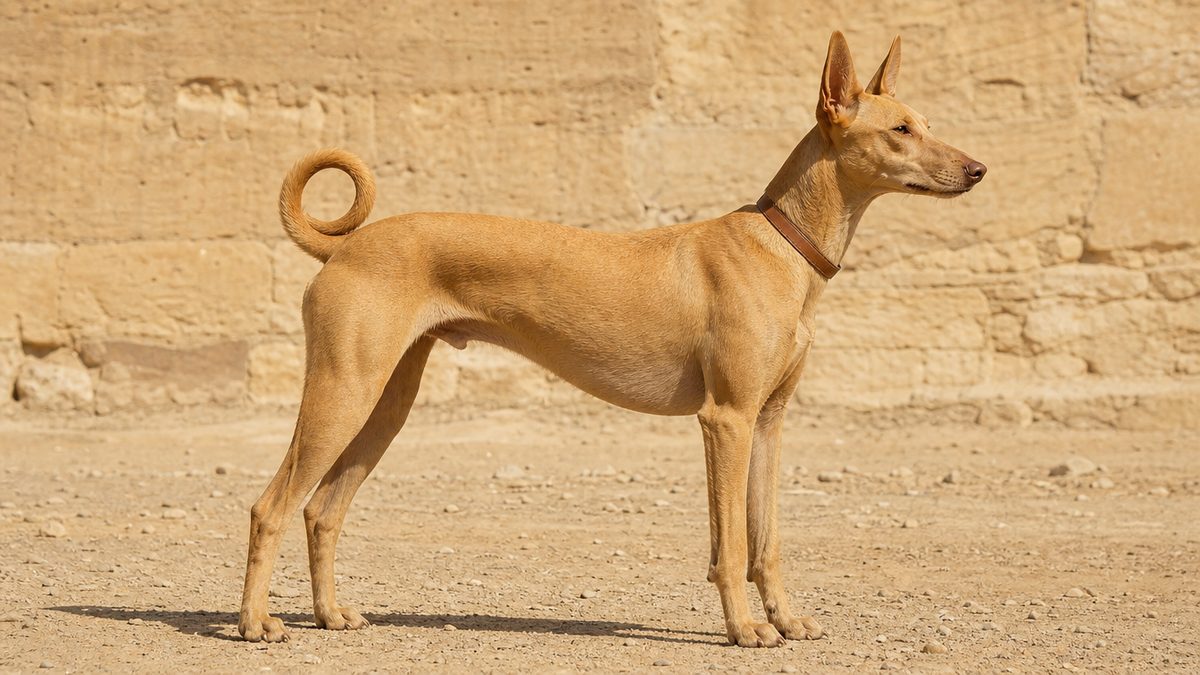
The image at the top of this page is a reconstruction based on the depiction conventions described here. Genuine ancient images of these dogs exist in enormous numbers on tomb walls, in relief and on artefacts, and they are the real evidence. No photograph of a Tesem exists for the obvious reason, and no reconstruction should be read as a portrait.
The word tzm, and what happens when a common noun is treated as a breed name
Tzm is an Egyptian common noun meaning hunting dog. It appears in real inscriptions applied to individual animals, which is why it feels like a name, and it covers more than one kind of dog, which is why it cannot be one.
This project has repeatedly found that the first question to ask about any breed name is what kind of word it is. A name can be a breed, a colour, a coat pattern, a trademark, a place, a job or a translation error, and getting that wrong makes every downstream fact meaningless.
| Test | Result for Tesem | What it implies |
|---|---|---|
| Does it name a function? | Yes. Tzm means hunting dog | A functional label behaves like 'gundog', not like 'Beagle' |
| Does it cover more than one morphology? | Yes. Prick-eared curly-tailed dogs and lop-eared Saluki types both | A breed name cannot describe two different dogs in the same corpus |
| Is it applied to individuals? | Yes. The stela of the dog Abutiu characterises him as tzm | This is what makes it feel like a breed name to a modern reader |
| Is there a written standard? | No, and there could not be. Egypt had no breed registration | Fails condition one of the breed test |
| Is there a studbook? | No | Fails condition two |
| Is it a colour or coat term? | No | It is not the pattern this project has caught with names like Havana and Himalayan |
| Is it a trademark? | No | It is not the pattern found with modern branded 'breeds' |
| Verdict on the word | A functional common noun | Everything downstream has to be written accordingly |
Why the individual application is the confusing part
If Egyptians had only used tzm in general statements, nobody would have mistaken it for a breed. They did not. The funerary stela of a specific royal guard dog characterises that animal as tzm, and once a word appears attached to a named dog it starts reading like a pedigree entry to a modern eye. It is not one. It is the equivalent of a British record describing a named animal as a hunting dog, which tells you the job and nothing about the line.
The same error, in modern form
The pattern repeats in living markets and Indian buyers meet it constantly. A word describing a job or a look gets sold as a breed: desi, spitz, hound, bully. None of those is a breed name in the registry sense, and a puppy sold under one comes with no verifiable ancestry, because there is no register in which to verify it. The Tesem is the oldest instance of the pattern on this site by about five thousand years.
The practical test is unchanged whether the word is Egyptian or English. Ask which register holds the name, which document defines it, and what number the specific animal carries. Where the answer is that the word describes what the dog does, you have a description rather than a breed.
The word appears as tzm, tjezem, tesem and tsm across different sources, and a search on one form will miss the others. That is the same name-form trap that produces false zeros in registry and literature searches throughout this project, and it is worth remembering before concluding that any source is silent on a subject.
The evidence base: tomb walls, one stela, and a criticised skull study
Three kinds of evidence carry everything reliably known about the Tesem: a very large pictorial record, a small number of inscriptions naming individual dogs, and a body of zooarchaeological work on skulls and mummies whose central claim is currently being revised.
Separating them matters, because the pictorial record is vast and the measured record is thin, and most popular writing quietly treats the first as if it were the second.
| Evidence | What it is | What it can establish | Weight |
|---|---|---|---|
| Tomb and monument art | Thousands of images across roughly three thousand years, from the Protodynastic Period onward | What dogs looked like to Egyptian artists, what work they did, and when a depiction convention changes | High for appearance and chronology. Silent on ancestry and population |
| Inscriptions naming individual dogs | Including the stela of Abutiu, ten rows of hieroglyphs on white limestone | That the word tzm was applied to specific animals, and how highly some dogs were valued | Highest for the word's usage. A sample of a few dogs |
| Dog mummies and skeletal remains | Studied since Lortet and Gaillard 1907, and much more since | Physical measurements, ages, burial contexts, and pathology | High, and the classification built on it is contested |
| Belova et al. 2024, Archaeofauna | A peer-reviewed report on a bi-species burial at Deir el-Banat in the Fayum, with Salima Ikram among the authors | Current scholarly framing, including the status of the four-type scheme and the archaeology of dog burial in Egypt | Highest for what Egyptology currently thinks |
| Modern breed literature | Pages asserting Tesem ancestry for the Basenji, Saluki, Pharaoh Hound and others | Nothing about ancestry. It is assertion built on resemblance | None, and this page cites none of it for a fact |
What retrieval taught us about one source
The Archaeofauna paper is the best source on this page and it did not arrive on the first attempt. A direct request returned HTTP 403 after a redirect. A second attempt with a referer header returned the file: 8,060,629 bytes, magic bytes confirming a real PDF, 32 pages, 102,570 extracted characters with a genuine text layer. That is recorded here because a single failed fetch is evidence about one moment rather than about a host, and a page that had stopped at the 403 would have been written without its best source.
What is not on this page
There is no breed standard, because Egypt had no breed registration. There is no lifespan, no screening data and no disease prevalence for this animal. And there is no biomedical literature at all: a PubMed search on the name returns exactly one record, a paper on transmission environmental scanning electron microscopy, with a control returning 108 in the same session.
Where this page gives a health or cost figure it describes a living dog an Indian reader can acquire, and it says so in the sentence.
The contrast with another extinct dog on this site sharpens what is missing. The Salish Wool Dog has a nuclear genome sequenced to 3.4x mean depth from a surviving pelt, an ancestry estimate of 84 percent pre-colonial against 16 percent European, and a set of candidate coat genes, all published in Science in 2023. One preserved animal produced all of that. The Tesem has thousands of images, a handful of inscriptions and no body that has been sequenced, so it will never support the same kind of claim.
It will not give the Tesem a height, weight or lifespan range, because no measured population underlies one. And it will not assert that any living breed descends from it, because resemblance in tomb art is evidence about what artists drew rather than about ancestry, and no genetic work establishes the link.
Bonbeno's two-condition test, applied to a word
To count as a breed on this site an animal needs two documents: a written breed standard and a studbook. The Tesem has neither and never could have, because both instruments postdate it by roughly three thousand years. The verdict is type, and the more precise description is a depiction convention.
The test is usually informative because it separates a real bloodline from a regional label. Here it is informative for a different reason: it shows that the question a modern breed page asks cannot even be posed about this animal, and that the pages asking it anyway are producing answers about nothing.
| Condition | Verdict | Evidence |
|---|---|---|
| A written breed standard | Never existed and could not have | Breed registration begins in nineteenth-century Europe. No Egyptian document defines points, heights or weights for any dog, and none is claimed by any source |
| A studbook | Never existed and could not have | No pedigree authority has ever held the name, checked against the Royal Kennel Club Breeds A to Z, the AKC full index, the FCI letter T index and the FCI provisional register, each with in-document controls that returned |
| Is the name a bloodline name? | No. It is a common noun | Tzm means hunting dog. Egyptian sources apply it both to prick-eared curly-tailed dogs and to lop-eared Saluki types |
| Did contemporaries distinguish types? | Yes, visually | The two greyhound-like sub-types are clearly distinguished in tomb decorations, so the artists saw a difference the vocabulary did not mark |
| Is there a closed population? | Unknown and unlikely | Nothing in the record describes controlled reproduction, and Egyptian dogs are attested in settlements, cemeteries and votive contexts across the whole country |
| Formal verdict | Type | Specifically a depiction convention that later writers converted into a breed, plus a functional word that later writers converted into a name |
Compare the two other verdicts this site could have reached
It is worth showing what was considered and rejected, because a verdict is only informative if alternatives existed.
- Breed in formation was rejected. That verdict fits a population with a standard and a register whose national body has not yet admitted it. Nothing here is in formation; the animal is four thousand years dead and no formation was ever attempted.
- Register without standard was rejected. That fits a body that will register a dog while stating no standard exists, which is a real modern state. No body has ever registered a Tesem.
- Brand was rejected. That fits a trademarked name applied to selected dogs, which this project has documented elsewhere. Tzm is a word in a dead language, owned by nobody.
- Breed was rejected on both conditions, decisively and without ambiguity.
Why the negative verdict is the useful part
Because it tells an Indian reader what to do with every page that says otherwise. If a site gives the Tesem a temperament, a weight range or a life expectancy, it did not find sources this one missed. It ran a breed-page template over a word.
The same test is the one to run on any dog offered for sale in India under an exotic name. Which register holds it? Which document defines it? What number does this animal carry? Three questions, and a seller who cannot answer them is selling a description.
That Egyptians kept and valued hunting dogs of a distinctive shape, in enormous numbers, over three thousand years, and that some of them were valued highly enough for a pharaoh to order a ceremonial burial. That is a real finding about human and canine history, and it does not need to be dressed up as a breed to be interesting.
Where the four Egyptian dog types come from, and why the number keeps moving
The familiar scheme of four Egyptian dog types, one of them the Tesem, comes from a single morphometric study published by Lortet and Gaillard in 1907. Its methodology was criticised as early as 1971, one of its four types rests on a single skull, and current scholarship has increased the number of phenotypes rather than confirming the four.
This is the most important paragraph on the page and no page ranking for the term contains it. The four types are not a fact about ancient Egypt. They are a hundred-and-twenty-year-old classification that has been under revision for over fifty years.
The current framing, from a 2024 peer-reviewed report with Salima Ikram among its authors, is worth quoting in substance. Lortet and Gaillard examined dog mummies, images of dogs from ancient Egypt, and the then-contemporary living dog population in Egypt, and from their morphometric studies identified four types: Egyptian pariah; Tesem, a greyhound-like dog; Egyptian dog, larger than the pariah and with a shorter skull; and Egyptian Spitz, described on the basis of one skull only.
| The 1907 type | How it was defined | Status today |
|---|---|---|
| Egyptian pariah | Morphometrics on mummies, images and living Egyptian dogs | Survives as a category, and current work notes real variety within it rather than one type |
| Tesem | A greyhound-like dog | Survives as a label. The word itself is a functional noun rather than a type name, and it is applied to two morphologies in the sources |
| Egyptian dog | Larger than the pariah, with a shorter skull | Part of the same scheme and subject to the same revision |
| Egyptian Spitz | Described on the basis of ONE skull | The weakest element of the scheme by a wide margin, and the clearest sign of how thin the sample was |
| The methodology | A limited sample originating from several sites across different time periods | Criticised by Ducos in 1971 on exactly that ground |
| The number of types | Four | Increased by current scholarship, based on skull morphology and size, to accommodate fresh data |
Read the sample before reading the conclusion
A classification built from material gathered at several sites across different periods is not a snapshot of a population; it is a mixture. That is the criticism recorded against the 1907 study, and it is the same problem this project meets constantly in modern data: a figure assembled from unlike sources describes the assembly rather than any real thing.
The single-skull type is the detail that makes it concrete. Nobody would accept a modern breed defined on one specimen, and the reason a hundred-year-old classification gets a pass is that it has been repeated for a century rather than re-examined.
What the revision means for the word Tesem
It means the term should be used the way the Egyptians used it, as a description of a hunting dog, rather than as the name of one of four fixed types. The tomb art still shows a clear, recognisable, prick-eared curly-tailed dog, and that observation is untouched. What has weakened is the idea that this dog was one of exactly four kinds, and that being one of four kinds makes it a breed.
When a page hands you a tidy number of categories, ask where the number came from and when. On this subject the answer is 1907, from a study whose sample was criticised in 1971, and the number has been going up ever since. A count that has never been re-derived is a citation habit rather than a finding.
When the Tesem disappeared, and what exactly disappeared
The prick-eared, curly-tailed dog stops appearing in Egyptian art by the New Kingdom, from about 1550 BC, replaced in the imagery by lop-eared, straight-tailed dogs of the Saluki and Sloughi kind. That is a datable change in what artists drew. It is not the same claim as a population dying out.
This distinction is the one nearly every page collapses, and it matters because the two claims have completely different evidence behind them. One is supported by a very large corpus of dated images. The other is supported by nothing at all.
| Date | What is recorded | What it establishes |
|---|---|---|
| 3200 to 3000 BC | A drawing of a Tesem-type dog at Nagada, in the Protodynastic Period, with upright ears and a tightly curled tail | The earliest cited depiction of the type. It does not date the animal's origin, only the image |
| 2609 to 2584 BC | The 'Khufu dog', named Akbaru, from the tomb of Khufu, depicted wearing a collar | A named individual dog of the period, with a collar, so a kept animal rather than a wild one |
| Before 2280 BC | Abutiu, a royal guard dog characterised as tzm, given a ceremonial burial ordered by a pharaoh | The clearest single instance of the word applied to a named dog, on a surviving stela |
| 2055 to 1650 BC | The type continues to appear through the Middle Kingdom | Continuity of the depiction convention across roughly a millennium and a half |
| c. 2065 BC | An image of a Tesem dog from the grave of Intef II | A dated example within that continuity |
| 1550 to 1069 BC | By the New Kingdom the prick-eared type has been replaced in the imagery by hanging-eared, straight-tailed dogs of the Saluki and Sloughi kind | The end of the depiction convention, which is what 'extinction' actually refers to here |
Four things a change in imagery could mean
- The population really was replaced, by imported lop-eared sighthounds absorbing or displacing the older stock.
- Fashion changed, and the newer dog became the one worth depicting in an elite tomb while the older one carried on unrecorded.
- The artistic convention changed, independently of either, as conventions in Egyptian art demonstrably did over three thousand years.
- The older dog persisted as an ordinary village animal, which is exactly the class of dog that elite art does not record.
The sources this page relies on do not choose between those four, and neither does this page. What they do say is that the prick-eared Tesem is thought to be similar to modern pariah dogs, which makes option four rather more plausible than a page announcing an extinction would suggest.
The honest sentence
A depiction type ended by about 1550 BC. Whether an animal population ended with it is not established, and the closest living morphological match to that depiction is still one of the commonest dogs on earth. Compare that with the other extinct dogs on this site, where a last registration, a last named individual or a sequenced pelt fixes an actual endpoint.
One of the ten Indian search results calls the Tesem 'an extinct species of dog breed' that lived in Egypt to at least 1069 BC. It is not a species, since every domestic dog is one species. It is not a breed, for the reasons this page sets out. And 1069 BC is the end of the New Kingdom rather than a date anything was recorded ending.
What the Tesem looked like, and the measurements that do not exist
The Tesem of early Egyptian art is a prick-eared, long-legged, deep-chested dog with a short close coat and a tightly curled tail. No height range, weight range or lifespan exists for it, because no measured population underlies the depictions.
The pictorial evidence for appearance is genuinely excellent, which makes the absence of measurements more striking rather than less. Egyptian artists worked to conventions precise enough that scholars can separate two sighthound sub-types by ear carriage and tail set alone.
| Feature | Status | Evidence and caveat |
|---|---|---|
| Ears | Established: upright and pricked | Consistent from the Nagada drawing of 3200 to 3000 BC onward. It is the feature that separates this dog from the later lop-eared type |
| Tail | Established: tightly curled | The second diagnostic feature, and the one that most clearly distinguishes it from a Saluki |
| Build | Established: leggy and lightly built | Described in the sources as greyhound-like, and shown coursing in tomb art |
| Coat | Established: short and close | Consistent across the imagery, and the correct coat for the climate |
| Collar | Established for at least one dog | Akbaru, the Khufu dog, is depicted wearing one |
| Height | NOT established | No source consulted gives a range. Any page printing one has taken it from a template |
| Weight | NOT established | Same |
| Lifespan | NOT established | Same, and no study exists that could have produced one |
| Colour | NOT established | Egyptian art uses conventionalised colour and cannot be read as a coat description |
The three features that matter, and why
Prick ears, a curled tail and a light coursing build are not decorative. Together they describe a dog built to run down fast game in open dry country, with no ear leather trapping heat, no coat holding it and no bulk to carry. Every element is a heat adaptation as much as a hunting one, and it is the reason this page rates heat tolerance at the top rather than the bottom.
That combination is also, precisely, the pariah morphology found across South Asia and the Middle East today. The sources say so directly: the prick-eared Tesem is thought to be similar to modern pariah dogs. An Indian reader looking at a street dog in Chennai is looking at the same build the Egyptians drew.
Where the imagery came from, on one reading
The prick-eared Tesem's origins are presumed to lie south of Egypt, in Nubia and in the Land of Punt, whose location is unclear but is thought to be southeast of Egypt on the Horn of Africa. That is a presumption in the sources rather than a demonstrated origin, and it is recorded here with its hedge intact.
If a page gives the Tesem a height in centimetres, a weight in kilograms and a lifespan in years, ask which measured population produced them. There is no answer, because there is no such population. A confident spec card for an animal known only from wall art is evidence about the page rather than about the dog.
Abutiu: the one Tesem with a name, a text and an object you can go and see
Abutiu was a royal guard dog who died before 2280 BC and received a ceremonial burial ordered by a pharaoh whose name is unknown. His inscribed limestone stela survives in Cairo, and its text is the clearest instance anywhere of the word tzm applied to a specific animal.
Everything else on this page is a category, a convention or a classification. This is one dog.
| Property | Detail |
|---|---|
| Found by | George A. Reisner, on a joint Harvard University and Boston Museum of Fine Arts expedition |
| Date of discovery | 13 October 1935, removed from the site four days later |
| Find context | Cemetery G 2100 in the Giza West Field, close to the western side of the Great Pyramid, reused as spoil material in a Sixth Dynasty mastaba after the demolition of the owner's funerary chapel |
| Material and size | White limestone, 54.2 by 28.2 by 23.2 cm |
| Inscription | Ten vertical rows of hieroglyphs, separated by vertical lines |
| Surviving imagery | Part of a leash is visible in the upper-right corner, suggesting the tablet once showed Abutiu with his owner |
| Where it is now | Egyptian Museum, Cairo, inventory number JE 67573 |
| What was never found | Neither the dog's grave nor his body has been recovered |
| Date of death | Before 2280 BC, in the Sixth Dynasty, 2345 to 2181 BC |
The text, in Reisner's translation
"The dog which was the guard of His Majesty, Abutiu is his name. His Majesty ordered that he be buried (ceremonially), that he be given a coffin from the royal treasury, fine linen in great quantity, (and) incense. His Majesty (also) gave perfumed ointment, and (ordered) that a tomb be built for him by the gangs of masons. His Majesty did this for him in order that he (the dog) might be Honoured (before the great god, Anubis)."
Read that as an itemised invoice rather than as sentiment and it becomes more impressive, not less. A coffin from the royal treasury, fine linen in great quantity, incense, perfumed ointment, and a tomb built by state masons. That is a burial specification normally reserved for upper-class humans, and it was authorised for a dog.
What Abutiu establishes, and what he does not
He establishes that the word tzm was applied to a specific, named, individual animal in a formal royal inscription, which is exactly why the word reads like a breed name to a modern eye. He establishes that at least one Egyptian dog was valued as highly as a person.
He establishes nothing about breeds, because the text does not describe his parents, his line or his points. And no image of Abutiu has been found, so even his appearance is inferred from what the word tzm generally denotes rather than from a portrait.
The wider burial context, from the archaeology
Dog burials are attested in Egypt from the Predynastic onward, in settlements, in animal cemeteries and catacombs, mixed in with human graves, in association with a single person or a group, and at the edges of human cemeteries. The majority of surviving dog burials are votive offerings, given to Anubis in particular, sometimes in mass interments numbering in the hundreds of thousands, and a mummy was considered more valuable than a statue because it represented the sacrifice of a living creature in the god's image.
Abutiu is the opposite of that category, and that is what makes him worth a section. He was buried as an individual, by name, at royal expense.
Because it is the oldest surviving written argument that a working dog deserved something back. The stela does not say the dog was valuable property. It says the burial was ordered so that the dog might be honoured. Four and a half thousand years later, that is still the entire case for taking a street dog to a vet.
Registry recognition: none anywhere, and none possible
No kennel club recognises the Tesem, and four registers were read with in-document controls to establish that rather than assume it. Unlike most absences on this site, this one is structural: the name is a word rather than a bloodline, so there is nothing a register could hold.
An absence is a strong claim, so each row below sits beside control breeds that returned in the same document American Kennel Club. A reader can reproduce every one by opening the same index and searching for the same control words.
The provisional register was checked separately, because a breed can be absent from a definitive nomenclature while sitting in a provisional queue. The FCI's provisional list runs to 4,272 characters and holds none of the six extinct names checked against it on the same day, so there is no pending application either.
| Register | Tesem found? | Controls that returned in the same document |
|---|---|---|
| The Royal Kennel Club, complete Breeds A to Z, 75,388 characters | No, zero on a strict search | Labrador 1, Beagle 1, Bulldog 2, Skye Terrier 1, Yorkshire Terrier 1, Harrier 1, Otterhound 1, Whippet 1, Greyhound 2, Terrier 62 |
| American Kennel Club, full breed index, 16,981 characters | No, zero on a strict search | Saluki 2, Basenji 2, Pharaoh Hound 2, Labrador 2, Beagle 2, Bulldog 8, Terrier 93 |
| FCI nomenclature, letter T index, returned in English | No, zero | The whole index holds fifteen entries from TAIWAN DOG to TOSA, with TIBETAN TERRIER, TORNJAK and TOSA present |
| FCI provisional register | No, zero | A 4,272-character list of provisional entries holding none of the extinct names checked against it |
| FCI letter S index, cited for the positive | SALUKI and SLOUGHI both present | The lop-eared type the word Tesem was also applied to corresponds to two living FCI-recognised breeds |
A false positive worth publishing, because it nearly went in
The AKC check produced a warning about method rather than about the register. A whitespace-tolerant search, the kind used to defeat broken word-wrapping in extracted PDFs, reported two occurrences of Tesem in the AKC index. Reading the context showed both were the matcher spanning a word boundary across the string tese M, and a strict substring search returns zero.
That is the over-correction trap: a pattern loose enough to survive bad text extraction is loose enough to invent hits in clean text. The rule this page followed, and the one worth copying, is that the count decides nothing and the context decides everything.
What this means for the Kennel Club of India
India is a full member of the FCI, represented by the Kennel Club of India in Chennai, and the KCI issues pedigrees against FCI nomenclature. Since no FCI number exists for the Tesem, no KCI pedigree route exists for it either. The KCI's own limitation should also be stated: it publishes no public breed list, so a query against it returns nothing for this name and nothing for every control, which is a broken instrument rather than a finding.
What the FCI does hold is the two living breeds corresponding to the later Egyptian sighthound type, the Saluki and the Sloughi, both present in the letter S index read on the same day. A reader who wants a dog with a genuine documented connection to Egyptian imagery can buy one of those, with paperwork.
For most extinct breeds, unrecognised means a registry never got round to it. For the Tesem it means there is no object of recognition: a functional word from a dead language is not a candidate for registration. Pages describing the Tesem as 'not recognised by any kennel club' are technically right and are implying something false, which is that it might have been.
The living dog that looks most like a Tesem is on an Indian street
The prick-eared, long-legged, curl-tailed dog of early Egyptian art is described in the literature as similar to modern pariah dogs. India has millions of them, they cost nothing, and they are the practical answer to almost every question this page raises.
This is not a rhetorical flourish added to make an extinct-breed page useful. It is what the source says: the prick-eared Tesem is thought to be similar to modern pariah dogs. The pariah morphology is the commonest dog shape across South Asia, the Middle East and North Africa, and it is what an Indian reader walks past every day.
Feature by feature
| Feature | Tesem in Egyptian art | Indian pariah dog | Match |
|---|---|---|---|
| Ears | Upright and pricked | Upright and pricked | Yes |
| Tail | Tightly curled | Curled or sickle, commonly carried high | Close |
| Build | Leggy, light, deep-chested | Leggy, light, square | Close |
| Coat | Short and close | Short and close | Yes |
| Climate adaptation | Hot and dry | Hot, and adapted to Indian humidity as well | Better than the original |
| Working role | Hunting, and at least one royal guard dog | Village generalist: alarm, scavenging, hunting where permitted | Overlapping |
| Documented ancestry | None. No genetic work links it to any living population | None needed. It is a landrace, not a claim | Neither has paperwork, and only one needs none |
| Price in India | No price exists | Rs 0 to Rs 5,000 | The living option costs nothing |
What this is not saying
It is not saying the Indian pariah dog descends from the Tesem. No genetic study establishes that and this page makes no such claim. Landrace dogs across a huge geographical band converge on the same shape because the same pressures produce it: heat, scavenging, distance, and no artificial selection for a novelty feature.
That convergence is the point. The shape is what an unselected dog looks like in a hot country, which is why it appears on Egyptian tomb walls and on a Chennai street four thousand years apart without any need for a family tree connecting them. The current scholarship on Egyptian dog phenotypes runs the same way: the categories are being multiplied rather than tightened, and the variety within the pariah type specifically is what recent work has emphasised.
Why an Indian buyer should take this seriously
Because the pariah dog is the single best-adapted dog available in India and it is the one most often passed over. It carries the short coat that suits the climate, the light build that suits the heat, and a gene pool wide enough that inherited disease concentration is not the problem it is in closed populations. It costs between nothing and Rs 5,000, and you can meet the adult animal before you commit, which no certificate substitutes for.
The Indian Pariah Dog page sets out what the trade-offs actually are, honestly, including the ones a romantic account leaves out.
If the appeal of the Tesem is an ancient, elegant, prick-eared hunting dog that thrives in heat, India offers three routes to it. Adopt a pariah dog for nothing. Buy an Indian sighthound such as the Rajapalayam or Mudhol Hound at Rs 8,000 to Rs 30,000. Or buy a Saluki, the living breed that actually appears in the later Egyptian imagery, with FCI paperwork behind it.
Price in India: none for a Tesem, and real prices for the dogs it points at
There is no price for a Tesem in India or anywhere, because the word is not a breed and no animal is sold under it. What this section prices instead are the living dogs the type actually corresponds to, from Rs 0 for a pariah dog to Rs 8,000 to Rs 30,000 for an Indian sighthound.
Saying the first part in the first line is deliberate. A reader who typed a breed name into a search box is usually deciding whether to buy something, and the shortest true answer is the useful one.
Why no price can exist
- The name is a common noun, meaning hunting dog, applied in the sources to at least two different morphologies. There is nothing for a price to attach to.
- No register holds it, so no pedigree can accompany a dog sold under it, and the Kennel Club of India issues against FCI nomenclature that does not contain it.
- Import is Restricted in any case. DGFT Trade Notice 22/2022-23 places live dogs under ITC(HS) 01061900 as a Restricted import and states at paragraph 6 that applications for trading or breeding purposes shall be duly rejected.
What the Indian lists actually price
| Dog | PawSpace | Wrapinfur | Note |
|---|---|---|---|
| Indian Pariah Dog | Rs 0 to Rs 5,000 | Not listed | The closest living morphological match, and free from a shelter in every metro |
| Rajapalayam | Rs 8,000 to Rs 30,000 | Not listed | An Indian sighthound doing the coursing job the tomb art shows |
| Mudhol Hound | Rs 8,000 to Rs 30,000 | Not listed | Identical band, which is a template signature rather than a second observation |
| Chippiparai | Rs 8,000 to Rs 30,000 | Not listed | Same band again |
| Kanni | Rs 8,000 to Rs 30,000 | Not listed | Same band a fourth time |
| Indian Spitz | Rs 8,000 to Rs 30,000 | Not listed | Prick-eared and curly-tailed, though double-coated rather than short |
| Saluki | Not listed on either | Not listed on either | The living breed that appears in the later Egyptian imagery is absent from both Indian price lists, which is itself a market observation |
| Basenji | Not listed on either | Not listed on either | Same. Neither of the two breeds most often linked to Egypt has an Indian retail price on these lists |
Four identical bands are one data point
The Rajapalayam, Mudhol Hound, Chippiparai and Kanni share a byte-identical Rs 8,000 to Rs 30,000 band. Identical bands across several unrelated breeds are a template signature, and this project has repeatedly found Indian sites assembling rows from preset lines rather than costing any animal. Read that band as one statement about how the site prices Indian breeds.
The absence of the Saluki and Basenji from both lists is the more interesting observation. Two breeds with the strongest popular association to ancient Egypt have no Indian retail price on either of the two largest Indian price pages, which says something real about what is and is not sold here.
The conversion test, run and reported
Forty-seven distinct rupee figures between Rs 1,000 and Rs 5,00,000 from both lists were divided by the rates this project has caught converted lists using. None divides to a whole number of US dollars at 84.38, none at 74.00 and none at 91.00. Twenty-six appear to divide at a flat 80.00, which proves nothing, because 1,000 divided by 80 is 12.5 so any figure ending in three zeros passes by construction, and the quotients include 15, 25, 50 and 75. These are rupee-native numbers.
An answer engine that says no Indian price exists and then prints a confident rupee band in the next sentence has converted a foreign asking price. The sequence is the tell rather than any particular divisor. This page prints no band for the animal in its title and prints the division test so you can run the same check elsewhere.
Monthly cost of ownership in India for a short-coated hound of this build
Budget roughly Rs 4,500 to Rs 9,000 a month for a 15 to 25 kg short-coated hound in an Indian metro, built from named line items rather than from a quoted total. Every line below was priced from its own source on 9 September 2026.
Indian breed pages routinely publish monthly totals assembled from a small set of preset components rather than costed against any animal, which is why this page names each line and its source separately. Components can be checked one by one. A round total cannot be checked at all.
The lines come from four different kinds of source rather than from one aggregator: a national pet pharmacy for parasite cover and deworming Supertails product page, one veterinary chain's published rate cards for vaccination and grooming Vetic, pet grooming Delhi price list, and two municipal corporations for registration Greater Chennai Corporation. None of it was taken from a breed page.
| Line | Figure | Source and caveat |
|---|---|---|
| Tick, flea and worm cover | About Rs 1,103 a month | NexGard Spectra for 15 to 30 kg, three tablets at Rs 3,308 against an MRP of Rs 3,375. One tablet covers the tick and flea role and the roundworm and hookworm role together |
| Deworming, if used separately | Rs 813 a strip of six, about Rs 135.50 a tablet at one per 10 kg | Drontal Plus. This price MOVED from Rs 754 to Rs 813 against an unchanged MRP of Rs 838 during the week this page was built, which is why nothing here was inherited from a sibling page |
| Vaccination, spread monthly | Rs 699 anti-rabies, Rs 899 for the 9-in-1 DHPPiL, Rs 899 canine corona | Vetic's national page, quoted as 'starts at'. These are one chain's promotional floors and the same chain quotes differently on different city pages |
| Grooming | Rs 99 for add-ons covering nail clipping, ear cleaning and tooth brushing; Rs 934 for a bath | Vetic Delhi price list. A short close coat is the cheapest coat in India to maintain, and the Rs 1,359 haircut line does not apply at all |
| Municipal registration | Rs 500 in Delhi, Rs 50 in Chennai | MCD new registration and renewal are both Rs 500 with a Rs 100 per month late fee and one month of grace. Greater Chennai Corporation licenses a pet animal at Rs 50 |
| Food | Not quoted here | No current Indian retail food figure was re-priced for this page, and a stale food price is worse than none |
The short coat is the saving, and the exposure
A short-coated hound is genuinely cheap to groom in India. It does not mat, it dries in minutes, and the Rs 1,359 haircut line simply never appears. That is a real and often overlooked reason to prefer this build in an Indian city over a double-coated import.
The trade-off is skin. A thin coat over a lean, deep-chested dog offers little protection from sun on the ears and muzzle, from abrasion, or from ticks reaching skin directly, and a lean hound has almost no fat layer over its bony points. Budget for a proper bed and shade rather than for shampoo.
Parasite cover is the line that is not optional
A West Bengal screening study of 584 client-owned dogs found Babesia gibsoni in 76.54 percent, Anaplasma species in 55.75 percent and Ehrlichia canis in 16.61 percent, with 72.9 percent of the dogs screened carrying two or more pathogens at once. Those were dogs presenting at a clinic rather than sampled from the street, so they describe caseload pressure rather than population prevalence, and they are still the reason cover is a fixed monthly line in India rather than a seasonal one.
Municipal registration is the cheapest useful thing on the table. Delhi charges Rs 500 to register and Rs 500 to renew, tied to the anti-rabies certificate's validity, while Greater Chennai Corporation charges Rs 50 and issued 9,115 licences in 2024.
This project has repeatedly found Indian breed sites publishing identical monthly totals across unrelated breeds, because the totals are the sum of a small set of preset lines. One documented set gave a Pug and a hand-stripped wire terrier the same grooming line, which is the one cost that cannot possibly match. Components you can price yourself beat a total you cannot.
Suitability for the Indian climate, and the one extinct dog on this site that was hotter-adapted than India
Luxor's July mean is 32.50 C, hotter than the hottest month of any Indian city compared here. On dry-bulb temperature alone the Tesem's homeland out-heats India, and it is the only breed in this site's extinct set of which that is true.
Every other extinct dog on this site comes from somewhere far cooler than India, and the climate section writes itself as a warning. This one inverts that, and the inversion is genuinely useful, because it isolates what an Indian climate actually demands.
The figures come from NASA POWER climatology for 2001 to 2020, queried by explicit latitude and longitude with the cell elevation echoed back and checked against the real one. Luxor's cell returned 248.37 m against a real elevation near 76 m, an error of about +172 m, which is stated rather than hidden. In the Nile valley that error runs in the cold direction, so the real Luxor is if anything hotter than the figures below.
| Place | Annual mean | Hottest month | Coolest month | Cell elevation check |
|---|---|---|---|---|
| Luxor, Egypt (homeland) | 24.33 C | July, 32.50 C | January, 13.26 C | 248.37 m against a real 76 m, an error of +172.37 m, stated |
| Cairo, Egypt | 21.82 C | July, 29.95 C | January, 12.06 C | 135.44 m against a real 23 m, +112.44 m |
| Chennai | 27.95 C | May, 31.51 C | January, 24.09 C | 48.95 m against a real 7 m. Usable |
| Delhi | 25.60 C | June, 35.88 C | January, 13.61 C | 206.37 m against 216 m. Excellent |
| Kolkata | 25.81 C | May, 31.53 C | January, 17.31 C | 7.35 m against 9 m. Excellent |
| Bengaluru | 23.74 C | April, 28.37 C | December, 20.22 C | 841.72 m against 920 m. Usable |
| Pune | 23.86 C | April, 28.93 C | December, 19.62 C | 635.99 m against 560 m. Usable |
Two Indian months that catch people out
Delhi peaks in June, not May, at 35.88 C, and Bengaluru and Pune both peak in April, at 28.37 C and 28.93 C, and are coolest in December rather than January. Chennai and Kolkata genuinely do peak in May. A page that labels every Indian peak as May is right often enough to look correct and wrong precisely where a heat-sensitive dog needs it to be right.
Read the whole table before concluding the dog would thrive here
Luxor beats Chennai on the hottest month, 32.50 C against 31.51 C, and is beaten by Delhi's 35.88 C. But Luxor's coolest month is 13.26 C against Chennai's 24.09 C, which means the Egyptian dog got a genuine winter and a Chennai dog does not. Annual mean is the fairer comparison, and there Chennai at 27.95 C is 3.62 C above Luxor.
So the honest summary is that a Tesem-built dog would handle Indian dry heat well and would still be working harder over a year than it did at home, with no seasonal recovery period. That is before humidity, which the next section shows is where the real gap lies.
This is the one page in this site's extinct set where heat-tolerant is the correct description rather than a marketing word, and it is worth being precise about what it earns. A heat-tolerant build is an advantage in Delhi in June and a smaller advantage in Chennai in May, because the two cities are hot in different ways. Heat tolerance is not a single property, and a page that treats it as one will mislead an Indian reader in both directions.
In a study of 905,543 UK dogs, being at or above the mean bodyweight for the breed and sex carried 1.42 times the odds of heat-related illness, with an overall event fatality rate of 14.18 percent. A lean hound build is a heat advantage and it is easy to lose. Ask your nearby vet for a body condition score at every visit.
Humidity and wet-bulb load: the eight-degree gap that decides everything
Luxor runs 28.71 percent annual relative humidity against Chennai's 72.39 percent, and the difference shows up where it matters most. Luxor's peak wet-bulb load is 17.96 C in August. Kolkata's is 27.09 C in June, a gap of 9.13 C.
This is the section that stops a desert dog looking like an obvious fit for India. Dry heat and wet heat are not the same physiological problem, and a dog cannot sweat its way out of either.
Wet-bulb temperature is the right measure because it combines heat and humidity into the quantity that limits evaporative cooling. Every figure here is computed by the Stull method from POWER's own T2M and RH2M for 2001 to 2020, and the method is named because two different wet-bulb sources are in circulation and they disagree by more than a degree.
| Place | Annual relative humidity | Peak wet bulb | Month of the peak |
|---|---|---|---|
| Luxor, Egypt (homeland) | 28.71 percent | 17.96 C | August |
| Cairo, Egypt | 50.54 percent | 21.30 C | August |
| Kolkata | 73.93 percent | 27.09 C | June |
| Delhi | 45.56 percent | 26.50 C | July |
| Chennai | 72.39 percent | 26.11 C | May |
| Ahmedabad | 48.32 percent | 26.11 C | June |
| Mumbai | 67.39 percent | 25.77 C | June |
| Pune | 66.80 percent | 22.97 C | June |
| Bengaluru | 67.94 percent | 21.86 C | May |
The inversion, stated plainly
Luxor is hotter than Chennai on the thermometer and about eight degrees easier on the wet bulb. July in Luxor runs 32.50 C at 19.9 percent humidity. May in Chennai runs 31.51 C at 64.5 percent. The Egyptian month is a degree hotter and imposes roughly eight degrees less cooling load, because at 20 percent humidity a panting dog can actually shed heat and at 65 percent it increasingly cannot NASA POWER climatology 2001-2020….
That single comparison is the most useful thing on this page for an Indian reader, and it generalises well beyond this dog. A breed described as heat-adapted is usually dry-heat adapted, because most of the world's hot dog-breeding regions are arid. Indian coastal heat is a different problem and a dog's origin climate does not automatically prepare it.
Even Cairo is easier than Bengaluru
Cairo peaks at 21.30 C wet bulb, marginally below Bengaluru's 21.86 C, which is India's mildest city in this table. The Egyptian Nile valley, in other words, is comparable at its worst to the gentlest Indian city, and nine degrees easier than Kolkata.
Two Indian cities share a wet-bulb peak, and both figures are correct
Chennai in May and Ahmedabad in June both compute to 26.11 C, to the hundredth, from very different monthly profiles: Chennai at 31.51 C and 64.5 percent humidity, Ahmedabad at 33.62 C and 53.7 percent. That is a coincidence rather than a copied figure, and it is recorded because an identical value in two places is exactly the sort of thing somebody corrects without recomputing either.
What an owner does with the wet-bulb column
Follow it rather than the thermometer. In Kolkata, Chennai and Mumbai the dangerous window is a humid morning after a hot night, because the dog has not shed heat overnight, and not the hottest hour of the afternoon. Exertion is the dominant trigger: of 1,259 heat-related illness events in 905,543 UK dogs, 879 had a recorded trigger and 652 of those, or 74.2 percent, were exertional. Those percentages are computed on the 879, not on the 1,259.
The practical translation for a heat-tolerant desert build in India is narrower than it sounds. It buys you a wider working window in Delhi, Ahmedabad and inland Pune, where the air is drier, and very little in Kolkata, Chennai and Mumbai in the weeks around the peak. Plan by city rather than by breed.
Long legs, a thin coat, a large skin-to-mass ratio and no bulk are all real cooling advantages, and they are why this page rates heat tolerance at the top. They do not stop a dog overheating in 65 percent humidity at 31 C, and a coursing dog will run itself into trouble long before it feels the limit. Time the exercise, and take any hard panting at rest to your nearby vet.
Temperament: what the art shows a dog doing, and what it cannot tell you
The Egyptian record shows these dogs coursing game, wearing collars, walking on leashes and guarding a pharaoh. That is evidence about roles rather than about personality, and this page does not convert one into the other.
Every other page ranking for this term supplies a temperament paragraph. None of them can source it, because there is no behavioural record for an animal known from wall art. What follows is what the images and inscriptions do support, kept separate from what they do not.
What the record supports
- Kept rather than tolerated. The Khufu dog Akbaru is depicted wearing a collar, and part of a leash survives on the corner of the Abutiu stela, so these are handled animals with equipment.
- Named individually. Akbaru and Abutiu are names, and a named animal is one somebody called and expected to come.
- Trusted at close quarters. Abutiu's own inscription describes him as the guard of His Majesty, which is a role requiring an animal that could be around people and could be relied on.
- Worked at speed on game. The coursing scenes are the commonest context in which the type appears, which is a prey-drive statement rather than a personality one.
- Buried with ceremony, at least once. A coffin from the royal treasury, fine linen, incense and a mason-built tomb is what the state spent on this dog.
What cannot be said
No source supports a claim about this animal's behaviour with children, its trainability in a modern sense, its separation tolerance, its sociability with other dogs, or its guarding instinct as a general trait. Those five are exactly the fields a breed-page generator fills automatically, and when you meet them attached to this name you are reading a template rather than a record.
The guard role is the one worth being careful about. Abutiu was a guard dog. That is one animal in one household, and generalising from him to a type would be like reading one police-dog record and concluding that all German Shepherds guard.
The transferable point for an Indian household
It is about sighthound temperament in general rather than about this dog. A lightly built coursing animal typically has high prey drive, a fast startle, a poor automatic recall around moving things, and a strong preference for soft surfaces to lie on. Those four are consistent across living coursing breeds and they are what an Indian buyer should plan for.
India has three living examples with real, observable temperaments, and observing them is better than reading any standard. The Rajapalayam, Mudhol Hound and Chippiparai pages set out what each is actually like in a home, and the Indian Pariah Dog page covers the least specialised and most adaptable option.
No lifespan figure exists for the Tesem. No temperament study exists for the Tesem. No screening data exists for the Tesem. Those three sentences are the correct output for an animal with zero biomedical literature and no measured population, and a page that fills them anyway has stopped reporting.
Training a sighthound-built dog in India
To train a coursing-built dog in India, build recall on a long line for months rather than weeks and never train in daylight from April. Nothing is recorded about training a Tesem, so this covers the living hounds an Indian reader will actually own.
Sighthound training has one hard problem and everything else follows from it: a dog selected to chase moving things at speed does not have a reliable recall when something is moving. That is not disobedience and it is not a training failure, it is the selected behaviour working correctly.
The recall plan that actually works
- Use a long line for months. Fifteen metres, on a harness rather than a collar, so the dog never once practises succeeding at running away.
- Pay every single recall, every time, for a year. Intermittent reward is for maintaining a behaviour, not for building one against a genetic pull.
- Never call the dog to something it dislikes. Go and get it for the bath, the nail trim or the end of the walk.
- Train an emergency stop as well as a recall. A dog already running away from you can still be stopped where it stands, and on a sighthound that is often the more achievable behaviour.
- Accept the ceiling. Off-lead freedom in an unfenced Indian public space is not a realistic goal for most coursing dogs, and planning around a secure space is safer than planning around perfect obedience.
The Indian timetable
Exertional heat illness is the dominant trigger of heat-related illness in dogs, accounting for 652 of the 879 events with a recorded trigger in a 905,543-dog study, which is 74.2 percent. Training sessions are exertion, and a hound will keep going past the point where it should stop.
From April, move sessions to before sunrise and after dark, keep them to five or ten minutes, and do the thinking work indoors on a cool floor. In Chennai the peak wet-bulb load reaches 26.11 C in May and in Delhi 26.50 C in July, and those are the fortnights to plan around rather than to push through.
Handling, because a thin-skinned lean dog needs it
The single most valuable trained behaviour for a lean short-coated hound in India is standing calmly for a body check. Ticks reach skin directly through a thin coat, bony points rub, and sun catches ears and muzzle. A dog that will stand still for two minutes while you run your hands over it is a dog whose problems get caught early.
What Indian law says about the tools
The Prevention of Cruelty to Animals (Dog Breeding and Marketing) Rules, 2017 are worth reading before hiring a trainer or a boarding kennel. Second Schedule Part IV requires separate housing for a vicious or aggressive dog and forbids the use of sedation to control its behaviour. A facility proposing chemical restraint for a difficult dog is proposing something the Rules address directly.
A hound that stops responding to known cues, becomes reluctant to move, or pants hard at rest is giving you a medical sign rather than a training problem, and in Indian conditions heat load and tick-borne disease are both high on the list. Get the animal examined before rebuilding a training plan around it.
Daily exercise requirement, and the sprint-and-sleep pattern
A coursing-built dog needs short bursts of real speed rather than long steady walking, so plan 45 to 60 minutes a day in two sessions outside daylight, with one of them offering a safe chance to actually run. Long slow walking is the least useful exercise you can give this build.
The tomb art shows what these dogs were for: sprinting after fast game across open ground. That is a sprint-and-recover animal, not an endurance animal, and Indian owners who apply retriever routines to a hound get a dog that is simultaneously exhausted and unsatisfied.
The Indian schedule
- Before sunrise: 25 to 35 minutes, including, where a secure space allows it, a few genuine sprints rather than a steady pace.
- After dark: 20 to 30 minutes, slower, on a surface you have touched with the back of your hand first.
- Through the day: rest. A hound that has sprinted will sleep for hours, and that is the correct outcome rather than laziness.
- April to June: cut the running, keep the frequency. Two short outings beat one long one, and the sprints are the first thing to drop.
- Monsoon: shorter and on surfaces that are not slick. A lean dog at speed on wet tile is an orthopaedic problem waiting to happen.
The seven-second ground test
Indian tarmac and concrete hold heat long after the air cools, and a deep-chested dog runs with its chest close to that layer. Put the back of your hand flat on the surface for seven seconds. If you want to lift it off, the dog does too. This single check moves more sessions onto grass and into later hours than any weather app.
Where an Indian owner can actually let a sighthound run
This is the practical constraint and it is worth naming honestly. Off-lead running for a coursing dog needs enclosed ground, and most Indian cities do not supply it as public infrastructure. The realistic options are a fenced private compound, a hired ground early in the morning, a long line in an open park to simulate the extension without the risk, or a spring-pole or flirt-pole at home for controlled bursts.
A dog that never sprints is a dog whose exercise need is being met on paper and not in fact, and that shows up as destructiveness rather than as a training problem.
Weight is the lever you hold
In 905,543 UK dogs, being at or above the mean bodyweight for the breed and sex carried 1.42 times the odds of heat-related illness. On a lean hound this is unusually easy to see, because the build shows condition honestly: you should see the last two ribs and a clear waist. A hound that looks like a Labrador is carrying weight it was never built to carry.
Stop and cool the dog if you see hard panting with a wide flat tongue, drooling that turns thick or ropey, staggering, brick-red or very pale gums, or a dog that lies down and will not get up. Wet it with cool rather than iced water, move it into moving air, and get to your nearby vet. In the UK study the event fatality rate was 14.18 percent, in a far cooler country.
Grooming: the cheapest coat in India, and the skin underneath it
A short close coat of the kind every Tesem depiction shows is the least demanding coat an Indian dog can have. It does not mat, it dries in minutes, and it needs no clipping. The work moves from the coat to the skin, and that is where an Indian owner should put the attention.
This is the only grooming section on this site's extinct set that is genuinely good news. Every other extinct dog covered here carried a coat that fights an Indian summer. This one carried the coat an Indian summer selects for.
The routine, in order
- A rubber curry mitt once or twice a week, five minutes, which lifts dead hair and lets you feel every inch of skin while you do it.
- A full skin check with the same session. Run your hands over ears, neck, armpits, groin, between toes and under the tail. On a thin coat a tick is findable by touch, which is a real advantage over a double coat.
- Bathe rarely. A short-coated dog in India needs a wash when it is dirty and not on a schedule, and over-washing strips the skin.
- Dry it anyway. Even a short coat should be towelled properly rather than left damp in monsoon humidity, especially at the ears.
- Check the ears weekly. Prick ears drain and ventilate far better than drop ears, which is a genuine Indian advantage, and they still collect dust and mites.
- Watch the sun. A thin coat over pale skin on the ear tips, muzzle and belly is exposed. Shade and timing matter more than any product.
What this costs in India
Almost nothing. Professional bathing in Delhi starts at Rs 934, and the Rs 1,359 haircut line simply does not apply to a short coat. The Rs 99 add-on package, covering nail clipping, anal gland expression, ear cleaning and tooth brushing, is the only salon service most short-coated dogs need, and all four can be learned at home.
Compare that with a double-coated northern breed in the same city, where drying alone is a recurring paid service. Coat type is one of the largest hidden differences in the real cost of owning a dog in India, and it is almost never priced on a breed page.
The trade-off nobody mentions
A lean, short-coated, deep-chested dog has very little padding over its elbows, hips and hocks, and Indian floors are hard. Pressure sores and calluses on a hound sleeping on tile are a genuine and preventable problem, and the fix is a proper raised or padded bed rather than a grooming product.
Thin skin also means abrasions from undergrowth and from other dogs heal slowly and get infected quickly in humid heat. Clean and watch anything that breaks the skin rather than assuming a short coat means low maintenance overall.
Redness, weeping, hair loss in patches, or a smell are veterinary problems in Indian humidity and they escalate fast. A short coat makes them easy to see early, which is an advantage only if somebody is looking. Take anything you find to your nearby vet rather than to a shampoo.
Health and lifespan: no data exists, and the search that proves it
No lifespan, screening data or disease prevalence exists for the Tesem, and the biomedical literature contains nothing about it at all. Every health figure below describes a living breed an Indian reader could acquire, and each says which.
Stating the absence is the correct output rather than a research failure. A page that borrows a Saluki's health issues and attaches them to this name has invented data, and this project has caught exactly that on extinct-breed content farms, complete with recommended annual screening for animals that do not exist.
The literature search, run properly and reported
Tesem[tiab] returns exactly one PubMed record, and it is a paper on transmission environmental scanning electron microscopy by Danilatos, Kollia and Dracopoulos in Ultramicroscopy, with no connection to dogs. The alternative transliteration tjesem[tiab] returns zero, with PubMed's own phrase-not-found warning. A control query in the same session, labrador combined with hip dysplasia, returned 108, so the instrument was working.
That is a homonym result rather than a literature: one hit, wrong subject. The correct summary is that the Tesem has no biomedical literature, and the real scholarship on it is Egyptological and zooarchaeological rather than veterinary.
| Question | For the Tesem | For the living alternatives |
|---|---|---|
| Lifespan | No figure exists and none was ever measured | UK life tables give 11.23 years (11.19-11.27) at age 0 from 30,563 deaths, ranging from 4.53 for the French Bulldog to 12.72 for the Jack Russell Terrier |
| Breed-level longevity | None | A 584,734-dog study covering 155 purebred breeds gives breed medians, with hazard ratios against the crossbred group |
| Inherited disease screening | None. No register, so no scheme | Hip, elbow and eye schemes exist for the living sighthounds, and Indian breed clubs vary in what they advise |
| Peer-reviewed literature | Zero on-topic records | Labrador combined with hip dysplasia alone returns 108 records in the same session |
| Heat-related illness | Not modelled | Weight at or above the breed and sex mean carries 1.42 times the odds in 905,543 UK dogs |
| Anaesthetic risk | Not modelled | Overall mortality 0.69 percent across 54,542 anaesthetics, with most between-breed differences reflecting case severity |
One anaesthetic point that matters for hound owners
Sighthounds are the group where anaesthetic folklore runs hardest, so it is worth quoting the best recent evidence rather than the folklore. A prospective multicentre cohort of 55,019 canine anaesthetic procedures, reduced to 54,542 after exclusions, found overall mortality of 0.69 percent, and after adjustment for the animal's physical status most between-breed differences disappeared, with the authors concluding that they largely reflected case severity.
The practical version is simple and it is not a reason to avoid anaesthesia. Tell your vet the dog is a sighthound, name the breed if it has one, and let the anaesthetist plan. What this page will not do is convert a crude rate into a breed risk.
What to ask about the dog you can actually buy
For an Indian sighthound or a pariah dog, the answerable questions are narrow. Ask what the parents died of, if they have. Ask what the dog has been treated for. Ask to see the vaccination record with product names and dates. For a shelter dog you get something better, which is the adult animal in front of you at the age when problems have usually declared themselves.
The two longevity studies quoted in the table are worth knowing by name, because they are what a serious question about any living breed's lifespan should be answered from. UK life tables built on 30,563 deaths give a life expectancy at age 0 of 11.23 years overall, and a separate study of 584,734 dogs including 284,734 deceased produces breed-level medians across 155 purebred breeds. Neither contains a Tesem, because neither could.
Nothing here is a diagnosis or a treatment plan, and no figure measured in a UK primary-care population transfers cleanly to a specific animal in an Indian city, where climate, disease pressure and caseload all differ. For any decision about a dog in front of you, consult your nearby vet.
The Indian disease picture a short-coated hound walks into
Two Indian studies published in 2026 give the clearest recent picture of what a dog faces here. Tick-borne infection dominates, carrying two or more pathogens at once is normal rather than exceptional, and microscopy alone misses a large share of it.
This is the section a page written for an overseas audience cannot supply, and it is the reason an Indian encyclopedia is worth writing. An overseas hound page discusses hips, eyes and anaesthesia. Those are not what most Indian dogs are treated for.
West Bengal: 584 dogs, five pathogens, and a diagnostic gap
A study at the State Animal Health Centre in Salt Lake, Kolkata screened 584 client-owned dogs between July 2024 and December 2025 with both microscopy and a five-target real-time PCR panel. Molecular prevalence was Babesia gibsoni 76.54 percent (447 of 584), Anaplasma species 55.75 percent (325 of 583), Hepatozoon 28.94 percent (169 of 584), Babesia canis 27.10 percent (158 of 583) and Ehrlichia canis 16.61 percent (97 of 584).
72.9 percent of the dogs screened carried two or more pathogens at once and 34.9 percent carried three or more. The denominator is the 584 screened, not the dogs found infected, and those are materially different claims.
The finding an owner can act on is diagnostic. Microscopy missed 130 of the 158 Babesia canis positives, and the missed samples had a significantly higher median cycle threshold, meaning microscopy fails at low parasite loads. A clean blood smear in an unwell dog is not a negative result.
Southern India: a different profile and a pre-monsoon peak
A second 2026 study screened 120 clinically affected dogs in southern India between November 2023 and September 2024, all presenting with pyrexia, anorexia and thrombocytopenia. Babesia species appeared in 66.7 percent (80 of 120), with B. gibsoni and B. vogeli co-infecting in 76.3 percent of Babesia-positive cases, while E. canis appeared in 5.0 percent, A. platys in 1.7 percent and H. canis in 1.7 percent, with no Rickettsia detected.
Cases peaked in the pre-monsoon months of March to May, which is the opposite of the intuition that monsoon means ticks. Both studies are clinic caseloads of dogs already showing signs rather than population surveys, and must be read that way.
| Measure | West Bengal, 584 dogs | Southern India, 120 dogs |
|---|---|---|
| Design | Client-owned dogs at one state centre, microscopy plus five-target qPCR | Clinically affected dogs with pyrexia and thrombocytopenia, smear plus PCR |
| Babesia gibsoni | 76.54 percent of 584 screened | Co-infecting with B. vogeli in 76.3 percent of Babesia positives |
| Ehrlichia canis | 16.61 percent of 584 screened | 5.0 percent of 120 |
| Co-infection | 72.9 percent with two or more, 34.9 percent with three or more | 76.3 percent of Babesia positives carried two Babesia species |
| Seasonality | Not the study's focus | Peak in the pre-monsoon months, March to May |
| Diagnostic warning | Microscopy missed 130 of 158 B. canis positives | Both smear and PCR used, with PCR resolving species |
The short coat is an advantage here, if you use it
A thin close coat is the easiest coat in India to search for ticks, because you can find one by running a hand over the dog rather than by parting fur in sections. That advantage is worth nothing if nobody looks. Pair the weekly curry-mitt session in the grooming routine with a deliberate check of ears, neck, armpits, groin and between the toes.
Parasite cover still runs at about Rs 1,103 a month in the 15 to 30 kg band, because a thin coat reduces the difficulty of finding ticks rather than the number that attach.
Fever, pale gums, lethargy, bruising or nosebleeds in an Indian dog are tick-borne disease until proven otherwise, and the West Bengal data shows a clean smear does not rule it out. Ask your nearby vet about PCR testing where the clinical picture fits and the smear does not, and keep parasite cover running all year rather than seasonally.
Feeding a lean coursing dog in India, and the one thing the Egyptian record cannot tell you
Feed a coursing-built dog to a visible waist and two visible ribs, split into two meals with a settled gap around exercise, because a deep-chested dog fed and then run is the classic bloat risk. Nothing about the Tesem's actual diet is established.
Egyptian sources tell us dogs were kept, named, collared and buried. They do not give a diet, and the honest position on that is a blank rather than a reconstruction. Where a page tells you what a Tesem ate, ask which document says so.
Body condition is the whole of it
For a lean sighthound build, condition scoring is easier than for any other shape of dog, because the animal shows it honestly. You should see the last two ribs, a clear tuck-up behind the ribcage and an obvious waist from above. A hound that looks like a Labrador is carrying weight the frame was never designed for, and in Indian heat that is a safety matter rather than a cosmetic one: being at or above the breed and sex mean weight carried 1.42 times the odds of heat-related illness in 905,543 UK dogs.
The Indian feeding plan
- Two meals, with the larger at the cool end of the day, because digestion itself generates heat.
- A settled gap either side of exercise, at least an hour, which matters more for a deep-chested dog than for a compact one.
- Transition any food change over ten to fourteen days, a quarter at a time, watching stools at each step.
- Weigh training treats out of the daily ration rather than adding them, since recall training on a hound means a lot of treats.
- Water in more than one place, refreshed rather than topped up. A dog drinking less in the heat is heading for trouble.
- Do not chase a dull coat with oil before a vet has looked at the skin. In Indian humidity a dull short coat is more often a skin problem than a nutritional one.
The Indian availability question
Complete diets in every life stage are widely stocked in Indian metros through the same retailers priced elsewhere on this page, and the practical constraint is storage rather than supply. A large bag opened in a humid Indian kitchen goes stale and can grow mould, so buy the size you will finish in about a month and keep it sealed and off the floor.
No current Indian retail food price is quoted here. Food is the fastest-moving line in the whole budget, and a stale figure is worse than no figure. It is also the line where the Drontal example on this page is instructive: a single medicine price moved from Rs 754 to Rs 813 in one week, and food moves faster than medicine.
A note on the romantic version
Pages on ancient breeds often drift into a raw or ancestral feeding recommendation on the grounds that the dog is old. That reasoning does not work here in either direction: nothing is known about what these dogs ate, and even if it were, a subsistence diet in a Nile-valley household is not a nutritional plan for an Indian pet with a fifteen-year expected life. Feed for the animal in front of you.
Ask for a body condition score out of nine and write it down. It is free, takes a minute, and on a lean hound it catches drift far earlier than a home weighing scale will. Any change in appetite, thirst or weight you did not intend is a reason to consult your nearby vet rather than to adjust the bowl yourself.
Month by month through the first year, for the dog you can actually get
No Tesem puppy timeline exists or can exist. This covers a short-coated hound or pariah-type puppy in an Indian city, built around two Indian constraints the overseas versions ignore: the eight-week legal minimum, and the month the puppy meets its first hot season.
The most important date is not in the table. It is the date of birth, and an Indian buyer or adopter should get it in writing, because Rule 8(1)(a) of the Prevention of Cruelty to Animals (Dog Breeding and Marketing) Rules, 2017 prohibits the sale of pups less than eight weeks of age.
| Age | What happens | The Indian adjustment |
|---|---|---|
| Under 8 weeks | Still with the mother and litter | Sale below this age is prohibited under Rule 8(1)(a). A seller offering a six-week puppy has told you what kind of seller they are |
| 8 to 10 weeks | Home, first vaccinations begin, socialisation window wide open | Anti-rabies from about Rs 699 and the 9-in-1 from about Rs 899 at one national chain. Start handling and body checks on day one |
| 10 to 16 weeks | Core vaccination course completes, socialisation window closes | Carry the puppy to see traffic, lifts, markets and stairs before it can walk there safely. In summer do this at dawn or after dark |
| 3 to 4 months | Teething, and the chase reflex begins to switch on | Start the long line now, before the dog is fast enough for a failed recall to matter |
| 4 to 6 months | Growth is fast and the legs outrun the joints | Resist repeated sprinting and stairs on a leggy puppy. Municipal registration becomes relevant: Rs 500 in Delhi, Rs 50 in Chennai |
| 6 to 9 months | The adult coat and the adult frame arrive, and the dog looks thin because it is | Do not add food to fix the look. A leggy adolescent hound is meant to be angular |
| 9 to 12 months | Full speed, incomplete judgement, and usually the first real hot season | Plan April to June around the exercise timetable. In Delhi the peak is June rather than May |
| Through the year | Parasite cover monthly, without gaps | The southern Indian data shows a pre-monsoon peak, so March to May is exactly the wrong window to lapse |
Two clauses a seller may not mention
Second Schedule Part II paragraph 6(3) prohibits in-breeding and incest breeding, defined as mating between relatives of the second to fourth grade within the first four generations, including uncle to niece, nephew to aunt, cousin to cousin and grandparent to grandchild, and separately mating between parents and children or between brother and sister. A seller who cannot describe how the parents are related cannot tell you whether the litter complies.
Paragraph 6(8) makes tail docking, ear cropping, de-barking, de-clawing, branding, dyeing and any change of appearance by artificial means strictly forbidden. None of those applies to a natural prick-eared, natural-tailed dog, which is one more practical advantage of this build in India: there is nothing on it that anybody would be tempted to cut.
Work out which month the hot season lands in
Whatever month the puppy arrives, calculate when it will be six to nine months old and check that against the climate table. A leggy adolescent hitting full speed in Delhi in June, at 35.88 C, is a much harder first year than one reaching the same stage in November.
The date of birth in writing, the vaccination record with product names and dates, and the chance to see the mother with the litter. For a shelter adoption, ask instead what the animal has been treated for and whether you can spend an hour with it first. All of these are free, and none can be produced retrospectively.
Indian law: import, breed creation and one clause that this build never triggers
Three Indian instruments cover the practical ground here. Import of live dogs is Restricted, breeding to create a new breed is prohibited outright, and outdoor housing of a dog unsuited to local temperatures needs written veterinary approval. A short-coated prick-eared dog is the one build that comes out well on all three.
Most breed pages on this site have to explain how the law constrains the animal. This one gets to explain where it does not, which is a genuinely useful contrast.
1. Import is Restricted, and trading applications are rejected
DGFT Trade Notice No. 22/2022-23 places live dogs under ITC(HS) 01061900 as a Restricted import subject to Policy Conditions 7 and 8. Entry is permitted in three narrow cases only: a pet accompanying its owner with a valid pet book in the importer's name, research use with a CPCSEA recommendation, or Defence and Police use. Paragraph 6 states that applications for trading or breeding purposes shall be duly rejected, and entry is limited to seven ports. The full route is set out in how to import a dog to India.
A seller saying an import authorisation is being arranged for a rare foreign breed is describing a document the notice says will be refused. Ask which of the three permitted grounds is being used before any money moves. The relevance here is direct: none of the dogs this page recommends needs importing at all.
2. Creating a breed is prohibited
Second Schedule Part II paragraph 6(9) of the Prevention of Cruelty to Animals (Dog Breeding and Marketing) Rules, 2017 is one sentence: breeding to create new breeds of dogs or unusual looks shall be strictly prohibited. Cite it in that form, because it is a Schedule paragraph and not a Rule. The Rules stop at Rule 13, so any citation reading 'Rule 6(9)' or 'Rule 21' is wrong by construction.
That clause reaches any programme proposing to breed a modern dog back towards an ancient Egyptian look, which is the shape a Tesem revival claim would take. It also reaches the more common Indian version, which is crossing two breeds and marketing the result under a new name.
3. The clauses this build does not trigger
Second Schedule Part II paragraph 6(8) forbids tail docking, ear cropping, de-barking, de-clawing, branding, dyeing and any change of appearance by artificial means. A dog with naturally erect ears and a naturally carried tail gives nobody a reason to reach for either, which is worth stating because several breeds on this site have standards that describe cropped ears or docked tails and therefore collide with Indian law directly.
Second Schedule Part IV paragraph 21(1) bars outdoor housing, without the written approval of the attending veterinary practitioner, of dogs not accustomed to local temperatures and of breeds that cannot tolerate them, such as long-haired breeds in high-temperature locations. A short-coated hound is not the animal that clause was written about, though the sick, infirm, aged and young are covered regardless of coat.
| Provision | What it does | Correct citation form |
|---|---|---|
| DGFT Trade Notice 22/2022-23 | Live dogs Restricted, six ports, trading and breeding applications rejected; DAHD added Kochi for pets arriving under the baggage rules in October 2024 | Cite the Trade Notice and paragraph, not a customs circular |
| PCA (Dog Breeding and Marketing) Rules 2017, Rule 8(1)(a) | No sale of pups below eight weeks | This one genuinely is a Rule and must not be rewritten as a Schedule paragraph |
| Second Schedule Part II para 6(3) | In-breeding within four generations and incest breeding prohibited | Second Schedule Part II paragraph 6(3), never 'Rule 6(3)' |
| Second Schedule Part II para 6(8) | Docking, cropping, de-barking, de-clawing, dyeing and artificial change of appearance forbidden | Second Schedule Part II paragraph 6(8) |
| Second Schedule Part II para 6(9) | Breeding to create new breeds or unusual looks prohibited | Second Schedule Part II paragraph 6(9) |
| Second Schedule Part III para 8(10) | Genetic-defect testing for a list introduced by the word 'including', so illustrative rather than closed | Second Schedule Part III paragraph 8(10) |
| Second Schedule Part IV para 21(1) | Outdoor housing of dogs unsuited to local temperature needs written veterinary approval | Second Schedule Part IV paragraph 21(1), never 'Rule 21' |
Two citable absences
The Rules contain no patella-testing requirement, no dental requirement and no mention of deafness testing. Nobody should tell an Indian buyer that the law requires a patella grade, because it does not, and the genetic-defect clause at paragraph 8(10) is introduced by the word including, so its list is illustrative rather than closed.
Everything above is what the instruments say. Enforcement of the 2017 Rules is uneven across states and this page makes no claim about it. Read the clauses as what you are entitled to ask a breeder, boarding kennel or importer to meet, rather than as a guarantee that somebody has already checked.
Head to head against the breeds people cross-shop after reading about Egypt
A reader who reached this page usually wants an ancient, elegant, prick-eared hound that copes with heat. Five living options deliver parts of that, and the table below compares them on the things that decide an Indian purchase.
The Tesem column is a baseline of absences. Every other column describes an animal that can be acquired, registered and treated in India today.
| Tesem | Indian Pariah Dog | Rajapalayam | Saluki | Basenji | |
|---|---|---|---|---|---|
| Available in India | No. Not a breed and not an animal | Yes, free, everywhere | Yes, mainly Tamil Nadu | Rarely, and imported | Rarely, and imported |
| Price band | None exists | Rs 0 to Rs 5,000 | Rs 8,000 to Rs 30,000 | Not listed on either Indian price list | Not listed on either Indian price list |
| Registry recognition | None anywhere, and none possible | Not a registry breed, and it does not need to be | Not FCI recognised, with state backing instead | FCI recognised, so a KCI route exists | FCI recognised |
| Ears | Prick | Prick | Drop | Drop | Prick |
| Tail | Tightly curled | Curled or sickle, carried high | Sickle | Feathered, low | Tightly curled |
| Coat | Short and close | Short and close | Short and close | Short with feathering, or smooth | Short and close |
| Heat suitability in India | Rated 5 of 5 for dry heat, 2 of 5 for humidity | Highest overall. It evolved here | High. Bred in Tamil Nadu | High for dry heat, less for coastal humidity | High |
| Documented link to Egyptian imagery | It IS the imagery | None claimed, and the morphology matches best | None | The lop-eared type in the later art is Saluki or Sloughi | Frequently claimed, never demonstrated |
| What you can verify before acquiring | Nothing | The adult animal itself | Parents, and often the working line locally | Pedigree, parents, health record | Pedigree, parents, health record |
The two rows that should decide it
The bottom one and the heat one. For the Tesem there is nothing to verify, because there is no animal and no register. For the Indian Pariah Dog there is something better than a document, which is the adult animal at the age when temperament has settled, and it is the best-adapted dog in the table for Indian conditions.
The Saluki is the honest answer for a reader who specifically wants a breed with a documented presence in Egyptian art and paperwork to go with it, since the lop-eared type that displaces the Tesem in the imagery is the Saluki and Sloughi kind. It is also the option neither Indian price list carries, which tells you how thin the Indian market for it is.
The Basenji claim, handled carefully
The Basenji is the breed most often asserted to descend from Egyptian dogs, on the strength of a prick-eared, curl-tailed, short-coated resemblance to the early depictions. That resemblance is real. The descent claim is not demonstrated by any source this page consulted, and resemblance across a landrace morphology is exactly what convergent selection in hot climates produces.
The same caution applies to the Pharaoh Hound, whose name does most of the work of the claim.
Ask what the same money buys in adoption plus a year of proper care. A pariah dog costs between nothing and Rs 5,000, a year of parasite cover runs about Rs 1,103 a month, and a full core vaccination course starts around Rs 1,600. The purchase price of one imported hound funds several years of excellent care for the dog that matches the Egyptian imagery most closely anyway.
Mistakes readers actually make with the Tesem
Seven mistakes recur, and the first four are about the word rather than the dog. They are listed in the order they usually happen.
- Treating Tesem as a breed name. Tzm is an Egyptian common noun meaning hunting dog, applied in the sources to at least two physically different animals. Ask which register holds it and the question answers itself.
- Calling it a species. One of the ten Indian search results describes it as 'an extinct species of dog breed'. Every domestic dog is one species, and no dog breed is a species.
- Repeating the four types as settled fact. The scheme comes from Lortet and Gaillard in 1907, one of its four types rests on a single skull, its sampling was criticised by Ducos in 1971, and current scholarship has increased the number of phenotypes rather than confirming four.
- Confusing a change in art with an extinction. The prick-eared curly-tailed dog stops being depicted by the New Kingdom. Whether the animals stopped existing is a separate question the sources do not settle.
- Asserting descent to a modern breed. The Basenji, Saluki and Pharaoh Hound are all claimed as descendants and none of those claims is demonstrated. Resemblance in tomb art is evidence about artists.
- Reading desert adaptation as Indian adaptation. Luxor is hotter than Chennai and about eight degrees easier on peak wet-bulb load, at 17.96 C against 26.11 C NASA POWER climatology 2001-2020…. Dry heat and wet heat are different problems.
- Buying a dog on the strength of a name. Any animal sold in India as a Tesem, an Egyptian hound or an ancient Egyptian breed comes with no register, no pedigree and no verifiable ancestry, because none exists to verify against.
The research mistake behind most of them
Not asking what kind of word a name is. This project has now met breed names that turned out to be colours, coat patterns, eye colours, trademarks, place names and, here, an ordinary noun for a job. Every one of those produces confident, wrong pages, because once a word is treated as a breed name every downstream fact gets attached to it.
The four-question test is quick. Which register holds the name? Which document defines it? Does the word describe a look, a job, a colour or a place? And does the same word cover more than one kind of animal in its own sources? On the Tesem, the last two answer the whole subject.
A search-side mistake worth avoiding
The word appears as tzm, tjezem, tesem and tsm across sources, and a search on one form misses the others. That is the same name-form trap that produces false zeros throughout this project, and it applies to registry indexes and literature databases alike. The counterpart on this page is the false positive: a whitespace-tolerant search of the AKC index reported two Tesem hits that turned out to be the matcher spanning the string 'tese M' across a word boundary, while a strict search returns zero.
Before acting on any claim about a dog, ask where it came from and open that place. A figure from a search snippet, an AI summary or a spec card is not a figure from a document. On this subject the documents give you a word, a wall painting and a stela, and the summaries give you a breed profile with a lifespan in it.
Adoption and responsible sourcing, with an unusually happy ending
You cannot buy a Tesem and there is nothing to buy. You can adopt, for nothing, in any Indian city, the living dog whose shape most closely matches the one Egyptian artists drew for three thousand years. That is a better outcome than most extinct-breed pages can offer.
Every other extinct dog on this site ends with a substitute that fights the Indian climate. This one ends with a dog that suits it better than any import, costs between nothing and Rs 5,000, and is waiting in a shelter.
The adoption route, in order
- Start with a municipal or established shelter in your city rather than an online listing. Greater Chennai Corporation, for example, runs veterinary clinics through its own zones and licenses pet animals at Rs 50.
- Meet the adult animal, twice if you can. This is adoption's structural advantage over any certificate: the temperament in front of you is the temperament you get, at an age when it has settled.
- Ask what the shelter has treated it for. Given that 72.9 percent of 584 dogs screened in one Kolkata study carried two or more tick-borne pathogens, a treatment history is worth more than a pedigree would be.
- Register the dog. Delhi charges Rs 500 to register and Rs 500 to renew, with a Rs 100 per month late fee. Chennai charges Rs 50. Proof of ownership is cheap until you need it.
- Budget the running cost honestly, starting with parasite cover at about Rs 1,103 a month in the 15 to 30 kg band, before food.
If you are buying an Indian sighthound instead, verify five things
- Date of birth in writing, because sale of pups under eight weeks is prohibited under Rule 8(1)(a) of the 2017 Rules.
- The mother, with the litter, where they live.
- How the parents are related, since in-breeding within four generations and incest breeding are both prohibited under Second Schedule Part II paragraph 6(3).
- What the parents died of, if they have, which is the most useful health question available for a breed with no formal screening scheme.
- A vaccination record with product names and dates, not a card with ticks on it.
What Bonbeno will not do
This site does not recommend breeders, link puppy listings or quote a live price as an offer. It reports published price ranges as editorial content and does not broker sales. Where a page carries no price, as this one does not for the word in its title, that is because no honest figure exists rather than because we are withholding one.
The last word on the Tesem
The Tesem is not a lost breed. It is a word for a working dog, attached to a shape that Egyptian artists drew for three thousand years and then stopped drawing, and formalised into one of four types by a study published in 1907 whose sampling was criticised in 1971 and whose count has been rising ever since.
What is genuinely remarkable survives all of that. Egyptians kept these dogs in enormous numbers, named individuals, gave them collars and leashes, buried them in their hundreds of thousands, and in at least one case ordered a state-funded funeral so that a dog might be honoured. The shape they drew is still walking around, on Indian streets, free to anyone who wants it.
For the closest living match, see Indian Pariah Dog. For the breed that actually appears in the later Egyptian imagery, see Saluki and Sloughi. For the two breeds most often claimed as Egyptian descendants, and what those claims rest on, see Basenji and Pharaoh Hound. For Indian coursing hounds you can actually buy, start with Rajapalayam, Mudhol Hound and Chippiparai.
Questions people actually ask about the Tesem
What are the ancient Egyptian dogs called?
Egyptian sources use more than one word and the commonest modern label is Tesem, written tzm, which simply means hunting dog. Modern scholarship separates the dogs shown in Egyptian art into several groups, usually a pariah type, one or more greyhound-like types and a mastiff type, and the number of groups has grown rather than settled as more skulls have been measured. There is no ancient Egyptian equivalent of a breed name.
What did Egyptians call dogs?
The specific word Tesem, tzm, denotes a hunting dog, and it appears in real inscriptions applied to real animals rather than only in modern books. The clearest surviving instance is the funerary stela of a dog called Abutiu, whose text characterises him as tzm. The word describes what the dog did rather than what it looked like, which is exactly why it ends up attached to two physically different animals in the same corpus.
What dog breeds were in ancient Egypt?
None, in the sense the word breed carries today, because a breed requires a written standard and a studbook and Egypt had neither. What existed were recognisable types, which the art distinguishes clearly: a prick-eared long-legged dog with a tightly curled tail in the earlier periods, a lop-eared Saluki or Sloughi type that displaces it by the New Kingdom, a pariah type and a heavier mastiff type. Modern breeds claiming direct Egyptian descent are making a claim the evidence does not support.
Is Anubis a dog or a wolf?
Anubis is a god rather than an animal, depicted with a canid head, and the identification of that head has never been settled between the domestic dog, the golden jackal and other wild canids. What the archaeology does establish is that real dogs were closely tied to Anubis in practice: the majority of surviving dog burials in Egypt are votive offerings to him, sometimes as mass interments numbering in the hundreds of thousands, and the stela of the dog Abutiu ends by asking that he be honoured before the great god Anubis.
Was the Tesem a real breed?
No. It fails both conditions of this site's breed test and it fails them by three thousand years. No breed standard was ever written, no studbook ever existed, and the word itself is a common noun for a working function rather than a name for a bloodline. The honest verdict is that the Tesem is a type, and more precisely a depiction convention that modern writers turned into a breed.
When did the Tesem go extinct?
The prick-eared curly-tailed dog stops appearing in Egyptian art by the New Kingdom, roughly 1550 BC onward, replaced in the imagery by dogs with hanging ears and straight tails. That is a datable change in what artists drew, and it is not the same thing as a population dying out. This page publishes it as the disappearance of a depiction type, because that is what the evidence actually shows.
Is the Basenji, Saluki or Pharaoh Hound descended from the Tesem?
No such descent has been demonstrated, and the modern genetic work on breed origins has repeatedly dissolved claims of this shape. What is true is narrower and still interesting: the lop-eared Saluki and Sloughi type appears in Egyptian art itself and is one of the dogs the word Tesem was applied to. Resemblance in tomb art is evidence about what artists drew, not about ancestry, and no page should convert one into the other.
Which living dog looks most like a Tesem?
The Indian pariah dog, and that is a finding rather than a flourish. The prick-eared, long-legged, curly-tailed early Tesem is described in the literature as similar to modern pariah dogs, and the pariah morphology is the commonest street dog across India. The closest living approximation to the most-depicted dog of ancient Egypt is free from a shelter in every Indian city.
What would a Tesem cost in India?
Nothing, because there is nothing to buy under that name and any price quoted for one is fabricated. This page carries no rupee figure for a Tesem. It does carry the Indian cost of the living dogs the type actually points at: Rs 0 to Rs 5,000 for a pariah dog and an identical Rs 8,000 to Rs 30,000 band quoted for the Rajapalayam, Mudhol Hound, Chippiparai and Kanni on one Indian price list.
Was Egypt's climate like India's?
Hotter and far drier, which changes the answer completely. Luxor's July mean is 32.50 C, above the hottest month of any Indian city compared here, while its annual relative humidity is 28.71 percent against Chennai's 72.39. The decisive number is wet-bulb load, which combines the two: Luxor peaks at 17.96 C and Kolkata at 27.09 C. A dog adapted to dry heat carries no advantage in wet heat.
Who was Abutiu?
Abutiu, also transcribed Abuwtiyuw, was a dog who died before 2280 BC and received a ceremonial burial ordered by a pharaoh whose name is unknown. His limestone stela was found by George Reisner on 13 October 1935 at Giza, measures 54.2 by 28.2 by 23.2 cm, carries ten rows of hieroglyphs, and is now in the Egyptian Museum in Cairo as JE 67573. Neither the grave nor the dog's body has ever been recovered.
Is there any scientific literature on the Tesem?
Not in the biomedical databases. A PubMed search on the name returns exactly one record and it is a paper on transmission environmental scanning electron microscopy, with no connection to dogs at all, while a control query returned 108 records in the same session. The real literature is Egyptological and zooarchaeological, and the current work is increasing the number of recognised dog phenotypes rather than confirming the old four-type scheme.
Compare with similar breeds
Tesem sits in 3 Bonbeno groups. Each one compares it directly against the breeds it is genuinely an alternative to, on the same figures.