
Dog breed profile
Saluki Price in India, Heat Fitness and Full Breed Guide
What a Saluki actually costs in India, why the two sites quoting a price print the same template row, and what a desert coursing hound needs to survive an Indian summer.
Quick answer
Two Indian sites quote a Saluki price in India of Rs 60,000 to Rs 1,50,000, but that band is a template rather than an observation: the same sites print an identical monthly cost row for the Whippet, and the two figures divide exactly by 75 to USD 800 and USD 2,000. No verifiable Indian Saluki transaction price exists. Budget instead for real care costs and for a desert hound in humid heat.
This guide is general information for Indian pet owners and is not a diagnosis. Consult your nearby veterinarian before acting on anything here, especially before any anaesthetic procedure or thyroid treatment, and treat any sudden change in your dog's condition as urgent.
Saluki at a glance, rated for India
What the Saluki is, and what its breed standard actually says
The Saluki is a Middle Eastern coursing hound held by the FCI as standard 269 in Group 10, Section 1, long haired or fringed sighthounds, without working trial. Its origin is given as Middle East under FCI patronage rather than as any single country, and the currently valid text was published on 25 October 2000.
Two things in that standard decide most of what follows on this page. The first is size. FCI 269 gives a height at withers averaging between 58 and 71 cm, with bitches proportionally smaller, and states no weight at all. The AKC fills that gap with 23 to 28 inches for males and 40 to 65 pounds. So a 71 cm hound weighing about 25 kg is normal, and any Indian page that prints a confident kilogram range as the standard is printing something the standard does not contain.
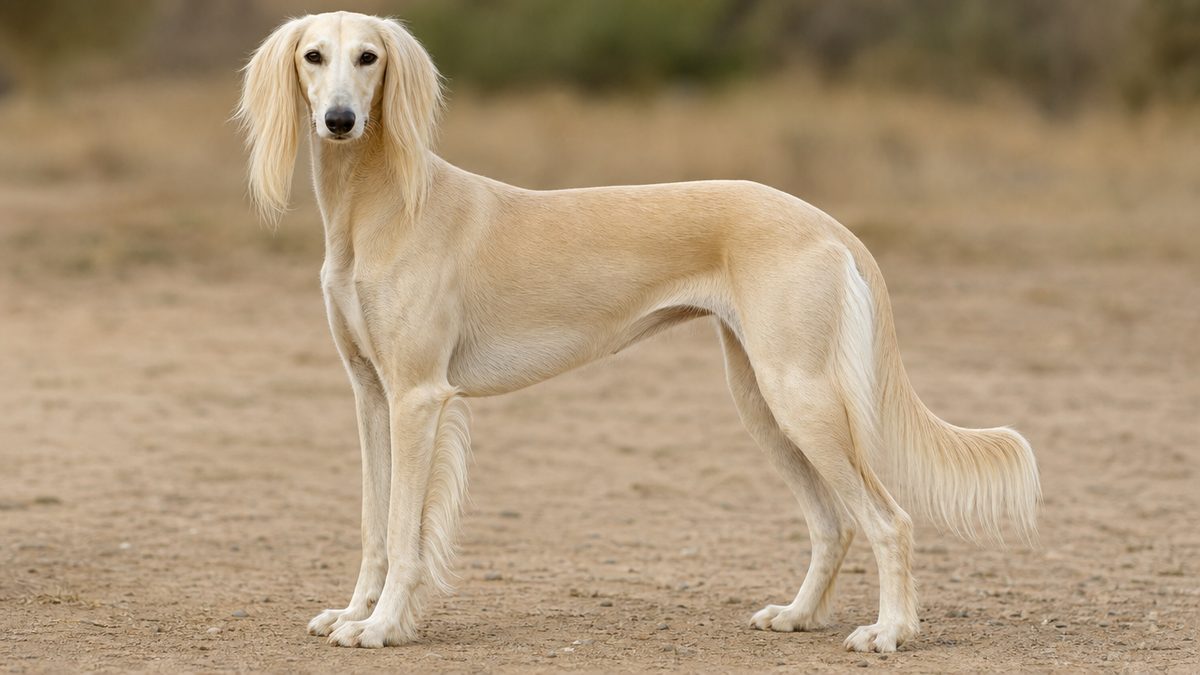
The second is that the breed comes in two coat varieties, and both are correct. The feathered variety carries long silky hair on the ears, the backs of the legs and thighs, and the underside of the tail. The smooth variety has none of it. FCI 269 handles this in one line: the points are the same except for the coat, which has no feathering. Any colour or combination of colours is permissible, and brindles are called undesirable.
The variation is deliberate, and the standard says why
The standard's own history section is unusually candid. It states that Salukis vary in type, that the variation is desired and typical, and that the reason is the size of the region the breed came from, each tribe keeping Salukis suited to its own game and terrain. It also records that by Middle East tradition Salukis are not bought or sold but presented as marks of honour, and that the British standard of 1923 was the first official European breed standard for the breed. A buyer reading an Indian price page should hold that sentence in mind: the breed's own governing document says the dogs traditionally do not have a price.
| Register | Status | What the record says |
|---|---|---|
| FCI | Fully recognised, standard 269 | Letter S index returns 41 breeds including SALUKI 269 |
| Kennel Club of India | Covered by FCI nomenclature | India is an FCI full member represented by the KCI, so Indian pedigrees run on FCI numbers |
| AKC | Fully recognised 1929, Hound Group | AKC code 417, popularity rank 135 of 210 in 2025 |
| UKC | Sighthound and Pariah group | Listed in the UKC breed-standards index |
The Saluki is a dolichocephalic breed, long-skulled, and McMillan's supplementary classification files it that way alongside every other sighthound in the study. That single word does real work later on this page, because skull shape, leg length and lean body mass drive both the heat physiology and the cancer risk that separate sighthounds from ordinary pets.
Saluki and Sloughi are different breeds with different standards, different countries of origin and different registry numbers, and Indian listings mix them freely. The Saluki is FCI 269, origin Middle East, Section 1 long haired or fringed. The Sloughi is FCI 188, origin Morocco, Section 3 short-haired, and its standard says the breed exists only in a single short-haired form. A smooth Saluki and a Sloughi look similar to an untrained eye and are not interchangeable on paper.
Saluki price in India, and why the number is a template
There is no verifiable Saluki price in India. Two Indian sites publish a band, they publish the same band, and the arithmetic behind it points at a converted foreign figure rather than at any Indian transaction.
Only two Indian pages carry a Saluki price at all. poodles.in quotes Rs 60,000 to Rs 1,50,000 and happypet.care quotes Rs 60,000 to Rs 1,50,000. Two unrelated sites agreeing to the rupee on both ends of a range is not two confirmations. It is one number appearing twice.
The monthly cost row is a shared preset, and it proves itself
Both sites also print the same monthly figures, and those figures give the game away. The row sums exactly from three component lines, and the same three lines appear on the Whippet's page with a completely different buying price.
| Line | Saluki, poodles.in | Saluki, happypet.care | Whippet, poodles.in |
|---|---|---|---|
| Food | Rs 2,250 to Rs 3,000 | Rs 2,250 to Rs 3,000 | Rs 2,250 to Rs 3,000 |
| Health | Rs 600 to Rs 1,200 | Rs 600 to Rs 1,200 | Rs 600 to Rs 1,200 |
| Grooming | Rs 700 to Rs 1,200 | Rs 700 to Rs 1,200 | Rs 700 to Rs 1,200 |
| Monthly total | Rs 3,550 to Rs 5,400 | Rs 3,550 to Rs 5,400 | Rs 3,550 to Rs 5,400 |
| Buying price | Rs 60,000 to Rs 1,50,000 | Rs 60,000 to Rs 1,50,000 | Rs 20,000 to Rs 50,000 |
Add the three component lines up. 2,250 plus 600 plus 700 is 3,550, and 3,000 plus 1,200 plus 1,200 is 5,400. The total is not a measurement of anything. It is the sum of three preset lines that the site assigns to a breed from a small menu, which is why a 71 cm desert coursing hound and a 47 cm Whippet are given an identical grooming budget while their buying prices differ by a factor of three.
Divide the band by 75 and see what falls out
Run the buying band through the exchange-rate tests. Rs 60,000 divided by 75.00 is exactly USD 800. Rs 1,50,000 divided by 75.00 is exactly USD 2,000. No other rate tested produces a pair a seller would print: at 84.38 the quotients are 711.07 and 1,777.67, at 80 they are 750 and 1,875, and at 74 they are 810.81 and 2,027.03. A clean 800 and 2,000 at both ends is what a converted American price band looks like, and USD 800 to USD 2,000 is a plausible American Saluki range.
The two Indian pages selling Salukis contain no Saluki
This is the part no ranking page mentions. Search the breed with a commercial intent and two Indian listing sites appear.
- petbuy.in, Saluki Puppies for Sale in India. The page's only price table lists Labrador, German Shepherd, Golden Retriever, Beagle, Pug, Rottweiler, Siberian Husky and Shih Tzu. There is no Saluki row.
- puppiezo.com, Saluki Puppies For Sale in India At Best Prices. The page runs to 361,852 bytes and its raw markup contains no rupee figure of any kind. Its own footer lists the breeds the site sells, and the Saluki is not among them.
Treat any rupee figure for this breed as unsourced until the seller shows you the animal, the parents and the paperwork. Bonbeno does not broker puppy sales and publishes no breeder listings. If you are shown a Saluki puppy in India, ask which register the litter is recorded in and ask to see the FCI or KCI pedigree, because there is no lawful commercial import route into India for breeding or sale stock.
One more detail worth checking yourself. happypet.care gives the breed's origin as Egypt, while the FCI standard gives Middle East under FCI patronage and names no country. When a page gets the origin field wrong, the cost of ownership figures beside it deserve no more trust.
What a Saluki actually costs to keep in India each month
Budget roughly Rs 4,000 to Rs 9,000 a month to keep a 25 kg Saluki in an Indian metro, built from published Indian rate cards rather than from a template. The cost of ownership is real and sourceable even though the purchase price is not.
The distinction matters. There is no honest Indian breed price for a Saluki, but Indian vaccination, parasite control, consultation, grooming and boarding are published figures that apply to any 20 to 30 kg dog living here.
| Item | Published figure | Source and caveat |
|---|---|---|
| Puppy core vaccination course | From Rs 6,499 | Vetic national page. A promotional floor from one chain, not a market average |
| Annual booster | From Rs 3,199 | Vetic national page |
| Anti-rabies, single dose | Rs 699 | Vetic list price |
| Consultation | Rs 500 to Rs 1,000 | VOSD. Treat as one data point, since a general insurer publishes the identical range |
| Monthly tick, flea and worm cover | About Rs 1,103 | NexGard Spectra 15 to 30 kg, 3 tablets at Rs 3,308 |
| Boarding, per 24 hours | Rs 500 to Rs 2,000 | VOSD range |
| Municipal registration, Delhi | Rs 500 | MCD pet dog registration, renewable at the same fee |
| Municipal licence, Chennai | Rs 50 | Greater Chennai Corporation, which also runs six pet clinics giving treatment and anti-rabies vaccination free |
The delivery model sets the price, not the drug
The single most useful cost fact for an Indian owner is that the same vaccine costs wildly different amounts depending on who gives it. A Greater Chennai Corporation clinic vaccinates against rabies free of charge, while a private chain lists the same anti-rabies dose at Rs 699. A municipal licence in Chennai costs Rs 50; the equivalent registration in Delhi costs Rs 500. None of that is breed-specific, and all of it is larger than the difference any breed makes.
Where a Saluki costs more than an average dog
- Parasite control is not optional here. In 584 client-owned dogs screened at the State Animal Health Centre in Kolkata, 76.54 percent were positive for *Babesia gibsoni* and 72.9 percent of the dogs screened carried two or more concurrent pathogens. Those are dogs presenting at a clinic rather than a random population, so read the number as a caseload rather than a prevalence, but it makes year-round tick cover a fixed cost.
- Anaesthesia costs more to do correctly. The published sighthound protocol requires sedative premedication, avoidance of thiobarbiturates, isoflurane maintenance and close core-temperature monitoring. A clinic that has never anaesthetised a sighthound may need to source drugs it does not stock.
- Screening is worth paying for. A SERPINF2 genotype, a cardiac examination read against Saluki-specific reference ranges and the two available DNA tests are one-off costs that prevent much larger ones.
- Food is a smaller line than owners expect. A lean coursing hound at 25 kg eats less than a heavy-bodied dog of the same height, and keeping body condition lean is a health requirement rather than a saving.
The Rs 3,550 to Rs 5,400 monthly figure the Indian breed pages give for this breed is the same figure they give the Whippet, the Basset Hound and several terriers. Open any two of those pages side by side and compare the food, health and grooming lines to the rupee. If they match, you are reading a preset, and you should build your own budget from the rate-card table above instead.
Heat tolerance: a desert hound in Indian humidity
A Saluki tolerates dry heat better than almost any European breed and humid heat considerably less well, and the homeland climatology shows exactly why. The breed's advantage is an adaptation to hot dry air, which transfers to Jaipur and Delhi far better than to Chennai, Kochi or Kolkata.
Bonbeno pulled NASA POWER climatology by explicit latitude and longitude for the homeland and for six Indian cities, and echoed the cell elevation each time so a wrong grid cell could not pass unnoticed. Riyadh returned a cell at 614.49 m against a real city elevation near 612 m, and Baghdad returned 38.44 m against a real 34 m, so both points describe the towns they name.
| Place | Annual mean temperature | Annual mean relative humidity | Hottest month mean | Coolest month mean |
|---|---|---|---|---|
| Riyadh, Saudi Arabia | 25.98 C | 24.26 percent | 36.00 C (Jul) | 13.80 C (Jan) |
| Baghdad, Iraq | 23.88 C | 36.61 percent | 37.34 C (Jul) | 9.19 C (Jan) |
| Jaipur | 25.58 C | 40.94 percent | 34.57 C (Jun) | 14.51 C (Jan) |
| Delhi | 25.60 C | 45.56 percent | 35.88 C (Jun) | 13.61 C (Jan) |
| Mumbai | 26.77 C | 67.39 percent | 31.19 C (May) | 23.19 C (Jan) |
| Pune | 23.86 C | 66.80 percent | 28.93 C (Apr) | 19.62 C (Dec) |
| Chennai | 27.95 C | 72.39 percent | 31.51 C (May) | 24.09 C (Jan) |
| Kolkata | 25.81 C | 73.93 percent | 31.53 C (May) | 17.31 C (Jan) |
A Saluki is genuinely heat-tolerant in the sense its homeland trained it to be, and that is a narrower claim than it sounds. Read the humidity column first. Riyadh runs 24.26 percent annual relative humidity and Baghdad 36.61 percent, while Chennai runs 72.39 percent and Kolkata 73.93 percent NASA POWER climatology NASA POWER climatology API. That is the whole argument in one line: the breed is not adapted to heat in general, it is adapted to a specific kind of heat that lets an animal dump load by evaporation.
Where a Saluki is genuinely comfortable in India
- Jaipur and inland Rajasthan. At 40.94 percent annual humidity and a June peak of 34.57 C, this is the closest Indian analogue to the homeland, and a Saluki here is close to home.
- Delhi and the northern plains. 45.56 percent humidity and a June peak of 35.88 C, which is hotter than Riyadh's July but dry enough to be manageable outside the monsoon months.
- Pune and Bengaluru. Cooler in absolute terms, peaking in April rather than May, but around 67 percent humidity, so the load is different rather than lower.
- Chennai, Kochi, Mumbai and Kolkata. Humid coastal cities where a lean, thin-skinned, hard-galloping hound has the least margin. A Saluki lives here perfectly well as a house dog and cannot safely be worked here in the afternoon.
Indian breed pages routinely name May as the hottest month for every city. Delhi's hottest month by mean temperature is June at 35.88 C, and Bengaluru's and Pune's is April, not May. Chennai, Mumbai and Kolkata genuinely do peak in May. If a page tells you every Indian city is hottest in the same month, it has not looked at the data.
The heat evidence that does exist for sighthounds
The Saluki was not separately modelled in the largest study of canine heat-related illness, because breed types entered that model only with five or more heat-illness cases and/or 5,000 or more dogs in the cohort. The Greyhound was modelled, and it is not reassuring: pet Greyhounds carried 4.26 times the odds of heat-related illness compared with Labrador Retrievers, with a confidence interval of 1.88 to 9.70 and p = 0.001, placing the breed fifth of the thirty-five categories tested. The paper attributes it to high lean muscle mass rather than to obesity. A Saluki carries the same lean muscle mass in the same long-limbed frame, so the honest reading is that sighthounds as a group are not the heat-safe animals their thin coats suggest, and no Saluki should be galloped in an Indian afternoon.
Indian law reaches this directly. Second Schedule Part IV paragraph 21(1) of the Dog Breeding and Marketing Rules 2017 bars keeping in outdoor facilities, without the attending veterinary practitioner's written approval, dogs not accustomed to local temperatures and breeds that cannot tolerate them, and paragraph 21(2) requires separate outdoor shade large enough to hold every animal at once and to protect them from direct sun.
Temperament: reserved, dignified and not a biddable dog
FCI 269 describes the Saluki's temperament in seven words: reserved with strangers, but not nervous or aggressive, dignified, intelligent and independent. Every practical consequence of living with the breed follows from that sentence, and Indian buyers reading marketing copy about an affectionate family hound are reading only half of it.
The AKC files the breed's temperament as reserved, graceful and noble. Both registers are describing an aloof dog that attaches deeply to its own household and declines to perform for anyone else. It is affectionate on its own terms, and it does not greet visitors.
What that means in an Indian flat
- Quiet indoors, explosive outdoors. A Saluki that has run properly will sleep most of the day on the softest surface it can find. One that has not will be restless and destructive.
- Reserved with strangers is not shyness. The standard is explicit that reserve is correct and nervousness is not. A Saluki that cowers, snaps or shakes at a visitor is showing a fault, not breed type.
- Prey drive is the defining risk in India. This is a coursing hound bred to sight and catch fast quarry. Indian streets, terraces and colony parks contain cats, squirrels, poultry and free-ranging dogs, and a Saluki at full gallop covers ground faster than any owner can react.
- It bruises easily and hates rough handling. Thin skin over very little subcutaneous fat means scrapes, tears and pressure sores from hard floors, which matters in a country where most homes have stone or tile.
Who should not buy this breed
A first-time owner in a high-rise with no safe running ground should not buy a Saluki, and neither should anyone who wants an obedient dog. The breed is intelligent and independent by standard, which in practice means it understands the request and decides. Households with cats, rabbits or poultry are taking a risk that no amount of training removes. So are owners who cannot commit to a securely fenced running space, because a Saluki off lead in an unfenced Indian setting is a dog you may not get back.
Indian breed pages describe the Saluki as a gentle family dog and stop there. The standard's word is dignified, and the AKC's is reserved. Both are compatible with a devoted house dog and neither promises a dog that tolerates a toddler pulling its ears. Match the dog to older children who understand that a sleeping sighthound is left alone.
One genuinely reassuring point. The standard's disqualifying faults are short and include aggressive or overly shy dogs, so temperament faults are penalised at the top of the fault list rather than treated as breed character. A well-bred Saluki is a calm, undemanding housemate, and the failure mode owners actually report is a bored dog rather than a difficult one.
Training a Saluki, and the one command that will not stick
Train a Saluki with short, varied, reward-based sessions and accept that recall against live quarry will never be reliable. The breed learns quickly and complies selectively, which is a description of function rather than a defect.
Start early. Socialise the puppy to traffic, lifts, market crowds, motorbikes and the sounds of an Indian street between eight and sixteen weeks, when the window is open and the vaccination course is still being completed. Indian law helps set the timetable here: the Dog Breeding and Marketing Rules 2017 record that puppies are vaccinated from the age of seven to eight weeks and that the course is usually completed at about eighteen weeks.
What works
- Short sessions. Three or four minutes, several times a day. A Saluki that has repeated an exercise ten times will simply stop offering it.
- Food that is worth working for. Boiled chicken or paneer, not kibble, and never during the hottest part of the day when the dog will not eat anyway.
- A long line, always. A 10 to 15 metre line lets you train distance work without gambling on recall. Use it for the first two years, not the first two months.
- A predictable release. Teach one clear cue that means the dog may run, so that running becomes something you grant rather than something the dog takes.
What will not work
Harsh corrections do not work and damage the relationship permanently with a reserved breed. Neither does repetition drilling, nor training in the afternoon heat, nor expecting the dog to work for praise alone. And no method makes recall reliable when a cat crosses the road. Plan the environment instead of trusting the training: fenced ground, a long line, and a lead in every unfenced space.
House training is usually settled by four months. A reliable sit, down and lead walk take about six months of short daily sessions. Recall in a quiet fenced field is achievable by a year. Recall in an Indian street with live quarry present is not a goal a Saluki owner should set, and treating it as one is how dogs are lost.
One legal point belongs here rather than in a footnote. The 2017 Rules prohibit tail docking, ear cropping, de-barking, de-clawing and any change of appearance by artificial means, in Second Schedule Part II paragraph 6(8). No part of the Saluki standard calls for any of it, so a Saluki offered to you with altered ears or tail was altered outside both the standard and Indian law.
Finally, train the vet visit. A dog that will stand for a blood draw, lie for an ultrasound and accept a muzzle without stress saves you the sedation that the sighthound anaesthesia literature says to minimise, since stress-induced complications including hyperthermia are the first of the four idiosyncrasies that review names.
Exercise: what a coursing hound needs, and when to give it in India
A Saluki needs two long daily outings plus at least one weekly chance to gallop flat out on soft ground inside a fence. Walking alone does not meet the requirement, and in most of India the run has to happen before sunrise or after dark.
FCI 269 gives the breed's utilization as a hunting and coursing hound and describes a gait that is smooth, flowing and effortless at the trot, light and lifting, with reach and drive. That is an animal built to cover ground, and an hour of lead walking on tarmac does not use it.
A workable Indian week
- Two outings a day, 45 to 60 minutes each, on lead, at the coolest hours available. In Delhi in June that means before 06:00 and after 21:00.
- One free gallop a week minimum, inside a fully fenced space on grass or soft earth. Twenty minutes is plenty; a Saluki sprints and then rests.
- Lure coursing or a flirt pole where a fenced field is not available, which lets the dog course a moving target without the risk of an open street.
- Nothing hard for two hours after a meal, and nothing hard at all when the wet-bulb load is high, which in Chennai and Kolkata is most afternoons from March to October.
Surfaces matter more than distance
Indian cities are tarmac, concrete and stone. A sighthound galloping on hard ground takes joint and pad damage that never shows up in a distance target, and hot tarmac burns pads long after the air has cooled. Test the surface with the back of your hand for five seconds before every walk in summer. If you cannot hold it, the dog should not walk on it.
Pet Greyhounds, the sighthound with the most published data, carried 4.26 times the odds of heat-related illness compared with Labradors in a 905,543-dog UK cohort, with the authors pointing at high lean muscle mass rather than obesity. A Saluki is the same shape doing the same work. Exercise-induced heat illness in this breed is an owner decision, not bad luck.
Puppies are the exception in the other direction. Do not let a growing Saluki gallop on hard surfaces or jump repeatedly before the growth plates close, which for a large sighthound is around 14 to 18 months. Free movement on grass is fine at any age; forced distance running is not.
Mental work counts. Scent games, a hidden-food routine and short training bursts take real energy out of an intelligent, independent dog, and they can be done indoors on the worst afternoons of the Indian summer when going out would be unsafe.
Grooming a feathered or smooth Saluki in Indian humidity
Grooming a Saluki takes about ten minutes a week plus a daily tick check, and the feathered variety needs a comb through the ear, leg and tail fringes to stop mats forming behind the ears and in the thigh feathering.
The coat is short and silky over the body in both varieties. The feathered variety adds long silky hair on the ears, the backs of the legs and thighs, and the underside of the tail, and adults may carry feathering on the throat. The smooth variety has none of it, and FCI 269 treats the two as the same dog with a different coat. Neither variety has an undercoat to blow, so shedding is light and the dog does not smell.
A weekly routine that works here
- Comb the fringes, if you have the feathered variety. Behind the ears, the back of the thighs and the tail underside are where mats start.
- Check the skin. Thin skin over a lean body tears and grazes easily, and small wounds go septic quickly in a humid Indian monsoon.
- Run a tick check every single day in tick season, ears, toes, groin and tail base first. The 2017 Rules make regular de-ticking part of routine grooming rather than an optional extra, in Second Schedule Part IV paragraph 27.
- Trim nails fortnightly. A sighthound's gait suffers fast when nails are long, and Indian tile floors give no natural wear.
- Bathe rarely, roughly once every six to eight weeks, and dry the ears properly afterwards rather than letting them air dry in humid weather.
Sun, not shampoo, is the Indian skin problem
A thin-coated pale sighthound sunburns. Light-coloured Salukis and those with sparse coat over the belly and inner thighs need shade rather than sunscreen, which most dogs lick off. Plan walks around the sun and give the dog a shaded outdoor rest area, which Indian law also requires of any outdoor housing under Second Schedule Part IV paragraph 21(2).
The Rs 700 to Rs 1,200 monthly grooming line that Indian breed pages give this breed is the same line they give a Pug and a Whippet. For a smooth or feathered Saluki the realistic figure is close to zero, because the coat needs a comb and a nail trim rather than a salon. Spend the difference on tick prevention instead, where a 15 to 30 kg dog costs about Rs 1,103 a month.
One last coat point that belongs on a buying checklist. FCI 269 calls brindles undesirable and permits any other colour or combination. A brindle Saluki is not disqualified, but a seller presenting brindle as a rare and premium colour is inverting what the standard says.
Saluki health, lifespan and the three things to tell your vet
Salukis are a long-lived breed with a median survival of 13.3 years, and the breed's most consequential health issues in India are not diseases but misreadings: normal sighthound blood and thyroid values look abnormal against standard reference intervals, and standard anaesthetic drugs are the wrong ones.
The strongest lifespan figure available comes from a 155-breed UK study. Its supplementary Table S3 gives the Saluki a median survival of 13.3 years, 95 percent CI 12.3 to 14.0, calculated on 169 deaths among 428 dogs, with a hazard ratio of 0.87 (0.75 to 1.01) against the crossbred group at p = 0.08. That hazard ratio does not reach significance, so the honest statement is that Salukis live about as long as crossbred dogs and possibly slightly longer, not that they outlive them. The same paper's Table S6 counts 281 alive and 169 deceased for a total of 450, which disagrees with S3's 428 while the death count is identical in both, so the death count is the figure to quote. The AKC's published life expectancy is a wider 10 to 17 years.
1. The thyroid trap, and why it matters more in India
In 283 healthy Salukis, median total T4 was 13.0 nmol/L with reference limits of 2.8 to 40.0 nmol/L, free T4 12.0 pmol/L (2.0 to 30.3), total T3 1.0 nmol/L (0.4 to 2.1), free T3 4.0 pmol/L (1.6 to 7.7) and TSH 0.18 ng/mL (0 to 0.86). Those limits are far wider at the bottom than a standard canine interval, which is why healthy Salukis are routinely called hypothyroid. The same study looked at 398 sighthounds that practitioners had diagnosed as hypothyroid: 303 of them, 76.1 percent, were diagnosed on a low thyroid hormone concentration alone, 30 more (7.5 percent) despite every index sitting inside reference limits, and only 65 (16.3 percent) had a raised TSH or a positive thyroglobulin antibody result to support the diagnosis.
Second Schedule Part III paragraph 8(10) of the Dog Breeding and Marketing Rules 2017 requires that breeding dogs have been tested for genetic defects including hypothyroidism, alongside hip dysplasia, progressive retinal atrophy and night blindness. Indian law therefore mandates a thyroid test on the one group of breeds in which a low reading is the normal finding. A breeder complying with the letter of that clause, using a standard canine reference interval, will over-diagnose. Ask for the TSH and thyroglobulin antibody results alongside the T4, and consult your nearby veterinarian before any Saluki is started on thyroid supplementation.
2. Delayed postoperative bleeding
A 2025 survey genotyped 63 breeds, including 16 sighthound breeds, using 4,044 pet dogs plus public data, for the SERPINF2 c.605 C>T variant behind delayed postoperative haemorrhage. The Saluki carried a 30 percent allele prevalence, in the moderate band alongside the Galgo Espanol at 34 percent, the Whippet at 25 percent and the Scottish Deerhound at 23 percent, with the high-risk T/T genotype running between 5 and 13 percent across that band. Nine of the 16 sighthound breeds reached at least 5 percent T/T while none of the 47 non-sighthound breeds did. The practical consequence is that bleeding can start 36 to 48 hours after an uneventful spay or neuter, once the dog is home.
3. Anaesthesia
The published sighthound anaesthesia review names four idiosyncrasies: a nervous demeanour that can cause stress-induced complications including hyperthermia; a lean body with a high surface-area-to-volume ratio predisposing to hypothermia; higher packed cell volume and lower serum protein than other breeds, which complicates pre-anaesthetic blood work; and impaired hepatic biotransformation producing prolonged recovery, especially from thiopental. Its instruction is unambiguous: thiopental, or any other thiobarbiturate, should not be used in these dogs, propofol, ketamine with diazepam and methohexital are the recommended alternatives, isoflurane maintenance is preferred, and core temperature must be monitored during anaesthesia and into recovery. Bonbeno's Greyhound page carries the same protocol, because it applies to the group.
Do not hand a Saluki the Greyhound's blood values
This is the correction most Indian pages need. The only study to compare sighthound breeds against each other tested 192 individuals across eight breeds, the Whippet, Greyhound, Italian Greyhound, Sloughi, Saluki, Borzoi, Pharaoh Hound and Azawakh, found significant differences between them, and concluded in terms that application of the Greyhound laboratory profile to other sighthounds is not recommended. The Whippet came closest to the Greyhound; the Saluki did not.
Inherited conditions with a DNA test
- Neuronal ceroid lipofuscinosis, caused in Salukis by a single base pair insertion in CLN8.
- Succinic semialdehyde dehydrogenase deficiency, caused by a missense variant in ALDH5A1 and described in the Saluki.
- Cardiac assessment against breed reference ranges, since Saluki-specific echocardiographic reference ranges exist and standard canine ranges will flag a normal Saluki heart as enlarged. Ambulatory ECG work in healthy Salukis has also mapped the arrhythmias that occur in normal dogs of the breed.
The India-specific health load is parasitic rather than inherited. Among 584 client-owned dogs screened in Kolkata, 76.54 percent were positive for *Babesia gibsoni*, 55.75 percent for *Anaplasma* species and 16.61 percent for *Ehrlichia canis*, and 72.9 percent of the dogs screened carried two or more pathogens at once. Those are clinic cases rather than a random sample, and they are still the reason year-round tick control is not negotiable here.
Feeding a Saluki in India: lean is the target, not thin
Feed a Saluki to a visibly lean body condition with the last one or two ribs faintly visible in movement, split across two meals, and never within two hours either side of hard exercise. A correctly fed Saluki looks underfed to anyone used to Labradors.
The standard describes a chest that is deep, long and moderately narrow, neither barrel ribbed nor slab sided, over a well tucked up underline. That shape is the target. An owner who feeds a Saluki until the tuck-up disappears has produced an overweight sighthound, and the extra load falls on joints built for speed rather than for mass.
A practical Indian feeding plan
- Two meals a day for an adult, morning and evening, avoiding the hottest hours when most dogs will not eat well anyway.
- Three to four meals a day for a puppy up to six months, then three until nine months.
- No hard exercise for two hours after a meal, and none in the two hours before. A deep-chested hound is the wrong shape to gamble on.
- Fresh water always available, and more of it than you expect during the dry northern summer where the breed does best.
- Weigh the dog monthly and record it, because a lean dog's weight change is easy to miss by eye.
Indian availability is straightforward for a 20 to 30 kg dog. Every large national brand sells a medium or large adult formula, and a home-prepared diet built on chicken, curd, rice and vegetables is workable if a vet sets the calcium and phosphorus balance. What matters more than the brand is the quantity: measure it rather than filling a bowl.
On a correctly conditioned Saluki you should see a deep chest running into a dramatic tuck-up, feel the ribs with no pressure, see the last one or two ribs faintly in movement, and feel the hip bones just under the skin. If you can see every rib at rest and the hip bones stand proud, the dog is too thin. If the tuck-up has flattened, it is too heavy. Ask your nearby veterinarian to score body condition at each visit and to write the score in the file.
Two Indian conditions change the feeding picture. In the humid coastal cities appetite drops sharply in April and May, and a dog that eats less for six weeks in summer is behaving normally rather than falling ill. And in a country where tick-borne disease is a routine clinic finding, a sudden loss of appetite in a Saluki is a reason to test rather than to change food.
One caution about published feeding figures for this breed in India. The same pages that print a template price also print a food line of Rs 2,250 to Rs 3,000 a month, and give the identical line to the Whippet, a dog roughly half the Saluki's weight. Build the food budget from the pack's own feeding guide and your dog's measured weight instead.
The first year with a Saluki puppy, month by month
Plan the first year around three things: the socialisation window that closes around sixteen weeks, growth plates that do not close until 14 to 18 months, and the Indian vaccination schedule that the 2017 Rules describe.
| Age | What is happening | What you do |
|---|---|---|
| Under 8 weeks | Still with the litter. Indian law prohibits the sale of pups under eight weeks of age | Do not accept a younger puppy under any circumstance, under Rule 8(1)(a) |
| 8 to 12 weeks | Core vaccination course under way, from about seven to eight weeks | Socialise hard and safely. Carry the puppy through markets and lift lobbies before the course finishes |
| 12 to 16 weeks | Socialisation window closing | Traffic, motorbikes, stairs, crowds, other dogs, handling by strangers, gentle nail and ear work |
| 16 to 18 weeks | Vaccination course usually complete at about eighteen weeks | Begin short lead walks at cool hours. Register with the municipality |
| 4 to 6 months | Fast height growth, gangly and clumsy | No forced running, no repeated jumping, no stairs marathons. Free movement on grass only |
| 6 to 9 months | Adolescent testing, recall degrades | Long line goes on and stays on. Keep sessions short and rewarding |
| 9 to 12 months | Approaching adult height, still filling out | Introduce controlled straight-line galloping on soft ground inside a fence |
| 14 to 18 months | Growth plates closing | Only now build real distance and speed work |
The three checks to make before you collect a puppy
- Age and microchip. The Rules require that pups under eight weeks are not sold and that each pup sold is micro-chipped with a complete record of treatment and vaccination maintained. A seller who cannot produce a chip number has not complied.
- Parents' paperwork. Ask to see the FCI or KCI pedigree, the parents' cardiac assessment read against Saluki reference ranges, and any CLN8 and ALDH5A1 DNA results.
- Where the litter came from. There is no lawful commercial import route for breeding or sale stock into India, so ask directly how the founding animals entered the country.
A Saluki puppy will run itself into trouble in Indian heat because it has no judgement yet and a very high surface area for its mass. Between March and October in most of the country, take puppies out before 06:30 and after sunset only, and stop the outing at the first sign of heavy panting with a wide tongue. Consult your nearby veterinarian immediately if a puppy collapses, vomits or becomes unsteady after exertion.
Expect the adult dog to be quieter than the puppy by a wide margin. Salukis mature slowly in body and quickly in temperament, and the destructive phase most owners describe sits between six and twelve months, which is exactly when the long line and the fenced weekly gallop earn their keep.
Saluki against the breeds Indian buyers actually cross-shop
Indian buyers looking at a Saluki are usually also looking at a Greyhound, a Whippet, an Afghan Hound or an Indian sighthound. The differences that matter here are supply, heat fitness and how much published clinical data your vet can work from.
| Saluki | Whippet | Rampur Greyhound | Indian Pariah Dog | |
|---|---|---|---|---|
| Height at withers | 58 to 71 cm average | Small by McMillan's body-size classification | Large Indian sighthound, no FCI standard | Medium, landrace |
| Median survival, UK cohort | 13.3 years on 169 deaths | 13.4 years on 1,483 deaths | No cohort study exists | No cohort study exists |
| Indian availability | No verifiable transaction price; listing pages contain no dogs | Advertised widely, template pricing | Genuine Indian breeders | Free from any shelter |
| Heat fitness | Adapted to dry heat, weaker in humid coastal air | Thin-coated, low body fat, needs the same care | Bred in the Indian climate | Best heat-adapted option in India |
| SERPINF2 bleeding allele | 30 percent | 25 percent | Not surveyed | Not surveyed |
| Anaesthesia caution | Applies as a sighthound | Applies as a sighthound | Applies by extrapolation | Standard protocol |
| Breed-specific lab values | Yes, thyroid and cardiac Giraut S, Haggstrom J, Koskinen LLE | Yes, closest profile to the Greyhound | None published | None published |
Two rows in that table decide most purchases. The first is availability. A Whippet or an Indian sighthound can actually be bought here from a person with dogs; a Saluki mostly cannot, and the pages that say otherwise contain no Saluki price and no Saluki puppiezo.com, Saluki Puppies For Sale….
The second is data. If your dog develops a problem, a vet treating a Saluki has breed-specific thyroid values, breed-specific cardiac reference ranges, an eight-breed haematology comparison, a bleeding-risk genotype and a published anaesthesia protocol to work from. For a Rampur Greyhound or a Mudhol Hound, none of that exists. That is an argument for the imported breed on clinical grounds and against it on every practical one.
If you want a sighthound in India and you live anywhere humid, an Indian sighthound or an adopted Indian Pariah Dog is the better animal for the climate and the only one with a real supply chain. Choose a Saluki because you want that specific dog, can give it dry-season running space, and have a vet willing to read the sighthound literature. Do not choose it because a listing page quoted a price.
Six mistakes Indian Saluki owners actually make
Most Saluki problems in India come from six specific errors, and five of them are avoidable by a decision made before the dog arrives.
1. Trusting a quoted price
Rs 60,000 to Rs 1,50,000 appears on two sites, divides exactly by 75 into USD 800 and USD 2,000, and sits above a monthly cost row shared with the Whippet. Treat it as a converted foreign figure, not an Indian market rate.
2. Letting the dog off lead
A coursing hound in an unfenced Indian street is a dog you may lose. Prey drive is the breed's function, and recall is not a solution to it. Use a long line for the first two years and a fenced space thereafter.
3. Accepting a hypothyroidism diagnosis without the supporting tests
In the largest study of the question, 76.1 percent of 398 sighthound hypothyroid diagnoses rested on a low hormone reading alone. Ask for the TSH result and the thyroglobulin antibody result before any Saluki is put on lifelong medication, and consult your nearby veterinarian about breed-specific reference limits.
4. Allowing thiopental
Thiopental, or any other thiobarbiturate, should not be used in sighthounds, and isoflurane maintenance with sedative premedication and close core-temperature monitoring is the published alternative. In a general practice that has never anaesthetised a sighthound, saying this out loud before the dog is on the table is the entire intervention.
5. Sending the dog home after surgery without a bleeding plan
The SERPINF2 bleeding-risk allele runs at 30 percent in the breed, and delayed haemorrhage appears a day or two after an operation that looked uneventful. Agree in advance what you will do if bruising spreads across the belly on day two, and get the number of a clinic that is open at night.
6. Galloping the dog in an Indian afternoon
The sighthound with the most published data carried 4.26 times the odds of heat-related illness against Labradors, attributed to lean muscle mass rather than to fat. Move the run to dawn or after dark from March to October, and check the tarmac with your hand first.
New owners often worry that a correctly conditioned Saluki looks too thin, and feed it up. Resist. The standard asks for a deep chest running into a well tucked up underline, and the lean shape is the healthy one. Ask your veterinarian to record a body condition score at every visit so you have a number rather than an impression.
Adoption and responsible sourcing for a Saluki in India
Adopt before you buy, and if you buy, verify the litter against Indian law before money changes hands. A Saluki is one of the harder breeds to source honestly in India, and that is a reason to slow down rather than to hurry.
Why adoption comes first here
India has no shortage of dogs needing homes, and the best heat-adapted dog in the country is free. If you want a lean, quiet, low-shedding, low-odour house dog that copes with Indian summers, an adopted Indian Pariah Dog delivers most of what people want from a Saluki without the anaesthetic complications, the thyroid confusion or the sourcing problem. Breed-specific rescue for imported sighthounds does exist in India but is small, so ask general shelters to flag sighthound-type arrivals.
If you are buying, verify these seven things
- A pedigree you can read. FCI or KCI, with the breed recorded as Saluki and the standard number 269.
- A microchip number, which Rule 8(1)(e) makes mandatory on every pup sold.
- Age at least eight weeks, under Rule 8(1)(a).
- A vaccination record consistent with a course beginning at seven to eight weeks.
- Health screening on both parents: cardiac against Saluki reference ranges, CLN8 and ALDH5A1 DNA results, and a SERPINF2 genotype if available Vernau KM, Struys E, Letko A, Woolard KD Court MH, Hardy M, Forbes KR, Yang H.
- No altered ears or tail. Docking, cropping, de-clawing and any change of appearance by artificial means are prohibited under Second Schedule Part II paragraph 6(8).
- A truthful answer about origin. Ask where the founding stock came from, because dogs are a Restricted import and applications for trading or breeding purposes are to be duly rejected.
A seller offering a Saluki puppy immediately, from a photograph, with a price quoted before you have asked anything, is the pattern that fits the listing pages this guide examined: pages titled for the breed that contain no Saluki price and no Saluki petbuy.in, Saluki Puppies for Sale…. A smooth Saluki offered cheaply may be a Sloughi, an Indian sighthound or a crossbreed, and none of those is a fraud unless it is sold as something it is not.
What you owe the dog if you go ahead
A fenced place to gallop once a week, walks at cool hours, year-round tick control in a country where 72.9 percent of dogs screened at one Kolkata centre carried two or more blood pathogens, a vet who will read the sighthound anaesthesia protocol before surgery, and a written note in the clinical file covering the bleeding risk. That list is short, and every item on it is cheaper than the consequence of skipping it.
Bonbeno does not sell animals, broker puppy sales or take breeder listings, and nothing on this page is an offer. Where sources disagree, this page prints the disagreement rather than picking the convenient number.
Saluki questions Indian buyers actually need answered
What is the Saluki price in India?
No verifiable Indian transaction price exists. Two sites quote Rs 60,000 to Rs 1,50,000, they print the identical figure, and both divide exactly by 75 to USD 800 and USD 2,000, which is the signature of a converted foreign price rather than an Indian observation. Two Indian pages advertising Saluki puppies for sale carry no Saluki price at all.
How long do Salukis live?
The largest study to give the breed its own row is McMillan 2024, which reports a median survival of 13.3 years with a 95 percent confidence interval of 12.3 to 14.0 years, calculated on 169 deaths among 428 Salukis in a UK cohort. The AKC quotes a wider life expectancy of 10 to 17 years.
Can a Saluki handle Indian heat?
A Saluki handles dry heat better than almost any Western breed and humid heat much less well. Its homeland at Riyadh runs an annual mean of 25.98 degrees Celsius at 24.26 percent relative humidity, hotter than Delhi and less than a third as humid as Chennai, so the adaptation transfers to Jaipur far better than to a coastal city.
Is the Saluki recognised by the Kennel Club of India?
India is a full FCI member represented by the Kennel Club of India, so Indian pedigrees are issued against FCI nomenclature, and the Saluki holds FCI standard 269 in Group 10, Section 1. The KCI publishes no breed list of its own, so absence from its website proves nothing either way.
How big does a Saluki get?
FCI Standard 269 gives a height at withers averaging between 58 and 71 cm, with bitches proportionally smaller, and states no weight at all. The AKC gives 23 to 28 inches for males and 40 to 65 pounds, so any Indian listing quoting a precise kilogram figure as the standard is quoting something the standard does not contain.
What health tests should a Saluki breeder have done?
Ask for a documented cardiac examination read against Saluki-specific echocardiographic reference ranges, DNA results for the CLN8 insertion causing neuronal ceroid lipofuscinosis and the ALDH5A1 variant causing succinic semialdehyde dehydrogenase deficiency, and a SERPINF2 genotype, because the bleeding-risk allele runs at 30 percent in the breed.
Why do vets say sighthounds need a different anaesthetic?
The published review of sighthound anaesthesia identifies four idiosyncrasies, a nervous demeanour, a lean body with a high surface-area-to-volume ratio, higher packed cell volume with lower serum protein, and impaired hepatic drug biotransformation. It states that thiopental, or any other thiobarbiturate, should not be used in these dogs and that isoflurane maintenance is preferred.
Is a low thyroid result in a Saluki a disease?
Usually not. In 283 healthy Salukis the median total T4 was 13.0 nmol/L with reference limits running from 2.8 to 40.0 nmol/L, which is far wider than a standard canine interval. In the same study 303 of 398 sighthounds (76.1 percent) had been diagnosed hypothyroid on a low hormone concentration alone, without a raised TSH or a positive antibody result.
Do Salukis get along with cats?
Assume not, and plan around it. This is a coursing hound whose entire function is to sight, chase and catch fast-moving quarry, and Indian streets and terraces are full of cats, squirrels and poultry. A Saluki raised with a household cat may accept that specific cat and still course a strange one.
Can I import a Saluki into India?
Only as an accompanied pet, and never for breeding or sale. DGFT Trade Notice 22/2022-23 makes dogs a Restricted import under ITC(HS) 01061900, permits entry for a pet with a valid pet book in the importer's name, for research on CPCSEA recommendation, or for Defence and Police use, and states that applications for trading or breeding purposes shall be duly rejected.
What does a Saluki cost per month in India?
Budget roughly Rs 4,000 to Rs 9,000 a month for food, parasite control, routine veterinary care and grooming, built from real Indian rate cards rather than from a template row. Monthly parasite cover alone runs about Rs 1,103 for a 15 to 30 kg dog on NexGard Spectra, and a consultation is quoted at Rs 500 to Rs 1,000.
Is the Saluki a good first dog?
No. An independent, reserved coursing hound with unreliable recall, a documented anaesthetic protocol, breed-specific blood and thyroid values and no Indian supply chain is a poor first dog in an Indian city. A first-time owner is better served by a heat-adapted Indian Pariah Dog from a shelter.
Is Saluki a good family dog?
A devoted house dog on its own terms, and not the gentle family hound Indian listing pages describe. FCI 269 gives the temperament in seven words, reserved with strangers but not nervous or aggressive, dignified, intelligent and independent, and the AKC files it as reserved, graceful and noble. It attaches deeply to its own household, does not greet visitors, understands a request and decides. Match it to older children who leave a sleeping sighthound alone, a securely fenced running space, and a home without cats, rabbits or poultry, because the prey drive is the defining risk in India.
Is Saluki an Indian breed?
No. FCI standard 269 gives the Saluki's origin as Middle East under FCI patronage rather than any single country, and records that by Middle East tradition Salukis are not bought or sold but presented as marks of honour. India is a full FCI member represented by the Kennel Club of India, so Indian pedigrees run on that number, but the breed mostly cannot be bought here and the pages that say otherwise contain no Saluki. India's own sighthounds are the Rampur Greyhound and the Mudhol Hound, which have a real supply chain and no published clinical data.
Compare with similar breeds
Saluki sits in 1 Bonbeno group. Each one compares it directly against the breeds it is genuinely an alternative to, on the same figures.