
Dog breed profile
Taigan Dog Breed: Kyrgyz Sighthound Facts, Size and India Guide
What the Taigan actually is, measured in 77 dogs in Kyrgyzstan, why it holds no place in any international register while its genetic near-twin does, and why there is no Indian market at all.
Quick answer
The Taigan dog breed is a Kyrgyz sighthound from the Tien Shan mountains, measured in 2025 at an average 64.82 cm at the withers and 20.94 kg across 77 dogs. It has no Indian market at all: neither Indian breed-content site carries a page for it, and no international registry recognises it, while its genetic near-twin the Kazakh Tazy entered the FCI provisional register on 3 September 2024.
This guide is general information for Indian pet owners and is not a diagnosis. No breed-specific veterinary literature exists for the Taigan, so every health statement here is either a group-level sighthound finding or an explicit gap. Consult your nearby veterinarian before acting on anything here, especially before any anaesthetic procedure, and treat any sudden change in your dog's condition as urgent.
Taigan at a glance, rated for India
What the Taigan is, and what is actually documented about it
The Taigan is a Kyrgyz sighthound from the Tien Shan mountains, described in its own peer-reviewed literature as an ancient breed adapted to hunting at high altitudes and in rough terrain. Until 2025 almost nothing about it was measured; two papers published that year changed that, and this page is built on them.
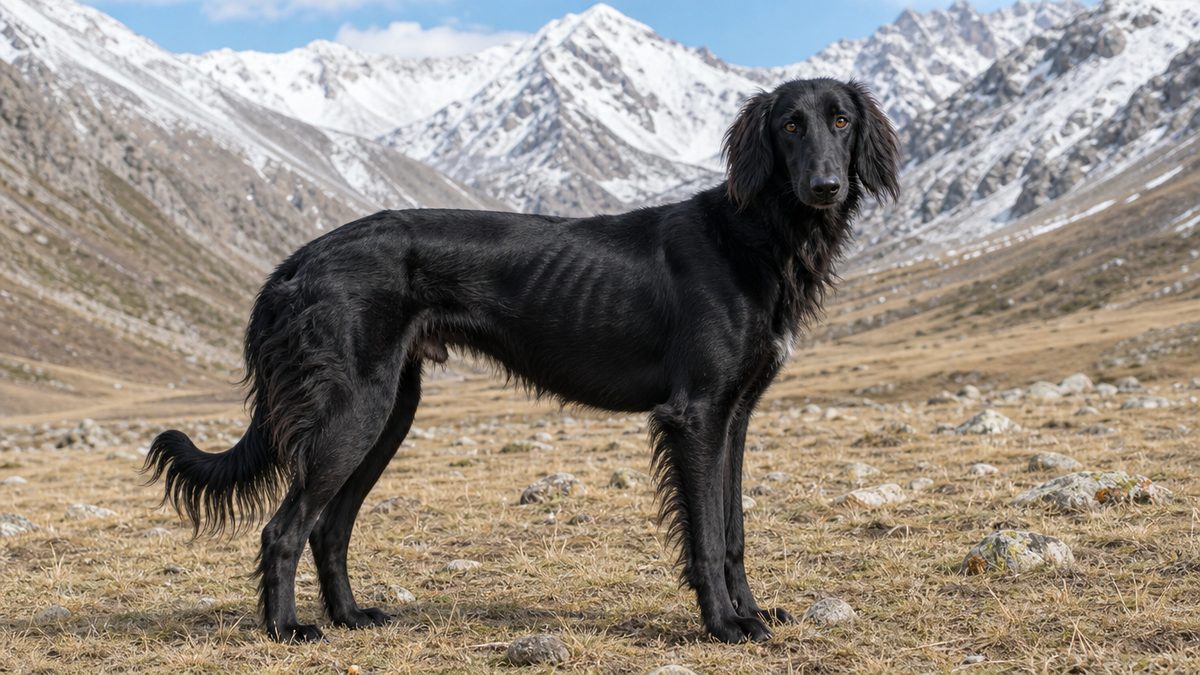
Start with what is now known rather than what is repeated. In 2025 a team from the Kyrgyzstan-Turkey Manas University measured 77 Kyrgyz Taigans, 45 males and 32 females, across three age groups of 12 to 16, 24 to 30 and 36 plus months. The whole-group averages are a withers height of 64.82 cm, a bodyweight of 20.94 kg, a body length of 64.36 cm, a chest circumference of 69.30 cm and a chest depth of 30.66 cm.
| Measurement | Males (n = 45) | Females (n = 32) | Significance |
|---|---|---|---|
| Body weight | 21.97 plus or minus 0.63 kg | 19.57 plus or minus 0.55 kg | p < 0.01 |
| Withers height | 66.23 plus or minus 0.65 cm | 62.94 plus or minus 0.66 cm | p < 0.01 |
| Body length | 65.72 plus or minus 0.79 cm | 62.55 plus or minus 0.61 cm | p < 0.01 |
| Chest circumference | 70.45 plus or minus 0.83 cm | 67.76 plus or minus 0.88 cm | p < 0.05 |
| Head length | 25.80 plus or minus 0.28 cm | 24.57 plus or minus 0.29 cm | p = 0.003 |
The number that matters most is the ratio
A dog 66 cm at the withers weighing 22 kg is remarkably light. For comparison, the FCI gives the Sloughi a height of 66 to 72 cm and the AKC gives that breed 40 to 65 pounds, which is 18 to 29 kg, so the Taigan sits at the bottom of that band at the bottom of that height. The study's own conclusion is that the Kyrgyz Taigan is medium-sized in terms of body weight, long-headed and dolichocephalic, rectangular in body shape like other greyhound breeds, and that the rump and withers are of nearly similar heights. Compared with other greyhound breeds it has greater head length, greater withers and rump heights, and greater chest circumference and depth.
Coat colour, counted rather than described
| Colour | Dogs | Percentage |
|---|---|---|
| Black | 32 | 41.559 percent |
| Yellow | 14 | 18.182 percent |
| Pied black | 12 | 15.584 percent |
| Grey | 8 | 10.389 percent |
| Light brown | 8 | 10.389 percent |
| White | 3 | 3.897 percent |
| Total | 77 | 100.0 percent |
The six counts sum exactly to 77 and each percentage reproduces from its own count, so the table is internally sound. One small caution for anyone reading the paper directly: its Results paragraph describes pied black and yellow as 18.2 and 15.584 percent, which swaps the two labels against its own Table 6 and against its own Discussion. The table and the discussion agree with each other, so those are the figures used here.
There is no published breed standard from the FCI, the AKC or the UKC, so there is no official statement of correct type, no fault list and no disqualification list for this breed United Kennel Club, Breed Standards index American Kennel Club. There is no published temperament assessment, no lifespan study, no screening scheme and no breed-specific reference interval for any laboratory value. This page states what was measured and marks the rest as unknown rather than filling the gaps from a related breed.
Taigan price in India: there is no market to have a price in
No Taigan price in India exists, and the absence is measurable rather than assumed. The two Indian sites that publish price pages for rare imported sighthounds do not carry a page for this breed at all, and both were tested against working controls in the same session.
This is the honest version of a finding that most rare-breed pages fudge. Rather than reporting an empty search, Bonbeno checked the two Indian breed-content sites that generate price pages for obscure imports and confirmed the absence at each site's own URL.
| Site and path | Response | What that means |
|---|---|---|
| poodles.in /dog-breeds/taigan/ | HTTP 200, title Dog Breed Not Found, 816 characters | A soft 404. A status check alone would have passed it |
| poodles.in, invented control slug | HTTP 200, identical Dog Breed Not Found page | Confirms the response is the site's not-found page |
| poodles.in /dog-breeds/saluki/ | HTTP 200, full 17,617-character breed page | Confirms the site does serve rare sighthound pages |
| happypet.care /dog-breeds/taigan | HTTP 404 | A hard not-found, with its own control also returning 404 |
That combination is worth naming precisely. poodles.in serves HTTP 200 with the title Dog Breed Not Found, so any automated check that reads only the status code would record the page as existing. Read the title, not the status. And because the same site serves a complete 17,617-character page for the Saluki, the absence is about this breed rather than about the site's coverage of rare sighthounds generally.
Why no lawful Indian supply chain can form
Two facts close the question. First, the breed holds no FCI number, being absent from both the definitive letter T index of ten breeds and the 20-entry provisional register Federation Cynologique Internationale. India is an FCI full member represented by the Kennel Club of India, so Indian pedigrees are issued against FCI nomenclature and a breed with no FCI number has no ordinary Indian pedigree route. Second, dogs are a Restricted import under DGFT Trade Notice 22/2022-23, with entry permitted only for a pet accompanying an owner holding a valid pet book, for research on CPCSEA recommendation, or for Defence and Police use, and with applications for trading or breeding purposes to be duly rejected.
Ask what register the litter is recorded in, and expect no satisfactory answer, because no international register holds the breed United Kennel Club, Breed Standards index American Kennel Club. A large lean sighthound offered in India as a Taigan is far more likely to be a Rampur Greyhound, a Mudhol Hound, a Saluki cross or an Indian sighthound of unrecorded breeding. None of those is a bad dog, and a seller who cannot document the claim should not be charging an import premium for it.
Bonbeno reports published prices as editorial content and does not broker sales. Where no price exists, this page publishes none rather than converting a foreign figure into rupees, which is the mechanism that produces most of the fabricated Indian prices this site has documented elsewhere.
What a Taigan would cost to keep in India, if one existed
A 21 kg working sighthound in an Indian metro costs roughly Rs 4,000 to Rs 8,000 a month once food, parasite control, routine veterinary care and municipal fees are built from published Indian rate cards. The cost of ownership is the part of this page that can be sourced properly, because it depends on the dog's size and the country rather than on the breed.
None of the figures below are Taigan figures. They are Indian figures for a dog of the size the 2025 measurements describe, and that is the honest way to give an Indian reader a budget when the breed itself has no market here.
| Item | Published figure | Source and caveat |
|---|---|---|
| Puppy core vaccination course | From Rs 6,499 | Vetic national page, a promotional floor from one chain |
| Annual booster | From Rs 3,199 | Vetic national page |
| Anti-rabies, single dose | Rs 699 privately, free at a Chennai municipal clinic | Vetic against Greater Chennai Corporation Greater Chennai Corporation |
| Consultation | Rs 500 to Rs 1,000 | VOSD, treated as one data point |
| Monthly tick, flea and worm cover | About Rs 1,103 | NexGard Spectra 15 to 30 kg, 3 tablets at Rs 3,308 |
| Boarding, per 24 hours | Rs 500 to Rs 2,000 | VOSD range |
| Municipal registration, Delhi | Rs 500 | MCD pet dog registration, 18,958 certificates issued since 2021 |
| Municipal licence, Chennai | Rs 50 | Greater Chennai Corporation, 9,115 licences issued in 2024 |
The delivery model, not the breed, sets most of the price
The most useful cost fact for an Indian owner of any sighthound is that the same intervention costs wildly different amounts depending on who provides it. A Greater Chennai Corporation clinic gives anti-rabies vaccination free of charge, while a private chain lists the same dose at Rs 699. A Chennai municipal licence costs Rs 50 and a Delhi registration Rs 500. Those gaps are larger than any breed difference.
The line that would be genuinely different
- Cooling. A mountain sighthound in an Indian plains summer is a cooling cost that no breed page publishes, and for this breed it would be the largest single line.
- Parasite control, all year. Among 584 client-owned dogs screened at a Kolkata animal health centre, 76.54 percent were positive for *Babesia gibsoni* and 72.9 percent of the dogs screened carried two or more pathogens at once. Those are clinic cases rather than a population sample, and they still make cover a fixed cost.
- Veterinary uncertainty. With no breed-specific reference intervals published, a vet interpreting a Taigan's blood work would be working from a general canine range on a lean sighthound, which the sighthound literature warns against.
- Grooming, which is close to zero. The measured population carried a functional working coat in six colours and nothing that needs a salon.
If the appeal is a lean, hardy, medium coursing hound at roughly 21 kg and 65 cm, an Indian sighthound gives you the same animal with a real supply chain and a climate it evolved in. A Rampur Greyhound or a Mudhol Hound costs the same to keep, is legal to buy, and does not require an import that Indian trade rules would refuse.
Heat tolerance: a mountain breed, and a climate nobody can measure
A Taigan is a high-altitude mountain sighthound and is not heat-tolerant in any Indian sense, and the honest position is that its working climate cannot be measured with the instrument this site uses. Only one of three Kyrgyz points returned a usable grid cell, and it is not the one the breed works in.
NASA POWER returns a MERRA-2 grid cell rather than a point, and in mountainous terrain the cell's mean elevation can miss the ground beneath it by more than a kilometre. Kyrgyzstan is the worst case Bonbeno has tested for this. Naryn returned a cell at 2,987.36 m against a real town elevation near 2,000 m, an error of 987.36 m, and Karakol returned 2,288.44 m against about 1,770 m, an error of 518.44 m. Neither cell describes the town beneath it, and neither can be published.
Bishkek is the only usable Kyrgyz point, returning 721.28 m against a real city elevation near 800 m, an error of 78.72 m. Bishkek sits in the Chuy valley, which is not where a Taigan hunts.
| Place | Cell elevation error | Annual mean temperature | Annual mean relative humidity | Hottest month | Coolest month |
|---|---|---|---|---|---|
| Bishkek, Kyrgyzstan | minus 78.72 m, usable | 13.76 C | 47.14 percent | 27.55 C (Jul) | 0.63 C (Jan) |
| Delhi | minus 9.63 m | 25.60 C | 45.56 percent | 35.88 C (Jun) | 13.61 C (Jan) |
| Jaipur | minus 25.26 m | 25.58 C | 40.94 percent | 34.57 C (Jun) | 14.51 C (Jan) |
| Pune | plus 75.99 m | 23.86 C | 66.80 percent | 28.93 C (Apr) | 19.62 C (Dec) |
| Bengaluru | minus 78.28 m | 23.74 C | 67.94 percent | 28.37 C (Apr) | 20.22 C (Dec) |
| Mumbai | plus 83.15 m | 26.77 C | 67.39 percent | 31.19 C (May) | 23.19 C (Jan) |
| Chennai | plus 42.95 m | 27.95 C | 72.39 percent | 31.51 C (May) | 24.09 C (Jan) |
What the numbers do and do not show
Bishkek's annual mean of 13.76 degrees Celsius is 11.84 degrees below Delhi's and its January mean of 0.63 degrees is below anything in plains India. Humidity is the one column where the two are comparable: Bishkek at 47.14 percent sits close to Delhi at 45.56 percent, so this is a continental dry climate rather than a damp one.
But Bishkek understates the case, and that is the point. The breed's own literature describes it as adapted to hunting at high altitudes and in rough terrain, and the Tian Shan hunting grounds sit one to two kilometres above the Chuy valley. Applying the standard lapse rate of about 6.5 degrees Celsius per 1,000 metres to Bishkek's figures suggests a working environment somewhere between 6 and 1 degrees Celsius annual mean. That is an estimate and is labelled one, because the grid cells that would confirm it are wrong by 518 to 987 metres.
A Taigan has no business in plains India. Even the valley city its breed comes from is nearly twelve degrees cooler on the annual mean than Delhi, and the breed does not live in that valley. There is no breed-specific heat-illness figure, because the Taigan was not modelled in the only study that produces them, where a breed type needed five or more cases and/or 5,000 or more dogs to enter the model. What that study does show is that the sighthound it did model, the Greyhound, carried 4.26 times the odds of heat-related illness against Labrador Retrievers at p = 0.001, attributed to high lean muscle mass. Second Schedule Part IV paragraph 21(1) of India's Dog Breeding and Marketing Rules 2017 separately bars keeping dogs not accustomed to local temperatures in outdoor facilities without written veterinary approval.
For completeness, the Indian cities that would be least hostile are Pune and Bengaluru, both peaking in April at around 28.5 degrees rather than in May, and both cooler in absolute terms than Delhi or Chennai. That is a ranking of bad options rather than a recommendation.
Temperament: what is documented, and what is only asserted
No published breed standard describes the Taigan's temperament and no survey has measured it, so this section separates what the peer-reviewed literature supports from what English breed pages assert without a source.
What the literature supports is functional rather than behavioural. The breed is described in a 2025 genetic study as an ancient sighthound native to the Tien Shan mountains adapted to hunting at high altitudes and in rough terrain, and the 2025 morphological study measured a light, long-headed, rectangular, deep-chested dog built for exactly that. From function you can infer a great deal, and inference is what it remains.
What follows from a working mountain sighthound
- High prey drive, because the animal's documented purpose is pursuing game by sight over rough ground. Every sighthound page on this site says this and here it is the only temperament claim with a documented basis.
- An independent worker rather than a biddable one. A dog working out of sight of its handler at altitude is making its own decisions, which is the opposite of the close-contact obedience an Indian city dog needs.
- Stamina rather than sprint. Rough terrain at altitude selects for sustained work, and the measured chest circumference of 69.30 cm on a 21 kg frame is a large engine for the bodyweight.
- Unknown tolerance of confinement, strangers, children and other pets. Nothing has been published. Any page that tells you this breed is affectionate with children is telling you something nobody has measured.
Several English pages about the Taigan carry confident temperament paragraphs. None of them cites a source, and there is none to cite: the breed has no FCI, AKC or UKC standard in which a temperament clause could live United Kennel Club, Breed Standards index American Kennel Club, and the two peer-reviewed papers on the breed measured genetics and morphology rather than behaviour Ari HH, Tas A, Sen I, Bayraktar M, Garip M. Bonbeno would rather leave a gap visible than fill it with a plausible sentence.
Who this breed would suit, if it were obtainable
A working hunter in a cold mountain region with space, a job for the dog and no expectation of urban obedience. That describes almost nobody in India. It does not describe an apartment in Mumbai, a bungalow in Chennai or a farmhouse in Punjab, and the mismatch is about climate and function rather than about the dog being difficult.
Training a Taigan: what transfers from the sighthound group
No training literature exists for this breed, so what follows is drawn from what applies to sighthounds as a group and from what a working mountain hunting function implies. Every claim here is labelled for where it comes from.
The starting point is that sighthounds are, in the words of the only anaesthesia review that covers them as a group, an ancient group of dog breeds selectively bred for high-speed pursuit of prey by sight. A breed selected to run down game across rough terrain at altitude is selected to act independently, and training has to work with that rather than against it.
What would apply, from group-level practice
- Socialise early and widely, between eight and sixteen weeks, to traffic, lifts, stairs, crowds and handling by strangers. Indian law sets the practical timetable, recording that puppies are vaccinated from about seven to eight weeks with the course usually completed near eighteen weeks.
- Short sessions with high-value food. Two to four minutes, several times a day, never in the afternoon heat.
- A long line for the first two years rather than a bet on recall, because prey drive is the one temperament trait this breed's documented function does support.
- A stand for examination taught early, so that routine veterinary handling does not require sedation, which matters more for a breed with no published anaesthetic data of its own.
- Environment management over obedience. Fenced ground, a lead everywhere else, and no plan that depends on the dog choosing you over a moving animal.
What Indian law adds
Two clauses of the Dog Breeding and Marketing Rules 2017 apply to anyone breeding or selling here. Second Schedule Part II paragraph 6(8) strictly forbids tail docking, ear cropping, de-barking, de-clawing and any change of appearance by artificial means, and paragraph 6(9) prohibits breeding to create new breeds of dogs or unusual looks. Paragraph 6(3) prohibits in-breeding between relatives of the second to fourth grade within the first four generations, and incest breeding between parents and children or between brother and sister. That last clause is worth knowing for any small imported population.
The one genetic study of the breed found high polymorphism and an excess of heterozygosity at F equal to minus 0.013, with five genetic clusters among the Taigans and no dominant lineage, which the authors read as a diverse gene pool. That is a healthier starting position than many recognised breeds enjoy, and it is a fact about the population in Kyrgyzstan rather than about any dog offered in India.
Exercise: the requirement a mountain hunting hound implies
A Taigan would need daily distance work plus regular free running, and in India almost none of it could safely happen in daylight for most of the year. This section states a requirement inferred from documented function, because no exercise guidance for the breed has been published.
The documented facts are these. The breed is adapted to hunting at high altitudes and in rough terrain, and it carries a chest circumference of 69.30 cm and a chest depth of 30.66 cm on a mean bodyweight of 20.94 kg. Those measurements describe a large cardiopulmonary capacity in a light frame, which is the physiology of an endurance animal rather than a pure sprinter.
What that implies for an Indian week
- Two long outings a day, 60 minutes each, at the coolest hours. In Delhi in June, whose mean alone is 35.88 degrees Celsius, that means before 06:00 and after 21:00.
- Free running on soft ground several times a week, inside a fence, because an endurance hound needs more than a weekly sprint.
- Nothing hard within two hours of a meal, in either direction, on a dog with a chest this deep.
- No work at all in the Indian afternoon from March to October. This is the single most important line in this section.
There is no Taigan heat-illness figure, because the breed was not modelled in the only study that produces them; a breed type entered that model with five or more heat-related illness cases and/or 5,000 or more dogs in the population. The transferable finding is the group one: pet Greyhounds carried 4.26 times the odds of heat-related illness compared with Labrador Retrievers, with the authors attributing it to high lean muscle mass rather than to obesity. A 21 kg dog at 65 cm is carrying that muscle in an even lighter frame, with a homeland nearly twelve degrees cooler than Delhi. Consult your nearby veterinarian immediately if any lean hound becomes unsteady, vomits or collapses after exertion.
Surfaces, growth and the Indian reality
Indian cities are tarmac and stone, and a mountain hound bred for rough natural ground takes pad and joint damage on them. Test the surface with the back of your hand for five seconds in summer. Keep any galloping to grass or soft earth. And because no growth data exists for this breed, apply the general rule for a 65 cm sighthound: free movement on grass at any age, forced distance running and repeated jumping only after about 14 to 18 months.
Mental work is the fallback on the many Indian days when the outdoor option is closed. Scent games and short food-finding routines take real energy out of an intelligent hunting hound and can be run indoors, which is the practical answer to a climate this breed was never built for.
Grooming a Taigan, and how little is actually known about the coat
No published grooming guidance exists for this breed, because no registry holds a standard describing its coat. What is documented is a colour distribution measured across 77 dogs, and that is where any honest grooming section has to start.
The 2025 morphological study recorded six coat colours across its 77 Kyrgyz Taigans: black in 32 dogs (41.559 percent), yellow in 14 (18.182 percent), pied black in 12 (15.584 percent), grey in 8 (10.389 percent), light brown in 8 (10.389 percent) and white in 3 (3.897 percent). The counts sum exactly to 77 and each percentage reproduces from its own count.
What the study did not do is describe coat length or texture, and no breed standard exists to fill that in United Kennel Club, Breed Standards index. So this page will not tell you how often to brush a Taigan. What it can do is set out what applies to any lean sighthound living in India, which is where the practical work is anyway.
What applies to any sighthound coat in Indian conditions
- Daily tick checks in season, ears, toes, groin and tail base first. India's Dog Breeding and Marketing Rules 2017 make regular de-ticking part of routine grooming rather than an optional extra, in Second Schedule Part IV paragraph 27.
- Skin inspection with every check. Sighthound skin is thin over very little subcutaneous fat, so grazes and pressure sores from hard Indian floors are common and go septic quickly in a humid monsoon.
- Nails every fortnight, because Indian tile and stone floors give no natural wear.
- Shade rather than sunscreen for pale-coated dogs. Second Schedule Part IV paragraph 21(2) requires anyone housing dogs outdoors to provide separate outside shade large enough to hold all the animals at once and to protect them from direct sun.
- Never clip a working coat to cool a dog. A coat over thin sighthound skin is providing sun protection, and removing it does not lower core temperature.
A measured colour distribution is more useful than it looks for a breed with no standard. If a seller in India offers a Taigan with a coat pattern that appears in none of the six colours recorded across 77 dogs in the breed's homeland, that is a reason to ask harder questions about what the dog actually is. It is not proof of anything on its own, and it is the only physical benchmark that exists.
Taigan health: one genetic study, no clinical literature, and a group-level protocol
The Taigan has no published clinical veterinary literature at all, so nobody can tell you which health issues the breed carries. What exists is a single population-genetics study, a set of body measurements, and a group-level anaesthesia protocol that applies to sighthounds generally. This section says which is which.
1. What the genetics study found
A 2025 study analysed the breed with short tandem repeat markers and a high-density SNP array. It reported high polymorphism and an excess of heterozygosity at F equal to minus 0.013, which indicates a balanced genetic structure rather than an inbred one. Bayesian clustering identified five genetic clusters among the Taigans with no dominant lineage, which the authors read as a diverse gene pool. Principal component and admixture analyses assigned the Taigan to the eastern sighthound group, closely clustered with the Kazakh Tazy, and pairwise FST analysis found only 17 highly divergent SNPs between the two, a number the authors describe as significantly lower than in recognised and well-differentiated breed pairs.
For an owner, the useful part of that is the heterozygosity. A landrace population that has not been through a registry bottleneck typically carries more genetic diversity than a closed studbook breed, and this study measured exactly that. It is a health advantage, and it is a property of the Kyrgyz population rather than of any individual dog.
No median survival or life expectancy exists: the breed appears nowhere in the 344-breed classification of the largest UK longevity study, so it was never considered rather than considered and excluded. No breed-specific haematological or biochemical reference intervals exist: the one study comparing sighthound breeds tested eight, and the Taigan is not among them. No bleeding-risk genotype exists: the 2025 SERPINF2 survey genotyped 16 sighthound breeds and the Taigan is not among them. No heat-illness odds ratio exists. No screening scheme, no hip or elbow statistics and no eye register cover the breed. Consult your nearby veterinarian and expect them to be working from general canine data, because that is all there is.
2. The anaesthesia protocol, which applies by group membership
The published sighthound anaesthesia review describes sighthounds as an ancient group of dog breeds selectively bred for high-speed pursuit of prey by sight, and names four idiosyncrasies that follow from that selection: a nervous demeanour that can produce stress-induced complications including hyperthermia; a lean body conformation with a high surface-area-to-volume ratio predisposing to hypothermia; higher packed cell volume and lower serum protein than other breeds, complicating pre-anaesthetic blood work; and impaired hepatic biotransformation of drugs producing prolonged recovery, especially from thiopental. Its instructions are that thiopental, or any other thiobarbiturate, should not be used in these dogs, that propofol, ketamine with diazepam and methohexital are the recommended alternatives, that isoflurane maintenance is the preferred technique, and that core body temperature should be monitored during anaesthesia and into recovery.
That review names no individual breed in its abstract, so it applies to the Taigan by group membership rather than by breed-specific evidence, and this page says so rather than implying the breed was studied. Bonbeno's Greyhound page carries the same protocol for the breed where the evidence is direct.
3. The warning that comes with borrowing another sighthound's numbers
The only study to compare sighthound breeds against one another tested 192 individuals across eight breeds, found significant differences between them, and concluded that application of the Greyhound laboratory profile to other sighthounds is not recommended. The Taigan is not one of the eight. So a vet who reaches for Greyhound reference intervals is doing the thing that study warns against, and there is no better alternative published. The practical answer is to establish a baseline panel on the individual dog when it is healthy and compare against itself thereafter.
4. The Indian health load, which is the same for every dog here
Among 584 client-owned dogs screened at the State Animal Health Centre in Salt Lake, Kolkata, between July 2024 and December 2025, molecular prevalence was **76.54 percent for *Babesia gibsoni* (447 of 584), 55.75 percent for *Anaplasma* species, 28.94 percent for *Hepatozoon* species, 27.10 percent for *Babesia canis* and 16.61 percent for *Ehrlichia canis*, with 72.9 percent of the dogs screened carrying two or more concurrent pathogens**. Those are dogs presenting at a clinic rather than a random population sample, so read the figures as a caseload. They are still the reason year-round tick control is a fixed cost for any dog in India.
Two of the four PubMed records matching Taigan in title or abstract are not about the dog at all. They are TAI-GAN, a Temporally and Anatomically Informed Generative Adversarial Network used for early-to-late frame conversion in dynamic cardiac PET motion correction. Half the apparent literature for this breed is a machine-learning model. Separately, the breed's native Cyrillic name cannot be tested in PubMed at all, because the database voids non-Latin script and returns a blank query translation, so a Cyrillic zero would be the zero of an empty search rather than evidence of an empty literature.
Feeding a Taigan: a very light dog for its height
Feed a Taigan to the body condition its own measurements describe, which is a lean 21 kg on a 65 cm frame. That ratio is the single most useful feeding fact available for this breed, because it is the one thing that has been measured.
The 2025 study gives a mean bodyweight of 20.94 kg across 77 dogs at a mean withers height of 64.82 cm. Put that beside another sighthound of similar height and the difference is stark: the AKC gives the Sloughi, at 66 to 72 cm, a weight of 40 to 65 pounds, which is 18 to 29 kg. A Taigan at 66 cm and 22 kg sits near the bottom of that band. Anyone feeding a Taigan toward the middle of a general large-breed guideline would be over-feeding it substantially.
A practical plan for a 20 to 22 kg working sighthound in India
- Two meals a day for an adult, morning and evening, avoiding the hottest hours when appetite falls anyway.
- Three to four meals a day for a puppy to six months, then three to nine months.
- No hard exercise for two hours either side of a meal, on a dog with a mean chest depth of 30.66 cm.
- Measure the food rather than filling a bowl, and weigh the dog monthly, because at 21 kg a one-kilogram change is nearly five percent.
- Do not feed toward a general large-breed target. The breed's own measurements are the target, and they are lighter than most guidelines assume.
Indian availability is straightforward for a dog this size. Every national brand sells a medium adult formula, and a vet-balanced home diet on chicken, curd, rice and vegetables works. What matters is the quantity, and for this breed the quantity is smaller than the height suggests.
With no breed standard to describe correct condition, use the general sighthound test and the breed's own numbers together. Feel the ribs with light pressure, see a clear waist from above and a marked tuck-up from the side, and check the weight against roughly 21 kg at 65 cm and 22 kg at 66 cm. Ask your veterinarian to record a body condition score at every visit so you have a number rather than an impression, and remember that no breed-specific reference interval exists for anything else on the report.
Two Indian adjustments apply to any lean hound here. Appetite falls through April and May in most of the country, and a dog eating less in the hot weeks is behaving normally rather than falling ill. And because tick-borne disease is a routine clinic finding, a sudden loss of appetite is a reason to test rather than to change the food.
The first year with a sighthound puppy, and the checks specific to this breed
No Taigan-specific rearing guidance exists, so this timeline is the general sighthound one with the Indian legal requirements attached. The breed-specific part is not the schedule but the paperwork, because a Taigan puppy in India would come with none.
| Age | What is happening | What you do |
|---|---|---|
| Under 8 weeks | With the litter. Indian law prohibits sale under eight weeks | Refuse any younger puppy, under Rule 8(1)(a) |
| 8 to 12 weeks | Core vaccination course under way from about seven to eight weeks | Socialise safely and constantly, and start daily handling of feet, ears and mouth |
| 12 to 16 weeks | Socialisation window closing | Traffic, lifts, stairs, crowds, other dogs, strangers, and a stand for examination |
| 16 to 18 weeks | Vaccination course usually complete near eighteen weeks | Short cool-hour lead walks. Register with the municipality |
| 4 to 6 months | Fast height growth on a light frame | No forced running, no repeated jumping. Free movement on grass only |
| 6 to 9 months | Adolescence, recall degrades | Long line on and staying on. Keep the dog lean against the measured 21 kg target |
| 9 to 14 months | Approaching adult height | Controlled galloping on soft ground inside a fence |
| 14 to 18 months | Growth plates closing | Only now build real distance work |
The verification problem, stated plainly
For every other breed on this site, the buying checklist includes a pedigree and a set of parental health tests. For the Taigan neither exists. There is no international register that issues a pedigree for this breed American Kennel Club, and no screening scheme, DNA test or health register that a breeder could produce results from. So the checklist reduces to Indian law and to honesty about what the dog is.
- Age at least eight weeks and a microchip. Rule 8(1)(a) prohibits sale below eight weeks and Rule 8(1)(e) requires every pup sold to be micro-chipped with a full treatment and vaccination record kept.
- A vaccination record consistent with a course started at seven to eight weeks and completed near eighteen weeks.
- No altered ears or tail, prohibited under Second Schedule Part II paragraph 6(8).
- A straight answer about what the dog is. Ask the seller which register the litter is in, and treat any claimed international pedigree for this breed as something to verify rather than accept.
- A straight answer about how the parents entered India, since dogs are a Restricted import and applications for trading or breeding purposes are to be duly rejected.
Second Schedule Part II paragraph 6(3) of the 2017 Rules prohibits in-breeding, defined as breeding between relatives of the second to fourth grade in straight or side line within the first four generations, and incest breeding between parents and children or between brother and sister. Any Indian breeding of a breed with no documented Indian population would be working from a handful of founders, which is exactly the situation that clause is written for. It is also the opposite of the diverse, five-cluster gene pool the breed's own genetic study measured in Kyrgyzstan.
Taigan against the sighthounds an Indian buyer can actually get
The Taigan's closest comparisons split two ways: the Kazakh Tazy on genetic grounds, and the Indian sighthounds on practical ones. Both comparisons argue against importing this breed.
| Taigan | Kazakh Tazy | Saluki | Mudhol Hound | |
|---|---|---|---|---|
| FCI status | Absent from both registers Federation Cynologique Internationale | Provisional standard 372, admitted 3 September 2024 | Full standard 269 | No FCI standard |
| UKC status | Absent from every group including the listing service | Absent | Sighthound and Pariah group | Absent |
| Measured height | 64.82 cm mean across 77 dogs | Not measured in the same way | 58 to 71 cm average | Not standardised |
| Measured weight | 20.94 kg mean | Not measured in the same way | 40 to 65 pounds per the AKC | Not standardised |
| Genetic study | Yes, 2025 | Yes, 2023 | Included in wide sighthound work | None published |
| Longevity data | None | None | 13.3 years on 169 deaths | None |
| Available in India | No. Both Indian sites return not-found | No | No verifiable transaction price | Yes, from Indian breeders |
The Tazy comparison is the interesting one
The Kazakh Tazy has been officially recognised as the national heritage of Kazakhstan, and a 2023 SNP study placed it as distinct from other sighthounds and genetically related to the ancient eastern sighthounds, sharing a branch with the Afghan Hound and the Saluki. In September 2024 it entered the FCI provisional register as standard 372. Two years later a study by an overlapping team found that pairwise FST separated the Taigan from that same Tazy by only 17 highly divergent SNPs, which the authors call significantly lower than in recognised and well-differentiated breed pairs.
Put those together and you get a genuinely unresolved situation rather than a tidy story. One of the two populations now holds an FCI provisional number and the other holds nothing, while the published genetics cannot yet tell them apart under current sampling. Bonbeno is not going to adjudicate that; the point for a reader is that the registry difference between these two dogs is currently larger than the measured genetic difference.
Do not try to import a Taigan into India. There is no lawful commercial route, no pedigree any registry would issue, no published health data to manage the dog with, and a homeland climate nearly twelve degrees cooler than Delhi. If the appeal is a lean, hardy, medium coursing hound with real stamina, the Mudhol Hound and the Rampur Greyhound are the same animal in a climate they evolved in, obtainable from Indian breeders, and an adopted Indian Pariah Dog is free.
Five mistakes to avoid around this breed
Because no Indian Taigan market exists, the mistakes here are mostly about what a reader concludes rather than what an owner does. Each of the five has a document behind it.
1. Reading a soft 404 as a real page
poodles.in returns HTTP 200 with the title Dog Breed Not Found for this breed, and an invented control slug returns the identical page. Any automated check reading only the status code records the page as existing. Read the title, not the status, and use a positive control on the same site before drawing a conclusion.
2. Trusting a PubMed count without opening the records
Four PubMed records match Taigan in title or abstract, which sounds like a small but real literature. Two of them are TAI-GAN, a cardiac PET imaging model. Half the apparent hits are a neural network. Open the records before counting them.
3. Reporting a Cyrillic zero as an absence
PubMed voids non-Latin script and returns a blank query translation, so a search for the breed's native Cyrillic name returns the zero of an empty search rather than the zero of an empty literature. That is a limit of the tool and must be worded as one. This page therefore reports what the Latin-script searches found and states that the native-script literature was not searchable.
4. Assuming a mountain grid cell describes a mountain town
NASA POWER returned a cell 987.36 m above Naryn and 518.44 m above Karakol, so the high Tian Shan where this breed works cannot be measured with this instrument at all. Only Bishkek, in the valley, returned a usable cell. Publishing the Naryn cell as Naryn's climate would have been wrong by roughly six degrees Celsius.
5. Buying a large lean sighthound in India as a Taigan
No registry anywhere issues a pedigree for this breed United Kennel Club, Breed Standards index American Kennel Club, and Indian trade rules refuse import applications for breeding or sale. A dog offered in India under this name is far more likely to be a Rampur Greyhound, a Mudhol Hound, a Saluki cross or an undocumented Indian sighthound. Those are all good dogs, and none of them justifies an import premium.
The one genetic study of the Taigan found an excess of heterozygosity at F equal to minus 0.013 and five genetic clusters with no dominant lineage, which is a healthier population structure than many closed-studbook breeds carry. A landrace that has never been through a registry bottleneck is doing something right, and that is worth saying about a breed this page otherwise advises against importing.
Adoption, and the sourcing question that has no good answer
There is no responsible way to source a Taigan in India, so this section is about what to do instead. Adopt, or choose one of the Indian sighthounds that exists here with a real supply chain.
Why there is no sourcing route
- No registry issues a pedigree. The breed is absent from both FCI registers, from every UKC group including the register-only Bloodlines Listing Service, and from the AKC's site-wide index, each checked against working controls American Kennel Club.
- No lawful commercial import exists. Dogs are a Restricted import under DGFT Trade Notice 22/2022-23, permitted only for an accompanied pet with a valid pet book, for research on CPCSEA recommendation, or for Defence and Police use, with trading or breeding applications to be duly rejected.
- No Indian breed page even exists. Both Indian breed-content sites return a not-found page against working controls.
- No health screening could be produced. There is no scheme, no DNA test and no register for this breed.
What to do instead
Adopt. Every Indian city has shelters full of lean, heat-adapted, hardy dogs that cost nothing and are already suited to the climate. If the specific appeal is a coursing sighthound, two Indian breeds give you the same animal legally: the Mudhol Hound from Karnataka and the Rampur Greyhound from the north, both with genuine Indian breeders and both bred in the climate they will live in. An adopted Indian Pariah Dog gives you the heat adaptation for free.
Ask three questions. Which register is the litter recorded in, and can you see the certificate. How did the parents enter India, given that trading and breeding imports are to be duly rejected. And what health screening was done, given that no scheme exists for this breed. A seller who answers all three convincingly has documentation nobody else in the world appears to have, and a seller who cannot is selling you a dog of unrecorded breeding at an import price.
What Bonbeno will and will not publish about this breed
This page publishes two peer-reviewed studies, four registry checks each run against a control, two climate points with their grid-cell errors stated, and a set of Indian care costs that apply to any 21 kg dog living here. It publishes no price, no lifespan, no temperament rating drawn from breed-club copy, and no health claim that rests on another sighthound's data. Where a figure does not exist, the page says so.
Bonbeno does not sell animals, broker puppy sales or accept breeder listings, and nothing on this page is an offer.
Taigan questions an Indian reader would actually ask
What is a Taigan dog?
The Taigan is a sighthound native to the Tien Shan mountains of Kyrgyzstan, described in the peer-reviewed literature as an ancient breed adapted to hunting at high altitudes and in rough terrain. A 2025 genetic study places it in the eastern sighthound group, clustered closely with the Kazakh Tazy.
How big is a Taigan?
Measured properly for the first time in 2025 across 77 Kyrgyz dogs, the average withers height is 64.82 cm and the average bodyweight 20.94 kg. Males averaged 66.23 cm and 21.97 kg, females 62.94 cm and 19.57 kg. That combination is unusually light for the height and is the breed's most distinctive physical fact.
What is the Taigan price in India?
There is no Indian price, because there is no Indian market. Both Indian breed-content sites that publish price pages for imported sighthounds return a not-found page for this breed, tested against working controls in the same session, and no lawful commercial import route exists for breeding or sale stock.
Is the Taigan recognised by the FCI?
No. The FCI's letter T index returns ten breeds and none is the Taigan, and the breed is absent from the 20-entry provisional register as well. Its close genetic relative the Kazakh Tazy is present in that provisional register as standard 372, admitted on 3 September 2024.
Is the Taigan the same breed as the Kazakh Tazy?
That is an open scientific question rather than a settled one. A 2025 pairwise FST analysis found only 17 highly divergent SNPs between the two, which the authors call significantly lower than in recognised and well-differentiated breed pairs, and they conclude that larger data sets are needed to determine the divergence.
What is the lifespan of a Taigan dog?
Nobody has measured it. The breed appears nowhere in the 344-breed classification table of the largest UK longevity study, so it was never considered rather than considered and excluded. For scale, the Saluki in that study has a median survival of 13.3 years and the Afghan Hound 11.1 years, and neither figure belongs to the Taigan.
Is the Taigan inbred?
The one study to look reports the opposite. Across short tandem repeat markers and a high-density SNP array it found high polymorphism and an excess of heterozygosity at F equal to minus 0.013, and Bayesian clustering identified five genetic clusters among the Taigans with no dominant lineage, which the authors read as a diverse gene pool.
Can a Taigan live in India?
It would be a poor fit almost everywhere in the country. Even Bishkek in the Kyrgyz valley averages 13.76 degrees Celsius annually with a January mean of 0.63 degrees, and the ground this breed actually works sits one to two kilometres higher. Nothing in plains India resembles that, and there is no supply chain to test the question with.
Why do some Taigan searches return nothing useful?
Because the name collides. Two of the four PubMed records for Taigan in title or abstract are TAI-GAN, a Temporally and Anatomically Informed Generative Adversarial Network used for cardiac PET motion correction, and only two are the dog. Separately, the breed's native Cyrillic name cannot be searched in PubMed at all, because non-Latin script is voided and returns a blank query translation.
What health problems does the Taigan have?
No breed-specific veterinary literature exists, so the honest answer is that nobody knows. What applies is group-level: the published sighthound anaesthesia review states that thiopental, or any other thiobarbiturate, should not be used in sighthounds, isoflurane maintenance is preferred, and core body temperature must be monitored during anaesthesia and into recovery.
Can I import a Taigan into India?
Only as an accompanied pet, and never for breeding or sale. DGFT Trade Notice 22/2022-23 makes dogs a Restricted import under ITC(HS) 01061900, permits entry for a pet with a valid pet book in the importer's name, for research on CPCSEA recommendation, or for Defence and Police use, and states that applications for trading or breeding purposes shall be duly rejected.
What colour is a Taigan?
Six colours were recorded across the 77 dogs measured in 2025, and black is much the commonest at 32 dogs or 41.559 percent. Yellow accounts for 18.182 percent, pied black for 15.584 percent, grey and light brown for 10.389 percent each, and white for 3.897 percent. The six counts sum exactly to 77.
Are Taigan dogs good family pets?
Nobody has measured it, and any page that says otherwise is asserting rather than citing. The Taigan has no FCI, AKC or UKC standard in which a temperament clause could live, and the two peer-reviewed papers on the breed, both from 2025, measured genetics and morphology rather than behaviour. What the literature does support is functional: an ancient sighthound native to the Tien Shan mountains, adapted to hunting at high altitudes and in rough terrain, which makes high prey drive the only temperament claim with a documented basis and leaves its tolerance of confinement, strangers, children and other pets unknown. The household it fits is a working hunter in a cold mountain region with space and a job for the dog, which describes almost nobody in India.
Compare with similar breeds
Taigan sits in 1 Bonbeno group. Each one compares it directly against the breeds it is genuinely an alternative to, on the same figures.