
Dog breed profile
Xigou Dog Breed: China's Thin Dogs, Types, Facts and Care
Why the Xigou is a category rather than a single breed, what a 170K SNP study actually measured in two of its populations, and why China's own state register cannot hold a dog at all.
Quick answer
The Xigou dog breed is not one breed. 细狗, meaning thin dog, is a Chinese category covering at least four regional sighthound populations from Shaanxi, Shandong, Hebei and Mongolia. Two of them have been genotyped on a 170K SNP array, and the Shaanxi population came back the most inbred of fourteen Chinese dog populations tested. No registry anywhere recognises any of them, and no Indian market exists.
This guide is general information for Indian pet owners and is not a diagnosis. No breed-specific clinical veterinary literature exists for any Xigou population, so every health statement here is either a group-level sighthound finding or an explicit gap. Consult your nearby veterinarian before acting on anything here, especially before any anaesthetic procedure, and treat any sudden change in your dog's condition as urgent.
Xigou at a glance, rated for India
The Xigou is a category, not a breed, and that changes everything
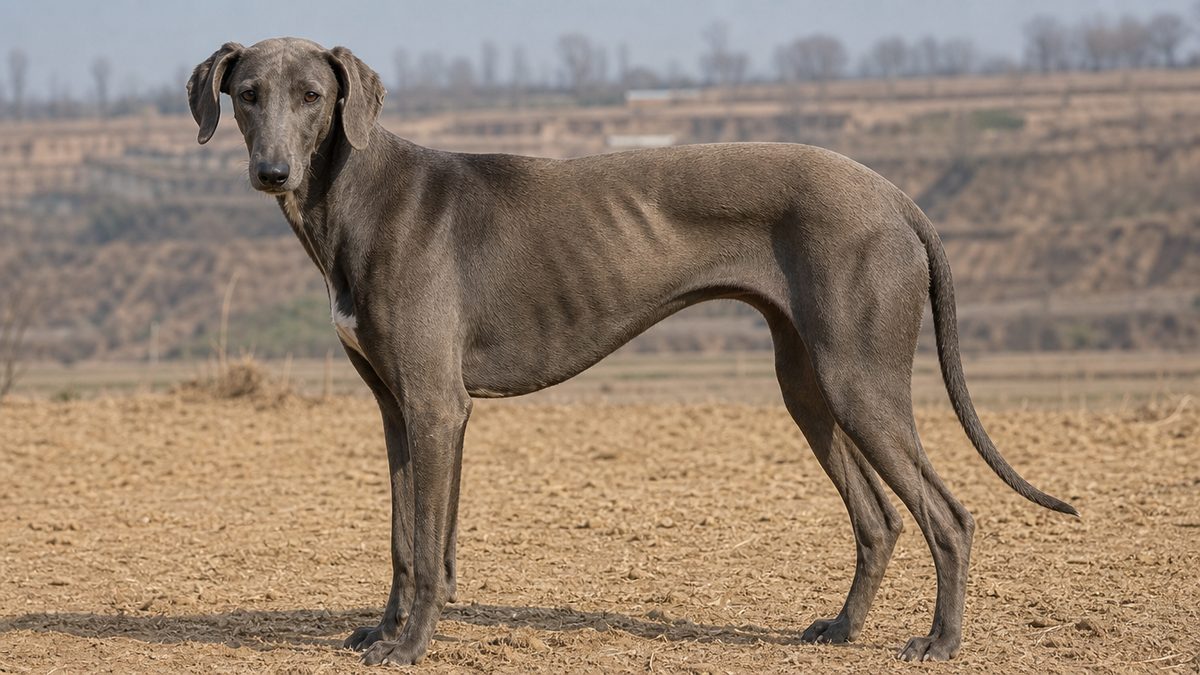
Xigou is written 细狗 or 細犬 and means thin dog. Chinese sources describe it not as one standardised breed but as a speed-type hunting hound produced in China, existing as at least four regional populations with different histories, different regions and, in one case, two different coats.
This is the first thing to get right, because almost every English page gets it wrong. The Chinese-language article treats 细犬 as a group term and then lists the members: 陝西細犬 the Shaanxi Xigou, 山東細犬 the Shandong Xigou, 河北細犬 the Hebei Xigou and 蒙古細犬 the Mongolian Xigou. Those are not colour varieties of one dog. They are separate regional populations, and the genetics bears that out.
| Population | Other names | Region | What is said about it |
|---|---|---|---|
| Shaanxi Xigou | Xian, Shaanxi hound, Xianliequan | Wei River plain: Weinan, Xianyang, Xi'an | Some Chinese writers call it the progenitor of all Xigou; a long narrow slightly curved head is its distinguishing feature |
| Shandong Xigou | Tiaoquan, the jumping dog | Shandong | Noted for scent and hunting drive; described as a Tang dynasty royal hunting dog; long-haired form called fanzi, short-haired form called huatiao |
| Hebei Xigou | Kangxi imperial dog | Hebei | Said to closely resemble the Greyhound, used for hares on open plains, and derived from improved Shandong stock |
| Mongolian Xigou | Khitan hunting dog | Heilongjiang, Jilin, Liaoning, eastern Inner Mongolia | Stockier with a thicker coat; traced to the Liao dynasty |
The measurements, and a contradiction inside one source
Chinese sources give a height of 60 to 78 cm and a weight of 20 to 30 kg, with both short-haired and long-haired coats and colours running grey-blue, black, white, cream, ochre, pale yellow and blood-red. Those figures should be handled carefully. The same article's body text says males stand about 60 to 78 cm while females are shorter, at about 65 to 75 cm. A shorter sex cannot have a higher floor than the taller one, so the two sentences contradict each other, and this page quotes the range as a range rather than splitting it by sex.
Where it sits in the registries, which is nowhere
| Register | Verdict | Evidence and control |
|---|---|---|
| FCI definitive | Absent | Letter X returns exactly one breed, XOLOITZCUINTLE 234; letter S returned 41 in the same session |
| FCI provisional | Absent | Twenty entries, none a Chinese sighthound |
| UKC, all groups | Absent | Zero matches for Xigou, Xian Hound or Chinese Sighthound across 25,963 characters, against six control matches |
| UKC Bloodlines Listing Service | Absent | The register-without-standard group holds ten breeds and none is Chinese |
| AKC | Absent | Zero matches in the site-wide breed index, against six control matches |
| Kennel Club of India | No route | India follows FCI nomenclature, so no FCI number means no ordinary Indian pedigree |
Chinese sources record that the CKU classifies the dog as a rare breed and began a DNA collection programme in 2017, and that numbers fell sharply after government restrictions on hunting rights. That is a conservation story rather than a pet-market one, and it is the honest frame for everything else on this page.
Xigou price in India: there is no market, and the absence is measured
No Indian price exists for any Xigou population, and the absence was tested rather than assumed. Both Indian breed-content sites that generate price pages for obscure imported sighthounds return a not-found page, each checked against a working control on the same site.
| Site and path | Response | What it means |
|---|---|---|
| poodles.in /dog-breeds/xigou/ | HTTP 200, title Dog Breed Not Found, 816 characters | A soft 404 that a status check alone would pass |
| poodles.in, invented control slug | HTTP 200, identical not-found page | Confirms the response is the site's own not-found page |
| poodles.in /dog-breeds/saluki/ | HTTP 200, full 17,617-character breed page | Confirms the site does serve rare sighthound pages |
| happypet.care /dog-breeds/xigou | HTTP 404 | A hard not-found, with its own control also returning 404 |
The poodles.in behaviour is worth naming, because it is a trap for anyone researching a rare breed. The site returns HTTP 200 with the title Dog Breed Not Found, so an automated check that reads the status code alone records the page as existing. Read the title, not the status, and use a positive control on the same site so you can tell a missing breed from a broken site.
Why no Indian supply chain can lawfully form
Three facts close it. There is no FCI number, so no ordinary Kennel Club of India pedigree route. There is no register anywhere that issues a pedigree for the dog, checked at the UKC and the AKC against passing controls. And dogs are a Restricted import into India under DGFT Trade Notice 22/2022-23, with entry permitted only for a pet accompanying an owner holding a valid pet book, for research on CPCSEA recommendation, or for Defence and Police use, and with applications for trading or breeding purposes to be duly rejected.
Ask which of the four regional populations they mean, and then ask which register the litter is recorded in. No register holds any of them United Kennel Club, Breed Standards index American Kennel Club, and the four populations differ enough in size, coat and region that a seller who cannot name one is not describing a documented animal. A lean short-coated hound offered in India under this name is far more likely to be a Rampur Greyhound, a Mudhol Hound or an undocumented Indian sighthound. All of those are good dogs, and none of them warrants an import premium.
Bonbeno reports published prices as editorial content and does not broker sales. Where no price exists, this page publishes none rather than converting a foreign figure into rupees, which is the mechanism behind most of the fabricated Indian prices this site has documented on other breeds.
What a dog of this size would cost to keep in India
The cost of ownership for a 20 to 30 kg lean coursing hound in an Indian metro runs roughly Rs 4,000 to Rs 9,000 a month once food, parasite control, routine veterinary care and municipal fees are built from published Indian rate cards. None of these are Xigou figures; they are Indian figures for a dog of the stated size.
That distinction is the honest way to give an Indian reader a budget for a breed with no Indian market. The size comes from Chinese sources at 20 to 30 kg; everything below comes from Indian rate cards and applies to any dog in that band.
| Item | Published figure | Source and caveat |
|---|---|---|
| Puppy core vaccination course | From Rs 6,499 | Vetic national page, a promotional floor from one chain |
| Annual booster | From Rs 3,199 | Vetic national page |
| Anti-rabies, single dose | Rs 699 privately, free at a Chennai municipal clinic | Vetic against Greater Chennai Corporation Greater Chennai Corporation |
| Consultation | Rs 500 to Rs 1,000 | VOSD, treated as one data point |
| Monthly tick, flea and worm cover | About Rs 1,103 | NexGard Spectra 15 to 30 kg, 3 tablets at Rs 3,308 |
| Boarding, per 24 hours | Rs 500 to Rs 2,000 | VOSD range |
| Municipal registration, Delhi | Rs 500 | MCD pet dog registration, 18,958 certificates since 2021 |
| Municipal licence, Chennai | Rs 50 | Greater Chennai Corporation, 9,115 licences issued in 2024 |
The delivery model sets the price, not the breed
The most useful cost fact for any Indian dog owner is that the same intervention costs wildly different amounts depending on who provides it. A Greater Chennai Corporation clinic gives anti-rabies vaccination free of charge while a private chain lists the same dose at Rs 699, and a Chennai municipal licence costs Rs 50 against a Delhi registration at Rs 500. Those gaps dwarf any breed difference.
The lines that would behave differently for this dog
- Parasite control, year round. Among 584 client-owned dogs screened at a Kolkata animal health centre, 76.54 percent were positive for *Babesia gibsoni* and 72.9 percent of the dogs screened carried two or more pathogens. Those are clinic cases rather than a population sample, and they make cover a fixed cost.
- Veterinary interpretation without a safety net. No breed-specific reference intervals exist for any Xigou population, and the one study comparing sighthound breeds warns explicitly against applying the Greyhound profile to other sighthounds. Establishing a baseline panel on the individual dog while it is healthy is the practical answer.
- Grooming close to zero for the short-coated populations, and moderate for the long-haired Shandong form the Chinese sources call fanzi.
- No screening costs, because no scheme exists. That is a saving on paper and a liability in practice.
If the appeal is a lean, hardy coursing hound of 20 to 30 kg, an Indian sighthound gives you the same animal, in the climate it evolved in, from a breeder you can visit. A Mudhol Hound or a Rampur Greyhound costs the same to keep and is legal to buy, while importing a Xigou is not a route Indian trade rules leave open.
Heat tolerance: a north Chinese farmland dog, measured where it can be
The Xigou's home ground is the north Chinese plain and loess country, which is warm and humid in summer and below freezing in winter. Measuring it properly took some care, because five of the six Chinese points tested returned a grid cell too far above the town to publish.
NASA POWER returns a MERRA-2 grid cell rather than a point, so Bonbeno echoed the returned elevation for every point and compared it against the real one. Xi'an, in the Shaanxi Xigou heartland, returned a cell 192.71 m above the city, Weinan 188.38 m above, Jinan 131.18 m, Yulin 128.72 m and Baoji 547.73 m. Only Zhengzhou on the Central Plain returned a clean cell, 129.36 m against a real elevation near 110 m, an error of 19.36 m.
So this section publishes Zhengzhou as the verified anchor for the north Chinese plain and states plainly that the Shaanxi heartland itself could not be measured cleanly with this instrument.
| Place | Cell elevation error | Annual mean temperature | Annual mean relative humidity | Hottest month | Coolest month |
|---|---|---|---|---|---|
| Zhengzhou, north China plain | plus 19.36 m, usable | 15.03 C | 62.07 percent | 28.41 C (Jul) | minus 0.08 C (Jan) |
| Delhi | minus 9.63 m | 25.60 C | 45.56 percent | 35.88 C (Jun) | 13.61 C (Jan) |
| Jaipur | minus 25.26 m | 25.58 C | 40.94 percent | 34.57 C (Jun) | 14.51 C (Jan) |
| Pune | plus 75.99 m | 23.86 C | 66.80 percent | 28.93 C (Apr) | 19.62 C (Dec) |
| Bengaluru | minus 78.28 m | 23.74 C | 67.94 percent | 28.37 C (Apr) | 20.22 C (Dec) |
| Mumbai | plus 83.15 m | 26.77 C | 67.39 percent | 31.19 C (May) | 23.19 C (Jan) |
| Chennai | plus 42.95 m | 27.95 C | 72.39 percent | 31.51 C (May) | 24.09 C (Jan) |
Reading the comparison honestly
Zhengzhou's July mean of 28.41 degrees Celsius at 62.07 percent humidity is genuinely close to Pune in April at 28.93 degrees and 66.80 percent NASA POWER climatology API. So a north Chinese summer is not alien to Indian conditions, and a Xigou would be more heat-tolerant on the Deccan than a Highland or Tien Shan breed would be. Two things separate them anyway. Zhengzhou's January mean is below freezing at minus 0.08 degrees, which no plains Indian city approaches, so the dog gets a hard winter off. And Zhengzhou's annual mean of 15.03 degrees is more than ten degrees below Delhi's, so the summer is a season there and a baseline here.
The transferable heat evidence
No Xigou heat-illness figure exists, because no Chinese sighthound was modelled in the only study that produces them; a breed type entered that model with five or more heat-related illness cases and/or 5,000 or more dogs in the population. The transferable finding is the group one: pet Greyhounds carried 4.26 times the odds of heat-related illness compared with Labrador Retrievers, at p = 0.001, which the authors attributed to high lean muscle mass rather than to fat. A dog named for being thin is carrying that muscle in a light frame.
Second Schedule Part IV paragraph 21(1) of the Dog Breeding and Marketing Rules 2017 bars keeping in outdoor facilities, without the attending veterinary practitioner's written approval, dogs not accustomed to the temperatures prevalent in the area and breeds that cannot tolerate them, and paragraph 21(2) requires separate outside areas of shade large enough to contain all the animals at once and protect them from the direct rays of the sun. A farmland coursing dog from a place that freezes in January falls squarely inside the first clause.
Temperament: what the sources support, and what they do not
No breed standard describes a Xigou's temperament, because no registry holds a standard for any of the four populations. What Chinese sources describe is function, and function supports some inferences and not others.
The documented material is functional. Chinese sources describe a speed-type hunting dog used to chase quarry across the open, flat ground of the loess plateau, and attribute specific working qualities to specific populations: the Shandong type for scenting ability and hunting instinct, the Hebei type for loyalty, memory, keen scent, hunting desire and endurance, the Mongolian type for perseverance and running ability. Those are breeder claims recorded in an encyclopedia rather than measured traits, and this page treats them as such.
What follows reliably from a coursing function
- High prey drive. Every source describes hare coursing as the dog's purpose, and the Shaanxi hare-coursing contest is still practised as listed intangible cultural heritage. This is the one temperament claim with a documented basis.
- An independent worker. A hound running down quarry at distance across farmland is making its own decisions, which is the opposite of close-contact urban obedience.
- Guarding claimed for two populations. Chinese sources describe the Shaanxi type as a reliable guard and the Shandong type as an efficient livestock guard on farms. That is unusual for a sighthound and is recorded here as a claim rather than a finding.
- Unknown tolerance of confinement, strangers and other pets. Nothing has been measured for any population.
There is no FCI, AKC or UKC standard in which a temperament clause could live United Kennel Club, Breed Standards index American Kennel Club, and the one peer-reviewed study of these populations measured runs of homozygosity and selection signatures rather than behaviour. Pages that describe the Xigou as affectionate, gentle or good with children are describing something nobody has measured, and are usually describing one imagined dog rather than four real populations.
The cultural role, which is documented
The dog's place in Chinese culture is better evidenced than its temperament. Chinese sources connect the type to imagery in tombs and paintings across dynasties and to the mythological celestial hound Xiaotian Quan, and record 细狗撵兔, xigou hare coursing, as a folk sport across Shaanxi, Shanxi, Henan, Hubei, Hunan, Inner Mongolia, Ningxia and Gansu, traditionally held at the Lantern Festival, the Dragon Boat Festival and Laba. Shaanxi has formally listed the contest as provincial intangible cultural heritage.
Training: what transfers from the sighthound group
No training literature exists for any Xigou population, so what follows is drawn from what applies to sighthounds generally and from a documented coursing function. Every claim here is labelled for where it comes from.
The starting point is the group description. The only review to treat sighthounds as a class calls them an ancient group of dog breeds selectively bred for high-speed pursuit of prey by sight. A dog bred to run down hares across open farmland is bred to act at a distance and on its own judgement, and training works with that or not at all.
What would apply, from group practice
- Socialise early and widely, between eight and sixteen weeks, to traffic, lifts, stairs, crowds and handling by strangers. Indian law sets the timetable, recording that puppies are vaccinated from about seven to eight weeks with the course usually completed near eighteen weeks.
- Short sessions with food worth working for, two to four minutes at a time, never in the afternoon heat.
- A long line for the first two years rather than a bet on recall, because prey drive is the one trait the documented function does support.
- A stand for examination taught early, so routine veterinary handling does not need sedation, which matters more for a dog with no published anaesthetic data of its own.
- Environment management over obedience. Fenced ground, a lead everywhere else, and no plan that assumes the dog will choose you over a moving animal.
What Indian law adds for anyone breeding here
Second Schedule Part II paragraph 6(8) of the 2017 Rules strictly forbids tail docking, ear cropping, de-barking, de-clawing and any change of appearance by artificial means, and paragraph 6(9) prohibits breeding to create new breeds of dogs or unusual looks. Paragraph 6(3) prohibits in-breeding between relatives of the second to fourth grade within the first four generations and incest breeding between parents and children or between brother and sister.
The one genetic study of these populations found the Shaanxi thin dogs carrying 1,809 runs of homozygosity and an F ROH of 0.26, the highest inbreeding degree of the fourteen Chinese dog populations tested, with the authors writing that the population is in dire need of conservation. Any attempt to establish these dogs outside China would start from a handful of founders drawn from an already narrow base, which is exactly the situation India's in-breeding clause is written for.
Exercise: the requirement a hare-coursing function implies
A Xigou would need daily distance work plus regular free running on soft ground, and in India almost none of it could happen safely in daylight for most of the year. This section states a requirement inferred from a documented function, because no exercise guidance for these populations exists.
What is documented is the job. Chinese sources describe a speed-type hunting hound used to course hares across the flat open ground of the loess plateau, and the practice survives as a listed folk sport in Shaanxi held at fixed points in the year Shaanxi Province second batch…. That is a dog with a real working output, not a decorative sighthound.
What that implies for an Indian week
- Two long outings a day, 45 to 60 minutes each, at the coolest hours. In Delhi in June, whose mean alone is 35.88 degrees Celsius, that means before 06:00 and after 21:00.
- Free running on soft ground at least weekly, inside a fence, because a coursing hound that never gallops is not being exercised.
- Nothing hard within two hours of a meal, in either direction.
- No work at all in the Indian afternoon from March to October, which is the single most important line here.
- Check the surface with the back of your hand for five seconds before any summer walk. Indian tarmac burns pads long after the air has cooled.
There is no Xigou heat-illness figure, because no Chinese sighthound entered the only model that produces them; a breed type needed five or more heat-related illness cases and/or 5,000 or more dogs to be included. The transferable finding is that pet Greyhounds carried 4.26 times the odds of heat-related illness against Labrador Retrievers, attributed to high lean muscle mass rather than to obesity. Consult your nearby veterinarian immediately if any lean hound becomes unsteady, vomits or collapses after exertion, and do not attempt to cool it with ice water.
Growth, in the absence of breed data
No growth data exists for any Xigou population, so apply the general rule for a sighthound of 60 to 78 cm: free movement on grass at any age, and forced distance running, repeated jumping and stair work only after about 14 to 18 months. On a dog whose whole identity is leanness, resist the temptation to build muscle early; the frame is the point.
Mental work is the fallback on the many Indian days when the outdoor option closes. Scent games and short food-finding routines take real energy out of a hunting hound and can be run indoors, and for the Shandong population in particular, which Chinese sources single out for scenting ability, they suit the dog rather than merely occupying it.
Grooming: which coat you are dealing with depends on the population
Grooming a Xigou depends entirely on which of the four regional populations the dog belongs to, because they do not share a coat. That is another consequence of treating a category as a breed, and it is the practical reason the distinction matters.
Chinese sources record that the type exists in short-haired and long-haired lines, that the Shandong population has both, with the long-haired form called 幡子 fanzi and the short-haired form 滑條 huatiao, and that the Mongolian population is stockier with a thicker coat than the others. Colours are given as grey-blue, black, white, cream, ochre, pale yellow and blood-red.
No registry standard exists to specify texture, length or trimming for any of them United Kennel Club, Breed Standards index, so this page will not tell you how often to brush a Xigou. What it can give you is the part that matters in India, which is the same for any lean hound here.
What applies to any sighthound coat in Indian conditions
- A daily tick check in season, ears, toes, groin and tail base first, and more thorough on a long-haired dog. India's Dog Breeding and Marketing Rules 2017 make regular de-ticking part of routine grooming rather than an extra, in Second Schedule Part IV paragraph 27.
- Skin inspection with every check. Sighthound skin is thin over little subcutaneous fat, so grazes from hard Indian floors go septic quickly in a humid monsoon.
- Nails every fortnight, since Indian tile and stone floors give no natural wear.
- Shade rather than sunscreen for pale dogs, which Second Schedule Part IV paragraph 21(2) also requires of anyone housing dogs outdoors.
- Never clip a working coat to cool a dog. A coat over thin sighthound skin provides sun protection, and removing it does not lower core temperature.
If someone in India offers you a Xigou, ask whether the dog is short-coated or long-coated and which region its line comes from. The four populations differ in coat, size and origin, so a seller who cannot answer is not describing a documented animal. That is not a grooming question. It is the cheapest verification question available for a dog no registry records.
Xigou health: one genomics paper, no clinical literature at all
There is no clinical veterinary literature on any Xigou population, so nobody can tell you which health issues these dogs carry. What exists is a single population-genomics study, and what it found about inbreeding is the most important health fact on this page.
1. The inbreeding finding, which differs sharply between populations
A 2023 study genotyped 130 individuals from 10 breeds and 14 populations of Chinese indigenous dogs on a 170K SNP microarray, retaining 144,481 SNPs, and calculated runs of homozygosity for each population. Two of the fourteen populations are Xigou, and they came out at opposite ends of the range.
| Population | Dogs | ROH 0.5 to 1 Mb | 1 to 5 Mb | 5 to 10 Mb | Over 10 Mb | Total ROH | F ROH | Effective population size |
|---|---|---|---|---|---|---|---|---|
| Shandong thin dogs (ThCSD) | 10 | 122 | 256 | 39 | 65 | 482 | 0.11 | 38 |
| Shaanxi thin dogs (ThCSX) | 12 | 349 | 1,046 | 257 | 157 | 1,809 | 0.26 | 36 |
The authors state the consequence directly: the Shaanxi thin dogs have the highest inbreeding degree among the 14 populations in the study, the Shandong thin dogs are much lower, the genetic diversity of the Shandong dogs is better, and the Shaanxi dogs are in dire need of conservation. They also note that both recent and distant inbreeding events appear in the Chinese thin dogs, which the size distribution of the runs supports: the Shaanxi population carries 257 runs between 5 and 10 Mb and 157 above 10 Mb, and long runs indicate recent inbreeding.
The paper's Abstract says the Chuandong hound dogs have the highest level of inbreeding among the tested breeds, with an F ROH of 0.21, while its Discussion says the Shaanxi thin dogs have the highest inbreeding degree among the 14 populations, with an F ROH of 0.26 Li Y et al. 2023, Discussion section. Both statements can hold at once, because one compares breeds and the other compares populations, and the Xigou contributes two populations to the study rather than one. Table 1 is the arbiter, and Table 1 puts the Shaanxi figure highest.
2. The anaesthesia protocol, which applies by group membership
The published sighthound anaesthesia review names four idiosyncrasies that follow from selection for high-speed pursuit by sight: a nervous demeanour that can produce stress-induced complications including hyperthermia; a lean body conformation with a high surface-area-to-volume ratio predisposing to hypothermia; higher packed cell volume and lower serum protein than other breeds, which complicates pre-anaesthetic blood work; and impaired hepatic biotransformation of drugs producing prolonged recovery, especially from thiopental. It states that thiopental, or any other thiobarbiturate, should not be used in these dogs, that propofol, ketamine with diazepam and methohexital are the recommended alternatives, that isoflurane maintenance is preferred, and that core body temperature must be monitored during anaesthesia and into recovery.
That review names no individual breed in its abstract, so it reaches the Xigou by group membership rather than by breed-specific evidence, and this page says so rather than implying any Chinese dog was studied.
3. The gaps, listed as gaps
- No lifespan data, and no life expectancy figure of any kind. No Chinese sighthound appears in the 344-breed classification of the largest UK longevity study, which lists only the Chinese Crested and the Chinese Shar Pei among Chinese breeds.
- No breed-specific laboratory reference intervals. The one study comparing sighthound breeds against each other tested eight and none is Chinese, and it concludes that applying the Greyhound laboratory profile to other sighthounds is not recommended.
- No bleeding-risk genotype. The 2025 SERPINF2 survey genotyped 16 sighthound breeds and none is Chinese.
- No heat-illness odds ratio, for the reason given in the climate section.
- No screening scheme, hip or elbow statistics, or eye register for any population.
4. Two search traps that make the literature look bigger or emptier than it is
Both are worth knowing if you research this dog yourself. All four PubMed records matching Xigou in title or abstract are an archaeological site, the Xigou and Shirenzigou excavations in Xinjiang, covering horse assemblages, mounted horseback riding, hafted stone technology and ancient glass beads. Not one is about a dog.
The Chinese-language route fails differently. Europe PMC returns 131 hits for 细狗, 321 for 细犬 and 11 for 陕西细犬, and every returned record is unrelated Chinese-language biomedical literature matched at the character level rather than as a compound term. The control 黑狼 returns 122 hits which are systemic lupus erythematosus papers, because 狼 sits inside 红斑狼疮. A non-zero Europe PMC count on a CJK term is character-level noise, not evidence of literature, and this page treats the Chinese-language veterinary literature on the Xigou as unsearched rather than as searched and empty.
The Indian health load, meanwhile, is the same as for every dog here. Among 584 client-owned dogs screened at a Kolkata animal health centre, 76.54 percent were positive for *Babesia gibsoni*, 55.75 percent for *Anaplasma* species and 16.61 percent for *Ehrlichia canis*, with 72.9 percent of the dogs screened carrying two or more pathogens at once. Those are clinic cases rather than a random population sample, and they still make year-round tick control a fixed requirement.
Feeding: the name is the feeding instruction
Feed a Xigou lean, because 细 means thin and the whole category is named for the shape. Chinese sources give a weight of 20 to 30 kg on a height of 60 to 78 cm, which describes a light dog for its frame in every population.
That ratio is the target. A 78 cm dog at 30 kg and a 60 cm dog at 20 kg are both consistent with the sources, and both are lean by the standards of any comparably tall Western breed. A Xigou fed toward the middle of a general large-breed guideline would be over-fed.
A practical plan for a 20 to 30 kg lean hound in India
- Two meals a day for an adult, morning and evening, avoiding the hottest hours when appetite falls anyway.
- Three to four meals a day for a puppy to six months, then three to nine months.
- No hard exercise for two hours either side of a meal, on a deep-chested coursing hound.
- Measure the food and weigh the dog monthly, because on a 25 kg animal a one-kilogram change is four percent and easy to miss.
- Feed to the frame, not to a chart. With no breed standard to describe correct condition, the shape the name refers to is the only benchmark available.
Indian availability is straightforward for a dog this size. Every national brand sells a medium or large adult formula, and a vet-balanced home diet on chicken, curd, rice and vegetables works. What matters is quantity, and for a dog named for being thin the quantity is smaller than the height suggests.
Use the general sighthound test. Feel every rib with light pressure, see a clear waist from above and a marked tuck-up from the side, and see the last one or two ribs faintly when the dog moves. Ask your veterinarian to record a body condition score at every visit, and remember that no breed-specific reference interval exists for anything else on the report either, so establishing a healthy baseline panel on the individual dog is worth doing while it is well.
Two Indian adjustments apply to any lean hound here. Appetite falls through April and May in most of the country, and a dog eating less through the hot weeks is behaving normally rather than falling ill. And because tick-borne disease is a routine clinic finding, a sudden loss of appetite is a reason to test rather than to change the food.
The first year with a sighthound puppy, and the checks this breed cannot pass
No Xigou-specific rearing guidance exists, so this timeline is the general sighthound one with Indian legal requirements attached. The breed-specific part is not the schedule but the verification, because a Xigou puppy in India would arrive with no paperwork any registry could issue.
| Age | What is happening | What you do |
|---|---|---|
| Under 8 weeks | With the litter. Indian law prohibits sale under eight weeks | Refuse any younger puppy, under Rule 8(1)(a) |
| 8 to 12 weeks | Core vaccination course under way from about seven to eight weeks | Socialise safely and constantly, and handle feet, ears and mouth daily |
| 12 to 16 weeks | Socialisation window closing | Traffic, lifts, stairs, crowds, other dogs, strangers, and a stand for examination |
| 16 to 18 weeks | Vaccination course usually complete near eighteen weeks | Short cool-hour lead walks. Register with the municipality |
| 4 to 6 months | Fast height growth on a light frame | No forced running, no repeated jumping. Free movement on grass only |
| 6 to 9 months | Adolescence, recall degrades | Long line on and staying on. Keep the dog lean, which is the whole point of the type |
| 9 to 14 months | Approaching adult height | Controlled galloping on soft ground inside a fence |
| 14 to 18 months | Growth plates closing | Only now build real distance work |
The verification problem, stated plainly
For every registered breed on this site, the buying checklist starts with a pedigree and parental health tests. For the Xigou neither can exist. No registry anywhere issues a pedigree for any of the four populations, checked at the FCI, the UKC including its register-only listing service, and the AKC, each against a passing control American Kennel Club. No screening scheme, DNA test or health register covers the dog. So the checklist reduces to Indian law and to honesty about what the animal is.
- Age at least eight weeks and a microchip. Rule 8(1)(a) prohibits sale below eight weeks and Rule 8(1)(e) requires every pup sold to be micro-chipped with a full treatment and vaccination record maintained.
- A vaccination record consistent with a course started at seven to eight weeks and completed near eighteen weeks.
- No altered ears or tail, prohibited under Second Schedule Part II paragraph 6(8).
- A named regional population. Ask whether the dog is Shaanxi, Shandong, Hebei or Mongolian type, because those are four different dogs.
- A straight answer about how the parents entered India, since dogs are a Restricted import and applications for trading or breeding purposes are to be duly rejected.
The Shaanxi population already carries an F ROH of 0.26, the highest of fourteen Chinese dog populations tested, and its authors call it in dire need of conservation. Any attempt to breed these dogs outside China would begin from a handful of founders drawn from a base that is already narrow. Second Schedule Part II paragraph 6(3) of India's 2017 Rules prohibits in-breeding between relatives of the second to fourth grade within the first four generations and incest breeding between parents and children or between brother and sister, which is exactly the constraint such a project would run into.
Xigou against the sighthounds an Indian buyer can actually get
The Xigou's useful comparisons are with the eastern sighthounds it is grouped with in the popular imagination, and with the Indian coursing hounds that are actually obtainable. Both comparisons argue the same way.
| Xigou | Saluki | Taigan | Mudhol Hound | |
|---|---|---|---|---|
| Is it one breed | No. At least four regional populations | Yes, one standard with two coat varieties | Yes, one population | One Indian breed |
| FCI status | Absent from both registers Federation Cynologique Internationale | Full standard 269 | Absent from both registers | No FCI standard |
| UKC status | Absent from every group | Sighthound and Pariah group | Absent | Absent |
| Published genetic study | Yes, two populations on a 170K array | Included in wide sighthound work | Yes, 2025 | None published |
| Inbreeding measured | F ROH 0.26 Shaanxi, 0.11 Shandong | Not reported this way | Excess heterozygosity, F minus 0.013 | Not measured |
| Longevity data | None | 13.3 years median in a UK cohort | None | None |
| State recognition at home | The sport is listed heritage, the dog is not | Country of origin holds the FCI patronage | None found | State-supported breeding in Karnataka |
| Available in India | No. Both Indian sites return not-found | No verifiable transaction price | No | Yes, from Indian breeders |
The state-recognition row is the interesting one
China's national catalogue of livestock and poultry genetic resources covers 33 species across twelve traditional and sixteen special entries, and not one of them is the dog. The 2021 breed list built on that catalogue records 948 local, developed and introduced breeds and matched lines, and no dog breed can appear on it because the species is out of scope. So the Xigou's absence from China's own genetic-resources register is a property of the register rather than a verdict on the dog, which is the opposite of what an absence usually means.
What the Chinese state has recognised is the sport. Shaanxi's second batch of provincial-level intangible cultural heritage includes item 237, code X-32, the 渭北细狗撵兔竞技 or Weibei xigou hare-coursing contest, with the Pucheng County Intangible Cultural Heritage Protection Centre as its protecting unit. Note that the listed name is the Weibei form rather than the popular Pucheng one, which is worth knowing if you go looking for the entry yourself.
Do not try to import a Xigou into India. There is no lawful commercial route, no registry that would issue a pedigree, no clinical literature to manage the dog with, and one of the two populations that has been measured is described by its own researchers as in dire need of conservation, which is an argument for leaving it in China rather than exporting it. If the appeal is a lean hare-coursing hound, the Mudhol Hound and the Rampur Greyhound are the same animal, legally obtainable, in the climate they evolved in.
Five mistakes people make about this breed
Because there is no Indian Xigou market, the mistakes here are mostly about what a reader concludes rather than what an owner does. Each one has a document behind it.
1. Treating the Xigou as one breed
Chinese sources describe four regional populations with different regions, histories, sizes and coats, and a genomics study found the two that have been tested to differ by more than a factor of two in inbreeding Li Y, Huang M, Wang Z, Liu X, He S, Wang T. Any single description of the Xigou's size, coat or temperament is describing at most one of four dogs.
2. Reading a soft 404 as a real page
poodles.in returns HTTP 200 with the title Dog Breed Not Found for this dog, and an invented control slug returns the identical page, while the same site serves a full 17,617-character page for the Saluki poodles.in, Saluki Price in India, Diet. Read the title, not the status.
3. Counting PubMed hits without opening them
Four PubMed records match Xigou in title or abstract, which looks like a small literature. All four are the Xigou and Shirenzigou archaeological sites in Xinjiang. The dog has none.
4. Trusting a non-zero Chinese-language search count
Europe PMC returns 131 hits for 细狗 and 321 for 细犬, and every record is unrelated Chinese-language biomedical literature matched character by character. The control 黑狼 returns 122 lupus papers, because 狼 sits inside 红斑狼疮. A non-zero CJK count there is noise, and the correct conclusion is that the Chinese-language veterinary literature on this dog was not searchable rather than searched and empty.
5. Reading the Chinese state's silence as a verdict on the dog
China's national livestock genetic resources catalogue covers 33 species and contains no dog at all, and the 948-entry breed list built on it therefore cannot hold a dog breed either. The Xigou's absence there says nothing about the Xigou. What the state has actually done is list the hare-coursing contest as provincial intangible cultural heritage.
The single most consequential fact on this page is not about buying a dog. It is that the Shaanxi population carries 1,809 runs of homozygosity and an F ROH of 0.26 against the Shandong population's 482 and 0.11, and that its own researchers describe it as in dire need of conservation. That is a conservation problem in China, and the useful thing an outside reader can do about it is not to create export demand.
Adoption, and why there is no sourcing route for this dog
There is no responsible way to source a Xigou in India, and one of the two measured populations is in a state its own researchers describe as needing conservation. This section is about what to do instead.
Why no sourcing route exists
- No registry issues a pedigree. Checked at the FCI definitive and provisional registers, at every UKC group including the register-only Bloodlines Listing Service, and at the AKC's site-wide index, each against a control that passed United Kennel Club, Breed Standards index American Kennel Club.
- No lawful commercial import. Dogs are a Restricted import under DGFT Trade Notice 22/2022-23, permitted only for an accompanied pet with a valid pet book, for research on CPCSEA recommendation, or for Defence and Police use, with trading or breeding applications to be duly rejected.
- No Indian breed page exists. Both Indian breed-content sites return a not-found page against working controls.
- No health screening could be produced, because no scheme, DNA test or register exists for any population.
- And the conservation argument runs the other way. The Shaanxi population is described by its own researchers as in dire need of conservation, with the highest inbreeding degree of fourteen Chinese dog populations tested.
What to do instead
Adopt. Every Indian city has shelters full of lean, hardy, heat-adapted dogs that cost nothing and are already suited to the climate. If the specific appeal is a coursing sighthound, two Indian breeds give you the same animal legally and locally: the Mudhol Hound from Karnataka and the Rampur Greyhound from the north, both with genuine Indian breeders and both bred in the climate they will live in. An adopted Indian Pariah Dog gives you the heat adaptation for free, and it does not require anyone to move a dog out of a population that is already narrow.
Ask three questions. Which of the four regional populations is it, and how do you know. Which register is the litter recorded in, given that none holds the breed. And how did the parents enter India, given that trading and breeding imports are to be duly rejected. A seller who answers all three convincingly holds documentation nobody else in the world appears to have.
What Bonbeno publishes about this dog, and what it will not
This page publishes one peer-reviewed genomics study with its table read directly, two Chinese state instruments read at the ministry's own site, a provincial heritage listing, four registry checks each run against a control, two climate points with their grid-cell errors stated, two search-tool audits, and a set of Indian care costs that apply to any 20 to 30 kg dog living here. It publishes no price, no lifespan, no temperament rating and no health claim that rests on another sighthound's data. Where a figure does not exist, the page says so.
Bonbeno does not sell animals, broker puppy sales or accept breeder listings, and nothing on this page is an offer.
Xigou questions people actually ask, answered as asked
Is Xigou a Chinese dog?
Yes, and it is more than one Chinese dog. 细狗 means thin dog and Chinese sources describe it as a speed-type hunting hound produced in China, existing as at least four regional populations from Shaanxi, Shandong, Hebei and Mongolia. Treating the name as a single standardised breed is the commonest error in English writing about it.
Is Shaanxi Xigou a dog?
Yes. The Shaanxi Xigou is one of the four regional Xigou populations, also called Xian, Shaanxi hound or Xianliequan in Chinese sources, distributed mainly across the Wei River plain around Weinan, Xianyang and Xi'an, and some Chinese writers regard it as the progenitor of all Xigou. It is also the population a 2023 SNP study found to be the most inbred of fourteen Chinese dog populations tested.
What is a Shandong Xigou?
The Shandong Xigou is the eastern regional population, also called Tiaoquan or jumping dog, noted in Chinese sources for scenting ability and hunting drive and described as a Tang dynasty royal hunting dog. It exists in two coat forms, a long-haired type called fanzi and a short-haired type called huatiao, and a 2023 SNP study found it considerably less inbred than the Shaanxi population.
What is a Hebei Xigou dog?
The Hebei Xigou is the northern regional population, also called the Kangxi imperial dog, described in Chinese sources as closely resembling the Greyhound in appearance and used mainly for hunting hares on open plains. Unlike the Shaanxi and Shandong populations it has not been genotyped in the published literature, so nothing quantitative is known about it.
What is the Xigou price in India?
None exists. Both Indian breed-content sites that generate price pages for obscure imported sighthounds return a not-found page for this dog, tested against working controls in the same session, and no lawful commercial route exists to import a dog into India for breeding or sale.
Is the Xigou recognised by any kennel club?
By none that could be checked. The FCI's letter X index returns exactly one breed, the Xoloitzcuintle, and the 20-entry provisional register holds no Chinese sighthound. The United Kennel Club index returns zero matches across every group including its register-only Bloodlines Listing Service, and the American Kennel Club index returns zero, both against controls that returned six.
Is the Xigou recognised by the Chinese government?
The dog is not, and it cannot be. China's national catalogue of livestock and poultry genetic resources, published as Ministry of Agriculture Announcement 303 in May 2020, covers 33 species and contains no dog at all, so no Chinese dog breed can appear on the state genetic-resources register. What the state has listed is the sport: the Weibei xigou hare-coursing contest sits in Shaanxi's second batch of provincial intangible cultural heritage.
How inbred are Xigou populations?
Very unevenly. In a 170K SNP study of 130 Chinese indigenous dogs across 14 populations, the Shaanxi thin dogs showed 1,809 runs of homozygosity with an F ROH of 0.26, the highest inbreeding degree of any population in the study, while the Shandong thin dogs showed 482 and an F ROH of 0.11. The authors describe the Shaanxi population as in dire need of conservation.
How big is a Xigou?
Chinese sources give a height of 60 to 78 cm and a weight of 20 to 30 kg, but the figures should be read with care. The same Chinese Wikipedia article states in its body text that males stand about 60 to 78 cm and that females are shorter at about 65 to 75 cm, which cannot both be true, since the stated female floor sits above the male floor.
Why do searches for the Xigou return archaeology papers?
Because the name collides with a place. All four PubMed records matching Xigou in title or abstract are about the Xigou and Shirenzigou archaeological sites in Xinjiang, covering horse assemblages, mounted horseback riding, hafted stone technology and ancient glass beads. None is about the dog, so the apparent literature for this breed is entirely a homonym.
How long does a Xigou live?
Nobody has measured it. No Chinese sighthound appears anywhere in the 344-breed classification table of the largest UK longevity study, which lists only the Chinese Crested and the Chinese Shar Pei among Chinese breeds. There is no cohort study, no breed survey and no registry health scheme for any Xigou population.
Can I import a Xigou into India?
Only as an accompanied pet, and never for breeding or sale. DGFT Trade Notice 22/2022-23 makes dogs a Restricted import under ITC(HS) 01061900, permits entry for a pet with a valid pet book in the importer's name, for research on CPCSEA recommendation, or for Defence and Police use, and states that applications for trading or breeding purposes shall be duly rejected.
Compare with similar breeds
Xigou sits in 1 Bonbeno group. Each one compares it directly against the breeds it is genuinely an alternative to, on the same figures.