
Breed profile
Castro Laboreiro Dog
Portugal's rarest native guardian, measured against its own registry rather than against the breed profiles that copy each other.
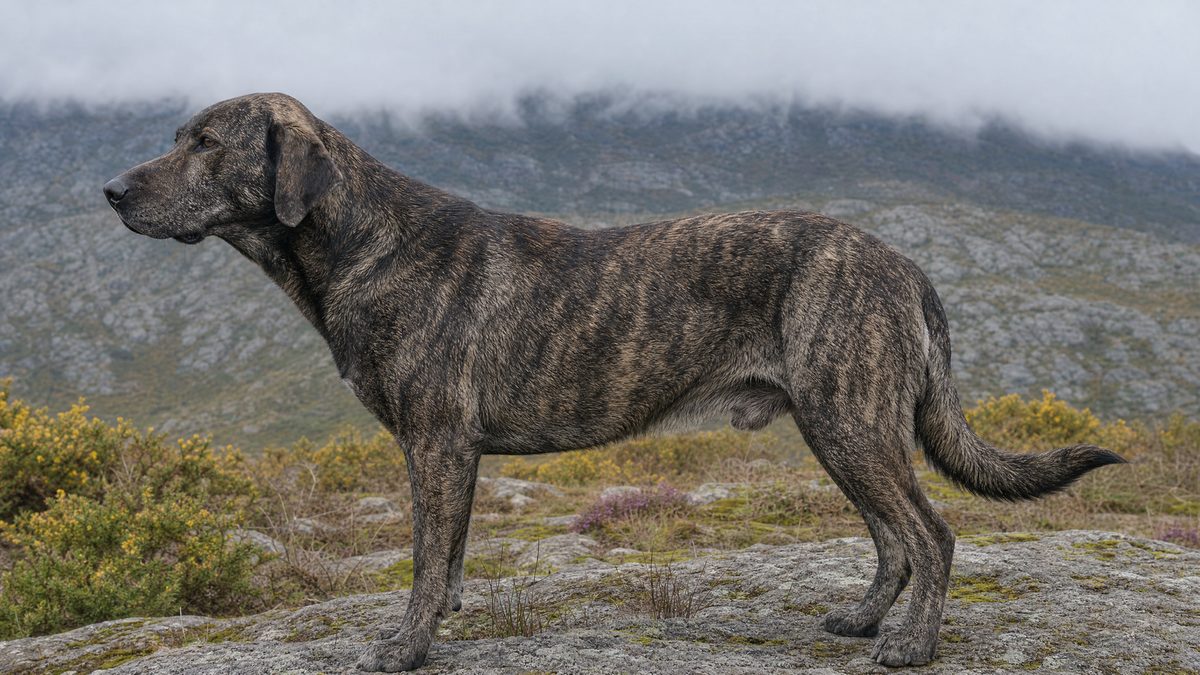
Quick answer
The Castro Laboreiro Dog is Portugal's rarest native livestock guardian dog, a 58 to 64 cm brindle mountain breed from Melgaco with no undercoat, held under FCI standard number 170. Portugal registered 95 of them in 2023 and its national registry puts life expectancy at 8.44 years. No verified dog of the breed exists in India, and Indian import policy allows no lawful breeding route for one.
This page is general information gathered from breed standards, registries and published research, not veterinary advice. No screening register anywhere carries this breed, so nothing here substitutes for examination by a registered veterinarian who has seen your dog. Consult a veterinarian before acting on any health, feeding, breeding or heat-management decision described here, and treat any sign of heat stress in a large dog as an emergency.
Castro Laboreiro Dog at a glance
What the Castro Laboreiro Dog actually is
The Castro Laboreiro Dog is Portugal's mountain livestock guardian dog from the Minho, a rustic, wolf-like molossoid of 58 to 64 cm and 30 to 40 kg for a male, recognised by the Fédération Cynologique Internationale as breed number 170 in Group 2 Section 2.2, and carrying a short 5 cm coat with no undercoat at all.
Start with the number, because the page ranking first for this breed gets it wrong. The FCI's own Group 2 nomenclature, under Section 2 Molossian type, subsection 2.2 Mountain type, entry 8 for Portugal, reads CÃO DE CASTRO LABOREIRO (170) (CASTRO LABOREIRO DOG) with the date 11/4/2008. English Wikipedia says the breed is "recognised by the FCI in Group 2, Section 2.2: Mastiffs, Mountain Type, Portugal (breed number 150)", while its own infobox links the standard file `170g02-en.pdf`. The number 150 does not appear anywhere in the FCI Group 2 list retrieved for this page.
The breed standard in force was published on 4 November 2008 and the current English translation is dated 5 January 2011. Its utilization line is three jobs, not one: guard dog, watch dog and livestock guarding dog. The Portuguese original at the Clube Português de Canicultura, the FCI member club of the country of origin, gives the same three: cão de guarda, de vigilância e proteção dos rebanhos.
The short version for an Indian reader
- No price in India exists. The only page on an Indian country path for this breed is Royal Canin India's template entry, and it carries no price, no availability and no India-specific guidance of any kind.
- Heat tolerance rates 2 of 5. The MERRA-2 grid cell containing the village of Castro Laboreiro averages 12.16 C across the year and 20.11 C in its hottest month, August.
- The coat has no undercoat, which is unusual for a mountain breed and changes the grooming and cooling advice completely.
- The published life expectancy is 8.44 years, not the 11 to 15 that every ranking page prints, and it comes from Portugal's own national registry.
A working dog whose job description names a predator
Very few breed standards name a wild animal. This one does, twice over. The current text says the dog is "a loyal and docile companion to its family" and "essential in flock protection against wolf attacks which, in the breed's area of origin, are still very frequent";. The Portuguese reads "indispensável na protecção dos rebanhos contra o ataque dos lobos que, nas imediações da região de origem, ainda hoje são frequentes";. The superseded 1995 standard said the same thing in older English: "absolutely necessary as defender of the herds against the wolf which still abounds in the neighbourhood";.
That matters because English Wikipedia states the opposite, that "with the eradication of wolves and other large predators the Castro Laboreiro Dog lost its original use";. A 2026 whole-genome study of Portuguese native breeds settles it: "Presently, the Transmontano Mastiff and the Castro Laboreiro Watchdog are the only breeds that still co-exist with the Iberian wolf, in the sense that they share a geographical range";. Royal Canin's Indian page gets this right where Wikipedia does not, describing dogs that guard "from attacks by the many wolves that still prowl the mountains of northern Portugal";.
| Breed | FCI number | Section | Date in the nomenclature |
|---|---|---|---|
| Cão de Castro Laboreiro | 170 | 2.2 Mountain type | 4 November 2008 |
| Cão da Serra da Estrela | 173 | 2.2 Mountain type | 4 November 2008 |
| Rafeiro do Alentejo | 96 | 2.2 Mountain type | 4 November 2008 |
| Cão Fila de São Miguel | 340 | 2.1 Mastiff type | 21 May 2007 |
Wamiz tells its readers that "the Portuguese Cattle dog is still a working breed in Europe, especially in the Azores region";. The Azores cattle dog is the Cão Fila de São Miguel, FCI 340, an island breed from São Miguel. The Castro Laboreiro Dog comes from a parish in Melgaço on the Spanish land border of mainland Portugal, not from an island in the Atlantic. The two are separate entries in the same FCI Group 2 list, in different sections.
Cor do monte: the coat colour every English page garbles
Cor do monte is the Portuguese name for this breed's most prized coat, and it means the colour of the hillside, not the colour of a mountain: the FCI's own translations of the same clause disagree with each other, and the explanation that makes it make sense is that the name records the colour of the mountain pasture vegetation in autumn.
Read the clause in the original before reading any English gloss. The Clube Português de Canicultura, the FCI member club of the country of origin, publishes it as follows. "A cor cinzenta-lobo (lobeiro) é a mais difundida e a cor preferida é a cor do monte, assim denominada pelos autóctones e considerada pelos criadores da região de Castro Laboreiro como uma característica da raça. É uma pelagem tigrada cuja cor de base é composta por diferentes tonalidades de cinzento, cor de carvão mais ou menos escuro. É típico dum pêlo que comporta três cores, desde a cor da pinha (pinheiro), ao vermelho e ao mogno."
Three Portuguese words carry the whole thing and none of them survives translation cleanly.
- Monte is not a mountain. In rural northern Portugal it is the uncultivated common hillside, the rough grazing above the fields, covered in gorse, heather and bracken. A United Kingdom breeder site that keeps this breed states the point plainly: the name "reflects the colours of the vegetation of mountain pastures in autumn". That is a camouflage description, not a geography lesson.
- Tigrada means brindle, literally tigered. The FCI English says "a brindle coat", the French "une robe bringée", the German "ein gestromtes Haar"; Fédération Cynologique Internationale.
- Cor de carvão means charcoal-coloured. The French keeps the specialist term, "charbonnée de noir plus ou moins foncé", which in cynological French means a sooty black overlay on a lighter ground. The English renders it as "overlaid with lighter and darker shades of black brindling", which is a different picture: sooting and brindling are not the same pattern.
The pine cone that became a pine nut
The Portuguese names the first of the three hair colours as a cor da pinha (pinheiro), the colour of the pine cone. The French translates it as "pignon de pin", the German as "kiefernuss" and the English as "pine-nut"; Fédération Cynologique InternationaleFédération Cynologique Internationale. A pinha is a cone and a pinhão is a nut, and they are not the same colour: a ripe cone is a dark resinous brown, a shelled kernel is pale cream. The Spanish edition takes a third route and calls it "color pino piñonero", the colour of the stone pine tree. The other two hair colours are stable across all four: vermelho, red, and mogno, mahogany.
| Edition | What the preferred coat is called | How the pattern is described | First hair colour |
|---|---|---|---|
| Portuguese, CPC | cor do monte | pelagem tigrada, base of grey tones, charcoal | cor da pinha, pine cone |
| English, FCI | mountain colour | brindle coat, grey base, black brindling | pine-nut |
| French, FCI | couleur montagne | robe bringée, grey base, charbonnée de noir | pignon de pin |
| German, FCI | Bergfarbe | gestromtes Haar, Grautöne, schwarz gestromt | kiefernuss |
| Spanish, FCI | color monte | no brindle mentioned at all, wolf grey but not black | color pino piñonero |
The Spanish row is the outlier and it is not a small one. Where the other four describe a brindle, the Spanish edition describes wolf colour in three gradations distributed by body region, and defines cor do monte as "un pelaje color lobo, grisáceo con matices más o menos oscuros, pero no negro", a wolf-coloured greyish coat with more or less dark shades but not black. It never uses the word atigrado. That is a different coat.
The superseded FCI-Standard N 170 of 24 August 1995 reads: "a mixed coat, similar to the coat of a wolf, greyish, in lighter or darker shades, not black, with brown (pine-seed colour) or reddish (mahogany colour) hairs interspersed on parts or over the whole body";. That is the Spanish text almost word for word, including the phrase not black. The FCI's Spanish edition is dated 05.01.2011 and prints the 04.11.2008 publication date on its own face, but the colour clause it carries is the pre-2008 one.
What this means when you are looking at a real dog
Judge the pattern, then the hairs. A correct cor do monte coat is a brindle: a grey ground with darker vertical striping, darker over the head, back and shoulders, medium over the body, croup and thighs, and lighter on the belly and lower limbs. Scattered through it are individual hairs of three warm colours running from pine-cone brown through red to mahogany. It is not a solid colour and it is not spotted. Wikipedia gets closer than most, describing "a mixed light and dark grey interspersed with individual hairs (not spots)", though it is quietly blending the 1995 and 2008 texts.
One marking is permitted and one is disqualifying. A small white spot on the chest is allowed; the English text of the standard carries a typographical slip here, printing "A small white spot is permitted 0n the chest" with a zero for the letter o, and the same slip is present in the 2014 fileInternet Archive Wayback Machine capture…. A white spot outside those limits is a fault, and a pied coat, albinism or a coat very different from breed type is a disqualification.
The 2008 revision, and the pages still publishing the 1995 breed standard
The FCI replaced this breed standard on 4 November 2008 and raised the height range by three to four centimetres at both ends, and four separate English-language authorities are still publishing the superseded 1995 figures, so a buyer measuring a dog against a printed standard can easily be measuring it against the wrong one.
Both documents are recoverable, so the change can be dated rather than asserted. The superseded text is FCI-Standard N 170 / 24.08.1995 / GB, whose own header records a date of publication of the original valid standard of 12.06.1967 and a translation by the Portuguese Kennel Club and Mrs R. Binder-Gresly. It survives as the Word file `170gb2002_en.doc` in an Internet Archive capture of 7 February 2007. The replacement is the standard published 04.11.2008, whose English edition is dated 05.01.2011.
| Clause | 1995 standard | Standard published 4 November 2008 |
|---|---|---|
| Height, males | 55 to 60 cm | 58 to 64 cm, tolerance +2 cm |
| Height, females | 52 to 57 cm | 55 to 61 cm, tolerance +2 cm |
| Weight | No figure given at all | Males 30 to 40 kg, females 25 to 35 kg |
| Utilization | Watch and guard Dog | Guard dog, watch dog and livestock guarding dog |
| Chest | Ogival in shape, high, broad and rather deep | Oval shaped, medium width and depth |
| Eyes | Tonsil shaped | Almond shaped |
| Ears | Medium size (12/12 cm) | Medium size, length equal to width |
| Bite | Normal bite | Scissors bite, a pincer bite may be accepted |
| Congenital deafness | A fault, either congenital or acquired | A disqualifying fault, congenital only |
| Scale of points | A 100-point scoring table | Abolished |
Read the height row twice, because it is the one that bites. A 57 cm male was inside the 1995 standard and is undersized today. A 63 cm male would have been penalised for giantism in 1995 and is close to ideal now. The 2008 text also introduced a stated tolerance of plus two centimetres, so a 66 cm male is now tolerable where the older text had no tolerance clause at allFédération Cynologique Internationale.
Four English-language sources are still on the old numbers
- The United Kennel Club standard, copyright 2006, gives "21½ to 23½ inches" for males and "20½ to 22½ inches" for females, and faults deviations over or under those averages. Converted, that is 54.6 to 59.7 cm and 52.1 to 57.2 cm, which is the 1995 range in inches. A dog at the FCI ideal would be marked down as oversized by a UKC judge.
- Eukanuba publishes "Males approximately 55-60 cm/21 3/4-23 1/2 inches; Females approximately 52-57cm/20 1/2-22 1/2 inches", with a single weight of approximately 40 kg. Those are the 1995 heights exactly.
- Rocadog gives "average height between 52-60 cm which is 20-24 inch and weight is typically around 40 kg";.
- English Wikipedia says "height should not be above 60cm (24in) at the withers and weight should not be more than 40kg (88lbs)";. That sentence takes its height ceiling from the 1995 standard and its weight ceiling from the 2008 one, which is a mixture that has never existed in any single document.
Two sources get it right. Brit reproduces the current figures accurately, "male is 58 to 64 cm and female is 55 to 61 cm. Weight of body should be in the range of 30-40 kg, males and 25-35 kg, females". So does the United Kingdom breeder site that actually keeps the breed.
The FCI's own Word file captured on 26 April 2012 already carries the 04.11.2008 standard, so the revision was not a recent one. Small editorial drift has continued since: the 2012 file heads the disqualifications ELIMINATING FAULTS where the current PDF reads DISQUALIFYING FAULTS, and calls the 2008 date the ORIGINAL VALID STANDARD where the current PDF reads OFFICIAL VALID STANDARD. The 2014 capture of the English PDF also titles the breed CASTRO LABOREIRO DOG with the Portuguese name in brackets, where the current file reverses the two.
The breed standard in numbers
The current breed standard gives males 58 to 64 cm and 30 to 40 kg, females 55 to 61 cm and 25 to 35 kg, a body-length to withers-height ratio of 7:6, a skull to muzzle ratio of 6:5, and a body coat of roughly 5 cm with no undercoat.
Every physical characteristic below is quoted from the standard published 4 November 2008, cross-checked against the Portuguese text at the club of the country of origin and against the French, Spanish and German editions of the same documentFédération Cynologique InternationaleFédération Cynologique InternationaleFédération Cynologique Internationale. Where the editions disagree, the disagreement is flagged rather than averaged.
| Clause | What the standard says |
|---|---|
| Height at withers | Males 58 to 64 cm, females 55 to 61 cm, both with a tolerance of +2 cm |
| Weight | Males 30 to 40 kg, females 25 to 35 kg |
| Type | Slight mastiff type, moderately long, sub-longilinear |
| Body to height ratio | Length of body to height at withers 7:6 |
| Skull to muzzle ratio | 6:5, the muzzle slightly shorter than the skull |
| Chest depth | Slightly less than half the height at withers |
| Cranio-facial axes | Slightly divergent, profile tending to rectilinear |
| Nose | Well developed, large, nostrils wide open, always black |
| Eyes | Medium size, almond shaped, slanting, brown, black eyelids |
| Ears | Fairly high set, hanging, thin, almost triangular, length equal to width |
| Tail | Natural, thick at the base, reaching the hock at rest, scimitar shaped |
| Hind pastern | May have single or double dewclaws |
| Coat | Short on the body, approximately 5 cm, without undercoat |
| Gait | Natural walk and sometimes an easy amble trot |
The clause an Indian buyer should read first
Without undercoat. Those two words appear in every edition of the standard, old and new: "sem subpêlo" in Portuguese, "sans sous poil" in French, "ohne Unterwolle" in German, "sin subpelo" in Spanish, and "No undercoat" in the 1995 English textFédération Cynologique InternationaleFédération Cynologique InternationaleFédération Cynologique InternationaleFédération Cynologique Internationale. The United Kennel Club standard says the same: "There is no undercoat";.
That single fact separates this breed from almost every other mountain guardian, and it changes the Indian advice in both directions. A dog with no undercoat has no dense insulating layer to trap heat, so it is not the worst case in an Indian summer. It also has no dense layer to shed, so the grooming load is genuinely light. But the outer coat is still described as very thick, close, resistant and somewhat harsh, and the animal underneath it weighs 30 to 40 kg.
What the standard disqualifies
The disqualifying list is short and mostly structural. Aggressive or overly shy dogs. Any dog clearly showing physical or behavioural abnormalities. Convergent longitudinal superior cranio-facial axes. A nose of any colour other than black. Undershot or overshot jaws. Wall eye or eyes of different sizes. Congenital deafness. A docked or rudimentary tail, or no tail at all. Albinism, a pied coat, or a coat very different from breed type. Oversized or undersized.
Severe faults are yellow eyes and loose eyelids, and a tail carried like a hunting horn, curled, or hooked at the tip. Ordinary faults are shyness or distrustfulness, a head that is too voluminous, bony, fleshy, narrow, long or pointed, atypically set or oversized ears, and a white spot outside the permitted limits.
A docked tail disqualifies this breed under FCI-Standard N 170. It is also illegal to cause in India: Second Schedule Part II paragraph 6(8) of the Prevention of Cruelty to Animals (Dog Breeding and Marketing) Rules 2017 states that "there shall be no tail docking, ear cropping de-barking, de-clawing, branding, dyeing, injecting substances to enhance visual appeal, performing a surgery or procedure to camouflage or hide any defect or infirmity or any other kind of mutilation of any body part of the pup and any change of appearance by artificial means is strictly forbidden";. The reverse also holds and is worth knowing. India's mandatory genetic-defect testing list at Second Schedule Part III paragraph 8(10) names hip dysplasia, progressive retinal atrophy, night blindness, hypothyroidism, entropion, ectropion, overshot and undershot jaw, wry mouth, missing teeth and cryptorchidism. It does not name deafness, which is the one condition this breed's own standard treats as an outright disqualification.
How rare the breed actually is at home, in seventeen years of registration statistics
Portugal's kennel club registered 95 Castro Laboreiro Dogs in 2023, down from a peak of 231 in 2012, a fall of 58.9 percent, and the breed now accounts for 0.63 percent of all individual dog registrations in the country and ranks ninth of the thirteen Portuguese native breeds.
The Clube Português de Canicultura publishes this every year and no English page has ever used it. Each annual Relatório e Contas carries two tables: REGISTOS DE RAÇAS PORTUGUESAS, which ranks the native breeds for the year, and EVOLUÇÃO DAS RAÇAS PORTUGUESAS, which prints a ten-year series per breed under the acronym CCL. Overlapping five annual reports gives an unbroken seventeen-year run, and every overlapping year agrees exactly across reportsClube Português de CaniculturaClube Português de CaniculturaClube Português de CaniculturaClube Português de Canicultura.
| Year | Registrations | Year | Registrations |
|---|---|---|---|
| 2007 | 149 | 2016 | 182 |
| 2008 | 152 | 2017 | 167 |
| 2009 | 155 | 2018 | 182 |
| 2010 | 198 | 2019 | 115 |
| 2011 | 192 | 2020 | 164 |
| 2012 | 231 | 2021 | 119 |
| 2013 | 146 | 2022 | 110 |
| 2014 | 175 | 2023 | 95 |
| 2015 | 202 |
The shape is not a smooth decline. It is a peak at 231 in 2012, a 36.8 percent collapse to 146 the following year, a recovery to 202 by 2015, a second collapse to 115 in 2019, a 42.6 percent rebound to 164 in 2020, and then four consecutive falling years to the series low of 95Clube Português de Canicultura. A breed registering under 100 dogs a year is a breed where a single kennel closing is a visible national event.
Where that sits against the rest of Portuguese dog registration
The 2023 report gives the denominators. Total individual registrations across all breeds were 15,006, of which 13,291 in the Livro de Origens Português and 1,715 in the Registo Inicial. Portuguese native breeds accounted for 2,560 of those. The Castro Laboreiro Dog's 95 is therefore 0.63 percent of all dogs registered in Portugal in 2023 and 3.71 percent of the native-breed total, ranking ninth of thirteen behind the Estrela Mountain Dog at 483 and the Portuguese Water Dog at 443.
The split matters too. Of the 95, 93 went into the studbook and 2 into the Registo Inicial, the register used to bring in a dog of correct type whose parents are unrecorded. In 2022 the Registo Inicial figure was zero: 110 registrations, all of them studbook. So almost no new unregistered blood is entering this population from the countryside any more.
Summing the 2023 column of the ten-year table gives exactly 2,560, matching its printed total. But the REGISTOS DE RAÇAS PORTUGUESAS table on the previous page prints its Totais row as 1.945, 607 and 2.552, with a variation of -341 and -11.79 percent. Summing the 2022 column of the same ten-year table gives exactly 2,552, and 2,552 against the 2021 total of 2,893 is -341 and -11.79 percent. The totals row on that page is the 2022 row, carried over unchanged. The report's own prose gives the game away: it says individual registrations rose by 8 exemplares, and 2,560 minus 2,552 is 8. Every breed row on the page is correct; only the summary line is stale. Row-sum a registry table against its printed total before quoting either.
A 2026 whole-genome study of Portuguese native breeds gives the Castro Laboreiro Watchdog an approximate census size of 1,134 for 2025, defining it as dogs registered in the Livro de Origens Português between 2016 and 2023. Adding the eight registration figures above for those years gives 182 + 167 + 182 + 115 + 164 + 119 + 110 + 95, which is 1,134 exactly. Two independent extractions of two independent documents agree to the unit.
The world population figure that four ranking pages repeat, and what the registries say
Four of the pages ranking for this breed put the world population between 200 and 500 dogs, and none of them cites a source, while Portugal's own studbook registered 1,134 dogs in eight years and its national microchip registry supplied 810 dogs of this breed with confirmed deaths to a peer-reviewed study.
Line the claims up first, because they cluster suspiciously.
| Source | Claim | Source given |
|---|---|---|
| English Wikipedia | "the number of specimens of this breed does not exceed 500 in the whole world" | None, tagged citation needed |
| Wamiz | "only between 200-500 canines documented" | None |
| Champdogs | "an estimated total worldwide population of only 250-500 purebred dogs" | None |
| Rocadog | "only few hundreads of purebred Castro Laboreiro dogs in the world" | None |
Now set two registries beside them. The Clube Português de Canicultura registered 1,134 Castro Laboreiro Dogs in the Livro de Origens Português between 2016 and 2023, which is the count a 2026 genomics paper uses as the breed's approximate census size. Separately, Portugal made microchipping compulsory for every companion dog born after 1 July 2008, and every microchipped dog goes into the Sistema de Informação de Animais de Companhia. A 2024 study drew on that registry and found 810 Castro Laboreiro Dogs with confirmed deaths.
A breed cannot have 810 recorded deaths in one country's registry and a world population of under 500. The two figures are not contradictory estimates of the same thing; they are a stock and a flow, and the flow is bigger than the stock every one of these pages claims. The honest reading is that the 200-to-500 figure has been copied from page to page without anyone checking it against a register.
What is genuinely uncertain
The real uncertainty is not the order of magnitude, it is the definition. Nobody publishes a count of living Castro Laboreiro Dogs.
- Studbook registrations are cumulative, not a census. The 1,134 figure counts dogs entered in eight years; the paper notes those dogs were up to eight or nine years old in 2025 and that no precise mortality data exists per breed.
- The microchip registry counts deaths, not survivors. The 810 figure is the number of dogs of this breed whose death was recorded, which depends on owners updating the registry.
- Neither counts unregistered rural dogs. The Registo Inicial, the route by which an unregistered dog of correct type enters the books, took in 2 Castro Laboreiro Dogs in 2023 and none at all in 2022Clube Português de Canicultura.
- Nobody counts the dogs abroad. A United Kingdom breeder site describes "a small group of enthusiasts in Spain, Germany and the UK establishing breeding programmes" and states the breed is almost unknown outside Portugal.
The same United Kingdom breeder site reports that under the criteria of the Food and Agriculture Organization of the United Nations the breed's conservation status is Endangered, on the ground that the number of registered females of reproductive age, while above 100, has never exceeded 1,000, and gives an estimate of 435 potentially breeding females aged two to eight based on records up to 2003. That estimate is now more than twenty years old and this page could not find a primary FAO or Portuguese government document restating it, so it is reported as the breeder community's own figure rather than as an official designation. It is nonetheless the only quantified statement of endangerment anybody has published in English.
Genetic diversity: what is actually known, with denominators
Two peer-reviewed studies have measured this breed's genetic diversity directly, and both found the same thing: it is the most isolated of Portugal's native dogs, with the lowest maternal diversity ever reported for a dog breed in its comparison set and an above-average genomic inbreeding coefficient.
Take the maternal line first, because the finding is extreme. van Asch and colleagues sequenced the mitochondrial control region of 143 dogs across four Portuguese breeds, of which 58 were Castro Laboreiro Dogs, excluding first-order relatives to reduce sampling bias. The 58 dogs carried two haplotypes, both in haplogroup A. Ninety-five percent of them carried one new A haplotype and the remaining 5 percent carried A33.
| Breed | n | Haplotypes | Haplogroups | Haplotype diversity |
|---|---|---|---|---|
| Castro Laboreiro Dog | 58 | 2 | 1 | 0.100 ± 0.052 |
| Portuguese Sheepdog | 28 | 5 | 3 | 0.484 ± 0.110 |
| Azores Cattle Dog | 23 | 5 | 3 | 0.640 ± 0.065 |
| Serra da Estrela Mountain Dog | 34 | 8 | 4 | 0.852 ± 0.030 |
| German Shepherd | 16 | 3 | 2 | 0.575 ± 0.112 |
| Labrador Retriever | 22 | 7 | 2 | 0.771 ± 0.060 |
| Kangal | 10 | 5 | 4 | 0.822 ± 0.097 |
A haplotype diversity of 0.100 is the lowest in that whole table and the authors call it "the unprecedented low mtDNA diversity observed in Castro Laboreiro dogs";. Their conclusion is that the breed "has clearly suffered a population bottleneck (although the hypothesis of a low number of female lineages at its origin can not be excluded) that severely reduced its mtDNA diversity". They add that at the maternal level the breed behaves "as a sub-sample of the Serra da Estrela Mountain Dog", a breed whose putative centre of origin is about 200 km away and whose diversity is the highest of the four.
The whole-genome picture, twenty-one years later
A 2026 study sequenced whole genomes for 46 unrelated dogs from 10 Portuguese native breeds, 4 to 6 per breed at 9 to 16 times coverage, and merged them with public genomes and with 1,770 dogs from 211 breeds genotyped on a 170K array. The Castro Laboreiro Watchdog contributed 6 whole genomes generated for the study plus 3 more from public data, so nine dogs in total. Those are small numbers and the paper says so; it excluded any breed with fewer than three samples from the heterozygosity analysis entirely.
- Genomic inbreeding is above the Portuguese average. The breed's ROH-based coefficient is F<sub>ROH</sub> = 0.16 ± 0.11 from whole genomes and 0.15 ± 0.09 from the array, against a Portuguese mean of 0.13 ± 0.10, which the authors describe as equivalent to a first-cousin relationship.
- It is moderate, not severe. The study's own bands are low below 0.10, moderate 0.10 to 0.25 and high above 0.25, and no pair of Portuguese breeds differed significantly (Tukey's HSD, p greater than 0.05 for all comparisons).
- The variance within the breed is the widest in the study. Both the shortest and the longest runs of homozygosity found anywhere in the dataset were in Castro Laboreiro dogs, 0.25 Mb in one animal and 21.61 Mb in another.
- Two sub-populations exist. At K = 12 the admixture analysis splits the breed by "the origin of the specimens, that is, pedigree dogs (show dogs) versus working dogs (mainly rural dogs)";.
The isolation is the headline. The first principal component of the whole-genome analysis separated this breed from every other Portuguese breed, it formed its own cluster at K = 5 among the Portuguese livestock guardian dogs, and it shared no significant haplotypes at all with the other Iberian livestock guardian breeds. The authors attribute it to a breed "maintained in a very isolated geographic region, the Minho region, in the Northwest of Portugal, with a small population size over the years".
The same study detected a few significant haplotype shares between the Castro Laboreiro Watchdog and breeds in the shepherds cluster, including the German Shepherd, and suggests these trace to exogenous dogs brought back by people who emigrated from the region since the nineteenth century. It states explicitly that "more recent admixture between Castro Laboreiro Watchdog and German Shepherd was not detected". Historical gene flow is not the same as a modern cross, and the distinction matters if you are ever offered a dog described as this breed.
The wolf job: still real, and what genomics says about it
The Castro Laboreiro Dog is one of only two Portuguese breeds that still shares a geographical range with the Iberian wolf, its breed standard names wolf attacks as still frequent in the area of origin, and a 2024 genome-wide study of 304 livestock guarding dogs found this breed sharing haplotypes with free-ranging dogs right across Eurasia.
The claim that the job is over is the single most repeated error about this breed. English Wikipedia states that "with the eradication of wolves and other large predators the Castro Laboreiro Dog lost its original use";. Four documents say otherwise, two of them the breed's own standards.
- The current FCI standard, published 2008: the dog is "essential in flock protection against wolf attacks which, in the breed's area of origin, are still very frequent";.
- The superseded 1995 standard, translating a 1967 original: "absolutely necessary as defender of the herds against the wolf which still abounds in the neighbourhood";.
- The United Kennel Club, 2006: "He is still used to defend against wolves that frequent his homeland";.
- A 2026 whole-genome study: "Presently, the Transmontano Mastiff and the Castro Laboreiro Watchdog are the only breeds that still co-exist with the Iberian wolf, in the sense that they share a geographical range. For these two breeds, dogs are selected mainly on the basis of functional parameters, since their activity for flock protection against predators is still important".
The Portuguese text is blunter than the English. It reads "indispensável na protecção dos rebanhos contra o ataque dos lobos que, nas imediações da região de origem, ainda hoje são frequentes", with ainda hoje meaning still today.
What the livestock guardian dog genomics found
A 2024 study in iScience generated genome-wide SNP data for 118 dogs across 23 livestock guarding breeds and combined it with published genotypes for 186 dogs of 21 breeds, giving a combined panel of 304 dogs from 36 livestock guarding breeds at roughly 120,000 markers, then merged that with 1,398 non-guarding purebreds, 780 free-ranging dogs and 20 grey wolves. The Castro Laboreiro Dog is one of the 36.
Two of its findings bear directly on this breed. First, the single-origin hypothesis for livestock guarding dogs fails: the study identifies two lineages and multiple ancestries tracing to distinct Eurasian ancient dogs. Second, and more useful to a buyer, "breeds of European origin, such as the Maremma sheepdog and the Castro Laboreiro dog, exhibit significant haplotype sharing with all Eurasian free-ranging dog populations";. The authors read that as evidence that "admixture between LGDs and free-ranging dogs argues against reproductive isolation as a core mechanism for maintaining the specialized skills of LGDs".
That is a genuinely counter-intuitive result and it sits oddly beside the isolation the 2026 Portuguese study reports. Both can be true: the breed can be strongly differentiated from its Iberian neighbours while still carrying old shared segments with village dogs across the continent. This page reports both rather than choosingCoutinho-Lima, D., Dreger, D. L., Doadrio.
The 1874 sentence that answers the India question
The breed association quotes a topographic writer, Pinho Leal, describing the region in 1874: "criam-se aqui mastins d'uma corpulência e vigor extraordinários, pois qualquer d'elles mata um lobo. Criados fora d'aqui degeneram inteiramente". Mastiffs of extraordinary size and vigour are bred here, since any of them kills a wolf. Bred away from here they degenerate entirely.
The last sentence is a nineteenth-century observation and not a genetic claim, but it names the thing an Indian buyer needs to think about. This animal was selected by a specific hillside, a specific climate and a specific predator, and its own countrymen were already noticing 150 years ago that it did not travel well.
Portuguese livestock guarding breeds were shaped by seasonal transhumance, dogs walking flocks across Iberia and mating with dogs from other regions along the way. Those migrations ended in Portugal in 1999. The gene flow that used to refresh these populations stopped inside living memory, which is part of why the studbook now matters so much and why the Registo Inicial took in zero Castro Laboreiro Dogs in 2022.
Price in India: there is no price, and here is the proof
There is no Castro Laboreiro Dog price in India because there are no Castro Laboreiro Dogs in India: a search for the breed name plus price in India, run with an India location, returned no Indian seller, no Indian listing and no rupee figure of any kind, while the identical search for a Labrador Retriever control in the same session returned a full Indian price marketplace.
Run the two searches side by side, because a zero is only evidence when the control works.
| Query, India location | Indian sellers returned | Rupee figures returned |
|---|---|---|
| Castro Laboreiro dog price in India puppy for sale | None. Every result was a United Kingdom, United States, Irish or international site | None |
| Labrador Retriever price in india puppy for sale (control) | Multiple Indian marketplaces, breeders and directories | Bands from tens of thousands of rupees upward, city by city |
The breed-name query returned the United Kennel Club, a United Kingdom breeder, Wikipedia, a United Kingdom pedigree directory, an Irish retailer, two European pet-food brands and a global registry page showing zero registered dogs. The control returned an Indian marketplace with per-city price tables. A search that finds a busy Indian market for one breed and nothing at all for another is telling you about the market, not about the search.
The Google results page says the same thing in a stranger way
Google itself was queried directly at google.com/search with gl=in and hl=en. It returned HTTP 200 with no challenge page, and printed About 113 results. Result counts are estimates and should not be quoted as a population, but a head-term breed query returning a three-figure estimate in the Indian locale is unusual on its face.
The People Also Ask box is the sharper signal. The three questions Google surfaced were "Which dog is 20 crore price in India?";, "What is the largest Portuguese dog breed?" and "What is the national dog of Portugal?". The first is not about this breed at all: Google answers it with the Bengaluru Caucasian Shepherd story. When a search engine has no India-shaped questions for a breed, it substitutes a generic expensive-rare-dog question. That is what zero local demand looks like from the outside.
The only two published prices anywhere, and both are British
- Wamiz gives "between £400 and £800" as the purchase price and "around £100" as the monthly budget. It gives no year, no sample and no country other than the United Kingdom.
- Champdogs publishes a table headed Historical Average Puppy Prices containing exactly one row: year 2017, price £800. One year, one figure, nine years stale, and no litters recorded since.
Neither is an Indian price and neither should be converted into one. There is no import market to price against, and the shipping, quarantine and authorisation costs of moving a live dog from Portugal dominate any puppy price anyway.
Indian pages routinely publish a breed price that is a foreign figure run through one exchange rate, and it shows up as a set of rupee numbers that all divide cleanly by the same rate. This page found no rupee figure for this breed at all, so there was nothing to test. If you ever see one, divide it by 84.38, by 74 and by 80 and see whether it lands on a round dollar amount. If several figures on the same page all resolve at one rate, you are looking at a converted foreign price list rather than an Indian market, and the rows that refuse to divide are usually the only ones a human actually typed.
The only lawful way a Castro Laboreiro Dog reaches India
One route exists and it is narrow: you must already own the dog abroad, be transferring your residence to India after two years of continuous stay, and bring it as accompanied baggage through one of seven ports, because India classifies dogs as a Restricted import and rejects any application made for trading or breeding.
The governing document is Trade Notice No. 22/2022-23 of the Directorate General of Foreign Trade, dated 19 December 2022 and signed by Md. Moin Afaque, Deputy Director General of Foreign Trade. It sets out the import policy for ITC (HS) 01061900, Mammals: Other, which is Restricted.
| Provision | What it says |
|---|---|
| Policy Condition (7) | Import of dogs is allowed only for a pet dog with valid pet book and records in the name of the importer, for R&D organisations with CPCSEA recommendation, or for internal security by the Defence and Police Force |
| Policy Condition (8) | Import of commercial dogs for breeding or any other commercial activities other than the purposes above is not permitted |
| Paragraph 6 | Any applications for trading or breeding purposes, or applications made on behalf of some another person or entity, shall be duly rejected |
| Paragraph 7 | Import of pet animals is allowed only through airports and seaports of Delhi, Mumbai, Chennai, Hyderabad, Bangalore and Kolkata; DAHD added Kochi for pets arriving under the baggage rules in October 2024 |
| Baggage route | Up to two pets, without DGFT authorisation, only to persons transferring their residence to India after two years of continuous stay abroad |
| Paragraph 5 | Pet owners are advised to start the import authorisation process at least two months before travel |
| Paragraph 8 | An Advance No Objection Certificate from the AQCS Regional or Quarantine Officer is needed seven days before travel, relaxable up to three days |
Read Policy Condition (8) and paragraph 6 together and the consequence is structural rather than merely difficult. Nobody can lawfully import this breed into India in order to breed it or to sell it. That means no founder population can form, which in turn means no Indian breeding line, no Kennel Club of India registration pathway built on imported stock, and therefore no Indian market. The absence of a price is not an accident of demand; it is what the import policy produces.
What you would actually have to do
- Acquire the dog while living abroad, from a Portuguese breeder, and hold the pet book in your own name.
- Complete two years of continuous stay abroad before the move, or apply to DGFT for an import authorisation against ANF-2M with the pet passport and vaccination book.
- Start the paperwork two months ahead and route the animal through Delhi, Mumbai, Chennai, Hyderabad, Bengaluru, Kolkata or, since October 2024, Kochi Department of Animal Husbandry….
- Obtain the Advance NOC from the Animal Quarantine and Certification Service seven days before travel, with a copy of the DGFT licence and a health certificate from a veterinarian in the exporting country, and be ready for quarantine at the port.
And the supply side is just as tight
Portugal registers under 100 of these dogs a year and the entire eight-year studbook intake to 2023 is 1,134 animalsBlaschikoff, L., Serra, O., Simões, F.. A United Kingdom breeder site describes the breed as almost unknown outside Portugal, with small enthusiast groups in Spain, Germany and the United Kingdom. One global pedigree database returns zero registered dogs of the breed. A Champdogs listing for the breed shows a single average puppy price from 2017 and nothing since. Even in Europe, you would join a waiting list.
There is no lawful import route for breeding stock and no verifiable Indian population, so any Indian listing for a Castro Laboreiro Dog is one of three things: a different breed sold under an exotic name, a crossbreed, or an auto-generated page that exists identically for every breed in a catalogue. Ask for the Livro de Origens Português registration number and the DGFT import authorisation. A genuine imported dog has both. Nothing else proves the breed, and a photograph of a brindle wolf-like dog proves nothing at all, because several breeds and many village dogs look exactly like that.
Cost of ownership, honestly bounded
No verified Indian cost of ownership figure exists for this breed because no verified Indian dog exists, so this section gives the cost structure a 30 to 40 kg dog with no undercoat generates in an Indian city, names which lines are breed-specific, and refuses to publish a rupee total nobody has measured.
One published monthly figure exists anywhere and it is British. Wamiz puts the monthly budget at "around £100" without stating a year, a sample or what it includes. Converting that into rupees would produce a number with the appearance of research and none of the substance, so this page does not.
What can be stated is which cost lines this particular dog drives up and which it drives down, because both follow from the breed standard rather than from a survey.
| Line | Direction | Why |
|---|---|---|
| Food | High and weight-driven | Males 30 to 40 kg, females 25 to 35 kg under the standard; portion and therefore cost scales with adult body weight |
| Professional grooming | Near zero | Short coat of about 5 cm with no undercoat, needing no trimming or stripping |
| Tick and flea prevention | High and non-negotiable | Year-round in most of India, and weight-banded so a large dog pays the top band every month |
| Cooling | The hidden one | A dog bred for 20 C summers needs shade, airflow and often a fan or cooler running through the hot months |
| Breed-specific health screening | Zero, because none exists | No screening register in the world carries this breed, so there is no testing package to buy |
| Year one, if imported | Dominates everything else | Airfreight or excess baggage, DGFT authorisation, AQCS certification and quarantine at the port of entry |
The two lines an Indian owner underestimates
Parasite control is the big recurring one. A PCR survey of 525 dogs across four Indian cities found 261 of them, 49.7 percent with a 95 percent confidence interval of 45.4 to 54.1, infected with at least one tick-borne pathogen, and found ticks on 278 dogs, 53 percent of those examined. That is not a seasonal risk you budget for twice a year. A short-coated dog with no undercoat gives ticks an easy surface, so preventive treatment runs all year and at the highest weight band.
Cooling is the line nobody prices. The MERRA-2 grid cell containing the breed's home village averages 12.16 C across the year with a hottest month of 20.11 C. Chennai's coldest month averages 24.09 C and Mumbai's 23.19 C. Keeping a 35 kg guardian comfortable through an Indian summer means running air movement for months, and that is an electricity bill, not a pet expense, which is exactly why it gets left out of every cost article.
What you cannot budget for, and should not pretend to
- No inherited-disease screening cost, because the Orthopedic Foundation for Animals carries no entry for this breed under any disease, and neither does it carry the Estrela Mountain Dog. There is no hip or elbow certification to buy and no result to compare against.
- No breed-club health scheme fee, because the Portuguese breed association publishes no health testing requirement.
- No verified Indian veterinary experience premium, because no Indian veterinarian has published on this breed. Expect to be the first case your clinic has seen, and expect to be dosing and diagnosing as a generic large mesocephalic dog.
This is one of the very few large mountain breeds with no undercoat at all, stated in every language edition of the standard and in the United Kennel Club textUnited Kennel Club. That removes the single largest grooming cost an Indian owner of a Golden Retriever, a Siberian Husky or a Saint Bernard faces, which is repeated professional de-shedding through the humid months. Eukanuba lists "no trimming or stripping required" among the breed's advantages and it is correct on that point.
Heat tolerance: the humidity is familiar, the temperature is not
Heat tolerance rates 2 of 5 for the Castro Laboreiro Dog, because its home is more humid across the year than any major Indian city checked but far colder: the grid cell containing the village averages 12.16 C annually with a hottest month of 20.11 C, and in Chennai, Mumbai, Bengaluru and Udhagamandalam every single month of the year is warmer than that.
The climate figures come from NASA POWER's MERRA-2 monthly climatology, queried by explicit latitude and longitude rather than by place name, so no other town can be served by accident. The request for the village of Castro Laboreiro returned longitude -8.161, latitude 41.992 and elevation 615.23 m. A separate request for Melgaço, the municipality the parish belongs to, returned identical monthly values, which means both points fall inside the same MERRA-2 cell. The village itself sits higher than the 615 m cell average, so the real place is a little colder than the numbers below, not warmer.
| Place | Annual mean C | Coldest month C | Annual mean RH percent |
|---|---|---|---|
| Castro Laboreiro, Portugal | 12.16 | 5.57 in January | 77.97 |
| Kolkata | 25.81 | 17.31 in January | 73.93 |
| Chennai | 27.95 | 24.09 in January | 72.39 |
| Udhagamandalam | 23.50 | 20.76 in December | 72.73 |
| Bengaluru | 23.74 | 20.22 in December | 67.94 |
| Mumbai | 26.77 | 23.19 in January | 67.39 |
| Pune | 23.86 | 19.62 in December | 66.80 |
| Shimla | 21.15 | 10.78 in January | 50.32 |
| Ahmedabad | 27.57 | 19.93 in January | 48.32 |
| Delhi | 25.60 | 13.61 in January | 45.56 |
The humidity comparison runs the wrong way from what you would guess
Castro Laboreiro is more humid than every Indian city in that table, at 77.97 percent annual mean against 73.93 for the wettest of them, Kolkata. So the standard objection to a European mountain dog in India, that it has never met humid air, is simply wrong for this breed. It has met plenty.
What it has never met is humid air that is also hot. The seasonal phase is inverted. Castro Laboreiro is at its most humid in January, at 91.45 percent and 5.57 C, and at its driest in August, at 60.10 percent. Pune is at its most humid in August, at 90.80 percent and 23.30 C. Those two months are within 0.65 percentage points of each other on humidity and 17.73 C apart on temperature. That gap is the entire problem, because a dog sheds heat by evaporating water from its airway, and saturated air at 23 C removes far less heat than saturated air at 6 C.
Every month warmer than the warmest month at home
Count the months rather than the averages, because averages hide the constancy. Taking 20.11 C, the mean of the hottest month in the breed's home cell, as the threshold:
- Chennai, Mumbai, Bengaluru and Udhagamandalam: 12 months out of 12 are warmer than the warmest month at home.
- Ahmedabad: 11 of 12. Pune and Kolkata: 10 of 12.
- Delhi: 8 of 12, and Delhi also has the highest recorded maximum in the set at 48.79 C.
- Shimla: 7 of 12, the mildest mainland option checked, and even there five months are cooler than the breed's summer while three are hotter than anything it has ever experienced.
Wamiz's health panel says under Vulnerability to hot weather: "This breed is used to being outside and working in all weathers. This dog won't have a problem during spells of warmer weather";. Eukanuba lists "Adapts well to most climates" among the breed's advantages. Both are written from inside a temperate climate, where a warm spell means a fortnight above 25 C. Neither statement survives contact with a Chennai January, where the coldest month of the year averages 24.09 C, four degrees above the hottest month this breed's ancestors ever worked inNASA POWER Climatology API.
City by city: where in India this dog could actually cope
Nowhere in mainland India offers this breed a year that resembles its own, but the ranking is clear: the Nilgiris and the Himalayan hill stations are the only places where a 35 kg no-undercoat guardian would not be heat-managed for most of the year, and the coastal metros are the worst possible choice.
Two numbers decide a city for this dog: how many months exceed 20.11 C, the mean of its hottest home month, and how humid those months are, because humidity is what disables panting. Sorting the ten places checked by that logic gives four bands.
| City | Months above 20.11 C | August RH percent | Verdict |
|---|---|---|---|
| Gangtok grid cell | 0 of 12 | 89.27 | Cool enough, but see the caveat below |
| Shimla | 7 of 12 | 79.28 | Best mainland option checked, still hot May to September |
| Delhi | 8 of 12 | 74.90 | Four cool months, then 48.79 C maxima and a wet August |
| Pune | 10 of 12 | 90.80 | Dry winter helps, monsoon is the danger window |
| Kolkata | 10 of 12 | 89.07 | Hot and saturated together for five months |
| Ahmedabad | 11 of 12 | 82.74 | Dry heat is survivable with shade, 48.58 C maxima are not |
| Udhagamandalam grid cell | 12 of 12 | 82.32 | Mild by Indian standards, see caveat |
| Bengaluru | 12 of 12 | 78.69 | Never cool enough, never dangerously hot either |
| Mumbai | 12 of 12 | 90.36 | Worst combination in the table |
| Chennai | 12 of 12 | 72.41 | Warmest annual mean at 27.95 C, coldest month 24.09 C |
MERRA-2 works on a coarse grid, so a hill station's cell averages a lot of surrounding lowland. The Gangtok request returned a grid elevation of 3,239.61 m, far above the town, so that cell is much colder than the real place. The Udhagamandalam request returned 784.64 m, far below the real town, so that cell is much warmer than the real place. Both rows are therefore directionally useful and numerically wrong for the town itself, and this page says so rather than quietly using them. Bengaluru at 841.72 m and Shimla at 897.65 m are closer to their true elevations and their rows can be read straight.
What each band means in practice
- Coastal metros, Mumbai and Chennai. Avoid. Mumbai runs above 20 C every month and reaches 90.36 percent relative humidity in August; Chennai's coldest month is warmer than the breed's hottest. A dog cannot cool itself efficiently in either, and the exercise this breed needs would have to happen before sunrise all year.
- Deccan plateau, Bengaluru and Pune. Manageable with real infrastructure. Bengaluru never gets dangerously hot, with an annual mean of 23.74 C, but it never gets cool either, so the dog lives permanently a few degrees above its comfort range.
- Northern plains, Delhi and Ahmedabad. Four workable months and then extreme heat. Delhi's recorded maximum in this dataset is 48.79 C and Ahmedabad's is 48.58 C, which is not a heat-management problem, it is a life-threatening one for a 35 kg dark-coated animal.
- Hill stations. The only genuinely suitable band, and the one where almost nobody lives. Shimla is the closest mainland match checked, with seven months above the threshold and an annual mean of 21.15 C against the breed's home 12.16 CNASA POWER Climatology API.
If you keep one anyway
Manage the day rather than the dog. Walk before sunrise and after dark. Give shade with airflow rather than a kennel, because still shade at 90 percent humidity is not shade. Keep water available in more than one place. Never shave the coat: it has no undercoat to grow back badly, but the outer coat is the only barrier between a pale-skinned working dog and Indian sun, and the standard describes it as thick, resistant and somewhat harsh for exactly that reason. Learn what early heat stress looks like in a breed nobody around you has treated before.
Temperament, and the bark nobody warns you about
The breed standard describes a loyal and docile family companion that patrols constantly, may show hostility without being quarrelsome, and has an alarm bark that starts as a deep sound, rises through low tones and ends in prolonged high-pitched sounds, and that bark is the single fact an Indian apartment buyer most needs to know.
Take the standard's own temperament clause first, because it is unusually specific. "A loyal and docile companion to its family, it is essential in flock protection against wolf attacks. Due to its constant vigilance, it is an ideal sentinel of property entrusted to it, patrolling it frequently. Of noble nature. Very agile and active, it can show some hostility, without being quarrelsome";. The Portuguese adds nothing softer: nobre de índole, muito ágil e activo, pode mostrar alguma hostilidade sem, contudo, ser brigão.
The breed association's own summary is four adjectives long and worth reading before any English breed profile: vigoroso, ágil, reservado, severo, with "um forte sentido de defesa do território à sua guarda, o que o torna hostil perante predadores e estranhos", a strong sense of defence of the territory in its charge that makes it hostile towards predators and strangers.
The bark is a breed characteristic, not a training failure
Four independent sources describe the same vocalisation in almost the same words. The current standard: "a characteristic alarm bark, starting with a deep sound, rising to low-pitched and ending in prolonged high-pitched sounds";. The 1995 standard: "his bark is quite characteristic, very loud, starting in variable, generally low tones and ending up in prolonged high-pitched sounds similar to howling". Royal Canin India leads its whole breed page with it: "highly resonant, generally starting with low tones and ending in a long high pitch, rather like screeching";. The breed association lists "ladrar característico" as one of thirteen defining breed points.
That is a purpose-built long-range alarm, designed to be audible across a mountain valley. In a Portuguese hillside it is an asset. In an Indian housing society at two in the morning it is a complaint, and it is not something obedience training removes, because the dog is doing precisely what it was selected over centuries to do.
Household fit, stated plainly
| Situation | Verdict |
|---|---|
| Independent house with a wall, a gate and land | The situation the breed was built for |
| First dog | No. Every source that comments says the breed is not for beginners |
| Apartment | No. The bark alone rules it out, before the exercise requirement |
| Home with a resident cat | High risk. One profile describes the breed as aggressive towards small animals |
| Home with another entire male dog | High risk. Same-sex male tension is reported repeatedly |
| Family with children who live in the house | Workable with supervision and rules for the children |
| Home with constant visitors and deliveries | No. Constant vigilance towards strangers is the breed's job description |
The sources that comment on beginners are unanimous. Brit says "this breed is not for beginners. The improper training, education and guidance could be dangerous", and that the owner should be "absolutely calm and serene, blessed with natural authority";. Wamiz calls it "very independent", "fearful of strangers", and only moderately recommended for a first-time owner, and it is the source for the two compatibility warnings in the table above, that the breed "is quite aggressive when it comes to small animals, especially cats" and "can be quite aggressive, especially with other male dogs";. Eukanuba lists "not a dog recommended for novice owners" and "not suitable for apartment living" among the negatives, and says the dog "obeys orders only from its master";.
A Europe PMC search for the breed name returned 33 records, and not one is a behavioural assessment of the breed. Controls passed in the same session: the term livestock guardian dog returned 12 records and Labrador Retriever returned 5,946, so the search was working. Everything in this section is therefore drawn from breed standards, the national breed association and the ranking profiles, which are description rather than measurement. Where a sibling Iberian breed has a published C-BARQ study, this one has nothing, and no page should present its temperament claims as data.
Training: what works, what this breed refuses, and what the sources disagree about
Train this breed early, non-violently and with absolute consistency, because every source that comments agrees it is intelligent and trainable but strong-willed, independent while working, and actively damaged by harsh handling, and because its own breed standard penalises the exact temperament failure bad training produces.
Start with the one training-relevant clause in the standard, because it is a legal document rather than an opinion. Under FAULTS, the standard lists "Behaviour: Animals showing signs of shyness or distrustfulness", and under DISQUALIFYING FAULTS it lists "Aggressive or overly shy dogs";. A judge is instructed to penalise a fearful dog and to eliminate a fearful or aggressive one. That is the breed's own governing body saying that under-socialisation is a breed fault, not an owner's private problem.
The four things everybody agrees on
- Start very early and never stop. Brit prescribes education from an early age that is "although sweet, but totally consistent", and calls "a thorough, early, nonviolent and widest socialization" equally essential.
- Positive reinforcement only. Rocadog notes the breed is "pretty sensitive" and does "not respond the best on harsh training methods". Brit puts it more bluntly: no trainer should expect to break this dog.
- Expect independence in the working head. Wamiz observes that "while some other livestock guardian dogs will work with the shepherd to herd and guard the stock, this breed will often be left alone with the cattle", which is why it can be "quite difficult to control and train".
- The handler matters more than the method. Brit says the owner "may be only one absolutely calm and serene, blessed with natural authority", and that the breed is unsuitable even for people experienced with common breeds who will not adapt their methods.
Where the ranking pages contradict each other, and each other's own copy
| Trait | Eukanuba | Wamiz | Brit | The standard |
|---|---|---|---|---|
| Trainability | Very trainable | Moderately easy, quite difficult to control | Not for beginners, dangerous if mishandled | Silent |
| Noise | Quiet | Tends to be very vocal | Vocalisations sometimes regarded as eerie | A characteristic alarm bark ending in prolonged high-pitched sounds |
The noise row is the one to act on. Eukanuba's trait scale marks the breed Quiet, at the opposite end of its own Loud-to-Quiet axis. The breed standard devotes a full sentence of its temperament clause to the bark, Royal Canin India opens its entire page with it, and the breed association lists it among thirteen defining breed pointsRoyal Canin India, Castro Laboreiro DogAssociação Portuguesa do Cão de Castro…. Three primary sources against one pet-food trait bar is not a close call.
The training plan for an Indian household
- Socialise the doorbell, not just the street. A dog selected to challenge anything approaching its territory will treat delivery riders, house help, meter readers and society security as a daily job. Build a controlled greeting routine before the dog is six months old.
- Train a settle before you train a recall. The default state you want is a dog that lies down when a stranger arrives, not one that comes when called after it has already begun the alarm bark.
- Do the work in the cool hours. Training sessions in a Chennai afternoon fail for physiological reasons before they fail for behavioural ones, given the breed's home climate.
- Do not buy a pup under eight weeks. Rule 8(1)(a) of India's Prevention of Cruelty to Animals (Dog Breeding and Marketing) Rules 2017 requires that "pups less than eight weeks in age are not sold", and the same Rules require the vaccination course to begin at seven to eight weeks and usually complete by eighteen. Those weeks are the socialisation window, and a guardian breed cannot afford to lose them.
There is no published behavioural or trainability assessment of this breed anywhere. Everything in this section comes from breed standards, the national association and commercial breed profiles, and the profiles openly contradict one another on the two most decision-relevant traits. Where a page gives you a trainability score out of five for this breed, ask what it was measured against.
Exercise: the gait clause tells you more than any daily-minutes figure
Give this breed patrolling territory rather than a fixed number of walk minutes, because its own standard says the natural gaits are a walk and an easy amble and that it will only trot or gallop when a strong reason urges it to, which describes an animal built for long low-intensity coverage rather than for a fast hour at the park.
No published study measures this breed's exercise requirement, so the honest starting point is the standard's movement clause. "The gait is rhythmical and easy, with the legs moving parallel to the middle body line. The most common gaits are a natural walk and sometimes an easy amble trot; it will only move faster (trot or gallop) when a strong reason urges it to do so";. The 1995 text said the same. The Portuguese calls the amble "anda lateralmente", moving laterally.
Read that as a job description. A livestock guardian dog covers ground all day at low speed, checks the perimeter, lies down, and repeats. The standard's temperament clause says the same thing in different words: the dog is an ideal sentinel of the property entrusted to it, "patrolling it frequently";.
What the ranking pages say, and how to read it
- Rocadog says the breed has "excellent stamina and a relatively high need for regular exercise" and that you "must take them on several longer walks every single day";.
- Wamiz rates the breed as needing a lot of exercise and says "simple walks around the park will not suffice";.
- Eukanuba lists "requires sufficient daily exercise" and "requires daily physical activity and mental stimulation" among the negatives, and "does best with acreage";.
- Brit says the dog "walks and it requires free movement, without it can become nervous or aggressive" and suggests swimming and jogging.
None of them cites anything. Treat the consensus as directional rather than quantitative: this is a high-mileage, low-intensity dog that becomes a problem without space, and no source anywhere supports a specific minutes-per-day figure for it.
The Indian version of that requirement
The exercise problem in India is not the volume, it is the window. A dog whose home cell averages 20.11 C in its hottest month cannot do its mileage in a Bengaluru afternoon, and Bengaluru is the mildest of the big Indian cities checkedNASA POWER Climatology API. That collapses the usable day to roughly two blocks.
| Window | What goes in it | Why |
|---|---|---|
| Pre-dawn to about 07:00 | The long walk, 45 to 60 minutes at the dog's own pace | Coolest ground temperature of the day, lowest radiant load |
| Mid-morning to late afternoon | Nothing outdoors. Scent work, chew work and settle training indoors | Surface temperature and humidity both peak |
| After dark | Second walk plus perimeter patrol of your own compound | Air has cooled, and this is when the dog's guarding instinct is naturally active |
| Monsoon months | Shorten both walks, extend indoor work | Saturated air at 23 to 26 C removes very little heat by panting |
Two practical notes follow from the coat. Because there is no undercoat, this dog wets through to the skin quickly and dries quickly, which makes swimming a genuinely good option where clean water exists and makes a soaked monsoon walk less of a skin risk than it would be in a double-coated breed. And because the outer coat is described as thick, resistant and somewhat harsh, walking through Indian scrub is unlikely to damage it.
Wamiz notes that without proper outlets the breed "may develop behaviour problems" including "aggression, over excitability, excessive barking, hyperactivity and destructiveness";. Brit warns that without free movement it "can become nervous or aggressive";. For a breed whose defining vocalisation is a long-range alarm bark, the first symptom of insufficient exercise in an Indian housing society will be a noise complaint, not a weight problem.
Grooming a coat with no undercoat, in Indian humidity
Groom this breed once a week with a rubber curry or a short-bristle brush and nothing else, because the coat is short at about 5 cm, very dense, somewhat harsh, and carries no undercoat at all, which removes the seasonal blow-out that dominates the grooming bill for every other large mountain breed kept in India.
The coat clause is unusually precise and it is identical across every edition of the standard. "Short hair on body (approximately 5 cm); without undercoat. Slightly dull, smooth, flat on most of the body and very thick; in general, it is shorter and denser on the head and ears, where it is thin and soft, and on the limbs below the elbow and hock. The hair is thick and long on the buttocks, which are very hairy; thick, resistant, and somewhat harsh to touch";. The Portuguese confirms the key phrase, sem subpêlo, and the United Kennel Club states flatly "There is no undercoat";.
Two areas carry longer hair and both need checking rather than cutting. The buttocks are described as very hairy, and the tail carries thick long hair especially on the underside, thickest in the middle third. Those are the places Indian humidity will find first.
| Task | Frequency | Why for this breed |
|---|---|---|
| Rubber curry or short-bristle brush, whole body | Once a week | Lifts shed hair from a dense single coat; no undercoat rake needed |
| Check and dry the tail underside and buttock feathering | After every wet walk | The only two long-haired areas, and the ones that stay damp |
| Check between the toes and pads | Weekly | The standard describes thick hard pads and well-developed nails; Indian grit and monsoon damp both collect here |
| Ear check, no water inside | Weekly | Hanging ears, thin leather, warm humid climate |
| Nail trim | Every three to four weeks | The standard expects nails moderately worn by rough ground, which a city dog does not get |
| Professional grooming | Never needed | Eukanuba lists no trimming or stripping required among the breed's advantages |
The one instruction to ignore from an overseas source
Wamiz says the coat "needs little care, other than an occasional brushing and bathing";. The brushing half transfers to India intact. The bathing half does not, for two reasons that have nothing to do with the breed and everything to do with where you live. First, a dog with hanging ears bathed without plugging them in a humid climate is the classic route to otitis externa. Second, a coat that is dense and somewhat harsh takes longer to dry to the skin than it looks, and the two areas that hold water are exactly the two the standard calls out as long-haired.
So bathe when the dog is genuinely dirty, plug the ears, and dry the tail underside and the buttock feathering actively rather than letting the dog air dry. An air-dry instruction written for northern Europe assumes air that pulls water out of a coat. Mumbai in August is 90.36 percent relative humidity and Pune 90.80 percent, which is air that does the opposite.
Shedding, and the honest answer about it
Wamiz rates shedding as Average and says the breed "does shed quite heavily";. Rocadog says weekly brushing will "remove the dead and old hair, which will also minimize the shedding";. Both are plausible for a very dense single coat, and neither is measured. What can be stated from the standard is structural: with no undercoat there is no seasonal undercoat blow, so shedding should be steady and moderate year-round rather than catastrophic twice a year.
The single coat is the dog's only barrier against Indian sun, and shaving a dog that has no undercoat removes protection without removing insulation, because there is no insulating layer to remove. The standard describes the hair as thick, resistant and somewhat harsh to touch, which is a working outer coat doing a working outer coat's job. If a groomer in India offers a summer clip on the grounds that it will cool the dog down, the answer is no, and the reason is that this breed's heat problem is ambient temperature rather than trapped undercoat.
Health and life expectancy: 8.44 years, not the 12 to 15 everybody prints
The only registry-derived, peer-reviewed life expectancy for the Castro Laboreiro Dog is 8.44 years at birth with a 95 percent confidence interval of 7.71 to 9.16, calculated from 810 dogs of the breed with confirmed deaths in Portugal's national companion-animal registry, and every page currently ranking for this breed prints a figure between 11 and 15 years instead.
The study built period life tables from the Sistema de Informação de Animais de Companhia, the registry that every microchipped dog in Portugal enters, microchipping having been compulsory for companion dogs born after 1 July 2008 under Decree No. 312/2003 and Decree No. 315/2009. The final dataset was 278,116 dogs with confirmed deaths, and the mean lifespan at birth across all dogs in Portugal was 8.91 years.
| Breed | Population | At birth, years | Males | Females |
|---|---|---|---|---|
| Portuguese Water Dog | 384 | 10.85 (9.80-11.89) | 10.51 | 10.25 |
| Portuguese Pointing Dog | 2,560 | 9.23 (8.84-9.61) | 9.35 | 9.10 |
| Terceira Cattle Dog | 104 | 8.62 (7.78-9.46) | 8.16 | 8.92 |
| Castro Laboreiro Dog | 810 | 8.44 (7.71-9.16) | 8.14 | 8.78 |
| Alentejo Mastiff | 3,486 | 8.03 (7.73-8.33) | 7.96 | 8.14 |
| Portuguese Sheepdog | 435 | 7.93 (7.35-8.51) | 7.88 | 7.99 |
| Portuguese Podengo | 77,706 | 7.86 (7.51-8.22) | 7.78 | 7.92 |
| Saint Miguel Cattle Dog | 1,553 | 7.81 (7.10-8.51) | 7.81 | 7.80 |
| Estrela Mountain Dog | 3,536 | 7.50 (6.66-8.33) | 7.06 | 7.91 |
| Transmontano Mastiff | 1,009 | 6.73 (6.35-7.11) | 6.80 | 6.55 |
The breed ranks fourth of ten and sits above the Portuguese-breed mean of 8.3 years, so this is not a short-lived breed by the standards of its own country. It is simply a large dog, and the study classifies it as Large and Mesocephalic. Females out-live males by 0.64 years in this dataset, 8.78 against 8.14.
Every page ranking for this breed disagrees, and none of them measured anything
| Source | Claim | Basis given |
|---|---|---|
| Geraz et al. 2024, peer-reviewed | 8.44 years (7.71-9.16) | 810 dogs with confirmed deaths in the national registry |
| Royal Canin India | 11 to 13 years | Attributed to the FCI, which publishes no lifespan |
| Eukanuba | 12 to 13 years | None |
| A United Kingdom breeder site | 12 years, with cases to 18 | Breeder experience |
| Wamiz | 12 to 14 years | None |
| Rocadog | 12 to 15 years | None |
Royal Canin India's page is the one worth pausing on, because it prints "Avg life expectancy: 11-13 years" and states "Source: key facts and characteristics sourced from Fédération Cynologique Internationale (FCI)";. FCI-Standard N 170 contains no life expectancy figure of any kind, in any of its five language editionsFédération Cynologique InternationaleFédération Cynologique InternationaleFédération Cynologique InternationaleClube Português de Canicultura. Whatever the 11 to 13 is, it did not come from the source named.
Life expectancy at birth is not the age a healthy adult reaches. It is a period life table figure that includes puppy and juvenile deaths, so a dog that survives its first year will on average exceed it. It also depends on owners updating the registry when a dog dies. Both caveats push in the same direction and neither closes a three-and-a-half to six-and-a-half year gap. One arithmetic check on the source table: the Portuguese Water Dog row prints an overall figure above both of its sex-specific figures, which cannot be right for a weighted mean, so that row is internally inconsistent. The Castro Laboreiro row is consistent, with the overall 8.44 sitting between the male 8.14 and the female 8.78, which is why this page quotes it.
Inherited disease: no screening register in the world carries this breed
No orthopaedic or ophthalmic screening register anywhere publishes data on the Castro Laboreiro Dog, so any list of the breed's inherited diseases is inference rather than evidence, and one page ranking for the breed lists brachycephalic syndrome for a dog whose own standard requires a long muzzle.
The Orthopedic Foundation for Animals publishes statistics for roughly 290 breeds across hips, elbows, patellae, thyroid, eyes, cardiac and dozens of DNA tests. The complete inline statistics tables were retrieved as 2,225,910 characters holding roughly 113,000 table cells and searched case-insensitively. CASTRO returns zero occurrences. LABOREIRO returns zero. So does ESTRELA, meaning no Portuguese mountain guardian breed appears at all.
That absence is earned rather than assumed, because the controls pass in the same retrieval. LABRADOR returns 109 occurrences and PORTUGUESE returns 116, the latter being the Portuguese Water Dog, which appears in the basic cardiac, patella, eye, thyroid and hip tables with samples running to 5,357 evaluations. The dump also prints the string "Searching Database, Please wait." while the tables are fully present, which is a known trap and not evidence of a failed load.
So what can honestly be said about inherited risk
- No hip dysplasia prevalence figure exists for this breed. None. Not from OFA, not from the Portuguese kennel club, not from the breed association.
- The standard disqualifies congenital deafness, which implies the breed community has seen enough of it to legislate for it, but no prevalence has ever been published.
- The genomic work reports moderate inbreeding, F<sub>ROH</sub> 0.16, with a wide within-breed variance, which raises the general expectation of recessive disease without naming a single condition.
- English Wikipedia is right on this one point. "Health issues specific to the breed have not been documented", it says, adding that "being a rare breed does not guarantee immunity from inherited disease or disability". That is the correct answer.
Champdogs goes further and says "There are no known health issues with this breed", which is a different and much stronger claim. No known issues means nobody has looked. It does not mean nothing is there, and on a population with a maternal haplotype diversity of 0.100 and an above-average inbreeding coefficient, it would be surprising if nothing wereBlaschikoff, L., Serra, O., Simões, F..
The disease list that gives the game away
Wamiz publishes fourteen common illnesses for the breed, including brachycephalic syndrome and shortness of breath. FCI-Standard N 170 requires a muzzle that is "long, straight; strong; tapering gradually towards the tip", a skull-to-muzzle ratio of 6:5, and a head "long and tending to rectilinear";. The peer-reviewed Portuguese registry study classifies the breed as Mesocephalic. A breed cannot have a long muzzle, a mesocephalic classification and brachycephalic syndrome as a common illness. That row is boilerplate from a template, and once you find one, the other thirteen rows on the same list stop being evidence of anything.
In the absence of breed data, screen as a large mesocephalic guardian and let Indian law set the floor. Second Schedule Part III paragraph 8(10) of the Prevention of Cruelty to Animals (Dog Breeding and Marketing) Rules 2017 requires that dogs be tested for genetic defects "including hip dysplasia, progressive retinal atrophy, night blindness, hypothyroidism, entropion, ectropion, overshot, undershot jaw (when incisors do not touch or mesh), wry mouth, two or more missing teeth, unilateral cryptorchid or full cryptorchid males";. Add a BAER hearing test, which that list does not mention but which this breed's own standard effectively demands by disqualifying congenital deafness.
The Indian disease pressure this breed has never met
A Castro Laboreiro Dog arriving in India meets a parasite load its ancestors never encountered: a PCR survey of 525 dogs across four Indian cities found 49.7 percent infected with at least one tick-borne pathogen and ticks on 53 percent of the dogs examined, and this breed's short single coat gives those ticks an unusually accessible body surface.
The survey is the reference point, and its title states the claim: A survey of canine tick-borne diseases in India. Abd Rani and colleagues screened 525 dogs across four Indian cities using conventional and molecular methods, and found 261 dogs, 49.7 percent with a 95 percent confidence interval of 45.4 to 54.1, infected with one or more canine tick-borne pathogen. Microscopy alone found only 12 of 525, 2.3 percent, which is the reason this matters: a blood smear misses most of it.
| Pathogen | Prevalence | 95 percent confidence interval |
|---|---|---|
| Hepatozoon canis | 30.0 percent | 26.0 to 34.0 |
| Ehrlichia canis | 20.6 percent | 17.2 to 24.3 |
| Mycoplasma haemocanis | 12.2 percent | 9.5 to 15.3 |
| Anaplasma platys | 6.5 percent | 4.5 to 8.9 |
| Babesia vogeli | 5.5 percent | 3.7 to 7.8 |
| Babesia gibsoni | 0.2 percent | 0.01 to 1.06 |
| Any of the above | 49.7 percent | 45.4 to 54.1 |
Concurrent infection with more than one pathogen occurred in 39 percent of cases, and potential vectors, most commonly Rhipicephalus and Haemaphysalis ticks, were found on 278 of the dogs examined, 53 percent. So roughly one dog in two is carrying ticks at any given inspection in an Indian city, and roughly one in two is carrying something a tick delivered.
Why this breed's coat changes the calculation
The coat has no undercoat and lies short and flat over most of the body at about 5 cm. For tick-borne disease risk that cuts both ways, and both ways are worth stating plainly.
- In your favour: you can actually find ticks. A weekly hand check over a short flat single coat is a real inspection, where the same check on a double-coated breed is guesswork. The two long-haired areas the standard names, the buttock feathering and the underside of the tail, are the two you have to work at.
- Against you: there is no dense undercoat mat for a tick to fail to penetrate, so attachment is easy across the whole body. A short coat is not a protective coat.
- And the exposure is structural: a guardian breed patrols a perimeter, which in India means scrub, boundary walls and long grass, which is where Rhipicephalus lives.
The three things to fix in the first month
- Year-round tick prevention at the correct weight band. A 30 to 40 kg dog sits in the top band of every Indian parasiticide, and the dose is not a place to economise.
- A weekly full-body tick check, including the ear leather, between the toes, the buttock feathering and the underside of the tail.
- A baseline blood picture before you need one. Nobody has published normal values for this breed, and it is a large dog your clinic will not have seen. Establishing what normal looks like for your dog while it is well is the only way to spot the drift that Ehrlichia canis produces.
The pages ranking for this breed are British, Irish, Czech and pan-European, and their care sections assume a temperate year: bathe occasionally, brush occasionally, no mention of ticks at all beyond a passing reference to demodicosisRocadog, Castro Laboreiro Dog TOP 10…. None of them is wrong for the reader they were written for. All of them are incomplete for an Indian reader, because a British owner does not face a 49.7 percent baseline tick-borne infection rate or nine humid months. Read overseas breed-club care advice for the anatomy and ignore it for the calendar.
Feeding: the breed standard contains its own body condition score
Feed this breed to the underline clause in its own standard rather than to a gram figure, because the standard describes a considerable rise from sternum to groin and a belly that is not voluminous, which is a written description of a correctly lean working dog and the only breed-specific body condition reference that exists for it.
No feeding study, no growth curve and no nutrient requirement has ever been published for the Castro Laboreiro Dog. Royal Canin, which publishes breed-specific formulas for dozens of breeds, has a page for this one and no product for it. So the honest approach is to feed a large-breed diet by body weight and to judge the result against the standard.
The underline clause, and how to use it
The current standard reads: "Underline and belly: Considerable rise from sternum to groin; the belly is not voluminous and shows a distinct difference in line between the sternum and the belly area";. The 1995 text was even more explicit, calling for a "rather flat belly, even somewhat narrow, with distinct difference in level between the xyphoid and the groin, forming a noticeably rising underline";. The Portuguese calls it "apreciável inclinação do esterno às virilhas; ventre muito pouco volumoso";.
Stand the dog side-on and look at the line from the bottom of the ribcage to the groin. It should climb noticeably. If it runs level, the dog is carrying weight, and no amount of coat hides that on a short single coat.
| Dog | Standard weight | Practical note |
|---|---|---|
| Male | 30 to 40 kg | A 10 kg spread, so the same breed can need very different daily amounts |
| Female | 25 to 35 kg | Overlaps the male range at the bottom |
| Growing pup | No published curve | Feed a large-breed puppy diet and manage growth rate rather than target weight |
Feeding in an Indian year
- Split the daily ration into two meals and feed them in the cool hours. A dog that will not walk in a Chennai afternoon will not eat well in one either, and the useful windows are the same ones the exercise section names.
- Water in more than one place, changed daily. A 35 kg dog in a humid Indian summer drinks far more than the same dog would in the Minho, and standing water in a warm climate does not stay clean.
- Watch the underline through the monsoon. Exercise volume falls when the rain comes and the ration usually does not, which is when a lean guardian quietly becomes a heavy one.
- Do not free-feed. Wamiz notes the breed is "moderately food motivated" and will "tend to be greedy when other food is around", and adds that it "won't gain weight easily" provided the exercise quota is met. In India the exercise quota is the part that slips.
Wamiz lists bloat and gastric torsion among the breed's common illnesses. No prevalence has ever been measured in this breed and no register carries it. What can be said is that the standard does not describe the deep narrow chest usually associated with the highest risk: it calls for a chest "oval shaped medium width and depth" whose depth is "slightly less than half of the height at withers";. That is a change from the 1995 text, which called the chest "ogival in shape, high, broad and rather deep";. Sensible large-breed feeding practice still applies, but a page telling an Indian reader this breed is a known bloat risk is stating something nobody has measured.
The first eighteen months: a puppy timeline anchored to Indian law
Build the puppy timeline for this breed around three dates fixed by Indian law rather than around breed folklore: no pup may be sold before eight weeks, the vaccination course starts at seven to eight weeks and usually completes by eighteen, and no male may be used for breeding before his eighteenth month.
Those three dates come from the Prevention of Cruelty to Animals (Dog Breeding and Marketing) Rules 2017, notified as G.S.R. 496(E) on 23 May 2017. They are not guidance. Everything else below is general large-breed practice, labelled as such, because no growth curve or developmental study exists for this breed.
| Age | What happens | Fixed by |
|---|---|---|
| 0 to 8 weeks | With the litter. Sale before eight weeks is prohibited | Rule 8(1)(a) of the 2017 Rules |
| 7 to 8 weeks | Vaccination course begins | Second Schedule Part III para 8(9) |
| 8 to 12 weeks | Home, crate and household routine. Controlled meetings with the people who will visit the house every week | General practice |
| 12 to 18 weeks | Vaccination course completes, usually by eighteen weeks. Socialisation continues throughout | Second Schedule Part III para 8(9) |
| 4 to 6 months | Doorbell, gate and delivery-rider protocol established before the guarding instinct sharpens | General practice |
| 6 months | Sale of a dog over six months requires prior sterilisation unless the buyer is another licensed breeder | Rule 8(1)(b) |
| 6 to 12 months | Growth phase. Controlled growth rate, no forced or repetitive exercise on hard surfaces | General large-breed practice |
| 12 to 18 months | Approaching adult height of 58 to 64 cm for a male, 55 to 61 cm for a female | FCI-Standard N 170 |
| 18 months | Earliest lawful use of a male for breeding, and only after a veterinary health certificate issued at least ten days before mating | Second Schedule Part II para 6(7) |
The two Indian-specific things to get right early
Front-load socialisation into the cool season if you can. The socialisation window closes on a calendar the weather does not respect. A pup that comes home in April in Ahmedabad, where May averages 35.06 C, will spend its most formative weeks indoors, and a guardian breed that misses street exposure becomes exactly the distrustful adult its own standard penalisesFédération Cynologique Internationale.
Teach the alarm bark a boundary before it matures. The bark is a breed characteristic described in the standard, in the 1995 standard, by Royal Canin India and by the breed associationFédération Cynologique InternationaleRoyal Canin India, Castro Laboreiro DogAssociação Portuguesa do Cão de Castro…. You cannot remove it. You can teach a young dog that one round of alarm is the job and that the handler takes over after that, and it is far easier at five months than at fifteen.
What to ask the breeder, whatever country they are in
- The Livro de Origens Português registration number of both parents. Portugal registered 95 dogs of this breed in 2023, so a genuine pedigree is a small, checkable set.
- A BAER hearing result, because congenital deafness is a disqualifying fault in the breed standard and is not on India's mandatory testing list.
- Hip and elbow results on both parents, understanding that there is no breed baseline to compare them against because no register carries the breed.
- Whether the line is a show line or a working line. The 2026 genomic study found the breed splits into pedigree show dogs and mainly rural working dogs at K = 12, and those are not the same dog to live with.
India's Rules permit only out breeding and line breeding, and prohibit in breeding and incest breeding outright. In breeding is defined as mating between relatives of the second to fourth grade in straight or side line within the first four generations, naming uncle to niece, nephew to aunt, cousin to cousin and grandparents to grandchildren; incest breeding is parents to children or brother to sister. On a breed with a nine-dog genomic sample, an above-average inbreeding coefficient and 95 registrations a year, an overseas breeder's advice on managing a small gene pool may well describe matings that Second Schedule Part II paragraph 6(3) forbids in IndiaClube Português de Canicultura.
Head to head: the Castro Laboreiro against the dogs it is actually cross-shopped with
Compared against Portugal's other FCI-recognised guardians the Castro Laboreiro Dog is the second smallest, the rarest, and the longest-lived, and compared against what an Indian buyer can actually obtain it loses on every practical axis, because none of these breeds has a lawful breeding-import route into India.
The useful comparison set is not the German Shepherd. It is the other Portuguese guardians, because the same primary sources give the same measurements for all of them: heights from each breed's own FCI standard, 2023 registrations from the Clube Português de Canicultura, and life expectancy at birth from the Portuguese national registryClube Português de CaniculturaGeraz, H., Pinello, K., Mendonça, D..
| Breed | FCI number | Male height and weight | Registered 2023 | Life expectancy at birth |
|---|---|---|---|---|
| Rafeiro do Alentejo | 96 | 66-74 cm, 45-60 kg | 212 | 8.03 years, n = 3,486 |
| Cão da Serra da Estrela | 173 | 65-73 cm, 45-60 kg | 483 | 7.50 years, n = 3,536 |
| Cão de Castro Laboreiro | 170 | 58-64 cm, 30-40 kg | 95 | 8.44 years, n = 810 |
| Cão Fila de São Miguel | 340 | 50-60 cm, 25-35 kg | 237 | 7.81 years, n = 1,553 |
| Cão de Gado Transmontano | Not in the Group 2 list retrieved | Not verified here | 359 | 6.73 years, n = 1,009 |
| Cão de Água Português | Not verified here | Not verified here | 443 | 10.85 years, n = 384 |
Three things stand out. The Castro Laboreiro is markedly smaller than the two big Portuguese mountain guardians, at 58 to 64 cm and 30 to 40 kg against the Rafeiro's 66 to 74 cm and 45 to 60 kgFederation Cynologique InternationaleFederation Cynologique Internationale, and larger than the Cão Fila de São Miguel at 50 to 60 cm and 25 to 35 kg. It is the least registered of the group at 95 dogs in 2023, well behind the Estrela's 483. And on the registry figures it is the longest-lived guardian of the set, at 8.44 years against 7.50 for the Estrela and 6.73 for the Transmontano. Rarity and fragility are not the same thing, and here they run in opposite directions.
What the Castro Laboreiro has that its siblings do not
- No undercoat. Every language edition of its standard says so, which is unusual among mountain guardians and is the characteristic most relevant to keeping one in India.
- A brindle coat with its own name. Cor do monte is a named ethnic trait recognised by the breeders of one parish, and no sibling breed has an equivalent.
- Documented genetic isolation. The first principal component of a whole-genome analysis separated it from every other Portuguese breed, and it shared no significant haplotypes with the other Iberian guardians.
- A live wolf job. It and the Transmontano Mastiff are the only two Portuguese breeds still sharing a range with the Iberian wolf.
And the comparison an Indian buyer is actually making
The real Indian choice is not between two Portuguese guardians. It is between an unobtainable European breed and something you can actually get, and the import rules settle it before temperament does. Dogs are a Restricted import, applications for breeding or trading "shall be duly rejected", and entry is limited to seven ports Department of Animal Husbandry…. That applies equally to the Estrela Mountain Dog and the Rafeiro do Alentejo. Neither has a lawful Indian breeding route either. The full route is set out in how to import a dog to India.
What is obtainable in India is an Indian guardian. The Rajapalayam, the Kombai, the Mudhol Hound and the free-ranging Indian dog are all here, all adapted to this climate over far longer than any import programme could manage, and all of them can be adopted or acquired without a DGFT authorisation. A dog bred for 20.11 C summers is being asked to do a job that Indian dogs already do in 35 CNASA POWER Climatology API.
Asked about this breed with an India location, the only India-shaped question Google could surface was "Which dog is 20 crore price in India?", which its own results page answers with a Caucasian Shepherd in Bengaluru rather than with anything Portuguese. That is worth naming, because it describes the market this breed would enter: an Indian large-guardian market organised around price and spectacle, in which a genuinely rare working breed with 95 registrations a year in its home country would be indistinguishable from any large brindle dog somebody chose to give an exotic name.
Mistakes Indian readers actually make with this breed
The commonest mistake is believing an Indian listing for a Castro Laboreiro Dog is a Castro Laboreiro Dog, and the next five all come from reading an overseas breed profile as though it were written for India, which none of them was.
1. Believing an Indian listing
There is no lawful import route for breeding stock, no verified Indian population, and no rupee price anywhere. The only page on an Indian country path is Royal Canin's template entry, which carries no price and no availability. Anything advertised in India under this name is a different breed, a crossbreed, or a catalogue page that exists identically for every breed. Ask for the Livro de Origens Português number and the DGFT authorisation. A dog that has neither is not this breed, whatever it looks like.
2. Measuring the dog against the wrong standard
The FCI replaced this standard on 4 November 2008 and raised the heights by three to four centimetres. The United Kennel Club, Eukanuba and Rocadog all still publish the older figures, and Wikipedia publishes the old height with the new weightEukanuba Breed FinderRocadog, Castro Laboreiro Dog TOP 10…Wikipedia, Castro Laboreiro Dog. A 62 cm male is correct today and oversized under three of those four pages.
3. Expecting twelve to fifteen years
Every ranking page prints a lifespan between 11 and 15 years. The only registry-derived, peer-reviewed figure is 8.44 years at birth, from 810 dogs of this breed in Portugal's national registry. Planning a fifteen-year commitment around a figure nobody measured is how owners are ambushed by the geriatric years arriving early in a large breed.
4. Reading no undercoat as heat-proof
The absence of an undercoat is real and it genuinely helps. It does not make a 35 kg dog bred in a 12.16 C annual mean into a hot-climate animal. Wamiz tells readers the dog "won't have a problem during spells of warmer weather" and Eukanuba says it "adapts well to most climates"; Eukanuba Breed Finder. Both were written where a warm spell ends. In Chennai it does not: the coldest month averages 24.09 C.
5. Shaving the coat in summer
A single coat shaved is a working dog with no sun barrier and no insulation gained, because there was no insulating undercoat to remove. The heat problem is ambient, not trapped, so clipping addresses nothing and costs the dog its only protection.
6. Underestimating the bark before you buy
The alarm bark is written into the standard, into the superseded standard, into Royal Canin's opening line and into the breed association's thirteen defining pointsFédération Cynologique InternationaleRoyal Canin India, Castro Laboreiro DogAssociação Portuguesa do Cão de Castro…. It was designed to carry across a valley. Eukanuba's trait bar marks the breed Quiet, which is the single most misleading data point on any page ranking for this breed.
7. Trusting a health list you have not audited
Wamiz lists brachycephalic syndrome among the breed's common illnesses for a dog whose standard requires a long muzzle and which the Portuguese registry study classifies as mesocephalicFédération Cynologique InternationaleGeraz, H., Pinello, K., Mendonça, D.. Champdogs says there are no known health issues at all. Neither statement is research. The honest position is Wikipedia's: health issues specific to the breed have not been documented.
Check whether the page's height figures match the standard currently in force, and check whether its lifespan figure names a source. On this breed those two tests alone separate the pages that opened a document from the pages that copied one another, and they take under a minute. FCI-Standard N 170 in force gives 58 to 64 cm and 55 to 61 cm with a 2 cm tolerance, and contains no lifespan at all.
Adoption, and the honest answer to wanting this dog
You cannot adopt a Castro Laboreiro Dog in India because there are none to adopt, so the useful advice is to separate what you actually want from the breed name: if you want a large, hardy, loyal, low-grooming territorial guardian, that dog is already in every Indian city and is waiting in a shelter.
Start with the position rather than the sentiment. No verified Castro Laboreiro Dog exists in India. The breed's own country registered 95 of them in 2023. Dogs are a Restricted import and applications for breeding or trading "shall be duly rejected";. Even in Europe, one of the ranking breed profiles could not find a single dog of the breed available for adoption, printing "There are no Castro Laboreiro Dog adoption profiles at the moment";.
What you probably actually want
Read back the breed's own description and ask which parts are breed-specific. Vigorous, agile, reserved, severe, with a strong sense of defence of the territory in its charge; a loyal and docile companion to its own people; short coat needing no professional grooming; rustic as a mountaineerFédération Cynologique Internationale. Every one of those is also a fair description of a well-raised Indian free-ranging dog, and one of them is available for a nominal adoption fee within five kilometres of wherever you are sitting.
| What you want | Imported Castro Laboreiro | Adopted Indian dog |
|---|---|---|
| Territorial guarding instinct | Yes, and it comes with a valley-carrying alarm bark | Common, and already tuned to Indian street life |
| Low grooming load | Yes, no undercoat | Yes, typically short single coat |
| Heat tolerance | Poor. Home cell averages 12.16 C annually | Adapted over generations to the local climate |
| Availability | No lawful breeding import route into India | Immediate, in every Indian city |
| Known health baseline | None. No register carries the breed | None breed-wide either, but your vet has seen thousands |
| Cost of acquisition | Import authorisation, airfreight, quarantine | Nominal adoption fee |
| Legal risk | An unverifiable Indian listing is almost certainly not the breed | None |
If you are outside India and genuinely pursuing the breed
- Go through the country of origin. The Clube Português de Canicultura holds the Livro de Origens Português and publishes the breed standard; the Associação Portuguesa do Cão de Castro Laboreiro is the breed club.
- Expect a wait. Ninety-five registrations across the whole of Portugal in 2023, of which 93 in the studbook, is a very small number of litters.
- Ask which lineage. The genomic work splits the breed into pedigree show dogs and mainly rural working dogs, and a working-line guardian is a different proposition in a suburban house.
- See the parents work if you can. The traditional Prémio dos Cães has been held in Castro Laboreiro since 1914 and still runs every 15 August; the 2023 edition drew close to two dozen dogs.
The point of a breed like this
This breed's value is not that somebody in Pune should own one. It is that a parish in Melgaço kept a working dog distinct enough that a whole-genome analysis can separate it from every other dog in Portugal on the first principal component, and that it still does the job it was selected for, alongside a wolf population that has not gone anywhere. A 1874 account of the region said that these dogs, bred away from the place, degenerate entirely. That sentence is not a genetic finding, but it is a reasonable thing for a prospective owner 8,000 kilometres away to sit with.
This page reports published price ranges and registry figures as editorial content. It does not recommend a breeder, link a puppy listing, or quote any figure as an offer. If you are in India and want a large guardian dog, adopt one. If you are abroad and want this breed specifically, go through the national breed club and the country-of-origin studbook, and expect to be asked as many questions as you askClube Português de Canicultura.
Castro Laboreiro Dog questions Indian readers actually ask
Which dog is 20 crore price in India?
No Castro Laboreiro Dog has ever been priced in India at any figure, and this question is not about the breed. Google itself surfaced it in the People Also Ask box for the breed name with an India location, and answers it on its own results page with a Caucasian Shepherd in Bengaluru rather than with anything Portuguese. Treat it as a sign of what the Indian large-guardian market is organised around, which is price and spectacle rather than working breed data.
What is the largest Portuguese dog breed?
Of the four Portuguese breeds in the FCI Group 2 nomenclature, the largest is the Rafeiro do Alentejo, whose standard gives males 66 to 74 cm and 45 to 60 kg. The Estrela Mountain Dog follows at 65 to 73 cm and 45 to 60 kg. The Castro Laboreiro Dog is third at 58 to 64 cm and 30 to 40 kg, and the Cao Fila de Sao Miguel is smallest at 50 to 60 cm. This page did not open the standards of the non-Group 2 Portuguese breeds, so it does not rank those.
What is the national dog of Portugal?
Portugal has no legally designated national dog, and no primary source found for this page names one. What exists instead is a set of native breeds recognised internationally, eleven of them according to a 2026 study, and a national studbook that records how many of each are registered each year. In 2023 the most registered Portuguese breed overall was the Cao da Serra da Estrela at 483 dogs, while the Cao de Agua Portugues led on studbook entries alone with 441.
What is the Castro Laboreiro Dog price in India?
There is no Castro Laboreiro Dog price in India because there are no verified dogs of the breed here. A search for the breed name plus price in India returned no Indian seller and no rupee figure, while the same search for a Labrador Retriever control returned a full Indian marketplace. The only two published prices anywhere are British: 400 to 800 pounds on one breed profile, and a single 2017 average of 800 pounds on a United Kingdom pedigree directory.
How long does a Castro Laboreiro Dog live?
The only registry-derived, peer-reviewed figure is 8.44 years at birth, with a 95 percent confidence interval of 7.71 to 9.16, calculated from 810 dogs of the breed with confirmed deaths in Portugal's national companion-animal registry. Males averaged 8.14 years and females 8.78. Every page currently ranking for this breed prints between 11 and 15 years instead, and none of them names a source. Life expectancy at birth includes puppy deaths, so a dog that survives its first year will on average exceed it.
What is cor do monte, the mountain colour?
Cor do monte is the preferred coat colour in the breed standard, and monte here means the uncultivated hillside rather than a mountain. It is a brindle, pelagem tigrada in Portuguese, with a base of different shades of grey in charcoal tones, overlaid with darker striping that is darkest on the head, back and shoulders and lightest on the belly and lower limbs, and carrying individual hairs in three warm colours from pine cone brown through red to mahogany. A United Kingdom breeder site explains that the name reflects the colours of mountain pasture vegetation in autumn.
Can a Castro Laboreiro Dog survive the Indian climate?
Not comfortably anywhere most Indians live. The MERRA-2 grid cell containing the breed's home village averages 12.16 C across the year with a hottest month of 20.11 C, and in Chennai, Mumbai and Bengaluru every single month of the year is warmer than that. Its home is actually more humid than any Indian city checked, at 77.97 percent annual mean relative humidity, but that humidity comes with cold air. Humid heat is the combination this breed has never been selected against.
Does the Castro Laboreiro Dog have an undercoat?
No, and this is one of the few uncontested facts about the breed. Every language edition of the FCI standard states it, sem subpelo in Portuguese, sans sous poil in French, ohne Unterwolle in German, and the United Kennel Club standard says there is no undercoat. The body coat is short at about 5 cm, flat, very thick and somewhat harsh. That removes the seasonal undercoat blow that dominates grooming costs for other large mountain breeds kept in India.
How many Castro Laboreiro Dogs are there in the world?
Nobody publishes a count of living dogs, but the widely repeated figure of 200 to 500 worldwide is contradicted by two registries. Portugal's kennel club registered 1,134 of them in its studbook between 2016 and 2023, and Portugal's national microchip registry supplied 810 dogs of the breed with confirmed deaths to a 2024 life expectancy study. A breed cannot have 810 recorded deaths in one country and a world population under 500.
Is the Castro Laboreiro Dog FCI number 150 or 170?
It is 170. The FCI Group 2 nomenclature, Section 2 Molossian type, subsection 2.2 Mountain type, entry 8 for Portugal, reads CAO DE CASTRO LABOREIRO (170) (CASTRO LABOREIRO DOG) with the date 11/4/2008. English Wikipedia says breed number 150 while its own infobox links the standard file named 170g02-en.pdf, so the article contradicts itself. The number 150 does not appear anywhere in the FCI Group 2 list.
Is the Castro Laboreiro Dog still used against wolves?
Yes. Its current standard says the dog is essential in flock protection against wolf attacks which in the breed's area of origin are still very frequent, and the superseded 1995 standard said the wolf still abounds in the neighbourhood. A 2026 whole-genome study states that the Transmontano Mastiff and the Castro Laboreiro Watchdog are the only Portuguese breeds that still co-exist with the Iberian wolf. English Wikipedia's claim that the breed lost its use when wolves were eradicated is wrong on both halves.
Can I import a Castro Laboreiro Dog to India?
Only as your own pet, and only under narrow conditions. Dogs are a Restricted import under ITC HS 01061900, and DGFT Trade Notice 22/2022-23 allows entry only for a pet dog with a valid pet book in the importer's name, for R and D with CPCSEA recommendation, or for Defence and Police use. Applications for trading or breeding purposes shall be duly rejected, and entry is limited to Delhi, Mumbai, Chennai, Hyderabad, Bengaluru, Kolkata and, since October 2024, Kochi.
Is the Castro Laboreiro Dog good for a first-time owner in India?
No, and every source that comments agrees. Brit says the breed is not for beginners and that improper training could be dangerous, Eukanuba lists not recommended for novice owners among its negatives, and Wamiz calls it very independent and fearful of strangers. Add an alarm bark written into the breed standard, a perimeter-patrolling instinct and a climate mismatch, and an Indian first dog is the worst possible context for this breed.
How much grooming does a Castro Laboreiro Dog need in India?
One weekly brush with a rubber curry or short-bristle brush, and nothing else. The coat is a short, very dense single coat with no undercoat, so there is no undercoat rake, no professional de-shedding and no trimming or stripping. The two areas that need attention after a wet walk are the buttock feathering and the underside of the tail, which are the only long-haired parts of the dog. Never shave the coat, because there is no insulating layer to remove and it is the dog's only sun barrier.
Compare with similar breeds
Castro Laboreiro Dog sits in 1 Bonbeno group. Each one compares it directly against the breeds it is genuinely an alternative to, on the same figures.