
Breed profile
Dunker Dog in India: Rarity, Merle Deafness and the Real Numbers
A Norwegian hare hound whose signature merle coat and blue glass eyes are the same trait that carries its best-documented health risk, and which Norway registered just 67 times in 2025.
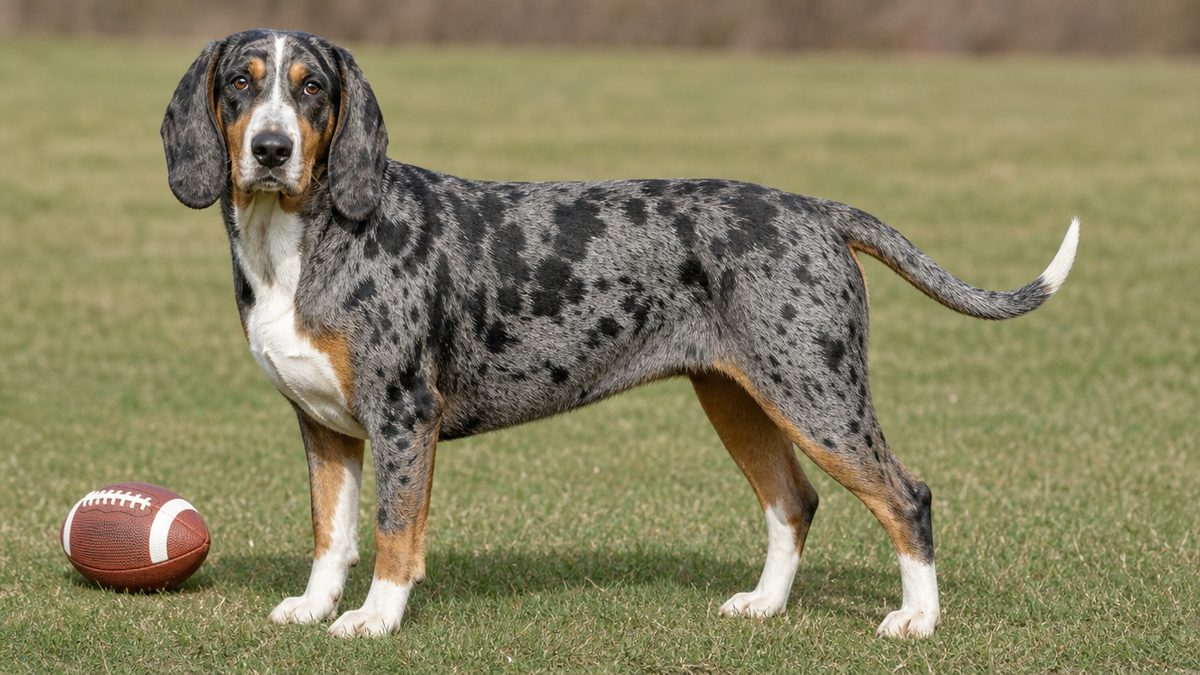
Quick answer
The Dunker, known to the FCI as the Norwegian Hound, is a medium-sized Norwegian hare hound recognised as standard 203, standing 50 to 58 cm at the withers for males and 47 to 54 cm for females. It is on Norway's national conservation list, and Norsk Kennel Klub registered only 67 Dunker puppies in 2025. India has no Dunker market at all.
This page is a research summary and is not veterinary advice. Screening percentages describe populations and not your dog. A puppy that does not respond to sound, an adult that limps or stiffens after rest, and any sudden eye change all need a registered veterinarian in person rather than a web page. Hearing loss in particular is confirmed by a BAER test at a veterinary hospital, not by a home check.
Dunker at a glance
What the Dunker is, and what its two standards say
The Dunker is a medium-sized Norwegian hare hound recognised by the FCI as standard 203 in Group 6, Section 1.2, Medium-sized Hounds, with a working trial attached to its entry. The FCI accepted it definitively on 7 February 1956, and its English-language name in the FCI nomenclature is the Norwegian Hound.
Two documents govern this breed and they are not identical, so this page names which one it is quoting throughout. The FCI standard, in the English text dated 03.06.2016 against a valid official standard of 04.04.2016, is the international one. A second standard, issued by Norsk Kennel Klub under the Nordic Kennel Union and dated 12.07.2021, sits alongside it and is marked on its own cover page "FCI dato: Avventer godkjennelse", that is, awaiting FCI approval. Where they differ, this page says so.
Size, and the weight that neither standard gives
Both standards agree exactly on height. Males stand 50 to 58 cm at the withers with an ideal of 52 to 54 cm, and females 47 to 54 cm with an ideal of 49 to 51 cm. The Norwegian text prints the same figures. Neither prints a weight, despite both heading the section "Size and weight" and "Storrelse og vekt" respectively.
| Source | Males, height | Females, height | Weight |
|---|---|---|---|
| FCI-Standard 203, 2016 | 50 to 58 cm, ideal 52 to 54 | 47 to 54 cm, ideal 49 to 51 | Not stated |
| Norsk Kennel Klub standard, 2021 | 50 to 58 cm, ideal 52 to 54 | 47 to 54 cm, ideal 49 to 51 | Not stated |
| Norsk Kennel Klub breed page | 50 to 55, bracketed 57 | 47 to 53 cm | Not stated |
| Rasehund.no breed portal | 50 to 55 cm | 47 to 53 cm | 22 to 25 kg males, 20 to 23 kg females |
| English Wikipedia | 50 to 55 cm | 47 to 52 cm | 11 to 18 kg in the infobox, 16 to 18 kg in the text |
| Continental Kennel Club, United States | 20 to 22 in, that is 51 to 56 cm | 18 to 21 in, that is 46 to 53 cm | 35 to 50 lb for both sexes, that is 16 to 23 kg |
That table is the single most useful thing on this page for anyone checking a dog against a description. The Norwegian Kennel Club's own consumer breed page gives 50 to 55(57) cm for males and 47 to 53 for females, which matches neither its own downloadable standard nor the FCI's. A Norwegian breed portal repeats those narrower figures and adds a weight of 22 to 25 kg for males and 20 to 23 kg for females that appears in no standard. English Wikipedia gives a third set, and contradicts itself on weight inside one article.
One more English-language source deserves naming because it is the one a search engine is most likely to summarise. The Continental Kennel Club, a United States registry, publishes a Dunker page giving heights of 20 to 22 inches for males and 18 to 21 inches for females, a weight of 35 to 50 pounds for both sexes and a life expectancy of 12 to 14 years. Its female minimum of 18 inches works out at 45.7 cm, below the 47 cm floor in both real standards, and its description says the belly "is not tucked up" where the FCI standard specifies a slightly tucked up belly.
Shape, head and the parts that identify the breed
The outline is the identifying feature. The FCI standard calls the dog "medium sized, distinctly rectangular, powerfully built, but should not appear heavy", conveying an impression of endurance, with depth of brisket approximately half the height at the withers. The Norwegian text adds two words the English does not: the brisket should be about half the height "aldri mindre", never less. On a rectangular working hound that is a functional requirement rather than a cosmetic one.
The head is clean and noble with good length and parallel lines, and the standard says explicitly that it is not wedge-shaped, with a slightly arched skull, a prominent occiput and a defined stop that is neither deep nor abrupt. Ears are medium high set, rather lower than higher, smooth, moderately wide, tapering, rounded at the end, hanging flat without folds and long enough to reach halfway along the muzzle when pulled forward. The tail is set level with the topline, thick at the root, tapering, straight and carried in a slight upward curve to the hock or slightly below.
Coat and the working job it was built for
The coat is "straight, hard, dense and not too short", with the backs of the thighs and the underside of the tail permitted somewhat more profuse hair if the coat is otherwise particularly good. That is a weatherproof outdoor jacket, not a short summer coat, and Indian pages that describe this breed as short-coated are contradicting both standards at once.
The job explains the dog. The Norwegian utilisation line is "drivende harehund", a driving hare hound, and Norway's breed portal records the breed working hare, fox and lynx, energetic and enduring, cooperating closely with the hunter, with a clear voice and often a large working radius. Hunters single out one physical trait above all: the breed's exceptionally hard feet, which tolerate ice and crust well enough that a Dunker can keep hunting where other hare hounds have to stop.
The FCI standard's last operative sentence about the breed is not about looks at all. Under its brief historical summary it states that after crossbreeding was permitted the breed gained much better genetic variation and health while keeping its typical characteristics, and then adds: "Unfortunately, the population figure is still low." A breed standard that ends its own history with a warning about population size is telling you what to ask a breeder about first.
The merle coat and the glass eyes, and what they actually mean
The Dunker's blue-marbled coat and blue glass eyes are the breed's signature and its one genuine genetic liability, and both standards treat them with unusual care. Merle is permitted, wall eyes are permitted in merle dogs, and the Norwegian standard makes a blue eye on a non-merle dog a disqualifying fault.
Start with what the colour is called, because four names circulate. In Norwegian it is "droplet", sometimes glossed as graskimlet, grey-roan. In the FCI's English text it is "blue marbled (merle)". In genetics it is the merle allele. On an Indian listing it will be called blue, grey or harlequin, none of which is the breed term.
| Point | FCI-Standard 203, 2016 | Norsk Kennel Klub standard, 2021 |
|---|---|---|
| Permitted colours | Diluted black with tan markings, or blue marbled (merle) with pale tan and white markings | Black and fawn, or droplet (merle) and fawn with white markings |
| Less desirable | Jet black with warm tan markings | Warm brown or reddish colour |
| White | 50 percent or more white is undesirable | Dominant white, more than 50 percent, is a serious fault |
| Wall eyes | Permitted in blue marbled (merle) dogs | Disqualifying fault on black and fawn dogs |
| Merle faults | White spots in the merle colour is a fault | The overmarked black type is a serious fault |
| Atypical dogs | Not addressed | Atypicality is a disqualifying fault, and this applies to crossed-in dogs too |
Read the wall-eye row twice, because it is the most sophisticated clause in either document and no English-language page about this breed carries it. The FCI text says only that "Wall eyes are permitted in blue marbled (merle) dogs";. The Norwegian standard adds the other half, listing "Glassoye (blatt oye) pa svart/blakke hunder", a glass eye on black and fawn dogs, among its disqualifying faults.
Merle is a dominant pigment allele. A dog carrying it usually looks merle, but the pattern can be faint enough to miss, particularly on a dark or heavily marked coat. A blue eye on a dog that does not appear merle is one of the few visible hints that the allele is present anyway. Disqualifying that dog is a genetic safeguard: it keeps hidden merles out of the breeding pool, and hidden merles bred to visible merles are precisely how double merles get produced by accident.
What double merle means, in the words of a veterinary school
The mechanism is not disputed. Merle is a dominant gene, so a dog carrying one copy shows the pattern. When two heterozygous merles are bred, a quarter of the offspring end up homozygous. Those dogs usually have a solid white coat and blue irises, are often deaf and blind, and may be sterile, which is why breeders in merle breeds know not to breed merle to merle. The deafness in this pathway is neither dominant nor recessive; it is linked to a dominant pigment gene whose secondary effect is to leave the inner ear without the pigment cells it needs.
The same source explains what those cells do. Pigment-associated deafness usually develops in the first few weeks after birth while the ear canal is still closed, and results from degeneration of part of the blood supply to the cochlea, the stria vascularis, after which the sensory hair cells die and the deafness is permanent. That is why a hearing test on an eight-week-old puppy is meaningful and why nothing can be done afterwards.
The numbers that do exist, with their denominators
One study puts real figures on the merle question, across breeds rather than in Dunkers specifically. Strain and colleagues BAER-tested 153 privately owned merle dogs of different breeds and both sexes and genotyped each for the merle allele of the SILV gene. Overall, 4.6 percent were unilaterally deaf and 4.6 percent bilaterally deaf. Single merles were 2.7 percent unilaterally and 0.9 percent bilaterally deaf. Double merles were 10 percent unilaterally and 15 percent bilaterally deaf.
Two conclusions follow that an owner can act on. The association between hearing status and merle genotype was statistically significant, so the genotype is the thing that matters. And there was no significant association with eye colour or with sex, so a blue-eyed merle Dunker is not, on this evidence, at higher risk than a dark-eyed one. The risk sits with the mating, not with the eye.
Why the colour survived at all
Norway's genetic resource centre records that the droplet colour and the blue-white glass eyes have always been characteristic of the breed, even though the standard permits other colours. The Norwegian standard is more precise about origin: in the process of creating the breed from about 1830, two colour types became fixed, the characteristic droplet with glass eyes and the other black and fawn. So this is not a fashion colour that arrived recently. It is one of the two founding phenotypes, which is exactly why it cannot simply be bred out of a population this small.
That is the honest tension on this page. In a breed with an effective population size of 57, removing every merle would halve an already narrow gene pool. The workable answer is the one the standards encode: keep merle, never breed merle to merle, and disqualify the blue-eyed non-merle dog that would let it happen by accident.
History, and the crossbreeding programme that saved the gene pool
Captain Wilhelm Conrad Dunker created the breed from about 1830 by crossing several Norwegian hare hound varieties, and by the 1980s inbreeding had made most of the population too closely related to breed from. Norsk Kennel Klub rejected the breed council's crossbreeding application in 1987 and approved it in 1989, and the effect on the numbers is measurable.
The origin story is short and the two standards tell it slightly differently, which is worth noting rather than blending. The FCI text says the breed is named after the Norwegian captain Wilhelm Conrad Dunker, "who created the breed by crossing several scent hound breeds in the first half of the 19th century", and that the county's hound group was large and included local hare hounds from all over the country. The Norwegian standard dates the work more precisely, from about 1830, and adds that two colour types became fixed in the process.
English Wikipedia gives a third version, that Wilhelm Dunker crossed a Russian Harlequin Hound with dependable Norwegian scent hounds. Neither standard mentions a Russian Harlequin Hound. Both say several Norwegian hare hound varieties. Where a breed's own two standards agree and an encyclopaedia adds a founder breed neither names, follow the standards.
1902, and the split that created two breeds
The institutional history begins in 1902, when the Specialklub for Norske Harehunde was founded. In the same year the Norwegian hare hounds were divided into the two main groups known today as the Dunker and the Hygenhund. The Dunker group absorbed a range of local hare hound strains from different parts of the country, so the founding base was broad and heterogeneous rather than narrow. That breadth is what the breed spent the twentieth century losing.
| Period | What happened |
|---|---|
| About 1830 | Wilhelm Conrad Dunker crosses several Norwegian hare hound varieties; two colour types fix |
| 1902 | Specialklub for Norske Harehunde founded; hare hounds split into Dunker and Hygenhund |
| Second World War | Poor demand for puppies; planned, quality-focused breeding becomes hard to maintain |
| Post-war to the 1970s | Interest rises sharply, then falls as foreign hare hounds arrive |
| 1980s | The breed is very homogeneous with excellent hunting ability, but heavy inbreeding has made most dogs too closely related |
| 1987 | The breeding council applies to Norsk Kennel Klub for crossbreeding; the application is rejected |
| 1989 | Permission granted for some crossbreeding |
| 1989 to 2012 | Fifteen litters produced from crossbreeding, recorded by Norske Harehundklubbers Forbund |
| 1986 | Dunker-ringen founded at Bogstad on 26 April, now with nearly 700 members |
The 1987 rejection is the part that gets skipped, and it is the interesting part. The breeding council did not act unilaterally: it asked, was refused by the national kennel club, and asked again. Two years later permission was given, and the FCI standard's own history section records the outcome in the mildest possible language, that applications were made at several stages and eventually permission was granted for some crossbreeding, which resulted in much better genetic variation and health while maintaining the typical and positive characteristics.
Which breeds went in
Three breeds are named in Norwegian sources. A Norwegian breed portal records that in recent years the Dunker breeding council, working with Norsk Kennel Klub, started a programme mixing in the Hamiltonstovare, the Hygenhund and the Finnish Hound to enlarge the breed's genetic material. The breed's own 2023 population report gives a concrete example from the pedigrees, a puppy born in 2022 whose paternal grandfather is a Finnish Hound.
The report also puts a number on the whole programme. Between 1989 and 2012, crossbreeding produced fifteen litters, recorded by Norske Harehundklubbers Forbund. Fifteen litters across twenty-three years is a deliberately cautious intervention rather than an open studbook, and the report is explicit that an outcross only works long-term if the descendants of the crossed-in dogs are actually used in later breeding.
Effective population size, calculated back to the founder population, fell through the 1970s and 1980s to 42 for the 1988 to 1992 generation, then rose steadily: 45 for 1993 to 1997, 57 for 1998 to 2002, 56 for 2003 to 2007, 59 for 2008 to 2012, and 57 for both 2013 to 2017 and 2018 to 2022. The report attributes that recovery to the crossbreeding begun in 1989 and notes the flattening of the inbreeding curve over the same period. It also says plainly that 55 to 59 is still low enough to require continued measures.
One caution belongs with those figures. The report states that its effective population size was calculated by a specific method, based on all available pedigree information back to the founder population and taking account of how complete each dog's pedigree is, and warns explicitly against comparing its numbers with effective population sizes calculated by other methods. So the 57 on this page is not directly comparable with a 57 you may read for another breed elsewhere.
The reference trail has one more lesson in it. The population report cites the Norwegian Kennel Club's breeding strategy for the hare hound breeds, downloaded on 18 April 2023. That URL now returns a 404, and English Wikipedia's claim that 150 Dunker puppies are born each year rests on an archived copy of the same dead document. A breed this small leaves a thin paper trail, and the documents behind the commonly quoted figures go offline faster than the figures do.
Registry status, conservation listing and the registration numbers
The Dunker is definitively recognised by the FCI as standard 203 and sits on Norway's official list of conservation-worthy livestock breeds, where six of the country's seven national dog breeds are counted as threatened. Norsk Kennel Klub registered 67 Dunker puppies in 2025, and that figure contradicts NKK's own breed page.
| Body | Status | Date or figure |
|---|---|---|
| FCI | Recognised on a definitive basis | 7 February 1956 |
| FCI, current standard | Valid official standard published | 4 April 2016; English text 3 June 2016 |
| FCI classification | Group 6, Section 1.2 Medium-sized Hounds, with working trial | Standard number 203 |
| Norsk Kennel Klub and Nordic Kennel Union | National standard issued, awaiting FCI approval | 12 July 2021 |
| Norsk genressurssenter | One of seven Norwegian national dog breeds, counted as threatened | Current |
| Norsk Kennel Klub | Puppies registered in 2025 | 67 |
The conservation listing, and what Norway does about it
Norway's genetic resource centre, hosted at NIBIO, treats the country's dogs as livestock genetic resources. It counts seven national breeds, four spitz types and three hare hounds, the hare hounds being the Dunker, the Haldenstover and the Hygenhund, and states that all the Norwegian breeds except the grey Norwegian Elkhound are so few in number that they are counted as threatened. That is a national register naming this breed as endangered, not a campaign group's opinion.
The practical measure that follows is worth knowing because very few breeds have one. A semen bank has been established for all seven Norwegian dog breeds, built jointly by the individual breed clubs, Norsk Kennel Klub and the Norwegian genetic resource centre, with the aim of holding frozen semen from ten dogs of each breed, stored preferably for ten years and available in an acute crisis or where old genetic material is needed in breeding work. That is a gene bank, and it is what conservation looks like when a population gets this small.
The registration numbers, and the contradiction inside NKK
| Year | Registered |
|---|---|
| 2010 | 124 |
| 2015 | 174 |
| 2018 | 152 |
| 2019 | 139 |
| 2020 | 112 |
| 2022 | 141 |
| 2023 | 92 |
| 2024 | 87 |
| 2025 | 67 |
Read the last three rows against what NKK's own consumer breed page says. That page states that in recent years the number of newly registered Dunker puppies has varied between 130 and 180 a year, and that this is low enough that the breed ought to increase somewhat in number for healthy and effective breeding work to continue. NKK's own registration spreadsheet records 92, 87 and 67 for 2023, 2024 and 2025. Both are published by the same organisation, and the breed page has not caught up with the data.
There is a second, smaller disagreement worth stating rather than smoothing over. The breed's own 2023 population report records 116 puppies registered in 2022 and 166 in 2021, while NKK's spreadsheet gives 141 for 2022. The likeliest explanation is that the two count different things, births in a year against registrations completed in a year, and NKK itself notes that a litter born late in a year and registered after New Year falls into the following year's figures. Say that rather than picking one.
Norsk Kennel Klub estimates that about 585,000 dogs live in Norway, that 18 percent of Norwegian households have one, and that it registers 50 to 60 percent of them, roughly 25,000 to 30,000 puppies a year. Against that, 67 Dunkers is about two-tenths of one percent of a year's registrations. For scale, the Golden Retriever was registered 1,274 times in Norway in 2025 and the Border Collie 1,001 times.
It is worth noting how the same year was reported publicly. Norsk Kennel Klub's own press release of 15 January 2026 describes the 2025 figures as a year of normal and predictable development, with the Golden Retriever, Border Collie and Labrador Retriever again the three most registered breeds. A stable national headline can sit on top of a breed that has lost 60 percent of its registrations in a decade, which is exactly why the per-breed spreadsheet matters more than the summary.
Where India stands in the same registers
India is listed as a member in the FCI's own members and contract partners register, under Asia, Africa and Oceania, alongside Norway under Europe. Because the Kennel Club of India issues pedigrees against FCI nomenclature, a definitively recognised FCI breed is in principle registrable in India, and the Dunker is definitively recognised. The obstacle is not recognition. It is that no Dunker appears to exist in India for anyone to register.
That distinction matters because it is the one Indian pages get wrong in both directions. A seller who tells you the breed is not recognised in India is wrong. A seller who tells you they can supply a KCI-registered Dunker is making a much stronger claim than recognition supports, and should be asked for the import authorisation and the pedigree of the imported parent before anything else.
Dunker price in India: there is not one, and here is the proof
No Dunker price exists in India because no Indian seller offers the breed. That is the finding, not a gap in the research, and it is worth more to a reader than any invented range. Below is what an India-located search actually returns, and why every rupee figure attached to this breed's name should be refused.
State the negative properly, with a control. An India-located search for this breed plus price in india returns two general dog price lists, a Justdial directory shell, a United States kennel club page, an Etsy poster, a 1915 Project Gutenberg book and a Quora thread. It returns no Indian breeder, no Indian kennel, no Indian classified listing and no rupee figure attached to the breed. The control is the same search working normally: it surfaces real Indian commerce for other breeds on the same domains.
| Page | What it promises | What it contains |
|---|---|---|
| Justdial, Pet Shops For Dunker Dog in Patna | Pet shops in Patna stocking the breed | Ten businesses, none in Patna, none listing the breed in its categories |
| PawSpace, Dog Price List in India, Top 40 Breeds | The Indian price of 40 breeds | 40 breeds including the Kanni and Chippiparai; the Dunker is not among them |
| Puppiezo, Norwegian Elkhound | Norwegian breeds for sale in India | A real Norwegian Elkhound page; the site has no Dunker page at all |
| Continental Kennel Club, Dunker | Breed information and registered puppies | A United States registry page, not an Indian source |
| Etsy, Norwegian Hound poster | The breed's name | Wall art |
The Justdial page is worth reading closely because it is the strongest single piece of evidence. It is headed "Popular Pet Shops For Dunker Dog in Patna" and lists ten businesses in Varanasi, Raebareli, Jabalpur, Bhubaneshwar, Jhansi, Agra, Hathras, Mathura, Hoshangabad and Bhopal. Not one is in Patna, and none of their listed categories mentions this breed; they are filed under pet shops for dogs, for Labradors, for birds, for rabbits and for Persian cats.
The same Justdial page recommends "Shop A", "Shop B" and "Shop C" rather than naming shops. It states that Dunkers have a short coat requiring regular brushing, where both breed standards say straight, hard, dense and not too short. And its own meta description promises pet shops for German Shepherd dogs on a Dunker page. A directory that generates one page for every breed crossed with every city produces a page for a dog that has never entered the country.
The absence is real, because the same sources carry other rare breeds
An absence only counts if the instrument works, so here is the control. The Indian puppy seller that has no Dunker page does carry pages for the Danish-Swedish Farmdog, the Redbone Coonhound, the Cirneco dell'Etna, the Clumber Spaniel, the Chesapeake Bay Retriever and the Norwegian Elkhound. That is a site perfectly willing to advertise obscure European breeds, including a Norwegian one. It simply has no Dunker.
The 40-breed Indian price list is the second control. It spans the Indian Pariah Dog at Rs 0 to Rs 5,000, the Indian Spitz and the Rajapalayam at Rs 8,000 to Rs 30,000, the Labrador Retriever at Rs 20,000 to Rs 70,000, the Belgian Malinois at Rs 40,000 to Rs 1,50,000 and the English Bulldog at Rs 80,000 to Rs 3,00,000. It includes five Indian breeds and 35 imported ones, and it does not include the Dunker.
Why no supply chain can easily form
Two facts together explain the absence, and neither is about demand. DGFT Trade Notice 22/2022-23 places live dogs under ITC(HS) 01061900 as Restricted and permits import only for a pet dog with a valid pet book in the importer's name, for research with CPCSEA recommendation, or for internal security by the Defence and Police Force, while stating that applications for trading or breeding purposes shall be duly rejected. So there is no lawful commercial route in.
And there is very little to import. Norway registered 67 Dunker puppies in the whole of 2025, the breed sits on Norway's conservation-worthy list, and its own breed organisation reported in August 2026 that it currently has no operative breeding council. A breed producing under a hundred puppies a year in its homeland, under active conservation management, does not export a pet trade.
Ask three questions before anything else. Which country did the parents come from, and under which of the three DGFT policy conditions did they enter India. What is the sire's and dam's Norwegian registration number, which for this breed looks like NO40064/13. And is the litter registered anywhere, with whom. A seller who cannot answer all three is not selling you this breed, whatever the photograph shows.
Bonbeno publishes no Indian price band for this breed, because inventing one is the exact failure this page exists to document. Where a number does not exist, the useful thing to publish is why.
Monthly cost of ownership in India, built from the size class
No Indian cost figure exists for this breed, so build one from the size class instead: a 50 to 58 cm hound is a medium breed, and Indian published estimates put medium-breed upkeep at roughly Rs 6,000 to Rs 18,000 a month. Every number below is an Indian services company's published estimate, not a study, and this page labels it as such.
Say the limit first, because it is the honest starting point. Bonbeno found no Indian cost survey, no veterinary costing and no insurer dataset for the Dunker, for the same reason it found no price: there are no Indian Dunkers to cost. What follows is the Indian cost structure for a medium-sized, active, dense-coated hound, taken from a published Indian pet-services price guide and applied to this breed's documented requirements.
| Expense | Published monthly range | What drives it for this breed |
|---|---|---|
| Food | Rs 2,000 to Rs 12,000 | A 22 to 25 kg working hound fed to an active energy level |
| Treats and chews | Rs 500 to Rs 2,500 | Scentwork and nosework rewards, which this breed needs daily |
| Grooming | Rs 800 to Rs 5,000 | A dense coat plus weekly ear checks in humidity |
| Vet and preventive care | Rs 500 to Rs 3,000 | Routine, plus a hearing test in puppyhood if merle |
| Training | Rs 2,000 to Rs 12,000 | Recall work, which is the whole training budget for a scenthound |
| Tick and flea prevention | Rs 500 to Rs 1,500 | Year round for an outdoor-worked dog in India |
| Walking or daycare support | Rs 2,000 to Rs 10,000 | Because nobody can walk this dog enough before work |
The same guide puts medium-breed maintenance at Rs 6,000 to Rs 18,000 a month and large-breed at Rs 8,000 to Rs 25,000. A Dunker sits at the top of the medium band, because the food line scales with a working hound's appetite and the training line scales with the recall problem. Its first-year table adds vaccinations at Rs 3,000 to Rs 8,000, deworming and vet visits at Rs 2,000 to Rs 6,000, and tick and flea prevention at Rs 6,000 to Rs 18,000, before any purchase price.
Two cost lines this breed adds that a chart will not show
- A BAER hearing test in puppyhood if the dog is merle, which is available only at a veterinary teaching hospital or a specialist referral centre, and is not a routine service in most Indian cities.
- Secure fencing or a long line for life, because a scenthound with a large working radius cannot be recalled off a fresh line and an Indian street is not a place to find that out.
Neither is optional and neither appears in any Indian cost list, because no Indian cost list covers this breed. The hearing test in particular is a one-time expense that determines how you train the dog for the next decade, and it is worth budgeting before the puppy rather than after the first missed recall.
The line that dominates everything: heat management
The largest hidden cost of keeping this breed in India is not veterinary, it is architectural. A hound formed where the annual mean wet-bulb temperature is 3.6 degrees C needs indoor cooling for most of the Indian year, and that is an electricity bill rather than a pet expense. It also compresses the walking window into the hour before sunrise, which for most working owners means paying somebody else to do it, at the Rs 2,000 to Rs 10,000 a month the Indian guide quotes for walking support.
The same Indian price guide puts adoption at Rs 0 to Rs 10,000 including vaccination and sterilisation, and Indian Pariah Dog upkeep at Rs 3,000 to Rs 8,000 a month, roughly half the medium-breed band. It also notes that Indian dogs are often better suited to the Indian climate. For a reader weighing a Norwegian hare hound they cannot buy against an Indian dog they can collect this week, the arithmetic and the climate point the same way.
One structural point closes this section. Cost of ownership for an unavailable breed is a thought experiment, and this page presents it as one. What is not a thought experiment is the pattern: a working hound in an Indian city costs more in services than in food, because the services replace the work the dog cannot do here.
Heat tolerance in India, measured against Oslo
The Dunker is one of the least heat-adapted breeds this site has measured, and the gap is best shown on wet-bulb temperature rather than air temperature. Oslo's annual mean wet-bulb is 3.6 degrees C. Chennai's is 24.9, and Chennai's coolest month is still 7.5 degrees hotter than Oslo's hottest.
Air temperature misleads in India because a dog cools by evaporating water from its airways, and evaporation stalls as humidity rises. Wet-bulb temperature folds heat and humidity into one number, which is why this page uses it. All figures come from NASA POWER's twenty-year climatology for January 2001 to December 2020, queried by explicit latitude and longitude so no place name can be substituted for another. One caveat, added on 31 August 2026. NASA POWER returns a grid cell rather than a point, and the Oslo cell sits at 258.7 metres against a city centre near 23 metres. At the standard lapse rate that makes the Oslo air figures here roughly 1.5 degrees C too cold, so the gap this page reports is slightly overstated rather than understated. It does not change the conclusion, because the smallest gap in the table below is about 16 degrees. The Indian cities in the table are lowland and their cells sit within about 80 metres of their towns, so no correction is needed on that side.
| Place | Annual mean wet-bulb | Warmest month | Coolest month | Annual mean air temp |
|---|---|---|---|---|
| Oslo, Norway | 3.6 | 14.3 in July | -6.2 in January | 4.6 |
| Bengaluru | 19.8 | 22.7 in May | 16.4 in January | 23.7 |
| Pune | 19.7 | 23.6 in June | 14.3 in January | 23.9 |
| Guwahati | 20.5 | 26.2 in July | 12.3 in January | 22.9 |
| Mumbai | 22.7 | 26.6 in June | 17.1 in January | 26.8 |
| Kolkata | 22.9 | 27.9 in June | 13.6 in January | 25.8 |
| Delhi | 18.0 | 27.7 in July | 6.9 in January | 25.6 |
| Chennai | 24.9 | 27.4 in May | 21.8 in January | 28.0 |
Three comparisons carry the argument. Chennai in May reaches 27.4 degrees wet-bulb against Oslo's July peak of 14.3, a gap of 13.1 degrees. Chennai's coolest month, January, is 21.8 degrees, still 7.5 degrees above the hottest month the breed's ancestors ever encountered. And on annual mean, Chennai sits 21.3 degrees above Oslo. Even Bengaluru, the mildest large Indian city on this table, runs 16.2 degrees above Oslo on the annual mean.
Both standards specify a coat that is straight, hard, dense and not too short, with the backs of the thighs and the underside of the tail permitted to be more profusely coated. That is a Norwegian winter jacket. A hound described in Norwegian sources as capable of hunting through ice and crusted snow, on paws hard enough to keep going where other hare hounds stop, is not a dog whose insulation was selected for a Chennai May.
What the best heat-illness dataset can and cannot say
The strongest evidence on canine heat illness comes from the UK VetCompass study of 905,543 dogs under primary veterinary care at 886 clinics in 2016, which identified 1,259 heat-related illness events from 1,222 dogs. Of those, 380 had no trigger recorded, leaving 879 events with a recorded trigger. Among those 879, exertional heat illness accounted for 652 events, or 74.2 percent, followed by environmental at 113 events, or 12.9 percent, and vehicular confinement at 46 events, or 5.2 percent.
Quote the denominator precisely, because this figure is misquoted more than any other on the subject. The 74.2 percent is 652 of the 879 events that had a recorded trigger. It is not 74.2 percent of 1,259, which would be 934 events, a number that appears nowhere in the paper. Exertional events occurred year round and carried a 7.6 percent fatality rate.
Now the limit. The word Dunker appears nowhere in that study, so the breed was not modelled and no breed-specific odds ratio exists for it. What the paper does report is that the Labrador Retriever had twice the odds of exertional heat illness compared with non-designer crossbred dogs, and that the same doubled odds applied to Boxer, Golden Retriever, Border Collie, Pug and "other purebred", the last category defined as breeds with relatively low numbers in the study population or fewer than five confirmed cases. Any UK Dunker would have sat in that last category. That is a category finding, not a breed finding, and this page treats it as one.
City by city, if the question ever became practical
- Bengaluru and Pune are the only defensible options, at 19.8 and 19.7 degrees annual mean wet-bulb, and both are still 16 degrees above the breed's homeland.
- Delhi is deceptive, dry enough in May to look manageable and then reaching 27.7 degrees wet-bulb in July, which is worse than Chennai's annual peak.
- Mumbai, Kolkata and Guwahati are unsuitable in the monsoon, at 26.6, 27.9 and 26.2 degrees in their worst months, when evaporative cooling barely works at all.
- Chennai has no easy season, at 21.8 degrees wet-bulb even in January.
The practical rules do not change with the city. Real work happens before sunrise, water is available free rather than rationed, the afternoon is rest, and the first sign of a widened tongue and a slowing pace ends the session. A heat-sensitive working hound can be kept alive in India. What cannot be arranged is the job it was built for, in the conditions it was built for, and that is the honest conclusion of this section.
One more figure belongs here because it changes the risk calculation. Both standards describe a dog with a large working radius that gives tongue on a line, which means a Dunker that gets onto a scent in Indian heat will keep working past the point of safety and out of earshot. That combination, high drive plus high wet-bulb plus poor recall, is the mechanism behind the exertional category the UK study found dominant.
Temperament and household fit: two sources that disagree
The FCI standard calls the Dunker especially sociable and trusting and an excellent combination of hunting and companion dog, while Norway's own breed portal states that the breed is not suited to beginners and cannot be recommended as a family dog for passive families. Both are accurate, and the difference between them is whether the dog has work.
Read the standard first. "The Norwegian Hound is considered to be the hardy and robust scent hound of old times, a dog with an excellent temperament. The breed is characterized by strong nerves and by being especially sociable and trusting. They are known to have done well in hunting trials. They can thus be characterized as an excellent combination of a hunting and companion dog. Due to its good temperament and open nature, the breed is also easy to train";. The Norwegian standard says the same in fewer words: robust and hardy, nerve-steady, especially sociable and trusting, easy to train.
Then read the portal. "Rasen er ikke egnet for nybegynnere og kan ikke anbefales som familiehund for passive familier", the breed is not suited to beginners and cannot be recommended as a family dog for passive families, though it functions well socially otherwise. The same page describes a self-reliant, hardy, robust working dog with a restrained temperament, great hunting desire, and a need for regular and sufficient exercise to thrive.
A breed standard describes what the dog is like when it is doing its job. A national breed portal describes what happens to the same dog in an ordinary household. A Dunker that drives hare twice a week is exactly the sociable, trusting, easy companion the standard promises. A Dunker with no work is a vocal, self-directing hound in a flat, and the portal is warning about that dog.
| Household | Fit | Why |
|---|---|---|
| Norwegian or Swedish hunting household | Strong | The job the breed exists for, and where the standard's temperament description holds |
| Rural Indian property with secure fencing and daily scentwork | Workable in theory | Only in the cool hours, and only with somebody who trains daily |
| Indian apartment | Poor | A hound bred to be heard across a valley, in a building with shared walls |
| First dog, any country | Poor | Norway's own breed portal says the breed is not for beginners |
| Passive family wanting a calm companion | Poor | Named specifically by the Norwegian portal as the household to avoid |
The voice, which is a design feature
The single trait that decides Indian suitability is not heat and it is not size. It is the voice. A driving hare hound's purpose is to hold a line and tell the hunter where it is, and the Norwegian breed page describes the Dunker as cooperating closely with its owner in the forest and giving a clear, distinct los, the Norwegian word for a hound's tracking bark. English Wikipedia claims the breed rarely barks outside hunting if properly exercised, sourced to a Norwegian blog. The qualifier in that sentence is doing all the work.
For an Indian reader the arithmetic is unforgiving. Adequate exercise for this breed means an hour or more of real work, which in most Indian cities is available only before sunrise for most of the year. A dog that does not get it is precisely the dog that uses its voice, in a building where the neighbours share a wall.
With people, other dogs and Indian streets
The sociability is real and worth stating clearly. Both standards describe strong nerves and an open, trusting nature, and the Norwegian portal notes the breed functions well socially. This is not a suspicious or territorial breed and it was never selected to be one. A Dunker meeting strangers, children or other dogs is generally straightforward, which is more than can be said for several breeds Indian sellers push harder.
The problem is not aggression, it is deafness to instruction under scent. A hound with a large working radius, used on hare, fox and lynx, is selected to keep going away from the handler rather than to check in. On an Indian street that means free-roaming cats, chickens, community dogs and traffic, all of which are more interesting than you are once a line lifts. A long line is not a training aid for this breed; it is the default equipment.
The last honest point on household fit is that nobody in India has tested any of this. Everything above is derived from Norwegian sources describing Norwegian conditions, because no Indian owner account of the breed exists to check it against. A page that claimed to know how a Dunker behaves in a Hyderabad flat would be inventing the evidence, and this one does not.
Training a scenthound, and the one thing this breed resists
Train a Dunker on everything except recall and you will succeed easily, because both standards call the breed easy to train and describe an open, cooperative nature. Recall off a live scent is the exception, and it is not a training failure so much as the trait the breed was selected for.
The standards are unusually positive about trainability. "Due to its good temperament and open nature, the breed is also easy to train", says the FCI text, after describing strong nerves and a sociable, trusting character. The Norwegian standard compresses it to one word, "lettrent", easily trained. Norway's breed portal agrees that the dog cooperates closely with its owner in the forest, and adds the qualifier that matters: it has great hunting desire and a large working radius.
Why recall is the whole training project
A driving hare hound is bred to commit to a line and stay on it, alone, at distance, for as long as the scent holds. Everything that makes a Dunker good at that makes recall hard: persistence, independence at range, and a nose that outranks your voice. This is not stubbornness and it does not respond to being corrected out of the dog. It responds to management.
- Train recall on a long line from week nine and never assume it transfers to open ground, because it will not until it has been proved a hundred times.
- Pair the recall word with food that outranks the environment, and never call the dog to do something it dislikes.
- Practise in ascending distraction: garden, quiet lane, park at dawn, and only then anywhere with live scent.
- Accept a fenced or long-line life if the tests fail, which is a normal outcome for a scenthound rather than a defeat.
- Register the dog's microchip and keep an identity tag on the collar, because a hound that leaves on a line can travel a long way before it stops.
What to build instead of distance
Scentwork is the obvious replacement and it is unusually well suited to India, for a climate reason rather than a temperament one. A tracking or search game tires a working hound far faster than the equivalent minutes of walking, and it can be run indoors at three in the afternoon in May when no walk is possible. For a breed whose whole nervous system is organised around a nose, ten minutes of searching is worth half an hour of pavement.
One real outdoor session before 07:00, two indoor scent games of ten minutes each, one five-minute obedience session, and a mat-settle exercise every evening. That structure gives a hound the nose work and the decisions it needs without ever asking it to exert itself in heat, and it is the only version of this breed's routine that survives an Indian April.
Socialisation, and where it starts
The breed's temperament makes socialise work easy and it still has to be done. An open, trusting hound that meets nothing until four months old becomes a startled one, and the receptive window closes at about fourteen weeks regardless of how good the genetics are. In India that means traffic, firecrackers well before Diwali, tiled and metal surfaces, calm adult dogs individually rather than street groups, and daily handling of ears, feet and mouth.
Handling matters more in this breed than in most, for one specific reason. If the dog is merle, it should have a BAER hearing test in puppyhood, and that is a procedure done at a referral hospital on a dog that must lie still. A puppy that has had its ears touched daily since eight weeks makes that appointment straightforward. A puppy that has not makes it an ordeal.
If the dog turns out to be deaf
A unilaterally deaf dog usually appears to hear normally, and only a brainstem auditory evoked response test detects it. That is worth knowing before you conclude a puppy is being disobedient. A bilaterally deaf dog is trainable on hand signals and vibration cues, and the training is not harder so much as different, but it does end any prospect of off-lead freedom permanently, which for a scenthound was already marginal.
One further point from the same veterinary source is a breeding one rather than a training one. A unilaterally deaf dog can be as great a genetic risk for transmitting deafness to its offspring as a bilaterally deaf dog. So a Dunker that tests unilaterally deaf can be an excellent companion and should not be bred from, and in a breed with an effective population size of 57 that is a genuinely painful trade-off rather than an easy rule.
Daily exercise, and the job India cannot supply
A Dunker needs an hour or more of real work every day, and in India that hour has to happen before sunrise for most of the year. The deeper problem is not the quantity: it is that the breed's actual job, driving hare and fox through Norwegian forest for hours, has no Indian equivalent at all.
Both standards make the requirement institutional rather than advisory. The FCI entry for this breed carries a working trial, meaning a championship in FCI countries requires proven work rather than conformation alone. The Norwegian standard gives the utilisation as "drivende harehund", a driving hare hound. Norway's breed portal states that the dog is energetic and enduring, has great hunting desire, and needs regular and sufficient exercise to thrive.
What the job actually is
The Norwegian sources describe a specific and demanding piece of work. Hare hunting is the core of it: the Dunker hunts hare, fox and lynx, cooperates closely with the hunter, gives a clear tracking voice and often works at a large radius. Hunters single out the feet: the breed tolerates ice and crusted snow well enough to keep hunting where other hare hounds have to stop. That is hours of self-directed searching over broken winter ground, which is not a thing that exists in Chennai in any month.
| Slot | Activity | Why it fits |
|---|---|---|
| 05:30 to 06:45, daily | Long-line walk on soft ground with free sniffing | The only window in most Indian cities where sustained work is survivable |
| Mid-morning, 10 minutes | Indoor scent search for hidden food | Nose work at zero thermal cost |
| Afternoon, 15 minutes | Shaping or a food puzzle indoors | Replaces the walk the afternoon takes away |
| Evening, 30 minutes | Second walk once surfaces have cooled | Check tarmac with the back of your hand first |
| Twice weekly | A long tracking exercise laid the night before | The closest available substitute for the breed's real job |
In the UK VetCompass cohort, exertional heat-related illness accounted for 652 of the 879 events with a recorded trigger, or 74.2 percent, against 113 environmental events and 46 from vehicular confinement. Exertional events happened year round and carried a 7.6 percent fatality rate. A hound that will keep working a line past the point of comfort, out of earshot, is exactly the profile that produces those numbers. Stop the session on the clock, not on the dog's willingness.
Surfaces, and a five-second check
Indian tarmac holds heat long after the air has cooled. Press the back of your hand to the road for five seconds before an evening walk; if you cannot hold it there, neither can the dog. Grass, packed earth and shaded paving are all better. The breed's famously hard feet were selected for ice and crust, not for a Delhi road surface at 40 degrees, and hard pads burn as readily as soft ones.
What under-exercise looks like
- Vocalising at every passing scooter, delivery rider and neighbour, because a hound with nothing to track will announce what it can hear.
- Roaming the moment a gate opens, following a scent rather than escaping anything.
- Destroying soft furnishings and doorframes in the first six months, which owners misread as separation anxiety.
- Gaining weight quickly, because a working appetite in a sedentary dog is the ordinary route to a heavy hound.
The fix is rarely more distance. A dog that has walked five kilometres on lead and solved nothing arrives home fitter and no calmer, which is the treadmill every working-breed owner describes. Nose work breaks that cycle because it satisfies the specific drive rather than burning general energy, and it is the only tool that functions indoors at 15:00 in an Indian summer.
One honest closing note. Nothing in this section is derived from an Indian Dunker, because there does not appear to be one. It is a plan built from what two standards and a national breed portal say the breed requires, applied to measured Indian conditions. If the plan reads as demanding, that is the finding: the gap between what this breed needs and what an Indian city offers is larger than for almost any breed on this site.
Grooming and coat care in Indian humidity
Groom a Dunker weekly and check its ears more often than that, because the coat is easy and the ears are not. Both standards describe a straight, hard, dense coat that is not too short, and the drop ear that identifies the breed is the part that suffers in an Indian monsoon.
The coat clause is identical in both standards. "Straight, hard, dense and not too short. The back of the thighs and the tail may be somewhat more profusely coated, provided the coat is otherwise particularly good";. The Norwegian text says the same. Norsk Kennel Klub's own care note adds that the coat does not require extensive attention and the dog can be bathed as needed, while Norway's breed portal is slightly firmer, saying the coat needs regular maintenance.
Note what this is not. It is not a short coat, whatever the Indian directory shell says. A dense, hard outer coat on a dog selected to work through crusted snow is a weather layer, and in Indian humidity a weather layer that stays damp is where problems start.
| Task | Frequency | Why it matters here |
|---|---|---|
| Brush through with a bristle or rubber tool | Weekly, daily in the moult | Removes dead undercoat that would otherwise hold moisture against skin |
| Check both ears | Weekly, and after every wet walk | A drop ear that lies flat against the head ventilates poorly in high humidity |
| Dry the coat with a towel then with air movement | After every monsoon walk | Air drying alone does not work above 85 percent humidity |
| Inspect between the toes | After off-lead or long-line work | Grass seeds and mud collect there, and licking is the first sign |
| Tick and flea treatment | Monthly, year round | An outdoor-worked dog in India has no low season |
| Bath | As needed only | Over-bathing strips a hard working coat and softens its texture |
The ears, which are the real job
The standard describes ears that are medium high set, rather lower than higher, smooth, moderately wide, tapering, rounded at the end, hanging flat without folds and close to the head, long enough to extend halfway along the muzzle when pulled forward. Every one of those words describes a well-sealed ear canal. In a Norwegian forest that keeps out snow and debris. In a Mumbai July it keeps in warm, moist air.
Overseas guidance for hard-coated hunting dogs routinely says to towel the dog off and let it air dry. That is sound in a Norwegian autumn, where cool dry air finishes the job in an hour. It is poor advice in an Indian monsoon, where ambient humidity above 85 percent means air drying effectively does not happen and the coat and ear canal stay damp for hours. Dry this breed actively rather than patiently, and dry the ear flap and the skin under it, not just the top coat.
What not to do
- Never shave the coat for the heat. A hard double-layered working coat insulates against heat as well as cold, and a shaved dog is a sunburn risk with worse thermoregulation rather than a cooler dog.
- Never push cotton buds or swabs into the ear canal. Clean only the visible part of the ear flap, and only when it needs it.
- Never clean with a proprietary ear solution without asking a vet first, particularly in a dog that has had an ear infection before.
- Never ignore a smelly ear, repeated head shaking or scratching at one side, which are the standard early signs of an ear infection and need a clinic rather than a home remedy.
The moult, and the one counterintuitive rule
A dense working coat drops heavily twice a year and lightly all the time in a warm climate, because Indian conditions blur the seasonal trigger. A rubber curry mitt or an undercoat rake two or three times a week through the monsoon removes more risk than any amount of trimming, and costs nothing. The dead undercoat is the problem, not the length of the top coat.
The counterintuitive rule comes from Dutch and Nordic care guidance for hard-coated breeds and is worth stating because Indian owners over-groom: brushing far more than the coat needs, outside the moult, can disturb the hair growth cycle and produce a dog that sheds continuously instead of seasonally. Weekly is enough between moults. Daily is for the moult itself.
One last point specific to this breed. If the dog is merle and has been confirmed deaf on one or both sides, grooming becomes a training exercise as much as a hygiene one, because a deaf dog startles when touched unexpectedly. Approach into the field of vision, touch the shoulder first every time, and the whole routine stays calm.
Health, with real Norwegian denominators instead of the famous percentage
The Dunker's best-documented health problem is merle-associated deafness, and its most cited statistic has no denominator anywhere. What does have denominators is Norway's own registration data, which records 233 dysplastic dogs from 784 hip radiographs across the 2002 to 2015 birth cohorts, a rate of 29.7 percent.
Start with what is missing, because it shapes everything else. The Orthopedic Foundation for Animals holds no record for this breed at all: the name appears zero times across its full disease-statistics tables, which run to roughly 5,400 rows. That is a proved absence rather than a failed search, because the Norwegian Elkhound appears in eight of the same tables, with 4,545 hip evaluations and 19.8 percent graded dysplastic, and the breed codes were read directly from OFA's own markup. So the American screening registry that this site normally leans on has nothing, and Norwegian data has to do the work.
Hips, from Norsk Kennel Klub's own spreadsheet
Norsk Kennel Klub publishes a spreadsheet of registrations for every breed since 2001, and its underlying data sheet carries per-birth-year columns for the number of dogs radiographed and the grade they received. Aggregating the birth cohorts from 2002 to 2015, which are old enough to have been screened, gives the following.
| Measure | Dogs | Share of those radiographed |
|---|---|---|
| Puppies registered in those cohorts | 2,087 | - |
| Hip-radiographed | 784 | 37.6 percent of those registered |
| Graded free | 551 | 70.3 percent |
| Graded mild | 142 | 18.1 percent |
| Graded moderate | 69 | 8.8 percent |
| Graded severe | 22 | 2.8 percent |
| Any degree of dysplasia | 233 | 29.7 percent |
Three caveats belong with that figure and none of them removes it. Only 37.6 percent of registered dogs were radiographed, and owners who screen are not a random sample. Norwegian and American grading schemes are not the same, so 29.7 percent here is not directly comparable with an OFA percentage for another breed. And the rate is not flat across the period: the 2006 cohort came in at 18.0 percent dysplastic on 50 radiographs, while the 2013 cohort came in at 43.6 percent on 39, so the confidence interval on any single year is wide.
Screening in this breed has collapsed. The 2002 birth cohort had 85 of 173 puppies radiographed. The 2015 cohort had 45 of 174. From 2016 the counts are 11, 11, 4, 4, 3, 5, 0 and 0. Part of that is cohort immaturity, since a dog born in 2022 may not be radiographed yet, but a 2016 cohort with 11 radiographs out of 103 puppies is a decade old. Any percentage computed on four dogs is noise, which is why this page stops the aggregate at 2015 and says so.
Elbows, where there is almost nothing to report
The same data sheet carries elbow columns, and the result is stark. Across all twenty-two birth cohorts from 2002 to 2023, covering 3,123 registered Dunkers, exactly 15 dogs were elbow-radiographed, and all 15 were recorded free. That is under half of one percent of the breed ever screened for elbow dysplasia. The honest reading is not that the breed has no elbow problem; it is that nobody has looked.
Deafness, and the figure that will not resolve
The most repeated sentence about this breed states that unilateral or bilateral deafness is found in 75 percent of all white Norwegian Dunkerhounds, while the prevalence in normal-colour dogs is unknown. It traces to a 1981 Norwegian source. Bonbeno could find no numerator, no denominator and no description of how hearing was assessed in any accessible source, and the peer-reviewed paper usually cited beside it tested eight breeds, none of which was the Dunker.
So this page will not repeat it as a prevalence. What it will use instead is a study with a stated method and a stated denominator. Strain and colleagues BAER-tested 153 privately owned merle dogs across breeds and genotyped each at the merle locus. Overall 4.6 percent were unilaterally deaf and 4.6 percent bilaterally deaf. Single merles were 2.7 percent unilaterally and 0.9 percent bilaterally deaf; double merles were 10 percent unilaterally and 15 percent bilaterally deaf. The genotype association was significant; eye colour and sex were not.
| Figure | Denominator | Method stated | Usable |
|---|---|---|---|
| 75 percent of all white Norwegian Dunkerhounds | None published | None found | No |
| Merles overall, 9.2 percent deaf in one or both ears | 153 merle dogs across breeds | BAER plus genotyping | Yes, as a cross-breed figure |
| Double merles, 25 percent deaf in one or both ears | The homozygous subset of those 153 | BAER plus genotyping | Yes, and it is the number that should drive breeding |
What the breed's own people are currently worried about
One live signal is worth more than a decade-old list. The Dunker's own organisation held a professional meeting on spondylosis in dogs at its annual gathering in Hokksund on 30 May 2026. A breed club convening a specialist session on a degenerative spinal condition is telling you what its members are seeing, and it is the only current, breed-sourced health signal Bonbeno located. It is not a prevalence and this page does not present it as one.
Lifespan, which nobody has measured
No lifespan study of the Dunker exists, and no breed-specific life expectancy figure exists either. Norsk Kennel Klub states the position clearly for all breeds: no collected statistics are kept in Norway on how many dogs are alive at any time or when dogs die, so available figures describe new registrations rather than the total population or actual longevity. It points instead to a general Norwegian life expectancy of around 12 years for dogs, drawn from a 2024 pet report. That is a national figure for all breeds and it is not a Dunker figure.
The literature is equally thin, and the search was run with controls. A PubMed search for Dunkerhound returns zero records, with the phrase preserved and no query rewriting, which makes the zero a real negative rather than an artefact. A search for the breed name plus dog and breed returns three records, and reading them shows none is about the breed: a Norwegian study of diabetes and hypothyroidism across breeds, a gadolinium imaging study, and a 1995 Norwegian article on canine cancer registration. Zero genuine records is the honest count.
Screening: what to test, and what Indian law would and would not require
Screen a Dunker for hips, have a BAER hearing test done in puppyhood if the dog is merle, and never breed merle to merle. Indian law separately requires testing for a named list of genetic defects, and that list does not include hearing, which is the one thing this breed most needs tested.
The four tests that matter for this breed
- Test hearing by BAER in puppyhood if the dog is merle, because a unilaterally deaf dog appears to hear normally and only that test detects it.
- Screen both parents' hips, because Norway's register records 233 dysplastic dogs from 784 radiographed across the 2002 to 2015 birth cohorts.
- Verify that the mating was not merle to merle, since double merles carried 10 percent unilateral and 15 percent bilateral deafness in the best-denominated study.
- Check eye colour against coat colour, because a blue eye on a black and fawn dog is a disqualifying fault in the Norwegian standard and a signal of hidden merle.
Elbows belong on the list in principle and are effectively untested in practice: 15 dogs across twenty-two birth cohorts covering 3,123 registered puppies. Ask anyway. A breeder who has elbow-scored a Dunker has done something almost nobody in the breed has done, and that tells you something about them.
What Indian law requires, verbatim
Second Schedule Part III paragraph 8(10) of the Prevention of Cruelty to Animals (Dog Breeding and Marketing) Rules, 2017 reads: "The dogs shall have been tested for genetic defects, including hip dysplasia, progressive retinal atrophy, night blindness, hypothyroidism, entropion, ectropion, overshot, undershot jaw (when incisors do not touch or mesh), wry mouth, two or more missing teeth, unilateral cryptorchid or full cryptorchid males";. The word is "including", so the list is illustrative rather than closed, and a defect is not outside the clause merely because it is unlisted.
| Test | Norwegian practice, from the register | Named in Indian Rules paragraph 8(10) |
|---|---|---|
| Hip dysplasia | 784 radiographs across 2002 to 2015 cohorts | Yes, named first |
| Elbow dysplasia | 15 radiographs across 2002 to 2023 cohorts | No |
| BAER hearing test | Not recorded in the register at all | No; the word BAER appears zero times in the Rules |
| Merle genotype | Not recorded in the register | No |
| Progressive retinal atrophy | Not recorded in the register | Yes, named |
| Night blindness | Not recorded in the register | Yes, named |
| Hypothyroidism | Not recorded in the register | Yes, named |
| Patella | Not recorded | No; the word patella appears zero times in the Rules |
Across all fourteen pages of the 2017 Rules, the term BAER appears zero times and the word deaf appears zero times. The only occurrence of hearing is an appeal hearing before the Secretary, Animal Husbandry. So Indian law requires a breeding dog to have been tested for progressive retinal atrophy and night blindness, and says nothing whatever about the one condition that is best documented in this breed. If an Indian-bred merle dog ever existed, a hearing test would have to be a private condition of sale, not a legal requirement.
Two other clauses that bite on a very small population
Second Schedule Part II paragraph 6(3) prohibits two named mating techniques. In breeding is defined as breeding between relatives of the second to fourth grade in straight or side line within the first four generations, with the examples uncle to niece, nephew to aunt, cousin to cousin and grandparents to grandchildren. Incest breeding is defined as mating between parents and children or between brother and sister, that is first-grade relatives. Only out breeding and line breeding are permitted.
For a breed whose mean inbreeding coefficient sat at 7 percent in 2022 and whose effective population size is 57, that clause is not academic. A population of that size runs out of unrelated matings quickly, which is precisely why Norway licensed crossbreeding rather than tightening a closed studbook. An Indian breeder working with a handful of imported dogs would hit the same wall much faster and with no crossbreeding permission available.
Second Schedule Part II paragraph 6(9) is one sentence and it is worth reading against the merle question: "Breeding to create new breeds of dogs or unusual looks shall be strictly prohibited";. Merle in this breed is not an unusual look invented for the market; it is one of the two founding colours, fixed by about 1830 and permitted by both standards. Breeding merle to merle to produce more merle would be a different matter, and 6(9) is one of several reasons not to.
What to ask, and what a good answer sounds like
Ask a breeder which of the eleven defects named in paragraph 8(10) the parents were tested for and with what result. A breeder who has never heard of the clause has not bred to the Indian standard, whatever their pedigree says. Then ask, separately, whether the litter was BAER-tested, because the law will not have prompted them and only a good breeder volunteers it.
Finally, ask for the parents' registration numbers and check them. Norwegian Dunker registration numbers look like NO40064/13 or NO41461/16, and the breed's own population report lists sires by exactly that format. A seller who cannot produce a registration number in a recognisable national format is not selling you a registered dog of this breed.
Feeding a working hound, and the weight nobody published
Feed a Dunker to body condition rather than to a chart, because neither of its two standards gives a weight at all. The only weight figures in circulation come from a Norwegian breed portal and from Wikipedia, and they disagree with each other by up to 11 kg.
Say the problem first. Both standards head the section "Size and weight" and then give only height: 50 to 58 cm for males with an ideal of 52 to 54, and 47 to 54 cm for females with an ideal of 49 to 51. No weight follows in either document. A Norwegian breed portal supplies 22 to 25 kg for males and 20 to 23 kg for females. English Wikipedia gives 11 to 18 kg in its infobox and 16 to 18 kg in its body text, contradicting itself inside one article.
| Source | Males | Females | Status |
|---|---|---|---|
| FCI-Standard 203 | Not stated | Not stated | The authoritative document, and it is silent |
| Norsk Kennel Klub standard 2021 | Not stated | Not stated | Also silent |
| Rasehund.no breed portal | 22 to 25 kg | 20 to 23 kg | A portal figure with no source given |
| English Wikipedia infobox | 11 to 18 kg | 11 to 18 kg | Contradicted by its own body text |
| English Wikipedia body text | 16 to 18 kg | 16 to 18 kg | Sourced to a kennel club page archived in 2012 |
Run your palm flat along the ribs with light pressure. You should feel each rib the way you feel your own knuckles through the back of your hand, with a thin covering over them. Look down from above for a waist behind the ribs and from the side for the slight tuck-up the standard describes. If you have to press to find ribs, cut portions by ten percent and re-check in three weeks. On a breed with no published weight, this is the only reliable instrument you have.
Puppy, eight weeks to twelve months
Feed four meals a day to about four months, three to about six months and two thereafter. Use a food formulated for medium-breed growth rather than a large-breed or a small-breed one, because a 22 to 25 kg adult built on a rectangular working frame does not need giant-breed calcium control and does not thrive on a toy formulation either. Slow, steady growth is protective for joints in any breed with a 29.7 percent recorded hip dysplasia rate.
The Indian legal calendar sets the practical timings. Rule 8(1)(a) of the 2017 Rules requires that "pups less than eight weeks in age are not sold", and the same Rules note that vaccination can start at seven to eight weeks and is usually completed at about eighteen weeks. That is also the window in which appetite dips and gut upsets are commonest, so change foods over five to seven days and never during a vaccination week.
Adult, one to seven years
| Situation | Adjustment | Why |
|---|---|---|
| Cool season, working most mornings | Baseline | The energy level the breed was selected at |
| Peak summer, exercise curtailed | Reduce by 10 to 15 percent | Calorie need falls with the workload, not with the heat |
| Monsoon, activity moved indoors | Hold, split into two meals | Weight creeps in the wettest weeks of an Indian year |
| After neutering | Reduce by about 10 percent and re-check in a month | Maintenance energy falls; appetite does not |
| Senior, seven years and older | Two smaller meals, protein held up | Muscle loss, not calorie need, is the senior problem |
Split the day's food and leave at least an hour between eating and hard work in either direction. No bloat data exists for this breed, and the standard does describe a capacious chest with well-sprung ribs and particularly well developed back ribs, which is the general body shape associated with gastric torsion in larger breeds. The precaution costs nothing.
Water, and the Indian mistake worth naming
The commonest Indian feeding error with a working dog is rationing water after exercise. A hound that has worked in Indian heat should have free access to cool water rather than a measured cup, and the evidence points the same way: in the UK VetCompass cohort exertion was the trigger in 652 of the 879 events with a recorded trigger, or 74.2 percent, against 113 environmental and 46 vehicular. Hydration is part of managing exertion, not a reward for finishing it.
Availability, which is the real Indian constraint
If this breed ever reached an Indian household, the feeding problem would be ordinary rather than exotic: pick a medium-breed food you can buy every month in your city rather than the best food you can buy once. Consistency beats optimisation for a dog that will eat the same thing for a decade, and outside the metros the stocking of international brands is patchy.
One closing caution about published figures. An Indian cost guide puts medium-breed food at Rs 2,000 to Rs 12,000 a month, which is a six-fold range because it covers everything from a basic kibble to a fresh diet. That is not a Dunker figure and no Dunker figure exists. Weigh your own dog, pick your own food, and let the ribs tell you whether the amount is right.
The first year, month by month
Plan a Dunker puppy's first year around three fixed points: the hearing test if the dog is merle, the socialisation window that closes at about fourteen weeks, and the recall training that will occupy the rest of the decade. In India a fourth clock overrides all of them, which is the hour before sunrise.
| Age | Priority | Note |
|---|---|---|
| 8 weeks, arrival | Crate, mat, name, four meals a day | The earliest lawful age under Rule 8(1)(a); refuse a younger pup |
| 8 to 10 weeks | BAER hearing test if the dog is merle | Only a referral hospital can do it, and unilateral deafness is invisible without it |
| 8 to 14 weeks | Socialisation window: surfaces, sounds, calm adult dogs, handling | Cool hours only; carry the pup where the ground is unsafe |
| 9 to 18 weeks | Vaccination course | The Rules note vaccination usually completes at about eighteen weeks |
| 9 weeks onward | Long-line recall, every single day | For a scenthound this is the training programme, not a module in it |
| 3 to 6 months | Down to three meals; begin formal scent games | Nose work replaces the walks an Indian afternoon removes |
| 6 to 9 months | Adolescence; the voice arrives | Manage barking early or it becomes the neighbours' problem |
| 9 to 12 months | Two meals; build steady distance on soft ground | Before sunrise only, and check tarmac by hand |
| 12 to 18 months | Hip radiographs if you intend to breed | Norway's own screening rate is 37.6 percent, so most owners skip this |
Weeks eight to ten: the test that cannot be done later
If the puppy is merle, book a BAER test before anything else. A unilaterally deaf dog appears to hear normally, and only a brainstem auditory evoked response detects it; facilities to perform it are usually available only at veterinary schools and referral centres. Congenital pigment-associated deafness develops in the first few weeks after birth while the ear canal is still closed, so a test at eight to ten weeks gives you a definitive answer for the dog's whole life.
The result changes the plan rather than the dog. A bilaterally hearing puppy trains conventionally. A unilaterally deaf puppy is a perfectly ordinary pet that will struggle to locate sound direction and should never be bred from. A bilaterally deaf puppy needs hand signals and vibration cues from day one, and needs them taught by somebody who has done it before.
Weeks eight to fourteen: the part you cannot redo
- Socialise the puppy to tiled floors, gravel, grass, metal grating and stairs, a few minutes each, so it arrives at adolescence already socialised to Indian surfaces.
- Play recordings of traffic, firecrackers and doorbells at low volume alongside food, months before Diwali.
- Introduce three or four calm adult dogs individually rather than a street group.
- Handle ears, feet and mouth daily, which matters twice over in a breed that may need referral-level ear work.
- Carry the puppy through busy places until vaccination allows ground contact, so exposure still happens on time.
Months six to nine: adolescence, and the voice
Two things arrive together in a scenthound's adolescence. The nose starts overriding the handler, and the voice matures into the carrying tracking bark the breed was selected for. Neither is a behaviour problem and both need managing before they become habits. Reward quiet at the window rather than correcting noise at the window, and move every recall session onto a longer line rather than a shorter one.
Indian adolescence for a spring-born puppy lands in April and May, exactly when outdoor sessions become impossible. Owners quietly stop training, the dog quietly stops offering behaviour, and by the monsoon there is a nine-month-old hound with no recall and a new voice. Move the work indoors instead of reducing it: shaping, scent games, mat duration and impulse control all run in an air-conditioned room.
Months nine to twelve: building the adult
Steady distance can be built from about nine months, on soft ground, before sunrise. Avoid repetitive jumping and hard turns on tile until growth plates close, which for a medium working breed is generally around twelve to eighteen months. Given a recorded hip dysplasia rate of 29.7 percent across 784 Norwegian radiographs, slow loading through the first year is a cheap insurance policy rather than an over-caution.
Ears go on the weekly calendar permanently from this point. The standard describes an ear that hangs flat and close to the head without folds, which is exactly the geometry that traps warm moist air in an Indian monsoon, and the habit is far easier to build at ten months than at three years.
What to record
Keep a one-page record from arrival: weight monthly, the BAER result and its date, vaccination and deworming dates, tick treatment dates, the food and quantity, and any limp, stiffness after rest or eye change with the date it appeared. In a breed whose own club convened a specialist meeting on spondylosis in May 2026, a dated note of the first time an adult was slow to rise is worth more than any general article, including this one.
Dunker against the breeds an Indian reader can actually get
Compare the Dunker against the Beagle and the Indian Pariah Dog rather than against other Norwegian hounds, because those are the two dogs an Indian household will genuinely be choosing between. The comparison is not close, and the reason is availability before it is temperament.
| Measure | Dunker | Beagle | Indian Pariah Dog |
|---|---|---|---|
| Available in India | No seller, breeder or listing found | Widely available | Free, from any shelter |
| Published Indian price | None exists | Rs 25,000 to Rs 90,000 and above | Rs 0 to Rs 5,000 |
| Height, males | 50 to 58 cm, ideally 52 to 54 | Smaller | Variable |
| Voice | Bred to give a clear carrying tongue on a line | Loud | Moderate |
| Climate origin, annual mean wet-bulb | 3.6 degrees C at Oslo | Temperate | The Indian plain itself |
| Hip data available | Norwegian register only, 784 radiographs | OFA and Indian clinics | None, and none needed |
| Conservation status at home | On Norway's conservation-worthy list | None | None |
Start with the row that decides it. A 40-breed Indian dog price list published in June 2026 carries the Kanni, the Kombai, the Chippiparai, the Mudhol Hound and 36 other breeds, and does not contain the Dunker. A national Indian puppy seller that stocks the Danish-Swedish Farmdog, the Redbone Coonhound, the Cirneco dell'Etna and the Norwegian Elkhound has no Dunker page at all. This is not a breed you are choosing between; it is a breed you cannot compare on price because there is no price.
Against the other Norwegian breeds, where the numbers do exist
| Breed | Registered in 2025 | Registered in 2015 | Counted as threatened |
|---|---|---|---|
| Norsk elghund gra, the grey Norwegian Elkhound | 563 | 870 | No |
| Norsk elghund sort, the Black Norwegian Elkhound | 262 | 207 | Yes |
| Norsk buhund | 139 | 109 | Yes |
| Norsk lundehund | 74 | 89 | Yes |
| Dunker | 67 | 174 | Yes |
| Hygenhund | 14 | 23 | Yes |
| Haldenstover | 14 | 14 | Yes |
Norway's genetic resource centre states that all the Norwegian dog breeds except the grey Norwegian Elkhound are so few in number that they count as threatened. The 2025 registration column shows what that means in practice: the Dunker sits fifth of seven, above only the two hare hounds that are close to disappearing, and it has lost 107 registrations a year since 2015. For context, the Golden Retriever was registered 1,274 times in Norway in the same year.
The Hygenhund and the Haldenstover are rarer, at 14 registrations each in 2025. The Dunker is the one worth a page because it still has a functioning population, a live breed organisation with nearly 700 members, twenty-two years of published screening data and a documented crossbreeding programme. It is the Norwegian hare hound where you can still see what conservation breeding looks like from the outside.
Against the Norwegian Elkhound, the one Norwegian breed India does import
One Norwegian breed does reach India, and the contrast is instructive. A national Indian puppy site carries a Norwegian Elkhound page and no Dunker page. OFA holds 4,545 Norwegian Elkhound hip evaluations with 19.8 percent graded dysplastic, and zero Dunker records of any kind. So an Indian buyer looking for a Norwegian hunting dog will be shown the Elkhound, which is a grey spitz used on moose, and not this merle-coated hare hound.
The two are not interchangeable in any respect that matters. The Elkhound is a spitz that bays at held game; the Dunker is a scent hound in FCI Group 6 that drives hare and fox and gives tongue on the line for hours. If an Indian seller offers you a Dunker, ask which one they mean, because the far likelier explanation is that they are describing something else.
What the comparison means
- Choose availability first. A breed with no Indian supply chain has no Indian veterinary familiarity either, which is the cost nobody quotes.
- Match the voice to the building. A hound bred to be heard across a Norwegian valley is not an apartment dog in Mumbai or Bengaluru.
- Weigh the screening evidence you can actually get. For the Dunker that means Norwegian registry data in Norwegian, which no Indian vet will have seen.
- Consider the Indian hound instead. A Mudhol Hound or an Indian Pariah Dog gives you a working nose, a climate-adapted body and a breeder or shelter you can visit this week.
Mistakes people make about the Dunker, and where they come from
The commonest Dunker mistake is trusting a single number that nobody can source, the claim that deafness occurs in 75 percent of all white Norwegian Dunkerhounds. Five errors recur across the English-language internet, and each one is traceable to a specific document.
1. Repeating the 75 percent figure as though it were measured
The sentence appears almost identically on every English page about this breed: unilateral or bilateral deafness is found in 75 percent of all white Norwegian Dunkerhounds, but the prevalence in normal-colour dogs is unknown. Follow it back and it credits a 1981 Norwegian source. The peer-reviewed paper usually cited alongside it lists the breeds it actually tested, and they are the Dalmatian, English setter, English cocker spaniel, bull terrier, Australian cattle dog, whippet, Catahoula leopard dog and Jack Russell terrier. No Dunker was tested in it.
So the figure has no numerator, no denominator and no hearing-test method that Bonbeno could reach. It may well be broadly true, because a solid white dog in a merle breed is usually a double merle and double merles are the high-risk group. But a percentage with no denominator is not evidence, and quoting it as one is how a 1981 remark becomes a fact forty-five years later.
Strain and colleagues BAER-tested 153 privately owned merle dogs across breeds and genotyped each for the merle allele. Overall, 4.6 percent were unilaterally deaf and 4.6 percent bilaterally deaf. Split by genotype, single merles were 2.7 percent unilaterally and 0.9 percent bilaterally deaf, while double merles were 10 percent unilaterally and 15 percent bilaterally deaf. That is a real denominator, a real test and a real genotype split, and it says the risk is concentrated in double merles rather than spread across the breed.
2. Assuming a blue eye means a deaf dog
It does not, on the best available evidence. The same merle study found no significant association between hearing status and eye colour, and none with sex either. The Dunker's blue glass eyes are traditional, are described by Norway's genetic resource centre as characteristic of the breed alongside the droplet colour, and are permitted by the FCI standard in merle dogs. A blue eye in a merle Dunker is a breed feature. What it is not is a hearing test.
The Norwegian standard adds the distinction that matters, and no English page carries it. A wall eye, that is a blue eye, is a disqualifying fault on a black and fawn dog. The logic is genetic rather than aesthetic: a blue eye on a dog that does not look merle raises the possibility of a hidden merle allele, and a hidden merle bred to a visible merle produces double merles by accident.
3. Quoting Wikipedia's numbers
The English Wikipedia article on this breed has carried a needs-more-citations banner since January 2013, and its figures show why. It gives males as 50 to 55 cm and females as 47 to 52 cm, where the FCI standard says 50 to 58 and 47 to 54. Its infobox gives a weight of 11 to 18 kg and its body text gives 16 to 18 kg, so the same article disagrees with itself, and neither standard states any weight at all.
Its registration claim is the one that misleads most. The article states that on average 150 Dunker puppies are born each year, sourced to a Norwegian Kennel Club breeding-strategy document archived in August 2022 whose live URL now returns a 404. The Norwegian Kennel Club's own current spreadsheet records 92 registrations in 2023, 87 in 2024 and 67 in 2025. The Wikipedia figure is not wrong for its date; it is simply more than double the present number.
3b. Assuming the English-language record is thicker than it is
A long-running English breed directory lists this dog twice on the same alphabetical page, once as Dunker and once as Norwegian Hound, both marked "photo needed" and neither linked to a profile. It is one of 117 breeds on that page in the same state, and the Russian Harlequin Hound that Wikipedia names as the Dunker's founder breed sits on the same list, also with no photograph and no page.
A United States registry does better on presentation and no better on substance. Its Dunker page prints the same appearance paragraph three times, once as Breed Information, once as Breed History under the heading "Tails of Time", and once again below, and leaves the headings of its own official breed standard, Proportions, Head, Body and Tail, Forequarters and Hindquarters, entirely empty. It also calls the coat a short double-coat, where both real standards say straight, hard, dense and not too short. That is close to the whole English-language record an answer engine has to work with, which is why this page leans on Norwegian sources instead.
4. Trusting the Indian pages that rank for the breed's name
Search the breed's name with an Indian location and the top Indian result is a Justdial page headed "Popular Pet Shops For Dunker Dog in Patna";. Read the listings and every one of the ten businesses is in a different city: Varanasi, Raebareli, Jabalpur, Bhubaneshwar, Jhansi, Agra, Hathras, Mathura, Hoshangabad and Bhopal. Not one is in Patna. None of their listed categories mentions the Dunker; they are filed under pet shops for dogs, for Labradors, for birds, for rabbits and for Persian cats.
Three tells appear together on that page. The advisory text names its recommendations "Shop A", "Shop B" and "Shop C" instead of naming shops. The care advice contradicts the breed standard, telling readers that Dunkers have a short coat when both standards say straight, hard, dense and not too short. And the page's own meta description promises pet shops for German Shepherd dogs. A page assembled by crossing every breed name with every city name is not evidence that the breed exists in that city.
5. Reading the breed's temperament from its standard alone
Both standards are warm about this dog. The FCI text calls it especially sociable and trusting, with strong nerves, and an excellent combination of a hunting and companion dog that is easy to train. Norway's own breed portal is blunter: the breed is not suited to beginners and cannot be recommended as a family dog for passive families. Both are true. The standard describes the dog's nature and the portal describes what happens when that nature has no work.
The gap between those two sentences is where an Indian buyer would fall. A hound with a large working radius, a carrying voice and a purpose-built nose is delightful with a job and unmanageable without one, and India offers no version of driving hare through Norwegian forest in snow.
Adoption, sourcing and what to do if you actually want one
Adopt an Indian dog instead, because there is no Dunker to adopt or buy in India and importing one privately is close to impossible. If you are reading this from Norway or Sweden, the route runs through Dunker-ringen and Norske Harehundklubbers Forbund, and there is a live complication you should know about.
The Indian answer, stated plainly
There is no Indian Dunker market to source from. No Indian seller lists the breed, no Indian breed club exists for it, and the pages that rank for its name are auto-generated directory shells. A 40-breed Indian price list that stretches from the Indian Pariah Dog at Rs 0 to Rs 5,000 up to the English Bulldog at Rs 80,000 to Rs 3,00,000 does not contain the breed at all. That is a complete answer, and it is the most useful thing this page can tell an Indian reader.
So the honest recommendation is a different dog. The same Indian price list puts adoption at roughly Rs 0 to Rs 10,000 including vaccination and sterilisation charges, and notes that Indian dogs are highly adaptable and often better suited to the Indian climate. Everything this page has measured about Oslo's wet-bulb temperature says the same thing from the other direction. If what attracts you is a working nose and a hound's independence, an Indian scent-working dog gives you both without the import problem.
Why importing one privately is not a plan
DGFT Trade Notice No. 22/2022-23 of 19 December 2022 places live dogs under ITC(HS) 01061900 as Restricted, and permits the import of dogs only for three purposes: a pet dog with a valid pet book and relevant records in the name of the importer, dogs imported by research and development organisations with CPCSEA recommendation, and internal security by the Defence and Police Force. Policy Condition 8 states that import of commercial dogs for breeding or any other commercial activity is not permitted, and paragraph 6 says applications for trading or breeding purposes shall be duly rejected.
The only route open to a household is the first one, and it is narrower than it looks. Up to two pets may come as passenger baggage without DGFT authorisation, and only for a person transferring residence to India after two years of continuous stay abroad, through the airports and seaports of Delhi, Mumbai, Chennai, Hyderabad, Bengaluru and Kolkata and, since October 2024, Kochi airport, with an advance no-objection certificate from the quarantine officer seven days before travel Department of Animal Husbandry…. Buying a puppy in Norway and flying it to India is not that. The full route is set out in how to import a dog to India.
Dunker-ringen posted on 6 August 2026 that it currently has no operative breeding council, and followed it on 8 August with a statement noting that the breeding council is owned by Norske Harehundklubbers Forbund and that a motion of no confidence in its work can only be raised there. Anyone approaching the breed for a puppy in 2026 should ask directly which body is issuing breeding advice at the time, because the answer has changed within this year.
The federation that owns the breeding council is Norske Harehundklubbers Forbund, which publishes the hare hound magazine Harehunden and holds an annual representative assembly. The papers for its 2026 assembly include a final report on a professional breeding system for the Dunker dated 1 March 2026, alongside a preliminary-project report on heritability analyses of hunting-trial registrations. If you want to know who currently sets breeding policy for this breed, that is the body to write to.
What to verify if you are buying in Norway or Sweden
- Screen both parents' hip radiographs and ask for the grade, because the Norwegian register shows 233 dysplastic dogs from 784 radiographed across the 2002 to 2015 birth cohorts.
- Ask for elbow results and expect not to get them: only 15 Dunkers were elbow-radiographed across twenty-two birth cohorts covering 3,123 registered dogs.
- Confirm that the mating was not merle to merle, because double merles are where the measured deafness risk sits.
- Check the coat and eye combination against the standard: a blue eye on a black and fawn dog is a disqualifying fault and a warning sign of hidden merle.
- Request the inbreeding coefficient for the specific combination, since the breed's mean sat at 7 percent in 2022 and its effective population size at 57.
What Indian law would require of anyone breeding one here
The question is hypothetical in India today, and the answer is still worth stating because it applies to every breed. Rule 8(1)(a) of the Prevention of Cruelty to Animals (Dog Breeding and Marketing) Rules, 2017 requires that "pups less than eight weeks in age are not sold";. It is worth noting that a widely-read Indian buying guide lists "offers puppies younger than 45 days" as its red flag, which is a looser threshold than the law: 45 days is six and a half weeks, and the legal minimum is eight.
Second Schedule Part III paragraph 8(10) requires that "The dogs shall have been tested for genetic defects, including hip dysplasia, progressive retinal atrophy, night blindness, hypothyroidism, entropion, ectropion, overshot, undershot jaw (when incisors do not touch or mesh), wry mouth, two or more missing teeth, unilateral cryptorchid or full cryptorchid males";. The word is "including", so the list is illustrative and not closed.
Across all fourteen pages of the 2017 Rules the word BAER appears zero times and the word deaf appears zero times. The only occurrence of hearing is an appeal hearing before the Secretary, Animal Husbandry. So Indian law mandates testing for progressive retinal atrophy and night blindness and says nothing at all about the one condition that is best documented in this breed. If you ever needed a hearing test on an Indian-bred merle dog, you would have to make it a private condition of sale.
Second Schedule Part II paragraph 6(3) is the other clause a rare-breed buyer should know. It prohibits in breeding, defined as breeding between relatives of the second to fourth grade in straight or side line within the first four generations, naming uncle to niece, nephew to aunt, cousin to cousin and grandparent to grandchild, and incest breeding, defined as mating between parents and children or between brother and sister. A breed with an effective population size of 57 runs into that limit faster than a common breed does, which is exactly why Norway licensed crossbreeding rather than tightening the closed studbook.
Dunker questions an Indian reader would actually ask
What is the Dunker dog price in India?
No Indian price exists, because no Indian seller offers the breed. A 40-breed Indian price list that includes the Kanni and the Chippiparai does not list the Dunker at all, and the pages that rank for its name in India are auto-generated directory shells listing pet shops in other cities.
Is the Dunker a rare breed?
Yes, and the number is small enough to state exactly. Norsk Kennel Klub registered 67 Dunker puppies in 2025, down from 174 in 2015, and Norway's national genetic resource centre counts the Dunker among six of the country's seven national dog breeds considered threatened.
Are Dunkers deaf?
Some are, and the honest answer is that nobody has published a usable prevalence for this breed. The most quoted figure, that unilateral or bilateral deafness occurs in 75 percent of all white Norwegian Dunkerhounds, traces to a 1981 Norwegian source and carries no denominator anywhere Bonbeno could reach.
What is the merle gene in Dunkers?
Merle is the dominant pigment allele that produces the breed's characteristic blue-marbled coat, called droplet in Norwegian. Both standards permit it, and the FCI standard also permits wall eyes, that is blue eyes, in merle dogs. Two merles bred together produce double merles, which are the dogs at real risk.
How big does a Dunker get?
Males stand 50 to 58 cm at the withers with an ideal of 52 to 54, and females 47 to 54 cm with an ideal of 49 to 51. Neither the FCI standard nor the Norwegian standard gives any weight, despite both printing the heading Size and Weight.
Do Dunkers have hip dysplasia?
Norway's own registration data says yes, at a meaningful rate. Across birth cohorts from 2002 to 2015, 784 Dunkers were hip-radiographed and 233 were graded dysplastic, which is 29.7 percent, split as 142 mild, 69 moderate and 22 severe.
Can you import a Dunker into India?
Only as a personal pet under narrow conditions. DGFT Trade Notice 22/2022-23 makes live dogs a Restricted import and permits entry only for a pet dog with a valid pet book in the importer's name, for research with CPCSEA recommendation, or for internal security by the Defence and Police Force.
Is the Dunker good for Indian weather?
No, and the gap is large. The breed was formed around Oslo, where the annual mean wet-bulb temperature is 3.6 degrees C against 24.9 in Chennai. Chennai in May reaches 27.4 degrees wet-bulb, which is 13.1 degrees above the hottest month the breed's ancestors ever met.
How long do Dunkers live?
No lifespan study of the breed exists. Norsk Kennel Klub states that no national statistics are kept on when dogs die, and points instead to a general Norwegian expectation of about 12 years for dogs of all breeds, which is not a Dunker figure.
Is the Dunker recognised by the Kennel Club of India?
India is a full member of the FCI, and the FCI recognises the Dunker definitively as standard 203, so a KCI pedigree could in principle be issued against FCI nomenclature. In practice no Dunker appears to exist in India for anyone to register.
Why do some Dunkers have blue eyes?
Blue or glass eyes come with the merle coat, and the Norwegian standard treats them very differently depending on colour. A wall eye is permitted in a merle dog and is a disqualifying fault on a black and fawn dog, because a blue eye on a non-merle dog suggests hidden merle.
What breeds were crossed into the Dunker?
Norsk Kennel Klub rejected the breeding council's crossbreeding application in 1987 and approved it in 1989. A Norwegian breed portal names the crossed-in breeds as the Hamiltonstovare, the Hygenhund and the Finnish Hound, and the breed's population report shows a Finnish Hound grandparent behind a 2022 puppy.
Is the Dunker the same as the Norwegian Elkhound?
No. The Norwegian Elkhound is a grey spitz used on moose and is the only one of Norway's seven national breeds not counted as threatened, with 563 puppies registered in 2025 against the Dunker's 67. The Dunker is a merle-coated hare hound in FCI Group 6.
Does the Dunker appear in OFA's health statistics?
No. The breed name appears zero times across OFA's full disease-statistics tables, while the Norwegian Elkhound appears in eight of them with 4,545 hip evaluations, which proves the search worked. Norwegian data has to fill the gap instead.
What is a dunker?
A Dunker is a medium-sized Norwegian hare hound, known to the FCI as the Norwegian Hound, standard 203, standing 50 to 58 cm at the withers for males and 47 to 54 cm for females. Captain Wilhelm Conrad Dunker created it from about 1830 by crossing several Norwegian hare hound varieties, and its merle coat, called droplet in Norwegian, is its signature. It sits on Norway's national conservation list, with 67 puppies registered in 2025, and India has no Dunker market at all.
What is the calmest hound?
This page ranks no hounds by calmness, and the Dunker's two sources disagree on the point. The FCI standard describes strong nerves, an especially sociable and trusting dog that is easy to train, while Norway's own breed portal says it is not suited to beginners, cannot be recommended as a family dog for passive families, and needs regular, sufficient exercise to thrive. It is a driving hare hound that gives a clear, distinct tracking bark, and how calm it is depends on whether it has work.
Compare with similar breeds
Dunker sits in 1 Bonbeno group. Each one compares it directly against the breeds it is genuinely an alternative to, on the same figures.