
Breed profile
Halden Hound in India: the Biggest Norwegian Hare Hound
Five of the ten pages ranking for this breed call it the smallest of the Norwegian hounds. Every breed standard says it is the largest, and Norway registered 14 of them in 2025.
Quick answer
The Halden Hound, or Haldenstøver, is the largest of Norway's three native hare hounds, standing 52 to 60 cm at the withers for males and 50 to 58 cm for females under FCI standard 267. It is also the rarest: Norsk Kennel Klub registered 14 puppies in 2025 and just 4 in 2018. No Halden Hound market exists in India, and the breed's dense double coat was selected for a homeland whose whole-year record high is 32 degrees C.
This page is a research summary and is not veterinary advice. Screening percentages describe populations, not your dog. A puppy that limps or stiffens after rest, a dog that pants without settling in Indian heat, and any sudden change in the eyes or ears all need a registered veterinarian in person rather than a web page. Hip status is established by radiography read by a qualified panel, never by a home check.
Halden Hound at a glance
What the Halden Hound is, and what its two standards actually say
The Halden Hound is a Norwegian scenthound recognised by the FCI as standard 267 in Group 6, Section 1.2 Medium-sized Hounds, with a working trial attached to its entry. The FCI accepted it on a definitive basis on 7 October 1965, and its Norwegian name is Haldenstøver.
Two documents govern this breed and they are not the same document, so this page names which one it is quoting throughout. The international one is the FCI standard, whose English text is dated 09.08.1999 and which was translated by Norsk Kennel Klub, English being the authentic language. The Norwegian one is NKK's Rasebeskrivelse for Haldenstøver, dated 16.11.2022, which leaves its FCI date field blank and runs to a graded fault list the FCI text does not carry.
The FCI register prints dates in month-day-year order, which is easy to misread as day-month. The proof sits in the same table: it gives the standard's publication date as 8/9/1999, and the standard PDF itself prints 09.08.1999 in European day-month order, so 8/9 is 9 August and the first field is the month. Applying that to the acceptance row, 10/7/1965 is 7 October 1965. The Hygen Hound's row reads 10/6/1965, one day earlier, so the FCI took Norway's two rarest hare hounds onto the definitive register on consecutive days.
Size and weight, where one is specified and the other is not
Both texts agree on height and neither gives a weight. Males stand 52 to 60 cm at the withers with an ideal of 56 cm, and females 50 to 58 cm with an ideal of 54 cm Norsk Kennel Klub. That makes this the largest of Norway's three hare hounds, above the Hygen Hound's 50 to 58 and the Dunker's 50 to 58 on every figure including the ideals. The size and weight heading in the FCI standard prints only height, so any weight you read for this breed was supplied by the writer rather than by the standard.
| Source | Males, height | Females, height | Weight |
|---|---|---|---|
| FCI-Standard 267, 09.08.1999 | 52 to 60 cm, ideal 56 | 50 to 58 cm, ideal 54 | Not stated |
| Norsk Kennel Klub description, 16.11.2022 | 52 to 60 cm, ideal 56 | 50 to 58 cm, ideal 54 | Not stated |
| Nordic Kennel Union, English page | 52 to 60 cm | 50 to 58 cm | Not stated |
| United Kennel Club, 2006 | 20.5 to 23.5 in, that is 52.1 to 59.7 cm | 19.5 to 22.5 in, that is 49.5 to 57.2 cm | Not stated |
| English Wikipedia | 43 to 54 cm, both sexes | 43 to 54 cm, both sexes | 18 to 24 kg |
| Eukanuba breed finder | 52 to 60 cm | 50 to 58 cm | 20 kg |
| Adopt a Pet | 20 to 26 in, that is 50.8 to 66.0 cm | 17 to 20 in in its own body text | 50 to 65 lb, 22.7 to 29.5 kg |
Read that table before you measure a dog against a description. Four of the seven sources agree because they are all reproducing the same breed standard. Wikipedia's 43 to 54 cm agrees with none of them and starts nine centimetres below every standard's floor, and Adopt a Pet's top figure of 26 inches sits six centimetres above every standard's ceiling while contradicting its own body text Adopt a Pet, Halden Hound breed profile….
Appearance, in the words of the documents
The FCI calls the general appearance "Rectangular build, proud, strong, but not heavy", and the Norwegian text adds that the dog should give an impression of being solid and powerful with well developed musculature and strong bone Norsk Kennel Klub. The head is clean, of medium size and well balanced, the skull slightly domed, the occipital protuberance scarcely perceptible and the stop not abrupt. Eyes are dark brown and medium sized with a tranquil expression. Ears are set neither too high nor too low and reach to the middle of the muzzle when pulled forward.
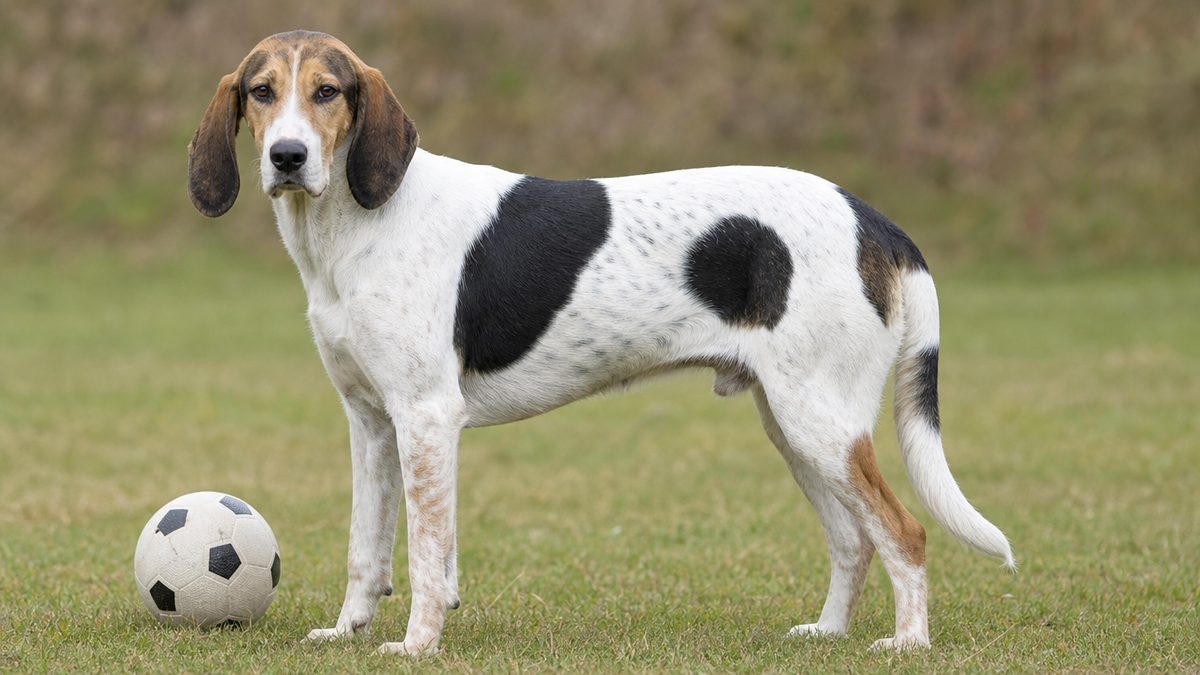
Colour is the identifying feature and the standard is specific about it. The dog is white with black patches and tan shadings on head and legs and sometimes between the white and the black patches, black must not predominate, and small black or tan spots are regarded as mismarked. The coat is harsh, very dense and straight over a dense undercoat, which the Norwegian and Nordic descriptions render as a short, straight outer coat above a thick undercoat. That is a two-layer northern jacket, and it is the single most important fact on this page for an Indian reader.
Telling the Halden Hound from the Hygen Hound and the Dunker
Tell the three Norwegian hare hounds apart on colour first, stop second and height third. Colour separates the Halden from the Hygen almost every time, and the merle coat separates the Dunker from both.
This section exists because the confusion is documented rather than theoretical. English Wikipedia's Halden Hound article gives the breed "a pronounced stop", which is the Hygen Hound's trait, since FCI 266 specifies a distinct stop and FCI 267 specifies a stop that is not abrupt FCI-Standard N 267. Its Hygen Hound article, which relies on a single source, gives that breed wide ears, a long neck and a tail carried high, where the United Kennel Club standard it cites says ears neither broad nor long, a neck of medium length, and a tail carried straight or in saber fashion.
- Colour first. A predominantly white dog with black patches and tan on head and legs is a Halden Hound. A red-brown or yellow-red dog with white markings is normally a Hygen Hound. A dog with a marbled blue-grey coat or a blue eye is a Dunker, which is the only one of the three whose standard permits merle.
- Stop second. Halden, not abrupt and weakly marked. Hygen, distinct and well marked. Dunker, defined but neither deep nor abrupt.
- Height third. Halden males start at 52 cm; Hygen and Dunker males start at 50. The ideals are 56, 54 and 52 to 54 respectively, so a 56 cm male is at the Halden ideal and two centimetres above the Hygen's.
- Ear reach fourth. Pulled forward, a Halden's ear reaches the middle of the muzzle and a Hygen's reaches hardly half way to the nose, so the Hygen's ear is the shorter of the two.
- Head shape fifth. The Hygen's head is wedge-shaped seen from front and side and its muzzle is rather short than long. The Halden's head is clean, medium and well balanced with a muzzle that is not too short.
The Hygen Hound's Norwegian description lists as a fault "Tegninger med utpreget sadel (Finsk støver farger)", markings with a pronounced saddle, in Finnish Hound colours. A breed standard carrying a fault written specifically to keep another breed's colouring out is telling you which dog it gets mixed up with. In Norway that is the Finnish Hound, which registered 4,117 puppies across the 2002 to 2023 birth years, more than five times the Hygen Hound's 743 and nearly ten times this breed's 434.
The trap that makes this worse online
On the FCI's own site the trailing number in a URL decides which document you get and the breed name in the slug is ignored. That is why this page read both standard numbers off the register's own Group 6 breed list rather than assembling a URL, and why every figure above was taken only after verifying that the breed name printed inside the returned PDF matched the breed being written about. The Halden Hound is 267 and the Hygen Hound is 266, one apart, which is exactly the situation in which a single mistyped digit hands you a complete, correct, plausible standard for the wrong dog.
The same discipline applies to the two names. Haldenstøver is the Norwegian name, and the Nordic Kennel Union also records Chien courant de Halden, Halden-Bracke, Sabueso Halden, Haldenstövare and Haldeninajokoira as recognised equivalents. A search on any of those should return the same dog, and if it returns a red hound with a wedge-shaped head, it has returned the Hygen Hound.
One practical consequence for anyone searching. The Nordic Kennel Union publishes a parallel English page for the sibling breed, and reading the two side by side is the fastest way to fix the difference in your head: it describes the Hygen Hound as somewhat shorter than the Norwegian Hound, with head and muzzle somewhat shorter and broader and a moderately wedge-shaped head, none of which describes this breed.
History: an English foxhound cross, a distemper outbreak and a name coined in 1938
The Halden Hound was built around the town of Halden in Ostfold from the second half of the 1800s, by crossing local Norwegian hare hounds with English dogs, principally the English Foxhound with some harrier and beagle. Its final standard was approved by Norsk Kennel Klub in 1952.
Norsk Kennel Klub's own history is the most detailed account published anywhere and no English page quotes it. It states that the breed can be traced with certainty to the middle of the 1800s, that the origin is assumed to be local hare hounds in the Ostfold district and particularly around Halden crossed with English dogs, in the first instance the English foxhound, and that there is also a certain element of harrier and beagle. It adds that the breed therefore resembles a lightly built foxhound in conformation, which is the sentence English pages garble into "resembles an American Foxhound but is smaller";.
The name is younger than the dog by roughly ninety years
"The designation haldenstøver did not come into use until around 1938", the Norwegian text says. Before that the dogs carried two other names, both of them personal. Bisseberghund came from Hans Larsen Bisseberg, who bred them, and Ankerstøver from the Anker family at Rød Herregård in Halden, who were closely connected to the breed. That is why pages dating the breed to "the early 1900s" are not exactly wrong so much as dating the wrong thing: they are dating the name, or the point at which the type stabilised, rather than the crossbreeding that produced it.
| Date | Event | Source |
|---|---|---|
| Second half of the 1800s | Local Ostfold hare hounds crossed with English foxhounds, with harrier and beagle influence | Norsk Kennel Klub description |
| 1884 | Meteorological measurements begin at Halden under met.no | Norwegian Wikipedia, met.no normals |
| 1931 | Hundepest, that is distemper, nearly destroys the breed | Norsk genressurssenter |
| 1940 to 1945 | The Second World War nearly finishes what the outbreak started | Norsk genressurssenter |
| Around 1938 | The name haldenstover comes into use, replacing Bisseberghund and Ankerstover | Norsk Kennel Klub description |
| 1952 | The breed's final standard is approved by Norsk Kennel Klub as a separate breed | Norsk Kennel Klub description |
| From 1956 | Interest falls away and never recovers; the breed has never been numerous | Norsk genressurssenter |
| 7 October 1965 | The FCI accepts the breed on a definitive basis as standard 267 | FCI nomenclature register |
| 9 August 1999 | The current FCI standard is published, in English as the authentic language | FCI-Standard 267 |
| 2006 | The United Kennel Club recognises the breed | UKC breed standard |
| 16 November 2022 | Norsk Kennel Klub issues a revised Norwegian description | NKK Rasebeskrivelse |
Two disease events, and one of them is misnamed in English
NIBIO's Norwegian text says "Hundepest i 1931 og andre verdenskrig holdt på å knekke haldenstøveren", distemper in 1931 and the Second World War nearly broke the Halden Hound, but enthusiasts got breeding going again after the war. The Nordic Kennel Union's English translation renders hundepest as "canine parvovirus";. That is impossible: parvovirus spread worldwide in 1978 and did not exist in 1931. The Norwegian is right and the English is a translation slip, and it matters because an Indian reader planning a vaccination schedule needs to know which disease a breed's own history turns on.
The recovery was real but shallow. NIBIO records that after the breed was approved in 1952 interest rose and several champions were made up, but that already from 1956 interest fell away, and the breed has never been large and numerous. Seventy years later the registration numbers in the next section show exactly where that left it.
Registration numbers, conservation status and three published figures that disagree
Norsk Kennel Klub registered 14 Halden Hound puppies in 2025, 7 in 2024 and 4 in 2018. Those are the real numbers, they come from NKK's own spreadsheet, and they contradict every published summary of them, including two of NKK's own.
No page ranking for this breed publishes a single registration number. What they publish instead is the word rare. Below are the counts, read directly from the per-breed spreadsheet NKK puts on its statistics page.
| Year | Halden Hound | Hygen Hound | Dunker |
|---|---|---|---|
| 2010 | 20 | 37 | 124 |
| 2015 | 14 | 23 | 174 |
| 2018 | 4 | 32 | 152 |
| 2019 | 33 | 43 | 139 |
| 2020 | 38 | 42 | 112 |
| 2022 | 28 | 29 | 141 |
| 2023 | 15 | 45 | 92 |
| 2024 | 7 | 16 | 87 |
| 2025 | 14 | 14 | 67 |
Three published bands, none of which fits the data
Three organisations describe the same quantity in words, and all three are wrong against the spreadsheet. Norway's genetic resource centre says recent years have run at 7 to 21 puppies a year. The Nordic Kennel Union repeats 7 to 21. Norsk Kennel Klub's own consumer breed page, last modified on 19 August 2026, says between 10 and 20. NKK's own spreadsheet records 33 in 2019, 38 in 2020 and 4 in 2018, so no published band contains those three years, and NKK contradicts itself between its breed page and its statistics file.
Norsk Kennel Klub estimates that about 585,000 dogs live in Norway, that 18 percent of Norwegian households have one, and that it registers 50 to 60 percent of them, roughly 25,000 to 30,000 puppies a year. Fourteen Halden Hounds is about five hundredths of one percent of a year's registrations. In the same 2025 file the Golden Retriever appears 1,274 times and the Border Collie 1,001 times. NKK also warns that its statistics count the date of registration rather than the date of birth, so a litter born late in one year lands in the next year's figure.
Conservation status, and what Norway does about it
Norway's genetic resource centre at NIBIO treats the country's dogs as livestock genetic resources. It counts seven national breeds, four spitz types and three hare hounds, the hare hounds being the Dunker, the Haldenstøver and the Hygenhund, and states that all the Norwegian breeds except the grey Norwegian Elkhound are so few in number that they are counted as threatened. That is a national register calling this breed endangered, not a campaign group's opinion.
The practical measure is a gene bank. A semen bank has been established for all seven Norwegian dog breeds, built jointly by the individual breed clubs, Norsk Kennel Klub and the genetic resource centre, aiming to hold frozen semen from ten dogs of each breed, stored preferably for ten years and released in an acute crisis or where old genetic material is needed in breeding work. The Haldenstøverklubben's breeding council controls access: semen from selected males stored in NKK's bank may be used only with the council's approval.
Where India stands in the same registers
India is a member of the FCI, listed in the federation's own members and contract partners register. Because the Kennel Club of India issues pedigrees against FCI nomenclature, a definitively recognised FCI breed is in principle registrable in India, and this breed is definitively recognised as standard 267. The obstacle is not recognition. It is that no Halden Hound appears to exist in India for anyone to register, which is a different problem and has a different answer.
One live snapshot makes the scale concrete. On 31 August 2026 NKK's breed page listed exactly one registered Halden Hound litter, nine puppies born on 4 April 2026. The breed club's news log confirms that this was the year's first litter, and by 26 August it reported that every puppy from all three of the year's litters had been sold.
Halden Hound price in India: there is none, and here is the proof with a control
No Halden Hound price exists in India because no Indian seller offers the breed. That is the finding rather than a gap in the research, and it is worth more to a reader than an invented range. The only rupee figures an India-located search returns for this breed's name belong to a book and a canvas print.
State the negative properly, with a control that worked in the same session. An India-located search for this breed plus price in india was run on 31 August 2026 and returned ten results, of which five are about the Mudhol Hound or the Caravan Hound, two are Basset Hound sellers, two are listings for an imported guide book and one is Royal Canin's breed page. The control query, labrador retriever price in india, was run on the same tool immediately before and after and returned genuine Indian commerce both times, including a live rupee price table. So the instrument was working and the absence is real.
| Position | Page | What it actually is |
|---|---|---|
| 1, 2, 6 | Mudhol Hound price pages | A different, Indian breed, priced from about ₹2,500 upward |
| 3 | Desertcart, Halden Hound Dog Breed Information | A guide book at ₹2,574, sourced from international marketplaces |
| 4, 7 | Basset Hound puppy sellers | A different breed, with Indian prices |
| 5 | Amazon.in, same title | The same book |
| 8 | Royal Canin India, Halden Hound | An education page with no price and no seller |
| 9, 10 | Caravan Hound pages | The Mudhol Hound under its other name |
₹2,574 buys a Halden Hound guide book on an Indian storefront that states its products are sourced from marketplaces in the United States, United Kingdom and United Arab Emirates. A related query surfaces a personalised Halden Hound canvas from ₹9,420, shipped from Longmont, Colorado, whose body copy never mentions the breed and whose sibling listings are Rhodesian Ridgeback, Old English Sheepdog and Leonberger. Neither number is a dog price. If you see either quoted as one, that is where it came from.
The supply-side control, which is what makes the absence meaningful
An absence only counts if the sellers would have listed the breed had they had it. They would. One Indian puppy retailer's own index carries the Azawakh, the Barbet, the Basset Fauve de Bretagne, the Bergamasco, the Cirneco dell'Etna, the Glen of Imaal Terrier, the Grand Basset Griffon Vendeen, the Komondor, the Pharaoh Hound and the Plott Hound, and markets several of them on rarity. It has no page for either Norwegian hare hound. India's largest breed-by-city puppy generator runs pages for the Afghan Hound, the Basset Hound, the Mudhol Hound and the Rampur Hound down to small towns, and its Halden Hound URL resolves to a 404 marked noindex.
One Indian page does carry the sibling breed's name, and reading it is instructive. It files the Hygenhund under Non-Sporting Dogs, which is wrong for an FCI Group 6 scenthound, records its origin as "FCI" rather than Norway, prints "Contact for pricing" where a price would go, and carries a placeholder sentence about the profile being expanded in future updates that appears word for word on its Aidi, Alpine Dachsbracke and American Akita pages. That is one page minted per FCI breed name, not an animal for sale.
Why no supply chain can form
Two facts close the route and neither is about demand. DGFT Trade Notice 22/2022-23 places live dogs under ITC(HS) 01061900 as Restricted, permits entry only for a pet dog with a valid pet book in the importer's name, for research with CPCSEA recommendation or for internal security, and states that applications for trading or breeding purposes shall be duly rejected. And Norway registered 14 puppies in 2025 under active conservation management. There is no lawful way to import the breed commercially, and nothing to import if there were.
For completeness, the breed does have a published price in its homeland, and Bonbeno prints it as a Norwegian figure rather than converting it. The Haldenstøverklubben's breeding council publishes guideline prices as at 2025 of 11,000 to 15,000 Norwegian kroner for a puppy, with a stud fee of 10 percent of the puppy price at mating and 10 percent per live puppy after one week. That is a Norwegian price for a Norwegian dog sold inside a club structure. Converting it into rupees would manufacture an Indian price that does not exist, which is exactly the failure this section documents.
Monthly cost of ownership in India for a hound this size
A hound of this size costs roughly ₹4,000 to ₹8,000 a month in India in food, parasite control and routine veterinary care, and this section shows the arithmetic instead of asserting a total. Every rupee figure below was read off a live Indian page on 31 August 2026.
The cost of ownership question is worth answering even for a breed nobody in India can buy, because the arithmetic is what a reader actually needs when comparing any medium hound. One input could not be sourced and is marked as a gap rather than filled.
Food, priced per kilogram from Indian retail
| Pack | Price as printed | MRP as printed | ₹ per kg |
|---|---|---|---|
| 20 kg | ₹3300 | ₹3900 | 165.00 |
| 15 kg | ₹2584 | ₹3400 | 172.27 |
| 10 kg | ₹2016 | ₹2390 | 201.60 |
| 5.5 kg | ₹1251 | ₹1390 | 227.45 |
| 3 kg | ₹667 | ₹725 | 222.33 |
| 1 kg | ₹229 | ₹249 | 229.00 |
Buying the 20 kg pack rather than the 1 kg pack cuts the cost per kilogram by 28 percent, and buying 20 kg rather than 10 kg cuts it by 18 percent. That single decision moves the monthly food bill more than any brand choice will.
Neither the Indian retailer nor the brand publishes a grams-per-day feeding chart in text; the chart exists only inside product photographs. This page therefore prints a cost per kilogram and refuses to print a monthly food total, because doing so would require inventing the ration. Multiply the per-kilogram figure by a daily ration your own veterinarian sets for your dog's body condition.
Parasite control, the one Indian cost you cannot skip
For a dog in the 20 to 40 kg band there is a clean published price. One Bravecto 1000 mg fluralaner tablet covering 20 to 40 kg costs ₹1805 against an MRP of ₹2063, and the page states plainly that it requires a prescription. That page does not print a dosing interval, so this page does not print one either; ask your veterinarian how often it is given rather than taking an interval from a web page.
Deworming is cheaper and the dose is published. A strip of six Drontal Plus Tasty tablets, praziquantel 50 mg plus pyrantel embonate 144 mg plus febantel 150 mg, costs ₹813 and the product details give the dose as one tablet per 10 kg of body weight. A 25 kg hound therefore takes three tablets per treatment, about ₹407 a dose, and one strip covers two doses with one tablet left over.
That cost is justified by measured exposure rather than by caution. A 2025 ICMR study examined 2,877 domestic animals across 28 villages at the forest fringes of the Western Ghats in five states and found tick prevalence in dogs of 42.60 percent, 95 percent confidence interval 30.33 to 55.84, from 23 infested dogs out of 54 examined. Quote that only with its confidence interval and its denominator, because a 25-point interval on 54 dogs is a wide one.
Veterinary care, where public and private prices differ by more than twenty times
| Item | Government, Chandigarh | Private, Vetic Delhi |
|---|---|---|
| Out-door ticket for pet animals | ₹30 | No rupee figure published |
| Anti-rabies vaccination | ₹30 | Starts at ₹699 |
| Nine-in-one DHPPiL | Not listed | Starts at ₹899 |
| Kennel cough | Not listed | Starts at ₹1,349 |
| Adult annual vaccination plan | Not listed | Starts at ₹3,199 |
| Puppy vaccination schedule | Not listed | Starts at ₹6,499 |
| Blood test or urine test | ₹20 | Not listed |
| Minor operation | ₹50 | Not listed |
| Major operation | ₹100 | Not listed |
The government anti-rabies fee of ₹30 and the private from-₹699 price are both real and both current, and the gap between them is the single most useful cost fact for an Indian dog owner on this page. Two cautions on the government schedule: it has no sterilisation row, the nearest item being a castration fee of ₹20, and its X-ray fee of ₹30 per film carries the printed note that the radiology wing is not functioning.
Grooming and boarding, where a big coat costs money
A full grooming session in Delhi runs ₹1,500 to ₹2,500 for a large breed and ₹1,200 to ₹2,000 for a medium one, with a complete bath and haircut package starting at ₹1,869 against a struck ₹2,199. Boarding in Bengaluru is published by size band at ₹750 per 24 hours for a large dog, ₹650 for a medium one and ₹550 for a dog under 5 kg. A 25 kg Halden Hound sits at the top of the medium band or the bottom of the large one, so budget ₹650 to ₹750 a night.
Heat tolerance in India, measured against Halden itself
The Halden Hound is among the least heat-adapted breeds this site has measured, and the cleanest way to show it is that the highest temperature ever recorded in its home municipality, 32.0 degrees C on 8 August 1975, is an ordinary May afternoon in Chennai.
Air temperature misleads in India because a dog cools by evaporating water from its airways, and evaporation stalls as humidity rises. Wet-bulb temperature folds heat and humidity into one number, which is why this page uses it. All figures come from NASA POWER's twenty-year climatology for January 2001 to December 2020, queried by explicit latitude and longitude so that no place name can be substituted for another.
| Place | Annual mean wet-bulb | Warmest month | Coolest month | Annual mean air temp |
|---|---|---|---|---|
| Halden, Norway | 6.21 | 15.36 in July | -2.12 in February | 7.35 |
| Bengaluru | 19.80 | 22.66 in May | 16.43 in January | 23.74 |
| Pune | 19.66 | 23.56 in June | 14.28 in January | 23.86 |
| Delhi | 18.03 | 27.74 in July | 6.86 in January | 25.60 |
| Guwahati | 20.54 | 26.18 in July | 12.27 in January | 22.94 |
| Mumbai | 22.73 | 26.55 in June | 17.06 in January | 26.77 |
| Kolkata | 22.85 | 27.86 in June | 13.64 in January | 25.81 |
| Chennai | 24.94 | 27.36 in May | 21.77 in January | 27.95 |
Three comparisons carry the argument. Chennai in May reaches 27.36 degrees wet-bulb against Halden's July peak of 15.36, a gap of 12.0 degrees. Chennai's coolest month, January at 21.77, is 6.4 degrees hotter on wet-bulb than the hottest month the breed's ancestors ever met. And on annual mean, Chennai sits 18.7 degrees above Halden. Even Pune, the mildest large city on this table, runs 13.5 degrees above the homeland.
NASA POWER returns a grid cell rather than a point, and the cell has its own elevation which can miss the town beneath it. For Halden the model reports the cell at 77.5 metres against a met.no measuring station at 10 metres, an overstatement of about 68 metres, which at roughly 6.5 degrees C per 1,000 metres is about 0.4 degrees C. That is small, and it is why Halden itself is a better homeland reference than Oslo, whose cell sits at 258.7 metres against a city at 23 metres, an overstatement of 236 metres.
A second, independent check on the homeland figure
The Norwegian Meteorological Institute has measured at Halden since 1884, and its published normals for the Halden station at 10 metres above sea level give an annual mean of 6.4 degrees C, a July mean of 16.7 and a January mean of -2.9, with 820 mm of precipitation a year. NASA POWER's 2001 to 2020 climatology gives 7.35, 17.11 and -1.44 for the same three figures. The two agree closely in July, to within 0.4 degrees, and diverge most in winter, which is the signature of a warming trend between normal periods rather than of a wrong location. Publish both.
The record extremes settle the argument for an Indian reader. The highest temperature ever officially recorded anywhere in Halden municipality is 32.0 degrees C, on 8 August 1975, and the lowest is -33.7 degrees C on 15 January 1893. Chennai's mean air temperature across the whole year is 27.95 degrees, and its May afternoons routinely pass the Norwegian all-time record. This is a heat-sensitive breed by construction, not by reputation.
Hill stations, satellite error and what the heat-illness evidence can prove
Two things decide whether a northern hound can live anywhere in India, and both are commonly got wrong. One is whether a hill town is genuinely cooler than the satellite says. The other is what the best heat-illness study can honestly be made to prove about a breed it never included.
The hill stations are not the answer they look like
Indian pages routinely send cold-climate breeds to a hill station, and the satellite data has to be read carefully before you agree. NASA POWER's grid cell for Shimla sits at 898 metres against a town at 2,376 metres, so the model is standing 1,478 metres too low and its figures are far too warm. Its cell for Gangtok sits at 3,240 metres against a town at 1,650, so it is 1,590 metres too high and far too cold. Its cell for Ooty sits at 785 metres against a town at 2,240, 1,455 metres too low. At 6.5 degrees C per 1,000 metres those are errors of nine to ten degrees, in both directions.
Bonbeno publishes the divergence rather than the cell. A hill town at 2,000 to 2,400 metres is genuinely cooler than the plains, and Shimla, Ooty, Darjeeling and Manali all sit in that band, so a northern coat is less punishing there than in Chennai. What this page will not do is print a wet-bulb figure for those towns as though it described the town, because on our own measurement the model is standing between 731 and 1,935 metres away from them vertically. If you need a number for a hill station, get it from a station at the town's own altitude, not from a satellite grid cell.
What the best heat-illness dataset can and cannot say here
The strongest evidence on canine heat illness comes from a UK VetCompass study of 905,543 dogs under primary veterinary care in 2016, which identified 1,259 heat-related illness events from 1,222 dogs. Of those, 380 had no trigger recorded, leaving 879 events with a recorded trigger, and among those 879 exertional heat illness accounted for 652 events, or 74.2 percent, environmental for 113, or 12.9 percent, and vehicular confinement for 46, or 5.2 percent. The 74.2 percent is 652 of 879, not of 1,259.
Now the limit, and it is a real one. The word Haldenstover appears nowhere in that study, so the breed was not modelled and no breed-specific odds ratio exists for it. The companion paper from the same 905,543-dog cohort reports that dogs at or above their breed and sex mean bodyweight had 1.42 times the odds of heat-related illness, with a confidence interval of 1.12 to 1.80. That is a transferable bodyweight finding, not a breed finding, and this page treats it as one.
Temperament and household fit, and the one claim every Norwegian source agrees on
The Halden Hound's temperament is the best-attested thing about it. Norway's genetic resource centre, Norsk Kennel Klub and the Nordic Kennel Union all describe strong nerves, an exceptionally sociable and trusting nature and a dog that is easy to train, in almost identical words.
The three sources are not independent of one another, which matters, but they are the three official bodies with responsibility for the breed and they say the same thing. NIBIO calls it "både en god jakthund og en snill familiehund", both a good hunting dog and a gentle family dog, distinguished by strong nerves and by being exceptionally sociable and trusting. The Nordic Kennel Union's English page renders that as "characterised by strong nerves and by being especially sociable and trusting" and adds that the good and open nature makes the breed easy to train.
The Norwegian breed description turns that into a requirement rather than a description. Under Bruk it states that the dog "skal virke tillitsfull og rolig, og opptre uanfektet i de fleste situasjoner", should appear trusting and calm and behave unperturbed in most situations, and under Adferd it requires that the breed be calm and not threatening towards a judge or other people in a public area. A standard that writes public-space behaviour into the breed's definition is a standard whose authors expect the dog to be in public.
What the temperament does not mean
- Sociable is not the same as biddable off-lead. This is a driving hare hound that works alone with its handler, follows a line by nose and gives tongue while it does so. Friendliness towards people has no bearing on whether it comes back when it is 400 metres away on a scent.
- Calm indoors is not the same as low-energy. Norsk Kennel Klub rates this breed's activity level High, a step above the rating it gives the Hygen Hound, which it rates Medium.
- Good with children is a description, not a study. No behavioural research on this breed exists, and the sources above are breed-club and register text rather than measurement.
- Strong nerves were selected for a Norwegian forest. Nothing in that selection history prepared the breed for Indian street traffic, festival firecrackers or the density of an Indian apartment block.
The breed club's own breeding aim lists, first among hunting qualities, a good and audible losmal, the baying voice a hare hound uses to signal to the hunter across forest. Volume has been deliberately selected for over a century. Norsk Kennel Klub's page for the sibling Hygen Hound goes further and says that breed is known for the characteristic ring of its voice and uses it in different ways to tell the hunter how far it is from its quarry. Neither breed was designed to be quiet, and no amount of training removes a trait that a hundred years of selection put in.
Who this breed suits, and who it does not
It suits a household with daily access to open ground and a genuine tolerance for noise, in a climate that does not punish a double coat. It does not suit a first-time owner in a Mumbai or Chennai flat, and the reason is not temperament but the combination of a hardy northern coat, a high activity rating and a bred-in voice. If you want the sociability without the rest, the Beagle is a smaller relative of the same type and the Indian Pariah Dog gives you the same open nature in a body that fits the climate.
Training a scenthound, and the one thing this breed resists
To train a Halden Hound, work the recall before anything else and accept that a nose on a line outranks a voice. Every official source calls the breed easy to train, and every one of them is describing obedience rather than recall off a scent.
Start with what the sources actually claim. NIBIO says the breed is easy to train because of its good and open nature, and NKK repeats it Norsk Kennel Klub. Neither is talking about the moment the dog picks up a hare line and disappears into cover. That distinction is the whole training problem, and it is structural: the Norwegian description defines the breed's use as "en drivende hund", a driving hound used for hunting hare and fox and exceptionally lynx, which means working at distance and out of contact.
The order to work in
- Socialise on a schedule in the first four months, because Indian streets present traffic, cattle, free-ranging dogs and crowds that a Norwegian forest does not.
- Train a recall on a long line for months before you ever test it loose, and pay it every single time regardless of how long the dog took.
- Screen the environment before you unclip, because a scenthound that is 400 metres away on a line cannot hear you and is not being disobedient.
- Feed the recall from the highest-value food you have, not from praise, since you are competing with a hardwired drive rather than with distraction.
- Exercise the nose deliberately with scent games, so that the drive has a legitimate outlet indoors and in a small garden.
- Test progress in stages, adding one new distraction at a time rather than moving straight from a corridor to an open field.
In Norway this breed is subject to a working trial as part of its FCI classification, and the breed club's competitions are organised around hunting trials rather than obedience: it runs an Arets hund, an Arets unghund and an Arets revehund, dog of the year, young dog of the year and fox dog of the year, and awards a club championship over a week of trials. An Indian owner has no access to any of that, so the equivalent has to be built at home: tracking games, scent discrimination and search work, done daily, because the drive is going somewhere whether you direct it or not.
The Indian complication nobody writes about
Two Indian realities change the training plan. The first is heat: a scent-work session that would be routine at 15 degrees is dangerous at a 24 degree wet-bulb, so training moves to first light and the evening, and the dog gets water offered rather than rationed. The second is legal. Second Schedule Part IV paragraph 21(1) of the 2017 Rules bars keeping in outdoor facilities, without the attending veterinary practitioner's written approval, dogs not accustomed to local temperatures and breeds that cannot tolerate them, giving long-haired breeds in high temperature locations as its example. A double-coated Norwegian hound in a Chennai yard is precisely the case that clause describes.
One more piece of Indian law belongs in a training section, because it governs what a trainer may do to the dog. Second Schedule Part II paragraph 6(8) forbids tail docking, ear cropping, de-barking, de-clawing, branding, dyeing and any other mutilation, and states that any change of appearance by artificial means is strictly forbidden. De-barking is named explicitly, which matters for a breed selected for volume. Norway prohibits the same procedures, and the Hygen Hound's Norwegian description prints the prohibition on its own face.
Daily exercise, and the job India cannot supply
A Halden Hound needs two hours a day of real work, and in India it needs that work before sunrise and after dark. Norsk Kennel Klub rates the breed's activity level High, a step above the Medium it gives the Hygen Hound, and the rating is about drive rather than about speed.
Understand what the exercise is replacing. The Norwegian description defines the breed's use as a driving hound worked on hare and fox and exceptionally on lynx, and Norway's genetic resource centre records that many Halden Hounds have done well at hunting trials Norsk genressurssenter at NIBIO. A hare hunt is several hours of continuous scent work over rough ground in cold air. A 20-minute lead walk on a Bengaluru pavement replaces none of it, and the deficit shows up as destructiveness and noise rather than as restlessness.
A workable Indian week
- Two sessions daily, 45 to 60 minutes each, the first finishing before the sun is properly up and the second starting after it has gone.
- Scent work three times a week, hiding food or a scented article and letting the dog find it, because the nose tires the dog faster than the legs do.
- One long outing a week on open ground with a long line, ideally somewhere with cover and varied terrain rather than a lawn.
- Rest through the middle of the day, indoors, on a cool floor, with water constantly available rather than rationed.
- Nothing at all above about 22 degrees wet-bulb, which on the table in the climate section means most of the day in most Indian cities for most of the year.
In the UK VetCompass study of 905,543 dogs, exertional heat illness accounted for 652 of the 879 events that had a recorded trigger, 74.2 percent, far ahead of environmental at 113 and vehicular confinement at 46. The dogs were not left in cars. They were exercised. A hound that has picked up a line will keep working past the point where it should stop, because that is what it was bred to do, and it will do it out of sight and out of earshot. High drive plus high wet-bulb plus weak recall is the exact combination that study describes.
What under-exercise looks like in this breed specifically
It looks like voice. This is a breed selected for a loud, carrying bay, and an under-worked scenthound uses it. The breed club's own breeding aim puts a good and audible losmal first among the hunting qualities it selects for. In a Norwegian forest that is the point of the dog. In an Indian apartment block it is the reason the dog is rehomed, and no training regime removes a vocal trait a century of selection has fixed.
Grooming and coat care in Indian humidity
The Halden Hound's coat needs brushing and bathing as needed, which Norsk Kennel Klub rates as little grooming. The Indian problem is not the brushing. It is the drying, because a dense undercoat holds monsoon damp against the skin for hours.
Take the coat description from the documents first. The FCI standard says the hair is harsh, very dense and straight with a dense undercoat. Norsk Kennel Klub and the Nordic Kennel Union both describe it as a two-layer coat, a dense undercoat under a short straight outer coat Svenska Kennelklubben for the Nordic Kennel…. The United Kennel Club's version reads "Short, harsh, dense and straight, with undercoat";. A short and thin coat is listed as a fault in the Norwegian description, so thinness is not something to breed towards even in a warm country.
NKK's own care advice is two words long: brushed and bathed as needed, and it rates coat care Litt, meaning little. That advice was written for Norway. It is not wrong here, but it is incomplete, because it assumes a climate where a wet dog dries.
The monsoon rule that overseas advice leaves out
- Groom with a slicker or rubber curry twice a week in the dry months and every second day through the shedding periods, working down to the undercoat rather than skating over the top.
- Dry to the skin after every bath and after every soaking, with a towel and then moving air, and check the undercoat with your fingers rather than trusting the surface.
- Screen the ears every week, because this is a drop-eared breed whose ear leather hangs flat and closes the canal.
- Check between the toes, since the standard specifies feet well covered with hair between the toes, which traps water and grit.
- Compare the dog's skin weekly against its own baseline rather than against a photograph, so that a hot spot is caught while it is still small.
The standard's own description is the risk. Ears set neither too high nor too low, hanging, long enough to reach the middle of the muzzle when pulled forward, is a design that seals a warm canal shut. Add Indian humidity and a dog that swims or gets soaked, and you have the standing conditions for otitis externa. The practical rule is to plug the ears before a bath, dry them afterwards, and treat a head shake or a smell as a reason to see a veterinarian rather than to buy a cleaner.
Cost, and the one thing worth paying for
Professional grooming in Delhi runs ₹1,500 to ₹2,500 for a large breed and ₹1,200 to ₹2,000 for a medium one, with a full bath and haircut package starting at ₹1,869. For a short-coated hound most of that is unnecessary; there is no haircut to give. What is worth paying for is a proper forced-air dry after a monsoon soaking, which is the one part of the job an owner with a towel cannot reproduce, and which is the difference between a dry undercoat and a week of damp skin.
Health, with real Norwegian denominators instead of a slogan
The Halden Hound's health record is genuinely good on the only data that exists: 100 hip radiographs from Norwegian birth cohorts 2002 to 2015 produced 82 dogs graded free and 18 with some degree of dysplasia, 18.0 percent, with no dog graded severe. No lifespan study of the breed exists at all.
Start with what is missing, because it shapes everything else. The Orthopedic Foundation for Animals holds no published row for this breed: the string Halden appears zero times across its full disease-statistics dump of roughly 5,400 rows. That is a proved absence rather than a failed search, because controls run against the same dump in the same session returned 109 mentions of the Labrador, 61 of the Beagle, 47 of the Elkhound and 39 of the Buhund. So two of Norway's seven national breeds are in OFA and none of its three hare hounds is, and Norwegian data has to do the work.
Hips, computed from Norsk Kennel Klub's own data sheet
NKK publishes a spreadsheet of registrations for every breed since 2001 whose underlying sheet carries, per birth year, the number of dogs radiographed and the grade each received. Aggregating the 2002 to 2015 birth cohorts, which are old enough to have been screened, gives the following. Every year's four grades sum exactly to that year's radiograph count, which is the arithmetic check that says the columns have been read correctly.
| Measure | Dogs | Share of those radiographed |
|---|---|---|
| Puppies registered in those cohorts | 252 | - |
| Hip-radiographed | 100 | 39.7 percent of those registered |
| Graded free | 82 | 82.0 percent |
| Graded mild | 16 | 16.0 percent |
| Graded moderate | 2 | 2.0 percent |
| Graded severe | 0 | 0.0 percent |
| Any degree of hip dysplasia | 18 | 18.0 percent |
Put that beside its relatives on the same sheet, the same window and the same method. The Hygen Hound comes in at 15.1 percent of 139 radiographs, the Dunker at 29.7 percent of 784, the Finnish Hound at 15.8 percent of 795, the grey Norwegian Elkhound at 16.4 percent of 4,494 and the Beagle at 24.3 percent of 605. So the Halden sits in the better half of Norway's hounds, and well below the Dunker, whose rate is 1.6 times higher on a much larger sample.
Only 39.7 percent of registered dogs were radiographed, and owners who screen are not a random sample. Norwegian and American grading schemes are not the same, so 18.0 percent here is not directly comparable with an OFA percentage. And the aggregate stops at the 2015 cohort deliberately. The reason is visible in a control: on the same sheet the Beagle's 2016 to 2023 cohorts show 64.4 percent dysplastic on 45 radiographs against 24.3 percent on 605 in the earlier window. A common breed's hip health did not collapse; its screening volume did, from 15.2 percent of registrations to 1.8 percent, leaving only the dogs somebody already suspected.
What the official sources claim, and whether the numbers support it
Both Norway's genetic resource centre and the Nordic Kennel Union state that despite an always-small population, no considerable extent of hereditary diseases such as HD has been recorded in the breed Svenska Kennelklubben for the Nordic Kennel…. On the hip figures above, that claim holds up. English Wikipedia goes much further and says "The Halden is a healthy breed, with no known health problems";. That is a different and unsupportable statement, since 18 of 100 radiographed dogs had some degree of dysplasia and two were graded moderate.
The condition that names the neighbouring breeds and not this one
One Norwegian case series matters for anyone comparing the three hare hounds. Rørvik and colleagues described 19 dogs with multiple epiphyseal dysplasia from 10 litters seen between 1991 and 2005, a deficiency in ossification of the epiphyses of the long bones and vertebrae, and reported that "There were 11 Hygenhund, 6 Dunker, 1 Golden Retriever, and 1 English Pointer";. The Haldenstover does not appear among them. Most dogs were presented for lameness that developed at 5 to 8 months, and the authors concluded the condition most likely has an autosomal recessive mode of inheritance.
Read that carefully, because it is a case series and not a prevalence. Eleven of nineteen tells you the breed composition of the dogs referred with this condition in Norway over fourteen years. It does not tell you what fraction of Hygen Hounds are affected, and nobody has published that. What it does establish is that the two neighbouring Norwegian hare hounds accounted for 17 of the 19 cases, 89.5 percent, and that this breed was not one of them.
Screening: what to test, what Indian law requires and what nobody has measured
Screen a Halden Hound's hips and nothing else has published breed evidence behind it. The breed club requires an HD grade of A or B for breeding and forbids breeding from a dog whose hip status is unknown, which is a stricter rule than Indian law imposes.
The Haldenstøverklubben's breeding guidelines are unusually explicit for a rare breed, and no English page quotes them. On hips: dogs used in breeding shall show status A or B, dogs with unknown HD status must not be used in breeding, and a dog with status C may be used only in combination with a status A dog and only where the breeding council judges its qualities especially valuable. The club's news log also asks owners directly to have hips radiographed, particularly males, both to contribute to the statistics and for possible future breeding.
Where the club's own rules meet Indian law
One number in those guidelines deserves an Indian reader's attention. The club states that the inbreeding coefficient of a mating should not normally exceed 6.25 percent, adding that in so small a population it may sometimes be necessary to go higher. An inbreeding coefficient of 6.25 percent is the coefficient produced by a first-cousin mating. Second Schedule Part II paragraph 6(3)(i) of the Dog Breeding and Marketing Rules 2017 prohibits in-breeding, defined as breeding between relatives of the 2nd to 4th grade in straight or side line within the first four generations, and it names "cousin to cousin" explicitly among its examples.
It does not mean the Norwegian club recommends anything illegal in Norway, and it does not mean any particular Halden Hound was bred from cousins. A coefficient of 6.25 percent can arise from several pedigree structures. What it does mean is that a breeding practice a Norwegian club treats as a normal working ceiling sits exactly at the coefficient of a relationship Indian law names as prohibited, and that anyone importing this breed's genetics into an Indian breeding programme would be operating under a tighter rule than the breed's own guidelines assume. Read the pedigree, not the percentage.
What Indian law actually requires of a breeding dog
Second Schedule Part III paragraph 8(10) requires that dogs "shall have been tested for genetic defects, including hip dysplasia, progressive retinal atrophy, night blindness, hypothyroidism, entropion, ectropion, overshot, undershot jaw (when incisors do not touch or mesh), wry mouth, two or more missing teeth, unilateral cryptorchid or full cryptorchid males";. The word is including, so the list is illustrative rather than closed. Hip dysplasia leads it, which is convenient, because hips are the one thing this breed has data on.
| Test | Breed evidence | Named in Indian law's 8(10) list |
|---|---|---|
| Hip radiograph | Yes: 100 Norwegian radiographs, 18.0 percent dysplastic | Yes, first item |
| Elbow radiograph | Almost none: 7 dogs across 22 birth cohorts, all free | No |
| Eye examination | None published for this breed | Yes, four items |
| Dentition and bite | Both standards require a scissor bite and complete dentition | Yes, three items |
| Thyroid | None published for this breed | Yes |
| Patella | None published for this breed | No, and the Rules never mention patella |
| BAER hearing test | None, and no merle in this breed to justify one | No, and the Rules never mention deafness |
Two absences in that table are real findings rather than gaps. Across all fourteen pages of the 2017 Rules the words patella and luxation appear zero times, and so do BAER and deaf. So there is no Indian patella-testing requirement and no Indian hearing-test requirement, and anybody who tells you otherwise has not read the instrument.
Elbows, where there is almost nothing to report
The same Norwegian data sheet carries elbow columns and the result is stark. Across all twenty-two birth cohorts from 2002 to 2023, covering 434 registered Halden Hounds, exactly 7 dogs were elbow-radiographed, and all 7 were recorded free. That is 1.6 percent of the breed ever screened for elbow dysplasia. The honest reading is not that the breed has no elbow problem. It is that nobody has looked, and seven dogs cannot answer the question either way.
What the veterinary literature holds on this breed, and the trap in asking
The published literature on the Halden Hound is zero papers. Establishing that honestly took three searches rather than one, because the obvious query returns 404,477 records and none of them is about this dog.
Run the searches in the right order and read the query translation rather than the count. A PubMed search for Haldenstover returns 0 records, and the translation line shows the phrase preserved intact, so the engine looked for the word and did not find it. A search for Halden hound returns 0 as well, and its translation is broader still, Halden in all fields AND hound or hounds, so a widened query also found nothing. A broadened search that still returns zero is a stronger negative than a narrow one.
Search PubMed for Haldenstover dog and it returns 404,477 records. Read the translation and the reason is plain: the engine reports the phrase as not found, discards the breed name entirely, and searches dogs as a MeSH term on its own. The result count is real, the records are real, and not one of them is about this breed. A writer who took the number at face value would report that the Halden Hound has a substantial veterinary literature. It has none, and the way to know that is to read the translation line and not the total.
The controls confirm the instrument was working in the same session. Labrador Retriever plus hip dysplasia returned 126 records, Norwegian Elkhound 30, Norwegian Buhund 7 and Finnish Hound dog 4. So PubMed was answering normally, two of Norway's seven national breeds do have literature, and the zero for this scent hound is a real finding rather than a broken query.
What that means for a buyer
It means every health claim about this breed rests on registry data and breed-club text rather than on research. The hip figures in the health section come from Norway's registration sheet, not from a study. The temperament description comes from three official bodies repeating one another. And the only peer-reviewed paper that names any Norwegian hare hound at all is the multiple epiphyseal dysplasia series, which names the Hygen Hound and the Dunker and not this breed. That is thin, and a page that pretended otherwise would be inventing depth.
It also means the search demand behind this page is small but real. A People Also Ask box does exist for the breed name on an India-region search, carrying four questions, and this page answers all four in its own words. The sibling Hygen Hound has no such box on the same instrument in the same session, which is a useful measure of how far below public attention these two dogs sit even among people looking for them.
One more absence worth stating plainly
No study of hare hunting performance, working ability or field trial results for this breed has been published in the peer-reviewed literature either. What exists instead is the breed club's own competition record, which is a real dataset of a different kind: it runs annual awards for dog of the year, young dog of the year and fox dog of the year, and a club championship over a week of hunting trials, and it publishes the results year by year. Those are field results, not research, and this page treats them as such.
Feeding a working hound in India, and the ration nobody publishes
Feed a Halden Hound to body condition rather than to a chart, because no breed standard gives a weight for this dog and no Indian retailer publishes a machine-readable feeding table. What can be priced exactly is the food itself, at ₹165 to ₹229 per kilogram depending on pack size.
Start with the honest gap. Neither the FCI standard nor the Norwegian description states a weight, under a heading that says size Norsk Kennel Klub. The figures in circulation range from 18 to 24 kg on Wikipedia to 22.7 to 29.5 kg on Adopt a Pet, an 11 kg spread on a medium dog Adopt a Pet, Halden Hound breed profile…. So there is no published target weight to feed towards, and body condition scoring by hand is not a fallback here, it is the primary method.
Life-stage feeding, in the order it matters
- Feed a growth diet in three or four meals a day to about six months, then two, and keep the puppy lean rather than round through the growth plates' closing period.
- Screen body condition weekly with your hands: ribs easily felt under a thin fat cover, a visible waist from above, a tucked abdomen from the side.
- Adopt an adult ration at about twelve months and hold the dog at the lower end of its natural range rather than the upper one.
- Compare intake against actual work rather than against a bag chart, because a dog exercising at first light in Chennai is doing far less work than a hound driving hare in Ostfold.
- Verify with your veterinarian before adding any joint supplement, since no evidence exists for this breed either way.
The UK VetCompass study of 905,543 dogs found that dogs at or above their breed and sex mean bodyweight had 1.42 times the odds of heat-related illness, with a confidence interval of 1.12 to 1.80. That is one of the few risk factors an Indian owner controls completely, it costs nothing, and it is the single most useful thing on this page for anyone who keeps a northern-coated dog in a hot country. Being at or above the breed mean is not obesity; it is the middle of the range.
What Indian food actually costs
The price per kilogram falls sharply with pack size. On 31 August 2026 a mainstream Indian adult dry food printed ₹3300 for 20 kg, ₹2584 for 15 kg, ₹2016 for 10 kg, ₹1251 for 5.5 kg and ₹229 for 1 kg, which works out at ₹165.00, ₹172.27, ₹201.60, ₹227.45 and ₹229.00 per kilogram respectively. The 20 kg pack is 28 percent cheaper per kilogram than the 1 kg pack. For a medium hound eating in the region of 350 to 450 grams a day, the pack-size decision is worth several hundred rupees a month on its own.
Two Indian practicalities finish the section. Store a 20 kg bag sealed and off the floor, because Indian humidity spoils kibble faster than a Norwegian pantry does. And time the main meal away from exercise in hot weather, since a full stomach and a hot afternoon are a bad combination in any deep-chested hound, and this breed's chest is deep by standard.
The first year, month by month, under Indian conditions
Plan a Halden Hound puppy's first year around three fixed points: vaccination from seven to eight weeks, the recall built on a long line from four months, and growth-plate protection until about twelve months. Indian law sets the earliest of them.
Two clauses of the 2017 Rules govern the start. Rule 8(1)(a) requires that pups less than eight weeks in age are not sold, and Second Schedule Part III paragraph 8(9) states that all pups shall be vaccinated, which can start at the age of seven to eight weeks and is usually completed at the age of eighteen weeks. Those are Indian legal minimums, not opinions, and a seller offering a six-week puppy is breaking the first of them.
| Age | What happens | The Indian complication |
|---|---|---|
| 8 weeks | Earliest lawful transfer under Rule 8(1)(a); core vaccination begins | Parvovirus is endemic in India, so the schedule is not optional |
| 8 to 16 weeks | The socialisation window; short controlled exposures daily | Traffic, cattle, free-ranging dogs and firecrackers, none of which a Norwegian forest presents |
| 18 weeks | Vaccination course usually complete | Vetic Delhi prints a puppy schedule from ₹6,499 |
| 4 to 6 months | Long-line recall work begins in earnest; nose games daily | All of it before sunrise or after dark from March onward |
| 5 to 8 months | The age at which lameness presented in the Norwegian dysplasia series | Any limp or stiffness after rest is a veterinary visit, not a wait-and-see |
| 6 months | Meals drop from three or four a day to two | Sterilisation before sale is required by Rule 8(1)(b) for dogs over six months |
| 9 to 12 months | Growth plates close; controlled exercise only until then | No forced running on hard Indian pavement in the interim |
| 12 months | Adult ration; hip radiography becomes possible | The breed club asks owners to radiograph hips, particularly males |
Parvovirus, and why the Indian schedule is stricter than the Norwegian one
A 2024 Indian review of canine parvovirus reports that the virus spread worldwide in 1978 and analyses Indian outbreaks from 2010 to 2023, finding seroprevalence differences across variants of 7 percent for CPV-2, 45 percent for CPV-2a, 12 percent for CPV-2b and 36 percent for CPV-2c, with CPV-2a the most prevalent. An Indian puppy meets a live, circulating and genetically diverse pathogen that a Norwegian puppy largely does not. Complete the course before the puppy meets unknown dogs, and take the eighteen-week endpoint in paragraph 8(9) seriously.
Two-wheelers and horns. Cattle and goats on the road. Free-ranging dogs at a distance, on lead, never nose to nose at first. Wet floors and monsoon rain. Children moving fast. Being handled all over, ears and feet especially, because a drop-eared dog in this climate will need its ears checked weekly for the rest of its life. Firecrackers, at a recorded low volume months before a festival. A dog with strong nerves by breed description still has to meet the specific things this country contains.
One hazard that belongs to hare hounds specifically
This is not an Indian risk, but it is a breed one and it is worth knowing before you take any hare hound to a hunting country. Norwegian researchers described the first case report of clinical Francisella tularensis subspecies holarctica infection in a European dog: a Hamilton Hound and its owner both developed tularaemia after hunting an infected mountain hare, the dog showing lethargy, anorexia and fever two to four days afterwards before recovering fully, with antibody titres rising 32-fold. The paper is about a Hamilton Hound, not a Halden Hound, and this page says so rather than borrowing it. The transferable point is that the quarry these breeds are built for carries a zoonosis.
Halden Hound against the Hygen Hound, the Dunker and the hounds India actually sells
The Halden Hound is the tallest of Norway's three hare hounds and the rarest of them, and those two facts are the whole comparison. Against the breeds an Indian buyer can genuinely obtain, it is not competitive on any axis except temperament, because there is nothing to buy.
Read the three Norwegian breeds against each other on the standards rather than on prose, because the prose is where the errors live. Every figure below is lifted from the FCI standard for that breed number, checked against the breed name printed inside the returned document.
| Halden Hound, FCI 267 | Hygen Hound, FCI 266 | Dunker, FCI 203 | |
|---|---|---|---|
| Males, height at withers | 52 to 60 cm, ideal 56 | 50 to 58 cm, ideal 54 | 50 to 58 cm, ideal 52 to 54 |
| Females, height at withers | 50 to 58 cm, ideal 54 | 47 to 55 cm, ideal 51 | 47 to 54 cm, ideal 49 to 51 |
| Weight in the standard | Not stated | Not stated | Not stated |
| Stop | Not abrupt | Distinct | Defined, neither deep nor abrupt |
| Colour | White with black patches, tan on head and legs | Red-brown or yellow-red, or black and tan, or white with patches | Merle permitted, blue eyes permitted |
| Ear reach when pulled forward | To the middle of the muzzle | Hardly half way to the nose | Halfway along the muzzle |
| Puppies registered in Norway, 2025 | 14 | 14 | 67 |
| Registered 2002 to 2023 birth years | 434 | 743 | 3,123 |
| Hip dysplasia, 2002 to 2015 cohorts | 18.0 percent of 100 | 15.1 percent of 139 | 29.7 percent of 784 |
Three readings follow from that table and none of them appears on a ranking page. The Halden is the largest of the three on every single height figure, taking the highest minimum, the highest maximum and the highest ideal for both sexes FCI-Standard N 203. It is also the rarest, with 434 dogs registered across twenty-two birth years against the Hygen Hound's 743 and the Dunker's 3,123. And it has the better hips of the two rare ones, at 18.0 percent showing any degree of dysplasia against the Dunker's 29.7 percent on the same Norwegian data and the same method.
The one trait that separates it from its sibling at a glance
Colour is the field mark, not size. The Halden Hound is a white dog with black patches and tan shading on head and legs, and its Norwegian standard makes black predominating a fault and small black or tan speckles in the white undesirable. The Hygen Hound is normally the opposite, a red-based dog with white markings, and its own standard permits three separate colour families. If the dog in front of you is predominantly red or yellow-red, it is not this breed.
The second field mark is the stop, and it is the one the internet gets backwards. FCI 267 says the Halden's stop is not abrupt and the Norwegian text says it is weakly marked. FCI 266 says the Hygen's stop is distinct. English Wikipedia gives the Halden Hound a pronounced stop, which is the Hygen's trait attached to the wrong breed.
Against the hounds an Indian buyer can actually get
| Breed | Available in India | Why it matters here |
|---|---|---|
| Halden Hound | No. India's largest breed-by-city puppy generator returns a 404 | No lawful commercial import route and no Norwegian surplus to import |
| Beagle | Yes, widely | One of the three breeds behind the Halden, and a scenthound with the same nose and voice in a smaller package |
| Mudhol Hound | Yes, with published Indian prices | The breed Indian search engines actually return when you ask about the Halden |
| Indian Pariah Dog | Yes, free from any shelter | Adapted to the wet-bulb conditions this page measures, which the Halden is not |
The honest recommendation is the uncomfortable one. If what attracts you is the temperament NIBIO describes, strong nerves and an exceptionally sociable and trusting dog, then the Beagle gives you a related scenthound you can actually buy, and the Indian Pariah Dog gives you the same friendliness in a body built for this climate. If what attracts you is rarity, the Mudhol Hound and the Rampur Greyhound are Indian hounds whose numbers are falling and which you can help by owning one.
Six things the internet gets wrong about this breed
The commonest mistake about the Halden Hound is calling it the smallest of the Norwegian hounds, which five of the ten pages ranking for its name do. Every breed standard makes it the largest. Here are the six errors in circulation, each with the document that settles it.
1. It is the largest of the three Norwegian hare hounds, not the smallest
English Wikipedia states "The Halden is one of three Norwegian hare hound breeds, and is the smallest in size";. Animalia repeats the sentence almost word for word and lists Wikipedia as its reference. Royal Canin opens its page "The smallest of the Norwegian hounds" and credits the FCI as its source, on the United States site and identically on the Indian one Royal Canin India, Halden Hound breed page. The FCI standards say the opposite: 52 to 60 cm for Halden males against 50 to 58 for both the Hygen Hound and the Dunker FCI-Standard N 203.
Wikipedia gives the breed's height as 43 to 54 cm. That range appears in no breed standard for this dog. The FCI, Norsk Kennel Klub, the Nordic Kennel Union, the United Kennel Club, Brit and Eukanuba all publish 52 to 60 cm for males and 50 to 58 for females, and the UKC's 20.5 to 23.5 inches is the same figures converted. A range that starts nine centimetres below every standard makes the breed look small, and once it is on Wikipedia it is copied by the aggregators, then restated by a global pet-food brand, then summarised by an answer engine.
2. The 1931 outbreak was distemper, and it cannot have been parvovirus
The Nordic Kennel Union's English page says "An outbreak of canine parvovirus in 1931 and the Second World War nearly wiped out the Halden Hound";. The Norwegian source it is translating says hundepest, dog plague, which is distemper. Canine parvovirus did not exist in 1931. A peer-reviewed Indian review states plainly that "In 1978, CPV has rapidly spread worldwide, resulting in outbreaks and high morbidity rates among dog populations";. A disease that emerged in 1978 cannot have nearly destroyed a breed forty-seven years earlier, so the English page carries a translation error and the Norwegian one is right.
3. There is no published weight for this breed
Neither standard gives one. The FCI text has a heading reading SIZE and prints only height at withers, and the Norwegian description does the same Norsk Kennel Klub. What circulates instead is three incompatible sets of figures: 18 to 24 kg on Wikipedia and Animalia, about 20 kg on Eukanuba, and 22.7 to 29.5 kg on Adopt a Pet, whose own body text then says males weigh 50 to 55 pounds and females 40 to 45, which does not match its own summary field Adopt a Pet, Halden Hound breed profile…. Treat any stated weight as an estimate by whoever wrote it.
4. Nobody quotes Norway's current description of the breed
Every English page works from the FCI text of 9 August 1999. Norsk Kennel Klub published a Norwegian description dated 16 November 2022 which is a materially different document: it adds a history section, a graded fault list, a serious-fault list and a disqualification list, and it leaves the FCI date field blank. Among the disqualifying faults are undershot bite, overshot bite, a kinked tail and glass eyes, none of which appears in the 1999 FCI text or in the United Kennel Club standard, which disqualifies only cryptorchidism, viciousness or extreme shyness and albinism.
5. The name is younger than the breed
The Norwegian description records that the breed can be traced with certainty to the middle of the 1800s, and that the word haldenstøver did not come into use until around 1938. Before that the dogs were called Bisseberghund, after the breeder Hans Larsen Bisseberg, and Ankerstøver, after the Anker family at Rød Herregård in Halden. English pages that date the breed to "the early 1900s" are dating the name rather than the dog.
6. The Indian search results are about a different dog
An India-located search for this breed plus price returns Mudhol Hound pages in positions 1, 2 and 6, Basset Hound sellers in 4 and 7, and Caravan Hound pages in 9 and 10. The only rupee figures on the whole results page belong to an imported guide book at ₹2,574 and, on a related query, a print-on-demand canvas shipped from Colorado. There is no Indian price for this dog, and the numbers that look like one are attached to paper and cotton-polyester.
Adoption, sourcing and what to do if you genuinely want this breed
You cannot adopt a Halden Hound in India, because there are none here to adopt. What you can do is adopt an Indian hound today, or, if the breed itself is the point, understand exactly what a lawful route would require and why it almost certainly does not exist.
Start with the number that decides everything. Norway produced 14 registered Halden Hound puppies in the whole of 2025 and 7 in 2024. A population producing single figures to low double figures a year, under active conservation management by a national genetic resource centre, does not have a surplus to export. The breed club's news log for 2026 reads as a running commentary on that scarcity: it asks readers to contact the breeding council if they want a puppy, explicitly in order to motivate breeders to have litters at all.
What a lawful import would actually require
Two instruments together close the commercial route. DGFT Trade Notice 22/2022-23 places live dogs under ITC(HS) 01061900 as Restricted and permits entry only for a pet dog with a valid pet book in the importer's name, for research with a CPCSEA recommendation, or for internal security by the Defence and Police Force, and states that applications for trading or breeding purposes shall be duly rejected. So no Indian business can lawfully import this breed to sell it. The personal-pet route survives, and it means relocating with a dog you already own abroad, not ordering one.
- Establish the dog exists on a Norwegian pedigree first, because the registry is the only real check. Norsk Kennel Klub registers only breeds approved by the FCI, provisionally approved by it, or nationally approved, and this breed is definitively recognised as standard 267 Federation Cynologique Internationale.
- Verify the parents' hip status, because the breed club requires HD status A or B for breeding and forbids breeding from a dog whose HD status is unknown.
- Check that the breeding was not a close mating, since Indian law prohibits in-breeding between relatives of the second to fourth grade within four generations, naming cousin to cousin and grandparent to grandchild.
- Confirm the pup is at least eight weeks old before any transfer, which Rule 8(1)(a) of the 2017 Rules requires for any sale in India.
- Budget for the Indian recurring costs set out in the cost of ownership section rather than for the purchase price, because the recurring costs are the ones you will actually pay.
Ask three questions before anything else. Which country did the parents come from, and under which of the three DGFT policy conditions did they enter India. What are the sire's and dam's Norwegian registration numbers and their HD grades. And is the litter registered, with whom, and can you see the entry. Bonbeno found no Indian seller of this breed at all, so a seller who has one has an unusual story to tell, and it should be checkable rather than merely confident.
Adopt instead, and the arithmetic is not close
The Indian Pariah Dog is the honest recommendation for almost everyone reading this page. It is free from a shelter, it is the only dog on this page whose ancestors were selected in the wet-bulb conditions of an Indian summer, and it does not carry an inherited hip risk anybody has had to measure. If you want a hound specifically, the Mudhol Hound and the Rampur Greyhound are Indian breeds with real Indian supply chains and falling numbers of their own.
If the Norwegian connection is what draws you, there is a second-best that is genuinely obtainable. The Black Norwegian Elkhound is one of the same seven national breeds on Norway's conservation list, and unlike the three hare hounds it does appear in international screening data, so a buyer has something to check Orthopedic Foundation for Animals.
Norway's genetic resource centre is blunt about it: the most important safeguard for the Haldenstøver is a larger and more viable population, and the way to contribute is to acquire one if you were going to get a hare hound anyway. It also records that demand has sometimes been so low that available puppies had no buyers. For a reader in India, the useful contribution is not ownership. It is refusing to repeat the claims this page corrects, because a breed whose own numbers nobody publishes is a breed that gets written about carelessly.
Halden Hound questions people actually search for
Do Halden Hounds have DM?
No published evidence exists either way, and DM here means degenerative myelopathy. The Orthopedic Foundation for Animals holds no row of any kind for this breed across its full statistics tables, PubMed returns zero records for Haldenstover with the phrase preserved in its query translation, and the Indian Rules never mention the condition. Anybody stating a rate is inventing one.
Are Halden Hounds dangerous?
No source describes this breed as dangerous, and its own Norwegian description requires the opposite. Norsk Kennel Klub's text says the breed shall be calm and not threatening towards a judge or other people in a public area, and Norway's genetic resource centre calls it exceptionally sociable and trusting with strong nerves. The real risk it carries is noise and a weak recall on a scent, not aggression.
What does a Halden Hound look like?
A rectangular, strongly built but not heavy hound of 52 to 60 cm for males and 50 to 58 cm for females, predominantly white with black patches and tan shading on the head and legs. Black must not predominate. The stop is not abrupt, the hanging ears reach the middle of the muzzle when pulled forward, and the thick tail reaches roughly to the hocks and is carried low.
Who bred Halden hounds?
The breed was developed around Halden in Ostfold from the second half of the 1800s by crossing local Norwegian hare hounds with English dogs, principally the English foxhound with some harrier and beagle. Two families gave the dogs their earlier names: Hans Larsen Bisseberg, from whom Bisseberghund came, and the Anker family at Rod Herregard in Halden, from whom Ankerstover came.
What is the Halden Hound price in India?
There is no Indian price, because no Indian seller offers the breed. An India-located search returns Mudhol Hound and Basset Hound sellers instead, and the only rupee figures on the results page belong to an imported guide book at ₹2,574. India's largest breed-by-city puppy generator returns a 404 for this breed while running live pages for the Afghan Hound and the Mudhol Hound.
Is the Halden Hound the smallest Norwegian hound?
No, it is the largest of the three. FCI standard 267 gives males 52 to 60 cm with an ideal of 56, against 50 to 58 with an ideal of 54 for the Hygen Hound and 50 to 58 with an ideal of 52 to 54 for the Dunker. The smallest claim traces to a Wikipedia height range of 43 to 54 cm that appears in no breed standard.
How rare is the Halden Hound?
Norsk Kennel Klub registered 14 Halden Hound puppies in 2025, 7 in 2024 and 4 in 2018, against roughly 25,000 to 30,000 puppies registered across all breeds each year. Across the 2002 to 2023 birth years the total is 434 dogs, which is fewer than the Hygen Hound's 743 and about a seventh of the Dunker's 3,123.
Does the Halden Hound get hip dysplasia?
Some do. Norwegian birth cohorts from 2002 to 2015 produced 100 hip radiographs, of which 82 were graded free, 16 mild, 2 moderate and none severe, so 18.0 percent showed some degree of dysplasia. That is better than the Dunker at 29.7 percent and the Beagle at 24.3 percent on the same data, and the breed club requires an A or B grade for breeding.
How long does a Halden Hound live?
Nobody has measured it. The 10 to 12 year figure on aggregator pages carries no study behind it, and Norsk Kennel Klub states plainly that no collected statistics exist in Norway for when dogs die, so available figures describe new registrations rather than actual longevity. It points instead to a general Norwegian life expectancy of around 12 years for all dogs.
Can a Halden Hound live in Indian heat?
Only with real management, and never comfortably. The breed carries a dense undercoat under a harsh straight outer coat, selected where the annual mean wet-bulb temperature is 6.21 degrees C and the all-time municipal record high is 32.0 degrees C. Chennai's annual mean wet-bulb is 24.94 and its coolest month is warmer than Halden's hottest.
Is the Halden Hound recognised by the Kennel Club of India?
In principle yes, because India is an FCI member represented by the Kennel Club of India, which issues pedigrees against FCI nomenclature, and this breed is definitively recognised as FCI standard 267. The obstacle is not recognition. It is that no Halden Hound appears to exist in India for anyone to register.
How much does a Halden Hound cost per month in India?
Budget roughly ₹4,000 to ₹8,000 a month for a hound of this size. Food runs ₹165 per kilogram in a 20 kg pack, a Bravecto tick tablet for a 20 to 40 kg dog is ₹1,805, a six-tablet deworming strip is ₹813, a government anti-rabies shot is ₹30 against ₹699 privately, and boarding in Bengaluru is ₹650 to ₹750 a night.
What is the difference between a Halden Hound and a Hygen Hound?
Colour, stop and height. The Halden is predominantly white with black patches and tan on head and legs; the Hygen is normally red-based with white markings. The Halden's stop is not abrupt and the Hygen's is distinct. Halden males start at 52 cm and Hygen males at 50. Norway registered exactly 14 of each in 2025.
Compare with similar breeds
Halden Hound sits in 1 Bonbeno group. Each one compares it directly against the breeds it is genuinely an alternative to, on the same figures.