
Breed profile
English Foxhound in India: Price, Registers and Heat
A vulnerable native breed by one register and a thriving pack hound by another. Both are true, and the difference is the whole story.
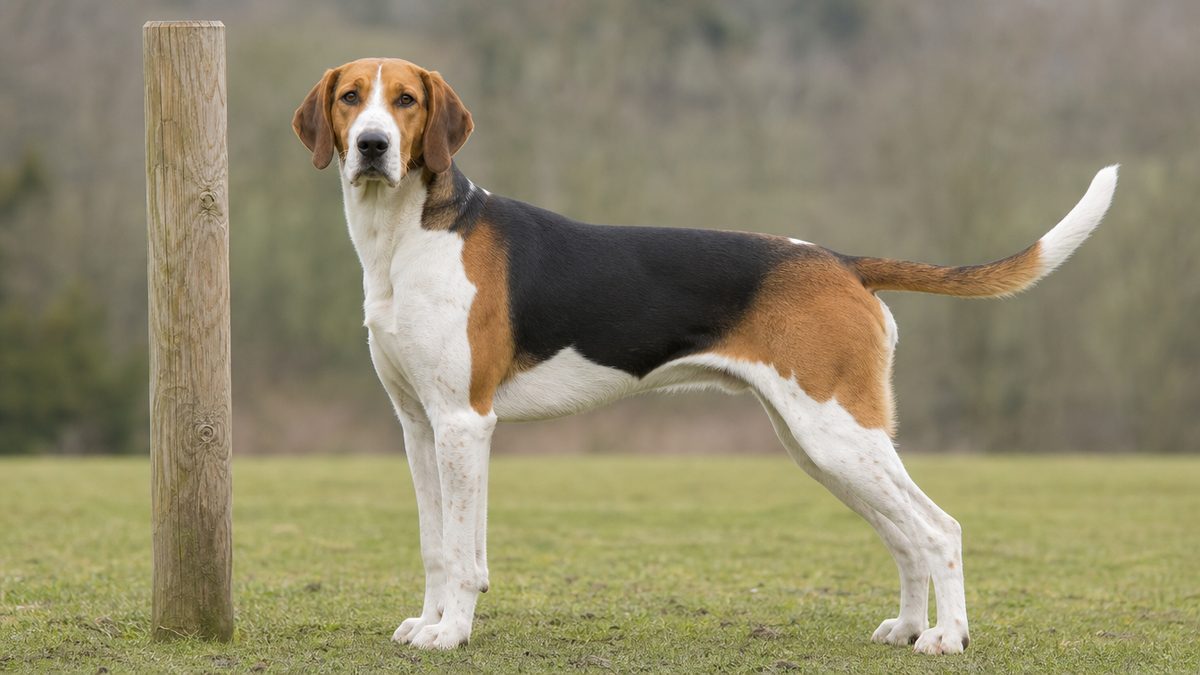
Quick answer
No verified English Foxhound price in India exists, because no Indian market exists to set one. The breed is also not as rare as its Kennel Club number suggests: the Royal Kennel Club registered 20 Foxhounds in the ten years to 2025, while the Masters of Foxhounds Association keeps a separate studbook for 178 working packs. Bonbeno rates the English Foxhound 1 of 5 for heat tolerance in Indian conditions.
This page summarises published breed-standard text, registry statistics, government notifications and peer-reviewed veterinary research for general information. It is not a diagnosis and it is not treatment advice. Consult a registered veterinarian near you about your own dog before acting on anything here. Two things on this page are urgent rather than routine: a hound that collapses, pants without settling or becomes wobbly during or after exercise in Indian heat is a same-hour emergency and needs active cooling on the way to a vet, and sudden drinking, sudden vomiting or sudden lethargy in a Foxhound needs kidney bloodwork the same day, because the one inherited disease documented in this breed killed five of six affected hounds within a week of first signs.
English Foxhound at a glance
What an English Foxhound actually is
An English Foxhound is a large British pack scenthound bred to run in front of mounted riders for hours, and the Federation Cynologique Internationale states its job in three words: packhound for mounted hunt. Every other fact about the breed follows from that sentence, including the two that matter most to an Indian reader, which are how much exercise it needs and how badly it copes with heat.
Three registries publish a standard for this dog and they agree on its shape far more closely than most breeds manage. The FCI text and the Royal Kennel Club text are near identical, both describing a well balanced, powerful and clean cut hound with a flat skull of medium width, a long square muzzle, pendant ear leathers carried close to the head and set high, a broad and level back with a slight rise over strong loins, and a tail carried gaily but never curled over the back The Royal Kennel Club.
The American text is a different document entirely. It is the oldest of the three, approved in 1935, and rather than describing proportions it prices them, allocating a Scale of Points that totals 100. Legs and feet take 20 of those points, back and loin 15, and head only 5. A judge working from the American standard is told, in numbers, that this breed is a set of running gear with a dog attached.
| Item | FCI Standard 159 | Royal Kennel Club | American Kennel Club |
|---|---|---|---|
| Document date | English text 03.06.2009, valid standard 26.03.2009 | Last updated 1 April 2025 | Approved 1935 |
| Breed name used | English Foxhound | Foxhound | English Foxhound |
| Height at withers | Approx 58 to 64 cm | Approx 58 to 64 cm (23 to 25 in) | Not stated |
| Weight | Not stated | Not stated | Not stated |
| Chest measurement given | Deep, ribs well sprung | Deep, ribs well sprung | Over 31 in girth in a 24-in hound |
| Ear rounding described | No | No | Yes, about 1.5 in taken off the end |
| Scale of points | No | No | Yes, totalling 100 |
| Disqualifications | Aggressive or overly shy dogs; physical or behavioural abnormalities | None listed | Pig-mouth (overshot) or undershot |
| Utilisation clause | Packhound for mounted hunt | Stamina and endurance, natural ability to hunt | Not stated as a clause |
Not one of the three standards gives a weight
None of the three published standards sets a weight for this breed, and that is deliberate rather than an oversight. A working pack hound is judged on condition in the field, so the FCI prints only a height, the Royal Kennel Club prints only a height, and the American standard prints neither height nor weight The Royal Kennel Club American Kennel Club. Every weight figure you will read for this breed therefore comes from a breed page rather than a standard.
The AKC's own breed page gives 24 inches and 60 to 75 pounds as averages. Wamiz, a United Kingdom consumer profile that ranks in India for this breed, prints 23 to 25 inches and 55 to 77 pounds for both sexes. Dogbreedslist prints 65 to 70 pounds and splits height by sex at 22 to 25 inches for males and 21 to 24 for females, which no standard does. Bonbeno prints all of them rather than averaging them, because averaging four unsourced numbers produces a fifth unsourced number.
The one measurement the American standard does give
The AKC standard's most useful line is a ratio rather than a size. It requires the chest to girth over 31 inches in a 24-inch hound, and the AKC breed page repeats it as the thing that gives the dog its lung capacity for a long day. That ratio is also how the breed is separated from its American cousin, because the American Foxhound's own standard defines that breed as narrower in proportion to depth than the English hound. Two hounds of the same height, and the English one is the wider barrel.
The Royal Kennel Club calls this breed simply Foxhound, in its breed list, its standard and its registration tables. The AKC and the FCI both call it the English Foxhound Federation Cynologique Internationale. The Orthopedic Foundation for Animals records both at once, filing the breed under ENGLISH FOXHOUND and then noting its Kennel Club group as TKC Hound Group (FOXHOUND). Search for either name and you are searching for the same dog.
Two studbooks, and why a Kennel Club number is not a population
The single most useful correction this page can make is that the Masters of Foxhounds Association keeps its own studbook, entirely separate from any kennel club, and the great majority of working English Foxhounds have never been kennel-club registered. So a Kennel Club registration figure for this breed is a count of show and pet puppies, not a count of Foxhounds.
This is not Bonbeno's inference. The FCI writes it into the breed standard itself: the studbooks published by the Masters of Foxhounds Association of England date back before 1800, it is an easy matter for any owner to trace a pedigree back, and the breeding of Foxhounds in England has always been and is still today in the hands of the Masters of Foxhounds, who kept the most careful records of their breeding operations. The same paragraph adds that the English Kennel Club published an interim standard only lately, and that there have been over two hundred and fifty packs of Foxhounds in Great Britain.
Read that sequence again in order. The working register came first by roughly a century and a half, and the kennel club arrived afterwards with a document for the show ring. Every other breed on this site runs the other way.
What each body actually records
The Masters of Foxhounds Association in Britain now sits inside the British Hound Sports Association, which states that the MFHA is the governing body for registered packs of Foxhounds, that it represents 170 packs hunting within the law in England and Wales and a further 8 in Scotland, and that the BHSA office produces the annual Foxhound Kennel Stud Book. A separate Masters of Foxhounds Association of North America maintains its own Foxhound Stud Book on the other side of the Atlantic.
| Question | Royal Kennel Club | MFHA Foxhound Kennel Stud Book |
|---|---|---|
| What is registered | A puppy | A hound that has entered |
| When | At a few weeks old | After its first season trail hunting |
| Who registers it | The breeder | The Master of the pack |
| Registered where it was bred | Yes | Not necessarily, a drafted hound enters at its new hunt |
| Scale in 2025 | 5 Foxhounds | 178 member packs |
| Purpose of the record | Pedigree and showing | Pack breeding and hunt governance |
The Foxhound Club, the breed's own UK club, sets the mechanism out plainly. The Kennel Club registers puppies at a few weeks old, while the MFHA studbook allows registration of hounds only once they have entered, meaning they have completed a first season trail hunting, and a hound may enter at a different hunt from the one that bred it if it has been drafted out. Two registers, two life stages, two different questions being answered.
The size of the gap, in the club's own words
The Foxhound Club states that since 1983 the Royal Kennel Club has had fewer than 900 Foxhounds registered in total, and that there are nonetheless thousands of Foxhounds in packs across the United Kingdom. Fewer than 900 in more than four decades on one register, against thousands alive on the other, is the whole argument in one sentence.
Every rarity claim about the English Foxhound that you will find online rests on kennel-club registration data, because that is the only data that is published as a tidy annual number. Before you accept one, ask which register produced it. The honest sentence is that the English Foxhound is extremely rare on the pedigree registers and not rare as a working animal, and both halves have to be said together or the reader is misled.
A vulnerable native breed, with the actual registration numbers
The Royal Kennel Club lists the Foxhound on its vulnerable native breeds table, and the ten-year run is startling: 2, 0, 0, 0, 0, 0, 1, 1, 6 and 5, which is 15 puppies across the whole decade to 2025. Corrected on 31 August 2026, when an earlier revision of this page printed twenty beside the same ten figures. Six of the ten years recorded no registrations at all. Read alone, that number says the breed is nearly gone in Britain, and read alone it would be wrong.
The vulnerable native breeds scheme covers breeds of British and Irish origin, and the Royal Kennel Club states the thresholds in its own words: it created the vulnerable native British and Irish breeds list, breeds with fewer than 300 registrations a year, and the at watch list, breeds with between 300 and 450 registrations a year, so that it can monitor them. Bonbeno counted the rows on the current sheet at 39 vulnerable breeds and 8 at watch, which is the same count a sibling page on this site reached from the same table.
| Year | Registrations | Same figure in the Hound group table? |
|---|---|---|
| 2016 | 2 | Yes |
| 2017 | 0 | Yes |
| 2018 | 0 | Yes |
| 2019 | 0 | Yes |
| 2020 | 0 | Yes |
| 2021 | 0 | Yes |
| 2022 | 1 | Yes |
| 2023 | 1 | Yes |
| 2024 | 6, the ten-year peak | Yes |
| 2025 | 5 | Yes |
| Decade total | 15 | Both documents agree on every year |
The asterisk that changes the meaning
The Royal Kennel Club marks exactly two rows on that table with an asterisk, and the Foxhound is one of them. Its footnote reads that this breed takes part in the Royal Kennel Club's Vulnerable Breed competitions because its registered numbers are low, but the breed is known to be numerous outside of the Royal Kennel Club due to either later recognition with the Royal Kennel Club, or registration on an alternate specialist register.
That is the kennel club itself telling you not to read its own number as a population. The alternate specialist register is the Foxhound Kennel Stud Book. The other asterisked row is the Greyhound, for the same reason. No ranking page for this breed quotes that footnote, and it is the single most important sentence on the Royal Kennel Club's page.
Where it sits inside its own group
Rank the Foxhound inside the Hound group and the contrast is absurd rather than merely small. Of the 40 hound breeds in the Royal Kennel Club's ten-year comparative table, the Foxhound's 2025 figure of 5 sits level with the Bloodhound at 5 and above only the Grand Bleu de Gascogne, the Hamiltonstovare and the Segugio Italiano at 0. In the same year the Miniature Smooth Haired Dachshund recorded 8,908 and the Whippet 3,218. The group total for 2025 was 20,841, so the Foxhound accounted for roughly one registration in every four thousand.
The vulnerable native breeds table lists the Foxhound as a vulnerable native breed. The Royal Kennel Club's Foxhound breed page, on the same website, prints Vulnerable native breed: No in its characteristics panel. Both were read on 27 August 2026. A sibling breed's page on this site records the opposite state, with its breed page printing Yes and matching the table. We are not going to tell you which of the two Foxhound pages is correct, because the club has not said. We are telling you they contradict each other, so that a reader who finds one does not assume the other agrees.
We checked the Kennel Club's tables against each other, cell by cell
Checking a registry's numbers against the same registry's other numbers is cheap, and on the Royal Kennel Club's vulnerable-breeds data it finds nine disagreements. The Foxhound's own row is clean in every one of its ten years, which is worth knowing before you trust it, and four of its neighbours' rows are not.
The method is boring and that is the point. The Royal Kennel Club publishes each vulnerable breed's ten-year run twice: once on the vulnerable native breeds web page, and once inside that breed's own group comparative-registrations PDF The Royal Kennel Club. Bonbeno parsed the web table's 47 rows and the six relevant group PDFs, matched them by breed name, and compared every cell.
| Breed | Year | Web page | Group PDF | Group |
|---|---|---|---|---|
| Bull Terrier (Miniature) | 2016 | 493 | 172 | Terrier |
| Bull Terrier (Miniature) | 2025 | 143 | 185 | Terrier |
| Bullmastiff | 2016 | 172 | 493 | Working |
| Bullmastiff | 2025 | 185 | 143 | Working |
| Dandie Dinmont Terrier | 2021 | 124 | 123 | Terrier |
| Irish Wolfhound | 2019 | 225 | 229 | Hound |
| King Charles Spaniel | 2023 | 36 | 39 | Toy |
| Manchester Terrier | 2019 | 243 | 133 | Terrier |
| Soft Coated Wheaten Terrier | 2021 | 227 | 277 | Terrier |
| Foxhound | all ten years | matches | matches | Hound |
Four of the nine are one clean transposition
Look at the first four rows together. The Bullmastiff and the Bull Terrier (Miniature) sit next to each other on the web page, and their 2016 and 2025 figures are swapped between the two documents. The web page gives the Bull Terrier 493 in 2016 and the Bullmastiff 172; the Terrier and Working PDFs give the Bull Terrier 172 and the Bullmastiff 493 The Royal Kennel Club. The same swap repeats in 2025, at 143 and 185. Two adjacent rows, two columns, one transposition.
The remaining five are ordinary single-cell drift, and one of them is large. The Manchester Terrier's 2019 figure is 243 on the web page and 133 in the Terrier PDF, a gap of 110 dogs on a breed that never exceeded 243 in the decade. The Soft Coated Wheaten Terrier's 2021 pair, 227 against 277, has the shape of a digit typo. Nine disagreeing cells out of roughly 460 is a small error rate, and it is not zero.
Then we added the columns up
Both PDFs also print an annual group total, so those can be checked against the rows above them. The Hound group table is exact. All ten annual columns across its 40 breed rows sum precisely to the printed totals, including 2025's 20,841. That matters here, because it is the table the Foxhound's own figures live in.
The Toy group table is not exact. Its 24 breed rows sum to 10,503 for 2025 against a printed total of 10,500, a shortfall of three dogs, while its other nine columns balance to the dog. A sibling page on this site found the opposite sign in the Terrier group, where a printed 2023 total exceeded its own rows by two.
None of these nine cells changes any breed's vulnerable status, and none of them touches the Foxhound. We print them because a registry figure quoted as a bare number, with no sample size and no cross-check, is how a soft number hardens into a fact. Anyone can repeat this check offline in about ten minutes: download the group PDF, extract the text, and diff it against the web table.
English Foxhound price in India: there is no Indian price
No verified English Foxhound price in India exists, because no Indian market exists to set one. Bonbeno ran an India-located search for the exact term on 27 August 2026, opened every result that would load, and found not one English Foxhound offered for sale anywhere in the country. What the search returns instead is more useful to a buyer than any rupee figure would be.
This is the section where a directory is most tempted to invent something. A band like Rs 55,000 to Rs 1,40,000 would look plausible beside the Beagle, would rank, and would be entirely made up. So here is what the India search actually returns, result by result.
One search engine could not be used at all, and the failure is worth recording rather than hiding. Bing India returned HTTP 200 for this exact query, with the correct page title and a confident About 15,400 results, and then served ten organic results about chemistry laboratory equipment, including a lab-apparatus guide, three Indian laboratory suppliers and an IndiaMART lab-equipment category. A control query for labrador retriever price in india, run in the same session on the same engine, returned ten correct Labrador results. So the substitution is specific to this query, and no conclusion about Indian availability was drawn from it.
| Result | What it actually is | A real Indian English Foxhound for sale? |
|---|---|---|
| puppiezo.com, positions 1 and 2 | Breed shell pages. The first two results are for the American Foxhound, a different breed | No |
| dogbreedslist.info, position 3 | A US breed profile priced in dollars, listing the breed's origin as United Kingdom and Canada | No |
| wamiz.co.uk, positions 4 and 11 | A United Kingdom breed profile priced in pounds sterling | No |
| call4dog.com, position 5 | An American Foxhound page, again the other breed | No |
| royalcanin.com/in, position 6 | A genuine India-domain breed page with an Indian helpline and no price at all | No |
| puppiezo.com English Foxhound page, position 7 | The breed's own shell page. Available-puppies block empty | No |
| hubpages.com, position 8 | An article about Indian dog breeds, a different topic | No |
| fluffyn.co.in, position 10 | An Indian breed-price index that does not list this breed | No |
| mrnmrspet.com, position 12 | A Wire Fox Terrier sales page, a different breed again | No |
Three of the top twelve results are a different Foxhound
The most common failure on this query is not a fake price, it is a substituted breed. Positions 1, 2 and 5 all serve American Foxhound pages to somebody who typed English Foxhound. Those are two separate breeds with separate FCI standards, 159 for the English and 303 for the American, and the American standard defines itself by being narrower in the chest than the English hound. A seller who cannot tell them apart in a URL is not sourcing either one.
The page that ranks for the exact phrase is selling a Maltipoo
Puppiezo's English Foxhound page carries the meta description 'English Foxhound price in India: Buy puppies online from KCI registered breeders. Purebred, healthy pups available at best prices!';. Its 'Available English Foxhound Puppies For Sale' block is empty. Underneath it sits an 'Other Available Pets' carousel holding eight named eight-week-old puppies, and Bonbeno recorded every one on 27 August 2026: Fizey a Maltipoo at Rs 98,999, Kuzo a Poodle at Rs 92,599, Dugu a Poodle at Rs 92,599, Kazuka a Cane Corso at Rs 94,999, Doir a Goldendoodle at Rs 1,20,000, Samy a Maltipoo at Rs 98,999, Tugi a Rottweiler at Rs 76,499 and Yoki a Doxiepoo at Rs 98,999. Eight puppies, zero Foxhounds.
Rs 98,999 is the figure a search engine will show you attached to this breed, and it belongs to Fizey, an eight-week-old Maltipoo. Bonbeno has now recorded that same Rs 98,999 on ten separate pages of this one site, attached to whichever puppy is in stock. It is a house price point, not a breed price, and it should never be reported as either Foxhound's value.
That meta description promises puppies from KCI registered breeders. There is no lawful route by which an Indian breeder could hold founding stock of this breed: DGFT Trade Notice 22/2022-23 states that any applications for trading or breeding purposes shall be duly rejected. If someone shows you a KCI certificate for an English Foxhound, ask to see the import authorisation and the airway bill behind it, because the Kennel Club of India's own imported-dog checklist requires both.
The price figures that do exist, and what is wrong with each
Four published price figures exist for the English Foxhound and not one of them is in rupees. Set them side by side and each has a specific, checkable defect, which is more useful than a converted average would be.
| Source | Figure as printed | Currency | What is wrong with it |
|---|---|---|---|
| Dogbreedslist infobox | Average $600 - $800 USD | US dollars | The same cell's own body text says $600 to $1,000 |
| Dogbreedslist body text | from $600 to $1,000 | US dollars | Contradicts the infobox two lines above it |
| Dogbreedslist adoption | approximately $300 or less | US dollars | No shelter, country or year named |
| Wamiz | Between £350 for Non KC Registered Dogs, and £1,050 for KC Registered Dogs | Pounds sterling | The identical band appears on the same site's American Foxhound page |
| Puppiezo carousel | Rs 98,999 | Rupees | Belongs to a Maltipoo named Fizey, not to any Foxhound |
| Royal Canin India | No price printed | None | Nothing wrong with it. An India-domain page that declines to guess |
Do not convert any of these into rupees
The temptation is obvious and it is a trap this site has documented repeatedly. Multiply Wamiz's £1,050 by any exchange rate and you get a number that looks like an Indian price, ranks like an Indian price, and describes a transaction that cannot legally happen in India. Bonbeno tested the reverse operation on the one rupee figure that does appear: Rs 98,999 divided by 84.38 is 1,173.25 dollars, which is not a price a seller would print, so it is not even a converted figure. It is a rupee-native charm price attached to a Maltipoo.
Dogbreedslist contradicts the standard it cites
The page ranking third in India for this query lists only two references, a YouTube video and the FCI standard PDF. Open that standard and the page disagrees with it three times. The FCI gives the origin as Great Britain; the page prints United Kingdom and Canada, with a Canadian flag. The FCI gives one height for the breed, approximately 58 to 64 cm; the page's infobox splits it by sex at 22 to 25 inches for males and 21 to 24 for females, which is the American Foxhound's range. And the page's own Overview paragraph then gives a third figure, 21 to 25 inches or 53 to 64 cm, contradicting its own infobox on the same screen.
Its popularity list is also three years stale, ending at 2022: #199, where the AKC's published 2025 table places the breed at 187.
One detail undercuts even those pounds. Wamiz prints the identical purchase band and the identical £60 to £100 monthly upkeep figure on its American Foxhound page. Two different breeds, one number. That is a house estimate applied across a category rather than a price observed for either dog.
Wamiz's split is genuinely informative about Britain rather than India: £350 for a non Kennel Club registered dog against £1,050 for a Kennel Club registered one, with upkeep of £60 to £100 a month. The threefold gap is the registry split from earlier in this page, showing up as money. A pack-bred hound leaving a kennel carries no kennel club paperwork, so it sits at the bottom of that range. Neither figure can be converted into an Indian price, because there is no Indian transaction to price.
Why no lawful Indian supply chain can form for this breed
Importing an English Foxhound into India to breed or sell is not merely difficult, it is barred by name. DGFT Trade Notice 22/2022-23 classifies dogs under ITC(HS) 01061900 as Restricted, and states in paragraph 6 that any applications for trading or breeding purposes, or applications made on behalf of some another person or entity, shall be duly rejected.
Bonbeno extracted the notice's own text rather than relying on a summary of it, because summaries of Indian pet-import rules have repeatedly been generated rather than read. The relevant provisions read as follows.
- Policy Condition 7 allows import of dogs only for three purposes: a pet dog with a valid pet book and relevant records, research and development with the recommendation of CPCSEA, and internal security by the Defence and Police Force.
- Policy Condition 8 states that import of commercial dogs for breeding or any other commercial activities other than the purposes mentioned above is not permitted.
- Paragraph 6 states that applications for trading or breeding purposes shall be duly rejected.
- Paragraph 7 allows import of pet animals only through the airports and seaports of Delhi, Mumbai, Chennai, Hyderabad, Bangalore and Kolkata, with quarantine at the government station of those ports where required. DAHD added a seventh port, Cochin International Airport at Kochi, for pets arriving under the baggage rules in October 2024.
- Baggage route permits import as passenger baggage without DGFT authorisation only to persons transferring residence to India after two years of continuous stay abroad, and only for up to two animals.
What that adds up to for a pack breed
Read those five together with what this page has already established and the conclusion is arithmetic rather than opinion. Founding stock cannot be imported for breeding. The only lawful entrant is a single hound accompanying a person who has lived abroad for two years and is moving to India. And the world's working population of this breed sits in pack kennels registered to a Master, not in homes with pet books The Foxhound Club, Breed History. There is no realistic person on either side of that transaction.
The Kennel Club of India route, and what it actually demands
The Kennel Club of India is the FCI's national member for India, and the English Foxhound is FCI standard 159, so an Indian pedigree is possible in principle. In practice the KCI's own checklist for an imported dog demands the single-dog registration form, the export pedigree in original, the airway bill in original, the air ticket in original from the country of import to the final destination, the boarding pass with payment, the DGFT licence, customs clearance, quarantine clearance, a pet passport and a notarised affidavit.
Read that list as a description of a person rather than a form. It describes somebody who flew into India on a specific flight with a specific dog. It does not describe a breeder importing a brood bitch, and paragraph 6 of the trade notice is why.
If anyone offers you an English Foxhound in India, ask which airway bill number the dog or its parents arrived on. There is no other lawful way for the breed to be here in a saleable quantity, and the Kennel Club of India's own paperwork requires that document in original. A seller who cannot produce it has not imported anything, which means the dog in front of you is something else.
The Indian rule that collides with the American breed standard
One line of the American Kennel Club's English Foxhound standard describes a procedure that Indian law prohibits by name. The standard states that most English hounds are 'rounded', which means that about 1.5 inches is taken off the end of the ear. That is ear cropping, and Second Schedule Part II paragraph 6(8) of the Prevention of Cruelty to Animals (Dog Breeding and Marketing) Rules 2017 forbids it.
Bonbeno extracted the gazette text and grepped it before quoting. The clause reads, verbatim: there shall be no tail docking, ear cropping, de-barking, de-clawing, branding, dyeing, injecting substances to enhance visual appeal, performing a surgery or procedure to camouflage or hide any defect or infirmity or any other kind of mutilation of any body part of the pup and any change of appearance by artificial means is strictly forbidden.
Note the clause number carefully. It is Second Schedule Part II paragraph 6(8), not Rule 6(8). The Rules' own Rule 6 is a different provision, headed Requirements to be met by breeders and establishments used for breeding or housing dogs for breeding, and what it does is make the Second Schedule binding. The Schedule's own header reads see rules 5(2) and 6, which is where the confusion comes from.
| Document | What it says about the ear | Compatible with Indian law? |
|---|---|---|
| AKC standard, approved 1935 | Ears set on low and lying close to the cheeks. Most English hounds are 'rounded' which means that about 1.5 inches is taken off the end of the ear | The rounding is not |
| Royal Kennel Club standard, 2025 | Leathers pendant, carried close to head, high set. No rounding mentioned | Yes |
| FCI Standard 159, 2009 | Leathers pendant, carried close to the head, high set. No rounding mentioned | Yes |
| Second Schedule Part II para 6(8), 2017 Rules | No ear cropping, and no change of appearance by artificial means | This is the rule |
The practical answer is easy, because two of the three standards already give it. Leave the ears alone. The British and international texts describe the ear only by its carriage and set, and neither asks for anything to be cut Federation Cynologique Internationale. An English Foxhound in India should have whole ears, and a photograph of one with flat-tipped ears is a photograph of a dog that was cut.
The bite clause, where standard and law agree
The AKC standard disqualifies a pig-mouth (overshot) or undershot bite, and the FCI and Royal Kennel Club texts both demand a perfect, regular and complete scissor bite Federation Cynologique Internationale The Royal Kennel Club. Second Schedule Part III paragraph 8(10) of the same 2017 Rules requires that dogs shall have been tested for genetic defects, including hip dysplasia, progressive retinal atrophy, night blindness, hypothyroidism, entropion, ectropion, overshot, undershot jaw (when incisors do not touch or mesh), wry mouth, two or more missing teeth, unilateral cryptorchid or full cryptorchid males.
Here the standard and the law point the same way, which is worth saying because on this breed they mostly do not. A breeder producing the required scissor bite is already avoiding both the overshot and the undershot items in paragraph 8(10). The word in that clause is including, so the list is illustrative rather than closed.
Rule 8(1)(a) of the same 2017 Rules, a genuine Rule rather than a Schedule paragraph, states that every breeder shall ensure that pups less than eight weeks in age are not sold. It is worth knowing because the Indian listing site that ranks for this breed advertises every puppy in its carousel as being exactly eight weeks old.
Cost of ownership in India, bounded honestly
The monthly cost of keeping an English Foxhound in India is dominated by one line, food, and that line can be priced exactly because Royal Canin publishes its own feeding table on its Indian website and an Indian retailer publishes the price of the bag. Everything else on this page's cost table is a range, and we say which figures are ours and which are cited.
Start with the food, because a 30 kg working-shaped hound is not a Beagle with longer legs. Royal Canin's India site sets its Maxi Adult formula for adult large-breed dogs from 26 to 44 kg, and publishes a daily feeding table by weight and activity level. At high activity a 26 kg dog is given 363 g a day, a 30 kg dog 404 g, a 34 kg dog 443 g and a 36 kg dog 463 g. An English Foxhound is a high-activity dog by definition, since the Royal Kennel Club lists its exercise requirement as more than 2 hours per day.
Now the price. On 27 August 2026 Supertails listed that food's 20 kg pack, sold as 2 x 10 kg with three 140 g wet pouches free, at Rs 13,816 against an MRP of Rs 15,700, and printed the unit price on the page as Rs 69 per 100 g. Multiply that out and a 30 kg Foxhound eating 404 g a day costs about Rs 279 a day, or roughly Rs 8,400 a month, in food alone.
| Adult weight | Grams per day, high activity | Rupees per day | Rupees per 30 days |
|---|---|---|---|
| 26 kg | 363 g | Rs 250 | Rs 7,514 |
| 30 kg | 404 g | Rs 279 | Rs 8,363 |
| 34 kg | 443 g | Rs 306 | Rs 9,170 |
| 36 kg | 463 g | Rs 319 | Rs 9,584 |
The grams are Royal Canin's, the Rs 69 per 100 g is Supertails', and the multiplication is ours. Do that multiplication yourself before you trust it, because a food cost is the one number on any breed page a reader can actually check.
Pack size moves the food bill by two thirds
The same product on the same page carries unit prices ranging from Rs 62 per 100 g on one large pack to Rs 104 per 100 g on the smallest. That is a 68 percent premium for buying small, and on 12 kg of food a month it is the difference between roughly Rs 7,400 and Rs 12,500. For a dog this size, buying the largest pack you can store dry is not a saving tip, it is most of the budget.
What we will not put a rupee figure on
Bonbeno prints no purchase price for this breed in India, because none exists and every published figure is in dollars or pounds Wamiz, English Foxhound: Temperament, Care. We also print no Indian veterinary or insurance figure specific to this breed, because a large-breed consultation and vaccination schedule does not vary by breed and quoting a number as though it did would be false precision.
For scale from a market where the breed genuinely exists, Wamiz estimates United Kingdom upkeep at £60 to £100 a month covering food, medical and insurance, and incidental expenses. Bonbeno does not convert that into rupees, because Indian and British veterinary and insurance costs do not track each other and a converted figure would be a fifth invented number.
Tick and flea prevention is the line where a hound with a short flat coat and a country-dog exercise pattern costs more than a lap dog, because it needs year-round cover rather than seasonal cover, and it needs it whether or not you live in a metro. Price it monthly, for a 30 kg dog, and assume no gaps. The reason is in this page's health section rather than its cost section.
The climate this hound was built for, against six Indian cities
The English Foxhound was bred to gallop for hours in a place whose warmest month averages 17.4 degrees Celsius, and India's coolest big city is warmer than that all year. Bonbeno queried NASA POWER by explicit latitude and longitude, checking in every response that the coordinates returned matched the coordinates requested, so no substitute location could be served.
Peterborough is the right English anchor rather than an arbitrary one, because the Royal Kennel Club's own breed page names the annual Festival of Hunting at Peterborough as the event where packs from around the country compete. At 52.569 north and 0.24 west, its annual mean temperature is 10.18 C and its July mean is 17.37 C. Melton Mowbray in Leicestershire, in the heart of the shire hunting country, is cooler still at 9.77 C annual and 16.73 C in July.
| Place | Annual mean temp | Hottest month mean | Annual mean wet bulb | Hottest month wet bulb |
|---|---|---|---|---|
| Peterborough, England | 10.18 C | 17.37 C (Jul) | 8.82 C | 15.20 C (Jul) |
| Melton Mowbray, England | 9.77 C | 16.73 C (Jul) | 8.55 C | 14.81 C (Jul) |
| Bengaluru | 23.74 C | 28.37 C (Apr) | 19.80 C | 22.66 C (May) |
| Pune | 23.86 C | 28.93 C (Apr) | 19.66 C | 23.56 C (Jun) |
| Delhi | 25.60 C | 35.88 C (Jun) | 18.03 C | 27.74 C (Jul) |
| Kolkata | 25.81 C | 31.53 C (May) | 22.85 C | 27.86 C (Jun) |
| Mumbai | 26.77 C | 31.19 C (May) | 22.73 C | 26.55 C (Jun) |
| Chennai | 27.95 C | 31.51 C (May) | 24.94 C | 27.36 C (May) |
Read the wet bulb column, not the temperature column
Wet bulb temperature is the number that matters for a panting dog, because panting is evaporative cooling and evaporative cooling fails as the air approaches saturation. On dry heat alone Delhi looks worst, with a June mean of 35.88 C. On wet bulb the ranking changes: Kolkata's June wet bulb of 27.86 C and Delhi's July wet bulb of 27.74 C are the two hardest months in the six cities, and Chennai's May figure of 27.36 C is not far behind.
Now put the two ends of the table together. Peterborough's hottest month has a mean wet bulb of 15.20 C. Chennai's annual mean wet bulb is 24.94 C, which is 9.74 degrees higher than the hottest month in the hound's homeland, every month of the year. Kolkata in June runs 12.66 degrees above Peterborough in July. There is no Indian season that resembles an English hunting season.
Where in India this is least bad
Bengaluru and Pune are the two cities in this table where an English Foxhound is merely difficult rather than dangerous. Bengaluru's annual mean of 23.74 C at 842 m elevation and a peak wet bulb of 22.66 C, and Pune's 23.86 C at 636 m with a peak wet bulb of 23.56 C, are both roughly 4 to 5 wet-bulb degrees easier than Chennai or Kolkata. That is a real difference and it is not a solution. Both are still warmer year-round than Peterborough is at the height of summer.
That is the lowest rating on our scale and it is not about the coat, which is short and dense. It is about the exercise requirement. A breed whose kennel club prints more than 2 hours per day, and whose FCI utilisation clause reads packhound for mounted hunt, cannot be given its needed workload in any of these six cities without exercising it in conditions its physiology was never selected for.
What the largest heat-illness study says, and what it does not say about this breed
Two thirds of canine exertional heat illness in the biggest study ever done followed an ordinary walk, not a run. That single finding matters more to an Indian Foxhound owner than any breed-specific risk figure, and it is the one figure a page like this can honestly transfer, because the English Foxhound does not appear in that study at all.
Hall, Carter and O'Neill reviewed the de-identified records of 905,543 dogs under primary veterinary care in the United Kingdom in 2016 and identified 1,259 heat-related illness events from 1,222 dogs. Of those 1,259 events, 380 had no trigger recorded, leaving 879 events with a recorded trigger. Of those 879, exertional heat illness accounted for 652, which is 74.2 percent, followed by environmental at 113 or 12.9 percent and vehicular confinement at 46 or 5.2 percent.
That denominator is worth stating precisely, because it is widely misquoted. The 74.2 percent is 652 of the 879 events with a recorded trigger, not 652 of 1,259. On 1,259 the same count would be 51.8 percent. The paper's own wording in discussion is 74.2 percent of events with a known cause.
The finding that should change what you do in May
Of the 652 exertional events, the type of exercise was unrecorded for 101, leaving 551. Of those 551, 372 (67.5 percent) occurred after walking, 97 (17.6 percent) after high-intensity activities such as running or cycling, 76 (13.8 percent) after periods of play, and 6 (1.1 percent) after canine competitions. The overall fatality rate for exertional events was 7.6 percent.
Read that in an Indian context. The dominant trigger of canine heat illness is not a marathon. It is a walk, taken by an owner who did not think a walk counted as exertion. On a breed whose kennel club prescribes more than two hours a day, the risk is not that you will over-exercise it dramatically. It is that you will do the ordinary thing at the ordinary time.
What the study does not license us to claim
The word Foxhound appears zero times in Hall 2020. The breed was not modelled, it is not among the seven breed types found to have greater odds of exertional heat illness than the Labrador Retriever, and Bonbeno will not import an odds ratio onto a breed the authors never studied. What we can transfer are the factors the paper measured on characteristics rather than on breed identity.
| Factor | Odds ratio | 95% CI | Applies to this breed? |
|---|---|---|---|
| Purebred versus crossbred | 1.84 | 1.47 to 2.31 | Yes, a registered Foxhound is purebred |
| Bodyweight 20 to under 30 kg (vs under 10 kg) | 2.27 | 1.73 to 2.99 | Yes for a smaller hound |
| Bodyweight 30 to under 40 kg (vs under 10 kg) | 2.30 | 1.68 to 3.15 | Yes for a larger hound |
| Brachycephalic skull | 1.32 | 1.10 to 1.60 | No, this breed is mesocephalic |
| Dolichocephalic skull | 0.72 | 0.52 to 1.00 | No, and so no protection either |
| Breed-specific odds ratio | Not published | Not published | Foxhound is absent from the paper |
The honest summary is that an English Foxhound carries the two transferable risk multipliers that its body gives it, purebred status and adult bodyweight over 20 kg, and gets neither the protection of a long skull nor the penalty of a short one. It sits in the base skull category. Its real risk sits in its job description rather than in its anatomy.
Walk before the sun, not after it. 67.5 percent of exertional cases followed a walk. Judge the day by wet bulb, not by temperature. A 30 C Kolkata morning at a 27.9 C wet bulb is far more dangerous than a 35 C Delhi afternoon in a dry month. Treat any hound that will not stop panting after ten minutes of rest as an emergency, cool it with water on the groin, armpits and paws on the way, and go.
Temperament: a dog that does not think it needs you
An English Foxhound is friendly, not aggressive, and profoundly independent, and the third of those is the one that surprises Indian buyers. The FCI standard's temperament clause is six words long, stamina and endurance, natural ability to hunt, followed by friendly and not aggressive. There is no clause about attachment to a handler, because attachment to a handler was never bred for.
The breed's own UK club puts it more plainly than any standard could. The Foxhound Club writes that a human is a convenience to a hound, that unlike retrievers or collies who work with you the foxhound will historically have gone off in its pack to the edge of a covert and used its nose with no instruction from its master, that it makes its own decisions, and that it will not do as it is told just because you demand it because it finds obedience a cooperative effort and needs to know what is in it for them.
The club then says the thing most breed pages will not: they make superb pets and it truly encourages anyone to consider them, however they are not a first time dog owner pet, probably not even a second time dog owner. That is a breed club advising against its own breed for most buyers, and it should be read as the most trustworthy sentence available on the subject.
What this looks like in an Indian home
- Recall is conditional, always. A hound that has picked up a scent is answering a different question than the one you asked. Wamiz's own profile says he loves his family but will give them up in an instant if he catches an irresistible scent.
- Separation is the failure mode, not aggression. The same profile warns that this dog does not appreciate alone time and may become very destructive if neglected. A pack animal left alone in a flat all day is being asked to do the one thing it was never bred to tolerate.
- Other dogs are a requirement, not a bonus. A Foxhound raised in a private home needs deliberate socialisation with other dogs from a young age, because in a kennel it would have had twenty of them.
- Cats and small pets are a live risk. Wamiz notes the size of a cat is similar to the size of a fox, so a cat is liable to draw pursuit from this hunter. In an Indian building with community cats, that is a daily problem rather than a theoretical one.
- Voice carries. The breed bays rather than barks, at a volume built to be heard across open country. Dogbreedslist rates barking tendencies at the top of its scale and describes it as frequent.
Who this breed genuinely suits
An English Foxhound suits a household with land, other dogs, and a person who enjoys the dog's independence rather than resenting it. The Royal Kennel Club's own suitability panel is unusually blunt about this: size of home, large house; size of garden, large garden; town or country, country. Not one of those three is a description of an Indian metro apartment.
A first-time owner. Anyone in a flat. Anyone who works a full day away from home. Anyone who wants a dog that comes when called every time. Anyone in Chennai, Kolkata or Mumbai without a genuine plan for two hours of daily exercise before sunrise. None of that is snobbery about the breed; it is the breed's own club and its own kennel club saying the same thing in their own words The Royal Kennel Club.
Training an English Foxhound, and the two things that will not work
Train an English Foxhound by making cooperation worth its while, because obedience through pressure fails on a breed selected for three centuries to work out of sight of its handler. The Foxhound Club's own description is the training manual in one line: the foxhound will not do as it is told just because you demand it, it finds it a cooperative effort, and it needs to know what is in it for them.
Start from what the dog was actually bred to do. In a working pack the hound casts ahead into a covert, picks up a line, decides where it goes, turns, climbs, jumps and commands its master with its cry. A huntsman does not want a hound sitting at his feet all day. Every trait an Indian pet owner will call stubborn is a trait somebody spent generations fixing on purpose.
What works
- Pay for every recall, every time, for life. Treats are a genuine motivator on this breed and Wamiz names them as such. A recall that pays sometimes is a recall a hound will audit and discard.
- Train the nose rather than against it. Scent games and tracking work turn the breed's defining drive into something you control the start of. Dogbreedslist rates the breed's trainability as moderately easy with results coming gradually, which is a fair description of nose work and a poor description of heelwork.
- Socialise with dogs early and deliberately. A hound raised without other dogs is missing the social structure its behaviour assumes.
- Build alone-time tolerance from week one. Destructiveness when left is the breed's documented failure mode, not a training gap that appears later.
- Accept partial compliance as success. The Foxhound Club describes its own hounds coming when called but not directly, appearing rather than arriving, showing they have listened while remaining independent. That is the correct outcome, not a failed one.
What does not work
Two approaches fail reliably. The first is off-lead freedom in an unfenced Indian public space, because a hound on a line is not disobeying you, it is doing its job, and Indian cities have traffic where English fields have hedges. The second is correction-based training, because a dog that was never selected to care whether you are pleased does not experience your displeasure as information.
There is a third that is specific to India and rarely mentioned. Heat removes your training window. The exercise this breed needs is also the training you would do with it, and in Chennai or Kolkata the only safe hours are before sunrise. An owner who trains in the evening because that is when they are free will be training a hot, distracted dog, or not training at all.
Do not buy this breed expecting an off-lead dog. The Royal Kennel Club's own suitability panel puts it in a large house with a large garden in the country, which is a description of a place where the dog can be loose safely. In an Indian city, plan for a long line, a secure garden, or a lifetime of on-lead exercise, and price the extra walking time into your decision before you buy rather than after.
The real daily requirement, and what an Indian day allows
The Royal Kennel Club prescribes more than 2 hours per day of exercise for this breed, in a large house with a large garden, in the country. That figure is the single hardest fact to reconcile with keeping an English Foxhound anywhere in urban India, and every Indian sales page for the breed understates it.
Compare the two numbers directly. The breed's own kennel club says more than two hours a day. Puppiezo's English Foxhound page, the Indian listing page that ranks for the buying query, prints an Exercise Routine of 60 minutes per day. That is less than half, on the page most likely to be read by an Indian buyer immediately before they spend money.
| Source | Stated requirement | Type of source |
|---|---|---|
| Royal Kennel Club | More than 2 hours per day | The breed's national kennel club |
| FCI Standard 159 | Utilisation: packhound for mounted hunt. Free striding, tireless, ability to gallop | The international standard |
| Wamiz | Certainly requires more than an hour of adventure | A consumer breed profile |
| Dogbreedslist | 5 of 5. Needs extensive exercise. A daily, long, brisk walk or jog | A US breed directory |
| Puppiezo, India | 60 minutes per day | An Indian page selling puppies |
Two hours in an Indian city, worked out honestly
Take Chennai, where the annual mean wet bulb is 24.94 C and May peaks at 27.36 C. Safe exercise for a 30 kg short-coated hound means the coolest part of the day, which is roughly 05:00 to 07:00. That is two hours, so on paper it works. In practice it means every single day of the year, before sunrise, at a running pace, on lead, for the twelve to thirteen years the breed is expected to live.
Now take Delhi, where the June mean is 35.88 C and the July wet bulb is 27.74 C. In the pre-monsoon and monsoon months there is no two-hour window that is both cool and dry enough. The honest answer for those months is a reduced, split, early-morning workload and an accepted behavioural cost, not a claim that the dog is fine.
What happens when the requirement is not met
The failure is behavioural before it is physical. Wamiz warns that this dog does not appreciate alone time and may become very destructive if neglected, and that a powerful, lonely hound can turn a three-piece suite into a several-hundred-piece one. Dogbreedslist rates the breed 1 of 5 for apartment friendliness, noting it is very active indoors and does best with acreage. An under-exercised Foxhound does not become calm, it becomes loud and destructive indoors.
The instinct when a dog is under-exercised is to make up the deficit at the weekend with one long outing. On this breed, in this climate, that is the exact pattern Hall 2020 measured: 67.5 percent of exertional heat-illness events followed a walk, and the events occurred year-round rather than only in summer. Spread the load across every morning. Never bank it.
Grooming is easy, the ears are not
The coat takes ten minutes a week and the ears take the rest of the attention. The Royal Kennel Club lists grooming for this breed as once a week with a short coat that sheds, and that is accurate. The part that transfers badly to India is the pendant ear, and there is a UK study that puts a number on it.
O'Neill and colleagues studied a random sample of 22,333 dogs drawn from 905,554 under UK primary veterinary care in 2016 and found a one-year period prevalence of otitis externa of 7.30 percent (95% CI 6.97 to 7.65). Breed and ear carriage were the two highest-ranked risk factors in the model.
The relevant figure for this breed is the conformation one. Compared with breeds with erect ear carriage, breeds with pendulous ear carriage had 1.76 times the odds (95% CI 1.48 to 2.10) of otitis externa, and breeds with V-shaped drop ears had 1.84 times the odds (95% CI 1.53 to 2.21). All three English Foxhound standards specify pendant leathers carried close to the head The Royal Kennel Club American Kennel Club.
Why that UK number understates the Indian problem
The 1.76 was measured in Britain. India adds sustained warm humidity that Britain does not have in the same combination. NASA POWER gives August relative humidity means of 90.8 percent in Pune, 90.4 percent in Mumbai and 74.9 percent in Delhi, with Kolkata reaching 89.3 percent in September. A closed, pendant-covered ear canal in those conditions does not dry between one day and the next.
The Foxhound is also absent from the sixteen breeds the study named with raised odds, so no breed-specific figure exists for it. What the study does give for scale is its nearest relatives: the Basset Hound at 5.87 times the odds of a crossbred and the Beagle at 2.54. Both are pendant-eared scenthounds. Both sit well above the crossbred baseline.
| Task | How often | Why, on this breed |
|---|---|---|
| Rubber curry or hound mitt over the whole coat | Weekly | Short dense coat, moderate shedding |
| Look inside both ears, in daylight | Every second day in monsoon | Pendulous carriage carries 1.76 times the odds |
| Dry the ear after any swim, bath or heavy rain | Every time | A wet canal is the mechanism, not the humidity itself |
| Full-body tick check, ears and armpits included | Daily | 99.6 percent of dogs in one Tamil Nadu series carried ticks |
| Nails | Every 3 to 4 weeks | A hound worked on soft Indian ground wears them less than on English flint |
| Bath | As needed only | Over-bathing a hard hound coat strips it and wets the ears |
The study's own plain-language conclusion recommends avoidance of overzealous ear-cleaning, alongside cleaning with a dry paper cloth and judicious use of antimicrobial ear cleaners. That nuance matters in India, where the instinct in a humid month is to flush the ears daily with liquid cleaner. Flushing liquid into a canal that already cannot dry is the opposite of the advice. Dry the ear, look at it often, and treat a smell or a head shake as a reason to see a vet rather than a reason to pour something in.
The one inherited disease this breed genuinely owns
Renal amyloidosis is the inherited disease documented in the English Foxhound, and it kills fast. Mason and Day diagnosed it in six related English Foxhounds from two separate hunting kennels, and five of the six died or were euthanised within one week of presentation. Nothing else attributed to this breed has that quality of evidence behind it.
The paper is worth reading in detail because its detail is the clinical advice. There was no apparent age or sex predilection. All six dogs had clinical and laboratory findings compatible with renal disease, and the onset of clinical signs was acute in all cases. The one dog that survived the first week was treated with diuresis, which produced a temporary improvement.
On histology the kidneys showed both glomerular and interstitial amyloid, confirmed by immunohistochemical staining to be of the reactive type, amyloid A. Renal papillary necrosis was identified in three of the six dogs, and one hound had concurrent multicentric lymphoma.
The pedigree evidence, which is what makes it inherited
Pedigree analysis showed that four of the affected individuals shared a common great grandsire, and that the same dog was the grandsire of a further case. Five additional dogs from one of the same kennels had clinical signs of acute renal failure but no renal tissue available, and pedigree analysis showed those five were closely related to the confirmed cases too.
Read the source of the cases as well as the finding. These were hounds in hunting kennels, not pets in homes, which is another way the working population is where this breed's medicine actually happens.
Why reactive amyloidosis matters more in India than in England
Amyloid A is the reactive form, meaning it follows sustained inflammatory stimulation rather than arising on its own. India supplies that stimulation at a rate Britain does not. In a Tamil Nadu series of 230 dogs, 229 (99.6 percent) were infested with ticks, and 156 (67.8 percent) were positive for at least one vector-borne pathogen, with Hepatozoon canis at 37.8 percent, Anaplasma platys at 22.6 percent and Ehrlichia canis at 16.1 percent. In a Northeast India series of 130 dogs, 52 percent carried a vector-borne pathogen and 34 percent were co-infected with two or more.
Bonbeno is not claiming a proven causal chain, because no study has linked Indian tick-borne disease to amyloidosis in this breed and we will not invent one. What we are saying is narrower and still actionable: the amyloid documented in English Foxhounds is the type driven by chronic inflammation, and an Indian dog carries a chronic inflammatory burden that an English one usually does not. That makes year-round tick control a health measure on this breed rather than a comfort measure.
The signs are non-specific and the window is short. Sudden increased drinking and urination, sudden vomiting, sudden loss of appetite or sudden lethargy in an English Foxhound warrants kidney bloodwork and a urine protein check the same day, not a wait-and-see. Five of six documented cases were dead within a week of the owner noticing something. This is the reason this page carries a medical disclaimer at the top rather than the bottom.
What the health registers hold on this breed, which is nothing
The Orthopedic Foundation for Animals publishes no statistics of any kind for the English Foxhound, and Bonbeno proved that with controls rather than assuming it. Searching the complete OFA statistics dump case-insensitively for foxhound returns zero rows, while the same search in the same session returns 109 for Labrador, 61 for Beagle, 39 for Manchester, 14 for Harrier and 3 for Otterhound.
Method matters here, because an absence is a strong claim. Bonbeno retrieved OFA's disease-statistics page in full, saved the 2.2 million characters it returns as 15,782 lines of tables, and searched it case-insensitively. Breed names in that dump are printed in capitals, and a case-sensitive search would have manufactured a false absence for every breed on it.
The controls are the point. Two of them, the Harrier at 14 rows and the Otterhound at 3, are British hounds rarer on the Royal Kennel Club's own register than most breeds and both still appear. So the Foxhound's zero is not an artefact of rarity in general. It is specific.
The breed does exist in OFA's system. Its breed selector carries the code FH, with data-name ENGLISH FOXHOUND and data-groups reading AKC Hound Group; UKC Scenthound Group; TKC Hound Group (FOXHOUND). Bonbeno read that code out of OFA's own markup rather than guessing it, because a guessed OFA code returns a complete, plausible table for a different breed. The breed is listed and has simply never reached the evaluation threshold OFA requires before it publishes anything.
The veterinary literature says foxhound and means something else
PubMed returns 412 records for foxhound and 406 for english foxhound, which looks like a well-studied breed and is not. Bonbeno read the query translation line in every case, as this site requires, and then opened records rather than trusting the count. The translation for the second query is english AND (foxhound OR foxhounds), so the 406 is a Boolean intersection rather than 406 papers about this breed.
Open the most recent records and the pattern is unmistakable. They include plasma metabolite profiles of exercising American Foxhound dogs fed different diets, a retracted dental-implant paper using an American Foxhound model, and hookworm resistance surveys in kennel dogs. The literature that mentions foxhound is overwhelmingly about American Foxhounds used as laboratory and kennel colonies, not about English Foxhounds as animals anyone lives with.
| Register or database | English Foxhound entry | Control that proves the search worked |
|---|---|---|
| OFA breed selector | Listed, code FH | Not needed, the code was read from OFA's markup |
| OFA disease statistics | Zero rows | Labrador 109, Beagle 61, Harrier 14, Otterhound 3 |
| Royal Kennel Club pre-breeding tests | No breed-specific screening test recommended, only prioritising genetic diversity | Sibling breeds on the same site carry named eye and DNA schemes |
| Royal Kennel Club DNA package | None offered for this breed | The club offers packages for other breeds |
| PubMed | One breed-specific clinical paper, on renal amyloidosis | Labrador plus hip dysplasia 126, Bergamasco dog 13 |
The Royal Kennel Club recommends no breed-specific pre-breeding test for the Foxhound at all, listing only prioritising genetic diversity under good practice, and offers no breed-specific DNA package. Its Breed Watch entry is Category 1, meaning no points of concern specific to this breed have been identified for special attention by judges. On a breed registering five puppies a year, none of that is evidence the breed is healthy. It is evidence nobody has enough dogs to measure.
Five sources give five lifespans, and one of them is a study
Published life expectancy figures for the English Foxhound range from 8 years at the bottom to over 12 at the top, and only one of the six comes from research. That study is McMillan and colleagues' 2024 analysis of UK companion-dog longevity, and its Foxhound figure is better than the crossbred baseline rather than worse.
| Source | Figure | Evidence behind it |
|---|---|---|
| Royal Kennel Club | Over 12 years | A breed-page category, no study cited |
| AKC breed page | 10 to 13 years | Listed as an average, no study cited |
| Dogbreedslist | 10 to 13 years | No study cited |
| Wamiz | Between 10 and 12 years | No study cited |
| Puppiezo, India | 8 to 10 years | No study cited, and the lowest of the five |
| McMillan et al. 2024 | Median 13.0 years, 95% CI 11.4 to 16.9 | Kaplan-Meier estimate from 31 recorded deaths |
Note which one is lowest. The Indian page selling the puppy prints 8 to 10 years, four years below the research median and two below the most pessimistic consumer profile. A buyer reading that page and then meeting a healthy eleven-year-old hound would think the dog was already past its expected span.
What the study actually reports, including its own inconsistency
McMillan and colleagues analysed 155 recognised purebred breeds against a crossbred group. For the breed the study calls Foxhound, using the Royal Kennel Club's name rather than the American one, Supplementary Table S3 gives a median survival of 13.0 years, with a 95 percent confidence interval of 11.4 to 16.9 and a hazard ratio of 0.67 (95 percent CI 0.47 to 0.95, p = 0.02) against the crossbred reference, whose own median is 12.0.
The two supplementary tables disagree about how many dogs that rests on, and Bonbeno prints the disagreement rather than choosing. Table S3 gives 71 dogs; Table S6 gives 84, as 53 alive plus 31 deceased. The death count is identical in both at 31, which is why the sentence above is built on deaths and the median rather than on N. The same discrepancy appears across other breeds in the same tables, so it is a property of the supplementary data rather than of this breed.
How to read a hazard ratio of 0.67 without over-reading it
A hazard ratio below 1 means the breed died at a lower rate than crossbred dogs over the study period, and 0.67 with an upper confidence bound of 0.95 clears statistical significance. That is a genuinely good result and it comes with two honest caveats. Thirty-one deaths is a small number, which is why the confidence interval runs from 11.4 all the way to 16.9 years. And a breed whose UK kennel-club register holds fifteen puppies in a decade is a breed whose recorded dogs may not represent the population that lives in pack kennels The Foxhound Club, Breed History.
Put the Foxhound's 13.0-year median beside the same table's other hounds and it holds up well. The Beagle's median is 12.5 years from 1,552 deaths, and the Bloodhound's is 9.3 years from 71 deaths with a hazard ratio of 1.68. On the best UK evidence available, the English Foxhound is a long-lived hound, not a fragile one. Its Indian problem is climate and exercise, not constitution.
Feeding an English Foxhound in India, by life stage
Feed an English Foxhound to a visible waist and a rib you can feel through a thin layer, and use a manufacturer's own weight-and-activity table rather than a scoop, because this breed's food requirement swings by more than 100 g a day across its adult weight range. Royal Canin's India site publishes exactly that table for its large-breed adult formula.
The adult numbers are the anchor. For a high-activity dog, Royal Canin India gives 363 g a day at 26 kg, 404 g at 30 kg, 443 g at 34 kg and 463 g at 36 kg. A Foxhound getting the two-plus hours its kennel club prescribes is a high-activity dog. A Foxhound in a Chennai flat getting forty minutes is not, and feeding it the high-activity column will make it fat.
Life stages, and what changes at each
- Eight weeks to four months. Four meals a day, on a large-breed puppy formula rather than an all-breed one. Do not free-feed. Rule 8(1)(a) of the Indian 2017 Rules means no lawfully sold puppy should reach you younger than eight weeks.
- Four to nine months. Three meals a day. This is the window where over-feeding does lasting damage to a fast-growing large-breed skeleton, so weigh the food rather than eyeballing it.
- Nine to fifteen months. Two meals a day. Royal Canin sets its large-breed adult formula from 15 months, so the switch is later than most owners expect.
- Fifteen months to about seven years. Two meals a day on the adult table, adjusted every month against body condition rather than against the bag.
- Seven years onward. Two meals a day, reduced volume as the exercise drops, and a hard look at the ribs every fortnight. Wamiz notes the breed piles on the pounds when out of training.
Three Indian-specific feeding rules
Never feed within an hour either side of the morning exercise. This is a deep-chested breed and Wamiz's own health list names bloating, gastric dilatation-volvulus, as a condition to watch. In India the exercise window and the breakfast window are pushed together by heat, which makes the collision more likely rather than less.
Store the bag against humidity, not just against the dog. A 20 kg pack bought at Rs 69 per 100 g takes about seven weeks to finish for a 30 kg hound Royal Canin India. Seven weeks of an Indian monsoon in an open bag produces food the dog will refuse and you will have paid Rs 13,816 for.
Water is a heat measure, not a feeding measure. A hound exercising at a 27 C wet bulb loses far more to panting than to urine. Two large bowls, refreshed rather than topped up, in different rooms.
The same food on the same Indian page ran from Rs 62 to Rs 104 per 100 g depending on pack size on 27 August 2026. At 12 kg a month that is the difference between roughly Rs 7,440 and Rs 12,480. Before you optimise anything else about feeding this breed, buy the biggest pack you can keep genuinely dry.
The first year, month by month, for an Indian household
Plan an English Foxhound's first year around two things that are not on any generic puppy timeline: the socialisation window closes before the dog is old enough for the exercise it needs, and the Indian summer will arrive in the middle of it. Everything below assumes a lawfully acquired puppy of at least eight weeks, which Rule 8(1)(a) of the 2017 Rules requires.
| Age | Exercise | The thing most owners get wrong |
|---|---|---|
| 8 to 12 weeks | Garden and carried outings only | Waiting for full vaccination before any social exposure, and losing the window |
| 3 to 4 months | Two short lead walks, pre-sunrise | Walking at 9 am because it feels mild to a human |
| 4 to 6 months | Three short outings, plus nose games indoors | Substituting a longer walk for the mental work the nose needs |
| 6 to 9 months | Building toward 60 to 75 minutes across the day | Adding distance in April and May, the two worst months |
| 9 to 12 months | 90 minutes, split, still no sustained running | Jogging with an unfinished skeleton because the dog looks adult |
| 12 months onward | Toward the 2-plus hours the breed needs | Assuming the adult figure applies from the first birthday in a hot city |
The socialisation list that actually matters for this breed
Two items on the standard list carry unusual weight here. Other dogs, because a hound raised alone is missing the structure its behaviour assumes and needs deliberate exposure from a young age. And cats and small animals, because the size of a cat is close to the size of a fox and this hound will pursue. In an Indian building with community cats on the stairwell, that work starts in week nine and never stops.
Add a third that is India-only. Traffic and horns. A pack hound bred for open country meets Indian street noise as an unbroken novel stimulus, and the pre-sunrise walking pattern this page recommends will actually help, because 5:30 am is the quietest the road will ever be.
Health checkpoints in year one
There is no breed-specific screening test to book, because the Royal Kennel Club recommends none for this breed and offers no DNA package. What replaces it is a baseline kidney panel and urinalysis at around twelve months, kept on file. Renal amyloidosis in this breed presents acutely and killed five of six documented dogs within a week, so a normal baseline from a healthy year-old dog is the most useful thing a vet can have when something changes at six.
In a Tamil Nadu series, 229 of 230 dogs were carrying ticks, at a mean intensity of 5.65 ticks per dog. The pathogens those ticks carry are the chronic inflammatory load that matters on a breed whose documented amyloid is the reactive type. Year-round, no seasonal gaps, and a physical check of the ears and armpits daily rather than a reliance on the product alone.
English Foxhound against the breeds Indian buyers actually cross-shop
Nobody in India chooses between an English Foxhound and an American Foxhound, because neither is available. What people actually do is search for a Foxhound, find nothing, and buy a Beagle. So the useful comparison is the one that maps this breed onto the hounds that are genuinely obtainable here.
| Breed | UK registrations 2025 | Published lifespan median | Otitis odds vs crossbred | Available in India? |
|---|---|---|---|---|
| English Foxhound (Foxhound) | 5 | 13.0 years | Not measured; pendulous carriage 1.76 | No |
| American Foxhound | Not a KC breed | Not in the study | Not measured | No |
| Beagle | 1,044 | 12.5 years | 2.54 | Yes, widely |
| Basset Hound | 298 | Not quoted here | 5.87, the highest in the study | Yes, occasionally |
| Bloodhound | 5 | 9.3 years | Not among the 16 named | Rarely |
| Rhodesian Ridgeback | 699 | Not quoted here | Not among the 16 named | Yes |
Against the Beagle, which is the real decision
A Beagle is the same argument at a third of the size, and that difference is the whole answer in India. Both are pendant-eared pack scenthounds with independent noses, both bay, and both were bred to hunt in company. The Beagle's UK registration figure of 1,044 in 2025 against the Foxhound's 5 is not a quality judgement, it is a statement about which one fits into a house.
Two things do differ materially. Heat. Hall 2020 found dogs from 10 to under 20 kg carried an odds ratio of 2.52 for exertional heat illness against dogs under 10 kg, and 20 to under 30 kg carried 2.27, so both are exposed, but only one of them needs two hours a day to stay sane. Ears. The Beagle carries a measured breed odds ratio of 2.54 for otitis externa, well above the crossbred baseline, so the ear routine on this page applies to a Beagle owner too.
Against the American Foxhound, for the reader who has both tabs open
The two breeds separate on chest shape rather than on temperament, and the American standard says so itself. It requires the chest to be deep for lung space, narrower in proportion to depth than the English hound, with 28 inches of girth in a 23-inch hound being good, where the English standard asks for over 31 inches in a 24-inch hound. The English hound is the heavier barrel. The American standard also prints a height range, 23 to 28 inches for dogs and 21 to 26 for bitches, which the English standard declines to give at all. On the AKC's 2025 popularity table the English Foxhound sits at 187 and the American Foxhound at 188, one place apart out of 201 ranked breeds.
The Coonhound page resolves the same registry-versus-working-population problem this page does, from the American side: six breeds carry the name, the FCI recognises one of them, and the AKC lets seven compete while publishing six standards. If you are shopping for a large scenthound in India, that page and the American Foxhound page together cover almost everything you will be offered under a hound name.
What Indian buyers get wrong about this breed, in order
Six mistakes account for almost everything that goes wrong with an English Foxhound in India, and the first one happens before any dog changes hands. They are listed here in the order they occur rather than in order of severity.
1. Believing there is an English Foxhound to buy
The largest error is treating an available-looking listing as an available dog. Three of the top twelve India results for this breed's buying query serve American Foxhound pages, and the page ranking for the exact phrase has an empty availability block above a carousel of eight puppies of six other breeds. Ask for the airway bill before you ask for anything else.
2. Reading the Kennel Club's rarity number as a population
Twenty registrations in ten years reads as a dying breed, and the Royal Kennel Club's own footnote says otherwise: the breed is known to be numerous outside the Royal Kennel Club because it is registered on an alternate specialist register. Getting this wrong in either direction produces bad decisions, whether it is paying a rarity premium or assuming the dog cannot exist.
3. Taking the 60-minute exercise figure from the sales page
The Indian page selling this breed prints 60 minutes a day. The breed's kennel club prints more than 2 hours. A buyer who plans around the first figure has bought a dog they will under-exercise by more than half every day for over a decade, and the result is destructiveness and noise rather than a calm dog.
4. Exercising in the evening because that is when you are free
This is the mistake that kills. Two thirds of exertional heat-illness events in the largest study followed a walk rather than a run, and those events occurred year-round. In Kolkata the June wet bulb averages 27.86 C and in Delhi the July figure is 27.74 C. An evening walk in those months is not a lighter version of a morning walk, it is a different risk category.
5. Cleaning the ears harder instead of drying them
The pendulous ear carries 1.76 times the odds of otitis externa, and the study's own recommendation is a dry paper cloth, judicious use of antimicrobial cleaner, and avoidance of overzealous ear-cleaning. In an Indian August, with relative humidity averaging over 90 percent in Pune and Mumbai, the instinct to flush daily makes a wet canal wetter.
6. Treating a sudden change as something to watch
The one inherited disease documented in this breed presented acutely in all six recorded cases and killed five of the six within a week. On this breed, sudden thirst, sudden vomiting or sudden lethargy is a same-day bloodwork event.
| Mistake | The one thing to do instead |
|---|---|
| Assuming an Indian listing means an Indian dog | Ask for the DGFT import authorisation and airway bill in original |
| Reading 20 registrations as a dying breed | Read the asterisk footnote on the Kennel Club's own table |
| Planning 60 minutes of exercise a day | Plan more than 2 hours, split, before sunrise |
| Walking in the evening | Walk before sunrise, and judge the day by wet bulb |
| Flushing the ears daily in monsoon | Dry them, look at them daily, and treat a smell as a vet visit |
| Waiting a few days on a sudden change | Same-day kidney panel and urinalysis |
Bonbeno will not tell you the mistake is paying too much, because there is no Indian price to overpay. Every rupee figure in circulation for this breed belongs to another animal, and every genuine figure is in dollars or pounds and describes a transaction in another country Wamiz, English Foxhound: Temperament, Care.
Adoption, and the honest route into this breed in India
Adopt rather than buy, and expect the dog you adopt not to be an English Foxhound. That is not a consolation prize, it is an accurate description of what is available: India has no Foxhound rescue because India has no Foxhound population, and the dogs that need homes here are the ones an owner of this breed would actually enjoy.
Start with the evidence for the absence rather than asserting it. An India-located search on 27 August 2026 returned no Indian seller, no Indian rescue and no Indian listing for this breed. Wamiz, which does run adoption listings, prints on its own English Foxhound page that there are no English Foxhound adoption profiles at the moment. The Royal Kennel Club's own Find a Puppy service is linked from a breed page whose register held five puppies in the whole of 2025 The Royal Kennel Club.
What to look for instead, and why it works
The traits that make this breed appealing are all available in dogs that are already in Indian shelters. If what you want is a nose-driven, sociable, hardy, independent dog that gets on with other dogs and wants a long morning walk, the Indian pariah type delivers every item on that list and is adapted to the climate that this breed is not.
- A local pariah or Indian street dog. Sociable with dogs, scent-driven, heat-adapted, and available in every Indian city at no cost.
- A Beagle or Beagle cross from rescue. The same pack-hound temperament at a size a flat can hold, and the breed genuinely exists in India.
- A hound-type mix from a metro shelter. Many Indian shelter dogs are hound-shaped, and a mixed-breed dog carries lower odds of exertional heat illness than a purebred does, at 1.84 times the odds for purebreds in the Hall study.
- A retired working dog, where a legitimate programme exists. Not applicable to Foxhounds in India, but worth asking about for other hound types.
If you are determined to have this breed
There is exactly one lawful route and it is narrow. A person relocating to India after two years of continuous residence abroad may bring up to two pet animals as passenger baggage without DGFT authorisation, entering through one of the seven named ports Department of Animal Husbandry…. Any other route requires an import authorisation, and applications for trading or breeding purposes are rejected by name. Registration with the Kennel Club of India then requires the export pedigree, airway bill and air ticket in original, plus the DGFT licence. The full route is set out in how to import a dog to India.
Before you take that route, weigh what this page has established. A breed whose kennel club recommends a large house, a large garden and the country, needing more than two hours a day, in a city whose annual mean wet bulb runs 10 to 16 degrees above its homeland's hottest month. The paperwork is the easy part.
Ask three questions of anyone offering a dog in India, and this page has given you the documents behind all three. Which register issued the papers, and what breed name is printed on them? May I see the import authorisation and airway bill? May I see the dam, at the premises, with the litter? Bonbeno does not sell dogs, recommend breeders or link puppy listings, and no answer to those three questions turns an unavailable breed into an available one.
Common questions
What is the English Foxhound price in India?
No verified English Foxhound price in India exists. Bonbeno opened every India result for that exact query on 27 August 2026 and found no Indian seller, no Indian rescue and no Indian listing. The only rupee figure attached to the breed online, Rs 98,999, belongs to an eight-week-old Maltipoo named Fizey in a marketplace carousel on a page that stocks no Foxhound at all.
Are English Foxhounds rare?
It is extremely rare on the pedigree registers and not rare as a working animal, and both halves have to be said together. The Royal Kennel Club registered 20 Foxhound puppies across the ten years to 2025, while the Masters of Foxhounds Association governs 178 packs in Britain and keeps its own Foxhound Kennel Stud Book. The breed's own club says there are thousands of Foxhounds in packs.
Can I import an English Foxhound to India?
Only as a personal pet, and only in narrow circumstances. DGFT Trade Notice 22/2022-23 classifies dogs as Restricted under ITC(HS) 01061900 and states that applications for trading or breeding purposes shall be duly rejected. Import as passenger baggage without DGFT authorisation is allowed only to a person transferring residence to India after two years of continuous stay abroad, for up to two animals, through seven named ports.
How much exercise does an English Foxhound need?
The Royal Kennel Club prescribes more than 2 hours per day for this breed, in a large house with a large garden, in the country. The Indian listing page that ranks for the buying query prints 60 minutes per day, which is less than half. Plan around the kennel club figure, split it, and take it before sunrise in any Indian city.
Can an English Foxhound survive in Indian heat?
It can survive, and it cannot work. Bonbeno rates the breed 1 of 5 for heat tolerance. Peterborough, where the breed's own Festival of Hunting is held, has a July mean wet bulb of 15.20 degrees Celsius, while Chennai's annual mean wet bulb is 24.94 and Kolkata's June figure reaches 27.86. There is no Indian season resembling an English hunting season.
What's the difference between an American Foxhound and an English Foxhound?
Chest shape, mainly, and the American standard says so itself. It calls for a chest narrower in proportion to depth than the English hound, with 28 inches of girth in a 23-inch hound being good, where the English standard asks for over 31 inches in a 24-inch hound. They are separate FCI breeds, 159 and 303, and they sit one place apart on the AKC's 2025 popularity table at 187 and 188.
How long do English Foxhounds live?
The only research figure gives a median survival of 13.0 years with a 95 percent confidence interval of 11.4 to 16.9, from 31 recorded deaths, and a hazard ratio of 0.67 against crossbred dogs. Published breed-page figures disagree, ranging from 8 to 10 years on an Indian sales page to over 12 years from the Royal Kennel Club. Bonbeno prints all of them rather than averaging them.
What health problems do English Foxhounds have?
One inherited disease is documented with real evidence: renal amyloidosis. Six related English Foxhounds from two hunting kennels were diagnosed and five of the six died or were euthanised within one week of presentation. The amyloid was confirmed as the reactive type, amyloid A. The Orthopedic Foundation for Animals publishes zero statistics rows for this breed, so no screening prevalence figure exists.
Do English Foxhounds make good pets?
It is friendly and not aggressive, gentle with children who respect boundaries, and profoundly independent. The breed's own UK club states plainly that it is not a first time dog owner pet and probably not even a second time dog owner pet, because a human is a convenience to a hound rather than a leader. It needs other dogs, land and a person who enjoys that independence.
Are foxhounds good house dogs?
No. The Royal Kennel Club's own suitability panel lists this breed as needing a large house, a large garden and the country. Dogbreedslist rates it 1 of 5 for apartment friendliness, noting it is very active indoors and does best with acreage. An under-exercised Foxhound in a flat becomes loud and destructive rather than calm.
Why is the Foxhound on the vulnerable native breeds list?
Because the scheme counts Kennel Club registrations and this breed is barely registered there. The Royal Kennel Club defines a vulnerable native breed as one of British or Irish origin with fewer than 300 registrations a year. Its own footnote on the Foxhound row says the breed is known to be numerous outside the Royal Kennel Club due to registration on an alternate specialist register.
Do English Foxhounds have their ears cropped?
The American Kennel Club standard describes rounding, which takes about 1.5 inches off the end of the ear, and that procedure is prohibited in India. Second Schedule Part II paragraph 6(8) of the Prevention of Cruelty to Animals (Dog Breeding and Marketing) Rules 2017 forbids ear cropping and any change of appearance by artificial means. The FCI and Royal Kennel Club standards describe the ear only by carriage and set.
How much does it cost to feed an English Foxhound in India?
Royal Canin India's own feeding table gives a high-activity dog 404 grams a day at 30 kg, and Supertails listed that food at Rs 69 per 100 grams on 27 August 2026. That works out to roughly Rs 279 a day, or about Rs 8,363 a month, in food alone. Pack size matters: the same product ran from Rs 62 to Rs 104 per 100 grams.
Are English Foxhounds prone to ear infections?
The breed itself has never been measured, but its ear conformation has. In a UK study of 22,333 dogs, breeds with pendulous ear carriage carried 1.76 times the odds of otitis externa compared with erect-eared breeds, and the one-year period prevalence across all dogs was 7.30 percent. All three English Foxhound standards specify pendant leathers carried close to the head.
Compare with similar breeds
English Foxhound sits in 1 Bonbeno group. Each one compares it directly against the breeds it is genuinely an alternative to, on the same figures.