
Breed group
Coonhound
Six separate breeds share this name, and no dog is registered as just a Coonhound anywhere. Here is which is which, and what each one means in an Indian city.
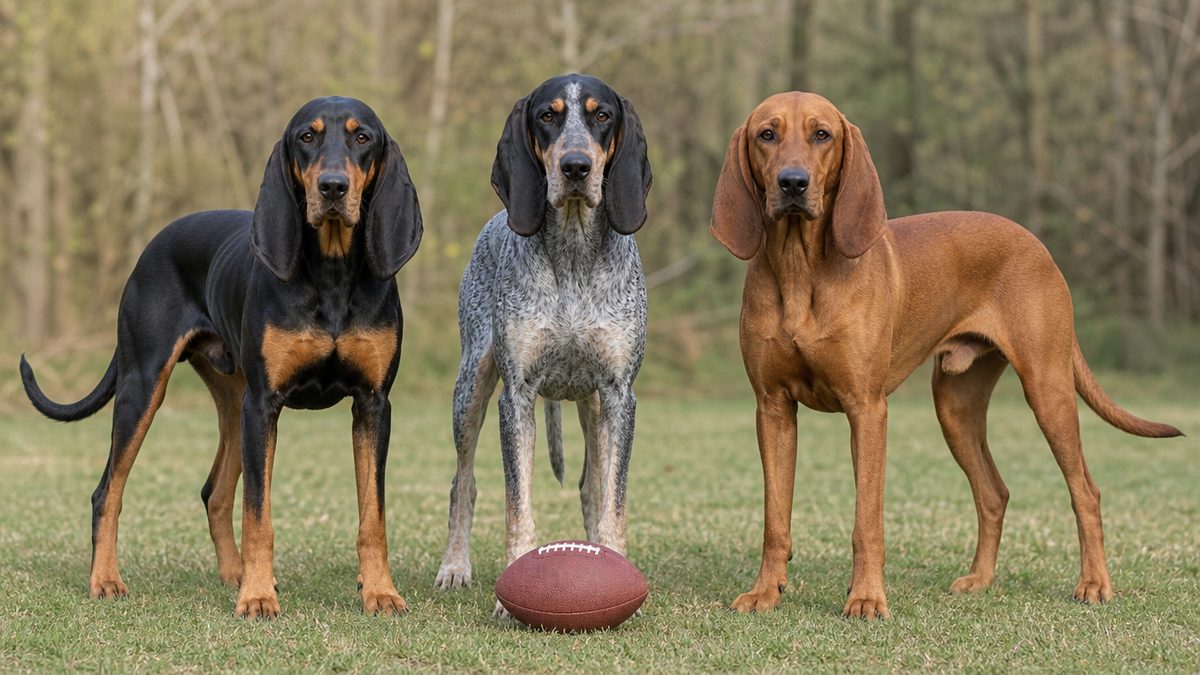
Quick answer
Coonhound names a group of six American scenthound breeds rather than any single breed, so no dog anywhere is registered as just a Coonhound. The six are the Black and Tan, Bluetick, English or American English, Redbone, Treeing Walker and Plott Hound. The AKC publishes six coonhound breed standards and lets seven breeds compete; the FCI recognises one. They span 18 to 50 kg, no trustworthy Indian rupee price exists, and Bonbeno rates the group 2 of 5 for heat tolerance.
This guide is general information for Indian pet owners and is not a diagnosis. Always consult your nearby registered veterinarian before acting on anything you read here, and treat any sudden change in your dog's condition as urgent, especially collapse in the heat, a painful ear, or a sudden weakness in the hind legs.
Coonhound at a glance
Coonhound names a group of six breeds, not one breed
A coonhound is a type of American scenthound bred to trail raccoon by nose and then bay at the tree until the hunter arrives, and six separate breeds carry the name. No kennel club anywhere registers a dog as simply a Coonhound, so if you are reading this because you were offered one, the first useful fact is that you were offered a category.
Wikipedia, which holds position 1 on Google India for this query, opens with the same point: a coonhound is 'an American type of hunting dog developed for the hunting of raccoons and also for feral pigs, bobcats, cougars, and bears', and 'There are six distinct breeds of coonhound.'; Type is the operative word. It sits at the same level as terrier or spitz, not at the level of Beagle.
The six exist because the imported European hounds could not finish the job. Colonial hunters brought foxhounds from England, Ireland and France, and those dogs lost the scent when the quarry climbed. American breeders selected for three things instead: a keen nose, the willingness to work a trail without a handler, and the instinct to follow the animal up the tree and hold it there by voice. Every difficult thing about living with one of these dogs in a city traces back to that second requirement, which is independence from you, on purpose.
What this page covers, and what it does not
This page covers the group and it names the breeds. It does not give you one set of coonhound measurements, one coonhound lifespan or one coonhound price, because those numbers do not exist and any page that prints them has made them up by averaging. The six breeds differ by 2.75 times in top weight and by five years in published life expectancy, so a composite figure would describe none of them.
Where a real per-breed figure exists, this page gives it with the breed named. Where it does not exist, this page says so. Three of the six have OFA screening data and three have zero rows, and that is reported as a difference between breeds rather than smoothed away.
Which six
The six, in the order the United Kennel Club first recognised them, are the Black and Tan Coonhound in 1900, the Redbone Coonhound in 1902, the English Coonhound in 1905, the Treeing Walker Coonhound and Bluetick Coonhound, both originally treated as varieties of the English and split off as separate breeds by 1945 and 1946, and the Plott Hound in 1946. The Plott is the odd one out in ancestry as well as name: it is the only coonhound that does not descend from foxhounds, tracing instead to German boar-hunting dogs brought to North Carolina.
One naming trap follows from that list and it catches Indian buyers. The breed the UKC calls the English Coonhound is the same breed the AKC calls the American English Coonhound. It is one dog with two registered names, and a seller quoting one name and a standard written under the other is not necessarily wrong, but is worth a question.
How this page checked what it claims
Every absence stated here was tested against a control in the same tool and the same session, because a search that returns nothing is not evidence of anything. One instrument failed that test outright and is reported rather than used. On 27 August 2026 a Bing query for coonhound with the India country code returned HTTP 200, the correct page title and a count of about 49,300 results, with ten organic results that were all Japanese articles about email newsletter open rates. Nothing on that page concerned dogs. No claim on this page rests on it in either direction.
Six breeds, six standards, one shared job. Black and Tan, Redbone, English or American English, Treeing Walker, Bluetick and Plott Hound. If a page or a seller gives you a number for 'the coonhound' without naming one of those six, the number came from somewhere else.
The group has enough cultural weight in the American South to have its own burial ground. The Key Underwood Coon Dog Memorial Graveyard in Colbert County, Alabama, established in 1937, accepts only certified coonhounds. That is a useful measure of how specific this working culture is, and of how little of it has travelled.
Which registry recognises which coonhound
Registry recognition of the coonhound group runs from one breed to seven depending on which register you open, and the spread is the single most useful thing on this page. The table below is built from each register's own listing, read on 27 August 2026.
| Register | Coonhound breeds recognised | Which |
|---|---|---|
| United Kennel Club | 6 | Black and Tan, Bluetick, English, Redbone, Treeing Walker, plus Plott Hound in the same Scenthound group |
| American Kennel Club, published standards | 6 | Black and Tan, Bluetick, American English, Plott Hound, Redbone, Treeing Walker |
| American Kennel Club, eligible to compete as Coonhounds | 7 | The six above plus the American Leopard Hound |
| Federation Cynologique Internationale | 1 | Black and Tan Coonhound, Standard No. 300 |
| The Royal Kennel Club, UK | 1 | Black & Tan Coonhound (Imp) |
The AKC's own rulebook is the place the arithmetic changes. Chapter 3 of the Regulations for AKC Coonhound Bench Shows, Field Trials, Nite Hunts and Water Races says that dogs 'registered with The American Kennel Club or recorded with AKC's Foundation Stock Service and classified as Coonhounds are eligible', then names seven: Black & Tan Coonhound, Bluetick Coonhound, American English Coonhound, Plott Hound, Redbone Coonhound, Treeing Walker Coonhound and American Leopard Hound. The same document then publishes six Official Standards, and the American Leopard Hound is not one of them.
That is not an inconsistency. The American Leopard Hound is not an AKC-recognised breed at all: its AKC page states that it 'has been recorded in the Foundation Stock Service since September 19, 2012', it carries a Hound Group designation, and it has no breed popularity ranking. So the honest sentence is that the AKC publishes six coonhound breed standard documents and lets seven breeds compete, with the seventh entering through a recording programme rather than the register.
The FCI recognises one, and that is what settles the India question
The FCI's Group 6 listing, Scent hounds and related breeds, contains exactly one coonhound across all three of its sections: BLACK AND TAN COONHOUND (300), in Section 1.1 large-sized hounds, under the country heading United States of America, with a validity date of 30 January 1991. Searching the same listing for bluetick, redbone, plott and treeing walker returns zero. The alphabetical registers for B, P, R and T return zero for those four, and the provisional list contains no coonhound either.
The controls confirm the search rather than the expectation. The same Group 6 listing returns the Bloodhound as CHIEN DE SAINT HUBERT (84), the Basset Hound as 163, the Beagle as 161 and the Dalmatian as 153. An instrument that finds those and not the coonhounds is working correctly.
This matters for India specifically. The FCI members register lists India as a full member represented by the Kennel Club of India in Chennai, so the KCI issues pedigrees against FCI nomenclature. FCI recognition therefore answers the Indian recognition question in practice: one of the six coonhound breeds has a route to an Indian pedigree, and five do not. Any Indian seller offering KCI papers for a Bluetick, Redbone, Treeing Walker, English or Plott Hound is offering something the nomenclature does not contain.
The standards disagree about weight, and one of them declines to answer
FCI Standard No. 300 gives the Black and Tan Coonhound's size as 63.5 to 68.5 cm for males and 58 to 63.5 cm for females, measured at the shoulder, and adds that 'Oversized dogs should not be penalized when general soundness and proportion are in favour'. It contains no weight clause at all: across the full seven-page text layer the word weight appears zero times and kg appears zero times. The Royal Kennel Club rounds the same heights to 64 to 69 cm and 58 to 64 cm. The AKC breed page, by contrast, prints 65 to 110 pounds. A reader comparing a registry standard with a breed page is not comparing like with like, and the 110-pound figure has no standard behind it.
The automated markdown rendering of FCI Standard 300 inserted the word BLOODHOUND directly beneath the breed title on page one. Extracting the same PDF's own text layer with pypdf returns zero occurrences of bloodhound anywhere in the document. The word was an artifact of the extraction layer, not the standard. Every figure quoted here comes from the raw text layer.
One naming point closes the section. The UKC's English Coonhound standard records that the breed 'was first registered by UKC in 1905, under the name of English Fox & Coonhound', and that 'Both the Treeing Walker and the Bluetick Coonhound were originally registered with UKC as English. The Walker was recognized as a separate breed in 1945, and the Bluetick a year later.'; The UKC page never mentions the AKC's American English name, so the two registries describe the same dog without acknowledging each other.
Coonhound price in India, and why the published figures are not prices
No reliable coonhound price in India exists, and the two rupee bands that are published contradict each other while resting on zero live listings. Bonbeno opened all six Indian pages ranking for the term on 27 August 2026 and recorded every figure printed on them.
| Site | Breed named | Price printed | Live listings on the page |
|---|---|---|---|
| PetBuy.in | Coonhound, generic | Rs 12,000 to Rs 50,000 | 0, stated on the page |
| Asiapets.in | Black and Tan Coonhound | Rs 30,000 to Rs 60,000 | 0 |
| Puppiezo | Redbone Coonhound | No coonhound price at all | 0 |
| Mr n Mrs Pet | Coonhound, generic | No price shown, sign-up wall | 0 |
| Breed n Breeder | Coonhound, generic | No price at all | 0 |
| Supertails 40-breed list | None | No coonhound row exists | not applicable |
The two bands disagree by a factor that no market could sustain. PetBuy.in prints a Typical Price in India of Rs 12,000 to Rs 50,000 for a generic Coonhound, and in the same panel prints its own live listing count as 0 and its live average as a dash. Asiapets prints Rs 30,000 to Rs 60,000 for the Black and Tan Coonhound specifically. One band starts below the other and ends below it, for what is nominally the same animal, and neither is anchored to a dog anyone can point at.
The Rs 98,999 problem, confirmed on this breed
Puppiezo's page is titled 'Redbone Coonhound Puppies For Sale in India At Best Prices' and stocks no Redbone Coonhound. Under the heading 'Available Redbone Coonhound Puppies For Sale' the container is empty, and every priced animal on the page belongs to the site-wide carousel. Those animals, with their printed prices, are a Maltipoo named Fizey at Rs 98,999, a Poodle named Kuzo at Rs 92,599, a Poodle named Dugu at Rs 92,599, a Cane Corso named Kazuka at Rs 94,999, a Goldendoodle named Doir at Rs 120,000, a Maltipoo named Samy at Rs 98,999, a Rottweiler named Tugi at Rs 76,499, and a Doxiepoo named Yoki at Rs 98,999.
Rs 98,999 appears three times on one page, on three animals of three different breeds, none of them a coonhound. That is a house price point rather than a valuation of anything. Google's AI Overview for 'coonhound price in india' was nevertheless quoting Puppiezo on 27 August 2026, stating that 'Redbone Coonhound puppies listed on online platforms like Puppiezo can command premium pricing around Rs 98,999 due to their scarcity'. The scarcity is real. The price is not attached to a scarce dog.
The division test, and what it rules out
Indian pages often publish a dollar figure run through one exchange rate, so every rupee figure above was divided by 84.38, 80.00, 74.00 and 66.67. Not one figure divides cleanly at 84.38, 74.00 or 66.67. Rs 98,999 comes out at 1,173.25, 1,237.49, 1,337.82 and 1,484.91 dollars respectively, and no seller anywhere prints a price of 1,173.25 dollars. Five figures do divide cleanly at 80, giving 150, 375, 625, 750 and 1,500 dollars, but all five end in three zeros, and 1,000 divided by 80 is 12.5, so a clean quotient at 80 on a round number is arithmetic and not evidence.
The conclusion is different from the usual one and worth stating plainly. These figures were not converted from a US price list. They are rare-breed rupee numbers typed by hand, in the X9,999 charm-price style, and reused across whatever puppy is in stock. That is a different contamination mechanism from currency conversion and it means there is no underlying American figure to recover.
What the Indian selling pages actually contain
Five Indian sites sell coonhounds and none of them has one. Bonbeno opened each on 27 August 2026 and recorded what was rendered on the page rather than what the title promised.
Mr n Mrs Pet's page is titled 'Coonhound Puppies for sale in India At Best Prices' and reports '3 Result Found'. The three animals rendered are a French Bulldog named Frankie in Delhi, a French Bulldog named Piku in Thiruvananthapuram and a Goldendoodle named jackiy in Delhi, all under a heading reading 'Similar breeds at other locations';. The coonhound count on that page is zero, and no price is visible at all because every card sits behind a sign-up wall.
Breed n Breeder's coonhound page is the emptiest of the five. It carries no working page title, its meta description reads 'Default description for the page.', its H1 misspells available as 'Avaliable', and its entire body is two copies of a 250-breed dropdown, a state dropdown and a lead form. The only substantive text is a phone number and the line that 'Mr. Vansh will connect with you to discuss the Coonhound puppies price'. The breed name is a string substituted into a template that exists identically for every breed.
The control that proves the search worked
Absence claims have to be earned, so the same instrument was run against a document that should return hits. India's most-cited price list, Supertails' 40-breed guide, contains zero occurrences of coonhound, plott, bluetick, redbone or treeing walker, while returning nine hits for Labrador and twelve for Beagle in the same 50,567-character page. Its forty rows include the Rajapalayam and the Mudhol Hound, so Indian breeds are not being filtered out either. The coonhound group is simply not in the Indian market that list describes.
There is no answer, and that is the answer. Two unanchored editorial bands, zero live listings across five selling sites, no row in the national price list, and a headline figure that belongs to a Maltipoo. Treat any rupee number quoted to you for a coonhound as an opening negotiating position invented on the spot.
What a coonhound costs to keep in India each month
Budget Rs 8,000 to Rs 14,000 a month for any coonhound except the Black and Tan, and Rs 12,000 to Rs 20,000 for a large male Black and Tan. The cost of ownership for this group is set by size band rather than by breed, and these six breeds straddle two bands.
Supertails publishes the only Indian monthly breakdown by size band that names its components, and its large-breed column reads dry or wet food Rs 4,000 to Rs 6,000, routine vet visits Rs 1,000 to Rs 2,000, vaccinations Rs 1,800 a year, grooming Rs 500 to Rs 1,200, training over six months Rs 3,000 to Rs 8,000, treats and toys Rs 600 to Rs 1,200, and miscellaneous flea and deworming Rs 500 to Rs 800, for a monthly total of Rs 8,000 to Rs 14,000. Its giant-breed column totals Rs 12,000 to Rs 20,000.
| Breed | AKC weight | In kg | Indian cost band |
|---|---|---|---|
| Plott Hound | 40 to 60 lb | 18.1 to 27.2 | Large, Rs 8,000 to Rs 14,000 |
| American English Coonhound | 45 to 65 lb | 20.4 to 29.5 | Large, Rs 8,000 to Rs 14,000 |
| Redbone Coonhound | 45 to 70 lb | 20.4 to 31.8 | Large, Rs 8,000 to Rs 14,000 |
| Treeing Walker Coonhound | 50 to 70 lb | 22.7 to 31.8 | Large, Rs 8,000 to Rs 14,000 |
| Bluetick Coonhound | 45 to 80 lb | 20.4 to 36.3 | Large, Rs 8,000 to Rs 14,000 |
| Black and Tan Coonhound | 65 to 110 lb | 29.5 to 49.9 | Large to giant, up to Rs 20,000 |
Two of the seven cost lines move in the opposite directions people expect. Grooming is the cheapest line for this group and stays at the bottom of the large-breed range, because all six breeds are short-coated and need brushing rather than clipping. Training is the line to over-fund rather than trim, because the recall problem is permanent and the equipment that manages it, a long line, a secure harness and a microchip, is a one-time cost that prevents the expensive outcome.
PetBuy.in's Indian breed page rates the Coonhound's grooming as 'High' and its exercise needs as 'Moderate';. Both ratings are inverted, and a buyer budgeting from that card would over-spend on the groomer and under-spend on the fencing.
The costs nobody puts in the table
- Ear care consumables, because a long pendulous ear in Indian humidity needs a weekly routine rather than an annual one.
- Secure fencing or a permanently long lead, since a coonhound that is loose once is a coonhound that may not come back.
- A tracking or GPS collar, which the trainers who live with these breeds treat as standard equipment rather than a luxury.
- Air cooling for the hottest four months, which is a real electricity line for a 30 to 50 kg dog in Chennai or Kolkata.
- Orthopaedic screening for the three breeds where a figure exists, because a hip radiograph is cheaper than the surgery it may avoid.
Google's AI Overview for 'coonhound price in india' told Indian searchers on 27 August 2026 to 'Expect a recurring monthly expense of Rs 4,000 to Rs 8,000' for what it correctly described as a large, high-energy hunting dog. That is the small-breed column of the Indian cost table, not the large-breed one. Budget from the size band, not from the summary.
Heat tolerance, measured against where each breed came from
Every Indian city checked is hotter on peak wet bulb temperature than the coolest coonhound homeland, and three of seven are cooler than the warmest one, so the group's heat tolerance depends on which breed you mean. Bonbeno queried NASA POWER by explicit latitude and longitude for three coonhound origin points and seven Indian cities on 27 August 2026.
The origins are not one climate. The Plott Hound was developed in the Great Smoky Mountains of Haywood County, North Carolina, the English and Treeing Walker types spread through the Tennessee hill country, and the Bluetick was fixed in Louisiana. Those three places differ from each other by 7.7 degrees C in annual mean wet bulb temperature, which is a larger gap than the one between Bengaluru and Chennai. A single heat-sensitive rating for all six coonhound breeds would be as false as a single weight.
| Place | Peak month | Peak wet bulb | Annual mean wet bulb | Peak max air temp |
|---|---|---|---|---|
| Haywood County, North Carolina, Plott origin | July | 19.63 | 9.97 | 37.18 |
| Knoxville, Tennessee, Walker and English range | July | 22.02 | 11.93 | 40.56 |
| Baton Rouge, Louisiana, Bluetick origin | July | 25.50 | 17.71 | 41.54 |
| Bengaluru | May | 22.66 | 19.80 | 40.38 |
| Pune | June | 23.56 | 19.66 | 43.20 |
| Hyderabad | June | 24.44 | 20.96 | 45.00 |
| Mumbai | June | 26.55 | 22.73 | 44.91 |
| Chennai | May | 27.36 | 24.94 | 42.70 |
| Delhi | July | 27.74 | 18.03 | 48.79 |
| Kolkata | June | 27.86 | 22.85 | 46.81 |
Read the fourth column against the third and the argument becomes obvious. Bengaluru's year-round average wet bulb temperature, 19.80 degrees C, is higher than the single hottest month Haywood County ever averages, 19.63. India's mildest large-city climate, in the month it is coldest, is close to the worst week a Plott Hound's home range delivers. For Chennai the annual mean of 24.94 sits within 0.6 degrees of Baton Rouge's hottest month.
The comparison flips only for the Bluetick's Louisiana origin, and only for three cities. Bengaluru at 22.66, Pune at 23.56 and Hyderabad at 24.44 all peak below Baton Rouge's 25.50, so a Bluetick in Bengaluru is arguably in an easier summer than one in its home state. Mumbai, Chennai, Delhi and Kolkata are all above it. That is the only defensible good news on this page about heat, and it applies to one breed and three cities.
What the heat literature can and cannot tell you here
No coonhound-specific heat-risk figure exists. Hall and colleagues studied 905,543 UK dogs under primary veterinary care in 2016 and identified 395 confirmed heat-related illness events, and their multivariable model names 34 breed categories. Searching the article and both its data tables returns zero hits for coonhound, bluetick, redbone, plott hound and treeing walker, against 21 hits for Labrador and 18 for Greyhound. The controls fire, so the absence is real: a breed needed at least five cases or 5,000 dogs in the population to be named, and every coonhound fell into the residual 'other purebred' category, which carried an odds ratio of 1.28 with a 95 percent confidence interval of 0.76 to 2.14 and a p-value of 0.358.
One finding from that paper does transfer, because it is not breed-specific. Dogs at or above the mean bodyweight for their breed and sex had 1.42 times the odds of heat-related illness, 95 percent confidence interval 1.12 to 1.80. That is the lever an Indian owner controls: a coonhound kept lean is measurably safer than the same dog kept heavy, whichever of the six it is.
The widely repeated figure that 74.2 percent of canine heat illness is exertional comes from the companion paper in Animals, not from the Scientific Reports study, and its denominator is different. It is 652 of the 879 prevalent events that had a trigger recorded, out of 1,259 events in 1,222 dogs, not a share of the 395 incident 2016 cases. Quote it with that denominator. The practical meaning is unchanged and it is the one that matters for a hound: most heat casualties are made by the walk, not by the weather.
The bay, and what Indian noise law actually says
A coonhound's voice will exceed the Indian residential night-time noise limit, and Indian law bans removing it. That combination is the single sharpest reason this group does not belong in an Indian flat, and both halves are in the gazette.
The bay is the working output. These six breeds were selected to open on a trail and then bay continuously at the base of a tree so that a hunter several hundred metres away in the dark knows where the dog is and what it has. Under the AKC's Coonhound Regulations a dog earns 125 points for being declared treed first, judged on barking to the satisfaction of the judges. Nothing in that scoring system rewards a quiet dog, and nine decades of selection have acted accordingly.
The legal numbers
The Noise Pollution (Regulation and Control) Rules, 2000 set ambient standards by zone. The Schedule reads, for category (C), 'Residential area 55 45', in dB(A) Leq, and the notes define day time as 6.00 a.m. to 10.00 p.m. and night time as 10.00 p.m. to 6.00 a.m. A silence zone, which includes areas within 100 metres of hospitals, educational institutions and courts, is tighter still at 50 and 40.
Forty-five dB(A) is about the level of a quiet room with a fan running. A hound baying in a stairwell at 2 a.m. is not near that number, it is an order of magnitude past it, and the sound is designed to carry through forest rather than be absorbed by it. In a vertical Indian building the complaint does not come from the flat next door, it comes from four floors up.
You cannot lawfully remove the voice
De-barking is prohibited outright. Second Schedule Part II paragraph 6(8) of the Prevention of Cruelty to Animals (Dog Breeding and Marketing) Rules, 2017 states that 'There shall be no tail docking, ear cropping de-barking, de-clawing, branding, dyeing, injecting substances to enhance visual appeal, performing a surgery or procedure to camouflage or hide any defect or infirmity or any other kind of mutilation of any body part of the pup and any change of appearance by artificial means is strictly forbidden';. The missing comma after 'ear cropping' is in the gazette itself.
Across all fourteen pages of the 2017 Rules the string 'noise' appears zero times, 'BAER' zero times and 'deaf' zero times. The word 'bark' appears exactly once, inside 'de-barking' in paragraph 6(8). So Indian breeding law bans surgically silencing a dog and says nothing at all about how loud a dog may be. The noise question is answered by the 2000 Rules and by your society's rules, not by the breeding Rules.
The practical conclusion is uncomfortable and should be. There is no lawful surgical fix, there is no training fix for a behaviour that is the breed's purpose, and there is a numeric legal limit the behaviour will breach at night. An independent house with distance to the neighbours changes the calculation completely. Apartment living does not.
One clinical footnote closes the loop between the voice and the group's namesake illness. In acute canine idiopathic polyradiculoneuritis, the condition commonly called coonhound paralysis, an affected dog's bark can be altered or lost as the nerve roots inflame. A coonhound that suddenly goes quiet is not a coonhound that has finally been trained. It is a coonhound that needs a veterinarian the same day.
Why no lawful coonhound supply chain can form in India
Importing a coonhound into India for breeding or sale is prohibited outright, and five of the six breeds have no FCI route to a Kennel Club of India pedigree. Those two facts together explain the empty listing pages better than any market analysis.
DGFT Trade Notice No. 22/2022-23, dated 19 December 2022, classifies live dogs under ITC(HS) 01061900 as Restricted. Policy Condition 7 permits import 'only for the following specific purposes', namely a 'Pet dog with valid pet book and relevant records/documents in the name of importer', dogs imported by research organisations with a CPCSEA recommendation, and dogs 'For the internal security by the Defence and Police Force';. Policy Condition 8 states that 'Import of commercial dogs for breeding or any other commercial activities other than the purposes mentioned above is not permitted.'
Paragraph 6 of the same notice removes any ambiguity about what happens to an application anyway: 'It may be noted that any applications for trading/breeding purposes, or applications made on behalf of some another person/ entity shall be duly rejected.'; Paragraph 7 limits entry to 'airports and seaports of Delhi, Mumbai, Chennai, Hyderabad, Bangalore and Kolkata', with quarantine at the government station of those ports where required. DAHD added a seventh port, Cochin International Airport at Kochi, for pets arriving under the baggage rules in October 2024. The full route is set out in how to import a dog to India.
So there is exactly one lawful way for a coonhound to enter India, which is in the personal baggage of an owner relocating with a valid pet book in their own name. You cannot import one to breed from, and you cannot import a litter to sell. A commercial Indian supply of any of these six breeds would have to be founded on dogs that arrived under a personal pet book, which is why there is no supply.
The pedigree side of the same wall
The Kennel Club of India issues pedigrees against FCI nomenclature as India's FCI member, and the FCI nomenclature contains one coonhound. A Bluetick, Redbone, Treeing Walker, English or Plott Hound therefore has no FCI standard to be registered against, no matter how genuine the dog is. Asiapets nevertheless advertises 'Vaccinated, KCI registered Black and Tan Coonhound dogs from verified breeders', and that is at least the one breed for which a nomenclature entry exists.
The registration trend behind all of this
Indian pedigree registration is contracting sharply, which makes a rare imported group even less likely to establish. The FCI's own statistics for the Kennel Club of India record 89,571 pure-bred dogs registered with the studbook in 2021, then 76,011 in 2022, 47,679 in 2023, 38,592 in 2024 and 33,880 in 2025. That is a fall of roughly 62 percent from the peak in four years, to below the 2014 figure of 40,546. Litters registered in 2025 numbered 7,412.
Ask for the import pet book in the previous owner's name, the microchip number, and which of the six breeds is written on the paperwork. If the seller offers KCI papers for a Redbone, Bluetick, Treeing Walker, English or Plott Hound, ask which FCI standard number those papers cite. There is only one, and it is 300, and it is the Black and Tan.
Temperament, and whether a coonhound is a good family dog
A coonhound is an affectionate house dog and an unreliable outdoor one, and both halves of that sentence come from the same selection pressure. These breeds were bred to work a trail alone, at night, out of sight of the handler, so the trait that makes them easy indoors is the same trait that makes them impossible off lead.
Google India's People also ask box for 'coonhound' surfaces exactly one question about the dogs themselves, and it is 'Is a coonhound a good family dog?' The honest answer has two clauses. With people, yes. HoundSong, which rescues these breeds, writes that 'Coonhounds are good with kids and make good family dogs' and that the one caveat is size rather than tolerance, because 'the Coonhound is not always fully aware of their size' and a child can be knocked down. With the outside world, it depends entirely on whether your outside world contains fencing.
Prey drive is not a behaviour problem here, it is the specification
Prey drive in a coonhound is the product, not a fault. HoundSong describes the working failure mode in the clearest phrase anyone has coined for it, 'nose deafness', and explains that 'the nose turns on and the brain turns off'. It adds a distinction that a family should read twice: a coonhound will learn to live with your cat indoors and still hunt the neighbour's cat outdoors, because the dog is intelligent enough to tell the two situations apart and is applying the rule you actually taught it.
A trainer who lives with two of them describes the same thing from the inside. Rebarkable calls it 'Hunt Mode' and says that once the dog is in it, 'switching them off of that is really hard', while food works well at every other moment. That is a workable summary: you are not training against a stubborn dog, you are training against a dog that has stopped receiving.
Not stubborn, and not biddable either
HoundSong draws a distinction worth keeping. 'Coonhounds are not guilty of the famous stubborn streaks of the Basset and the Beagle. They are STILL NOT anxious to please as are breeds like Labradors', and their demeanour is 'more of a working dog temperament';. The practical version is that the dog will cooperate when cooperation is worth something to it. Rebarkable's phrasing is that they 'usually want to know what is in it for them'.
The on-off switch, and what it means in a flat
Rebarkable's most useful observation for apartment living is that these dogs run at two speeds. 'They kind of only have two speeds. Go, or stop', and when they crash 'they're pretty much comatose'. An exercised coonhound is a genuinely calm flatmate. An unexercised one climbs. The same trainer reports one of hers hopping onto surfaces about four foot high, opening a stiff cupboard to reach the bin, and digging through anything that is not stone.
Answer three questions before you go further. Can you give this dog 90 minutes of real scent work and movement every day, before the heat? Do you have a fenced space, or are you prepared never to unclip the lead? Will your neighbours accept a voice that carries several hundred metres by design? Two yeses out of three is not a pass.
Training a coonhound, and the one thing you will not fix
Train a coonhound with food, early and often, and accept that recall will never be reliable enough to bet the dog's life on. Every other behaviour on the list is workable; that one is a design feature of all six breeds.
Start with what the working culture rewards, because it explains what you are up against. Under the AKC's Coonhound Regulations, a nite hunt awards '100 points for dog declared struck first' when the dog opens on a trail, and '125 points for dog declared treed first' when it holds the quarry and bays at the base of the tree. Water races are scored the same way: the first dog into the 25-foot home tree circle 'barking to the satisfaction of the Tree Judges' wins. Silence scores nothing. Coming back when called scores nothing. Working at distance from the handler scores everything.
Recall, and the honest limit
Recall is where every experienced owner lands in the same place. Rebarkable, writing as a professional trainer, puts it under a heading that reads 'They'll likely never get a reliable recall' and adds that if a deer breaks cover 'your hound will go chasing it for miles'. In an Indian city that is not a lost-dog risk, it is a traffic risk. Treat the lead as equipment rather than as a training stage you will grow out of.
The mitigation the same trainer uses is a tracking collar, on the reasoning that recovering the dog quickly beats the alternative. In India a microchip plus an engraved tag with a working phone number is the minimum, because a large short-coated hound loose in an Indian city will be picked up by somebody long before it is picked up by a shelter with a scanner.
What actually works
- Pay in food, and pay early. These breeds are strongly food motivated in every situation except an active scent, so build the habit while nothing is competing.
- Socialise deliberately in the first four months, to traffic, lifts, autorickshaws, building watchmen and other dogs, because a hound that is confident is a hound that is quieter.
- Train scent work rather than obedience drills. Scatter feeding, snuffle mats and search boxes are how you tire the part of the dog that actually gets tired.
- Manage the counter and the bin rather than correcting the dog at them. A hound that has once found food on a surface will check that surface for years.
- Keep one dog first. Rebarkable's advice is that 'one is better than two' for a beginner, because two coonhounds push each other into overdrive, and to wait a couple of years before adding a second.
Aversive equipment is not required and the trainer who owns two of them says so directly: 'You don't need to use a prong, and you don't need an ecollar.'; That is worth stating in an Indian context, where e-collars are sold freely online and are frequently recommended for exactly this kind of high-drive dog.
Expect house manners inside three months, a solid lead walk inside six, scent-work engagement almost immediately, and no reliable off-lead recall ever. Plan the dog's life around the fourth item rather than hoping to move it.
Exercise, and what an unexercised coonhound does to a flat
Budget 90 minutes a day of real movement plus deliberate nose work, split around the heat, for any of the six breeds. These are energetic endurance dogs bred to work a forest all night, and the failure mode is not a bored dog, it is a destructive one.
The most concrete figure any coonhound owner has published comes from Rebarkable, whose two hounds 'average about 35k steps a day' on a tracking collar, placing them in the top ten of their breed across the whole United States every month. That is a working benchmark rather than a requirement, and it is roughly triple what an average Indian pet dog gets. The relevant point is the shape of the number, not the number: these dogs do not have a satiation point that a twenty-minute walk reaches.
PetBuy.in's Indian breed page rates the Coonhound's exercise needs as 'Moderate' while simultaneously rating its barking 'High' and its grooming 'High';. Two of those three are wrong in ways that matter. Exercise is the single largest demand this group makes, and grooming is close to the smallest. A prospective Indian buyer reading that spec card would prepare for exactly the wrong things.
Splitting the day around Indian heat
Exercise timing is a safety question here rather than a convenience one, because exertion rather than weather is what triggers most canine heat illness. The practical Indian schedule for a large hound is a long session before roughly 7 a.m., a short one after dark, and nothing structured in between. In Chennai and Kolkata the evening window closes later than people expect, because the wet bulb temperature stays high after sunset in a way the air temperature does not show. The climate section gives the monthly figures.
What replaces distance when it is too hot to run
- Scatter the daily ration across a room or a terrace instead of using a bowl, which converts feeding time into twenty minutes of nose work.
- Build a search box from delivery cartons and hide a treat in one, then rotate the boxes so the dog cannot memorise the answer.
- Run a short indoor tracking line along a corridor using a dragged treat, which works the same system as a trail at a fraction of the heat load.
- Use a snuffle mat for the evening meal on days when even the post-sunset walk is short.
- Teach a formal settle on a mat, because a dog that can switch off on cue copes far better with a monsoon week indoors.
The one thing that does not substitute is a toy. Rebarkable is blunt about it: physically they will bounce around with you, but 'most of the time a ball, or squeaky toy is sub-par' because nothing manufactured competes with a real trail. Nose work does compete. Fetch does not.
There is a failure mode at the other end too. Rebarkable describes the 'Endurance Monster', a dog conditioned so hard that stopping is no longer an option and relaxation becomes impossible. Teaching an off switch is part of the exercise plan, not an alternative to it.
Grooming a coonhound in Indian humidity
Groom the coat weekly and the ears weekly, and understand that only the second of those two jobs is difficult in India. All six coonhound breeds carry a short coat that needs almost nothing; the ear is where the whole grooming budget and the whole risk sit.
The coat clause is one line long. FCI Standard No. 300 gives the Black and Tan Coonhound's hair as 'Short but dense to withstand rough going', and the other five breeds are described the same way by their own registries. The AKC's grooming advice for the breed is correspondingly light: a short dense coat 'shed once or twice a year', weekly brushing with a medium-bristle brush, a rubber grooming mitt or a hound glove, occasional bathing and regular nail trimming. That is the entire coat routine.
PetBuy.in's Indian page rates coonhound grooming as 'High';. It is not. Grooming is the cheapest line in the Indian large-breed monthly table for this group, at Rs 500 to Rs 1,200, and a hound glove bought once does most of the work. Where the same page is right is shedding, which it rates High, and so does one Indian seller's own spec card, which prints 'Shedding YES' beside a photograph of the breed it is advertising.
The ear is the whole problem
Read the ear clause and the risk is obvious. FCI Standard No. 300 says the ears 'Are low set and well back. They hang in graceful folds, giving the dog a majestic appearance. In length they extend naturally well beyond the tip of the nose and are set at eye level or lower.'; An ear leather long enough to reach past the nose, hanging in folds, set at or below eye level, is a lid on the ear canal. Every one of the six breeds carries a version of it, which is the one anatomical feature the group genuinely shares.
The AKC's grooming section for the Black and Tan Coonhound covers brushing, bathing and nails, and does not mention the ears at all. That omission is defensible in a North American winter and it is not defensible here. Care guidance written for another climate is the commonest way an Indian breed page goes wrong, and this is a clean example of it.
The size of the risk is measurable, though not for these breeds specifically. O'Neill and colleagues examined a random sample of 22,333 UK dogs from a population of 905,554 and found a one-year period prevalence of otitis externa of 7.30 percent, 95 percent confidence interval 6.97 to 7.65. In their final model, breeds with pendulous ear infection exposure carried 1.76 times the odds of erect-eared breeds, 95 percent confidence interval 1.48 to 2.10, and V-shaped drop ears carried 1.84 times, 1.53 to 2.21. Semi-erect ears were no different from erect at 1.03. The Basset Hound, the extreme of the same conformation, sat at 5.87 times the odds of a crossbreed, 3.26 to 10.57.
That paper names no coonhound, and it names no Bloodhound either. Searching it returns zero hits for coonhound, bluetick, redbone, plott and treeing walker against nine hits for Labrador and three for Cocker, so the absence is real rather than a failed search. The transferable finding is the ear shape, not a breed number, and the six coonhound breeds all carry the pendulous form the paper measured.
The short dense coat is insulation against radiant heat as well as against cold, and clipping it does not make an Indian summer easier. Cooling comes from shade, water, timing the walk and keeping the dog lean, not from removing the coat.
Ear care through an Indian monsoon
Check a coonhound's ears weekly from March through October, because the two published Indian series disagree about which season is worst and between them they cover both. Indian humidity arrives at a different point in the year from American humidity, and that is what changes the job.
Both climates are humid. They are humid at different times of year, and that is what changes the ear risk. NASA POWER's climatological relative humidity at 2 metres peaks at all three coonhound origin points in their coldest months: Haywood County, North Carolina at 82.8 percent in December, Knoxville at 82.3 percent in December, Baton Rouge at 84.1 percent in February. Every Indian city checked peaks in the monsoon or just after it, when the air is also hot: Pune at 90.8 percent in August, Mumbai at 90.4 in August, Kolkata at 89.3 in September, Bengaluru at 81.0 in October.
So an American coonhound meets its wettest air when the ear canal is cool, and an Indian one meets wetter air still when the canal is warm. Warm plus wet plus closed is the combination that matters, and it runs for four to five months a year here rather than never.
Two Indian series that disagree about when to worry
Indian veterinary practice has published seasonal figures and they point in opposite directions, so both are given here rather than one. A Palam Valley series in Himachal Pradesh diagnosed otitis in 81 of 2,476 dogs presented, an overall hospital prevalence of 3.27 percent, and reported the incidence peaking in the rainy season at 59.25 percent of cases, 48 of 81. A Durg series in Chhattisgarh screened 281 cases, found otitis externa in 51 dogs at 18.14 percent, and reported the highest prevalence in summer at 41.18 percent, 21 of 51, with the rainy season second at 33.33 percent and winter at 25.49 percent.
The Palam Valley study ran from June 2022 to July 2023, so July was sampled twice and every other month once, which inflates a July to August peak by construction. Its own pendulous-ear row also fails its arithmetic: it prints 53 of 81 as 69.13 percent, but 53 divided by 81 is 65.43 percent, and 69.13 percent requires 56. Cite the percentage rather than the count. The Durg season figures do reconcile exactly, at 21 plus 17 plus 13 of 51, though its sex split of 52.95 and 47.05 percent matches no integer pair out of 51. Two useful series, both worth reading, neither worth quoting uncritically.
The practical reading is that an Indian coonhound's ears need weekly attention from March through October rather than in one named season, because the two published Indian pictures between them cover both the summer and the monsoon. That is a wider window than any overseas grooming guide assumes.
Ticks, which the coat does not protect against
A short coat is no defence against the Indian tick load, and the tick load here is the highest documented risk to a dog that spends hours outdoors with its nose down. A survey of 525 dogs across four Indian cities found 261, or 49.7 percent with a 95 percent confidence interval of 45.4 to 54.1, infected with one or more tick-borne pathogens by PCR. Hepatozoon canis was present in 30 percent, Ehrlichia canis in 20.6 percent and Mycoplasma haemocanis in 12.2 percent, ticks were found on 278 of the dogs, and 39 percent of infected dogs carried more than one pathogen. For a hound whose working posture is nose to the ground in undergrowth, the weekly grooming check is a tick check as much as a coat check.
The weekly routine that actually fits India
- Lift and look every week, from June to October twice a week, checking for smell before you check for discharge, because odour comes first.
- Dry the canal after every bath and after every monsoon walk, and never let a wet ear simply air dry the way overseas grooming guides suggest.
- Keep water out of the canal at bath time and dry the leather afterwards, because a closed pendulous ear is the conformation the UK data measures at 1.76 times the odds of erect ears.
- Wipe the visible leather only, and leave anything deeper than your fingertip to a veterinarian rather than a cotton bud.
- Brush the coat weekly with a hound glove, which takes five minutes and is the whole of the coat routine.
- Book a veterinary look at the first head shake rather than the third, because an ear that has been infected once is far likelier to be infected again.
The short dense coat is insulation against radiant heat as well as against cold, and clipping it does not make an Indian summer easier. Cooling comes from shade, water, timing the walk and keeping the dog lean, not from removing the coat.
Health, screened breed by breed
Screen for hips first, and only three of the six coonhound breeds have enough evaluations for that to mean anything. Coonhound health issues are usually written up as one list for all six breeds, which is wrong twice over: hip dysplasia is the one inherited condition with real published numbers behind this group, and those numbers differ enough between breeds that a pooled figure would mislead in both directions.
The Redbone Coonhound is the worst of the three on hips, at 24.2 percent dysplastic across 124 evaluations, and it sits at rank 38 in the OFA's whole hip table. The Bluetick follows at 17.1 percent of 146, rank 69. The Black and Tan is the best of the three and by far the best evidenced, at 16.0 percent of 985 evaluations, rank 79. Publish the denominator with the percentage every time, because 24.2 percent of 124 dogs is a far softer claim than 16.0 percent of 985, and OFA counts move as evaluations are added.
The Treeing Walker, American English and Plott Hound have no rows in any OFA ranking table. OFA needs 100 hip evaluations, or 50 for its other databases, before a breed appears at all, so their absence means the screening has not been done at volume rather than that the hips are sound. For those three breeds there is no published inherited-risk figure of any kind, and this page does not borrow one from a sibling.
Eyes, and one figure worth knowing
Eye results are reassuring at the summary level and interesting one layer down. The Black and Tan is 96.7 percent normal across 488 eye examinations, the Bluetick 96.5 percent of 85, the Redbone 98.5 percent of 67. Then the per-diagnosis tables show the Black and Tan Coonhound at the top of OFA's retinal dysplasia-folds table, with 58 affected of 487 tested, 11.9 percent, the highest rate of any breed listed there. It also carries 24 of 487 for cataract of unknown significance, 4.9 percent.
Those two facts sit oddly together and the honest reading is that retinal folds are being recorded without being called abnormal in the summary. A part cannot exceed its whole, so 11.9 percent for one finding against 3.3 percent abnormal overall means the two tables are counting different things. Both are printed here rather than one being chosen.
What the parent clubs actually ask for
Only two of the six breeds have a national breed club that recommends any health test. The Black and Tan Coonhound club asks for a hip evaluation, a cardiac exam and an ophthalmologist evaluation. The Treeing Walker Coonhound club asks for hip, ophthalmologist and thyroid. The Bluetick, Redbone, American English and Plott Hound pages all print 'No recommended health tests';. American Kennel Club American Kennel Club American Kennel Club Four of the six breeds therefore have no club-level screening expectation at all, which is the likeliest reason three of them are missing from OFA.
Second Schedule Part III paragraph 8(10) of the Dog Breeding and Marketing Rules 2017 requires that breeding dogs 'shall have been tested for genetic defects, including hip dysplasia, progressive retinal atrophy, night blindness, hypothyroidism, entropion, ectropion, overshot, undershot jaw (when incisors do not touch or mesh), wry mouth, two or more missing teeth, unilateral cryptorchid or full cryptorchid males'. Hip dysplasia is named and the word is 'including', so the list is illustrative rather than closed. What the Rules never mention is deafness: BAER appears zero times and deaf zero times across all fourteen pages.
Cardiac results are the one place a coonhound leads a table for a good reason. The Black and Tan Coonhound holds rank 8 in OFA's basic cardiac table at 99.1 percent normal across 116 evaluations, and rank 97 in congenital cardiac at 98.5 percent normal of 131. Its thyroid figure is 98.1 percent normal of 54, which is below OFA's own reporting threshold for confidence and should be read as thin rather than clean.
What the published literature does and does not say about coonhounds
The largest recent lifespan study excludes every coonhound breed, and the one paper that gives a coonhound figure gives it for the group rather than for a breed. Both facts matter more than the numbers themselves, because they explain why every other page has to guess.
No coonhound is in the lifespan study everyone cites
McMillan and colleagues published survival estimates for 155 purebred dog breeds in 2024, drawn from 584,734 UK dogs. Bonbeno downloaded all eleven supplementary files and extracted 133,615 characters of text from them. Searching case-insensitively for coonhound, bluetick, redbone, plott and treeing walker returns zero hits in Supplementary Table S3, the survival table, and zero in Table S6.
The controls fire, so the zero is real. Beagle, Labrador Retriever and Basset Hound all appear as full rows in the same files: the Beagle at a median survival of 12.5 years with a 95 percent confidence interval of 12.3 to 12.7 across 1,552 deaths, the Labrador at 13.1 years, 13.0 to 13.1, across 16,155 deaths, the Basset Hound at 12.5 years, 12.2 to 12.7, across 883 deaths. A search that returns those and not the coonhounds is working.
One coonhound does appear, in Supplementary Table S5, which is the breed universe rather than the analysis. The Black and Tan Coonhound is listed there flagged N for not included in the survival analysis, classified as Hound group, FCI Scent hounds and related breeds, Large, Mesocephalic. The other five coonhound breeds are not in that table at all, not even among its 189 excluded rows. So the AKC and parent-club life expectancies in the comparison table are the only figures that exist, and they are estimates rather than measured survival.
Tables S3 and S6 do not reconcile. S6 gives the Beagle 3,112 alive plus 1,552 dead, a total of 4,664, while S3 lists the Beagle's N as 4,678. The death count is identical in both. Anyone quoting this paper should build the sentence on deaths and the median with its confidence interval rather than on the sample size.
The one coonhound figure in the literature, and how to read it
Bellumori and colleagues examined 90,004 dogs with an identified breed status at the University of California Davis veterinary medical teaching hospital between 1995 and 2010, of which 27,254 had at least one inherited disorder under study. For atopy or allergic dermatitis the paper lists 'West Highland White Terrier (8.58%), Coonhound (8.33%), Wirehaired Fox Terrier (8.16%), Cairn Terrier (6.91%), Tibetan Terrier (5.86%), and mixed breed (1.08%)'.
That is a real figure, quoted correctly, and it is being over-read everywhere it is repeated. The word coonhound appears exactly once in the entire paper, no breed is specified, no denominator is given for it, and the list carries no confidence interval and no p-value. The paper's actual statistical finding for atopy is purebred against mixed-breed overall, at an odds ratio of 1.56 with a 95 percent confidence interval of 1.30 to 1.89. Saying the study 'found coonhounds predisposed' adds a claim the authors did not test.
It is also, unintentionally, the best evidence for this page's argument. A peer-reviewed veterinary paper collapsed six breeds into one label because the hospital records did too, and the resulting 8.33 percent is now quoted on the internet as a coonhound fact. If a UC Davis dataset cannot keep the six apart, an Indian listing site advertising 'Coonhound puppies' certainly cannot.
Feeding, and the one number that changes a coonhound's odds
Feed a coonhound to a body condition score rather than to a bowl measure, because bodyweight at or above the breed and sex mean carried 1.42 times the odds of heat-related illness in the largest study of the question, 95 percent confidence interval 1.12 to 1.80. In an Indian summer that is not a cosmetic concern.
The risk runs the other way too, through the hips. The Redbone Coonhound runs 24.2 percent dysplastic across 124 OFA evaluations and the Bluetick 17.1 percent of 146. Bodyweight is the single largest modifiable load on a dysplastic hip, so for the two breeds with the worst published figures, the food bowl is the main lever an owner actually holds. The three breeds with no OFA rows are not exempt; they are unmeasured.
Weight gain is easy with these dogs and every experienced owner says so. Rebarkable's summary is that 'They get chunky pretty quick. Especially if the exercise isn't there', and that a happy hound is a fit one rather than a comfortable one. The same trainer records her two averaging 35,000 steps a day, which is the exercise level that particular diet assumes. An Indian city dog on two short walks needs materially less food than the same dog in a Tennessee autumn.
Life stage, in Indian terms
- Eight weeks to six months, feed a large-breed puppy formulation in three or four meals, and target steady rather than fast growth to protect developing hips.
- Six to twelve months, drop to two meals and hold the growth curve flat rather than pushing weight, because the frame is still setting.
- Twelve months to seven years, feed twice daily on an adult large-breed ration sized to the dog's actual work, not to its breed.
- Seven years onward, reweigh monthly, because a hound that slows down and eats the same amount gains quickly.
- Through every stage, scatter part of the ration rather than serving all of it, which turns a two-minute meal into twenty minutes of nose work.
Indian availability is not a constraint for this group. A large, short-coated, high-activity dog eats an ordinary large-breed adult ration, and Supertails' Indian cost table puts food for a large breed at Rs 4,000 to Rs 6,000 a month. Nothing about a coonhound requires an imported or specialist diet, and no breed-specific formulation exists for any of the six.
Managing the kitchen, not the dog
Counter surfing is a management problem rather than a training one with these breeds. Rebarkable describes one of hers opening a stiff bin cupboard by nose and both of them taking anything left on a counter, and notes that it is 'very easy to slip up and become complacent';. In an Indian kitchen with open shelving and a bin at floor level, assume the dog will find it, and change the kitchen.
Run your palm flat along the ribs. You should feel each rib under a thin layer, with a visible waist from above and a tuck from the side. If you have to press to find ribs on a 30 kg hound in April, you are carrying the 1.42 odds ratio into the hottest month of the year.
The first year, mapped onto the Indian calendar
Plan a coonhound puppy's first year around the Indian heat calendar rather than around a generic month-by-month schedule, because the socialisation window and the hottest four months can collide. Indian law also sets the earliest date the puppy may leave its litter.
Rule 8(1)(a) of the Prevention of Cruelty to Animals (Dog Breeding and Marketing) Rules, 2017 states, under the heading 'Conditions for sale', that 'Every breeder shall ensure that pups less than eight weeks in age are not sold';. That is a Rule in the main body of the instrument, not a Schedule paragraph, and it is the one date in the whole first year that is legally fixed. A seller offering a six-week-old puppy is breaking it.
| Age | What matters most | The Indian complication |
|---|---|---|
| 8 to 12 weeks | Socialise to lifts, traffic, watchmen, autorickshaws and other dogs | If these weeks fall in April to June, do it at 6 a.m. and after dark only |
| 3 to 4 months | Lead manners, name response, crate and settle | Monsoon onset means indoor work; build the settle now |
| 4 to 6 months | Scent games daily, first ear-care routine established | Humidity peaks; check ears weekly, not monthly |
| 6 to 9 months | Long-line work outdoors, never off lead | Growth spurt plus heat; cap high-impact exercise |
| 9 to 12 months | Build distance and stamina gradually | Start the build in October, not in March |
| 12 to 24 months | Hip radiographs for the breeds where screening exists | Book the scan for a cool month, since sedation and heat are a poor pair |
Why the arrival month matters more here than anywhere else
The socialisation window closes at roughly sixteen weeks and it does not reopen. In Delhi the climatological monthly maximum air temperature runs 45.59 degrees C in April, 48.08 in May and 48.79 in June, so a puppy arriving in March spends its entire window unable to be outside in daylight. The same puppy arriving in October gets Delhi at 38.70 falling to 29.84 by December, which is four usable months. Bengaluru is the most forgiving Indian city on this measure and Kolkata one of the least, peaking at 46.81 in May.
If the arrival month cannot be chosen, move the work indoors and to the edges of the day rather than skipping it. Stairwells, lift lobbies, the society gate at shift change and a friend's flat are all real socialisation, and a large hound that is confident in a lift is a hound you can still manage at 40 kg.
Two things to start on day one
Start ear handling and lead pressure in week one, before either matters. A puppy that accepts its ear being lifted and wiped will accept it at three years, and a puppy taught that a taut lead means stop will still pull at eighteen months but will be recoverable. Both are far harder to install on an adult hound that has already learned the opposite.
At a year you should have a calm, house-trained, lead-walkable dog that settles indoors, works happily for food, and greets strangers well. You will not have reliable off-lead recall, and you should not test for it.
The six coonhound breeds compared, side by side
The six coonhound breeds differ by 2.75 times in top weight and by five years in stated life expectancy, so a single set of coonhound numbers cannot describe any of them. The table below is assembled from each breed's own AKC page, read on 27 August 2026. Nobody else publishes these six rows together, which is the reason this page exists.
| Breed | AKC recognised | Popularity rank | Height, males | Weight | Life expectancy | Club-recommended tests |
|---|---|---|---|---|---|---|
| Black and Tan Coonhound | 1945 | 137 of 210 | 25 to 27 in | 65 to 110 lb | 10 to 12 years | Hip, cardiac, ophthalmologist |
| Plott Hound | 2006 | 171 of 210 | 20 to 25 in | 50 to 60 lb males, 40 to 55 lb females | 12 to 14 years | No recommended health tests |
| Bluetick Coonhound | 2009 | 132 of 210 | 22 to 27 in | 55 to 80 lb males, 45 to 65 lb females | 11 to 12 years | No recommended health tests |
| Redbone Coonhound | 2009 | 146 of 210 | 22 to 27 in | 45 to 70 lb | 12 to 15 years | No recommended health tests |
| American English Coonhound | 2011 | 182 of 210 | 24 to 26 in | 45 to 65 lb | 11 to 12 years | No recommended health tests |
| Treeing Walker Coonhound | 2012 | 143 of 210 | 22 to 27 in | 50 to 70 lb | 12 to 13 years | Hip, ophthalmologist, thyroid |
Read the weight column first, because it is the one that decides whether the dog fits your life. The lightest figure any AKC coonhound page prints is 40 lb, for a female Plott Hound, and the heaviest is 110 lb, for a Black and Tan. That is 18.1 kg against 49.9 kg, a 2.75-fold span inside one supposed breed name. A 50 kg large hound and an 18 kg one are different animals to lift into an autorickshaw, different animals to feed, and different animals to cool down after a walk in May.
The life expectancy column carries the second surprise. The Redbone Coonhound's stated 12 to 15 years does not overlap the Black and Tan's 10 to 12 years except at a single point, which means the two ends of this group are separated by three years at the bottom and three at the top. These are registry estimates rather than cohort findings, and the section on health explains why no cohort figure exists for any of the six. Treat the column as what each parent club and the AKC publish, not as measured survival.
Popularity is the column that misleads. Every one of the six sits in the bottom half of the AKC's 210-breed ranking, between 132 and 182. American Kennel Club In the United States, where coonhounds are a working culture with their own nite hunts and water races, the whole group is a minority interest. In India it has no registered presence at all.
The three that carry screening data, and the three that do not
Only three of the six coonhound breeds appear in the Orthopedic Foundation for Animals ranking tables at all, and the split runs the opposite way to popularity. The Bluetick is the most popular of the six and has 146 hip evaluations. The American English is the least popular and has none.
| Breed | Hip evaluations | Dysplastic | Eye evaluations | Eyes abnormal |
|---|---|---|---|---|
| Redbone Coonhound | 124 | 24.2 percent | 67 | 1.5 percent |
| Bluetick Coonhound | 146 | 17.1 percent | 85 | 3.5 percent |
| Black and Tan Coonhound | 985 | 16.0 percent | 488 | 3.3 percent |
| Treeing Walker Coonhound | no rows | no figure | no rows | no figure |
| American English Coonhound | no rows | no figure | no rows | no figure |
| Plott Hound | no rows | no figure | no rows | no figure |
The absence is real and it was tested rather than assumed. The same 2.2 million character OFA dump that returned those three breeds returned 109 rows for the Labrador Retriever and 61 for the Beagle when searched the same way, so the search instrument works. Breed names in that dump are printed in capitals, and a case-sensitive query manufactures an absence that is not there, so every search here was run case-insensitively and against controls first.
Averaging the three OFA hip figures to get a coonhound number would produce 19.1 percent, which describes no breed on this page. The Redbone's 24.2 percent rests on 124 evaluations and the Black and Tan's 16.0 percent on 985. Those are different questions with different amounts of evidence behind them, and collapsing them is exactly the mistake this page is written against.
What Indian buyers get wrong about coonhounds
The commonest mistake is buying a coonhound without knowing which coonhound, and it starts with the search itself. Five specific errors follow, each traced to something a ranking page or a listing site actually publishes.
1. Treating a group name as a breed name
No dog anywhere is registered as a Coonhound. The UKC's 300-plus breed list contains five breeds whose names end in Coonhound and a Plott Hound beside them, and no entry reading simply Coonhound. The AKC's Coonhound Regulations name seven eligible breeds and publish six Official Standards, again with no generic entry. An Indian listing headed 'Coonhound Puppies for sale in India' is therefore not naming a breed, and the first question to ask a seller is which of the six they mean. If the answer is vague, the paperwork will be too.
2. Believing the ranking pages agree
They do not, and the disagreement is easy to check. Rebarkable, position 4 in India and written by a trainer who lives with two coonhounds, states that 'There are 4 kind of coonhounds' and lists the Redbone, Bluetick, Treeing Walker and Black and Tan. Wikipedia at position 1 and HoundSong at position 10 both say six and both include the English and the Plott. Two of these cannot be right. Read the register rather than the article.
3. Taking a listing price as a market price
Indian coonhound prices are not prices. The pattern is covered in full in the price section, but the short version is that the recurring Rs 98,999 figure attached to coonhound listings is a house charm price rather than a valuation of any dog, and Google's own AI Overview for 'coonhound price in india' was repeating it as a market rate on 27 August 2026. A rare breed with no lawful import route cannot have a market price, and a number that appears beside several unrelated puppies is telling you about the seller's pricing template, not the animal.
4. Underestimating the voice, then trying to train it out
The bay is the job. A coonhound that trails silently is a coonhound that failed, because the hunter is not watching the dog, he is listening to it from a distance in the dark. Buying one of these breeds and then working to make it quiet is buying a dog for a purpose and then punishing the purpose. In an Indian flat that is not a training problem you will solve; it is a fit problem you should have avoided. The section on noise gives the actual legal limits.
5. Assuming a short coat means a heat-tolerant dog
Every coonhound is short-coated and none of them is built for this climate. Heat tolerance is set by where the breed was selected to work and by what it was selected to do, and these dogs were selected to run for hours in a North American forest at night. The climate section puts real numbers on the gap, including the fact that Bengaluru's year-round average wet bulb temperature is almost exactly the hottest month the Plott Hound's home range ever records.
If you are being offered a coonhound in India, ask for the registration papers and read which breed is written on them. There are six correct answers and one wrong one, and the wrong one is a blank.
Adopting instead, and what to do if a coonhound reaches you
Adopt rather than buy, because no lawful commercial import route for a coonhound into India exists and the animals offered as coonhounds here are usually something else. Indian shelters do not hold purebred coonhounds, but they do hold large, loud, nose-led dogs that want exactly the same life.
Start with the Indian Pariah Dog, which is the honest substitute for most of what a buyer wants from this group. It is a medium to large, athletic, short-coated, independent dog that evolved in the wet bulb conditions the climate section measures, it is free to adopt from any Indian shelter, and it carries none of the inherited hip risk the OFA tables record for the Redbone and Bluetick. If the appeal was the nose and the stamina rather than the ears, this is the better dog and it is already here.
If the appeal was specifically a scent hound with a voice, the Beagle is the drop-eared scenthound an Indian buyer can genuinely obtain, at a fraction of the size and with a real supply of Indian rescues. Bonbeno's Beagle guide covers the recall problem and the ear care that both breeds share. Read it before you commit to a nose-led dog of any size.
If you already have one, or are offered a rehome
Coonhounds reach Indian homes occasionally through relocation, so the rehome case is real even though the purchase case is not. Six things to do in the first month, in order.
- Confirm which of the six breeds it is, from papers rather than from colour. A tricolour dog may be a Treeing Walker or an English Coonhound, and the two have different registries behind them.
- Book a hip assessment with a veterinarian who can position for extended-hip radiographs, because two of the three coonhound breeds with OFA data run above 17 percent dysplastic.
- Screen the ears weekly from day one, not at the first head shake. The ear leather on these breeds is long, low set and closes the canal.
- Fit a flat collar with an engraved phone number and a separate harness for walks, then microchip. A coonhound that catches a scent does not come back on voice.
- Set the exercise clock before the day heats up, and measure the dog's recovery rather than the distance covered.
- Feed to a body condition score rather than to a bowl size, because a heavy hound with 24 percent breed-level hip risk is carrying the one variable you control.
Adoption is also the right answer for a reason the Indian statute makes plain rather than merely the ethical one. Buying a puppy from a seller who cannot show which breed it is, and who obtained it through a supply chain that could not lawfully exist, funds exactly the trade the Dog Breeding and Marketing Rules were written to control. The law section sets out what those Rules require and what they do not.
A genuine coonhound rehome in India comes with an import pet book in the previous owner's name, a microchip number that matches it, and a named breed. Ask for all three. A seller who has none of them is not rehoming a coonhound.
Coonhound questions Indian buyers actually ask
Is a coonhound a good family dog?
Yes with people and no with the outside world. Rescue organisations that handle these breeds report that coonhounds are good with children and that intolerance is a rare and heavily frowned-on fault, with size rather than temper the real caution because a large hound can knock a child down. The problem is prey drive outdoors, not the household.
How many coonhound breeds are there?
Six breeds carry the name, and a seventh competes alongside them. The AKC publishes six Official Standards, for the Black and Tan, Bluetick, American English, Plott Hound, Redbone and Treeing Walker, then lists all six plus the American Leopard Hound as eligible Coonhounds. The FCI recognises one of the six and the Royal Kennel Club recognises the same one.
What is the coonhound price in India?
No reliable figure exists. Two Indian pages publish bands that contradict each other, Rs 12,000 to Rs 50,000 for a generic Coonhound and Rs 30,000 to Rs 60,000 for the Black and Tan, and both sites show zero live listings. India's most-cited 40-breed price list contains no coonhound at all while returning nine hits for Labrador and twelve for Beagle in the same document.
Which dog is under RS 5000?
No coonhound is, and the honest answer to this query in India is an adopted Indian Pariah Dog, which costs nothing to adopt and which the national price list itself puts at Rs 0 to Rs 2,500. Any purebred large hound offered under Rs 5,000 is either not that breed or is being sold by someone you should not buy from.
Which dog price is 2000?
Nothing in the coonhound group sits at that price and nothing legitimately could, given there is no lawful commercial import route into India for any of the six breeds. The only Rs 2,000 band in India's published price list is the adoption line for an Indian street dog, and adoption is the route this page recommends anyway.
Which dog is 20 crore price in India?
Not a coonhound. Google attaches this question to Indian coonhound price queries, and the answer it surfaces concerns a Caucasian Shepherd named Cadabom Hayder in Bengaluru, reported across Indian media as a claimed valuation rather than a documented transaction. It has nothing to do with any coonhound breed and is a good example of how thin the Indian query set for this group is.
Can you import a coonhound to India?
Only as your own pet, never to breed or sell. DGFT Trade Notice 22/2022-23 classifies live dogs as Restricted under ITC(HS) 01061900 and permits import only for a pet dog with a valid pet book in the importer's name, for research with a CPCSEA recommendation, or for Defence and Police use. Applications for trading or breeding purposes are duly rejected.
Can a coonhound live in an Indian apartment?
Realistically no, and the deciding factor is the voice rather than the floor area. India's Noise Pollution Rules 2000 set a residential night-time limit of 45 dB(A) Leq between 10 p.m. and 6 a.m., and a hound bred to be heard across a forest at night is nowhere near that. De-barking is prohibited outright, so there is no lawful way to reduce it.
Is a coonhound the same as a Plott Hound?
The Plott Hound is one of the six coonhound breeds and it is the odd one out. It is the only coonhound that does not descend from foxhounds, tracing instead to German boar-hunting dogs, and it is the smallest of the six at 40 to 60 pounds against the Black and Tan's 65 to 110. The AKC recognised it in 2006 and ranks it 171 of 210.
Do coonhounds shed?
Yes, and one Indian seller says so on the spec card of the breed it is advertising, printing Shedding YES. All six breeds carry a short close coat that sheds year round and needs brushing rather than clipping, which makes grooming the cheapest line in an Indian monthly budget for this group, not the most expensive one.
Which coonhound breed has the best health data?
The Black and Tan Coonhound, by a wide margin, because it is the only one of the six with a substantial OFA record. It has 985 hip evaluations at 16.0 percent dysplastic and 488 eye examinations at 96.7 percent normal. The Treeing Walker, American English and Plott Hound have zero rows in any OFA ranking table, so no published figure exists for them.
How long do coonhounds live?
Between 10 and 15 years depending on which breed, and no measured figure exists for any of them. The AKC gives the Black and Tan 10 to 12 years and the Redbone 12 to 15. The largest recent lifespan study covers 155 UK breeds and includes no coonhound at all, with the Black and Tan appearing only in its excluded-breed table.
Compare with similar breeds
Coonhound sits in 2 Bonbeno groups. Each one compares it directly against the breeds it is genuinely an alternative to, on the same figures.