
Dog breed profile
Treeing Walker Coonhound in India: Price, Heat and Evidence
The coonhound the AKC standard itself calls the people's choice, with three recommended health tests, one named disease risk, a Kentucky homeland cooler than Bengaluru, and an Indian price two websites publish identically without sourcing it.
Quick answer
The Treeing Walker Coonhound price in India is published as Rs 30,000 to Rs 50,000 by two websites that print the identical figure and the identical monthly cost row, neither with a source. The same monthly row appears on those sites for the Redbone Coonhound and the Whippet, three dogs whose own pages give them 1,600, 1,500 and 800 calories a day. No Indian litter, breeder or registration exists.
This page reports registry documents, Indian statutes and the published veterinary literature that names this breed. It is not veterinary advice and it cannot diagnose your dog. Most PubMed records naming a Walker hound describe research-colony animals rather than patients, so the breed-specific evidence base is thin and an Indian owner is working largely from general large-hound data. Any ear discharge, lameness, cough, sudden weakness, weight loss or sign of heat stress needs a registered veterinarian in person. Consult your nearby vet before acting on anything here.
Treeing Walker Coonhound traits, rated for India
What a Treeing Walker Coonhound is, and the stolen dog in its pedigree
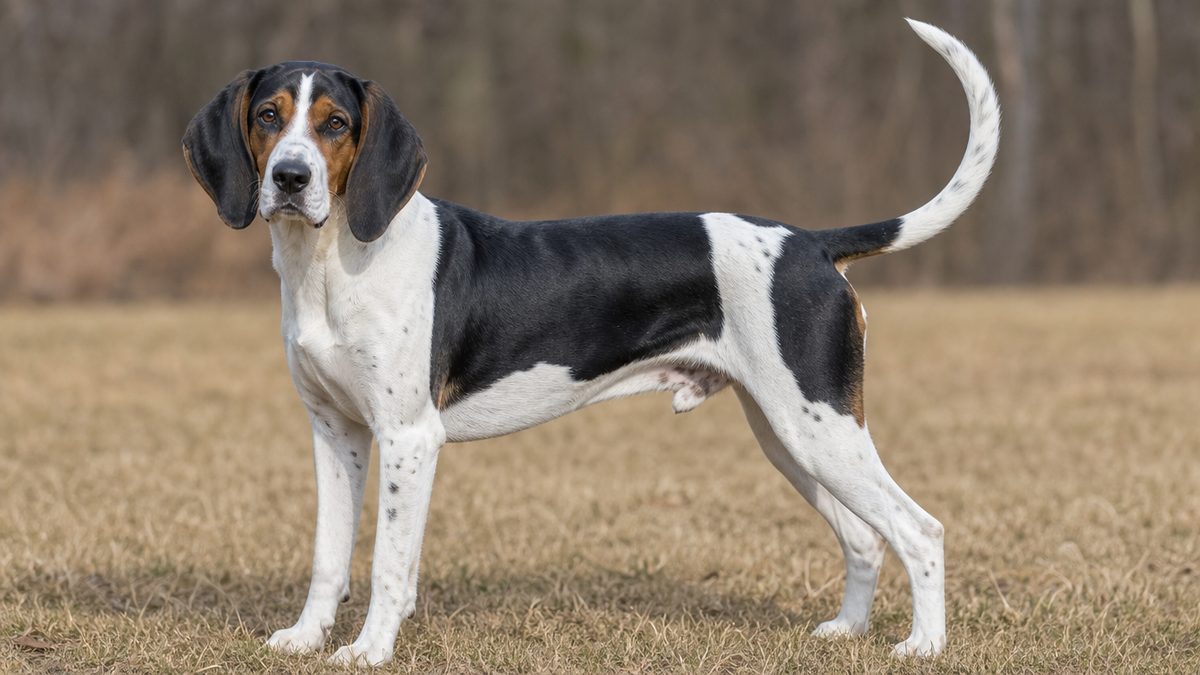
The Treeing Walker Coonhound is a tricolour American scenthound developed in Kentucky from Walker Foxhound stock to trail and tree raccoon, registered as a separate breed by the United Kennel Club from 1945 and recognised by the American Kennel Club in 2012American Kennel Club.
The breed history the UKC prints inside its own standard is more specific than most, and it names people and dates. Credit for developing the Walker Foxhound goes to two Kentuckians, George Washington Maupin and John W. Walker. Behind them sit two imports: Thomas Walker of Albemarle County, Virginia, brought hounds from England in 1742, and George Washington, an avid fox hunter, imported several more in 1770. Those dogs became the foundation of the Virginia hounds that were developed into the Walker hound.
Then comes the sentence no Indian page quotes. At least one major outcross was made in the 19th century that was to forever influence the breed, and the UKC standard states plainly that the outcross was with *a stolen dog from Tennessee of unknown origin, known as Tennessee Lead*. Lead did not look like the Virginia strain, and what he contributed was game sense, drive, speed and a clear short mouth. A registry writing an admitted theft and an unknown pedigree into its own founding document is unusual, and it is a better guide to what this dog is than any temperament paragraph.
The 1945 separation, and why the name is what it is
Walkers were first registered with the UKC as part of the English Coonhound breed. In 1945, at the request of Walker breeders, the UKC began registering them separately, first as Walkers (Treeing) and later as Treeing Walkers. That order matters when you read older material: a pre-1945 pedigree naming an English Coonhound may describe this dog, and the current UKC standard still carries a 1945 copyright.
Two registries, one dog, and a three-year gap in the dates
| Source | Males | Females | Weight | Date |
|---|---|---|---|---|
| AKC Official Standard | 22 to 27 inches | 20 to 25 inches | In proportion to height, no numbers given | Approved 8 July 2008, effective 1 January 2009 |
| AKC breed page | 22 to 27 inches | 20 to 25 inches | 50 to 70 pounds, about 23 to 32 kg | Recognition year given as 2012 |
| UKC standard | 22 to 27 inches | 20 to 25 inches | In proportion to size and working condition | Revised 1 January 2016, copyright 1945 |
The rest of the AKC standard reads as a specification for a running dog rather than a show outline. The shoulder blade slopes forward and downward at a 45 degree angle to the ground, the length of shoulder blade and upper arm are equal, depth of chest matters more than width and descends to about the point of the elbow, and the hind legs are muscular and powerful with great propelling leverage and well muscled thighs of considerable length. Feet are cat-like with thick pads and well arched toes, and the standard notes that no rear dewclaws should be present while front dewclaws may be removed, which is the one line in it that collides with Indian law.
Two things follow. The three registries agree on height to the inch, which is rare, and the AKC's own standard took effect three years before the AKC's own stated recognition year. That is not a contradiction, it is how a breed moves through the Miscellaneous class, but a page that quotes 2012 without the 2009 standard date is giving you half the record. And as with every hound in this family, the standard prints no weight at all, so every kilogram figure you will see comes from the AKC's separate breed page rather than from the document that defines the breed.
Colour is the whole identification problem
Tricolour is preferred: white, black and tan, with white predominant carrying black markings and tan trim, or black predominant with white markings and tan trim as a saddle or blanket back. White with tan spots or white with black spots may be accepted, and any other colour combination is penalised in the ring. That matters in India because the four American coonhounds most likely to be offered here are told apart almost entirely by coat: solid red is a Redbone, brindle is a Plott, blue mottling is a Bluetick, black and tan without white is a Black and Tan Coonhound, and white with black and tan is this dog.
The nickname is in the standard, not in the marketing
The AKC standard opens by calling this breed *the people's choice* among all coonhound breeds, and explains it as a competitive spirit that makes the dog an ideal choice for coonhound events. Read that as a statement about American nite-hunt entries rather than about pet ownership. The same document then describes a hound with extreme endurance and the desire to perform, which is the part an Indian buyer should weigh.
The AKC standard ends with a note that working dogs will not be penalised for scars or blemishes due to hunting injuries. It is a small line and it tells you what kind of document this is: a working schedule that expects the dog in front of it to have been used.
Registry status: a breed on both American registers, absent from the one India uses
The Treeing Walker Coonhound is a breed rather than a type, because two organisations each publish a breed standard and keep a register for it, and it is nevertheless unregisterable in India because the FCI, whose nomenclature the Kennel Club of India works to, does not hold it.
Bonbeno applies one test to every animal it writes about. A name is a breed when a recognised body publishes a written standard and a register records its individuals generation to generation. A standard plus a register with no national admission is a breed in formation. Neither is a type. A register with no standard is its own fourth state, and the UKC keeps exactly such a group. A name owned as a trademark is a brand.
This breed clears the test on both American registers, and it is worth naming the fourth state explicitly because the UKC operates it. The UKC's Breed Standards index enumerates nine groups, and its last one is the UKC Bloodlines Listing Service, holding ten breeds the registry will record without publishing a conformation standard for them: the Alapaha Blue Blood Bulldog, American Exhibition Bully, Armenian Gampr, Duitsch Herder, Hollandse Herder, Mechelse Herder, Phu Quoc Ridgeback, Russian Salon Dog, Russian Tsvetnaya Bolonka and Yakutian Laika. No coonhound is in that group. The Treeing Walker sits in the Scenthound group with a full standard, which is a different and stronger status.
What the FCI holds, and what that means for an Indian buyer
India is a full FCI member represented by the Kennel Club of India, so the KCI issues pedigrees against FCI nomenclature and FCI status is the practical answer to the Indian recognition question. The FCI's Group 6 list, Scent hounds and related breeds, carries a United States block with exactly two entries: American Foxhound, standard 303, accepted 2 November 1979 and Black and Tan Coonhound, standard 300, accepted 30 January 1991.
| Register | Status | Evidence |
|---|---|---|
| UKC Scenthound Group | Full breed standard and register | Standard revised 1 January 2016, copyright 1945, separated from the English Coonhound in 1945 |
| UKC Bloodlines Listing Service | Not a member | The group holds ten breeds and no coonhound is among them |
| AKC Hound Group | Recognised | Standard approved 8 July 2008, effective 1 January 2009; recognition year given as 2012 |
| FCI definitive register, Group 6 | Absent | Zero occurrences of Treeing or Walker; controls Beagle 161, Basset Hound 163, English Foxhound 159 and Chien de Saint Hubert 84 all present |
| FCI provisional register | Absent | Zero occurrences; the list rendered, with dated rows from 11 February 2026 back to 2019 |
| Kennel Club of India | No route exists | The KCI works to FCI nomenclature and there is no FCI standard for this breed |
The provisional register was checked separately and with a control, because reading a zero off a list that failed to render is the commonest way to manufacture a false absence. It returned real dated rows running back from 11 February 2026 and contains zero occurrences of Treeing, Walker or Coonhound.
Note the date format while you are reading that FCI table, because it inverts easily. The Black and Tan's acceptance reads 1/30/1991, and 30 cannot be a month, so the column is month first and the American Foxhound's 11/2/1979 is 2 November 1979 rather than 11 February.
The Kennel Club of India limit, stated honestly
The KCI publishes no public breed list, so a query there returns nothing for this breed and nothing for a control breed either. That is a broken instrument, not a finding, and it must never be reported as the breed being unrecognised in India. The correct statement is the one above: because the KCI issues pedigrees against FCI nomenclature and the FCI has no Treeing Walker standard, no KCI pedigree route exists for this breed, and a seller offering KCI papers for one is offering something that cannot exist.
The parent club, and why we checked it before linking to it
The AKC parent breed club is the National Treeing Walker Coonhound Association, whose site is hosted on Google Sites. We checked it on 9 September 2026 for the link-injection pattern that has been found on other small breed-club sites, where a genuine club page running an unsupported content management system carries dozens of injected outbound links. The NTWCA page carries two outbound hosts, both Google's own, and shows no injection.
The reason we run that check at all is a live example. The club that the United Kennel Club's own Rat Terrier standard names as that breed's national parent club returns HTTP 200 with a genuine club identity and a genuine breed description, and it also declares WordPress 4.7.21 in its generator meta tag and carries 29 of its 42 outbound hosts pointing at Indonesian lottery and slot-gambling destinations, under labels such as DATA HK and TOGEL SINGAPORE. Before you follow an outbound link from any small breed-club site, look at what else is on the page.
Treeing Walker Coonhound price in India, and the row that gives it away
The Treeing Walker Coonhound price in india is published as Rs 30,000 to Rs 50,000 by two websites, and the strongest evidence that neither measured anything is not the price at all, it is the monthly cost row printed beneath it.
One caveat belongs at the top. No India-located search-engine result page could be captured on 9 September 2026: Google served a JavaScript shell on every route tried and Bing India served a fully substituted result set of YouTube and Google Help pages in five languages, while a Labrador control passed twice through the same Bing endpoint in the same session. Every page discussed below was found by general web search and then opened directly, and every figure attributed to one was read out of that page's own bytes.
The number, and the number underneath it
| Source | Buying price | Monthly cost | Source given on the page |
|---|---|---|---|
| poodles.in | Rs 30,000 to Rs 50,000 | Rs 3,550 to Rs 5,400 | None |
| happypet.care | Rs 30,000 to Rs 50,000 | Rs 3,550 to Rs 5,400 | None |
| puppiezo.com | Rs 76,499 to Rs 1,20,000 in the carousel | Not given | None of the eight animals is a Treeing Walker |
| mrnmrspet.com breed page | No figure, and no breed content | Not given | The page returns HTTP 200 with an empty title tag |
| mrnmrspet.com listing page | No figure | Not given | HTTP 200 under the title 404 Page Not Found |
| dogbreedslist.info | 400 to 800 US dollars | Not given | United States |
Two unrelated websites agreeing to the rupee on two separate quantities is one data point, not two. This page therefore reports Rs 30,000 to Rs 50,000 as a single published claim with no source behind it.
The three-breed test that settles it
The monthly row is a preset, and the proof is on the same website, twice over.
| Line | Treeing Walker | Redbone Coonhound | Whippet |
|---|---|---|---|
| Monthly total | Rs 3,550 to Rs 5,400 | Rs 3,550 to Rs 5,400 | Rs 3,550 to Rs 5,400 |
| Food | Rs 2,250 to Rs 3,000 | Rs 2,250 to Rs 3,000 | Rs 2,250 to Rs 3,000 |
| Health | Rs 600 to Rs 1,200 | Rs 600 to Rs 1,200 | Rs 600 to Rs 1,200 |
| Grooming | Rs 700 to Rs 1,200 | Rs 700 to Rs 1,200 | Rs 700 to Rs 1,200 |
| Stated adult calories per day | 1,600 kcal | 1,500 kcal | 800 kcal |
| Stated buying price | Rs 30,000 to Rs 50,000 | Rs 60,000 to Rs 1,00,000 | Rs 20,000 to Rs 50,000 |
| Stated size class | Medium Breed | Medium Breed | Medium Breed |
| Stated ideal weather | 10 to 25 C | 10 to 30 C | 15 to 30 C |
A dog eating 1,600 calories a day and a dog eating 800 cannot have the same food budget, and the site says both on its own pages. What varies is the buying price and the weather band. What does not vary is the entire cost table, which is assembled from a small set of preset lines and assigned per breed. It is not an observation of anything, and it is why this page rebuilds the number from named rate cards in the section below.
The same template also assigns a wrong fact rather than only a wrong price. All three breeds above are filed as Medium Breed, and this hound is 50 to 70 pounds against a Whippet's 25 to 40. A size class propagates into food quantity, crate sizing and drug dosing, so distrust the physical measurements on any page whose cost row you have caught being a preset.
Is the Indian band a converted dollar price?
| Rate | Rs 30,000 becomes | Rs 50,000 becomes | Verdict |
|---|---|---|---|
| 84.38 | 355.54 dollars | 592.56 dollars | No |
| 74.00 | 405.41 dollars | 675.68 dollars | No |
| 80.00 | 375 dollars | 625 dollars | Clean, but any figure ending in three zeros divides cleanly by 80 by construction |
Only the structurally weak rate fits, and its quotients are prices a seller might print, so the test is inconclusive rather than exculpating. The American published band for this breed is 400 to 800 dollars, and 375 sits just below it. The defensible reading is that this is a rupee-native number rather than a converted American list, and either way no transaction stands behind it.
What the listing pages are actually selling
The carousel headed *Available Treeing Walker Coonhound Puppies For Sale* held eight animals on 9 September 2026 and not one was a Treeing Walker: two Maltipoos named Fizey and Samy at Rs 98,999, two Poodles at Rs 92,599, a Cane Corso at Rs 94,999, an unnamed puppy at Rs 1,20,000, a Rottweiler at Rs 76,499 and a Doxiepoo named Yoki at Rs 98,999, every one stamped 8 weeks.
That is the same eight animals, under the same names, at the same prices, that the site's Redbone Coonhound page shows. One carousel serves both breeds, and Rs 98,999 is a house price point attached to whichever puppy is in stock rather than a price for anything. Eight puppies at an identical eight weeks is a template default, not eight simultaneous litters, and eight weeks is exactly the legal floor set by Rule 8(1)(a).
The second marketplace is emptier still, and it fails in a way a status check would miss. Its Treeing Walker breed page returns HTTP 200 with an empty title tag and a body containing only site navigation and lead-capture forms. Its Treeing Walker listing page returns HTTP 200 under the title *404 Page Not Found*. A crawler reading status codes would record two live pages. A reader gets nothing.
A soft 404 answers, renders and passes an automated link check while carrying no content. It is the same class of trap as a listing carousel full of other breeds: the page exists, so nothing looks broken, and there is nothing behind it. Before you take any Indian price for this breed from any page, confirm the page is about the breed and contains the number in its own bytes.
Real cost of ownership in India, rebuilt from rate cards
Budget roughly Rs 6,000 to Rs 11,000 a month for an adult Treeing Walker Coonhound in an Indian metro, and treat that cost of ownership as assembled from clinics and retailers you can open rather than lifted from the preset row the section above pulls apart.
The published Indian figure of Rs 3,550 to Rs 5,400 is the same row this website gives a Whippet, so it cannot describe a 23 to 32 kg hound working an hour or two a day. Here is the table built the other way.
| Item | Figure | Source and scope |
|---|---|---|
| Puppy core vaccination course | From Rs 6,499 | Vetic national page, a promotional floor from one chain rather than a market average |
| Annual booster | From Rs 3,199 | Vetic, same caveat |
| Anti-rabies, single dose | Rs 699 | Vetic |
| 9-in-1 DHPPiL | Rs 899 | Vetic |
| Kennel cough | Rs 1,349 | Vetic. Worth pricing for a hound that will board or meet other dogs |
| Tick, flea and worm control | Rs 1,103 per month | NexGard Spectra 15 to 30 kg, three tablets at Rs 3,308 on Supertails |
| Bathing, if used at all | From Rs 934 | Vetic Delhi. A close hard hound coat does not need a salon |
| Thyroid evaluation | Priced per clinic, not published nationally | Recommended by the AKC national breed club and worth quoting for before you buy |
| Hip evaluation | Priced per clinic, not published nationally | Recommended by the breed club and separately required of Indian breeding dogs by statute |
| Delhi pet dog registration | Rs 500 new, Rs 500 renewal, Rs 100 per month late fee | Municipal Corporation of Delhi, dogs only, certificate valid one year |
| Chennai pet licence | Rs 50 | Greater Chennai Corporation, pet animals generally |
Three lines this breed carries that most dogs do not
- Screening you can actually buy. Alone among the coonhounds compared on this site, this breed has a national breed club recommending three specific tests, a hip evaluation, an ophthalmologist evaluation and a thyroid evaluation. Price them locally before you buy, because they are the difference between an informed purchase and a photograph.
- Food that scales with a two-hour dog. A hound working up to two hours a day eats more than a template row allows, and a monthly kibble figure is arithmetic from grams per day against the price of the bag you buy.
- Ears, weekly, forever. Ears reaching or nearly reaching the tip of the nose sit in the highest-risk conformation group for otitis externa, and Indian monsoon humidity makes that worse.
- Parasite control that is not optional. About Rs 1,103 a month is cheaper than one course of treatment for tick fever, and Indian dogs in organised working kennels tested 15.45 percent positive for Babesia by nested PCR.
- Grooming, which is nearly free. Smooth, glossy, short and hard, so a weekly hound glove is the whole job and a Rs 1,869 complete groom is money this dog does not need spent.
What a first year actually costs, roughly
Add the vaccination course at Rs 6,499, twelve months of parasite control at about Rs 13,236, a municipal registration at Rs 500, three recommended screening tests priced locally, and food arithmetic for a 25 to 30 kg dog. The number that comes out is several times the Rs 3,550 to Rs 5,400 a month both Indian pages print, and it is the only version of the figure with sources attachedMunicipal Corporation of Delhi pet dog….
Retail veterinary and grooming prices move within days, and one chain quotes different course prices on different city pages on the same day. Re-price every Vetic and Supertails row before you rely on it. The Delhi Rs 500 and the Chennai Rs 50 have not moved, and Chennai's six corporation pet clinics are stated to provide all treatment and anti-rabies vaccination free of cost, which is a better fact for an Indian reader than any private rate card.
Heat tolerance in India: Kentucky is cooler than Bengaluru
The Treeing Walker Coonhound's heat tolerance rates 2 of 5 for India, one point below the Redbone Coonhound's, because Richmond in Kentucky peaks at a 21.32 C wet bulb in July and Bengaluru already exceeds that in May.
That single point of difference is the most useful thing this page can tell an Indian buyer, because the two breeds look almost identical on a photograph and are cross-shopped constantly. They are not from the same climate. Richmond, Kentucky runs an annual mean of 13.19 C and Macon, Georgia runs 17.64 C, a gap of 4.45 degrees between two American coonhound homelands, and their peak wet bulbs differ by 2.09 degrees.
We queried NASA POWER by explicit latitude and longitude and echoed the grid-cell elevation back for every point, because a cell can sit well above or below the town underneath it. Richmond came back at 313.22 m against a real elevation near 283 m, an error of 30.22 m, which is small enough to use without correction. Every Indian point below is a plains or plateau city whose cell error runs under 85 m.
| Place | Cell elevation | Annual mean T2M | Annual mean RH2M | Hottest month | Peak wet bulb |
|---|---|---|---|---|---|
| Richmond, Kentucky | 313.22 m against a real 283 m | 13.19 C | 78.54 percent | July, 24.59 C | 21.32 C in July |
| Macon, Georgia | 160.89 m against a real 102 m | 17.64 C | 75.31 percent | July, 27.60 C | 23.41 C in July |
| Bengaluru | 841.72 m against a real 920 m | 23.74 C | 67.94 percent | April, 28.37 C | 21.86 C in May |
| Pune | 635.99 m against a real 560 m | 23.86 C | 66.80 percent | April, 28.93 C | 22.97 C in June |
| Hyderabad | 494.59 m against a real 505 m | 26.10 C | 60.30 percent | May, 33.30 C | 23.35 C in June |
| Delhi | 206.37 m against a real 216 m | 25.60 C | 45.56 percent | June, 35.88 C | 26.50 C in July |
| Mumbai | 97.15 m against a real 14 m | 26.77 C | 67.39 percent | May, 31.19 C | 25.77 C in June |
| Chennai | 48.95 m against a real 11 m | 27.95 C | 72.39 percent | May, 31.51 C | 26.11 C in May |
| Kolkata | 7.35 m against a real 9 m | 25.81 C | 73.93 percent | May, 31.53 C | 27.09 C in June |
The wet-bulb column is computed from mean temperature and mean relative humidity with the Stull approximation, never from a period maximum, and every value sits far below the roughly 35 C physical ceiling, which is the check that says the arithmetic is sound.
Count months above the homeland peak, not degrees
Set the threshold at Richmond's own July peak of 21.32 C and ask how many months each Indian city spends above it. That is the load this hound has never met at any point in its breeding history.
| Place | Months above 21.32 C | Which months |
|---|---|---|
| Richmond, Kentucky | 0 | Its own peak, by definition |
| Bengaluru | 1 | May |
| Macon, Georgia | 3 | June, July and August |
| Delhi | 4 | June to September |
| Pune | 5 | May to September |
| Hyderabad | 6 | April to September |
| Mumbai | 7 | April to October |
| Kolkata | 7 | April to October |
| Chennai | 11 | February to December |
Chennai exceeds this hound's homeland peak in eleven months of twelve. Bengaluru exceeds it in one, and only just, at 21.86 C in May. That is the whole Indian answer to this breed in one table, and it is a genuinely different answer from the Redbone's, whose Georgia homeland already delivers three such months every year.
Two things about humidity, both of which cut against the usual advice
The homeland is not dry. Richmond runs 78.54 percent annual relative humidity, higher than Kolkata's 73.93, Chennai's 72.39, Mumbai's 67.39 and every other Indian city in the table. So a Treeing Walker is not meeting damp air for the first time and calling it heat-sensitive to humidity is wrong at the source. What it has never met is that humidity carried at 26 or 28 degrees rather than at 13. That distinction is the difference between a warning that is useful and one that is decorative.
And the recovery season is what India removes. Richmond's January mean is 0.42 C, with a January wet bulb below zero. A Kentucky hound gets four months a year in which heat is simply not a management problem. In Chennai there is no such month, in Mumbai there is none below a 16.62 C wet bulb, and in Bengaluru the coolest month still sits at 16.41 C.
What the heat literature transfers, and what it does not
No coonhound appears among the breed categories modelled in the largest UK heat-illness study, so there is no Treeing Walker odds ratio and this page will not borrow another breed's. Two findings do transfer. A bodyweight at or above the breed and sex mean carried 1.42 times the odds of heat-related illness, 95 percent confidence interval 1.12 to 1.80. And of 879 heat-illness events with a recorded trigger, 652, or 74.2 percent, were exertional rather than environmental or vehicular. For a breed the AKC standard describes as having extreme endurance and the desire to perform, exertional is the category that matters.
- Treat Bengaluru and Pune as the only workable Indian cities for this breed, and treat Chennai as the one to refuse.
- Move all work to before 07:00 and after 20:00 from March to October in Mumbai, Kolkata, Chennai and Hyderabad.
- Stop the dog yourself. A competition-bred trailing hound does not self-regulate, and exertional cases outnumber every other trigger three to one.
- Keep it lean. Carrying weight above the breed mean is the one transferable risk factor with a number on it.
- Never shave the coat, which is short and hard already and is the dog's only sun protection.
Indian law supplies a clause that fits this case precisely. Second Schedule Part IV paragraph 21(1) of the Prevention of Cruelty to Animals (Dog Breeding and Marketing) Rules 2017 bars keeping dogs in outdoor facilities, without the attending veterinary practitioner's written approval, where they are not accustomed to the temperatures prevalent in the area, or belong to breeds that cannot tolerate them, or are sick, infirm, aged or young.
poodles.in prints an ideal weather band of 10 to 25 C for this hound, 10 to 30 for the Redbone and 15 to 30 for the Whippet, three different bands with no source on any of them, attached to three breeds it gives the identical food, health and grooming budgetpoodles.in Whippet price and care guide. A field that varies while the measurements beneath it do not is a field being filled in.
Temperament, and what a competition breed is actually like at home
The Treeing Walker Coonhound's temperament is set out in one AKC sentence: *alert, intelligent, active, courteous, and courageous with extreme endurance and the desire to perform*.
Read it as two claims rather than one. The social half is unusually reassuring for a working breed, and the UKC standard backs it, listing the breed as energetic, intelligent, active, courteous, composed, confident, fearless and kind, and disqualifying viciousness or extreme shyness outright. The working half is the one that decides whether an Indian household can keep the dog: extreme endurance and the desire to perform describes an animal selected in competition for going until the job is finished.
The AKC standard is explicit about where that came from, calling the breed the people's choice among coonhounds because its competitive spirit makes it an ideal choice for competitive coonhound events. This is a breed shaped by scoring systems, not by living rooms.
Who this dog suits in India
- Households in Bengaluru or Pune with land, the only two Indian metros where the wet bulb stays near or below the homeland peak for most of the year.
- Owners who run, cycle or hike daily, because up to two hours of work is a routine rather than a target for this breed.
- Families with a fenced compound, since a trailing hound with a scent will test every boundary a property has.
- Homes that already have a dog, because a pack-bred hound settles better with company than alone.
- Buyers who will actually demand the three screening tests, which is the practical advantage this breed has over every other coonhound.
Who should not buy one
- Apartment residents, rated 1 of 5 here. A bugling voice in a shared Indian building generates the complaint that ends the placement.
- Anyone in Chennai, Kolkata or Mumbai without a plan for eleven, seven and seven months above the homeland peak.
- First-time owners. The dog is independent on a trail by design and biddable indoors, and the gap between those two states surprises people.
- Owners who want off-lead park walks. A competition prey drive does not switch off because the venue changed.
- Anyone buying on the nickname. The people's choice is a statement about American nite-hunt entries, not about family life.
The one temperament claim that is measurable
A courteous hound is not a guard dog, and the standards make that explicit rather than implicit. The UKC disqualifies viciousness, which means an aggressive Treeing Walker is a disqualified Treeing Walker and must be reported to the registry. If an Indian seller markets this breed as protective, they are describing something the defining document writes out of it.
Everything in this breed's history is about working in company, in a pack, with other dogs and handlers. The predictable failure in an Indian nuclear-family flat is not aggression and it is not destructiveness. It is a vocal dog left alone for nine hours, and a neighbour with a phone.
Training a competition hound, where recall is the only hard problem
To train a Treeing Walker Coonhound in India, put every hour into recall and boundary management, because the AKC standard describes a breed with the desire to perform and the UKC standard grades the voice it uses while performing at a distance from you.
Household obedience is easy on this breed. Sit, down, stay, crate, settle and a loose lead in a quiet street all land quickly on a dog the standards call alert, intelligent and courteous. What does not land is a reliable recall against a scent, and the reason is structural rather than behavioural: the breed was scored, generation after generation, on how far and how long it would keep going without you.
A four-week recall plan for an Indian street
- Week one, indoors. Pay the recall word every time, with food, in a room with nothing to smell. Never use it to end something the dog enjoys.
- Week two, a long line in a walled space. Ten metres of line inside a compound or on a fenced terrace, with a rule you keep for life: say the word once, then go and collect the dog.
- Week three, one distraction at a time. A dropped biscuit, then a second person, then a passing dog, then a planted scent. Add nothing new until the last one is boring.
- Week four, outdoors on the line, and accept the ceiling. In an Indian street with cats, monkeys, cattle and food waste, a coonhound's recall is a management tool. The lead is correct equipment, not a training failure.
Frictions you should expect, and the response that works
| What the dog does | Why | What works |
|---|---|---|
| Ignores a recall on a scent | Selected in competition for exactly this | Long line, lead in public, and a fence the dog cannot pass |
| Bugles for long periods | The voice is a graded characteristic, preferably a clear ringing bugle or steady chop | Exercise before the noise, plus scent enrichment. It cannot be trained away |
| Changes voice and fixates upward | The standard requires a noticeable change in voice at the tree | Redirect early. A hound treeing a squirrel in a Bengaluru park will not stop on request |
| Escapes a boundary | Extreme endurance plus a scent | Check the fence at ground level as well as height, and gate every exit twice |
| Pulls hard as an adolescent | Powerful hindquarters with great propelling leverage | Front-clip harness from week one, before the dog outweighs the handler |
| Struggles alone | A pack-hunted breed | Build absence in minutes from the first week, and consider a second dog |
Socialisation on an Indian timetable
Socialise deliberately and early, because the sensitive window closes near sixteen weeks while Indian vaccination schedules can strand a puppy indoors through most of it. Indian law is useful here rather than obstructive: Second Schedule Part III paragraph 8(9) records that pups can start vaccination at seven to eight weeks and are usually completed at eighteen weeks. That leaves a real gap, and the answer is carried exposure, controlled visitors and clean surfaces rather than a locked room. Ask your vet how much ground contact is safe at each stage in your city.
One India-specific addition for this breed. Free-roaming dogs are part of the street in most Indian cities, and a hound that self-releases into a chase can end in a fight, under a vehicle or in a municipal complaint. Build calm passing behaviour around loose dogs deliberately, on lead, from the first outing.
A breed selected across generations for pressing on will not be argued out of it by a device, and a hound that associates the shock with the trail can generalise it to the handler. Manage the environment instead. A fence, a lead and a long line are cheaper, legal and effective.
How much exercise a Treeing Walker Coonhound needs, and when India allows it
Plan 60 to 120 minutes of real work every day, which is the figure the fullest Indian care guide gives and which matches a standard describing extreme endurance, and understand that in six Indian metros most of that hour or two has to happen outside daylight.
This is the highest daily requirement of any breed in this cluster, and it is the number an Indian buyer should test their own week against before anything else. Two hours a day, every day, for twelve to thirteen years, is roughly 8,000 hours. That is the real price of the dog, and no page quoting Rs 30,000 mentions it.
Where the window is, city by city
| City | Months above the homeland peak | Practical window | Verdict |
|---|---|---|---|
| Bengaluru | 1, May only | Morning and evening year round | The best Indian city for this breed |
| Pune | 5, May to September | Before 07:00 in the monsoon months, wide in winter | Workable |
| Delhi | 4, June to September | Before 07:00 and after 20:00 in summer, generous November to February | Workable, with a hard summer |
| Hyderabad | 6, April to September | Before 07:00 for half the year | Demanding |
| Mumbai | 7, April to October | Before 06:30, split into two sessions | Hard |
| Kolkata | 7, April to October | Before 06:30, split into two sessions | Hard |
| Chennai | 11, February to December | Before 06:30, every day, all year | The one to refuse |
Chennai's row is not a season to work around, it is the climate. An owner there is committing to two hours of pre-dawn work for the whole of the dog's life, and honesty about that is more useful than any encouragement.
What the two hours should contain
- Scent work first, and it is not optional. Twenty minutes of hidden-food searching in a courtyard tires this hound more than an hour of walking, because it uses the faculty the whole animal is built around.
- Steady distance second. Forty-five to sixty minutes at a pace you can hold, on a front-clip harness, on lead.
- Running or cycling with an adult dog, once growth plates have closed, which is the only realistic way most Indian owners will find two hours in a day.
- Never off-lead in public. A competition prey drive beside an Indian road is a hazard with no upside.
- Nothing intense in daylight in the hard months, because exertional heat illness accounted for 652 of the 879 UK events with a recorded trigger.
What happens if the requirement is not met
An under-exercised Treeing Walker does not become calm. It becomes vocal, and then it becomes an escapee. Baying at nothing, digging under a fence, climbing a gate and destructive chewing are the predictable outputs of an athletic, energetic hound with nothing to do, and in an Indian apartment block the noise is what generates the complaint. This is the commonest reason coonhounds of every kind end up rehomed.
A dog bred to run a raccoon for miles in the dark is not satisfied by two twenty-minute lead walks and a garden. If your honest weekly diary cannot find the time, the correct decision is not to buy the dog, and that is a better outcome than a rehoming at eighteen months.
Grooming: a hound glove once a week, and the ears for life
To groom a Treeing Walker Coonhound in India, spend ten minutes a week on the coat and a great deal more on the ears, because the AKC standard asks for smooth hair that is glossy and short, close and hard, attached to ears reaching or nearly reaching the tip of the nose.
The coat is genuinely low maintenance and the standard is specific about why: dense enough for protection, with too short, too thin or too soft all listed as faults. A weekly rubber curry or hound glove lifts dead hair, a bath every four to six weeks is enough, and there is no clipping or stripping at any point in the dog's life. This is a short-coated breed and it should never be shaved, because the coat is its sun protection and a shaved tricolour dog burns on the white.
The ear risk, with a number behind it
Ear carriage is the strongest documented conformational risk this breed carries. A study of 22,333 dogs sampled from 905,554 under UK primary veterinary care in 2016 put the one-year period prevalence of otitis externa at 7.30 percent, 95 percent confidence interval 6.97 to 7.65. Compared with erect-eared breeds, breeds with pendulous ears carried 1.76 times the odds, 95 percent CI 1.48 to 2.10, and breeds with a V-shaped drop ear carried 1.84 times the odds, 1.53 to 2.21.
That is a British baseline and India adds the humidity. Richmond in Kentucky runs 78.54 percent annual relative humidity, so the homeland is damp, but it is damp at 13 C. Mumbai in August sits at 90.4 percent and Pune at 90.8, at 26 and 23 degrees, and an ear hanging flat against the head with no airflow is a warm closed space for months at a time.
The weekly ear routine, and the monsoon version
- Lift and look, every week. Healthy skin is pale pink with no smell. Redness, a yeasty or sour odour, brown or black discharge, head-shaking or a head tilt are reasons to see a vet, not reasons to buy a cleaner.
- Clean only when needed, with a veterinary ear solution. Fill, massage the base, let the dog shake, wipe the visible part with gauze. Never push cotton buds into the canal.
- Dry after every swim and every bath. Overseas breed-club advice to towel off and air dry is written for a cool climate and does not transfer to an Indian monsoon.
- Move to twice weekly from June to September in Mumbai, Pune, Kolkata and Chennai, where relative humidity runs above 80 percent for months.
- Chase a recurring ear infection as a diagnosis, not as a cleaning failure. Repeated otitis in a hound is often secondary to allergy or a foreign body and needs a veterinarian.
The rest of the routine
| Task | Frequency | Note |
|---|---|---|
| Hound glove or rubber curry | Weekly | Ten minutes, a little more in a seasonal shed |
| Ear check | Weekly, twice weekly in monsoon months | The one non-negotiable line on this table |
| Bath | Every 4 to 6 weeks | From Rs 934 at a Delhi chain, or free at home |
| Nails | Every 3 to 4 weeks | The standard asks for a tight cat foot, which long nails flatten |
| Teeth | Two or three times a week | Indian law mandates no dental screening at all, so this is entirely on the owner |
| Tick check after every walk | Daily in tick season | Paired with a monthly preventive at about Rs 1,103 |
| Dewclaws | Leave them alone | The AKC standard says front dewclaws may be removed; Indian law forbids de-clawing |
That last row is not a detail. The AKC standard for this breed reads *No rear dewclaws. Front dewclaws may be removed*, and the UKC standard says *Dewclaws removed* under HindquartersUnited Kennel Club. Second Schedule Part II paragraph 6(8) of the Prevention of Cruelty to Animals (Dog Breeding and Marketing) Rules 2017 states that there shall be no tail docking, ear cropping, de-barking, de-clawing, branding, dyeing, injecting substances to enhance visual appeal, or any other kind of mutilation of any body part of the pup, and that any change of appearance by artificial means is strictly forbidden. A show convention two American registries permit is prohibited by Indian statute.
A complete bath and styling runs from Rs 1,869 and a haircut from Rs 1,359 at a Delhi chain. This dog needs neither for its entire life. Across twelve or thirteen years that is a real saving against any coated breed, and it is one of the two strongest practical arguments in this hound's favour for an Indian household.
Health issues, lifespan and the three tests you can actually demand
The Treeing Walker Coonhound is the best-documented coonhound on this site and that is a low bar: its AKC national breed club recommends three specific screening tests, one 857-case study names it among four breeds at highest risk of a fungal disease, and the breed appears in none of the 345 rows of the largest breed-longevity study's breed universeRudmann DG, Coolman BR, Perez CMMcMillan 2024 Supplementary Table S5.
The three tests, and why they matter more here than in America
The AKC national breed club recommends a hip evaluation, an ophthalmologist evaluation and a thyroid evaluation. That is three more than the Redbone Coonhound's club recommends, which is none at all, and it gives an Indian buyer something specific to ask for rather than a vague appeal to responsible breeding.
Indian law then reinforces two of the three from a completely different direction. Second Schedule Part III paragraph 8(10) of the Dog Breeding and Marketing Rules 2017 requires that breeding dogs *shall have been tested for genetic defects, including hip dysplasia, progressive retinal atrophy, night blindness, hypothyroidism, entropion, ectropion, overshot, undershot jaw (when incisors do not touch or mesh), wry mouth, two or more missing teeth, unilateral cryptorchid or full cryptorchid males*.
| Test | Recommended by the AKC national breed club | Required of Indian breeding dogs by statute | What to ask for |
|---|---|---|---|
| Hip evaluation | Yes | Yes, hip dysplasia is named in paragraph 8(10) | Written results for both parents |
| Thyroid evaluation | Yes | Yes, hypothyroidism is named in paragraph 8(10) | Written results for both parents |
| Ophthalmologist evaluation | Yes | Partly. PRA and night blindness are named; a full eye examination is broader | A certificate from a veterinary ophthalmologist |
| Hearing, BAER | No | No. The words deaf and BAER return zero occurrences in the whole gazette | Not required, and worth knowing the gap exists |
| Patella | No | No. The word patella returns zero occurrences | Never claim Indian law mandates a patella grade |
So on this breed the buyer's leverage is unusually strong. Two of the three tests the American club recommends are separately compelled by Indian statute for any registered breeder, which means a seller who cannot produce hip and thyroid results is either not a registered breeder or is not complying.
The lifespan number, and why nobody has measured it
The AKC gives 12 to 13 years, and that is a registry estimate rather than a cohort measurement. McMillan 2024 is the study that would settle it, measuring median survival across 155 UK breeds and listing its whole considered breed universe in a 345-row supplementary table. Parsed on 9 September 2026, that table contains no Treeing Walker Coonhound row at all.
| Breed | In Table S5? | Included in the analysis? | What that means |
|---|---|---|---|
| Treeing Walker Coonhound | No | Not applicable | Never considered. The name appears nowhere in 345 rows |
| Redbone Coonhound | No | Not applicable | Never considered |
| Bluetick Coonhound | No | Not applicable | Never considered |
| Plott | No | Not applicable | Never considered |
| Black and Tan Coonhound | Yes | N | Considered and excluded. KC group Hound, body size Large |
| American Foxhound | Yes | N | Considered and excluded. KC group NA, body size Medium |
| Foxhound, meaning the English Foxhound | Yes | Y | Measured: 71 dogs, 31 deaths, median 13.0 years, 95 percent CI 11.4 to 16.9 |
| Labrador Retriever, Beagle, Bloodhound, Whippet | Yes | Y | Controls, all present, so the search works |
Absent from the table and excluded by the table are different statements. The American Foxhound and the Black and Tan Coonhound were weighed and left out. This breed was never weighed. The only member of the family with a measured median is the English Foxhound at 13.0 years on 31 deaths, and borrowing it would be exactly the substitution this section exists to argue against.
What the literature that names this breed actually is
PubMed does not index *Treeing Walker Coonhound* as a phrase; the query decomposes and returns one record. *Treeing Walker* returns six and *Walker hound* returns seventeen. Every one of the six was resolved individually on 9 September 2026, and the pattern is striking: computed tomographic pancreatic perfusion in healthy dogs, dexmedetomidine sedation and cardiovascular effects, radiographic positioning and cubital joint congruity, and sevoflurane effects on gastrointestinal motility.
Those are research-colony animals, not patients. The Walker hound is a standard laboratory and teaching-hospital dog in North America, so most of this breed's apparent literature is the breed being used as an experimental subject rather than being studied. Two records are different, and they are the two this page builds on: the blastomycosis risk-factor study, and a leishmaniasis case report covered in the next section.
Both Indian pages name bloat, canine distemper, heartworm and hip dysplasia as this breed's documented concerns, and neither cites anythinghappypet.care Treeing Walker Coonhound…. Distemper and heartworm are real Indian risks for any dog and have nothing to do with this breed in particular. Consult your nearby vet about screening for your individual dog rather than working from any breed list, including this one.
Blastomycosis, leishmaniasis and ticks: three risks that change at the border
The one disease this breed is named for in the veterinary literature is a North American soil fungus, and the two that follow it are parasites whose Indian versions differ from their American ones, so all three risks change shape rather than disappearing when the dog moves.
1. Blastomycosis, the only disease this breed is named at highest risk for
An epidemiological study using the Veterinary Medical Data Base identified 971 cases of canine blastomycosis between January 1980 and June 1990 across 22 North American veterinary teaching hospitals, excluded 114 for incomplete records, and analysed the remaining 857 cases against a control group of 417,079 dogs. Prevalence was 205 per 100,000 admissions. Sporting dogs and hounds were at increased risk, and *at highest risk were Bluetick Coonhounds, Treeing-walker Coonhounds, Pointers, and Weimaraners, compared with mixed-breed dogs*.
Two further details from that study make the risk concrete rather than abstract. Autumn carried a significantly increased risk against spring, and the highest-risk profile was a sexually intact male, two to four years old, weighing 22.7 to 34.1 kg. That weight band is precisely this breed's, at 50 to 70 pounds.
| Finding | Figure | Does it transfer to India? |
|---|---|---|
| Cases analysed | 857 of 971 identified | The study is North American throughout |
| Control group | 417,079 dogs | A large and credible denominator |
| Prevalence | 205 per 100,000 admissions | Teaching-hospital admissions, not a general population |
| Breeds at highest risk | Bluetick Coonhound, Treeing-walker Coonhound, Pointer, Weimaraner | The breed predisposition may travel with the dog |
| Highest-risk profile | Intact male, 2 to 4 years, 22.7 to 34.1 kg | This breed's exact weight band |
| Geography | East South Central, East North Central, West South Central and South Atlantic regions | Blastomyces dermatitidis is classically described as a North American endemic |
Now the Indian half, stated at exactly the strength the evidence supports. A PubMed search for canine blastomycosis together with India returns one record, and India appears in it only as the geographic origin of antigen 48938, an isolate taken from a bat, used as one of eight antigens in an American serology study. That is not evidence that blastomycosis occurs in Indian dogs, and it is not evidence that it does not. What it establishes is that no Indian canine case series exists in the indexed literature, and that *Blastomyces* has at least once been isolated in India. An Indian owner of this breed should know the association exists and should mention any chronic cough, skin nodule, lameness or eye lesion to their veterinarian, and should not be told either that the risk is imported or that it is absent.
2. The foxhound inheritance, and an Indian parasite with a different name
This breed came from Walker Foxhound stock, and that ancestry carries a documented veterinary history. Canine leishmaniasis caused by *Leishmania infantum* is enzootic in the North American foxhound population, a peer-reviewed paper says so in its opening line, and a study of one American kennel found 30 percent of 120 English Foxhounds seropositive at a titre of 1:16 or higher, documenting the first recorded transmission of the parasite by blood transfusionOwens SD, Oakley DA, Marryott K.
The single clinical case report that names this breed belongs to the same story. A one-year-old 32.5 kg male foxhound cross Treeing Walker Coonhound in Colorado was diagnosed with leishmaniasis by ELISA, an indirect fluorescent antibody titre of 1:1,024 against *L. infantum*, PCR on blood and a lymph node aspirate, and amastigotes in skin biopsies. It came from a litter of ten of which four were stillborn and two died as neonates, and both the littermate and the foxhound dam were later euthanised on high antibody titres.
India is a leishmaniasis country and a different species. Here the parasite is *Leishmania donovani*, transmitted by the sandfly *Phlebotomus argentipes*, historically treated as anthroponotic. That assumption is under active challenge: sandflies trapped outside endemic villages have been shown to feed on cattle and dogs as well as people, and goats, cattle, rats and dogs have tested positive for *L. donovani* infection or exposure in eastern Africa, Bangladesh, Nepal and India. No Indian prevalence figure exists for this breed and none is invented here. The practical instruction is a history to give your vet, not a fear: say where the dog has lived, and mention unexplained weight loss, scaly skin disease, lymph node enlargement or persistent fever.
3. Tick-borne disease, with Indian denominators
| Measure | Figure | What it means for a working hound |
|---|---|---|
| Positive by conventional microscopy | 17 of 330, 5.15 percent | A negative blood smear is weak evidence |
| Positive by simple PCR | 30 of 330, 9.09 percent | Better, still an undercount |
| Positive by nested PCR | 51 of 330, 15.45 percent | Three times the microscopy figure on the same dogs |
| Species split among the 51 | Babesia gibsoni 47, Babesia vogeli 4 | The small form dominates and carries the poorer prognosis |
| Population sampled | Dogs suspected of babesiosis at organised kennels across Indian agro-climatic zones | A clinic caseload, not a random population |
Read those figures as a caseload picture rather than a prevalence in all Indian dogs, because the study screened animals already suspected of the disease. The transferable lesson is diagnostic. On the same 330 dogs, nested PCR found three times as many infections as a blood smear, so tick-borne disease is not ruled out by a negative smear in a lethargic, feverish or anaemic hound, and it is worth asking your vet whether PCR is available.
One more Indian trigger worth naming
Acute polyradiculoneuritis, the condition still called coonhound paralysis, was named for cases following raccoon contact and raccoons do not occur in India. The other trigger does. A case-control study of 27 affected dogs and 47 controls found affected dogs 9.4 times more likely to be shedding *Campylobacter* where the sample was taken within seven days of onset, with 96 percent of cases having eaten raw chicken against 26 percent of controls. Raw feeding is growing among Indian owners of working breeds, so discuss any raw diet with your veterinarian.
Every Indian page for this breed prints a health list. None of them names the study that puts the breed among four at highest risk for a specific disease, and none separates a North American risk from an Indian one. That separation is the whole job of a country-specific encyclopaedia, and where the Indian evidence is missing this page says so rather than filling the gap.
Feeding a two-hour hound in India
To feed an adult Treeing Walker Coonhound in India, work from body condition and grams per day rather than from the published rupee figure, because that figure is the same food line the same website gives a Whippet it says eats half as much.
The only Indian calorie figures available give puppies 1,800 kcal a day and adults 1,600, printed identically on both Indian pages, with a food budget of Rs 2,250 to Rs 3,000 a monthhappypet.care Treeing Walker Coonhound…. Take the calorie figure as a starting hypothesis and reject the budget outright, since the identical budget is attached to an 800-calorie sighthound on the same site.
The arithmetic to do instead
- Read the kcal per kilogram off the bag. Indian large-breed kibbles run roughly 3,400 to 3,900 kcal per kg, and that spread changes the daily scoop materially.
- Divide the daily calorie target by that number to get grams per day, then weigh it once with a kitchen scale rather than using a cup.
- Multiply grams by 30, then by the per-kilogram price of the bag you actually buy. That is your monthly food line, and it is arithmetic rather than a quoted price.
- Add workload. A hound doing 120 minutes a day needs meaningfully more than one doing 60, and the ration should move with the week rather than staying fixed.
- Re-check body condition every four weeks. Ribs easily felt under a thin fat cover, a waist visible from above, a tuck from the side.
Life stages
| Stage | Meals per day | What matters most |
|---|---|---|
| 8 to 16 weeks | 4 | Large-breed puppy food with controlled calcium, and no supplements on top of a complete diet |
| 4 to 12 months | 3 | Steady growth rather than fast growth. A heavy puppy is a hip problem later, and hips are one of the three tests this breed's club asks for |
| 12 months to adult | 2 | Adult food, ration set from body condition rather than from a bag chart |
| Adult, hard-working days | 2 | Never a large meal immediately before or after two hours of work |
| 7 years and older | 2 | Activity falls before appetite does, and a heavy senior hound is both a joint risk and a heat risk |
Two Indian specifics
Heat suppresses appetite, so summer feeding is an evening job. In Chennai, Mumbai and Kolkata, where this breed spends seven to eleven months above its homeland's peak wet bulb, a dog that skips breakfast in May is usually responding to temperature. Move the larger meal after the evening walk. A dog that refuses food and is also lethargic, vomiting or panting at rest is a different problem and needs a vet the same day.
Raw chicken deserves a specific conversation. The strongest identified risk factor for acute polyradiculoneuritis in dogs is raw chicken consumption, present in 96 percent of cases against 26 percent of controls, with affected dogs 9.4 times more likely to be shedding *Campylobacter*. That is a reason to ask your veterinarian before starting a raw diet, particularly for a breed whose family name is attached to that disease.
The AKC standard says depth of chest is more important than width, descending to the approximate point of the elbow, with ribs well sprung and never flat or slab-sided. Deep-chested dogs are the conformation most associated with gastric dilatation and volvulus. No breed-specific rate exists for this hound, and two meals rather than one, with rest around exercise, costs nothing. Ask your vet whether a preventive gastropexy is worth discussing at the time of neutering.
The first year, month by month
A Treeing Walker Coonhound puppy's first year in India runs on three clocks that do not align: the legal one at eight weeks, the socialisation one closing near sixteen weeks, and the vaccination one finishing around eighteen.
| Age | What is happening | What you do |
|---|---|---|
| Before 8 weeks | Legally unsaleable. Rule 8(1)(a) requires that pups less than eight weeks in age are not sold | Refuse any earlier collection, and treat an offer of a six-week puppy as disqualifying the seller |
| 8 weeks | Collection age, and the age every puppy in the top Indian listing carousel is stamped with | Confirm the micro-chip Rule 8(1)(e) requires and take the written feeding, inoculation and de-worming record Rule 8(2) obliges the breeder to hand over |
| 8 to 10 weeks | Settling, house training, crate introduction | Four meals a day. Build absence in two-minute pieces from the first day |
| 10 to 16 weeks | The socialisation window, closing fast | Carried exposure to traffic, lifts, tile, stairs and calm adult dogs. Ask your vet how much ground contact is safe at each stage in your city |
| Around 16 weeks | Ear carriage established, canals adult | Start the weekly ear routine now, so it is habit before the first monsoon |
| Around 18 weeks | Vaccination course usually complete, per Second Schedule Part III paragraph 8(9) | Full public exposure. Begin long-line recall work |
| 4 to 6 months | Growth peak, teething | Three meals. Steady low-impact exercise only. No forced running and no stair marathons on a breed whose club asks for hip evaluations |
| 6 months | Rule 8(1)(b) bars the sale of dogs over six months without prior sterilisation, except between licensed breeders | Discuss timing of neutering with your vet, including whether to delay in a large hound |
| 6 to 9 months | Adolescence. Recall degrades and prey drive arrives | Back to the long line. Expect the trained dog to appear to forget everything |
| 9 to 12 months | Adult height reached, filling out continues | Two meals. Build toward the full 60 to 120 minutes, in the cool hours |
| 12 months | Adult food and adult routine | Set the ration from body condition. Book the first adult booster at Rs 3,199 |
Two rows are worth arguing about with a seller rather than reading past. The first is eight weeks, because a carousel in which all eight puppies carry that exact age is a template default rather than eight simultaneous litters, and it happens to be the legal floor. The second is six months, because Rule 8(1)(b) makes sterilisation before sale a legal condition and almost no Indian seller mentions it.
The screening conversation belongs in month one, not year three
This breed is the one coonhound where a buyer has a real list: hip, ophthalmologist and thyroid evaluations. Ask for the parents' results before you collect the puppy, not for the puppy's own, because two of the three are about what the dog inherited. A breeder who has done the work will have paper. A breeder who has not will offer reassurance.
A puppy collected in November in Delhi gets its socialisation window in the most comfortable ten weeks of that city's year, while one collected in April spends the same window indoors avoiding a 35.88 C June. In Bengaluru the timing matters least, because only May exceeds this breed's homeland peak at all.
Treeing Walker against the hounds it is cross-shopped with
Against the other American coonhounds, the Treeing Walker is the only one whose national breed club recommends any health tests at all, and it is one of only two named at highest risk in the largest canine blastomycosis studyRudmann DG, Coolman BR, Perez CM.
Indian search results confuse six breeds with this one, and the useful comparison is not size or coat, because those are close. It is what documentation exists behind each, and how hot the homeland is.
| Breed | AKC year | AKC life expectancy | Club-recommended tests | In McMillan Table S5? |
|---|---|---|---|---|
| Treeing Walker Coonhound | 2012 | 12 to 13 years | Hip, ophthalmologist and thyroid evaluation | No, never considered |
| Redbone Coonhound | 2009 | 12 to 15 years | None | No, never considered |
| Bluetick Coonhound | 2009 | 11 to 12 years | Not compared here | No, never considered |
| American English Coonhound | 2011 | 11 to 12 years | Not compared here | No, never considered |
| Plott | 2006 | 12 to 14 years | Not compared here | No, never considered |
| Black and Tan Coonhound | 1945 | 10 to 12 years | Not compared here | Yes, listed and excluded |
| American Foxhound | Not checked for this page | Not compared here | Not compared here | Yes, listed and excluded |
| English Foxhound | Not checked for this page | Not compared here | Not compared here | Yes, and measured at 13.0 years |
The AKC's own life expectancies for those six coonhounds span five years, from 10 to 12 for the Black and Tan to 12 to 15 for the Redbone, and not one of them rests on a cohort study. Treat every figure in that column as a registry estimate.
Treeing Walker against the Redbone Coonhound
This is the pair Indian buyers actually choose between, and there are three real differences.
| Point of difference | Treeing Walker Coonhound | Redbone Coonhound |
|---|---|---|
| Coat | Tricolour white, black and tan | Solid red, white only on brisket and feet |
| Weight | 50 to 70 pounds | 45 to 70 pounds |
| Club-recommended health tests | Three | None |
| Homeland annual mean | Richmond, Kentucky, 13.19 C | Macon, Georgia, 17.64 C |
| Homeland peak wet bulb | 21.32 C in July | 23.41 C in July |
| Indian cities above the homeland peak for 6 months or more | Hyderabad, Mumbai, Kolkata and Chennai | Chennai, Kolkata and Mumbai |
| Bonbeno heat tolerance rating | 2 of 5 | 3 of 5 |
| Indian price on the same two websites | Rs 30,000 to Rs 50,000 | Rs 60,000 to Rs 1,00,000 |
| Monthly cost row on the same website | Rs 3,550 to Rs 5,400 | Rs 3,550 to Rs 5,400, identical |
The two dogs look the same and their homelands are 4.45 C apart in annual mean. That is the finding no Indian page carries, and it is the reason this site rates the Redbone one point higher for heat. Against that, the Treeing Walker is the only one of the pair with a screening list a buyer can demand.
Treeing Walker against the American English Coonhound
These two were the same registered breed until 1945, when the UKC began recording Walkers separately at the request of Walker breeders. The AKC recognised the American English in 2011 and the Treeing Walker in 2012, and gives the American English a shorter life expectancy at 11 to 12 years. If you are reading a pre-1945 pedigree, the two names may describe the same dogs.
Treeing Walker against the Black and Tan Coonhound
The Black and Tan is the only coonhound the FCI holds, as standard 300 accepted on 30 January 1991, which is the difference that matters in India: it has an FCI number and therefore a theoretical KCI pedigree route, and the Treeing Walker does not. It also has the shortest AKC life expectancy in the group at 10 to 12 years, and it is the only coonhound McMillan 2024 even listed, flagged as not included.
Where the Treeing Walker genuinely wins
- A screening list that exists. Three tests, two of which Indian statute separately requires of breeding dogs, which turns a vague request into a specific one.
- Coat cost close to zero. Short, hard, glossy, no clipping for the dog's whole life, against Rs 1,869 for a full groom on a coated breed.
- Colour that is easy to check. A tricolour dog with a sabre tail and low-set ears reaching the nose is straightforward to compare against the standard, which makes an obviously wrong animal easy for a buyer to spot.
- Temperament written down. Courteous in one standard, viciousness disqualified in the other, which is a stronger guarantee than most breeds carry.
The English Foxhound is the only breed in the whole family with a cohort median: 13.0 years, 95 percent confidence interval 11.4 to 16.9, on 71 dogs and 31 deaths, with a hazard ratio of 0.67 against crossbreds. Do not transfer it. Different breed, different continent, different management system.
Nine mistakes Indian buyers make with this breed
The commonest mistake is assuming a cheaper Indian price means a cheaper dog, when the buying price is the one field two websites vary and the monthly cost row underneath it is a preset they share with a Whippet.
- Reading two agreeing websites as two sources. poodles.in and happypet.care print the identical Rs 30,000 to Rs 50,000 band and the identical Rs 3,550 to Rs 5,400 monthly row. Two unrelated sites agreeing exactly on two quantities is evidence against independence.
- Believing the monthly cost row. The same site prints it for the Redbone Coonhound and the Whippet too, three dogs it says eat 1,600, 1,500 and 800 calories a day.
- Not opening the listing carousel. Eight puppies sit under a Treeing Walker heading and none is a coonhound, and it is the same eight animals, same names, same prices, as the site's Redbone page.
- Trusting a page because it returns HTTP 200. One marketplace serves this breed's page with an empty title tag and no breed content, and its listing URL under the title 404 Page Not Found.
- Not asking for the three tests. This is the one coonhound with a real screening list, and hip and thyroid are separately required of Indian breeding dogs by statute.
- Assuming this hound handles heat like the Redbone. Richmond in Kentucky peaks at a 21.32 C wet bulb, 2.09 degrees below Macon in Georgia, and Bengaluru already exceeds it in May.
- Buying one for a flat. Rated 1 of 5 here. The voice is a graded characteristic of the breed standard, so it cannot be trained away.
- Underestimating 120 minutes a day. That is the upper figure the fullest Indian guide gives, and it holds every day for twelve or thirteen years.
- Letting anyone remove the dewclaws. The AKC standard permits front dewclaw removal and Indian law forbids de-clawing and any change of appearance by artificial means.
The five questions to put to any seller
- Which registry, which number, and can I see the sire and dam registrations? There is no FCI or KCI route for this breed, so a real answer names a foreign register and can be checked.
- Can I see the parents' hip, eye and thyroid results? This breed's own national club asks for all three, so there is nothing unreasonable in the question.
- Is the pup micro-chipped, and can I see the written feeding, inoculation and de-worming record? Rule 8(1)(e) and Rule 8(2) require both from a registered breeder.
- Have the dewclaws been touched? If the answer is yes, the seller has done something Indian law forbids.
- Can I visit and meet the dam? A seller who will only meet you elsewhere is a seller whose premises you are not allowed to see.
The Rs 30,000 to Rs 50,000 band reads like an affordable entry point next to the Redbone's Rs 60,000 to Rs 1,00,000, and both numbers describe the same thing: a field on a template. Neither corresponds to a verifiable Indian litter, and an affordable price for a dog nobody can produce is not a bargain.
Adoption, sourcing and the honest Indian answer
To adopt a Treeing Walker Coonhound in India, begin by accepting that you probably cannot, then decide whether what you wanted was a large, short-coated, courteous, scent-driven dog with two hours a day in it, because that animal is available here in numbers and free.
There is no Indian Treeing Walker rescue, no Indian breed club, no KCI stud-book entry and no verified Indian litter. What the Indian result set contains is two breed guides quoting one another, a listing carousel holding eight dogs of other breeds, a breed page with an empty title tag, a listing URL that is a soft 404, and two American price surveysmrnmrspet.com Treeing Walker Coonhound…dogbreedslist.info Treeing Walker Coonhound…. Any real Treeing Walker in India would be an individual import, and the paperwork for that runs through the personal pet route rather than a commercial one.
What is genuinely available, and why it may suit you better
- Indian pariah and community dogs. Short-coated, climate-native, scent-capable, free, and available in every Indian city, with heat tolerance no imported hound can match.
- Rescued large hound crosses. Indian shelters routinely hold big short-coated mixes with the courteous, sociable profile the standards describe, at a fraction of the price and none of the verification risk.
- A Beagle from a documented Indian source, if you wanted a scent hound in a smaller package. Note the same ear risk applies and the Beagle's odds of otitis externa are 2.54 times a crossbred's.
- Nothing at all, for now. A dog needing up to two hours of pre-dawn work every day for thirteen years is a decision to make in the cool season with a clear head, not from a listing page.
If you still intend to source one, the checklist
| Check | What a real answer looks like | What it means if it is missing |
|---|---|---|
| Registry and registration number | A UKC or AKC number for the pup and both parents, checkable with the registry | There is no FCI or KCI route, so no number means no pedigree exists |
| Hip evaluation on both parents | Written results | The breed's own national club asks for it and Indian statute names hip dysplasia |
| Thyroid evaluation on both parents | Written results | Same, and hypothyroidism is named in paragraph 8(10) |
| Ophthalmologist evaluation | A certificate from a veterinary ophthalmologist | The third of the three tests, and the one most often skipped |
| Micro-chip | A chip number on the sale receipt, per Rule 8(1)(e) | A registered Indian breeder is not complying |
| Written health record | Feeding, inoculation and de-worming dates plus the attending vet's name and address, per Rule 8(2) | You cannot verify the vaccination history you are being told |
| Age at sale | Eight weeks or older, per Rule 8(1)(a) | Any earlier offer is unlawful |
| Sterilisation if over six months | Done before sale, per Rule 8(1)(b), unless the buyer is a licensed breeder | Another compliance failure worth walking away from |
| Sight of the dam and the premises | You visit, you meet the mother, you see where the litter lives | A seller who meets you at a car park is showing you a dog, not a breeding programme |
What a rehomed adult would need from you
Assume any adult of this type arrives with an intact prey drive, an untested recall and no experience of an Indian street. Give it four to six weeks on a long line before trusting it in any unfenced space, start the weekly ear routine on day one, screen for tick-borne infection if the dog came from a kennel or the street, and vaccinate and microchip it into the local municipal system: Rs 500 in Delhi with an annual renewal keyed to the anti-rabies certificate date, Rs 50 in Chennai, where the corporation also runs six pet clinics whose stated function is all treatment and anti-rabies vaccination free of costGreater Chennai Corporation veterinary….
Budget for the first eight weeks rather than the first month. A booster at Rs 3,199, a rabies dose at Rs 699, a first month of parasite control at about Rs 1,103 and a municipal registration at Rs 500 is a realistic settling-in figure before a single bag of food, and none of those lines appears in the Rs 3,550 to Rs 5,400 row both Indian pages print.
The AKC Official Standard of the Treeing Walker Coonhound is two pages long and free. It describes a dog with extreme endurance and the desire to perform, a voice graded on its carrying quality, and a note that working scars will not be penalised. Decide from that document whether this is the dog you meant, and only then look at what anyone is charging for it.
Treeing Walker Coonhound questions Indian buyers actually ask
What is the Treeing Walker Coonhound price in India?
Two Indian websites publish Rs 30,000 to Rs 50,000 and neither names a source. They are one data point rather than two, because they also print the identical monthly cost row to the rupee. No Indian breeder, kennel, litter or Kennel Club of India registration for the breed appears anywhere, so treat that band as a published claim rather than a market rate.
Why is the Treeing Walker cheaper than the Redbone Coonhound in India?
Because the buying price is the one field those two websites vary and the cost row is a preset. The same two sites give the Redbone Rs 60,000 to Rs 1,00,000 and this breed Rs 30,000 to Rs 50,000, while printing the identical Rs 3,550 to Rs 5,400 monthly row for both. Neither figure describes a transaction anyone can point to.
Is the Treeing Walker Coonhound recognised by the AKC?
Yes, since 2012, in the Hound Group, and the dates are worth knowing in order. The AKC approved this breed's Official Standard on 8 July 2008 and made it effective on 1 January 2009, three years before the recognition year the AKC's own breed page gives. A standard can precede full recognition while a breed moves through the Miscellaneous class.
What health tests should a Treeing Walker Coonhound have?
Three, and this breed is unusual among coonhounds in having any. The AKC national breed club recommends a hip evaluation, an ophthalmologist evaluation and a thyroid evaluation. For comparison, the Redbone Coonhound's national breed club recommends none at all, so a buyer here has a specific list to ask a breeder to produce.
Can a Treeing Walker Coonhound handle Indian heat?
Less well than it looks, and less well than the Redbone. Richmond in Kentucky, where the Walker family bred this hound, runs an annual mean of 13.19 C and peaks at a 21.32 C wet bulb in July. Bengaluru already exceeds that in May, Pune exceeds it for five months of the year and Chennai for eleven.
How long do Treeing Walker Coonhounds live?
The AKC gives 12 to 13 years and that is an estimate, not a measurement. The largest breed-level longevity study available lists its whole breed universe in a 345-row table and this breed appears in none of those rows, so it was never considered rather than considered and excluded. No cohort median exists for it anywhere.
What is blastomycosis and does it affect this breed?
Blastomycosis is a systemic fungal infection caused by Blastomyces dermatitidis, and this is one of only four breeds named at highest risk in an 857-case American study drawn from 22 veterinary teaching hospitals against 417,079 control dogs. The others are the Bluetick Coonhound, the Pointer and the Weimaraner. That study is North American and the fungus is classically described as a North American endemic.
Do Treeing Walker coonhounds bark a lot?
Yes, and the sound is graded in the breed standard rather than tolerated. The UKC standard specifies a voice that is preferably a clear ringing bugle or a steady clear chop, with a noticeable change in voice at the tree. A hound that trails silently is a faulty hound under that document, so the noise can be managed but not removed.
Is a Treeing Walker Coonhound a good family dog?
The temperament is not the obstacle and the household is. The AKC standard calls the breed alert, intelligent, active, courteous and courageous, and the UKC standard disqualifies viciousness or extreme shyness. What defeats most Indian homes is up to two hours of daily exercise, a voice built to carry across a valley and a prey drive competed for in nite hunts.
Can a Treeing Walker Coonhound live in an apartment in India?
We rate apartment suitability 1 out of 5, the lowest score on this page. A 23 to 32 kg competition hound with a bugling voice and a two-hour daily requirement is the wrong animal for an Indian flat, and the noise, not the exercise, is what usually ends the arrangement in a shared building.
How much does it cost to keep a Treeing Walker Coonhound in India each month?
Budget roughly Rs 6,000 to Rs 11,000 a month for an adult in a metro, assembled from named rate cards rather than copied from a template. The widely republished Rs 3,550 to Rs 5,400 figure is a preset row that the same website also prints for the Redbone Coonhound and the Whippet, dogs it says eat 1,500 and 800 calories a day against this breed's 1,600.
Why is the Treeing Walker called the people's choice?
Because the AKC Official Standard says so in its own first sentence, calling it the people's choice among all coonhound breeds and attributing that to a competitive spirit that makes it an ideal choice for coonhound events. It is a claim about American nite-hunt entries, not about pet ownership, and it does not transfer to an Indian household.
Are Treeing Walker Coonhound puppies legally saleable at eight weeks in India?
Eight weeks is the legal floor, which is why it is worth noticing when every puppy on a listing page carries that same age. Rule 8(1)(a) of the Prevention of Cruelty to Animals (Dog Breeding and Marketing) Rules 2017 requires that pups less than eight weeks in age are not sold, and Rule 8(1)(e) requires each pup sold to be micro-chipped.
What are common issues with Treeing Walker coonhounds?
Three are documented rather than anecdotal. Ear carriage is the strongest: ears reaching the tip of the nose sit in the pendulous group that carried 1.76 times the odds of otitis externa in a study of 22,333 UK dogs, and Indian monsoon humidity makes that worse. Blastomycosis names this breed among only four at highest risk in an 857-case North American study. And the AKC national breed club recommends hip, ophthalmologist and thyroid evaluations, which is the list to ask a breeder to produce.
How expensive are Treeing Walker coonhounds?
In India, two websites publish Rs 30,000 to Rs 50,000 and neither names a source; they are one data point rather than two, because they also print the identical monthly cost row to the rupee, and no Indian breeder, kennel, litter or Kennel Club of India registration for the breed appears anywhere. Upkeep is the surer figure: budget roughly Rs 6,000 to Rs 11,000 a month for an adult in a metro, assembled from named rate cards rather than the preset Rs 3,550 to Rs 5,400 row the same site prints for the Redbone and the Whippet.
Compare with similar breeds
Treeing Walker Coonhound sits in 3 Bonbeno groups. Each one compares it directly against the breeds it is genuinely an alternative to, on the same figures.