
Dog breed profile
Redbone Coonhound in India: Price, Heat and the Evidence
A solid red American coonhound with a documented Georgia foundation, one PubMed paper to its name, and an Indian price that two websites publish to the rupee without either of them naming a source.
Quick answer
The Redbone Coonhound price in India is published as Rs 60,000 to Rs 1,00,000 by two websites that print the identical range, the identical monthly cost row and no source for either. No Indian breeder, kennel, litter or KCI registration for the breed appears anywhere. The top listing page offers eight puppies under a Redbone heading and not one of them is a Redbone.
This page reports registry documents, Indian statutes and the very small published veterinary literature on this breed. It is not veterinary advice and it cannot diagnose your dog. Exactly one PubMed record names the Redbone Coonhound, so an Indian owner is working from general large-hound and pendulous-ear evidence rather than from breed data. Any ear discharge, lameness, sudden weakness, appetite change or sign of heat stress needs a registered veterinarian in person. Consult your nearby vet before acting on anything here.
Redbone Coonhound traits, rated for India
What a Redbone Coonhound is, and what the two registries disagree about
The Redbone Coonhound is a solid red American scenthound bred to trail and tree raccoon, bear, cougar and bobcat, registered by the United Kennel Club since 1902 and recognised by the American Kennel Club in 2009American Kennel Club.
The breed history is unusually well documented for an American working dog, because the UKC prints it inside the standard itself. Its account runs like this. Coon hunters called any red dog of unknown ancestry with proven treeing ability a Redbone. A few breeders then set out to fix the type, and the foundation stock of the modern breed came from George F. L. Birdsong of Georgia, a noted foxhunter and breeder who obtained the pack of Dr. Thomas Henry in the 1840s. Two things follow that most Indian pages omit. The ancestors were foxhounds, with a Bloodhound cross said to have been added and Irish hound blood said to have come later. And the first dogs were not solid red at all; they were called Saddlebacks, red with a black saddle, and the saddle was bred out deliberately.
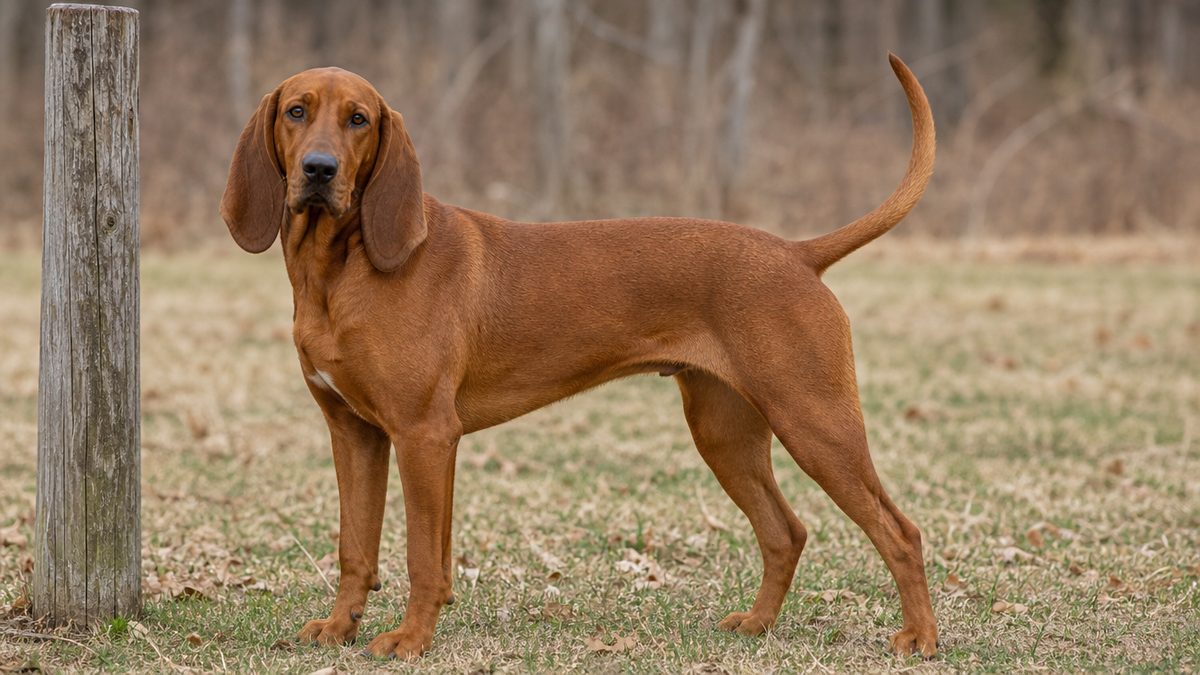
The dog those breeders arrived at is described in one line of the AKC standard. *Hunted from swamplands to mountains, the Redbone is surefooted and swift, even on the most difficult terrain. Well-balanced, with a flashy red coat and excellent cold nose, the powerfully built Redbone mingles handsome looks with a confident air and fine hunting talents*. Everything in the standard beneath that sentence serves it: clean, muscular shoulders and thighs, a deep broad chest with well-sprung ribs denoting stamina, and cat feet with stout well-arched toes. The UKC standard adds the proportion that makes the outline read correctly, putting the length of leg from elbow to ground at approximately one-half the height at the withers.
That last detail about the saddle is the whole reason the colour is so strict today. The AKC standard says solid red preferred, permits a dark muzzle and a small amount of white on brisket and feet, and makes white on the feet extending beyond the toes, more white on the brisket than an open hand will cover, and white stockings on the legs into faults. The UKC goes further and makes any colour or combination other than the one described an outright disqualification. A red dog with a black saddle is not a badly marked Redbone. It is the ancestor the breeders spent decades removing.
Two registries, two different dogs on paper
Both bodies file the breed as a scent hound, the UKC in its Scenthound Group and the AKC in the Hound Group, and they do not fully agree on the animalAmerican Kennel Club.
| Source | Males | Females | Weight |
|---|---|---|---|
| AKC Official Standard, effective 30 December 2009 | 22 to 27 inches, mid-range preferred | 21 to 26 inches | In proportion to height and bone, no numbers given |
| AKC breed page | 22 to 27 inches | 21 to 26 inches | 45 to 70 pounds, about 20 to 32 kg |
| UKC standard, revised 1 January 2016 | 22 to 27 inches | 21 to 25 inches | Proportionate to size and medium build |
The gap is small but it is real, and it is at the bottom of the female range: the UKC's floor for a bitch is 21 inches with a ceiling of 25, while the AKC allows up to 26. More usefully, the AKC standard prints no weight at all. Every kilogram figure an Indian page quotes for this breed comes from the AKC's separate breed page, not from the standard, which says only that working dogs are not to be penalised for being slightly underweight. That is a working dog's document, and it matters when a seller tells you a puppy will finish at a particular weight.
The eliminating faults and disqualifications differ too
The UKC turns size into an eliminating fault, so a male under 22 inches or over 27, or a female under 21 or over 25, cannot be placed at a bench show, with puppies exempt for being undersize. It then disqualifies undershot or overshot bites, cryptorchidism, viciousness or extreme shyness, albinism, any colour outside the description, deafness and blindness. The AKC standard carries no disqualification section whatsoever, only faults. So the same dog can be unshowable under one registry and merely faulted under the other, which is worth knowing before anyone quotes you a show-quality premium.
How many coonhounds are there, and where this one sits
The UKC counts seven coonhound breeds and the AKC counts six, so both numbers are right about their own books and neither is a fact about the world. Inside that group the Redbone is early: the UKC standard states that it was the second coonhound breed to be registered, the first one registered in 1902, two years after the American Black and Tan. On the AKC side it arrived late, in 2009, and it is not popular there either, sitting 144th of 210 breeds.
dogbreedslist.info prints the AKC recognition year as 2003. The AKC's own breed page gives 2009, and the AKC's own standard is stamped approved 6 February 2009 and effective 30 December 2009American Kennel Club. Where a directory and a registry disagree about the registry's own decision, take the registry.
Registry status: a breed by every test, and unregisterable in India
The Redbone Coonhound is a breed rather than a type, because a published breed standard and a closed register both exist and one organisation supplies both, and it is nevertheless unregisterable in India because the route India actually uses does not hold it.
Bonbeno applies a two-condition test to every animal it writes about. A name is a breed when a recognised body publishes a written standard for it and a register records its individuals generation to generation. Where a standard and a register exist but no national body has admitted the breed, the verdict is breed in formation. Where neither exists, the verdict is type. Where a register exists without a standard, that is its own fourth state. Where the name turns out to belong to a trademark holder, the verdict is brand.
The Redbone clears the first test twice over. The UKC publishes a full conformation standard with an eliminating-fault schedule and seven disqualifications, revised 1 January 2016 under a 1982 copyright, and registers the breed in its Scenthound Group. The AKC publishes a separate two-page Official Standard, approved 6 February 2009 and effective 30 December 2009, and files the breed in the Hound Group. Two organisations, two standards, two registers.
The FCI holds two American scenthounds and this is not one of them
India is a full member of the Federation Cynologique Internationale, represented by the Kennel Club of India, so the KCI issues pedigrees against FCI nomenclature. That makes FCI status the practical answer to the Indian recognition question, and it is checkable. The FCI's own Group 6 list, Scent hounds and related breeds, has a United States block in its large-hound section containing exactly two entries: American Foxhound, standard 303, accepted 2 November 1979 and Black and Tan Coonhound, standard 300, accepted 30 January 1991.
| Breed searched | Occurrences in the FCI Group 6 list | Occurrences in the FCI provisional register |
|---|---|---|
| Redbone Coonhound | 0 | 0 |
| Any name containing Treeing | 0 | 0 |
| Any name containing Cur | 0 | 0 |
| Any name containing Feist | 0 | 0 |
| Trigg | 0 | 0 |
| Plott | 0 | 0 |
| American Foxhound | 1, standard 303 | not applicable, already definitive |
| Black and Tan Coonhound | 1, standard 300 | not applicable, already definitive |
| Beagle, Basset Hound, English Foxhound, Bloodhound | present, as in-document controls | not applicable |
The controls matter. Reading a zero off a list that failed to render is the commonest way to manufacture a false absence, so the same fetch was checked for breeds that must be there. Beagle 161, Basset Hound 163, English Foxhound 159 and the Bloodhound under its FCI name Chien de Saint Hubert 84 all appear, and the provisional register returned real dated rows running back from 11 February 2026Federation Cynologique Internationale. The list worked. The breed is simply not in it.
Note the date format while you are there, because it is easy to invert. The Black and Tan's acceptance reads 1/30/1991, and 30 cannot be a month, so this table is month first and the American Foxhound's 11/2/1979 is 2 November 1979, not 11 February.
What the Kennel Club of India can and cannot tell you
The KCI publishes no public breed list, so a query there returns nothing for this breed and nothing for a control breed either. That is a limit of the instrument, not a finding about the dog, and it should never be reported as the Redbone being unrecognised in India. The honest statement is the one above: because the KCI works to FCI nomenclature and the FCI has no Redbone standard, there is no pedigree route into India for this breed, and anyone offering you a KCI-registered Redbone puppy is offering something that cannot exist in that form.
The AKC parent club is the National Redbone Coonhound Club and the UKC-side body is the National Redbone Coonhound AssociationNational Redbone Coonhound Association. Both were checked on 9 September 2026 for the link-injection pattern that has been found on other small breed-club sites, where an outdated content management system leaves a genuine club page carrying dozens of injected gambling links. Neither Redbone club shows it. For contrast, the club the UKC's own Rat Terrier standard names as that breed's national parent club runs WordPress 4.7.21 and carries 29 of its 42 outbound hosts pointing at Indonesian lottery and slot destinations. An official endorsement is not a security guarantee, so look at what else is on a club page before you follow a link from it.
Redbone Coonhound price in India, and why one number is doing all the work
The Redbone Coonhound price in india is published as Rs 60,000 to Rs 1,00,000 by two websites, and those two websites are one data point rather than two, because they also print the identical monthly cost row to the rupee.
One caveat belongs at the top rather than in a footnote. No India-located search-engine result page could be captured on 9 September 2026: Google served a JavaScript shell on every route tried and Bing India served four different substituted result sets at HTTP 200, while a Labrador control passed through the same Bing endpoint in the same session. Every page discussed below was therefore found by general web search and then opened directly, and every figure attributed to one was read out of that page's own bytes.
Start with what is not there. No Indian breeder, kennel, city, litter, KCI registration number or dated advertisement for a Redbone Coonhound appears anywhere in the Indian result set. What appears instead is two breed-guide pages that quote a band without sourcing it, two listing pages that list no Redbones, two American price surveys, and a Flipkart entry for a printed book about the breedpetcalculator.com.
Two sites, one number, no source
| Source | Buying price | Monthly cost | Source given on the page |
|---|---|---|---|
| poodles.in | Rs 60,000 to Rs 1,00,000 | Rs 3,550 to Rs 5,400 | None |
| happypet.care | Rs 60,000 to Rs 1,00,000 | Rs 3,550 to Rs 5,400 | None |
| mrnmrspet.com breed page | No figure anywhere in the body | Not given | Page is titled Breed Information, Price, Tips and Facts |
| mrnmrspet.com listing page | Behind a View Price control | Not given | Page lists no Redbone Coonhound |
| puppiezo.com | Rs 76,499 to Rs 1,20,000 in the carousel | Not given | None of the eight animals is a Redbone |
| petcalculator.com | 540 US dollars average, 300 to 600 typical | Not given | 110 puppies, explicitly United States |
| dogbreedslist.info | 500 to 800 US dollars | Not given | United States |
Two unrelated organisations agreeing to the rupee on two separate quantities is not two confirmations. Either one copied the other or both copied something upstream. Genuinely independent sources disagree at the edges, and these do not disagree anywhere, so this page reports Rs 60,000 to Rs 1,00,000 as one published claim.
Is it a converted dollar price? Run the arithmetic yourself
Indian breed pages routinely publish a US figure passed through one exchange rate, so the band is worth testing. Divide both ends by the three rates this kind of figure usually hides behind.
| Rate | Rs 60,000 becomes | Rs 1,00,000 becomes | Verdict |
|---|---|---|---|
| 84.38 | 711.07 dollars | 1,185.11 dollars | No. Neither is a price a seller would print |
| 74.00 | 810.81 dollars | 1,351.35 dollars | No |
| 80.00 | 750 dollars | 1,250 dollars | Clean, but any figure ending in three zeros divides cleanly by 80 by construction |
So the only rate that fits is the structurally weak one, and it is worth saying what that does and does not prove. The quotients 750 and 1,250 are prices a human would quote, which is the extra test a match at 80 has to pass. But they sit above every published American range for this breed: 300 to 600 dollars typical with a 540 average across 110 puppies, and 500 to 800 dollars on the other US source. A conversion normally lands on the source range, not above it. The most defensible reading is that Rs 60,000 to Rs 1,00,000 is a rupee-native invention rather than a converted American list, and either way it describes no transaction anyone can point to.
What the top listing page is actually selling
Open the carousel headed *Available Redbone Coonhound Puppies For Sale* and count the Redbones. There are none. On 9 September 2026 it held eight animals: two Maltipoos named Fizey and Samy at Rs 98,999, two Poodles at Rs 92,599, a Cane Corso at Rs 94,999, an unnamed puppy at Rs 1,20,000, a Rottweiler at Rs 76,499 and a Doxiepoo named Yoki at Rs 98,999.
Two details make that carousel worth more than the price it advertises. Every one of the eight is listed at exactly 8 weeks, which is the legal floor in India rather than a coincidence of eight simultaneous litters, and Rule 8(1)(a) of the Dog Breeding and Marketing Rules 2017 requires that pups less than eight weeks in age are not sold. And Rs 98,999 is a house price point, not a breed price: it recurs across this site attached to whichever puppy is in stock, on pages for breeds the site does not carry at all. Never report it as any breed's price.
The second listing site is emptier still. Its page is titled *Redbone Coonhound Puppies for sale in India At Best Prices* and its three visible listings are a Border Collie in Mumbai and a Goldendoodle, with every price hidden behind a View Price control. Its companion page, titled *Redbone Coonhound Breed Information, Price, Tips and Facts*, contains no breed price anywhere in its body.
A solid red dog of the right size, offered in India as a Redbone Coonhound, has no pedigree route to be one, because the FCI holds no Redbone standard and the KCI works to FCI nomenclature. Ask for the registry, the registration number and the sire and dam. If the answer is a photograph and a price, you are being offered a red dog, and the honest description of what you are paying for is a red dog.
Real cost of ownership in India, built from named rate cards
Budget roughly Rs 6,000 to Rs 11,000 a month for an adult Redbone Coonhound in an Indian metro, and note that this cost of ownership is assembled here from clinics and retailers you can open rather than copied from the template row every Indian page prints.
The published Indian figure is Rs 3,550 to Rs 5,400 a month, broken into food Rs 2,250 to Rs 3,000, health Rs 600 to Rs 1,200 and grooming Rs 700 to Rs 1,200. Those four lines are a preset, and the proof is on the same website. Its Whippet page prints all four identically, to the rupee.
| Line | Redbone Coonhound | Whippet | Identical? |
|---|---|---|---|
| Monthly total | Rs 3,550 to Rs 5,400 | Rs 3,550 to Rs 5,400 | Yes |
| Food | Rs 2,250 to Rs 3,000 | Rs 2,250 to Rs 3,000 | Yes |
| Health | Rs 600 to Rs 1,200 | Rs 600 to Rs 1,200 | Yes |
| Grooming | Rs 700 to Rs 1,200 | Rs 700 to Rs 1,200 | Yes |
| Stated adult calories per day | 1,500 kcal | 800 kcal | No, and this is the tell |
| Stated buying price | Rs 60,000 to Rs 1,00,000 | Rs 20,000 to Rs 50,000 | No |
| Stated size class | Medium Breed | Medium Breed | Yes, for a 20 to 32 kg hound and an 11 to 18 kg sighthound |
One page cannot have it both ways. If the Redbone eats 1,500 calories a day and the Whippet eats 800, their food lines cannot be identical, and the site is contradicting its own feeding data inside its own cost table. The row is assembled from a small set of preset lines and assigned per breed. It is not an observation of anything.
The same template also carries a wrong fact, not merely a wrong price. Both Indian pages file the Redbone as a Medium Breed while the AKC gives 22 to 27 inches and 45 to 70 pounds, and a third directory files the same dog as Large. The poodles.in page then calls the breed large in its own grooming paragraph, three screens below the spec card that calls it medium. A size class is not cosmetic: it propagates into food quantity, crate sizing and drug dosing, so distrust the physical measurements on any page whose cost row you have caught being a preset.
What it actually costs, from sources you can open
| Item | Figure | Source and scope |
|---|---|---|
| Puppy core vaccination course | From Rs 6,499 | Vetic national page, a promotional floor from one chain rather than a market average |
| Annual booster | From Rs 3,199 | Vetic, same caveat |
| Anti-rabies, single dose | Rs 699 | Vetic |
| 9-in-1 DHPPiL | Rs 899 | Vetic |
| Kennel cough | Rs 1,349 | Vetic, and worth pricing for a hound that will meet other dogs |
| Tick, flea and worm control | Rs 1,103 per month | NexGard Spectra 15 to 30 kg, three tablets at Rs 3,308 on Supertails |
| Bathing, if used at all | From Rs 934 | Vetic Delhi. A short glossy coat does not need a salon |
| Delhi pet dog registration | Rs 500 new, Rs 500 renewal, Rs 100 per month late fee | Municipal Corporation of Delhi, dogs only, certificate valid one year |
| Chennai pet licence | Rs 50 | Greater Chennai Corporation, pet animals generally |
Where the money actually goes on this breed
- Food, and it scales with the dog. A 30 kg working-built hound eats meaningfully more than the Rs 2,250 to Rs 3,000 a template row suggests. A monthly kibble number is arithmetic from grams per day against the price of the bag you actually buy, not a figure to copy.
- Ears, every week, for life. Ears that reach near the end of the nose when stretched forward are the single most expensive piece of anatomy on this dog in an Indian climate. This is the one line where a Redbone costs more than a prick-eared dog of the same weight.
- Parasite control, which is not optional here. A monthly product at about Rs 1,103 is cheaper than one course of treatment for tick fever, and Indian working dogs in organised kennels tested 15.45 percent positive for Babesia by nested PCR.
- Grooming, which is close to free. Short, smooth, coarse enough to provide protection, and a weekly hound glove is the entire job. A Rs 1,869 complete bath and styling is money this dog does not need spent.
- Municipal registration. Rs 500 in Delhi, renewed annually against the anti-rabies certificate date, and Rs 50 in Chennai, where the corporation also runs six pet clinics whose stated function is all treatment and anti-rabies vaccination free of costGreater Chennai Corporation veterinary….
The Vetic figures above are one chain's promotional floors, and the same chain quotes different course prices on different city pages on the same day. Treat every retail row here as perishable and re-price it before you commit. The municipal fees are the durable half of the table.
Heat tolerance in India: this hound's homeland is hotter than Bengaluru
The Redbone Coonhound's heat tolerance rates 3 of 5 for India, and the reason is that Georgia is not a cool country: Macon runs a July mean of 27.60 C at 70.3 percent relative humidity and a July wet bulb of 23.41 C, which is above Bengaluru's annual peak of 21.86 C.
That inverts the sentence almost every imported-breed page in India writes. This is not a mountain dog meeting tropical heat for the first time. It is a humid-subtropical dog from a place whose summer already sits above two Indian metros, and whose annual relative humidity, 75.31 percent, is higher than every Indian city in the table below, Kolkata's 73.93 and Chennai's 72.39 included.
We queried NASA POWER by explicit latitude and longitude and echoed the grid-cell elevation back for every point, because a cell can sit a long way above or below the town underneath it. Macon came back at 160.89 m against a real elevation near 102 m, an error of 58.89 m, which is small enough to use. Every Indian point in the table is a plains or plateau city where the cell error runs under 85 m, so none of them needed a correction.
| Place | Cell elevation | Annual mean T2M | Annual mean RH2M | Hottest month | Peak wet bulb |
|---|---|---|---|---|---|
| Macon, Georgia | 160.89 m against a real 102 m | 17.64 C | 75.31 percent | July, 27.60 C | 23.41 C in July |
| Bengaluru | 841.72 m against a real 920 m | 23.74 C | 67.94 percent | April, 28.37 C | 21.86 C in May |
| Pune | 635.99 m against a real 560 m | 23.86 C | 66.80 percent | April, 28.93 C | 22.97 C in June |
| Hyderabad | 494.59 m against a real 505 m | 26.10 C | 60.30 percent | May, 33.30 C | 23.35 C in June |
| Delhi | 206.37 m against a real 216 m | 25.60 C | 45.56 percent | June, 35.88 C | 26.50 C in July |
| Mumbai | 97.15 m against a real 14 m | 26.77 C | 67.39 percent | May, 31.19 C | 25.77 C in June |
| Chennai | 48.95 m against a real 11 m | 27.95 C | 72.39 percent | May, 31.51 C | 26.11 C in May |
| Kolkata | 7.35 m against a real 9 m | 25.81 C | 73.93 percent | May, 31.53 C | 27.09 C in June |
The wet-bulb column is computed from mean temperature and mean relative humidity with the Stull approximation, never from a period maximum, and every value sits far below the roughly 35 C physical ceiling, which is the arithmetic check that says the column is sound.
The finding that actually decides this: duration, not peak
Count months rather than degrees and the picture changes completely. Macon crosses a 23 C wet bulb in exactly two months of the year, July and August. Chennai crosses it in nine, Kolkata and Mumbai in seven, Delhi in four, Hyderabad in one, and Bengaluru and Pune in none at all.
| Place | Months at or above 23 C wet bulb | Which months |
|---|---|---|
| Bengaluru | 0 | None. Peak 21.86 C in May |
| Pune | 0 | None. Peak 22.97 C in June |
| Hyderabad | 1 | June |
| Macon, Georgia | 2 | July and August |
| Delhi | 4 | June to September |
| Mumbai | 7 | April to October |
| Kolkata | 7 | April to October |
| Chennai | 9 | March to November |
That is why this page rates the breed 3 out of 5 rather than 1 or 2. Calling a Redbone Coonhound heat-sensitive in the way a Siberian Husky or a Newfoundland is heat-sensitive misdescribes the animal, because its homeland already delivers a summer load two Indian metros never reach. Calling it heat-proof would be worse. The correct statement is that it is a hot-country dog with a cold season built into its year, being asked to live somewhere that has no cold season.
So the honest advice splits by city rather than being one warning. Bengaluru and Pune never reach the load a Redbone's homeland delivers every July, which makes them the two Indian cities where this breed is genuinely climatically plausible. Delhi is a summer problem with a real winter on the other side of it, and its January mean of 13.61 C is closer to Macon's March than to anything tropical. Chennai, Kolkata and Mumbai are the hard three, not because any single month beats Georgia by much, but because the dog never gets the seven-month recovery that Georgia builds in, where January means 6.60 C and the wet bulb falls to 4.76 C.
What the heat literature does and does not say about this dog
No coonhound appears among the breed categories modelled in the largest UK heat-illness study, so there is no Redbone odds ratio to quote and this page will not borrow another breed's. Two findings from that work do transfer honestly. A bodyweight at or above the breed and sex mean carried 1.42 times the odds of heat-related illness, 95 percent confidence interval 1.12 to 1.80, so a heavy Redbone is a worse bet than a lean one. And of 879 heat-illness events with a recorded trigger, 652, or 74.2 percent, were exertional rather than caused by a hot car or a hot room. For a dog selected to keep working a scent past the point of sense, that is the number that matters.
What to actually do about it
- Move all work to before 07:00 and after 20:00 from March to June in Delhi, Mumbai, Chennai, Kolkata and Hyderabad, and keep a wider window in Bengaluru and Pune where the wet bulb never crosses 23 C.
- Stop the dog rather than trusting it to stop. A trailing hound follows a scent past the point where it should quit, because that is exactly what it was selected to do, and exertional cases outnumber every other trigger three to one.
- Keep it lean, and weigh it monthly. Carrying weight above the breed mean is the one transferable risk factor with a number attached to it.
- Watch the ears through the monsoon, because a hanging ear plus Indian July humidity is the commonest avoidable veterinary bill this breed will generate.
- Never shave the coat. It is short already, and a shaved red dog sunburns.
Indian law provides a hook that fits this breed precisely. The Prevention of Cruelty to Animals (Dog Breeding and Marketing) Rules 2017, Second Schedule Part IV paragraph 21(1), bars keeping dogs in outdoor facilities without the attending veterinary practitioner's written approval where the dogs are not accustomed to the temperatures prevalent in the area, or belong to breeds that cannot tolerate them, or are sick, infirm, aged or young. A coonhound kennelled outdoors through a Chennai May is the case that clause contemplates.
Both Indian pages print an ideal weather band for this breed with no source at all: 10 to 30 degrees on one, and the Whippet page on the same site prints 15 to 30poodles.in Whippet price and care guide. A band that spans the whole of India tells a reader nothing, and a band that differs by five degrees between two dogs given identical food, health and grooming lines is a field being filled in, not measured.
Temperament, and the sentence buyers read half of
The Redbone Coonhound's temperament is described in one sentence of the AKC standard, and it contains both halves of the answer: *Even-tempered at home but an aggressive hunter. Amenable to formal training. A good family dog that likes to please*.
Indian listing pages quote the second and third clauses and drop the first. The full sentence is a working description, and it says that the dog switches. The UKC puts the same thing differently, calling the breed even tempered and affectionate with a strong desire to please, characterised by its pleading eyes and sweet voice, with a natural treeing instinct and a liking for water. Two registries, one picture: affectionate indoors, single-minded outdoors, and not remotely the same animal in each place.
What the standards rule out, which is more than most
The UKC standard disqualifies viciousness or extreme shyness outright, and a disqualified dog must be reported to the registry. That is a stronger statement than the AKC's, which lists no disqualifications at all. So aggression toward people is not a breed characteristic here, it is a disqualifying fault, and a seller who describes a Redbone as a guard dog is describing something the standard writes out of the breed.
Who this dog suits in India
- Households with land, in a house rather than a flat, where 60 to 90 minutes of daily work is a routine rather than an ambition.
- Owners in Bengaluru or Pune, the two metros where the wet bulb never reaches the load Georgia delivers every July.
- Families with older children, because the standard's even-tempered home description is genuine and a 30 kg hound at speed is still 30 kg at speed.
- People who want a second dog, since a pack-hunted breed generally lives easily with other dogs and finds solitude harder than most.
- Anyone who can tolerate the voice, which is the single characteristic that ends more coonhound placements than every other trait combined.
Who should not buy one
- Apartment residents. We rate this 1 of 5, the lowest score on the page. A bawling hound in a shared building is a complaint waiting to be filed.
- First-time owners wanting an easy dog. This breed is independent on a trail by design, and biddability at home does not survive the arrival of a scent.
- Anyone who exercises off-lead in public. A treeing hound bred to run raccoon, bear, cougar and bobcat will leave you for a cat, a monkey or a cattle shed.
- Buyers who want a guard dog. The standard disqualifies the temperament that would make one.
- Anyone hoping to work the dog in India. There is no legal quarry here that resembles what it was built for, so the job the breed exists to do simply does not exist locally.
Both standards name the expression: pleading, from round dark brown to hazel eyes set well apart, with no drooping eyelids. It is worth knowing that the soulful look an Indian buyer falls for on a photograph is a conformation requirement written into the document, which tells you nothing about whether the dog in front of you is even-tempered.
Training a hound that was bred to work out of your sight
To train a Redbone Coonhound in India, treat recall as the whole project and everything else as easy, because the AKC standard describes a breed amenable to formal training that was nevertheless selected to leave the handler and keep going.
Nothing about this dog is hard to teach in a room. Sit, down, stay, crate, loose lead in a quiet street, all of it lands quickly on a breed the standard calls amenable and eager to please. The difficulty is entirely about what happens when the nose engages, and the honest way to put it is that a trailing hound is not disobeying when it ignores you, it is working.
The four-week recall plan that actually fits an Indian street
- Week one, indoors only. Pay the recall word every single time, with food, in a room with nothing to smell. Never call the dog to end something it enjoys.
- Week two, a long line in a walled space. Ten metres of line, a walled compound or a fenced terrace, and a rule you keep for life: the recall word is used once, then you go and get the dog.
- Week three, add one distraction at a time. A dropped biscuit, then a second person, then a passing dog, then a smell you have planted. Add nothing new until the previous one is boring.
- Week four, take it outdoors on the line and accept the ceiling. In an Indian street with cats, cattle, monkeys and food waste, a coonhound's recall is a management tool, not a guarantee. Plan for a lead.
There is one further reason to do this properly here rather than abroad. Indian streets carry free-roaming dogs, and a hound that self-releases into a chase can end up in a fight, under a vehicle, or on the wrong side of a municipal complaint. The lead is not a training failure, it is the correct equipment for this breed in this country.
What this breed resists, and what to do instead
| What the dog does | Why it does it | What works |
|---|---|---|
| Ignores a recall on a scent | Selected for exactly this over generations of treeing work | Long line, lead in public, and a garden the dog cannot leave |
| Bays for long periods | The voice is part of the standard, not a fault | Exercise before the noise starts, plus enrichment; it cannot be trained out |
| Wanders and climbs at boundaries | Bred to work terrain from swamplands to mountains | A fence a hound respects, checked at ground level as well as height |
| Pulls hard on lead as a young dog | Powerful hindquarters and a scent ahead | Front-clip harness and steady work from week one, before the dog outweighs the handler |
| Is slow to settle alone | A pack-hunted breed | Build absence in minutes from the first week, and consider a second dog |
Socialisation, on an Indian timetable
Socialise deliberately and early, because the window closes at roughly sixteen weeks and Indian vaccination schedules can strand a puppy indoors through most of it. Indian law is useful here rather than an obstacle: Second Schedule Part III paragraph 8(9) records that pups can start vaccination at seven to eight weeks and are usually completed at eighteen weeks. That leaves a real gap, and the answer is carried exposure, controlled visitors and clean surfaces rather than a locked room. Ask your vet how much street contact is safe at each stage in your city.
A breed that has been selected for centuries to keep going will not be argued out of it by a device, and a hound that associates a shock with the trail can generalise it to the handler. Manage the environment instead. Fence, lead and long line are cheaper, legal and they work.
How much exercise a Redbone Coonhound needs, and when in India it can get it
Plan 60 to 90 minutes of real work every day, and understand that in five Indian metros the whole of it has to happen outside daylight for four to nine months of the year.
The figure itself is not controversial. The Indian breed guide that carries the fullest care section asks for 60 to 90 minutes of vigorous daily activity, and that is consistent with a breed the AKC standard describes moving with good reach and drive over terrain from swamplands to mountains. What no page does is put that requirement next to a climate table and check whether the window exists.
Where the window actually is, city by city
| City | Hardest months | Practical window | Honest verdict |
|---|---|---|---|
| Bengaluru | None above a 23 C wet bulb | Early morning and evening year round, wider in December and January | The best Indian city for this breed |
| Pune | None above a 23 C wet bulb | Early morning and evening year round | Second best, and April is the hottest month rather than May |
| Hyderabad | June | Before 07:00 from March to June | Workable with discipline |
| Delhi | June to September | Before 07:00 and after 20:00 from April to September, generous in winter | A summer problem with a real winter on the other side |
| Mumbai | April to October | Before 06:30 for most of the year | Hard, and the monsoon adds an ear problem to the heat problem |
| Kolkata | April to October | Before 06:30, and split into two shorter sessions | Hard |
| Chennai | March to November | Before 06:30, every day, all year | The hardest of the eight, because the load never lifts |
Note what the Chennai row means in practice. Nine months at or above a 23 C mean wet bulb is not a season to work around, it is the climate. An owner there is committing to a pre-dawn routine for the twelve to fifteen years the breed is expected to live, and that commitment, not the price, is the real cost of this dog in that city.
What the exercise should be
- Scent work first. Twenty minutes of hidden-food searching in a courtyard tires a trailing hound more than an hour of walking, and it is the only activity that uses the thing the breed was built around.
- Steady distance second. A brisk 45 to 60 minute lead walk at a pace you can hold, on a front-clip harness, is the backbone of the routine.
- Swimming where it is safe and clean. The UKC standard notes this breed takes readily to water, and a swim moves the same load without the ground heat.
- Never off-lead in public. A prey drive built for treeing raccoon is a hazard beside an Indian road, and this is the one rule with no exception.
- Nothing intense in daylight during the hard months, because exertional heat illness accounted for 652 of the 879 UK events with a recorded trigger.
What happens without it
An under-exercised coonhound does not become calm, it becomes vocal. Baying at nothing, digging, escaping and destructive chewing are the predictable outputs, and in an Indian apartment block the first of those four is what generates the complaint that ends the placement. An athletic, energetic hound with an unmet need is the single most common reason this family of breeds is surrendered.
A heat-managed exercise routine assumes the dog can recover indoors afterwards. In cities with summer load-shedding, ask any boarding kennel or daycare about generator backup before you need it, and keep a plan for the afternoon the fan stops.
Grooming: ten minutes on the coat a week, and the ears for life
To groom a Redbone Coonhound in India, spend almost no time on the coat and a great deal on the ears, because the AKC standard describes a coat that is short, smooth and coarse enough to provide protection, attached to ears long enough to reach near the end of the nose when stretched forward.
The coat is the easiest job on this page and one of the easiest on this site. A weekly rubber curry or hound glove lifts the dead hair, a bath every four to six weeks or after a muddy walk is enough, and there is no clipping, stripping or salon work of any kind. This is a short-coated breed and it should never be shaved, because a shaved red dog loses its only protection against Indian sun and gains nothing in cooling.
The ears are the whole story, and there is a number behind it
Ear carriage is the strongest documented risk this breed carries, and it comes from a study of 22,333 dogs sampled from 905,554 under UK primary veterinary care in 2016. The one-year period prevalence of otitis externa across all dogs was 7.30 percent, 95 percent confidence interval 6.97 to 7.65. Breeds with pendulous ears carried 1.76 times the odds of otitis externa compared with erect-eared breeds, 95 percent confidence interval 1.48 to 2.10, and breeds with a V-shaped drop ear carried 1.84 times the odds, 1.53 to 2.21.
That study is British, and India adds the humidity. Kolkata runs 73.93 percent annual relative humidity and Chennai 72.39, with monsoon months well above both, and an ear that hangs flat against the head with no air movement inside it is a warm, damp, closed space for four months a year. This is where a Redbone will cost you more than a prick-eared dog of the same weight, and it is the one recurring cost that never goes away.
The weekly ear routine, and the monsoon version of it
- Lift and look, every week. Healthy skin is pale pink with no smell. Redness, a yeasty or sour smell, brown or black discharge, or a dog that tilts its head are all reasons to see a vet rather than to buy a cleaner.
- Clean only when needed, with a veterinary ear solution. Fill, massage the base, let the dog shake, wipe the visible part with gauze. Never push cotton buds into the canal.
- Dry after every swim and every bath. An overseas breed-club instruction to towel off and let the dog air dry is written for a cool northern climate and it does not transfer to an Indian monsoon.
- Move to twice weekly from June to September in Mumbai, Pune, Kolkata and Chennai, where the humidity peaks above 80 percent for months at a time.
- Chase a recurring ear infection as a diagnosis, not as a cleaning failure. Repeated otitis in a hound is frequently secondary to allergy or a foreign body, and that needs a veterinarian rather than a bottle.
The rest of the routine, briefly
| Task | Frequency | Note |
|---|---|---|
| Hound glove or rubber curry | Weekly | Ten minutes, more in a spring shed |
| Ear check | Weekly, twice weekly in monsoon months | The one non-negotiable line |
| Bath | Every 4 to 6 weeks | From Rs 934 at a Delhi chain, or free at home |
| Nails | Every 3 to 4 weeks | Working feet wear less on tile than on ground |
| Teeth | Two or three times a week | Indian law mandates no dental screening, so this is entirely on the owner |
| Tick check after every walk | Daily in tick season | Paired with a monthly preventive at about Rs 1,103 |
A complete bath and styling runs from Rs 1,869 at a Delhi chain and a haircut from Rs 1,359. A Redbone needs neither. Over twelve years that is a genuine saving against a coated breed, and it is the single strongest practical argument in the dog's favour for an Indian household.
Health issues, lifespan and what the literature actually contains
The honest summary of Redbone Coonhound health issues is that almost nothing is documented at breed level: exactly one PubMed record names the breed, the AKC national breed club recommends no health tests at all, and the breed appears in none of the 345 rows of the largest breed-longevity study's breed universe tableAmerican Kennel ClubMcMillan 2024 Supplementary Table S5.
That is a finding rather than a gap, and it is the most useful thing this page can tell an Indian buyer, because every Indian page selling the breed prints a confident list of conditions with no source behind any of them.
The lifespan number, and why nobody has measured it
The AKC gives 12 to 15 years and calls it a life expectancy, which is a registry estimate rather than a cohort measurement. Two Indian pages print 12 to 14 and one American directory prints 12 to 14 as well, with none of the three naming a study.
McMillan 2024 is the study that would settle it, and it is the largest of its kind: *Longevity of companion dog breeds: those at risk from early death*, published in Scientific Reports in 2024. It measures median survival across 155 UK breeds, and its Supplementary Table S5 lists the whole breed universe it considered, 345 rows, 155 flagged as included and 189 flagged as not included. We parsed that table namespace-aware on 9 September 2026, and the result is worth stating precisely, because there are two different kinds of absence in it.
| Breed | In Table S5? | Included in the survival analysis? | What that means |
|---|---|---|---|
| Redbone Coonhound | No | Not applicable | Never considered. The name appears nowhere in 345 rows |
| Treeing Walker Coonhound | No | Not applicable | Never considered |
| Bluetick Coonhound | No | Not applicable | Never considered |
| Plott | No | Not applicable | Never considered |
| Black and Tan Coonhound | Yes | N | Considered and excluded. KC group Hound, body size Large |
| American Foxhound | Yes | N | Considered and excluded. KC group NA, body size Medium |
| Foxhound, meaning the English Foxhound | Yes | Y | Measured: 71 dogs, 31 deaths, median 13.0 years, 95 percent CI 11.4 to 16.9 |
| Labrador Retriever, Beagle, Bloodhound, Whippet | Yes | Y | Controls, all present, so the search works |
Absent from the table and excluded by the table are different statements, and the difference matters. The Black and Tan Coonhound and the American Foxhound were looked at and left out, so somebody weighed them. The Redbone was never weighed at all. The only member of this whole family with a measured median is the English Foxhound, at 13.0 years on 31 deaths with a hazard ratio of 0.67 against crossbreds and p equal to 0.02, and that is a different breed on a different continent. This page prints no measured lifespan for the Redbone Coonhound, because none exists.
The entire published literature on this breed is one case report
A PubMed search on 9 September 2026 for the exact phrase Redbone Coonhound returned one record, on a clean query translation, against 52 for a Labrador and hip dysplasia control run in the same session. That record is a six-month-old neutered male Redbone Coonhound that developed severe subcutaneous swelling after a routine prescrotal orchiectomy, with urine extravasation from a 2 cm urethral laceration, treated by scrotal ablation and urethrostomy. It is a surgical complication report. It says nothing about the breed at all.
Three further risks change specifically because the dog is in India rather than in Georgia, and they get their own section below: the disease named after coonhounds loses its American trigger and keeps an Indian one, the family's best-documented parasite has an Indian relative, and the ear conformation gets worse in a monsoon.
What to screen for, and what Indian law requires anyway
There is no breed screening protocol to follow, because the AKC national breed club recommends none. Indian law, however, imposes one on any registered breeder regardless of what a club says. Second Schedule Part III paragraph 8(10) of the Dog Breeding and Marketing Rules 2017 requires that breeding dogs *shall have been tested for genetic defects, including hip dysplasia, progressive retinal atrophy, night blindness, hypothyroidism, entropion, ectropion, overshot, undershot jaw (when incisors do not touch or mesh), wry mouth, two or more missing teeth, unilateral cryptorchid or full cryptorchid males*.
Two collisions follow, and both are worth putting to any seller. Hip dysplasia is named by Indian law and by no breed club for this dog, so a buyer here has a statutory hook a buyer in the United States does not. And the UKC standard disqualifies deafness outright, while the words deaf and BAER return zero occurrences across the whole 51,953-character gazette, so the one sensory defect the registry cares most about is the one Indian law never mentionsPrevention of Cruelty to Animals.
Both Indian breed guides name hip dysplasia, bloat, allergies and heartworm as this breed's documented concerns, and neither cites anythinghappypet.care Redbone Coonhound breed…. Those are plausible large-hound conditions and they may well be right. They are not evidence, and a page that presents an unsourced list as documented is doing the opposite of what it claims. Consult your nearby vet about screening for your individual dog rather than working from any breed list, this one included.
Three Indian health questions this breed raises that no other page asks
Three risks change when a foxhound-descended American treeing hound is kept in India: the disease named after coonhounds loses its American trigger and keeps its Indian one, the family's best-documented parasite has an Indian cousin, and the ear conformation gets worse in the monsoon.
1. Coonhound paralysis, and why India changes the risk rather than removing it
The one condition carrying this family's name is coonhound paralysis, the old term for acute polyradiculoneuritis, an immune-mediated disorder of the peripheral nerves that produces ascending weakness from the hind limbs and, in severe cases, respiratory failure. It was named because cases followed raccoon contact, and raccoons do not occur in India.
That is not the reassurance it looks like. A case-control study of 27 dogs with suspected acute polyradiculoneuritis and 47 healthy controls found that where a faecal sample was collected within seven days of onset, cases were 9.4 times more likely to be positive for *Campylobacter* than controls, with p less than 0.001. Ninety-six percent of cases had eaten raw chicken, against 26 percent of controls, and the commonest organism identified was *Campylobacter upsaliensis*. The trigger that matters in India is therefore raw poultry and the organism it carries, not a mammal that does not live here, and raw feeding is a growing practice among Indian owners of working breeds. Discuss any raw diet with your veterinarian before you start it.
2. The foxhound inheritance nobody mentions, and why it matters here
The UKC's own history says the Redbone's ancestors were foxhounds. That inheritance carries a specific piece of veterinary history. Canine leishmaniasis caused by *Leishmania infantum* is enzootic in the North American foxhound population, a statement a peer-reviewed paper makes in its opening line. In one American kennel, 30 percent of 120 English Foxhounds were seropositive for *Leishmania* at a titre of 1:16 or higher, and the same study documented the first recorded transmission of the parasite by blood transfusion, concluding that using foxhounds as blood donors may not be advisable in North America.
India is a leishmaniasis country, and a different species. Here it is *Leishmania donovani*, transmitted by the sandfly *Phlebotomus argentipes*, and it has historically been treated as anthroponotic, meaning humans are the reservoir. That assumption is under active challenge. Sandflies trapped outside endemic villages have been shown to feed on cattle and dogs as well as people, and goats, cattle, rats and dogs have tested positive for *L. donovani* infection or exposure in eastern Africa, Bangladesh, Nepal and India.
State the limit plainly, because this is the point at which a page could overclaim. No Indian prevalence figure exists for this breed, no Redbone Coonhound has been reported with leishmaniasis anywhere, and the American story concerns a different parasite species. What the two literatures together justify is one practical sentence: an owner of a foxhound-descended hound in eastern India should mention any unexplained weight loss, scaly skin disease, lymph node enlargement or persistent fever to their veterinarian and say where the dog has lived. That is a history to give, not a diagnosis to fear.
3. Tick-borne disease, with Indian denominators
| Measure | Figure | What it means for a hound |
|---|---|---|
| Positive by conventional microscopy | 17 of 330, 5.15 percent | A negative blood smear is weak evidence |
| Positive by simple PCR | 30 of 330, 9.09 percent | Better, still an undercount |
| Positive by nested PCR | 51 of 330, 15.45 percent | Three times the microscopy figure on the same dogs |
| Species split among the 51 | Babesia gibsoni 47, Babesia vogeli 4 | The small form dominates and carries the poorer prognosis |
| Population sampled | Dogs suspected of babesiosis at organised kennels across Indian agro-climatic zones | This is a clinic caseload, not a random population |
Read those numbers as a caseload picture rather than a prevalence in all Indian dogs, because the study screened animals already suspected of the disease. The transferable lesson is the diagnostic one. On the same 330 dogs, nested PCR found three times as many infections as a blood smear, so if your hound is lethargic, feverish or anaemic after tick exposure, tick-borne disease is not ruled out by a negative smear, and it is worth asking your vet whether PCR is available.
The practical response is unglamorous and cheap. A monthly product covering ticks, fleas and intestinal worms costs about Rs 1,103 for a 15 to 30 kg dog, which is less than one course of treatment for a single episode of tick fever. For a dog that will spend its life with its nose in grass, that is the highest-value recurring line on the whole budget.
Both Indian breed guides name hip dysplasia, bloat, allergies and heartworm as this breed's documented concerns, and neither cites anythinghappypet.care Redbone Coonhound breed…. Those are plausible large-hound conditions and they may well be right. They are not evidence, and a page that presents an unsourced list as documented is doing the opposite of what it claims. Consult your nearby vet about screening for your individual dog rather than working from any breed list, this one included.
Feeding a working-built hound in India
To feed an adult Redbone Coonhound in India, work from body condition and grams per day rather than from any published monthly rupee figure, because the only Indian numbers available are a preset row shared with a dog that eats roughly half as much.
The one calorie figure in the Indian result set gives puppies 1,800 kcal a day and adults 1,500, printed identically on both Indian pages. Treat it as a starting hypothesis rather than a prescription. It is unsourced, it comes from the same template that assigned this breed a Medium size class and a Whippet's food budget, and real requirement varies with age, neuter status, workload and ambient temperature.
The arithmetic an Indian owner should actually do
- Read the kcal per kilogram off the bag, because Indian large-breed kibbles run roughly 3,400 to 3,900 kcal per kg and the difference changes the daily scoop meaningfully.
- Divide the daily calorie target by that figure to get grams per day, then weigh it once with a kitchen scale rather than using a cup.
- Multiply grams per day by 30, then by the per-kilogram price of the bag you actually buy, and that is your monthly food line. It is arithmetic, not a quoted price, and it is the only honest way to get one.
- Re-check body condition every four weeks. Ribs easily felt under a thin fat cover, a visible waist from above and a tucked abdomen from the side, which is what the AKC standard means by working dogs not being penalised for being slightly underweight.
- Cut the ration on rest days. A hound with 90 minutes of work on Sunday and 20 on Monday does not need the same bowl.
Life stages, briefly
| Stage | Meals per day | What matters most |
|---|---|---|
| 8 to 16 weeks | 4 | Large-breed puppy food with controlled calcium, and no supplementation on top of a complete diet |
| 4 to 12 months | 3 | Steady growth rather than fast growth; a fat puppy is a joint problem later |
| 12 months to adult | 2 | Switch to adult food and set the ration from body condition, not the bag chart |
| Adult, working days | 2 | Never a large meal immediately before or after hard exercise |
| 7 years and older | 2 | Watch weight as activity falls; a heavy senior hound is a heat risk as well as a joint one |
Two Indian specifics worth planning for
Heat suppresses appetite, so summer feeding is an evening job. In Chennai, Kolkata and Mumbai, where the wet bulb sits above 23 C for seven to nine months, a dog that refuses breakfast in May is usually responding to temperature rather than to illness, and the practical answer is to move the larger meal to after the evening walk. A dog that refuses food and is also lethargic, vomiting or panting at rest is a different problem and needs a vet.
Raw chicken deserves a specific conversation with your veterinarian. Raw feeding has grown among Indian owners of working breeds, and the strongest single risk factor identified for acute polyradiculoneuritis in dogs is raw chicken consumption, present in 96 percent of cases against 26 percent of controls. That is not a reason to panic and it is a reason to ask, particularly for a breed whose historic name for that disease is coonhound paralysis.
The AKC standard describes a deep, broad chest with well-sprung ribs. Deep-chested dogs are the conformation most often associated with gastric dilatation and volvulus, and while no breed-specific rate exists for the Redbone, two meals rather than one, and rest around exercise, cost nothing. Ask your vet whether a preventive gastropexy is worth discussing at the time of neutering.
The first year, month by month
A Redbone Coonhound puppy's first year in India runs on three clocks that do not line up: the legal one at eight weeks, the socialisation one that closes near sixteen weeks, and the vaccination one that finishes around eighteen.
| Age | What is happening | What you do |
|---|---|---|
| Before 8 weeks | Legally unsaleable. Rule 8(1)(a) requires that pups less than eight weeks in age are not sold | Refuse any earlier collection, and treat an offer of a six-week puppy as disqualifying the seller |
| 8 weeks | Collection age, and the age every puppy on the top Indian listing carousel is stamped with | Confirm the micro-chip required by Rule 8(1)(e), and get the written feeding, vaccination and deworming record the Rules oblige the breeder to hand over |
| 8 to 10 weeks | Settling, house training, crate introduction | Four meals a day. Start absence in two-minute pieces from day one |
| 10 to 16 weeks | The socialisation window, closing fast | Carried exposure to traffic, lifts, tiles, stairs, hospital floors and calm adult dogs. Ask your vet how much ground contact is safe at each stage in your city |
| Around 16 weeks | Ear canals and adult carriage established | Begin the weekly ear routine now so it is a habit before the first monsoon |
| Around 18 weeks | Vaccination course usually complete, per Second Schedule Part III paragraph 8(9) | Full public exposure. Start long-line recall work |
| 4 to 6 months | Growth peak. Teething | Three meals. Keep exercise steady and low impact. No stairs marathons, no forced running |
| 6 months | Rule 8(1)(b) bars the sale of dogs over six months without prior sterilisation, except between licensed breeders | Discuss timing of neutering with your vet, including whether to delay it in a large hound |
| 6 to 9 months | Adolescence. Recall degrades, prey drive arrives | Return to the long line. Expect the trained dog to appear to forget everything |
| 9 to 12 months | Adult height reached, filling out continues | Move to two meals. Build to the full 60 to 90 minutes, in the cool hours |
| 12 months | Adult food, adult routine | Set the ration from body condition. Book the first adult booster |
Two rows on that table are worth arguing about with a seller rather than reading past. The first is eight weeks, because a listing carousel where all eight puppies carry that exact age is showing you a template default rather than eight simultaneous litters. The second is six months, because Rule 8(1)(b) makes sterilisation before sale a legal condition rather than an ethical preference, and very few Indian sellers mention it.
A puppy collected in November in Delhi gets its socialisation window in the pleasantest ten weeks of that city's year, while one collected in April spends the same window indoors avoiding a 35.88 C June. In Bengaluru and Pune the timing matters much less, because neither city crosses a 23 C wet bulb at all.
Redbone Coonhound against the hounds it is cross-shopped with
Compared with the other American coonhounds, the Redbone is the only one whose national breed club recommends no health tests, and the Treeing Walker is the only one whose club asks for threeAmerican Kennel Club.
Six breeds get confused with this one in Indian search results, and the useful comparison is not size or coat, because those are close. It is what documentation exists behind each.
| Breed | AKC year | AKC life expectancy | Club-recommended health tests | In McMillan Table S5? |
|---|---|---|---|---|
| Redbone Coonhound | 2009 | 12 to 15 years | None | No, never considered |
| Treeing Walker Coonhound | 2012 | 12 to 13 years | Hip, ophthalmologist and thyroid evaluation | No, never considered |
| Bluetick Coonhound | 2009 | 11 to 12 years | Not compared here | No, never considered |
| American English Coonhound | 2011 | 11 to 12 years | Not compared here | No, never considered |
| Plott | 2006 | 12 to 14 years | Not compared here | No, never considered |
| Black and Tan Coonhound | 1945 | 10 to 12 years | Not compared here | Yes, listed and excluded |
| American Foxhound | Not checked for this page | Not compared here | Not compared here | Yes, listed and excluded |
| English Foxhound | Not checked for this page | Not compared here | Not compared here | Yes, and measured at 13.0 years |
Two things jump out of that table. The AKC's own life expectancies for these six breeds span five years, from the Black and Tan's 10 to 12 to the Redbone's 12 to 15, and not one of them rests on a cohort study. And the Redbone and the Treeing Walker, recognised three years apart into the same group, have opposite screening advice from their own parent clubs, which tells you more about the clubs than about the dogs.
Redbone against the Treeing Walker Coonhound
These two are the closest pair. Both stand 22 to 27 inches at the male, both are trailing and treeing hounds, both descend from foxhound stock. The differences that matter to an Indian buyer are that the Treeing Walker is heavier at 50 to 70 pounds against 45 to 70, is given a shorter AKC life expectancy at 12 to 13 years, and arrives with a screening list you can actually demand: hip evaluation, ophthalmologist evaluation and thyroid evaluation. If a breeder anywhere offers you either breed, the Treeing Walker is the one where a refusal to produce test results means something specific.
Redbone against the Black and Tan Coonhound
The Black and Tan is the older breed on both registers. The UKC's Redbone standard dates its own breed's first registration to 1902 and says that was two years after the American Black and Tan, and the AKC recognised the Black and Tan in 1945American Kennel Club. It is also the only coonhound the FCI holds, as standard 300 accepted on 30 January 1991. That single fact changes the Indian answer completely: a Black and Tan has an FCI number and therefore a theoretical KCI pedigree route, and a Redbone does not. It also carries the shortest AKC life expectancy in the group at 10 to 12 years.
Redbone against the American Foxhound
The American Foxhound is the Redbone's acknowledged ancestor and the only other American scenthound the FCI recognises, as standard 303 accepted on 2 November 1979Federation Cynologique Internationale. It is a leaner, faster pack hound built to run in front of mounted riders rather than to tree, and it carries the veterinary history this page discusses at length, because *Leishmania infantum* is enzootic in the North American foxhound population.
Where the Redbone genuinely wins
- Coat cost. Short, smooth and glossy, with no clipping or stripping for twelve to fifteen years, against Rs 1,869 for a full groom on a coated breed.
- Homeland climate fit. A Georgia summer already exceeds Bengaluru's annual peak wet bulb, which is not true of any European or northern American hound.
- Temperament on paper. A standard that disqualifies viciousness and extreme shyness is a stronger guarantee than most breeds carry.
- Colour clarity. A solid red dog with a small amount of white is easy to check against the standard, which makes an obviously wrong animal easy for a buyer to spot.
The English Foxhound is the only hound in this whole comparison with a cohort median: 13.0 years, 95 percent confidence interval 11.4 to 16.9, on 71 dogs and 31 deaths, with a hazard ratio of 0.67 against crossbreds. Do not transfer it. It is a different breed, on a different continent, in a different management system, and borrowing it would be exactly the substitution this page spends its health section arguing against.
Nine mistakes Indian buyers make with this breed
The commonest mistake is treating Rs 60,000 to Rs 1,00,000 as a market price when it is one unsourced number published twice, and the other eight follow from the same habit of reading a page instead of checking it.
- Treating two agreeing websites as two sources. poodles.in and happypet.care print the identical buying band and the identical monthly row to the rupee. Two unrelated sites agreeing exactly on two separate quantities is evidence against independence, not for it.
- Believing the monthly cost row. Rs 3,550 to Rs 5,400 is a preset. The same site gives the Whippet the identical food, health and grooming lines while saying the Whippet eats 800 calories a day and the Redbone 1,500.
- Not opening the listing carousel. Eight puppies sit under a Redbone Coonhound heading on the top listing page and none of them is a Redbone. Two Maltipoos, two Poodles, a Cane Corso, a Rottweiler, a Doxiepoo and one unnamed dog.
- Accepting Rs 98,999 as a price. It is a house price point attached to whichever puppy is in stock, and it appears on pages for breeds the site does not carry at all.
- Asking for KCI papers and accepting a yes. The KCI issues pedigrees against FCI nomenclature and the FCI holds no Redbone standard, so a KCI-registered Redbone cannot exist.
- Assuming an American breed cannot take Indian heat. Macon in Georgia runs a July wet bulb of 23.41 C against Bengaluru's annual peak of 21.86 C, and its annual humidity of 75.31 percent beats every Indian city in our table. The real problem is that India never gives the dog the seven cool months Georgia does.
- Buying one for a flat. We rate apartment suitability 1 of 5. The voice is written into the breed standard as a defining characteristic, so it cannot be trained away, only exercised down and managed.
- Trusting an unsourced health list. Both Indian pages name hip dysplasia, bloat, allergies and heartworm with no citation, while the AKC national breed club recommends no tests and exactly one PubMed record names the breed.
- Skipping the ear routine until there is a problem. Pendulous ear carriage carries 1.76 times the odds of otitis externa in a British climate, and Indian monsoon humidity is not a British climate.
The four questions to ask any seller
- Which registry, which number, and can I see the sire and dam registrations? There is no FCI or KCI route for this breed, so a real answer names a foreign register and can be checked.
- Is the pup micro-chipped, and can I see the written feeding, vaccination and deworming record? Rule 8(1)(e) and Rule 8(2) require both from a registered breeder.
- What are the parents' hip results? Indian law lists hip dysplasia among the genetic defects a breeding dog must have been tested for, even though the breed club recommends nothing.
- Can I see the litter with its dam, at the premises? A seller who will only meet you elsewhere is a seller whose premises you are not allowed to see.
The clearest test on this breed costs nothing. Ask the seller for a photograph of the actual puppy beside a dated newspaper or a today's-date note, and for a video of it moving with its littermates. A listing that can produce a price and a stock photograph but not the animal is not selling you that animal.
Adoption, sourcing and the honest Indian answer
To adopt a Redbone Coonhound in India, start by accepting that you almost certainly cannot, and then decide whether what you actually wanted was a large, short-coated, even-tempered, affordable scent-driven dog, because that animal is available here in numbers.
There is no Indian Redbone rescue, no Indian breed club, no KCI stud book entry and no verified Indian litter. The Indian pages that appear to offer the breed are a listing carousel containing eight dogs of other breeds, a marketplace page showing a Border Collie and a Goldendoodle, and two breed guides quoting one another's pricemrnmrspet.com Redbone Coonhound puppies…. Any actual Redbone in India would be an individual import, and the paperwork for that runs through a personal pet route rather than a commercial one.
What is genuinely available instead, and why it may be better
- Indian pariah and community dogs. Short-coated, climate-native, scent-capable, free to adopt and available in every Indian city, with heat tolerance no imported hound can match.
- Rescued large hound crosses. Indian shelters routinely hold big short-coated mixes with exactly the temperament profile the AKC standard describes, at a fraction of the price and the risk.
- A Beagle from a documented Indian source, if what you wanted was a scent hound in a smaller package, though the same ear conformation risk applies and the odds of otitis externa are 2.54 times a crossbred's.
- Nothing at all, for now. A dog needing 60 to 90 minutes of pre-dawn work every day for fifteen years is a decision to make in the cool season with a clear head, not on a listing page.
If you still intend to source one, here is the checklist
| Check | What a real answer looks like | What it means if it is missing |
|---|---|---|
| Registry and registration number | A UKC or AKC number for the pup and both parents, checkable with the registry | There is no FCI or KCI route, so no number at all means no pedigree exists |
| Micro-chip | A chip number on the sale receipt, as Rule 8(1)(e) requires | A registered Indian breeder is not complying with the Rules |
| Written health record | Feeding, inoculation and de-worming dates plus the attending vet's name and address, as Rule 8(2) requires | You cannot verify the vaccination status you are being told about |
| Age at sale | Eight weeks or older, per Rule 8(1)(a) | Any earlier offer is unlawful |
| Sterilisation if over six months | Done before sale, per Rule 8(1)(b), unless the buyer is a licensed breeder | Another compliance failure worth walking away from |
| Parents' genetic-defect testing | Results for the conditions named in Second Schedule Part III paragraph 8(10), hip dysplasia included | No breed club protocol exists, so the statutory list is the only leverage a buyer has |
| Sight of the dam and the premises | You visit, you meet the mother, you see where the litter lives | A seller who meets you at a car park is showing you a dog, not a breeding programme |
What a rehomed adult would actually need from you
Assume any adult of this type arrives with an intact prey drive, an untested recall and no experience of an Indian city. Give it four to six weeks on a long line before you trust it in any unfenced space, start the weekly ear routine on day one, screen for tick-borne infection if the dog came from a kennel or the street, and vaccinate and microchip it into the local municipal system: Rs 500 in Delhi with an annual renewal against the anti-rabies certificate date, Rs 50 in Chennai, where the corporation also runs six pet clinics whose stated function is all treatment and anti-rabies vaccination free of costGreater Chennai Corporation veterinary….
Budget for the first eight weeks rather than the first month. A booster at Rs 3,199, a rabies dose at Rs 699, a first month of parasite control at about Rs 1,103 and a municipal registration at Rs 500 is a realistic settling-in figure before a single bag of food, and none of those lines appears in the Rs 3,550 to Rs 5,400 row every Indian page prints.
Most people outside coon hunting know this dog from a children's book about two hounds in the Ozarks, and that is a perfectly good reason to be curious about it. It is not a reason to buy an unverifiable puppy at Rs 1,00,000. Read the UKC standard instead, which is free, and decide whether the dog it describes, an all-weather outdoor working hound with a voice built to be heard a mile away, is the dog you meant.
Redbone Coonhound questions Indian buyers actually ask
How much does a Redbone Coonhound cost?
Two Indian websites publish Rs 60,000 to Rs 1,00,000 and neither names a source. They are one data point, not two, because they also print the identical monthly cost row to the rupee. No Indian breeder, kennel, city, litter or Kennel Club of India registration for the breed appears anywhere, so treat that band as a published claim rather than a market rate.
Is the Redbone Coonhound available in India?
Not in any form we could verify. The top Indian listing page offers eight puppies under a Redbone Coonhound heading and every one of them is a different breed, including two Maltipoos, two Poodles, a Cane Corso, a Rottweiler and a Doxiepoo. A second listing site's Redbone page carries no Redbone at all, showing a Border Collie and a Goldendoodle instead.
Can a Redbone Coonhound handle Indian heat?
Better than most imported hounds, and the reason is the homeland. Macon in Georgia, the state the UKC standard names for the foundation stock, runs a July mean of 27.60 C at 70.3 percent humidity and a July wet bulb of 23.41 C, which is above Bengaluru's annual peak of 21.86 C. The problem in India is duration, not peak: Georgia gets two months of that load and Chennai gets nine.
How long do Redbone Coonhounds live?
The AKC gives 12 to 15 years and that figure is an estimate, not a measurement. The largest breed-level longevity study available covers 155 breeds and its breed universe table runs to 345 rows, and the Redbone Coonhound appears in none of them, so the breed was never considered rather than considered and excluded. No cohort median exists for this breed anywhere.
Is the Redbone Coonhound recognised in India?
No, and the route is closed rather than merely unused. India is a full FCI member represented by the Kennel Club of India, so the KCI issues pedigrees against FCI nomenclature, and the FCI's Group 6 list holds exactly two American scenthounds, the American Foxhound at 303 and the Black and Tan Coonhound at 300. The Redbone has no FCI number and does not appear on the provisional register either.
What health problems do Redbone Coonhounds have?
Almost nothing is documented at breed level, which is itself the finding. Exactly one PubMed record names the breed and it describes a surgical complication rather than an inherited disease. The AKC national breed club recommends no health tests at all. What is documented is conformational: ears reaching near the end of the nose sit in the ear-carriage group carrying 1.76 times the odds of otitis externa.
Do Redbone Coonhounds bark a lot?
Yes, and it is written into the breed standard rather than being a training failure. The UKC standard makes the sweet bawling voice a defining characteristic of the breed, because a treeing hound has to be followed by ear at distance in the dark. A dog that trails silently is a faulty dog under that document, so the noise can be managed but never removed.
Is a Redbone Coonhound a good family dog?
The temperament is not the problem and the household is. The AKC standard calls the breed even-tempered at home and a good family dog that likes to please, and the UKC standard disqualifies viciousness or extreme shyness outright. What defeats most Indian homes is 60 to 90 minutes of daily exercise, a carrying voice and a prey drive built for treeing raccoon.
Can a Redbone Coonhound live in an apartment?
We rate apartment suitability 1 out of 5 for this breed, the lowest score on this page. A 20 to 32 kg trailing hound with a voice designed to carry a mile, a standard describing an all-weather outdoor working dog, and an hour and a half of daily need is the wrong animal for an Indian flat. Noise complaints, not exercise, are what usually end the arrangement.
What is coonhound paralysis and does it happen in India?
Coonhound paralysis is the old name for acute polyradiculoneuritis, an immune-mediated nerve disorder first described after raccoon contact. Raccoons do not occur in India, so that trigger is absent, but the other one is not: a case-control study found dogs with the condition 9.4 times more likely to be shedding Campylobacter, and 96 percent of cases had eaten raw chicken against 26 percent of controls.
How much does it cost to keep a Redbone Coonhound in India each month?
Budget roughly Rs 6,000 to Rs 11,000 a month for an adult in a metro, assembled here from named rate cards rather than copied from a template. The widely republished Rs 3,550 to Rs 5,400 figure is a preset row: the same site prints the identical food, health and grooming lines for the Whippet, a dog it says eats 800 calories a day against the Redbone's 1,500.
Is the Redbone Coonhound the dog from Where the Red Fern Grows?
The book's two hounds are described as redbone coonhounds and that is the main reason most people outside hunting circles have heard of the breed at all. It is worth knowing because the reputation an Indian buyer is responding to comes from fiction, while the working document that defines the dog is a UKC standard first copyrighted in 1982 and last revised on 1 January 2016.
Are Redbone Coonhound puppies legally saleable at eight weeks in India?
Eight weeks is exactly the legal floor, which is why it is worth noticing when every puppy on a listing page carries that same age. Rule 8(1)(a) of the Prevention of Cruelty to Animals (Dog Breeding and Marketing) Rules 2017 requires that pups less than eight weeks in age are not sold, and Rule 8(1)(e) requires each pup sold to be micro-chipped.
Can a coonhound be a house dog?
In a house with land, yes; in a flat, no. The AKC standard's one temperament sentence says even-tempered at home but an aggressive hunter, and the UKC calls the breed even tempered and affectionate with a strong desire to please, so indoors it is a genuine companion. What it cannot be is quiet or contained by a balcony: an under-exercised coonhound becomes vocal, digs, escapes and chews, and Bonbeno rates apartment suitability 1 of 5. It suits households with land where 60 to 90 minutes of daily work is routine, and never off-lead in public.
What is the Redbone Coonhound good for?
Trailing and treeing game, which is the whole design brief. It is a solid red American scenthound bred to trail and tree raccoon, bear, cougar and bobcat, registered by the United Kennel Club since 1902, whose standard credits it with a natural treeing instinct, a liking for water and a sweet bawling voice. Its foundation stock came from George F. L. Birdsong of Georgia, from foxhound packs of the 1840s with a Bloodhound cross said to have been added. In an Indian household the usable version of that talent is scent work: twenty minutes of hidden-food searching tires it more than an hour of walking.
Compare with similar breeds
Redbone Coonhound sits in 2 Bonbeno groups. Each one compares it directly against the breeds it is genuinely an alternative to, on the same figures.