
Breed profile
Mountain Cur: Price in India, Registers, Heat and Health
An American treeing dog with four written standards that contradict each other, a 1957 studbook kept in Tennessee, zero rows in the OFA database, and an Indian price band an answer engine assembled from a page whose own listing counter reads nought.
Quick answer
No mountain cur price in india can be verified, because no Indian seller has one. The Mountain Cur is an American treeing dog declared a breed in 1957 by the Original Mountain Cur Breeders Association and recognised by the United Kennel Club on 1 November 1998. It is a breed on Bonbeno's two-condition test, with four written standards and three studbooks behind it. The four standards disagree on its size, and India has no route to register one.
This guide is general information for Indian pet owners and is not a diagnosis. Consult a registered veterinarian near you before acting on anything here, and treat collapse, disorientation, dark red gums or laboured breathing after exercise in hot weather as an emergency rather than something to watch for an hour.
Mountain Cur at a glance
What a Mountain Cur actually is
A Mountain Cur is a medium, short-coated American treeing dog that was declared a breed in 1957, when the Original Mountain Cur Breeders Association was organised to gather up the surviving working strains and write them down. Before that date the dogs existed and the records did not.
The United Kennel Club standard tells that history in two sentences, and they are the most useful two sentences written about this dog. It states that the Mountain Cur was declared a breed in 1957 with the organization of the OMCBA, that prior to that time dogs of this type could only be found in very remote, rural areas, and that there were no organized breeding records. It then names the strains the association assembled: McConnell, Stephens, Ledbetter, Arline and York.
The second founding event has a date attached to it as well. On the last weekend of September 1991 a group met at Robert and Lou Ella Kemmer's house and formed a new club to register a linebred strain that became the Kemmer Stock Mountain Cur, kept by the Kemmer Stock Mountain Cur Breeders' Association. Dogs from the OMCBA and the KSBA together provided the foundation stock for the UKC breed, which the club recognised on 1 November 1998 and placed in its Scenthound Group.
What the dog is supposed to look like
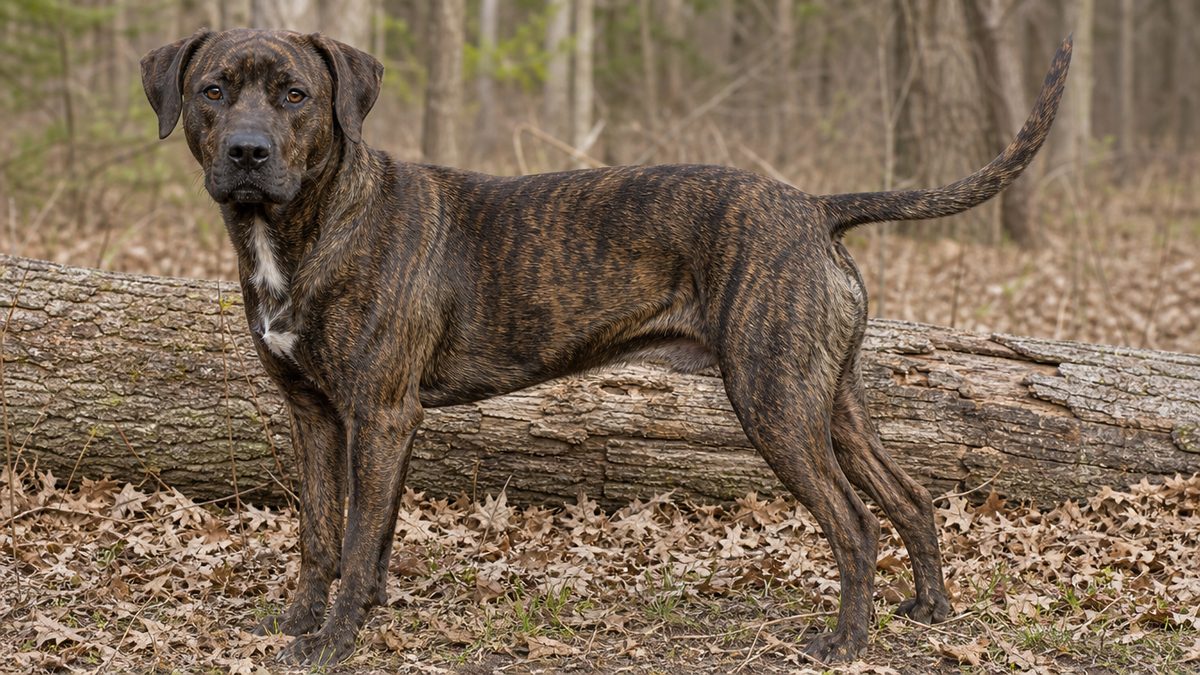
The UKC describes a powerful, agile tree dog of medium size, square or just slightly longer than tall, with legs long enough to move quickly through rough terrain. The head is broad with a moderate stop and a muzzle slightly shorter than the skull. Ears are set high and drop, and semi-erect ears are a fault. The tail is set low and may be a natural bob. Height runs 18 to 26 inches for a mature male and 16 to 24 for a female, and the weight is given only as proportionate to height.
The coat is where an Indian reader should slow down. The standard specifies a short outer coat that may be smooth or rough in texture, over an undercoat that is short, dense and soft. This is a double coat, not a single short coat, and a rough-coated variety is permitted. That matters more in Chennai than it does in Tennessee, and the climate sections below work through why.
Colour runs across black with or without tan or brindle points, blue, brindle, brown, red, yellow, blonde or buttermilk buckskin, with white permitted up to one third of the dog. Albinism is a disqualification, as are overshot and undershot bites, cryptorchidism, viciousness, extreme shyness, blindness and deafness.
Continental Kennel Club's own history says it plainly: although the name implies that the breed originated in the mountains, the dogs were used by settlers throughout the Ohio River Valley area, then spreading westward and down through the Southeast. So mountain here describes terrain the dog worked rather than a place it came from, and the registry that publishes the fullest standard for the breed is the one saying so.
The working description is unusually specific for a breed standard, and it is the part that predicts what living with one is like. The UKC calls this a fast, hard hunter that runs the track with its head in the air, open, semi-open or silent on track, with a clear bark that can be heard a long distance. When a hot track is not immediately available the dog circles and drifts on a cold track until it finds one. That is a description of an animal that leaves, works out of sight, and announces itself.
It also says what the dog is like at home. The breed is intelligent with a strong desire to please, is easily discouraged from tracking unwanted game despite strong treeing instincts, responds better to training with plenty of human contact, and makes a good family companion and watch dog. That last clause is the reason a loyal, athletic, muscular farm dog keeps being sold to Indian flat-dwellers who read only the second half of the sentence.
Is the Mountain Cur a breed, on Bonbeno's own test
The Mountain Cur is a breed on Bonbeno's two-condition test, and it clears the bar more comfortably than most dogs this site has assessed. The rule is published on Bonbeno's page for dog types that are not breeds and it is short: a breed has a written standard and a studbook behind it, so a puppy can be measured against a document.
Take the conditions one at a time, because a test only means something if it can come out either way. Bonbeno applied this same rule to the Koolie and found a breed, on an unofficial club document and three private registers. It applied the same rule to the Kuchi and found a type, because neither a standard nor a register exists anywhere on earth. It applied the same rule to the Halls Heeler and found a type that failed both conditions and never had either.
Condition one: is there a written standard?
Yes, and there are four of them. The United Kennel Club publishes a full standard for the Mountain Cur in its Scenthound Group, revised 15 April 2001. The National Kennel Club in Blaine, Tennessee publishes a separate twenty-point standard with its own measurements and a show points scheme. The Continental Kennel Club publishes a long Official CKC Breed Standard under Breed Group 7, Scenthounds and Related Breeds. And the OMCBA, the body that declared the breed in 1957, prints its own standards on the back of its litter registration form, where every breeder registering a litter has to sign against them.
The fourth of those is the one worth pausing on, because Bonbeno could not read it. The OMCBA serves that standard as a JPEG image, 226,739 bytes, under a filename beginning Messenger_creation, which is the name Facebook Messenger gives a file. The registration form that carries it is a single-page PDF holding one 1582 by 2047 pixel DCTDecode image with no font resources and zero extractable characters, confirmed by running pypdf against the downloaded bytes. The standard exists and a person can read it. No machine can, which is why no answer engine has ever quoted it.
Condition two: is there a studbook?
Yes, and three of them, with real gatekeeping. The OMCBA's litter registration requires the owner of the sire and the owner of the dam each to sign and to supply that parent's registration number, and puppies must be litter registered before they are six months old. Permanent registration then requires the ancestral background puppy paper issued by that litter registration, signed by the seller, with two colour photographs and a fee, and it returns a six generation background on the dog. Membership must be current to register or transfer anything. The association's by-laws name a Registrar among its officers, whose duty is to see to the registration and keep records of all registrations.
That is a closed loop, not an owner declaration. You cannot enter a dog into the OMCBA register by saying it looks like a Mountain Cur; you enter it because both its parents were already in the register. The United Kennel Club draws the same line from the other side. To single register a Mountain Cur it requires a registration certificate from one of nine acknowledged registries, among them the OMCBA, the Kemmer Stock Breeders Association and the United Mountain Cur Association, plus a complete three generation pedigree and three colour photographs United Mountain Cur Association.
The UKC's own single registration page ends with one line: if the dog does not meet the requirements above, the registration can be submitted as Treeing Cur. That is a registry saying out loud that a cur without documented parents is not a Mountain Cur, and giving it a different name to go under. A register with a fallback category for undocumented dogs is a register that is actually checking.
| Condition | Mountain Cur | Koolie | Kuchi | Halls Heeler |
|---|---|---|---|---|
| A written standard | Yes, four of them | Yes, one unofficial club document | No | No, and never was |
| A studbook | Yes, three, with pedigree gatekeeping | Yes, three private registers | No | No, and never was |
| Verdict | A breed | A breed | A type | A type |
One more door had to be checked before this verdict could stand, because a registry that registers on owner declaration is not a studbook. The Continental Kennel Club runs exactly such a route, its PAW programme, which registers a purebred dog with no documented ancestry on five photographs and two witness signatures from people familiar with the breed, for a 50 dollar evaluation fee. Bonbeno read the PAW eligible breeds list letter by letter. The M list carries seventeen breeds from Majestic Tree Hound to Moscow Toy Terrier, and the Mountain Cur is not among them. Every route into a Mountain Cur registration therefore runs through documented parentage.
Which bodies hold this breed, checked one by one
Six organisations hold or record the Mountain Cur and one does not, and each check below names the register, names a control that returned a result on the same document, and names what was found. Kennel club recognition for this breed is layered rather than binary, and reporting only the first layer gets an Indian buyer's practical question wrong.
| Register | Mountain Cur | Control that did return a result |
|---|---|---|
| United Kennel Club | Yes, Scenthound Group, recognised 1 Nov 1998 | Black Mouth Cur, Stephens' Cur and Treeing Cur present in the same group list |
| National Kennel Club | Yes, a full twenty-point standard | Treeing Cur standard present on the same site, 219 visible words |
| Continental Kennel Club | Yes, Breed Group 7, full standard | The CKC breeds index served a complete Mountain Cur document |
| OMCBA | Yes, the founding register since 1957 | Its own registration and by-laws pages both render in full |
| Kemmer Stock Breeders Association | Yes, acknowledged by UKC for this breed | Named on the UKC single registration page beside OMCBA and UMCA |
| American Kennel Club | Recorded in Foundation Stock Service, not fully recognised | The AKC page returns HTTP 200 and prints Foundation Stock Service on its face |
| FCI | Absent | The letter M index returned 11 breeds including Maltese 65 and Mudi 238 |
The United Kennel Club is the anchor, because it is the body that actually registers American working dogs at scale. Its breed standards index states that the club recognises over 300 separate breeds, and its Scenthound Group carries four curs by name: Black Mouth Cur, Mountain Cur, Stephens' Cur and Treeing Cur. That is the control that makes the entry meaningful, because three sibling curs sit beside it on the same page.
The American Kennel Club records the breed without recognising it. Its Mountain Cur page returns HTTP 200 and carries the Foundation Stock Service label on its face, alongside height of 18 to 26 inches for males and 16 to 24 for females, a weight of 30 to 60 pounds and a life expectancy of 10 to 13 years. Foundation Stock Service is a recording service rather than full recognition, so the dog cannot compete for AKC championship points in conformation, and the distinction is worth stating precisely rather than writing that the AKC recognises the breed.
The FCI answer, and why it settles the India question
The Federation Cynologique Internationale has never held this breed. Bonbeno read its letter M nomenclature index in full on 2 September 2026: eleven breeds, from Macedonian Shepherd Dog Karaman at standard 378 through Maltese 65, Manchester Terrier 71, Mastiff 264, Miniature American Shepherd 367 and Mudi 238, and not one cur of any kind. Six of those eleven are the control, because they are exactly the breeds that should be on an M index and they were.
That absence answers the Indian question directly. The FCI's members register lists India as a full member represented by the Kennel Club of India at Nr 28, AA Block, First Street, Anna Nagar, Chennai 600 040. The KCI issues pedigrees against FCI nomenclature, and the FCI has no Mountain Cur in its nomenclature, so there is nothing for the KCI to register a Mountain Cur as. No Indian pedigree for this breed can exist, however many Indian listing sites advertise KCI registered Mountain Cur puppies.
A registry index is a promise, not a document
One check on this trail produced a result worth publishing on its own. The National Kennel Club's breed standards index links Mountain Cur and Original Mountain Cur as two separate entries, and it links Mountain Feist, Kemmer Stock Cur, Stephens Cur, Treeing Cur, Leopard Cur, Carolina Cur and several Blackmouth Curs besides. The Mountain Cur page behind that index is real: 397 visible words, a twenty-point standard, colours, height, weight and a show points table.
The Original Mountain Cur page behind the neighbouring link is not. Fetched directly on 2 September 2026 it returned HTTP 200 and roughly 86 KB of HTML containing three visible words of body content, which were its own title, three stock photographs and a Bible verse. None of the nine probe strings a breed standard must contain, among them Colour, Height, Weight, Ears and Teeth, appears anywhere in it. The Mountain Feist entry on the same site is the same: two visible words and no standard. So the index promises eleven cur standards and delivers fewer, and the only way to know which is which is to open each page and count.
How big is a Mountain Cur, and why four standards disagree
A male Mountain Cur is 18 to 26 inches tall under three standards and 18 to 24 under a fourth, and weighs 30 to 60 pounds under two, 45 to 60 under one, and nothing at all under the largest register of the breed. Set the figures side by side rather than averaging them, because an average would produce a number that appears in no document.
| Source | Male height | Female height | Weight |
|---|---|---|---|
| UKC breed standard, revised 15 April 2001 | 18 to 26 in | 16 to 24 in | Proportionate to height. No figure given |
| National Kennel Club standard | 18 to 24 in | 17 to 22 in | Males 45 to 60 lb, females 40 to 50 lb |
| Continental Kennel Club standard | 18 to 26 in | 16 to 24 in | 30 to 60 lb, both sexes |
| AKC Foundation Stock Service page | 18 to 26 in | 16 to 24 in | 30 to 60 lb |
| NKC Treeing Cur, for contrast | 18 to 28 in | 18 to 28 in | Over 30 lb |
The last row is there for contrast rather than comparison. The National Kennel Club's Treeing Cur standard gives 18 to 28 inches and a weight of over 30 pounds with no ceiling at all, which is what a genuine catch-all category looks like beside four attempts at a defined breed. Three consequences follow, and none of them is academic for a buyer.
- A 25 inch male is a correct Mountain Cur under the UKC, CKC and AKC and two inches over the NKC ceiling. Which document the seller is quoting decides whether the dog in front of you is correct or oversized.
- A 16.5 inch bitch is correct under three standards and half an inch under the NKC floor of 17 inches, which is the only standard that sets a different floor for females.
- A 35 pound dog is correct under the CKC and the AKC, ten pounds under the NKC male minimum, and neither correct nor incorrect under the UKC, which declines to print a weight at all.
The registry that publishes no weight
The UKC's silence is the most interesting entry in the table, because the UKC is the register most Indian buyers would be told to trust. Its Height and Weight clause reads that height for a mature male ranges between 18 to 26 inches and 16 to 24 for a mature female, that weight is proportionate to height, and that Mountain Curs are working dogs and should be presented in hard, muscular condition. There is no number. A judge is being asked to assess condition rather than mass, which is a defensible choice for a hunting breed and a useless one for somebody trying to work out whether the dog they have been shown is the breed at all.
The AKC's 30 to 60 pound band and the NKC's 45 to 60 pound band cannot both describe the same population, and the gap is not rounding. Fifteen pounds is close to seven kilos, which on a 20 kilogram dog is a third of its body weight. Either the NKC is describing a heavier working line, or one of the two figures was written down without measuring anything. Bonbeno cannot tell which, and prints both rather than picking National Kennel Club, Blaine, Tennessee.
Three more places the standards contradict each other
- The tail. The UKC says the tail may be naturally bobbed, bobbed, or of medium length, and that a bobbed tail is preferred. The CKC says the tail may be naturally long or naturally bobbed and that preference should not be given to either type. One standard prefers a shortened tail and the other explicitly refuses to.
- The bite. The UKC requires a scissors bite and disqualifies overshot and undershot bites outright. The CKC permits level, scissor or reverse-scissor. A reverse-scissor dog is a correct CKC Mountain Cur and a disqualified UKC one.
- How long it lives. The AKC prints 10 to 13 years. The CKC prints 14 to 16. That is a gap of three years at the bottom and three at the top, on the same breed, from two American registries, and neither cites a study.
For an Indian buyer the practical rule is short. Assume nothing about the size of the dog you are shown, ask which standard the seller is measuring against, and treat any single confident number for this breed's height, weight or life expectancy as a quotation from one document out of four rather than a fact about the animal.
What the dog was built to do, and what that means indoors
A Mountain Cur was built to find game by nose and eye, drive it up a tree, and hold it there barking until a person arrives, and every difficult thing about owning one follows from that job description. The treeing instinct is not a quirk; it is the trait the whole breed was assembled around.
The UKC standard describes the working style in enough detail to plan a life around. The dog is a fast, hard hunter that runs the track with its head in the air rather than nose-down like a hound, may be open, semi-open or silent on the track, and carries a clear bark audible a long distance. Where there is no hot track it will circle and drift on a cold one until it finds a fresh line. It is described as a courageous fighter when required, and as easily discouraged from tracking unwanted game because of its desire to please.
The National Kennel Club standard says the same thing in shorter words and adds a detail the UKC leaves out. Its Voice clause reads that an open or semi-open dog on track is preferred with good change over at the tree, and that silent trailing is accepted. Its Characteristics clause names a strong treeing instinct on all game, courageous fighters, intelligent, easy trained, retaining a high degree of ancestral instincts such as running a track with head in air, tracking style much different than hounds but faster.
On all game is the phrase to read twice
Both American standards use that formula, and in an Indian city it stops being romantic. A dog with a strong treeing instinct on all game, in a country whose urban wildlife includes rhesus macaques, palm squirrels, monitor lizards, feral cats, free-ranging community dogs and poultry, will attempt to work all of them. This is not aggression and it does not train out. It is the dog doing the one job three registries selected it to do, in an environment where the game is somebody's chicken or somebody's cat.
The bark is the second constraint, and it is the one that ends tenancies. A working cur is quiet on the trail and then extremely loud at the tree, which is precisely the wrong acoustic profile for a shared wall. The standard's own phrase, a clear bark that can be heard a long distance, was written as praise.
A Mountain Cur needs somewhere to hunt, something to hunt, and someone who wants it to. Take away the job and you still have the drive, the stamina, the independence and the voice, with nowhere for any of them to go. That is how a good farm dog becomes a destructive, vocal, escaping problem in a flat, and it is why the breed's own American breeders talk about placing dogs into hunting homes rather than pet homes.
There is one honest counterweight. The same standard that describes a courageous fighter also says that in addition to hunting, Mountain Curs make great family companions and watch dogs, and that the breed responds better to training with lots of human contact. This is not a difficult or unstable dog. It is a biddable, loyal, agile animal with a very specific requirement, and households that can meet the requirement generally do well. The failure mode is a mismatch, not a temperament fault.
Mountain Cur price in India
No mountain cur price in india can be verified from any source Bonbeno opened, because no Indian seller has one. Three Indian pages publish a rupee band anyway, the three bands do not agree, and the site with the widest band is the one whose own listing counter reads nought.
| Source | Published band | What else the same page says |
|---|---|---|
| petbuy.in, breed page | Rs 8,000 to Rs 35,000 | Prints Live Avg (PetBuy) as a dash and Listings 0 in the same block |
| barkjunction.com | Rs 15,000 to Rs 40,000 | Splits it by age: Rs 15,000 to Rs 25,000 for puppies, Rs 25,000 to Rs 35,000 for young adults |
| poodles.in | Rs 30,000 to Rs 60,000 | Prints the same band later as ?30,000 to ?60,000, with its rupee glyph broken |
| Bing AI summary | Rs 15,000 to Rs 60,000 | Says most sources suggest Rs 25,000 to Rs 40,000 and attributes it to petbuy.in |
| Google AI Mode | None locally | States there is no standard or fixed market price for them locally, then converts a dollar band |
Start with the floor and the ceiling, because they come from different pages. The lowest published figure, Rs 8,000, and the highest, Rs 60,000, are a factor of 7.5 apart. No two of the three Indian bands share both endpoints, and two of them do not overlap at their extremes at all: petbuy's ceiling of Rs 35,000 is Rs 5,000 below poodles.in's floor of Rs 30,000 only in the sense that they barely touch BarkJunction, Mountain Cur price in indian….
The page that prices a dog it does not have
PetBuy's breed page carries a block headed Mountain Cur Price in India with three fields under it: Typical Low Rs 8,000, Typical High Rs 35,000, and Live Avg (PetBuy) rendered as a dash, followed by the words Listings 0. The band and the empty counter sit in the same paragraph of the same page. The site's own for-sale page is blunter still. Its H3 reads No Mountain Cur Currently Listed, and in place of any Mountain Cur it prints a price table for eight other breeds, from Labrador at Rs 8,000 to Rs 30,000 through Siberian Husky at Rs 30,000 to Rs 90,000.
That is the whole Indian market for this breed in one screen. A typical price is being published for a dog the publisher has never had, and the publisher says so, in the same block, in its own words.
What the puppy price is in the country that has the dogs
American figures exist and they disagree too, which is worth knowing before you judge the Indian ones. Lancaster Puppies gives 400 to 800 dollars, dogbreedslist.info gives 500 to 1,000, Good Dog says prices nationally usually range from 800 to 900, breeds101 gives 400 to 1,000, and Adopt a Pet puts adoption around 300 with breeder prices up to 3,000. That is a range from 150 dollars to 3,000 across the sources Google itself surfaced.
Bonbeno is not going to convert any of those into rupees and print the result as an Indian price. That conversion is the exact mechanism this site has documented manufacturing fake Indian price bands across dozens of breeds, and the next section shows an answer engine doing it on this very query, twice, at two different rates.
Auditing the rupee figures, digit by digit
Run the currency tests on every rupee figure published for this breed and none of them is a converted dollar price. They are round rupee numbers written by hand, which is a different kind of wrong from a conversion and needs saying differently.
The strong test on this site is division by 84.38, the rate that has caught converted Indian price lists repeatedly. Not one of the five figures in the Bing summary survives it. Rs 15,000 gives 177.77 dollars, Rs 25,000 gives 296.28, Rs 30,000 gives 355.53, Rs 40,000 gives 474.05 and Rs 60,000 gives 711.07. Division by 74 fails as well, giving 202.70, 337.84, 405.41, 540.54 and 810.81. Nobody prices a puppy at 810.81 dollars.
Division by a flat 80 appears to work on three of the five, giving 375, 500 and 750, and division by 66.67 appears to work on all five. Both results are arithmetic noise rather than evidence. Any rupee figure ending in three zeros divides cleanly by 80 by construction, because 1,000 divided by 80 is 12.5, and any figure divisible by 200 divides cleanly by 66.67 for the same structural reason. The two figures that fail even the flat-80 test, Rs 15,000 and Rs 25,000, give 187.50 and 312.50, which are not prices a seller would print.
These are rupee-native, arbitrary, round numbers. No arithmetic was done to produce them from a dollar price, so no division test can expose them. What exposes them is that three Indian sites publish three different bands for a dog none of them has ever sold, and that the widest of the three sits beside a counter reading zero.
The answer engine doing the converting, in one answer
Google India's AI Mode for this query does something the site has recorded before and had not yet seen this cleanly. It opens by stating that Mountain Curs are rare in India, so there is no standard or fixed market price for them locally. It then prints a price anyway: puppies generally cost between 500 and 1,000 US dollars, approximately Rs 42,000 to Rs 84,000, with high-working-line or show puppies reaching 3,000 dollars, approximately Rs 2,50,000.
Do the arithmetic on the engine's own numbers. Rs 42,000 divided by 500 is exactly 84.00, and Rs 84,000 divided by 1,000 is exactly 84.00. Then Rs 2,50,000 divided by 3,000 is 83.33. The same answer, in consecutive sentences, converts at two different rates. A table that cannot hold one rate across its own rows was generated by division rather than by pricing anything in India, and the internal inconsistency is itself the proof.
| Dollar figure printed | Rupee figure printed | Implied rate |
|---|---|---|
| 500 | Rs 42,000 | 84.00 |
| 1,000 | Rs 84,000 | 84.00 |
| 3,000 | Rs 2,50,000 | 83.33 |
And a figure attributed to a page that does not contain it
Bing's AI summary for the same query is a second failure of a different kind, and it is worth saying first that the engine itself was working: the same endpoint, queried in the same session for labrador retriever price in india, returned a genuine Indian result set and a live four-question People Also Ask box. It states that most sources suggest a price range of Rs 25,000 to Rs 40,000 and attaches that claim to petbuy.in. Bonbeno fetched petbuy.in's Mountain Cur page directly and extracted every rupee figure in its visible text. There are four, and they are Rs 8,000 and Rs 35,000, each printed twice. Neither Rs 25,000 nor Rs 40,000 appears anywhere on the cited page.
So the citation is real, the page exists, and the number is invented. Checking whether a cited page exists is not enough; you have to confirm the figure actually appears in it. That is the whole lesson of this section, and it is why the price table above prints what each page says rather than what an engine says each page says.
Why no lawful supply chain can form in India
Two independent facts close the route into India, and either one alone would be enough. Indian trade law bars importing a dog to breed or sell it, and the breed has no FCI standard, so no Indian registry has anything to record it as.
Take the trade rule first. The Directorate General of Foreign Trade's Trade Notice 22/2022-23 of 19 December 2022 sets out the guidelines for importing pet animals, classifying live dogs under ITC(HS) 01061900 as Restricted. Import is permitted as a pet with a valid pet book in the importer's name, for research with a CPCSEA recommendation, or for Defence and Police internal security use. Applications for trading or breeding purposes are to be rejected, and entry is confined to a small number of named ports.
The practical reading for a buyer is short. A returning resident relocating with a dog they already own can bring one. Nobody can lawfully import a pair to found an Indian breeding population, which is what would have to happen before an Indian puppy price could exist at all. The absence of a market is not an accident of demand; it is the shape of the law.
And no Indian paperwork exists on the other side
The second closure is the registration one, and it is the more useful of the two because it lets a reader test a seller's claim in thirty seconds. The Kennel Club of India is a full member of the FCI, issues pedigrees against FCI nomenclature, and the FCI's letter M index holds no cur of any kind. There is no slot. A KCI certificate for a Mountain Cur cannot be issued, so a seller offering one is offering a document for a different breed, a forgery, or nothing.
That claim is being made in the Indian market right now. Google India's own top organic result for this query is a listing page whose snippet reads that it sells KCI registered Mountain Cur puppies for sale in India. For most breeds this site covers, the advice is to insist on KCI registration. For this one that advice is actively misleading, and the correct response to a KCI-registered Mountain Cur is to stop rather than to negotiate.
Indian listing pages for absent breeds are usually one of three things: an auto-generated city shell with no dog behind it, a different breed under this name, or a crossbreed. Bonbeno found city-level pages for this breed covering Vijayawada, Kamareddy and Madhya Pradesh among others, all generated from one template, none showing an actual animal. A short-coated brindle dog of roughly the right size in India is far more likely to be an indie cross than an imported American cur, and no test on the market can tell them apart.
If you want the dog anyway, the honest route is the one the American breeders themselves describe. They place into hunting homes, and at least one publishes in writing that it does not ship dogs at all. That is not an obstacle to work around. It is the breed community telling you what this animal is for.
The real cost of ownership for a dog this size in India
Budget Rs 6,000 to Rs 12,000 a month for a 20 to 27 kilogram working dog in an Indian metro, and treat any breed-specific monthly table you find online with suspicion, because at least one of them is a shared constant rather than an observation.
Published Indian figures for dogs in general are the sound starting point. Supertails' 2026 price list puts monthly upkeep at Rs 3,000 to Rs 18,000 depending on breed size and grooming needs, gives an average monthly maintenance cost of Rs 3,000 to Rs 11,000, notes that city prices vary by 15 to 30 percent with Mumbai and Delhi the most expensive markets, and advises budgeting Rs 80,000 to Rs 2,00,000 for the first year including purchase, vaccinations, food, training and supplies. A Mountain Cur sits in the upper half of the monthly band on food alone, and near the bottom on grooming, because the coat needs almost nothing.
| Line | Monthly, Rs | Note |
|---|---|---|
| Food | 3,000 to 5,500 | High for the size, because the daily exercise load is high |
| Preventive veterinary care | 800 to 1,500 | Vaccination, deworming and a year-round tick programme, amortised |
| Grooming | 0 to 600 | A brush and a bath. No clipper work and no salon visit |
| Boarding and consumables | 1,000 to 3,000 | Leads, bedding, and boarding averaged across the year |
| Realistic total | 6,000 to 12,000 | Before any single emergency, which can exceed a year of the above |
The monthly table you will find online is a shared constant
One of the three Indian pages publishing a price for this breed also publishes a monthly cost table, and Bonbeno tested it the only way that settles the question. Poodles.in gives the Mountain Cur a monthly care total of Rs 3,550 to Rs 5,400, made up of food at Rs 2,250 to Rs 3,000, grooming at Rs 700 to Rs 1,200 and health at Rs 600 to Rs 1,200.
Pulling eight other breed guides from the same site returned the identical set, to the rupee, on six unrelated dogs.
| Monthly care total | Breeds printing exactly this set | Food line |
|---|---|---|
| Rs 3,550 to Rs 5,400 | Mountain Cur, Whippet, Basset Hound, Rat Terrier, Plott Hound, Boxer | Rs 2,250 to Rs 3,000 |
| Rs 4,900 to Rs 7,650 | Labrador Retriever, Catahoula Leopard Dog | Rs 3,000 to Rs 4,500 |
| Rs 2,200 to Rs 3,750 | Beagle | Rs 1,200 to Rs 1,800 |
A Whippet and a Boxer do not eat the same amount, and a Basset Hound and a Plott Hound do not cost the same to keep. Six breeds printing one figure to the rupee is a template constant, not an observation of anything. What does vary per breed on that site is the buying price and the stated ideal weather band, which is exactly the pattern that lets a generated page look breed-specific while its cost table is boilerplate.
So use the general Indian figures and your own vet's rates, and treat any breed-level monthly total you find for a dog nobody in India owns as a number somebody typed rather than measured.
Suitability for the Indian climate, measured rather than guessed
The Mountain Cur's home county averages 13.67 degrees Celsius across the year and never averages 28 in any month, while Chennai averages 27.95 and does so in seven months of twelve. That gap of 14.28 degrees in the annual mean is the single most decision-relevant number on this page.
Bonbeno queried NASA POWER by explicit latitude and longitude rather than by place name, using the 20 year monthly and annual climatologies for January 2001 to December 2020, and echoes back what the model returned for each point. The origin point is Jamestown, Fentress County, Tennessee, at 36.427 north and 84.933 west, which is where the OMCBA holds its world hunts and thirty kilometres from the Registrar's address at Clarkrange.
| Place | Annual mean C | Hottest month | Months averaging 28 C or more | Annual mean humidity |
|---|---|---|---|---|
| Jamestown, Tennessee (origin) | 13.67 | July, 24.48 C | 0 | 78.2 percent |
| Chennai | 27.95 | May, 31.51 C | 7 | 72.4 percent |
| Delhi | 25.60 | June, 35.88 C | 6 | 45.6 percent |
| Mumbai | 26.77 | May, 31.19 C | 4 | 67.4 percent |
| Bengaluru | 23.74 | April, 28.37 C | 1 | 67.9 percent |
Jamestown's hottest month averages 24.48 C. Chennai's coolest month averages 24.09 C. The warmest month this breed's homeland has ever known, averaged over twenty years, is 0.39 degrees warmer than the coolest month Chennai gets. A Mountain Cur living in Chennai spends its entire life above the top of its origin's temperature range.
Checking the model against the ground, because mountains break it
NASA POWER returns a grid cell rather than a point, and in hilly terrain the cell's mean elevation can miss the ground underneath it badly. Since this breed's name is Mountain Cur and its country is Appalachian, that check had to be run rather than assumed. Bonbeno compared each POWER cell elevation against the United States Geological Survey's Elevation Point Query Service for the same coordinates.
| Point | POWER cell, m | USGS point, m | Error |
|---|---|---|---|
| Gatlinburg, Great Smoky Mountains front | 741.67 | 392.86 | POWER 348.8 m too high |
| Jamestown, Cumberland Plateau | 390.80 | 517.73 | POWER 126.9 m too low |
| Sparta, White County | 347.03 | 279.85 | POWER 67.2 m too high |
| Clarkrange, Fentress County | 497.82 | 530.92 | POWER 33.1 m too low |
| Fayetteville, Arkansas Ozarks | 395.66 | 428.92 | POWER 33.3 m too low |
The Smokies point is the one that would have misled. At Gatlinburg the cell sits 348.8 metres above the valley floor, and at roughly 6.5 degrees per 1,000 metres that is about 2.3 degrees of spurious cooling. The Cumberland Plateau points, which are the ones that actually matter for this breed, are wrong in the other direction and by a third as much, so Jamestown's real annual mean is if anything slightly cooler than the 13.67 printed above rather than warmer. Either way the conclusion holds with room to spare.
The Indian cells are sound. Chennai comes back at 48.95 metres, Delhi at 206.37, Mumbai at 97.15 and Kolkata at 7.35, all consistent with the ground. The rule that emerges is the cheap one: if the place is a hill station, check the elevation before trusting the temperature; if it is a plains city, the cell is the town.
One further note on the name. A dog called Mountain Cur is not from high country. Jamestown sits at 518 metres by the USGS reading, which is Cumberland Plateau rather than mountain, and the Continental Kennel Club's own history says the settlers who kept these dogs worked the Ohio River Valley and spread west and south from there. The breed is a plateau and valley dog with a mountain name.
City by city, and the one Indian place this dog could actually live
Shillong is the only Indian city Bonbeno checked that comes close to this breed's homeland, at 17.96 degrees annual mean with zero months averaging 28 or more, and it is more humid than the origin rather than less. Everywhere else on the plains asks the dog to work at temperatures its ancestors never met.
| Place | POWER elevation m | Annual mean C | Above origin | Months at 28 C or more |
|---|---|---|---|---|
| Jamestown, Tennessee (origin) | 390.80 | 13.67 | - | 0 |
| Shillong, Meghalaya | 1224.61 | 17.96 | +4.29 | 0 |
| Shimla (cell, see caution) | 897.65 | 21.15 | +7.48 | 2 |
| Ooty (cell, see caution) | 784.64 | 23.50 | +9.83 | 0 |
| Bengaluru | 841.72 | 23.74 | +10.07 | 1 |
| Pune | 635.99 | 23.86 | +10.19 | 2 |
| Delhi | 206.37 | 25.60 | +11.93 | 6 |
| Kolkata | 7.35 | 25.81 | +12.14 | 5 |
| Hyderabad | 494.59 | 26.10 | +12.43 | 4 |
| Mumbai | 97.15 | 26.77 | +13.10 | 4 |
| Ahmedabad | 46.53 | 27.57 | +13.90 | 7 |
| Chennai | 48.95 | 27.95 | +14.28 | 7 |
The Ooty and Shimla rows are grid cells, not towns. POWER placed Ooty at 784.64 m against a real elevation near 2,240 m and Shimla at 897.65 m against roughly 2,200 m, so both cells are more than a kilometre below the actual hill station and both figures are far too warm. Bonbeno reproduced both numbers to the centimetre against values this site recorded on an earlier build, which is what confirms the diagnosis rather than merely asserting it. Treat those two rows as unusable and read the Shillong row instead, where the cell at 1,224.61 m is much closer to the ground.
Why Shillong is the honest answer
Shillong's twenty-year annual mean is 17.96 degrees, only 4.29 above the origin, and no month averages 28 or more. Its hottest month, August, averages 22.38, which is below Jamestown's July peak of 24.48. Its highest recorded monthly maximum across the series is 29.91, against 40.43 at the origin, so the extremes are gentler too. On temperature alone this is a genuine match.
Humidity is the twist and it cuts in the breed's favour rather than against it. Shillong averages 81.9 percent annual relative humidity against the origin's 78.2, so the Meghalaya hills are 3.8 points more humid than the Cumberland Plateau. That is a small enough gap to be manageable for a dog already adapted to a wet, wooded, temperate summer. Most imported working breeds fail on Indian humidity; this one comes from somewhere humid.
The rest of the country, ranked honestly
- Genuinely workable: Shillong and the Meghalaya hills, and by extension similar elevations in the northeast. Four degrees warmer than home, comparably humid, no month above 28.
- Manageable with discipline: Bengaluru and Pune, both around 10 degrees above the origin but with only one or two months averaging 28 or more, and with cool nights that make a 5.30 am and 9 pm exercise split realistic year-round.
- Hard: Delhi and Kolkata. Delhi's June averages 35.88 with a monthly maximum reaching 48.79, which is not a temperature at which any thick-coated working dog should be asked to run.
- Do not: Chennai, Ahmedabad and coastal Mumbai in May. Seven months at or above 28 degrees, with humidity high enough to blunt evaporative cooling exactly when the dog needs it most.
None of this makes the breed impossible in India. It makes it a dog whose exercise requirement and whose climate are in direct conflict for four to seven months of the year in most Indian cities, and the owner is the one who has to resolve that conflict every single day.
Temperament and household fit
A Mountain Cur is a loyal, biddable, high-drive working dog that bonds hard to its family, guards the property without being asked, and treats every small moving animal as a job. It suits a rural or semi-rural Indian household with land and fails in almost every other setting.
The registries agree on the temperament in a way they conspicuously do not agree on the size. The UKC calls the breed intelligent with a strong desire to please, easily discouraged from tracking unwanted game, better with plenty of human contact, and a good family companion and watch dog. The NKC standard names it intelligent and easy trained with a strong treeing instinct on all game. The CKC goes further and says out loud what the other two imply: that these dogs require a high degree of mental, physical and instinctual stimulation, and that it is recommended they be reserved for working and hunting homes that will use their talents, or else they can develop problem behaviours.
That last sentence is a breed registry advising against pet homes. It deserves more weight than any temperament adjective, because it is the body with the longest published standard telling prospective buyers who should not have one.
Who this dog suits
- Households with land and a boundary. A farm, an orchard, a plantation bungalow, a walled plot on a city edge. Somewhere the dog can range and cannot leave.
- Owners who want a watchdog and mean it. The guarding is genuine and unprompted, and the CKC describes the breed as protective and aloof with strangers though friendly with friends when well socialised.
- People who will be outdoors twice a day, every day, in the heat. Not people who intend to be. People who already are.
- Homes without cats, poultry, rabbits or free-roaming small pets. The CKC states plainly that the breed is highly predatory towards small animals and pocket pets and should not be left unsupervised with them.
Who should not buy one
- Anyone in an Indian apartment. Bonbeno rates apartment suitability 1 of 5 and would rate it lower if the scale allowed.
- First-time dog owners. An independent, vocal, high-drive hunting breed with no local breed community, no Indian vet familiar with it and no register to check it against is not a first dog.
- Anyone who wants a low-effort family pet. The affection is real and it arrives attached to ninety minutes of daily work.
- Anyone buying on looks. A short-coated brindle dog of medium size is the single most common phenotype among Indian street dogs, and you can adopt that dog for nothing.
A breed described by its own registry as protective, aloof with strangers and quarrelsome with new dogs needs deliberate, early, wide social exposure to be safe in an Indian neighbourhood, where delivery riders, domestic staff, festival crowds and free-ranging community dogs are all part of ordinary life. Socialise between eight and sixteen weeks, broadly and calmly, and keep doing it after. This is the one investment that cannot be made up later.
The honest summary is that this is not a difficult dog and it is a very specific one. Households that match it report a devoted, easy-to-train, low-maintenance companion. Households that do not get a loud, bored, escaping animal with a strong treeing instinct and nothing to point it at, and the mismatch is the owner's fault rather than the dog's.
Training a dog bred to work out of sight
Train recall first, train it for two years, and accept that it will fail near live prey. Everything else about training a Mountain Cur is easy, because three registries independently describe the breed as intelligent and eager to please.
The biddability is real and documented. The UKC standard says the breed is intelligent with a strong desire to please, and that it responds better to training when it has lots of human contact. The NKC calls it easy trained. So obedience, household manners, crate work and handling for veterinary examination all come quickly, in short sessions, with food and praise.
The one thing that does not train out
The UKC's own phrasing contains the caveat. It says the dog is easily discouraged from tracking unwanted game despite its strong treeing instincts, which means the breed can be taught which species to leave alone. It does not say the dog can be taught to leave a moving animal at close range while off lead in an unfenced space. In an Indian city with open traffic, that distinction is the difference between a trained dog and a dead one.
- Start recall at eight weeks, indoors, on a long line, paid every single time, before the dog has ever succeeded at chasing anything.
- Proof it against increasing distraction in a fenced space over months, not weeks, and never call the dog when you cannot enforce the recall.
- Use a long line outdoors until the dog is two, and in most Indian cities keep using it afterwards. A secure boundary is a safety requirement rather than a preference.
- Teach a settle on a mat early, because a dog that cannot switch off indoors will not cope with the four hottest months when outdoor time is rationed.
- Give the drive a legal outlet. Scent games, a flirt pole, retrieve work and food puzzles do not replace hunting, and they do take the edge off a dog that cannot hunt.
Two Indian constraints worth planning around
The first is the clock. From March to June in most of the country, training happens before sunrise and after dark or it does not happen at all. Build the habit in December so it is already a habit in April.
The second is the noise. A treeing breed is selected to bark hard once it has something cornered, and in a dense Indian neighbourhood that is a complaint waiting to happen. Teach a reliable interrupt cue from the first week, and never reward the barking with attention, because a dog that has learned barking summons a human has learned exactly what the breed was designed to learn.
Unlike some working-breed registers, none of the three cur registries requires a working test before it will register a dog. Training here is for the dog's benefit and yours rather than for a certificate. What the OMCBA does require before it will register a litter is the signature of the owner of the sire and the owner of the dam against the standards printed on the back of its form, which is a different kind of gatekeeping and arguably a more useful one.
The daily exercise requirement, and the Indian clock
Give a Mountain Cur ninety minutes of real work a day, split across two sessions, and in Indian summer both of those sessions have to happen in darkness. This is the requirement that decides whether the breed is possible for a given household, more than heat tolerance does.
The exercise need follows from the job rather than from the size. A dog selected to run a track with its head in the air, circle and drift on a cold line until it finds a hot one, and then hold game at a tree, is an athletic animal with deep stamina and no natural off switch outdoors. Ninety minutes is a floor. Two hours is better and most owners cannot supply it.
| Season | Morning | Evening | What to drop |
|---|---|---|---|
| November to February | 45 to 60 min, any time before 9 am | 45 min at dusk | Nothing. This is the season to build fitness |
| March to June | 45 min, starting before 5.30 am | 45 min, after 9 pm | All midday movement. Use scent games indoors instead |
| July to September, monsoon | 40 min between showers | 40 min | Long runs on wet ground. Dry the ears afterwards |
| October | 50 min | 45 min | Nothing, but watch humidity in coastal cities |
What happens without it
The failure sequence is predictable and every registry hints at it. The CKC says outright that boredom and high energy combined can develop into problem behaviours. In practice that means digging, escaping, chewing, barking at every sound in the stairwell, and a dog that becomes progressively harder to walk because the walk is now the only thing in its day.
The specific Indian version is worse than the general one, because the escape has somewhere to go. A bored cur that gets over a wall in an Indian city meets traffic, free-ranging dogs and, in many neighbourhoods, monkeys. A treeing breed that finds a troop of macaques is not coming back when called.
Building a young dog without wrecking its joints
There is no OFA hip data for this breed to argue from, which makes conservative growth management the only defensible position rather than a cautious one. Keep a growing Mountain Cur lean, avoid forced repetitive running on hard surfaces before about fourteen months, keep jumping low, and let the dog set the pace on rough ground. Hip dysplasia is common enough across medium and large working breeds that a breed with no published screening figures should be managed as though it carries the usual risk, because nobody can show you that it does not.
Exertional heat illness accounts for 652 of the 879 UK heat-related illness events with a recorded trigger in the largest study of the subject, which is 74.2 percent, and that study's dogs were working in a British summer. An Indian April is not a British summer. Stop the session at the first sign of a widening stance, dark red gums, a lolling tongue with a curled edge, or a dog that stops responding to its name. Cool with tap-temperature water over the neck, chest and inside the thighs, and drive to a vet rather than waiting. The same VetCompass team's follow-up paper on the risk factors for severe and fatal heat-related illness is the reason speed matters more than technique.
Grooming a double coat in Indian humidity
Groom a Mountain Cur once a week with a rubber curry or a slicker, bathe it only when it is genuinely dirty, and never shave it. The coat is low-maintenance, but it is a double coat rather than a single short coat, and that changes what you do in the monsoon.
The UKC standard is precise about the structure. The outer coat is short and may be smooth or rough in texture, and the undercoat is short, dense and soft. The CKC says the same thing and adds that both coat types are double coats with a short, dense, soft undercoat, and that the rough-coated variety is harsh and rough to the touch, longer on the neck, ears and rear of the limbs. So a smooth Mountain Cur and a rough Mountain Cur need slightly different tools and the same routine.
- Weekly, five minutes with a rubber curry brush for a smooth coat or a slicker for a rough one, working against the lie of the hair to lift dead undercoat.
- Twice weekly in the two shedding peaks, which in most Indian cities fall in late February and again in October as the weather turns.
- Bathe roughly monthly, or after a genuinely muddy monsoon walk. More often than that strips the coat and irritates the skin.
- Dry the ears every single time. High-set drop ears over a warm, humid climate is the standing recipe for otitis externa, and this is the one grooming task in India that is medical rather than cosmetic.
- Nails every three weeks, and check between the pads for grass seed and ticks at the same time.
It is an intuitive move and it makes things worse. The undercoat is what holds an insulating air layer that works in both directions, and the outer coat is what stops solar radiation reaching the skin. Clipping a double coat removes the sun barrier, exposes skin that has never seen an Indian April, and frequently grows back patchy. Brush the dead undercoat out instead, which achieves what shaving is meant to achieve without the damage.
Skin and ears in the monsoon
Overseas breed advice on grooming is written for a temperate climate and does not transfer whole. American guidance for short-coated working dogs generally assumes the dog dries off by itself in a few hours. In an Indian monsoon a wet dog with drop ears does not dry off by itself, and the standing water in the ear canal is where the trouble starts. Plug the ears before a bath, dry the canal opening afterwards with cotton wool rather than a bud, and treat a head-shake or an odour as a reason to see a vet the same week rather than to buy an ear cleaner.
The other Indian addition is the tick check. Run your hands over the whole dog after every outdoor session, paying attention to the ear margins, the armpits, between the toes and around the tail base. On a short-coated dog this takes ninety seconds and it is the highest-value ninety seconds in the routine, for reasons the health sections below set out with numbers.
Shedding is moderate rather than heavy, and it is year-round in a climate without a hard winter. Expect hair on dark clothing permanently. Anybody hoping for a low-shedding or hypoallergenic dog should read the FAQ entry on that claim and then choose a different animal, because no such dog exists.
Health conditions, and the register that holds nothing
There is no screening baseline for the Mountain Cur anywhere in the world, and any confident percentage you are quoted about its health was invented. The Orthopedic Foundation for Animals holds zero rows for any cur breed, and PubMed holds zero genuine records for this one.
Bonbeno retrieved the OFA's complete disease statistics dump on 2 September 2026: 2,213,948 characters, 13,976 table rows and 770 distinct breed labels, with the page's own title reading Disease Statistics by Breed. Searching it case-insensitively for the string CUR returns 48 hits, and every single one of them sits inside CURLY-COATED RETRIEVER or DRY EYE CURLY COAT SYNDROME. There is no Mountain Cur row, no Black Mouth Cur row, no Treeing Cur row and no Stephens Cur row. The string MOUNTAIN appears 168 times, in Bavarian Mountain Scent Hound, Bernese Mountain Dog, Entlebucher Mountain Dog and Greater Swiss Mountain Dog, and in nothing else.
The controls passed on the same document in the same session, which is what makes the absence a finding rather than a broken query. LABRADOR returns 109 occurrences, GOLDEN RETRIEVER 101, RAT TERRIER 30 and LOUISIANA CATAHOULA LEOPARD 37. The dump also prints the string Searching Database, Please wait even while the tables are fully present, which is a known trap on that page and not evidence that anything failed to load.
OFA publishes a breed's statistics only once it has enough evaluations, around 100 for hips and roughly 50 for its other databases. So the correct phrasing is that the Mountain Cur has no row in OFA's published statistics tables, twenty-eight years after UKC recognition. Whether individual Mountain Curs have been evaluated and simply have not reached the threshold is a question the public tables cannot answer.
The nearest comparable breed with real numbers
One American cur landrace does clear the threshold, and it is the honest yardstick. The Louisiana Catahoula Leopard Dog's hip row reads 975 evaluations, 81.1 percent normal and 18.1 percent dysplastic, with the dysplastic figure broken down as 10.8 percent mild, 6.8 moderate and 0.5 severe. Those three components sum to 18.1, so the row reconciles. Its elbow row gives 241 evaluations at 4.1 percent abnormal.
Two cautions before that number is borrowed. It describes the Catahoula and not this breed, and OFA figures are voluntarily submitted, so they are a floor rather than a population rate. Bonbeno prints them as the closest available comparator and not as the Mountain Cur's risk, because substituting a related breed's numbers is exactly the shortcut this site refuses to take.
What the standards themselves point at
Where no data exists, the disqualification lists are the next best evidence, because a standard only disqualifies faults that occur.
- Deafness. The UKC disqualifies it outright, alongside blindness, albinism and cryptorchidism. A registry that disqualifies deafness is telling you deafness happens. No prevalence figure exists for this breed anywhere.
- Entropion and ectropion. The CKC standard states that any signs of entropion or ectropion are incorrect for this breed, which is an eyelid conformation fault serious enough to need surgery in bad cases.
- Bite faults. Overshot and undershot bites are UKC disqualifications, while the CKC permits a reverse-scissor. Bonbeno cannot reconcile that and prints both.
- Hip dysplasia. No breed figure exists. The Catahoula's 18.1 percent on 975 evaluations is the nearest published number for an American cur landrace, and it is not this breed's.
The practical conclusion for a buyer is unusual and worth stating plainly. With no breed baseline, screening the individual dog is not optional caution, it is the only information available. Hips and elbows before any breeding decision, an eye examination, and a hearing check, on the animal in front of you rather than on the name it was sold under.
The Indian health picture, where the real numbers are
The health risks that will actually affect a Mountain Cur living in India are tick-borne disease, exertional heat illness and the consequences of Indian law on the standard's own preferences, and all three have real published figures behind them, unlike anything breed-specific.
Start with ticks, because for a short-coated dog working outdoors in India this is the dominant year-round risk. A 2026 study from the Odisha University of Agriculture and Technology developed and validated a hexaplex PCR assay for five canine tick-borne pathogens across eight districts of Odisha and screened 320 dogs, finding a 31.56 percent infection rate. The pathogens covered were Ehrlichia canis, Babesia gibsoni, Babesia vogeli, Hepatozoon canis and Anaplasma platys, and the authors report that Hepatozoon canis and Babesia gibsoni peaked in summer while Anaplasma platys peaked in the rains.
A second Indian study makes the seasonality sharper. Working in Haryana, Bhagwan and colleagues screened 120 dogs by PCR and studied the 24 confirmed positive for Hepatozoon canis, finding pyrexia in 83.33 percent, inappetence to anorexia in 75.00, pale mucous membranes in 58.33, lethargy in 37.50 and weight loss in 25.00 percent. Their risk-factor analysis identified age between zero and six months and the summer season as significant. So the highest-risk animal is a puppy in an Indian summer, which is precisely the dog a new owner brings home in April.
Run a year-round tick programme rather than a seasonal one, and check the dog by hand after every outdoor session. On a working dog that ranges through undergrowth, a monthly preventive plus a ninety-second manual check does more for its life expectancy than any breed-specific screening could, because the breed-specific screening does not exist and the tick-borne disease demonstrably does.
Heat illness, with the right denominator
The largest study of canine heat-related illness followed 905,543 UK dogs under primary veterinary care in 2016 and recorded 1,259 events from 1,222 dogs. Of those, 380 had no trigger recorded, leaving 879 with one, and 652 of those 879 were exertional, which is 74.2 percent. Environmental heat accounted for 113 and confinement in a vehicle for 46. The message is that dogs overwhelmingly overheat while working rather than while shut in a car, which is exactly the risk profile of a breed with a ninety-minute daily requirement.
The companion paper from the same cohort gives the risk factor that transfers to this breed. Dogs at or above their breed and sex mean bodyweight carried an odds ratio of 1.42 for heat-related illness, with a confidence interval of 1.12 to 1.80. That paper also reports an odds ratio of 3.42 for dogs over 50 kg, which does not apply here: a Mountain Cur weighs 30 to 60 pounds, roughly 14 to 27 kilograms, so it sits nowhere near that band and the breed itself was not modelled. Keeping the dog lean is the transferable finding. Its size is not the problem; its workload is.
Where Indian law and the breed standard collide
Two of the standard's own preferences are illegal to act on in India, and an owner following the document would be breaking the law. The UKC standard states that the tail may be naturally bobbed, bobbed, or of medium length, and that a bobbed tail is preferred, and it prefers one or two dewclaws on each rear leg. The NKC and CKC standards likewise favour rear dewclaws.
Second Schedule Part II paragraph 6(8) of the Prevention of Cruelty to Animals (Dog Breeding and Marketing) Rules, 2017 forbids tail docking, ear cropping, de-barking, de-clawing, branding, dyeing and any change of appearance by artificial means, in those words. Two consequences follow. A docked Mountain Cur in India was either imported already docked or was docked unlawfully here. And a breeder removing rear dewclaws to satisfy a standard would be committing the offence in order to meet a foreign document.
The breeding clauses bite too. Second Schedule Part III paragraph 8(10) requires that dogs shall have been tested for genetic defects including hip dysplasia, progressive retinal atrophy, night blindness, hypothyroidism, entropion, ectropion, overshot and undershot jaw, wry mouth, two or more missing teeth and cryptorchidism. Entropion, ectropion and the jaw faults are all named in the breed's own standards, so Indian law is asking for exactly the tests this breed most needs and for which no registry publishes a baseline.
Feeding a working dog of this size in India
Feed a Mountain Cur to body condition rather than to a chart, because the four published standards cannot agree what it should weigh and one of them declines to say. Two meals a day, a lean outline you can feel ribs through, and more food in the cool months than the hot ones.
The reason to feed by condition here is structural rather than stylistic. The UKC gives no weight figure at all and asks only that the dog be presented in hard, muscular condition. The NKC gives 45 to 60 pounds for males, the CKC and the AKC give 30 to 60 for both sexes American Kennel Club. A chart built on any one of those numbers will be wrong for a dog measured against another.
| Stage | Meals a day | What to watch |
|---|---|---|
| 8 to 16 weeks | 4 | Steady growth, not fast growth. Keep the puppy lean through the growth plates |
| 4 to 12 months | 3 | Ribs easily felt, waist visible from above, no ribs visible from a distance |
| 12 months to adult | 2 | Adjust with the season, not the calendar. Less food in May, more in December |
| Working adult | 2 | Feed after work, never before. Deep-chested dogs and full stomachs are a bad pairing |
| Senior, 8 years on | 2 | Watch for muscle loss over the topline, which food alone will not fix |
Body condition, in three checks you can do in the kitchen
- Ribs. You should feel them easily through a thin layer of covering, the way you feel the back of your own hand. If you have to press, the dog is overweight.
- Waist. From above, the body should narrow behind the ribs. From the side, the belly should tuck up toward the hindquarters.
- The seasonal check. Weigh the dog on the first of each month on the same scale. A working dog in an Indian summer eats less and moves less, and a routine that was right in January quietly makes a fat dog by June.
What is actually available in India
Nothing about this breed's nutrition is exotic. A good large-breed or all-life-stages complete food sold in India will do the job, and the useful decisions are the boring ones: a food the dog digests well, fed at a quantity that holds the body condition described above, split across two meals, with fresh water always available and more of it in summer than you think. Home-prepared diets are common in India and can be done well, but a working dog on a home diet needs a veterinary nutritionist to balance calcium and phosphorus rather than a recipe from the internet.
Supertails' 2026 figures put general Indian monthly upkeep at Rs 3,000 to Rs 18,000 depending on size and grooming needs. For a 20 to 27 kilogram dog with a very low grooming load, food will be the dominant line, and Rs 3,000 to Rs 5,500 a month is the realistic band for a decent commercial diet at this size in a metro.
A dog whose homeland never averages 28 degrees in any month will eat noticeably less through an Indian April and May. That is a sensible physiological response rather than a problem to fix, and forcing food on a dog in a 35 degree afternoon achieves nothing. Shift the main meal to after the evening walk, when the temperature has dropped and the dog has actually worked, and let the summer weight sit a little below the winter weight.
The first year, month by month, with Indian law on it
Take a Mountain Cur puppy home at eight weeks at the earliest, because Rule 8(1)(a) of the Indian breeding rules requires it, and spend the first sixteen weeks on socialisation and recall rather than on obedience polish. The paperwork comes first in this breed, because for most of the animal's life there will be none.
Before the timeline, the documents. Rule 8(1)(a) of the Prevention of Cruelty to Animals (Dog Breeding and Marketing) Rules, 2017 provides that pups less than eight weeks in age are not sold. A seller offering a six-week puppy is breaking Indian law before the transaction starts, which tells you everything else you need to know about them.
| Age | Priority | The Indian detail |
|---|---|---|
| 8 to 12 weeks | Socialisation window. Meet 100 people and 50 surfaces calmly | Delivery riders, autos, festival noise, cattle and community dogs, all at a distance the puppy can cope with |
| 8 to 16 weeks | Core vaccination course and first deworming | Start the year-round tick programme now, not in summer |
| 12 to 16 weeks | Recall on a long line, paid every time | Build it in the cool months so it is habit before April |
| 4 to 6 months | Handling, crate, car, vet table without drama | Microchip and municipal licence. Do it before you need it |
| 6 to 9 months | Impulse control near moving animals | This is where the treeing instinct switches on. Long line, always |
| 9 to 14 months | Build stamina slowly on soft ground | No forced running on tarmac. There is no hip data to reassure you |
| 14 months to 2 years | Adult exercise load, two sessions a day | Recall is still not proofed near live prey and may never be |
The paperwork question, answered honestly
For a dog bought in India there will be no breed registration, because none can exist. The Kennel Club of India has no slot for a Mountain Cur, since the FCI does not hold the breed Federation Cynologique Internationale. What you can and should have instead is a folder: the vaccination card in the vet's handwriting, the deworming record, the microchip number, the municipal licence, and a written note of where the dog came from and who its parents were said to be. That folder is what turns a claim about a dog into a documented dog, which is the whole argument of this page in miniature.
An OMCBA permanent registration returns a six generation background on the dog, and a UKC single registration requires a complete three generation pedigree plus photographs before it will call the dog a Mountain Cur at all. Ask which register the dog sits in and then read the certificate rather than the seller. If the answer is Treeing Cur, that is the UKC telling you the pedigree was short, and it is useful information rather than a disqualification.
One more thing to get right early. Second Schedule Part III paragraph 8(10) of the 2017 Rules lists the genetic defects a breeding dog must have been tested for, and it includes hip dysplasia, entropion, ectropion and the jaw faults this breed's own standards call out. If there is any chance you will breed the dog, book those tests in the first eighteen months rather than the week before the mating, because the results change the decision.
Against the dogs an Indian buyer can actually get
Compare the Mountain Cur on what you can verify rather than on temperament, because the temperaments are similar and the paperwork is not. Four of the five dogs below can be checked against a document in India and one cannot.
| Breed | Written standard | Indian pedigree possible? | OFA hip data | Available in India? |
|---|---|---|---|---|
| Mountain Cur | Four, disagreeing on size | No. Absent from FCI nomenclature | None. Zero rows for any cur | No verified seller found |
| Black Mouth Cur | Five bodies, also disagreeing | No, same reason | None | No verified seller found |
| Catahoula Leopard Dog | UKC, Herding Group | No, absent from FCI | 975 hips, 18.1 percent dysplastic | Rare, occasionally listed |
| Labrador Retriever | FCI, AKC, UKC, KCI | Yes, routinely | 9,673 evaluations in the same table | Yes, everywhere |
| Indian Pariah Dog | Landrace, no closed studbook | Not applicable | None | Yes, free, in every city |
The row that decides it for most readers is the third column. A Labrador in India can be registered with the KCI, which means the paperwork can be checked against a national register, and the breed has 9,673 hip evaluations sitting in the same OFA table that holds nothing at all for any cur. A Mountain Cur in India can be registered nowhere, screened against nothing, and verified by no document. For a buyer who cannot verify, an unverifiable rare dog is a worse purchase than a common one, whatever its qualities.
If what you want is the working dog rather than the name
Google's own answer engine, asked about this breed's Indian price, recommends two Indian alternatives and prices them: the Mudhol Hound at Rs 3,000 to Rs 15,000 and the Rajapalayam at Rs 5,000 to Rs 20,000, citing Supertails Supertails, Dog Price List in India 2026. That is a rare case of an AI summary giving better advice than the pages it is summarising, and it is worth taking. Both are Indian working breeds, both are lawfully available here, both are adapted to this climate, and both cost a fraction of what importing anything would.
The honest closest match on function, though, is not a hound at all. What a Mountain Cur does is hunt small game by sight, sound and scent, guard the property, and live outdoors on a farm. The Indian Pariah Dog does all three, has been selected in this exact climate for thousands of years, needs no import licence, has no registry problem because nobody pretends it has one, and is free.
Read this page next to the Mountain Feist guide. Same hills, same job, same silent-on-track hunting style, and a dog a quarter of the size. The two breeds are the large and small halves of one American working tradition. Their UKC standards even share a Terrier-and-Scenthound split and a near-identical account of the rural South, but the Mountain Feist's was written in 2015 and revised in 2020 to add three words, Ears must be erect, that disqualify an ear carriage its own sibling feist standard accepts. Reading the two together tells you a lot about how a breed standard actually gets written.
What Indian buyers get wrong about this breed
The commonest mistake is treating a single confident number as a fact about the breed, when four registries publish four different answers and an answer engine invents a fifth. The rest are errors of sourcing, of climate and of assuming that a short coat means a heat-tolerant dog.
- Believing any one published size or lifespan. The AKC prints a life expectancy of 10 to 13 years and the CKC prints 14 to 16 Continental Kennel Club. Neither cites a study. Quote both or quote neither.
- Accepting an Indian price band at face value. Three Indian sites publish three bands for a dog none of them has ever sold, and the site with the widest band prints Listings 0 in the same block.
- Trusting an AI summary's citation without opening the page. Bing attributes Rs 25,000 to Rs 40,000 to petbuy.in, whose page contains neither figure.
- Being offered a KCI registered Mountain Cur and treating it as reassurance. No such certificate can exist, because the FCI holds no cur in its nomenclature and the KCI issues against FCI nomenclature.
- Reading short coat as heat-tolerant. This is a double coat with a dense undercoat and a permitted rough-coated variety, from a place that has never averaged 28 degrees in any month NASA POWER, Climatology API.
- Assuming mountain means high altitude. The dogs worked the Ohio River Valley and the Cumberland Plateau at around 500 metres, not alpine country.
- Docking the tail because the standard prefers it. The UKC standard prefers a bobbed tail; Second Schedule Part II paragraph 6(8) of the 2017 Rules forbids docking outright.
- Buying a short-coated brindle dog of medium size and believing the label. That description fits an enormous share of Indian street dogs, and no DNA panel on the Indian market can distinguish a Mountain Cur from a cross.
The two search results that explain the confusion
Some of the misinformation about this breed is not anybody's fault, and knowing that helps a reader calibrate. The word cur is an ordinary English noun and a substring of longer words, so search systems collide with it constantly.
PubMed is the cleaner demonstration. Querying the exact phrase Mountain Cur returns seven records, and the query translation shows why: PubMed could not match the phrase, expanded mountain into mountaineering and mountains, and matched cur inside curcumin. Every one of the seven is a curcumin, curculigoside or cucurbitacin paper. Querying cur dog returns nineteen, all of them curcumin studies in canine models. The controls in the same session returned 52 records for Labrador Retriever with hip dysplasia and 15 for Catahoula, so the instrument was working perfectly. The breed genuinely has no literature.
Google India does the same thing commercially. Its results page for mountain cur price in india carries a CarWale listing for the Tata Curvv, whose price in India starts at Rs 9.76 lakh. A car has been pulled onto page one of a dog query because of four letters. Neither system is broken; the string is simply ambiguous, and a reader who does not know that will read the noise as signal.
Adoption, and how to verify what you are being offered
Adopt rather than import, because there is no lawful route to import a Mountain Cur for purchase into India and no register here that could confirm one if you did. If you still intend to pursue the breed, the checklist below is the part no other page provides.
The adoption case for this breed is not a consolation prize. What a Mountain Cur offers is a medium, short-coated, athletic, loyal working dog that guards, hunts and lives outdoors. Indian shelters are full of exactly that animal, already acclimatised, already vaccinated in most cases, and free. The Indian Pariah Dog is not a compromise on function; it is the same function selected by a harsher climate for longer.
If you are buying abroad, the four questions that matter
- Which register is the dog in? There are only four honest answers: OMCBA, KSBA, UMCA or UKC. Ask, then ask to see the certificate rather than a photograph of one.
- Does the UKC certificate say Mountain Cur or Treeing Cur? If it says Treeing Cur, the three generation pedigree did not satisfy the club. That is not fraud, and it is information.
- Were both parents registered before the litter was? OMCBA litter registration requires the registration number and signature of the owner of the sire and of the dam. A litter registered without them was not registered.
- What were the parents screened for? There is no breed baseline, so the answer has to be about these two dogs. Hips, elbows, eyes and hearing, with certificates.
| The claim | The reality |
|---|---|
| KCI registered Mountain Cur | Impossible. No FCI nomenclature entry means no KCI slot |
| Imported from a US breeder for sale | Barred. DGFT Trade Notice 22/2022-23 rejects import for trading or breeding |
| Indian bred from imported parents | No lawful route existed to import the founding pair |
| Champion bloodline, papers on delivery | Ask which register. Then ask why the papers are not already in hand |
| Health guaranteed | Against what baseline? OFA holds zero rows for any cur |
Adopting the dog you may actually have
A large share of the people who read a page like this already own a short-coated brindle or buckskin dog of medium size that somebody told them was a Mountain Cur. If that is you, the sourcing advice above is moot and the care advice is not. Groom weekly, run a year-round tick programme given that 31.56 percent of 320 dogs screened across eight Odisha districts carried a tick-borne pathogen, work the dog before sunrise from March to June, keep it lean because bodyweight at or above the breed mean carried an odds ratio of 1.42 for heat illness, socialise it hard and early, and get its hearing checked.
And use the right name for it. The dog you own is very probably an Indian dog with an American label attached by a seller, and that is not a criticism of the animal. An unregistered dog is not an inferior one. It means only that there is no document to check, in a market where the document is usually the pitch.
The Mountain Cur is a breed on Bonbeno's own test, and it passes more clearly than the Koolie and unarguably more than the Kuchi. It has four written standards, three studbooks, a registrar in Clarkrange, Tennessee and a registry that renames undocumented dogs rather than admitting them. None of that gets a dog to India, and none of it needs to. Read the registers, admire a 1957 association that saved a working breed from disappearing, and then go and adopt a dog that can survive May in your city.
Mountain Cur questions Indian readers actually ask
How much is a Mountain Cur dog?
In the United States published prices run from 150 to 3,000 dollars depending on who is asking, with Lancaster Puppies giving 400 to 800, dogbreedslist.info giving 500 to 1,000, Good Dog giving 800 to 900 and adoption fees quoted around 300. In India there is no verifiable price at all, because no Indian seller has one in stock. Bonbeno will not convert a dollar figure into rupees and print it as an Indian price.
Which dog is under RS 5000?
Google prints this question inside the Mountain Cur results, and the honest answer names no imported breed at all. Supertails' 2026 Indian price list puts the Mudhol Hound at Rs 3,000 to Rs 15,000 and an indie or street dog at the bottom of its forty-breed table. A healthy Indian pariah dog from a municipal shelter costs nothing beyond vaccination and sterilisation, and it is already adapted to the climate this page spends three sections on.
Are Mountain Cur dogs rare?
In the United States the breed is not rare: three cur registries hold it, the United Kennel Club has registered it since 1998 and the American Kennel Club records it in Foundation Stock Service. In India it is effectively absent. The one Indian listing site publishing a price prints Listings 0 on the same screen and heads its own for-sale page No Mountain Cur Currently Listed.
Which dog is under 10,000 rupees?
Adoption is the only honest answer under Rs 10,000, and Google surfaces this question on a page about an American breed nobody sells here. Indian shelters rehome healthy adult dogs for the cost of vaccination and sterilisation, and Supertails' own list bottoms out at the indie or street dog. Any imported working breed offered to you under Rs 10,000 is either not that breed or not healthy.
Is the Mountain Cur a real breed or just a type?
It is a breed on Bonbeno's two-condition test, and it passes more comfortably than most. Four bodies publish a written standard for it, three of them run studbooks, and the United Kennel Club refuses to register a dog as a Mountain Cur unless a complete three generation pedigree comes with it. A dog that cannot produce that pedigree is registered as a Treeing Cur instead, which is the registry drawing the line in public.
Can I get a KCI registered Mountain Cur in India?
No, and any seller offering one is offering paperwork for a different dog. The Kennel Club of India is a full member of the Federation Cynologique Internationale and issues pedigrees against FCI nomenclature, and the FCI's letter M index carries eleven breeds with no cur among them. There is nothing for the KCI to register a Mountain Cur as, so no such certificate can exist.
How big does a Mountain Cur get?
Four standards give four answers and none of them agrees fully with the others. The UKC allows males 18 to 26 inches and states no weight at all. The NKC allows males 18 to 24 inches at 45 to 60 pounds. The CKC and the AKC both print 18 to 26 inches and 30 to 60 pounds. So a 25 inch male is correct under three documents and oversized under the fourth, and a 32 pound dog is correct under two and underweight under one.
What health tests should a Mountain Cur have?
There is no breed baseline to screen against, because the Orthopedic Foundation for Animals holds zero rows for any cur across 13,976 statistics rows. Screen the individual dog rather than the breed: hips and elbows before any breeding decision, an eye examination given that two of the four standards call out entropion or ectropion, and a hearing check, since the UKC standard disqualifies deafness outright and a standard that disqualifies a fault is telling you the fault occurs.
Can a Mountain Cur live in an Indian flat?
No, and the climate is only half the reason. This is a ninety-minute-a-day working dog with a bark the standard says carries a long distance and a treeing instinct on all game, which in an Indian apartment block means cats, monitor lizards and other people's small dogs. Bonbeno rates apartment suitability 1 of 5 and heat tolerance 3 of 5, and the second number matters less than the first.
Why does searching for a Mountain Cur return a car?
Because cur is an ordinary English word and a substring of other words, so the query collides with things that are not dogs. Google India's own results page for mountain cur price in india returns a CarWale listing for the Tata Curvv at Rs 9.76 lakh, and PubMed answers the same breed name with seven papers about curcumin. Both systems are working correctly; the string is simply ambiguous.
Is a Mountain Cur hypoallergenic?
No, and no dog is. Vredegoor and colleagues measured Can f 1 across 196 dogs of so-called hypoallergenic breeds against 160 controls and found the hypoallergenic group higher rather than lower, concluding that there is no evidence for the classification of certain dog breeds as hypoallergenic. This breed carries a documented undercoat and sheds, so it would be a poor candidate even if the category existed.
Is it legal to dock a Mountain Cur's tail in India?
No. The UKC standard states that a bobbed tail is preferred and permits a docked one, and it prefers dewclaws that the NKC and CKC standards also favour. Second Schedule Part II paragraph 6(8) of the Prevention of Cruelty to Animals (Dog Breeding and Marketing) Rules, 2017 forbids tail docking and de-clawing outright. An Indian owner following the standard's tail preference would be breaking Indian law.
Compare with similar breeds
Mountain Cur sits in 1 Bonbeno group. Each one compares it directly against the breeds it is genuinely an alternative to, on the same figures.