
Breed profile
Plott Hound: Price in India, Heat, and the German Story
North Carolina's state dog, one of the very few American hounds with a documented German origin. Six sources tell that story and no two of them tell it the same way.
Quick answer
The Plott Hound price in India is quoted at Rs 30,000 to Rs 60,000 by exactly one page in the search results, and a second site copies the same figure and the same four monthly cost lines to the rupee. No Indian breeder, kennel, city or litter appears anywhere. This is a 50 to 75 pound mountain bear hound from a place 16 degrees cooler than Chennai and more humid than it.
This page reports registry documents, statutes and the small published veterinary literature on this breed. It is not veterinary advice and it cannot diagnose your dog. The Plott Hound has almost no breed-specific health research behind it, which means an Indian owner is relying on general large-breed and pendant-eared care rather than on breed data, so an ear infection, a lameness, a change in appetite or any sign of heat stress needs a registered veterinarian in person. Consult your veterinarian before acting on anything here.
Plott Hound at a glance
What a Plott Hound is, and what the registries disagree about
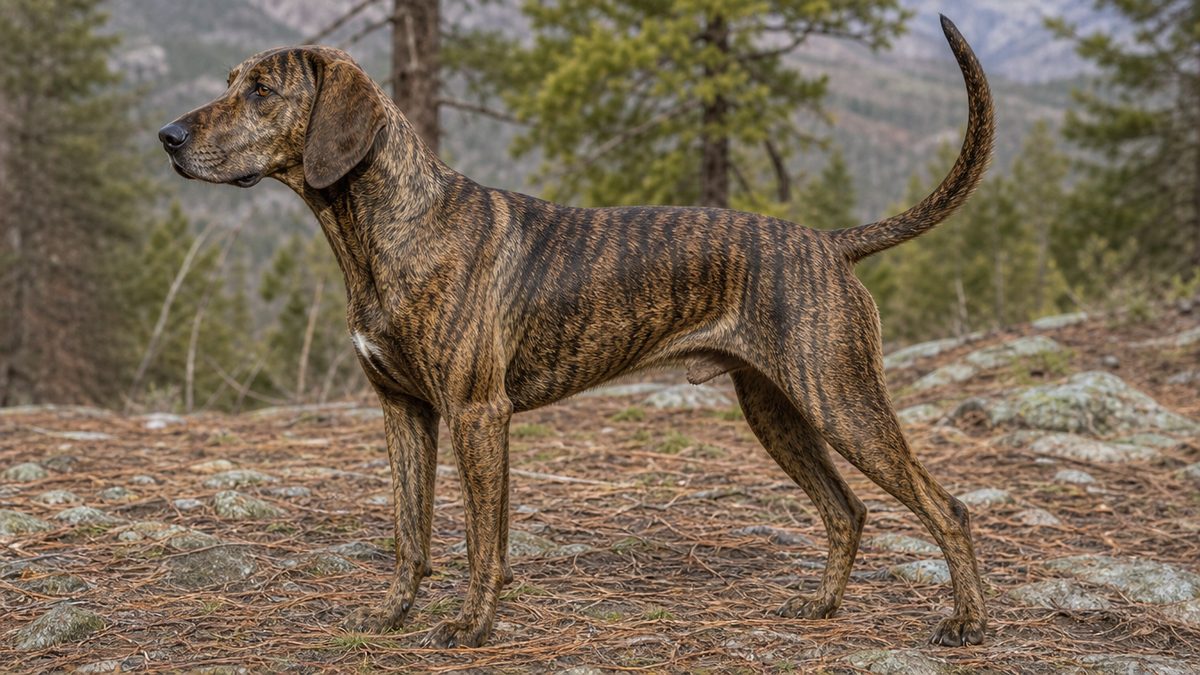
The Plott Hound is a brindle American scenthound bred in the mountains of western North Carolina to trail and tree bear and wild boar, registered by the United Kennel Club since 1946 and by the American Kennel Club since 2006American Kennel Club.
It is also the official State dog of North Carolina. The statute is short and it is worth quoting because so few breed pages cite an actual law: section 145-13 of the North Carolina General Statutes reads *The Plott Hound is adopted as the official dog of the State of North Carolina*, enacted by session law 1989 chapter 773 section 1. The North Carolina Museum of History dates the adoption to 12 August 1989. The same chapter makes the dogwood the state flower, so North Carolina has a dogwood and a dog.
Two registries, two different dogs on paper
The UKC files the Plott in its Scenthound group and the AKC in the Hound group, eligible from 1 January 2007 after a May 2006 board decision. They do not agree on the size of the animal.
| Source | Males | Females |
|---|---|---|
| UKC breed standard, revised 1 January 2020 | 22 to 27 inches, 50 to 75 pounds | 21 to 25 inches, 40 to 65 pounds |
| AKC breed page | 20 to 25 inches, 50 to 60 pounds | 20 to 23 inches, 40 to 55 pounds |
| North Carolina Museum of History, 2008 | 20 to 25 inches, about 45 to 55 pounds | not stated separately |
The gap is not trivial. The UKC's ceiling for a male is two inches taller and fifteen pounds heavier than the AKC's, and the UKC makes anything outside its band an eliminating fault at a bench show. A buyer told a Plott weighs 30 kg is being given a UKC-shaped answer; a buyer told 25 kg is being given an AKC-shaped one. Both are correct, from different documents.
The coat, which everyone does agree on
Fine to medium coarse in texture, short or medium in length, smooth and glossy, in any shade of brindle, brindle with a black saddle, black with brindle trim, solid buckskin or solid black. The AKC's colour register lists thirteen accepted colours, eleven of them a shade of brindle. A brindled dog is the default and, all things being equal, the UKC standard says brindle is preferred.
One quiet change is worth noting because it dates the document you are reading. The current UKC standard carries a line stating that it no longer disqualifies a Plott Hound that is solid coloured, under a revision date of 1 January 2020 and a copyright of 1982. If a page quotes you a solid-colour disqualification, it is quoting a standard that is at least six years out of date.
How many coonhounds are there?
The two registries cannot even agree how many coonhounds exist. The UKC standard opens by referring to *the seven breeds of UKC registered Coonhounds*, and says the Plott Hound and the American Leopard Hound do not trace their ancestry to the foxhound. The AKC page opens by calling the Plott *unique among the six AKC coonhound breeds*. Different registries hold different rosters, so both numbers are right about their own books and neither is a fact about the world.
UKC breed pages print an Official UKC Breed Standard footer with a revision date, and the body of the page can carry a different and later note. On this breed the body carries the January 2020 revision and the solid-colour change. Read the body.
The German origin story, tested against evidence
The Plott Hound's German ancestry is real and well attested, but the familiar sentence about a man named Johannes Plott bringing five Hanoverian hounds to North Carolina in 1750 does not survive contact with the documents, because six sources tell it and no two tell it the same way.
This is the part of the breed nobody checks. Here is what each source actually says, verbatim where it matters.
| Source | The man's name | Year | Dogs | What breed the dogs were |
|---|---|---|---|---|
| UKC breed standard | Jonathon Plott | 1750 | a few | wild boar hounds, no breed named |
| AKC breed page | Johannes Plott | 1750 | five | German Hanover hounds, elsewhere Hanoverian Schweisshund |
| Petfinder | Johannes Georg Plott | 1750 | five | German hounds |
| Dog Breeds List | Jonathan Plott | 1750 | five | Hanoverian Hounds |
| North Carolina Museum of History | Johannes Plott, later anglicised to George Plott | 1750 | five | probably the Hanoverian hound, hedged |
| Wikipedia | (Johannes) George Plott, c. 1733 to 1815 | 1750 | five | five Hanover Hounds |
Three things the sources agree on
The year 1750, the German origin, and the family name. Those hold across all six, and the German ancestry is separately supported by the breed's own registries, both of which state that the Plott does not descend from the English Foxhound the other American coonhounds trace toAmerican Kennel Club. That is a real and unusual claim about an American breed and nothing here disturbs it.
The problem with the words Hanoverian Hound
The Hanoverian Scenthound exists, it is German, and it is a tracking hound for wounded game. But the FCI's own standard for it, whose official language is German, records that the breed developed out of the mediaeval liam hound, that the hunting estate of the Kingdom of Hannover developed it further, and that since 1894 the registered Verein Hirschmann e.V. has been taking care of the breed. The Kingdom of Hanover itself was not created until 1814.
So a man leaving Germany in 1750 cannot have brought Hanoverian Scenthounds, because that breed and its register post-date him by roughly 144 years. What he could have brought is the German leash-hound and Bracke stock those dogs were later organised out of. The ancestry survives. The breed name attached to it in every ranking page is an anachronism.
The problem with the mountains, and with 1750
The North Carolina statute's own preamble asserts that *the Plott Hound breed originated in the mountains of North Carolina in 1750 and is the only breed known to have originated in this State*. The museum's own account then undercuts the date. It records that after his ship's record, Johannes Plott does not appear in public records again until 1759, when he bought land in Bute, now Warren, County, having anglicised his name to George Plott; that he later moved on, and that it was his son Henry who reached Buncombe, now Haywood, County about 1800.
Wikipedia goes further and says outright that there is no evidence George Plott ever went to western North Carolina, placing his settlement in Cabarrus County in the Piedmont and dating Henry's move to Haywood County to around 1801 to 1810. Two independent accounts put the family in the mountains around fifty years after the year the statute names.
There is an arithmetic check too. Wikipedia gives Johannes Plott's dates as c. 1733 to 1815, which makes him about seventeen years old in 1750. That fits the museum's version, in which the five dogs were a gift from his father Elias, a gamekeeper near Heidelberg, and it does not fit any account of an established houndsman emigrating with his pack.
The claim that cannot be checked at all
The UKC standard says *Plott supposedly kept his strain entirely pure, making no outcrosses*, and that a single borrowed stud dog from a Georgia hunter is the only known instance of new blood since the dogs reached America. Note the word supposedly, which the registry itself put there. The museum supplies the reason it has to be hedged: the Plott family did not keep written records about its dogs. A two-hundred-year purity claim resting on no written record is oral tradition, and the UKC's own standard immediately adds that other crosses possibly took place around 1900 through the Blevins and Cable hounds, to an extent that is not known.
None of this says the Plott Hound is not German-descended. Both registries say it is, and they say it in the specific and checkable form that it does not descend from the English Foxhound. What fails is the precision the story is usually told with: the breed name, the mountain location, and the unbroken purity across two centuries. Those three are tradition, not record.
Even the recognition date is disputed
The AKC's own page says the Plott Hound was recognised as a breed by the AKC in 2006, and separately that at the May 2006 board meeting the Plott became eligible to compete in the Hound Group effective 1 January 2007. The North Carolina Museum of History says the AKC recognised the breed in 1998. Wikipedia says 2006 and adds that Plott Hounds were exhibited at Westminster in 2008. Three dates, three documents, one breed. Where a state heritage source and a registry disagree about the registry's own decision, follow the registry, and record that the disagreement exists.
Plott Hound price in India, and why one number is doing all the work
Exactly one page in the Indian search results carries a Plott Hound price, Rs 30,000 to Rs 60,000, and a second site prints the identical figure and the identical four monthly cost lines to the rupee, so India has one number rather than a market.
Start with what the ten ranking results actually are. The page in first position for a query containing the words in india carries no rupee figure at all, only a US band of 500 to 700 dollars. Third and fourth are American pages that never mention IndiaPetfinder, Plott Hound Dog Breed…. Fifth is a cost guide for the Bloodhound, a different breed, in which the Plott Hound is never mentioned. Sixth, seventh and tenth sell a book, a steel garden marker and another book. Ninth is about Indian native breeds. That leaves one page.
| Position | Site | Plott Hound price given |
|---|---|---|
| 1 | Dog Breeds List | None. USD 500 to 700 only |
| 2 | Happy Pet Care | Rs 30,000 to Rs 60,000 |
| 3 | American Kennel Club | None, and no mention of India |
| 4 | Petfinder | A price heading with no number under it |
| 5 | Supertails | Bloodhound prices, wrong breed entirely |
| 6 | Amazon India | A book about Plott Hound mixes |
| 7 | Etsy | A steel garden marker |
| 8 | YouTube | A Hindi video that never names the breed |
| 9 | HubPages | Indian native breeds, no Plott content |
| 10 | Flipkart | A training guide book |
The one rupee figure, and the site that copies it
Happy Pet Care publishes a cost of buying of Rs 30,000 to Rs 60,000, monthly expenses of Rs 3,550 basic and Rs 5,400 premium, food Rs 2,250 to Rs 3,000, healthcare Rs 600 to Rs 1,200 and grooming Rs 700 to Rs 1,200. Poodles Petcare prints the same buying band and the same four monthly lines, to the rupee, along with an identical 12 to 14 year lifespan, an identical ideal weather band of 10 to 30 C, identical calorie figures of 1,200 and 1,800 kcal, an identical 60 to 120 minute exercise requirement and an identical five-item trait list. Eleven fields match between two supposedly independent sites.
The control that settles it
Pulling an unrelated breed from the same site is the test, and it is decisive. Poodles Petcare's Whippet page prints monthly care Rs 3,550 to Rs 5,400, food Rs 2,250 to Rs 3,000, grooming Rs 700 to Rs 1,200 and health Rs 600 to Rs 1,200. Byte-identical to the Plott Hound, on all four lines and both bounds.
| Field | Plott Hound | Whippet |
|---|---|---|
| Monthly care | Rs 3,550 to Rs 5,400 | Rs 3,550 to Rs 5,400 |
| Food | Rs 2,250 to Rs 3,000 | Rs 2,250 to Rs 3,000 |
| Grooming | Rs 700 to Rs 1,200 | Rs 700 to Rs 1,200 |
| Health | Rs 600 to Rs 1,200 | Rs 600 to Rs 1,200 |
| Stated daily calories | 1,200 and 1,800 kcal | 1,100 and 800 kcal |
| Stated exercise | 60 to 120 minutes a day | 30 to 60 minutes a day |
| Stated shedding | Moderate | Low |
| Buying price | Rs 30,000 to Rs 60,000 | Rs 20,000 to Rs 50,000 |
A dog the site says eats 1,800 kcal a day and a dog it says eats 800 are given the identical food budget on the same site on the same day. A moderate shedder and a low shedder are given the identical grooming budget. The food line is not derived from the calorie line printed six inches above it. A second control, the site's Pug page, carries a different food and health line but the same Rs 700 to Rs 1,200 grooming line again, so grooming is a site-wide constant and food and health are keyed to a size bucket. Nothing in that row is about the Plott Hound.
The conversion tests, including the one that fails
Run the division tests and the picture is honest but inconclusive. Dividing by 66.67 turns the whole ladder into exact quarter-dollar values: Rs 30,000 is 450, Rs 60,000 is 900, Rs 2,250 is 33.75, Rs 700 is 10.50, Rs 5,400 is 81. Nine figures for nine. But every figure on the page is a multiple of 50 and 66.67 is close to 200 divided by 3, so clean division is partly an arithmetic property of round numbers rather than evidence. One clean hit at the current-era rate is worth recording: Rs 5,400 divided by 84.38 is 64.00 exactly.
The reverse test is the useful one and it fails cleanly. Converting the only US price any ranking page prints, 500 to 700 dollars, gives Rs 42,190 to Rs 59,066 at 84.38, Rs 40,000 to Rs 56,000 at 80, Rs 37,000 to Rs 51,800 at 74 and Rs 33,335 to Rs 46,669 at 66.67. None of the four produces Rs 30,000 to Rs 60,000. So the Indian band is not a conversion of the American one. It is a template value with no traceable origin at all, which is a different and slightly worse finding.
One Indian listing site claims KCI registered Plott Hound puppies and lists eight of them, every one exactly 8 weeks old, named Samy, Tugi, Yoki, Fizey, Kuzo, Dugu, Kazuka and Doir. The identical eight names at the identical age appear on the same site's Rhodesian Ridgeback page. These are template rows, not a litter.
Real cost of ownership in India, built from named rate cards
Budget roughly Rs 6,000 to Rs 10,000 a month for an adult Plott Hound in an Indian metro, and note that this figure is assembled here from named clinics and retailers rather than copied from a shared template row.
The section above showed why the widely-published Rs 3,550 to Rs 5,400 monthly figure cannot be trusted for this breed: the same four lines appear on a Whippet page on the same site. So here is a cost of ownership built the other way, from sources you can open.
| Item | Figure | Source and scope |
|---|---|---|
| Puppy core vaccination course | Starts at Rs 6,499 | Vetic Pet Clinic national page, a promotional floor from one chain rather than a market average |
| Annual booster | Starts at Rs 3,199 | Vetic, same caveat |
| Anti-rabies, single dose | Rs 699 | Vetic |
| 9-in-1 DHPPiL | Rs 899 | Vetic |
| Tick, flea and worm control | Rs 1,103 per month | NexGard Spectra 15-30 kg, three tablets at Rs 3,308 on Supertails |
| Ear cleaning solution and gauze | Ongoing, low | The one recurring item this breed genuinely needs more of than most |
| Grooming, if used at all | From Rs 934 bathing | Vetic Delhi. A Plott's coat does not need a salon |
| Delhi pet dog registration | Rs 500 new, Rs 500 renewal | Municipal Corporation of Delhi, dogs only |
| Chennai pet licence | Rs 50 | Greater Chennai Corporation, pet animals generally |
Where the money actually goes on this breed
- Food, and it scales. A working-built 27 kg hound eats meaningfully more than the Rs 2,250 to Rs 3,000 a template row suggests, and a monthly kibble figure is arithmetic from grams per day rather than a quoted price. Weigh the food and multiply for the bag you actually buy.
- Ears, every week, forever. Pendant ears set moderately high with no erectile power are a monsoon liability in India. This is the one line where a Plott costs more than a prick-eared dog of the same size.
- Parasite control, which is not optional here. A survey of 525 dogs across four Indian climatic zones found ticks on 80 percent of 162 dogs sampled in Mumbai and 75.3 percent of 162 in Delhi, against 17 percent in Sikkim and 11 percent in Ladakh. A monthly product at about Rs 1,103 is cheaper than one course of treatment for tick fever.
- Grooming, which is close to free. Short, smooth, glossy, weekly brush. A Rs 1,869 complete bath and styling is money this dog does not need spent.
- Municipal registration. Rs 500 in Delhi and Rs 50 in Chennai, where the corporation's six pet clinics also give treatment and anti-rabies vaccination free of cost.
For a Plott in an Indian apartment the largest real cost is not money. It is the risk of a noise complaint from a dog whose standard describes its voice as open trailing, bawl and chop. No budget line fixes that, and it is worth deciding about before the dog arrives rather than after.
Heat, humidity and a mountain dog in an Indian city
The Plott Hound comes from a Great Smoky Mountains valley that runs 16 degrees cooler than Chennai and more humid than it, so the problem this breed faces in India is heat rather than damp air.
We queried NASA POWER by explicit latitude and longitude and echoed back the grid-cell elevation for every point, because in hilly terrain a cell can sit a long way above or below the town underneath it. Waynesville, in Haywood County where the Plott family settled, came back at 866 m against a real elevation near 808 m, an error of 58 m, which is small enough to use. Heidelberg, near where the museum places the gamekeeper who supplied the founding dogs, came back at 236 m against a real 114 m, so its figures run about 0.8 C cold by lapse rate and are labelled as an estimate rather than a reading.
| Place | Cell elevation | Annual mean T2M | Annual mean RH2M | Peak monthly wet bulb |
|---|---|---|---|---|
| Waynesville, North Carolina | 866 m against a real 808 m | 12.08 C | 78.50 percent | 19.13 C in July |
| Heidelberg, Germany | 236 m against a real 114 m | 10.09 C | 79.35 percent | 15.97 C in July |
| Bengaluru | 842 m against a real 920 m | 23.74 C | 67.94 percent | 21.86 C in May |
| Pune | 636 m against a real 560 m | 23.86 C | 66.80 percent | 22.97 C in June |
| Mumbai | 97 m against a real 14 m | 26.77 C | 67.39 percent | 25.77 C in June |
| Delhi | 206 m against a real 216 m | 25.60 C | 45.56 percent | 26.50 C in July |
| Chennai | 49 m against a real 11 m | 27.95 C | 72.39 percent | 26.11 C in May |
| Kolkata | 7 m against a real 9 m | 25.81 C | 73.93 percent | 27.09 C in June |
The wet-bulb column is computed from mean temperature and mean relative humidity with the Stull approximation, never from a period maximum, and every value sits far below the roughly 35 C physical ceiling, which is the check that says the arithmetic is sound.
The finding that changes the usual advice
Waynesville is more humid than every Indian city in the table. Its 78.50 percent annual relative humidity beats Kolkata's 73.93, Chennai's 72.39 and Mumbai's 67.39. The Great Smoky Mountains are named for their haze. So the common line that Indian humidity will finish a mountain breed is simply wrong at the source. What the Plott has never met is that humidity carried at 26 or 28 degrees instead of 12.
Read it as wet bulb and the gap is stark. Waynesville peaks at 19.13 C in July. Kolkata peaks at 27.09 C in June, 7.96 C higher, and Chennai at 26.11 C in May, 6.98 C higher. The nearest Indian analogue is Bengaluru at 21.86 C, still 2.7 C above anything the homeland produces, and Pune next. The three hardest cities for this breed are Kolkata, Chennai and Mumbai.
What to actually do about it
- Move all exercise to before 07:00 and after 20:00 from March to June in every city in the table except Bengaluru and Pune, where the window is wider.
- Never work a Plott in the middle of the day. A trailing hound follows a scent past the point where it should stop, because that is precisely what it was selected to do.
- Watch the ears through the monsoon, because a hound's hanging ear plus Indian July humidity is the commonest avoidable veterinary bill on this breed.
- Do not shave the coat. It is short already, and a shaved brindle dog sunburns.
- Plan for power cuts. In Bengaluru, load-shedding between March and May can take out the fan a heat-sensitive dog is relying on, so ask any boarding kennel about generator backup before you need it.
Indian law provides a hook worth knowing. The Prevention of Cruelty to Animals (Dog Breeding and Marketing) Rules, 2017 bar keeping dogs in outdoor facilities, without an attending veterinary practitioner's written approval, where the dogs are not accustomed to local temperatures or belong to breeds that cannot tolerate them, at Second Schedule Part IV paragraph 21(1). A mountain bear hound kennelled outdoors through a Chennai May is exactly the case that clause contemplates.
Both Indian pages carrying this breed print an ideal weather band of 10 to 30 degrees with no source at allPoodles Petcare, Plott Hound Price…. A dog whose homeland runs a 12.08 C annual mean is not comfortable at 30 C, and printing a band that spans the whole of India tells a reader nothing.
Temperament, and the sentence people misread
The UKC standard describes a breed that is active, fast, bright, kind, confident and courageous, and disqualifies viciousness or extreme shyness, so household aggression is a fault in this breed rather than a feature.
The sentence that gets misquoted sits two lines later in the same paragraph: *They are vicious fighters on game, have a super treeing instinct and take readily to water*. That is a description of what the dog does to a bear at the end of a trail. It is not a description of how it behaves in a living room, and the same standard disqualifies viciousness in the ring. Anyone quoting the first half of that paragraph without the second is misleading you.
The AKC's description is the more useful one for a family: a rugged, relentless hunting dog who is a mellow gentleman at home but fearless, implacable and bold at work, and one who may be a bit standoffish because he is extremely smart and focused.
The four things that decide the fit
- Voice. Open trailing, bawl and chop, described by the AKC as a loud, ringing chop. This is the deciding trait for Indian apartment living and no amount of training removes it.
- Prey drive. Selected over two centuries to trail and tree bear and wild boar. The AKC's own guidance is that the Plott is extremely prey driven and should always be walked on leash.
- Independence. Alert and quick to learn, and used to working out of sight of the handler. This is a hound that decides.
- Attachment. Strong to its own people. Plotts do not do well left alone for ten hours, and a bored Plott makes its own entertainment audibly.
Who this breed suits in India
A household with land, a rural or peri-urban address, neighbours far enough away that a bawling hound is not a legal problem, and an owner who will walk it twice a day in the dark half of the day for four months a year. Farms, plantations and estates in the Nilgiris, Coorg, Wayanad or the Western Ghats foothills are the Indian settings where a Plott makes sense, and even there the heat argument above applies.
It does not suit a metro flat, a first-time owner, or anyone buying a dog for looks. The brindle coat is genuinely striking, and that is the worst possible reason to acquire this particular animal.
The AKC notes that Plotts may become food or toy aggressive and need training to avoid these behaviours. That is a normal, trainable resource-guarding tendency in a working hound, and it is far easier to prevent at ten weeks than to fix at two years.
Training a hound that was bred to work out of sight
Train a Plott Hound with short, food-paid, scent-led sessions and a long line, because a breed selected to make decisions half a mile from its handler will not be argued into compliance.
The UKC standard calls the breed alert and quick to learn, and the AKC calls it intelligent, alert and confident, adding that because of his intelligence the Plott needs mental stimulation to keep him occupied or he will find ways to amuse himself that may be undesirable. That is a polite way of saying a bored Plott will bay, dig and escape.
The realistic timeline
- Weeks 8 to 16, socialisation. The AKC's own guidance is that puppies should be socialised thoroughly with gentle exposure to a wide variety of people and other animals. In an Indian city that means lifts, autorickshaws, doorbells, tiled floors and the building watchman. Socialise deliberately or inherit a suspicious adult.
- Months 4 to 8, foundation. Recall on a long line, lead manners, a settle on a mat, and handling tolerance so ears can be cleaned without a fight. Five minutes three times a day beats twenty minutes once.
- Months 8 to 18, adolescence. Recall will appear to vanish the moment a scent appears. It has not vanished; it has been outbid. Go back to the long line rather than shouting across a park.
- Months 18 to 30, maturity. A working hound settles late. Expect the adult dog somewhere in the second year.
What actually works
Scent games, and lots of them. Ten minutes of finding food hidden around a room tires a Plott more reliably than half an hour of heel practice, because it uses the equipment the breed was actually built with. Pair it with a clear end-of-session cue so the dog learns that work stops.
What does not work is correction-based handling. This is a breed the AKC describes as fearless, implacable and bold at work, and a dog with those adjectives in its own registry description does not fold under pressure; it hardens.
The one command that has to be proofed and still cannot be trusted
Recall away from a live scent. Proof it relentlessly, reward it enormously, and still never let a Plott off lead near an Indian road. The AKC says it plainly: because the Plott is extremely prey driven, he should always be walked on leash. Treat that as a fact about the breed rather than a comment on your training.
Owners try to train the voice out of a Plott and cannot, because the voice is the product. The UKC standard records it as open trailing, bawl and chop and says a clear voice that carries well is what today's Plotts are known for. You can teach a quiet cue for indoors. You cannot make this a quiet dog.
How much exercise a Plott Hound needs
Plan on 60 to 120 minutes of real exercise a day for an adult Plott Hound, split around the heat, with daily scent work on top.
The AKC describes Plotts as tough, relentless athletes requiring lots of exercise and outdoor time, and quotes its own standard on stamina, endurance, agility, determination and aggressiveness when hunting. The UKC describes a muscular and athletic dog whose gait is quick and agile, with head and tail carried well up. Both registries are describing an endurance animal, and an under-exercised endurance animal is not a calm one.
A workable Indian week
- Two walks daily, 40 to 60 minutes each, before 07:00 and after 20:00 through the hot months.
- Three long-line sessions weekly on secure ground, where the dog can trail rather than heel.
- Daily nosework, ten to fifteen minutes. Cheapest fatigue available and the closest thing to the dog's real job.
- Swimming where it is safe. The UKC standard notes the breed takes readily to water, and water work in an Indian summer solves the exercise and the cooling problem at once.
- One easy day in seven, because a hound will run itself into a soft-tissue injury and never mention it.
The puppy rule
Do not run a Plott puppy. Growth plates in a 25 to 30 kg breed close late, and repetitive forced exercise on hard ground before about 18 months is a known contributor to joint disease. Free play on grass is a different thing from a controlled jog beside a bicycle. Save the jogging for the second year, and have the neuter timing conversation with your vet rather than defaulting to a date on a calendar.
For most breeds on this site there is an honest apartment adaptation. For the Plott Hound there is not. Between 120 minutes of daily exercise and a bawling trail voice, a metro flat is the wrong address for this dog, and saying otherwise would be selling you something.
Grooming: five minutes on the coat, five minutes on the ears
Groom a Plott Hound with a weekly soft brush or hound glove, and treat the ears as the only part that needs real attention in an Indian climate.
The coat is fine to medium coarse, short or medium in length, with a smooth and glossy appearance, and the AKC says it requires minimal maintenance, just a weekly brushing with a soft-bristle brush or a hound glove to remove dirt and loose hair. That is the whole coat routine. This is one of the cheapest large breeds in India to keep looking right.
The ears, which is where the work is
The UKC standard specifies ears set moderately high and of medium length, soft to the touch, with no erectile power. A hanging ear traps warmth and moisture, and the AKC notes that pendant ears such as the Plott's can be prone to infection so the ears should be checked regularly.
In India that general advice needs a local edit. Overseas care guidance frequently tells an owner to towel a dog off and let it air dry, which is reasonable in a temperate climate and poor practice in an Indian monsoon. After every bath and every swim, dry inside the ear properly, and check weekly for odour, redness, head-shaking or scratching. An ear infection caught in week one is a cheap problem and in week four is not.
The rest of the routine
- Nails, trimmed often if not worn down naturally. A dog exercised on soil rather than pavement will need them done more often, not less.
- Teeth, brushed regularly with a dog toothpaste. There is no Indian statutory dental requirement for a breeding dog, so nothing external will prompt you.
- Tick checks, by hand, weekly, and daily in the monsoon. A short coat makes this quick and does nothing to prevent the ticks.
- Baths, occasional. The AKC notes a bath helps keep the dog from having a doggy odour, which is a real characteristic of scenthounds and one buyers are rarely warned about.
The hypoallergenic question
No dog breed is hypoallergenic, and the Plott is not marketed as one, but the question reaches every short-coated breed page. Vredegoor and colleagues measured Can f 1 in the hair and homes of different dog breeds and titled the paper for the finding: lack of evidence to describe any dog breed as hypoallergenic. A short coat sheds less visibly. It does not shed less allergen.
Hound glove over the coat, check both ears and dry them if damp, run your hands over the body for ticks, check between the toes, look at the nails. That is the complete weekly grooming routine for this breed and it is a genuine reason to like it.
Health: what the literature contains, which is almost nothing
The Plott Hound's health issues are almost entirely undocumented: there is no meaningful breed-specific veterinary literature, its own AKC national breed club recommends no health tests at all, and that absence is the most important health fact on this page.
Start with the search, because a claim of absence has to be earned. The query "Plott Hound"[tiab] returns five records in total on PubMed, and "Plott"[tiab] AND dog returns the same five. A control query in the same session, "Labrador Retriever"[tiab] AND "hip dysplasia"[tiab], returned 47 records with a sane query translation, so the instrument was working. Five records is not a literature.
| Record | Year | What it actually is |
|---|---|---|
| Spellacy et al., PNAS 80(19):6091-5 | 1983 | A disease discovered in three Plott Hound littermates, found to be alpha-L-iduronidase deficiency, the founding canine model of human mucopolysaccharidosis I |
| Shull et al., Pediatric Research 24(3):347-52 | 1988 | Bone marrow transplantation in that same Plott Hound colony, measuring neurological effects |
| Kirino et al., Veterinary Parasitology 158(4):376-9 | 2008 | A 23 kg boar-hunting dog of Plott Hound background in Miyazaki, Japan, infected with the lung fluke Paragonimus westermani, along with all four dogs on its hunting team |
| Quinn et al., JAVMA 261(10):1-3 | 2023 | A clinical case report in a 14-year-old male neutered Plott Hound with progressive inappetence, weight loss and coughing |
| J Analytical Toxicology, PMID 41514164 | 2026 | A malicious poisoning case in a dog, with postmortem quantitation |
The breed's real contribution to medicine
Two of those five records are the same research colony, and it matters more than the breed's own literature does. In 1983 a disease discovered in three Plott Hound littermates was found to be a profound and specific deficiency of alpha-L-iduronidase, resembling human mucopolysaccharidosis I in every biochemical parameter tested, with the clinical picture closest to Hurler-Scheie syndrome. Five years later the same colony was used to test whether bone marrow transplantation could reach the central nervous system in a lysosomal storage disease, and three long-term survivors transplanted before clinical signs showed enzyme activity in brain tissue and significant reductions in stored glycosaminoglycans.
That is the Plott Hound's largest documented appearance in the scientific record: not as a patient, but as the animal model that opened a line of human therapy. It is a genuinely interesting fact about the breed and no page ranking in India mentions it.
What a buyer can actually screen for
Very little, and the registry says so. Under the heading of recommended health tests from the national breed club, the AKC prints no recommended health tests. Its general advice is that Plotts are generally healthy dogs, that a responsible breeder will have had the parents screened for health concerns such as hip dysplasia, that pendant ears can be prone to infection and should be checked regularly, and that teeth should be brushed often.
The UKC standard adds a small but real list by way of its disqualifications, which tell you what the registry considers unacceptable in a breeding animal: undershot or overshot bite, unilateral or bilateral cryptorchid, albinism, deaf, and blind. A registry that disqualifies deafness and blindness is telling you those have been seen.
What to plan around instead
- Ear disease. The single highest-probability veterinary cost for this breed in India. Pendant ears, a humid monsoon, and a dog that swims.
- Large-breed joints. Hips and elbows, screened on the parents even though no breed club asks for it.
- Bloat. A deep-chested hound of this size carries gastric dilatation and volvulus risk. Two meals, no hard exercise within an hour of eating, and know the signs.
- Tick-borne disease. Ticks were found on 80 percent of 162 dogs sampled in Mumbai and 75.3 percent of 162 in Delhi in a four-zone Indian survey, and among dogs tested at veterinary clinics the pathogen burden that follows is substantial.
- Parasites from working. The Japanese case series is a reminder that a hunting hound eats what it finds: all five dogs on one boar-hunting team carried lung fluke. An Indian Plott worked on an estate needs a deworming schedule set by a vet, not a default one.
On lifespan, the AKC gives 12 to 14 years. There is no population mortality study of this breed, so treat that as a breed-club estimate rather than an actuarial figure. The one datum the literature supplies is a single case report in a 14-year-old Plott Hound, which is consistent with the estimate and is one dog.
A breed club that recommends no health tests may have a genuinely healthy working population, or it may simply have never run a health survey. Those two situations look identical from the outside and lead to very different outcomes. Ask any breeder what they screen for anyway, and treat hip and elbow scores as the minimum.
Feeding a working hound in India
Feed a Plott Hound to body condition rather than to a template calorie figure, because the two Indian pages carrying this breed print a daily calorie number they also print for dogs less than half its working output.
The AKC's guidance is the sensible baseline: a high-quality dog food appropriate to the dog's age, with attention to calorie consumption and weight level because some dogs are prone to getting overweight. For a hound the practical version is simpler. Ribs easily felt, waist visible from above, no hollow at the hip. A lean Plott handles Indian heat better and puts less load on the joints nobody is screening.
Life stages
- 8 weeks to 6 months. A large-breed puppy formulation with controlled calcium, four meals dropping to three. Do not add calcium on top of a complete food.
- 6 to 18 months. Two meals. Resist the urge to bulk up a lanky adolescent; the standard asks for a strongly built yet moderate hound, not a heavy one.
- 18 months onward. Two meals, portioned by body condition and adjusted seasonally. Most Indian dogs need less food in May than in January.
- From about 8 years. Watch for muscle loss rather than weight loss, and re-portion after any drop in exercise.
Bloat, and the deep chest
The UKC standard asks for a chest deep to the elbow and moderately broad, giving adequate lung space, with ribs nicely sprung. Deep-chested large breeds carry gastric dilatation and volvulus risk, which is a surgical emergency and not an upset stomach. Split the ration into two meals, avoid hard work within an hour either side of eating, and learn what a distended abdomen with unproductive retching looks like before you need to recognise it at 2 a.m.
Availability and the arithmetic
Large-breed complete diets are widely available across Indian metros and online. A monthly kibble figure is arithmetic from grams per day and price per kilogram rather than a quoted price, which is exactly why the Rs 2,250 to Rs 3,000 food line on the two Indian pages should be ignored: the same site prints it for a Whippet the same page says eats 800 kcal a day. Weigh your food, read your pack, do your own multiplication.
Add parasite control to the monthly routine because it is easy to forget. A NexGard Spectra pack for the 15 to 30 kg band runs Rs 3,308 for three tablets, about Rs 1,103 a month, which covers the tick and flea role and the roundworm and hookworm role in one product.
A trailing hound will work past thirst. On an Indian estate or farm, carry water for the dog rather than assuming it will find some, and refill bowls at home more often than feels necessary through April and May.
The first year, month by month
A Plott Hound puppy's first year turns on four things: socialisation, the ear routine, the exercise limit, and deciding early whether your address can live with the voice.
- Before you take the puppy. Ask for hip and elbow scores on both parents even though the national breed club recommends no health tests. Indian law prohibits the sale of pups less than eight weeks old, at Rule 8(1)(a) of the 2017 Rules.
- Weeks 8 to 12. Home, first vaccinate appointments, and the start of socialisation. A puppy core course at one national chain starts at Rs 6,499 across the schedule. Microchip the dog: the 2017 Rules make microchipping mandatory for puppies, and a hound that has followed a scent out of a gate is a hard dog to recover without one.
- Weeks 12 to 16. The most valuable month of the dog's life, and the AKC asks specifically for gentle exposure to a wide variety of people and other animals. Add the Indian list: lifts, traffic, tiled floors, the watchman, children, umbrellas.
- Months 4 to 6. Teething, lead manners, and the beginning of the ear routine that will run for fourteen years. Register with your municipality, Rs 500 in Delhi and Rs 50 in ChennaiGreater Chennai Corporation.
- Months 6 to 9. The voice arrives properly. This is when apartment-dwelling owners discover what open trailing, bawl and chop means in a stairwell. Decide now, not at eighteen months.
- Months 9 to 12. Adolescence, and the recall degrades. Long line, patience, no escalation. Start resource-guarding prevention around food and toys, which the AKC flags for this breed.
- Around 12 months. Have the neutering conversation with your vet rather than defaulting to a date.
- Around 18 months. Growth plates close. Only now does running beside a bicycle become reasonable, and only in the cool hours.
A puppy bought in December is four months old in April, just as its energy peaks and owners start extending walks. For a breed whose homeland runs a 12.08 C annual mean, that is exactly where heat incidents happen. Shorten walks and move them to the edges of the day before the weather forces you to.
Plott Hound against the dogs it is confused with
The Plott is cross-shopped against the other American coonhounds, the Mountain Cur and the Bloodhound, and it differs from all of them in the same direction: a mountain big-game specialist rather than a night-hunting raccoon dog or a trailing bloodhound.
| Breed | Descends from the English Foxhound | Built for | Coat |
|---|---|---|---|
| Plott Hound | No, per both the UKC and the AKC | Trailing and treeing bear and wild boar in mountains | Short, brindle |
| American Leopard Hound | No, per the UKC | Treeing game | Short, often merle-patterned |
| Black and Tan Coonhound | Yes | Night trailing raccoon | Short, black and tan |
| Treeing Walker Coonhound | Yes | Speed trailing and treeing | Short, tricolour |
| Mountain Cur | No, a working cur type | All-purpose southern Appalachian farm and hunting dog | Short |
| Bloodhound | No, a separate leash-hound line | Cold trailing, including man-trailing | Short, loose skinned |
The UKC's own framing is the useful one: of the seven breeds of UKC registered coonhounds, the Plott Hound and the American Leopard Hound do not trace their ancestry to the foxhound. That single sentence is why the Plott is worth distinguishing at all, and it is the claim the origin section of this page tests.
Against the Bloodhound, which matters in India specifically
This comparison is not academic here. A Bloodhound cost guide ranks fifth in India for the query *plott hound price in india*, and it contains no Plott Hound content at all. Its own monthly cost table does not even add up: the line items sum to Rs 13,000 at the low end against a printed total of Rs 12,000, and Rs 26,000 at the high end against a printed Rs 20,000. If you searched for a Plott price and read a number, check which dog the page was about.
Against the Rhodesian Ridgeback
Both are large short-coated hounds and both are rare in India, and the practical difference is noise and legal status. The Ridgeback is quiet and was named on the March 2024 central circular; the Plott is loud and was not named on it at all. For an Indian apartment, that trade runs entirely in the Ridgeback's favour. For an estate with land, it runs the other way.
The comparison worth making before any of these
Compare open populations against closed ones. More than 500 genetic defects exist in today's purebred dogs, and every 10 percent increase in coefficient of inbreeding is associated with a 7 percent decrease in litter size and median lifespan. The Plott's own registry describes a strain kept without outcrosses for two centuries, hedged with the word supposedly and resting on a family that kept no written recordsNCpedia, State Dog of North Carolina. Whatever the truth of that claim, a very small imported pool in India would produce exactly the situation that arithmetic describes.
If what appeals about the Plott is a hardy, short-coated, heat-adapted working hound that can live outdoors on a farm, the honest comparison is with an Indian breed that is already here and already adapted, rather than with an imported mountain dog you cannot lawfully import for breeding anyway.
What Indian owners get wrong with this breed
Six mistakes account for most of the trouble a Plott Hound gets into in India, and the first two are made before anyone looks at a dog.
- Buying it for an apartment. The voice is the product, not a fault. Open trailing, bawl and chop, described by the AKC as a loud ringing chop. This is the mistake that ends with a rehomed dog.
- Assuming a short-coated American hound is heat-hardy. Waynesville runs a 12.08 C annual mean at 78.50 percent humidity; Chennai runs 27.95 C at 72.39 percent. The homeland is more humid than Chennai and sixteen degrees cooler. It is heat, not damp, and this is a genuinely heat-sensitive breed here.
- Trusting the Rs 30,000 to Rs 60,000 figure. It is printed by two sites with identical cost rows, and the same rows appear on a Whippet page on one of them. It is not an observation of an Indian market.
- Ignoring the ears until they smell. Pendant ears plus an Indian monsoon plus a dog that takes readily to water is the commonest avoidable bill on this breed.
- Letting it off lead. Extremely prey driven, and the AKC says it should always be walked on leash. In an Indian street this is not a training question, it is a traffic one.
- Reading a price page that is about another dog. Position five in the Indian results for this query is a Bloodhound guide, and nothing on the search page tells you so.
The mistakes the ranking pages make, which become yours
The page ranking first in India for a rupee query publishes no rupee figure, prints a broken sentence reading *A mix of and Curs* where a breed name should be, and has a References section whose entire content is a dangling footnote reading *YouTube* with no video named. The page ranking fourth prints a heading asking how much a Plott Hound costs and then gives no number in any currency. One listing site claims KCI registered stock and lists eight puppies all at exactly eight weeks under names it also prints on other breeds' pages.
When a page cannot keep its own breed straight, or prints a heading it does not answer, nothing else on it is evidence either, including the price, the KCI claim and the health advice.
Do not plan to import a Plott Hound to start breeding them in India. Policy Condition 8 of the DGFT trade notice states that import of commercial dogs for breeding or any other commercial activity is not permitted, and the notice says applications for trading or breeding purposes shall be duly rejected.
Adoption, sourcing and the honest Indian answer
Adopt rather than import, because there is no lawful commercial route to bring this breed into India and no evidence in the search results that a genuine Indian population exists.
Here is the position stated plainly. Not one page in the Indian top ten names an Indian breeder, kennel, city, litter or KCI registration for the Plott Hound. The only page claiming stock lists template rows. The only rupee price is a template value that does not convert from the one American figure any ranking page prints. On the evidence available, the Plott Hound has no Indian market, and that is content rather than a gap.
What Indian law allows
Live dogs sit at ITC(HS) 01061900 with an import policy of Restricted. DGFT Trade Notice 22/2022-23 of 19 December 2022 permits import of dogs for three purposes only: a pet dog with a valid pet book and records in the importer's name, dogs imported by R&D organisations with a CPCSEA recommendation, and dogs for internal security by the Defence and Police Force. Import of commercial dogs for breeding or any other commercial activity is not permitted, and entry is limited to the airports and seaports of Delhi, Mumbai, Chennai, Hyderabad, Bengaluru and Kolkata and, since October 2024, Kochi airport Department of Animal Husbandry…. The full route is set out in how to import a dog to India.
Separately, the Plott Hound is not among the breeds named in the Department of Animal Husbandry and Dairying circular of 12 March 2024, as reproduced in full by customs two days later, and that circular was in any case quashed by the Karnataka High Court on 10 April 2024. So nothing breed-specific stands against this dog in India. The obstacle is supply, not law.
If you meet a Plott Hound in India anyway
- Ask to see the dam with the litter, in the place they were raised. Indian law requires breeders to register with the State Animal Welfare Board and sets housing standards.
- Ask for hip and elbow scores on both parents, even though the AKC's national breed club recommends none. Absence of a club recommendation is not evidence of absence of risk.
- Ask which registry's standard the dog is bred to, because the UKC and AKC size bands differ by two inches and fifteen pounds at the top.
- Ask what the dog actually is. A short brindle hound in India is far more likely to be an Indian dog or a cross than a Plott Hound, and a brindle coat proves nothing on its own.
- Confirm the puppy is at least eight weeks old, which Rule 8(1)(a) of the 2017 Rules requires.
The rescue route, which is the realistic one
In the United States the Plott and Plott crosses turn up in shelters routinely, which is why Petfinder carries a breed page and a location-based search for them at all. In India the equivalent route is a short-coated brindle hound cross from a local rescue, which will very likely handle the climate better than an imported Plott and will be far more affordable than any figure on this page. That is not a consolation answer. For most Indian households it is the better one.
Ask them where the breed's Hanoverian ancestry claim comes from and whether the Hanoverian Scenthound existed as a breed in 1750. The answer is that its breed organisation, the Verein Hirschmann, dates from 1894. A seller who has never looked that up has not looked anything else up either.
Plott Hound questions people actually ask
Is a Plott Hound a good family dog?
Yes in a rural or semi-rural home with land, and no in an Indian apartment. The UKC standard describes a breed that is active, fast, bright, kind, confident and courageous, and disqualifies viciousness or extreme shyness, so temperament with people is not the problem. Noise and exercise are. This is a dog bred to be heard at a distance while trailing a bear.
What is a Plott Hound good for?
Trailing and treeing large game, and the standard says so plainly. The UKC describes a breed with a super treeing instinct that takes readily to water, with an open trailing, bawl and chop voice. The AKC adds that the Plott was a mountain breed raised and trained to hunt animals such as bear and wild boar. Nothing in either document describes a companion animal.
Is a Plott Hound rare?
In India, effectively absent. Not one page in the Indian search results names an Indian breeder, kennel, city, litter or KCI registration for this breed, and the only listing page that claims stock lists eight puppies all at exactly 8 weeks old under the same names it prints on unrelated breed pages. In the United States it is uncommon rather than rare, and it has been UKC-registered since 1946.
Is a Plott Hound an aggressive breed?
No, and its own standard disqualifies aggression toward people. The UKC lists viciousness or extreme shyness as a disqualification and requires a kind and intelligent expression. The same standard describes the breed as vicious fighters on game, which is a description of quarry behaviour in a bear hunt and not of household temperament. Confusing the two is the commonest misreading of this breed.
Do Plott hounds like to cuddle?
Many do, and the AKC describes a mellow gentleman at home who can be a tail-wagging, people-loving dog but may be a bit standoffish because he is extremely smart and focused. Expect an affectionate dog that still wants a job. A Plott that has not been exercised will not settle for cuddling, whatever its temperament.
Do Plott hounds bark a lot?
Yes, and it is the single biggest reason this breed does not suit an Indian flat. The UKC standard records the voice as open trailing, bawl and chop, and the AKC describes Plott music as a loud, ringing chop on the track and the tree. The breed was selected for carrying voice over Appalachian ridges, and that selection does not switch off in a stairwell.
Are Plott hounds good house dogs?
Only in a house with land around it. The coat is short and needs almost nothing, the dog is clean and settles well indoors once worked, and none of that helps if the exercise requirement of 60 to 120 minutes a day cannot be met. The AKC's own guidance is that the Plott is extremely prey driven and should always be walked on leash.
What is the no. 1 lazy dog?
No registry or veterinary body publishes such a ranking, and the Plott Hound would be nowhere near it if one existed. The AKC calls the breed tough, relentless athletes requiring lots of exercise and outdoor time, and quotes its own standard on stamina, endurance, agility, determination and aggressiveness when hunting. If you want a low-energy dog, this is the wrong page.
How much does a Plott Hound cost in India?
One page in the Indian search results gives a figure, Rs 30,000 to Rs 60,000, and it names no breeder, no city, no date and no source. A second site prints the identical range and the identical four monthly cost lines to the rupee, and that same site prints those cost lines again unchanged on its Whippet page. Treat the number as a template value rather than as an observation of an Indian market.
Is the Plott Hound banned in India?
No. The Plott Hound does not appear on the list of breeds named in the Department of Animal Husbandry and Dairying circular of 12 March 2024, as reproduced in full by customs two days later, and that circular was in any case quashed by the Karnataka High Court on 10 April 2024. Importing any dog into India is separately restricted, and importing one for breeding or sale is not permitted at all.
Did a German immigrant really bring five Hanoverian hounds to North Carolina in 1750?
Parts of that sentence survive scrutiny and parts do not. Six sources tell the story and no two agree on the man's name, the number of dogs, or what breed they were. The Hanoverian Scenthound was not organised as a breed until the Verein Hirschmann took it up in 1894, so whatever arrived in 1750 could not have carried that name. The German ancestry itself is not in dispute.
Can a Plott Hound handle Indian heat?
Poorly, and the homeland data says why. Waynesville in the Great Smoky Mountains runs an annual mean of 12.08 C at 78.50 percent humidity, which is 16 degrees cooler than Chennai and more humid than it. The problem is heat, not damp air. A Plott in Kolkata faces a June wet bulb almost 8 degrees above anything its homeland produces.
What health problems do Plott Hounds have?
Almost nothing is documented, and that absence is the finding. The AKC's national breed club recommends no health tests at all, and a PubMed search returns five records in total for the breed, two of which are a 1980s research colony used to model a human enzyme deficiency. In practice an Indian owner should plan around pendant-eared ear infections, large-breed joints and bloat rather than around breed data that does not exist.
Compare with similar breeds
Plott Hound sits in 3 Bonbeno groups. Each one compares it directly against the breeds it is genuinely an alternative to, on the same figures.