
Breed profile
Black and Tan Coonhound in India: The Voice and the Ears
A trailing and treeing hound built to work at a distance and tell you where it is by giving voice. What the three registries that recognise it actually say, what OFA's own evaluation counts show, why the ear clause in the standard is the single biggest health question in an Indian monsoon, and why no lawful Indian supply chain exists.
Quick answer
The black and tan coonhound is a large American scenthound bred to trail raccoon entirely by scent and then bay at the tree until the hunter arrives, so its voice is the working purpose and not a fault to be trained away. No Indian rupee price for the breed could be found on any page, and Bonbeno rates it 2 of 5 for heat tolerance.
This guide is general information for Indian pet owners and is not a diagnosis. Always consult your nearby registered veterinarian before acting on anything you read here, and treat any sudden change in your dog's condition, especially collapse in the heat or a painful ear, as urgent.
Black and Tan Coonhound at a glance
What a Black and Tan Coonhound actually is
A Black and Tan Coonhound is a large American scent hound built to trail a raccoon by nose alone and then stand at the tree giving voice until the hunter walks in. The AKC breed standard opens by calling it "first and fundamentally a working dog, a trail and tree hound", and almost every other clause in that document exists to serve those two verbs.
The standard leaves no room to read the breed as an ornament. It says the dog is "capable of withstanding the rigors of winter, the heat of summer, and the difficult terrain over which he is called upon to work", that he is "used principally for trailing and treeing raccoon", and that he "runs his game entirely by scent". It adds that the same characteristics make him proficient on deer, bear and mountain lion. The FCI publishes the same text almost word for word as Standard No. 300, in Group 6, Section 1, large-sized hounds.
Size is where the paperwork is firmest. The AKC and the FCI both put males at 25 to 27 inches at the shoulder and females at 23 to 25 inches, measured at the shoulder, and the FCI converts that to 63.5 to 68.5 cm and 58 to 63.5 cm. Federation Cynologique Internationale The Royal Kennel Club rounds the same range to 64 to 69 cm for males and 58 to 64 cm for females. A good male therefore stands roughly as tall at the withers as a kitchen counter, which matters more in an Indian flat than any temperament note.
Weight is where the paperwork falls apart, and the disagreement is covered in the next section.
The AKC's own one-line summary is a fair description of the whole animal: "Large, athletic hunters who work nights, Black and Tan Coonhounds are friendly, easygoing hounds who love company."; Athletic and nocturnal and sociable, in that order, is what you are taking on.
The four things you notice first
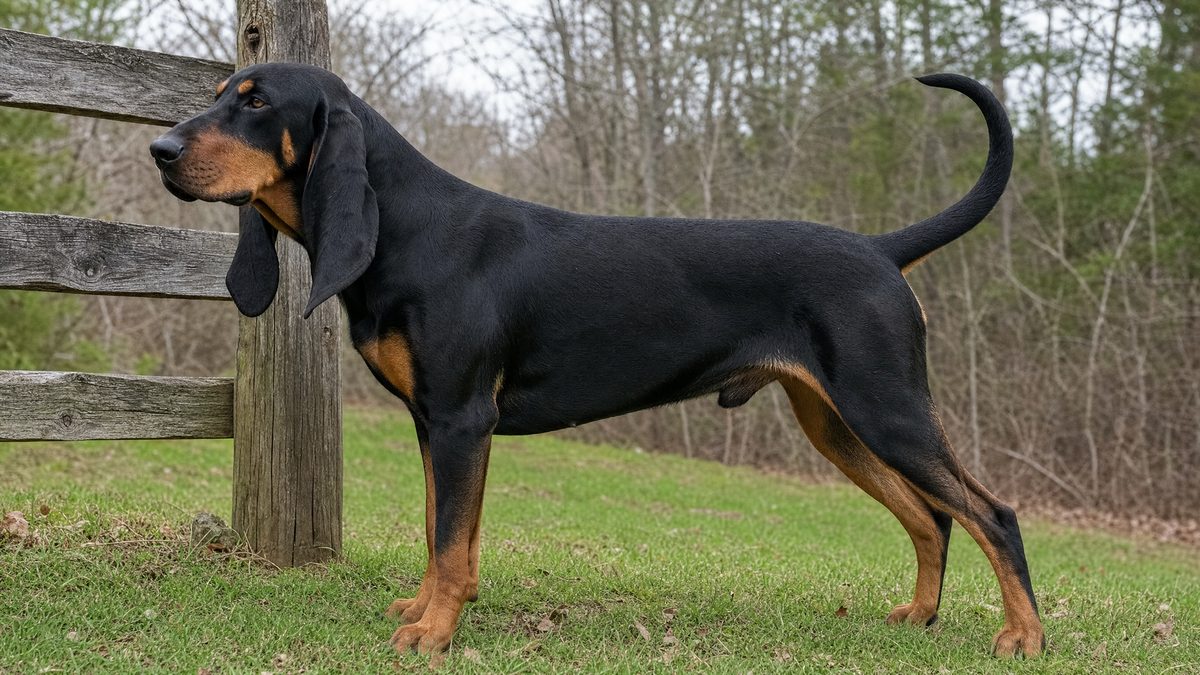
- Coal black with rich tan. The colour clause is precise: coal black with rich tan markings above the eyes, on the sides of the muzzle, chest, legs and breeching, with black pencil markings on the toes.
- The pumpkin seeds. Two small tan ovals sit above the eyes. The AKC's own breed page calls them "the distinctive 'pumpkin seeds' above keenly expressive eyes".
- Ears you cannot miss. They are low set and well back, hang in graceful folds, and "extend naturally well beyond the tip of the nose". That single clause drives most of this page.
- A clean head, not a Bloodhound head. The standard says the skin is "devoid of folds" and the neck "devoid of excess dewlap". A heavily wrinkled, dewlapped dog is off type, whatever the ancestry.
The ancestry is Bloodhound and Foxhound. The AKC's own history section says the breed is "believed to have descended from the St. Hubert Hound (Bloodhound), and then through the Talbot hound which was already known in 11th century England", and that it evolved from "the deliberate trailing, supremely cold-nosed Foxhounds with treeing instinct, of the black and tan color pattern". It records the dogs as owned by scouts during the late 1700s and calls the Black and Tan "the first coonhound to be considered a separate breed from the American Foxhound";.
The UKC tells a compatible story from the other side of the registry fence. It says the breed traces to the American Foxhound and the Virginia Foxhound "with probably the introduction of some Bloodhound stock", which "would not only explain the coloration of the Black & Tan, but its tendency toward being larger boned than other breeds, its long ears and its famous cold nose". It also records that this was the first coonhound breed admitted to the UKC registry, in 1900, under the name American Black & Tan Fox and Coonhound.
A dog bred to work half a kilometre away in the dark, alone, and to report its position by voice is not a dog that comes back when called and is not a dog that stays quiet. Both behaviours are the design, not a training failure. If either is a problem where you live, the rest of the page will not fix it.
Four registries, two names, and where they disagree
Four kennel clubs publish a breed standard for this dog, and they do not agree. The AKC, the FCI and the Royal Kennel Club call it the Black and Tan Coonhound; the UKC files it as the American Black and Tan Coonhound. Bonbeno opened all four documents and confirmed the breed name printed inside each one before comparing a single clause.
Two of the four are the same text. The AKC standard was approved on 11 December 1990 and made effective on 30 January 1991. The FCI's Standard No. 300 records its "date of publication of the official valid standard" as 30.01.1991, and its wording is the AKC text reformatted into FCI headings. So when a page says the AKC and the FCI agree, that is true and it is not evidence of anything. They agree because one copied the other.
The two independent documents are the UKC standard, revised on 1 May 2016 and copyright 1989, and the Royal Kennel Club standard, last updated on 1 April 2025 and held on the imported register. Those are the ones worth reading against each other.
| Clause | AKC (1991) | FCI No. 300 | UKC (2016) | Royal Kennel Club (2025) |
|---|---|---|---|---|
| Name printed in the document | Black and Tan Coonhound | Black and Tan Coonhound | American Black and Tan Coonhound | Black & Tan Coonhound (Imp) |
| Group | Hound Group | Group 6, Section 1, large-sized hounds | Scenthound Group | Hound |
| Height, males | 25 to 27 in | 63.5 to 68.5 cm | 23 to 27 in | 64 to 69 cm |
| Height, females | 23 to 25 in | 58 to 63.5 cm | 21 to 26 in | 58 to 64 cm |
| Weight | Not stated | Not stated | 50 to 75 lb dogs, 40 to 65 lb bitches | Not stated |
| Topline | Back level, powerful and strong | Back level, powerful and strong | Back short and slightly arched | Back level, powerful and strong |
| Ear length | Extends well beyond the tip of the nose | Extends well beyond the tip of the nose | Reaches approximately to the end of the nose | Extends well beyond the tip of the nose |
| Ear set | Low set, at eye level or lower | Low set, at eye level or lower | Set medium low | Set low, at or below eye level |
| Tail in action | About a right angle to the back | About a right angle to the back | Carried free, well up, sabre like | Carried high, in a scimitar fashion |
| Tan proportion | Not quantified | Not quantified | Not more than 10 to 15 percent of body | Should not predominate |
| White markings | Solid patch over one inch is a disqualification | Solid patch over one inch is a disqualification | A little white on the breast is not a fault | Highly undesirable, but no disqualification listed |
Three disagreements matter to a buyer rather than a judge. The weight gap is the largest: the UKC caps dogs at 75 lb, the AKC's own breed page quotes 65 to 110 lb, and the AKC, FCI and Royal Kennel Club standards give no weight figure at all. The Royal Kennel Club, Breed Standard A 34 kg dog and a 50 kg dog are different animals to feed, medicate and lift into a car.
The topline gap is a real difference in construction. The AKC, FCI and Royal Kennel Club all require a level back; the UKC asks for a back "short and slightly arched" and calls it "one important part of the breed";. A dog bred to one document can be faulted under another.
The ear gap is the one this page turns on. Three of the four standards demand ears that extend well beyond the tip of the nose and sit at eye level or lower; the UKC asks only that they reach approximately to the end of the nose. The AKC and FCI go further and penalise ears that fail to reach the nose. That is a written instruction to breed a longer, lower, heavier ear leather, and it has consequences in a humid climate.
For India the FCI text is the operative one on paper, because the Kennel Club of India is the FCI member body for the country. In practice no Indian registry activity exists for the breed, which the price section deals with.
The AKC ranks the breed 137 of 210 on its own registration-based popularity list. It also appears on the AKC's 2026 Low Entry Breeds List, dated 12 January 2026 and effective 1 March 2026, which runs to 114 breeds and includes every one of the six coonhounds, both foxhounds, the Harrier and the Bloodhound. The whole scenthound family is thin in the show ring even in its home country.
The voice is the job, not a behaviour problem
A Black and Tan Coonhound bays because the sport it was built for pays points for baying. The AKC's own Coonhound Regulations score a dog for opening on the trail and for sounding off at the tree, and award nothing whatever for working in silence. Read the scoring table before you read any breed page's barking level chart.
In an AKC Nite Hunt the handler calls his dog struck when it opens on a trail, and calls it treed when it settles at the base of a tree and changes its voice. The judge scores the calls. The regulations, amended to October 2021, set the points out plainly.
| Call | First dog | Second | Third | Fourth |
|---|---|---|---|---|
| Strike points, for opening on the trail | 100 | 75 | 50 | 25 |
| Tree points, for sounding at the tree | 125 | 75 | 50 | 25 |
Two details in that chapter make the point sharper than the headline numbers. A minute is timed from each release, and "fifty (50) strike points will be recorded for dog(s) barking within the last five seconds of the minute", with the judge counting the last five seconds aloud. And points go minus when a dog strikes and then fails to tree. A hound that hunts quietly scores zero. A hound that opens at the right second scores 100.
The registries describe the same thing in their own words. The UKC lists the breed's characteristics as "active, fast, bright, kind, confident and courageous, with open trailing and treeing instinct and ability", where open is the working term for a hound that gives tongue on a line. The AKC's breed page notes that the Black and Tan "trails much like a Bloodhound, entirely by scent, with nose to the ground, 'barking up' or giving voice upon locating quarry";.
What that sounds like at home
The AKC does not soften it. Its breed page says a lonely Black and Tan Coonhound "will serenade the neighborhood with loud, mournful 'music'", and its training section warns that a dog "left alone in a yard for long periods, bored and ignored, is likely to complain, loudly";. The page that ranks first in India for this breed rates its barking tendencies at the top of a five-point scale, marks it "Frequent", and separately scores the breed one out of five for apartment friendliness with the note that it "is not recommended for apartment life";.
The US classifieds page that ranks third puts it in a single sentence in its own cons list: the "loud, deep baying voice is a breed characteristic that creates real challenges in suburban and apartment settings";. Note the word characteristic. Not habit, not fault.
Management reduces how often a hound bays. It does not change what the dog is for. The surgical shortcut, de-barking, is separately dealt with in the next section, because Indian law names it.
There is one honest counterweight. Every source that describes the breed indoors describes a quiet dog. The AKC calls Black and Tans "snoozy by the fireside but tenacious when on the trail";, and the Royal Canin India page, drawing on the FCI, lists the breed's traits as including "quiet" and "even-tempered";. Both things are true at once. A settled, exercised, company-kept hound lies still for hours. A bored or lonely one is audible three buildings away.
What a baying hound means in an Indian flat
Indian residential noise standards are set at 55 dB(A) Leq by day and 45 dB(A) Leq at night, and a hound bred to be heard across dark woodland is not designed to sit inside them. The numbers come from the Schedule to the Noise Pollution (Regulation and Control) Rules, 2000, notified as S.O. 123(E) on 14 February 2000.
| Category of area or zone | Day time | Night time |
|---|---|---|
| Industrial area | 75 | 70 |
| Commercial area | 65 | 55 |
| Residential area | 55 | 45 |
| Silence zone | 50 | 40 |
The Schedule defines day time as 6.00 a.m. to 10.00 p.m. and night time as 10.00 p.m. to 6.00 a.m., and defines a silence zone as an area of not less than 100 metres around hospitals, educational institutions and courts. A great many Indian flats sit inside a silence zone without their occupants realising it.
Be precise about what those Rules do and do not reach. They are area standards, not per-source limits, and the operative provisions of S.O. 123(E) empower an authority to act against "any vocal or instrumental music", loudspeakers, public address systems and trades carried on in premises. A domestic dog is not named anywhere in them. So the realistic consequence of a baying hound in an Indian apartment block is not a prosecution under the Noise Rules. It is a running dispute with the flat below, and then with the society committee.
The surgical shortcut is illegal here
Indian law names de-barking directly. Paragraph 6(8) of Part II of the Second Schedule to the Prevention of Cruelty to Animals (Dog Breeding and Marketing) Rules, 2017, notified as G.S.R. 496(E) on 23 May 2017, reads: "There shall be no tail docking, ear cropping de-barking, de-clawing, branding, dyeing, injecting substances to enhance visual appeal, performing a surgery or procedure to camouflage or hide any defect or infirmity or any other kind of mutilation of any body part of the pup and any change of appearance by artificial means is strictly forbidden.";
Read the scope honestly. The Second Schedule is headed "[See rules 5(2) and 6]" and binds registered breeding establishments and the pups in them, so paragraph 6(8) is not itself a general prohibition on every owner in the country. What it does establish is that Indian animal welfare law treats de-barking as mutilation in the one context where it writes the word down. Nobody should be reading an overseas forum thread about ventriculocordectomy and assuming it transfers.
The circular everybody quotes, and nobody has read
Indian articles about barking and housing societies almost all trace back to one document, the Animal Welfare Board of India's Revised Guidelines on Pet dogs and street dogs dated 26 February 2015. The Delhi High Court referred to it in Dr. Maya D. Chablani v. Smt Radha Mittal & Ors. on 24 June 2021 and directed that law enforcement "properly implement" it, so the document plainly exists and carries weight.
Bonbeno downloaded the Board's own published copy and opened it with a PDF text extractor. It is six pages, ten embedded images, zero font resources and zero extractable characters. Nobody quoting that circular has read it as published, because as published it contains no text. So this page quotes nothing from it, and you should treat any article that puts quotation marks around its contents with suspicion until the Board republishes a machine-readable copy.
- Site the dog away from the shared wall. A hound's bay carries through masonry far better than a terrier's yap, because the energy sits lower in the frequency range.
- Solve the cause, not the sound. The AKC attributes the complaining to being left alone, bored and ignored. Company, scent work and a settled routine do more than any anti-bark device.
- Never leave one alone on a balcony. An unattended hound on an open balcony is an amplifier pointed at the whole block.
- Talk to the society before the dog arrives. A written understanding reached in advance survives a bad night. One reached afterwards rarely does.
The ears are written into the standard, and so is the risk
Three of the four standards instruct breeders to produce an ear that extends well beyond the tip of the nose and sits at eye level or lower, and that is the conformation the largest primary-care study of canine otitis externa associates with the highest odds. The ear is not an incidental feature of this breed. It is a required one, and it is the single most predictable health problem an Indian owner will meet.
Start with the clause. The AKC and FCI text reads: "Ears are low set and well back. They hang in graceful folds, giving the dog a majestic appearance. In length they extend naturally well beyond the tip of the nose and are set at eye level or lower." Both then instruct judges to "penalize ears that do not reach the tip of the nose and are set too high on the head";. Federation Cynologique Internationale The Royal Kennel Club repeats it: "Set low, at or below eye level, and well back on skull. Hanging in graceful folds, extending well beyond the tip of the nose.";
Only the UKC is more modest, asking for ears "set medium low" that "should reach approximately to end of nose when drawn out", and describing them as "slightly oval, soft and velvety, hanging in a roll when head is raised";. Even the conservative version is a long, soft, low-set drop ear lying flat over the canal opening.
What that does mechanically
A pendulous leather covers the vertical canal like a lid. It cuts air exchange, holds warmth against the canal wall, and keeps whatever water or debris gets in from drying out. The breed's own working pattern makes it worse: this is a nose-down trailing hound whose ears sweep the ground, which is exactly what the position-1 page means when it says "its long ears may help stir up ground scents";. The feature that makes the dog good at its job is the feature that makes the ear a problem.
The numbers, with denominators
The best available evidence is O'Neill and colleagues, 2021, in Canine Medicine and Genetics. It took a random sample of 22,333 dogs from 905,554 under UK primary veterinary care during 2016 and found a one-year period prevalence of otitis externa of 7.30 percent, with a 95 percent confidence interval of 6.97 to 7.65.
| Ear carriage | Cases | Non-cases | Dogs in group | Crude rate | Adjusted odds ratio |
|---|---|---|---|---|---|
| Erect | 220 | 3,898 | 4,118 | 5.3% | Base |
| Semi-erect | 276 | 4,654 | 4,930 | 5.6% | 1.03 |
| V-shaped drop | 299 | 2,734 | 3,033 | 9.9% | 1.84 |
| Pendulous | 395 | 3,752 | 4,147 | 9.5% | 1.76 |
Check the arithmetic before you trust it. The five ear-carriage rows in the paper sum to 1,631 cases, and 7.30 percent of 22,333 is 1,630.3, so the counts and the headline prevalence agree. Dividing out, 395 of 4,147 pendulous-eared dogs is 9.5 percent and 220 of 4,118 erect-eared dogs is 5.3 percent, a crude risk ratio of 1.78 against a published adjusted odds ratio of 1.76 (95 percent CI 1.48 to 2.10). The crude and adjusted figures land in the same place, which is what an honest dataset looks like.
Now add the second risk factor, because this breed carries both. In the same model, adult bodyweight of 40 kg or more carried 2.35 times the odds of otitis externa (95 percent CI 1.80 to 3.07) compared with dogs under 10 kg, and the 30 to under 40 kg band carried 2.05 times the odds. The AKC's published weight range for this breed, 65 to 110 lb, is 29.5 to 50 kg. A male Black and Tan Coonhound sits in the top two weight bands and has a pendulous ear. Those are not two ways of saying the same thing; they were separate variables in the same multivariable model.
In the same study the Basset Hound had 5.87 times the odds of otitis externa compared with crossbred dogs, the highest of the sixteen breed types with raised odds. The Basset is what happens when the long, low ear is taken to its extreme. The Black and Tan Coonhound is on the same road, further back.
Indian ear infections, the monsoon, and one series that does not add up
Indian otitis externa cases cluster in the rains, and the Indian series everyone quotes puts 48 of its 81 cases in July and August alone. That series is worth reading closely, because one of its own figures fails a simple division and Bonbeno checked every percentage in it before using any of them.
The study is Nainika and Pardeep Sharma, at the Dr. G.C. Negi College of Veterinary and Animal Sciences in Palampur, Himachal Pradesh. Between June 2022 and July 2023 they screened 2,476 dogs presented to the veterinary clinics and diagnosed otitis externa in 81, a hospital prevalence of 3.27 percent. Divide it out: 81 of 2,476 is 3.271 percent. The headline holds.
| Season | Cases | Published % | Cases divided by 81 |
|---|---|---|---|
| Rainy, July to August | 48 | 59.25% | 59.26% |
| Summer, April to June | 15 | 18.51% | 18.52% |
| Winter, December to March | 10 | 12.34% | 12.35% |
| Autumn, September to November | 8 | 9.87% | 9.88% |
Those four rows sum to 81 cases and to 99.97 percent, and every one of them divides out. So the monsoon clustering is real in that dataset: nearly six ear cases in ten arrived in a two-month window.
The figure that fails
The same paper reports breed predisposition and states that "69.13% of cases occurring in breeds with pendulous ears", while its own table prints the count for pendulous ear breed as 53. Divide it: 53 of 81 is 65.43 percent, not 69.13 percent. To reach 69.13 percent you need 56 cases.
The paper then supplies the answer against itself. It reports 30.86 percent in erect-eared breeds and tables that count as 25. Twenty-five of 81 is 30.86 percent, which checks. And 81 minus 25 is 56, not 53. So the two published percentages are internally consistent with 56 and 25, while the tabulated count of 53 is the error, and 53 plus 25 comes to 78 rather than 81. The safe reading is that between 53 and 56 of the 81 cases were in pendulous-eared breeds, somewhere between 65 and 69 percent. Do not quote 69.13 percent alongside the number 53, because they cannot both be right.
One more inconsistency sits nearby. The aetiology paragraph opens "In a study of 50 cases of Otitis externa" and then gives every fraction over 81. Every other percentage in the paper does divide out, including hypersensitivity at 37 of 81, moisture accumulation noted in 33.33 percent of cases, water entry in 20.98 percent, aural polyps in 7.40 percent and treatment error in 11.11 percent.
They are proportions of cases, not per-breed risk. The paper does not publish how many Labradors were among the 2,476 dogs screened, so its Labrador figure of 19 of 81 cases tells you Labradors are common in Palampur clinics, not that a Labrador has a 23 percent chance of otitis. The UK study is the one with a proper denominator. Palam Valley is also a hill station in Himachal, so its monsoon is not a Chennai or Mumbai monsoon and the seasonal split should not be transplanted city to city without thought.
What neither the club nor the law screens
The American Black and Tan Coonhound Club requires three tests for a CHIC number: a hip evaluation by OFA or PennHIP, an eye examination by a boarded ACVO ophthalmologist, and an OFA congenital cardiac evaluation. It recommends two more, elbow dysplasia and autoimmune thyroiditis. It sets no ear requirement of any kind, on a breed whose standard mandates the ear.
Indian law screens a different list again. Paragraph 8(10) of Part III of the Second Schedule to the 2017 Rules requires that dogs "shall have been tested for genetic defects, including hip dysplasia, progressive retinal atrophy, night blindness, hypothyroidism, entropion, ectropion, overshot, undershot jaw (when incisors do not touch or mesh), wry mouth, two or more missing teeth, unilateral cryptorchid or full cryptorchid males". It mandates hypothyroidism testing, which the American club only recommends, and it says nothing about the cardiac test the club requires. Neither list mentions the ear canal.
Black and Tan Coonhound price in India: there is no figure
No published Black and Tan Coonhound price in India exists. Bonbeno searched the India-localised results for the term on 21 August 2026, opened every Indian page that ranked, and found not one rupee figure for this breed anywhere. That absence is the most useful thing this page can tell an Indian buyer, and it is evidenced rather than assumed.
Here is what the two Indian selling pages actually contain.
- Mr n Mrs Pet, position 2. Its own Black and Tan Coonhound listing page reads "3 Result Found". The three cards displayed on the day of the pull were a Border Collie in Lucknow, a Border Collie in Pune and a French Bulldog in Noida. Not one coonhound, and no rupee figure on the page at all, because every price sits behind a View Price link that routes to a sign-up form.
- Breed n Breeder, same breed, Ahmednagar. The page is a template shell: a breed dropdown, a state dropdown, a city dropdown, a phone number and the line "Mr. Vansh will help you choose the perfect Black and tan coonhound puppy at the best prices in Ahmednagar". No puppy, no photograph, no price. The same page exists for every breed in the dropdown and every city in the list.
- Puppiezo, position 7. No Black and Tan Coonhound is listed. Treat the Rs 98,999 on that site with care: it is a recurring house price point rather than a breed valuation, and on 21 August 2026 the same figure was the listed price of a Maltipoo and of a Doxiepoo in the carousel that appears on every one of its breed pages.
- Royal Canin India, position 6. A real Indian-domain page about the breed, with no price, and its own footer says the key facts come from the FCI.
Now the control, because an absence is only evidence if the search works. India's most-cited dog price list is Supertails, covering more than 40 breeds with city-wise tables. It carries the Labrador Retriever at Rs 8,000 to Rs 80,000, the Beagle at Rs 15,000 to Rs 60,000, the Mudhol Hound at Rs 3,000 to Rs 15,000 and the Rajapalayam at Rs 5,000 to Rs 20,000. It carries no coonhound of any kind. The list plainly works, and this breed is not on it.
What the US market charges, for reference only
| Source | Published figure | At 84.38 to the dollar |
|---|---|---|
| Dogbreedslist, position 1 | 400 to 800 dollars, average 550 | Rs 33,752 to Rs 67,504, average Rs 46,409 |
| Lancaster Puppies, position 3 | 500 to 1,200 dollars | Rs 42,190 to Rs 1,01,256 |
| Lancaster Puppies, live listings on the day | 800, 1,500 and 1,500 dollars | Rs 67,504 and Rs 1,26,570 |
| iHeartDogs, position 8 | 500 to 1,300 dollars by US region | Rs 42,190 to Rs 1,09,694 |
Those rupee columns are arithmetic, not offers, and nothing in India is selling at them. Lancaster Puppies Capalac Z. Cost of a Black and Tan… Bonbeno prints them for one reason. Indian pages routinely publish a "price" that is a US dollar figure run through a single exchange rate, and this site has caught that three times at exactly 84.38. If you ever see a Black and Tan Coonhound advertised in India at roughly Rs 46,400 or Rs 1,01,300, divide it by 84.38 and see whether a round dollar number falls out.
The one Indian rupee figure on the whole result page belongs to a different breed, and it passes the test. Puppiezo's Rs 98,999 divides to 1,173.25 dollars, which is not a round dollar amount, so that number was not generated by converting a US price. It is not a coonhound price either: re-checked at source on 21 August 2026, Rs 98,999 is a house tier attached to whichever puppy is in stock, that day a Maltipoo and a Doxiepoo.
If an Indian seller quotes you a price for this breed, the realistic possibilities are a different coonhound, a black and tan mixed-breed dog, a Rottweiler or Dobermann cross sold under a rarer name, or an imported dog whose paperwork will not survive scrutiny. Ask for the KCI registration number and the sire and dam, and ask which port the parents entered through. The next section explains why that last question is the one that ends the conversation.
Why no lawful Indian supply of this breed can form
Indian import rules make dogs a Restricted item and permit entry for only three purposes, none of which is breeding or trade. Bonbeno downloaded the governing document, DGFT Trade Notice No. 22/2022-23 dated 19 December 2022, extracted its text and read it paragraph by paragraph rather than relying on any summary of it.
The trade notice sets out the import policy for pet animals against ITC (HS) 01061900, "Mammals: Other", which it marks Restricted, subject to Policy Condition 6 of that chapter. Then it narrows further.
- Policy Condition (7) permits import of dogs "only for the following specific purposes": a pet dog with a valid pet book and relevant records in the name of the importer; dogs imported by R&D organisations for research with the recommendation of CPCSEA; and dogs for internal security by the Defence and Police Force.
- Policy Condition (8) states that "import of commercial dogs for breeding or any other commercial activities other than the purposes mentioned above is not permitted".
- Paragraph 6 removes any ambiguity: "any applications for trading/breeding purposes, or applications made on behalf of some another person/entity shall be duly rejected".
- Paragraph 7 limits entry to six places: "Import of pet animals is allowed only through airports and seaports of Delhi, Mumbai, Chennai, Hyderabad, Bangalore and Kolkata", with quarantine at the government station of those ports where required. DAHD added a seventh port, Cochin International Airport at Kochi, for pets arriving under the baggage rules in October 2024. The full route is set out in how to import a dog to India.
The one route that stays open is a person moving home. Up to two pets may enter as passenger baggage without a DGFT authorisation, but only for a person transferring residence to India after two years of continuous stay abroad, and only cats and dogs qualify under the baggage rules. Anything else needs an import authorisation, and applicants are advised to start at least two months before travel and to obtain an Advance No Objection Certificate from the quarantine officer seven days before the date of travel, relaxable to three.
Put those together. A returning family can bring their own Black and Tan Coonhound home. Nobody can lawfully import one to breed from, and nobody can lawfully import one on someone else's behalf. That is the entire top of the funnel, and it is a trickle by design.
The founder problem underneath the law
Even if a handful of dogs arrived with returning residents over a decade, Indian breeding law would block the obvious next step. Paragraph 6 of Part II of the Second Schedule to the 2017 Rules permits only two techniques, "out breeding, the mating of dogs, which are not at all related to one another" and "line breeding, mating between dogs that are marginally related". It prohibits in-breeding, defined as "breeding between relatives of the 2nd to 4th grade in straight or side line within the first four generations e.g. uncle to niece, nephew to aunt, cousin to cousin, grandparents to grandchildren", and prohibits incest breeding between parents and children or brother and sister.
Founding a breed population from three or four unrelated imports means breaking that rule within two generations. There is no legal path from a scattered handful of pets to an Indian breeding population, which is why one has never formed.
The registry numbers say the same thing from the demand side. The Kennel Club of India is the FCI member body for the country, and FCI's own statistics record 32,219 puppies registered with its studbook in 2025, down from 89,571 in 2021, against 1,425,001 pure-bred dogs registered since the studbook began. A breed that is 137 of 210 in its home country and on the AKC's low entry list does not appear in a register that is contracting.
Rule 8(1)(a) of the same 2017 Rules requires every breeder to ensure that "pups less than eight weeks in age are not sold". Note the clause number: this is Rule 8, in the body of the Rules, and it is a different provision from paragraph 8 of the Second Schedule, which deals with veterinary care. Any seller offering you a six-week-old puppy of any breed is telling you what kind of operation it runs.
What one would cost to keep in India each month
Budget for a large-to-giant dog, not a large one. India's most-cited price list puts the monthly cost of a large breed at Rs 8,000 to Rs 14,000 and a giant breed at Rs 12,000 to Rs 20,000, and at 29.5 to 50 kg this breed straddles the boundary. Two line items that no Indian list carries belong on top of that.
| Line item | Large breed | Giant breed |
|---|---|---|
| Dry and wet food | 4,000 to 6,000 | 6,000 to 10,000 |
| Routine vet visits | 1,000 to 2,000 | 1,500 to 3,000 |
| Grooming | 500 to 1,200 | 600 to 1,500 |
| Treats and toys | 600 to 1,200 | 800 to 1,500 |
| Flea, tick and deworming | 500 to 800 | 600 to 1,000 |
| Sum of the five monthly lines | 6,600 to 11,200 | 9,500 to 17,000 |
| Printed monthly total | 8,000 to 14,000 | 12,000 to 20,000 |
| Vaccinations, annual | 1,800 per year | 2,000 per year |
| Training, over six months | 3,000 to 8,000 | 5,000 to 10,000 |
The two totals do not reconcile, and that is worth saying out loud. Adding the five genuinely monthly lines gives Rs 6,600 to Rs 11,200 for a large breed against a printed total of Rs 8,000 to Rs 14,000. Spreading the annual vaccination and the six-month training figure across twelve months adds roughly Rs 650 to Rs 1,500 a month, which still leaves a gap. Treat the published total as a rounded-up estimate rather than a calculation, and build your own from the line items.
The two Indian line items this breed adds
- Ear care, every week, all year. A weekly clean is the single most important maintenance task on this breed, and both the AKC and the US classifieds page say so independently. Budget for a veterinary ear cleaner rather than a supermarket one, and budget separately for the vet visits that a pendulous-eared, 30 to 50 kg dog in an Indian monsoon will need. The Indian series had nearly six ear cases in ten arriving in July and August.
- Everything dosed by weight. Flea, tick and worm treatment, anaesthesia, most antibiotics and most joint medication are priced by body weight. A 45 kg hound costs roughly twice a 22 kg dog to medicate, and Indian tick-preventive spend is not seasonal in most of the country.
For a sense of scale over a life, the US cost article that ranks eighth in India estimates total ownership at 10,000 to 20,000 dollars across a 10 to 12 year lifespan, excluding the purchase price, built from annual food at 250 to 700 dollars, routine veterinary care at 200 to 500 and parasite prevention at 100 to 300. Those are US clinic prices and do not transfer, but the shape does: food and routine care dominate, and one emergency can exceed a year of everything else.
A hound that cannot be let off lead needs a long line, a properly fitted harness and somewhere safe to use them. In most Indian cities that means either a fenced private space or a drive to one, several times a week, for ten to twelve years. Price the fuel and the time before you price the food.
Heat tolerance in India, rated 2 of 5, and the reasoning
Bonbeno rates the Black and Tan Coonhound 2 of 5 for heat tolerance in India. The rating is argued from four things the standards themselves describe, the breed's body mass, and a like-for-like comparison of its origin climate against six Indian cities on one dataset and one methodology. It is not argued from coat length, because coat length is the least reliable part of the picture.
The standard makes a climate claim of its own. It says the dog is "capable of withstanding the rigors of winter, the heat of summer, and the difficult terrain over which he is called upon to work";. The question is whose summer. The breed was developed in the American South and is still commonest in the hunting communities of the Appalachian South and Midwest. So Tennessee is the fair benchmark.
The comparison below uses NASA's POWER native-resolution climatology, queried on 21 August 2026 for eight points on the same methodology, so the American and Indian figures are directly comparable rather than stitched together from two national weather services. Two measures matter. Mean air temperature is the obvious one. Mean wet bulb temperature is the important one, because a dog sheds heat by evaporating water from its airway, and evaporative cooling gets harder as wet bulb rises.
| Place | Hottest month by mean air temp | Mean air temp | Peak mean wet bulb | Wet bulb above Knoxville |
|---|---|---|---|---|
| Knoxville, Tennessee | July | 25.0 | 22.0 | base |
| Nashville, Tennessee | July | 26.1 | 23.3 | +1.3 |
| Bengaluru | April | 28.4 | 22.7 | +0.7 |
| Pune | April | 28.9 | 23.6 | +1.6 |
| Mumbai | May | 31.2 | 26.6 | +4.6 |
| Chennai | May | 31.5 | 27.4 | +5.4 |
| New Delhi | June | 35.9 | 27.7 | +5.7 |
| Kolkata | May | 31.5 | 27.9 | +5.9 |
Read that table carefully, because it contains a surprise. The breed's origin is not dry. Knoxville's July mean relative humidity is 72.6 percent, which is higher than Delhi's annual mean. So humidity by itself is not the new thing an imported hound meets in India. Temperature is. Bengaluru and Pune sit within 1.6 degrees of wet bulb of the breed's home summer at their worst. Mumbai, Chennai, Delhi and Kolkata sit 4.6 to 5.9 degrees above it, and that gap is the whole difference between a hound that copes and one that collapses.
Four things about the dog itself
- The skull helps. The standard describes a medium stop with the skull "on a practically parallel plane to the foreface or muzzle" and a head measuring 9 to 10 inches from occiput to nose in males. That is a normal-length muzzle with a full-sized airway, and it spares this breed the flat-faced penalty entirely.
- The coat helps less than people assume. The standard calls it "short but dense to withstand rough going", and the UKC calls it "smooth haired, fine, glossy, but thick enough for protection";. Dense and protective is not the same as thin and cooling. The colour clause also mandates coal black, and a black surface absorbs more of the sun that lands on it than a pale one does.
- The mass hurts. The largest UK study of heat-related illness found dogs weighing over 50 kg at greater risk, and dogs at or above their breed and sex mean bodyweight at 1.42 times the odds (95 percent CI 1.12 to 1.80). The AKC quotes 65 to 110 lb for this breed, which is 29.5 to 50 kg. A heavy male is at the wrong end of that.
- A lean short-coated running hound is not exempt. In that same study, nine breeds had higher odds of heat-related illness than the Labrador Retriever, and one of them was the Greyhound, at an incidence of 0.15 percent (95 percent CI 0.07 to 0.29). The Greyhound is short-coated, lean, deep-chested and long-muzzled, which is the exact profile people assume protects a dog. It did not.
The 2 of 5 follows. A normal muzzle and a short coat keep this breed out of the worst category. A dense black coat, a 30 to 50 kg body, a working brief that means covering ground, and Indian peak wet bulb temperatures 4.6 to 5.9 degrees above the breed's home summer in four of the six cities checked keep it well out of the best one. In Bengaluru or Pune the case is genuinely easier, and Bonbeno would still not rate it above 3 there.
Temperament, and who this hound actually suits
Every registry describes the same dog: even-tempered, outgoing, friendly, and expected to work shoulder to shoulder with other hounds without a fuss. The AKC and FCI standards say "even temperament, outgoing and friendly" and add that "aggression toward people or other dogs is most undesirable", with some individuals reserved "but never shy or vicious";. Federation Cynologique Internationale
The UKC agrees and goes further, disqualifying "viciousness or extreme shyness" outright, and listing the breed's characteristics as "active, fast, bright, kind, confident and courageous";. This is not a guarding breed and it is not a suspicious one. A page selling you one as a security dog is selling you the wrong animal.
Indoors the picture is consistently mild. The AKC calls Black and Tans "friendly, easygoing hounds who love company" who are "snoozy by the fireside but tenacious when on the trail of the wily raccoon", and notes they "can hog the sofa for hours on end";. The Royal Canin India page, drawing its traits from the FCI, lists loving, alert, friendly, gentle, independent, quiet, sensitive, even-tempered and sociable.
Three things that turn on the moment you open the door
- Prey drive, instantly. The AKC's own page says "a passing squirrel can arouse Black and Tan Coonhound prey drive in no time flat, so a strong leash and sturdy fence are must-haves". In an Indian street that is not a squirrel, it is a cat, a monkey, a bandicoot or a community dog.
- A recall that stops working. The classifieds page that ranks third states it plainly among its cons: "scent drive makes recall in open environments essentially unreliable regardless of training history". A hound on a line does not hear you, and that is not disobedience.
- Loneliness, expressed loudly. The same page lists the breed as "pack-oriented" and warns it "can develop significant separation anxiety when kept as the sole dog". The AKC says a dog left alone and ignored will complain, loudly. In an Indian flat with both adults at work, that is the default condition, not the exception.
Who it suits
| Household | Verdict |
|---|---|
| A family with a walled compound, a second dog and someone home most of the day | The best case this breed gets in India |
| A ground-floor home in Bengaluru or Pune with a garden and a tolerant neighbourhood | Workable, with weekly ear care and hot-hour discipline |
| Children in the house | Good on the evidence. Rated highly for tolerance with children, though it may be too independent for a child who wants a playmate |
| A resident cat | Better than most hounds. The position-1 page rates cat friendliness at the top of its scale, but a scenthound raised with a cat is a different case from one meeting a street cat |
| Apartment living in a shared block | Against. The same page scores the breed one out of five for apartment friendliness and states it "is not recommended for apartment life"; |
| A first dog | Against. Independent, hard to recall, loud, heavy, and with no Indian breed community to ask for help |
| A guard dog brief | Against, on all four breed standards |
The AKC ends its own breed summary with an unusually blunt sentence for a registry: "Black and Tan Coonhounds might be too much hound for the lifestyle of every owner."; That is the honest position, and it is more true in an Indian city than in rural Tennessee.
How to train a Black and Tan Coonhound, and what it will refuse
Train the first repetition correctly, because this breed keeps it. The AKC's own guidance says Black and Tan Coonhounds "can be trained, but it's best to expect compliance rather than blind obedience", and that "once they learn to do something, they'll be inclined to do it that way for the rest of their lives, so it's important to train the behavior correctly the first time";.
That single sentence reorders the usual priorities. With a biddable breed you can fix a sloppy sit later. With this one, a habit laid down at four months is the habit at four years, so slow correct repetitions beat fast approximate ones.
The ranking pages agree on where the ceiling sits. The position-1 page rates trainability four out of five and calls it "moderately easy training", while noting the dog "can be easily distracted by opportunities to follow a scent" and "requires lots of encouragement";. The classifieds page is blunter: "recall in open environments on a live or hot trail is not realistically achievable regardless of training investment", and the training that actually pays is "leash manners, indoor settling behaviors, and vocal management";.
The four things worth your training hours
- Lead manners on a 30 to 45 kg dog. A hound that pulls is a hound that dislocates a shoulder, yours. Start on day one with a properly fitted harness, and never with a choke chain on a breed this heavy.
- A settle on a mat. The quiet indoor dog every source describes is a dog that has been taught where to be. Reward stillness in the room you actually live in, at the hours the household is noisy.
- A recall you use only where it can succeed. Build it on a long line in a fenced space. Never spend it on an open road, because a recall that fails in the presence of a scent is a recall you have just taught the dog to ignore.
- Vocal management, not vocal suppression. Teach a reliable interrupt and pay quiet after it. Do not punish the bay itself; a hound that is punished for its own voice becomes anxious, and an anxious hound is louder.
Socialise early and widely, and do it before the heat and the monsoon shut down your walking hours. Indian law expects it of breeders too. Paragraph 7 of Part III of the Second Schedule to the 2017 Rules requires that "every dog shall be kept in a clean, healthy and safe environment and be provided with all socialisation opportunities, vaccinations, and de-worming necessary to provide maximum mental and physical well-being".
| Age | What is actually achievable |
|---|---|
| 8 to 16 weeks | Socialisation to traffic, lifts, tiled floors, other dogs and handling of the ears. Ear handling is a training task, not a grooming one, and this is the window. |
| 4 to 6 months | Loose lead walking in low-distraction places. Settle on a mat. Name response indoors. Do not expect any of it outdoors yet. |
| 6 to 12 months | Long-line recall in a fenced space. Nose games as a daily outlet. First honest test of how the household copes with the voice. |
| 12 to 18 months | Adolescent regression, loudly. The dog is physically adult and mentally not. Hold the routine rather than escalating corrections. |
| 18 to 24 months | The settled adult described in the standards, if the first year was done properly. Recall around live scent still fails, and always will. |
There is no lawful raccoon hunting in India and no coonhound field-trial circuit here, so the working outlet the AKC and UKC assume simply does not exist. Substitute scent work. Hide food or a scented cloth in the flat and in the stairwell, and let the dog find it. Twenty minutes of searching tires this breed more than an hour of walking, and it can be done indoors at 2 p.m. in May when walking cannot.
Daily exercise, and the hour of day that decides everything
Plan on 60 to 90 minutes a day, on lead, split around the heat. The sources disagree about the number and that disagreement is worth seeing, because the honest answer sits between a registry that says moderate and a marketplace that says extraordinary.
| Source | Stated requirement |
|---|---|
| American Kennel Club | "A moderate amount of exercise every day, whether it's a play session in the yard or a long walk"; |
| Dogbreedslist, position 1 | Five out of five for exercise needs: "vigorous daily exercise is needed, which includes a long walk each day. Does best with an active family. Will do well with a job to do"; |
| Lancaster Puppies, position 3 | "A minimum of 90 minutes of vigorous daily activity", and "extraordinary exercise needs" listed among its cons |
| Bonbeno, for an Indian city | 60 to 90 minutes, always on lead, split into a long early morning session and a shorter late evening one, with 20 minutes of scent work indoors on the worst days |
Every source agrees on one thing: it is never off lead. The AKC is explicit that "the yard has to have a tall, solid fence, and the walk has to be on a leash", because the breed has "a very strong instinct to chase after any small animal they smell";. There is no version of this dog that is safe loose beside an Indian road.
Why the ordinary walk is the dangerous part
The biggest UK study of what triggers canine heat-related illness reviewed the records of 905,543 dogs and identified 1,259 events. Exertion was the predominant trigger at 74.2 percent of the 879 events where a cause was recorded, ahead of environmental heat at 12.9 percent and vehicular confinement at 5.2 percent. The message that dogs die in hot cars is not wrong. It is just not the main risk.
Then look inside the exertional group, because this is the number that should change your routine. Of the exertional events for which the preceding activity was recorded, 372 followed walking, 97 followed high-intensity activity such as running or cycling, 76 followed periods of play and 6 followed canine competitions. Those four counts sum to 551, and 372 of 551 is 67.5 percent, 97 is 17.6 percent, 76 is 13.8 percent and 6 is 1.1 percent, which totals exactly 100. Two thirds of exertional heat casualties had simply been for a walk.
For scale, the companion study put the 2016 incidence of heat-related illness at 0.04 percent of dogs under primary care, with 56 of 395 confirmed events ending in death, an event fatality rate of 14.18 percent (95 percent CI 11.08 to 17.96). It is a rare event with a high case fatality, which is the worst combination for an owner's intuition, because you will get away with it many times before you do not.
The Indian routine
- Walk before 7 a.m. and after 8 p.m. from March to June in most of the country. In Chennai, Kolkata and coastal Maharashtra the humid evening is worse than the number on the thermometer suggests, because wet bulb stays high after sunset.
- Test the pavement with the back of your hand for five seconds before you set off. A black-coated hound absorbs radiant heat from above and conducted heat from below at the same time.
- Carry water and wet the dog, not just the mouth. Wetting the ears, groin and paws helps the dog cool; letting it drink alone does not.
- Stop on the first change of gait. A hound that slows, widens its stance or seeks shade has told you. Do not walk it home; get it into shade, wet it, and call your veterinarian.
- Swap distance for nose work on bad days. Twenty minutes of searching indoors substitutes for a walk far better than an owner expects, and it is the closest thing to the job the breed was designed for.
Skipping the exercise is not a neutral choice either. The classifieds page states that "inadequate exercise creates significant behavioral problems";, and the AKC warns that a bored, ignored hound complains loudly. In an Indian apartment block the under-exercised version of this breed is the version your neighbours meet.
Grooming a short-coated hound in Indian humidity
Groom this breed for its ears and its skin, not for its coat. The coat needs a weekly ten minutes; the ears need a weekly inspection that most Indian owners skip, and in a humid climate that is the difference between a healthy hound and a chronic otitis case.
All four standards describe a short protective jacket rather than a decorative one. The AKC and FCI call the coat "short but dense to withstand rough going", the Royal Kennel Club says "short, dense and weatherproof", and the UKC says "smooth haired, fine, glossy, but thick enough for protection";. The Royal Kennel Club, Breed Standard United Kennel Club That word protection is the operative one. Never shave a Black and Tan Coonhound to cool it down. You remove a sun barrier from a black-skinned dog and gain nothing.
How much it sheds, and who to believe
The sources contradict each other and the gap is large. The AKC says the coat "is shed once or twice a year" and that weekly brushing with a medium-bristle brush, a rubber grooming mitt or a hound glove "will remove the dead hair before it can fall onto the furniture";. The page that ranks first in India rates shedding at the top of its five-point scale and says "constant shedding: expect this dog to shed frequently. Be prepared to vacuum often", while simultaneously rating grooming needs one out of five as "low maintenance";.
Bonbeno's reading is that both describe something real. A short dense single coat does have heavier seasonal drops, and in an Indian climate with no true winter the seasonal cue is blunted, so the drop is spread across the year and reads as constant. Plan for a hound glove twice a week and a vacuum you do not resent.
The weekly ear routine, which is the actual job
- Lift and look, every week. The AKC says the ears "should be checked weekly for any signs of infection". You are looking for redness, a yeasty smell, brown or waxy discharge and any flinch when you touch the base.
- Dry the ears after every bath and every swim. In the Palampur series, moisture accumulation in the ear canal was noted in 33.33 percent of cases and water entry was linked to 20.98 percent. Bathe with the head tipped so water runs away from the canal, and dry the inside of the leather and the canal opening afterwards.
- Do not pour cleaner into a painful ear. If the dog is shaking its head, tilting or resenting handling, the ear may already be inflamed or the drum may be involved. That is a veterinary visit, not a home clean. Treatment error was recorded as a predisposing factor in 11.11 percent of the Indian cases.
- Check for ticks inside the leather and around the canal. In a Tamil Nadu study, 229 of 230 dogs examined, 99.6 percent, were infested with ticks. A long pendulous ear is a warm dark tent, and it is where you will find them.
Bathing frequency is a judgement call rather than a rule. The AKC says Black and Tans "should be bathed occasionally to keep them from developing a doggy odor";, and the classifieds page suggests every four to six weeks or after field work. In an Indian summer most owners will bathe more often than that, which is fine for the skin and dangerous for the ears unless the drying step is treated as compulsory.
Nails on a black-coated dog are usually black, so the quick is invisible; trim little and often rather than occasionally and deep, and the AKC warns that overly long nails cause pain and problems walking and running. And wipe the flews. The position-1 page notes that most coonhounds drool to some extent and the face may need regular wiping, and in a humid climate a permanently damp lip fold turns into a skin problem.
Health problems, with the evaluation counts printed next to them
The Black and Tan Coonhound has real screening data, and Bonbeno prints the denominators beside every percentage so you can see what each number is built on. On the Orthopedic Foundation for Animals register the breed carries 985 hip evaluations, 307 elbow, 478 eye, 131 congenital cardiac, 116 basic cardiac and 54 thyroid. Below 100 hip evaluations, or 50 in the other databases, a breed does not appear in OFA's tables at all.
Every figure below was taken from a row whose printed label reads BLACK AND TAN COONHOUND, matched to its own column headers rather than to column position. No OFA breed code was guessed.
| Database | Evaluations | Normal | Abnormal | Detail |
|---|---|---|---|---|
| Hips | 985 | 82.4% | 16.0% dysplastic | Excellent 11.7, Good 54.3, Fair 16.4; Mild 8.2, Moderate 7.4, Severe 0.4 |
| Elbows | 307 | 95.4% | 4.6% | Grade 1 3.9, Grade 2 0.3, Grade 3 0.3 |
| Eyes, CAER | 478 | 96.7% | 3.3% | Breeder option 0.0 |
| Congenital cardiac | 131 | 98.5% | 0.0% | Equivocal 1.5 |
| Basic cardiac | 116 | 99.1% | 0.9% | Equivocal 0.0 |
| Thyroid | 54 | 98.1% | 0.0% autoimmune thyroiditis | Equivocal 1.9 |
Check the internal arithmetic before you use any of it. Excellent 11.7 plus Good 54.3 plus Fair 16.4 comes to 82.4, which is exactly the printed normal figure. Mild 8.2 plus Moderate 7.4 plus Severe 0.4 comes to 16.0, which is exactly the printed dysplastic figure. Normal and dysplastic together leave 1.6 percent, which is OFA's unpublished borderline category. The table is internally consistent, which is not something to take on trust.
In dogs rather than percentages: 16.0 percent of 985 is about 158 hips graded dysplastic, and 4.6 percent of 307 is about 14 elbows graded abnormal. The thyroid figure rests on 54 dogs, so a single abnormal result would move it by nearly two percentage points, and the one equivocal reading in that database is exactly one dog. Treat the thyroid line as a hint, not a rate.
How that compares
| Breed | Hip evaluations | Dysplastic | OFA rank |
|---|---|---|---|
| Basset Hound | 286 | 39.5% | 14 |
| Bloodhound | 3,749 | 26.4% | 28 |
| Redbone Coonhound | 124 | 24.2% | 38 |
| Golden Retriever | 192,855 | 19.3% | 55 |
| Bluetick Coonhound | 146 | 17.1% | 69 |
| Black and Tan Coonhound | 985 | 16.0% | 79 |
| Labrador Retriever | 324,642 | 11.3% | 121 |
Two things follow. The Black and Tan Coonhound sits in the worse half of OFA's hip table, at rank 79 of 220, but it is better than its own Bloodhound ancestry and better than the Golden Retriever. And its 985 evaluations are by far the largest coonhound sample OFA holds, roughly seven times the Redbone's and Bluetick's.
The other coonhounds are simply not there. Searching OFA's full dataset for the word Coonhound returns exactly three breed labels, Black and Tan, Bluetick and Redbone. The American English Coonhound, the Treeing Walker Coonhound and the Plott Hound appear in no OFA table at all, and neither does the American Foxhound. The three that do appear are the control that proves the search works, so the absence of the other four is a finding rather than a broken query.
It is not a population prevalence. OFA figures come from dogs whose owners chose to submit radiographs, and owners are less likely to submit a hip they already know looks bad, so the true rate is probably worse than the published one. The register is also live: within weeks one breed's hip figure has been seen moving from 43.9 percent of 912 to 43.8 percent of 913. Always read the sample size beside the percentage, and re-verify before you quote these numbers a year from now.
Eyes, lifespan and the bloat question
The commonest recorded eye finding in this breed is retinal dysplasia in the folded form, in 58 of 477 dogs examined by OFA-registered ophthalmologists, which is 12.2 percent. No lifespan study covers the breed at all, and no bloat study includes it either, so this section says what is known, what is not, and which relative stands in for it.
| Finding | Affected | Published % | Affected divided by 477 |
|---|---|---|---|
| Normal, no finding | 352 | 73.8% | 73.79% |
| Retinal dysplasia, folds | 58 | 12.2% | 12.16% |
| Cataract, significance unknown | 24 | 5.0% | 5.03% |
| Persistent pupillary membranes, lens pigment foci | 12 | 2.5% | 2.52% |
| Ectropion | 6 | 1.3% | 1.26% |
| Distichiasis | 3 | 0.6% | 0.63% |
| Entropion | 1 | 0.2% | 0.21% |
Every one of those divides out. Two details are worth flagging. The eye summary table reports 478 evaluations while the condition tables report 477 tested, a one-dog difference that shows this is a live register being written to. And entropion and ectropion, which Indian law specifically requires breeding dogs to be tested for, run at 1 and 6 dogs out of 477 in this breed, which is genuinely low.
Lifespan: four sources, one number, no study
Every source Bonbeno opened gives 10 to 12 years, and every one of them is a registry or a marketplace rather than a study. The AKC's life expectancy panel says 10 to 12, Royal Canin India says 10 to 12, the position-1 page says 10 to 12 and the classifieds page says 10 to 12. Four sources repeating one another is not four pieces of evidence.
The largest breed-level longevity study available covers 584,734 UK dogs including 284,734 deceased, across 155 breeds. The word Coonhound does not appear in it. That absence is real rather than a failed search, because the same paper does carry the Bloodhound, this breed's acknowledged ancestor, at a median of 9.3 years with a hazard ratio of 1.7 (95 percent CI 1.3 to 2.1), among the ten breeds most at risk of early death. So the search works, and the breed is simply not studied.
Bloat, and why the Bloodhound is the closest thing to evidence
The standards describe a deep-chested dog. The AKC and FCI require that the "chest reaches at least to the elbows" with "full, round, sprung ribs", and the UKC asks for a chest "deep, moderately wide, showing large lung space";. United Kennel Club Deep-chested large breeds are the classic gastric dilatation-volvulus population.
No coonhound has been studied for it. The largest prospective cohort followed 1,914 dogs of 11 breeds, and the list is Akita, Bloodhound, Collie, Great Dane, Irish Setter, Irish Wolfhound, Newfoundland, Rottweiler, Saint Bernard, Standard Poodle and Weimaraner. Incidence was 23 cases per 1,000 dog-years at risk for the seven large breeds of 23 to 45 kg and 26 per 1,000 for the four giant breeds, cumulative incidence across all breeds was 5.7 percent, and of the 105 dogs that developed the condition 30 died, which is 28.6 percent.
That cohort contains the Bloodhound and no coonhound, so Bonbeno will not print a bloat figure for this breed. What transfers is the shape of the risk: incidence rose with age, roughly one dog in four that bloated died, and a 30 to 50 kg deep-chested hound sits squarely in the weight band studied. Know the signs, know your nearest 24-hour surgical clinic, and know it before you need it.
For a CHIC number the American Black and Tan Coonhound Club requires a hip evaluation by OFA or PennHIP, an eye examination by a boarded ACVO ophthalmologist and an OFA congenital cardiac evaluation, and recommends elbow and autoimmune thyroiditis testing on top. If anyone ever offers you a purebred Black and Tan Coonhound in India, those five results for both parents are the minimum you should ask to see, and their absence is your answer.
Ticks, and the disease named after this breed that India does not have
The health risk that would actually dominate a Black and Tan Coonhound's life in India is tick-borne, not inherited. In a survey of 525 dogs across Indian cities, 261 of them, 49.7 percent, carried at least one tick-borne pathogen, and ticks were found on 278 of the dogs examined, 53 percent.
That study, from Parasites & Vectors in 2011 and co-authored from Bombay Veterinary College, used PCR rather than blood smears and found six pathogen species. Hepatozoon canis led at 30 percent (95 percent CI 26.0 to 34.0), then Ehrlichia canis at 20.6 percent, Mycoplasma haemocanis at 12.2 percent, Anaplasma platys at 6.5 percent, Babesia vogeli at 5.5 percent and Babesia gibsoni at 0.2 percent. Divide the headline: 261 of 525 is 49.71 percent and 278 of 525 is 52.95 percent. Both hold.
A later Tamil Nadu study is starker. Of 230 dogs examined, 229 were infested with ticks, which is 99.6 percent, and 156, or 67.8 percent, tested positive for at least one pathogen, led again by Hepatozoon canis at 37.8 percent, then Anaplasma platys at 22.6 percent, Ehrlichia canis at 16.1 percent and Babesia vogeli at 10 percent. Both fractions divide out exactly.
This breed is built to collect ticks. It works nose down with its ears sweeping the vegetation, which the position-1 page describes as the ears helping to "stir up ground scents";, and the long pendulous ears then provide a warm dark fold for a tick to attach in. Year-round preventive treatment is not optional in most of India, and a hands-on check after every walk in grass matters more than the product you buy.
Coonhound paralysis: the name travels, the cause does not
Coonhound paralysis is a sudden progressive paralysis caused by acute inflammation of the nerve roots and peripheral nerves. One trigger is an immune reaction to raccoon saliva, and signs typically appear 7 to 14 days after a bite or scratch. Dogs start with a stiff-legged gait that progresses to paralysis of all four legs over four to five days, and the bark itself "may become altered or lost";.
Two things about it matter for an Indian reader. A dog living in an Indian city will not meet a wild raccoon, so the exposure route the name describes does not arise here. And the clinical source is explicit that for the form that does occur without raccoon contact, "there are no breeds that are more likely than others to develop these symptoms spontaneously";. The condition remains possible after vaccination, after a gastrointestinal or respiratory infection, after Campylobacter exposure from raw poultry and after toxoplasmosis, none of which is breed-specific.
So if a seller uses the phrase coonhound paralysis to explain why this breed needs some premium product, they are describing a North American exposure and a non-breed-specific illness. Most affected dogs recover fully with intensive nursing, no medication is proven to reverse the disorder, and the condition can recur.
Your veterinarian has seen thousands of tick fever cases and thousands of otitis externa cases and will handle both without blinking. They will almost certainly never have examined this breed. Take the standards with you, print the OFA figures, and be ready to say the ear canal is long and low and that the dog is 30 to 50 kg rather than the 20 kg the reception desk assumed.
Feeding: to a body condition, not to a number
Feed a Black and Tan Coonhound to how it looks and feels, because the registries cannot agree on what it should weigh. The UKC caps dogs at 75 lb and bitches at 65 lb, the AKC's breed page quotes 65 to 110 lb, and the AKC, FCI and Royal Kennel Club standards give no weight at all. The Royal Kennel Club, Breed Standard Anyone feeding to a target number is feeding to a coin toss.
What the standards do agree on is the shape. They ask for "moderate bone and good muscle tone", and the UKC adds that "dogs being shown slightly under weight due to hunting will not be penalized. This is a working breed and should appear as such."; United Kennel Club A show ring that forgives a lean working hound is telling you what the breed is supposed to look like.
Keeping it lean matters more in India than in Tennessee. In the largest UK study of heat-related illness, dogs at or above their breed and sex mean bodyweight had 1.42 times the odds of an event (95 percent CI 1.12 to 1.80). Every extra kilo on a black-coated 40 kg hound in a Chennai May is a kilo of insulation you asked for.
The practical rules
- Two meals a day, never one large one. Large deep-chested dogs are the gastric dilatation-volvulus population, and in the largest prospective cohort of such breeds 30 of the 105 dogs that bloated died, which is 28.6 percent. Split the ration, and leave a gap between the meal and hard exercise.
- Large-breed puppy food until growth finishes. Controlling growth rate is one of the few things an owner can do about hip development on a breed carrying 16.0 percent dysplastic hips across 985 evaluations.
- Feed to the ribs. You should feel the ribs easily under a thin cover and see a waist from above. The AKC's own nutrition guidance warns that "some dogs are prone to getting overweight" and that too many training treats cause obesity.
- Water available at all times. The AKC says clean fresh water should be available at all times, and the classifieds page adds that this is "critical for field dogs working in warm weather";. In an Indian summer, carry it on walks too.
- Be careful with raw poultry. The clinical reference on coonhound paralysis lists exposure to Campylobacter bacteria from consuming raw poultry among the risk factors for acute polyradiculoneuritis. Raw feeding is a choice with a named cost on this breed's own signature illness.
On cost, the Indian benchmark list puts food at Rs 4,000 to Rs 6,000 a month for a large breed and Rs 6,000 to Rs 10,000 for a giant one. A 45 kg working-line hound eats at the giant end of that, and a hound that is actually getting 90 minutes of exercise eats more again. Food will be your largest recurring line item by a distance.
This is a nose. Scatter part of the daily ration in the flat instead of putting it in a bowl, or hide it in a folded towel, and the meal becomes twenty minutes of the work the breed was designed for. It slows the eating, which helps the bloat risk, and it burns mental energy on the days when the pavement is too hot to walk on.
The first year, month by month, on an Indian calendar
Plan the first year around two things the overseas guides ignore: the month the puppy arrives, and the ear. In India the socialisation window, the first summer and the first monsoon all land inside the first twelve months, and which one lands when depends entirely on the birth date.
Start from the legal floor. Rule 8(1)(a) of the 2017 Rules requires that "pups less than eight weeks in age are not sold", and paragraph 8(9) of Part III of the Second Schedule records that vaccination "can start at the age of seven-eight weeks, and are usually completed at the age of eighteen weeks";. Anyone offering a younger puppy has told you what kind of operation they run.
| Age | What is happening | What you do about it |
|---|---|---|
| 8 to 12 weeks | The socialisation window, and it closes | Handle both ears every single day, gently, with food. Lift, look inside, touch the base. This is the habit that makes ten years of weekly checks possible. |
| 3 months | Teething, and vaccinations completing by around 18 weeks | Lead introduction indoors. Short walks in cool hours only. Start a written ear log so you can see a pattern later. |
| 4 to 6 months | Fast skeletal growth on a large-breed frame | Large-breed puppy food. No repetitive running on concrete, no stairs marathons, no jumping from height. Growth control is one of the few hip levers an owner holds. |
| 6 to 9 months | The voice arrives properly | The bay deepens and lengthens, and this is when neighbours notice. Fix the settle and the interrupt now, before adolescence makes everything harder. |
| 6 to 12 months | First full monsoon for a spring puppy | Ear vigilance goes to maximum. In the Palampur series 48 of 81 otitis cases arrived in July and August. Dry the ears after every wetting. |
| 9 to 12 months | Sexual maturity, and the recall stops working outdoors | Move all recall work onto a long line inside a fenced space. Discuss sterilisation timing with your veterinarian rather than with the internet. |
| 12 to 18 months | Adolescent regression, loudly | Hold the routine. Escalating corrections on a hound this independent produces an anxious dog, and an anxious hound is a louder one. |
| 18 to 24 months | The adult described in the standards | Time to talk to your veterinarian about hip and elbow radiographs and an eye examination, which are what the parent club asks of breeding stock. |
Which month the puppy arrives changes the plan
- A puppy that comes home in January gets a gentle socialisation window and meets its first serious heat at four to six months, in the middle of its growth spurt. Shift walks to before 7 a.m. from March.
- A puppy that comes home in April is socialising through the worst heat of the year, when you cannot take it out at the hours it needs to meet the world. Use the stairwell, the lift, the car and the terrace at dawn, and accept that this is the hardest start.
- A puppy that comes home in June or July spends its socialisation window in the monsoon, with permanently damp ears and streets it cannot walk on. Daily ear drying is not optional from day one.
None of the four breed standards asks for a docked tail or cropped ears on this breed, and the Royal Kennel Club and the AKC both describe a natural tail carried free. American Kennel Club The UKC standard does ask for hind legs "free of dewclaws";, and in India paragraph 6(8) of Part II of the Second Schedule to the 2017 Rules names de-clawing alongside docking, cropping and "any other kind of mutilation of any body part of the pup" as strictly forbidden in a breeding establishment. A breed standard written elsewhere is not a licence to cut anything off a puppy here.
How it compares to the hounds you can actually get in India
Compare this breed against dogs an Indian buyer can genuinely obtain, because the Black and Tan Coonhound is not one of them. The table below is built only from figures Bonbeno read in the source: Indian prices from the 40-breed list, otitis odds from the UK primary-care study, and hip results from OFA with their evaluation counts attached.
| Breed | On India's 40-breed price list | Ear carriage | Otitis odds vs crossbred | OFA hips, dysplastic (evaluations) |
|---|---|---|---|---|
| Black and Tan Coonhound | No | Pendulous, extends well beyond the nose | Not published by breed | 16.0% (985) |
| Bloodhound | No | Pendulous, extreme | Does not appear in the paper at all | 26.4% (3,749) |
| Basset Hound | No | Pendulous, extreme | 5.87, the highest of the sixteen | 39.5% (286) |
| Beagle | Rs 15,000 to Rs 60,000 | Drop | 2.54 | Not compared here |
| Labrador Retriever | Rs 8,000 to Rs 80,000 | Drop | 1.64 (95% CI 1.33 to 2.01) | 11.3% (324,642) |
| Mudhol Hound | Rs 3,000 to Rs 15,000 | Semi-drop | Not studied | Not in OFA |
| Rajapalayam | Rs 5,000 to Rs 20,000 | Semi-drop | Not studied | Not in OFA |
| Indian community dog, adopted | Rs 0 to Rs 3,000 | Usually erect | Erect is the reference category | Not in OFA |
Sources for that table, in order: the Indian price column and the absence of all three long-eared hounds from it come from Supertails' 2026 list; the otitis odds come from the UK primary-care study of 22,333 dogs; the hip results and evaluation counts come from OFA; the ear descriptions come from the breed standards themselves United Kennel Club.
One row deserves a caveat rather than a tick. The Labrador Retriever is not an otitis-free default: it is itself one of the sixteen breed types with raised odds in that study, at 1.64 (95 percent CI 1.33 to 2.01), and it was the commonest breed among the otitis cases at 154 of them. Drop ears are drop ears. The Black and Tan Coonhound's problem is that its ear is longer, lower and attached to a much heavier dog.
Read the first column downwards and the point makes itself. India's most-cited dog price list carries 40-plus breeds including two Indian hounds and the Indian community dog, and not one of the three long-eared scenthounds appears on it. That is not a gap in the list. It is the market telling you which dogs are here.
The one comparison that decides most Indian households
Set the Black and Tan Coonhound beside an adopted Indian community dog on the four axes that matter here. On ears, the UK data gives a crude otitis rate of 395 in 4,147 pendulous-eared dogs, 9.5 percent, against 220 in 4,118 erect-eared dogs, 5.3 percent. On heat, one dog evolved in a place with a peak mean wet bulb of 22.0 degrees and the other in a place with 27.4. On voice, one was selected for a hundred years to be audible across woodland and the other was not. On price and legality, one costs nothing to adopt and the other cannot lawfully be imported to breed from at all.
There is one axis where the coonhound wins clearly, and it is worth saying. On temperament with people, all four standards describe an outgoing, friendly, non-aggressive dog that must work in close contact with other hounds, and the UKC disqualifies viciousness outright. United Kennel Club If you want a large, gentle, sociable dog, the temperament is genuinely lovely. The problem was never the temperament.
Several breeds carry it and are actually available here, including the Dobermann, the Rottweiler and the Indian Rampur Hound in some lines. If a seller offers you a black and tan dog under the coonhound name, the ear is the tell. This breed's ears reach past the end of its nose and hang from at or below eye level. Nothing else on an Indian street looks like that.
Mistakes Indian buyers make with this breed
The commonest mistake is believing the dog is available at all. The breed is rare in its own country and effectively unavailable in India, so almost every Indian mistake with a Black and Tan Coonhound starts at the point of purchase rather than at the point of care.
1. Buying a name and receiving a different dog
The page that ranks second in India for this breed is a listing shell that reported three results and displayed two Border Collies and a French Bulldog. The page for the same breed on another Indian site is a template with three dropdowns, a phone number and no dog at all. Ask for a KCI registration number you can verify, the sire and dam, and photographs of both parents' ears. Then check the ear against the standard: at or below eye level, extending well beyond the tip of the nose.
2. Trusting a weight figure from a page that cannot convert units
Two of the top three ranking pages print size figures that fail simple arithmetic, and an owner feeding to them would be badly wrong. The page at position 1 gives "weight 50 to 75 pounds (45 to 64 kg)". Fifty pounds is 22.7 kg and 75 pounds is 34 kg, so the metric figure it prints is roughly double its own imperial one.
The page at position 3 is stranger. Its spec card gives "height male: 64 to 69 inches" and "weight male: 23 to 34 lbs", while its own body text on the same page says the dog stands "58 to 69 cm at the shoulder" and weighs "18 to 34 kg";. Those are the Royal Kennel Club's centimetre heights with the unit changed to inches, and the kilogram weights with the unit changed to pounds. Sixty-nine inches at the shoulder is a dog five feet nine inches tall. Feed to body condition and to your veterinarian's scales, never to a spec card.
3. Treating the voice as disobedience
Owners punish the bay, the dog becomes anxious, and an anxious hound is louder. The sport this breed exists for pays 100 points for opening on a trail and 125 for sounding at a tree. Manage the causes, teach an interrupt, and reward quiet. Do not go looking for a surgical answer, which Indian law names as mutilation in the one place it writes the word down.
4. Reading the short coat as heat tolerance
The standards call the coat dense and protective, not thin. United Kennel Club And in the largest UK study of heat-related illness, the lean, short-coated, deep-chested, long-muzzled Greyhound was one of nine breeds with higher odds than the Labrador. Short does not mean cool, and black does not help.
5. Copying care advice written for another climate
American and British club guidance assumes a hunting outlet, off-lead field work, a fenced acreage and a temperate summer, none of which an Indian city offers. The one instruction that transfers badly and often is letting a wet dog dry itself. In the Indian series, moisture in the ear canal featured in 33.33 percent of otitis cases and water entry in 20.98 percent. Dry the ears deliberately, every time.
6. Assuming the vet has seen one
There is no Indian breed club, no Indian breeder community and no Indian population to compare a dog against. Your veterinarian will be seeing this breed for the first time. Print the OFA screening figures, the AKC and FCI standards and the parent club's CHIC list, and take them with you. American Black and Tan Coonhound Club
Paying a five-figure Indian price for a dog described as a Black and Tan Coonhound. No published Indian rupee price for this breed exists, the two Indian selling pages that rank for it contain no coonhound, and the only lawful route into the country is a returning resident bringing their own pet, since applications for trading or breeding purposes "shall be duly rejected";. Any Indian price for this breed is a number somebody made up.
Adoption, and how to source responsibly if you still want a hound
Adopt, because in India that is the only route that reliably ends with a dog in your house. The Black and Tan Coonhound has no Indian breeding population and no lawful import route for breeding stock, and the rescue network that exists for the breed is entirely American.
The AKC points prospective owners at Coonhound Rescue for this breed, and the American Black and Tan Coonhound Club links to the same organisation while noting that its own rescue is a separate entity. American Black and Tan Coonhound Club Both are US bodies rehoming US dogs. Importing one of them to India is not a route the rules allow: a pet dog may enter only with a valid pet book "in the name of importer", and "applications made on behalf of some another person/entity shall be duly rejected";. You cannot adopt an American coonhound into India by proxy.
What is actually available here
India's most-cited price list puts adopting an Indian community dog at Rs 0 to Rs 3,000, and city by city at Rs 0 to Rs 2,500. The Delhi High Court, reviewing the position of Indian dogs in 2021, recorded that Indian dogs "are very loyal to their caretakers", can be raised on ordinary food without specialist diets, and that street dogs act as community scavengers and rodent control.
If what drew you to this breed was a large, gentle, sociable, nose-driven dog, that description fits a great many Indian shelter dogs, and it fits them in a body that evolved for a peak wet bulb of 27 degrees rather than 22.
If you adopt a large drop-eared dog, do these four things
- Check the ears in the first week and every week after. Pendulous ears carried 1.76 times the odds of otitis externa in the UK data, and a body weight of 40 kg or more carried 2.35 times the odds independently. Adoption does not change the anatomy.
- Screen for tick-borne disease before you assume the dog is well. Half of 525 Indian dogs sampled by PCR carried at least one tick-borne pathogen, and 99.6 percent of 230 dogs in a Tamil Nadu study were tick-infested. Ask for a blood smear and a PCR panel, not just a visual check.
- Set the heat rules on day one. Walk before 7 a.m. and after 8 p.m. in summer, and remember that two thirds of exertional heat casualties in the largest study had simply been for a walk.
- Budget honestly. A large dog in India runs Rs 8,000 to Rs 14,000 a month on published figures, before ear treatment and before anything goes wrong.
If you are still determined to buy
- Ask for the KCI registration number and verify it with the registry, not with the seller.
- Ask which of the seven permitted ports the parents entered through, and on whose import authorisation. The lawful list is Delhi, Mumbai, Chennai, Hyderabad, Bengaluru, Kolkata and, since October 2024, Kochi. Department of Animal Husbandry…
- Ask for hip, eye and cardiac results on both parents, because that is the parent club's own minimum.
- Refuse any puppy under eight weeks, which Rule 8(1)(a) of the 2017 Rules prohibits from being sold.
- Walk away from any listing whose photographs show a different breed, and from any page that will not show you a price until you create an account.
We report published prices as editorial content and we do not recommend breeders, link puppy listings or quote a live price as an offer. Where a breed has no lawful Indian supply, saying so plainly is more useful to a buyer than any price range would be.
Black and Tan Coonhound questions Indian buyers actually ask
What is the Black and Tan Coonhound price in India?
No published Black and Tan Coonhound price in India exists. Bonbeno opened every Indian page ranking for the term on 21 August 2026 and found no rupee figure. India's most-cited 40-breed price list carries no coonhound at all, while listing the Labrador, Beagle, Mudhol Hound and Rajapalayam, so the search plainly works.
Do Black and Tan Coonhounds bark a lot?
Yes, and the barking is the working purpose. In AKC Nite Hunts the first dog declared struck scores 100 points and the first declared treed scores 125, so the sport rewards a dog for sounding off and gives nothing for silence. The AKC also warns that a lonely one will serenade the neighbourhood.
Can a Black and Tan Coonhound handle Indian heat?
Poorly. Bonbeno rates it 2 of 5 for heat tolerance. Its origin region in Tennessee peaks at a mean wet bulb of 22.0 degrees, while Chennai reaches 27.4, Delhi 27.7 and Kolkata 27.9 on the same dataset. Bengaluru and Pune are much closer, at 22.7 and 23.6.
How long do Black and Tan Coonhounds live?
Four sources all say 10 to 12 years, and all four are registries or marketplaces rather than studies. The largest breed-level longevity study, covering 584,734 UK dogs and 155 breeds, contains no coonhound at all, though it does carry the Bloodhound at a median of 9.3 years.
Are Black and Tan Coonhounds prone to ear infections?
The conformation is. Three of the four standards require ears extending well beyond the tip of the nose and set at eye level or lower. In UK primary care, pendulous ear carriage carried 1.76 times the odds of otitis externa, and a bodyweight of 40 kg or more carried 2.35 times the odds independently.
What kind of health issues should I anticipate with a Black and Tan Coonhound, and what are the potential costs?
Expect ears first, hips second. OFA records 16.0 percent dysplastic hips across 985 evaluations, 4.6 percent abnormal elbows across 307, and 3.3 percent abnormal eyes across 478, with retinal folds in 58 of 477 dogs examined. Indian costs will be dominated by recurring otitis and tick-borne disease.
What is the average cost of feeding a Black and Tan Coonhound annually?
In India, budget Rs 4,000 to Rs 6,000 a month for a large breed and Rs 6,000 to Rs 10,000 for a giant one, which is Rs 48,000 to Rs 1,20,000 a year. A 45 kg working-line hound eats at the giant end of that range.
How much should I budget for veterinary expenses for a Black and Tan Coonhound?
India's benchmark list puts routine vet visits at Rs 1,000 to Rs 2,000 a month for a large breed plus Rs 1,800 a year in vaccinations. Add a separate ear budget, because this is the breed's most predictable recurring problem in a humid climate.
Are Black and Tan Coonhounds expensive to groom?
No. The coat is short and dense and needs a hound glove once or twice a week, and India's benchmark list puts large-breed grooming at Rs 500 to Rs 1,200 a month. The real weekly job is the ears, which the AKC says should be checked every week for signs of infection.
Which dogs are best for apartments in India?
Not this one. The page ranking first in India scores the Black and Tan Coonhound one out of five for apartment friendliness and states plainly that it is not recommended for apartment life, while rating its barking tendency at the top of the same five-point scale.
Should I adopt or shop for a dog in India?
For this breed the question does not arise, because there is nothing lawful to shop for. Import of dogs for trading or breeding is not permitted and such applications shall be duly rejected, so adoption is the only route that ends with a dog in your house.
Is INR 3,000 a lot for a dog?
No. India's most-cited price list puts adopting an Indian community dog at Rs 0 to Rs 3,000, which is the entire acquisition cost. Against a monthly keeping cost of Rs 8,000 to Rs 14,000 for a large dog, the purchase price is the smallest number in the decision.
Where can I buy a dog ethically in India?
Start with a shelter. If you buy, ask for a verifiable KCI registration number, hip, eye and cardiac results on both parents, and refuse any pup under eight weeks, which Rule 8(1)(a) of the 2017 Rules prohibits from being sold.
What To Expect When Caring For a Black and Tan Coonhound
Expect a quiet, sofa-loving dog indoors and an unrecallable one outdoors. The AKC describes friendly, easygoing hounds who love company, warns that a passing squirrel arouses the prey drive instantly, and ends by saying the breed might be too much hound for the lifestyle of every owner.
Are black and tan coonhounds good dogs?
Yes, and every registry describes the same dog: even-tempered, outgoing and friendly, with aggression toward people or other dogs most undesirable, and the UKC disqualifies viciousness or extreme shyness outright. Indoors the AKC calls them friendly, easygoing hounds who love company and can hog the sofa for hours. The three things to plan for are an instant prey drive, a recall that stops working on a scent, and loud complaint when left alone, which is why the AKC says the breed might be too much hound for every owner's lifestyle.
How much is a black and tan coon dog?
In India there is no published price at all: every Indian page ranking for the breed was opened on 21 August 2026 and none carried a rupee figure, and India's most-cited 40-breed price list carries no coonhound of any kind. In the United States, published puppy prices run from 400 to 800 dollars on one aggregator to 500 to 1,300 dollars by region, which is Rs 33,752 to Rs 1,09,694 at 84.38 rupees to the dollar, arithmetic rather than an offer since nothing in India sells at those figures.
Are coonhounds good family dogs?
Good with children and better than most hounds with a resident cat, on the evidence, but only for a household with a walled compound, someone home most of the day and ideally a second dog. The Black and Tan is rated highly for tolerance with children though it may be too independent for a child wanting a playmate, scores one out of five for apartment friendliness, is pack-oriented and can develop significant separation anxiety as a sole dog, and fails on all four breed standards as a guard dog.
Is a coonhound a smart dog?
Smart in a way that keeps what it learns. The AKC says Black and Tan Coonhounds can be trained but to expect compliance rather than blind obedience, and that once they learn to do something they will do it that way for the rest of their lives, so the behaviour must be trained correctly the first time. The top-ranking page rates trainability four out of five, noting the dog is easily distracted by a scent, and recall on a live trail is described as not realistically achievable regardless of training investment.
Compare with similar breeds
Black and Tan Coonhound sits in 3 Bonbeno groups. Each one compares it directly against the breeds it is genuinely an alternative to, on the same figures.