
Breed profile
Colombian Fino Hound: the first Colombian breed the FCI ever recognised
A Colombian scent hound that the Federation Cynologique Internationale accepted on a provisional basis on 11 February 2026, checked against both registers and against India's own climate and import law.
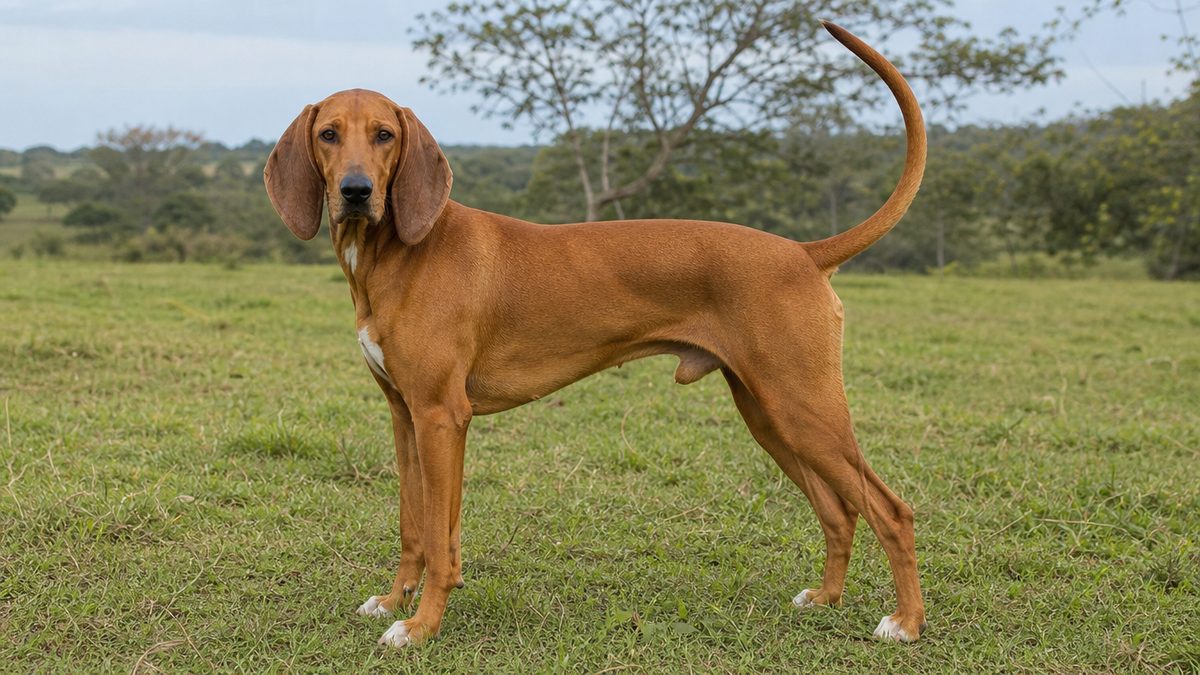
Quick answer
The colombian fino hound is a Colombian scent hound that the FCI accepted on a provisional basis as standard 376 on 11 February 2026, making it the first breed native to Colombia in the FCI nomenclature. It stands 45 to 58 cm and weighs 15 to 35 kg across two size varieties. It is effectively absent from India, where no rupee price, breeder or listing for it exists.
This page is general information, not veterinary advice. No published health survey, screening scheme or lifespan study exists for this breed, so nothing here can substitute for a veterinarian examining your own dog. Talk to a registered veterinarian before acting on anything here about diet, parasite control, vaccination or a suspected illness.
Colombian Fino Hound at a glance
What the Colombian Fino Hound is
The Colombian Fino Hound is a medium-sized Colombian scent hound of FCI Group 6, Section 1, entered in the FCI nomenclature as standard number 376 under its Spanish name, Sabueso Fino Colombiano. It is the only dog breed native to Colombia to appear in that nomenclature, and it arrived there on 11 February 2026.
The FCI standard describes a typical howling hound with long ears and a long tail, rectangular in proportion, a passionate hunter of substantial ruggedness, medium to large in size, with a smooth or rough coat in diverse colours. Its stated utilisation is tracking, hunting and companionship. The height-to-length proportion is 10:11.5, so the dog is longer than it is tall, and the depth of body from withers to elbow equals the distance from elbow to ground.
Physical characteristics, from the standard and from measured dogs
Two independent bodies of evidence describe this dog's size, and they agree. The FCI standard sets two size varieties, and researchers at the Universidad Nacional de Colombia measured real animals in the field. The table below puts both side by side.
| Source | Measure | Figure |
|---|---|---|
| FCI standard 376 | Standard variety, height at withers | 45-50 cm, tolerance 2 cm less |
| FCI standard 376 | Standard variety, weight | 15-25 kg |
| FCI standard 376 | Large variety, height at withers | 51-58 cm, tolerance 2 cm more |
| FCI standard 376 | Large variety, weight | 25-35 kg |
| Martinez and others 2015 | Mean height at withers, n=109 | 48.95 cm, standard deviation 4.07 |
| Martinez and others 2015 | Mean body length, n=109 | 56.85 cm, standard deviation 4.65 |
| Alvarez and others 2015 | Observed working size range | 45-55 cm |
The measured mean of 48.95 cm sits inside the standard variety's 45 to 50 cm band, which is what you would expect if the standard was written from the population rather than imposed on it. The survey covered 109 adults, 49 males and 60 females, recorded between June 2013 and December 2014 across seven departments: Caldas, Cundinamarca, Santander, Boyaca, Antioquia, Guajira and Magdalena.
Coat and colour
The 2026 standard recognises two coat varieties, and this is where the current text departs from every English page about the breed. A short-haired variety carries a short, smooth, shiny coat, while a wire-haired variety carries an even, dense, hard outer coat with an undercoat, a small beard on the muzzle and thick eyebrows. Colours run to red, black, brown and grey, with or without white, in various shades, patterns and combinations. Merle colouration is not accepted and merle-coloured specimens are a disqualifying fault.
The pendulous ears are the breed's signature and the standard is specific about them. They are long, set at the level of the outer corner of the eye or just below it, with rounded tips, and they must reach at least to the tip of the nose. Short ears that do not reach the nose are a severe fault. That single requirement drives most of what the grooming and health sections of this page have to say about an Indian monsoon.
What Colombians call it
The breed answers to five regional names, and an Indian reader searching in Spanish will meet all of them. It is Perro Fino generally, Sabueso Tinajero in Santander, Chapolo on the Colombian Caribbean coast, Bramador in Antioquia and Aullador elsewhere. The last two translate as bellower and howler, which tells you something useful about the voice before you ever meet one.
Roughly 1,500 dogs are registered with the Colombian kennel club nationwide. That is the registered population of the entire breed, worldwide, and it is smaller than the number of Labrador puppies advertised in India in a single month.
Breed recognition: what the registers actually say
The FCI recognises the Colombian Fino Hound on a provisional basis, as standard 376, with effect from 11 February 2026, and the Colombian national kennel club recognised it years earlier. Both halves of that sentence come from the registers themselves rather than from any article about them, because the pages currently ranking for this breed give four different answers.
The FCI position, read off the FCI
Bonbeno checked both FCI lists rather than one. The definitive nomenclature for Group 6, which covers scent hounds and related breeds, lists breeds by country of origin across three sections and contains no Colombian breed anywhere in it. The provisional register does contain it, printed as SABUESO FINO COLOMBIANO (376) (COLOMBIAN FINO HOUND), with a date of provisional recognition and a validity date both of 11 February 2026. The breed's own nomenclature entry states its breed status in one line, Recognized on a provisional basis, and gives its country of origin as Colombia. It also appears in the FCI's alphabetical nomenclature under the letter S, filed between the Sabueso Espanol and the Saluki.
It was not alone that day. Four breeds entered the provisional register with the same 11 February 2026 date: the Macedonian Shepherd Dog Karaman at 378, this breed at 376, the Segugio dell'Appennino at 375 and the Tatra Hound at 377. Three of the four are scent hounds.
What provisional status actually costs you
Provisional recognition is not a lesser version of the same thing, and the FCI spells out the difference on the register page itself. Provisionally recognised breeds are not eligible for the CACIB, the certificate that leads to the International Beauty Champion title, until they are recognised on a definitive basis. They are eligible for FCI titles such as Winner of the World Dog Show and the Section Shows, and pedigrees issued to dogs of these breeds have to carry the FCI logo.
| Register | Result | What that means |
|---|---|---|
| FCI definitive nomenclature, Group 6 | Absent | Not CACIB-eligible, not a fully recognised breed |
| FCI provisional register | Present, standard 376, 11 Feb 2026 | In the nomenclature, FCI-logo pedigrees, no CACIB |
| FCI alphabetical nomenclature, letter S | Present, links to entry 376 | Listed among all FCI breeds |
| Asociacion Club Canino Colombiano | Recognised nationally, standard published 2018 | Full national recognition, predates the FCI |
| Kennel Club of India | No Indian recognition found | No Indian registration route |
| Orthopedic Foundation for Animals | Absent from all statistics tables | No screening data published |
National recognition came first, and the ranking pages cannot agree when
Colombia recognised this breed nationally long before the FCI did, which is an ordinary and legitimate state for a breed to be in. The FCI standard itself credits its translation to the Asociacion Club Canino Colombiano, so the national club is the sponsoring body. On the date, though, the sources genuinely disagree, and Bonbeno prints the disagreement rather than picking one.
- Wag! says 21 April 2014, and gives a specific day.
- Colombia One says recognised since 2015.
- Spanish Wikipedia says recognised by the Club Canino Colombiano since 2015.
- The club's own president told El Colombiano it was about thirteen years ago, which points at 2013.
Two anchors are firmer than any of those four. Field research on the breed ran from June 2013 to December 2014, and the club's official written standard carries a publication date of 20 January 2018. So national recognition sits somewhere in 2013 to 2015, the written standard followed in 2018, and FCI provisional recognition came in 2026.
What changed between the 2018 Colombian standard and the 2026 FCI standard
Four substantive things changed when the Colombian standard became an FCI standard, and every English page about this breed still describes the older text. Bonbeno read both documents end to end and compared them clause by clause, which no ranking page does.
| Point | ACCC 2018 | FCI 376, 2026 |
|---|---|---|
| Coat varieties | Short coat only, corto, suave, brillante | Short-haired and wire-haired varieties, each in both sizes |
| Colours | Red, black, white, brown, brindle (atigrado) | Red, black, brown and grey, with or without white |
| Merle | Not mentioned | Not accepted, and a disqualifying fault |
| Entropion and ectropion | Not listed; drooping eyelids a severe fault | Both named as disqualifying faults |
| Eye shape | Almond (almendrada) | Oval |
| Achondroplasia | Disqualifying (ejemplares manetos) | Not listed as a named fault |
| Size, standard variety | 45-50 cm, 2 cm tolerance below, 15-25 kg | 45-50 cm, 2 cm tolerance below, 15-25 kg |
| Size, large variety | 51-58 cm, 2 cm tolerance above, 25-35 kg | 51-58 cm, 2 cm tolerance above, 25-35 kg |
The wire-haired variety is genuinely new to the written record
The wire-haired dogs existed before the standard did. The 2018 Colombian standard describes a single coat, short, soft and shiny, and the 2015 field survey of 109 dogs likewise recorded a smooth short coat in various colours and no wire-haired animals as a separate type. The FCI text of 2026 sets out two coat varieties in each of two sizes. El Colombiano explains where the difference came from: the genetic and phenotypic work found four types, standard and large in smooth coat plus standard and large in a hard coat known locally as barbillas.
The size figures did not change, and English pages report them wrongly anyway
Both standards give identical size figures, so any English page disagreeing with them is not reporting a change. English Wikipedia states the standard variety as 43 to 50 cm and the large variety as 51 to 60 cm, attributing both to the Colombian club's own 2018 PDF. That PDF says 45 to 50 cm with a tolerance of 2 cm below, and 51 to 58 cm with a tolerance of 2 cm above. Wikipedia has silently folded the tolerances into the ranges, which is why 45 minus 2 becomes its 43 and 58 plus 2 becomes its 60.
That is a defensible way to describe the outer envelope and a misleading way to state a breed standard, because a judge measures against 45 to 50 and then applies a tolerance. Read literally, the Wikipedia figures make a 43 cm dog ideal rather than tolerated.
Why the ectropion and entropion change matters in India
The 2026 standard makes ectropion and entropion disqualifying faults, and Indian law requires breeding dogs to have been tested for both. The Prevention of Cruelty to Animals (Dog Breeding and Marketing) Rules 2017, at Second Schedule Part III paragraph 8(10), requires that dogs shall have been tested for genetic defects, including hip dysplasia, progressive retinal atrophy, night blindness, hypothyroidism, entropion, ectropion, overshot and undershot jaw. The FCI standard disqualifies entropion, ectropion, prognathic bite and enognathic bite.
On this site most imported breeds produce a collision between what a breed standard wants and what Indian law permits. This one does not. The standard describes natural pendulous ears and a long undocked tail, so nothing in it invites a procedure that Second Schedule Part II paragraph 6(8) forbids, and its disqualifying faults line up with the defects Part III paragraph 8(10) makes testing mandatory for.
History and origins: a landrace population that became a breed
The Colombian Fino Hound formed from imported European and North American hunting dogs that peasants in Colombia selected for function over roughly two centuries. It is a landrace population that was documented into a breed, rather than a breed that was designed, and the documentation is recent enough to name the people who did it.
The FCI standard puts the raw history in two sentences. The breed developed in Colombia from packs of hounds and some pointing dogs brought from continental Europe, Great Britain and North America since the colonial period, and for over 200 years these dogs have been used in Colombia to track various game species, fully adapted to the country's diverse geography and climates. Its popularity crossed every social class, from presidents of the Republic hunting for sport down to peasants who often relied on the dog to obtain food.
One of those presidents is named. Guillermo Leon Valencia, Colombia's 29th president from 1962 to 1966, hunted with them, and it was peasants in remote areas who preserved the type afterwards.
Where the imported blood came from
Colombian and English sources name overlapping ancestor breeds, and a commercial DNA panel later quantified them. Historical documents suggest that between 1550 and 1800, Spanish-origin bloodhounds were brought to Colombia to hunt rodents, and that during the Colombian War of Independence British soldiers introduced Foxhounds and Pointers. Spanish sources add the Sabueso Espanol, the Azul de Gascuna, the Bloodhound and early coonhounds.
When the breed was registered in the Embark database, the reported ancestry breakdown was 47.3 percent North American hounds with coonhounds predominating, 20.3 percent continental European hounds including Basset Hound, Azul de Gascuna and Bloodhound, 10.5 percent English hounds represented by the Beagle and English Foxhound, and 22 percent an unresolved diverse fraction. Read that as reported rather than as settled, because the four figures sum to 100.1 percent, so at least one is rounded.
If the reported breakdown is right, the nearest relative of this dog by proportion is not a European hound at all. The Black and Tan Coonhound sits in the same FCI Group 6, Section 1, large-sized hounds, as standard 300.
How a farm dog became a register entry
The work took about a decade and it started with a farmer. Chejo Marin, a campesino, had been collecting information on these dogs since 2007. A student, later the zootechnician Jonathan Alvarez Sarmiento, found Marin's files online in 2012, and a group from the Universidad Nacional de Colombia began travelling the country with the Brazilian cynophile Stefano Trindade, measuring dogs and building a census. They worked the Llanos, the Santanderes, La Guajira, the Sierra Nevada, Boyaca and Cordoba.
They recorded information and measurements on about 400 dogs and published in a scientific journal. Two of those papers are the field surveys this page cites throughout, both published in Actas Iberoamericanas de Conservacion Animal in 2015 Alvarez J. and others. Reaching the FCI then required assembling up to four families of dogs across five to six generations that did not interbreed, in order to prove a large population sharing the same characteristics.
Genetic foci, and why the breed is called vulnerable
Colombia's geography split the population into regional pockets that are named in the literature. Spanish-language sources identify genetic foci in the Rio Suarez basin, the Llanos Orientales, the plains of the Rio Cauca and Rio Sinu, the mountains of Antioquia, the Caribbean region and the Rio Magdalena. Those pockets matter enormously for the climate section, because they sit at wildly different altitudes.
The population is described as vulnerable for two reasons that have nothing to do with disease. Indiscriminate crossing with imported hounds outside the national gene pool, specifically the Beagle and the Basset Hound, dilutes the type, and hunting has almost vanished from Colombian life. Colombia's Constitutional Court banned recreational hunting in February 2019, ruling the norms authorising sport hunting unconstitutional and allowing a one-year grace period Michigan State University Animal Legal…. A hunting breed in a country that no longer hunts has to find another job.
Colombian Fino Hound price in India
No Colombian Fino Hound price exists in India, because no Indian seller, breeder, listing or rupee figure for the breed exists. That is the answer, and the rest of this section is the evidence for it plus what you will actually be shown if you go looking.
How that absence was tested
An absence is only worth publishing if the search that produced it can be shown to work. Searching the breed name plus price in india from an India location returned no Indian marketplace, no breeder and no rupee figure anywhere in the top ten. The same tool, in the same session, asked for a labrador retriever price in india, returned a full Indian puppy marketplace quoting Rs 30,000-60,000 for basic quality, Rs 60,000-90,000 for KCI registered and Rs 90,000-1,20,000 for champion bloodline. The tool was working and the Indian price web was reachable, so the zero is real.
What ranks in India instead
The ninth result for the breed's Indian price query is a generic Indian dog price list, and the breed is not in it. That page publishes a table of more than 50 breeds with puppy prices, monthly costs, lifespan and size, and the Colombian Fino Hound appears nowhere in it. A page ranking for a query is not a page containing an answer to it, and this is the clearest example of the pattern on this breed.
The conversion test, run and reported even though it failed
Bonbeno divides suspicious Indian price tables by the exchange rates that expose a converted US price list, and this table is not one. None of its 46 rupee values divides to a whole dollar figure at 84.38, and none at 74. Thirty of the 46 appear to divide cleanly at 80, but 45 of those 46 values end in at least three zeros, and 1,000 divided by 80 is exactly 12.5, so a match at 80 is arithmetic rather than evidence.
| Rate tested | Values dividing to a whole dollar | Verdict |
|---|---|---|
| 84.38 | 0 of 46 | No match |
| 74.00 | 0 of 46 | No match |
| 80.00 | 30 of 46 | Structural artefact, not evidence |
That table is rupee-native. Its Indian breeds carry distinct local prices, from Rs 8,000-25,000 for a Mudhol Hound to adoption to Rs 15,000 for an Indian Pariah Dog Wrapinfur, Dog Price List in India 2026, which is the opposite of the signature a wholesale conversion leaves. Reporting a test that did not fire matters as much as reporting one that did.
The only currency figures that exist anywhere
Two dollar figures appear across the entire ranking set, both from one US page and neither a purchase price. That page gives annual vet bills of 750 to 2,000 US dollars and a food cost of 1.50 to 1.90 dollars a day, alongside a monthly food cost of 39 to 52 dollars. Those last two rows contradict each other, since 1.50 a day over 30 days is 45 dollars and 1.90 is 57.
A US marketplace listing page for the breed advertised a national band of 1,000 to 1,500 dollars in its search snippet, but the page itself did not show that figure when Bonbeno opened it. A snippet is not a page, so no purchase price is reported here.
Treat any rupee figure for this breed as describing a different dog. Roughly 1,500 dogs of the breed are registered worldwide, India's import rules reject applications made for trading or breeding purposes outright, and no lawful supply chain into India can form from those two facts together.
Import rules: why the lawful route into India closes
India permits a dog to be imported for exactly three purposes, and buying a rare foreign breed is not one of them. The Directorate General of Foreign Trade sets this out in Trade Notice 22/2022-23 of 19 December 2022, which Bonbeno read in full from the DGFT's own server rather than from any summary of it.
Dogs enter India under ITC (HS) code 01061900, mammals other, which carries an import policy of Restricted. Policy Condition 7 then limits imports of dogs to three cases, quoted here from the notice itself.
- A pet dog with a valid pet book and relevant records or documents in the name of the importer.
- Dogs imported by research and development organisations for conducting research, with the recommendation of CPCSEA.
- Dogs for internal security by the Defence and Police Force.
Policy Condition 8 closes the remaining door. Import of commercial dogs for breeding or any other commercial activities other than the purposes mentioned above is not permitted. Paragraph 6 of the same notice adds that any applications for trading or breeding purposes, or applications made on behalf of some other person or entity, shall be duly rejected.
What the pet route actually requires
The only realistic route is the first one, and it is narrow. Permanent import as passenger baggage without DGFT authorisation is allowed only to persons transferring their residence to India after two years of continuous stay abroad, and only for cats and dogs. Fewer than two years abroad, transport other than as passenger baggage, or more than two animals all trigger a requirement for a DGFT import authorisation, examined against justifications submitted to the Department of Animal Husbandry and Dairying.
| Requirement | What the notice says |
|---|---|
| Import policy | Restricted under ITC (HS) 01061900 |
| Permitted purposes | Pet with pet book in importer's name, R&D with CPCSEA recommendation, Defence and Police |
| Commercial breeding imports | Not permitted |
| Trading or breeding applications | Shall be duly rejected |
| Baggage route | Transfer of residence after two years continuous stay abroad |
| Permitted ports | Delhi, Mumbai, Chennai, Hyderabad, Bengaluru, Kolkata and, since October 2024, Kochi, and no others |
| Advance NOC | From the AQCS Regional or Quarantine Officer, seven days before travel |
| Lead time advised | At least two months before travel |
Entry is confined to seven places. Import of pet animals is allowed only through the airports and seaports of Delhi, Mumbai, Chennai, Hyderabad, Bengaluru and Kolkata and, since October 2024, Kochi airport, and animals may be quarantined at the government quarantine station of those ports Department of Animal Husbandry…. An advance No Objection Certificate must be obtained from the Regional or Quarantine Officer after submitting the DGFT import licence and a health certificate from a veterinarian in the exporting country, seven days before travel and relaxable to three. The full route is set out in how to import a dog to India.
Why this matters more for this breed than most
Two facts have to be read together. India will not authorise an import for breeding or trading, and Colombia has roughly 1,500 registered dogs whose valid registrations the national club says are centralised with itself. There is therefore no lawful mechanism by which a breeding population of this breed could be established in India, which is why the price section reports no market rather than a thin one.
A person relocating to India from Colombia or the United States, who already owns a Fino, with a pet book in their own name and two years of continuous residence abroad, can lawfully bring the dog. That is the entire realistic route, and it produces individual dogs rather than a supply.
Monthly cost of ownership for a dog of this size in India
Budget Rs 4,000-8,000 a month for the standard variety and Rs 6,000-12,000 for the large variety, using published Indian costs for medium and large dogs. No Indian cost data exists for this breed specifically, so these are size-class figures and this section says so rather than dressing them up as breed data.
The two size varieties fall into different Indian cost brackets, which is unusual and worth planning around. A standard-variety Fino at 15-25 kg is a medium dog by Indian pricing convention, while a large-variety Fino at 25-35 kg is a large one. The gap between those brackets is roughly Rs 2,000-4,000 every month, for the same breed.
| Expense | Medium dog, standard variety | Large dog, large variety |
|---|---|---|
| Food and treats | Rs 2,000-4,000 | Rs 3,000-6,000 |
| Grooming | Rs 800-2,000 | Rs 1,000-3,000 |
| Veterinary care | Rs 500-1,500 | Rs 500-2,000 |
| Toys and enrichment | Rs 500-1,500 | Rs 500-2,000 |
| Accessories and miscellaneous | Rs 500-1,500 | Rs 500-2,000 |
| Estimated monthly total | Rs 4,000-8,000 | Rs 6,000-12,000+ |
The first year costs more than any year after it. Published Indian first-year totals run Rs 55,000-2,00,000 and upward for a medium dog and Rs 75,000-3,00,000 and upward for a large one, once initial vaccinations at Rs 3,000-8,000, deworming and preventive care at Rs 1,000-3,000, bedding, bowls and training are added.
Three costs that would run higher for this breed than for its size class
- Tick and flea prevention, year-round rather than seasonal, because a scent hound works nose-down in cover and Indian tick pressure is documented and heavy.
- Ear care, because ears that must reach the tip of the nose trap moisture in a humid climate and ear infection is the recurring complaint on this breed.
- Secure fencing or a long line, because a hound that has locked onto a scent does not hear you and a lost dog is the most expensive outcome on this list.
The published food figure is worth sanity-checking against portion size rather than accepting. The one US source giving a portion for this breed says 2 to 3 cups of high-quality food a day Penny Sebring, Perro fino Colombiano, Wag!, which for a 20 kg working-built dog is a reasonable maintenance ration and sits inside the Indian medium-dog food band above.
None of these numbers was measured on a Colombian Fino Hound in India, because no such dog is known to be kept here. They are Indian costs for Indian dogs of the same weight, which is the most honest thing available, and they should be read as a size-class budget rather than a breed figure.
Heat tolerance and the Indian climate: which Colombia are we talking about?
A Colombian Fino Hound from lowland Colombia is genuinely adapted to humid tropical heat, and one from highland Colombia is not, so the breed's heat tolerance depends entirely on which part of its home range a dog's family came from. Colombia spans sea level to over 2,000 m within a few dozen kilometres, and the breed's documented genetic foci sit at both extremes.
Bonbeno queried NASA POWER by explicit latitude and longitude for every location below, so no place name could be silently substituted for another. The figures are 20-year climatologies covering January 2001 to December 2020, drawn from MERRA-2, and the elevation shown is the one POWER returns for that grid cell. Wet-bulb temperature is used rather than air temperature because it is what actually limits a panting dog.
| Location | Latitude, longitude | Cell elevation | Annual mean wet-bulb | Monthly range |
|---|---|---|---|---|
| Sincelejo, Sucre, Colombia | 9.30 N, 75.40 W | 49 m | 25.9 C | 25.1-26.4 C |
| Monteria, Rio Sinu, Colombia | 8.75 N, 75.88 W | 62 m | 25.6 C | 24.9-26.1 C |
| Puerto Gaitan, Llanos, Colombia | 4.31 N, 72.08 W | 164 m | 24.4 C | 23.9-24.9 C |
| San Gil, Rio Suarez, Colombia | 6.55 N, 73.13 W | 1,739 m | 17.0 C | 16.7-17.5 C |
| Bogota, Colombia | 4.71 N, 74.07 W | cell mean | 16.5 C | 15.8-17.1 C |
| Medellin, Antioquia, Colombia | 6.25 N, 75.56 W | 2,074 m | 15.4 C | 15.1-15.8 C |
| Manizales, Caldas, Colombia | 5.07 N, 75.52 W | cell mean | 14.8 C | 14.2-15.3 C |
| Chennai, India | 13.08 N, 80.27 E | 49 m | 24.9 C | 21.8-27.4 C |
| Kolkata, India | 22.57 N, 88.36 E | cell mean | 22.9 C | 13.6-27.9 C |
| Mumbai, India | 19.08 N, 72.88 E | cell mean | 22.7 C | 17.1-26.6 C |
| Bengaluru, India | 12.97 N, 77.59 E | cell mean | 19.8 C | 16.4-22.7 C |
| Delhi, India | 28.61 N, 77.21 E | cell mean | 18.0 C | 6.9-27.7 C |
The lowland claim is real, and this is the pairing that proves it
Compare Sincelejo with Chennai, because POWER returns almost the same elevation for both, 49 m in each case. Sincelejo's annual mean wet-bulb of 25.9 C is about a degree higher than Chennai's 24.9 C. A Fino whose family came off the Caribbean plain or the Rio Sinu therefore comes from somewhere with a higher year-round humid-heat load than Chennai, which is a claim almost no European breed on this site can make.
But India's peak is hotter than anything Colombia produces
Constant heat and seasonal heat are different problems, and this breed is adapted to the first. Colombia's lowland wet-bulb varies by only 1.1 to 1.4 C across an entire year, while Chennai's swings 5.6 C, Kolkata's 14.2 C and Delhi's 20.9 C. Delhi's July mean wet-bulb of 27.7 C and Kolkata's June figure of 27.9 C both exceed the hottest month anywhere in the breed's Colombian range.
So the honest reading is that a Fino would find Chennai's climate familiar in kind and manageable in degree, would find Delhi's summer peak worse than anything in its ancestry, and would find Delhi's winter unlike anything its ancestors ever met.
The altitude problem, which no other page raises
Half the breed's documented home range is cool. Spanish-language sources place genetic foci in the mountains of Antioquia and the Rio Suarez basin alongside the Caribbean and the Llanos. Antioquia's grid cell returns an annual mean wet-bulb of 15.4 C and Caldas 14.8 C, both cooler year-round than every Indian metro in the table, including Bengaluru. A dog from those pockets carries no lowland heat adaptation at all.
POWER's native grid smooths terrain, and in Colombia that matters. The Medellin cell returns an elevation of 2,074 m against the city's own figure of roughly 1,495 m, because the cell averages the surrounding Cordillera Central. Treat the highland numbers as cell means that get the direction right rather than as city readings.
Temperament and household fit
The Colombian Fino Hound is stubborn while hunting and affectionate at home, which is the FCI standard's own summary and matches what Colombian researchers recorded in the field. It is friendly towards strangers and lives easily in groups with other dogs, and it is loud. The living conditions that suit it best are rural, though Colombian city dogs have adapted to flats.
The standard's behaviour clause is unusually blunt for an FCI text. Stubborn in hunting, affectionate at home, and excels as a companion dog, with hunting instincts that make it capable of living in groups with other dogs and friendly towards strangers. The 2015 field survey of 109 adults independently recorded a sociable, affectionate and friendly temperament with people. Two sources, one written to define the breed and one written to describe it, agreeing.
The voice is the deal-breaker for Indian apartments
This dog was named for its noise in two Colombian regions. It is the Bramador, the bellower, in Antioquia and the Aullador, the howler, elsewhere. The zootechnician who has worked with the breed for fourteen years put it plainly, saying they are sweet and intelligent and yes, they bark loudly, and that you end up getting used to it.
Colombian experience with apartments is more encouraging than you would expect and should still be read carefully. The club's position is that these are ideally farm dogs, but that dogs kept in apartments and in cities have done well, and that the concern about the voice has not so far produced problems. Colombian apartment blocks are not Mumbai apartment blocks, and a howling hound in a shared-wall Indian building is a neighbour dispute waiting to happen.
Who this breed suits
- Households with other dogs, since the standard describes a pack animal that lives in groups.
- Households with children, since Colombian sources describe it as affectionate with children.
- Households with visitors, since the standard calls it friendly towards strangers rather than protective.
- Households with ground floor access and a secure boundary, since scent-driven dogs leave.
Who it does not suit
Anyone wanting a guard dog should look elsewhere, because friendly towards strangers is written into the standard and aggressive or overly shy dogs are a disqualifying fault. Anyone in a shared-wall flat with noise-sensitive neighbours should take the two regional names seriously. Anyone who wants reliable off-lead recall should understand that stubborn in hunting is the standard's own phrase and that a scent hound following a track is not being disobedient, it is doing the job it was selected for over two centuries.
With hunting banned in Colombia since 2019, the breed's nose has been redirected. Two or three dogs work at Colombian airports with the authorities on tracking tasks, and the club argues the same ability suits search and rescue Wikipedia, Colombian Fino Hound. That is the realistic modern job for this dog.
Training a scent hound that the standard itself calls stubborn
To train a Colombian Fino Hound, work with the nose rather than against it, because the FCI standard describes a dog that is stubborn in hunting and affectionate at home. No breed-specific training study exists, so this section applies what the standard and the Colombian sources say about this dog to what is known about scent hounds generally, and labels which is which.
What the breed makes easy
Two traits in the standard work in a trainer's favour. Friendly towards strangers means socialisation visits are low-stress rather than a management problem, and capable of living in groups with other dogs means dog-to-dog introductions are usually straightforward. Colombian handlers describe the temperament as sweet, understanding and intelligent, which is a description of a trainable dog that learns quickly when it wants to.
What it resists
Recall is the hard problem and it is structural, not behavioural. A hound selected across two centuries to track game through Colombian forest does not stop tracking because a person calls. Treat off-lead freedom in an unfenced Indian park as a decision to lose the dog, and use a long line while you build the behaviour. This is the same problem Indian Beagle owners describe, for the same reason.
A realistic first-year plan
- Weeks 8 to 16: socialise hard, since the standard's friendly temperament is worth protecting rather than assuming.
- Weeks 12 to 20: build a name response and a hand target indoors, away from competing scent.
- Months 4 to 7: train recall on a long line only, and pay it heavily every single time.
- Months 6 to 12: introduce scent games, so the nose has a legitimate outlet you control.
- Months 9 to 18: expect an adolescent regression in recall, and go back to the long line without treating it as failure.
Give the nose a job or it will find one. Scent work, tracking games and food puzzles use the same drive that makes this dog difficult on a walk, and a hound that has tracked something deliberately for twenty minutes is a calmer animal afterwards. The Colombian club's own view is that these dogs are ideally kept on farms, and scent work is the closest an Indian flat gets to that.
Nothing in this section rests on a study of this breed, because none exists. PubMed returns zero records for the breed under either name, so the training advice here is inference from the standard and from Colombian handlers, and it is labelled as such rather than presented as breed research.
Daily exercise requirement
Plan on at least an hour of real exercise a day, split into two sessions timed around the heat. That figure is not a breed study, it is the only published activity guidance for the breed, and it is consistent with a medium working hound built to cover ground.
The one page that quantifies activity for this breed puts it at 60 minutes a day and roughly 10 miles of walking a week. Sixteen kilometres a week across seven days is about 2.3 km a day, which is a low figure for a hound and should be read as a floor rather than a target for a young adult. The standard describes agile, effortless, balanced movement with good reach and drive, which is a description of an animal built for distance.
Timing matters more than duration in India
Split the hour and put both halves outside the heat of the day. In Chennai the mean wet-bulb runs above 26 C from April through September, and a dog cannot shed heat efficiently by panting when the air is already close to saturation at body-relevant temperatures. Early morning and after dark are the workable windows in every Indian metro in the climate table for most of the year.
| City | Peak month | Peak mean wet-bulb | Practical window |
|---|---|---|---|
| Delhi | July | 27.7 C | Before 6 am and after 9 pm, June to September |
| Kolkata | June | 27.9 C | Before 6 am and after 9 pm, May to September |
| Chennai | May | 27.4 C | Before 6 am and after 8 pm, most of the year |
| Mumbai | June | 26.6 C | Before 7 am and after 8 pm, April to September |
| Bengaluru | May | 22.7 C | Widest window of the five, most mornings usable |
What happens without it
An under-exercised scent hound gets loud and gets out. Both failure modes are specific to this breed rather than generic: the voice that earned it the names Bramador and Aullador becomes a daily event, and a bored hound works the boundary of a compound until it finds the gap. Weight is the third consequence, and the only structured health list published for the breed names obesity as its major concern.
Twenty minutes of scent work in a cool room does more for a hound than forty minutes of lead walking in 27 C wet-bulb air, and it carries none of the heat risk. Use it deliberately through the Indian summer rather than as an occasional game.
Grooming two coat varieties in Indian humidity
Grooming a Colombian Fino Hound is easy on the coat and demanding on the ears, and which coat variety you have decides the workload. The FCI standard recognises a short-haired and a wire-haired variety, and in an Indian monsoon the ears matter more than either.
The short-haired variety
A short, smooth, shiny coat needs almost nothing. Weekly brushing with a rubber mitt lifts dead hair and spreads skin oils, and the 2015 field survey describes fine, elastic skin with a smooth short coat. Bathe only when the dog is actually dirty, because over-bathing in a humid climate strips the coat and leaves skin damp for longer than it should be.
The wire-haired variety, known in Colombia as barbillas
The wire coat carries an undercoat and needs real work. The standard describes an even, dense, hard outer coat that should have an undercoat, a small beard on the muzzle and thick eyebrows, and a woolly coat in the wire-haired variety is a severe fault. Brush twice a week in dry months and closer to daily through the monsoon, and hand-strip rather than clip if you want the harsh texture the standard asks for.
The standard makes specimens with long fur a disqualifying fault and asks for a hard outer coat with undercoat in the wire variety. Shaving a double coat in Indian heat removes the insulation that slows solar gain and does not make the dog cooler.
The ears are the real grooming job
Ears that must reach the tip of the nose seal the ear canal against airflow. The standard requires ears long enough to extend beyond the muzzle without difficulty and at minimum to reach the tip of the nose, with folds permitted, and short ears are a severe fault. That is a design brief for a warm, dark, damp canal in a country with a monsoon, and it is why the only published health list for the breed names ear infections among its minor concerns.
Advice written for Tennessee needs adjusting here. The US kennel that breeds them recommends baths focusing on the eyes and ears to avoid odour and infections, which is right in principle and incomplete for India. Plug the ears before a bath, dry inside the leather and the canal opening afterwards, and lift and air the ear flaps for a minute daily through July and August rather than waiting for a smell.
- Check both ears every day in the monsoon, and twice weekly the rest of the year.
- Dry the canal opening after every bath, every swim and every soaking walk.
- Look for head-shaking and odour, which precede visible discharge.
- See a veterinarian before using any ear cleaner, because treating the wrong cause makes an infection worse.
Health risks and life expectancy: what is actually known
Almost nothing is published about this breed's health problems, and Bonbeno prints no life expectancy figure for it. Two databases were searched with controls run in the same session to prove the searches worked, and both returned the breed as absent. That absence is the finding.
PubMed returns zero, from a query it had already broadened
There is no veterinary literature on this breed. Searching PubMed for Sabueso Fino Colombiano returned 0 records, and the database's own query translation shows it had already loosened the phrase into three separate all-fields terms joined by AND. Searching for Colombian Fino Hound also returned 0, from a translation that expanded Colombian to include a supplementary concept for Colombian people. A broadened query returning zero is a stronger negative than a strict phrase search returning zero.
Two controls were run in the same session and both behaved normally. Labrador Retriever with hip dysplasia returned 126 records and Bergamasco with dog returned 13, so the tool was working and only the breed was missing.
The OFA has no row for this breed either
The Orthopedic Foundation for Animals publishes no screening statistics for it. Bonbeno retrieved OFA's complete disease-statistics tables, roughly 2.2 million characters covering every breed it holds, and searched case-insensitively: COLOMBIAN, SABUESO, FINO and COLOMBIA each returned zero. In the same retrieval LABRADOR returned 109 rows, COONHOUND 60, BEAGLE 61 and BLOODHOUND 41, so the dump was intact and the absence is real.
| Database | Breed query | Result | Control | Control result |
|---|---|---|---|---|
| PubMed | Sabueso Fino Colombiano | 0 records | Labrador Retriever AND hip dysplasia | 126 |
| PubMed | Colombian Fino Hound | 0 records | Bergamasco AND dog | 13 |
| OFA statistics | COLOMBIAN / SABUESO / FINO | 0 rows | LABRADOR | 109 rows |
| OFA statistics | COLOMBIA | 0 rows | COONHOUND | 60 rows |
Why Bonbeno publishes no lifespan
The only life expectancy figure anywhere for this breed is 12 to 13 years, printed by a US kennel that sells the puppies. Four of the six pages ranking for the breed give no lifespan at all, including both large aggregators Puppies.com, Colombian Fino Hound Complete…. With no cohort study, no insurance dataset and no breed-club survey behind it, a single seller's figure is not a lifespan, so this page carries none.
What the standard implies you should screen for
The breed's own standard names the conditions its register cares about, and that is the best available screening guide. Entropion, ectropion, prognathic bite, enognathic bite, blue or differently coloured eyes, albinism and merle colouration are all disqualifying faults in FCI standard 376. The Colombian standard of 2018 adds achondroplasia, ejemplares manetos, as disqualifying.
Indian law happens to require testing for most of that list. Second Schedule Part III paragraph 8(10) of the Dog Breeding and Marketing Rules 2017 requires that breeding dogs shall have been tested for genetic defects, including hip dysplasia, progressive retinal atrophy, night blindness, hypothyroidism, entropion, ectropion, overshot and undershot jaw, wry mouth, two or more missing teeth and cryptorchidism. The word in the clause is including, so the list is illustrative rather than closed.
A single ranking page publishes a structured condition list for this breed, naming obesity as a major concern, ear and eye infections as minor concerns and hip dysplasia as an occasional diagnosis. It cites no study, no sample size and no register, and the same page prints identical measurements for males and females. Treat it as plausible for a medium hound rather than as data about this breed.
The Indian health risks that would actually matter for this dog
Tick-borne disease is the risk that would dominate this breed's life in India, because a scent hound works nose-down through vegetation and Indian tick pressure is heavy, seasonal and well documented. None of the studies below is about this breed, and all of them are about Indian dogs, which for an imported hound is the more useful evidence.
Ehrlichiosis in tropical South India
Canine monocytic ehrlichiosis is common enough in south Indian clinics to expect it. A 2026 cross-sectional study sampled 442 clinically suspected dogs presented to 90 veterinary dispensaries across Andhra Pradesh and found Ehrlichia canis in 37 of 442 by blood-smear microscopy, 8.37 percent, and in 51 of 442 by PCR, 11.54 percent. Dogs with tick infestation had significantly higher odds of infection, and dogs with a history of tick-control measures had lower odds.
The gap between the two methods is the practical lesson. PCR found infection in 14 dogs that microscopy missed, so a negative smear does not clear a dog and a hound with a fever and a tick history deserves the confirmatory test.
Babesiosis in northern India
Babesia is at least as common further north. A 2026 study of 216 dogs in northern India found an overall prevalence of 12.5 percent, 27 of 216, by microscopy and 27.78 percent, 60 of 216, by PCR. Babesia vogeli was the predominant species at 22.22 percent by PCR against Babesia gibsoni at 5.55 percent, and haemoglobin, packed cell volume and platelet counts were significantly reduced in affected dogs.
| Study region | Pathogen or measure | Sample | Finding |
|---|---|---|---|
| Andhra Pradesh | Ehrlichia canis, microscopy | 442 suspected dogs | 37 of 442, 8.37 percent |
| Andhra Pradesh | Ehrlichia canis, PCR | 442 suspected dogs | 51 of 442, 11.54 percent |
| Northern India | Any Babesia, PCR | 216 dogs | 60 of 216, 27.78 percent |
| Northern India | Babesia vogeli, PCR | 216 dogs | 22.22 percent |
| Wayanad, Kerala | Ticks collected, monsoon | 2,562 ticks total | 1,231, 48.06 percent |
| Wayanad, Kerala | Ticks collected, winter | 2,562 ticks total | 965, 37.66 percent |
| Wayanad, Kerala | Ticks collected, summer | 2,562 ticks total | 366, 14.28 percent |
The tick season is not the season most owners expect
Monsoon yields the most ticks and winter puts the most ticks on each animal, and those are two different statements. A longitudinal survey across 40 locations in Wayanad, Kerala, between 2022 and 2024 collected 2,562 ticks and found abundance highest in the monsoon at 1,231 ticks, 48.06 percent of the total, ahead of winter at 965 and summer at 366. Yet mean tick burden per animal was highest in winter, and the regression put winter moderately above monsoon at an incidence rate ratio of 1.15 while summer fell to 0.36.
Read together, that argues for year-round prevention rather than a monsoon push. Dogs carried 313 of the 2,562 ticks, 12.2 percent, behind cattle and goats, so a dog sharing space with livestock is in the higher-risk setting.
Heat illness, and why the breed's absence from the risk lists proves nothing
No heat-illness dataset includes this breed, and that is a data gap rather than reassurance. A study of heat-related illness in New South Wales identified 119 cases between 1997 and 2017 with a fatality rate of 23 percent, and listed the breeds at elevated risk against crossbreeds, including the Labrador Retriever, Golden Retriever, Border Collie and several brachycephalic breeds. The Colombian Fino Hound appears nowhere on that list because it does not live in Australia, not because it is heat-proof. Older dogs were at increased risk, and that finding does transfer.
Feeding and nutrition in India
Feed a Colombian Fino Hound to body condition rather than to a chart, because the only published health list for the breed names obesity as its single major concern. No breed-specific nutritional research exists, so what follows is portion guidance from the sources that do quantify it, plus the Indian practicalities.
Published portions for this breed cluster around two to three cups of a good complete food a day. The US kennel breeding them states 2 to 3 cups of high-quality food per day, and the one aggregator giving a portion says 3 cups Penny Sebring, Perro fino Colombiano, Wag!. Split that across two meals rather than one, and treat it as a starting point you then adjust by what you can feel over the ribs.
Why body condition beats a cup measure for this breed
The two size varieties differ by up to 20 kg, so one portion cannot serve both. A standard-variety dog weighs 15 to 25 kg and a large-variety dog 25 to 35 kg under the same standard, which is the difference between feeding a Beagle-plus and feeding a large hound. Run your hands along the ribs weekly and adjust the ration by roughly 10 percent when the covering changes, rather than measuring more precisely.
Life-stage feeding
- Weeks 8 to 16: four meals a day of a complete puppy food, kept to portion rather than free-fed.
- Months 4 to 8: three meals a day, with growth watched rather than pushed.
- Months 8 to 18: two meals a day, moving to an adult formula suited to the projected adult weight.
- Adult: two meals a day, adjusted seasonally because appetite drops in Indian summer.
- Senior: two meals a day, with portion cut as activity falls to protect against the obesity risk.
Indian practicalities
Availability is not the constraint in India, storage is. Indian humidity spoils kibble faster than most feeding guides assume, so buy pack sizes you will finish within a few weeks and keep them sealed and off the floor. Fresh water in more than one place matters more for a working-built hound in this climate than any specific formula, particularly through the months when the wet-bulb temperature sits above 26 C.
The US kennel breeding this dog feeds a biologically appropriate raw food diet. That is their choice on their farm, and it carries handling and pathogen considerations that change in an Indian kitchen and an Indian cold chain. Discuss any raw diet with a veterinarian before adopting it rather than copying a breeder's practice across climates.
Month by month through the first year
The first year with a scent hound is a socialisation window followed by a recall problem, and planning for both in order is what separates a manageable adult from an escape artist. The timeline below combines the vaccination schedule Indian law assumes with what the breed's own standard and Colombian handlers describe.
| Age | Focus | What to get right |
|---|---|---|
| Under 8 weeks | Still with the litter | Indian law prohibits sale of pups under eight weeks, at Rule 8(1)(a) |
| 7 to 18 weeks | Vaccination course | The Rules note vaccination can start at seven to eight weeks and usually completes by eighteen |
| 8 to 16 weeks | Socialisation | People, traffic, other dogs, surfaces, handling of ears and feet |
| 3 to 5 months | Ear routine | Daily ear checks become habit before the first monsoon |
| 4 to 7 months | Long-line recall | Never off-lead in unfenced space, no exceptions |
| 6 to 9 months | Scent games | Give the nose a sanctioned job |
| 9 to 14 months | Adolescence | Expect recall to collapse and rebuild it without escalating |
| 12 to 18 months | Adult food and load | Move to adult rations; build distance gradually in cool hours |
The eight-week rule, cited correctly
India sets a floor on how young a pup may be sold, and it sits in the Rules rather than the Schedule. Rule 8(1)(a) of the Prevention of Cruelty to Animals (Dog Breeding and Marketing) Rules 2017 provides that pups less than eight weeks in age are not sold. That is a different provision from the Second Schedule paragraph 8 on veterinary care, and the two are easy to confuse because the document numbers clauses twice.
What the breeding rules mean for anyone producing a litter
Anyone breeding dogs in India is bound by the Second Schedule whichever breed they keep. Second Schedule Part II paragraph 6(2) permits only out breeding and line breeding, while paragraph 6(3) prohibits in breeding and incest breeding, defining in breeding as mating between relatives of the second to fourth grade within the first four generations, including uncle to niece and cousin to cousin. Paragraph 6(8) forbids tail docking, ear cropping, de-barking, de-clawing and any change of appearance by artificial means, and paragraph 6(9) prohibits breeding to create new breeds or unusual looks.
Those limits bite unusually hard on a breed with roughly 1,500 registered dogs worldwide. Building a population from a handful of imported animals would require exactly the close matings that Second Schedule Part II paragraph 6(3) prohibits, which is a second and independent reason no Indian breeding programme for this breed can lawfully form.
Nothing in FCI standard 376 asks for a procedure Indian law forbids. The ears are naturally pendulous and the tail is long, reaching beyond the hock and carried high in a sabre shape, so no owner faces the docking and cropping conflict that Second Schedule Part II paragraph 6(8) creates for many imported breeds.
Colombian Fino Hound compared with the scent hounds an Indian buyer can actually get
Compared with the scent hounds sold in India, the Colombian Fino Hound differs on one decisive point: you cannot lawfully buy one here. The table below sets it beside four Group 6 breeds that are genuinely available in the Indian market and two Indian breeds that fill the same role, using the FCI nomenclature for registry status and a published Indian price list for the rupee bands.
| Breed | FCI status | Height at withers | Indian puppy price | Monthly cost | Sold in India |
|---|---|---|---|---|---|
| Colombian Fino Hound | Provisional, standard 376, 11 Feb 2026 | 45-50 cm standard, 51-58 cm large | No rupee figure exists | No Indian data | No |
| Beagle | Definitive, standard 161 | 33-40 cm | Rs 15,000-40,000 | Rs 3,500-7,000 | Yes, widely |
| Basset Hound | Definitive, standard 163 | Short-legged, achondroplastic | Rs 30,000-70,000 | Rs 4,000-7,000 | Yes |
| Dalmatian | Definitive, standard 153, Group 6 Section 3 | Medium, square | Rs 20,000-60,000 | Rs 4,000-7,500 | Yes |
| Dachshund | Definitive, Group 4 | Short-legged, achondroplastic | Rs 15,000-40,000 | Rs 3,000-5,500 | Yes, widely |
| Indian Pariah Dog | Not in the FCI nomenclature | Medium, variable | Adoption to Rs 15,000 | Rs 2,000-4,000 | Yes, adoptable |
| Rajapalayam | Not in the FCI nomenclature | Large sighthound | Rs 10,000-30,000 | Rs 3,000-5,500 | Yes |
Read the height column carefully, because it settles the commonest confusion about this breed. The Colombian researchers who measured 109 adult Finos across seven departments compared them directly against the FCI standards of four hound breeds and found the Fino's working size of 45 to 55 cm exceeds only the Beagle, at 33 to 40 cm. A Fino is not a big Beagle. It is a leggier, taller, longer-bodied animal that happens to share the long pendulous ears and the short coat.
The same paper names the trap in the other direction, and it is the reason this comparison matters commercially. Its authors wrote that because the breed was not internationally recognised, Finos were commonly sold and shown as dogs of other breeds that share the plastic characteristics of long ears, medium size and short hair, in order to raise their commercial value. That was the risk in Colombia. In India the risk runs the opposite way, and an Indian buyer should assume any long-eared, medium, short-coated dog offered as a Fino is one of the breeds in the table above, or a crossbreed.
Which of these actually suits an Indian home
Choose on heat and housing rather than on rarity. The Indian Pariah Dog is the honest answer for most Indian households wanting a medium, rustic, short-coated dog, and at adoption to Rs 15,000 with Rs 2,000-4,000 a month it is the most affordable option in the table. The Beagle is the closest available scent hound by function, and it brings the same nose-led stubbornness you would train around in a Fino.
- Want the scent-hound temperament: pick a Beagle, and plan for the same recall problem.
- Want the rustic tropical adaptation: pick an Indian Pariah Dog, which evolved in this climate rather than another one.
- Want a large hound with local history: pick a Rajapalayam or a Mudhol Hound, both sighthounds rather than scent hounds.
- Want the Fino specifically: there is no lawful route, and the import-rules section explains why.
The Colombian standard makes achondroplastic specimens, described as ejemplares manetos, a disqualifying fault. A short-legged, heavy-bodied hound is the opposite of what this breed is selected for, so a seller offering a Basset-proportioned dog as a Fino is offering something the breed's own register would exclude.
Common mistakes Indian readers make about the Colombian Fino Hound
The commonest mistake Indian readers make about this breed is reading an out-of-date recognition claim and repeating it. Six pages currently rank for the breed in India and they disagree with each other and with the register on almost every checkable fact, so the errors below are the ones the search results themselves produce.
Mistake 1: believing no kennel club recognises it internationally
That claim was true when it was written and is false now. Wag!, published in 2018 and last edited in 2021, still tells readers the breed has not yet earned recognition with any of the major worldwide kennel clubs and that the breed club is working to meet the FCI's requirements. The FCI's own provisional register records the Sabueso Fino Colombiano as standard 376, accepted on a provisional basis on 11 February 2026. Check the register, not the article.
Mistake 2: treating provisional recognition as full recognition
Provisional recognition is a real status with real limits, and the FCI states them itself. Breeds recognised on a provisional basis are not eligible for the CACIB until they are recognised on a definitive basis, though they are eligible for FCI titles such as World Dog Show winner, and their pedigrees must carry the FCI logo. The definitive Group 6 list contains no Colombian breed at all. So this breed is in the nomenclature and is not yet a fully recognised breed.
Mistake 3: quoting a life expectancy figure
No life expectancy figure for this breed rests on anything. The only number anywhere in the ranking set is 12 to 13 years, printed by a US kennel that sells the puppies, and four of the six ranking pages give no lifespan at all. PubMed returns zero records for the breed under either of its names, and the Orthopedic Foundation for Animals publishes no row for it Orthopedic Foundation for Animals. Bonbeno publishes no lifespan for this breed for that reason.
Mistake 4: trusting an aggregator's measurements
Aggregator measurements for this breed contradict the standard and sometimes contradict themselves. One ranking page prints identical heights and weights for males and females, and a growth chart whose 6, 12 and 18 month figures are identical for both sexes, which is template filler rather than measurement. Its weight band of 49 to 60 lb, roughly 22 to 27 kg, straddles the boundary between the standard variety at 15 to 25 kg and the large variety at 25 to 35 kg and matches neither.
Mistake 5: assuming a rupee price you saw is this breed's price
A generic Indian dog price list ranked ninth in India for this breed's price query, and its 50-breed table does not contain the breed at all. A page that ranks for a query is not a page that answers it. Bonbeno also ran the conversion tests this site uses on suspicious Indian price tables, and that table is rupee-native rather than a converted US list, which the price section shows in full.
One ranking page prints a daily food cost of 1.50 to 1.90 US dollars beside a monthly food cost of 39 to 52 US dollars for the same dog. At 1.50 a day a 30-day month is 45 dollars and at 1.90 a day it is 57, so the two rows cannot both be right. Dividing a quoted figure before you trust it is the cheapest way to catch a number nobody checked.
Adoption, responsible sourcing and what to do instead
Adopt an Indian dog instead, because there is no lawful route to a Colombian Fino Hound in India and no shelter here will ever have one. That is not a consolation prize. The traits an Indian buyer likes in this breed, a medium rustic short-coated tropical scent-driven dog that lives easily with other dogs, describe animals already waiting in Indian shelters.
Why no adoption route exists
The breed's entire registered population sits in Colombia. About 1,500 dogs are registered with the Asociacion Club Canino Colombiano nationwide, a figure its president gave when the FCI decision was announced. A separate 2015 estimate put the total Colombian population at as many as 10,000 dogs, most of them unregistered farm dogs. Neither number implies any export market, and India's import rules close the question regardless.
If you are offered one in India, verify these five things
- Ask for the FCI-logo pedigree, because the FCI requires pedigrees for provisionally recognised breeds to carry its logo.
- Ask which register issued it, since the breed's president says valid registrations are centralised in the Colombian club.
- Ask for the DGFT import authorisation, which is the document that makes a lawful import provable.
- Ask to see the pet book in the importer's name, which is the only route by which a dog of this breed could lawfully enter India.
- Ask why a breed with roughly 1,500 registered dogs worldwide is available to you at all.
Expect the answer to fail at step three. The president of the Colombian club warned when recognition was announced that some parties would begin issuing invalid registrations, and that legal ones are centralised in the Club Canino Colombiano. A certificate from any other body is not evidence of anything.
What to adopt instead
Adopt an Indian Pariah Dog if the appeal is a hardy medium dog that copes with this climate. It is the one dog in this comparison that evolved in Indian heat rather than being carried into it, and Indian shelters have them in every city. Indian Pariah Dogs cost adoption to Rs 15,000 with monthly costs of Rs 2,000-4,000, the lowest in any published Indian price list.
Adopt or buy a Beagle if what you want is specifically a scent hound. Indian rescue groups regularly rehome Beagles surrendered by owners who did not expect the nose, the noise or the stubbornness, and every one of those traits is shared with the Fino. A rehomed adult Beagle gives you the temperament you were shopping for without an import authorisation.
There is no ethical way to acquire this breed in India today and no reason to try. Support the Colombian conservation effort by reading about it rather than by creating demand for a population of roughly 1,500 registered dogs that a country spent thirteen years documenting.
Colombian Fino Hound questions Indian readers actually ask
Is the Colombian Fino Hound recognised by the FCI?
Yes, on a provisional basis. The FCI accepted the Sabueso Fino Colombiano as standard number 376 on 11 February 2026, placing it in Group 6, Section 1, scent hounds. It is not on the definitive register, so it is not yet eligible for the CACIB.
What is the Colombian Fino Hound price in India?
There is no Colombian Fino Hound price in India, because no Indian breeder, seller or listing for the breed exists. A search from an India location returned no rupee figure, while a control search for a Labrador in the same session returned a full Indian marketplace.
How long do Colombian Fino Hounds live?
No reliable life expectancy figure exists for this breed. The only number published anywhere is 12 to 13 years, stated by a US kennel that sells the puppies, and PubMed holds zero research records on the breed under either of its names.
What's the personality of a Colombian Fino Hound?
Stubborn while hunting and affectionate at home, in the FCI standard's own words. It is friendly towards strangers rather than protective, lives easily in groups with other dogs, and Colombian handlers describe it as sweet, intelligent and very loud.
Will a Colombian Fino Hound get along with my other pets?
With other dogs, almost certainly. The FCI standard states its hunting instincts make it capable of living in groups with other dogs. With cats and small pets, treat a hound bred for two centuries to track game as a serious prey-drive risk.
What kind of exercise do Colombian Fino Hounds need?
At least an hour a day, split into two sessions and timed outside the heat. The only published activity figure for the breed is 60 minutes daily and about 10 miles of walking a week, which is a floor for a young adult working hound.
Do Colombian Fino Hounds shed a lot?
The short-haired variety sheds moderately and needs only a weekly brush. The wire-haired variety carries an undercoat and needs more work. Neither should ever be shaved, since long fur is a disqualifying fault and the coat slows solar gain.
How much space does a Colombian Fino Hound need?
Ideally a farm, by its own club's account, though Colombian city dogs have adapted. What it actually needs is a secure boundary, because a scent hound that locks onto a track will leave and will not hear you calling.
How big does a Colombian Fino Hound get?
The standard variety stands 45 to 50 cm and weighs 15 to 25 kg, and the large variety stands 51 to 58 cm and weighs 25 to 35 kg. A field survey of 109 Colombian adults measured a mean height of 48.95 cm.
Is the Colombian Fino Hound the same as a Beagle?
No, and the size difference is decisive. Colombian researchers comparing the breed against four FCI hound standards found the Fino's working size of 45 to 55 cm exceeds the Beagle's 33 to 40 cm. It is a taller, longer-bodied dog.
Can I import a Colombian Fino Hound to India?
Only as your own pet when relocating. India restricts dog imports to a pet with a pet book in the importer's name, R&D with CPCSEA recommendation, or Defence and Police use, and applications for trading or breeding purposes shall be duly rejected.
Is the Colombian Fino Hound good for Indian heat?
A lowland Colombian line genuinely is, since the Caribbean plain runs a higher annual mean wet-bulb than Chennai. A highland line from Antioquia is not, because that grid cell averages 15.4 C, cooler year-round than every Indian metro.
Is the Colombian Fino Hound recognised by the Kennel Club of India?
No Indian recognition was found for this breed. Its recognition runs through the Asociacion Club Canino Colombiano nationally and the FCI provisionally, and the Colombian club states that valid registrations are centralised with itself.
Is Colombia dog friendly?
This page can only answer for its own breed, and on that evidence Colombia treats it well. About 1,500 Finos are registered with the Asociacion Club Canino Colombiano, the club reports that dogs kept in Colombian city apartments have done well, and two or three work at Colombian airports with the authorities on tracking tasks. The page holds no data on Colombian pet-keeping rates or pet travel rules.
What is the calmest hound?
This page does not rank hounds by calmness, and the one it covers is not a candidate. Colombians named it the Bramador, the bellower, in Antioquia and the Aullador, the howler, elsewhere, and its FCI standard calls it stubborn in hunting and affectionate at home. The calmest Fino is one that has just tracked something deliberately for twenty minutes.
What is the most popular dog breed in Colombia?
This page holds no popularity ranking for Colombia. What it can state is that the Colombian Fino Hound is the only breed native to Colombia in the FCI nomenclature, that about 1,500 are registered with the national kennel club, that a 2015 estimate put the total population at up to 10,000 mostly unregistered farm dogs, and that its popularity once ran from presidents of the Republic down to peasants who relied on it for food.
Compare with similar breeds
Colombian Fino Hound sits in 1 Bonbeno group. Each one compares it directly against the breeds it is genuinely an alternative to, on the same figures.