
Breed profile
Bloodhound in India: The Ears, the Skin and the Heat
A Belgian leash hound with the most extreme ear leather and facial skin of any recognised breed, sold in India by pages that publish no price. What the three kennel clubs actually say and where they contradict each other, what OFA's own evaluation counts show, why a 9.3-year median lifespan is the figure that matters, and why Bonbeno rates it 1 of 5 for heat.
Quick answer
The bloodhound price in India runs from Rs 10,000 to Rs 2,00,000 across published sources, and the three Indian sites that actually advertise puppies publish no figure at all. The largest longevity study puts the breed's median lifespan at 9.3 years, its OFA record shows 928 dysplastic hips in 3,615 evaluations, and Bonbeno rates it 1 of 5 for heat tolerance in India.
This guide is general information for Indian pet owners and is not a diagnosis. Always consult your nearby registered veterinarian before acting on anything you read here, and treat any sudden change in your dog's condition as urgent, especially a distended abdomen with unproductive retching, collapse in the heat, or a painful ear.
Bloodhound at a glance
What a Bloodhound actually is
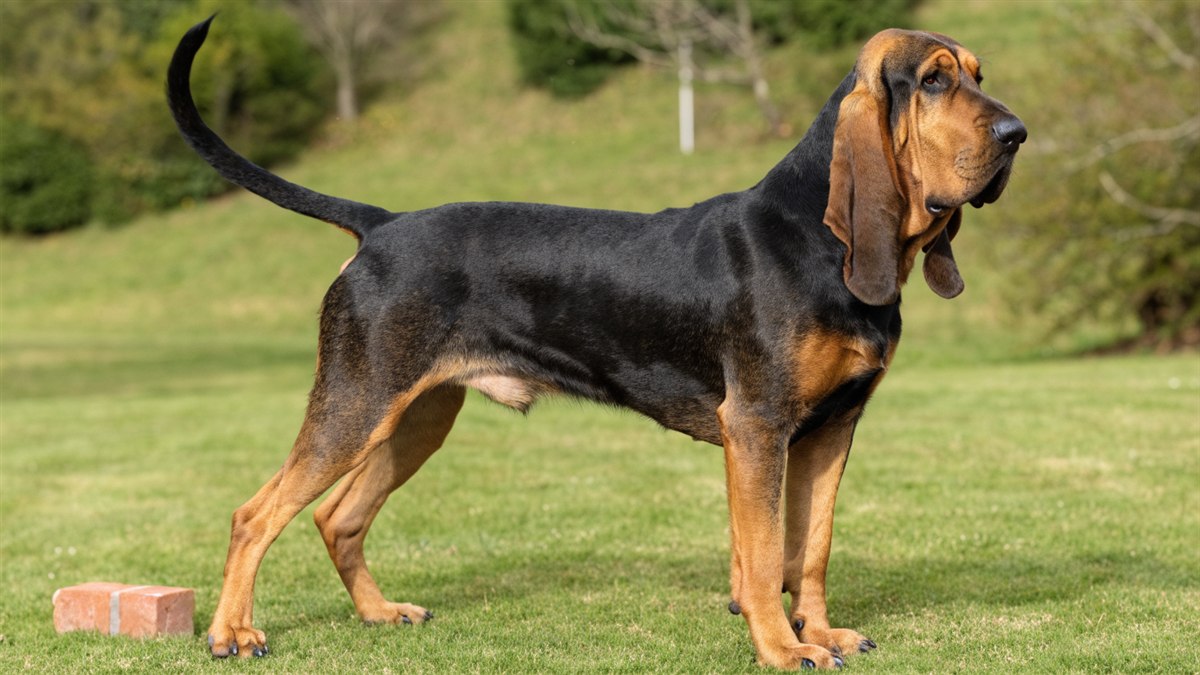
The Bloodhound is a large Belgian scent hound bred in the Ardennes by the monks of the Abbaye de Saint-Hubert, recognised by the Federation Cynologique Internationale as Standard No. 84 under the name Chien de Saint-Hubert, and registered by the American Kennel Club since 1885. It is a leash hound built to follow one trail for hours, and the FCI describes it as the most powerful of all the scent hounds.
The FCI gives the country of origin as Belgium and classifies the breed in Group 6, Scent hounds and related breeds, Section 1.1, Large sized hounds, with working trial. Its utilization clause is unusually specific about what the dog is for. It says the breed "was and it must always remain a hound which due to its remarkable sense of smell is foremost a leash hound, often used not only to follow the trail of wounded game as in the blood scenting trials but also to seek out missing people in police operations";. That single sentence explains almost everything an Indian buyer needs to know: this is a dog designed to work on a long line, nose down, for a long time, in cool European forest.
The AKC standard opens on the same point in older language. It says the breed "possesses, in a most marked degree, every point and characteristic of those dogs which hunt together by scent (Sagaces)" and "stands over more ground than is usual with hounds of other breeds";. The AKC currently ranks the breed 59 of 210 for registrations, and gives a life expectancy of 10 to 12 years.
Size, and where the registries disagree about it
| Registry | Male height | Female height | Male weight | Female weight |
|---|---|---|---|---|
| AKC standard | 25 to 27 in (63.5 to 68.5 cm) | 23 to 25 in | mean 90 lb, attains 110 lb (41 to 50 kg) | mean 80 lb, attains 100 lb |
| Royal Kennel Club | 63 to 69 cm (25 to 27 in) | 58 to 63 cm | mean 41 kg, attains 50 kg | mean 36 kg, attains 45.5 kg |
| FCI Standard No. 84 | 68 cm ideal, 4 cm tolerance | 62 cm ideal, 4 cm tolerance | about 46 to 54 kg | about 40 to 48 kg |
| Call 4 Dog, Delhi listing | 64 to 69 cm | 58 to 64 cm | 41 to 50 kg | 36 to 45 kg |
| HankPets, India | 58 to 69 cm | 53 to 64 cm | 40 to 58 kg | 36 to 45 kg |
Read the weight column carefully, because the disagreement is real and it matters. The FCI's minimum male weight of 46 kg is above the AKC's stated mean of 90 lb, which is 40.8 kg, and the FCI's maximum of 54 kg is above the AKC's ceiling of 110 lb, which is 49.9 kg. American Kennel Club The Royal Kennel Club, Breed Standard A male Bloodhound bred to the FCI standard is a heavier animal than one bred to the American standard, and that difference lands squarely on a threshold in the heat-illness literature covered later on this page.
One Indian figure fits nothing. HankPets publishes a male weight range of 40 to 58 kg. No standard permits 58 kg: the FCI ceiling is 54 kg and the AKC and Royal Kennel Club ceiling is 50 kg. American Kennel Club The Royal Kennel Club, Breed Standard Where an Indian page quotes a size band, check it against a standard before you use it to judge a puppy.
Rare everywhere, and rarer here
The Bloodhound appears on the American Kennel Club's 2026 Low Entry Breeds List, effective 1 March 2026. That is a list of breeds that draw so few show entries that judges struggle to see enough of them to gain approval, and it sits oddly beside a popularity rank of 59 of 210. In the United Kingdom the Royal Kennel Club records the Bloodhound as a Vulnerable Native Breed.
For India, the Kennel Club of India registered 32,219 puppies in 2025 across all breeds, down from a peak of 88,261 in 2021, and its studbook has recorded 1,425,001 pure-bred dogs since it began. The FCI publishes those national totals but no per-breed breakdown for India, so no verified count of Indian Bloodhound registrations exists in that dataset, and this page does not estimate one.
Three kennel clubs, one dog, and a flat contradiction about the skin
The three kennel clubs that publish a Bloodhound breed standard disagree about the breed's most famous feature. The AKC requires loose skin that "in nearly every position appears superabundant". The Royal Kennel Club requires a head "furnished with only a small amount of loose skin". The FCI lists too much loose skin among the exaggerations that must never harm the dog. Those are not three ways of saying the same thing.
This matters in India more than anywhere, because an Indian buyer is almost always shown American or American-derived photographs of the breed while any dog actually offered here may be bred to a different specification, and because the loose skin is the part of the dog that behaves worst in heat and humidity.
| Feature | AKC, approved 9 January 1996 | Royal Kennel Club, updated 1 April 2025 | FCI Standard No. 84 |
|---|---|---|---|
| Skin on the head | "an amount of loose skin, which in nearly every position appears superabundant" | "Head furnished with only a small amount of loose skin" | "abundant, supple and thin skin, hanging in deep folds", with a warning against "too much and too loose skin" |
| Skin overall | "thin to the touch and extremely loose" | "Skin relatively loose" | "Supple over all the body, loose and elastic"; body folds "not desirable" |
| Eyes | "deeply sunk in the orbits, the lids assuming a lozenge or diamond shape, in consequence of the lower lids being dragged down and everted by the heavy flews" | "neither sunken nor prominent, the lids being oval in shape and meeting the cornea perfectly without any irregularity in their contour"; "Any obvious signs of eye irritation unacceptable" | "neither protruding nor sunk into the socket"; "lower lid too pendulous, too much haw visible" is listed as a fault |
| Ears | "thin and soft to the touch, extremely long, set very low" | "Thin and soft to the touch, long, set on low" | "very long lobes, reaching at least beyond the end of the nose when they are laid on the upper line of the foreface; ears set very low, level with the eyes or even lower" |
| Exaggeration clause | none | "Breeders and judges should at all times be careful to avoid obvious conditions or exaggerations which would be detrimental in any way to the health, welfare or soundness of this breed" | "No characteristic should be so exaggerated as to destroy the harmony of the whole... or even less to harm the health or well-being of the dog" |
The eye row is the sharpest. The American standard does not merely tolerate an everted lower lid, it describes the eversion as the mechanism that produces the correct diamond eye. The British standard names any obvious sign of eye irritation as unacceptable and asks for lids meeting the cornea perfectly. The FCI lists "lower lid too pendulous, too much haw visible" among its faults. A judge applying the AKC text and a judge applying the British text would reward opposite dogs.
The Bloodhound sits in Breed Watch Category 2, and the points of concern the Royal Kennel Club lists for special attention by judges are: eyelids not in normal contact with the eyeball, turned inwards or outwards; excessive skin on the head or body; signs of dermatitis irritation in skin folds, and hair loss or scarring from previous dermatitis; nervous temperament; and incorrect hind conformation or poor rear movement. Three of those five are the ear, eye and skin story, and they are the reason this page spends four sections on it.
The FCI also names the specific exaggerations to avoid, and the list reads like a description of the breed as it is often photographed: "eyes which are too deep set or too small; distended eyelids; too much and too loose skin with too many and too deep folds; too much dewlap; too narrow a head", plus "Dogs which are too big, with bodies too heavy or too massive";. A standard that has to name those exaggerations is telling you they occur.
None of this makes the Bloodhound a bad dog. It makes the breed one where the specification you are buying to changes the animal you get, and where the milder British reading is the one that transfers best to an Indian climate.
The ears are written into the standard, and so is the risk
The Bloodhound's ear is the most extreme ear leather in any recognised breed, and the FCI standard specifies exactly how extreme: the lobes must reach "at least beyond the end of the nose" when laid along the muzzle, and must be set "level with the eyes or even lower". Both of those clauses describe the conformation that the largest UK study of ear disease found carries the highest odds.
Take the clauses one at a time, because each one does separate mechanical work.
- Length. The FCI requires "very long lobes, reaching at least beyond the end of the nose when they are laid on the upper line of the foreface". The AKC calls the ears "extremely long";. The Royal Kennel Club says only "long";. A leather that reaches past the nose on a head 12 inches or more from occiput to muzzle is a flap roughly a foot long hanging over each ear canal.
- Set. The FCI requires the ears "set very low, level with the eyes or even lower, on the side of the head". The AKC says "set very low";. A low set means the leather covers the canal opening rather than hanging behind it.
- Fold. All three standards require the ears to fall "in graceful folds, the lower parts curling inward and backward";. The Royal Kennel Club, Breed Standard The FCI calls them curling ears and lists "too flat" as a fault. A curled leather seals the canal more completely than a flat one.
- Thickness and covering. The FCI describes the ears as "thin and supple, covered in short hair, delicate and velvety to the touch", and lists "too thick" as a fault. Thin leather is easier to lift and inspect, which is the one point in this list that helps you.
Put those four together and you have a warm, dark, poorly ventilated canal under a heavy curled flap, on a dog whose working posture is nose to the ground with both leathers sweeping the surface it is trailing over.
What the UK data says about ears like this
The largest primary-care study of canine ear disease examined a random sample of 22,333 dogs drawn from 905,554 dogs under UK veterinary care in 2016, and found 1,631 cases of otitis externa, a one-year period prevalence of 7.30 percent (95 percent CI 6.97 to 7.65). Divide it out: 1,631 of 22,333 is 7.303 percent, so the headline holds.
Breed and ear carriage were the two highest-ranked risk factors in that study. Compared with breeds carrying erect ears, breeds with pendulous ears had 1.76 times the odds of otitis externa (95 percent CI 1.48 to 2.10), and breeds with V-shaped drop ears had 1.84 times the odds (1.53 to 2.21). The single worst breed was the Basset Hound, at 5.87 times the odds of a crossbred and a one-year prevalence of 28.81 percent (17.76 to 42.08). Roughly three Basset Hounds in ten were treated for an ear infection in one year.
The word Bloodhound does not appear anywhere in the O'Neill otitis paper. That absence is real rather than a failed search: the same document returns the Basset Hound twelve times and discusses pendulous ear carriage at length, so the search works and the breed is simply too rare in a 22,333-dog UK sample to produce a breed-level estimate. Bonbeno will therefore not print an otitis odds ratio for the Bloodhound. What we will say is that the Basset Hound figure of 5.87 is the closest published estimate for a low-set, floor-length, curled ear leather, and that the Bloodhound's standard asks for a longer one.
Neither the American parent club nor Indian law screens for any of this. The OFA-CHIC requirements the American Bloodhound Club sets are hips, elbows and a cardiac evaluation, with eye, patella, PennHIP and degenerative myelopathy testing optional. There is no ear requirement of any kind on a breed whose standard mandates the ear.
Ear infections in an Indian monsoon, and what a Bloodhound owner does about them
Indian ear cases cluster hard in the rains. In the most detailed recent Indian series, 48 of 81 canine otitis externa cases arrived in July and August alone, a two-month window that carried close to six ear infections in ten across a full year of screening. For a breed whose standard mandates a floor-length curled leather over the canal, that seasonal pattern is the whole management problem.
The study is Nainika and Pardeep Sharma at the Dr. G.C. Negi College of Veterinary and Animal Sciences, CSK Himachal Pradesh Krishi Vishvavidyalaya, Palampur. Between June 2022 and July 2023 they screened 2,476 dogs presented to the veterinary clinics and diagnosed otitis externa in 81, a hospital prevalence of 3.27 percent. Divide it out: 81 of 2,476 is 3.271 percent. The headline holds.
| Season | Cases | Published % | Cases divided by 81 |
|---|---|---|---|
| Rainy, July to August | 48 | 59.25% | 59.26% |
| Summer, April to June | 15 | 18.51% | 18.52% |
| Winter, December to March | 10 | 12.34% | 12.35% |
| Autumn, September to November | 8 | 9.87% | 9.88% |
Those four rows sum to 81 cases, every one divides out, and the paper truncates rather than rounds. So the monsoon clustering is genuine in that dataset.
The same paper names the mechanism, and it is not weather in the abstract. Excessive moisture in the ear canal was recorded in 17 of the 81 cases, which is 20.98 percent, and treatment error in 9, which is 11.11 percent. Hypersensitivity was the commonest primary cause at 37 of 81, or 45.67 percent, and aural polyps accounted for 6. Every one of the 81 dogs had secondary bacterial or fungal overgrowth confirmed on cytology, with yeast in 13, cocci in 30 and rods in 23. The paper's prose also cites a moisture figure of 33.33 percent that matches no count in its own table; the next section works out why, and this page does not use it.
Where the house line and the evidence diverge
Bonbeno's gundog pages report a monsoon peak, and Palampur agrees with them. Two other Indian datasets do not line up neatly. A Kerala study of pyoderma found maximum cases in the south-west monsoon and post-monsoon seasons rather than a single two-month spike. Palam Valley is also a Himachal hill station, so its rains are not a Chennai or a Mumbai monsoon, and the two-month split should not be transplanted city to city without thought. What transfers is the direction, not the exact months.
What this means for a Bloodhound in India
Treat the ear as a daily task from the first week, not a monthly one. Four things follow directly from the two datasets above.
- Lift and look every single day. The leather is thin and supple by standard, so lifting it is easy. You are checking for redness, smell, discharge and heat. A canal that smells before it looks wrong is already infected.
- Plug the ears before any bath and keep water out. Water entry was linked to one case in five in the Palampur series. Never let a Bloodhound swim without drying the canals afterwards.
- Dry, do not air dry. Overseas club advice to towel a dog and let it air dry is written for a climate where air dries things. In an Indian monsoon it does the opposite. Dry the canal and the fold under the leather deliberately.
- Do not clean an ear that is already painful. Treatment error accounted for 11.11 percent of the Palampur cases. A painful ear needs an otoscope and a diagnosis before anything goes into it.
They are proportions of cases, not per-breed risk. The Palampur paper does not publish how many Labradors were among the 2,476 dogs screened, so its Labrador figure of 19 of 81 cases tells you Labradors are common in Palampur clinics, not that a Labrador has a 23 percent chance of otitis. The UK study is the one with a proper denominator.
The Indian ear series everyone quotes, checked line by line
One figure in the most-quoted Indian otitis series is arithmetically impossible, and Bonbeno divided out every percentage in the paper before using any of them. The paper reports that 69.13 percent of cases occurred in breeds with pendulous ears while its own table prints the count as 53. Fifty-three of 81 is 65.43 percent, not 69.13 percent. Both cannot be right.
Work out which one is wrong rather than dropping both, because the paper answers the question against itself.
- The percentage is right and the count is wrong. To produce 69.13 percent from a denominator of 81 you need 56 cases: 56 divided by 81 is 69.135 percent, and this paper truncates, so it prints 69.13. Fifty-three gives 65.43 percent.
- The other half of the pair confirms it. The same table gives erect ear breed as 25 cases at 30.86 percent, and 25 of 81 is 30.864 percent, which checks. Now add: 56 plus 25 is exactly 81. Fifty-three plus 25 is 78, and three cases go missing.
- The stray 53 is traceable inside the same paper. The aetiology paragraph states that "Bacterial infections were present in 65.43%", and 53 of 81 is 65.432 percent. The table's own secondary-cause rows give cocci-associated 30 and rod-associated 23, and 30 plus 23 is 53. So 53 is the paper's bacterial-infection count, and it has been pasted into the pendulous-ear row, whose true value is 56.
The safe reading is that 56 of the 81 cases, or 69.13 percent, occurred in pendulous-eared breeds. Never quote 69.13 percent alongside the number 53, because they cannot both be true.
Two more figures that contradict the paper's own tables
| Count | Printed in the breed table | Printed in the season table | Count divided by 81 |
|---|---|---|---|
| 10 | 12.43% (Pomeranian, Mongrel) | 12.34% (Winter) | 12.35% |
| 8 | 9.80% (Pug) | 9.87% (Autumn) | 9.88% |
In each row the season table is correct and the breed table is not. Ten of 81 is 12.345 percent, which truncates to 12.34, so the breed table's 12.43 is a transposition. Eight of 81 is 9.876 percent, which truncates to 9.87, so the breed table's 9.80 is a slip. The counts themselves are sound: the eleven breed rows sum to exactly 81, as do the four age rows, the two sex rows and the four season rows.
Two figures with no count behind them
The aetiology section opens "In a study of 50 cases of Otitis externa" and then gives every single fraction over 81. There is no 50-case subgroup anywhere in the paper, and the sentence appears to be leftover text.
The same paragraph says moisture accumulation was noted in 33.33 percent of cases and water entry in 20.98 percent, but the table's only moisture row reads "Excessive moisture, 17, 20.98%";. Seventeen of 81 is 20.987 percent, so the 20.98 figure is anchored to a real count. To reach 33.33 percent you need 27 cases, and no row in the paper shows 27. Bonbeno therefore uses the 17 and drops the 33.33 percent.
Everything else in the paper divides out, and that is worth saying plainly. The 3.27 percent hospital prevalence, the four season rows, the four age rows, the two sex rows, hypersensitivity at 37 of 81, demodicosis at 5, immune-mediated disease at 4, hypothyroidism and distemper at 2 each, aural polyps at 6, treatment error at 9, yeast at 13, cocci at 30, rods at 23 and mixed infection at 15 all reconcile with a denominator of 81. This is a usable dataset with three typographical faults in it, not a fabricated one, and the fix is to check the arithmetic rather than to discard the source.
The wrinkle, the flews and the dewlap: what skin folds actually do
Skin fold dermatitis is caused by friction, trapped moisture and poor ventilation between two skin surfaces held against each other, and the two commonest sites in the largest UK study were the lip fold and the facial fold, together 572 of 974 cases. The Bloodhound standard mandates both of those folds in the most extreme form of any recognised breed.
Read the lip clause first, because it is the one people underestimate. The FCI specifies that "the edge of the upper lips comes down about 5 cm below the lower jaw", and that the lips become "fleshy flews" which "blend imperceptibly into the abundant dewlap";. The AKC says the lips "form deep, hanging flews, and, being continued into the pendant folds of loose skin about the neck, constitute the dewlap, which is very pronounced";. The FCI additionally requires "a double dewlap" on the neck.
That is a five-centimetre curtain of wet lip tissue lying against the lower jaw, all day, on a dog that drools. In a climate where the ambient dew point is close to skin temperature for months at a time, it does not dry between meals.
The UK denominators
A VetCompass study of a population of 905,553 dogs found 974 cases of skin fold dermatitis in one year, a period prevalence of 0.37 percent (95 percent CI 0.35 to 0.39). The paper defines the condition as "a superficial inflammatory process of closely apposing skin surfaces resulting from abrasion through friction, excessive moisture and reduced ventilation";. Every word of that definition describes a Bloodhound's flews in an Indian July.
| Location | Cases | Published % | Cases divided by 974 |
|---|---|---|---|
| Lip | 358 | 36.76% | 36.76% |
| Facial fold | 214 | 21.97% | 21.97% |
| Vulva | 138 | 14.17% | 14.17% |
| Nasal fold | 88 | 9.03% | 9.03% |
| Tail | 56 | 5.75% | 5.75% |
| Periocular fold | 34 | 3.49% | 3.49% |
Every row divides out. The lip and facial folds together account for 572 of 974 cases, which is 58.7 percent. Most affected dogs had a single site: 939 of 974, or 96.41 percent, had one location recorded, 34 had two and one dog had three.
The breeds at the top of that list are all extreme brachycephalics. Compared with crossbreds, the English Bulldog had 49.07 times the odds (95 percent CI 37.79 to 63.70), the French Bulldog 25.92 (19.62 to 34.26) and the Pug 16.27 (12.20 to 21.69). The protected breeds were the Yorkshire Terrier (0.14), Border Collie (0.31), Jack Russell Terrier (0.53) and Labrador Retriever (0.57).
The word Bloodhound appears zero times in the skin fold dermatitis paper. The control holds: the same document returns Bulldog 41 times and Basset 7 times, so the search works and the breed is genuinely absent from a 905,553-dog population. Bonbeno therefore publishes no odds ratio for skin fold dermatitis in this breed. The honest statement is narrower and still useful: the two sites that produce nearly six in ten UK cases are the two the Bloodhound standard requires, and the odds ratios above show what happens to a breed when a fold is written into its specification and the population is big enough to measure.
One practical consequence. A long, deep, permanently damp lip fold is also where a dog's food and water sit after every meal, which is why Bloodhound owners in every climate keep drool cloths, and why in India the cloth is a hygiene tool rather than a furniture-saving one.
Indian skin data with denominators, and the bathing habit that shows up in it
The best Indian dataset on canine skin infection comes from Thrissur in Kerala, where 178 of 2,366 dogs presented for dermatological problems were diagnosed with pyoderma, which is 7.5 percent of dermatology consultations. Two of its findings translate directly to a wrinkled, humid-climate dog: outdoor housing and frequent bathing both showed up strongly among the cases.
Krupa Rose Jose and colleagues at Kerala Veterinary and Animal Sciences University ran a longitudinal study at the Teaching Veterinary Clinical Complex, Mannuthy and the University Veterinary Hospital, Kokkalai, between July 2021 and February 2023. Divide the headline out: 178 of 2,366 is 7.523 percent. It checks.
Be precise about what that number is. It is a proportion of dermatology presentations, not a population prevalence, so it is not comparable with the UK's 0.37 percent of all dogs under care. The authors note the same figure was 12.5 percent at the same location in an earlier study, and attribute the fall to better owner care rather than to less disease.
| Finding | Cases | Published % | Cases divided by 178 |
|---|---|---|---|
| Housed outdoors in a separate kennel | 93 | 52.25% | 52.25% |
| Housed both indoors and outdoors | 48 | 26.97% | 26.97% |
| Housed strictly indoors with the owner | 37 | 20.78% | 20.79% |
| Bathed regularly, at least once a week | 122 | 68.54% | 68.54% |
| Aged 1 to 3 years | 82 | 46.07% | 46.07% |
| Fleas or ticks present | 36 | 20.22% | 20.22% |
| Given no coat conditioner or supplement | 128 | 71.91% | 71.91% |
Every row divides out, and the counts in each category sum to 178. One small internal slip is worth flagging: the discussion prints the Pomeranian figure as 7.37 percent while the table gives 13 cases, and 13 of 178 is 7.303 percent, so the table's 7.30 is the correct one.
The two findings a Bloodhound owner should act on
Housing was statistically significant, and outdoor-kennelled dogs made up more than half the cases while strictly indoor dogs made up a fifth. A heavily wrinkled dog kept outside in Indian humidity is sitting in the higher-risk group before anything else is decided.
Bathing was also significant, and 122 of the 178 affected dogs were bathed at least weekly, 103 of them at home. The authors cite work showing furunculosis following water immersion or exposure to grooming products, and conclude that "aggressive bathing, grooming or hair clipping of the pets is discouraged as this causes follicular trauma and increased susceptibility to opportunistic infection";. That is the opposite of the instinct most Indian owners have with a smelly, drooling hound.
Season mattered too. Maximum cases fell in the south-west monsoon and post-monsoon, which in the Koppen classification the authors use run June to September and October to November respectively. Note that this disagrees in shape with the Himachal otitis series, which put its peak into a two-month July and August window. Two Indian datasets, two different peaks, and neither is wrong for its own city.
Wipe the lip folds and facial folds daily with a plain damp cloth and then dry them completely, especially after meals and water. Bathe less often than instinct suggests and dry the folds and the ear canals thoroughly afterwards. Do not clip or scrub a fold that is already inflamed. Treat any smell, redness, hair loss or scarring in a fold as a veterinary matter rather than a hygiene failure, because the Royal Kennel Club lists exactly that scarring among the things its judges are told to look for. Krupa Rose Jose, Vijayakumar K, Vergis J
The diamond eye is ectropion, and Indian law says to test for it
The AKC breed standard describes the correct Bloodhound eye as one in which "the lower lids being dragged down and everted by the heavy flews" produce a lozenge or diamond shape. Eversion of the lower eyelid margin is the clinical definition of ectropion, and paragraph 8(10) of the Second Schedule to India's Dog Breeding and Marketing Rules 2017 requires breeding dogs to have been tested for it.
Set the two texts beside each other. The AKC standard reads: "The eyes are deeply sunk in the orbits, the lids assuming a lozenge or diamond shape, in consequence of the lower lids being dragged down and everted by the heavy flews."; The 2017 Rules read: "The dogs shall have been tested for genetic defects, including hip dysplasia, progressive retinal atrophy, night blindness, hypothyroidism, entropion, ectropion, overshot, undershot jaw...";
The 2019 VetCompass eyelid study defines the terms without ambiguity: entropion is "inversion of the eyelid margin" and ectropion is "eversion of the eyelid margin";. Its mechanism paragraph then reads like a description of this breed: "the orbital anatomy, length of the eyelids and excessive facial skin folds, heavy ears and an unstable lateral canthus can result in ectropion and lateral canthal entropion";.
How common the condition is, and in which breeds
From 2,250,417 dogs under UK primary veterinary care in 2019, the study analysed 3,029 confirmed conformational eyelid disorder cases, of which 2,752 were entropion (90.86 percent) and 344 were ectropion (11.36 percent). Those two counts sum to 3,096, which is 67 more than 3,029, so 67 dogs carried both. Annual prevalence was 0.36 percent overall, 0.33 percent for entropion and 0.04 percent for ectropion.
| Breed | Condition | Annual prevalence | 95% CI |
|---|---|---|---|
| Shar-Pei | Entropion | 15.41% | 14.00 to 16.91 |
| Chow Chow | Entropion | 9.28% | 7.64 to 11.14 |
| Neapolitan Mastiff | Entropion | 6.88% | 3.02 to 13.14 |
| Neapolitan Mastiff | Ectropion | 4.30% | 1.41 to 9.77 |
| Saint Bernard | Ectropion | 1.72% | 0.86 to 3.05 |
| Basset Hound | Ectropion | 1.59% | 0.94 to 2.49 |
| All dogs | Ectropion | 0.04% | 0.04 to 0.05 |
The Bloodhound appears nowhere in that paper either. The control holds again, with Shar Pei returned seven times and the word ectropion seventy-six times, so the document loaded and the search worked. What the table does show is the company the Bloodhound keeps: the three breeds with the highest ectropion prevalence are all heavy-headed, loose-skinned dogs with substantial facial folds, and the Basset Hound in third place is the low-set long-eared hound closest to this breed in build.
Surgery is uncommon for ectropion and common for entropion. Of the incident 2019 cases, 414 of 2,275 entropion cases were managed surgically, which is 18.20 percent, against 12 of 305 ectropion cases, or 3.93 percent. Both divide out.
What OFA's own eye register shows
The American Bloodhound Club's OFA summary, current to 2024, records 105 eye evaluations for the breed under registry code BL. Of those, 70 were normal, 30 were recorded under breeder option and 5 were abnormal, and the summary page rolls breeder option into normal to report 100 normal (95.24 percent) against 5 abnormal (4.76 percent). Both readings divide out: 70 plus 30 is 100, and 100 of 105 is 95.238 percent.
Treat that figure carefully rather than as reassurance. OFA's own threshold for a database other than hips is 50 evaluations, so 105 clears the bar but only just, and an eye examination is voluntary and optional under the parent club's CHIC scheme rather than required. A register built from dogs whose owners chose to have them examined is not a population sample.
Health problems, with the evaluation counts printed next to them
The Bloodhound's worst screening result is hips: 928 of 3,615 evaluations came back dysplastic, which is 25.7 percent, and the Orthopedic Foundation for Animals ranks the breed 22nd worst of 199 breeds with more than 100 hip cases. Elbows are next at 269 abnormal of 1,848. Both figures come from the parent club's own OFA summary, current to 2024, under registry code BL.
Bonbeno did not guess that code. The American Bloodhound Club's own OFA query link uses breed=BL, and the summary document it publishes prints the word Bloodhound in its header and again in the row labels of every detail table. American Bloodhound Club Guessing an OFA breed code returns a real, complete table for a different dog, so the code has to be read rather than assumed.
| Registry | Evaluations | Normal | Equivocal or carrier | Abnormal | Abnormal % |
|---|---|---|---|---|---|
| Hips | 3,615 | 2,622 | 65 borderline | 928 | 25.7% |
| Elbow | 1,848 | 1,573 | 6 | 269 | 14.6% |
| Congenital cardiac | 893 | 877 | 10 | 6 | 0.7% |
| Degenerative myelopathy (DNA) | 668 | 372 | 259 carriers | 37 | 5.5% |
| Thyroid | 217 | 170 | 36 | 11 | 5.1% |
| Advanced cardiac | 212 | 201 | 6 | 5 | 2.4% |
| Patella | 199 | 194 | 0 | 5 | 2.5% |
| Basic cardiac | 115 | 114 | 1 | 0 | 0.0% |
| Eyes | 105 | 100 | 0 | 5 | 4.8% |
| Spine | 31 | 1 | 0 | 30 | 96.8% |
| Shoulder | 10 | 10 | 0 | 0 | 0.0% |
| Dentition | 7 | 7 | 0 | 0 | 0.0% |
Three things to notice before you use any of those numbers
- The bottom four rows are below OFA's own threshold. OFA requires 100 hip evaluations, or 50 for its other databases, before a breed appears at all. Spine at 31, shoulder at 10, dentition at 7 and the Mizzou biomarker study at 3 are all under it, so none of them is a population rate. The spine row is the clearest case of why: 30 of 31 abnormal reflects that spinal radiographs get submitted when something is already wrong.
- The summary page and the detail tables use different denominators. The summary line reports hips as 73.78 percent normal and 26.11 percent abnormal, which resolves to a base of 3,554, while the year-by-year detail table sums to 3,615 cases. Divide 928 by each and you get 26.11 percent and 25.67 percent. Bonbeno uses the detail table, because its counts add up: 2,622 normal plus 65 borderline plus 928 abnormal is exactly 3,615.
- The register is live and it moves. The same club published a snapshot through December 2014 showing 2,941 hip evaluations at 25.4 percent abnormal and a rank of 24. Ten years later it is 3,615 evaluations at 25.7 percent and a rank of 22. Always read the sample size next to the percentage.
The hip grade breakdown, which is more useful than the headline
OFA splits the 3,615 hip results into seven grades. Excellent 122 (3.37 percent), Good 1,603 (44.29 percent), Fair 897 (24.79 percent), Borderline 65 (1.80 percent), Mild 577 (15.94 percent), Moderate 312 (8.62 percent) and Severe 39 (1.08 percent). The three abnormal grades sum to 928 and the three normal grades sum to 2,622, which is how the headline is built.
Read the Mild column, because it carries the practical message. Mild dysplasia at 577 dogs is more than half of all abnormal results, and a mildly dysplastic 45 kg hound in a Chennai flat with polished floors is a very different animal from a mildly dysplastic 10 kg dog. Hip dysplasia is also one of the specific conditions Indian law names for genetic-defect testing in breeding dogs.
The American Bloodhound Club requires three results for a CHIC number: an OFA hip evaluation, an OFA elbow evaluation, and a cardiac evaluation, either a congenital cardiac exam or an advanced cardiac exam. Eye examination by a boarded ACVO ophthalmologist, patellar luxation, PennHIP and the DNA test for degenerative myelopathy are all listed as optional. The Royal Kennel Club asks for hip and elbow screening under the BVA schemes as Good Practice and eye testing as Best Practice. Ask to see hips, elbows and a cardiac result for both parents. Their absence is your answer.
Lifespan: a study says 9.3 years, and most Indian pages say 10 to 12
The largest breed-level longevity study available puts the Bloodhound's median lifespan at 9.3 years with a hazard ratio of 1.7, and names it among the ten breeds most at risk of early death. Almost every Indian page repeats the American Kennel Club's 10 to 12 years instead. Those figures come from different kinds of evidence, and only one of them is a study.
McMillan and colleagues merged, cleaned and deduplicated records for 584,734 individual dogs in the United Kingdom, including 284,734 deceased, from 18 sources, and produced survival estimates for 155 recognised purebreds. Averaged across every dog in the dataset, median survival was 12.5 years (12.5 to 12.6). Purebreds ran to 12.7 years (12.6 to 12.7, n = 473,681, events = 212,289) and crossbreds to 12.0.
The paper then lists the breeds most at risk of early death, and the Bloodhound is on it: median 9.3 years, hazard ratio 1.7, 95 percent confidence interval 1.3 to 2.1. Its company on that list is the Caucasian Shepherd Dog at 5.4 years, the Presa Canario at 7.7, the Cane Corso at 8.1, the Mastiff at 9.0, the St Bernard and the Neapolitan Mastiff at 9.3, and the Bulldog and French Bulldog at 9.8.
Two comparisons make the size of the gap clear. Against the all-dog median of 12.5 years the Bloodhound is 3.2 years short. Against the median for large purebreds specifically, 11.9 years (11.9 to 11.9, n = 123,072, events = 61,976), it is still 2.6 years short. So this is not simply the ordinary penalty large dogs pay.
| Source | Figure | What kind of number it is |
|---|---|---|
| McMillan et al. 2024, Scientific Reports | 9.3 years median, HR 1.7 (1.3 to 2.1) | A survival estimate from 584,734 UK dogs, 284,734 of them deceased |
| The Royal Kennel Club breed page | Under 10 years | A national kennel club's published band |
| Supertails, India, position 1 for the price term | 8 to 10 years | An Indian retail editorial figure, used to compute its lifetime cost |
| American Kennel Club breed page | 10 to 12 years | A registry life-expectancy panel, no study cited |
| Call 4 Dog, Delhi listing | 10 to 12 years | A seller's spec card |
| A-Z Animals, US cost article | up to 12 years | A consumer article |
| Tegha Kennel, India, position 1 for the breed term | 10 year Breed Guarantee | A commercial warranty, not a lifespan estimate |
Publish the disagreement rather than averaging it. Two of those seven sources, the study and the Royal Kennel Club, put the breed under ten years. The Royal Kennel Club, Bloodhound One Indian retail page independently says 8 to 10 years and is closer to the study than the AKC is. The 10 to 12 figure appears in the AKC panel and is then repeated by Indian sellers, which makes it four repetitions of one claim rather than four pieces of evidence. Call 4 Dog, Bloodhound Puppy
The page ranking first in India for this breed advertises a 10 year Breed Guarantee. The largest published study puts the breed's median survival at 9.3 years. More than half the dogs in that dataset would not have reached the end of that guarantee. Read any such promise as a marketing term with a defined claims process, not as a statement about how long the dog will live, and ask in writing what it actually pays out and when.
One honest caveat. McMillan's dataset is British, and a UK median does not transfer directly to Chennai or Delhi. Bonbeno found no Indian longevity study covering this breed, and none covering imported large breeds in India generally, so no Indian-specific figure is published here. What the UK number establishes is that 9.3 years is what this breed does in a temperate climate with good veterinary access, and that is the optimistic end of the range for an Indian owner rather than the pessimistic one.
Bloat: the Bloodhound had the highest incidence of any large breed studied
In the largest prospective cohort study of gastric dilatation-volvulus ever run, the Bloodhound recorded the highest incidence of any large breed followed, at 39 cases per 1,000 dog-years at risk. Ten of the 115 Bloodhounds followed developed the condition, which is 8.7 percent over a median 2.6 years of follow-up, against 1 of 110 Rottweilers.
The study is Glickman and colleagues at Purdue University, published in the Journal of the American Veterinary Medical Association in January 2000. Owners of 1,914 dogs across 11 breeds were recruited at 27 national or specialty shows between June 1994 and March 1997 and followed by post and telephone at roughly yearly intervals. The 11 breeds were the Akita, Bloodhound, Collie, Great Dane, Irish Setter, Irish Wolfhound, Newfoundland, Rottweiler, Saint Bernard, Standard Poodle and Weimaraner.
| Group | Dog-years of follow-up | Dogs that developed GDV | Published incidence per 1,000 dog-years | 95% CI | Cases divided by dog-years |
|---|---|---|---|---|---|
| Bloodhound, all | 259.2 | 10 | 39 | 15 to 63 | 38.6 |
| Bloodhound, males | 91.2 | 5 | 55 | 7 to 103 | 54.8 |
| Bloodhound, females | 168.0 | 5 | 30 | 4 to 56 | 29.8 |
| All 7 large breeds | 2,499.9 | 57 | 23 | 17 to 29 | 22.8 |
| All 4 giant breeds | 1,824.9 | 48 | 26 | 19 to 33 | 26.3 |
| Great Dane, for scale | 586.9 | 31 | 53 | 34 to 72 | 52.8 |
Every published incidence reproduces from its own numerator and denominator. The paper states plainly that "Great Danes and Bloodhounds had the highest incidence of GDV among the giant and large breeds, respectively". The cumulative incidence across all 11 breeds during the study was 5.7 percent, and of the 105 dogs that developed GDV, 30 died, which is 28.6 percent.
The lifetime figure, and where it comes from
The paper publishes no lifetime risk for the Bloodhound, so Bonbeno derived one using the paper's own arithmetic and labels it as derived. The method is visible in the paper's own Great Dane figure: incidence 53 per 1,000 dog-years multiplied by an assumed 8-year giant-breed lifespan gives 424 per 1,000, which is the 42.4 percent lifetime risk the authors publish. The same multiplication reproduces their large-breed and giant-breed estimates of roughly 24 and 21.6 percent.
Apply it to the Bloodhound. Thirty-nine cases per 1,000 dog-years over the 10-year large-breed lifespan the authors assume gives 390 per 1,000, or about 39 percent. Substitute the 9.3-year median that McMillan's study actually measured for this breed and it falls to about 36 percent. Either way it sits close to the Great Dane's published 42.4 percent, and that is the point worth carrying away.
Glickman classified the Bloodhound as a large breed, defined as 23 to 45 kg, and the giant band as above 45 kg. The FCI standard gives ideal male weight as about 46 to 54 kg. A male Bloodhound bred to the FCI weight would have fallen into the giant category, not the large one, and the study's own giant-breed dogs died at 53 per 1,000 dog-years from all causes against 39 for the large breeds. Bonbeno prints the 39 as published rather than adjusting it, but an owner of a heavy male should read it as a floor.
The four risk factors that are actually modifiable
A companion paper from the same cohort, following 1,637 dogs, identified the factors significantly associated with increased risk of GDV: increasing age, having a first-degree relative with a history of GDV, faster speed of eating, and having a raised feeding bowl. Approximately 20 percent of GDV cases among the large breeds and 52 percent among the giant breeds were attributed to a raised feed bowl.
That last finding matters in India because raised bowls are marketed to owners of large dogs as a joint and posture aid. On the evidence from the only prospective cohort that measured it, a raised bowl is associated with more bloat, not less. Ask about GDV in the parents before you buy, feed from the floor, slow the dog's eating, and know where your nearest twenty-four-hour surgical clinic is before you need it.
Heat tolerance in India, rated 1 of 5, and the reasoning
Bonbeno rates the Bloodhound 1 of 5 for heat tolerance in India, the lowest rating this site gives a normal-muzzled breed. The rating is argued from the breed's Belgian origin climate compared with six Indian cities on one dataset and one methodology, from the bodyweight the standards ask for, and from the loose skin and dewlap the standards mandate.
Start with where the breed comes from, because the FCI is explicit about it. The country of origin is Belgium, and the breed "was bred in the Ardennes by the monks of the Abbaye de Saint-Hubert";. Saint-Hubert is a real town in the Belgian Ardennes, so it is the fair benchmark rather than a national average.
The comparison below uses NASA's POWER native-resolution climatology, a 20-year monthly climatology covering January 2001 to December 2020, queried on 21 August 2026 for seven points by explicit latitude and longitude. Every query returned the coordinates it was given, which is how Bonbeno confirms it received the place it asked for. Two measures matter. Mean air temperature is the obvious one. Mean wet bulb temperature is the important one, because a dog sheds heat by evaporating water from its airway, and evaporative cooling gets harder as wet bulb rises.
| Place | Hottest month by mean air temp | Mean air temp | Peak mean wet bulb | Wet bulb above Saint-Hubert | Coolest month mean air temp |
|---|---|---|---|---|---|
| Saint-Hubert, Belgium | July | 17.6 | 14.9 | base | 0.2 (January) |
| Bengaluru | April | 28.4 | 22.7 | +7.7 | 20.2 (December) |
| Pune | April | 28.9 | 23.6 | +8.6 | 19.6 (December) |
| Mumbai | May | 31.2 | 26.6 | +11.6 | 23.2 (January) |
| Chennai | May | 31.5 | 27.4 | +12.4 | 24.1 (January) |
| New Delhi | June | 35.9 | 27.7 | +12.8 | 13.6 (January) |
| Kolkata | May | 31.5 | 27.9 | +12.9 | 17.3 (January) |
Read the last two columns together, because that is where the argument lives. In Bengaluru, Pune, Mumbai and Chennai, the coolest month of the entire year is warmer than the hottest month in the breed's home valley. Delhi and Kolkata do have a genuine cool season, with January means of 13.6 and 17.3 degrees, and those are the two Indian cities where a Bloodhound gets a real annual break. They are also two of the three worst on peak wet bulb.
The humidity is not the new thing either. Saint-Hubert's July mean relative humidity is 73.95 percent and its annual mean is 85.2 percent, so this breed evolved in damp air. What it did not evolve in is damp air at 27 degrees wet bulb. The gap Bonbeno measured for the Black and Tan Coonhound against Tennessee was 4.6 to 5.9 degrees in the four hardest cities. For the Bloodhound against Belgium it is 7.7 to 12.9 degrees across all six.
The word Bloodhound appears zero times in the UK heat-related illness paper, which drew 395 confirmed events from 905,543 dogs under care in 2016. The control holds, with Chow Chow returned ten times and Greyhound sixteen. So there is no measured heat-illness rate for this breed, and Bonbeno publishes none.
Four things about the dog that decide the heat rating
Four features of the Bloodhound decide its heat rating, and only one of them helps. The skull is a full-sized airway and spares the breed the flat-faced penalty entirely. The coat, the bodyweight and the loose skin all work against it, and the bodyweight works against it at a specific threshold that the FCI standard sits astride.
- The skull helps, and it is the only thing that does. The FCI requires a muzzle "As long as the skull" with a muzzle-to-head length ratio of 1 to 2, and a nose that is "broad, well-developed, with wide open nostrils";. That is a full-sized airway. In the UK heat-illness study, brachycephalic dogs had 2.10 times the odds of mesocephalic dogs (95 percent CI 1.68 to 2.64), and there was no significant difference between dolichocephalic and mesocephalic dogs. This breed escapes the flat-faced penalty entirely.
- The coat helps less than it looks. The FCI calls the body hair "short, dense, quite harsh and weatherproof". Weatherproof is another word for insulating. Short is not the same as thin.
- The mass hurts, and it hurts at a specific number. Dogs weighing over 50 kg had 3.42 times the odds of heat-related illness compared with dogs under 10 kg (95 percent CI 1.54 to 7.57), and dogs at or above their own breed and sex mean bodyweight had 1.42 times the odds (1.12 to 1.80). The FCI's ideal male Bloodhound weight is about 46 to 54 kg. A standard-conforming male straddles that threshold.
- The loose skin and dewlap are extra tissue over the throat. The FCI requires "a double dewlap" and skin on the head that is "abundant, supple and thin... hanging in deep folds". That is additional insulated bulk sitting directly over the neck, and folded skin also holds moisture against the body rather than letting it evaporate away.
The verdict follows. A long muzzle keeps the Bloodhound out of the worst category. A 46 to 54 kg body, a dense weatherproof coat, a double dewlap, an exercise requirement the Royal Kennel Club puts at more than two hours a day, and Indian peak wet bulb temperatures 7.7 to 12.9 degrees above the breed's home summer in every city checked keep it firmly out of the best one. Bengaluru and Pune are the least bad cases, and Bonbeno would still not rate the breed above 2 there.
In the same UK study, pet Greyhounds had 4.26 times the odds of heat-related illness compared with Labrador Retrievers, at an incidence of 0.15 percent (95 percent CI 0.07 to 0.29). The Greyhound is lean, short-coated, deep-chested and long-muzzled, which is the exact profile people assume protects a dog. It did not. Nine breeds in total showed higher odds than the Labrador, and the overall event fatality rate for heat-related illness was 14.18 percent (11.08 to 17.96), or 56 of 395 dogs.
Living with a 1 of 5 heat rating in an Indian city
Keeping a Bloodhound in India means moving its entire working day to the two hours after sunrise and the two hours after dark, and accepting that from March to June in most of the country the middle of the day is indoor time. Apartment living is possible but poorly suited, because the Royal Kennel Club's own guidance for this breed asks for a large house, a large garden and country rather than town.
The Royal Kennel Club publishes four practical lines on this breed that no Indian page carries: exercise more than two hours per day, size of home a large house, size of garden a large garden, and town or country, country. Read them together and the picture is a dog that needs a lot of ground and a lot of time outdoors, in a country where being outdoors is the risky part for eight months of the year.
| City | Hardest months | Peak wet bulb | What that means for a 45 kg hound |
|---|---|---|---|
| Bengaluru | March to May | 22.7 | The easiest Indian case. Morning and evening walks work most of the year |
| Pune | March to June | 23.6 | Similar to Bengaluru, with a hotter and drier April |
| New Delhi | April to July | 27.7 | A real winter from December to February, and a summer that rules out daytime exercise entirely |
| Mumbai | April to June | 26.6 | No cool season at all. Wet bulb stays above 23 degrees for eight months |
| Kolkata | April to June | 27.9 | The highest peak wet bulb of the six, with a short usable winter |
| Chennai | April to June | 27.4 | The coolest month of the year is warmer than the breed's hottest home month |
- Walk before sunrise and after dark, not in the last hour of daylight when the ground is still holding heat. Test the pavement with the back of your hand for five seconds before you set off.
- Split the two hours into two or three shorter outings rather than one long one, and keep the dog on lead throughout, which this breed needs anyway.
- Work the nose indoors on the days you cannot walk. Scent games on a cool floor tire a Bloodhound in a way a lead walk does not, and they are the single most useful Indian adaptation for this breed.
- Cool with water on the belly, groin and paws, not by draping a wet towel over the back, which traps heat. Then dry the ear canals and the facial folds afterwards.
- Treat the signs as an emergency. Collapse, distress, a dog that stops and will not move, or gums that change colour all mean stop, cool and go to a veterinarian.
A Bloodhound in an Indian apartment is a poor fit and an honest page should say so. The dog needs more than two hours a day outdoors in a climate that limits when it can go, it weighs 40 to 54 kg in a lift and a lobby, and it drools and sheds indoors. Federation Cynologique Internationale Air conditioning solves the middle of the day and solves nothing else. If a flat is what you have, the honest answer is a different breed.
Bloodhound price in India: a 20-fold spread, and no seller publishes a number
Published Bloodhound prices in India run from Rs 10,000 to Rs 2,00,000, a twentyfold spread of Rs 1,90,000 between the cheapest and the dearest figure. Every one of those numbers comes from an editorial page. The three Indian sites that actually advertise Bloodhound puppies publish no price at all.
That second sentence is the more useful finding, so take it first. Bonbeno opened the three Indian listing pages that rank for this breed and none of them prints a rupee figure.
| Source | Type | Published price | What is actually on the page |
|---|---|---|---|
| Supertails | Editorial cost guide | Rs 60,000 to Rs 1,50,000 in the body, Rs 80,000 to Rs 2,00,000 in the FAQ | A city-wise table, a monthly cost table and two mutually contradictory headline bands |
| HankPets | E-commerce blog | Rs 10,000 to Rs 1,50,000 | No source given, and a male weight ceiling of 58 kg that matches no breed standard |
| Mr n Mrs Pet | Listing site | None | Reads '3 Result Found'; the three cards shown were a Newfoundland, a Border Collie and a French Bulldog. Prices sit behind a sign-up wall |
| Tegha Kennel | Kennel listing | None | One dog named Bunny, a bar chart of unsourced percentages, and a 10 year Breed Guarantee |
| Call 4 Dog, Delhi | Listing site | None | A WhatsApp link reading 'Please Share Best Price' |
| A-Z Animals, United States | US cost article | USD 500 to USD 1,200 | For comparison only; adoption quoted at USD 50 to USD 300 |
The 84.38 test, and this breed passes it
Indian pages routinely publish a dollar figure run through one exchange rate and present it as an Indian price. Bonbeno has caught that three times on this site, each time at exactly 84.38 rupees to the dollar. So divide every published rupee figure by 84.38 and see whether a round dollar amount falls out.
| Published figure | Divided by 84.38 | Round dollar amount? |
|---|---|---|
| Rs 10,000 | USD 118.51 | No |
| Rs 22,000 | USD 260.73 | No |
| Rs 60,000 | USD 711.07 | No |
| Rs 70,000 | USD 829.58 | No |
| Rs 80,000 | USD 948.09 | No |
| Rs 90,000 | USD 1,066.60 | No |
| Rs 1,00,000 | USD 1,185.11 | No |
| Rs 1,20,000 | USD 1,422.14 | No |
| Rs 1,50,000 | USD 1,777.67 | No |
| Rs 2,00,000 | USD 2,370.23 | No |
Not one resolves to a round dollar figure, and the check works in the other direction too. The US article's band of USD 500 to USD 1,200 converts at 84.38 to Rs 42,190 to Rs 1,01,256, which matches no published Indian band. So unlike the Airedale, the Ariegeois and the Andalusian Terrier, the Bloodhound's Indian prices appear to be genuinely quoted in rupees rather than converted from dollars. HankPets, Bloodhound Dog Breed: History That does not make them accurate. It makes them Indian.
The city table, and the one number that gives the game away
Supertails publishes a city-wise band: Mumbai Rs 1,20,000 to Rs 2,00,000, Delhi NCR Rs 1,00,000 to Rs 1,50,000, Bangalore Rs 90,000 to Rs 1,50,000, Hyderabad Rs 80,000 to Rs 1,20,000, Pune Rs 70,000 to Rs 1,20,000, and smaller towns Rs 60,000 to Rs 1,00,000. It is the only Indian source with that level of detail, and it is worth reading for the shape rather than the digits.
The same page says buyers searching this term are "hit with numbers all over the place: Rs 22,000 on one site, Rs 1,50,000 on another, Rs 2,00,000 in Mumbai", and calls the Rs 22,000 to Rs 30,000 listings a red flag from backyard breeders. Bonbeno agrees with that warning and would extend it. HankPets, ranking second, publishes a floor of Rs 10,000. A dog of this size, from screened parents, cannot be produced for that.
Mr n Mrs Pet's Bloodhound page carries the heading 'Bloodhound Puppies For Sale' and the line '3 Result Found', and advertises 'KCI registered Bloodhound puppies'. On the day of the pull, the three cards actually rendered on that page were a Newfoundland in Delhi, a Border Collie in Pune and a French Bulldog in Hyderabad, under the sub-heading 'Similar breeds at other locations';. Not one Bloodhound, and no price on any of them. This is the commonest pattern for a rare breed in India: the page exists, the inventory does not, and the enquiry form does.
Import rules: dogs are a Restricted item, and breeding applications are rejected
Indian import rules make dogs a Restricted item under ITC (HS) 01061900, permit entry for only three purposes, and state that applications made for trading or breeding "shall be duly rejected". One of the three permitted purposes is internal security use by the Defence and Police Force, which is the only route by which a working Bloodhound can lawfully enter India for a job.
Bonbeno read DGFT Trade Notice No. 22/2022-23 directly rather than summarising a summary. It is dated 19 December 2022, issued by the Directorate General of Foreign Trade, Ministry of Commerce and Industry, and signed by Md. Moin Afaque, Deputy Director General of Foreign Trade.
The policy table it reproduces classifies ITC (HS) 01061900, "Mammals: Other", as Restricted. Policy Condition 7 states that "Import of dogs is allowed only for the following specific purposes: i. Pet dog with valid pet book and relevant records/documents in the name of importer. ii. Dogs imported by the R&D Organisations for conducting research with the recommendation of CPCSEA. iii. For the internal security by the Defence and Police Force." Policy Condition 8 adds that "Import of commercial dogs for breeding or any other commercial activities other than the purposes mentioned above is not permitted.";
Paragraph 6 of the trade notice is blunter still: "any applications for trading/breeding purposes, or applications made on behalf of some another person/entity shall be duly rejected.";
- Six entry points in the notice, seven today. Paragraph 7 limits import of pet animals to the airports and seaports of Delhi, Mumbai, Chennai, Hyderabad, Bangalore and Kolkata, with quarantine at the port where required. DAHD added a seventh port, Cochin International Airport at Kochi, for pets arriving under the baggage rules in October 2024. Directorate General of Foreign Trade
- Two years abroad, or an authorisation. Up to two pets may come in as passenger baggage without DGFT authorisation only for a person transferring residence to India after two years of continuous stay abroad. Anything else, including more than two animals or a temporary import, needs a DGFT import authorisation.
- Two months of lead time. The notice advises pet owners to start the authorisation process at least two months before travel, and to obtain an advance No Objection Certificate from the Regional or Quarantine Officer seven days before the date of travel, relaxable to three.
The police clause and this breed
Condition 7(iii) is unusually relevant here, because the FCI's own utilization clause describes the Bloodhound as a "service dog, tracking dog" used "to seek out missing people in police operations";. So Indian law leaves exactly one open door for a Bloodhound imported to work: a Defence or Police force bringing one in for internal security. It leaves no door at all for a commercial breeder. Any Indian page offering imported Bloodhound puppies for sale is describing a transaction the trade notice says will be rejected at the application stage.
Paragraph 6(9) of Part II of the Second Schedule to the Prevention of Cruelty to Animals (Dog Breeding and Marketing) Rules, 2017 states that "Breeding to create new breeds of dogs or unusual looks shall be strictly prohibited", and paragraph 6(8) forbids "any change of appearance by artificial means";. The American standard asks for skin that "in nearly every position appears superabundant" and an eye everted by the flews. Bonbeno is not a court and does not claim to know how an Indian regulator would read that against a recognised breed standard. We note only that anyone breeding Bloodhounds in India toward the more exaggerated reading of the standard is working against the direction of the 2017 Rules, not with it.
Monthly cost of keeping a Bloodhound in India, and the sum that does not add up
The only detailed Indian monthly cost estimate for this breed comes to Rs 13,000 to Rs 26,000 when you add up its own table, and the page that publishes it prints a headline of Rs 12,000 to Rs 20,000. Bonbeno uses the table, because the same page's yearly figures reconcile with the table and not with the headline.
Supertails publishes a five-line monthly breakdown for a Bloodhound in India. Add the column up.
| Category | Published monthly range |
|---|---|
| Food | Rs 7,000 to Rs 12,000 |
| Grooming | Rs 1,000 to Rs 3,000 |
| Training and toys | Rs 2,000 to Rs 5,000 |
| Vet care | Rs 2,000 to Rs 4,000 |
| Miscellaneous | Rs 1,000 to Rs 2,000 |
| Published total | Rs 12,000 to Rs 20,000 |
| Actual sum of the five rows | Rs 13,000 to Rs 26,000 |
The low end is out by Rs 1,000 and the high end by Rs 6,000, which is 30 percent of the published ceiling. That is not a rounding difference.
The same page settles the question against itself. Its yearly estimate gives food Rs 90,000 to Rs 1,40,000, grooming Rs 12,000 to Rs 36,000, training and toys Rs 24,000 to Rs 60,000, vet care Rs 24,000 to Rs 50,000 and miscellaneous Rs 12,000 to Rs 24,000, for a stated yearly total of Rs 1.6 lakh to Rs 3.1 lakh. Those five yearly rows do sum correctly, to Rs 1,62,000 and Rs 3,10,000. Divide the yearly total by twelve and you get Rs 13,500 to Rs 25,833 a month, which matches the sum of the monthly table and not the monthly headline.
The lifetime figure, recalculated
The page states a lifetime cost of Rs 13 lakh to Rs 25 lakh over 8 to 10 years. Check it: Rs 1.6 lakh times 8 is Rs 12.8 lakh and Rs 3.1 lakh times 8 is Rs 24.8 lakh, so both ends of that range were computed on 8 years, not on 8 to 10. Run the same figures over 10 years and it becomes Rs 16 lakh to Rs 31 lakh. Run it over the 9.3-year median the largest study actually measured for this breed and it lands at roughly Rs 15 lakh to Rs 29 lakh.
What Bonbeno would budget
- Food is the dominant line and it scales with the dog. A 45 kg hound eats roughly four times what a 12 kg dog eats. The US comparison figure is about 30 pounds of dry food a month. Whatever large-breed kibble costs in your city, multiply by that volume rather than trusting a national average.
- Ear and skin care is a recurring line, not an occasional one. Ear cleaner, drying solution, plain cloths and fold care are weekly consumables for this breed, which is why the grooming line for a short-coated dog is not zero.
- Budget separately for the emergency you can name. Bloat surgery is the one predictable catastrophic bill for this breed, and roughly one dog in four that develops it dies. Price gastropexy and emergency surgery at your nearest 24-hour clinic before you need it, and consider insurance.
There is no Indian survey of what large-breed dog ownership actually costs, so the honest options are to reproduce the one detailed published estimate with its arithmetic checked, or to invent a figure. We reproduce it and show the check. Treat Rs 13,000 to Rs 26,000 a month as a documented estimate from one Indian retailer, not as a measured national figure.
Temperament, and the one thing the top-ranking Indian page gets backwards
All three breed standards describe the Bloodhound as gentle, affectionate and never aggressive, and the FCI lists aggression as a disqualifying fault. The page ranking first in India for this breed rates its watchdog ability at 100 percent. That is the single most consequential error in the Indian Bloodhound literature, because it sells the breed for the one job every standard says it cannot do.
Quote the standards rather than paraphrasing them. The FCI describes the temperament as "Gentle, placid, kind and sociable with people. Particularly attached to its owner. Tolerant of kennel companions and other domestic animals. Somewhat reserved and stubborn. Just as sensitive to compliments as to corrections. Never aggressive. Its voice is deep but it rarely barks.";
The AKC says the breed "is extremely affectionate, neither quarrelsome with companions nor with other dogs" and that "his nature is somewhat shy, and equally sensitive to kindness or correction by his master";. The Royal Kennel Club shortens it to "Affectionate, neither quarrelsome with companions nor with other dogs. Somewhat reserved and sensitive."; The FCI's disqualifying faults include "Aggressive or overly shy dogs", and its ordinary fault list includes "Temperament: Lacking in confidence or shy";.
Tegha Kennel, the page ranking first in India for the breed term, publishes a bar chart giving this breed a grooming need of 30 percent, size 90 percent, exercise requirements 80 percent, good with other dogs 65 percent, and watchdog ability 100 percent. No source is given for any of those numbers, and the last one contradicts three breed standards at once. A dog described by its own governing bodies as never aggressive, sociable with people, tolerant of other animals and rarely barking is not a guard dog. If you are buying a Bloodhound in India for security, you are buying the wrong breed, and you will discover that the first time a stranger walks in.
Who this breed genuinely suits
- A household with a garden and a fence, not a flat. The Royal Kennel Club's own guidance asks for a large house, a large garden and country rather than town.
- Someone who wants a companion, not obedience. The standards describe a dog that is stubborn and equally sensitive to praise and correction. That combination punishes harsh handling badly.
- A family with older children. This is a 40 to 54 kg dog with no aggression in its specification and a great deal of momentum. The risk to a toddler is being knocked over, not being bitten.
- Someone who will do scent work. A Bloodhound with a nose job to do is a settled dog. One without is a bored 45 kg animal in an Indian summer.
Who should not buy one
Skip this breed if you want a guard dog, if you live in an apartment, if you cannot commit more than two hours a day outdoors, if drool bothers you, or if nobody in the household will lift and inspect two ears every day for the next nine years. McMillan KM, Bielby J, Williams CL The Royal Kennel Club also lists nervous temperament among the Breed Watch points its judges are told to watch for, so temperament in the ring is not uniformly what the standards describe. Meet both parents before you commit, and walk away from a shy or fearful one.
How to train a Bloodhound, and the one thing it will never do
Train a Bloodhound by giving its nose a job and rewarding it, and accept from the first week that reliable off-lead recall on a live scent is not achievable in this breed regardless of how much you invest. The FCI standard calls it "foremost a leash hound", which is a working description rather than a training failure.
Start from what the standard says the dog is. The FCI describes a hound "which due to its remarkable sense of smell is foremost a leash hound", built "to follow a trail over a long distance and difficult terrain without problems", and gives it a neck "Long so that the dog can follow the trail with its nose on the ground";. Every part of that specification points away from a dog that checks in with you.
The temperament clauses tell you how to teach it. The breed is "Somewhat reserved and stubborn" and "Just as sensitive to compliments as to corrections";. The AKC puts it as "equally sensitive to kindness or correction by his master";. A dog that takes correction as hard as it takes praise does not respond well to being told off, and shuts down rather than arguing.
What works
- Socialise early and widely, before sixteen weeks. A shy Bloodhound is a fault under the FCI standard and a Breed Watch concern under the Royal Kennel Club, so temperament is worth working on rather than hoping for. In an Indian city that means lifts, horns, traffic, market crowds and other dogs, all in short cool-hour sessions.
- Train the trail, not against it. Lay simple scent trails in the house and garden and let the dog find things. This is the only training a Bloodhound finds intrinsically rewarding, and it does more to settle the dog than any obedience routine.
- Use a long line rather than a flexi lead. A five to ten metre line on a well-fitted harness gives the dog the head-down working posture the standard describes while keeping it attached to you.
- Reward heavily and never correct harshly. Food works. Loud handling does not, on a breed both standards describe as sensitive.
- Teach lead manners early, because 45 kg is 45 kg. A Bloodhound that learns at four months to lean into a collar will still be doing it at four years, and by then it outweighs most handlers.
Realistic timelines
Expect house training to take longer than with a small breed, basic lead manners to take three to six months of daily work, and a settled indoor adult somewhere past two years. Expect recall off a live scent never to be reliable. This dog does not go off lead outside a fenced space, and no amount of training changes that. Plan the garden fence before you plan the training class.
Training sessions and heat management collide. The best training window for a young dog is short, frequent sessions through the day, and the only safe outdoor windows in most Indian cities from March to June are before sunrise and after dark. The practical answer is to move most of the puppy's learning indoors onto a cool floor, keep the outdoor slots short and purposeful, and treat the monsoon and winter months as the period when the outdoor work actually gets done.
Daily exercise needs, and what happens without them
The Royal Kennel Club puts this breed's exercise needs at more than two hours per day, which is the highest band it publishes. The FCI standard demands a dog "capable of maintaining a trot for a long period of time without showing signs of tiredness", covering "more ground than any other scent hound". An Indian owner has to deliver that inside a narrow daily window.
Two hours a day is the published requirement, and it is not padding. The FCI's gait clause describes "measured steps, springy and free, covering more ground than any other scent hound", with the explicit endurance requirement quoted above. This is an animal engineered to work all day at a trot.
| Slot | Duration | What it is for |
|---|---|---|
| Pre-sunrise walk | 45 to 60 minutes | The main lead walk, on a long line, nose down |
| Mid-morning indoor scent work | 15 to 20 minutes | Finding hidden food or a scented cloth on a cool floor |
| Afternoon | 0 minutes outdoors | Rest indoors from roughly 10am to 5pm from March to June |
| After dark walk | 45 to 60 minutes | The second lead walk, once the ground has cooled |
| Evening chew or puzzle | 20 minutes | Settles the dog before the night |
That schedule totals about two hours of deliberate activity while keeping the dog off hot ground entirely. In Bengaluru and Pune the afternoon restriction relaxes for much of the year. In Mumbai and Chennai it does not, because those two cities have no month cooler than the breed's hottest home month.
Puppies are the exception, and getting it wrong is expensive
Do not give a growing Bloodhound two hours a day. This is a breed with 928 dysplastic hips in 3,615 OFA evaluations, and forced exercise on hard surfaces during growth is one of the few environmental factors an owner controls. Keep puppy walks short and frequent, avoid stairs and slippery floors, and let the dog set the pace until the growth plates close.
What happens without it
An under-exercised Bloodhound does not become destructive in the terrier sense. It becomes heavy, and weight is the risk factor that compounds every other one on this page. Dogs at or above their own breed and sex mean bodyweight had 1.42 times the odds of heat-related illness (95 percent CI 1.12 to 1.80), and dogs over 50 kg had 3.42 times the odds of dogs under 10 kg. A fat Bloodhound in Chennai is carrying two problems, not one, and the second one is the one that kills.
Scent work is the substitution that makes this breed liveable in an Indian city, and it is barely mentioned on any page ranking here. Twenty minutes of finding a scented cloth hidden around a cool flat tires a Bloodhound more than twenty minutes of walking, costs nothing, works during the monsoon, and gives the dog the job its own standard says it was built for. Use it on the days the weather takes the walk away, which in Delhi in June is most of them.
Grooming a short-coated dog that is not low maintenance
The Bloodhound's coat takes ten minutes a week and its ears, folds and flews take ten minutes a day. Every Indian page that calls this breed low maintenance is reading the coat clause and ignoring the skin and ear clauses, which is exactly the wrong way round for a hot, humid country.
The coat itself is genuinely easy. The FCI describes body hair that is "short, dense, quite harsh and weatherproof", with hair on the head and ears that is "very short and soft to the touch";. The Royal Kennel Club calls it "Smooth, short and weatherproof", publishes grooming as once a week, and answers Sheds with a plain Yes. The Royal Kennel Club, Bloodhound A rubber hound glove twice a week handles it.
Never shave a Bloodhound. A weatherproof double-purpose coat protects against sun as well as cold, and removing it in an Indian summer exposes thin, already fold-damaged skin to direct sunlight.
The daily ten minutes, in order
- Lift both ear leathers and look inside. Check for redness, heat, discharge and smell. This is the single most important minute of the day for this breed, because water entry and moisture accumulation were named factors in the Indian otitis series.
- Wipe and dry the lip folds after every meal and every drink. The FCI requires the upper lip edge to fall about 5 cm below the lower jaw, so food and water sit in that fold by design. Lip folds were the commonest recorded site of skin fold dermatitis in the UK data, at 358 of 974 cases.
- Wipe and dry the facial folds and the dewlap. Facial folds were the second commonest site at 214 of 974. Use a plain damp cloth and then a dry one. Wet is the problem; scrubbing is a second problem.
- Check the eyes. The Royal Kennel Club tells its judges to look for eyelids not in normal contact with the eyeball. An owner should look for discharge, redness and a dog rubbing its face.
- Keep a drool cloth in every room. This is a hygiene tool in an Indian climate, not a furniture-saving one.
Bathing: less often than you think
In the Kerala pyoderma series, 122 of the 178 affected dogs were bathed at least once a week, and 103 of those at home. The authors conclude that "aggressive bathing, grooming or hair clipping of the pets is discouraged as this causes follicular trauma and increased susceptibility to opportunistic infection";. Bathe when the dog is dirty, not on a schedule, plug the ears first, and dry the canals and every fold completely afterwards.
Care guidance written for Britain or the American Midwest routinely tells owners to towel a dog off and let it air dry. That instruction assumes air that dries things. Saint-Hubert's annual mean relative humidity is 85.2 percent but at an annual mean temperature of 8.65 degrees, while Mumbai runs 89 to 90 percent through July and August at 26 degrees. In an Indian monsoon a towelled-off Bloodhound stays wet inside its ear canals and its folds for hours. Dry them deliberately, with a cloth, every time.
Feeding a deep-chested hound: to a body condition, and from the floor
Feed a Bloodhound from a bowl on the floor, in two or three small meals rather than one large one, and slowly. The only prospective cohort that measured it found a raised feeding bowl associated with increased risk of gastric dilatation-volvulus, and attributed roughly 20 percent of cases among large breeds to it.
Take the evidence first, because the advice runs against what is marketed to owners of large dogs in India. Glickman's companion paper followed 1,637 dogs of the same eleven breeds and identified four factors significantly associated with increased risk of GDV: increasing age, having a first-degree relative with a history of GDV, faster speed of eating, and having a raised feeding bowl. Approximately 20 percent of GDV cases among the large breeds and 52 percent among the giant breeds were attributed to the raised bowl.
Two of those four are things you control at every meal. Slow the eating with a slow-feeder bowl or a spread-out portion, and put the bowl on the floor. Raised feeders are sold in India as a posture and joint aid for large breeds; on the evidence from the only prospective study that measured it, they are the opposite of protective for this shape of dog.
Life stages
- Puppy, 8 weeks to about 6 months. A large-breed puppy formula, four meals a day dropping to three. Do not free-feed and do not push growth. Fast growth on a heavy frame is the wrong thing to do to a breed with 928 dysplastic hips in 3,615 evaluations.
- Adolescent, 6 to 18 months. Three meals, then two. Keep the dog visibly lean through this period. A rib you can feel easily under a thin fat cover is the target.
- Adult. Two or three meals a day, never one. The AKC gives adult weight as 90 to 110 lb for males and 80 to 100 lb for females; the FCI asks for about 46 to 54 kg and 40 to 48 kg. Federation Cynologique Internationale Feed to whichever standard your dog is built to, and adjust to the body rather than to the bag.
- Senior, from about seven years. With a median lifespan of 9.3 years, seven is genuinely senior in this breed. Watch weight, joints and dental condition.
Body condition beats any published quantity
No feeding chart knows your dog. Bodyweight relative to the breed and sex mean was itself a risk factor for heat-related illness, at 1.42 times the odds (95 percent CI 1.12 to 1.80), and absolute bodyweight over 50 kg carried 3.42 times the odds of a dog under 10 kg. For a breed whose standard already asks for 46 to 54 kg, there is no spare margin. Keeping a Bloodhound lean in India is a heat intervention as much as a joint one.
What it costs and what is available
Large-breed dry formulas from the major brands are widely available in Indian metros and by mail order elsewhere. The Indian retail estimate for food alone is Rs 7,000 to Rs 12,000 a month for this breed. For scale, a US source puts consumption at roughly 30 pounds of dry food a month. Fresh water must be available at all times, and in an Indian summer that means more than one bowl, refilled.
A distended abdomen, unproductive retching, restlessness, drooling more than usual and rapid shallow breathing are the classic signs of gastric dilatation-volvulus. This is a surgical emergency measured in hours, not days. Of the 105 dogs that developed it in Glickman's cohort, 30 died, which is 28.6 percent. Find your nearest 24-hour surgical clinic and save the number in your phone on the day the puppy arrives.
The first year, month by month, on an Indian calendar
A Bloodhound puppy may not lawfully be sold in India before eight weeks of age, and the first year splits into three jobs: socialisation before sixteen weeks, controlled growth to eighteen months, and an ear and fold routine that starts on day one and never stops. The Indian calendar decides when each of those can happen outdoors.
Rule 8(1)(a) of the Prevention of Cruelty to Animals (Dog Breeding and Marketing) Rules, 2017 requires every breeder to ensure that "pups less than eight weeks in age are not sold";. Paragraph 8(9) of Part III of the Second Schedule adds that "All pups shall be vaccinated which can start at the age of seven-eight weeks, and are usually completed at the age of eighteen weeks";. A seller offering a six-week-old puppy is breaking the first of those rules, and that alone is enough to walk away.
| Age | The job | The Indian complication |
|---|---|---|
| 8 to 10 weeks | Home, settle, start the daily ear and fold routine, begin vaccination | Arrive in the cool season if you can choose. A monsoon arrival means fold care from the first week |
| 10 to 16 weeks | Socialisation window. Lifts, traffic, crowds, other dogs, handling of ears and feet | Only two safe outdoor windows a day from March to June. Do the rest indoors and in the car |
| 4 to 6 months | Lead manners, name, basic scent games. Four meals dropping to three | Ear checks become daily habit before the first monsoon, when Indian ear cases peak |
| 6 to 9 months | Long-line work. Growth is fast and the dog is now heavy enough to pull you over | Keep walks short and off hot ground. Do not force distance on growing joints |
| 9 to 12 months | Adolescent testing. Recall gets worse, not better, as the nose matures | Fence the garden properly before this stage, not after the first escape |
| 12 to 18 months | Two meals a day, adult exercise built up gradually, hips and elbows can be evaluated from 24 months | Full two-hour adult exercise load only once the weather and the growth plates both allow it |
The three things that matter most
- Handle the ears from day one. A dog that has had its leathers lifted daily since eight weeks tolerates ear cleaning for life. A dog that first meets an otoscope at two years with a painful ear does not.
- Do not over-exercise the growing dog. This breed carries 25.7 percent dysplastic hips across 3,615 OFA evaluations, and growth-stage management is one of the few levers an owner holds.
- Get the socialisation done in the cool hours. The window closes at about sixteen weeks whatever the weather does, so plan around it. A puppy that arrives in April in Delhi has a genuinely harder socialisation window than one that arrives in November.
The 2017 Rules require that only healthy mature females that have reached their eighteenth month are bred, that no female produces litters in two consecutive breeding seasons, that no female produces more than five litters in her lifetime, and that females are not mated after the age of eight. Paragraph 6(3) prohibits in-breeding within four generations and any mating between parents and offspring or between siblings. Ask a breeder about the dam's age, her litter history and the relationship between the parents. Those questions are answerable from the law, not from opinion.
Three Indian ear studies, three different prevalences, and why
Three Indian hospital studies report canine otitis externa prevalences of 1.25 percent, 3.27 percent and 7.30 percent, and the spread is mostly about what each one counted rather than about ear disease. Read the denominators before you compare the numbers, because two of these three are not measuring the same thing at all.
| Study | Place | Denominator | Cases | Prevalence | Divided out |
|---|---|---|---|---|---|
| Sharma et al. 2026 | Nagpur, Maharashtra | 18,172 medicine-section presentations | 228 | 1.25% | 1.255% |
| Nainika and Sharma | Palam Valley, Himachal Pradesh | 2,476 dogs screened | 81 | 3.27% | 3.271% |
| O'Neill et al. 2021 | United Kingdom | 22,333 dogs under care in one year | 1,631 | 7.30% | 7.303% |
All three divide out. Nainika and Pardeep Sharma. Otitis externa… O'Neill DG, Volk AV, Soares T, Church DB The UK figure is a genuine one-year period prevalence in a random sample of the dog population under veterinary care. The two Indian figures are hospital case proportions, which count only dogs whose owners brought them to a teaching hospital, and Nagpur's denominator is every medicine-section case rather than every dog screened. Those are three different questions.
What the Nagpur study adds that the others do not
The Nagpur study is the only one of the three with a bodyweight axis. Of its 228 cases, 92 were in the 24.1 to 34.0 kg band (40.35 percent), 68 in 14.1 to 24.0 kg (29.82 percent), 36 at 34.1 kg or more (15.79 percent) and 32 in 4.0 to 14.0 kg (14.04 percent). The four counts sum to 228 and every percentage divides out.
Do not read that as saying a 45 kg Bloodhound is safer than a 30 kg Labrador. There is no population denominator by weight band in the paper, and dogs above 34 kg are simply uncommon in Indian clinics. The authors themselves attribute the pattern to "anatomical features of the external ear canal with respect to the body size, which affects ventilation and moisture retention", which is a statement about mechanism, not about risk.
The breed pattern is the same across both Indian studies and tells you about Indian dog ownership rather than about ears. Labrador Retrievers were the commonest breed in Nagpur at 70 of 228, or 30.70 percent, and in Palampur at 19 of 81, or 23.45 percent. Nainika and Pardeep Sharma. Otitis externa… Labradors are the commonest large dog in India. Nobody has published how many were in either denominator.
The abstract and the results section both give the study period as March 2025 to December 2025, while the materials and methods section says "Clinical cases were enrolled... from March 2024 to December 2025";. Those are a ten-month study and a twenty-two-month study, and the difference matters, because 18,172 presentations over ten months and over twenty-two months describe very different clinics. Bonbeno reports the 1.25 percent with that caveat attached, and would not use it to compare against a study whose period is unambiguous. One small rounding slip sits nearby too: the Golden Retriever row of 28 cases is printed as 12.30 percent, and 28 of 228 is 12.28 percent.
How the Bloodhound compares with the breeds Indian buyers cross-shop
The Bloodhound's closest comparison is the Basset Hound, and reading the two FCI standards side by side settles how extreme this breed actually is. The Basset's ears must reach "only slightly beyond end of muzzle... but not excessively so", and its skin must be "Supple and elastic without any exaggeration". The Bloodhound's ears must reach "at least beyond the end of the nose" and its skin hangs "in deep folds".
That comparison matters because the Basset Hound is the breed with the highest otitis externa odds in the entire UK dataset, at 5.87 times a crossbred and a one-year prevalence of 28.81 percent, and the third-highest annual ectropion prevalence at 1.59 percent. O'Neill DG and colleagues. Conformational… The Bloodhound is more extreme than that dog on every clause that matters.
| Clause | Basset Hound, FCI No. 163 | Bloodhound, FCI No. 84 |
|---|---|---|
| Ear length | "reaching only slightly beyond end of muzzle of correct length, but not excessively so" | "very long lobes, reaching at least beyond the end of the nose" |
| Head wrinkle | "There may be a small amount of wrinkle at brow and beside eyes" | "the abundant thin skin forms wrinkles and deep folds" |
| Skin overall | "Supple and elastic without any exaggeration" | "Supple over all the body, loose and elastic", with an explicit warning against too many and too deep folds |
| Dewlap | "pronounced but not exaggerated dewlap" | "presenting a double dewlap" |
| Eyes | "Lozenge-shaped, neither prominent nor deep-set" | "neither protruding nor sunk into the socket" under FCI, but "deeply sunk in the orbits" and everted under the AKC standard |
Read the last row carefully, because it is the only one where the FCI Bloodhound standard is the milder document. Federation Cynologique Internationale American Kennel Club On the American reading, the Bloodhound's eye is the more extreme of the two.
The wider cross-shop
| Breed | Median lifespan, McMillan 2024 | Otitis externa, UK one-year prevalence | GDV in Glickman's cohort | Bonbeno heat rating |
|---|---|---|---|---|
| Bloodhound | 9.3 years, HR 1.7 | not measured, too rare | 10 of 115 dogs, 39 per 1,000 dog-years | 1 of 5 |
| Basset Hound | not in the top or bottom ten | 28.81%, OR 5.87 | not in the cohort | not yet rated |
| Beagle | not in the top or bottom ten | 14.72%, OR 2.54 | not in the cohort | not yet rated |
| Great Dane | not in the top or bottom ten | not among the sixteen raised breeds | 31 of 198 dogs, 53 per 1,000 dog-years | not yet rated |
| St Bernard | 9.3 years, HR 1.7 | not among the sixteen raised breeds | 2 of 174 dogs, 6 per 1,000 dog-years | not yet rated |
| Golden Retriever | not in the top or bottom ten | 14.11%, OR 2.23 | not in the cohort | not yet rated |
Two readings follow. First, the St Bernard shares the Bloodhound's exact median of 9.3 years and hazard ratio of 1.7, and yet had the lowest GDV incidence of any giant breed in Glickman's cohort at 2 of 174 dogs. Glickman LT, Glickman NW, Schellenberg DB Short-lived and bloat-prone are separate problems, and the Bloodhound has both. Second, the Great Dane is the only breed in that cohort with a worse bloat record, and it is the breed Indian buyers most often consider alongside this one.
If what draws you to the Bloodhound is the nose and the temperament rather than the look, the Beagle is the drop-eared scent hound Indian buyers can actually get, at 14.72 percent one-year otitis prevalence rather than the Basset's 28.81 percent, at a fraction of the weight, and with an Indian supply chain that exists. If what draws you is a large nose-led dog that belongs in this climate, look at the Indian sighthounds and the Indian pariah dog instead. Neither carries a fold, a leather or a dewlap that has to be dried twice a day in a Chennai August.
Mistakes Indian buyers make with this breed
The commonest Indian mistake with a Bloodhound is buying one for security, and the page ranking first in India actively encourages it by rating the breed 100 percent for watchdog ability. The UK's largest veterinary charity says the opposite in plain words: "Bloodhounds make terrible guard dogs because they really enjoy the company of people."
- Buying it as a guard dog. Three breed standards describe a gentle, never aggressive, rarely barking hound, and the PDSA calls it a terrible guard dog. One Indian listing page rates it 100 percent for watchdog ability with no source. Believe the standards.
- Reading the coat clause and calling it low maintenance. The coat needs a weekly brush. The ears, folds and flews need ten minutes every day. Every Indian page that answers "Are Bloodhounds low maintenance?" without separating those two things is answering the wrong question.
- Planning around 10 to 12 years. The largest study puts the median at 9.3 years and the Royal Kennel Club and PDSA both publish under 10 years. The Royal Kennel Club, Bloodhound People's Dispensary for Sick Animals Budget, insurance and expectations should all be built on the shorter figure.
- Buying a raised feeder because the dog is tall. A raised feeding bowl was significantly associated with increased GDV risk, and about 20 percent of cases among large breeds in that cohort were attributed to it. Feed from the floor.
- Letting the dog off lead outside a fence. The FCI calls it "foremost a leash hound", and the PDSA warns that Bloodhounds "can fit through surprisingly small spaces, so a secure garden is an absolute must";. Fence first, then buy.
- Bathing it every week because it smells. In the Kerala pyoderma series 122 of 178 affected dogs were bathed at least weekly. The PDSA adds that Bloodhounds "have very sensitive skin" and advises talking to a vet before buying any shampoo. The smell is a breed characteristic, not dirt.
- Walking in the last hour of daylight. The ground is still hot. Walk before sunrise and after dark from March to June, and check the pavement with the back of your hand.
- Buying without seeing hip, elbow and cardiac results for both parents. Those three are what the American parent club requires for a CHIC number, and 928 of 3,615 OFA hip evaluations in this breed came back dysplastic.
Do not rely on a single secondary source for a fact you can check at the primary one. The PDSA breed page states that Bloodhounds are "classed as 'Category Three' by The Kennel Club";. The Royal Kennel Club's own current Breed Watch page for the Bloodhound says Category 2, and its breed page links to a page titled Bloodhound Category 2. The Royal Kennel Club, Bloodhound One of those is out of date, and it is not the kennel club's own page. The substance behind both is identical, and the PDSA states it well: the breed "has been bred to look a certain way, which can cause them problems and discomfort. In the case of Bloodhounds, this is the loose skin around their eyes which can easily get infected or cause problems with their sight." Take the category number from the Kennel Club and the plain-English explanation from the vets.
Adoption, and how to verify a seller if you still want one
Adopt rather than buy wherever you can, and if you buy, verify the seller against the two Indian documents that already govern them: the Dog Breeding and Marketing Rules 2017 and DGFT Trade Notice 22/2022-23. Both are public, both are short, and between them they answer most of the questions a buyer would otherwise have to take on trust.
Bonbeno did not run a systematic count of Bloodhounds in Indian shelters for this page, so we make no claim about how many there are. What is verifiable is the general position. Indian shelters and rescues rehome large dogs, imported breeds turn up in them when owners cannot cope with the size, and the Royal Kennel Club maintains a breed-specific rescue listing for the Bloodhound in the United Kingdom. The PDSA's advice applies here too: adopting an adult from a rescue centre is the cheaper route and gives a home to a dog that does not have one.
There is also a straightforward Indian alternative that no page ranking for this term mentions. If you want a large, nose-led, gentle dog that is already adapted to this climate, the Indian pariah dog and the Indian sighthounds do the same jobs without a floor-length ear leather, a double dewlap or a five-centimetre lip fold to dry twice a day.
The verification checklist, drawn from the law
- Ask the puppy's age and refuse anything under eight weeks. Rule 8(1)(a) of the 2017 Rules requires breeders to ensure that "pups less than eight weeks in age are not sold".
- Ask the dam's age and litter history. Only healthy mature females past their eighteenth month may be bred, no female may produce litters in two consecutive breeding seasons, none may produce more than five litters in her lifetime, and none may be mated after the age of eight.
- Ask how the parents are related. Paragraph 6(3) prohibits in-breeding between relatives of the second to fourth grade within four generations, and prohibits parent-to-offspring and sibling matings outright. Only out breeding and line breeding are permitted.
- Ask for the genetic-defect testing. Paragraph 8(10) of Part III of the Second Schedule requires breeding dogs to have been tested for hip dysplasia, progressive retinal atrophy, night blindness, hypothyroidism, entropion, ectropion and several dentition faults. On this breed, entropion and ectropion are the two that matter most.
- Ask for hips, elbows and a cardiac result. Those three are the American parent club's CHIC requirements, and the Royal Kennel Club asks for hip and elbow screening as Good Practice and eye testing as Best Practice.
- Test any import claim against the trade notice. Dogs are a Restricted item, entry is permitted only for a pet with a valid pet book in the importer's name, for CPCSEA-recommended research, or for Defence and Police internal security, and applications for trading or breeding "shall be duly rejected". A seller offering imported puppies for sale is describing something the notice does not permit.
This page names no breeder, links no listing and quotes no live price as an offer. Every rupee figure here is reported from a published source as editorial content. Bonbeno does not broker sales and has no commercial relationship with any seller named or unnamed on this page. If a page tells you where to buy a rare breed and also tells you it is a wonderful choice, read the second claim in the light of the first.
Bloodhound questions Indian buyers actually ask
What is the price of a Bloodhound dog?
Published Indian figures run from Rs 10,000 to Rs 2,00,000, a twentyfold spread. The most detailed Indian source gives Rs 60,000 to Rs 1,50,000 in its body text and Rs 80,000 to Rs 2,00,000 in its own FAQ, which contradict each other. No Indian listing page that actually advertises this breed publishes any price at all.
How expensive is a Bloodhound puppy?
Expect the purchase price to be the smallest part of the bill. The only detailed Indian monthly estimate sums to Rs 13,000 to Rs 26,000 a month, which is Rs 1.6 lakh to Rs 3.1 lakh a year, and over a 9.3-year median lifespan that is roughly Rs 15 lakh to Rs 29 lakh.
How Much Does a Bloodhound Dog Cost in India?
Across published Indian sources the purchase band is Rs 10,000 to Rs 2,00,000, with a city-wise table giving Mumbai Rs 1,20,000 to Rs 2,00,000 and smaller towns Rs 60,000 to Rs 1,00,000. Divide every figure by 84.38 first, because none of them resolves to a round dollar amount, which means they are genuinely Indian prices rather than converted ones.
Why the Wild Price Differences?
Because almost nobody is actually selling the breed here, so the numbers are estimates rather than transactions. Three Indian sites advertise KCI-registered Bloodhound puppies and none publishes a price; one of them displayed a Newfoundland, a Border Collie and a French Bulldog under the heading Bloodhound Puppies For Sale.
What Is The monthly Cost of Owning a Bloodhound?
Add the published table rather than trusting its headline. Food Rs 7,000 to Rs 12,000, grooming Rs 1,000 to Rs 3,000, training and toys Rs 2,000 to Rs 5,000, vet care Rs 2,000 to Rs 4,000 and miscellaneous Rs 1,000 to Rs 2,000 come to Rs 13,000 to Rs 26,000, not the Rs 12,000 to Rs 20,000 the same page prints.
Is Bloodhound aggressive?
No. The FCI standard says the breed is gentle, placid, kind, sociable with people and never aggressive, and lists aggressive or overly shy dogs as a disqualifying fault. The AKC calls it extremely affectionate and neither quarrelsome with companions nor with other dogs. Aggression in a Bloodhound is a fault, not a feature.
Are Bloodhounds low maintenance?
The coat is, and nothing else is. A short weatherproof jacket needs a weekly brush, but the ears, facial folds and lip flews need about ten minutes of inspection and drying every single day, and in Indian humidity that routine is the whole difference between a healthy dog and a chronically infected one.
Is Bloodhound a good family dog?
For the right household, yes. It is affectionate, gentle with children and tolerant of other dogs. It is also a 40 to 54 kg animal that drools, needs more than two hours of exercise daily, cannot be let off lead outside a fence, and lives a median 9.3 years. Match the household to that list honestly.
Is a Bloodhound Right for Indian Homes?
Rarely, and least of all in a flat. Bonbeno rates it 1 of 5 for heat tolerance, the Royal Kennel Club asks for a large house, a large garden and country rather than town, and peak wet bulb temperature in six Indian cities runs 7.7 to 12.9 degrees above the breed's Belgian origin. Bengaluru and Pune are the least difficult cases.
Are Bloodhound dogs smart?
They are exceptional at the one thing they were built for and indifferent to most of the rest. The FCI describes a hound with a remarkable sense of smell able to follow a trail over long distances, and the same standard calls it somewhat reserved and stubborn. Train the nose and you will find the dog cooperative; test obedience for its own sake and you will not.
How long do Bloodhounds live?
The largest study available, covering 584,734 UK dogs, puts the median at 9.3 years with a hazard ratio of 1.7 and names the breed among the ten most at risk of early death. The Royal Kennel Club and the PDSA both publish under 10 years. The AKC's 10 to 12 years is a registry panel, not a study.
Can you import a Bloodhound into India?
Only in narrow circumstances. Indian import policy makes dogs a Restricted item, permits entry for a pet with a valid pet book in the importer's name, for CPCSEA-recommended research, or for Defence and Police internal security, and states that applications for trading or breeding shall be duly rejected. Entry is limited to seven ports. The full route is set out in how to import a dog to India.
Do Bloodhounds get ear infections in India?
Expect to manage them rather than avoid them. Indian ear cases cluster in the rains, with 48 of 81 cases in one Himachal series falling in July and August, and the closest measured breed to this ear shape, the Basset Hound, ran a 28.81 percent one-year prevalence in UK primary care. Check both ears daily.
Is the Bloodhound a guard dog?
No, and the top-ranking Indian page rating it 100 percent for watchdog ability is wrong. The PDSA states plainly that Bloodhounds make terrible guard dogs because they enjoy the company of people, and all three breed standards describe a sociable, never aggressive hound that rarely barks.
Which group is the Bloodhound in, and is it available in India?
The American Kennel Club places it in the Hound group and the FCI in Group 6, scent hounds. As for supply, it is effectively unavailable through any lawful Indian breeding channel, because Indian import policy rejects applications made for breeding or trading purposes outright, so a genuine purebred puppy here has no documented route to exist.
Is a Bloodhound a dog?
Yes. The Bloodhound is a large Belgian scent hound bred in the Ardennes by the monks of the Abbaye de Saint-Hubert, recognised by the FCI as Standard No. 84 under the name Chien de Saint-Hubert in Group 6, Section 1.1, large sized hounds, and registered by the American Kennel Club since 1885. The FCI calls it the most powerful of all the scent hounds, gives males an ideal height of 68 cm and about 46 to 54 kg, and defines it as a leash hound used to follow the trail of wounded game and to seek out missing people in police operations.
Compare with similar breeds
Bloodhound sits in 2 Bonbeno groups. Each one compares it directly against the breeds it is genuinely an alternative to, on the same figures.