
Breed group
Foxhound
Four dogs are called Foxhound, two of them hold kennel club standards, and the register that holds the working population defines the breed as a number on a scale of 0 to 100.
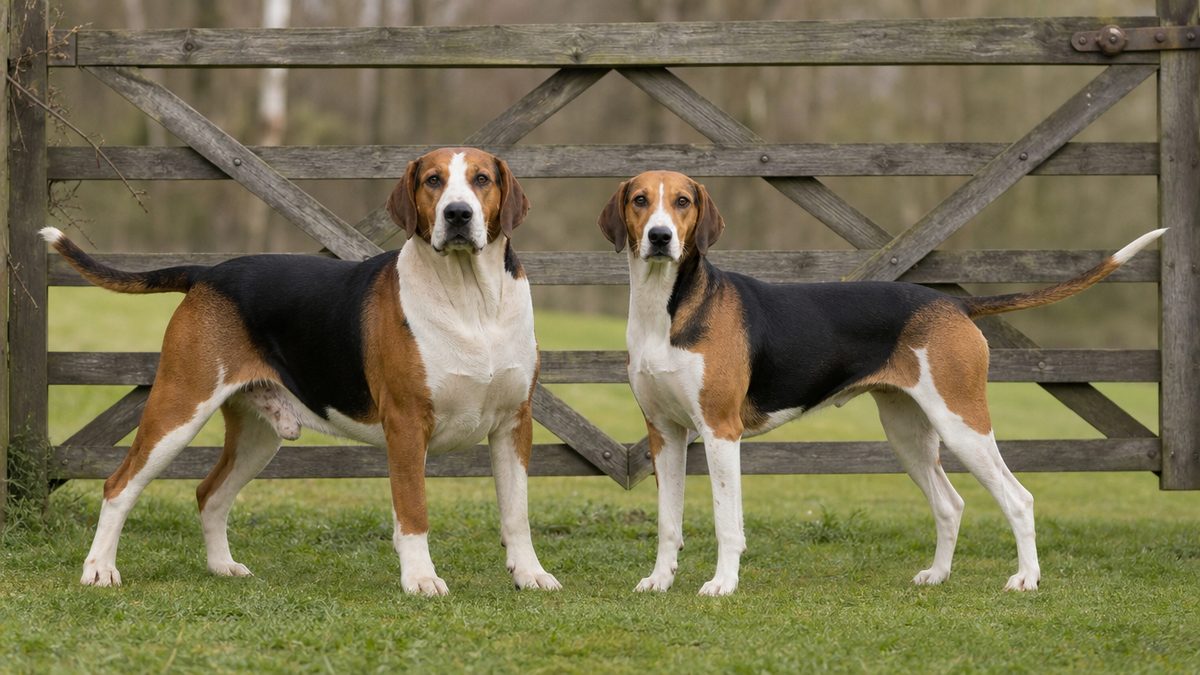
Quick answer
Foxhound names more than one dog. Four breeds carry the name at home, the American, the English, the Welsh and the extinct Dumfriesshire, and only the first two hold FCI standards, numbers 303 and 159. Britain's Royal Kennel Club registers one breed called Foxhound and means the English one. In North America the working studbook registers five kinds of hound under the name and decides which is which by a coefficient from 0 to 100. Bonbeno rates every foxhound 1 of 5 for heat tolerance in India.
This guide is general information for Indian pet owners and is not a diagnosis or treatment advice. Consult a registered veterinarian near you before acting on anything you read here, and treat collapse in the heat, laboured panting that does not settle, a painful ear, or persistent coughing and weight loss in a dog fed raw meat as reasons to go to a clinic rather than to wait.
Foxhound at a glance
Foxhound names more than one dog, and the registers do not agree how many
A foxhound is a large scent hound bred to run in front of mounted riders and hunt fox by nose for hours at a stretch, and at least four separate dogs carry the name. Two of them hold international breed standards. The register that actually holds the working population recognises five kinds of hound and decides which is which with arithmetic.
Wikipedia, which holds position 2 on Google India for this query, states the problem in one sentence and then walks into it. There are different breeds of foxhound, it says, each often called simply Foxhound in their native countries, and it lists four: the American Foxhound, the extinct Dumfriesshire Black and Tan Foxhound, the English Foxhound and the Welsh Foxhound. That is the right answer to the question the query asks.
Two paragraphs later the same page prints one set of measurements for all of them: males typically 29 to 32 kg and 55 to 63 cm, females 27 to 29 kg and 53 to 60 cm. Those figures are sourced to the American Kennel Club's American Foxhound breed page, which prints exactly 65 to 70 pounds and 22 to 25 inches for males and 60 to 65 pounds and 21 to 24 inches for females. One breed's row, converted into metric and relabelled as the type's.
What this page covers, and what it does not
This page covers the name and it separates the dogs. It does not give you one foxhound weight, one foxhound height or one foxhound price in india, because no such figure exists that is not an average across different animals. Where a per-breed number exists, it appears here with the breed named and the document it came from. Where a number exists for one breed and not the other, that is reported as a difference between breeds rather than smoothed away.
The cleanest example is health. The Orthopedic Foundation for Animals publishes no rows at all for either foxhound breed, while the Harrier has 416 hip evaluations and the Otterhound 644 in the same tables. There is nothing to average, and the reason there is nothing to average is the most interesting thing on this page.
The one thing every foxhound has in common
All of them were bred for the same job, and the FCI writes it into the standard as a single line. The English Foxhound's utilization clause reads Packhound for mounted hunt. Everything difficult about living with one of these dogs in an Indian city follows from that clause: the endurance, the voice, the pack habit and the fact that a scent hound stops receiving instructions the moment a scent goes live.
The FCI's own history for the breed is worth reading for what it says about records. The English Foxhound, it states, has been bred along careful lines for over two hundred years, the stud books published by the Masters of Foxhounds Association of England dating back before 1800, and the breeding of foxhounds in England has always been and is still today in the hands of the masters of foxhounds. It adds, almost as an afterthought, that lately the English Kennel Club has published an interim standard, and that the FCI recognised the breed in 1964.
Foxhound is a job description that four dogs answer to. The English Foxhound is FCI Standard 159 and the American Foxhound is FCI Standard 303. The Welsh Foxhound and the Dumfriesshire have no FCI standard at all, which in India means no route to a Kennel Club of India pedigree. If a page or a seller gives you a number for 'the Foxhound' without naming one of those, ask which.
Bonbeno already publishes full guides to the two registered breeds. Read the English Foxhound page for the British registry story, including why a kennel club registration figure is not a population figure, and the American Foxhound page for the breed that most pages ranking under this name are actually describing. This page is about what happens between them.
Which register holds which foxhound, counted from each register's own listing
Registry recognition of the foxhound runs from one breed to five depending on which document you open, and the spread is the most useful thing on this page. Every count below was read from that body's own listing on 27 August 2026.
| Register | Foxhounds recognised | Which |
|---|---|---|
| Federation Cynologique Internationale | 2 | English Foxhound (159), Great Britain; American Foxhound (303), USA |
| The Royal Kennel Club, UK | 1 | Foxhound, whose own breed page describes the English Foxhound |
| American Kennel Club | 2 | English Foxhound and American Foxhound, as separate breeds |
| Masters of Foxhounds Association of North America | 5 | American, Crossbred, English and Penn-Marydel Foxhounds, plus Harriers |
| Wikipedia's list of dogs called simply Foxhound | 4 | American, English, Welsh, and the extinct Dumfriesshire |
The FCI holds two, and only two, and the controls prove it
The FCI's Group 6 listing, Scent hounds and related breeds, contains exactly two breeds with foxhound in the name. ENGLISH FOXHOUND (159) sits in Section 1.1, large-sized hounds, under Great Britain, with a validity date of 26 March 2009, and AMERICAN FOXHOUND (303) sits in the same section under United States of America, with a validity date of 2 November 1979. Both carry the working trial marker.
Searching that same listing for the other two names returns zero. Welsh returns zero. Dumfries returns zero. Penn returns zero. Crossbred returns zero. The controls fire in the same document: Bloodhound appears once, as CHIEN DE SAINT HUBERT (84), and Dalmatian appears once, so the search instrument is working and the absences are real.
That matters directly in India. The Kennel Club of India is the FCI's member body here and registered 32,219 puppies to its studbook in 2025. It issues pedigrees against FCI nomenclature, and FCI nomenclature contains 159 and 303 and nothing else under this name. A KCI paper cannot say Foxhound. It has to name one of the two, and a seller who cannot say which is describing paperwork that does not exist in that form.
The Royal Kennel Club holds one, and calls it by the group name
Britain registers a single breed called Foxhound, and the club's own breed page opens by describing a different name: traditionally, it says, the English Foxhound has always been a pack hound, with many hunts developing their own readily identified type, and the annual Festival of Hunting at Peterborough sees exhibits from many packs in competition. So the register's word and the breed's word differ on the same page, which is exactly why an Indian reader searching the shorter word lands on the wrong material.
The same page adds a detail that belongs in any account of this breed's variability. It registers nineteen breed standard colours, including Badger Pied, Hare Pied, Lemon Pied, Blue White and Tan and Tricolour, each with a Mottle variant. That is a hunting-kennel vocabulary rather than a show-ring palette, and it is longer than almost any other breed's list on the same site.
The FCI says two foxhound breeds. The Royal Kennel Club says one. The Masters of Foxhounds Association of North America admits five kinds of hound to one stud book. None of these bodies is wrong; they are answering different questions. What is wrong is any page that prints a single number for 'the Foxhound' without saying which of those questions it answered.
The stud book that decides the breed with arithmetic
The Masters of Foxhounds Association of North America defines which foxhound breed a hound belongs to by a Breed Coefficient on a scale of 0 to 100, and that single rule is the strongest evidence available that Foxhound is not one breed. A hound scoring 93 is a Crossbred and a hound scoring 94 is English.
The rules are published, and Bonbeno read them rather than summarising a summary. Eligibility is stated first: American, Crossbred, English and Penn-Marydel Foxhounds and Harriers are eligible for registration or listing in the Foxhound Stud Book, provided they meet the association's requirements, and prior to 2008 Penn-Marydels were identified as American in the same book.
| Breed Coefficient | The hound is classified as | Coefficient then assigned |
|---|---|---|
| 1 to 7 | American | 0, rather than the calculated figure |
| 8 to 93 | Crossbred | The calculated figure |
| 94 to 100 | English | 100, rather than the calculated figure |
The calculation is simple and its implication is not. You take the Breed Coefficients of the sire and the dam, add them and divide by two. Breed membership is therefore an inherited average that can move a fraction at a time, and the two named breeds sit at the two ends of one continuous scale with an 86-point band of Crossbred hounds between them. No kennel club anywhere defines a breed this way, and this is the definition that governs the population of working foxhounds in North America.
The other three rules that make this register unlike a kennel club
- A work requirement. Every registered hound, and both its sires and dams in the first and second preceding generations, must be certified to have legally hunted fox, coyote, bobcat, mountain lion or drag.
- A breeder test. Hounds bred by a person or organisation not primarily devoted to hunting acceptable quarry are not considered to have hunted for the purpose of qualifying.
- A naming rule. An entered hound's name has three parts, the hunt prefix, the given name and the year of entry, and none of them changes when the hound is drafted to another pack. A hound is entered once it has been hunted on a regular and systematic basis.
- An outcross allowance. Outcrosses from other scenting breeds may be listed, with one non-foxhound outcross permitted in the third generation and one-eighth outcross allowed for such listing.
- A fractional purity rule. American, Penn-Marydel and English hounds must each have no more than one outcross in the fourth generation, or not more than one-sixteenth total outcross. For English hounds this rule applies from 1978; before that the threshold was one thirty-second.
Read the naming rule again, because it is the sentence that explains why no foxhound population figure matches any kennel club number. A hound acquires a registered identity after it has proved it can work, not at a few weeks old. The stud book is a record of animals that hunted, and a kennel club register is a record of puppies that were born.
Penn-Marydel, the breed that appeared in 2008
The Penn-Marydel is the clearest case of a foxhound breed created by a registry decision rather than by a founding population. Since 2008, Penn-Marydel hounds have been given breed recognition and have their own section in the Foxhound Stud Book, and before that date they were recorded as American. A further category, Penn-Marydel Listed, covers hounds that are 12.5 percent or less outcross, whose progeny by a pure Penn-Marydel count as pure.
So a hound that was an American Foxhound in 2007 could be a Penn-Marydel in 2009 without a single gene changing. PubMed returns zero records for Penn-Marydel against working controls of 126 for Labrador with hip dysplasia and 14,765 for Beagle in the same session. The breed exists in a stud book and nowhere in the veterinary literature.
Because it is where the animals are. The MFHA notes that English and Irish hounds have their own registry and are not typically recorded in its book unless used as a sire or dam in North America. Between the two working registers and the kennel clubs, a foxhound can hold three different breed identities depending on which door it walks through, and none of those doors opens in India.
Not one foxhound standard gives a weight, and the two define each other by chest
No published breed standard for any foxhound states a weight. FCI Standards 159 and 303 and both American Kennel Club texts give heights, chest girths and proportions and stop there, which is why every weight figure you will read for a foxhound came from a breed page rather than a standard.
| Item | English Foxhound, FCI 159 | American Foxhound, FCI 303 | Harrier, FCI 295 |
|---|---|---|---|
| Origin | Great Britain | U.S.A. | Great Britain |
| Valid standard dated | 26.03.2009 | 02.11.1979 | 27.11.1974 |
| FCI section | 1.1 large-sized | 1.1 large-sized | 1.2 medium sized |
| Utilization clause | Packhound for mounted hunt | Hound | Scent hound |
| Height | Approx 58 to 64 cm | 56 to 63.5 cm dogs, 53 to 61 cm bitches | 48 to 55 cm, 48 to 50 preferred |
| Weight | Not stated | Not stated | Not stated |
| Coat | Short and dense, weatherproof | Close, hard hound coat of medium length | Smooth, of English style, flat and not too short |
| Colour | Any recognized hound colour and markings | Any colour | Usually white base with black to orange shades |
Read the weight row across. Three standards, three countries, five decades between the oldest and the newest, and not one of them prints a number in kilograms or pounds Federation Cynologique Internationale Federation Cynologique Internationale. Bonbeno searched the American Kennel Club's English Foxhound text for the words height and weight and found zero occurrences of either. That standard, approved in 1935, describes the dog entirely by proportion.
The chest girth ratio, which is the real difference
What the two American standards do give, and give in the same form, is a chest girth expressed against a height. The English text asks that the chest should girth over 31 inches in a 24-inch hound. The American text asks for a chest narrower in proportion to depth than the English hound, 28 inches girth in a 23-inch hound being good, and the FCI's American standard repeats that sentence word for word.
Divide them out and the difference is measurable. Thirty-one over twenty-four is 1.29; twenty-eight over twenty-three is 1.22. The English hound is asked to be about six percent deeper through the barrel at the same height, which is the whole visible difference between two dogs that most photographs cannot separate. It is also the only breed comparison on this page that comes from the standards rather than from anybody's opinion.
The AKC's own breed page disagrees with the AKC's own standard
Here is where the composite weight comes from. The American Kennel Club's American Foxhound breed page prints Height 22 to 25 inches for males and 21 to 24 for females, Weight 65 to 70 pounds and 60 to 65 pounds, and a life expectancy of 11 to 13 years. The club's own Official Standard of the American Foxhound, approved 11 January 2011, says something different: dogs should not be under 23 or over 28 inches, bitches not under 21 or over 26 inches.
That is a three-inch gap at the top of the range for the same breed on the same website, and the breed page's figures match the FCI's 22 to 25 rather than the AKC's own 23 to 28. Bonbeno prints all three rather than choosing. Then note what happened downstream: Wikipedia took the breed page's numbers, converted them and printed them as the measurements of the foxhound type, covering four dogs including one that has been extinct for a century.
It comes from one breed page, and no standard supports it. If you need a working figure for planning a crate, a car or a vet's dose chart, use the AKC American Foxhound page's 65 to 70 pounds and say where it came from. Do not present it as the weight of an English Foxhound, because no document anywhere states one.
Five puppies in a year, and we checked both of the club's documents
The Royal Kennel Club registered five Foxhound puppies in 2025 and fifteen across the whole decade, and both of the club's own documents agree on every one of those ten figures. Corrected on 31 August 2026: an earlier revision of this page summed the decade to twenty. The ten annual figures are right and were checked twice against the club's own documents; the addition was ours, and 2+0+0+0+0+0+1+1+6+5 is fifteen. Bonbeno checked, because the club's tables are known to disagree with each other elsewhere.
| Breed | 2016 to 2025 | Decade total | Cells that disagree between the two documents |
|---|---|---|---|
| Foxhound | 2, 0, 0, 0, 0, 0, 1, 1, 6, 5 | 15 | 0 of 10 |
| Harrier | recorded only from 2020: 12, 38, 9, 0, 1, 7 | 67 | 0 of 6 |
| Otterhound | 40, 24, 39, 44, 7, 42, 30, 18, 42, 10 | 296 | 0 of 10 |
| Bloodhound | 53, 88, 62, 91, 36, 19, 34, 54, 25, 5 | 467 | 0 of 10 |
| Irish Wolfhound | 256, 372, 239, ?, 195, 198, 238, 191, 165, 197 | not stated | 1 of 10, the 2019 figure |
The Foxhound's row survives the check intact, and so do the Harrier's, the Otterhound's and the Bloodhound's The Royal Kennel Club. One row in the same group does not: the web table gives the Irish Wolfhound 225 for 2019 and the PDF gives 229, a difference of four dogs. That is worth naming because it shows the check is capable of finding something, which is what makes the four clean rows meaningful.
The group total reconciles too. Summing the PDF's own breed rows for 2025 gives 20,841, matching the printed group total exactly, once the three short rows are read as right-aligned to the most recent year rather than the oldest. The web table confirms that alignment independently for the Harrier, which it shows as unrecorded for 2016 to 2019 and then 12, 38, 9, 0, 1 and 7.
Why the number is small and what it does not mean
Twenty puppies in ten years makes the Foxhound one of the least registered breeds in Britain, and the Royal Kennel Club marks the row with an asterisk explaining that the breed is known to be numerous outside of The Royal Kennel Club. Bonbeno's English Foxhound page works through what that footnote means and why a kennel club figure is not a population figure, so this page will not repeat it.
What belongs here instead is the comparison the sibling page cannot make. In the same ten years the Otterhound recorded 296 and the Bloodhound 467, both of them also rare British hounds, and both of them have OFA screening tables while the Foxhound has none. So low registration and absent health data are not the same problem, and this breed has both for different reasons.
Bonbeno extracted the Hound group PDF with pypdf rather than a web scraper, because a scraper has silently dropped rows from these files before, and then compared every relevant cell against the club's live web table. Where the two agree we say so. Where they do not, as with the Irish Wolfhound's 2019 figure, we print both.
Foxhound price in India, and the search engine that answers with a snack
No Foxhound price in India exists, and the clearest evidence is what a search engine does with the query. On 27 August 2026 Bing India's results for 'foxhound price in india' were led by fox nuts, the Indian puffed-lotus-seed snack, and eight of its ten organic results were not about dogs at all.
| Position | What the result was about | Engine's own note |
|---|---|---|
| 1 | Amazon.in listing for foxnut, 1 kg | none |
| 2 | Amazon.in premium fox nuts, phool makhana | none |
| 3 and 4 | Flipkart makhana and fox nut packs | none |
| 5 | Smartprix scooter price list, 211 scooters | Missing: foxhound. Must include: foxhound |
| 6 | Horse price in India | Missing: foxhound. Must include: foxhound |
| 7 | Live horse prices per kilogram in India | none |
| 8 | Liquor prices in India by state | Missing: foxhound. Must include: foxhound |
| 9 | A 50-breed Indian dog price list | none |
| 10 | Today's live chicken rate in India | Missing: foxhound. Must include: foxhound |
The engine is not malfunctioning and it is not substituting a poisoned result set. It is telling the truth in the only way it can: it printed Missing: foxhound / Must include: foxhound on five of those ten results, its People also ask box read 'Loading' and then 'Unable to load answer', and every related search it offered was for fox nut price in India. The commercial query has no commercial answer, so the engine fell back to the nearest thing Indians actually buy.
The control that proves the absence is real
An absence has to be earned, so the same instrument was run against a document that should return hits. India's most-cited price list, Supertails' 40-breed guide, contains zero occurrences of foxhound, while returning 30 hits for Labrador, 36 for Beagle, 8 for Dachshund, 11 for Mudhol and 4 for Rajapalayam in the same 1.59 million character page. Its forty rows include the Bull Terrier at Rs 25,000 to Rs 70,000 and the Scottish Terrier at Rs 30,000 to Rs 80,000, so neither hounds nor Indian breeds are being filtered out.
Bonbeno's American Foxhound page documents what the Indian listing pages that do rank for the longer breed names actually contain, including a carousel of eight puppies of six other breeds sitting above an empty availability block. That work is not repeated here. What this page adds is the shorter query, and the shorter query is worse: it does not reach a dog at all.
Why no lawful supply chain can form
Two facts close the loop. First, the FCI nomenclature the Kennel Club of India registers against contains two foxhound breeds and no dog called simply Foxhound, so there is nothing for a generic Indian listing to be registered as Federation Cynologique Internationale. Second, DGFT Trade Notice 22/2022-23 makes dogs a Restricted import under ITC(HS) 01061900 and states that any applications for trading/breeding purposes, or applications made on behalf of some another person or entity shall be duly rejected. Entry is allowed only through the airports and seaports of Delhi, Mumbai, Chennai, Hyderabad, Bengaluru and Kolkata and, since October 2024, Kochi airport. The full route is set out in how to import a dog to India.
So the only lawful route for a foxhound to reach India is one traveller importing their own dog, with an import authorisation applied for at least two months before travel and an advance No Objection Certificate from the quarantine officer at one of those seven ports. That is not a supply chain. It is a single person moving house.
There is no answer, and the search engine's own behaviour is the answer. No named breed on any Indian selling page, no row in the national price list, no generic FCI breed to register, no lawful commercial import, and a price query that resolves to makhana. Treat any rupee number quoted to you for a foxhound as invented on the spot.
What a foxhound would cost to keep in India, bounded honestly
Feeding a 30 kg endurance hound is the largest predictable line in the cost of ownership, and at printed Indian shelf prices it runs between about Rs 6,510 and Rs 10,920 a month depending on which pack size you buy. Every other line in the cost of ownership is a range rather than a figure, because no Indian owner base exists to average.
Large-breed adult formulas are widely stocked in India, and the pack-size effect is bigger than the brand effect. Royal Canin Maxi Adult is sold in packs from 385 g to a 20 kg twin pack, with the printed price per 100 grams running from Rs 104 in the smallest to Rs 62 in the largest. The 20 kg twin pack carries an MRP of Rs 15,700.
| Pack you buy | Printed price per 100 g | Cost per month at 350 g a day |
|---|---|---|
| Largest pack | Rs 62 | Rs 6,510 |
| Mid-size pack | Rs 69 | Rs 7,245 |
| Small pack | Rs 87 | Rs 9,135 |
| Smallest pack | Rs 104 | Rs 10,920 |
The 350 grams is an arithmetic assumption for the table, not a feeding recommendation, and your dog's ration comes from its body condition and your veterinarian. What the table does show is real and controllable: buying in the smallest pack costs Rs 4,410 a month more than buying in the largest, a 68 percent premium for convenience, on a dog that will eat for twelve years or more.
The lines that are not food
- Grooming is close to free. The coat is short-coated, hard and weatherproof in every standard, so a rubber brush and a bath when needed is the whole routine.
- Parasite control is not. A large dog on year-round tick and flea prevention in an Indian city is a recurring monthly cost, and a pendant-eared hound needs the ear checked with it.
- Space is the hidden cost. A hound that cannot run needs somewhere to be walked twice a day in the dark, which in most Indian metros means either a car or a compromise.
- Emergency reserve. A deep-chested large breed is a candidate for gastric emergencies, and a surgical night at a metro referral clinic is the single largest bill most owners will meet.
Bonbeno does not publish an Indian monthly cost total for this breed, because there is no Indian population to derive one from and a made-up total would be the same error this page spends its length correcting. The food line above is real because it comes from a printed shelf price. The rest is your city, your vet and your dog.
Twelve to fourteen years of two long walks a day, taken before sunrise for four months of every year. That is the real cost of a pack hound in India, and it is the one that people underestimate when they price a puppy.
Heat tolerance: Bonbeno rates every foxhound 1 of 5 for India
The five places these hounds were made differ from each other by 8.54 degrees Celsius in peak wet bulb temperature, and every Indian city checked is hotter than all five. Bonbeno queried NASA POWER by explicit latitude and longitude on 27 August 2026, checking in every response that the coordinates returned matched the coordinates requested so that no substitute location could be served.
| Place | Annual mean air | Annual mean wet bulb | Peak month wet bulb | Peak maximum air |
|---|---|---|---|---|
| Cockermouth, Cumbria, fell hound country | 8.89 | 7.98 | 13.44 (Jul) | 25.53 |
| Brecon, Wales, Welsh hound country | 8.77 | 7.90 | 13.65 (Jul) | 30.98 |
| Melton Mowbray, Leicestershire, shire pack country | 9.77 | 8.55 | 14.81 (Jul) | 32.24 |
| Charlottesville, Virginia | 12.72 | 10.19 | 21.22 (Jul) | 39.80 |
| Middleburg, Virginia, MFHA country | 12.75 | 10.39 | 21.98 (Jul) | 40.65 |
| Shillong | 17.96 | 16.22 | 21.63 (Jul) | 29.91 |
| Bengaluru | 23.74 | 19.80 | 22.66 (May) | 40.38 |
| Pune | 23.86 | 19.66 | 23.56 (Jun) | 43.20 |
| Hyderabad | 26.10 | 20.96 | 24.44 (Jun) | 45.00 |
| Mumbai | 26.77 | 22.73 | 26.55 (Jun) | 44.91 |
| Chennai | 27.95 | 24.94 | 27.36 (May) | 42.70 |
| Delhi | 25.60 | 18.03 | 27.74 (Jul) | 48.79 |
| Kolkata | 25.81 | 22.85 | 27.86 (Jun) | 46.81 |
The first thing this table shows is that the homelands are not one climate. Middleburg's July peak wet bulb of 21.98 degrees is 8.54 above Cockermouth's 13.44, which is a bigger gap than the one between Bengaluru and Kolkata. An American Foxhound was selected in a place whose worst month is warmer than a fell hound's worst month by more than eight degrees, so a single heat tolerance rating for the type would be false in both directions before India is even mentioned.
The second thing it shows is that the distinction stops mattering here. Every Indian city in the table has a higher peak wet bulb than every homeland in it, and Chennai's year-round average of 24.94 is nearly three degrees above the single hottest month Middleburg ever averages. Even Shillong, the mildest Indian entry, runs a July peak of 21.63, which is within half a degree of Virginia's worst month and nearly eight above Cumbria's.
One thing worth saying for the American Foxhound specifically
Middleburg records a peak maximum air temperature of 40.65 degrees, which is higher than Bengaluru's 40.38. So the American Foxhound's homeland does get genuinely hot air. What it does not get is Chennai's or Kolkata's humidity for eight months of the year, and humidity is what decides whether panting works. Read the wet bulb column, not the maximum air column, when you are deciding whether a dog can be exercised.
What the heat literature says, and what it cannot say about this breed
No foxhound-specific heat risk figure exists. Hall and colleagues reviewed the clinical records of 905,543 UK dogs under primary veterinary care in 2016 and identified 395 confirmed heat-related illness events, putting the 2016 incidence at 0.04 percent and the event fatality rate at 14.18 percent, with a 95 percent confidence interval of 11.08 to 17.96. Their multivariable model names breed as a risk factor, and no foxhound is among the breeds it names.
Two findings do transfer because neither is breed-specific. Bodyweight above the breed and sex mean was a significant risk factor, as was being over two years of age. And in the companion study of the same cohort, exertional heat-related illness was the predominant trigger at 74.2 percent of events, ahead of environmental at 12.9 percent and vehicular confinement at 5.2 percent, with the authors concluding that in the UK exertional heat illness affects more dogs, and kills more dogs, than confinement in a hot car.
A pack hound's entire purpose is prolonged exertion, and the largest study of triggers finds exertion is what causes and kills. An athletic dog bred to gallop for a full English winter day, asked to do a fraction of that in Chennai in May, is the exact profile the paper describes. This is why the rating here is 1 of 5 and not 2.
Temperament, and the two things a pack kennel selected for
Every foxhound of every type is bred to be friendly with people and to live with other dogs, because a pack that fights or that cannot be handled by a stranger on a hunt morning is useless. The two traits that follow from the same selection are the ones that make an Indian flat impossible: a carrying voice and total absorption in a scent.
The standards are unusually consistent on this. The FCI's English Foxhound text gives its behaviour clause as stamina and endurance, natural ability to hunt. The American Kennel Club's American Foxhound standard describes eyes that are large, set well apart, soft and houndlike, expression gentle and pleading. There is no guarding language anywhere in either document, because a hound that guarded would be a liability in a kennel of forty.
Wikipedia's summary matches and is worth quoting because it is the description most Indian readers will meet first: foxhounds generally display a gentle and affectionate temperament, are highly active and energetic, are sociable, have great stamina and a good sense of smell, and enjoy being in a pack, as they are bred for hunting in packs.
The voice, and what Indian law says about it
A pack hound speaks while it works, and it is bred to be heard across a valley. India regulates that. The Noise Pollution (Regulation and Control) Rules 2000 set ambient limits of 55 dB(A) Leq by day and 45 by night in a residential area, with night time running from 10 p.m. to 6 a.m., and 50 by day and 40 by night in a silence zone, defined as not less than 100 metres around hospitals, educational institutions and courts.
That is the single most practical constraint on keeping any foxhound in an Indian city, and no page ranking for this breed mentions it. A vocal hound that gives tongue at the corridor at 11 p.m. is not a neighbour dispute; it is a limit written into a notification. Nothing about training removes the voice, because the voice is the working product.
Who any foxhound suits, and who it does not
It suits a household with genuine land or reliable daily access to it, other dogs for company, a tolerance for noise, and mornings that start before sunrise for a third of the year. It suits people who want an independent, cheerful, unmanipulative dog that will never be neurotic about being left with its own kind.
It does not suit a flat, a single-dog household where the dog is alone all day, a family with free-roaming small animals, or anyone who wants a dog that walks off-lead. The Royal Kennel Club's own hound group note describes these breeds as enjoying a significant amount of exercise and as dignified, aloof but trustworthy companions, which is a polite way of saying the dog likes you and does not need you.
A 58 to 64 cm hound bred to live in a communal kennel and run in front of horses is not an apartment dog at any level of owner effort. This is one of the few breeds on this site where the honest answer to 'can it work in a 2BHK' is no rather than 'with difficulty'.
Training a foxhound, and the definition that explains why it is different
To train a foxhound, understand first that the working register does not measure training at all. The Masters of Foxhounds Association defines an entered hound as one that has been hunted on a regular and systematic basis, which is education by immersion in a pack rather than anything a pet owner can reproduce.
That definition is worth reading twice. A hound is entered when he has been hunted on a regular and systematic basis, and only an entered hound may be registered or listed in the stud book. The animal earns its identity by doing the job, in company, over a season. There is no obedience component and no individual handler relationship in that model, and an Indian pet home offers neither the pack nor the season.
What works
- Socialise early and widely, in the first sixteen weeks, because a hound raised alone in a flat misses the pack that would otherwise have taught it everything.
- Train with food, in short sessions, indoors, before the dog is hot. Foxhounds are cheerful and food-motivated and learn quickly when the nose is quiet.
- Build a settle on a mat as the single most valuable behaviour, because a hound that can switch off indoors is a hound that can live in a house.
- Teach a scent game with a clear start and stop, so that the nose has a legitimate outlet on your cue rather than only on its own.
- Use a long line in enclosed space instead of chasing an off-lead recall you will not get.
What will not change
Recall around a live scent. This is not a training deficiency and it is not fixable by a better trainer. A scent hound selected for two centuries to follow a line and ignore everything else will follow a line and ignore everything else, and in Indian traffic that is a fatal property rather than an inconvenient one. The lead is permanent equipment on any public road.
The second is the voice, dealt with above. The third is company. A foxhound left alone all day in a flat, with no pack and no work, will vocalise and destroy, and the honest fix is a second dog and a garden rather than a training plan.
The rules require that a registered hound and both its sires and dams in the two preceding generations were certified as having legally hunted. Three generations of selection for a specific working temperament is a very strong filter, and it is why these dogs are so uniformly friendly and so uniformly unreachable on a scent. You are not getting a blank slate; you are getting the output of that filter.
Exercise, and the requirement no Indian city can meet
A foxhound's exercise requirement is written into its FCI utilization clause: packhound for mounted hunt. That means keeping up with horses across country for the length of a hunting day, and no combination of Indian walks substitutes for it.
The FCI's gait clause for the English Foxhound asks for movement that is free striding, tireless, with the ability to gallop, and good drive behind with no indication to roll. The American standard's Scale of Points allocates 35 of its 100 points to Running Gear alone, split as forelegs 10, hips, thighs and hind legs 10, and feet 15. The English standard, approved in 1935, gives 20 of its 100 to legs and feet.
Read that as a judging instruction and it is unambiguous. More than a third of the American Foxhound's quality, as its own register scores it, is the machinery for covering ground. A dog built and scored that way is not satisfied by two twenty-minute lead walks.
| City | The constraint | Realistic verdict |
|---|---|---|
| Delhi | Peak maximum air 48.79 C, but the driest annual mean wet bulb in the table at 18.03 | Genuinely workable November to February, dawn only from April to July |
| Chennai | Annual mean wet bulb 24.94 C, the highest in the table, with no cool season | The hardest fit in India. The humidity does not release at night |
| Mumbai and Kolkata | Peak wet bulb 26.55 and 27.86 C plus monsoon | Pre-dawn only, and indoor scent work for the wettest weeks |
| Bengaluru and Pune | The mildest large cities, peak wet bulb 22.66 and 23.56 C | The only large Indian cities where two real outings a day are possible most of the year |
| Shillong | Annual mean wet bulb 16.22 C, peak maximum air only 29.91 C | The easiest Indian climate in the table by a wide margin, and the only one that approaches the homelands |
What ninety minutes should actually contain
- Two outings, both before 7 a.m. and after 7 p.m. for four months of the year, never in the middle of the day from March to June.
- Long-line work in an enclosed space so the dog can move at its own pace rather than at lead length.
- Deliberate scent work, twenty minutes of it, because a nose that is used is a nose that is quieter afterwards.
- Company, ideally another dog, because a pack animal exercised alone is still under-stimulated.
- Water available throughout and a hard stop at the first sign of laboured panting, since exertional heat illness is the leading trigger in the largest study of the question.
The failure mode is predictable and it is not aggression. An under-exercised foxhound becomes noisy, becomes destructive and starts leaving. A large hound that has learned to get out of a compound in search of something interesting is a dog with a road ahead of it.
Grooming is the easiest part, and the ear is the exception
Every foxhound standard describes a short, hard, weatherproof coat that needs a brush and nothing else, so grooming is the one line where this breed is genuinely cheap in India. The pendant ear is where an Indian monsoon does its damage.
The three standards agree almost word for word. The FCI's English text asks for hair that is short and dense, weatherproof. The FCI's American text asks for a close, hard hound coat of medium length and marks a short thin coat, or one of soft quality, as a defect. The AKC's American standard repeats that defect clause exactly. The Harrier's standard, for comparison, asks for hair smooth, of English style, flat and not too short.
In practice that means a rubber curry once a week, a bath when the dog is actually dirty, and nails kept short. Nothing about a hard weatherproof jacket struggles in a humid Indian August, which is more than can be said for most imported coats. A short-coated working hound in India needs less coat care than almost any other imported breed, and the weekly brush matters mainly as an excuse to run your hands over the whole dog and find ticks before they find a vein.
The ear, which is the real job
Both foxhound standards describe an ear that closes the canal. The FCI's English text gives leathers pendant, carried close to the head, high set, and the American text describes ears set on moderately low, long, reaching nearly to the tip of the nose when drawn out, fine in texture, with almost entire absence of erectile power, setting close to the head. That is a lid over a warm, dark, damp space, and Indian humidity supplies the rest.
- Dry the ear leather and the entrance to the canal after every bath, swim or heavy rain.
- Lift and look weekly, checking for redness, a yeasty smell or head shaking rather than waiting for scratching.
- Never pour water or a home remedy into the canal. A veterinarian's cleaner on a cotton pad on your finger is the safe method.
- Treat a painful ear as urgent rather than as grooming, because a ruptured drum is not a grooming problem.
- Watch the ear tips on a hound that runs through scrub, since the American standard's own description has them reaching nearly to the nose.
The AKC's English Foxhound standard, approved in 1935, states that most English hounds are rounded, which means that about 1.5 inches is taken off the end of the ear. That is ear cropping, and it is prohibited in India. Bonbeno's English Foxhound page sets out the clause and the three standards side by side. The practical instruction is short: leave the ears alone, and treat a flat-tipped ear on an Indian-bred hound as evidence of an offence.
Health, and the blank that is about screening rather than rarity
Neither foxhound breed has a single row in the Orthopedic Foundation for Animals' published statistics, and two closely related British hounds that are rarer on the Royal Kennel Club's own register do. That comparison is the point: the foxhound blank is not caused by there being few of them.
| Breed | Hips | Elbows | Eyes, summary line | Other |
|---|---|---|---|---|
| English Foxhound | No row | No row | No row | No row of any kind |
| American Foxhound | No row | No row | No row | No row of any kind |
| Harrier | 416 evaluations, 14.7 percent dysplastic, rank 88 | No row | 86 evaluations, 97.7 percent normal, rank 202 | - |
| Otterhound | 644 evaluations, 46.9 percent dysplastic, rank 11 | 259 evaluations, 32.8 percent abnormal, rank 9 | No row | Glanzmann's thrombasthenia, rank 1 of all breeds, 290 tested |
The Harrier and the Otterhound are the controls, and they are unusually good ones because both are British hounds registered in tiny numbers. The Harrier recorded 67 Royal Kennel Club puppies across six years and the Otterhound 296 across ten, against the Foxhound's 20. Both nonetheless carry substantial OFA tables, so the absence of foxhound data is not an artefact of rarity. It is a consequence of who owns the dogs: pack hounds belong to hunts, and hunts do not submit radiographs to an American orthopaedic registry.
The Harrier and Otterhound figures, with the arithmetic checked
Since these are the nearest published numbers to a foxhound that exist, they are worth printing properly rather than gesturing at. The Harrier's 416 hip evaluations break down as 8.2 percent excellent, 53.6 good and 22.6 fair, which sums to the printed 84.4 percent normal exactly, against 11.3 mild, 3.1 moderate and 0.2 severe, summing to 14.6 against a printed 14.7. The Otterhound's 644 evaluations give 50.2 percent normal and 46.9 percent dysplastic, which places it eleventh worst of every breed OFA ranks for hip dysplasia.
Do not read the Otterhound's figure across to a foxhound. It is here to show what a published hound table looks like and to make the foxhound zero legible, not as a substitute. The Otterhound is a heavier, differently built dog and its elbow figure, 32.8 percent abnormal of 259 with rank 9, belongs to it alone.
OFA's eye tables contradict themselves here too
The Harrier's eye summary line reports 97.7 percent normal of 86 evaluations, while the detail rows give the normal count as 73 of 86, which is 84.9 percent. That is a gap of 12.8 percentage points on the same denominator, and neither figure should be quoted as the rate. Bonbeno publishes both and the division rather than the flattering one, which is the same treatment this site gives the identical problem in other breeds.
What the Royal Kennel Club asks breeders to test
Almost nothing, and it says so on the page. For the breed it calls Foxhound the club lists a single item under Good Practice, prioritising genetic diversity, and no Best Practice scheme or test at all. Breed Watch places it in Category 1, meaning no points of concern specific to the breed have been identified for special attention by judges, and there are no breed-specific breeding restrictions.
Ask the breeder what they screen for and accept the answer that they screen for nothing, because on a pack hound that is the truthful answer. Then screen the dog you own: hips at two years, an eye examination, and a baseline thyroid and biochemistry panel. On a breed with no registry data, your own dog's records are the only data that will ever exist about it.
The published literature says foxhound and usually means something else
PubMed returns 412 records for foxhound, which looks like a well-studied breed and is not. Bonbeno queried the E-utilities endpoint directly on 27 August 2026, read the query translation line every time, and ran two controls in the same session.
| Query | Records | How PubMed actually translated it |
|---|---|---|
| foxhound | 412 | "foxhound"[All Fields] OR "foxhounds"[All Fields] |
| English Foxhound | 406 | "English"[All Fields] AND ("foxhound" OR "foxhounds") |
| American Foxhound | 44 | an expansion of "american" AND ("foxhound" OR "foxhounds") |
| Welsh Foxhound | 1 | "Welsh"[All Fields] AND ("foxhound" OR "foxhounds") |
| Penn-Marydel | 0 | Penn-Marydel, unmodified |
| Labrador Retriever hip dysplasia, control | 126 | translated and returned normally |
| Beagle dog, control | 14,765 | translated and returned normally |
The second row is the one to read carefully. 406 is not a count of English Foxhound papers. It is a Boolean intersection of the word English with the word foxhound anywhere in the record, and it returns the same top five identifiers as the bare foxhound search does. PubMed cannot separate the two breeds by name, which means the literature cannot be used to compare them and any page that quotes a per-breed count has quoted an artefact.
The Welsh Foxhound's single hit is the clearest illustration. It resolves to a paper on Echinococcus genetic diversity in the United Kingdom, which mentions Wales and hounds and is not about the breed at all. The honest count for the Welsh Foxhound is zero, and zero is publishable.
The Penn-Marydel's zero is different and stronger, because PubMed did not rewrite the query at all. It searched the exact term and found nothing, against controls returning 126 and 14,765 in the same session. A breed created by a registry decision in 2008 has, eighteen years later, no veterinary literature under its own name.
Because the whole argument here is that Foxhound is several dogs, and the medical literature is one place you might hope to separate them. It cannot. When a paper says foxhound it usually means a research or kennel colony, and when a database says 406 it usually means English AND foxhound. Open the records before you count them.
The one disease outbreak this breed genuinely owns, and why it matters in India
The best-documented outbreak of tuberculosis in dogs anywhere happened in a pack of about 180 English Foxhounds in England in 2016 and 2017, and raw meat from a bovine tuberculosis area was the suspected route. India has an estimated 21.8 million infected cattle, and the paper reporting that estimate ran in the same journal, the same volume and the same issue.
O'Halloran and colleagues investigated a Mycobacterium bovis outbreak in a pack of approximately 180 foxhounds inside the bovine tuberculosis Edge Area of England, using an interferon gamma release assay and a serological assay. Their published results are specific.
| Measure | Figure |
|---|---|
| Hounds in the pack | Approximately 180 |
| Hounds tested | 164 |
| Responded positively to at least one test | 97, which the paper gives as 59 percent |
| Responded to M. bovis antigens by IGRA | 85, given as 52 percent |
| Had detectable serological responses | 21, given as 12.9 percent |
| Visible lesions at post-mortem, culture confirmed | 3, given as 3.1 percent |
| Further culture-confirmed among 24 non-lesion hounds | 3, given as 11 percent |
The paper's own summary of its significance is the line worth quoting: this study is the first investigation and report of an outbreak of M. bovis TB in a canine species. It also establishes that diagnostic tests used for other species can be used in the dog, while warning that further work is urgently needed to establish their sensitivity and specificity.
One percentage in that abstract does not reproduce from its own counts
Bonbeno divides every quoted percentage out, and one here does not balance. Three of twenty-four is 12.5 percent, not 11, and 11.1 percent would require a denominator of 27, which is the 24 non-lesion hounds plus the 3 with visible lesions. Every other figure in the abstract reconciles: 97 of 164 is 59.1 percent, 85 of 164 is 51.8 and 21 of 164 is 12.8. We flag the one that does not rather than repeating it silently, and the finding itself is unaffected.
The human side, and a published dissent
Public Health England managed the human exposure and published its own account. Contacts were stratified into risk pools, and eleven out of twenty exposed persons with the greatest risk of exposure were recommended to attend TB screening, of whom one tested positive but had no evidence of active TB infection. Its conclusion is that current guidance should be revised to account for the unique risks to human health posed by exposure to infected working dogs.
The veterinary press did not accept the reading uncritically, and Bonbeno records that. A letter in the Veterinary Record the same year was published under the title No evidence to suggest foxhounds spread bovine TB. Bonbeno retrieved that record's title, journal and volume rather than its full text, and cites it only as evidence that the interpretation was contested at the time.
Srinivasan and colleagues pooled 44 studies covering 82,419 cows and buffaloes across 18 Indian states and one union territory and estimated bovine tuberculosis prevalence in Indian cattle at 7.3 percent, 95 percent confidence interval 5.6 to 9.5, implying about 21.8 million infected cattle, a population larger than the entire United States dairy herd, with no national control programme yet implemented. That paper ran in Transboundary and Emerging Diseases, volume 65, issue 6, December 2018. So did the foxhound outbreak paper. If you feed any dog raw meat or unpasteurised milk in India, that is the risk the two papers describe from opposite ends.
The only foxhound cohort figures that exist come from 1977
One study has ever followed a foxhound population and counted what happened to it, and it was a research breeding colony surveyed over three years and published in 1977. It does not say which breed, which is itself consistent with everything else on this page.
Potkay and Bacher surveyed a research foxhound breeding colony for three years to identify problem areas for study and rectification. Its figures are the closest thing to a foxhound life table anybody has published.
| Measure | Figure |
|---|---|
| Litters whelped over three years | 339 |
| Puppies whelped | 2,872 |
| Died before weaning | 17.4 percent |
| Died between weaning and 30 weeks | 4.0 percent |
| Share of total mortality in the first week after birth | 55.6 percent |
| Leading causes in that first week | Stillbirth, immaturity or runting, trauma, congenital abnormalities |
| Predominant causes of death thereafter | Pneumonia, malnutrition, gastrointestinal disease |
| Most frequent causes of illness in puppies | Respiratory disease, anorexia and dehydration, skin disorders, gastrointestinal disease |
| Share of adult cases that were fighting or skin and ear canal infections | 75.5 percent |
Two things in that table are worth an Indian reader's attention. The first is the litter size: 2,872 puppies from 339 litters averages 8.5 puppies per litter, which is large, and which is the arithmetic behind why a pack can be rebuilt quickly and why hunt kennels have never needed a kennel club. The second is the last row. Among adult breeding stock, fighting and infections of the skin and ear canals accounted for three quarters of everything the colony treated, which is exactly the ear problem the grooming section describes, measured.
Three caveats, stated rather than buried
- It is a laboratory colony, not a pet or pack population, so the housing, the density and the veterinary attention are all different from a home.
- It is nearly fifty years old, and canine neonatal care, vaccination and parasite control have all changed since.
- It does not name a breed. The paper says foxhound, and on this page that word has already been shown to cover at least four dogs, so the figures cannot be attributed to either registered breed specifically.
Bonbeno publishes it anyway, with the caveats attached, because the alternative is what every other page does: print an invented lifespan and an invented list of conditions. Wikipedia's own most-common-causes-of-death section for the Foxhound is drawn from this same 1977 paper, which is worth knowing when you read it there without the caveats.
Bonbeno's English Foxhound guide sets out every published life expectancy for that breed against the one peer-reviewed estimate, including the disagreement between two supplementary tables of the same study about how many dogs it rests on. This page does not repeat that work, and no equivalent analysis exists for the American Foxhound.
Feeding, and the one Indian practice this breed's literature argues against
Feed a foxhound to body condition rather than to a chart, because no breed standard gives a weight to feed toward. And do not feed raw meat in India, because the only significant disease outbreak ever documented in this breed was attributed to exactly that.
The absence of a weight in every standard is not a gap here, it is an instruction. The American Kennel Club's English Foxhound text contains zero occurrences of the word weight and describes the dog entirely by proportion, asking for a chest girthing over 31 inches in a 24-inch hound and a back rib that is very deep. Judge your dog the same way: ribs easy to feel under light pressure, a waist visible from above, and a tuck-up you can see from the side.
| Stage | Meals a day | What to watch |
|---|---|---|
| 8 weeks to 4 months | 4 | Steady growth without roundness. A large-breed puppy grown fast is a large-breed adult with joints it did not need |
| 4 to 9 months | 3 | The fastest growth window. Ribs findable, no visible fat pad over the spine |
| 9 to 15 months | 2 | Growth plates still closing. Avoid forced running and stairs |
| Adult | 2 | Split meals and no exercise for an hour either side, because this is a deep-chested breed |
| Senior, from about 9 years | 2 | Muscle loss hides fat gain on a big hound. Weigh, do not guess |
The raw feeding question, answered from this breed's own literature
Raw feeding is popular in Indian cities and it is the practice this breed's own case history warns about. The 2016-17 outbreak investigation records that the affected hounds ate raw meat, and that the meat came from areas affected by Mycobacterium bovis. In Britain that was a regional risk inside a defined Edge Area. In India, pooled prevalence in cattle is estimated at 7.3 percent, about 21.8 million animals, with no national control programme in place.
Bonbeno's position is narrow and evidence-based rather than ideological. If you feed raw in India, source and handle it as you would meat for a person with a compromised immune system, and understand that pasteurisation and cooking are the only interventions that reliably kill M. bovis. Persistent coughing, lethargy and weight loss in a raw-fed dog is a reason to see a veterinarian and to mention the diet unprompted.
What is available in India
Large-breed adult formulas are widely stocked. Royal Canin Maxi Adult, for instance, prints a price per 100 grams falling from Rs 104 in its smallest pack to Rs 62 in its largest, with a 20 kg twin pack at an MRP of Rs 15,700. Bonbeno recommends no brand and has no commercial relationship with any retailer; the useful point is that pack size moves your monthly bill more than brand choice does.
Every foxhound standard asks for a chest deep for lung space. Deep-chested large breeds are the classic gastric dilatation and volvulus profile. Feed two smaller meals rather than one large one, avoid strenuous exercise for an hour either side of eating, and treat a dog that is retching without producing anything, with a swelling abdomen and obvious distress, as a surgical emergency to be driven to a clinic immediately.
The first year, month by month, on the Indian calendar
Plan a foxhound puppy's first year around two constraints Indian owners underestimate: the socialisation window closes at about sixteen weeks whatever the weather is doing, and a large-breed skeleton takes fifteen months to finish. Buy in October if you have the choice.
| Age | What matters most | The Indian complication |
|---|---|---|
| 8 weeks | The earliest lawful age. Indian rules require that pups less than eight weeks in age are not sold | A seller offering a six-week puppy is breaking Rule 8(1)(a). Walk away |
| 8 to 16 weeks | Socialisation, and other dogs above all, because this is a pack animal | From April to June this has to happen at dawn or indoors. Move it, do not skip it |
| 3 to 5 months | Lead manners before the dog outweighs the walker | Hot pavement burns pads. Test with the back of your hand for five seconds |
| 5 to 9 months | Controlled growth. No forced running, no stairs work, no long road walks | Monsoon arrives. Dry the ears after every soaking |
| 9 to 12 months | Adolescence, and the point at which recall gets worse | Peak stray-dog interaction season in many cities. Keep the lead on |
| 12 to 15 months | Growth plates close. Only now does real endurance work start | Time the transition for the cool season rather than for the dog's birthday |
| 15 months | Adult condition assessed by rib and waist, not by a chart | No standard gives a weight, so the assessment is by hand |
The two Indian sale rules, quoted from the gazette
Bonbeno extracted the fourteen-page gazette and grepped it before quoting. Rule 8, Conditions for sale, sub-rule (1)(a) of the Prevention of Cruelty to Animals (Dog Breeding and Marketing) Rules 2017 requires every breeder to ensure that pups less than eight weeks in age are not sold. Sub-clause (1)(b) adds that dogs over six months in age are not sold without first being sterilised, unless they are being sold to another licensed breeder, which almost no Indian buyer has heard of and which changes what a lawful seller can offer you at seven months.
Why October
A puppy that arrives in October gets its whole socialisation window in weather that lets it outside, and reaches its first summer at eight or nine months old, when it can be kept quiet without frustration. One that arrives in April spends the critical four weeks indoors in Delhi or Chennai and then hits adolescence in the monsoon. Nothing about the breed causes that; the calendar does.
Find your emergency clinic before you need it. Write down the address, the night number and the route, and put it on the fridge. On a large deep-chested breed the difference between a good outcome and a bad one is often forty minutes of driving that nobody planned.
The seven dogs that answer to Foxhound, side by side
Seven distinct animals are covered by this one word across four registers, and only three of them have a published height. The table below is assembled from each register's own document and nobody else publishes these rows together.
| Dog | Recognised by | Standard dated | Height in a standard | Weight in a standard |
|---|---|---|---|---|
| English Foxhound | FCI 159, AKC, Royal Kennel Club as Foxhound, MFHA as E | FCI valid 26.03.2009 | Approx 58 to 64 cm | None |
| American Foxhound | FCI 303, AKC, MFHA as A | FCI valid 02.11.1979 | 56 to 63.5 cm dogs per FCI, 23 to 28 in per the AKC standard | None |
| Penn-Marydel Foxhound | MFHA only, own section since 2008 | No breed standard published | Not published | None |
| Crossbred Foxhound | MFHA only, Breed Coefficient 8 to 93 | No breed standard published | Not published | None |
| Welsh Foxhound | No FCI standard, zero hits in Group 6 | None | Not published | None |
| Dumfriesshire Black and Tan Foxhound | Extinct, no FCI standard | None | Not published | None |
| Harrier, admitted to the same stud book | FCI 295, MFHA | FCI valid 27.11.1974 | 48 to 55 cm, 48 to 50 preferred | None |
Read the last column first. Not one of the seven has a weight in any standard, which is the fact that should have prevented every composite figure in circulation Federation Cynologique Internationale American Kennel Club American Kennel Club. Read the fourth column next: only three of the seven have a published height at all, and two of those three disagree with themselves depending on which of the two registers you ask.
The Harrier is the useful comparison, and it is not a small foxhound
Indian readers meet the Harrier as a footnote and should not. It is a separate FCI breed in a different section of the same group, Section 1.2 medium sized rather than 1.1 large-sized, at 48 to 55 cm against the foxhound's 58 to 64 Federation Cynologique Internationale. Its own standard opens by defining it against the bigger dog: strong and light, less powerful and more distinguished than the Foxhound.
It is also the only member of this family with usable health data, at 416 hip evaluations and 14.7 percent dysplastic, and the Masters of Foxhounds Association admits Harriers to the Foxhound Stud Book alongside the four foxhound types. So the working register treats it as part of the family while the FCI treats it as a different size class, which is one more place where the answer depends on the door.
What an Indian reader should take from the table
Nothing here is obtainable in India, so the practical value of the table is diagnostic rather than comparative. If somebody offers you a foxhound, ask which row of this table they mean. Four of the seven rows have no standard at all, so no pedigree can name them; two have no living population; and the two that a Kennel Club of India paper could name are the two with FCI numbers.
If what appeals to you is a friendly, tricolour, short-coated, pack-minded scent hound that India genuinely sells, the honest answer is the Beagle, which Wikipedia's own foxhound article says a foxhound physically resembles at larger scale. If what appeals is size and drive in a dog built for this climate, read the Mudhol Hound instead.
It cannot rank these dogs on health, because six of the seven have no published health data of any kind and the seventh is the Harrier. Any page giving you a foxhound health profile has produced it by borrowing, and borrowing across an 86-point Breed Coefficient band is not a comparison.
Indian law, and the screening clause that meets a total blank
Indian breeding law requires that dogs shall have been tested for genetic defects including hip dysplasia, and neither foxhound breed has a single hip evaluation in the world's largest orthopaedic registry. That collision, rather than the import rules, is the most interesting legal fact about this breed in India.
The clause is Second Schedule, Part III, paragraph 8, sub-clause (10) of the Prevention of Cruelty to Animals (Dog Breeding and Marketing) Rules 2017, and Bonbeno extracted it from the fourteen-page gazette rather than from any summary. It reads, verbatim: The dogs shall have been tested for genetic defects, including hip dysplasia, progressive retinal atrophy, night blindness, hypothyroidism, entropion, ectropion, overshot, undershot jaw (when incisors do not touch or mesh), wry mouth, two or more missing teeth, unilateral cryptorchid or full cryptorchid males.
Note the word including. The list is illustrative rather than closed, so a defect is not outside the clause merely because it is unlisted. Note also the clause number: it is a Second Schedule paragraph, not a Rule, because the Rules' own Rule 6 is a different provision that makes the Schedule binding.
The collision, stated plainly
An Indian breeder of either foxhound breed is required by that clause to have tested for hip dysplasia. The Orthopedic Foundation for Animals, which publishes hip statistics for hundreds of breeds and requires 100 evaluations before it will publish any, has no row at all for the English Foxhound or the American Foxhound. So the test the law requires has, on the world's largest published record, essentially never been done on this breed by anybody.
That is not a reason to skip it. It is the reason to do it and to keep the result, because on a breed with no registry data your dog's radiograph is the only data that will ever exist. It also tells you what to ask a seller: a breeder who says the parents were hip scored should be able to show you the scores.
| Requirement | Clause | What exists for a foxhound |
|---|---|---|
| Tested for genetic defects including hip dysplasia | Second Schedule Part III para 8(10) | No OFA row for either breed |
| Pups less than eight weeks in age are not sold | Rule 8(1)(a) | Applies normally |
| All pups vaccinated, starting at seven to eight weeks | Second Schedule Part III para 8(9) | Applies normally |
| No ear cropping or any change of appearance by artificial means | Second Schedule Part II para 8 | Collides with the AKC English standard's ear rounding |
| No commercial import of dogs | DGFT Trade Notice 22/2022-23 | Applications for trading or breeding shall be duly rejected |
Importing one, and what the notice actually permits
DGFT Trade Notice 22/2022-23 places dogs under ITC(HS) 01061900 as a Restricted import. Applicants must obtain an import authorisation and are advised to begin at least two months before travel, and the notice states that any applications for trading/breeding purposes, or applications made on behalf of some another person or entity shall be duly rejected. Import of pet animals is allowed only through the airports and seaports of Delhi, Mumbai, Chennai, Hyderabad, Bengaluru and Kolkata and, since October 2024, Kochi airport, with quarantine at the port where required, and an advance No Objection Certificate from the quarantine officer at that port.
So a foxhound can lawfully enter India only as one traveller's own pet. Any Indian seller advertising imported foxhound stock is describing a route the notice closes by name, and it is worth verifying that before any money changes hands.
What Indian readers get wrong about foxhounds, in order of cost
The most expensive mistake is assuming a foxhound is a big Beagle that will settle in a flat. The most common one is reading a figure for the type and thinking it describes a breed.
- Taking the 30 kg weight as a breed fact. No standard for any foxhound gives a weight. The figure in circulation is the AKC's American Foxhound breed page row, converted and relabelled as the type's.
- Trusting a single height. The AKC's own breed page and its own official standard disagree about the American Foxhound by three inches at the top of the range.
- Assuming Foxhound means the same dog everywhere. In Britain it means the English Foxhound. In North America the working stud book admits five kinds of hound and decides between them with a coefficient.
- Reading the Royal Kennel Club's fifteen registrations as a population. The club itself asterisks that row to say the breed is numerous outside its register.
- Assuming the absence of health data means the breed is healthy. It means nobody has submitted evaluations, which is a different thing, and two rarer British hounds have full tables.
- Believing PubMed's 406 English Foxhound records. That is a Boolean intersection of two words and returns the same papers as the bare term.
- Feeding raw meat in India. The only well-documented disease outbreak this breed owns was attributed to raw meat from a bovine tuberculosis area, and Indian cattle prevalence is estimated at 7.3 percent.
- Planning the exercise and not the hour. Ninety minutes is achievable in most Indian cities. Ninety minutes before sunrise, every day, from March to June, is what actually has to be sustained.
- Ignoring the noise limit. India's residential night-time ambient limit is 45 dB(A) Leq from 10 p.m., and a hound is bred to be heard across a valley.
- Accepting a flat-tipped ear. Ear rounding is described in the 1935 AKC English standard and prohibited in India by name.
One further mistake is about evidence rather than about dogs, and it is the one this whole page exists to correct. Wikipedia gets the structure right, listing four dogs each called simply Foxhound at home, and then prints one weight and one height for all four sourced to a single breed page American Kennel Club. A correct list followed by an averaged figure is more misleading than either alone, because the list earns the reader's trust and the figure spends it.
Adoption, and what to do if a foxhound reaches you in India
Adopt, because there is no lawful commercial route into this breed in India and there is a real one out of a rehoming kennel. A drafted or retired pack hound is a friendly, sound, undemanding animal in the right home and an impossible one in a flat.
Where these dogs actually come from
Hunt kennels retire and draft hounds constantly, and the Masters of Foxhounds Association's own rules describe hounds being drafted from one pack to another, keeping their hunt prefix and year of entry. Retired pack hounds are rehomed as pets in Britain and North America through hunt-linked schemes and general rescue. That is the population, and it is not in India.
In India the realistic route is a large tricolour scent hound cross in a shelter, which will not be a registered foxhound and will very often behave like one: friendly with everyone, uninterested in guarding, deaf to recall on a scent and audible from two floors down. Bonbeno's Indian Pariah Dog guide covers the alternative that is genuinely built for this climate.
If a foxhound does reach you, the checks in order
- Ask which breed, English or American, and which FCI standard number the paperwork names, 159 or 303. A seller who cannot answer this has no paperwork.
- Ask to see the Kennel Club of India registration for the sire and dam rather than a promise of papers to follow.
- Look at the ears. Flat-cut tips mean rounding, which is prohibited under the 2017 Rules.
- Ask for the parents' hip scores, because Second Schedule Part III paragraph 8(10) requires testing for hip dysplasia and no registry has ever published a foxhound figure.
- Count the weeks. Below eight weeks is prohibited by Rule 8(1)(a).
- Ask what the dog has been fed, and think hard before continuing a raw diet in India.
- Visit where the dogs live, and decline politely if the meeting has to happen in a car park.
Bonbeno does not recommend breeders, does not link puppy listings and does not broker sales. The checks above exist so a reader can screen a seller themselves, in an order that makes an evasive one obvious early rather than late.
Foxhound is a job, not a breed. Two dogs hold international standards and neither of those standards tells you what the dog weighs. The register that holds the working animals decides breed membership with a number between 0 and 100 and will not register a hound that has not hunted. India has no foxhound market, no foxhound row in its national price list, and a search engine that answers the price query with makhana. Ask which dog, ask for the paper that names it, and adopt if either answer is vague.
Foxhound questions, answered per breed
How much does it cost to own a dog in India?
For a foxhound-sized dog the food line alone runs about Rs 6,510 to Rs 10,920 a month at printed Indian shelf prices, depending entirely on pack size rather than brand. That is before vaccination, deworming, tick prevention, grooming or the emergency fund that a large deep-chested hound makes advisable.
What is the most expensive dog breed in India?
Not a foxhound. India's most-cited 40-breed price list contains no foxhound row at all, while its highest bands run to Rs 3,00,000 for breeds like the Dogo Argentino and the Akita. A breed with no Indian listings has no Indian price, expensive or otherwise.
Is the Foxhound one breed or several?
Several. Wikipedia names four dogs each called simply Foxhound in their home countries, the American, the English, the Welsh and the extinct Dumfriesshire, and the FCI publishes standards for only two of them. The North American working stud book registers five kinds of hound under the name.
What is the difference between an English and an American Foxhound?
Chest proportion, mainly, and the standards say so explicitly. The AKC's American Foxhound standard asks for a chest narrower in proportion to depth than the English hound, 28 inches of girth in a 23-inch hound, while the English standard asks for over 31 inches of girth in a 24-inch hound.
How much does a Foxhound weigh?
No breed standard for any foxhound gives a weight. FCI Standards 159 and 303 and both American Kennel Club standards give heights, chest girths and proportions and no weight at all. The 65 to 70 pound figure in circulation comes from the AKC's American Foxhound breed page, not from any standard.
Can you buy a Foxhound in India?
No Indian selling page checked on 27 August 2026 offered a named foxhound breed, India's national 40-breed price list has no foxhound row, and DGFT Trade Notice 22/2022-23 states that import applications for trading or breeding purposes shall be duly rejected. The lawful route is one traveller bringing their own dog.
Is a Foxhound a good family dog?
They are famously friendly and almost never guard-minded, and they are a poor fit for an Indian flat. A pack hound is bred to live with other dogs, run for hours and speak while it works, so the temperament is easy and the logistics are not.
Do Foxhounds get hip dysplasia?
Nobody knows, because neither foxhound breed has a single row in the Orthopedic Foundation for Animals' published statistics. Two closely related British hounds do: the Harrier records 14.7 percent dysplastic of 416 evaluations and the Otterhound 46.9 percent of 644, which shows the foxhound blank is about screening rather than about rarity.
Can a dog catch tuberculosis?
Yes, and the best-documented canine outbreak on record was in foxhounds. A 2018 investigation of a pack of about 180 English Foxhounds tested 164 hounds and found 97 responding positively to at least one test, with Mycobacterium bovis confirmed by culture at post-mortem. Raw meat from a bovine tuberculosis area was the suspected route.
How long do Foxhounds live?
Published figures range widely and none separates the breeds cleanly. The AKC gives 11 to 13 years for the American Foxhound and the Royal Kennel Club gives over 12 years for the breed it calls Foxhound. Bonbeno's English Foxhound guide sets out the one peer-reviewed estimate and its sample-size dispute.
Is a Harrier a small Foxhound?
No, it is a separate FCI breed, standard 295, in the medium-sized scent hound section rather than the large one, at 48 to 55 cm against the foxhound's 58 to 64. Its own standard describes it as strong and light, less powerful and more distinguished than the Foxhound.
Which register should an Indian buyer trust for a Foxhound?
The FCI, because India is represented in it by the Kennel Club of India, which registered 32,219 puppies to its studbook in 2025. FCI nomenclature contains exactly two foxhound breeds, numbers 159 and 303, so a KCI pedigree has to name one of them and cannot say simply Foxhound.
Are foxhounds and beagles the same?
No. Wikipedia's own foxhound article says a foxhound physically resembles a Beagle at larger scale, and the scale is the point: the English Foxhound stands approximately 58 to 64 cm in its FCI standard, while the Beagle is the friendly, tricolour, short-coated, pack-minded scent hound that India genuinely sells. India's most-cited 40-breed price list returns 36 hits for Beagle and zero for foxhound, and the most expensive mistake described on this page is assuming a foxhound is a big Beagle that will settle in a flat.
Do foxhounds like to cuddle?
Affectionate, yes; needy, no. Wikipedia's summary, the description most Indian readers meet first, says foxhounds generally display a gentle and affectionate temperament, are sociable and enjoy being in a pack, and the AKC American Foxhound standard asks for a soft, houndlike expression that is gentle and pleading. The Royal Kennel Club's hound group note describes them as dignified, aloof but trustworthy companions that enjoy a significant amount of exercise, which is a polite way of saying the dog likes you and does not need you.
What kind of dog is a Foxhound?
A large scent hound bred to run in front of mounted riders and hunt fox by nose for hours at a stretch, and the name covers more than one breed. Wikipedia lists four dogs each called simply Foxhound in their home countries, the American, the English, the Welsh and the extinct Dumfriesshire Black and Tan, and the FCI publishes standards for only two of them: the English Foxhound as standard 159 at approximately 58 to 64 cm and the American Foxhound as standard 303 at 56 to 63.5 cm for dogs. Not one of them carries a weight in any standard.
Compare with similar breeds
Foxhound sits in 2 Bonbeno groups. Each one compares it directly against the breeds it is genuinely an alternative to, on the same figures.