
Breed profile
Polish Hound Price in India: Two Official Dates, and an Undercoat
A 56 to 65 cm Polish scent hound with a wrinkled forehead, a folded dewlap and a dense undercoat its own standard requires. Poland's kennel club wrote the English standard itself, and it still disagrees with the FCI's register about the breed's own birthday.
Quick answer
No Indian seller lists a Polish Hound, so there is no Polish Hound price in India to quote. Google India returns about 41 results for the query and its AI Mode says outright that the breed is virtually non-existent here, then prints two rupee bands anyway. The figure that should decide an Indian buyer is not a price: the FCI standard requires this hound to carry a dense undercoat.
This page reports registry documents, breed-standard text and Indian veterinary literature. It is not veterinary advice and it cannot diagnose your dog. No peer-reviewed paper anywhere names this breed, so claims that it is free of genetic disease are untested rather than verified. Skin fold infection, ear disease and heat collapse are the presentations to watch in Indian conditions. Consult your nearby vet before acting on anything here, and take an unwell dog to a registered veterinarian rather than to a web page.
Polish Hound at a glance
What the Polish Hound is, and the one clause that decides its Indian future
The Polish Hound is a medium-sized Polish scent hound, held by the FCI as breed standard 52 in Group 6, Section 1.1, large-sized hounds, and subject to a working trial. Its native name is Ogar Polski, and the clause that matters most to an Indian buyer is not about temperament or price. It is about the coat.
The FCI standard opens its General Appearance clause by calling this a medium size hound of muscular, rather heavy build, ensuring endurance but not speed, which is the whole dog in one line. Its coat clause then reads: on head, muzzle, ears and limbs short and smooth; on other parts of the body the coat is of medium length, thick and hard; it is a little longer on nape, buttocks and underside of the tail; undercoat is dense and soft. The UKC standard, written independently, says the same thing in six words: medium length and thick, with a dense undercoat. Two registries, one requirement, and it is the requirement that makes this a difficult dog in India.
This is not a breed that happens to have an undercoat. Both governing standards specify one. A dog bred to trail wild boar through a Polish winter carries insulation by design, and it cannot take it off in Chennai. Everything this page says about heat, grooming and exercise timing follows from that one clause.
Size and weight, and which registry actually gives you a number
The FCI standard gives height at the withers as 56 to 65 cm for males and 55 to 60 cm for females, then, under a heading that reads SIZE AND WEIGHT, states only that weight should be proportional to height at withers and the whole conformation. Bonbeno searched the extracted text: the strings kg and pound appear zero times in the document.
The UKC does give numbers, and this is where the two Polish breeds diverge instructively. The UKC's Polish Hound standard states height at withers of 22 to 25.5 inches for males and 21.5 to 23.5 inches for females, and weight of 55 to 70 pounds for males and 44 to 57 pounds for females. That is about 25 to 32 kg and 20 to 26 kg. The same registry's Chart Polski standard carries a section under the identical heading, Height and Weight, and gives no weight at all. So the omission on the sighthound page is a real gap in the record rather than a UKC house style.
| Source | Male | Female | Weight stated |
|---|---|---|---|
| FCI Standard 52 (authentic English) | 56 to 65 cm | 55 to 60 cm | No number |
| UKC standard | 22 to 25.5 in (55.9 to 64.8 cm) | 21.5 to 23.5 in (54.6 to 59.7 cm) | 55 to 70 lb / 44 to 57 lb |
| PetGuide | 21.5 to 23.5 in, no sex given | as stated | 55 to 62 lb |
| A breed-club social post | 22 to 26 in | not separated | 50 to 70 lb in its title, 50 to 75 lb in its body |
| warsawdog.com | not separated | not separated | 20 to 32 kg (44 to 70.5 lb) |
Read that table for what it shows about the secondary web rather than about the dog. PetGuide's 21.5 to 23.5 inch range is the UKC's female range presented without a sex, so it excludes most standard-conforming males. The breed-club post gives two different top weights in its own title and body. warsawdog's 20 to 32 kg spans both UKC sexes at once. The UKC figures are the only sexed, registry-published weights available, and a page quoting a weight should say so.
The rest of the standard, in the parts that matter to an owner
- Colour is tightly specified. A black or dark grey saddle covering the whole nape, back and both sides, over tan from dark yellow to mahogany, with distinct tan spots above the eyes and ears always a darker shade of tan. White is permitted only as a blaze, a chest spot, on legs or toes, and at the tail tip.
- A black muzzle is a UKC disqualification. The FCI standard has no such clause, and disqualifies instead on 'untypical specimen', which is a much vaguer test.
- The belly is not tucked up. Both standards say so. This is a deep capacious hound, not a sighthound outline.
- A folded dewlap is required, and so is a wrinkled forehead, thick drooping upper lips and folded lip corners.
- The gait is deliberately slow. The FCI calls for a slow trot and, while chasing, not a very fast gallop. The UKC says the trot is slow, heavy and short.
Two angles are given as figures rather than adjectives, which is worth noting because most standards do not: the shoulder blade forms an angle of 100 degrees with the upper arm, and the coxo-femoral joint angle is about 100 degrees. Those are the numbers a judge measures against, and they describe a dog built to keep going rather than to accelerate.
History and origin: four centuries of Polish literature, and no Egypt in it
The Polish Hound's history and origin are documented from the eleventh century in Polish written sources, and the FCI standard sets them out at more length than almost any other standard the FCI publishes. What that history does not contain is Egypt.
The standard's own chain of sources is worth listing, because a reader will not find it anywhere else in English. The first reports on hunting with dogs in Poland appear in the Chronicles of Gallus Anonymous, dating from the eleventh century. Fourteenth-century chronicles record that ogar hounds were bred specifically for the royal hunt. The name ogar appears in the Book on Rural Arts by Piotr Krescentyn, published in Cracow in 1549, and in The Life of an Honest Man by Mikolaj Rej from 1568. In 1618 a Cracovian publishing house issued Hunting with Ogar hounds by count Jan Ostrorog, voivode of Poznan, which the standard calls the first Polish cynological guide and credits with containing the principles of rational breeding. The first description of the Polish Hound itself appears in Krzysztof Kluk's natural history of 1779.
A widely shared article carries the headline 'Polish Hound, a descendant of Egyptian hunting dogs'. Bonbeno extracted FCI Standard 52 and searched it: the strings Egypt and Egyptian appear ZERO times across 10,208 characters, and neither does Asia or Celtic. The standard's history is written by the Polish Kennel Club itself, in English, which is this standard's authentic language, and it traces the breed entirely through Polish written sources. An origin claim that the breed's own governing document does not make is a claim that needs its own evidence.
Three etymologies, printed side by side in the standard
Very few breed standards admit uncertainty about their own breed's name. This one prints three competing explanations and attributes each. According to Sztolcman and Gerald-Wyzycki, ogar comes from the Polish 'ogorzaly', meaning tawny, describing the hound's colour. In Mann's opinion it derives from 'grac', to give tongue, which names the characteristic barking on the trail. Frankiewicz explained it from the Czech 'ohar', meaning the pointing dog.
That is a small thing and it is also the tell of a document written by people who knew the subject and declined to tidy it. It sits oddly beside the same standard's confident 22-month disagreement with the FCI's own register about the breed's recognition date, which the next section takes on its own.
The breed nearly disappeared, and the rebuild has names and dates
Poland was under partition when the breed was being shown in the nineteenth century, and the standard records that Polish Hounds were bred in kennels of Polish nobility on the territory annexed by Russia. Poland regained independence after 123 years of occupation, after the Great War in 1918, and hunting with hounds survived only in residual forms in the Eastern Borderlands, in Polesie, Wolyn and the Vilnius region.
Then the border moved again. After the Second World War Poland lost the Eastern Borderlands together with the mainstay of its scent hounds, and the standard states flatly that there were practically no Polish Hounds bred within the new borders of the country. In 1959 colonel Piotr Kartawik imported the first four Polish Hounds from his homeland, now Belarusian territory, and founded the first post-war kennel under the name 'z Kresow', meaning from the Borderlands. In 1964 engineer Jerzy Dylewski wrote the first standard on the basis of Kartawik's dogs.
Four founding dogs in 1959 is the number to hold on to. It is the same shape of history as the Polish Greyhound's reconstruction from a handful of survivors in the 1980s, and it is why any serious buyer of either breed should be asking about coefficients of inbreeding rather than about colour.
Two official FCI documents, two recognition dates, 22 months apart
The FCI's own register and the FCI's own breed standard disagree about when the Polish Hound was recognised. The register gives 29 January 1965; the standard's history gives 15 November 1966. Both documents are current, both are official, and no page ranking in India mentions it.
The FCI breed record for Ogar Polski (52) prints, under Date of acceptance on a definitive basis by the FCI, the value 1/29/1965. FCI dates are written month first, which this very record proves on its own face: the English text's date of publication reads 5/27/2015 and the French, German and Spanish texts read 1/19/2017, and 27 and 19 cannot be months. So 1/29/1965 is 29 January 1965.
FCI Standard 52 itself, in the closing sentence of its historical summary, states that in 1964 engineer Jerzy Dylewski wrote the first standard of the Polish Hound breed and that it was included in the FCI register on 15 November 1966 under the number 52. The string 1965 appears nowhere in the standard.
| Document | Date | The claim it is making |
|---|---|---|
| FCI breed record 52 | 29 January 1965 | Date of acceptance on a definitive basis by the FCI |
| FCI Standard 52, history section | 15 November 1966 | Date the standard was included in the FCI register under number 52 |
| FCI Standard 52, front matter | 3 November 2014 | Date of publication of the currently valid standard |
| FCI breed record 52, English row | 27 May 2015 | Date the English PDF was published |
| FCI breed record 52, other languages | 19 January 2017 | Date the French, German and Spanish PDFs were published |
These are not two claims about the same event stated differently. One is a register entry recording acceptance of the breed; the other is a sentence about when a document entered a register. They could in principle both be true of different acts 22 months apart. But nothing in either document explains the gap, and the FCI is the author of both, so the honest thing is to print both dates and say which source gave which.
This is a known behaviour of FCI paperwork rather than a scandal. The same thing happens on other breeds: an FCI register entry and an FCI standard's own history have been found 47 days apart on one breed and eleven years apart on another. What is worth taking from it is a working rule. When a page dates a breed's recognition, ask which FCI document the date came from, because there are at least two and they do not always agree.
The front-matter dates are worth one more line, because they are a small archaeology of how little attention this breed's paperwork gets. The currently valid standard is dated 3 November 2014. The English PDF carrying it was published 27 May 2015, roughly seven months later. The French, German and Spanish translations were not published until 19 January 2017, another twenty months after that. For most of three years, the only FCI text of this Polish breed's current standard was in English.
That English text is also the authentic one. The standard names its own translator as Zwiazek Kynologiczny w Polsce, revised by Renee Sporre-Willes, and marks the official language as EN. So unlike the Polish Greyhound, whose authentic FCI language is German, this Polish breed's governing text was written in English by the Polish kennel club itself. Where a translation drift might explain a discrepancy on other breeds, it cannot explain one here.
Polish Hound price in India: about 41 results, and two invented rupee bands
There is no Polish Hound price in India. Google India returns about 41 results for the quoted query, and its own AI Mode states that there is no standard or official market price for a Polish Hound in India because the breed is exceptionally rare and virtually non-existent in the country. It then prints two rupee bands anyway.
What the 41 results actually contain
Bonbeno read the organic set rather than the count. It holds the FCI's own nomenclature page, Facebook posts about individual dogs including one named Blade, Polish-language YouTube videos, a Swiss shop selling a Polish Hound sticker, and an outlet-style page advertising 'Top polish hound puppies for sale Outlet Online' that is merchandise rather than livestock. Not one Indian seller appears.
The broader informational query returns a cleaner set and confirms the same thing from the other side: Wikipedia, Wamiz in the United Kingdom quoting GBP 450 to GBP 650 for a puppy and GBP 60 and up a month in upkeep, Wag! in the United States quoting USD 750 to USD 2,000 a year with a daily food cost of USD 1.20 to USD 1.40, the Animalia encyclopedia, which files the breed's size simply as Moderate and gives no price at all, warsawdog.com in Poland, four YouTube channels, a stock-photo library and a Pinterest board. Every commercial page on either query prices in pounds or dollars, and the only rupee figures anywhere in the results belong to other breeds.
| Figure | Currency | Source | What it prices |
|---|---|---|---|
| 450 to 650 | GBP | Wamiz, United Kingdom | Purchase price of a puppy |
| 60 and up per month | GBP | Wamiz, United Kingdom | Food and vet upkeep |
| 750 to 2,000 per year | USD | Wag!, United States | Annual cost of ownership |
| 1.20 to 1.40 per day | USD | Wag!, United States | Food bowl daily cost |
| 34.00 to 45.00 per month | USD | Wag!, United States | Monthly cost |
| Rs 50,000 to Rs 70,000 | INR | Google AI Mode | Its own conversion of the Wamiz GBP figure |
| Rs 2,00,000 to Rs 3,50,000 | INR | Google AI Mode | 'Total import cost', with no source at all |
The conversion, tested
Google's AI Mode presents the British price as 'between GBP 450 and GBP 650 (approximately Rs 50,000 to Rs 70,000)' and attributes it to Wamiz. Divide it out and the two ends do not share a rate. 50,000 divided by 450 is 111.11. 70,000 divided by 650 is 107.69. A single conversion cannot yield two rates, so what has happened is that each end was converted and then rounded to the nearest ten thousand rupees. That is arithmetic on somebody else's British number, not an Indian observation.
The second band is worse. Rs 2,00,000 to Rs 3,50,000 is offered as the total landed cost of importing the breed, broken into breeder fees, international pet shipping, documentation and clearances, and customs duties and quarantine. No source is attached to any part of it. The pattern is now familiar enough to name: an answer engine states that no local price exists, converts a foreign price at whatever rate suits the source currency, then adds an unsourced landed-cost range on top.
In the same answer, offering Indian alternatives, the engine recommends the Plott Hound at 'around Rs 98,999' and attributes it to a listing site. Rs 98,999 is a charm price rather than a valuation, and an answer about the Polish Hound that ends by quoting a precise five-figure rupee price for an unrelated American coonhound is not a market report. Bonbeno has not opened that listing page and makes no claim about what it contains, only about what the engine printed.
The supply side, and why it is empty
India's largest puppy listing site carries a breed selector running to roughly three hundred entries, from Affenpinscher to Yorkshire Terrier, and it includes the Mudhol Hound, the Rampur Hound, the Pashmi Hound, the Redbone Coonhound and the Black and Tan Coonhound. It contains no Polish breed of any kind. That is not a comment on demand. It is what a supply chain that cannot lawfully form looks like from the retail end.
Dogs are a Restricted import in India, and the lawful entry routes are a pet accompanying its owner with a valid pet book in the importer's name, research use with a CPCSEA recommendation, and defence or police use. Applications for trading or breeding purposes are rejected. So there is no legal path by which an Indian breeder could import foundation stock and start producing this breed here, and the empty listings follow from the law rather than from taste.
The honest bottom line: if somebody offers you a Polish Hound puppy in India today, ask to see the import paperwork and the FCI or KCI pedigree before anything else. Bonbeno will not convert a British price into rupees to fill this section, because doing that is exactly the mistake the rest of the page is documenting.
Cost of ownership in India for a 25 to 32 kg working hound
The cost of ownership for this breed in India is calculable even though its purchase price is not, because vaccination, parasite control, ear care, boarding and municipal registration are published Indian figures. Use the UKC's weight range, 25 to 32 kg for males and 20 to 26 kg for females, as the planning basis.
| Item | Published figure | Source |
|---|---|---|
| Puppy core vaccination course | from Rs 6,499 | Vetic, national page |
| Annual booster | from Rs 3,199 | Vetic, national page |
| Anti-rabies, single dose | Rs 699 | Vetic |
| Nine-in-one DHPPiL | Rs 899 | Vetic |
| Kennel cough | Rs 1,349 | Vetic |
| Consultation | Rs 500 to Rs 1,000 | VOSD, treated as one data point |
| NexGard Spectra, 15 to 30 kg, per month | Rs 1,103 | Supertails, Rs 3,308 for three tablets |
| Bath, professional | from Rs 934 | Vetic Delhi grooming |
| Boarding, overnight to 24 hours | Rs 899 | PawSpace Bengaluru |
| Delhi MCD pet dog registration | Rs 500 | MCD Delhi, dogs only |
| Chennai GCC pet licence | Rs 50 | Greater Chennai Corporation |
The ear line, which is this breed's own recurring cost
Most breeds do not need a budget line for ears. This one does. The standard specifies pendulous ears, set quite low, of medium length and width, with the front edges of the earlobes turned toward the cheeks and hanging close to them. That is a design that keeps the ear canal warm, dark and poorly ventilated, which in an Indian monsoon is the standing condition for ear infection.
Budget for an ear cleaner as a monthly consumable rather than an occasional purchase, and for at least one veterinary consultation a year specifically for ears, at the Rs 500 to Rs 1,000 consultation range VOSD publishes. An untreated otitis externa in a pendant-eared hound becomes a chronic, expensive, recurring problem, and the cheap intervention is a weekly look.
Parasite control is the largest recurring line
A Polish Hound sits squarely in the 15 to 30 kg NexGard Spectra band, and heavier males cross into the next one. Supertails lists three tablets at Rs 3,308 against an MRP of Rs 3,375, which is Rs 1,103 a month. That single product covers the tick and flea role alongside roundworm and hookworm.
A working scent hound in India spends its time nose-down in exactly the vegetation ticks occupy, which makes this line non-negotiable. The Indian literature is stark. A West Bengal series of 584 dogs screened at veterinary clinics found *Babesia gibsoni* in 76.54 percent and Anaplasma in 55.75 percent, with 72.9 percent of the 584 dogs screened carrying two or more pathogens. An eastern Indian series of 178 dogs found *Ehrlichia canis* in 56 of 178, that is 31.46 percent, with 75 percent of infected dogs weighing over 20 kg and 79 percent having a tick history. A southern Indian series of 120 dogs found Babesia in 80 of 120, that is 66.7 percent, peaking pre-monsoon from March to May.
All three studies sampled dogs presented at veterinary clinics or clinically suspected animals, not a random population. They describe the caseload an Indian vet sees rather than the prevalence in every dog on the street. Even read conservatively they make year-round acaricide a fixed cost for a nose-down hound, and the eastern Indian finding that 75 percent of infected dogs were over 20 kg puts this breed in the exposed group.
Boarding is the line where a vocal double-coated hound costs more than its size suggests, because it needs a facility that will tolerate the voice and can keep it cool. PawSpace Bengaluru publishes hourly care to four hours at Rs 599, daycare to ten hours at Rs 799 and overnight to 24 hours at Rs 899, and VOSD gives a wider Indian range of Rs 500 to Rs 2,000 a day. Ask about generator backup for air conditioning before you book. Municipal costs are small and stable. Delhi's Municipal Corporation charges Rs 500 to register a pet dog and publishes its own counters, 18,958 certificates issued since 2021 and 71 of 1,006 applications rejected in FY 2026-27. Greater Chennai Corporation charges Rs 50, issued 9,115 licences in 2024, and runs six municipal clinics providing treatment and anti-rabies vaccination free of cost.
Bonbeno quotes no single monthly total for this breed. A headline figure would have to assume a city, a clinic, a food brand and a body weight, and Indian breed sites that print one are usually reprinting a preset row shared across unrelated breeds. Add the lines above that apply to you.
Heat tolerance: a mandatory undercoat meets an Indian summer
This breed's heat tolerance in India is poor, and unusually among the breeds Bonbeno covers, the reason is written into the governing document. Both the FCI and the UKC standards require a dense undercoat. A dog cannot decline a required coat.
Bonbeno queried NASA POWER by explicit latitude and longitude for the homeland and echoed the model cell elevation on every point, because a grid cell is not always the town underneath it. Warsaw, at 52.2297 N and 21.0122 E, returns a cell elevation of 125.44 m against a real city elevation near 113 m, so the cell describes the place. It gives an annual mean of 8.64 C, a July mean of 20.62 C, a January mean of minus 3.97 C, and annual relative humidity of 79.45 percent. Poznan, in the western lowlands where much of the breed's shooting country lies, returns 9.09 C annual and 20.17 C in July from a cell within 27 m of the town.
| Place | Cell elevation | Hottest month | Coolest month |
|---|---|---|---|
| Warsaw, Poland | 125.44 m | July, 20.62 C | January, minus 3.97 C |
| Poznan, Poland | 86.45 m | July, 20.17 C | January, minus 2.33 C |
| Krakow, Poland | 307.33 m | July, 20.00 C | January, minus 3.29 C |
| Delhi | 206.37 m | June, 35.88 C | January, 13.61 C |
| Chennai | 48.95 m | May, 31.51 C | January, 24.09 C |
| Kolkata | 7.35 m | May, 31.53 C | January, 17.31 C |
| Bengaluru | 841.72 m | April, 28.37 C | December, 20.22 C |
| Pune | 635.99 m | April, 28.93 C | December, 19.62 C |
| Kochi | 47.32 m | March, 29.42 C | August, 25.91 C |
Warsaw's hottest month averages 20.62 C. Chennai's coolest month averages 24.09 C. Kochi's coolest month, which is August in the middle of the monsoon, averages 25.91 C. This breed's homeland at its hottest is cooler than the coolest month of every coastal Indian city on this page, and the dog is required by its standard to wear an undercoat through all of it.
What the exertion evidence says
Ambient temperature is only half the risk. Hall and colleagues, working a cohort of 905,543 UK dogs under primary veterinary care in 2016, recorded 1,259 heat-related illness events from 1,222 dogs. Of the 879 events with a recorded trigger, 652 were exertional, which is 74.2 percent, against 113 environmental and 46 from vehicular confinement. The companion paper on the same cohort, using a stricter case definition and 395 confirmed events, gives an incidence of 0.04 percent and a fatality rate of 14.18 percent, and reports odds of 1.42 (1.12 to 1.80) for dogs at or above their breed and sex mean bodyweight.
Name which Hall paper you are reading, because the two share authors, a year and a cohort and are constantly conflated. Neither models this breed, which is far below any UK inclusion threshold, so the only transferable factor is bodyweight relative to breed mean. A working hound kept fit sits at or above it by design.
The Indian rule that names this situation
The Second Schedule, Part IV, paragraph 21(1) of the Prevention of Cruelty to Animals (Dog Breeding and Marketing) Rules, 2017 bars keeping dogs in outdoor facilities, without the attending veterinary practitioner's written approval, where they are (i) not accustomed to the temperatures prevalent in the area, (ii) of breeds that cannot tolerate them, such as long-haired breeds in high temperature locations, or (iii) sick, infirm, aged or young. The clause's own example is long coats. A dense double coat on a medium-length hound is the same problem by a different route, and limb (i) reaches it directly.
- Delhi. The hardest case, peaking in June at 35.88 C rather than May. December to February is the only workable trailing season.
- Chennai, Mumbai, Kolkata, Kochi. Warm and humid all year with no cool season. Kochi is coolest in August, which is the monsoon, and hottest in March.
- Bengaluru and Pune. The two most workable Indian cities, peaking in April rather than May and coolest in December rather than January.
- Air conditioning is a real dependency here, and a Bengaluru boarding directory now carries a specific warning about generator backup during BESCOM load shedding from March to May. Ask any boarding facility that question before leaving a double-coated dog.
The practical rule for an Indian owner is unromantic. Work this dog at first light and after dark, never between eleven and four in any Indian month, keep it out of direct sun on tile and concrete, and treat a heat-sensitive double-coated hound panting hard on a warm evening as a reason to stop rather than to slow down.
Temperament: an excellent family dog, in the standard's own words, and a very loud one
The FCI standard calls the Polish Hound an excellent family dog, easy to maintain, devoted to the household and wary of strangers, in the same paragraph in which it describes the breed chasing game on the hot trail with loud barking. Both halves are true and the second is the one Indian buyers underestimate.
Very few FCI standards praise a breed's household temperament at all. This one does it explicitly, which is a genuine signal: the people who wrote it were describing a hound that lives in the house between hunts rather than in a kennel. The contrast with Poland's other large native breed is exact and worth holding on to. FCI Standard 333 puts the word reserved into the Chart Polski's temperament clause as a required trait, while this standard reaches instead for devoted to the household and wary of strangers. A reserved sighthound and a devoted, wary hound are two different animals to live with. A gentle, settled, undemanding indoor dog is what most owners report and what the standard leads you to expect.
The voice is the deal-breaker in an Indian flat
The standard's behaviour clause describes the voice as lower pitched in males and higher in females, names the barking 'giving tongue' as hunters call it, and calls the loud pursuit 'the chase';. That is a dog selected for centuries to be heard at distance through forest. Google India's own People also ask panel returns 'Do Polish hounds bark a lot?' as one of four questions, which suggests the wider web has noticed.
Anyone in a shared-wall apartment, anyone in a housing society with a noise complaint history, anyone who is out of the house for long working days, and anyone without secure fencing. A trailing hound that finds a scent under a gate is gone, and it will announce the whole journey.
Prey drive, and what it means around Indian streets
The breed's utilization clause is specific about what has changed and what has not. Polish Hounds were used mainly for hunting hares, foxes, roe deer, wild boar and for flushing wild ducks from rushes. The standard then records that since hunting hare with dogs is prohibited in Poland, except in mountain areas, Polish Hounds are now used only for hunting wild boar and fox throughout the country. A breed standard that updates itself for a change in hunting law is unusual and worth noticing.
For an Indian owner the consequence is the prey drive. This is not a sighthound's explosive chase off sight; it is a slower, more relentless pursuit released by scent, which means the dog can be a hundred metres away before you know it has committed. Cats, poultry, goats and free-roaming street dogs are all triggers, and an unfenced Indian street is the wrong environment for a hound that trails.
With children the standard's own description is favourable and there is no published behavioural evidence either way, because no study has ever included the breed. What can be said structurally is that this is a 25 to 32 kg dog with a heavy, deliberate way of moving rather than a bouncy one, which is easier around small children than a fast breed of the same size.
Two things the standard does not say are worth naming. It does not say guarding, and it does not say protective. Aggressive or overly shy dogs are disqualified under the FCI standard, and the UKC disqualifies viciousness or extreme shyness. A Polish Hound that announces a visitor and then settles is the breed working; one that will not settle is not.
Training a scent hound: everything works except the recall
To train a Polish Hound, use short reward-based sessions and build every safety system on the assumption that recall training will fail on a fresh scent. This is an intelligent, cooperative, biddable dog in every context except the one it was bred for.
The FCI files this breed as subject to a working trial, which is a formal statement that the breed is expected to demonstrate its hunting function. The Polish Greyhound, by contrast, is filed as not subject to one. That is a registry telling you, in its own vocabulary, that this hound's working drive is the point of the animal rather than an incidental trait.
The order to teach things in
- Lead manners first. A 30 kg dog that pulls on a scent is unmanageable on an Indian pavement, and the lead is the only safety system that works when the nose engages.
- Long-line work second, on a fifteen-metre line in open ground, which lets the dog trail safely and is the closest thing to freedom this breed can have outside a fence.
- Name response and a food-loaded recall third, built indoors, then in a fenced garden, then in progressively harder places, understanding that you are raising a ceiling rather than removing it.
- Settle on a mat fourth, which is what makes a vocal hound liveable in an Indian building with shared walls.
- Quiet on cue fifth. Teaching an alternative to barking is more realistic than suppressing a behaviour the breed was selected for.
- Handling and ear examination sixth, taught as a pleasant daily routine, because this breed will need its ears looked at every week for its whole life.
Do not train in the middle of an Indian day. A double-coated dog that is thermally stressed consolidates nothing, and the short bursts of effort a training session produces are precisely the exertional pattern behind 652 of the 879 triggered UK heat-illness events. Train at first light and repeat after dark.
Socialisation, in the Indian version
Socialise early and to the right things. An Indian puppy's list is autorickshaws, temple bells, firecrackers, cattle, monkeys, building watchmen, lift doors and street dogs at a controlled distance. A European socialisation checklist covers almost none of it. The window closes at around sixteen weeks and adult work does not fully reopen it.
Give the first festival season its own plan. Diwali and wedding season produce sustained close-range noise in Indian residential areas, and a noise phobia set in a hound that is already highly vocal is a hard problem. Start low-volume desensitisation in the first month you own the dog and prepare a quiet interior room in advance.
A well-trained Polish Hound will recall reliably indoors, usually in a fenced garden, and sometimes in a quiet park. It will not recall off a fresh boar or deer trail, or off a street cat. Owners who plan around that keep their dogs. The long line and the fence are not training failures; they are the correct equipment for a scent hound.
Exercise needs: endurance rather than speed, and a nose that needs a job
A Polish Hound's exercise needs run to roughly two hours a day, and the important half is scent work rather than distance. The UKC describes a dog that gives the appearance of endurance rather than speed, with a trot that is slow, heavy and short. Walk it far and slowly, and let it use its nose.
The FCI gait clause agrees and is even blunter: slow trot, and while chasing, not a very fast gallop. This is not a dog that needs to sprint. It needs to keep going, and it needs to smell things. An owner who provides two brisk walks and no scent work has met half the requirement.
| When | What | Why |
|---|---|---|
| Daily, first light | 60 minutes on lead at the dog's pace, allowing sniffing | The only window in most Indian cities where a double-coated hound can work without heat load |
| Daily, after dark | 45 minutes on lead | Second session maintains condition without daytime heat risk |
| Three or four times a week | 20 minutes of scatter feeding or a scent trail in a fenced space | Nose work tires this breed more than distance does |
| Twice a week | Long-line trailing on open ground | The closest safe substitute for the work the breed exists to do |
| Never | Exercise between 11am and 4pm, in any Indian month | Exertional heat-related illness accounted for 652 of 879 triggered UK events |
Scent work is the substitute, and it is a good one
A hound bred to follow a warm trail for hours will do most of that work in a suburban garden if you set it up. Drag a scented cloth across grass, let it cool for ten minutes, then let the dog work it out. Hide portions of the daily ration around a room and let the dog find them. Twenty minutes of that leaves a scent hound more settled than an hour of walking, and it can be done indoors during an Indian afternoon when outdoor exercise is unsafe.
Under-exercise looks like this
- More barking, not less. A frustrated hound uses its voice, and in an Indian housing society that is the complaint that ends the arrangement.
- Escaping. A trailing hound that finds a gap follows a scent through it and keeps going, and Indian compound gates usually have a gap.
- Weight gain, which on a deep-bodied hound is hard to see until it is substantial, and which the standard's own outline does not accommodate.
- Destructive chewing, which in this breed is boredom rather than anxiety and resolves when the nose gets a job.
Growth is the exception. A medium to large breed's growth plates close late, and forced roadwork, stairs and long walks on hard surfaces before about twelve to fourteen months add joint risk without adding fitness. Free play on soft ground in bursts the puppy chooses to end is the whole prescription until then, plus as much scent work as you like, because sniffing does not load joints.
Grooming in Indian humidity: the coat is easy, the ears and folds are not
Groom this breed weekly for the coat and daily for the ears. The body coat is medium length, thick and hard over a dense soft undercoat and needs a brush once a week. The pendulous ears, wrinkled forehead, drooping lips and folded dewlap need looking at far more often than that in an Indian monsoon.
The weekly and daily routine
- Look inside both ears every day, and smell them. A yeasty or sour smell in a pendant-eared hound is the earliest sign of otitis and the cheapest moment to treat it.
- Wipe the lip folds and the dewlap after meals and after any drink, because food and water sit in folded skin and ferment faster in Indian humidity than in Polish air.
- Brush the body coat once a week with a slicker or rubber mitt, and twice a week during the shedding periods when the undercoat lifts.
- Dry the ears actively after every bath or swim, rather than letting them air dry. This matters more here than it does in the breed's homeland.
- Check between the toes after any off-path walk, because grass seeds and thorns abscess quickly in warm damp conditions.
- Trim nails every three weeks, since a hound that trots slowly on soft ground does not wear them down.
The instinct in an Indian summer is to clip the coat off. On a breed whose standard requires a dense undercoat, clipping removes the layer that also reflects heat and shields skin from sun, and the coat frequently grows back with a changed texture. Manage heat with timing, shade, water and air movement instead. If a coat is genuinely matted to the skin, that is a veterinary and welfare decision, not a cooling strategy.
Why the Indian monsoon changes the maths
Breed-club care advice for scent hounds is written for temperate climates, where an ear that stays damp for an afternoon dries out overnight. In a coastal Indian city in July it does not. The combination this standard requires, a low-set pendulous ear lying flat against the cheek over a canal that never sees moving air, plus ambient humidity near saturation, is the standing setup for chronic ear disease.
Bonbeno looked for an Indian prevalence figure for canine otitis externa and could not source one that would survive scrutiny, so this page publishes none. What it publishes instead is the mechanism and the routine, which is the part an owner can act on. Consult your nearby vet at the first sour smell rather than at the first head shake.
Bathing every two to three weeks with a mild dog shampoo is reasonable in Indian conditions, more often than a European routine would suggest, and the drying matters more than the washing. Vetic's Delhi grooming page lists bathing from Rs 934 and complete bath and styling from Rs 1,869, though for this coat the styling half is unnecessary and the money is better spent on the ears.
Shedding is seasonal and substantial, because the undercoat is real. Expect two heavier periods a year plus steady background loss, and expect an Indian air-conditioned home to blur the seasons so that the dog sheds moderately all year instead. There is no way to make a required double coat shed less, and nobody markets this breed as hypoallergenic, which is just as well: Vredegoor and colleagues measured Can f 1 across 196 dogs of so-called hypoallergenic breeds against 160 controls and found the hypoallergenic group came back higher, concluding there is a lack of evidence to describe any dog breed as hypoallergenic.
Health problems and life expectancy: three instruments, three zeros, and one claim that cannot be checked
Every health instrument Bonbeno can reach returns nothing for this breed. Zero papers in PubMed under three name forms, no OFA breed code at all, and McMillan 2024 lists the Polish Hound in Supplementary Table S5 with flag N. That is not the same as a clean bill of health, and the difference is this section's whole point.
Life expectancy: no study, and two circulating numbers
McMillan and colleagues published the largest UK companion-dog longevity analysis in Scientific Reports in 2024, covering 155 purebred breeds. Bonbeno downloaded its supplementary tables from the publisher rather than reading the article body, because a breed's absence from an article's prose proves nothing. Table S5, where inclusion is adjudicated, lists 'Polish Hound' with flag N and no reclassification, alongside separate N rows for 'Polish Greyhound' and 'Polish Hunting Dog'. Flag N means the authors considered the breed and excluded it. It was not merged into another row and it is not filed under another name.
So there is no median and no confidence interval for this breed. The life expectancy figures that circulate are 12 to 13 years from one guide and 13 to 14 from another Warsaw Dog, 'Polish Hound, and neither traces to a study naming the Polish Hound. For scale, McMillan's Table S3 gives the Polish Lowland Sheepdog a median of 13.2 years (12.3 to 14.8) from 83 dogs and 24 deaths and the Labrador Retriever 13.1 years from 43,428 dogs and 16,155 deaths. That is what a real breed row looks like.
OFA: not a missing row, a missing breed
Bonbeno read the Orthopedic Foundation for Animals breed codes out of OFA's own checkbox markup rather than guessing them, because a guessed OFA code returns a complete and plausible table for a different breed. The scan recovered 475 codes. It found POLISH HUNTING SPANIEL as PHS, POLISH LOWLAND SHEEPDOG as PON, POLISH SHEEPDOG as PSD and POLISH TATRA SHEEPDOG as PTS. There is no code for the Polish Hound.
That is a different and stronger absence than the Polish Greyhound's. The Chart Polski holds OFA code CP and simply has too few evaluations to be published. The Ogar Polski is not in OFA's breed list at all, so no American owner can even file a hip score against it under that name. A search of OFA's full statistics dump returns zero rows, against in-session controls returning 109 hits for LABRADOR, 93 for GREYHOUND and 62 for BORZOI.
| Instrument | Result for the Ogar Polski | Control in the same session |
|---|---|---|
| PubMed, 'Ogar Polski'[tiab] | 0 records | Labrador Retriever tiab, 1,109 |
| PubMed, 'Polish Hound'[tiab] | 0 records | Labrador hip dysplasia, 126 |
| PubMed, 'Polish Hounds'[tiab] (plural) | 0 records | as above |
| OFA breed code list | No code exists, in 475 read from markup | Labrador LR, Greyhound GH, Borzoi BZ all present |
| OFA statistics dump | 0 rows | LABRADOR 109, GREYHOUND 93, BORZOI 62 |
| McMillan 2024 Table S5 | Listed, flag N, considered and excluded | Labrador and Whippet both flag Y |
A Polish breed page states that the Polish Hound is a strong, healthy breed virtually devoid of genetic disorders. That may well be true. But for a breed with zero papers, no OFA code and a considered exclusion from the largest longevity dataset there is, nobody has ever been in a position to test it. Absence of reported disease in a breed nobody has studied is absence of study. Treat it as a hypothesis a buyer should verify with screening, not as a reason to skip screening.
The risks that follow from the standard's own description
Where no breed-specific data exists, the defensible thing is to reason from conformation rather than to borrow another breed's percentages. Three risks follow directly from what the standard requires.
- Otitis externa. Low-set pendulous ears lying flat against the cheeks, over a canal with no air movement, in Indian humidity. This is the most likely thing you will actually treat.
- Skin fold and lip fold dermatitis. The standard requires a wrinkled forehead, thick drooping upper lips with folded corners, and a loose folded dewlap. Warm, damp, occluded skin behaves the same way in every breed that has it.
- Gastric dilatation-volvulus. The standard describes a deep chest reaching the elbows with long, well-sprung, almost vertically set ribs, and a belly that is not tucked up. That is the classic body shape for bloat, which is a surgical emergency measured in hours.
Hip dysplasia deserves a line even with no breed figure, because Indian law asks for it. The Second Schedule, Part III, paragraph 8(10) of the Dog Breeding and Marketing Rules 2017 requires that breeding dogs have been tested for genetic defects, including hip dysplasia, progressive retinal atrophy, night blindness, hypothyroidism, entropion, ectropion, overshot, undershot jaw (when incisors do not touch or mesh), wry mouth, two or more missing teeth, unilateral cryptorchid or full cryptorchid males. The word is 'including', so the list is illustrative rather than closed. Ask any breeder to screen for hips and eyes and to show you the certificates.
Bonbeno publishes no prevalence percentage for any inherited condition in this breed, because none has ever been measured. Any page that gives you one has borrowed it from a different hound. Consult your nearby vet about a screening plan before breeding, and treat the first sour ear smell or the first distended abdomen as the clinical events they are.
Feeding a working hound in India, with the UKC's weight as the only anchor
Feed this breed to body condition using the UKC's weight range as a sanity check, 25 to 32 kg for males and 20 to 26 kg for females, because the FCI standard gives no number to work from. Ribs easily felt under a light covering, a visible waist from above.
Body condition is harder to read on this breed than on most, and that is a genuine trap. The standard specifies a belly that is not tucked up, with short well-filled flanks and only a slight hollow behind the last rib. So the outline that would signal overweight on a sighthound is correct here. Judge by feeling ribs and by watching the trend on a scale, not by the silhouette.
| Stage | Meals per day | What matters most |
|---|---|---|
| 8 to 16 weeks | 4 | A large-breed puppy formulation with controlled calcium. Never free-feed a scent hound |
| 4 to 8 months | 3 | Fastest growth. Overfeeding here buys joint problems in a breed with no screening data |
| 8 to 12 months | 2 | Keep visibly lean through the growth-plate window |
| 12 months to 7 years | 2 | Feed to condition. Split meals, and rest either side of any hard work |
| 7 years and older | 2 | Watch weight closely, because a slowing hound gains quietly under a deep coat |
Never feed immediately before or after hard exercise. Split the ration into two meals, leave an hour after eating before work, and half an hour after work before feeding. The standard describes a deep chest descending to the elbow with long, well-sprung ribs, which is the body shape most associated with gastric dilatation-volvulus. It kills in hours.
The scent hound's own feeding problem
A hound with this nose will find food you did not offer it. Indian kitchens, open bins, street food waste and neighbours who feed dogs are all in range, and a trailing hound investigates them methodically. Two practical consequences follow: weigh the dog monthly rather than trusting the ration you set, and use part of the daily ration for scatter feeding and scent games rather than adding treats on top of a full bowl.
Storage is the Indian-specific line. A 15 kg bag of dry food in a humid coastal city goes rancid and grows mould faster than the same bag in Poland. Buy smaller bags more often, decant into an airtight container, keep it off the floor and out of sun, and discard anything that smells sharp. That habit does more for an Indian dog's gut than the brand does.
Water needs its own note for a double-coated dog working at first light in Chennai or Kolkata. The dog will drink heavily after exercise, and gulping a large volume at once after exertion is itself a bloat risk factor. Offer measured amounts over twenty minutes rather than leaving a full bucket down immediately after work.
The first year, month by month, in Indian conditions
A Polish Hound puppy's first year in India runs on four clocks: the vaccination schedule, the socialisation window closing near sixteen weeks, the growth plates closing near twelve to fourteen months, and the ear routine that starts on day one and never stops.
| Age | What happens | The Indian complication |
|---|---|---|
| 8 weeks | Legal minimum age of sale in India under Rule 8(1)(a). Core vaccination begins | A puppy offered below eight weeks is being sold unlawfully. Walk away |
| 8 to 12 weeks | Socialisation at full speed. Daily ear handling becomes routine | Carry the puppy in public until the course finishes. Street-dog contact is a real disease risk |
| 12 to 16 weeks | Course completes. First supervised ground contact outdoors | All of it before 8am. A double-coated 14-week puppy has almost no heat regulation |
| 4 to 6 months | Recall and long-line foundations. Adult teeth erupt. Voice deepens | First monsoon. Ear checks move from weekly to daily and stay there |
| 6 to 9 months | Nose switches on properly. The puppy starts trailing on walks | Fence audit. This is when a hound first follows a scent through a gap |
| 9 to 12 months | Structured scent work. Endurance builds slowly | Never in the middle of the day, in any Indian city, in any month |
| 12 to 14 months | Growth plates close. Roadwork and longer distances can begin | Hip screening conversation with your vet starts here |
The eight-week rule is law
Rule 8(1)(a) of the Prevention of Cruelty to Animals (Dog Breeding and Marketing) Rules, 2017 requires every breeder to ensure that pups less than eight weeks in age are not sold. The same Rule 8 requires that dogs over six months are not sold without first being sterilised unless sold to a registered breeder. Both bind the seller, and a seller who ignores the first is unlikely to have done the screening either.
What are the hip results for both parents, and can I see the certificates? What is the coefficient of inbreeding for this mating, given the breed was rebuilt from four imported dogs in 1959? And what has the ear history been in this line, since a pendant-eared hound in a humid climate will show it?
The ear habit is the single most valuable thing to establish in the first year. Look inside both ears every day from week eight, make it a pleasant handled routine with food rather than a restraint, and by six months you will have a dog that presents its ears rather than one that has to be held down. In a breed that will need this done weekly for twelve years in an Indian climate, that habit is worth more than any obedience title.
Plan the first festival season deliberately. A vocal breed that meets its first Diwali at four months with no preparation can carry the noise phobia for life, and a hound that barks from fear on top of barking from instinct is a very difficult dog in an Indian apartment block.
Ogar Polski against the hounds Indian buyers actually cross-shop
An Indian buyer looking at this breed is realistically choosing between it, the Beagle, the Bloodhound and an Indian hound. On sourced figures the Polish Hound loses on availability and on evidence, and wins on nothing an Indian owner can act upon.
| Polish Hound | Gonczy Polski | Beagle | Mudhol Hound | |
|---|---|---|---|---|
| FCI standard number | 52 | 354 | 161 | None |
| Height, males | 56 to 65 cm | Smaller and lighter | 33 to 40 cm | About 68 to 72 cm |
| Weight in its FCI standard | No number | Stated separately | Not stated | No FCI standard |
| Undercoat required by standard | Yes, dense and soft | Yes | No undercoat clause | Short single coat |
| Working trial required by the FCI | Yes | Yes | No | Not applicable |
| Papers naming the breed in PubMed | 0 | 0 | Hundreds | Very few |
| OFA breed code | None exists | None | BE | None |
| McMillan 2024 median lifespan | No row, flag N | No row, flag N | Present in S3 | No row |
| Available in India | No evidence of any | No evidence | Yes, very widely | Yes, native |
Two rows carry the decision. The OFA and McMillan rows mean that if your Polish Hound develops a limp or an eye problem, neither you nor your vet has a breed baseline to place it against. The Beagle has both. That is not a statement about which dog is healthier; it is a statement about which dog you can make informed decisions about, which for a first-time owner in a country with no breed club is the more useful property.
Polish Hound or Gonczy Polski, which is the commonest confusion
These are two separate FCI breeds and the web merges them constantly. The Polish Hound is Ogar Polski, FCI 52, a large-sized hound at 56 to 65 cm with a black or dark grey saddle. The Polish Hunting Dog is Gonczy Polski, FCI 354, a smaller and lighter scent hound. Even Google's own result set for 'polish hound dog' returns a Wisdom Panel entry headed 'Polish Hunting Dog Facts' and a Scrumbles guide to the Gonczy Polski among its top results. McMillan's Table S5 keeps them properly separate, listing both and flagging both N.
The comparison that matters in India
Set the Polish breeds against what is available domestically. Google's own AI Mode, asked about this breed's Indian price, recommends the Mudhol Hound at Rs 5,000 to Rs 30,000 for pet quality and Rs 60,000 to Rs 1,20,000 for KCI-registered or premium bloodlines. That part of its answer is reasonable, unlike the rupee bands it invented for the Polish Hound. An Indian buyer who wants a large working hound can have one domestically, legally, immediately, and in a body already adapted to the climate.
Nothing here says the Ogar Polski is a poor dog. It is a sound, hardy, even-tempered working hound that its own governing standard describes as an excellent family dog, and it comes with an unusually well-documented four-century written history. What it is not is available in India, evidenced well enough for a vet to work from, or built for a climate where the coolest month beats its homeland's hottest.
Mistakes Indian buyers make with this breed
The commonest mistake with this breed in India is treating an absence of reported health problems as evidence of health. The second commonest is buying a Gonczy Polski, or something else entirely, under this breed's name.
- Reading 'virtually devoid of genetic disorders' as a finding. Zero papers, no OFA code and a considered exclusion from McMillan 2024 mean nobody has looked, not that somebody looked and found nothing.
- Quoting a weight without saying which registry it came from. The FCI gives none. The UKC gives 55 to 70 lb for males and 44 to 57 for females. Anything else circulating is somebody's estimate.
- Believing the Egyptian origin story. The words Egypt and Egyptian appear zero times in the breed's own standard, whose history is written by the Polish Kennel Club and runs entirely through Polish sources from the eleventh century.
- Trusting an AI-generated rupee band. One is a rounded conversion of a British price at two different implied rates, and the other has no source attached at all.
- Underestimating the voice. This is a hound bred to be audible across a forest, and an Indian housing society is not a forest.
- Ignoring the ears until they smell. In an Indian monsoon, a low-set pendulous ear is a weekly job at minimum and a daily look in the wet months.
- Shaving the coat to cool the dog, which removes a layer the standard requires and that also shields skin from sun.
- Exercising a puppy hard before twelve to fourteen months, which trades adult soundness for no fitness gain at all in a breed with no screening data to fall back on.
How to check a claim about this breed in five minutes
| Claim you are told | How to check it | What you will find |
|---|---|---|
| A weight quoted as the FCI standard | Open FCI Standard 52 and search for kg or lb | Neither string appears. Only 'proportional to height at withers' |
| An Egyptian or Asian origin | Search the same document for Egypt, Asia, Celtic | All three return zero |
| A recognition date of 1965, stated flatly | Compare the FCI record against the standard's own history | The register says 29 January 1965, the standard says 15 November 1966 |
| A lifespan sourced to research | Search McMillan 2024 Table S5 for Polish Hound | Listed with flag N. No median exists |
| Hip scores quoted from OFA | Search OFA's breed code list for Polish Hound | No code exists among 475 read from OFA's own markup |
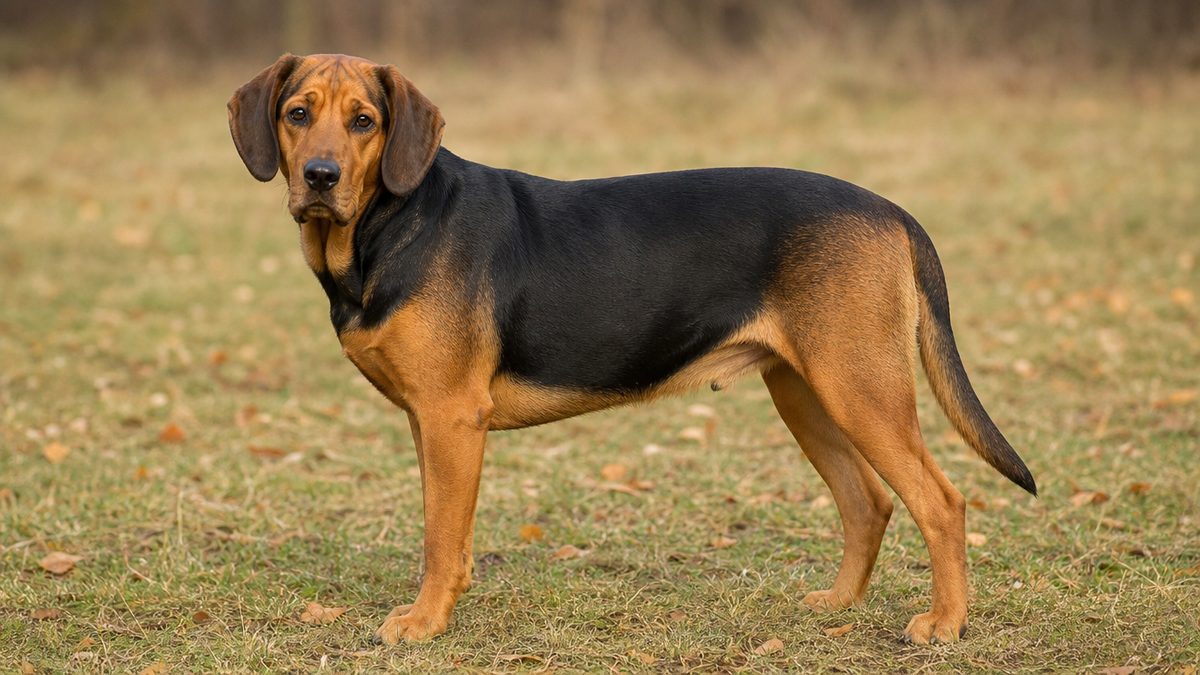
Before believing any page about this breed, look at whether it says Ogar Polski or Gonczy Polski, and whether the dog in the photograph carries a black or dark grey SADDLE over tan with darker tan ears. Google's own top results for 'polish hound dog' include two pages about the Gonczy Polski, so the confusion is upstream of any individual writer.
One mistake belongs to the search engine and is worth naming because it will keep happening. Asked about this breed's Indian price, Google's AI Mode correctly says the breed is virtually non-existent in India, then prints a converted British price, then an unsourced landed cost, then recommends an American coonhound at a precise Rs 98,999. Every one of those four moves is defensible on its own and the sequence is not a market report. Read what an engine says about availability. Do not read what it says about price.
Adoption, sourcing and what Indian law permits
The realistic route to a Polish Hound in India is to adopt a scent hound that is already here, because Indian import policy does not permit bringing a dog in to buy, sell or breed from, and no Indian breeder of this breed is evidenced anywhere.
The import position
Dogs sit under a Restricted heading in India's import policy. The lawful routes are a pet accompanying its owner with a valid pet book in the importer's name, research use with a CPCSEA recommendation, and defence or police use, with applications for trading or breeding purposes rejected and entry limited to a named list of ports. A commercial supply chain for the Ogar Polski cannot lawfully form in India, which explains the empty listings better than any theory about demand.
A returning resident relocating from Poland with their own registered dog is the case the pet route exists for. If that is you, work from the instrument governing the pet route rather than the commercial one, since the two have different law and different port lists behind them, and confirm requirements with the Animal Quarantine and Certification Station before booking anything.
What Indian breeding law would require
If this breed is ever bred in India, the Dog Breeding and Marketing Rules 2017 apply in full.
- Second Schedule Part II paragraph 6(3) prohibits two of the four named mating techniques. In breeding is defined as breeding between relatives of the 2nd to 4th grade in straight or side line within the first four generations, giving uncle to niece, nephew to aunt, cousin to cousin and grandparent to grandchild as examples. Incest breeding is mating between parents and children or between brother and sister. Only out breeding and line breeding are permitted.
- Second Schedule Part III paragraph 8(10) requires breeding dogs to have been tested for genetic defects including hip dysplasia, progressive retinal atrophy, night blindness and hypothyroidism among others.
- Second Schedule Part II paragraph 6(8) forbids tail docking, ear cropping, de-barking, de-clawing and any change of appearance by artificial means. Nothing in this breed's standard calls for any of them, which makes it lawful to produce here in a way some Continental breeds are not.
- Rule 8(1)(a) prohibits selling pups under eight weeks of age, and Rule 8(1)(b) prohibits selling dogs over six months without prior sterilisation unless the buyer is a registered breeder.
Paragraph 6(8) names de-barking among the prohibited procedures. For the loudest scent hound in Poland's native set, living in an Indian apartment block, that is not an abstract provision. If the voice is a problem you cannot manage, the lawful answer is training, environment and honest reconsideration of the breed, and surgery is not on the list.
The route that is actually open
India has no Polish Hound rescue because India has no Polish Hounds. It does have scent hounds and hound crosses in quantity, and a reader who wants this kind of dog can have one.
- Beagles in rescue, which arrive in Indian shelters regularly, including ex-laboratory dogs, and which are the closest widely available equivalent in nose, voice and temperament.
- Indian hounds in rescue, including Mudhol, Rampur, Chippiparai and Kanni types, already adapted to the climate.
- Indian pariah dogs, which are common, free, robust and by a wide margin the best-adapted large dog available in India.
- Municipal shelters and NGO adoption drives, several of which cost nothing beyond vaccination. Greater Chennai Corporation's six pet clinics provide treatment and anti-rabies vaccination free of cost.
Register whichever dog you take home. Delhi charges Rs 500 and has issued 18,958 pet dog certificates since 2021; Greater Chennai Corporation charges Rs 50 and issued 9,115 licences in 2024. For a hound that will one day follow a scent out of an open gate, a registered identity is worth considerably more than the fee.
Bonbeno does not recommend breeders, link puppy listings or quote live prices as offers. If you decide this is your breed and can source one properly in its country of origin, the questions that matter are hip and eye certificates for both parents, the coefficient of inbreeding for the mating, and what the line's ear history has been.
Polish Hound questions Indian buyers actually ask
Are Polish hounds good family dogs?
Yes, by the breed standard's own words. The FCI text says this outstanding hunting dog is also an excellent family dog, easy to maintain, devoted to the household and wary of strangers, which is unusually warm language for a governing document. The caveats are volume and scent: it is bred to give tongue loudly on a trail, and it will follow a scent through a recall.
Do Polish hounds bark a lot?
Yes, and it is the breed's job rather than a fault. The FCI standard describes the Polish Hound chasing game on the hot trail with loud barking, calls it giving tongue, and specifies that the voice is lower pitched in males and higher in females. A hound selected for three centuries to be audible over a Polish forest is not a quiet apartment dog.
Are Polish hounds rare?
Yes, and outside Poland they are very rare. Google India returns about 41 results for the quoted price query and about 123 for the bare breed query. No paper in PubMed names the breed under any of three name forms, the Orthopedic Foundation for Animals holds no breed code for it among 475 read from its own markup, and India's largest puppy listing site does not carry it.
What is a Polish dog breed?
Poland has several FCI-recognised native breeds, and the four an Indian reader will meet are the Polish Hound (Ogar Polski, FCI 52), the Polish Hunting Dog (Gonczy Polski, FCI 354), the Polish Greyhound (Chart Polski, FCI 333) and the Polish Lowland Sheepdog (Polski Owczarek Nizinny, FCI 251). The Polish Tatra Sheepdog, FCI 252, is a fifth.
How much does a Polish Hound cost in India?
There is no Indian price, because no Indian seller lists the breed. Google's own AI Mode states that there is no standard or official market price in India because the breed is virtually non-existent here, then prints Rs 50,000 to Rs 70,000 as a converted British price and Rs 2,00,000 to Rs 3,50,000 as a landed cost with no source attached to it.
How much does a Polish Hound weigh?
The FCI standard gives no number and says only that weight should be proportional to height at withers and the whole conformation. The UKC standard does give figures, at 55 to 70 pounds for males and 44 to 57 pounds for females, which is about 25 to 32 kg and 20 to 26 kg. Quote the UKC if you need a weight, and say which registry it came from.
When was the Polish Hound recognised by the FCI?
Two official FCI documents give two answers. The FCI's own breed record gives definitive acceptance on 29 January 1965, while the history section of FCI Standard 52 states that the first standard was included in the FCI register on 15 November 1966 under the number 52. The two are 22 months apart and both documents are current.
Is the Polish Hound descended from Egyptian hunting dogs?
No source supports it in the breed's own standard. A widely shared article carries that claim in its headline, but the words Egypt and Egyptian appear zero times across the 10,208 extracted characters of FCI Standard 52, whose history section is written by the Polish Kennel Club and traces the breed entirely through Polish literary sources from the eleventh century onward.
How long do Polish Hounds live?
No breed-specific study exists. McMillan 2024, the largest UK longevity dataset, lists the Polish Hound in Supplementary Table S5 with flag N, meaning the authors considered the breed and excluded it, so there is no median and no confidence interval. Secondary sites print 12 to 13 or 13 to 14 years, and neither figure traces to a study naming this breed.
Can a Polish Hound handle Indian heat?
Badly, and the breed standard is the reason. It requires a medium-length hard topcoat over a dense soft undercoat, which is insulation the dog cannot remove. Warsaw's hottest month averages 20.62 C while Chennai's coolest averages 24.09 C. India's own outdoor-housing rule bars keeping dogs that cannot tolerate local temperatures outdoors without written veterinary approval.
Does the Polish Hound need a working trial?
Yes, in FCI terms. The FCI files the Ogar Polski as subject to a working trial under its breeds nomenclature, which means a dog needs a working qualification as well as a show one for the international beauty championship. The Polish Greyhound, by contrast, is filed as not subject to a working trial.
Is the Polish Hound the same as the Polish Hunting Dog?
No, they are two separate FCI breeds. The Polish Hound is Ogar Polski, FCI 52, a large-sized hound at 56 to 65 cm. The Polish Hunting Dog is Gonczy Polski, FCI 354, a smaller and lighter scent hound. McMillan 2024's Supplementary Table S5 lists them as separate rows and flags both N, so neither has a lifespan figure.
Compare with similar breeds
Polish Hound sits in 1 Bonbeno group. Each one compares it directly against the breeds it is genuinely an alternative to, on the same figures.